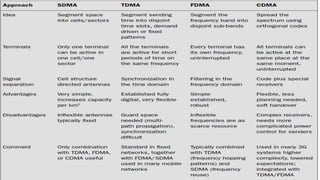
UNIT-V
Multiple Access Techniques
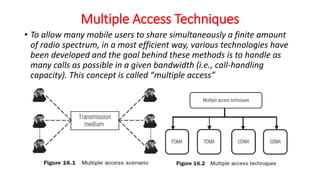
• To allow many mobile users to share simultaneously a finite amount
of radio spectrum, in a most efficient way, various technologies have
been developed and the goal behind these methods is to handle as
many calls as possible in a given bandwidth (i.e., call-handling
capacity). This concept is called “multiple access”
FDMA
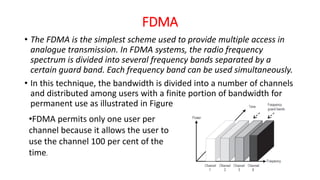
• The FDMA is the simplest scheme used to provide multiple access in
analogue transmission. In FDMA systems, the radio frequency
spectrum is divided into several frequency bands separated by a
certain guard band. Each frequency band can be used simultaneously.
• In this technique, the bandwidth is divided into a number of channels
and distributed among users with a finite portion of bandwidth for
permanent use as illustrated in Figure
•FDMA permits only one user per
channel because it allows the user to
use the channel 100 per cent of the
time.
• Frequency guard bands are provided between adjacent
signal spectra to minimize crosstalk between adjacent
channels.
• In FDMA, the channel has two frequencies, namely forward
channel and reverse channel.
• When the FDMA technique is employed, as long as the user
is engaged in “conversation,” no other user can access the
same spectrum space.
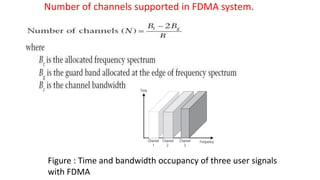
Number of channels supported in FDMA system.
Figure : Time and bandwidth occupancy of three user signals
with FDMA
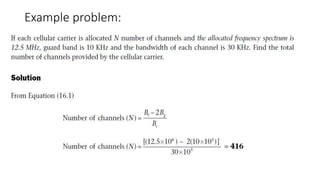
Example problem:
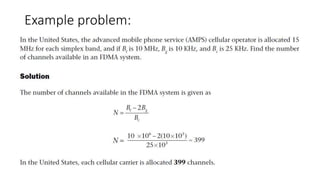
Example problem:
Advantages, disadvantages, and applications of
FDMA:
Advantages:
• 1. A continuous transmission scheme, and therefore of lower
complexity than TDMA scheme, for example, synchronization
requirements are not severe
• 2. Simple to implement from a hardware standpoint, because
multiple users are isolated by employing simple band pass filters
• 3. Fairly efficient with a small base population and when traffic is
constant
• 4. No channel equalization required
• 5. Capacity can be increased by reducing the information bit rate and
using an efficient digital speech coding scheme
TDMA
• TDMA systems were developed as FDMA system spectrum efficiency
became insufficient. In digital systems, continuous transmission is not
required because users do not use the allotted bandwidth all the
time. It allows several users to share the same frequency band by
dividing the timescale into different time slots which are periodically
allocated to each mobile user for the duration of a call.
• TDMA systems have the capability to split users into time slots
because they transfer digital data, instead of analogue data
commonly used in legacy FDMA systems.
TDMA
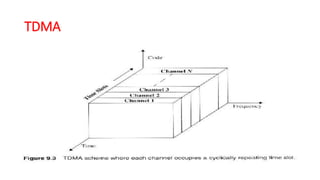
TDMA principle of operation
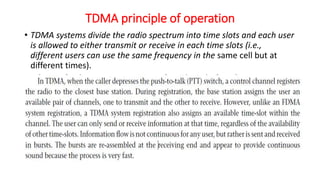
• TDMA systems divide the radio spectrum into time slots and each user
is allowed to either transmit or receive in each time slots (i.e.,
different users can use the same frequency in the same cell but at
different times).
• TDMA systems divide the radio spectrum into time slots and each user
is allowed to either transmit or receive in each time slots (i.e.,
different users can use the same frequency in the same cell but at
different times).
• Each user occupies a cyclically repeating time slot,
• A channel may be thought of as particular time slot that reoccurs
every frame, where N time slots comprise a frame.
• Transmit data in a buffer-and-burst method, the
transmission for any user is noncontinuous.
• digital data and digital modulation must be used with TDMA.
TDMA principle of operation
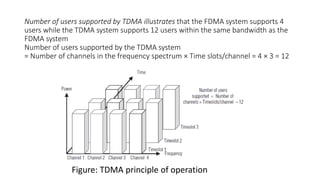
Number of users supported by TDMA illustrates that the FDMA system supports 4
users while the TDMA system supports 12 users within the same bandwidth as the
FDMA system
Number of users supported by the TDMA system
= Number of channels in the frequency spectrum × Time slots/channel = 4 × 3 = 12
Figure: TDMA principle of operation
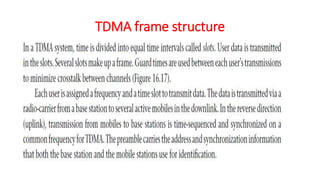
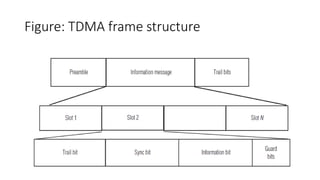
TDMA frame structure
Figure: TDMA frame structure
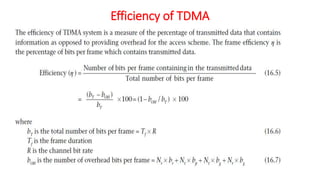
Efficiency of TDMA
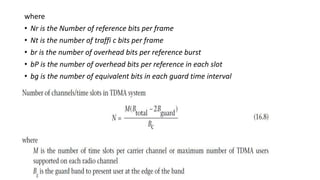
where
• Nr is the Number of reference bits per frame
• Nt is the number of traffi c bits per frame
• br is the number of overhead bits per reference burst
• bP is the number of overhead bits per reference in each slot
• bg is the number of equivalent bits in each guard time interval
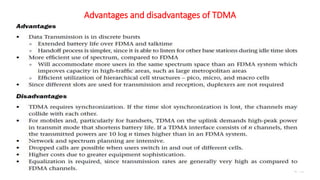
Advantages and disadvantages of TDMA
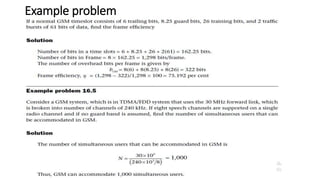
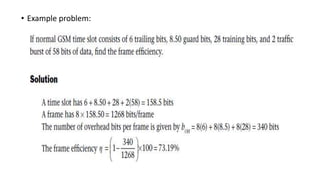
Example problem
• Example problem:
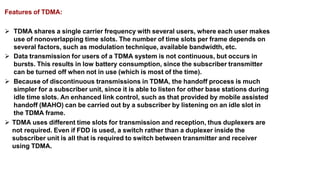
Features of TDMA:
 TDMA shares a single carrier frequency with several users, where each user makes
use of nonoverlapping time slots. The number of time slots per frame depends on
several factors, such as modulation technique, available bandwidth, etc.
 Data transmission for users of a TDMA system is not continuous, but occurs in
bursts. This results in low battery consumption, since the subscriber transmitter
can be turned off when not in use (which is most of the time).
 Because of discontinuous transmissions in TDMA, the handoff process is much
simpler for a subscriber unit, since it is able to listen for other base stations during
idle time slots. An enhanced link control, such as that provided by mobile assisted
handoff (MAHO) can be carried out by a subscriber by listening on an idle slot in
the TDMA frame.
 TDMA uses different time slots for transmission and reception, thus duplexers are
not required. Even if FDD is used, a switch rather than a duplexer inside the
subscriber unit is all that is required to switch between transmitter and receiver
using TDMA.
Features of TDMA (continued):
 Adaptive equalization is usually necessary in TDMA systems, since the transmission rates are
generally very high as compared to FDMA channels.
 In TDMA, the guard time should be minimized. If the transmitted signal at the edges of a time slot
are suppressed sharply in order to shorten the guard time, the transmitted spectrum will expand
and cause interference to adjacent channels.
 High synchronization overhead is required in TDMA systems because of burst transmissions.
TDMA transmissions are slotted, and this requires the receivers to be synchronized for each data
burst. In addition, guard slots are necessary to separate users, and this results in the TDMA
systems having larger overheads as compared to FDMA.
 TDMA has an advantage in that it is possible to allocate different numbers of time slots per frame
to different users. Thus bandwidth can be supplied on demand to different users by concatenating
or reassigning time slots based on priority.
Code division multiple access
• CDMA allows transmissions to occupy the entire bandwidth at the
same time without interference.
• CDMA uses spread-spectrum technique to increase spectrum
efficiency over current FDMA and TDMA systems.
• A spread-spectrum signal is a signal that has an extra modulation that
expands the signal bandwidth beyond what is required by the
underlying data modulation. Spread-spectrum communication
systems are useful for the following:
1. Suppressing interference
2. Making interception difficult
3. Accommodating fading and multipath channels
4. Providing a multiple-access capability
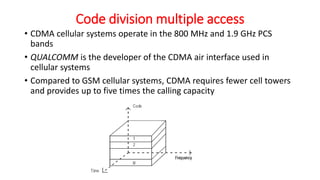
• CDMA cellular systems operate in the 800 MHz and 1.9 GHz PCS
bands
• QUALCOMM is the developer of the CDMA air interface used in
cellular systems
• Compared to GSM cellular systems, CDMA requires fewer cell towers
and provides up to five times the calling capacity
Code division multiple access
CDMA principle of operation
• CDMA assigns to each user a unique code sequence that is used to code
data before transmission. If a receiver knows the code sequence related to
a user, it is able to decode the received data.
• The codes are called Pseudorandom code sequences
• A user’s unique code separates the call from all other calls.
• The capacity of the system depends on the quality of current calls. As more
users are added, noise is added to the wideband frequency, therefore
decreasing the quality of current calls
• Types of codes used in CDMA:
Walsh codes: These are orthogonal codes. The spreading on forward link is
1.2288 Mbps and on reverse link is 307.2 Kbps. 64-bit Walsh codes are used
in IS 95A and IS 95B. 128-bit 1.Walshcodes are used in CDMA2000.
2.Short PRN code: (16 bit) are used to identify the base station and the cell.
3.Long PRN code : (42-bit code) are used to identify mobile station on
reverse link.
• Advantages
• Greatest spectrum efficiency: capacity increases about 8 to 10 times that of an
analogue system and 4 to 5 times that of other digital systems, which makes it most
useful in high traffic areas with a large number of users and limited spectrum.
• CDMA improves call quality by filtering out background noise, crosstalk, and
interference.
• “Soft handoffs”: because of the multiple diversities in use, handoffs between cells are
undetected by the user.
• Simplified frequency planning: all users on a CDMA system use the same radio
frequency spectrum. Engineering detailed frequency plans are not necessary. Frequency
re-tunes for expansion are eliminated. Fewer cells are required for quality coverage.
• Random Walsh codes enhance user privacy; a spread-spectrum advantage.
• Precise power control increases talk time and battery life for mobile phones.
• Disadvantages
• Backwards compatibility techniques are costly.
• Currently, equipment is expensive.
• Difficult to optimize to maximize performance.
• Low traffic areas lead to inefficient use of spectrum and equipment resources.
Handoffs in CDMA mobile systems
• The act of transferring a call of from one base station to another is
termed as handoff. Handoff occurs when a call has to be handed off
from one cell to another as the user moves between cells.
• Hard handoff and soft handoff
• In a traditional “hard” handoff, the connection to the current cell is
broken and then the connection to the new cell is made. This is
known as a “break-before-make” or hard handoff.
• Since all cells in CDMA use the same frequency, it is possible to make
the connection to the new cell before leaving the current cell. This is
known as a “make-before-break” or “soft handoff”.
• Soft handoff requires less power, which reduces interference and
increases capacity. The implementation of handoff is different in GSM
and CDMA standards.
Near-far problem
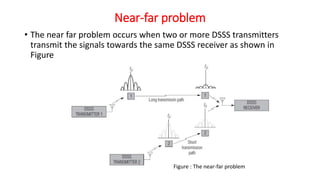
• The near far problem occurs when two or more DSSS transmitters
transmit the signals towards the same DSSS receiver as shown in
Figure
Figure : The near-far problem
• In this figure, two DSSS transmitters transmit the signals towards a DSSS
receiver, one transmitter being closer to the receiver than the other
transmitter. The power of the two spread-spectrum signals transmitter is
the same at the antenna of each DSSS transmitter.
• However, the two spread-spectrum signals at the DSSS receiver antenna
have different power levels because the paths between the two
transmitters and the receiver are of different lengths.
• The power of the spread-spectrum signal coming from DSSS transmitter 1
is lower than that coming from DSSS transmitter 2 because transmitter 1 is
farther away from the receiver than transmitter 2.
• Any spread spectrum signal other than the desired one produces
interference similar to that caused by noise, this results in a rather poor
S/N ratio at the DSSS receiver input. Consequently, errors are likely to
appear in the recovered data when the process gain of the system is not
sufficient to overcome the S/N ratio deficit observed at the DSSS receiver
input.
Near-far problem contd------
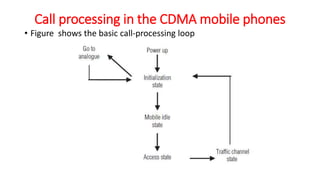
Call processing in the CDMA mobile phones
• Figure shows the basic call-processing loop
• After power up, the initialization state determines which system to
use (whether analogue or CDMA).
• If it is CDMA, it goes into sync processing. Once the system is
synchronized, the system goes into the mobile station idle state,
where it monitors the paging channel.
• If a call is to be originated or the mobile is paged, the system goes
into the access state.
• Once a call is setup, the phone moves over to the traffic channel
state, where the forward and reverse traffic channels are used to
communicate voice and messaging.
• During the idle state, the mobile will monitor the paging channel.
Various messages pertaining to setup and operation are on the paging
channel.
• Certain situations will trigger the mobile to drop out of the traffic
state (drop the call on purpose):
• Mobile ACK failure: Certain messages require an ACK (Acknowledge
signal); generally, a mobile will retransmit the message after 400 ms,
but if no ACK comes after three tries, the mobile drops the call.
• Base station ACK failure: This is similar to the mobile ACK failure, but
it is not standardized.
• Mobile fade timer: The timer is set to 5 s after receiving two
consecutive good frames. If the timer gets to zero, the call drops.
• Mobile bad frames: If there are 12 consecutive bad frames, the mobile
drops the call.
• Base station bad frames: This is similar to mobile bad frames, but not
standardized (i.e., manufacturers can implement this, however, they
choose).
Space division multiple access
• SDMA enables users to share simultaneously the same
bandwidth in different geographical locations. SDMA solves
capacity problem of wireless communication systems by
exploitation of the spatial dimension which makes it possible
to identify the individual users, even when they are in the
same time/frequency/code domains. SDMA can be achieved
using beam forming or sectorization.
Adaptive antenna or SDMA-based cellular network
• By using adaptive antennas arrays, sometimes called smart antennas in
mobile radio systems, signals can be received and sent only from and into a
limited angular range, following the directional nature of multipath. This
improves coverage or link quality in noise-limited situations and enhances
capacity in interference-limited situations.
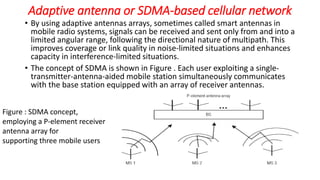
• The concept of SDMA is shown in Figure . Each user exploiting a single-
transmitter-antenna-aided mobile station simultaneously communicates
with the base station equipped with an array of receiver antennas.
Figure : SDMA concept,
employing a P-element receiver
antenna array for
supporting three mobile users
Advantages of SDMA technique
• 1. Range extension: The coverage area of the antenna array is
greater than that of any single element as a result of the gain
provided by the array. When a system is constructed using SDMA, the
number of cells required to cover a given area can be substantially
reduced.
• 2. Interference suppression: Interference from other systems and
from users in other cells is significantly reduced by exploiting the
desired user’s unique channel impulse responses (CIRs). In “noisy”
areas where range is limited by interference, spatially selective
transmission and reception result in range extension.
• 3. Multipath effect elimination: The copies of the desired signal that
have arrived at the antenna after bouncing from objects between the
signal source and the antenna can often be mitigated. In certain
cases, the multipath can actually be used to reinforce the desired
signal.
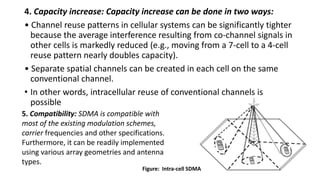
4. Capacity increase: Capacity increase can be done in two ways:
• Channel reuse patterns in cellular systems can be significantly tighter
because the average interference resulting from co-channel signals in
other cells is markedly reduced (e.g., moving from a 7-cell to a 4-cell
reuse pattern nearly doubles capacity).
• Separate spatial channels can be created in each cell on the same
conventional channel.
• In other words, intracellular reuse of conventional channels is
possible
5. Compatibility: SDMA is compatible with
most of the existing modulation schemes,
carrier frequencies and other specifications.
Furthermore, it can be readily implemented
using various array geometries and antenna
types.
Figure: Intra-cell SDMA
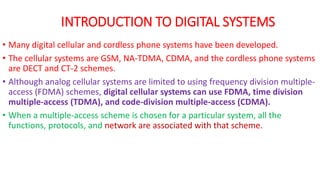
• Many digital cellular and cordless phone systems have been developed.
• The cellular systems are GSM, NA-TDMA, CDMA, and the cordless phone systems
are DECT and CT-2 schemes.
• Although analog cellular systems are limited to using frequency division multiple-
access (FDMA) schemes, digital cellular systems can use FDMA, time division
multiple-access (TDMA), and code-division multiple-access (CDMA).
• When a multiple-access scheme is chosen for a particular system, all the
functions, protocols, and network are associated with that scheme.
INTRODUCTION TO DIGITAL SYSTEMS
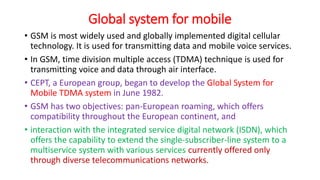
Global system for mobile
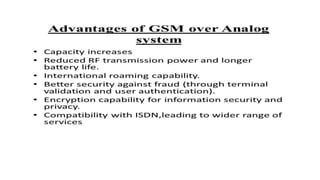
• GSM is most widely used and globally implemented digital cellular
technology. It is used for transmitting data and mobile voice services.
• In GSM, time division multiple access (TDMA) technique is used for
transmitting voice and data through air interface.
• CEPT, a European group, began to develop the Global System for
Mobile TDMA system in June 1982.
• GSM has two objectives: pan-European roaming, which offers
compatibility throughout the European continent, and
• interaction with the integrated service digital network (ISDN), which
offers the capability to extend the single-subscriber-line system to a
multiservice system with various services currently offered only
through diverse telecommunications networks.
Flexibility and increased capacity:
•GSM equipment is fully controlled by its software.
Network re-configurations can be made quickly and
easily with minimum manual intervention.
•new speech algorithms
•flexibility of international roaming.
•More carriers in a given area to give better
frequency reuse.
•Multi-band networks and mobiles
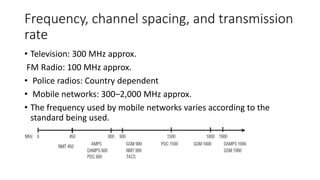
Frequency, channel spacing, and transmission
rate
• Television: 300 MHz approx.
FM Radio: 100 MHz approx.
• Police radios: Country dependent
• Mobile networks: 300–2,000 MHz approx.
• The frequency used by mobile networks varies according to the
standard being used.
• Transmission rate:-The amount of information transmitted over a radio
channel over a period of time is known as the transmission rate.In GSM, the
net bit rate over the air interface is 270 kbps.
• Improved security and confidentiality:-With GSM, both the mobile equipment
(ME) and mobile subscriber are identified. The ME has a unique number coded
into it when it is manufactured.
• This can be checked against a database every time the mobile makes a call
to validate the actual equipment. The subscriber is authenticated by use of
a smart card known as a SIM.
• GSM also offers the capability to encrypt all signals over the air interface.
• it makes it very diffi cult for the casual “hacker” to listen-in to personal calls.
• In addition to this, the GSM air interface supports frequency hopping. This
entails each “burst” of information being transmitted to/from the MS/base
site on a different frequency, again making it very difficult for an observer
(hacker) to follow/listen to a specific call.
• Flexible handover processes
• Switching and control
• Noise robust:-In order to combat the problems caused by noise, GSM uses digital
technology instead of analogue. By using digital signals, we can manipulate the data
and include sophisticated error protection, detection, and correction software.
• User services:- Teleservices or telephony services:-A teleservice utilizes the
capabilities of a bearer service to transport data, defining which capabilities are
required and how they should be set up. Voice calls, Videotext and facsimile
• ISDN compatibility in GSM
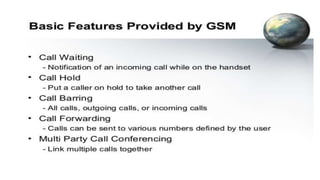
• Supplementary services
• Short text messages (SMS):
• Multiparty service or conferencing
• Call waiting
• Call hold
• Call forwarding
• Call barring
• Number identification
• Advice of Charge
• Closed User Groups
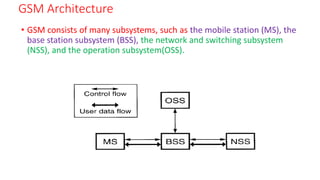
• GSM consists of many subsystems, such as the mobile station (MS), the
base station subsystem (BSS), the network and switching subsystem
(NSS), and the operation subsystem(OSS).
GSM Architecture
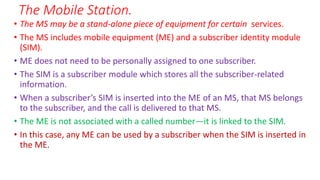
• The MS may be a stand-alone piece of equipment for certain services.
• The MS includes mobile equipment (ME) and a subscriber identity module
(SIM).
• ME does not need to be personally assigned to one subscriber.
• The SIM is a subscriber module which stores all the subscriber-related
information.
• When a subscriber’s SIM is inserted into the ME of an MS, that MS belongs
to the subscriber, and the call is delivered to that MS.
• The ME is not associated with a called number—it is linked to the SIM.
• In this case, any ME can be used by a subscriber when the SIM is inserted in
the ME.
The Mobile Station.
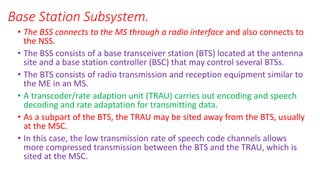
• The BSS connects to the MS through a radio interface and also connects to
the NSS.
• The BSS consists of a base transceiver station (BTS) located at the antenna
site and a base station controller (BSC) that may control several BTSs.
• The BTS consists of radio transmission and reception equipment similar to
the ME in an MS.
• A transcoder/rate adaption unit (TRAU) carries out encoding and speech
decoding and rate adaptation for transmitting data.
• As a subpart of the BTS, the TRAU may be sited away from the BTS, usually
at the MSC.
• In this case, the low transmission rate of speech code channels allows
more compressed transmission between the BTS and the TRAU, which is
sited at the MSC.
Base Station Subsystem.
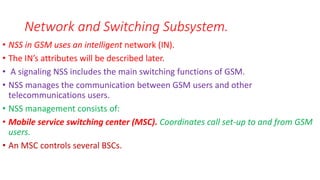
• NSS in GSM uses an intelligent network (IN).
• The IN’s attributes will be described later.
• A signaling NSS includes the main switching functions of GSM.
• NSS manages the communication between GSM users and other
telecommunications users.
• NSS management consists of:
• Mobile service switching center (MSC). Coordinates call set-up to and from GSM
users.
• An MSC controls several BSCs.
Network and Switching Subsystem.
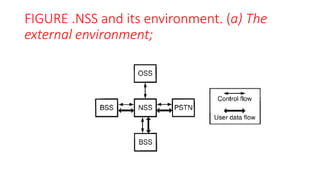
FIGURE .NSS and its environment. (a) The
external environment;
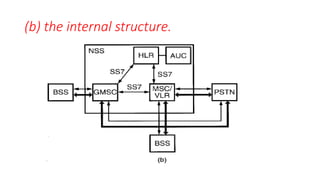
(b) the internal structure.
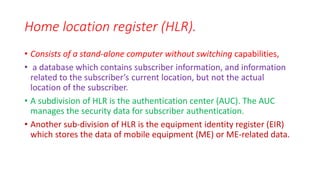
• Consists of a stand-alone computer without switching capabilities,
• a database which contains subscriber information, and information
related to the subscriber’s current location, but not the actual
location of the subscriber.
• A subdivision of HLR is the authentication center (AUC). The AUC
manages the security data for subscriber authentication.
• Another sub-division of HLR is the equipment identity register (EIR)
which stores the data of mobile equipment (ME) or ME-related data.
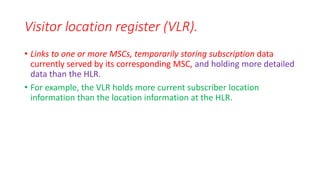
Home location register (HLR).
• Links to one or more MSCs, temporarily storing subscription data
currently served by its corresponding MSC, and holding more detailed
data than the HLR.
• For example, the VLR holds more current subscriber location
information than the location information at the HLR.
Visitor location register (VLR).
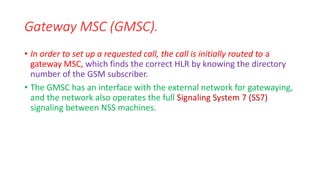
• In order to set up a requested call, the call is initially routed to a
gateway MSC, which finds the correct HLR by knowing the directory
number of the GSM subscriber.
• The GMSC has an interface with the external network for gatewaying,
and the network also operates the full Signaling System 7 (SS7)
signaling between NSS machines.
Gateway MSC (GMSC).
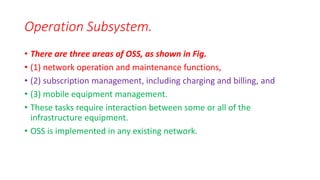
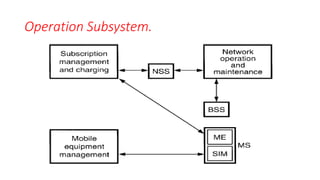
• There are three areas of OSS, as shown in Fig.
• (1) network operation and maintenance functions,
• (2) subscription management, including charging and billing, and
• (3) mobile equipment management.
• These tasks require interaction between some or all of the
infrastructure equipment.
• OSS is implemented in any existing network.
Operation Subsystem.
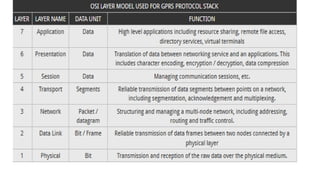
Layer Modeling of GSM
• The Open System Interconnection(OSI) of GSM consisting of five
layers:
1. Transmission(TX) layer: The TX layer sets up a connection between
MS and BTS.
2. Radio Resource Management(RR): The RR layer refers to the
protocol for management of the transmission over the radio
interface and provides a stable link between MS and BSC. The BSS
performs most of the RR functions.
3. Mobility Management layer(MM) layer: The MM layer 1 manages
the subscriber databases, including location data, and layer 2
manages authentication activities, SIM, HLR, and AUC.
4. Communication Management(CM) layer:
The following functions are parts of CM layer
Call Control The CM layer sets up calls, maintain calls, and releases calls.
Supplementary services management Allows users to have some control
of their calls in the network.
Short message services(SMS) A SMS service center may connect to
several GSM networks. Two functions of SMS are
a) Mobile originating short message
b) Mobile terminating short message
5. Operation Administration and Maintenance(OAM) layer: OSS layer is the
integral part of OAM layer. All the subsystems such as BSS and NSS,
contribute to the OAM operation and maintainnance functions.
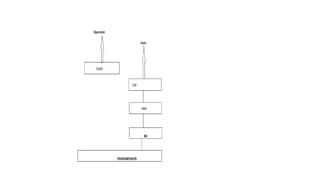
Following figure shows five layers of GSM
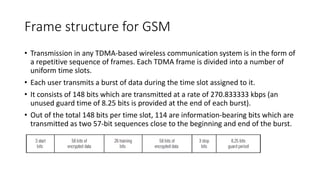
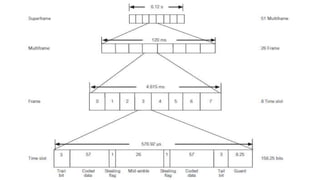
Frame structure for GSM
• Transmission in any TDMA-based wireless communication system is in the form of
a repetitive sequence of frames. Each TDMA frame is divided into a number of
uniform time slots.
• Each user transmits a burst of data during the time slot assigned to it.
• It consists of 148 bits which are transmitted at a rate of 270.833333 kbps (an
unused guard time of 8.25 bits is provided at the end of each burst).
• Out of the total 148 bits per time slot, 114 are information-bearing bits which are
transmitted as two 57-bit sequences close to the beginning and end of the burst.
GSM Channels
• Physical Channels: There are three kinds of physical channels, also
called traffic channels (TCHs):
• 1. TCH/F (full rate): Transmits a speech code of 13 kbps or three
data-mode rates, 12, 6, and 3.6 kbps.
• 2. TCH/H (half rate): Transmits a speech code of 7 kbps or two data
modes, 6 and 3.6 kbps.
• 3. TCH/8 (one-eighth rate): Used for low-rate signaling channels,
common channels, and data channels.
• Logic channels:
• 1. Common channels: All the common channels are embedded in
different traffic channels. They are grouped by the same cycle (51 × 8
BP), where BP stands for burst period (i.e.,time slot), which is 577 μs.
• 2. Downlink common channels: There are five downlink
unidirectional channels, shared or grouped by a TCH.
• (i) Frequency correction channel (FCCH) repeats once every 51×8
BPs; used to identify a beacon frequency.
• (ii)Synchronization channel (SCH) follows each FCCH slot by 8 BPs.
• (iii)Broadcast control channel (BCCH) is broadcast regularly in each
cell and received by all the mobile stations in the idle mode.
• (iv)Paging and access grant channel (PAGCH) is used for the
incoming call received at the mobile station. The access grant
channel is answered from the base station and allocates a channel
during the access procedure of setting up a call.
• (v)Call broadcast channel (CBCH). Each cell broadcasts a short
message for 2s from the network to the mobile station in idle mode.
Half a downlink TCH/8 is used, and special CBCH design constraints
exist because of the need for sending two channels (CBCH and BCCH)
in parallel.
• 3. Uplink common channels: The random-access channel (RACH) is
the only common uplink channel. RACH is the channel that the
mobile station chooses to access the calls.
• There are two rates: RACH/F (full rate, one time slot every 8 BP), and
RACH/H (half rate, using 23 time slots in the 51 × 8 BP cycle, where 8
BP cycle [i.e. a frame] is 4.615ms).
• 4. Signaling channels: All the signaling channels have chosen one of
the physical channels,and the logical channels names are based on
their logical functions:
• 5. Slow Associated Control Channel (SACCH): A slow-rate TCH used
for signaling transport and used for non urgent procedures, mainly
handover decisions. It uses one-eighth rate. The TCH/F is always
allocated with SACCH. This combined TCH and SACCH is denoted
TACH/F.
6. Fast Associated Control Channel (FACCH): Indicates cell
establishment, authenticates subscribers, or commands a handover.
7. Stand-alone Dedicated Control Channel (SDCCH): Occasionally the
connection between a mobile station and the network is used solely
for passing signaling information and not for calls.
This connection may be at the user’s demand or for other management
operations such as updating the unit’s location. It operates at a very
low rate and uses a TCH/8 channel. Radio slots are allocated to users
only when call penetration is needed. There are two modes,
dedicated and idle. The mode used depends on the uplink and the
downlink. In GSM terminology, the downlink is the signal transmitted
from the base station to the mobile station, and the uplink is the
signal transmitted in the opposite direction.
8. Voice/data channels: Each time slot of a voice channel contains 260
bits per block. The entire block contains 316 bits. Each time slot of a
data channel contains 120 or 240 bits per block.
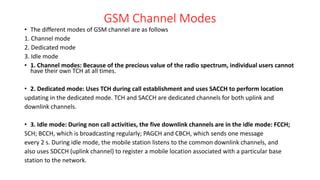
GSM Channel Modes
• The different modes of GSM channel are as follows
1. Channel mode
2. Dedicated mode
3. Idle mode
• 1. Channel modes: Because of the precious value of the radio spectrum, individual users cannot
have their own TCH at all times.
• 2. Dedicated mode: Uses TCH during call establishment and uses SACCH to perform location
updating in the dedicated mode. TCH and SACCH are dedicated channels for both uplink and
downlink channels.
• 3. Idle mode: During non call activities, the five downlink channels are in the idle mode: FCCH;
SCH; BCCH, which is broadcasting regularly; PAGCH and CBCH, which sends one message
every 2 s. During idle mode, the mobile station listens to the common downlink channels, and
also uses SDCCH (uplink channel) to register a mobile location associated with a particular base
station to the network.
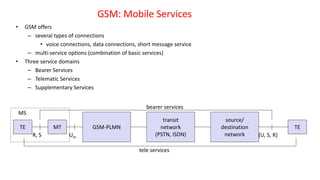
• GSM offers
– several types of connections
• voice connections, data connections, short message service
– multi-service options (combination of basic services)
• Three service domains
– Bearer Services
– Telematic Services
– Supplementary Services
GSM-PLMN
transit
network
(PSTN, ISDN)
source/
destination
network
TE TE
bearer services
tele services
R, S (U, S, R)
Um
MT
MS
GSM: Mobile Services
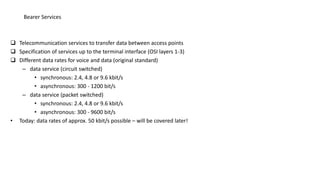
 Telecommunication services to transfer data between access points
 Specification of services up to the terminal interface (OSI layers 1-3)
 Different data rates for voice and data (original standard)
– data service (circuit switched)
• synchronous: 2.4, 4.8 or 9.6 kbit/s
• asynchronous: 300 - 1200 bit/s
– data service (packet switched)
• synchronous: 2.4, 4.8 or 9.6 kbit/s
• asynchronous: 300 - 9600 bit/s
• Today: data rates of approx. 50 kbit/s possible – will be covered later!
Bearer Services
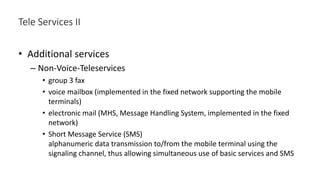
• Additional services
– Non-Voice-Teleservices
• group 3 fax
• voice mailbox (implemented in the fixed network supporting the mobile
terminals)
• electronic mail (MHS, Message Handling System, implemented in the fixed
network)
• Short Message Service (SMS)
alphanumeric data transmission to/from the mobile terminal using the
signaling channel, thus allowing simultaneous use of basic services and SMS
Tele Services II
 Services in addition to the basic services, cannot be offered stand-alone
 Similar to ISDN services besides lower bandwidth due to the radio link
 May differ between different service providers, countries and protocol versions
 Important services
– identification: forwarding of caller number
– suppression of number forwarding
– automatic call-back
– conferencing with up to 7 participants
– locking of the mobile terminal (incoming or outgoing calls)
Supplementary services
Concepts related to Multiple Access Scheme of GSM
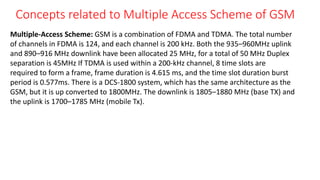
Multiple-Access Scheme: GSM is a combination of FDMA and TDMA. The total number
of channels in FDMA is 124, and each channel is 200 kHz. Both the 935–960MHz uplink
and 890–916 MHz downlink have been allocated 25 MHz, for a total of 50 MHz Duplex
separation is 45MHz If TDMA is used within a 200-kHz channel, 8 time slots are
required to form a frame, frame duration is 4.615 ms, and the time slot duration burst
period is 0.577ms. There is a DCS-1800 system, which has the same architecture as the
GSM, but it is up converted to 1800MHz. The downlink is 1805–1880 MHz (base TX) and
the uplink is 1700–1785 MHz (mobile Tx).
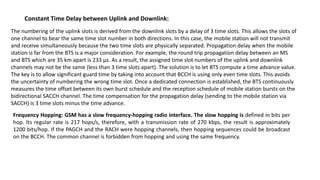
The numbering of the uplink slots is derived from the downlink slots by a delay of 3 time slots. This allows the slots of
one channel to bear the same time slot number in both directions. In this case, the mobile station will not transmit
and receive simultaneously because the two time slots are physically separated. Propagation delay when the mobile
station is far from the BTS is a major consideration. For example, the round trip propagation delay between an MS
and BTS which are 35 km apart is 233 μs. As a result, the assigned time slot numbers of the uplink and downlink
channels may not be the same (less than 3 time slots apart). The solution is to let BTS compute a time advance value.
The key is to allow significant guard time by taking into account that BCCH is using only even time slots. This avoids
the uncertainty of numbering the wrong time slot. Once a dedicated connection is established, the BTS continuously
measures the time offset between its own burst schedule and the reception schedule of mobile station bursts on the
bidirectional SACCH channel. The time compensation for the propagation delay (sending to the mobile station via
SACCH) is 3 time slots minus the time advance.
Constant Time Delay between Uplink and Downlink:
Frequency Hopping: GSM has a slow frequency-hopping radio interface. The slow hopping is defined in bits per
hop. Its regular rate is 217 hops/s, therefore, with a transmission rate of 270 kbps, the result is approximately
1200 bits/hop. If the PAGCH and the RACH were hopping channels, then hopping sequences could be broadcast
on the BCCH. The common channel is forbidden from hopping and using the same frequency.
GSM operation
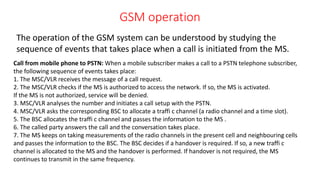
The operation of the GSM system can be understood by studying the
sequence of events that takes place when a call is initiated from the MS.
Call from mobile phone to PSTN: When a mobile subscriber makes a call to a PSTN telephone subscriber,
the following sequence of events takes place:
1. The MSC/VLR receives the message of a call request.
2. The MSC/VLR checks if the MS is authorized to access the network. If so, the MS is activated.
If the MS is not authorized, service will be denied.
3. MSC/VLR analyses the number and initiates a call setup with the PSTN.
4. MSC/VLR asks the corresponding BSC to allocate a traffi c channel (a radio channel and a time slot).
5. The BSC allocates the traffi c channel and passes the information to the MS .
6. The called party answers the call and the conversation takes place.
7. The MS keeps on taking measurements of the radio channels in the present cell and neighbouring cells
and passes the information to the BSC. The BSC decides if a handover is required. If so, a new traffi c
channel is allocated to the MS and the handover is performed. If handover is not required, the MS
continues to transmit in the same frequency.
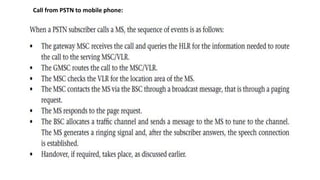
Call from PSTN to mobile phone:
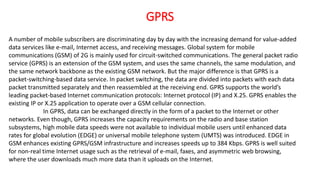
GPRS
A number of mobile subscribers are discriminating day by day with the increasing demand for value-added
data services like e-mail, Internet access, and receiving messages. Global system for mobile
communications (GSM) of 2G is mainly used for circuit-switched communications. The general packet radio
service (GPRS) is an extension of the GSM system, and uses the same channels, the same modulation, and
the same network backbone as the existing GSM network. But the major difference is that GPRS is a
packet-switching-based data service. In packet switching, the data are divided into packets with each data
packet transmitted separately and then reassembled at the receiving end. GPRS supports the world’s
leading packet-based Internet communication protocols: Internet protocol (IP) and X.25. GPRS enables the
existing IP or X.25 application to operate over a GSM cellular connection.
In GPRS, data can be exchanged directly in the form of a packet to the Internet or other
networks. Even though, GPRS increases the capacity requirements on the radio and base station
subsystems, high mobile data speeds were not available to individual mobile users until enhanced data
rates for global evolution (EDGE) or universal mobile telephone system (UMTS) was introduced. EDGE in
GSM enhances existing GPRS/GSM infrastructure and increases speeds up to 384 Kbps. GPRS is well suited
for non-real time Internet usage such as the retrieval of e-mail, faxes, and asymmetric web browsing,
where the user downloads much more data than it uploads on the Internet.
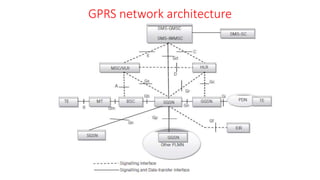
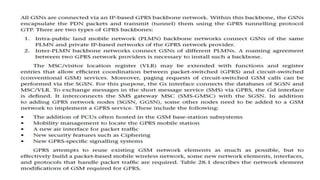
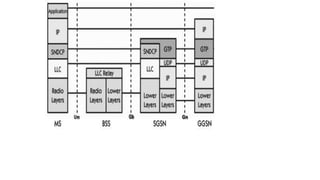
GPRS network architecture
• The main features of the GPRS architecture are its flexibility, scalability,
interoperability, and roaming capability. The network architecture of a
GPRS system is shown in Figure.
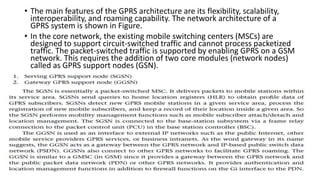
• In the core network, the existing mobile switching centers (MSCs) are
designed to support circuit-switched traffic and cannot process packetized
traffic. The packet-switched traffic is supported by enabling GPRS on a GSM
network. This requires the addition of two core modules (network nodes)
called as GPRS support nodes (GSN).
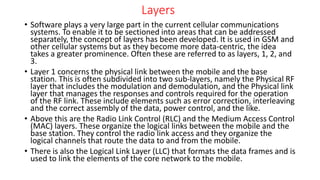
Layers
• Software plays a very large part in the current cellular communications
systems. To enable it to be sectioned into areas that can be addressed
separately, the concept of layers has been developed. It is used in GSM and
other cellular systems but as they become more data-centric, the idea
takes a greater prominence. Often these are referred to as layers, 1, 2, and
3.
• Layer 1 concerns the physical link between the mobile and the base
station. This is often subdivided into two sub-layers, namely the Physical RF
layer that includes the modulation and demodulation, and the Physical link
layer that manages the responses and controls required for the operation
of the RF link. These include elements such as error correction, interleaving
and the correct assembly of the data, power control, and the like.
• Above this are the Radio Link Control (RLC) and the Medium Access Control
(MAC) layers. These organize the logical links between the mobile and the
base station. They control the radio link access and they organize the
logical channels that route the data to and from the mobile.
• There is also the Logical Link Layer (LLC) that formats the data frames and is
used to link the elements of the core network to the mobile.
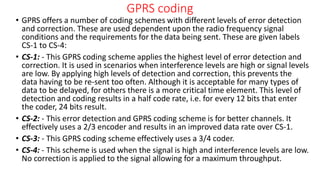
GPRS coding
• GPRS offers a number of coding schemes with different levels of error detection
and correction. These are used dependent upon the radio frequency signal
conditions and the requirements for the data being sent. These are given labels
CS-1 to CS-4:
• CS-1: - This GPRS coding scheme applies the highest level of error detection and
correction. It is used in scenarios when interference levels are high or signal levels
are low. By applying high levels of detection and correction, this prevents the
data having to be re-sent too often. Although it is acceptable for many types of
data to be delayed, for others there is a more critical time element. This level of
detection and coding results in a half code rate, i.e. for every 12 bits that enter
the coder, 24 bits result.
• CS-2: - This error detection and GPRS coding scheme is for better channels. It
effectively uses a 2/3 encoder and results in an improved data rate over CS-1.
• CS-3: - This GPRS coding scheme effectively uses a 3/4 coder.
• CS-4: - This scheme is used when the signal is high and interference levels are low.
No correction is applied to the signal allowing for a maximum throughput.
GPRS physical channel
GPRS channel allocation
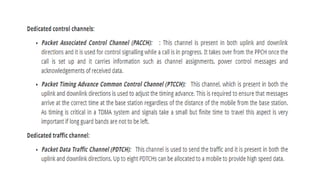
Logical channels
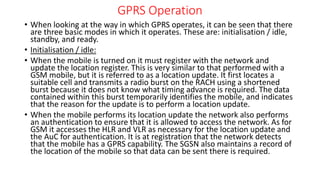
GPRS Operation
• When looking at the way in which GPRS operates, it can be seen that there
are three basic modes in which it operates. These are: initialisation / idle,
standby, and ready.
• Initialisation / idle:
• When the mobile is turned on it must register with the network and
update the location register. This is very similar to that performed with a
GSM mobile, but it is referred to as a location update. It first locates a
suitable cell and transmits a radio burst on the RACH using a shortened
burst because it does not know what timing advance is required. The data
contained within this burst temporarily identifies the mobile, and indicates
that the reason for the update is to perform a location update.
• When the mobile performs its location update the network also performs
an authentication to ensure that it is allowed to access the network. As for
GSM it accesses the HLR and VLR as necessary for the location update and
the AuC for authentication. It is at registration that the network detects
that the mobile has a GPRS capability. The SGSN also maintains a record of
the location of the mobile so that data can be sent there is required.
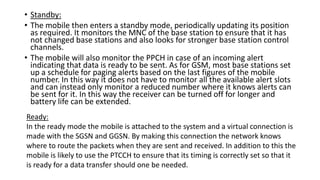
• Standby:
• The mobile then enters a standby mode, periodically updating its position
as required. It monitors the MNC of the base station to ensure that it has
not changed base stations and also looks for stronger base station control
channels.
• The mobile will also monitor the PPCH in case of an incoming alert
indicating that data is ready to be sent. As for GSM, most base stations set
up a schedule for paging alerts based on the last figures of the mobile
number. In this way it does not have to monitor all the available alert slots
and can instead only monitor a reduced number where it knows alerts can
be sent for it. In this way the receiver can be turned off for longer and
battery life can be extended.
Ready:
In the ready mode the mobile is attached to the system and a virtual connection is
made with the SGSN and GGSN. By making this connection the network knows
where to route the packets when they are sent and received. In addition to this the
mobile is likely to use the PTCCH to ensure that its timing is correctly set so that it
is ready for a data transfer should one be needed.
3G Systems
• 3G mobile systems offer high bit rate services, high-quality videos,
images, and fast web access. They differ significantly from the 2G
technologies (global system for mobile communication [GSM] and
CDMA1). The aim of 3G is to provide communication services from
person to person at any place and at any time through any medium
using a compact lightweight terminal with guaranteed quality of
service (QoS) and security. The two standards of 3G technology that
are most popular in the world are
• Wideband code division multiple access (WCDMA)
• Code division multiple access 2000 (CDMA2000).
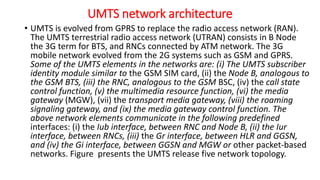
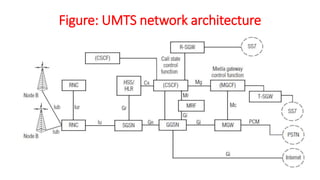
UMTS network architecture
• UMTS is evolved from GPRS to replace the radio access network (RAN).
The UMTS terrestrial radio access network (UTRAN) consists in B Node
the 3G term for BTS, and RNCs connected by ATM network. The 3G
mobile network evolved from the 2G systems such as GSM and GPRS.
Some of the UMTS elements in the networks are: (i) The UMTS subscriber
identity module similar to the GSM SIM card, (ii) the Node B, analogous to
the GSM BTS, (iii) the RNC, analogous to the GSM BSC, (iv) the call state
control function, (v) the multimedia resource function, (vi) the media
gateway (MGW), (vii) the transport media gateway, (viii) the roaming
signaling gateway, and (ix) the media gateway control function. The
above network elements communicate in the following predefined
interfaces: (i) the Iub interface, between RNC and Node B, (ii) the Iur
interface, between RNCs, (iii) the Gr interface, between HLR and GGSN,
and (iv) the Gi interface, between GGSN and MGW or other packet-based
networks. Figure presents the UMTS release five network topology.
Figure: UMTS network architecture
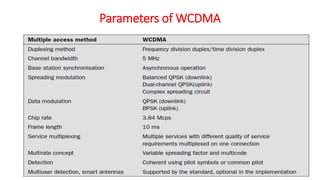
• Salient features of WCDMA
• WCDMA uses a new spectrum with a 5 MHz carrier and uses the DS-CDMA radio access (multiple
access) technology. It provides 50 times higher data rate than in present GSM networks and 10 times
higher data rate than in GPRS networks.
• WCDMA is a technology for wideband digital radio communications of Internet, multimedia,
video, and other capacity demanding applications.
• WCDMA is the demanding 3G technology providing higher capacity for voice and data at higher data
rates.
• The wider band makes it possible to divide and combine reception signals propagated through
multipath-fading channels into more multipath components, which helps to improve the
reception quality through RAKE time diversity.
• Its merits include the ability to accommodate a greater number of users who communicate
at high speed (e.g., at 64 and 384 Kbps). It has also been verified in experiments that high quality data
transmission at 2 Mbps can be implemented using the 5 MHz bandwidth.
• The wide bandwidth of WCDMA gives an inherent performance gain over the previous
cellular systems and it reduces the fading of the radio signal thus improving the performance.
• WCDMA uses dual mode packet access scheme. Packet transfer can take place on both the common
and dedicated channels. Owing to this phenomenon, packet access can be optimized for fast access
response as well as for maximum throughput.
• The advance form of WCDMA is high-speed downlink packet access (HSDPA). HSDPA is a technology that
leads to the cost-effective delivery of the most advance data services and significantly improves the
network capacity.
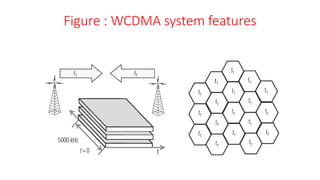
Figure : WCDMA system features
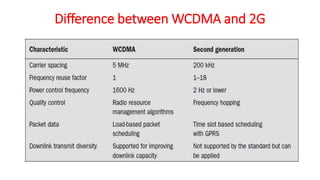
Difference between WCDMA and 2G
Parameters of WCDMA
CDMA2000
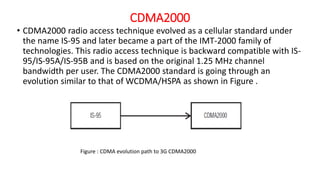
• CDMA2000 radio access technique evolved as a cellular standard under
the name IS-95 and later became a part of the IMT-2000 family of
technologies. This radio access technique is backward compatible with IS-
95/IS-95A/IS-95B and is based on the original 1.25 MHz channel
bandwidth per user. The CDMA2000 standard is going through an
evolution similar to that of WCDMA/HSPA as shown in Figure .
Figure : CDMA evolution path to 3G CDMA2000
Key features of CDMA2000
• CDMA2000 builds on the inherent advantages of CDMA technologies
and introduces other enhancements, such as orthogonal frequency
division multiplexing (OFDM and OFDMA), advanced control and
signaling mechanisms, improved interference management
techniques, end-to-end QoS, and new antenna techniques such as
multiple inputs multiple outputs (MIMO) and space division multiple
access (SDMA) to increase data throughput rates and QoS, while
significantly improving network capacity and reducing delivery cost.
• Leading performance: CDMA2000 performance in terms of data speed, voice capacity, and
latencies continue to outperform in commercial deployments and other comparable
technologies.
• Efficient use of spectrum: CDMA2000 technologies offer the highest voice capacity and data
throughput using the least amount of spectrum, lowering the cost of delivery for
operators and delivering superior customer experience for the end users.
• Support for advanced mobile services: CDMA2000 1xEV-DO enables the delivery of a broad
range of advanced services such as high-performance VoIP, push-to-talk, video telephony,
multimedia messaging, multicasting, and multi playing online gaming with richly rendered 3D
graphics.
• Devices selection: CDMA2000 offers a broad selection of devices and has a significant cost
advantage compared to other 3G technologies to meet the diverse market needs around the
world.
• Seamless evolution path: CDMA2000 has a solid and long-term evolution path, which is built
on the principle of backward and forward compatibility in-band migration, and support of
hybrid network configurations.
• Flexibility: CDMA2000 systems have been designed for urban as well as remote rural areas
for fixed wireless, wireless local loop, limited mobility and full mobility applications in
multiple spectrum bands including 450, 800, 1,700, 1,900, and 2,100 MHz.
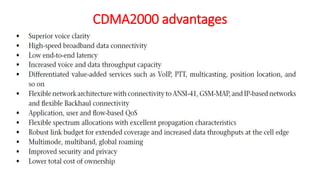
CDMA2000 advantages
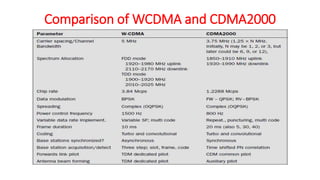
Comparison of WCDMA and CDMA2000
THE END

v unit (1).pptx

  • 1.
  • 2.
    Multiple Access Techniques •To allow many mobile users to share simultaneously a finite amount of radio spectrum, in a most efficient way, various technologies have been developed and the goal behind these methods is to handle as many calls as possible in a given bandwidth (i.e., call-handling capacity). This concept is called “multiple access”
  • 3.
    FDMA • The FDMAis the simplest scheme used to provide multiple access in analogue transmission. In FDMA systems, the radio frequency spectrum is divided into several frequency bands separated by a certain guard band. Each frequency band can be used simultaneously. • In this technique, the bandwidth is divided into a number of channels and distributed among users with a finite portion of bandwidth for permanent use as illustrated in Figure •FDMA permits only one user per channel because it allows the user to use the channel 100 per cent of the time.
  • 4.
    • Frequency guardbands are provided between adjacent signal spectra to minimize crosstalk between adjacent channels. • In FDMA, the channel has two frequencies, namely forward channel and reverse channel. • When the FDMA technique is employed, as long as the user is engaged in “conversation,” no other user can access the same spectrum space.
  • 5.
    Number of channelssupported in FDMA system. Figure : Time and bandwidth occupancy of three user signals with FDMA
  • 6.
  • 7.
  • 8.
    Advantages, disadvantages, andapplications of FDMA: Advantages: • 1. A continuous transmission scheme, and therefore of lower complexity than TDMA scheme, for example, synchronization requirements are not severe • 2. Simple to implement from a hardware standpoint, because multiple users are isolated by employing simple band pass filters • 3. Fairly efficient with a small base population and when traffic is constant • 4. No channel equalization required • 5. Capacity can be increased by reducing the information bit rate and using an efficient digital speech coding scheme
  • 11.
    TDMA • TDMA systemswere developed as FDMA system spectrum efficiency became insufficient. In digital systems, continuous transmission is not required because users do not use the allotted bandwidth all the time. It allows several users to share the same frequency band by dividing the timescale into different time slots which are periodically allocated to each mobile user for the duration of a call. • TDMA systems have the capability to split users into time slots because they transfer digital data, instead of analogue data commonly used in legacy FDMA systems.
  • 12.
  • 13.
    TDMA principle ofoperation • TDMA systems divide the radio spectrum into time slots and each user is allowed to either transmit or receive in each time slots (i.e., different users can use the same frequency in the same cell but at different times).
  • 14.
    • TDMA systemsdivide the radio spectrum into time slots and each user is allowed to either transmit or receive in each time slots (i.e., different users can use the same frequency in the same cell but at different times). • Each user occupies a cyclically repeating time slot, • A channel may be thought of as particular time slot that reoccurs every frame, where N time slots comprise a frame. • Transmit data in a buffer-and-burst method, the transmission for any user is noncontinuous. • digital data and digital modulation must be used with TDMA. TDMA principle of operation
  • 15.
    Number of userssupported by TDMA illustrates that the FDMA system supports 4 users while the TDMA system supports 12 users within the same bandwidth as the FDMA system Number of users supported by the TDMA system = Number of channels in the frequency spectrum × Time slots/channel = 4 × 3 = 12 Figure: TDMA principle of operation
  • 16.
  • 17.
  • 18.
  • 19.
    where • Nr isthe Number of reference bits per frame • Nt is the number of traffi c bits per frame • br is the number of overhead bits per reference burst • bP is the number of overhead bits per reference in each slot • bg is the number of equivalent bits in each guard time interval
  • 20.
  • 21.
  • 22.
  • 23.
    Features of TDMA: TDMA shares a single carrier frequency with several users, where each user makes use of nonoverlapping time slots. The number of time slots per frame depends on several factors, such as modulation technique, available bandwidth, etc.  Data transmission for users of a TDMA system is not continuous, but occurs in bursts. This results in low battery consumption, since the subscriber transmitter can be turned off when not in use (which is most of the time).  Because of discontinuous transmissions in TDMA, the handoff process is much simpler for a subscriber unit, since it is able to listen for other base stations during idle time slots. An enhanced link control, such as that provided by mobile assisted handoff (MAHO) can be carried out by a subscriber by listening on an idle slot in the TDMA frame.  TDMA uses different time slots for transmission and reception, thus duplexers are not required. Even if FDD is used, a switch rather than a duplexer inside the subscriber unit is all that is required to switch between transmitter and receiver using TDMA.
  • 24.
    Features of TDMA(continued):  Adaptive equalization is usually necessary in TDMA systems, since the transmission rates are generally very high as compared to FDMA channels.  In TDMA, the guard time should be minimized. If the transmitted signal at the edges of a time slot are suppressed sharply in order to shorten the guard time, the transmitted spectrum will expand and cause interference to adjacent channels.  High synchronization overhead is required in TDMA systems because of burst transmissions. TDMA transmissions are slotted, and this requires the receivers to be synchronized for each data burst. In addition, guard slots are necessary to separate users, and this results in the TDMA systems having larger overheads as compared to FDMA.  TDMA has an advantage in that it is possible to allocate different numbers of time slots per frame to different users. Thus bandwidth can be supplied on demand to different users by concatenating or reassigning time slots based on priority.
  • 25.
    Code division multipleaccess • CDMA allows transmissions to occupy the entire bandwidth at the same time without interference. • CDMA uses spread-spectrum technique to increase spectrum efficiency over current FDMA and TDMA systems. • A spread-spectrum signal is a signal that has an extra modulation that expands the signal bandwidth beyond what is required by the underlying data modulation. Spread-spectrum communication systems are useful for the following: 1. Suppressing interference 2. Making interception difficult 3. Accommodating fading and multipath channels 4. Providing a multiple-access capability
  • 26.
    • CDMA cellularsystems operate in the 800 MHz and 1.9 GHz PCS bands • QUALCOMM is the developer of the CDMA air interface used in cellular systems • Compared to GSM cellular systems, CDMA requires fewer cell towers and provides up to five times the calling capacity Code division multiple access
  • 27.
    CDMA principle ofoperation • CDMA assigns to each user a unique code sequence that is used to code data before transmission. If a receiver knows the code sequence related to a user, it is able to decode the received data. • The codes are called Pseudorandom code sequences • A user’s unique code separates the call from all other calls. • The capacity of the system depends on the quality of current calls. As more users are added, noise is added to the wideband frequency, therefore decreasing the quality of current calls • Types of codes used in CDMA: Walsh codes: These are orthogonal codes. The spreading on forward link is 1.2288 Mbps and on reverse link is 307.2 Kbps. 64-bit Walsh codes are used in IS 95A and IS 95B. 128-bit 1.Walshcodes are used in CDMA2000. 2.Short PRN code: (16 bit) are used to identify the base station and the cell. 3.Long PRN code : (42-bit code) are used to identify mobile station on reverse link.
  • 28.
    • Advantages • Greatestspectrum efficiency: capacity increases about 8 to 10 times that of an analogue system and 4 to 5 times that of other digital systems, which makes it most useful in high traffic areas with a large number of users and limited spectrum. • CDMA improves call quality by filtering out background noise, crosstalk, and interference. • “Soft handoffs”: because of the multiple diversities in use, handoffs between cells are undetected by the user. • Simplified frequency planning: all users on a CDMA system use the same radio frequency spectrum. Engineering detailed frequency plans are not necessary. Frequency re-tunes for expansion are eliminated. Fewer cells are required for quality coverage. • Random Walsh codes enhance user privacy; a spread-spectrum advantage. • Precise power control increases talk time and battery life for mobile phones. • Disadvantages • Backwards compatibility techniques are costly. • Currently, equipment is expensive. • Difficult to optimize to maximize performance. • Low traffic areas lead to inefficient use of spectrum and equipment resources.
  • 29.
    Handoffs in CDMAmobile systems • The act of transferring a call of from one base station to another is termed as handoff. Handoff occurs when a call has to be handed off from one cell to another as the user moves between cells. • Hard handoff and soft handoff • In a traditional “hard” handoff, the connection to the current cell is broken and then the connection to the new cell is made. This is known as a “break-before-make” or hard handoff. • Since all cells in CDMA use the same frequency, it is possible to make the connection to the new cell before leaving the current cell. This is known as a “make-before-break” or “soft handoff”. • Soft handoff requires less power, which reduces interference and increases capacity. The implementation of handoff is different in GSM and CDMA standards.
  • 30.
    Near-far problem • Thenear far problem occurs when two or more DSSS transmitters transmit the signals towards the same DSSS receiver as shown in Figure Figure : The near-far problem
  • 31.
    • In thisfigure, two DSSS transmitters transmit the signals towards a DSSS receiver, one transmitter being closer to the receiver than the other transmitter. The power of the two spread-spectrum signals transmitter is the same at the antenna of each DSSS transmitter. • However, the two spread-spectrum signals at the DSSS receiver antenna have different power levels because the paths between the two transmitters and the receiver are of different lengths. • The power of the spread-spectrum signal coming from DSSS transmitter 1 is lower than that coming from DSSS transmitter 2 because transmitter 1 is farther away from the receiver than transmitter 2. • Any spread spectrum signal other than the desired one produces interference similar to that caused by noise, this results in a rather poor S/N ratio at the DSSS receiver input. Consequently, errors are likely to appear in the recovered data when the process gain of the system is not sufficient to overcome the S/N ratio deficit observed at the DSSS receiver input. Near-far problem contd------
  • 32.
    Call processing inthe CDMA mobile phones • Figure shows the basic call-processing loop
  • 33.
    • After powerup, the initialization state determines which system to use (whether analogue or CDMA). • If it is CDMA, it goes into sync processing. Once the system is synchronized, the system goes into the mobile station idle state, where it monitors the paging channel. • If a call is to be originated or the mobile is paged, the system goes into the access state. • Once a call is setup, the phone moves over to the traffic channel state, where the forward and reverse traffic channels are used to communicate voice and messaging. • During the idle state, the mobile will monitor the paging channel. Various messages pertaining to setup and operation are on the paging channel.
  • 34.
    • Certain situationswill trigger the mobile to drop out of the traffic state (drop the call on purpose): • Mobile ACK failure: Certain messages require an ACK (Acknowledge signal); generally, a mobile will retransmit the message after 400 ms, but if no ACK comes after three tries, the mobile drops the call. • Base station ACK failure: This is similar to the mobile ACK failure, but it is not standardized. • Mobile fade timer: The timer is set to 5 s after receiving two consecutive good frames. If the timer gets to zero, the call drops. • Mobile bad frames: If there are 12 consecutive bad frames, the mobile drops the call. • Base station bad frames: This is similar to mobile bad frames, but not standardized (i.e., manufacturers can implement this, however, they choose).
  • 35.
    Space division multipleaccess • SDMA enables users to share simultaneously the same bandwidth in different geographical locations. SDMA solves capacity problem of wireless communication systems by exploitation of the spatial dimension which makes it possible to identify the individual users, even when they are in the same time/frequency/code domains. SDMA can be achieved using beam forming or sectorization.
  • 36.
    Adaptive antenna orSDMA-based cellular network • By using adaptive antennas arrays, sometimes called smart antennas in mobile radio systems, signals can be received and sent only from and into a limited angular range, following the directional nature of multipath. This improves coverage or link quality in noise-limited situations and enhances capacity in interference-limited situations. • The concept of SDMA is shown in Figure . Each user exploiting a single- transmitter-antenna-aided mobile station simultaneously communicates with the base station equipped with an array of receiver antennas. Figure : SDMA concept, employing a P-element receiver antenna array for supporting three mobile users
  • 37.
    Advantages of SDMAtechnique • 1. Range extension: The coverage area of the antenna array is greater than that of any single element as a result of the gain provided by the array. When a system is constructed using SDMA, the number of cells required to cover a given area can be substantially reduced. • 2. Interference suppression: Interference from other systems and from users in other cells is significantly reduced by exploiting the desired user’s unique channel impulse responses (CIRs). In “noisy” areas where range is limited by interference, spatially selective transmission and reception result in range extension. • 3. Multipath effect elimination: The copies of the desired signal that have arrived at the antenna after bouncing from objects between the signal source and the antenna can often be mitigated. In certain cases, the multipath can actually be used to reinforce the desired signal.
  • 38.
    4. Capacity increase:Capacity increase can be done in two ways: • Channel reuse patterns in cellular systems can be significantly tighter because the average interference resulting from co-channel signals in other cells is markedly reduced (e.g., moving from a 7-cell to a 4-cell reuse pattern nearly doubles capacity). • Separate spatial channels can be created in each cell on the same conventional channel. • In other words, intracellular reuse of conventional channels is possible 5. Compatibility: SDMA is compatible with most of the existing modulation schemes, carrier frequencies and other specifications. Furthermore, it can be readily implemented using various array geometries and antenna types. Figure: Intra-cell SDMA
  • 40.
    • Many digitalcellular and cordless phone systems have been developed. • The cellular systems are GSM, NA-TDMA, CDMA, and the cordless phone systems are DECT and CT-2 schemes. • Although analog cellular systems are limited to using frequency division multiple- access (FDMA) schemes, digital cellular systems can use FDMA, time division multiple-access (TDMA), and code-division multiple-access (CDMA). • When a multiple-access scheme is chosen for a particular system, all the functions, protocols, and network are associated with that scheme. INTRODUCTION TO DIGITAL SYSTEMS
  • 41.
    Global system formobile • GSM is most widely used and globally implemented digital cellular technology. It is used for transmitting data and mobile voice services. • In GSM, time division multiple access (TDMA) technique is used for transmitting voice and data through air interface. • CEPT, a European group, began to develop the Global System for Mobile TDMA system in June 1982. • GSM has two objectives: pan-European roaming, which offers compatibility throughout the European continent, and • interaction with the integrated service digital network (ISDN), which offers the capability to extend the single-subscriber-line system to a multiservice system with various services currently offered only through diverse telecommunications networks.
  • 43.
    Flexibility and increasedcapacity: •GSM equipment is fully controlled by its software. Network re-configurations can be made quickly and easily with minimum manual intervention. •new speech algorithms •flexibility of international roaming. •More carriers in a given area to give better frequency reuse. •Multi-band networks and mobiles
  • 44.
    Frequency, channel spacing,and transmission rate • Television: 300 MHz approx. FM Radio: 100 MHz approx. • Police radios: Country dependent • Mobile networks: 300–2,000 MHz approx. • The frequency used by mobile networks varies according to the standard being used.
  • 45.
    • Transmission rate:-Theamount of information transmitted over a radio channel over a period of time is known as the transmission rate.In GSM, the net bit rate over the air interface is 270 kbps. • Improved security and confidentiality:-With GSM, both the mobile equipment (ME) and mobile subscriber are identified. The ME has a unique number coded into it when it is manufactured. • This can be checked against a database every time the mobile makes a call to validate the actual equipment. The subscriber is authenticated by use of a smart card known as a SIM. • GSM also offers the capability to encrypt all signals over the air interface. • it makes it very diffi cult for the casual “hacker” to listen-in to personal calls. • In addition to this, the GSM air interface supports frequency hopping. This entails each “burst” of information being transmitted to/from the MS/base site on a different frequency, again making it very difficult for an observer (hacker) to follow/listen to a specific call.
  • 46.
    • Flexible handoverprocesses • Switching and control • Noise robust:-In order to combat the problems caused by noise, GSM uses digital technology instead of analogue. By using digital signals, we can manipulate the data and include sophisticated error protection, detection, and correction software. • User services:- Teleservices or telephony services:-A teleservice utilizes the capabilities of a bearer service to transport data, defining which capabilities are required and how they should be set up. Voice calls, Videotext and facsimile • ISDN compatibility in GSM • Supplementary services • Short text messages (SMS): • Multiparty service or conferencing • Call waiting • Call hold • Call forwarding • Call barring • Number identification • Advice of Charge • Closed User Groups
  • 48.
    • GSM consistsof many subsystems, such as the mobile station (MS), the base station subsystem (BSS), the network and switching subsystem (NSS), and the operation subsystem(OSS). GSM Architecture
  • 49.
    • The MSmay be a stand-alone piece of equipment for certain services. • The MS includes mobile equipment (ME) and a subscriber identity module (SIM). • ME does not need to be personally assigned to one subscriber. • The SIM is a subscriber module which stores all the subscriber-related information. • When a subscriber’s SIM is inserted into the ME of an MS, that MS belongs to the subscriber, and the call is delivered to that MS. • The ME is not associated with a called number—it is linked to the SIM. • In this case, any ME can be used by a subscriber when the SIM is inserted in the ME. The Mobile Station.
  • 50.
    • The BSSconnects to the MS through a radio interface and also connects to the NSS. • The BSS consists of a base transceiver station (BTS) located at the antenna site and a base station controller (BSC) that may control several BTSs. • The BTS consists of radio transmission and reception equipment similar to the ME in an MS. • A transcoder/rate adaption unit (TRAU) carries out encoding and speech decoding and rate adaptation for transmitting data. • As a subpart of the BTS, the TRAU may be sited away from the BTS, usually at the MSC. • In this case, the low transmission rate of speech code channels allows more compressed transmission between the BTS and the TRAU, which is sited at the MSC. Base Station Subsystem.
  • 51.
    • NSS inGSM uses an intelligent network (IN). • The IN’s attributes will be described later. • A signaling NSS includes the main switching functions of GSM. • NSS manages the communication between GSM users and other telecommunications users. • NSS management consists of: • Mobile service switching center (MSC). Coordinates call set-up to and from GSM users. • An MSC controls several BSCs. Network and Switching Subsystem.
  • 52.
    FIGURE .NSS andits environment. (a) The external environment;
  • 53.
    (b) the internalstructure.
  • 54.
    • Consists ofa stand-alone computer without switching capabilities, • a database which contains subscriber information, and information related to the subscriber’s current location, but not the actual location of the subscriber. • A subdivision of HLR is the authentication center (AUC). The AUC manages the security data for subscriber authentication. • Another sub-division of HLR is the equipment identity register (EIR) which stores the data of mobile equipment (ME) or ME-related data. Home location register (HLR).
  • 55.
    • Links toone or more MSCs, temporarily storing subscription data currently served by its corresponding MSC, and holding more detailed data than the HLR. • For example, the VLR holds more current subscriber location information than the location information at the HLR. Visitor location register (VLR).
  • 56.
    • In orderto set up a requested call, the call is initially routed to a gateway MSC, which finds the correct HLR by knowing the directory number of the GSM subscriber. • The GMSC has an interface with the external network for gatewaying, and the network also operates the full Signaling System 7 (SS7) signaling between NSS machines. Gateway MSC (GMSC).
  • 57.
    • There arethree areas of OSS, as shown in Fig. • (1) network operation and maintenance functions, • (2) subscription management, including charging and billing, and • (3) mobile equipment management. • These tasks require interaction between some or all of the infrastructure equipment. • OSS is implemented in any existing network. Operation Subsystem.
  • 58.
  • 59.
    Layer Modeling ofGSM • The Open System Interconnection(OSI) of GSM consisting of five layers: 1. Transmission(TX) layer: The TX layer sets up a connection between MS and BTS. 2. Radio Resource Management(RR): The RR layer refers to the protocol for management of the transmission over the radio interface and provides a stable link between MS and BSC. The BSS performs most of the RR functions. 3. Mobility Management layer(MM) layer: The MM layer 1 manages the subscriber databases, including location data, and layer 2 manages authentication activities, SIM, HLR, and AUC.
  • 60.
    4. Communication Management(CM)layer: The following functions are parts of CM layer Call Control The CM layer sets up calls, maintain calls, and releases calls. Supplementary services management Allows users to have some control of their calls in the network. Short message services(SMS) A SMS service center may connect to several GSM networks. Two functions of SMS are a) Mobile originating short message b) Mobile terminating short message 5. Operation Administration and Maintenance(OAM) layer: OSS layer is the integral part of OAM layer. All the subsystems such as BSS and NSS, contribute to the OAM operation and maintainnance functions. Following figure shows five layers of GSM
  • 62.
    Frame structure forGSM • Transmission in any TDMA-based wireless communication system is in the form of a repetitive sequence of frames. Each TDMA frame is divided into a number of uniform time slots. • Each user transmits a burst of data during the time slot assigned to it. • It consists of 148 bits which are transmitted at a rate of 270.833333 kbps (an unused guard time of 8.25 bits is provided at the end of each burst). • Out of the total 148 bits per time slot, 114 are information-bearing bits which are transmitted as two 57-bit sequences close to the beginning and end of the burst.
  • 64.
    GSM Channels • PhysicalChannels: There are three kinds of physical channels, also called traffic channels (TCHs): • 1. TCH/F (full rate): Transmits a speech code of 13 kbps or three data-mode rates, 12, 6, and 3.6 kbps. • 2. TCH/H (half rate): Transmits a speech code of 7 kbps or two data modes, 6 and 3.6 kbps. • 3. TCH/8 (one-eighth rate): Used for low-rate signaling channels, common channels, and data channels. • Logic channels: • 1. Common channels: All the common channels are embedded in different traffic channels. They are grouped by the same cycle (51 × 8 BP), where BP stands for burst period (i.e.,time slot), which is 577 μs.
  • 65.
    • 2. Downlinkcommon channels: There are five downlink unidirectional channels, shared or grouped by a TCH. • (i) Frequency correction channel (FCCH) repeats once every 51×8 BPs; used to identify a beacon frequency. • (ii)Synchronization channel (SCH) follows each FCCH slot by 8 BPs. • (iii)Broadcast control channel (BCCH) is broadcast regularly in each cell and received by all the mobile stations in the idle mode. • (iv)Paging and access grant channel (PAGCH) is used for the incoming call received at the mobile station. The access grant channel is answered from the base station and allocates a channel during the access procedure of setting up a call. • (v)Call broadcast channel (CBCH). Each cell broadcasts a short message for 2s from the network to the mobile station in idle mode. Half a downlink TCH/8 is used, and special CBCH design constraints exist because of the need for sending two channels (CBCH and BCCH) in parallel.
  • 66.
    • 3. Uplinkcommon channels: The random-access channel (RACH) is the only common uplink channel. RACH is the channel that the mobile station chooses to access the calls. • There are two rates: RACH/F (full rate, one time slot every 8 BP), and RACH/H (half rate, using 23 time slots in the 51 × 8 BP cycle, where 8 BP cycle [i.e. a frame] is 4.615ms). • 4. Signaling channels: All the signaling channels have chosen one of the physical channels,and the logical channels names are based on their logical functions: • 5. Slow Associated Control Channel (SACCH): A slow-rate TCH used for signaling transport and used for non urgent procedures, mainly handover decisions. It uses one-eighth rate. The TCH/F is always allocated with SACCH. This combined TCH and SACCH is denoted TACH/F.
  • 67.
    6. Fast AssociatedControl Channel (FACCH): Indicates cell establishment, authenticates subscribers, or commands a handover. 7. Stand-alone Dedicated Control Channel (SDCCH): Occasionally the connection between a mobile station and the network is used solely for passing signaling information and not for calls. This connection may be at the user’s demand or for other management operations such as updating the unit’s location. It operates at a very low rate and uses a TCH/8 channel. Radio slots are allocated to users only when call penetration is needed. There are two modes, dedicated and idle. The mode used depends on the uplink and the downlink. In GSM terminology, the downlink is the signal transmitted from the base station to the mobile station, and the uplink is the signal transmitted in the opposite direction. 8. Voice/data channels: Each time slot of a voice channel contains 260 bits per block. The entire block contains 316 bits. Each time slot of a data channel contains 120 or 240 bits per block.
  • 68.
    GSM Channel Modes •The different modes of GSM channel are as follows 1. Channel mode 2. Dedicated mode 3. Idle mode • 1. Channel modes: Because of the precious value of the radio spectrum, individual users cannot have their own TCH at all times. • 2. Dedicated mode: Uses TCH during call establishment and uses SACCH to perform location updating in the dedicated mode. TCH and SACCH are dedicated channels for both uplink and downlink channels. • 3. Idle mode: During non call activities, the five downlink channels are in the idle mode: FCCH; SCH; BCCH, which is broadcasting regularly; PAGCH and CBCH, which sends one message every 2 s. During idle mode, the mobile station listens to the common downlink channels, and also uses SDCCH (uplink channel) to register a mobile location associated with a particular base station to the network.
  • 69.
    • GSM offers –several types of connections • voice connections, data connections, short message service – multi-service options (combination of basic services) • Three service domains – Bearer Services – Telematic Services – Supplementary Services GSM-PLMN transit network (PSTN, ISDN) source/ destination network TE TE bearer services tele services R, S (U, S, R) Um MT MS GSM: Mobile Services
  • 70.
     Telecommunication servicesto transfer data between access points  Specification of services up to the terminal interface (OSI layers 1-3)  Different data rates for voice and data (original standard) – data service (circuit switched) • synchronous: 2.4, 4.8 or 9.6 kbit/s • asynchronous: 300 - 1200 bit/s – data service (packet switched) • synchronous: 2.4, 4.8 or 9.6 kbit/s • asynchronous: 300 - 9600 bit/s • Today: data rates of approx. 50 kbit/s possible – will be covered later! Bearer Services
  • 71.
    • Additional services –Non-Voice-Teleservices • group 3 fax • voice mailbox (implemented in the fixed network supporting the mobile terminals) • electronic mail (MHS, Message Handling System, implemented in the fixed network) • Short Message Service (SMS) alphanumeric data transmission to/from the mobile terminal using the signaling channel, thus allowing simultaneous use of basic services and SMS Tele Services II
  • 72.
     Services inaddition to the basic services, cannot be offered stand-alone  Similar to ISDN services besides lower bandwidth due to the radio link  May differ between different service providers, countries and protocol versions  Important services – identification: forwarding of caller number – suppression of number forwarding – automatic call-back – conferencing with up to 7 participants – locking of the mobile terminal (incoming or outgoing calls) Supplementary services
  • 73.
    Concepts related toMultiple Access Scheme of GSM Multiple-Access Scheme: GSM is a combination of FDMA and TDMA. The total number of channels in FDMA is 124, and each channel is 200 kHz. Both the 935–960MHz uplink and 890–916 MHz downlink have been allocated 25 MHz, for a total of 50 MHz Duplex separation is 45MHz If TDMA is used within a 200-kHz channel, 8 time slots are required to form a frame, frame duration is 4.615 ms, and the time slot duration burst period is 0.577ms. There is a DCS-1800 system, which has the same architecture as the GSM, but it is up converted to 1800MHz. The downlink is 1805–1880 MHz (base TX) and the uplink is 1700–1785 MHz (mobile Tx).
  • 74.
    The numbering ofthe uplink slots is derived from the downlink slots by a delay of 3 time slots. This allows the slots of one channel to bear the same time slot number in both directions. In this case, the mobile station will not transmit and receive simultaneously because the two time slots are physically separated. Propagation delay when the mobile station is far from the BTS is a major consideration. For example, the round trip propagation delay between an MS and BTS which are 35 km apart is 233 μs. As a result, the assigned time slot numbers of the uplink and downlink channels may not be the same (less than 3 time slots apart). The solution is to let BTS compute a time advance value. The key is to allow significant guard time by taking into account that BCCH is using only even time slots. This avoids the uncertainty of numbering the wrong time slot. Once a dedicated connection is established, the BTS continuously measures the time offset between its own burst schedule and the reception schedule of mobile station bursts on the bidirectional SACCH channel. The time compensation for the propagation delay (sending to the mobile station via SACCH) is 3 time slots minus the time advance. Constant Time Delay between Uplink and Downlink: Frequency Hopping: GSM has a slow frequency-hopping radio interface. The slow hopping is defined in bits per hop. Its regular rate is 217 hops/s, therefore, with a transmission rate of 270 kbps, the result is approximately 1200 bits/hop. If the PAGCH and the RACH were hopping channels, then hopping sequences could be broadcast on the BCCH. The common channel is forbidden from hopping and using the same frequency.
  • 75.
    GSM operation The operationof the GSM system can be understood by studying the sequence of events that takes place when a call is initiated from the MS. Call from mobile phone to PSTN: When a mobile subscriber makes a call to a PSTN telephone subscriber, the following sequence of events takes place: 1. The MSC/VLR receives the message of a call request. 2. The MSC/VLR checks if the MS is authorized to access the network. If so, the MS is activated. If the MS is not authorized, service will be denied. 3. MSC/VLR analyses the number and initiates a call setup with the PSTN. 4. MSC/VLR asks the corresponding BSC to allocate a traffi c channel (a radio channel and a time slot). 5. The BSC allocates the traffi c channel and passes the information to the MS . 6. The called party answers the call and the conversation takes place. 7. The MS keeps on taking measurements of the radio channels in the present cell and neighbouring cells and passes the information to the BSC. The BSC decides if a handover is required. If so, a new traffi c channel is allocated to the MS and the handover is performed. If handover is not required, the MS continues to transmit in the same frequency.
  • 76.
    Call from PSTNto mobile phone:
  • 77.
    GPRS A number ofmobile subscribers are discriminating day by day with the increasing demand for value-added data services like e-mail, Internet access, and receiving messages. Global system for mobile communications (GSM) of 2G is mainly used for circuit-switched communications. The general packet radio service (GPRS) is an extension of the GSM system, and uses the same channels, the same modulation, and the same network backbone as the existing GSM network. But the major difference is that GPRS is a packet-switching-based data service. In packet switching, the data are divided into packets with each data packet transmitted separately and then reassembled at the receiving end. GPRS supports the world’s leading packet-based Internet communication protocols: Internet protocol (IP) and X.25. GPRS enables the existing IP or X.25 application to operate over a GSM cellular connection. In GPRS, data can be exchanged directly in the form of a packet to the Internet or other networks. Even though, GPRS increases the capacity requirements on the radio and base station subsystems, high mobile data speeds were not available to individual mobile users until enhanced data rates for global evolution (EDGE) or universal mobile telephone system (UMTS) was introduced. EDGE in GSM enhances existing GPRS/GSM infrastructure and increases speeds up to 384 Kbps. GPRS is well suited for non-real time Internet usage such as the retrieval of e-mail, faxes, and asymmetric web browsing, where the user downloads much more data than it uploads on the Internet.
  • 78.
  • 79.
    • The mainfeatures of the GPRS architecture are its flexibility, scalability, interoperability, and roaming capability. The network architecture of a GPRS system is shown in Figure. • In the core network, the existing mobile switching centers (MSCs) are designed to support circuit-switched traffic and cannot process packetized traffic. The packet-switched traffic is supported by enabling GPRS on a GSM network. This requires the addition of two core modules (network nodes) called as GPRS support nodes (GSN).
  • 81.
    Layers • Software playsa very large part in the current cellular communications systems. To enable it to be sectioned into areas that can be addressed separately, the concept of layers has been developed. It is used in GSM and other cellular systems but as they become more data-centric, the idea takes a greater prominence. Often these are referred to as layers, 1, 2, and 3. • Layer 1 concerns the physical link between the mobile and the base station. This is often subdivided into two sub-layers, namely the Physical RF layer that includes the modulation and demodulation, and the Physical link layer that manages the responses and controls required for the operation of the RF link. These include elements such as error correction, interleaving and the correct assembly of the data, power control, and the like. • Above this are the Radio Link Control (RLC) and the Medium Access Control (MAC) layers. These organize the logical links between the mobile and the base station. They control the radio link access and they organize the logical channels that route the data to and from the mobile. • There is also the Logical Link Layer (LLC) that formats the data frames and is used to link the elements of the core network to the mobile.
  • 83.
    GPRS coding • GPRSoffers a number of coding schemes with different levels of error detection and correction. These are used dependent upon the radio frequency signal conditions and the requirements for the data being sent. These are given labels CS-1 to CS-4: • CS-1: - This GPRS coding scheme applies the highest level of error detection and correction. It is used in scenarios when interference levels are high or signal levels are low. By applying high levels of detection and correction, this prevents the data having to be re-sent too often. Although it is acceptable for many types of data to be delayed, for others there is a more critical time element. This level of detection and coding results in a half code rate, i.e. for every 12 bits that enter the coder, 24 bits result. • CS-2: - This error detection and GPRS coding scheme is for better channels. It effectively uses a 2/3 encoder and results in an improved data rate over CS-1. • CS-3: - This GPRS coding scheme effectively uses a 3/4 coder. • CS-4: - This scheme is used when the signal is high and interference levels are low. No correction is applied to the signal allowing for a maximum throughput.
  • 85.
  • 86.
  • 87.
  • 89.
    GPRS Operation • Whenlooking at the way in which GPRS operates, it can be seen that there are three basic modes in which it operates. These are: initialisation / idle, standby, and ready. • Initialisation / idle: • When the mobile is turned on it must register with the network and update the location register. This is very similar to that performed with a GSM mobile, but it is referred to as a location update. It first locates a suitable cell and transmits a radio burst on the RACH using a shortened burst because it does not know what timing advance is required. The data contained within this burst temporarily identifies the mobile, and indicates that the reason for the update is to perform a location update. • When the mobile performs its location update the network also performs an authentication to ensure that it is allowed to access the network. As for GSM it accesses the HLR and VLR as necessary for the location update and the AuC for authentication. It is at registration that the network detects that the mobile has a GPRS capability. The SGSN also maintains a record of the location of the mobile so that data can be sent there is required.
  • 90.
    • Standby: • Themobile then enters a standby mode, periodically updating its position as required. It monitors the MNC of the base station to ensure that it has not changed base stations and also looks for stronger base station control channels. • The mobile will also monitor the PPCH in case of an incoming alert indicating that data is ready to be sent. As for GSM, most base stations set up a schedule for paging alerts based on the last figures of the mobile number. In this way it does not have to monitor all the available alert slots and can instead only monitor a reduced number where it knows alerts can be sent for it. In this way the receiver can be turned off for longer and battery life can be extended. Ready: In the ready mode the mobile is attached to the system and a virtual connection is made with the SGSN and GGSN. By making this connection the network knows where to route the packets when they are sent and received. In addition to this the mobile is likely to use the PTCCH to ensure that its timing is correctly set so that it is ready for a data transfer should one be needed.
  • 91.
    3G Systems • 3Gmobile systems offer high bit rate services, high-quality videos, images, and fast web access. They differ significantly from the 2G technologies (global system for mobile communication [GSM] and CDMA1). The aim of 3G is to provide communication services from person to person at any place and at any time through any medium using a compact lightweight terminal with guaranteed quality of service (QoS) and security. The two standards of 3G technology that are most popular in the world are • Wideband code division multiple access (WCDMA) • Code division multiple access 2000 (CDMA2000).
  • 92.
    UMTS network architecture •UMTS is evolved from GPRS to replace the radio access network (RAN). The UMTS terrestrial radio access network (UTRAN) consists in B Node the 3G term for BTS, and RNCs connected by ATM network. The 3G mobile network evolved from the 2G systems such as GSM and GPRS. Some of the UMTS elements in the networks are: (i) The UMTS subscriber identity module similar to the GSM SIM card, (ii) the Node B, analogous to the GSM BTS, (iii) the RNC, analogous to the GSM BSC, (iv) the call state control function, (v) the multimedia resource function, (vi) the media gateway (MGW), (vii) the transport media gateway, (viii) the roaming signaling gateway, and (ix) the media gateway control function. The above network elements communicate in the following predefined interfaces: (i) the Iub interface, between RNC and Node B, (ii) the Iur interface, between RNCs, (iii) the Gr interface, between HLR and GGSN, and (iv) the Gi interface, between GGSN and MGW or other packet-based networks. Figure presents the UMTS release five network topology.
  • 93.
  • 94.
    • Salient featuresof WCDMA • WCDMA uses a new spectrum with a 5 MHz carrier and uses the DS-CDMA radio access (multiple access) technology. It provides 50 times higher data rate than in present GSM networks and 10 times higher data rate than in GPRS networks. • WCDMA is a technology for wideband digital radio communications of Internet, multimedia, video, and other capacity demanding applications. • WCDMA is the demanding 3G technology providing higher capacity for voice and data at higher data rates. • The wider band makes it possible to divide and combine reception signals propagated through multipath-fading channels into more multipath components, which helps to improve the reception quality through RAKE time diversity. • Its merits include the ability to accommodate a greater number of users who communicate at high speed (e.g., at 64 and 384 Kbps). It has also been verified in experiments that high quality data transmission at 2 Mbps can be implemented using the 5 MHz bandwidth. • The wide bandwidth of WCDMA gives an inherent performance gain over the previous cellular systems and it reduces the fading of the radio signal thus improving the performance. • WCDMA uses dual mode packet access scheme. Packet transfer can take place on both the common and dedicated channels. Owing to this phenomenon, packet access can be optimized for fast access response as well as for maximum throughput. • The advance form of WCDMA is high-speed downlink packet access (HSDPA). HSDPA is a technology that leads to the cost-effective delivery of the most advance data services and significantly improves the network capacity.
  • 95.
    Figure : WCDMAsystem features
  • 96.
  • 97.
  • 98.
    CDMA2000 • CDMA2000 radioaccess technique evolved as a cellular standard under the name IS-95 and later became a part of the IMT-2000 family of technologies. This radio access technique is backward compatible with IS- 95/IS-95A/IS-95B and is based on the original 1.25 MHz channel bandwidth per user. The CDMA2000 standard is going through an evolution similar to that of WCDMA/HSPA as shown in Figure . Figure : CDMA evolution path to 3G CDMA2000
  • 99.
    Key features ofCDMA2000 • CDMA2000 builds on the inherent advantages of CDMA technologies and introduces other enhancements, such as orthogonal frequency division multiplexing (OFDM and OFDMA), advanced control and signaling mechanisms, improved interference management techniques, end-to-end QoS, and new antenna techniques such as multiple inputs multiple outputs (MIMO) and space division multiple access (SDMA) to increase data throughput rates and QoS, while significantly improving network capacity and reducing delivery cost.
  • 100.
    • Leading performance:CDMA2000 performance in terms of data speed, voice capacity, and latencies continue to outperform in commercial deployments and other comparable technologies. • Efficient use of spectrum: CDMA2000 technologies offer the highest voice capacity and data throughput using the least amount of spectrum, lowering the cost of delivery for operators and delivering superior customer experience for the end users. • Support for advanced mobile services: CDMA2000 1xEV-DO enables the delivery of a broad range of advanced services such as high-performance VoIP, push-to-talk, video telephony, multimedia messaging, multicasting, and multi playing online gaming with richly rendered 3D graphics. • Devices selection: CDMA2000 offers a broad selection of devices and has a significant cost advantage compared to other 3G technologies to meet the diverse market needs around the world. • Seamless evolution path: CDMA2000 has a solid and long-term evolution path, which is built on the principle of backward and forward compatibility in-band migration, and support of hybrid network configurations. • Flexibility: CDMA2000 systems have been designed for urban as well as remote rural areas for fixed wireless, wireless local loop, limited mobility and full mobility applications in multiple spectrum bands including 450, 800, 1,700, 1,900, and 2,100 MHz.
  • 101.
  • 102.
    Comparison of WCDMAand CDMA2000
  • 103.