1
THE PRE-TRAVEL
CONSULTATION
Gary W. Brunette, MD, MS
Travelers’ Health Team
Division of Global Migration and Quarantine
Centers for Disease Control and Prevention
2
Outline
• Travelers’ Health Epidemiology
• Traveler Assessment
• Itinerary Review
• Sources of Information
• Risks to the Traveler
• Travel Vaccines
• Travel Medications
• Counseling
3
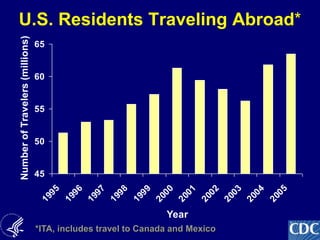
U.S. Residents Traveling Abroad*
*ITA, includes travel to Canada and Mexico
45
50
55
60
65
1
9
9
5
1
9
9
6
1
9
9
7
1
9
9
8
1
9
9
9
2
0
0
0
2
0
0
1
2
0
0
2
2
0
0
3
2
0
0
4
2
0
0
5
Year
Number
of
Travelers
(millions)
4
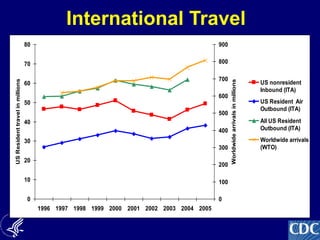
International Travel
0
10
20
30
40
50
60
70
80
1996 1997 1998 1999 2000 2001 2002 2003 2004 2005
US
Resident
travel
in
millions
0
100
200
300
400
500
600
700
800
900
Worldwide
arrivals
in
millions
US nonresident
Inbound (ITA)
US Resident Air
Outbound (ITA)
All US Resident
Outbound (ITA)
Worldwide arrivals
(WTO)
5
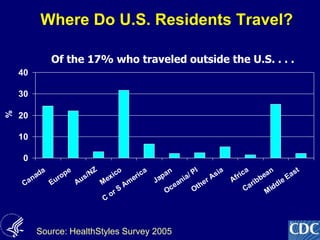
Where Do U.S. Residents Travel?
0
10
20
30
40
Canada
Europe
Aus/NZ
Mexico
C
or S
Am
erica
Japan
Oceania/ PI
Other Asia
Africa
Caribbean
Middle East
%
Source: HealthStyles Survey 2005
Of the 17% who traveled outside the U.S. . . .
6
VFRs: Visiting Friends and Relatives
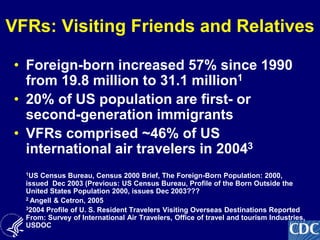
• Foreign-born increased 57% since 1990
from 19.8 million to 31.1 million1
• 20% of US population are first- or
second-generation immigrants
• VFRs comprised ~46% of US
international air travelers in 20043
1US Census Bureau, Census 2000 Brief, The Foreign-Born Population: 2000,
issued Dec 2003 (Previous: US Census Bureau, Profile of the Born Outside the
United States Population 2000, issues Dec 2003???
2 Angell & Cetron, 2005
32004 Profile of U. S. Resident Travelers Visiting Overseas Destinations Reported
From: Survey of International Air Travelers, Office of travel and tourism Industries,
USDOC
7
Travelers’ Health Risks
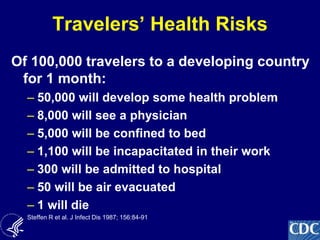
Of 100,000 travelers to a developing country
for 1 month:
– 50,000 will develop some health problem
– 8,000 will see a physician
– 5,000 will be confined to bed
– 1,100 will be incapacitated in their work
– 300 will be admitted to hospital
– 50 will be air evacuated
– 1 will die
Steffen R et al. J Infect Dis 1987; 156:84-91
8
The Patient: Medical Issues
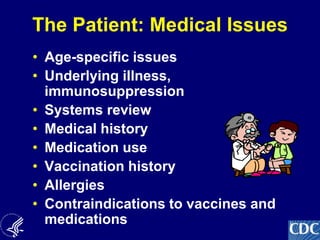
• Age-specific issues
• Underlying illness,
immunosuppression
• Systems review
• Medical history
• Medication use
• Vaccination history
• Allergies
• Contraindications to vaccines and
medications
9
The Patient: Other Issues
• Reproductive
– Pregnant
– Breastfeeding
– Preconception
• Risk-taking behaviors
10
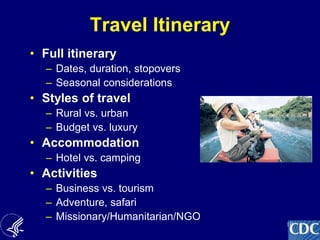
Travel Itinerary
• Full itinerary
– Dates, duration, stopovers
– Seasonal considerations
• Styles of travel
– Rural vs. urban
– Budget vs. luxury
• Accommodation
– Hotel vs. camping
• Activities
– Business vs. tourism
– Adventure, safari
– Missionary/Humanitarian/NGO
11
Travel Health Resources
• CDC Travelers’ Health Website
– www.cdc.gov/travel
• World Health Organization
– www.who.int/int
• State Department
– travel.state.gov
• International Society of Travel Medicine
– www.istm.org
• Health Information for International Travel
– CDC “Yellow Book”
• International Travel and Health
– WHO “Green Book”
12
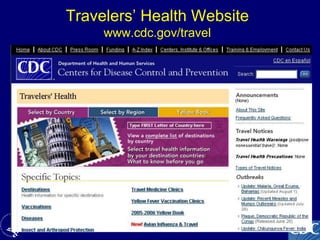
Travelers’ Health Website
www.cdc.gov/travel
13
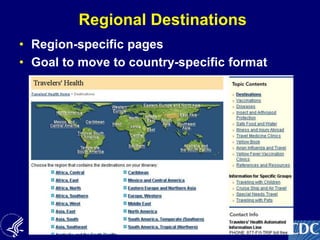
Regional Destinations
• Region-specific pages
• Goal to move to country-specific format
14
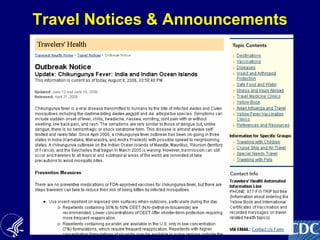
Travel Notices & Announcements
15
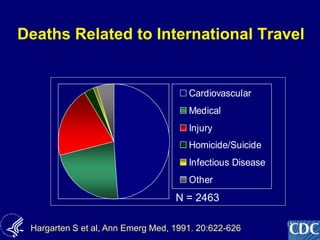
Cardiovascular
Medical
Injury
Homicide/Suicide
Infectious Disease
Other
Deaths Related to International Travel
N = 2463
Hargarten S et al, Ann Emerg Med, 1991. 20:622-626
16
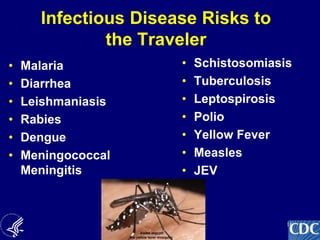
Infectious Disease Risks to
the Traveler
• Malaria
• Diarrhea
• Leishmaniasis
• Rabies
• Dengue
• Meningococcal
Meningitis
• Schistosomiasis
• Tuberculosis
• Leptospirosis
• Polio
• Yellow Fever
• Measles
• JEV
ETC.
17
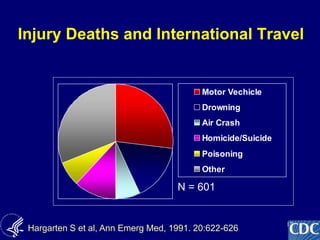
Motor Vechicle
Drowning
Air Crash
Homicide/Suicide
Poisoning
Other
Injury Deaths and International Travel
N = 601
Hargarten S et al, Ann Emerg Med, 1991. 20:622-626
18
Other Risks to the Traveler
• Accidental injury
• Environmental hazards
• Crime and assault
• Psychiatric problems
• Animal bites, stings and envenomations
• Dermatologic disorders
• Altitude
• …….
ETC.
19
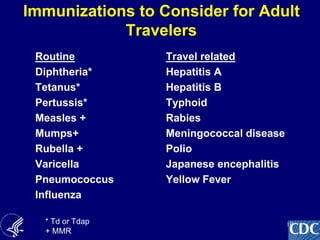
Immunizations to Consider for Adult
Travelers
Routine
Diphtheria*
Tetanus*
Pertussis*
Measles +
Mumps+
Rubella +
Varicella
Pneumococcus
Influenza
Travel related
Hepatitis A
Hepatitis B
Typhoid
Rabies
Meningococcal disease
Polio
Japanese encephalitis
Yellow Fever
* Td or Tdap
+ MMR
20
Travel Medications:
Prophylaxis & Self Treatment
• Malaria
– chloroquine, atovaquone/proguanil (Malarone),
doxycycline, mefloquine (Lariam), primaquine
• Diarrhea
– quinolone, azithromycin
• Altitude
– acetazolamide
• Motion sickness
– scopolamine, dimenhydrinate (Dramamine)
21
Patient Counseling
• Sufficient time for patient education
• Tailored to suit traveler
• Fitness for travel
– Understanding impact on existing
conditions
– Advisability of destinations
22
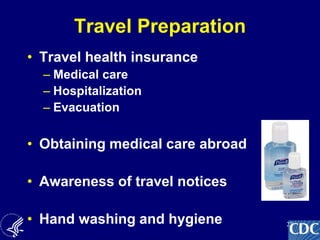
Travel Preparation
• Travel health insurance
– Medical care
– Hospitalization
– Evacuation
• Obtaining medical care abroad
• Awareness of travel notices
• Hand washing and hygiene
23
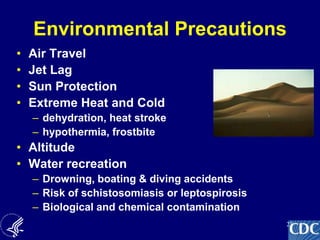
Environmental Precautions
• Air Travel
• Jet Lag
• Sun Protection
• Extreme Heat and Cold
– dehydration, heat stroke
– hypothermia, frostbite
• Altitude
• Water recreation
– Drowning, boating & diving accidents
– Risk of schistosomiasis or leptospirosis
– Biological and chemical contamination
24
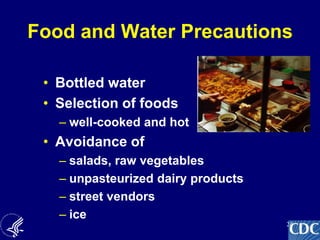
Food and Water Precautions
• Bottled water
• Selection of foods
– well-cooked and hot
• Avoidance of
– salads, raw vegetables
– unpasteurized dairy products
– street vendors
– ice
25
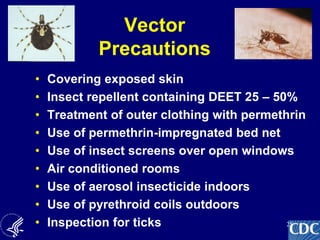
Vector
Precautions
• Covering exposed skin
• Insect repellent containing DEET 25 – 50%
• Treatment of outer clothing with permethrin
• Use of permethrin-impregnated bed net
• Use of insect screens over open windows
• Air conditioned rooms
• Use of aerosol insecticide indoors
• Use of pyrethroid coils outdoors
• Inspection for ticks
26
Bloodborne and STD Precautions
• Prevalence of
– STDs
– Hepatitis B
– Hepatitis C
– HIV
• Unprotected sexual activity
• Commercial sex workers
• Tattooing and body piercing
• Auto accidents
• Blood products
• Dental and surgical procedures
27
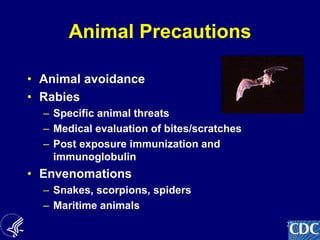
Animal Precautions
• Animal avoidance
• Rabies
– Specific animal threats
– Medical evaluation of bites/scratches
– Post exposure immunization and
immunoglobulin
• Envenomations
– Snakes, scorpions, spiders
– Maritime animals
28
Injury and Crime
• Vehicles
– Risk of road and pedestrian accidents
– Night travel
– Seat belts and car seats
• Use of drugs and alcohol
• Understanding local crime risks
– Scam awareness
– Situational awareness
– Location avoidance
29
Travel Emergency Kit
• Copy of medical records and extra pair of glasses
• Prescription medications
• Over-the counter medicines and supplies
– Analgesics
– Decongestant, cold medicine, cough suppressant
– Antibiotic/antifungal/hydrocortisone creams
– Pepto-Bismol tablets, antacid
– Band-Aids, gauze bandages, tape, Ace wraps
– Insect repellant, sunscreen, lip balm
– Tweezers, scissors, thermometer
30
Post-Travel Care
• Post-travel checkup
– Long term travelers
– Adventure travelers
– Expatriates in developing world
• Post-travel care
– Fever, chills, sweats
– Persistent diarrhea
– Weight loss
31
Questions?
32
Other Resources
33
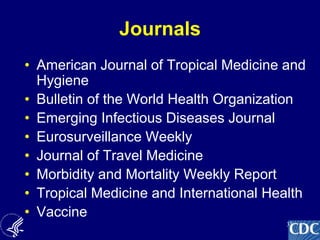
Journals
• American Journal of Tropical Medicine and
Hygiene
• Bulletin of the World Health Organization
• Emerging Infectious Diseases Journal
• Eurosurveillance Weekly
• Journal of Travel Medicine
• Morbidity and Mortality Weekly Report
• Tropical Medicine and International Health
• Vaccine
34
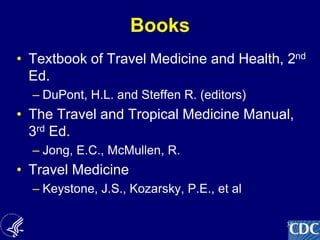
Books
• Textbook of Travel Medicine and Health, 2nd
Ed.
– DuPont, H.L. and Steffen R. (editors)
• The Travel and Tropical Medicine Manual,
3rd Ed.
– Jong, E.C., McMullen, R.
• Travel Medicine
– Keystone, J.S., Kozarsky, P.E., et al
35
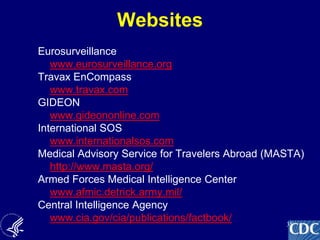
Websites
Eurosurveillance
www.eurosurveillance.org
Travax EnCompass
www.travax.com
GIDEON
www.gideononline.com
International SOS
www.internationalsos.com
Medical Advisory Service for Travelers Abroad (MASTA)
http://www.masta.org/
Armed Forces Medical Intelligence Center
www.afmic.detrick.army.mil/
Central Intelligence Agency
www.cia.gov/cia/publications/factbook/

CDC-travel-slides.ppt

  • 1.
    1 THE PRE-TRAVEL CONSULTATION Gary W.Brunette, MD, MS Travelers’ Health Team Division of Global Migration and Quarantine Centers for Disease Control and Prevention
  • 2.
    2 Outline • Travelers’ HealthEpidemiology • Traveler Assessment • Itinerary Review • Sources of Information • Risks to the Traveler • Travel Vaccines • Travel Medications • Counseling
  • 3.
    3 U.S. Residents TravelingAbroad* *ITA, includes travel to Canada and Mexico 45 50 55 60 65 1 9 9 5 1 9 9 6 1 9 9 7 1 9 9 8 1 9 9 9 2 0 0 0 2 0 0 1 2 0 0 2 2 0 0 3 2 0 0 4 2 0 0 5 Year Number of Travelers (millions)
  • 4.
    4 International Travel 0 10 20 30 40 50 60 70 80 1996 19971998 1999 2000 2001 2002 2003 2004 2005 US Resident travel in millions 0 100 200 300 400 500 600 700 800 900 Worldwide arrivals in millions US nonresident Inbound (ITA) US Resident Air Outbound (ITA) All US Resident Outbound (ITA) Worldwide arrivals (WTO)
  • 5.
    5 Where Do U.S.Residents Travel? 0 10 20 30 40 Canada Europe Aus/NZ Mexico C or S Am erica Japan Oceania/ PI Other Asia Africa Caribbean Middle East % Source: HealthStyles Survey 2005 Of the 17% who traveled outside the U.S. . . .
  • 6.
    6 VFRs: Visiting Friendsand Relatives • Foreign-born increased 57% since 1990 from 19.8 million to 31.1 million1 • 20% of US population are first- or second-generation immigrants • VFRs comprised ~46% of US international air travelers in 20043 1US Census Bureau, Census 2000 Brief, The Foreign-Born Population: 2000, issued Dec 2003 (Previous: US Census Bureau, Profile of the Born Outside the United States Population 2000, issues Dec 2003??? 2 Angell & Cetron, 2005 32004 Profile of U. S. Resident Travelers Visiting Overseas Destinations Reported From: Survey of International Air Travelers, Office of travel and tourism Industries, USDOC
  • 7.
    7 Travelers’ Health Risks Of100,000 travelers to a developing country for 1 month: – 50,000 will develop some health problem – 8,000 will see a physician – 5,000 will be confined to bed – 1,100 will be incapacitated in their work – 300 will be admitted to hospital – 50 will be air evacuated – 1 will die Steffen R et al. J Infect Dis 1987; 156:84-91
  • 8.
    8 The Patient: MedicalIssues • Age-specific issues • Underlying illness, immunosuppression • Systems review • Medical history • Medication use • Vaccination history • Allergies • Contraindications to vaccines and medications
  • 9.
    9 The Patient: OtherIssues • Reproductive – Pregnant – Breastfeeding – Preconception • Risk-taking behaviors
  • 10.
    10 Travel Itinerary • Fullitinerary – Dates, duration, stopovers – Seasonal considerations • Styles of travel – Rural vs. urban – Budget vs. luxury • Accommodation – Hotel vs. camping • Activities – Business vs. tourism – Adventure, safari – Missionary/Humanitarian/NGO
  • 11.
    11 Travel Health Resources •CDC Travelers’ Health Website – www.cdc.gov/travel • World Health Organization – www.who.int/int • State Department – travel.state.gov • International Society of Travel Medicine – www.istm.org • Health Information for International Travel – CDC “Yellow Book” • International Travel and Health – WHO “Green Book”
  • 12.
  • 13.
    13 Regional Destinations • Region-specificpages • Goal to move to country-specific format
  • 14.
    14 Travel Notices &Announcements
  • 15.
    15 Cardiovascular Medical Injury Homicide/Suicide Infectious Disease Other Deaths Relatedto International Travel N = 2463 Hargarten S et al, Ann Emerg Med, 1991. 20:622-626
  • 16.
    16 Infectious Disease Risksto the Traveler • Malaria • Diarrhea • Leishmaniasis • Rabies • Dengue • Meningococcal Meningitis • Schistosomiasis • Tuberculosis • Leptospirosis • Polio • Yellow Fever • Measles • JEV ETC.
  • 17.
    17 Motor Vechicle Drowning Air Crash Homicide/Suicide Poisoning Other InjuryDeaths and International Travel N = 601 Hargarten S et al, Ann Emerg Med, 1991. 20:622-626
  • 18.
    18 Other Risks tothe Traveler • Accidental injury • Environmental hazards • Crime and assault • Psychiatric problems • Animal bites, stings and envenomations • Dermatologic disorders • Altitude • ……. ETC.
  • 19.
    19 Immunizations to Considerfor Adult Travelers Routine Diphtheria* Tetanus* Pertussis* Measles + Mumps+ Rubella + Varicella Pneumococcus Influenza Travel related Hepatitis A Hepatitis B Typhoid Rabies Meningococcal disease Polio Japanese encephalitis Yellow Fever * Td or Tdap + MMR
  • 20.
    20 Travel Medications: Prophylaxis &Self Treatment • Malaria – chloroquine, atovaquone/proguanil (Malarone), doxycycline, mefloquine (Lariam), primaquine • Diarrhea – quinolone, azithromycin • Altitude – acetazolamide • Motion sickness – scopolamine, dimenhydrinate (Dramamine)
  • 21.
    21 Patient Counseling • Sufficienttime for patient education • Tailored to suit traveler • Fitness for travel – Understanding impact on existing conditions – Advisability of destinations
  • 22.
    22 Travel Preparation • Travelhealth insurance – Medical care – Hospitalization – Evacuation • Obtaining medical care abroad • Awareness of travel notices • Hand washing and hygiene
  • 23.
    23 Environmental Precautions • AirTravel • Jet Lag • Sun Protection • Extreme Heat and Cold – dehydration, heat stroke – hypothermia, frostbite • Altitude • Water recreation – Drowning, boating & diving accidents – Risk of schistosomiasis or leptospirosis – Biological and chemical contamination
  • 24.
    24 Food and WaterPrecautions • Bottled water • Selection of foods – well-cooked and hot • Avoidance of – salads, raw vegetables – unpasteurized dairy products – street vendors – ice
  • 25.
    25 Vector Precautions • Covering exposedskin • Insect repellent containing DEET 25 – 50% • Treatment of outer clothing with permethrin • Use of permethrin-impregnated bed net • Use of insect screens over open windows • Air conditioned rooms • Use of aerosol insecticide indoors • Use of pyrethroid coils outdoors • Inspection for ticks
  • 26.
    26 Bloodborne and STDPrecautions • Prevalence of – STDs – Hepatitis B – Hepatitis C – HIV • Unprotected sexual activity • Commercial sex workers • Tattooing and body piercing • Auto accidents • Blood products • Dental and surgical procedures
  • 27.
    27 Animal Precautions • Animalavoidance • Rabies – Specific animal threats – Medical evaluation of bites/scratches – Post exposure immunization and immunoglobulin • Envenomations – Snakes, scorpions, spiders – Maritime animals
  • 28.
    28 Injury and Crime •Vehicles – Risk of road and pedestrian accidents – Night travel – Seat belts and car seats • Use of drugs and alcohol • Understanding local crime risks – Scam awareness – Situational awareness – Location avoidance
  • 29.
    29 Travel Emergency Kit •Copy of medical records and extra pair of glasses • Prescription medications • Over-the counter medicines and supplies – Analgesics – Decongestant, cold medicine, cough suppressant – Antibiotic/antifungal/hydrocortisone creams – Pepto-Bismol tablets, antacid – Band-Aids, gauze bandages, tape, Ace wraps – Insect repellant, sunscreen, lip balm – Tweezers, scissors, thermometer
  • 30.
    30 Post-Travel Care • Post-travelcheckup – Long term travelers – Adventure travelers – Expatriates in developing world • Post-travel care – Fever, chills, sweats – Persistent diarrhea – Weight loss
  • 31.
  • 32.
  • 33.
    33 Journals • American Journalof Tropical Medicine and Hygiene • Bulletin of the World Health Organization • Emerging Infectious Diseases Journal • Eurosurveillance Weekly • Journal of Travel Medicine • Morbidity and Mortality Weekly Report • Tropical Medicine and International Health • Vaccine
  • 34.
    34 Books • Textbook ofTravel Medicine and Health, 2nd Ed. – DuPont, H.L. and Steffen R. (editors) • The Travel and Tropical Medicine Manual, 3rd Ed. – Jong, E.C., McMullen, R. • Travel Medicine – Keystone, J.S., Kozarsky, P.E., et al
  • 35.
    35 Websites Eurosurveillance www.eurosurveillance.org Travax EnCompass www.travax.com GIDEON www.gideononline.com International SOS www.internationalsos.com MedicalAdvisory Service for Travelers Abroad (MASTA) http://www.masta.org/ Armed Forces Medical Intelligence Center www.afmic.detrick.army.mil/ Central Intelligence Agency www.cia.gov/cia/publications/factbook/

Editor's Notes

  • #4 Source http://tinet.ita.doc.gov/view/f-2005-11-001/index.html
  • #6  This is not supposed to include travel without an overnight stay, particularly to Canada and Mexico. Notice that the specification of the regions was not completely 52% have traveled to developing countries As expected, the majority of travel is to Canada, western Europe and Mexico.
  • #7 Christie, the first bullet needs to have the reference I cited. The previous reference is in parentheses, which I think is a typo. I cannot find a source to confirm the second bullet. The paper I have cited there has this information, but I cannot confirm with the US Census reference that is included in the paper (Kip has a copy). The whole reference is Angell SY, Cetron MS. Health Disparities among Travelers Visiting Friends and Relatives Abroad. Annals of Internal Medicine, 2005; 142:1, 67-73. I have updated the 3rd bullet and reference.
  • #13 In web use, usually in top 5 CDC sites Primary Audiences Traveling public Health professionals advising travelers Content Areas Travel Notices & Announcements Online Yellow Book Regional Destination Pages Resources (Y.Fever Registry, Travel Med Clinics, Contact Us) Additional Topics & Special Needs Groups Diseases A-Z Traveling with Pets, Children, Special Needs Travelers Travel Industry
  • #20 VZV (no mention of upper age limit; approved for >=12 months) >= 13 Years of Age After the first and second doses, 10.2% and 9.5% of vaccinees, respectively, developed fever (i.e., oral temperature greater than or equal to 100 F {37.7 C}); these febrile episodes occurred throughout the 42-day period and were usually associated with intercurrent illness. After one and two doses, 24.4% and 32.5% of vaccinees, respectively, had complaints regarding the injection site; rash at the injection site at a peak of 6-20 days and 0-6 days postvaccination, respectively, developed in 3% and 1% of vaccinees, respectively; and a nonlocalized rash consisting of a median number of five lesions developed in 5.5% and 0.9% of vaccinees, respectively, and occurred at a peak of 7-21 days and 0-23 days postvaccination, respectively.