Chapter 6: Quality of Service
CCNA Routing and Switching
Connecting Networks v6.0
2
© 2016 Cisco and/or its affiliates. All rights reserved. Cisco Confidential
 6.1 QoS Overview
• Explain the purpose and characteristics of QoS.
• Explain how network transmission characteristics impact quality.
• Describe minimum network requirements for voice, video, and data traffic.
• Describe the queuing algorithms used by networking devices.
 6.2 QoS Mechanisms
• Explain how networking devices implement QoS.
• Describe the different QoS models.
• Explain how QoS uses mechanisms to ensure transmission quality.
Chapter 1 - Sections & Objectives
3
© 2016 Cisco and/or its affiliates. All rights reserved. Cisco Confidential
6.1 QoS Overview
4
© 2016 Cisco and/or its affiliates. All rights reserved. Cisco Confidential
Network Transmission Quality
Video Tutorial – The Purpose of QoS
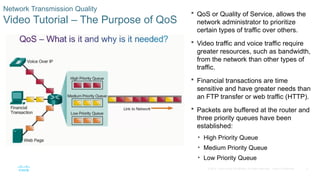
 QoS or Quality of Service, allows the
network administrator to prioritize
certain types of traffic over others.
 Video traffic and voice traffic require
greater resources, such as bandwidth,
from the network than other types of
traffic.
 Financial transactions are time
sensitive and have greater needs than
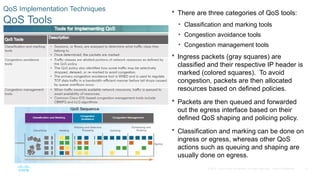
an FTP transfer or web traffic (HTTP).
 Packets are buffered at the router and
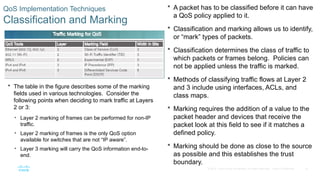
three priority queues have been
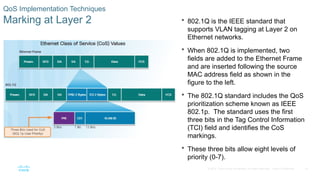
established:
• High Priority Queue
• Medium Priority Queue
• Low Priority Queue
5
© 2016 Cisco and/or its affiliates. All rights reserved. Cisco Confidential
Network Transmission Quality
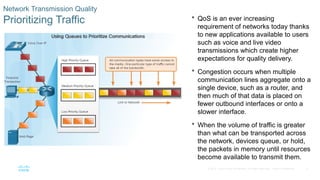
Prioritizing Traffic  QoS is an ever increasing
requirement of networks today thanks
to new applications available to users
such as voice and live video
transmissions which create higher
expectations for quality delivery.
 Congestion occurs when multiple
communication lines aggregate onto a
single device, such as a router, and
then much of that data is placed on
fewer outbound interfaces or onto a
slower interface.
 When the volume of traffic is greater
than what can be transported across
the network, devices queue, or hold,
the packets in memory until resources
become available to transmit them.
6
© 2016 Cisco and/or its affiliates. All rights reserved. Cisco Confidential
Network Transmission Quality
Prioritizing Traffic (Cont.)
 Queuing packets causes delay
because new packets cannot be
transmitted until previous packets
have been processed.
 Packets will be dropped when
memory fills up.
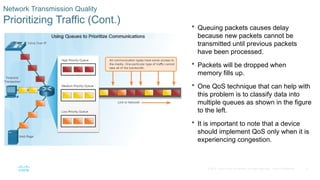
 One QoS technique that can help with
this problem is to classify data into
multiple queues as shown in the figure
to the left.
 It is important to note that a device
should implement QoS only when it is
experiencing congestion.
7
© 2016 Cisco and/or its affiliates. All rights reserved. Cisco Confidential
Network Transmission Quality
Bandwidth, Congestion, Delay, and Jitter
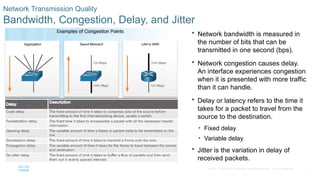
 Network bandwidth is measured in
the number of bits that can be
transmitted in one second (bps).
 Network congestion causes delay.
An interface experiences congestion
when it is presented with more traffic
than it can handle.
 Delay or latency refers to the time it
takes for a packet to travel from the
source to the destination.
• Fixed delay
• Variable delay
 Jitter is the variation in delay of
received packets.
8
© 2016 Cisco and/or its affiliates. All rights reserved. Cisco Confidential
Network Transmission Quality
Packet Loss
 Without any QoS mechanisms in place,
packets are processed in the order in
which they are received.
• When congestion occurs, network
devices will drop packets.
• This includes time-sensitive video and
audio packets.
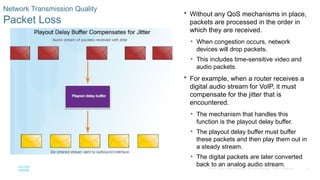
 For example, when a router receives a
digital audio stream for VoIP, it must
compensate for the jitter that is
encountered.
• The mechanism that handles this
function is the playout delay buffer.
• The playout delay buffer must buffer
these packets and then play them out in
a steady stream.
• The digital packets are later converted
back to an analog audio stream.
9
© 2016 Cisco and/or its affiliates. All rights reserved. Cisco Confidential
Network Transmission Quality
Packet Loss (Cont.)
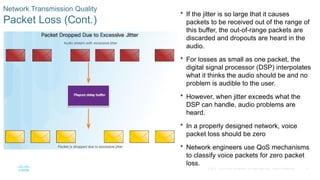
 If the jitter is so large that it causes
packets to be received out of the range of
this buffer, the out-of-range packets are
discarded and dropouts are heard in the
audio.
 For losses as small as one packet, the
digital signal processor (DSP) interpolates
what it thinks the audio should be and no
problem is audible to the user.
 However, when jitter exceeds what the
DSP can handle, audio problems are
heard.
 In a properly designed network, voice
packet loss should be zero
 Network engineers use QoS mechanisms
to classify voice packets for zero packet
loss.
10
© 2016 Cisco and/or its affiliates. All rights reserved. Cisco Confidential
Traffic Characteristics
Video Tutorial – Traffic Characteristics
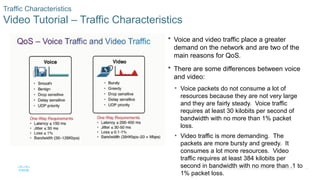
 Voice and video traffic place a greater
demand on the network and are two of the
main reasons for QoS.
 There are some differences between voice
and video:
• Voice packets do not consume a lot of
resources because they are not very large
and they are fairly steady. Voice traffic
requires at least 30 kilobits per second of
bandwidth with no more than 1% packet
loss.
• Video traffic is more demanding. The
packets are more bursty and greedy. It
consumes a lot more resources. Video
traffic requires at least 384 kilobits per
second in bandwidth with no more than .1 to
1% packet loss.
11
© 2016 Cisco and/or its affiliates. All rights reserved. Cisco Confidential
Traffic Characteristics
Network Traffic Trends
 In the early 2000s, the predominant types
of IP traffic were voice and data.
 Voice traffic has a predictable bandwidth
need and known packet arrival times.
 Data traffic is not real-time and has an
unpredictable bandwidth need.
 More recently, video traffic has become
increasingly important to business
communications and operations.
 According to the Cisco Visual Networking
Index (VNI), video traffic represented 67%
of all traffic in 2014. By 2019, video will
represent 80% of all traffic.
 The type of demands that voice, video,
and data traffic place on the network are
very different.
12
© 2016 Cisco and/or its affiliates. All rights reserved. Cisco Confidential
Traffic Characteristics
Voice
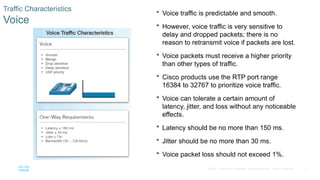
 Voice traffic is predictable and smooth.
 However, voice traffic is very sensitive to
delay and dropped packets; there is no
reason to retransmit voice if packets are lost.
 Voice packets must receive a higher priority
than other types of traffic.
 Cisco products use the RTP port range
16384 to 32767 to prioritize voice traffic.
 Voice can tolerate a certain amount of
latency, jitter, and loss without any noticeable
effects.
 Latency should be no more than 150 ms.
 Jitter should be no more than 30 ms.
 Voice packet loss should not exceed 1%.
13
© 2016 Cisco and/or its affiliates. All rights reserved. Cisco Confidential
Traffic Characteristics
Video
 Without QoS and a significant amount
of extra bandwidth capacity, video
quality typically degrades.
 The picture appears blurry, jagged, or
in slow motion. The audio portion
may become unsynchronized with the
video.
 Video Traffic Characteristics:
• Video – Bursty, greedy, drop sensitive,
delay sensitive, UDP priority
• One-Way Requirements:
• Latency <= 200 - 400 ms
• Jitter <= 30 – 50ms
• Loss <= 0.1 – 1%
• Bandwidth (384 Kb/s – 20+ Mb/s)
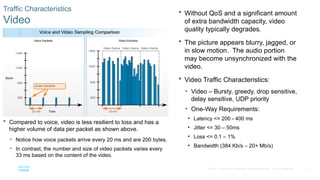
 Compared to voice, video is less resilient to loss and has a
higher volume of data per packet as shown above.
• Notice how voice packets arrive every 20 ms and are 200 bytes.
• In contrast, the number and size of video packets varies every
33 ms based on the content of the video.
14
© 2016 Cisco and/or its affiliates. All rights reserved. Cisco Confidential
Traffic Characteristics
Data
 Most applications use either TCP or UDP. Unlike UDP, TCP
performs error recovery.
 Data applications that have no tolerance for data loss, such as
email and web pages, use TCP to ensure packets will be
resent in the event they are lost.
 Some TCP applications, such as FTP, can be very greedy,
consuming a large portion of network capacity.
 Although data traffic is relatively insensitive to drops and
delays compared to voice and video, a network administrator
still needs to consider the quality of the user experience.
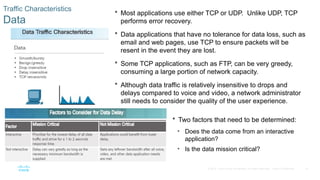
 Two factors that need to be determined:
• Does the data come from an interactive
application?
• Is the data mission critical?
15
© 2016 Cisco and/or its affiliates. All rights reserved. Cisco Confidential
queuing Algorithms
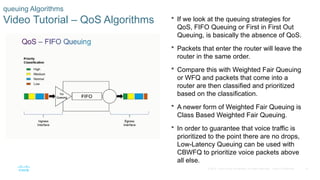
Video Tutorial – QoS Algorithms  If we look at the queuing strategies for
QoS, FIFO Queuing or First in First Out
Queuing, is basically the absence of QoS.
 Packets that enter the router will leave the
router in the same order.
 Compare this with Weighted Fair Queuing
or WFQ and packets that come into a
router are then classified and prioritized
based on the classification.
 A newer form of Weighted Fair Queuing is
Class Based Weighted Fair Queuing.
 In order to guarantee that voice traffic is
prioritized to the point there are no drops,
Low-Latency Queuing can be used with
CBWFQ to prioritize voice packets above
all else.
16
© 2016 Cisco and/or its affiliates. All rights reserved. Cisco Confidential
Queuing Algorithms
Queuing Overview  The QoS policy implemented by the network
administrator becomes active when
congestion occurs on the link.
 Queuing is a congestion management tool
that can buffer, prioritize, and if required,
reorder packets before being transmitted to
the destination.
 This course will focus on the following
queuing algorithms:
• First-In, First-Out (FIFO)
• Weighted Fair Queuing (WFQ)
• Class-Based Weighted Fair Queuing (CBWFQ)
• Low Latency Queuing (LLQ)
17
© 2016 Cisco and/or its affiliates. All rights reserved. Cisco Confidential
Queuing Algorithms
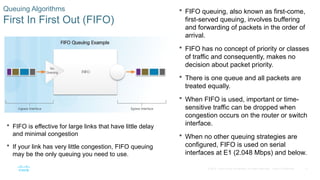
First In First Out (FIFO)
 FIFO queuing, also known as first-come,
first-served queuing, involves buffering
and forwarding of packets in the order of
arrival.
 FIFO has no concept of priority or classes
of traffic and consequently, makes no
decision about packet priority.
 There is one queue and all packets are
treated equally.
 When FIFO is used, important or time-
sensitive traffic can be dropped when
congestion occurs on the router or switch
interface.
 When no other queuing strategies are
configured, FIFO is used on serial
interfaces at E1 (2.048 Mbps) and below.
 FIFO is effective for large links that have little delay
and minimal congestion
 If your link has very little congestion, FIFO queuing
may be the only queuing you need to use.
18
© 2016 Cisco and/or its affiliates. All rights reserved. Cisco Confidential
Queuing Algorithms
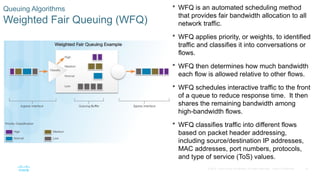
Weighted Fair Queuing (WFQ)
 WFQ is an automated scheduling method
that provides fair bandwidth allocation to all
network traffic.
 WFQ applies priority, or weights, to identified
traffic and classifies it into conversations or
flows.
 WFQ then determines how much bandwidth
each flow is allowed relative to other flows.
 WFQ schedules interactive traffic to the front
of a queue to reduce response time. It then
shares the remaining bandwidth among
high-bandwidth flows.
 WFQ classifies traffic into different flows
based on packet header addressing,
including source/destination IP addresses,
MAC addresses, port numbers, protocols,
and type of service (ToS) values.
19
© 2016 Cisco and/or its affiliates. All rights reserved. Cisco Confidential
Queuing Algorithms
Class-Based Weighted Fair Queuing (WFQ)
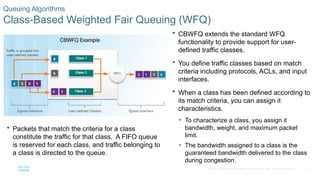
 CBWFQ extends the standard WFQ
functionality to provide support for user-
defined traffic classes.
 You define traffic classes based on match
criteria including protocols, ACLs, and input
interfaces.
 When a class has been defined according to
its match criteria, you can assign it
characteristics.
• To characterize a class, you assign it
bandwidth, weight, and maximum packet
limit.
• The bandwidth assigned to a class is the
guaranteed bandwidth delivered to the class
during congestion.
 Packets that match the criteria for a class
constitute the traffic for that class. A FIFO queue
is reserved for each class, and traffic belonging to
a class is directed to the queue.
20
© 2016 Cisco and/or its affiliates. All rights reserved. Cisco Confidential
Queuing Algorithms
Low Latency Queuing (LLQ)
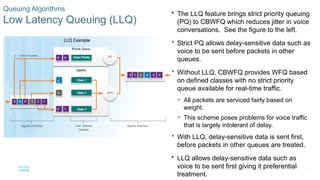
 The LLQ feature brings strict priority queuing
(PQ) to CBWFQ which reduces jitter in voice
conversations. See the figure to the left.
 Strict PQ allows delay-sensitive data such as
voice to be sent before packets in other
queues.
 Without LLQ, CBWFQ provides WFQ based
on defined classes with no strict priority
queue available for real-time traffic.
• All packets are serviced fairly based on
weight.
• This scheme poses problems for voice traffic
that is largely intolerant of delay.
 With LLQ, delay-sensitive data is sent first,
before packets in other queues are treated.
 LLQ allows delay-sensitive data such as
voice to be sent first giving it preferential
treatment.
21
© 2016 Cisco and/or its affiliates. All rights reserved. Cisco Confidential
6.2 QoS Mechanisms
22
© 2016 Cisco and/or its affiliates. All rights reserved. Cisco Confidential
QoS Models
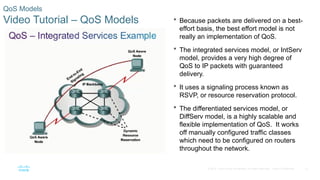
Video Tutorial – QoS Models  Because packets are delivered on a best-
effort basis, the best effort model is not
really an implementation of QoS.
 The integrated services model, or IntServ
model, provides a very high degree of
QoS to IP packets with guaranteed
delivery.
 It uses a signaling process known as
RSVP, or resource reservation protocol.
 The differentiated services model, or
DiffServ model, is a highly scalable and
flexible implementation of QoS. It works
off manually configured traffic classes
which need to be configured on routers
throughout the network.
23
© 2016 Cisco and/or its affiliates. All rights reserved. Cisco Confidential
QoS Models
Selecting an Appropriate QoS Policy Model
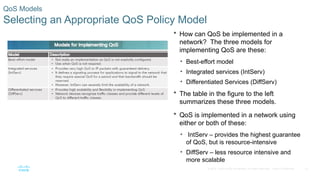
 How can QoS be implemented in a
network? The three models for
implementing QoS are these:
• Best-effort model
• Integrated services (IntServ)
• Differentiated Services (DiffServ)
 The table in the figure to the left
summarizes these three models.
 QoS is implemented in a network using
either or both of these:
• IntServ – provides the highest guarantee
of QoS, but is resource-intensive
• DiffServ – less resource intensive and
more scalable
24
© 2016 Cisco and/or its affiliates. All rights reserved. Cisco Confidential
QoS Models
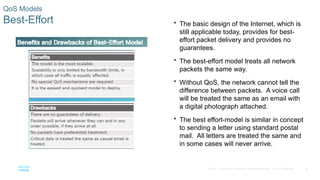
Best-Effort  The basic design of the Internet, which is
still applicable today, provides for best-
effort packet delivery and provides no
guarantees.
 The best-effort model treats all network
packets the same way.
 Without QoS, the network cannot tell the
difference between packets. A voice call
will be treated the same as an email with
a digital photograph attached.
 The best effort-model is similar in concept
to sending a letter using standard postal
mail. All letters are treated the same and
in some cases will never arrive.
25
© 2016 Cisco and/or its affiliates. All rights reserved. Cisco Confidential
QoS Models
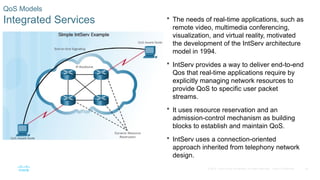
Integrated Services  The needs of real-time applications, such as
remote video, multimedia conferencing,
visualization, and virtual reality, motivated
the development of the IntServ architecture
model in 1994.
 IntServ provides a way to deliver end-to-end
Qos that real-time applications require by
explicitly managing network resources to
provide QoS to specific user packet
streams.
 It uses resource reservation and an
admission-control mechanism as building
blocks to establish and maintain QoS.
 IntServ uses a connection-oriented
approach inherited from telephony network
design.
26
© 2016 Cisco and/or its affiliates. All rights reserved. Cisco Confidential
QoS Models
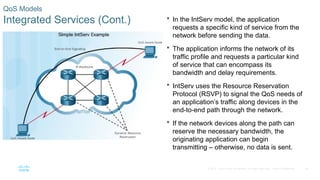
Integrated Services (Cont.)  In the IntServ model, the application
requests a specific kind of service from the
network before sending the data.
 The application informs the network of its
traffic profile and requests a particular kind
of service that can encompass its
bandwidth and delay requirements.
 IntServ uses the Resource Reservation
Protocol (RSVP) to signal the QoS needs of
an application’s traffic along devices in the
end-to-end path through the network.
 If the network devices along the path can
reserve the necessary bandwidth, the
originating application can begin
transmitting – otherwise, no data is sent.
27
© 2016 Cisco and/or its affiliates. All rights reserved. Cisco Confidential
QoS Models
Differentiated Services
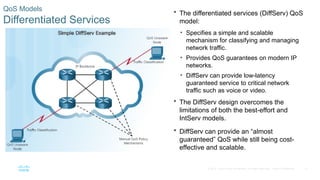
 The differentiated services (DiffServ) QoS
model:
• Specifies a simple and scalable
mechanism for classifying and managing
network traffic.
• Provides QoS guarantees on modern IP
networks.
• DiffServ can provide low-latency
guaranteed service to critical network
traffic such as voice or video.
 The DiffServ design overcomes the
limitations of both the best-effort and
IntServ models.
 DiffServ can provide an “almost
guaranteed” QoS while still being cost-
effective and scalable.
28
© 2016 Cisco and/or its affiliates. All rights reserved. Cisco Confidential
QoS Models
Differentiated Services (Cont.)
 DiffServ is not an end-to-end QoS strategy
because it cannot enforce end-to-end
guarantees. However, it is a more scalable
approach to implementing QoS.
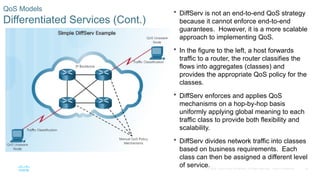
 In the figure to the left, a host forwards
traffic to a router, the router classifies the
flows into aggregates (classes) and
provides the appropriate QoS policy for the
classes.
 DiffServ enforces and applies QoS
mechanisms on a hop-by-hop basis
uniformly applying global meaning to each
traffic class to provide both flexibility and
scalability.
 DiffServ divides network traffic into classes
based on business requirements. Each
class can then be assigned a different level
of service.
29
© 2016 Cisco and/or its affiliates. All rights reserved. Cisco Confidential
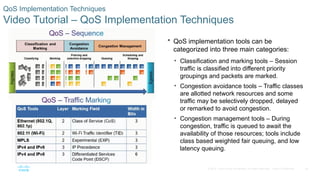
QoS Implementation Techniques
Video Tutorial – QoS Implementation Techniques
 QoS implementation tools can be
categorized into three main categories:
• Classification and marking tools – Session
traffic is classified into different priority
groupings and packets are marked.
• Congestion avoidance tools – Traffic classes
are allotted network resources and some
traffic may be selectively dropped, delayed
or remarked to avoid congestion.
• Congestion management tools – During
congestion, traffic is queued to await the
availability of those resources; tools include
class based weighted fair queuing, and low
latency queuing.
30
© 2016 Cisco and/or its affiliates. All rights reserved. Cisco Confidential
QoS Implementation Techniques
Avoiding Packet Loss
 Packet loss is usually the result of
congestion on an interface.
 Most TCP applications experience
slowdown because TCP automatically
adjusts to network congestion.
• Some applications do not use TCP and
cannot handle drops (fragile flows).
 The following approaches can prevent
drops in sensitive applications:
• Increase link capacity to ease or prevent
congestion.
• Guarantee enough bandwidth and increase
buffer space to accommodate bursts of
traffic from fragile flows – WFQ, CBWFQ
and LLQ.
• Prevent congestion by dropping lower-
priority packets before congestion occurs –
weighted random early detection (WRED).
31
© 2016 Cisco and/or its affiliates. All rights reserved. Cisco Confidential
QoS Implementation Techniques
QoS Tools
 There are three categories of QoS tools:
• Classification and marking tools
• Congestion avoidance tools
• Congestion management tools
 Ingress packets (gray squares) are
classified and their respective IP header is
marked (colored squares). To avoid
congestion, packets are then allocated
resources based on defined policies.
 Packets are then queued and forwarded
out the egress interface based on their
defined QoS shaping and policing policy.
 Classification and marking can be done on
ingress or egress, whereas other QoS
actions such as queuing and shaping are
usually done on egress.
32
© 2016 Cisco and/or its affiliates. All rights reserved. Cisco Confidential
QoS Implementation Techniques
Classification and Marking
 A packet has to be classified before it can have
a QoS policy applied to it.
 Classification and marking allows us to identify,
or “mark” types of packets.
 Classification determines the class of traffic to
which packets or frames belong. Policies can
not be applied unless the traffic is marked.
 Methods of classifying traffic flows at Layer 2
and 3 include using interfaces, ACLs, and
class maps.
 Marking requires the addition of a value to the
packet header and devices that receive the
packet look at this field to see if it matches a
defined policy.
 Marking should be done as close to the source
as possible and this establishes the trust
boundary.
 The table in the figure describes some of the marking
fields used in various technologies. Consider the
following points when deciding to mark traffic at Layers
2 or 3:
• Layer 2 marking of frames can be performed for non-IP
traffic.
• Layer 2 marking of frames is the only QoS option
available for switches that are not “IP aware”.
• Layer 3 marking will carry the QoS information end-to-
end.
33
© 2016 Cisco and/or its affiliates. All rights reserved. Cisco Confidential
QoS Implementation Techniques
Marking at Layer 2  802.1Q is the IEEE standard that
supports VLAN tagging at Layer 2 on
Ethernet networks.
 When 802.1Q is implemented, two
fields are added to the Ethernet Frame
and are inserted following the source
MAC address field as shown in the
figure to the left.
 The 802.1Q standard includes the QoS
prioritization scheme known as IEEE
802.1p. The standard uses the first
three bits in the Tag Control Information
(TCI) field and identifies the CoS
markings.
 These three bits allow eight levels of
priority (0-7).
34
© 2016 Cisco and/or its affiliates. All rights reserved. Cisco Confidential
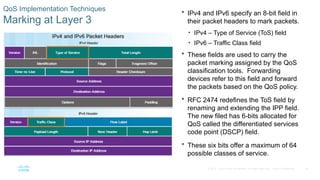
QoS Implementation Techniques
Marking at Layer 3
 IPv4 and IPv6 specify an 8-bit field in
their packet headers to mark packets.
• IPv4 – Type of Service (ToS) field
• IPv6 – Traffic Class field
 These fields are used to carry the
packet marking assigned by the QoS
classification tools. Forwarding
devices refer to this field and forward
the packets based on the QoS policy.
 RFC 2474 redefines the ToS field by
renaming and extending the IPP field.
The new filed has 6-bits allocated for
QoS called the differentiated services
code point (DSCP) field.
 These six bits offer a maximum of 64
possible classes of service.
35
© 2016 Cisco and/or its affiliates. All rights reserved. Cisco Confidential
QoS Implementation Techniques
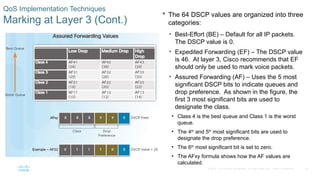
Marking at Layer 3 (Cont.)
 The 64 DSCP values are organized into three
categories:
• Best-Effort (BE) – Default for all IP packets.
The DSCP value is 0.
• Expedited Forwarding (EF) – The DSCP value
is 46. At layer 3, Cisco recommends that EF
should only be used to mark voice packets.
• Assured Forwarding (AF) – Uses the 5 most
significant DSCP bits to indicate queues and
drop preference. As shown in the figure, the
first 3 most significant bits are used to
designate the class.
• Class 4 is the best queue and Class 1 is the worst
queue.
• The 4th
and 5th
most significant bits are used to
designate the drop preference.
• The 6th
most significant bit is set to zero.
• The AFxy formula shows how the AF values are
calculated.
36
© 2016 Cisco and/or its affiliates. All rights reserved. Cisco Confidential
QoS Implementation Techniques
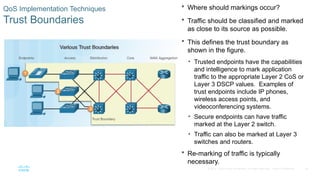
Trust Boundaries
 Where should markings occur?
 Traffic should be classified and marked
as close to its source as possible.
 This defines the trust boundary as
shown in the figure.
• Trusted endpoints have the capabilities
and intelligence to mark application
traffic to the appropriate Layer 2 CoS or
Layer 3 DSCP values. Examples of
trust endpoints include IP phones,
wireless access points, and
videoconferencing systems.
• Secure endpoints can have traffic
marked at the Layer 2 switch.
• Traffic can also be marked at Layer 3
switches and routers.
 Re-marking of traffic is typically
necessary.
37
© 2016 Cisco and/or its affiliates. All rights reserved. Cisco Confidential
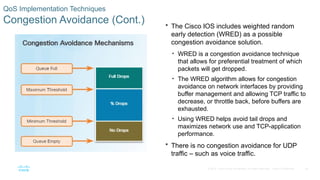
QoS Implementation Techniques
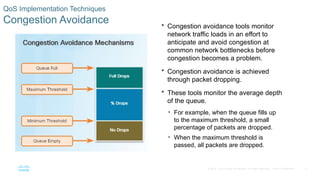
Congestion Avoidance  Congestion avoidance tools monitor
network traffic loads in an effort to
anticipate and avoid congestion at
common network bottlenecks before
congestion becomes a problem.
 Congestion avoidance is achieved
through packet dropping.
 These tools monitor the average depth
of the queue.
• For example, when the queue fills up
to the maximum threshold, a small
percentage of packets are dropped.
• When the maximum threshold is
passed, all packets are dropped.
38
© 2016 Cisco and/or its affiliates. All rights reserved. Cisco Confidential
QoS Implementation Techniques
Congestion Avoidance (Cont.)  The Cisco IOS includes weighted random
early detection (WRED) as a possible
congestion avoidance solution.
• WRED is a congestion avoidance technique
that allows for preferential treatment of which
packets will get dropped.
• The WRED algorithm allows for congestion
avoidance on network interfaces by providing
buffer management and allowing TCP traffic to
decrease, or throttle back, before buffers are
exhausted.
• Using WRED helps avoid tail drops and
maximizes network use and TCP-application
performance.
 There is no congestion avoidance for UDP
traffic – such as voice traffic.
39
© 2016 Cisco and/or its affiliates. All rights reserved. Cisco Confidential
QoS Implementation Techniques
Shaping and Policing
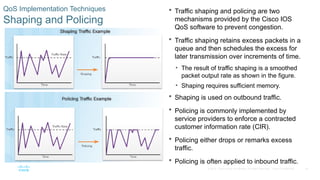
 Traffic shaping and policing are two
mechanisms provided by the Cisco IOS
QoS software to prevent congestion.
 Traffic shaping retains excess packets in a
queue and then schedules the excess for
later transmission over increments of time.
• The result of traffic shaping is a smoothed
packet output rate as shown in the figure.
• Shaping requires sufficient memory.
 Shaping is used on outbound traffic.
 Policing is commonly implemented by
service providers to enforce a contracted
customer information rate (CIR).
 Policing either drops or remarks excess
traffic.
 Policing is often applied to inbound traffic.
40
© 2016 Cisco and/or its affiliates. All rights reserved. Cisco Confidential
6.3 Summary
41
© 2016 Cisco and/or its affiliates. All rights reserved. Cisco Confidential
Summary
Conclusion
• Explain the purpose and characteristics of QoS.
• Explain how networking devices implement QoS.
CCNA Routing and Switching 06_Quality_of_Service

CCNA Routing and Switching 06_Quality_of_Service

  • 1.
    Chapter 6: Qualityof Service CCNA Routing and Switching Connecting Networks v6.0
  • 2.
    2 © 2016 Ciscoand/or its affiliates. All rights reserved. Cisco Confidential  6.1 QoS Overview • Explain the purpose and characteristics of QoS. • Explain how network transmission characteristics impact quality. • Describe minimum network requirements for voice, video, and data traffic. • Describe the queuing algorithms used by networking devices.  6.2 QoS Mechanisms • Explain how networking devices implement QoS. • Describe the different QoS models. • Explain how QoS uses mechanisms to ensure transmission quality. Chapter 1 - Sections & Objectives
  • 3.
    3 © 2016 Ciscoand/or its affiliates. All rights reserved. Cisco Confidential 6.1 QoS Overview
  • 4.
    4 © 2016 Ciscoand/or its affiliates. All rights reserved. Cisco Confidential Network Transmission Quality Video Tutorial – The Purpose of QoS  QoS or Quality of Service, allows the network administrator to prioritize certain types of traffic over others.  Video traffic and voice traffic require greater resources, such as bandwidth, from the network than other types of traffic.  Financial transactions are time sensitive and have greater needs than an FTP transfer or web traffic (HTTP).  Packets are buffered at the router and three priority queues have been established: • High Priority Queue • Medium Priority Queue • Low Priority Queue
  • 5.
    5 © 2016 Ciscoand/or its affiliates. All rights reserved. Cisco Confidential Network Transmission Quality Prioritizing Traffic  QoS is an ever increasing requirement of networks today thanks to new applications available to users such as voice and live video transmissions which create higher expectations for quality delivery.  Congestion occurs when multiple communication lines aggregate onto a single device, such as a router, and then much of that data is placed on fewer outbound interfaces or onto a slower interface.  When the volume of traffic is greater than what can be transported across the network, devices queue, or hold, the packets in memory until resources become available to transmit them.
  • 6.
    6 © 2016 Ciscoand/or its affiliates. All rights reserved. Cisco Confidential Network Transmission Quality Prioritizing Traffic (Cont.)  Queuing packets causes delay because new packets cannot be transmitted until previous packets have been processed.  Packets will be dropped when memory fills up.  One QoS technique that can help with this problem is to classify data into multiple queues as shown in the figure to the left.  It is important to note that a device should implement QoS only when it is experiencing congestion.
  • 7.
    7 © 2016 Ciscoand/or its affiliates. All rights reserved. Cisco Confidential Network Transmission Quality Bandwidth, Congestion, Delay, and Jitter  Network bandwidth is measured in the number of bits that can be transmitted in one second (bps).  Network congestion causes delay. An interface experiences congestion when it is presented with more traffic than it can handle.  Delay or latency refers to the time it takes for a packet to travel from the source to the destination. • Fixed delay • Variable delay  Jitter is the variation in delay of received packets.
  • 8.
    8 © 2016 Ciscoand/or its affiliates. All rights reserved. Cisco Confidential Network Transmission Quality Packet Loss  Without any QoS mechanisms in place, packets are processed in the order in which they are received. • When congestion occurs, network devices will drop packets. • This includes time-sensitive video and audio packets.  For example, when a router receives a digital audio stream for VoIP, it must compensate for the jitter that is encountered. • The mechanism that handles this function is the playout delay buffer. • The playout delay buffer must buffer these packets and then play them out in a steady stream. • The digital packets are later converted back to an analog audio stream.
  • 9.
    9 © 2016 Ciscoand/or its affiliates. All rights reserved. Cisco Confidential Network Transmission Quality Packet Loss (Cont.)  If the jitter is so large that it causes packets to be received out of the range of this buffer, the out-of-range packets are discarded and dropouts are heard in the audio.  For losses as small as one packet, the digital signal processor (DSP) interpolates what it thinks the audio should be and no problem is audible to the user.  However, when jitter exceeds what the DSP can handle, audio problems are heard.  In a properly designed network, voice packet loss should be zero  Network engineers use QoS mechanisms to classify voice packets for zero packet loss.
  • 10.
    10 © 2016 Ciscoand/or its affiliates. All rights reserved. Cisco Confidential Traffic Characteristics Video Tutorial – Traffic Characteristics  Voice and video traffic place a greater demand on the network and are two of the main reasons for QoS.  There are some differences between voice and video: • Voice packets do not consume a lot of resources because they are not very large and they are fairly steady. Voice traffic requires at least 30 kilobits per second of bandwidth with no more than 1% packet loss. • Video traffic is more demanding. The packets are more bursty and greedy. It consumes a lot more resources. Video traffic requires at least 384 kilobits per second in bandwidth with no more than .1 to 1% packet loss.
  • 11.
    11 © 2016 Ciscoand/or its affiliates. All rights reserved. Cisco Confidential Traffic Characteristics Network Traffic Trends  In the early 2000s, the predominant types of IP traffic were voice and data.  Voice traffic has a predictable bandwidth need and known packet arrival times.  Data traffic is not real-time and has an unpredictable bandwidth need.  More recently, video traffic has become increasingly important to business communications and operations.  According to the Cisco Visual Networking Index (VNI), video traffic represented 67% of all traffic in 2014. By 2019, video will represent 80% of all traffic.  The type of demands that voice, video, and data traffic place on the network are very different.
  • 12.
    12 © 2016 Ciscoand/or its affiliates. All rights reserved. Cisco Confidential Traffic Characteristics Voice  Voice traffic is predictable and smooth.  However, voice traffic is very sensitive to delay and dropped packets; there is no reason to retransmit voice if packets are lost.  Voice packets must receive a higher priority than other types of traffic.  Cisco products use the RTP port range 16384 to 32767 to prioritize voice traffic.  Voice can tolerate a certain amount of latency, jitter, and loss without any noticeable effects.  Latency should be no more than 150 ms.  Jitter should be no more than 30 ms.  Voice packet loss should not exceed 1%.
  • 13.
    13 © 2016 Ciscoand/or its affiliates. All rights reserved. Cisco Confidential Traffic Characteristics Video  Without QoS and a significant amount of extra bandwidth capacity, video quality typically degrades.  The picture appears blurry, jagged, or in slow motion. The audio portion may become unsynchronized with the video.  Video Traffic Characteristics: • Video – Bursty, greedy, drop sensitive, delay sensitive, UDP priority • One-Way Requirements: • Latency <= 200 - 400 ms • Jitter <= 30 – 50ms • Loss <= 0.1 – 1% • Bandwidth (384 Kb/s – 20+ Mb/s)  Compared to voice, video is less resilient to loss and has a higher volume of data per packet as shown above. • Notice how voice packets arrive every 20 ms and are 200 bytes. • In contrast, the number and size of video packets varies every 33 ms based on the content of the video.
  • 14.
    14 © 2016 Ciscoand/or its affiliates. All rights reserved. Cisco Confidential Traffic Characteristics Data  Most applications use either TCP or UDP. Unlike UDP, TCP performs error recovery.  Data applications that have no tolerance for data loss, such as email and web pages, use TCP to ensure packets will be resent in the event they are lost.  Some TCP applications, such as FTP, can be very greedy, consuming a large portion of network capacity.  Although data traffic is relatively insensitive to drops and delays compared to voice and video, a network administrator still needs to consider the quality of the user experience.  Two factors that need to be determined: • Does the data come from an interactive application? • Is the data mission critical?
  • 15.
    15 © 2016 Ciscoand/or its affiliates. All rights reserved. Cisco Confidential queuing Algorithms Video Tutorial – QoS Algorithms  If we look at the queuing strategies for QoS, FIFO Queuing or First in First Out Queuing, is basically the absence of QoS.  Packets that enter the router will leave the router in the same order.  Compare this with Weighted Fair Queuing or WFQ and packets that come into a router are then classified and prioritized based on the classification.  A newer form of Weighted Fair Queuing is Class Based Weighted Fair Queuing.  In order to guarantee that voice traffic is prioritized to the point there are no drops, Low-Latency Queuing can be used with CBWFQ to prioritize voice packets above all else.
  • 16.
    16 © 2016 Ciscoand/or its affiliates. All rights reserved. Cisco Confidential Queuing Algorithms Queuing Overview  The QoS policy implemented by the network administrator becomes active when congestion occurs on the link.  Queuing is a congestion management tool that can buffer, prioritize, and if required, reorder packets before being transmitted to the destination.  This course will focus on the following queuing algorithms: • First-In, First-Out (FIFO) • Weighted Fair Queuing (WFQ) • Class-Based Weighted Fair Queuing (CBWFQ) • Low Latency Queuing (LLQ)
  • 17.
    17 © 2016 Ciscoand/or its affiliates. All rights reserved. Cisco Confidential Queuing Algorithms First In First Out (FIFO)  FIFO queuing, also known as first-come, first-served queuing, involves buffering and forwarding of packets in the order of arrival.  FIFO has no concept of priority or classes of traffic and consequently, makes no decision about packet priority.  There is one queue and all packets are treated equally.  When FIFO is used, important or time- sensitive traffic can be dropped when congestion occurs on the router or switch interface.  When no other queuing strategies are configured, FIFO is used on serial interfaces at E1 (2.048 Mbps) and below.  FIFO is effective for large links that have little delay and minimal congestion  If your link has very little congestion, FIFO queuing may be the only queuing you need to use.
  • 18.
    18 © 2016 Ciscoand/or its affiliates. All rights reserved. Cisco Confidential Queuing Algorithms Weighted Fair Queuing (WFQ)  WFQ is an automated scheduling method that provides fair bandwidth allocation to all network traffic.  WFQ applies priority, or weights, to identified traffic and classifies it into conversations or flows.  WFQ then determines how much bandwidth each flow is allowed relative to other flows.  WFQ schedules interactive traffic to the front of a queue to reduce response time. It then shares the remaining bandwidth among high-bandwidth flows.  WFQ classifies traffic into different flows based on packet header addressing, including source/destination IP addresses, MAC addresses, port numbers, protocols, and type of service (ToS) values.
  • 19.
    19 © 2016 Ciscoand/or its affiliates. All rights reserved. Cisco Confidential Queuing Algorithms Class-Based Weighted Fair Queuing (WFQ)  CBWFQ extends the standard WFQ functionality to provide support for user- defined traffic classes.  You define traffic classes based on match criteria including protocols, ACLs, and input interfaces.  When a class has been defined according to its match criteria, you can assign it characteristics. • To characterize a class, you assign it bandwidth, weight, and maximum packet limit. • The bandwidth assigned to a class is the guaranteed bandwidth delivered to the class during congestion.  Packets that match the criteria for a class constitute the traffic for that class. A FIFO queue is reserved for each class, and traffic belonging to a class is directed to the queue.
  • 20.
    20 © 2016 Ciscoand/or its affiliates. All rights reserved. Cisco Confidential Queuing Algorithms Low Latency Queuing (LLQ)  The LLQ feature brings strict priority queuing (PQ) to CBWFQ which reduces jitter in voice conversations. See the figure to the left.  Strict PQ allows delay-sensitive data such as voice to be sent before packets in other queues.  Without LLQ, CBWFQ provides WFQ based on defined classes with no strict priority queue available for real-time traffic. • All packets are serviced fairly based on weight. • This scheme poses problems for voice traffic that is largely intolerant of delay.  With LLQ, delay-sensitive data is sent first, before packets in other queues are treated.  LLQ allows delay-sensitive data such as voice to be sent first giving it preferential treatment.
  • 21.
    21 © 2016 Ciscoand/or its affiliates. All rights reserved. Cisco Confidential 6.2 QoS Mechanisms
  • 22.
    22 © 2016 Ciscoand/or its affiliates. All rights reserved. Cisco Confidential QoS Models Video Tutorial – QoS Models  Because packets are delivered on a best- effort basis, the best effort model is not really an implementation of QoS.  The integrated services model, or IntServ model, provides a very high degree of QoS to IP packets with guaranteed delivery.  It uses a signaling process known as RSVP, or resource reservation protocol.  The differentiated services model, or DiffServ model, is a highly scalable and flexible implementation of QoS. It works off manually configured traffic classes which need to be configured on routers throughout the network.
  • 23.
    23 © 2016 Ciscoand/or its affiliates. All rights reserved. Cisco Confidential QoS Models Selecting an Appropriate QoS Policy Model  How can QoS be implemented in a network? The three models for implementing QoS are these: • Best-effort model • Integrated services (IntServ) • Differentiated Services (DiffServ)  The table in the figure to the left summarizes these three models.  QoS is implemented in a network using either or both of these: • IntServ – provides the highest guarantee of QoS, but is resource-intensive • DiffServ – less resource intensive and more scalable
  • 24.
    24 © 2016 Ciscoand/or its affiliates. All rights reserved. Cisco Confidential QoS Models Best-Effort  The basic design of the Internet, which is still applicable today, provides for best- effort packet delivery and provides no guarantees.  The best-effort model treats all network packets the same way.  Without QoS, the network cannot tell the difference between packets. A voice call will be treated the same as an email with a digital photograph attached.  The best effort-model is similar in concept to sending a letter using standard postal mail. All letters are treated the same and in some cases will never arrive.
  • 25.
    25 © 2016 Ciscoand/or its affiliates. All rights reserved. Cisco Confidential QoS Models Integrated Services  The needs of real-time applications, such as remote video, multimedia conferencing, visualization, and virtual reality, motivated the development of the IntServ architecture model in 1994.  IntServ provides a way to deliver end-to-end Qos that real-time applications require by explicitly managing network resources to provide QoS to specific user packet streams.  It uses resource reservation and an admission-control mechanism as building blocks to establish and maintain QoS.  IntServ uses a connection-oriented approach inherited from telephony network design.
  • 26.
    26 © 2016 Ciscoand/or its affiliates. All rights reserved. Cisco Confidential QoS Models Integrated Services (Cont.)  In the IntServ model, the application requests a specific kind of service from the network before sending the data.  The application informs the network of its traffic profile and requests a particular kind of service that can encompass its bandwidth and delay requirements.  IntServ uses the Resource Reservation Protocol (RSVP) to signal the QoS needs of an application’s traffic along devices in the end-to-end path through the network.  If the network devices along the path can reserve the necessary bandwidth, the originating application can begin transmitting – otherwise, no data is sent.
  • 27.
    27 © 2016 Ciscoand/or its affiliates. All rights reserved. Cisco Confidential QoS Models Differentiated Services  The differentiated services (DiffServ) QoS model: • Specifies a simple and scalable mechanism for classifying and managing network traffic. • Provides QoS guarantees on modern IP networks. • DiffServ can provide low-latency guaranteed service to critical network traffic such as voice or video.  The DiffServ design overcomes the limitations of both the best-effort and IntServ models.  DiffServ can provide an “almost guaranteed” QoS while still being cost- effective and scalable.
  • 28.
    28 © 2016 Ciscoand/or its affiliates. All rights reserved. Cisco Confidential QoS Models Differentiated Services (Cont.)  DiffServ is not an end-to-end QoS strategy because it cannot enforce end-to-end guarantees. However, it is a more scalable approach to implementing QoS.  In the figure to the left, a host forwards traffic to a router, the router classifies the flows into aggregates (classes) and provides the appropriate QoS policy for the classes.  DiffServ enforces and applies QoS mechanisms on a hop-by-hop basis uniformly applying global meaning to each traffic class to provide both flexibility and scalability.  DiffServ divides network traffic into classes based on business requirements. Each class can then be assigned a different level of service.
  • 29.
    29 © 2016 Ciscoand/or its affiliates. All rights reserved. Cisco Confidential QoS Implementation Techniques Video Tutorial – QoS Implementation Techniques  QoS implementation tools can be categorized into three main categories: • Classification and marking tools – Session traffic is classified into different priority groupings and packets are marked. • Congestion avoidance tools – Traffic classes are allotted network resources and some traffic may be selectively dropped, delayed or remarked to avoid congestion. • Congestion management tools – During congestion, traffic is queued to await the availability of those resources; tools include class based weighted fair queuing, and low latency queuing.
  • 30.
    30 © 2016 Ciscoand/or its affiliates. All rights reserved. Cisco Confidential QoS Implementation Techniques Avoiding Packet Loss  Packet loss is usually the result of congestion on an interface.  Most TCP applications experience slowdown because TCP automatically adjusts to network congestion. • Some applications do not use TCP and cannot handle drops (fragile flows).  The following approaches can prevent drops in sensitive applications: • Increase link capacity to ease or prevent congestion. • Guarantee enough bandwidth and increase buffer space to accommodate bursts of traffic from fragile flows – WFQ, CBWFQ and LLQ. • Prevent congestion by dropping lower- priority packets before congestion occurs – weighted random early detection (WRED).
  • 31.
    31 © 2016 Ciscoand/or its affiliates. All rights reserved. Cisco Confidential QoS Implementation Techniques QoS Tools  There are three categories of QoS tools: • Classification and marking tools • Congestion avoidance tools • Congestion management tools  Ingress packets (gray squares) are classified and their respective IP header is marked (colored squares). To avoid congestion, packets are then allocated resources based on defined policies.  Packets are then queued and forwarded out the egress interface based on their defined QoS shaping and policing policy.  Classification and marking can be done on ingress or egress, whereas other QoS actions such as queuing and shaping are usually done on egress.
  • 32.
    32 © 2016 Ciscoand/or its affiliates. All rights reserved. Cisco Confidential QoS Implementation Techniques Classification and Marking  A packet has to be classified before it can have a QoS policy applied to it.  Classification and marking allows us to identify, or “mark” types of packets.  Classification determines the class of traffic to which packets or frames belong. Policies can not be applied unless the traffic is marked.  Methods of classifying traffic flows at Layer 2 and 3 include using interfaces, ACLs, and class maps.  Marking requires the addition of a value to the packet header and devices that receive the packet look at this field to see if it matches a defined policy.  Marking should be done as close to the source as possible and this establishes the trust boundary.  The table in the figure describes some of the marking fields used in various technologies. Consider the following points when deciding to mark traffic at Layers 2 or 3: • Layer 2 marking of frames can be performed for non-IP traffic. • Layer 2 marking of frames is the only QoS option available for switches that are not “IP aware”. • Layer 3 marking will carry the QoS information end-to- end.
  • 33.
    33 © 2016 Ciscoand/or its affiliates. All rights reserved. Cisco Confidential QoS Implementation Techniques Marking at Layer 2  802.1Q is the IEEE standard that supports VLAN tagging at Layer 2 on Ethernet networks.  When 802.1Q is implemented, two fields are added to the Ethernet Frame and are inserted following the source MAC address field as shown in the figure to the left.  The 802.1Q standard includes the QoS prioritization scheme known as IEEE 802.1p. The standard uses the first three bits in the Tag Control Information (TCI) field and identifies the CoS markings.  These three bits allow eight levels of priority (0-7).
  • 34.
    34 © 2016 Ciscoand/or its affiliates. All rights reserved. Cisco Confidential QoS Implementation Techniques Marking at Layer 3  IPv4 and IPv6 specify an 8-bit field in their packet headers to mark packets. • IPv4 – Type of Service (ToS) field • IPv6 – Traffic Class field  These fields are used to carry the packet marking assigned by the QoS classification tools. Forwarding devices refer to this field and forward the packets based on the QoS policy.  RFC 2474 redefines the ToS field by renaming and extending the IPP field. The new filed has 6-bits allocated for QoS called the differentiated services code point (DSCP) field.  These six bits offer a maximum of 64 possible classes of service.
  • 35.
    35 © 2016 Ciscoand/or its affiliates. All rights reserved. Cisco Confidential QoS Implementation Techniques Marking at Layer 3 (Cont.)  The 64 DSCP values are organized into three categories: • Best-Effort (BE) – Default for all IP packets. The DSCP value is 0. • Expedited Forwarding (EF) – The DSCP value is 46. At layer 3, Cisco recommends that EF should only be used to mark voice packets. • Assured Forwarding (AF) – Uses the 5 most significant DSCP bits to indicate queues and drop preference. As shown in the figure, the first 3 most significant bits are used to designate the class. • Class 4 is the best queue and Class 1 is the worst queue. • The 4th and 5th most significant bits are used to designate the drop preference. • The 6th most significant bit is set to zero. • The AFxy formula shows how the AF values are calculated.
  • 36.
    36 © 2016 Ciscoand/or its affiliates. All rights reserved. Cisco Confidential QoS Implementation Techniques Trust Boundaries  Where should markings occur?  Traffic should be classified and marked as close to its source as possible.  This defines the trust boundary as shown in the figure. • Trusted endpoints have the capabilities and intelligence to mark application traffic to the appropriate Layer 2 CoS or Layer 3 DSCP values. Examples of trust endpoints include IP phones, wireless access points, and videoconferencing systems. • Secure endpoints can have traffic marked at the Layer 2 switch. • Traffic can also be marked at Layer 3 switches and routers.  Re-marking of traffic is typically necessary.
  • 37.
    37 © 2016 Ciscoand/or its affiliates. All rights reserved. Cisco Confidential QoS Implementation Techniques Congestion Avoidance  Congestion avoidance tools monitor network traffic loads in an effort to anticipate and avoid congestion at common network bottlenecks before congestion becomes a problem.  Congestion avoidance is achieved through packet dropping.  These tools monitor the average depth of the queue. • For example, when the queue fills up to the maximum threshold, a small percentage of packets are dropped. • When the maximum threshold is passed, all packets are dropped.
  • 38.
    38 © 2016 Ciscoand/or its affiliates. All rights reserved. Cisco Confidential QoS Implementation Techniques Congestion Avoidance (Cont.)  The Cisco IOS includes weighted random early detection (WRED) as a possible congestion avoidance solution. • WRED is a congestion avoidance technique that allows for preferential treatment of which packets will get dropped. • The WRED algorithm allows for congestion avoidance on network interfaces by providing buffer management and allowing TCP traffic to decrease, or throttle back, before buffers are exhausted. • Using WRED helps avoid tail drops and maximizes network use and TCP-application performance.  There is no congestion avoidance for UDP traffic – such as voice traffic.
  • 39.
    39 © 2016 Ciscoand/or its affiliates. All rights reserved. Cisco Confidential QoS Implementation Techniques Shaping and Policing  Traffic shaping and policing are two mechanisms provided by the Cisco IOS QoS software to prevent congestion.  Traffic shaping retains excess packets in a queue and then schedules the excess for later transmission over increments of time. • The result of traffic shaping is a smoothed packet output rate as shown in the figure. • Shaping requires sufficient memory.  Shaping is used on outbound traffic.  Policing is commonly implemented by service providers to enforce a contracted customer information rate (CIR).  Policing either drops or remarks excess traffic.  Policing is often applied to inbound traffic.
  • 40.
    40 © 2016 Ciscoand/or its affiliates. All rights reserved. Cisco Confidential 6.3 Summary
  • 41.
    41 © 2016 Ciscoand/or its affiliates. All rights reserved. Cisco Confidential Summary Conclusion • Explain the purpose and characteristics of QoS. • Explain how networking devices implement QoS.

Editor's Notes

  • #1 Cisco Networking Academy Program Connecting Networks v6.0 Chapter 6: Quality of Service
  • #2 Cisco Networking Academy Program Connecting Networks v6.0 Chapter 6: Quality of Service
  • #3 6- Quality of Service 6.1 – QoS Overview
  • #4 6.1 – QoS Overview 6.1.1 – Network Transmission Quality 6.1.1.1 – Video Tutorial – The Purpose of QoS
  • #5 6.1 – QoS Overview 6.1.1 – Network Transmission Quality 6.1.1.2 – Prioritizing Traffic
  • #6 6.1 – QoS Overview 6.1.1 – Network Transmission Quality 6.1.1.2 – Prioritizing Traffic
  • #7 6.1 – QoS Overview 6.1.1 – Network Transmission Quality 6.1.1.3 – Bandwidth, Congestion, Delay, and Jitter
  • #8 6.1 – QoS Overview 6.1.1 – Network Transmission Quality 6.1.1.4 – Packet Loss
  • #9 6.1 – QoS Overview 6.1.1 – Network Transmission Quality 6.1.1.4 – Packet Loss
  • #10 6.1 – QoS Overview 6.1.2 – Traffic Characteristics 6.1.2.1 – Video Tutorial – Traffic Characteristics
  • #11 6.1 – QoS Overview 6.1.2 – Traffic Characteristics 6.1.2.2 – Network Traffic Trends
  • #12 6.1 – QoS Overview 6.1.2 – Traffic Characteristics 6.1.2.3 – Voice
  • #13 6.1 – QoS Overview 6.1.2 – Traffic Characteristics 6.1.2.4 – Video
  • #14 6.1 – QoS Overview 6.1.2 – Traffic Characteristics 6.1.2.5 – Data
  • #15 6.1 – QoS Overview 6.1.3 – Queuing Algorithms 6.1.3.1 – Video Tutorial – QoS Algorithms
  • #16 6.1 – QoS Overview 6.1.3 – Queueing Algorithms 6.1.3.2 – Queuing Overview
  • #17 6.1 – QoS Overview 6.1.3 – Queuing Algorithms 6.1.3.3 – First In First Out (FIFO)
  • #18 6.1 – QoS Overview 6.1.3 – Queuing Algorithms 6.1.3.4 – Weighted Fair Queuing (WFQ)
  • #19 6.1 – QoS Overview 6.1.3 – Queuing Algorithms 6.1.3.5 – Class-Based Weighted Fair Queuing (CBWFQ)
  • #20 6.1 – QoS Overview 6.1.3 – Queuing Algorithms 6.1.3.6 – Low Latency Queuing (LLQ)
  • #21 6 – Quality of Service 6.2 – QoS Mechanisms
  • #22 6.2 – QoS Mechanisms 6.2.1 – QoS Models 6.2.1.1 – Video Tutorial – QoS Models
  • #23 6.2 – QoS Mechanisms 6.2.1 – QoS Models 6.2.1.2 – Selecting an Appropriate QoS Policy Model
  • #24 6.2 – QoS Mechanisms 6.2.1 – QoS Models 6.2.1.3 – Best-Effort
  • #25 6.2 – QoS Mechanisms 6.2.1 – QoS Models 6.2.1.4 – Integrated Services
  • #26 6.2 – QoS Mechanisms 6.2.1 – QoS Models 6.2.1.4 – Integrated Services
  • #27 6.2 – QoS Mechanisms 6.2.1 – QoS Models 6.2.1.5 – Differentiated Services
  • #28 6.2 – QoS Mechanisms 6.2.1 – QoS Models 6.2.1.5 – Differentiated Services
  • #29 6.2 – QoS Mechanisms 6.2.2 – QoS Implementation Techniques 6.2.2.1 – Video Tutorial – QoS Implementation Techniques
  • #30 6.2 – QoS Mechanisms 6.2.2 – QoS Implementation Techniques 6.2.2.2 – Avoiding Packet Loss
  • #31 6.2 – QoS Mechanisms 6.2.2 – QoS Implementation Techniques 6.2.2.3 – QoS Tools
  • #32 6.2 – QoS Mechanisms 6.2.2 – QoS Implementation Techniques 6.2.2.4 – Avoiding Packet Loss
  • #33 6.2 – QoS Mechanisms 6.2.2 – QoS Implementation Techniques 6.2.2.5 – Marking at Layer 2
  • #34 6.2 – QoS Mechanisms 6.2.2 – QoS Implementation Techniques 6.2.2.6 – Marking at Layer 3
  • #35 6.2 – QoS Mechanisms 6.2.2 – QoS Implementation Techniques 6.2.2.6 – Marking at Layer 3
  • #36 6.2 – QoS Mechanisms 6.2.2 – QoS Implementation Techniques 6.2.2.7 – Trust Boundaries
  • #37 6.2 – QoS Mechanisms 6.2.2 – QoS Implementation Techniques 6.2.2.8 – Congestion Avoidance
  • #38 6.2 – QoS Mechanisms 6.2.2 – QoS Implementation Techniques 6.2.2.8 – Congestion Avoidance
  • #39 6.2 – QoS Mechanisms 6.2.2 – QoS Implementation Techniques 6.2.2.9 – Shaping and Policing
  • #40 6 – Quality of Service 6.3 – Summary
  • #41 6.3 – Summary 6.3.1 – Conclusion 6.3.1.1 – Chapter 6: Quality of Service
  • #42 New Terms and Commands
  • #43 New Terms and Commands