w
w
w
.edurite.com
131
CLASS IX
Time : 3 Hrs. Marks : 90
UNIT TERM 1 TERM 2
1 India and the Contemporary World - I 23 23
2 India -Land and the People 23 23
3 Democratic Politics I 22 22
4 Understanding Economic Development-I 22 22
5 Disaster Management (Through Project &Assessments) - -
TOTAL 90 90
Theprescribedsyllabuswillbeassessedusingformativeandsummativeassessmentsinthefollowingmanner:
Term-I Term-II Total
Formative Assessment 1 and 2, 3 and 4 20% 20% 40%
SummativeAssessment 1 and 2 30% 30% 60%
TOTAL 50% 50% 100%
Theformativeassessmentwillcompriseofprojects,assignments,activitiesandclasstests/periodictestsforwhich
Boardhasalreadyissuedguidelinestotheschools.TheSummativeassessmentwillcompriseofTheorypaperasper
the prescribed design of the Question Paper.
Class IX
Unit 1 : India and the Contemporary World - I 40 Periods
Themes
Term I
Twothemesfromthefirstsub-unitandoneeachfrom
the second and third subunits could be studied.
Sub-unit 1.1 : Events and processes.
In this unit the focus is on three events and
processesthathaveinmajorwaysshapedtheidentity
ofthemodernworld.Eachrepresentsadifferentform
ofpolitics,andaspecificcombinationofforces.One
event is linked to the growth of liberalism and
democracy, one with socialism, and one with a
negationofbothdemocracyandsocialism.
Two themes of the following :
1. French Revolution :
Objectives
Ineachofthethemesinthisunitstudentswould
be made familiar with extracts of speeches,
political declarations, as well as the politics of
caricatures, posters and engravings. Students
wouldlearnhowtointerpretthesekindsofhis-
toricalevidences.
Familiarize students with the names of people
involved,thedifferenttypesofideasthatinspired
the revolution, the wider forces that shaped it.
Showhowwritten,oralandvisualmaterialcan
be used to recover the history of revolutions.
Explorethehistoryofsocialismthroughastudy
w
w
w
.edurite.com
132
(a) TheAncientRegimeanditscrises.(b)The
socialforcesthatledtotherevolution.(c)
The different revolutionary groups and
ideas of the time. (d)The legacy.
Compulsory (Chapter-1)
2. Russian Revolution.
(a) The crises of Tzarism. (b) The nature of
social movements between 1905 and
1917. (c) The First World War and
foundationofSovietstate.(d)Thelegacy.
(Chapter 2)
3. Rise of Nazism.
(a) The growth of social democracy (b) The
crisesinGermany.(b)ThebasisofHitler's
risetopower.(c)TheideologyofNazism.
(d)TheimpactofNazism. (Chapter 3)
Term II
Sub-unit 1.2 : Economies and Livelihoods
Thethemesinthissectionwillfocusonhowdifferent
social groups grapple with the changes in the
contemporary world and how these changes affect
theirlives.
Any one theme of the following :
4. Pastoralists in the modern world.
(a) Pastoralism as a way of life. (b) Different
forms of pastoralism. (c) What happens
to pastoralism under colonialism and
modern states?
Case studies : focus on two pastoral
groups, one from Africa and one from
India. (Chapter 5)
5. Forest society and colonialism :
(a) Relationship between forests and
livelihoods.(b)Changesinforestsocieties
undercolonialism.
Case studies : focus on two forest
movementsoneincolonialIndia(Bastar)
and one in Indonesia. (Chapter 4)
oftheRussianrevolution.
Familiarize students with the names of people
involved,thedifferenttypesofideasthatinspired
therevolution.
Discuss the critical significance of Nazism in
shapingthepoliticsofmodernworld.
Familiarize students with the speeches and
writingsofNazileaders.
Consider what happens to pastoralists and
pastoralism in the modern world, with the
formation of modern states, marking of
boundaries, processes of sedentarization,
contraction of pastures, and expansion of
markets.
Point to the varying patterns of developments
withinpastoralsocietiesindifferentplaces.
Look at the impact of colonialism on forest
societies,andtheimplicationofscientificforestry.
Discuss the social and cultural world of forest
communities through the study of specific
revolts.
Understand how oral traditions can be used to
exploretribalrevolts.
Show the different processes through which
agrariantransformationmayoccurinthemodern
world.
Themes Objectives
{
(anyone)
w
w
w
.edurite.com
133
6. Farmers and peasants :
(a) Histories of the emergence of different
formsoffarmingandpeasantsocieties.(b)
Changes within rural economies in the
modernworld.
Case studies : focus on contrasting forms
ofruralchangeanddifferentformsofrural
societies (expansion of large-scale wheat
andcottonfarminginUSA,ruraleconomy
andtheAgriculturalRevolutioninEngland,
and small peasant production in colonial
India) (Chapter 6)
Term II
Sub-unit 1.3 : Culture, Identity and Society
Thethemesinthisunitwillconsiderhowissues
of culture are linked up to the making of
contemporaryworld.
Any one of the following :
7. Sports and politics :
Thestoryofcricket(a)Theemergenceofcricket
asanEnglishsport.(b)Cricketandcolonialism.
(c)Cricketnationalismandde-colonialization.
(Chapter 7)
8. Clothes and cultures. (a) A short history of
changesinclothing.(b)Debatesoverclothingin
colonialIndia.(c)Swadeshiandthemovement
forKhadi. (Chapter 8)
UnderstandhowagriculturalsystemsinIndiaare
differentfromthatinothercountries.
Familiarizestudentswiththeideathatlargescale
farming, small scale production, shifting
agriculture operate on different principles and
havedifferenthistories.
Suggesthowsportsalsohaveahistoryandthat
it is linked up with the politics of power and
domination.
Introduce students to some of the stories in
cricketthathavehistoricalsignificance.
Show how clothing has a history, and how it is
linkedtoquestionsofculturalidentity.
Discuss how clothing has been the focus of
intensesocialbattles.
Themes Objectives
w
w
w
.edurite.com
134
Unit 2 : India - Land and the People
Term I
1. India : location, relief, structure, major
physiographicunits. (Chapter 1&2)
2. Drainage : major rivers and tributaries, lakes
andseas,roleofriversintheeconomy,pollution
of rivers, measures to control river pollution.
(Chapter 3)
Term II
3. Climate : factors influencing the climate;
monsoon- its characteristics, rainfall and
temperature distribution; seasons; climate and
humanlife. (Chapter 4)
4. Natural Vegetation : vegetation types,
distributionaswellasaltitudinalvariation,need
for conservation and various measures.
(Chapter 5)
5. Wildlife:majorspecies,theirdistribution,need
for conservation and various measures.
(Chapter 5)
6. Population : size, distribution, age-sex
composition,populationchange-migrationasa
determinant of population change, literacy,
health, occupational structure and national
populationpolicy:adolescentsasunder-served
population group with special needs.
(Chapter 6)
7. Map Work (3 marks).
To understand the major landform features and the
underlyinggeologicalstructure;theirassociationwith
various rocks and minerals as well as nature of soil
types
Toidentifythevariousfactorsinfluencingtheclimate
andexplaintheclimaticvariatonofourcountryand
its impact on the life of the people.
Tor explain the importance and unifying role of
monsoons;
To understand the river systems of the country and
explain the role of rivers in the evolution of human
society.
To find out the nature of diverse flora and fauna as
wellastheirdistribution;
To develop concern about the need to protect the
bio-diversityofourcountry;
To analyse the uneven nature of population
distributionandshowconcernaboutthelargesizeof
ourpopulation;
Tounderstandthevariousoccupationsofpeopleand
explainvariousfactorsofpopulationchange;
Toexplainvariousdimensionofnationalpolicyand
understandtheneedsofadolescentsasunderserved
group.
Themes Objectives
w
w
w
.edurite.com
135
45 Periods
Project/Activity
Learnersmayidentifysongs,dances,festivalsandspecialfoodpreparationsassociatedwithcertainseasons
intheirparticularregion,andwhethertheyhavesomecommonalitywithotherregionsofIndia.
Collection of material by learners on the flora and fauna of the region in which their school is situated. It
shouldincludealistofendangeredspeciesoftheregionandalsoinformationregardingeffortsbeingmadetosave
them.
Posters
Riverpollution
Depletionofforestsandecologicalimbalance.
Unit - 3 : Democratic Politics I
40 Periods
Themes Learning Objectives
Term I
1. What is democracy? Why democracy?
What are the different ways of defining
democracy? Why has democracy become the
mostprevalentformofgovernmentinourtimes?
What are the alternatives to democracy? Is
democracysuperiortoitsavailablealternatives?
Musteverydemocracyhavethesameinstitutions
andvalues? (Chapter 1&2)
(Part 1.3 and 1.4 (pages 10-18 of prescribed
NCERTTextbook) will be assessed through
formative assessment only)
2. Designing of Democracy in India
How and why did India become a democracy?
HowwastheIndianconstitutionframed?What
arethesalientfeaturesoftheConstitution?How
is democracy being constantly designed and
redesignedinIndia? (Chapter 3)
Developconceptualskillsofdefiningdemoc-
racy
Understand how different historical processes
and forces have promoted democracy.
Developing a sophisticated defence of
democracyagainstcommonprejudices
Develop a historical sense of the choice and
natureofdemocracyinIndia.
Introduction to the process of Constitution
making
Develop respect for the Constitution and
appreciationforConstitutionalvalues
Recognisethatconstitutionisalivingdocument
thatundergoeschanges.
Introducetheideaofrepresentativedemocracy
viacompetitivepartypolitics
Familiarisewithourelectoralsystemandreasons
forchoosingthis
w
w
w
.edurite.com
136
Themes Learning Objectives
Develop an appreciation of citizen’s increased
participationinelectoralpolitics
Recognise the significance of the Election
Commission
Provide an overview of central governmental
structures
Sensitise to the key role of the Parliament and
its procedures
Distinguishbetweennominalandrealexecutive
authoritiesandfunctions
Understand the parliamentary system of
executive’saccountabilitytothelegislature
Developacitizens’awarenessoftheirrights
Introduction to and appreciation of the
FundamentalRights
Recognition of the ways in which these rights
areexercisedanddeniedinreallifesituations.
Introduction to judicial system and key
institutionsliketheSupremeCourt,HighCourts
andNationalHumanRightsCommission.
Term II
3. Electoral politics in democracy
Whyandhowdoweelectrepresentatives?Why
do we have a system of competition among
political parties? How has the citizens’
participationinelectoralpoliticschanged?What
are the ways to ensure free and fair elections?
(Chapter 4)
4. Institutions of parliamentary democracy
How is the country governed? What does
Parliament do in our democracy? What is the
roleofthePresidentofIndia,thePrimeMinister
and the Council of Ministers? How do these
relate to one another? (Chapter 5)
5. Citizens’ rights in democracy
Why do we need rights in a constitution? What
are the Fundamental Rights enjoyed by the
citizenundertheIndianconstitution?Howdoes
thejudiciaryprotecttheFundamentalRightsof
the citizen? How is the independence of the
judiciaryensured? (Chapter 6)
Unit - 4 : Understanding Economic Development - I
40 Periods
Familiarising the children with some basic
economic concepts through an imaginary story
ofavillage
Familiarisationofafewpopulationrelatedconcepts
and sensitization of child that people as asset can
participateandcontributeinnationbuilding
Themes Objectives
Term I
1. TheeconomicstoryofPalampore:Economic
transactionsofPalamporeanditsinteractionwith
therestoftheworldthroughwhichtheconcept
of production (including three factors of
production (land, labour and capital) can be
introduced. (Chapter 1)
2. People as Resource : Introduction of how
people become resource / asset; economic
activitiesdonebymenandwomen;unpaidwork
done by women; quality of human resource ;
w
w
w
.edurite.com
137
SuggestedActivities / Instructions :
Theme 1 : Give more examples of activities done by different workers and farmers.
Numericalproblemscanalsobeincluded.
Some of the ways through which description of villages are available in the writings of Prem Chand, MN Srinivas
and RK Narayan. They may have to be referred.
ThemeII:Discusstheimpactofunemployment
Debate on whether all the activities done by women should be included or not.
Isbegginganeconomicactivity?Discuss.
Isitnecessarytoreducepopulationgrowthorfamilysize?Discuss.
ThemeIV:Visitafewfarmsinavillageandcollectthedetailsoffoodgrainscultivated;
Visit a nearby ration shop and collect the details of goods available;
Visit a regulated market yard and observe how goods are transacted and get the details of the places where the
goods come and go.
Themes Objectives
roleofhealthandeducation;unemploymentasa
formofnonutilisationofhumanresource;socio-
politicalimplicationinsimpleform (Chapter 2)
Term II
3. Poverty as a challenge facing India : Who is
poor (through two case studies: one rural one
urban); indicators; absolute poverty (not as a
conceptbutthroughafewsimpleexamples)-why
people are poor ; unequal distribution of
resources; comparison between countries; steps
taken by government for poverty alleviation
(Chapter 3)
4. Food Security : Source of foodgrains- variety
across the nation - famines in the past - the need
for self sufficiency - role of government in food
security-procurementoffoodgrains-overflowing
of granaries and people without food - public
distributionsystem-roleofcooperativesinfood
security (foodgrains, milk and vegetables ration
shops,cooperativeshops,two-threeexamplesas
case studies) (Chapter 4)
Understanding of poverty as a challenge and
sensitizationofthelearner;
Appreciationofthegovernmentinitiativetoalleviate
poverty
Exposingthechildtoaneconomicissuewhichisbasic
necessitiesoflife;
Appreciate and critically look at the role of
governmentinensuringfoodsupply
w
w
w
.edurite.com
138
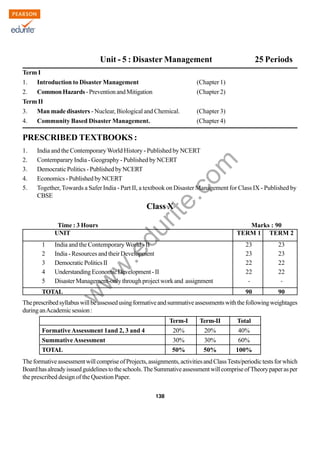
Unit - 5 : Disaster Management 25 Periods
Term I
1. Introduction to Disaster Management (Chapter 1)
2. CommonHazards-PreventionandMitigation (Chapter 2)
Term II
3. Man made disasters - Nuclear, Biological and Chemical. (Chapter 3)
4. Community Based Disaster Management. (Chapter 4)
PRESCRIBED TEXTBOOKS :
1. India and the ContemporaryWorld History - Published by NCERT
2. Contemparary India - Geography - Published by NCERT
3. Democratic Politics - Published by NCERT
4. Economics - Published by NCERT
5. Together,Towards a Safer India - Part II, a textbook on Disaster Management for Class IX - Published by
CBSE
Class X
Time : 3 Hours Marks : 90
UNIT TERM 1 TERM 2
1 India and the ContemporaryWorld - II 23 23
2 India - Resources and their Development 23 23
3 DemocraticPoliticsII 22 22
4 UnderstandingEconomicDevelopment-II 22 22
5 DisasterManagement-onlythroughprojectworkand assignment - -
TOTAL 90 90
Theprescribedsyllabuswillbeassessedusingformativeandsummativeassessmentswiththefollowingweightages
duringanAcademicsession:
Term-I Term-II Total
FormativeAssessment 1and 2, 3 and 4 20% 20% 40%
SummativeAssessment 30% 30% 60%
TOTAL 50% 50% 100%
TheformativeassessmentwillcompriseofProjects,assignments,activitiesandClassTests/periodictestsforwhich
Boardhasalreadyissuedguidelinestotheschools.TheSummativeassessmentwillcompriseofTheorypaperasper
the prescribed design of the Question Paper.

Class 9 Cbse Social Science Syllabus 2012-13

  • 1.
    w w w .edurite.com 131 CLASS IX Time :3 Hrs. Marks : 90 UNIT TERM 1 TERM 2 1 India and the Contemporary World - I 23 23 2 India -Land and the People 23 23 3 Democratic Politics I 22 22 4 Understanding Economic Development-I 22 22 5 Disaster Management (Through Project &Assessments) - - TOTAL 90 90 Theprescribedsyllabuswillbeassessedusingformativeandsummativeassessmentsinthefollowingmanner: Term-I Term-II Total Formative Assessment 1 and 2, 3 and 4 20% 20% 40% SummativeAssessment 1 and 2 30% 30% 60% TOTAL 50% 50% 100% Theformativeassessmentwillcompriseofprojects,assignments,activitiesandclasstests/periodictestsforwhich Boardhasalreadyissuedguidelinestotheschools.TheSummativeassessmentwillcompriseofTheorypaperasper the prescribed design of the Question Paper. Class IX Unit 1 : India and the Contemporary World - I 40 Periods Themes Term I Twothemesfromthefirstsub-unitandoneeachfrom the second and third subunits could be studied. Sub-unit 1.1 : Events and processes. In this unit the focus is on three events and processesthathaveinmajorwaysshapedtheidentity ofthemodernworld.Eachrepresentsadifferentform ofpolitics,andaspecificcombinationofforces.One event is linked to the growth of liberalism and democracy, one with socialism, and one with a negationofbothdemocracyandsocialism. Two themes of the following : 1. French Revolution : Objectives Ineachofthethemesinthisunitstudentswould be made familiar with extracts of speeches, political declarations, as well as the politics of caricatures, posters and engravings. Students wouldlearnhowtointerpretthesekindsofhis- toricalevidences. Familiarize students with the names of people involved,thedifferenttypesofideasthatinspired the revolution, the wider forces that shaped it. Showhowwritten,oralandvisualmaterialcan be used to recover the history of revolutions. Explorethehistoryofsocialismthroughastudy
  • 2.
    w w w .edurite.com 132 (a) TheAncientRegimeanditscrises.(b)The socialforcesthatledtotherevolution.(c) The differentrevolutionary groups and ideas of the time. (d)The legacy. Compulsory (Chapter-1) 2. Russian Revolution. (a) The crises of Tzarism. (b) The nature of social movements between 1905 and 1917. (c) The First World War and foundationofSovietstate.(d)Thelegacy. (Chapter 2) 3. Rise of Nazism. (a) The growth of social democracy (b) The crisesinGermany.(b)ThebasisofHitler's risetopower.(c)TheideologyofNazism. (d)TheimpactofNazism. (Chapter 3) Term II Sub-unit 1.2 : Economies and Livelihoods Thethemesinthissectionwillfocusonhowdifferent social groups grapple with the changes in the contemporary world and how these changes affect theirlives. Any one theme of the following : 4. Pastoralists in the modern world. (a) Pastoralism as a way of life. (b) Different forms of pastoralism. (c) What happens to pastoralism under colonialism and modern states? Case studies : focus on two pastoral groups, one from Africa and one from India. (Chapter 5) 5. Forest society and colonialism : (a) Relationship between forests and livelihoods.(b)Changesinforestsocieties undercolonialism. Case studies : focus on two forest movementsoneincolonialIndia(Bastar) and one in Indonesia. (Chapter 4) oftheRussianrevolution. Familiarize students with the names of people involved,thedifferenttypesofideasthatinspired therevolution. Discuss the critical significance of Nazism in shapingthepoliticsofmodernworld. Familiarize students with the speeches and writingsofNazileaders. Consider what happens to pastoralists and pastoralism in the modern world, with the formation of modern states, marking of boundaries, processes of sedentarization, contraction of pastures, and expansion of markets. Point to the varying patterns of developments withinpastoralsocietiesindifferentplaces. Look at the impact of colonialism on forest societies,andtheimplicationofscientificforestry. Discuss the social and cultural world of forest communities through the study of specific revolts. Understand how oral traditions can be used to exploretribalrevolts. Show the different processes through which agrariantransformationmayoccurinthemodern world. Themes Objectives { (anyone)
  • 3.
    w w w .edurite.com 133 6. Farmers andpeasants : (a) Histories of the emergence of different formsoffarmingandpeasantsocieties.(b) Changes within rural economies in the modernworld. Case studies : focus on contrasting forms ofruralchangeanddifferentformsofrural societies (expansion of large-scale wheat andcottonfarminginUSA,ruraleconomy andtheAgriculturalRevolutioninEngland, and small peasant production in colonial India) (Chapter 6) Term II Sub-unit 1.3 : Culture, Identity and Society Thethemesinthisunitwillconsiderhowissues of culture are linked up to the making of contemporaryworld. Any one of the following : 7. Sports and politics : Thestoryofcricket(a)Theemergenceofcricket asanEnglishsport.(b)Cricketandcolonialism. (c)Cricketnationalismandde-colonialization. (Chapter 7) 8. Clothes and cultures. (a) A short history of changesinclothing.(b)Debatesoverclothingin colonialIndia.(c)Swadeshiandthemovement forKhadi. (Chapter 8) UnderstandhowagriculturalsystemsinIndiaare differentfromthatinothercountries. Familiarizestudentswiththeideathatlargescale farming, small scale production, shifting agriculture operate on different principles and havedifferenthistories. Suggesthowsportsalsohaveahistoryandthat it is linked up with the politics of power and domination. Introduce students to some of the stories in cricketthathavehistoricalsignificance. Show how clothing has a history, and how it is linkedtoquestionsofculturalidentity. Discuss how clothing has been the focus of intensesocialbattles. Themes Objectives
  • 4.
    w w w .edurite.com 134 Unit 2 :India - Land and the People Term I 1. India : location, relief, structure, major physiographicunits. (Chapter 1&2) 2. Drainage : major rivers and tributaries, lakes andseas,roleofriversintheeconomy,pollution of rivers, measures to control river pollution. (Chapter 3) Term II 3. Climate : factors influencing the climate; monsoon- its characteristics, rainfall and temperature distribution; seasons; climate and humanlife. (Chapter 4) 4. Natural Vegetation : vegetation types, distributionaswellasaltitudinalvariation,need for conservation and various measures. (Chapter 5) 5. Wildlife:majorspecies,theirdistribution,need for conservation and various measures. (Chapter 5) 6. Population : size, distribution, age-sex composition,populationchange-migrationasa determinant of population change, literacy, health, occupational structure and national populationpolicy:adolescentsasunder-served population group with special needs. (Chapter 6) 7. Map Work (3 marks). To understand the major landform features and the underlyinggeologicalstructure;theirassociationwith various rocks and minerals as well as nature of soil types Toidentifythevariousfactorsinfluencingtheclimate andexplaintheclimaticvariatonofourcountryand its impact on the life of the people. Tor explain the importance and unifying role of monsoons; To understand the river systems of the country and explain the role of rivers in the evolution of human society. To find out the nature of diverse flora and fauna as wellastheirdistribution; To develop concern about the need to protect the bio-diversityofourcountry; To analyse the uneven nature of population distributionandshowconcernaboutthelargesizeof ourpopulation; Tounderstandthevariousoccupationsofpeopleand explainvariousfactorsofpopulationchange; Toexplainvariousdimensionofnationalpolicyand understandtheneedsofadolescentsasunderserved group. Themes Objectives
  • 5.
    w w w .edurite.com 135 45 Periods Project/Activity Learnersmayidentifysongs,dances,festivalsandspecialfoodpreparationsassociatedwithcertainseasons intheirparticularregion,andwhethertheyhavesomecommonalitywithotherregionsofIndia. Collection ofmaterial by learners on the flora and fauna of the region in which their school is situated. It shouldincludealistofendangeredspeciesoftheregionandalsoinformationregardingeffortsbeingmadetosave them. Posters Riverpollution Depletionofforestsandecologicalimbalance. Unit - 3 : Democratic Politics I 40 Periods Themes Learning Objectives Term I 1. What is democracy? Why democracy? What are the different ways of defining democracy? Why has democracy become the mostprevalentformofgovernmentinourtimes? What are the alternatives to democracy? Is democracysuperiortoitsavailablealternatives? Musteverydemocracyhavethesameinstitutions andvalues? (Chapter 1&2) (Part 1.3 and 1.4 (pages 10-18 of prescribed NCERTTextbook) will be assessed through formative assessment only) 2. Designing of Democracy in India How and why did India become a democracy? HowwastheIndianconstitutionframed?What arethesalientfeaturesoftheConstitution?How is democracy being constantly designed and redesignedinIndia? (Chapter 3) Developconceptualskillsofdefiningdemoc- racy Understand how different historical processes and forces have promoted democracy. Developing a sophisticated defence of democracyagainstcommonprejudices Develop a historical sense of the choice and natureofdemocracyinIndia. Introduction to the process of Constitution making Develop respect for the Constitution and appreciationforConstitutionalvalues Recognisethatconstitutionisalivingdocument thatundergoeschanges. Introducetheideaofrepresentativedemocracy viacompetitivepartypolitics Familiarisewithourelectoralsystemandreasons forchoosingthis
  • 6.
    w w w .edurite.com 136 Themes Learning Objectives Developan appreciation of citizen’s increased participationinelectoralpolitics Recognise the significance of the Election Commission Provide an overview of central governmental structures Sensitise to the key role of the Parliament and its procedures Distinguishbetweennominalandrealexecutive authoritiesandfunctions Understand the parliamentary system of executive’saccountabilitytothelegislature Developacitizens’awarenessoftheirrights Introduction to and appreciation of the FundamentalRights Recognition of the ways in which these rights areexercisedanddeniedinreallifesituations. Introduction to judicial system and key institutionsliketheSupremeCourt,HighCourts andNationalHumanRightsCommission. Term II 3. Electoral politics in democracy Whyandhowdoweelectrepresentatives?Why do we have a system of competition among political parties? How has the citizens’ participationinelectoralpoliticschanged?What are the ways to ensure free and fair elections? (Chapter 4) 4. Institutions of parliamentary democracy How is the country governed? What does Parliament do in our democracy? What is the roleofthePresidentofIndia,thePrimeMinister and the Council of Ministers? How do these relate to one another? (Chapter 5) 5. Citizens’ rights in democracy Why do we need rights in a constitution? What are the Fundamental Rights enjoyed by the citizenundertheIndianconstitution?Howdoes thejudiciaryprotecttheFundamentalRightsof the citizen? How is the independence of the judiciaryensured? (Chapter 6) Unit - 4 : Understanding Economic Development - I 40 Periods Familiarising the children with some basic economic concepts through an imaginary story ofavillage Familiarisationofafewpopulationrelatedconcepts and sensitization of child that people as asset can participateandcontributeinnationbuilding Themes Objectives Term I 1. TheeconomicstoryofPalampore:Economic transactionsofPalamporeanditsinteractionwith therestoftheworldthroughwhichtheconcept of production (including three factors of production (land, labour and capital) can be introduced. (Chapter 1) 2. People as Resource : Introduction of how people become resource / asset; economic activitiesdonebymenandwomen;unpaidwork done by women; quality of human resource ;
  • 7.
    w w w .edurite.com 137 SuggestedActivities / Instructions: Theme 1 : Give more examples of activities done by different workers and farmers. Numericalproblemscanalsobeincluded. Some of the ways through which description of villages are available in the writings of Prem Chand, MN Srinivas and RK Narayan. They may have to be referred. ThemeII:Discusstheimpactofunemployment Debate on whether all the activities done by women should be included or not. Isbegginganeconomicactivity?Discuss. Isitnecessarytoreducepopulationgrowthorfamilysize?Discuss. ThemeIV:Visitafewfarmsinavillageandcollectthedetailsoffoodgrainscultivated; Visit a nearby ration shop and collect the details of goods available; Visit a regulated market yard and observe how goods are transacted and get the details of the places where the goods come and go. Themes Objectives roleofhealthandeducation;unemploymentasa formofnonutilisationofhumanresource;socio- politicalimplicationinsimpleform (Chapter 2) Term II 3. Poverty as a challenge facing India : Who is poor (through two case studies: one rural one urban); indicators; absolute poverty (not as a conceptbutthroughafewsimpleexamples)-why people are poor ; unequal distribution of resources; comparison between countries; steps taken by government for poverty alleviation (Chapter 3) 4. Food Security : Source of foodgrains- variety across the nation - famines in the past - the need for self sufficiency - role of government in food security-procurementoffoodgrains-overflowing of granaries and people without food - public distributionsystem-roleofcooperativesinfood security (foodgrains, milk and vegetables ration shops,cooperativeshops,two-threeexamplesas case studies) (Chapter 4) Understanding of poverty as a challenge and sensitizationofthelearner; Appreciationofthegovernmentinitiativetoalleviate poverty Exposingthechildtoaneconomicissuewhichisbasic necessitiesoflife; Appreciate and critically look at the role of governmentinensuringfoodsupply
  • 8.
    w w w .edurite.com 138 Unit - 5: Disaster Management 25 Periods Term I 1. Introduction to Disaster Management (Chapter 1) 2. CommonHazards-PreventionandMitigation (Chapter 2) Term II 3. Man made disasters - Nuclear, Biological and Chemical. (Chapter 3) 4. Community Based Disaster Management. (Chapter 4) PRESCRIBED TEXTBOOKS : 1. India and the ContemporaryWorld History - Published by NCERT 2. Contemparary India - Geography - Published by NCERT 3. Democratic Politics - Published by NCERT 4. Economics - Published by NCERT 5. Together,Towards a Safer India - Part II, a textbook on Disaster Management for Class IX - Published by CBSE Class X Time : 3 Hours Marks : 90 UNIT TERM 1 TERM 2 1 India and the ContemporaryWorld - II 23 23 2 India - Resources and their Development 23 23 3 DemocraticPoliticsII 22 22 4 UnderstandingEconomicDevelopment-II 22 22 5 DisasterManagement-onlythroughprojectworkand assignment - - TOTAL 90 90 Theprescribedsyllabuswillbeassessedusingformativeandsummativeassessmentswiththefollowingweightages duringanAcademicsession: Term-I Term-II Total FormativeAssessment 1and 2, 3 and 4 20% 20% 40% SummativeAssessment 30% 30% 60% TOTAL 50% 50% 100% TheformativeassessmentwillcompriseofProjects,assignments,activitiesandClassTests/periodictestsforwhich Boardhasalreadyissuedguidelinestotheschools.TheSummativeassessmentwillcompriseofTheorypaperasper the prescribed design of the Question Paper.