Material Safety Data Sheet
CAUSTIC SODA
Revision date May 2005 Page 1/4
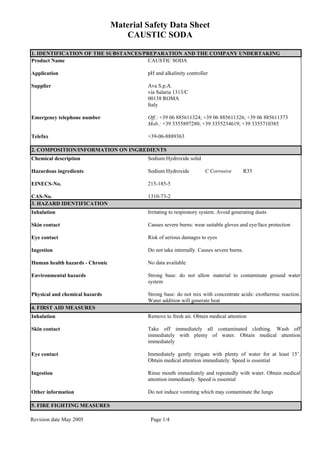
1. IDENTIFICATION OF THE SUBSTANCES/PREPARATION AND THE COMPANY UNDERTAKING
Product Name CAUSTIC SODA
Application pH and alkalinity controller
Supplier Ava S.p.A.
via Salaria 1313/C
00138 ROMA
Italy
Emergency telephone number Off.: +39 06 885611324; +39 06 885611326; +39 06 885611373
Mob.: +39 3355897280; +39 3355234619; +39 3355710385
Telefax +39-06-8889363
2. COMPOSITION/INFORMATION ON INGREDIENTS
Chemical description Sodium Hydroxide solid
Hazardous ingredients Sodium Hydroxide C Corrosive R35
EINECS-No. 215-185-5
CAS-No. 1310-73-2
3. HAZARD IDENTIFICATION
Inhalation Irritating to respiratory system. Avoid generating dusts
Skin contact Causes severe burns: wear suitable gloves and eye/face protection
Eye contact Risk of serious damages to eyes
Ingestion Do not take internally. Causes severe burns.
Human health hazards - Chronic No data available
Environmental hazards Strong base: do not allow material to contaminate ground water
system
Physical and chemical hazards Strong base: do not mix with concentrate acids: exothermic reaction.
Water addition will generate heat
4. FIRST AID MEASURES
Inhalation Remove to fresh air. Obtain medical attention
Skin contact Take off immediately all contaminated clothing. Wash off
immediately with plenty of water. Obtain medical attention
immediately
Eye contact Immediately gently irrigate with plenty of water for at least 15’.
Obtain medical attention immediately. Speed is essential
Ingestion Rinse mouth immediately and repeatedly with water. Obtain medical
attention immediately. Speed is essential
Other information Do not induce vomiting which may contaminate the lungs
5. FIRE FIGHTING MEASURES
Material Safety Data Sheet
CAUSTIC SODA
Revision date May 2005 Page 2/4
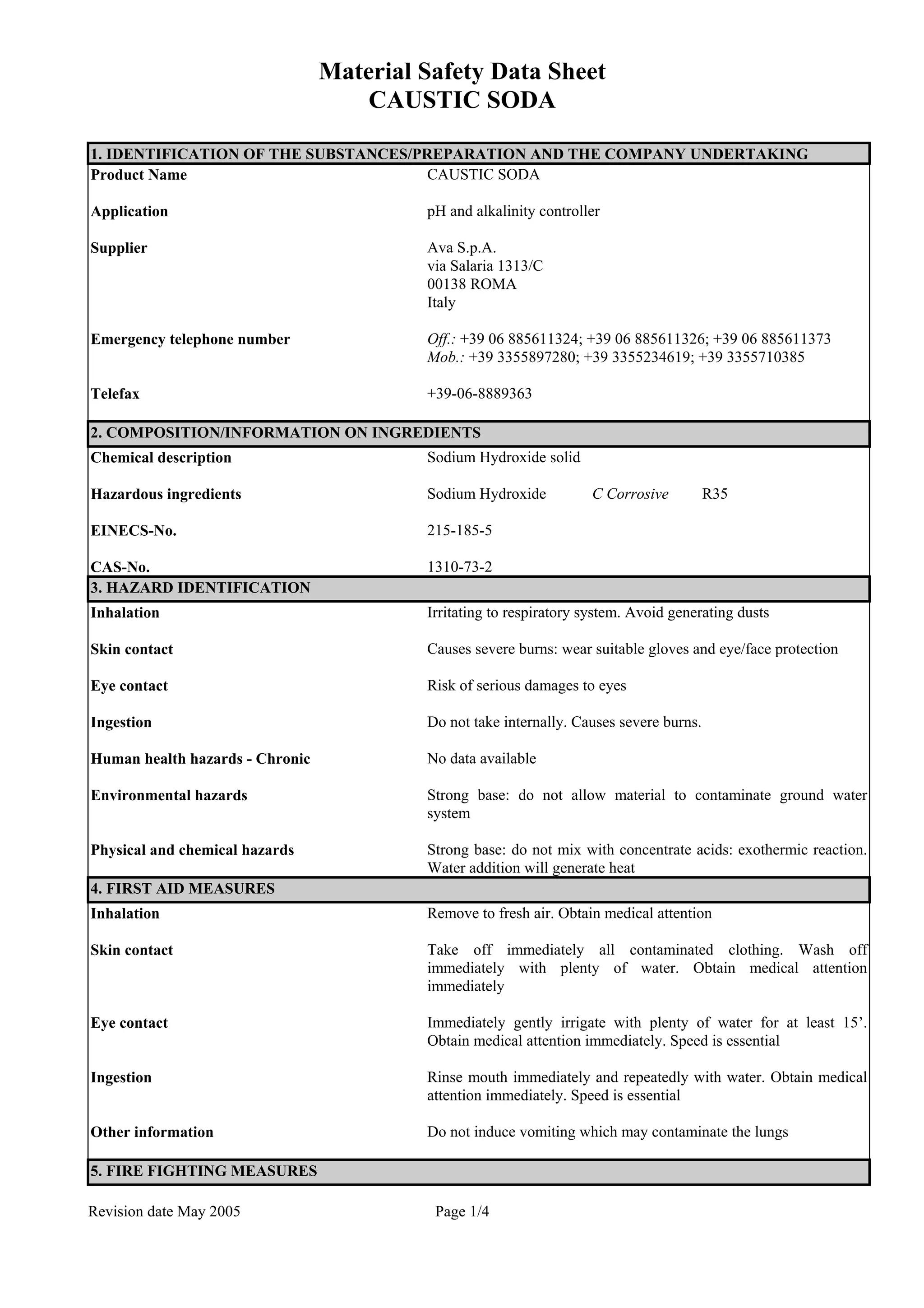
Extinguishing media In case of fire use water spray, foam, powder, carbon dioxide
Unsuitable extinguishing media None
Fire and explosion hazard None
Protective equipment In case of fire wear a full face positive pressure self contained
breathing apparatus and protective suit
6. ACCIDENTAL RELEASE MEASURES
Personal precautions Do not breathe powders. Avoid the contact with eyes and skin. Take
off immediately all contaminated clothing
Environmental precautions Do not discharge into drains or the environment. Do not contaminate
ground water system
Methods for cleaning up Clean up by broom, scoop or vacuum. Wash with plenty of water
7. HANDLING AND STORAGE
Handling Wear suitable gloves and eye/face protection
Storage conditions Store separately from acids. Keep in dry, cool place
8. EXPOSURE CONTROLS/PERSONAL PROTECTION
Engineering measures General ventilation is recommended
Exposure limits (ACGIH 2004) TLV-STEL = 2 mg/m³ C, corrosion
Personal protection equipment
Respiratory protection Dust mask with P2 type filter (when required by use conditions). Do
not generate dusts
Hand/skin protection Impervious gloves. Standard protective clothing
Eye protection Safety glasses
Hygiene measures Eyewash fountain near-by. Keep a safety shower available
9. PHYSICAL AND CHEMICAL PROPERTIES
Form Deliquescent flakes
Colour White, translucent
Odour None
Boiling point 1390 °C
Melting point 318 °C
Flash point - (PMCC) None
Auto ignition N/A
Explosion limits N/A
Material Safety Data Sheet
CAUSTIC SODA
Revision date May 2005 Page 3/4
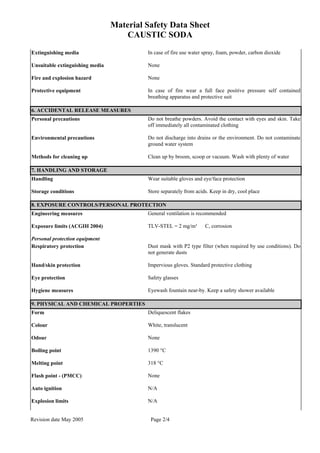
Vapour pressure Negligible
Relative density 2.13
Solubility in water Soluble
pH (1 % aqueous solution) > 13
Viscosity N/A
Bulk density N/A
Freezing point N/A
Pour point N/A
Abbreviations: N/A = Not Applicable - N/E = Not Evaluated
10. STABILITY AND REACTIVITY
Stability Stable
Conditions to avoid Moisture
Materials to avoid Do not mix with acids: exothermic reaction. Reacts with ammonium
salts evolving ammonia gas. In presence of moisture, this product is
corrosive to aluminium, zinc and tin
Hazardous decomposition products It liberates hydrogen by reaction with metals
11. TOXICOLOGICAL INFORMATION
Acute toxicity Corrosive: causes severe burns
Primary irritation skin/eye Causes severe burns. Causes serious damages to eyes
Sensitisation Repeated or prolonged skin contact may cause dermatitis and skin
sensitisation
Chronic toxicity data Not available data
12. ECOLOGICAL INFORMATION
Persistency and degradation Not persistent. Biodegradable.
Mobility and Bioaccumulation Solubility and mobility: high.
Bioaccumulation: no adverse effects expected
Ecotoxicological effects Strong base: may cause local pH variation and damages to the aquatic
environment
13. DISPOSAL CONSIDERATIONS
Do not discharge into drains or the environment, dispose to an authorized waste collection point
14. TRASPORT INFORMATION
Description Sodium hydroxide, solid
UN number 1823
Material Safety Data Sheet
CAUSTIC SODA
Revision date May 2005 Page 4/4
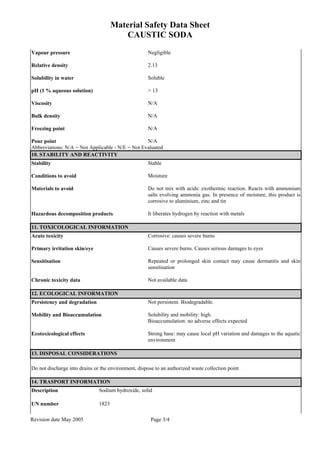
Packing group II
ADR/RID
Class 8 ADR 2003 label: 8
ADR 2003 Classif. Code: C6
Hazard identification 80
IMDG
Class 8 Subsidiary risk - -
Em S F-A, S-B
IATA
Class 8
15. REGULATORY INFORMATION
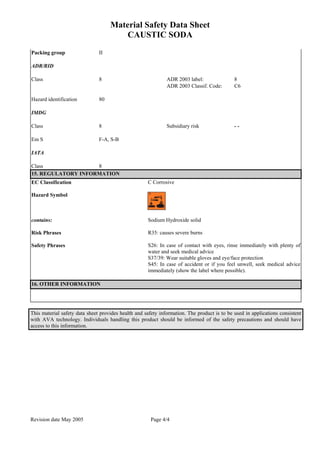
EC Classification C Corrosive
Hazard Symbol
contains: Sodium Hydroxide solid
Risk Phrases R35: causes severe burns
Safety Phrases S26: In case of contact with eyes, rinse immediately with plenty of
water and seek medical advice
S37/39: Wear suitable gloves and eye/face protection
S45: In case of accident or if you feel unwell, seek medical advice
immediately (show the label where possible).
16. OTHER INFORMATION
This material safety data sheet provides health and safety information. The product is to be used in applications consistent
with AVA technology. Individuals handling this product should be informed of the safety precautions and should have
access to this information.

CAUSTIC SODA.pdf

  • 1.
    Material Safety DataSheet CAUSTIC SODA Revision date May 2005 Page 1/4 1. IDENTIFICATION OF THE SUBSTANCES/PREPARATION AND THE COMPANY UNDERTAKING Product Name CAUSTIC SODA Application pH and alkalinity controller Supplier Ava S.p.A. via Salaria 1313/C 00138 ROMA Italy Emergency telephone number Off.: +39 06 885611324; +39 06 885611326; +39 06 885611373 Mob.: +39 3355897280; +39 3355234619; +39 3355710385 Telefax +39-06-8889363 2. COMPOSITION/INFORMATION ON INGREDIENTS Chemical description Sodium Hydroxide solid Hazardous ingredients Sodium Hydroxide C Corrosive R35 EINECS-No. 215-185-5 CAS-No. 1310-73-2 3. HAZARD IDENTIFICATION Inhalation Irritating to respiratory system. Avoid generating dusts Skin contact Causes severe burns: wear suitable gloves and eye/face protection Eye contact Risk of serious damages to eyes Ingestion Do not take internally. Causes severe burns. Human health hazards - Chronic No data available Environmental hazards Strong base: do not allow material to contaminate ground water system Physical and chemical hazards Strong base: do not mix with concentrate acids: exothermic reaction. Water addition will generate heat 4. FIRST AID MEASURES Inhalation Remove to fresh air. Obtain medical attention Skin contact Take off immediately all contaminated clothing. Wash off immediately with plenty of water. Obtain medical attention immediately Eye contact Immediately gently irrigate with plenty of water for at least 15’. Obtain medical attention immediately. Speed is essential Ingestion Rinse mouth immediately and repeatedly with water. Obtain medical attention immediately. Speed is essential Other information Do not induce vomiting which may contaminate the lungs 5. FIRE FIGHTING MEASURES
  • 2.
    Material Safety DataSheet CAUSTIC SODA Revision date May 2005 Page 2/4 Extinguishing media In case of fire use water spray, foam, powder, carbon dioxide Unsuitable extinguishing media None Fire and explosion hazard None Protective equipment In case of fire wear a full face positive pressure self contained breathing apparatus and protective suit 6. ACCIDENTAL RELEASE MEASURES Personal precautions Do not breathe powders. Avoid the contact with eyes and skin. Take off immediately all contaminated clothing Environmental precautions Do not discharge into drains or the environment. Do not contaminate ground water system Methods for cleaning up Clean up by broom, scoop or vacuum. Wash with plenty of water 7. HANDLING AND STORAGE Handling Wear suitable gloves and eye/face protection Storage conditions Store separately from acids. Keep in dry, cool place 8. EXPOSURE CONTROLS/PERSONAL PROTECTION Engineering measures General ventilation is recommended Exposure limits (ACGIH 2004) TLV-STEL = 2 mg/m³ C, corrosion Personal protection equipment Respiratory protection Dust mask with P2 type filter (when required by use conditions). Do not generate dusts Hand/skin protection Impervious gloves. Standard protective clothing Eye protection Safety glasses Hygiene measures Eyewash fountain near-by. Keep a safety shower available 9. PHYSICAL AND CHEMICAL PROPERTIES Form Deliquescent flakes Colour White, translucent Odour None Boiling point 1390 °C Melting point 318 °C Flash point - (PMCC) None Auto ignition N/A Explosion limits N/A
  • 3.
    Material Safety DataSheet CAUSTIC SODA Revision date May 2005 Page 3/4 Vapour pressure Negligible Relative density 2.13 Solubility in water Soluble pH (1 % aqueous solution) > 13 Viscosity N/A Bulk density N/A Freezing point N/A Pour point N/A Abbreviations: N/A = Not Applicable - N/E = Not Evaluated 10. STABILITY AND REACTIVITY Stability Stable Conditions to avoid Moisture Materials to avoid Do not mix with acids: exothermic reaction. Reacts with ammonium salts evolving ammonia gas. In presence of moisture, this product is corrosive to aluminium, zinc and tin Hazardous decomposition products It liberates hydrogen by reaction with metals 11. TOXICOLOGICAL INFORMATION Acute toxicity Corrosive: causes severe burns Primary irritation skin/eye Causes severe burns. Causes serious damages to eyes Sensitisation Repeated or prolonged skin contact may cause dermatitis and skin sensitisation Chronic toxicity data Not available data 12. ECOLOGICAL INFORMATION Persistency and degradation Not persistent. Biodegradable. Mobility and Bioaccumulation Solubility and mobility: high. Bioaccumulation: no adverse effects expected Ecotoxicological effects Strong base: may cause local pH variation and damages to the aquatic environment 13. DISPOSAL CONSIDERATIONS Do not discharge into drains or the environment, dispose to an authorized waste collection point 14. TRASPORT INFORMATION Description Sodium hydroxide, solid UN number 1823
  • 4.
    Material Safety DataSheet CAUSTIC SODA Revision date May 2005 Page 4/4 Packing group II ADR/RID Class 8 ADR 2003 label: 8 ADR 2003 Classif. Code: C6 Hazard identification 80 IMDG Class 8 Subsidiary risk - - Em S F-A, S-B IATA Class 8 15. REGULATORY INFORMATION EC Classification C Corrosive Hazard Symbol contains: Sodium Hydroxide solid Risk Phrases R35: causes severe burns Safety Phrases S26: In case of contact with eyes, rinse immediately with plenty of water and seek medical advice S37/39: Wear suitable gloves and eye/face protection S45: In case of accident or if you feel unwell, seek medical advice immediately (show the label where possible). 16. OTHER INFORMATION This material safety data sheet provides health and safety information. The product is to be used in applications consistent with AVA technology. Individuals handling this product should be informed of the safety precautions and should have access to this information.