CASHLESS ECONOMY –
OPPORTUNITIES &
CHALLENGES IN INDIA
Done by :-
Name – Aditya Prakash
Reg no. – 99210041496
INTRODUCTION
A cashless economy refers to a
financial system where
transactions are conducted
electronically without the use of
physical cash.
in 2016, The Govt. of India
launched the Digital India
program aiming to transform India
into a digitally empowered
society.
The Digital India initiative has been
instrumental in promoting digital
transactions, increasing
transparency, and reducing
corruption. The introduction of
Unified Payments Interface (UPI)
has revolutionized digital
payments.
ADVANTAGES OF CASHLESS ECONOMY
1. Efficiency: Faster transactions No need to carry cash.
2. Security: Lower risk of theft and enhanced traceability. Carrying a small
card is enough.
3. Convenience: Easy online and in-person payments. Through, e-
payments , every single expense will be recorded in your bank statement
or e -wallet
4. Economic Growth: Boosts e-commerce and reduces the shadow
economy. Monitoring of tax compliance is easy for the government.
5. Environmental Impact: Reduces paper waste and energy consumption
COMPARISON IN BETWEEN YEARS THROUGH DATA
ECONOMIC IMPACT
• Increased GDP:
• A report by the Boston Consulting Group and Google projected that
digital payments in India could add up to $700 billion to GDP by 2025.
• Digital payments have facilitated faster and more efficient
transactions, reducing costs and increasing economic productivity.
• Boost in Formal Economy:
• The shift to digital transactions has increased the transparency of
financial transactions, reducing the size of the informal economy and
boosting tax revenues.
• The Indian government's demonetization policy in 2016 aimed to
curb black money and promote digital payments, resulting in a
significant increase in cashless transactions.
• Initiatives like the Pradhan Mantri Jan Dhan Yojana (PMJDY) have
opened millions of new bank accounts, enabling more people to
participate in the economy.
CONTINUE…..
• Growth in E-commerce:
• The rise of cashless payments has fueled the growth of e-
commerce, with platforms like Flipkart and Amazon seeing
significant increases in sales.
• The convenience and security of digital payments have attracted
more consumers to online shopping, contributing to economic
growth.
• Startup Ecosystem:
• The cashless economy has spurred innovation and growth in the
fintech sector, with startups developing new digital payment
solutions and services.
• India has become a global leader in fintech, attracting substantial
investments and creating jobs.
• As per RBI Report, The Unified Payments Interface (UPI) has seen
exponential growth, with monthly transactions crossing 3 billion as of
2021
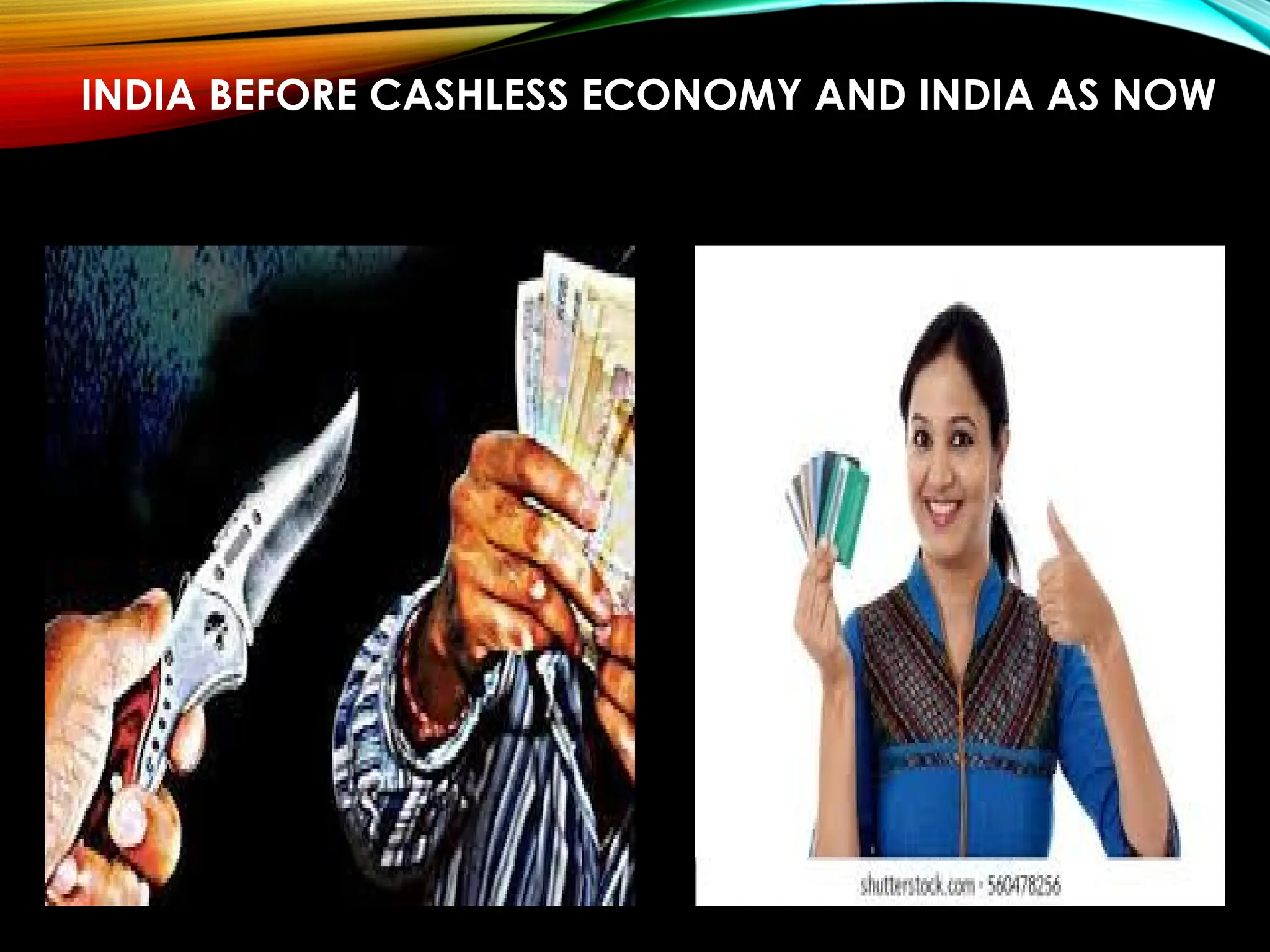
INDIA BEFORE CASHLESS ECONOMY AND INDIA AS NOW
THANK YOU

Cashless_Economy_–_Opportunities_&_Challenges_in_India.pptx

  • 1.
    CASHLESS ECONOMY – OPPORTUNITIES& CHALLENGES IN INDIA Done by :- Name – Aditya Prakash Reg no. – 99210041496
  • 2.
    INTRODUCTION A cashless economyrefers to a financial system where transactions are conducted electronically without the use of physical cash. in 2016, The Govt. of India launched the Digital India program aiming to transform India into a digitally empowered society. The Digital India initiative has been instrumental in promoting digital transactions, increasing transparency, and reducing corruption. The introduction of Unified Payments Interface (UPI) has revolutionized digital payments.
  • 3.
    ADVANTAGES OF CASHLESSECONOMY 1. Efficiency: Faster transactions No need to carry cash. 2. Security: Lower risk of theft and enhanced traceability. Carrying a small card is enough. 3. Convenience: Easy online and in-person payments. Through, e- payments , every single expense will be recorded in your bank statement or e -wallet 4. Economic Growth: Boosts e-commerce and reduces the shadow economy. Monitoring of tax compliance is easy for the government. 5. Environmental Impact: Reduces paper waste and energy consumption
  • 5.
    COMPARISON IN BETWEENYEARS THROUGH DATA
  • 6.
    ECONOMIC IMPACT • IncreasedGDP: • A report by the Boston Consulting Group and Google projected that digital payments in India could add up to $700 billion to GDP by 2025. • Digital payments have facilitated faster and more efficient transactions, reducing costs and increasing economic productivity. • Boost in Formal Economy: • The shift to digital transactions has increased the transparency of financial transactions, reducing the size of the informal economy and boosting tax revenues. • The Indian government's demonetization policy in 2016 aimed to curb black money and promote digital payments, resulting in a significant increase in cashless transactions. • Initiatives like the Pradhan Mantri Jan Dhan Yojana (PMJDY) have opened millions of new bank accounts, enabling more people to participate in the economy.
  • 7.
    CONTINUE….. • Growth inE-commerce: • The rise of cashless payments has fueled the growth of e- commerce, with platforms like Flipkart and Amazon seeing significant increases in sales. • The convenience and security of digital payments have attracted more consumers to online shopping, contributing to economic growth. • Startup Ecosystem: • The cashless economy has spurred innovation and growth in the fintech sector, with startups developing new digital payment solutions and services. • India has become a global leader in fintech, attracting substantial investments and creating jobs. • As per RBI Report, The Unified Payments Interface (UPI) has seen exponential growth, with monthly transactions crossing 3 billion as of 2021
  • 8.
    INDIA BEFORE CASHLESSECONOMY AND INDIA AS NOW
  • 9.