A PROJECT REPORT ON
“A STUDY ON CASH FLOW MANAGEMENT”
OF SOFTORIX TECHNOLOGY PVT LTD”
In partial fulfillment of the requirements
Of the Master of Business Administration
Submitted to
SRM SCHOOL OF MANAGEMENT
Submitted by:
Bhupendra Singh
REG. NO: 3511210394
UNDER THE GUIDANCE OF
S.PRIYA
Asst. Professor
FACULTY OF ENGINEERING AND TECHNOLOGY
SRM UNIVERSITY
KATTANKULATHUR
1
2
BONAFIDE CERTIFICATE
Certified that this project report titled “A STUDY ON CASH FLOW MANAGEMENT OF
SOFTORIX TECHNOLOGIES PVT LTD”
is the bonafide work of Bhupendra Singh (3511210394) who carried out the research under my
supervision.
Certified further, that to the best of my knowledge the work reported here in does not form part of any
other project report or dissertation on the basis of which a degree or award was conferred on an earlier
occasion on this or any other candidate.
S.PRIYA Dr.JayshreeSuresh
(Project Guide) (Dean, SRM School of Management)
Internal examiner External examiner
(………………..) (…………………..)
3
DECLARATION
I hereby declare that the project work entitled “ CASH FLOW MANAGEMENT OF SOFTORIX
TECHNOLOGY PVT LTD” is the produce of my sincere effort. This summer internship project
report is being submitted by me alone, at SRM School of management, SRM University, Chennai, for
the partial fulfillment of the course MBA, and the report has not been submitted to any other
educational institutions for any other purpose.
Bhupendra Singh
Place:
Date :
4
ACKNOWLEDGEMENT
The success of any task lies upon the efforts made by a person, but it cannot be achieved
without the help and cooperation of others. So I would like to thank SRM UNIVERSITY - SCHOOL
OF BUSINESS MANAGEMENT for giving me the opportunity of doing a general industrial training
and project work as a special subject and provides a wonderful platform to represent myself as a
management student.
First and foremost I would like to thank God almighty for giving me a chance to undertaken and to
complete my project successfully.
I would like to thank full to Dr.Jayshree Suresh, Dean, SRM School of Management, for giving me
an opportunity to carry out the project work.
I express my sincere thanks to my class in charge S.PRIYA, Asst. Professor, SRM School of
Management, SRM University, for being constant source of inspiration and wholehearted support
I take great pleasure in thanking my guide S.PRIYA. Asst. Professor, SRM School of Management,
SRM University, for her valuable guidance and the suggestions without which the report could not have
been completed.
Last but not the least I would like to thank my family, friends and relatives. Who were with me in
every step of my work. My sincere thanks to everyone.
5
6
7
A STUDY ON CASH FLOW REFERENCE TO SOFTORIX
TECHNOLOGIES
The project flow management for SOFTORIX TECHNOLOGIES”
eals with the mov or out of a business, project, or financial product. It is usually
easured during a d of time. The main objective of this project is to study on the
ement of the ties so that satisfactory level of working capital is
ined. The se to manage receivable, inventory and cash, to
y the different study the operating cycle of company, to study the
quidity position o le remedial measures if any on the basis of which tied-
and efficiently, to suggest, if possible on the basis
e ation. The study covers all the components of current
parted in the organization. ic and vital aspects of the
pe of research to analyze the past da ade.
project for calculating the Ratio analysis and Cash
tatement of t ides all the information about the company for the accounting
This enable he existing performance of the company. The
y this proje various global challenges that are faced by every pany in the
resent competitive FTORIX TECHNOLOGIES is not any exemption. To face the
resent global chall urces department should be develop to improve various skills
among the employees specially the motivational skills and having the regular training for the
employees about various developments in the market. The project ahs been concluded as the company
has a good liquidity position and does not delay its commitment in cash of both its creditors and
debtors. The company being mostly dependent on the working capital facilities, it is maintaining very
good relationship with their banks and their working capital management is well balanced.
MANAGEMENT WITH
ABSTRACT
titled “A Study on cash
d ement of money into
m specified, finite perio
manag current assets and current liabili
mainta condary objectives are to know how
stud sources of financing capital, to
li f company, to look at possib
up funds in working capital could be used effectively
of conclusion som modification to meet the situ
assets and current liabilities fo
im
r the year 2009-2012. The study also deals with the various ratios
The working capital is one of the dynam
business operation. Analytical research technique was adopted in this project. The researcher used
analytical ty ta based on which certain future decision can be m
Annual report os the company are been used in this
flow s he company. It prov
period. s to understand t main suggestion
given b ct is there are com
p environment and SO
p enges the human reso
8
T
ER NO.
ABLE OF CONTENTS
CHAPT CONTENTS PAGE NO.
I INTRODUCTION 1
II COMPANY PR 10
OFILE
2.1 Industry Profile 12
2.2 Product Pr 18
ofile
III REVIEW OF LI 20
TERATURE
IV RESEARCH 30
METHODOLOGY
4.1 Statement 35
of the problem
4.2 Objectives of th 40
e study
4.3 Scope of the s 45
tudy
4.4 Limitatio 58
n of the study
4.5 Working procedure for the Cash flow Management 62
4 65
.6 Calculation of coverage of Current Liabilities
V DATA ANALYSIS AND INTERPRETATION 70
VI FINDINGS 71
VII S 73
UGGESTIONS
VIII CONCLUSION 74
IX ANNEXURE 75
BIBLIOGRAPHY 76
BALANCESHEET 77
9
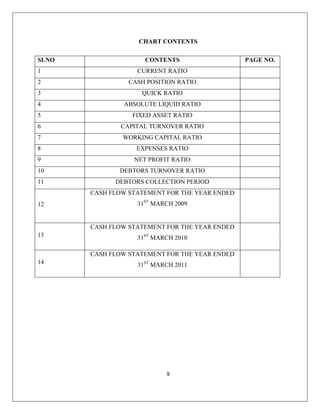
CHART CONTENTS
SLNO CONTENTS PAGE NO.
1 CURRENT RATIO
2 CASH POSITION RATIO
3 QUICK RATIO
4 ABSOLUTE LIQUID RATIO
5 FIXED ASSET RATIO
6 CAPITAL TURNOVER RATIO
7 WORKING CAPITAL RATIO
8 EXPENSES RATIO
9 NET PROFIT RATIO
10 DEBTORS TURNOVER RATIO
11 DEBTORS COLLECTION PERIOD
12
CASH FLOW STATEMENT FOR THE YEAR ENDED
31ST
MARCH 2009
13
CASH FLOW STATEMENT FOR THE YEAR ENDED
31ST
MARCH 2010
14
CASH FLOW STATEMENT FOR THE YEAR ENDED
31ST
MARCH 2011
10
TABLE CONTENTS
SLNO CONTENTS PAGE NO.
1 CURRENT RATIO CHART
2 CASH POSITION RATIO CHART
3 QUICK RATIO CHART
4 ABSOLUTE LIQUID RATIO CHART
5 FIXED ASSET RATIO CHART
6 CAPITAL TURNOVER RATIO CHART
7 WORKING CAPITAL RATIO CHART
8 EXPENSES RATIO CHART
9 NET PROFIT RATIO CHART
10 DEBTORS TURNOVER RATIO CHART
11 DEBTORS COLLECTION PERIOD CHART
11
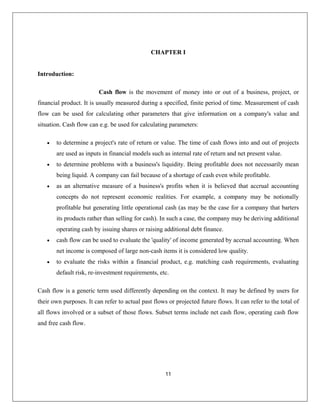
Introduction:
Cash flow is the movement of money into or out of a business, project, or
etermine problems with a business's liquidity. Being profitable does not necessarily mean
being liquid. A company can fail because of a shortage of cash even while profitable.
ive measure of a business's profits when it is believed that accrual accounting
al accounting. When
net income is composed of large non-cash items it is considered low quality.
risks within a financial product, e.g. matching cash requirements, evaluating
default risk, re-investment requirements, etc.
s a generic term used differently depending on the context. It may be defined by users for
their own purposes. It can refer to actual past flows or projected future flows. It can refer to the total of
ll flows involved or a subset of those flows. Subset terms include net cash flow, operating cash flow
nd free cash flow.
CHAPTER I
financial product. It is usually measured during a specified, finite period of time. Measurement of cash
flow can be used for calculating other parameters that give information on a company's value and
situation. Cash flow can e.g. be used for calculating parameters:
• to determine a project's rate of return or value. The time of cash flows into and out of projects
are used as inputs in financial models such as internal rate of return and net present value.
• to d
• as an alternat
concepts do not represent economic realities. For example, a company may be notionally
profitable but generating little operational cash (as may be the case for a company that barters
its products rather than selling for cash). In such a case, the company may be deriving additional
operating cash by issuing shares or raising additional debt finance.
• cash flow can be used to evaluate the 'quality' of income generated by accru
• to evaluate the
Cash flow i
a
a
12
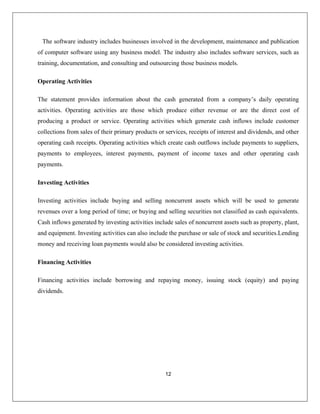
The software industry includes businesses involved in the development, maintenance and publication
of computer software using any business model. The industry also includes software services, such as
aining, documentation, and consulting and outsourcing those business models.
Operating Activities
The statement provides information from a company’s daily operating
ctivities. Operating activities are those which produce either revenue or are the direct cost of
producing a product or service. Operating activities which generate cash inflows include customer
sales of their primary products or services, receipts of interest and dividends, and other
s such as property, plant,
nd equipment. Investing activities can also include the purchase or sale of stock and securities.Lending
loan payments would also be considered investing activities.
tr
about the cash generated
a
collections from
operating cash receipts. Operating activities which create cash outflows include payments to suppliers,
payments to employees, interest payments, payment of income taxes and other operating cash
payments.
Investing Activities
Investing activities include buying and selling noncurrent assets which will be used to generate
revenues over a long period of time; or buying and selling securities not classified as cash equivalents.
Cash inflows generated by investing activities include sales of noncurrent asset
a
money and receiving
Financing Activities
Financing activities include borrowing and repaying money, issuing stock (equity) and paying
dividends.
13
CHAPTER II
COMPANY PROFILE
Abo
Our project methodology includes techniques for initiating a project, developing the
making clear assignments to the project team, developing a dynamic schedule, reporting
status to executives and problem solving. In today's competitive environment, students want to ensure
dy, design,
us aspects of Information
Technology, students can be sure that Softorix is just that sort of organization.
ent. Our
ining for technical students include Aptitude, Analytical, Verbal, Technical, Soft Skills, Personality
Dev nterviews.
s, we would
ut Us
requirements,
that they are getting guidance in an organization that can meet their professional needs.
With our well equipped team of solid Information Systems Professionals, who stu
develop, enhance, customize, implement, maintain and support vario
CAREER FAIRS:
We specialize in campus interviews, workshops in management, and career developm
tra
elopment and Interview Skills that very well prepares the candidate to get through any i
As we have a passion for conducting Mega Job Fairs in Colleges and educational institute
be able to satisfy our clients in qualitative & Quantitative terms. We have set track records of mo
5
didates. Our candidates are placed in various Industries like IT, ITES& NON IT Se
Positions mentioned blow.
re then
000 walk ins in a single day event and nearly 20 Core Companies have represented and recruited 367
Can ctors as the
Software / IT / Telecom
14
Accounts
Finance
HR & Admin
Engineering / Production / Maintenance / Quality Control
Pharma / Biotech
ITES / BPO / Call Centers
Sales & Marketing
Secretary / Executive Asst.
Receptionist / Front Office / Office Admin
SR. MANAGEMENT / Project Manager/ Quality Analyst.
SERVICES
An explicit an iled [not
implementation specific] odel. The narrative definition is in some cases
augmented by machine-readable semantic information about the service which facilitates
service mediation nterprise Architecture.
d detailed narrative definition supported by a low (but not deta
) level process m
and consistency checking of an E
An explicit a ition supported by a low (but not detailed [not
implementation tive definition is in some cases
augmented b
service me ture.
nd detailed narrative defin
specific]) level process model. The narra
y machine-readable semantic information about the service which facilitates
diation and consistency checking of an Enterprise Architec
the
A set of performance indicators that address measures/performance parameters such
as availability (when should members of the organization be able to perform the
function), duration (how long should it take to perform the function), rate (how often will
function be performed over a period of time).
A linkage to the organizations information model showing what information the
Service owns (creates, reads, updates, and deletes) and which information it references
15
and i s.
s owned by other Service
Largest Talent Pool
We enable you to hire the people that you want
Utilizing our Services can actually save your Time and Money
Confidentiality
Qualitative & Quantitative terms
Speed & Volumes
Highest level of accuracy
Delivering long term quality parameter
We maintain Solution based operational methodology Scientific & Focused approach
Go getters Implementing Unique techniques on HEAD HUNTING
QUALITY POLICY:
In today's increasingly competitive environment, the biggest challenge is to retain value
added quality parameter with the latest HR Policy.
Knowledge Management.
Manpower Resources.
Strategy Analysis.
Implementation.
2.1 INDUSTRY PROFILE:
History:
The word "software" had been coined as a prank by at least 1953, but did not appear in print
until the 1960s. Before this time, computers were programmed either by customers, or the few
NIVAC and IBM. The first company founded to
provide software products and services was Computer Usage Company in 1955. The software industry
ry expanded greatly with the rise of the personal computer in the mid-1970s,
which brought computing to the desktop of the office worker. In subsequent years, it also created a
an only be accessed through the Web, and by definition no client software is loaded onto the end user's
PC.
commercial computer vendors of the time, such as U
expanded in the early 1960s, almost immediately after computers were first sold in mass-produced
quantities. Universities, government, and business customers created a demand for software. Many of
these programs were written in-house by full-time staff programmers. Some were distributed freely
between users of a particular machine for no charge. Others were done on a commercial basis, and
other firms such as Computer Sciences Corporation (founded in 1959) started to grow. The computer-
makers started bundling operating systems software and programming environments with their
machines.
The indust
growing market for games, applications, and utilities. DOS, Microsoft's first operating system product,
was the dominant operating system at the time.In the early years of the 21st century, another successful
business model has arisen for hosted software, called software as a service, or SaaS ,this was at least
the third time this model had been attempted. SaaS reduces the concerns about software piracy, since it
16
c
17
are several types of businesses in the software industry. Infrastructure software,
ing systems, middleware and databases, is made by companies such as Microsoft, IBM,
Oracle and VMWare. Enterprise software, the software that automates business
finance, production, logistics, sales and marketing, is made by Oracle, SAP AG , Sage and
ftware is made by the likes of Symantec, Trend Micro and Kaspersky. Several
ftware makers are also among the largest software companies in the world:
lack Board making software for schools, and companies like
Qualcomm or Cyber Vision making software for telecom companies. Other companies do contract
rogramming to develop unique software for one particular client company i.e outsourcing, or focus on
rom large vendors such as SAP or Oracle.
Size of the industry:
Software sectors: The Global Scenario
There
including operat
Sybase, EMC,
processes in
Infor. Security so
industry-specific so
SunGard, making software for banks, B
p
configuring and customizing suites f
Leading companies: Mindshare and Marketshare
In terms of technology leadership, the software industry has long been
led by IBM. However, Microsoft became the dominant PC operating system supplier. Other companies
that have substantial mindshare (not: marketshare) in the software industry are SUN Microsystems, the
developer of the Java platform (purchased by Oracle in 2011), Red Hat, for its open source momentum,
and Google for its Google Docs. However in terms of revenues coming from software sales, the
software industry is clearly dominated by Microsoft, since inception. Microsoft products are still sold in
largest number across the globe.
According to market researcher DataMonitor, the size of the worldwide
software industry in 2009 was US$ 303.8 billion, an increase of 6.5% compared to 2008. Americas
account for 42.6% of the global software market's value. DataMonitor forecasts that in 2013, the global
software market will have a value of US$ 457 billion, an increase of 50.5% since 2009.
Software Magazine's Top 10 ranking of 2012 :
18
8. Capgemini
9. Computer Sciences Corporation
tegration, Software experiments, Custom Application Development and Maintenance (CADM),
of
or more than 77% of the entire software and services
to
actors behind India being a preferred destination are its reasonably
priced labor, favorable business ambiance and availability of expert workforce. Considering its
ess process outsourcing (BPO) functions in India
namely:
1. International Business Machine
2. Oracle Corporation
3. Accenture
4. Google
5. Yahoo
6. HP
7. Symantec
INDIA IT INDUSTRY:
The Indian information technology (IT) industry has played a major role in placing India on the
international map. The industry is mainly governed by IT software and facilities for instance System
In
network services and IT Solutions. According to Nasscom's findings Indian IT-BPO industry expanded
by 12% during the Fiscal year 2010 and attained aggregate returns of US$ 71.6 billion. Out of the
derived revenue US$ 59.6 billion was solely earned by the software and services division. Moreover,
the industry witnessed an increase of around US$ 7 million in FY 2009-09 i.e. US$ 47.3 billion against
US$ 40.9 billion accrued in FY 2009-09.
IT Outsourcing in India:
As per NASSCOM, IT exports in business process outsourcing (BPO) services attained revenues
US$ 48 billion in FY 2009-09 and accounted f
income. Over the years India has been the most favorable outsourcing hub for firm on a lookout
offshore their IT operations. The f
escalating growth, IBM has plans to increase its busin
besides employing 5,000 workforces to assist its growth.
In the next few years, the industry is all set to witness some multi-million dollar agreements
19
ters and IT services in UK. As per the industry analysts, the pact is estimated
• US$ 50 million agreement between HCL Technologies and Meggitt, UK-based security
r, for offering engineering facilities.
India's domestic IT Market over the years has become one of the major driving forces of the industry.
veloping contexts of technology and intensity of penetration.
ctronic operations.
omestic IT Market
• A 5 year agreement between HCL Technologies and News Corp for administering its
information cen
to be in the range of US$ 200-US$ 250 million
apparatus manufacture
• Global giant Walmart has short listed their Indian IT dealers namely Cognizant Technology
Solutions, UST Global and Infosys Technologies for a contract worth US$ 600 million
India's domestic IT Market:
The domestic IT infrastructure is de
In the FY 2009-09, the domestic IT sector attained revenues worth US$ 24.3 billion as compared to
US$ 23.1 billion in FY 2008-08, registering a growth of 5.4%. Moreover, the increasing demand for IT
services and goods by India Inc has strengthened the expansion of the domestic market with
agreements worth rising up extraordinarily to US$ 100 million. By the FY 2012, the domestic sector is
estimated to expand to US$ 1.7 billion against the existing from US$ 1 billion.
Government initiative in India's domestic IT Market:
• The Indian government has established a National Taskforce on IT with an aim of formatting
a durable National IT Policy for India
• Endorsement of the IT Act, which offers an authorized structure to assist electronic trade and
ele
Major investments in India's d
• According to Andhra Pradesh Government the state's SEZs and Software Technology Parks
of India (STPI) will witness an investment of US$ 3.27 billion in the next few years.
20
ission over inclusion of its
Interne
lications are more often found and used on the Internet and
• VMware Inc, San Francisco-based IT firm is looking forward to invest US$ 100 million by
2011 in India.
• EMC Corporation's total Indian assets is expected to reach US$ 2 billion by 2014
Indian Software Industry:
The Indian Information Technology industry accounts for a 5.19% of
the country's GDP and export earnings as of 2011, while providing employment to a significant number
of its tertiary sector workforce. More than 2.3 million people are employed in the sector either directly
or indirectly, making it one of the biggest job creators in India and a mainstay of the national economy.
In 2012 , annual revenues from outsourcing operations in India amounted to US$54.33 billion
compared to China with $35.76 billion and Philippines with $8.85 billion. India's outsourcing industry
is expected to increase to US$225 billion by 2020.
Recent trends in software Industry:
The computer software industry, unlike the more traditional
manufacturing and services industries, is coping with the current gloomy economic climate as best it
can by concentrating on transforming interesting ideasinto novel technology, must-have applications,
and competitive maneuvering rivals. Profits may be down at the moment but expectations, whether for
companies like Microsoft, Apple, and IBM or Intel, Symantec and Oracle, remain quite high.Remond,
WA-based software giant Microsoft is currently battling the European Comm
t Explorer web browser in operating system software.
Additional issues facing the computer software industry are piracy, a
crime which may lessen once software app
are not available on individual computers; portability, the transferability of software among operating
systems
Future of software industry:
Hardware, software, and people are the three basic ingredients of enterprise business technology.
They provide the enterprise with an economic advantage through automated and improved business
21
ology era, we
predict that managing the third part of the equation people — will emerge as the dominant focus. As
software applications become business services, the cost of human resources producing, operating, and
managing software will soon be prohibitive and the new focal point.
The Indian Information Technology industry accounts for a 5.19% of the country's GDP and
export earnings as of 2011, while providing employment to a significant number of its tertiary sector
workforce. More than 2.3 million people ar sector either directly or indirectly, making
it one of the biggest job creators i tional economy. In 2012 , annual
s in India amounted to US$54.33 billion compared to China with
$35.76
dustry was born in Mumbai in 1967 with the establishment of Tata Group
in partn
d 7,570,000 people in the country have access to
processes, increased employee productivity, and more accurate and precise information. The
relationship between these three components has evolved over time. In the business techn
—
e employed in the
n India and a mainstay of the na
revenues from outsourcing operation
billion and Philippines with $8.85 billion. India's outsourcing industry is expected to increase to
US$225 billion by 2020. The most prominent IT hub is IT capital Bangalore. The other emerging
destinations are Chennai, Hyderabad, Kolkata, Pune, Mumbai, NCR, Trivandrum and Kochi.
Technically proficient immigrants from India sought jobs in the western world from the 1950s onwards
as India's education system produced more engineers than its industry could absorb. India's growing
stature in the information age enabled it to form close ties with both the United States of America and
the European Union. However, the recent global financial crises has deeply impacted the Indian IT
companies as well as global companies. As a result hiring has dropped sharply and employees are
looking at different sectors like the financial service, telecommunications, and manufacturing
industries, which have been growing phenomenally over the last few years.
India's IT Services in
ership with Burroughs. The first software export zone SEEPZ was set up here way back in
1973, the old avatar of the modern day IT park. More than 80 percent of the country's software exports
happened out of SEEPZ, Mumbai in 80s.
Each year India produces roughly 500,000 engineers in the country, out of them only 25% to 30%
possessed both technical competency and English language skills, although 12% of India's population
can speak in English. India developed a number of outsourcing companies specializing in customer
support via Internet or telephone connections. By 2011, India also has a total of 37,160,000 telephone
lines in use, a total of 506,040,000 mobile phone connections, a total of 81,000,000 Internet users—
comprising 7.0% of the country's population, an
22
broadb
REVIEW OF LITERATURE
3.1 REVIEW OF LITERATURE
longer to pay their bills.
and Internet making it the 12th largest country in the world in terms of broadband Internet users.
Total fixed-line and wireless subscribers reached 543.20 million as of November, 2011.
CHAPTER III
In intention to discover the relationship between efficient capital management and firm’s
profitability(Shin & Soenen, 1998) used net-trade cycle (NTC) as a measure of working capital
management. NTC is basically equal to the CCC whereby all three components are expressed as a
percentage of sales. The reason by using NTC because it can be an easy device to estimate for
additional financing needs with regard to working capital expressed as a function of the projected sales
growth. This relationship is examined using correlation and regression analysis, by industry and
working capital intensity. Using a Compustat sample of 58,985 firm years covering the period 1975-
1994, in all cashs, they found, a strong negative relation between the length of the firm's net-trade cycle
and its profitability. In addition, shorter NTC are associated with higher risk-adjusted stock returns. In
other word, (Shin & Soenen, 1998) suggest that one possible way the firm to create shareholder value
is by reducing firm’s NTC.
The study of (Shin & Soenen, 1998) consistent with later study on the same objective that done
by (Deloof, 2003) by using sample of 1009 large Belgian non-financial firms for the period of 1992-
1996. However, (Deloof, 2003) used trade credit policy and inventory policy are measured by number
of days accounts receivable, accounts payable and inventories, and the cash conversion cycle as a
comprehensive measure of working capital management. He founds a significant negative relation
between gross operating income and the number of days accounts receivable, inventories and accounts
payable. Thus, he suggests that managers can create value for their shareholders by reducing the
number of days accounts receivable and inventories to a reasonable minimum. He also suggests that
less profitable firms wait
23
est earned ratio. Finally, there is no difference between the liquidity ratios of large and
small fi
e the level of operating assets, increase the need for external funding, resulting
ts and a lower return on equity, without any increase in profit.
However the picture changes when uncertainty (i.e. uncertain growth) is introduced (Brigham
nd Houston, 2000). Larger amounts of cash, securities, accounts receivables, marketable securities,
ventories, and fixed assets will be needed to support increased sales Required levels will be based on
xpected sales levels and expected order lead times. Additional holdings may be needed to enable the
rm to deal with departures from the expected values. Further, firms will also attempt to increase their
ccounts payable balances as a means of financing increased levels of current operating assets. Firms
hich are in high growth stages will face the challenge of maintaining the necessary level of operating
ssets to support subsequent growth, while at the same time attempting to maintain adequate
erformance indicators.
In other study, (Lyroudi & Lazaridis, 2000) use food industry Greek to examined the cash
conversion cycle (CCC) as a liquidity indicator of the firms and tries to determine its relationship with
the current and the quick ratios, with its component variables, and investigates the implications of the
CCC in terms of profitability, indebtness and firm size. The results of their study indicate that there is a
significant positive relationship between the cash conversion cycle and the traditional liquidity
measures of current and quick ratios. The cash conversion cycle also positively related to the return on
assets and the net profit margin but had no linear relationship with the leverage ratios. Conversely, the
current and quick ratios had negative relationship with the debt to equity ratio, and a positive one with
the times inter
rms.
Working capital policy refers to the firm's policies regarding 1) target levels for each category
of current operating assets and liabilities, and 2) how current assets will be financed. Generally good
working capital policy (i.e. under conditions of certainty) is considered to be one in which holdings of
cash, securities, inventories, fixed assets, and accounts payables are minimized. The level of accounts
receivables should be used as a means of stimulating sales and other income. Previous literature on
working capital management has found a negative association, overall, between level of working
capital and operating performance as measured by operating returns and operating margins (Peterson
and Rajan, 1997). Under conditions of certainty (i.e. sales, costs, lead times, payment periods, and so
on, are known), firms have little reason to hold more working capital than a minimum level. Larger
amounts would increas
in lower return on asse
a
in
e
fi
a
w
a
p
24
companies manage their working capital and
ther balance sheet items to support subsequent growth. This study supports the existing literature on
existing literature by examining a sample of firms (i.e. recent
O firms) which have a wider range of growth levels than non-IPO firms. Our study examines the
ines these relationships under three categories of growth (i.e. negative
An underlying theme of this study is that high growth certainly does not ensure high operating
performance. Consistent with prior research (Peterson and Rajan, 1997) this study provides further
evidence that good working capital management is positively associated with better operating
performance. Higher levels of accounts receivable are associated with higher operating performance, in
all three of the growth rate categories. The study also finds that maintaining control over levels of cash,
securities, inventory, fixed assets, and accounts payables is associated with higher operating
performance. We find that firms which are experiencing very high growth will hold higher levels of
cash, securities, inventory, fixed assets, and accounts payable to support the high growth. The study
suggests that these firms are sacrificing operating performance (accepting lower operating returns) to
support the high growth. This, in turn, increases financial and operating risk for these firms. Perhaps
IPO firms should stay more focused on their operating performance, while maintaining more moderate
growth levels.
This study focuses on understanding how IPO
o
working capital and contributes to the
IP
impact of working capital management on the operating performance and growth of new public
companies. The study also exam
growth, moderate growth, and high growth). The study also examines other selected firm characteristics
in light of working capital management: firm operating and financial risk, amount of debt, firm size,
and industry.
25
CHAPTER IV
PROBLEM:
is essential and that short term responses
ance
4.1 STATEMENT OF
¾ To understand that an ongoing approach to the problem
may have negligible effect.
¾ Data such as savings ratio, debt-to-income ratio, self-evaluation of the productivity, perform
rating, and absenteeism are difficult to gather as individuals may not know the exact figures of each
category or may not want to reveal this information
26
DY
To know how to manage current assets and current liabilities so that satisfactory level of working
how to manage receivable, inventory and cash.
• ity position of company.
To look at possible remedial measures if any on the basis of which tied-up funds in working
4.2 OBJECTIVE OF STU
capital is maintained.
• To know
• To study the different sources of financing capital.
• To study the operating cycle of company.
To study the liquid
•
capital could be used effectively and efficiently.
• To suggest, if possible on the basis of conclusion some modification to meet the situation.
27
.3 SCOPE OF STUDY
sets and current liabilities for the year
2008-2012
The study also deals with the various ratios imparted in the organization.
The working capital is one of the dynamic and vital aspects of the business operation.
4.4 NEED FOR THE STUDY
he student to understand how to maintain the adequate cash balance.
rating efficiency, financial capability and the
company. The cash flow statement helps the finance manager helps in planning the repayment of loan
4
¾ The study covers all the components of current as
¾
¾
Cash plays a very important role in the economic life of a business. A firm needs cash to make
payment to its suppliers, to incur day-to-day expenses and to pay salaries, wages, interest and dividends
etc. the study helps t
It also helps the company to know about the ope
investment efficiency of the business. The study also used to know the liquidity position of the
schedule and replacement of fixed assets, etc.
28
4.5 RESEARCH
Research is an organized, systematic, database, critical, objective, scientific, inquiry or
gation into a s aken with the purpose of finding answer or solutions to it.
defines resea designed and carried out to provide information for
”
for acquiring the information
needed to structure or to solve problem.
Research and analysis of the
data in a manner that aims to combined relevant to the research purpose with economy in procedure”
Analytical research technique was adopted in this project. The researcher used analytical type
rch to analyz made.
4.5.2 SOURCE OF DATA
SECONDARY DATA
These data, which have already been collected, complied and presented earlier by any agency,
NNUAL REPORT
RESEARCH METHODOLOGY
investi pecific problem, undert
Emory rch as, “any organized inquiry
solving a problem
4.5.1RESEARCH DESIGN
Research design is specification of methods and procedures
design is defined as, “the arrangement of condition for collection
of resea e the past data based on which certain future decision can be
may be used for the purpose of investigation. Such data may be called secondary data. Secondary data
may earlier be published data or unpublished data. Usually published data are available in annual
report.
A
29
bout the company for the accounting period. This enables to
understand the existing performance of the company.
RATIO ANALYSIS
The following ratios are used to calculate the liquidity.
a) Current ratio = current assets
Current liabilities
b) Cash position ratio = cash & bank
Current liabilities
WORKING CAPITAL
Working capital = current assets – current liabilities
Working capital refers to the cash a business requires for day-to-day operations. It is the amount of
funds necessary to cover the cost of operating the enterprise. It is also known as revolving or circulating
capital or short term capital.
It provides all the information a
4.5.3 TOOLS USED FOR THE STUDY
i) Ratio analysis
ii) Cash flow Statement.
30
4.6 LIM
• Every company will be having their own factors and situation. The findings of the study could
nly as guidelines and cannot be applied directly to other companies in the same
• In depth analysis of data is not possible due to time constraint.
ITATIONS OF THE STUDY
• The study mainly depends on the secondary data taken from annual report and internal records
of the company.
• The figures taken from the financial statement for analysis were historical in nature.
• The study is confined to a short period of 3 months. This would not picture the exact position of
company
• The results made using the statistical technique are expected outcomes and not the fact.
be taken o
industry.
31
7 WORKING PROCEDURE FOR THE CASH FLOW MANAGEMENT
is additional information to the users of Financial Statements. The statement shows the
sses es the apabil y of th enter ise to enera
and utilize it. Thus a Cash-Flow statement may be defined as a summary of receipts and disbursements
r the changes in cash position of the
outflows. Transactions which increase the cash position of the
entity are called as inflows of cash and those which decrease the cash position as outflows of cash.
PROCEDURE:
(i) Operating Activities
Cash flow from operating activities are primarily derived from the principal revenue generating
a h flow from operating activities are :
s from oyalti , fee, Commissions and other revenue.
fro operating activities
4.
Cash Flow Statement deals with flow of cash which includes cash equivalents as well as cash. This
statement
incoming and outgoing of cash. The statement a s c it e pr g te cash
of cash for a particular period of time. It also explains reasons fo
firm. Cash flows are cash inflows and
activities of the enterprise. A few items of c s s
(i) Cash receipt from the sale of goods and rendering services.
(ii) Cash receipt r es
(iii) Cash payments to suppliers for goods and services.
(iv) Cash payment to employees
(vi) Cash payment or refund of Income tax.
Determination of cash flow from operating activities
There are two stages for arriving at the cash flow m
32
non operating Items which have already been
Depreciation xxx
Loss on the sale of Fixed assets. xxx
Provision for tax xxx
paid xxx
on-operating Items which have already been credited
assets xxx
xxx
xxx
Stage-1
Calculation of operating profit before working capital changes, It can be calculated in the following
manner.
Net profit before Tax and extra ordinary Items xxx
Add Non-cash and
debited to profit and Loss Account i.e.
Amortisation of intangible assets xxx
Loss on the sale of Long term Investments xxx
Dividend
Less : Non-cash and N
to Profit and Loss Account i.e.
Profit on sale of fixed
Profit on sale of Long term investment
Operating profit before working Capital changes
33
increase or decrease
The following general rules may be applied at the time of adjusting current assets and current liabilities.
in cash inflow because cash is blocked in
current assets.
(ii) A decrease in an item of current assets causes an increase in cash inflow because cash is released
ease in an item of current liability causes a decrease in cash outflow because cash is saved.
tem of current liability causes increase in cash out flow because of payment of
hase and sale of fixed or long term assets
ade to third parties.
Stage-II
After getting operating profit before working capital changes as per stage I, adjust
in the current assets and current liabilities.
A. Current assets
(i) An increase in an item of current assets causes a decrease
from the sale of current assets.
B. Current liabilities
(i) An incr
(ii) A decrease in an i
liability.
Investing Activities
Investing Activities refer to transactions that affect the purc
and investments.
Examples of cash flow arising from Investing activities are
1. Cash payments to acquire fixed Assets
2. Cash receipts from disposal of fixed assets
3. Cash payments to acquire shares, or debenture investment.
4. Cash receipts from the repayment of advances and loans m
Thus, Cash inflow from investing activities are
34
, goodwill etc.
panies
g the Principal amount of loans made to third parties.
Cash outflow from investing activities are :
– Purchase of fixed assets i.e. land, Building, furniture, machinery etc.
– Purchase of Intangible assets i.e. goodwill, trade mark etc.
– Purchase of shares and debentures
– Purchase of Government Bonds
– Loan made to third parties
Step- III
Financing Activities
The third section of the cash flow statement reports e cash paid and received from activities with non-
current or long term liabilities and shareholders Capital.
Examples of cash flow arising from financing activities are
– Cash proceeds from issue of shares or other similar instruments.
– Cash proceeds from issue of debentures, loans, notes, bonds, and other short-term borrowings
– Cash repayment of amount borrowed Cash Inflow from financing activities are
– Issue of Equity and preference share capital for cash only.
– Issue of Debentures, Bonds and long-term note for cash only
Cash outflow from financing activities are :
– Payment of dividends to shareholders
– Cash sale of plant and machinery, land and Building, furniture
– Cash sale of investments made in the shares and debentures of other com
– Cash receipts from collectin
th
35
– Redemption or repayment of loans i.e. debentures and bonds
– Redemption of preference share capital
– Buy back of equity shares.
36
CHAPTER V
DATA ANALYSIS
1. CURRENT RATIO:
Current ratio is defined as the relationship between current asset and current liabilities. This
is most widely used ratio. The standard ratio is 2:1; the current asset is twice than the current liabilities.
If the ratio is less than 2 then difficulty may be experienced in payment of current liability and day-to-
day operations of the business may suffer. If the ratio is higher than 2, it is very comfortable for
creditors but for the concern, the funds would be locked up in this, which may be unproductive or idle.
FORMULA:-
Current Assets
Current Ratio = ------------------------------------
TABLE 5.1
CURRENT
ASSET
CURRENT
LIABILITY
CURRENT RATIO
Current Liabilities
S.NO YEAR
1 2008 19,89,000 8,11,000 2.45
2 2009 18,81,000 10,40,000 1.81
3 2010 23,39,000 11,63,000 1.62
4 2011 25,50,000 10,84,000 2.35
5 2012 32,54,000 16,48,000 1.97
CHART 5.1:
INTERPRETATIONS:
¾ The ideal current the curr g riod of time according
e series analysis. Since the healthy current ratio is 2:1 SOFTORIX
CHN IESTCHNOLO hes the t the year 2008 and 2011.
Higher the current ratio, higher the short term liquidity. Here the position of the company is
od wh pared to previous year. This show i ition of the company.
ratio is 2:1.here ent ratio declinin over a pe
to tim
TE OLOG GIES reac healthy ra io in
go en com s the posit ve pos
37
38
ITION RATIO:
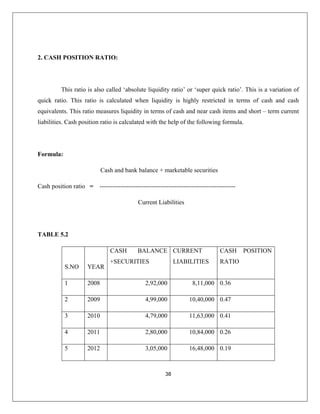
This ratio is also called ‘absolute liquidity ratio’ or ‘super quick ratio’. This is a variation of
quick ratio. This ratio is calculated when liquidity is highly restricted in terms of cash and cash
equivalents. This ratio measures liquidity in terms of cash and near cash items and short – term current
liabilities. Cash position ratio is calculated with the help of the following formula.
Formula:
Cash and bank balance + marketable securities
Cash position ratio = -----------------------------------------------------------------
iabilities
CASH BALANCE
+SECURITIES
CURRENT
LIABILITIES
CASH POSITION
RATIO
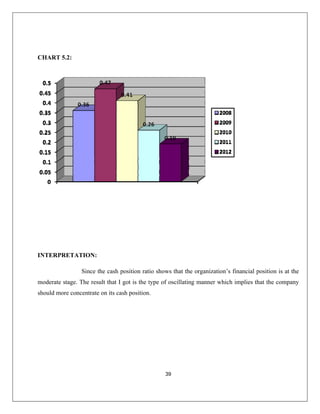
2. CASH POS
Current L
TABLE 5.2
S.NO YEAR
1 2008 2,92,000 8,11,000 0.36
2 2009 4,99,000 10,40,000 0.47
3 2010 4,79,000 11,63,000 0.41
4 2011 2,80,000 10,84,000 0.26
5 2012 3,05,000 16,48,000 0.19
CHART 5.2:
INTERPRETATION:
Since the cash position ratio shows that the organization’s financial position is at the
oderate stage. The result that I got is the type of oscillating manner which implies that the company
ould more concentrate on its cash position.
m
sh
39
40
LIQUID RATIO:
3.ABSOLUTE
Therefore, absolute liquidity ratio relates cash, bank and marketable securities to the
current liabilities.
= (ABSOLUTE LIQUID ASSET/CURRENT LIABILITIES)
TABLE 5.3:
S.NO YEAR
ABSOLUTE LIQUID
ASSET
CURRENT
LIABILITIES
ABSOLUTE
LIQUID RATIO
1 2008 53,000 8,11,000 0.07
2 2009 52,000 10,40,000 0.05
3 2010 2,02,000 11,63,000 0.17
4 2011 21,000 10,84,000 0.02
5 2012 74,000 16,48,000 0.05
CHART 5.3:
INTERPRETATION:
om the above chart it is clearly seen that the com a very low liquid assets when
compared with the liabilities. The company e a corre re to o me this situation.
Fr pany has
has to tak ctive measu verco
41
42
. FIXED ASSETS RATIO:
This ratio establishes the relationship between fixed assets and long term funds.
is ratio is to ascertain the proportion of long term funds invested in fixed
FORMULA:
FIXED ASSE RATIO = FIXED ASSET
LONG TERM FUND
TABLE 5.4:
Sl. No. Year Fixed assets Long term
funds
Fixed assets
ratio
4
The objective of calculating th
assets. The ratio is calculated as given below.
1 2008 6,13,000 7,51,000 0.82
2 2009 6,13,000 6,83,000 0.90
3 2010 5,69,000 5,84,000 0.97
4 2011 5,33,000 11,22,000 0.47
5 2012 4,48,000 8,63,000 0.52
CHART 5.4:
INTERP TATI
The study clears that the concern has started employing leverages for better
rofitability. The raising percentage of this ratio shows that the company has made a good proportion
of long term funds in fixed assets.
RE ON:
43
p
44
. CAPITAL TURNOVER RATIO:
Managerial efficiency is also calculated by establishing the
relationship between cost of sales or sales with the amount of capital invested in the business. Capital
turnover ratio is calculated with the help of the following formula.
FORMULA:
COST OF SALES
CAPITAL TURNOVER RATIO =
CAPITAL EMPLOYED
TABLE 5.5
S.NO YEAR
COST OF
SALES
CAPITAL
EMPLOYED
CAPITAL
TURNOVER RATIO
CS/CE
5
1 2008 27,72,200 17,91,000 1.55
2 2009 36,98,000 14,54,000 2.54
3 2010 35,93,000 17,45,000 2.06
4 2011 32,10,000 19,99,000 1.61
5 2012 4,56,500 20,54,000 0.22
CHART 5.5:
INTERPRETATION:
The percentage of this ratio is in the increasing position this shows a positive sign for the
company. ce the cost of sales has increased th is on the osition.
Sin e company safe p
45
46
CAPITAL TURNOVER RATIO:
Working capital ratio measures the effective utilization of working Capital .It also
measures the smooth running of business .The ratio establishes relationship between sales/cost of sales
and working capital.
FORMULA
Sales
Working capital turnover ratio =
Net working capital
TABLE 5.6
S.NO YEAR SALES
NET
WORKING
CAPITAL
WORKING CAPITAL
TURNOVER RATIO
6. WORKING
1 2008 27,72,200 5,78,000 4.80
2 2009 36,98,000 8,41,000 4.40
3 2010 35,93,000 11,76,000 3.06
4 2011 32,10,000 14,66,000 2.19
5 2012 4,56,500 16,06,000 0.28
CHART 5.6:
INTERPRETATION
The working capital ratio is decreasing every year, this shows that the company has
not used e work pital . Therefo that the any is at the unsafe zone.
Therefore the comp hould take corrective actions to get into the safer zone.
47
th ing ca effectively re it shows comp
any s
48
. NET PROFIT RATIO:
This ratio is called net profit to sales ratio. It is a measure of Managements efficiency in
the Owner point of view. In indicates the return on
ents.
FORMULA
NET PROFIT AFTER TAX *100
NET PROFIT RATIO = NET SALES
TABLE 5.7
S.NO YEAR
NET PROFIT
AFTER TAX
NET SALES NET PROFIT RATIO
=NPAT/NS
7
operating the business successfully from
shareholders investm
1 2008 9,86,600 27,72,200 0.36
2 2009 3,53,000 36,98,000 0.10
3 2010 1,20,600 35,93,000 0.03
4 2011 11,09,900 32,10,000 0.35
5 2012 7,03,800 4,56,500 1.54
CHART 5.7:
INTERPRETATION:
This chart shows that the man s for the ye 2 has been increased in
highe xtend w ompared to the pre r
agement’ efficiency ar 201
r e hen c vious yea s.
a
49
50
. EXPENSES RATIO
This ratio is also known as supporting ratios to Operating ratio. They indicate the efficiency
with which business as a Whole functions. It is better for the concern to know how it is able to save or
waste over expenditure in respect of different items of expenses.
FORMULA:
ADMINISTRATION EXPENSES *100
EXPENSES RATIO =
NET SALES
TABLE 5.8
S.NO YEAR
ADMINISTRATION
EXPENSES
NET SALES EXPENSES RATIO
= AE/NS
8
1 2008 5,90,000 27,72,200 0.21
2 2009 6,00,000 36,98,000 0.16
3 2010 8,97,000 35,93,000 0.24
4 2011 8,48,100 32,10,000 0.26
5 2012 9,17,000 4,56,500 2.01
51
CHART 5.8:
INTER ATIO
It shows that it is better for the concern to know how it is able to save or waste over
expenditure in respect of different items of expenses. The expenses of the company has been increased
in a higher rate in 2012 .
PRET N
52
R
5.9. DEBTORS TURNOVER RATIO:
Debtor constitute an important constitute of current assets & their fore the quality of debtor to
great extent determines a firm liquidity of a firm use two ratio. They are debtors turnover ratio & debt
collection period ratio. This ratio indication the speed with which debtors receivable are being collected
there it is indicative of the efficiency of trade credit management. The higher the turnover ratio the
better the trade credit management & the better the liquidity of debtors.
TABLE-5.9
DEBTORS TURNOVER RATIO
(In Lakhs)
l Sales Account Receivables Debtors Turnover Ratio
ECEIVABLES MANAGEMENT
Year Tota
2008 27,72,200 11,28,000 2.46
2009 36,98,000 11,95,000 3.09
2010 35,93,000 12,19,000 2.95
2011 32,10,000 11,62,000 2.76
2012 4,56,500 14,87,000 0.31
53
ART-5.9
CH
DEBTORS TURNOVER RATIO
INTERPRETATION:
on it in observed that both the rates & account receivable are
increased in the year2009 and the division was in a very good portion llection but in
the following year due to increase in the amount of average payables the ratio has come down
drastic
From the date of interpretati
regarding the co
ally.
54
5.10. DEBITORS COLLECTION PERIOD:
Their ratio indication the extent to which the debts have been collected in time it gives the
average debt collection period the ratio is very helpful to the lenders because it explain them whether
borrowers are collating money in a reasonable time an increase in the period reflects grater blockage of
funds in debtors a very long collection period would imply either power credit selection or and
inadequate collection effort.
TABLE-5.10
DEBTORS COLLECTION PERIOD
(In Lakhs)
No of Days
Debtors Turnover
Ratio
Debtors Collection
Period in Days
Year
2008 364 2.46 148
2009 365 3.09 118
2010 365 2.95 124
2011 365 2.76 132
2012 365 2.05 178
CHART-5.10
DEBTORS COLLECTION PERIOD
INTERPRETATION
collection period is very low which indicates the better quality
of debtors as the quick payments by them within a short period
During the year 2009-2012 the average collection period is very high as which indicate that the
debtor as by late payments.
55
During the year 2008-2009 the average
inefficient performance of the
56
TECHNOLOGIES THE YEAR ENDED 31ST
MARCH 2009
PARTICULARS AMOUNT
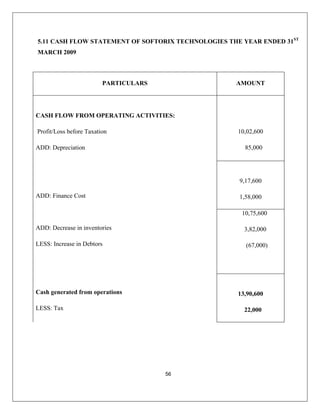
5.11 CASH FLOW STATEMENT OF SOFTORIX
CASH FLOW FROM OPERATING ACTIVITIES:
Profit/Loss before Taxation
ADD: Depreciation
ADD: Finance Cost
ADD: Decrease in inventories
LESS: Increase in Debtors
Cash generated from operations
LESS: Tax
10,02,600
85,000
9,17,600
1,58,000
10,75,600
3,82,000
(67,000)
13,90,600
22,000
57
NET CASH FLOW FROM OPERATING ACTIVITIES
Cash flow from investing activities:
LESS: Purchase of assets
LESS: Cash receipts from loans and advances
Cash flow from investing activities
CASH FLOW FROM INVESTING ACTIVITIES:
Proceeds from issue of shares
NET INCREASE IN CASH
CASH AND CASH EQUIVALENT IN THE BEGINNING
13,68,600
(1,08,000)
12,60,600
(68,000)
11,92,600
2,69,000
9,22,600
53,000
8,69,600
58
CASH AND CASH EQUIVALENT AT THE END
59
TECHNOLOGIES THE YEAR ENDED 31ST
MARCH 2010
PARTICULARS AMOUNT
5.12 CASH FLOW STATEMENT OF SOFTORIX
CASH FLOW FROM OPERATING ACTIVITIES:
Profit/Loss before Taxation
ADD: Depreciation
ADD: Finance Cost
LESS: Increase in inventories
LESS: Increase in Debtors
Add: Decrease in Bank
Cash generated from operations
LESS: Tax
1,50,600
71,000
2,21,600
83,000
3,04,600
(4,54,000)
(24,000)
1,70,000
(3,400)
(13,000)
60
NET CASH FLOW FROM OPERATING ACTIVITIES
Cash flow from investing activities:
ADD: Sale of assets
LESS: Cash receipts from loans and advances
Cash flow from investing activities
CASH FLOW FROM INVESTING ACTIVITIES:
Proceeds from issue of shares
NET INCREASE IN CASH
CASH AND CASH EQUIVALENT IN THE BEGINNING
CASH AND CASH EQUIVALENT AT THE END
(16,400)
4,14,000
3,97,600
(99,000)
2,98,600
3,90,000
(91,400)
1,50,000
58,600
61
62
NOLOGIES THE YE R ENDED 31ST
MARCH 2011
PARTICULARS AMOUNT
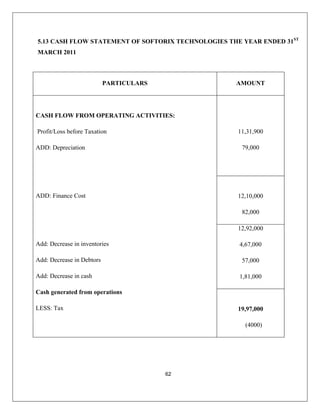
5.13 CASH FLOW STATEMENT OF SOFTORIX TECH A
CASH FLOW FROM OPERATING ACTIVITIES:
Profit/Loss before Taxation
ADD: Depreciation
ADD: Finance Cost
Add: Decrease in inventories
Add: Decrease in Debtors
Add: Decrease in cash
Cash generated from operations
LESS: Tax
11,31,900
79,000
12,10,000
82,000
12,92,000
4,67,000
57,000
1,81,000
19,97,000
(4000)
63
NET CASH FLOW FROM OPERATING ACTIVITIES
Cash flow from investing activities:
Add: Sale o
LESS: Cash receipts from loans and advances
Cash flow
Proceeds from issue of shares
NET INCREASE I H
CASH AN ASH VA THE BEGINNIN
CASH AN ASH V T THE END
19,93,000
1,75,000
(5,38,000)
f assets
from investing activities
(3,63,000)
2,84,000
(79,000)
N CAS
D C EQUI LENT IN G
D C EQUI ALENT A
(79,000)
1,81,000
1,02,000
64
CALCULATION OF ACTUAL LIABILITY AND SOLVENCY POSITION
1. NET CASH FLOW TO CURRENT LIABILITY:
NET PROFIT + NON-CASH EXP
NET CASH FLOW TO
CURRENT LIABILITIES = ---------------------------------------------------------------------------
CURRENT LIABILITES
S.NO YEAR
NON- CASH EXP LIABILITIES TO CURRENT
LIABILITIES
NET PROFIT + CURRENT NET CASH FLOW
1 2008 9,86,600 8,11,000 1.21
2 2009 3,53,000 10,40,000 0.339
3 2010 1,20,600 11,63,000 0.104
4 2011 11,09,900 10,84,000 1.02
5 2012 7,03,800 16,48,000 0.427
65
INFERENCE:
The higher the ratio, the greater the degree of liquidity and solvency of a firm and vice-versa. The
com e year 2008 and start declining for the following years. In the
year 2012 the company has a lower degree of liquidity and solvency because of decrease in net profit
and
pany has shown a good position in th
non-cash expenses.
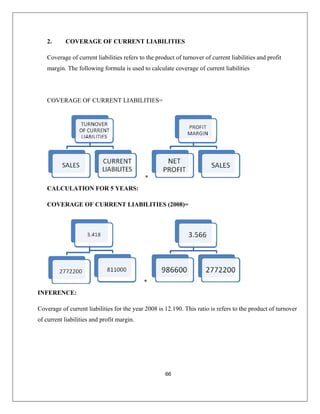
2. COVERAGE OF CURRENT LIABILITIES
66
Coverage of current liabilities refers to the product of turnover of current liabilities and profit
margin. The following formula is used to calculate coverage of current liabilities
COVERAGE OF CURRENT LIABILITIES=
*
CALCULATION FOR 5 YEARS:
COVERAGE OF CURRENT LIABILITIES (2008)=
*
INFERENCE:
Coverage of current liabilities for the year 2008 is 12.190. This ratio is refers to the product of turnover
of current liabilities and profit margin.
COVERAGE OF CURRENT LIABILITIES(2009)=
*
INFERENCE:
Coverage of current liabilities for the year 2009 is 0.339
COVERAGE OF CURRENT LIABILITIES (2010)=
*
INFERENCE:
overage of current liabilities for the year 2010 is 1.0380
C
67
68
1)=
COVERAGE OF CURRENT LIABILITIES (201
*
INFERENCE:
Coverage of current liabilities for the year 2011 is 1.022
COVERAGE OF CURRENT LIABILITIES (2012)=
*
INFERENCE:
Coverage of current liabilities for the year 2012 is 4.271
69
1. The company is having sufficient cash flow management
2. Current Assets are in an increasing position.
4. Current Assets are more than current Liabilities.
5. The working capital is negative working capital
as it various from. Here in this cash the
current ratio is more than 1 and it is enough to meet the current liability.
ry high which shows that there is a lack of trade credit
management.
13. Debtor’s collection is very high it shows the low betterment of collection of funds from debtors.
08 to the year 2009 there was decreased in working capital
position in the major circumstances this cleared that company is trying to procure the funds all
in procurement of secured loans.
17. The Increase in figures of sources and applications from the year 2010-2011 to the year 2011-
2012 makes clear that the company is active in increasing or standardizing of its operations.
CHAPTER VI
FINDINGS
3. Loans & Funds are decreases by year by year, it means that the company is in profitable
position
6. Current liabilities are Increased by every year.
7. Long – term liabilities are increased by every year but in 2011-2012 year long term liabilities
are decreased from 40,000 to 35,200.
8. The Quick Ratio > 1 which shows the sound short-term solvency.
9. The suggested current ratio is 2:1. But it is not fixed
10. When Working capital is compared with net sales it is in increasing trend indicating the
effective utilization of the net working capital.
11. The debtor’s turnover ratio is high and it shows the better trade credit management.
12. Debtor’s collection period is ve
14. By creating the Profit and Loss statement it shows that the company has generated more
revenue and its position is satisfactory.
15. It is understand that from the year 20
the times in order to compensate on wipe on the losses.
16. It is to be observed that the company’s new worth is decreases considerably. Through this
increase
70
1. The manpower needs to be assessed in relation to production and sales. The excess of
employees should be removed through various measures like VRS, retirement’s and destructing
2. There are various global challenges that are faced by every company in the present competitive
global challenges the human resources department should be develop to improve various skills
market.
hould also make efforts to regain the agents in Germany and UK. They
should also make efforts to regain the defiance and railways and find new markets for
l change and
improvement in design and process.
velopment new market with the accreditation of ISO 9001 and C.E. making for
certain products should be continuous as it will help in development the confidence of foreign
CHAPTER VII
SUGGESTIONS:-
the requirement of new employees.
environment and SOFTORIX TECHNOLOGIES is not any exemption. To face the present
among the employees specially the motivational skills and having the regular training for the
employees about various developments in the
3. The marketing department should be restructured on profit center and product line basis. The
new marketing strategy s
expansion.
4. There are various development taking in the industry to change it the company should develop a
full fledged research and development department for bringing technologica
5. The policy of de
buyers.
71
6. The sundry debtors should be efficiently managed so that the outstanding are to be cleared at
short intervals. The company should appoint on different areas on a success fees basis to collect
the debtors.
7. The cost of holding inventory is too high so the inventory holding period is to be reduced and to
anaged more effectively so as to avoid unnecessary blocking of
10. The Working Capital requirement is to be assessed based on the norms circulated by RBI for the
machine tools industry.
any has maintained p oper records s ing full particulars, quantitative details and
solutions of fixed assets are indicated for major items in the register, the managements during
the year has conducted a random verification in respect of fixed assets, which in our opinion is
reasonable, having regard to the size of the company and the nature of tits assets.
12. The management has physically verified the stock of finished goods and work in progress at the
end of the year.
spect of servi s th ason for recording receipts i
consumption of ma terials con jobs,
commensurate with the size and nature of its business.
build up inventory in anticipation of export orders from Russia and Germany.
8. The company has to make new joint venture with other companies in order to reduce the losses.
9. The current assets should be m
capital that could be used for other purposes.
11. The comp r how
13. In re ce activitie ere is a re able system ssues and
terials and stores and collection of ma sumed to the relative
72
CHAPTER VIII
ION
The company is performing exceptionally well due to the up wising in the global market
mestic an u e wi inn s an in
improving all the areas of its operations. The company has a good liquidity position and does not delay
sh of both its creditors and debtors. The company being mostly dependent on the
working capital facilities, it is maintaining very good relationship with their banks and their working
management is well balanced.
CONSOLIDATED BALNCE SHEET OF SOFTORIX TECHNOLOGIES
FISCAL YEAR 2008 2009 2010 2011 2012
CONCLUS
followed by the do market. It is pcoming on th good and ovative idea d believed
its commitment in ca
capital
ASSETS
CURRENT ASSETS:
CASH 53,000 52,000 2,02,000 21,000 74,000
CASH AT BANK 2,39 4 2 2,31,00
,000 ,47,000 2,77,000 ,59,000 0
STOCK 5,69,000 1,87,000 6,41,000 11,08,000 14,62,000
SUNDRY DEBTORS 11,28,000 11,95,000 12,19,000 11,62,000 14,87,000
TOTAL CURRENT ASSETS 19,89,000 18,81,000 23,39,000 25,50,000 32,54,000
73
FIXED ASSETS:
GROSS BLOCK-
DEPRECIATION 6,13,000 6,13,000 5,69,000 5,33,000 4,48,000
TOTAL FIXED ASSETS 6,13,000 6,13,000 5,69,000 5,33,000 4,48,000
TOTAL ASSETS 26,02,000 24,94,000 29,08,000 30,83,000 37,02,000
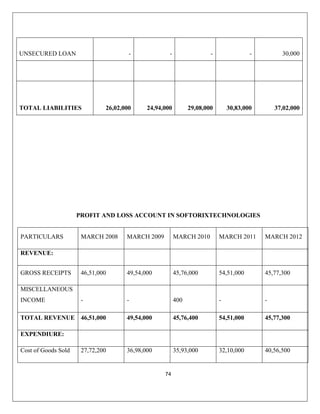
LIABILITIES
CAPITAL:
SHARE CAPITAL 1,40,000 1,40,000 1,40,000 1,40,000 9,50,000
SHARE APPLICATION 71,000
AD.. 9,00,000 6,31,000 10,21,000 7,37,000
RESERVES AND SURPL ,4
US - - - - 1 0,000
CURRENT
LIABILITIES:
CREDITORS 7,61,000 9,60,000 ,000 0 00
3,63 10,41,00 11,53,0
PROVISIONS 50,000 80,000 8,00,000 43,000 3,61,000
OTHERS - - - - 1,34,000
LOAN FUND:
SECURED LOAN 8,63,000
7,51,000 6,83,000 5,84,000 11,22,000
74
- - - 000
UNSECURED LOAN - 30,
TOTAL LIABILITIES 26,02,00 24,94,000 ,08,000 ,000 2,000
0 29 30,83 37,0
PROFIT AND LOSS ACCOUNT IN SOFTORIXTECHNOLOGIES
ICULARS 2008 2009 2010 011 2012
PART MARCH MARCH MARCH MARCH 2 MARCH
REVENUE:
GROSS RECEIPTS 46,51,000 49,54,000 45,76,000 54,51,000 45,77,300
MISCELLANEOUS
INCOME - - 400 - -
TOTAL REVENUE 46,51,000 49,54,000 45,76,400 54,51,000 45,77,300
EXPENDIURE:
Cost of Goods Sold 27,72,200 36,98,000 35,93,000 32,10,000 40,56,500
75
Admin
Expenses 5,90,000 6,00,000 8,97,000 8,48,100 9,17,000
istrative
Financ 1,58,000 83,000 82,000 1,67,200
ial Charges 1,67,000
Selling Exp 38,000 83,000 1,00,000 80,400
enses 37,200
Depreciation 82,000 85,000 71,000 79,000 82,000
TOTAL
EXPENDI 36,48,400 45,79,000 47,27,000 43,19,100 53,03,100
TURE
PROFIT/(LOSS) 10,02,600 3,75,000 1,50,600 11,31,900 7,25,800
LE
Tax 4000 15,000
SS: Provision for
11,000 7000 13,000
Pr
Benefit Tax 7,000 18,000 7000
ovision for fringe
5000 15000 1
PROF
TAX 9,86,600 3,53,000 1,20,600 11,09,900 7,03,800
IT AFTER
76
BIBLIOGRAPHY:
1.www.investopedia.com/
2. www.studyfinance.com/
3 Hen.wikipedia.org/wiki/H
4 Hhttp://www.bimite.co.in/
BOOKS:
1. Bolten, SE, Managerial finance – Principles and Practices, Houghton, Miffin company, Boston
1976, p.162
2. Financial Management(Tenth Edition), I.M. Pandey & Brealey, R. and S., Myers, principles of
Corporate Finance, McGraw Hill, 1991, p.159 – 190
3. An introduction to Financial Management, Good year Publishing company, Santa Califf,
Solomn, Ezra and JJ Prigle, 1977, p.282 -312
4. Brigham, E. F. and Houston, J. F. Fundamentals of Financial Management, Concise Third
Edition, Harcourt Publishers, 2001.

cash flow statement _project report.pdf

  • 1.
    A PROJECT REPORTON “A STUDY ON CASH FLOW MANAGEMENT” OF SOFTORIX TECHNOLOGY PVT LTD” In partial fulfillment of the requirements Of the Master of Business Administration Submitted to SRM SCHOOL OF MANAGEMENT Submitted by: Bhupendra Singh REG. NO: 3511210394 UNDER THE GUIDANCE OF S.PRIYA Asst. Professor FACULTY OF ENGINEERING AND TECHNOLOGY SRM UNIVERSITY KATTANKULATHUR 1
  • 2.
    2 BONAFIDE CERTIFICATE Certified thatthis project report titled “A STUDY ON CASH FLOW MANAGEMENT OF SOFTORIX TECHNOLOGIES PVT LTD” is the bonafide work of Bhupendra Singh (3511210394) who carried out the research under my supervision. Certified further, that to the best of my knowledge the work reported here in does not form part of any other project report or dissertation on the basis of which a degree or award was conferred on an earlier occasion on this or any other candidate. S.PRIYA Dr.JayshreeSuresh (Project Guide) (Dean, SRM School of Management) Internal examiner External examiner (………………..) (…………………..)
  • 3.
    3 DECLARATION I hereby declarethat the project work entitled “ CASH FLOW MANAGEMENT OF SOFTORIX TECHNOLOGY PVT LTD” is the produce of my sincere effort. This summer internship project report is being submitted by me alone, at SRM School of management, SRM University, Chennai, for the partial fulfillment of the course MBA, and the report has not been submitted to any other educational institutions for any other purpose. Bhupendra Singh Place: Date :
  • 4.
    4 ACKNOWLEDGEMENT The success ofany task lies upon the efforts made by a person, but it cannot be achieved without the help and cooperation of others. So I would like to thank SRM UNIVERSITY - SCHOOL OF BUSINESS MANAGEMENT for giving me the opportunity of doing a general industrial training and project work as a special subject and provides a wonderful platform to represent myself as a management student. First and foremost I would like to thank God almighty for giving me a chance to undertaken and to complete my project successfully. I would like to thank full to Dr.Jayshree Suresh, Dean, SRM School of Management, for giving me an opportunity to carry out the project work. I express my sincere thanks to my class in charge S.PRIYA, Asst. Professor, SRM School of Management, SRM University, for being constant source of inspiration and wholehearted support I take great pleasure in thanking my guide S.PRIYA. Asst. Professor, SRM School of Management, SRM University, for her valuable guidance and the suggestions without which the report could not have been completed. Last but not the least I would like to thank my family, friends and relatives. Who were with me in every step of my work. My sincere thanks to everyone.
  • 5.
  • 6.
  • 7.
    7 A STUDY ONCASH FLOW REFERENCE TO SOFTORIX TECHNOLOGIES The project flow management for SOFTORIX TECHNOLOGIES” eals with the mov or out of a business, project, or financial product. It is usually easured during a d of time. The main objective of this project is to study on the ement of the ties so that satisfactory level of working capital is ined. The se to manage receivable, inventory and cash, to y the different study the operating cycle of company, to study the quidity position o le remedial measures if any on the basis of which tied- and efficiently, to suggest, if possible on the basis e ation. The study covers all the components of current parted in the organization. ic and vital aspects of the pe of research to analyze the past da ade. project for calculating the Ratio analysis and Cash tatement of t ides all the information about the company for the accounting This enable he existing performance of the company. The y this proje various global challenges that are faced by every pany in the resent competitive FTORIX TECHNOLOGIES is not any exemption. To face the resent global chall urces department should be develop to improve various skills among the employees specially the motivational skills and having the regular training for the employees about various developments in the market. The project ahs been concluded as the company has a good liquidity position and does not delay its commitment in cash of both its creditors and debtors. The company being mostly dependent on the working capital facilities, it is maintaining very good relationship with their banks and their working capital management is well balanced. MANAGEMENT WITH ABSTRACT titled “A Study on cash d ement of money into m specified, finite perio manag current assets and current liabili mainta condary objectives are to know how stud sources of financing capital, to li f company, to look at possib up funds in working capital could be used effectively of conclusion som modification to meet the situ assets and current liabilities fo im r the year 2009-2012. The study also deals with the various ratios The working capital is one of the dynam business operation. Analytical research technique was adopted in this project. The researcher used analytical ty ta based on which certain future decision can be m Annual report os the company are been used in this flow s he company. It prov period. s to understand t main suggestion given b ct is there are com p environment and SO p enges the human reso
  • 8.
    8 T ER NO. ABLE OFCONTENTS CHAPT CONTENTS PAGE NO. I INTRODUCTION 1 II COMPANY PR 10 OFILE 2.1 Industry Profile 12 2.2 Product Pr 18 ofile III REVIEW OF LI 20 TERATURE IV RESEARCH 30 METHODOLOGY 4.1 Statement 35 of the problem 4.2 Objectives of th 40 e study 4.3 Scope of the s 45 tudy 4.4 Limitatio 58 n of the study 4.5 Working procedure for the Cash flow Management 62 4 65 .6 Calculation of coverage of Current Liabilities V DATA ANALYSIS AND INTERPRETATION 70 VI FINDINGS 71 VII S 73 UGGESTIONS VIII CONCLUSION 74 IX ANNEXURE 75 BIBLIOGRAPHY 76 BALANCESHEET 77
  • 9.
    9 CHART CONTENTS SLNO CONTENTSPAGE NO. 1 CURRENT RATIO 2 CASH POSITION RATIO 3 QUICK RATIO 4 ABSOLUTE LIQUID RATIO 5 FIXED ASSET RATIO 6 CAPITAL TURNOVER RATIO 7 WORKING CAPITAL RATIO 8 EXPENSES RATIO 9 NET PROFIT RATIO 10 DEBTORS TURNOVER RATIO 11 DEBTORS COLLECTION PERIOD 12 CASH FLOW STATEMENT FOR THE YEAR ENDED 31ST MARCH 2009 13 CASH FLOW STATEMENT FOR THE YEAR ENDED 31ST MARCH 2010 14 CASH FLOW STATEMENT FOR THE YEAR ENDED 31ST MARCH 2011
  • 10.
    10 TABLE CONTENTS SLNO CONTENTSPAGE NO. 1 CURRENT RATIO CHART 2 CASH POSITION RATIO CHART 3 QUICK RATIO CHART 4 ABSOLUTE LIQUID RATIO CHART 5 FIXED ASSET RATIO CHART 6 CAPITAL TURNOVER RATIO CHART 7 WORKING CAPITAL RATIO CHART 8 EXPENSES RATIO CHART 9 NET PROFIT RATIO CHART 10 DEBTORS TURNOVER RATIO CHART 11 DEBTORS COLLECTION PERIOD CHART
  • 11.
    11 Introduction: Cash flow isthe movement of money into or out of a business, project, or etermine problems with a business's liquidity. Being profitable does not necessarily mean being liquid. A company can fail because of a shortage of cash even while profitable. ive measure of a business's profits when it is believed that accrual accounting al accounting. When net income is composed of large non-cash items it is considered low quality. risks within a financial product, e.g. matching cash requirements, evaluating default risk, re-investment requirements, etc. s a generic term used differently depending on the context. It may be defined by users for their own purposes. It can refer to actual past flows or projected future flows. It can refer to the total of ll flows involved or a subset of those flows. Subset terms include net cash flow, operating cash flow nd free cash flow. CHAPTER I financial product. It is usually measured during a specified, finite period of time. Measurement of cash flow can be used for calculating other parameters that give information on a company's value and situation. Cash flow can e.g. be used for calculating parameters: • to determine a project's rate of return or value. The time of cash flows into and out of projects are used as inputs in financial models such as internal rate of return and net present value. • to d • as an alternat concepts do not represent economic realities. For example, a company may be notionally profitable but generating little operational cash (as may be the case for a company that barters its products rather than selling for cash). In such a case, the company may be deriving additional operating cash by issuing shares or raising additional debt finance. • cash flow can be used to evaluate the 'quality' of income generated by accru • to evaluate the Cash flow i a a
  • 12.
    12 The software industryincludes businesses involved in the development, maintenance and publication of computer software using any business model. The industry also includes software services, such as aining, documentation, and consulting and outsourcing those business models. Operating Activities The statement provides information from a company’s daily operating ctivities. Operating activities are those which produce either revenue or are the direct cost of producing a product or service. Operating activities which generate cash inflows include customer sales of their primary products or services, receipts of interest and dividends, and other s such as property, plant, nd equipment. Investing activities can also include the purchase or sale of stock and securities.Lending loan payments would also be considered investing activities. tr about the cash generated a collections from operating cash receipts. Operating activities which create cash outflows include payments to suppliers, payments to employees, interest payments, payment of income taxes and other operating cash payments. Investing Activities Investing activities include buying and selling noncurrent assets which will be used to generate revenues over a long period of time; or buying and selling securities not classified as cash equivalents. Cash inflows generated by investing activities include sales of noncurrent asset a money and receiving Financing Activities Financing activities include borrowing and repaying money, issuing stock (equity) and paying dividends.
  • 13.
    13 CHAPTER II COMPANY PROFILE Abo Ourproject methodology includes techniques for initiating a project, developing the making clear assignments to the project team, developing a dynamic schedule, reporting status to executives and problem solving. In today's competitive environment, students want to ensure dy, design, us aspects of Information Technology, students can be sure that Softorix is just that sort of organization. ent. Our ining for technical students include Aptitude, Analytical, Verbal, Technical, Soft Skills, Personality Dev nterviews. s, we would ut Us requirements, that they are getting guidance in an organization that can meet their professional needs. With our well equipped team of solid Information Systems Professionals, who stu develop, enhance, customize, implement, maintain and support vario CAREER FAIRS: We specialize in campus interviews, workshops in management, and career developm tra elopment and Interview Skills that very well prepares the candidate to get through any i As we have a passion for conducting Mega Job Fairs in Colleges and educational institute be able to satisfy our clients in qualitative & Quantitative terms. We have set track records of mo 5 didates. Our candidates are placed in various Industries like IT, ITES& NON IT Se Positions mentioned blow. re then 000 walk ins in a single day event and nearly 20 Core Companies have represented and recruited 367 Can ctors as the
  • 14.
    Software / IT/ Telecom 14 Accounts Finance HR & Admin Engineering / Production / Maintenance / Quality Control Pharma / Biotech ITES / BPO / Call Centers Sales & Marketing Secretary / Executive Asst. Receptionist / Front Office / Office Admin SR. MANAGEMENT / Project Manager/ Quality Analyst. SERVICES An explicit an iled [not implementation specific] odel. The narrative definition is in some cases augmented by machine-readable semantic information about the service which facilitates service mediation nterprise Architecture. d detailed narrative definition supported by a low (but not deta ) level process m and consistency checking of an E An explicit a ition supported by a low (but not detailed [not implementation tive definition is in some cases augmented b service me ture. nd detailed narrative defin specific]) level process model. The narra y machine-readable semantic information about the service which facilitates diation and consistency checking of an Enterprise Architec the A set of performance indicators that address measures/performance parameters such as availability (when should members of the organization be able to perform the function), duration (how long should it take to perform the function), rate (how often will function be performed over a period of time). A linkage to the organizations information model showing what information the Service owns (creates, reads, updates, and deletes) and which information it references
  • 15.
    15 and i s. sowned by other Service Largest Talent Pool We enable you to hire the people that you want Utilizing our Services can actually save your Time and Money Confidentiality Qualitative & Quantitative terms Speed & Volumes Highest level of accuracy Delivering long term quality parameter We maintain Solution based operational methodology Scientific & Focused approach Go getters Implementing Unique techniques on HEAD HUNTING QUALITY POLICY: In today's increasingly competitive environment, the biggest challenge is to retain value added quality parameter with the latest HR Policy. Knowledge Management. Manpower Resources.
  • 16.
    Strategy Analysis. Implementation. 2.1 INDUSTRYPROFILE: History: The word "software" had been coined as a prank by at least 1953, but did not appear in print until the 1960s. Before this time, computers were programmed either by customers, or the few NIVAC and IBM. The first company founded to provide software products and services was Computer Usage Company in 1955. The software industry ry expanded greatly with the rise of the personal computer in the mid-1970s, which brought computing to the desktop of the office worker. In subsequent years, it also created a an only be accessed through the Web, and by definition no client software is loaded onto the end user's PC. commercial computer vendors of the time, such as U expanded in the early 1960s, almost immediately after computers were first sold in mass-produced quantities. Universities, government, and business customers created a demand for software. Many of these programs were written in-house by full-time staff programmers. Some were distributed freely between users of a particular machine for no charge. Others were done on a commercial basis, and other firms such as Computer Sciences Corporation (founded in 1959) started to grow. The computer- makers started bundling operating systems software and programming environments with their machines. The indust growing market for games, applications, and utilities. DOS, Microsoft's first operating system product, was the dominant operating system at the time.In the early years of the 21st century, another successful business model has arisen for hosted software, called software as a service, or SaaS ,this was at least the third time this model had been attempted. SaaS reduces the concerns about software piracy, since it 16 c
  • 17.
    17 are several typesof businesses in the software industry. Infrastructure software, ing systems, middleware and databases, is made by companies such as Microsoft, IBM, Oracle and VMWare. Enterprise software, the software that automates business finance, production, logistics, sales and marketing, is made by Oracle, SAP AG , Sage and ftware is made by the likes of Symantec, Trend Micro and Kaspersky. Several ftware makers are also among the largest software companies in the world: lack Board making software for schools, and companies like Qualcomm or Cyber Vision making software for telecom companies. Other companies do contract rogramming to develop unique software for one particular client company i.e outsourcing, or focus on rom large vendors such as SAP or Oracle. Size of the industry: Software sectors: The Global Scenario There including operat Sybase, EMC, processes in Infor. Security so industry-specific so SunGard, making software for banks, B p configuring and customizing suites f Leading companies: Mindshare and Marketshare In terms of technology leadership, the software industry has long been led by IBM. However, Microsoft became the dominant PC operating system supplier. Other companies that have substantial mindshare (not: marketshare) in the software industry are SUN Microsystems, the developer of the Java platform (purchased by Oracle in 2011), Red Hat, for its open source momentum, and Google for its Google Docs. However in terms of revenues coming from software sales, the software industry is clearly dominated by Microsoft, since inception. Microsoft products are still sold in largest number across the globe. According to market researcher DataMonitor, the size of the worldwide software industry in 2009 was US$ 303.8 billion, an increase of 6.5% compared to 2008. Americas account for 42.6% of the global software market's value. DataMonitor forecasts that in 2013, the global software market will have a value of US$ 457 billion, an increase of 50.5% since 2009. Software Magazine's Top 10 ranking of 2012 :
  • 18.
    18 8. Capgemini 9. ComputerSciences Corporation tegration, Software experiments, Custom Application Development and Maintenance (CADM), of or more than 77% of the entire software and services to actors behind India being a preferred destination are its reasonably priced labor, favorable business ambiance and availability of expert workforce. Considering its ess process outsourcing (BPO) functions in India namely: 1. International Business Machine 2. Oracle Corporation 3. Accenture 4. Google 5. Yahoo 6. HP 7. Symantec INDIA IT INDUSTRY: The Indian information technology (IT) industry has played a major role in placing India on the international map. The industry is mainly governed by IT software and facilities for instance System In network services and IT Solutions. According to Nasscom's findings Indian IT-BPO industry expanded by 12% during the Fiscal year 2010 and attained aggregate returns of US$ 71.6 billion. Out of the derived revenue US$ 59.6 billion was solely earned by the software and services division. Moreover, the industry witnessed an increase of around US$ 7 million in FY 2009-09 i.e. US$ 47.3 billion against US$ 40.9 billion accrued in FY 2009-09. IT Outsourcing in India: As per NASSCOM, IT exports in business process outsourcing (BPO) services attained revenues US$ 48 billion in FY 2009-09 and accounted f income. Over the years India has been the most favorable outsourcing hub for firm on a lookout offshore their IT operations. The f escalating growth, IBM has plans to increase its busin besides employing 5,000 workforces to assist its growth. In the next few years, the industry is all set to witness some multi-million dollar agreements
  • 19.
    19 ters and ITservices in UK. As per the industry analysts, the pact is estimated • US$ 50 million agreement between HCL Technologies and Meggitt, UK-based security r, for offering engineering facilities. India's domestic IT Market over the years has become one of the major driving forces of the industry. veloping contexts of technology and intensity of penetration. ctronic operations. omestic IT Market • A 5 year agreement between HCL Technologies and News Corp for administering its information cen to be in the range of US$ 200-US$ 250 million apparatus manufacture • Global giant Walmart has short listed their Indian IT dealers namely Cognizant Technology Solutions, UST Global and Infosys Technologies for a contract worth US$ 600 million India's domestic IT Market: The domestic IT infrastructure is de In the FY 2009-09, the domestic IT sector attained revenues worth US$ 24.3 billion as compared to US$ 23.1 billion in FY 2008-08, registering a growth of 5.4%. Moreover, the increasing demand for IT services and goods by India Inc has strengthened the expansion of the domestic market with agreements worth rising up extraordinarily to US$ 100 million. By the FY 2012, the domestic sector is estimated to expand to US$ 1.7 billion against the existing from US$ 1 billion. Government initiative in India's domestic IT Market: • The Indian government has established a National Taskforce on IT with an aim of formatting a durable National IT Policy for India • Endorsement of the IT Act, which offers an authorized structure to assist electronic trade and ele Major investments in India's d • According to Andhra Pradesh Government the state's SEZs and Software Technology Parks of India (STPI) will witness an investment of US$ 3.27 billion in the next few years.
  • 20.
    20 ission over inclusionof its Interne lications are more often found and used on the Internet and • VMware Inc, San Francisco-based IT firm is looking forward to invest US$ 100 million by 2011 in India. • EMC Corporation's total Indian assets is expected to reach US$ 2 billion by 2014 Indian Software Industry: The Indian Information Technology industry accounts for a 5.19% of the country's GDP and export earnings as of 2011, while providing employment to a significant number of its tertiary sector workforce. More than 2.3 million people are employed in the sector either directly or indirectly, making it one of the biggest job creators in India and a mainstay of the national economy. In 2012 , annual revenues from outsourcing operations in India amounted to US$54.33 billion compared to China with $35.76 billion and Philippines with $8.85 billion. India's outsourcing industry is expected to increase to US$225 billion by 2020. Recent trends in software Industry: The computer software industry, unlike the more traditional manufacturing and services industries, is coping with the current gloomy economic climate as best it can by concentrating on transforming interesting ideasinto novel technology, must-have applications, and competitive maneuvering rivals. Profits may be down at the moment but expectations, whether for companies like Microsoft, Apple, and IBM or Intel, Symantec and Oracle, remain quite high.Remond, WA-based software giant Microsoft is currently battling the European Comm t Explorer web browser in operating system software. Additional issues facing the computer software industry are piracy, a crime which may lessen once software app are not available on individual computers; portability, the transferability of software among operating systems Future of software industry: Hardware, software, and people are the three basic ingredients of enterprise business technology. They provide the enterprise with an economic advantage through automated and improved business
  • 21.
    21 ology era, we predictthat managing the third part of the equation people — will emerge as the dominant focus. As software applications become business services, the cost of human resources producing, operating, and managing software will soon be prohibitive and the new focal point. The Indian Information Technology industry accounts for a 5.19% of the country's GDP and export earnings as of 2011, while providing employment to a significant number of its tertiary sector workforce. More than 2.3 million people ar sector either directly or indirectly, making it one of the biggest job creators i tional economy. In 2012 , annual s in India amounted to US$54.33 billion compared to China with $35.76 dustry was born in Mumbai in 1967 with the establishment of Tata Group in partn d 7,570,000 people in the country have access to processes, increased employee productivity, and more accurate and precise information. The relationship between these three components has evolved over time. In the business techn — e employed in the n India and a mainstay of the na revenues from outsourcing operation billion and Philippines with $8.85 billion. India's outsourcing industry is expected to increase to US$225 billion by 2020. The most prominent IT hub is IT capital Bangalore. The other emerging destinations are Chennai, Hyderabad, Kolkata, Pune, Mumbai, NCR, Trivandrum and Kochi. Technically proficient immigrants from India sought jobs in the western world from the 1950s onwards as India's education system produced more engineers than its industry could absorb. India's growing stature in the information age enabled it to form close ties with both the United States of America and the European Union. However, the recent global financial crises has deeply impacted the Indian IT companies as well as global companies. As a result hiring has dropped sharply and employees are looking at different sectors like the financial service, telecommunications, and manufacturing industries, which have been growing phenomenally over the last few years. India's IT Services in ership with Burroughs. The first software export zone SEEPZ was set up here way back in 1973, the old avatar of the modern day IT park. More than 80 percent of the country's software exports happened out of SEEPZ, Mumbai in 80s. Each year India produces roughly 500,000 engineers in the country, out of them only 25% to 30% possessed both technical competency and English language skills, although 12% of India's population can speak in English. India developed a number of outsourcing companies specializing in customer support via Internet or telephone connections. By 2011, India also has a total of 37,160,000 telephone lines in use, a total of 506,040,000 mobile phone connections, a total of 81,000,000 Internet users— comprising 7.0% of the country's population, an
  • 22.
    22 broadb REVIEW OF LITERATURE 3.1REVIEW OF LITERATURE longer to pay their bills. and Internet making it the 12th largest country in the world in terms of broadband Internet users. Total fixed-line and wireless subscribers reached 543.20 million as of November, 2011. CHAPTER III In intention to discover the relationship between efficient capital management and firm’s profitability(Shin & Soenen, 1998) used net-trade cycle (NTC) as a measure of working capital management. NTC is basically equal to the CCC whereby all three components are expressed as a percentage of sales. The reason by using NTC because it can be an easy device to estimate for additional financing needs with regard to working capital expressed as a function of the projected sales growth. This relationship is examined using correlation and regression analysis, by industry and working capital intensity. Using a Compustat sample of 58,985 firm years covering the period 1975- 1994, in all cashs, they found, a strong negative relation between the length of the firm's net-trade cycle and its profitability. In addition, shorter NTC are associated with higher risk-adjusted stock returns. In other word, (Shin & Soenen, 1998) suggest that one possible way the firm to create shareholder value is by reducing firm’s NTC. The study of (Shin & Soenen, 1998) consistent with later study on the same objective that done by (Deloof, 2003) by using sample of 1009 large Belgian non-financial firms for the period of 1992- 1996. However, (Deloof, 2003) used trade credit policy and inventory policy are measured by number of days accounts receivable, accounts payable and inventories, and the cash conversion cycle as a comprehensive measure of working capital management. He founds a significant negative relation between gross operating income and the number of days accounts receivable, inventories and accounts payable. Thus, he suggests that managers can create value for their shareholders by reducing the number of days accounts receivable and inventories to a reasonable minimum. He also suggests that less profitable firms wait
  • 23.
    23 est earned ratio.Finally, there is no difference between the liquidity ratios of large and small fi e the level of operating assets, increase the need for external funding, resulting ts and a lower return on equity, without any increase in profit. However the picture changes when uncertainty (i.e. uncertain growth) is introduced (Brigham nd Houston, 2000). Larger amounts of cash, securities, accounts receivables, marketable securities, ventories, and fixed assets will be needed to support increased sales Required levels will be based on xpected sales levels and expected order lead times. Additional holdings may be needed to enable the rm to deal with departures from the expected values. Further, firms will also attempt to increase their ccounts payable balances as a means of financing increased levels of current operating assets. Firms hich are in high growth stages will face the challenge of maintaining the necessary level of operating ssets to support subsequent growth, while at the same time attempting to maintain adequate erformance indicators. In other study, (Lyroudi & Lazaridis, 2000) use food industry Greek to examined the cash conversion cycle (CCC) as a liquidity indicator of the firms and tries to determine its relationship with the current and the quick ratios, with its component variables, and investigates the implications of the CCC in terms of profitability, indebtness and firm size. The results of their study indicate that there is a significant positive relationship between the cash conversion cycle and the traditional liquidity measures of current and quick ratios. The cash conversion cycle also positively related to the return on assets and the net profit margin but had no linear relationship with the leverage ratios. Conversely, the current and quick ratios had negative relationship with the debt to equity ratio, and a positive one with the times inter rms. Working capital policy refers to the firm's policies regarding 1) target levels for each category of current operating assets and liabilities, and 2) how current assets will be financed. Generally good working capital policy (i.e. under conditions of certainty) is considered to be one in which holdings of cash, securities, inventories, fixed assets, and accounts payables are minimized. The level of accounts receivables should be used as a means of stimulating sales and other income. Previous literature on working capital management has found a negative association, overall, between level of working capital and operating performance as measured by operating returns and operating margins (Peterson and Rajan, 1997). Under conditions of certainty (i.e. sales, costs, lead times, payment periods, and so on, are known), firms have little reason to hold more working capital than a minimum level. Larger amounts would increas in lower return on asse a in e fi a w a p
  • 24.
    24 companies manage theirworking capital and ther balance sheet items to support subsequent growth. This study supports the existing literature on existing literature by examining a sample of firms (i.e. recent O firms) which have a wider range of growth levels than non-IPO firms. Our study examines the ines these relationships under three categories of growth (i.e. negative An underlying theme of this study is that high growth certainly does not ensure high operating performance. Consistent with prior research (Peterson and Rajan, 1997) this study provides further evidence that good working capital management is positively associated with better operating performance. Higher levels of accounts receivable are associated with higher operating performance, in all three of the growth rate categories. The study also finds that maintaining control over levels of cash, securities, inventory, fixed assets, and accounts payables is associated with higher operating performance. We find that firms which are experiencing very high growth will hold higher levels of cash, securities, inventory, fixed assets, and accounts payable to support the high growth. The study suggests that these firms are sacrificing operating performance (accepting lower operating returns) to support the high growth. This, in turn, increases financial and operating risk for these firms. Perhaps IPO firms should stay more focused on their operating performance, while maintaining more moderate growth levels. This study focuses on understanding how IPO o working capital and contributes to the IP impact of working capital management on the operating performance and growth of new public companies. The study also exam growth, moderate growth, and high growth). The study also examines other selected firm characteristics in light of working capital management: firm operating and financial risk, amount of debt, firm size, and industry.
  • 25.
    25 CHAPTER IV PROBLEM: is essentialand that short term responses ance 4.1 STATEMENT OF ¾ To understand that an ongoing approach to the problem may have negligible effect. ¾ Data such as savings ratio, debt-to-income ratio, self-evaluation of the productivity, perform rating, and absenteeism are difficult to gather as individuals may not know the exact figures of each category or may not want to reveal this information
  • 26.
    26 DY To know howto manage current assets and current liabilities so that satisfactory level of working how to manage receivable, inventory and cash. • ity position of company. To look at possible remedial measures if any on the basis of which tied-up funds in working 4.2 OBJECTIVE OF STU capital is maintained. • To know • To study the different sources of financing capital. • To study the operating cycle of company. To study the liquid • capital could be used effectively and efficiently. • To suggest, if possible on the basis of conclusion some modification to meet the situation.
  • 27.
    27 .3 SCOPE OFSTUDY sets and current liabilities for the year 2008-2012 The study also deals with the various ratios imparted in the organization. The working capital is one of the dynamic and vital aspects of the business operation. 4.4 NEED FOR THE STUDY he student to understand how to maintain the adequate cash balance. rating efficiency, financial capability and the company. The cash flow statement helps the finance manager helps in planning the repayment of loan 4 ¾ The study covers all the components of current as ¾ ¾ Cash plays a very important role in the economic life of a business. A firm needs cash to make payment to its suppliers, to incur day-to-day expenses and to pay salaries, wages, interest and dividends etc. the study helps t It also helps the company to know about the ope investment efficiency of the business. The study also used to know the liquidity position of the schedule and replacement of fixed assets, etc.
  • 28.
    28 4.5 RESEARCH Research isan organized, systematic, database, critical, objective, scientific, inquiry or gation into a s aken with the purpose of finding answer or solutions to it. defines resea designed and carried out to provide information for ” for acquiring the information needed to structure or to solve problem. Research and analysis of the data in a manner that aims to combined relevant to the research purpose with economy in procedure” Analytical research technique was adopted in this project. The researcher used analytical type rch to analyz made. 4.5.2 SOURCE OF DATA SECONDARY DATA These data, which have already been collected, complied and presented earlier by any agency, NNUAL REPORT RESEARCH METHODOLOGY investi pecific problem, undert Emory rch as, “any organized inquiry solving a problem 4.5.1RESEARCH DESIGN Research design is specification of methods and procedures design is defined as, “the arrangement of condition for collection of resea e the past data based on which certain future decision can be may be used for the purpose of investigation. Such data may be called secondary data. Secondary data may earlier be published data or unpublished data. Usually published data are available in annual report. A
  • 29.
    29 bout the companyfor the accounting period. This enables to understand the existing performance of the company. RATIO ANALYSIS The following ratios are used to calculate the liquidity. a) Current ratio = current assets Current liabilities b) Cash position ratio = cash & bank Current liabilities WORKING CAPITAL Working capital = current assets – current liabilities Working capital refers to the cash a business requires for day-to-day operations. It is the amount of funds necessary to cover the cost of operating the enterprise. It is also known as revolving or circulating capital or short term capital. It provides all the information a 4.5.3 TOOLS USED FOR THE STUDY i) Ratio analysis ii) Cash flow Statement.
  • 30.
    30 4.6 LIM • Everycompany will be having their own factors and situation. The findings of the study could nly as guidelines and cannot be applied directly to other companies in the same • In depth analysis of data is not possible due to time constraint. ITATIONS OF THE STUDY • The study mainly depends on the secondary data taken from annual report and internal records of the company. • The figures taken from the financial statement for analysis were historical in nature. • The study is confined to a short period of 3 months. This would not picture the exact position of company • The results made using the statistical technique are expected outcomes and not the fact. be taken o industry.
  • 31.
    31 7 WORKING PROCEDUREFOR THE CASH FLOW MANAGEMENT is additional information to the users of Financial Statements. The statement shows the sses es the apabil y of th enter ise to enera and utilize it. Thus a Cash-Flow statement may be defined as a summary of receipts and disbursements r the changes in cash position of the outflows. Transactions which increase the cash position of the entity are called as inflows of cash and those which decrease the cash position as outflows of cash. PROCEDURE: (i) Operating Activities Cash flow from operating activities are primarily derived from the principal revenue generating a h flow from operating activities are : s from oyalti , fee, Commissions and other revenue. fro operating activities 4. Cash Flow Statement deals with flow of cash which includes cash equivalents as well as cash. This statement incoming and outgoing of cash. The statement a s c it e pr g te cash of cash for a particular period of time. It also explains reasons fo firm. Cash flows are cash inflows and activities of the enterprise. A few items of c s s (i) Cash receipt from the sale of goods and rendering services. (ii) Cash receipt r es (iii) Cash payments to suppliers for goods and services. (iv) Cash payment to employees (vi) Cash payment or refund of Income tax. Determination of cash flow from operating activities There are two stages for arriving at the cash flow m
  • 32.
    32 non operating Itemswhich have already been Depreciation xxx Loss on the sale of Fixed assets. xxx Provision for tax xxx paid xxx on-operating Items which have already been credited assets xxx xxx xxx Stage-1 Calculation of operating profit before working capital changes, It can be calculated in the following manner. Net profit before Tax and extra ordinary Items xxx Add Non-cash and debited to profit and Loss Account i.e. Amortisation of intangible assets xxx Loss on the sale of Long term Investments xxx Dividend Less : Non-cash and N to Profit and Loss Account i.e. Profit on sale of fixed Profit on sale of Long term investment Operating profit before working Capital changes
  • 33.
    33 increase or decrease Thefollowing general rules may be applied at the time of adjusting current assets and current liabilities. in cash inflow because cash is blocked in current assets. (ii) A decrease in an item of current assets causes an increase in cash inflow because cash is released ease in an item of current liability causes a decrease in cash outflow because cash is saved. tem of current liability causes increase in cash out flow because of payment of hase and sale of fixed or long term assets ade to third parties. Stage-II After getting operating profit before working capital changes as per stage I, adjust in the current assets and current liabilities. A. Current assets (i) An increase in an item of current assets causes a decrease from the sale of current assets. B. Current liabilities (i) An incr (ii) A decrease in an i liability. Investing Activities Investing Activities refer to transactions that affect the purc and investments. Examples of cash flow arising from Investing activities are 1. Cash payments to acquire fixed Assets 2. Cash receipts from disposal of fixed assets 3. Cash payments to acquire shares, or debenture investment. 4. Cash receipts from the repayment of advances and loans m Thus, Cash inflow from investing activities are
  • 34.
    34 , goodwill etc. panies gthe Principal amount of loans made to third parties. Cash outflow from investing activities are : – Purchase of fixed assets i.e. land, Building, furniture, machinery etc. – Purchase of Intangible assets i.e. goodwill, trade mark etc. – Purchase of shares and debentures – Purchase of Government Bonds – Loan made to third parties Step- III Financing Activities The third section of the cash flow statement reports e cash paid and received from activities with non- current or long term liabilities and shareholders Capital. Examples of cash flow arising from financing activities are – Cash proceeds from issue of shares or other similar instruments. – Cash proceeds from issue of debentures, loans, notes, bonds, and other short-term borrowings – Cash repayment of amount borrowed Cash Inflow from financing activities are – Issue of Equity and preference share capital for cash only. – Issue of Debentures, Bonds and long-term note for cash only Cash outflow from financing activities are : – Payment of dividends to shareholders – Cash sale of plant and machinery, land and Building, furniture – Cash sale of investments made in the shares and debentures of other com – Cash receipts from collectin th
  • 35.
    35 – Redemption orrepayment of loans i.e. debentures and bonds – Redemption of preference share capital – Buy back of equity shares.
  • 36.
    36 CHAPTER V DATA ANALYSIS 1.CURRENT RATIO: Current ratio is defined as the relationship between current asset and current liabilities. This is most widely used ratio. The standard ratio is 2:1; the current asset is twice than the current liabilities. If the ratio is less than 2 then difficulty may be experienced in payment of current liability and day-to- day operations of the business may suffer. If the ratio is higher than 2, it is very comfortable for creditors but for the concern, the funds would be locked up in this, which may be unproductive or idle. FORMULA:- Current Assets Current Ratio = ------------------------------------ TABLE 5.1 CURRENT ASSET CURRENT LIABILITY CURRENT RATIO Current Liabilities S.NO YEAR 1 2008 19,89,000 8,11,000 2.45 2 2009 18,81,000 10,40,000 1.81 3 2010 23,39,000 11,63,000 1.62 4 2011 25,50,000 10,84,000 2.35 5 2012 32,54,000 16,48,000 1.97
  • 37.
    CHART 5.1: INTERPRETATIONS: ¾ Theideal current the curr g riod of time according e series analysis. Since the healthy current ratio is 2:1 SOFTORIX CHN IESTCHNOLO hes the t the year 2008 and 2011. Higher the current ratio, higher the short term liquidity. Here the position of the company is od wh pared to previous year. This show i ition of the company. ratio is 2:1.here ent ratio declinin over a pe to tim TE OLOG GIES reac healthy ra io in go en com s the posit ve pos 37
  • 38.
    38 ITION RATIO: This ratiois also called ‘absolute liquidity ratio’ or ‘super quick ratio’. This is a variation of quick ratio. This ratio is calculated when liquidity is highly restricted in terms of cash and cash equivalents. This ratio measures liquidity in terms of cash and near cash items and short – term current liabilities. Cash position ratio is calculated with the help of the following formula. Formula: Cash and bank balance + marketable securities Cash position ratio = ----------------------------------------------------------------- iabilities CASH BALANCE +SECURITIES CURRENT LIABILITIES CASH POSITION RATIO 2. CASH POS Current L TABLE 5.2 S.NO YEAR 1 2008 2,92,000 8,11,000 0.36 2 2009 4,99,000 10,40,000 0.47 3 2010 4,79,000 11,63,000 0.41 4 2011 2,80,000 10,84,000 0.26 5 2012 3,05,000 16,48,000 0.19
  • 39.
    CHART 5.2: INTERPRETATION: Since thecash position ratio shows that the organization’s financial position is at the oderate stage. The result that I got is the type of oscillating manner which implies that the company ould more concentrate on its cash position. m sh 39
  • 40.
    40 LIQUID RATIO: 3.ABSOLUTE Therefore, absoluteliquidity ratio relates cash, bank and marketable securities to the current liabilities. = (ABSOLUTE LIQUID ASSET/CURRENT LIABILITIES) TABLE 5.3: S.NO YEAR ABSOLUTE LIQUID ASSET CURRENT LIABILITIES ABSOLUTE LIQUID RATIO 1 2008 53,000 8,11,000 0.07 2 2009 52,000 10,40,000 0.05 3 2010 2,02,000 11,63,000 0.17 4 2011 21,000 10,84,000 0.02 5 2012 74,000 16,48,000 0.05
  • 41.
    CHART 5.3: INTERPRETATION: om theabove chart it is clearly seen that the com a very low liquid assets when compared with the liabilities. The company e a corre re to o me this situation. Fr pany has has to tak ctive measu verco 41
  • 42.
    42 . FIXED ASSETSRATIO: This ratio establishes the relationship between fixed assets and long term funds. is ratio is to ascertain the proportion of long term funds invested in fixed FORMULA: FIXED ASSE RATIO = FIXED ASSET LONG TERM FUND TABLE 5.4: Sl. No. Year Fixed assets Long term funds Fixed assets ratio 4 The objective of calculating th assets. The ratio is calculated as given below. 1 2008 6,13,000 7,51,000 0.82 2 2009 6,13,000 6,83,000 0.90 3 2010 5,69,000 5,84,000 0.97 4 2011 5,33,000 11,22,000 0.47 5 2012 4,48,000 8,63,000 0.52
  • 43.
    CHART 5.4: INTERP TATI Thestudy clears that the concern has started employing leverages for better rofitability. The raising percentage of this ratio shows that the company has made a good proportion of long term funds in fixed assets. RE ON: 43 p
  • 44.
    44 . CAPITAL TURNOVERRATIO: Managerial efficiency is also calculated by establishing the relationship between cost of sales or sales with the amount of capital invested in the business. Capital turnover ratio is calculated with the help of the following formula. FORMULA: COST OF SALES CAPITAL TURNOVER RATIO = CAPITAL EMPLOYED TABLE 5.5 S.NO YEAR COST OF SALES CAPITAL EMPLOYED CAPITAL TURNOVER RATIO CS/CE 5 1 2008 27,72,200 17,91,000 1.55 2 2009 36,98,000 14,54,000 2.54 3 2010 35,93,000 17,45,000 2.06 4 2011 32,10,000 19,99,000 1.61 5 2012 4,56,500 20,54,000 0.22
  • 45.
    CHART 5.5: INTERPRETATION: The percentageof this ratio is in the increasing position this shows a positive sign for the company. ce the cost of sales has increased th is on the osition. Sin e company safe p 45
  • 46.
    46 CAPITAL TURNOVER RATIO: Workingcapital ratio measures the effective utilization of working Capital .It also measures the smooth running of business .The ratio establishes relationship between sales/cost of sales and working capital. FORMULA Sales Working capital turnover ratio = Net working capital TABLE 5.6 S.NO YEAR SALES NET WORKING CAPITAL WORKING CAPITAL TURNOVER RATIO 6. WORKING 1 2008 27,72,200 5,78,000 4.80 2 2009 36,98,000 8,41,000 4.40 3 2010 35,93,000 11,76,000 3.06 4 2011 32,10,000 14,66,000 2.19 5 2012 4,56,500 16,06,000 0.28
  • 47.
    CHART 5.6: INTERPRETATION The workingcapital ratio is decreasing every year, this shows that the company has not used e work pital . Therefo that the any is at the unsafe zone. Therefore the comp hould take corrective actions to get into the safer zone. 47 th ing ca effectively re it shows comp any s
  • 48.
    48 . NET PROFITRATIO: This ratio is called net profit to sales ratio. It is a measure of Managements efficiency in the Owner point of view. In indicates the return on ents. FORMULA NET PROFIT AFTER TAX *100 NET PROFIT RATIO = NET SALES TABLE 5.7 S.NO YEAR NET PROFIT AFTER TAX NET SALES NET PROFIT RATIO =NPAT/NS 7 operating the business successfully from shareholders investm 1 2008 9,86,600 27,72,200 0.36 2 2009 3,53,000 36,98,000 0.10 3 2010 1,20,600 35,93,000 0.03 4 2011 11,09,900 32,10,000 0.35 5 2012 7,03,800 4,56,500 1.54
  • 49.
    CHART 5.7: INTERPRETATION: This chartshows that the man s for the ye 2 has been increased in highe xtend w ompared to the pre r agement’ efficiency ar 201 r e hen c vious yea s. a 49
  • 50.
    50 . EXPENSES RATIO Thisratio is also known as supporting ratios to Operating ratio. They indicate the efficiency with which business as a Whole functions. It is better for the concern to know how it is able to save or waste over expenditure in respect of different items of expenses. FORMULA: ADMINISTRATION EXPENSES *100 EXPENSES RATIO = NET SALES TABLE 5.8 S.NO YEAR ADMINISTRATION EXPENSES NET SALES EXPENSES RATIO = AE/NS 8 1 2008 5,90,000 27,72,200 0.21 2 2009 6,00,000 36,98,000 0.16 3 2010 8,97,000 35,93,000 0.24 4 2011 8,48,100 32,10,000 0.26 5 2012 9,17,000 4,56,500 2.01
  • 51.
    51 CHART 5.8: INTER ATIO Itshows that it is better for the concern to know how it is able to save or waste over expenditure in respect of different items of expenses. The expenses of the company has been increased in a higher rate in 2012 . PRET N
  • 52.
    52 R 5.9. DEBTORS TURNOVERRATIO: Debtor constitute an important constitute of current assets & their fore the quality of debtor to great extent determines a firm liquidity of a firm use two ratio. They are debtors turnover ratio & debt collection period ratio. This ratio indication the speed with which debtors receivable are being collected there it is indicative of the efficiency of trade credit management. The higher the turnover ratio the better the trade credit management & the better the liquidity of debtors. TABLE-5.9 DEBTORS TURNOVER RATIO (In Lakhs) l Sales Account Receivables Debtors Turnover Ratio ECEIVABLES MANAGEMENT Year Tota 2008 27,72,200 11,28,000 2.46 2009 36,98,000 11,95,000 3.09 2010 35,93,000 12,19,000 2.95 2011 32,10,000 11,62,000 2.76 2012 4,56,500 14,87,000 0.31
  • 53.
    53 ART-5.9 CH DEBTORS TURNOVER RATIO INTERPRETATION: onit in observed that both the rates & account receivable are increased in the year2009 and the division was in a very good portion llection but in the following year due to increase in the amount of average payables the ratio has come down drastic From the date of interpretati regarding the co ally.
  • 54.
    54 5.10. DEBITORS COLLECTIONPERIOD: Their ratio indication the extent to which the debts have been collected in time it gives the average debt collection period the ratio is very helpful to the lenders because it explain them whether borrowers are collating money in a reasonable time an increase in the period reflects grater blockage of funds in debtors a very long collection period would imply either power credit selection or and inadequate collection effort. TABLE-5.10 DEBTORS COLLECTION PERIOD (In Lakhs) No of Days Debtors Turnover Ratio Debtors Collection Period in Days Year 2008 364 2.46 148 2009 365 3.09 118 2010 365 2.95 124 2011 365 2.76 132 2012 365 2.05 178 CHART-5.10 DEBTORS COLLECTION PERIOD
  • 55.
    INTERPRETATION collection period isvery low which indicates the better quality of debtors as the quick payments by them within a short period During the year 2009-2012 the average collection period is very high as which indicate that the debtor as by late payments. 55 During the year 2008-2009 the average inefficient performance of the
  • 56.
    56 TECHNOLOGIES THE YEARENDED 31ST MARCH 2009 PARTICULARS AMOUNT 5.11 CASH FLOW STATEMENT OF SOFTORIX CASH FLOW FROM OPERATING ACTIVITIES: Profit/Loss before Taxation ADD: Depreciation ADD: Finance Cost ADD: Decrease in inventories LESS: Increase in Debtors Cash generated from operations LESS: Tax 10,02,600 85,000 9,17,600 1,58,000 10,75,600 3,82,000 (67,000) 13,90,600 22,000
  • 57.
    57 NET CASH FLOWFROM OPERATING ACTIVITIES Cash flow from investing activities: LESS: Purchase of assets LESS: Cash receipts from loans and advances Cash flow from investing activities CASH FLOW FROM INVESTING ACTIVITIES: Proceeds from issue of shares NET INCREASE IN CASH CASH AND CASH EQUIVALENT IN THE BEGINNING 13,68,600 (1,08,000) 12,60,600 (68,000) 11,92,600 2,69,000 9,22,600 53,000 8,69,600
  • 58.
    58 CASH AND CASHEQUIVALENT AT THE END
  • 59.
    59 TECHNOLOGIES THE YEARENDED 31ST MARCH 2010 PARTICULARS AMOUNT 5.12 CASH FLOW STATEMENT OF SOFTORIX CASH FLOW FROM OPERATING ACTIVITIES: Profit/Loss before Taxation ADD: Depreciation ADD: Finance Cost LESS: Increase in inventories LESS: Increase in Debtors Add: Decrease in Bank Cash generated from operations LESS: Tax 1,50,600 71,000 2,21,600 83,000 3,04,600 (4,54,000) (24,000) 1,70,000 (3,400) (13,000)
  • 60.
    60 NET CASH FLOWFROM OPERATING ACTIVITIES Cash flow from investing activities: ADD: Sale of assets LESS: Cash receipts from loans and advances Cash flow from investing activities CASH FLOW FROM INVESTING ACTIVITIES: Proceeds from issue of shares NET INCREASE IN CASH CASH AND CASH EQUIVALENT IN THE BEGINNING CASH AND CASH EQUIVALENT AT THE END (16,400) 4,14,000 3,97,600 (99,000) 2,98,600 3,90,000 (91,400) 1,50,000 58,600
  • 61.
  • 62.
    62 NOLOGIES THE YER ENDED 31ST MARCH 2011 PARTICULARS AMOUNT 5.13 CASH FLOW STATEMENT OF SOFTORIX TECH A CASH FLOW FROM OPERATING ACTIVITIES: Profit/Loss before Taxation ADD: Depreciation ADD: Finance Cost Add: Decrease in inventories Add: Decrease in Debtors Add: Decrease in cash Cash generated from operations LESS: Tax 11,31,900 79,000 12,10,000 82,000 12,92,000 4,67,000 57,000 1,81,000 19,97,000 (4000)
  • 63.
    63 NET CASH FLOWFROM OPERATING ACTIVITIES Cash flow from investing activities: Add: Sale o LESS: Cash receipts from loans and advances Cash flow Proceeds from issue of shares NET INCREASE I H CASH AN ASH VA THE BEGINNIN CASH AN ASH V T THE END 19,93,000 1,75,000 (5,38,000) f assets from investing activities (3,63,000) 2,84,000 (79,000) N CAS D C EQUI LENT IN G D C EQUI ALENT A (79,000) 1,81,000 1,02,000
  • 64.
    64 CALCULATION OF ACTUALLIABILITY AND SOLVENCY POSITION 1. NET CASH FLOW TO CURRENT LIABILITY: NET PROFIT + NON-CASH EXP NET CASH FLOW TO CURRENT LIABILITIES = --------------------------------------------------------------------------- CURRENT LIABILITES S.NO YEAR NON- CASH EXP LIABILITIES TO CURRENT LIABILITIES NET PROFIT + CURRENT NET CASH FLOW 1 2008 9,86,600 8,11,000 1.21 2 2009 3,53,000 10,40,000 0.339 3 2010 1,20,600 11,63,000 0.104 4 2011 11,09,900 10,84,000 1.02 5 2012 7,03,800 16,48,000 0.427
  • 65.
    65 INFERENCE: The higher theratio, the greater the degree of liquidity and solvency of a firm and vice-versa. The com e year 2008 and start declining for the following years. In the year 2012 the company has a lower degree of liquidity and solvency because of decrease in net profit and pany has shown a good position in th non-cash expenses.
  • 66.
    2. COVERAGE OFCURRENT LIABILITIES 66 Coverage of current liabilities refers to the product of turnover of current liabilities and profit margin. The following formula is used to calculate coverage of current liabilities COVERAGE OF CURRENT LIABILITIES= * CALCULATION FOR 5 YEARS: COVERAGE OF CURRENT LIABILITIES (2008)= * INFERENCE: Coverage of current liabilities for the year 2008 is 12.190. This ratio is refers to the product of turnover of current liabilities and profit margin.
  • 67.
    COVERAGE OF CURRENTLIABILITIES(2009)= * INFERENCE: Coverage of current liabilities for the year 2009 is 0.339 COVERAGE OF CURRENT LIABILITIES (2010)= * INFERENCE: overage of current liabilities for the year 2010 is 1.0380 C 67
  • 68.
    68 1)= COVERAGE OF CURRENTLIABILITIES (201 * INFERENCE: Coverage of current liabilities for the year 2011 is 1.022 COVERAGE OF CURRENT LIABILITIES (2012)= * INFERENCE: Coverage of current liabilities for the year 2012 is 4.271
  • 69.
    69 1. The companyis having sufficient cash flow management 2. Current Assets are in an increasing position. 4. Current Assets are more than current Liabilities. 5. The working capital is negative working capital as it various from. Here in this cash the current ratio is more than 1 and it is enough to meet the current liability. ry high which shows that there is a lack of trade credit management. 13. Debtor’s collection is very high it shows the low betterment of collection of funds from debtors. 08 to the year 2009 there was decreased in working capital position in the major circumstances this cleared that company is trying to procure the funds all in procurement of secured loans. 17. The Increase in figures of sources and applications from the year 2010-2011 to the year 2011- 2012 makes clear that the company is active in increasing or standardizing of its operations. CHAPTER VI FINDINGS 3. Loans & Funds are decreases by year by year, it means that the company is in profitable position 6. Current liabilities are Increased by every year. 7. Long – term liabilities are increased by every year but in 2011-2012 year long term liabilities are decreased from 40,000 to 35,200. 8. The Quick Ratio > 1 which shows the sound short-term solvency. 9. The suggested current ratio is 2:1. But it is not fixed 10. When Working capital is compared with net sales it is in increasing trend indicating the effective utilization of the net working capital. 11. The debtor’s turnover ratio is high and it shows the better trade credit management. 12. Debtor’s collection period is ve 14. By creating the Profit and Loss statement it shows that the company has generated more revenue and its position is satisfactory. 15. It is understand that from the year 20 the times in order to compensate on wipe on the losses. 16. It is to be observed that the company’s new worth is decreases considerably. Through this increase
  • 70.
    70 1. The manpowerneeds to be assessed in relation to production and sales. The excess of employees should be removed through various measures like VRS, retirement’s and destructing 2. There are various global challenges that are faced by every company in the present competitive global challenges the human resources department should be develop to improve various skills market. hould also make efforts to regain the agents in Germany and UK. They should also make efforts to regain the defiance and railways and find new markets for l change and improvement in design and process. velopment new market with the accreditation of ISO 9001 and C.E. making for certain products should be continuous as it will help in development the confidence of foreign CHAPTER VII SUGGESTIONS:- the requirement of new employees. environment and SOFTORIX TECHNOLOGIES is not any exemption. To face the present among the employees specially the motivational skills and having the regular training for the employees about various developments in the 3. The marketing department should be restructured on profit center and product line basis. The new marketing strategy s expansion. 4. There are various development taking in the industry to change it the company should develop a full fledged research and development department for bringing technologica 5. The policy of de buyers.
  • 71.
    71 6. The sundrydebtors should be efficiently managed so that the outstanding are to be cleared at short intervals. The company should appoint on different areas on a success fees basis to collect the debtors. 7. The cost of holding inventory is too high so the inventory holding period is to be reduced and to anaged more effectively so as to avoid unnecessary blocking of 10. The Working Capital requirement is to be assessed based on the norms circulated by RBI for the machine tools industry. any has maintained p oper records s ing full particulars, quantitative details and solutions of fixed assets are indicated for major items in the register, the managements during the year has conducted a random verification in respect of fixed assets, which in our opinion is reasonable, having regard to the size of the company and the nature of tits assets. 12. The management has physically verified the stock of finished goods and work in progress at the end of the year. spect of servi s th ason for recording receipts i consumption of ma terials con jobs, commensurate with the size and nature of its business. build up inventory in anticipation of export orders from Russia and Germany. 8. The company has to make new joint venture with other companies in order to reduce the losses. 9. The current assets should be m capital that could be used for other purposes. 11. The comp r how 13. In re ce activitie ere is a re able system ssues and terials and stores and collection of ma sumed to the relative
  • 72.
    72 CHAPTER VIII ION The companyis performing exceptionally well due to the up wising in the global market mestic an u e wi inn s an in improving all the areas of its operations. The company has a good liquidity position and does not delay sh of both its creditors and debtors. The company being mostly dependent on the working capital facilities, it is maintaining very good relationship with their banks and their working management is well balanced. CONSOLIDATED BALNCE SHEET OF SOFTORIX TECHNOLOGIES FISCAL YEAR 2008 2009 2010 2011 2012 CONCLUS followed by the do market. It is pcoming on th good and ovative idea d believed its commitment in ca capital ASSETS CURRENT ASSETS: CASH 53,000 52,000 2,02,000 21,000 74,000 CASH AT BANK 2,39 4 2 2,31,00 ,000 ,47,000 2,77,000 ,59,000 0 STOCK 5,69,000 1,87,000 6,41,000 11,08,000 14,62,000 SUNDRY DEBTORS 11,28,000 11,95,000 12,19,000 11,62,000 14,87,000 TOTAL CURRENT ASSETS 19,89,000 18,81,000 23,39,000 25,50,000 32,54,000
  • 73.
    73 FIXED ASSETS: GROSS BLOCK- DEPRECIATION6,13,000 6,13,000 5,69,000 5,33,000 4,48,000 TOTAL FIXED ASSETS 6,13,000 6,13,000 5,69,000 5,33,000 4,48,000 TOTAL ASSETS 26,02,000 24,94,000 29,08,000 30,83,000 37,02,000 LIABILITIES CAPITAL: SHARE CAPITAL 1,40,000 1,40,000 1,40,000 1,40,000 9,50,000 SHARE APPLICATION 71,000 AD.. 9,00,000 6,31,000 10,21,000 7,37,000 RESERVES AND SURPL ,4 US - - - - 1 0,000 CURRENT LIABILITIES: CREDITORS 7,61,000 9,60,000 ,000 0 00 3,63 10,41,00 11,53,0 PROVISIONS 50,000 80,000 8,00,000 43,000 3,61,000 OTHERS - - - - 1,34,000 LOAN FUND: SECURED LOAN 8,63,000 7,51,000 6,83,000 5,84,000 11,22,000
  • 74.
    74 - - -000 UNSECURED LOAN - 30, TOTAL LIABILITIES 26,02,00 24,94,000 ,08,000 ,000 2,000 0 29 30,83 37,0 PROFIT AND LOSS ACCOUNT IN SOFTORIXTECHNOLOGIES ICULARS 2008 2009 2010 011 2012 PART MARCH MARCH MARCH MARCH 2 MARCH REVENUE: GROSS RECEIPTS 46,51,000 49,54,000 45,76,000 54,51,000 45,77,300 MISCELLANEOUS INCOME - - 400 - - TOTAL REVENUE 46,51,000 49,54,000 45,76,400 54,51,000 45,77,300 EXPENDIURE: Cost of Goods Sold 27,72,200 36,98,000 35,93,000 32,10,000 40,56,500
  • 75.
    75 Admin Expenses 5,90,000 6,00,0008,97,000 8,48,100 9,17,000 istrative Financ 1,58,000 83,000 82,000 1,67,200 ial Charges 1,67,000 Selling Exp 38,000 83,000 1,00,000 80,400 enses 37,200 Depreciation 82,000 85,000 71,000 79,000 82,000 TOTAL EXPENDI 36,48,400 45,79,000 47,27,000 43,19,100 53,03,100 TURE PROFIT/(LOSS) 10,02,600 3,75,000 1,50,600 11,31,900 7,25,800 LE Tax 4000 15,000 SS: Provision for 11,000 7000 13,000 Pr Benefit Tax 7,000 18,000 7000 ovision for fringe 5000 15000 1 PROF TAX 9,86,600 3,53,000 1,20,600 11,09,900 7,03,800 IT AFTER
  • 76.
    76 BIBLIOGRAPHY: 1.www.investopedia.com/ 2. www.studyfinance.com/ 3 Hen.wikipedia.org/wiki/H 4Hhttp://www.bimite.co.in/ BOOKS: 1. Bolten, SE, Managerial finance – Principles and Practices, Houghton, Miffin company, Boston 1976, p.162 2. Financial Management(Tenth Edition), I.M. Pandey & Brealey, R. and S., Myers, principles of Corporate Finance, McGraw Hill, 1991, p.159 – 190 3. An introduction to Financial Management, Good year Publishing company, Santa Califf, Solomn, Ezra and JJ Prigle, 1977, p.282 -312 4. Brigham, E. F. and Houston, J. F. Fundamentals of Financial Management, Concise Third Edition, Harcourt Publishers, 2001.