A
Case Study
on:
“Who
makes the
Apple iPhone?”
Group Members:
Robin Kuriakose, Rini Sara Thomas,
Ronak Radhakrishnan, Sachin Varghese,
Sebastian Philip.
S-3 MBA,
Mar Athanasios College For Advanced
Studies, Thiruvalla. (MACFAST college)
Page39-“InternationalBusiness”byCharlesW
Hill&ArunK.Jain,10thedition,McGraw-Hill-
NewDelhi.
Briefing of the Case Study:
• Apple started to make the
Macintosh computer in 1983 at
it’s iMac plant in Elk Grove,
California.
• By 2004, Apple turned to foreign
manufacturing.
• Its offshore manufacturing
reached its peak with the iconic
iPhone which was introduced in
2007.
• iPhone consists of hundreds of
parts, 90% of which are
manufactured abroad.
• Core activities like product
design, software engineering &
marketing are done in the US.
Manufacturing of the iPhone:
Advanced semiconductors: Germany & Taiwan.
Memory: Korea & Japan.
Display panels & circuitry: Korea & Taiwan.
Chip sets: Europe.
Rare metals: Africa & Asia.
Apple’s major subcontractor, a Taiwanese
multinational firm, “Foxconn” performs final
assembly in China.
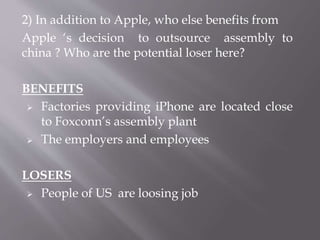
2) In addition to Apple, who else benefits from
Apple ‘s decision to outsource assembly to
china ? Who are the potential loser here?
BENEFITS
 Factories providing iPhone are located close
to Foxconn’s assembly plant
 The employers and employees
LOSERS
 People of US are loosing job
 Poor working condition
 Low pay to workers
 Poor safety
 overtime
 Fix strong ethical policy when outsourcing
 Provide technical assistance in improving
working condition
 Cancelation of contract
Ans. I don’t think the outsourcing undertaken by apple is
a good thing for the American economy why because ,
 They provide jobs to foreign people while they could
have offered these jobs to Americans.
 There is recession these days and a people are seeking
for job ,so apple could make a difference.
 Some countries specialize for example ,memory,
chipsets etc. but more things could not be done in US.

Case study on Apple

  • 1.
    A Case Study on: “Who makes the AppleiPhone?” Group Members: Robin Kuriakose, Rini Sara Thomas, Ronak Radhakrishnan, Sachin Varghese, Sebastian Philip. S-3 MBA, Mar Athanasios College For Advanced Studies, Thiruvalla. (MACFAST college) Page39-“InternationalBusiness”byCharlesW Hill&ArunK.Jain,10thedition,McGraw-Hill- NewDelhi.
  • 2.
    Briefing of theCase Study: • Apple started to make the Macintosh computer in 1983 at it’s iMac plant in Elk Grove, California. • By 2004, Apple turned to foreign manufacturing. • Its offshore manufacturing reached its peak with the iconic iPhone which was introduced in 2007. • iPhone consists of hundreds of parts, 90% of which are manufactured abroad. • Core activities like product design, software engineering & marketing are done in the US.
  • 3.
    Manufacturing of theiPhone: Advanced semiconductors: Germany & Taiwan. Memory: Korea & Japan. Display panels & circuitry: Korea & Taiwan. Chip sets: Europe. Rare metals: Africa & Asia. Apple’s major subcontractor, a Taiwanese multinational firm, “Foxconn” performs final assembly in China.
  • 7.
    2) In additionto Apple, who else benefits from Apple ‘s decision to outsource assembly to china ? Who are the potential loser here? BENEFITS  Factories providing iPhone are located close to Foxconn’s assembly plant  The employers and employees LOSERS  People of US are loosing job
  • 8.
     Poor workingcondition  Low pay to workers  Poor safety  overtime
  • 9.
     Fix strongethical policy when outsourcing  Provide technical assistance in improving working condition  Cancelation of contract
  • 10.
    Ans. I don’tthink the outsourcing undertaken by apple is a good thing for the American economy why because ,  They provide jobs to foreign people while they could have offered these jobs to Americans.  There is recession these days and a people are seeking for job ,so apple could make a difference.  Some countries specialize for example ,memory, chipsets etc. but more things could not be done in US.