CaseStudyRome, June 7 2010
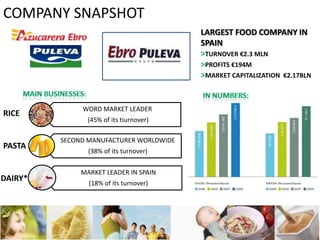
COMPANY SNAPSHOTLARGEST FOOD COMPANY IN SPAIN>TURNOVER €2.3 MLN>PROFITS €194M>MARKET CAPITALIZATION  €2.17BLNMainbusinesses:In numbers:RICEPASTADAIRY*
INTERNATIONAL PRESENCE     MORE THAN 60 BRANDS26 COUNTRIESASIA:IndiaThailandEUROPE:GermanyBelgiumCzech Rep.DenemarkSpainFinalndFranceGreeceHungaryItalyPolandPortugalUKRomaniaUkraineAFRICA:AlgeriaEgyptLibyaMoroccoIsraelAMERICA:CanadaUSAMexicoPuerto RicoUruguay
PRODUCT PORTFOLIOMILKPASTARICE
GLOBAL FOOD INDUSTRY: OVERVIEWGROWTH TRENDSLOW BUT POSITIVE
EXTERNAL ENVIRONMENT ANALYSIS
GLOBAL FOOD INDUSTRY: 5 FORCES ANALYSISBUYERS POWERSUPPLIERS POWERNECESSITY OF FOOD PRODUCTS FOR BUYERS’ BUSINESSNEED FOR RETAILERS  TO TAKE INTO ACCOUNT CONSUMERS’ BRAND   LOYALTYHIGHER CONCENTRATION OF BUYERS RELATIVE TO SELLERS THE AVAILABILITY OF  CHEAPER INTERNATIONAL SOURCESTHE ABILITY TO INTEGRATE BACKWARDS DRIVE UP BUYERS’ POWER      WEAKMODERATEMODERATELARGE AMOUNT OF CAPITAL INVESTMENT IN PRODUCTION HIGH FIXED COSTS LARGE SCALE PRODUCTION REQUIRED, PRESENCE OF STRONG BRANDS DIFFICULT ACCESS TO DISTRIBUTION CHANNELSLIMITED ENTRY OPPORTUNITIES BECAUSE ALL SECTORS ARE ALREADY OCCUPIEDNEW ENTRANTSSTRONGER FINANCIAL SITUATION OF MARKET PLAYERS THE POSSIBILITY TO PURCHASE SUPPLIES IN THE OPEN MARKETCOMMITMENT TO SUPPLIERS THROUGH FIXED-TERM CONTRACTSHIGH SWITCHING COSTS STRONG RELIANCE UPON SUPPLIERS
GLOBAL FOOD INDUSTRY: 5 FORCES ANALYSISSUBSTITUTESNO SUBSTITUTES DUE TO THE NATURE OF PRODUCTS        HIGHRIVARLY AMONG EXISTING FIRMSNO SERIOUS THREAT FROM SUBSTITUTES -> NATURE OF THE PRODUCT: YOU CAN’T SUBSTITUTE ITSUPPLIERS      ->  OPEN MARKET ALTERNATIVEBUYERS           ->  RELIANCE ON BRANDED PRODUCTS TO SATISFY CUSTOMERSDANGEROUS RIVARLY AMONG EXISTING PLAYERSHIGH FRAGMENTED INDUSTRY (DESPITE LEADING INTERNATIONAL INCUMBENTS) HIGHLY SIMILAR PRODUCTSLOW SWITCHING COSTS FOR RETAILERSHIGH  EXIT BARRIERSSTRONG COMPETITION BASED ON PRICETO SUM UPFOR AN INCUMBENT: NEED FOR STRONG DIFFERENTIATION TO SURVIVE COMPETITIONCONCLUSION
GLOBAL PASTA INDUSTRY: OVERVIEWTOP 3 GLOBAL PLAYERSWORLD PASTA PRODUCTION EXPECTED GROWTH IN PASTA DEMANDINCREASED NEED FOR EASY-TO-PREPARE, VERSATILE FOODeven in the middle eastern and african regionsCOUNTER-CYCLICALILTY OF DEMAND FOR PASTAas pasta is a relatively less expensive food staple, demand for pasta increases when the economy slows.
GLOBAL PASTA INDUSTRY: 5 FORCES ANALYSISMODERATE       WEAKMODERATETHE PASTA MARKET IS ATTRACTIVE IFPRODUCTION IS ON A LARGE SCALE (CONSIDERABLE COST EFFICIENCY IN PRODUCTION)
CAPABILITY FOR INNOVATION IS STRONG
CAPABILITIES IN MANAGING INVENTORIES AND WHEAT PRICES’ FLUCTUATIONS ARE DISTINCTIVEWEAKMODERATE
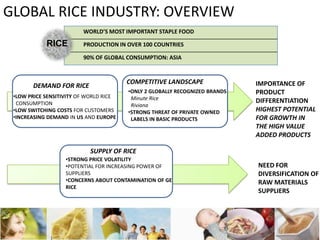
GLOBAL RICE INDUSTRY: OVERVIEWRICECOMPETITIVE LANDSCAPEIMPORTANCE OF PRODUCT DIFFERENTIATIONHIGHEST POTENTIAL FOR GROWTH IN  THE HIGH VALUE ADDED PRODUCTSDEMAND FOR RICEONLY 2 GLOBALLY RECOGNIZED BRANDSMinute RiceRivianaSTRONG THREAT OF PRIVATE OWNED  LABELS IN BASIC PRODUCTSLOW PRICE SENSITIVITY OF WORLD RICE     CONSUMPTIONLOW SWITCHING COSTS FOR CUSTOMERS
INCREASING DEMAND IN US AND EUROPESUPPLY OF RICESTRONG PRICE VOLATILITY
POTENTIAL FOR INCREASING POWER OF SUPPLIERS
CONCERNS ABOUT CONTAMINATION OF GE RICENEED FOR DIVERSIFICATION OF RAW MATERIALS SUPPLIERS:
INTERNAL ENVIRONMENT ANALYSIS
APPRAISING RESOURCESTANGIBLE RESOURCESHUMAN RESOURCESManagement and development of talent.Creation of stable, quality employment.Implementation of pay policies based on criteria of individual recognition and furtherance.Participationin management.Internalcommunication.Human Resources Policy is based on:
APPRAISING RESOURCESINTANGIBLE RESOURCESVALUES leadership, transparency, servicevocation, honesty, integrity, respect and  commitment to our shareholders and the environmentCULTUREVISION to be leader in the meal solutions sector, with the aim of providing consumers with the best possible food solutions in terms of functionality, health, convenience and pleasure,achieved through constant innovation geared towards meeting the demands of the market.TECHNOLOGYHigh R&D investmentsin the nutrition research, including patents on infant formulas;in  the process for extraction and purification of Omega-3 acidsin the development of functional and high value-added products
 in innovation in packaging (easy-to-use and extend life of products).REPUTATIONGLOCAL STRATEGY (respect  of cultural differences among countries)Strong reputation and brandperceptionStrong local brands (more than 60 in dairy, rice and pasta)
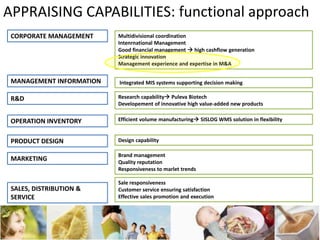
APPRAISING CAPABILITIES: functionalapproachCORPORATE MANAGEMENTMultidivisional coordination  Intenrnational Management   Good financial management  high cashflow generation Strategic innovation             Management experience and expertise in M&AMANAGEMENT INFORMATION Integrated MIS systems supporting decision makingResearchcapability PulevaBiotechDevelopementof innovative high value-addednewproductsR&DEfficient volume manufacturing SISLOG WMS solution in flexibilityOPERATION INVENTORYDesign capabilityPRODUCT DESIGNBrand managementQualityreputationResponsivenesstomarlettrendsMARKETING 	Sale responsivenessCustomer service ensuringsatisfactionEffectivesales promotion and executionSALES, DISTRIBUTION & SERVICE
Management experience and expertise in M&ASOME CASES OF EBRO’S M&A: THE MARKET REACTIONS Ebro Puleva’s buy of the rice company Riviana for $380 millions
Ebro Puleva’s acquisition of Panzani, pasta company, for €636 millions
Ebro Puleva’s buy of Minute Rice from Altria/Kraft for €280 millions
Ebro Puleva’s purchase of New World Pasta for €362,5 millions
Sale of Ebro Puleva sugar division to A.British Foods for €385mln
Ebro Puleva sells its diary business to Lactalis for €630 millionEbro Puleva’s buy of the rice company Rivianafor USD380 millionsSlight variance of 7-day-share-priceafter the acquisition announcementHowever, the company’s share pricetrend remained above IBEX 35. 6-month-variance of share price isn’t going up along with the index, only exceeding at the last month due to the initial fruits of cost synergies integration.
Ebro Puleva’s acquisition of Panzani, pasta company, for EUR636 millions7-day-variance of the share price dropped according to speculative actions Although the prices went up until July 2005 for nearly 15%, a gradual slump occurred on the 22nd May 2005, due to the claim of Australian Sugar Society to WTO against EU countries export levels.Source: http://finance.yahoo.com/q?s=EVA.MC
Ebro Puleva’s purchase of New World Pasta for EUR362,5 millionsWithin 7 days of acquisition announcement, the share price increased by 3.5%, exceeding the IBEX 35 Index one.The price dumped for 15% due to the initial invisible effect of the Credit Crunch which, necessary to note, was commenced in Europe by run on Northern Rock and spread all over the EU.
Ebro Puleva’s buy of Minute Rice from Altria/Kraft for EUR280 millions7 days after the acquisition announcement the share price trend was always higher than that of IBEX 35, even though remained stable. The business was growing on a normal scale, the acquisition approved successful by adding value to shareholders.  However, due to speculation in the market, the share price slumped at the beginning of 2008.
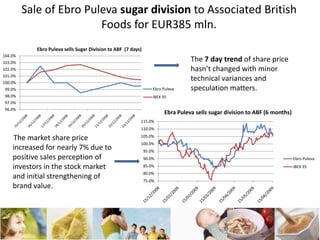
Sale of Ebro Pulevasugar division to Associated British Foods for EUR385 mln.The 7 day trend of share price hasn’t changed with minor technical variances and speculation matters.       The market share price increased for nearly 7% due to positive sales perception of investors in the stock market and initial strengthening of brand value.
EXTERNAL + INTERNAL ENVIRONMENT ANALYSISSWOT Analysis
WEAKNESSES:COMPLICATIONS IN NEW RECIPE DEVELOPEMENT
WASTE OF WATER AND ENERGY COSTS
LIMITED PRESENCE IN MICROWAVE AND QUICK COOKING PRODUCTS
 RELATIVELY LOWER DIVERSIFICATIONS IN COMPARISON TO COMPETITORS
 FALLING REVENUES FROM DAIRY BUSINESSSTRENGTHS:STRONG MANAGEMENT TEAM
STRONG BRAND
R&D INNOVATION AND REASEARCH
 LEADERSHIP IN DIFFERENT SEGMENTS
STRONG CASHFLOW GENERATION
EFFICIENT STOCK MANAGEMENT
ACTIVE SHAREHOLDER REMUNERATION POLICY
EXCELLENT RELATIONSHIPS WITH RETAILERS
STRONG CAPABILITY TO DIFFERENTIATESWOT ANALYSISTHREATSSENSITIVITY TO RAW MATERIALS COSTS
SENSITIVITY TO WEATHER CONDITION
GROWING SALES OF PRIVATE LABEL PRODUCTS LIKELYTO IMPACT THE COMPANY’S MARGINSFUEL PRICE INCREASE
CONTAMINATION OF THE GLOBAL RICE SUPPLY.OPPORTUNITIES:INCREASING DEMAND FOR FUNCTIONAL AND HEALTHY PRODUCTS AND FOR READY AND FROZEN MEALS WHERE EBRO HAS POTENTIAL TO EXPAND
INCREASING FOCUS ON ITS PASTA AND RICE BUSINESSES WILL POSITIVELY AFFECT REVENUE GROWTH
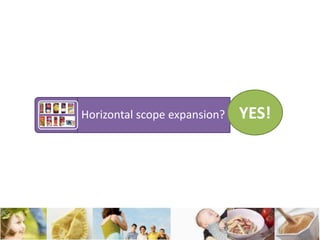
HORIZONTAL EXPANSION IN FROZEN FOOD WILL ENABLE EBRO TO RIDE ON THE GROWING  US FROZEN FOOD MARKETINDUSTRY KSF & EP’s RESOURCES&CAPABILITIES:PERFECT MATCH!
BUSINESS STRATEGY
BUSINESS STRATEGY: Industry KSFBEYOND THE TRADITIONAL BUSINESS MODEL:“PULEVA MODEL” as the basisof EP’s COMPETITIVE ADVANTAGEPULEVA BIOTECH
FUNDAMENTAL ROLE OF PULEVA R&D DIVISION: BIOTECHBiotech allows to create unique, highly sought after value added products. User-friendly, differentiated products that improve consumers’ quality of life. Puleva Biotech’s scientific researchers have been generating healthy bioactive strains with a high industrial component and significant commercial valuePuleva is a leading researcher in ‘Nutraceuticals’ or ‘functional foods’: natural, bioactivechemical compounds that have health promoting, disease preventing or medicinalproperties.
BUSINESS STRATEGY: COMPETITIVE ADVANTAGELEVERAGE OF COMPETITIVE ADVANTAGE IN RICE INDUSTRYInnovations in the ricecategoryincluded :pre-cooked, shelf-stableplainrice and ricemixeswhichcouldbequicklyreheated in microwavesingle service portionsofprecookedproductsLEVERAGE OF COMPETITIVE ADVANTAGE IN PASTA INDUSTRYInnovation in the pasta industryincluded :shelfstableoffrozenmicrowaveable pasta meals, microwaveableofprecooked pasta, fresh and frozen pasta meals complete meal in one box
Functionalformulations: multi grain pasta, fortified in fiber, protein and omega 3s + pasta madefromorganicflour
New steam system to produce betterqualityproductCORPORATE STRATEGY
CORPORATE STRATEGY: INTERNATIONALIZATIONATTRACTIVENESS OF OVERSEAS MARKETSPOTENTIAL TO ESTABLISH  COMPETITIVE ADVANTAGE inoverseasmarketsWHY?The industryanalysisshowedusthatboth the rice and pasta industry are globallyattractiveEbro Pulevahas the abilityto match itsdomesticstrengths in resources and capabilitiesto the key successfulfactorsof the global industries.GLOBAL STRATEGY
GLOBAL STRATEGY: PROS & CONSCOST BENEFITS OF SCALE AND REPLICATION replicationofknowledge-basedassetcosts a fractionof the original
POSSIBILITY TO SERVE GLOBAL CUSTOMERS
EXPLOITING NATIONAL RESOURCES  rawmaterials and low costlabor
LEARNING BENEFITS  integrationofknowledgefromdifferentlocations and enviroments
MORE STRATEGIC FORCE TO COMPETE  cross-subsidization: multinationalsfight aggressive competitive battles in individualnationalmarketsusingtheirresourcesfromothernationalmarkets.GLOBAL STRATEGYA PURELY GLOBAL STRATEGY IS NOT APPROPRIATE!!INTERNAZIONALIZATION STRATEGY HAS TO BE VIEWED AS A TRADE OFF BETWEEN THE BENEFITS OF GLOBAL INTEGRATION AND THOSE OF THE NATIONAL ADAPTATIONBECAUSE OF THE DIFFERENT PREFERENCES OF CONSUMERS IN DIFFERENT MARKETS:everynationrepresents a uniquecombinationofdistinctivecharacteristics:  productsdesignedtomeet the needsof the “global customer” tendtobeunappealingtomostconsumers
EBRO: FROM GLOBAL to GLOCAL Stanrdardizeproductfeatures and company activitywhere scale economies are substantialGLOBAL LOCALIZATION: GLOCAL STRATEGYDifferentiatewherenationalpreferences are strongest and whereachievingthemisnotovercostly.
CORPORATE STRATEGY: OWNERSHIP CHOICEACQUISITIONSLow levelofuncertainty Abilitytodigestacquisitions Feasibilityofacquiring Desireto transfer knowledgeCHOICE OF ACQUISITION OVER ALTERNATIVE OWNERSHIP FORMS (PARTNERSHIP,ALLIANCES,… ETC.)
CORPORATE STRATEGY: ORGANIZATIONAL DESIGNMATRIX ORGANIZATIONBoardofDirectorChairmanGeographic Area1Geographic Area3Geographic Area2Geographic Area3…Dairy…Rice…PastaDISADVANTAGESSOLUTIONS TO INCREASE COORDINATIONEXCESSIVE COMPLEXITYSLOWER DECISION MAKINGDIFFUSED AUTHORITYINFORMATIONAL LOGJAMSPROLIFERATION OF COMMITTEES AND REPORTSOVERLAPPING RESPONSABILITIES* due totheir strong management team Herbamanaged  the europeanricebrandswhilePanzanimanaged the european pasta business
CORPORATE STRATEGY: NEXT STEPSYES!WHY?NO!WHY?YES!WHERE?HOW?
CORPORATE STRATEGY: NEXT STEPS - DRIVERSYES!THE CHANGE IN THE RETAIL FOOD MARKETNO!YES!
Changes In RetailFoodMkt: the threatof private labelsWHAT ARE Private Labelproducts or services: manufactured or provided by one company to be offered under another company's brand.
 available in a wide range of industries from food to cosmetics to web hosting.
 often positioned as lower cost alternatives to regional, national or international brands (although recently some private label brands have been positioned as "premium" brands to compete with existing "name" brands)usually SUPPLIED by:Large national brand manufacturers that utilize their expertise and excess plant capacity to supply store brands  (ErbaPuleva) Small, quality manufacturers who specialize in particular product lines and concentrate on producing store brands almost exclusively  Major retailers and wholesalers that own their own manufacturing facilities and provide store brand products for themselves.
Changes In RetailFoodMkt: the threatof private labelsThe effectof the Global Financial Crisis:Private label has received a BOOSTfrom the weakened economy as consumers look to make cutbacks: consumers’ price sensitivity has strongly increased; shoppers are seeking out cheaper deals for their food and drink suppliesShare of private labelproductsin traditionalretailersshelfs(94% in discounters)Share of private labelproductspurchasedoverallfoods and beverageproducts18%34%48 %19 %19992009199920092010..2010..
Changes In RetailFoodMkt: the threatof private labelsNEGATIVE CORRELATION BETWEEN MARKET SHARE OF PRIVATE LABELS AND PERSONAL DISPOSABLE INCOME:1980  1982  1984  1986  1988   1990  1992  1994   1996  1998  2000   2002   2004   2006   2008
Changes In RetailFoodMkt: the threatof private labelsThe consumers’ change in purchasingbehavior:Share of private labelproductspurchasedoverallfoods and beverageproductsHowoften do youpurchasestore-brandproducts?34 %18 %2010..19992009
Changes In RetailFoodMkt: the threatof private labelsThe newretailers’ strategy:Share of private labelproducts in traditionalretailersshelfs  (94% in discounters)Retailers have recognized that they cannot simply rely on national branded products to draw consumers into their stores and sustain loyalty.48%19%2010..19992009Manufacturers’ product brandswith their pervasive presence everywhereconsumers don’t need to have a strong relationship with a particular store setting to have access to these products.can be a magnet to draw people into its store versus others and accrue direct meaning and loyalty to the overarching banner. Proprietary brands (private labels) exclusively available at a specific retailer
Changes In RetailFoodMkt: the threatof private labelsThe sustainablesuccess of Private Labels:Today's retail marketers are managing their proprietary brands with the same combination of care and innovation as manufacturers of national brands!!the poor relative of national brand consumer goodsgood alternative in terms of both price and quality to brand productsTRADITIONAL DEFINITION: NEW DEFINITION: The current success of the private labelsisnottemporaryanymoreand not just relatedto the business cycle, as in the past, asHernandezargued in the case.63%33%Brandnamemanufacturermustdevelop a clear and long termorientedstrategyto face the new challenge of Private Labels!
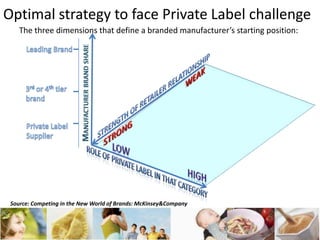
Optimal strategy to face Private Label challengeThe three dimensions that define a branded manufacturer’s starting position:Leading BrandWEAK3rd or 4th tier brandManufacturer brand shareStrength of RETAILER relationshipPrivate Label SupplierSTRONGLOWRole of private label in that categoryHighSource: Competing in the New World of Brands: McKinsey&Company

Case Study Ebro Puleva

  • 1.
  • 2.
    COMPANY SNAPSHOTLARGEST FOODCOMPANY IN SPAIN>TURNOVER €2.3 MLN>PROFITS €194M>MARKET CAPITALIZATION €2.17BLNMainbusinesses:In numbers:RICEPASTADAIRY*
  • 3.
    INTERNATIONAL PRESENCE MORE THAN 60 BRANDS26 COUNTRIESASIA:IndiaThailandEUROPE:GermanyBelgiumCzech Rep.DenemarkSpainFinalndFranceGreeceHungaryItalyPolandPortugalUKRomaniaUkraineAFRICA:AlgeriaEgyptLibyaMoroccoIsraelAMERICA:CanadaUSAMexicoPuerto RicoUruguay
  • 4.
  • 5.
    GLOBAL FOOD INDUSTRY:OVERVIEWGROWTH TRENDSLOW BUT POSITIVE
  • 6.
  • 7.
    GLOBAL FOOD INDUSTRY:5 FORCES ANALYSISBUYERS POWERSUPPLIERS POWERNECESSITY OF FOOD PRODUCTS FOR BUYERS’ BUSINESSNEED FOR RETAILERS TO TAKE INTO ACCOUNT CONSUMERS’ BRAND LOYALTYHIGHER CONCENTRATION OF BUYERS RELATIVE TO SELLERS THE AVAILABILITY OF CHEAPER INTERNATIONAL SOURCESTHE ABILITY TO INTEGRATE BACKWARDS DRIVE UP BUYERS’ POWER WEAKMODERATEMODERATELARGE AMOUNT OF CAPITAL INVESTMENT IN PRODUCTION HIGH FIXED COSTS LARGE SCALE PRODUCTION REQUIRED, PRESENCE OF STRONG BRANDS DIFFICULT ACCESS TO DISTRIBUTION CHANNELSLIMITED ENTRY OPPORTUNITIES BECAUSE ALL SECTORS ARE ALREADY OCCUPIEDNEW ENTRANTSSTRONGER FINANCIAL SITUATION OF MARKET PLAYERS THE POSSIBILITY TO PURCHASE SUPPLIES IN THE OPEN MARKETCOMMITMENT TO SUPPLIERS THROUGH FIXED-TERM CONTRACTSHIGH SWITCHING COSTS STRONG RELIANCE UPON SUPPLIERS
  • 8.
    GLOBAL FOOD INDUSTRY:5 FORCES ANALYSISSUBSTITUTESNO SUBSTITUTES DUE TO THE NATURE OF PRODUCTS HIGHRIVARLY AMONG EXISTING FIRMSNO SERIOUS THREAT FROM SUBSTITUTES -> NATURE OF THE PRODUCT: YOU CAN’T SUBSTITUTE ITSUPPLIERS -> OPEN MARKET ALTERNATIVEBUYERS -> RELIANCE ON BRANDED PRODUCTS TO SATISFY CUSTOMERSDANGEROUS RIVARLY AMONG EXISTING PLAYERSHIGH FRAGMENTED INDUSTRY (DESPITE LEADING INTERNATIONAL INCUMBENTS) HIGHLY SIMILAR PRODUCTSLOW SWITCHING COSTS FOR RETAILERSHIGH EXIT BARRIERSSTRONG COMPETITION BASED ON PRICETO SUM UPFOR AN INCUMBENT: NEED FOR STRONG DIFFERENTIATION TO SURVIVE COMPETITIONCONCLUSION
  • 9.
    GLOBAL PASTA INDUSTRY:OVERVIEWTOP 3 GLOBAL PLAYERSWORLD PASTA PRODUCTION EXPECTED GROWTH IN PASTA DEMANDINCREASED NEED FOR EASY-TO-PREPARE, VERSATILE FOODeven in the middle eastern and african regionsCOUNTER-CYCLICALILTY OF DEMAND FOR PASTAas pasta is a relatively less expensive food staple, demand for pasta increases when the economy slows.
  • 10.
    GLOBAL PASTA INDUSTRY:5 FORCES ANALYSISMODERATE WEAKMODERATETHE PASTA MARKET IS ATTRACTIVE IFPRODUCTION IS ON A LARGE SCALE (CONSIDERABLE COST EFFICIENCY IN PRODUCTION)
  • 11.
  • 12.
    CAPABILITIES IN MANAGINGINVENTORIES AND WHEAT PRICES’ FLUCTUATIONS ARE DISTINCTIVEWEAKMODERATE
  • 13.
    GLOBAL RICE INDUSTRY:OVERVIEWRICECOMPETITIVE LANDSCAPEIMPORTANCE OF PRODUCT DIFFERENTIATIONHIGHEST POTENTIAL FOR GROWTH IN THE HIGH VALUE ADDED PRODUCTSDEMAND FOR RICEONLY 2 GLOBALLY RECOGNIZED BRANDSMinute RiceRivianaSTRONG THREAT OF PRIVATE OWNED LABELS IN BASIC PRODUCTSLOW PRICE SENSITIVITY OF WORLD RICE CONSUMPTIONLOW SWITCHING COSTS FOR CUSTOMERS
  • 14.
    INCREASING DEMAND INUS AND EUROPESUPPLY OF RICESTRONG PRICE VOLATILITY
  • 15.
    POTENTIAL FOR INCREASINGPOWER OF SUPPLIERS
  • 16.
    CONCERNS ABOUT CONTAMINATIONOF GE RICENEED FOR DIVERSIFICATION OF RAW MATERIALS SUPPLIERS:
  • 17.
  • 18.
    APPRAISING RESOURCESTANGIBLE RESOURCESHUMANRESOURCESManagement and development of talent.Creation of stable, quality employment.Implementation of pay policies based on criteria of individual recognition and furtherance.Participationin management.Internalcommunication.Human Resources Policy is based on:
  • 19.
    APPRAISING RESOURCESINTANGIBLE RESOURCESVALUESleadership, transparency, servicevocation, honesty, integrity, respect and commitment to our shareholders and the environmentCULTUREVISION to be leader in the meal solutions sector, with the aim of providing consumers with the best possible food solutions in terms of functionality, health, convenience and pleasure,achieved through constant innovation geared towards meeting the demands of the market.TECHNOLOGYHigh R&D investmentsin the nutrition research, including patents on infant formulas;in the process for extraction and purification of Omega-3 acidsin the development of functional and high value-added products
  • 20.
    in innovationin packaging (easy-to-use and extend life of products).REPUTATIONGLOCAL STRATEGY (respect of cultural differences among countries)Strong reputation and brandperceptionStrong local brands (more than 60 in dairy, rice and pasta)
  • 21.
    APPRAISING CAPABILITIES: functionalapproachCORPORATEMANAGEMENTMultidivisional coordination Intenrnational Management Good financial management  high cashflow generation Strategic innovation Management experience and expertise in M&AMANAGEMENT INFORMATION Integrated MIS systems supporting decision makingResearchcapability PulevaBiotechDevelopementof innovative high value-addednewproductsR&DEfficient volume manufacturing SISLOG WMS solution in flexibilityOPERATION INVENTORYDesign capabilityPRODUCT DESIGNBrand managementQualityreputationResponsivenesstomarlettrendsMARKETING Sale responsivenessCustomer service ensuringsatisfactionEffectivesales promotion and executionSALES, DISTRIBUTION & SERVICE
  • 22.
    Management experience andexpertise in M&ASOME CASES OF EBRO’S M&A: THE MARKET REACTIONS Ebro Puleva’s buy of the rice company Riviana for $380 millions
  • 23.
    Ebro Puleva’s acquisitionof Panzani, pasta company, for €636 millions
  • 24.
    Ebro Puleva’s buyof Minute Rice from Altria/Kraft for €280 millions
  • 25.
    Ebro Puleva’s purchaseof New World Pasta for €362,5 millions
  • 26.
    Sale of EbroPuleva sugar division to A.British Foods for €385mln
  • 27.
    Ebro Puleva sellsits diary business to Lactalis for €630 millionEbro Puleva’s buy of the rice company Rivianafor USD380 millionsSlight variance of 7-day-share-priceafter the acquisition announcementHowever, the company’s share pricetrend remained above IBEX 35. 6-month-variance of share price isn’t going up along with the index, only exceeding at the last month due to the initial fruits of cost synergies integration.
  • 28.
    Ebro Puleva’s acquisitionof Panzani, pasta company, for EUR636 millions7-day-variance of the share price dropped according to speculative actions Although the prices went up until July 2005 for nearly 15%, a gradual slump occurred on the 22nd May 2005, due to the claim of Australian Sugar Society to WTO against EU countries export levels.Source: http://finance.yahoo.com/q?s=EVA.MC
  • 29.
    Ebro Puleva’s purchaseof New World Pasta for EUR362,5 millionsWithin 7 days of acquisition announcement, the share price increased by 3.5%, exceeding the IBEX 35 Index one.The price dumped for 15% due to the initial invisible effect of the Credit Crunch which, necessary to note, was commenced in Europe by run on Northern Rock and spread all over the EU.
  • 30.
    Ebro Puleva’s buyof Minute Rice from Altria/Kraft for EUR280 millions7 days after the acquisition announcement the share price trend was always higher than that of IBEX 35, even though remained stable. The business was growing on a normal scale, the acquisition approved successful by adding value to shareholders. However, due to speculation in the market, the share price slumped at the beginning of 2008.
  • 31.
    Sale of EbroPulevasugar division to Associated British Foods for EUR385 mln.The 7 day trend of share price hasn’t changed with minor technical variances and speculation matters. The market share price increased for nearly 7% due to positive sales perception of investors in the stock market and initial strengthening of brand value.
  • 32.
    EXTERNAL + INTERNALENVIRONMENT ANALYSISSWOT Analysis
  • 33.
  • 34.
    WASTE OF WATERAND ENERGY COSTS
  • 35.
    LIMITED PRESENCE INMICROWAVE AND QUICK COOKING PRODUCTS
  • 36.
    RELATIVELY LOWERDIVERSIFICATIONS IN COMPARISON TO COMPETITORS
  • 37.
    FALLING REVENUESFROM DAIRY BUSINESSSTRENGTHS:STRONG MANAGEMENT TEAM
  • 38.
  • 39.
  • 40.
    LEADERSHIP INDIFFERENT SEGMENTS
  • 41.
  • 42.
  • 43.
  • 44.
  • 45.
    STRONG CAPABILITY TODIFFERENTIATESWOT ANALYSISTHREATSSENSITIVITY TO RAW MATERIALS COSTS
  • 46.
  • 47.
    GROWING SALES OFPRIVATE LABEL PRODUCTS LIKELYTO IMPACT THE COMPANY’S MARGINSFUEL PRICE INCREASE
  • 48.
    CONTAMINATION OF THEGLOBAL RICE SUPPLY.OPPORTUNITIES:INCREASING DEMAND FOR FUNCTIONAL AND HEALTHY PRODUCTS AND FOR READY AND FROZEN MEALS WHERE EBRO HAS POTENTIAL TO EXPAND
  • 49.
    INCREASING FOCUS ONITS PASTA AND RICE BUSINESSES WILL POSITIVELY AFFECT REVENUE GROWTH
  • 50.
    HORIZONTAL EXPANSION INFROZEN FOOD WILL ENABLE EBRO TO RIDE ON THE GROWING US FROZEN FOOD MARKETINDUSTRY KSF & EP’s RESOURCES&CAPABILITIES:PERFECT MATCH!
  • 51.
  • 52.
    BUSINESS STRATEGY: IndustryKSFBEYOND THE TRADITIONAL BUSINESS MODEL:“PULEVA MODEL” as the basisof EP’s COMPETITIVE ADVANTAGEPULEVA BIOTECH
  • 53.
    FUNDAMENTAL ROLE OFPULEVA R&D DIVISION: BIOTECHBiotech allows to create unique, highly sought after value added products. User-friendly, differentiated products that improve consumers’ quality of life. Puleva Biotech’s scientific researchers have been generating healthy bioactive strains with a high industrial component and significant commercial valuePuleva is a leading researcher in ‘Nutraceuticals’ or ‘functional foods’: natural, bioactivechemical compounds that have health promoting, disease preventing or medicinalproperties.
  • 54.
    BUSINESS STRATEGY: COMPETITIVEADVANTAGELEVERAGE OF COMPETITIVE ADVANTAGE IN RICE INDUSTRYInnovations in the ricecategoryincluded :pre-cooked, shelf-stableplainrice and ricemixeswhichcouldbequicklyreheated in microwavesingle service portionsofprecookedproductsLEVERAGE OF COMPETITIVE ADVANTAGE IN PASTA INDUSTRYInnovation in the pasta industryincluded :shelfstableoffrozenmicrowaveable pasta meals, microwaveableofprecooked pasta, fresh and frozen pasta meals complete meal in one box
  • 55.
    Functionalformulations: multi grainpasta, fortified in fiber, protein and omega 3s + pasta madefromorganicflour
  • 56.
    New steam systemto produce betterqualityproductCORPORATE STRATEGY
  • 57.
    CORPORATE STRATEGY: INTERNATIONALIZATIONATTRACTIVENESSOF OVERSEAS MARKETSPOTENTIAL TO ESTABLISH COMPETITIVE ADVANTAGE inoverseasmarketsWHY?The industryanalysisshowedusthatboth the rice and pasta industry are globallyattractiveEbro Pulevahas the abilityto match itsdomesticstrengths in resources and capabilitiesto the key successfulfactorsof the global industries.GLOBAL STRATEGY
  • 58.
    GLOBAL STRATEGY: PROS& CONSCOST BENEFITS OF SCALE AND REPLICATION replicationofknowledge-basedassetcosts a fractionof the original
  • 59.
    POSSIBILITY TO SERVEGLOBAL CUSTOMERS
  • 60.
    EXPLOITING NATIONAL RESOURCES rawmaterials and low costlabor
  • 61.
    LEARNING BENEFITS integrationofknowledgefromdifferentlocations and enviroments
  • 62.
    MORE STRATEGIC FORCETO COMPETE  cross-subsidization: multinationalsfight aggressive competitive battles in individualnationalmarketsusingtheirresourcesfromothernationalmarkets.GLOBAL STRATEGYA PURELY GLOBAL STRATEGY IS NOT APPROPRIATE!!INTERNAZIONALIZATION STRATEGY HAS TO BE VIEWED AS A TRADE OFF BETWEEN THE BENEFITS OF GLOBAL INTEGRATION AND THOSE OF THE NATIONAL ADAPTATIONBECAUSE OF THE DIFFERENT PREFERENCES OF CONSUMERS IN DIFFERENT MARKETS:everynationrepresents a uniquecombinationofdistinctivecharacteristics: productsdesignedtomeet the needsof the “global customer” tendtobeunappealingtomostconsumers
  • 63.
    EBRO: FROM GLOBALto GLOCAL Stanrdardizeproductfeatures and company activitywhere scale economies are substantialGLOBAL LOCALIZATION: GLOCAL STRATEGYDifferentiatewherenationalpreferences are strongest and whereachievingthemisnotovercostly.
  • 64.
    CORPORATE STRATEGY: OWNERSHIPCHOICEACQUISITIONSLow levelofuncertainty Abilitytodigestacquisitions Feasibilityofacquiring Desireto transfer knowledgeCHOICE OF ACQUISITION OVER ALTERNATIVE OWNERSHIP FORMS (PARTNERSHIP,ALLIANCES,… ETC.)
  • 65.
    CORPORATE STRATEGY: ORGANIZATIONALDESIGNMATRIX ORGANIZATIONBoardofDirectorChairmanGeographic Area1Geographic Area3Geographic Area2Geographic Area3…Dairy…Rice…PastaDISADVANTAGESSOLUTIONS TO INCREASE COORDINATIONEXCESSIVE COMPLEXITYSLOWER DECISION MAKINGDIFFUSED AUTHORITYINFORMATIONAL LOGJAMSPROLIFERATION OF COMMITTEES AND REPORTSOVERLAPPING RESPONSABILITIES* due totheir strong management team Herbamanaged the europeanricebrandswhilePanzanimanaged the european pasta business
  • 66.
    CORPORATE STRATEGY: NEXTSTEPSYES!WHY?NO!WHY?YES!WHERE?HOW?
  • 67.
    CORPORATE STRATEGY: NEXTSTEPS - DRIVERSYES!THE CHANGE IN THE RETAIL FOOD MARKETNO!YES!
  • 68.
    Changes In RetailFoodMkt:the threatof private labelsWHAT ARE Private Labelproducts or services: manufactured or provided by one company to be offered under another company's brand.
  • 69.
    available ina wide range of industries from food to cosmetics to web hosting.
  • 70.
    often positionedas lower cost alternatives to regional, national or international brands (although recently some private label brands have been positioned as "premium" brands to compete with existing "name" brands)usually SUPPLIED by:Large national brand manufacturers that utilize their expertise and excess plant capacity to supply store brands (ErbaPuleva) Small, quality manufacturers who specialize in particular product lines and concentrate on producing store brands almost exclusively  Major retailers and wholesalers that own their own manufacturing facilities and provide store brand products for themselves.
  • 71.
    Changes In RetailFoodMkt:the threatof private labelsThe effectof the Global Financial Crisis:Private label has received a BOOSTfrom the weakened economy as consumers look to make cutbacks: consumers’ price sensitivity has strongly increased; shoppers are seeking out cheaper deals for their food and drink suppliesShare of private labelproductsin traditionalretailersshelfs(94% in discounters)Share of private labelproductspurchasedoverallfoods and beverageproducts18%34%48 %19 %19992009199920092010..2010..
  • 72.
    Changes In RetailFoodMkt:the threatof private labelsNEGATIVE CORRELATION BETWEEN MARKET SHARE OF PRIVATE LABELS AND PERSONAL DISPOSABLE INCOME:1980 1982 1984 1986 1988 1990 1992 1994 1996 1998 2000 2002 2004 2006 2008
  • 73.
    Changes In RetailFoodMkt:the threatof private labelsThe consumers’ change in purchasingbehavior:Share of private labelproductspurchasedoverallfoods and beverageproductsHowoften do youpurchasestore-brandproducts?34 %18 %2010..19992009
  • 74.
    Changes In RetailFoodMkt:the threatof private labelsThe newretailers’ strategy:Share of private labelproducts in traditionalretailersshelfs (94% in discounters)Retailers have recognized that they cannot simply rely on national branded products to draw consumers into their stores and sustain loyalty.48%19%2010..19992009Manufacturers’ product brandswith their pervasive presence everywhereconsumers don’t need to have a strong relationship with a particular store setting to have access to these products.can be a magnet to draw people into its store versus others and accrue direct meaning and loyalty to the overarching banner. Proprietary brands (private labels) exclusively available at a specific retailer
  • 75.
    Changes In RetailFoodMkt:the threatof private labelsThe sustainablesuccess of Private Labels:Today's retail marketers are managing their proprietary brands with the same combination of care and innovation as manufacturers of national brands!!the poor relative of national brand consumer goodsgood alternative in terms of both price and quality to brand productsTRADITIONAL DEFINITION: NEW DEFINITION: The current success of the private labelsisnottemporaryanymoreand not just relatedto the business cycle, as in the past, asHernandezargued in the case.63%33%Brandnamemanufacturermustdevelop a clear and long termorientedstrategyto face the new challenge of Private Labels!
  • 76.
    Optimal strategy toface Private Label challengeThe three dimensions that define a branded manufacturer’s starting position:Leading BrandWEAK3rd or 4th tier brandManufacturer brand shareStrength of RETAILER relationshipPrivate Label SupplierSTRONGLOWRole of private label in that categoryHighSource: Competing in the New World of Brands: McKinsey&Company

Editor's Notes

  • #18 On July 23 2004, Ebro Puleva bought rice company Riviana for USD380 millions. The share price 3 day prior and after the announcement the share price changed in average 0.6% that is described in the following table. However it is necessary to note that after the announcement the price increased for 1.2%. Seven days after the acquisition announcement varied a bit but at the end of the 7th day the trend overcame the of IBEX 35 index. However it is significant to mention that acquisitions should create long term value for shareholders thus we checked 6 month variance of Ebro Puleva’s stock price compared to IBEX 35 index change that isn’t going up along with the index exceeding at the last month due to the successful integration of cost synergies.
  • #19 On April 24 2005, Ebro acquired Panzani, pasta manufacturing company, for EUR636 millions. In average, technically, the share price hasn’t changed (-0.7%). In addition, there is a decline of share price itself and compared to the market index within the six months for 5%. Although, the prices went up until July 2005 for nearly 15%, the dramatic slump occurred on the 22nd May 2005, due to the claim of Australian Sugar Society to WTO against EU countries export levels. In accordance with its WTO obligations, the EU must implement the WTO dispute rulings by no later than 22 May 2006 decreasing export amount by 1022 tonnes of sugar by the end of 2005.  As a consequence of the WTO dispute outcomes, the EU has no alternative but to reduce its sugar production and to do so swiftly. So due to this, the share price decreased not because the acquisition was a failure. The EU is the second biggest sugar exporter and Australia second last with a great potential. A seven day and 6 month share price is shown in the following graphs:
  • #20 On June 7 2007, Ebro Puleva buys New World Pasta, US Company, for EUR362.5 millions. Surprisingly the purchasing announcement of American Pasta Company had in average 3.2% increase within 6 days of acquisition announcement which can be observed in the following table:Although, within 7 days of acquisition announcement the share price increased by 3%, in the long run the price dumped for 15% due to the initial invisible effect of the Credit Crunch which, necessary to note, was commenced in Europe by run on Northern Rock. Both of the trends are shown in the following graphs:
  • #21 On July 28 2006, Ebro Puleva bought Minute Rice Company from Altria/Kraft for EUR280 millions. The share price at the end of the 7th day after the acquisition announcement didn’t change much however, the the share price trend was always higher than that of IBEX 35. Importantly, in the long run (6 months after the announcement) the price increased for 13%. Assuming that the business was growing on a normal scale the acquisition approved successful by adding value to shareholders. However, due to speculation in the market the share price slumped at the beginning of 2008.
  • #22 On December 15 2008, Ebro Puleva sold its sugar division to Associated British Foods for EUR385 millions. The 7 day trend of share price hasn’t changed with minor technical variances.In the long run (6 months) the market share price increased for nearly 7% due to product line concentration, positive sales perception of investors in the stock market and initial strengthening of brand value.
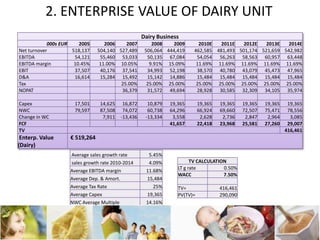
  • #55 1. Here we are projecting the Consolidated Enterprise Value if we are going to keep, Ebro Puleva’s Dairy division. So in order to arrive to EV our group has made the following assumptions:Average Sales growth rate was taken from the Reuter’s website of Ebro Puleva’s page Computed future 5-year-EBITDA-margin based on the average 2007-2009 EBITDA marginTax rate was chosen on average 25% depending on the historical data and industry average tax rate.Forecasted Capex was calculated on 2007-2009 averageThe Projected NWC was computed as an average 2007-2008 Sales Multiple for the future 5 yearsLong Term dividend growth rate and outstanding shares were taken from the Ebro Puleva’s page on Reuters siteWACC was taken from the Investor Report.Lastly, we derived the Present Value of Ebro Puleva’s Share Price based on the FCF model which is EUR14.47 higher than the current market price (EUR)14.10 on Borla de Madrid
  • #56 2. Here is the Enterprise Value only of Dairy Unit of Ebro Puleva to show the shareholders how much it values and to subtract this EV (D) from the EV consolidated in order to derive the EV (P+R) with some growth assumptions of Capex and growth rate and We made the following assumptions:Calculated sales growth rate based on the historical 2003-2005 why? Because the company business is returning to the normal level of efficiency we decided to take pre-crisis sales growth rate in order to be more accurate in our projectionsTo calculate future Average EBITDA margin we used 2007-2009 EBITDA margin on averageTax rate still remains the same for the industryAverage Capex amount was found as an average of 2005-2009 CapexesFuture NWC multiple was calculated based on an average NWC/Sales of 2006-2008As a Dairy industry has been declining all over the world due to its complicated maintenance and short life time and loosing its attractiveness owning to Real Giants (Nestle and Danone) the long term dividend growth rate is 0.50%WACC of Dairy Division was found in Investors’ ReportBased on these assumptions we derived Enterprise Value of Dairy Business – EUR519,264 (Also to show that the sale price of EUR630,000 to Lactalis was on a premium of 21%
  • #57 3. And now, we have calculated the Enterprise Value and PV Share Price of Ebro Puleva assuming the sale of Dairy Unit and not only investing the incoming cash to enlarge the core divisions but to focus on further comprehensive development of already globally successful Rice-Pasta businesses.We made couple of following assumptions:We have chosen the Industry Turnover future growth rate from Reuter’s site - 5.81% knowing that proceeds from Dairy Unit will boost our sales steadilyAverage EBITDA margin was kept at the Consolidated LevelAverage Tax Rate is 25% industryAverage Capex was computed as a difference of Consolidated and Dairy Unit Capexes multiplied by 1.1 multiple due to the additional investments in equipments, machinery and R&D financed by the Sale of Dairy Unit, certainly.NWC was just taken as a difference between Consolidated NWC and Diary Unit’s NWC. (Same EBITDA) Long term dividend growth rate must be higher than the R+P+D (Consolidated one) because Ebro Puleva will focus on widening of Core Businesses by bringing higher ROE (g=ROE*retention rate)The WACC was unchanged and taken from consolidated FCF model due compensation of decrease of D/EV ration by the decrease of Debt rate (Because Banks will be informed that the default risk of Ebro Puleva decreases)When calculating Net Debt, we simply add the proceeds of EUR630 millions from Sale of Dairy Division to it (Because simply we will have increase in cash by selling the Dairy Unit)So, By Comparing our PV of Share Price with and without (by sale) Dairy business including some assumptions like proceeds invested to Capex, higher Sales growth rate and Long Term Dividend growth rate, we can easily notice the PV of Share Price if we sell Dairy Division is EUR21,52 against EUR14.47 , if we keep it within our business. Ultimutely by selling Dairy Unit, Ebro Puleva’s Management is creating additional 50% value to its Shareholders in the long run
  • #61 On March 8 2010, Ebro Puleva lastly decided to sell its dairy business to Lactalis for EUR630 millions. Three day prior and after the sales announcement affected average decrease of share price by 1.6%. Furthermore, 7 day analysis of market price change went down by 4% percent because of day-trading speculation and trader’s short selling strategy. However, in the longer run (2 months), although, the IBEX 35 index decreased by 15%, the share price remained almost the same showing sustainability for future investors.To sum up, we would like to state that all above acquisitions and sales created a value for the Ebro Puleva ‘s shareholders except the New World Pasta one due to initial effect of Financial crisis and investors reluctance to pour funds in the market.
  • #62 The divestment will allow the group to focus on further acquisitions, in its core businesses of branded rice and pasta in europe and North america. One plausible prediction is that the group will make a bid for Uncle Ben’sIn particular, in the rice industry there is a huge potential for technological innovation on many fronts. Such as genetic techologies, manufacturing proceses and product preparation. In addition, new consumption habits (health, readiness, immigration) demand more rice as a staple food.In addition, we suggest that an eventual further acquisition strategy should be performed in the rice busines because its profitability is even stronger than pasta: the ebitda margin is increasing from 9% to 14% in the 2005-2008 years, while that of pasta has decreased from 15% to 9% in the same period. So the group has a greater critical mass in rice, and it should focus investment behind what’s more profitable!The aim of the dairy division sale was not to generate a cash injection or help with debt reduction but instead it was part of the company strategy to focus the food business on ready meals.
  • #74 -low threat by private labels because the frozen food industry require high capital investments, expert knowledge and there is a strong brand loyalty in this segment (it is perceived that quality is granted by branded manufacturers)-Retailers can switchbetween different manufacturers' products quite easily. But, brand loyalty ofconsumers exerts a pull-through on retailers, which makes it difficult for them toabandon the more expensive branded products for private-label alternatives.-The main competitors in the frozen food market (bertolli and buitoni) are not also players in the dry pasta industry. Ebro Puleva would be the only one playing both in dry and frozen/fresh category