Acy2021 L11 Group 1
Misrepresentation
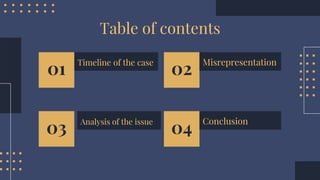
Table of contents
01 02
03 04
Timeline of the case Misrepresentation
Analysis of the issue Conclusion
Timeline of the case
01
Timeline of Case 5- Misrepresentation
Peter was informed that it
was from the Tang Dynasty
. David, who likewise
thought so. Also, he claims
that his friend verified and
checked it.
Peter wonder he can
rescind the contract under
the ground and type of
misrepresentation
Peter purchased a
piece of ancient
porcelain from David
Peter invited Mr. Fong,
an expert antiquarian
who inspected to see
the porcelain and found
that it is a replica.
2015 2015 2018 2018
Misrepresentation
02
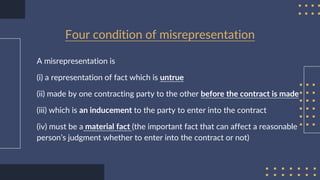
Four condition of misrepresentation
A misrepresentation is
(i) a representation of fact which is untrue
(ii) made by one contracting party to the other before the contract is made
(iii) which is an inducement to the party to enter into the contract
(iv) must be a material fact (the important fact that can affect a reasonable
person’s judgment whether to enter into the contract or not)
Analysis of the case
03
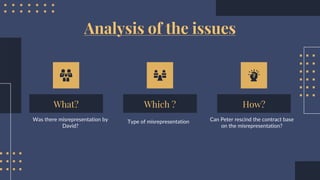
What? Which ? How?
Analysis of the issues
Was there misrepresentation by
David?
Type of misrepresentation Can Peter rescind the contract base
on the misrepresentation?
Analysis of the issue
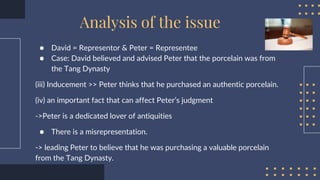
● David = Representor & Peter = Representee
● Case: David believed and advised Peter that the porcelain was from
the Tang Dynasty
(i) False statement >> Representor don’t tell Peter that the porcelain was
only a replica but try to make he believe it was an authentic Tang Dynasty
piece.
(ii) False statement is proposed by David to Peter before the sales and
purchase provisional agreement is made
● David = Representor & Peter = Representee
● Case: David believed and advised Peter that the porcelain was from
the Tang Dynasty
(iii) Inducement >> Peter thinks that he purchased an authentic porcelain.
(iv) an important fact that can affect Peter’s judgment
->Peter is a dedicated lover of antiquities
● There is a misrepresentation.
-> leading Peter to believe that he was purchasing a valuable porcelain
from the Tang Dynasty.
Analysis of the issue
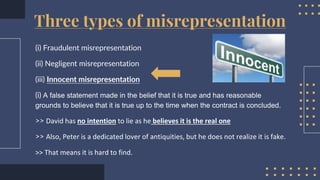
Three types of misrepresentation
(i) Fraudulent misrepresentation
(ii) Negligent misrepresentation
(iii) Innocent misrepresentation
(i) A false statement made in the belief that it is true and has reasonable
grounds to believe that it is true up to the time when the contract is concluded.
>> David has no intention to lie as he believes it is the real one
>> Also, Peter is a dedicated lover of antiquities, but he does not realize it is fake.
>> That means it is hard to find.
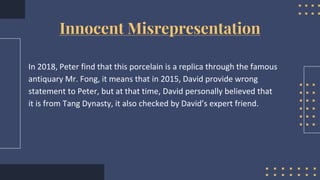
In 2018, Peter find that this porcelain is a replica through the famous
antiquary Mr. Fong, it means that in 2015, David provide wrong
statement to Peter, but at that time, David personally believed that
it is from Tang Dynasty, it also checked by David’s expert friend.
Innocent Misrepresentation
What can Peter do?
● Sue David’s friend by Negligent misrepresentation ?
● Sue David by Negligent misrepresentation ?
● Rescind the contract ?
The application of the law
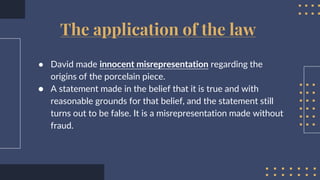
● David made innocent misrepresentation regarding the
origins of the porcelain piece.
● A statement made in the belief that it is true and with
reasonable grounds for that belief, and the statement still
turns out to be false. It is a misrepresentation made without
fraud.
Reasoning of the case
● A similar case is for comparison- Leaf v International Galleries(1950)
● According to the Sale of Goods Ordinance (s15)
-> the implied good should correspond with description
-> The breach of the implies condition entitled to the buyers
-reject the goods
-rescind the contract
=> contract will not be formed under this unclear or false description by the
seller
Reasoning of the case
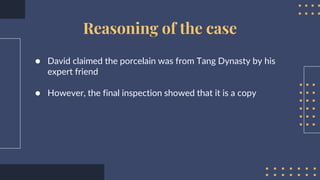
● David claimed the porcelain was from Tang Dynasty by his
expert friend
● However, the final inspection showed that it is a copy
Reasoning of the case
● However, since David did not intentionally provided false
information to Peter
● This case will be treat as innocent misrepresentation
● As a result, Peter can consider the contract to be rescinded since
David gave incorrect information about the goods.
● Peter also should receive a refund of purchasing the product
● Further potential remedies could consult by the legal professional
Leaf v
International
Galleries [1950]
Case Law
Timeline
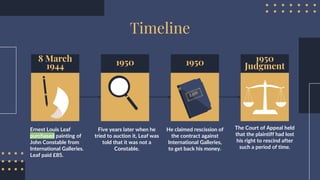
Five years later when he
tried to auction it, Leaf was
told that it was not a
Constable.
The Court of Appeal held
that the plaintiff had lost
his right to rescind after
such a period of time.
Ernest Louis Leaf
purchased painting of
John Constable from
International Galleries.
Leaf paid £85.
He claimed rescission of
the contract against
International Galleries,
to get back his money.
8 March
1944 1950 1950 1950
Judgment
● The claimant purchased a painting from the defendant.
● Both parties believed that the painting was by the artist Constable.
● 5 years later the claimant discovered the painting was not a Constable. The
claimant brought an action based on misrepresentation
● The trial judge found in favour of the defendants, despite explaining that
they had made an innocent misrepresentation regarding the artist of the
painting, on the basis that the contract had been executed.
● The claim based on misrepresentation was successful however, since it was
an innocent misrepresentation, the claimant had lost the right to rescind the
contract through lapse of time.
● His only remedy after that length of time was for damages only, a claim
which he did not bring before the court.
Case Background
Conclusion
04
Conclusion
■ After analysing the case:
We determinate David made innocent misrepresentation regarding
the False information of the product
■ The divisible contract should be rescinded
■ The purchasing cost also should be REFUNDED
■ However, the further remedies may be subjected by certain limitation
- Passage of time
- The product can be restored to their original position or appearance
Thanks!
● Leaf v International Galleries [1950] 2 KB 86. Teacher, Law.
https://www.lawteacher.net/cases/leaf-v-international-galleries.php?vref=1
Law cases sources

Case Law Misrepresentation

  • 1.
    Acy2021 L11 Group1 Misrepresentation
  • 2.
    Table of contents 0102 03 04 Timeline of the case Misrepresentation Analysis of the issue Conclusion
  • 3.
  • 4.
    Timeline of Case5- Misrepresentation Peter was informed that it was from the Tang Dynasty . David, who likewise thought so. Also, he claims that his friend verified and checked it. Peter wonder he can rescind the contract under the ground and type of misrepresentation Peter purchased a piece of ancient porcelain from David Peter invited Mr. Fong, an expert antiquarian who inspected to see the porcelain and found that it is a replica. 2015 2015 2018 2018
  • 5.
  • 6.
    Four condition ofmisrepresentation A misrepresentation is (i) a representation of fact which is untrue (ii) made by one contracting party to the other before the contract is made (iii) which is an inducement to the party to enter into the contract (iv) must be a material fact (the important fact that can affect a reasonable person’s judgment whether to enter into the contract or not)
  • 7.
  • 8.
    What? Which ?How? Analysis of the issues Was there misrepresentation by David? Type of misrepresentation Can Peter rescind the contract base on the misrepresentation?
  • 9.
    Analysis of theissue ● David = Representor & Peter = Representee ● Case: David believed and advised Peter that the porcelain was from the Tang Dynasty (i) False statement >> Representor don’t tell Peter that the porcelain was only a replica but try to make he believe it was an authentic Tang Dynasty piece. (ii) False statement is proposed by David to Peter before the sales and purchase provisional agreement is made
  • 10.
    ● David =Representor & Peter = Representee ● Case: David believed and advised Peter that the porcelain was from the Tang Dynasty (iii) Inducement >> Peter thinks that he purchased an authentic porcelain. (iv) an important fact that can affect Peter’s judgment ->Peter is a dedicated lover of antiquities ● There is a misrepresentation. -> leading Peter to believe that he was purchasing a valuable porcelain from the Tang Dynasty. Analysis of the issue
  • 11.
    Three types ofmisrepresentation (i) Fraudulent misrepresentation (ii) Negligent misrepresentation (iii) Innocent misrepresentation (i) A false statement made in the belief that it is true and has reasonable grounds to believe that it is true up to the time when the contract is concluded. >> David has no intention to lie as he believes it is the real one >> Also, Peter is a dedicated lover of antiquities, but he does not realize it is fake. >> That means it is hard to find.
  • 12.
    In 2018, Peterfind that this porcelain is a replica through the famous antiquary Mr. Fong, it means that in 2015, David provide wrong statement to Peter, but at that time, David personally believed that it is from Tang Dynasty, it also checked by David’s expert friend. Innocent Misrepresentation
  • 13.
    What can Peterdo? ● Sue David’s friend by Negligent misrepresentation ? ● Sue David by Negligent misrepresentation ? ● Rescind the contract ?
  • 14.
    The application ofthe law ● David made innocent misrepresentation regarding the origins of the porcelain piece. ● A statement made in the belief that it is true and with reasonable grounds for that belief, and the statement still turns out to be false. It is a misrepresentation made without fraud.
  • 15.
    Reasoning of thecase ● A similar case is for comparison- Leaf v International Galleries(1950) ● According to the Sale of Goods Ordinance (s15) -> the implied good should correspond with description -> The breach of the implies condition entitled to the buyers -reject the goods -rescind the contract => contract will not be formed under this unclear or false description by the seller
  • 16.
    Reasoning of thecase ● David claimed the porcelain was from Tang Dynasty by his expert friend ● However, the final inspection showed that it is a copy
  • 17.
    Reasoning of thecase ● However, since David did not intentionally provided false information to Peter ● This case will be treat as innocent misrepresentation ● As a result, Peter can consider the contract to be rescinded since David gave incorrect information about the goods. ● Peter also should receive a refund of purchasing the product ● Further potential remedies could consult by the legal professional
  • 18.
  • 19.
    Timeline Five years laterwhen he tried to auction it, Leaf was told that it was not a Constable. The Court of Appeal held that the plaintiff had lost his right to rescind after such a period of time. Ernest Louis Leaf purchased painting of John Constable from International Galleries. Leaf paid £85. He claimed rescission of the contract against International Galleries, to get back his money. 8 March 1944 1950 1950 1950 Judgment
  • 20.
    ● The claimantpurchased a painting from the defendant. ● Both parties believed that the painting was by the artist Constable. ● 5 years later the claimant discovered the painting was not a Constable. The claimant brought an action based on misrepresentation ● The trial judge found in favour of the defendants, despite explaining that they had made an innocent misrepresentation regarding the artist of the painting, on the basis that the contract had been executed. ● The claim based on misrepresentation was successful however, since it was an innocent misrepresentation, the claimant had lost the right to rescind the contract through lapse of time. ● His only remedy after that length of time was for damages only, a claim which he did not bring before the court. Case Background
  • 21.
  • 22.
    Conclusion ■ After analysingthe case: We determinate David made innocent misrepresentation regarding the False information of the product ■ The divisible contract should be rescinded ■ The purchasing cost also should be REFUNDED ■ However, the further remedies may be subjected by certain limitation - Passage of time - The product can be restored to their original position or appearance
  • 23.
  • 24.
    ● Leaf vInternational Galleries [1950] 2 KB 86. Teacher, Law. https://www.lawteacher.net/cases/leaf-v-international-galleries.php?vref=1 Law cases sources

Editor's Notes

  • #14  So, how can Peter do in the above case? I'm here today to offer advice to Peter regarding his misrepresentation case. As we all know, misrepresenting information can have serious consequences, both legally and ethically. However, there are steps that Peter maybe can take to protect his interests and seek justice for any harm caused. First, we recommend that Peter consider suing David and his friend for negligent misrepresentation. Negligent misrepresentation occurs when someone makes a false statement without reasonable grounds for believing it to be true, and the other party relies on that false statement to their detriment. In this case, it's clear that David and his friend made false statements about the year of the porcelain that Peter purchased, and that Peter relied on those false statements to his detriment. At that time, David and his friend need to disprove their negligence to show that they have reasonable ground to believe that porcelain is real because it is possible that David’s friend provided a false or misleading opinion about the porcelain to make Peter enter into the contact. In addition to seeking damages, we also recommend that Peter consider rescinding the contract. Rescission is a legal remedy that allows a party to cancel a contract and return to the status quo ante, as if the contract had never been entered into. In this case, rescission may be an appropriate remedy, Peter must show that the misrepresentation is a material factor in his decision to purchase the porcelain, in this case, Peter would not have entered into the contract if he known it is a replica. Rescission would allow Peter to recover any consideration he gave under the contract, such as the purchase price of the porcelain.