

CASE CONTROL
      STUDIES
DR MUHAMMAD TAUSEEF JAVED
MBBS.DPH.FCPS(CM)M.Phil(CM).Dip-Card
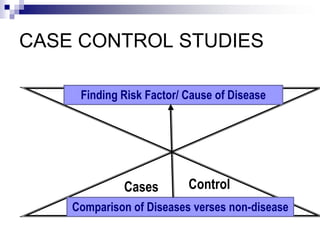
CASE CONTROL STUDIES

     Finding Risk Factor/ Cause of Disease


             Cases        Control
    Comparison of Diseases verses non-disease
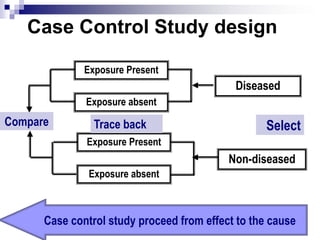
Case Control Study design

              Exposure Present
                                            Diseased
              Exposure absent
Compare         Trace back                         Select
              Exposure Present
                                           Non-diseased
               Exposure absent


      Case control study proceed from effect to the cause
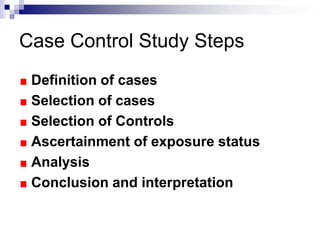
Case Control Study Steps
 Definition of cases
 Selection of cases
 Selection of Controls
 Ascertainment of exposure status
 Analysis
 Conclusion and interpretation
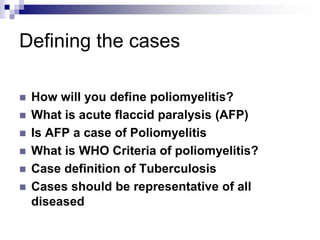
Defining the cases

   How will you define poliomyelitis?
   What is acute flaccid paralysis (AFP)
   Is AFP a case of Poliomyelitis
   What is WHO Criteria of poliomyelitis?
   Case definition of Tuberculosis
   Cases should be representative of all
    diseased
Selection of Cases

 Preferably new cases or incident cases
 Prevalent cases (cases already present)
 Random selection
 Convenient selection
Control
 Control must be Ideally matching
   with the cases by age, sex and
  other characteristics except the
 control must not be suffering from
              diseases
Criteria for control
 Matching by all respect with cases
  except not having disease
 Hospital controls
 Neighborhoods controls
 Friends and relatives
 Controls from general population
Methods of selection of control


 Random  Selection
 Convenient Selection
 What should be the ratio between
  cases and control
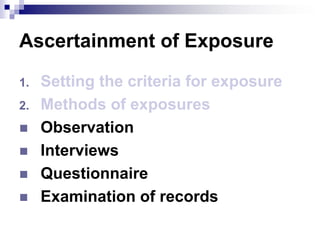
Ascertainment of Exposure

1.   Setting the criteria for exposure
2.   Methods of exposures
    Observation
    Interviews
    Questionnaire
    Examination of records
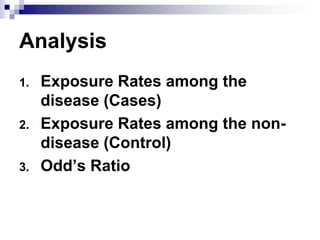
Analysis
1.   Exposure Rates among the
     disease (Cases)
2.   Exposure Rates among the non-
     disease (Control)
3.   Odd’s Ratio
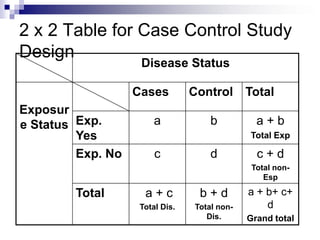
2 x 2 Table for Case Control Study
Design
                    Disease Status

                   Cases         Control Total
Exposur
e Status Exp.           a            b          a+b
         Yes                                  Total Exp

         Exp. No        c            d          c+d
                                               Total non-
                                                  Esp

        Total        a+c          b+d         a + b+ c+
                    Total Dis.   Total non-       d
                                    Dis.      Grand total
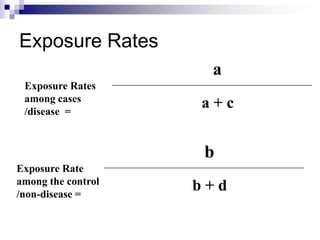
Exposure Rates
                     a
 Exposure Rates
 among cases
 /disease =
                    a+c


                     b
Exposure Rate
among the control
/non-disease =
                    b+d
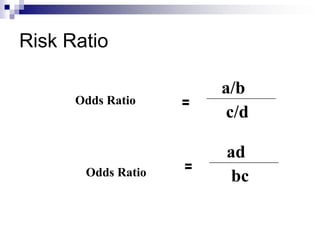
Risk Ratio

                        a/b
      Odds Ratio    =
                         c/d

                        ad
       Odds Ratio   =
                         bc
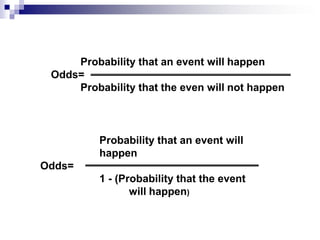
Probability that an event will happen
 Odds=
     Probability that the even will not happen


          Probability that an event will
          happen
Odds=
          1 - (Probability that the event
                 will happen)
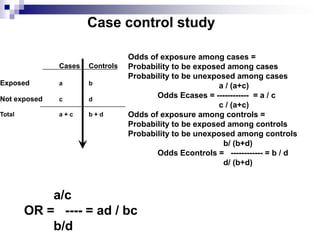
Case control study

                                 Odds of exposure among cases =
              Cases   Controls   Probability to be exposed among cases
                                 Probability to be unexposed among cases
Exposed       a       b                                  a / (a+c)
Not exposed   c       d
                                        Odds Ecases = ------------ = a / c
                                                         c / (a+c)
Total         a+c     b+d        Odds of exposure among controls =
                                 Probability to be exposed among controls
                                 Probability to be unexposed among controls
                                                          b/ (b+d)
                                        Odds Econtrols = ------------ = b / d
                                                          d/ (b+d)


            a/c
        OR = ---- = ad / bc
            b/d
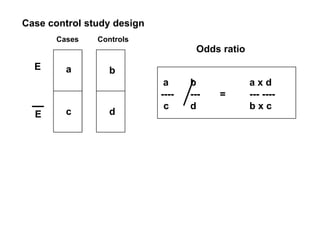
Case control study design
       Cases   Controls
                                    Odds ratio
  E      a       b
                             a     b             axd
                            ----   ---   =       --- ----
                             c     d             bxc
  E      c       d
Interpretation of Odds Ratio


 What   do you understand by OR= 1
  ?
 What do you understand by OR= 3
  ?
 What is your opinion if OR is less
  than 1
Brain Storming

 Can we estimate Incidence of disease
  in case control study design?
 Can we estimate time relationship of
  cause and disease/effect?
 What is the time relationship of cause
  and effect?
Limitations

 Is inefficient design for evaluation of
  rare exposure
 Incidence rate cannot be computed
 Time relationship cannot be estimated
 This study design is more prone to bias
Scope of case control study
design

 It is quick and inexpensive as
  compared to other analytic study
  designs
 It is particularly suitable for evaluation
  of diseases with long latent periods
 It is optimum design for rare diseases

Case control studies

  • 1.
    CASE CONTROL STUDIES DR MUHAMMAD TAUSEEF JAVED MBBS.DPH.FCPS(CM)M.Phil(CM).Dip-Card
  • 2.
    CASE CONTROL STUDIES Finding Risk Factor/ Cause of Disease Cases Control Comparison of Diseases verses non-disease
  • 3.
    Case Control Studydesign Exposure Present Diseased Exposure absent Compare Trace back Select Exposure Present Non-diseased Exposure absent Case control study proceed from effect to the cause
  • 4.
    Case Control StudySteps Definition of cases Selection of cases Selection of Controls Ascertainment of exposure status Analysis Conclusion and interpretation
  • 5.
    Defining the cases  How will you define poliomyelitis?  What is acute flaccid paralysis (AFP)  Is AFP a case of Poliomyelitis  What is WHO Criteria of poliomyelitis?  Case definition of Tuberculosis  Cases should be representative of all diseased
  • 6.
    Selection of Cases Preferably new cases or incident cases  Prevalent cases (cases already present)  Random selection  Convenient selection
  • 7.
    Control Control mustbe Ideally matching with the cases by age, sex and other characteristics except the control must not be suffering from diseases
  • 8.
    Criteria for control Matching by all respect with cases except not having disease  Hospital controls  Neighborhoods controls  Friends and relatives  Controls from general population
  • 9.
    Methods of selectionof control  Random Selection  Convenient Selection  What should be the ratio between cases and control
  • 10.
    Ascertainment of Exposure 1. Setting the criteria for exposure 2. Methods of exposures  Observation  Interviews  Questionnaire  Examination of records
  • 11.
    Analysis 1. Exposure Rates among the disease (Cases) 2. Exposure Rates among the non- disease (Control) 3. Odd’s Ratio
  • 12.
    2 x 2Table for Case Control Study Design Disease Status Cases Control Total Exposur e Status Exp. a b a+b Yes Total Exp Exp. No c d c+d Total non- Esp Total a+c b+d a + b+ c+ Total Dis. Total non- d Dis. Grand total
  • 13.
    Exposure Rates a Exposure Rates among cases /disease = a+c b Exposure Rate among the control /non-disease = b+d
  • 14.
    Risk Ratio a/b Odds Ratio = c/d ad Odds Ratio = bc
  • 15.
    Probability that anevent will happen Odds= Probability that the even will not happen Probability that an event will happen Odds= 1 - (Probability that the event will happen)
  • 16.
    Case control study Odds of exposure among cases = Cases Controls Probability to be exposed among cases Probability to be unexposed among cases Exposed a b a / (a+c) Not exposed c d Odds Ecases = ------------ = a / c c / (a+c) Total a+c b+d Odds of exposure among controls = Probability to be exposed among controls Probability to be unexposed among controls b/ (b+d) Odds Econtrols = ------------ = b / d d/ (b+d) a/c OR = ---- = ad / bc b/d
  • 17.
    Case control studydesign Cases Controls Odds ratio E a b a b axd ---- --- = --- ---- c d bxc E c d
  • 18.
    Interpretation of OddsRatio  What do you understand by OR= 1 ?  What do you understand by OR= 3 ?  What is your opinion if OR is less than 1
  • 19.
    Brain Storming  Canwe estimate Incidence of disease in case control study design?  Can we estimate time relationship of cause and disease/effect?  What is the time relationship of cause and effect?
  • 20.
    Limitations  Is inefficientdesign for evaluation of rare exposure  Incidence rate cannot be computed  Time relationship cannot be estimated  This study design is more prone to bias
  • 21.
    Scope of casecontrol study design  It is quick and inexpensive as compared to other analytic study designs  It is particularly suitable for evaluation of diseases with long latent periods  It is optimum design for rare diseases