Case-Control Studies Rachel Walden, MLIS Eskind Biomedical Library MLA 2007: Quality Filtering
“ Begin with the outcome  and look for features of people who share that outcome, then compare characteristics with subjects who do not.” - Stephen H. Gehlbach, Interpreting the Medical Literature, 1993 Case-control studies start with a disease, and work backward to find associations between exposures and the disease.  Compares patients with and without disease to determine how they may differ in what they were exposed to.
Our example:   D’Souza G, Kreimer AR, Viscidi R, Pawlita M, Fakhry C, Koch WM, Westra WH, Gillison ML. Case-control study of human papillomavirus and oropharyngeal cancer. N Engl J Med. 2007 May 10; 356(19):1944-1956 . – Looks at factors associated with throat cancer, such as smoking and human papillomavirus exposure Famous Examples: Daff ME, Doll R, Kennaway EL. Cancer of the lung in relation to tobacco. Br J Cancer. 1951 Mar;5(1):1-20 . – Interviewed patients with diagnosed lung cancer and patients hospitalized for other disorders about smoking habits. Herbst AL, Ulfelder H, Poskanzer DC.  Adenocarcinoma of the vagina. Association of maternal stilbestrol therapy with tumor appearance in young women. N Engl J Med. 1971 Apr 15;284(15):878-81.  – Looked at young women diagnosed with vaginal cancer (and controls without) for both their exposures and maternal exposures; found miscarriage drug associated with daughters’ cancer Examples
Case-Control Checklist Key Components Study base -  all people who would be in the study if they developed the disease Disease (case definition) -  clear definition, newly diagnosed Controls -  random sample of those without disease in study base Exposure -  interview cases and controls Confounders -  what could confuse the results? Analysis -  how was the information handled? Selection Bias -  were the populations similar? Were they “normal?”
Cases Selected based on disease status –  cases have disease Select only after developing clear criteria for defining the disease of interest Should be representative of all cases May be found from clinics, hospitals, disease registries Newly diagnosed disease is preferred May be limited to cases occurring within a specific period of time
Controls Selected based on disease status – controls should not have disease of interest Comes from same study base or population as cases Can come from geographic samples, medical institutions, neighbors, friends May be matched by age, weight, sex, other factors Selection can be problematic Should be representative of population of interest in general Can have multiple control groups
Exposure Can be things like smoking, behaviors, food habits Exposures occurred before disease developed Subject to recall bias and reporting bias Confounders (factors that distort or mask the true effect of exposure in an epidemiologic study)   must be addressed; attempt to control with appropriate design and statistical techniques
Analysis Odds ratio is the measure of risk used look at odds of exposure between cases and controls If cases have lower odds of exposure than controls, exposure may reduce risk of disease (i.e., protective effect) If cases have higher odds of exposure than controls, exposure may increase risk of disease If cases and controls have equal odds of exposure, exposure is likely not related to disease development
Case-Control Study Base Cases (50) Controls (50) Exposed (40) Not Exposed (10) Not Exposed (35) Odds Ratio: (number of exposed cases)/(number of unexposed cases) (number of exposed controls)/(number of unexposed controls) OR  40/10 X 35/15 = (4)(2.33)= 9.33  Odds of exposure for cases is 9.33 times that of controls Exposure is associated with 9x greater chance of disease Exposed (15)
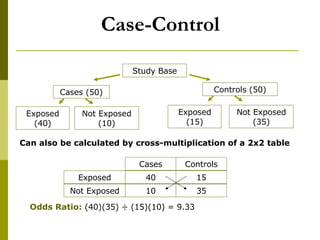
Case-Control Study Base Cases (50) Controls (50) Exposed (40) Not Exposed (10) Not Exposed (35) Exposed (15) Odds Ratio:  (40)(35) ÷ (15)(10) = 9.33  Can also be calculated by cross-multiplication of a 2x2 table Cases Controls Exposed Not Exposed 40 10 35 15
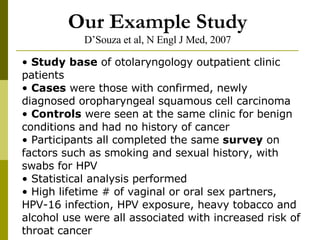
Our Example Study D’Souza et al, N Engl J Med, 2007 Study base  of otolaryngology outpatient clinic patients Cases  were those with confirmed, newly diagnosed oropharyngeal squamous cell carcinoma  Controls  were seen at the same clinic for benign conditions and had no history of cancer Participants all completed the same  survey  on factors such as smoking and sexual history, with swabs for HPV Statistical analysis performed High lifetime # of vaginal or oral sex partners, HPV-16 infection, HPV exposure, heavy tobacco and alcohol use were all associated with increased risk of throat cancer
Our Example Study Authors may also look at other levels of exposure, like 1-19 pack years, or 0-5, 5-25, and ≥26 lifetime sexual partners Also look at factors that may be additive or synergistic, such as smoking and drinking, or smoking and exposure to asbestos Cases Controls Exposed Not Exposed 34 44 119 39 Smoking ≥20 pack-years Odds Ratio: (34)(119) ÷ (39)(44) = 2.4
Advantages Efficient - saves time and money Used for rare diseases, smaller sample sizes Multiple associations with a disease Can generate hypotheses for future study Can be used to examine multiple exposures, such as smoking and asbestos exposure in mesothelioma risk
Disadvantages Susceptible to bias – recall, reporting Prone to methodological errors Observational  Works for certain types of conditions
Resources Pitt Supercourse on Case Control Studies: http://www.pitt.edu/~super1/lecture/lec8591/index.htm

Case Control Studies

  • 1.
    Case-Control Studies RachelWalden, MLIS Eskind Biomedical Library MLA 2007: Quality Filtering
  • 2.
    “ Begin withthe outcome and look for features of people who share that outcome, then compare characteristics with subjects who do not.” - Stephen H. Gehlbach, Interpreting the Medical Literature, 1993 Case-control studies start with a disease, and work backward to find associations between exposures and the disease. Compares patients with and without disease to determine how they may differ in what they were exposed to.
  • 3.
    Our example: D’Souza G, Kreimer AR, Viscidi R, Pawlita M, Fakhry C, Koch WM, Westra WH, Gillison ML. Case-control study of human papillomavirus and oropharyngeal cancer. N Engl J Med. 2007 May 10; 356(19):1944-1956 . – Looks at factors associated with throat cancer, such as smoking and human papillomavirus exposure Famous Examples: Daff ME, Doll R, Kennaway EL. Cancer of the lung in relation to tobacco. Br J Cancer. 1951 Mar;5(1):1-20 . – Interviewed patients with diagnosed lung cancer and patients hospitalized for other disorders about smoking habits. Herbst AL, Ulfelder H, Poskanzer DC. Adenocarcinoma of the vagina. Association of maternal stilbestrol therapy with tumor appearance in young women. N Engl J Med. 1971 Apr 15;284(15):878-81. – Looked at young women diagnosed with vaginal cancer (and controls without) for both their exposures and maternal exposures; found miscarriage drug associated with daughters’ cancer Examples
  • 4.
    Case-Control Checklist KeyComponents Study base - all people who would be in the study if they developed the disease Disease (case definition) - clear definition, newly diagnosed Controls - random sample of those without disease in study base Exposure - interview cases and controls Confounders - what could confuse the results? Analysis - how was the information handled? Selection Bias - were the populations similar? Were they “normal?”
  • 5.
    Cases Selected basedon disease status – cases have disease Select only after developing clear criteria for defining the disease of interest Should be representative of all cases May be found from clinics, hospitals, disease registries Newly diagnosed disease is preferred May be limited to cases occurring within a specific period of time
  • 6.
    Controls Selected basedon disease status – controls should not have disease of interest Comes from same study base or population as cases Can come from geographic samples, medical institutions, neighbors, friends May be matched by age, weight, sex, other factors Selection can be problematic Should be representative of population of interest in general Can have multiple control groups
  • 7.
    Exposure Can bethings like smoking, behaviors, food habits Exposures occurred before disease developed Subject to recall bias and reporting bias Confounders (factors that distort or mask the true effect of exposure in an epidemiologic study) must be addressed; attempt to control with appropriate design and statistical techniques
  • 8.
    Analysis Odds ratiois the measure of risk used look at odds of exposure between cases and controls If cases have lower odds of exposure than controls, exposure may reduce risk of disease (i.e., protective effect) If cases have higher odds of exposure than controls, exposure may increase risk of disease If cases and controls have equal odds of exposure, exposure is likely not related to disease development
  • 9.
    Case-Control Study BaseCases (50) Controls (50) Exposed (40) Not Exposed (10) Not Exposed (35) Odds Ratio: (number of exposed cases)/(number of unexposed cases) (number of exposed controls)/(number of unexposed controls) OR 40/10 X 35/15 = (4)(2.33)= 9.33 Odds of exposure for cases is 9.33 times that of controls Exposure is associated with 9x greater chance of disease Exposed (15)
  • 10.
    Case-Control Study BaseCases (50) Controls (50) Exposed (40) Not Exposed (10) Not Exposed (35) Exposed (15) Odds Ratio: (40)(35) ÷ (15)(10) = 9.33 Can also be calculated by cross-multiplication of a 2x2 table Cases Controls Exposed Not Exposed 40 10 35 15
  • 11.
    Our Example StudyD’Souza et al, N Engl J Med, 2007 Study base of otolaryngology outpatient clinic patients Cases were those with confirmed, newly diagnosed oropharyngeal squamous cell carcinoma Controls were seen at the same clinic for benign conditions and had no history of cancer Participants all completed the same survey on factors such as smoking and sexual history, with swabs for HPV Statistical analysis performed High lifetime # of vaginal or oral sex partners, HPV-16 infection, HPV exposure, heavy tobacco and alcohol use were all associated with increased risk of throat cancer
  • 12.
    Our Example StudyAuthors may also look at other levels of exposure, like 1-19 pack years, or 0-5, 5-25, and ≥26 lifetime sexual partners Also look at factors that may be additive or synergistic, such as smoking and drinking, or smoking and exposure to asbestos Cases Controls Exposed Not Exposed 34 44 119 39 Smoking ≥20 pack-years Odds Ratio: (34)(119) ÷ (39)(44) = 2.4
  • 13.
    Advantages Efficient -saves time and money Used for rare diseases, smaller sample sizes Multiple associations with a disease Can generate hypotheses for future study Can be used to examine multiple exposures, such as smoking and asbestos exposure in mesothelioma risk
  • 14.
    Disadvantages Susceptible tobias – recall, reporting Prone to methodological errors Observational Works for certain types of conditions
  • 15.
    Resources Pitt Supercourseon Case Control Studies: http://www.pitt.edu/~super1/lecture/lec8591/index.htm