Title:- Cross sectional study
2/23/2021 1
Study Design
 A study design is a plan for selecting study
subjects and for obtaining data about them.
A research design is the blueprint for
conducting a study that maximizes control
over factors that could interfere with the
validity of the findings.
There are different category of study types: -
descriptive studies, Analytical studies, and
Experimental studies.
2/23/2021 2
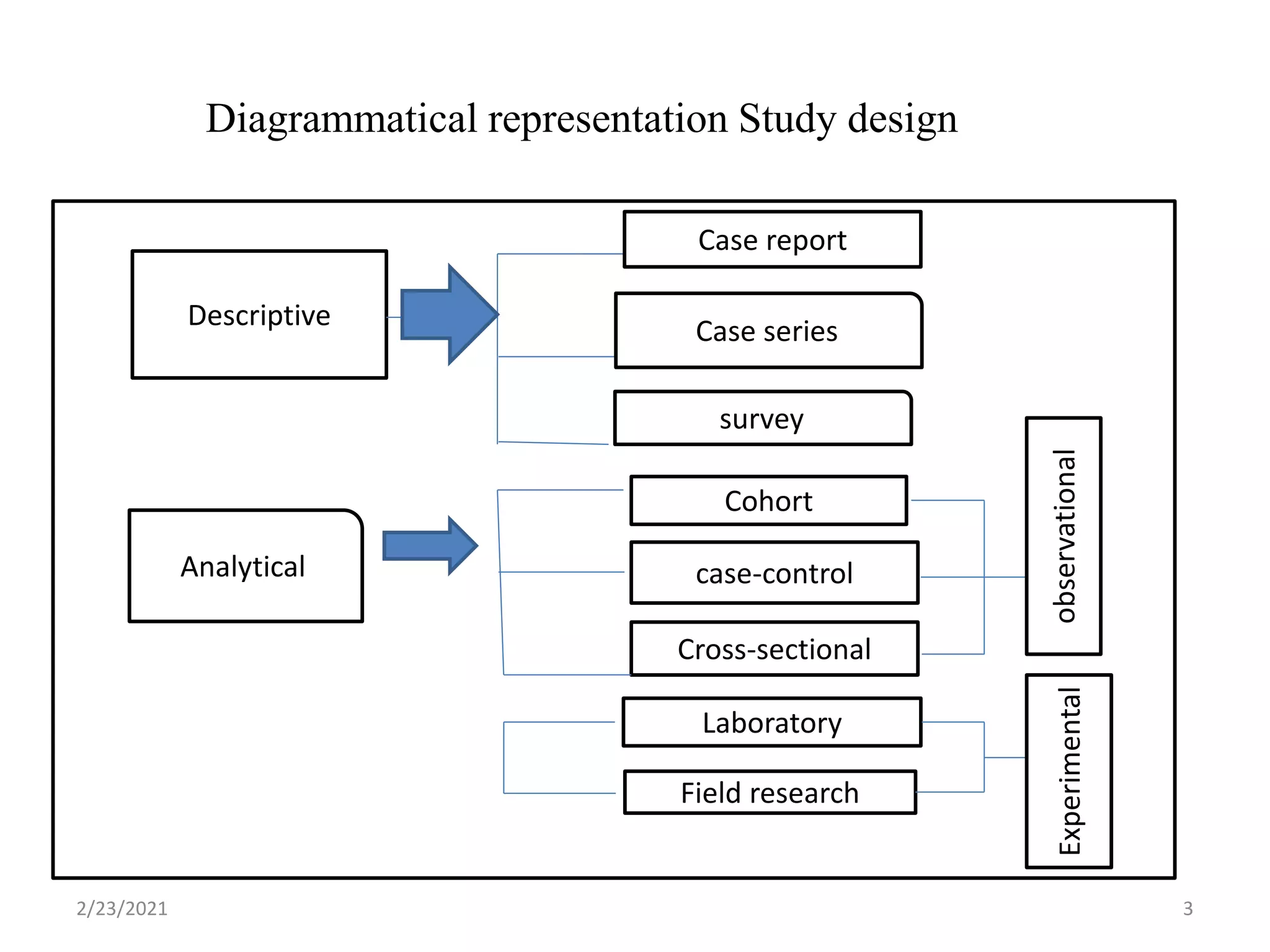
Diagrammatical representation Study design
Descriptive
Case report
survey
Case series
Analytical
Cohort
case-control
Cross-sectional
Laboratory
Field research
observational
Experimental
2/23/2021 3
Analytical study
Analytical studies are undertaken to test a
hypothesis and the association between an
exposure of interest and a particular outcome
hypothesis typically concerns whether a
certain exposure causes (or is associated with)
a certain outcome
2/23/2021 4
 Most frequent researches are done in the form of
observational studies.
Observational study can be
• Retrospective =outcome occurred before study
starts
• Prospective = no out come occurred before study
starts
It do not interfere with the phenomena under study,
only observe in a systematic and standardized
manner
2/23/2021 5
• In observational studies normally three types
of study design are used: -
• Cross-Sectional (prevalence study)
• Case-control (Compares diseased animals
(cases) with non-diseased animals (controls))
• Cohort Studies (Follow the groups through
time to determine if disease develops) Also
Called Incidence.
2/23/2021 6
Cross sectional study
What are cross-sectional studies?
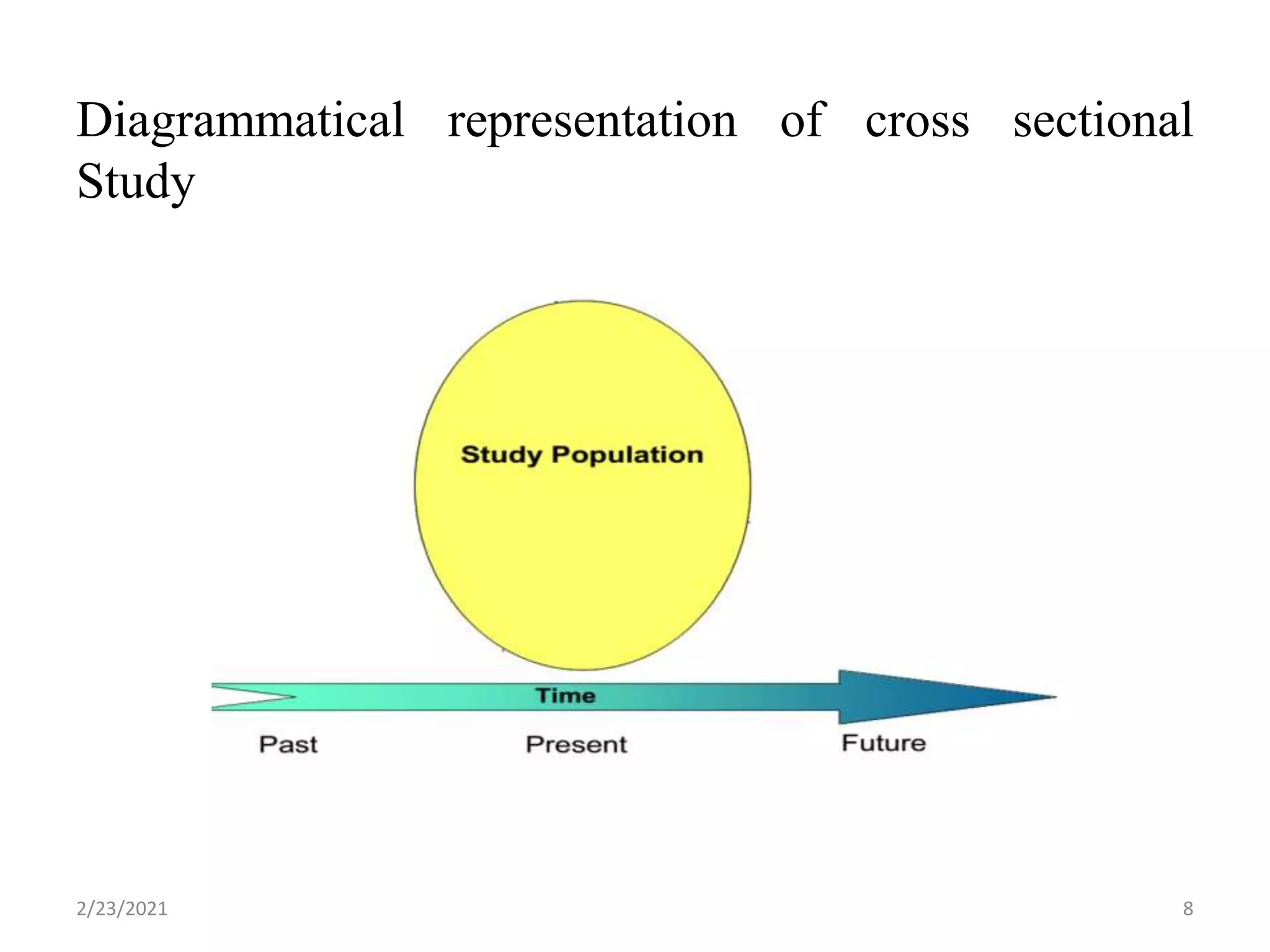
Described as a “snapshot” of a population in a
certain point of time because exposure and
outcome are determined simultaneously for
each subject.
 It is an observational study.
 It is also called prevalence study.
2/23/2021 7
Diagrammatical representation of cross sectional
Study
2/23/2021 8
Con’t…
Cross-sectional study measure simultaneously
the exposure and health outcome in a given
population and in a given geographical area at
a certain time.
cross-sectional studies are very useful in
descriptive studies when used in studies that
are proposed to be analytical.
2/23/2021 9
Cross sectiontional con’t….
The aim of cross-sectional studies is to obtain
reliable data that make possible to generate,
robust conclusions, and create new hypotheses
that can be investigated with new research.
The main characteristic of cross-sectional
studies is that the observation of variable.
Whether they are cases, individuals, or other
types of data, is performed in a single moment.
2/23/2021 10
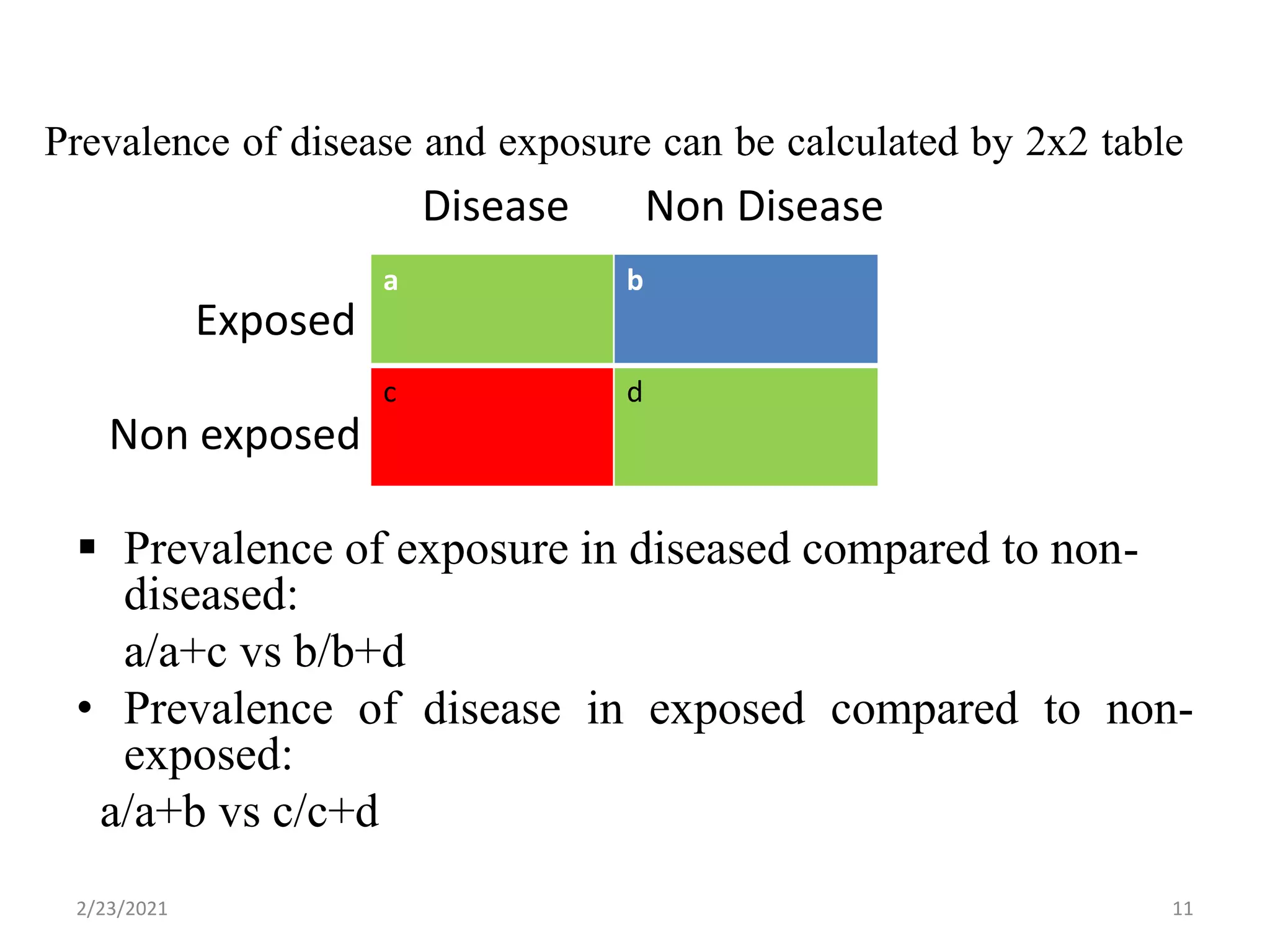
Prevalence of disease and exposure can be calculated by 2x2 table
Disease Non Disease
Exposed
Non exposed
 Prevalence of exposure in diseased compared to non-
diseased:
a/a+c vs b/b+d
• Prevalence of disease in exposed compared to non-
exposed:
a/a+b vs c/c+d
a b
c d
2/23/2021 11
Applications of cross-sectional studies
 They are usually conducted to estimate the prevalence of the
outcome of interest for a given population, commonly for the
purposes of public health planning.
 Appropriate for screening hypotheses because they require
relatively shorter time and fewer resources.
 Also used to understand the prevalence of various conditions,
treatments, services or other outcomes and the factors
associated with such outcomes.
2/23/2021 12
Advantages of cross-sectional studies
 Relatively inexpensive
 Takes little time to conduct(quick)
serve as a basis for calculating sample size in
the planning of future analytical research
 Can estimate prevalence of outcome of
interest because sample is usually taken from
the whole population.
2/23/2021 13
Advantage con’t…
 Many outcomes and risk factors can be assessed.
 Useful for public health planning, understanding
disease etiology and for the generation of hypotheses.
 There is no loss to follow-up.
 No risk to subjects
 Current records occasionally can be used
2/23/2021 14
Disadvantages of cross-sectional studies
Cannot tell us about causal relationships (only
correlation).
Temporal sequence of cause and effect cannot
necessarily be determined
Only suitable for chronic conditions occurring at a
moderate level in the population
 Unsuited to the study of rare diseases
Unsuited to the study of diseases of short duration
 Generalizability limited by sampled population
and population definition.
2/23/2021 15
Disadvatage con’t…
Sample size requirements may be very large
(especially when looking at rare outcomes or
exposures).
It evaluates prevalence rather than incidence
Potential for selection bias (systematic differences
between characteristics of the study population
and the target population from which it was
drawn)
 Most observational studies use data gathered from convenient
populations such as veterinary clinics, abattoirs and particular
farms (inference be made with great care)
2/23/2021 16
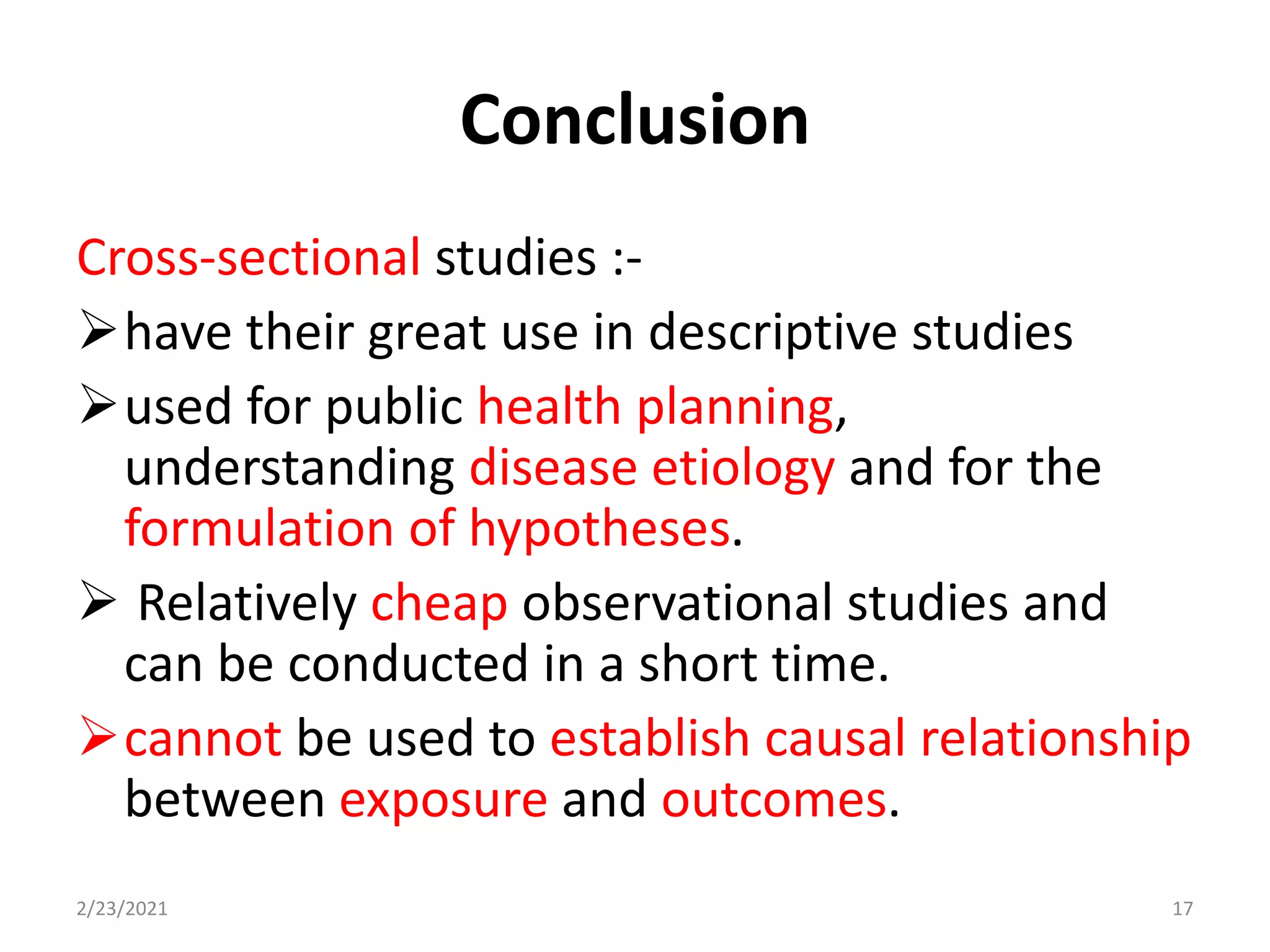
Conclusion
Cross-sectional studies :-
have their great use in descriptive studies
used for public health planning,
understanding disease etiology and for the
formulation of hypotheses.
 Relatively cheap observational studies and
can be conducted in a short time.
cannot be used to establish causal relationship
between exposure and outcomes.
2/23/2021 17
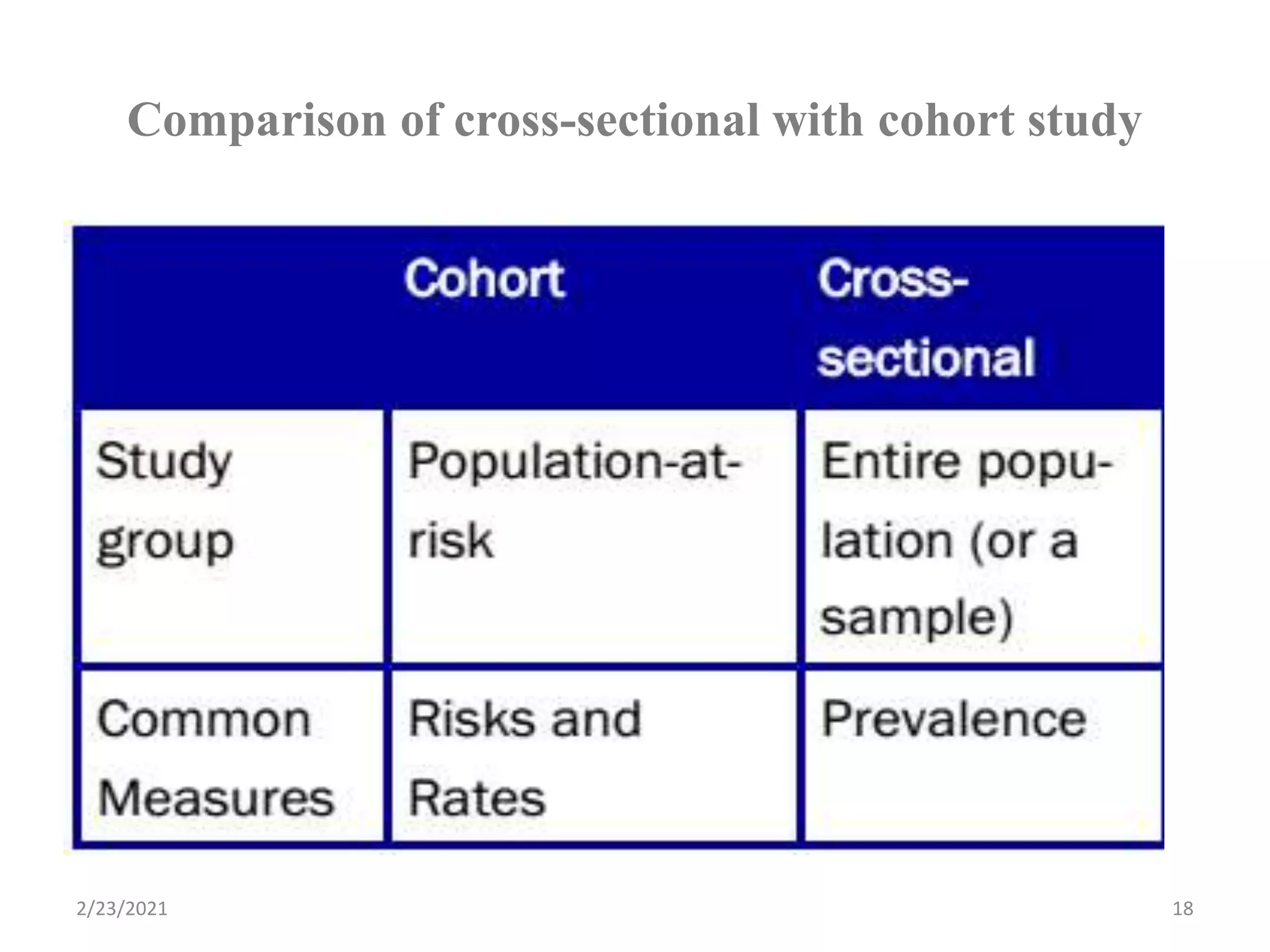
Comparison of cross-sectional with cohort study
2/23/2021 18
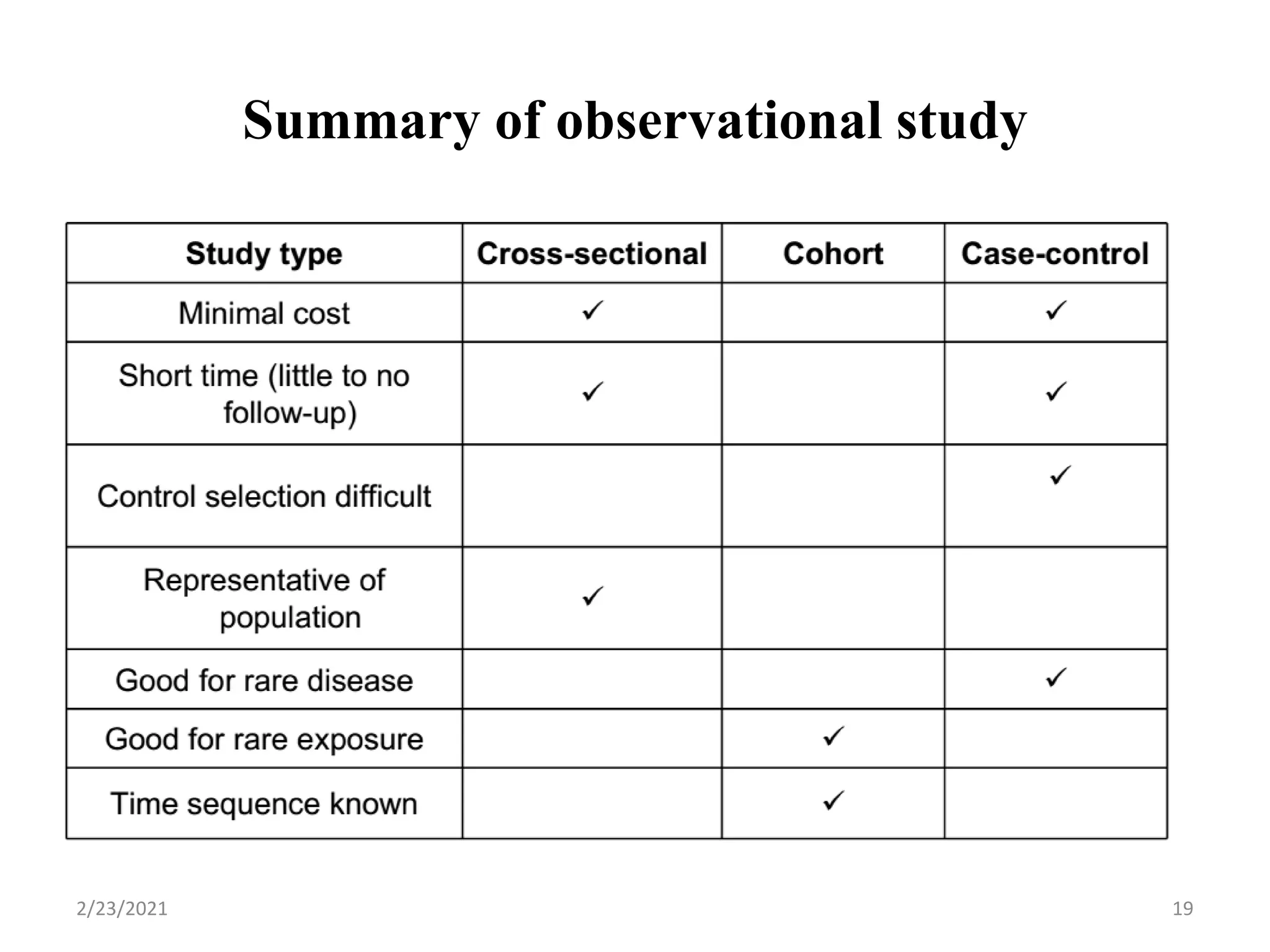
Summary of observational study
2/23/2021 19
2/23/2021 20

Cross sectional study

  • 1.
    Title:- Cross sectionalstudy 2/23/2021 1
  • 2.
    Study Design  Astudy design is a plan for selecting study subjects and for obtaining data about them. A research design is the blueprint for conducting a study that maximizes control over factors that could interfere with the validity of the findings. There are different category of study types: - descriptive studies, Analytical studies, and Experimental studies. 2/23/2021 2
  • 3.
    Diagrammatical representation Studydesign Descriptive Case report survey Case series Analytical Cohort case-control Cross-sectional Laboratory Field research observational Experimental 2/23/2021 3
  • 4.
    Analytical study Analytical studiesare undertaken to test a hypothesis and the association between an exposure of interest and a particular outcome hypothesis typically concerns whether a certain exposure causes (or is associated with) a certain outcome 2/23/2021 4
  • 5.
     Most frequentresearches are done in the form of observational studies. Observational study can be • Retrospective =outcome occurred before study starts • Prospective = no out come occurred before study starts It do not interfere with the phenomena under study, only observe in a systematic and standardized manner 2/23/2021 5
  • 6.
    • In observationalstudies normally three types of study design are used: - • Cross-Sectional (prevalence study) • Case-control (Compares diseased animals (cases) with non-diseased animals (controls)) • Cohort Studies (Follow the groups through time to determine if disease develops) Also Called Incidence. 2/23/2021 6
  • 7.
    Cross sectional study Whatare cross-sectional studies? Described as a “snapshot” of a population in a certain point of time because exposure and outcome are determined simultaneously for each subject.  It is an observational study.  It is also called prevalence study. 2/23/2021 7
  • 8.
    Diagrammatical representation ofcross sectional Study 2/23/2021 8
  • 9.
    Con’t… Cross-sectional study measuresimultaneously the exposure and health outcome in a given population and in a given geographical area at a certain time. cross-sectional studies are very useful in descriptive studies when used in studies that are proposed to be analytical. 2/23/2021 9
  • 10.
    Cross sectiontional con’t…. Theaim of cross-sectional studies is to obtain reliable data that make possible to generate, robust conclusions, and create new hypotheses that can be investigated with new research. The main characteristic of cross-sectional studies is that the observation of variable. Whether they are cases, individuals, or other types of data, is performed in a single moment. 2/23/2021 10
  • 11.
    Prevalence of diseaseand exposure can be calculated by 2x2 table Disease Non Disease Exposed Non exposed  Prevalence of exposure in diseased compared to non- diseased: a/a+c vs b/b+d • Prevalence of disease in exposed compared to non- exposed: a/a+b vs c/c+d a b c d 2/23/2021 11
  • 12.
    Applications of cross-sectionalstudies  They are usually conducted to estimate the prevalence of the outcome of interest for a given population, commonly for the purposes of public health planning.  Appropriate for screening hypotheses because they require relatively shorter time and fewer resources.  Also used to understand the prevalence of various conditions, treatments, services or other outcomes and the factors associated with such outcomes. 2/23/2021 12
  • 13.
    Advantages of cross-sectionalstudies  Relatively inexpensive  Takes little time to conduct(quick) serve as a basis for calculating sample size in the planning of future analytical research  Can estimate prevalence of outcome of interest because sample is usually taken from the whole population. 2/23/2021 13
  • 14.
    Advantage con’t…  Manyoutcomes and risk factors can be assessed.  Useful for public health planning, understanding disease etiology and for the generation of hypotheses.  There is no loss to follow-up.  No risk to subjects  Current records occasionally can be used 2/23/2021 14
  • 15.
    Disadvantages of cross-sectionalstudies Cannot tell us about causal relationships (only correlation). Temporal sequence of cause and effect cannot necessarily be determined Only suitable for chronic conditions occurring at a moderate level in the population  Unsuited to the study of rare diseases Unsuited to the study of diseases of short duration  Generalizability limited by sampled population and population definition. 2/23/2021 15
  • 16.
    Disadvatage con’t… Sample sizerequirements may be very large (especially when looking at rare outcomes or exposures). It evaluates prevalence rather than incidence Potential for selection bias (systematic differences between characteristics of the study population and the target population from which it was drawn)  Most observational studies use data gathered from convenient populations such as veterinary clinics, abattoirs and particular farms (inference be made with great care) 2/23/2021 16
  • 17.
    Conclusion Cross-sectional studies :- havetheir great use in descriptive studies used for public health planning, understanding disease etiology and for the formulation of hypotheses.  Relatively cheap observational studies and can be conducted in a short time. cannot be used to establish causal relationship between exposure and outcomes. 2/23/2021 17
  • 18.
    Comparison of cross-sectionalwith cohort study 2/23/2021 18
  • 19.
    Summary of observationalstudy 2/23/2021 19
  • 20.