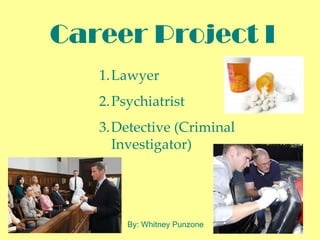
Career Project I Lawyer Psychiatrist Detective (Criminal Investigator) By: Whitney Punzone
Lawyer Represent clients in a courtroom  Present clients’ cases and show evidence to defend them Study the law Choose jurors and question witnesses
Skills & Abilities   Skills: Listen to what people say during court or in private with clients Speaking skills to present information Negotiate with people, including settling deals with criminals Good judgment and decision making to see both positives and negatives of others’ actions Abilities: Communicate information in a way people can understand Listen and understand ideas and facts presented in court or in private Inductive reasoning (finding information from unusual events and piece them together) Deductive reasoning (piece together obvious information)
Knowledge Law and Government – legal codes & court procedures English language – grammar, vocabulary, word meanings Administration & Management – leadership & strategic planning Economic & Accounting – banking and reporting financial data
Interests (Holland Code) Enterprising – carry out projects and make decisions  Investigative – search for facts to come up with a result Artistic – follow an easily understood set of directions
Related Occupations Criminal Investigator Special Agent Judge Paralegal
Earnings Median Annual - $110,590  Private Practices - $126,080  Businesses - $69,100 Government - $50,000 Academic Clerkships - $48,000 Health & life insurance provided Salary based on location, type, and size of employer
Training, Other Qualifications, Advancement   7 years after high school – 4 years of undergraduate school, 3 years of law school Bachelor’s Degree Get licensed & pass bar examination Several years for advancements (move from a new attorney to a partnership in a firm)
Employment  759,200 jobs for lawyers in 2008 26% self employed Small number works in law schools Most salaried lawyers hold office in government
Psychiatrist Prescribe medications to patients with mental disorders Counsel patients during office visits Evaluate data from patients to diagnose mental disorders and severity  Conduct lab tests to find out information on conditions
Skills & Abilities Skills: Give full attention to patients Understand why people react the way they do Speaking to convey information to patients, doctors, and patients’ families Logic and reasoning to figure out solutions to problems Abilities: Listen and understand what their patients tell them Problem sensitivity to tell if something goes wrong or if something is bothering their patient Speech recognition to understand what others tell them Speak clearly to others
Knowledge  Human behavior – psychology Medicine – be able to diagnose patients correctly Counseling/Diagnosing – counsel patients, principles and methods on diagnosing and treating patients Sociology – group behaviors and social trends in a community
Interests (Holland Code) Investigative – work with ideas, search for facts, figure out problems mentally Social – communicate with people Artistic – follow work without a clear set of rules
Related  Occupations Psychiatric technician Psychiatric aid
Earnings Median Annual - $160,230 Median Hourly - $77.04 Top paying industry – nursing care facilities ($199,910 annually)
Training, Other Qualifications, & Advancement 4 years of undergraduate school 4 years of medical school 3-8 years of internship and residency In medical school – spend first 2 years taking classes on: Anatomy Biochemistry Physiology Psychology
Employment 5.2% of physicians involved in psychiatry in 2007 53% worked in physician offices 19% were employed by hospitals
Detective (Criminal Investigator) Analyze evidence in labs Obtain evidence by interviewing suspects Look at records to determine links in chains of evidence Testify in court about criminal activities
Skills & Abilities Skills: Give full attention to others when they speak Talk to others in an understanding way Persuade people to change their minds Awareness of why people act the way they do Abilities: Inductive reasoning – piece together information that doesn’t seem to go together Oral comprehension – listen and understand people when they speak Deductive reasoning – apply rules together so they make sense Near vision – see details closely
Knowledge The law – statutes, amendments Public safety and security – operations for protecting people Psychology – for interviewing suspects English language – meanings of words and grammar
Interests (Holland Code) Enterprising – start and carry out projects, lead people into making decisions Investigative – use thinking to figure out problems and find out facts
Related Occupations Private detectives & investigators Police detectives
Earnings  Median Annual in 2008- $60, 910 Highest ten percent of people - $97, 870 Middle fifty percent of people - $41, 930- $81,490 Lowest ten percent of people - $36,500
Training, Other Qualifications & Advancement High school degree College degree Foreign languages  Physical education (to build stamina) 21 years old Physical examinations
Employment 883,600 jobs for police officers and detectives in 2008 79% employed by local governments 11% employed by police agencies
The career that most interests me… The career that most interests me is psychiatry. This is because I find the mind really interesting. I always wonder why people act the way that they do, and if I become a psychiatrist, I’m able to study peoples’ behaviors to figure out how to help them; I love helping people. Also, becoming a psychiatrist takes a lot of hard work, and I like to be able to do all of that work and have it paid off in the end with a high salary that will be used to provide for my family. Psychiatry

Career project i

  • 1.
    Career Project ILawyer Psychiatrist Detective (Criminal Investigator) By: Whitney Punzone
  • 2.
    Lawyer Represent clientsin a courtroom Present clients’ cases and show evidence to defend them Study the law Choose jurors and question witnesses
  • 3.
    Skills & Abilities Skills: Listen to what people say during court or in private with clients Speaking skills to present information Negotiate with people, including settling deals with criminals Good judgment and decision making to see both positives and negatives of others’ actions Abilities: Communicate information in a way people can understand Listen and understand ideas and facts presented in court or in private Inductive reasoning (finding information from unusual events and piece them together) Deductive reasoning (piece together obvious information)
  • 4.
    Knowledge Law andGovernment – legal codes & court procedures English language – grammar, vocabulary, word meanings Administration & Management – leadership & strategic planning Economic & Accounting – banking and reporting financial data
  • 5.
    Interests (Holland Code)Enterprising – carry out projects and make decisions Investigative – search for facts to come up with a result Artistic – follow an easily understood set of directions
  • 6.
    Related Occupations CriminalInvestigator Special Agent Judge Paralegal
  • 7.
    Earnings Median Annual- $110,590 Private Practices - $126,080 Businesses - $69,100 Government - $50,000 Academic Clerkships - $48,000 Health & life insurance provided Salary based on location, type, and size of employer
  • 8.
    Training, Other Qualifications,Advancement 7 years after high school – 4 years of undergraduate school, 3 years of law school Bachelor’s Degree Get licensed & pass bar examination Several years for advancements (move from a new attorney to a partnership in a firm)
  • 9.
    Employment 759,200jobs for lawyers in 2008 26% self employed Small number works in law schools Most salaried lawyers hold office in government
  • 10.
    Psychiatrist Prescribe medicationsto patients with mental disorders Counsel patients during office visits Evaluate data from patients to diagnose mental disorders and severity Conduct lab tests to find out information on conditions
  • 11.
    Skills & AbilitiesSkills: Give full attention to patients Understand why people react the way they do Speaking to convey information to patients, doctors, and patients’ families Logic and reasoning to figure out solutions to problems Abilities: Listen and understand what their patients tell them Problem sensitivity to tell if something goes wrong or if something is bothering their patient Speech recognition to understand what others tell them Speak clearly to others
  • 12.
    Knowledge Humanbehavior – psychology Medicine – be able to diagnose patients correctly Counseling/Diagnosing – counsel patients, principles and methods on diagnosing and treating patients Sociology – group behaviors and social trends in a community
  • 13.
    Interests (Holland Code)Investigative – work with ideas, search for facts, figure out problems mentally Social – communicate with people Artistic – follow work without a clear set of rules
  • 14.
    Related OccupationsPsychiatric technician Psychiatric aid
  • 15.
    Earnings Median Annual- $160,230 Median Hourly - $77.04 Top paying industry – nursing care facilities ($199,910 annually)
  • 16.
    Training, Other Qualifications,& Advancement 4 years of undergraduate school 4 years of medical school 3-8 years of internship and residency In medical school – spend first 2 years taking classes on: Anatomy Biochemistry Physiology Psychology
  • 17.
    Employment 5.2% ofphysicians involved in psychiatry in 2007 53% worked in physician offices 19% were employed by hospitals
  • 18.
    Detective (Criminal Investigator)Analyze evidence in labs Obtain evidence by interviewing suspects Look at records to determine links in chains of evidence Testify in court about criminal activities
  • 19.
    Skills & AbilitiesSkills: Give full attention to others when they speak Talk to others in an understanding way Persuade people to change their minds Awareness of why people act the way they do Abilities: Inductive reasoning – piece together information that doesn’t seem to go together Oral comprehension – listen and understand people when they speak Deductive reasoning – apply rules together so they make sense Near vision – see details closely
  • 20.
    Knowledge The law– statutes, amendments Public safety and security – operations for protecting people Psychology – for interviewing suspects English language – meanings of words and grammar
  • 21.
    Interests (Holland Code)Enterprising – start and carry out projects, lead people into making decisions Investigative – use thinking to figure out problems and find out facts
  • 22.
    Related Occupations Privatedetectives & investigators Police detectives
  • 23.
    Earnings MedianAnnual in 2008- $60, 910 Highest ten percent of people - $97, 870 Middle fifty percent of people - $41, 930- $81,490 Lowest ten percent of people - $36,500
  • 24.
    Training, Other Qualifications& Advancement High school degree College degree Foreign languages Physical education (to build stamina) 21 years old Physical examinations
  • 25.
    Employment 883,600 jobsfor police officers and detectives in 2008 79% employed by local governments 11% employed by police agencies
  • 26.
    The career thatmost interests me… The career that most interests me is psychiatry. This is because I find the mind really interesting. I always wonder why people act the way that they do, and if I become a psychiatrist, I’m able to study peoples’ behaviors to figure out how to help them; I love helping people. Also, becoming a psychiatrist takes a lot of hard work, and I like to be able to do all of that work and have it paid off in the end with a high salary that will be used to provide for my family. Psychiatry