“
Smart Vehicle System With Tracking
Monitoring Accident Detection And
Antitheft Features
”
Under the guidance of:- Prof.
Dhriti Rudra Paul Prof. Tapan
Kumar Mohanta (Assistant
Professor, FST)
Bikash Malakar (21IUT0020095)
Sandipan Das (21IUT0020096)
Sourav Basak (21IUT0020097)
Mandeep Nath (21IUT0020100)
Submitted In Partial Fulfillment Of The Course Requirement of Special Project –II
(EC492)
Submitted by:-
DEPARTMENT OF ELECTRONICS AND COMMUNICATION ENGINEERING
Introduction
A smart vehicle system with tracking, Alchoohol detection, Sealt Belt
monitoring, accident detection, and antitheft features can use a “smart
unit” to record a vehicle’s data and send it to the owner or a third party at
regular intervals.
The smart device is made up of a variety of sensors that provide
continuous safety to the driver.
The system uses Global Positioning System (GPS) to find the location of the
vehicle and then uses satellite or radio systems to send the coordinates and
location data to the monitoring center. The monitoring center uses various
software to plot the vehicle on a map.
Objective
The objective of the “low-power smart vehicle tracking, monitoring, collision avoidance, and anti- theft system”
project is to design, develop, and implement a comprehensive solution that enhances the safety, security, and
efficiency of vehicles. The project aims to integrate various technologies,
including GPS tracking, sensor-based collision detection, remote monitoring, and anti-theft
measures, into a single, unified system.
Vehicle Tracking: Implement real-time GPS tracking to accurately monitor the location and movement of vehicles..
Anti-Theft Measures: Design and implement security features such as remote immobilization,and theft notifications
to prevent unauthorized access and deter theft attempts.
Smart Monitoring: Continuously monitor vehicle and Detecinting Seat belt is wear or not.
Components Required
1. IR sensor
2. Arduno UNO
3. Gas Sensor
4. Vibration sensor
5. Gps module
6. Gsm module
7. Display Unit
8. Motor
9. Relay
10.Buzzer
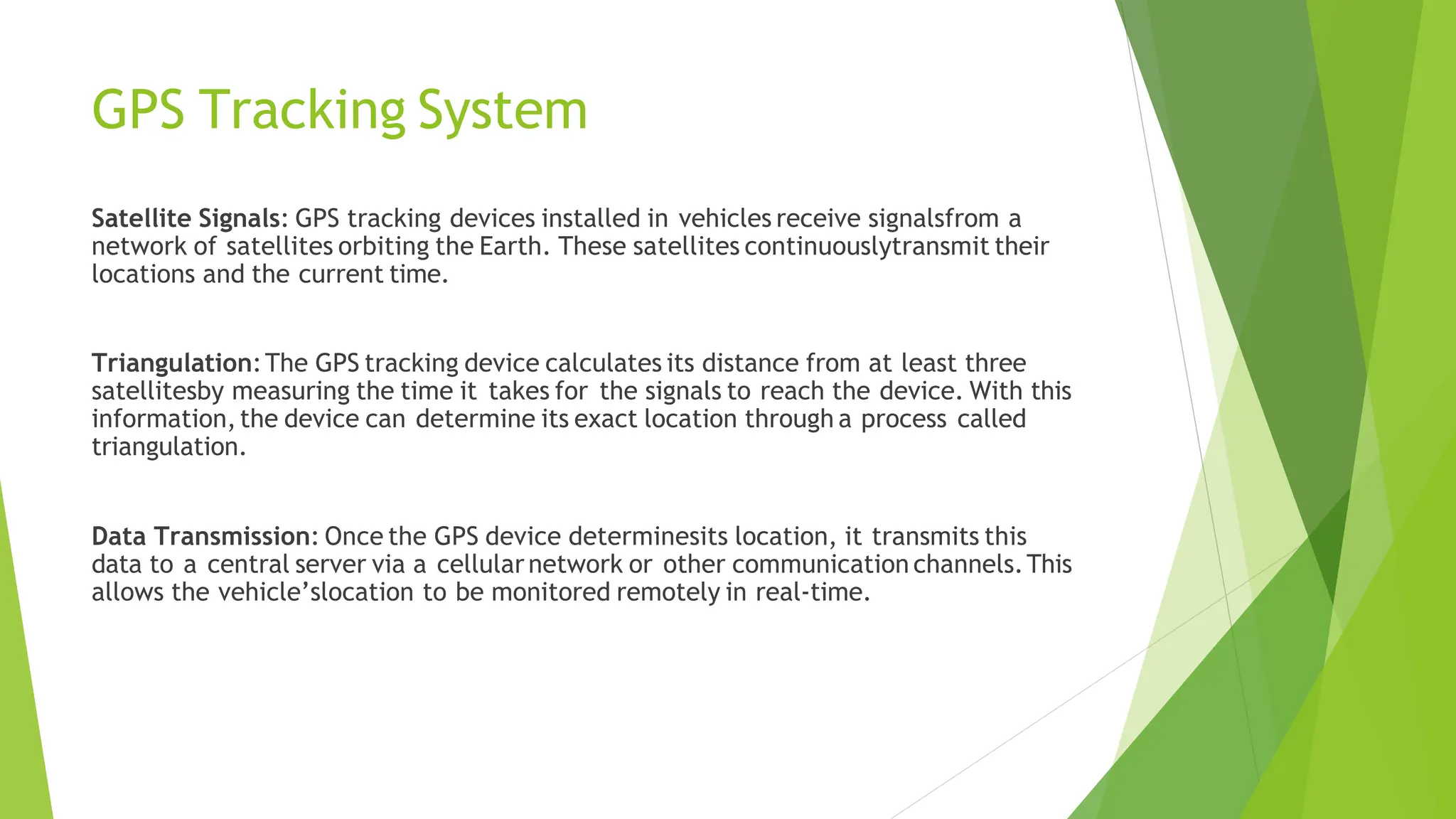
GPS Tracking System
Satellite Signals: GPS tracking devices installed in vehicles receive signalsfrom a
network of satellites orbiting the Earth. These satellites continuouslytransmit their
locations and the current time.
Triangulation:The GPS tracking device calculates its distance from at least three
satellitesby measuring the time it takes for the signals to reach the device. With this
information,the device can determine its exact location through a process called
triangulation.
Data Transmission: Once the GPS device determinesits location, it transmits this
data to a central server via a cellularnetwork or other communication channels.This
allows the vehicle’slocation to be monitored remotely in real-time.
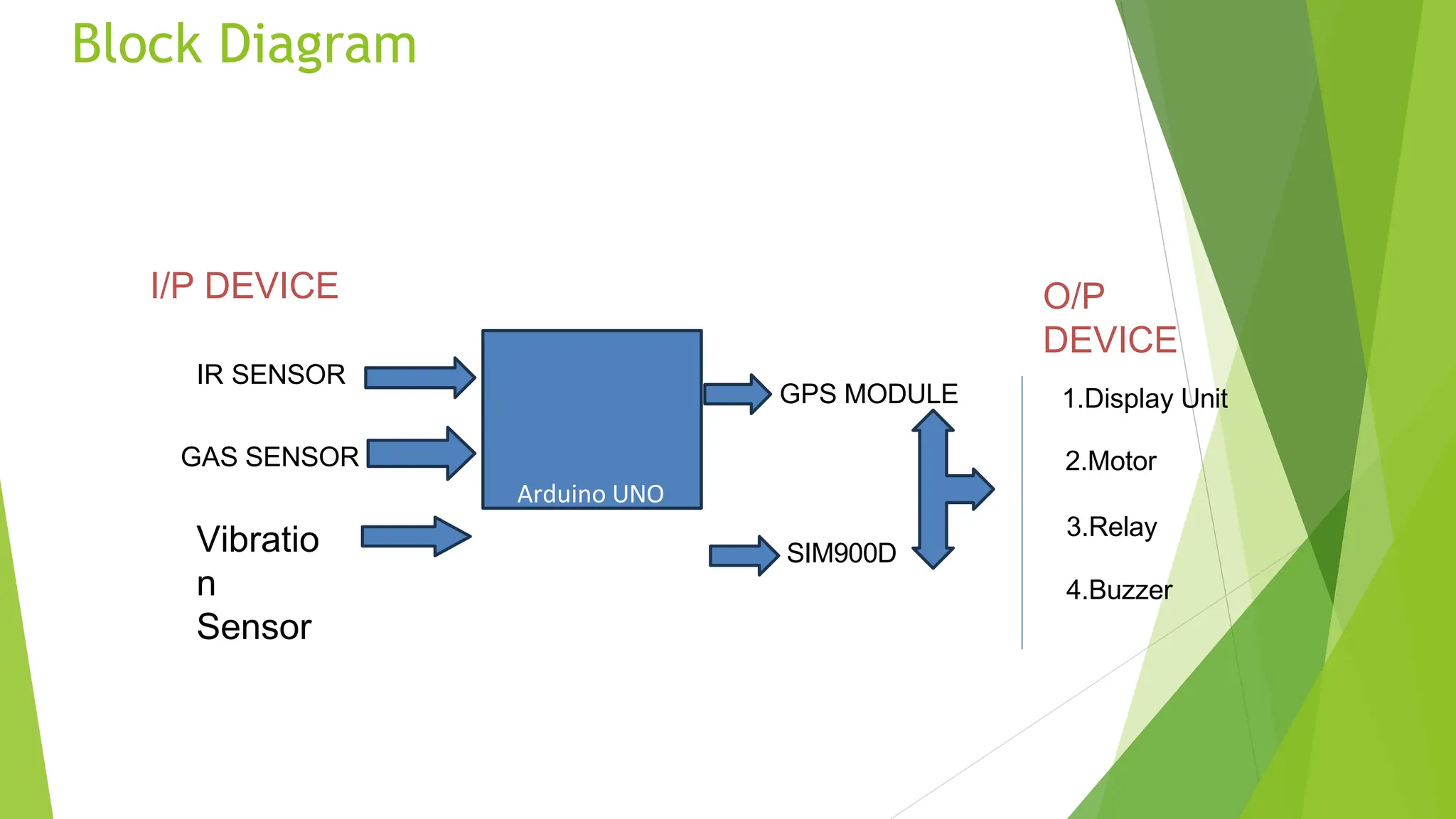
Block Diagram
Arduino UNO
IR SENSOR
GAS SENSOR
4.Buzzer
3.Relay
SIM900D
Vibratio
n
Sensor
2.Motor
1.Display Unit
GPS MODULE
I/P DEVICE O/P
DEVICE
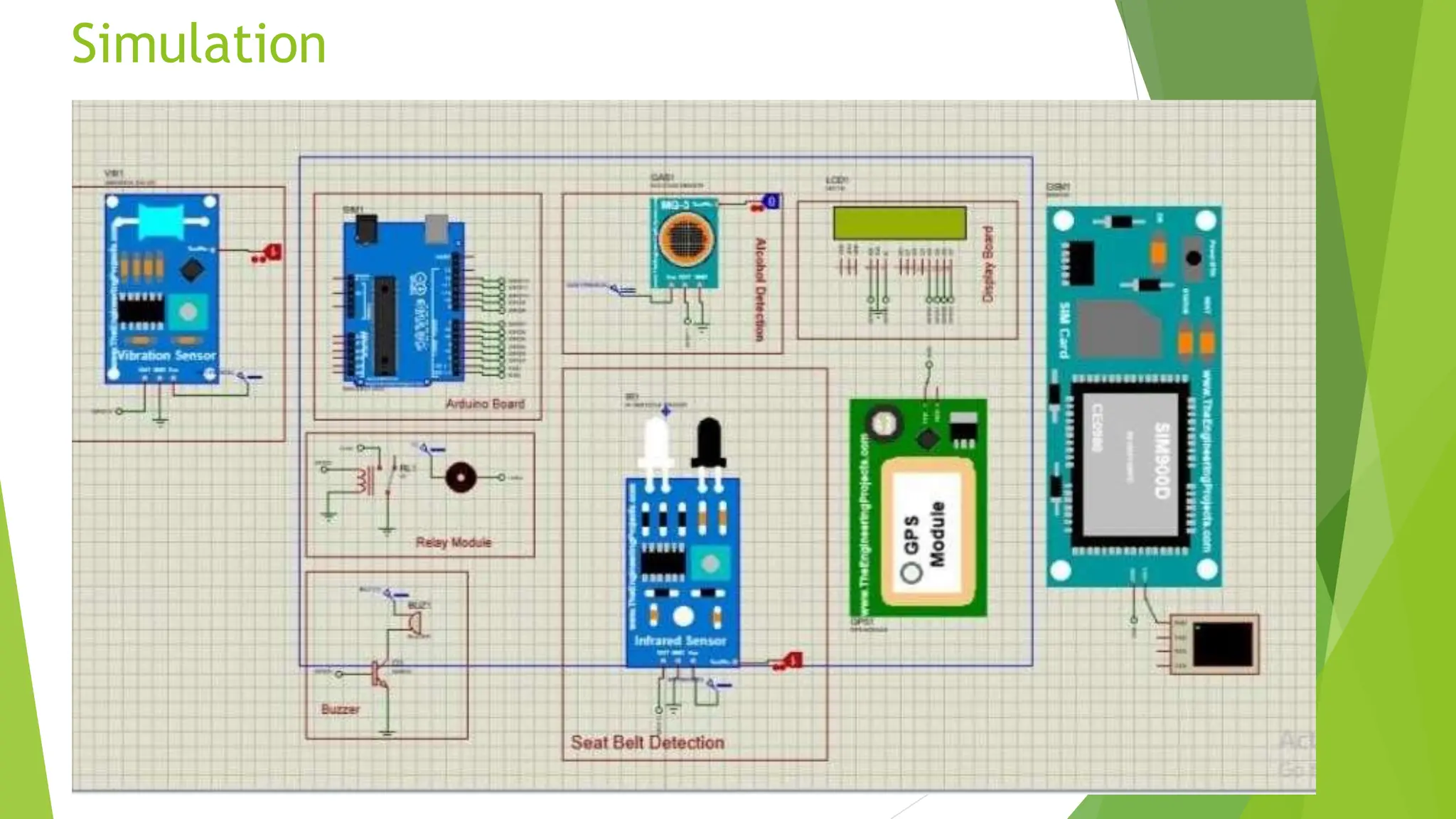
Simulation
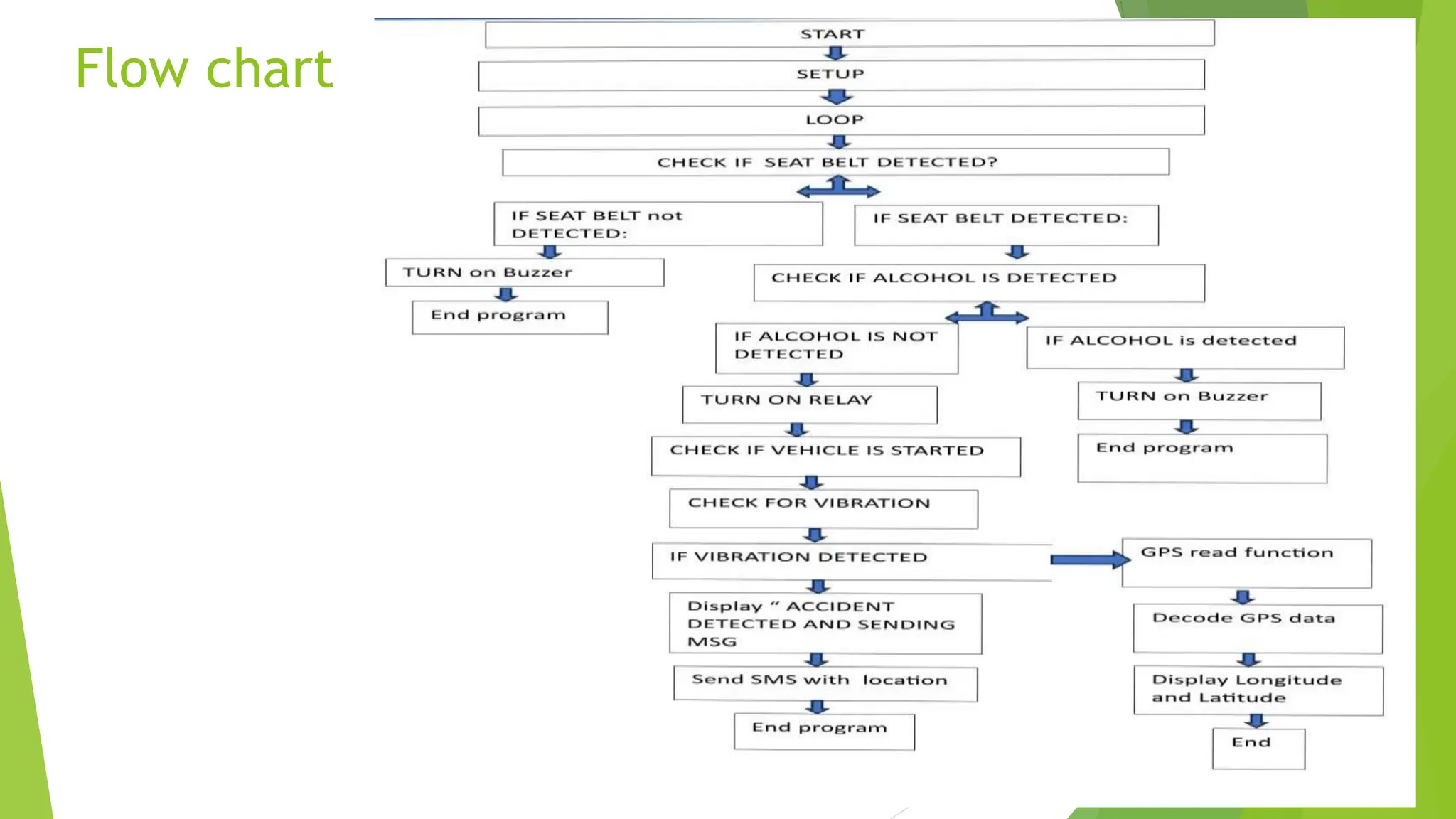
Flow chart
Programming on Arduino Code
Advantages
Improved traffic flow: Efficient traffic management can reduce congestion
and travel times
Efficient emergency services: Real-time data and coordinated responses can
make emergency services more effective
Reduced risk of collisions: Systemscan detect potential hazards and take
proactive measures to prevent accidents
Reduced casualties:Systems can reduce casualtiesdue to accidents Cost-
effective: Systems are cost-effective to implement
Better accuracy: Systems have better accuracy
Efficient time consumption: Systemsconsume time efficiently
Reduced chance of human error: Systems reduce the chance of human error
Disadvantages
False reporting: The system may report an accident at low speeds, even if it’s
not happening
Sensor damage: The system can’t detect sensor damage
Communication: In places without GSM networks, it can be hard to
communicate
Signal blockage: Mountains, high buildings, and tunnels can block signal
transmission
Vibrations: Vibrations in vehicles can cause the system to give false accident
detection
No GPS signal: The system may not have a GPS signal during a crash
Insufficient cellular signal: The system may not have enough cellular signal to
upload crash details
Application
Accident detection systems can alert emergency services about an accident
and share the exact location with them.
The systems can also alert others in your circle that you’ve been in an
accident.
The systems use sensors like accelerometers to detect the tilt of the vehicle,
and then send the information to the owner, family, or emergency services via
an app.
These systems are used to data capture, data storage, data analysis and
finally data transfer.
This system is based on new technology, its main purpose is to detect an
accident and alert to the control room, so the victim can find some help.
Conclusion
A smart vehicle tracking, monitoring, and anti-theft system represents a
significant advancement in automotive technology. By leveraging the capabilities
of IoT, GPS, sensors, and intelligent algorithms, this system offers comprehensive
protection and management for vehicles, reduced theft incidents, and improved
overall vehicle efficiency. Continued innovation and integration of emerging
technologies will further enhance the capabilities and effectiveness of such
systems, paving the way for a smarter, safer, and more connected future in
transportatin
THANK YOU

CAR ACCIDENT detection using IR SENSOR &

  • 1.
    “ Smart Vehicle SystemWith Tracking Monitoring Accident Detection And Antitheft Features ” Under the guidance of:- Prof. Dhriti Rudra Paul Prof. Tapan Kumar Mohanta (Assistant Professor, FST) Bikash Malakar (21IUT0020095) Sandipan Das (21IUT0020096) Sourav Basak (21IUT0020097) Mandeep Nath (21IUT0020100) Submitted In Partial Fulfillment Of The Course Requirement of Special Project –II (EC492) Submitted by:- DEPARTMENT OF ELECTRONICS AND COMMUNICATION ENGINEERING
  • 2.
    Introduction A smart vehiclesystem with tracking, Alchoohol detection, Sealt Belt monitoring, accident detection, and antitheft features can use a “smart unit” to record a vehicle’s data and send it to the owner or a third party at regular intervals. The smart device is made up of a variety of sensors that provide continuous safety to the driver. The system uses Global Positioning System (GPS) to find the location of the vehicle and then uses satellite or radio systems to send the coordinates and location data to the monitoring center. The monitoring center uses various software to plot the vehicle on a map.
  • 3.
    Objective The objective ofthe “low-power smart vehicle tracking, monitoring, collision avoidance, and anti- theft system” project is to design, develop, and implement a comprehensive solution that enhances the safety, security, and efficiency of vehicles. The project aims to integrate various technologies, including GPS tracking, sensor-based collision detection, remote monitoring, and anti-theft measures, into a single, unified system. Vehicle Tracking: Implement real-time GPS tracking to accurately monitor the location and movement of vehicles.. Anti-Theft Measures: Design and implement security features such as remote immobilization,and theft notifications to prevent unauthorized access and deter theft attempts. Smart Monitoring: Continuously monitor vehicle and Detecinting Seat belt is wear or not.
  • 4.
    Components Required 1. IRsensor 2. Arduno UNO 3. Gas Sensor 4. Vibration sensor 5. Gps module 6. Gsm module 7. Display Unit 8. Motor 9. Relay 10.Buzzer
  • 5.
    GPS Tracking System SatelliteSignals: GPS tracking devices installed in vehicles receive signalsfrom a network of satellites orbiting the Earth. These satellites continuouslytransmit their locations and the current time. Triangulation:The GPS tracking device calculates its distance from at least three satellitesby measuring the time it takes for the signals to reach the device. With this information,the device can determine its exact location through a process called triangulation. Data Transmission: Once the GPS device determinesits location, it transmits this data to a central server via a cellularnetwork or other communication channels.This allows the vehicle’slocation to be monitored remotely in real-time.
  • 6.
    Block Diagram Arduino UNO IRSENSOR GAS SENSOR 4.Buzzer 3.Relay SIM900D Vibratio n Sensor 2.Motor 1.Display Unit GPS MODULE I/P DEVICE O/P DEVICE
  • 7.
  • 8.
  • 9.
  • 12.
    Advantages Improved traffic flow:Efficient traffic management can reduce congestion and travel times Efficient emergency services: Real-time data and coordinated responses can make emergency services more effective Reduced risk of collisions: Systemscan detect potential hazards and take proactive measures to prevent accidents Reduced casualties:Systems can reduce casualtiesdue to accidents Cost- effective: Systems are cost-effective to implement Better accuracy: Systems have better accuracy Efficient time consumption: Systemsconsume time efficiently Reduced chance of human error: Systems reduce the chance of human error
  • 13.
    Disadvantages False reporting: Thesystem may report an accident at low speeds, even if it’s not happening Sensor damage: The system can’t detect sensor damage Communication: In places without GSM networks, it can be hard to communicate Signal blockage: Mountains, high buildings, and tunnels can block signal transmission Vibrations: Vibrations in vehicles can cause the system to give false accident detection No GPS signal: The system may not have a GPS signal during a crash Insufficient cellular signal: The system may not have enough cellular signal to upload crash details
  • 14.
    Application Accident detection systemscan alert emergency services about an accident and share the exact location with them. The systems can also alert others in your circle that you’ve been in an accident. The systems use sensors like accelerometers to detect the tilt of the vehicle, and then send the information to the owner, family, or emergency services via an app. These systems are used to data capture, data storage, data analysis and finally data transfer. This system is based on new technology, its main purpose is to detect an accident and alert to the control room, so the victim can find some help.
  • 15.
    Conclusion A smart vehicletracking, monitoring, and anti-theft system represents a significant advancement in automotive technology. By leveraging the capabilities of IoT, GPS, sensors, and intelligent algorithms, this system offers comprehensive protection and management for vehicles, reduced theft incidents, and improved overall vehicle efficiency. Continued innovation and integration of emerging technologies will further enhance the capabilities and effectiveness of such systems, paving the way for a smarter, safer, and more connected future in transportatin
  • 16.