Aleksandre Ambokadze
E-mail: sambokadze@geostat.ge
Head of IT Division
National Statistics Office of Georgia
DWeb Based - the respondent fills the questionnaire forms
directly into the web based application;
D
Paper Based - an interviewer reads questions, either face
to-face or over the telephone, to the respondent and
records his or her answers on the paper form;
DCAP/ (in the developmentprocess) - The questionnaire is
designed using CAPI software and is loaded onto the
device. The interviewer asks the questions to the
respondent, and inputs the responses directly into the
device;
O Low costs- There is no need to pay like for the paper questionnaires;
O Real-time Data - Respondents input their own data directly into a
central database;
O Conven ience - Respondents can answer questions on their schedule,
at their pace, and can even start a survey at one time, stop, and
complete it later;
O Design flexibility - Web-based methods allow for instant editing
checks as responses are entered, and, if desired, allows for many of
the traditional techniques for inputting responses such as textboxes,
dropdowns, checkboxes or other styles that are available through
web programming without additional software installed on the client
other than a web brow ser.
D Limited resp ondent availability - Some respondents do nod have
valid e-mail addresses and there are problems for responding to
online questionnaires;
D Possible cooperation p roblems - Although online surveys can attain
response rates equal to or slightly higher than that of traditional
modes, internet users today are constantly bombarded by messages
and can easily delete your advances;
D Qµestions complexity issues - Questions that are too complex,
complicated or contextual should not be used. The respondent may
not understand them properly;
D Computer-Assisted Personal Interviewing (CAPI) refers to interviews
conducted using handheld devices such as tablets;
D The questionnaire is configured using CAPI software and is loaded
onto the device;
O The interviewer asks the questions to the respondent, and inputs the
responses directly into the device;
D This electronic data capture approach eliminates the need for post
interview data entry and thus allows for immediate data retrieval;
D Since 2016 Geostat has started development of the
questionnaires using CAPI Software;
D We made changes in questionnaires due to CAPI
functionality;
D By the end of 2017 we plan to introduce the pilot version
of agriculture survey;
OData validation - Surveys can contain validation data that make it impossible to
enter values outside a given range. Supervisors may also view and check the collected
information as soon as the enumerators finish the interviews, together with possible
error reports. Automated routing reduces the incidence of missing data;
OReal-time U
p date - Changes in the structure of the questionnaire can be instantly
reflected on the interviewers' devices. This allows for last-minute updates or error
corrections. Unlike to the PAPI, Changes or corrections of the questionnaires have no
cost;
OGPS Mon itoring - The interview is normally conducted in the respondent's home or,
although rarely, in another agreed upon location. GPS field in the questionnaire gives
coordinates about respondent's home. This information is used by monitoring team;
OQµality - CAPI has a solely positive influence on the quality of statistical processes
and therefore - directly on the quality of statistics. Implementation of CAPI will
allow to improve our activities in line with the ES Code of Practice
DCAPI, compared with paper surveys, generates both extra costs and
.
savings;
Dset-up costs - CAPI will always be more expensive due to the time
needed to convert paper questionnaires to a tablet version;
Ddata entry cost - the savings generated by CAPI (which has no separate
data entry) increase as the size of the survey population increases;
Dcleaning data - The costs of cleaning data are also higher for paper
surveys since, in a CAPI interview, respondent and interviewer errors
are rectified during the interview itself;
DAdministration cost - Administration costs for paper surveys, which
include the printing and distribution of questionnaires, also tend to be
higher than for CAPI surveys;
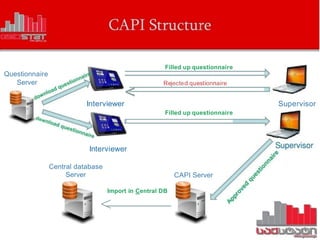
Questionnaire
Server
Filled up questionnaire
<
Rejected questionnaire
Interviewer Supervisor
Filled up questionnaire
Import in Central DB
<
Interviewer
Central database
Server CAPI Server
M
Thank you for your attention
Any questions?

capi presentation for free download here

  • 1.
    Aleksandre Ambokadze E-mail: sambokadze@geostat.ge Headof IT Division National Statistics Office of Georgia
  • 2.
    DWeb Based -the respondent fills the questionnaire forms directly into the web based application; D Paper Based - an interviewer reads questions, either face to-face or over the telephone, to the respondent and records his or her answers on the paper form; DCAP/ (in the developmentprocess) - The questionnaire is designed using CAPI software and is loaded onto the device. The interviewer asks the questions to the respondent, and inputs the responses directly into the device;
  • 3.
    O Low costs-There is no need to pay like for the paper questionnaires; O Real-time Data - Respondents input their own data directly into a central database; O Conven ience - Respondents can answer questions on their schedule, at their pace, and can even start a survey at one time, stop, and complete it later; O Design flexibility - Web-based methods allow for instant editing checks as responses are entered, and, if desired, allows for many of the traditional techniques for inputting responses such as textboxes, dropdowns, checkboxes or other styles that are available through web programming without additional software installed on the client other than a web brow ser.
  • 4.
    D Limited respondent availability - Some respondents do nod have valid e-mail addresses and there are problems for responding to online questionnaires; D Possible cooperation p roblems - Although online surveys can attain response rates equal to or slightly higher than that of traditional modes, internet users today are constantly bombarded by messages and can easily delete your advances; D Qµestions complexity issues - Questions that are too complex, complicated or contextual should not be used. The respondent may not understand them properly;
  • 5.
    D Computer-Assisted PersonalInterviewing (CAPI) refers to interviews conducted using handheld devices such as tablets; D The questionnaire is configured using CAPI software and is loaded onto the device; O The interviewer asks the questions to the respondent, and inputs the responses directly into the device; D This electronic data capture approach eliminates the need for post interview data entry and thus allows for immediate data retrieval;
  • 6.
    D Since 2016Geostat has started development of the questionnaires using CAPI Software; D We made changes in questionnaires due to CAPI functionality; D By the end of 2017 we plan to introduce the pilot version of agriculture survey;
  • 7.
    OData validation -Surveys can contain validation data that make it impossible to enter values outside a given range. Supervisors may also view and check the collected information as soon as the enumerators finish the interviews, together with possible error reports. Automated routing reduces the incidence of missing data; OReal-time U p date - Changes in the structure of the questionnaire can be instantly reflected on the interviewers' devices. This allows for last-minute updates or error corrections. Unlike to the PAPI, Changes or corrections of the questionnaires have no cost; OGPS Mon itoring - The interview is normally conducted in the respondent's home or, although rarely, in another agreed upon location. GPS field in the questionnaire gives coordinates about respondent's home. This information is used by monitoring team; OQµality - CAPI has a solely positive influence on the quality of statistical processes and therefore - directly on the quality of statistics. Implementation of CAPI will allow to improve our activities in line with the ES Code of Practice
  • 8.
    DCAPI, compared withpaper surveys, generates both extra costs and . savings; Dset-up costs - CAPI will always be more expensive due to the time needed to convert paper questionnaires to a tablet version; Ddata entry cost - the savings generated by CAPI (which has no separate data entry) increase as the size of the survey population increases; Dcleaning data - The costs of cleaning data are also higher for paper surveys since, in a CAPI interview, respondent and interviewer errors are rectified during the interview itself; DAdministration cost - Administration costs for paper surveys, which include the printing and distribution of questionnaires, also tend to be higher than for CAPI surveys;
  • 9.
    Questionnaire Server Filled up questionnaire < Rejectedquestionnaire Interviewer Supervisor Filled up questionnaire Import in Central DB < Interviewer Central database Server CAPI Server
  • 10.
    M Thank you foryour attention Any questions?