Capacity:
The capacity is the eligibility of the person to acquire
rights and assume liabilities. There are 2 types of
capacity:
a) Capacity to acquire:
• It implies the existence of eligibility to acquire rights and assume
liabilities, it is related to the existence of the personality.
- .
‫بااللتزام‬ ‫التحمل‬ ‫و‬ ‫الحقوق‬ ‫الكتساب‬ ‫الصالحية‬ ‫الوجوب‬ ‫أهلية‬.
b) Capacity to exercise:
• It is the person’s ability to express his will by himself for his own
account. This ability requires full consciousness. Thus, the person’s full
capacity to exercise entitles him to exercise all kinds of legal
transactions.
-
:
‫عن‬ ‫بااللتزام‬ ‫التحمل‬ ‫و‬ ‫الحقوق‬ ‫اكتساب‬ ‫على‬ ‫القدرة‬ ‫هى‬ ‫األداء‬ ‫أهلية‬
.‫القانونى‬ ‫التصرف‬ ‫طريق‬
-
.‫قانونية‬ ‫اثار‬ ‫عليه‬ ‫يترتب‬ ‫تعبيرا‬ ‫ارادته‬ ‫عن‬ ‫للتعبير‬ ‫الشخص‬ ‫صالحية‬ ‫فهى‬
I) The stage of capacity of the person affects his eligibility to enter
certain types of transactions.
• In general, There are three types of legal transactions:
First one : Completely beneficial transactions:
‫حضا‬ ‫نفعا‬ ‫النافعة‬ ‫التصرفات‬
• The person who exercises this type of transaction gets rich without
giving any return to the other party such as accepting donation.
Second one : Completely detrimental transactions
:
‫محضا‬ ‫ضرا‬ ‫الضارة‬ ‫التصرفات‬
• Here, the person who exercise these type of transactions get gives out
of his patrimony without getting anything in return. Such as writing a
will.
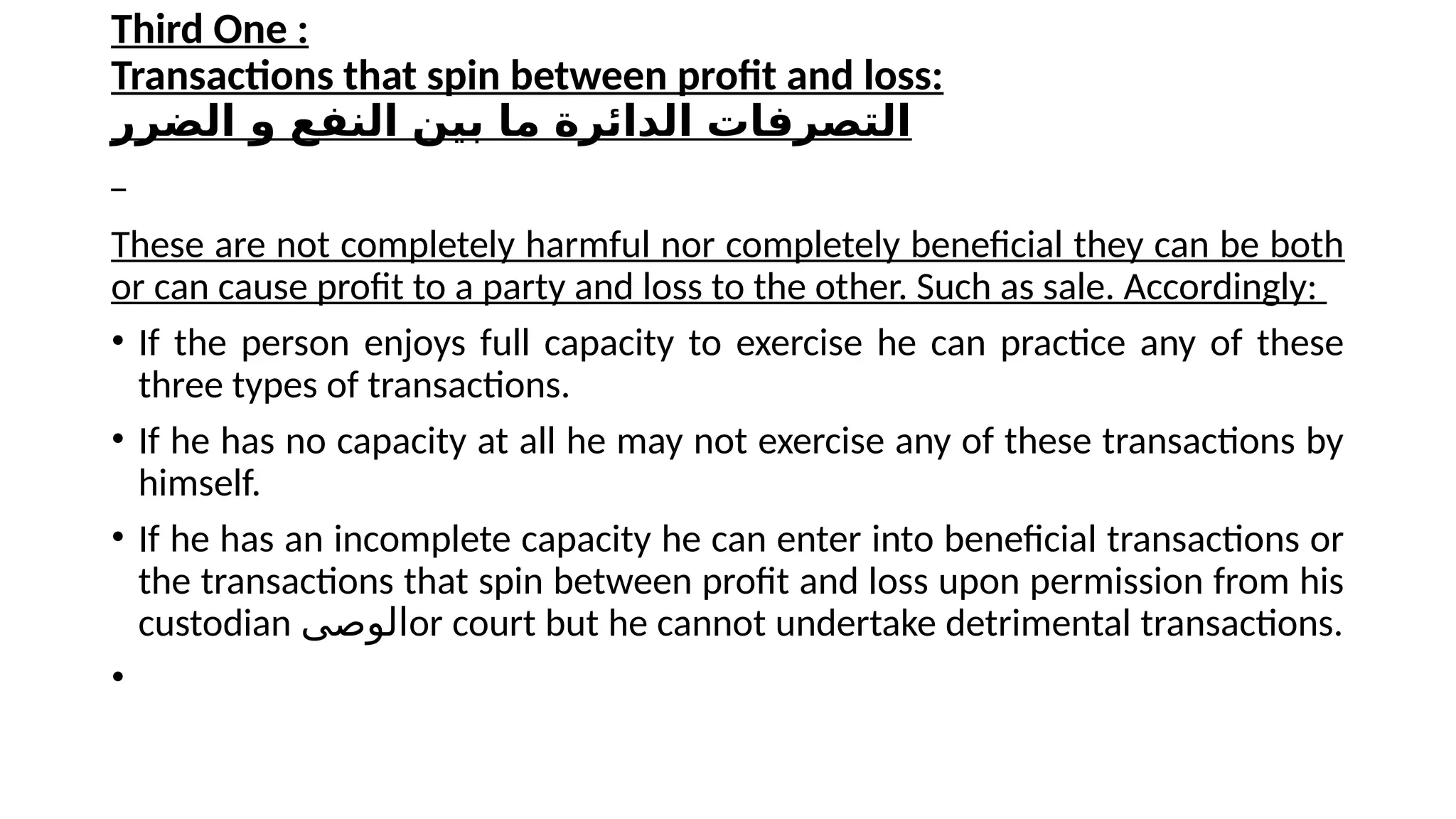
Third One :
Transactions that spin between profit and loss:
‫الضرر‬ ‫و‬ ‫النفع‬ ‫بين‬ ‫ما‬ ‫الدائرة‬ ‫التصرفات‬
These are not completely harmful nor completely beneficial they can be both
or can cause profit to a party and loss to the other. Such as sale. Accordingly:
• If the person enjoys full capacity to exercise he can practice any of these
three types of transactions.
• If he has no capacity at all he may not exercise any of these transactions by
himself.
• If he has an incomplete capacity he can enter into beneficial transactions or
the transactions that spin between profit and loss upon permission from his
custodian ‫الوصى‬or court but he cannot undertake detrimental transactions.
•
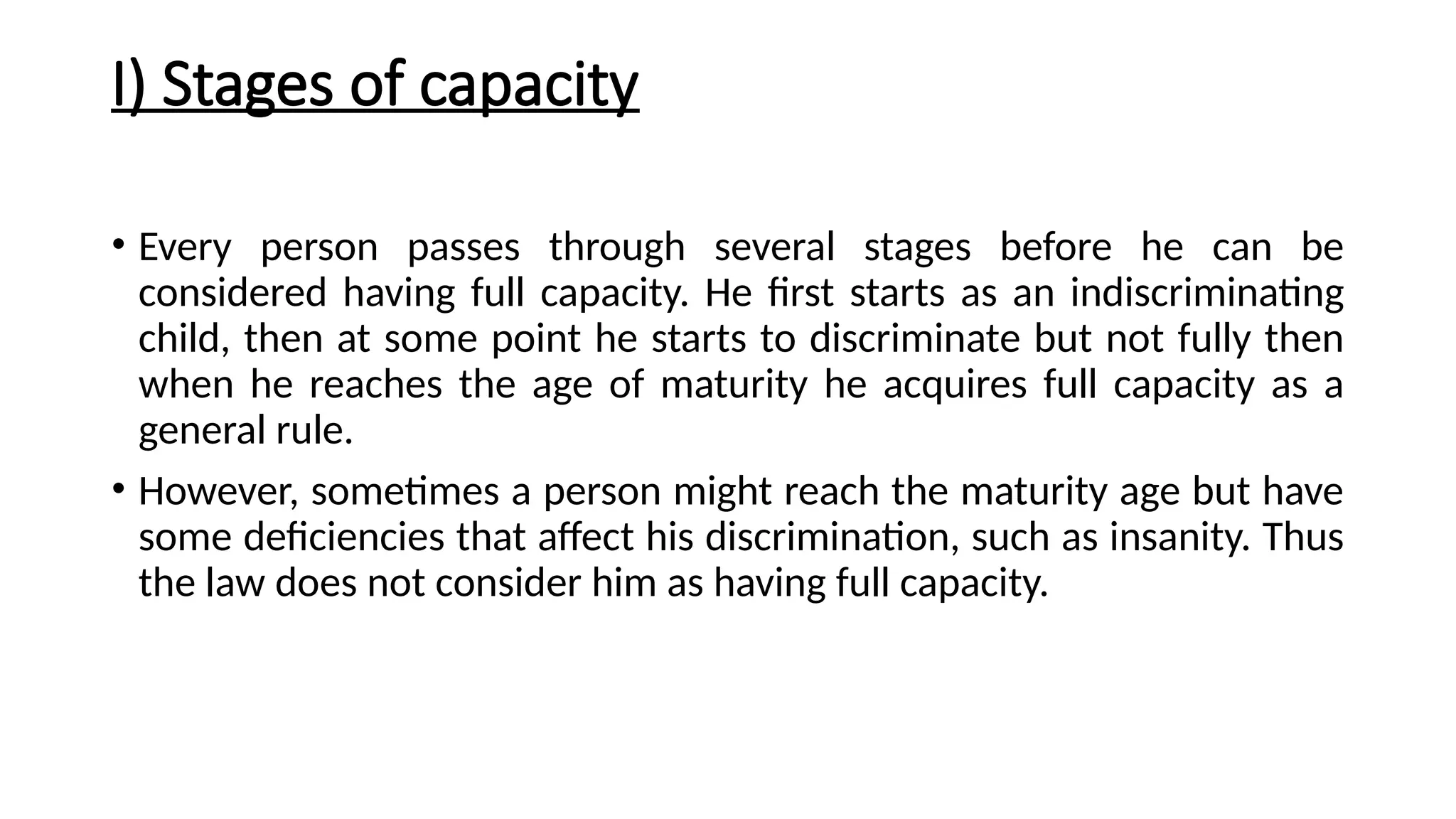
I) Stages of capacity
• Every person passes through several stages before he can be
considered having full capacity. He first starts as an indiscriminating
child, then at some point he starts to discriminate but not fully then
when he reaches the age of maturity he acquires full capacity as a
general rule.
• However, sometimes a person might reach the maturity age but have
some deficiencies that affect his discrimination, such as insanity. Thus
the law does not consider him as having full capacity.
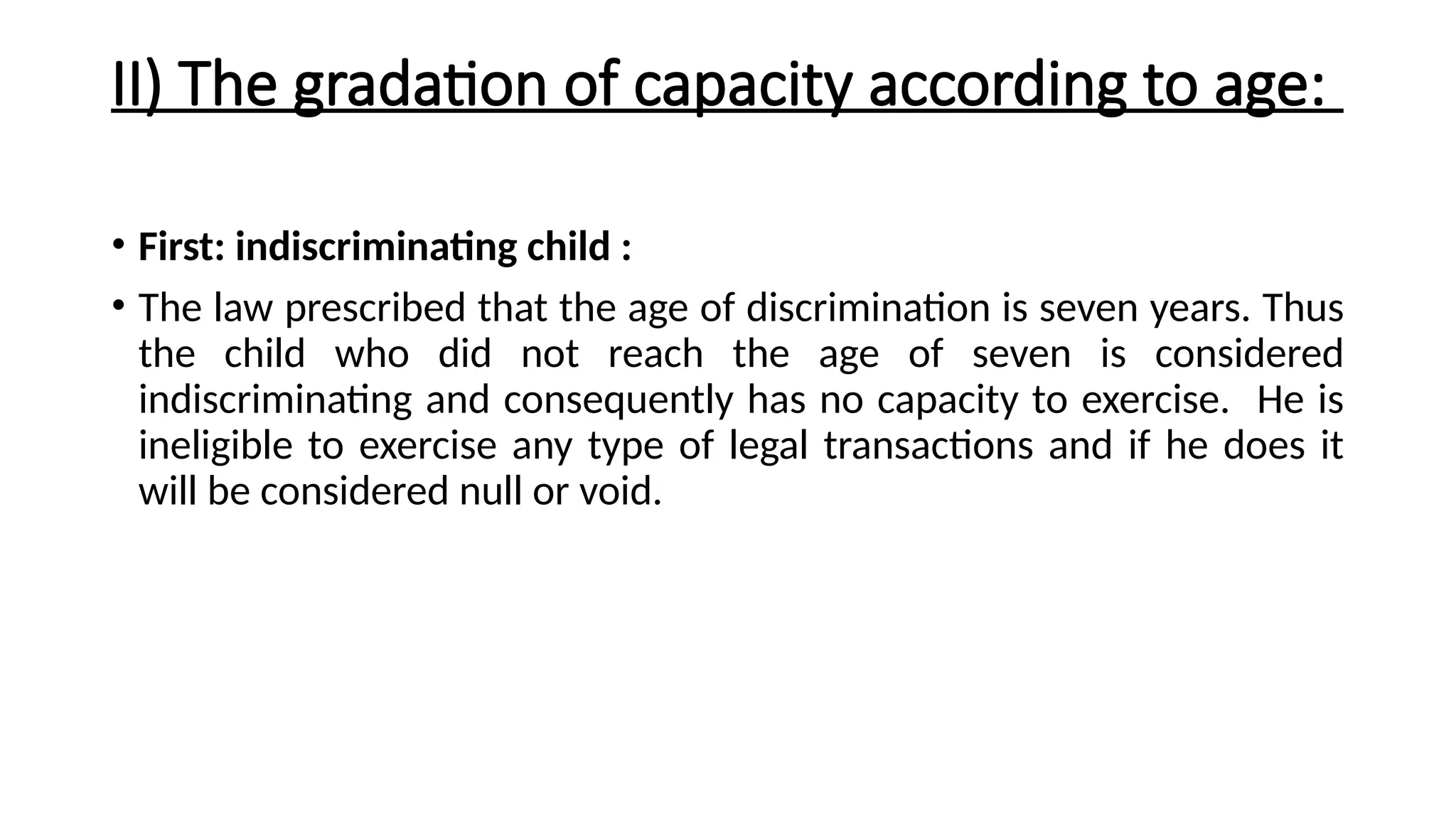
II) The gradation of capacity according to age:
• First: indiscriminating child :
• The law prescribed that the age of discrimination is seven years. Thus
the child who did not reach the age of seven is considered
indiscriminating and consequently has no capacity to exercise. He is
ineligible to exercise any type of legal transactions and if he does it
will be considered null or void.
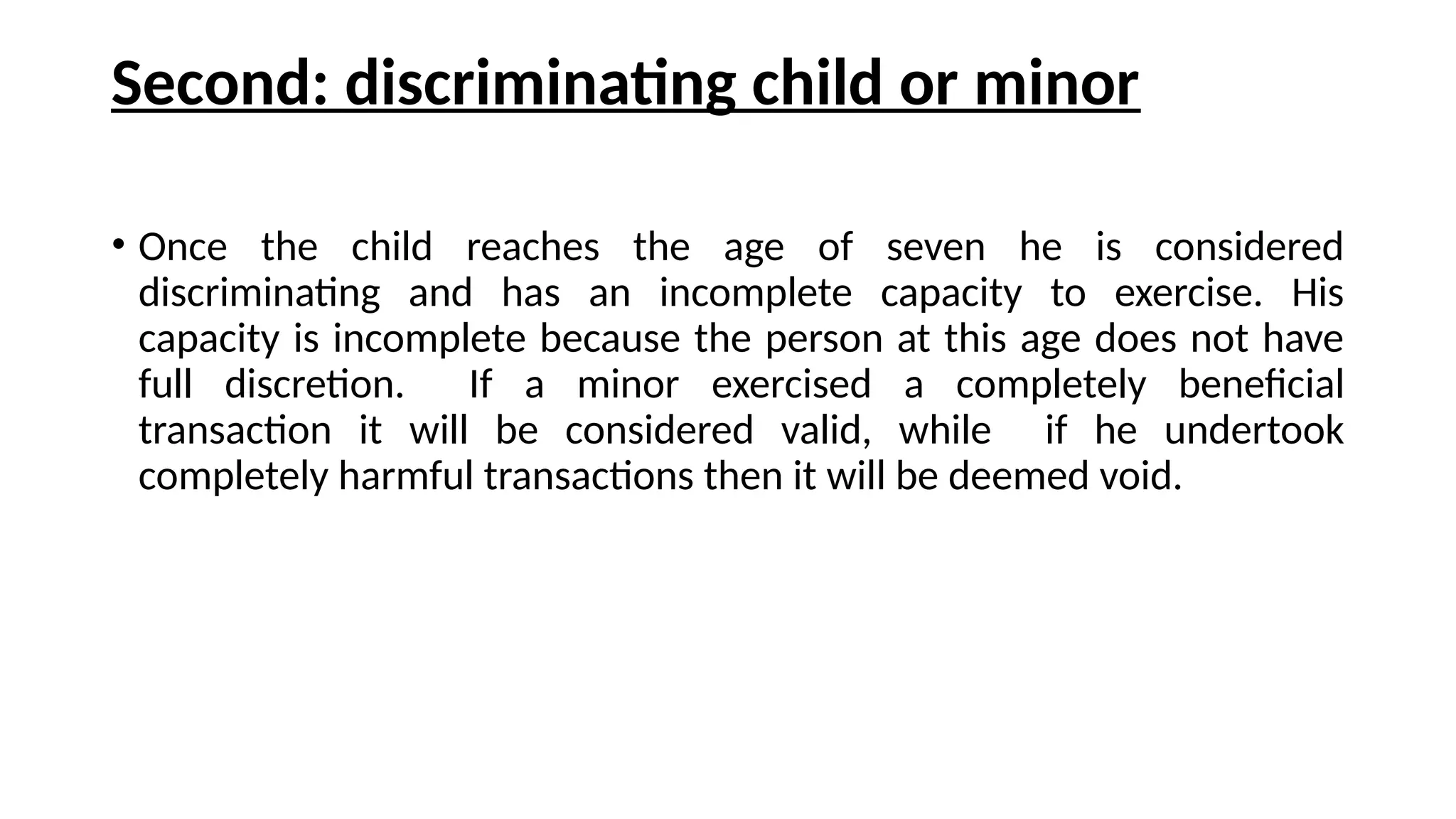
Second: discriminating child or minor
• Once the child reaches the age of seven he is considered
discriminating and has an incomplete capacity to exercise. His
capacity is incomplete because the person at this age does not have
full discretion. If a minor exercised a completely beneficial
transaction it will be considered valid, while if he undertook
completely harmful transactions then it will be deemed void.
Third : the adult or major
• The law prescribes that the age of maturity is 21. At this age the law
considers him has full discretion and thus full capacity to exercise.
• However it is not sufficient that the person reaches 21 to be major
and have full capacity to exercise. He must be totally sane too. Thus, if
person reaches 21 but have a mental defect his capacity would still be
incomplete.
Incidents that affect mental ability and affects in turn the
capacity can be divided into two categories:
• Incidents that deprives the person from his legal capacity: which are
insanity and feeblemindedness. In such cases he is considered an
indiscriminating child. ‫معتوه‬ ‫و‬ ‫مجنون‬
• Incidents that reduce the level of person’s discretion: which are
imbecility and prodigality. Here the person is considered as a
discriminating child. ‫الغفلة‬ ‫ذى‬ ‫و‬ ‫سفيه‬
Second Juristic persons:
• The legal personality is not limited to natural persons. There is
another type of persons that may enjoy legal personality that is the
juristic person.
• Juristic persons are: assemblies of natural persons or funds, dedicated
to achieve a certain objective and possess and independent entity
separate from the personalities of its constituents.
• The juristic person cannot participate into the legal life or have legal
personality unless the law acknowledges its existence.
• The legislator sets in advance the general requirements that an
assembly of funds or persons have to satisfy in order to acquire the
juristic personality. Juristic personalities stated in law are:
associations, companies, endowments, foundations, the state, the
provinces, towns, villages.
• Juristic personality can come to an end through several ways; If it has
a term stated in the document that founded it. Or if it achieved the
objective from founding it or if the objective become impossible to
realize. Or through dissolution.
The juristic personality enjoys similar characteristics as the natural
persons. Thus it entails the following characteristics:
• status:
• Juristic personalities does not have a civil status as it cannot have a
family. However it can have a nationality and it is distinct from the
nationality of its constituents.
• Name:
• The law requires the juristic person to choose a name that
distinguishes it from other entities. The constituents of the juristic
person have to choose its name once its established and state the
name in the document of its foundation.
• Domicile:
• The domicile of the juristic person is different from that of its
constituents. The domicile of the juristic person is the place where its
headquarters exist or where the head management office exists.
• Capacity:
• The juristic person enjoys a capacity to perform and a capacity to
exercise and owns a patrimony that is separate from its founders.
• The aforementioned introduction as we have said before is a must
know information for any person in order to be able to grasp the legal
concepts of the business law.
• Now that we have given you the required introduction to law. we shall
turn to the laws governing the business world .
Characteristics of Commercial law
• French and Egyptian Jurisprudence define commercial law as: A
branch of private law that regulates certain activities called the
commercial acts and category of legal persons called merchants.
• The commercial law is a branch of private law because it
regulates the relations between private persons (whether
natural or juristic).
• The commercial law despite having a close resemblance to the
civil law, it cannot be considered a law that comprises of mere
exceptions to the general rules. The commercial world is
fundamentally different. This difference can be seen in:
a) Rapidity in Civil and Commercial Life :
• In everyday life, people do not usually take big risks or focus on
making a profit. Most people work in jobs or professions to earn
money for their daily needs. Even if they make deals or contracts to
manage their money, their main goal is to keep their savings safe and
prevent loss. Because of this, people in civil life are careful and take
their time with decisions. Civil law is designed to protect this stability
and slow decision-making.
• On the other hand, business life is very different. In commerce,
people aim to make a profit, which means they often take risks and
move money quickly. For example, a merchant buys products only to
sell them again and make a profit. Since businesses are always making
deals and transactions, they need to act fast. Delays can cause losses,
and in business, "time is money." This is why commercial law is made
to support quick actions and fast decisions.
b) Credit and Trustworthiness :
• Speed alone is not enough to explain why business needs a separate
law. In the commercial world, fast transactions must be reliable, and
merchants need to keep their promises. However, in reality, many
merchants face a problem: they do not always have enough cash
available to pay immediately. This is where credit becomes important,
as it allows business to continue without needing cash on hand.
• Credit is based on trust. It means giving a buyer extra time to pay for
goods or services. For example, wholesale merchants usually cannot
pay for the goods they buy right away. Instead, they get a few months
to pay after selling the goods. In this case, the producer gives credit to
the wholesaler. Similarly, the wholesaler might also give credit to
retail merchants, who then sell to customers who may take loans
from banks. This chain of credit keeps businesses running smoothly.
The Need for a Separate Commercial Law
The business world is deeply connected through a continuous chain of
credit transactions. Because of this, commercial law must protect and
support credit through special rules, such as solidarity and bankruptcy
laws.
• Now that we see how commerce operates on different principles—
speed, credit, and trust—it becomes clear that it requires its own
legal system, separate from civil law. Unlike civil law, which focuses on
stability and careful decision-making, commercial law is designed to
ensure fast transactions and protect trust in credit-based deals. Legal
experts agree that commercial law must be independent to meet the
unique needs of businesses.
Sources of Commercial Law:
• The hierarchy of commercial law sources ensures that business
transactions remain legally structured and adaptable to different
situations. The priority order—agreements, statutes, customs, and
civil law—helps resolve commercial disputes efficiently.
Importance of Agreements in Commercial
Law
• Agreements are given the highest priority in commercial law because
they allow businesses to set their own rules. Since businesses
operate in diverse industries with unique needs, contracts provide
flexibility to customize obligations, payment terms, and risk
management strategies. However, this contractual freedom is not
unlimited—contracts cannot contradict public order or mandatory
legal provisions.
• Role of Commercial Statutes
• When contracts do not specify how to handle a dispute, commercial
statutes provide a default legal framework. These laws ensure
fairness and consistency in business practices. Since business
transactions involve complex financial and operational dealings,
commercial statutes cover issues such as:
• Business formations and partnerships
• Corporate governance
• Trade regulations
• Banking and financial transactions
• Bankruptcy laws
• Customs and Usages as a Source of Law
• Even though commercial statutes have codified many old business
customs, some industry-specific traditions remain important.
Customs and usages provide flexibility and practical solutions for
businesses that operate based on long-standing trade practices.
• For instance, in international trade, customs and usages play a crucial
role, as businesses from different countries may not have the same
legal framework. Recognizing trade customs allows transactions to
proceed smoothly, even when legal systems differ.
• Civil Law as a Last Resort
• When no contract, statute, or business custom applies to a dispute,
civil law serves as a backup source. However, commercial law always
takes priority over civil law in business matters.
PLAN OF STUDY :
• Part I: Commercial acts.
• Part II: Merchants.
• Part III: Commercial Companies
• Part IV: Commercial papers.

Capacity.pptx 4.pptx presentation in the

  • 1.
    Capacity: The capacity isthe eligibility of the person to acquire rights and assume liabilities. There are 2 types of capacity:
  • 2.
    a) Capacity toacquire: • It implies the existence of eligibility to acquire rights and assume liabilities, it is related to the existence of the personality. - . ‫بااللتزام‬ ‫التحمل‬ ‫و‬ ‫الحقوق‬ ‫الكتساب‬ ‫الصالحية‬ ‫الوجوب‬ ‫أهلية‬.
  • 3.
    b) Capacity toexercise: • It is the person’s ability to express his will by himself for his own account. This ability requires full consciousness. Thus, the person’s full capacity to exercise entitles him to exercise all kinds of legal transactions. - : ‫عن‬ ‫بااللتزام‬ ‫التحمل‬ ‫و‬ ‫الحقوق‬ ‫اكتساب‬ ‫على‬ ‫القدرة‬ ‫هى‬ ‫األداء‬ ‫أهلية‬ .‫القانونى‬ ‫التصرف‬ ‫طريق‬ - .‫قانونية‬ ‫اثار‬ ‫عليه‬ ‫يترتب‬ ‫تعبيرا‬ ‫ارادته‬ ‫عن‬ ‫للتعبير‬ ‫الشخص‬ ‫صالحية‬ ‫فهى‬
  • 4.
    I) The stageof capacity of the person affects his eligibility to enter certain types of transactions. • In general, There are three types of legal transactions: First one : Completely beneficial transactions: ‫حضا‬ ‫نفعا‬ ‫النافعة‬ ‫التصرفات‬ • The person who exercises this type of transaction gets rich without giving any return to the other party such as accepting donation.
  • 5.
    Second one :Completely detrimental transactions : ‫محضا‬ ‫ضرا‬ ‫الضارة‬ ‫التصرفات‬ • Here, the person who exercise these type of transactions get gives out of his patrimony without getting anything in return. Such as writing a will.
  • 6.
    Third One : Transactionsthat spin between profit and loss: ‫الضرر‬ ‫و‬ ‫النفع‬ ‫بين‬ ‫ما‬ ‫الدائرة‬ ‫التصرفات‬ These are not completely harmful nor completely beneficial they can be both or can cause profit to a party and loss to the other. Such as sale. Accordingly: • If the person enjoys full capacity to exercise he can practice any of these three types of transactions. • If he has no capacity at all he may not exercise any of these transactions by himself. • If he has an incomplete capacity he can enter into beneficial transactions or the transactions that spin between profit and loss upon permission from his custodian ‫الوصى‬or court but he cannot undertake detrimental transactions. •
  • 7.
    I) Stages ofcapacity • Every person passes through several stages before he can be considered having full capacity. He first starts as an indiscriminating child, then at some point he starts to discriminate but not fully then when he reaches the age of maturity he acquires full capacity as a general rule. • However, sometimes a person might reach the maturity age but have some deficiencies that affect his discrimination, such as insanity. Thus the law does not consider him as having full capacity.
  • 8.
    II) The gradationof capacity according to age: • First: indiscriminating child : • The law prescribed that the age of discrimination is seven years. Thus the child who did not reach the age of seven is considered indiscriminating and consequently has no capacity to exercise. He is ineligible to exercise any type of legal transactions and if he does it will be considered null or void.
  • 9.
    Second: discriminating childor minor • Once the child reaches the age of seven he is considered discriminating and has an incomplete capacity to exercise. His capacity is incomplete because the person at this age does not have full discretion. If a minor exercised a completely beneficial transaction it will be considered valid, while if he undertook completely harmful transactions then it will be deemed void.
  • 10.
    Third : theadult or major • The law prescribes that the age of maturity is 21. At this age the law considers him has full discretion and thus full capacity to exercise. • However it is not sufficient that the person reaches 21 to be major and have full capacity to exercise. He must be totally sane too. Thus, if person reaches 21 but have a mental defect his capacity would still be incomplete.
  • 11.
    Incidents that affectmental ability and affects in turn the capacity can be divided into two categories: • Incidents that deprives the person from his legal capacity: which are insanity and feeblemindedness. In such cases he is considered an indiscriminating child. ‫معتوه‬ ‫و‬ ‫مجنون‬ • Incidents that reduce the level of person’s discretion: which are imbecility and prodigality. Here the person is considered as a discriminating child. ‫الغفلة‬ ‫ذى‬ ‫و‬ ‫سفيه‬
  • 12.
    Second Juristic persons: •The legal personality is not limited to natural persons. There is another type of persons that may enjoy legal personality that is the juristic person. • Juristic persons are: assemblies of natural persons or funds, dedicated to achieve a certain objective and possess and independent entity separate from the personalities of its constituents. • The juristic person cannot participate into the legal life or have legal personality unless the law acknowledges its existence.
  • 13.
    • The legislatorsets in advance the general requirements that an assembly of funds or persons have to satisfy in order to acquire the juristic personality. Juristic personalities stated in law are: associations, companies, endowments, foundations, the state, the provinces, towns, villages. • Juristic personality can come to an end through several ways; If it has a term stated in the document that founded it. Or if it achieved the objective from founding it or if the objective become impossible to realize. Or through dissolution.
  • 14.
    The juristic personalityenjoys similar characteristics as the natural persons. Thus it entails the following characteristics: • status: • Juristic personalities does not have a civil status as it cannot have a family. However it can have a nationality and it is distinct from the nationality of its constituents. • Name: • The law requires the juristic person to choose a name that distinguishes it from other entities. The constituents of the juristic person have to choose its name once its established and state the name in the document of its foundation.
  • 15.
    • Domicile: • Thedomicile of the juristic person is different from that of its constituents. The domicile of the juristic person is the place where its headquarters exist or where the head management office exists. • Capacity: • The juristic person enjoys a capacity to perform and a capacity to exercise and owns a patrimony that is separate from its founders.
  • 16.
    • The aforementionedintroduction as we have said before is a must know information for any person in order to be able to grasp the legal concepts of the business law. • Now that we have given you the required introduction to law. we shall turn to the laws governing the business world .
  • 17.
    Characteristics of Commerciallaw • French and Egyptian Jurisprudence define commercial law as: A branch of private law that regulates certain activities called the commercial acts and category of legal persons called merchants. • The commercial law is a branch of private law because it regulates the relations between private persons (whether natural or juristic).
  • 18.
    • The commerciallaw despite having a close resemblance to the civil law, it cannot be considered a law that comprises of mere exceptions to the general rules. The commercial world is fundamentally different. This difference can be seen in:
  • 19.
    a) Rapidity inCivil and Commercial Life : • In everyday life, people do not usually take big risks or focus on making a profit. Most people work in jobs or professions to earn money for their daily needs. Even if they make deals or contracts to manage their money, their main goal is to keep their savings safe and prevent loss. Because of this, people in civil life are careful and take their time with decisions. Civil law is designed to protect this stability and slow decision-making.
  • 20.
    • On theother hand, business life is very different. In commerce, people aim to make a profit, which means they often take risks and move money quickly. For example, a merchant buys products only to sell them again and make a profit. Since businesses are always making deals and transactions, they need to act fast. Delays can cause losses, and in business, "time is money." This is why commercial law is made to support quick actions and fast decisions.
  • 21.
    b) Credit andTrustworthiness : • Speed alone is not enough to explain why business needs a separate law. In the commercial world, fast transactions must be reliable, and merchants need to keep their promises. However, in reality, many merchants face a problem: they do not always have enough cash available to pay immediately. This is where credit becomes important, as it allows business to continue without needing cash on hand.
  • 22.
    • Credit isbased on trust. It means giving a buyer extra time to pay for goods or services. For example, wholesale merchants usually cannot pay for the goods they buy right away. Instead, they get a few months to pay after selling the goods. In this case, the producer gives credit to the wholesaler. Similarly, the wholesaler might also give credit to retail merchants, who then sell to customers who may take loans from banks. This chain of credit keeps businesses running smoothly.
  • 23.
    The Need fora Separate Commercial Law The business world is deeply connected through a continuous chain of credit transactions. Because of this, commercial law must protect and support credit through special rules, such as solidarity and bankruptcy laws.
  • 24.
    • Now thatwe see how commerce operates on different principles— speed, credit, and trust—it becomes clear that it requires its own legal system, separate from civil law. Unlike civil law, which focuses on stability and careful decision-making, commercial law is designed to ensure fast transactions and protect trust in credit-based deals. Legal experts agree that commercial law must be independent to meet the unique needs of businesses.
  • 25.
    Sources of CommercialLaw: • The hierarchy of commercial law sources ensures that business transactions remain legally structured and adaptable to different situations. The priority order—agreements, statutes, customs, and civil law—helps resolve commercial disputes efficiently.
  • 26.
    Importance of Agreementsin Commercial Law • Agreements are given the highest priority in commercial law because they allow businesses to set their own rules. Since businesses operate in diverse industries with unique needs, contracts provide flexibility to customize obligations, payment terms, and risk management strategies. However, this contractual freedom is not unlimited—contracts cannot contradict public order or mandatory legal provisions.
  • 27.
    • Role ofCommercial Statutes • When contracts do not specify how to handle a dispute, commercial statutes provide a default legal framework. These laws ensure fairness and consistency in business practices. Since business transactions involve complex financial and operational dealings, commercial statutes cover issues such as: • Business formations and partnerships • Corporate governance • Trade regulations • Banking and financial transactions • Bankruptcy laws
  • 28.
    • Customs andUsages as a Source of Law • Even though commercial statutes have codified many old business customs, some industry-specific traditions remain important. Customs and usages provide flexibility and practical solutions for businesses that operate based on long-standing trade practices. • For instance, in international trade, customs and usages play a crucial role, as businesses from different countries may not have the same legal framework. Recognizing trade customs allows transactions to proceed smoothly, even when legal systems differ. • Civil Law as a Last Resort • When no contract, statute, or business custom applies to a dispute, civil law serves as a backup source. However, commercial law always takes priority over civil law in business matters.
  • 29.
    PLAN OF STUDY: • Part I: Commercial acts. • Part II: Merchants. • Part III: Commercial Companies • Part IV: Commercial papers.