

Sweeti Kumari Sah
G. V. P. College
13131D2512 1
CanvasFingerprinting12/22/2014
Contents
• Introduction
• Problem Today
• Web Browser Fingerprinting
• Working Mechanism
• Examples
• Primary Actions
• Limitations
• Conclusion
• References
12/22/2014CanvasFingerprinting
2
INTRODUCTION
History (Canvas Fingerprinting):
• In May 2012, Keaton Mowery and Hovav Shacham,
researchers at University of California, San Diego, wrote
a paper ‘Pixel Perfect: Fingerprinting Canvas in
HTML5’ describing how the HTML5 canvas could be
used to create digital fingerprints of web users.
• Social bookmarking technology company AddThis
experimented it early in 2014.
• AddThis, employing it in “shadowing visitors to
thousands of top websites, from WhiteHouse.gov to
YouPorn.com.”
12/22/2014CanvasFingerprinting
3
1993
4
CanvasFingerprinting12/22/2014
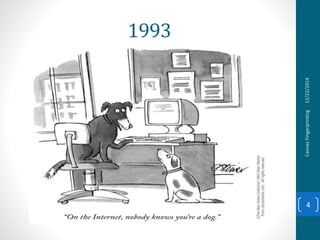
But today on the internet...
Interested parties not only know you’re a dog, they
also have a pretty good idea of the color of your fur,
how often you visit the vet, and what your favorite
doggy treat is.
12/22/2014CanvasFingerprinting
5
Canvas Fingerprinting
• A new web tracking tool that's ‘nearly impossible
to block’
• Technology which advertisers use to track your
every movement online
• One of a number of browser fingerprinting
techniques of tracking online users that allow
websites to uniquely identify and track visitors
without the use of browser cookies
12/22/2014CanvasFingerprinting
6
Problem
 Modern web browsers suffer from a
fundamental privacy/information leakage flaw.
 Websites you visit can query your web browser
for instance-specific information.
 Using this information, one can attach a certain
uniqueness to your browser thereby creating a
very persistent, cookie-less tracking
mechanism.
12/22/2014CanvasFingerprinting
7
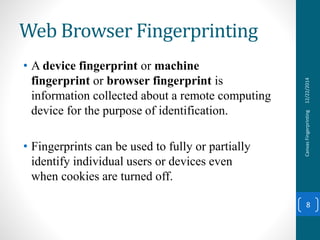
Web Browser Fingerprinting
• A device fingerprint or machine
fingerprint or browser fingerprint is
information collected about a remote computing
device for the purpose of identification.
• Fingerprints can be used to fully or partially
identify individual users or devices even
when cookies are turned off.
12/22/2014CanvasFingerprinting
8
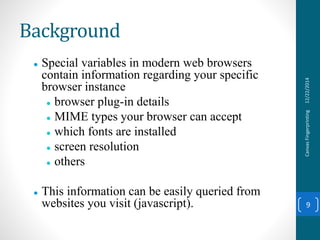
Background
 Special variables in modern web browsers
contain information regarding your specific
browser instance
 browser plug-in details
 MIME types your browser can accept
 which fonts are installed
 screen resolution
 others
 This information can be easily queried from
websites you visit (javascript).
12/22/2014CanvasFingerprinting
9
12/22/2014CanvasFingerprinting
10
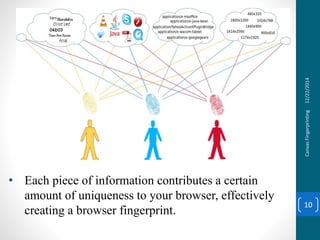
• Each piece of information contributes a certain
amount of uniqueness to your browser, effectively
creating a browser fingerprint.
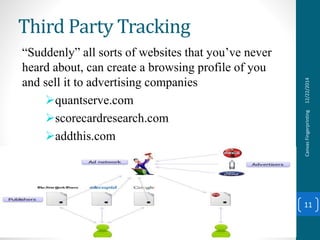
Third Party Tracking
“Suddenly” all sorts of websites that you’ve never
heard about, can create a browsing profile of you
and sell it to advertising companies
quantserve.com
scorecardresearch.com
addthis.com
12/22/2014CanvasFingerprinting
11
Implementation
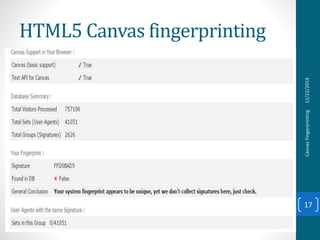
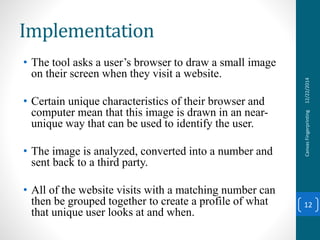
• The tool asks a user’s browser to draw a small image
on their screen when they visit a website.
• Certain unique characteristics of their browser and
computer mean that this image is drawn in an near-
unique way that can be used to identify the user.
• The image is analyzed, converted into a number and
sent back to a third party.
• All of the website visits with a matching number can
then be grouped together to create a profile of what
that unique user looks at and when.
12/22/2014CanvasFingerprinting
12
12/22/2014CanvasFingerprinting
13
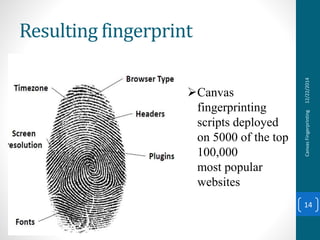
Resulting fingerprint
12/22/2014CanvasFingerprinting
14
Canvas
fingerprinting
scripts deployed
on 5000 of the top
100,000
most popular
websites
Basic flow of operation
When a user visits a page,
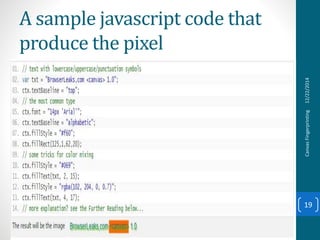
 The fingerprinting script first draws text with the font and
size of its choice and adds background colors.
 Next, the script calls Canvas API's ToDataURL method to
get the canvas pixel data in dataURL format, which is
basically a Base64 encoded representation of the binary
pixel data.
 Finally, the script takes the hash of the text-encoded pixel
data, which serves as the fingerprint and may be combined
with other high-entropy browser properties such as the list
of plugins, the list of fonts, or the user agent string.
12/22/2014CanvasFingerprinting
15
12/22/2014CanvasFingerprinting
16
To save the canvas image, you need to do similar to:
var el = document.getElementsByTagName('canvas')[0];
var base64 = el.toDataURL();
alert(base64);
HTML5 Canvas fingerprinting
12/22/2014CanvasFingerprinting
17
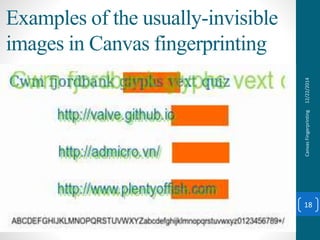
Examples of the usually-invisible
images in Canvas fingerprinting
12/22/2014CanvasFingerprinting
18
A sample javascript code that
produce the pixel
12/22/2014CanvasFingerprinting
19
Users Reacted..
• 1/3 of users delete first & third-party cookies
within a month after they’ve been setup
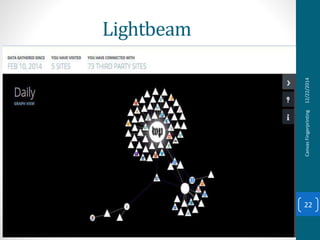
• Multiple extensions revealing hidden trackers
Ghostery
Lightbeam
• Private mode of browsers used to avoid traces of
cookies from certain websites
12/22/2014CanvasFingerprinting
20
Ghostery
12/22/2014CanvasFingerprinting
21
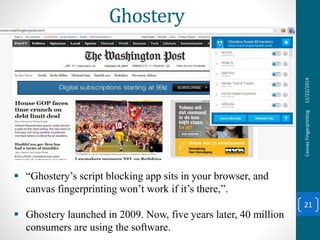
 “Ghostery’s script blocking app sits in your browser, and
canvas fingerprinting won’t work if it’s there,”.
 Ghostery launched in 2009. Now, five years later, 40 million
consumers are using the software.
Lightbeam
12/22/2014CanvasFingerprinting
22
Primary Actions
• Use the Tor browser (Warning: can be slow)
• Block Javascript from loading in your browser
(Warning: breaks a lot of websites)
• Use NoScript browser extension to block
JavaScript from known fingerprinters such as
AddThis (Warning: requires a lot of research and
decision-making)
12/22/2014CanvasFingerprinting
23
• Trying browser extension Chameleon that is
designed to block fingerprinting (Warning: only
recommended for tech-savvy users at this point)
• A countermeasure against canvas fingerprinting is the
CanvasFingerprintBlock browser extension
(currently only available for Chrome).
Every time a website tries to read data from a
canvas, the extension intervenes to blank the data out
before it can be read.
 If the website then use the read data to create a
fingerprint, everyone's fingerprint will look the same.
12/22/2014CanvasFingerprinting
24
Primary Actions
Limitations
• Unlike cookie, canvas fingerprinting brings Internet
tracking to an entirely new level of invasiveness.
• For one, it is performed without the user’s prior
knowledge or consent, and it’s extremely difficult to
know when and where you’re being tracked online.
• To make matters worse, canvas fingerprinting is
incredibly complicated and inconvenient to disable
on the user’s end.
12/22/2014CanvasFingerprinting
25
Conclusion
• Web tracking is so much more than cookies
• Fingerprinting is a real problem
• Browsers are so complex that it is really hard
to make them seem identical
• Current browser extensions should not be
used for privacy reasons
• Long term solutions will most-likely not be
pure technical ones (Legislation required )
12/22/2014CanvasFingerprinting
26
References:
• Acar, Gunes; Eubank, Christian; Englehardt, Steven;
Juarez, Marc; Narayanan, Arvind; Diaz, Claudia
(July 24, 2014). "The Web never forgets: Persistent
tracking mechanisms in the wild".
• Nikiforakis, Nick; Acar, Günes (2014-07-
25). "Browser Fingerprinting and the Online-
Tracking Arms Race". ieee.org. IEEE. Retrieved
2014-10-31.
• http://www.theregister.co.uk/2014/07/22/canvas_fing
erprinting_is_privacy_pirates_new_web_weapon/
12/22/2014CanvasFingerprinting
27
Queries Please
12/22/2014CanvasFingerprinting
28
12/22/2014CanvasFingerprinting
29

Canvas fingerprinting

  • 1.
    Sweeti Kumari Sah G.V. P. College 13131D2512 1 CanvasFingerprinting12/22/2014
  • 2.
    Contents • Introduction • ProblemToday • Web Browser Fingerprinting • Working Mechanism • Examples • Primary Actions • Limitations • Conclusion • References 12/22/2014CanvasFingerprinting 2
  • 3.
    INTRODUCTION History (Canvas Fingerprinting): •In May 2012, Keaton Mowery and Hovav Shacham, researchers at University of California, San Diego, wrote a paper ‘Pixel Perfect: Fingerprinting Canvas in HTML5’ describing how the HTML5 canvas could be used to create digital fingerprints of web users. • Social bookmarking technology company AddThis experimented it early in 2014. • AddThis, employing it in “shadowing visitors to thousands of top websites, from WhiteHouse.gov to YouPorn.com.” 12/22/2014CanvasFingerprinting 3
  • 4.
  • 5.
    But today onthe internet... Interested parties not only know you’re a dog, they also have a pretty good idea of the color of your fur, how often you visit the vet, and what your favorite doggy treat is. 12/22/2014CanvasFingerprinting 5
  • 6.
    Canvas Fingerprinting • Anew web tracking tool that's ‘nearly impossible to block’ • Technology which advertisers use to track your every movement online • One of a number of browser fingerprinting techniques of tracking online users that allow websites to uniquely identify and track visitors without the use of browser cookies 12/22/2014CanvasFingerprinting 6
  • 7.
    Problem  Modern webbrowsers suffer from a fundamental privacy/information leakage flaw.  Websites you visit can query your web browser for instance-specific information.  Using this information, one can attach a certain uniqueness to your browser thereby creating a very persistent, cookie-less tracking mechanism. 12/22/2014CanvasFingerprinting 7
  • 8.
    Web Browser Fingerprinting •A device fingerprint or machine fingerprint or browser fingerprint is information collected about a remote computing device for the purpose of identification. • Fingerprints can be used to fully or partially identify individual users or devices even when cookies are turned off. 12/22/2014CanvasFingerprinting 8
  • 9.
    Background  Special variablesin modern web browsers contain information regarding your specific browser instance  browser plug-in details  MIME types your browser can accept  which fonts are installed  screen resolution  others  This information can be easily queried from websites you visit (javascript). 12/22/2014CanvasFingerprinting 9
  • 10.
    12/22/2014CanvasFingerprinting 10 • Each pieceof information contributes a certain amount of uniqueness to your browser, effectively creating a browser fingerprint.
  • 11.
    Third Party Tracking “Suddenly”all sorts of websites that you’ve never heard about, can create a browsing profile of you and sell it to advertising companies quantserve.com scorecardresearch.com addthis.com 12/22/2014CanvasFingerprinting 11
  • 12.
    Implementation • The toolasks a user’s browser to draw a small image on their screen when they visit a website. • Certain unique characteristics of their browser and computer mean that this image is drawn in an near- unique way that can be used to identify the user. • The image is analyzed, converted into a number and sent back to a third party. • All of the website visits with a matching number can then be grouped together to create a profile of what that unique user looks at and when. 12/22/2014CanvasFingerprinting 12
  • 13.
  • 14.
  • 15.
    Basic flow ofoperation When a user visits a page,  The fingerprinting script first draws text with the font and size of its choice and adds background colors.  Next, the script calls Canvas API's ToDataURL method to get the canvas pixel data in dataURL format, which is basically a Base64 encoded representation of the binary pixel data.  Finally, the script takes the hash of the text-encoded pixel data, which serves as the fingerprint and may be combined with other high-entropy browser properties such as the list of plugins, the list of fonts, or the user agent string. 12/22/2014CanvasFingerprinting 15
  • 16.
    12/22/2014CanvasFingerprinting 16 To save thecanvas image, you need to do similar to: var el = document.getElementsByTagName('canvas')[0]; var base64 = el.toDataURL(); alert(base64);
  • 17.
  • 18.
    Examples of theusually-invisible images in Canvas fingerprinting 12/22/2014CanvasFingerprinting 18
  • 19.
    A sample javascriptcode that produce the pixel 12/22/2014CanvasFingerprinting 19
  • 20.
    Users Reacted.. • 1/3of users delete first & third-party cookies within a month after they’ve been setup • Multiple extensions revealing hidden trackers Ghostery Lightbeam • Private mode of browsers used to avoid traces of cookies from certain websites 12/22/2014CanvasFingerprinting 20
  • 21.
    Ghostery 12/22/2014CanvasFingerprinting 21  “Ghostery’s scriptblocking app sits in your browser, and canvas fingerprinting won’t work if it’s there,”.  Ghostery launched in 2009. Now, five years later, 40 million consumers are using the software.
  • 22.
  • 23.
    Primary Actions • Usethe Tor browser (Warning: can be slow) • Block Javascript from loading in your browser (Warning: breaks a lot of websites) • Use NoScript browser extension to block JavaScript from known fingerprinters such as AddThis (Warning: requires a lot of research and decision-making) 12/22/2014CanvasFingerprinting 23
  • 24.
    • Trying browserextension Chameleon that is designed to block fingerprinting (Warning: only recommended for tech-savvy users at this point) • A countermeasure against canvas fingerprinting is the CanvasFingerprintBlock browser extension (currently only available for Chrome). Every time a website tries to read data from a canvas, the extension intervenes to blank the data out before it can be read.  If the website then use the read data to create a fingerprint, everyone's fingerprint will look the same. 12/22/2014CanvasFingerprinting 24 Primary Actions
  • 25.
    Limitations • Unlike cookie,canvas fingerprinting brings Internet tracking to an entirely new level of invasiveness. • For one, it is performed without the user’s prior knowledge or consent, and it’s extremely difficult to know when and where you’re being tracked online. • To make matters worse, canvas fingerprinting is incredibly complicated and inconvenient to disable on the user’s end. 12/22/2014CanvasFingerprinting 25
  • 26.
    Conclusion • Web trackingis so much more than cookies • Fingerprinting is a real problem • Browsers are so complex that it is really hard to make them seem identical • Current browser extensions should not be used for privacy reasons • Long term solutions will most-likely not be pure technical ones (Legislation required ) 12/22/2014CanvasFingerprinting 26
  • 27.
    References: • Acar, Gunes;Eubank, Christian; Englehardt, Steven; Juarez, Marc; Narayanan, Arvind; Diaz, Claudia (July 24, 2014). "The Web never forgets: Persistent tracking mechanisms in the wild". • Nikiforakis, Nick; Acar, Günes (2014-07- 25). "Browser Fingerprinting and the Online- Tracking Arms Race". ieee.org. IEEE. Retrieved 2014-10-31. • http://www.theregister.co.uk/2014/07/22/canvas_fing erprinting_is_privacy_pirates_new_web_weapon/ 12/22/2014CanvasFingerprinting 27
  • 28.
  • 29.