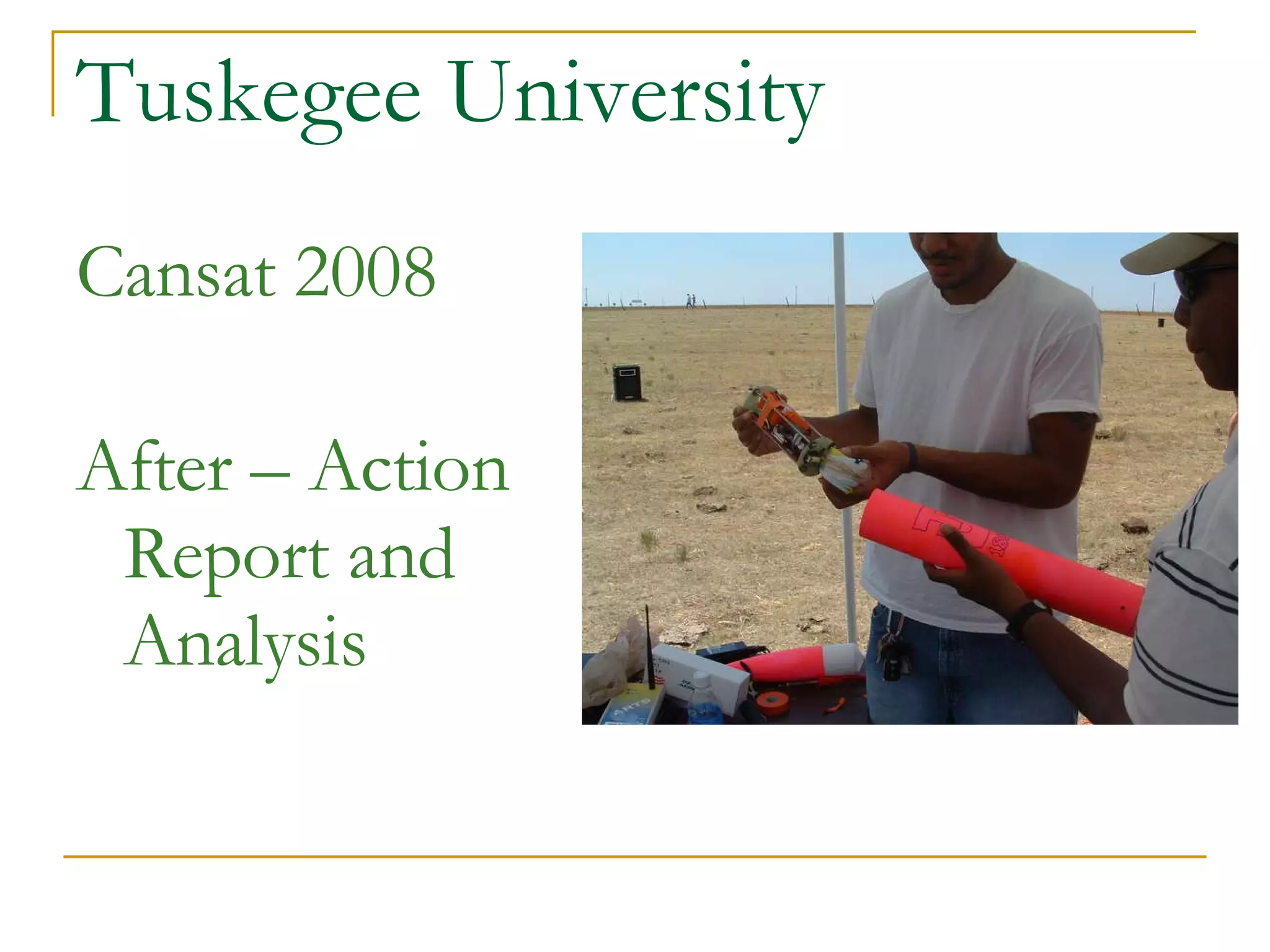
Tuskegee University Cansat 2008  After – Action Report and Analysis
Overview of After-Action Report Attending Members Design Overview Data as recorded by ground station  Results of flight (success, failure, and omissions) Failure mode analysis Lessons learned Preparations for next competition
Attending Members Software Lead: Christopher Coleman Hardware Lead: Brandon Williams Advisor: Eldon Triggs
Design Overview 2.8 inch diameter by 11 inch length planetary exploration payload Parachute to surface and record altitude during entire flight  Transmit data to ground station during flight Land upright and detach parachute prior to landing
Design Overview Use of COTS hardware to collect data and transmit to ground station (ARTS2 altimeter and TX-900G transmitter/GPS) Use hotwire connected to pyros to cut parachute loose Use LDM (Lawn Dart Method) to land upright Use 9.6V battery to power all functions
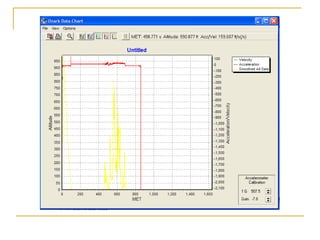
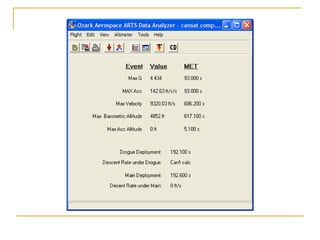
Ground station data collection Heavy emphasis on collection of altitude data Average descent rate was 14.1 feet/sec or 4.3 meters/sec Max barometric altitude was 4852 feet / 1330 ft AGL Max acceleration was 43.37 meters/sec^2
 
 
Results of Flight Tuskegee University’s Cansat successfully flew on June 14 th , 2008 First Cansat competition for Tuskegee Some objectives/requirements met, some were not
Objectives achieved Measurement of altitude and transmit to ground station. Good link with ARTS2 altimeter and TX-900G transmitter throughout duration of flight (maximum signal strength) Storage of data on ground station and flight computer successful
Objectives achieved Proper parachute deployment Parachute packing was correct and allowed proper deployment Parachute deployed and slowed the Cansat to 4.3 m/s average
Objectives Missed Landing upright Due to weight restrictions, landing legs were not installed.  Cansat impacted hard soil and was not able to use landing pegs as LDM (Lawn Dart Method) Center of gravity higher than expected (roughly centerline of spacecraft instead of low COG)
Objectives Missed Parachute separation Ultimate altitude not determined correctly prior to launch.  As a consequence, pyros did not fire and cut parachute cord. Method of parachute detachment outlined in PDR and CDR was not able to be used due to weight concerns
Bonus Objectives Omitted Due to weight issues, the vacuum motor, parachute release motor, stepper motor/drill, and temperature probe were omitted Battery and component weights created issues that prevented attempting any bonus points
Failure Mode and Effect Analysis Anticipated failure modes based on severity Parachute deployment failure Catastrophic failure (complete destruction of system, medium possibility) Power system failure (battery disconnect/premature drain) Mission failure (not catastrophic, but part of basic requirements, medium possibility) Data downlink failure/transmission  Mission failure (not catastrophic, but part of basic requirements, medium possibility) Parachute not detaching Mission failure (not catastrophic, but part of basic requirements, high possibility) Not landing upright Mission failure (not catastrophic, but part of basic requirements, high possibility)
Failure Mode and Effect Analysis Actual failure modes based on severity Parachute deployment failure Did not occur (successful) Power system failure (battery disconnect/premature drain) Did not occur (successful) Data downlink failure/transmission  Did not occur (successful) Parachute not detaching Mission failure ( failure occurred) Not landing upright Mission failure ( failure occurred)
Failure analysis  Parachute detachment failure Pyro switch did not activate due to failure to attain anticipated altitude (wind restrictions) Pyro switch was calibrated on descent from apogee as well as time (not enough altitude or time)  Due to weight restrictions, the ultrasonic rangefinder was omitted and the process of parachute detachment was altered
Failure analysis Cansat not landing upright Weight restrictions prevented landing legs from being added LDM (lawn Dart Method) was used, but the compacted soil prevented the pegs from penetrating the ground sufficiently (Cansat bounced rather than sticking) Also, failure of parachute detachment mechanism caused the Cansat to be drug 1-2 feet AFTER landing
Lessons learned (generic) Battery/Power source Battery did not fail, however last minute changes increased the mass of the battery.  A larger current was needed to fire the pyro and maintain good downlink Battery sizing needs to be more of a focus in the initial stages Back up batteries on hand
Lessons learned (generic) Structure Structure was satisfactory, but needed minor modifications Finite Element modeling of structure to properly reduce unnecessary mass Consider alternative materials to reduce mass and increase durability
Lessons learned (generic) Electronics Simplify wiring to reduce mass and possibility of broken connections due to launch / MECO / Parachute deployment Use of microprocessors to increase capability and reduce mass Move from COTS to hand built parts to tailor functions to specific tasks/objectives
Lessons learned (specific) Defining vertical landing.  Some orientations were on the long axis instead of the circular diameter Use of e-matches for pyros instead of high resistance / small diameter wire (used rocket igniters) as the wire was an abject failure. Calibration of ARTS2 flight computer to provide more accurate data (i.e. redefine “up” and “down”
Lessons learned (specific) Budget Funding:  secure sources and commitments and obtain funds EARLY Find outside sources in the commercial community as well as academic Use funding WISELY!
Lessons learned (specific) Team organization Find members from other fields (electrical, mechanical, etc) and recruit them.  This year was aerospace engineering only. Give members tasks based on their individual strengths and fields of study Make team meeting regular and give specific outcomes for each meeting
Questions?

Cansat 2008: Tuskegee University Final Presentation

  • 1.
    Tuskegee University Cansat2008 After – Action Report and Analysis
  • 2.
    Overview of After-ActionReport Attending Members Design Overview Data as recorded by ground station Results of flight (success, failure, and omissions) Failure mode analysis Lessons learned Preparations for next competition
  • 3.
    Attending Members SoftwareLead: Christopher Coleman Hardware Lead: Brandon Williams Advisor: Eldon Triggs
  • 4.
    Design Overview 2.8inch diameter by 11 inch length planetary exploration payload Parachute to surface and record altitude during entire flight Transmit data to ground station during flight Land upright and detach parachute prior to landing
  • 5.
    Design Overview Useof COTS hardware to collect data and transmit to ground station (ARTS2 altimeter and TX-900G transmitter/GPS) Use hotwire connected to pyros to cut parachute loose Use LDM (Lawn Dart Method) to land upright Use 9.6V battery to power all functions
  • 6.
    Ground station datacollection Heavy emphasis on collection of altitude data Average descent rate was 14.1 feet/sec or 4.3 meters/sec Max barometric altitude was 4852 feet / 1330 ft AGL Max acceleration was 43.37 meters/sec^2
  • 7.
  • 8.
  • 9.
    Results of FlightTuskegee University’s Cansat successfully flew on June 14 th , 2008 First Cansat competition for Tuskegee Some objectives/requirements met, some were not
  • 10.
    Objectives achieved Measurementof altitude and transmit to ground station. Good link with ARTS2 altimeter and TX-900G transmitter throughout duration of flight (maximum signal strength) Storage of data on ground station and flight computer successful
  • 11.
    Objectives achieved Properparachute deployment Parachute packing was correct and allowed proper deployment Parachute deployed and slowed the Cansat to 4.3 m/s average
  • 12.
    Objectives Missed Landingupright Due to weight restrictions, landing legs were not installed. Cansat impacted hard soil and was not able to use landing pegs as LDM (Lawn Dart Method) Center of gravity higher than expected (roughly centerline of spacecraft instead of low COG)
  • 13.
    Objectives Missed Parachuteseparation Ultimate altitude not determined correctly prior to launch. As a consequence, pyros did not fire and cut parachute cord. Method of parachute detachment outlined in PDR and CDR was not able to be used due to weight concerns
  • 14.
    Bonus Objectives OmittedDue to weight issues, the vacuum motor, parachute release motor, stepper motor/drill, and temperature probe were omitted Battery and component weights created issues that prevented attempting any bonus points
  • 15.
    Failure Mode andEffect Analysis Anticipated failure modes based on severity Parachute deployment failure Catastrophic failure (complete destruction of system, medium possibility) Power system failure (battery disconnect/premature drain) Mission failure (not catastrophic, but part of basic requirements, medium possibility) Data downlink failure/transmission Mission failure (not catastrophic, but part of basic requirements, medium possibility) Parachute not detaching Mission failure (not catastrophic, but part of basic requirements, high possibility) Not landing upright Mission failure (not catastrophic, but part of basic requirements, high possibility)
  • 16.
    Failure Mode andEffect Analysis Actual failure modes based on severity Parachute deployment failure Did not occur (successful) Power system failure (battery disconnect/premature drain) Did not occur (successful) Data downlink failure/transmission Did not occur (successful) Parachute not detaching Mission failure ( failure occurred) Not landing upright Mission failure ( failure occurred)
  • 17.
    Failure analysis Parachute detachment failure Pyro switch did not activate due to failure to attain anticipated altitude (wind restrictions) Pyro switch was calibrated on descent from apogee as well as time (not enough altitude or time) Due to weight restrictions, the ultrasonic rangefinder was omitted and the process of parachute detachment was altered
  • 18.
    Failure analysis Cansatnot landing upright Weight restrictions prevented landing legs from being added LDM (lawn Dart Method) was used, but the compacted soil prevented the pegs from penetrating the ground sufficiently (Cansat bounced rather than sticking) Also, failure of parachute detachment mechanism caused the Cansat to be drug 1-2 feet AFTER landing
  • 19.
    Lessons learned (generic)Battery/Power source Battery did not fail, however last minute changes increased the mass of the battery. A larger current was needed to fire the pyro and maintain good downlink Battery sizing needs to be more of a focus in the initial stages Back up batteries on hand
  • 20.
    Lessons learned (generic)Structure Structure was satisfactory, but needed minor modifications Finite Element modeling of structure to properly reduce unnecessary mass Consider alternative materials to reduce mass and increase durability
  • 21.
    Lessons learned (generic)Electronics Simplify wiring to reduce mass and possibility of broken connections due to launch / MECO / Parachute deployment Use of microprocessors to increase capability and reduce mass Move from COTS to hand built parts to tailor functions to specific tasks/objectives
  • 22.
    Lessons learned (specific)Defining vertical landing. Some orientations were on the long axis instead of the circular diameter Use of e-matches for pyros instead of high resistance / small diameter wire (used rocket igniters) as the wire was an abject failure. Calibration of ARTS2 flight computer to provide more accurate data (i.e. redefine “up” and “down”
  • 23.
    Lessons learned (specific)Budget Funding: secure sources and commitments and obtain funds EARLY Find outside sources in the commercial community as well as academic Use funding WISELY!
  • 24.
    Lessons learned (specific)Team organization Find members from other fields (electrical, mechanical, etc) and recruit them. This year was aerospace engineering only. Give members tasks based on their individual strengths and fields of study Make team meeting regular and give specific outcomes for each meeting
  • 25.