Cancer Biology
M.Phil Semester II
Dr. Naila Malkani
Department of Zoology
GC University, Lahore
WEEK 01
INTRODUCTION TO CANCER
BIOLOGY
Contents
a. Introduction of Cancer,
b. General features and types of cancers,
c. The nature of Cancer,
d. Arise of Cancer from normal and specialized
cells.
Cancer
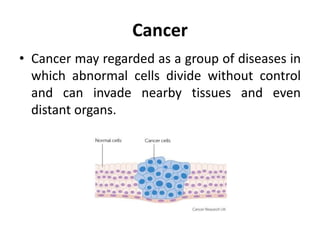
• Cancer may regarded as a group of diseases in
which abnormal cells divide without control
and can invade nearby tissues and even
distant organs.
Types of Cancer
• Carcinoma – this cancer begins in the skin or in tissues that line or cover
internal organs. The subtypes include
1. Squamous cell carcinoma
Squamous cell carcinoma starts in squamous cells. These are the flat, surface
covering cells found in areas such as the skin or the lining of the throat or
food pipe (oesophagus).
2. Adenocarcinoma
Adenocarcinomas start in glandular cells called adenomatous cells. Glandular
cells produce fluids to keep tissues moist.
3. Transitional cell carcinoma
Transitional cells are cells that can stretch as an organ expands. They make up
tissues called transitional epithelium. An example is the lining of the
bladder. Cancers that start in these cells are called transitional cell carcinoma.
4. Basal cell carcinoma
Basal cells line the deepest layer of skin cells. Cancers that start in these cells
are called basal cell carcinomas.
• Sarcoma – this cancer begins in the connective or supportive tissues
such as bone, cartilage, fat, muscle or blood vessels.
• Leukaemia – this is cancer of the white blood cells. It starts in the
tissues that make blood cells such as the bone marrow.
• Lymphoma and Myeloma – these cancers begin in the cells of the
immune system. Lymphoma is the cancer in lymphatic system while
myeloma is the cancer of plasma cells (antibody producing cells).
• Brain and spinal cord cancers – these are known as central nervous
system cancers
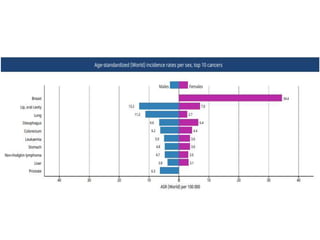
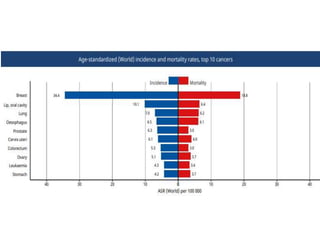
Global Statistics of Cancer
• Globocan, 2020
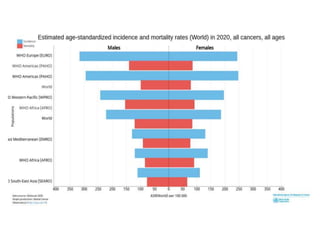
• Worldwide, an estimated 19.3 million new cancer cases and
almost 10.0 million cancer deaths occurred in 2020.
• Female breast cancer has surpassed lung cancer as the most
commonly diagnosed cancer, with an estimated 2.3 million
new cases (11.7%), followed by
• lung (11.4%), colorectal (10.0 %), prostate (7.3%), and
stomach (5.6%) cancers.
• Lung cancer remained the leading cause of cancer death, with
an estimated 1.8 million deaths (18%), followed by colorectal
(9.4%), liver (8.3%), stomach (7.7%), and female breast (6.9%)
cancers.
• Overall incidence was from 2-fold to 3-fold higher in
transitioned versus transitioning countries for both sexes,
whereas mortality varied <2-fold for men and little for
women.
• Death rates for female breast and cervical cancers, however,
were considerably higher in transitioning versus transitioned
countries (15.0 vs 12.8 per 100,000 and 12.4 vs 5.2 per
100,000, respectively).
• The global cancer burden is expected to be 28.4 million cases
in 2040, a 47% rise from 2020, with a larger increase in
transitioning (64% to 95%) versus transitioned (32% to 56%)
countries due to demographic changes, although this may be
further exacerbated by increasing risk factors associated with
globalization and a growing economy.
• Efforts to build a sustainable infrastructure for the
dissemination of cancer prevention measures and provision of
cancer care in transitioning countries is critical for global
cancer control.
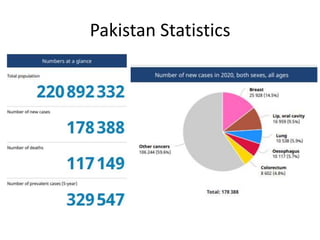
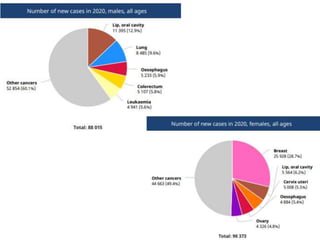
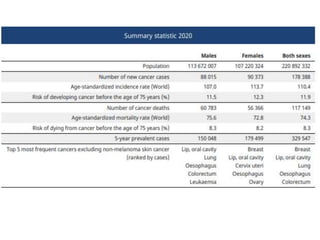
Pakistan Statistics
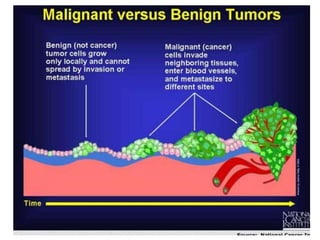
Tumors can be;
Benign Tumor
• Self-limited in growth
• Do not invade or metastasize
Malignant Tumor
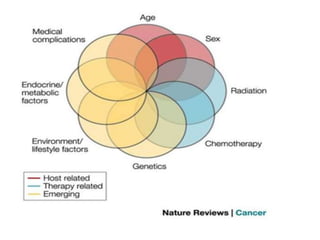
Risk Factors attributed to cancer
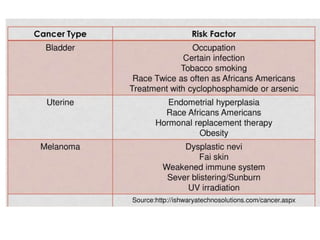
• Risk factor is anything that increases the person’s
chances of getting a disease.
• Some factors can be modified, others cannot.
• There are lot of international variations in the pattern
of cancer which are attributed to a number of factors
such as
- Age, Gender
- Environmental factors
- Food habits
- Lifestyles
- Genetic factors
- Inadequacy in detection and reporting of cases
• Age is significant factor for all cancers. With increasing age the
chances increases due to accumulation of mutations and
decrease in immune vigor.
• Gender is important in some cancers. like breast, oral, etc.
• Tobacco in various forms of usage can cause cancer of lungs,
larynx, mouth, pharynx, esophagus, bladder, pancreas and
probably kidney.
• Cigarette smoking is now responsible for more than 1 million
death each year.
• Excess intake of alcohol can cause esophageal and liver
cancer. Beer consumption may be associated with rectal
cancer. Alcohol contributes about 3 % of all cancer deaths.
• Dietary factor Smoked fish is related to stomach cancer,
Dietary fiber to intestinal cancer, Beef consumption to bowel
cancer, High fat diet to breast cancer, Food additives and
contaminants have fallen under suspicion as causative agent.
• Occupational exposures includes exposure to
benzene, cadmium, arsenic, chromium, vinyl
chloride, asbestos, polycyclic hydrocarbons, etc.
The risk of occupational exposure is said to be
increased if the individual also smokes cigarette.
Occupational exposure is usually reported 1-5%
of human cancer.
• Others Sunlight, radiation, water and air
pollution, medication and pesticides. These are
related to cancer as environmental factors.
Customs, habits and life style may be associated
with an increased risk of cancer Smoking and lung
cancer Tobacco and beetle chewing and oral
cancer
• Viruses; Hepatitis B & C - hepatocarcinoma
HIV infection – kaposi’s carcinoma AIDS – non
Hodgkin’s lymphoma Epstein – bar virus –
Burkitts lymphoma and naso – pharyngial
carcinoma Cytomegalovirus – Kaposi’s Sa
Pappiloma virus – cervix cancer Human T cell
leukemia virus – T cell leukemia.
• Parasites, May be a cause of cancer
Schistosomiasis can produce cancer of bladder
• Genetic influences have long been suspected
-Retinoblastoma occurs in children of the same
parent,
-Mongols are more likely to develop leukemia
–BRCA1/2 in breast cancer
There is probably a complex relationship
between hereditary susceptibility and
environmental carcinogenic stimuli in the
causation of cancer.
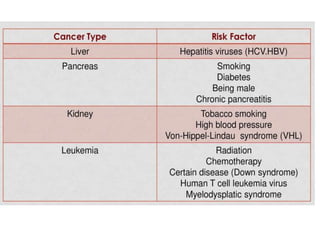
• Risk factors varies for each type of cancer
Cancer Biology bbbbbnnnnbbbbjnbbbbbbbbbh

Cancer Biology bbbbbnnnnbbbbjnbbbbbbbbbh

  • 1.
    Cancer Biology M.Phil SemesterII Dr. Naila Malkani Department of Zoology GC University, Lahore
  • 2.
  • 3.
    Contents a. Introduction ofCancer, b. General features and types of cancers, c. The nature of Cancer, d. Arise of Cancer from normal and specialized cells.
  • 4.
    Cancer • Cancer mayregarded as a group of diseases in which abnormal cells divide without control and can invade nearby tissues and even distant organs.
  • 5.
    Types of Cancer •Carcinoma – this cancer begins in the skin or in tissues that line or cover internal organs. The subtypes include 1. Squamous cell carcinoma Squamous cell carcinoma starts in squamous cells. These are the flat, surface covering cells found in areas such as the skin or the lining of the throat or food pipe (oesophagus). 2. Adenocarcinoma Adenocarcinomas start in glandular cells called adenomatous cells. Glandular cells produce fluids to keep tissues moist. 3. Transitional cell carcinoma Transitional cells are cells that can stretch as an organ expands. They make up tissues called transitional epithelium. An example is the lining of the bladder. Cancers that start in these cells are called transitional cell carcinoma. 4. Basal cell carcinoma Basal cells line the deepest layer of skin cells. Cancers that start in these cells are called basal cell carcinomas.
  • 6.
    • Sarcoma –this cancer begins in the connective or supportive tissues such as bone, cartilage, fat, muscle or blood vessels. • Leukaemia – this is cancer of the white blood cells. It starts in the tissues that make blood cells such as the bone marrow. • Lymphoma and Myeloma – these cancers begin in the cells of the immune system. Lymphoma is the cancer in lymphatic system while myeloma is the cancer of plasma cells (antibody producing cells). • Brain and spinal cord cancers – these are known as central nervous system cancers
  • 7.
    Global Statistics ofCancer • Globocan, 2020 • Worldwide, an estimated 19.3 million new cancer cases and almost 10.0 million cancer deaths occurred in 2020. • Female breast cancer has surpassed lung cancer as the most commonly diagnosed cancer, with an estimated 2.3 million new cases (11.7%), followed by • lung (11.4%), colorectal (10.0 %), prostate (7.3%), and stomach (5.6%) cancers. • Lung cancer remained the leading cause of cancer death, with an estimated 1.8 million deaths (18%), followed by colorectal (9.4%), liver (8.3%), stomach (7.7%), and female breast (6.9%) cancers.
  • 8.
    • Overall incidencewas from 2-fold to 3-fold higher in transitioned versus transitioning countries for both sexes, whereas mortality varied <2-fold for men and little for women. • Death rates for female breast and cervical cancers, however, were considerably higher in transitioning versus transitioned countries (15.0 vs 12.8 per 100,000 and 12.4 vs 5.2 per 100,000, respectively). • The global cancer burden is expected to be 28.4 million cases in 2040, a 47% rise from 2020, with a larger increase in transitioning (64% to 95%) versus transitioned (32% to 56%) countries due to demographic changes, although this may be further exacerbated by increasing risk factors associated with globalization and a growing economy. • Efforts to build a sustainable infrastructure for the dissemination of cancer prevention measures and provision of cancer care in transitioning countries is critical for global cancer control.
  • 10.
  • 15.
  • 16.
    Benign Tumor • Self-limitedin growth • Do not invade or metastasize
  • 17.
  • 19.
    Risk Factors attributedto cancer • Risk factor is anything that increases the person’s chances of getting a disease. • Some factors can be modified, others cannot. • There are lot of international variations in the pattern of cancer which are attributed to a number of factors such as - Age, Gender - Environmental factors - Food habits - Lifestyles - Genetic factors - Inadequacy in detection and reporting of cases
  • 21.
    • Age issignificant factor for all cancers. With increasing age the chances increases due to accumulation of mutations and decrease in immune vigor. • Gender is important in some cancers. like breast, oral, etc. • Tobacco in various forms of usage can cause cancer of lungs, larynx, mouth, pharynx, esophagus, bladder, pancreas and probably kidney. • Cigarette smoking is now responsible for more than 1 million death each year. • Excess intake of alcohol can cause esophageal and liver cancer. Beer consumption may be associated with rectal cancer. Alcohol contributes about 3 % of all cancer deaths. • Dietary factor Smoked fish is related to stomach cancer, Dietary fiber to intestinal cancer, Beef consumption to bowel cancer, High fat diet to breast cancer, Food additives and contaminants have fallen under suspicion as causative agent.
  • 22.
    • Occupational exposuresincludes exposure to benzene, cadmium, arsenic, chromium, vinyl chloride, asbestos, polycyclic hydrocarbons, etc. The risk of occupational exposure is said to be increased if the individual also smokes cigarette. Occupational exposure is usually reported 1-5% of human cancer. • Others Sunlight, radiation, water and air pollution, medication and pesticides. These are related to cancer as environmental factors. Customs, habits and life style may be associated with an increased risk of cancer Smoking and lung cancer Tobacco and beetle chewing and oral cancer
  • 23.
    • Viruses; HepatitisB & C - hepatocarcinoma HIV infection – kaposi’s carcinoma AIDS – non Hodgkin’s lymphoma Epstein – bar virus – Burkitts lymphoma and naso – pharyngial carcinoma Cytomegalovirus – Kaposi’s Sa Pappiloma virus – cervix cancer Human T cell leukemia virus – T cell leukemia. • Parasites, May be a cause of cancer Schistosomiasis can produce cancer of bladder
  • 24.
    • Genetic influenceshave long been suspected -Retinoblastoma occurs in children of the same parent, -Mongols are more likely to develop leukemia –BRCA1/2 in breast cancer There is probably a complex relationship between hereditary susceptibility and environmental carcinogenic stimuli in the causation of cancer.
  • 25.
    • Risk factorsvaries for each type of cancer