PRESENTATION TO AGILE COP
Never the Twain Shall Meet…
Can Agile Work with a Waterfall Process?
John Carter
TCGen Inc.
March 5, 2018
Agile Community of Practice
ARE YOU
READY?
MOBILE - PHOTO
YOUR ORGANIZATION
MUST CHANGE
but how?
AGENDA
1.The Research
2.Barriers
3.Intelligent Agile
4.‘Next’ Practices
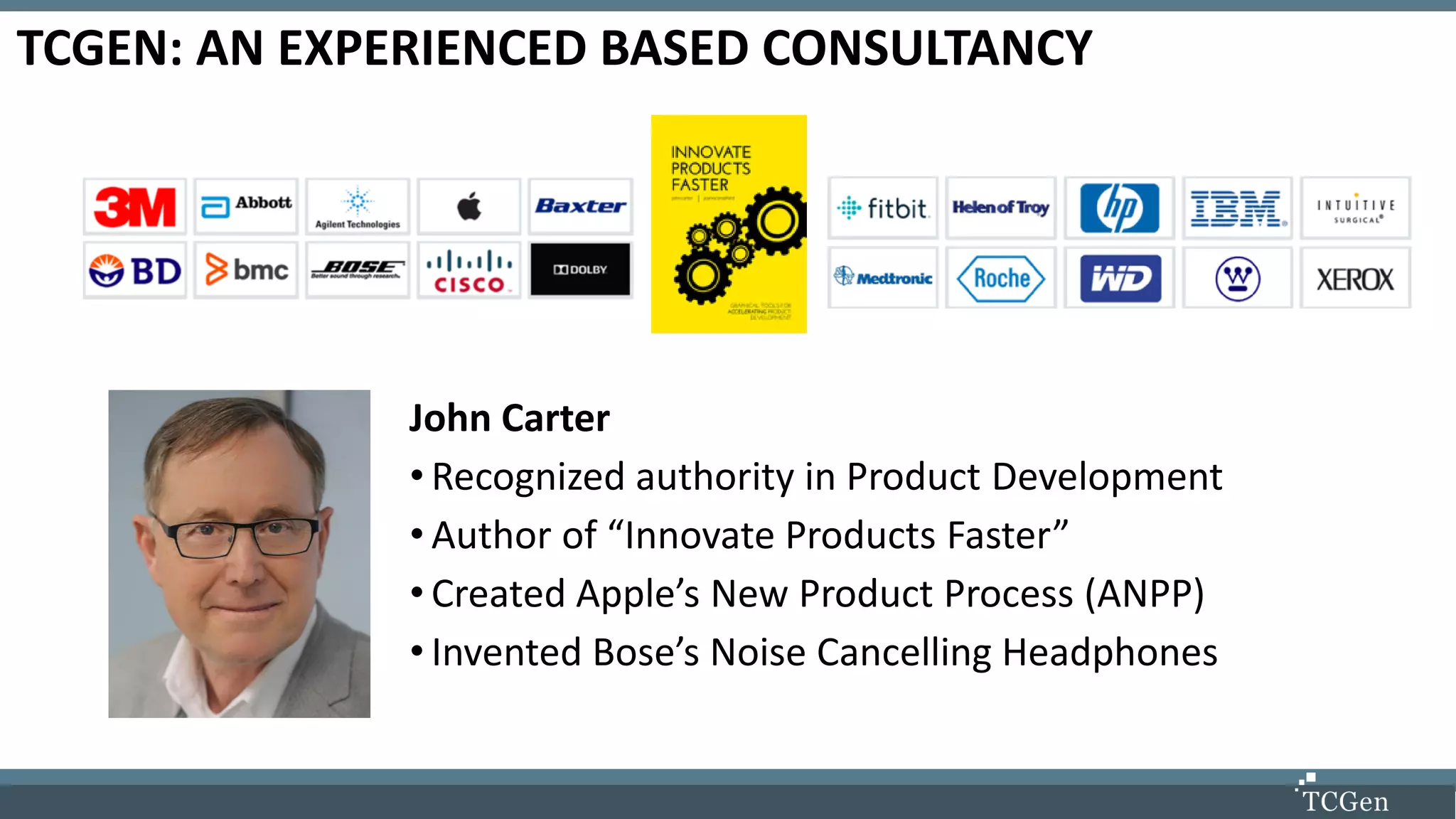
TCGEN: AN EXPERIENCED BASED CONSULTANCY
John Carter
• Recognized authority in Product Development
• Author of “Innovate Products Faster”
• Created Apple’s New Product Process (ANPP)
• Invented Bose’s Noise Cancelling Headphones
RESEARCH
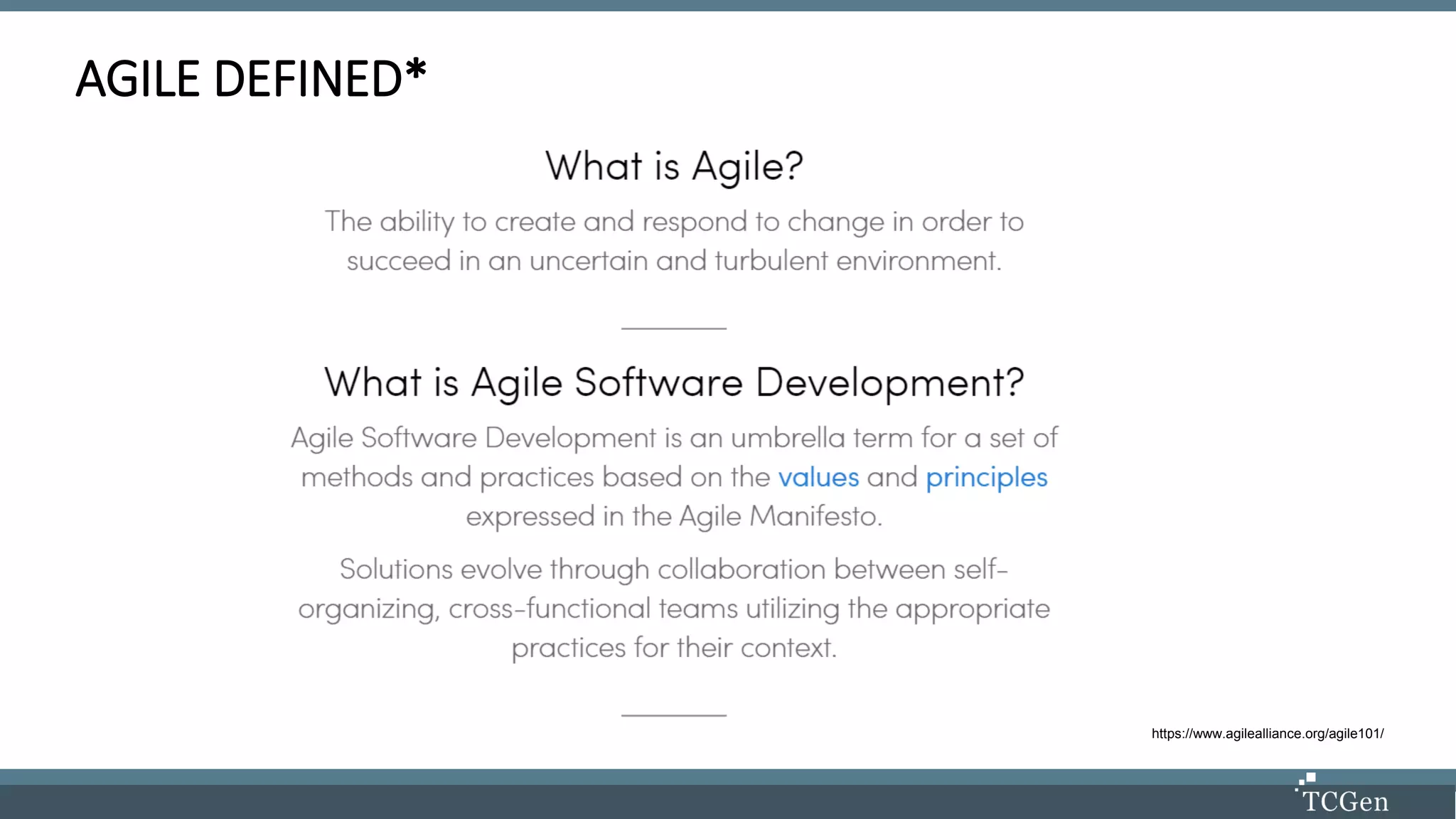
AGILE DEFINED*
https://www.agilealliance.org/agile101/
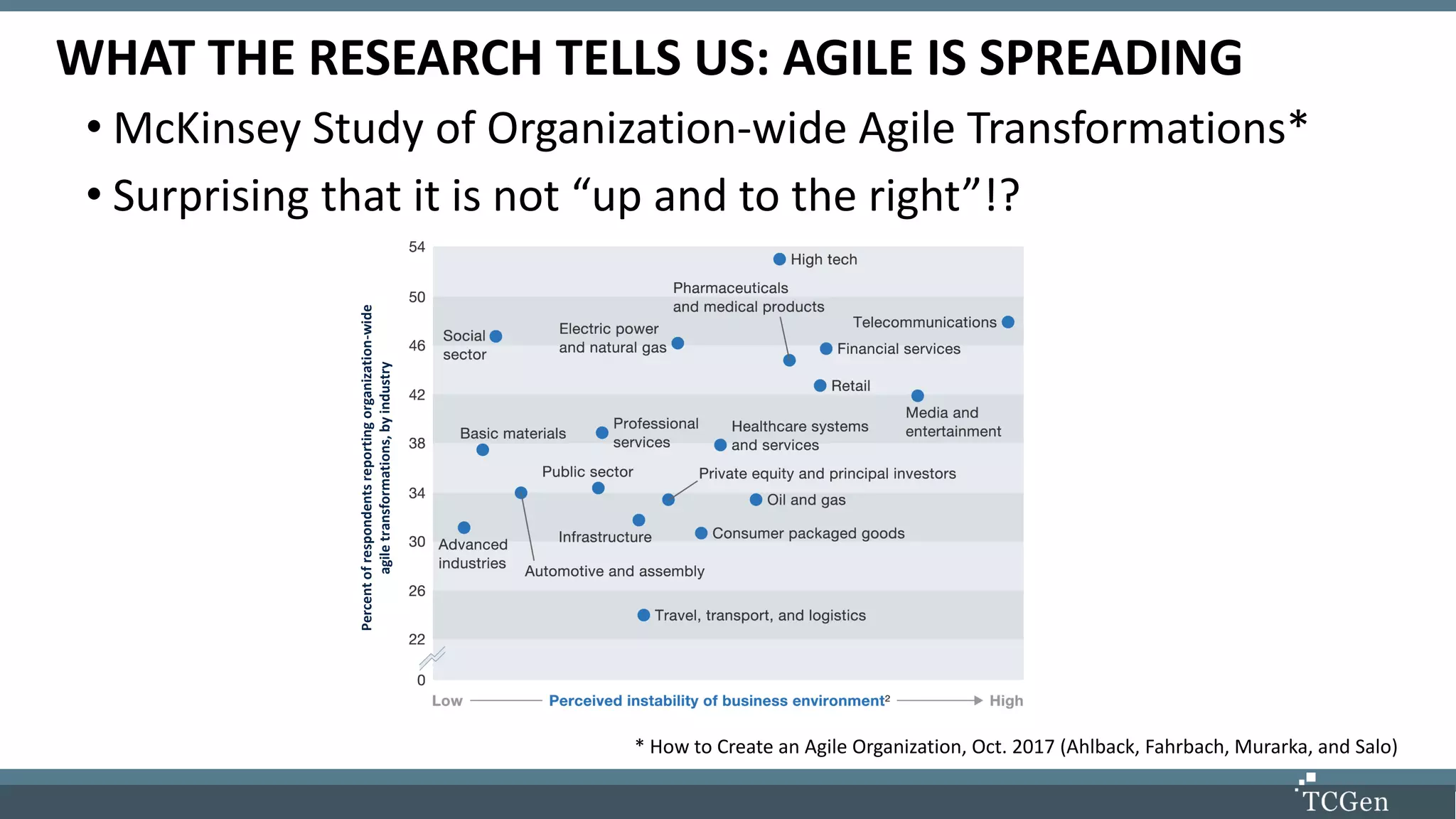
WHAT THE RESEARCH TELLS US: AGILE IS SPREADING
• McKinsey Study of Organization-wide Agile Transformations*
• Surprising that it is not “up and to the right”!?
* How to Create an Agile Organization, Oct. 2017 (Ahlback, Fahrbach, Murarka, and Salo)
Percentofrespondentsreportingorganization-wide
agiletransformations,byindustry
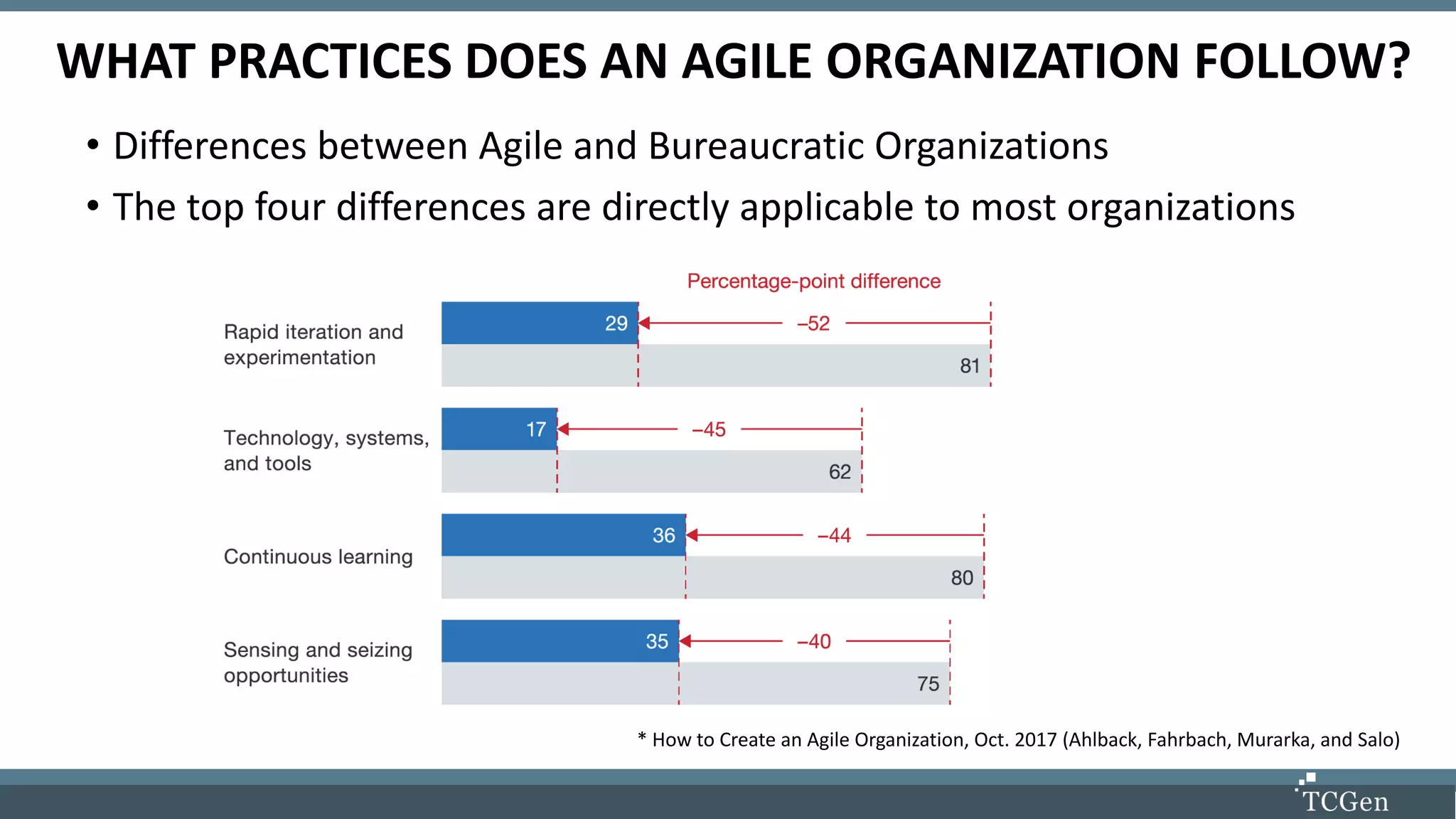
WHAT PRACTICES DOES AN AGILE ORGANIZATION FOLLOW?
• Differences between Agile and Bureaucratic Organizations
• The top four differences are directly applicable to most organizations
* How to Create an Agile Organization, Oct. 2017 (Ahlback, Fahrbach, Murarka, and Salo)
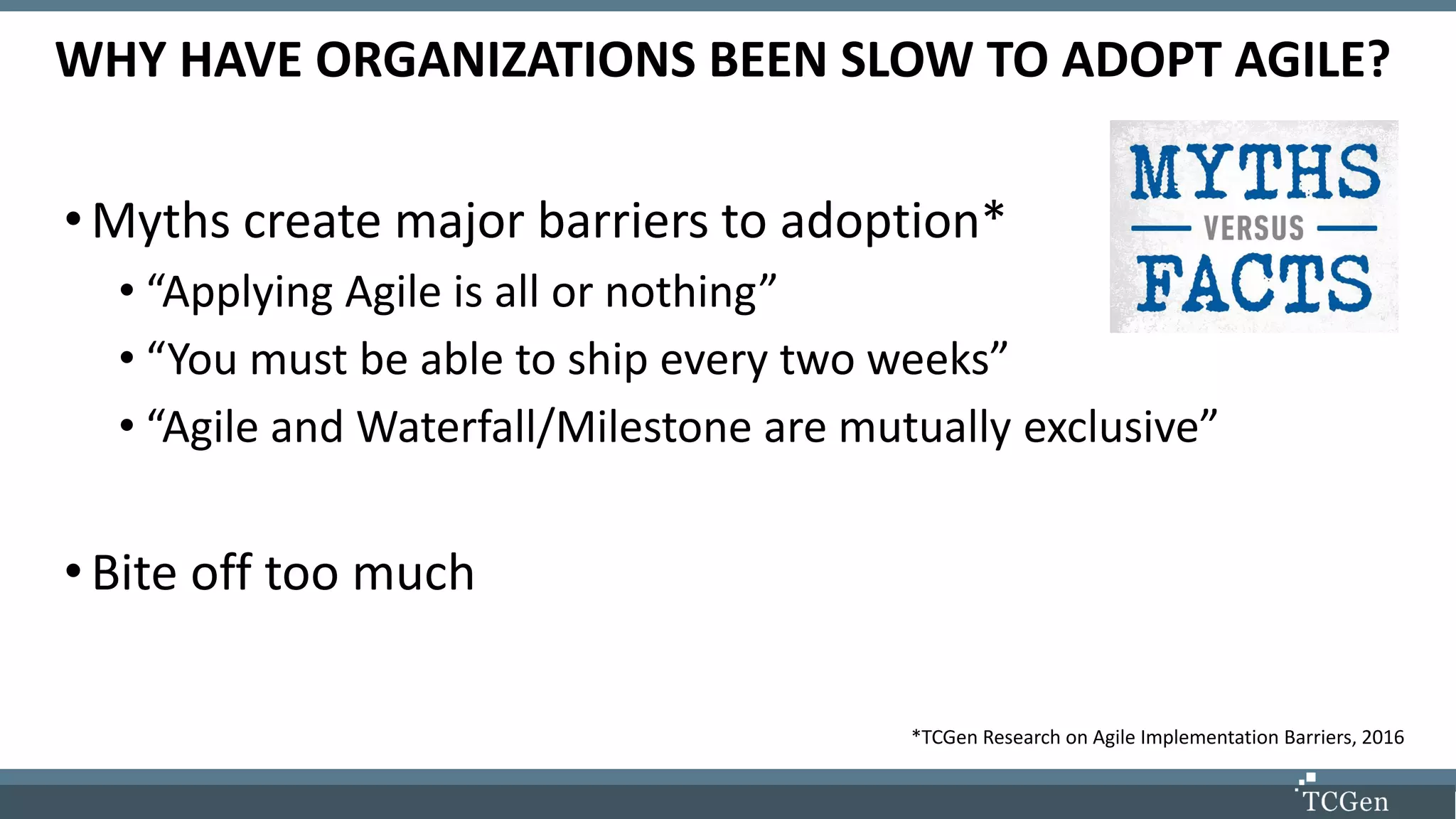
WHY HAVE ORGANIZATIONS BEEN SLOW TO ADOPT AGILE?
•Myths create major barriers to adoption*
• “Applying Agile is all or nothing”
• “You must be able to ship every two weeks”
• “Agile and Waterfall/Milestone are mutually exclusive”
•Bite off too much
*TCGen Research on Agile Implementation Barriers, 2016
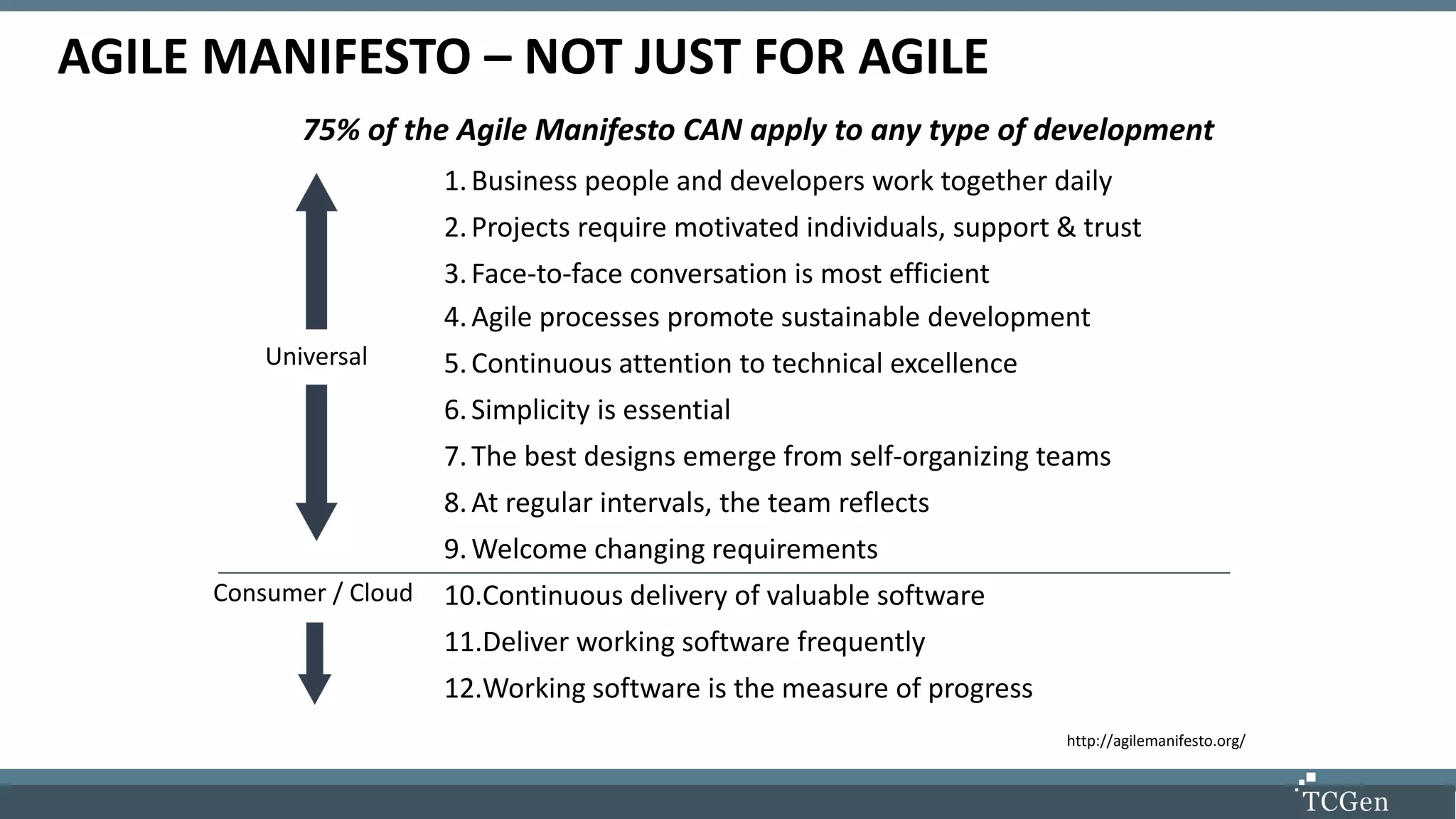
AGILE MANIFESTO – NOT JUST FOR AGILE
1.Business people and developers work together daily
2.Projects require motivated individuals, support & trust
3.Face-to-face conversation is most efficient
4.Agile processes promote sustainable development
5.Continuous attention to technical excellence
6.Simplicity is essential
7.The best designs emerge from self-organizing teams
8.At regular intervals, the team reflects
9.Welcome changing requirements
10.Continuous delivery of valuable software
11.Deliver working software frequently
12.Working software is the measure of progress
75% of the Agile Manifesto CAN apply to any type of development
Consumer / Cloud
Universal
http://agilemanifesto.org/
THE TAKEAWAY
YOU CAN
CHANGE
Here’s how!
BUT FIRST…
BARRIERS
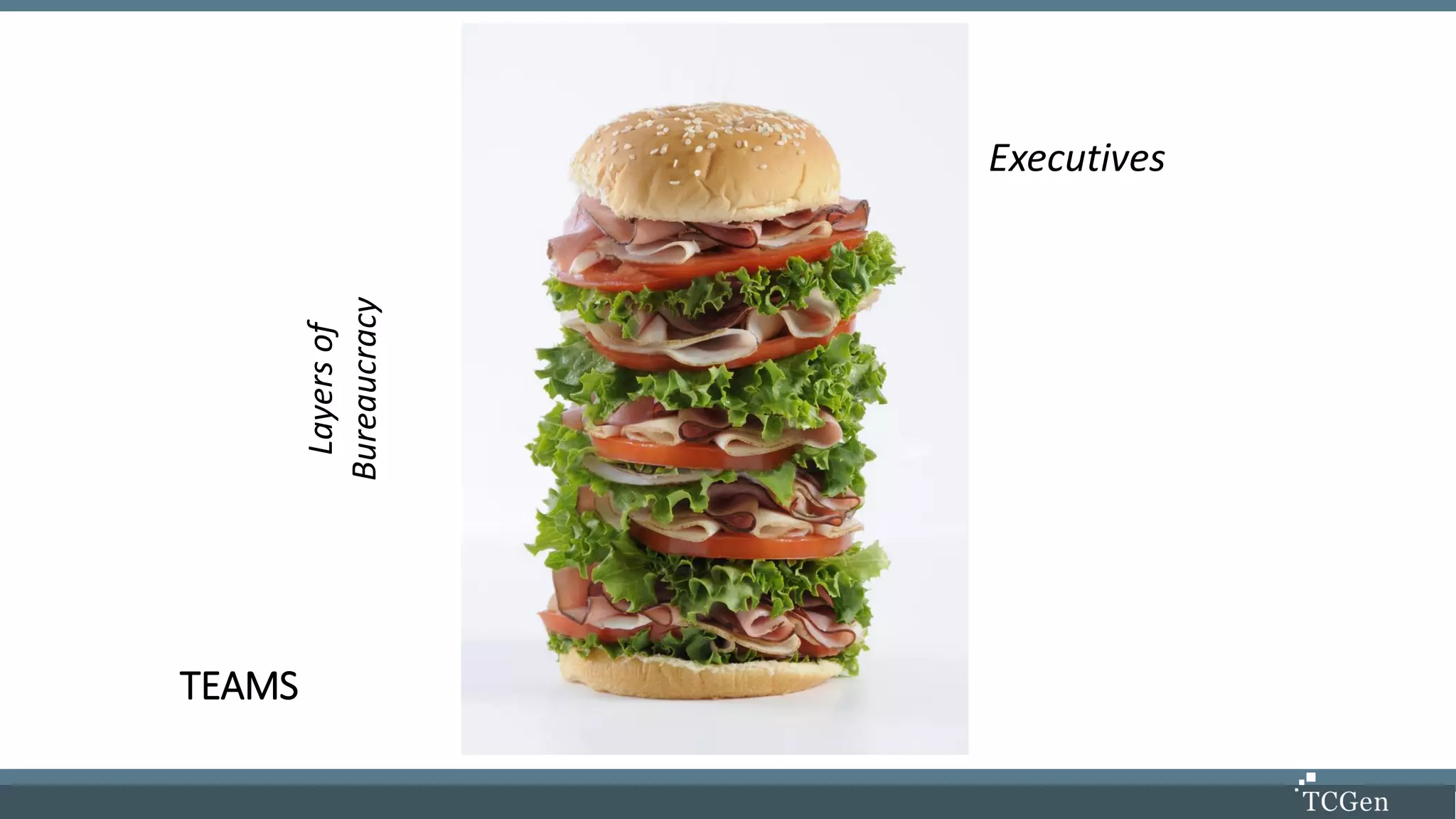
MANAGERS - DEFINITION
TEAMS
Executives
Layersof
Bureaucracy
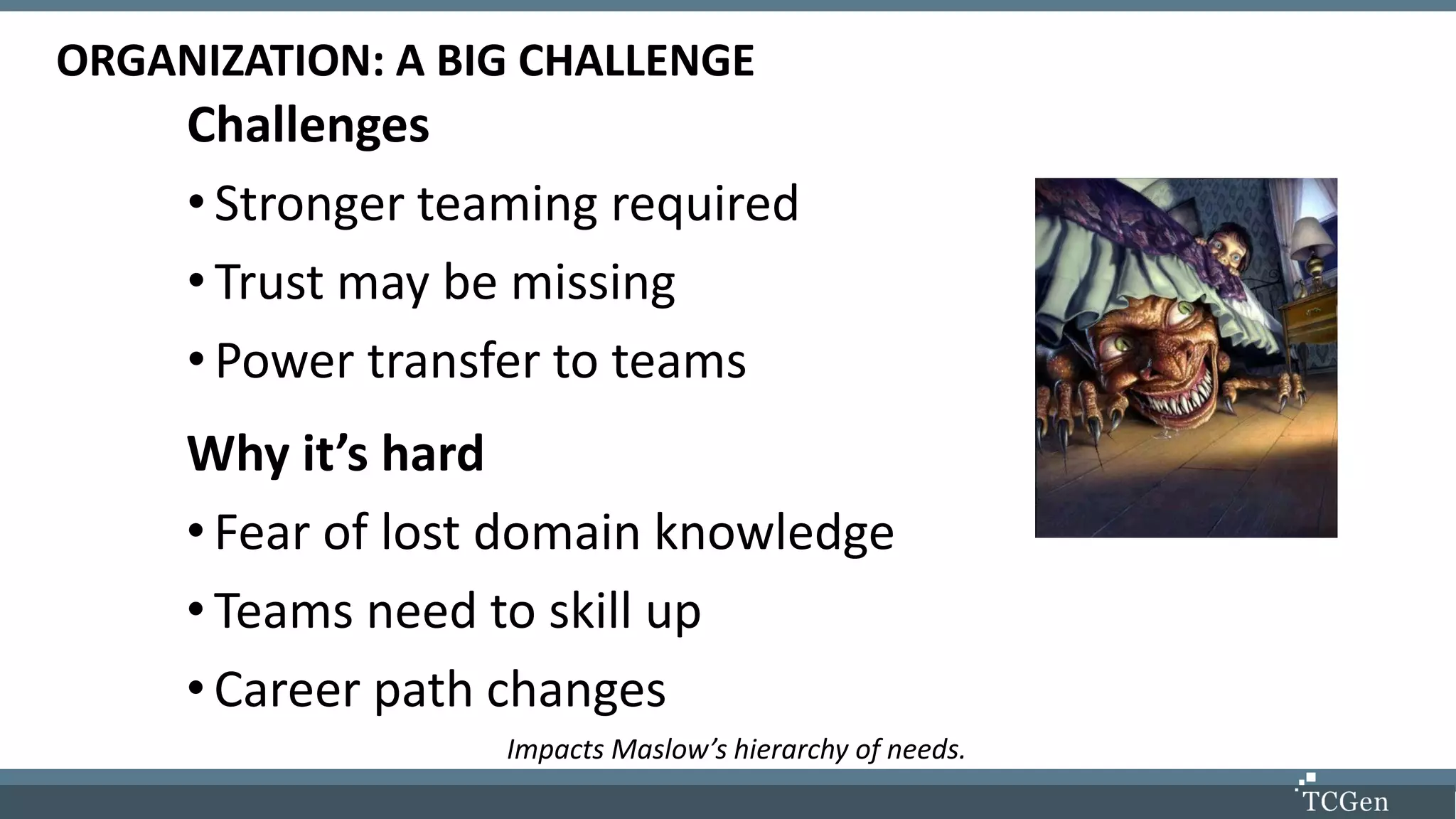
ORGANIZATION: A BIG CHALLENGE
Challenges
• Stronger teaming required
• Trust may be missing
• Power transfer to teams
Impacts Maslow’s hierarchy of needs.
Why it’s hard
• Fear of lost domain knowledge
• Teams need to skill up
• Career path changes
CHANGE ROLES: RECIPE FOR THE AGILE TRANSFORMATION
• Servant Leadership model
–Proactive help
• Roles for Managers
–Increase Talent Density
–Remove Roadblocks
–Plan Architecture
• Roles for Teams
–Self Governing if in bounds
HOW CAN
I HELP YOU
TO BE SUCCESSFUL?
REMOVE BARRIERS
SUPERPOWER
POOR ATTITUDE
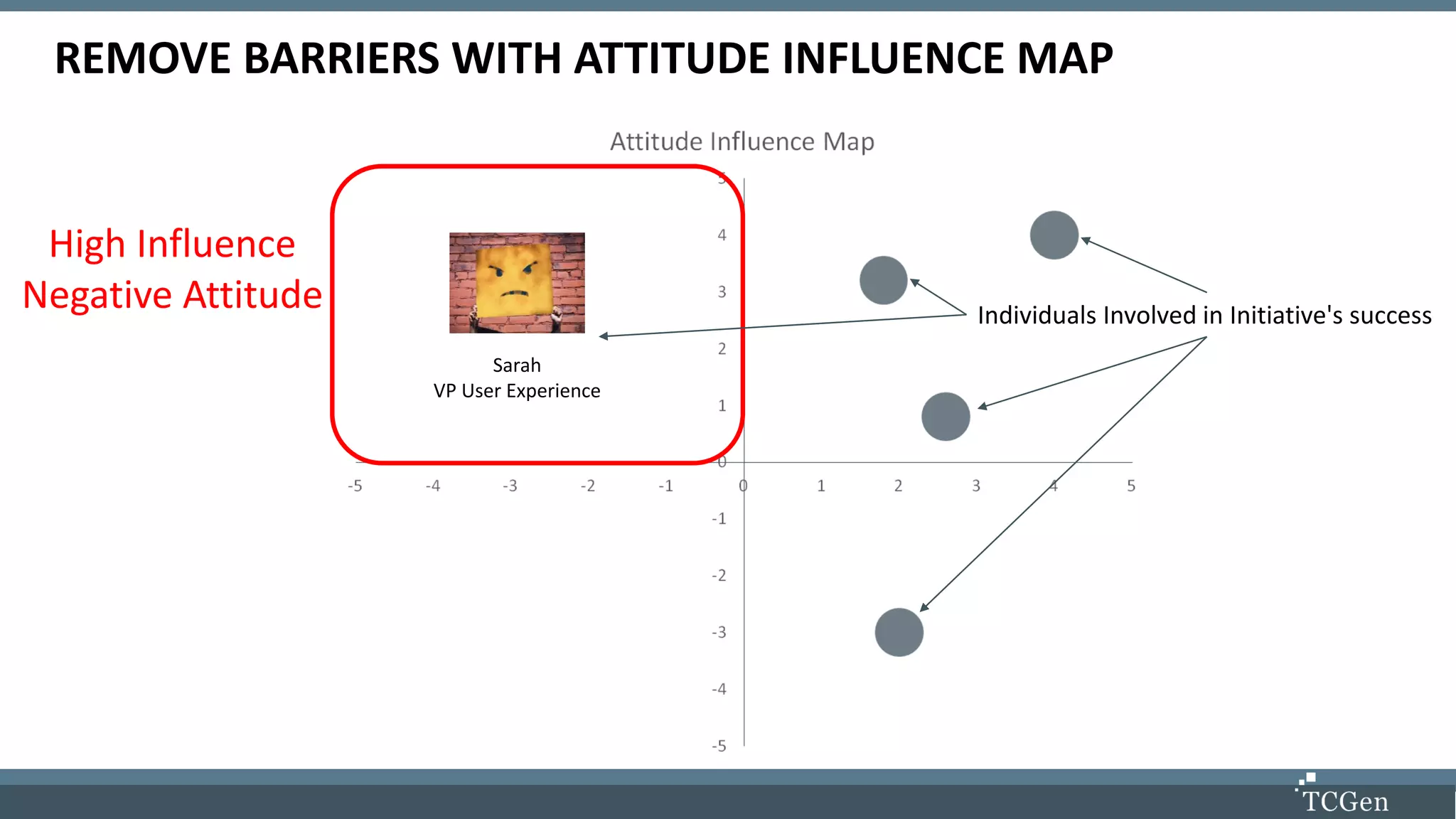
REMOVE BARRIERS WITH ATTITUDE INFLUENCE MAP
High Influence
Negative Attitude
Sarah
VP User Experience
Individuals Involved in Initiative's success
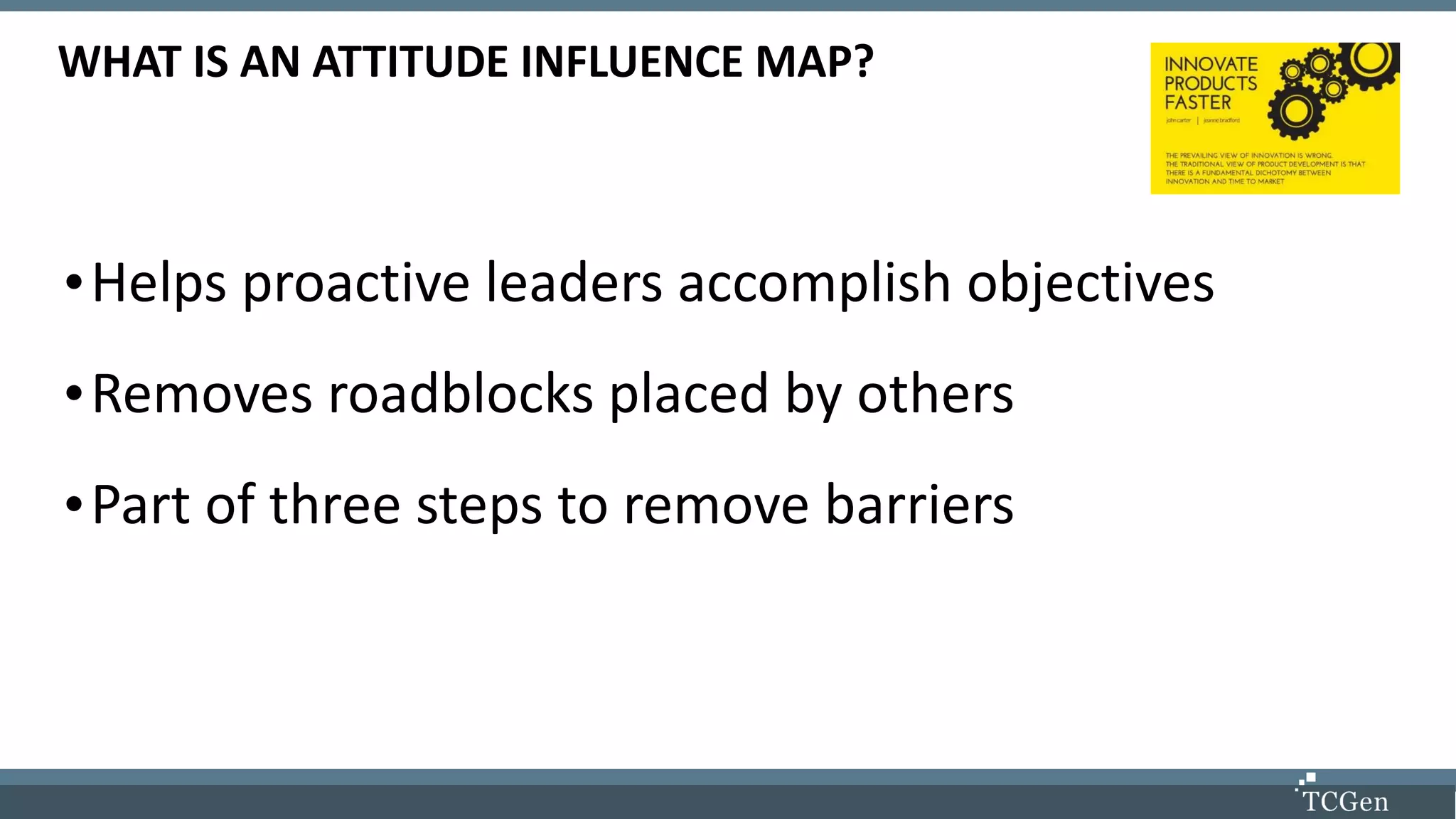
WHAT IS AN ATTITUDE INFLUENCE MAP?
•Helps proactive leaders accomplish objectives
•Removes roadblocks placed by others
•Part of three steps to remove barriers
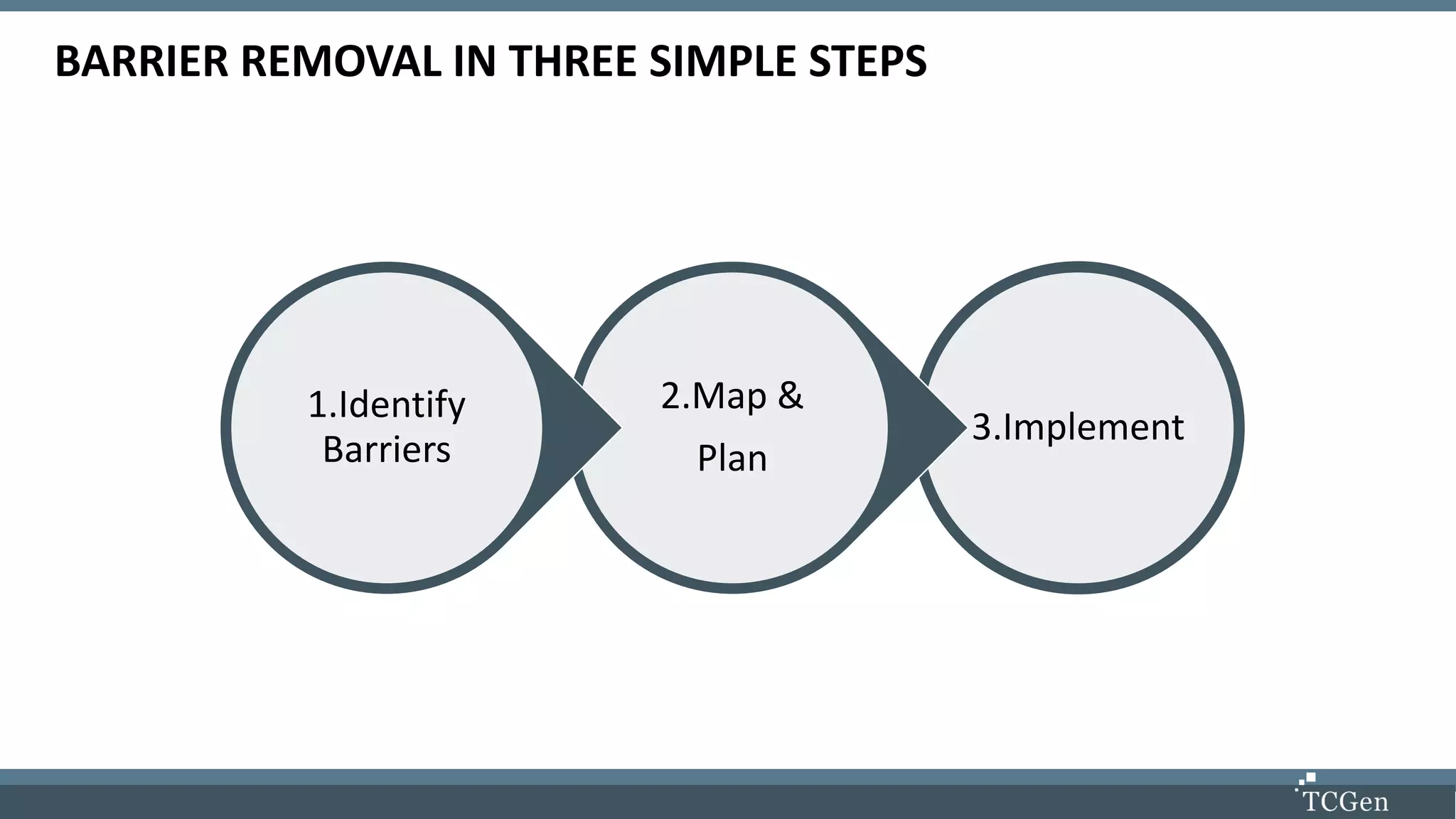
BARRIER REMOVAL IN THREE SIMPLE STEPS
3.Implement
2.Map &
Plan
1.Identify
Barriers
#1 – PROGRAM LEADERS EVALUATE CHALLENGES
•In small group
–List those who might impact your program
•Plot individuals against the two axes (Attitude and
Influence)
•Attitude (horizontal axis) – Rate the person’s attitude
•Influence (vertical axis) – Rate the person’s influence
–Often it is their position, but also consider seniority,
knowledge, etc.
#2 - CREATE ATTITUDE INFLUENCE MAP & PLAN
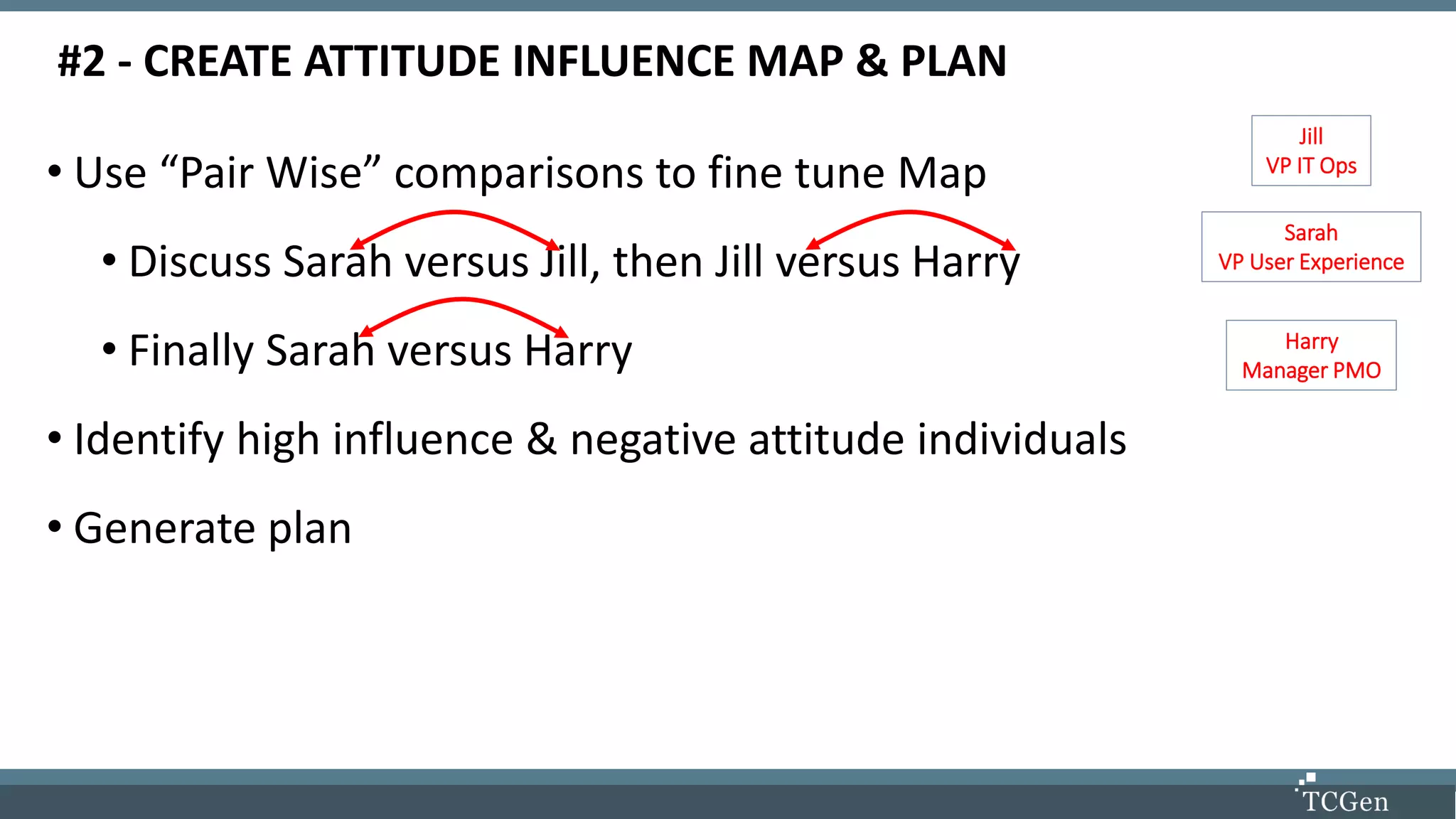
• Use “Pair Wise” comparisons to fine tune Map
• Discuss Sarah versus Jill, then Jill versus Harry
• Finally Sarah versus Harry
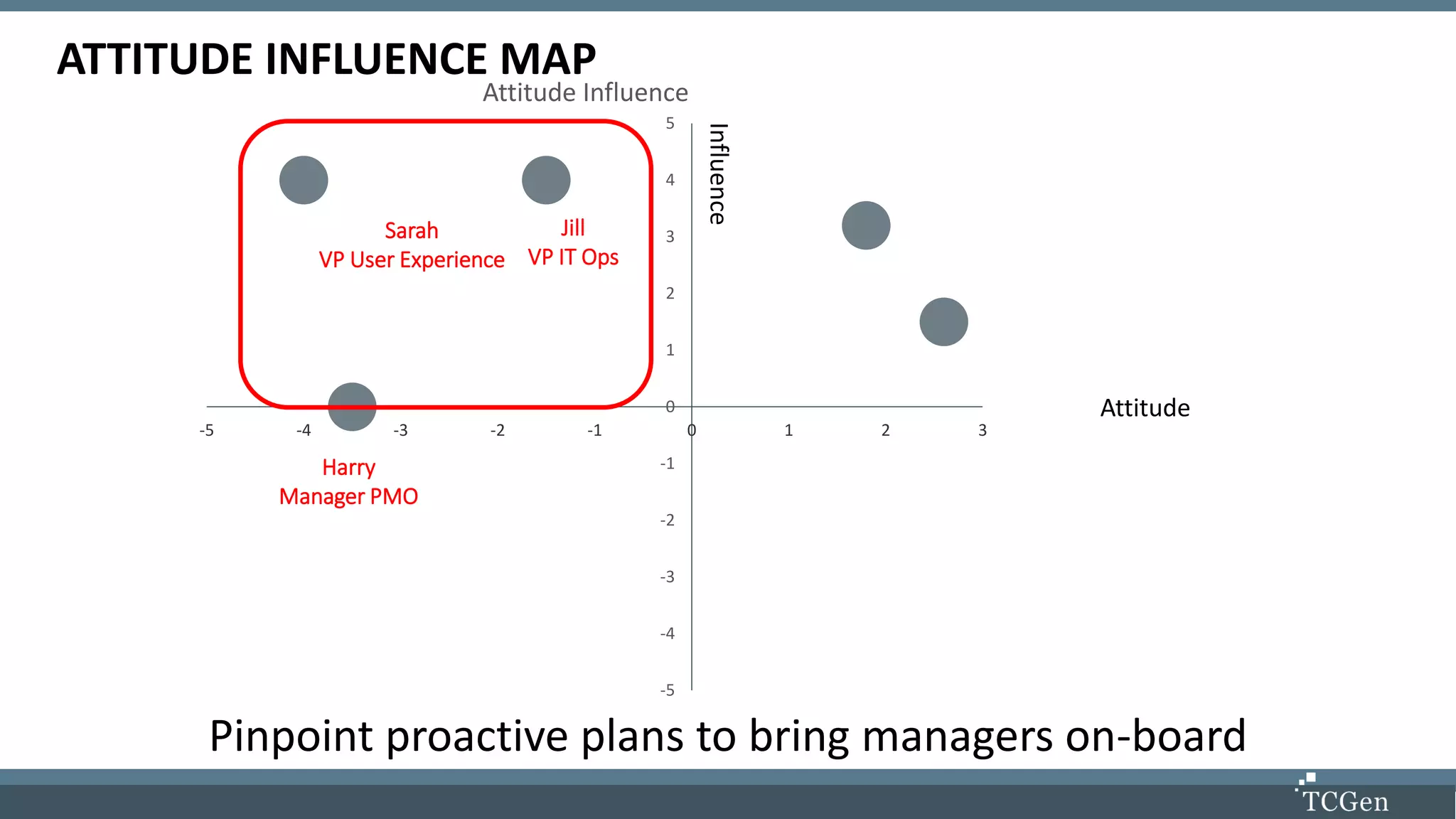
• Identify high influence & negative attitude individuals
• Generate plan
Jill
VP IT Ops
Harry
Manager PMO
Sarah
VP User Experience
-5
-4
-3
-2
-1
0
1
2
3
4
5
-5 -4 -3 -2 -1 0 1 2 3
Attitude Influence
ATTITUDE INFLUENCE MAP
Pinpoint proactive plans to bring managers on-board
Jill
VP IT Ops
Harry
Manager PMO
Sarah
VP User Experience
Attitude
Influence
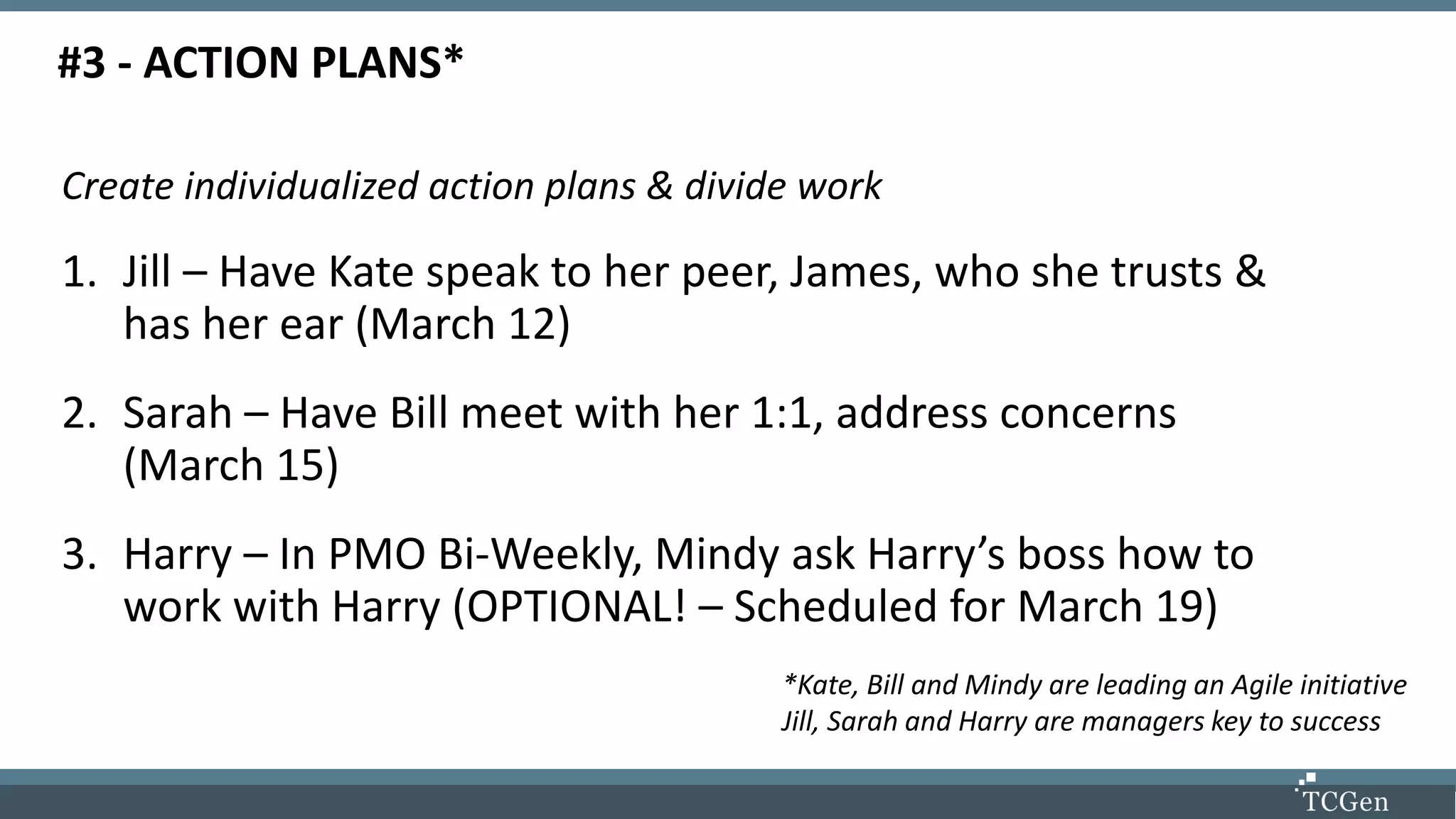
#3 - ACTION PLANS*
Create individualized action plans & divide work
1. Jill – Have Kate speak to her peer, James, who she trusts &
has her ear (March 12)
2. Sarah – Have Bill meet with her 1:1, address concerns
(March 15)
3. Harry – In PMO Bi-Weekly, Mindy ask Harry’s boss how to
work with Harry (OPTIONAL! – Scheduled for March 19)
*Kate, Bill and Mindy are leading an Agile initiative
Jill, Sarah and Harry are managers key to success
AGILE ADVOCATES USE AT THEIR SITE
OR
AGILE BOD USE ACROSS ORG
Idea!
INTELLIGENT
AGILE
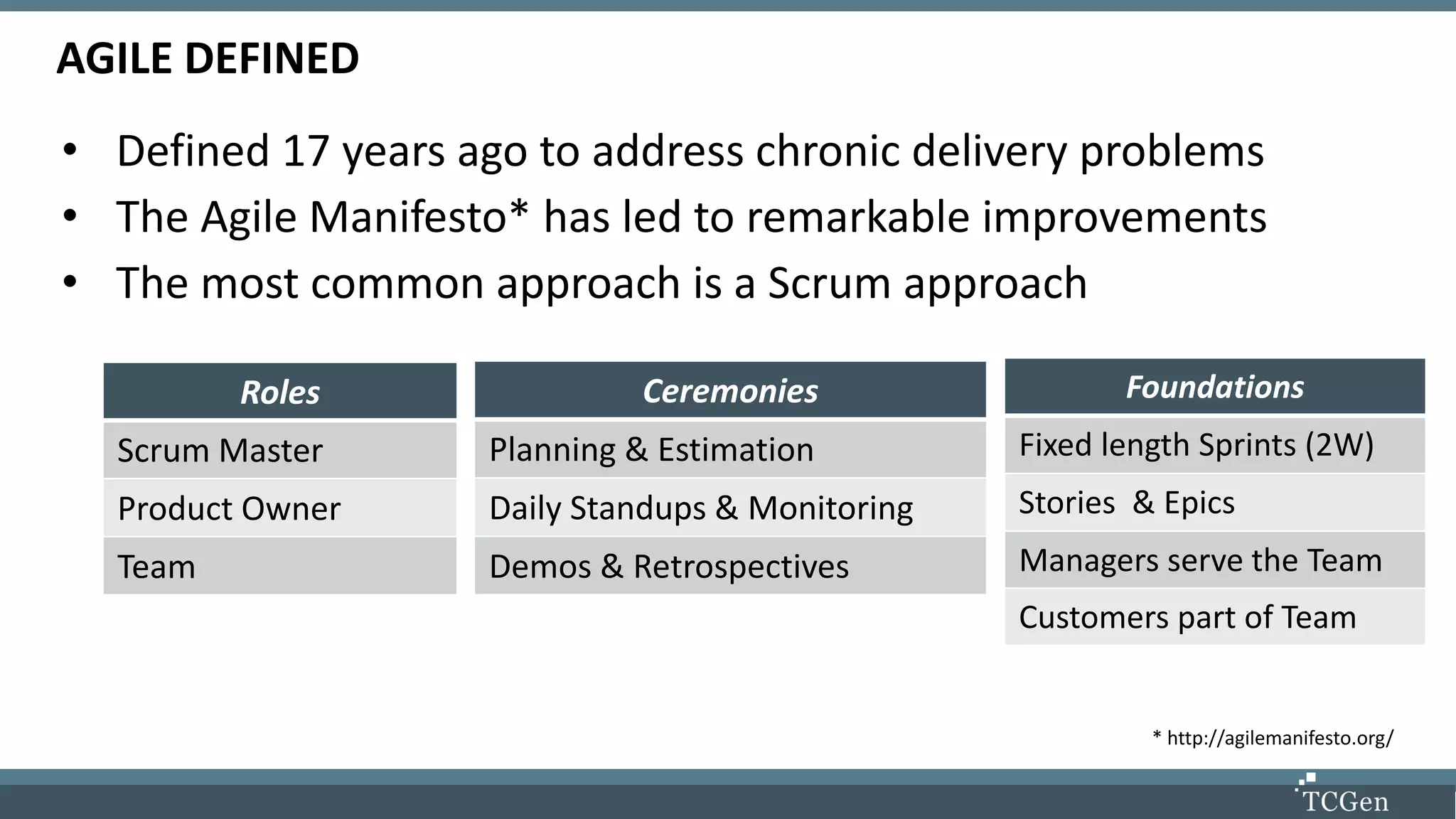
AGILE DEFINED
• Defined 17 years ago to address chronic delivery problems
• The Agile Manifesto* has led to remarkable improvements
• The most common approach is a Scrum approach
* http://agilemanifesto.org/
Roles
Scrum Master
Product Owner
Team
Ceremonies
Planning & Estimation
Daily Standups & Monitoring
Demos & Retrospectives
Foundations
Fixed length Sprints (2W)
Stories & Epics
Managers serve the Team
Customers part of Team
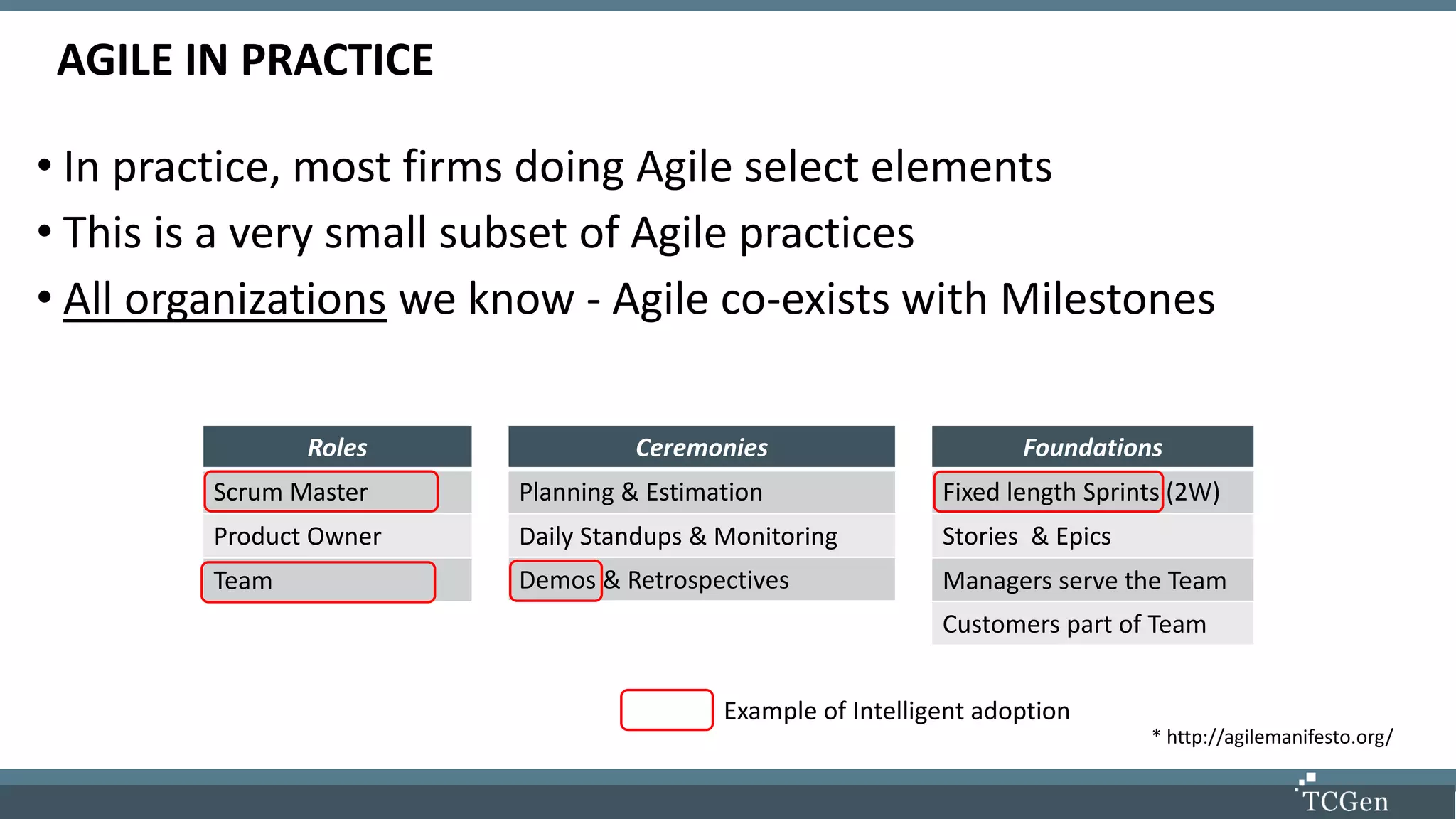
AGILE IN PRACTICE
• In practice, most firms doing Agile select elements
• This is a very small subset of Agile practices
• All organizations we know - Agile co-exists with Milestones
* http://agilemanifesto.org/
Roles
Scrum Master
Product Owner
Team
Ceremonies
Planning & Estimation
Daily Standups & Monitoring
Demos & Retrospectives
Foundations
Fixed length Sprints (2W)
Stories & Epics
Managers serve the Team
Customers part of Team
Example of Intelligent adoption
Instructor Biographies
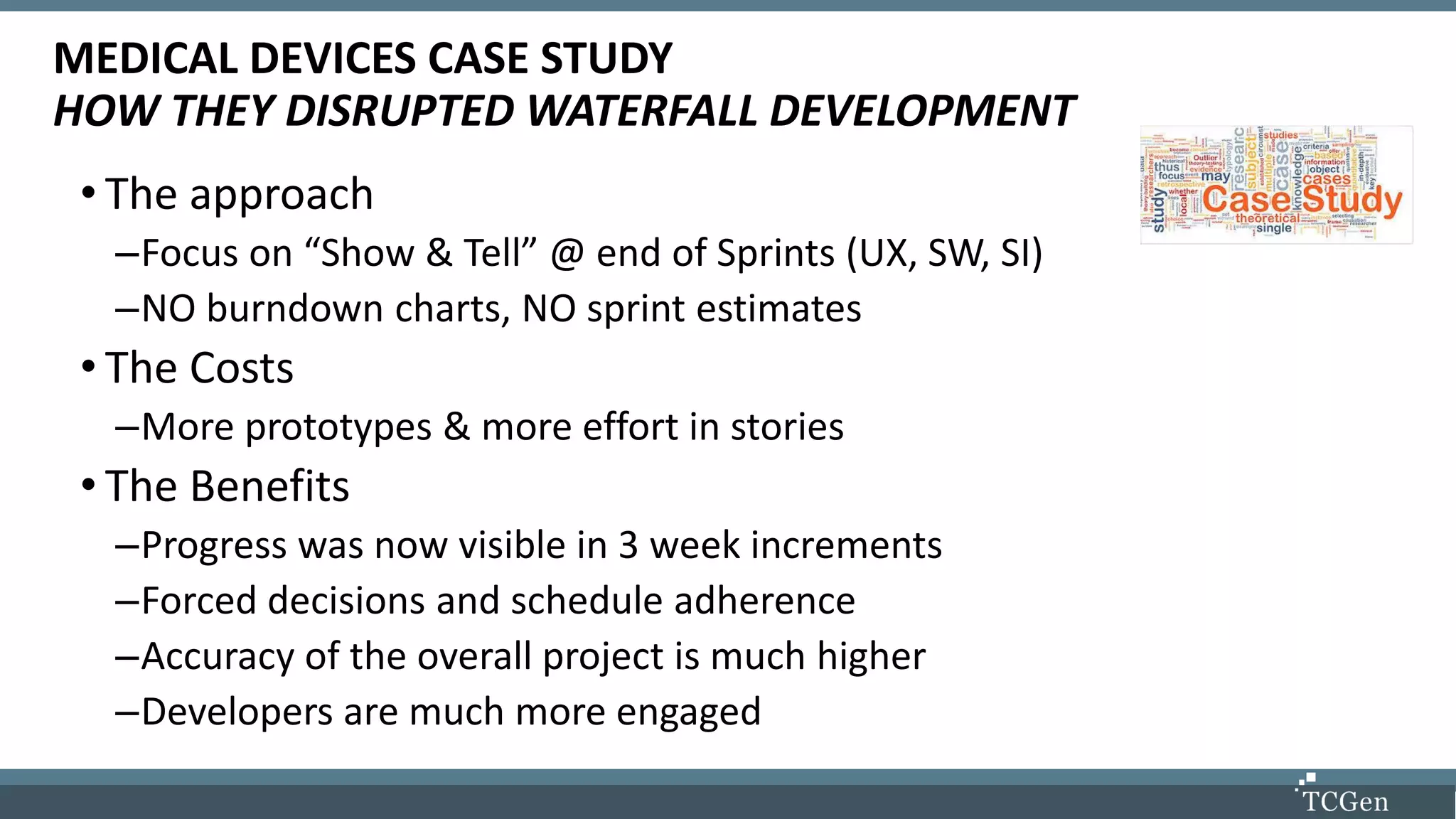
• The approach
–Focus on “Show & Tell” @ end of Sprints (UX, SW, SI)
–NO burndown charts, NO sprint estimates
• The Costs
–More prototypes & more effort in stories
• The Benefits
–Progress was now visible in 3 week increments
–Forced decisions and schedule adherence
–Accuracy of the overall project is much higher
–Developers are much more engaged
MEDICAL DEVICES CASE STUDY
HOW THEY DISRUPTED WATERFALL DEVELOPMENT
Instructor Biographies
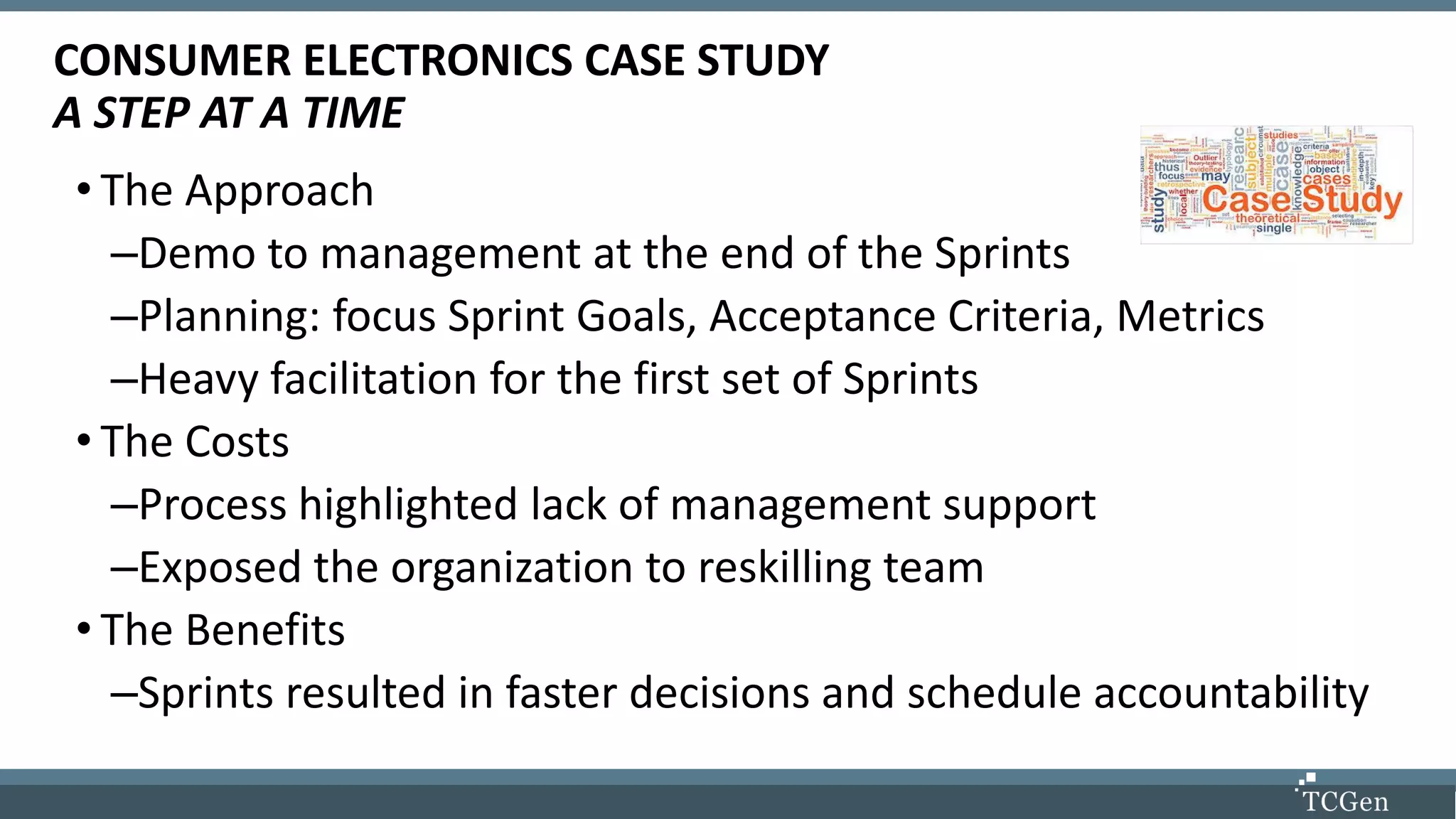
• The Approach
–Demo to management at the end of the Sprints
–Planning: focus Sprint Goals, Acceptance Criteria, Metrics
–Heavy facilitation for the first set of Sprints
• The Costs
–Process highlighted lack of management support
–Exposed the organization to reskilling team
• The Benefits
–Sprints resulted in faster decisions and schedule accountability
CONSUMER ELECTRONICS CASE STUDY
A STEP AT A TIME
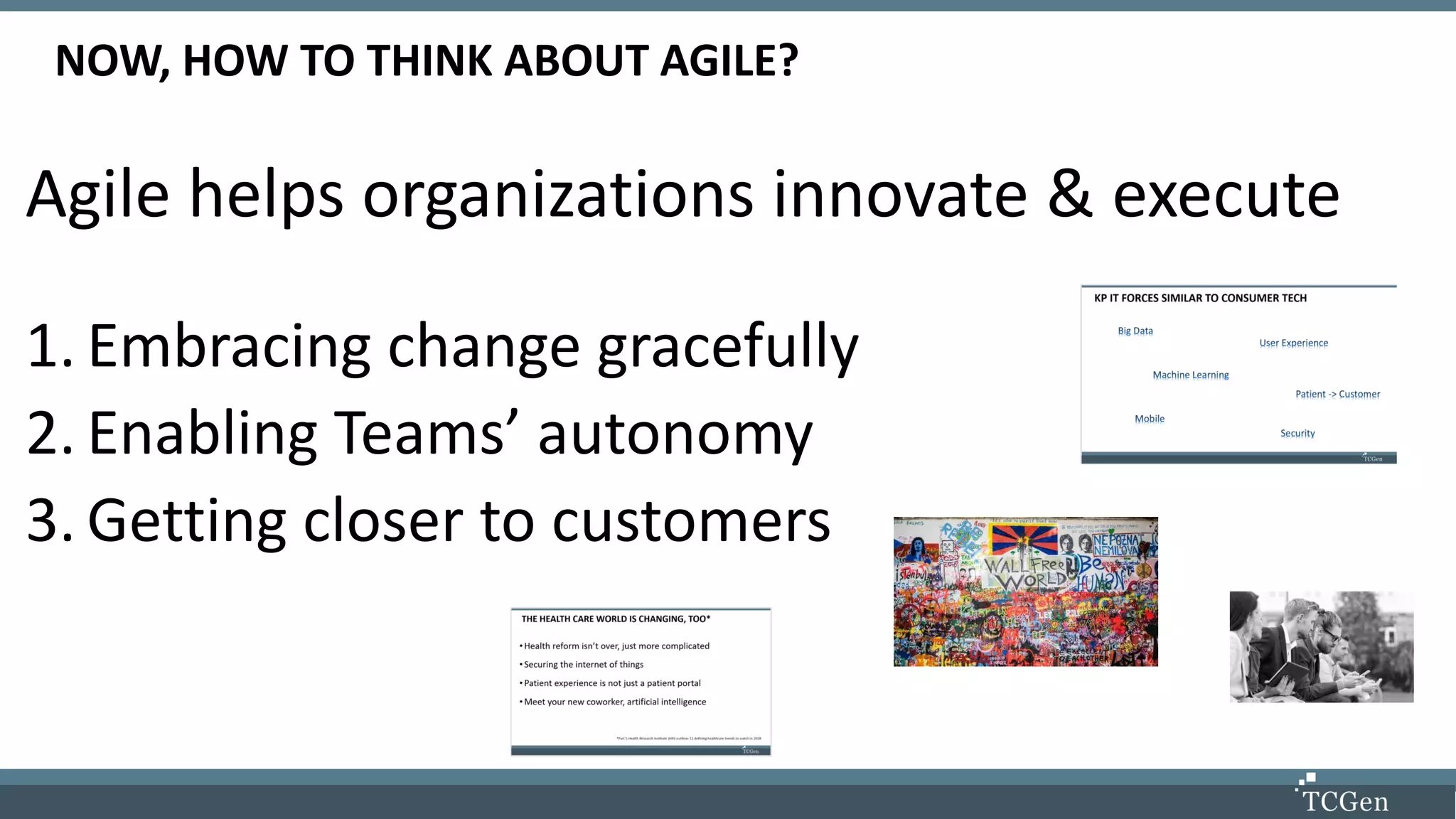
NOW, HOW TO THINK ABOUT AGILE?
Agile helps organizations innovate & execute
1. Embracing change gracefully
2. Enabling Teams’ autonomy
3. Getting closer to customers
HOW TO IMPLEMENT AGILE
@
AN ORGANIZATION WITH
WATERFALL PROCESS
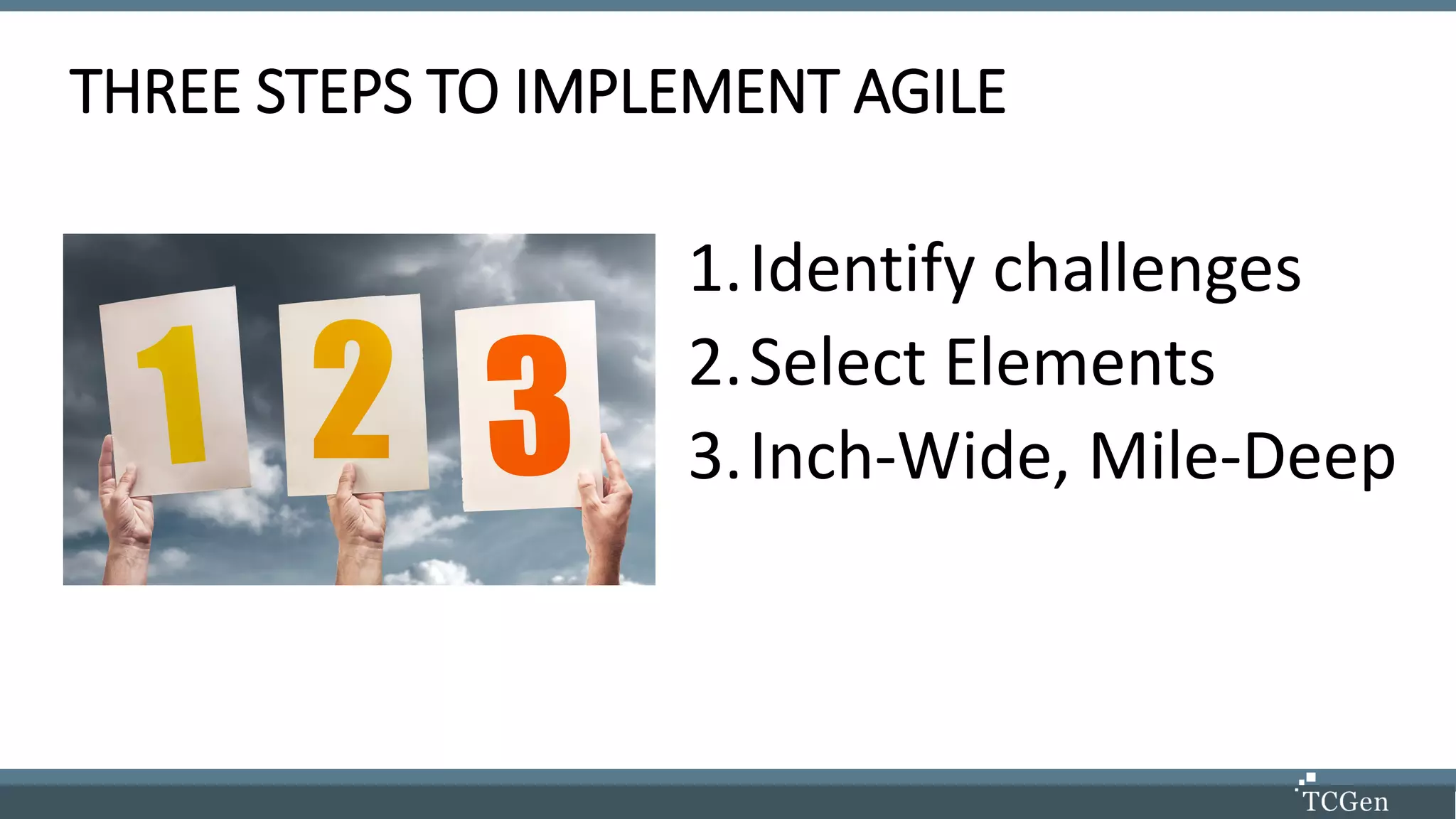
THREE STEPS TO IMPLEMENT AGILE
1.Identify challenges
2.Select Elements
3.Inch-Wide, Mile-Deep
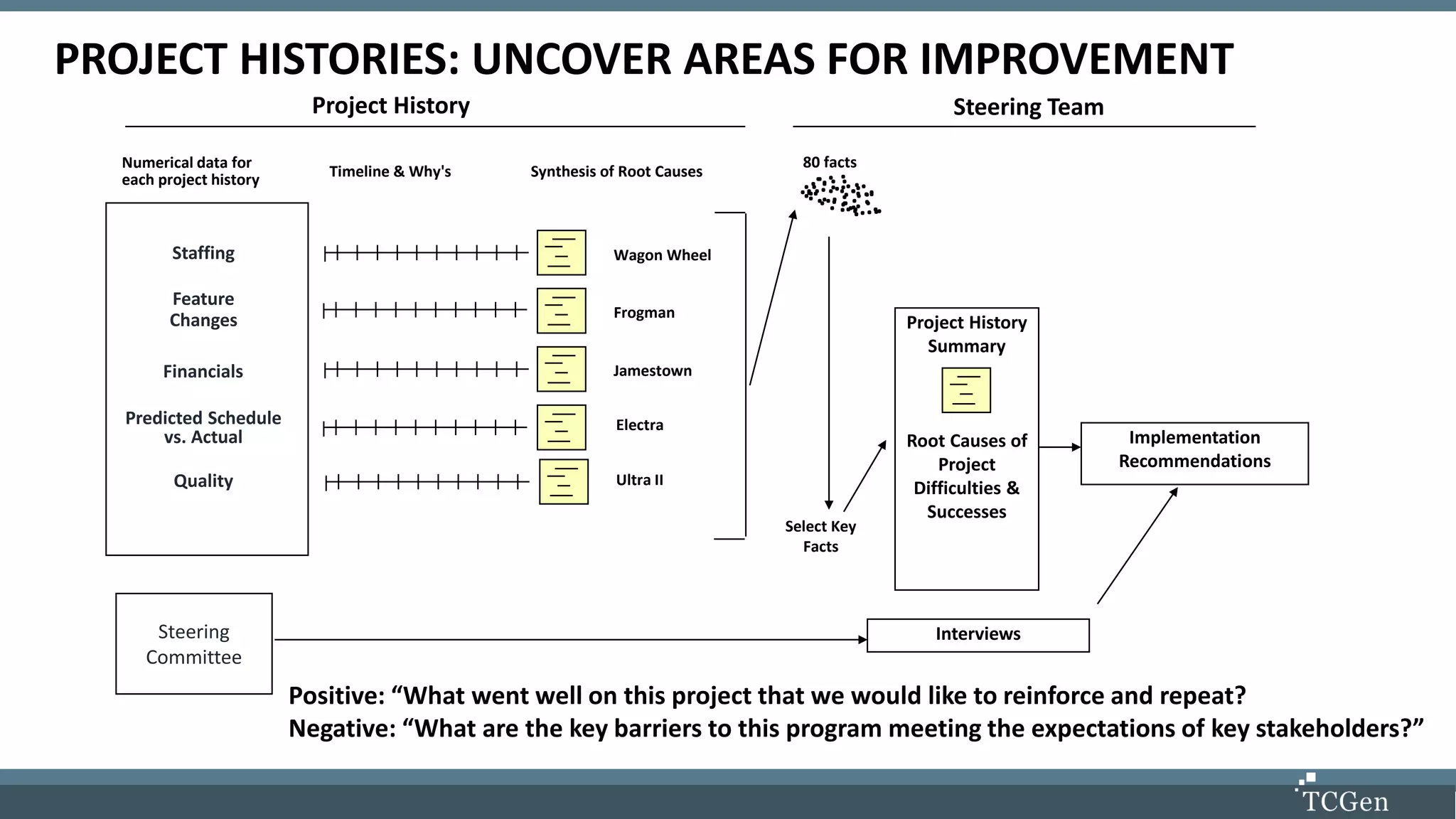
PROJECT HISTORIES: UNCOVER AREAS FOR IMPROVEMENT
Positive: “What went well on this project that we would like to reinforce and repeat?
Negative: “What are the key barriers to this program meeting the expectations of key stakeholders?”
Project History
Timeline & Why's Synthesis of Root Causes
Wagon Wheel
Frogman
Jamestown
Interviews
Implementation
Recommendations
80 facts
Select Key
Facts
.... ... ..
.. .
.
.
.
.
.. .. . .
.
.. ... .
..
..Numerical data for
each project history
. ..
. . .
. ..
.
.. ..
. ..
.. .
.
.
. . ..
.
..
.. ..
Steering Team
Project History
Summary
Root Causes of
Project
Difficulties &
Successes
Staffing
Feature
Changes
Financials
Predicted Schedule
vs. Actual
Quality
Steering
Committee
Electra
Ultra II
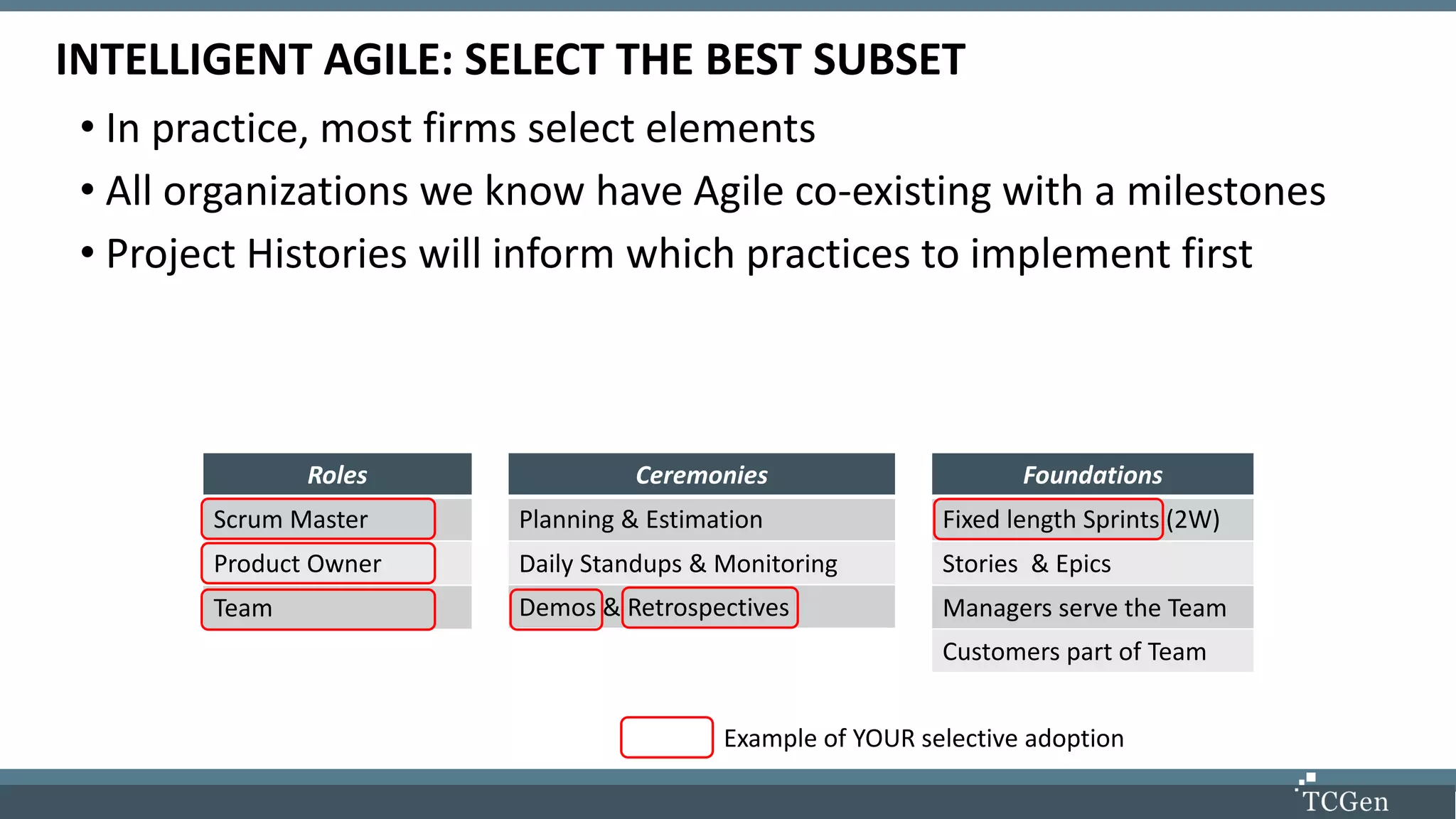
INTELLIGENT AGILE: SELECT THE BEST SUBSET
• In practice, most firms select elements
• All organizations we know have Agile co-existing with a milestones
• Project Histories will inform which practices to implement first
Roles
Scrum Master
Product Owner
Team
Ceremonies
Planning & Estimation
Daily Standups & Monitoring
Demos & Retrospectives
Foundations
Fixed length Sprints (2W)
Stories & Epics
Managers serve the Team
Customers part of Team
Example of YOUR selective adoption
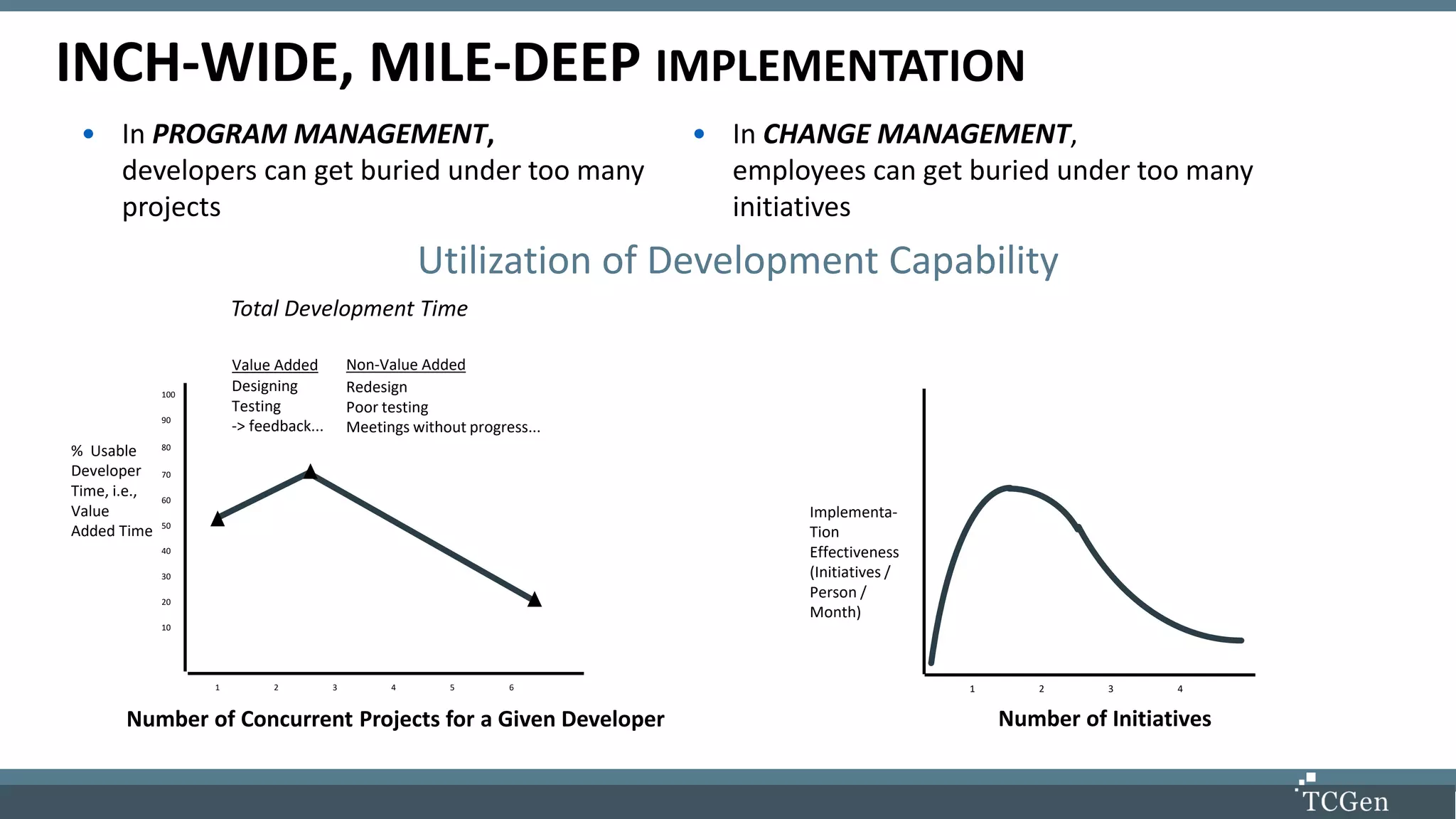
Utilization of Development Capability
Total Development Time
Value Added
Designing
Testing
-> feedback...
Non-Value Added
Redesign
Poor testing
Meetings without progress...
Number of Concurrent Projects for a Given Developer
100
90
80
70
60
50
40
30
20
10
% Usable
Developer
Time, i.e.,
Value
Added Time
1 2 3 4 5 6
Number of Initiatives
Implementa-
Tion
Effectiveness
(Initiatives /
Person /
Month)
1 2 3 4
• In PROGRAM MANAGEMENT,
developers can get buried under too many
projects
• In CHANGE MANAGEMENT,
employees can get buried under too many
initiatives
INCH-WIDE, MILE-DEEP IMPLEMENTATION
NEXT
PRACTICES
PATH FOR YOU
• 1, 2, 3
EMPOWER TEAMS
SUPERPOWER
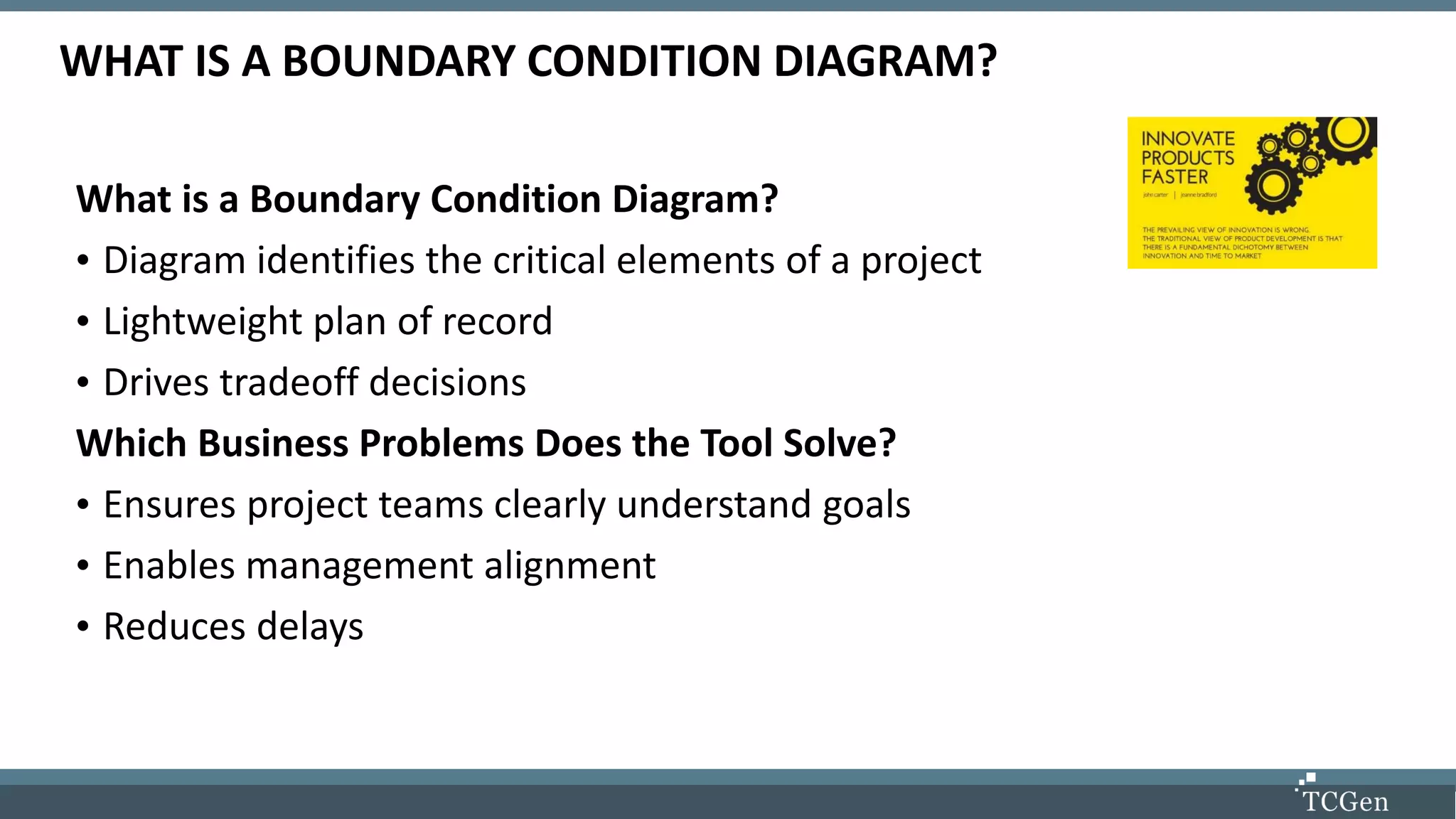
WHAT IS A BOUNDARY CONDITION DIAGRAM?
What is a Boundary Condition Diagram?
• Diagram identifies the critical elements of a project
• Lightweight plan of record
• Drives tradeoff decisions
Which Business Problems Does the Tool Solve?
• Ensures project teams clearly understand goals
• Enables management alignment
• Reduces delays
HOW TO APPLY CREATE BOUNDARY CONDITIONS
•Team selects key boundaries
•Assign each element to a side
• Triangle
• Square…
• Polygon
•State the boundary for each element
•Document thresholds
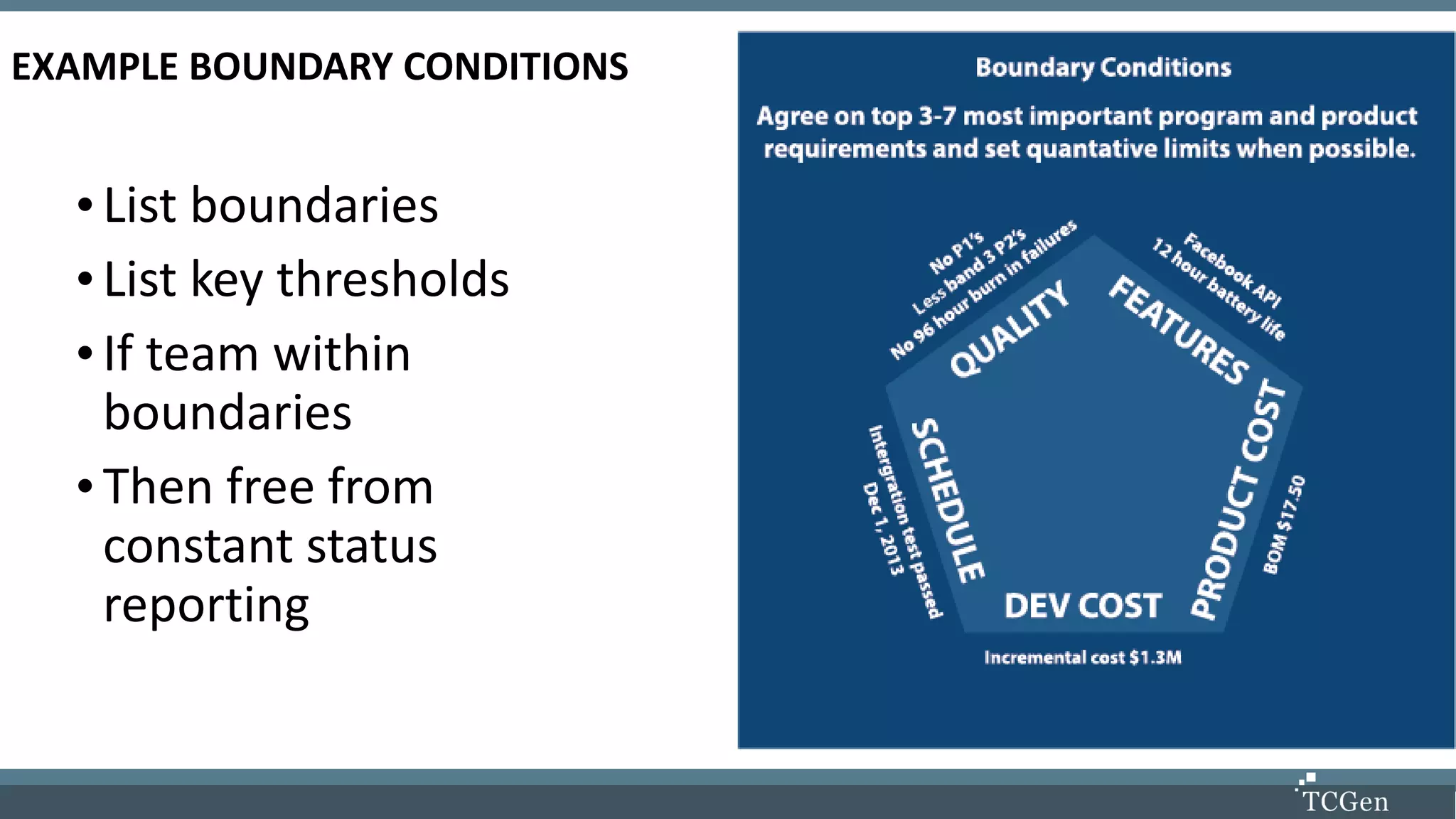
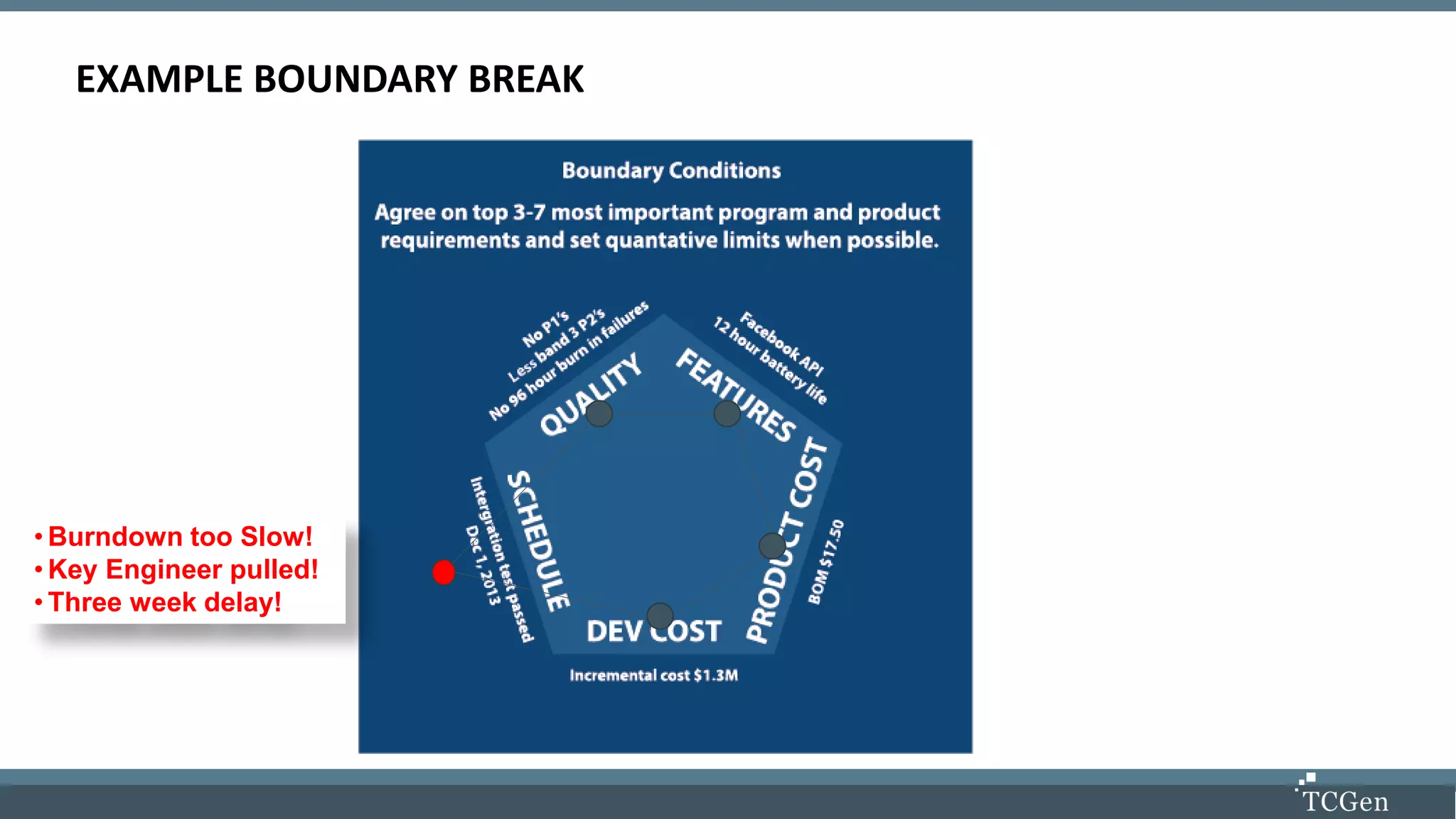
EXAMPLE BOUNDARY CONDITIONS
•List boundaries
•List key thresholds
•If team within
boundaries
•Then free from
constant status
reporting
EXAMPLE BOUNDARY BREAK
• Burndown too Slow!
• Key Engineer pulled!
• Three week delay!
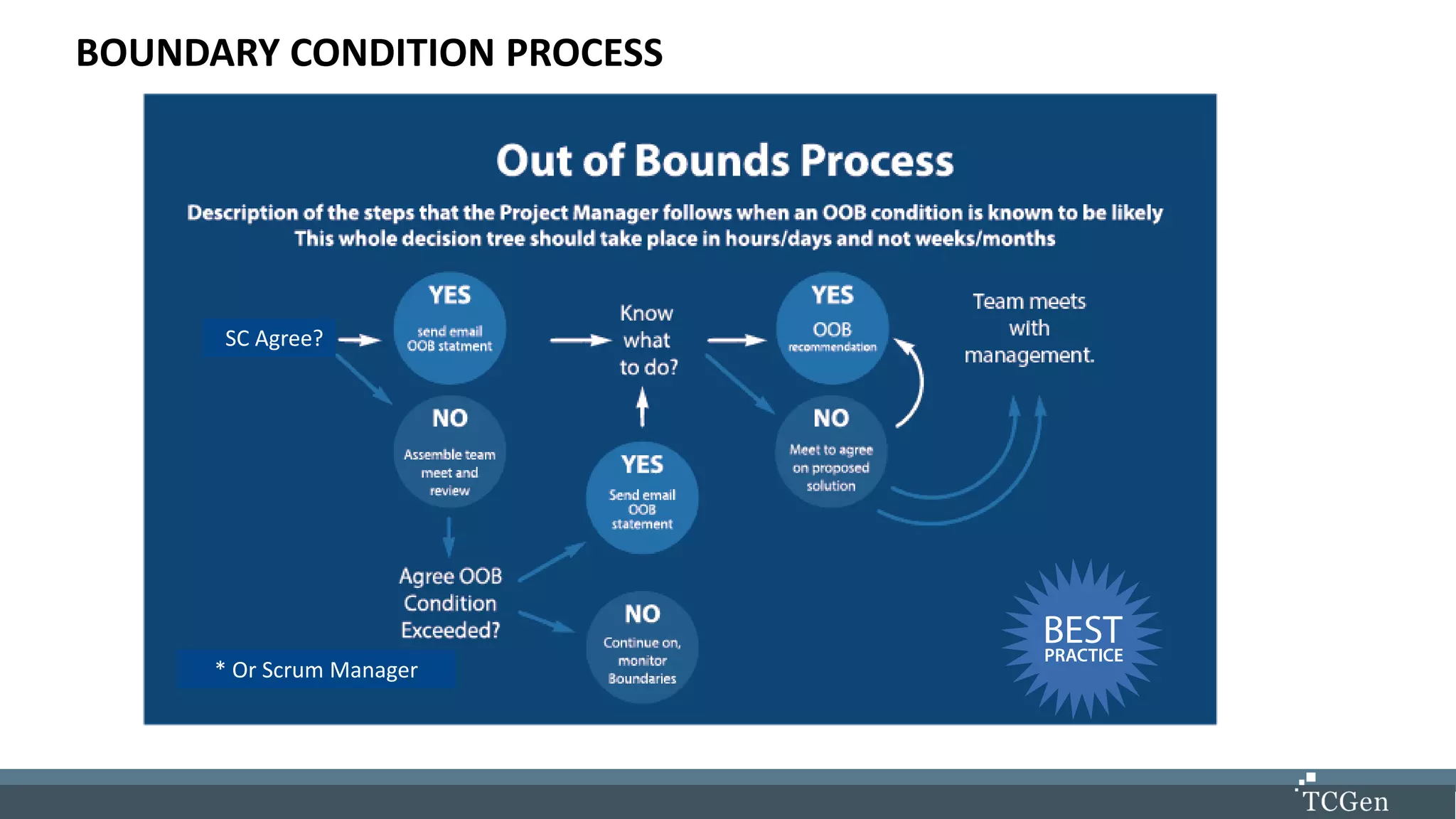
BOUNDARY CONDITION PROCESS
* Or Scrum Manager
SC Agree?
AGILE TEAMS CREATE BOUNDARY CONDITIONS DIAGRAM
THEN
PRESENT TO MANAGEMENT @ NEXT REVIEW
Idea!
CUSTOMER FEEDBACK
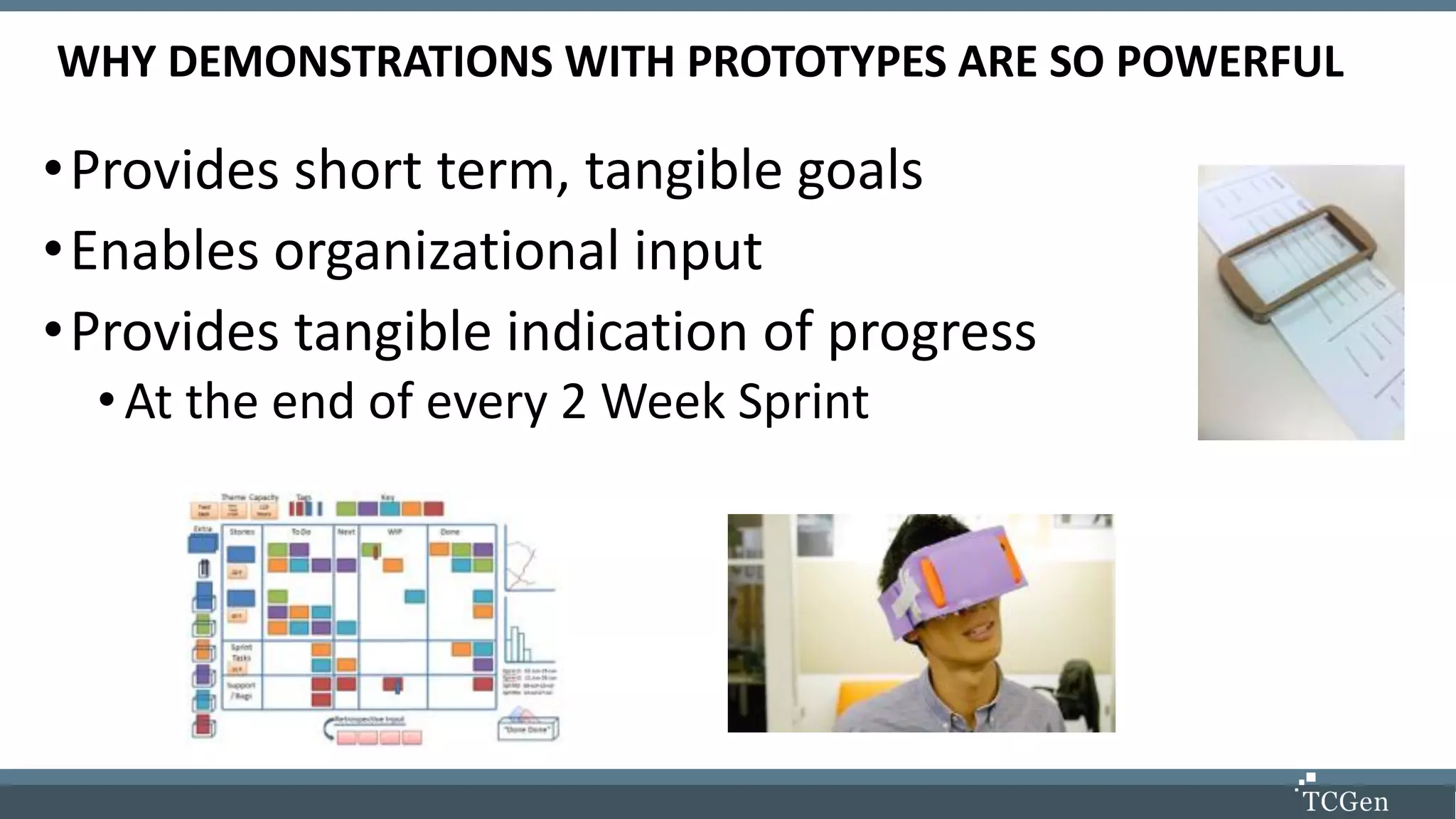
WHY DEMONSTRATIONS WITH PROTOTYPES ARE SO POWERFUL
•Provides short term, tangible goals
•Enables organizational input
•Provides tangible indication of progress
•At the end of every 2 Week Sprint
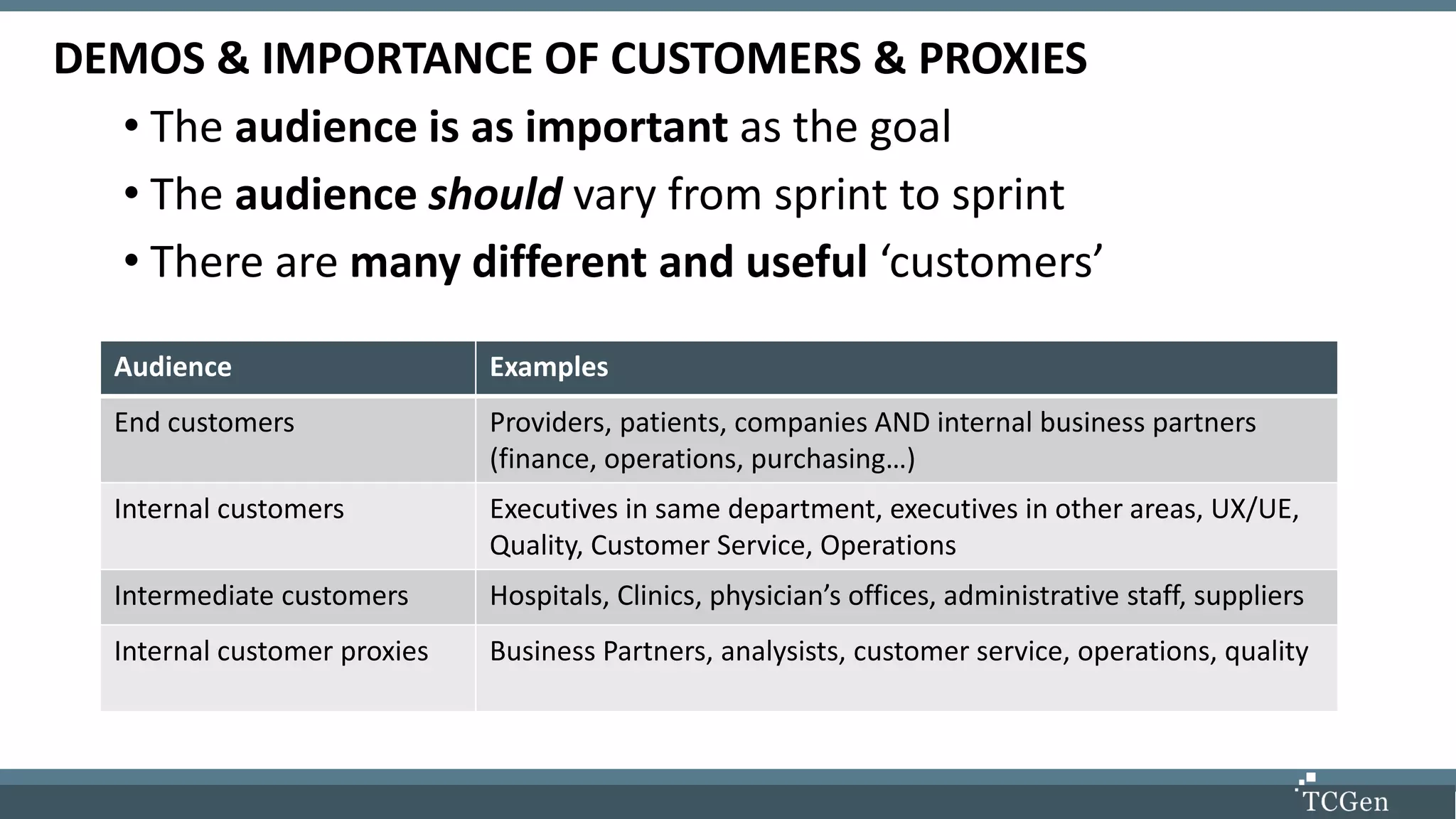
DEMOS & IMPORTANCE OF CUSTOMERS & PROXIES
• The audience is as important as the goal
• The audience should vary from sprint to sprint
• There are many different and useful ‘customers’
Audience Examples
End customers Providers, patients, companies AND internal business partners
(finance, operations, purchasing…)
Internal customers Executives in same department, executives in other areas, UX/UE,
Quality, Customer Service, Operations
Intermediate customers Hospitals, Clinics, physician’s offices, administrative staff, suppliers
Internal customer proxies Business Partners, analysists, customer service, operations, quality
AGILE TEAMS
IDENTIFY AUDIENCE
&
PLAN THREE SPRINT DEMONSTRATIONS
Idea!
RAPID LEARNING
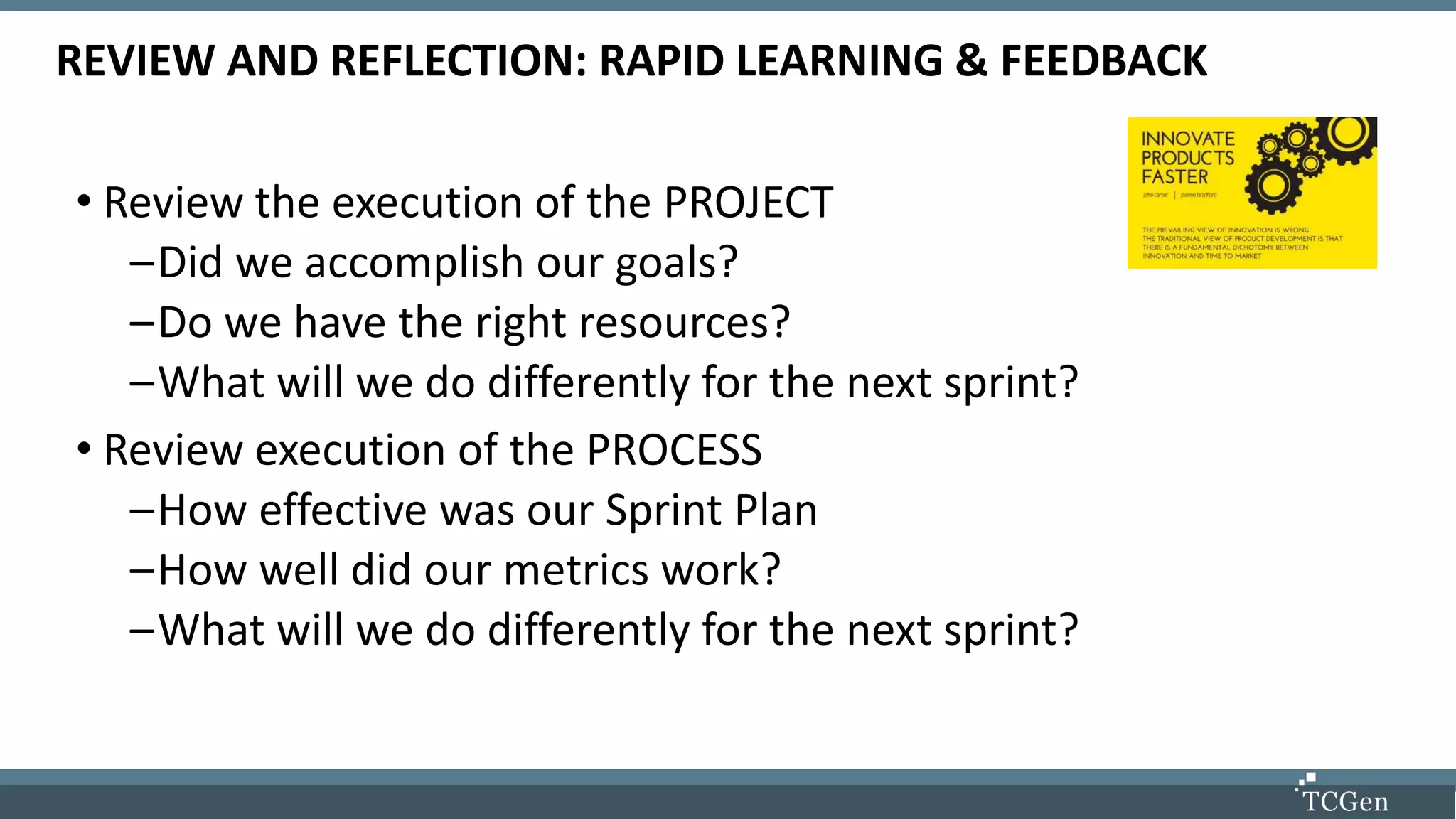
REVIEW AND REFLECTION: RAPID LEARNING & FEEDBACK
• Review the execution of the PROJECT
–Did we accomplish our goals?
–Do we have the right resources?
–What will we do differently for the next sprint?
• Review execution of the PROCESS
–How effective was our Sprint Plan
–How well did our metrics work?
–What will we do differently for the next sprint?
3
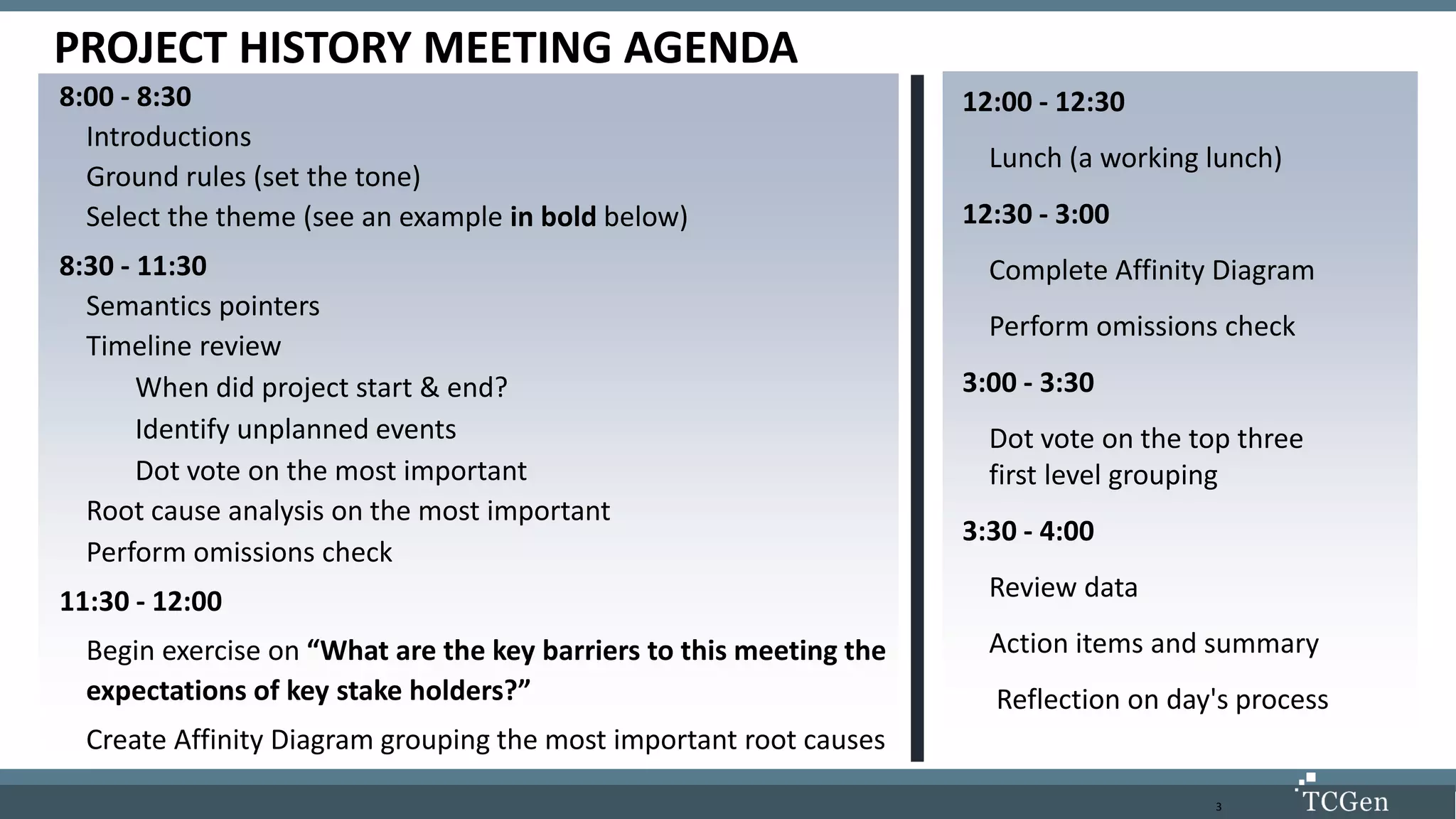
PROJECT HISTORY MEETING AGENDA
8:00 - 8:30
Introductions
Ground rules (set the tone)
Select the theme (see an example in bold below)
8:30 - 11:30
Semantics pointers
Timeline review
When did project start & end?
Identify unplanned events
Dot vote on the most important
Root cause analysis on the most important
Perform omissions check
11:30 - 12:00
Begin exercise on “What are the key barriers to this meeting the
expectations of key stake holders?”
Create Affinity Diagram grouping the most important root causes
12:00 - 12:30
Lunch (a working lunch)
12:30 - 3:00
Complete Affinity Diagram
Perform omissions check
3:00 - 3:30
Dot vote on the top three
first level grouping
3:30 - 4:00
Review data
Action items and summary
Reflection on day's process
4
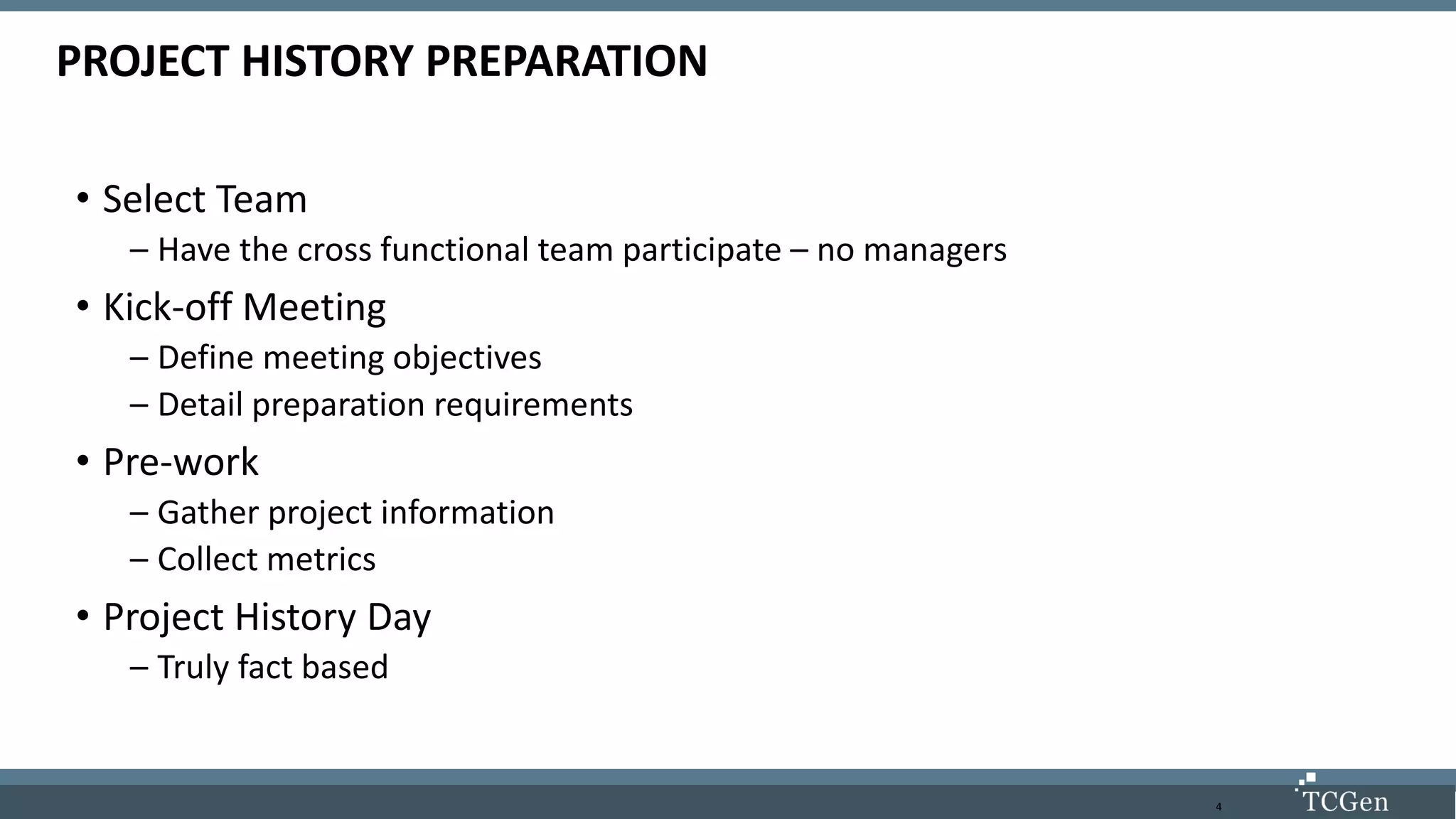
PROJECT HISTORY PREPARATION
• Select Team
– Have the cross functional team participate – no managers
• Kick-off Meeting
– Define meeting objectives
– Detail preparation requirements
• Pre-work
– Gather project information
– Collect metrics
• Project History Day
– Truly fact based
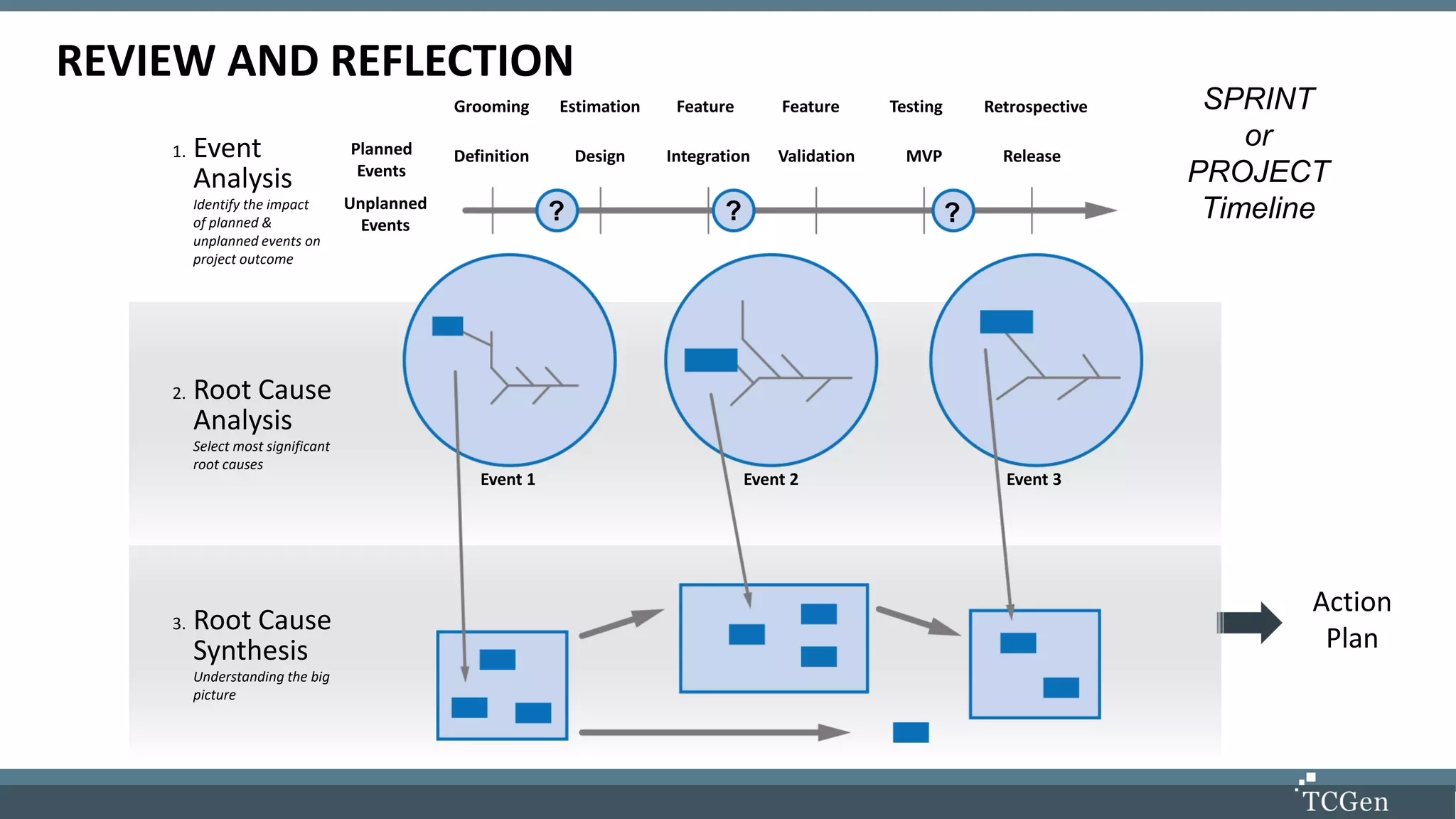
REVIEW AND REFLECTION
Action
Plan
1. Event
Analysis
Identify the impact
of planned &
unplanned events on
project outcome
2. Root Cause
Analysis
Select most significant
root causes
3. Root Cause
Synthesis
Understanding the big
picture
Planned
Events
Unplanned
Events
Definition Design Integration Validation MVP Release
Event 1 Event 2 Event 3
SPRINT
or
PROJECT
Timeline? ??
Grooming Estimation Feature Feature Testing Retrospective
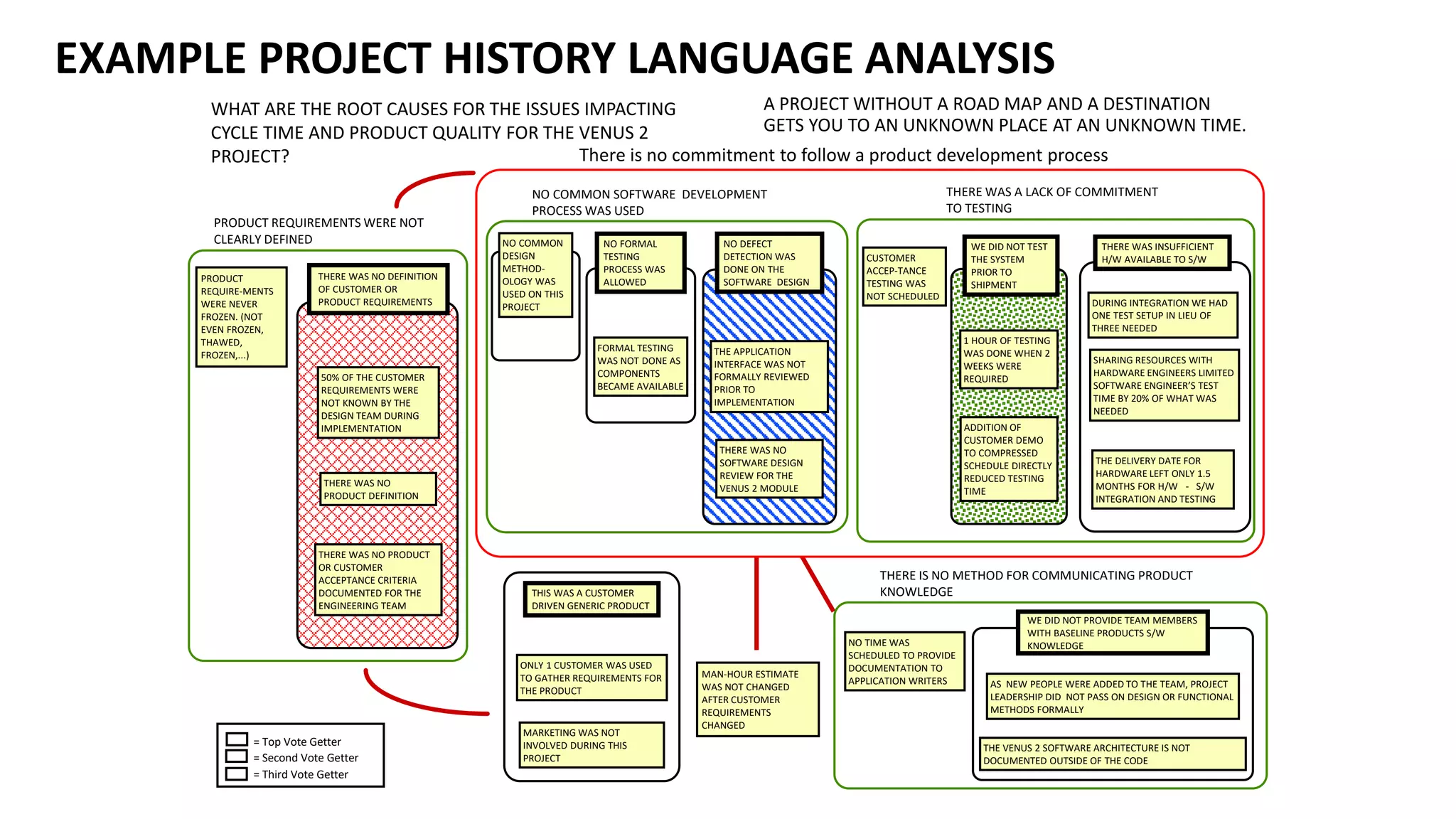
EXAMPLE PROJECT HISTORY LANGUAGE ANALYSIS
WHAT ARE THE ROOT CAUSES FOR THE ISSUES IMPACTING
CYCLE TIME AND PRODUCT QUALITY FOR THE VENUS 2
PROJECT?
A PROJECT WITHOUT A ROAD MAP AND A DESTINATION
GETS YOU TO AN UNKNOWN PLACE AT AN UNKNOWN TIME.
There is no commitment to follow a product development process
MAN-HOUR ESTIMATE
WAS NOT CHANGED
AFTER CUSTOMER
REQUIREMENTS
CHANGED
PRODUCT
REQUIRE-MENTS
WERE NEVER
FROZEN. (NOT
EVEN FROZEN,
THAWED,
FROZEN,...)
THERE WAS NO DEFINITION
OF CUSTOMER OR
PRODUCT REQUIREMENTS
THERE WAS NO PRODUCT
OR CUSTOMER
ACCEPTANCE CRITERIA
DOCUMENTED FOR THE
ENGINEERING TEAM
50% OF THE CUSTOMER
REQUIREMENTS WERE
NOT KNOWN BY THE
DESIGN TEAM DURING
IMPLEMENTATION
THERE WAS NO
PRODUCT DEFINITION
= Top Vote Getter
= Second Vote Getter
= Third Vote Getter
ONLY 1 CUSTOMER WAS USED
TO GATHER REQUIREMENTS FOR
THE PRODUCT
MARKETING WAS NOT
INVOLVED DURING THIS
PROJECT
THIS WAS A CUSTOMER
DRIVEN GENERIC PRODUCT
PRODUCT REQUIREMENTS WERE NOT
CLEARLY DEFINED
NO TIME WAS
SCHEDULED TO PROVIDE
DOCUMENTATION TO
APPLICATION WRITERS AS NEW PEOPLE WERE ADDED TO THE TEAM, PROJECT
LEADERSHIP DID NOT PASS ON DESIGN OR FUNCTIONAL
METHODS FORMALLY
THE VENUS 2 SOFTWARE ARCHITECTURE IS NOT
DOCUMENTED OUTSIDE OF THE CODE
WE DID NOT PROVIDE TEAM MEMBERS
WITH BASELINE PRODUCTS S/W
KNOWLEDGE
THERE IS NO METHOD FOR COMMUNICATING PRODUCT
KNOWLEDGE
NO COMMON SOFTWARE DEVELOPMENT
PROCESS WAS USED
DURING INTEGRATION WE HAD
ONE TEST SETUP IN LIEU OF
THREE NEEDED
SHARING RESOURCES WITH
HARDWARE ENGINEERS LIMITED
SOFTWARE ENGINEER’S TEST
TIME BY 20% OF WHAT WAS
NEEDED
THE APPLICATION
INTERFACE WAS NOT
FORMALLY REVIEWED
PRIOR TO
IMPLEMENTATION
THERE WAS NO
SOFTWARE DESIGN
REVIEW FOR THE
VENUS 2 MODULE
FORMAL TESTING
WAS NOT DONE AS
COMPONENTS
BECAME AVAILABLE
NO COMMON
DESIGN
METHOD-
OLOGY WAS
USED ON THIS
PROJECT
THE DELIVERY DATE FOR
HARDWARE LEFT ONLY 1.5
MONTHS FOR H/W - S/W
INTEGRATION AND TESTING
CUSTOMER
ACCEP-TANCE
TESTING WAS
NOT SCHEDULED
NO DEFECT
DETECTION WAS
DONE ON THE
SOFTWARE DESIGN
WE DID NOT TEST
THE SYSTEM
PRIOR TO
SHIPMENT
1 HOUR OF TESTING
WAS DONE WHEN 2
WEEKS WERE
REQUIRED
ADDITION OF
CUSTOMER DEMO
TO COMPRESSED
SCHEDULE DIRECTLY
REDUCED TESTING
TIME
NO FORMAL
TESTING
PROCESS WAS
ALLOWED
THERE WAS A LACK OF COMMITMENT
TO TESTING
THERE WAS INSUFFICIENT
H/W AVAILABLE TO S/W
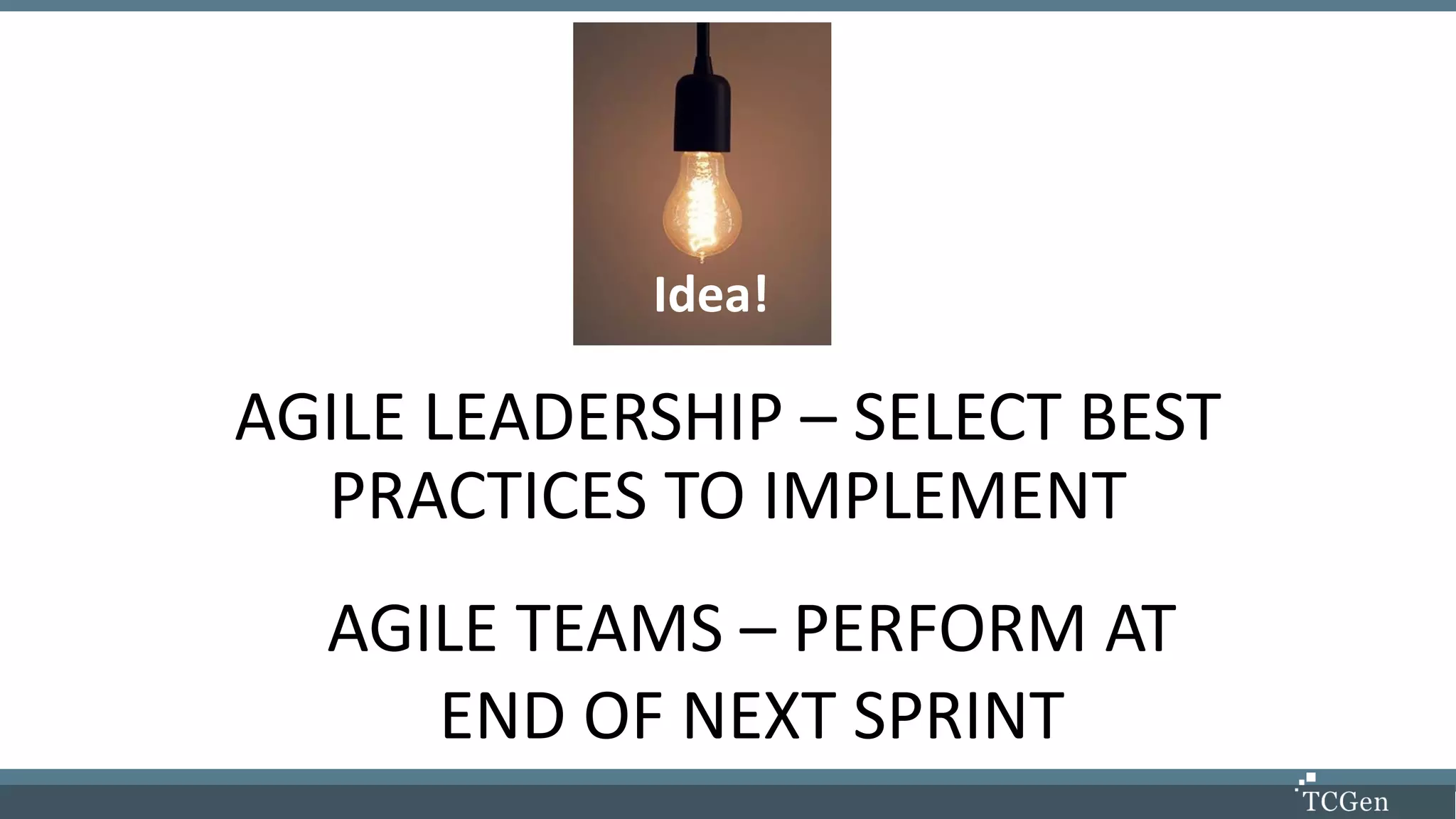
AGILE LEADERSHIP – SELECT BEST
PRACTICES TO IMPLEMENT
AGILE TEAMS – PERFORM AT
END OF NEXT SPRINT
Idea!
IN SUMMARY…
Tidal Wave to Fountain – By Directing the Water
TCGen Inc.
Menlo Park
CA, 94025
jcarter@tcgen.com
+1 650 733-5310
Thank you, Agile COP
And
Agile COP Board of Directors

Can Agile Work With a Waterfall Process?

  • 1.
    PRESENTATION TO AGILECOP Never the Twain Shall Meet… Can Agile Work with a Waterfall Process? John Carter TCGen Inc. March 5, 2018 Agile Community of Practice
  • 2.
  • 4.
  • 5.
  • 6.
  • 7.
    TCGEN: AN EXPERIENCEDBASED CONSULTANCY John Carter • Recognized authority in Product Development • Author of “Innovate Products Faster” • Created Apple’s New Product Process (ANPP) • Invented Bose’s Noise Cancelling Headphones
  • 9.
  • 10.
  • 11.
    WHAT THE RESEARCHTELLS US: AGILE IS SPREADING • McKinsey Study of Organization-wide Agile Transformations* • Surprising that it is not “up and to the right”!? * How to Create an Agile Organization, Oct. 2017 (Ahlback, Fahrbach, Murarka, and Salo) Percentofrespondentsreportingorganization-wide agiletransformations,byindustry
  • 12.
    WHAT PRACTICES DOESAN AGILE ORGANIZATION FOLLOW? • Differences between Agile and Bureaucratic Organizations • The top four differences are directly applicable to most organizations * How to Create an Agile Organization, Oct. 2017 (Ahlback, Fahrbach, Murarka, and Salo)
  • 13.
    WHY HAVE ORGANIZATIONSBEEN SLOW TO ADOPT AGILE? •Myths create major barriers to adoption* • “Applying Agile is all or nothing” • “You must be able to ship every two weeks” • “Agile and Waterfall/Milestone are mutually exclusive” •Bite off too much *TCGen Research on Agile Implementation Barriers, 2016
  • 14.
    AGILE MANIFESTO –NOT JUST FOR AGILE 1.Business people and developers work together daily 2.Projects require motivated individuals, support & trust 3.Face-to-face conversation is most efficient 4.Agile processes promote sustainable development 5.Continuous attention to technical excellence 6.Simplicity is essential 7.The best designs emerge from self-organizing teams 8.At regular intervals, the team reflects 9.Welcome changing requirements 10.Continuous delivery of valuable software 11.Deliver working software frequently 12.Working software is the measure of progress 75% of the Agile Manifesto CAN apply to any type of development Consumer / Cloud Universal http://agilemanifesto.org/
  • 15.
  • 16.
  • 17.
  • 18.
  • 19.
  • 20.
  • 21.
    ORGANIZATION: A BIGCHALLENGE Challenges • Stronger teaming required • Trust may be missing • Power transfer to teams Impacts Maslow’s hierarchy of needs. Why it’s hard • Fear of lost domain knowledge • Teams need to skill up • Career path changes
  • 22.
    CHANGE ROLES: RECIPEFOR THE AGILE TRANSFORMATION • Servant Leadership model –Proactive help • Roles for Managers –Increase Talent Density –Remove Roadblocks –Plan Architecture • Roles for Teams –Self Governing if in bounds
  • 23.
    HOW CAN I HELPYOU TO BE SUCCESSFUL?
  • 24.
  • 25.
  • 26.
  • 27.
    REMOVE BARRIERS WITHATTITUDE INFLUENCE MAP High Influence Negative Attitude Sarah VP User Experience Individuals Involved in Initiative's success
  • 28.
    WHAT IS ANATTITUDE INFLUENCE MAP? •Helps proactive leaders accomplish objectives •Removes roadblocks placed by others •Part of three steps to remove barriers
  • 29.
    BARRIER REMOVAL INTHREE SIMPLE STEPS 3.Implement 2.Map & Plan 1.Identify Barriers
  • 30.
    #1 – PROGRAMLEADERS EVALUATE CHALLENGES •In small group –List those who might impact your program •Plot individuals against the two axes (Attitude and Influence) •Attitude (horizontal axis) – Rate the person’s attitude •Influence (vertical axis) – Rate the person’s influence –Often it is their position, but also consider seniority, knowledge, etc.
  • 31.
    #2 - CREATEATTITUDE INFLUENCE MAP & PLAN • Use “Pair Wise” comparisons to fine tune Map • Discuss Sarah versus Jill, then Jill versus Harry • Finally Sarah versus Harry • Identify high influence & negative attitude individuals • Generate plan Jill VP IT Ops Harry Manager PMO Sarah VP User Experience
  • 32.
    -5 -4 -3 -2 -1 0 1 2 3 4 5 -5 -4 -3-2 -1 0 1 2 3 Attitude Influence ATTITUDE INFLUENCE MAP Pinpoint proactive plans to bring managers on-board Jill VP IT Ops Harry Manager PMO Sarah VP User Experience Attitude Influence
  • 33.
    #3 - ACTIONPLANS* Create individualized action plans & divide work 1. Jill – Have Kate speak to her peer, James, who she trusts & has her ear (March 12) 2. Sarah – Have Bill meet with her 1:1, address concerns (March 15) 3. Harry – In PMO Bi-Weekly, Mindy ask Harry’s boss how to work with Harry (OPTIONAL! – Scheduled for March 19) *Kate, Bill and Mindy are leading an Agile initiative Jill, Sarah and Harry are managers key to success
  • 34.
    AGILE ADVOCATES USEAT THEIR SITE OR AGILE BOD USE ACROSS ORG Idea!
  • 35.
  • 36.
    AGILE DEFINED • Defined17 years ago to address chronic delivery problems • The Agile Manifesto* has led to remarkable improvements • The most common approach is a Scrum approach * http://agilemanifesto.org/ Roles Scrum Master Product Owner Team Ceremonies Planning & Estimation Daily Standups & Monitoring Demos & Retrospectives Foundations Fixed length Sprints (2W) Stories & Epics Managers serve the Team Customers part of Team
  • 37.
    AGILE IN PRACTICE •In practice, most firms doing Agile select elements • This is a very small subset of Agile practices • All organizations we know - Agile co-exists with Milestones * http://agilemanifesto.org/ Roles Scrum Master Product Owner Team Ceremonies Planning & Estimation Daily Standups & Monitoring Demos & Retrospectives Foundations Fixed length Sprints (2W) Stories & Epics Managers serve the Team Customers part of Team Example of Intelligent adoption
  • 38.
    Instructor Biographies • Theapproach –Focus on “Show & Tell” @ end of Sprints (UX, SW, SI) –NO burndown charts, NO sprint estimates • The Costs –More prototypes & more effort in stories • The Benefits –Progress was now visible in 3 week increments –Forced decisions and schedule adherence –Accuracy of the overall project is much higher –Developers are much more engaged MEDICAL DEVICES CASE STUDY HOW THEY DISRUPTED WATERFALL DEVELOPMENT
  • 39.
    Instructor Biographies • TheApproach –Demo to management at the end of the Sprints –Planning: focus Sprint Goals, Acceptance Criteria, Metrics –Heavy facilitation for the first set of Sprints • The Costs –Process highlighted lack of management support –Exposed the organization to reskilling team • The Benefits –Sprints resulted in faster decisions and schedule accountability CONSUMER ELECTRONICS CASE STUDY A STEP AT A TIME
  • 40.
    NOW, HOW TOTHINK ABOUT AGILE? Agile helps organizations innovate & execute 1. Embracing change gracefully 2. Enabling Teams’ autonomy 3. Getting closer to customers
  • 41.
    HOW TO IMPLEMENTAGILE @ AN ORGANIZATION WITH WATERFALL PROCESS
  • 42.
    THREE STEPS TOIMPLEMENT AGILE 1.Identify challenges 2.Select Elements 3.Inch-Wide, Mile-Deep
  • 43.
    PROJECT HISTORIES: UNCOVERAREAS FOR IMPROVEMENT Positive: “What went well on this project that we would like to reinforce and repeat? Negative: “What are the key barriers to this program meeting the expectations of key stakeholders?” Project History Timeline & Why's Synthesis of Root Causes Wagon Wheel Frogman Jamestown Interviews Implementation Recommendations 80 facts Select Key Facts .... ... .. .. . . . . . .. .. . . . .. ... . .. ..Numerical data for each project history . .. . . . . .. . .. .. . .. .. . . . . . .. . .. .. .. Steering Team Project History Summary Root Causes of Project Difficulties & Successes Staffing Feature Changes Financials Predicted Schedule vs. Actual Quality Steering Committee Electra Ultra II
  • 44.
    INTELLIGENT AGILE: SELECTTHE BEST SUBSET • In practice, most firms select elements • All organizations we know have Agile co-existing with a milestones • Project Histories will inform which practices to implement first Roles Scrum Master Product Owner Team Ceremonies Planning & Estimation Daily Standups & Monitoring Demos & Retrospectives Foundations Fixed length Sprints (2W) Stories & Epics Managers serve the Team Customers part of Team Example of YOUR selective adoption
  • 45.
    Utilization of DevelopmentCapability Total Development Time Value Added Designing Testing -> feedback... Non-Value Added Redesign Poor testing Meetings without progress... Number of Concurrent Projects for a Given Developer 100 90 80 70 60 50 40 30 20 10 % Usable Developer Time, i.e., Value Added Time 1 2 3 4 5 6 Number of Initiatives Implementa- Tion Effectiveness (Initiatives / Person / Month) 1 2 3 4 • In PROGRAM MANAGEMENT, developers can get buried under too many projects • In CHANGE MANAGEMENT, employees can get buried under too many initiatives INCH-WIDE, MILE-DEEP IMPLEMENTATION
  • 46.
  • 47.
  • 48.
  • 49.
  • 50.
    WHAT IS ABOUNDARY CONDITION DIAGRAM? What is a Boundary Condition Diagram? • Diagram identifies the critical elements of a project • Lightweight plan of record • Drives tradeoff decisions Which Business Problems Does the Tool Solve? • Ensures project teams clearly understand goals • Enables management alignment • Reduces delays
  • 51.
    HOW TO APPLYCREATE BOUNDARY CONDITIONS •Team selects key boundaries •Assign each element to a side • Triangle • Square… • Polygon •State the boundary for each element •Document thresholds
  • 52.
    EXAMPLE BOUNDARY CONDITIONS •Listboundaries •List key thresholds •If team within boundaries •Then free from constant status reporting
  • 53.
    EXAMPLE BOUNDARY BREAK •Burndown too Slow! • Key Engineer pulled! • Three week delay!
  • 54.
    BOUNDARY CONDITION PROCESS *Or Scrum Manager SC Agree?
  • 55.
    AGILE TEAMS CREATEBOUNDARY CONDITIONS DIAGRAM THEN PRESENT TO MANAGEMENT @ NEXT REVIEW Idea!
  • 56.
  • 57.
    WHY DEMONSTRATIONS WITHPROTOTYPES ARE SO POWERFUL •Provides short term, tangible goals •Enables organizational input •Provides tangible indication of progress •At the end of every 2 Week Sprint
  • 58.
    DEMOS & IMPORTANCEOF CUSTOMERS & PROXIES • The audience is as important as the goal • The audience should vary from sprint to sprint • There are many different and useful ‘customers’ Audience Examples End customers Providers, patients, companies AND internal business partners (finance, operations, purchasing…) Internal customers Executives in same department, executives in other areas, UX/UE, Quality, Customer Service, Operations Intermediate customers Hospitals, Clinics, physician’s offices, administrative staff, suppliers Internal customer proxies Business Partners, analysists, customer service, operations, quality
  • 59.
    AGILE TEAMS IDENTIFY AUDIENCE & PLANTHREE SPRINT DEMONSTRATIONS Idea!
  • 60.
  • 61.
    REVIEW AND REFLECTION:RAPID LEARNING & FEEDBACK • Review the execution of the PROJECT –Did we accomplish our goals? –Do we have the right resources? –What will we do differently for the next sprint? • Review execution of the PROCESS –How effective was our Sprint Plan –How well did our metrics work? –What will we do differently for the next sprint?
  • 62.
    3 PROJECT HISTORY MEETINGAGENDA 8:00 - 8:30 Introductions Ground rules (set the tone) Select the theme (see an example in bold below) 8:30 - 11:30 Semantics pointers Timeline review When did project start & end? Identify unplanned events Dot vote on the most important Root cause analysis on the most important Perform omissions check 11:30 - 12:00 Begin exercise on “What are the key barriers to this meeting the expectations of key stake holders?” Create Affinity Diagram grouping the most important root causes 12:00 - 12:30 Lunch (a working lunch) 12:30 - 3:00 Complete Affinity Diagram Perform omissions check 3:00 - 3:30 Dot vote on the top three first level grouping 3:30 - 4:00 Review data Action items and summary Reflection on day's process
  • 63.
    4 PROJECT HISTORY PREPARATION •Select Team – Have the cross functional team participate – no managers • Kick-off Meeting – Define meeting objectives – Detail preparation requirements • Pre-work – Gather project information – Collect metrics • Project History Day – Truly fact based
  • 64.
    REVIEW AND REFLECTION Action Plan 1.Event Analysis Identify the impact of planned & unplanned events on project outcome 2. Root Cause Analysis Select most significant root causes 3. Root Cause Synthesis Understanding the big picture Planned Events Unplanned Events Definition Design Integration Validation MVP Release Event 1 Event 2 Event 3 SPRINT or PROJECT Timeline? ?? Grooming Estimation Feature Feature Testing Retrospective
  • 65.
    EXAMPLE PROJECT HISTORYLANGUAGE ANALYSIS WHAT ARE THE ROOT CAUSES FOR THE ISSUES IMPACTING CYCLE TIME AND PRODUCT QUALITY FOR THE VENUS 2 PROJECT? A PROJECT WITHOUT A ROAD MAP AND A DESTINATION GETS YOU TO AN UNKNOWN PLACE AT AN UNKNOWN TIME. There is no commitment to follow a product development process MAN-HOUR ESTIMATE WAS NOT CHANGED AFTER CUSTOMER REQUIREMENTS CHANGED PRODUCT REQUIRE-MENTS WERE NEVER FROZEN. (NOT EVEN FROZEN, THAWED, FROZEN,...) THERE WAS NO DEFINITION OF CUSTOMER OR PRODUCT REQUIREMENTS THERE WAS NO PRODUCT OR CUSTOMER ACCEPTANCE CRITERIA DOCUMENTED FOR THE ENGINEERING TEAM 50% OF THE CUSTOMER REQUIREMENTS WERE NOT KNOWN BY THE DESIGN TEAM DURING IMPLEMENTATION THERE WAS NO PRODUCT DEFINITION = Top Vote Getter = Second Vote Getter = Third Vote Getter ONLY 1 CUSTOMER WAS USED TO GATHER REQUIREMENTS FOR THE PRODUCT MARKETING WAS NOT INVOLVED DURING THIS PROJECT THIS WAS A CUSTOMER DRIVEN GENERIC PRODUCT PRODUCT REQUIREMENTS WERE NOT CLEARLY DEFINED NO TIME WAS SCHEDULED TO PROVIDE DOCUMENTATION TO APPLICATION WRITERS AS NEW PEOPLE WERE ADDED TO THE TEAM, PROJECT LEADERSHIP DID NOT PASS ON DESIGN OR FUNCTIONAL METHODS FORMALLY THE VENUS 2 SOFTWARE ARCHITECTURE IS NOT DOCUMENTED OUTSIDE OF THE CODE WE DID NOT PROVIDE TEAM MEMBERS WITH BASELINE PRODUCTS S/W KNOWLEDGE THERE IS NO METHOD FOR COMMUNICATING PRODUCT KNOWLEDGE NO COMMON SOFTWARE DEVELOPMENT PROCESS WAS USED DURING INTEGRATION WE HAD ONE TEST SETUP IN LIEU OF THREE NEEDED SHARING RESOURCES WITH HARDWARE ENGINEERS LIMITED SOFTWARE ENGINEER’S TEST TIME BY 20% OF WHAT WAS NEEDED THE APPLICATION INTERFACE WAS NOT FORMALLY REVIEWED PRIOR TO IMPLEMENTATION THERE WAS NO SOFTWARE DESIGN REVIEW FOR THE VENUS 2 MODULE FORMAL TESTING WAS NOT DONE AS COMPONENTS BECAME AVAILABLE NO COMMON DESIGN METHOD- OLOGY WAS USED ON THIS PROJECT THE DELIVERY DATE FOR HARDWARE LEFT ONLY 1.5 MONTHS FOR H/W - S/W INTEGRATION AND TESTING CUSTOMER ACCEP-TANCE TESTING WAS NOT SCHEDULED NO DEFECT DETECTION WAS DONE ON THE SOFTWARE DESIGN WE DID NOT TEST THE SYSTEM PRIOR TO SHIPMENT 1 HOUR OF TESTING WAS DONE WHEN 2 WEEKS WERE REQUIRED ADDITION OF CUSTOMER DEMO TO COMPRESSED SCHEDULE DIRECTLY REDUCED TESTING TIME NO FORMAL TESTING PROCESS WAS ALLOWED THERE WAS A LACK OF COMMITMENT TO TESTING THERE WAS INSUFFICIENT H/W AVAILABLE TO S/W
  • 66.
    AGILE LEADERSHIP –SELECT BEST PRACTICES TO IMPLEMENT AGILE TEAMS – PERFORM AT END OF NEXT SPRINT Idea!
  • 68.
    IN SUMMARY… Tidal Waveto Fountain – By Directing the Water
  • 69.
    TCGen Inc. Menlo Park CA,94025 jcarter@tcgen.com +1 650 733-5310 Thank you, Agile COP And Agile COP Board of Directors