1
AGILE PROJECT MANAGEMENT IN A
WATERFALL WORLD MANAGING SPRINTS
WITH PREDICTIVE METRICS
John Carter, Jeanne Bradford
June 2014
22
INSTRUCTOR BIOGRAPHIES
• Architected Apple’s product development process (ANPP) to gain scalability and speed
• Led development and program management teams for Apple, Cisco & Texas Instruments
• Certified Scrum Manager
• John Carter is Principal of TCGen Inc. and currently serves on the Board of Directors of Cirrus Logic (CRUS).
• Prior to TCGen, he consulted to leading Silicon Valley technology companies. John was the architect of
Apple’s product development process (ANPP) in use by all divisions.
• Before starting PDC, John was Chief Engineer of BOSE Corporation where he was the co-inventor of Bose’s
Noise Cancelling Headphones.
John & Jeanne co-authored
“Innovate Products Faster” a visual
handbook on tools for teams
33
AGILITY CASE STUDIES – SUCCESS STORIES
1
Shortening of
internationalization of
software from 11 months
down to 1 month
2
Reducing time to release
from every 8 months
down to every 2 months 3
Having a savings of
40-50% of product
development cycle time
But all of these successes were in SW… how can we apply to
Physical Products/Systems?
Conducted research of case
studies where Agile methods were
applied to Products/Systems with
nearly 20 participants
44
HOW DO WE APPLY BEST PRACTICES TO HARDWARE?
The challenge is how do we apply Agile Software Methods to programs that…
• Have components with long lead times?
• Development partners that do things their own way?
• Long supply chains with components, sub-assemblies, and final assemblies that need
integration around the world?
• Medical products that require FDA compliance?
• Large software platforms that are developed using Waterfall Methods?
• …by adopting a couple of changes – easy to say, hard to do
1 AGILE TEAM SOFT SKILLS 2 SHORT INTERVALS WITH FEEDBACK
55
10 AGILE SKILLS & TOOLS
SOFT SKILLS
1. High performance teams
2. Self organized teams
3. Trust and empowerment
4. Customer owner & team interacting
daily
5. Daily standup meetings
SHORT INTERVALS
1. User Stories into Boundary
Conditions
2. Burn-down charts into Deliverable
Hit Rate
3. Sprint into HW intervals
4. Manage the project with Out of
Bounds Process
5. Sprint Retrospectives into Event
Timeline Retrospectives
66
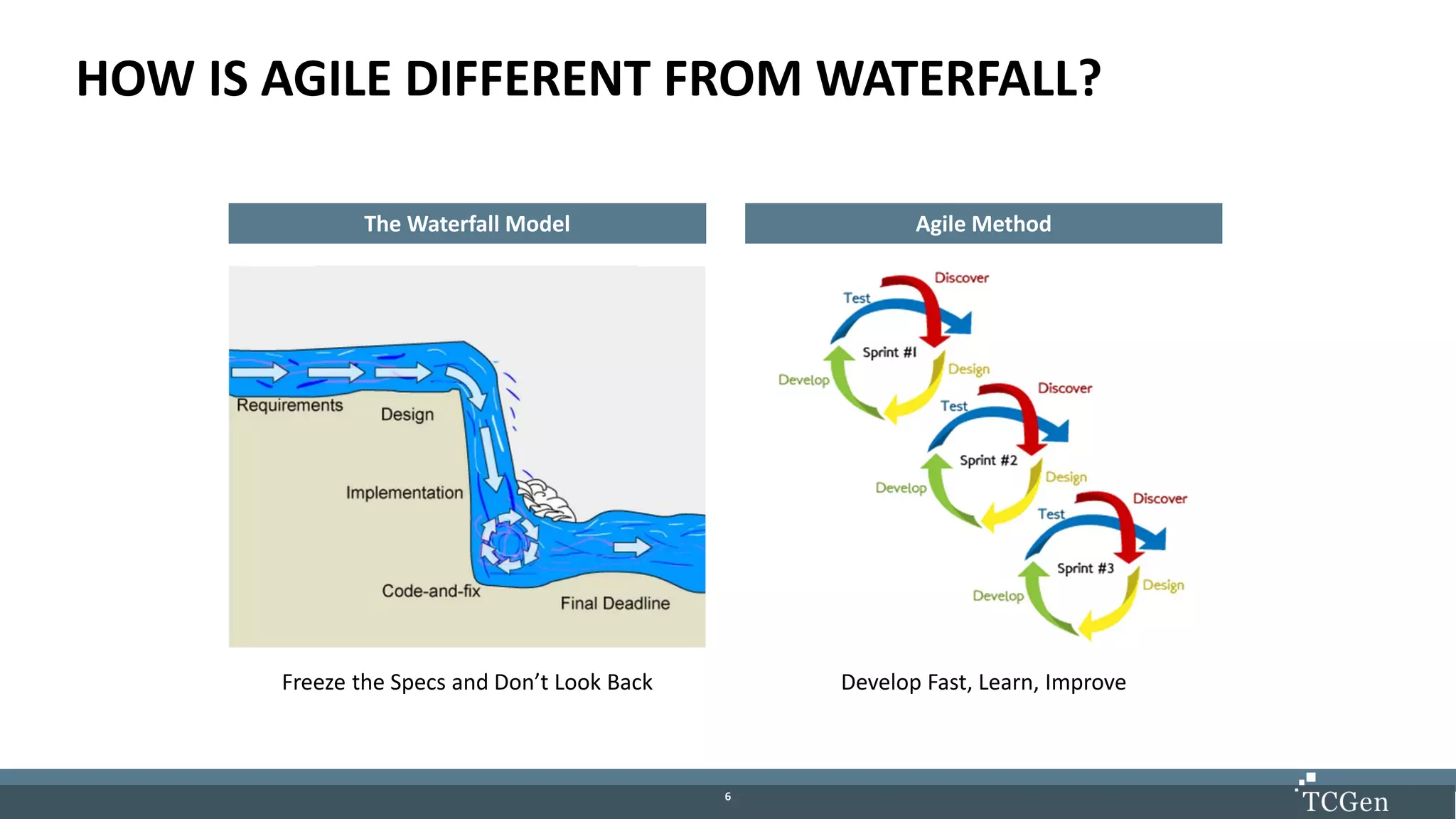
HOW IS AGILE DIFFERENT FROM WATERFALL?
Freeze the Specs and Don’t Look Back Develop Fast, Learn, Improve
The Waterfall Model Agile Method
77
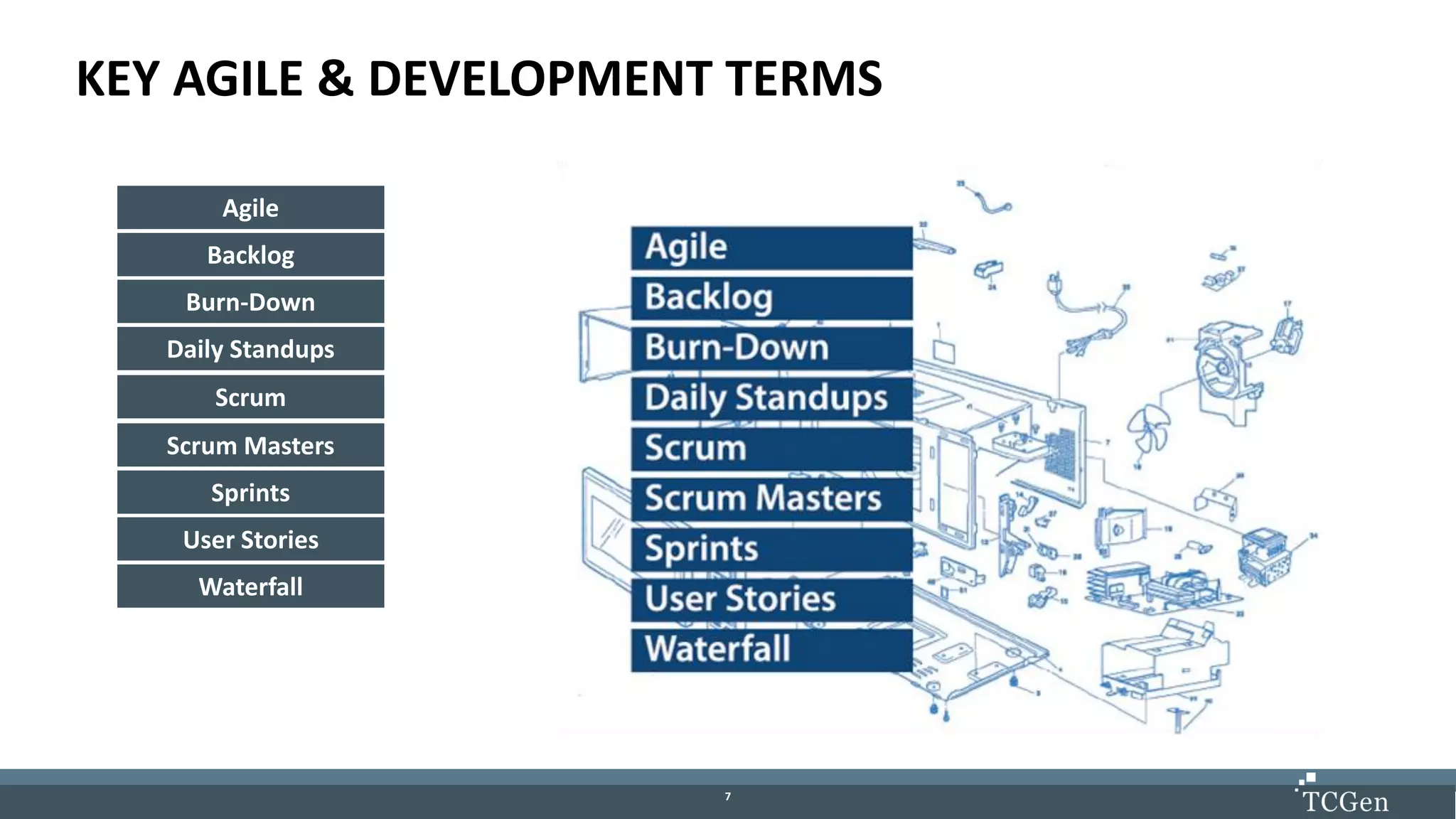
KEY AGILE & DEVELOPMENT TERMS
Agile
Backlog
Burn-Down
Daily Standups
Scrum
Scrum Masters
Sprints
User Stories
Waterfall
88
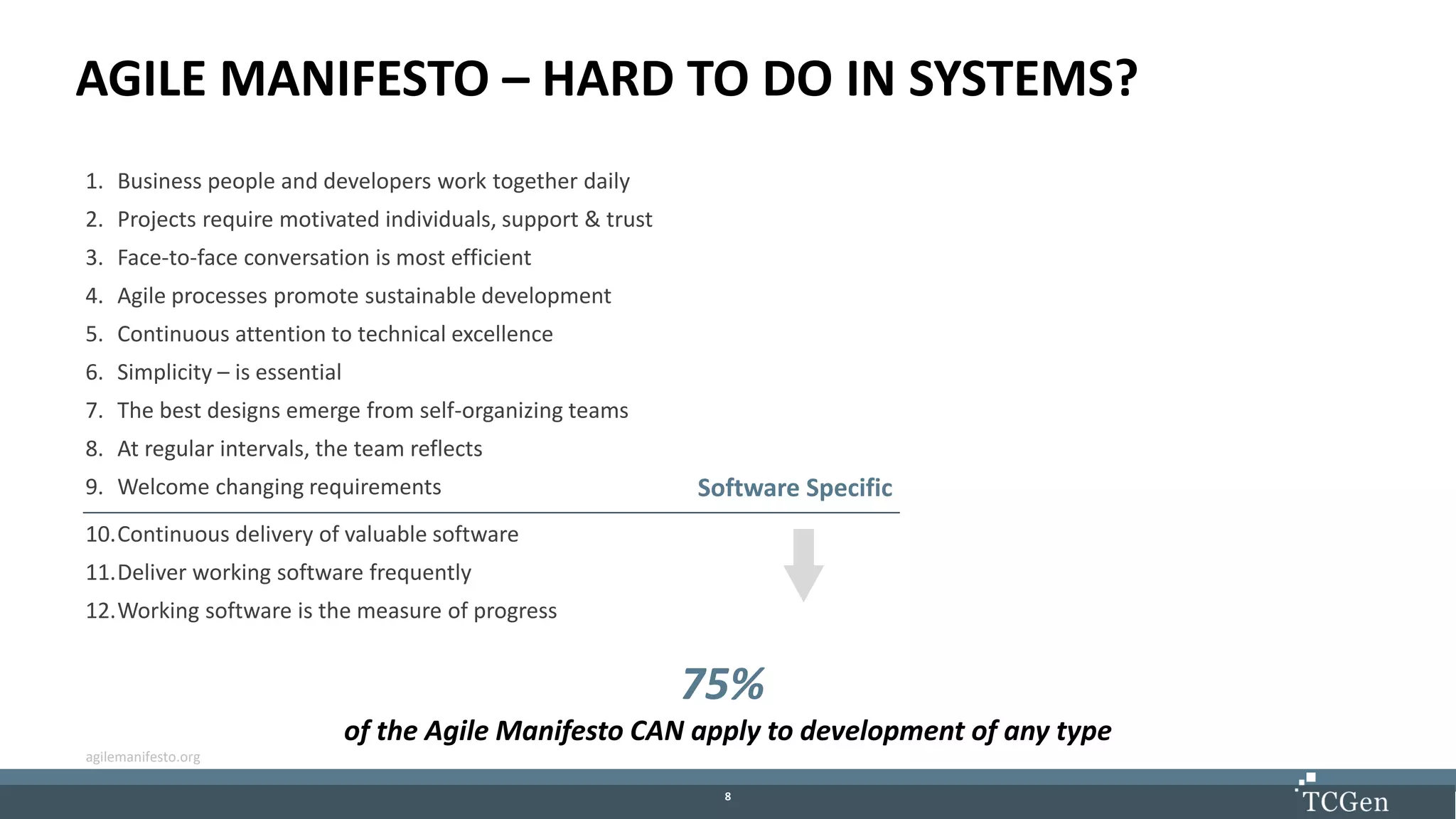
AGILE MANIFESTO – HARD TO DO IN SYSTEMS?
1. Business people and developers work together daily
2. Projects require motivated individuals, support & trust
3. Face-to-face conversation is most efficient
4. Agile processes promote sustainable development
5. Continuous attention to technical excellence
6. Simplicity – is essential
7. The best designs emerge from self-organizing teams
8. At regular intervals, the team reflects
9. Welcome changing requirements
10.Continuous delivery of valuable software
11.Deliver working software frequently
12.Working software is the measure of progress
Software Specific
75%
of the Agile Manifesto CAN apply to development of any type
agilemanifesto.org
99
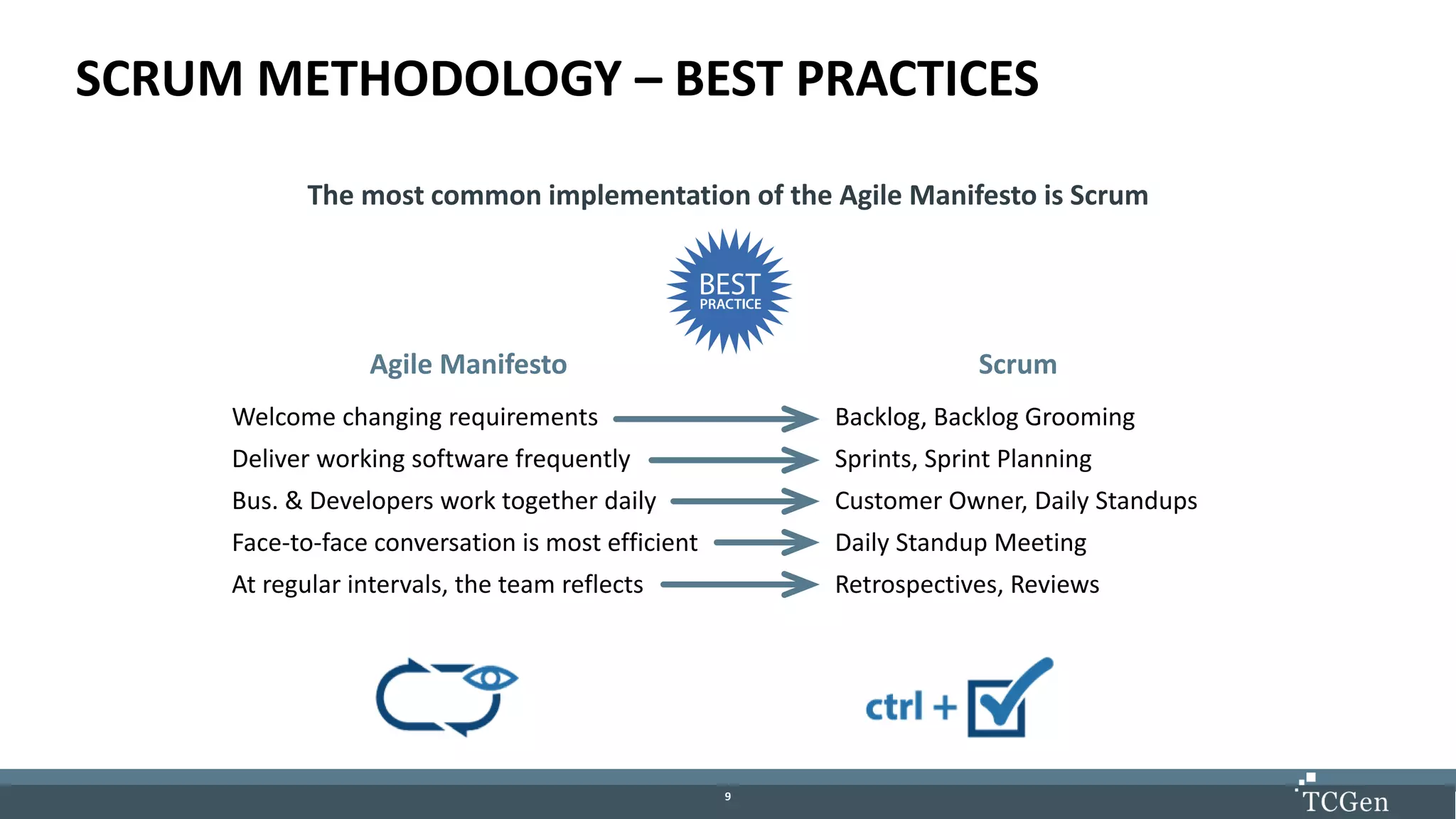
SCRUM METHODOLOGY – BEST PRACTICES
The most common implementation of the Agile Manifesto is Scrum
Agile Manifesto
Welcome changing requirements
Deliver working software frequently
Bus. & Developers work together daily
Face-to-face conversation is most efficient
At regular intervals, the team reflects
Scrum
Backlog, Backlog Grooming
Sprints, Sprint Planning
Customer Owner, Daily Standups
Daily Standup Meeting
Retrospectives, Reviews
1010
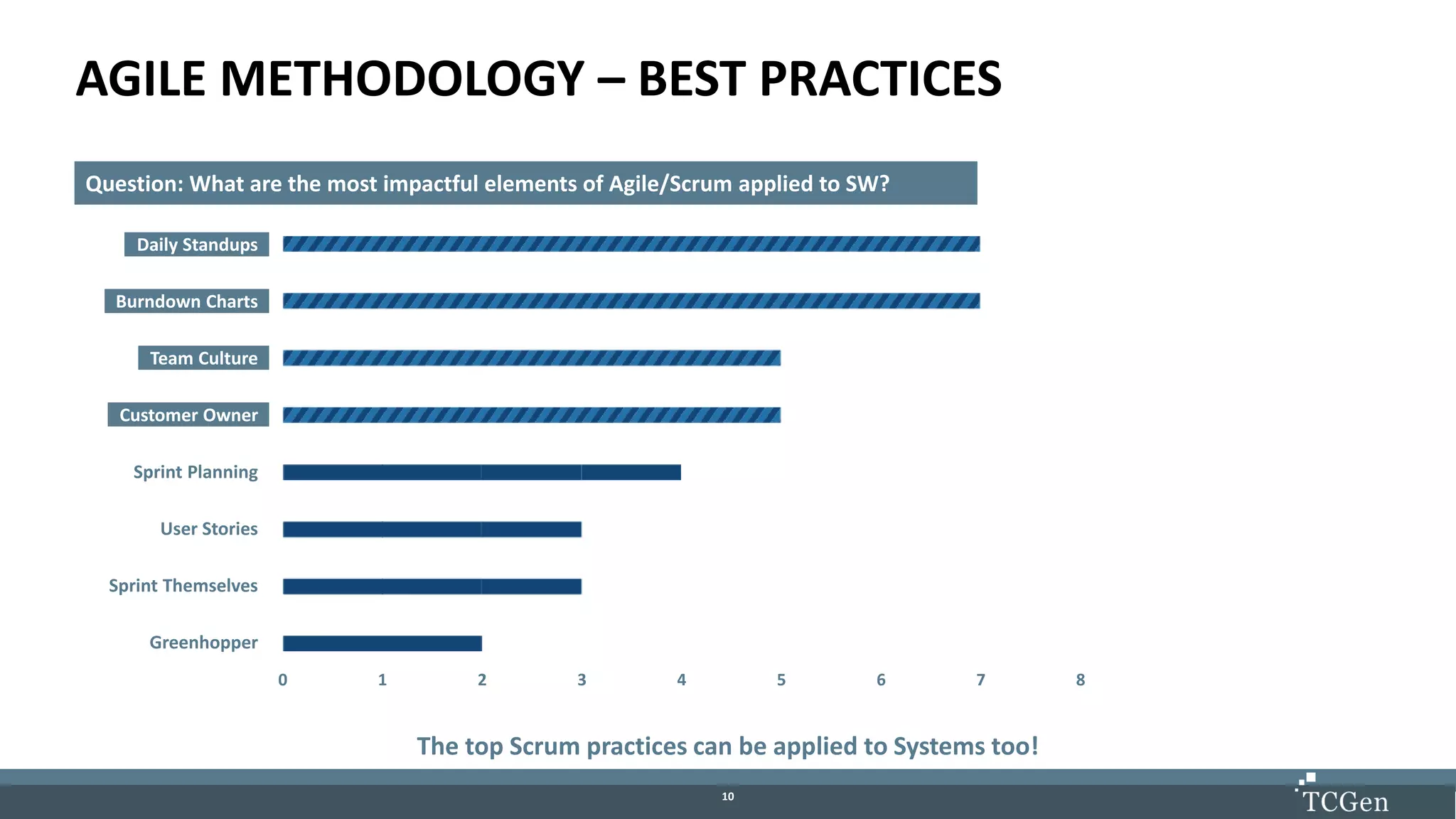
AGILE METHODOLOGY – BEST PRACTICES
Question: What are the most impactful elements of Agile/Scrum applied to SW?
The top Scrum practices can be applied to Systems too!
Daily Standups
Burndown Charts
Team Culture
Customer Owner
Sprint Planning
User Stories
Sprint Themselves
Greenhopper
0 1 2 3 4 5 6 7 8
1111
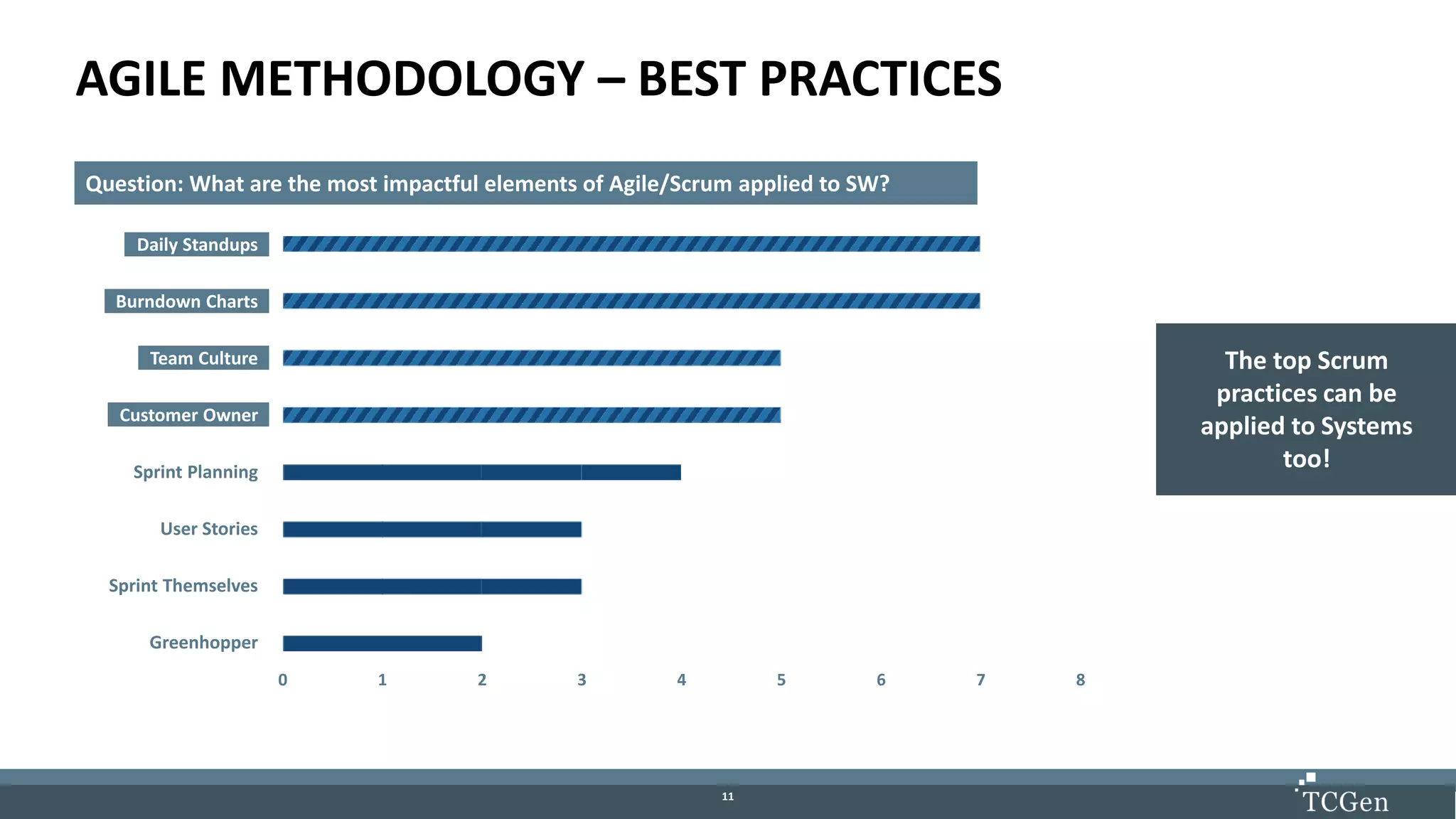
AGILE METHODOLOGY – BEST PRACTICES
Question: What are the most impactful elements of Agile/Scrum applied to SW?
Daily Standups
Burndown Charts
Team Culture
Customer Owner
Sprint Planning
User Stories
Sprint Themselves
Greenhopper
0 1 2 3 4 5 6 7 8
The top Scrum
practices can be
applied to Systems
too!
1212
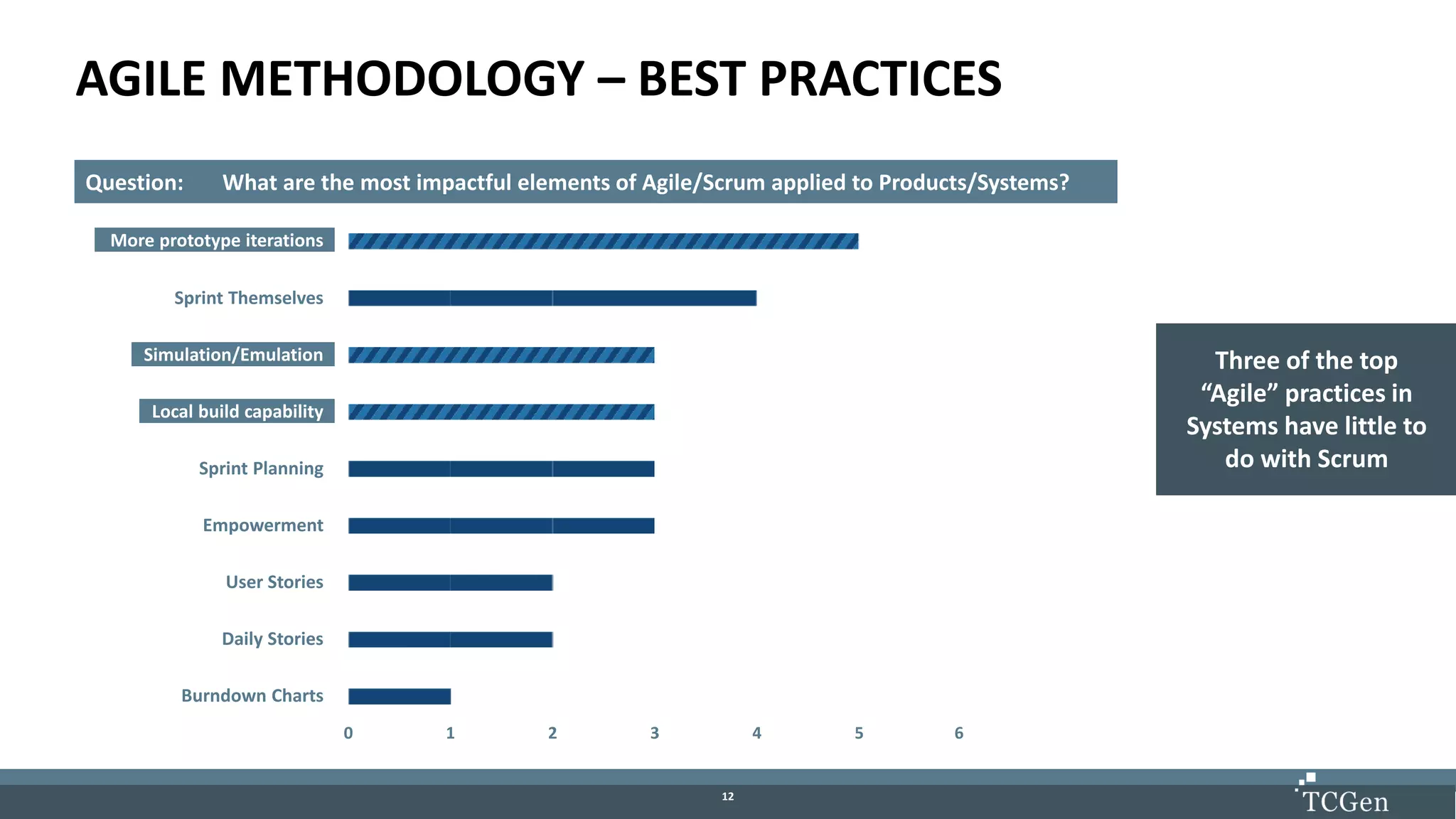
AGILE METHODOLOGY – BEST PRACTICES
Question: What are the most impactful elements of Agile/Scrum applied to Products/Systems?
Sprint Themselves
Simulation/Emulation
Local build capability
Sprint Planning
Empowerment
User Stories
Daily Stories
Burndown Charts
0 1 2 3 4 5 6
More prototype iterations
Three of the top
“Agile” practices in
Systems have little to
do with Scrum
1313
AGILE METHODOLOGY – APPLIED TO HW/SYSTEMS
So why is applying Agile/Scrum
to HW/Systems so hard?
1414
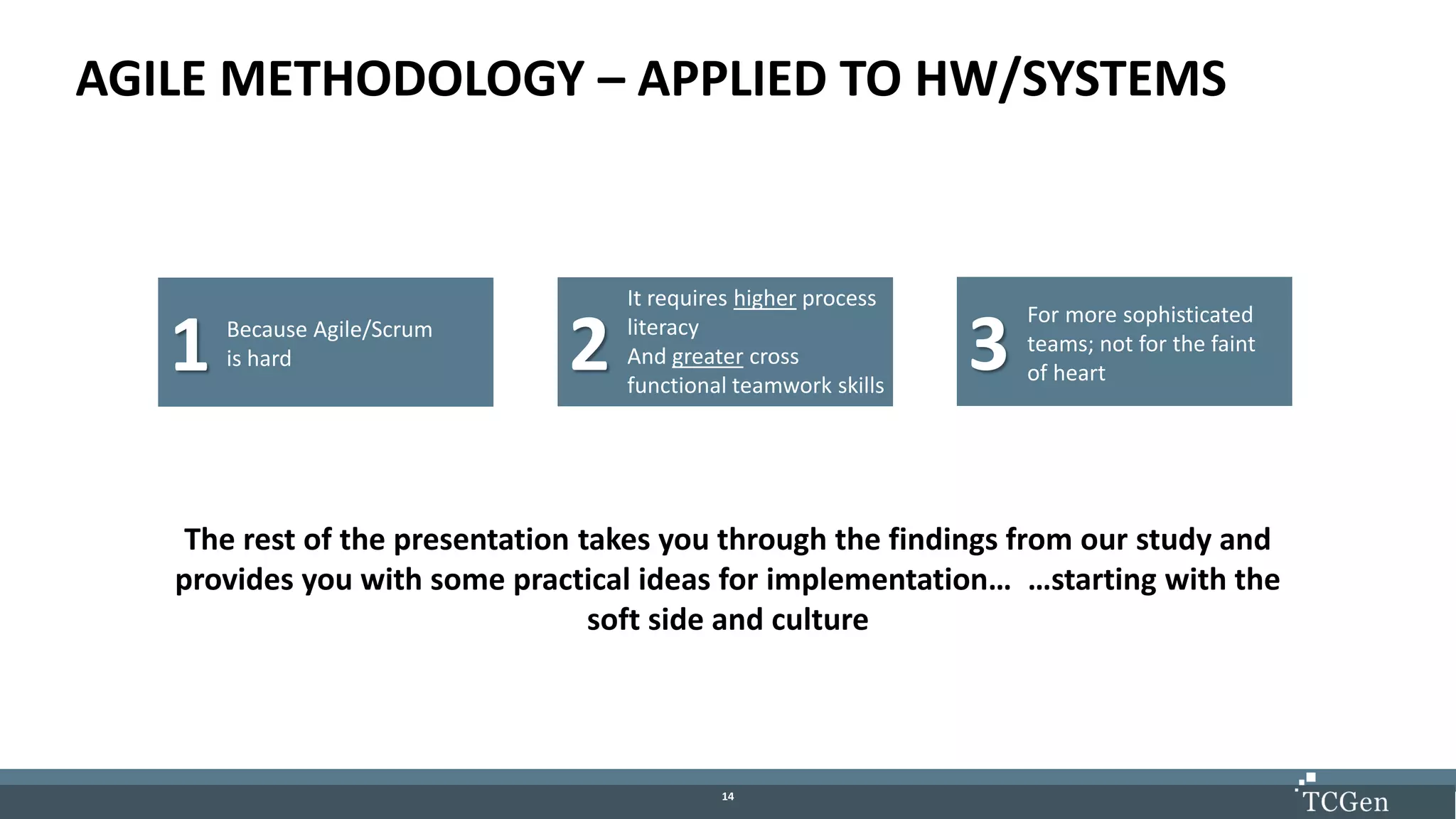
AGILE METHODOLOGY – APPLIED TO HW/SYSTEMS
The rest of the presentation takes you through the findings from our study and
provides you with some practical ideas for implementation… …starting with the
soft side and culture
1 Because Agile/Scrum
is hard 2
It requires higher process
literacy
And greater cross
functional teamwork skills
3
For more sophisticated
teams; not for the faint
of heart
1515
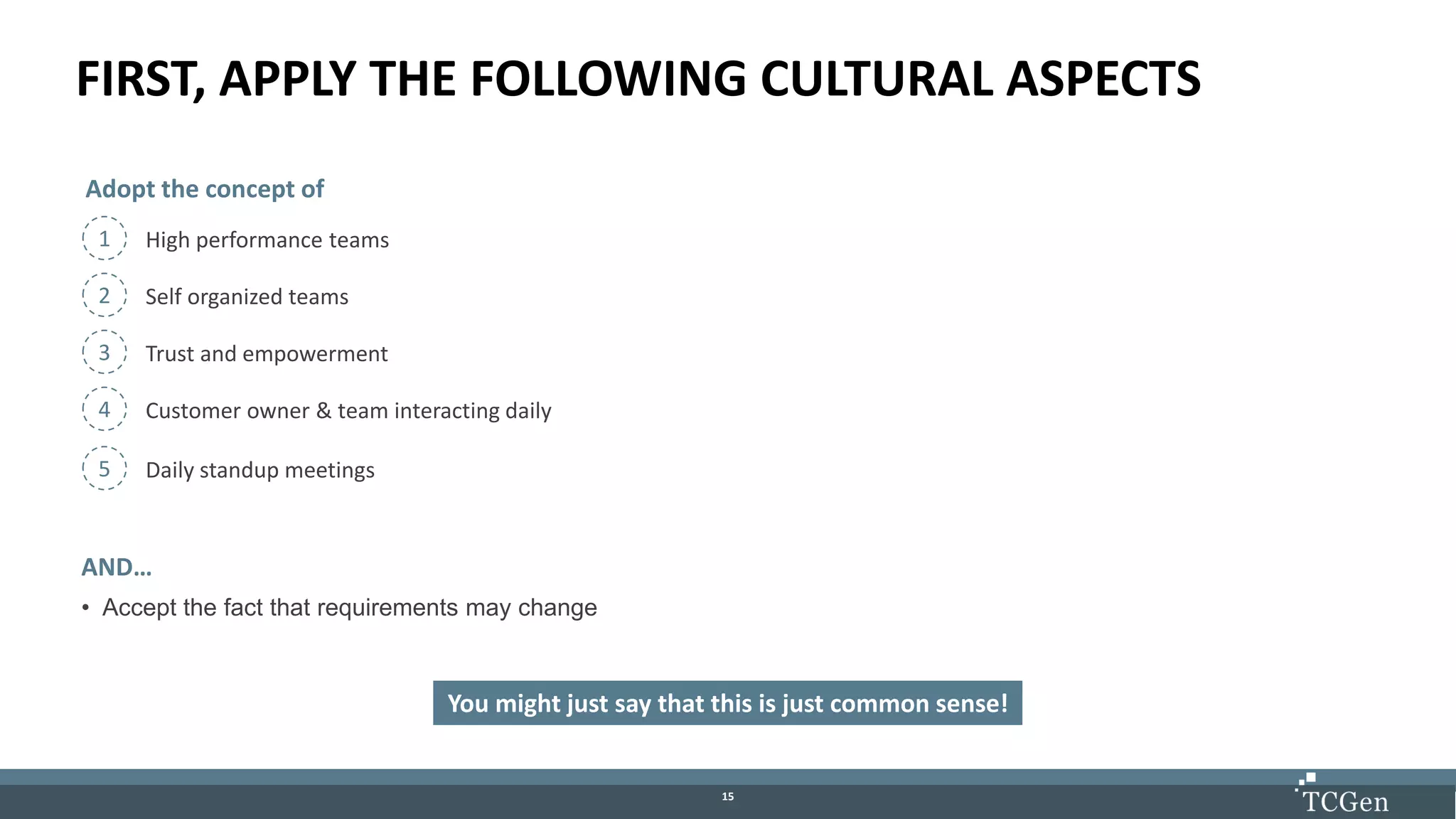
FIRST, APPLY THE FOLLOWING CULTURAL ASPECTS
AND…
• Accept the fact that requirements may change
You might just say that this is just common sense!
Adopt the concept of
1 High performance teams
2 Self organized teams
3 Trust and empowerment
4 Customer owner & team interacting daily
5 Daily standup meetings
1616
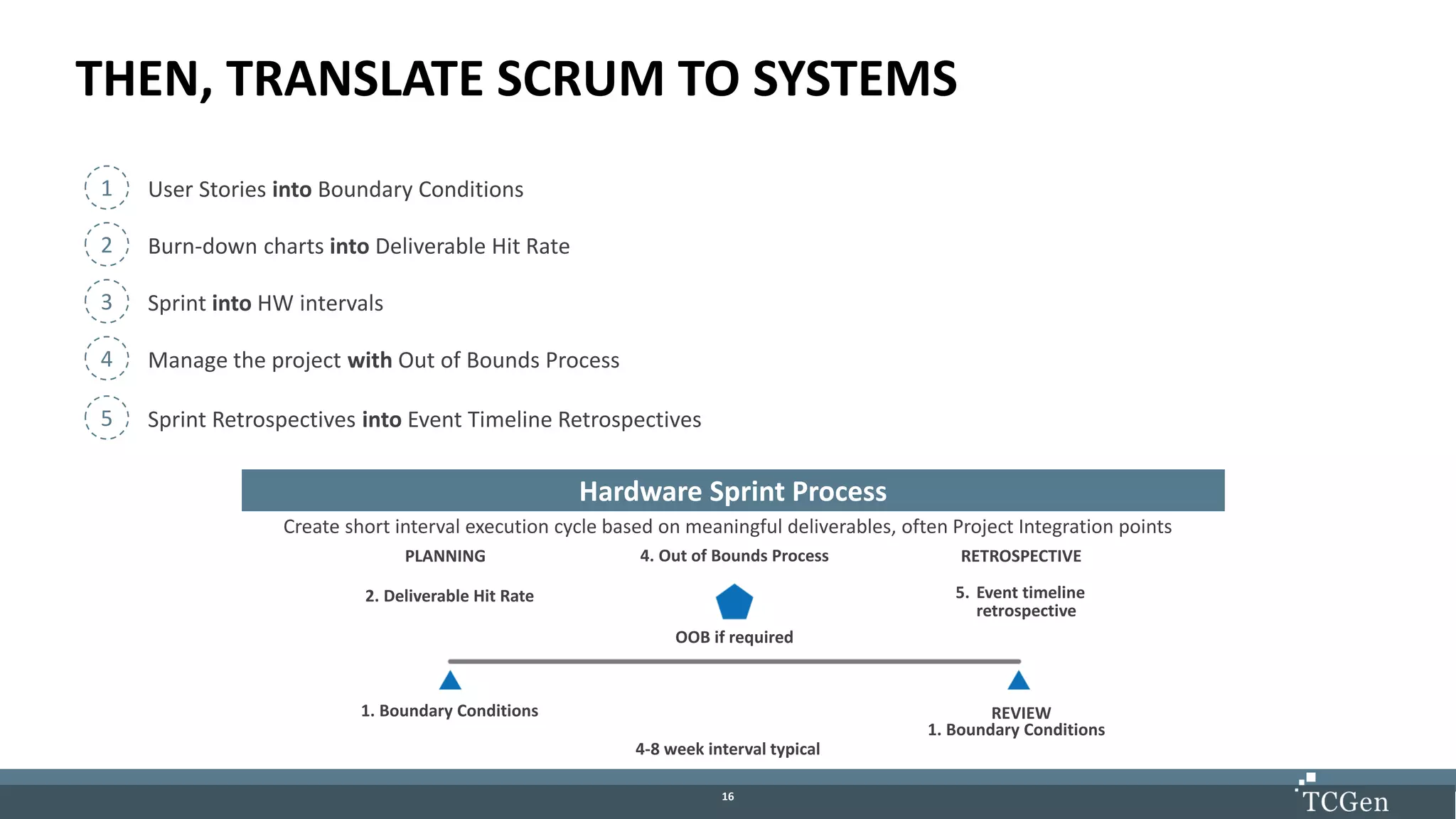
THEN, TRANSLATE SCRUM TO SYSTEMS
Hardware Sprint Process
Create short interval execution cycle based on meaningful deliverables, often Project Integration points
PLANNING RETROSPECTIVE
4-8 week interval typical
REVIEW
OOB if required
4. Out of Bounds Process
2. Deliverable Hit Rate
1. Boundary Conditions
5. Event timeline
retrospective
1. Boundary Conditions
1 User Stories into Boundary Conditions
2 Burn-down charts into Deliverable Hit Rate
3 Sprint into HW intervals
4 Manage the project with Out of Bounds Process
5 Sprint Retrospectives into Event Timeline Retrospectives
1717
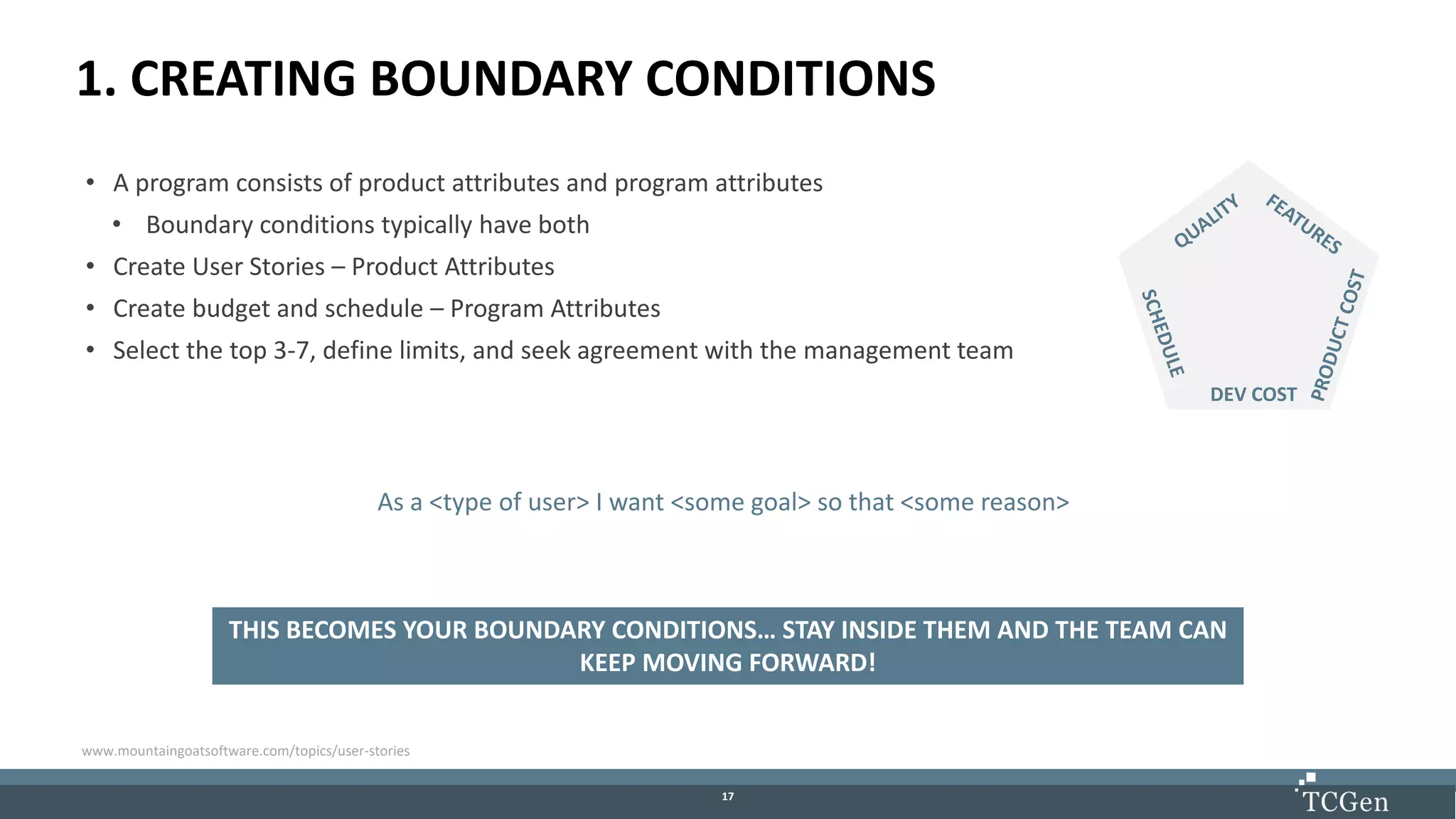
1. CREATING BOUNDARY CONDITIONS
• A program consists of product attributes and program attributes
• Boundary conditions typically have both
• Create User Stories – Product Attributes
• Create budget and schedule – Program Attributes
• Select the top 3-7, define limits, and seek agreement with the management team
As a <type of user> I want <some goal> so that <some reason>
THIS BECOMES YOUR BOUNDARY CONDITIONS… STAY INSIDE THEM AND THE TEAM CAN
KEEP MOVING FORWARD!
DEV COST
www.mountaingoatsoftware.com/topics/user-stories
1818
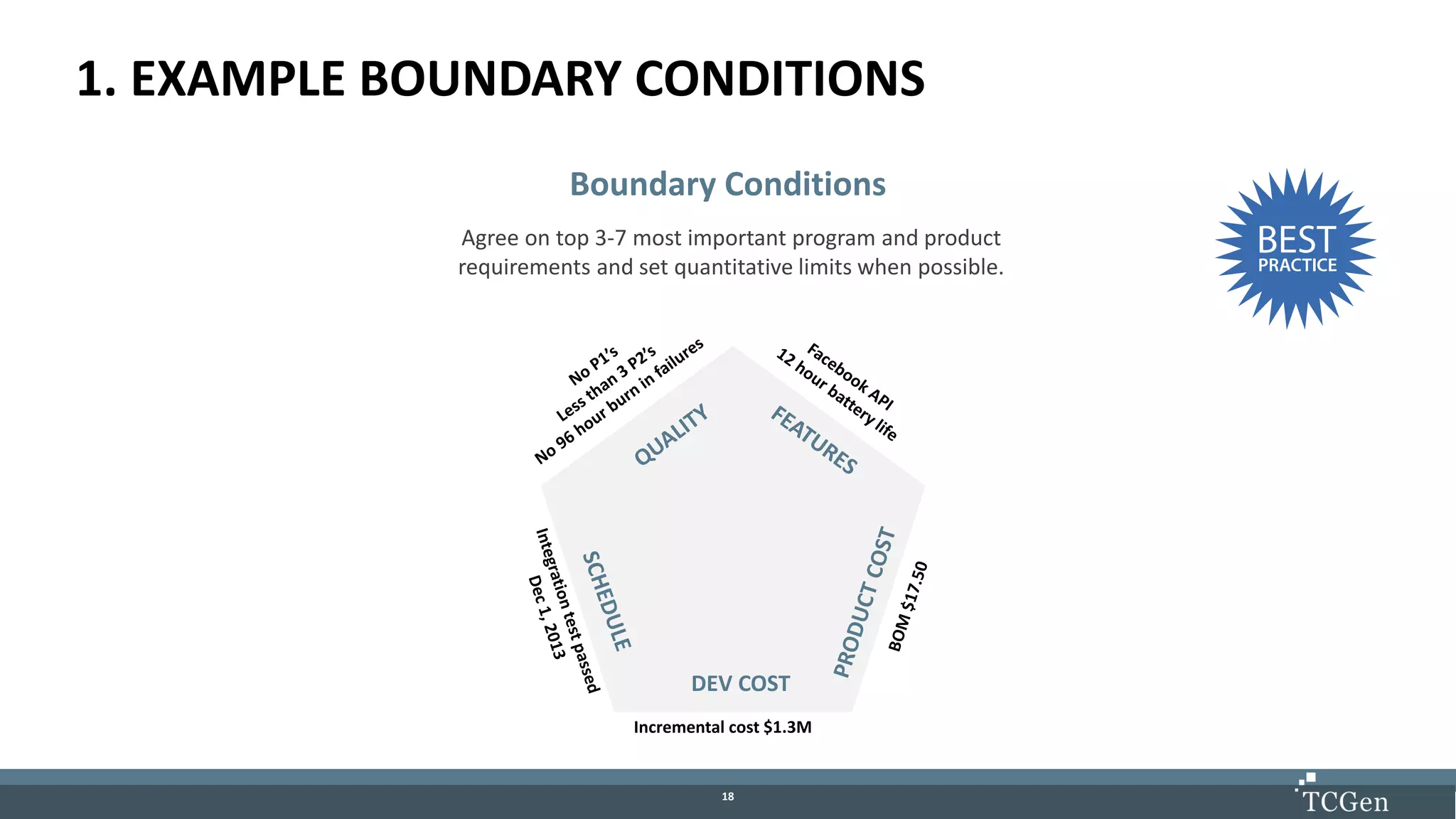
1. EXAMPLE BOUNDARY CONDITIONS
Agree on top 3-7 most important program and product
requirements and set quantitative limits when possible.
Boundary Conditions
DEV COST
Incremental cost $1.3M
1919
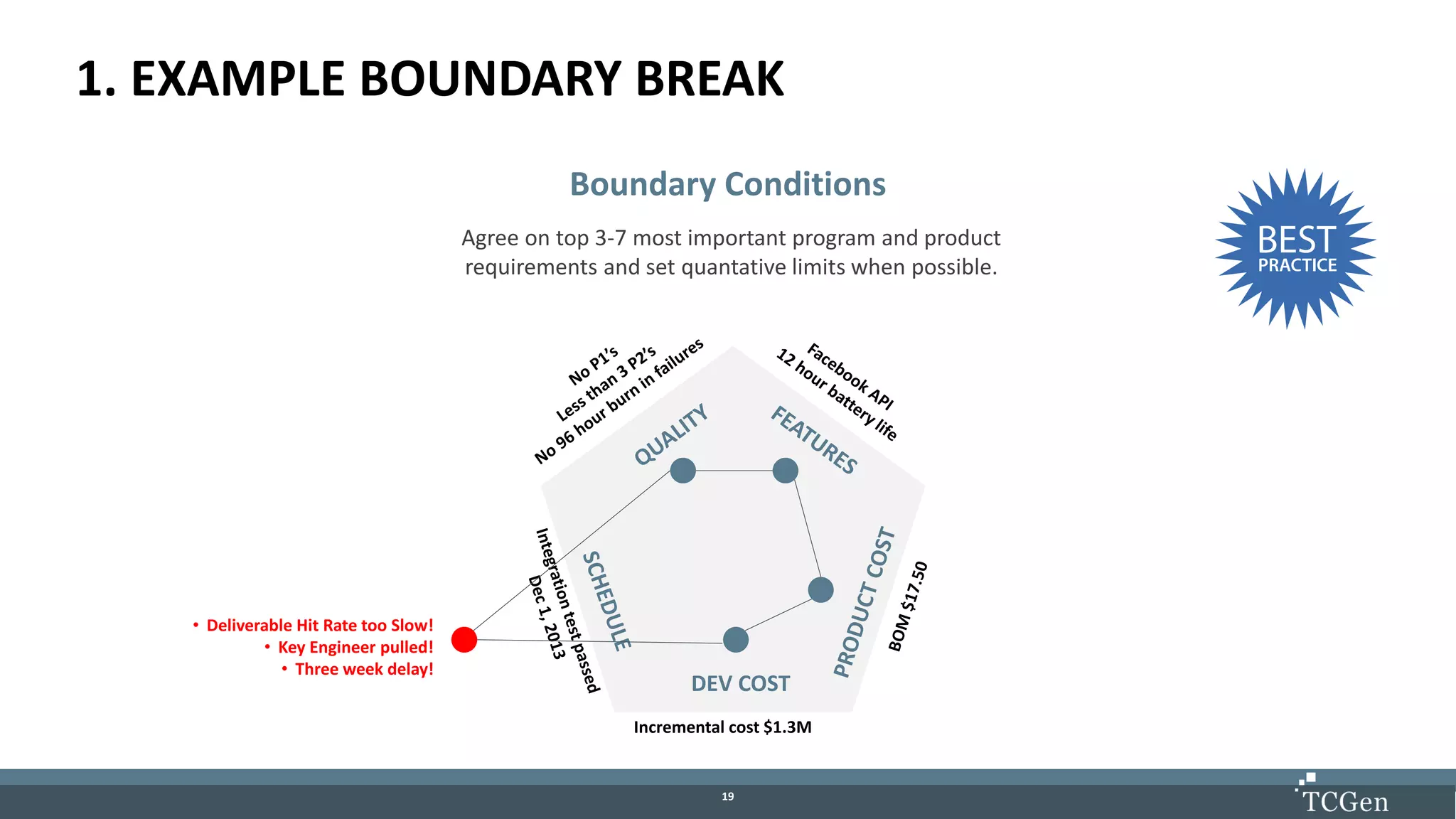
1. EXAMPLE BOUNDARY BREAK
Agree on top 3-7 most important program and product
requirements and set quantative limits when possible.
Boundary Conditions
DEV COST
Incremental cost $1.3M
• Deliverable Hit Rate too Slow!
• Key Engineer pulled!
• Three week delay!
2020
2. TRANSLATE BURNDOWNS INTO DELIVERABLE HIT RATE
Identify the key tasks that should be satisfied during an interval
• Can features be implemented?
• Can features/specs be validated?
• Can tasks be performed?
• Can be a customized metric of progress
This list of requirements can vary from interval to interval
• Front end is more definition loaded
• Middle is more task loaded
• Back end is more validation loaded
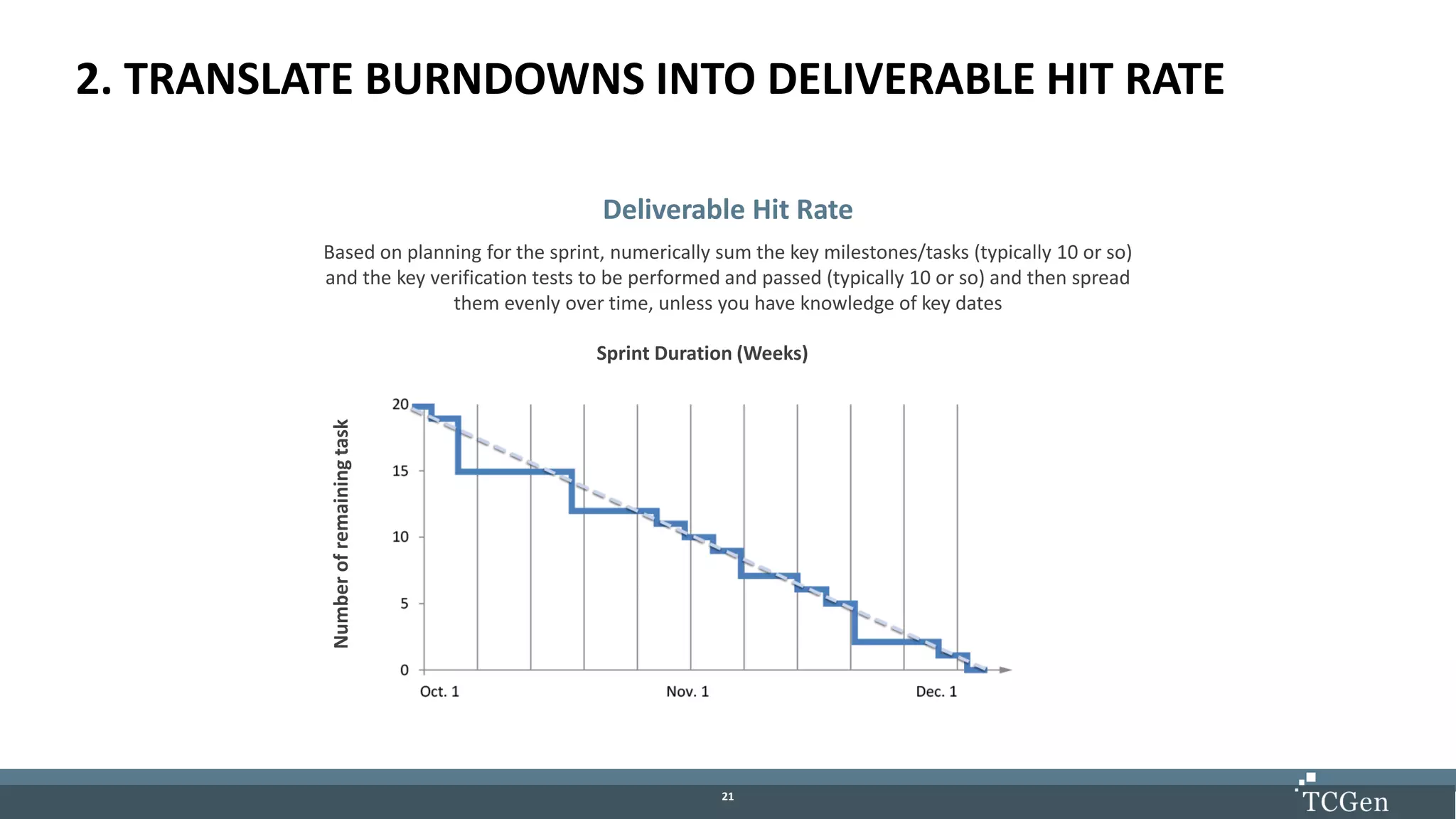
Create a target curve over the sprint interval
• Don’t get too stressed out over perfection
• Assume that the events can be distributed evenly, unless you have clear
knowledge otherwise
2121
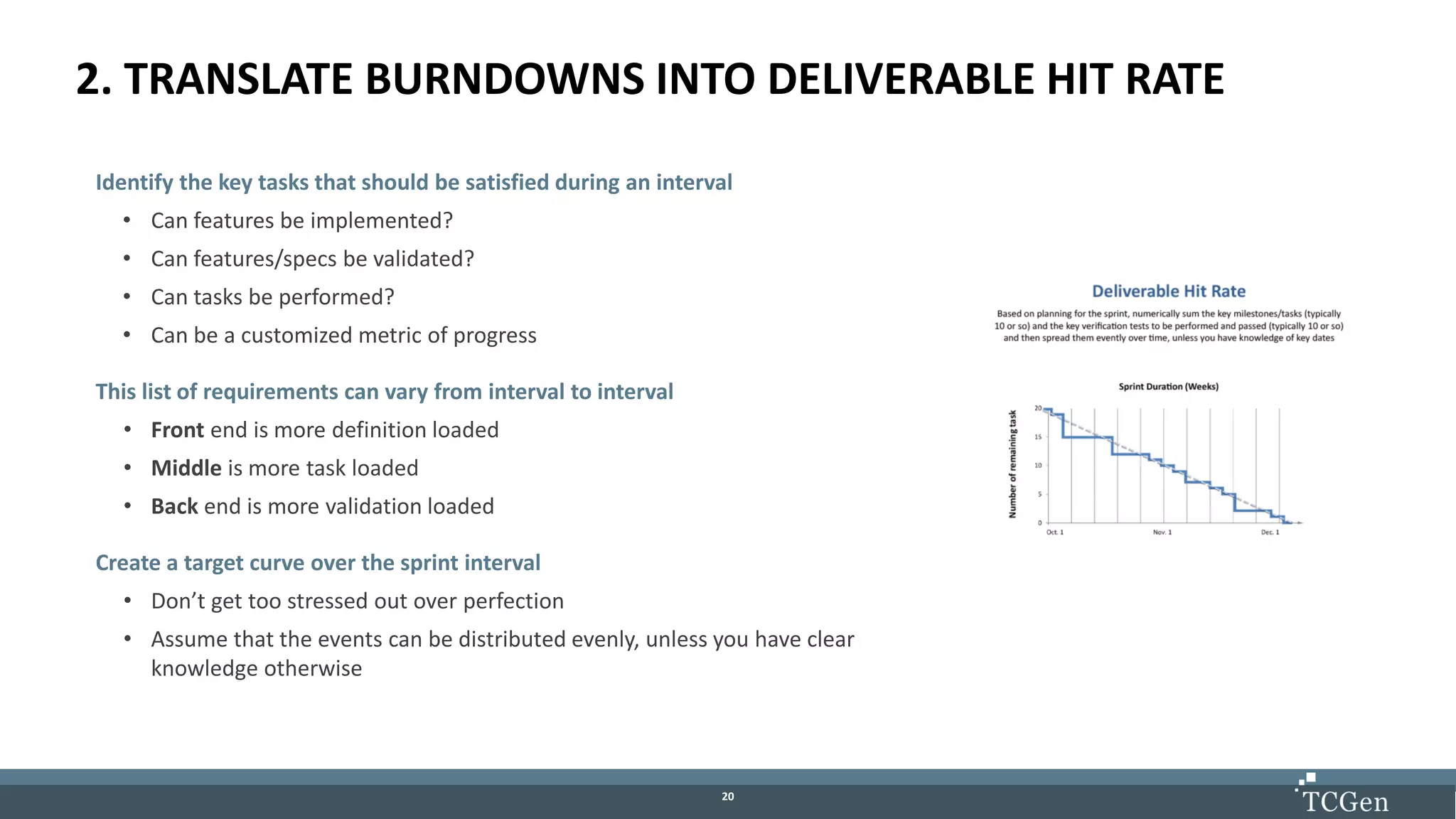
2. TRANSLATE BURNDOWNS INTO DELIVERABLE HIT RATE
Deliverable Hit Rate
Based on planning for the sprint, numerically sum the key milestones/tasks (typically 10 or so)
and the key verification tests to be performed and passed (typically 10 or so) and then spread
them evenly over time, unless you have knowledge of key dates
Sprint Duration (Weeks)
Numberofremainingtask
2222
2. EXAMPLE OF PCB LAYOUT PROGRESS
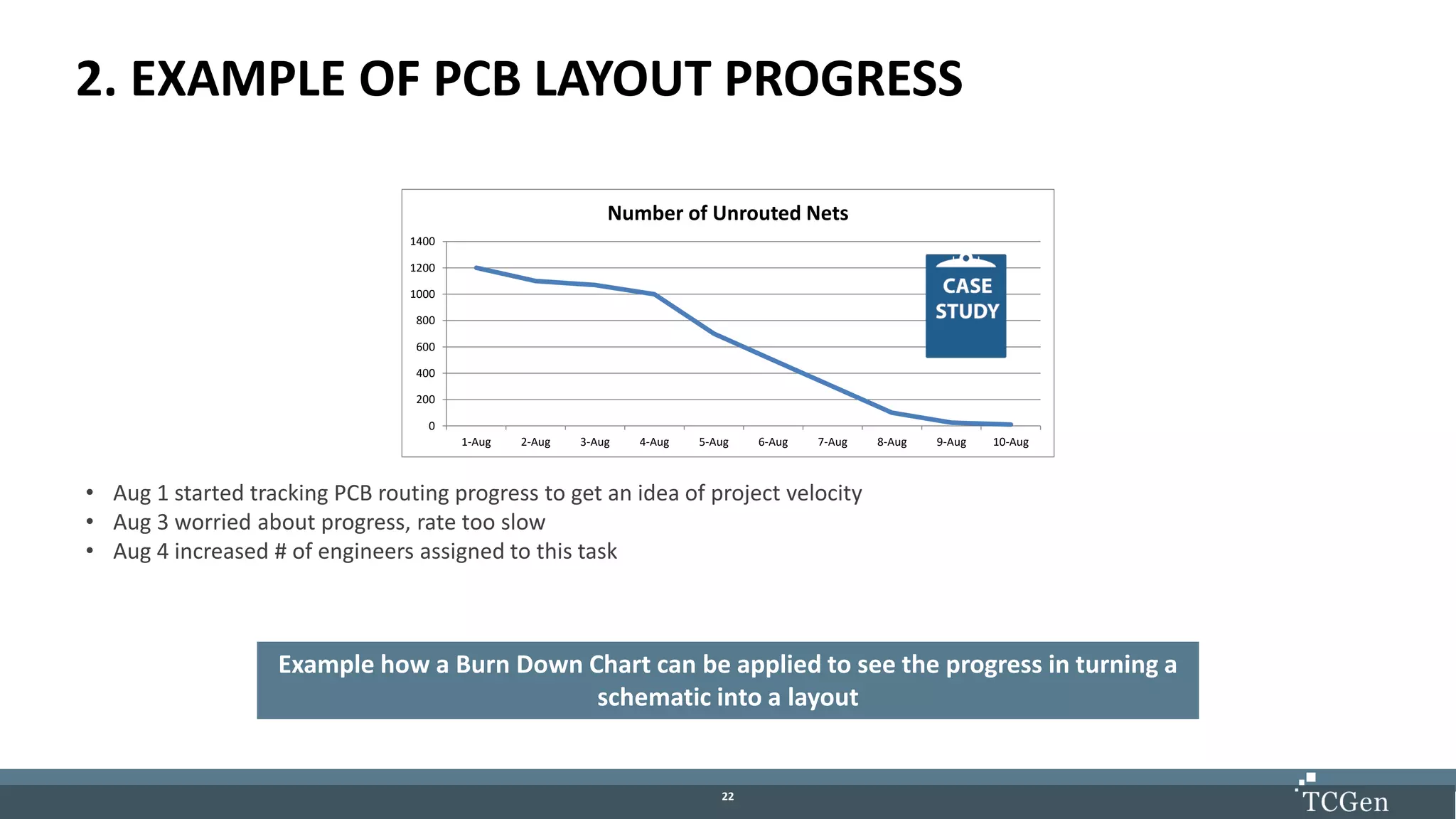
• Aug 1 started tracking PCB routing progress to get an idea of project velocity
• Aug 3 worried about progress, rate too slow
• Aug 4 increased # of engineers assigned to this task
0
200
400
600
800
1000
1200
1400
1-Aug 2-Aug 3-Aug 4-Aug 5-Aug 6-Aug 7-Aug 8-Aug 9-Aug 10-Aug
Number of Unrouted Nets
Example how a Burn Down Chart can be applied to see the progress in turning a
schematic into a layout
2323
BURN DOWN METRICS FOR HYBRID DEVELOPMENT
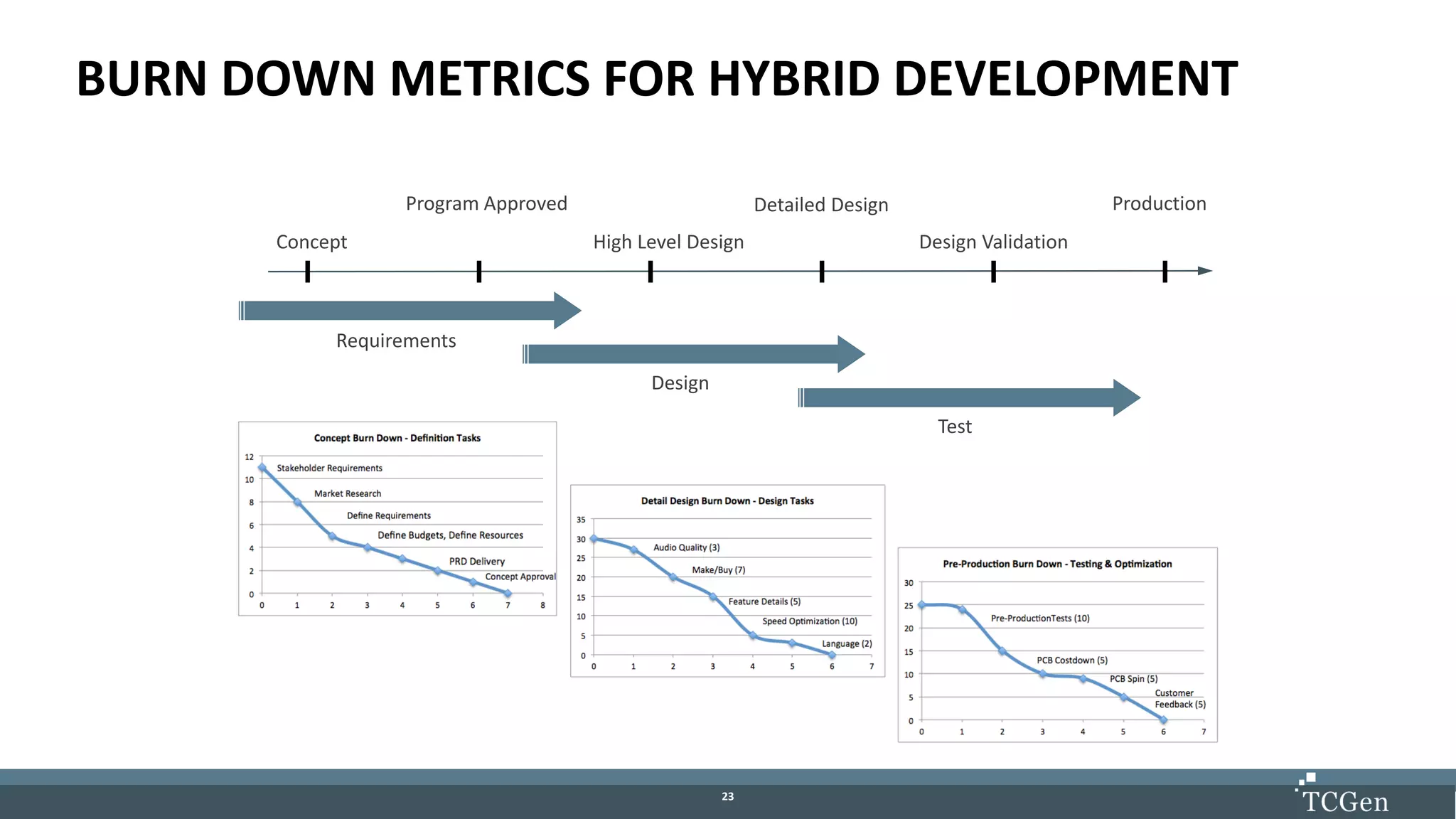
Concept
Program Approved
High Level Design
Detailed Design
Design Validation
Production
Requirements
Design
Test
2424
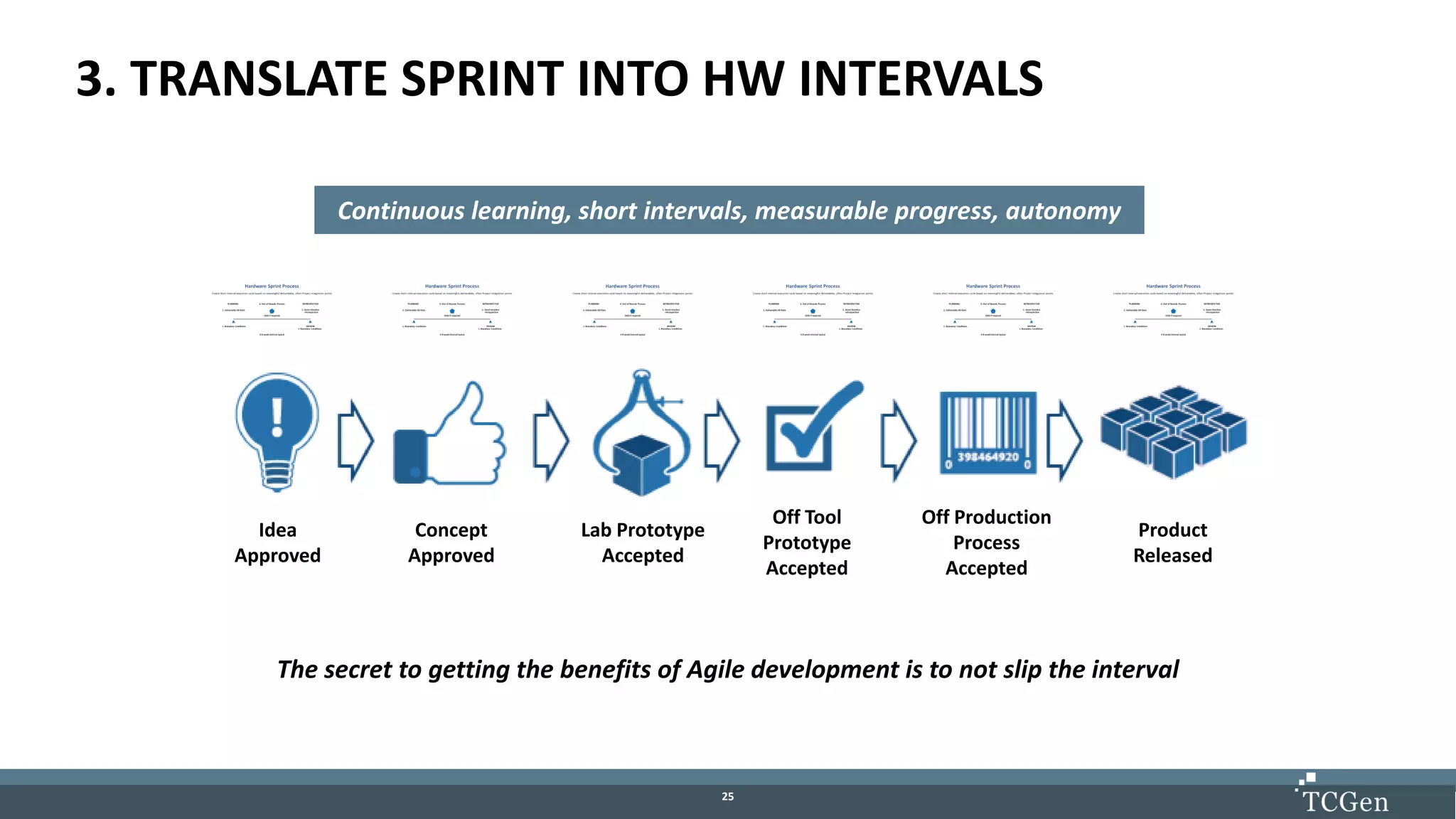
3. TRANSLATE SPRINT INTO HW INTERVALS
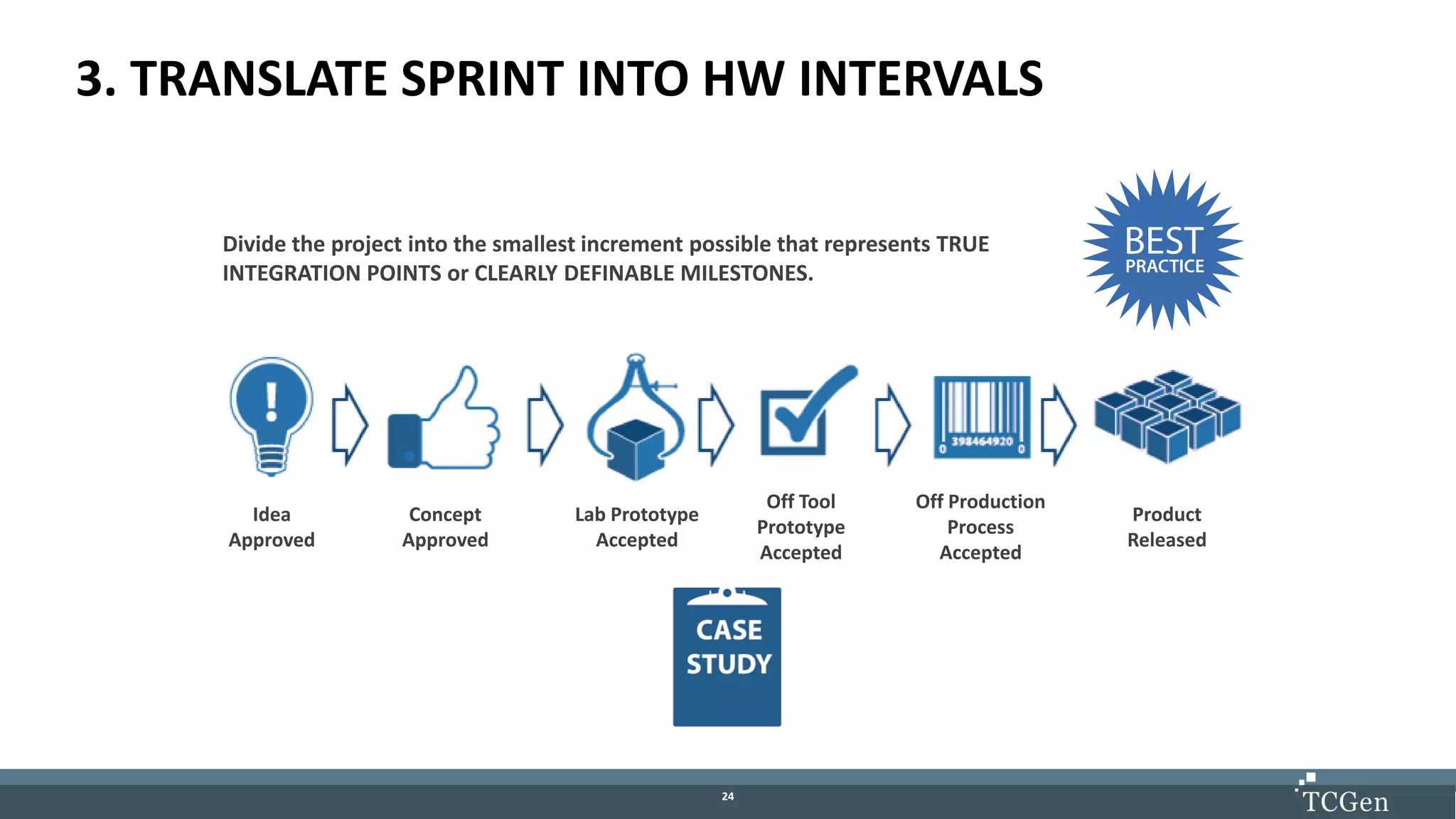
Divide the project into the smallest increment possible that represents TRUE
INTEGRATION POINTS or CLEARLY DEFINABLE MILESTONES.
Idea
Approved
Concept
Approved
Lab Prototype
Accepted
Off Tool
Prototype
Accepted
Off Production
Process
Accepted
Product
Released
2525
3. TRANSLATE SPRINT INTO HW INTERVALS
Continuous learning, short intervals, measurable progress, autonomy
The secret to getting the benefits of Agile development is to not slip the interval
Idea
Approved
Concept
Approved
Lab Prototype
Accepted
Off Tool
Prototype
Accepted
Off Production
Process
Accepted
Product
Released
2626
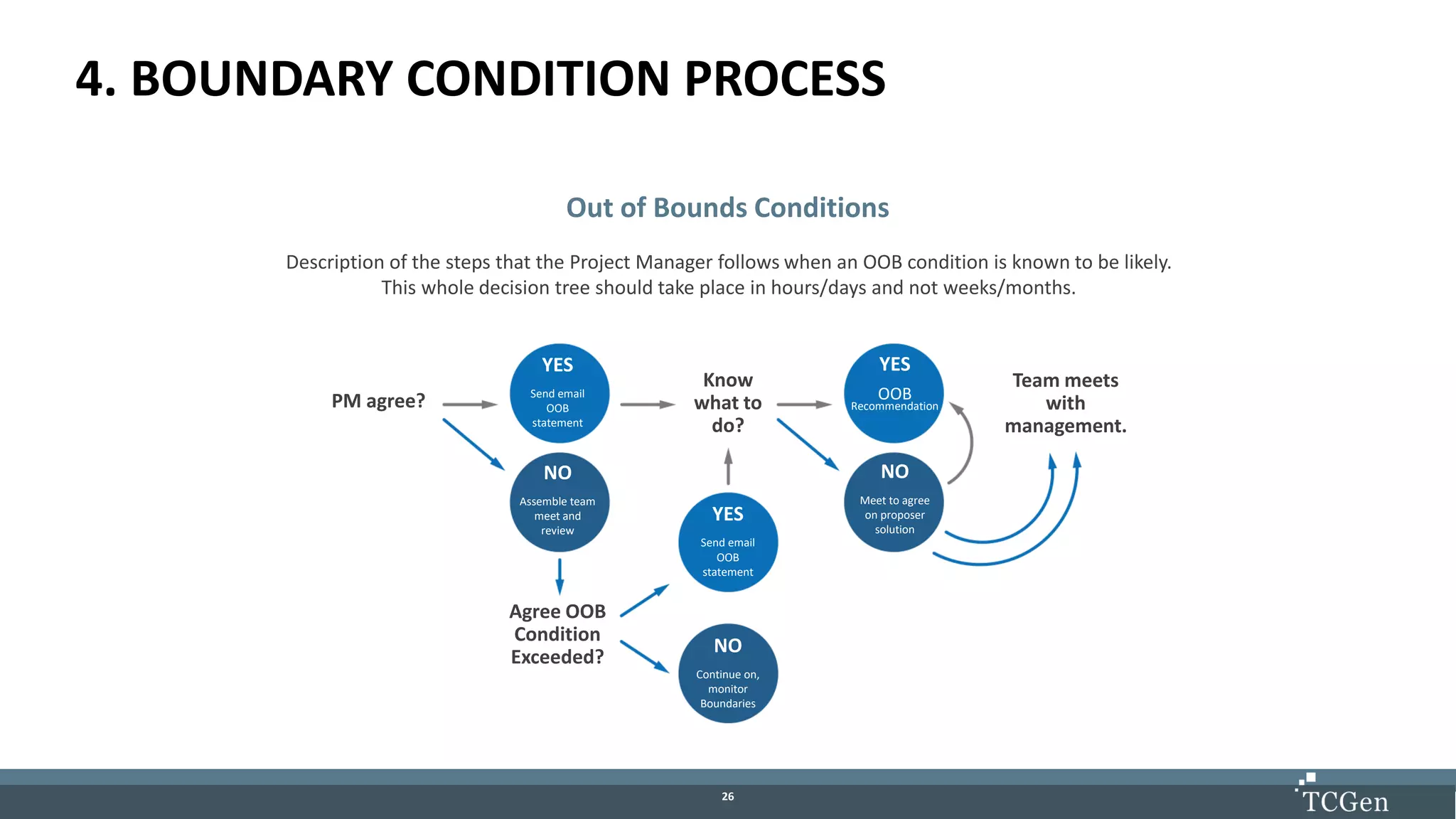
4. BOUNDARY CONDITION PROCESS
Out of Bounds Conditions
Description of the steps that the Project Manager follows when an OOB condition is known to be likely.
This whole decision tree should take place in hours/days and not weeks/months.
PM agree?
Know
what to
do?
Team meets
with
management.
Agree OOB
Condition
Exceeded?
YES
Send email
OOB
statement
NO
Assemble team
meet and
review
YES
Send email
OOB
statement
NO
Continue on,
monitor
Boundaries
YES
OOB
Recommendation
NO
Meet to agree
on proposer
solution
2727
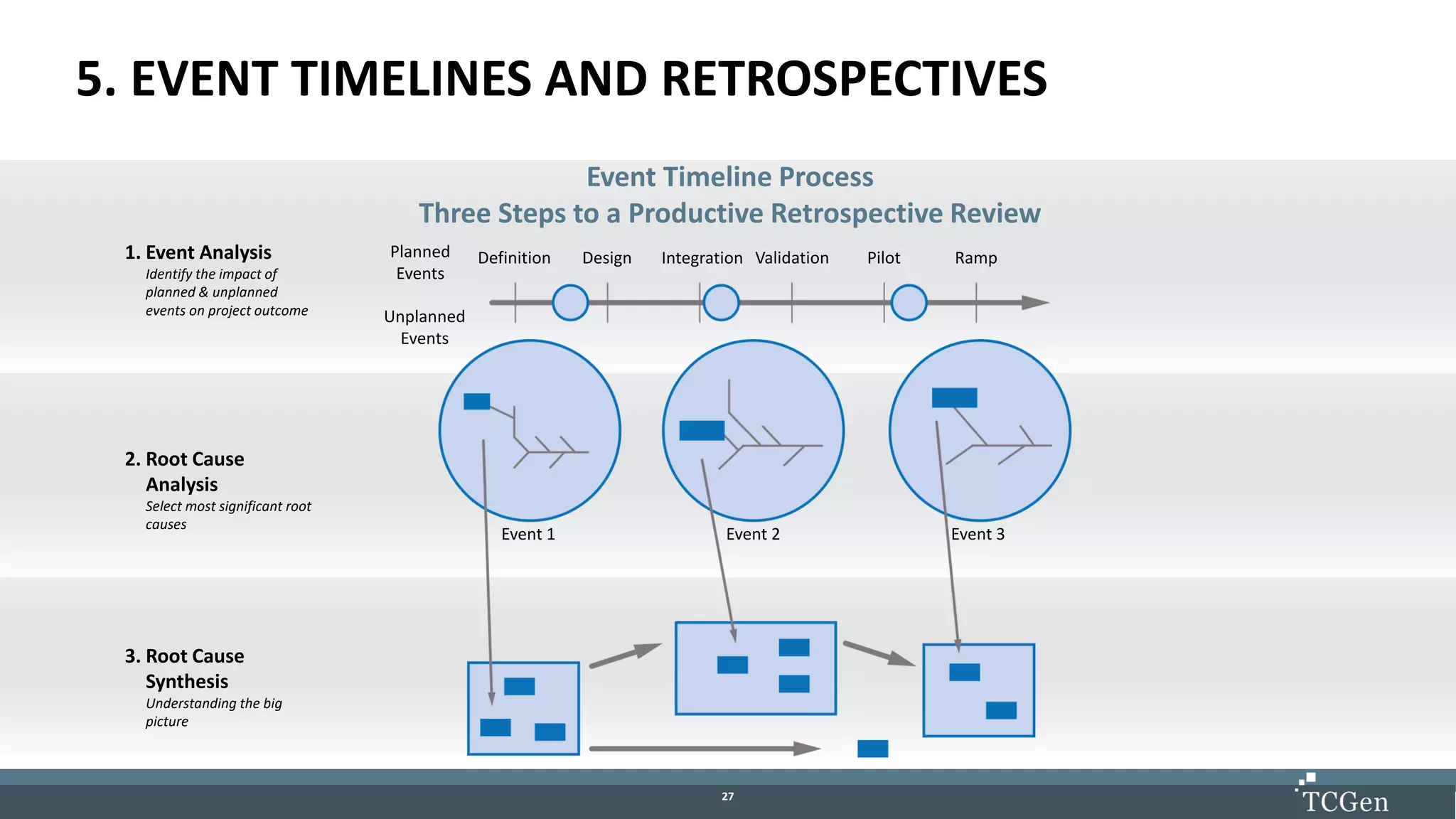
5. EVENT TIMELINES AND RETROSPECTIVES
1. Event Analysis
Identify the impact of
planned & unplanned
events on project outcome
Event Timeline Process
Three Steps to a Productive Retrospective Review
2. Root Cause
Analysis
Select most significant root
causes
3. Root Cause
Synthesis
Understanding the big
picture
Planned
Events
Unplanned
Events
Definition Design Integration Validation Pilot Ramp
Event 1 Event 2 Event 3
2828
RETROSPECTIVES
• Retrospectives should be carried out on all programs
• The retrospectives should follow a common process which has the following attributes
1. Fact based, and data driven
2. Involve Cross-functional team members
• The retrospective process should be owned by the team
• The retrospective process should be used during every Interval
• The process consists of the following steps
1. Event time lines & Prioritization of the biggest events
2. Root Cause Analysis
3. Affinity Diagram to summarize results
29
Thank you
30
TCGen Inc.
Menlo Park
CA, 94025
jcarter@tcgen.com
(650) 733-5310

Agile Project Management in a Waterfall World: Managing Sprints with Predictive Metrics

  • 1.
    1 AGILE PROJECT MANAGEMENTIN A WATERFALL WORLD MANAGING SPRINTS WITH PREDICTIVE METRICS John Carter, Jeanne Bradford June 2014
  • 2.
    22 INSTRUCTOR BIOGRAPHIES • ArchitectedApple’s product development process (ANPP) to gain scalability and speed • Led development and program management teams for Apple, Cisco & Texas Instruments • Certified Scrum Manager • John Carter is Principal of TCGen Inc. and currently serves on the Board of Directors of Cirrus Logic (CRUS). • Prior to TCGen, he consulted to leading Silicon Valley technology companies. John was the architect of Apple’s product development process (ANPP) in use by all divisions. • Before starting PDC, John was Chief Engineer of BOSE Corporation where he was the co-inventor of Bose’s Noise Cancelling Headphones. John & Jeanne co-authored “Innovate Products Faster” a visual handbook on tools for teams
  • 3.
    33 AGILITY CASE STUDIES– SUCCESS STORIES 1 Shortening of internationalization of software from 11 months down to 1 month 2 Reducing time to release from every 8 months down to every 2 months 3 Having a savings of 40-50% of product development cycle time But all of these successes were in SW… how can we apply to Physical Products/Systems? Conducted research of case studies where Agile methods were applied to Products/Systems with nearly 20 participants
  • 4.
    44 HOW DO WEAPPLY BEST PRACTICES TO HARDWARE? The challenge is how do we apply Agile Software Methods to programs that… • Have components with long lead times? • Development partners that do things their own way? • Long supply chains with components, sub-assemblies, and final assemblies that need integration around the world? • Medical products that require FDA compliance? • Large software platforms that are developed using Waterfall Methods? • …by adopting a couple of changes – easy to say, hard to do 1 AGILE TEAM SOFT SKILLS 2 SHORT INTERVALS WITH FEEDBACK
  • 5.
    55 10 AGILE SKILLS& TOOLS SOFT SKILLS 1. High performance teams 2. Self organized teams 3. Trust and empowerment 4. Customer owner & team interacting daily 5. Daily standup meetings SHORT INTERVALS 1. User Stories into Boundary Conditions 2. Burn-down charts into Deliverable Hit Rate 3. Sprint into HW intervals 4. Manage the project with Out of Bounds Process 5. Sprint Retrospectives into Event Timeline Retrospectives
  • 6.
    66 HOW IS AGILEDIFFERENT FROM WATERFALL? Freeze the Specs and Don’t Look Back Develop Fast, Learn, Improve The Waterfall Model Agile Method
  • 7.
    77 KEY AGILE &DEVELOPMENT TERMS Agile Backlog Burn-Down Daily Standups Scrum Scrum Masters Sprints User Stories Waterfall
  • 8.
    88 AGILE MANIFESTO –HARD TO DO IN SYSTEMS? 1. Business people and developers work together daily 2. Projects require motivated individuals, support & trust 3. Face-to-face conversation is most efficient 4. Agile processes promote sustainable development 5. Continuous attention to technical excellence 6. Simplicity – is essential 7. The best designs emerge from self-organizing teams 8. At regular intervals, the team reflects 9. Welcome changing requirements 10.Continuous delivery of valuable software 11.Deliver working software frequently 12.Working software is the measure of progress Software Specific 75% of the Agile Manifesto CAN apply to development of any type agilemanifesto.org
  • 9.
    99 SCRUM METHODOLOGY –BEST PRACTICES The most common implementation of the Agile Manifesto is Scrum Agile Manifesto Welcome changing requirements Deliver working software frequently Bus. & Developers work together daily Face-to-face conversation is most efficient At regular intervals, the team reflects Scrum Backlog, Backlog Grooming Sprints, Sprint Planning Customer Owner, Daily Standups Daily Standup Meeting Retrospectives, Reviews
  • 10.
    1010 AGILE METHODOLOGY –BEST PRACTICES Question: What are the most impactful elements of Agile/Scrum applied to SW? The top Scrum practices can be applied to Systems too! Daily Standups Burndown Charts Team Culture Customer Owner Sprint Planning User Stories Sprint Themselves Greenhopper 0 1 2 3 4 5 6 7 8
  • 11.
    1111 AGILE METHODOLOGY –BEST PRACTICES Question: What are the most impactful elements of Agile/Scrum applied to SW? Daily Standups Burndown Charts Team Culture Customer Owner Sprint Planning User Stories Sprint Themselves Greenhopper 0 1 2 3 4 5 6 7 8 The top Scrum practices can be applied to Systems too!
  • 12.
    1212 AGILE METHODOLOGY –BEST PRACTICES Question: What are the most impactful elements of Agile/Scrum applied to Products/Systems? Sprint Themselves Simulation/Emulation Local build capability Sprint Planning Empowerment User Stories Daily Stories Burndown Charts 0 1 2 3 4 5 6 More prototype iterations Three of the top “Agile” practices in Systems have little to do with Scrum
  • 13.
    1313 AGILE METHODOLOGY –APPLIED TO HW/SYSTEMS So why is applying Agile/Scrum to HW/Systems so hard?
  • 14.
    1414 AGILE METHODOLOGY –APPLIED TO HW/SYSTEMS The rest of the presentation takes you through the findings from our study and provides you with some practical ideas for implementation… …starting with the soft side and culture 1 Because Agile/Scrum is hard 2 It requires higher process literacy And greater cross functional teamwork skills 3 For more sophisticated teams; not for the faint of heart
  • 15.
    1515 FIRST, APPLY THEFOLLOWING CULTURAL ASPECTS AND… • Accept the fact that requirements may change You might just say that this is just common sense! Adopt the concept of 1 High performance teams 2 Self organized teams 3 Trust and empowerment 4 Customer owner & team interacting daily 5 Daily standup meetings
  • 16.
    1616 THEN, TRANSLATE SCRUMTO SYSTEMS Hardware Sprint Process Create short interval execution cycle based on meaningful deliverables, often Project Integration points PLANNING RETROSPECTIVE 4-8 week interval typical REVIEW OOB if required 4. Out of Bounds Process 2. Deliverable Hit Rate 1. Boundary Conditions 5. Event timeline retrospective 1. Boundary Conditions 1 User Stories into Boundary Conditions 2 Burn-down charts into Deliverable Hit Rate 3 Sprint into HW intervals 4 Manage the project with Out of Bounds Process 5 Sprint Retrospectives into Event Timeline Retrospectives
  • 17.
    1717 1. CREATING BOUNDARYCONDITIONS • A program consists of product attributes and program attributes • Boundary conditions typically have both • Create User Stories – Product Attributes • Create budget and schedule – Program Attributes • Select the top 3-7, define limits, and seek agreement with the management team As a <type of user> I want <some goal> so that <some reason> THIS BECOMES YOUR BOUNDARY CONDITIONS… STAY INSIDE THEM AND THE TEAM CAN KEEP MOVING FORWARD! DEV COST www.mountaingoatsoftware.com/topics/user-stories
  • 18.
    1818 1. EXAMPLE BOUNDARYCONDITIONS Agree on top 3-7 most important program and product requirements and set quantitative limits when possible. Boundary Conditions DEV COST Incremental cost $1.3M
  • 19.
    1919 1. EXAMPLE BOUNDARYBREAK Agree on top 3-7 most important program and product requirements and set quantative limits when possible. Boundary Conditions DEV COST Incremental cost $1.3M • Deliverable Hit Rate too Slow! • Key Engineer pulled! • Three week delay!
  • 20.
    2020 2. TRANSLATE BURNDOWNSINTO DELIVERABLE HIT RATE Identify the key tasks that should be satisfied during an interval • Can features be implemented? • Can features/specs be validated? • Can tasks be performed? • Can be a customized metric of progress This list of requirements can vary from interval to interval • Front end is more definition loaded • Middle is more task loaded • Back end is more validation loaded Create a target curve over the sprint interval • Don’t get too stressed out over perfection • Assume that the events can be distributed evenly, unless you have clear knowledge otherwise
  • 21.
    2121 2. TRANSLATE BURNDOWNSINTO DELIVERABLE HIT RATE Deliverable Hit Rate Based on planning for the sprint, numerically sum the key milestones/tasks (typically 10 or so) and the key verification tests to be performed and passed (typically 10 or so) and then spread them evenly over time, unless you have knowledge of key dates Sprint Duration (Weeks) Numberofremainingtask
  • 22.
    2222 2. EXAMPLE OFPCB LAYOUT PROGRESS • Aug 1 started tracking PCB routing progress to get an idea of project velocity • Aug 3 worried about progress, rate too slow • Aug 4 increased # of engineers assigned to this task 0 200 400 600 800 1000 1200 1400 1-Aug 2-Aug 3-Aug 4-Aug 5-Aug 6-Aug 7-Aug 8-Aug 9-Aug 10-Aug Number of Unrouted Nets Example how a Burn Down Chart can be applied to see the progress in turning a schematic into a layout
  • 23.
    2323 BURN DOWN METRICSFOR HYBRID DEVELOPMENT Concept Program Approved High Level Design Detailed Design Design Validation Production Requirements Design Test
  • 24.
    2424 3. TRANSLATE SPRINTINTO HW INTERVALS Divide the project into the smallest increment possible that represents TRUE INTEGRATION POINTS or CLEARLY DEFINABLE MILESTONES. Idea Approved Concept Approved Lab Prototype Accepted Off Tool Prototype Accepted Off Production Process Accepted Product Released
  • 25.
    2525 3. TRANSLATE SPRINTINTO HW INTERVALS Continuous learning, short intervals, measurable progress, autonomy The secret to getting the benefits of Agile development is to not slip the interval Idea Approved Concept Approved Lab Prototype Accepted Off Tool Prototype Accepted Off Production Process Accepted Product Released
  • 26.
    2626 4. BOUNDARY CONDITIONPROCESS Out of Bounds Conditions Description of the steps that the Project Manager follows when an OOB condition is known to be likely. This whole decision tree should take place in hours/days and not weeks/months. PM agree? Know what to do? Team meets with management. Agree OOB Condition Exceeded? YES Send email OOB statement NO Assemble team meet and review YES Send email OOB statement NO Continue on, monitor Boundaries YES OOB Recommendation NO Meet to agree on proposer solution
  • 27.
    2727 5. EVENT TIMELINESAND RETROSPECTIVES 1. Event Analysis Identify the impact of planned & unplanned events on project outcome Event Timeline Process Three Steps to a Productive Retrospective Review 2. Root Cause Analysis Select most significant root causes 3. Root Cause Synthesis Understanding the big picture Planned Events Unplanned Events Definition Design Integration Validation Pilot Ramp Event 1 Event 2 Event 3
  • 28.
    2828 RETROSPECTIVES • Retrospectives shouldbe carried out on all programs • The retrospectives should follow a common process which has the following attributes 1. Fact based, and data driven 2. Involve Cross-functional team members • The retrospective process should be owned by the team • The retrospective process should be used during every Interval • The process consists of the following steps 1. Event time lines & Prioritization of the biggest events 2. Root Cause Analysis 3. Affinity Diagram to summarize results
  • 29.
  • 30.
    30 TCGen Inc. Menlo Park CA,94025 jcarter@tcgen.com (650) 733-5310