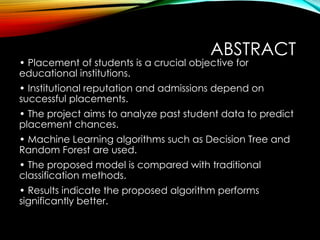
ABSTRACT
• Placement ofstudents is a crucial objective for
educational institutions.
• Institutional reputation and admissions depend on
successful placements.
• The project aims to analyze past student data to predict
placement chances.
• Machine Learning algorithms such as Decision Tree and
Random Forest are used.
• The proposed model is compared with traditional
classification methods.
• Results indicate the proposed algorithm performs
significantly better.
3.
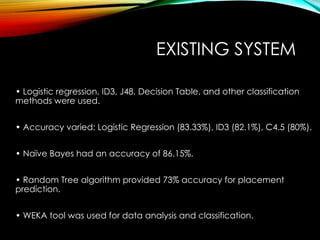
EXISTING SYSTEM
• Logisticregression, ID3, J48, Decision Table, and other classification
methods were used.
• Accuracy varied: Logistic Regression (83.33%), ID3 (82.1%), C4.5 (80%).
• Naïve Bayes had an accuracy of 86.15%.
• Random Tree algorithm provided 73% accuracy for placement
prediction.
• WEKA tool was used for data analysis and classification.
4.
DISADVANTAGES OF
EXISTING SYSTEM
•Attribute selection is not relevant to each other.
• Missing values were not handled properly.
• Data cleaning and preprocessing were not optimized.
5.
PROPOSED SYSTEM
• Predictsplacement probability of undergraduate students.
• Uses Decision Tree and Random Forest classification algorithms.
• Uses academic history (percentages, backlogs, credits) for
prediction.
• Algorithms applied to past student placement data.
6.
ADVANTAGES OF
PROPOSED SYSTEM
•Irrelevant attributes are removed to improve accuracy.
• Uses Random Forest, an ensemble learning technique,
for better results.
• More accurate and efficient than previous models.
• Predicts placement outcomes with improved precision
and recall.


![Template_for_Mini_Project_PPT_-_Review-I_-_23-08-2025.ppt[1].pptx](https://cdn.slidesharecdn.com/ss_thumbnails/templateforminiprojectppt-review-i-23-08-2025-251209085746-2c4b1c6f-thumbnail.jpg?width=640&height=640&fit=bounds)


