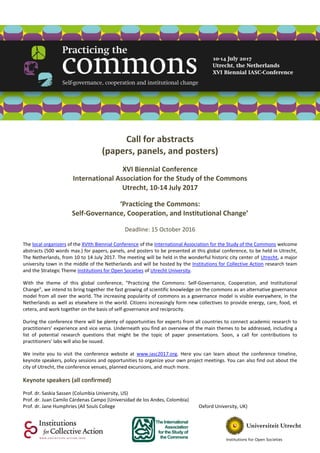
Call for abstracts
(papers, panels, and posters)
XVI Biennial Conference
International Association for the Study of the Commons
Utrecht, 10-14 July 2017
‘Practicing the Commons:
Self-Governance, Cooperation, and Institutional Change’
Deadline: 15 October 2016
The local organizers of the XVIth Biennial Conference of the International Association for the Study of the Commons welcome
abstracts (500 words max.) for papers, panels, and posters to be presented at this global conference, to be held in Utrecht,
The Netherlands, from 10 to 14 July 2017. The meeting will be held in the wonderful historic city center of Utrecht, a major
university town in the middle of the Netherlands and will be hosted by the Institutions for Collective Action research team
and the Strategic Theme Institutions for Open Societies of Utrecht University.
With the theme of this global conference, “Practicing the Commons: Self-Governance, Cooperation, and Institutional
Change”, we intend to bring together the fast growing of scientific knowledge on the commons as an alternative governance
model from all over the world. The increasing popularity of commons as a governance model is visible everywhere, in the
Netherlands as well as elsewhere in the world. Citizens increasingly form new collectives to provide energy, care, food, et
cetera, and work together on the basis of self-governance and reciprocity.
During the conference there will be plenty of opportunities for experts from all countries to connect academic research to
practitioners’ experience and vice versa. Underneath you find an overview of the main themes to be addressed, including a
list of potential research questions that might be the topic of paper presentations. Soon, a call for contributions to
practitioners’ labs will also be issued.
We invite you to visit the conference website at www.iasc2017.org. Here you can learn about the conference timeline,
keynote speakers, policy sessions and opportunities to organize your own project meetings. You can also find out about the
city of Utrecht, the conference venues, planned excursions, and much more.
Keynote speakers (all confirmed)
Prof. dr. Saskia Sassen (Columbia University, US)
Prof. dr. Juan Camilo Cárdenas Campo (Universidad de los Andes, Colombia)
Prof. dr. Jane Humphries (All Souls College Oxford University, UK)
Conference tracks, including examples of possible research questions that can be addressed in
submitted panels, papers, and posters
1. Recipes for resilient cooperation
 How did the management and use of commons evolve over time?
 Does the longevity of an institution for collective action have a positive effect on continuation? What is the role of path
dependency in long‐enduring commons?
 Which factors influence(d) the emergence and continuation of commons?
 How do commons cope with shocks and countervailing powers?
 In what way does management of common pool-resources depend on the type of resource?
 …
2. Issues of exclusion and control in the formation, defence, and governance of commons
 Who sets the boundaries to commons?
 Under which conditions are strict boundaries/access rules better for resilience and under which conditions are vague,
open boundaries preferable?
 Can technology help to make commons more inclusive?
 What are the moral implications of limiting access to common pool-resources?
 What are the mechanisms that include or exclude women, poor households, or particular ethnic groups from the
commons?
 Which instruments for monitoring, controlling and sanctioning behavior can be found in self‐governing institutions and
how do these evolve over time?
 What is the impact of group size and composition on the commons’ functioning?
 How does inclusion and exclusion work in digital resources governed as commons?
 ….
3. The impact of the commons
 What role can commons play in enhancing food security?
 Do commons have a positive effect on livelihoods, well‐being, social justice, inequality?
 How can knowledge on commons be used to secure the future of global resources?
 How can (knowledge on) local resource governance contribute to mitigating climate change?
 What is the impact of technological change on self‐governance and resource appropriation?
 ….
4. Methods and models to study the commons
 How can institutional change on the commons be studied (methodology, coding of case studies, individual cases)?
 How can different methodologies to study commons better be integrated?
 How can micro‐/macro‐relations be modelled to understand the functioning of commons?
 How can our current knowledge on natural resource commons be used to improve our understanding of collective action
in digital environments, genetics, etc., and vice versa?
 ….
5. Polycentric governance of global resources
 How can polycentric governance contribute to governing global resources?
 Which are the legal constraints to polycentric governance?
 What can be the impact of local change on the future of global resources?
 How and in which ways is leadership important in polycentric governance?
 ….
6. Crisis on the commons?
 How do commoners overcome periods of extreme stress and crisis?
 Are commons as governance regimes more resilient to shocks and crises, compared to e.g. state or market-governed
resources?
 How well can commoners mediate conflicts both within their own group and with other groups within society?
 How to study failure instead of success of commons?
 ….
7. Commons and the city
 For which urban spaces and resources can commons be a viable alternative governance model?
 Which specific opportunities and challenges does the urban environment offer to commons’ initiatives?
 How to establish durable collaboration between commons and local governments?
 ….
8. Corporations, governments and commons
 What impact do businesses and private investment have on the commons?
 What are mechanisms for constructive engagement between corporations and the commons?
 What role can commons play in the struggle for land rights, in particular of indigenous communities?
 Which role can local and national governments play in the development of new commons?
 What is the role of external agents (e.g. NGOs, government agencies, etc.) in the governance of the commons and has
this changed over time?
 ….
Submission guidelines
Abstracts can be submitted for posters, individual papers, panels, and papers belonging to a coherent panel. See further
for details.
All abstracts should be submitted via the IASC Conference Registration system: http://conferences.iasc-
commons.org/index.php/iasc/IASC2017/author/submit?requiresAuthor=1
All submissions should be in English (either US or UK spelling are allowed)
The text of your abstract should be no longer than 500 words (including references) and entered as flat-text via the
online registration procedure by the 15 October 2016 at the latest
Please also submit relevant keywords regarding topics, region, and time period in the registration system
All abstracts will be peer-reviewed by at least two selected reviewers
You will be notified about the reviewing result ultimately by 31 January 2017
Full papers and posters are expected to be submitted ultimately by 20 June 2017
Please notice that by submitting your paper, you will allow the paper to be included into the Digital Library on the
Commons
In case you wish to submit a panel proposal (consisting of 4 papers), please note that:
 the main organizer of the panel first needs to submit a panel proposal with an abstract on the session’s content, and
needs to inform the authors of the 4 papers about the submission ID that will be provided after submission of the
panel (via a confirmation email).
 sessions are only considered if all 4 paper proposals are also individually submitted by their authors, including the
reference to the submission number of the panel. It is the responsibility of the main session organizer to inform the
authors of the participating papers about this procedure.
 panels are only included in the program if all four individual papers are accepted by the reviewers and if all authors
have registered by 10 May 2017. If the authors have not registered in time, the organizers will allocate the papers of
registered authors to other panels, if possible.
Please do also note that….
For practitioners interested in presenting their initiative/organization to other delegates at the conference, a special
“Call for contributions to practitioners’ labs” will be issued in the fall of 2016, giving practitioners the opportunity to
present their organization and engage in the academic debate. The conference is of course also open to practitioners,
scholars, or any other interested parties to attend the conference without presenting their initiative or research.
There will be a number of grants available to delegates from the Global South and to PhD-students which will comprise a
waiver of the conference fee, free accommodation during the conference (arrival on Monday, departure on Saturday),
participation in the conference events (pre-conference workshop, dinner, excursion) and – depending on the grant – a
limited contribution to travel costs. Authors of accepted abstracts will receive notice before 31 January 2017 explaining
the application procedure for a grant. Please note that reimbursements of costs related to a grant are made after
presentation of the paper at the conference only.
Conference fees will be announced via the conference website www.iasc2017.org in the fall of 2016 and will be income-
dependent, but they will also be substantially lower for members of the IASC. Register now as IASC-member via
https://membership.iasc-commons.org and start benefiting right away from your IASC-membership.
As the conference is an excellent opportunity to meet your international project partners, the organizers will be offering
high-quality low-cost meeting rooms (approx. 100 EUR/day, incl. equipment) for your project meetings on the opening
day of the conference (Monday 10 July, 9 am – 3 pm). You can register for this via the conference website
http://www.iasc2017.org/when/project-meetings/.
Questions?
Get in touch with the conference organizers: iasc2017@iasc2017.org. If you wish to be updated about the IASC-conference
and other IASC-events, please register for the IASC-newsletter via http://iasc-commons.org/
We are looking forward to see you in Utrecht!
Local Organizing Committee
 Prof. dr. Tine De Moor (Professor of Institutions for Collective Action in Historical Perspective,
Faculty of Humanities, Utrecht University). Chair of the LOC, http://www.uu.nl/hum/staff/MDeMoor1/0
 Prof. dr. ir. Vincent Buskens (Professor of Theoretical Sociology, Faculty of Social and Behavioural Sciences, Utrecht
University), http://www.uu.nl/staff/vbuskens
 Prof. dr. Marco A. Janssen (Professor School of Sustainability / Director of the Center for Behavior, Institutions and the
Environment, Arizona State University and visiting professor of the Institutions for Open Societies Program at Utrecht
University), http://www.marcojanssen.info/
 Dr. Frank van Laerhoven (Assistant Professor Copernicus Institute of Sustainable Development, Faculty of Geosciences,
Utrecht), http://www.uu.nl/staff/FSJvanLaerhoven/0
 Prof. dr. Jan Luiten van Zanden (Professor of Global Economic History, Faculty of Humanities, Utrecht University),
http://www.uu.nl/hum/staff/JLvanZanden/0
 Dr. Anita Boele (Postdoc researcher Research Team ‘Institutions for Collective Action’, Utrecht University),
http://www.uu.nl/hum/staff/AHBoele
 Dr. Charlotte Störmer (Postdoc researcher Research Team ‘Institutions for Collective Action’, Utrecht University),
http://www.uu.nl/hum/staff/CStormer
 Dr. Sarah Carmichael (Postdoc researcher Research Team ‘Institutions for Collective Action’, Utrecht University),
http://www.uu.nl/staff/SGCarmichael/0
Conference Team / Secretariat
 Charlotte Witte MA (Research Assistant Research Team ‘Institutions for Collective Action’, Utrecht University),
http://www.collective-action.info/_TEA_Charlotte-Witte
 Miguel Laborda Pemán MA (PhD‐candidate Research Team ‘Institutions for Collective Action’, Utrecht University),
http://www.uu.nl/staff/MLabordaPerman/0
 René van Weeren BA (Research Assistant Research Team ‘Institutions for Collective Action’, Utrecht University/Executive
Director IASC), http://www.uu.nl/hum/staff/RvanWeeren

call for papers 2017_Final_revision_Oct16

  • 1.
    Call for abstracts (papers,panels, and posters) XVI Biennial Conference International Association for the Study of the Commons Utrecht, 10-14 July 2017 ‘Practicing the Commons: Self-Governance, Cooperation, and Institutional Change’ Deadline: 15 October 2016 The local organizers of the XVIth Biennial Conference of the International Association for the Study of the Commons welcome abstracts (500 words max.) for papers, panels, and posters to be presented at this global conference, to be held in Utrecht, The Netherlands, from 10 to 14 July 2017. The meeting will be held in the wonderful historic city center of Utrecht, a major university town in the middle of the Netherlands and will be hosted by the Institutions for Collective Action research team and the Strategic Theme Institutions for Open Societies of Utrecht University. With the theme of this global conference, “Practicing the Commons: Self-Governance, Cooperation, and Institutional Change”, we intend to bring together the fast growing of scientific knowledge on the commons as an alternative governance model from all over the world. The increasing popularity of commons as a governance model is visible everywhere, in the Netherlands as well as elsewhere in the world. Citizens increasingly form new collectives to provide energy, care, food, et cetera, and work together on the basis of self-governance and reciprocity. During the conference there will be plenty of opportunities for experts from all countries to connect academic research to practitioners’ experience and vice versa. Underneath you find an overview of the main themes to be addressed, including a list of potential research questions that might be the topic of paper presentations. Soon, a call for contributions to practitioners’ labs will also be issued. We invite you to visit the conference website at www.iasc2017.org. Here you can learn about the conference timeline, keynote speakers, policy sessions and opportunities to organize your own project meetings. You can also find out about the city of Utrecht, the conference venues, planned excursions, and much more. Keynote speakers (all confirmed) Prof. dr. Saskia Sassen (Columbia University, US) Prof. dr. Juan Camilo Cárdenas Campo (Universidad de los Andes, Colombia) Prof. dr. Jane Humphries (All Souls College Oxford University, UK)
  • 2.
    Conference tracks, includingexamples of possible research questions that can be addressed in submitted panels, papers, and posters 1. Recipes for resilient cooperation  How did the management and use of commons evolve over time?  Does the longevity of an institution for collective action have a positive effect on continuation? What is the role of path dependency in long‐enduring commons?  Which factors influence(d) the emergence and continuation of commons?  How do commons cope with shocks and countervailing powers?  In what way does management of common pool-resources depend on the type of resource?  … 2. Issues of exclusion and control in the formation, defence, and governance of commons  Who sets the boundaries to commons?  Under which conditions are strict boundaries/access rules better for resilience and under which conditions are vague, open boundaries preferable?  Can technology help to make commons more inclusive?  What are the moral implications of limiting access to common pool-resources?  What are the mechanisms that include or exclude women, poor households, or particular ethnic groups from the commons?  Which instruments for monitoring, controlling and sanctioning behavior can be found in self‐governing institutions and how do these evolve over time?  What is the impact of group size and composition on the commons’ functioning?  How does inclusion and exclusion work in digital resources governed as commons?  …. 3. The impact of the commons  What role can commons play in enhancing food security?  Do commons have a positive effect on livelihoods, well‐being, social justice, inequality?  How can knowledge on commons be used to secure the future of global resources?  How can (knowledge on) local resource governance contribute to mitigating climate change?  What is the impact of technological change on self‐governance and resource appropriation?  …. 4. Methods and models to study the commons  How can institutional change on the commons be studied (methodology, coding of case studies, individual cases)?  How can different methodologies to study commons better be integrated?  How can micro‐/macro‐relations be modelled to understand the functioning of commons?  How can our current knowledge on natural resource commons be used to improve our understanding of collective action in digital environments, genetics, etc., and vice versa?  …. 5. Polycentric governance of global resources  How can polycentric governance contribute to governing global resources?  Which are the legal constraints to polycentric governance?  What can be the impact of local change on the future of global resources?  How and in which ways is leadership important in polycentric governance?  ….
  • 3.
    6. Crisis onthe commons?  How do commoners overcome periods of extreme stress and crisis?  Are commons as governance regimes more resilient to shocks and crises, compared to e.g. state or market-governed resources?  How well can commoners mediate conflicts both within their own group and with other groups within society?  How to study failure instead of success of commons?  …. 7. Commons and the city  For which urban spaces and resources can commons be a viable alternative governance model?  Which specific opportunities and challenges does the urban environment offer to commons’ initiatives?  How to establish durable collaboration between commons and local governments?  …. 8. Corporations, governments and commons  What impact do businesses and private investment have on the commons?  What are mechanisms for constructive engagement between corporations and the commons?  What role can commons play in the struggle for land rights, in particular of indigenous communities?  Which role can local and national governments play in the development of new commons?  What is the role of external agents (e.g. NGOs, government agencies, etc.) in the governance of the commons and has this changed over time?  …. Submission guidelines Abstracts can be submitted for posters, individual papers, panels, and papers belonging to a coherent panel. See further for details. All abstracts should be submitted via the IASC Conference Registration system: http://conferences.iasc- commons.org/index.php/iasc/IASC2017/author/submit?requiresAuthor=1 All submissions should be in English (either US or UK spelling are allowed) The text of your abstract should be no longer than 500 words (including references) and entered as flat-text via the online registration procedure by the 15 October 2016 at the latest Please also submit relevant keywords regarding topics, region, and time period in the registration system All abstracts will be peer-reviewed by at least two selected reviewers You will be notified about the reviewing result ultimately by 31 January 2017 Full papers and posters are expected to be submitted ultimately by 20 June 2017 Please notice that by submitting your paper, you will allow the paper to be included into the Digital Library on the Commons In case you wish to submit a panel proposal (consisting of 4 papers), please note that:  the main organizer of the panel first needs to submit a panel proposal with an abstract on the session’s content, and needs to inform the authors of the 4 papers about the submission ID that will be provided after submission of the panel (via a confirmation email).  sessions are only considered if all 4 paper proposals are also individually submitted by their authors, including the reference to the submission number of the panel. It is the responsibility of the main session organizer to inform the authors of the participating papers about this procedure.  panels are only included in the program if all four individual papers are accepted by the reviewers and if all authors have registered by 10 May 2017. If the authors have not registered in time, the organizers will allocate the papers of registered authors to other panels, if possible.
  • 4.
    Please do alsonote that…. For practitioners interested in presenting their initiative/organization to other delegates at the conference, a special “Call for contributions to practitioners’ labs” will be issued in the fall of 2016, giving practitioners the opportunity to present their organization and engage in the academic debate. The conference is of course also open to practitioners, scholars, or any other interested parties to attend the conference without presenting their initiative or research. There will be a number of grants available to delegates from the Global South and to PhD-students which will comprise a waiver of the conference fee, free accommodation during the conference (arrival on Monday, departure on Saturday), participation in the conference events (pre-conference workshop, dinner, excursion) and – depending on the grant – a limited contribution to travel costs. Authors of accepted abstracts will receive notice before 31 January 2017 explaining the application procedure for a grant. Please note that reimbursements of costs related to a grant are made after presentation of the paper at the conference only. Conference fees will be announced via the conference website www.iasc2017.org in the fall of 2016 and will be income- dependent, but they will also be substantially lower for members of the IASC. Register now as IASC-member via https://membership.iasc-commons.org and start benefiting right away from your IASC-membership. As the conference is an excellent opportunity to meet your international project partners, the organizers will be offering high-quality low-cost meeting rooms (approx. 100 EUR/day, incl. equipment) for your project meetings on the opening day of the conference (Monday 10 July, 9 am – 3 pm). You can register for this via the conference website http://www.iasc2017.org/when/project-meetings/. Questions? Get in touch with the conference organizers: iasc2017@iasc2017.org. If you wish to be updated about the IASC-conference and other IASC-events, please register for the IASC-newsletter via http://iasc-commons.org/ We are looking forward to see you in Utrecht! Local Organizing Committee  Prof. dr. Tine De Moor (Professor of Institutions for Collective Action in Historical Perspective, Faculty of Humanities, Utrecht University). Chair of the LOC, http://www.uu.nl/hum/staff/MDeMoor1/0  Prof. dr. ir. Vincent Buskens (Professor of Theoretical Sociology, Faculty of Social and Behavioural Sciences, Utrecht University), http://www.uu.nl/staff/vbuskens  Prof. dr. Marco A. Janssen (Professor School of Sustainability / Director of the Center for Behavior, Institutions and the Environment, Arizona State University and visiting professor of the Institutions for Open Societies Program at Utrecht University), http://www.marcojanssen.info/  Dr. Frank van Laerhoven (Assistant Professor Copernicus Institute of Sustainable Development, Faculty of Geosciences, Utrecht), http://www.uu.nl/staff/FSJvanLaerhoven/0  Prof. dr. Jan Luiten van Zanden (Professor of Global Economic History, Faculty of Humanities, Utrecht University), http://www.uu.nl/hum/staff/JLvanZanden/0  Dr. Anita Boele (Postdoc researcher Research Team ‘Institutions for Collective Action’, Utrecht University), http://www.uu.nl/hum/staff/AHBoele  Dr. Charlotte Störmer (Postdoc researcher Research Team ‘Institutions for Collective Action’, Utrecht University), http://www.uu.nl/hum/staff/CStormer  Dr. Sarah Carmichael (Postdoc researcher Research Team ‘Institutions for Collective Action’, Utrecht University), http://www.uu.nl/staff/SGCarmichael/0 Conference Team / Secretariat  Charlotte Witte MA (Research Assistant Research Team ‘Institutions for Collective Action’, Utrecht University), http://www.collective-action.info/_TEA_Charlotte-Witte  Miguel Laborda Pemán MA (PhD‐candidate Research Team ‘Institutions for Collective Action’, Utrecht University), http://www.uu.nl/staff/MLabordaPerman/0  René van Weeren BA (Research Assistant Research Team ‘Institutions for Collective Action’, Utrecht University/Executive Director IASC), http://www.uu.nl/hum/staff/RvanWeeren