Quality of global (forest) governance
                   &
       institutional legitimacy  	


                 USQ


                TOOWOOMBA


Tim Cadman BA Hons MA (Cantab) PhD (UTas)
Summary
•  There are many (forest) governance initiatives,
   some useful, some not: telling the difference is
   not always easy
•  Stakeholders need a simple method to determine
   if they should participate
•  This presentation provides
  –  a means of classifying diverse governance systems
     and
  –  A set of principles, criteria and indicators (PC&I) to
     evaluate governance quality and rate legitimacy
•  Looks at four case studies: FSC, ISO 14000,
   PEFC, UNFF
Modern (environmental)
             governance
•  “the coordination of interdependent social relations in
   the mitigation of environmental
   disruptions” (Mackendrick 2005)
•  Governance systems understood as “governance as
   structure” and “governance as process”(Pierre and
   Peters 2000)
•  Participation as structure, deliberation as process
   (Cadman 2009)
•  Together, effective interaction between structure and
   process delivers the quality of outcomes, which
   determine legitimacy (Kooiman 1993, 2000):
Figure 3.2 Conceptual model of contemporary global governance


                            INSTITUTION


                            Governance
                              System
                                                               Inputs
                            Interaction
          Structure                            Process
                           (Collaborative)
         (Participative)                      (Deliberative)

                                                               Outputs
                             Outcomes
                           (Substantive and
                             behavioural)
                                                         (Determination of
                                                           governance
                             Legitimacy                       quality)
How can you compare different institutions?

 •  Previously, governance theory has identified
    many different types of institution: public private
    partnerships (PPPs), ‘new’ public management
    (NPM), etc.
    –  This makes comparison difficult
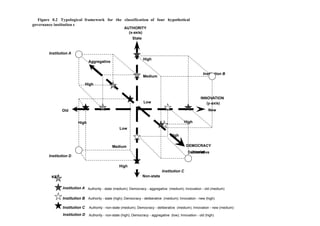
 •  Rather than identifying institutions by type, it is
    better to identify by key factors:
    –  Authority (state or non-state)
    –  Democracy (aggregative or deliberative)
    –  Innovation (new or old governance styles)
 •  These can then be located in the ‘universe’ of
    global governance:
Figure 0.2 Typological framework for the classification of four hypothetical
governance institution s
                                                        AUTHORITY
                                                          (x-axis)
                                                            State


        Institution A
                                                                     High
                                 Aggregative


                                                                                                             Institution B
                                                                     Medium

                                High


                                                                                                            INNOVATION
                                                                     Low                                       (y-axis)
               Old                                                                                               New


                         High                                                                     High
                                                     Low
                                                                                       High

                                                Medium                                            DEMOCRACY
                                                                                                    (z-axis)
                                                                                                   Deliberative
        Institution D

                                                     High
                                                                                  Institution C
         KEY                                                         Non-state


                Institution A Authority - state (medium); Democracy - aggregative (medium); Innovation - old (medium)

                Institution B Authority - state (high); Democracy - deliberative (medium); Innovation - new (high)

                Institution C    Authority - non-state (medium); Democracy - deliberative (medium); Innovation - new (medium)

                Institution D    Authority - non-state (high); Democracy - aggregative (low); Innovation - old (high)
What system of measurement
         can you use?
•  All governance theorists identify a range of
   governance attributes, which deliver ‘good’
   governance: e.g transparency, accountability,
   interest representation, inclusiveness, etc.
  –  But they have not sought to identify the structural and
     procedural relationship between these arrangements
•  Cadman (2009) identifies the relationship
   between these attributes, and locates them in a
   hierarchical framework (following Lammerts van
   Beuren and Blom 1997):
Case studies
•  Using the classification framework and
   PC&I Cadman 2009 investigated the
   governance quality of four global forest
   institutions:
  –  Forest Stewardship Council (FSC)
  –  ISO 14000 series (TC 207)
  –  Programme for the Endorsement of Forest
     Certification schemes (PEFC)
  –  United Nations Forum on Forests (UNFF)
Results: Classification
                                                                                              State


                                                                        UNFF
                                                DEMOCRACY
                                                   (z-axis)
                                                                                                      High
                                                     Aggregative

                                                                                                               PEFC

                                                                                                      Medium
                                                               High


                                                                                                      Low

                                INNOVATION      Old                                                                                 New
                                   (y-axis)
                                                          High                 ISO                                          High

                                                                                      Low
KEY                                                                                                               High

             Authority - state (medium-high); Democracy - aggregative (low);
      UNFF                                                                                                               Deliberative
                                                                                     Medium
             Innovation -state(low)
             Authority – old (low-medium); Democracy - aggregative
      PEFC

             (low-medium); Innovation -- new (medium)
             Authority – non-state (medium-high); Democracy - deliberative
      FSC
                                                                                      High Non-state
      ISO    Authority – non-state (low); - new (medium-high)
             (medium-high); Innovation Democracy - aggregative (low);
                                                                                            (x-axis)                                      FSC
             Innovation - old (low)
                                                                                         AUTHORITY
Results: Evaluation
        The image cannot be displayed. Your computer may not have enough memory to open the image, or the image may have been corrupted. Restart your computer, and then open the file again. If the red x still appears, you may have to delete the image and then insert it again.


Principle                                                                                        1. Meaningful Participation
Criterion                  1. Interest representation                                                                           2. Organisational responsibilit y                                                                Sub-
                  Highest possible score: 9                                                                               Highest possible score: 6                                                                              total
                  Lowest possible score: 3                                                                                Lowest possible score: 2                                                                               (out of
                                                                                                                                                                                                                                 15)
Indicator            Inclusive-                    Equality                Resource s                    Total                  Accountability                             Transparency                         Total
                        ness
FSC                           3                           2                          2                       7                                2                                         2                           4                   11
ISO                           2                           1                          2                       5                                2                                         1                           3                       8
PEFC                          1                           1                          1                       3                                1                                         1                           2                       5
UNFF                          2                           1                          1                       4                                1                                         1                           2                       6

Principle                                                                                          2. Productive deliberation
Criterion                     3. Decision ma k i n g                                                                                  4. Implementation                                                                          Sub-
                  Highest possible score: 9                                                                               Highest possible score: 9                                                                              total
                  Lowest possible score: 3                                                                                Lowest possible score: 3                                                                               (out of
                                                                                                                                                                                                                                 18)

Indicator          Democracy                        Agree-                   Dispute                     Total            Behavioural                      Problem                  Durability                  Total
                                                     men t                  settlemen t                                     change                         solving
FSC                           2                           3                          1                       6                        2                           2                          3                      7                     13
ISO                           2                           2                          1                       5                        2                           1                          3                      6                     11                         Legitimacy
PEFC                          1                           2                          1                       4                        2                           1                          2                      5                       9
UNFF                          1                           1                          1                       3                        1                           1                          2                      4                       7                          Rating
                                                                                                                                                                                                                                 Grand
                                                                                                                                                                                                                                 Total
                                                                                                                                                                                                                                 (out of
                                                                                                                                                                                                                                 33)
FSC                                                                                                                                                                                                                                  24
ISO                                                                                                                                                                                                                                       19
PEFC                                                                                                                                                                                                                                      14
UNFF                                                                                                                                                                                                                                      13
Conclusions
•  Preliminary:
   –  Non-state systems may be a better option; BUT
   –  Insufficient case studies to be definitive AND
   –  It is not non-state systems per se but their quality of
      governance that counts
•  Implications:
   –  Stakeholders should pay attention to the governance
      systems of the institutions in which they participate
      •  They could be wasting their time on a system with poor
         governance: it will not solve the problem (eg climate change) or
         meet sectoral needs
   –  There may be ‘decoy’ institutions (Dimitrov 2005) gaining
      legitimacy
   –  There is an urgent need for consistent global
      governance standards

Cadman long

  • 1.
    Quality of global(forest) governance & institutional legitimacy USQ TOOWOOMBA Tim Cadman BA Hons MA (Cantab) PhD (UTas)
  • 2.
    Summary •  There aremany (forest) governance initiatives, some useful, some not: telling the difference is not always easy •  Stakeholders need a simple method to determine if they should participate •  This presentation provides –  a means of classifying diverse governance systems and –  A set of principles, criteria and indicators (PC&I) to evaluate governance quality and rate legitimacy •  Looks at four case studies: FSC, ISO 14000, PEFC, UNFF
  • 3.
    Modern (environmental) governance •  “the coordination of interdependent social relations in the mitigation of environmental disruptions” (Mackendrick 2005) •  Governance systems understood as “governance as structure” and “governance as process”(Pierre and Peters 2000) •  Participation as structure, deliberation as process (Cadman 2009) •  Together, effective interaction between structure and process delivers the quality of outcomes, which determine legitimacy (Kooiman 1993, 2000):
  • 4.
    Figure 3.2 Conceptualmodel of contemporary global governance INSTITUTION Governance System Inputs Interaction Structure Process (Collaborative) (Participative) (Deliberative) Outputs Outcomes (Substantive and behavioural) (Determination of governance Legitimacy quality)
  • 5.
    How can youcompare different institutions? •  Previously, governance theory has identified many different types of institution: public private partnerships (PPPs), ‘new’ public management (NPM), etc. –  This makes comparison difficult •  Rather than identifying institutions by type, it is better to identify by key factors: –  Authority (state or non-state) –  Democracy (aggregative or deliberative) –  Innovation (new or old governance styles) •  These can then be located in the ‘universe’ of global governance:
  • 6.
    Figure 0.2 Typologicalframework for the classification of four hypothetical governance institution s AUTHORITY (x-axis) State Institution A High Aggregative Institution B Medium High INNOVATION Low (y-axis) Old New High High Low High Medium DEMOCRACY (z-axis) Deliberative Institution D High Institution C KEY Non-state Institution A Authority - state (medium); Democracy - aggregative (medium); Innovation - old (medium) Institution B Authority - state (high); Democracy - deliberative (medium); Innovation - new (high) Institution C Authority - non-state (medium); Democracy - deliberative (medium); Innovation - new (medium) Institution D Authority - non-state (high); Democracy - aggregative (low); Innovation - old (high)
  • 7.
    What system ofmeasurement can you use? •  All governance theorists identify a range of governance attributes, which deliver ‘good’ governance: e.g transparency, accountability, interest representation, inclusiveness, etc. –  But they have not sought to identify the structural and procedural relationship between these arrangements •  Cadman (2009) identifies the relationship between these attributes, and locates them in a hierarchical framework (following Lammerts van Beuren and Blom 1997):
  • 9.
    Case studies •  Usingthe classification framework and PC&I Cadman 2009 investigated the governance quality of four global forest institutions: –  Forest Stewardship Council (FSC) –  ISO 14000 series (TC 207) –  Programme for the Endorsement of Forest Certification schemes (PEFC) –  United Nations Forum on Forests (UNFF)
  • 10.
    Results: Classification State UNFF DEMOCRACY (z-axis) High Aggregative PEFC Medium High Low INNOVATION Old New (y-axis) High ISO High Low KEY High Authority - state (medium-high); Democracy - aggregative (low); UNFF Deliberative Medium Innovation -state(low) Authority – old (low-medium); Democracy - aggregative PEFC (low-medium); Innovation -- new (medium) Authority – non-state (medium-high); Democracy - deliberative FSC High Non-state ISO Authority – non-state (low); - new (medium-high) (medium-high); Innovation Democracy - aggregative (low); (x-axis) FSC Innovation - old (low) AUTHORITY
  • 11.
    Results: Evaluation The image cannot be displayed. Your computer may not have enough memory to open the image, or the image may have been corrupted. Restart your computer, and then open the file again. If the red x still appears, you may have to delete the image and then insert it again. Principle 1. Meaningful Participation Criterion 1. Interest representation 2. Organisational responsibilit y Sub- Highest possible score: 9 Highest possible score: 6 total Lowest possible score: 3 Lowest possible score: 2 (out of 15) Indicator Inclusive- Equality Resource s Total Accountability Transparency Total ness FSC 3 2 2 7 2 2 4 11 ISO 2 1 2 5 2 1 3 8 PEFC 1 1 1 3 1 1 2 5 UNFF 2 1 1 4 1 1 2 6 Principle 2. Productive deliberation Criterion 3. Decision ma k i n g 4. Implementation Sub- Highest possible score: 9 Highest possible score: 9 total Lowest possible score: 3 Lowest possible score: 3 (out of 18) Indicator Democracy Agree- Dispute Total Behavioural Problem Durability Total men t settlemen t change solving FSC 2 3 1 6 2 2 3 7 13 ISO 2 2 1 5 2 1 3 6 11 Legitimacy PEFC 1 2 1 4 2 1 2 5 9 UNFF 1 1 1 3 1 1 2 4 7 Rating Grand Total (out of 33) FSC 24 ISO 19 PEFC 14 UNFF 13
  • 12.
    Conclusions •  Preliminary: –  Non-state systems may be a better option; BUT –  Insufficient case studies to be definitive AND –  It is not non-state systems per se but their quality of governance that counts •  Implications: –  Stakeholders should pay attention to the governance systems of the institutions in which they participate •  They could be wasting their time on a system with poor governance: it will not solve the problem (eg climate change) or meet sectoral needs –  There may be ‘decoy’ institutions (Dimitrov 2005) gaining legitimacy –  There is an urgent need for consistent global governance standards