THE
TRENDING
Tamil
Most Lucrative Professions
 Medical Professionals
 Chartered Accountants
 Management Professionals
 Law Professionals
 Engineers
 Scientists
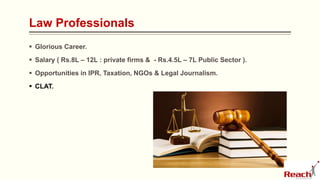
Law Professionals
 Glorious Career.
 Salary ( Rs.8L – 12L : private firms & - Rs.4.5L – 7L Public Sector ).
 Opportunities in IPR, Taxation, NGOs & Legal Journalism.
 CLAT.
Chartered Accountants
• THINK BIG Career.
• Salary ( Rs.7.5L – 15L ).
• Opportunities in IFRS, Taxation, Corporate
Governance & Economic & Commercial Laws.
• CA Foundation
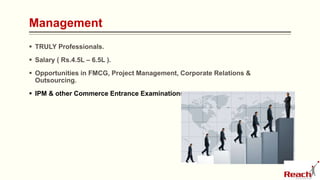
Management
 TRULY Professionals.
 Salary ( Rs.4.5L – 6.5L ).
 Opportunities in FMCG, Project Management, Corporate Relations &
Outsourcing.
 IPM & other Commerce Entrance Examinations.
Chartered Accountant
CA FOUNDATION
CA Foundation
 Conducted by ICAI.
 Entry-level exam for Chartered Accountancy.
 Exam will be conducted across four days.
 The first two papers of CA Foundation 2018 will be subjective/descriptive type.
 Paper 3 & 4 will be MCQ type papers.
 English / Hindi.
Exam Pattern
 400 Marks exam with each paper accounting for 100 Marks
 Candidates will have to score a minimum of 40 marks in each paper and 50%
overall (200 marks) to pass the CA Foundation exam.
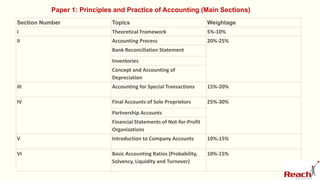
Section Number Topics Weightage
I Theoretical Framework 5%-10%
II Accounting Process 20%-25%
Bank Reconciliation Statement
Inventories
Concept and Accounting of
Depreciation
III Accounting for Special Transactions 15%-20%
IV Final Accounts of Sole Proprietors 25%-30%
Partnership Accounts
Financial Statements of Not-for-Profit
Organizations
V Introduction to Company Accounts 10%-15%
VI Basic Accounting Ratios (Probability,
Solvency, Liquidity and Turnover)
10%-15%
Paper 1: Principles and Practice of Accounting (Main Sections)
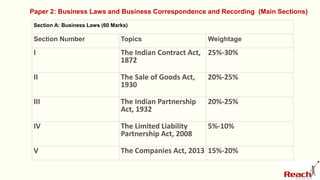
Section A: Business Laws (60 Marks)
Section Number Topics Weightage
I The Indian Contract Act,
1872
25%-30%
II The Sale of Goods Act,
1930
20%-25%
III The Indian Partnership
Act, 1932
20%-25%
IV The Limited Liability
Partnership Act, 2008
5%-10%
V The Companies Act, 2013 15%-20%
Paper 2: Business Laws and Business Correspondence and Recording (Main Sections)
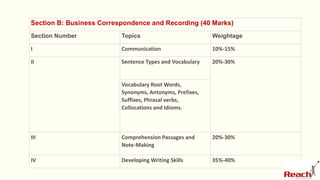
Section B: Business Correspondence and Recording (40 Marks)
Section Number Topics Weightage
I Communication 10%-15%
II Sentence Types and Vocabulary 20%-30%
Vocabulary Root Words,
Synonyms, Antonyms, Prefixes,
Suffixes, Phrasal verbs,
Collocations and Idioms.
III Comprehension Passages and
Note-Making
20%-30%
IV Developing Writing Skills 35%-40%
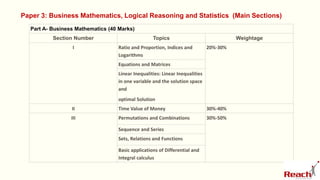
Part A- Business Mathematics (40 Marks)
Section Number Topics Weightage
I Ratio and Proportion, Indices and
Logarithms
20%-30%
Equations and Matrices
Linear Inequalities: Linear Inequalities
in one variable and the solution space
and
optimal Solution
II Time Value of Money 30%-40%
III Permutations and Combinations 30%-50%
Sequence and Series
Sets, Relations and Functions
Basic applications of Differential and
Integral calculus
Paper 3: Business Mathematics, Logical Reasoning and Statistics (Main Sections)
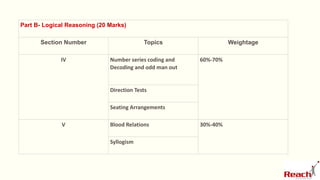
Part B- Logical Reasoning (20 Marks)
Section Number Topics Weightage
IV Number series coding and
Decoding and odd man out
60%-70%
Direction Tests
Seating Arrangements
V Blood Relations 30%-40%
Syllogism
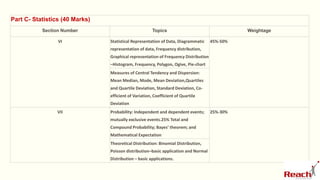
Part C- Statistics (40 Marks)
Section Number Topics Weightage
VI Statistical Representation of Data, Diagrammatic
representation of data, Frequency distribution,
Graphical representation of Frequency Distribution
–Histogram, Frequency, Polygon, Ogive, Pie-chart
45%-50%
Measures of Central Tendency and Dispersion:
Mean Median, Mode, Mean Deviation,Quartiles
and Quartile Deviation, Standard Deviation, Co-
efficient of Variation, Coefficient of Quartile
Deviation
VII Probability: Independent and dependent events;
mutually exclusive events.25% Total and
Compound Probability; Bayes’ theorem; and
Mathematical Expectation
25%-30%
Theoretical Distribution: Binomial Distribution,
Poisson distribution–basic application and Normal
Distribution – basic applications.
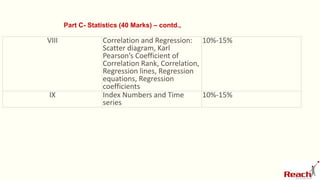
VIII Correlation and Regression:
Scatter diagram, Karl
Pearson’s Coefficient of
Correlation Rank, Correlation,
Regression lines, Regression
equations, Regression
coefficients
10%-15%
IX Index Numbers and Time
series
10%-15%
Part C- Statistics (40 Marks) – contd.,
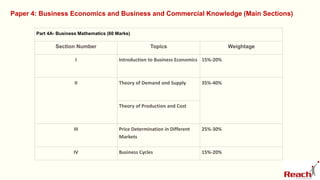
Part 4A- Business Mathematics (60 Marks)
Section Number Topics Weightage
I Introduction to Business Economics 15%-20%
II Theory of Demand and Supply 35%-40%
Theory of Production and Cost
III Price Determination in Different
Markets
25%-30%
IV Business Cycles 15%-20%
Paper 4: Business Economics and Business and Commercial Knowledge (Main Sections)
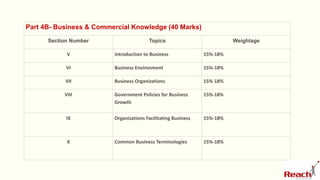
Part 4B- Business & Commercial Knowledge (40 Marks)
Section Number Topics Weightage
V Introduction to Business 15%-18%
VI Business Environment 15%-18%
VII Business Organizations 15%-18%
VIII Government Policies for Business
Growth
15%-18%
IX Organizations Facilitating Business 15%-18%
X Common Business Terminologies 15%-18%
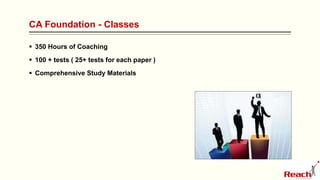
CA Foundation - Classes
 350 Hours of Coaching
 100 + tests ( 25+ tests for each paper )
 Comprehensive Study Materials
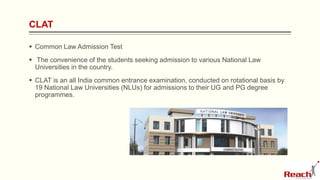
CLAT
 Common Law Admission Test
 The convenience of the students seeking admission to various National Law
Universities in the country.
 CLAT is an all India common entrance examination, conducted on rotational basis by
19 National Law Universities (NLUs) for admissions to their UG and PG degree
programmes.
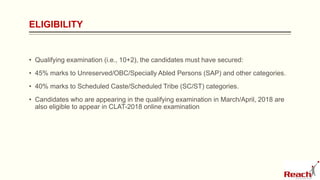
ELIGIBILITY
• Qualifying examination (i.e., 10+2), the candidates must have secured:
• 45% marks to Unreserved/OBC/Specially Abled Persons (SAP) and other categories.
• 40% marks to Scheduled Caste/Scheduled Tribe (SC/ST) categories.
• Candidates who are appearing in the qualifying examination in March/April, 2018 are
also eligible to appear in CLAT-2018 online examination
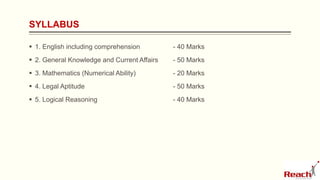
SYLLABUS
 1. English including comprehension - 40 Marks
 2. General Knowledge and Current Affairs - 50 Marks
 3. Mathematics (Numerical Ability) - 20 Marks
 4. Legal Aptitude - 50 Marks
 5. Logical Reasoning - 40 Marks
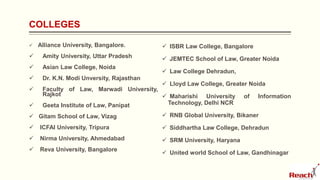
COLLEGES
 Alliance University, Bangalore.
 Amity University, Uttar Pradesh
 Asian Law College, Noida
 Dr. K.N. Modi Unversity, Rajasthan
 Faculty of Law, Marwadi University,
Rajkot
 Geeta Institute of Law, Panipat
 Gitam School of Law, Vizag
 ICFAI University, Tripura
 Nirma University, Ahmedabad
 Reva University, Bangalore
 ISBR Law College, Bangalore
 JEMTEC School of Law, Greater Noida
 Law College Dehradun,
 Lloyd Law College, Greater Noida
 Maharishi University of Information
Technology, Delhi NCR
 RNB Global University, Bikaner
 Siddhartha Law College, Dehradun
 SRM University, Haryana
 United world School of Law, Gandhinagar
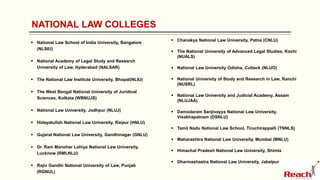
NATIONAL LAW COLLEGES
 National Law School of India University, Bangalore
(NLSIU)
 National Academy of Legal Study and Research
University of Law, Hyderabad (NALSAR)
 The National Law Institute University, Bhopal(NLIU)
 The West Bengal National University of Juridical
Sciences, Kolkata (WBNUJS)
 National Law University, Jodhpur (NLUJ)
 Hidayatullah National Law University, Raipur (HNLU)
 Gujarat National Law University, Gandhinagar (GNLU)
 Dr. Ram Manohar Lohiya National Law University,
Lucknow (RMLNLU)
 Rajiv Gandhi National University of Law, Punjab
(RGNUL)
 Chanakya National Law University, Patna (CNLU)
 The National University of Advanced Legal Studies, Kochi
(NUALS)
 National Law University Odisha, Cuttack (NLUO)
 National University of Study and Research in Law, Ranchi
(NUSRL)
 National Law University and Judicial Academy, Assam
(NLUJAA)
 Damodaram Sanjivayya National Law University,
Visakhapatnam (DSNLU)
 Tamil Nadu National Law School, Tiruchirappalli (TNNLS)
 Maharashtra National Law University, Mumbai (MNLU)
 Himachal Pradesh National Law University, Shimla
 Dharmashastra National Law University, Jabalpur
CLAT - Classes
• 150 Hours of Coaching
• 50 + tests
• Comprehensive Study Materials
Commerce Entrances
 Commerce Entrance Examinations
 The convenience of the students seeking admission to various Top Universities ( Delhi
University, BHU & Mumbai University )in the country.
SYLLABUS
 1. English including comprehension
 2. General Knowledge and Current Affairs
 3. Mathematics (Numerical Ability)
 4. Logical Reasoning
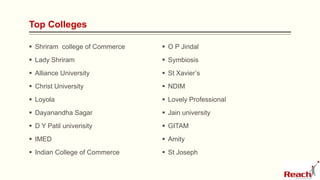
Top Colleges
 Shriram college of Commerce
 Lady Shriram
 Alliance University
 Christ University
 Loyola
 Dayanandha Sagar
 D Y Patil univerisity
 IMED
 Indian College of Commerce
 O P Jindal
 Symbiosis
 St Xavier’s
 NDIM
 Lovely Professional
 Jain university
 GITAM
 Amity
 St Joseph
Commerce Entrance - Classes
• 130 Hours of Coaching
• 30 + tests
• Comprehensive Study Materials
CA CLAT final.pptx

CA CLAT final.pptx

  • 2.
  • 3.
    Most Lucrative Professions Medical Professionals  Chartered Accountants  Management Professionals  Law Professionals  Engineers  Scientists
  • 4.
    Law Professionals  GloriousCareer.  Salary ( Rs.8L – 12L : private firms & - Rs.4.5L – 7L Public Sector ).  Opportunities in IPR, Taxation, NGOs & Legal Journalism.  CLAT.
  • 5.
    Chartered Accountants • THINKBIG Career. • Salary ( Rs.7.5L – 15L ). • Opportunities in IFRS, Taxation, Corporate Governance & Economic & Commercial Laws. • CA Foundation
  • 6.
    Management  TRULY Professionals. Salary ( Rs.4.5L – 6.5L ).  Opportunities in FMCG, Project Management, Corporate Relations & Outsourcing.  IPM & other Commerce Entrance Examinations.
  • 7.
  • 8.
    CA Foundation  Conductedby ICAI.  Entry-level exam for Chartered Accountancy.  Exam will be conducted across four days.  The first two papers of CA Foundation 2018 will be subjective/descriptive type.  Paper 3 & 4 will be MCQ type papers.  English / Hindi.
  • 9.
    Exam Pattern  400Marks exam with each paper accounting for 100 Marks  Candidates will have to score a minimum of 40 marks in each paper and 50% overall (200 marks) to pass the CA Foundation exam.
  • 10.
    Section Number TopicsWeightage I Theoretical Framework 5%-10% II Accounting Process 20%-25% Bank Reconciliation Statement Inventories Concept and Accounting of Depreciation III Accounting for Special Transactions 15%-20% IV Final Accounts of Sole Proprietors 25%-30% Partnership Accounts Financial Statements of Not-for-Profit Organizations V Introduction to Company Accounts 10%-15% VI Basic Accounting Ratios (Probability, Solvency, Liquidity and Turnover) 10%-15% Paper 1: Principles and Practice of Accounting (Main Sections)
  • 11.
    Section A: BusinessLaws (60 Marks) Section Number Topics Weightage I The Indian Contract Act, 1872 25%-30% II The Sale of Goods Act, 1930 20%-25% III The Indian Partnership Act, 1932 20%-25% IV The Limited Liability Partnership Act, 2008 5%-10% V The Companies Act, 2013 15%-20% Paper 2: Business Laws and Business Correspondence and Recording (Main Sections)
  • 12.
    Section B: BusinessCorrespondence and Recording (40 Marks) Section Number Topics Weightage I Communication 10%-15% II Sentence Types and Vocabulary 20%-30% Vocabulary Root Words, Synonyms, Antonyms, Prefixes, Suffixes, Phrasal verbs, Collocations and Idioms. III Comprehension Passages and Note-Making 20%-30% IV Developing Writing Skills 35%-40%
  • 13.
    Part A- BusinessMathematics (40 Marks) Section Number Topics Weightage I Ratio and Proportion, Indices and Logarithms 20%-30% Equations and Matrices Linear Inequalities: Linear Inequalities in one variable and the solution space and optimal Solution II Time Value of Money 30%-40% III Permutations and Combinations 30%-50% Sequence and Series Sets, Relations and Functions Basic applications of Differential and Integral calculus Paper 3: Business Mathematics, Logical Reasoning and Statistics (Main Sections)
  • 14.
    Part B- LogicalReasoning (20 Marks) Section Number Topics Weightage IV Number series coding and Decoding and odd man out 60%-70% Direction Tests Seating Arrangements V Blood Relations 30%-40% Syllogism
  • 15.
    Part C- Statistics(40 Marks) Section Number Topics Weightage VI Statistical Representation of Data, Diagrammatic representation of data, Frequency distribution, Graphical representation of Frequency Distribution –Histogram, Frequency, Polygon, Ogive, Pie-chart 45%-50% Measures of Central Tendency and Dispersion: Mean Median, Mode, Mean Deviation,Quartiles and Quartile Deviation, Standard Deviation, Co- efficient of Variation, Coefficient of Quartile Deviation VII Probability: Independent and dependent events; mutually exclusive events.25% Total and Compound Probability; Bayes’ theorem; and Mathematical Expectation 25%-30% Theoretical Distribution: Binomial Distribution, Poisson distribution–basic application and Normal Distribution – basic applications.
  • 16.
    VIII Correlation andRegression: Scatter diagram, Karl Pearson’s Coefficient of Correlation Rank, Correlation, Regression lines, Regression equations, Regression coefficients 10%-15% IX Index Numbers and Time series 10%-15% Part C- Statistics (40 Marks) – contd.,
  • 17.
    Part 4A- BusinessMathematics (60 Marks) Section Number Topics Weightage I Introduction to Business Economics 15%-20% II Theory of Demand and Supply 35%-40% Theory of Production and Cost III Price Determination in Different Markets 25%-30% IV Business Cycles 15%-20% Paper 4: Business Economics and Business and Commercial Knowledge (Main Sections)
  • 18.
    Part 4B- Business& Commercial Knowledge (40 Marks) Section Number Topics Weightage V Introduction to Business 15%-18% VI Business Environment 15%-18% VII Business Organizations 15%-18% VIII Government Policies for Business Growth 15%-18% IX Organizations Facilitating Business 15%-18% X Common Business Terminologies 15%-18%
  • 19.
    CA Foundation -Classes  350 Hours of Coaching  100 + tests ( 25+ tests for each paper )  Comprehensive Study Materials
  • 21.
    CLAT  Common LawAdmission Test  The convenience of the students seeking admission to various National Law Universities in the country.  CLAT is an all India common entrance examination, conducted on rotational basis by 19 National Law Universities (NLUs) for admissions to their UG and PG degree programmes.
  • 22.
    ELIGIBILITY • Qualifying examination(i.e., 10+2), the candidates must have secured: • 45% marks to Unreserved/OBC/Specially Abled Persons (SAP) and other categories. • 40% marks to Scheduled Caste/Scheduled Tribe (SC/ST) categories. • Candidates who are appearing in the qualifying examination in March/April, 2018 are also eligible to appear in CLAT-2018 online examination
  • 23.
    SYLLABUS  1. Englishincluding comprehension - 40 Marks  2. General Knowledge and Current Affairs - 50 Marks  3. Mathematics (Numerical Ability) - 20 Marks  4. Legal Aptitude - 50 Marks  5. Logical Reasoning - 40 Marks
  • 24.
    COLLEGES  Alliance University,Bangalore.  Amity University, Uttar Pradesh  Asian Law College, Noida  Dr. K.N. Modi Unversity, Rajasthan  Faculty of Law, Marwadi University, Rajkot  Geeta Institute of Law, Panipat  Gitam School of Law, Vizag  ICFAI University, Tripura  Nirma University, Ahmedabad  Reva University, Bangalore  ISBR Law College, Bangalore  JEMTEC School of Law, Greater Noida  Law College Dehradun,  Lloyd Law College, Greater Noida  Maharishi University of Information Technology, Delhi NCR  RNB Global University, Bikaner  Siddhartha Law College, Dehradun  SRM University, Haryana  United world School of Law, Gandhinagar
  • 25.
    NATIONAL LAW COLLEGES National Law School of India University, Bangalore (NLSIU)  National Academy of Legal Study and Research University of Law, Hyderabad (NALSAR)  The National Law Institute University, Bhopal(NLIU)  The West Bengal National University of Juridical Sciences, Kolkata (WBNUJS)  National Law University, Jodhpur (NLUJ)  Hidayatullah National Law University, Raipur (HNLU)  Gujarat National Law University, Gandhinagar (GNLU)  Dr. Ram Manohar Lohiya National Law University, Lucknow (RMLNLU)  Rajiv Gandhi National University of Law, Punjab (RGNUL)  Chanakya National Law University, Patna (CNLU)  The National University of Advanced Legal Studies, Kochi (NUALS)  National Law University Odisha, Cuttack (NLUO)  National University of Study and Research in Law, Ranchi (NUSRL)  National Law University and Judicial Academy, Assam (NLUJAA)  Damodaram Sanjivayya National Law University, Visakhapatnam (DSNLU)  Tamil Nadu National Law School, Tiruchirappalli (TNNLS)  Maharashtra National Law University, Mumbai (MNLU)  Himachal Pradesh National Law University, Shimla  Dharmashastra National Law University, Jabalpur
  • 26.
    CLAT - Classes •150 Hours of Coaching • 50 + tests • Comprehensive Study Materials
  • 28.
    Commerce Entrances  CommerceEntrance Examinations  The convenience of the students seeking admission to various Top Universities ( Delhi University, BHU & Mumbai University )in the country.
  • 29.
    SYLLABUS  1. Englishincluding comprehension  2. General Knowledge and Current Affairs  3. Mathematics (Numerical Ability)  4. Logical Reasoning
  • 30.
    Top Colleges  Shriramcollege of Commerce  Lady Shriram  Alliance University  Christ University  Loyola  Dayanandha Sagar  D Y Patil univerisity  IMED  Indian College of Commerce  O P Jindal  Symbiosis  St Xavier’s  NDIM  Lovely Professional  Jain university  GITAM  Amity  St Joseph
  • 31.
    Commerce Entrance -Classes • 130 Hours of Coaching • 30 + tests • Comprehensive Study Materials