C.003 Task Based Risk Assessment
Competence Reference Handbook Page 1 of 6
C.003 Task Based Risk Assessment
The content of this document is meant as a general introduction to the subject. The
Seadrill TMS, manufacture manuals and/or other rig specific procedures and guidelines
should always be consulted for the relevant operations or equipment types.
In case of doubt or if additional detailed information is required please contact your
immediate supervisor.
Introduction
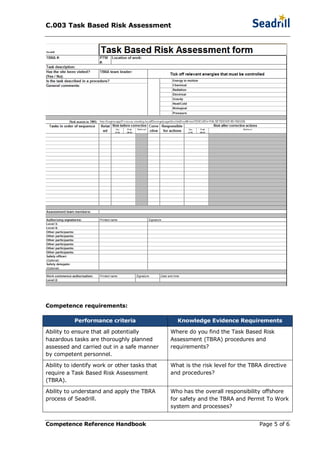
The Task Based Risk Assessment (TBRA) is normally performed on all new jobs (no
controlled work instruction exists) and for acceptable changes from existing jobs. The
TBRA is required to be completed and reviewed with those performing the work before the
job starts. The purpose is to ensure that all potentially hazardous tasks are thoroughly
planned, assessed, communicated, and executed in a safe manner by competent
personnel.
TBRA may also be performed for existing jobs that already have formal work instructions,
at the discretion of the offshore leadership. This may be in response to perceived safety
risks (STOP Program, Near Miss Report, etc.) or as a result of poor safety performance
(incidents, injury, etc.). In these cases, the objective of performing the TBRA is to both
improve the safety aspects of the work instruction as well as raising awareness of hazards
by the persons performing the job.
In either case, the job being subject to the TBRA should be defined to the extent
appropriate to effectively perform the analysis. It may be necessary to identify several
minor jobs for TBRA on each rather than tackling a more time demanding, complex job
within a single TBRA.
Use of good judgment is required when selecting jobs which will need a TBRA.
All involved personnel shall actively participate in a job planning review to achieve full
understanding of the task at hand. To support this risk assessment approach, the TBRA-
form and the Risk Matrix shall be applied.
Considerations
When applied correctly, the TBRA is a tool that will increase crew participation in the rig
site safety program by requiring them to take a proactive group role in planning their tasks
and mitigating hazards to which they are exposed.
Use of the TBRA development process gives ownership of the task to the crew and this
builds understanding, teamwork, and crew motivation.
The development of a TBRA should be an evolving process and perfection should not be
expected. Quality is achieved through consistent practical use and the individuals’
incremental development of their hazard identification skills.
The direct benefits of the TBRA are:
 Identifies hazards.
 Improves safety.
C.003 Task Based Risk Assessment
Competence Reference Handbook Page 2 of 6
 Improves communication.
 Defines safe and efficient job procedures.
 Provides training for new or relief employees.
 Increased safety awareness especially with changes or new jobs.
The indirect benefits of the TBRA are:
 Develops a sense of ownership for crew.
 Increases job satisfaction.
 Increases productivity.
 Encourages participation.
 Encourages thinking before acting.
When identifying the steps for a new job, a small group session of people knowledgeable to
the job task should agree on the basic steps and the order of completion. These are
documented on the SJA form.
To record the breakdown, number the job steps consecutively. Each step tells what is
done, not how. The wording for each step should begin with an action word like “remove”,
“open,” or “inform.” The action is completed by naming the item to which the action
applies, for example, “remove extinguisher”, “move to rig floor.”
The Task Based Risk Assessment shall be a simple, systematic assessment and discussion
of a job, led by persons with knowledge and experience of the specific task to be
undertaken.
It is critical that this discussion process is collaborative and demonstrates active
participation by all personnel involved.
The person in charge of this activity must ensure that appropriately skilled personnel are
involved in key aspects of the job and those less experienced are delegated suitable tasks
with adequate supervision.
It is also important that generalities do not feature in this process; specific roles &
responsibilities must be clearly allocated, which will also carry with them specific
responsibilities for particular hazard control measures. There must be a personal
accountability for the hazard controls identified and each assigned individual holds that
accountability to themselves and to their workmates. This clear delegation shall also
feature as part of the validation of understanding process upon the conclusion of the TBRA
meeting, whereby random individuals must explain those responsibilities held to the work
group.
When to carry out a TBRA
A TBRA shall be conducted in the following situations:
1. The task at hand requires a work permit
2. When a deviation is necessary from a procedure or a specific work process
3. When procedures may be in conflict with each other
C.003 Task Based Risk Assessment
Competence Reference Handbook Page 3 of 6
4. Prior to any job considered hazardous and the involved risks are not fully covered in
a procedure
5. When activities are new to the personnel involved
6. When uncertainties or significant changes in the working conditions occur
7. When working with or close to high-voltage electrical equipment
8. When handling hazardous material (e.g. explosives, chemicals, or radioactive
equipment)
9. Whenever there is a risk of H2S
10. Before working in environment that may cause excessive health hazards, e.g.:
o Prolonged exposure to chemicals
o Prolonged exposure to high noise levels
o Use of equipment with inferior ergonomic design or poor work positions
o Work involving highly stressful conditions or causing extreme psychic strain
A TBRA should be conducted whenever the need arises, e.g. to assist the planning of the
work.
C.003 Task Based Risk Assessment
Competence Reference Handbook Page 4 of 6
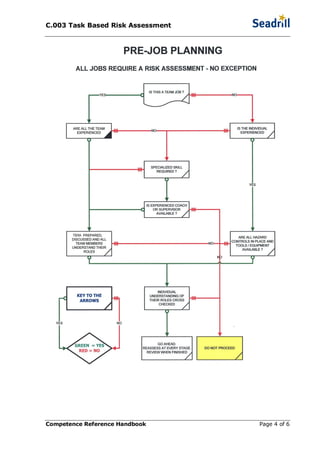
C.003 Task Based Risk Assessment
Competence Reference Handbook Page 5 of 6
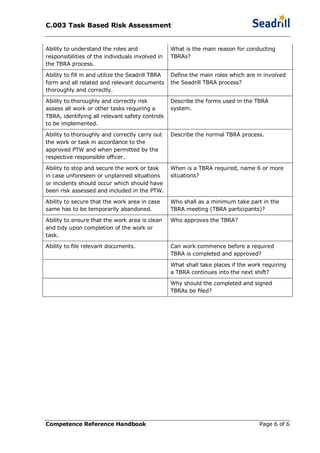
Competence requirements:
Performance criteria Knowledge Evidence Requirements
Ability to ensure that all potentially
hazardous tasks are thoroughly planned
assessed and carried out in a safe manner
by competent personnel.
Where do you find the Task Based Risk
Assessment (TBRA) procedures and
requirements?
Ability to identify work or other tasks that
require a Task Based Risk Assessment
(TBRA).
What is the risk level for the TBRA directive
and procedures?
Ability to understand and apply the TBRA
process of Seadrill.
Who has the overall responsibility offshore
for safety and the TBRA and Permit To Work
system and processes?
C.003 Task Based Risk Assessment
Competence Reference Handbook Page 6 of 6
Ability to understand the roles and
responsibilities of the individuals involved in
the TBRA process.
What is the main reason for conducting
TBRAs?
Ability to fill in and utilize the Seadrill TBRA
form and all related and relevant documents
thoroughly and correctly.
Define the main roles which are in involved
the Seadrill TBRA process?
Ability to thoroughly and correctly risk
assess all work or other tasks requiring a
TBRA, identifying all relevant safety controls
to be implemented.
Describe the forms used in the TBRA
system.
Ability to thoroughly and correctly carry out
the work or task in accordance to the
approved PTW and when permitted by the
respective responsible officer.
Describe the normal TBRA process.
Ability to stop and secure the work or task
in case unforeseen or unplanned situations
or incidents should occur which should have
been risk assessed and included in the PTW.
When is a TBRA required, name 6 or more
situations?
Ability to secure that the work area in case
same has to be temporarily abandoned.
Who shall as a minimum take part in the
TBRA meeting (TBRA participants)?
Ability to ensure that the work area is clean
and tidy upon completion of the work or
task.
Who approves the TBRA?
Ability to file relevant documents. Can work commence before a required
TBRA is completed and approved?
What shall take places if the work requiring
a TBRA continues into the next shift?
Why should the completed and signed
TBRAs be filed?

C.003 task based risk assessment

  • 1.
    C.003 Task BasedRisk Assessment Competence Reference Handbook Page 1 of 6 C.003 Task Based Risk Assessment The content of this document is meant as a general introduction to the subject. The Seadrill TMS, manufacture manuals and/or other rig specific procedures and guidelines should always be consulted for the relevant operations or equipment types. In case of doubt or if additional detailed information is required please contact your immediate supervisor. Introduction The Task Based Risk Assessment (TBRA) is normally performed on all new jobs (no controlled work instruction exists) and for acceptable changes from existing jobs. The TBRA is required to be completed and reviewed with those performing the work before the job starts. The purpose is to ensure that all potentially hazardous tasks are thoroughly planned, assessed, communicated, and executed in a safe manner by competent personnel. TBRA may also be performed for existing jobs that already have formal work instructions, at the discretion of the offshore leadership. This may be in response to perceived safety risks (STOP Program, Near Miss Report, etc.) or as a result of poor safety performance (incidents, injury, etc.). In these cases, the objective of performing the TBRA is to both improve the safety aspects of the work instruction as well as raising awareness of hazards by the persons performing the job. In either case, the job being subject to the TBRA should be defined to the extent appropriate to effectively perform the analysis. It may be necessary to identify several minor jobs for TBRA on each rather than tackling a more time demanding, complex job within a single TBRA. Use of good judgment is required when selecting jobs which will need a TBRA. All involved personnel shall actively participate in a job planning review to achieve full understanding of the task at hand. To support this risk assessment approach, the TBRA- form and the Risk Matrix shall be applied. Considerations When applied correctly, the TBRA is a tool that will increase crew participation in the rig site safety program by requiring them to take a proactive group role in planning their tasks and mitigating hazards to which they are exposed. Use of the TBRA development process gives ownership of the task to the crew and this builds understanding, teamwork, and crew motivation. The development of a TBRA should be an evolving process and perfection should not be expected. Quality is achieved through consistent practical use and the individuals’ incremental development of their hazard identification skills. The direct benefits of the TBRA are:  Identifies hazards.  Improves safety.
  • 2.
    C.003 Task BasedRisk Assessment Competence Reference Handbook Page 2 of 6  Improves communication.  Defines safe and efficient job procedures.  Provides training for new or relief employees.  Increased safety awareness especially with changes or new jobs. The indirect benefits of the TBRA are:  Develops a sense of ownership for crew.  Increases job satisfaction.  Increases productivity.  Encourages participation.  Encourages thinking before acting. When identifying the steps for a new job, a small group session of people knowledgeable to the job task should agree on the basic steps and the order of completion. These are documented on the SJA form. To record the breakdown, number the job steps consecutively. Each step tells what is done, not how. The wording for each step should begin with an action word like “remove”, “open,” or “inform.” The action is completed by naming the item to which the action applies, for example, “remove extinguisher”, “move to rig floor.” The Task Based Risk Assessment shall be a simple, systematic assessment and discussion of a job, led by persons with knowledge and experience of the specific task to be undertaken. It is critical that this discussion process is collaborative and demonstrates active participation by all personnel involved. The person in charge of this activity must ensure that appropriately skilled personnel are involved in key aspects of the job and those less experienced are delegated suitable tasks with adequate supervision. It is also important that generalities do not feature in this process; specific roles & responsibilities must be clearly allocated, which will also carry with them specific responsibilities for particular hazard control measures. There must be a personal accountability for the hazard controls identified and each assigned individual holds that accountability to themselves and to their workmates. This clear delegation shall also feature as part of the validation of understanding process upon the conclusion of the TBRA meeting, whereby random individuals must explain those responsibilities held to the work group. When to carry out a TBRA A TBRA shall be conducted in the following situations: 1. The task at hand requires a work permit 2. When a deviation is necessary from a procedure or a specific work process 3. When procedures may be in conflict with each other
  • 3.
    C.003 Task BasedRisk Assessment Competence Reference Handbook Page 3 of 6 4. Prior to any job considered hazardous and the involved risks are not fully covered in a procedure 5. When activities are new to the personnel involved 6. When uncertainties or significant changes in the working conditions occur 7. When working with or close to high-voltage electrical equipment 8. When handling hazardous material (e.g. explosives, chemicals, or radioactive equipment) 9. Whenever there is a risk of H2S 10. Before working in environment that may cause excessive health hazards, e.g.: o Prolonged exposure to chemicals o Prolonged exposure to high noise levels o Use of equipment with inferior ergonomic design or poor work positions o Work involving highly stressful conditions or causing extreme psychic strain A TBRA should be conducted whenever the need arises, e.g. to assist the planning of the work.
  • 4.
    C.003 Task BasedRisk Assessment Competence Reference Handbook Page 4 of 6
  • 5.
    C.003 Task BasedRisk Assessment Competence Reference Handbook Page 5 of 6 Competence requirements: Performance criteria Knowledge Evidence Requirements Ability to ensure that all potentially hazardous tasks are thoroughly planned assessed and carried out in a safe manner by competent personnel. Where do you find the Task Based Risk Assessment (TBRA) procedures and requirements? Ability to identify work or other tasks that require a Task Based Risk Assessment (TBRA). What is the risk level for the TBRA directive and procedures? Ability to understand and apply the TBRA process of Seadrill. Who has the overall responsibility offshore for safety and the TBRA and Permit To Work system and processes?
  • 6.
    C.003 Task BasedRisk Assessment Competence Reference Handbook Page 6 of 6 Ability to understand the roles and responsibilities of the individuals involved in the TBRA process. What is the main reason for conducting TBRAs? Ability to fill in and utilize the Seadrill TBRA form and all related and relevant documents thoroughly and correctly. Define the main roles which are in involved the Seadrill TBRA process? Ability to thoroughly and correctly risk assess all work or other tasks requiring a TBRA, identifying all relevant safety controls to be implemented. Describe the forms used in the TBRA system. Ability to thoroughly and correctly carry out the work or task in accordance to the approved PTW and when permitted by the respective responsible officer. Describe the normal TBRA process. Ability to stop and secure the work or task in case unforeseen or unplanned situations or incidents should occur which should have been risk assessed and included in the PTW. When is a TBRA required, name 6 or more situations? Ability to secure that the work area in case same has to be temporarily abandoned. Who shall as a minimum take part in the TBRA meeting (TBRA participants)? Ability to ensure that the work area is clean and tidy upon completion of the work or task. Who approves the TBRA? Ability to file relevant documents. Can work commence before a required TBRA is completed and approved? What shall take places if the work requiring a TBRA continues into the next shift? Why should the completed and signed TBRAs be filed?