Rapid detection of Biological warfare agents(BWA) using nanotechnology
in combination with optical methods and MALDI- MS
Vidyasagar Sriramoju MD
Objectives:
 Rapid Detection and Decontamination of Biological warfare agents (BWA).
 Develop the use of organic receptor coupled to gold nanoparticles for improved collection and sensitive detection of
biological warfare agents.
 Study the binding properties of hybrid nanoparticle complexes to specific biological warfare agents (BWA) in
controlled environments with high specificity and sensitivity.
Challenges:
 Characterization of specific antibodies and their adhering properties to biological warfare agents.
 Characterization of strength of biological molecule bonds in controlled environmental conditions.
 Aerosolized hybrid nanoparticles for removal of airborne biological agents for decontamination
Method:
Target specific organic ligands will be used to enhance the adhesive properties of gold nanoparticles for the detection of
biological warfare agents (BWA). The ligands can be protein or carbohydrate in nature. The analyses will be performed
on biological warfare models e.g., Bacillus species, botulinum toxin Viral phages. The adhesion characteristics of the
specialized hybrid nanoparticles to theese biological agents will be studied by electrochemical (changes in resistance and
capacitance), optical (Raman and fluorescence spectroscopies) and MALDI-Mass spectroscopic methods
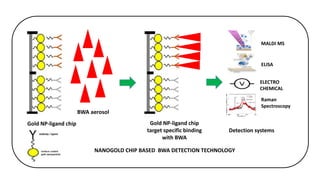
MALDI MS
ELISA
ELECTRO
CHEMICAL
Raman
Spectroscopy
Gold NP-ligand chip
BWA aerosol
Gold NP-ligand chip
target specific binding
with BWA
Detection systems
NANOGOLD CHIP BASED BWA DETECTION TECHNOLOGY

BWA (3)

  • 1.
    Rapid detection ofBiological warfare agents(BWA) using nanotechnology in combination with optical methods and MALDI- MS Vidyasagar Sriramoju MD Objectives:  Rapid Detection and Decontamination of Biological warfare agents (BWA).  Develop the use of organic receptor coupled to gold nanoparticles for improved collection and sensitive detection of biological warfare agents.  Study the binding properties of hybrid nanoparticle complexes to specific biological warfare agents (BWA) in controlled environments with high specificity and sensitivity. Challenges:  Characterization of specific antibodies and their adhering properties to biological warfare agents.  Characterization of strength of biological molecule bonds in controlled environmental conditions.  Aerosolized hybrid nanoparticles for removal of airborne biological agents for decontamination Method: Target specific organic ligands will be used to enhance the adhesive properties of gold nanoparticles for the detection of biological warfare agents (BWA). The ligands can be protein or carbohydrate in nature. The analyses will be performed on biological warfare models e.g., Bacillus species, botulinum toxin Viral phages. The adhesion characteristics of the specialized hybrid nanoparticles to theese biological agents will be studied by electrochemical (changes in resistance and capacitance), optical (Raman and fluorescence spectroscopies) and MALDI-Mass spectroscopic methods
  • 2.
    MALDI MS ELISA ELECTRO CHEMICAL Raman Spectroscopy Gold NP-ligandchip BWA aerosol Gold NP-ligand chip target specific binding with BWA Detection systems NANOGOLD CHIP BASED BWA DETECTION TECHNOLOGY