Business Impact Analysis (BIA) Template
This sample template is designed to assist the user in performing a BIA on an IT system. The
BIA is an essential step in developing the Business Continuity Plan. The template is meant only
as a basic guide and may not apply to all systems. The user may modify this template of the
general BIA approach as required to best accommodate the specific system.
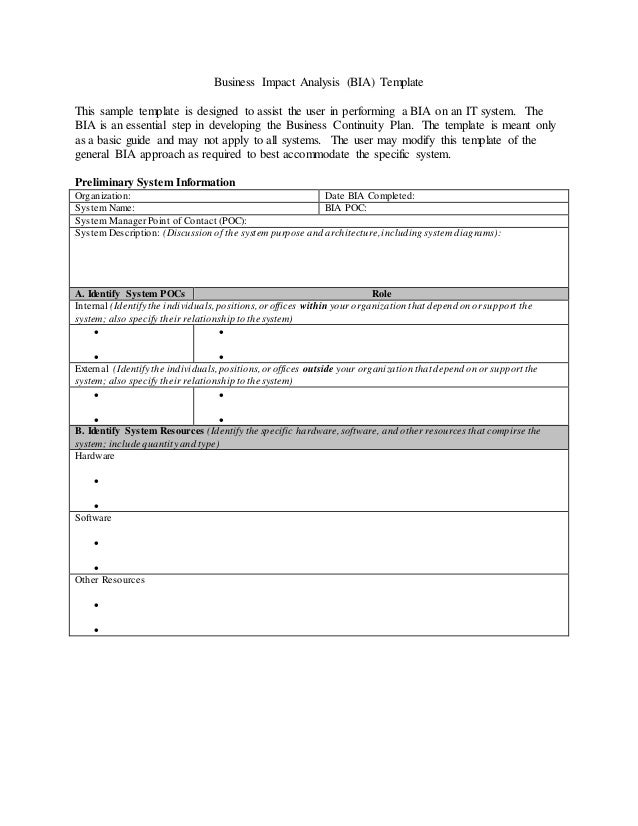
Preliminary System Information
Organization: Date BIA Completed:
System Name: BIA POC:
System ManagerPoint of Contact (POC):
System Description: (Discussion of the system purpose and architecture,including system diagrams):
A. Identify System POCs Role
Internal (Identify the individuals,positions,or offices within your organization that depend on or support the
system; also specify their relationship to the system)




External (Identify the individuals,positions,or offices outside your organization that depend on or support the
system; also specify their relationship to the system)




B. Identify System Resources (Identify the specific hardware,software, and other resources that compirse the
system; include quantity and type)
Hardware


Software


Other Resources


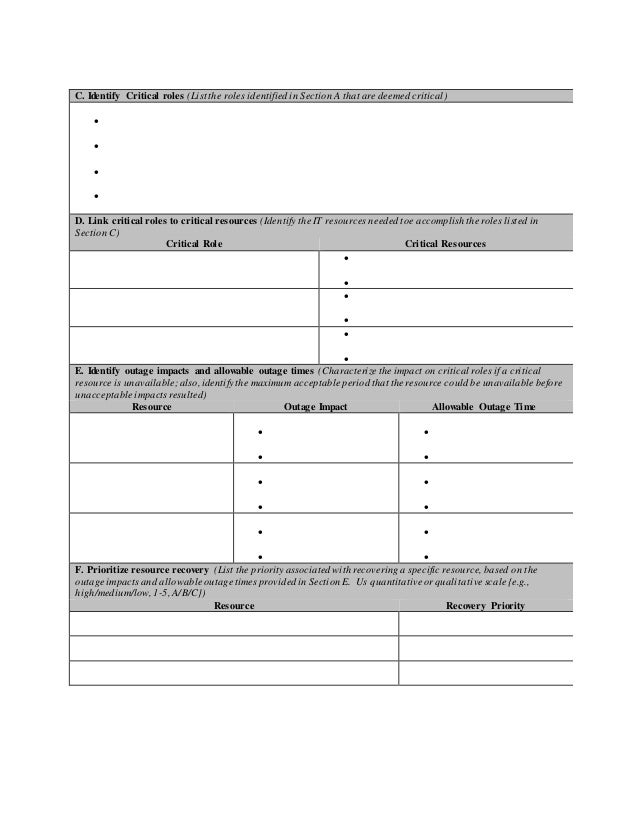
C. Identify Critical roles (List the roles identified in Section A that are deemed critical)




D. Link critical roles to critical resources (Identify the IT resources needed toe accomplish the roles listed in
Section C)
Critical Role Critical Resources






E. Identify outage impacts and allowable outage times (Characterize the impact on critical roles if a critical
resource is unavailable;also,identify the maximum acceptable period that the resource could be unavailable before
unacceptable impactsresulted)
Resource Outage Impact Allowable Outage Time












F. Prioritize resource recovery (List the priority associated with recovering a specific resource, based on the
outage impactsand allowable outage timesprovided in Section E. Us quantitative or qualita tive scale {e.g.,
high/medium/low,1-5, A/B/C})
Resource Recovery Priority

Business-Impact-Analysis-BIA-Template-Word-Format.doc

  • 1.
    Business Impact Analysis(BIA) Template This sample template is designed to assist the user in performing a BIA on an IT system. The BIA is an essential step in developing the Business Continuity Plan. The template is meant only as a basic guide and may not apply to all systems. The user may modify this template of the general BIA approach as required to best accommodate the specific system. Preliminary System Information Organization: Date BIA Completed: System Name: BIA POC: System ManagerPoint of Contact (POC): System Description: (Discussion of the system purpose and architecture,including system diagrams): A. Identify System POCs Role Internal (Identify the individuals,positions,or offices within your organization that depend on or support the system; also specify their relationship to the system)     External (Identify the individuals,positions,or offices outside your organization that depend on or support the system; also specify their relationship to the system)     B. Identify System Resources (Identify the specific hardware,software, and other resources that compirse the system; include quantity and type) Hardware   Software   Other Resources  
  • 2.
    C. Identify Criticalroles (List the roles identified in Section A that are deemed critical)     D. Link critical roles to critical resources (Identify the IT resources needed toe accomplish the roles listed in Section C) Critical Role Critical Resources       E. Identify outage impacts and allowable outage times (Characterize the impact on critical roles if a critical resource is unavailable;also,identify the maximum acceptable period that the resource could be unavailable before unacceptable impactsresulted) Resource Outage Impact Allowable Outage Time             F. Prioritize resource recovery (List the priority associated with recovering a specific resource, based on the outage impactsand allowable outage timesprovided in Section E. Us quantitative or qualita tive scale {e.g., high/medium/low,1-5, A/B/C}) Resource Recovery Priority