Ethics
•Definition: Ethics refers to the systematic study of
what is right and wrong, guiding principles that
govern behavior.
•It can be personal or professional, often grounding
itself in philosophical theories
Types of ethics
• Normative Ethics: Focuses on establishing standards or
norms for behaviour.
• Meta-Ethics: Explores the nature of ethical properties,
statements, and judgments.
• Applied Ethics: Deals with specific ethical issues (e.g.,
bioethics, business ethics).
Morals
•Definition: Morals are the beliefs, values, and principles that
individuals hold about what is right and wrong.
•Morality is often shaped by cultural, religious, or personal
factors.
•Characteristics:
Typically more subjective than ethics.
•Can vary significantly from person to person or culture to
culture.
•Often derived from traditions, upbringing, and community
norms.
The Law
•Definition: The law consists of formal rules and regulations
created and enforced by governmental institutions.
•Laws are designed to maintain order, protect rights, and
provide justice.
Characteristics:
•Codified and publicly available.
•Enforced through systems of governance and legal
institutions.
•Violations often result in penalties (fines, imprisonment,
etc.).
Interrelationships
• Ethics vs. Morals: While morals are personal beliefs about right and wrong,
ethics provides a more structured framework for analyzing those beliefs. Ethics
can influence personal morals, and vice versa; however, ethics can also involve
broader, more generalized principles applicable to groups or professions.
• Ethics vs. Law: Laws are often influenced by ethical standards, but not all ethical
principles are enshrined in law. For example, an action might be legal (like lying
in certain contexts) but considered unethical. Conversely, some laws may be
seen as unethical (e.g., discriminatory laws).
• Morals vs. Law: Laws are designed to reflect the moral standards of society, but
individuals’ personal morals might conflict with the law. For instance, during
times of civil rights struggles, individuals and groups might break laws they
consider unjust, believing they are upholding a higher moral standard.
Moral problems when using the Internet
(Spam)
• The internet raises several moral issues, with particular concerns surrounding
spam, easy access to pornography, censorship, and free speech. Here's a brief
exploration of each:
• Definition: Spam refers to unsolicited and often irrelevant messages sent over
the internet, typically via email or social media, aimed at advertising or phishing.
• Moral Problems:
• Invasion of Privacy: Spam can violate personal space and clutter inboxes, leading to
frustration and potential loss of important communications.
• Deceptive Practices: Many spam messages are misleading, promoting scams or fraudulent
schemes, which can harm individuals financially or emotionally.
• Environmental Impact: The sheer volume of spam consumes server resources, energy, and
contributes to carbon emissions from the data centers.
Moral problems when using the Internet
(Easy access to pornography)
• Easy Access to Pornography
• Definition: The internet provides unrestricted access to pornographic material,
which can be easily found with just a few clicks.
• Moral Problems:
• Impact on Relationships: Easy access to pornography can distort expectations regarding sex
and intimacy, potentially leading to relationship problems or unrealistic body image
standards.
• Exploitation and Consent: Many forms of pornography raise ethics issues regarding
exploitation of performers, consent, and the potential for coercive practices in the industry.
• Age Appropriateness: There are concerns about minors accessing pornographic content,
which may not be suitable for their development, leading to unhealthy perceptions of
sexuality and relationships.
Moral problems when using the Internet
(Censorship)
• Definition: Censorship refers to the suppression or prohibition of speech,
public communication, or other information deemed objectionable by
controlling bodies (governments, organizations).
• Moral Problems:
• Freedom of Expression: Censorship can infringe upon individuals' rights to
express their opinions and share information, raising questions about the
scope of free speech.
• Subjectivity: Determining what content should be censored often involves
subjective judgments, leading to potential biases and unfair treatment of
certain viewpoints.
• Consequences for Society: Overly broad censorship can stifle important
conversations, hinder activism, and limit access to diverse ideas and
Moral problems when using the Internet
(Free speech)
• Free Speech
• Definition: Free speech is the right to express one’s opinions without censorship or
restraint, although it's typically subject to certain limitations (e.g., hate speech,
incitement to violence).
• Moral Problems:
• Hate Speech and Misinformation: While free speech is a fundamental right, the spread of
hate speech and misinformation can have damaging consequences for individuals and
communities.
• Balancing Rights: Finding the right balance between protecting free speech and preventing
harm to individuals or groups presents a moral dilemma, especially in diverse societies.
• Platform Responsibilities: Social media platforms face ethical considerations regarding how
they police content, deal with users who spread harmful ideas, and protect free speech.
Moral problems when using the Internet
(Ensuring public safety)
• Ensuring public safety is paramount. As new technologies are introduced, they
bring safety concerns.
• For example, driverless cars may soon be on the roads in the UK. The designers
of driverless cars have not only had to ensure the safety of passengers but also
of other drivers and pedestrians. An ethical issue applies here, as a situation
may occur where the car's software has to decide who has safety priority.
Should it be the passengers inside the car, or other road users?
Moral problems when using the Internet
(Privacy)
• Once data is put into a computer it can easily be copied or transmitted. This puts personal
private data at risk. Organisations that hold private data should do their best to ensure that such
data remains private. The Data Protection Act 1998/2018 exists to ensure that organisations
comply with the law regarding data privacy.
• Many smartphone apps ask for permission to access data held on the device. Once accessed, this
data is usually sent to the app producer, who is often in another country and not always subject
to the privacy laws that exist in the given country.
• In 2016, the government introduced the Investigatory Powers Act. This sets out rules on the use
of investigatory powers by law enforcement and the security and intelligence agencies.
• Under the act, phone companies and internet service providers are required to keep copies of
users' emails and browsing histories for a period of time. It also gives the police and security
services the authority to access computers and phones to search for data.
• This act has proved controversial, with opponents concerned over how it impacts people's right
to privacy.
Moral problems when using the Internet
(Digital divide)
• The digital divide is the difference between those who have access to
computers and the internet and those who do not. This may be due to
wealth, location, age or the ability to use new technology.
• Somebody who has a visual impairment may have difficulties using a
touchscreen. Apps that are designed to be used on a smartphone may
exclude such people from using their services.
• The elderly generation have not grown up with technology and might feel
nervous of the steep learning curve required to gain confidence with
using the internet. This could mean that they miss out on opportunities,
such as online shopping offers that are not available on the high street.
Moral problems when using the Internet
(Working conditions)
• Modern technology has revolutionised many organisations. The
benefits include quick access to data, cheap data storage, automatic
generation of letters and invoices, and easy tracking of accounts.
However, there are also some disadvantages of modern technology:
• people can now be contacted through smartphones no matter where
they are, making it difficult to have time when they are not on call
• medical issues such as RSI (repetitive strain injury) or eye strain can
occur when an employee is stationary at a desk for long periods of time
• there is concern that new technology, for example robots, might take
jobs away from humans
Computer Ethics
• Ethics are a set of moral principles that govern an individual or a group on what
is acceptable behaviour while using a computer.
Ethics are moral principles, or rules, that govern a person's attitudes and
behaviour.
• Ethics apply to the use of computers as much as they do to other things in life.
• Computer ethics is a set of moral principles that govern the usage of
computers. One of the common issues of computer ethics is violation of
copyright issues.
• Duplicating copyrighted content without the author’s approval, accessing
personal information of others are some of the examples that violate ethical
principles.
Internet Ethics
• Internet Ethics for everyone
• Internet ethics means acceptable behaviour for using Internet.
• We should be honest, respect the rights and property of others on the Internet.
• Acceptance
• Internet must be used for communication with family and friends. Avoid
chatting with strangers and forwarding e-mails from unknown people
/strangers.
• We must be aware of risks involved in chatting and forwarding e-mails to
strangers.
Internet Issues
• Internet Ethics for everyone
• Internet ethics means acceptable behaviour for using Internet. We should be honest, respect
the rights and property of others on the Internet.
• Acceptance
• Internet must be used for communication with family and friends. Avoid chatting with
strangers and forwarding e-mails from unknown people /strangers.We must be aware of risks
involved in chatting and forwarding e-mails to strangers.
• Pretending to be someone else
• We must not use Internet to fool others by pretending to be someone else. Hiding our own
identity to fool others in the Internet world is a crime and may also be a risk to others.
• Avoid Bad language
• We must not use Internet to fool others by pretending to be someone else. Hiding our own
identity to fool others in the Internet world is a crime and may also be a risk to others.
Contn of Internet Issues
• Access to Internet
• The Internet is a time-efficient tool for everyone that enlarges the possibilities for
curriculum growth. Learning depends on the ability to find relevant and reliable
information quickly and easily, and to select, understand and assess that information.
• Searching for information on the Internet can help to develop these skills. Classroom
exercises and take-home assessment tasks, where students are required to compare
website content, are ideal for alerting students to the requirements of writing for
different audiences, the purpose of particular content, identifying and judging
accuracy and reliability.
• Since many sites adopt particular views about issues, the Internet is a useful tool for
developing the skills of distinguishing fact from opinion and exploring subjectivity and
objectivity.
Contn of Internet Issues
• Hide personal information
• We should not give personal details like home address, phone
numbers, interests, passwords. No photographs should be sent to
strangers because it might be misused and shared with others
without their knowledge.
• While Downloading
• Internet is used to listen and learn about music,It is also used to
watch videos and play games we must not use it to download them
or share copyrighted material. We must be aware of the
importance of copyrights and issues of copyright.
Ethical rules for computer users
• Do not use computers to harm other users.
• Do not use computers to steal others information.
• Do not access files without the permission of the owner.
• Do not copy copyrighted software without the author’s permission.
• Always respect copyright laws and policies.
• Respect the privacy of others, just as you expect the same from others.
Contn of Ethical rules for computer users
• Do not use other user's computer resources without their permission.
• Use Internet ethically.
• Complain about illegal communication and activities, if found, to Internet
service Providers and local law enforcement authorities.
• Users are responsible for safeguarding their User Id and Passwords. They
should not write them on paper or anywhere else for remembrance.
• Users should not intentionally use the computers to retrieve or modify
the information of others, which may include password information, files,
etc.
Professional standards
• Working professionally in the computer science and information
technology industry often requires that people:
• have knowledge and experience in the industry, probably with formal
qualifications
• continually develop their skills and knowledge
• have a wide range of industry skills
• follow ‘best practice’ in their job
• There is an expectation of how the people working within an
organisation should act. There are both formal and informal codes of
conduct they are expected to be aware of.
Formal codes of conduct
• These are codes of conduct as outlined and enforced by the
organisation in their policies, which all personnel within the
organisation have to agree to abide by.
• These policies are written down and signed, and include:
• acceptable use policy
• internet access policy
Acceptable use policy
• Employees within an organisation may have access to sensitive data about
their customers and clients. If so, they must treat this data with respect and in
accordance with the law. An acceptable use policy sets out what is and is not
acceptable and clearly explains the use of electronic devices to establish
ethical and lawful behaviour.
• For instance, it may specify:
• employees are not allowed to copy personal information from clients onto a
removable storage media device and take it out of the office
• data needs to be encrypted before it is sent via email
• paper copies of sensitive data must be destroyed once it is no longer needed
Internet access policy
• An internet access policy provides employees with rules and guidelines about
the appropriate use of the internet while in the workplace. It may specify:
• employees are expected to use the internet responsibly and productively
• internet access is limited to job-related activities only and personal use is not
permitted
• the organisation reserves the right to monitor internet traffic and monitor and
access data that is composed, sent or received through its online connections
• emails sent via the company email system should not contain content that is
classed as offensive or includes vulgar language and images or can be
interpreted as bullying to another party
Informal codes of conduct
• An informal code is not laid out in a formal policy but people within
an organisation will still be expected to behave in an appropriate
manner.
• For example, if all staff log off their computers and lock doors behind
them, then other staff will usually follow their lead.
• Even though a written rule may not be in place, informally this
becomes an expectation in the workplace.
• Informal codes might also include unwritten customs and habits in
organisations, and demonstrate personal integrity by exhibiting
honesty and truthfulness.
Cybersecurity
• There is a growing need for cybersecurity in light of the increasing frequency of attacks to
computerised systems. Not all hacking is bad. It can be split into three categories:
• Black hat hacking - these hackers wish to cause damage or gain access to a computer system
for criminal activities. They are performing this action illegally and without the consent of
the organisation who own the computer system they are attempting to gain access to.
• White hat hacking - these hackers want to use their skills for good. They attempt to gain
access, finding weaknesses in the system so that potential future attacks can be prevented.
White hat hackers have full permission to attempt access to the system and are paid by the
organisation to perform this service. White hat hacking is completely legal.
• Grey hat hacking - these hackers attempt to illegally gain access to a computer without the
consent of the owner(s). Once a fault is found, they will report it to the organisation in
exchange for a fee. If the organisation does not pay the fee, the hacker will post the
weakness on the internet for other hackers to exploit.
Definition of Intellectual Property
• Intellectual Property (IP) refers to creations of the mind, such as inventions,
literary and artistic works, designs, symbols, names, and images used in
commerce. IP rights protect these creations, allowing creators to control and
benefit from their work legally. The main types of IP include:
• Copyright: Protection for original works of authorship, such as books, music,
and software.
• Patents: Rights granted for inventions, allowing inventors to exclude others
from making, using, or selling their invention for a limited time.
• Trademarks: Signs or symbols that distinguish goods or services from others in
the market.
• Trade Secrets: Information that provides a business advantage over
competitors who do not know it.
What is Fair Use?
• Fair Use is a legal doctrine that allows limited use of copyrighted material
without permission from the rights holder. It is often applied in cases
involving:
• Criticism or Commentary: Quoting a portion of a work in a review or criticism.
• News Reporting: Using material to report on current events.
• Teaching and Scholarship: Allowing educational uses, such as in classrooms or
for academic research.
• Research: Using material for scholarly analysis.
• Fair use considers factors like purpose, nature, amount used, and effect on the
market
How IT Infringes on These Rights
• IT can infringe on IP rights in several ways:
• Copying and Distributing: Digital technologies make it easy to replicate and
distribute copyrighted material without authorization (e.g., software, music,
videos).
• Counterfeiting: IT tools can support the production of counterfeit goods,
undermining trademark protections.
• File Sharing: Peer-to-peer networks allow users to share copyrighted materials
without permission, violating copyright laws.
• Data Mining: Often, data scraping may infringe on protected databases and
software by extracting and reusing content without proper rights.
Ethical issues surrounding intellectual
property rights
• Intellectual property (IP) rights and information technology (IT)
intersect in complex ways that raise various moral problems. Here
are some key issues:
• 1. Access vs. Ownership
• Conflict: The legal framework of IP often prioritizes ownership rights
over access to information, which can limit availability of essential
resources (e.g., medicines, educational materials).
• Moral Dilemma: Balancing the rights of creators to profit from their
work with the public's right to access vital knowledge and resources.
Contn of Ethical issues surrounding
intellectual property rights
• 2. Innovation vs. Restriction
• Conflict: IP rights can stifle innovation by imposing restrictions on the use
of existing technologies.
• Moral Dilemma: Are we hindering future advancements by protecting
current inventions too rigorously?
• 3. Cultural Appropriation
• Conflict: The use of traditional knowledge and cultural expressions without
permission can lead to exploitation of underrepresented communities.
• Moral Dilemma: How do we fairly compensate and respect original
creators while allowing for cultural exchange?
Contn of Ethical issues surrounding
intellectual property rights
• 4. Digital Piracy
• Conflict: While copyright laws are designed to protect creators, digital piracy
raises questions about fairness and accessibility.
• Moral Dilemma: Is it morally acceptable to share copyrighted material for
wider social benefit versus protecting individual creators’ rights?
• 5. Privacy and Data Ownership
• Conflict: With the rise of big data, questions arise about who owns the data
generated by users and how it is used.
• Moral Dilemma: How do we respect individual privacy while also utilizing
data for technological advancements?
Contn of Ethical issues surrounding
intellectual property rights
• 6. Global Disparities
• Conflict: IP laws can disproportionately benefit wealthier countries or
corporations, leading to inequities in innovation and development.
• Moral Dilemma: How do we ensure fair access to IP benefits for
developing nations or marginalized groups?
• Ethical Use of AI and IP
• Conflict: The rise of AI raises questions about authorship and
ownership of AI-generated content.
• Moral Dilemma: Who should be credited and compensated for
creations produced by machines?
The intersection of intellectual property (IP) rights and
information technology (IT) presents several moral problems.
• Here are some of the key issues:
• 1. Access vs. Restriction
• Moral Issue: IP laws can create barriers to access essential goods like medicines and educational
resources. For example, patent protections can make life-saving drugs prohibitively expensive,
raising the question of whether prioritizing profit over public health is ethical.
• Consideration: How should we balance the rights of creators to profit from their work with the
need for public access to essential information and resources?
• 2. Innovation vs. Stagnation
• Moral Issue: While IP rights are intended to encourage innovation by rewarding creators, they
can also hinder progress by restricting the free use of ideas. For instance, overly broad patents
on basic technologies can stifle new developments and harm small innovators.
• Consideration: Is it ethical to limit the ability of others to innovate in the name of protecting
existing IP?
The intersection of intellectual property (IP) rights and
information technology (IT) presents several moral problems.
• 3. Cultural Appropriation
• Moral Issue: The use of indigenous or traditional knowledge
without permission can lead to exploitation and
misrepresentation of cultures.
• This raises concerns about power dynamics and respect for
original creators.
• Consideration: How can we ensure that cultural heritage is
respected and that the original creators are valued and
compensated?
The intersection of intellectual property (IP) rights and
information technology (IT) presents several moral problems.
• 4. Fair Use and Copyright Infringement
• Moral Issue: The debate around fair use often leads to complex
moral conversations about whether certain uses of copyrighted
material (e.g., for education, commentary, or parody) are
justified.
• While some argue for greater access to knowledge, others
believe this undermines creators’ rights.
• Consideration: How do we define the line between fair use and
infringement in a way that respects both the creator's rights and
societal benefits?
The intersection of intellectual property (IP) rights and
information technology (IT) presents several moral problems.
• 5. Digital Piracy
• Moral Issue: While some view digital piracy as a form of rebellion against
corporate greed, it also raises questions about fairness to creators. Many
artists and developers rely on sales to support their livelihoods, and piracy
can harm their income.
• Consideration: Is it ethical to share pirated content for social benefit, even if
it negatively impacts the creators?
• 6. Data Privacy and Ownership
• Moral Issue: The rise of big data raises significant concerns about who owns
user-generated data and how it is used. Many users are unaware of how
their data is collected, stored, and sold, leading to potential exploitation and
The intersection of intellectual property (IP) rights and
information technology (IT) presents several moral problems.
• 7. Global Disparities in IP Enforcement
• Moral Issue: The enforcement of IP rights often
disproportionately affects developing countries, where such
laws can hinder access to technology and information,
exacerbating global inequalities.
• Consideration: How can we create a more equitable IP system
that fosters innovation and access across different nations and
cultures?
Ethical Issues in Intellectual Property Rights
• Intellectual Property Rights (IPR), including patents, copyrights, trademarks, and
trade secrets, serve as the legal frameworks that protect the intellectual
creations and innovations of individuals and organizations.
• These regulations are designed to provide inventors and creators with exclusive
rights to their work, offering both an incentive for innovation and a mechanism
for fair compensation.
• Yet, beneath the surface of these legal structures lies a complex web of ethical
dilemmas that demand our attention.
IPR’s Ethical Foundations
• Intellectual Property Rights (IPR) ethics are based on two key ideas:
encouraging innovation and sharing knowledge.
• These laws motivate people and organizations to invest in new ideas and
creations by giving them exclusive rights for a certain period.
• This is meant to fairly reward innovators and creators.
• But IPR also follows the ethical values of fairness and justice. By granting
exclusive rights for a limited time, it tries to balance the interests of inventors
and society.
• After this period, the work becomes available to everyone, benefiting
everyone’s well-being.
• In essence, IPR is like a moral compass, guiding us to be fair and just in the
pursuit of innovation and knowledge.
Ethical Issues in Intellectual Property Rights
• Monopoly Concerns: One ethical issue with IPR is the potential of
monopolisation. When inventors or companies own exclusive rights to their
creations, they can regulate access and cost. This power can lead to excessive
pricing, making it difficult for individuals to obtain necessary treatments or
technologies. When corporations prioritise profits over societal well-being, it
creates an ethical quandary.
• Access to Essential Medications: The pharmaceutical sector is a prime example
of an industry where ethical questions frequently emerge. Drug patents can
cause life-saving treatments to become prohibitively expensive for the most
vulnerable people. Profits vs the ethical imperative to give access to basic
healthcare is a major problem.
Contn of Ethical Issues in Intellectual Property
Rights
• Cultural Appropriation and Indigenous Knowledge: IPR is also linked to cultural
appropriation and indigenous knowledge protection.
• When traditional knowledge is patented or copyrighted by people or entities
outside the originating culture, it raises ethical concerns about preserving
indigenous cultures’ cultural legacy and rights.
• Digital Copyright and Fair Use: Digital copyright issues are frequent in the
internet age. When content creators and copyright holders attempt to
safeguard their works with digital rights management (DRM) technologies,
ethical issues arise.
• These methods may violate user privacy and restrict users’ capacity to utilise
copyrighted material for reasons such as criticism, commentary, or education.
Balancing Ethical Considerations
• Balancing the ethical considerations of IPR can be difficult,
however there are numerous approaches to find a balance
between stimulating innovation and protecting the interests of the
community:
• Patent Term Reduction: Reducing the duration of patents and other
intellectual property rights might help strike a balance between
encouraging innovation and providing timely access to inventions.
• Shorter terms foster the rapid transmission of information while
limiting the possibility of monopolistic practices.
Contn of Balancing Ethical Considerations
• Licencing and Access Agreements: Creators and businesses can use
more ethical licensing and access agreements that prioritise fair
pricing and broad access.
• Initiatives such as open-source software and open-access publishing
encourage knowledge exchange
• Ethical Business Practises: Businesses should embrace ethical
business practices that prioritise societal wellbeing over profits.
• Pricing transparency, appropriate marketing, and socially
responsible activities can all contribute to this.
Contn of Balancing Ethical Considerations
• Global Collaboration: International collaboration and agreements
can aid in addressing ethical concerns around IPR, particularly when
it comes to global public goods such as vaccinations and climate
technologies.
• These agreements can make critical advances more accessible.
• Ethical Education: Promoting IPR and ethical considerations
education can help individuals, producers, and organisations make
better decisions.
• Understanding the ethical implications of intellectual property rights
can lead to more responsible behaviour.
Patents, Trademarks, and Copyrights: The
Basics
• A patent is a property right issued by a government authority
allowing the holder exclusive rights to the invention for a certain
period of time.
• There are three types of patents: utility patents, plant patents, and
design patents.
• A trademark is a word, symbol, design, or phrase that denotes a
specific product and differentiates it from similar products.
• Copyrights protect “original works of authorship,” such as writings,
art, architecture, and music.
What Is a Patent?
• A patent safeguards an original invention. The inventor hands over comprehensible
details about its process, design, or invention to a sovereign authority and is granted
exclusive rights to it for a specified period of time.
• By granting the right to produce a product without fear of competition for the
duration of the patent, an incentive is provided for companies or individuals to
continue developing innovative new products or services.
• There are three types of patents: utility patents, plant patents, and design patents.3
• Utility Patent
• A utility patent covers the creation of a new or improved product, process, or
machine. Also known as a “patent for invention,” it bars other individuals or
companies from making, using, or selling the creation without consent. Utility
patents are good for up to 20 years after the patent application is filed, but require
the holder to pay regularly scheduled maintenance fees.
Types of Patent
• While most people associate patents with machines and appliances, they can also apply to
software, business processes, and chemical formulations such as in pharmaceutical products.
Utility patents are the most common form of patent. In recent years, they represented
approximately 90% of all patents issued in the U.S., according to the USPTO.4
• Plant Patent
• A plant patent protects a new and unique plant’s key characteristics from being copied, sold, or
used by others. It is also good for up to 20 years after the application is filed.4
• To qualify, the plant must be asexually reproducible with reproduction being genetically identical
to the original and performed through methods such as root cuttings, bulbs, division, or grafting
and budding. Plant patents are not subject to maintenance fees.4
• Design Patent
• A design patent applies to the unique look of a manufactured item. Take, for example, an
automobile with a distinctive hood or headlight shape. These visual elements are part of the
car’s identity and may add to its value; however, without protecting these components with a
patent, competitors could potentially copy them without legal consequences.4
What Is a Copyright?
• Copyrights protect “original works of authorship,” such as writings, art,
architecture, and music. For as long as the copyright is in effect, the copyright
owner has the sole right to display, share, perform, or license the material.12
• Technically, you don’t have to file for a copyright to have the piece of work
protected. It’s considered yours once your ideas are translated into a tangible
form, such as a book, music, or published research; however, officially
registering with the copyright office before—or within five years of—publishing
your work makes it a lot easier to establish that you were the original author if
you or your patent attorney ever have to go to court.
• The duration of a copyright can vary. According to WIPO, in countries that are
members of the Berne Convention, the time limit should be 50 years or more
after the creator’s death
What Is the Difference Between a Patent,
Copyright, and Trademark?
• A patent protects new inventions, processes, or scientific creations, a trademark
protects brands, logos, and slogans, and a copyright protects original works of
authorship.
• What Are the 3 Types of Patents?
• The three types of patents are design, utility, and plant. Utility patents are for new
discoveries, compositions of matter, machines, or processes. Plant patents are for
anyone that discovers or develops and asexually reproduces a new variety of plant.
A design patent is for anyone that creates a new, original, and ornamental design.3
• What Is Included in a Trademark?
• A trademark includes words, phrases, designs, or any combination of these that
particularly identify a good or service.
Patents
• Patents
• A patent is a government-granted monopoly to build, sell, and use your
invention (and prevent others from doing so). If you are issued a patent, it’s
usually good for 20 years.
• However, there are some patents that are only good for 14 years.
• After 20 years, your patent expires and anyone can copy, build,and sell your
invention.
• To receive a patent your idea must meet four requirements:
Trademarks
• Trademarks
• A trademark can be any word, phrase, symbol, design, or combination of these
things that identifies your goods or services — it’s how customers recognize
your company in the marketplace.
• A trademark is used for goods; a “service mark” is used for services.
• A trademark has many benefits, including:
• Identifying the source of your goods or services
• Providing legal protection for your brand
• Guarding against counterfeiting and fraud
Copyrights
• Copyrights
• Copyrights protect original works of authorship, such as paintings, photographs, musical
compositions, sound recordings, computer programs, books, blog posts, movies,
architectural works, and plays.
• Copyrights protect expression and never ideas, procedures, methods, systems, processes,
concepts, principles, or discoveries.
• Copyright law provides copyright owners with the following exclusive rights (among
others):
• Reproduce the work
• Prepare derivative works
• Distribute copies by sale, transfer of ownership, or license
• Perform or display the work publicly
Trade Secrets
• Trade Secrets
• A trade secret is typically something not generally known to the public, where
reasonable efforts are made to keep it confidential, and confers some type of
economic value to the holder by the information not being known by another
party.
• Some examples of likely trade secrets include;
• new business models;
• customer and supplier information, especially around price; marketing
strategy; processes and formulae; and
• other confidential business information.
Three Traditional Theories
• Teleology – Based on the writings of Aristotle (384-322 BC), the theory of
teleology provides one with a two-step approach to determining the right
course of action:
• first, determine the proper end and then decide the means for achieving it.
• In other words, achieving the purpose or end justifies the means for achieving
it.
• In a school setting, questions that need to be asked are: “What are we trying
to achieve?” and “Are we going about this in the right way?”
• Care needs to be taken so that concern for achieving a goal does not
overshadow ethical standards.
Deontology
• Deontology – The German philosopher Immanuel Kant (1724-1804) believed
that decisions or choices should be based on moral principles that can be
applied universally.
• He gives paramount status to moral rules. The correctness of a decision or
choice is investigated by asking the question “why?” and discovering the
implied moral principles involved.
• Once an individual has chosen to accept moral principles, that person needs
to obey and apply them at all times and in all cases.
• A weakness associated with this theory is the lack of concern for the
consequences of actions.
Utilitarianism
• Utilitarianism – John Stuart Mill (1806-1873), viewed as one of the chief
architects of utilitarianism, argued that the correctness of actions should be
judged by their consequences (i.e., whether the act produces the greatest good
for the greatest number of people).
• Two problems are generally associated with the use of this philosophy:
• first, how one person defines good may differ significantly from that of another;
and
• second, it is difficult to predetermine all of the consequences of a given action.
• In spite of these two concerns, this ethical approach to decision making can
provide the teacher with the motivation to examine which consequences of
actions should be considered.
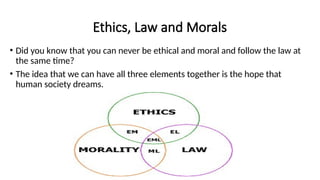
Ethics, Law and Morals
• Did you know that you can never be ethical and moral and follow the law at
the same time?
• The idea that we can have all three elements together is the hope that
human society dreams.
Contn of Ethics, Law and Morals
• Ethics is the moral principles that govern a person's behavior or the
conducting of an activity.
• Morals are concerned with the principles of right and wrong behavior and the
goodness or badness of human character.
• Law is the system of rules that a particular country or community recognizes
as regulating the actions of its members and may enforce by the imposition of
penalties.
• Some people talk about their personal ethics, others talk about a set
of morals, and everyone in a society is governed by the same set of laws. If
the law conflicts with our personal values or a moral system, we have to act –
but to do so we need to be able to tell the difference between them.
Contn of Ethics, Law and Morals
• Ethics and morals relate to “right” and “wrong” conduct. While they
are sometimes used interchangeably, they are different:
• Ethics refer to rules provided by an external source, e.g., codes of
conduct in workplaces or principles in religions.
• Morals refer to an individual's own principles regarding right and
wrong.
• Morals and Law differ because the law demands an absolute
subjection to its rules and commands. Law has enforcing authority
derived from the state.
• Law regulates men’s relations with others and with society.
Contn of Ethics, Law and Morals
• Ethics and Law - Ethics are rules of conduct. Laws are rules developed by
governments in order to provide balance in society and protection to its
citizens.
• Ethics comes from people’s awareness of what is right and wrong. Laws are
enforced by governments to their people.
• Ethics are moral codes that every person must conform to. Laws are
codifications of ethics meant to regulate society.
• Ethics does not carry any punishment to anyone who violates it. The law will
punish anyone who happens to violate it.
• Ethics comes from within a person’s moral values.
• Laws are made with ethics as a guiding principle.
Traditional theories of ethics
• Deontology
• The deontological class of ethical theories states that people should adhere to
their obligations and duties when engaged in decision making when ethics are
in play.
• This means that a person will follow his or her obligations to another
individual or society because upholding one’s duty is what is considered
ethically correct.
• For instance, a deontologist will always keep his promises to a friend and will
follow the law.
• A person who adheres to deontological theory will produce very consistent
decisions since they will be based on the individual’s set duties.
Deontology contains many positive attributes,
but it also contains flaws.
• One flaw is that there is no rationale or logical basis for deciding an
individual’s duties. For instance, a businessperson may decide that it is his/her
duty to always be on time to meetings.
• Although this appears to be something good, we do not know why the person
chose to make this his duty.
• Ask students what reasons they might provide for this behavior.
• Sometimes, a person’s duties are in conflict. For instance, if the business
person who must be on time to meetings is running late, how is he/she
supposed to drive? Is speeding breaking his/her duty to society to uphold the
law, or is the businessperson supposed to arrive at the meeting late, not
fulfilling the duty to be on time?
Utilitarian ethical theories
• Utilitarian ethical theories are based on one’s ability to predict the consequences of
an action. To a utilitarian, the choice that yields the greatest benefit to the most
people is the one that is ethically correct.
• There are two types of utilitarianism,
• act utilitarianism and rule utilitarianism.
• Act utilitarianism subscribes precisely to the definition of utilitarianism—a person
performs the acts that benefit the most people, regardless of personal feelings or the
societal constraints such as laws.
• Rule utilitarianism takes into account the law and is concerned with fairness. A rule
utilitarian seeks to benefit the most people but through the fairest and most just
means available. Therefore, added benefits of rule utilitarianism are that it values
justice and includes beneficence at the same time.
Both act and rule utilitarianism have
disadvantages.
• Although people can use their life experiences to attempt to predict outcomes, no one
can be certain that his/her predictions will be accurate. Uncertainty can lead to
unexpected results making the utilitarian decision maker appear unethical as time
passes, as the choice made did not benefit the most people as predicted.
• Another assumption that a utilitarian decision maker must make concerns his/her
ability to compare the various types of consequences against each other on a similar
scale. But, comparing material gains, such as money, against intangible gains, such as
happiness, is very difficult since their qualities differ to such a large extent.
• An act utilitarian decision maker is concerned with achieving the maximum good.
Thus, one individual’s rights may be infringed upon in order to benefit a greater
number of people. In other words, act utilitarianism is not always concerned with
justice, beneficence or autonomy for an individual if oppressing the individual leads to
the solution that benefits a majority of people.
Contn of utilitarianism disadvantages
• Still another source of challenge with act utilitarian decision makers occurs when an individual
faces one set of variable conditions and then suddenly experiences changes in those conditions.
• The change in conditions may lead to a change in the original decision—being be nice to someone
one moment and then dislike them the next moment because the situation has changed, and
liking the person is no longer beneficial to the most people. In rule utilitarianism, there is the
possibility of conflicting rules.
• Recall the example of the business person running late for a meeting. Suppose the business person
happens to be the CEO, who may believe that it is ethically correct to arrive at important meetings
on time as the members of the company will benefit from this decision.
• The CEO may encounter conflicting ideas about what is ethically correct if he/she is running late.
• Yet, the CEO believes that he/she should follow the law because this benefits society.
Simultaneously, he/she believes that it is ethically correct to be on time for his meeting because it
is a meeting that also benefits the society. There appears to be no ethically correct answer for this
scenario.
Rights
• Rights In ethical theories based on rights, the rights established by a society
are protected and given the highest priority.
• Rights are considered to be ethically correct and valid since a large population
endorses them.
• Individuals may also bestow rights upon others if they have the ability and
resources to do so.
• For example, a person may say that her friend may borrow her laptop for the
afternoon.
• The friend who was given the ability to borrow the laptop now has a right to
the laptop in the afternoon.
Patents
A patent is a government-granted monopoly to build, sell, and use
your invention (and prevent others from doing so).
If you are issued a patent, it’s usually good for 20 years; however,
there are some patents that are only good for 14 years.
To receive a patent your idea must meet four requirements:
• The subject matter must be “patentable”
• Your idea must be “new.”
• The idea must be “useful.”
• Your idea must be “non-obvious.”
There are three types of patents you can file
for:
• Utility patent – Utility patents may be granted to anyone who
invents or discovers any new and useful process, machine, article of
manufacture, composition of matter, or any new and useful
improvement thereof (good for 20 years).
• Design patent – may be granted to anyone who invents a new,
original, and ornamental design (good for 14 years).
• Plant patent – Plant patents may be granted to anyone who invents
or discovers and asexually reproduces any distinct and new variety
of plant (good for 20 years).
Trademarks
• A trademark can be any word, phrase, symbol, design, or
combination of these things that identifies your goods or
services — it’s how customers recognize your company in the
marketplace.
• We tend to use the term “trademark” generically as referring
to both trademarks and service marks.
• A trademark is used for goods; a “service mark” is used for
services.
A trademark has many benefits, including:
• Identifying the source of your goods or services
• Providing legal protection for your brand
• Guarding against counterfeiting and fraud
A trademark does not mean
• You own a particular word or phrase. Rather, you own the rights to how that
word or phrase is used with respect to specific goods or services.
• Key to obtaining trademark protection is the need to identify the specific
categories of goods and services the mark will cover.
• And, the company must actually use or provide such goods and services in the
chosen categories — or have a good faith and demonstrative intent to do so.
Copyrights
•Copyrights protect original works of authorship,
such as paintings, photographs, musical
compositions, sound recordings, computer
programs, books, blog posts, movies,
architectural works, and plays.
•Copyrights protect expression and never ideas,
procedures, methods, systems, processes,
concepts, principles, or discoveries.
Copyright law provides copyright owners with the following exclusive
rights (among others):
•Reproduce the work
•Prepare derivative works
•Distribute copies by sale, transfer of
ownership, or license
•Perform or display the work publicly
Trade Secrets
•A trade secret is typically something not
generally known to the public, where reasonable
efforts are made to keep it confidential, and
confers some type of economic value to the
holder by the information not being known by
another party.
What exactly constitutes a trade secret can
vary by state
•A good shorthand for what constitutes a trade
secret is: any information you would not want
your competitors to have.
•Some examples of likely trade secrets include new
business models; customer and supplier
information, especially around price; marketing
strategy; processes and formulae; and other
confidential business information.
Courts will generally look at the following factors
to determine if something is a trade secret:
• Extent to which the information is known outside of the
company
• Measures taken to guard the secrecy of the information
• Value of the information to competitors
• Extent to which the information is known throughout the
company’s employee base and others involved in the business
• Money or effort spent by the company to develop the
information
• and how easy would it be for others to duplicate the
information
Business Ethics Lecture Notes MUBS class.pptx

  • 1.
    Ethics •Definition: Ethics refersto the systematic study of what is right and wrong, guiding principles that govern behavior. •It can be personal or professional, often grounding itself in philosophical theories
  • 2.
    Types of ethics •Normative Ethics: Focuses on establishing standards or norms for behaviour. • Meta-Ethics: Explores the nature of ethical properties, statements, and judgments. • Applied Ethics: Deals with specific ethical issues (e.g., bioethics, business ethics).
  • 3.
    Morals •Definition: Morals arethe beliefs, values, and principles that individuals hold about what is right and wrong. •Morality is often shaped by cultural, religious, or personal factors. •Characteristics: Typically more subjective than ethics. •Can vary significantly from person to person or culture to culture. •Often derived from traditions, upbringing, and community norms.
  • 4.
    The Law •Definition: Thelaw consists of formal rules and regulations created and enforced by governmental institutions. •Laws are designed to maintain order, protect rights, and provide justice. Characteristics: •Codified and publicly available. •Enforced through systems of governance and legal institutions. •Violations often result in penalties (fines, imprisonment, etc.).
  • 5.
    Interrelationships • Ethics vs.Morals: While morals are personal beliefs about right and wrong, ethics provides a more structured framework for analyzing those beliefs. Ethics can influence personal morals, and vice versa; however, ethics can also involve broader, more generalized principles applicable to groups or professions. • Ethics vs. Law: Laws are often influenced by ethical standards, but not all ethical principles are enshrined in law. For example, an action might be legal (like lying in certain contexts) but considered unethical. Conversely, some laws may be seen as unethical (e.g., discriminatory laws). • Morals vs. Law: Laws are designed to reflect the moral standards of society, but individuals’ personal morals might conflict with the law. For instance, during times of civil rights struggles, individuals and groups might break laws they consider unjust, believing they are upholding a higher moral standard.
  • 6.
    Moral problems whenusing the Internet (Spam) • The internet raises several moral issues, with particular concerns surrounding spam, easy access to pornography, censorship, and free speech. Here's a brief exploration of each: • Definition: Spam refers to unsolicited and often irrelevant messages sent over the internet, typically via email or social media, aimed at advertising or phishing. • Moral Problems: • Invasion of Privacy: Spam can violate personal space and clutter inboxes, leading to frustration and potential loss of important communications. • Deceptive Practices: Many spam messages are misleading, promoting scams or fraudulent schemes, which can harm individuals financially or emotionally. • Environmental Impact: The sheer volume of spam consumes server resources, energy, and contributes to carbon emissions from the data centers.
  • 7.
    Moral problems whenusing the Internet (Easy access to pornography) • Easy Access to Pornography • Definition: The internet provides unrestricted access to pornographic material, which can be easily found with just a few clicks. • Moral Problems: • Impact on Relationships: Easy access to pornography can distort expectations regarding sex and intimacy, potentially leading to relationship problems or unrealistic body image standards. • Exploitation and Consent: Many forms of pornography raise ethics issues regarding exploitation of performers, consent, and the potential for coercive practices in the industry. • Age Appropriateness: There are concerns about minors accessing pornographic content, which may not be suitable for their development, leading to unhealthy perceptions of sexuality and relationships.
  • 8.
    Moral problems whenusing the Internet (Censorship) • Definition: Censorship refers to the suppression or prohibition of speech, public communication, or other information deemed objectionable by controlling bodies (governments, organizations). • Moral Problems: • Freedom of Expression: Censorship can infringe upon individuals' rights to express their opinions and share information, raising questions about the scope of free speech. • Subjectivity: Determining what content should be censored often involves subjective judgments, leading to potential biases and unfair treatment of certain viewpoints. • Consequences for Society: Overly broad censorship can stifle important conversations, hinder activism, and limit access to diverse ideas and
  • 9.
    Moral problems whenusing the Internet (Free speech) • Free Speech • Definition: Free speech is the right to express one’s opinions without censorship or restraint, although it's typically subject to certain limitations (e.g., hate speech, incitement to violence). • Moral Problems: • Hate Speech and Misinformation: While free speech is a fundamental right, the spread of hate speech and misinformation can have damaging consequences for individuals and communities. • Balancing Rights: Finding the right balance between protecting free speech and preventing harm to individuals or groups presents a moral dilemma, especially in diverse societies. • Platform Responsibilities: Social media platforms face ethical considerations regarding how they police content, deal with users who spread harmful ideas, and protect free speech.
  • 10.
    Moral problems whenusing the Internet (Ensuring public safety) • Ensuring public safety is paramount. As new technologies are introduced, they bring safety concerns. • For example, driverless cars may soon be on the roads in the UK. The designers of driverless cars have not only had to ensure the safety of passengers but also of other drivers and pedestrians. An ethical issue applies here, as a situation may occur where the car's software has to decide who has safety priority. Should it be the passengers inside the car, or other road users?
  • 11.
    Moral problems whenusing the Internet (Privacy) • Once data is put into a computer it can easily be copied or transmitted. This puts personal private data at risk. Organisations that hold private data should do their best to ensure that such data remains private. The Data Protection Act 1998/2018 exists to ensure that organisations comply with the law regarding data privacy. • Many smartphone apps ask for permission to access data held on the device. Once accessed, this data is usually sent to the app producer, who is often in another country and not always subject to the privacy laws that exist in the given country. • In 2016, the government introduced the Investigatory Powers Act. This sets out rules on the use of investigatory powers by law enforcement and the security and intelligence agencies. • Under the act, phone companies and internet service providers are required to keep copies of users' emails and browsing histories for a period of time. It also gives the police and security services the authority to access computers and phones to search for data. • This act has proved controversial, with opponents concerned over how it impacts people's right to privacy.
  • 12.
    Moral problems whenusing the Internet (Digital divide) • The digital divide is the difference between those who have access to computers and the internet and those who do not. This may be due to wealth, location, age or the ability to use new technology. • Somebody who has a visual impairment may have difficulties using a touchscreen. Apps that are designed to be used on a smartphone may exclude such people from using their services. • The elderly generation have not grown up with technology and might feel nervous of the steep learning curve required to gain confidence with using the internet. This could mean that they miss out on opportunities, such as online shopping offers that are not available on the high street.
  • 13.
    Moral problems whenusing the Internet (Working conditions) • Modern technology has revolutionised many organisations. The benefits include quick access to data, cheap data storage, automatic generation of letters and invoices, and easy tracking of accounts. However, there are also some disadvantages of modern technology: • people can now be contacted through smartphones no matter where they are, making it difficult to have time when they are not on call • medical issues such as RSI (repetitive strain injury) or eye strain can occur when an employee is stationary at a desk for long periods of time • there is concern that new technology, for example robots, might take jobs away from humans
  • 14.
    Computer Ethics • Ethicsare a set of moral principles that govern an individual or a group on what is acceptable behaviour while using a computer. Ethics are moral principles, or rules, that govern a person's attitudes and behaviour. • Ethics apply to the use of computers as much as they do to other things in life. • Computer ethics is a set of moral principles that govern the usage of computers. One of the common issues of computer ethics is violation of copyright issues. • Duplicating copyrighted content without the author’s approval, accessing personal information of others are some of the examples that violate ethical principles.
  • 15.
    Internet Ethics • InternetEthics for everyone • Internet ethics means acceptable behaviour for using Internet. • We should be honest, respect the rights and property of others on the Internet. • Acceptance • Internet must be used for communication with family and friends. Avoid chatting with strangers and forwarding e-mails from unknown people /strangers. • We must be aware of risks involved in chatting and forwarding e-mails to strangers.
  • 16.
    Internet Issues • InternetEthics for everyone • Internet ethics means acceptable behaviour for using Internet. We should be honest, respect the rights and property of others on the Internet. • Acceptance • Internet must be used for communication with family and friends. Avoid chatting with strangers and forwarding e-mails from unknown people /strangers.We must be aware of risks involved in chatting and forwarding e-mails to strangers. • Pretending to be someone else • We must not use Internet to fool others by pretending to be someone else. Hiding our own identity to fool others in the Internet world is a crime and may also be a risk to others. • Avoid Bad language • We must not use Internet to fool others by pretending to be someone else. Hiding our own identity to fool others in the Internet world is a crime and may also be a risk to others.
  • 17.
    Contn of InternetIssues • Access to Internet • The Internet is a time-efficient tool for everyone that enlarges the possibilities for curriculum growth. Learning depends on the ability to find relevant and reliable information quickly and easily, and to select, understand and assess that information. • Searching for information on the Internet can help to develop these skills. Classroom exercises and take-home assessment tasks, where students are required to compare website content, are ideal for alerting students to the requirements of writing for different audiences, the purpose of particular content, identifying and judging accuracy and reliability. • Since many sites adopt particular views about issues, the Internet is a useful tool for developing the skills of distinguishing fact from opinion and exploring subjectivity and objectivity.
  • 18.
    Contn of InternetIssues • Hide personal information • We should not give personal details like home address, phone numbers, interests, passwords. No photographs should be sent to strangers because it might be misused and shared with others without their knowledge. • While Downloading • Internet is used to listen and learn about music,It is also used to watch videos and play games we must not use it to download them or share copyrighted material. We must be aware of the importance of copyrights and issues of copyright.
  • 19.
    Ethical rules forcomputer users • Do not use computers to harm other users. • Do not use computers to steal others information. • Do not access files without the permission of the owner. • Do not copy copyrighted software without the author’s permission. • Always respect copyright laws and policies. • Respect the privacy of others, just as you expect the same from others.
  • 20.
    Contn of Ethicalrules for computer users • Do not use other user's computer resources without their permission. • Use Internet ethically. • Complain about illegal communication and activities, if found, to Internet service Providers and local law enforcement authorities. • Users are responsible for safeguarding their User Id and Passwords. They should not write them on paper or anywhere else for remembrance. • Users should not intentionally use the computers to retrieve or modify the information of others, which may include password information, files, etc.
  • 21.
    Professional standards • Workingprofessionally in the computer science and information technology industry often requires that people: • have knowledge and experience in the industry, probably with formal qualifications • continually develop their skills and knowledge • have a wide range of industry skills • follow ‘best practice’ in their job • There is an expectation of how the people working within an organisation should act. There are both formal and informal codes of conduct they are expected to be aware of.
  • 22.
    Formal codes ofconduct • These are codes of conduct as outlined and enforced by the organisation in their policies, which all personnel within the organisation have to agree to abide by. • These policies are written down and signed, and include: • acceptable use policy • internet access policy
  • 23.
    Acceptable use policy •Employees within an organisation may have access to sensitive data about their customers and clients. If so, they must treat this data with respect and in accordance with the law. An acceptable use policy sets out what is and is not acceptable and clearly explains the use of electronic devices to establish ethical and lawful behaviour. • For instance, it may specify: • employees are not allowed to copy personal information from clients onto a removable storage media device and take it out of the office • data needs to be encrypted before it is sent via email • paper copies of sensitive data must be destroyed once it is no longer needed
  • 24.
    Internet access policy •An internet access policy provides employees with rules and guidelines about the appropriate use of the internet while in the workplace. It may specify: • employees are expected to use the internet responsibly and productively • internet access is limited to job-related activities only and personal use is not permitted • the organisation reserves the right to monitor internet traffic and monitor and access data that is composed, sent or received through its online connections • emails sent via the company email system should not contain content that is classed as offensive or includes vulgar language and images or can be interpreted as bullying to another party
  • 25.
    Informal codes ofconduct • An informal code is not laid out in a formal policy but people within an organisation will still be expected to behave in an appropriate manner. • For example, if all staff log off their computers and lock doors behind them, then other staff will usually follow their lead. • Even though a written rule may not be in place, informally this becomes an expectation in the workplace. • Informal codes might also include unwritten customs and habits in organisations, and demonstrate personal integrity by exhibiting honesty and truthfulness.
  • 26.
    Cybersecurity • There isa growing need for cybersecurity in light of the increasing frequency of attacks to computerised systems. Not all hacking is bad. It can be split into three categories: • Black hat hacking - these hackers wish to cause damage or gain access to a computer system for criminal activities. They are performing this action illegally and without the consent of the organisation who own the computer system they are attempting to gain access to. • White hat hacking - these hackers want to use their skills for good. They attempt to gain access, finding weaknesses in the system so that potential future attacks can be prevented. White hat hackers have full permission to attempt access to the system and are paid by the organisation to perform this service. White hat hacking is completely legal. • Grey hat hacking - these hackers attempt to illegally gain access to a computer without the consent of the owner(s). Once a fault is found, they will report it to the organisation in exchange for a fee. If the organisation does not pay the fee, the hacker will post the weakness on the internet for other hackers to exploit.
  • 27.
    Definition of IntellectualProperty • Intellectual Property (IP) refers to creations of the mind, such as inventions, literary and artistic works, designs, symbols, names, and images used in commerce. IP rights protect these creations, allowing creators to control and benefit from their work legally. The main types of IP include: • Copyright: Protection for original works of authorship, such as books, music, and software. • Patents: Rights granted for inventions, allowing inventors to exclude others from making, using, or selling their invention for a limited time. • Trademarks: Signs or symbols that distinguish goods or services from others in the market. • Trade Secrets: Information that provides a business advantage over competitors who do not know it.
  • 28.
    What is FairUse? • Fair Use is a legal doctrine that allows limited use of copyrighted material without permission from the rights holder. It is often applied in cases involving: • Criticism or Commentary: Quoting a portion of a work in a review or criticism. • News Reporting: Using material to report on current events. • Teaching and Scholarship: Allowing educational uses, such as in classrooms or for academic research. • Research: Using material for scholarly analysis. • Fair use considers factors like purpose, nature, amount used, and effect on the market
  • 29.
    How IT Infringeson These Rights • IT can infringe on IP rights in several ways: • Copying and Distributing: Digital technologies make it easy to replicate and distribute copyrighted material without authorization (e.g., software, music, videos). • Counterfeiting: IT tools can support the production of counterfeit goods, undermining trademark protections. • File Sharing: Peer-to-peer networks allow users to share copyrighted materials without permission, violating copyright laws. • Data Mining: Often, data scraping may infringe on protected databases and software by extracting and reusing content without proper rights.
  • 30.
    Ethical issues surroundingintellectual property rights • Intellectual property (IP) rights and information technology (IT) intersect in complex ways that raise various moral problems. Here are some key issues: • 1. Access vs. Ownership • Conflict: The legal framework of IP often prioritizes ownership rights over access to information, which can limit availability of essential resources (e.g., medicines, educational materials). • Moral Dilemma: Balancing the rights of creators to profit from their work with the public's right to access vital knowledge and resources.
  • 31.
    Contn of Ethicalissues surrounding intellectual property rights • 2. Innovation vs. Restriction • Conflict: IP rights can stifle innovation by imposing restrictions on the use of existing technologies. • Moral Dilemma: Are we hindering future advancements by protecting current inventions too rigorously? • 3. Cultural Appropriation • Conflict: The use of traditional knowledge and cultural expressions without permission can lead to exploitation of underrepresented communities. • Moral Dilemma: How do we fairly compensate and respect original creators while allowing for cultural exchange?
  • 32.
    Contn of Ethicalissues surrounding intellectual property rights • 4. Digital Piracy • Conflict: While copyright laws are designed to protect creators, digital piracy raises questions about fairness and accessibility. • Moral Dilemma: Is it morally acceptable to share copyrighted material for wider social benefit versus protecting individual creators’ rights? • 5. Privacy and Data Ownership • Conflict: With the rise of big data, questions arise about who owns the data generated by users and how it is used. • Moral Dilemma: How do we respect individual privacy while also utilizing data for technological advancements?
  • 33.
    Contn of Ethicalissues surrounding intellectual property rights • 6. Global Disparities • Conflict: IP laws can disproportionately benefit wealthier countries or corporations, leading to inequities in innovation and development. • Moral Dilemma: How do we ensure fair access to IP benefits for developing nations or marginalized groups? • Ethical Use of AI and IP • Conflict: The rise of AI raises questions about authorship and ownership of AI-generated content. • Moral Dilemma: Who should be credited and compensated for creations produced by machines?
  • 34.
    The intersection ofintellectual property (IP) rights and information technology (IT) presents several moral problems. • Here are some of the key issues: • 1. Access vs. Restriction • Moral Issue: IP laws can create barriers to access essential goods like medicines and educational resources. For example, patent protections can make life-saving drugs prohibitively expensive, raising the question of whether prioritizing profit over public health is ethical. • Consideration: How should we balance the rights of creators to profit from their work with the need for public access to essential information and resources? • 2. Innovation vs. Stagnation • Moral Issue: While IP rights are intended to encourage innovation by rewarding creators, they can also hinder progress by restricting the free use of ideas. For instance, overly broad patents on basic technologies can stifle new developments and harm small innovators. • Consideration: Is it ethical to limit the ability of others to innovate in the name of protecting existing IP?
  • 35.
    The intersection ofintellectual property (IP) rights and information technology (IT) presents several moral problems. • 3. Cultural Appropriation • Moral Issue: The use of indigenous or traditional knowledge without permission can lead to exploitation and misrepresentation of cultures. • This raises concerns about power dynamics and respect for original creators. • Consideration: How can we ensure that cultural heritage is respected and that the original creators are valued and compensated?
  • 36.
    The intersection ofintellectual property (IP) rights and information technology (IT) presents several moral problems. • 4. Fair Use and Copyright Infringement • Moral Issue: The debate around fair use often leads to complex moral conversations about whether certain uses of copyrighted material (e.g., for education, commentary, or parody) are justified. • While some argue for greater access to knowledge, others believe this undermines creators’ rights. • Consideration: How do we define the line between fair use and infringement in a way that respects both the creator's rights and societal benefits?
  • 37.
    The intersection ofintellectual property (IP) rights and information technology (IT) presents several moral problems. • 5. Digital Piracy • Moral Issue: While some view digital piracy as a form of rebellion against corporate greed, it also raises questions about fairness to creators. Many artists and developers rely on sales to support their livelihoods, and piracy can harm their income. • Consideration: Is it ethical to share pirated content for social benefit, even if it negatively impacts the creators? • 6. Data Privacy and Ownership • Moral Issue: The rise of big data raises significant concerns about who owns user-generated data and how it is used. Many users are unaware of how their data is collected, stored, and sold, leading to potential exploitation and
  • 38.
    The intersection ofintellectual property (IP) rights and information technology (IT) presents several moral problems. • 7. Global Disparities in IP Enforcement • Moral Issue: The enforcement of IP rights often disproportionately affects developing countries, where such laws can hinder access to technology and information, exacerbating global inequalities. • Consideration: How can we create a more equitable IP system that fosters innovation and access across different nations and cultures?
  • 39.
    Ethical Issues inIntellectual Property Rights • Intellectual Property Rights (IPR), including patents, copyrights, trademarks, and trade secrets, serve as the legal frameworks that protect the intellectual creations and innovations of individuals and organizations. • These regulations are designed to provide inventors and creators with exclusive rights to their work, offering both an incentive for innovation and a mechanism for fair compensation. • Yet, beneath the surface of these legal structures lies a complex web of ethical dilemmas that demand our attention.
  • 40.
    IPR’s Ethical Foundations •Intellectual Property Rights (IPR) ethics are based on two key ideas: encouraging innovation and sharing knowledge. • These laws motivate people and organizations to invest in new ideas and creations by giving them exclusive rights for a certain period. • This is meant to fairly reward innovators and creators. • But IPR also follows the ethical values of fairness and justice. By granting exclusive rights for a limited time, it tries to balance the interests of inventors and society. • After this period, the work becomes available to everyone, benefiting everyone’s well-being. • In essence, IPR is like a moral compass, guiding us to be fair and just in the pursuit of innovation and knowledge.
  • 41.
    Ethical Issues inIntellectual Property Rights • Monopoly Concerns: One ethical issue with IPR is the potential of monopolisation. When inventors or companies own exclusive rights to their creations, they can regulate access and cost. This power can lead to excessive pricing, making it difficult for individuals to obtain necessary treatments or technologies. When corporations prioritise profits over societal well-being, it creates an ethical quandary. • Access to Essential Medications: The pharmaceutical sector is a prime example of an industry where ethical questions frequently emerge. Drug patents can cause life-saving treatments to become prohibitively expensive for the most vulnerable people. Profits vs the ethical imperative to give access to basic healthcare is a major problem.
  • 42.
    Contn of EthicalIssues in Intellectual Property Rights • Cultural Appropriation and Indigenous Knowledge: IPR is also linked to cultural appropriation and indigenous knowledge protection. • When traditional knowledge is patented or copyrighted by people or entities outside the originating culture, it raises ethical concerns about preserving indigenous cultures’ cultural legacy and rights. • Digital Copyright and Fair Use: Digital copyright issues are frequent in the internet age. When content creators and copyright holders attempt to safeguard their works with digital rights management (DRM) technologies, ethical issues arise. • These methods may violate user privacy and restrict users’ capacity to utilise copyrighted material for reasons such as criticism, commentary, or education.
  • 43.
    Balancing Ethical Considerations •Balancing the ethical considerations of IPR can be difficult, however there are numerous approaches to find a balance between stimulating innovation and protecting the interests of the community: • Patent Term Reduction: Reducing the duration of patents and other intellectual property rights might help strike a balance between encouraging innovation and providing timely access to inventions. • Shorter terms foster the rapid transmission of information while limiting the possibility of monopolistic practices.
  • 44.
    Contn of BalancingEthical Considerations • Licencing and Access Agreements: Creators and businesses can use more ethical licensing and access agreements that prioritise fair pricing and broad access. • Initiatives such as open-source software and open-access publishing encourage knowledge exchange • Ethical Business Practises: Businesses should embrace ethical business practices that prioritise societal wellbeing over profits. • Pricing transparency, appropriate marketing, and socially responsible activities can all contribute to this.
  • 45.
    Contn of BalancingEthical Considerations • Global Collaboration: International collaboration and agreements can aid in addressing ethical concerns around IPR, particularly when it comes to global public goods such as vaccinations and climate technologies. • These agreements can make critical advances more accessible. • Ethical Education: Promoting IPR and ethical considerations education can help individuals, producers, and organisations make better decisions. • Understanding the ethical implications of intellectual property rights can lead to more responsible behaviour.
  • 46.
    Patents, Trademarks, andCopyrights: The Basics • A patent is a property right issued by a government authority allowing the holder exclusive rights to the invention for a certain period of time. • There are three types of patents: utility patents, plant patents, and design patents. • A trademark is a word, symbol, design, or phrase that denotes a specific product and differentiates it from similar products. • Copyrights protect “original works of authorship,” such as writings, art, architecture, and music.
  • 47.
    What Is aPatent? • A patent safeguards an original invention. The inventor hands over comprehensible details about its process, design, or invention to a sovereign authority and is granted exclusive rights to it for a specified period of time. • By granting the right to produce a product without fear of competition for the duration of the patent, an incentive is provided for companies or individuals to continue developing innovative new products or services. • There are three types of patents: utility patents, plant patents, and design patents.3 • Utility Patent • A utility patent covers the creation of a new or improved product, process, or machine. Also known as a “patent for invention,” it bars other individuals or companies from making, using, or selling the creation without consent. Utility patents are good for up to 20 years after the patent application is filed, but require the holder to pay regularly scheduled maintenance fees.
  • 48.
    Types of Patent •While most people associate patents with machines and appliances, they can also apply to software, business processes, and chemical formulations such as in pharmaceutical products. Utility patents are the most common form of patent. In recent years, they represented approximately 90% of all patents issued in the U.S., according to the USPTO.4 • Plant Patent • A plant patent protects a new and unique plant’s key characteristics from being copied, sold, or used by others. It is also good for up to 20 years after the application is filed.4 • To qualify, the plant must be asexually reproducible with reproduction being genetically identical to the original and performed through methods such as root cuttings, bulbs, division, or grafting and budding. Plant patents are not subject to maintenance fees.4 • Design Patent • A design patent applies to the unique look of a manufactured item. Take, for example, an automobile with a distinctive hood or headlight shape. These visual elements are part of the car’s identity and may add to its value; however, without protecting these components with a patent, competitors could potentially copy them without legal consequences.4
  • 49.
    What Is aCopyright? • Copyrights protect “original works of authorship,” such as writings, art, architecture, and music. For as long as the copyright is in effect, the copyright owner has the sole right to display, share, perform, or license the material.12 • Technically, you don’t have to file for a copyright to have the piece of work protected. It’s considered yours once your ideas are translated into a tangible form, such as a book, music, or published research; however, officially registering with the copyright office before—or within five years of—publishing your work makes it a lot easier to establish that you were the original author if you or your patent attorney ever have to go to court. • The duration of a copyright can vary. According to WIPO, in countries that are members of the Berne Convention, the time limit should be 50 years or more after the creator’s death
  • 50.
    What Is theDifference Between a Patent, Copyright, and Trademark? • A patent protects new inventions, processes, or scientific creations, a trademark protects brands, logos, and slogans, and a copyright protects original works of authorship. • What Are the 3 Types of Patents? • The three types of patents are design, utility, and plant. Utility patents are for new discoveries, compositions of matter, machines, or processes. Plant patents are for anyone that discovers or develops and asexually reproduces a new variety of plant. A design patent is for anyone that creates a new, original, and ornamental design.3 • What Is Included in a Trademark? • A trademark includes words, phrases, designs, or any combination of these that particularly identify a good or service.
  • 51.
    Patents • Patents • Apatent is a government-granted monopoly to build, sell, and use your invention (and prevent others from doing so). If you are issued a patent, it’s usually good for 20 years. • However, there are some patents that are only good for 14 years. • After 20 years, your patent expires and anyone can copy, build,and sell your invention. • To receive a patent your idea must meet four requirements:
  • 52.
    Trademarks • Trademarks • Atrademark can be any word, phrase, symbol, design, or combination of these things that identifies your goods or services — it’s how customers recognize your company in the marketplace. • A trademark is used for goods; a “service mark” is used for services. • A trademark has many benefits, including: • Identifying the source of your goods or services • Providing legal protection for your brand • Guarding against counterfeiting and fraud
  • 53.
    Copyrights • Copyrights • Copyrightsprotect original works of authorship, such as paintings, photographs, musical compositions, sound recordings, computer programs, books, blog posts, movies, architectural works, and plays. • Copyrights protect expression and never ideas, procedures, methods, systems, processes, concepts, principles, or discoveries. • Copyright law provides copyright owners with the following exclusive rights (among others): • Reproduce the work • Prepare derivative works • Distribute copies by sale, transfer of ownership, or license • Perform or display the work publicly
  • 54.
    Trade Secrets • TradeSecrets • A trade secret is typically something not generally known to the public, where reasonable efforts are made to keep it confidential, and confers some type of economic value to the holder by the information not being known by another party. • Some examples of likely trade secrets include; • new business models; • customer and supplier information, especially around price; marketing strategy; processes and formulae; and • other confidential business information.
  • 55.
    Three Traditional Theories •Teleology – Based on the writings of Aristotle (384-322 BC), the theory of teleology provides one with a two-step approach to determining the right course of action: • first, determine the proper end and then decide the means for achieving it. • In other words, achieving the purpose or end justifies the means for achieving it. • In a school setting, questions that need to be asked are: “What are we trying to achieve?” and “Are we going about this in the right way?” • Care needs to be taken so that concern for achieving a goal does not overshadow ethical standards.
  • 56.
    Deontology • Deontology –The German philosopher Immanuel Kant (1724-1804) believed that decisions or choices should be based on moral principles that can be applied universally. • He gives paramount status to moral rules. The correctness of a decision or choice is investigated by asking the question “why?” and discovering the implied moral principles involved. • Once an individual has chosen to accept moral principles, that person needs to obey and apply them at all times and in all cases. • A weakness associated with this theory is the lack of concern for the consequences of actions.
  • 57.
    Utilitarianism • Utilitarianism –John Stuart Mill (1806-1873), viewed as one of the chief architects of utilitarianism, argued that the correctness of actions should be judged by their consequences (i.e., whether the act produces the greatest good for the greatest number of people). • Two problems are generally associated with the use of this philosophy: • first, how one person defines good may differ significantly from that of another; and • second, it is difficult to predetermine all of the consequences of a given action. • In spite of these two concerns, this ethical approach to decision making can provide the teacher with the motivation to examine which consequences of actions should be considered.
  • 58.
    Ethics, Law andMorals • Did you know that you can never be ethical and moral and follow the law at the same time? • The idea that we can have all three elements together is the hope that human society dreams.
  • 59.
    Contn of Ethics,Law and Morals • Ethics is the moral principles that govern a person's behavior or the conducting of an activity. • Morals are concerned with the principles of right and wrong behavior and the goodness or badness of human character. • Law is the system of rules that a particular country or community recognizes as regulating the actions of its members and may enforce by the imposition of penalties. • Some people talk about their personal ethics, others talk about a set of morals, and everyone in a society is governed by the same set of laws. If the law conflicts with our personal values or a moral system, we have to act – but to do so we need to be able to tell the difference between them.
  • 60.
    Contn of Ethics,Law and Morals • Ethics and morals relate to “right” and “wrong” conduct. While they are sometimes used interchangeably, they are different: • Ethics refer to rules provided by an external source, e.g., codes of conduct in workplaces or principles in religions. • Morals refer to an individual's own principles regarding right and wrong. • Morals and Law differ because the law demands an absolute subjection to its rules and commands. Law has enforcing authority derived from the state. • Law regulates men’s relations with others and with society.
  • 61.
    Contn of Ethics,Law and Morals • Ethics and Law - Ethics are rules of conduct. Laws are rules developed by governments in order to provide balance in society and protection to its citizens. • Ethics comes from people’s awareness of what is right and wrong. Laws are enforced by governments to their people. • Ethics are moral codes that every person must conform to. Laws are codifications of ethics meant to regulate society. • Ethics does not carry any punishment to anyone who violates it. The law will punish anyone who happens to violate it. • Ethics comes from within a person’s moral values. • Laws are made with ethics as a guiding principle.
  • 62.
    Traditional theories ofethics • Deontology • The deontological class of ethical theories states that people should adhere to their obligations and duties when engaged in decision making when ethics are in play. • This means that a person will follow his or her obligations to another individual or society because upholding one’s duty is what is considered ethically correct. • For instance, a deontologist will always keep his promises to a friend and will follow the law. • A person who adheres to deontological theory will produce very consistent decisions since they will be based on the individual’s set duties.
  • 63.
    Deontology contains manypositive attributes, but it also contains flaws. • One flaw is that there is no rationale or logical basis for deciding an individual’s duties. For instance, a businessperson may decide that it is his/her duty to always be on time to meetings. • Although this appears to be something good, we do not know why the person chose to make this his duty. • Ask students what reasons they might provide for this behavior. • Sometimes, a person’s duties are in conflict. For instance, if the business person who must be on time to meetings is running late, how is he/she supposed to drive? Is speeding breaking his/her duty to society to uphold the law, or is the businessperson supposed to arrive at the meeting late, not fulfilling the duty to be on time?
  • 64.
    Utilitarian ethical theories •Utilitarian ethical theories are based on one’s ability to predict the consequences of an action. To a utilitarian, the choice that yields the greatest benefit to the most people is the one that is ethically correct. • There are two types of utilitarianism, • act utilitarianism and rule utilitarianism. • Act utilitarianism subscribes precisely to the definition of utilitarianism—a person performs the acts that benefit the most people, regardless of personal feelings or the societal constraints such as laws. • Rule utilitarianism takes into account the law and is concerned with fairness. A rule utilitarian seeks to benefit the most people but through the fairest and most just means available. Therefore, added benefits of rule utilitarianism are that it values justice and includes beneficence at the same time.
  • 65.
    Both act andrule utilitarianism have disadvantages. • Although people can use their life experiences to attempt to predict outcomes, no one can be certain that his/her predictions will be accurate. Uncertainty can lead to unexpected results making the utilitarian decision maker appear unethical as time passes, as the choice made did not benefit the most people as predicted. • Another assumption that a utilitarian decision maker must make concerns his/her ability to compare the various types of consequences against each other on a similar scale. But, comparing material gains, such as money, against intangible gains, such as happiness, is very difficult since their qualities differ to such a large extent. • An act utilitarian decision maker is concerned with achieving the maximum good. Thus, one individual’s rights may be infringed upon in order to benefit a greater number of people. In other words, act utilitarianism is not always concerned with justice, beneficence or autonomy for an individual if oppressing the individual leads to the solution that benefits a majority of people.
  • 66.
    Contn of utilitarianismdisadvantages • Still another source of challenge with act utilitarian decision makers occurs when an individual faces one set of variable conditions and then suddenly experiences changes in those conditions. • The change in conditions may lead to a change in the original decision—being be nice to someone one moment and then dislike them the next moment because the situation has changed, and liking the person is no longer beneficial to the most people. In rule utilitarianism, there is the possibility of conflicting rules. • Recall the example of the business person running late for a meeting. Suppose the business person happens to be the CEO, who may believe that it is ethically correct to arrive at important meetings on time as the members of the company will benefit from this decision. • The CEO may encounter conflicting ideas about what is ethically correct if he/she is running late. • Yet, the CEO believes that he/she should follow the law because this benefits society. Simultaneously, he/she believes that it is ethically correct to be on time for his meeting because it is a meeting that also benefits the society. There appears to be no ethically correct answer for this scenario.
  • 67.
    Rights • Rights Inethical theories based on rights, the rights established by a society are protected and given the highest priority. • Rights are considered to be ethically correct and valid since a large population endorses them. • Individuals may also bestow rights upon others if they have the ability and resources to do so. • For example, a person may say that her friend may borrow her laptop for the afternoon. • The friend who was given the ability to borrow the laptop now has a right to the laptop in the afternoon.
  • 68.
    Patents A patent isa government-granted monopoly to build, sell, and use your invention (and prevent others from doing so). If you are issued a patent, it’s usually good for 20 years; however, there are some patents that are only good for 14 years. To receive a patent your idea must meet four requirements: • The subject matter must be “patentable” • Your idea must be “new.” • The idea must be “useful.” • Your idea must be “non-obvious.”
  • 69.
    There are threetypes of patents you can file for: • Utility patent – Utility patents may be granted to anyone who invents or discovers any new and useful process, machine, article of manufacture, composition of matter, or any new and useful improvement thereof (good for 20 years). • Design patent – may be granted to anyone who invents a new, original, and ornamental design (good for 14 years). • Plant patent – Plant patents may be granted to anyone who invents or discovers and asexually reproduces any distinct and new variety of plant (good for 20 years).
  • 70.
    Trademarks • A trademarkcan be any word, phrase, symbol, design, or combination of these things that identifies your goods or services — it’s how customers recognize your company in the marketplace. • We tend to use the term “trademark” generically as referring to both trademarks and service marks. • A trademark is used for goods; a “service mark” is used for services.
  • 71.
    A trademark hasmany benefits, including: • Identifying the source of your goods or services • Providing legal protection for your brand • Guarding against counterfeiting and fraud
  • 72.
    A trademark doesnot mean • You own a particular word or phrase. Rather, you own the rights to how that word or phrase is used with respect to specific goods or services. • Key to obtaining trademark protection is the need to identify the specific categories of goods and services the mark will cover. • And, the company must actually use or provide such goods and services in the chosen categories — or have a good faith and demonstrative intent to do so.
  • 73.
    Copyrights •Copyrights protect originalworks of authorship, such as paintings, photographs, musical compositions, sound recordings, computer programs, books, blog posts, movies, architectural works, and plays. •Copyrights protect expression and never ideas, procedures, methods, systems, processes, concepts, principles, or discoveries.
  • 74.
    Copyright law providescopyright owners with the following exclusive rights (among others): •Reproduce the work •Prepare derivative works •Distribute copies by sale, transfer of ownership, or license •Perform or display the work publicly
  • 75.
    Trade Secrets •A tradesecret is typically something not generally known to the public, where reasonable efforts are made to keep it confidential, and confers some type of economic value to the holder by the information not being known by another party.
  • 76.
    What exactly constitutesa trade secret can vary by state •A good shorthand for what constitutes a trade secret is: any information you would not want your competitors to have. •Some examples of likely trade secrets include new business models; customer and supplier information, especially around price; marketing strategy; processes and formulae; and other confidential business information.
  • 77.
    Courts will generallylook at the following factors to determine if something is a trade secret: • Extent to which the information is known outside of the company • Measures taken to guard the secrecy of the information • Value of the information to competitors • Extent to which the information is known throughout the company’s employee base and others involved in the business • Money or effort spent by the company to develop the information • and how easy would it be for others to duplicate the information