MEANING OF BUSINESS
•The term business refers to an organization or
enterprising entity engaged in commercial, industrial, or
professional activities. The purpose of a business is to
organize some sort of economic production (of goods or
services).
3.
Introduction
• Ethics reflectsa society’s notions about the rightness or wrongness of an act.
• Ethics also involves the evaluation and application of certain moral values that a society or culture has come to accept
as its norms.
• It is generally described as a set of principles or moral conduct.
The word ‘ethics’ is derived from the Greek word ethikos meaning custom or character. The Concise Oxford
English Dictionary defines ethics as the treating of moral questions. But this definition is imprecise and leaves a number
of loose ends. Whose morals? Which moral questions? Business ethics covers diverse areas ranging from labour
practices, free and fair trade, health concerns, euthanasia to animal welfare, environmental concerns, to genetic
modification, to human cloning.
Perhaps the definition provided by the Chambers Dictionary comes closest to providing a workable definition: ‘Ethics is
a code of behaviour considered correct.’
Ethics is a branch of philosophy and is considered a normative science because it is concerned with the norms of
human conduct, as distinguished from formal sciences such as mathematics and logic, physical sci- ences such as
chemistry and physics, and empirical sciences such as economics and psychology. As a science, ethics must follow the
same rigours of logical reasoning as other sciences. Ethics, as a science, involves sys- temizing, defending and
recommending concepts of right and wrong behaviour
4.
Definition of T.M.Garrett:
Business ethics is a study of the moral rightness or wrongness of
the acts involved in the production, distribution and exchange of
economic goods and services.
5.
MEANING OF BUSINESSETHICS
• Business ethics refers to implementing appropriate business policies and
practices with regard to arguably controversial subjects. Some issues that come
up in a discussion of ethics include corporate governance, insider trading,
bribery, discrimination, social responsibility, and fiduciary responsibilities.
• Business ethics, therefore, is a sum total of principles and code of conduct
businessmen are expected to follow in their dealings with their fellowmen such
as stockholders, employees, customers, creditors, and comply with to enact the
laws of the land and to protect all these stakeholders.
6.
What is BusinessEthics?
Moral Principles
Values that guide behaviour
of individuals and
organisations in business
Fair Dealings
Honest transactions, respect
for people and environment,
social responsibility
Sustainable Success
Decisions that are financially sound and socially responsible for
long-term growth
7.
True or False?
Isthe following statement true or false?
“Ethics has to do with whether my feelings are right or wrong.”
True – but we must realise that
sometimes our feelings can cloud are
judgement and make it difficult to see
both sides.
8.
True or False?
Isthe following statement true or false?
“Ethics has to do with my religious beliefs.”
True – it can be linked to religious
beliefs, but remember it is much more
than this.
9.
True or False?
Isthe following statement true or false?
“Being ethical is doing what the law always requires.”
True – people and business have to
follow law, but remember that some
laws may be unethical.
10.
True or False?
Isthe following statement true or false?
“Ethics consists of the standards of behaviour our society expects.”
True – but remember that society is
sometimes unpredictable and cruel.
11.
WHAT IS NOTBUSINESS ETHICS?
ETHICS IS DIFFERENT FROM RELIGION
ETHICS IS NOT SYNONYMOUS WITH LAW ETHICAL STANDARDS ARE DIFFERENT FROM CULTURAL
TRAITS
ETHICS IS DIFFERENT FROM FEELINGS
ETHICS IS NOT A SCIENCE IN THE STRICTEST SENSE OF THE
TERM
ETHICS IS NOT JUST A COLLECTION OF VALUES
12.
Four Pillars ofAncient Indian Business Ethics
Dharma
Ethical duty and righteousness -
moral obligation to act according to
duty
Artha
Pursuit of wealth balanced with
ethical principles - prosperity without
immorality
Karma
Consequences of actions - belief that
individuals are rewarded or punished
based on deeds
Ahimsa
Non-violence - avoiding harm to
others whilst promoting peace and
harmony
13.
Arthashastra: The AncientBusiness Manual
1 Honesty & Transparency
Emphasises fairness in dealings, warns against corruption
2 Social Responsibility
Encourages philanthropy and community welfare contributions
3 Environmental Sustainability
Wise resource use, avoiding practices that harm nature
4 Ethical Leadership
Leaders prioritising community welfare over self-interest
14.
Bhagavad Gita's Business
Wisdom
KarmaYoga
Performing duties selflessly without attachment to results - ethical actions without
personal gain motivation
Dharmic Conduct
Acting according to ethical duty, avoiding actions against moral principles
Compassionate Treatment
Treating others with respect, kindness and empathy whilst avoiding harmful
practices
Continuous Learning
Pursuing knowledge and self-improvement for ethical decision-making
15.
Epic Lessons: Ramayana& Mahabharata
Yudhishthira's Ethics
• Honesty and fairness in business
• Duty towards employees and customers
• Building stakeholder trust
• Avoiding deceitful practices
Rama's Leadership
• Compassion and empathy
• Strong stakeholder relationships
• Employee dignity and respect
• Community welfare priority
16.
Modern Ethical Challenges& Ancient Solutions
Corruption
Solution: Dharma principles emphasise honesty, transparency and considering impact on others
Environmental Degradation
Solution: Ahimsa and sustainability concepts promote harmony with nature
Worker Exploitation
Solution: Fair labour practices balanced with dharmic pursuit of artha
Social Inequality
Solution: Compassion, empathy and karma consciousness for community welfare
17.
Vaishya Ethics inDharmashastras
Honest Dealings
Fair business practices, keeping promises, fulfilling contracts without fraud
Dharmic Conduct
Business according to moral principles, considering impact on others
Social Responsibility
Contributing to community welfare through philanthropic activities
Continuous Improvement
Pursuing knowledge, skills development and learning opportunities
18.
Timeless Wisdom forModern Business
Enduring Principles
Dharma, honesty, compassion and
social responsibility remain relevant
across millennia
Sustainable Success
Ethical behaviour creates lasting
prosperity whilst contributing to
societal welfare
Universal Application
Ancient Indian ethical frameworks
provide solutions for contemporary
global business challenges
"By applying these timeless principles, we can create a more just and sustainable business world."
19.
Ethics is closelyrelated to trust. Most people would agree on the fact that to develop
trust, behaviour must be ethical. Ethical behaviour is a necessity to gain trust. Trust will
be used as an indicator variable of ethics.
Trust is three-dimensional, that is,
• trust in supplier relationships,
• trust in employee relationships
• and trust in customer relationships.
1. Business ethics enables us ‘assess the benefits and problems associated with different ways
of managing ethics in organizations’.
2. It helps us assess the role of business in contemporary society.
3. Even as business contributes to the growth of the society by offering products and services,
enhancing incomes and standard of living, providing jobs, paying taxes to the government
and being the facilitator for economic development, its functioning often raises several
ethical issues such as pollution, environmental degradation, and corrupt practices.
4. By enabling people to understand these malpractices and the consequent repercussions,
business ethics seeks to improve the welfare of the society by offering a social and political
platform for remedial, and sometimes proactive action.
Why is business ethics important?
20.
Why is businessethics important?
• Business ethics ensure that companies operate according to all applicable laws.
This maintains the company's respect among its peers and customers and
protects it from legal liability. A company's ethics also help it attract quality team
members. Businesses that care for their teams according to the highest ethical
standards are often attractive to job seekers. Ethical treatment can also increase
employee retention and reduce hiring and training costs.
• A business that treats its customers or clients ethically can build trust and
create longstanding relationships. These customers are likely to return and may
recommend the business to people within their sphere of influence. Also, a
business known for its effective ethical principles can gain respect and elevate
the quality of its brand.
21.
We can pointout to numerous examples of companies whose top managements are involved
in unethical practices, for example, Enron and WorldCom, in 2002 and a host of others
including investment bankers Lehman Brothers and Merrill Lynch in 2008.
Earlier it was said that ‘business of business is business’. In the contemporary scenario
where ethics has got its due importance, the slogan has taken the form: ‘the business of
business is ethical business’. Applying ethics in business makes good sense because it
induces others to follow ethics in their behaviour.
The Tata Code of Conduct affirms that ‘The Tata name represents more than a century of ethical conduct
of business in a wide array of markets and commercial activities in India and abroad.
As the owner of the Tata mark, Tata Sons Ltd., wishes to strengthen the Tata brand by formulating the
Tata Code of Conduct, enunciating the values that have governed and shall govern the conduct and
activities of companies associating with or using the Tata name and of their employees’
22.
Enron (2001–2002):
Enron, onceconsidered an innovative energy giant, collapsed due to widespread accounting fraud. The company used mark-to-market
accounting to record projected profits from long-term contracts as if they were immediate earnings. At the same time, it created special purpose
entities (SPEs) to hide mounting debts and losses from investors. These deceptive practices painted a false picture of profitability and stability,
luring investors while masking the company’s true financial health. When the fraud was exposed, Enron filed for bankruptcy, wiping out
employee pensions, jobs, and billions in shareholder value.
WorldCom (2002):
WorldCom, a leading telecommunications company, engaged in one of the largest accounting scandals in history. Its executives fraudulently
classified routine operating expenses—such as fees paid to lease telephone lines—as capital investments. This allowed them to artificially inflate
profits by nearly $11 billion. The manipulation gave the illusion of growth and profitability, misleading investors and regulators. Eventually, the
fraud came to light, leading to the company’s bankruptcy and massive financial losses for shareholders and employees.
Lehman Brothers (2008):
Lehman Brothers, a global investment bank, played a central role in the 2008 financial crisis. The firm relied heavily on mortgage-backed
securities tied to risky subprime loans and used an accounting trick called Repo 105. This method temporarily moved billions of dollars off its
balance sheet to make the company appear less leveraged and more financially stable than it truly was. When housing markets collapsed and
the risks became visible, Lehman could no longer sustain itself and filed for bankruptcy—the largest in U.S. history—sending shockwaves across
global financial markets.
Merrill Lynch (2008):
Merrill Lynch, another major investment bank, was deeply involved in selling toxic mortgage-backed securities. While aggressively promoting
these products to investors, the firm downplayed the risks associated with subprime mortgages. Even as losses mounted, the company awarded
its executives large bonuses, reflecting a culture of short-term profit over long-term responsibility. The mounting losses eventually forced Merrill
Lynch into a hurried sale to Bank of America, highlighting how unethical practices and misaligned incentives contributed to the broader financial
meltdown.
23.
Need for Businessethics
• Survival of the Business Unit
• Growth of Business Unit
• Earning Goodwill
• Improving the Confidence
• Maintaining Inter-relationship
• Solving Social Problems
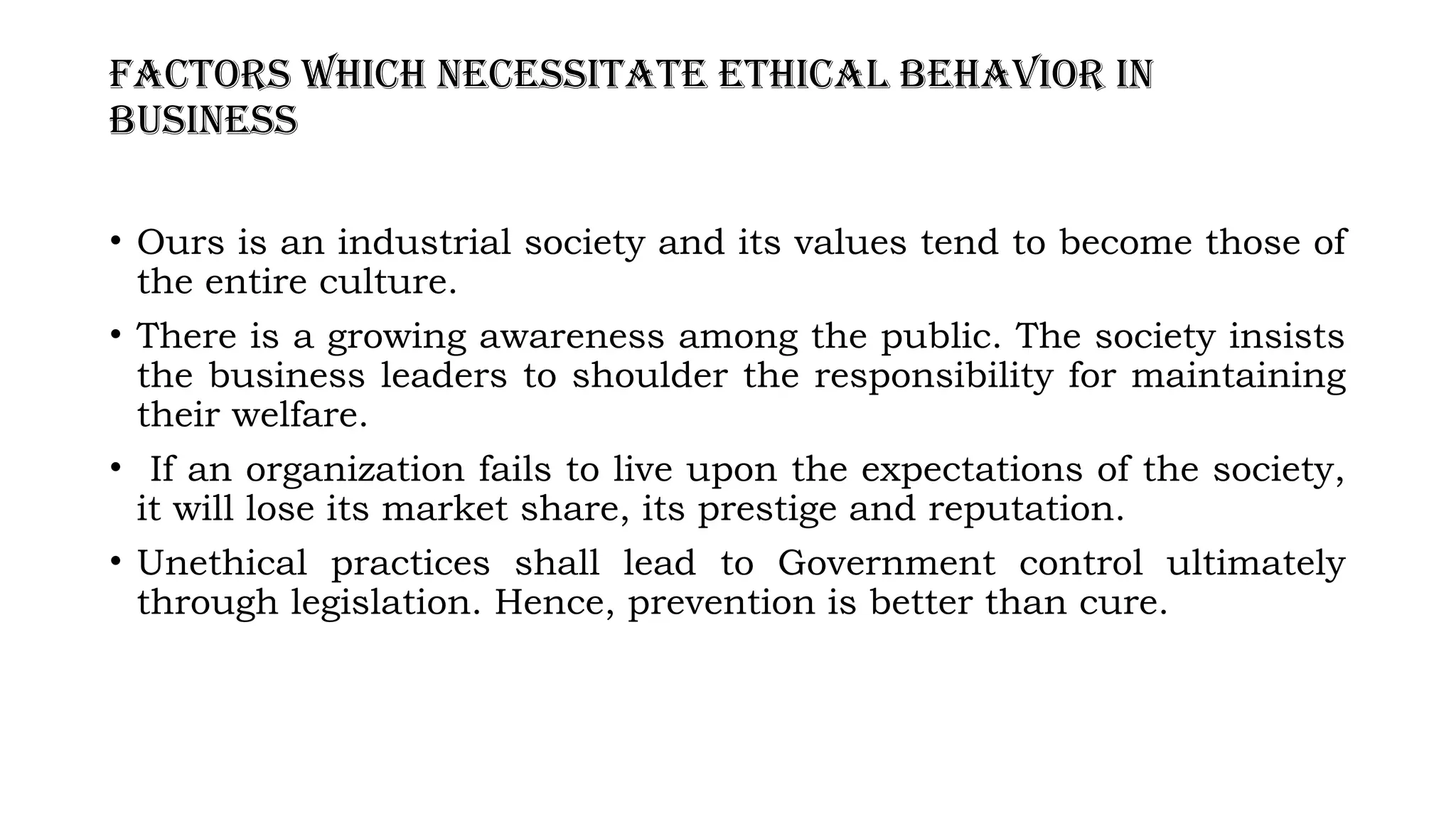
Factors which necessitateethical behavior in
business
• Ours is an industrial society and its values tend to become those of
the entire culture.
• There is a growing awareness among the public. The society insists
the business leaders to shoulder the responsibility for maintaining
their welfare.
• If an organization fails to live upon the expectations of the society,
it will lose its market share, its prestige and reputation.
• Unethical practices shall lead to Government control ultimately
through legislation. Hence, prevention is better than cure.
27.
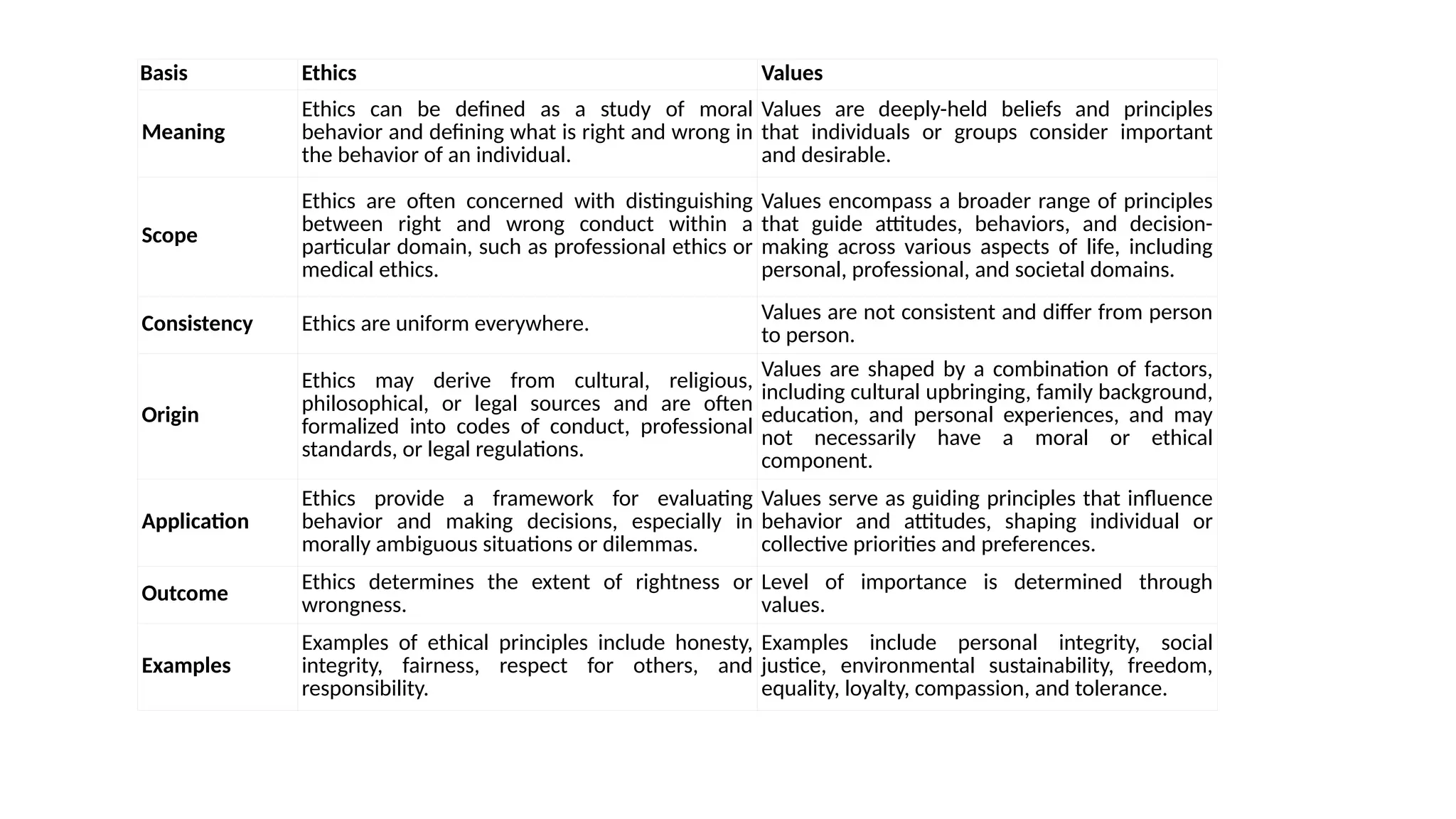
Basis Ethics Values
Meaning
Ethicscan be defined as a study of moral
behavior and defining what is right and wrong in
the behavior of an individual.
Values are deeply-held beliefs and principles
that individuals or groups consider important
and desirable.
Scope
Ethics are often concerned with distinguishing
between right and wrong conduct within a
particular domain, such as professional ethics or
medical ethics.
Values encompass a broader range of principles
that guide attitudes, behaviors, and decision-
making across various aspects of life, including
personal, professional, and societal domains.
Consistency Ethics are uniform everywhere.
Values are not consistent and differ from person
to person.
Origin
Ethics may derive from cultural, religious,
philosophical, or legal sources and are often
formalized into codes of conduct, professional
standards, or legal regulations.
Values are shaped by a combination of factors,
including cultural upbringing, family background,
education, and personal experiences, and may
not necessarily have a moral or ethical
component.
Application
Ethics provide a framework for evaluating
behavior and making decisions, especially in
morally ambiguous situations or dilemmas.
Values serve as guiding principles that influence
behavior and attitudes, shaping individual or
collective priorities and preferences.
Outcome Ethics determines the extent of rightness or
wrongness.
Level of importance is determined through
values.
Examples
Examples of ethical principles include honesty,
integrity, fairness, respect for others, and
responsibility.
Examples include personal integrity, social
justice, environmental sustainability, freedom,
equality, loyalty, compassion, and tolerance.




![Business ethics module_1[1]](https://cdn.slidesharecdn.com/ss_thumbnails/businessethicsmodule11-130228085400-phpapp01-thumbnail.jpg?width=640&height=640&fit=bounds)


