BUSINESS
COMMUNICATION
ODD SEMESTER
PATRICIAN COLLEGE OF ARTS & SCIENCE
DEPARTMENT OF COMMERCE, SHIFT-II
COMMUNICATION?
Communication is the actionable transfer of
information from one person, group, or place to
another by writing, speaking, or using a medium that
provides a means of understanding. Every
communication consists of a minimum of one
sender, a receiver, and a message.
2
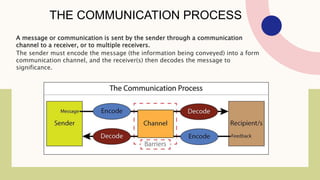
THE COMMUNICATION PROCESS
A message or communication is sent by the sender through a communication
channel to a receiver, or to multiple receivers.
The sender must encode the message (the information being conveyed) into a form
communication channel, and the receiver(s) then decodes the message to
significance.
• Semantic barriers: Semantic barriers are also known as language
barriers. These barriers are caused due to improper
communication between the sender and the receiver. The
following instances of semantic barriers can be witnessed in
communication.
• Psychological Barriers: Psychological barriers play an
important role in interpersonal communication as the state of
the mind of the sender or the receiver can make it difficult to
understand the information that is conveyed, which often leads
to misunderstanding.
5
BARRIERS TO EFFECTIVE COMMUNICATION
BARRIERS TO EFFECTIVE
COMMUNICATION
• Organisational barriers: Organisational barriers are those
barriers that are caused due to the structure, rules and
regulations present in the organisation. The various types
of barriers that can be encountered due to superior
subordinate relationships where the free flow of
communication is not possible.
• Cultural barriers: Cultural barriers are those that arise
due to lack of similarities among the different cultures
across the world. A term that can be harmless in one
culture can be regarded as a slang in another culture.
Moreover, various beliefs can differ from one culture to
another.
6
BARRIERS TO EFFECTIVE COMMUNICATION
• Physical barriers: Physical barriers to communication are
those that arise due to certain factors like faulty
equipment, noise, closed doors and cabins that cause the
information sent from sender to receiver to become
distorted, which results in improper communication.
• Physiological barriers: Physiological barriers arise when
a sender or the receiver of the communication is not in a
position to express or receive the message with clarity
due to some physiological issues like dyslexia, or nerve
disorders that interfere with speech or hearing.
7
BUSINESS LETTERS?
8
• A business letter is a letter from one company to another,
or such organizations and their customers, clients, or
other external parties.
• Business letters can have many types of content
• A business letter is useful because it produces a
permanent written record,and may be taken more
seriously by the recipient than other forms of
communication. It is written in formal language
KINDS OF BUSINESS LETTERS9
1) Sales Letter
This is the most common form of a business letter that is used in
almost every field. The sales letter serves as an introduction for
the customer about the product and/or the company. A typical
Sales letter starts off with a line or statement which captures the
interest of the reader who is more often than not a target customer
or a prospect.
2) Acknowledgment letter
A letter sent for acknowledgment or recognition or receipt of
material or letter from the other party is called an acknowledgment
letter. The acknowledgment can be of receipt of goods and
services, receipt of any other letter or of general inquiries.
3) Order Letters
As the name suggests, these are types of Business letters that are
sent solely for the purpose of placing orders and they may be sent
to wholesalers, retailers, or a manufacturer.
KINDS OF BUSINESS LETTERS 10
4) Apology letter
An apology letter is written in order to express regret regarding a
certain matter, which says the acknowledgment of mistake or
issue or error along with an apology. It is a way of showing
sincere regret towards the mistake along with the steps to rectify
it or make necessary changes to try and undo the damage.
5) Complaint Letter
Complaint letters are the types of Business letters written by one
party to another party or entity to convey dismay about a certain
issue. Complaints are indicators that something has went wrong
and that has been indicated by a formal business letter.
6) Appreciation letters
These types of communication letters are written by senior
management to the junior management for the conveyance of
gratitude in order to congratulate them on a job well done or in
order to motivate them.
KINDS OF BUSINESS LETTERS 11
7) Circular Letters
These types of business letters are sent to a closed
group or selected people with the purpose of being
circulated widely. The purpose of circular letters is to
either convey customers about the sale or news or
intimate about important information about newly
launched or built facilities.
8) Inquiry Letters
These types of business letters are sent for inquiry
about certain information. The primary purpose is to
know about something or if someone has any query
which needs to be answered. The inquiry letter is to be
kept short and to the point with directly addressing the
inquiry.
KINDS OF BUSINESS LETTERS12
9) Confirmation letter
Whenever there is a discussion or mutual agreement between
two parties, and the discussion leads to an understanding or
mutual agreement, that agreement is quoted in a confirmation
letter.
10) Adjustment Letter
Adjustment letters are the ones that are sent to the customers
as a response to their claim or complaint. The adjustment can
be either in customers’ favor in which case, the letter should
begin accordingly and if it is not in the favor of the customer,
the tone should be kept factual with a message that you
understand the complaint.
THANK YOU
BY : SARANYA S
ASST.PROF, DEPT OF COMMERCE, SHIFT-II

Business communication ODD SEMESTERPPT.pptx

  • 1.
    BUSINESS COMMUNICATION ODD SEMESTER PATRICIAN COLLEGEOF ARTS & SCIENCE DEPARTMENT OF COMMERCE, SHIFT-II
  • 2.
    COMMUNICATION? Communication is theactionable transfer of information from one person, group, or place to another by writing, speaking, or using a medium that provides a means of understanding. Every communication consists of a minimum of one sender, a receiver, and a message. 2
  • 3.
    THE COMMUNICATION PROCESS Amessage or communication is sent by the sender through a communication channel to a receiver, or to multiple receivers. The sender must encode the message (the information being conveyed) into a form communication channel, and the receiver(s) then decodes the message to significance.
  • 5.
    • Semantic barriers:Semantic barriers are also known as language barriers. These barriers are caused due to improper communication between the sender and the receiver. The following instances of semantic barriers can be witnessed in communication. • Psychological Barriers: Psychological barriers play an important role in interpersonal communication as the state of the mind of the sender or the receiver can make it difficult to understand the information that is conveyed, which often leads to misunderstanding. 5 BARRIERS TO EFFECTIVE COMMUNICATION
  • 6.
    BARRIERS TO EFFECTIVE COMMUNICATION •Organisational barriers: Organisational barriers are those barriers that are caused due to the structure, rules and regulations present in the organisation. The various types of barriers that can be encountered due to superior subordinate relationships where the free flow of communication is not possible. • Cultural barriers: Cultural barriers are those that arise due to lack of similarities among the different cultures across the world. A term that can be harmless in one culture can be regarded as a slang in another culture. Moreover, various beliefs can differ from one culture to another. 6
  • 7.
    BARRIERS TO EFFECTIVECOMMUNICATION • Physical barriers: Physical barriers to communication are those that arise due to certain factors like faulty equipment, noise, closed doors and cabins that cause the information sent from sender to receiver to become distorted, which results in improper communication. • Physiological barriers: Physiological barriers arise when a sender or the receiver of the communication is not in a position to express or receive the message with clarity due to some physiological issues like dyslexia, or nerve disorders that interfere with speech or hearing. 7
  • 8.
    BUSINESS LETTERS? 8 • Abusiness letter is a letter from one company to another, or such organizations and their customers, clients, or other external parties. • Business letters can have many types of content • A business letter is useful because it produces a permanent written record,and may be taken more seriously by the recipient than other forms of communication. It is written in formal language
  • 9.
    KINDS OF BUSINESSLETTERS9 1) Sales Letter This is the most common form of a business letter that is used in almost every field. The sales letter serves as an introduction for the customer about the product and/or the company. A typical Sales letter starts off with a line or statement which captures the interest of the reader who is more often than not a target customer or a prospect. 2) Acknowledgment letter A letter sent for acknowledgment or recognition or receipt of material or letter from the other party is called an acknowledgment letter. The acknowledgment can be of receipt of goods and services, receipt of any other letter or of general inquiries. 3) Order Letters As the name suggests, these are types of Business letters that are sent solely for the purpose of placing orders and they may be sent to wholesalers, retailers, or a manufacturer.
  • 10.
    KINDS OF BUSINESSLETTERS 10 4) Apology letter An apology letter is written in order to express regret regarding a certain matter, which says the acknowledgment of mistake or issue or error along with an apology. It is a way of showing sincere regret towards the mistake along with the steps to rectify it or make necessary changes to try and undo the damage. 5) Complaint Letter Complaint letters are the types of Business letters written by one party to another party or entity to convey dismay about a certain issue. Complaints are indicators that something has went wrong and that has been indicated by a formal business letter. 6) Appreciation letters These types of communication letters are written by senior management to the junior management for the conveyance of gratitude in order to congratulate them on a job well done or in order to motivate them.
  • 11.
    KINDS OF BUSINESSLETTERS 11 7) Circular Letters These types of business letters are sent to a closed group or selected people with the purpose of being circulated widely. The purpose of circular letters is to either convey customers about the sale or news or intimate about important information about newly launched or built facilities. 8) Inquiry Letters These types of business letters are sent for inquiry about certain information. The primary purpose is to know about something or if someone has any query which needs to be answered. The inquiry letter is to be kept short and to the point with directly addressing the inquiry.
  • 12.
    KINDS OF BUSINESSLETTERS12 9) Confirmation letter Whenever there is a discussion or mutual agreement between two parties, and the discussion leads to an understanding or mutual agreement, that agreement is quoted in a confirmation letter. 10) Adjustment Letter Adjustment letters are the ones that are sent to the customers as a response to their claim or complaint. The adjustment can be either in customers’ favor in which case, the letter should begin accordingly and if it is not in the favor of the customer, the tone should be kept factual with a message that you understand the complaint.
  • 13.
    THANK YOU BY :SARANYA S ASST.PROF, DEPT OF COMMERCE, SHIFT-II