“Bus off”...
Can you continue to afford
your DeviceNet downtime?
White Paper
2
White Paper
“Bus off”... Can you continue to afford your DeviceNet downtime?
This white paper is intended for operations, maintenance and controls management who are concerned with the cost
of downtime associated with failures of DeviceNet networks during production. This significant cost increases the cost
of operations such as lost production, production overtime, cost of maintenance, expedited shipping etc. This paper
proposes an IO-Link solution that will help you meet your production demands by reducing or eliminating these costs.
In the current climate of shorter automotive program cycles and cost reduction initiatives it is common for companies
to repurpose equipment for new programs by refurbishing their machines and building new tooling. As many of these
machines may be 3-4 years old when DeviceNet was the leading networking technology. These machines go back into
service with the same network.
As any of us who have worked with DeviceNet know the network integrity is at its best the day the machine was built
and starts deteriorating from that point. How many of us have experienced the dreaded “Bus Off” error on the DeviceNet
scanner, only to be left with no power on the network and left to use a process of elimination to find where the fault
occurred? The “Bus Off” fault can be caused by a variety of issues but the most common causes are intermittent
connections, short circuit or open circuit on the CAN lines due to damaged cables, defective devices or nodes such as
network Tee’s etc. Downtime due to DeviceNet issues is a common occurrence at every manufacturing plant every day
and causes significant downtime. This downtime costs companies tens if not hundreds of thousands of dollars per year
in lost production and overtime. How can this issue be resolved?
Now that EtherNet/IP has become more commonly available you would think that it would be relatively easy to convert
to EtherNet/IP. Unfortunately there is still a significant premium in cost to go from DeviceNet to EtherNet/IP. Generally
for IO with high current requirements there is no POE capability with EtherNet/IP like there is with DeviceNet therefore
every node needs an additional auxiliary power cable as well as a shielded network cable. The cost of EtherNet/IP nodes
themselves are also still significantly higher than DeviceNet nodes that has been on the market for many years.
One way to reduce the number of errors on your DeviceNet networks would be to simplify your network by reducing
the number of nodes and length of cabling on each segment of the network. This would require adding scanner cards
and splitting the network into smaller segments, also limiting the number of nodes per segment to make it easier to
troubleshoot.
A new and innovative way to achieve the same result is by reducing the size of the DeviceNet network by replacing the
DeviceNet IO blocks and expensive Valve Manifold nodes with cost effective IO-Link I/O hubs and valve connectors.
IO-Link is an innovative vendor neutral technology. It uses powerful point to point communication for up to 32 bytes of
input data and 32 bytes of output data from IO-Link slaves such as hubs that pick up IO to an IO-Link Master that resides
on the physical network such as DeviceNet, EtherNet/IP, PROFINET and more. The beauty of this technology is that even
though it is more intelligent with many more features, it is quite simple to use and more cost effective. This makes IO-Link
a simple expansion to an existing network currently implemented by the user.
So how does IO-Link do this? Let’s explain further:
The IO-Link Master would remain on the DeviceNet network but the new IO-Link hubs and valve connectors are arranged
in a star configuration from the master making it significantly easier to troubleshoot. The IO-Link Hubs can be up to
20 meters from the master using standard “off the shelf” 3 or 4 wire “prox” cables, no custom or proprietary cabling is
required. Power for the IO-Link hubs is supplied through that “prox” cable from the IO-Link Master therefore no additional
Aux power cable is required either. The IO-Link hubs also require no addressing making it easier for maintenance to
replace a device without any special training. IO-Link hubs are also significantly less expensive than EtherNet/IP blocks as
there is no fee for the expensive Ethernet chip set.
3
A second and more common method of reducing downtime from DeviceNet is by replacing the DeviceNet network
entirely with a cost effective EtherNet/IP IO-Link conversion. Several major Tier 1 automotive suppliers have now
undertaken this conversion with significant results in eliminating network issues. Examples such as losing 8-10 hours
per month of machine downtime on a single piece of equipment were common for these customers. This downtime
has now been eliminated by an IO-Link conversion.
The convenience of a conversion from DeviceNet to IO-Link solution is the ability to prepare all the hardware and
software changes in parallel to the existing network, testing everything and ensuring that it is all functioning correctly
while in all cases keeping the existing equipment in production. The switch over from DeviceNet to EtherNet/IP IO-
Link is then as simple as moving the IO cables from the DeviceNet blocks to the IO-Link hubs on a planned shutdown.
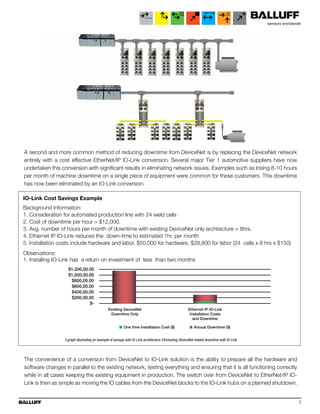
A graph illustrating an example of savings with IO-Link architecture: Eliminating DeviceNet related downtime with IO-Link
$1,200,00.00
$1,000,00.00
$800,00.00
$600,00.00
$400,00.00
$200,00.00
$-
Existing DeviceNet
Downtime Only
Ethernet IP IO-Link
Installation Costs
and Downtime
One time Installation Cost ($) Annual Downtime ($)
IO-Link Cost Savings Example
Background Information:
1. Consideration for automated production line with 24 weld cells
2. Cost of downtime per hour = $12,000.
3. Avg. number of hours per month of downtime with existing DeviceNet only architecture = 8hrs.
4. Ethernet IP IO-Link reduces the down-time to estimated 1hr. per month
5. Installation costs include hardware and labor, $50,000 for hardware, $28,800 for labor (24 cells x 8 hrs x $150)
Observations:
1. Installing IO-Link has a return on investment of less than two months
4
EtherNet I/P
IO-Link Master
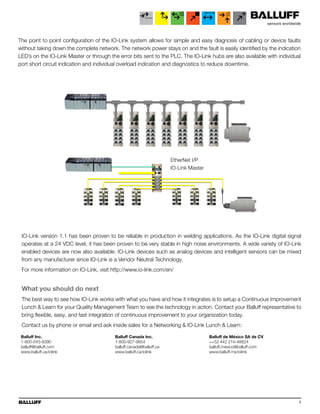
The point to point configuration of the IO-Link system allows for simple and easy diagnosis of cabling or device faults
without taking down the complete network. The network power stays on and the fault is easily identified by the indication
LED’s on the IO-Link Master or through the error bits sent to the PLC. The IO-Link hubs are also available with individual
port short circuit indication and individual overload indication and diagnostics to reduce downtime.
IO-Link version 1.1 has been proven to be reliable in production in welding applications. As the IO-Link digital signal
operates at a 24 VDC level, it has been proven to be very stable in high noise environments. A wide variety of IO-Link
enabled devices are now also available. IO-Link devices such as analog devices and intelligent sensors can be mixed
from any manufacturer since IO-Link is a Vendor Neutral Technology.
For more information on IO-Link, visit http://www.io-link.com/en/
What you should do next
The best way to see how IO-Link works with what you have and how it integrates is to setup a Continuous Improvement
Lunch & Learn for your Quality Management Team to see the technology in action. Contact your Balluff representative to
bring flexible, easy, and fast integration of continuous improvement to your organization today.
Contact us by phone or email and ask inside sales for a Networking & IO-Link Lunch & Learn:
Balluff Inc.
1-800-543-8390
balluff@balluff.com
www.balluff.us/iolink
Balluff Canada Inc.
1-800-927-9654
balluff.canada@balluff.ca
www.balluff.ca/iolink
Balluff de México SA de CV
++52 442 214-48824
balluff.mexico@balluff.com
www.balluff.mx/iolink
5
About the Author
Tom O Connell is based out of the Balluff Canada headquarters in Mississauga,
Ontario. He has over 37 years’ experience in the automation industry, over
25 years of that in the automotive sector in machine design, machine
building and sales. Tom is currently a Business Development Manager at
Balluff Canada. He can be reached at thomas.o’connell@balluff.ca
About Balluff
Rugged Control Components from Network to Sensor
Balluff specializes in delivering dependable, rugged and precision products for industrial sensing, networking, and
identification to help prevent downtime and eliminate errors. We are a complete system and component supplier, offering
industrial network and I/O products for use outside of the control cabinet. We add value to automated systems by
providing a wide range of enabling technologies that unlock hidden productivity potential.
Our products include a complete line of sensors, transducers, ID systems, and connectivity products. Our sensor lines
include photoelectric, inductive, capacitive and magnetic, as well as other more specialized sensor products to fit virtually
any sensing application.
USA
Balluff Inc.
8125 Holton Drive
Florence, KY 41042
Phone: (859) 727-2200
Toll-free: 1-800-543-8390
Fax: (859) 727-4823
E-Mail: balluff@balluff.com
Canada
Balluff Canada, Inc.
2840 Argentia Road, Unit #2
Mississauga, Ontario L5N 8G4
Phone: (905) 816-1494
Toll-free: 1-800-927-9654
Fax: (905) 816-1411
E-Mail: balluff.canada@balluff.ca
www.balluff.com
Mexico
Balluff de México SA de CV
Anillo Vial II Fray Junípero Serra No. 4416
Colonia La Vista Residencial.
Querétaro, Qro. CP76146
Phone: (++52 442) 212-4882
Fax: (++52 442) 214-0536
E-Mail: balluff.mexico@balluff.com
Object Detection
Linear Position Sensing and Measurement
Fluid Sensors
Industrial Identification
Industrial Networking and Connectivity
Accessories
Systems and Services

Bus Off DeviceNet June-FINAL

  • 1.
    “Bus off”... Can youcontinue to afford your DeviceNet downtime? White Paper
  • 2.
    2 White Paper “Bus off”...Can you continue to afford your DeviceNet downtime? This white paper is intended for operations, maintenance and controls management who are concerned with the cost of downtime associated with failures of DeviceNet networks during production. This significant cost increases the cost of operations such as lost production, production overtime, cost of maintenance, expedited shipping etc. This paper proposes an IO-Link solution that will help you meet your production demands by reducing or eliminating these costs. In the current climate of shorter automotive program cycles and cost reduction initiatives it is common for companies to repurpose equipment for new programs by refurbishing their machines and building new tooling. As many of these machines may be 3-4 years old when DeviceNet was the leading networking technology. These machines go back into service with the same network. As any of us who have worked with DeviceNet know the network integrity is at its best the day the machine was built and starts deteriorating from that point. How many of us have experienced the dreaded “Bus Off” error on the DeviceNet scanner, only to be left with no power on the network and left to use a process of elimination to find where the fault occurred? The “Bus Off” fault can be caused by a variety of issues but the most common causes are intermittent connections, short circuit or open circuit on the CAN lines due to damaged cables, defective devices or nodes such as network Tee’s etc. Downtime due to DeviceNet issues is a common occurrence at every manufacturing plant every day and causes significant downtime. This downtime costs companies tens if not hundreds of thousands of dollars per year in lost production and overtime. How can this issue be resolved? Now that EtherNet/IP has become more commonly available you would think that it would be relatively easy to convert to EtherNet/IP. Unfortunately there is still a significant premium in cost to go from DeviceNet to EtherNet/IP. Generally for IO with high current requirements there is no POE capability with EtherNet/IP like there is with DeviceNet therefore every node needs an additional auxiliary power cable as well as a shielded network cable. The cost of EtherNet/IP nodes themselves are also still significantly higher than DeviceNet nodes that has been on the market for many years. One way to reduce the number of errors on your DeviceNet networks would be to simplify your network by reducing the number of nodes and length of cabling on each segment of the network. This would require adding scanner cards and splitting the network into smaller segments, also limiting the number of nodes per segment to make it easier to troubleshoot. A new and innovative way to achieve the same result is by reducing the size of the DeviceNet network by replacing the DeviceNet IO blocks and expensive Valve Manifold nodes with cost effective IO-Link I/O hubs and valve connectors. IO-Link is an innovative vendor neutral technology. It uses powerful point to point communication for up to 32 bytes of input data and 32 bytes of output data from IO-Link slaves such as hubs that pick up IO to an IO-Link Master that resides on the physical network such as DeviceNet, EtherNet/IP, PROFINET and more. The beauty of this technology is that even though it is more intelligent with many more features, it is quite simple to use and more cost effective. This makes IO-Link a simple expansion to an existing network currently implemented by the user. So how does IO-Link do this? Let’s explain further: The IO-Link Master would remain on the DeviceNet network but the new IO-Link hubs and valve connectors are arranged in a star configuration from the master making it significantly easier to troubleshoot. The IO-Link Hubs can be up to 20 meters from the master using standard “off the shelf” 3 or 4 wire “prox” cables, no custom or proprietary cabling is required. Power for the IO-Link hubs is supplied through that “prox” cable from the IO-Link Master therefore no additional Aux power cable is required either. The IO-Link hubs also require no addressing making it easier for maintenance to replace a device without any special training. IO-Link hubs are also significantly less expensive than EtherNet/IP blocks as there is no fee for the expensive Ethernet chip set.
  • 3.
    3 A second andmore common method of reducing downtime from DeviceNet is by replacing the DeviceNet network entirely with a cost effective EtherNet/IP IO-Link conversion. Several major Tier 1 automotive suppliers have now undertaken this conversion with significant results in eliminating network issues. Examples such as losing 8-10 hours per month of machine downtime on a single piece of equipment were common for these customers. This downtime has now been eliminated by an IO-Link conversion. The convenience of a conversion from DeviceNet to IO-Link solution is the ability to prepare all the hardware and software changes in parallel to the existing network, testing everything and ensuring that it is all functioning correctly while in all cases keeping the existing equipment in production. The switch over from DeviceNet to EtherNet/IP IO- Link is then as simple as moving the IO cables from the DeviceNet blocks to the IO-Link hubs on a planned shutdown. A graph illustrating an example of savings with IO-Link architecture: Eliminating DeviceNet related downtime with IO-Link $1,200,00.00 $1,000,00.00 $800,00.00 $600,00.00 $400,00.00 $200,00.00 $- Existing DeviceNet Downtime Only Ethernet IP IO-Link Installation Costs and Downtime One time Installation Cost ($) Annual Downtime ($) IO-Link Cost Savings Example Background Information: 1. Consideration for automated production line with 24 weld cells 2. Cost of downtime per hour = $12,000. 3. Avg. number of hours per month of downtime with existing DeviceNet only architecture = 8hrs. 4. Ethernet IP IO-Link reduces the down-time to estimated 1hr. per month 5. Installation costs include hardware and labor, $50,000 for hardware, $28,800 for labor (24 cells x 8 hrs x $150) Observations: 1. Installing IO-Link has a return on investment of less than two months
  • 4.
    4 EtherNet I/P IO-Link Master Thepoint to point configuration of the IO-Link system allows for simple and easy diagnosis of cabling or device faults without taking down the complete network. The network power stays on and the fault is easily identified by the indication LED’s on the IO-Link Master or through the error bits sent to the PLC. The IO-Link hubs are also available with individual port short circuit indication and individual overload indication and diagnostics to reduce downtime. IO-Link version 1.1 has been proven to be reliable in production in welding applications. As the IO-Link digital signal operates at a 24 VDC level, it has been proven to be very stable in high noise environments. A wide variety of IO-Link enabled devices are now also available. IO-Link devices such as analog devices and intelligent sensors can be mixed from any manufacturer since IO-Link is a Vendor Neutral Technology. For more information on IO-Link, visit http://www.io-link.com/en/ What you should do next The best way to see how IO-Link works with what you have and how it integrates is to setup a Continuous Improvement Lunch & Learn for your Quality Management Team to see the technology in action. Contact your Balluff representative to bring flexible, easy, and fast integration of continuous improvement to your organization today. Contact us by phone or email and ask inside sales for a Networking & IO-Link Lunch & Learn: Balluff Inc. 1-800-543-8390 balluff@balluff.com www.balluff.us/iolink Balluff Canada Inc. 1-800-927-9654 balluff.canada@balluff.ca www.balluff.ca/iolink Balluff de México SA de CV ++52 442 214-48824 balluff.mexico@balluff.com www.balluff.mx/iolink
  • 5.
    5 About the Author TomO Connell is based out of the Balluff Canada headquarters in Mississauga, Ontario. He has over 37 years’ experience in the automation industry, over 25 years of that in the automotive sector in machine design, machine building and sales. Tom is currently a Business Development Manager at Balluff Canada. He can be reached at thomas.o’connell@balluff.ca About Balluff Rugged Control Components from Network to Sensor Balluff specializes in delivering dependable, rugged and precision products for industrial sensing, networking, and identification to help prevent downtime and eliminate errors. We are a complete system and component supplier, offering industrial network and I/O products for use outside of the control cabinet. We add value to automated systems by providing a wide range of enabling technologies that unlock hidden productivity potential. Our products include a complete line of sensors, transducers, ID systems, and connectivity products. Our sensor lines include photoelectric, inductive, capacitive and magnetic, as well as other more specialized sensor products to fit virtually any sensing application.
  • 6.
    USA Balluff Inc. 8125 HoltonDrive Florence, KY 41042 Phone: (859) 727-2200 Toll-free: 1-800-543-8390 Fax: (859) 727-4823 E-Mail: balluff@balluff.com Canada Balluff Canada, Inc. 2840 Argentia Road, Unit #2 Mississauga, Ontario L5N 8G4 Phone: (905) 816-1494 Toll-free: 1-800-927-9654 Fax: (905) 816-1411 E-Mail: balluff.canada@balluff.ca www.balluff.com Mexico Balluff de México SA de CV Anillo Vial II Fray Junípero Serra No. 4416 Colonia La Vista Residencial. Querétaro, Qro. CP76146 Phone: (++52 442) 212-4882 Fax: (++52 442) 214-0536 E-Mail: balluff.mexico@balluff.com Object Detection Linear Position Sensing and Measurement Fluid Sensors Industrial Identification Industrial Networking and Connectivity Accessories Systems and Services