Chapter IV:
Management
Process
Lesson
Objectives
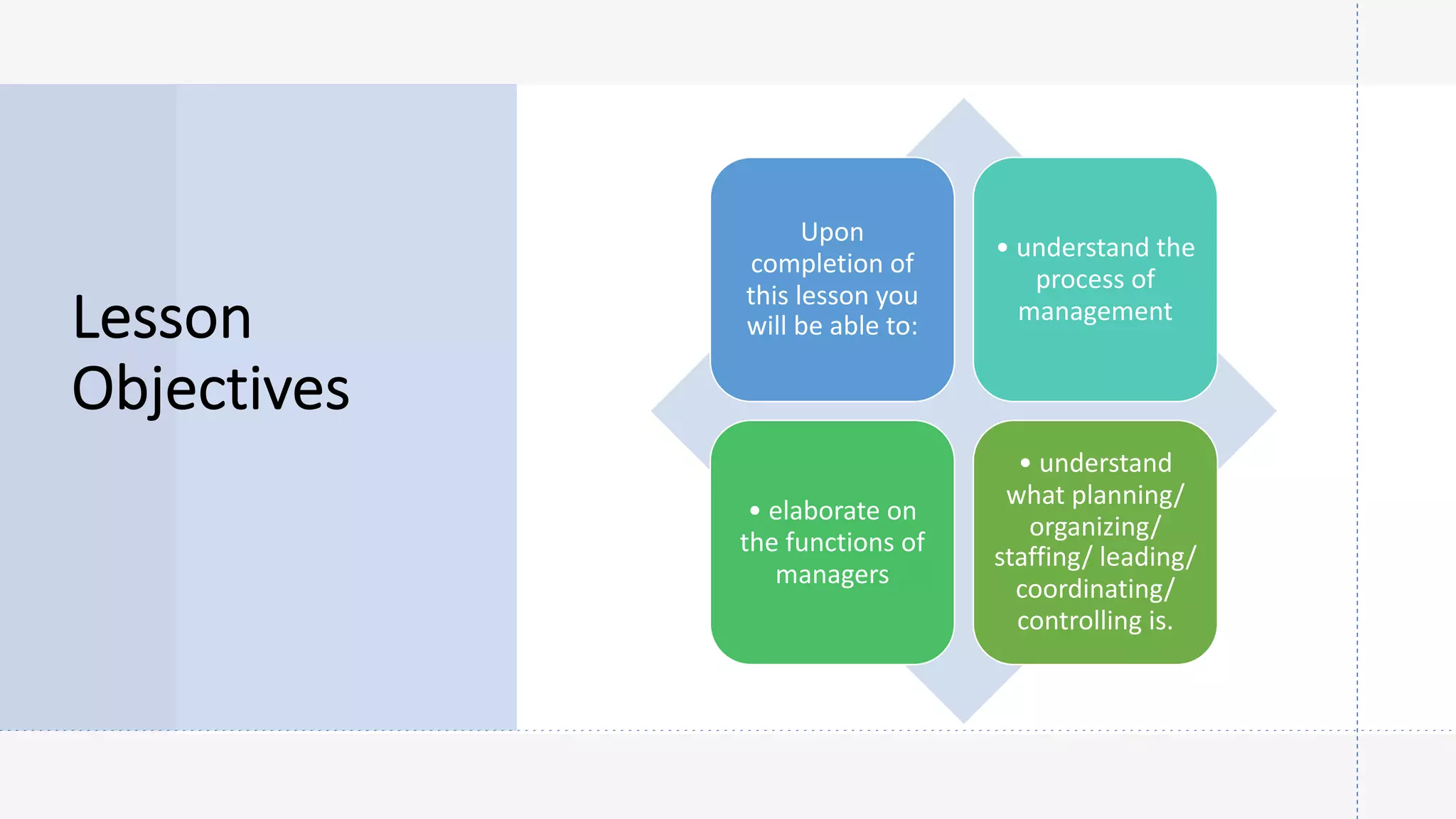
Upon
completion of
this lesson you
will be able to:
• understand the
process of
management
• elaborate on
the functions of
managers
• understand
what planning/
organizing/
staffing/ leading/
coordinating/
controlling is.
Introduction
• A process is a systematic way of doing things. We refer to management
as a process to emphasize that all managers, irrespective of their
aptitude or skill, engage in some inter-related functions in order to
achieve their desired goals. In this lesson we will briefly describe the
functions that comprise the process of management.
• Planning: Planning may be defined as making decisions in advance as to what is
to be done in the future. It is a future course of action. It implies that managers
think through their goals and actions in advance and their actions are based on
some method, plan or logic rather than on hunch. Plans give the organization its
objectives and set up the best procedures for reaching them.
• Planning involves selecting missions and objectives and the actions to achieve
them, it requires decision making, i.e. choosing future courses of action from
among alternatives. In short, planning means determining what the
organization’s position and situation should be at some time in the future and
deciding how best to bring about that situation
• Plans may be of various types (as elaborated in chapter 3) covering
various time periods, and are usually set by top-level managers. Anyway,
they are the guidelines by which (a) the organization obtains and
commits the resources required to reach its objectives; (b) members of
the organization carry on activities consistent with the chosen objectives
and procedures; and (c) progress toward the objectives is monitored and
measured so that corrective action can be taken if progress in
unsatisfactory.
• Planning involves a number of steps - the first step is the selection of
goals for the organization. The second step is the establishment of goals
for each of the organization’s sub-units, departments, divisions etc. The
third step is to establish programmes for achieving goals in a systematic
manner.
• Planning requires an ability to foresee, to visualize, and to look ahead
purposefully. In short, planning is essential and is a fundamental function
of management
• Organizing: Once a manager has developed a work plan, the next phase
of management is to organize the people and other resources necessary
to carry out the plan. Organizing may be referred to as the process of
arranging and allocating work, authority and resources among an
organization’s members so they can achieve the organization’s goals. In
fact, organizing involves work distribution which is guided by
considerations for such things as component activities – the members of
the group, and the physical facilities available. These component
activities are so grouped and assigned that minimum expenditure or
maximum employee work satisfaction is attained.
• Organizing produces a structure of relationships in an organization, and it
is through these structured relationships that future plans are pursued.
• Organizing, then, is that part of managing which involves establishing an
intentional structure of roles for people to fill in an organization. It is
intentional in the sense of making sure that all the tasks necessary to
accomplish goals are assigned to people who can do them best.
• The purpose of an organization structure is to help people create an
environment for human performance. The structure must define the
tasks to be done. The roles so established must also be designed in the
light of the abilities and motivations of the people available.
• However, designing an effective organization structure is not an easy
managerial task. Many problems are encountered in making structures
fit situations, including both defining the kinds of jobs that must be done
and finding the people to do them.20 All these fall under the definition
of organizing, which is a fundamental function of management.
• Leading: Leading is an important job of the manager. It involves
directing, influencing and motivating employees to perform essential
tasks. To lead these people to contribute to organization and group goals
constitutes an essential function of the manager. In fact, the manager
has to get on intimate terms with them if he wants to lead them
successfully. The manager leads in an attempt to persuade others to join
them in pursuit of the future that emerges from the planning and
organizing steps. By establishing the proper atmosphere, managers help
their employees do their best.
• Controlling: The final phase of the management process is controlling. As the
organization moves toward its goals, management must monitor its progress. It must
make sure that events conform to plans. Controlling involves measuring performance
against goals and plans and helping correct deviations from standards. As a matter of
fact, controlling facilitates the accomplishment of plans. Although planning must
precede controlling, plans are not self-achieving. They guide the manager in the use of
resources to accomplish specific goals. Activities are evaluated to determine whether
they conform to the plans.
• Controlling is the last but not the least important function of management. Thus it is
rightly said, “Planning without controlling is useless.”
• The process of management may be represented by the following diagram.
Exercises
Write (T) for True and (F) for False for the following statements.
• A management process is an unsystematic way of doing things. ( )
• Planning is a future course of action. ( )
• The first step of planning is the selection of goals for the organization. ( )
• Organizing produces an unstructured of relationships in an organization ( )
• Designing an effective organization structure is an easy managerial task. ( )
• Controlling is the last but not the least important function of management. (
)
Fill in the blanks
objectives / function / effectiveness / organizing / job / systematic
• A management process is a ---------------------- way of doing things.
• Plans give the organization its -------------------- and set up the best
procedures for reaching them.
• Planning helps maintain managerial --------------------- by guiding future
activities.
• ---------------------- produces a structure of relationships in an
organization.
• Leading is an important ---------------- of the manager.
• Controlling is the last but not the least important ----------------- of
management.
Multiple choice questions:
• ------------- defined as making decisions in advance
as to what is to be done in the future.
a) Planning
b) organizing
c) controlling
d) leading
• Planning involves selecting --------------- missions
and objectives and the actions to achieve them.
a) Missions
b) Goals
c) Vision
d) All
• Planning helps maintain managerial effectiveness
by guiding ------------ activities.
a) Present
b) past
c) Future
d) None
• Plans are usually set by managers.
a) top-level
b) middle-level
c) down-level
d) All
• The final phase of the management process is controlling.
a) Planning
b) organizing
c) controlling
d) leading
Essay type questions
1. What do you mean by management process?
2. Discuss the functions of management.
3. What are the steps of planning?
4. What is organizing?

BUS 101- Chapter4.pdf

  • 1.
  • 2.
    Lesson Objectives Upon completion of this lessonyou will be able to: • understand the process of management • elaborate on the functions of managers • understand what planning/ organizing/ staffing/ leading/ coordinating/ controlling is.
  • 3.
    Introduction • A processis a systematic way of doing things. We refer to management as a process to emphasize that all managers, irrespective of their aptitude or skill, engage in some inter-related functions in order to achieve their desired goals. In this lesson we will briefly describe the functions that comprise the process of management.
  • 4.
    • Planning: Planningmay be defined as making decisions in advance as to what is to be done in the future. It is a future course of action. It implies that managers think through their goals and actions in advance and their actions are based on some method, plan or logic rather than on hunch. Plans give the organization its objectives and set up the best procedures for reaching them. • Planning involves selecting missions and objectives and the actions to achieve them, it requires decision making, i.e. choosing future courses of action from among alternatives. In short, planning means determining what the organization’s position and situation should be at some time in the future and deciding how best to bring about that situation
  • 5.
    • Plans maybe of various types (as elaborated in chapter 3) covering various time periods, and are usually set by top-level managers. Anyway, they are the guidelines by which (a) the organization obtains and commits the resources required to reach its objectives; (b) members of the organization carry on activities consistent with the chosen objectives and procedures; and (c) progress toward the objectives is monitored and measured so that corrective action can be taken if progress in unsatisfactory.
  • 6.
    • Planning involvesa number of steps - the first step is the selection of goals for the organization. The second step is the establishment of goals for each of the organization’s sub-units, departments, divisions etc. The third step is to establish programmes for achieving goals in a systematic manner. • Planning requires an ability to foresee, to visualize, and to look ahead purposefully. In short, planning is essential and is a fundamental function of management
  • 7.
    • Organizing: Oncea manager has developed a work plan, the next phase of management is to organize the people and other resources necessary to carry out the plan. Organizing may be referred to as the process of arranging and allocating work, authority and resources among an organization’s members so they can achieve the organization’s goals. In fact, organizing involves work distribution which is guided by considerations for such things as component activities – the members of the group, and the physical facilities available. These component activities are so grouped and assigned that minimum expenditure or maximum employee work satisfaction is attained.
  • 8.
    • Organizing producesa structure of relationships in an organization, and it is through these structured relationships that future plans are pursued. • Organizing, then, is that part of managing which involves establishing an intentional structure of roles for people to fill in an organization. It is intentional in the sense of making sure that all the tasks necessary to accomplish goals are assigned to people who can do them best.
  • 9.
    • The purposeof an organization structure is to help people create an environment for human performance. The structure must define the tasks to be done. The roles so established must also be designed in the light of the abilities and motivations of the people available. • However, designing an effective organization structure is not an easy managerial task. Many problems are encountered in making structures fit situations, including both defining the kinds of jobs that must be done and finding the people to do them.20 All these fall under the definition of organizing, which is a fundamental function of management.
  • 10.
    • Leading: Leadingis an important job of the manager. It involves directing, influencing and motivating employees to perform essential tasks. To lead these people to contribute to organization and group goals constitutes an essential function of the manager. In fact, the manager has to get on intimate terms with them if he wants to lead them successfully. The manager leads in an attempt to persuade others to join them in pursuit of the future that emerges from the planning and organizing steps. By establishing the proper atmosphere, managers help their employees do their best.
  • 11.
    • Controlling: Thefinal phase of the management process is controlling. As the organization moves toward its goals, management must monitor its progress. It must make sure that events conform to plans. Controlling involves measuring performance against goals and plans and helping correct deviations from standards. As a matter of fact, controlling facilitates the accomplishment of plans. Although planning must precede controlling, plans are not self-achieving. They guide the manager in the use of resources to accomplish specific goals. Activities are evaluated to determine whether they conform to the plans. • Controlling is the last but not the least important function of management. Thus it is rightly said, “Planning without controlling is useless.” • The process of management may be represented by the following diagram.
  • 13.
  • 14.
    Write (T) forTrue and (F) for False for the following statements. • A management process is an unsystematic way of doing things. ( ) • Planning is a future course of action. ( ) • The first step of planning is the selection of goals for the organization. ( ) • Organizing produces an unstructured of relationships in an organization ( ) • Designing an effective organization structure is an easy managerial task. ( ) • Controlling is the last but not the least important function of management. ( )
  • 15.
    Fill in theblanks objectives / function / effectiveness / organizing / job / systematic • A management process is a ---------------------- way of doing things. • Plans give the organization its -------------------- and set up the best procedures for reaching them. • Planning helps maintain managerial --------------------- by guiding future activities. • ---------------------- produces a structure of relationships in an organization. • Leading is an important ---------------- of the manager. • Controlling is the last but not the least important ----------------- of management.
  • 16.
    Multiple choice questions: •------------- defined as making decisions in advance as to what is to be done in the future. a) Planning b) organizing c) controlling d) leading • Planning involves selecting --------------- missions and objectives and the actions to achieve them. a) Missions b) Goals c) Vision d) All • Planning helps maintain managerial effectiveness by guiding ------------ activities. a) Present b) past c) Future d) None • Plans are usually set by managers. a) top-level b) middle-level c) down-level d) All
  • 17.
    • The finalphase of the management process is controlling. a) Planning b) organizing c) controlling d) leading
  • 18.
    Essay type questions 1.What do you mean by management process? 2. Discuss the functions of management. 3. What are the steps of planning? 4. What is organizing?