
Buried Ideas singing loudlyAli Anani
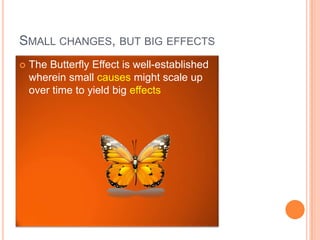
Small changes, but big effectsThe Butterfly Effect is well-established wherein small causes might scale up over time to yield big effects
Nature is Full of exemplary examples of the butterfly effect- to help your business growOpalReflecting and deflecting ideas for your businessMicro Nutrients for your businessSinging sand for your business
Singing Sand and Singing IdeasHave your heard sand singing?
Singing Sand and Singing IdeasSinging sand, whistling sand or barking sand is sand that produces sound. The sound emission may be caused by wind passing over dunes or by walking on the sand.Certain conditions have to come together to create singing sand:The sand grains have to be round and between 0.1 and 0.5 mm in diameterThe sand has to contain silicaThe sand needs to be at a certain humidity
Singing sand dunesscientists say that collisions between sand grains cause the motions of the grains to become synchronized. The outer layer of the dune vibrates like the cone of a loudspeaker. The particular note depends primarily on the size of the grainsThe emerging property of singing sand is very sensitive to the conditions in which sand exists.
What causes the Singing Sand?The sound is generated by the stress and pressure of the grains of sand colliding with each other. The collision causes a synchronized movement among the grains, while the outer layer of the dune acts as a giant loudspeaker as the grains fall.Sweet Stress
QuestionHow to find the conditions so that your staff pressure each other to sing while even falling
sound-generating plantsSome plants make interesting sounds as well. Ornamental grasses come in many varieties and as wind moves through their foliage, it produces relaxing sounds.
OpalOpal is a closely paled array of millions of spherical particles of amorphous silica stacked in a three dimensional grating. Because of the special grating of the spheres, it has the unique natural ability to diffract sunlight into all the beautiful colors of the rainbow.A condition called crazing affects certain opals, causing them to form internal and external cracks. Crazing is a particularly interesting phenomenon, for it lacks consistency and is unpredictable.
Colorful opalOpal's internal structure makes it diffract light; depending on the conditions in which it formed it can take on many colors. Opal ranges from clear through white, gray, red, orange, yellow, green, blue, magenta, rose, pink, slate, olive, brown, and black.
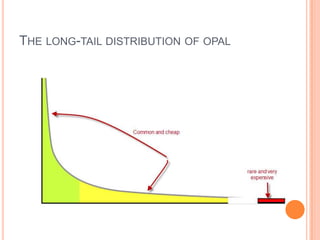
The long-tail distribution of opal
Opal StructureOpal is made up of layers of precipitated silica spheres in a jelly-like water .The density and pattern of the aligned silica spheres are responsible for the different colors refracted in the Opal. Common Opal lacks this effect, for its spheres are disordered or too compact to permit the light from refracting
Reordering your organizationSilica may sing while falling or diffract light depending on its unique structureBehaviors emerge just by making small changes in the ordering of silica spheresYour attempts will give largely common and unworthy results. Those hits that will fall in the long tail are your black sawn. Is it better to plan or use a try-and-find approach? For me, it is the latter
Micronutrients- Small in amount, but big in effectLack of certain nutrients leads to different plant problems, See the presentation on slideshare entitled, “Managing the Undermanaged Nutrients”
Small variation lead to big behavioral differencesNotice the delicate equilibrium
The Same in EnzymesMicronutrient atoms can impact the structure and functions of enzymes as well
Lessons for organizationsLesson 1Look for small variations that impact your organization. Most likely being small they reside in the long tail. They are in disguise.
Lessons for organizationsLesson 2Small variations are not observed by your competitors. Find them as they promote your business and move it to the Blue Ocean
Lessons for organizationsLesson 3Trial-and-find approach is recommended. You have to experiment to get your efforts singing even when collapsing.
Lessons for organizationsLesson 4Look for the micronutrients that make your business grow healthily.

Buried ideas singing loudly

  • 1.
    Buried Ideas singingloudlyAli Anani
  • 2.
    Small changes, butbig effectsThe Butterfly Effect is well-established wherein small causes might scale up over time to yield big effects
  • 3.
    Nature is Fullof exemplary examples of the butterfly effect- to help your business growOpalReflecting and deflecting ideas for your businessMicro Nutrients for your businessSinging sand for your business
  • 4.
    Singing Sand andSinging IdeasHave your heard sand singing?
  • 5.
    Singing Sand andSinging IdeasSinging sand, whistling sand or barking sand is sand that produces sound. The sound emission may be caused by wind passing over dunes or by walking on the sand.Certain conditions have to come together to create singing sand:The sand grains have to be round and between 0.1 and 0.5 mm in diameterThe sand has to contain silicaThe sand needs to be at a certain humidity
  • 6.
    Singing sand dunesscientistssay that collisions between sand grains cause the motions of the grains to become synchronized. The outer layer of the dune vibrates like the cone of a loudspeaker. The particular note depends primarily on the size of the grainsThe emerging property of singing sand is very sensitive to the conditions in which sand exists.
  • 7.
    What causes theSinging Sand?The sound is generated by the stress and pressure of the grains of sand colliding with each other. The collision causes a synchronized movement among the grains, while the outer layer of the dune acts as a giant loudspeaker as the grains fall.Sweet Stress
  • 8.
    QuestionHow to findthe conditions so that your staff pressure each other to sing while even falling
  • 9.
    sound-generating plantsSome plantsmake interesting sounds as well. Ornamental grasses come in many varieties and as wind moves through their foliage, it produces relaxing sounds.
  • 10.
    OpalOpal is aclosely paled array of millions of spherical particles of amorphous silica stacked in a three dimensional grating. Because of the special grating of the spheres, it has the unique natural ability to diffract sunlight into all the beautiful colors of the rainbow.A condition called crazing affects certain opals, causing them to form internal and external cracks. Crazing is a particularly interesting phenomenon, for it lacks consistency and is unpredictable.
  • 11.
    Colorful opalOpal's internalstructure makes it diffract light; depending on the conditions in which it formed it can take on many colors. Opal ranges from clear through white, gray, red, orange, yellow, green, blue, magenta, rose, pink, slate, olive, brown, and black.
  • 12.
  • 13.
    Opal StructureOpal ismade up of layers of precipitated silica spheres in a jelly-like water .The density and pattern of the aligned silica spheres are responsible for the different colors refracted in the Opal. Common Opal lacks this effect, for its spheres are disordered or too compact to permit the light from refracting
  • 14.
    Reordering your organizationSilicamay sing while falling or diffract light depending on its unique structureBehaviors emerge just by making small changes in the ordering of silica spheresYour attempts will give largely common and unworthy results. Those hits that will fall in the long tail are your black sawn. Is it better to plan or use a try-and-find approach? For me, it is the latter
  • 15.
    Micronutrients- Small inamount, but big in effectLack of certain nutrients leads to different plant problems, See the presentation on slideshare entitled, “Managing the Undermanaged Nutrients”
  • 16.
    Small variation leadto big behavioral differencesNotice the delicate equilibrium
  • 17.
    The Same inEnzymesMicronutrient atoms can impact the structure and functions of enzymes as well
  • 18.
    Lessons for organizationsLesson1Look for small variations that impact your organization. Most likely being small they reside in the long tail. They are in disguise.
  • 19.
    Lessons for organizationsLesson2Small variations are not observed by your competitors. Find them as they promote your business and move it to the Blue Ocean
  • 20.
    Lessons for organizationsLesson3Trial-and-find approach is recommended. You have to experiment to get your efforts singing even when collapsing.
  • 21.
    Lessons for organizationsLesson4Look for the micronutrients that make your business grow healthily.