“Bullies”         1

by
Nancy Knight


                                                                          zxg


                                   Bullies


                        1. Innocence and Ignorance


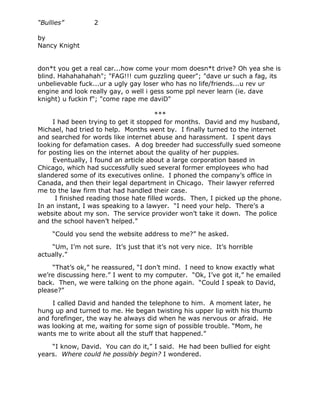
One day in the spring of 2001, I was sitting at my computer desk. I stared
at the sheets of paper scattered in front of me. A ribbon of letters and
punctuation marks stretched like a banner across the top of each page:
http://us.geocities.yahoo.com//gb/view?member=daveknightisgay. I knew
the last four words, daveknightisgay, were a lie meant to humiliate him. The
insult could have been just another childish prank—except that it was a
website, available for the whole world to see.
      There was a photograph of my son, David, at fifteen years old, on the
first page. He was wearing a baseball cap. I turned to the next page. “Tell
your friends what you think of Dave Knight!” it said. I glanced over the lines
of text that pretended to introduce each contributor: J, Maveric, FU, Cpt.
David Knight, ur mother, and dogg. The name of the school my children had
been attending was printed above each entry: Pearson. I started to read
those comments one more time, courting the pain they caused; as if with
the suffering, I could purge myself of the guilt of inadequacy. I am his
mother. I couldn’t protect him. Am I a failure?

                                     ***

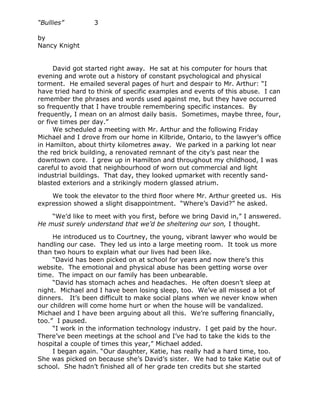
    "dirty fagget get somes friends and then take a shower and get ur
mother some glasses"; "stop using date rape on little boyz and then takin
them in the back of ur car. your dirt and so is ur sister..."; "dave is the
biggest fucked up fag i have ever met! his mom was on something bad when
she had him. U think ur so tough dave but ur not ur a flaming homo"; "Why
“Bullies”         2

by
Nancy Knight


don*t you get a real car...how come your mom doesn*t drive? Oh yea she is
blind. Hahahahahah"; "FAG!!! cum guzzling queer"; "dave ur such a fag, its
unbelievable fuck...ur a ugly gay loser who has no life/friends...u rev ur
engine and look really gay, o well i gess some ppl never learn (ie. dave
knight) u fuckin f"; "come rape me daviD"
                                       ***
     I had been trying to get it stopped for months. David and my husband,
Michael, had tried to help. Months went by. I finally turned to the internet
and searched for words like internet abuse and harassment. I spent days
looking for defamation cases. A dog breeder had successfully sued someone
for posting lies on the internet about the quality of her puppies.
     Eventually, I found an article about a large corporation based in
Chicago, which had successfully sued several former employees who had
slandered some of its executives online. I phoned the company’s office in
Canada, and then their legal department in Chicago. Their lawyer referred
me to the law firm that had handled their case.
      I finished reading those hate filled words. Then, I picked up the phone.
In an instant, I was speaking to a lawyer. “I need your help. There’s a
website about my son. The service provider won’t take it down. The police
and the school haven’t helped.”

     “Could you send the website address to me?” he asked.

    “Um, I’m not sure. It’s just that it’s not very nice. It’s horrible
actually.”

     “That’s ok,” he reassured, “I don’t mind. I need to know exactly what
we’re discussing here.” I went to my computer. “Ok, I’ve got it,” he emailed
back. Then, we were talking on the phone again. “Could I speak to David,
please?”

    I called David and handed the telephone to him. A moment later, he
hung up and turned to me. He began twisting his upper lip with his thumb
and forefinger, the way he always did when he was nervous or afraid. He
was looking at me, waiting for some sign of possible trouble. “Mom, he
wants me to write about all the stuff that happened.”

    “I know, David. You can do it,” I said. He had been bullied for eight
years. Where could he possibly begin? I wondered.
“Bullies”         3

by
Nancy Knight


      David got started right away. He sat at his computer for hours that
evening and wrote out a history of constant psychological and physical
torment. He emailed several pages of hurt and despair to Mr. Arthur: “I
have tried hard to think of specific examples and events of this abuse. I can
remember the phrases and words used against me, but they have occurred
so frequently that I have trouble remembering specific instances. By
frequently, I mean on an almost daily basis. Sometimes, maybe three, four,
or five times per day.”
      We scheduled a meeting with Mr. Arthur and the following Friday
Michael and I drove from our home in Kilbride, Ontario, to the lawyer’s office
in Hamilton, about thirty kilometres away. We parked in a parking lot near
the red brick building, a renovated remnant of the city’s past near the
downtown core. I grew up in Hamilton and throughout my childhood, I was
careful to avoid that neighbourhood of worn out commercial and light
industrial buildings. That day, they looked upmarket with recently sand-
blasted exteriors and a strikingly modern glassed atrium.

    We took the elevator to the third floor where Mr. Arthur greeted us. His
expression showed a slight disappointment. “Where’s David?” he asked.

    “We’d like to meet with you first, before we bring David in,” I answered.
He must surely understand that we’d be sheltering our son, I thought.

     He introduced us to Courtney, the young, vibrant lawyer who would be
handling our case. They led us into a large meeting room. It took us more
than two hours to explain what our lives had been like.
     “David has been picked on at school for years and now there’s this
website. The emotional and physical abuse has been getting worse over
time. The impact on our family has been unbearable.
     “David has stomach aches and headaches. He often doesn’t sleep at
night. Michael and I have been losing sleep, too. We’ve all missed a lot of
dinners. It’s been difficult to make social plans when we never know when
our children will come home hurt or when the house will be vandalized.
Michael and I have been arguing about all this. We’re suffering financially,
too.” I paused.
     “I work in the information technology industry. I get paid by the hour.
There’ve been meetings at the school and I’ve had to take the kids to the
hospital a couple of times this year,” Michael added.
     I began again. “Our daughter, Katie, has really had a hard time, too.
She was picked on because she’s David’s sister. We had to take Katie out of
school. She hadn’t finished all of her grade ten credits but she started
“Bullies”         4

by
Nancy Knight


acting out and we were worried she’d get into more trouble than she’d
already been getting into.
     “David’s grades are suffering, too, and the stakes are high. He wants to
get into the Royal Military College and the Canadian Air Force. He wants to
fly F18 Hornets but he thinks he’ll be lucky if he makes it into a community
college. He’s been injured so many times over the years. The school
probably can’t stop it even if they finally did try. It’s so severe and so
generalized now. He’s already been assaulted several times this year.”
     The following week, we were back in the lawyer’s office with David. In
yet another brightly lit room, the two lawyers patiently explained several
parts of Canadian legislation. One section in the Criminal Code of Canada
addressed the “duty of care” that requires those with whom we entrust our
children to act as a prudent and just parent would. “There’s a lot happening
right now with regards to bullying, and this website is definitely libellous,”
Mr. Arthur said.

      I didn’t know anything about bullying. I had only a vague notion of
what the word meant. There had been a lot of mean kids in Hamilton while I
was growing up there in the 1950’s and 60’s. I’d even been picked on. But
the only bullies I thought I knew were cartoon characters. Even as an adult,
I thought youth violence was something that happened in big American
cities, not in Canada.

     The conversation quickly moved on. Mr. Arthur asked us what we
wanted to accomplish. “Vindication for David,” said Michael, “He’s a good
kid and he didn’t deserve the treatment he got.”

     “I want to make sure it never happens to any other kid,” David said.

    “Correcting the systemic failings that allowed this to happen,” the
lawyers reworded David’s request into legal jargon.

     “An apology, too,” we all agreed.

     “How will we get their attention? They’ll think it’s just another lawsuit,
but, though money’s not important, if we ask for a lot of it, they’ll certainly
pay attention,” I volunteered.

    As we walked back to the parking lot, I considered the seriousness of
what lay ahead. This is going to cost a lot of money, I thought. It was also
going to change our lives.
“Bullies”         5

by
Nancy Knight


     During the next few weeks, we struggled to remember and document
details of every incident of harassment and every assault, every meeting,
letter and phone call to school administrators and staff, police and
government. We went to the big drawer in the study and the cardboard
storage boxes in the basement to get the report cards, the notes, the police
reports and all the victim impact statements we’d given to them. Over the
next few days, we told Courtney everything that had happened to us and
answered her many questions.

     Courtney sent us the first draft of the statement of claim at the
beginning of the holiday weekend. We searched through all of our notes
again. We relived our memories of each incident, confirmed the times and
places, and made sure even the smallest detail was correct.

    Later, Courtney asked David and Katie to write about their memories.
Michael and I wrote our stories in heart breaking detail in chronologies that
were dozens of pages long. As time went on, we kept adding to the pages
as our memories came flooding back.


                                     ***


Six years later, I gathered all of this together with hundreds of pages of
court documents. It’s all spread out on the floor of the small study in our
Toronto apartment. The legal documents are sorted into coiled binders with
legal titles printed on their front pages like Statement of Defence, Affidavit
of Documents, and Request to Admit. Within those documents, there are
the board of education policies and procedures, and the notes of school
administrators and the superintendent.

     We had learned a lot during those years when our children attended
public school about how local boards of education function. They have a
responsibility to interpret and implement the provincial Education Act that
affects our children and their education. Criminal law, provincial law, privacy
law, and even municipal bylaws, individually and together, impact what
happens in schools.

    I’ve spent years, organizing and combining all of this information into a
narrative about the day to day lives of our children at school. As I worked, I
was often overwhelmed by the magnitude of the violence and suffering my
“Bullies”        6

by
Nancy Knight


children had been experiencing everyday at school. I’ve been driven to
complete this task by the knowledge that thousands of children are going
through what my children experienced—every, single day.

     How naive Michael and I had been. As parents, we plodded on. We
tried to support and protect David and Katie by working co-operatively
within the system, only to find that the system: school, community, and law
enforcement, could not or would not help us.

      Over time, the bullying became more frightening. Trying to get it
stopped became more frustrating. Year after year, in an escalating cycle of
abuse, our children suffered. We gathered strength and courage. We
became more assertive and involved. But those who could make a
difference chose to look the other way.
      By the time we withdrew first our daughter, and then our son, from
high school in 2002, I had asked at least seven teachers, eight school
counsellors and school staff, three vice-principals, four principals, two
superintendents, two board of education staff, four parents of some of the
bullies, one director of education, one ministry of education employee, one
trustee, the privacy commissioner’s office, and several police officers, to
help. They all knew our children were being bullied. I know they knew
because I told them in person, phoned them, or wrote letters or emails.
Eventually I realized that the school principals were the ones who could have
made things happen, but didn’t.
      Over the next many years, I read everything I could about bullying,
youth violence, and teenage suicide. [ I learned even more at the national
conferences on bullying held in Ottawa and presented by Child and Youth
Friendly Ottawa (CAYFO). There, experts from all over the world shared
their knowledge of this tragic subject. ]
      I wanted to understand what words like bully, victim, bullying and
cyber-bullying mean. I looked up some definitions [in the AskOxford English
Dictionary on the internet. I had some fun looking up the word bully and
was surprised and amused to find that the word bully was once a term of
endearment. It probably originated from the Dutch word boele (bull as in
male cow). I like this use of the word in a piece of old English literature
titled: Thre Lawes published in 1538: Though she be sumwhat olde, it is
myne owne swete bullye. Later on in the 1500’s, the meaning of the word
took a drastic turn and a bully became: ]
“Bullies”         7

by
Nancy Knight


“A tyrannical coward who makes himself a terror to the weak, a person who
deliberately intimidates or persecutes those who are weaker,” one entry
read.
     [ All too often, bullies and victims are our own sweet and precious
children. Though all children instinctively seek acceptance, approval, and
love, bullies are children who have learned inappropriate ways to gain what
they think is the attention they so desperately need.
     Bullies fail to learn appropriate negotiating and leadership skills. Yet
these are children who could otherwise become good leaders. If left
unchecked, bullying evolves over time. I witnessed this from the misdeeds
of youthful urchins to the intimidating and threatening battles for power of
teenagers and adults. Bullies often get into trouble with the law. Little
bullies become big bullies in the workplace and at home with their own
partners and children. Thus the bullying cycle begins again.
     Victims are the unfortunate children who happen to be in the bully’s
path when the bully decides to find a target. Victims are usually isolated. In
the long term, they may suffer from low self-esteem. They may be
convinced that they somehow deserve to be bullied. They’re ashamed and
humiliated by it. They often have trouble trusting other people. Victims
usually don’t want to talk about the bullying. That’s why our daughter Katie
wouldn’t tell us what was happening to her. It was years before she
gathered the strength she needed to realize that she didn’t deserve to be
bullied and it wasn’t her fault.
     Bullies and victims are not the only children who are affected by
bullying. Barbara Coldoroso, in her book: “The Bully, the Bullied and the
Bystander,” (Harper Collins, 2002) introduces us to the great multitudes of
children who are also affected by bullying. These are the children who are
forced to witness this abuse day after day. As Ms Coldoroso wrote in her
book and I observed at my children’s elementary school, bystanders learn
that bullying behaviour is acceptable if there are never any consequences for
it. They lose their natural empathy for the victim and come to believe that
some people just deserve to be bullied. They see that bullying is a way to
gain power and that the bully always wins. They become the bully’s
admiring audience, they may align themselves with the bully (and help with
the bullying), or they may become bullies themselves--because they don’t
want to become victims. After all, which one of these characters would you
rather be--the bully, the victim or the bystander?
     So what is bullying? ] To me, bullying is what happens when someone
who is physically, intellectually, or socially more powerful hurts or denigrates
someone who is weaker. Bullying is not an argument between friends. It’s
“Bullies”         8

by
Nancy Knight


not an impulsive push or shove or even a punch, though it could be any one
or all of these things.
      Bullying is a deliberate and determined plan of attack meant to lower
someone else’s status within the group while raising the prestige of the
bully. That’s why bullying almost always takes place in front of an audience
or for an audience. The bully very rarely bullies when he or she is alone.
      [ In the twenty first century we have cyber-bullying. That’s a futuristic
word meaning the use of communications technology, like a computer or a
cell phone, to bully others. The psychological torment can invade the
privacy of your home and enter into every moment of your children’s lives.
You may never know it is happening. ]
      Should we accept or even excuse a bully’s behaviour? I don’t believe
that would be the kind thing to do. Teaching our children appropriate ways
to build healthy relationships and modelling that behaviour for them is the
responsibility of adults. Firm, deliberate, and yet compassionate
consequences for behaviour that hurts others, are essential. This takes
commitment from parents or educators or society. Someone must do this
work. There is no other choice. Our children are paying a very high price as
this violence is allowed to continue. They are hurting themselves and each
other. The cost to society, in terms of lost potential and even the lives of
our young people, is too great.
“Bullies”        9

by
Nancy Knight


                             2. The Early Days


Early on, Mr. MacIntyre, David’s grade one teacher at the privately-owned
Montessori school, asked us to meet with him. He was having difficulty with
David’s behaviour. “But if I had to choose someone to accompany me on a
long, difficult journey, it would be David,” he told us.
       Katie was attending that Montessori school, too. Both children had
attended the school since they were three years old. For the majority of
those early years, Katie had been in a separate class from David’s.
       Two years later, Katie, then seven years old, had been in the same
class as David for two years. She was doing fine and keeping up with her
grade two work. David was eight and in grade three. He was behind
academically and his behaviour was still a problem, Mr. MacIntyre, who was
still David’s teacher, told us. He suggested we take David to a tutoring
agency. But after we enrolled David, the owner of the Montessori school,
Mrs. Taylor, called me every week for a month. “We don’t need their help,”
she said. So we stopped taking David to the agency.
       Within days, the owner of that tutoring agency sent us a note:
“David’s needs should be addressed in a determined way,” it said.
       “I’m sure the Montessori teachers and Mrs. Taylor, as the owner and
administrator of the school, will take care of David,” I told Michael.
       The following year, Mrs. Taylor, hired a new teacher for David’s grade
four class. There were no more holes in David’s turtleneck shirts. For years,
I had imagined that he’d been pulling on them and I hadn’t mentioned the
holes until then. “Good work, David, you’ve stopped pulling at your shirts.
Look, they don’t have holes in them anymore!”
       “Mr. MacIntyre pulled my shirts. He dragged me out of reading circle.
He made the holes,” David looked down at his feet and shuffled a bit.
        “Honey, why did he do that?” I asked, hoping to hide my shock. Mr.
MacIntyre had been David’s teacher for three years and for that entire time,
there had been holes in the shirts.
       “I couldn’t sit still, Mom.”
       “How often did that happen?”
“Bullies”         10

by
Nancy Knight


       “Always,” he said.
        A month later, David told me he’d cut Darren’s hair with a pair of
scissors. Darren had been in David’s class since they were three years old.
“Darren wanted me to. He said it was funny,” David grinned.
       When I phoned the administrator’s office, Mrs. Taylor told me not to
worry, “The teacher is perfectly capable of handling the class,” she said.
       Soon after that, David told me he’d knocked over the room divider that
separated the work area from the reading circle. He stood up too quickly, he
said, and lost his balance. “What did the teacher do?” I asked.
       “She grabbed my shoulder and took me out of the room,” he said. He
looked down at his feet again. There was a nervous tightening in my
stomach. When I spoke to Mrs. Taylor again, she said not to worry.
       Soon after, we went in to see the teacher, Miss Gregory. “He’s a very
active boy,” she told us. “We need to nip this in the bud.”
       Nip what in the bud? I wondered. At home, David was a great kid to
have around. He was happy, funny, and loveable. But I began to notice
things. He was more active whenever the house was filled with company.
He often did things without thinking first: he’d rush across the kitchen with
an open carton of milk in his hands and trip over his feet, sending the milk
splattering across the floor. Then, he’d carefully help to wipe it up.
       I tried calling different organizations, hoping to find answers to David’s
busyness. The Hospital for Sick Children in Toronto transferred me to their
paediatric psychiatry department. “Tell your son you love him every day,”
the lady at the hospital instructed. “Tell him he’s a good little boy every
chance you get. Make sure you find something for him to do, something he
can do well, at least once a day. He’s a good boy.”
       That was easy. David could build intricate models with Lego bricks.
He could draw precise pictures of airplanes, boats, and cars. But there was
also chaos. When he wasn’t playing at something he really liked, or
watching television, David was a bundle of energy—and a whirlwind of
accidents. And things weren’t getting any better at school.
       I went to the phone book again. Soon, Mr. Sanders, a children’s
therapist, was sitting in our living room. David came into the room and
interrupted our conversation three times. I didn’t think of his behaviour as
disruptive but Mr. Sanders noticed. “He might be hyperactive. Let me test
him.”
       Mr. Sanders spent many evenings assessing David. Months later,
Michael, David and I were at the paediatrician’s office discussing the
therapist’s reports with her. “I’ve been thinking long and hard about this,” I
told the doctor. “David’s my son and I love him, but other people find it
“Bullies”         11

by
Nancy Knight


difficult to deal with such an active child. His behaviour is isolating him from
his peers. He’s in the middle of a game of Hide and Seek, he’s It, and he
gets distracted and just walks away, comes home and starts playing by
himself. He leaves all the kids waiting for him, still hiding in the bushes and
behind trees. They get furious. I think we need to help him.”
       “Do you want to try this, David?” the paediatrician asked him after we
had discussed available medications.
       “Ok,” he said. “I want to be good.”
       The doctor prescribed a small, twice a day, dose of Ritalin for him.
Ritalin is an amphetamine. For most of us, it would affect us like we’d had
several cups of coffee. For a hyper-active child, the results are different.
       Later in the day, we were all in the kitchen at home. We asked David
when he would like to try taking one of the pills.
        “I’m ok with right now,” he said, sticking his hand out for one of the
tiny pills and reaching for the glass of water we had ready. We started
talking again. As usual, David carried the whole conversation. He was
talking quickly, trying to get as much detail about the latest airplane he’d
been reading about into as short a time period as possible. Before David
had said six sentences we became transfixed, not on what he was saying,
but on how he was saying it. His speech slowed; his sentences became
more logical and concise; he looked more relaxed.
       “I feel like my brain is in a box!” he told us later with a huge smile.
       The Ritalin slowed his impulses and gave him a chance to think about
what he was about to do and the potential consequences, instead of doing
something as soon as it entered his mind. Mr. Sanders worked with David
for a few months. He prepared a classroom intervention strategy for Miss
Gregory to use in the Montessori classroom. Soon, she started telling me
she’d noticed a wonderful improvement in the classroom.
       But weeks later, Mrs. Taylor started calling me again. “Mrs. Knight,
we really don’t need the therapist. David chooses to misbehave. We can
handle it by ourselves.” She called me once a week for several weeks and I
was getting more agitated with each call. Why is she always trying to stop
me from helping David? I wondered. Is it the reputation of her school she’s
worried about, or my child?
       The next evening, I phoned Michael who was working in Ottawa
Monday to Friday. “Mrs. Taylor keeps resisting. The therapist says she’s
giving him a hard time, too. Can you talk to her?”
       “Nancy, I can’t phone her from work and talk about David in front of
everyone here.” I slammed the phone into its cradle.
“Bullies”        12

by
Nancy Knight


       That’s when I started having trouble with my stomach. It just started
to churn and heave. Whenever I got nervous or upset the cramps came.
They pounded downwards with such fury and without warning. “I can’t go
anywhere without checking for washrooms,” I told Michael.
       “Mom,” David said, “you just have to take Imodiums.”
       “What are they?” I asked.
       “They’re stuff you take when you have cramps or diarrhoea.” My
children had been watching more television, and more commercials, than I
had. With Michael away so much, and because I’ve had low vision for years,
I rarely had time to watch television and I never read magazines or
newspapers.
       Mr. Sanders, when he came to the house to counsel David, started
suggesting I transfer both David and Katie to public school. Then, Mrs.
Taylor called me for yet another weekly conversation about not needing a
therapist. I didn’t believe her anymore. “Mrs. Taylor, send David and Katie
home. I’m taking them out of your school,” I told the administrator.
       “Let me talk to Mr. Knight,” she demanded.
       “He’s not available. I’m their mother. Send them home.”
       “David’s a fine young boy, with concerns about his own behaviour,”
Mr. Sanders wrote in his last report. He also wrote about David’s three
requests: David wished that his behaviour would improve, he didn’t want to
be bad anymore, and he wanted to get to his work.
       That summer, we took David to a psychologist. “Please test him. We
want to know where he is academically and what we have to deal with.”
       “He’ll need lots of help to catch up,” she said after the tests were
done.
       “That’s ok. That’s our job,” I told her.
       By the time David entered public school, he was a well-behaved and
intelligent ten year old, who had already determined his own future. “I want
to fly airplanes,” he told us.
       “You have to work really hard at school,” we said.
       “I will!” he answered.
“Bullies”         13

by
Nancy Knight


                              3. New Beginnings

Soon after my last conversation with Mrs. Taylor, I called the local public
school and asked for a meeting with the principal. Mr. Hampton sat behind
his desk and observed me through his wire-rimmed glasses. His suit was
immaculately tailored, a dark blue pin-stripe, crisp white shirt, navy tie with
touches of powder blue and daring red. I felt awkward in my faded but
freshly laundered summer blouse and my cotton-twill skirt. I wished that I’d
had a chance in the last month or two to get my hair styled, but with all that
housework, laundry and the spring gardening to do, I kept putting it off.
      “Well now, Mrs. Knight,” the principal said, “tell me about your
children. Nothing anecdotal though, please.” I watched his lips moving
somewhere in the midst of his thick, brown moustache and his full beard.
      I held my breath for a moment and tried to think quickly. But I
couldn’t remember, or possibly never did know, what the word “anecdotal”
meant. I’d been a stay at home mom for nine years. I knew how to make
cookies and edible play dough, peanut butter flavoured. But I didn’t know
what that word meant. So I guessed.
      “Well, my son is a sensitive boy. He cries easily when he’s upset. His
face gets red when he’s embarrassed but he’s not afraid to express an
opinion if he knows he’s right. He never gets angry at anything. David’s
very smart. We’ve had him tested by a psychologist and his scores show
he’s far above average. He’s a little impulsive for a nine year old, but he’s
taking medication for his attention problems and he’s made great
improvements with the counselling that he’s had. We’re really hoping he
can have a fresh start here at Kilbride.”
      “Thank you, Mrs. Knight. That’s very enlightening, and your
daughter?”
      “Oh, Katie, she’s so quiet and shy, not outgoing at all. But she’s
friendly if approached kindly. She has the most beautiful brown eyes and
when she smiles, well her smile lights up her whole face.” I was feeling
more comfortable, gesturing and smiling--a proud mom fluttering like a
productive hen. “She’s very smart too. She likes working on her own and
she’s really very organized. Her room is always tidy. Unusual for a girl only
eight years old, don’t you think?”
      The principal stood up. “Please bring your children here next week so
they will have two weeks to familiarize themselves with this school before
summer break,” he said and gestured towards the door. “Make sure you
meet with David’s teacher early in the school year,” he said.
“Bullies”         14

by
Nancy Knight


       A few days later, I walked over to Kilbride School with David and
Katie. I was filled with doubt. Am I making the right choices for my kids? I
wondered.
       When we reached the main road, the crossing guard greeted us with a
huge smile. He gave a deep bow as he removed his cap—to reveal a
completely bald head! We all laughed politely. Any worries I had were
gone. David and Katie started talking about their new school. “It even has
a real gymnasium,” David said.
       Katie was placed in grade four. Marina, her friend from the Montessori
school, was also starting out at Kilbride School and was in the same class.
Their new teacher was a lovely young woman with a bright disposition. She
was a perfect teacher for a shy, quiet girl like Katie.
       After a holiday from Ritalin during the summer, David started taking
one pill in the morning and another at lunch. He said the medication was
helping him concentrate. Then David told me that his new teacher, Mr.
Barnett, yelled at him to pay attention and to do his work. David said that
he had felt embarrassed and cried. “Don’t worry David, we’ll have a
meeting with Mr. Barnett and explain why you might have trouble paying
attention, but you have to try hard to do your work,” I told him that day.
       Within days, Michael and I met with David’s teacher. Mr. Barnett was
a young teacher—one of the best in the school, another mom told me later.
The three of us discussed the difficulties David would have because of his
ADHD and the classroom strategies Mr. Sanders had suggested. Though I
quickly realized that the teacher hadn’t read the information I’d given the
principal to put into David’s file, I knew that Mr. Barnett understood what lay
ahead. After our meeting, he helped David to focus by casually mentioning
a fact or idea to David directly or asking him a question.
       He told us that David was making friends with two boys in the class.
Not surprising, I thought. David had a bright mind, an entertaining sense of
humour, a great reservoir of general knowledge, and an eagerness to share
this information with others. It was no surprise to me that his new friends,
Stanley and Aaron, were two of the smartest kids in his grade five class. I
thought that was just wonderful. What I didn’t understand, however, was
how the other children, who had been raised in the casualness of the small
hamlet and on the nearby farms, would react to David.
       There would be academic challenges, too. David was behind. Mr.
Barnett suggested we ask the vice-principal to flag David’s file so that he
could get extra resource help. I phoned the school and arranged a meeting
for the end of the following week.
“Bullies”         15

by
Nancy Knight


       Meanwhile, at home, I started to help David catch up. It was hard.
My vision hadn’t been good those last five years, but with some help from a
few workbooks, multiplication tables printed on the back of the suppertime
placemats, and a little creativity with pieces of macaroni to demonstrate long
division, David made progress.
       Early that week, Katie told me that some of the boys had been calling
her names. A few days later, I asked her if the boys were still bothering
her. “No Mom, they stopped,” she looked at me as if she was the mightiest
girl in the world.
       “Why do you think that is, Katie?” I inquired.
       “I told Mrs. Patterson when she was helping me in the resource room
and she talked to them about it.” Mrs. Patterson, one of the school’s
resource teachers, had been giving Katie extra help with multiplication.
       A day after Katie told me about that, I asked David and Katie about
the grass stains. I had first noticed the green patches on their clothing in
early fall, but because the play area behind the school was a grassy field, I
wasn’t worried at first. But David and Katie told me that some of the older
boys were pushing them. I phoned Mrs. Patterson and asked her to take
care of it. She had been able to stop the boys from hurting Katie so I
thought she would do something right away. But David was not as lucky.
              I started to ask him about what had been happening at school.
He told me that weeks before, he had seen one of the older grade six
students assaulting a young child who was too small to fight back. “Pick on
somebody your own size,” David had called out to the bigger boy. The older
boy immediately left the younger child alone and turned his attention to
David. The bully and his friends soon discovered that Katie was David’s
sister and started pushing her, too.
       “Who are these kids?” I asked David. But I realized that, because my
children were new to the school, they hadn’t learned the names of many of
the children, especially the older mischief makers.
       I was getting worried as David continued to come home after school
with bad news, but I wasn’t sure what I should do to help. I decided to wait
for our meeting with the vice-principal, and to give David a chance to
resolve the problem in his own way. But while we were waiting, David’s
problems got worse.
       “I was in the washroom,” he told me one day after school. “I finished
going and that kid who keeps pushing me was near the sinks. I asked him
how you use the towel.” I had seen the metal towel machines that were
hung on the walls in each of the school’s washrooms. Their continuous
lengths of white linen curled below each one. “Then the kid pulls the towel
“Bullies”         16

by
Nancy Knight


all out of the box. There was a whole bunch of it on the floor. The kid
wraps it around and around his legs, all around his waist, and over his
shoulders. He put it over his head and his neck, too,” David twirled and
made circles around his body with his hands. “He was laughing,” David
added. Then his brow furrowed. He frowned. “Mrs. Patterson came in.”
       “Who is this kid?” I asked David, not expecting an answer.
       “His name’s Stewart Martin,” David told me. He lowered his voice in a
tone of authority. “Mrs. Patterson says, ‘Get right down to the office Stewart
Martin!’” David illustrated by pointing and shaking his finger at an imaginary
Stewart Martin. But David’s fingers reached for his upper lip and started
pulling at it. “That kid Stewart, he said, ‘I’ll get you for this.’ He’s a pretty
big guy, Mom. Why does he want to get me?”
       “Some people like to blame others, because they don’t want to take
responsibility for their own behaviour,” I said. What sort of child could
Stewart Martin be? I asked myself.
       I set David to work on his handwriting at the kitchen table while I
sipped a cup of tea. I imagined Mrs. Patterson, the resource teacher who
had helped Katie, and who I had spoken to about the playground assaults,
must have been working in the resource room just across from the boys’
washroom. She must have heard the laughter and rushed inside.
     I started to find out more about Stewart Martin without even trying.
Rumours about him had been circulating around our community. It wasn’t
long before one of the townspeople told me one of them.
     At the age of eight, Stewart walked into the small variety store that
served the tiny hamlet, pointed a pellet gun at the owner and demanded all
the money in the cash register. The owner promptly went to the phone and
called the community police officer. Stewart was taken home to his parents.
     I needed only the rumours to understand that my son had somehow
attracted the attention of a troubled young man. I knew there was danger
but I had no way of knowing what to do about it. Thank goodness our
meeting with the vice-principal is in a few days, I thought. I’ll mention it to
her then.
       Michael and I had that meeting with Barbara Mackenzie, the vice-
principal. We talked about the psychologist’s reports and asked her to flag
David’s file. We told her about the assaults and taunting on the playground,
too.
       Mrs. Mackenzie wouldn’t agree to flag David’s file. She didn’t seem
too concerned about the playground assaults either. She wanted to see if
things would improve as David continued to take his medication, she told us.
But days later, there was another problem.
“Bullies”         17

by
Nancy Knight


       Kilbride Public School is set back from the hamlet’s main road by an
acre of grass field. A residential street runs out from the front of the school
past several ancient maples that edge the field. The street crosses the main
road and continues south.
       Jerry Woolcott, who was one of Stewart Martin’s closest friends, lived
on that street. He had already participated in much of the playground
bullying. David was by then the main target.
         That afternoon, Jerry waited on the driveway, at the far side of his
house, hidden from David’s view. When David passed by, Jerry jumped onto
his miniature, but very real, motorcycle, revved up the engine, and sped
towards David. He came within six inches of David’s heels and chased him
all the way home. By the time David bolted into the house and slammed the
door behind him, he was gasping for breath.
       As soon as he could explain what had happened, I phoned Barbara
Mackenzie. “He’s terrified,” I told the vice-principal after I explained what
had happened.
       “I’ll look into it,” she said.
       “It’s ok now, David. Mrs. Mackenzie’s going to look into it,” I told him.
But then the problems with Christine began.
        Christine was taunting David on the way home. At first, I wondered if
he was bringing any of the trouble upon himself. I started walking over to
the school. Every day, as I got closer, I heard Christine’s strong, projecting
voice repeating David’s name again and again. What I heard was not gentle
teasing.
       “Just ignore it,” I told David. But telling a ten year old boy to ignore
relentless taunts, when the embarrassment was obvious on his crimson-red
cheeks, was futile. By Christmas, the strain was frozen onto David’s face
every time he came into the house. Katie stopped walking home with him.
       “I’ll take care of it,” Barbara Mackenzie said when I phoned her. But
Christine didn’t stop.
       Things weren’t getting any better at the school either. Aaron and
Stanley, David’s new friends, were away at special enrichment classes two
days a week. That’s when David was alone. And that’s when Stewart Martin
and his friends bullied David the most.
       “What are they calling you?” I asked David.
       “They say things like fag, mother fucker, homo, loser...”
       “Ok that’s enough.” Those were words that David had never heard
before, but they were quickly becoming a part of his everyday school
experience. The boys were starting to punch and kick him, too.
“Bullies”        18

by
Nancy Knight


       Years later, we found notes that David had written about the winter
days after there had been a snowfall: “…In the cold weather, when all of the
kids are wearing heavier clothing, they seem to think it’s safe to be more
physical. I would open the door to go outside for recess, and someone
would be waiting with a snowball or a fist to hit me with. It seemed that
every day of my life was both a physical and mental struggle just to get
through the day without cuts and scratches.”
       My sense of what kind of parent I could be was quickly diminished by
the pain my children were experiencing and my inability to get it stopped.
Fearing that I was being regarded as just another worried mother, though I
was trying hard to maintain a professional relationship with the school, I
asked Michael to get involved. Michael and I started arguing fiercely about
this and the tension between us worsened. I began to wonder about
whether or not I was expecting too much of the school. Is that what school
is like these days? I asked myself. My school days were never like that. I
just could not imagine a school allowing such aggression to continue.
       Just before that Christmas, I walked up to the school. Pat Hunter was
coming out of the building after her lunch hour duties as a playground
supervisor. “What’s going on and why is David getting picked on so much?”
I asked. I was hoping to get more information from her than I had been
getting from everyone else.
       “It’s not a nice lunch,” she said. Frustration and anger seem to
surround her, I thought.
“Bullies”         19

by
Nancy Knight


                              4. Little Weapons


When I heard the back door open and close, and the shuffling and banging
as they tossed their boots and coats onto the big wooden box in the back
hall, I’d know my children were home. I could only hope that my
exaggerated cheerfulness, when they came into the kitchen, could hide the
dread that I felt. What happened today? I’d wonder.
       Katie always went right for the warm cinnamon loaf or the bite-size
peanut butter cookies in the wicker baskets on the counter. Increasingly,
without saying a word, she’d go up the stairs to her room. David usually
stood silently at the open refrigerator, looking for juice or chocolate milk.
Often, as he started to settle in, I’d notice a quick change in his posture, a
tightening across his shoulders, and a snap in his voice as he told me what
had happened that day. These after-school rituals became a constant
throughout the years the children attended public school. I became
accustomed to the daily outpourings of torment.
       That winter, David came into the kitchen after school and, avoiding the
refrigerator, he walked right to me. I was standing at the kitchen sink. He
carefully placed a shiny, steel blade on the counter beside me.
       “What’s that?” I asked softly.
       “It’s a comb,” he said. He was studying my face, staring right into my
eyes. I knew there was more to come because my stomach started to
squeeze. I waited. There was a little tremor in his voice when he said the
words, “A kid showed it to me.”
       “He showed it to you?”
       “Yea he showed it to me. It was really scary. Then he went away.
But he dropped it so I ran and got it. He didn’t see me. I put it in my
pocket really fast.”
       “It sounds like the boy may have threatened you with it,” I said.
       “Yea, I think he threatened me.”
       I looked carefully at the knife-comb. It was made of two thin shards
of shiny metal bolted together and locked at one end around a tight wire coil
so that the two sections could be jack-knifed apart to create a long, thin
blade. The last third of one end was slotted like a comb; the other end was
shaped into a sharply honed point. The last thing those kids need, are
weapons, I thought.
“Bullies”         20

by
Nancy Knight


       The next day was cold with a strong, cutting wind. That morning, I
placed the comb into an envelope. A little after noon, I tucked it under my
arm and walked to the school. I walked past the back corner of the building,
through the broken glass, pieces of metal and old newspapers that littered
the ground around the overflowing garbage and recycle containers, and
started looking for a teacher or a principal.
       The vice-principal was standing away from the school on the soft area
of the playground which stretched out from the black asphalt near the school
to the baseball diamonds and the snow covered fields beyond. She stood
like a frozen symbol of elegance in a long, fashionable cloth coat, matching
hat, gloves, and winter boots. I handed the envelope to her and explained
that David had picked its contents up and carried the knife-comb home to
me. The vice-principal looked into the envelope with obvious concern. “Oh
dear,” she said, “I will definitely look into this and do something right away.”
       But months later, it seemed, she hadn’t done a thing. Nothing
changed. The taunting and the aggression at the school, and Christine’s
harassment on the way home—none of it stopped.
       We were in the midst of one of the harshest winters we’d experienced
in Kilbride. The last thing I wanted to do was to walk over to the school and
back with my children. But other children from the village were starting to
follow Christine’s lead. Soon their taunting, including rude remarks and
gestures, were directed at me, too.
       I phoned Christine’s mother. “Please Lorraine, just tell her to leave
him alone,” I pleaded.
       When I called the school Mrs. Mackenzie’s answer was always the
same, “We’ll look into it,” “check on it,” “ask about it.”
       Neither the principal nor the vice-principal would answer me when I
asked them what had been done. “We’re looking into it,” they would repeat
like an overused mantra. But the name calling and assaults at school, and
the harassment on the way home didn’t stop.
       Katie was starting to withdraw. She’d go right to her room and hardly
say a word. I could see the tortured pain in my son’s eyes every time he
told me what had happened to him. Michael and I had been arguing fiercely.
It seemed that every day when he arrived home after work, I had another
report of persecution to tell him about. If he could only realized our
children’s pain, he would do something. I continued to plead with him to
talk to the school. “The school will take care of it. Stop causing trouble,” he
said.
       “They’re not doing anything!” I retorted constantly. I couldn’t
understand why the school was not responding to my concerns. Maybe
“Bullies”         21

by
Nancy Knight


Michael’s right. Maybe I am causing trouble, I thought at one point and
stopped mentioning the hurt feelings and scraped knees. But things only
got worse.
       One Saturday morning Michael was sitting in the study shuffling
papers on the desk. I walked into the room. I tried to convince him to write
a letter to the school and ask them to help my children. He kept shuffling
his papers. I fell apart. I threw the cold remnants of coffee that were in the
bottom of my cup onto his papers. Some of the brown liquid splashed up
onto his clothing.
       Michael fell apart too. His face went bright red. He looked like an
angry animal. He came around the desk and, with his face just inches away
from mine, he screamed at me.
       I screamed back at him, “What kind of man doesn’t protect his
family?”
       Michael wrote the first letter to Mr. Hampton that day.

***

Dear Mr. Hampton,
I would like to make you aware of a problem that is causing considerable
discomfort for my son David...”

***

       On Monday, I placed the letter in one of Michael’s old business
envelopes, hoping that the professional looking identification of the British
company my husband once owned would lend authority to the letter inside.
I changed into my nicest blouse and a pair of dress slacks, took two
Immodium tablets, and slipped my newest spring jacket on before I left the
house. My stomach continued to cramp as I walked along the village road to
the school.
       On my way, I rehearsed what I was going to say. The words I used
would need to be carefully chosen. Mr. Hampton was an intelligent man,
“...from a family of academics,” he had told me one day. Throughout my
years in public school, I had been taught to respect the adults who had
authority over me. As an adult, I admired and trusted the educators who
were responsible for the care and education of my children. I wanted to
ensure a good working relationship with them, while I sought to show an
adequate degree of assertiveness as the mother of my children. I held the
letter tightly.
“Bullies”         22

by
Nancy Knight


       I met the principal in the secretary’s office just inside the front doors.
At that moment, I forgot everything I had rehearsed on my way over to the
school. “Here,” I said, “you’d better read this and do something about it
now.”
       But nothing happened. Absolutely nothing changed. So, Michael and I
walked down the intermediate corridor and into Barbara Mackenzie’s tiny
office. We started telling her what David was going through. She didn’t
seem surprised by what we were telling her. Michael and I sat stunned as
she recommended that we enrol David in Karate lessons. “He’ll learn how to
defend himself,” she said. We left the meeting feeling completely
inadequate. We had failed to advocate for our son. The vice-principal had
promised nothing.
       Pat Hunter approached us just after we got into the car. “They’re
going to be starting Parent Councils in every public school,” she said, “Now,
we wouldn’t want a say in what goes on in our school, would we?” she
added.
       Oh yes we would, I thought.
       It took us two weeks to find a karate instructor who we trusted to
teach our children the discipline and confidence they would need in order to
endure the increasing aggression at school without becoming aggressive
themselves.
       After that, something strange started happening to me. I was getting
used to David’s daily reports of abuse. Of course, we were working hard to
get it stopped. Of course, I could feel his hurt and anger. Sometimes I
became very frightened. Sometimes, I ran out of things to say or do. My
mind couldn’t get around it anymore.
       “Oh, he hit you again, did he? Well did you tell the teacher? Oh, you
did? Well that’s good,” I said, as if ending my sentence with one positive
word made everything all right.
       For a while, David came home for lunch and that eased the playground
trouble. Occasionally, the harassment stopped. For a while we all felt
relaxed, went on with our everyday lives, and trusted that the school had
finally done something. But soon we were embroiled in another crisis and
the sickening fear returned. We would realize that the school hadn’t solved
the problem after all and we were crushed once again.
       There was a respite from all of the taunting during the winter break.
After that short reprieve, David was hurt again. When he told me what had
happened, his eyes were wide and glaring angrily at me. Do something,
anything, they silently signalled.
“Bullies”         23

by
Nancy Knight


        “I was walking in the hall,” David told me. “Christine kicked me in the
bum. It made me fall. All the kids were laughing at me.”
        “Why’d she do that?” I spluttered, stupidly. I yelled the words at him,
as if it was his fault. He took a step back, startled. As usual, I felt non-
functioning, useless. Maybe if he wasn’t so soft and sensitive these things
wouldn’t happen. Then I was ashamed of what I was thinking. I was trying
to find fault with my son, blaming him for what was happening to him,
because I felt so inadequate myself. Of course David didn’t know why. I
had no answers either. I couldn’t understand why a beautiful and popular
young girl would kick my ten year old son in the bum.
        So we were in the midst of yet another sequence of heartrending
reaction, reluctantly polite communication with the school, and pitifully
insufficient words of comfort for our hurting child. There was another round
of fierce arguments with Michael, but he wrote the next letter to the
principal much quicker that second time.

***
“...David was again picked on by Christine Camden. He was called
derogatory names and kicked on the bottom. ...a very upsetting effect on
David and is making it difficult for him to concentrate on his school work.
We are already bringing him home at lunch to avoid similar occurrences with
other students....we hope by dealing with it now, it won’t continue to
escalate in the future...”

***

      Again I placed the letter into an old envelope and delivered it to the
principal. “Please do something about this,” I said to him. But nothing
changed.
      Finally, I began confronting Christine every day as she walked home
from school, bolder and more mean-spirited than ever. My eyesight was
just good enough. I could pick out the tall blonde from the other smaller
children.
      After a few days of being told off for her bad behaviour and
embarrassed in front of her friends, she finally left David alone. Finally,
David could stay at school for lunch again, so he could spend time with
Aaron and Stanley.
      That year another strange thing had been happening. David’s red
Paddington Bear hat had disappeared almost as soon as school started. The
Blue Jays baseball cap went missing. Expensive sweatshirts were lost.
“Bullies”         24

by
Nancy Knight


When the weather cooled, he lost winter hats every week, along with
scarves, mittens, and even a pair of winter boots.

       When David told me that some of the boys were stealing his clothes, I
didn’t believe him. I thought he must have been absentmindedly misplacing
things. After all, most of the students were well dressed. Why would they
want David’s things? I wondered.

      When I finally asked David’s teacher why children were taking David’s
clothes, he told me it was all a game of Capture the Flag. The flag was
usually something David was wearing that the other students promptly
ripped off of him whenever he left the school building for recess or lunch.
The children ran after one another trying to capture the flag. Of course
David spent most of the time trying to steal back his clothes before the boys
could throw them over the fence or into the garbage dumpster.

      In the spring his brand new Nike baseball cap disappeared after only
one week. These losses were costing us a lot of money and I was getting
desperate. One evening, at the local team’s baseball game, I spotted one of
the other boys with a Nike baseball cap on his head. It was exactly the
same as David’s. I was sure that was David’s hat and decided to confront
the issue straight on. I walked towards the boy, ready to pounce and accuse
when I got there. But on the way, I decided I’d better be cautious.
      I approached the boy’s mom and tried to sound as polite as I could.
“That’s a really nice Nike cap,” I complimented, “It’s exactly like the one we
bought our son last week. He only got to wear it a few times before it went
missing.”
      “We bought it for him at the mall a couple of days ago,” the mom told
me. She looked right at me and smiled. “He’s been losing everything he
has,” she added, “We’re hoping he keeps this one a bit longer than the last
one and we told him he won’t be getting another one if this one disappears.”
      Not all of the problems were that harmless or ongoing. The violence
was sometimes completely unexpected. A boy we’d never heard of, walked
up to David and, for no reason at all, took a swing at him. David ducked
fast enough to avoid being hit and then quickly punched the boy in the
stomach really hard. The other child collapsed, gasped for air, gagged, and
threw up. The two boys were taken to the office where the principal yelled
at them both.
      Michael and I drove the children to school the next morning and met
the principal outside. “The other child started it,” he told us, “and justly got
the worst of it, too,” he said. He laughed as if he was telling us about a cock
“Bullies”         25

by
Nancy Knight


fight. “Of course, we’re supposed to have a zero-tolerance policy in effect
here,” he added with just a little more seriousness.
       Later, I had a more serious talk with my son. Years later, when he
was seventeen, David wrote about this conversation: “My mom was pretty
angry. She told me that from that day on that I was never, ever under
(any) circumstances to fight back. I listened to her, and that to this day has
been the only time I ever fought back.”
       Over time, David understood why this was important. School
administrators were always reluctant to discipline children for fighting.
When the aggression was reciprocated, it was impossible to get them to deal
with the perpetrator. Both children were disciplined if school administration
reacted at all.
       I was also worried about the bigger bullies. The boy who hit David was
tall but slight. David was smaller. But many of the older troublemakers
bothering David were much stronger. I could only draw on my childhood
experiences for the advice I offered him.
       I was fourteen years old, and on my way home from a Girl Guide
meeting. Two older girls forced me against a wall in a laneway. One held
my head down so the other could thrust her knee upward and into my face.
The incident left me partially blind in one eye and changed my life forever.
It’s difficult to concentrate on your schoolwork when you can’t see very well.
       I wanted to protect my son. To avoid severe injury, the wisest thing
David could do was to concentrate on protecting himself, rather than trying
to match a larger adversary blow for blow.
       “Do you want to fly airplanes, David?” I asked him.
       “Yea, Mom.”
       “Then protect your head and your face, honey.”
       But not all dangers are the same. Some are completely unexpected. I
just couldn’t prepare my children for everything.
       In late spring, David and Katie came home happy for a change. They
asked me if they could ride their bicycles. “Ok,” I said, “but stay close to
home. The roads are a bit busy right now.”
       Soon they rushed into the kitchen. “Some of the older kids are at
Randy Wilson’s house. Look, he shot me!”
       “How did he do that?” I said. I checked the small wound on his leg.
       “They were yelling at us. Randy went inside his house. He got a pellet
gun. He hid behind his trees. I thought he was going to shoot me and I
remembered about protecting my head and my face. I was trying to ride
away and he shot me.”
“Bullies”         26

by
Nancy Knight


       I felt sick. My stomach was upset and I rushed upstairs for an
Imodium. What if they’d hit him in an eye? What kind of a place is this? I
wanted to scream.
       “Who was there?” I asked him when I came back downstairs.
       “Randy Wilson was there, Mom. So was Jerry Woolcott and Luke
Carellia,” he said.
       I called the school. Barbara Mackenzie said she’d handle it as an after
school incident. “Leave it with me,” she said. I bet, I thought. I called the
police.
       About two hours later, an officer was sitting at our kitchen table
looking at the wound on David’s leg. He asked David who was involved.
When David told him that Randy Wilson had shot him, the officer frowned.
He looked at the wound again. “That doesn’t look like a pellet gun injury to
me,” he said.
       I assured him it was. “I believe my son,” I said.
       “Listen,” he said, “Mr. Wilson is a member of the emergency response
team here in Kilbride. I could be helping out at a fire with him and other
guys from this community. I’m not going to say a word about this one.” He
got up and left.
       I kept David home from school the next day and took him to our
doctor’s office in Burlington. “What does that look like?” I asked him.
       “It looks like a wound caused by a projectile travelling at high
velocity,” he told me.
       “Like a pellet gun injury?” I asked.
       “Yes, but listen, you’ve probably done all you can about this,” he said.
       When we returned home, I called the school. Mrs. Mackenzie said she
was looking into it. Empty words, I thought. Is this really all I can do?
       I was angry. I’m not going to wait for you any more, I thought as I
hung up and reached for the police department phone number again.
Another police officer was at our door a couple of hours later.
       “That looks like a pellet gun wound,” he said. He furrowed his
forehead and tensed his jaw. “Who did this?” he asked David. Minutes later
he left for Randy’s house and was back in our kitchen about an hour after
that.
       “Mr. Wilson says there’s never been a pellet gun in his house and
Randy said he was just hiding in the trees and having a pee.”
       “Is that all you can do about this?” I stared at him. “Those boys have
been harassing my son for months and now they’re turning our
neighbourhood into a duck shoot, and now you’re telling me this is all you
can do?” I wiped tears off of my cheeks.
“Bullies”         27

by
Nancy Knight


      “Are you all right ma’am? Listen that’s all I can do. If there’s
anything else wrong here though just let me know.”

      No you fool, I thought. But I was silent. It’s just that my poor child is
getting battered and no one will do a thing about it!
      After I had reluctantly sent David and Katie back to school, I phoned
the principal’s office to find out what they were planning to do.
      “We’re looking into it,” was all the vice-principal would say later when
she returned my call.
“Bullies”         28

by
Nancy Knight


                                  5. Excuses


David and many of his classmates were eleven years old and still very small.
But class 6-7 was a split class, which meant that though David was in grade
six, he would be together with some of the older grade seven students who
had been bullying him the year before. At least one of the boys who had
been there when David was shot with the pellet gun was in that class, too.
       News of the pellet gun incident was spreading. The local children
weren’t as interested in the fact that David was shot as they were about the
fact that we had called the police. Most of the intermediate and senior
students were already fiercely taunting David about “calling the cops”. Well,
the school wasn’t doing anything to address the problem; I thought when I
heard about the rumour from a little fellow in grade four.
       Michael and I had been trying to figure out why we weren’t getting a
response to our concerns. I looked through the Kilbride School Handbook.
Its instructions were clear. Parents were to mention any problems or
concerns to the teacher first, and then, if the issue was not resolved, they
were to inform the principal. There were no further instructions that told us
what to do if the school administration didn’t solve the problem. Maybe we
should solicit the teacher’s help early, Michael and I agreed. We prepared a
letter for him and tried to make it as clear and complete as we could. We
wanted to discuss David’s academic challenges as well as the peer
aggression issue.
        Our meeting with David’s new teacher, Mr. O’Leary, was on the same
day as Katie’s tenth birthday. We would rush into town after the meeting to
buy a birthday cake in time for a late dinner. We handed Mr. O’Leary the
letter. He read it carefully.
       “...Peer harassment – This is particularly worrisome to David. It
greatly affects the quality of his school work. Please document cases of
physical harassment so that we can take any steps necessary to solve it...”
       We gave Mr. O’Leary some literature about helping David in the
classroom. “I’ve got at least four other kids like this in the class,” he said.
“Have you mentioned this to school administration?” he asked us.
       “Yes,” we both said.
       “You should mention it again,” he added as he arranged the notes we
gave him into a neat pile.
“Bullies”          29

by
Nancy Knight


       Soon, David came home with some news. “Mr. Hampton’s going to
get a rifle, Mom.” He didn’t often use that tiny little voice of his those days
but right then he was sounding like a toddler. Why on earth would David be
aware of that? I wondered.
       “I heard him talking on the telephone. He asked someone when they
were going to deliver his rifle,” David said. He picked at his lip.
       “It’s hunting season now honey. Maybe he’s going hunting.” David
stopped picking at his lip and took a sip of his juice.
       After David and Katie went off to school, I turned on the radio. There
had been a shooting at a school just a few miles away. A young man had
walked into a secondary school and shot a teacher and a vice-principal. It
seems that someone else has gone hunting, too, I thought. I called Kilbride
school.
       When Mr. Harris, the Resource teacher, answered, I was surprised.
“Mr. Harris, I just wondered if you’d heard the news today. There’s been a
school shooting. I wanted to let Mr. Hampton know.”
       “Oh dear. Thanks Mrs. Knight. John isn’t here. He’s away on a retreat
but I’ll contact him and let him know. I’m sure he’ll appreciate that.”
       “Listen, Mr. Harris,” I added, keeping my voice serious, “David
overheard Mr. Hampton talking on the telephone yesterday about the
delivery of a rifle. I don’t think it’s the sort of conversation the children
should be overhearing and given that David was shot with a pellet gun in
June, I think it worried him.”
       “I’ll check on that,” he said.
       “David’s been having a really rough time at school. The other students
are picking on him. I think he’s getting more of the abuse than he deserves.
Couldn’t you do something about it?”
       “I’ll check into that as well,” he said, “and I’ll get back to you if I find
out more.”
       I hung up the phone disappointed. He had given me the standard
answer anyone at the school I spoke to always gave me. Is it their way of
dismissing a concerned parent? I wondered. I decided to try talking to
Barbara Mackenzie again.
       It was much easier to walk over to the school, rather than leave a
message with the secretary and risk the call not being returned, so I had
many in the hall meetings with the school’s administrators. “David’s still
getting picked on during lunch and recess,” I said. “Now listen Barbara, you
and John are telling me that there’s zero tolerance for fighting, but you’re
not doing much about all the abuse David’s getting. Why are things so
difficult on that playground?”
“Bullies”         30

by
Nancy Knight


       She spoke in a whisper, “There’s just not enough supervision and not
enough money to hire anyone for the job.”
       “Then I’ll come and help,” I said. “My eyesight isn’t that great, but I’ll
try.” I imagined myself coming to the rescue of a suffering schoolyard,
somehow able to arrest the raging tide of violence.
       Soon, I was helping out at the school as a volunteer lunch supervisor.
I helped in the classrooms, in the halls, and on the playground, almost every
day. I started to discover what was happening inside our public school.
       And Michael and I continued to try to get extra help for David. We
asked Barbara Mackenzie to flag David’s file. His report cards were reflecting
the difficulty he was having organizing his work.
       “David is progressing,” she explained, “His grades are acceptable.
There’s no reason for extra help or identification.”
       “But he’s not reaching his potential. He’s a brighter child than his
grades reflect,” I tried again with no success. We mentioned the abuse
again, too, but we knew we were on our own.
       I started searching for a tutor and decided to hire the girl next door.
She was a bit older than David, and an excellent student. With her help,
and the better notes he was taking with the laptop Mr. Barnett had
suggested we buy the year before, David’s work started to improve. But the
violence on the playground did not.
       It was clear that the principal and vice-principal knew there were
problems with student behaviour. One day, Mr. Hampton gave me two
newsletters. The articles inside were about the relationship between an
abuser and his or her victim: The Cycle of Abuse. Another day, on the
playground, Mr. Hampton moaned, “You know, Mrs. Knight, there are some
weeks when at least one hundred students are sent to my office.” Days
later, he explained that some of the children were so difficult to handle that
he and other staff members were sent on a conflict resolution course to
learn how to deal with them. “You’ll soon get to know the few children who
cause the most trouble,” he said. I already knew who some of them were
because they’d been hurting David.
       Later, the principal explained, “Mrs. Knight, as employees of the board
we are required to maintain the strictest confidence about everything
concerning the school and the children within it. Though this officially
applies to employees only, I would request that, as a volunteer, you
maintain the same standards.”
       “The only way to survive around here is to keep your mouth shut,” Pat
Hunter told me later as we supervised the playground together. I was
slowly getting the message. Everyone knew that there were children at the
“Bullies”         31

by
Nancy Knight


school who were troubled and dangerous but no one was supposed to talk
about them.
       My first experiences on the playground were harrowing. There were
several fights during each lunch hour, with accompanying injuries --usually
caused by the same students day after day. That playground wasn’t
anything like the playground scenes I remembered from my childhood.
       In all my years attending public school, I never once felt unsafe. I was
shy, yet I always felt welcome on the playground. The games we played
were inclusive. They required co-operation and teamwork.
       We quickly and efficiently learned games, songs, crafts—and
behaviour--from each other. There was a communications web of current
events and safety warnings, sometimes brutally accurate, sometimes
horrifically wrong: Dirty Joe was hanging out in the alleyway behind the
school; don’t kiss anyone with a cold sore; a little girl was killed when she
tripped and fell under a bus, so be careful; and if you eat too many apples
you’ll throw up. The city-wide newspaper couldn’t have done a better job.

       Misinformation, prejudice, fear, and hate also swirled around a school
under the radar of adults who, I suspect, may have been the source of much
of it. Those were dangerous times for gay teachers, d.p.’s, yips, krauts,
ukes and niggers. Adult debates, repeated through children’s mouths, could
spread like an insidious and unchecked evil. Without the benefit of objective
and rational information and debate, we learned about fear and loathing as
rapidly as the games we played.

       Though mostly unaware of these youthful communications, our
teachers seemed to be constantly present, a reassuring and clear reminder
that we should behave. A child who misbehaved would find himself or
herself carrying a note home which had to be signed and brought back to
the teacher. Our parents were willing to back the teacher up every time.
Our teachers treated us with respect. Not once was I ever spoken to rudely
or in a way that made me uncomfortable.

      Later, as we got older, there were many incentives for good behaviour.
A happy teacher often organized extra privileges, and special excursions.
These privileges were withdrawn and cancelled at a moment’s notice if
behaviour was not up to expectations—for the entire class. Peer pressure to
behave could be very powerful when an interesting day away from the
classroom was at stake.

      At Kilbride School, everything seemed so different. School just wasn’t
as nice as it used to be. No wonder David’s having such a difficult time, I
“Bullies”         32

by
Nancy Knight


thought as I walked around the playground. Surely there must be some
way to deal with the few individuals who are causing so much turmoil and
hurt, I considered.

       The next time I found John Hampton and Barbara Mackenzie together
in the principal’s office, I asked them if I could speak with them. “I’m
concerned. Such a small group of students really are causing much of the
trouble on the playground,” I said. “Surely you know them, too. You must
know it’s like a free for all out there every recess. There must be something
that will help.”
       John Hampton became agitated. “Mrs. Knight, what do you mean?”
       “I’m concerned about the level of aggression on the playground and I
want to know what’s being done and what can be done to stop it,” I said.
       “Mrs. Knight, why are you here?” he growled and then added, “Why
don’t you just leave?” John’s candidness during our earlier conversations had
disappeared. I started to cry as I left the office and walked home.
       Later that day, John phoned to apologize and ask me to go back to
help. It took me a week. My stomach was upset whenever I started to think
about heading over to the school and I had to take a couple of Imodium to
settle it before I could leave the house.
       It wasn’t long before I went to the principal again. Desperate to stop
the bullying, I pleaded for any help available. I wasn’t really surprised at his
answer.
       “Mrs. Knight,” he said in his most knowledgeable teaching voice, “I live
in a home that was built years ago by my parents in a farming community
similar to this one. Whenever someone new moves into a home that had
been inhabited for years by one of the families that first farmed the land,
local people still refer to that house as the McArthur’s place, or the Kramer’s
place. It is very difficult to meld into a small, rural community like this one.”
       I tried again with Mr. Harris, the resource teacher I had talked to
about the rifle. “Katie’s okay. Her best friend is here with her from their
previous school. David’s met two friends from outside of the community,
but they’re all having a lot of trouble fitting in with the local kids, or rather,
getting many of the local kids to stop bullying them. Is there anything you
can do?” I asked.
       “Yes actually, Mrs. Knight, I’m thinking of starting up a small social
group for the children who are new arrivals to the school. Leave it with me
and I’ll get back to you.”
       Weeks later, I met Mr. Harris in the hallway again. “Any news about
that social group?” I asked him. He didn’t stop to talk. He just shook his
head and walked on.
“Bullies”         33

by
Nancy Knight


       When I started hearing Tyler Harvey’s name, I realized that the new
kids might not be the ones David needed as friends anyway. Tyler Harvey
was one of those new arrivals. He was a short but well muscled fellow, and
very quick on his feet. He made a bold entry onto the scene by tackling the
other boys at lunch. At first, Tyler didn’t have a good idea which students
were easy targets and which ones to leave alone. Of course, the better
fighters immediately put Tyler in his place. This left just a few potential
victims--including David, still one of the smallest boys in his class. Tyler
Harvey was assaulting David relentlessly every recess, tackling him from
behind, or diving head first into his stomach.
       “David, why don’t you ask Sensei Deluca to teach you some defensive
moves?” I suggested before his next karate lesson.
       “David’s not a punching bag,” Brian Deluca told us a few days later.
       “We know Brian, but the school won’t do anything.”
       I tried Mr. Hampton again. “David’s being picked on constantly.”
       “You know Mrs. Knight,” he replied, “My own son is also having
difficulty at the school he attends. He has been taking medication which has
made him gain weight. It’s worrying, I’m sure, that David is having
difficulty making friends.”
       “He’s not having trouble making friends. He has two good friends in
his class. They’re the boys who go to brainers. It’s the local kids who are
beating him up and constantly harassing him.”
       But the principal was more interested in the term I used to describe
the students who went off to their special classes. “Brainers?” he said,
raising his eyebrows.
       “Yes, that’s what the children call the gifted students. The enrichment
class has isolated those children from their peers. I’m surprised no one has
considered the repercussions whenever people, and children, are categorized
and separated from one another. David has befriended two of them. When
the three boys are together, they’re ostracized as a group, but when David’s
by himself, he gets bullied.” The principal looked thoughtful for a moment
and then he walked into his office and closed the door.
       At karate lessons, Brian taught David how to defend himself against
the kicks and punches of daily playground activity. But soon I was
mentioning it to the vice-principal again. “Barbara, if this continues I’m
going to have to give David permission to fight back,” I told her.
       “David would certainly not be allowed to hit anyone!” She was
actually quite right. Defensive manoeuvres would protect my son.
       Over time David became quite adept at raising a knee or an elbow to
thwart the onward attack of a rushing Tyler Harvey whose own force was to
“Bullies”         34

by
Nancy Knight


be the cause of his own injury. Tyler would eventually learn that David’s
bones were a lot harder than he was. Sadly, Tyler would eventually look for
a more vulnerable target. At the end of that school year his family moved
away. Unfortunately though, Tyler was only one small part of the problem.
      Mr. Hampton,” I said to the principal in my most assertive voice as he
stood at his office door. He was a rather short man but looked taller in his
usual well-tailored suit and striped tie. “Surely there’s got to be some help
you can offer my son. There’s no way he should be treated so horribly and
no way these kids should be allowed to behave the way they’re behaving.
Don’t you have something you can offer us?”
      John went to the large filing cabinet in the corner of his office and
removed one of the multi-layered requisition forms from the top of it. He
sat down at his desk and began filling it in. “Mary Lou Gibson will call you in
a few days,” he said.
      Mary Lou Gibson was soon sitting at the kitchen table with me and we
were discussing my children. Her first advice was baffling. “Try letting his
hair grow longer,” she told me one day, “and he should really stop wearing
those track pants. A nice pair of blue jeans would look much better on him.
He needs to work on his tidiness, too. He often looks a bit dishevelled.” As
soon as we could, we went shopping and we began to fix our son. Strange
advice though, I thought, since the other kids aren’t dressed that much
better.
“Bullies”        35

by
Nancy Knight


                                 6. Parents


For a fledgling Parent Council, that first year, we were doing well. A few
well-organized and knowledgeable moms had helped initiate the first
meetings: red binders filled with information about parent councils, meeting
procedures, and copies of government and board policies and procedures
were included. We began to read up on Robert’s Rules of Order.
      The Parent Council meetings went well at first, but the objections
started coming in: Why didn’t everyone get a red binder rather than just the
parents who had signed up and put their names up for election? The
meetings were too formal and it was difficult to follow the Rules of Order.
Besides, some said, why do we have to follow the rules the government had
set down for the councils anyway?
      Committees were formed. I had signed up for the Safe Schools
Committee and some of us had added a few touches to the school’s Code of
Conduct to make it unique to our school community: we added the name of
the town to the board’s already adequate document.

       Mary Lou soon told me that she’d be visiting David’s class once a week
to explain and emphasize the expected behaviour and the listed
consequences for behaviour that was unacceptable. “We’re hoping we can
stop much of the harassment towards David by working with the whole
class.” So the Code of Conduct leaflets were distributed to each student
and for about three or four weeks, once a week, Mary Lou spoke to the
class.

      But nothing changed for David and much of the abuse got worse. I
reported Stewart Martin’s behaviour. “Some of the other children are giving
David a hard time, too,” I said to John. “What about the Code of Conduct?
Doesn’t that mean anything?” Why’s he shaking his head? I wondered.

       The next Safe Schools meeting was held in the room at the back of the
library. There were several parents in attendance and later on, John and
Barbara dropped in and stayed while we discussed the work we were doing.
“Bullies”         36

by
Nancy Knight


       I spoke up. “I’d like to mention the amount of aggression and the
injuries that are happening on the playground. It’s getting worse over time
and I wonder if parents have any idea how difficult things are.”
       “Mrs. Knight, what on earth do you mean? There are no issues
concerning aggression here!” John had raised his voice, his face was red.
His forehead furrowed into an angry twist.
       “There certainly is a problem,” I persisted. “And I think it needs to be
addressed in some way. A few children at this school are causing major
problems because of their unchecked behaviour.” I tried to stay relaxed and
confident. There was total silence in the room. I could hear the breathing of
the other mothers. Not one spoke up.
       “All of the children in this school are doing just fine and I would
appreciate it if you would be silent, right now!” he shouted at me. I glared
back at him as he and Barbara quickly left the room.
       I pleaded with Terry. Terry Noble was a paid lunch supervisor and a
tornado of energy and authority. “They don’t do anything about anything,”
she often observed as she led another injured student into the school.
       “It’s like bringing the injured in from a war zone,” we both said to John
one day.
       “Whenever I call parents to tell them about their children’s injuries,
they usually ask me why I’m bothering them. They tell me injuries are just
part of a child’s life and we’re supposed to take care of it,” he explained.
       Barbara McKenzie had a similar view. “Parents are never home during
the day and if I was to try to call for everything that happened, I’d be on the
telephone all evening,” she said.
       “Please Terry, if you come to one of our meetings and tell the other
moms just what’s going on here, maybe they’ll believe me. I can’t persuade
anyone as long as John and Barbara keep denying anything’s wrong!”
       The next meeting was the following week and Terry was there with
me. “You know, the behaviour of the kids on the playground is atrocious. It
may be difficult for you to understand how ordinarily nice children can be so
aggressive at school but the behaviour has been allowed for so long, they
are all getting out of control,” she said.
       One week later, one of the moms joined me on the playground. “But
Nancy, everything looks just fine to me,” she said.
“Bullies”         37

by
Nancy Knight


       “Yes, on the surface it does, but every day there are fights and
injuries. We report the misbehaviour but no one does anything about it.
The principal never gives out any consequences and the Code of Conduct is
just a joke.” She looked doubtful.
       Another day on the playground, I was talking to Katie’s math teacher.
“The school’s administration never seems to do anything about the
harassment and beatings David is getting,” I said to her. She didn’t say a
word.
        “Mrs. Knight,” the principal spoke to me quietly soon after the
committee meeting, “I do not like to be embarrassed in a public forum.”
       About the same time, the vice-principal saw me in the hall. “We’re not
allowed to refer to the children in any way, especially in a public meeting,”
she said.
       Still later, the principal spoke to me again. “Mrs. Knight, if we were to
openly refer to anything that occurred here at the school, or even alluded to
the fact that any situation may have happened, it could be understood, in a
small community like this, to be confirmation that a rumour is true. We
don’t want to risk the reputations of our children, staff, or the school,” he
told me.
       “Then you have to deal with the problems on your own, but deal with
them,” I replied.
       “Why won’t they do anything?” I asked Mary Lou next time I saw her.
       “You know, some parents want some children to be expelled from
school for every little thing,” Mary Lou replied.
       “We want the abuse to stop. Why won’t the principal do anything to
help David? He accuses me of being negative every time I mention there’s a
problem. It’s like hitting a brick wall every time the subject of behaviour
comes up.”
       “Oh it’s just John,” Mary Lou explained with a toss of her head, “I’ve
worked with him for years and I pretty well know how to get to him. It’s
just that he doesn’t consider you part of the family!”
       During one lunch hour, after the halls emptied, I saw Terry standing
near the office door. There was a group of older boys huddled together in
the senior hallway near the science room. I could hear one of the kids
saying, “Maybe he won’t look like such a fag.”
“Bullies”         38

by
Nancy Knight


       Terry rushed towards the group, angrily gesturing the kids towards the
door and yelling, “Five on one isn’t fair!” The boys scattered, leaving David
on the floor, shaking with fright. I hurried after Terry and gave David a hug.
“Are you alright David?” I said. I asked him if he wanted to go home or was
he ok to go outside. “I’m ok,” he said, “I’ll go outside.” On the way out, he
told me what had happened.
       The five boys surrounded David and pushed him to the floor. One of
them took out the metal stud that was in his ear and tried to stick it into
David’s ear lobe while the other boys laughed and held David down.
       Terry walked outside with us. I looked for John so I could tell him
what had happened but never saw him. “I told John what happened to
David,” Terry said later that afternoon, “but I bet he doesn’t do anything
about it. He never does.” She shook her head.
       Soon after that, things started happening in the change room next to
the gymnasium. Mrs. Ravemsberg was the gym teacher. Her energy
seemed to vitalize the entire school. Her thick brown hair was often tied up
high behind her head and, though she was not a tall young woman, the
bobbing ponytail could be seen from all directions as she led her students
around the gymnasium or over the grounds of the school.
       The boys’ change room was a particularly dangerous place. The
young, female teacher rarely went inside. After class one day, one of the
boys took David’s aerosol can of deodorant away from him. Another boy
held a cigarette lighter close to the spray and used it and the deodorant can
as a flame thrower. One of the older students ran out of the room and
came back with the teacher. Mrs. Ravemsbirg asked David what had just
happened and David told the truth. The older boy stared at him and smiled.
Mrs. Ravemsberg gave the boys a lecture about safety but David slowly
realized he had been set up and was going to be accused of ratting on his
classmates.
       Outside of school, at their karate and piano lessons, Katie and David
did well. None of the other children from the school who were the same age
attended Karate and the music lessons were individual sessions. We hoped
that outside of school, on the baseball team, the boys would get along.
       In early spring, the baseball practices started up again. That year, the
league was divided into the ‘A’ team and the ‘B’ team which was unofficially
“Bullies”         39

by
Nancy Knight


designated the losing team. David was hoping that the pressure to win
would not be as great and that the weaker players would be given more
opportunities to try out the more exciting positions, like first base and
pitcher, so David stayed on the ‘B’ team.
      Unfortunately, it wasn’t long before we received a call one evening
before David got home from a practice. David was being picked on, one of
the coaches said. He told us that during that evening’s practice, the boys
teased, insulted and bashed David constantly. There was too much
negativity, he told the other coaches. It had just become too much. He
packed up and left in disgust and he took his son with him. He had offered
David a ride home but David wanted to stay. “The kids are allowed to do
the same at school,” the ex-coach told Michael. That was the last year
David wanted to play baseball.
      Yet it seemed that the children weren’t the only ones who were out of
control. The early spring sun was starting to heat up the playground and
during one lunch hour the children had left their jackets inside the school.
They seemed energized and excited about the freedom the light clothing
gave them. I had reached the dome-shaped climber that stood like the
skeleton of an ancient reptile on the far eastern edge of the field. I was
standing close to the skeleton and facing towards the chain link perimeter
fence as I distributed animal stickers to a group of boys.
      One of them, a young fellow with a mop of curly brown hair, sucked in
a quick, gasping breath and stared wide-eyed at something behind me. I
turned around fast. A petite woman with blonde hair was walking away from
me in the direction of the school. A young boy walked along beside her.
The woman’s hand was around the boy’s arm. I turned to the other boys.
“Who is that?” I said.

      “It’s Mrs. Sutton! She’s got Steven! Is she allowed to grab him like
that?” one of the boys stammered. All of them were now nervously
bouncing around and staying closer to me.

      “No she’s not, but it’ll be all right. I’ll go see what’s up. You guys stay
here and stay together!” I said. I followed Mrs. Sutton and Steven. “That’s
not your child you know!’ I called after her.
“Bullies”          40

by
Nancy Knight


       “No one else does anything around here!” she shrieked. She was too
far away by then for me to catch up before she disappeared into the crowd
of children near the school.

      I was walking right towards Pat Hunter who was standing, as she
usually did, near the edge of the blacktop. “What on earth happened, Pat?
Why was Mrs. Sutton dragging Steven off like that? Do you know where she
went with him?” I asked.

      “She was talking to me a minute ago. She’s mad as hell. She says
the kids have been picking on her son and she’s getting fed up. ‘No one else
does anything,’ she said.” Pat rolled her eyes upwards.

       “Why did you let her loose?” I asked. I didn’t wait for an answer.

     Just as I took a few steps around Pat, Mrs. Mackenzie came towards
me. “What happened?” she pleaded.

       “Barbara, Mrs. Sutton just assaulted Steven. The other children are
really upset. Pat tells me she let her go over to the boys!” I explained
rapidly.

      No one said another word. That evening though, Steven’s mom,
Linda, phoned me. She had my phone number from the baseball team’s
contact list. She spoke in a gentle but quivering voice. “Hi Nancy, it’s Linda
here,” she began politely. “Do you know anything about what happened to
Steven today? We’ve phoned the school but they won’t tell us a thing. Mrs.
Sutton’s nails have punctured his skin.”

       I told her everything. “The school probably won’t do anything,” I told
her.

       “We’re going to call the police right now,” Linda said.

      When I walked past the principal’s office the next day, he called to me,
“Mrs. Knight, could you please come in for a moment?” I went into his office
and watched him close the door. I didn’t sit down. “I’m wondering if you
would be so kind as to fill this police report in for us, please.” I tried not to
glare at him.
“Bullies”         41

by
Nancy Knight


      “Yes certainly. I’ll return it tomorrow,” I said. That evening I called
Linda. “I’m assuming the police are laying charges because I’ve been given
a report. I’ll fill it out and return it to the school tomorrow,” I told her.

      “Thank you very much, Nancy. I’d appreciate it if you kept this quiet.”

      “Yes, of course,” I said. I wondered why the news of our call to the
police about the pellet gun had spread so quickly. Of course, I thought,
those boys and their parents wouldn’t have kept any confidences. “Would
the principal tell you anything?” I asked. “Pat Hunter saw more than I did.
They may have found out more from her.”

      “I spoke to John again this morning. He wouldn’t say a thing. They
never do. We had to ask the police to lay charges. Thanks to your
information, we could get something done ourselves,” she said.

       I received a Subpoena to Appear form a few months later. Almost a
year after Mrs. Sutton walked onto the playground, Michael and I were
sitting in the Burlington court house with Steven’s parents, Linda and
Richard. We listened to Mrs. Sutton plead guilty to assaulting Steven on the
playground and later, as we drank our coffee at the nearby Tim Horton’s, we
wondered why the school administration was so remiss in taking action.

      In a way, I agreed with the judge who had told the quiet courtroom
that adults should let children solve their own disagreements and that adults
can often make things worse.

      But children do not have the same moral and ethical restraints on their
behaviour and I’d often seen minor disagreements escalate into injurious
battles. I puzzled for a while about where the fine line should be drawn
between allowing our children to work things out for themselves, and
protecting them from each other.
“Bullies”         42

by
Nancy Knight


Dear Parents,


      Our children will share a common experience while they are at school
together. For much of their day, they’ll be supervised by their teacher in a
well-organized and disciplined classroom. They’ll also spend time on the
playground during lunch and recesses. Often, there will be as few as three
or four adults watching out for hundreds of children.

       During those unstructured times, our children will learn strategies that
they’ll take with them into adulthood. In the best of all worlds, they’d learn
positive negotiating skills, co-operate, and be respectful of each other. Yet
the few adults on that playground will not be able to teach them how to
accomplish this. Whatever social skills they have will be learned while they
are with their families, while they’re watching television, or, more likely,
from each other. It doesn’t take long for children to learn that a quick shove
or a mean word can cause tears and earn an extra turn at the game. If
there are no adults to intervene, the behaviour reinforces itself.

        You need to know if your child is bullying mine. We’ll need to act
quickly to stop it. But please understand how difficult it must be for me to
tell you that it’s happening. I’m hoping we can help them both. Perhaps,
we can prevent a never-ending cycle of abuse. They might even become
friends.

      We could gather support amongst the greater school community and
convince school administrators to take bullying seriously. We can set a good
example by being respectful of each other at parent council meetings and
when we meet up elsewhere. Let’s start early, and work together to make
our school a safe and happy place.


Yours truly,

Another parent
“Bullies”      43

by
Nancy Knight
“Bullies”         44

by
Nancy Knight


                           7. Little Mischief Makers


It is impossible for children to live and breathe in Kilbride, this place of
gentle prettiness, and not love the creatures that share their world. Deer
come in the spring to nibble at the new growth on our conifers. They stroll
past the vegetable garden to quench their thirst at the creek behind our
back woodlot. Male and female geese lead their tender little goslings from
the small pond on the other side of the road, down our drive and around our
house to join the deer at the creek.
       In all directions there are horses grazing in the fields. Every spring, a
breeder to the southwest of our property, sets out his mares and weeks later
the children begin to count the leggy foals as they stumble after their
mothers’ milk.
       Katie had been adding “one horse” to her wish list to Santa for years
without success. Lowering her expectations, she pleaded with us for riding
lessons. Finally, we found a riding school we could afford and Katie was
learning to care for and ride the horses she loved. Ride Along Farm is
adequate and casual. Katie spent much of her free time at the farm with
people she felt comfortable with. At school however, except for Marina,
friendships were much more difficult to foster.
        David was in Mr. Marcella’s Class 7-8 in 1996. I had sent in a note
the previous spring to request that placement because Stanley and Aaron
had asked David to make sure he was placed with them. But I had no way
of knowing who the other classmates were going to be. School
administrators were the only ones who would have that information. Still,
they put Stewart Martin in that class, too.
       That autumn, all of the paid lunch supervisors were laid off. Pat
Hunter continued to help, but all the others, including Terry Noble, were
dismissed. It was a disaster. Three hundred and seventy-five students
were on that enormous field for recesses and the lunch hour, with only two
or three adults.
        Mr. Hampton approached the Safe Schools committee for help. I was
still working with the small group of moms. The group decided to appeal to
“Bullies”        45

by
Nancy Knight


parents and raised just enough money to pay for one lunch supervisor for
the remainder of the year.
       The supervisor the principal hired was a pleasant woman, but she
didn’t have the energy or the firm, no nonsense approach that Terry had
had. And Pat Hunter, though often ready to yell warnings to the children
about not tattling on each other, hardly did anything else. The teachers
often simply walked around without intervening. With such low vision, I
couldn’t be of much help either. With so little supervision on the playground
and in the school, the behaviour of the troubled students who were
bothering David continued to worsen.
       David began to report the physical assaults to Mr. Hampton, the
principal, by himself. These reports were to become more frequent as the
year progressed but the principal was less than sympathetic. “Mr. Hampton
listen, this is getting ridiculous. David just does not feel safe on the
playground. Some of the kids are picking on him every time he walks
outside,” I told him one afternoon.
       He looked at me blankly, “Then why doesn’t he go home for lunch?” he
replied.
       Ok, that’s it, I told myself. We’re out of here!
       “David honey,” I said to him that evening, “I can’t get Mr. Hampton to
do anything about the other kids hurting you at lunch. If you’d like to, I’ll
come home every day so that you can come home, too. The food will be
better that’s for sure.” I was not surprised when David said he’d rather be
at home and that’s what we did. Katie decided to come home, too, and
often invited Marina and their other friends to join her.
       This arrangement worked well for a couple of weeks. Then the
principal announced that there would be a chess tournament held inside the
school at every lunch hour. The students who wanted to join in would be
sorted into teams and the first, second, and third place winners would be
announced at the end of the month.
       David was excited. He liked playing chess. He went back to the
school for the lunch hour chess games. Katie and her friends wanted to stay
at school for lunch, too. At the end of the month, David and his team
captured second place and David’s confidence was at an all time high.
Within days of the final chess game however, I was mentioning the
“Bullies”        46

by
Nancy Knight


harassment again. “My kids shouldn’t have to miss out because you can’t
stop a few troublemakers from picking on them!” I told the principal.
       I was sometimes surprised at how well David could remember the
details. He was a natural story teller and his descriptions of what had
happened to him and how he had felt were filled with clarity and the
emotions of the moment. His eyes widened and bulged as he remembered
the terror he felt, his brows slid towards one another with anger, sometimes
his face reddened with humiliation, and his hands and arms gestured as he
described the movements of others.
       If David was exaggerating, or making things up, he would have been
very smart indeed to be so consistent and accurate over months and years.
He was telling me the truth and I knew it. As well, I saw much of the
violence that happened to David and the other children because I was at the
school so often. By the time David was in grade seven, I was helping out on
the playground, in Mrs. Hennessey’s grade five class room and in the halls.
       “Mrs. Ravemsbirg yelled for everyone to hurry up and get ready for
the game,” David told me. I imagined that the mood in the boys’ change
room was, as is usual with boys that age, filled with competitive tension.
The boys were excited, laughing, joking around and jumpy, David told me.
Some of them rushed to get ready and were already in the gym. Others,
like David, had hidden themselves in the farthest corners of the change
room trying to get ready without attracting attention from the older, rougher
boys.
       When he was ready, David tried to sneak past Stewart who was taking
his time. David managed to get through the door and into the gym, but
Stewart rushed after him, grabbed his shoulder and swung him around.
       “You fag,” he growled as he pinned David against the wall so fast
David’s head hit the painted concrete surface. Stewart pulled his fist back
and then thrust it forward into David’s face. Blood oozed and then poured
out of David’s lower lip and down onto his white t-shirt. Stewart had been
able to attack David so often without repercussion by then that he hadn’t
even taken the time to check for a teacher.
       Mrs. Ravemsbirg was there in a second. “Stewart Martin, stop right
now!” she ordered. She turned her attention to David, and then back to
“Bullies”         47

by
Nancy Knight


Stewart, “You get right down to the office. I’ll be there in one minute,” she
commanded.
       “Are you all right now?” I asked after David told me what had
happened. The cut in his lip had stopped bleeding and would heal, but his
feelings might not. I always felt the same sense of sadness, anger and
frustration I knew he felt. My feelings were raw and painful. There was no
sense rushing to the phone and calling the school. I knew they wouldn’t tell
me anything.
       “What happened to Stewart? Did they do anything this time?”
       “Yea Mom,” David grinned slightly but winced and moved his fingers
up to his sore lip. “They suspended him for one day,” he said.
       “Thank goodness for that. Maybe he’ll leave you alone from now on.”
       I saw Mrs. Mackenzie and Mr. Hampton standing together in the
secretary’s office. “The position David’s in is untenable. Stewart Martin’s
the worst of them all. It’s imperative that you protect David.” The two
principals said they’d think about it and see what they could do.
       When Mr. Hampton stopped to talk to me later in the hall, I thought he
was going to tell me that he’d done something about Stewart Martin—talked
to his parents and arranged for some counselling or therapy for instance.
       “Apparently, David has been keeping medication in his locker which
some of the students believe are drugs.” It was a statement rather than a
question.
       “He hasn’t got any drugs. He brings one Ritalin pill to school every
morning and leaves it in his locker with his lunch so he can take it at noon.”
       “Medication is supposed to be kept in the office.”
       “Ok then,” I said, “let’s leave the pills in the office and he can ask you
for one every day. You can make sure you’re there to take care of it.”
What’s that got to do with Stewart Martin and David’s split lip? I wondered.
       Stewart Martin struck again during Christmas vacation. We had set
out early. The ski resort was a three hour drive north of Toronto and far
away from the trouble at school, we thought. David and Katie had been on
the slopes for just a couple of runs. They rushed into the chalet restaurant
where Michael and I were sipping our coffees. “The Martin’s are here!”
David pushed the words from his mouth as if they were painful. Katie stood
quietly beside him, wide-eyed and nodding, as David told the story.
“Bullies”         48

by
Nancy Knight


       They met Stewart’s younger brother William on their first run and
skied down the slope with him. Then Stewart joined them. Because David
was wearing a hat, a balaclava and ski goggles, Stewart didn’t recognize him
at first. But soon Stewart realized it was David.
       Stewart followed David up the chair lift. He chased David down the hill
and quickly caught up. He stabbed at the binding release on David’s ski with
his own ski pole. David tried to pick up speed but Stewart was too fast. He
pushed the binding release. David’s ski fell away from his boot, and then
caught in the snow. David stumbled. Stewart tore David’s goggles and
balaclava from his head but began to slide away. David managed to snap
his boot back into the binding. He raced down the slope to the resort’s main
building.
       We wondered what to do. I asked David if he wanted to take a break
and try again later. He didn’t want to try again, he said. Michael and I
discussed our options. We didn’t know Stewart’s parents and couldn’t have
picked them out from the multitudes of people there. The only thing we
could do was to leave.
       After the holidays, Trevor and Jason increased their attacks on David.
The boys, who also lived in the village, had been picking on him for months.
Years later, when I could look through the records that were released to our
lawyers, I realized that this was the first year Trevor, Jason, Stewart, and
his friends, were all in the same French class together. It hadn’t taken long
for Trevor and Jason to notice that David was the focus of the older boys’
negative attention. Trevor and Jason had started calling David names like
gay, fag, homo, woos, and loser, just as Stewart and his friends were doing.
       For many of the students, these words were all part of the daily
lexicon of school life. Among accepted friends, the words were considered
gentle teasing. But for a child who was deliberately and overtly excluded
and scorned, as David was, the words were insults of the most degrading
kind.
        It wasn’t just the name calling that hurt. Word had spread that David
either didn’t have, or didn’t deserve to have, friends. Stanley and Aaron
were outsiders and did nothing to boost David’s status. The friends David
didn’t have were the children of long-time local residents. They were the
only friends that counted.
“Bullies”         49

by
Nancy Knight


         In the French class, Jason sat beside Trevor just behind David, and
encouraged Trevor to be abusive to David. Jason constantly teased David,
too, and asked David who his friends were. Then, in front of everyone else,
he’d ask that student, “Are you really Dave Knight’s friend?” Jason began to
follow David around and observe David’s every conversation in order to find
out who was talking to him. He’d spend his time criticizing that student for
“being David’s friend”.
       David told me he didn’t blame his few friends for saying “no”. “I
wouldn’t want people thinking I was my friend either,” he told me.
       “These were two hate filled little boys,” David wrote later. “I could
never look them in the eye because it scared me. All I saw was hate.”
       The abuse became part of David’s everyday existence. It eventually
included our family and friends. Jason and Trevor made fun of my visual
disability; they made fun of our house; and they laughed when David told
the teacher our dog had died. Every time he came home and told me about
it, David’s eyes filled with tears and his breathing was ever so shallow, as if
he was trying not to let the tears escape.
       A teacher or administrator would have had to be totally deaf not to
hear the discriminatory banter that went on inside and outside the
classrooms and the school. As the year progressed, Mr. Marcelle must
surely have had increasing difficulty with Trevor and Jason. As well, Stewart
Martin and his friends were already a major problem for David. According to
David, the boys eventually spent the entire French class, and many of the
others, harassing him. Eventually, Mr. Marcelle made note of this, however
subtly, on Jason’s report card: “...more work, less socializing.” Trevor was
also having some difficulty in this class: “...participation & achievement have
improved, more attention in class req’d.” Even if the boys’ parents could
have realized what those obtuse comments meant, those report cards didn’t
get sent out until June. By then, it was too late for David. The circle of
abuse and abusers was becoming larger.
       Over time, David began to dehumanize his villains just as they sought
to denigrate him. Later, in one of his many essays about what happened to
him, David described the boys this way: “Picture a really big and stupid
villain with his vicious pet dog as a sidekick, one incites and uses the other
to do his dirty work.”
“Bullies”         50

by
Nancy Knight


       Why are they picking on him so mercilessly? I wondered. Surely they
must be subhuman to cause such undeserved pain.
       Throughout the year, the culture of abuse spread to even the most
scholarly and gentle of students. When David came home and told me that
Gordon Garson had threatened him with the knife that was packed with his
lunch, I was surprised. Gordon was a soft-spoken, young man with a
diligent attitude towards his school work and the school’s rules. David had
been threatened by other students often enough to believe that it was no
game.
       He rushed down the hall to the office and told the principal. Gordon’s
behaviour had been threatening enough, but the reaction of the principal
certainly made things worse. The principal sent for Gordon. He sat both
boys down in the office. He made them face each other.
       “What did Gordon do?” I asked David later.
       “He said he was sorry and that he wouldn’t do it again. He was crying
his eyes out.”
       “Well then honey, I think he really meant it. He’s a nice boy you
know. He probably won’t bother you again,” I wanted to sound reassuring.
       “But Mom, I was really scared. What if he beats me up for telling?”
       “After you saw him cry, did you think he might beat you up?”
       “But Mom, what if he does?”
       “If you think he’s going to hurt you, you have to go to the office again
and tell the principal, ok?”
       “But Mom, I don’t want to tell anymore. What if I told on Stewart?
What if the principal did that with me and Stewart?”
       “Listen honey, if you feel really scared, just come home, ok? Just
leave the school and come home.”
“Bullies”         51

by
Nancy Knight


                           8. Spreading the Abuse


The advertisement for the Air Cadets had taken up just a quarter of a page
in the program magazine we had purchased at the air show the previous
June. As soon as David saw it, he asked us if he could join. We phoned the
number in the advertisement right away and David joined the group that
fall.
      Michael drove David into Burlington for the Monday evening meetings.
David was given a uniform and taught how to care for it. He took this very
seriously. He learned how to iron his shirts and press his wool trouser legs
into sharp creases. Soon we were buying spray cans of laundry starch so
the collars on his shirts were stiff and smooth. We searched for the best
black boot polish we could find. He tried melting the black wax onto the
leather. He polished for hours. The Monday night meetings were endless
exercises of marching up and down the parking lot behind the building and
lessons about the weather and the physics of flight. I saw how happy he
was when he came home from those meetings, and began to understand
just how much David wanted to be a pilot.
      One of the boys he knew from Air Cadets transferred to Kilbride School
just after that Christmas. David came home and told me how happy he was
that someone he already knew and got along with was now in his class.
David greeted his fellow cadet right away.
      “Don’t sit next to him, he’s a fag,” was soon the ongoing refrain. The
new student watched day after day as the others taunted and insulted
David. Within two weeks, the new boy was involved in the daily verbal and
physical assaults, too.
      I understood, when David told me about this, that the damage to his
self-esteem could be enormous. David was stoic, at least on the surface.
Later though, his notes related the pain he was really feeling. For me, it was
crushing. What kind of mother am I? I continued to ask myself. When I
read his notes, I crumpled with sorrow.
      “I was a joke,” David wrote about himself later. “I couldn’t understand
why. I was trying so hard to be nice. I was never once aggressive toward
“Bullies”         52

by
Nancy Knight


anyone. I just wanted people to like me. They must have seen that as
some defect because none of them wanted to be near me. I asked myself
what was wrong with me. I tried everything to fit in but nothing worked. I
was just an outsider.”
       Family time became so important and time with his dad even more
special. David was very excited that Sunday, as he prepared to spend an
afternoon with his dad. Michael was working long hours and it was a rare
opportunity. After breakfast they put on warm winter clothing, packed the
long, silver toboggan into the car, and drove off down the road to the park.
       Lowville Park lies at the lowest section of the Bronte Creek Valley
which cuts through the hilly rise of land upon which our tiny hamlet sits.
The creek flows through the deepening valley. East of Lowville, the hilly rise
and the valley flatten and disappear and the creek winds its way through the
fields and then flows south to Lake Ontario. In Lowville Park, there is some
flat ground on either side of the creek and within the valley walls. On the
north side, the valley wall is steep and cliff-like. On the southern side of the
creek, though, there is a gently sloping hill that is perfect for tobogganing.
       Though we never knew exactly where Stewart Martin’s family lived, we
did know that the Martin home was above Lowville, somewhere on the
southern escarpment. It was easy for Stewart to ride his bike or walk down
the hill to the park. That day, when David and Michael arrived at the snow
covered slope, Stewart and his friends were there, too. Stewart immediately
approached them. Yelling and cursing as loudly as he could, he followed
David up and down the hill. Michael tried to appeal to the young fellow’s
sense of fairness. Using all the British politeness he could muster, he
suggested that Stewart and his friends use one end of the hill, while Michael
and David stayed at the other.
       Other students from the school, and their parents, were also trying to
enjoy a day outdoors but were subjected to the ongoing, very loud and
offensive banter. One of the younger Kilbride students and his dad saw the
troubling encounter. Thoroughly disgusted with this demonstration of
disrespect, the other dad offered Michael his support. “It all starts by letting
the children get away with this sort of behaviour at the school,” he told
Michael.
“Bullies”         53

by
Nancy Knight


       Stewart continued to follow Michael and David everywhere they went.
Stewart swore at them constantly. He blew his cigarette smoke directly into
their faces. Michael and David gave up. They had had enough and Michael
finally realized how difficult David’s life at school had been.
       Michael went over to the school and mentioned the incident to Mr.
Hampton. We talked about it when he got home. “I told him about
yesterday’s incident,” Michael said, “just to make sure he knows this is an
ongoing problem and that Stewart’s giving David a hard time at school, too.”
       “He won’t do anything about it,” I said.
       A couple of days later, I found Mr. Hampton in the hall. “Mr. Hampton,
how can you let Stewart Martin cause the trouble he’s causing? And some of
the others are getting worse, too. How can you let these kids keep hurting
each other? And David, well, he’s getting the worst of it,” I told him as he
looked nervously around the hall.
        “Mrs. Knight, why don’t you enrol David in another school?”
       “I can’t do that. You know my vision is bad and I can’t drive. I’ve got
no way of getting my kids to another school!” Mr. Hampton nodded his
head and walked away. I’m going to fix this, I told myself, I’m going to
figure out how this organization works and fix this.
       It took me weeks of searching. “Hello, I’m looking for information
about how to help my son at school. The school won’t do anything,” I told
one person after another. Finally, I found out what I needed to do. I had it:
An association for children with learning disabilities.
       “Send the school a letter. Ask for an Identification, Placement and
Review Committee meeting,” the literature they sent to me said. Why
hadn’t anyone at the school told me about this? It’s not as if we hadn’t
asked for help often enough.
       A representative from the board of education was there. The
principals, David’s teachers, and Mary Lou Gibson, were seated around a
large table in the school’s resource room. Everyone there spoke on David’s
behalf. Michael and I explained that we had professional advice that David
had a learning disability, and that it was probably connected with his ADHD.
We said we were not confident that he was performing to his aptitude
despite his best efforts. We mentioned the difficulty he was having with
some of his peers.
“Bullies”        54

by
Nancy Knight


      Then, the man from the board of education told us what help would be
given to our son. I carefully picked out the main points: David’s file would
be flagged for special attention. He would get the help he needed. “It’s
remarkable that David’s file hadn’t been flagged much earlier,” the man from
the board office said.

       A few days later, Mr. Hampton approached me as I walked across the
asphalt surface behind the school.
        “Mrs. Knight,” he said, “the school administration and staff have
decided that lunch volunteers will no longer be needed.”
       “Really? Ok, that’s fine,” I said. “I’ll just have to catch up on my
gardening.”
       As I passed through the main foyer of the school on my way home I
stopped at the long table near the front doors and shuffled through the
various pamphlets, newsletters and board literature that had been sorted
into neat piles. Though my low vision prevented me from reading much of
it, one pamphlet with large printing on its cover caught my attention. That’s
strange, I thought, here’s a pamphlet from the board that says lunchtime
and hall supervision volunteers are needed everywhere in the region.
       I phoned the number on the pamphlet. “Are you recruiting volunteers
to perform lunch and hallway supervision in your schools? The principal at
my children’s school has just told me that the school no longer needs
volunteers.”
       “Were you doing a good job at your children’s school?” he asked me.
       “Yes, I’m sure I was. I mean, the children seemed to appreciate me
being there.”
       “Well then, you go right back to the school and continue helping out
for as long as you want to. We’re really proud and appreciative of our
volunteers,” he said.
       I went back to the school for lunch. I didn’t see Mr. Hampton during
the entire hour. There were some new additions to the playground,
however. Several older ladies I had never seen before were there. I went
up to two of the new volunteers and introduced myself.
       “The board office sent us. We’re here for a few days and then we’re
off to another school next week. We’re glad to help.”
“Bullies”         55

by
Nancy Knight


      A week or so later, there was an accident in the intermediate hall. I
had no proof, but I suspected Jim Connelly was the cause of it. Jim had
been punching his way through the hallways for months and was fast
becoming one of the biggest problems in the school. He was able to punch
whomever he pleased while miraculously avoiding detection. The teachers
never once caught him. Once Jim reached puberty, he rapidly grew tall and
slender. He was over six feet tall while all the other students around him
were much smaller. He kept his punches low, aiming for lower backs in
crowded spaces. Jim repeatedly punched one student after another. He
forced others to get out of his way as students crowded the busy hallway.
       Jim’s friend, a smaller and weaker fellow, often stood beside him,
holding Jim’s can of pop or his books, while Jim poked leisurely and
carelessly through their shared locker. Then, when he was ready, Jim would
leave his friend to tidy up his mess. Some of the boys started to avoid Jim.
They loitered in the classroom until he was gone or the teacher noticed them
and shooed them out into the frenzied hall.
      It was just such a chaotic scene the day I was standing near the music
room door. My presence was supposed to promote calm and decorum but
rarely had any effect. The teachers weren’t much help either. Most days,
they were standing at their classroom doors, but, they were usually talking
to each other or to students who needed extra help. The principal, too,
seemed incapable of recognizing or doing something about the chaos. My
many reports about Jim’s behaviour and the crowding and confusion in the
hall were all ignored.
      That day, when David fell, the students were, as usual, crowded
shoulder to shoulder in front of their lockers trying to put on winter clothing.
Jim was just ahead of me on the opposite side of the hall. I saw a leg swing
outward, just as David came alongside me from behind. I watched
helplessly, as he lunged forward and fell onto the floor. He lay there for a
moment. I stood staring at him. My legs wouldn’t move for me.
      “Everyone stay still!” I yelled. I wanted to halt the inevitable rush as
the students got ready and bolted for the doors.
      Mr. Marcelle went to David and checked to see if he was alright. He
helped David sit up while I made sure the other students did not start
rushing around, or over, him. Then David was on his feet once again. When
“Bullies”        56

by
Nancy Knight


he was safely out of the way, one of the teachers sent the other students
outside. When I was sure he was ok, I went to the principal and told him
that this time he needed to make sure he did something.
       A few days later, the teachers changed the hallway routine. They
staggered the times they dismissed their classes so that only half the
number of students were in the hallway at one time. Unfortunately, that
didn’t stop Jim Connelly. Weeks later, one of the more easy going students
got fed up with Jim’s continual assaults. He took a swing back. Jim
punched the boy in the head and sent him tumbling to the ground. I let the
injured and embarrassed victim lean on me as I led him into the school to
see the nurse. Then, I reported the incident to the principal. Jim wasn’t at
school the next day. But one day after that, he was back as mean as ever.
       Jim may have been mean, but Stewart Martin was beginning to
frighten me. He came up to me on the playground during lunch. This
surprised me. I had never once encountered Stewart on the playground
before that day. But there he was, a tall, stocky, muscular young man. He
was staring right at me.
       Two friends stood by his side, smiling at him and occasionally glaring
at me. He asked me if I wanted him “to toughen up” my son. I sensed that
Stewart was expecting at least a weak retort on my part so that he could
demonstrate his bravado to the others. He seemed to be waiting. I knew
that anything I said would be fuel for his performance. I wondered if I was
able to hide the fear and anger that I felt as I walked away. I considered
going to Mr. Hampton. A useless effort, I decided.
“Bullies”        57

by
Nancy Knight


                             9. Protecting Who


In the spring, when the weather got warmer, the children started looking
forward to summer freedom. The teachers tried hard to keep them
interested in their school work. They introduced exciting and new activities.
       Weeks earlier, the announcement had been made for the upcoming
Science Fair. Students were invited to create a science project. These
projects were displayed in the school gymnasium and the other students
were allowed to visit and view them.
       David decided to build a pendulum out of balsa wood. Soon, he was
standing in the gym beside his project. Trevor rushed over to it. He started
swinging the pendulum as hard as he could. David asked him to stop.
“We’re allowed to touch whatever we want!” Trevor said. He hit the
pendulum, hard, and snapped its base.
       “What did you do?” I asked David later at home.
       “I told the teacher and he made Trevor go back to class,” David told
me.
       Despite everything, David never gave up trying to make friends.
Usually cheerful and outgoing, he often said a quick hello to other students
who he thought might be receptive to having a new friend. But within
minutes of saying hello to one young fellow, David knew he’d made a
mistake. The boy was furious. He ran towards David. David immediately
bolted to another area of the playground.
       Moments later, he was helping some of the junior children with their
game of soccer baseball when he noticed the boy he’d encountered earlier,
approaching. Stewart Martin was standing nearby, glaring at David. The
two boys looked very much alike. David knew instantly that the smaller
fellow was Stewart’s younger brother. On cue from Stewart, the younger
child raced towards David, ready to plough right into him with all his force.
David stepped away and thrust his leg out to the side at the last minute.
The young boy tripped and fell. Stewart moved towards David.
“Bullies”         58

by
Nancy Knight


       “Hey Stewart, I was just defending myself,” David repeated several
times as he backed away. Stewart kept moving. Realizing his pleas were
doing no good, David started running as fast as he could. Stewart soon
caught up and pushed David down. His shoulder scraped against the hard
ground.
       As if David’s injured shoulder wasn’t enough, whenever Stewart saw
David later in the hall, Stewart kept saying, “I never want to see that again.”
Later in the day, he changed his taunts to constant threats. “I’m going to
punch you right in your face.”
       “He never stops Mom,” David told me.
       A day later, Stewart was sitting behind David in math class and threw
erasers at him throughout the entire class. “I heard what you said,” he
repeated constantly, even though David hadn’t said a thing.
       When David took a photo card to school and was standing on the
playground looking at it, Stewart decided he wanted it. He grabbed David
and pushed him down as he tried to steal the card out of David’s hands.
       Stewart was also always the most hurtful and dangerous of all the kids
on the bus rides down to the city for Design and Technology classes. During
the twice-weekly journey, he spent much of the time spitting. He threw
blocks of wood or calculators stolen from the school, out the windows and at
passing cars.
       One day, Stewart pushed David’s head hard against the bus window.
The bus driver had had enough. He went to the principal. A few days later,
David figured out that Stewart was left behind at the school every Design
and Tech day after that.
       David was not Stewart’s only target. That week, Sylvia Taylor told me
that Stewart had been harassing Marina, her daughter, for months. “He’s
been picking on David, too,” I told her, “but Mr. Hampton refuses to follow
the Code of Conduct so nothing’s getting any better.”
       “Well I’m going to tell Mr. Hampton what I think about him,” she said
as she headed for the office door.
       Mrs. Parker came up to me on the school parking lot. “Stewart’s been
calling Emma names on the bus ride home. Yesterday, he pushed her to the
ground after they got off the bus. I’ve had enough. I’m going to let Mr.
“Bullies”         59

by
Nancy Knight


Hampton know I’m not happy about any of this,” she said. I watched her
walk towards the doors leading to the principal’s office.
       It amazed Michael and me that even though school administration and
staff behaved in a professional way, ultimately, they were always
uncooperative. No one would openly acknowledge what was happening to
David or who the perpetrators were, even when David told them. They
refused to have a meaningful conversation with us about what should be
done. School administration could duck and evade. They were silent and
polite or openly hostile. After I had spoken to the principal several times, he
became clearly dismissive.
       Yet the teachers and the principals certainly knew it was happening. I
knew they saw it and we told them about it, repeatedly. If you don’t
acknowledge a problem—how do you fix it? I often wondered.
        Over time, we saw no improvement in how David was being treated.
Stewart and the other boys were still allowed back into the school no matter
what they did. The harassment was affecting Katie again. Trevor and Jason
were starting to harass her. When I asked Mr. Hampton for help for Katie,
he seemed eager and Mary Lou Gibson started meeting with her. Yet there
were never any repercussions for the boys.
       The teachers seemed to hold the administration accountable for the
behaviour of the children. They often told me that they sent their students
to the office for discipline, only to have them sent back to their classrooms
with no consequences or counselling.
       The principal was supposed to be providing the consequences for
misbehaviour according to the Code of Conduct, yet I wondered if he was
simply referring the problems to Mary Lou Gibson. I suspected that Mary
Lou had been individually counselling all of the boys most troublesome to
David and Katie, but with no significant improvement in their behaviour. I
frequently saw one child after another, walking in or out of the room where
Mary Loud met with them. Who is monitoring the effectiveness of Mary
Lou’s efforts? I wondered. How is she managing to counsel the bullies, while
at the same time, trying to offer support and encouragement to my
children?
       And who was deciding which children were in need of counselling?
One of the teachers had some words to say about the vice-principal’s
“Bullies”         60

by
Nancy Knight


penchant for diagnosing the children herself, rather than seeking more
professional help. “She told me there was nothing wrong with my son,” the
grade five teacher said to me, “based on a test she gave him and analyzed
herself. I knew she was wrong. I had to enrol him in another public school.
They had him tested by a psychologist and found out he had a learning
disability.”
       “She did the same thing to us. Too bad I couldn’t get David to another
school,” I moaned.
       So, how could we deal with this lack of action, as parents or as a
school? I thought. Discussions about behaviour or discipline were not
allowed at Parent Council meetings we discovered one evening when a
concerned parent tried to mention the behaviour of the children. “My
children attend this school, and the babysitter who takes care of them
attends this school. She told me that she has seen children drinking beer on
school property during the lunch hours,” he announced to the meeting of
about twenty parents and four staff. “I’ve done some checking of my own
and I found a pile of dozens of beer bottles on school property,” he added.
       “And WHO ARE YOU?” the principal yelled. “If you’ve got something to
say about this school, why don’t you come to my office and tell me about
it?” The man’s face reddened as he sat down.
       We can’t discuss discipline or behaviour issues in private, specifically
or in general; and we can’t discuss them in public, specifically or in general.
And then I realized that because the principal didn’t have to acknowledge
anything was wrong, he didn’t have to do anything about it.
       I had often asked the principal why he was not enforcing the Code of
Conduct we parents had worked on so diligently. I was trying to convince
him that discipline could only create a better school. It was his obligation to
do so. One day as I walked down the senior hallway, he stopped me and
said, “Mrs. Knight, I want to explain something to you. If I were to enforce
many of the consequences listed in the Code of Conduct, I could find myself
in a very difficult position indeed. I could be sitting in my office on my side
of my desk with the perpetrator’s parents, their lawyer, and my
superintendent on the other. It would be my obligation to defend my
actions to all of them.” He paused. “And the parents of the victim would be
nowhere to be seen.”
“Bullies”         61

by
Nancy Knight


       “We’d support you!” I said. I meant it. But he just shook his head
and walked away.
       He doesn’t believe he’d have my support, I thought to myself. In
order to take care of Stewart and to protect David, we have to prove to him
that we’ll stand behind his decision to act. He just needs our reassurance
that we’ll be there.
       I spent the next while trying to convince the principal that we were on
his side. I tried to support his suggestions and reaffirm his opinions. I
believed that, even though the principal didn’t acknowledge that anything
was wrong, he did know what he was doing. I trusted him to do the right
thing.
       That spring, Mr. Barnett led a small group of children in a presentation
of the play ‘Teen’. The evening was amazing: professional lighting,
costumes, and makeup. It was a wonderful evening meant to boost the
image of the school and impress the parents. They spend a lot of time,
effort, and money on this sort of thing. Public image must be pretty
important, I thought. But why don’t they worry about the kids’ bad
behaviour? Because, if they never have to acknowledge the problems, no
one is going to find out about them, I figured.
       Because Mr. Marcelle was the homeroom teacher for class 7-8, the
class was always together in the French room for morning announcements.
While the messages were being read over the intercom, David glanced at
Stewart. David told me later that he was trying to get an idea of Stewart’s
mood that day without being noticed. Stewart didn’t seem angry or
agitated, David told me.
       The students moved on to their social sciences class and then moved
again to their math lesson. After math class, David stood up at his desk and
started to pack up his books.
       “You know what? I hate this kid!” David heard someone pronounce
loudly so that everyone else could hear. It was inevitable that all eyes
would be on the unfolding scene. Stewart punched David in his right arm.
David looked behind him. Startled, he didn’t know what to do. In seconds,
Stewart took two steps sideways and punched David twice in his left arm.
David gripped the edge of his desk as he tried to recover from the pain.
Stewart waited for a reaction. There was none. Instead, David hurried to
“Bullies”          62

by
Nancy Knight


pack up his books, quickly left the room, and, avoiding a visit to his locker,
walked right home.
      When David arrived home, I immediately phoned the school. “We’ll
look into it,” Mr. Hampton said. Then I phoned the police. “Have you
phoned his parents?” the lady at the desk asked me. The sergeant
suggested I phone Stewart Martin’s father and speak to him. I found their
phone number in the directory and in a moment I was speaking to Mr.
Martin. He was polite but didn’t seem to understand the extent of the
damage his son was causing.
      “Oh Stewart,” he started rather hesitantly, and then with a chummy
tone, “he’s always been a handful. We’ve always had our share of trouble
with him. Now the younger ones, they’re a little easier to handle, and of
course our youngest is only a toddler now so she’s no trouble at all.”
      “Well look,” I submitted, “I have to tell you that he’s given David more
than his fair share of abuse and we’re really getting fed up. We’re really
thinking that we might have to call the police. I hope you’ll tell him that
we’ve had enough and he’s got to stop.”
      “Listen,” he said as if confiding to a friend, “If you’re thinking of calling
the police, you probably should.”
      I took a deep breath. The last time we asked the police for help, the
news spread through the school so quickly, and David had borne much of
the consequences. I had to weigh my confidence or lack of it, in the school
with my trust in the police, my concern for David’s safety, and his ability to
withstand more teasing if news got around that we had called the police
again.
        I had to protect my son. Within minutes, I was talking to the
sergeant at the police station again. I told her that I had spoken to Mr.
Martin and he had not been much help except to convince me that he did
not have any idea about how to deal with his son.
      An hour later there was an officer sitting at our kitchen table and we
were explaining the frustration and anguish we had all been dealing with
during the past three years. “David is being harassed. Can you charge
Stewart with harassment?” we asked.
      “Harassment is difficult to prove,” the police officer said, “but we can
do something about this.” After David and Michael finished filling out the
“Bullies”         63

by
Nancy Knight


police report forms, Michael to explain his encounter with Stewart at Lowville
Park earlier in the year and David to explain that, as well as that day’s
assault, there had been many others. The officer took photographs of the
three bruises on David’s arms.
      “I’m going to be heading to Stewart’s house right now,” he said. “I
think I’ll put a pair of handcuffs on the kid and drag him off to the station.
Maybe that’ll shake him up. And tomorrow I’m going over to the school and
taking a look at what’s in his school records. Then we can give the whole
batch of it to the Crown Attorney.”
      Michael and I went to see the principal. We described David’s bruises.
We told him what David had told us. We asked him what he was going to do
about it. He listened but would not say a word. His face was
expressionless, unresponsive to our hurt. We waited.
      “Well, I’ll tell you what we’re doing. We’ve called the police. We’re
prepared to lay charges against Stewart. This has got to stop.”
      The principal moved and stiffened ever so slightly. His mood seemed
to change. He looked as if he knew something that we did not, and yet was
unprepared to tell us. I thought he seemed relieved that we were actually
prepared to do something.
      Fine for him, I thought. We do all the work the hard way and he gets
away with not doing his job!
      The officer called us back. He told us that he had gone to the school
and obtained copies of Stewart’s file. “That kid has been nothing but trouble
for us,” he said.
      Stewart continued to attend the school. “Mom, he’s still there!” David
told me every day.
      We waited for more information but didn’t hear a thing. Stewart
continued to attend the school for another three weeks. Then, he was
gone. He disappeared for the remainder of the year. We heard rumours
that he had gone to another school. Who else is he going to hurt? I
wondered at the thought of Stewart at another school with unresolved
behavioural issues. Because Stewart had been in grade eight, we knew he
would be attending high school the following year, but we had no way of
knowing which high school he would be attending. But David would be in
grade eight and we hoped we would have one peaceful year.
“Bullies”         64

by
Nancy Knight


     Later Michael went to the school to meet David. He waited for him in
the main hallway near the library. Mr. Porter and Mr. Harris saw him and
stopped to talk. “Thank goodness somebody was prepared to do
something,” they told Michael.

                               10. Real Bullies


As David’s suffering increased, his notes about what was happening and how
he felt, grew longer. “For once, I felt like something had finally been done
to help me. Unfortunately, having the police involved just opened up a new
avenue of abuse toward me. The kids in my class would insult and play
cruel jokes on me and then say, ‘Oh, we better stop or he might press
charges on me.’’ It made me feel even more isolated. I was so small. The
abuse was so widespread that even the two smart guys who I had managed
to make friends with began keeping their distance. Anyone who was
anywhere near me, got just as bad. Everyone either had to hate me or be
bullied as well. I was terrified.”
       I was terrified, too, and feeling very confused. Was asking the police
to help, the right thing to do? I wondered. Why had I been forced to call
them? Wasn’t that the school’s responsibility?
       Years later, the judge who presided over our pre-trial hearing would
say, “The professionals responsible for the children were the only people
who knew the children, witnessed the interactions between them, and were
there to intervene.”
       What sort of dynamic could be causing so much pain in one child’s
life? we asked ourselves as David began his grade eight year. We had no
idea. We knew nothing about bullying.
       Some suggestions were offered: David stopped using the laptop
except for science class. It may have been causing the negative attention.
Instead, his teacher, Mrs. Simpson, helped him organize and write his notes.
The school also tried limiting his participation in activities which might draw
negative attention to him. I wondered about the wisdom of protecting David
by restricting his activities rather than addressing the bullies’ behaviour.
“Bullies”         65

by
Nancy Knight


       Of course, none of these changes helped. Things actually got worse.
That year, several incidents happened that would almost certainly seal
David’s fate when he entered high school.
       David often took some time putting on his thick winter coat and snow
pants, his boots, his hat and his mittens. Then he’d lift his loaded pack sack
onto his back and trudge outside. Every day after the last bell rang, almost
four hundred children raced out of the school and gathered at the front of
the building. Many boarded the buses that transported them home. The
children who lived in the village also milled around for a while, talking to
their friends before walking home.
       One day, Trevor was there, wearing only a light jacket. He
approached David. “You fag. You told me to shut up this morning,” he
snarled. David hadn’t said anything to Trevor that morning, he told me later
at home. Even then, David didn’t say a word. He simply turned around to
start walking home.
       He felt the hard punches at the back of his head. Trevor pushed
David. David fell down sideways into the snow. Within seconds, Trevor was
on top of David and shoving snow into his mouth.
       David heard Mrs. Simpson, his teacher, call out to Trevor, “That’ll be a
suspension for you on Monday, Trevor!”
       “It wasn’t fair, Mom,” David said later. “My packsack was so heavy and
I had all this heavy stuff on and I could hardly move. I didn’t have a
chance.”
       Years later, David wrote down his feelings about this assault: “If
you’ve ever had an encounter with a vicious guard dog at a scrap yard, you’ll
know how it felt. It was terrifying. This vicious boy was yelling and snarling
and punching and scraping me like a rabid dog”
       When David came home the following Monday and told me that Trevor
was back in school, smirking and happy, I was crushed. We were all
incredibly disappointed. Mrs. Simpson was one of the most respected
teachers in the school. If that was all we could expect of her, what more
could we do? After that, Trevor was there in true form, making fun of David
even more in the class where he could get away with it the most—Mr.
Marcella’s French class. “He must have felt above the law. I wanted to
hide in my desk. I hated French class,” David wrote later.
“Bullies”         66

by
Nancy Knight


       A few weeks after that, David went on the grade seven and eight ski
trip. All of the older students had been looking forward to the trip for
weeks. Many parents would have found a way to work the cost of the three
day, two night trip into their budgets. A chartered school bus was hired to
take the students and their luggage up to Collingwood, about one hundred
miles to the north. David was excited but anxious.
       During the first day there, Stewart’s younger brother, William, met
David on the slopes. “When you go to Pearson next year, Stewart’s going to
get you, David,” William announced.
       When David came home and told me about this latest threat, I phoned
the local police station. So Stewart’s at Pearson, I realized. Well maybe we
can get a head start on preventing future problems!
        “But it’s a threat, isn’t it?” I pleaded with the desk sergeant for help.
       “No ma’am,” she said. “First of all, we can only act on specific death
threats but even so, Collingwood is in another jurisdiction. We can’t do
anything about what happens there.” Am I starting to over react? I asked
myself. Even minor problems were starting to seem like ominous warnings
of trouble ahead.
       There were bound to be disagreements among students of course. I
knew that David had clear and strong opinions about many social issues.
We had often discussed complicated subjects, like the morality of war, social
injustice, and what makes a compassionate society. David was articulate
and very capable of presenting his point of view.
       But many of his fellow students were struggling with how to use
language to express their opinions. Lacking the academic vocabulary
needed to frame complicated ideas, many of the kids resorted to using blunt
language. Words like fag, woos, homo, whore, ho, slut, bitch were part of
everyday conversation. If those words didn’t emphasize the point well
enough, there were others that were much stronger. I often heard that sort
of vocabulary in the school. I imagined that the milder, more acceptable
words like stupid, dumb and loser that seemed polite by comparison, were
reserved for use within the class rooms, though I frequently heard that
language in the hallways, too.
       So it wasn’t a surprise when David came home one day and told me
that he had called one of the boys in his class a name. David and Edward
“Bullies”        67

by
Nancy Knight


had been having a disagreement during a classroom discussion and the word
had slipped out as David tried to make a point. Edward reported the name
calling to his mom that evening. She phoned Mr. Harris, David’s resource
teacher. Then, Mr. Harris spoke to David. It surprised me that David had
been reprimanded by Mr. Harris at all, though I was glad for it. Many other
students, it seemed to me, also needed to be counselled about their
language.
       “What did you call him?” I asked, not sure I wanted to hear the
answer.
       “I called him stupid,” David said. He looked down at his feet.
       You’ve got to be joking, I thought silently.
       David did learn from the experience and made sure he was more
careful. The other student also learned a lesson. Because of that one
infraction, David was the only boy in the class not invited to Edward’s
birthday party. Edward had not been a popular student, but he was more
popular after that.
       Then, Trevor took David’s hat. At the time, it seemed like a trivial
matter, mild by comparison to all the physical abuse David was suffering.
But I often think about it now and consider how troubling it must have been
for David. He was thirteen years old.
       “What happened?” I asked when David walked into the kitchen.
       “I was carrying this,” he threw his crumpled cardboard project onto
the floor. “Trevor ran up behind me. He knocked my project out of my
hands. Then he grabbed my hat. He called me a faggot. He ran into his
backyard. I sat down. I had to think about what to do,” David said.
       “You were sitting on the road?”
       “No Mom, I sat in the gravel part. I thought that if I wanted my hat
back, I was going to have to walk up to his front door and ring the bell.”
       “Boy, that was pretty brave.”
       “Trevor’s mom opened the door. I asked her for my hat. She asked
Trevor what happened and he said he didn’t have my hat. He said I was
lying about it because I hate him. I told his mom that I didn’t hate him and
I barely even knew him. Trevor’ dad went out the back door and found my
hat in the backyard. He gave it to me.”
“Bullies”        68

by
Nancy Knight


       Then there were Rachel’s Bat Mitzvah plans. The gossip and the notes
had been circulating around the grade eight class room for weeks. Rachel
was making up her list of friends who would be invited.
       David mentioned the rumours about the big party at least weekly. We
didn’t know Rachel or her family, but neither did many of the other children
in the class, except for the small group of girls who were Rachel’s usual
friends. As the weeks rolled on, Rachel made a great fuss of who was going
to be invited to her party and passed around notes and messages about how
much fun it was going to be and who was going to be there. She quickly
became one of the popular girls as the competition for her favour, which
appeared and disappeared with cyclical regularity, heated up.
       As the big day approached, David began to realize that he was the
only one in the class not included in the message and information chains
that were circulating around the room. About three weeks before the party,
the invitations were handed out---to everyone but David.
       When he told me that he had not been invited, I knew he cared
because he didn’t eat anything that evening. He had never had even one
disagreement with Rachel, he told me. He had never been anything but
extremely polite and courteous to her. My heart was just breaking. David
was always a kind and sensitive boy. The more isolated he felt, the harder
he tried to be even nicer. But the name calling, assaults and jokes just
continued to get worse. I just couldn’t understand why this was happening
and why the principals, Mary Lou Gibson, or any of David’s teachers, hadn’t
been able to correct the problem.
       To make matters worse, David’s two friends deserted him. This didn’t
happen overnight. There were signs early on in the year that the two boys
were starting to feel uneasy about their friendship with David.
       Aaron tried to help. He approached Michael and me in the hallway,
just as we were leaving a parent-teacher interview. He walked up to us
quickly, took a moment to check the hallway in every direction, and then
spoke to us in an almost inaudible whisper.
       “Mr. and Mrs. Knight,” he said. He rocked from side to side. “David is
getting picked on every single day.”
“Bullies”        69

by
Nancy Knight


“We know, Aaron,” I replied. “Thank you for caring. We’re trying to get it
stopped. We’re trying very hard to help.” Then, as quickly as he had come
to us, he was gone.
       Increasingly, the bullying was being directed towards Aaron and
Stanley. The two friends were coming under more and more pressure.
Eventually, I suspected, they saw no other way to avoid the abuse. They
distanced themselves from David and each other. Aaron began to associate
with the bullies. Stanley isolated himself completely. They also began to
harass David themselves, gently at first, and then more fiercely. By the end
of his grade eight year, David was completely isolated.
       When the bright, two-page pamphlet, along with the usual newsletter
and notes from the teacher, came home with Katie in the big manila
envelope, I thought I finally had the answer. The pamphlet was a school
board publication. It emphasized the impact of discrimination and
harassment and mentioned the importance of telling someone about it.
       I took it over to the school and waved it at the principal. “Here, see
this?” I said to him, “this says quite clearly that harassment and
discrimination should not be tolerated. This needs to be followed for David’s
sake.”
       “That is not what’s happening to David and at the present time, we
have no policies or programs that would help David,” he said. I stared at
him as he turned and walked away.
       I wondered just what could be happening to David if it wasn’t
harassment. I searched the sheet of paper for clues about what to do if the
principal refused to acknowledge and deal with harassment when it was
reported, but there were none.
       The next time I had a chance to speak to Brian Deluca after a Karate
lesson, I mentioned this to him. “The principal told me they have no policies
or programs to put in place that would help David. Do you know of any?”
       “Yes, as a matter of fact, we offer an anti-harassment seminar for
employers and their employees. I’m sure it could be adapted for a school,”
he said. He handed me one of his shiny brochures. I went back to the
school and handed the thin booklet to John Hampton.
“Bullies”         70

by
Nancy Knight


       “David’s Karate teacher gave me this. He offers a program designed
to eliminate workplace harassment and says it could be adapted for a school
environment.” John took it from me and walked into his office.
       I took inventory of my attempts to advocate for David and the lack of
response from the teachers and school administration. There had also been
the strange reluctance of the parents to confront the subject of student
behaviour at parent council meetings. Often, the subject of discipline was
mentioned, but the principal would end the discussion abruptly, before the
problem could be dealt with. I think I lost all faith in the principal the day he
angrily explained that he didn’t like “being embarrassed in a public forum.”
       “Parents don’t want schools telling their children how to behave,” he
said.
       But someone had to do that job and the only person ultimately
responsible for disciplining the children was the principal. He’s not doing his
job, I finally realized. I needed a way to bring the problem out into the open
and in the presence of someone in authority over school administration.
       That year, large businesses were contributing equipment and
resources to some schools. Many parent councils wanted to obtain
charitable organization numbers so they could solicit those funds.
       Our board of education announced that it was holding a meeting about
this at a local secondary school. The assistant superintendent of schools
was there with a team of board lawyers. They asserted the board’s right to
charitable donations of any significant value. For me, the meeting was a
quick lesson in how our school board was organized and who was
accountable to whom. The superintendent was our principal’s supervisor. I
approached her at the end of the meeting. I wasn’t happy with what was
happening at my children’s school, I told her.
       “Have your principal invite me to one of the school’s parent council
meetings,” she said. “You can do that by writing a letter requesting that he
invite me to the next meeting. Hand the letter to him directly.”
       I gave the letter to the principal the next day. “What’s this about?” he
asked me. “And in what capacity are you making this request?” he added
formally.
       “I’m making the request as a concerned parent. I’m worried about
this school.”
“Bullies”         71

by
Nancy Knight


      The superintendent attended the next parent council meeting. When
she spoke to the group, she didn’t mention the thirty or so page letter I had
sent to her by registered mail the previous week. Does the superintendent
want to hide what’s going on at the school as much as the principal does? I
wondered.
       Regular council business was discussed, and then the chair opened
the discussion to everyone. I said I had concerns. “One of our parents has
harmed one of our children. It’s the unwillingness of those responsible to
deal with the problem of student behaviour that’s causing frustration. We
can’t deal with it if we allow our discussions to be muffled,” I said to a
hushed room. The entire administration, support staff, and several of the
teachers were transferred out of the school that year. I thought my
revelation that evening may have prompted the changes.

The anticipation of high school was all the buzz among the grade eight
students. Their teachers began to talk about planning for the big change
and helping the students fill out their course selection forms. All of them
were bussed down to the city for a one day orientation session and a tour of
their new school.
       Many of the children were worried. There were plenty of stories
circulating about gummering. This was the name for the initiation rituals
that were to be meted out to any students unfortunate enough to be in the
wrong place at the wrong time. There were rumours flying about students
being lifted into garbage bins or locked inside lockers. David told me one
story about a grade nine student who had his head plunged into a toilet by
two senior students who had been loitering in the washroom.
       Though David, and many of the young teens at Kilbride School were
very worried, David was quite excited about going to a new school. “I’ll
have nine hundred kids to choose from,” he told me.
       We made sure we asked Mr. Harris, the resource teacher, to fill out the
requisition form so David would get extra help in grade nine. Michael asked
him to pass on all the information in David’s file. We believed that the
reports from the therapist and psychologist, and our letters to the grade six
teacher and the principal would be in David’s file. The meeting notes the
teachers and the principals had made would be included, we thought. We
“Bullies”         72

by
Nancy Knight


also thought that whatever notes Mary Lou Gibson had made in the course
of counselling David about the harassment and physical aggression would
also be included. All that information would give the new administration an
idea of the challenges ahead. When we eventually saw the contents of
David’s file, only one report was in it: a very early report explaining that
David had ADHD.
      The grade eight students started to make plans for their graduation.
David was eager to go but we were nervous. Not one of his fellow students
was willing to associate with him. Before we walked over to the school that
evening, Michael and I argued. I thought he hadn’t done enough to help
David. He felt I had interfered too much and caused trouble.
      We were still stressed and upset when we reached the school with
David and Katie. I was worried about the isolation and rejection David must
have felt. As the different groups of students huddled together, David sat all
alone. He walked up to the front of the gymnasium to collect his diploma.
He didn’t seem to care about whether he was accepted. He had his eyes set
on the new school and the new people he would meet there.
“Bullies”         73

by
Nancy Knight


      Dear Principal,

       The principal of my children’s elementary school loved gardening. In
his garden, he told me, he could experience the results of his efforts in just
one season. But, as an educator of young children, he rarely got to see their
ultimate outcomes after his students left his care. My children and I have
lived through the educational experience from beginning to end. I can tell
you now that the challenges you avoid early on, will only grow into bigger
problems later. The uncontrolled behaviour and anger of a bully will
eventually wreck havoc on someone or something.
       You will need the courage to use your training and common sense, the
Code of Conduct, teachers, resource staff, and everything the board of
education has to offer, to maintain a healthy and disciplined school
environment. With your positive encouragement and good example, the
school climate should be cheerful and success oriented. If it’s not and you
have concerned parents at your office door or raising the subject of
behaviour at parent council meetings, you have to ask yourself if there’s
anything that needs to be changed. Is there a missing link in the chain of
positive school communication? You don`t want to be on your own, trying
to fulfill your duty of “ensuring student supervision and school discipline”,
without the co-operation and the involvement of parents, community, and
school.
       Do you need reinforcements: re-thinking budget priorities to
implement a good anti-bullying program, an in-service to get the teachers
onside, an honest discussion at a parent council meeting, and a student
assembly? The Ministry of Education and your local school board have given
you the authority and the responsibility to use your discretion in deciding
how to address student behaviour. Principals are the ones who can make
things happen. It’s up to you.


Sincerely,
“Bullies”      74

by
Nancy Knight


A parent
“Bullies”         75

by
Nancy Knight


                               11. High School


We drove to Pearson High School for student photo and locker registration
day. David sat quietly in the back seat and if he was nervous, he didn’t
show it. He was fourteen years old and looked very young. His wispy,
sandy blonde hair blew in all directions in the slightest breeze above his ice
blue eyes.

     We arrived just after nine and hoped the first rush of students would
be gone. We parked on the busy parking lot some distance away from the
main doors. David went into the school alone.

       It was a lovely summer day so Michael and I sat with the windows
open and waited. A large mini-van pulled into the row just ahead of us and
for several minutes we heard a loud, heated argument coming from that
direction. A man, dressed smartly in a light summer shirt and crisp cotton
trousers approached the driver’s open door. “Good morning,” the man said
to whoever was inside. “I’m a teacher here at Pearson and I couldn’t help
but overhear your discussion. I know first visits to a new school can be
difficult but Pearson is a nice school. Can I help?”

      “My boy here, well, he doesn’t want to go in,” we heard someone say
from inside the van. A big, burly man got out and walked around the vehicle
and opened the passenger side door. A young teenager climbed out and
stood beside his father. The teacher joined them both.

       “I understand why you might be nervous,” the teacher addressed the
boy, who was wiping tears from his cheeks with his bare arm. “How about if
I go inside with you and show you where to find the line for the lockers?” the
teacher offered.

      “Sure,” the young teenager accepted. He seemed to brighten a bit.

      “Don’t worry about him. He’ll be back in about an hour,” the teacher
reassured the dad as he and the boy walked towards the school. Michael
and I sat silent.
“Bullies”         76

by
Nancy Knight


      At least two hours later we watched sadly yet not surprised as David
walked back to the car. Streams of tears were rolling down his cheeks. He
seemed absolutely overwhelmed as he quickly got into the car. I handed
him some tissues and waited. “I took a number and waited in line,” he said
when he had settled. “When I got to the table I tried to give my ticket to
the teacher. This kid, he runs up to me, grabs it real fast, pushes in front of
me, and hands it in.”

      “Didn’t the teacher do anything?” I asked.

      “No, the teacher was looking the other way.”

      “Did you tell him what happened?”

     “I told him the kid took my number. He said there was no way to
prove it,” David’s voice cracked.

     Michael went into the school with David and told a teacher what had
happened. The three of them walked past the other waiting students. Half
an hour later David and his dad were back in the car.

      When we finally got home it was after noon. As soon as I got inside
the house, I called the school. “May I speak to the principal please?” I asked
the secretary.

      “Hugo Mastroianni here,” the principal said. His voice was soft and
refined.

       “I’m not impressed with what happened to my son today,” I said. I
told him how horrible David had felt, and then, to make sure he knew, I
mentioned Trevor, Jason and Stewart. “They caused us a lot of misery at
Kilbride School,” I said. The principal seemed very quiet. Was he actually
writing their names down? Is he going to fix things? I wondered. He was
polite enough but didn’t say he would do anything.

     I began to suspect that things weren’t going to be much different at
Pearson when David told me about the first assembly of his grade nine year.

    “Yea Mom, Mr. Mastroianni said that. He said, ‘If you go looking for
gummering, you’ll be in trouble, too,’ that’s what he said.”

       “I’m sure he means that if you were to be joking around and acting
like you wanted to participate in that sort of silliness, you’d be responsible
“Bullies”         77

by
Nancy Knight


for your own problems,” I explained, “I’m sure he doesn’t mean when you
haven’t done anything to deserve it.”

       “Yea, but Mom,” David said in his most officious voice, “how’s he going
to tell whether someone’s been joking around or not? He’s going to think
everyone who gets gummered was asking for trouble.”

      Two days after that assembly, as if Mr. Mastroianni had given the
signal for the gummering to begin rather than warning against it, one of the
senior boys picked David up--all sixty pounds of him--and dropped him into
a large garbage can.


Pearson High School was just blocks away from where we had lived years
earlier. Jeremy, a boy David knew from our former neighbourhood, was also
starting out at Pearson that year. A quick call to his mom and we were able
to help the boys get connected with one another again.

       For a while, Jeremy’s mother offered to have both boys go to her
place for lunch on school days. For the next forty-five minute period after
lunch, Jeremy, David, and many of the students from Kilbride School were in
Mr. Moffat’s music class together. David and Jeremy were doing well but it
was obvious from what David was telling us that Trevor and Jason were not.

       Jason had grown quickly the previous year. In grade nine he was a
tall, bulky fellow, with strong, masculine features. He was quite intimidating
and very confident. Trevor too was growing taller and stronger. He had
always seemed impulsive when I had encountered him in Kilbride. Now he
was quick tempered and aggressive.

      David and Jeremy sat in the music class together. Trevor and Jason
taunted and embarrassed them mercilessly. “He’s a fag,” they called out
over and over again.

       One day, Trevor and Jason backed Jeremy against a wall and pushed
their bulky, muscular bodies close to him. Jeremy was a thin and fragile
young man with blond hair, fair skin and deep blue eyes. Trevor and Jason
accused Jeremy of being gay: “Like David,” they said. It was too much for
“Bullies”        78

by
Nancy Knight


Jeremy to bear. The friendship between Jeremy and David slid rapidly into
history.

      There were problems in some other classes, too. Jason and David
were in the same geography class and day after day, Jason harassed David
there, too.

      That wasn’t surprising. What was incredible however, was the number
of times throughout the day when Jason and Trevor were outside of the
class room. In the larger secondary school, with fewer teachers in the
corridors, they started yelling those names out to David in the halls, in the
huge locker bay, in the cafeteria, and outside on the grounds of the school.
They called out loudly, and when the halls were filled with students, every
time they saw him, every day.

      One day, Jason approached David while he was talking to a girl in the
hall. Jason pushed David out of the way and said, “No, she doesn’t like
you.” Then he started talking to her himself.

     “Yea, he’s a fag, don’t hang out with him. Everyone hates him,” Jason
repeated constantly.

     Soon, the innuendo and rumours Trevor and Jason were spreading
about David began to permeate throughout the entire school. It didn’t
matter who David tried to speak to, they all seemed to have heard about
how disliked he was.

       “I guess a lot of people really do hate you,” one young lady, who
hardly knew David, told him. “I don’t really know him,” she told another
student a short time later. Jason had seen her talking to David, she
realized. He was beginning to focus his negative attention onto her.

      It’s unbelievable, I thought at the time. How could two students be
constantly shadowing him in the halls throughout the day and still be
attending their own classes?

     As well, David was trapped on the same school bus with Trevor for
almost two hours a day. David told me that he always slipped into his seat
“Bullies”         79

by
Nancy Knight


at the very front of the bus. He liked engaging the driver, who was always
eager to talk to him, in conversation. At the same time he tried to ignore
the constant barrage of hate filled banter from Trevor and his friends who
sat with him at the back. I don’t think I could have hidden the sorrow I felt
for David as I imagined his hurt and embarrassment-- all of the other
students on the bus must have been an unwilling audience to David’s
torment.

      Every school day morning it was easy to tell that David was worried:
he was irritable, angry, and not eager to go out the door. And every
afternoon when he came home from school, he’d tell me what happened that
day--I knew he was unhappy. Years later, when I read over the many notes
David had written, I realized what sort of thought processes he was going
through as he tried to cope.

     “Games grow with kids until high school and then it’s no longer a
game. Now it’s hate, but they can’t understand why they hate you.”

      I phoned Mr. Mastroianni again. I told him that Stewart, Trevor, and
Jason were still harassing David. I reminded him that this had been going
on for a long time and that it was constant. He told me he would
investigate.

       I thought I knew what to do. Be really firm with the principal and get
the resource staff on side, I schemed. I’m not going to let things get bad
this time, I promised myself.

      I phoned the Student Services office. I hoped that they could do more
than the principal was doing. “Mrs. Spencer here,” the woman said right
away. She was going to be David’s teacher for a resource period, she told
me.

       “The boys from Kilbride have been persecuting David for years,” I told
her.

      “Let’s give him a bit of time and see how he does. I’ll watch out for
him,” Mrs. Spencer promised.
“Bullies”          80

by
Nancy Knight


      One week later, I phoned her again. “He’s afraid to go to the principal
or to you to report what’s happening,” my voice seemed to be splitting into a
thousand pieces. “He’s worried about the repercussions if they find out he’s
been saying anything, but he comes home and tells me. They’re
embarrassing him. He’s worried and he can’t sleep. He’s not eating well
either.”

      “Don’t worry. There are ways to deal with these things without
attributing the information to David,” she explained. “Leave it to me.” A
few days later, David told me that he had two short talks with Mrs. Spencer
in the Student Services office--but nothing changed.

      After two or three more phone calls to the principal and the chats with
Mrs. Spencer, I’d heard all the familiar phrases that meant that nothing was
going to happen: “We’ll take care of it”, “I’ll look into it”, “I’ll check”, “Don’t
worry”, and “We’re taking care of it”.

       Isn’t anyone going to follow the Code of Conduct and provide some
discipline? I wondered. I didn’t want to get tough but I felt I had no choice.

       I phoned the board of education office. The woman on the phone in
the Office of the Superintendent of Schools seemed sympathetic. “The
principal is not following the Code of Conduct. Students are not being
disciplined for their inappropriate behaviour. My son is being harassed by
the same students year after year and no one is doing anything about it.”

      A few days later an envelope arrived in my mailbox. Enclosed was a
copy of the Code of Conduct. It was exactly the same as the one the Safe
Schools Committee at Kilbride School had worked on three years earlier.
There was also a letter.


***.

     “Dear Mrs. Knight: ...I have forwarded your messages to
Superintendent, Roberta Flack, Education Services. ...I hope this difficult
“Bullies”         81

by
Nancy Knight


situation is addressed as soon as possible. Wishing you all the best, yours
truly, Mary Jones, Office of the Director.”


***


      That Halloween, as usual, Trevor, Jason and some friends threw eggs
at our house. Michael once again fetched a bucket of water and cleaned up
the mess. At school, Trevor bluntly warned David, “If I ever find eggs
smashed on my property, I’ll kill you.” They’re getting bolder, I thought.

      We were getting some mixed reports from the school. David’s grades
were starting to fall. One In Danger letter arrived in the mail warning of a
possible failing grade. Some of his teachers appealed for more effort. None
of them mentioned anything about David’s attitude towards his work. The
music teacher’s comments complemented him on maintaining his good
behaviour despite what he called “distractions”. “I appreciate the positive
example you display,” Mr. Moffat wrote.

      Soon, Jason wanted David’s lunch money. He demanded money from
David n the cafeteria and during their class time together. Trevor soon
picked this up and tried to get money from David, too.

      “So what did you say to them?” I asked David.

      “I don’t have any money,” David told me.

      “You’ve got to tell the principal,” I urged.

      “No Mom, they never do anything about things and if the kids see me
in the office or find out, they’ll be even worse.”

    “Well, what does Trevor say when you tell him you don’t have any
money?”

      David lowered his voice and mimicked gruffly, “So at lunch, I better
not see you buying food.”
“Bullies”         82

by
Nancy Knight


       It was a mystery why the boys needed extra money. They’re families
weren’t poor. I could only wonder later if the reason had anything to do
with the sad fact that Trevor and Jason, along with many of the other
students, were starting to smoke. David told me he noticed many of them
loitering around the variety store across from the school until they could find
someone who was old enough and willing to buy cigarettes for them. I
found out later from the court documents that Jason was given a one day
suspension for smoking on school property.

      The main doors of the high school lead out to the parking lot and the
acres of exercise fields beyond. The driveway runs past a bank of portable
class rooms and out to the city street. Every day, just before three o’clock,
students who lived too far away to walk would wait on the sidewalk along
the driveway until the busses arrived. If he was finished his classes early
and if his bus was already there, David would have ten minutes to half an
hour to sit in his usual seat near the driver and look out the bus window.

     The day David saw the fight, he was sitting on the bus looking over
towards the portables. As always, he had a watchful eye for his tormentors.
He noticed Stewart and his friend as soon as they left the school.

      David watched the two boys walk over to the grassy area in front of
the row of class rooms. They faced each other for a few moments. The
boys began to gesture wildly. There was a shove. Then, in a frenzy of what
David told me looked like madness, Stewart drove one powerful punch after
another into his friend’s face. In seconds, they were both on the ground
embroiled in a bloody battle.

     “The teacher didn’t do anything!” David’s eyes were wide with fear
when he came home. “It was a real fight this time. The other boy was
beaten up. His face was dripping with blood.” David was sweating. His face
was bright red. His descriptions were dramatic. I could feel my stomach
churn.

       The day after the fight, I phoned Mr. Mastroianni. “David told me
Stewart Martin was in a fight yesterday and hurt another student badly. I’m
really worried about this. I’m afraid for my son. Stewart’s been intimidating
“Bullies”         83

by
Nancy Knight


and hurting David for years. I’m really upset about this,” I said to a silent
principal. “If Stewart was to go unpunished for this incident, I’m worried he
may go after David,” I added.

      “I haven’t had any problems with Stewart before this,” he said,
“except for some skipped classes last year and when I spoke to him about
that, he stopped skipping.”

       “Listen, Mr. Mastroianni, this isn’t the first time Stewart Martin has
assaulted another student. I’ve mentioned him to you before. I’m pretty
sure he was charged and put on probation for assaulting David in
elementary school. This time there should be serious consequences for
Stewart Martin. The board’s Code of Conduct requires it. David tells me the
injuries were so severe both of the boys probably should have seen a doctor.
Stewart’s one year probation for hitting David would be finished by now. He
may think he’s free to misbehave again. Heaven knows what he’ll do now.”

      “Well I wouldn’t worry too much about this. I don’t think he’ll be in
school very much longer anyway. He’s not the brightest bulb in the bunch,
you know.” I was surprised at the latest excuse for not taking action. I
hadn’t heard that one before.

      “I really hope you do the right thing, Mr. Mastroianni, and I’m going to
phone the superintendent now to make sure she gives you her support for
doing what’s appropriate here. I’m going to make sure she knows I want
you to protect David from Stewart.”

       Then I phoned his boss, the superintendent, and spoke directly to her.
“I’ve just phoned Mr. Mastroianni,” I said, and then repeated everything I
had said to her principal.

      “Oh yes, Mr. Mastroianni. We work very closely on these things,” she
said. She was letting me know that she was definitely on the principal’s side.
“Mrs. Knight, there are many times,” now she was sounding like a grade one
teacher, “when children are allowed a second chance, that they turn around
and become good students,” the superintendent explained.
“Bullies”         84

by
Nancy Knight


  “Stewart’s had more than his share of second chances,” I said. “I hope it
isn’t my son who gets hurt next.”

      David heard rumours aplenty. Because Stewart was not at school for
the next few days, David told me, everyone assumed that he’d been
suspended. “What about the police?” I asked David, “Did anyone say
anything about the police?”

     “I heard some kids talking. They hang out with Stewart sometimes.
They said the other boy’s dad told the principal it was just an argument
between friends.”

      We thought about the harm an angry young man like Stewart was
capable of causing. We were all having trouble sleeping at night. I couldn’t
help imagining my young son as the victim of Stewart’s rage. The thought
made me dizzy with fear.

       Stewart Martin had returned his attention to David almost as soon as
David started school that year. Stewart threw chalk, markers, and paper
scrunched into hard balls, at David--anything he could get his hands on,
whenever he had a chance to avoid getting caught. He often stood in
David’s way so that David couldn’t get on the bus. David had to go back
into the school and call his dad to pick him up.

       Those encounters were less frequent then. Stewart wasn’t in any of
David’s classes. But, I knew that negotiating his way around Stewart was
like a game in which David seemed forever trapped. Though Jason and
Trevor continued to harass and embarrass David, Stewart, I thought, was
more dangerous. The strategies David had to quickly learn to avoid
confrontations with Stewart, Jason, Trevor, and some of their friends, would
be important lessons in avoiding conflict later, but I could see the strain
wearing him down. He spent more and more emotional and intellectual
energy learning: to avoid eye contact, changing the routes he took to
classes, choosing the times he went to his locker. David’s ability to stay out
of the bullies’ way had become a matter of survival.

      Trevor was in David’s Computer Technology class. “He tried to make
my life miserable,” David wrote later. And Jason was in David’s Science
“Bullies”         85

by
Nancy Knight


class and taunted David there. He continued to harass David in the halls.
Jason still harassed whoever associated with David, whenever he had a
chance. And he seemed to have endless opportunities. David told me that
Jason was always in the hallways, drifting aimlessly, for a good part of the
day.

       In fact, Jason’s report cards in the court documents showed that he
was skipping many of his classes. David started skipping, too. He didn’t
want to go to the classes the bullies were in. He started to miss a great deal
of his work and some of the tests.

      He was also having a difficult time finding anyone willing to work on
assignments with him. By then, it would have been apparent to all that
even an association with David carried its risks. A young teenager would
have had to be very courageous to maintain a connection with David—or
very needy.

       So when David told me he was getting to know Steve Jessop, I was
apprehensive as well as happy for him. David’s first descriptions of Steve
were vague, yet he seemed to welcome this new friend. The number of
students prepared to associate with David steadily declined. Eventually, his
social contacts were limited to Steve Jessop, and a few girls who gathered in
the lounge area adjacent to the music room.

       It would have been a miracle if his school work did not suffer. Not
surprisingly, David’s marks dropped rapidly. Soon, we received the second
In Danger letter from the principal. At the end of the year some of the
comments on his report card gave us a hint of the effects of the bullying on
his work: “David has refocused his efforts and is ignoring most social
distractions.” This is certainly an understated way of referring to the
psychological abuse that was being directed at David every single day. With
all of the challenges facing him, the last thing we needed to do was to put
any pressure on him about his grades. We left him to do the best he could.

      Jason, too, had not done well that year. He was suspended again.
“Physical Risk and Moral Tone” were the reasons on the suspension letter.
Academically, Jason had been having difficulty at school for a very long time.
“Bullies”         86

by
Nancy Knight


He’d been a sensitive, cheerful little boy in public school. He struggled with
mathematics and reading. He had difficulty concentrating and attending to
his work. The school provided Jason with ongoing remedial help for the
earlier grades. When Jason was in grade seven, they withdrew that help.
Jason was failing again. Then, while he was in grade eight, they gave him
resource help again. Somehow, as Jason prepared to move on to high
school, his marks were all in the mid to high seventies.

     In grade nine, Jason was having great difficulty. He attended summer
school for mathematics and science. That raised his marks to a passing
grade. Yet he did well in physical education, and in computer studies his
mark was well over seventy percent.

      In contrast, Trevor was a perfect student. He excelled at mathematics
from an early age and had very good marks. Yet progressive report cards
indicated the increasing difficulty he was having in listening politely and
carefully in group situations. He needed to use more self control in the class
room and on the playground, his teachers repeatedly observed.

      Once he reached high school, Trevor’s achievement slipped in science,
the class in which he harassed David the most. In music too, another class
in which he was constantly acting out and taunting David and Jeremy, the
teacher noted that Trevor’s performance was not indicative of his ability.

       I phoned Mr. Mastroianni several more times to tell him that Trevor
was continuing to harass David on the bus. Trevor never stopped and his
taunts became progressively more threatening. Since Trevor lived just a
quarter of a mile away from our house, the boys disembarked at the same
location. Trevor had to head west to reach his house while David needed to
walk south. David said that instead of going directly home, Trevor started
chasing him after they got off the bus. David was often out of breath when
he slammed the back door behind him.

      “He keeps telling me he’s going to beat me up,” David told me.

    “I’ll phone the school David,” I told him one day, “but what will you do
meanwhile?”
“Bullies”         87

by
Nancy Knight


      “I stayed on the bus already,” he told me. “I pretend I’m getting off.
Then Trevor gets off. Then I sit back down. Then the driver closes the
doors,” he said. I didn’t think David would be too unhappy with the longer
bus ride. He had told me many times that his conversations with DJ were
interesting. DJ the bus driver was in a band. He often told David stories
about his exciting evening job. But I was really worried about Trevor’s
increasingly aggressive behaviour.

      Unfortunately, as time went on, Trevor realized what David was doing
and stayed on the bus, too. David had to wait yet another stop to avoid
Trevor. Some of the stops on a school bus route through the Southern
Ontario countryside were miles apart and David was coming home later and
more worried as the days went by.

     One afternoon the phone rang. “Mom, will you come and get me?” It
was David.

      “Where are you?”

       “I’m at Kilbride School,” he said. He had stayed on the bus until it had
finished all of its stops and reached the school. The bus would then pick up
the elementary school children at 3:45 pm and make the journey back to
Burlington. “Trevor told me he was going to beat me up, Mom. I went
inside the school. They let me use the phone,” David told me as we walked
the half mile route home past Trevor’s house.

     “Mr. Mastroianni, Trevor is still harassing David on the bus to and from
school. David has been staying on the bus and getting off at stops farther
away in order to avoid Trevor. Trevor has been threatening to beat David
up. This has been going on for some time now.”

      “Thank you for calling, Mrs. Knight. I’ll check on it right away.”

       “Hello Mr. Mastroianni. Trevor is still bothering David on the bus.
Other students are joining in. The harassment and bullying in the halls and
in the classes the boys take together is never ending. This is getting very
difficult.”
“Bullies”        88

by
Nancy Knight


     “Mrs. Spencer, I’m worried about David. Trevor and Jason are still
harassing him.”
“Bullies”        89

by
Nancy Knight


                                     12. Katie


In grade six, Katie was placed in a class with her friend Marina and two
other friends. Mrs. Ravemsbirg, the homeroom teacher, sat Katie beside
Abbie Morris. Abbie had a hearing disability and had difficulty understanding
what was being said. Mrs. Ravensburg wanted Katie to help Abbie.
       By Christmas of her grade seven year, Katie had been helping Abbie
for a year and a half and as Abbie demanded more of her time Katie was
becoming increasingly disconnected from her other friends. They didn’t
want to include Abbie and Katie found herself trying to divide her time
between them.
        In that second half of Katie’s grade seven year, David was being
constantly harassed by Trevor and Jason in grade eight. Thankfully though,
we were enjoying a brief reprieve from David’s problems with Stewart
Martin. But for some reason, William Martin, Stewart’s younger brother, and
Katie became friends. With his sandy brown hair and blue eyes he
resembled his older brother, except that he was less stocky, less muscular,
and had freckles which made him look impish. It seemed an unlikely
alliance and it was puzzling. Of all the children in the school, why would it
be the brother of David’s fiercest persecutor who would be giving our Katie
his attention? I wondered. I mentioned this to Mr. Hampton. I told him that
I hoped that the friendship wouldn’t be encouraged. But I knew keeping the
two young people apart at school would be next to impossible. I comforted
myself with the fact that William did not have the difficulties with his
behaviour that his older brother had been troubled with. William was quite
an academic and polite young man. Besides, it would be difficult for the two
of them to associate anywhere else other than at the school.
       The following year, a new administration took over the school and I
hoped for change. “We wanted to be here,” the new principal told me. But,
“Bullies”         90

by
Nancy Knight


at the first Parent Council meeting of the year, one of the parents tried to
raise the subject of school discipline and behaviour again. I held my breath
and waited for the principal’s response, but she said nothing. She refused to
discuss the subject.
       “You’re not going to allow discussion about this are you?” one of the
parents said. He was irritated and angry.
       “No,” the new principal said and shook her head. I gave up on Parent
Councils.
       After Christmas, the school organized a four day trip to Quebec City. I
remembered the orientation meeting Mr. Harris had organized the previous
year for David’s grade eight Blue Mountain trip. Mr. Harris had explained
that the trip was absolutely optional, that the children should be encouraged
to work towards the trip expenses themselves, and that no harm would be
done if some parents felt that they did not want their child to participate.
We considered this information carefully. Our family was planning to take a
vacation to England and Europe that coming summer and I remembered
David’s stories about his three days at Blue Mountain. After much
consideration, we decided that it wouldn’t be too much of a sacrifice for
Katie to miss Quebec City.
       The week of the trip came and went. Katie did not seem to mind
staying behind and spent the week helping out at the school in one of the
junior class rooms. However, when the students came back from Quebec, it
didn’t take us long to realize the real repercussions of not sending Katie
away with the group.
       Mr. Harris had been wrong. There had been a considerable amount of
bonding between the students while they were away. When they returned, a
whole new configuration of friendship groups had formed. Abbie was then
well entrenched with one of those groups and when she came back, she
completely ignored Katie.
       Another major change was occurring at the same time. As many of
the older girls and boys approached their thirteenth birthdays in the New
Year, some of them began to enter puberty. The former principal had
pointed this out to me the previous year, “You’ll notice a dramatic change in
behaviour,” he had said. We hadn’t encountered this process in our family
yet.
“Bullies”         91

by
Nancy Knight


       Some of the boys in Katie’s grade eight class started to grow taller,
heavier; their voices deepened. Some of the girls blossomed into young
women and started to experiment with cosmetics and more mature clothing.
The banter between the sexes became more provocative, more sexual as the
boys started to notice the girls. The language in the halls and on the
playground was changing, too. Some of the boys were calling the girls
names. On my occasional walks through the school, I often heard the
whispered, denigrating, sexist insults that I knew were most likely also
directed at my daughter.
      I remember wondering to myself how terrible it must have been for
those young girls to have been continually harassed about their emerging
femininity at the very time they may have been the most self-conscious and
insecure about it. I heard words like slut, ho and whore so often I wanted to
scream. And I could only imagine how terrible some of the younger boys,
not yet maturing, and possibly panicking about whether they ever would, to
be constantly called names like woos, homo, gay, fag and loser.
      As the year went on, it seemed that every day Katie went to school
there were more problems with Abbie. The two girls were close enough at
the beginning of the year that they had chosen to share a locker together.
But after the trip to Quebec, there were several accusations by Abbie that
Katie had taken various items of clothing and books from their locker. Then
one day, Katie came home in tears. Abbie had accused her of stealing her
lunch, reported the theft to the teacher, and Katie had been questioned
severely about the incident. She was devastated and was upset for days.
As the accusations continued, Katie was getting increasingly irritable and her
grades were dropping rapidly.
      And at home, the tension in our family had reached terrible levels.
Michael and I had been arguing constantly as we struggled to understand
and to deal with what was happening to our children. We seemed to
disagree on everything else. As the pressures mounted I turned to different
professionals for help. I arranged some appointments with a social worker
and asked her to help me figure out what to do and started attending
classes on parenting teenagers.
      During the winter break, we took the children to Florida and to Disney
World. We drove down along the I-75 and came back the same way. David
“Bullies”        92

by
Nancy Knight


and Katie had been arguing constantly during the past two years. As usual,
Katie was teasing David relentlessly throughout the journey back and while
we were waiting outside of a hotel while Michael went inside to register,
Katie and David argued again. I was furious. Katie was beginning to sound
very much like the other children at the school who had been harassing
David. Michael was no help. He sulked and interfered when I tried to warn
the children about arguing. When we headed off again, Michael and I sat in
the car struggling to keep from attacking each other all the way home along
the 401 highway. By the time we got back home, I had decided that I
wasn’t prepared to try to deal with the tension between Michael and me at
the same time as I was trying to figure out how to help my children. I asked
Michael to take the car, his unpacked bags, and leave. He spent the next
two months in a hotel. I got on the phone. I called Mr. Sanders, who had
seen and helped David earlier and who had since trained as a psychologist.
I took both David and Katie to see him. Mr. Sanders seemed to know what
he was doing.
       As Katie and her friends continued through their grade eight year,
there were some dramatic changes ahead. Marina’s father suffered a
lengthy illness and Marina, Katie and their two friends, grew closer for a
while. There were many sleepovers as three of us mothers tried to occupy
the girls while Marina’s mom cared for and spent time with her husband.
       Then tragedy changed Marina’s life. Her father died and Marina and
her mom decided to sell their house and move to northern Ontario to be
closer to family. Marina became more distant as she prepared to leave. The
two other girls were changing as well. They became interested in modelling
while Katie was more comfortable at the stable with the horses and the
friends she had there.
       As the grade eight students were anticipating their move on to Pearson
High School in the fall I worried about how isolated Katie had become at
school. I mentioned my concerns to the principal. She handed me a
pamphlet with the name of a child psychologist on it. She didn’t seem to be
interested in doing anything to help even though Katie’s grades continued
their downward spiral and she missed more and more school. She didn’t
feel well she said and hid in her bedroom. Later on I realized she had
“Bullies”        93

by
Nancy Knight


missed even more school when her teacher finally called me to let me know
that Katie had not been at school for several days.
       “I send her to school every morning and there’s no way I can find out
if she leaves school after that,” I told the teacher when she called.
“Everybody there at that school knows why she doesn’t want to be there.
Why don’t you do what it takes to keep her there?” Katie had missed
twenty-nine days of school. Of course it was no surprise that Katie did not
want to go to her Grade eight graduation. Spending time with the horses
and the people at the riding stable continued to be a source of comfort and
pride for Katie and that evening she preferred to be with them.
“Bullies”         94

by
Nancy Knight


                             13. Finding Lugano


While Michael was out of the house, we went to counselling sessions
separately. It was easier to figure out why we were so angry, and how to
deal with it, if we weren’t able to point fingers at each other. The two
children weren’t interested in our problems. Michael had been away for
similar periods in the past while he worked in Europe and other parts of
North America. David and Katie were busy coping with the day to day
difficulties at school. So, when Michael and I decided it was time to co-
operate again, the two children seemed to hardly notice he’d been gone.
       We needed to pull our family together, and strengthen ourselves
against the constant bullying and our feelings of helplessness. I continued
making plans for a vacation. I wanted to fly to London and trek through
Europe by train. But Michael was in the midst of an important project. “I’m
not sure I can get away from work,” he told me.
       “Ok,” I said, “but the kids and I are going anyway.”
       That’s when David, who was sitting at the kitchen table, furrowed his
brow. “But mom, how’re you going to know where to go? You can’t see
very well.”
       “A totally blind man has just made it to the top of Mount Everest. If
he can do that, I can do Europe. Katie and you can help, too,” I proclaimed.
       But I started to have doubts. I knew I’d have difficulty reading signs,
train schedules, and restaurant menus. It would be difficult for me to
recognize people and observe facial expressions. I had a small magnifier I
could carry in my pocket that would help me a bit, but I didn’t know exactly
what challenges I’d face. I started to think up excuses for not going.
       Then Michael negotiated with the company for some time away from
work. Days before we were to leave, he came home with good news. “I can
go for three weeks,” he said. He would join us during our second week in
England. My confidence rose. He’d be there to help during the most difficult
sections of the trip, but I knew I’d still have a lot to learn.
“Bullies”         95

by
Nancy Knight


       As the plane rose into the late night sky, Katie said, “Mom, if we crash
and die, it’ll be your fault.” She stared at me. Though Katie hadn’t objected
much about going on the vacation, I knew she’d rather be at the stable,
riding horses. Her remark was a hint that Katie might not be a co-operative
fellow traveller. I wondered if I could ask the pilot to turn the plane around.
I could think of some excuse and then take the three of us back home, I
thought. But there was no turning back.
       In London, we hopped on and off bright red double-decker busses. We
took the Jack the Ripper evening coach tour and experienced some of the
gruesome reminders of Britain’s turbulent past: Sweeny Todd’s barber shop,
haunted estates, and relics of medieval barbarism at The Dungeon. David
and Katie paid special attention when the tour guide pointed out Tyburn Hill.
“Twenty-four people were hanged here, all at once, twelve times a year,” he
told us all and then boasted, “At least we didn’t make a bloody orgy of it,
like the French.” Bullying has been around for a very long time, I thought.
        The following week, we arrived at King’s Cross Station mid-afternoon.
I hadn’t checked the train schedules. “They probably leave every hour,” I
told David and Katie. We got to the ticket booth fifteen minutes before the
last afternoon train was scheduled to leave.
       “Three tickets, please,” I said.
       “Madam, you’d do better with a family pass,” the man behind the
wicket said as he handed me a pass that was half the cost.
       On the platform, the conductor called out, “Please be quick. The train
is about to leave.”
       David and Katie lifted their bags three feet up into the carriage and
scrambled up the metal steps. My bag wobbled and caught on the open
door. David reached down and pulled on the handle. “You’re great, David.
Thanks for the help,” I said. I climbed into the carriage. “Take half as many
clothes as you think you’ll need, and twice as much money,” I remembered
my friend Ruth saying before we left.
              The next morning, Michael arrived in a rented car and we started
to explore southern England. At Cheddar Gorge, Michael parked the car at
the side of the road beneath the jagged cliffs. We stood there for a while
with our heads bent back as far as they would go. We turned in circles to
take it all in.
“Bullies”         96

by
Nancy Knight


       In minutes, we realized Katie was gone. She had climbed up and
along the steep rock face to a ledge about fifty feet above the floor of the
narrow canyon. I held my breath as David took a photograph. Then,
quickly and gingerly, Katie climbed back down.
       We visited Stonehenge and stopped for Devon cream and scones. We
drove along the channel coast. Days later, back in London, we boarded a
high speed train and rode through the channel tunnel to Paris.
             That evening, we stood on the balcony at our hotel and stared at
La Tour Eiffel. It was glowing brilliantly, like a golden sceptre rising towards
the starlit sky. “Wow, look how tall it is,” David said. His eyes were wide
with surprise. Katie was the first to agree when we asked if we should ride
the sloping elevators to the observation deck. That girl has a lot of spirit
and a lot of courage, I told myself.
       We walked to the Louvre and along the Seine to Notre Dame
Cathedral. Michael waved for a taxi and we headed for lunch on the
Champs-Élysées. We laughed together at our humbling clumsiness when we
tried our French in the souvenir shops.
       Then, we were on another high speed train to Nice, a popular tourist
destination on the southern coast. The elevator at the small hotel was
covered in cobwebs and chalky dust. “L’ascenseur ne marche pas,” the lady
behind the desk said. We carried our luggage up three flights of steps.
       We walked along the black pebble beach and bought chocolate covered
almonds on the Promenade des Anglais. Soon, we started looking for a
restaurant. I imagined the four of us sitting under a huge, floppy umbrella,
digging into plates of superb French cuisine. “We’ll get to try all sorts of
different foods,” I had said back home, before we left. But within blocks of
the Promenade, David saw the bright, golden arches.
       “We want McDonald’s!” both hungry teenagers said at once.
        I moaned, “We’ve been to every McDonald’s in England and France!”
       Michael looked at me and shrugged as we walked through the doors
and up to the counter. There wasn’t a word of English in the restaurant.
       “Does anyone know how to say Big Mac in French?” I looked at the
others. The two children had been studying French since they were in
Montessori school.
“Bullies”         97

by
Nancy Knight


        “No, we’ll say it in English,” David said. A sweet young lady, just a
little older than David was, greeted him in French.
        “One Big Mac, a large fries, and a large Coke,” he recited. The pretty
teenager stared at him blankly.
        David shuffled a bit. “One Big Mac, a large fries, and a large Coke,” he
said again. The girl turned around abruptly and walked towards the rear of
the store.
        Moments later, she returned with a tall gentleman wearing a white
shirt and a striped tie. “May I assist you?” he said to us all, in barely
understandable English.
        I think we all decided at the same time, to keep it simple. Each of us
ordered one Big Mac, a large fries, and a large Coke.
        Early the next morning, the woman behind the counter in the train
station grimaced. “Eight is good, nine is not good,” she said.
        “Eight o’clock then,” Michael said. He reached for our tickets for the
early train to Florence. It was seven forty-five in the morning. We walked
to the platform and boarded the train. It was packed solid. We stood
crammed together in the space between the carriages. She must have
meant to say, “Eight is bad, nine is good,” I thought as we struggled to hold
our footing on the lurching, trembling train. Forty-five minutes later,
hundreds of harried early morning commuters pushed their way around us
and left the train at the last town before the Italian border.
        As soon as we could get into a carriage, the conductor checked our
first class tickets and opened some of the windows. The cool Mediterranean
air washed over us. We let ourselves snuggle into the soft seats. This isn’t
so difficult, I thought, as I watched David and Katie peer out at the coastal
mountains, the sea, and the red clay roofs of distant villas.
        Just before noon, David and Katie started getting restless. “Why don’t
you walk up and down the train?” I suggested. They both lowered the backs
of their seats and tried to make themselves comfortable by curling their legs
up. David rested his shoes on the corner of his seat. “I wouldn’t keep your
shoes up like that. They’re pretty fussy in this country,” I warned.
        Just then, the conductor walked through the carriage. He said
something to David in Italian, pointed at his shoes, and gestured towards
“Bullies”         98

by
Nancy Knight


the floor. “See, I told you. He wants you to get your shoes off the
furniture,” I said. David sat up and put his feet on the floor.
       We arrived in Florence a few hours later and found our hotel across the
road from the station. David and Katie stood near us on the sidewalk as
Michael checked to make sure we had the right address. A fragile,
haggardly looking woman approached me. She looked young and old at the
same time. Her eyes sunk into her smooth face as though she hadn’t slept
in days. She pushed up against me as she moaned and, with her head,
gestured downward to what looked like a tiny infant, wrapped in a soft pink
blanket, and nestled into her arm. The woman pressed the baby up against
me, pushing deliberately into my side, as if asking for help. Then she
disappeared.
       “This is it,” Michael said as he led us into the hotel. When we got to
our room, I lifted my suitcase onto the bed, and placed my leather shoulder
bag on top of it. Two of its compartments were open, the contents missing.
       “What did you have in there?” David said.
       “Just a comb and a package of Kleenex.”
       “Where was your money?” Michael asked.
       “In the wallet attached to my belt,” I said. “Do you think that woman
had a real baby?” I asked.
       “No, Mom, it was a doll,” David said.
       We spent a day in Florence, took a one day trip to the Tower of Pisa,
and then took the train to Rome. In order to leave the platform in Rome
and exit the station, we had to walk down one long flight of steps and up
another. I could see the weariness in Michael’s eyes as he glanced at my
bag. He had been helping me with my luggage since he joined us. “I’ll take
mine this time,” I said and quickly reached for the handle.
       While Michael, David and Katie carried their bags, I pulled mine. It
made loud, clunking noises as it hit each step. We headed for the next
stairway. Again I pulled. I was halfway up. The suitcase twisted. Its metal
handle snapped. The oversized case fell backwards and then slid down the
steps. Several fellow travellers scattered to safety. The bag hit the concrete
below. It looked like a disembowelled rhinoceros. “How am I going to
manage now?” I cried as I held the useless handle in my hand.
“Bullies”         99

by
Nancy Knight


       “Here, you take my duffel bag. I’ll carry your case to the hotel,”
Michael said.
       The hotel we were looking for was the third in a series we had booked
with the travel agent in Canada. Blocks from the station, we reached a
dingy, undistinguished wall of worn, dirty red brick. There were several dark
brown doors leading from the narrow road. Rows of shuttered windows lined
the wall above. The door to the hotel itself was halfway along the sombre
expanse of ancient clay. We found the reception desk two floors up a
narrow, wooden staircase.
       “Would you like some orange juice?” the gentleman behind the counter
offered, giving us all a glimmer of hope.
       Our room was large. On one side, there was a king size and two
single beds neatly made up with clean linens. The door to the washroom
was opposite. I looked inside. We’d been travelling for three weeks by then
and our clothing desperately needed washing. I was planning on rinsing out
some of them. The sink was so tiny I knew I’d only be able to wash one pair
of socks at a time. I looked for a bathtub. Instead, there was a shower
curtain stretched across one side of the room. I pulled it aside. One shower
head hung on the wall above a small drain in the floor. There was no ledge
around the shower area; the tiled floor sloped from the far wall towards the
drain.
       After dinner, I started washing the clothes in the sink with some soap I
had taken with me: about three dozen pairs of various underwear, soiled t-
shirts, and David’s cotton pants with the chocolate stain on the front of one
leg. I noticed the small bathroom was getting warmer as I hung the clothes
over the curtain rod.
       “We should turn the air conditioner on,” I said as I walked into the
main room. Michael searched the walls. “There is no air conditioning,” he
said.
       “Then let’s open the window. The humidity from the clothes is turning
this place into a sauna.”
       We went over to the small window on the far side of the room.
Michael pulled the panes of glass open. I pushed at the wooden shutters.
They wouldn’t move. A hot blast of moist air burst into the room. It must
have been forty degrees outside.
“Bullies”         100

by
Nancy Knight


       That night, we all went to bed hot and sweaty. I couldn’t sleep. David
and Katie were breathing softly on the far side of the room. I heard a sharp,
metallic bang from the street. Michael, David and Katie woke up. We heard
the crash of glass, and then a scream. “I’m an American! I’m an
American!” a woman’s voice called out. Sirens sounded in the distance, got
louder, and then shrieked from the street below. I jumped out of bed, felt
along the wall for the light switch, and rushed towards the sound. I opened
the window and pushed at the shutters again. They wouldn’t budge.
       We could hear a woman’s slurred pleas for help in English. A car
screeched to a stop. Male voices, in Italian, were shouting commands. A
car sped away. Then there was silence.
       It was too hot to sleep. Sweat rolled down and over my body in sticky
rivulets. The children tossed and made peculiar wheezing sounds. Michael
lay still and silent. “Tomorrow we’re finding a new hotel,” I said.
       Breakfast was served in a cramped room, crowded with scruffy young
men and women. None of them looked happy. The toast was cold and the
small buns were stale.
       After our meagre breakfast, I pulled the wet clothing off of the curtain
rod and packed them into a large plastic bag. Then, we got into a taxi and
headed for the nearest Best Western Hotel. We didn’t care what the room
rate was. Once again, I hung the clothes, over the curtain rod in the
washroom and turned on the air conditioning.
       That afternoon, we walked along the boulevard until we found a
luggage shop. I bought a new suitcase, half the size of my crippled
monstrosity, and with twice the room. When I repacked my clothes, I
realized I hadn’t worn most of them.
       We stayed for two more days. We hopped on and off the city busses.
We walked along the frenetic, circling streets, past the Coliseum, Vatican
Square, and the ever-present graffiti. Vatican Square was crowded with
people and the temperature continued to rise.
       We were thirsty and looked for the nearest concession wagon. We
surveyed the various bottles of soda and water. A large display of plump
grapes, kept cool under a fountain of sparkling water, rested on an upper
shelf. David reached for a bottle of Gator Aid.
“Bullies”         101

by
Nancy Knight


       “How much are the bottles of water?” I asked. I heard David snap off
the lid of the Gator Aid bottle.
       “One thousand lira for water, nine thousand lira for Gator Aid,” the
man said. He glanced towards David.
       “Oh, I see,” I said. I took a bottle of water for each of us and handed
the fellow twelve thousand lira.
       “Next time, it might be a good idea if we asked the price first before
we opened things,” I observed.
       “He did the same to me,” a petite woman walked over to us and spoke
in a whisper. “He charged me twelve thousand lira for a bottle of water and
I didn’t realize that was far too much,” she said.
       We walked into St. Peter’s Basilica, and then waited for two hours in
the line for a tour of the Vatican and the Sistine Chapel. “Remember that
painting,” I told David and Katie as they stared upward at Michelangelo’s
masterpiece.
       Around the corner and down the road from the Vatican, we found a
small family restaurant. Halfway through their pasta, David and Katie said
they’d had enough. “They’ll be insulted if you don’t eat everything,” I
warned gently. The two children hadn’t been eating much and I wanted to
encourage them to fill up.
       The plump Italian lady behind the counter peered at us. She said a
few words to the slender man beside her. He walked over to our table and
gestured towards the children’s half full plates. “You no like?” he said.
       David and Katie picked up their forks and started eating again.
       “It’s all very good,” I said to the gentleman and smiled.
       We went on to Venice. With renewed confidence, we jumped on and
off the water taxis, walked up and over the curved bridges that crossed the
canals, and along the cobbled walkways. We had dinner and listened to a
pianist play in San Marcos Square.
       When we left Venice, David and Katie were beginning to appreciate the
different foods of the country and becoming more adventurous. Finally, we
could stop looking for the nearest McDonald’s. The children seemed more
confident and independent. Even Michael seemed more relaxed as we
travelled north to Switzerland.
“Bullies”         102

by
Nancy Knight


       Lugano nestles into a valley, high in the Swiss Alps, just north of the
Italian border. The flagstone roads wind gently through the old village, past
the immaculately maintained shops, and down to the lake. Spiced meats
hang in open shop windows; their pungent aromas drift outward to tempt
hungry passersby. Steps away, brightly coloured awnings shade displays
crammed with glazed pastries and frosted cakes.
       We took the funicular rail car to the summit of Mount San Salvatore
and gasped at the scene below. In every direction, the hills and mountains
rose upward. Later we stood on the shore of Lago di Lugano. Its glacial
waters, gossamer turquoise, shimmered in the sunlight.
       It was a solemn and spiritual experience. Yet updrafts through the
valleys twisted and teased frothy clouds into towering phallic symbols:
Mother Nature’s discreet seduction in playful, yet ever proper, Switzerland.
I looked over at my husband and was grateful that the hotel had given David
and Katie their own rooms. Michael and I had a room all to ourselves. The
hotel had anticipated and seen to our every need. Not one detail was left to
chance.
       In Lugano, the precision and the grace of Switzerland merged with its
grandeur and beauty. The pursuit of excellence mattered. David and
seemed to understand and respect the order and dignity of their
surroundings. They spoke in hushed tones throughout our stay. We allowed
Lugano to nurture us, to replenish and heal our spirits. We drew our family
circle closer together, relaxed, and grew stronger.
       “If only everyone would aspire to this sort of diligence and enterprise,”
I said aloud, allowing myself, for just a moment, to think about the
difficulties we were experiencing with the school back home.
       “We can only stay for three days,” I lamented to the matron of the
hotel.
       “That is a pity.”
       “Yes, I know. But I will be back.”
       We travelled on. The train took us through the Swiss Alps and along
the Seine Valley through Germany and then to Holland. We took a boat ride
along the canals in Amsterdam. We visited a cheese factory in the north.
Michael and I tasted fresh herrings on the shores of the IJssel Meer, a
freshwater lake transformed from the salty Zuiderzee. David and Katie
“Bullies”        103

by
Nancy Knight


climbed up the man-made dyke. “The water’s a lot higher than the roofs of
those houses,” David said. He looked down at the tidy Dutch houses.
      “That’s sea level,” Michael explained. “The homes are below where
the sea used to be.”
      Then it was time for Michael to return to work in Canada. I had
appreciated his help and I knew I’d miss him. I tried not to seem nervous.
I was in a strange country, and did not know a word of Dutch.
      “What time does that schedule say the next train to Paris leaves?” I
asked David when we arrived at the train station. “One o’clock,” he said.
      “What number does it say our train is?” I asked, showing him our
Eurorail passbook.
      “It doesn’t say a train number, Mom,” he was twisting his upper lip
between his finger and thumb.
      I tried to sound confident. “Ok, we’d better ask someone how this
works.” I looked around for something official. “That looks like a place to
ask questions.”
      There was a long line-up that stretched out the door of the office. We
reached the counter about forty-five minutes later. “I can’t find a train
number on this Eurorail pass. Which train do we take to Paris?” I said to the
woman behind the counter.
      “You have no tickets! You must book tickets days in advance for these
trains!” she said.
      “How do I get tickets?” I said. I wondered if we’d have to go back to
the hotel for another few nights until we could book seats.
      “Here, here are your tickets,” she said. She gave me three slips of
paper. “You go to platform four.”
      We passed through Belgium and rode on to Paris. We were going to
stay for three more days. We took a bus tour to the beaches of Omaha.
David crawled through old World War II bunkers and around deep craters
blown out by allied bombing. He was already familiar with that area. The
computer games he played so often at home were all about the battles and
countries of the two world wars.
      We walked through fields of white crosses that stretched for miles. “I
can’t believe I’m actually here, where Dad died,” one American man sobbed
as he walked among the rows.
“Bullies”        104

by
Nancy Knight


      All too soon, it was time to head back to London and then home. The
Calais train station was nowhere near the ferry dock. “Take the bus,” the
lady in the office told us. We hopped on the local public transportation.
      “Where’s our shopping bag?” I asked after we’d disembarked and
headed for the terminal.
      “Oh no, it’s still on the bus!” David said. The bright green and yellow
vehicle was speeding away from us. “I’ll get it,” David said. He raced after
it.
      I wondered how he could possibly catch up and how he would get the
driver to stop if he did. But the next stop was only a block away and David
reached it just as the bus did. Minutes later, he was back with the huge bag
of back-to-school clothing we‘d purchased in Paris.
      By the time we arrived back in Canada a week later, we had all
learned some very important lessons. My young teenagers seemed mature
and confident. They had been helpful and co-operative. We’d learned to
rely on each other. We’d learned to be supportive of our individual needs.
      For months after, we talked about the many churches, works of art,
and landscapes we had seen. We recalled the different people we’d met
who were so helpful and kind, and the others who had disappointed us.
“There are all sorts of people in this world. There are bullies everywhere,
but look for good people. They’re the ones you want in your life,” I told my
children.
“Bullies”         105

by
Nancy Knight


                                14. Katie, too


Just before the start of Katie’s grade nine year, Katie and I went shopping at
one of the biggest malls in the area. The fashions Katie chose were trendy
and bright, mix and match combinations. When school started Katie had a
brand new wardrobe, a cheery outlook--but no friends. “Don’t worry, Mom,”
she said, “I’ll meet new friends. Someone will like me.”

      But Jason and Trevor started at her. They called Katie a bitch, a slut,
a whore, and dirty. This happened every day, several times a day. She’d
come home, still happy and confident that first little while. She’d tip her
head to the side, flip her pony tail as if gesturing the boys’ behaviour into
the they’re jerks category, and then she’d tell me what they’d said to her.

       Katie had spunk in those first days. A girl in Katie’s class told David
that she’d seen Katie and another girl building a model boat together. Katie
had done all of the work. Just as she added the finishing touches, the other
girl snatched it. Katie grabbed it back. There was a fight and Katie won.

       “Katie did that?” I asked David as I wondered about my daughter’s
surprising assertiveness.

      David was fifteen years old that year in grade ten. His hormones were
doing their most troublesome work on his complexion—his face was covered
in pimples. Time passed while he tried several remedies from the drug
store. Then we were sitting in a dermatologist’s office. One of the most
expensive ointments David diligently smeared over his face every night took
the colour right out of a new set of bed linens—but didn’t do a thing for the
acne.

       “I was waiting for the bus,” he told me one day. “There were lots of
kids standing around. Jason walked over to me. He said, ‘Use soap,’ really
loud and he pointed right at me. Then Trevor came over. Then he came up
really close to my face and yelled, ‘Look at this guy’s zits!’”

     David’s face turned bright red and then he looked away. I gave him a
hug and kissed him right on his spotted cheek. He brightened a little.
“Bullies”         106

by
Nancy Knight


      “They’ll go away some day. You’re going to be a successful guy ready
to take your pick of all the really hot women out there,” I told him.

      Throughout the next weeks, David told me, he couldn’t walk through
the halls without Jason and Trevor bringing the acne to the attention of
everyone nearby. David often stood in the kitchen, telling me about every
hurt feeling, with a composure that astonished me. Why isn’t he angry? I
asked myself. Or is this tearing him apart inside?

     I had been trying to get results from Mr. Mastroianni for too long, and
though he was the principal again that year, I decided to appeal to Pearson’s
new vice-principal, Mr. Matthew Stanton. “Trevor and Jason have been
bothering David, and now they’re bothering Katie, too,” I told him.

      “I’ll look for them in the halls and see what’s happening,” he said.

      One day later, he phoned me back—“Katie seems happy,” he assured
me.

      Then, Katie told me Trevor and Jason were still harassing her. So I
called Mr. Stanton again. “I’ll look into it,” he said. But nothing changed.


     Soon, Trevor’s threats were sounding more dangerous. “I’m gonna
throw a flamin’ cocktail through your window,” he told David.

       The leaves on the trees were changing colour and beginning to fall into
dry little heaps on the ground. We were cleaning up after dinner and heard
noises outside. The four of us rushed to the window and saw four figures
running away.

       Then we saw the ball of fire underneath the Purple Sand Cherry bush
nearest the wooden deck leading to the kitchen door. I stood at the window
staring at the flames and watching the thin column of smoke curl up through
the bare branches. I wondered if they would catch fire. It was like watching
television and waiting to see what would happen in the next scene.
Fortunately, the fire went out before it caught the branches or burned the
house down.

      The officer arrived soon after I called the police station. “They ran off
towards the house next door,” we told him. The officer told us he was going
over there. Minutes later, we saw his car pull out of their driveway and head
north towards the village. When he came back, he told us he had gone to
“Bullies”         107

by
Nancy Knight


visit each of the boys, but he wouldn’t tell us who they were. “You should
get a security camera installed,” he said.

      “Who did this?” I asked the boy next door when I called later that
evening.

     “I’m sorry Mrs. Knight. I didn’t know they were going to do that. It
was Jason, Trevor, J.D. and me. J.D. put the papers there and lit them. It
was Jason’s idea.” My neighbour’s son gave me J.D.’s and Trevor’s phone
numbers.

      J.D.’s mom said she’d have a good long talk with her son, John.

       “I’m not happy with Trevor,” I told Trevor’s mom, Janice Armstrong,
after that. “He’s been harassing my son, my daughter, and me.”

      “They’re bored,” she told me.

     “Please, just tell Trevor to stay off of our property and to stop
harassing my children at school.”

      On Halloween, someone pounded on our front door. I opened it.
Several boys were standing in front of me with their treat bags, pillow cases,
held out as if demanding that I fill them. They were all wearing masks and
they were all pretty big guys for Halloween trick or treating. I held the
wicker basket in one hand and started to pick out fistfuls of candy. A hand
reached out for the basket and tugged. I pulled hard, stepped back, and
slammed the door.

      Later that evening, after all of the children had come and gone, we
heard shuffling, banging noises on our front porch. When we opened the
door, we discovered that it was covered with broken eggs and our two
pumpkins had been smashed into a sticky, orange smudge.

      Despite the boys’ behaviour at school, Katie seemed to be doing well;
her midterm report was good, so we arranged for a long-awaited reward:
part boarding of a horse at the stable where she had been taking riding
lessons. Other benefits went along with her good grades: a bank account
with a weekly deposit for lunch money and treats, and another shopping trip
to the mall for some winter clothes.

     We were surprised that David’s marks were acceptable. The teacher’s
remarks were always positive about his attitude and behaviour. His lunch
money account worked the same as Katie’s.
“Bullies”         108

by
Nancy Knight


       David was still having a difficult time dealing with the constant
bullying and was letting me know what was happening. He soon came home
with the latest news about Jason’s impact on him. “I just want to eat my
lunch and maybe talk to someone,” David told me one afternoon. He said
that whenever he looked around the cafeteria for a safe place to eat, he
looked for a seat near the younger, grade nine students who wouldn’t know
him. But as soon as Jason noticed where David was sitting, Jason started
spreading rumours.

        David walked into the school one morning and a girl he didn’t know
yelled out at him, in front of all the other students, “Hey, I know you. You’re
Dave Knight. You’re the one who’s been stalking my friends.”

      “They never stop,” David told me.

      “I’ll call the vice-principal again,” I promised.

      “Trevor and Jason are still causing trouble in the halls. And Trevor is
doing the same on the bus, every day.” Is he hearing me? I wondered.

      The trouble on the bus had started again and now it included Katie,
too, so Michael was driving David and Katie to school as often as he could.
This arrangement was not without its benefits. They could stop to pick up
donuts on the way.

       Since Michael was at the school every morning, he often mentioned
the problems on the bus to Mr. Stanton. But Michael was usually expected
to work ten hour days, so David and Katie had to return home on the bus.
Nothing improved until after Christmas when David and Katie started staying
after school to help set up the audio and visual equipment needed for school
dances, plays and assemblies David told us that Katie rarely helped, but it
meant Michael could pick them up from school on his way home from work.

       Finally, just three days before Christmas, someone started to pay
more attention to Jason. Jason was the subject of a School Resource Team
(SRT) meeting. I imagine that the principal, the vice-principal, the school
social worker, and a few of Jason’s teachers might have attended. The
meeting notes mentioned the anger and sense of responsibility the then
fifteen year old Jason Cooke was feeling as he struggled through the first
semester of his grade ten year. There was no mention of Trevor.

      For several weeks, Katie stopped telling us what was happening to her
at school. I remembered what the social worker I had seen the previous
“Bullies”         109

by
Nancy Knight


spring had told me, “Watch out for the quiet ones,” she’d said. Katie did
seem happier. She was getting to know some new friends, David said,
though Katie never mentioned them to us. According to David, they were
some of the tougher students.

       We offered to drive Katie into the city as often as she wanted us to.
We were hoping that she would want to meet her new friends at their homes
or at the mall and we’d be able to find out more about them. But we didn’t
have a chance. Katie only saw her friends at school.

      Then, David started telling us that Katie was missing some of her
classes. Why isn’t the school telling me? I thought. So my next call to Mr.
Stanton was about Katie’s absences. Apparently, skipping classes was to be
expected. The vice-principal told me that students often skipped classes and
that he couldn’t monitor students when they had no classes. Mr. Stanton
called me back days later. He wouldn’t do anything about Katie’s skipping,
he told me. “Katie’s marks are fine,” he said.

      I called Mr. Stanton again. “She’s been smoking at school. She’s not
allowed to smoke at home,” I said.

     “I can’t do anything about the smoking off of school property,” Mr.
Stanton told me.

       After checking with David and Michael, I phoned Mr. Stanton again. I
said, “She’s smoking at the smoker’s pit. Her dad’s seen her smoking at
school, too. Why on earth is there a smoker’s pit?” I asked him.

       “There’s no such thing,” he replied.

       But David had told me about the smoker’s pit. It must have been just
after Jason’s suspension for smoking on school property the year before,
that the principal may have decided to give up on enforcing a school
smoking ban which was backed up by provincial legislation and a city by-law.
Faced with irate neighbours fed up with students throwing cigarette butts on
their lawns, the principal had an area just outside of the rear doors paved
and thus created the smoker’s pit. The administration may have been
reluctant to acknowledge it, but the smoker’s pit was generally known to be
where students could congregate and light up. Apparently, teachers and
principals looked the other way.

      “How am I supposed to teach my daughter to follow our rules if you let
her disobey school rules and provincial laws?” I asked Mr. Stanton one day.
“Bullies”         110

by
Nancy Knight


      When Katie’s first semester report card arrived in the mail. Katie’s
grades for the term were in the eighties. But shortly after the new term
began, two of Katie’s teachers called me to tell me that Katie was skipping
classes. Then her latest midterm report card arrived in the mail. Katie’s
marks had fallen and there were far too many absences. I talked to Mr.
Stanton again. “She’s skipping her regular classes,” I told him. “Her
teachers have phoned me,” I said. “What am I supposed to do--be at the
school every day and follow Katie around to make sure she goes to her
classes?”

      “That would embarrass Katie,” Mr. Stanton replied.

      “Then you should monitor her attendance and make sure she’s where
she’s supposed to be,” I told him.

      “I’ll check into this and see if an in-school suspension is appropriate,”
Mr. Stanton told me.

      “I don’t think that will be very effective,” I said. “At this age,
everything she wants, her friends or doing things she shouldn’t be doing,
like smoking and skipping classes, is happening at school anyway, so an
hour or two in the office isn’t going to bother Katie.”

      Michael, too, was still trying to get through to Mr. Stanton. He lost
track of the number of times he spoke to the vice-principal about enforcing
attendance and appropriate behaviour.

      At the Parent Night, Katie certainly had her own defences up. The
school’s cafeteria was filled with parents and students. The principal said a
few words and there was a performance by some of the school’s budding
musicians. Mrs. Rochelle, from the student services office, outlined how our
children should choose their courses depending on their future plans. “Not
every student will be interested in going on to higher academic achievement.
Some will want to turn to the other important roles in society, like the arts
or the trades.”

      I looked over at my daughter. Though she had wanted to go along
with us, she was sullen and inattentive. Katie had chosen to wear an old
pair of sweatpants and an old, oversized sweatshirt that hadn’t been washed
in weeks. She took her Walkman along with her. She sat with the ear
phones over her ears and the music turned on throughout the evening.
“Bullies”         111

by
Nancy Knight


      Just a short time earlier, my daughter had dreamed of becoming a
lawyer, then a veterinarian. Our past conversations with her about working
towards whatever future she chose by trying hard at school seemed
forgotten. The bright, cheerful girl with her eyes on a professional career
was gone.

      Michael and I met with Mrs. Rochelle, the counsellor in the student
services office. “Jason and Trevor have been harassing her. Now her
behaviour is changing,” we told Mrs. Rochelle.

       “I’ll speak to Katie,” she said. She phoned me days later and said,
“Katie needs to decide which is more important, her friends or her school
work.”

       I called Mrs. Rochelle again a week or two later. “Are you trying to
isolate Katie?” she asked me. You’ve got to be kidding, I thought,
remembering our unaccepted offers to give Katie rides into the city.

      Soon, Katie started to lose weight. When I took her to our family
doctor, take it in stride, was his unspoken message. “She’ll start gaining
weight when she feels better,” he said.

       I asked Mrs. Rochelle for help again. “She’s skipping classes, she’s
smoking at school, and her marks are dropping like a falling star.” I
continued, “She isn’t sleeping. She walks around the house in the middle of
the night, so Michael and I can’t sleep. She won’t wash her hair. She has
no appetite. Her room is a mess. The clothes we bought are disappearing.
She stuffs them into drawers, or wears them over and over, even to bed,” I
lamented. “Can you do anything to help us?” I pleaded.

      “Have you taken privileges away?” Mrs. Rochelle asked me that day.

      “I’ve taken just about all of them away.”

      “Then take away more.”

       I couldn’t have been more confused. At that point in my daughter’s
life, as she began to pull away from us, her need to seek our approval and to
earn what privileges we could give her was less important. Family rules no
longer mattered. Katie didn’t care when we stopped paying for her horse
and her visits to the stable. She didn’t care about the friends she left behind
there. She just didn’t seem to care about anything.
“Bullies”         112

by
Nancy Knight


      Yet Mrs. Rochelle didn’t seem too worried. None of the professionals I
spoke to seemed concerned. I wondered if the words I was using to
describe my daughter were any different than those of many other parents
of teenagers. I didn’t have any other words to describe Katie then. Nothing
in the parenting teenagers classes I had taken had prepared me for what
was happening to her. I began to think that I was, indeed, over reacting. I
began to doubt my own feelings that something was terribly wrong.

       I believed Mrs. Rochelle. Mrs. Rochelle’s notes about that last
conversation included this short entry: “parents co-operative”, she wrote. I
really had no choice. Our household was becoming a never ending
nightmare.

      One evening I discovered that Katie had been smoking in our
basement. This was after several previous warnings. I packed a few of her
things into a small suitcase and told her that if she didn’t like our rules, she
would have to leave. I pointed to the door. She left. I thought she would
stand outside for a while, and then come back in and say she was sorry.
She didn’t. Katie took her suitcase and walked away from the house.
      Perhaps I’ve gone too far, I worried. Michael and David went out into
the snow covered landscape searching for her. They found the suitcase near
the small waterfall beside the road. When they came back without Katie, I
panicked. I called the police. They searched for Katie almost all evening.
They couldn’t find her. I phoned the neighbours and my friends to ask them
to look out for her.

      Katie arrived home at about eleven o’clock that night, cold and wet.
She had walked through the village, out into the countryside and back, she
said. Katie didn’t smoke in our house again.

     Many years later, we were having dinner with David and Katie.
“Remember that night when you kicked me out of the house when you
caught me smoking?” she asked us.

      “How could we forget?” we said and prepared for the unexpected.

        “I came back and crawled into the house through the basement
window. I heard everything that was going on. I climbed out again later
and knocked on the front door.” I felt a strange combination of shock and
relief.

      Soon after Katie’s walk in the snow, we were looking for help for her
outside of the school. “Look at the cuts on Katie’s arms,” David said. We
“Bullies”         113

by
Nancy Knight


were eating a late lunch in Swiss Chalet. Katie was silent. She had no
choice but to let us take her to the local hospital.
       After the usual wait in the emergency room, a psychiatric nurse
interviewed Katie and then turned to me, “She’s not depressed or suicidal.
Teenagers are often influenced by current music,” she said. She gave me
the number of an adolescent counselling agency. The receptionist there told
me they’d call me early in the school year.
       I wondered how Katie’s behaviour could possibly be considered
normal. Surely she’s reacting to what she is enduring at school, I thought.
According to David, Jason was calling him and Katie names all the time. He
called out to them from down the hall, across the cafeteria, or in the
classrooms. He searched them out wherever they were. He interrupted
their conversations with other students. He gestured towards them no
matter how close or far away they were. The language was always
denigrating. I believed it would have been impossible for the teachers or
school administration to be ignorant of this oppressive noise. Why aren’t
they doing anything to stop it? I worried.
       One of the other students told David what had happened to Katie days
earlier. He had seen Trevor and Jason force Katie against a wall. There was
no escape. They threatened her, “....because everyone hates your brother.
He’s a faggot,” the boys said. They moved closer and glared into Katie’s
face. Katie never said a word to us about that encounter.
       Michael and I hoped to get some insight at the next parent–teacher
interviews. We tried to make our appointments with the teachers we
thought would be the most helpful. Mrs. Urbain, Katie’s math teacher, was
concerned. Katie was in a downward spiral. She was known as a skipper.
“Do you know who Katie’s friends are? she asked as we sat there bewildered
and feeling helpless.
       Katie only associated with her friends at school. There had been no
opportunities for us to meet them. We said we knew the first name of one
of them was Andrea.
        “Yes, but which Andrea?” Mrs. Urbain suggested we try to find out
who Katie’s friends were.
       “But that isn’t the real problem,” we told her. “She’s being abused day
after day and school administration isn’t doing anything about it.”
       The physical education teacher also had bad news. “I often see her
standing with a pretty rough group over by the portables,” he said.
       No matter how many times I talked to Mr. Stanton, I was getting
nowhere. Each phone call was more difficult than the last. I was worried
about maintaining my composure despite my frustration. I wanted to keep
“Bullies”        114

by
Nancy Knight


the communication cordial, while at the same time, demonstrating the
seriousness of the problem. It was making me very nervous.
       It was time to try contacting Jason’s parents. But there were a lot of
people in the phone book with the same last name and I didn’t know his
exact address. David thought Jason was the son of one of the community
police officers. I decided to take a chance and phoned him at the station. I
introduced myself and started the conversation delicately. It only took me a
few seconds to realize that Jason was not his son.
       Frustrated and desperate, I phoned Mr. Stanton. I asked him if he
could give me Jason’s phone number. “We’re fed up. I want to talk to his
parents,” I said.
       There was a long silence. Then he said, “No, I can’t do that.”
       “Then will you arrange a meeting between our families?” I asked.
       “I definitely don’t want to get into that sort of thing,” he said.
       I’d also been talking to Mr. Weeks about Trevor. That term, David was
taking Mr. Weeks’ Auto Shop class. He seemed enthusiastic at first, but
Trevor was there, too. It wasn’t long before David became afraid for his
safety. Trevor continually harassed David, repeatedly pushed him while he
was working with tools. Parts of David’s projects went missing and he later
noticed the same parts had been integrated into Trevor’s and other students’
work.
       During one class, David was using a welding torch. Mr. Weeks ran
towards David. He yelled at him to stop welding and quickly removed a tray
of gasoline which was dangerously close. Another day, Trevor and his
friends attached a staple gun to a hydraulic hose and fired it near David,
menacingly aiming it closer and closer.
         What’s going on? Where’s the supervision? I asked myself.
       When David told me that he was missing some of Mr. Weeks’' classes,
I wasn’t surprised. He was trying to complete his work early in the morning,
after school, or at lunch when Trevor wasn’t in the shop. I gave him my
permission, and my blessing. Then I waited.
       It wasn’t long before Mr. Weeks called me. He asked me why David
was skipping classes. “I agree with David. He shouldn’t go to any more
classes than he needs to. He’s afraid to attend your class,” I said.
       Mr. Weeks called me again soon after. He seemed to want a better
explanation. “Trevor and some of the other students are doing things in
your class that are dangerous,” I said. I reminded him about the tray of
gasoline.
       “Oh, the tray had probably been placed there by accident. Proving
someone put it there on purpose would be difficult,” he said. I wondered if
“Bullies”         115

by
Nancy Knight


he thought that an accident with a tray of gasoline was any less dangerous
than if it was put there on purpose.
       “Parts of David’s projects disappeared and he told me he saw them in
other students’ work,” I added.
       “I’ll try to give David replacement parts so he can finish his work,” he
said. “Some kids are harder to get rid of than others, but I don’t think those
boys will be in the school much longer,” he finally said.
       Katie’s world began to brighten a bit that spring. As soon as she
realized she had a chance to compete on the school’s high jump team, she
asked us if we would sign the permission form. We hesitated. Hadn’t Mrs.
Rochelle asked us to take away all of her privileges just a few weeks earlier?
We suspected she was still missing many of her classes.
       But Katie had been looking more fragile. We hoped that the physical
exertion would improve her appetite and help her sleep at night. We signed
the form. Katie would stay after school for practices and Michael would pick
her up on his way home from work.
       We asked Katie to let us know if she needed a ride the day before or at
least before Michael left work that day. But Katie kept forgetting to tell us
when she had practices and competitions. When she didn’t come home on
the bus I worried about her but didn’t say anything at first. Michael was
often arriving home and then having to drive back into the city, rather than
staying at work and picking Katie up on the way home.
        Eventually, I phoned the school secretary. “Can you tell me when the
track and field practices are?” I asked. The secretary told me that it was
Katie’s job to let us know. But Katie often seemed disoriented. I doubted if
she had the presence of mind to deal with anything farther away than the
same day.
        Katie did tell us about some of the events. She needed a ride to the
various locations away from the school. We were there to watch her slender
body, curved into a graceful arc, appear to float over the silver bar. The
newspaper photographer covering the meet took Katie’s picture. When it
appeared the next day in the city newspaper, we bought three copies.
       The physical activity seemed to keep Katie grounded through those
remaining weeks of school. We gave her all the encouragement we could.
We bought her a membership at a local fitness club and hired a personal
trainer to help her strengthen her muscles. Yet her teachers and even the
personal trainer told us repeatedly about Katie’s low self-esteem. She was
withdrawn and unhappy. An undefined anger seemed to seethe within her.
       Kati had been trying to cope with bullying from all directions, yet we
didn’t know about much of it at the time. It took years before she told us
“Bullies”         116

by
Nancy Knight


about many of the things that happened to her. One evening, we were all
together, talking about one of the many incidents which had happened to
David. Then, surprising us all, Katie told us what had happened to her.
       Katie had walked into the girls’ change room to prepare for her
physical education class. She chose a locker and set her books down on the
bench in front of it. She turned to walk over to the water fountain. That’s
when she saw the large, black letters scrawled over all of the walls with a
thick marker. Someone had written, ‘Die Katie Knight, die Katie Knight, die
Katie Knight”. Katie knew who did it; everyone else knew who did it. Katie
told the teacher, but no one did anything about it.
       Katie had not done well that year. She failed two of her courses and
had to attend summer school. I was devastated. How could it be, I asked
myself, that a girl with above-average abilities, a former "A" student, is
standing there on the lawn in front of the school, untidy and angry, together
with many other similarly unkempt teenagers, waiting for a ride home from
summer school?
       But by the end of that summer, Katie seemed happier. The dentist
finally removed her braces. Her smile, like David’s had been after his braces
were removed earlier, showed perfectly straight and white teeth. And Katie
had been rapidly growing taller. Her long legs had been shaped with a firm
layer of muscle—a result of the high jump competitions the previous spring,
the workouts at the fitness club, and a better appetite. With her thick,
brown hair pulled up into a long pony tail, and her smooth complexion,
sprinkled with just the perfect number of freckles, she seemed to be a
healthy and attractive girl. Summer school had gone well.
       That summer, the break from school meant that Katie had to get
together with her new friends at their homes or ours, so we finally met
Andrea Kirby and Tracy Grant. Michael drove Katie into the city as often as
he could and she invited the girls to our house. “They live in ordinary
houses, Mom. Not big houses like ours,” she told me early on.
        “That doesn’t matter Katie, it’s the friendship that counts,” I said. The
two girls were a bit tough and harsh, but I didn’t say anything about that to
Katie. Why is she having so much difficulty connecting with the pleasant
young girls in Kilbride? I wondered. Katie continued to try throughout that
year, once accompanying a group of Kilbride girls over to the elementary
school to visit their former grade eight teacher, but there were no repeat
invitations to join in.
       David was sixteen that spring. His marks had been good, and he was
old enough to take a Young Drivers of Canada course. He worked on the
classroom material and soon had his first (G1) license.
“Bullies”         117

by
Nancy Knight


       David was out in the car as often as Michael could accompany him and
his left hand turns were slowly improving. “You’re too wide, you’re too
wide!” I’d call out when I was with them, as the deep culverts at the side of
the roads loomed ahead of us.
       When school started again in the fall, the usual abuse from Trevor and
Jason was turning into threatening jibes. David told me he was saying
things back to them. Other kids were starting to throw him a few verbal
punches, too, David said. He thought it was getting worse because he didn’t
defend himself.
       “What are you saying?” I asked, trying not to sound too worried.
       “I tell them to ‘shut up’ and I tell them they’re gonna end up flipping
hamburgers and selling French fries.” I thought of calling Mr. Stanton. Why
bother? I thought. Maybe if David starts giving the boys the same back,
they’ll leave him alone.
       Katie continued to skip classes. When I called him, Mr. Stanton, who
was the vice-principal again that year, told me repeatedly that there was
nothing we could do. But because of the summer visits to their homes, we
needed the phone numbers of Katie’s two new friends. When I mentioned
the absences to Tracy Grant’s mom, she didn’t seem surprised. “The school
sends us Tracy’s attendance record every week,”’ Tracy’s mother told me.
       I called the school right away. “I want Katie’s attendance record
mailed to me weekly,” I told Mr. Stanton. When we finally started to receive
the reports, we offered to restore some of Katie’s privileges if she went to
her classes and waited for her to respond.
       Early in the school year, the lady at the adolescent counselling service
called me to arrange an appointment. We were told to wait while a
counsellor spoke with Katie. Half an hour later, Katie came out of the room,
as silent as ever. After three or four appointments, Katie told us she wasn’t
expected to go back. When I called the office later, all they would tell me
was that the counsellor who had seen Katie had left the organization.
       Then something strange happened. Katie became more independent.
She began to take care of her clothes and keep herself clean and groomed.
We returned some privileges.
       But soon, Katie started to withdraw again. She didn’t eat well, and
she rarely slept through the night. Katie’s bedroom was once again a
disorganized mess of clothing, garbage, leftover food and tattered books and
notes. All requests for a little cleanliness and consideration were ignored.
Her unspoken anger was obvious.
“Bullies”         118

by
Nancy Knight


                               15. Taking Note


Months after the School Resource Team meeting in which Jason’s behaviour
was first discussed, a school counsellor started making notes.
       At 8:45 Jason was in the study area where he would be able to work
quietly, without distractions. There were several others in the room. Jason
argued with a student whose CD player was playing loudly. Jason cut in
when another student was addressed. He lamented and called the teachers,
who were also working in the room, names like High Chief and King of the
World.
       At 9:00 Jason went to the reading area. At 9:02 he went to the
computer area. He interrupted the other students, complaining loudly about
not being allowed to use the computer. “I can’t stand Mrs. Lawrence,” he
said as that teacher entered the room. Jason sat at another computer.
        Mr. Stanton, the vice-principal entered. Jason argued with him. He
ordered him to leave. When the vice-principal eventually did leave, Jason
turned the CD player up.
       Days later, Jason was given an out of school, one day suspension for
harassment. This suspension had nothing to do with David or Katie. We
didn’t even know about it. From our family’s perspective, nothing was being
done about Jason’s behaviour, or to help and support David and Katie. We
felt abandoned and powerless to do anything ourselves.
       But Mr. Stanton was doing something. One week after Jason’s
suspension, the vice-principal wrote that he was going to give Jason one
more chance before there would be consequences for his behaviour. He
talked to the principal, Mr. Mastroianni, about Jason. The principal said that
if there were no positive results, Jason should be pulled out of the school.
The school had been conning his marks on his work, and to his parents. He
wasn’t gaining anything from the help offered to him.
       Mr. Stanton asked one of the school counsellors to do another
assessment. Jason was told to do his work in the back room of the study
area, where it was quiet. That counsellor’s notes confirmed Jason’s erratic
behaviour. Soon, Mr. Stanton started writing his own notes about Jason
Cooke.
       One morning, in the study area, Mr. Stanton confiscated a student’s
CD player for turning the sound up. Jason walked to the vice-principal’s side
with his own CD player. He turned the sound up loud. Mr. Stanton asked
him for it. Jason refused and caused a disturbance. Mr. Stanton asked him
“Bullies”         119

by
Nancy Knight


to go with him to the back room. Jason set the player down while still
arguing.
       Mr. Stanton picked the player up and walked to the office. Jason
followed him. Mrs. Arnold and Mr. Stanton asked Jason to relate what had
happened. Jason blamed the administrator, but didn’t mention the CD
player. He picked up the CD player and left the office with it. He returned
to the back room at the rear of the study area.
       The vice-principal returned to his table. His science book was missing.
Two students in the room told him they saw Jason take it.
       Jason walked out of the back room. He argued about wanting to use
the computer and about wanting to go to the library. Then, once again, he
demanded to use the computer. Mrs. Arnold gave her permission. Jason
began chatting with the student beside him. He was off topic for a couple of
minutes. He continued to do his assignment but then kept asking the same
student for answers. Soon, Jason was off topic again and talking aloud and
calling to others across the room. At the beginning of period three, Mr.
Stanton found his science text on a shelf in the back room.
       The next day, in the cafeteria, Jason threw an apple at the counsellor
who was helping him. It didn’t hit anyone. The counsellor asked Mr.
Stanton to work with Jason. He said he didn’t feel he could help Jason at
that moment. Jason didn’t say a word. He just sat and listened.
       Later he was with some of the other students and complaining bitterly
about the “no good teachers”. He refused to do his work in math. “How can
I pass if I don’t have a teacher?” he complained.
       Mr. Stanton made a note that Jason may need to go to the hospital for
two weeks of screening. He planned to talk to the principal again about
Jason’s behaviour. He wrote down his plans for Jason. Jason’s parents
would be back from their four week trip to Europe in three weeks. Mr.
Stanton wanted them to meet with Jason’s teachers to discuss strategies.
The vice-principal was going to tell Jason’s parents that Jason needed a
psychiatric evaluation.
       Mr. Stanton noted that, “Other kids in the school are afraid of him and
he’s affecting other students’ education.” His plan was that, in the future,
he would connect with Jason’s mom daily. Consequences would be given.
       Unfortunately, while Mr. Stanton waited for Jason’s mom to return,
Jason continued abusing David and Katie. When I read these notes, I felt
intensely angry. This process had taken a long time. Mr. Stanton still hadn’t
addressed Trevor’s behaviour, either. And meanwhile, my son was hurting
and my daughter was falling apart.
“Bullies”         120

by
Nancy Knight


       Soon, Mr. Stanton started to pay attention to Trevor Armstrong, too.
Trevor was suspended for the first time that spring. “Conduct injurious to
the moral tone of the school,” the form letter stated, the description taken
from the Code of Conduct. The vice-principal would have phoned Trevor’s
parents that day, explaining in more detail than the letter they were to
receive, the reason for the two-day suspension.
       The victim’s parents, if there was a victim, should also have been
called. The perpetrator’s name wouldn’t have been mentioned to them, of
course--privacy laws prohibited that. That information would be forthcoming
anyway, when the victimized child returned home that afternoon.
       We knew that Trevor wasn’t being punished for the hurt he was
causing David and Katie because we didn’t get a phone call. Yet I had been
reporting Trevor’s behaviour for some time, to the vice-principal, with no
success.
       Meanwhile, Jason was becoming an ongoing and continual big
problem, not only for my children, but for the school’s administrators and
the teachers. Even the school custodian had been constantly cleaning up
after Jason’s mischief. David often told us about many of his conversations
with him.
        Jason’s mom was supposed to be back from her trip. The school had
been trying to get a hold of her but she hadn’t called back. Finally, just days
before the end of the school year, the meeting with Mrs. Cooke took place.
Mr. Stanton and Mrs. Arnold from student services were there. Several
topics were discussed. They felt that, with the help of a social worker, Jason
needed to work on accepting responsibility for his actions and learn how to
deal with criticism. He needed to address his strategy of deflecting a
problem by changing the subject. He needed to let issues go. He needed to
explore the reasons for his anger
       They also discussed Jason’s strengths. He had excellent social skills.
He could be kind, sweet, and undemanding. Mrs. Cooke agreed that she
should have a discussion with Jason about these issues.
       The next day, Mr. Stanton spoke to Jason and mentioned the previous
day’s meeting. But Jason seemed surprised. He hadn’t heard about the
meeting at home. His mom hadn’t talked about any of it with him.
       Five days after that, Jason was suspended again—for three days, for
“conduct injurious to the physical well being of others in the school”, as well
as “conduct injurious to the moral tone of the school.” Jason was struggling
academically, too. Jason failed one course, and he had an unusual number
of marks of exactly fifty percent—a hint that the teachers were, indeed,
conning his marks.
“Bullies”            121

by
Nancy Knight


Dear Teacher,

       You and I have a challenging job ahead. I’ll be parenting my children
in the best way I know. You will be their teacher. Our joint effort can be
strengthened with communication, co-operation, and trust. I’ll tell you
what’s going on in my children’s lives. I’ll let you know if there’s a serious
illness or temporary crisis. I need you to tell me if my children have been
embarrassed, if they’ve been misbehaving, or if they’ve been hurt at school.
They may not tell me. Your interpretation of what has happened can help
me decide what to do. Is it just a minor concern of the moment or an
ongoing problem? Is it normal for the situation or do I need a professional’s
help? Please be clear and forthright. This is my first time around as a
parent, and I might not be able to understand subtle or indirect references.
       If my child is being bullied or engaging in bullying behaviour, we must
stop it right away. Having a child who bullies in your classroom is a
potential risk to you and others. You should be told who those students are.
They need to be monitored throughout their entire educational experience.
Their parents should ensure that their children receive the psychological and
medical care they need. For your own wellbeing and that of your students,
your union should insist on it.
       While we are the parents that love them, you will be an enormous
influence in our children’s lives. We’re in this together, to share the hard
work and the joys of success. Let’s ensure that every child has a safe and
carefree time at school.

All the very best,
A parent
“Bullies”        122

by
Nancy Knight


                             16. Getting Tough


David continued his strategy of returning the boys’ insults with his own
throughout that fall. It wasn’t working. Trevor and Jason started a
completely new campaign that included me. At home we couldn’t walk
through the village without one of them making disrespectful comments
about my visual disability. At school, they started yelling out blind jokes.
“You’re gonna be blind just like your mom,” or “Hey, I’m walking into things
‘cause I’m Mrs. Knight.”
       Then they started throwing things. One day, David was sitting at a
table with some of the more friendly students. Jason, Trevor, and their
friends sat nearby. They threw French fries at David and the group he was
sitting with. The other students asked David to leave. Trevor and Jason
threw things at David wherever he went. David later described it as a blur
of constant attacks.
       Then Trevor grew bolder. One morning, David and Steve were on
their way to class. They passed Trevor in the hallway near the lockers.
Trevor called David a faggot. As usual, there were hundreds of students
around. David, as part of his new strategy of being more assertive, told
Trevor to shut up. Trevor took a sudden, sideways stride and checked David
into the lockers.
       David went to Mr. Stanton’s office. “Trevor just checked me into the
lockers,” David told him. “Steve was there. He saw it. He’ll tell you.”
       “Ok David,” Mr. Stanton said, “go back to your class and tell Steve to
come down here and see me.”
       Mr. Stanton spoke to David again later that day. “Steve refused to
cooperate, David. He said he didn’t really see anything. I talked to Trevor
about it and told him to leave you alone.”
       David came home that day, worried. “Trevor knows I reported him.
Mr. Stanton told him. He’s sure going to come after me now.” It seemed
like the ultimate betrayal or absolute stupidity.
       It didn’t take Trevor long. A few days later, David was at his locker
getting ready to leave school. Trevor walked past him. “Hey look, it’s
David Knight, the faggot!” Trevor yelled out in front of everyone.
       David continued to try to counter Trevor’s abuse with his wit and
sarcasm. “Trevor, you couldn’t even spell college.”
“Bullies”         123

by
Nancy Knight


       Trevor swung his body into David, pinned him against the lockers,
glared into his face, and said, “What did you just say, fag?”
       David shrunk back. Trevor was much bigger than David and the
physical threat he posed was very real. David said, too timidly to save any
face in front of the after school locker crowd, “Nothing,” and his humiliation
was complete. Trevor strutted confidently away.
       Mr. Stanton started to write notes almost every day, sometimes
several times a day. These notes were extensive chronicles of day to day
life at Pearson High School. Mr. Stanton’s days were filled with a
combination of mundane incidents, and frequent critical problems. He also
made note of phone calls to parents about suspensions, about their
children’s friends, about behaviour.
       A student taped someone’s locker (a mischievous trick of stretching
lengths of duct tape, stolen from the shop class, around a locker so that it
couldn’t be opened.) One of the girls had been sending harassing e-mails to
another girl. The vice-principal spoke to a girl about skipping classes. A
student was kicked out of Linda Sander’s class. One student forged a note.
Another young girl informed him that she would not return for semester two.
Mr. Stanton confirmed the news with her mother.
       A parent wanted to know how his daughter was doing. Mr. Stanton
asked a dad to talk to his child about lying and talking about other people.
Another mother called the school twice. She had been charged with assault
for hitting her daughter. Mr. Stanton got her the names of a couple of
lawyers. There was a meeting with the police and a student’s mother. Mr.
Stanton talked to a parent about paying for some broken windows.
       The vice-principal’s days were filled with this sort of interaction. Very
few students caused ongoing and frequent concern. But throughout all of
Mr. Stanton’s notes, there was a constant theme of difficulty with Trevor,
Jason, and my two children. Though other children were included in those
records, either as perpetrators or victims, the notes hint at the narrowing
focus, over time, of the aggression by the bullies and their friends, towards
David and Katie. They eventually seemed to dominate every page.
        Trevor and his friend were swearing in Mr. Dupont’s class. Mr.
Dupont sent them to the office. Mr. Stanton gave them a detention and told
them to apologize to Mr. Dupont. After he warned Trevor, Mr. Stanton made
a note that he would meet with Trevor again.
       Later that day, I called Mr. Stanton and told him again that Trevor was
still harassing David and Katie on the bus rides home. “I will look into it,”
and, “talk to Trevor,” he wrote.
“Bullies”         124

by
Nancy Knight


       The vice-principal met David later and asked him about the problem.
David occasionally told me about these little talks with Mr. Stanton. The
vice-principal often passed David in the halls.
       “How’s it going David?” he asked or “How’re things on the bus, David?”
Usually there were other students around. David wouldn’t want word to get
back to Trevor or anyone else that he’d been talking to the principal.
       “Fine,” David replied. The short answer was usually the least
embarrassing or dangerous.
       Before Mr. Stanton could meet with Trevor about swearing in Mr.
Dupont’s class, Trevor was involved in another incident in the same class.
Mr. Stanton told Trevor that swearing was not acceptable. Then, he called
Mrs. Armstrong. He informed her of Trevor’s behaviour and the possibility of
a suspension. Trevor could be taken off the bus. He set up an appointment
with her. Then Mr. Stanton decided to suspend Trevor. He phoned Mrs.
Armstrong to let her know. He didn’t do anything about the harassment on
the bus.
       Following Trevor’s suspension, Mr. Stanton met with Janice Armstrong.
“She will phone me every week and we will monitor his behaviour,” Mr.
Stanton wrote. But there was no mention of David, Katie, and the bus.
       I was still waiting for something to be done to help David and Katie. I
called Mr. Stanton to let him know that Katie was avoiding getting on the
bus altogether. I could understand why, but I was worried. She hadn’t
come home that afternoon, I told him. He said he would look for her but
phoned me back and told me he couldn’t find her.
       When Mr. Stanton did speak to Katie, rather than making sure she
knew she had to get on the school bus, he told Katie not to use the school as
an excuse not to go home. So Katie continued to miss the bus. Then she’d
call us later for a ride home. “What are you doing when you’re in
Burlington?” I asked her.
       Then, Mr. Stanton phoned me. He told me that David was warned not
to stand nearby when things were happening that were obviously not
appropriate. When David came home, he told me about the gauntlet.
       A dozen or more students, including Jason and Trevor, formed a
gauntlet in the hall at the back of the cafeteria. David wanted to pass
through the hallway in order to leave. He stood to the side for a moment,
just as Mr. Stanton came along and broke it up.
       Days before Halloween, Trevor told David he was going to vandalize
our house. I’m going to outwit that fellow this time, I thought. That
afternoon, I phoned the police. I asked them to make sure Trevor didn’t go
“Bullies”         125

by
Nancy Knight


out for Halloween. Miraculously, Trevor, Jason, and their friends stayed
away from our house that evening.
       Halloween day at the school was eventful. One of the students pulled
the fire alarm and Matthew Stanton was about to have a very difficult day. I
could easily imagine what happened. Nine hundred students had to rush
outside to the nearby field. Fire trucks screamed along one of the busiest
thoroughfares in Burlington. They raced south, past the clusters of
residential and commercial buildings, before turning east into the driveway
leading to the school.
        Massive residential subdivisions fan out in all directions from Pearson.
The sirens would have been heard for miles around. It would have been a
miracle if the school board trustee hadn’t been called by neighbours worried
about safety in the school and whether she was the right trustee for the job.
The trustee, too, would have had some concerns about the administration’s
ability to maintain order.
       Later in the day, Mr. Stanton informed the guilty student’s mother of
her child’s immediate eight day suspension. When I read this in the court
documents, I couldn’t help remembering Stewart Martin’s three day
suspension for smashing his friend’s face in. Was the difference based on
the level of public embarrassment caused to the school?
        Mr. Stanton didn’t write one note about receiving a call from Mrs.
Armstrong or calling her himself, as they had agreed to do at their meeting.
Eventually, Mr. Stanton did call Mrs. Armstrong to inform her that Trevor
was about to be suspended again. Janice Armstrong told Mr. Stanton that
she was aware that Trevor was harassing David. Mr. Stanton warned Mrs.
Armstrong about the possible aggression the harassment could lead to.
Then he talked to Trevor and warned him, too. Mr. Stanton told them both
that there could be a possible suspension. “Trevor denied it,” his notes
read.
       Later, Mr. Stanton spoke with David and again asked him if the bus
problem had ended. Mr. Stanton wrote “ok” in his notes, but he knew that
Michael had been driving David and Katie to school as often as he could, so
the harassment on the bus had abated somewhat, at least in the mornings.
       The day after that, a girl reported that she was being harassed in
period five. Mr. Stanton told her to ignore it. He spoke to another student
in the office about what had been happening in that class. “It has to stop,”
he wrote.
       He spoke to David. David confirmed that Trevor had been harassing
him and the girl. The language Trevor was using was vulgar, David told me.
Mr. Stanton took Trevor out of the period five class and had him work in the
“Bullies”         126

by
Nancy Knight


office. But there was no suspension. He still didn’t do anything about the
bus.
       I phoned Mr. Stanton again. I told him I was holding the school
responsible for all of Katie’s actions when she was there. Then, Mr. Stanton
acted quickly. He asked Marianne Baxter to meet separately with Katie,
Andrea, and another friend. Mr. Stanton also had a talk with Katie. He
wrote that Katie had been lying to her parents. She wasn’t involved in the
fashion show and the tech group that worked on it. She often didn’t call
home ‘til 10. She’s been associating with students who are involved in daily
drug use at school, Mr. Stanton’s notes read. He needed to get permission
so that Marianne Baxter could do an assessment of Katie’s behaviour. I
gave him my permission immediately. The assessment was finally done,
almost a year after I had first started telling the school that Katie was at
risk.
       The next day, a letter arrived informing us that school administration
had discovered Katie smoking on school property. The Tobacco Control Act
for the Province of Ontario forbids smoking or holding lighted tobacco on any
board of education property. Mr. Stanton made a note about the
suspension. There would be more suspensions, he noted, of increasing
lengths. We took Katie’s allowance away to reinforce this suspension. The
only money she would have was the money she had been given on her
birthday. She would have to start making her lunch again.
       Katie was still skipping many of her classes and her grades were still
suffering. The vice-principal made a note of my concerns in his logs. Then,
he met with another student and his mother about attendance. “Read him
the riot act,” the vice-principal wrote. But he didn’t do a thing about Katie.
       Just two days after that, we received an In Danger letter again
informing us of our daughter’s academic deficiencies. I called Mr. Stanton
again. I wanted him to let me know when he gave Katie an in-school
suspension for skipping classes so I would know that he was monitoring and
dealing with Katie’s absences. He never called me. They keep telling us, I
keep telling them, but no one does anything about it, I thought
“Bullies”        127

by
Nancy Knight


                             17. Never Give Up


        The absence reports we were still getting in the mail were showing a
steady pattern of missed classes. Mr. Stanton warned Katie to stop. He’d
warned her before. But he must have forgotten the note he’d written about
the suspensions of increasing length. There were no consequences for Katie
that day. Instead, Mr. Stanton spoke to Marianne Baxter, the school social
worker, again, and told her that the problem was continuing.
       I phoned him again. I hoped he might take a more involved approach
to Katie’s skipping. Her behaviour was deteriorating quickly. It was obvious
she needed more structure and supervision. I told Mr. Stanton that I
thought Katie might be depressed.
       Later that day, he gave a detention to another student for skipping
and told yet another to be off of school property when he was not in class.
Then someone was kicked out of Mr. Dupont’s class and Mr. Stanton spoke
to the student, told him he couldn’t go back to the class room and gave him
a detention at lunch. But there were still no consequences for Katie.
       At the same time, there was a problem with drugs at the school. Two
students were caught smoking pot. They initially lied, but then said they’d
sold $500.00 worth to other students. One was suspended for three days,
the other for five days. Mr. Stanton arranged counselling for both of them.
The vice-principal suspected four other students were trying drugs and he
warned them against it. There was no mention of any phone calls to the
police or to the parents of the students involved. He should have been
worried about Katie. Marianne Baxter wrote a note that Katie was involved
in daily drug use at school. But no one told us that.
        That same day, I called him again. Mr. Stanton mentioned arranging
an SRT meeting for Katie. Soon after that, Marianne Baxter organized a
counselling group for Katie and some of her friends. We were never told
exactly what was happening in that group or which students were
participating. We didn’t know that the other girls in the group had
psychiatric and social problems. I could imagine Katie wondering if her past
mistakes had forever relegated her to the difficult kids category.
       Finally, Mr. Stanton gave Katie a detention for skipping classes. He
didn’t tell me that. He didn’t tell me about the students who had been
smoking and selling marijuana, either. He didn’t have to. I had heard the
“Bullies”         128

by
Nancy Knight


rumours about drugs at the school from David. I’d been worried for a long
time about what Katie could be doing when she wasn’t in her classes.
        Then, Mr. Stanton called to tell me that Katie was being suspended for
smoking on school property. Katie stayed at home that day. I told her to
clean her room and one of the washrooms. Days later, we received a letter
explaining that Katie was suspended for “conduct injurious to the moral tone
of the school”. What’s that got to do with smoking? I asked myself.
       Just one day? I was bewildered. This has been going on for a year
now, she’s already had one suspension for it, and he’s given her just
another one day suspension?
       Mr. Stanton had already had his first experience with Internet
harassment when one of his students sent insulting emails to another.
Michael and I, however, were only just beginning to understand the impact
of cyber-bullying. Children of all ages were learning how to use the Internet
and the youthful need to communicate was leading to the development of
ever more messaging services. David soon found out about ICQ. “ICQ is a
homophone for the phrase ‘I seek you.’” It’s a text messaging service which
allows users to communicate with one another when added to each other’s
contact lists.
       It was easier and safer for David to socialize online. He actually found
the other students eager to talk to him without the ever present intrusions of
Trevor and Jason at school.
        David’s friend, Steve Jessop, also began to take advantage of this
new technology, but the potential for abuse was obvious from the beginning.
Steve was never positive in his communications with David. He constantly
sent David messages telling him about how other students hated him.
       It wasn’t long before Trevor and Jason found out how to get through to
David, too. They began sending him harassing messages with much more
ferocity than they were using at school. We told David to ignore the taunts,
but the boys kept sending them. They sent messages to David’s friends and
harassed them, too. Many of the insults were vulgar, homophobic gibberish.
       Soon, Jason and Trevor began to monitor David’s status to find out if
he was on ICQ and to see what he was typing. When David found out how
to block their messages, Jason pretended to be a grade nine girl. Before
David realized what was happening, Jason transferred David’s webpage
photo to his own computer. After several minutes David figured out what
was going on.

???: (4:54 PM) im joelle in grd 9
DESSERT VIPER 1%: (4:54 PM) joelle?
“Bullies”         129

by
Nancy Knight


DESSERT VIPER F1%: (4:55 pm) Funny, your profile sez you’re 16 and a
male?

????: (4:55 PM) ha ha you think I put my reall info in there? That’s sick

DESSERT VIPER 1% (4:55 pm() You just put my webpage on it!

????: (4:56 PM) I know cuz I want to show it off


        Jason took David’s postings off of ICQ and changed them. He told
Trevor they were written by David and used them to incite Trevor. The next
day at school, Trevor threatened and cursed at my surprised and bewildered
son while Jason stood or sat a few feet away and watched the unfolding
scene.
        On Valentine’s Day the school was starting to fill up with students
arriving early. David walked into the front entrance that morning and saw a
letter sized poster on the wall in the hallway. When he got closer, he
realized that it was a photograph of him. It looked like the photo that Jason
had taken from David’s ICQ webpage. He was wearing a black cap and a t-
shirt with an abstract design on its front. He was fifteen years old in that
picture.
        David quickly pulled it off the wall and looked at it more closely. He
read the caption bubble that had been edited into the image. The caption,
written by hand and in ink read, “I’m a fag.” “My stomach started to hurt,”
he told me later.
        David hurried towards the office with the page in his hand. When he
got to the hall near the office he saw another photo. This caption read, “I
like little boys.” He pulled that one down and then, suspecting there were
more posters, he rushed towards the back of the school where he found one
more. He ran into the cafeteria just in time to see Jason taping another one
on the wall. David gathered them all up and headed for the office again.
         He went to Mr. Stanton and handed the posters to him. Mr. Stanton
promised he would investigate but later told David that he couldn’t find out
who put them up. Later, Trevor told David that he and Jason sent the
poster photo off to a website called, Ugly People.com.
        In Mr. Stanton’s notes he wrote that he met with Trevor and Jason and
spoke to them about the posters. They denied it and told Mr. Stanton that
“Bullies”         130

by
Nancy Knight


“anybody could have done it.” Mr. Stanton searched their lockers and
compared their handwriting. He gave them a warning.
       Later that day, Jason and Trevor were caught throwing food in the
cafeteria. Mr. Stanton spoke to them and made them clean it up. Other
students were caught making a mess, too. They were told to clean up and
given detentions.
        Mr. Stanton met with Trevor and Jason again. There had been
problems in Sinclair’s class. Later that day he met with Jason again. There
had been more problems in Smith’s class. Mr. Stanton decided to suspend
Jason for “opposition to authority and conduct injurious to the moral tone of
the school”. The suspension was for two days.
       Two days after Jason’s suspension, there was more trouble on the
school bus. Trevor and Jason were throwing grapes at other students. Mr.
Stanton sent them home and told them they weren’t allowed to ride on the
school bus for two weeks. Four days later, two students reported that other
students were throwing things on the bus but Mr. Stanton didn’t follow up.
       After that, a female student reported that her locker had been glued.
Someone had poured glue into her locker and into her lock. She told Mr.
Stanton that Trevor Armstrong was involved. Trevor denied it. Mr. Stanton
warned him.
          The vice-principal knew how seriously Katie was being affected by
Jason. I’d phoned him and told him that the boys were still harassing her.
When Michael told him about the abuse yet again, Mr. Stanton said that he
hoped the problem would soon be solved. He hinted that our children were
not the only ones having trouble with Jason and Trevor.
       We were then in the fifth year of constant bullying. It was not simply
the insults or rudeness that worried me. As well as the hurt and
psychological damage this constant abuse could cause my son and my
daughter, I wondered why no one was concerned about what this meant for
the bullies. How was this preoccupation with tormenting David and Katie
affecting the bullies’ educations? What did it indicate about the mental
health of each boy? Did this harassment foreshadow any potential, physical
danger to my children?
       I finally discovered what the school was doing to help Jason when I
read the court documents years later. Throughout that school year, the
school’s resource staff and the administration had been referring Jason for
assessment. It took staff five months to start making more notes about
Jason. He was in a spiral of problematic behaviour, socially and
academically. “Can be a real problem,” the notes read. He was taking only
three classes. One day, he was eating food while working on the computer
“Bullies”         131

by
Nancy Knight


in the study room. Mr. Stanton decided to discuss the situation with his
mom. “The administration will keep suspending if necessary,” was all he
wrote.
      Jason continued his attacks. Twice on the same day, Katie went to the
vice-principal and reported that Jason had been picking on her.
      Mr. Stanton wrote a note that he planned to talk to Jason, that Katie
seemed ok, and that she said it was “no big deal”. I can’t help wondering if
he’d followed up with Katie in the halls with dozens of students around. Of
course she’d say it’s no big deal, I thought.
      But it was a big deal. For a short while after that, Katie told us about
a few of her more difficult days at school. We didn’t know what to do to
help. The only power we had over what happened at school was to ask Mr.
Stanton to do something. We didn’t have the knowledge, opportunity, or
authority to change anything at the school.
      Katie asked an older boy, one of the tougher fellows she had become
friends with, to tell Jason to leave her alone. Katie told us she thought
Jason must have told Mr. Stanton about it. She was right. Mr. Stanton’s
notes show that he did warn Jason to leave Katie alone. But Jason went to
Mr. Stanton later and accused Katie of asking her friend to threaten him.
Then, Mr. Stanton scolded Katie for soliciting the other boy’s help. There
was no shelter for Katie at Pearson High School.
“Bullies”        132

by
Nancy Knight


                          18. Learning to Behave?


According to the notes in the board’s documents, there were ongoing
problems with drugs at the school within days of when Mr. Stanton talked to
Katie about a skipped class and gave her a detention. We didn’t know about
either occurrence. But the school had sent another In Danger letter.
Missing assignments were pulling Katie’s marks down from honours for the
work she did do, to barely a passing grade because she wasn’t completing all
of it.
       Michael and I thought it was time to have another meeting with Mr.
Stanton. We wanted to discuss the skipped classes that were showing up on
the absence reports. Katie attended this meeting with us.
       Mr. Stanton told Katie that she needed to be responsible for her own
education. He asked her why she was associating with a young fellow who,
he said, had been suspended from school for selling drugs. Then, to our
surprise, he pointed toward the window to a rough-looking young man who
was standing on the grass outside. “He’s been told not to come to school
during his suspension and yet there he’s been all day,” Mr. Stanton said. It
was the middle of the afternoon and I wondered why he hadn’t picked up the
phone to ask the police to remove the boy from the property.
       Later that day, Mr. Stanton called me to let me know that he had
found Katie skipping classes again. She had been loitering in the conference
room. Jason and Trevor had been harassing her there. When he checked
and found that they had all missed a period, he spoke to them about it and
told them to make up the time.
       We didn’t know until we read the documents that Mr. Stanton also
suspected Jason had been drinking but let him go because there was no real
smell of alcohol. Later that day, Jason was involved in a conflict with
another student and though Mr. Stanton dealt with the problem, no
consequences were mentioned. Then, Mr. Stanton was told that Trevor and
Jason had been harassing another student. He wrote that he planned to talk
to both of them.
       After our meeting with the vice-principal, we started worrying about
Katie’s association with the boy who had been suspended for selling drugs.
We needed Mr. Sanders again. It had been years since the children’s
therapist had tested David for ADHD. Mr. Sanders realized right away that
Katie showed signs of depression. Arranging the visit to our family doctor
only took a week. Getting to the psychiatrist was going to take weeks.
“Bullies”         133

by
Nancy Knight


       We found a group called New Beginnings and took Katie in for a visit.
She filled out some questionnaires. The tests showed what we knew—Katie
was in deep emotional pain.
       We drove Katie to the New Beginnings sessions every week. There,
we were told, she would benefit from peer support and the guidance of the
counsellor who led the group. The sessions were structured to provide
support for the young teens, and to teach them about the hazards of drug
and alcohol use, as well as negotiating and coping skills.
       Then, we were sitting in the psychiatrist’s waiting room. Katie was
called in to see the doctor by herself. We sat there, silently imagining that
Katie would be explaining everything to the young, female doctor. Moments
later, Katie was back and we were sent off with a prescription for Prozac.
       I phoned Mr. Stanton to tell him about the medication. Since Katie’s
behaviour had been unpredictable, I asked him to make sure none of the
pills were showing up at school. I remembered the principal’s reaction to
David’s one a day Ritalin pill years earlier and wanted to make sure there
were no problems.
       That day, Jason was caught throwing water balloons. Mr. Stanton
warned him and made a note that Jason responded well. When I read this, I
wondered if Mr. Stanton had been distracted by Jason’s behaviour when
Katie went to the office and asked him for a daily behaviour contract. The
New Beginnings people had suggested the contract would keep Katie on
track. I’d asked her to see the vice-principal about it. But, a few days later,
I found out that there was no daily contract for Katie. I phoned Mr. Stanton
again. “I want Katie on a daily contract,” I told him.
       That day, Mr. Stanton caught three students throwing more water
balloons. He gave them one day suspensions and phoned their parents. But
there was no behaviour contract for Katie.
       Then one of Katie’s teachers phoned me. Mr. Borden, Katie’s history
teacher, had also taught David. He was a great teacher and we respected
his opinions. “Katie is skipping history class,” he told me. “I’m having a lot
of trouble with her when she does come to class. She doesn’t do any of the
work. She’s the antithesis of her brother. She’s the kind of girl who will end
up on the streets of Toronto if you’re not careful.”
       I panicked. I started phoning the school again to find out where she
was whenever she didn’t come home with David. The secretary told me she
didn’t know where Katie was. “It’s between you and Katie whether or not
she lets you know where she is,” she replied.
“Bullies”         134

by
Nancy Knight


        I phoned again and asked for the vice-principal. “Katie could be in
Toronto by the time you realize she’s not at school,” I said. He set up the
behaviour contract.
        There were other worries. Trevor and Jason had been spreading
rumours at school that Katie was taking drugs. David had heard the
rumours and told us about them. And, Bill Ruston, the counsellor at New
Beginnings, was concerned that Katie knew a lot more than she should
about drugs. He suggested we take her in for a series of drug tests at a
local medical lab. The results were sent off to Bill. Each and every test
came back negative.
        At least we didn’t have to worry about drug addiction, but despite the
Prozac and occasional visits to the psychiatrist, Katie’s mood showed no
signs of improvement. Michael counted the pills and discovered that Katie
hadn’t been taking them. When we told her that Michael was counting the
pills, the appropriate number started to disappear from the container. But
still there was no sign of improvement.
        Fortunately, things were improving with David’s academic progress.
We were doing some investigating and discovering what lay ahead for David
and his dreams of becoming an Air Force pilot. David was realizing just how
high his marks would have to be in order for him to get into the Royal
Military College or university. He increased his focus and spent more time
on school work and studying for exams. The extra work helped. David
received a letter from the principal, congratulating him on achieving honours
standing.
        His self-esteem boosted by this success, David tried to socialize a bit
more. He was in the cafeteria with a group of boys who were playing
Hackey Sack. “A game for two or more who form a circle of play in which a
foot bag is passed from person to person with the goal of keeping the bag
off of the floor without using the palms of the hands.”—Wilkepedia.
        The boys were standing in a circle kicking the ball. Trevor moved in
behind David. He grabbed David and knocked him out of the way and said,
“I’m here now, so you’re out.”
        Soon after that, David invited a student from another school to
Pearson for lunch. They walked into the cafeteria together. Jason, Trevor
and their friends were standing at the far end of the room. Jason yelled,
“Hey Dave, is that your new boyfriend?” Jason and Trevor started spitting
balls of paper and food at David and his friend.
        Jason was normally passive and relied on Trevor for the muscle power.
But he was getting more aggressive. One morning he started insulting
David about his acne, again. He threatened David and challenged him to
“Bullies”         135

by
Nancy Knight


fight. But though Jason was large and imposing, he was not physically
dexterous. He knew it, and the fight went nowhere.
       Another day, David was sitting with a girl named Lindsay in the front
section of the school. Trevor approached them and started swearing at
David. Lindsay told Trevor to leave David alone. David tried to pretend
Trevor wasn’t there. As Trevor turned away he said, “You’re going to get
your ass kicked!”
        There were other victims, too. Jason and Trevor were involved in an
incident with four other students. Mr. Stanton met with them and Constable
Summerly, the school liaison officer.
       And, in the process of gathering information for our lawsuit, we hired a
private investigator who interviewed some of the other students who were
willing to help. One of them told the investigator that he had been bullied
mercilessly by Trevor. In fact, he had been assaulted by him on the way to
elementary school. His sister, too, had been bullied by Trevor. She still
couldn’t talk about it, he said.
       And Trevor and Jason weren’t the only students bullying others.
Several days after Constable Summerly was called in, David was sitting in
the cafeteria at a table with some younger students. They were surrounded
by three grade ten boys who tried to provoke a fight.
       David told the mischief makers to leave, but one of them started
hitting one of the younger boys. Another called the other seated student a
fag. “YOU’RE a fag,” the younger boy responded. The older student started
punching and shoving. The younger boy stood up and started fighting back.
He was overpowered when the older boy punched him in his eye. David
went to the office to report the incident. Mr. Stanton gave out a one day
suspension to the grade ten boys.
       Soon, David received a more advanced license, and that meant he
could drive by himself. With some restrictions of our own along with rules
already in place with that level of license, we let him drive the family car
occasionally. This brought instant popularity and a few of the nicer boys and
girls from school began showing up at our house. The new found mobility
meant that the young people could begin to socialize away from the stress at
school.
        Buying a second car was not a difficult decision to make. The bus
rides to and from school when Michael was not available to drive, were still a
problem. But what sort of car to buy was more challenging. Safety was
important; it had to be a new car with modern safety features. It also had
to be a car David would have pride in. A sixteen year old may believe he is
indestructible, but may drive more carefully because he knows the car he
“Bullies”         136

by
Nancy Knight


loves is not. With David’s help we decided on a Chevy Cavalier and waited
for it to be delivered.
        Soon after the Cavalier arrived, we didn’t have to worry about the
problem with Katie not coming home. She realized the benefits of getting a
ride home with David: no more harassment on the bus. We saw other
benefits of having the second car: Michael could be more productive. He
had been missing many hours of work.
        But as soon as David started driving it to the school, the harassment
about the car began. Jason and Trevor researched the cost of the Cavalier
and its performance specifications. They researched consumer reports about
our old car, a Cougar. It was a cheap car, they wrote at the same time as
they sent the consumer reports. “How come your mom doesn’t drive it? Oh
yah, she’s blind!” and, “Get a better car.”
        David had been driving the car to school for less than a week. After
his last class of the day he walked towards it to wait for Katie and then drive
home. He noticed the trunk lid was raised and investigated. “Maybe I
forgot to lock it,” he told me later. There was a muffler in the trunk. The
tail pipe was sticking out over the back edge of it. He told me he began to
feel nauseous as he worried about the damage and expense of replacing the
muffler.
        David and Katie got into the car and David turned the ignition key.
The car sounded fine—no unusually loud engine noise. He got out and
peered underneath. The tail pipe and muffler were intact. He looked at the
muffler in the trunk more carefully. It looked like an old relic that may have
come from the school’s auto shop.
        It wasn’t long before Jason and Trevor started threatening to damage
the car. David told me that some of the other students warned him that
Trevor had been asking around for a can of automotive spray paint. He said
he wanted to spray the word fag on the car.
        Soon after that, David was driving through the village. We had just
picked up the mail from the variety store. I sat in the passenger seat and
looked out through the open window. David carefully slowed down as we
approached the younger children who were walking away from the school.
        It was difficult to know which one called out the word fag as we passed
Trevor’s younger brother and his friend. I was really upset and angry. It
amazed me how far reaching the harassment could be.
        I asked David to stop at the Armstrong’s house. I rang the door bell.
Janice Armstrong opened the door. “Trevor’s younger brother or his friend,
I couldn’t really tell which one, but one of them has just been rude to us,” I
said.
“Bullies”        137

by
Nancy Knight


       “I keep telling him not to play with Jerry. He’s a bad influence,” she
told me.
       “I’m sure he’s probably picked it up from Trevor,” I said. I told her
about the harassment at the school, “We’re getting fed up. It’s been going
on for too long. Trevor has been constantly taunting David at school, and
now he’s threatening to damage the car we’ve just bought. Tell Trevor that
if there’s any damage to our car, I’ll know who did it.”
       “Please don’t shout at me. I’ve had a horrible headache all day.”
       “I’m not shouting Janice, but I am angry and worried. We have to do
something about this problem. It’s not good for either of the boys.”
       “Well we’re doing the best we can. Trevor is seeing a counsellor.
We’re trying to get some help,” she said and closed the door.
       I asked David to drive to the other young boy’s house. His father, a
tall, imposing man, opened the door. His young son, Jerry, was about eight
years old. He stood behind his massive parent. “You should know that your
son or the Armstrong’s younger boy, I’m not sure exactly which one, has
just been very rude and I’d appreciate it if you asked him to stop it. I hope
you don’t mind me telling you but I’m sure you’d want to know.”
       “No problem at all,” the man said. “Thanks for letting me know.
We’re going to have a talk about it right now,” he said as he looked down at
his wide-eyed son.
       Whatever counselling Jason and Trevor were getting didn’t seem to be
helping. Soon, there were more resource team notes about Jason. His
parents were going off to England for six weeks, Jason told the resource
person in one interview.
       Who was caring about Jason? I wondered when I read that note.
“Bullies”        138

by
Nancy Knight


                            19. Summer of Fun


It was near the end of June. The kids were writing exams and the stakes
were getting higher. Though grade nine and ten marks may not have been
of great interest to post secondary institutions, grade eleven through to
grade thirteen, the year when students would be completing their Ontario
Academic Credits, certainly would be. David was very aware that his future
goal of being accepted at the Royal Military College and going on to flight
training in the Canadian Air Force, depended on the subjects he took and his
grades. “You have to take all the difficult subjects, you have to work really
hard, and your marks have to be really good,” was the advice of the lady at
the local recruitment office. So David had been studying hard and felt
confident.
        David had finished writing his math exam. He left the building and
walked outside. Jason, Trevor, and their friends were gathered around the
car. Trevor was yelling at David. Jason was holding a video camera. There
was spit and a sticky white liquid on the car as well as scuff marks all over
the side panels. Jason seemed to be taping David’s reaction. All the kids
were jumping around with excitement.
        “Hey fag, act angry for the camera,” Trevor shouted.
        “I’m not going to do anything for you guys,” David said.
         Jason started kicking the panels on the car. “Oh yeah, well uh…what
if I did this to it? I bet you’ll perform for our Summer of Fun video now!”
Jason said.
        David turned around and went into the school. He told Mr. Stanton
about the damage and the video. Mr. Stanton went outside and looked at
the car. When he asked the boys, Trevor and Jason denied it. He told them
he would continue to look into it. He confiscated the video camera and
watched the film. All he saw was Jason and Trevor acting up.
        “There’s nothing on it,” he told David. He ordered the boys to clean
up the mess and they did a bad job of it with paper towels.
        About three o’clock, Mr. Stanton called me. “There’s been some
trouble today. David’s car has been vandalized but there doesn’t seem to be
too much damage. They were apparently taking videos. I looked at the
tape and couldn’t see anything on it. I think the boys may have arranged it
so I couldn’t see anything. You know, erased it.”
        “I hope you’re going to do something about this,” I said.
“Bullies”         139

by
Nancy Knight


       “Well, you know, if they were to get a suspension it’s too late now. It
would have to wait until next year.”
       “Then I want you to make sure you deal with it in the fall,” I told him.
       “Well, I’ll leave a note for the new administrator but I doubt if
anything will be done. I’m leaving here at the end of June and I’ll be at
another school in the fall. You may want to call the police about this.”
       “I guess I’ll have to.”
       “Will you get back to me and let me know?”
       About forty-five minutes later David arrived home. He took his books
upstairs to his room, changed into old clothes and started washing the car
on the driveway. As he washed away the sticky white smears and scuff
marks he realized that someone had scratched an “A” into the hood. He
came into the house and told me.
       I took the loaf I was baking out of the oven and set it on the counter.
Then I picked up the phone and called the police. Constable Oaklands
knocked at the door an hour later. “I’m going over there to have a talk with
them. Listen, we really need to get this sorted out. I’d like to ask them if
we can get you guys together for a meeting. How’d you feel about that?”
       “Well, we’d be a bit uncomfortable with it. It’s not as if we haven’t
tried to talk to them before. Their reaction has never been good. But we’ll
try if you think it’s the best thing to do,” I explained.
       Twenty minutes later he was back. “They wouldn’t agree to get
together. Mr. Armstrong just got out of the shower and he didn’t look like
he was in any mood for talking. That kid really has no respect for his mom
and dad anyway. He looks a bit menacing if you ask me. I asked him why
he was bothering David. He said, ‘I don’t like David.’ He said it just as
plain as that. His father asked him why he didn’t like David. He said, ‘I
don’t know, nobody likes him.’ I’m going to see the other boy’s parents, too
—probably won’t be much different.”
       I was close to tears. “Listen Constable Oaklands, we can’t handle this
anymore. It’s been going on for so long and it happens so often. It’s
affecting our entire family. I’m starting to feel very vulnerable, helpless, and
really stressed. Isn’t this harassment? Can’t you charge them with
harassment?”
       Constable Oaklands drew his lips tightly together. He shook his head
slowly. “Harassment’s awfully difficult to prove. I don’t think that’d go
anywhere,” he said.
       On Monday, after a weekend of studying, David drove down to the
school to write his French exam. He chose a seat halfway down a middle
row of desks. Just as the exam was about to start, Trevor and his friend
“Bullies”         140

by
Nancy Knight


Ryan, entered the room. They quickly sat down in a row beside David.
Trevor whispered taunts at David throughout the entire exam. Just as the
time was almost up, he called over to David, “If you call the cops again,
you’re gonna end up dead in a gutter.”
       A half an hour later, David came home. He slammed the back door
behind him and stomped into the kitchen. “I just wanted to write my exam,”
he said. He glared at me as if I had hurt him somehow. My body felt like it
had been threaded into a ball of knots.
       I called Mr. Stanton. “This is it,” I said after I told him what had
happened. “After everything you know has gone on, how could you let
Trevor sit so close to David in his exam? You should have known something
would happen!”
        “I can’t control where students sit during their exams.”
       “Good grief, this is enough. I’m taking David out of the school. I’ll
send him to another school in the fall. I’ve had enough of this.”
        “You should talk to Mrs. Rochelle first,” he said. “She’ll help you out.”
       “Mrs. Rochelle, I really feel we have no choice. The abuse has become
too much to bear. Our whole family is suffering, not to mention the damage
to our children’s education,” I was determined.
       “Before you go ahead with this, will you let me have a word with
David? I’ll talk to him and see if we can work something out.”
       Then I was on the phone to the police again. “I’m getting tired of this.
Trevor threatened David in his French exam today. This is very frightening.
It’s harassment. I want you to do something,” I told the female officer.
       “I’ll pay them a visit,” she said.
       When David went into the school to pick up his report card, he saw
Mrs. Rochelle at the Student Services office. She asked David to reconsider
withdrawing. She told him that it would be difficult to sign up for the
courses he would need the following year if he went to another school. She
persuaded him to stay.
       Later on that day, David was outside washing the car. It was after
dinner and Michael and I were tidying up in the kitchen. Katie, as usual, was
in her room. David rushed inside through the garage.
       “Jason and Trevor are coming down the road!” His eyes bulged. He
stared at me.
       “Well we’ll just have to check this out,” I said. Michael and I headed
through the garage to the north side of the house. But when we reached the
driveway, Trevor and Jason weren’t there. We walked around the corner of
the garage and onto the front walkway just as the two boys were
“Bullies”         141

by
Nancy Knight


approaching our front door. David stayed on the driveway behind the
Cavalier.
       “So what do you two fellows want?” I asked them.
       They turned around to face us. “We don’t like the way you’ve been
calling the cops on us. Your son is a fucking tool and he has no friends,”
Jason said. Trevor nodded in agreement.
       “Yea that’s right,” said Trevor.
       “Listen, David has just as much right to get an education at Pearson as
you do. You’ve got to start leaving him alone,” I said.
       “He drives too fast and he tried to run us over last week. Yea, so we
better not be hearing from the cops anymore or we’re gonna call them on
you,” Jason warned.
       “Boys listen. You have to start leaving David alone. He needs to get
his work done at school just like you do. Why don’t you just leave him alone
and we promise he won’t say anything to you? Then all of you can just do
your work.” We were trying to be civil and calm but nothing seemed to be
sinking in. I got annoyed at the useless and vulgar language we were
hearing.
       Fortunately, the boys appeared to have nothing else to say. They
walked around us and back onto the driveway where David was still standing
behind the car. When they had almost reached the road, they turned
around and raised their middle fingers to us all.
       As soon as I got inside, I called the police again. I reminded the same
officer about the damage to the car and Trevor’s threats during the French
exam. This time the young woman officer said that she would make the
boys and their parents go down to the station.
       We finally got to look at David’s report card later that evening. The
majority of his final marks were above seventy percent and some were into
the eighties. His French mark was interesting. His term marks had been
very high and, though David failed the exam, his final mark was 72.5
percent. I wondered what my mark would have been with Trevor sitting in
the row beside me.
       At the end of June, there was a promotion meeting in which the school
administration discussed whether or not Jason should go on to grade 12.
His many absences and his failures were discussed. He had no math, except
for his one grade 10 credit. Though he had taken only three subjects,
Jason’s grade 11 report showed his difficulties: His attendance was a
problem; assignments were not on time and were incomplete. He disrupted
the class and interfered with other students. Jason did not accept
responsibility for his personal achievement.
“Bullies”         142

by
Nancy Knight


       David’s life changed that summer. With a car he could visit his friend
Richard. Richard and David had lost interest in the Air Cadet group, but
certainly not their love of flying. Richard spent a lot of his time building
models of airplanes and dreaming of becoming a pilot, just like David did.
       The two boys met occasionally to go to the movies or to spend
evenings watching television at Rich’s mother’s house. Katie often went
along and soon there was a large group of young people connected to one
another through Richard. These friendships may have been possible
because Richard attended another school in the city and wasn’t exposed to
the day to day abuse from Trevor and Jason.
       Richard had his own burdens to bear, though. He was harassed at the
separate school he attended. His Attention Deficit Disorder (ADD) made it
difficult for him to succeed academically. His efforts to make the school
football team got him nowhere.
       Richard’s home life had been difficult, too. His young, single mother
had been unable to care for him. His father was distant and unavailable.
Richard’s grandparents had taken care of him.
       David and Richard met at Air Cadet camp. The first time Richard came
to visit David at our house he was twelve years old. He was a big, strong
boy with a mop of dark, curly hair. It was a hot summer day so his
grandmother brought him to our house with a swim suit and a towel.
       Richard was the first to jump into the pool. David took too long to get
into the water for Richard’s liking. “Get into the water,” Richard called out to
him. David waited. Richard got out of the pool. He started pulling the
lounge chair David was sitting on towards the edge. Then, with a mighty
heave ho, he pulled the chair and David into the pool.
       “It might be a good idea if the furniture stayed on the deck,” I said. I
quickly realized that this new friend was going to be a blessing and a
challenge.
       We were still worried about Katie. Each of the young people attending
New Beginnings sessions had their own unique problems. The young people
in the group, and Bill Ruston, were aware of those individual difficulties, but,
because we weren’t part of the group discussions, we parents were not. So
when our daughter started to develop friendships with the others, we had no
way of knowing where the dangers lay.
       Katie quickly became friends with two of the young girls, twins, who
lived in town. She was soon asking us if we could take her down for visits.
Eager to help Katie socialize with others we thought would be experiencing
the same challenges, and confident that with the help of the New Beginnings
“Bullies”         143

by
Nancy Knight


sessions they would all be improving their behaviour together, we
encouraged the friendship.
       That summer, there was the inevitable sleepover. Soon after Katie
arrived at their home, the twins phoned an older boy who also attended the
group, and asked him to buy a bottle of whiskey for them. The girls, with
Katie in tow, rode the city bus to meet the fellow, paid him for the bottle,
and took it back to their house where they hid it until later that night. Then,
after their foster parents fell asleep, the girls went outside and spent the
night drinking and sleeping on the driveway of the small apartment complex
—in full view of one of the busiest streets in Burlington.
       Within days, Bill Ruston called us to let us know what had happened.
Of course he knew because the young people were talking about it at the
next session. “You must keep your daughter away from the other young
people,” he told us, almost too late. That Saturday we were in his office
again, discussing what to do next.
       “I know this great guy. He’s a little like a cop, the way he comes
across, but he really knows what he’s doing. I’ll get him in here and you
can come in and meet him next week.”
       Days later we were all back in the New Beginnings office meeting
Mitch. I recognized him almost as soon as I saw him. He had led an
information session for parents that I had attended when David and Katie
were still in elementary school. “Get your kids involved in youth groups or
other groups you know are well organized and interesting, before they get
involved in a group of kids who have problems,” he had said.
       “And protect your daughters. Dads, tell your daughters what they
need to know about young teenage boys so they’ll survive high school and
beyond with their self-esteem and their pride intact. I once saw a sign hung
out the windows of a local university residence on the first day of orientation
week. It said, ‘Parents, thank you for your daughters.’”
       Soon after that first meeting at New Beginnings, Mitch was sitting in
our family room, talking to all of us. “Have you guys had any experiences
with harassment, isolation, or ostracizing at school?” he asked David and
Katie. They didn’t seem to know what the words meant.
       “Both of my kids have been harassed, isolated, and ostracized for
years—at Kilbride School and at Pearson,” I eventually volunteered. Mitch
talked about ways we could support our children. We’ve been doing that,
and we’d have time to do more if we weren’t trying to survive what is
always happening at school, I thought.
“Bullies”         144

by
Nancy Knight


       Mitch reassured us. Our family was not the most horrible,
dysfunctional family in the country, he said. Then he added, “There’s no
such thing as a normal family.”
       Katie had failed two courses and had to take summer school again.
David drove her to the school in Burlington every morning and picked her up
later in the day. She didn’t seem to be doing any homework or studying for
the two courses yet the report she got at the end of the summer gave her
mark as a pass for both subjects.
       We also kept running into problems with the internet that summer.
We often checked our computer’s history and also spot checked ICQ
messages. We discovered Katie engaging in inappropriate discussions on
ICQ. Some boys Katie met in her summer school were leading her into
increasingly more intimate discussions and Katie was following along. The
next time Mitch came to the house to see us; he talked to Katie about self-
respect and dignity. Katie listened carefully but it was obvious the message
was not getting through. So Mitch gave us the name of a female
psychologist. “Please wait here while I have a chat with Katie,” she said
days later as she left us in her waiting room. Are they talking about the real
issues in there? I thought and wondered how much money we were
supposed to spend on professionals who didn’t seem to make a difference.
       It would be a busy summer. David was going to start learning how to
fly. “When he gets his driver’s license, he can start ground school,” I had
promised. It was time to sign him up at the local airport. “He’ll have to see
the doctor. There’s no sense dreaming about becoming a pilot if he can’t
pass the medical,” I insisted. He passed the medical. Michael decided to
take the course, too, so father and son went off to the classes together once
a week. By the end of that summer, David had his ground school certificate
in his hand.
“Bullies”         145

by
Nancy Knight


                             20. Getting Katie Out


       Before the start of Katie’s grade eleven year, I called the office. Mrs.
Grenville, the new vice-principal, sounded surprised when I asked her if I
could go in to see her about Katie. If there had been any discussion at an
earlier review meeting about how Trevor and Jason were treating Katie, she
didn’t tell me.
       “When would you like to make an appointment?” she asked.
       “Right now,” I said. We were in her office an hour later.
        “Katie has had a difficult time here at Pearson. A psychologist tells us
that Katie has signs of depression. She’s been acting out.”
       I thought about what I had been told about acting out: “A symptom of
physical or psychological trauma and pain,” I remembered Mitch telling me
weeks earlier. “All children want to behave--if they aren’t behaving, there’s
always a reason,” a counsellor had said years earlier.
 “Katie’s behaviour has been difficult,” I continued telling Mrs. Grenville our
story. “I’m not surprised considering the abuse she’s been getting here day
after day. Jason and Trevor have been picking on her relentlessly. She’s in
therapy and counselling sessions as well. She’s getting all the support and
guidance we can possibly give her. We’re starting to see results. But it’s
time the school started helping us out here.
       “We need the harassment by Trevor and Jason to stop. Katie needs
more supervision and structure. She’s been skipping. I want Katie’s
attendance supervised. She needs to be on an attendance and homework
contract. I want a report sent home to me weekly. Suspend her and tell me
immediately if Katie skips even one class. If Katie doesn’t start attending
her classes, we will withdraw her from the school. She was allowed to
smoke on school property for months before anything was done. Many of
the students were. That should be stopped, too.”
       Katie sat quietly and listened.
       “Katie, we will give you no warnings. The first time you skip a class,
you will be given a suspension. Is that understood?”
       “Yes Mrs. Grenville,” Katie replied politely.
       “And I’ll have a behaviour contract ready for you to sign soon after
start of school. So your behaviour must improve,” Mrs. Grenville said. Then
Marg Grenville made notes about getting a contract ready and to check that
all was progressing well before Katie’s mid-term report came out.
“Bullies”         146

by
Nancy Knight


       For a very short while after school started, Katie seemed to be on the
right track. She said she wanted to get it right that semester. She wanted
to be a veterinarian, she told us, and that meant taking hard subjects like
math, chemistry and biology. She went into school early to get help from
her teachers and sat with Michael for hours in the evening, letting him help
her with math and chemistry. “I can do it,” Katie told us.
       During the first week of classes, David started to drive home at lunch
hour rather than stay at school. When he started doing this my heart sank.
Things must be really bad, I thought and worried. It took him twenty
minutes to drive home. He walked into the kitchen and we had about ten
minutes to talk. He kept telling me his stomach hurt and he didn’t want to
eat anything. He hardly ate anything for dinner and wouldn’t eat breakfast
at all. At the end of each lunch hour, he always waited until the last minute
before he went back to school.
       On September 11, David came home after his first class was over. We
were talking about black cats and the supposed bad luck they were said to
bring. Michael called and told us to turn on the television. We watched as
the airplanes flew into the World Trade Centre. The network kept replaying
the film of the horror in New York City.
       “The world is going to change after today,” I said.
       When David went to school for his next class, the teachers had set up
television sets so the students could watch the coverage of the attacks.
David stood with the other students in the front foyer of the school. Trevor
and his friends ran up to him and yelled as loudly as they could, “Hey look
David, now you can go kill people.” David had often mentioned his dream of
becoming a fighter pilot. What unfolded throughout that day would only
reinforce David’s commitment to honour and protect the freedom we all
enjoy.
       Katie, however, was using the distractions of the moment to enjoy
some time outside with her friends. That afternoon, she fell in the field
behind the school and cut her knee on a rock. When she told the vice-
principal, Mrs. Grenville asked David to drive Katie to the hospital. He
waited with her until Michael left work and met them there. Then David
went back to school. Michael waited for the doctor to put stitches in Katie’s
knee and then brought her home.
       Katie missed period five that day while she was at the hospital, but the
next day she missed periods two and five. One week later, five days after
Katie’s first skipped class, Marg Grenville made a note on an attendance
report and phoned me to let me know that she was giving Katie an in-school
suspension the next day, her birthday. When we received the attendance
“Bullies”         147

by
Nancy Knight


report in the mail a few days later, we discovered that Katie had missed
several classes and a lot of her work. Katie was starting to slip away again.
       We knew David would tell us if Jason and Trevor disappeared for a day
or two during those first weeks of school. Disappeared was the word we
used to describe the times when Jason and Trevor were absent from school.
Of course we’d never know if the boys had been suspended or if they were ill
but it was the closest we could come to knowing if there had been any
consequences. But by mid September, the boys hadn’t missed a day of
school and we knew there’d be no consequences--for damaging the car, for
the posters, or for the death threats during the French exam the previous
spring.
        But Jason was getting the attention of school administration and staff.
Everyone knew that Jason could be a real problem. Mr. Stanton had sent a
letter to Jason’s mom the previous spring. At a summer review meeting,
outgoing school administration shared information about Jason with yet
another new principal and vice-principal.
       The resource staff made notes about Jason. Jason was wandering,
and he only had two classes. The resource office made another note. Jason
was still wandering, there was concern about him being in the halls so much,
and he didn’t have a full timetable. They decided to discuss Jason with Mr.
Watson, the school’s new principal, and suggest that Mr. Watson meet with
Jason.
       Jason was also suspended for harassment. But though Jason was
constantly insulting Katie, harassing David with comments about the car and
continuing to damage it by throwing eggs and mucous over it, there was no
indication in the notes that his behaviour towards my children was the
reason for the suspension. If it had involved Katie or David, I should have
been called.
       We were worried about David’s safety but all David seemed worried
about was his marks. He had a full schedule. He’d decided to take some
OAC courses as well as the grade twelve classes he needed, plus Mrs.
Vanderbrughen’s grade eleven business course.
       Katie had been desperately trying to find her way through a maze of
class schedules that weren’t finalized in time for the first week of school.
Mrs. Grenville, after realizing that Katie did not have a full course load,
placed her into the same business class David was taking. She phoned me
to let me know. I wondered how Katie was going to catch up on two week’s
worth of missed classes.
       What Mrs. Grenville didn’t tell me, was that she also told Jason Cooke
to attend that class. Jason was there, sitting with some other boys, when
“Bullies”        148

by
Nancy Knight


Katie showed up. David told me later that Jason started to tease him about
his sister as soon as she sat down. Jason was talking to David, but loudly
enough so that Katie could hear every abusive word. “Your sister’s a real
slut, don’t ya think, Dave?” Jason said. Some of the other boys joined in.
David told them to “shut up” but they didn’t. Katie stared straight ahead.
       Katie left the group when the teacher moved the class to the computer
room. When the teacher asked where Katie was, David told her what had
happened. The teacher didn’t believe the story. She said she thought Katie
was just skipping class. She told David she would talk to the boys. Later,
when she saw Katie, she yelled at her for skipping class.
       When Katie came home she was trembling. She wouldn’t talk to us.
She went straight to her room and stayed there until morning.
        The boys were back in class the next day, but Katie was not. Though
Mrs. Grenville warned Jason about the inappropriate behaviour, there were
no other consequences. When I phoned Mrs Grenville and told her that I
was concerned, she explained that the teacher “didn’t handle it properly,”
and that she would discuss it with her. But Katie never returned to that
class and started skipping many others.
        The abuse in the business class distracted us from the worry about
Katie’s skipping. When the next attendance report arrived in our mailbox,
we knew Katie had missed more classes: There were five absences in math
alone. Michael phoned Mrs. Grenville and reminded her that we wanted her
to give stiff penalties for Katie’s skipping. Mrs. Grenville got one of the
counsellors involved.
       There were more notes about Jason. Marianne Baxter was going to try
to get a permission sheet from Jason’s mom. She was soon going to be
away, Jason told the counsellor. His parents were planning another month
long trip—to England this time. The school needed to know who to contact if
they had to suspend him while she was away.
       Someone managed to contact his mom. Mrs. Cooke said that she
couldn’t afford an assessment for Jason, but would support any help the
school was able to give him. Jason was only taking three subjects. He was
still wandering in the halls. His grades were terrible: Two were in the
twenties and one was zero. The school sent In Danger letters to his mom
and the resource staff wanted the principal to discuss accountability with
Jason. Later on, someone noted that Jason was only 16 years old.
       Within days, Jason was suspended again for conduct injurious to the
moral tone of the school. He had been involved with a group of students
who were harassing others. Later that day, he was given another
“Bullies”         149

by
Nancy Knight


suspension for conduct injurious to the physical wellbeing of others in the
school. Jason tried to put another student into a garbage can.
       Katie was starting to do everything she could to avoid her classes.
Michael and I had asked her several times to bring home the behaviour and
attendance contract that Mrs. Grenville had prepared for her, so that we
could check the comments the teachers had written on it, but Katie wouldn’t
bring the contracts home. So, Michael drove Katie to school and went inside
the building with her to retrieve the contract from her locker. Katie was
upset; there was a big display of tears and indignation.
       The attendance record showed a total of fourteen skipped classes.
When I read the board’s documents later, I knew that Marg Grenville noted
on her copy that she would have to deal with the problem.
       “Katie, why are you skipping classes?” I kept asking. Katie wouldn’t
answer. “We won’t let this continue,” I told her. “We’ll have to take you out
of school,” I said. “You’ll have to get a job,” I warned her repeatedly.
       “I’d like to go to another school,” Katie told me very calmly and
sincerely. After a moment of reflection, she added, “I liked Montessori
school.”
       “But Katie, there are no Montessori schools for older students your
age. The way you’re going, getting into trouble and all that, we’ll have to
send you someplace where there’s a lot more structure and discipline.”
       “Then I’d like to go there.”
       I heard the sincerity again but I couldn’t imagine what kind of school
we’d need or where we would find it. A school is a school, I thought. I
wondered what more we could do. There’d been the meeting with the vice-
principal, and several phone calls after that. There had been the ongoing
withdrawal and returning of privileges. The school had finally started to give
her a sequence of warnings, detentions and suspensions, all of which didn’t
seem to matter to her either. And we knew the harassment was still going
on, because of what David was telling us.
       Even the antidepressants the psychiatrist had given her didn’t seem to
be working. One day, Michael noticed several small white specks in the
garden underneath Katie’s bedroom window. She had been pretending to
take the pills and then throwing them outside to the earth below. Katie
looked unhealthy. She still wasn’t sleeping at night. She didn’t eat properly
and must have been ten pounds underweight. I feared that if she caught a
cold, she would die. We knew we were running out of options and time.
       For some time, I had thought that I was forgetting or, losing my mind.
Money had been disappearing out of my purse for almost a year. I waited
for months before I mentioned it to anyone, thinking that I just wasn’t
“Bullies”        150

by
Nancy Knight


keeping track. When I did finally mention it to Michael and then David and
Katie, no one knew anything about it. Michael and I began keeping our
wallets in our bedroom at night. Katie was still wandering the house and,
though I was ashamed of myself for suspecting her, I wanted to be careful.
      Then, Katie started talking to us again. She told us about her friend
Tracy. Katie said that Tracy had been making Katie loan her money for a
long time but Katie was beginning to think Tracy would never pay it back.
Katie said that Tracy had also stolen money from her out of their shared
locker. “I look out for you don’t I? I helped you with your problems didn’t
I?” Tracy told Katie.
      “Tracy was nice to me in grade nine,” Katie told us. “She rescued me
from being hurt by the other kids. But she takes my money and I don’t
have enough for my lunch. Tracy’s really tough. She beat up Andrea,” Katie
said.
      Later, Mr. Stanton’s notes confirmed what had happened the year
before. There had been a fight between Katie’s two friends, Andrea and
Tracy. Shortly after the fight, Mr. Stanton spoke to Katie. Katie told him
that she left her classroom to see a friend. She saw the girls fighting.
      Andrea had somehow disappointed Tracy. Andrea tried to apologize to
Tracy but Tracy called her a ho, pushed her against a locker, and hit her in
the face. Katie told a teacher right away. Later, she told Mr. Stanton that
Andrea hadn’t hit back.
      “I’m lucky I didn’t upset Tracy,” Katie told Mr. Stanton.
      The vice-principal talked to two other students. One girl told him that
she was lucky it wasn’t her. The other student heard the two girls yelling at
each other. “Tracy was poor,” she’d heard Andrea say. Mr. Stanton
believed her. He gave Tracy a two-day out of school suspension. Andrea
was given a one day in school suspension, for being the victim of an assault.
      When I read Mr. Stanton’s notes, I understood why Katie had been so
intimidated by Tracy Grant. But, we knew nothing about that fight at the
time it happened. We didn’t know that Katie had witnessed the fight or that
she’d reported it. We didn’t know about her observation to Mr. Stanton that
she was glad it hadn’t been her. Mr. Stanton didn’t call to let us know.
      What we were trying to cope with at the time was the drastic and
puzzling change in Katie’s behaviour as she lost whatever gains she had
made at the Adolescent Counselling Service and sank into the deepest pit of
despair. Katie had never quite been able to pick herself up from that
traumatic experience, nor had she been able to find the strength to distance
herself from Tracy. And we didn’t have all the information we needed to
understand or help her. Katie had been under siege from all directions.
“Bullies”         151

by
Nancy Knight


       What David had told us weeks earlier started to make sense. He
remembered the Saturday Tracy slept over, just after school started. David
had overheard a conversation between the girls in Katie’s bedroom. Tracy
demanded money from Katie, “…or else my mother will be talking to your
mother…” We hadn’t understood what money Tracy was referring to. But,
finally, we were starting to understand that Jason and Trevor weren’t the
only students troubling Katie.
       I asked her what she wanted me to do. She wanted me to tell Tracy
not to call her, but Tracy kept calling. I had to ask the phone company to
put our number on a do not call list. Katie asked me to tell Mrs. Grenville to
move her to another locker, away from the locker she had shared with
Tracy.
       I called Mrs. Grenville the next morning. We set up a meeting to deal
with Katie’s absences. “You know, she’s still being harassed by Jason and
Trevor,” I added. Her notes show that later that day, Mrs. Grenville had a
chat with Trevor. Her goal was to instil in him an awareness of the group of
students with whom he shared the school. She wanted him to work towards
a more positive connection with the other students. But Trevor only gave
the vice-principal “attitude.”
       I was going to talk to her about Tracy at that future meeting but I
decided not to wait. I called her again. I told the vice-principal that Katie
wanted Tracy to leave her alone. “Katie would like to withdraw from the
relationship with Tracy and could you please tell Tracy to leave Katie alone
from now on?” I told Mrs. Grenville. Katie didn’t want me to say anything to
get Tracy into trouble. She just wanted to be left alone, so I didn’t say
anything to the vice-principal about the money. “Katie shares a locker with
Tracy. Please move them away from each other. There needs to be more
distance between them. We still want to apply pressure about Katie’s
attendance,” I said. The vice-principal moved Katie and her belongings to
another locker that day.
       A few days later, Michael called Mrs. Grenville. He told her we were
getting increasingly worried. He wanted to set up an earlier meeting with
her than the one already planned so we could withdraw Katie. “She asked
me to wait. I told her we’d give it a bit more time,” Michael told me when
he came home from work.
       “People are always asking us to wait. What are we waiting for?” I
said.
       On the same day, notes were made at the school about building a case
regarding Jason so that they could deal with him when his mom returned
home. She had gone away on her month long vacation. But the school
“Bullies”         152

by
Nancy Knight


needed her permission to have Mrs. Spencer do academic testing with Jason.
Jason was “frustrated with parents,” the school notes read.
       Our bank statement arrived in the mail. “Nancy, take a look at these
withdrawals,” Michael said to me one day. I checked the dates. I had been
nowhere near a bank machine on those days.
       We asked the bank to send us the transaction record that indicates
from which machines the withdrawals were made. The machines were all in
Burlington, near the school. Katie had taken my credit card. She knew my
p.i.n. number because she had been with me a few times when I had
withdrawn money. We compared the dates and times of the withdrawals
with Katie’s attendance report. All of the dates and times of the withdrawals
coincided with Katie’s skipped classes. One of the days she had withdrawn
money from our account was her birthday, the day she was supposed to be
in the school and under an in-school suspension.
       After we discovered the withdrawals, we asked Mitch to talk to Katie
again. I phoned Tracy’s father and told him what had been happening. He
told me that they knew Katie had been stealing money from us. He told me
they knew the girls had been missing classes and going off together to “do
things.” The reason they knew and we didn’t was because the girls had
been coming and going from their home in the city. We had no way of
knowing whether or not Katie was at school during the different periods of
the day until we received the attendance record. We couldn’t begin to find
out what she had been doing and where. Tracy’s dad told me his daughter
had been going to counselling; in fact, he said, she would be going to see
her counsellor that very night. He told us later that he found quite a few
expensive items in Tracy’s locker at school that she said were bought with
money Katie had “loaned” her. I told Tracy’s father that we’d appreciate it if
he could have Tracy pay back some of the money she had borrowed. We
never received a penny.
       When her next attendance report arrived, we knew that Katie had
missed twenty-two classes. We had had enough. We decided to withdraw
Katie. We felt it was the only way we could make sure she had the
supervision and structure she needed. We took Katie to the school for the
prearranged meeting with Mrs. Grenville.
       The meeting started off uncomfortably. Mrs. Grenville had apparently
already spoken to Tracy Grant. She told Katie that Tracy had had a few
words to say about her. The vice-principal’s words were judgemental but
meaningless. We had no way of knowing exactly what she was referring to
because she was so vague. I was certain she had the wrong perception of
what had been happening. She started to berate Katie. I considered telling
“Bullies”        153

by
Nancy Knight


her that Tracy had been extorting money from Katie but remembered that
Katie had asked me not to mention it. “We think Katie needs a break from
everything. She needs to rest so she can rebuild her strength and
confidence. We’d like to withdraw her from Pearson,” I told the vice-
principal.
      Mrs. Grenville looked shocked. “Is that what you want, Katie?” Mrs.
Grenville said.
      “Yes,” Katie replied.
      “We hope she can take some correspondence courses while she’s
away,” I said.
      “Well, there’s the Independent Learning Centre. I’ll write their number
down for you. They only have a two percent success rate, however,” she
frowned. We signed the withdrawal papers, took Katie to her locker to get
her things, and took her home with us.
      Mrs. Grenville asked the school secretary to wait a week before taking
Katie off the school’s roll, “...just in case she changes her mind. Please
leave her semester II timetable in place; she plans to return at that time.
She will be doing work/volunteer work and ILC. Could you please inform her
teachers? She said she would drop her books off at the office. Thanks.”
      Not once did Katie ask us if she could go back to Pearson High School.
       Jason was suspended again, for three days, for conduct injurious to
the moral tone of the school – racial harassment. He had never once been
suspended for harassing Katie or David. But finally, Katie was at home with
me, resting and sleeping on the couch in the family room and out of Jason’s
reach. I felt a calm sense that she was going to be alright.
“Bullies”         154

by
Nancy Knight


                              21. The Internet


Just before noon, the phone in the kitchen rang. “Mom, Aaron just came
after me with a metre stick!” David gasped.
       “Are you ok?”
       “I’m scared mom. What should I do?”
       “Listen honey, I know you don’t want to, but go to the office right now
and tell someone.”
“Ok mom. I love you. Bye mom.” I shivered. David’s goodbye sounded as
if he thought it would be his last. After I hung up the phone, I tried to
remember what I knew of Aaron Bradford.
       I had been hearing about him for a while. David had told me that
Aaron was about a year older than the other students. He’d already caused
a great deal of chaos in the business class. One of the other boys had
pounded his feet hard on the floor behind Aaron’s desk, David told me weeks
earlier. Aaron exploded. He threw his desk sideways. In a frenzy of
screaming and kicking, he sent the bulky contraption scraping across the
floor.
       “That kid scares me,” the foot stomping boy told David.
       “His eyes are always red, Mom,” David confided to me at home.
       The teacher, Mrs. Vanderbrughen, often placed David and Aaron in the
same work groups together with other students. David heard Aaron brag
about how he had nine assault charges and possession against him. “He’s
proud of it,” David said. “The other kids and me think his brain’s been fried
by so many hits of acid. He’s unpredictable.”
       David had been skipping business classes so he wouldn’t have to work
with Aaron. The morning he called me, he had attended the class, and the
teacher placed Aaron in a work group with him. The other students were
acting up and joking around while David was working on the assignment.
       Aaron grabbed a metal metre stick and raised it high. “Let me hit you
with this,” he said to David, then added slowly, “Just--once”. He raised the
metre stick to swing it at David and lunged forward. David raced for the
door and down the hall. Aaron chased him until he saw Mrs.
Vanderbrughen, and then he turned and ran the other way. David told the
teacher what had happened. Then he rushed to the nearest phone to call
me.
       David did what I’d asked him to do and went straight to the vice-
principal. Mrs. Grenville listened and told David to go back to the business
“Bullies”         155

by
Nancy Knight


class. Aaron was gone. Later, David walked by the office and saw Aaron
talking to her. “They were both smiling, like they were buddies,” David told
me when he came home.
         Katie was resting on the couch in the family room. She listened as
David and I talked about that day’s frightening news. “I didn’t know if he
had a knife on him. I thought if he had one, maybe he’d pull it out.”
         Mrs. Grenville made notes that afternoon. Aaron Bradford had been
agitated by an altercation with the business teacher earlier in the day and
had been in the office, Mrs. Grenville wrote. He seemed unready to return
to class but wanted to go back against the vice-principal’s recommendation.
She let him return to the class. After he ran after David, he spoke to the
vice-principal briefly. Then, just after noon, he hopped onto the back of his
friend’s motorbike and left the school without permission. The vice-principal
called one of the school’s counsellors who had previously been trying to help
Aaron.
         Early the next day, Mrs. Grenville had a meeting with Mrs.
Vanderbrughen to discuss appropriate methods of dealing with Aaron’s
behaviour. She told the business teacher that if she sensed that Aaron’s
energy level was escalating, the teacher should ask him to leave the class
and go to the office. Mrs. Grenville would send him home. This was
supposed to channel his energy. The business teacher told Mrs. Grenville
that the kids were afraid of Aaron.
         During second period, just after Mrs. Grenville’s meeting with Mrs.
Vanderbrughen, David was walking up the stairs to class. Aaron came up
behind him, pushed past him, and then turned around. He looked straight
at David, “If you ever rat on me again, I’ll snap your neck.” He hadn’t
bothered to check for a teacher. Mrs. Vanderbrughen overheard him. She
led him to the office where she told the vice-principal about the
confrontation. The teacher said she’d heard Aaron say, “If you rat on me--
I’ll kill you.”
         The vice-principal called Aaron’s mother. She asked Mrs. Bradford to
make sure Aaron didn’t return to school that day. “Please tell him to meet
with me in the morning,” the vice-principal requested. But Mrs. Bradford
told her that Aaron wasn’t living with her. He was staying with Mr. Bradford.
         Mrs. Grenville called David to the office. “How are you feeling, David?
Are you angry about all this?” she asked him.
         David described what had happened: “Aaron left the room and caught
me on the stairs. He said, ‘If you rat on me again, I’ll snap your neck.’”
         “Did you feel threatened?” the vice-principal asked.
“Bullies”         156

by
Nancy Knight


       “Yes,” David said. David told her about the drugs that he saw Aaron
use. “He talks about drugs on his cell phone all the time. He stabs kids with
pens. He’s unpredictable and erratic. He frightens me and the other
students in the class. He gets up and leaves the class for no reason and
sometimes he brings a bottle to school and he sniffs white stuff out of it.”
       “I think it’s time to do something about this,” Mrs. Grenville explained
and then added, “Do you think we should call the police?”
       “Yes,” David said.
       Then, Mrs. Grenville called me. “David is all right but he was involved
in an incident with another boy. We’ll take care of this, of course.”
       One of the female students was upset by what she had seen. She had
watched Aaron confront David and told the vice-principal. “The guy’s crazy,”
she said about Aaron. She described how frightened David had been.
       Mrs. Grenville phoned the police station and spoke with Fred
Summerly, the police-school liaison officer. He sent Constable Carson. He
interviewed David and took a quick statement from him. Later, David saw
Aaron in the office with Constable Carson. Constable Carson arrested Aaron
and the vice-principal suspended him for three days.
       There were forms to be filled out. The vice-principal sent a note to the
assistant superintendent to tell her about the suspension for “uttering
threats against a student.” and “...he had been intimidating other students.”
She also filled out a Violent Incident Report which described the metre stick
incident. The form would be included in an overall report of violent incidents
which would be sent to the Ministry of Education. “Aaron was charged with
uttering threats and assault,” she wrote.
       After that, for a while, we had one of those uneasy, yet welcome,
respites. For the next two school days and the following Monday, Aaron and
Jason were both away from the school on separate suspensions. Jason had
been suspended for sexual harassment.
       And, following Mr. Stanton’s last conversation with his mom, Trevor
had been on his best behaviour. Then, on the Monday of Jason’s
suspension, Trevor was in the cafeteria first thing that morning, sitting at a
table with his friends. He started yelling insults at David when David walked
by. “Hey, it’s Dave, the faggot!” he said. Then he threw a cup of cream
over David’s brand new vest. David went to the office and told Mr. Watson
but the abuse just got worse after that.
       Trevor’s bullying was, once again, constant, repeated day after day.
“Look, I’m walking into things cause I’m blind like Mrs. Knight,” Trevor yelled
in the halls as he pretended to walk into a locker or a wall whenever David
walked by. “You’re gonna be blind just like your mother,” he’d call out.
“Bullies”         157

by
Nancy Knight


Trevor threw food at David every time he saw him in the cafeteria. He threw
all sorts of objects at David in the halls.
       On Tuesday, Aaron was back in school. “Is he ever scary, Mom,”
David told me when he came home.
       Mrs. Grenville had a behaviour contract ready for Aaron first thing that
morning. Aaron would continue his business course, but he would work in
the office. “He is not to be within five feet of David Knight nor is he to
communicate with him, verbally or nonverbally, at any time.”
       “I’m happy I’m not at school anymore,” Katie said that evening.
       Nothing seemed to be going right for David that month. His English
teacher set up a mock election campaign. David and another male student
came up with their strategy: They would make fun of the “Blue Party” by
campaigning with the slogan “Screw Blue”. David approached a female
student in the hall and asked if he could take her picture. She said “no” and
held up her finger just as David snapped the photo. David posted the
photograph in the English room with the caption “This girl knows what to
say: Screw Blue”. David didn’t know it, but the young lady also had a class
in that room. When she saw her photograph, she was furious. She sent
David a string of angry ICQ messages and said she had shown the photos to
her mother and would be talking to the principal.
       After Aaron returned to school, I worried constantly. I started looking
at the phone every time I passed it. I wondered when it would ring again. I
panicked when it did. I was forgetting things. The dog had been sick that
week and I’d made an appointment with the vet, but forgot all about it.
After several years of telling David’s paediatrician about his stomach aches,
she had finally agreed to arrange a test. The appointment was that week. I
forgot about that, too. I couldn’t sleep. My appetite dwindled. I kept taking
Imodium.
       I continued trying to get Katie to eat more. Finally, she was gaining
some weight and starting to sleep at night. She spent her days watching
television or reading and I started to think about what she should be doing.
       David’s life continued to get more difficult. “Why do you do that?
People are going to think you’re a fag,” Steve told David all the time. Steve
was still sending David those strange, insulting messages over the internet,
about how other students hated him. It was wearing David down. Steve
started phoning David constantly, asking him to come to his house to drink
with him. When David said no, Steve became irritable and childish, making
rude noises and saying bizarre things. Once, while David was visiting his
house, Steve went into his mother’s drink cabinet above their fridge, and
“Bullies”         158

by
Nancy Knight


started drinking hard lemonade and watching pornography on their
computer. David left and came home.
       David told me there were often fights among Steve’s family. As if
there aren’t fights around here, I thought as I remembered some of the
arguments in our family’s daily life. But when David told me about one of
them, I began to sense there was a big difference.
       During one visit, Steve started a brawl with his brother over some toy
figurines sitting on a table. Steve’s mother came downstairs, and the entire
family started yelling at one another. At that point, Steve asked David to
leave.
       There were strange conversations that disturbed David enough to tell
me about. Steve bragged about his grade eight, 13 year old girl friend and
offered to introduce David to the underage girls he had met, in person, and
on the internet. One day, Steve told David he had received oral sex from
one of the young girls in the park the night before, but that he hadn’t been
able to have an orgasm.
“David that’s not right, you know,” I said as casually as I could. I didn’t
want to risk closing our lines of communication by overreacting. “A girl that
young is so young--too young to make good choices about what she does
with an older boy. I hope you try to find someone who is your own age and
can make good choices about what she does and when. More important is
why. I wonder if she’s just searching for attention.” I wondered what the
healthy sexuality courses had been teaching our young people at school in
grades seven and eight.
       What would Mitch do? I wondered. Mitch had suggested we
encourage David and Katie to join a church youth group. “Invite your
friends along,” he’d said.
       After the youth group had been going for a while, Katie was joined by
Christine’s younger sister. Christine had long since stopped harassing David,
and her younger sister and Katie were great friends. I suggested to David
that he invite Steve to try the youth group and to take the young lady, too.
So for a while, they all went down to the church together.
       One Tuesday evening, the group of teenagers went to Wendy’s.
Stewart Martin was there and, against David’s advice, Steve’s friend started
talking to Stewart. David knew well enough to stay away from Stewart
Martin. Stewart had continued to intimidate and harass David at school. He
frequently stood in David’s way and forced him to move. One lunch hour, at
the sandwich shop across the street from the school, Stewart forced David to
give up his place in line so that he and his girlfriend could be served first.
“Bullies”         159

by
Nancy Knight


       The others wouldn’t leave the restaurant with David and he decided to
drive off by himself. He phoned us from another location and Michael went
to pick up Katie and her friend. The young lady walked home later, by
herself. Steve left separately. David didn’t take Steve or his girlfriend to
youth group again.
       A few days after that, a student David didn’t know called out to him in
the cafeteria, “Hey David, you’re famous!”
       Days later, another student called out, “Hey David, there’s a website
about you!”
       Steve seemed to know what was going on. David asked him for what
he knew, but for days, Steve wouldn’t tell him. Then, one evening, Steve
sent David the URL link. “Just face it, Dave,” Steve text-messaged him, “no
one likes u.”
       Minutes later, David brought the earliest two pages into the kitchen.
On the first page, there was a photograph of David at fifteen years old. He
was wearing a baseball cap. It was the same photograph that Jason had
taken from David’s MSN page. The one Jason had posted on the walls of the
school the previous year.
        I turned to the second page. “Tell your friends what you think of
Dave Knight!” it invited.
       There were only a few entries. Each was prefixed with the apparent
identity of the contributor. “J” - "Dirty fagget get somes friends and then
take a shower and get ur mother some glasses";” maveric” – “learn how to
fight back u fuckin pussy then wash ur face and stop using date rape on little
boyz and then takin them in the back of ur car. your dirt and so is ur
sister...”
       I tried to think about what it all meant. I couldn’t believe it was
happening. How could anyone, especially such young people, harbour so
much hate, and why do they hate us? I wondered.
       That evening when he came home from work, I showed the pages to
Michael. He was silent. I asked him what he could do. Would he call the
police and talk to them about it, ask them what we should do? He said
nothing. Later, upstairs in our bedroom, I screamed at him, “What if
someone wrote this about you? What if they sent it to your office and
everyone could read it? What would you do then?” There was only silence.
       Our marriage was becoming strained once again. Dealing with the
constant, unpredictable chaos was wearing on us. There were no evenings
out. No guests were invited to our house. We could never be sure of a
quiet, uneventful weekend. Michael and I certainly never had the confidence
to go off for a weekend away. We could never know if one of the boys would
“Bullies”         160

by
Nancy Knight


show up at the front door to hurt our children if we went away. We never
knew whether we’d be soothing our children’s injured bodies or broken
spirits, dealing with the police or writing out reports. We were so busy with
one child-centered problem after another that we hadn’t had time to take
care of ourselves. Then the abuse was invading our home, coming into our
lives through the new technology of the internet.
       I called the police station. The desk sergeant transferred me to
someone in their computer section. I recited the website address to her and
then waited as she brought the pages up onto her computer. “I think I’ll
post a notice on this site and let them know we’re watching it,” she said.
They never did post the promised note on the website. One week later there
were more entries. About fifteen people had visited the site.
       David phoned Steve, “Please give me the name of who sent you that
address?” he said. Steve refused.
       “I’m going to report it,” David warned Steve.
       “I’m bein a gd frnd Dave and I gotta tell u no one likes u cus u alwys
cll the cops.”
       Jason was sending David a constant stream of MSN messages. “Get
NOS (Nitrous Oxide Systems) put in your car.”
       David replied, “Why do you have such an interest in my car?”
       Jason replied, “Uh, I don’t know, maybe because you drive it like a
fucking Lambourguigni.”
       Meanwhile, Trevor was acting out more frequently at school. He was
given a four day suspension for lighting firecrackers inside the building. He
continued attacking David’s friends. One day, he followed David as he
walked through the hall with Amy. Amy was already upset about a personal
problem. She was fighting back tears. As the two young people walked past
Trevor, he looked at Amy and yelled right at her, “fat,” as loudly as he could.
                    Finally, Jason’s mom went to the school and gave her
permission for a psycho-educational assessment of Jason. The school would
also review his Ontario School Record. The purpose of the evaluation was to
determine if Jason had Attention Deficit Disorder or Attention Deficit
Hyperactivity Disorder. Also, he could see the school social worker if he
wanted to.
       Two years after Mr. Stanton first wrote his notes about the anger
Jason was feeling, and more than a year after he wrote that he’d give Jason
“one more chance”, there were once again signals in the school notes that it
would be the last straw for Jason Cooke. There was a series of notes about
ways in which the school could try to support Jason, but then administrators
warned his mom that Jason would have to help himself, too. The school
“Bullies”         161

by
Nancy Knight


administrators suggested that there was doubt as to whether Jason did, in
fact, have ADD or ADHD. They planned to have Marianne Baxter complete
an ADHD checklist. Trevor refused to see Marianne. But Marianne had been
involved enough with Jason and Trevor. She had begun to hear comments
directly related to the internet and the website from the two boys and some
of the other students she was counselling.
       While the school was plodding along, we were feeling besieged. We
didn’t know how to deal with the constant barrage of abuse. David had to
try harder to avoid Stewart Martin; his friendship with Steve Jessop was
becoming increasingly troublesome, and Trevor and Jason were continuing
to harass David and his friends. All of them were becoming more
aggressive.
       Jason, Trevor and Steve were continuing to send one disturbing
message after another over the internet. There were threatening messages,
too. One evening, Trevor told David that he was going to “render you
unconscious.” David wrote back to him that if he did, it would be assault.
Trevor wrote back, “I’m a young offender. They can’t touch me. I’ll get a
small fine and nothing else. It will be well worth it to see you unconscious.”
       Soon after that, we got an offence charge form telling us that Aaron
Bradford, who had disappeared from the school a short time before, had
been charged with “the offence of assault with a weapon, uttering threats to
cause bodily harm, (and) two breaches of probation.” I wondered why we
hadn’t received a similar form about Stewart Martin when he assaulted
David in elementary school. Had they done anything about Stewart or did
Officer Kennedy lie to us about laying charges? I wondered.
       David and I tried to figure out what to do about the website. The
number of entries had increased and we hadn’t heard anything from the
police. I tried contacting our service provider. Their website was easy to
negotiate and its instructions about abusive use of their service were clear.
But to report, it was necessary to submit the headers from the messages we
were getting. What are headers? I wondered. I wasted more time finding
out about headers and then sent them in with a request that the service
provider remove the website.
       I waited almost two weeks for the response: investigations were for
that service provider’s users only. “But this is a Yahoo website,” I moaned
in frustration.
       David kept asking Steve how he found out about the website and if he
knew who created it. But Steve was becoming more and more belligerent.
He refused to help. David spent days trying to find out how to report an
abusive website to Yahoo.
“Bullies”         162

by
Nancy Knight


        Meanwhile, I had to figure out how to get Katie back on track. I
phoned Susan at Ride Along Stables. “Do you need extra help? Katie needs
to be there with the horses. You don’t have to pay her. Just let her work,” I
begged. Soon, Michael started driving Katie off to the stable each morning
before he went on to work. About two months later, Katie had a firm layer
of muscle and was sleeping well; but David was skeletal.
        Finally, David found the reporting page on the Yahoo site. I asked him
to fill it in and send it. There was a short response that acknowledged our
submission. One more week went by. There was no answer. The count of
visitors to the website started to increase more rapidly. The abusive emails
and MSN messages kept coming.
        I asked David to ignore everything and waited for someone to do
something. I asked him to remove all traces of himself from the internet
and to delete all emails and similar files from his computer. We’ll try to
isolate ourselves and disappear, I thought. I knew I was taking away the
only safe social contact with the other students at the school that David had.
I felt miserable and alone. I imagined David did too.
        He did try to ignore what we knew was still there on the internet. But
after a few days, David went back online. He brought a new printout of the
page to me. It had several more entries, much more abusive and vulgar
than the earlier ones. “Dave is the biggest fucked up fag I have ever met!
his mom was on something bad when she had him. U think ur so tough dave
but ur not ur a flaming homo.”
        Just before Christmas, David filled in the abuse report form on the
Yahoo website again and sent it in. I hoped for the best and waited.
“Bullies”         163

by
Nancy Knight


                               22. The Assault


In the New Year, an ADD form was completed for Jason and Mrs. Spencer
had a meeting with him. Mrs. Spencer had been advocating for Jason with
his teachers and he must have felt comfortable enough with her to talk
about his home life. He’d grown up with a lot of criticism, he told her. She
asked Jason if he would be willing to sign up for the Ontario Youth
Apprenticeship Program, if he could be sponsored. He told her that he was
willing to do that or try working at the self reliant office which offered more
independent learning.
       Mrs. Spencer would ask Marianne Baxter to be an advocate for Jason,
while she would check his semester two course schedule and do the
transition needed to get him into either the apprenticeship program or the
self-reliant group. He’d need more structure and help with his work, she
wrote and placed him on the agenda for the school resource team meeting.
       During those long evenings, we were checking to see if Yahoo had
taken the website down. David’s eyes begged for relief as he handed me
more pages: “Why don’t you get a real car...how come your mom doesn’t
drive? Oh yea she is blind. Hahahahahah”; “FAG!!!!CUm guzzling queer”.
       Then we thought we had a breakthrough. Steve told David that a
student they both knew, Mark Johnston had given him the address of the
website. Mark told David that he found out about it in the computer lab at
school. He had seen someone working on it there but he refused to tell
David who that person was. Since the school computers were likely
involved, Michael gave the principal a copy of the website. The more
obvious MSN and ICQ interference by Trevor, Jason and their friends
continued. The visitors to the website and the entries kept growing.
       For a while, Jason had been telling Trevor that David was insulting him
on the internet. That week, most of the students were studying for their
exams, but Jason had little interest in studying. One evening, he sent a
message to Trevor, claiming that it was from David. The message insulted
Trevor’s girlfriend.
       Early the next morning, Trevor started searching the school and asked
a student if she’d seen David. “I’m really mad at him,” Trevor told her.
       David was in the music room with some of the girls who usually
socialized there. One of them, a girl named Lindsay, had to leave to write
an exam. David decided to go with her.
“Bullies”         164

by
Nancy Knight


       When they approached the locker bay, Trevor was standing near the
first bank of lockers. David told me later that Trevor’s eyes were wide,
glaring at them both. As David and Lindsay walked past, Trevor followed
them. “Oh look, it’s Dave Knight, the faggot!” he called out. Others in the
locker bay started to laugh.
       David was fed up. He turned slightly. “Shut up Trevor,” he fired back
and walked on with Lindsay at his side. He heard Trevor drop his books.
Trevor rushed up behind him, positioned himself alongside and grabbed
David’s shoulder. He wanted him to turn around. But David didn’t turn.
Trevor pushed him into Lindsay. She lost her balance and fell. Then, she
righted herself and continued walking down the hall to her exam.
       Trevor forced David against a locker. David raised his arms to protect
his face. His hat and sunglasses fell to the floor. Trevor slammed David’s
head sideways into the metal and waited. When David lowered his arms,
Trevor pounded at his face and head. Two older students finally pushed him
away.
       David willed the nausea back into his stomach. “Now you’ve really
done it,” he said. He reached for his hat and glasses.
       David stumbled down the hall to Lindsay’s class. She had already
gone inside. He stood there for a moment, stunned. He wasn’t thinking
clearly. He was dizzy and feeling sick. He lifted his hand to his ear and then
moved it in front of his face. He watched the sticky, red liquid ooze down
between his fingers and onto the floor, and realized he should go to the
office.
       Mrs. Grenville called the police. She called Michael. He would have to
drive to the school and take David to the hospital. While David sat in the
office, waiting for his dad, Trevor was taken to another room. He smiled and
waved at David as he walked by the office door.
       First, Mrs. Grenville checked on David and started to make notes about
what she was learning: David’s cheek bones were sore, and there was a
bump on the back of his head. Mrs. Grenville thought he’d been hit twice,
once on his left cheekbone, and once behind his right ear where there was a
swollen bump. There was blood coming from his right ear. He had a
headache. His vision was cloudy. He was not dizzy or nauseous. His pupils
were fine. Then, his headache worsened. His neck felt stiff.
       Mrs. Grenville asked David for the names of any students who may
have witnessed the assault. “My friend Tim was there and saw it. I think
he’s one of the guys who pushed Trevor away from me. Lindsay also saw it.
Another senior student named Ben saw it,” David told her.
“Bullies”         165

by
Nancy Knight


       Mrs. Grenville called me to let me know that David had been hurt and
that Michael was on his way to the school. She also told me that the police
had been called and had seen David and taken a statement from him. When
she was finished, I gently placed the phone back into its cradle but held onto
it. It was my only tenuous connection to my son and I couldn’t let it go.
       David’s dad arrived at the school, met with the vice-principal and then
took David to the hospital. A physician found a bruise behind his left and
right ears and his cheeks were swollen. Otherwise he was ok.
       At the school, Mrs. Grenville talked to Trevor. He told her that David
had been making fun of him on ICQ and called him a faggot. “I punched
him by the lockers---near the benches.”
       “Do you realize what you’ve done, Trevor?” Mrs. Grenville said.
       “Yea, I know. It’s assault.”
       Mrs. Grenville left Trevor and phoned his mom. “Trevor’s been
involved in an incident here at school. He’s assaulted another student and
we’ve had to call for the police. There will most likely be a suspension.
You’ll hear more from us as soon as we know more.”
       Mrs. Grenville started to interview the witnesses. Tim told her that
Trevor was angry and seemed to be planning the attack earlier that
morning. Todd Palme said, “It happened pretty quick. He gave him a shove
and made some contact. David didn’t say anything. I think Trevor punched
David in the head two times. It happened quick. I jumped in the middle
and Tim helped pull him off.”
       Constable Kennedy interviewed Trevor as Mrs. Grenville wrote her
notes. “Trevor, I’m not planning on arresting you right now, but whatever
you tell me could change my mind,” Constable Kennedy explained. “Do you
want to say anything?” he added.
       “He called me a faggot. I hit him. He’s stupid. He does stupid things--
poshy stuff on the internet. Last night he was making fun of my girlfriend,
too. I hit him two times. When he wasn’t fighting back, I stopped.”
       “But Trevor, what’s the big issue between you and David?” the
constable asked.
       “He thinks he’s better than me.”
       “What? In your classes? Your schoolwork?”
       “We don’t have classes together. He wanted me to hit him.”
       “Why?”
       “He wants me to get angry at him. He wants us to get in trouble.
Early today, I thought, ‘I’m going to look for David today.’ I wasn’t planning
on hitting him but I don’t know for sure. I’ve hit people before. I’ve hit one
other person.”
“Bullies”        166

by
Nancy Knight


        “How do you normally resolve conflicts?” Constable Kennedy prodded.
        “I make fun of them until they call the police.”
        “What do you mean? Trevor, are you under a lot of pressure right
now?”
        “No.”
        “So what happens, say, next week if someone calls you a fag again?
What would you do? Punch him out?”
        “I’d do it again,” Trevor admitted to Constable Kennedy.
        Constable Kennedy counselled Trevor about never reacting when
people call you names. “You know the sticks and stones thing? Because,
you know, if you can’t control it, there are a lot of things that can happen.
Someone could file a civil action against your family.”
        “I don’t care. I’m not backing down.”
        Just as she had done when Aaron Bradford assaulted David months
earlier, Mrs. Grenville sent a memo to Mr. Watson and the assistant
superintendent, Stella Montrose. She briefly described that David’s injuries
required medical attention, that Trevor had been suspended twice before,
and that he was presently under a suspension. The process to expel him
was underway.
        Next, the vice-principal was required to fill out an Aggressive
Behaviour Report. “A report of violent occurrence must be included in the
OSR for occurrences leading to police contact, suspension or expulsion,” the
note at the bottom of the form read. The report included all the information
about the assault, Trevor’s suspension and the ultimate expulsion.
        While this process was unfolding, I stayed near the phone and hoped
that there would be no more bad news. Hours later, Michael arrived at the
house with David. My young son couldn’t remember where to hang his coat.
He couldn’t eat. It was a Wednesday.
        Mr. Watson must have been sitting at his desk and wondering what he
should do next. He didn’t know what the exact procedure was for initiating
the suspension and expulsion. He wrote to his contact at the board of
education and asked her to explain some parts of the procedure. It was his
first time.
        After his questions were answered, the principal sent a Suspension
Pending Expulsion letter to Janice Armstrong. Trevor had been suspended
for twenty days. Then a Principal’s Inquiry Form had to be completed
promptly. Mr. Watson noted Trevor’s academic record. He’d earned an
appropriate number of credits. His averages ranged in the 60’s. Trevor had
twenty unauthorized absences. Before he’d be allowed back to school,
Trevor would have to attend standard counselling plus anger management
“Bullies”        167

by
Nancy Knight


counselling. The principal described the impact on Trevor’s mom: “Mrs.
Armstrong appears to be resigned to accept the consequences of her son’s
behaviour.”
         The principal described the impact the incident had on David: “This
incident follows a long history of conflict/victimization that David and his
family have suffered. They are fed up with it.” The principal may have
gotten the time frame wrong with his next comment, but otherwise was
quite accurate: “Coincidentally, the night of the incident, David received a
message that there was a web page (created by Pearson students--
unidentified) that was slanderous, Trevor is said to have a copy of the
picture used in the web page.” Michael had given the principal a copy of the
website days before the assault.
         Constable Kennedy wrote up the release conditions for Trevor. Trevor
had to promise to appear at the courthouse. He would be on probation. He
was to drink no alcohol, take no drugs, attend school, and have no contact
with David in the school or on school property. Had it not been for the
school’s suspension, Trevor would have been back in the halls with David
that day. When I read those notes, I knew that Constable Kennedy
understood how little regard for authority Trevor had and I wondered if he
cared about David’s safety.
        That afternoon, I took David back to the hospital for x-rays. He was
still feeling sick and dizzy.
        When I called Mrs. Grenville, she confirmed that David’s exams had
been postponed until the following Monday. I told her that I was very
concerned about sending David back to school. I asked her if Trevor had
been suspended and if he would be there on Monday. Mrs. Grenville said
she had been warned not to tell me that information. She said that what
she could say was that, if I was to send David back to school on Monday,
he’d be safe. Yes, but for how long? I worried. She asked me to be sure to
get the hospital report. I thought about the bizarre idea that the
administrator couldn’t tell me whether or not Trevor, who had threatened
and hurt my son for so long, would be meeting him in the halls of the school
when he went in to write his exams.
        Next, I phoned the board office and asked for the assistant
superintendent. When she returned my call I told her that I was not pleased
with the lack of information about whether Trevor Armstrong would be back
at school the next Monday. She said she could not give me that information
and said something about asking for an appeal.
        “We don’t want David to be in the same school as Trevor.”
“Bullies”         168

by
Nancy Knight


       “You can enrol your son in another school and then withdraw him if the
other boy shows up,” she said.
        That’s crazy, I thought. How would he be sure to get the courses he
needs?
       “We also have to decide where to place our daughter Katie for the next
semester. We took her out of the school this past fall because of Trevor,
Jason, and their friends. We were thinking of placing her at MM Robinson
High School, but what if Trevor shows up there?” I asked her. She didn’t
say a thing.
       On the same day, I phoned the trustee and explained about the
bullying. Of course, I didn’t have access to any of the school’s documents at
that point. “The school has been doing nothing. I can’t find out whether the
child who hit my son will be back at school or when, and I don’t want to take
any more chances.”
       “I’m in a difficult position here,” she said. “I get these forms on my
desk. The names and any identifying information are all blacked out and I’m
supposed to make a decision as to whether to sign them or not. Yet I don’t
know what on earth is going on.” She asked me if we had a lawyer and I
told her we had been asking for some advice.
        “What can I do about this?” I had asked the lawyer weeks earlier.
       “Draft a letter to the superintendent at the board’s office asking the
school to take action. Send it to me first. I’ll look at it and return it to you
with my suggestions for next steps.” A few days later, he sent me a letter
with a few suggestions and a bill. One of his suggestions was to go to the
media but I wasn’t ready for that yet. I still thought the police or the school
would eventually do something.
       The trustee told me to make a paper trail. So, that Friday I sat down
at my computer and wrote a long letter to the assistant superintendent and
sent a copy to Mrs. Grenville. It was a summary of what our family had
been going through during those past eight years. It was also a plea for
mercy. There was no response.
       That Saturday, David missed his shift at William’s Coffee Shop. He
had only been working part-time on the weekends for a short while and was
very happy with his job there, preparing food in the kitchen and occasionally
waiting on tables. On Monday, he felt better and went in to the school to
write his exam. Trevor wasn’t there so there were no distractions, but “I’d
lost the edge,” David told me later.
       That afternoon, the school administration sent a registered letter
confirming Trevor’s suspension to Janice Armstrong. She had moved away
from her home in Kilbride and was living in Mississauga with relatives.
“Bullies”         169

by
Nancy Knight


Dear Trustee,


       By the time I speak to my child’s teacher about the bullying and wait
for results; then mention the problem to the school’s administration and
wait; then work with the resource staff, wait yet again; and then realize
nothing is going to change, months have passed. By the time I call the
board office and discover there’s no help there, and decide to call or write a
letter to you, months and even years have gone by. By then, I’m desperate.
I’m hoping you can act quickly. My child has suffered long enough.
       One of your responsibilities is “bringing the issues and concerns of...
constituents to board discussions and decision making,”
(www.edu.gov.on.ca/eng/document/brochure/rhosresp.html). If you’re
getting calls and you’ve heard and read articles in the media about the same
issue, you can be confident that the other trustees have, too. You’ll need to
be familiar with the concerns of the day, check the newspapers, and attend
seminars and conferences. (If there are conferences, the problem is
probably greater than you think.) To help me and my child, for change to
happen, you must convince most of the trustees that there’s a need for
change throughout the region.
       Another one of your responsibilities is to explain “policies and decisions
of the board to community residents”. When I ask you questions, you often
refer me to staff at the board, but, while most staff are eager to help,
knowledgeable and capable, some staff can be difficult to understand,
deliberately vague, or downright dismissive. You could help by simplifying
the educational and legal jargon for me. I want to understand how policies
manifest themselves at school level where they affect my children, so I can
give you feedback about the effectiveness of those policies. If they’re not
working, I’ll tell you. Then, I want you to do what it takes to ensure that my
children are safe at school.

Sincerely,
A Parent or Guardian
“Bullies”        170

by
Nancy Knight


                          23. Tying Up Loose Ends


A week after David was assaulted, I still hadn’t heard a word about the
website from the police or the school. I guess we’re on our own, I thought.
I knew very little about the internet and realized I needed help. Michael had
been working in the information technology industry for years, but even
more helpful, his brother had completed a Ph.D. thesis on computer
networking just a few years earlier and was working at a university in
England. My brother-in-law warned me to be careful. “Don’t ask the service
provider to take the website down without dealing with the bullies. They
might replace one website with thousands of others, posted through many
different internet service providers,” he wrote. I imagined endless streams
of abuse spread out over the world wide internet and I was stunned. The
possibilities for public humiliation were enormous. We decided to ignore the
website until we could find out who initiated it.
       When David went back to school following exam week, Trevor didn’t
show up, but other things started to happen. Trevor’s friends started calling
David “one punch”. They accused him of trying to drive his car into them.
“Dave Knight is a pussy who hides behind the cops,” they whispered. One
day while he was at his locker someone yelled, “Fight your own battles you
fuckin’ pussy.”
       His tenuous friendship with Steve Jessop started to fall apart, too.
Steve tried to keep people angry at David for weeks. He started accusing
David of doing things he hadn’t done. One day, Steve took out some
crumpled history notes and asked the teacher for another set. Mr. Borden
asked Steve how the notes got so crumpled. In front of everyone, Steve
accused David of breaking into his binder, taking out the sheets of paper,
crumpling them, and then putting them back into the binder and closing it.
No one believed him. Again and again he accused David of going into
people’s bags and stealing their belongings.
       Steve went into David’s math class, too. In front of the class and the
teacher, he accused David of stealing his math books. Steve said he had
“Bullies”        171

by
Nancy Knight


witnesses who said it was Dave Knight who did it. He demanded that he be
allowed to search through David’s bag. He tore through David’s belongings
looking for the non-existent books and then left. The teacher reported the
incident to the principal but Mr. Watson did nothing.
       Steve started calling David stupid. David responded that he was
making better grades. Steve said, “That’s because you’re gay and all you do
all day is sit at home and study.” Steve constantly criticized David’s few
friends, the few girls who spent most of their free time in the music room.
“Why do you hang out with those girls? They’re fat and ugly,” “Don’t hang
out with them, they’re gay,” and “Why do you do that, people are going to
think you’re a fag.”
      One afternoon after school, Steve Jessop asked David to drive him to
an intramural hockey game at a Burlington arena. The two boys watched
the game for a while, but then David told Steve he had to leave right away.
Steve refused to go. David left without him. But, Steve had forgotten his
schoolbag in the car’s trunk. Later that afternoon, he phoned David, who
was already studying at home, and asked him to drive back to Burlington to
pick him up from the arena. David said he was busy doing his homework.
Later, Mrs. Jessop phoned David. She was angry and yelling at him because
he had not driven back to Burlington. Steve didn’t have his bag and couldn’t
do his homework. Mrs. Jessop gave David no chance to explain and hung
up. David drove down to Burlington to return Steve’s bag.
      Steve approached David in the cafeteria. Several girls sat at a table
watching, “Maybe if you stop being so gay, I can help you get some friends
back.”
      Steve told one of the girls from the music room that David had been
spying on two of them when they used the washroom at our house. They’d
been there to visit a few days before. The impact was devastating and
embarrassing to David and his friends. Steve had been to our home several
times and knew that there was no way the bathroom rumour could have
been true. Not content to leave it at that, Steve announced the tale in front
of David’s entire history class.
      That night David phoned Steve to confront him about it. His mother
took the phone away from Steve and told David that she was sick and tired
of David causing trouble for their family.
“Bullies”         172

by
Nancy Knight


       David tried again. He phoned Steve. He told him that if he didn’t
undo what he had done, he’d be in trouble for slander. “The police can’t do
shit to me. Do you know how much I hate you? I hate you with a passion.”
Steve hung up. David phoned the police by himself and asked for advice on
what to do. The officer on the phone told David to take it up with his
school’s principal.
       Things were getting out of hand. I called Mrs. Rochelle and asked her
to look out for David and make sure that he was ok. That very day, with
another boy’s help, David took Steve’s packsack when he wasn’t looking
after it, and hid it behind a bench. When Steve couldn’t find it, they let him
worry about it for a while, and then gave it back to him.
       Steve was very upset. He took David’s sunglasses from his head and
walked off down the hallway to the cafeteria with them. In full view of a
teacher, he handed the sunglasses to another student. Mrs. Rochelle had
been watching out for David and observed this. She reported the incident to
the principal. Mr. Watson arrived and told Steve that he had to compensate
David for the sunglasses, but he didn’t follow up.
       When I called Mr. Watson, I didn’t know what had just happened.
“The harassment has been allowed to go on for so long, and David is starting
to get frustrated and angry.”
       “Do you mean what just happened this morning in the hall outside my
office?”
       “No, what’s just happened?” I asked him.
       “Oh, never mind. I’ll check on everything and let you know.”
       I bet, I thought and hung up. David told me what had happened when
he got home. The boys had been arguing again, right outside Mr. Watson’s
office. Steve had threatened to start a fight with David. David replied,
“Steve if I got in a fight with you, I’d flatten you.”
       Steve started to stalk David around the school. He jumped out from
around corners, pushed David and said, “Don’t say shit about me,” and then
ran away.
       I wrote another letter to the assistant superintendent and sent a copy
to Mrs. Grenville with a history of what had been happening and a recent
copy of the website. They didn’t reply.
“Bullies”         173

by
Nancy Knight


       Mr. Watson decided that Trevor’s limited expulsion was to be for 102
school days, but we didn’t know that. Two days later, Marianne Baxter
wrote a note: Mr. Watson needed to see Jason. The first semester report
cards had been given out. Jason’s grade 12 English mark was 25%. He
had been absent 37 times. His Peer Helper/Human Relations mark was
51%. He was absent 13 days. “Well done Jason. Continue to work on
developing tolerance for the ideas of others,” the teacher observed.
       David came within 1% of obtaining his goal of an 80 percent average.
He had been working hard, studying diligently, and trying to avoid
distractions. We knew that all of David’s dreams depended on his ability to
raise his marks.
       Later in the month, Mr. Watson and the assistant superintendent,
Stella Montrose, met with Janice Armstrong to discuss Trevor’s expulsion,
how he was to continue his education, and the anger management resources
that were available for him.
       On the same day, an older student pushed David into a locker and
Jason yelled, “Stop, or he’ll call the cops on you!” As soon as David came
home and told me, I phoned the school and told the secretary what had
happened. She wrote a note for the vice-principal, “latest of ongoing saga,”
but she didn’t write anything about the assault so Mrs. Grenville most likely
never knew about it and, at the time, I didn’t understand why she wasn’t
doing anything about it.
       We thought we might go crazy. Then Jason did go crazy. “Dave
Knight is a pussy who hides behind the cops,” “Fight your own battles you
fucking faggot!” “Learn to fight back, you fuckin pussy,” “Why don’t you fight
back you pussy?” “Why doesn’t your mom drive? Oh yeah, she’s blind!”
“Fag,” “Homo,” “Mother Fucker,” “Loser,” he shrieked at David in the halls.
       He kept asking questions about the car. He spread rumours. “Jason
told me that you and him were in a fight at lunch,” one young girl told
David.
       Students, who had been civil, became more aggressive and abusive
and David’s visits to his locker were unbearable. More hateful comments
appeared on the website. “Learn how to fight back” and “you are a dirty
faggot.”
       I phoned the trustee again. She told me that the board had
implemented governance by policy. It was becoming more difficult for
“Bullies”        174

by
Nancy Knight


individual trustees to bring motions forward and to advocate on behalf of
their own constituents.
       I sent another letter to Mrs. Grenville about Jason’s behaviour. She
didn’t respond. Michael called soon after. Mrs. Grenville told him she was
on her meeting period and that she’d see Jason before he left school that
day. She told Michael that she or Mr. Watson would call him Friday
afternoon or Monday morning. She wrote Michael’s work number on the first
page of the letter I had sent to her, but no one called.
       The following Friday, a woman I didn’t know called me from the
Ontario Parole Board. She wanted me to tell her about the impact the
assault had on our family. Her name was Stephanie, she told me. “Which
incident was that?” I asked. There had been so many incidents; each of
them was blurring into the others and I was getting confused. I told her
that a young man had just assaulted David.
       “No, this is an incident that happened last fall of 2001,” she said.
       The memories of those autumn days came back to me. “Oh yes, I
remember what happened last fall,” I finally said.
       “Why are these children allowed back into the public school system
when they haven’t received the help they need or haven’t responded to
whatever help they do get?” I asked her. “I don’t want children like that
back in school where they can disrupt the honest efforts of other children.
Yes, the incident has had an impact on my family. Every one of these
incidents has had an impact on us.” I couldn’t stop talking.
       “When things at school seem safe he studies with his father for hours,
seems attentive and makes good grades. David’s test results are worse
when something happens to upset him. He goes to bed and sleeps most of
the evening. His stomach is upset so he usually doesn’t eat. He doesn’t
study. He doesn’t read. He becomes disoriented and forgets things. One of
the troublemakers had been harassing him before the winter break. David
was upset. He forgot to do a homework assignment before taking a quiz in
math. He got 6 out of 21 marks on the quiz. And now he’s dropped his
physics class.
       “He’s started to isolate himself from the few friends he does have.
One of his so-called friends has started insulting and threatening him, too.
I’m worried because David’s telling me about some of his behaviour at
“Bullies”         175

by
Nancy Knight


school. He’s becoming increasingly aggressive. I’ve called the principals
and the student services office to ask for their help. Nothing changes. I’m
afraid I’d be on the phone every day reporting these incidents. I’m
wondering if I should spend even more money on counselling for a perfectly
normal boy who happens to be dealing with some really bizarre
circumstances.
       “I have long talks with David about morals, ethics and human
relationships. We have talks about how people react to pain in their lives
and how the other children seem to have difficulty coping. I ask him to be
sympathetic yet assertive.
       “I’m upset too. My mind is filled with worries about the assault that
just happened. Inside, I’m afraid he’ll give up and we’ll lose him
       “My daughter refuses to go back to school. She’s not completed grade
10 and the correspondence courses are not going well. But at least she’s
happy now. She’s gained over fifteen pounds of solid muscle from the hard
work at the stable, she sleeps well, eats well, looks beautiful and content on
her new horse. She has a new group of friends who treat her well. She
attends a church youth group and has a lot of fun. But she’s not getting an
education. When she heard about the assault on David she said that she
was glad she wasn’t in school because it could have happened to her.
Should I make sure she’s educated or should I keep her safe?” I wondered.
“Bullies”         176

by
Nancy Knight


                             24. The Countdown


After my conversation with Stephanie, I sat down at my computer and wrote
a letter to Mr. Watson. It was pages and pages long. In it I described what
we had been through.
       The following week was the winter break and David had a welcome
respite from school while Katie went off to work at the stable every morning.
I spent the week phoning every office connected with education and
government that I could think of.
       The assistant superintendent was away on vacation, her assistant told
me. I phoned the person in charge of the code of conduct at the board
office. He didn’t return my call. I tried a regional office of the Ministry of
Education; the woman I spoke to told me to “work with the principal.” I
phoned the clerk at the Ontario Legislature. The woman in charge told me
that I could send a letter to each member by printing a copy out for each
person and then mailing them all together in a larger package. Twice, I
spoke to a fellow at the Ministry of Education. He sympathized and offered
to “pass the information along.” I phoned my local MPP’s office. The girl I
spoke to didn’t know anything at all about education. I phoned the Ministry
of Education again. Lana Marcey took my call. “Sue the board,” she said
after I told her our story.
       Every morning, after David had gone off to school and I was alone in
the house, I worried about what would happen if Trevor returned to the
school. And, despite Stephanie’s obvious concern for what we’d been
through, she could give us no idea if or when Aaron Bradford would return to
the school. David had sent a victim impact letter to Stephanie as she had
asked him to do. When I read it, I realized what a potential danger Aaron
was.
       For me, each school day the phone didn’t ring was another day of
survival. Our evenings and weekends were never peaceful, either. Steve
Jessop sent David a constant stream of MSN messages. “Your gay don’t
ever talk again, no one likes u ur immature and dirty go wash ur face,” he
wrote just before that Easter weekend. He signed the message, “Acapulco
Gold”.
“Bullies”        177

by
Nancy Knight


       “Chat with friends on line, try MSN Messenger: Click Here”, the
message said at the bottom of each page. We were under attack. It was a
nightmare.
       I phoned Mitch again. “Ask for a meeting. Phone Marianne Baxter,
the school social worker. Marianne and I worked on a bullying survey and
some interventions to help prevent it way back in the early nineties. We
submitted it to the board so they’ve known about this for years. They put
the survey and the programs on the shelf. Listen, call Constable Summerly,
too. He’s the school-police liaison officer. Ask them both to attend.”
       Lana Marcey sent me a fax copy of the Freedom of Information Act
and I started learning what it would allow me to find out about Trevor. I
wanted to keep David and Katie out of Trevor’s and Jason’s reach. We didn’t
know that Trevor Armstrong had gone north to Outward Bound in
Temagami, Ontario. There he would spend the next few months
participating in anger management counselling and completing some
Independent Learning Centre courses. What we did know was that we were
living in constant dread that he might return to school. I needed
reassurance and decided to follow Mitch’s advice.
        I called Mr. Watson and said Michael and I wanted to set up a meeting
with him. “David’s still gets harassed and it’s getting worse. Isn’t there a
program you could use to stop this?” I asked.
       “One of my colleagues has been involved in something like that. I’ll
ask her about it, but I’m not aware of anything we could use here,” he said.
       I phoned Marianne Baxter. I told her I was fed up with the bullying.
“I’ve been talking to Mitch. He tells me you were working on an anti-
bullying survey and some interventions,” I told her.
       “Yes, that’s true,” she said.
       “I’d like you to attend a meeting with Michael and me at the school.
The principal insists we meet in person. He refuses to answer any of my
concerns in writing. You know, I’m really upset. I’m ready to start going to
the superintendent, the trustee, or a lawyer—whatever will work. This has
had an enormous impact on David. We’re thinking of sending him to a
private school but what if we can’t arrange that? I’ve been looking at the
Young Offenders Act, the Freedom of Information Act, and anything I can
think of to try to figure out what to do. It seems to me that the school
administrators don’t have to care about whether or not students hurt each
other or break the law. Principals seem to have a lot of discretion about
whether they follow up with students who disobey the school’s Code of
Conduct or the laws of our country when it happens at school, and there’s no
“Bullies”         178

by
Nancy Knight


one else there watching these kids. The police certainly don’t seem to be
there much.”
       “I think they do think they’re above the law,” Marianne Baxter
interjected.
       “Well they didn’t do a thing about the harassment Katie was enduring.
Mitch is trying to convince her to go to MM Robinson High School this coming
fall, but what if Trevor shows up there? We’d like you to be at the
meeting,” I said.
       David got his midterm mathematics mark. He’d made a 75% average.
“David is an excellent math student who always gives his best effort. Keep
up the great effort David and be sure to see me for help if problems arise.”
David told me he’d be lucky if he managed to get accepted at a community
college. His marks were not high enough to get him into the Royal Military
College or university. He was disappointed. He could do a lot better if he
didn’t have to go to school and study in this constant chaos, I thought.
       That evening, David gave me another copy of the website. I phoned
the police station again. A police officer came to the house.
       “Listen, ma’am, I have to ignore people jeering at me all the time.
You need to ignore things like this,” he said.
       I was trying to be assertive. “You’ve got to do something. It’s been
getting worse and we’re fed up,” I said.
       “Don’t try to tell me what to do, ma’am,” he snapped.
       “Well then you tell me what you can do,” I snapped back.
       “I’ll take this to the station and hand it over to the computer section,”
he said as he stomped out the door.
       I wanted to make sure that he had actually delivered it to the
computer investigation section and called the station again. “We haven’t
heard anything. I wanted to make sure the officer did, in fact, give the
website to the right people,” I said.
       The response was even more abrupt. “We’re taking care of it,” he
said. I couldn’t believe police officers were allowed to be so rude to those
they were supposed to protect.
        One week later, we had our meeting with Mr. Watson. Marianne
Baxter was there but Constable Summerly was not. I couldn’t get a hold of
him. Michael gave Mr. Watson another copy of the website. “How would
you feel if this was your child?” he asked.
       We talked about the harassment and described how it was escalating.
The principal was silent. Then, after a few moments, he said, “The work
Marianne Baxter did related to the elementary grades. These problems start
there,” he said.
“Bullies”          179

by
Nancy Knight


       “The bullying survey I worked on a few years ago, and the anti-
bullying program, was cut before we could get it going,” Marianne said.
       “We want to know if David will be safe here at Pearson,” I said.
       “What I can tell you is that he will be safe, at least until the end of this
school year,” Mr. Watson assured us. “I’ll also send out a notice to all staff
involved to watch out for David’s safety.”
       I wondered what sort of empty reassurance that was supposed to be.
I didn’t know whether we were referring to Trevor alone, or the whole
complicated mess of the bullying. Even if I asked him directly, it was
apparent that Mr. Watson would not be more definite. Even if he meant he
would deal with all of the generalized harassment, what would happen in the
fall? Would we have to pull David out and send him to another school if the
abuse started again? Then how would he make sure he could enrol in the
courses he needed? He’d be signing up for his classes late.
       “Will Marianne see David for counselling?” I asked.
       “Of course, yes,” Mr. Watson said. Marianne wrote a note and began
to leaf through her copy of my letter to Mr. Watson.
       “I’ll get started on this right away,” she said. She gestured towards
Mr. Watson. “You know, he’s one of the more responsive principals we’ve
had here,” she said. Then, she left the three of us alone.
       Mr. Watson thanked me for the letter I had sent him. We discussed
some of my suggestions for improving security at the school. We discussed
the smoker’s pit. “We’re tearing it up,” he said.
       So there really is a Smoker’s Pit, I thought as I remembered my
conversations with Mr. Stanton years before. So our children have been
allowed to break school rules and city bylaws, I considered.
       “I’ve also just recently realized that the school property extends past
the chain link fence into the wooded area so we’ll be supervising that area
from now on. It’s a good idea to reposition the lockers, too.” I had
suggested that if the banks of lockers were turned, it would be easier to
supervise the entire locker bay. Mr. Watson continued, “The idea of security
guards is on my list, too. Notre Dame has three security guards and they
seem to be working out well. I can’t do anything about the neighbourhood
variety store selling cigarette lighters to the students...”
       “It’s not just that they’re selling cigarette lighters. The students are
loitering outside the store, waiting for someone older to agree to buy them
cigarettes,” I interrupted.
       “I could talk to the store owner about that, I suppose,” he said.
       “You could also mention it to the police and ask them to check
periodically,” I said. “In fact, you could get the police in here whenever
“Bullies”         180

by
Nancy Knight


there’s criminal activity, like the drugs that are turning up, or the assaults,
or the thefts. We’re supposed to have zero tolerance but it seems like the
progressive discipline just goes on forever with no real consequences.”
I asked him if he and David’s history teacher could give us a letter of
recommendation for David. I had started to research alternative schools for
both David and Katie.
      “These are all positive suggestions,” he said, “but of course, there’s
always a problem about money and budgets.” On our way out the door, he
gave us some brochures printed by the board showing the tight budget
constraints they were under.
      That evening, the school held its Cabaret Night. Another one of those
expensive productions expected to impress everyone, I thought.
      Two days later, David got another interim finite math report. His mark
had gone down to 70%. “David has worked very hard to overcome some
early difficulties. He asks questions when necessary and submits all work on
time. Keep up the solid effort.” David’s American History mark was 82%.
“David is a knowledgeable and enthusiastic student in history. He is capable
of great insight and continues to be a compassionate thinker. Some work
has not always been up to his standards so more consistency is required.”
David’s average was just below what he needed.
      I received a reply to the request for information I’d sent to the board
days earlier. Under the Freedom of Information act, I’d asked them to tell
me if Trevor would be allowed back into Pearson High School. The board
could not give me that information, the letter said. I contemplated my
options. There weren’t many. I could leave David in the school to deal with
the ongoing harassment, and hope that Trevor wouldn’t return to make
matters worse. Maybe David could get his grade average up despite all the
other distractions. Or, I could withdraw him either immediately or at the
end of the year, and try to find some alternative to a public education.
      Every day that David continued to attend Pearson was a risk. Though
Trevor wasn’t there, Jason was becoming bolder. More students, some
David didn’t really know, were becoming aggressive towards him. I
wondered if the website was the reason the violence against David
escalated. David was assaulted several times that spring. Getting rid of the
website seemed to make the most sense.
      I had been making some preliminary plans to do something for myself
that spring. I was hoping to enrol in a French immersion program, stay with
a French-Canadian family in Quebec City, and have a break from everything.
It would have been my first time away in more than twenty years, but I put
“Bullies”         181

by
Nancy Knight


the pages of registration information aside, and started searching the
internet.
        “How to deal with defamation on the internet,” I typed. “The first
step should be to notify the internet service provider ….” I couldn’t do that.
Michael’s brother had warned me to deal with the bullies first.
        I felt as if I would crumble under the pressure of trying to end the
abuse. I wondered, as the visitor count on the website increased by the day
and the comments became more disgusting, who was typing those words
and who was viewing them. Were the participants limited to the students at
the school? Were any of the neighbourhood children involved? Were my
neighbours aware of the website and not telling me what they knew about
it? Were any of our friends or family members searching for my son’s name
and finding that site? I was frustrated, angry and humiliated. I knew that
the school was never going to protect and support my son. All of his hopes
and dreams depended on his ability to finish his year in safety and peace. I
wanted to make sure he had that chance. I called the law firm in Hamilton.
       That evening, Michael went to the parent-teacher meeting at the
school by himself. He mentioned the bullying to David’s teachers. I was too
upset and too angry to go with him. Not one of the teachers reassured
Michael that anything would be done to protect David.
       I started to write notes about every incident of harassment that
happened to David at school. I began with the previous Monday. David had
come home upset again. Jason had intruded into David’s conversation with
another student. These constant interruptions weren’t just a brief
interjection. Jason, as he had been doing for years, walked up to David and
his companion, pushed himself between them and started to take over the
conversation. He interrupted and overpowered David and the other student
until the boys were forced to withdraw from the conversation. On Thursday,
Jason once again, forced David to withdraw from a conversation and retreat
until Jason left.
       The next Friday, when we got home after our first meeting at the
lawyer’s office, I phoned Mr. Watson. Again, I asked him to do something.
“I’m not sure what to do now. David hasn’t been telling me everything that
happens to him. He needs to tell me right away,” Mr. Watson said.
         “He’d be in your office every hour,” I told him.
       “I’ll make up a reporting form and give it to David,” he promised. He
told me that David would be able to write every incident down as it
happened.
       When David came home that afternoon, he told us that William Martin,
Stewart Martin’s brother, and another boy from Kilbride, threw papers at
“Bullies”         182

by
Nancy Knight


him. I asked David if he had spoken to Mr. Watson. “Yea, Mom, he said
he’d give me a form to write down all the things that happen to me, but he
never gave it to me and I didn’t see him again today.”
       Four days later, Jason interrupted another one of David’s
conversations and forced the boys to stop talking. Later that day, Mr.
Watson asked Gloria Shepard, the secretary, to retrieve a form from her
computer. Its title was “My Log of Incidents.” The following day, David
came home with the reporting form and I continued to make notes of each
incident that happened so that we could transfer the information to the form
when the principal asked David for it. He hadn’t told David when to return
the form and we didn’t know whether he needed a few days worth of
incidents or a few weeks. We decided to wait at least a week so the
principal would have enough information so that he could take action.
       William Martin threw a bag of fruit at David in the cafeteria while David
was sitting with another student. Two days later, Jason Cooke and Roger
Bradley taunted David about the car. The list grew as quickly as the abuse
always did. Jason harassed David every time he saw him. Some kid pushed
David into the pop machine. Another student hit him several times with a
thick wooden drum stick. Jason started threatening to hurt him. Steve
threw an empty plastic pop bottle at him in the library. Kids he didn’t know
started to grimace and roll their eyes at him. And the website was going
crazy and no one was listening or doing anything to help.
       Soon, we were back in the lawyer’s office with David, planning our
strategy, while still hoping that the school administrators and staff would
begin to act. But there were more problems with Jason and I had to call Mr.
Watson again. He said he would meet with David on Friday, to ask him how
things were going but that Friday, David found spit and a sticky liquid
smeared over the headlights of the car. Seeds and other debris were
imbedded in it.
       “Did Mr. Watson speak to you today?” I asked David.
       “No Mom,” he replied. I picked up the phone again.
       “Mr. Watson, someone has vandalized David’s car again today.
Haven’t you had a chance to speak to David about all this--and what about
the form? When do you want it back?” I asked.
       “I’ve been busy and haven’t had a chance, but I’ll speak to David on
Tuesday.”
       I was getting so weary. How can he be so cavalier about something
that is causing us so much grief? I thought. We told the lawyers to go
ahead and prepare a Statement of Claim. “Just in case we might need to
“Bullies”         183

by
Nancy Knight


protect David’s education,” I said to Michael, “but let’s hope they finally start
doing something to stop this.”
        I decided to try Yahoo again, too. If I couldn’t get them to take the
website down, we had lawyers to help us now. When I reached the Yahoo
switchboard I asked for their legal department right away. “What do I need
to do to get this website taken down? Do you need a subpoena from a
Canadian court?” I asked.
        “Yes, we’d have to have a subpoena, but you’d have to process it
through the legal offices here in the United States,” the fellow said.
        “Well then, we’ve got lawyers here in Canada and we’re prepared to do
just that,” I said.
        “Can you give me the URL address of the website?” he asked. I read
out the long list of characters. “Is that a picture of your son? Are those
comments about him?” he asked.
        “Yes, they are, and I want it taken down,” I insisted.
        “Ok, it’s gone.”
        I checked my computer the instant I hung up. The website had
disappeared.
        Courtney helped me draft an email to Mr. Watson.       I phoned the
school for Mr. Watson’s email address and checked the board’s website for
the others. Then, I sent the long message to Mr. Watson. With Courtney’s
help, I had summarized my communications with Mr. Watson. I included a
list of the things that had been happening to David throughout those last
four weeks. We wanted to make sure the principal realized how devastating
to David the bullying had become. “It’s been three weeks and you haven’t
asked David for the reporting form...The harassment and abuse of David has
to stop, and the school has both the responsibility and the ability to stop
it...report to me in writing.”
        Mr. Watson wrote several notes on his copy of my email which had
been included in the documents. He had been aware of one of the incidents
and had dealt with it superficially. The others, he noted, hadn’t been
reported to him. When I read this, I wondered if it had occurred to him that
that was why the reporting form was printed.
        Mr. Watson forwarded my message to Stella Montrose, his
superintendent. “Did you receive this yet, Stella? What do I do now? This
(is) concerning me deeply,” Mr. Watson wrote.
        Minutes later, I sent a copy of the email to Stella Montrose and to the
director of education. I imagine Mr. Watson must have spoken to Mrs.
Montrose on the phone, and then, he sent me a response. “Unfortunately, I
am not available tomorrow. If there are issues tomorrow, he should see Ms.
“Bullies”         184

by
Nancy Knight


Grenville directly. I would like to arrange a meeting with you, David and
Mrs. Montrose to address how we might support David in the last few weeks
of school. I would also like to take this opportunity to respond to several of
the points you make in your letter. Please let me know if there is a
preferred day or time for this meeting. Regards, George Watson.”
        Stella wrote to Mr. Watson. Her calendar was free until Thursday, at
10:30 am. “We should also talk before we go into the meeting,” Stella
Montrose wrote to Mr. Watson. Mr. Watson wrote to Stella Montrose. He
would try to set up a meeting for early Thursday. Then he wrote to me.
“Stella Montrose is available to meet on Thursday morning. Could we meet
at 8:30 or 8:45?” Finally, Stella Montrose sent me an email telling me that
she would make herself available for Mr. Watson’s meeting with us. There
was no mention of what they were prepared to do to stop the abuse and I
believed another meeting would be like all the others—useless.
       The school secretary phoned me to confirm the time and date of the
meeting. I told the secretary that we weren’t interested in having any more
meetings. I told her that I wanted a response in writing or I wanted my
lawyer to attend with me. She wrote that phone message for Mr. Watson
and another message saying that Stella Montrose would meet with him
anyway.
       That same day, Michael left work early for a meeting at our house with
Courtney and Patrick, one of the law firm’s partners. Patrick and Courtney
wanted to meet Katie, and then they talked to us about how a lawsuit would
progress and what we were allowed to say if we were asked by the media or
our neighbours. We were going to make sure the school protected our son
and his education.
       That evening, the school held a Music Night. I can only wonder about
the resources spent to show off how well students were doing, while not
enough attention was paid to solving the problems that were harming them.
       On Thursday morning, Mrs. Montrose and Mr. Watson met without us.
Mrs. Grenville was there, too. There were various notes written on several
copies of my email disagreeing with some of my recollections of the
conversations between Mr. Watson and me.
       Mrs. Montrose wrote on her copy, “Carmen,” (the director of
education), “spoke with me. I indicated that we were trying to set up a
meeting for discussing. I would keep him informed." When I finally found
this note, I realized that the director had received my email, but he hadn’t
bothered to reply.
       There were more notes on their numerous copies of my email. David
hadn’t reported the harassment. I had done the reporting. We had
“Bullies”         185

by
Nancy Knight


encouraged David to go and report the harassment to the office but many
times he didn’t do this and instead came home and told me. It was difficult
to get him to go to the administration, especially since, when this had
happened at Kilbride, he had been brought into the office and made to
confront his persecutor. In the last year at Pearson he was more prepared
to do this, and did. Even so, there were many incidents that were not
reported. How many times do you have to report before something more
than a warning is issued and before you begin to realize its futility? David
was also seeing his parents contact the teachers, the administration, the
board and still the harassment was continuing – what was he to do that we
hadn’t already done?
       There were more notes on Mr. Watson’s and Stella Montrose’s copies
of my email. The strategies they were using were not working. The
principal had been aware of some of the problems but hadn’t dealt with
them all effectively.
       After his meeting with Mrs. Montrose, Mr. Watson sent a note to
David’s teachers: “Apparently, David continues to be the victim of harassing
behaviours from other students. Often this is subtle in nature, but
sometimes it is not. Please take careful note of any behaviour towards
David that could be perceived as harassing in nature...David should not be
left in unsupervised situations. ..Handle this situation with discretion...please
let me know directly..."
       But Mr. Watson didn’t let me know that he had finally sent that letter
that he’d promised to send to all of David’s teachers at our meeting one
month earlier. I had hoped that he’d kept his word but then couldn’t
understand why the harassment was continuing and wasn’t being
discovered.
       When David came home, he told me that Mr. Watson had called him to
the office that afternoon around two o’clock. “How’s it going, David?” he
asked.
       “Things are ok in class now, but socially it’s really tough,” David said
as he shook his head then added, “You know, I can’t wait to get out of this
school.”
       “David, where’s your car parked today?”
       “It’s in the middle of the parking lot, near the fields.”
       “Ok, I’ll check on it, but David, I can’t do much about all the little
things that are happening,” Mr. Watson said.
       When David went back to his history class, Steve Jessop was pointing
at him and whispering to the other students around him. “See, I told you
so,” David heard him say as the group of students started to laugh.
“Bullies”         186

by
Nancy Knight


       Just another typical day, I thought as David finished this latest after-
school report. Then he added, (matter-of-factly, as if the physical abuse
didn’t matter as much as the embarrassment), that he’d been tripped in the
hall by one of Trevor’s friends. Trevor’s girlfriend had been standing right
beside the fellow who had thrust his leg out in front of David. David thought
she’d encouraged him. As David picked himself up off the floor, the entire
group of kids broke into loud laughter.
“Bullies”         187

by
Nancy Knight


                                  25. Enough


By the time David came home from school, Michael had left work early and
dropped into the lawyer’s office to sign the papers that would ensure that we
would pay the costs of the legal proceedings. Michael must have been in the
lawyer’s office when David walked into the house and told me about his
meeting with Mr. Watson, the comments from Steve Jessop and the tripping
incident. I sent an email to Courtney telling her about the most recent
harassment. “Should we think about taking him out of the school
immediately and hiring a tutor?” I asked. I knew that there was a high
probability of more serious emotional and physical abuse as exams
approached. I had lost all confidence in the school’s administration to deal
with the problem. There had been no written response to our request for a
plan of action. I wondered if we were going to save David’s grade twelve
year. “Go ahead, Courtney, send the papers,” I told her over the phone.
      Courtney sent for the courier and phoned the principal. She told him
she was sending a faxed letter and a copy of the statement of claim. There
was a paper copy of the statement being couriered to him.
      “We act for David Knight and his parents Nancy and Michael Knight
and sister, Katharine Knight.” “Enclosed please find a Statement of Claim
regarding the abuse...” “Please advise immediately as to what protective
measures the school has implemented in this regard.”
      David wrote his Opinion Editorial that week. He placed a copy into an
envelope and mailed it to the editor of the Globe and Mail, one of the largest
newspapers in the country. Later that day, Courtney sent some quotations
from David’s Op Ed to one of the Globe’s reporters.
        “I no longer care about ‘being cool’ and ignoring the things that
happen to me. I want everyone who will listen to know what I’ve gone
through and how wrong it is.”
      Later, I made note of another quote: “There is one thing that has
bothered me a lot since I launched this case. Uneducated comments from
people who think my case is unfounded. One comment has bothered me in
particular. While talking to someone my age I was told that, and I quote,
“Yeah, well it happens to everyone in high school.” As if it makes it okay if it
happens to a large number of people. I know a lot about 20th century
history and so I can think of a lot of examples. I want to ask the people
with that attitude this question: Would you have walked into a Nazi
“Bullies”         188

by
Nancy Knight


concentration camp and told a Jewish person, ‘Oh well, it happened to
everyone.’ Six million Jews died because of Hitler. Does that make it okay?
Thousands died on September 11, but would you dare go to a survivor and
say ‘Yeah well it happened to everyone else,’ or ‘Suck it up and learn to fight
back.’
       “I am going to fight back but I’m not going to leave a trail of dead
bodies behind me.”
       The next day, David drove to the school. He turned around and came
back home, too afraid to enter the building. “The closer I got to school, the
worse my stomach felt, then, when I turned around to come back home, my
stomach ache started to go away.”
       Throughout that weekend, we waited for a reaction from the Globe and
Mail but they didn’t print the editorial. “They must vet it through their legal
department,” Courtney said.
       “Then tell them not to print it. We’ll go with whatever interviews they
want,” I told her. Why is it so difficult to tell the truth? I wondered.
       Meanwhile, that Sunday, Steve Jessop’s dad began to react to the
statement of claim that had been sent to Steve’s mother that week. Mr.
Jessop’s email response was angry and defensive.
       “Your son is responsible for the role he played in making David’s life
miserable...”C Courtney wrote back.
       David was afraid to go to school that Monday and stayed at home. We
hadn’t heard a thing from the school. Courtney sent a fax to Mr. Watson
and Stella Montrose reminding them of her letter in which she asked them to
send her details of whatever plans they would put in place to keep David
safe. She told the principal and the assistant superintendent about the
tripping incident that had happened the day the statement of claim was
delivered.
       That Monday was the first day of a three day suspension for Jason for
swearing at the principal in the locker bay.
       That same day, the reporter from the Globe sent an email to Courtney.
“He wants to interview David and you tomorrow morning,” Courtney told us.
David was eager to agree.
        “And Nancy, Mrs. Montrose wants to meet us tomorrow. I’ve set up a
meeting for one o’clock in the afternoon at Pearson. Do you have anything
to wear?” The question was appropriate. I had been at home for years,
doing housework, gardening and taking care of the family. I owned just one
outfit that could be described as somewhat suitable.
       Courtney came to the house in the morning and helped us negotiate
our way through the phone interview with the reporter. We had our answers
“Bullies”         189

by
Nancy Knight


ready: “This lawsuit is how we’ve decided to stand up for children and
ourselves as a family. Everything else...had failed,” and “We are doing this
to protect our children and to ensure a safe and beneficial learning
environment for them and for all children.”
       Minutes after the interview, the assistant superintendent called
Courtney’s cell phone and cancelled that afternoon’s meeting.
       Then the Globe and Mail called. “Can we send a photographer around
to take David’s picture? Is later this week ok?” the fellow said.
       David still didn’t want to go to school. He had been trying to get to his
history class, the last period of the day, but he’d missed nine out of ten
math classes and his exams were only days away. I phoned the principal
and asked him to send David’s work home and my neighbour’s son delivered
an envelope to us. One of David’s teachers included a note that David would
need instruction. I asked David if he felt he could return to school. He said
he’d be able to concentrate in the history class and complete his
assignments, but he thought the math classes would be difficult. I knew
we’d need to do more.
       Courtney sent a faxed letter to the board’s lawyer. She told him that
David had gone to the school the day before to pick up some things from his
locker. Someone threw a football and hit David as he walked towards his
car. Then Courtney wrote a letter to Steve Jessop’s father telling him that
David would be attending the history class in which Steve was also enrolled,
and asking that Steve not communicate with David directly or indirectly.
       We started to phone tutoring agencies and scheduled interviews with
them for the following week. Courtney wrote a letter to the board, asking
them to pay for the tutors or to provide private instruction for David
themselves. The board’s lawyer wrote back. He did not want David to go to
history class in the afternoon and agreed that David’s teachers would tutor
him. They’d set up a schedule for sessions to be held at a local school. The
lawyers also agreed that David would write his exams separately from the
other students at another school. David had missed 57 classes on 39 days
since the beginning of the school year.
       Steve Jessop was having difficulty attending school as well. Steve’s
doctor wrote a note and the school hired a teacher to provide instruction for
Steve at his home, until the end of the school year.
       Early in the morning, while we were still in our beds, the reporter’s
article about David was printed in the Globe and Mail. Courtney called us
about midmorning. “The reporters will be there shortly—get ready,” she
said. I quickly put the house in order and called Michael at work. By the
time he arrived home, there were half a dozen huge media vans on our
“Bullies”         190

by
Nancy Knight


driveway. Our house was a spider’s web of wires and gear. Cables and
video equipment stretched through the halls. David excused himself and
hurried upstairs to brush his teeth and comb his hair. Courtney and Mr.
Arthur settled themselves into the role of directing the various media
representatives to different rooms of the house. Reporters waited patiently
in out of the way corners for their turns. We disconnected the telephone so
its ringing would not interrupt the taping, and then reconnected it to answer
calls from radio stations and magazines.
       Soon, David was being interviewed by one reporter after another as he
told the story of what his life had been like during the previous eight years.
       Later, when we had a chance to buy a copy at the Kilbride store, I was
surprised that David’s picture, with the bright red cap, was so prominent and
on the front page. I had expected that if they printed the story at all, it
would probably be somewhere inside the paper.
       At the school that morning, Mr. Watson had already made an
announcement about the news article. “Most of you are aware of media
reports about our school. Despite these, we maintain our focus on the
important business of learning and teaching as we move toward a successful
completion of the school year. There could be further media attention. My
response to the media will be to refer them to the senior staff at the board
office. Please reflect carefully before deciding if you want to comment to the
media, and what you might say.
       “I am confident that we will emerge from this controversy an even
stronger school, with the support of our school community.”
       Mr. Watson sent an email report to his superintendent, Stella
Montrose, “I have taken one call from a concerned parent seeking assurance
that the school is a safe place for her Grade 9 student. I got a busy signal
when I dialled the board office. Is that a bad sign?”
        That morning, Mr. and Mrs. Simpson stood near the newspaper stand
at the hospital. They had taken a break before returning to the emergency
room. Norma glanced at the Globe and Mail and recognized David
immediately. They went back to where their grandson, Richard, the friend
David had met at Air Cadets, was lying on a hospital bed. The doctors had
pumped an entire container of Tylenol out of his stomach. The article on the
front page may have been about David’s experiences with bullying at school,
but Richard’s grandparents knew only too well, that it was Rich’s story too.
       The lead report on that evening’s news was all about David. The
media was primarily interested in the internet and the cyber-bullying and
focussed on that. For an entire week reporters continued to call. There
“Bullies”         191

by
Nancy Knight


were stories about David and the bullying in the local newspapers, various
magazines and on the internet for weeks.
      The day after the Globe and Mail story was published Veronica
Mendleson went to Mr. Watson’s office and told him a lie. She told him that
three weeks earlier, David had accosted her in the hall, restrained her, and
groped her. “He wouldn’t let me go,” she said.
      “Who is Veronica Mendleson?” David asked when Courtney asked us
about this item in the board’s documents.
      At the end of that week, a security officer left a note at our front door.
“I have some information that may assist you. Please call me,” the message
read. He worked in the private community south of our subdivision, where
Jason Cooke and his family lived, he told Michael on the phone. It was only
his second year working in that community, but he’d already had several
confrontations with Trevor and Jason. The boys had taken swings at him
and his partner. Once, Jason’s stepfather took their security car and then
went after them with a tire iron when they tried to get it back. “We
specialize in gang and youth removal,” the security guard said.
“Bullies”        192

by
Nancy Knight


                             26. The Aftermath


Steve Jessop’s mother and father acted quickly. They paid for some legal
advice and continued to defend their son. Eventually, they saw printouts of
some of the messages Steve had been sending David, and Steve finally
admitted to placing one of the entries onto the website, but we suspected
he’d been responsible for several of the more offensive comments. Steve
finally signed an apology letter that we agreed was acceptable.
       One day, the year after we withdrew David from school, he was driving
through Burlington, and saw Steve walking along the sidewalk with his books
under his arm. He was heading away from MM Robinson High School
towards his home which was located further east, past Pearson. Thank
goodness Katie’s not there with him, I thought when David told me. Two
years later, David heard another rumour about Steve. He had been
arrested, something about drugs, and Steve had spent time in jail, someone
who knew Steve told David later.

Because Trevor had been charged with assault, he was required to appear in
youth court. We weren’t expected to be at any of those appearances, but
we wanted to be sure that the legal process actually did what it was
supposed to do. The Crown Attorney took Courtney, David and me into a
small room adjacent to the courtroom and asked us to tell him about Trevor.
       David explained that Trevor had been an ongoing threat to his safety
at school and that he had been greatly affected when Trevor assaulted him.
I described the environment at the school as being toxic for David. I told
the Crown that the school was unresponsive and not co-operative.
       David had written a victim impact statement earlier that had been
submitted to the court. “It is my last year and a half in high school. To put
it simply, it’s down to the wire as far as marks and attendance goes. If I
continue to have distractions and obstacles to deal with such as Trevor and
his friends, I will not make the grades necessary for university. I do not
have the time to deal with his abuse and immaturity. All I ask is for him to
be told to leave me alone and if possible, not attend my school. At this
point, I just want to get my job done and finish my education without people
trying to stop me.
       “Because of the abuse by Trevor and his friends, I have been unable to
continue attendance at my high school and have been withdrawn from it.
My family is looking for an alternate school.”
“Bullies”         193

by
Nancy Knight


        When we went back into the courtroom, the Crown Attorney said a few
words about the toxic school environment that had been allowed to exist in
the school. Then, the judge asked Trevor a few questions. Trevor’s mom
spoke up on his behalf and mentioned Trevor’s experience at Outward Bound
The judge was not sympathetic. He explained the punitive and deterrent
aspects of sentencing for what he labelled “the bullying incident.” He gave
Trevor consequences we all agreed were adequate: probation for one year,
community service, and instructions to stay away from David and Katie.
        I read about Trevor’s experiences in Temagami in the copies of letters
his mom eventually sent us. The Outward Bound facility was a special needs
school in Temagami, Ontario. When he arrived at the school, Trevor had
symptoms of depression and anger.
        He had missed a lot of his classes at Pearson and needed to catch up
on his schoolwork. Trevor was an ideal student at Outward Bound. He got
along well with both the staff and the other students. He finished his course
work and his exams in good time. His marks in history and English were
outstanding. During his stay there, Trevor also received counselling in anger
management and substance abuse. The report which the school sent to his
parents was glowing. Trevor finished his studies in Temagami that spring.
In the fall, Trevor attended MM Robinson High School--the same school
Steve Jessop was attending. But there, Trevor seemed to stumble through
his courses.
        We had been negotiating with him and his mom for an apology letter
and a token sum of money to reinforce the lesson. The responses we
initially got back were defensive and accusatory. Then we received
communication from Trevor and his mom that seemed to be references to
Trevor’s good character and justifications for his behaviour towards David.
Are they trying to get out of an apology and a few hundred dollars? I
wondered. Doesn’t she want her son to learn something? I asked myself.
        Then, Janice Armstrong told Courtney that Trevor had tried to commit
suicide. But it seemed like she and her son were simply trying to avoid
writing an apology. Whenever David saw Trevor, Trevor seemed to be in
better spirits than we would have expected. Despite the order from the
court to stay away from David, he often seemed to be in the same place at
the same time.
        One afternoon, for instance, David had stopped the car at the curb
outside of the local shopping mall and Trevor appeared. Instead of ignoring
David and continuing on his way, Trevor stopped, made childish faces at
David, gestured towards him as if mocking him, made a little dance and a
twirling motion, and then gestured towards David and the car.
“Bullies”         194

by
Nancy Knight


        Later, we saw Trevor driving around and knew he was doing well
enough to have earned his driver’s license and purchase a car—a used black
Cavalier, almost exactly the same as David’s. Trevor drove around in it,
wearing a pair of bright yellow flying goggles, the kind military pilots might
wear.
        One day, while David was working his shift at a large store in
Burlington, Trevor made a show of walking by the aisle where David was
working—wearing the same yellow flying goggles. “I’ll just ignore it unless it
gets bad enough that we can be sure it’s not just a coincidence,” David told
Courtney.
        We doubted Janice Armstrong’s story about her son and asked for
proof while we continued to insist on an appropriate apology from Trevor.
When Trevor’s mom finally sent the hospital reports, six months later, we
knew that Trevor had swallowed an overdose of medication and had been in
the hospital for treatment.
        We had never been told that Trevor was taking medication for
depression. His hospital record showed that he had a history of chronic
depression, oppositional defiant disorder, and attention deficit hyperactivity
disorder. Apparently, school administration didn’t know about any of this
either. None of this information appeared in any of the school’s records.
The only medical note for Trevor was about asthma. He’d been prescribed
pills for Attention Deficit Hyperactivity Disorder, but he’d only taken those
pills for a short time. Not long enough to make a difference, we thought.
Our experiences with David and his attention difficulties had taught us that
ADHD was best treated at the earliest age. Though David had benefitted
greatly from taking medication, we knew that overcoming ADHD sometimes
took years, not months. There were notes, too, about Trevor’s relationship
with his father—he walks out of the house when things get difficult. There
were also notes about the lawsuit we’d filed against him.
        We knew then that Trevor was more fragile than we had thought
previously, but an appropriate apology letter seemed like a reasonable
expectation to us. We continued to ask Trevor to apologize.
        That year, Trevor managed to keep his grades high enough and he
was accepted into a community college outside of the city the following year.
We thought we were close to reaching an agreement about what his apology
letter should look like. We wanted Trevor to realize the impact his
behaviour had had on us, take responsibility for it, and make amends. The
suggested apology letter we sent to him was straight forward and clear.
        But then David started to hear rumours from some of the young
people who had attended Pearson. Trevor was dead, they told David. He’d
“Bullies”         195

by
Nancy Knight


hung himself in his room at college and his roommate had discovered him
hanging there. Some of Trevor’s friends were invited to head north to Barrie
for the funeral. It was unbelievable. Trevor was gone.
       There was a strange uneasiness that enveloped us then. There had
been a sublime, agonizing relationship between our two families for years.
As parents, Michael and I had experienced this macabre epic from a
distance, and yet it was ever painful as we watched our children suffer.
       David and Katie, however, had been caught in a vortex of intimate
psychological and physical abuse for a decade. The ever-present turmoil,
dread, and panic had grown to be a part of us all. Now it was gone. We
found ourselves drifting in empty spaces of uncertainty. Yet there was calm.
We hoped that we could move on.
       The first pre-trial hearing was scheduled. David was training with the
military so Michael and I attended with Courtney. A conservative looking
gentleman with grey hair took a seat several rows behind the counsel for the
defendants. “He’s from the insurance company,” Courtney explained.
       I took a deep breath. This fellow represented our real adversary, I
believed. His goal would be to protect his insurance company from costs
that would have to be paid to us if the board of education was found liable.
He would not be interested in the truth. Money was really the only issue to
him.
       Jason walked into the room with his mom. It had been at least three
years since we’d seen Jason and I’d never had the opportunity to meet Mrs.
Cooke. She looked sophisticated and confident; Jason was bigger than I
remembered him to be. He looked a bit dishevelled. He still had difficulty
expressing himself well. Jason surprised us all. He told the judge that he
hadn’t seen David in years. He was willing to apologize. He wanted to move
on with his life. “I saw the website at school and kids were looking at it and
adding things to it there,” he told the judge. “I don’t want to talk about
Trevor,” he said.
       The board’s, or rather the insurance company’s, lawyer was adamant.
“You’re not going to get one red cent unless you take this to trial,” he
insisted.
       Courtney came back to us. “The money’s not important, Courtney,” I
whispered. If the insurance company was honourable, it would at least pay
our costs, I thought.
       The judge had his say, too. If he was judging our case at trial, he’d be
on our side and he’d be awarding us compensation as well, he said. Then he
referred to the bullying David had suffered for so long, “It’s a pox,” he said.
“Bullies”         196

by
Nancy Knight


      We thought we were close to getting Jason to acknowledge the harm
his behaviour had caused and to apologize, but Jason moved away. We
decided not to look for him. Though we knew that Trevor’s suicide was
caused by more than just our insistence on a proper apology, we didn’t want
to take any more chances. We let Jason go.

The senior staff member at the board of education was a little surprised
when I called her one day. “Would you please send me a copy of the
bullying survey the board requisitioned in the early 1990s—the one Marianne
Baxter and Mitch Goodall worked on?” I asked.
       “We don’t have that survey,” she said.
       “I’ve been told by someone that it was put on the shelf. You might
have to dig around for it. I’d appreciate it if you’d send it to me when you
find it,” I said.
       A couple of weeks later the bullying survey arrived in the mail. Before
my children started their education in public school in the early 1990s, our
school board had sent out a questionnaire to be completed by children in
several schools in the region. The survey proved that bullying was a
significant problem.
       There was also extensive research about bullying that had been
available for a few years. Statistics had been gathered from around the
world, and across Canada. There was a major problem brewing in Ontario
schools and everyone should have known about it and acted.

In the end, it turns out that Katie paid the highest price for our inability to
get the bullying stopped before it broke her spirit. She seemed happy at
Ride Along stable that first year and we were so grateful that we’d given her
something to rely on outside of her life at school. The correspondence
courses seemed to suit her, until she refused to write the math exam, even
though her term mark was in the nineties. Later, when she tried to return to
school in another area, she couldn’t reconnect with the routine of classes,
homework, and studying. She dropped out soon after she started.
      We had to ask her to leave the house twice. The first time, we made
sure she had a place to go; the second time, she was old enough to make
her own arrangements. She seemed to need to deal with her anger and hurt
on her own terms. But she always managed to get to the stable to work
with the horses. She still goes back to the farm.
      Eventually Katie settled down at home again. Education will always be
a priority for Michael and me. I searched the internet for ideas and
discovered Woodsworth College on the University of Toronto website.
“Bullies”         197

by
Nancy Knight


“Katie, if you want to take one course at Woodsworth College, and if you do
well, you’ll be able to get into university,” I said. By then, Katie could drive.
She drove into Toronto. I sat in the passenger seat wondering how that
latest adventure would turn out.
       “I was so uncomfortable,” Katie explained later as she described how
she had felt nervous and much younger than the other potential students at
that first orientation meeting. I remember thinking that, just as she had
seemed during the parent night at Pearson years before, Katie had her
defences up. “Don’t get near me. Don’t hurt me,” she seemed to be saying.
       Katie took that course and did well. She attended university full-time
the following year and did well again. “I’d like to join the police force. I
want to be a police officer,” she said. She’s strong and healthy: a health
food junkie, a hot yoga fan, and a dirt bike owner who races every summer
at motocross events.
       Just as Kate was finishing her last year at U of T, she came to see me.
“I couldn’t sleep last night,” she said. “I woke up thinking about all the
things Jason Cooke had said to me at school. I couldn’t stop thinking about
it. I just couldn’t get to sleep.”
       “Try to let it go, Katie,” I said.

David spent two years after withdrawing from high school, studying at
home. He spent hours working on courses from the Independent Learning
Centre and, with the help of the occasional visit to a tutoring agency, made
good grades. We offered him more flying lessons for completing his work.
      I will never forget those wonderful months while David was at home
with me. We’d take a break at noon to watch Charlie Rose on the U.S.
public broadcasting channel. I’d call out to him occasionally, “Hey David,
come and watch this. It’s about Martin Luther.”
      He perfected his public speaking skills by visiting conferences and
schools throughout Ontario, Quebec, and the United States, speaking out
against bullying and encouraging educators to address the issue head on.
      David received offers of admittance from two universities and chose
the University of Toronto. He breezed through his studies on a military
sponsorship. He had stopped taking any medication years earlier when he
started to learn to fly Cesnas. The medication had helped him learn to
control his impulses and his behaviour long ago.
      David spent his summers at basic training camp in Quebec. Then,
there was flight training in Manitoba and Saskatchewan. David is a military
man now, and we like to think we are a military family, too. His training has
been second to none. His life is exactly how he wants it to be. He’s had
“Bullies”         198

by
Nancy Knight


the excitement of spending hours riding along with the pilot in an F18 fighter
jet. He’s been training in Moose Jaw, Saskatchewan, and Portage La Prairie,
Manitoba. He’s going to learn how to fly military helicopters. He hopes that
someday, he’ll be flying one of those jets all by himself.
       When he has come to Ontario to visit us, we’ve tried, occasionally, to
drive into Burlington for a meal at one of the local pubs. I see his shoulders
brace. He remembers and doesn’t want to be there. Now that Michael and I
are in Toronto most of the time these days, we can all go out for dinner and
forget the hurt we felt years ago.

Now, as I spend my days writing, I keep a small folded card on the desk in
front of me. It sits beside my computer and every one in a while I pick it up
and read the poem inside. It’s the remembrance card from Rich’s funeral.
He died on February 13, 2004, a Friday.
       There’d been some talk among his friends about Rich’s fantasies of a
perfect place called Blisstopia, but we adults hadn’t been aware of that.
There’d also been some talk about Rich’s friends cheering him on. “Go for it
Rich,” someone had apparently messaged him the night before he died.
       Rich’s younger brother discovered him hanging from the ceiling in the
basement of his mother’s house. “He was in pretty bad shape. His face and
neck were black and blue when Bobby found him. His mom’s a wreck. I
can’t believe he’s gone,” Rich’s grandma told me.
       Mitch was at the funeral parlour when Michael, David, and I walked
into the room. Mitch had started talking to Rich and his family after we
referred them to him. We said a brief hello and then went to see Rich. His
ear and lip studs were gone. His hair was neatly combed to one side. He
was wearing a light blue jacket over a white shirt. There was no sign of the
massive bruising his grandma had described or the smell she told me about
much later. The undertaker had done a good job. Several bouquets of
colourful balloons rose up from the coffin at each end.
       The air smelled of fragrant flowers, prettily displayed throughout the
room. A low, constant murmur of voices seemed to blend with soft, peaceful
music.
       But all too frequently, loud, wretched sobbing punched through the
solemn dignity of the space. “That’s his dad,” Rich’s grandma told us.
       The man was in his mid thirties, dark haired and solid featured like
Rich. He was slouched over as he sat leaning into the shoulder of the petite
woman sitting beside him. “I should’ve been there more. I should’ve called
more. I should’ve paid more attention,” he moaned over and over again.
“Bullies”         199

by
Nancy Knight


His body heaved constantly with his grief. In the eight years we knew Rich,
none of us had ever seen his father.
       Rich had tried hard to survive but family didn’t seem to work for Rich,
and the bullying he was enduring at his school made things worse. He
began to realize that he wouldn’t be a pilot early on. His marks started to
drop. His grandparents couldn’t get help for him at school. The part-time
job he managed to get didn’t work out either.
       But Rich was always there for David. Once, when the two boys
ventured out for an evening at a new friend’s house, David turned a corner
into the living room and came face to face with Aaron Bradford. “Fuck you,
man,” Aaron said and headed towards David. David turned and raced for
the front door. Aaron almost caught up, but Rich was there faster and stood
between them.
       “He’s my friend. Leave him alone,” Rich snarled.
       “I’m out of here,” David said.
       “Yah, me too,” Rich replied as they headed for the car.
       Then Rich got into an accident in his mom’s Ford Escort. He needed
money to pay for the extra insurance rates if he wanted to drive it again. So
Rich tried to set up his own business at the vocational school he had just
started attending. He purchased a set of scales, plastic bags, and his
merchandise from a local drug dealer, stored it all in a closet at his mom’s
house, and started to sell the stuff outside of the school. Within a week, a
police cruiser drove by as he was making a deal, and Rich was in big trouble
for selling marijuana. Rich was nineteen years old when he died.
       The poem on the memorial card reads:


                    When I come to the end of the road
                        and the sun has set for me
                   I want no rites in a gloom-filled room.
                        Why cry for a soul set free?

                    Miss me a little--but not too long
                   And not with your head bowed low.
                 Remember the love that we once shared,
                        Miss me--but let me go.

                 For this is a journey that we all must take
                           And each must go alone.
                     It's all a part of the Master's plan,
                         A step on the road to home.
“Bullies”         200

by
Nancy Knight


                  When you are lonely and sick of heart
                        Go to the friends we know
                And bury your sorrows in doing good deeds.
                         Miss Me--But Let me go!

                                -author unknown

We’re trying to let it go…
“Bullies”         201

by
Nancy Knight


Pages       197

Chapters    26

Words 78,470

Bullies 972003

  • 1.
    “Bullies” 1 by Nancy Knight zxg Bullies 1. Innocence and Ignorance One day in the spring of 2001, I was sitting at my computer desk. I stared at the sheets of paper scattered in front of me. A ribbon of letters and punctuation marks stretched like a banner across the top of each page: http://us.geocities.yahoo.com//gb/view?member=daveknightisgay. I knew the last four words, daveknightisgay, were a lie meant to humiliate him. The insult could have been just another childish prank—except that it was a website, available for the whole world to see. There was a photograph of my son, David, at fifteen years old, on the first page. He was wearing a baseball cap. I turned to the next page. “Tell your friends what you think of Dave Knight!” it said. I glanced over the lines of text that pretended to introduce each contributor: J, Maveric, FU, Cpt. David Knight, ur mother, and dogg. The name of the school my children had been attending was printed above each entry: Pearson. I started to read those comments one more time, courting the pain they caused; as if with the suffering, I could purge myself of the guilt of inadequacy. I am his mother. I couldn’t protect him. Am I a failure? *** "dirty fagget get somes friends and then take a shower and get ur mother some glasses"; "stop using date rape on little boyz and then takin them in the back of ur car. your dirt and so is ur sister..."; "dave is the biggest fucked up fag i have ever met! his mom was on something bad when she had him. U think ur so tough dave but ur not ur a flaming homo"; "Why
  • 2.
    “Bullies” 2 by Nancy Knight don*t you get a real car...how come your mom doesn*t drive? Oh yea she is blind. Hahahahahah"; "FAG!!! cum guzzling queer"; "dave ur such a fag, its unbelievable fuck...ur a ugly gay loser who has no life/friends...u rev ur engine and look really gay, o well i gess some ppl never learn (ie. dave knight) u fuckin f"; "come rape me daviD" *** I had been trying to get it stopped for months. David and my husband, Michael, had tried to help. Months went by. I finally turned to the internet and searched for words like internet abuse and harassment. I spent days looking for defamation cases. A dog breeder had successfully sued someone for posting lies on the internet about the quality of her puppies. Eventually, I found an article about a large corporation based in Chicago, which had successfully sued several former employees who had slandered some of its executives online. I phoned the company’s office in Canada, and then their legal department in Chicago. Their lawyer referred me to the law firm that had handled their case. I finished reading those hate filled words. Then, I picked up the phone. In an instant, I was speaking to a lawyer. “I need your help. There’s a website about my son. The service provider won’t take it down. The police and the school haven’t helped.” “Could you send the website address to me?” he asked. “Um, I’m not sure. It’s just that it’s not very nice. It’s horrible actually.” “That’s ok,” he reassured, “I don’t mind. I need to know exactly what we’re discussing here.” I went to my computer. “Ok, I’ve got it,” he emailed back. Then, we were talking on the phone again. “Could I speak to David, please?” I called David and handed the telephone to him. A moment later, he hung up and turned to me. He began twisting his upper lip with his thumb and forefinger, the way he always did when he was nervous or afraid. He was looking at me, waiting for some sign of possible trouble. “Mom, he wants me to write about all the stuff that happened.” “I know, David. You can do it,” I said. He had been bullied for eight years. Where could he possibly begin? I wondered.
  • 3.
    “Bullies” 3 by Nancy Knight David got started right away. He sat at his computer for hours that evening and wrote out a history of constant psychological and physical torment. He emailed several pages of hurt and despair to Mr. Arthur: “I have tried hard to think of specific examples and events of this abuse. I can remember the phrases and words used against me, but they have occurred so frequently that I have trouble remembering specific instances. By frequently, I mean on an almost daily basis. Sometimes, maybe three, four, or five times per day.” We scheduled a meeting with Mr. Arthur and the following Friday Michael and I drove from our home in Kilbride, Ontario, to the lawyer’s office in Hamilton, about thirty kilometres away. We parked in a parking lot near the red brick building, a renovated remnant of the city’s past near the downtown core. I grew up in Hamilton and throughout my childhood, I was careful to avoid that neighbourhood of worn out commercial and light industrial buildings. That day, they looked upmarket with recently sand- blasted exteriors and a strikingly modern glassed atrium. We took the elevator to the third floor where Mr. Arthur greeted us. His expression showed a slight disappointment. “Where’s David?” he asked. “We’d like to meet with you first, before we bring David in,” I answered. He must surely understand that we’d be sheltering our son, I thought. He introduced us to Courtney, the young, vibrant lawyer who would be handling our case. They led us into a large meeting room. It took us more than two hours to explain what our lives had been like. “David has been picked on at school for years and now there’s this website. The emotional and physical abuse has been getting worse over time. The impact on our family has been unbearable. “David has stomach aches and headaches. He often doesn’t sleep at night. Michael and I have been losing sleep, too. We’ve all missed a lot of dinners. It’s been difficult to make social plans when we never know when our children will come home hurt or when the house will be vandalized. Michael and I have been arguing about all this. We’re suffering financially, too.” I paused. “I work in the information technology industry. I get paid by the hour. There’ve been meetings at the school and I’ve had to take the kids to the hospital a couple of times this year,” Michael added. I began again. “Our daughter, Katie, has really had a hard time, too. She was picked on because she’s David’s sister. We had to take Katie out of school. She hadn’t finished all of her grade ten credits but she started
  • 4.
    “Bullies” 4 by Nancy Knight acting out and we were worried she’d get into more trouble than she’d already been getting into. “David’s grades are suffering, too, and the stakes are high. He wants to get into the Royal Military College and the Canadian Air Force. He wants to fly F18 Hornets but he thinks he’ll be lucky if he makes it into a community college. He’s been injured so many times over the years. The school probably can’t stop it even if they finally did try. It’s so severe and so generalized now. He’s already been assaulted several times this year.” The following week, we were back in the lawyer’s office with David. In yet another brightly lit room, the two lawyers patiently explained several parts of Canadian legislation. One section in the Criminal Code of Canada addressed the “duty of care” that requires those with whom we entrust our children to act as a prudent and just parent would. “There’s a lot happening right now with regards to bullying, and this website is definitely libellous,” Mr. Arthur said. I didn’t know anything about bullying. I had only a vague notion of what the word meant. There had been a lot of mean kids in Hamilton while I was growing up there in the 1950’s and 60’s. I’d even been picked on. But the only bullies I thought I knew were cartoon characters. Even as an adult, I thought youth violence was something that happened in big American cities, not in Canada. The conversation quickly moved on. Mr. Arthur asked us what we wanted to accomplish. “Vindication for David,” said Michael, “He’s a good kid and he didn’t deserve the treatment he got.” “I want to make sure it never happens to any other kid,” David said. “Correcting the systemic failings that allowed this to happen,” the lawyers reworded David’s request into legal jargon. “An apology, too,” we all agreed. “How will we get their attention? They’ll think it’s just another lawsuit, but, though money’s not important, if we ask for a lot of it, they’ll certainly pay attention,” I volunteered. As we walked back to the parking lot, I considered the seriousness of what lay ahead. This is going to cost a lot of money, I thought. It was also going to change our lives.
  • 5.
    “Bullies” 5 by Nancy Knight During the next few weeks, we struggled to remember and document details of every incident of harassment and every assault, every meeting, letter and phone call to school administrators and staff, police and government. We went to the big drawer in the study and the cardboard storage boxes in the basement to get the report cards, the notes, the police reports and all the victim impact statements we’d given to them. Over the next few days, we told Courtney everything that had happened to us and answered her many questions. Courtney sent us the first draft of the statement of claim at the beginning of the holiday weekend. We searched through all of our notes again. We relived our memories of each incident, confirmed the times and places, and made sure even the smallest detail was correct. Later, Courtney asked David and Katie to write about their memories. Michael and I wrote our stories in heart breaking detail in chronologies that were dozens of pages long. As time went on, we kept adding to the pages as our memories came flooding back. *** Six years later, I gathered all of this together with hundreds of pages of court documents. It’s all spread out on the floor of the small study in our Toronto apartment. The legal documents are sorted into coiled binders with legal titles printed on their front pages like Statement of Defence, Affidavit of Documents, and Request to Admit. Within those documents, there are the board of education policies and procedures, and the notes of school administrators and the superintendent. We had learned a lot during those years when our children attended public school about how local boards of education function. They have a responsibility to interpret and implement the provincial Education Act that affects our children and their education. Criminal law, provincial law, privacy law, and even municipal bylaws, individually and together, impact what happens in schools. I’ve spent years, organizing and combining all of this information into a narrative about the day to day lives of our children at school. As I worked, I was often overwhelmed by the magnitude of the violence and suffering my
  • 6.
    “Bullies” 6 by Nancy Knight children had been experiencing everyday at school. I’ve been driven to complete this task by the knowledge that thousands of children are going through what my children experienced—every, single day. How naive Michael and I had been. As parents, we plodded on. We tried to support and protect David and Katie by working co-operatively within the system, only to find that the system: school, community, and law enforcement, could not or would not help us. Over time, the bullying became more frightening. Trying to get it stopped became more frustrating. Year after year, in an escalating cycle of abuse, our children suffered. We gathered strength and courage. We became more assertive and involved. But those who could make a difference chose to look the other way. By the time we withdrew first our daughter, and then our son, from high school in 2002, I had asked at least seven teachers, eight school counsellors and school staff, three vice-principals, four principals, two superintendents, two board of education staff, four parents of some of the bullies, one director of education, one ministry of education employee, one trustee, the privacy commissioner’s office, and several police officers, to help. They all knew our children were being bullied. I know they knew because I told them in person, phoned them, or wrote letters or emails. Eventually I realized that the school principals were the ones who could have made things happen, but didn’t. Over the next many years, I read everything I could about bullying, youth violence, and teenage suicide. [ I learned even more at the national conferences on bullying held in Ottawa and presented by Child and Youth Friendly Ottawa (CAYFO). There, experts from all over the world shared their knowledge of this tragic subject. ] I wanted to understand what words like bully, victim, bullying and cyber-bullying mean. I looked up some definitions [in the AskOxford English Dictionary on the internet. I had some fun looking up the word bully and was surprised and amused to find that the word bully was once a term of endearment. It probably originated from the Dutch word boele (bull as in male cow). I like this use of the word in a piece of old English literature titled: Thre Lawes published in 1538: Though she be sumwhat olde, it is myne owne swete bullye. Later on in the 1500’s, the meaning of the word took a drastic turn and a bully became: ]
  • 7.
    “Bullies” 7 by Nancy Knight “A tyrannical coward who makes himself a terror to the weak, a person who deliberately intimidates or persecutes those who are weaker,” one entry read. [ All too often, bullies and victims are our own sweet and precious children. Though all children instinctively seek acceptance, approval, and love, bullies are children who have learned inappropriate ways to gain what they think is the attention they so desperately need. Bullies fail to learn appropriate negotiating and leadership skills. Yet these are children who could otherwise become good leaders. If left unchecked, bullying evolves over time. I witnessed this from the misdeeds of youthful urchins to the intimidating and threatening battles for power of teenagers and adults. Bullies often get into trouble with the law. Little bullies become big bullies in the workplace and at home with their own partners and children. Thus the bullying cycle begins again. Victims are the unfortunate children who happen to be in the bully’s path when the bully decides to find a target. Victims are usually isolated. In the long term, they may suffer from low self-esteem. They may be convinced that they somehow deserve to be bullied. They’re ashamed and humiliated by it. They often have trouble trusting other people. Victims usually don’t want to talk about the bullying. That’s why our daughter Katie wouldn’t tell us what was happening to her. It was years before she gathered the strength she needed to realize that she didn’t deserve to be bullied and it wasn’t her fault. Bullies and victims are not the only children who are affected by bullying. Barbara Coldoroso, in her book: “The Bully, the Bullied and the Bystander,” (Harper Collins, 2002) introduces us to the great multitudes of children who are also affected by bullying. These are the children who are forced to witness this abuse day after day. As Ms Coldoroso wrote in her book and I observed at my children’s elementary school, bystanders learn that bullying behaviour is acceptable if there are never any consequences for it. They lose their natural empathy for the victim and come to believe that some people just deserve to be bullied. They see that bullying is a way to gain power and that the bully always wins. They become the bully’s admiring audience, they may align themselves with the bully (and help with the bullying), or they may become bullies themselves--because they don’t want to become victims. After all, which one of these characters would you rather be--the bully, the victim or the bystander? So what is bullying? ] To me, bullying is what happens when someone who is physically, intellectually, or socially more powerful hurts or denigrates someone who is weaker. Bullying is not an argument between friends. It’s
  • 8.
    “Bullies” 8 by Nancy Knight not an impulsive push or shove or even a punch, though it could be any one or all of these things. Bullying is a deliberate and determined plan of attack meant to lower someone else’s status within the group while raising the prestige of the bully. That’s why bullying almost always takes place in front of an audience or for an audience. The bully very rarely bullies when he or she is alone. [ In the twenty first century we have cyber-bullying. That’s a futuristic word meaning the use of communications technology, like a computer or a cell phone, to bully others. The psychological torment can invade the privacy of your home and enter into every moment of your children’s lives. You may never know it is happening. ] Should we accept or even excuse a bully’s behaviour? I don’t believe that would be the kind thing to do. Teaching our children appropriate ways to build healthy relationships and modelling that behaviour for them is the responsibility of adults. Firm, deliberate, and yet compassionate consequences for behaviour that hurts others, are essential. This takes commitment from parents or educators or society. Someone must do this work. There is no other choice. Our children are paying a very high price as this violence is allowed to continue. They are hurting themselves and each other. The cost to society, in terms of lost potential and even the lives of our young people, is too great.
  • 9.
    “Bullies” 9 by Nancy Knight 2. The Early Days Early on, Mr. MacIntyre, David’s grade one teacher at the privately-owned Montessori school, asked us to meet with him. He was having difficulty with David’s behaviour. “But if I had to choose someone to accompany me on a long, difficult journey, it would be David,” he told us. Katie was attending that Montessori school, too. Both children had attended the school since they were three years old. For the majority of those early years, Katie had been in a separate class from David’s. Two years later, Katie, then seven years old, had been in the same class as David for two years. She was doing fine and keeping up with her grade two work. David was eight and in grade three. He was behind academically and his behaviour was still a problem, Mr. MacIntyre, who was still David’s teacher, told us. He suggested we take David to a tutoring agency. But after we enrolled David, the owner of the Montessori school, Mrs. Taylor, called me every week for a month. “We don’t need their help,” she said. So we stopped taking David to the agency. Within days, the owner of that tutoring agency sent us a note: “David’s needs should be addressed in a determined way,” it said. “I’m sure the Montessori teachers and Mrs. Taylor, as the owner and administrator of the school, will take care of David,” I told Michael. The following year, Mrs. Taylor, hired a new teacher for David’s grade four class. There were no more holes in David’s turtleneck shirts. For years, I had imagined that he’d been pulling on them and I hadn’t mentioned the holes until then. “Good work, David, you’ve stopped pulling at your shirts. Look, they don’t have holes in them anymore!” “Mr. MacIntyre pulled my shirts. He dragged me out of reading circle. He made the holes,” David looked down at his feet and shuffled a bit. “Honey, why did he do that?” I asked, hoping to hide my shock. Mr. MacIntyre had been David’s teacher for three years and for that entire time, there had been holes in the shirts. “I couldn’t sit still, Mom.” “How often did that happen?”
  • 10.
    “Bullies” 10 by Nancy Knight “Always,” he said. A month later, David told me he’d cut Darren’s hair with a pair of scissors. Darren had been in David’s class since they were three years old. “Darren wanted me to. He said it was funny,” David grinned. When I phoned the administrator’s office, Mrs. Taylor told me not to worry, “The teacher is perfectly capable of handling the class,” she said. Soon after that, David told me he’d knocked over the room divider that separated the work area from the reading circle. He stood up too quickly, he said, and lost his balance. “What did the teacher do?” I asked. “She grabbed my shoulder and took me out of the room,” he said. He looked down at his feet again. There was a nervous tightening in my stomach. When I spoke to Mrs. Taylor again, she said not to worry. Soon after, we went in to see the teacher, Miss Gregory. “He’s a very active boy,” she told us. “We need to nip this in the bud.” Nip what in the bud? I wondered. At home, David was a great kid to have around. He was happy, funny, and loveable. But I began to notice things. He was more active whenever the house was filled with company. He often did things without thinking first: he’d rush across the kitchen with an open carton of milk in his hands and trip over his feet, sending the milk splattering across the floor. Then, he’d carefully help to wipe it up. I tried calling different organizations, hoping to find answers to David’s busyness. The Hospital for Sick Children in Toronto transferred me to their paediatric psychiatry department. “Tell your son you love him every day,” the lady at the hospital instructed. “Tell him he’s a good little boy every chance you get. Make sure you find something for him to do, something he can do well, at least once a day. He’s a good boy.” That was easy. David could build intricate models with Lego bricks. He could draw precise pictures of airplanes, boats, and cars. But there was also chaos. When he wasn’t playing at something he really liked, or watching television, David was a bundle of energy—and a whirlwind of accidents. And things weren’t getting any better at school. I went to the phone book again. Soon, Mr. Sanders, a children’s therapist, was sitting in our living room. David came into the room and interrupted our conversation three times. I didn’t think of his behaviour as disruptive but Mr. Sanders noticed. “He might be hyperactive. Let me test him.” Mr. Sanders spent many evenings assessing David. Months later, Michael, David and I were at the paediatrician’s office discussing the therapist’s reports with her. “I’ve been thinking long and hard about this,” I told the doctor. “David’s my son and I love him, but other people find it
  • 11.
    “Bullies” 11 by Nancy Knight difficult to deal with such an active child. His behaviour is isolating him from his peers. He’s in the middle of a game of Hide and Seek, he’s It, and he gets distracted and just walks away, comes home and starts playing by himself. He leaves all the kids waiting for him, still hiding in the bushes and behind trees. They get furious. I think we need to help him.” “Do you want to try this, David?” the paediatrician asked him after we had discussed available medications. “Ok,” he said. “I want to be good.” The doctor prescribed a small, twice a day, dose of Ritalin for him. Ritalin is an amphetamine. For most of us, it would affect us like we’d had several cups of coffee. For a hyper-active child, the results are different. Later in the day, we were all in the kitchen at home. We asked David when he would like to try taking one of the pills. “I’m ok with right now,” he said, sticking his hand out for one of the tiny pills and reaching for the glass of water we had ready. We started talking again. As usual, David carried the whole conversation. He was talking quickly, trying to get as much detail about the latest airplane he’d been reading about into as short a time period as possible. Before David had said six sentences we became transfixed, not on what he was saying, but on how he was saying it. His speech slowed; his sentences became more logical and concise; he looked more relaxed. “I feel like my brain is in a box!” he told us later with a huge smile. The Ritalin slowed his impulses and gave him a chance to think about what he was about to do and the potential consequences, instead of doing something as soon as it entered his mind. Mr. Sanders worked with David for a few months. He prepared a classroom intervention strategy for Miss Gregory to use in the Montessori classroom. Soon, she started telling me she’d noticed a wonderful improvement in the classroom. But weeks later, Mrs. Taylor started calling me again. “Mrs. Knight, we really don’t need the therapist. David chooses to misbehave. We can handle it by ourselves.” She called me once a week for several weeks and I was getting more agitated with each call. Why is she always trying to stop me from helping David? I wondered. Is it the reputation of her school she’s worried about, or my child? The next evening, I phoned Michael who was working in Ottawa Monday to Friday. “Mrs. Taylor keeps resisting. The therapist says she’s giving him a hard time, too. Can you talk to her?” “Nancy, I can’t phone her from work and talk about David in front of everyone here.” I slammed the phone into its cradle.
  • 12.
    “Bullies” 12 by Nancy Knight That’s when I started having trouble with my stomach. It just started to churn and heave. Whenever I got nervous or upset the cramps came. They pounded downwards with such fury and without warning. “I can’t go anywhere without checking for washrooms,” I told Michael. “Mom,” David said, “you just have to take Imodiums.” “What are they?” I asked. “They’re stuff you take when you have cramps or diarrhoea.” My children had been watching more television, and more commercials, than I had. With Michael away so much, and because I’ve had low vision for years, I rarely had time to watch television and I never read magazines or newspapers. Mr. Sanders, when he came to the house to counsel David, started suggesting I transfer both David and Katie to public school. Then, Mrs. Taylor called me for yet another weekly conversation about not needing a therapist. I didn’t believe her anymore. “Mrs. Taylor, send David and Katie home. I’m taking them out of your school,” I told the administrator. “Let me talk to Mr. Knight,” she demanded. “He’s not available. I’m their mother. Send them home.” “David’s a fine young boy, with concerns about his own behaviour,” Mr. Sanders wrote in his last report. He also wrote about David’s three requests: David wished that his behaviour would improve, he didn’t want to be bad anymore, and he wanted to get to his work. That summer, we took David to a psychologist. “Please test him. We want to know where he is academically and what we have to deal with.” “He’ll need lots of help to catch up,” she said after the tests were done. “That’s ok. That’s our job,” I told her. By the time David entered public school, he was a well-behaved and intelligent ten year old, who had already determined his own future. “I want to fly airplanes,” he told us. “You have to work really hard at school,” we said. “I will!” he answered.
  • 13.
    “Bullies” 13 by Nancy Knight 3. New Beginnings Soon after my last conversation with Mrs. Taylor, I called the local public school and asked for a meeting with the principal. Mr. Hampton sat behind his desk and observed me through his wire-rimmed glasses. His suit was immaculately tailored, a dark blue pin-stripe, crisp white shirt, navy tie with touches of powder blue and daring red. I felt awkward in my faded but freshly laundered summer blouse and my cotton-twill skirt. I wished that I’d had a chance in the last month or two to get my hair styled, but with all that housework, laundry and the spring gardening to do, I kept putting it off. “Well now, Mrs. Knight,” the principal said, “tell me about your children. Nothing anecdotal though, please.” I watched his lips moving somewhere in the midst of his thick, brown moustache and his full beard. I held my breath for a moment and tried to think quickly. But I couldn’t remember, or possibly never did know, what the word “anecdotal” meant. I’d been a stay at home mom for nine years. I knew how to make cookies and edible play dough, peanut butter flavoured. But I didn’t know what that word meant. So I guessed. “Well, my son is a sensitive boy. He cries easily when he’s upset. His face gets red when he’s embarrassed but he’s not afraid to express an opinion if he knows he’s right. He never gets angry at anything. David’s very smart. We’ve had him tested by a psychologist and his scores show he’s far above average. He’s a little impulsive for a nine year old, but he’s taking medication for his attention problems and he’s made great improvements with the counselling that he’s had. We’re really hoping he can have a fresh start here at Kilbride.” “Thank you, Mrs. Knight. That’s very enlightening, and your daughter?” “Oh, Katie, she’s so quiet and shy, not outgoing at all. But she’s friendly if approached kindly. She has the most beautiful brown eyes and when she smiles, well her smile lights up her whole face.” I was feeling more comfortable, gesturing and smiling--a proud mom fluttering like a productive hen. “She’s very smart too. She likes working on her own and she’s really very organized. Her room is always tidy. Unusual for a girl only eight years old, don’t you think?” The principal stood up. “Please bring your children here next week so they will have two weeks to familiarize themselves with this school before summer break,” he said and gestured towards the door. “Make sure you meet with David’s teacher early in the school year,” he said.
  • 14.
    “Bullies” 14 by Nancy Knight A few days later, I walked over to Kilbride School with David and Katie. I was filled with doubt. Am I making the right choices for my kids? I wondered. When we reached the main road, the crossing guard greeted us with a huge smile. He gave a deep bow as he removed his cap—to reveal a completely bald head! We all laughed politely. Any worries I had were gone. David and Katie started talking about their new school. “It even has a real gymnasium,” David said. Katie was placed in grade four. Marina, her friend from the Montessori school, was also starting out at Kilbride School and was in the same class. Their new teacher was a lovely young woman with a bright disposition. She was a perfect teacher for a shy, quiet girl like Katie. After a holiday from Ritalin during the summer, David started taking one pill in the morning and another at lunch. He said the medication was helping him concentrate. Then David told me that his new teacher, Mr. Barnett, yelled at him to pay attention and to do his work. David said that he had felt embarrassed and cried. “Don’t worry David, we’ll have a meeting with Mr. Barnett and explain why you might have trouble paying attention, but you have to try hard to do your work,” I told him that day. Within days, Michael and I met with David’s teacher. Mr. Barnett was a young teacher—one of the best in the school, another mom told me later. The three of us discussed the difficulties David would have because of his ADHD and the classroom strategies Mr. Sanders had suggested. Though I quickly realized that the teacher hadn’t read the information I’d given the principal to put into David’s file, I knew that Mr. Barnett understood what lay ahead. After our meeting, he helped David to focus by casually mentioning a fact or idea to David directly or asking him a question. He told us that David was making friends with two boys in the class. Not surprising, I thought. David had a bright mind, an entertaining sense of humour, a great reservoir of general knowledge, and an eagerness to share this information with others. It was no surprise to me that his new friends, Stanley and Aaron, were two of the smartest kids in his grade five class. I thought that was just wonderful. What I didn’t understand, however, was how the other children, who had been raised in the casualness of the small hamlet and on the nearby farms, would react to David. There would be academic challenges, too. David was behind. Mr. Barnett suggested we ask the vice-principal to flag David’s file so that he could get extra resource help. I phoned the school and arranged a meeting for the end of the following week.
  • 15.
    “Bullies” 15 by Nancy Knight Meanwhile, at home, I started to help David catch up. It was hard. My vision hadn’t been good those last five years, but with some help from a few workbooks, multiplication tables printed on the back of the suppertime placemats, and a little creativity with pieces of macaroni to demonstrate long division, David made progress. Early that week, Katie told me that some of the boys had been calling her names. A few days later, I asked her if the boys were still bothering her. “No Mom, they stopped,” she looked at me as if she was the mightiest girl in the world. “Why do you think that is, Katie?” I inquired. “I told Mrs. Patterson when she was helping me in the resource room and she talked to them about it.” Mrs. Patterson, one of the school’s resource teachers, had been giving Katie extra help with multiplication. A day after Katie told me about that, I asked David and Katie about the grass stains. I had first noticed the green patches on their clothing in early fall, but because the play area behind the school was a grassy field, I wasn’t worried at first. But David and Katie told me that some of the older boys were pushing them. I phoned Mrs. Patterson and asked her to take care of it. She had been able to stop the boys from hurting Katie so I thought she would do something right away. But David was not as lucky. I started to ask him about what had been happening at school. He told me that weeks before, he had seen one of the older grade six students assaulting a young child who was too small to fight back. “Pick on somebody your own size,” David had called out to the bigger boy. The older boy immediately left the younger child alone and turned his attention to David. The bully and his friends soon discovered that Katie was David’s sister and started pushing her, too. “Who are these kids?” I asked David. But I realized that, because my children were new to the school, they hadn’t learned the names of many of the children, especially the older mischief makers. I was getting worried as David continued to come home after school with bad news, but I wasn’t sure what I should do to help. I decided to wait for our meeting with the vice-principal, and to give David a chance to resolve the problem in his own way. But while we were waiting, David’s problems got worse. “I was in the washroom,” he told me one day after school. “I finished going and that kid who keeps pushing me was near the sinks. I asked him how you use the towel.” I had seen the metal towel machines that were hung on the walls in each of the school’s washrooms. Their continuous lengths of white linen curled below each one. “Then the kid pulls the towel
  • 16.
    “Bullies” 16 by Nancy Knight all out of the box. There was a whole bunch of it on the floor. The kid wraps it around and around his legs, all around his waist, and over his shoulders. He put it over his head and his neck, too,” David twirled and made circles around his body with his hands. “He was laughing,” David added. Then his brow furrowed. He frowned. “Mrs. Patterson came in.” “Who is this kid?” I asked David, not expecting an answer. “His name’s Stewart Martin,” David told me. He lowered his voice in a tone of authority. “Mrs. Patterson says, ‘Get right down to the office Stewart Martin!’” David illustrated by pointing and shaking his finger at an imaginary Stewart Martin. But David’s fingers reached for his upper lip and started pulling at it. “That kid Stewart, he said, ‘I’ll get you for this.’ He’s a pretty big guy, Mom. Why does he want to get me?” “Some people like to blame others, because they don’t want to take responsibility for their own behaviour,” I said. What sort of child could Stewart Martin be? I asked myself. I set David to work on his handwriting at the kitchen table while I sipped a cup of tea. I imagined Mrs. Patterson, the resource teacher who had helped Katie, and who I had spoken to about the playground assaults, must have been working in the resource room just across from the boys’ washroom. She must have heard the laughter and rushed inside. I started to find out more about Stewart Martin without even trying. Rumours about him had been circulating around our community. It wasn’t long before one of the townspeople told me one of them. At the age of eight, Stewart walked into the small variety store that served the tiny hamlet, pointed a pellet gun at the owner and demanded all the money in the cash register. The owner promptly went to the phone and called the community police officer. Stewart was taken home to his parents. I needed only the rumours to understand that my son had somehow attracted the attention of a troubled young man. I knew there was danger but I had no way of knowing what to do about it. Thank goodness our meeting with the vice-principal is in a few days, I thought. I’ll mention it to her then. Michael and I had that meeting with Barbara Mackenzie, the vice- principal. We talked about the psychologist’s reports and asked her to flag David’s file. We told her about the assaults and taunting on the playground, too. Mrs. Mackenzie wouldn’t agree to flag David’s file. She didn’t seem too concerned about the playground assaults either. She wanted to see if things would improve as David continued to take his medication, she told us. But days later, there was another problem.
  • 17.
    “Bullies” 17 by Nancy Knight Kilbride Public School is set back from the hamlet’s main road by an acre of grass field. A residential street runs out from the front of the school past several ancient maples that edge the field. The street crosses the main road and continues south. Jerry Woolcott, who was one of Stewart Martin’s closest friends, lived on that street. He had already participated in much of the playground bullying. David was by then the main target. That afternoon, Jerry waited on the driveway, at the far side of his house, hidden from David’s view. When David passed by, Jerry jumped onto his miniature, but very real, motorcycle, revved up the engine, and sped towards David. He came within six inches of David’s heels and chased him all the way home. By the time David bolted into the house and slammed the door behind him, he was gasping for breath. As soon as he could explain what had happened, I phoned Barbara Mackenzie. “He’s terrified,” I told the vice-principal after I explained what had happened. “I’ll look into it,” she said. “It’s ok now, David. Mrs. Mackenzie’s going to look into it,” I told him. But then the problems with Christine began. Christine was taunting David on the way home. At first, I wondered if he was bringing any of the trouble upon himself. I started walking over to the school. Every day, as I got closer, I heard Christine’s strong, projecting voice repeating David’s name again and again. What I heard was not gentle teasing. “Just ignore it,” I told David. But telling a ten year old boy to ignore relentless taunts, when the embarrassment was obvious on his crimson-red cheeks, was futile. By Christmas, the strain was frozen onto David’s face every time he came into the house. Katie stopped walking home with him. “I’ll take care of it,” Barbara Mackenzie said when I phoned her. But Christine didn’t stop. Things weren’t getting any better at the school either. Aaron and Stanley, David’s new friends, were away at special enrichment classes two days a week. That’s when David was alone. And that’s when Stewart Martin and his friends bullied David the most. “What are they calling you?” I asked David. “They say things like fag, mother fucker, homo, loser...” “Ok that’s enough.” Those were words that David had never heard before, but they were quickly becoming a part of his everyday school experience. The boys were starting to punch and kick him, too.
  • 18.
    “Bullies” 18 by Nancy Knight Years later, we found notes that David had written about the winter days after there had been a snowfall: “…In the cold weather, when all of the kids are wearing heavier clothing, they seem to think it’s safe to be more physical. I would open the door to go outside for recess, and someone would be waiting with a snowball or a fist to hit me with. It seemed that every day of my life was both a physical and mental struggle just to get through the day without cuts and scratches.” My sense of what kind of parent I could be was quickly diminished by the pain my children were experiencing and my inability to get it stopped. Fearing that I was being regarded as just another worried mother, though I was trying hard to maintain a professional relationship with the school, I asked Michael to get involved. Michael and I started arguing fiercely about this and the tension between us worsened. I began to wonder about whether or not I was expecting too much of the school. Is that what school is like these days? I asked myself. My school days were never like that. I just could not imagine a school allowing such aggression to continue. Just before that Christmas, I walked up to the school. Pat Hunter was coming out of the building after her lunch hour duties as a playground supervisor. “What’s going on and why is David getting picked on so much?” I asked. I was hoping to get more information from her than I had been getting from everyone else. “It’s not a nice lunch,” she said. Frustration and anger seem to surround her, I thought.
  • 19.
    “Bullies” 19 by Nancy Knight 4. Little Weapons When I heard the back door open and close, and the shuffling and banging as they tossed their boots and coats onto the big wooden box in the back hall, I’d know my children were home. I could only hope that my exaggerated cheerfulness, when they came into the kitchen, could hide the dread that I felt. What happened today? I’d wonder. Katie always went right for the warm cinnamon loaf or the bite-size peanut butter cookies in the wicker baskets on the counter. Increasingly, without saying a word, she’d go up the stairs to her room. David usually stood silently at the open refrigerator, looking for juice or chocolate milk. Often, as he started to settle in, I’d notice a quick change in his posture, a tightening across his shoulders, and a snap in his voice as he told me what had happened that day. These after-school rituals became a constant throughout the years the children attended public school. I became accustomed to the daily outpourings of torment. That winter, David came into the kitchen after school and, avoiding the refrigerator, he walked right to me. I was standing at the kitchen sink. He carefully placed a shiny, steel blade on the counter beside me. “What’s that?” I asked softly. “It’s a comb,” he said. He was studying my face, staring right into my eyes. I knew there was more to come because my stomach started to squeeze. I waited. There was a little tremor in his voice when he said the words, “A kid showed it to me.” “He showed it to you?” “Yea he showed it to me. It was really scary. Then he went away. But he dropped it so I ran and got it. He didn’t see me. I put it in my pocket really fast.” “It sounds like the boy may have threatened you with it,” I said. “Yea, I think he threatened me.” I looked carefully at the knife-comb. It was made of two thin shards of shiny metal bolted together and locked at one end around a tight wire coil so that the two sections could be jack-knifed apart to create a long, thin blade. The last third of one end was slotted like a comb; the other end was shaped into a sharply honed point. The last thing those kids need, are weapons, I thought.
  • 20.
    “Bullies” 20 by Nancy Knight The next day was cold with a strong, cutting wind. That morning, I placed the comb into an envelope. A little after noon, I tucked it under my arm and walked to the school. I walked past the back corner of the building, through the broken glass, pieces of metal and old newspapers that littered the ground around the overflowing garbage and recycle containers, and started looking for a teacher or a principal. The vice-principal was standing away from the school on the soft area of the playground which stretched out from the black asphalt near the school to the baseball diamonds and the snow covered fields beyond. She stood like a frozen symbol of elegance in a long, fashionable cloth coat, matching hat, gloves, and winter boots. I handed the envelope to her and explained that David had picked its contents up and carried the knife-comb home to me. The vice-principal looked into the envelope with obvious concern. “Oh dear,” she said, “I will definitely look into this and do something right away.” But months later, it seemed, she hadn’t done a thing. Nothing changed. The taunting and the aggression at the school, and Christine’s harassment on the way home—none of it stopped. We were in the midst of one of the harshest winters we’d experienced in Kilbride. The last thing I wanted to do was to walk over to the school and back with my children. But other children from the village were starting to follow Christine’s lead. Soon their taunting, including rude remarks and gestures, were directed at me, too. I phoned Christine’s mother. “Please Lorraine, just tell her to leave him alone,” I pleaded. When I called the school Mrs. Mackenzie’s answer was always the same, “We’ll look into it,” “check on it,” “ask about it.” Neither the principal nor the vice-principal would answer me when I asked them what had been done. “We’re looking into it,” they would repeat like an overused mantra. But the name calling and assaults at school, and the harassment on the way home didn’t stop. Katie was starting to withdraw. She’d go right to her room and hardly say a word. I could see the tortured pain in my son’s eyes every time he told me what had happened to him. Michael and I had been arguing fiercely. It seemed that every day when he arrived home after work, I had another report of persecution to tell him about. If he could only realized our children’s pain, he would do something. I continued to plead with him to talk to the school. “The school will take care of it. Stop causing trouble,” he said. “They’re not doing anything!” I retorted constantly. I couldn’t understand why the school was not responding to my concerns. Maybe
  • 21.
    “Bullies” 21 by Nancy Knight Michael’s right. Maybe I am causing trouble, I thought at one point and stopped mentioning the hurt feelings and scraped knees. But things only got worse. One Saturday morning Michael was sitting in the study shuffling papers on the desk. I walked into the room. I tried to convince him to write a letter to the school and ask them to help my children. He kept shuffling his papers. I fell apart. I threw the cold remnants of coffee that were in the bottom of my cup onto his papers. Some of the brown liquid splashed up onto his clothing. Michael fell apart too. His face went bright red. He looked like an angry animal. He came around the desk and, with his face just inches away from mine, he screamed at me. I screamed back at him, “What kind of man doesn’t protect his family?” Michael wrote the first letter to Mr. Hampton that day. *** Dear Mr. Hampton, I would like to make you aware of a problem that is causing considerable discomfort for my son David...” *** On Monday, I placed the letter in one of Michael’s old business envelopes, hoping that the professional looking identification of the British company my husband once owned would lend authority to the letter inside. I changed into my nicest blouse and a pair of dress slacks, took two Immodium tablets, and slipped my newest spring jacket on before I left the house. My stomach continued to cramp as I walked along the village road to the school. On my way, I rehearsed what I was going to say. The words I used would need to be carefully chosen. Mr. Hampton was an intelligent man, “...from a family of academics,” he had told me one day. Throughout my years in public school, I had been taught to respect the adults who had authority over me. As an adult, I admired and trusted the educators who were responsible for the care and education of my children. I wanted to ensure a good working relationship with them, while I sought to show an adequate degree of assertiveness as the mother of my children. I held the letter tightly.
  • 22.
    “Bullies” 22 by Nancy Knight I met the principal in the secretary’s office just inside the front doors. At that moment, I forgot everything I had rehearsed on my way over to the school. “Here,” I said, “you’d better read this and do something about it now.” But nothing happened. Absolutely nothing changed. So, Michael and I walked down the intermediate corridor and into Barbara Mackenzie’s tiny office. We started telling her what David was going through. She didn’t seem surprised by what we were telling her. Michael and I sat stunned as she recommended that we enrol David in Karate lessons. “He’ll learn how to defend himself,” she said. We left the meeting feeling completely inadequate. We had failed to advocate for our son. The vice-principal had promised nothing. Pat Hunter approached us just after we got into the car. “They’re going to be starting Parent Councils in every public school,” she said, “Now, we wouldn’t want a say in what goes on in our school, would we?” she added. Oh yes we would, I thought. It took us two weeks to find a karate instructor who we trusted to teach our children the discipline and confidence they would need in order to endure the increasing aggression at school without becoming aggressive themselves. After that, something strange started happening to me. I was getting used to David’s daily reports of abuse. Of course, we were working hard to get it stopped. Of course, I could feel his hurt and anger. Sometimes I became very frightened. Sometimes, I ran out of things to say or do. My mind couldn’t get around it anymore. “Oh, he hit you again, did he? Well did you tell the teacher? Oh, you did? Well that’s good,” I said, as if ending my sentence with one positive word made everything all right. For a while, David came home for lunch and that eased the playground trouble. Occasionally, the harassment stopped. For a while we all felt relaxed, went on with our everyday lives, and trusted that the school had finally done something. But soon we were embroiled in another crisis and the sickening fear returned. We would realize that the school hadn’t solved the problem after all and we were crushed once again. There was a respite from all of the taunting during the winter break. After that short reprieve, David was hurt again. When he told me what had happened, his eyes were wide and glaring angrily at me. Do something, anything, they silently signalled.
  • 23.
    “Bullies” 23 by Nancy Knight “I was walking in the hall,” David told me. “Christine kicked me in the bum. It made me fall. All the kids were laughing at me.” “Why’d she do that?” I spluttered, stupidly. I yelled the words at him, as if it was his fault. He took a step back, startled. As usual, I felt non- functioning, useless. Maybe if he wasn’t so soft and sensitive these things wouldn’t happen. Then I was ashamed of what I was thinking. I was trying to find fault with my son, blaming him for what was happening to him, because I felt so inadequate myself. Of course David didn’t know why. I had no answers either. I couldn’t understand why a beautiful and popular young girl would kick my ten year old son in the bum. So we were in the midst of yet another sequence of heartrending reaction, reluctantly polite communication with the school, and pitifully insufficient words of comfort for our hurting child. There was another round of fierce arguments with Michael, but he wrote the next letter to the principal much quicker that second time. *** “...David was again picked on by Christine Camden. He was called derogatory names and kicked on the bottom. ...a very upsetting effect on David and is making it difficult for him to concentrate on his school work. We are already bringing him home at lunch to avoid similar occurrences with other students....we hope by dealing with it now, it won’t continue to escalate in the future...” *** Again I placed the letter into an old envelope and delivered it to the principal. “Please do something about this,” I said to him. But nothing changed. Finally, I began confronting Christine every day as she walked home from school, bolder and more mean-spirited than ever. My eyesight was just good enough. I could pick out the tall blonde from the other smaller children. After a few days of being told off for her bad behaviour and embarrassed in front of her friends, she finally left David alone. Finally, David could stay at school for lunch again, so he could spend time with Aaron and Stanley. That year another strange thing had been happening. David’s red Paddington Bear hat had disappeared almost as soon as school started. The Blue Jays baseball cap went missing. Expensive sweatshirts were lost.
  • 24.
    “Bullies” 24 by Nancy Knight When the weather cooled, he lost winter hats every week, along with scarves, mittens, and even a pair of winter boots. When David told me that some of the boys were stealing his clothes, I didn’t believe him. I thought he must have been absentmindedly misplacing things. After all, most of the students were well dressed. Why would they want David’s things? I wondered. When I finally asked David’s teacher why children were taking David’s clothes, he told me it was all a game of Capture the Flag. The flag was usually something David was wearing that the other students promptly ripped off of him whenever he left the school building for recess or lunch. The children ran after one another trying to capture the flag. Of course David spent most of the time trying to steal back his clothes before the boys could throw them over the fence or into the garbage dumpster. In the spring his brand new Nike baseball cap disappeared after only one week. These losses were costing us a lot of money and I was getting desperate. One evening, at the local team’s baseball game, I spotted one of the other boys with a Nike baseball cap on his head. It was exactly the same as David’s. I was sure that was David’s hat and decided to confront the issue straight on. I walked towards the boy, ready to pounce and accuse when I got there. But on the way, I decided I’d better be cautious. I approached the boy’s mom and tried to sound as polite as I could. “That’s a really nice Nike cap,” I complimented, “It’s exactly like the one we bought our son last week. He only got to wear it a few times before it went missing.” “We bought it for him at the mall a couple of days ago,” the mom told me. She looked right at me and smiled. “He’s been losing everything he has,” she added, “We’re hoping he keeps this one a bit longer than the last one and we told him he won’t be getting another one if this one disappears.” Not all of the problems were that harmless or ongoing. The violence was sometimes completely unexpected. A boy we’d never heard of, walked up to David and, for no reason at all, took a swing at him. David ducked fast enough to avoid being hit and then quickly punched the boy in the stomach really hard. The other child collapsed, gasped for air, gagged, and threw up. The two boys were taken to the office where the principal yelled at them both. Michael and I drove the children to school the next morning and met the principal outside. “The other child started it,” he told us, “and justly got the worst of it, too,” he said. He laughed as if he was telling us about a cock
  • 25.
    “Bullies” 25 by Nancy Knight fight. “Of course, we’re supposed to have a zero-tolerance policy in effect here,” he added with just a little more seriousness. Later, I had a more serious talk with my son. Years later, when he was seventeen, David wrote about this conversation: “My mom was pretty angry. She told me that from that day on that I was never, ever under (any) circumstances to fight back. I listened to her, and that to this day has been the only time I ever fought back.” Over time, David understood why this was important. School administrators were always reluctant to discipline children for fighting. When the aggression was reciprocated, it was impossible to get them to deal with the perpetrator. Both children were disciplined if school administration reacted at all. I was also worried about the bigger bullies. The boy who hit David was tall but slight. David was smaller. But many of the older troublemakers bothering David were much stronger. I could only draw on my childhood experiences for the advice I offered him. I was fourteen years old, and on my way home from a Girl Guide meeting. Two older girls forced me against a wall in a laneway. One held my head down so the other could thrust her knee upward and into my face. The incident left me partially blind in one eye and changed my life forever. It’s difficult to concentrate on your schoolwork when you can’t see very well. I wanted to protect my son. To avoid severe injury, the wisest thing David could do was to concentrate on protecting himself, rather than trying to match a larger adversary blow for blow. “Do you want to fly airplanes, David?” I asked him. “Yea, Mom.” “Then protect your head and your face, honey.” But not all dangers are the same. Some are completely unexpected. I just couldn’t prepare my children for everything. In late spring, David and Katie came home happy for a change. They asked me if they could ride their bicycles. “Ok,” I said, “but stay close to home. The roads are a bit busy right now.” Soon they rushed into the kitchen. “Some of the older kids are at Randy Wilson’s house. Look, he shot me!” “How did he do that?” I said. I checked the small wound on his leg. “They were yelling at us. Randy went inside his house. He got a pellet gun. He hid behind his trees. I thought he was going to shoot me and I remembered about protecting my head and my face. I was trying to ride away and he shot me.”
  • 26.
    “Bullies” 26 by Nancy Knight I felt sick. My stomach was upset and I rushed upstairs for an Imodium. What if they’d hit him in an eye? What kind of a place is this? I wanted to scream. “Who was there?” I asked him when I came back downstairs. “Randy Wilson was there, Mom. So was Jerry Woolcott and Luke Carellia,” he said. I called the school. Barbara Mackenzie said she’d handle it as an after school incident. “Leave it with me,” she said. I bet, I thought. I called the police. About two hours later, an officer was sitting at our kitchen table looking at the wound on David’s leg. He asked David who was involved. When David told him that Randy Wilson had shot him, the officer frowned. He looked at the wound again. “That doesn’t look like a pellet gun injury to me,” he said. I assured him it was. “I believe my son,” I said. “Listen,” he said, “Mr. Wilson is a member of the emergency response team here in Kilbride. I could be helping out at a fire with him and other guys from this community. I’m not going to say a word about this one.” He got up and left. I kept David home from school the next day and took him to our doctor’s office in Burlington. “What does that look like?” I asked him. “It looks like a wound caused by a projectile travelling at high velocity,” he told me. “Like a pellet gun injury?” I asked. “Yes, but listen, you’ve probably done all you can about this,” he said. When we returned home, I called the school. Mrs. Mackenzie said she was looking into it. Empty words, I thought. Is this really all I can do? I was angry. I’m not going to wait for you any more, I thought as I hung up and reached for the police department phone number again. Another police officer was at our door a couple of hours later. “That looks like a pellet gun wound,” he said. He furrowed his forehead and tensed his jaw. “Who did this?” he asked David. Minutes later he left for Randy’s house and was back in our kitchen about an hour after that. “Mr. Wilson says there’s never been a pellet gun in his house and Randy said he was just hiding in the trees and having a pee.” “Is that all you can do about this?” I stared at him. “Those boys have been harassing my son for months and now they’re turning our neighbourhood into a duck shoot, and now you’re telling me this is all you can do?” I wiped tears off of my cheeks.
  • 27.
    “Bullies” 27 by Nancy Knight “Are you all right ma’am? Listen that’s all I can do. If there’s anything else wrong here though just let me know.” No you fool, I thought. But I was silent. It’s just that my poor child is getting battered and no one will do a thing about it! After I had reluctantly sent David and Katie back to school, I phoned the principal’s office to find out what they were planning to do. “We’re looking into it,” was all the vice-principal would say later when she returned my call.
  • 28.
    “Bullies” 28 by Nancy Knight 5. Excuses David and many of his classmates were eleven years old and still very small. But class 6-7 was a split class, which meant that though David was in grade six, he would be together with some of the older grade seven students who had been bullying him the year before. At least one of the boys who had been there when David was shot with the pellet gun was in that class, too. News of the pellet gun incident was spreading. The local children weren’t as interested in the fact that David was shot as they were about the fact that we had called the police. Most of the intermediate and senior students were already fiercely taunting David about “calling the cops”. Well, the school wasn’t doing anything to address the problem; I thought when I heard about the rumour from a little fellow in grade four. Michael and I had been trying to figure out why we weren’t getting a response to our concerns. I looked through the Kilbride School Handbook. Its instructions were clear. Parents were to mention any problems or concerns to the teacher first, and then, if the issue was not resolved, they were to inform the principal. There were no further instructions that told us what to do if the school administration didn’t solve the problem. Maybe we should solicit the teacher’s help early, Michael and I agreed. We prepared a letter for him and tried to make it as clear and complete as we could. We wanted to discuss David’s academic challenges as well as the peer aggression issue. Our meeting with David’s new teacher, Mr. O’Leary, was on the same day as Katie’s tenth birthday. We would rush into town after the meeting to buy a birthday cake in time for a late dinner. We handed Mr. O’Leary the letter. He read it carefully. “...Peer harassment – This is particularly worrisome to David. It greatly affects the quality of his school work. Please document cases of physical harassment so that we can take any steps necessary to solve it...” We gave Mr. O’Leary some literature about helping David in the classroom. “I’ve got at least four other kids like this in the class,” he said. “Have you mentioned this to school administration?” he asked us. “Yes,” we both said. “You should mention it again,” he added as he arranged the notes we gave him into a neat pile.
  • 29.
    “Bullies” 29 by Nancy Knight Soon, David came home with some news. “Mr. Hampton’s going to get a rifle, Mom.” He didn’t often use that tiny little voice of his those days but right then he was sounding like a toddler. Why on earth would David be aware of that? I wondered. “I heard him talking on the telephone. He asked someone when they were going to deliver his rifle,” David said. He picked at his lip. “It’s hunting season now honey. Maybe he’s going hunting.” David stopped picking at his lip and took a sip of his juice. After David and Katie went off to school, I turned on the radio. There had been a shooting at a school just a few miles away. A young man had walked into a secondary school and shot a teacher and a vice-principal. It seems that someone else has gone hunting, too, I thought. I called Kilbride school. When Mr. Harris, the Resource teacher, answered, I was surprised. “Mr. Harris, I just wondered if you’d heard the news today. There’s been a school shooting. I wanted to let Mr. Hampton know.” “Oh dear. Thanks Mrs. Knight. John isn’t here. He’s away on a retreat but I’ll contact him and let him know. I’m sure he’ll appreciate that.” “Listen, Mr. Harris,” I added, keeping my voice serious, “David overheard Mr. Hampton talking on the telephone yesterday about the delivery of a rifle. I don’t think it’s the sort of conversation the children should be overhearing and given that David was shot with a pellet gun in June, I think it worried him.” “I’ll check on that,” he said. “David’s been having a really rough time at school. The other students are picking on him. I think he’s getting more of the abuse than he deserves. Couldn’t you do something about it?” “I’ll check into that as well,” he said, “and I’ll get back to you if I find out more.” I hung up the phone disappointed. He had given me the standard answer anyone at the school I spoke to always gave me. Is it their way of dismissing a concerned parent? I wondered. I decided to try talking to Barbara Mackenzie again. It was much easier to walk over to the school, rather than leave a message with the secretary and risk the call not being returned, so I had many in the hall meetings with the school’s administrators. “David’s still getting picked on during lunch and recess,” I said. “Now listen Barbara, you and John are telling me that there’s zero tolerance for fighting, but you’re not doing much about all the abuse David’s getting. Why are things so difficult on that playground?”
  • 30.
    “Bullies” 30 by Nancy Knight She spoke in a whisper, “There’s just not enough supervision and not enough money to hire anyone for the job.” “Then I’ll come and help,” I said. “My eyesight isn’t that great, but I’ll try.” I imagined myself coming to the rescue of a suffering schoolyard, somehow able to arrest the raging tide of violence. Soon, I was helping out at the school as a volunteer lunch supervisor. I helped in the classrooms, in the halls, and on the playground, almost every day. I started to discover what was happening inside our public school. And Michael and I continued to try to get extra help for David. We asked Barbara Mackenzie to flag David’s file. His report cards were reflecting the difficulty he was having organizing his work. “David is progressing,” she explained, “His grades are acceptable. There’s no reason for extra help or identification.” “But he’s not reaching his potential. He’s a brighter child than his grades reflect,” I tried again with no success. We mentioned the abuse again, too, but we knew we were on our own. I started searching for a tutor and decided to hire the girl next door. She was a bit older than David, and an excellent student. With her help, and the better notes he was taking with the laptop Mr. Barnett had suggested we buy the year before, David’s work started to improve. But the violence on the playground did not. It was clear that the principal and vice-principal knew there were problems with student behaviour. One day, Mr. Hampton gave me two newsletters. The articles inside were about the relationship between an abuser and his or her victim: The Cycle of Abuse. Another day, on the playground, Mr. Hampton moaned, “You know, Mrs. Knight, there are some weeks when at least one hundred students are sent to my office.” Days later, he explained that some of the children were so difficult to handle that he and other staff members were sent on a conflict resolution course to learn how to deal with them. “You’ll soon get to know the few children who cause the most trouble,” he said. I already knew who some of them were because they’d been hurting David. Later, the principal explained, “Mrs. Knight, as employees of the board we are required to maintain the strictest confidence about everything concerning the school and the children within it. Though this officially applies to employees only, I would request that, as a volunteer, you maintain the same standards.” “The only way to survive around here is to keep your mouth shut,” Pat Hunter told me later as we supervised the playground together. I was slowly getting the message. Everyone knew that there were children at the
  • 31.
    “Bullies” 31 by Nancy Knight school who were troubled and dangerous but no one was supposed to talk about them. My first experiences on the playground were harrowing. There were several fights during each lunch hour, with accompanying injuries --usually caused by the same students day after day. That playground wasn’t anything like the playground scenes I remembered from my childhood. In all my years attending public school, I never once felt unsafe. I was shy, yet I always felt welcome on the playground. The games we played were inclusive. They required co-operation and teamwork. We quickly and efficiently learned games, songs, crafts—and behaviour--from each other. There was a communications web of current events and safety warnings, sometimes brutally accurate, sometimes horrifically wrong: Dirty Joe was hanging out in the alleyway behind the school; don’t kiss anyone with a cold sore; a little girl was killed when she tripped and fell under a bus, so be careful; and if you eat too many apples you’ll throw up. The city-wide newspaper couldn’t have done a better job. Misinformation, prejudice, fear, and hate also swirled around a school under the radar of adults who, I suspect, may have been the source of much of it. Those were dangerous times for gay teachers, d.p.’s, yips, krauts, ukes and niggers. Adult debates, repeated through children’s mouths, could spread like an insidious and unchecked evil. Without the benefit of objective and rational information and debate, we learned about fear and loathing as rapidly as the games we played. Though mostly unaware of these youthful communications, our teachers seemed to be constantly present, a reassuring and clear reminder that we should behave. A child who misbehaved would find himself or herself carrying a note home which had to be signed and brought back to the teacher. Our parents were willing to back the teacher up every time. Our teachers treated us with respect. Not once was I ever spoken to rudely or in a way that made me uncomfortable. Later, as we got older, there were many incentives for good behaviour. A happy teacher often organized extra privileges, and special excursions. These privileges were withdrawn and cancelled at a moment’s notice if behaviour was not up to expectations—for the entire class. Peer pressure to behave could be very powerful when an interesting day away from the classroom was at stake. At Kilbride School, everything seemed so different. School just wasn’t as nice as it used to be. No wonder David’s having such a difficult time, I
  • 32.
    “Bullies” 32 by Nancy Knight thought as I walked around the playground. Surely there must be some way to deal with the few individuals who are causing so much turmoil and hurt, I considered. The next time I found John Hampton and Barbara Mackenzie together in the principal’s office, I asked them if I could speak with them. “I’m concerned. Such a small group of students really are causing much of the trouble on the playground,” I said. “Surely you know them, too. You must know it’s like a free for all out there every recess. There must be something that will help.” John Hampton became agitated. “Mrs. Knight, what do you mean?” “I’m concerned about the level of aggression on the playground and I want to know what’s being done and what can be done to stop it,” I said. “Mrs. Knight, why are you here?” he growled and then added, “Why don’t you just leave?” John’s candidness during our earlier conversations had disappeared. I started to cry as I left the office and walked home. Later that day, John phoned to apologize and ask me to go back to help. It took me a week. My stomach was upset whenever I started to think about heading over to the school and I had to take a couple of Imodium to settle it before I could leave the house. It wasn’t long before I went to the principal again. Desperate to stop the bullying, I pleaded for any help available. I wasn’t really surprised at his answer. “Mrs. Knight,” he said in his most knowledgeable teaching voice, “I live in a home that was built years ago by my parents in a farming community similar to this one. Whenever someone new moves into a home that had been inhabited for years by one of the families that first farmed the land, local people still refer to that house as the McArthur’s place, or the Kramer’s place. It is very difficult to meld into a small, rural community like this one.” I tried again with Mr. Harris, the resource teacher I had talked to about the rifle. “Katie’s okay. Her best friend is here with her from their previous school. David’s met two friends from outside of the community, but they’re all having a lot of trouble fitting in with the local kids, or rather, getting many of the local kids to stop bullying them. Is there anything you can do?” I asked. “Yes actually, Mrs. Knight, I’m thinking of starting up a small social group for the children who are new arrivals to the school. Leave it with me and I’ll get back to you.” Weeks later, I met Mr. Harris in the hallway again. “Any news about that social group?” I asked him. He didn’t stop to talk. He just shook his head and walked on.
  • 33.
    “Bullies” 33 by Nancy Knight When I started hearing Tyler Harvey’s name, I realized that the new kids might not be the ones David needed as friends anyway. Tyler Harvey was one of those new arrivals. He was a short but well muscled fellow, and very quick on his feet. He made a bold entry onto the scene by tackling the other boys at lunch. At first, Tyler didn’t have a good idea which students were easy targets and which ones to leave alone. Of course, the better fighters immediately put Tyler in his place. This left just a few potential victims--including David, still one of the smallest boys in his class. Tyler Harvey was assaulting David relentlessly every recess, tackling him from behind, or diving head first into his stomach. “David, why don’t you ask Sensei Deluca to teach you some defensive moves?” I suggested before his next karate lesson. “David’s not a punching bag,” Brian Deluca told us a few days later. “We know Brian, but the school won’t do anything.” I tried Mr. Hampton again. “David’s being picked on constantly.” “You know Mrs. Knight,” he replied, “My own son is also having difficulty at the school he attends. He has been taking medication which has made him gain weight. It’s worrying, I’m sure, that David is having difficulty making friends.” “He’s not having trouble making friends. He has two good friends in his class. They’re the boys who go to brainers. It’s the local kids who are beating him up and constantly harassing him.” But the principal was more interested in the term I used to describe the students who went off to their special classes. “Brainers?” he said, raising his eyebrows. “Yes, that’s what the children call the gifted students. The enrichment class has isolated those children from their peers. I’m surprised no one has considered the repercussions whenever people, and children, are categorized and separated from one another. David has befriended two of them. When the three boys are together, they’re ostracized as a group, but when David’s by himself, he gets bullied.” The principal looked thoughtful for a moment and then he walked into his office and closed the door. At karate lessons, Brian taught David how to defend himself against the kicks and punches of daily playground activity. But soon I was mentioning it to the vice-principal again. “Barbara, if this continues I’m going to have to give David permission to fight back,” I told her. “David would certainly not be allowed to hit anyone!” She was actually quite right. Defensive manoeuvres would protect my son. Over time David became quite adept at raising a knee or an elbow to thwart the onward attack of a rushing Tyler Harvey whose own force was to
  • 34.
    “Bullies” 34 by Nancy Knight be the cause of his own injury. Tyler would eventually learn that David’s bones were a lot harder than he was. Sadly, Tyler would eventually look for a more vulnerable target. At the end of that school year his family moved away. Unfortunately though, Tyler was only one small part of the problem. Mr. Hampton,” I said to the principal in my most assertive voice as he stood at his office door. He was a rather short man but looked taller in his usual well-tailored suit and striped tie. “Surely there’s got to be some help you can offer my son. There’s no way he should be treated so horribly and no way these kids should be allowed to behave the way they’re behaving. Don’t you have something you can offer us?” John went to the large filing cabinet in the corner of his office and removed one of the multi-layered requisition forms from the top of it. He sat down at his desk and began filling it in. “Mary Lou Gibson will call you in a few days,” he said. Mary Lou Gibson was soon sitting at the kitchen table with me and we were discussing my children. Her first advice was baffling. “Try letting his hair grow longer,” she told me one day, “and he should really stop wearing those track pants. A nice pair of blue jeans would look much better on him. He needs to work on his tidiness, too. He often looks a bit dishevelled.” As soon as we could, we went shopping and we began to fix our son. Strange advice though, I thought, since the other kids aren’t dressed that much better.
  • 35.
    “Bullies” 35 by Nancy Knight 6. Parents For a fledgling Parent Council, that first year, we were doing well. A few well-organized and knowledgeable moms had helped initiate the first meetings: red binders filled with information about parent councils, meeting procedures, and copies of government and board policies and procedures were included. We began to read up on Robert’s Rules of Order. The Parent Council meetings went well at first, but the objections started coming in: Why didn’t everyone get a red binder rather than just the parents who had signed up and put their names up for election? The meetings were too formal and it was difficult to follow the Rules of Order. Besides, some said, why do we have to follow the rules the government had set down for the councils anyway? Committees were formed. I had signed up for the Safe Schools Committee and some of us had added a few touches to the school’s Code of Conduct to make it unique to our school community: we added the name of the town to the board’s already adequate document. Mary Lou soon told me that she’d be visiting David’s class once a week to explain and emphasize the expected behaviour and the listed consequences for behaviour that was unacceptable. “We’re hoping we can stop much of the harassment towards David by working with the whole class.” So the Code of Conduct leaflets were distributed to each student and for about three or four weeks, once a week, Mary Lou spoke to the class. But nothing changed for David and much of the abuse got worse. I reported Stewart Martin’s behaviour. “Some of the other children are giving David a hard time, too,” I said to John. “What about the Code of Conduct? Doesn’t that mean anything?” Why’s he shaking his head? I wondered. The next Safe Schools meeting was held in the room at the back of the library. There were several parents in attendance and later on, John and Barbara dropped in and stayed while we discussed the work we were doing.
  • 36.
    “Bullies” 36 by Nancy Knight I spoke up. “I’d like to mention the amount of aggression and the injuries that are happening on the playground. It’s getting worse over time and I wonder if parents have any idea how difficult things are.” “Mrs. Knight, what on earth do you mean? There are no issues concerning aggression here!” John had raised his voice, his face was red. His forehead furrowed into an angry twist. “There certainly is a problem,” I persisted. “And I think it needs to be addressed in some way. A few children at this school are causing major problems because of their unchecked behaviour.” I tried to stay relaxed and confident. There was total silence in the room. I could hear the breathing of the other mothers. Not one spoke up. “All of the children in this school are doing just fine and I would appreciate it if you would be silent, right now!” he shouted at me. I glared back at him as he and Barbara quickly left the room. I pleaded with Terry. Terry Noble was a paid lunch supervisor and a tornado of energy and authority. “They don’t do anything about anything,” she often observed as she led another injured student into the school. “It’s like bringing the injured in from a war zone,” we both said to John one day. “Whenever I call parents to tell them about their children’s injuries, they usually ask me why I’m bothering them. They tell me injuries are just part of a child’s life and we’re supposed to take care of it,” he explained. Barbara McKenzie had a similar view. “Parents are never home during the day and if I was to try to call for everything that happened, I’d be on the telephone all evening,” she said. “Please Terry, if you come to one of our meetings and tell the other moms just what’s going on here, maybe they’ll believe me. I can’t persuade anyone as long as John and Barbara keep denying anything’s wrong!” The next meeting was the following week and Terry was there with me. “You know, the behaviour of the kids on the playground is atrocious. It may be difficult for you to understand how ordinarily nice children can be so aggressive at school but the behaviour has been allowed for so long, they are all getting out of control,” she said. One week later, one of the moms joined me on the playground. “But Nancy, everything looks just fine to me,” she said.
  • 37.
    “Bullies” 37 by Nancy Knight “Yes, on the surface it does, but every day there are fights and injuries. We report the misbehaviour but no one does anything about it. The principal never gives out any consequences and the Code of Conduct is just a joke.” She looked doubtful. Another day on the playground, I was talking to Katie’s math teacher. “The school’s administration never seems to do anything about the harassment and beatings David is getting,” I said to her. She didn’t say a word. “Mrs. Knight,” the principal spoke to me quietly soon after the committee meeting, “I do not like to be embarrassed in a public forum.” About the same time, the vice-principal saw me in the hall. “We’re not allowed to refer to the children in any way, especially in a public meeting,” she said. Still later, the principal spoke to me again. “Mrs. Knight, if we were to openly refer to anything that occurred here at the school, or even alluded to the fact that any situation may have happened, it could be understood, in a small community like this, to be confirmation that a rumour is true. We don’t want to risk the reputations of our children, staff, or the school,” he told me. “Then you have to deal with the problems on your own, but deal with them,” I replied. “Why won’t they do anything?” I asked Mary Lou next time I saw her. “You know, some parents want some children to be expelled from school for every little thing,” Mary Lou replied. “We want the abuse to stop. Why won’t the principal do anything to help David? He accuses me of being negative every time I mention there’s a problem. It’s like hitting a brick wall every time the subject of behaviour comes up.” “Oh it’s just John,” Mary Lou explained with a toss of her head, “I’ve worked with him for years and I pretty well know how to get to him. It’s just that he doesn’t consider you part of the family!” During one lunch hour, after the halls emptied, I saw Terry standing near the office door. There was a group of older boys huddled together in the senior hallway near the science room. I could hear one of the kids saying, “Maybe he won’t look like such a fag.”
  • 38.
    “Bullies” 38 by Nancy Knight Terry rushed towards the group, angrily gesturing the kids towards the door and yelling, “Five on one isn’t fair!” The boys scattered, leaving David on the floor, shaking with fright. I hurried after Terry and gave David a hug. “Are you alright David?” I said. I asked him if he wanted to go home or was he ok to go outside. “I’m ok,” he said, “I’ll go outside.” On the way out, he told me what had happened. The five boys surrounded David and pushed him to the floor. One of them took out the metal stud that was in his ear and tried to stick it into David’s ear lobe while the other boys laughed and held David down. Terry walked outside with us. I looked for John so I could tell him what had happened but never saw him. “I told John what happened to David,” Terry said later that afternoon, “but I bet he doesn’t do anything about it. He never does.” She shook her head. Soon after that, things started happening in the change room next to the gymnasium. Mrs. Ravemsberg was the gym teacher. Her energy seemed to vitalize the entire school. Her thick brown hair was often tied up high behind her head and, though she was not a tall young woman, the bobbing ponytail could be seen from all directions as she led her students around the gymnasium or over the grounds of the school. The boys’ change room was a particularly dangerous place. The young, female teacher rarely went inside. After class one day, one of the boys took David’s aerosol can of deodorant away from him. Another boy held a cigarette lighter close to the spray and used it and the deodorant can as a flame thrower. One of the older students ran out of the room and came back with the teacher. Mrs. Ravemsbirg asked David what had just happened and David told the truth. The older boy stared at him and smiled. Mrs. Ravemsberg gave the boys a lecture about safety but David slowly realized he had been set up and was going to be accused of ratting on his classmates. Outside of school, at their karate and piano lessons, Katie and David did well. None of the other children from the school who were the same age attended Karate and the music lessons were individual sessions. We hoped that outside of school, on the baseball team, the boys would get along. In early spring, the baseball practices started up again. That year, the league was divided into the ‘A’ team and the ‘B’ team which was unofficially
  • 39.
    “Bullies” 39 by Nancy Knight designated the losing team. David was hoping that the pressure to win would not be as great and that the weaker players would be given more opportunities to try out the more exciting positions, like first base and pitcher, so David stayed on the ‘B’ team. Unfortunately, it wasn’t long before we received a call one evening before David got home from a practice. David was being picked on, one of the coaches said. He told us that during that evening’s practice, the boys teased, insulted and bashed David constantly. There was too much negativity, he told the other coaches. It had just become too much. He packed up and left in disgust and he took his son with him. He had offered David a ride home but David wanted to stay. “The kids are allowed to do the same at school,” the ex-coach told Michael. That was the last year David wanted to play baseball. Yet it seemed that the children weren’t the only ones who were out of control. The early spring sun was starting to heat up the playground and during one lunch hour the children had left their jackets inside the school. They seemed energized and excited about the freedom the light clothing gave them. I had reached the dome-shaped climber that stood like the skeleton of an ancient reptile on the far eastern edge of the field. I was standing close to the skeleton and facing towards the chain link perimeter fence as I distributed animal stickers to a group of boys. One of them, a young fellow with a mop of curly brown hair, sucked in a quick, gasping breath and stared wide-eyed at something behind me. I turned around fast. A petite woman with blonde hair was walking away from me in the direction of the school. A young boy walked along beside her. The woman’s hand was around the boy’s arm. I turned to the other boys. “Who is that?” I said. “It’s Mrs. Sutton! She’s got Steven! Is she allowed to grab him like that?” one of the boys stammered. All of them were now nervously bouncing around and staying closer to me. “No she’s not, but it’ll be all right. I’ll go see what’s up. You guys stay here and stay together!” I said. I followed Mrs. Sutton and Steven. “That’s not your child you know!’ I called after her.
  • 40.
    “Bullies” 40 by Nancy Knight “No one else does anything around here!” she shrieked. She was too far away by then for me to catch up before she disappeared into the crowd of children near the school. I was walking right towards Pat Hunter who was standing, as she usually did, near the edge of the blacktop. “What on earth happened, Pat? Why was Mrs. Sutton dragging Steven off like that? Do you know where she went with him?” I asked. “She was talking to me a minute ago. She’s mad as hell. She says the kids have been picking on her son and she’s getting fed up. ‘No one else does anything,’ she said.” Pat rolled her eyes upwards. “Why did you let her loose?” I asked. I didn’t wait for an answer. Just as I took a few steps around Pat, Mrs. Mackenzie came towards me. “What happened?” she pleaded. “Barbara, Mrs. Sutton just assaulted Steven. The other children are really upset. Pat tells me she let her go over to the boys!” I explained rapidly. No one said another word. That evening though, Steven’s mom, Linda, phoned me. She had my phone number from the baseball team’s contact list. She spoke in a gentle but quivering voice. “Hi Nancy, it’s Linda here,” she began politely. “Do you know anything about what happened to Steven today? We’ve phoned the school but they won’t tell us a thing. Mrs. Sutton’s nails have punctured his skin.” I told her everything. “The school probably won’t do anything,” I told her. “We’re going to call the police right now,” Linda said. When I walked past the principal’s office the next day, he called to me, “Mrs. Knight, could you please come in for a moment?” I went into his office and watched him close the door. I didn’t sit down. “I’m wondering if you would be so kind as to fill this police report in for us, please.” I tried not to glare at him.
  • 41.
    “Bullies” 41 by Nancy Knight “Yes certainly. I’ll return it tomorrow,” I said. That evening I called Linda. “I’m assuming the police are laying charges because I’ve been given a report. I’ll fill it out and return it to the school tomorrow,” I told her. “Thank you very much, Nancy. I’d appreciate it if you kept this quiet.” “Yes, of course,” I said. I wondered why the news of our call to the police about the pellet gun had spread so quickly. Of course, I thought, those boys and their parents wouldn’t have kept any confidences. “Would the principal tell you anything?” I asked. “Pat Hunter saw more than I did. They may have found out more from her.” “I spoke to John again this morning. He wouldn’t say a thing. They never do. We had to ask the police to lay charges. Thanks to your information, we could get something done ourselves,” she said. I received a Subpoena to Appear form a few months later. Almost a year after Mrs. Sutton walked onto the playground, Michael and I were sitting in the Burlington court house with Steven’s parents, Linda and Richard. We listened to Mrs. Sutton plead guilty to assaulting Steven on the playground and later, as we drank our coffee at the nearby Tim Horton’s, we wondered why the school administration was so remiss in taking action. In a way, I agreed with the judge who had told the quiet courtroom that adults should let children solve their own disagreements and that adults can often make things worse. But children do not have the same moral and ethical restraints on their behaviour and I’d often seen minor disagreements escalate into injurious battles. I puzzled for a while about where the fine line should be drawn between allowing our children to work things out for themselves, and protecting them from each other.
  • 42.
    “Bullies” 42 by Nancy Knight Dear Parents, Our children will share a common experience while they are at school together. For much of their day, they’ll be supervised by their teacher in a well-organized and disciplined classroom. They’ll also spend time on the playground during lunch and recesses. Often, there will be as few as three or four adults watching out for hundreds of children. During those unstructured times, our children will learn strategies that they’ll take with them into adulthood. In the best of all worlds, they’d learn positive negotiating skills, co-operate, and be respectful of each other. Yet the few adults on that playground will not be able to teach them how to accomplish this. Whatever social skills they have will be learned while they are with their families, while they’re watching television, or, more likely, from each other. It doesn’t take long for children to learn that a quick shove or a mean word can cause tears and earn an extra turn at the game. If there are no adults to intervene, the behaviour reinforces itself. You need to know if your child is bullying mine. We’ll need to act quickly to stop it. But please understand how difficult it must be for me to tell you that it’s happening. I’m hoping we can help them both. Perhaps, we can prevent a never-ending cycle of abuse. They might even become friends. We could gather support amongst the greater school community and convince school administrators to take bullying seriously. We can set a good example by being respectful of each other at parent council meetings and when we meet up elsewhere. Let’s start early, and work together to make our school a safe and happy place. Yours truly, Another parent
  • 43.
    “Bullies” 43 by Nancy Knight
  • 44.
    “Bullies” 44 by Nancy Knight 7. Little Mischief Makers It is impossible for children to live and breathe in Kilbride, this place of gentle prettiness, and not love the creatures that share their world. Deer come in the spring to nibble at the new growth on our conifers. They stroll past the vegetable garden to quench their thirst at the creek behind our back woodlot. Male and female geese lead their tender little goslings from the small pond on the other side of the road, down our drive and around our house to join the deer at the creek. In all directions there are horses grazing in the fields. Every spring, a breeder to the southwest of our property, sets out his mares and weeks later the children begin to count the leggy foals as they stumble after their mothers’ milk. Katie had been adding “one horse” to her wish list to Santa for years without success. Lowering her expectations, she pleaded with us for riding lessons. Finally, we found a riding school we could afford and Katie was learning to care for and ride the horses she loved. Ride Along Farm is adequate and casual. Katie spent much of her free time at the farm with people she felt comfortable with. At school however, except for Marina, friendships were much more difficult to foster. David was in Mr. Marcella’s Class 7-8 in 1996. I had sent in a note the previous spring to request that placement because Stanley and Aaron had asked David to make sure he was placed with them. But I had no way of knowing who the other classmates were going to be. School administrators were the only ones who would have that information. Still, they put Stewart Martin in that class, too. That autumn, all of the paid lunch supervisors were laid off. Pat Hunter continued to help, but all the others, including Terry Noble, were dismissed. It was a disaster. Three hundred and seventy-five students were on that enormous field for recesses and the lunch hour, with only two or three adults. Mr. Hampton approached the Safe Schools committee for help. I was still working with the small group of moms. The group decided to appeal to
  • 45.
    “Bullies” 45 by Nancy Knight parents and raised just enough money to pay for one lunch supervisor for the remainder of the year. The supervisor the principal hired was a pleasant woman, but she didn’t have the energy or the firm, no nonsense approach that Terry had had. And Pat Hunter, though often ready to yell warnings to the children about not tattling on each other, hardly did anything else. The teachers often simply walked around without intervening. With such low vision, I couldn’t be of much help either. With so little supervision on the playground and in the school, the behaviour of the troubled students who were bothering David continued to worsen. David began to report the physical assaults to Mr. Hampton, the principal, by himself. These reports were to become more frequent as the year progressed but the principal was less than sympathetic. “Mr. Hampton listen, this is getting ridiculous. David just does not feel safe on the playground. Some of the kids are picking on him every time he walks outside,” I told him one afternoon. He looked at me blankly, “Then why doesn’t he go home for lunch?” he replied. Ok, that’s it, I told myself. We’re out of here! “David honey,” I said to him that evening, “I can’t get Mr. Hampton to do anything about the other kids hurting you at lunch. If you’d like to, I’ll come home every day so that you can come home, too. The food will be better that’s for sure.” I was not surprised when David said he’d rather be at home and that’s what we did. Katie decided to come home, too, and often invited Marina and their other friends to join her. This arrangement worked well for a couple of weeks. Then the principal announced that there would be a chess tournament held inside the school at every lunch hour. The students who wanted to join in would be sorted into teams and the first, second, and third place winners would be announced at the end of the month. David was excited. He liked playing chess. He went back to the school for the lunch hour chess games. Katie and her friends wanted to stay at school for lunch, too. At the end of the month, David and his team captured second place and David’s confidence was at an all time high. Within days of the final chess game however, I was mentioning the
  • 46.
    “Bullies” 46 by Nancy Knight harassment again. “My kids shouldn’t have to miss out because you can’t stop a few troublemakers from picking on them!” I told the principal. I was sometimes surprised at how well David could remember the details. He was a natural story teller and his descriptions of what had happened to him and how he had felt were filled with clarity and the emotions of the moment. His eyes widened and bulged as he remembered the terror he felt, his brows slid towards one another with anger, sometimes his face reddened with humiliation, and his hands and arms gestured as he described the movements of others. If David was exaggerating, or making things up, he would have been very smart indeed to be so consistent and accurate over months and years. He was telling me the truth and I knew it. As well, I saw much of the violence that happened to David and the other children because I was at the school so often. By the time David was in grade seven, I was helping out on the playground, in Mrs. Hennessey’s grade five class room and in the halls. “Mrs. Ravemsbirg yelled for everyone to hurry up and get ready for the game,” David told me. I imagined that the mood in the boys’ change room was, as is usual with boys that age, filled with competitive tension. The boys were excited, laughing, joking around and jumpy, David told me. Some of them rushed to get ready and were already in the gym. Others, like David, had hidden themselves in the farthest corners of the change room trying to get ready without attracting attention from the older, rougher boys. When he was ready, David tried to sneak past Stewart who was taking his time. David managed to get through the door and into the gym, but Stewart rushed after him, grabbed his shoulder and swung him around. “You fag,” he growled as he pinned David against the wall so fast David’s head hit the painted concrete surface. Stewart pulled his fist back and then thrust it forward into David’s face. Blood oozed and then poured out of David’s lower lip and down onto his white t-shirt. Stewart had been able to attack David so often without repercussion by then that he hadn’t even taken the time to check for a teacher. Mrs. Ravemsbirg was there in a second. “Stewart Martin, stop right now!” she ordered. She turned her attention to David, and then back to
  • 47.
    “Bullies” 47 by Nancy Knight Stewart, “You get right down to the office. I’ll be there in one minute,” she commanded. “Are you all right now?” I asked after David told me what had happened. The cut in his lip had stopped bleeding and would heal, but his feelings might not. I always felt the same sense of sadness, anger and frustration I knew he felt. My feelings were raw and painful. There was no sense rushing to the phone and calling the school. I knew they wouldn’t tell me anything. “What happened to Stewart? Did they do anything this time?” “Yea Mom,” David grinned slightly but winced and moved his fingers up to his sore lip. “They suspended him for one day,” he said. “Thank goodness for that. Maybe he’ll leave you alone from now on.” I saw Mrs. Mackenzie and Mr. Hampton standing together in the secretary’s office. “The position David’s in is untenable. Stewart Martin’s the worst of them all. It’s imperative that you protect David.” The two principals said they’d think about it and see what they could do. When Mr. Hampton stopped to talk to me later in the hall, I thought he was going to tell me that he’d done something about Stewart Martin—talked to his parents and arranged for some counselling or therapy for instance. “Apparently, David has been keeping medication in his locker which some of the students believe are drugs.” It was a statement rather than a question. “He hasn’t got any drugs. He brings one Ritalin pill to school every morning and leaves it in his locker with his lunch so he can take it at noon.” “Medication is supposed to be kept in the office.” “Ok then,” I said, “let’s leave the pills in the office and he can ask you for one every day. You can make sure you’re there to take care of it.” What’s that got to do with Stewart Martin and David’s split lip? I wondered. Stewart Martin struck again during Christmas vacation. We had set out early. The ski resort was a three hour drive north of Toronto and far away from the trouble at school, we thought. David and Katie had been on the slopes for just a couple of runs. They rushed into the chalet restaurant where Michael and I were sipping our coffees. “The Martin’s are here!” David pushed the words from his mouth as if they were painful. Katie stood quietly beside him, wide-eyed and nodding, as David told the story.
  • 48.
    “Bullies” 48 by Nancy Knight They met Stewart’s younger brother William on their first run and skied down the slope with him. Then Stewart joined them. Because David was wearing a hat, a balaclava and ski goggles, Stewart didn’t recognize him at first. But soon Stewart realized it was David. Stewart followed David up the chair lift. He chased David down the hill and quickly caught up. He stabbed at the binding release on David’s ski with his own ski pole. David tried to pick up speed but Stewart was too fast. He pushed the binding release. David’s ski fell away from his boot, and then caught in the snow. David stumbled. Stewart tore David’s goggles and balaclava from his head but began to slide away. David managed to snap his boot back into the binding. He raced down the slope to the resort’s main building. We wondered what to do. I asked David if he wanted to take a break and try again later. He didn’t want to try again, he said. Michael and I discussed our options. We didn’t know Stewart’s parents and couldn’t have picked them out from the multitudes of people there. The only thing we could do was to leave. After the holidays, Trevor and Jason increased their attacks on David. The boys, who also lived in the village, had been picking on him for months. Years later, when I could look through the records that were released to our lawyers, I realized that this was the first year Trevor, Jason, Stewart, and his friends, were all in the same French class together. It hadn’t taken long for Trevor and Jason to notice that David was the focus of the older boys’ negative attention. Trevor and Jason had started calling David names like gay, fag, homo, woos, and loser, just as Stewart and his friends were doing. For many of the students, these words were all part of the daily lexicon of school life. Among accepted friends, the words were considered gentle teasing. But for a child who was deliberately and overtly excluded and scorned, as David was, the words were insults of the most degrading kind. It wasn’t just the name calling that hurt. Word had spread that David either didn’t have, or didn’t deserve to have, friends. Stanley and Aaron were outsiders and did nothing to boost David’s status. The friends David didn’t have were the children of long-time local residents. They were the only friends that counted.
  • 49.
    “Bullies” 49 by Nancy Knight In the French class, Jason sat beside Trevor just behind David, and encouraged Trevor to be abusive to David. Jason constantly teased David, too, and asked David who his friends were. Then, in front of everyone else, he’d ask that student, “Are you really Dave Knight’s friend?” Jason began to follow David around and observe David’s every conversation in order to find out who was talking to him. He’d spend his time criticizing that student for “being David’s friend”. David told me he didn’t blame his few friends for saying “no”. “I wouldn’t want people thinking I was my friend either,” he told me. “These were two hate filled little boys,” David wrote later. “I could never look them in the eye because it scared me. All I saw was hate.” The abuse became part of David’s everyday existence. It eventually included our family and friends. Jason and Trevor made fun of my visual disability; they made fun of our house; and they laughed when David told the teacher our dog had died. Every time he came home and told me about it, David’s eyes filled with tears and his breathing was ever so shallow, as if he was trying not to let the tears escape. A teacher or administrator would have had to be totally deaf not to hear the discriminatory banter that went on inside and outside the classrooms and the school. As the year progressed, Mr. Marcelle must surely have had increasing difficulty with Trevor and Jason. As well, Stewart Martin and his friends were already a major problem for David. According to David, the boys eventually spent the entire French class, and many of the others, harassing him. Eventually, Mr. Marcelle made note of this, however subtly, on Jason’s report card: “...more work, less socializing.” Trevor was also having some difficulty in this class: “...participation & achievement have improved, more attention in class req’d.” Even if the boys’ parents could have realized what those obtuse comments meant, those report cards didn’t get sent out until June. By then, it was too late for David. The circle of abuse and abusers was becoming larger. Over time, David began to dehumanize his villains just as they sought to denigrate him. Later, in one of his many essays about what happened to him, David described the boys this way: “Picture a really big and stupid villain with his vicious pet dog as a sidekick, one incites and uses the other to do his dirty work.”
  • 50.
    “Bullies” 50 by Nancy Knight Why are they picking on him so mercilessly? I wondered. Surely they must be subhuman to cause such undeserved pain. Throughout the year, the culture of abuse spread to even the most scholarly and gentle of students. When David came home and told me that Gordon Garson had threatened him with the knife that was packed with his lunch, I was surprised. Gordon was a soft-spoken, young man with a diligent attitude towards his school work and the school’s rules. David had been threatened by other students often enough to believe that it was no game. He rushed down the hall to the office and told the principal. Gordon’s behaviour had been threatening enough, but the reaction of the principal certainly made things worse. The principal sent for Gordon. He sat both boys down in the office. He made them face each other. “What did Gordon do?” I asked David later. “He said he was sorry and that he wouldn’t do it again. He was crying his eyes out.” “Well then honey, I think he really meant it. He’s a nice boy you know. He probably won’t bother you again,” I wanted to sound reassuring. “But Mom, I was really scared. What if he beats me up for telling?” “After you saw him cry, did you think he might beat you up?” “But Mom, what if he does?” “If you think he’s going to hurt you, you have to go to the office again and tell the principal, ok?” “But Mom, I don’t want to tell anymore. What if I told on Stewart? What if the principal did that with me and Stewart?” “Listen honey, if you feel really scared, just come home, ok? Just leave the school and come home.”
  • 51.
    “Bullies” 51 by Nancy Knight 8. Spreading the Abuse The advertisement for the Air Cadets had taken up just a quarter of a page in the program magazine we had purchased at the air show the previous June. As soon as David saw it, he asked us if he could join. We phoned the number in the advertisement right away and David joined the group that fall. Michael drove David into Burlington for the Monday evening meetings. David was given a uniform and taught how to care for it. He took this very seriously. He learned how to iron his shirts and press his wool trouser legs into sharp creases. Soon we were buying spray cans of laundry starch so the collars on his shirts were stiff and smooth. We searched for the best black boot polish we could find. He tried melting the black wax onto the leather. He polished for hours. The Monday night meetings were endless exercises of marching up and down the parking lot behind the building and lessons about the weather and the physics of flight. I saw how happy he was when he came home from those meetings, and began to understand just how much David wanted to be a pilot. One of the boys he knew from Air Cadets transferred to Kilbride School just after that Christmas. David came home and told me how happy he was that someone he already knew and got along with was now in his class. David greeted his fellow cadet right away. “Don’t sit next to him, he’s a fag,” was soon the ongoing refrain. The new student watched day after day as the others taunted and insulted David. Within two weeks, the new boy was involved in the daily verbal and physical assaults, too. I understood, when David told me about this, that the damage to his self-esteem could be enormous. David was stoic, at least on the surface. Later though, his notes related the pain he was really feeling. For me, it was crushing. What kind of mother am I? I continued to ask myself. When I read his notes, I crumpled with sorrow. “I was a joke,” David wrote about himself later. “I couldn’t understand why. I was trying so hard to be nice. I was never once aggressive toward
  • 52.
    “Bullies” 52 by Nancy Knight anyone. I just wanted people to like me. They must have seen that as some defect because none of them wanted to be near me. I asked myself what was wrong with me. I tried everything to fit in but nothing worked. I was just an outsider.” Family time became so important and time with his dad even more special. David was very excited that Sunday, as he prepared to spend an afternoon with his dad. Michael was working long hours and it was a rare opportunity. After breakfast they put on warm winter clothing, packed the long, silver toboggan into the car, and drove off down the road to the park. Lowville Park lies at the lowest section of the Bronte Creek Valley which cuts through the hilly rise of land upon which our tiny hamlet sits. The creek flows through the deepening valley. East of Lowville, the hilly rise and the valley flatten and disappear and the creek winds its way through the fields and then flows south to Lake Ontario. In Lowville Park, there is some flat ground on either side of the creek and within the valley walls. On the north side, the valley wall is steep and cliff-like. On the southern side of the creek, though, there is a gently sloping hill that is perfect for tobogganing. Though we never knew exactly where Stewart Martin’s family lived, we did know that the Martin home was above Lowville, somewhere on the southern escarpment. It was easy for Stewart to ride his bike or walk down the hill to the park. That day, when David and Michael arrived at the snow covered slope, Stewart and his friends were there, too. Stewart immediately approached them. Yelling and cursing as loudly as he could, he followed David up and down the hill. Michael tried to appeal to the young fellow’s sense of fairness. Using all the British politeness he could muster, he suggested that Stewart and his friends use one end of the hill, while Michael and David stayed at the other. Other students from the school, and their parents, were also trying to enjoy a day outdoors but were subjected to the ongoing, very loud and offensive banter. One of the younger Kilbride students and his dad saw the troubling encounter. Thoroughly disgusted with this demonstration of disrespect, the other dad offered Michael his support. “It all starts by letting the children get away with this sort of behaviour at the school,” he told Michael.
  • 53.
    “Bullies” 53 by Nancy Knight Stewart continued to follow Michael and David everywhere they went. Stewart swore at them constantly. He blew his cigarette smoke directly into their faces. Michael and David gave up. They had had enough and Michael finally realized how difficult David’s life at school had been. Michael went over to the school and mentioned the incident to Mr. Hampton. We talked about it when he got home. “I told him about yesterday’s incident,” Michael said, “just to make sure he knows this is an ongoing problem and that Stewart’s giving David a hard time at school, too.” “He won’t do anything about it,” I said. A couple of days later, I found Mr. Hampton in the hall. “Mr. Hampton, how can you let Stewart Martin cause the trouble he’s causing? And some of the others are getting worse, too. How can you let these kids keep hurting each other? And David, well, he’s getting the worst of it,” I told him as he looked nervously around the hall. “Mrs. Knight, why don’t you enrol David in another school?” “I can’t do that. You know my vision is bad and I can’t drive. I’ve got no way of getting my kids to another school!” Mr. Hampton nodded his head and walked away. I’m going to fix this, I told myself, I’m going to figure out how this organization works and fix this. It took me weeks of searching. “Hello, I’m looking for information about how to help my son at school. The school won’t do anything,” I told one person after another. Finally, I found out what I needed to do. I had it: An association for children with learning disabilities. “Send the school a letter. Ask for an Identification, Placement and Review Committee meeting,” the literature they sent to me said. Why hadn’t anyone at the school told me about this? It’s not as if we hadn’t asked for help often enough. A representative from the board of education was there. The principals, David’s teachers, and Mary Lou Gibson, were seated around a large table in the school’s resource room. Everyone there spoke on David’s behalf. Michael and I explained that we had professional advice that David had a learning disability, and that it was probably connected with his ADHD. We said we were not confident that he was performing to his aptitude despite his best efforts. We mentioned the difficulty he was having with some of his peers.
  • 54.
    “Bullies” 54 by Nancy Knight Then, the man from the board of education told us what help would be given to our son. I carefully picked out the main points: David’s file would be flagged for special attention. He would get the help he needed. “It’s remarkable that David’s file hadn’t been flagged much earlier,” the man from the board office said. A few days later, Mr. Hampton approached me as I walked across the asphalt surface behind the school. “Mrs. Knight,” he said, “the school administration and staff have decided that lunch volunteers will no longer be needed.” “Really? Ok, that’s fine,” I said. “I’ll just have to catch up on my gardening.” As I passed through the main foyer of the school on my way home I stopped at the long table near the front doors and shuffled through the various pamphlets, newsletters and board literature that had been sorted into neat piles. Though my low vision prevented me from reading much of it, one pamphlet with large printing on its cover caught my attention. That’s strange, I thought, here’s a pamphlet from the board that says lunchtime and hall supervision volunteers are needed everywhere in the region. I phoned the number on the pamphlet. “Are you recruiting volunteers to perform lunch and hallway supervision in your schools? The principal at my children’s school has just told me that the school no longer needs volunteers.” “Were you doing a good job at your children’s school?” he asked me. “Yes, I’m sure I was. I mean, the children seemed to appreciate me being there.” “Well then, you go right back to the school and continue helping out for as long as you want to. We’re really proud and appreciative of our volunteers,” he said. I went back to the school for lunch. I didn’t see Mr. Hampton during the entire hour. There were some new additions to the playground, however. Several older ladies I had never seen before were there. I went up to two of the new volunteers and introduced myself. “The board office sent us. We’re here for a few days and then we’re off to another school next week. We’re glad to help.”
  • 55.
    “Bullies” 55 by Nancy Knight A week or so later, there was an accident in the intermediate hall. I had no proof, but I suspected Jim Connelly was the cause of it. Jim had been punching his way through the hallways for months and was fast becoming one of the biggest problems in the school. He was able to punch whomever he pleased while miraculously avoiding detection. The teachers never once caught him. Once Jim reached puberty, he rapidly grew tall and slender. He was over six feet tall while all the other students around him were much smaller. He kept his punches low, aiming for lower backs in crowded spaces. Jim repeatedly punched one student after another. He forced others to get out of his way as students crowded the busy hallway. Jim’s friend, a smaller and weaker fellow, often stood beside him, holding Jim’s can of pop or his books, while Jim poked leisurely and carelessly through their shared locker. Then, when he was ready, Jim would leave his friend to tidy up his mess. Some of the boys started to avoid Jim. They loitered in the classroom until he was gone or the teacher noticed them and shooed them out into the frenzied hall. It was just such a chaotic scene the day I was standing near the music room door. My presence was supposed to promote calm and decorum but rarely had any effect. The teachers weren’t much help either. Most days, they were standing at their classroom doors, but, they were usually talking to each other or to students who needed extra help. The principal, too, seemed incapable of recognizing or doing something about the chaos. My many reports about Jim’s behaviour and the crowding and confusion in the hall were all ignored. That day, when David fell, the students were, as usual, crowded shoulder to shoulder in front of their lockers trying to put on winter clothing. Jim was just ahead of me on the opposite side of the hall. I saw a leg swing outward, just as David came alongside me from behind. I watched helplessly, as he lunged forward and fell onto the floor. He lay there for a moment. I stood staring at him. My legs wouldn’t move for me. “Everyone stay still!” I yelled. I wanted to halt the inevitable rush as the students got ready and bolted for the doors. Mr. Marcelle went to David and checked to see if he was alright. He helped David sit up while I made sure the other students did not start rushing around, or over, him. Then David was on his feet once again. When
  • 56.
    “Bullies” 56 by Nancy Knight he was safely out of the way, one of the teachers sent the other students outside. When I was sure he was ok, I went to the principal and told him that this time he needed to make sure he did something. A few days later, the teachers changed the hallway routine. They staggered the times they dismissed their classes so that only half the number of students were in the hallway at one time. Unfortunately, that didn’t stop Jim Connelly. Weeks later, one of the more easy going students got fed up with Jim’s continual assaults. He took a swing back. Jim punched the boy in the head and sent him tumbling to the ground. I let the injured and embarrassed victim lean on me as I led him into the school to see the nurse. Then, I reported the incident to the principal. Jim wasn’t at school the next day. But one day after that, he was back as mean as ever. Jim may have been mean, but Stewart Martin was beginning to frighten me. He came up to me on the playground during lunch. This surprised me. I had never once encountered Stewart on the playground before that day. But there he was, a tall, stocky, muscular young man. He was staring right at me. Two friends stood by his side, smiling at him and occasionally glaring at me. He asked me if I wanted him “to toughen up” my son. I sensed that Stewart was expecting at least a weak retort on my part so that he could demonstrate his bravado to the others. He seemed to be waiting. I knew that anything I said would be fuel for his performance. I wondered if I was able to hide the fear and anger that I felt as I walked away. I considered going to Mr. Hampton. A useless effort, I decided.
  • 57.
    “Bullies” 57 by Nancy Knight 9. Protecting Who In the spring, when the weather got warmer, the children started looking forward to summer freedom. The teachers tried hard to keep them interested in their school work. They introduced exciting and new activities. Weeks earlier, the announcement had been made for the upcoming Science Fair. Students were invited to create a science project. These projects were displayed in the school gymnasium and the other students were allowed to visit and view them. David decided to build a pendulum out of balsa wood. Soon, he was standing in the gym beside his project. Trevor rushed over to it. He started swinging the pendulum as hard as he could. David asked him to stop. “We’re allowed to touch whatever we want!” Trevor said. He hit the pendulum, hard, and snapped its base. “What did you do?” I asked David later at home. “I told the teacher and he made Trevor go back to class,” David told me. Despite everything, David never gave up trying to make friends. Usually cheerful and outgoing, he often said a quick hello to other students who he thought might be receptive to having a new friend. But within minutes of saying hello to one young fellow, David knew he’d made a mistake. The boy was furious. He ran towards David. David immediately bolted to another area of the playground. Moments later, he was helping some of the junior children with their game of soccer baseball when he noticed the boy he’d encountered earlier, approaching. Stewart Martin was standing nearby, glaring at David. The two boys looked very much alike. David knew instantly that the smaller fellow was Stewart’s younger brother. On cue from Stewart, the younger child raced towards David, ready to plough right into him with all his force. David stepped away and thrust his leg out to the side at the last minute. The young boy tripped and fell. Stewart moved towards David.
  • 58.
    “Bullies” 58 by Nancy Knight “Hey Stewart, I was just defending myself,” David repeated several times as he backed away. Stewart kept moving. Realizing his pleas were doing no good, David started running as fast as he could. Stewart soon caught up and pushed David down. His shoulder scraped against the hard ground. As if David’s injured shoulder wasn’t enough, whenever Stewart saw David later in the hall, Stewart kept saying, “I never want to see that again.” Later in the day, he changed his taunts to constant threats. “I’m going to punch you right in your face.” “He never stops Mom,” David told me. A day later, Stewart was sitting behind David in math class and threw erasers at him throughout the entire class. “I heard what you said,” he repeated constantly, even though David hadn’t said a thing. When David took a photo card to school and was standing on the playground looking at it, Stewart decided he wanted it. He grabbed David and pushed him down as he tried to steal the card out of David’s hands. Stewart was also always the most hurtful and dangerous of all the kids on the bus rides down to the city for Design and Technology classes. During the twice-weekly journey, he spent much of the time spitting. He threw blocks of wood or calculators stolen from the school, out the windows and at passing cars. One day, Stewart pushed David’s head hard against the bus window. The bus driver had had enough. He went to the principal. A few days later, David figured out that Stewart was left behind at the school every Design and Tech day after that. David was not Stewart’s only target. That week, Sylvia Taylor told me that Stewart had been harassing Marina, her daughter, for months. “He’s been picking on David, too,” I told her, “but Mr. Hampton refuses to follow the Code of Conduct so nothing’s getting any better.” “Well I’m going to tell Mr. Hampton what I think about him,” she said as she headed for the office door. Mrs. Parker came up to me on the school parking lot. “Stewart’s been calling Emma names on the bus ride home. Yesterday, he pushed her to the ground after they got off the bus. I’ve had enough. I’m going to let Mr.
  • 59.
    “Bullies” 59 by Nancy Knight Hampton know I’m not happy about any of this,” she said. I watched her walk towards the doors leading to the principal’s office. It amazed Michael and me that even though school administration and staff behaved in a professional way, ultimately, they were always uncooperative. No one would openly acknowledge what was happening to David or who the perpetrators were, even when David told them. They refused to have a meaningful conversation with us about what should be done. School administration could duck and evade. They were silent and polite or openly hostile. After I had spoken to the principal several times, he became clearly dismissive. Yet the teachers and the principals certainly knew it was happening. I knew they saw it and we told them about it, repeatedly. If you don’t acknowledge a problem—how do you fix it? I often wondered. Over time, we saw no improvement in how David was being treated. Stewart and the other boys were still allowed back into the school no matter what they did. The harassment was affecting Katie again. Trevor and Jason were starting to harass her. When I asked Mr. Hampton for help for Katie, he seemed eager and Mary Lou Gibson started meeting with her. Yet there were never any repercussions for the boys. The teachers seemed to hold the administration accountable for the behaviour of the children. They often told me that they sent their students to the office for discipline, only to have them sent back to their classrooms with no consequences or counselling. The principal was supposed to be providing the consequences for misbehaviour according to the Code of Conduct, yet I wondered if he was simply referring the problems to Mary Lou Gibson. I suspected that Mary Lou had been individually counselling all of the boys most troublesome to David and Katie, but with no significant improvement in their behaviour. I frequently saw one child after another, walking in or out of the room where Mary Loud met with them. Who is monitoring the effectiveness of Mary Lou’s efforts? I wondered. How is she managing to counsel the bullies, while at the same time, trying to offer support and encouragement to my children? And who was deciding which children were in need of counselling? One of the teachers had some words to say about the vice-principal’s
  • 60.
    “Bullies” 60 by Nancy Knight penchant for diagnosing the children herself, rather than seeking more professional help. “She told me there was nothing wrong with my son,” the grade five teacher said to me, “based on a test she gave him and analyzed herself. I knew she was wrong. I had to enrol him in another public school. They had him tested by a psychologist and found out he had a learning disability.” “She did the same thing to us. Too bad I couldn’t get David to another school,” I moaned. So, how could we deal with this lack of action, as parents or as a school? I thought. Discussions about behaviour or discipline were not allowed at Parent Council meetings we discovered one evening when a concerned parent tried to mention the behaviour of the children. “My children attend this school, and the babysitter who takes care of them attends this school. She told me that she has seen children drinking beer on school property during the lunch hours,” he announced to the meeting of about twenty parents and four staff. “I’ve done some checking of my own and I found a pile of dozens of beer bottles on school property,” he added. “And WHO ARE YOU?” the principal yelled. “If you’ve got something to say about this school, why don’t you come to my office and tell me about it?” The man’s face reddened as he sat down. We can’t discuss discipline or behaviour issues in private, specifically or in general; and we can’t discuss them in public, specifically or in general. And then I realized that because the principal didn’t have to acknowledge anything was wrong, he didn’t have to do anything about it. I had often asked the principal why he was not enforcing the Code of Conduct we parents had worked on so diligently. I was trying to convince him that discipline could only create a better school. It was his obligation to do so. One day as I walked down the senior hallway, he stopped me and said, “Mrs. Knight, I want to explain something to you. If I were to enforce many of the consequences listed in the Code of Conduct, I could find myself in a very difficult position indeed. I could be sitting in my office on my side of my desk with the perpetrator’s parents, their lawyer, and my superintendent on the other. It would be my obligation to defend my actions to all of them.” He paused. “And the parents of the victim would be nowhere to be seen.”
  • 61.
    “Bullies” 61 by Nancy Knight “We’d support you!” I said. I meant it. But he just shook his head and walked away. He doesn’t believe he’d have my support, I thought to myself. In order to take care of Stewart and to protect David, we have to prove to him that we’ll stand behind his decision to act. He just needs our reassurance that we’ll be there. I spent the next while trying to convince the principal that we were on his side. I tried to support his suggestions and reaffirm his opinions. I believed that, even though the principal didn’t acknowledge that anything was wrong, he did know what he was doing. I trusted him to do the right thing. That spring, Mr. Barnett led a small group of children in a presentation of the play ‘Teen’. The evening was amazing: professional lighting, costumes, and makeup. It was a wonderful evening meant to boost the image of the school and impress the parents. They spend a lot of time, effort, and money on this sort of thing. Public image must be pretty important, I thought. But why don’t they worry about the kids’ bad behaviour? Because, if they never have to acknowledge the problems, no one is going to find out about them, I figured. Because Mr. Marcelle was the homeroom teacher for class 7-8, the class was always together in the French room for morning announcements. While the messages were being read over the intercom, David glanced at Stewart. David told me later that he was trying to get an idea of Stewart’s mood that day without being noticed. Stewart didn’t seem angry or agitated, David told me. The students moved on to their social sciences class and then moved again to their math lesson. After math class, David stood up at his desk and started to pack up his books. “You know what? I hate this kid!” David heard someone pronounce loudly so that everyone else could hear. It was inevitable that all eyes would be on the unfolding scene. Stewart punched David in his right arm. David looked behind him. Startled, he didn’t know what to do. In seconds, Stewart took two steps sideways and punched David twice in his left arm. David gripped the edge of his desk as he tried to recover from the pain. Stewart waited for a reaction. There was none. Instead, David hurried to
  • 62.
    “Bullies” 62 by Nancy Knight pack up his books, quickly left the room, and, avoiding a visit to his locker, walked right home. When David arrived home, I immediately phoned the school. “We’ll look into it,” Mr. Hampton said. Then I phoned the police. “Have you phoned his parents?” the lady at the desk asked me. The sergeant suggested I phone Stewart Martin’s father and speak to him. I found their phone number in the directory and in a moment I was speaking to Mr. Martin. He was polite but didn’t seem to understand the extent of the damage his son was causing. “Oh Stewart,” he started rather hesitantly, and then with a chummy tone, “he’s always been a handful. We’ve always had our share of trouble with him. Now the younger ones, they’re a little easier to handle, and of course our youngest is only a toddler now so she’s no trouble at all.” “Well look,” I submitted, “I have to tell you that he’s given David more than his fair share of abuse and we’re really getting fed up. We’re really thinking that we might have to call the police. I hope you’ll tell him that we’ve had enough and he’s got to stop.” “Listen,” he said as if confiding to a friend, “If you’re thinking of calling the police, you probably should.” I took a deep breath. The last time we asked the police for help, the news spread through the school so quickly, and David had borne much of the consequences. I had to weigh my confidence or lack of it, in the school with my trust in the police, my concern for David’s safety, and his ability to withstand more teasing if news got around that we had called the police again. I had to protect my son. Within minutes, I was talking to the sergeant at the police station again. I told her that I had spoken to Mr. Martin and he had not been much help except to convince me that he did not have any idea about how to deal with his son. An hour later there was an officer sitting at our kitchen table and we were explaining the frustration and anguish we had all been dealing with during the past three years. “David is being harassed. Can you charge Stewart with harassment?” we asked. “Harassment is difficult to prove,” the police officer said, “but we can do something about this.” After David and Michael finished filling out the
  • 63.
    “Bullies” 63 by Nancy Knight police report forms, Michael to explain his encounter with Stewart at Lowville Park earlier in the year and David to explain that, as well as that day’s assault, there had been many others. The officer took photographs of the three bruises on David’s arms. “I’m going to be heading to Stewart’s house right now,” he said. “I think I’ll put a pair of handcuffs on the kid and drag him off to the station. Maybe that’ll shake him up. And tomorrow I’m going over to the school and taking a look at what’s in his school records. Then we can give the whole batch of it to the Crown Attorney.” Michael and I went to see the principal. We described David’s bruises. We told him what David had told us. We asked him what he was going to do about it. He listened but would not say a word. His face was expressionless, unresponsive to our hurt. We waited. “Well, I’ll tell you what we’re doing. We’ve called the police. We’re prepared to lay charges against Stewart. This has got to stop.” The principal moved and stiffened ever so slightly. His mood seemed to change. He looked as if he knew something that we did not, and yet was unprepared to tell us. I thought he seemed relieved that we were actually prepared to do something. Fine for him, I thought. We do all the work the hard way and he gets away with not doing his job! The officer called us back. He told us that he had gone to the school and obtained copies of Stewart’s file. “That kid has been nothing but trouble for us,” he said. Stewart continued to attend the school. “Mom, he’s still there!” David told me every day. We waited for more information but didn’t hear a thing. Stewart continued to attend the school for another three weeks. Then, he was gone. He disappeared for the remainder of the year. We heard rumours that he had gone to another school. Who else is he going to hurt? I wondered at the thought of Stewart at another school with unresolved behavioural issues. Because Stewart had been in grade eight, we knew he would be attending high school the following year, but we had no way of knowing which high school he would be attending. But David would be in grade eight and we hoped we would have one peaceful year.
  • 64.
    “Bullies” 64 by Nancy Knight Later Michael went to the school to meet David. He waited for him in the main hallway near the library. Mr. Porter and Mr. Harris saw him and stopped to talk. “Thank goodness somebody was prepared to do something,” they told Michael. 10. Real Bullies As David’s suffering increased, his notes about what was happening and how he felt, grew longer. “For once, I felt like something had finally been done to help me. Unfortunately, having the police involved just opened up a new avenue of abuse toward me. The kids in my class would insult and play cruel jokes on me and then say, ‘Oh, we better stop or he might press charges on me.’’ It made me feel even more isolated. I was so small. The abuse was so widespread that even the two smart guys who I had managed to make friends with began keeping their distance. Anyone who was anywhere near me, got just as bad. Everyone either had to hate me or be bullied as well. I was terrified.” I was terrified, too, and feeling very confused. Was asking the police to help, the right thing to do? I wondered. Why had I been forced to call them? Wasn’t that the school’s responsibility? Years later, the judge who presided over our pre-trial hearing would say, “The professionals responsible for the children were the only people who knew the children, witnessed the interactions between them, and were there to intervene.” What sort of dynamic could be causing so much pain in one child’s life? we asked ourselves as David began his grade eight year. We had no idea. We knew nothing about bullying. Some suggestions were offered: David stopped using the laptop except for science class. It may have been causing the negative attention. Instead, his teacher, Mrs. Simpson, helped him organize and write his notes. The school also tried limiting his participation in activities which might draw negative attention to him. I wondered about the wisdom of protecting David by restricting his activities rather than addressing the bullies’ behaviour.
  • 65.
    “Bullies” 65 by Nancy Knight Of course, none of these changes helped. Things actually got worse. That year, several incidents happened that would almost certainly seal David’s fate when he entered high school. David often took some time putting on his thick winter coat and snow pants, his boots, his hat and his mittens. Then he’d lift his loaded pack sack onto his back and trudge outside. Every day after the last bell rang, almost four hundred children raced out of the school and gathered at the front of the building. Many boarded the buses that transported them home. The children who lived in the village also milled around for a while, talking to their friends before walking home. One day, Trevor was there, wearing only a light jacket. He approached David. “You fag. You told me to shut up this morning,” he snarled. David hadn’t said anything to Trevor that morning, he told me later at home. Even then, David didn’t say a word. He simply turned around to start walking home. He felt the hard punches at the back of his head. Trevor pushed David. David fell down sideways into the snow. Within seconds, Trevor was on top of David and shoving snow into his mouth. David heard Mrs. Simpson, his teacher, call out to Trevor, “That’ll be a suspension for you on Monday, Trevor!” “It wasn’t fair, Mom,” David said later. “My packsack was so heavy and I had all this heavy stuff on and I could hardly move. I didn’t have a chance.” Years later, David wrote down his feelings about this assault: “If you’ve ever had an encounter with a vicious guard dog at a scrap yard, you’ll know how it felt. It was terrifying. This vicious boy was yelling and snarling and punching and scraping me like a rabid dog” When David came home the following Monday and told me that Trevor was back in school, smirking and happy, I was crushed. We were all incredibly disappointed. Mrs. Simpson was one of the most respected teachers in the school. If that was all we could expect of her, what more could we do? After that, Trevor was there in true form, making fun of David even more in the class where he could get away with it the most—Mr. Marcella’s French class. “He must have felt above the law. I wanted to hide in my desk. I hated French class,” David wrote later.
  • 66.
    “Bullies” 66 by Nancy Knight A few weeks after that, David went on the grade seven and eight ski trip. All of the older students had been looking forward to the trip for weeks. Many parents would have found a way to work the cost of the three day, two night trip into their budgets. A chartered school bus was hired to take the students and their luggage up to Collingwood, about one hundred miles to the north. David was excited but anxious. During the first day there, Stewart’s younger brother, William, met David on the slopes. “When you go to Pearson next year, Stewart’s going to get you, David,” William announced. When David came home and told me about this latest threat, I phoned the local police station. So Stewart’s at Pearson, I realized. Well maybe we can get a head start on preventing future problems! “But it’s a threat, isn’t it?” I pleaded with the desk sergeant for help. “No ma’am,” she said. “First of all, we can only act on specific death threats but even so, Collingwood is in another jurisdiction. We can’t do anything about what happens there.” Am I starting to over react? I asked myself. Even minor problems were starting to seem like ominous warnings of trouble ahead. There were bound to be disagreements among students of course. I knew that David had clear and strong opinions about many social issues. We had often discussed complicated subjects, like the morality of war, social injustice, and what makes a compassionate society. David was articulate and very capable of presenting his point of view. But many of his fellow students were struggling with how to use language to express their opinions. Lacking the academic vocabulary needed to frame complicated ideas, many of the kids resorted to using blunt language. Words like fag, woos, homo, whore, ho, slut, bitch were part of everyday conversation. If those words didn’t emphasize the point well enough, there were others that were much stronger. I often heard that sort of vocabulary in the school. I imagined that the milder, more acceptable words like stupid, dumb and loser that seemed polite by comparison, were reserved for use within the class rooms, though I frequently heard that language in the hallways, too. So it wasn’t a surprise when David came home one day and told me that he had called one of the boys in his class a name. David and Edward
  • 67.
    “Bullies” 67 by Nancy Knight had been having a disagreement during a classroom discussion and the word had slipped out as David tried to make a point. Edward reported the name calling to his mom that evening. She phoned Mr. Harris, David’s resource teacher. Then, Mr. Harris spoke to David. It surprised me that David had been reprimanded by Mr. Harris at all, though I was glad for it. Many other students, it seemed to me, also needed to be counselled about their language. “What did you call him?” I asked, not sure I wanted to hear the answer. “I called him stupid,” David said. He looked down at his feet. You’ve got to be joking, I thought silently. David did learn from the experience and made sure he was more careful. The other student also learned a lesson. Because of that one infraction, David was the only boy in the class not invited to Edward’s birthday party. Edward had not been a popular student, but he was more popular after that. Then, Trevor took David’s hat. At the time, it seemed like a trivial matter, mild by comparison to all the physical abuse David was suffering. But I often think about it now and consider how troubling it must have been for David. He was thirteen years old. “What happened?” I asked when David walked into the kitchen. “I was carrying this,” he threw his crumpled cardboard project onto the floor. “Trevor ran up behind me. He knocked my project out of my hands. Then he grabbed my hat. He called me a faggot. He ran into his backyard. I sat down. I had to think about what to do,” David said. “You were sitting on the road?” “No Mom, I sat in the gravel part. I thought that if I wanted my hat back, I was going to have to walk up to his front door and ring the bell.” “Boy, that was pretty brave.” “Trevor’s mom opened the door. I asked her for my hat. She asked Trevor what happened and he said he didn’t have my hat. He said I was lying about it because I hate him. I told his mom that I didn’t hate him and I barely even knew him. Trevor’ dad went out the back door and found my hat in the backyard. He gave it to me.”
  • 68.
    “Bullies” 68 by Nancy Knight Then there were Rachel’s Bat Mitzvah plans. The gossip and the notes had been circulating around the grade eight class room for weeks. Rachel was making up her list of friends who would be invited. David mentioned the rumours about the big party at least weekly. We didn’t know Rachel or her family, but neither did many of the other children in the class, except for the small group of girls who were Rachel’s usual friends. As the weeks rolled on, Rachel made a great fuss of who was going to be invited to her party and passed around notes and messages about how much fun it was going to be and who was going to be there. She quickly became one of the popular girls as the competition for her favour, which appeared and disappeared with cyclical regularity, heated up. As the big day approached, David began to realize that he was the only one in the class not included in the message and information chains that were circulating around the room. About three weeks before the party, the invitations were handed out---to everyone but David. When he told me that he had not been invited, I knew he cared because he didn’t eat anything that evening. He had never had even one disagreement with Rachel, he told me. He had never been anything but extremely polite and courteous to her. My heart was just breaking. David was always a kind and sensitive boy. The more isolated he felt, the harder he tried to be even nicer. But the name calling, assaults and jokes just continued to get worse. I just couldn’t understand why this was happening and why the principals, Mary Lou Gibson, or any of David’s teachers, hadn’t been able to correct the problem. To make matters worse, David’s two friends deserted him. This didn’t happen overnight. There were signs early on in the year that the two boys were starting to feel uneasy about their friendship with David. Aaron tried to help. He approached Michael and me in the hallway, just as we were leaving a parent-teacher interview. He walked up to us quickly, took a moment to check the hallway in every direction, and then spoke to us in an almost inaudible whisper. “Mr. and Mrs. Knight,” he said. He rocked from side to side. “David is getting picked on every single day.”
  • 69.
    “Bullies” 69 by Nancy Knight “We know, Aaron,” I replied. “Thank you for caring. We’re trying to get it stopped. We’re trying very hard to help.” Then, as quickly as he had come to us, he was gone. Increasingly, the bullying was being directed towards Aaron and Stanley. The two friends were coming under more and more pressure. Eventually, I suspected, they saw no other way to avoid the abuse. They distanced themselves from David and each other. Aaron began to associate with the bullies. Stanley isolated himself completely. They also began to harass David themselves, gently at first, and then more fiercely. By the end of his grade eight year, David was completely isolated. When the bright, two-page pamphlet, along with the usual newsletter and notes from the teacher, came home with Katie in the big manila envelope, I thought I finally had the answer. The pamphlet was a school board publication. It emphasized the impact of discrimination and harassment and mentioned the importance of telling someone about it. I took it over to the school and waved it at the principal. “Here, see this?” I said to him, “this says quite clearly that harassment and discrimination should not be tolerated. This needs to be followed for David’s sake.” “That is not what’s happening to David and at the present time, we have no policies or programs that would help David,” he said. I stared at him as he turned and walked away. I wondered just what could be happening to David if it wasn’t harassment. I searched the sheet of paper for clues about what to do if the principal refused to acknowledge and deal with harassment when it was reported, but there were none. The next time I had a chance to speak to Brian Deluca after a Karate lesson, I mentioned this to him. “The principal told me they have no policies or programs to put in place that would help David. Do you know of any?” “Yes, as a matter of fact, we offer an anti-harassment seminar for employers and their employees. I’m sure it could be adapted for a school,” he said. He handed me one of his shiny brochures. I went back to the school and handed the thin booklet to John Hampton.
  • 70.
    “Bullies” 70 by Nancy Knight “David’s Karate teacher gave me this. He offers a program designed to eliminate workplace harassment and says it could be adapted for a school environment.” John took it from me and walked into his office. I took inventory of my attempts to advocate for David and the lack of response from the teachers and school administration. There had also been the strange reluctance of the parents to confront the subject of student behaviour at parent council meetings. Often, the subject of discipline was mentioned, but the principal would end the discussion abruptly, before the problem could be dealt with. I think I lost all faith in the principal the day he angrily explained that he didn’t like “being embarrassed in a public forum.” “Parents don’t want schools telling their children how to behave,” he said. But someone had to do that job and the only person ultimately responsible for disciplining the children was the principal. He’s not doing his job, I finally realized. I needed a way to bring the problem out into the open and in the presence of someone in authority over school administration. That year, large businesses were contributing equipment and resources to some schools. Many parent councils wanted to obtain charitable organization numbers so they could solicit those funds. Our board of education announced that it was holding a meeting about this at a local secondary school. The assistant superintendent of schools was there with a team of board lawyers. They asserted the board’s right to charitable donations of any significant value. For me, the meeting was a quick lesson in how our school board was organized and who was accountable to whom. The superintendent was our principal’s supervisor. I approached her at the end of the meeting. I wasn’t happy with what was happening at my children’s school, I told her. “Have your principal invite me to one of the school’s parent council meetings,” she said. “You can do that by writing a letter requesting that he invite me to the next meeting. Hand the letter to him directly.” I gave the letter to the principal the next day. “What’s this about?” he asked me. “And in what capacity are you making this request?” he added formally. “I’m making the request as a concerned parent. I’m worried about this school.”
  • 71.
    “Bullies” 71 by Nancy Knight The superintendent attended the next parent council meeting. When she spoke to the group, she didn’t mention the thirty or so page letter I had sent to her by registered mail the previous week. Does the superintendent want to hide what’s going on at the school as much as the principal does? I wondered. Regular council business was discussed, and then the chair opened the discussion to everyone. I said I had concerns. “One of our parents has harmed one of our children. It’s the unwillingness of those responsible to deal with the problem of student behaviour that’s causing frustration. We can’t deal with it if we allow our discussions to be muffled,” I said to a hushed room. The entire administration, support staff, and several of the teachers were transferred out of the school that year. I thought my revelation that evening may have prompted the changes. The anticipation of high school was all the buzz among the grade eight students. Their teachers began to talk about planning for the big change and helping the students fill out their course selection forms. All of them were bussed down to the city for a one day orientation session and a tour of their new school. Many of the children were worried. There were plenty of stories circulating about gummering. This was the name for the initiation rituals that were to be meted out to any students unfortunate enough to be in the wrong place at the wrong time. There were rumours flying about students being lifted into garbage bins or locked inside lockers. David told me one story about a grade nine student who had his head plunged into a toilet by two senior students who had been loitering in the washroom. Though David, and many of the young teens at Kilbride School were very worried, David was quite excited about going to a new school. “I’ll have nine hundred kids to choose from,” he told me. We made sure we asked Mr. Harris, the resource teacher, to fill out the requisition form so David would get extra help in grade nine. Michael asked him to pass on all the information in David’s file. We believed that the reports from the therapist and psychologist, and our letters to the grade six teacher and the principal would be in David’s file. The meeting notes the teachers and the principals had made would be included, we thought. We
  • 72.
    “Bullies” 72 by Nancy Knight also thought that whatever notes Mary Lou Gibson had made in the course of counselling David about the harassment and physical aggression would also be included. All that information would give the new administration an idea of the challenges ahead. When we eventually saw the contents of David’s file, only one report was in it: a very early report explaining that David had ADHD. The grade eight students started to make plans for their graduation. David was eager to go but we were nervous. Not one of his fellow students was willing to associate with him. Before we walked over to the school that evening, Michael and I argued. I thought he hadn’t done enough to help David. He felt I had interfered too much and caused trouble. We were still stressed and upset when we reached the school with David and Katie. I was worried about the isolation and rejection David must have felt. As the different groups of students huddled together, David sat all alone. He walked up to the front of the gymnasium to collect his diploma. He didn’t seem to care about whether he was accepted. He had his eyes set on the new school and the new people he would meet there.
  • 73.
    “Bullies” 73 by Nancy Knight Dear Principal, The principal of my children’s elementary school loved gardening. In his garden, he told me, he could experience the results of his efforts in just one season. But, as an educator of young children, he rarely got to see their ultimate outcomes after his students left his care. My children and I have lived through the educational experience from beginning to end. I can tell you now that the challenges you avoid early on, will only grow into bigger problems later. The uncontrolled behaviour and anger of a bully will eventually wreck havoc on someone or something. You will need the courage to use your training and common sense, the Code of Conduct, teachers, resource staff, and everything the board of education has to offer, to maintain a healthy and disciplined school environment. With your positive encouragement and good example, the school climate should be cheerful and success oriented. If it’s not and you have concerned parents at your office door or raising the subject of behaviour at parent council meetings, you have to ask yourself if there’s anything that needs to be changed. Is there a missing link in the chain of positive school communication? You don`t want to be on your own, trying to fulfill your duty of “ensuring student supervision and school discipline”, without the co-operation and the involvement of parents, community, and school. Do you need reinforcements: re-thinking budget priorities to implement a good anti-bullying program, an in-service to get the teachers onside, an honest discussion at a parent council meeting, and a student assembly? The Ministry of Education and your local school board have given you the authority and the responsibility to use your discretion in deciding how to address student behaviour. Principals are the ones who can make things happen. It’s up to you. Sincerely,
  • 74.
    “Bullies” 74 by Nancy Knight A parent
  • 75.
    “Bullies” 75 by Nancy Knight 11. High School We drove to Pearson High School for student photo and locker registration day. David sat quietly in the back seat and if he was nervous, he didn’t show it. He was fourteen years old and looked very young. His wispy, sandy blonde hair blew in all directions in the slightest breeze above his ice blue eyes. We arrived just after nine and hoped the first rush of students would be gone. We parked on the busy parking lot some distance away from the main doors. David went into the school alone. It was a lovely summer day so Michael and I sat with the windows open and waited. A large mini-van pulled into the row just ahead of us and for several minutes we heard a loud, heated argument coming from that direction. A man, dressed smartly in a light summer shirt and crisp cotton trousers approached the driver’s open door. “Good morning,” the man said to whoever was inside. “I’m a teacher here at Pearson and I couldn’t help but overhear your discussion. I know first visits to a new school can be difficult but Pearson is a nice school. Can I help?” “My boy here, well, he doesn’t want to go in,” we heard someone say from inside the van. A big, burly man got out and walked around the vehicle and opened the passenger side door. A young teenager climbed out and stood beside his father. The teacher joined them both. “I understand why you might be nervous,” the teacher addressed the boy, who was wiping tears from his cheeks with his bare arm. “How about if I go inside with you and show you where to find the line for the lockers?” the teacher offered. “Sure,” the young teenager accepted. He seemed to brighten a bit. “Don’t worry about him. He’ll be back in about an hour,” the teacher reassured the dad as he and the boy walked towards the school. Michael and I sat silent.
  • 76.
    “Bullies” 76 by Nancy Knight At least two hours later we watched sadly yet not surprised as David walked back to the car. Streams of tears were rolling down his cheeks. He seemed absolutely overwhelmed as he quickly got into the car. I handed him some tissues and waited. “I took a number and waited in line,” he said when he had settled. “When I got to the table I tried to give my ticket to the teacher. This kid, he runs up to me, grabs it real fast, pushes in front of me, and hands it in.” “Didn’t the teacher do anything?” I asked. “No, the teacher was looking the other way.” “Did you tell him what happened?” “I told him the kid took my number. He said there was no way to prove it,” David’s voice cracked. Michael went into the school with David and told a teacher what had happened. The three of them walked past the other waiting students. Half an hour later David and his dad were back in the car. When we finally got home it was after noon. As soon as I got inside the house, I called the school. “May I speak to the principal please?” I asked the secretary. “Hugo Mastroianni here,” the principal said. His voice was soft and refined. “I’m not impressed with what happened to my son today,” I said. I told him how horrible David had felt, and then, to make sure he knew, I mentioned Trevor, Jason and Stewart. “They caused us a lot of misery at Kilbride School,” I said. The principal seemed very quiet. Was he actually writing their names down? Is he going to fix things? I wondered. He was polite enough but didn’t say he would do anything. I began to suspect that things weren’t going to be much different at Pearson when David told me about the first assembly of his grade nine year. “Yea Mom, Mr. Mastroianni said that. He said, ‘If you go looking for gummering, you’ll be in trouble, too,’ that’s what he said.” “I’m sure he means that if you were to be joking around and acting like you wanted to participate in that sort of silliness, you’d be responsible
  • 77.
    “Bullies” 77 by Nancy Knight for your own problems,” I explained, “I’m sure he doesn’t mean when you haven’t done anything to deserve it.” “Yea, but Mom,” David said in his most officious voice, “how’s he going to tell whether someone’s been joking around or not? He’s going to think everyone who gets gummered was asking for trouble.” Two days after that assembly, as if Mr. Mastroianni had given the signal for the gummering to begin rather than warning against it, one of the senior boys picked David up--all sixty pounds of him--and dropped him into a large garbage can. Pearson High School was just blocks away from where we had lived years earlier. Jeremy, a boy David knew from our former neighbourhood, was also starting out at Pearson that year. A quick call to his mom and we were able to help the boys get connected with one another again. For a while, Jeremy’s mother offered to have both boys go to her place for lunch on school days. For the next forty-five minute period after lunch, Jeremy, David, and many of the students from Kilbride School were in Mr. Moffat’s music class together. David and Jeremy were doing well but it was obvious from what David was telling us that Trevor and Jason were not. Jason had grown quickly the previous year. In grade nine he was a tall, bulky fellow, with strong, masculine features. He was quite intimidating and very confident. Trevor too was growing taller and stronger. He had always seemed impulsive when I had encountered him in Kilbride. Now he was quick tempered and aggressive. David and Jeremy sat in the music class together. Trevor and Jason taunted and embarrassed them mercilessly. “He’s a fag,” they called out over and over again. One day, Trevor and Jason backed Jeremy against a wall and pushed their bulky, muscular bodies close to him. Jeremy was a thin and fragile young man with blond hair, fair skin and deep blue eyes. Trevor and Jason accused Jeremy of being gay: “Like David,” they said. It was too much for
  • 78.
    “Bullies” 78 by Nancy Knight Jeremy to bear. The friendship between Jeremy and David slid rapidly into history. There were problems in some other classes, too. Jason and David were in the same geography class and day after day, Jason harassed David there, too. That wasn’t surprising. What was incredible however, was the number of times throughout the day when Jason and Trevor were outside of the class room. In the larger secondary school, with fewer teachers in the corridors, they started yelling those names out to David in the halls, in the huge locker bay, in the cafeteria, and outside on the grounds of the school. They called out loudly, and when the halls were filled with students, every time they saw him, every day. One day, Jason approached David while he was talking to a girl in the hall. Jason pushed David out of the way and said, “No, she doesn’t like you.” Then he started talking to her himself. “Yea, he’s a fag, don’t hang out with him. Everyone hates him,” Jason repeated constantly. Soon, the innuendo and rumours Trevor and Jason were spreading about David began to permeate throughout the entire school. It didn’t matter who David tried to speak to, they all seemed to have heard about how disliked he was. “I guess a lot of people really do hate you,” one young lady, who hardly knew David, told him. “I don’t really know him,” she told another student a short time later. Jason had seen her talking to David, she realized. He was beginning to focus his negative attention onto her. It’s unbelievable, I thought at the time. How could two students be constantly shadowing him in the halls throughout the day and still be attending their own classes? As well, David was trapped on the same school bus with Trevor for almost two hours a day. David told me that he always slipped into his seat
  • 79.
    “Bullies” 79 by Nancy Knight at the very front of the bus. He liked engaging the driver, who was always eager to talk to him, in conversation. At the same time he tried to ignore the constant barrage of hate filled banter from Trevor and his friends who sat with him at the back. I don’t think I could have hidden the sorrow I felt for David as I imagined his hurt and embarrassment-- all of the other students on the bus must have been an unwilling audience to David’s torment. Every school day morning it was easy to tell that David was worried: he was irritable, angry, and not eager to go out the door. And every afternoon when he came home from school, he’d tell me what happened that day--I knew he was unhappy. Years later, when I read over the many notes David had written, I realized what sort of thought processes he was going through as he tried to cope. “Games grow with kids until high school and then it’s no longer a game. Now it’s hate, but they can’t understand why they hate you.” I phoned Mr. Mastroianni again. I told him that Stewart, Trevor, and Jason were still harassing David. I reminded him that this had been going on for a long time and that it was constant. He told me he would investigate. I thought I knew what to do. Be really firm with the principal and get the resource staff on side, I schemed. I’m not going to let things get bad this time, I promised myself. I phoned the Student Services office. I hoped that they could do more than the principal was doing. “Mrs. Spencer here,” the woman said right away. She was going to be David’s teacher for a resource period, she told me. “The boys from Kilbride have been persecuting David for years,” I told her. “Let’s give him a bit of time and see how he does. I’ll watch out for him,” Mrs. Spencer promised.
  • 80.
    “Bullies” 80 by Nancy Knight One week later, I phoned her again. “He’s afraid to go to the principal or to you to report what’s happening,” my voice seemed to be splitting into a thousand pieces. “He’s worried about the repercussions if they find out he’s been saying anything, but he comes home and tells me. They’re embarrassing him. He’s worried and he can’t sleep. He’s not eating well either.” “Don’t worry. There are ways to deal with these things without attributing the information to David,” she explained. “Leave it to me.” A few days later, David told me that he had two short talks with Mrs. Spencer in the Student Services office--but nothing changed. After two or three more phone calls to the principal and the chats with Mrs. Spencer, I’d heard all the familiar phrases that meant that nothing was going to happen: “We’ll take care of it”, “I’ll look into it”, “I’ll check”, “Don’t worry”, and “We’re taking care of it”. Isn’t anyone going to follow the Code of Conduct and provide some discipline? I wondered. I didn’t want to get tough but I felt I had no choice. I phoned the board of education office. The woman on the phone in the Office of the Superintendent of Schools seemed sympathetic. “The principal is not following the Code of Conduct. Students are not being disciplined for their inappropriate behaviour. My son is being harassed by the same students year after year and no one is doing anything about it.” A few days later an envelope arrived in my mailbox. Enclosed was a copy of the Code of Conduct. It was exactly the same as the one the Safe Schools Committee at Kilbride School had worked on three years earlier. There was also a letter. ***. “Dear Mrs. Knight: ...I have forwarded your messages to Superintendent, Roberta Flack, Education Services. ...I hope this difficult
  • 81.
    “Bullies” 81 by Nancy Knight situation is addressed as soon as possible. Wishing you all the best, yours truly, Mary Jones, Office of the Director.” *** That Halloween, as usual, Trevor, Jason and some friends threw eggs at our house. Michael once again fetched a bucket of water and cleaned up the mess. At school, Trevor bluntly warned David, “If I ever find eggs smashed on my property, I’ll kill you.” They’re getting bolder, I thought. We were getting some mixed reports from the school. David’s grades were starting to fall. One In Danger letter arrived in the mail warning of a possible failing grade. Some of his teachers appealed for more effort. None of them mentioned anything about David’s attitude towards his work. The music teacher’s comments complemented him on maintaining his good behaviour despite what he called “distractions”. “I appreciate the positive example you display,” Mr. Moffat wrote. Soon, Jason wanted David’s lunch money. He demanded money from David n the cafeteria and during their class time together. Trevor soon picked this up and tried to get money from David, too. “So what did you say to them?” I asked David. “I don’t have any money,” David told me. “You’ve got to tell the principal,” I urged. “No Mom, they never do anything about things and if the kids see me in the office or find out, they’ll be even worse.” “Well, what does Trevor say when you tell him you don’t have any money?” David lowered his voice and mimicked gruffly, “So at lunch, I better not see you buying food.”
  • 82.
    “Bullies” 82 by Nancy Knight It was a mystery why the boys needed extra money. They’re families weren’t poor. I could only wonder later if the reason had anything to do with the sad fact that Trevor and Jason, along with many of the other students, were starting to smoke. David told me he noticed many of them loitering around the variety store across from the school until they could find someone who was old enough and willing to buy cigarettes for them. I found out later from the court documents that Jason was given a one day suspension for smoking on school property. The main doors of the high school lead out to the parking lot and the acres of exercise fields beyond. The driveway runs past a bank of portable class rooms and out to the city street. Every day, just before three o’clock, students who lived too far away to walk would wait on the sidewalk along the driveway until the busses arrived. If he was finished his classes early and if his bus was already there, David would have ten minutes to half an hour to sit in his usual seat near the driver and look out the bus window. The day David saw the fight, he was sitting on the bus looking over towards the portables. As always, he had a watchful eye for his tormentors. He noticed Stewart and his friend as soon as they left the school. David watched the two boys walk over to the grassy area in front of the row of class rooms. They faced each other for a few moments. The boys began to gesture wildly. There was a shove. Then, in a frenzy of what David told me looked like madness, Stewart drove one powerful punch after another into his friend’s face. In seconds, they were both on the ground embroiled in a bloody battle. “The teacher didn’t do anything!” David’s eyes were wide with fear when he came home. “It was a real fight this time. The other boy was beaten up. His face was dripping with blood.” David was sweating. His face was bright red. His descriptions were dramatic. I could feel my stomach churn. The day after the fight, I phoned Mr. Mastroianni. “David told me Stewart Martin was in a fight yesterday and hurt another student badly. I’m really worried about this. I’m afraid for my son. Stewart’s been intimidating
  • 83.
    “Bullies” 83 by Nancy Knight and hurting David for years. I’m really upset about this,” I said to a silent principal. “If Stewart was to go unpunished for this incident, I’m worried he may go after David,” I added. “I haven’t had any problems with Stewart before this,” he said, “except for some skipped classes last year and when I spoke to him about that, he stopped skipping.” “Listen, Mr. Mastroianni, this isn’t the first time Stewart Martin has assaulted another student. I’ve mentioned him to you before. I’m pretty sure he was charged and put on probation for assaulting David in elementary school. This time there should be serious consequences for Stewart Martin. The board’s Code of Conduct requires it. David tells me the injuries were so severe both of the boys probably should have seen a doctor. Stewart’s one year probation for hitting David would be finished by now. He may think he’s free to misbehave again. Heaven knows what he’ll do now.” “Well I wouldn’t worry too much about this. I don’t think he’ll be in school very much longer anyway. He’s not the brightest bulb in the bunch, you know.” I was surprised at the latest excuse for not taking action. I hadn’t heard that one before. “I really hope you do the right thing, Mr. Mastroianni, and I’m going to phone the superintendent now to make sure she gives you her support for doing what’s appropriate here. I’m going to make sure she knows I want you to protect David from Stewart.” Then I phoned his boss, the superintendent, and spoke directly to her. “I’ve just phoned Mr. Mastroianni,” I said, and then repeated everything I had said to her principal. “Oh yes, Mr. Mastroianni. We work very closely on these things,” she said. She was letting me know that she was definitely on the principal’s side. “Mrs. Knight, there are many times,” now she was sounding like a grade one teacher, “when children are allowed a second chance, that they turn around and become good students,” the superintendent explained.
  • 84.
    “Bullies” 84 by Nancy Knight “Stewart’s had more than his share of second chances,” I said. “I hope it isn’t my son who gets hurt next.” David heard rumours aplenty. Because Stewart was not at school for the next few days, David told me, everyone assumed that he’d been suspended. “What about the police?” I asked David, “Did anyone say anything about the police?” “I heard some kids talking. They hang out with Stewart sometimes. They said the other boy’s dad told the principal it was just an argument between friends.” We thought about the harm an angry young man like Stewart was capable of causing. We were all having trouble sleeping at night. I couldn’t help imagining my young son as the victim of Stewart’s rage. The thought made me dizzy with fear. Stewart Martin had returned his attention to David almost as soon as David started school that year. Stewart threw chalk, markers, and paper scrunched into hard balls, at David--anything he could get his hands on, whenever he had a chance to avoid getting caught. He often stood in David’s way so that David couldn’t get on the bus. David had to go back into the school and call his dad to pick him up. Those encounters were less frequent then. Stewart wasn’t in any of David’s classes. But, I knew that negotiating his way around Stewart was like a game in which David seemed forever trapped. Though Jason and Trevor continued to harass and embarrass David, Stewart, I thought, was more dangerous. The strategies David had to quickly learn to avoid confrontations with Stewart, Jason, Trevor, and some of their friends, would be important lessons in avoiding conflict later, but I could see the strain wearing him down. He spent more and more emotional and intellectual energy learning: to avoid eye contact, changing the routes he took to classes, choosing the times he went to his locker. David’s ability to stay out of the bullies’ way had become a matter of survival. Trevor was in David’s Computer Technology class. “He tried to make my life miserable,” David wrote later. And Jason was in David’s Science
  • 85.
    “Bullies” 85 by Nancy Knight class and taunted David there. He continued to harass David in the halls. Jason still harassed whoever associated with David, whenever he had a chance. And he seemed to have endless opportunities. David told me that Jason was always in the hallways, drifting aimlessly, for a good part of the day. In fact, Jason’s report cards in the court documents showed that he was skipping many of his classes. David started skipping, too. He didn’t want to go to the classes the bullies were in. He started to miss a great deal of his work and some of the tests. He was also having a difficult time finding anyone willing to work on assignments with him. By then, it would have been apparent to all that even an association with David carried its risks. A young teenager would have had to be very courageous to maintain a connection with David—or very needy. So when David told me he was getting to know Steve Jessop, I was apprehensive as well as happy for him. David’s first descriptions of Steve were vague, yet he seemed to welcome this new friend. The number of students prepared to associate with David steadily declined. Eventually, his social contacts were limited to Steve Jessop, and a few girls who gathered in the lounge area adjacent to the music room. It would have been a miracle if his school work did not suffer. Not surprisingly, David’s marks dropped rapidly. Soon, we received the second In Danger letter from the principal. At the end of the year some of the comments on his report card gave us a hint of the effects of the bullying on his work: “David has refocused his efforts and is ignoring most social distractions.” This is certainly an understated way of referring to the psychological abuse that was being directed at David every single day. With all of the challenges facing him, the last thing we needed to do was to put any pressure on him about his grades. We left him to do the best he could. Jason, too, had not done well that year. He was suspended again. “Physical Risk and Moral Tone” were the reasons on the suspension letter. Academically, Jason had been having difficulty at school for a very long time.
  • 86.
    “Bullies” 86 by Nancy Knight He’d been a sensitive, cheerful little boy in public school. He struggled with mathematics and reading. He had difficulty concentrating and attending to his work. The school provided Jason with ongoing remedial help for the earlier grades. When Jason was in grade seven, they withdrew that help. Jason was failing again. Then, while he was in grade eight, they gave him resource help again. Somehow, as Jason prepared to move on to high school, his marks were all in the mid to high seventies. In grade nine, Jason was having great difficulty. He attended summer school for mathematics and science. That raised his marks to a passing grade. Yet he did well in physical education, and in computer studies his mark was well over seventy percent. In contrast, Trevor was a perfect student. He excelled at mathematics from an early age and had very good marks. Yet progressive report cards indicated the increasing difficulty he was having in listening politely and carefully in group situations. He needed to use more self control in the class room and on the playground, his teachers repeatedly observed. Once he reached high school, Trevor’s achievement slipped in science, the class in which he harassed David the most. In music too, another class in which he was constantly acting out and taunting David and Jeremy, the teacher noted that Trevor’s performance was not indicative of his ability. I phoned Mr. Mastroianni several more times to tell him that Trevor was continuing to harass David on the bus. Trevor never stopped and his taunts became progressively more threatening. Since Trevor lived just a quarter of a mile away from our house, the boys disembarked at the same location. Trevor had to head west to reach his house while David needed to walk south. David said that instead of going directly home, Trevor started chasing him after they got off the bus. David was often out of breath when he slammed the back door behind him. “He keeps telling me he’s going to beat me up,” David told me. “I’ll phone the school David,” I told him one day, “but what will you do meanwhile?”
  • 87.
    “Bullies” 87 by Nancy Knight “I stayed on the bus already,” he told me. “I pretend I’m getting off. Then Trevor gets off. Then I sit back down. Then the driver closes the doors,” he said. I didn’t think David would be too unhappy with the longer bus ride. He had told me many times that his conversations with DJ were interesting. DJ the bus driver was in a band. He often told David stories about his exciting evening job. But I was really worried about Trevor’s increasingly aggressive behaviour. Unfortunately, as time went on, Trevor realized what David was doing and stayed on the bus, too. David had to wait yet another stop to avoid Trevor. Some of the stops on a school bus route through the Southern Ontario countryside were miles apart and David was coming home later and more worried as the days went by. One afternoon the phone rang. “Mom, will you come and get me?” It was David. “Where are you?” “I’m at Kilbride School,” he said. He had stayed on the bus until it had finished all of its stops and reached the school. The bus would then pick up the elementary school children at 3:45 pm and make the journey back to Burlington. “Trevor told me he was going to beat me up, Mom. I went inside the school. They let me use the phone,” David told me as we walked the half mile route home past Trevor’s house. “Mr. Mastroianni, Trevor is still harassing David on the bus to and from school. David has been staying on the bus and getting off at stops farther away in order to avoid Trevor. Trevor has been threatening to beat David up. This has been going on for some time now.” “Thank you for calling, Mrs. Knight. I’ll check on it right away.” “Hello Mr. Mastroianni. Trevor is still bothering David on the bus. Other students are joining in. The harassment and bullying in the halls and in the classes the boys take together is never ending. This is getting very difficult.”
  • 88.
    “Bullies” 88 by Nancy Knight “Mrs. Spencer, I’m worried about David. Trevor and Jason are still harassing him.”
  • 89.
    “Bullies” 89 by Nancy Knight 12. Katie In grade six, Katie was placed in a class with her friend Marina and two other friends. Mrs. Ravemsbirg, the homeroom teacher, sat Katie beside Abbie Morris. Abbie had a hearing disability and had difficulty understanding what was being said. Mrs. Ravensburg wanted Katie to help Abbie. By Christmas of her grade seven year, Katie had been helping Abbie for a year and a half and as Abbie demanded more of her time Katie was becoming increasingly disconnected from her other friends. They didn’t want to include Abbie and Katie found herself trying to divide her time between them. In that second half of Katie’s grade seven year, David was being constantly harassed by Trevor and Jason in grade eight. Thankfully though, we were enjoying a brief reprieve from David’s problems with Stewart Martin. But for some reason, William Martin, Stewart’s younger brother, and Katie became friends. With his sandy brown hair and blue eyes he resembled his older brother, except that he was less stocky, less muscular, and had freckles which made him look impish. It seemed an unlikely alliance and it was puzzling. Of all the children in the school, why would it be the brother of David’s fiercest persecutor who would be giving our Katie his attention? I wondered. I mentioned this to Mr. Hampton. I told him that I hoped that the friendship wouldn’t be encouraged. But I knew keeping the two young people apart at school would be next to impossible. I comforted myself with the fact that William did not have the difficulties with his behaviour that his older brother had been troubled with. William was quite an academic and polite young man. Besides, it would be difficult for the two of them to associate anywhere else other than at the school. The following year, a new administration took over the school and I hoped for change. “We wanted to be here,” the new principal told me. But,
  • 90.
    “Bullies” 90 by Nancy Knight at the first Parent Council meeting of the year, one of the parents tried to raise the subject of school discipline and behaviour again. I held my breath and waited for the principal’s response, but she said nothing. She refused to discuss the subject. “You’re not going to allow discussion about this are you?” one of the parents said. He was irritated and angry. “No,” the new principal said and shook her head. I gave up on Parent Councils. After Christmas, the school organized a four day trip to Quebec City. I remembered the orientation meeting Mr. Harris had organized the previous year for David’s grade eight Blue Mountain trip. Mr. Harris had explained that the trip was absolutely optional, that the children should be encouraged to work towards the trip expenses themselves, and that no harm would be done if some parents felt that they did not want their child to participate. We considered this information carefully. Our family was planning to take a vacation to England and Europe that coming summer and I remembered David’s stories about his three days at Blue Mountain. After much consideration, we decided that it wouldn’t be too much of a sacrifice for Katie to miss Quebec City. The week of the trip came and went. Katie did not seem to mind staying behind and spent the week helping out at the school in one of the junior class rooms. However, when the students came back from Quebec, it didn’t take us long to realize the real repercussions of not sending Katie away with the group. Mr. Harris had been wrong. There had been a considerable amount of bonding between the students while they were away. When they returned, a whole new configuration of friendship groups had formed. Abbie was then well entrenched with one of those groups and when she came back, she completely ignored Katie. Another major change was occurring at the same time. As many of the older girls and boys approached their thirteenth birthdays in the New Year, some of them began to enter puberty. The former principal had pointed this out to me the previous year, “You’ll notice a dramatic change in behaviour,” he had said. We hadn’t encountered this process in our family yet.
  • 91.
    “Bullies” 91 by Nancy Knight Some of the boys in Katie’s grade eight class started to grow taller, heavier; their voices deepened. Some of the girls blossomed into young women and started to experiment with cosmetics and more mature clothing. The banter between the sexes became more provocative, more sexual as the boys started to notice the girls. The language in the halls and on the playground was changing, too. Some of the boys were calling the girls names. On my occasional walks through the school, I often heard the whispered, denigrating, sexist insults that I knew were most likely also directed at my daughter. I remember wondering to myself how terrible it must have been for those young girls to have been continually harassed about their emerging femininity at the very time they may have been the most self-conscious and insecure about it. I heard words like slut, ho and whore so often I wanted to scream. And I could only imagine how terrible some of the younger boys, not yet maturing, and possibly panicking about whether they ever would, to be constantly called names like woos, homo, gay, fag and loser. As the year went on, it seemed that every day Katie went to school there were more problems with Abbie. The two girls were close enough at the beginning of the year that they had chosen to share a locker together. But after the trip to Quebec, there were several accusations by Abbie that Katie had taken various items of clothing and books from their locker. Then one day, Katie came home in tears. Abbie had accused her of stealing her lunch, reported the theft to the teacher, and Katie had been questioned severely about the incident. She was devastated and was upset for days. As the accusations continued, Katie was getting increasingly irritable and her grades were dropping rapidly. And at home, the tension in our family had reached terrible levels. Michael and I had been arguing constantly as we struggled to understand and to deal with what was happening to our children. We seemed to disagree on everything else. As the pressures mounted I turned to different professionals for help. I arranged some appointments with a social worker and asked her to help me figure out what to do and started attending classes on parenting teenagers. During the winter break, we took the children to Florida and to Disney World. We drove down along the I-75 and came back the same way. David
  • 92.
    “Bullies” 92 by Nancy Knight and Katie had been arguing constantly during the past two years. As usual, Katie was teasing David relentlessly throughout the journey back and while we were waiting outside of a hotel while Michael went inside to register, Katie and David argued again. I was furious. Katie was beginning to sound very much like the other children at the school who had been harassing David. Michael was no help. He sulked and interfered when I tried to warn the children about arguing. When we headed off again, Michael and I sat in the car struggling to keep from attacking each other all the way home along the 401 highway. By the time we got back home, I had decided that I wasn’t prepared to try to deal with the tension between Michael and me at the same time as I was trying to figure out how to help my children. I asked Michael to take the car, his unpacked bags, and leave. He spent the next two months in a hotel. I got on the phone. I called Mr. Sanders, who had seen and helped David earlier and who had since trained as a psychologist. I took both David and Katie to see him. Mr. Sanders seemed to know what he was doing. As Katie and her friends continued through their grade eight year, there were some dramatic changes ahead. Marina’s father suffered a lengthy illness and Marina, Katie and their two friends, grew closer for a while. There were many sleepovers as three of us mothers tried to occupy the girls while Marina’s mom cared for and spent time with her husband. Then tragedy changed Marina’s life. Her father died and Marina and her mom decided to sell their house and move to northern Ontario to be closer to family. Marina became more distant as she prepared to leave. The two other girls were changing as well. They became interested in modelling while Katie was more comfortable at the stable with the horses and the friends she had there. As the grade eight students were anticipating their move on to Pearson High School in the fall I worried about how isolated Katie had become at school. I mentioned my concerns to the principal. She handed me a pamphlet with the name of a child psychologist on it. She didn’t seem to be interested in doing anything to help even though Katie’s grades continued their downward spiral and she missed more and more school. She didn’t feel well she said and hid in her bedroom. Later on I realized she had
  • 93.
    “Bullies” 93 by Nancy Knight missed even more school when her teacher finally called me to let me know that Katie had not been at school for several days. “I send her to school every morning and there’s no way I can find out if she leaves school after that,” I told the teacher when she called. “Everybody there at that school knows why she doesn’t want to be there. Why don’t you do what it takes to keep her there?” Katie had missed twenty-nine days of school. Of course it was no surprise that Katie did not want to go to her Grade eight graduation. Spending time with the horses and the people at the riding stable continued to be a source of comfort and pride for Katie and that evening she preferred to be with them.
  • 94.
    “Bullies” 94 by Nancy Knight 13. Finding Lugano While Michael was out of the house, we went to counselling sessions separately. It was easier to figure out why we were so angry, and how to deal with it, if we weren’t able to point fingers at each other. The two children weren’t interested in our problems. Michael had been away for similar periods in the past while he worked in Europe and other parts of North America. David and Katie were busy coping with the day to day difficulties at school. So, when Michael and I decided it was time to co- operate again, the two children seemed to hardly notice he’d been gone. We needed to pull our family together, and strengthen ourselves against the constant bullying and our feelings of helplessness. I continued making plans for a vacation. I wanted to fly to London and trek through Europe by train. But Michael was in the midst of an important project. “I’m not sure I can get away from work,” he told me. “Ok,” I said, “but the kids and I are going anyway.” That’s when David, who was sitting at the kitchen table, furrowed his brow. “But mom, how’re you going to know where to go? You can’t see very well.” “A totally blind man has just made it to the top of Mount Everest. If he can do that, I can do Europe. Katie and you can help, too,” I proclaimed. But I started to have doubts. I knew I’d have difficulty reading signs, train schedules, and restaurant menus. It would be difficult for me to recognize people and observe facial expressions. I had a small magnifier I could carry in my pocket that would help me a bit, but I didn’t know exactly what challenges I’d face. I started to think up excuses for not going. Then Michael negotiated with the company for some time away from work. Days before we were to leave, he came home with good news. “I can go for three weeks,” he said. He would join us during our second week in England. My confidence rose. He’d be there to help during the most difficult sections of the trip, but I knew I’d still have a lot to learn.
  • 95.
    “Bullies” 95 by Nancy Knight As the plane rose into the late night sky, Katie said, “Mom, if we crash and die, it’ll be your fault.” She stared at me. Though Katie hadn’t objected much about going on the vacation, I knew she’d rather be at the stable, riding horses. Her remark was a hint that Katie might not be a co-operative fellow traveller. I wondered if I could ask the pilot to turn the plane around. I could think of some excuse and then take the three of us back home, I thought. But there was no turning back. In London, we hopped on and off bright red double-decker busses. We took the Jack the Ripper evening coach tour and experienced some of the gruesome reminders of Britain’s turbulent past: Sweeny Todd’s barber shop, haunted estates, and relics of medieval barbarism at The Dungeon. David and Katie paid special attention when the tour guide pointed out Tyburn Hill. “Twenty-four people were hanged here, all at once, twelve times a year,” he told us all and then boasted, “At least we didn’t make a bloody orgy of it, like the French.” Bullying has been around for a very long time, I thought. The following week, we arrived at King’s Cross Station mid-afternoon. I hadn’t checked the train schedules. “They probably leave every hour,” I told David and Katie. We got to the ticket booth fifteen minutes before the last afternoon train was scheduled to leave. “Three tickets, please,” I said. “Madam, you’d do better with a family pass,” the man behind the wicket said as he handed me a pass that was half the cost. On the platform, the conductor called out, “Please be quick. The train is about to leave.” David and Katie lifted their bags three feet up into the carriage and scrambled up the metal steps. My bag wobbled and caught on the open door. David reached down and pulled on the handle. “You’re great, David. Thanks for the help,” I said. I climbed into the carriage. “Take half as many clothes as you think you’ll need, and twice as much money,” I remembered my friend Ruth saying before we left. The next morning, Michael arrived in a rented car and we started to explore southern England. At Cheddar Gorge, Michael parked the car at the side of the road beneath the jagged cliffs. We stood there for a while with our heads bent back as far as they would go. We turned in circles to take it all in.
  • 96.
    “Bullies” 96 by Nancy Knight In minutes, we realized Katie was gone. She had climbed up and along the steep rock face to a ledge about fifty feet above the floor of the narrow canyon. I held my breath as David took a photograph. Then, quickly and gingerly, Katie climbed back down. We visited Stonehenge and stopped for Devon cream and scones. We drove along the channel coast. Days later, back in London, we boarded a high speed train and rode through the channel tunnel to Paris. That evening, we stood on the balcony at our hotel and stared at La Tour Eiffel. It was glowing brilliantly, like a golden sceptre rising towards the starlit sky. “Wow, look how tall it is,” David said. His eyes were wide with surprise. Katie was the first to agree when we asked if we should ride the sloping elevators to the observation deck. That girl has a lot of spirit and a lot of courage, I told myself. We walked to the Louvre and along the Seine to Notre Dame Cathedral. Michael waved for a taxi and we headed for lunch on the Champs-Élysées. We laughed together at our humbling clumsiness when we tried our French in the souvenir shops. Then, we were on another high speed train to Nice, a popular tourist destination on the southern coast. The elevator at the small hotel was covered in cobwebs and chalky dust. “L’ascenseur ne marche pas,” the lady behind the desk said. We carried our luggage up three flights of steps. We walked along the black pebble beach and bought chocolate covered almonds on the Promenade des Anglais. Soon, we started looking for a restaurant. I imagined the four of us sitting under a huge, floppy umbrella, digging into plates of superb French cuisine. “We’ll get to try all sorts of different foods,” I had said back home, before we left. But within blocks of the Promenade, David saw the bright, golden arches. “We want McDonald’s!” both hungry teenagers said at once. I moaned, “We’ve been to every McDonald’s in England and France!” Michael looked at me and shrugged as we walked through the doors and up to the counter. There wasn’t a word of English in the restaurant. “Does anyone know how to say Big Mac in French?” I looked at the others. The two children had been studying French since they were in Montessori school.
  • 97.
    “Bullies” 97 by Nancy Knight “No, we’ll say it in English,” David said. A sweet young lady, just a little older than David was, greeted him in French. “One Big Mac, a large fries, and a large Coke,” he recited. The pretty teenager stared at him blankly. David shuffled a bit. “One Big Mac, a large fries, and a large Coke,” he said again. The girl turned around abruptly and walked towards the rear of the store. Moments later, she returned with a tall gentleman wearing a white shirt and a striped tie. “May I assist you?” he said to us all, in barely understandable English. I think we all decided at the same time, to keep it simple. Each of us ordered one Big Mac, a large fries, and a large Coke. Early the next morning, the woman behind the counter in the train station grimaced. “Eight is good, nine is not good,” she said. “Eight o’clock then,” Michael said. He reached for our tickets for the early train to Florence. It was seven forty-five in the morning. We walked to the platform and boarded the train. It was packed solid. We stood crammed together in the space between the carriages. She must have meant to say, “Eight is bad, nine is good,” I thought as we struggled to hold our footing on the lurching, trembling train. Forty-five minutes later, hundreds of harried early morning commuters pushed their way around us and left the train at the last town before the Italian border. As soon as we could get into a carriage, the conductor checked our first class tickets and opened some of the windows. The cool Mediterranean air washed over us. We let ourselves snuggle into the soft seats. This isn’t so difficult, I thought, as I watched David and Katie peer out at the coastal mountains, the sea, and the red clay roofs of distant villas. Just before noon, David and Katie started getting restless. “Why don’t you walk up and down the train?” I suggested. They both lowered the backs of their seats and tried to make themselves comfortable by curling their legs up. David rested his shoes on the corner of his seat. “I wouldn’t keep your shoes up like that. They’re pretty fussy in this country,” I warned. Just then, the conductor walked through the carriage. He said something to David in Italian, pointed at his shoes, and gestured towards
  • 98.
    “Bullies” 98 by Nancy Knight the floor. “See, I told you. He wants you to get your shoes off the furniture,” I said. David sat up and put his feet on the floor. We arrived in Florence a few hours later and found our hotel across the road from the station. David and Katie stood near us on the sidewalk as Michael checked to make sure we had the right address. A fragile, haggardly looking woman approached me. She looked young and old at the same time. Her eyes sunk into her smooth face as though she hadn’t slept in days. She pushed up against me as she moaned and, with her head, gestured downward to what looked like a tiny infant, wrapped in a soft pink blanket, and nestled into her arm. The woman pressed the baby up against me, pushing deliberately into my side, as if asking for help. Then she disappeared. “This is it,” Michael said as he led us into the hotel. When we got to our room, I lifted my suitcase onto the bed, and placed my leather shoulder bag on top of it. Two of its compartments were open, the contents missing. “What did you have in there?” David said. “Just a comb and a package of Kleenex.” “Where was your money?” Michael asked. “In the wallet attached to my belt,” I said. “Do you think that woman had a real baby?” I asked. “No, Mom, it was a doll,” David said. We spent a day in Florence, took a one day trip to the Tower of Pisa, and then took the train to Rome. In order to leave the platform in Rome and exit the station, we had to walk down one long flight of steps and up another. I could see the weariness in Michael’s eyes as he glanced at my bag. He had been helping me with my luggage since he joined us. “I’ll take mine this time,” I said and quickly reached for the handle. While Michael, David and Katie carried their bags, I pulled mine. It made loud, clunking noises as it hit each step. We headed for the next stairway. Again I pulled. I was halfway up. The suitcase twisted. Its metal handle snapped. The oversized case fell backwards and then slid down the steps. Several fellow travellers scattered to safety. The bag hit the concrete below. It looked like a disembowelled rhinoceros. “How am I going to manage now?” I cried as I held the useless handle in my hand.
  • 99.
    “Bullies” 99 by Nancy Knight “Here, you take my duffel bag. I’ll carry your case to the hotel,” Michael said. The hotel we were looking for was the third in a series we had booked with the travel agent in Canada. Blocks from the station, we reached a dingy, undistinguished wall of worn, dirty red brick. There were several dark brown doors leading from the narrow road. Rows of shuttered windows lined the wall above. The door to the hotel itself was halfway along the sombre expanse of ancient clay. We found the reception desk two floors up a narrow, wooden staircase. “Would you like some orange juice?” the gentleman behind the counter offered, giving us all a glimmer of hope. Our room was large. On one side, there was a king size and two single beds neatly made up with clean linens. The door to the washroom was opposite. I looked inside. We’d been travelling for three weeks by then and our clothing desperately needed washing. I was planning on rinsing out some of them. The sink was so tiny I knew I’d only be able to wash one pair of socks at a time. I looked for a bathtub. Instead, there was a shower curtain stretched across one side of the room. I pulled it aside. One shower head hung on the wall above a small drain in the floor. There was no ledge around the shower area; the tiled floor sloped from the far wall towards the drain. After dinner, I started washing the clothes in the sink with some soap I had taken with me: about three dozen pairs of various underwear, soiled t- shirts, and David’s cotton pants with the chocolate stain on the front of one leg. I noticed the small bathroom was getting warmer as I hung the clothes over the curtain rod. “We should turn the air conditioner on,” I said as I walked into the main room. Michael searched the walls. “There is no air conditioning,” he said. “Then let’s open the window. The humidity from the clothes is turning this place into a sauna.” We went over to the small window on the far side of the room. Michael pulled the panes of glass open. I pushed at the wooden shutters. They wouldn’t move. A hot blast of moist air burst into the room. It must have been forty degrees outside.
  • 100.
    “Bullies” 100 by Nancy Knight That night, we all went to bed hot and sweaty. I couldn’t sleep. David and Katie were breathing softly on the far side of the room. I heard a sharp, metallic bang from the street. Michael, David and Katie woke up. We heard the crash of glass, and then a scream. “I’m an American! I’m an American!” a woman’s voice called out. Sirens sounded in the distance, got louder, and then shrieked from the street below. I jumped out of bed, felt along the wall for the light switch, and rushed towards the sound. I opened the window and pushed at the shutters again. They wouldn’t budge. We could hear a woman’s slurred pleas for help in English. A car screeched to a stop. Male voices, in Italian, were shouting commands. A car sped away. Then there was silence. It was too hot to sleep. Sweat rolled down and over my body in sticky rivulets. The children tossed and made peculiar wheezing sounds. Michael lay still and silent. “Tomorrow we’re finding a new hotel,” I said. Breakfast was served in a cramped room, crowded with scruffy young men and women. None of them looked happy. The toast was cold and the small buns were stale. After our meagre breakfast, I pulled the wet clothing off of the curtain rod and packed them into a large plastic bag. Then, we got into a taxi and headed for the nearest Best Western Hotel. We didn’t care what the room rate was. Once again, I hung the clothes, over the curtain rod in the washroom and turned on the air conditioning. That afternoon, we walked along the boulevard until we found a luggage shop. I bought a new suitcase, half the size of my crippled monstrosity, and with twice the room. When I repacked my clothes, I realized I hadn’t worn most of them. We stayed for two more days. We hopped on and off the city busses. We walked along the frenetic, circling streets, past the Coliseum, Vatican Square, and the ever-present graffiti. Vatican Square was crowded with people and the temperature continued to rise. We were thirsty and looked for the nearest concession wagon. We surveyed the various bottles of soda and water. A large display of plump grapes, kept cool under a fountain of sparkling water, rested on an upper shelf. David reached for a bottle of Gator Aid.
  • 101.
    “Bullies” 101 by Nancy Knight “How much are the bottles of water?” I asked. I heard David snap off the lid of the Gator Aid bottle. “One thousand lira for water, nine thousand lira for Gator Aid,” the man said. He glanced towards David. “Oh, I see,” I said. I took a bottle of water for each of us and handed the fellow twelve thousand lira. “Next time, it might be a good idea if we asked the price first before we opened things,” I observed. “He did the same to me,” a petite woman walked over to us and spoke in a whisper. “He charged me twelve thousand lira for a bottle of water and I didn’t realize that was far too much,” she said. We walked into St. Peter’s Basilica, and then waited for two hours in the line for a tour of the Vatican and the Sistine Chapel. “Remember that painting,” I told David and Katie as they stared upward at Michelangelo’s masterpiece. Around the corner and down the road from the Vatican, we found a small family restaurant. Halfway through their pasta, David and Katie said they’d had enough. “They’ll be insulted if you don’t eat everything,” I warned gently. The two children hadn’t been eating much and I wanted to encourage them to fill up. The plump Italian lady behind the counter peered at us. She said a few words to the slender man beside her. He walked over to our table and gestured towards the children’s half full plates. “You no like?” he said. David and Katie picked up their forks and started eating again. “It’s all very good,” I said to the gentleman and smiled. We went on to Venice. With renewed confidence, we jumped on and off the water taxis, walked up and over the curved bridges that crossed the canals, and along the cobbled walkways. We had dinner and listened to a pianist play in San Marcos Square. When we left Venice, David and Katie were beginning to appreciate the different foods of the country and becoming more adventurous. Finally, we could stop looking for the nearest McDonald’s. The children seemed more confident and independent. Even Michael seemed more relaxed as we travelled north to Switzerland.
  • 102.
    “Bullies” 102 by Nancy Knight Lugano nestles into a valley, high in the Swiss Alps, just north of the Italian border. The flagstone roads wind gently through the old village, past the immaculately maintained shops, and down to the lake. Spiced meats hang in open shop windows; their pungent aromas drift outward to tempt hungry passersby. Steps away, brightly coloured awnings shade displays crammed with glazed pastries and frosted cakes. We took the funicular rail car to the summit of Mount San Salvatore and gasped at the scene below. In every direction, the hills and mountains rose upward. Later we stood on the shore of Lago di Lugano. Its glacial waters, gossamer turquoise, shimmered in the sunlight. It was a solemn and spiritual experience. Yet updrafts through the valleys twisted and teased frothy clouds into towering phallic symbols: Mother Nature’s discreet seduction in playful, yet ever proper, Switzerland. I looked over at my husband and was grateful that the hotel had given David and Katie their own rooms. Michael and I had a room all to ourselves. The hotel had anticipated and seen to our every need. Not one detail was left to chance. In Lugano, the precision and the grace of Switzerland merged with its grandeur and beauty. The pursuit of excellence mattered. David and seemed to understand and respect the order and dignity of their surroundings. They spoke in hushed tones throughout our stay. We allowed Lugano to nurture us, to replenish and heal our spirits. We drew our family circle closer together, relaxed, and grew stronger. “If only everyone would aspire to this sort of diligence and enterprise,” I said aloud, allowing myself, for just a moment, to think about the difficulties we were experiencing with the school back home. “We can only stay for three days,” I lamented to the matron of the hotel. “That is a pity.” “Yes, I know. But I will be back.” We travelled on. The train took us through the Swiss Alps and along the Seine Valley through Germany and then to Holland. We took a boat ride along the canals in Amsterdam. We visited a cheese factory in the north. Michael and I tasted fresh herrings on the shores of the IJssel Meer, a freshwater lake transformed from the salty Zuiderzee. David and Katie
  • 103.
    “Bullies” 103 by Nancy Knight climbed up the man-made dyke. “The water’s a lot higher than the roofs of those houses,” David said. He looked down at the tidy Dutch houses. “That’s sea level,” Michael explained. “The homes are below where the sea used to be.” Then it was time for Michael to return to work in Canada. I had appreciated his help and I knew I’d miss him. I tried not to seem nervous. I was in a strange country, and did not know a word of Dutch. “What time does that schedule say the next train to Paris leaves?” I asked David when we arrived at the train station. “One o’clock,” he said. “What number does it say our train is?” I asked, showing him our Eurorail passbook. “It doesn’t say a train number, Mom,” he was twisting his upper lip between his finger and thumb. I tried to sound confident. “Ok, we’d better ask someone how this works.” I looked around for something official. “That looks like a place to ask questions.” There was a long line-up that stretched out the door of the office. We reached the counter about forty-five minutes later. “I can’t find a train number on this Eurorail pass. Which train do we take to Paris?” I said to the woman behind the counter. “You have no tickets! You must book tickets days in advance for these trains!” she said. “How do I get tickets?” I said. I wondered if we’d have to go back to the hotel for another few nights until we could book seats. “Here, here are your tickets,” she said. She gave me three slips of paper. “You go to platform four.” We passed through Belgium and rode on to Paris. We were going to stay for three more days. We took a bus tour to the beaches of Omaha. David crawled through old World War II bunkers and around deep craters blown out by allied bombing. He was already familiar with that area. The computer games he played so often at home were all about the battles and countries of the two world wars. We walked through fields of white crosses that stretched for miles. “I can’t believe I’m actually here, where Dad died,” one American man sobbed as he walked among the rows.
  • 104.
    “Bullies” 104 by Nancy Knight All too soon, it was time to head back to London and then home. The Calais train station was nowhere near the ferry dock. “Take the bus,” the lady in the office told us. We hopped on the local public transportation. “Where’s our shopping bag?” I asked after we’d disembarked and headed for the terminal. “Oh no, it’s still on the bus!” David said. The bright green and yellow vehicle was speeding away from us. “I’ll get it,” David said. He raced after it. I wondered how he could possibly catch up and how he would get the driver to stop if he did. But the next stop was only a block away and David reached it just as the bus did. Minutes later, he was back with the huge bag of back-to-school clothing we‘d purchased in Paris. By the time we arrived back in Canada a week later, we had all learned some very important lessons. My young teenagers seemed mature and confident. They had been helpful and co-operative. We’d learned to rely on each other. We’d learned to be supportive of our individual needs. For months after, we talked about the many churches, works of art, and landscapes we had seen. We recalled the different people we’d met who were so helpful and kind, and the others who had disappointed us. “There are all sorts of people in this world. There are bullies everywhere, but look for good people. They’re the ones you want in your life,” I told my children.
  • 105.
    “Bullies” 105 by Nancy Knight 14. Katie, too Just before the start of Katie’s grade nine year, Katie and I went shopping at one of the biggest malls in the area. The fashions Katie chose were trendy and bright, mix and match combinations. When school started Katie had a brand new wardrobe, a cheery outlook--but no friends. “Don’t worry, Mom,” she said, “I’ll meet new friends. Someone will like me.” But Jason and Trevor started at her. They called Katie a bitch, a slut, a whore, and dirty. This happened every day, several times a day. She’d come home, still happy and confident that first little while. She’d tip her head to the side, flip her pony tail as if gesturing the boys’ behaviour into the they’re jerks category, and then she’d tell me what they’d said to her. Katie had spunk in those first days. A girl in Katie’s class told David that she’d seen Katie and another girl building a model boat together. Katie had done all of the work. Just as she added the finishing touches, the other girl snatched it. Katie grabbed it back. There was a fight and Katie won. “Katie did that?” I asked David as I wondered about my daughter’s surprising assertiveness. David was fifteen years old that year in grade ten. His hormones were doing their most troublesome work on his complexion—his face was covered in pimples. Time passed while he tried several remedies from the drug store. Then we were sitting in a dermatologist’s office. One of the most expensive ointments David diligently smeared over his face every night took the colour right out of a new set of bed linens—but didn’t do a thing for the acne. “I was waiting for the bus,” he told me one day. “There were lots of kids standing around. Jason walked over to me. He said, ‘Use soap,’ really loud and he pointed right at me. Then Trevor came over. Then he came up really close to my face and yelled, ‘Look at this guy’s zits!’” David’s face turned bright red and then he looked away. I gave him a hug and kissed him right on his spotted cheek. He brightened a little.
  • 106.
    “Bullies” 106 by Nancy Knight “They’ll go away some day. You’re going to be a successful guy ready to take your pick of all the really hot women out there,” I told him. Throughout the next weeks, David told me, he couldn’t walk through the halls without Jason and Trevor bringing the acne to the attention of everyone nearby. David often stood in the kitchen, telling me about every hurt feeling, with a composure that astonished me. Why isn’t he angry? I asked myself. Or is this tearing him apart inside? I had been trying to get results from Mr. Mastroianni for too long, and though he was the principal again that year, I decided to appeal to Pearson’s new vice-principal, Mr. Matthew Stanton. “Trevor and Jason have been bothering David, and now they’re bothering Katie, too,” I told him. “I’ll look for them in the halls and see what’s happening,” he said. One day later, he phoned me back—“Katie seems happy,” he assured me. Then, Katie told me Trevor and Jason were still harassing her. So I called Mr. Stanton again. “I’ll look into it,” he said. But nothing changed. Soon, Trevor’s threats were sounding more dangerous. “I’m gonna throw a flamin’ cocktail through your window,” he told David. The leaves on the trees were changing colour and beginning to fall into dry little heaps on the ground. We were cleaning up after dinner and heard noises outside. The four of us rushed to the window and saw four figures running away. Then we saw the ball of fire underneath the Purple Sand Cherry bush nearest the wooden deck leading to the kitchen door. I stood at the window staring at the flames and watching the thin column of smoke curl up through the bare branches. I wondered if they would catch fire. It was like watching television and waiting to see what would happen in the next scene. Fortunately, the fire went out before it caught the branches or burned the house down. The officer arrived soon after I called the police station. “They ran off towards the house next door,” we told him. The officer told us he was going over there. Minutes later, we saw his car pull out of their driveway and head north towards the village. When he came back, he told us he had gone to
  • 107.
    “Bullies” 107 by Nancy Knight visit each of the boys, but he wouldn’t tell us who they were. “You should get a security camera installed,” he said. “Who did this?” I asked the boy next door when I called later that evening. “I’m sorry Mrs. Knight. I didn’t know they were going to do that. It was Jason, Trevor, J.D. and me. J.D. put the papers there and lit them. It was Jason’s idea.” My neighbour’s son gave me J.D.’s and Trevor’s phone numbers. J.D.’s mom said she’d have a good long talk with her son, John. “I’m not happy with Trevor,” I told Trevor’s mom, Janice Armstrong, after that. “He’s been harassing my son, my daughter, and me.” “They’re bored,” she told me. “Please, just tell Trevor to stay off of our property and to stop harassing my children at school.” On Halloween, someone pounded on our front door. I opened it. Several boys were standing in front of me with their treat bags, pillow cases, held out as if demanding that I fill them. They were all wearing masks and they were all pretty big guys for Halloween trick or treating. I held the wicker basket in one hand and started to pick out fistfuls of candy. A hand reached out for the basket and tugged. I pulled hard, stepped back, and slammed the door. Later that evening, after all of the children had come and gone, we heard shuffling, banging noises on our front porch. When we opened the door, we discovered that it was covered with broken eggs and our two pumpkins had been smashed into a sticky, orange smudge. Despite the boys’ behaviour at school, Katie seemed to be doing well; her midterm report was good, so we arranged for a long-awaited reward: part boarding of a horse at the stable where she had been taking riding lessons. Other benefits went along with her good grades: a bank account with a weekly deposit for lunch money and treats, and another shopping trip to the mall for some winter clothes. We were surprised that David’s marks were acceptable. The teacher’s remarks were always positive about his attitude and behaviour. His lunch money account worked the same as Katie’s.
  • 108.
    “Bullies” 108 by Nancy Knight David was still having a difficult time dealing with the constant bullying and was letting me know what was happening. He soon came home with the latest news about Jason’s impact on him. “I just want to eat my lunch and maybe talk to someone,” David told me one afternoon. He said that whenever he looked around the cafeteria for a safe place to eat, he looked for a seat near the younger, grade nine students who wouldn’t know him. But as soon as Jason noticed where David was sitting, Jason started spreading rumours. David walked into the school one morning and a girl he didn’t know yelled out at him, in front of all the other students, “Hey, I know you. You’re Dave Knight. You’re the one who’s been stalking my friends.” “They never stop,” David told me. “I’ll call the vice-principal again,” I promised. “Trevor and Jason are still causing trouble in the halls. And Trevor is doing the same on the bus, every day.” Is he hearing me? I wondered. The trouble on the bus had started again and now it included Katie, too, so Michael was driving David and Katie to school as often as he could. This arrangement was not without its benefits. They could stop to pick up donuts on the way. Since Michael was at the school every morning, he often mentioned the problems on the bus to Mr. Stanton. But Michael was usually expected to work ten hour days, so David and Katie had to return home on the bus. Nothing improved until after Christmas when David and Katie started staying after school to help set up the audio and visual equipment needed for school dances, plays and assemblies David told us that Katie rarely helped, but it meant Michael could pick them up from school on his way home from work. Finally, just three days before Christmas, someone started to pay more attention to Jason. Jason was the subject of a School Resource Team (SRT) meeting. I imagine that the principal, the vice-principal, the school social worker, and a few of Jason’s teachers might have attended. The meeting notes mentioned the anger and sense of responsibility the then fifteen year old Jason Cooke was feeling as he struggled through the first semester of his grade ten year. There was no mention of Trevor. For several weeks, Katie stopped telling us what was happening to her at school. I remembered what the social worker I had seen the previous
  • 109.
    “Bullies” 109 by Nancy Knight spring had told me, “Watch out for the quiet ones,” she’d said. Katie did seem happier. She was getting to know some new friends, David said, though Katie never mentioned them to us. According to David, they were some of the tougher students. We offered to drive Katie into the city as often as she wanted us to. We were hoping that she would want to meet her new friends at their homes or at the mall and we’d be able to find out more about them. But we didn’t have a chance. Katie only saw her friends at school. Then, David started telling us that Katie was missing some of her classes. Why isn’t the school telling me? I thought. So my next call to Mr. Stanton was about Katie’s absences. Apparently, skipping classes was to be expected. The vice-principal told me that students often skipped classes and that he couldn’t monitor students when they had no classes. Mr. Stanton called me back days later. He wouldn’t do anything about Katie’s skipping, he told me. “Katie’s marks are fine,” he said. I called Mr. Stanton again. “She’s been smoking at school. She’s not allowed to smoke at home,” I said. “I can’t do anything about the smoking off of school property,” Mr. Stanton told me. After checking with David and Michael, I phoned Mr. Stanton again. I said, “She’s smoking at the smoker’s pit. Her dad’s seen her smoking at school, too. Why on earth is there a smoker’s pit?” I asked him. “There’s no such thing,” he replied. But David had told me about the smoker’s pit. It must have been just after Jason’s suspension for smoking on school property the year before, that the principal may have decided to give up on enforcing a school smoking ban which was backed up by provincial legislation and a city by-law. Faced with irate neighbours fed up with students throwing cigarette butts on their lawns, the principal had an area just outside of the rear doors paved and thus created the smoker’s pit. The administration may have been reluctant to acknowledge it, but the smoker’s pit was generally known to be where students could congregate and light up. Apparently, teachers and principals looked the other way. “How am I supposed to teach my daughter to follow our rules if you let her disobey school rules and provincial laws?” I asked Mr. Stanton one day.
  • 110.
    “Bullies” 110 by Nancy Knight When Katie’s first semester report card arrived in the mail. Katie’s grades for the term were in the eighties. But shortly after the new term began, two of Katie’s teachers called me to tell me that Katie was skipping classes. Then her latest midterm report card arrived in the mail. Katie’s marks had fallen and there were far too many absences. I talked to Mr. Stanton again. “She’s skipping her regular classes,” I told him. “Her teachers have phoned me,” I said. “What am I supposed to do--be at the school every day and follow Katie around to make sure she goes to her classes?” “That would embarrass Katie,” Mr. Stanton replied. “Then you should monitor her attendance and make sure she’s where she’s supposed to be,” I told him. “I’ll check into this and see if an in-school suspension is appropriate,” Mr. Stanton told me. “I don’t think that will be very effective,” I said. “At this age, everything she wants, her friends or doing things she shouldn’t be doing, like smoking and skipping classes, is happening at school anyway, so an hour or two in the office isn’t going to bother Katie.” Michael, too, was still trying to get through to Mr. Stanton. He lost track of the number of times he spoke to the vice-principal about enforcing attendance and appropriate behaviour. At the Parent Night, Katie certainly had her own defences up. The school’s cafeteria was filled with parents and students. The principal said a few words and there was a performance by some of the school’s budding musicians. Mrs. Rochelle, from the student services office, outlined how our children should choose their courses depending on their future plans. “Not every student will be interested in going on to higher academic achievement. Some will want to turn to the other important roles in society, like the arts or the trades.” I looked over at my daughter. Though she had wanted to go along with us, she was sullen and inattentive. Katie had chosen to wear an old pair of sweatpants and an old, oversized sweatshirt that hadn’t been washed in weeks. She took her Walkman along with her. She sat with the ear phones over her ears and the music turned on throughout the evening.
  • 111.
    “Bullies” 111 by Nancy Knight Just a short time earlier, my daughter had dreamed of becoming a lawyer, then a veterinarian. Our past conversations with her about working towards whatever future she chose by trying hard at school seemed forgotten. The bright, cheerful girl with her eyes on a professional career was gone. Michael and I met with Mrs. Rochelle, the counsellor in the student services office. “Jason and Trevor have been harassing her. Now her behaviour is changing,” we told Mrs. Rochelle. “I’ll speak to Katie,” she said. She phoned me days later and said, “Katie needs to decide which is more important, her friends or her school work.” I called Mrs. Rochelle again a week or two later. “Are you trying to isolate Katie?” she asked me. You’ve got to be kidding, I thought, remembering our unaccepted offers to give Katie rides into the city. Soon, Katie started to lose weight. When I took her to our family doctor, take it in stride, was his unspoken message. “She’ll start gaining weight when she feels better,” he said. I asked Mrs. Rochelle for help again. “She’s skipping classes, she’s smoking at school, and her marks are dropping like a falling star.” I continued, “She isn’t sleeping. She walks around the house in the middle of the night, so Michael and I can’t sleep. She won’t wash her hair. She has no appetite. Her room is a mess. The clothes we bought are disappearing. She stuffs them into drawers, or wears them over and over, even to bed,” I lamented. “Can you do anything to help us?” I pleaded. “Have you taken privileges away?” Mrs. Rochelle asked me that day. “I’ve taken just about all of them away.” “Then take away more.” I couldn’t have been more confused. At that point in my daughter’s life, as she began to pull away from us, her need to seek our approval and to earn what privileges we could give her was less important. Family rules no longer mattered. Katie didn’t care when we stopped paying for her horse and her visits to the stable. She didn’t care about the friends she left behind there. She just didn’t seem to care about anything.
  • 112.
    “Bullies” 112 by Nancy Knight Yet Mrs. Rochelle didn’t seem too worried. None of the professionals I spoke to seemed concerned. I wondered if the words I was using to describe my daughter were any different than those of many other parents of teenagers. I didn’t have any other words to describe Katie then. Nothing in the parenting teenagers classes I had taken had prepared me for what was happening to her. I began to think that I was, indeed, over reacting. I began to doubt my own feelings that something was terribly wrong. I believed Mrs. Rochelle. Mrs. Rochelle’s notes about that last conversation included this short entry: “parents co-operative”, she wrote. I really had no choice. Our household was becoming a never ending nightmare. One evening I discovered that Katie had been smoking in our basement. This was after several previous warnings. I packed a few of her things into a small suitcase and told her that if she didn’t like our rules, she would have to leave. I pointed to the door. She left. I thought she would stand outside for a while, and then come back in and say she was sorry. She didn’t. Katie took her suitcase and walked away from the house. Perhaps I’ve gone too far, I worried. Michael and David went out into the snow covered landscape searching for her. They found the suitcase near the small waterfall beside the road. When they came back without Katie, I panicked. I called the police. They searched for Katie almost all evening. They couldn’t find her. I phoned the neighbours and my friends to ask them to look out for her. Katie arrived home at about eleven o’clock that night, cold and wet. She had walked through the village, out into the countryside and back, she said. Katie didn’t smoke in our house again. Many years later, we were having dinner with David and Katie. “Remember that night when you kicked me out of the house when you caught me smoking?” she asked us. “How could we forget?” we said and prepared for the unexpected. “I came back and crawled into the house through the basement window. I heard everything that was going on. I climbed out again later and knocked on the front door.” I felt a strange combination of shock and relief. Soon after Katie’s walk in the snow, we were looking for help for her outside of the school. “Look at the cuts on Katie’s arms,” David said. We
  • 113.
    “Bullies” 113 by Nancy Knight were eating a late lunch in Swiss Chalet. Katie was silent. She had no choice but to let us take her to the local hospital. After the usual wait in the emergency room, a psychiatric nurse interviewed Katie and then turned to me, “She’s not depressed or suicidal. Teenagers are often influenced by current music,” she said. She gave me the number of an adolescent counselling agency. The receptionist there told me they’d call me early in the school year. I wondered how Katie’s behaviour could possibly be considered normal. Surely she’s reacting to what she is enduring at school, I thought. According to David, Jason was calling him and Katie names all the time. He called out to them from down the hall, across the cafeteria, or in the classrooms. He searched them out wherever they were. He interrupted their conversations with other students. He gestured towards them no matter how close or far away they were. The language was always denigrating. I believed it would have been impossible for the teachers or school administration to be ignorant of this oppressive noise. Why aren’t they doing anything to stop it? I worried. One of the other students told David what had happened to Katie days earlier. He had seen Trevor and Jason force Katie against a wall. There was no escape. They threatened her, “....because everyone hates your brother. He’s a faggot,” the boys said. They moved closer and glared into Katie’s face. Katie never said a word to us about that encounter. Michael and I hoped to get some insight at the next parent–teacher interviews. We tried to make our appointments with the teachers we thought would be the most helpful. Mrs. Urbain, Katie’s math teacher, was concerned. Katie was in a downward spiral. She was known as a skipper. “Do you know who Katie’s friends are? she asked as we sat there bewildered and feeling helpless. Katie only associated with her friends at school. There had been no opportunities for us to meet them. We said we knew the first name of one of them was Andrea. “Yes, but which Andrea?” Mrs. Urbain suggested we try to find out who Katie’s friends were. “But that isn’t the real problem,” we told her. “She’s being abused day after day and school administration isn’t doing anything about it.” The physical education teacher also had bad news. “I often see her standing with a pretty rough group over by the portables,” he said. No matter how many times I talked to Mr. Stanton, I was getting nowhere. Each phone call was more difficult than the last. I was worried about maintaining my composure despite my frustration. I wanted to keep
  • 114.
    “Bullies” 114 by Nancy Knight the communication cordial, while at the same time, demonstrating the seriousness of the problem. It was making me very nervous. It was time to try contacting Jason’s parents. But there were a lot of people in the phone book with the same last name and I didn’t know his exact address. David thought Jason was the son of one of the community police officers. I decided to take a chance and phoned him at the station. I introduced myself and started the conversation delicately. It only took me a few seconds to realize that Jason was not his son. Frustrated and desperate, I phoned Mr. Stanton. I asked him if he could give me Jason’s phone number. “We’re fed up. I want to talk to his parents,” I said. There was a long silence. Then he said, “No, I can’t do that.” “Then will you arrange a meeting between our families?” I asked. “I definitely don’t want to get into that sort of thing,” he said. I’d also been talking to Mr. Weeks about Trevor. That term, David was taking Mr. Weeks’ Auto Shop class. He seemed enthusiastic at first, but Trevor was there, too. It wasn’t long before David became afraid for his safety. Trevor continually harassed David, repeatedly pushed him while he was working with tools. Parts of David’s projects went missing and he later noticed the same parts had been integrated into Trevor’s and other students’ work. During one class, David was using a welding torch. Mr. Weeks ran towards David. He yelled at him to stop welding and quickly removed a tray of gasoline which was dangerously close. Another day, Trevor and his friends attached a staple gun to a hydraulic hose and fired it near David, menacingly aiming it closer and closer. What’s going on? Where’s the supervision? I asked myself. When David told me that he was missing some of Mr. Weeks’' classes, I wasn’t surprised. He was trying to complete his work early in the morning, after school, or at lunch when Trevor wasn’t in the shop. I gave him my permission, and my blessing. Then I waited. It wasn’t long before Mr. Weeks called me. He asked me why David was skipping classes. “I agree with David. He shouldn’t go to any more classes than he needs to. He’s afraid to attend your class,” I said. Mr. Weeks called me again soon after. He seemed to want a better explanation. “Trevor and some of the other students are doing things in your class that are dangerous,” I said. I reminded him about the tray of gasoline. “Oh, the tray had probably been placed there by accident. Proving someone put it there on purpose would be difficult,” he said. I wondered if
  • 115.
    “Bullies” 115 by Nancy Knight he thought that an accident with a tray of gasoline was any less dangerous than if it was put there on purpose. “Parts of David’s projects disappeared and he told me he saw them in other students’ work,” I added. “I’ll try to give David replacement parts so he can finish his work,” he said. “Some kids are harder to get rid of than others, but I don’t think those boys will be in the school much longer,” he finally said. Katie’s world began to brighten a bit that spring. As soon as she realized she had a chance to compete on the school’s high jump team, she asked us if we would sign the permission form. We hesitated. Hadn’t Mrs. Rochelle asked us to take away all of her privileges just a few weeks earlier? We suspected she was still missing many of her classes. But Katie had been looking more fragile. We hoped that the physical exertion would improve her appetite and help her sleep at night. We signed the form. Katie would stay after school for practices and Michael would pick her up on his way home from work. We asked Katie to let us know if she needed a ride the day before or at least before Michael left work that day. But Katie kept forgetting to tell us when she had practices and competitions. When she didn’t come home on the bus I worried about her but didn’t say anything at first. Michael was often arriving home and then having to drive back into the city, rather than staying at work and picking Katie up on the way home. Eventually, I phoned the school secretary. “Can you tell me when the track and field practices are?” I asked. The secretary told me that it was Katie’s job to let us know. But Katie often seemed disoriented. I doubted if she had the presence of mind to deal with anything farther away than the same day. Katie did tell us about some of the events. She needed a ride to the various locations away from the school. We were there to watch her slender body, curved into a graceful arc, appear to float over the silver bar. The newspaper photographer covering the meet took Katie’s picture. When it appeared the next day in the city newspaper, we bought three copies. The physical activity seemed to keep Katie grounded through those remaining weeks of school. We gave her all the encouragement we could. We bought her a membership at a local fitness club and hired a personal trainer to help her strengthen her muscles. Yet her teachers and even the personal trainer told us repeatedly about Katie’s low self-esteem. She was withdrawn and unhappy. An undefined anger seemed to seethe within her. Kati had been trying to cope with bullying from all directions, yet we didn’t know about much of it at the time. It took years before she told us
  • 116.
    “Bullies” 116 by Nancy Knight about many of the things that happened to her. One evening, we were all together, talking about one of the many incidents which had happened to David. Then, surprising us all, Katie told us what had happened to her. Katie had walked into the girls’ change room to prepare for her physical education class. She chose a locker and set her books down on the bench in front of it. She turned to walk over to the water fountain. That’s when she saw the large, black letters scrawled over all of the walls with a thick marker. Someone had written, ‘Die Katie Knight, die Katie Knight, die Katie Knight”. Katie knew who did it; everyone else knew who did it. Katie told the teacher, but no one did anything about it. Katie had not done well that year. She failed two of her courses and had to attend summer school. I was devastated. How could it be, I asked myself, that a girl with above-average abilities, a former "A" student, is standing there on the lawn in front of the school, untidy and angry, together with many other similarly unkempt teenagers, waiting for a ride home from summer school? But by the end of that summer, Katie seemed happier. The dentist finally removed her braces. Her smile, like David’s had been after his braces were removed earlier, showed perfectly straight and white teeth. And Katie had been rapidly growing taller. Her long legs had been shaped with a firm layer of muscle—a result of the high jump competitions the previous spring, the workouts at the fitness club, and a better appetite. With her thick, brown hair pulled up into a long pony tail, and her smooth complexion, sprinkled with just the perfect number of freckles, she seemed to be a healthy and attractive girl. Summer school had gone well. That summer, the break from school meant that Katie had to get together with her new friends at their homes or ours, so we finally met Andrea Kirby and Tracy Grant. Michael drove Katie into the city as often as he could and she invited the girls to our house. “They live in ordinary houses, Mom. Not big houses like ours,” she told me early on. “That doesn’t matter Katie, it’s the friendship that counts,” I said. The two girls were a bit tough and harsh, but I didn’t say anything about that to Katie. Why is she having so much difficulty connecting with the pleasant young girls in Kilbride? I wondered. Katie continued to try throughout that year, once accompanying a group of Kilbride girls over to the elementary school to visit their former grade eight teacher, but there were no repeat invitations to join in. David was sixteen that spring. His marks had been good, and he was old enough to take a Young Drivers of Canada course. He worked on the classroom material and soon had his first (G1) license.
  • 117.
    “Bullies” 117 by Nancy Knight David was out in the car as often as Michael could accompany him and his left hand turns were slowly improving. “You’re too wide, you’re too wide!” I’d call out when I was with them, as the deep culverts at the side of the roads loomed ahead of us. When school started again in the fall, the usual abuse from Trevor and Jason was turning into threatening jibes. David told me he was saying things back to them. Other kids were starting to throw him a few verbal punches, too, David said. He thought it was getting worse because he didn’t defend himself. “What are you saying?” I asked, trying not to sound too worried. “I tell them to ‘shut up’ and I tell them they’re gonna end up flipping hamburgers and selling French fries.” I thought of calling Mr. Stanton. Why bother? I thought. Maybe if David starts giving the boys the same back, they’ll leave him alone. Katie continued to skip classes. When I called him, Mr. Stanton, who was the vice-principal again that year, told me repeatedly that there was nothing we could do. But because of the summer visits to their homes, we needed the phone numbers of Katie’s two new friends. When I mentioned the absences to Tracy Grant’s mom, she didn’t seem surprised. “The school sends us Tracy’s attendance record every week,”’ Tracy’s mother told me. I called the school right away. “I want Katie’s attendance record mailed to me weekly,” I told Mr. Stanton. When we finally started to receive the reports, we offered to restore some of Katie’s privileges if she went to her classes and waited for her to respond. Early in the school year, the lady at the adolescent counselling service called me to arrange an appointment. We were told to wait while a counsellor spoke with Katie. Half an hour later, Katie came out of the room, as silent as ever. After three or four appointments, Katie told us she wasn’t expected to go back. When I called the office later, all they would tell me was that the counsellor who had seen Katie had left the organization. Then something strange happened. Katie became more independent. She began to take care of her clothes and keep herself clean and groomed. We returned some privileges. But soon, Katie started to withdraw again. She didn’t eat well, and she rarely slept through the night. Katie’s bedroom was once again a disorganized mess of clothing, garbage, leftover food and tattered books and notes. All requests for a little cleanliness and consideration were ignored. Her unspoken anger was obvious.
  • 118.
    “Bullies” 118 by Nancy Knight 15. Taking Note Months after the School Resource Team meeting in which Jason’s behaviour was first discussed, a school counsellor started making notes. At 8:45 Jason was in the study area where he would be able to work quietly, without distractions. There were several others in the room. Jason argued with a student whose CD player was playing loudly. Jason cut in when another student was addressed. He lamented and called the teachers, who were also working in the room, names like High Chief and King of the World. At 9:00 Jason went to the reading area. At 9:02 he went to the computer area. He interrupted the other students, complaining loudly about not being allowed to use the computer. “I can’t stand Mrs. Lawrence,” he said as that teacher entered the room. Jason sat at another computer. Mr. Stanton, the vice-principal entered. Jason argued with him. He ordered him to leave. When the vice-principal eventually did leave, Jason turned the CD player up. Days later, Jason was given an out of school, one day suspension for harassment. This suspension had nothing to do with David or Katie. We didn’t even know about it. From our family’s perspective, nothing was being done about Jason’s behaviour, or to help and support David and Katie. We felt abandoned and powerless to do anything ourselves. But Mr. Stanton was doing something. One week after Jason’s suspension, the vice-principal wrote that he was going to give Jason one more chance before there would be consequences for his behaviour. He talked to the principal, Mr. Mastroianni, about Jason. The principal said that if there were no positive results, Jason should be pulled out of the school. The school had been conning his marks on his work, and to his parents. He wasn’t gaining anything from the help offered to him. Mr. Stanton asked one of the school counsellors to do another assessment. Jason was told to do his work in the back room of the study area, where it was quiet. That counsellor’s notes confirmed Jason’s erratic behaviour. Soon, Mr. Stanton started writing his own notes about Jason Cooke. One morning, in the study area, Mr. Stanton confiscated a student’s CD player for turning the sound up. Jason walked to the vice-principal’s side with his own CD player. He turned the sound up loud. Mr. Stanton asked him for it. Jason refused and caused a disturbance. Mr. Stanton asked him
  • 119.
    “Bullies” 119 by Nancy Knight to go with him to the back room. Jason set the player down while still arguing. Mr. Stanton picked the player up and walked to the office. Jason followed him. Mrs. Arnold and Mr. Stanton asked Jason to relate what had happened. Jason blamed the administrator, but didn’t mention the CD player. He picked up the CD player and left the office with it. He returned to the back room at the rear of the study area. The vice-principal returned to his table. His science book was missing. Two students in the room told him they saw Jason take it. Jason walked out of the back room. He argued about wanting to use the computer and about wanting to go to the library. Then, once again, he demanded to use the computer. Mrs. Arnold gave her permission. Jason began chatting with the student beside him. He was off topic for a couple of minutes. He continued to do his assignment but then kept asking the same student for answers. Soon, Jason was off topic again and talking aloud and calling to others across the room. At the beginning of period three, Mr. Stanton found his science text on a shelf in the back room. The next day, in the cafeteria, Jason threw an apple at the counsellor who was helping him. It didn’t hit anyone. The counsellor asked Mr. Stanton to work with Jason. He said he didn’t feel he could help Jason at that moment. Jason didn’t say a word. He just sat and listened. Later he was with some of the other students and complaining bitterly about the “no good teachers”. He refused to do his work in math. “How can I pass if I don’t have a teacher?” he complained. Mr. Stanton made a note that Jason may need to go to the hospital for two weeks of screening. He planned to talk to the principal again about Jason’s behaviour. He wrote down his plans for Jason. Jason’s parents would be back from their four week trip to Europe in three weeks. Mr. Stanton wanted them to meet with Jason’s teachers to discuss strategies. The vice-principal was going to tell Jason’s parents that Jason needed a psychiatric evaluation. Mr. Stanton noted that, “Other kids in the school are afraid of him and he’s affecting other students’ education.” His plan was that, in the future, he would connect with Jason’s mom daily. Consequences would be given. Unfortunately, while Mr. Stanton waited for Jason’s mom to return, Jason continued abusing David and Katie. When I read these notes, I felt intensely angry. This process had taken a long time. Mr. Stanton still hadn’t addressed Trevor’s behaviour, either. And meanwhile, my son was hurting and my daughter was falling apart.
  • 120.
    “Bullies” 120 by Nancy Knight Soon, Mr. Stanton started to pay attention to Trevor Armstrong, too. Trevor was suspended for the first time that spring. “Conduct injurious to the moral tone of the school,” the form letter stated, the description taken from the Code of Conduct. The vice-principal would have phoned Trevor’s parents that day, explaining in more detail than the letter they were to receive, the reason for the two-day suspension. The victim’s parents, if there was a victim, should also have been called. The perpetrator’s name wouldn’t have been mentioned to them, of course--privacy laws prohibited that. That information would be forthcoming anyway, when the victimized child returned home that afternoon. We knew that Trevor wasn’t being punished for the hurt he was causing David and Katie because we didn’t get a phone call. Yet I had been reporting Trevor’s behaviour for some time, to the vice-principal, with no success. Meanwhile, Jason was becoming an ongoing and continual big problem, not only for my children, but for the school’s administrators and the teachers. Even the school custodian had been constantly cleaning up after Jason’s mischief. David often told us about many of his conversations with him. Jason’s mom was supposed to be back from her trip. The school had been trying to get a hold of her but she hadn’t called back. Finally, just days before the end of the school year, the meeting with Mrs. Cooke took place. Mr. Stanton and Mrs. Arnold from student services were there. Several topics were discussed. They felt that, with the help of a social worker, Jason needed to work on accepting responsibility for his actions and learn how to deal with criticism. He needed to address his strategy of deflecting a problem by changing the subject. He needed to let issues go. He needed to explore the reasons for his anger They also discussed Jason’s strengths. He had excellent social skills. He could be kind, sweet, and undemanding. Mrs. Cooke agreed that she should have a discussion with Jason about these issues. The next day, Mr. Stanton spoke to Jason and mentioned the previous day’s meeting. But Jason seemed surprised. He hadn’t heard about the meeting at home. His mom hadn’t talked about any of it with him. Five days after that, Jason was suspended again—for three days, for “conduct injurious to the physical well being of others in the school”, as well as “conduct injurious to the moral tone of the school.” Jason was struggling academically, too. Jason failed one course, and he had an unusual number of marks of exactly fifty percent—a hint that the teachers were, indeed, conning his marks.
  • 121.
    “Bullies” 121 by Nancy Knight Dear Teacher, You and I have a challenging job ahead. I’ll be parenting my children in the best way I know. You will be their teacher. Our joint effort can be strengthened with communication, co-operation, and trust. I’ll tell you what’s going on in my children’s lives. I’ll let you know if there’s a serious illness or temporary crisis. I need you to tell me if my children have been embarrassed, if they’ve been misbehaving, or if they’ve been hurt at school. They may not tell me. Your interpretation of what has happened can help me decide what to do. Is it just a minor concern of the moment or an ongoing problem? Is it normal for the situation or do I need a professional’s help? Please be clear and forthright. This is my first time around as a parent, and I might not be able to understand subtle or indirect references. If my child is being bullied or engaging in bullying behaviour, we must stop it right away. Having a child who bullies in your classroom is a potential risk to you and others. You should be told who those students are. They need to be monitored throughout their entire educational experience. Their parents should ensure that their children receive the psychological and medical care they need. For your own wellbeing and that of your students, your union should insist on it. While we are the parents that love them, you will be an enormous influence in our children’s lives. We’re in this together, to share the hard work and the joys of success. Let’s ensure that every child has a safe and carefree time at school. All the very best, A parent
  • 122.
    “Bullies” 122 by Nancy Knight 16. Getting Tough David continued his strategy of returning the boys’ insults with his own throughout that fall. It wasn’t working. Trevor and Jason started a completely new campaign that included me. At home we couldn’t walk through the village without one of them making disrespectful comments about my visual disability. At school, they started yelling out blind jokes. “You’re gonna be blind just like your mom,” or “Hey, I’m walking into things ‘cause I’m Mrs. Knight.” Then they started throwing things. One day, David was sitting at a table with some of the more friendly students. Jason, Trevor, and their friends sat nearby. They threw French fries at David and the group he was sitting with. The other students asked David to leave. Trevor and Jason threw things at David wherever he went. David later described it as a blur of constant attacks. Then Trevor grew bolder. One morning, David and Steve were on their way to class. They passed Trevor in the hallway near the lockers. Trevor called David a faggot. As usual, there were hundreds of students around. David, as part of his new strategy of being more assertive, told Trevor to shut up. Trevor took a sudden, sideways stride and checked David into the lockers. David went to Mr. Stanton’s office. “Trevor just checked me into the lockers,” David told him. “Steve was there. He saw it. He’ll tell you.” “Ok David,” Mr. Stanton said, “go back to your class and tell Steve to come down here and see me.” Mr. Stanton spoke to David again later that day. “Steve refused to cooperate, David. He said he didn’t really see anything. I talked to Trevor about it and told him to leave you alone.” David came home that day, worried. “Trevor knows I reported him. Mr. Stanton told him. He’s sure going to come after me now.” It seemed like the ultimate betrayal or absolute stupidity. It didn’t take Trevor long. A few days later, David was at his locker getting ready to leave school. Trevor walked past him. “Hey look, it’s David Knight, the faggot!” Trevor yelled out in front of everyone. David continued to try to counter Trevor’s abuse with his wit and sarcasm. “Trevor, you couldn’t even spell college.”
  • 123.
    “Bullies” 123 by Nancy Knight Trevor swung his body into David, pinned him against the lockers, glared into his face, and said, “What did you just say, fag?” David shrunk back. Trevor was much bigger than David and the physical threat he posed was very real. David said, too timidly to save any face in front of the after school locker crowd, “Nothing,” and his humiliation was complete. Trevor strutted confidently away. Mr. Stanton started to write notes almost every day, sometimes several times a day. These notes were extensive chronicles of day to day life at Pearson High School. Mr. Stanton’s days were filled with a combination of mundane incidents, and frequent critical problems. He also made note of phone calls to parents about suspensions, about their children’s friends, about behaviour. A student taped someone’s locker (a mischievous trick of stretching lengths of duct tape, stolen from the shop class, around a locker so that it couldn’t be opened.) One of the girls had been sending harassing e-mails to another girl. The vice-principal spoke to a girl about skipping classes. A student was kicked out of Linda Sander’s class. One student forged a note. Another young girl informed him that she would not return for semester two. Mr. Stanton confirmed the news with her mother. A parent wanted to know how his daughter was doing. Mr. Stanton asked a dad to talk to his child about lying and talking about other people. Another mother called the school twice. She had been charged with assault for hitting her daughter. Mr. Stanton got her the names of a couple of lawyers. There was a meeting with the police and a student’s mother. Mr. Stanton talked to a parent about paying for some broken windows. The vice-principal’s days were filled with this sort of interaction. Very few students caused ongoing and frequent concern. But throughout all of Mr. Stanton’s notes, there was a constant theme of difficulty with Trevor, Jason, and my two children. Though other children were included in those records, either as perpetrators or victims, the notes hint at the narrowing focus, over time, of the aggression by the bullies and their friends, towards David and Katie. They eventually seemed to dominate every page. Trevor and his friend were swearing in Mr. Dupont’s class. Mr. Dupont sent them to the office. Mr. Stanton gave them a detention and told them to apologize to Mr. Dupont. After he warned Trevor, Mr. Stanton made a note that he would meet with Trevor again. Later that day, I called Mr. Stanton and told him again that Trevor was still harassing David and Katie on the bus rides home. “I will look into it,” and, “talk to Trevor,” he wrote.
  • 124.
    “Bullies” 124 by Nancy Knight The vice-principal met David later and asked him about the problem. David occasionally told me about these little talks with Mr. Stanton. The vice-principal often passed David in the halls. “How’s it going David?” he asked or “How’re things on the bus, David?” Usually there were other students around. David wouldn’t want word to get back to Trevor or anyone else that he’d been talking to the principal. “Fine,” David replied. The short answer was usually the least embarrassing or dangerous. Before Mr. Stanton could meet with Trevor about swearing in Mr. Dupont’s class, Trevor was involved in another incident in the same class. Mr. Stanton told Trevor that swearing was not acceptable. Then, he called Mrs. Armstrong. He informed her of Trevor’s behaviour and the possibility of a suspension. Trevor could be taken off the bus. He set up an appointment with her. Then Mr. Stanton decided to suspend Trevor. He phoned Mrs. Armstrong to let her know. He didn’t do anything about the harassment on the bus. Following Trevor’s suspension, Mr. Stanton met with Janice Armstrong. “She will phone me every week and we will monitor his behaviour,” Mr. Stanton wrote. But there was no mention of David, Katie, and the bus. I was still waiting for something to be done to help David and Katie. I called Mr. Stanton to let him know that Katie was avoiding getting on the bus altogether. I could understand why, but I was worried. She hadn’t come home that afternoon, I told him. He said he would look for her but phoned me back and told me he couldn’t find her. When Mr. Stanton did speak to Katie, rather than making sure she knew she had to get on the school bus, he told Katie not to use the school as an excuse not to go home. So Katie continued to miss the bus. Then she’d call us later for a ride home. “What are you doing when you’re in Burlington?” I asked her. Then, Mr. Stanton phoned me. He told me that David was warned not to stand nearby when things were happening that were obviously not appropriate. When David came home, he told me about the gauntlet. A dozen or more students, including Jason and Trevor, formed a gauntlet in the hall at the back of the cafeteria. David wanted to pass through the hallway in order to leave. He stood to the side for a moment, just as Mr. Stanton came along and broke it up. Days before Halloween, Trevor told David he was going to vandalize our house. I’m going to outwit that fellow this time, I thought. That afternoon, I phoned the police. I asked them to make sure Trevor didn’t go
  • 125.
    “Bullies” 125 by Nancy Knight out for Halloween. Miraculously, Trevor, Jason, and their friends stayed away from our house that evening. Halloween day at the school was eventful. One of the students pulled the fire alarm and Matthew Stanton was about to have a very difficult day. I could easily imagine what happened. Nine hundred students had to rush outside to the nearby field. Fire trucks screamed along one of the busiest thoroughfares in Burlington. They raced south, past the clusters of residential and commercial buildings, before turning east into the driveway leading to the school. Massive residential subdivisions fan out in all directions from Pearson. The sirens would have been heard for miles around. It would have been a miracle if the school board trustee hadn’t been called by neighbours worried about safety in the school and whether she was the right trustee for the job. The trustee, too, would have had some concerns about the administration’s ability to maintain order. Later in the day, Mr. Stanton informed the guilty student’s mother of her child’s immediate eight day suspension. When I read this in the court documents, I couldn’t help remembering Stewart Martin’s three day suspension for smashing his friend’s face in. Was the difference based on the level of public embarrassment caused to the school? Mr. Stanton didn’t write one note about receiving a call from Mrs. Armstrong or calling her himself, as they had agreed to do at their meeting. Eventually, Mr. Stanton did call Mrs. Armstrong to inform her that Trevor was about to be suspended again. Janice Armstrong told Mr. Stanton that she was aware that Trevor was harassing David. Mr. Stanton warned Mrs. Armstrong about the possible aggression the harassment could lead to. Then he talked to Trevor and warned him, too. Mr. Stanton told them both that there could be a possible suspension. “Trevor denied it,” his notes read. Later, Mr. Stanton spoke with David and again asked him if the bus problem had ended. Mr. Stanton wrote “ok” in his notes, but he knew that Michael had been driving David and Katie to school as often as he could, so the harassment on the bus had abated somewhat, at least in the mornings. The day after that, a girl reported that she was being harassed in period five. Mr. Stanton told her to ignore it. He spoke to another student in the office about what had been happening in that class. “It has to stop,” he wrote. He spoke to David. David confirmed that Trevor had been harassing him and the girl. The language Trevor was using was vulgar, David told me. Mr. Stanton took Trevor out of the period five class and had him work in the
  • 126.
    “Bullies” 126 by Nancy Knight office. But there was no suspension. He still didn’t do anything about the bus. I phoned Mr. Stanton again. I told him I was holding the school responsible for all of Katie’s actions when she was there. Then, Mr. Stanton acted quickly. He asked Marianne Baxter to meet separately with Katie, Andrea, and another friend. Mr. Stanton also had a talk with Katie. He wrote that Katie had been lying to her parents. She wasn’t involved in the fashion show and the tech group that worked on it. She often didn’t call home ‘til 10. She’s been associating with students who are involved in daily drug use at school, Mr. Stanton’s notes read. He needed to get permission so that Marianne Baxter could do an assessment of Katie’s behaviour. I gave him my permission immediately. The assessment was finally done, almost a year after I had first started telling the school that Katie was at risk. The next day, a letter arrived informing us that school administration had discovered Katie smoking on school property. The Tobacco Control Act for the Province of Ontario forbids smoking or holding lighted tobacco on any board of education property. Mr. Stanton made a note about the suspension. There would be more suspensions, he noted, of increasing lengths. We took Katie’s allowance away to reinforce this suspension. The only money she would have was the money she had been given on her birthday. She would have to start making her lunch again. Katie was still skipping many of her classes and her grades were still suffering. The vice-principal made a note of my concerns in his logs. Then, he met with another student and his mother about attendance. “Read him the riot act,” the vice-principal wrote. But he didn’t do a thing about Katie. Just two days after that, we received an In Danger letter again informing us of our daughter’s academic deficiencies. I called Mr. Stanton again. I wanted him to let me know when he gave Katie an in-school suspension for skipping classes so I would know that he was monitoring and dealing with Katie’s absences. He never called me. They keep telling us, I keep telling them, but no one does anything about it, I thought
  • 127.
    “Bullies” 127 by Nancy Knight 17. Never Give Up The absence reports we were still getting in the mail were showing a steady pattern of missed classes. Mr. Stanton warned Katie to stop. He’d warned her before. But he must have forgotten the note he’d written about the suspensions of increasing length. There were no consequences for Katie that day. Instead, Mr. Stanton spoke to Marianne Baxter, the school social worker, again, and told her that the problem was continuing. I phoned him again. I hoped he might take a more involved approach to Katie’s skipping. Her behaviour was deteriorating quickly. It was obvious she needed more structure and supervision. I told Mr. Stanton that I thought Katie might be depressed. Later that day, he gave a detention to another student for skipping and told yet another to be off of school property when he was not in class. Then someone was kicked out of Mr. Dupont’s class and Mr. Stanton spoke to the student, told him he couldn’t go back to the class room and gave him a detention at lunch. But there were still no consequences for Katie. At the same time, there was a problem with drugs at the school. Two students were caught smoking pot. They initially lied, but then said they’d sold $500.00 worth to other students. One was suspended for three days, the other for five days. Mr. Stanton arranged counselling for both of them. The vice-principal suspected four other students were trying drugs and he warned them against it. There was no mention of any phone calls to the police or to the parents of the students involved. He should have been worried about Katie. Marianne Baxter wrote a note that Katie was involved in daily drug use at school. But no one told us that. That same day, I called him again. Mr. Stanton mentioned arranging an SRT meeting for Katie. Soon after that, Marianne Baxter organized a counselling group for Katie and some of her friends. We were never told exactly what was happening in that group or which students were participating. We didn’t know that the other girls in the group had psychiatric and social problems. I could imagine Katie wondering if her past mistakes had forever relegated her to the difficult kids category. Finally, Mr. Stanton gave Katie a detention for skipping classes. He didn’t tell me that. He didn’t tell me about the students who had been smoking and selling marijuana, either. He didn’t have to. I had heard the
  • 128.
    “Bullies” 128 by Nancy Knight rumours about drugs at the school from David. I’d been worried for a long time about what Katie could be doing when she wasn’t in her classes. Then, Mr. Stanton called to tell me that Katie was being suspended for smoking on school property. Katie stayed at home that day. I told her to clean her room and one of the washrooms. Days later, we received a letter explaining that Katie was suspended for “conduct injurious to the moral tone of the school”. What’s that got to do with smoking? I asked myself. Just one day? I was bewildered. This has been going on for a year now, she’s already had one suspension for it, and he’s given her just another one day suspension? Mr. Stanton had already had his first experience with Internet harassment when one of his students sent insulting emails to another. Michael and I, however, were only just beginning to understand the impact of cyber-bullying. Children of all ages were learning how to use the Internet and the youthful need to communicate was leading to the development of ever more messaging services. David soon found out about ICQ. “ICQ is a homophone for the phrase ‘I seek you.’” It’s a text messaging service which allows users to communicate with one another when added to each other’s contact lists. It was easier and safer for David to socialize online. He actually found the other students eager to talk to him without the ever present intrusions of Trevor and Jason at school. David’s friend, Steve Jessop, also began to take advantage of this new technology, but the potential for abuse was obvious from the beginning. Steve was never positive in his communications with David. He constantly sent David messages telling him about how other students hated him. It wasn’t long before Trevor and Jason found out how to get through to David, too. They began sending him harassing messages with much more ferocity than they were using at school. We told David to ignore the taunts, but the boys kept sending them. They sent messages to David’s friends and harassed them, too. Many of the insults were vulgar, homophobic gibberish. Soon, Jason and Trevor began to monitor David’s status to find out if he was on ICQ and to see what he was typing. When David found out how to block their messages, Jason pretended to be a grade nine girl. Before David realized what was happening, Jason transferred David’s webpage photo to his own computer. After several minutes David figured out what was going on. ???: (4:54 PM) im joelle in grd 9 DESSERT VIPER 1%: (4:54 PM) joelle?
  • 129.
    “Bullies” 129 by Nancy Knight DESSERT VIPER F1%: (4:55 pm) Funny, your profile sez you’re 16 and a male? ????: (4:55 PM) ha ha you think I put my reall info in there? That’s sick DESSERT VIPER 1% (4:55 pm() You just put my webpage on it! ????: (4:56 PM) I know cuz I want to show it off Jason took David’s postings off of ICQ and changed them. He told Trevor they were written by David and used them to incite Trevor. The next day at school, Trevor threatened and cursed at my surprised and bewildered son while Jason stood or sat a few feet away and watched the unfolding scene. On Valentine’s Day the school was starting to fill up with students arriving early. David walked into the front entrance that morning and saw a letter sized poster on the wall in the hallway. When he got closer, he realized that it was a photograph of him. It looked like the photo that Jason had taken from David’s ICQ webpage. He was wearing a black cap and a t- shirt with an abstract design on its front. He was fifteen years old in that picture. David quickly pulled it off the wall and looked at it more closely. He read the caption bubble that had been edited into the image. The caption, written by hand and in ink read, “I’m a fag.” “My stomach started to hurt,” he told me later. David hurried towards the office with the page in his hand. When he got to the hall near the office he saw another photo. This caption read, “I like little boys.” He pulled that one down and then, suspecting there were more posters, he rushed towards the back of the school where he found one more. He ran into the cafeteria just in time to see Jason taping another one on the wall. David gathered them all up and headed for the office again. He went to Mr. Stanton and handed the posters to him. Mr. Stanton promised he would investigate but later told David that he couldn’t find out who put them up. Later, Trevor told David that he and Jason sent the poster photo off to a website called, Ugly People.com. In Mr. Stanton’s notes he wrote that he met with Trevor and Jason and spoke to them about the posters. They denied it and told Mr. Stanton that
  • 130.
    “Bullies” 130 by Nancy Knight “anybody could have done it.” Mr. Stanton searched their lockers and compared their handwriting. He gave them a warning. Later that day, Jason and Trevor were caught throwing food in the cafeteria. Mr. Stanton spoke to them and made them clean it up. Other students were caught making a mess, too. They were told to clean up and given detentions. Mr. Stanton met with Trevor and Jason again. There had been problems in Sinclair’s class. Later that day he met with Jason again. There had been more problems in Smith’s class. Mr. Stanton decided to suspend Jason for “opposition to authority and conduct injurious to the moral tone of the school”. The suspension was for two days. Two days after Jason’s suspension, there was more trouble on the school bus. Trevor and Jason were throwing grapes at other students. Mr. Stanton sent them home and told them they weren’t allowed to ride on the school bus for two weeks. Four days later, two students reported that other students were throwing things on the bus but Mr. Stanton didn’t follow up. After that, a female student reported that her locker had been glued. Someone had poured glue into her locker and into her lock. She told Mr. Stanton that Trevor Armstrong was involved. Trevor denied it. Mr. Stanton warned him. The vice-principal knew how seriously Katie was being affected by Jason. I’d phoned him and told him that the boys were still harassing her. When Michael told him about the abuse yet again, Mr. Stanton said that he hoped the problem would soon be solved. He hinted that our children were not the only ones having trouble with Jason and Trevor. We were then in the fifth year of constant bullying. It was not simply the insults or rudeness that worried me. As well as the hurt and psychological damage this constant abuse could cause my son and my daughter, I wondered why no one was concerned about what this meant for the bullies. How was this preoccupation with tormenting David and Katie affecting the bullies’ educations? What did it indicate about the mental health of each boy? Did this harassment foreshadow any potential, physical danger to my children? I finally discovered what the school was doing to help Jason when I read the court documents years later. Throughout that school year, the school’s resource staff and the administration had been referring Jason for assessment. It took staff five months to start making more notes about Jason. He was in a spiral of problematic behaviour, socially and academically. “Can be a real problem,” the notes read. He was taking only three classes. One day, he was eating food while working on the computer
  • 131.
    “Bullies” 131 by Nancy Knight in the study room. Mr. Stanton decided to discuss the situation with his mom. “The administration will keep suspending if necessary,” was all he wrote. Jason continued his attacks. Twice on the same day, Katie went to the vice-principal and reported that Jason had been picking on her. Mr. Stanton wrote a note that he planned to talk to Jason, that Katie seemed ok, and that she said it was “no big deal”. I can’t help wondering if he’d followed up with Katie in the halls with dozens of students around. Of course she’d say it’s no big deal, I thought. But it was a big deal. For a short while after that, Katie told us about a few of her more difficult days at school. We didn’t know what to do to help. The only power we had over what happened at school was to ask Mr. Stanton to do something. We didn’t have the knowledge, opportunity, or authority to change anything at the school. Katie asked an older boy, one of the tougher fellows she had become friends with, to tell Jason to leave her alone. Katie told us she thought Jason must have told Mr. Stanton about it. She was right. Mr. Stanton’s notes show that he did warn Jason to leave Katie alone. But Jason went to Mr. Stanton later and accused Katie of asking her friend to threaten him. Then, Mr. Stanton scolded Katie for soliciting the other boy’s help. There was no shelter for Katie at Pearson High School.
  • 132.
    “Bullies” 132 by Nancy Knight 18. Learning to Behave? According to the notes in the board’s documents, there were ongoing problems with drugs at the school within days of when Mr. Stanton talked to Katie about a skipped class and gave her a detention. We didn’t know about either occurrence. But the school had sent another In Danger letter. Missing assignments were pulling Katie’s marks down from honours for the work she did do, to barely a passing grade because she wasn’t completing all of it. Michael and I thought it was time to have another meeting with Mr. Stanton. We wanted to discuss the skipped classes that were showing up on the absence reports. Katie attended this meeting with us. Mr. Stanton told Katie that she needed to be responsible for her own education. He asked her why she was associating with a young fellow who, he said, had been suspended from school for selling drugs. Then, to our surprise, he pointed toward the window to a rough-looking young man who was standing on the grass outside. “He’s been told not to come to school during his suspension and yet there he’s been all day,” Mr. Stanton said. It was the middle of the afternoon and I wondered why he hadn’t picked up the phone to ask the police to remove the boy from the property. Later that day, Mr. Stanton called me to let me know that he had found Katie skipping classes again. She had been loitering in the conference room. Jason and Trevor had been harassing her there. When he checked and found that they had all missed a period, he spoke to them about it and told them to make up the time. We didn’t know until we read the documents that Mr. Stanton also suspected Jason had been drinking but let him go because there was no real smell of alcohol. Later that day, Jason was involved in a conflict with another student and though Mr. Stanton dealt with the problem, no consequences were mentioned. Then, Mr. Stanton was told that Trevor and Jason had been harassing another student. He wrote that he planned to talk to both of them. After our meeting with the vice-principal, we started worrying about Katie’s association with the boy who had been suspended for selling drugs. We needed Mr. Sanders again. It had been years since the children’s therapist had tested David for ADHD. Mr. Sanders realized right away that Katie showed signs of depression. Arranging the visit to our family doctor only took a week. Getting to the psychiatrist was going to take weeks.
  • 133.
    “Bullies” 133 by Nancy Knight We found a group called New Beginnings and took Katie in for a visit. She filled out some questionnaires. The tests showed what we knew—Katie was in deep emotional pain. We drove Katie to the New Beginnings sessions every week. There, we were told, she would benefit from peer support and the guidance of the counsellor who led the group. The sessions were structured to provide support for the young teens, and to teach them about the hazards of drug and alcohol use, as well as negotiating and coping skills. Then, we were sitting in the psychiatrist’s waiting room. Katie was called in to see the doctor by herself. We sat there, silently imagining that Katie would be explaining everything to the young, female doctor. Moments later, Katie was back and we were sent off with a prescription for Prozac. I phoned Mr. Stanton to tell him about the medication. Since Katie’s behaviour had been unpredictable, I asked him to make sure none of the pills were showing up at school. I remembered the principal’s reaction to David’s one a day Ritalin pill years earlier and wanted to make sure there were no problems. That day, Jason was caught throwing water balloons. Mr. Stanton warned him and made a note that Jason responded well. When I read this, I wondered if Mr. Stanton had been distracted by Jason’s behaviour when Katie went to the office and asked him for a daily behaviour contract. The New Beginnings people had suggested the contract would keep Katie on track. I’d asked her to see the vice-principal about it. But, a few days later, I found out that there was no daily contract for Katie. I phoned Mr. Stanton again. “I want Katie on a daily contract,” I told him. That day, Mr. Stanton caught three students throwing more water balloons. He gave them one day suspensions and phoned their parents. But there was no behaviour contract for Katie. Then one of Katie’s teachers phoned me. Mr. Borden, Katie’s history teacher, had also taught David. He was a great teacher and we respected his opinions. “Katie is skipping history class,” he told me. “I’m having a lot of trouble with her when she does come to class. She doesn’t do any of the work. She’s the antithesis of her brother. She’s the kind of girl who will end up on the streets of Toronto if you’re not careful.” I panicked. I started phoning the school again to find out where she was whenever she didn’t come home with David. The secretary told me she didn’t know where Katie was. “It’s between you and Katie whether or not she lets you know where she is,” she replied.
  • 134.
    “Bullies” 134 by Nancy Knight I phoned again and asked for the vice-principal. “Katie could be in Toronto by the time you realize she’s not at school,” I said. He set up the behaviour contract. There were other worries. Trevor and Jason had been spreading rumours at school that Katie was taking drugs. David had heard the rumours and told us about them. And, Bill Ruston, the counsellor at New Beginnings, was concerned that Katie knew a lot more than she should about drugs. He suggested we take her in for a series of drug tests at a local medical lab. The results were sent off to Bill. Each and every test came back negative. At least we didn’t have to worry about drug addiction, but despite the Prozac and occasional visits to the psychiatrist, Katie’s mood showed no signs of improvement. Michael counted the pills and discovered that Katie hadn’t been taking them. When we told her that Michael was counting the pills, the appropriate number started to disappear from the container. But still there was no sign of improvement. Fortunately, things were improving with David’s academic progress. We were doing some investigating and discovering what lay ahead for David and his dreams of becoming an Air Force pilot. David was realizing just how high his marks would have to be in order for him to get into the Royal Military College or university. He increased his focus and spent more time on school work and studying for exams. The extra work helped. David received a letter from the principal, congratulating him on achieving honours standing. His self-esteem boosted by this success, David tried to socialize a bit more. He was in the cafeteria with a group of boys who were playing Hackey Sack. “A game for two or more who form a circle of play in which a foot bag is passed from person to person with the goal of keeping the bag off of the floor without using the palms of the hands.”—Wilkepedia. The boys were standing in a circle kicking the ball. Trevor moved in behind David. He grabbed David and knocked him out of the way and said, “I’m here now, so you’re out.” Soon after that, David invited a student from another school to Pearson for lunch. They walked into the cafeteria together. Jason, Trevor and their friends were standing at the far end of the room. Jason yelled, “Hey Dave, is that your new boyfriend?” Jason and Trevor started spitting balls of paper and food at David and his friend. Jason was normally passive and relied on Trevor for the muscle power. But he was getting more aggressive. One morning he started insulting David about his acne, again. He threatened David and challenged him to
  • 135.
    “Bullies” 135 by Nancy Knight fight. But though Jason was large and imposing, he was not physically dexterous. He knew it, and the fight went nowhere. Another day, David was sitting with a girl named Lindsay in the front section of the school. Trevor approached them and started swearing at David. Lindsay told Trevor to leave David alone. David tried to pretend Trevor wasn’t there. As Trevor turned away he said, “You’re going to get your ass kicked!” There were other victims, too. Jason and Trevor were involved in an incident with four other students. Mr. Stanton met with them and Constable Summerly, the school liaison officer. And, in the process of gathering information for our lawsuit, we hired a private investigator who interviewed some of the other students who were willing to help. One of them told the investigator that he had been bullied mercilessly by Trevor. In fact, he had been assaulted by him on the way to elementary school. His sister, too, had been bullied by Trevor. She still couldn’t talk about it, he said. And Trevor and Jason weren’t the only students bullying others. Several days after Constable Summerly was called in, David was sitting in the cafeteria at a table with some younger students. They were surrounded by three grade ten boys who tried to provoke a fight. David told the mischief makers to leave, but one of them started hitting one of the younger boys. Another called the other seated student a fag. “YOU’RE a fag,” the younger boy responded. The older student started punching and shoving. The younger boy stood up and started fighting back. He was overpowered when the older boy punched him in his eye. David went to the office to report the incident. Mr. Stanton gave out a one day suspension to the grade ten boys. Soon, David received a more advanced license, and that meant he could drive by himself. With some restrictions of our own along with rules already in place with that level of license, we let him drive the family car occasionally. This brought instant popularity and a few of the nicer boys and girls from school began showing up at our house. The new found mobility meant that the young people could begin to socialize away from the stress at school. Buying a second car was not a difficult decision to make. The bus rides to and from school when Michael was not available to drive, were still a problem. But what sort of car to buy was more challenging. Safety was important; it had to be a new car with modern safety features. It also had to be a car David would have pride in. A sixteen year old may believe he is indestructible, but may drive more carefully because he knows the car he
  • 136.
    “Bullies” 136 by Nancy Knight loves is not. With David’s help we decided on a Chevy Cavalier and waited for it to be delivered. Soon after the Cavalier arrived, we didn’t have to worry about the problem with Katie not coming home. She realized the benefits of getting a ride home with David: no more harassment on the bus. We saw other benefits of having the second car: Michael could be more productive. He had been missing many hours of work. But as soon as David started driving it to the school, the harassment about the car began. Jason and Trevor researched the cost of the Cavalier and its performance specifications. They researched consumer reports about our old car, a Cougar. It was a cheap car, they wrote at the same time as they sent the consumer reports. “How come your mom doesn’t drive it? Oh yah, she’s blind!” and, “Get a better car.” David had been driving the car to school for less than a week. After his last class of the day he walked towards it to wait for Katie and then drive home. He noticed the trunk lid was raised and investigated. “Maybe I forgot to lock it,” he told me later. There was a muffler in the trunk. The tail pipe was sticking out over the back edge of it. He told me he began to feel nauseous as he worried about the damage and expense of replacing the muffler. David and Katie got into the car and David turned the ignition key. The car sounded fine—no unusually loud engine noise. He got out and peered underneath. The tail pipe and muffler were intact. He looked at the muffler in the trunk more carefully. It looked like an old relic that may have come from the school’s auto shop. It wasn’t long before Jason and Trevor started threatening to damage the car. David told me that some of the other students warned him that Trevor had been asking around for a can of automotive spray paint. He said he wanted to spray the word fag on the car. Soon after that, David was driving through the village. We had just picked up the mail from the variety store. I sat in the passenger seat and looked out through the open window. David carefully slowed down as we approached the younger children who were walking away from the school. It was difficult to know which one called out the word fag as we passed Trevor’s younger brother and his friend. I was really upset and angry. It amazed me how far reaching the harassment could be. I asked David to stop at the Armstrong’s house. I rang the door bell. Janice Armstrong opened the door. “Trevor’s younger brother or his friend, I couldn’t really tell which one, but one of them has just been rude to us,” I said.
  • 137.
    “Bullies” 137 by Nancy Knight “I keep telling him not to play with Jerry. He’s a bad influence,” she told me. “I’m sure he’s probably picked it up from Trevor,” I said. I told her about the harassment at the school, “We’re getting fed up. It’s been going on for too long. Trevor has been constantly taunting David at school, and now he’s threatening to damage the car we’ve just bought. Tell Trevor that if there’s any damage to our car, I’ll know who did it.” “Please don’t shout at me. I’ve had a horrible headache all day.” “I’m not shouting Janice, but I am angry and worried. We have to do something about this problem. It’s not good for either of the boys.” “Well we’re doing the best we can. Trevor is seeing a counsellor. We’re trying to get some help,” she said and closed the door. I asked David to drive to the other young boy’s house. His father, a tall, imposing man, opened the door. His young son, Jerry, was about eight years old. He stood behind his massive parent. “You should know that your son or the Armstrong’s younger boy, I’m not sure exactly which one, has just been very rude and I’d appreciate it if you asked him to stop it. I hope you don’t mind me telling you but I’m sure you’d want to know.” “No problem at all,” the man said. “Thanks for letting me know. We’re going to have a talk about it right now,” he said as he looked down at his wide-eyed son. Whatever counselling Jason and Trevor were getting didn’t seem to be helping. Soon, there were more resource team notes about Jason. His parents were going off to England for six weeks, Jason told the resource person in one interview. Who was caring about Jason? I wondered when I read that note.
  • 138.
    “Bullies” 138 by Nancy Knight 19. Summer of Fun It was near the end of June. The kids were writing exams and the stakes were getting higher. Though grade nine and ten marks may not have been of great interest to post secondary institutions, grade eleven through to grade thirteen, the year when students would be completing their Ontario Academic Credits, certainly would be. David was very aware that his future goal of being accepted at the Royal Military College and going on to flight training in the Canadian Air Force, depended on the subjects he took and his grades. “You have to take all the difficult subjects, you have to work really hard, and your marks have to be really good,” was the advice of the lady at the local recruitment office. So David had been studying hard and felt confident. David had finished writing his math exam. He left the building and walked outside. Jason, Trevor, and their friends were gathered around the car. Trevor was yelling at David. Jason was holding a video camera. There was spit and a sticky white liquid on the car as well as scuff marks all over the side panels. Jason seemed to be taping David’s reaction. All the kids were jumping around with excitement. “Hey fag, act angry for the camera,” Trevor shouted. “I’m not going to do anything for you guys,” David said. Jason started kicking the panels on the car. “Oh yeah, well uh…what if I did this to it? I bet you’ll perform for our Summer of Fun video now!” Jason said. David turned around and went into the school. He told Mr. Stanton about the damage and the video. Mr. Stanton went outside and looked at the car. When he asked the boys, Trevor and Jason denied it. He told them he would continue to look into it. He confiscated the video camera and watched the film. All he saw was Jason and Trevor acting up. “There’s nothing on it,” he told David. He ordered the boys to clean up the mess and they did a bad job of it with paper towels. About three o’clock, Mr. Stanton called me. “There’s been some trouble today. David’s car has been vandalized but there doesn’t seem to be too much damage. They were apparently taking videos. I looked at the tape and couldn’t see anything on it. I think the boys may have arranged it so I couldn’t see anything. You know, erased it.” “I hope you’re going to do something about this,” I said.
  • 139.
    “Bullies” 139 by Nancy Knight “Well, you know, if they were to get a suspension it’s too late now. It would have to wait until next year.” “Then I want you to make sure you deal with it in the fall,” I told him. “Well, I’ll leave a note for the new administrator but I doubt if anything will be done. I’m leaving here at the end of June and I’ll be at another school in the fall. You may want to call the police about this.” “I guess I’ll have to.” “Will you get back to me and let me know?” About forty-five minutes later David arrived home. He took his books upstairs to his room, changed into old clothes and started washing the car on the driveway. As he washed away the sticky white smears and scuff marks he realized that someone had scratched an “A” into the hood. He came into the house and told me. I took the loaf I was baking out of the oven and set it on the counter. Then I picked up the phone and called the police. Constable Oaklands knocked at the door an hour later. “I’m going over there to have a talk with them. Listen, we really need to get this sorted out. I’d like to ask them if we can get you guys together for a meeting. How’d you feel about that?” “Well, we’d be a bit uncomfortable with it. It’s not as if we haven’t tried to talk to them before. Their reaction has never been good. But we’ll try if you think it’s the best thing to do,” I explained. Twenty minutes later he was back. “They wouldn’t agree to get together. Mr. Armstrong just got out of the shower and he didn’t look like he was in any mood for talking. That kid really has no respect for his mom and dad anyway. He looks a bit menacing if you ask me. I asked him why he was bothering David. He said, ‘I don’t like David.’ He said it just as plain as that. His father asked him why he didn’t like David. He said, ‘I don’t know, nobody likes him.’ I’m going to see the other boy’s parents, too —probably won’t be much different.” I was close to tears. “Listen Constable Oaklands, we can’t handle this anymore. It’s been going on for so long and it happens so often. It’s affecting our entire family. I’m starting to feel very vulnerable, helpless, and really stressed. Isn’t this harassment? Can’t you charge them with harassment?” Constable Oaklands drew his lips tightly together. He shook his head slowly. “Harassment’s awfully difficult to prove. I don’t think that’d go anywhere,” he said. On Monday, after a weekend of studying, David drove down to the school to write his French exam. He chose a seat halfway down a middle row of desks. Just as the exam was about to start, Trevor and his friend
  • 140.
    “Bullies” 140 by Nancy Knight Ryan, entered the room. They quickly sat down in a row beside David. Trevor whispered taunts at David throughout the entire exam. Just as the time was almost up, he called over to David, “If you call the cops again, you’re gonna end up dead in a gutter.” A half an hour later, David came home. He slammed the back door behind him and stomped into the kitchen. “I just wanted to write my exam,” he said. He glared at me as if I had hurt him somehow. My body felt like it had been threaded into a ball of knots. I called Mr. Stanton. “This is it,” I said after I told him what had happened. “After everything you know has gone on, how could you let Trevor sit so close to David in his exam? You should have known something would happen!” “I can’t control where students sit during their exams.” “Good grief, this is enough. I’m taking David out of the school. I’ll send him to another school in the fall. I’ve had enough of this.” “You should talk to Mrs. Rochelle first,” he said. “She’ll help you out.” “Mrs. Rochelle, I really feel we have no choice. The abuse has become too much to bear. Our whole family is suffering, not to mention the damage to our children’s education,” I was determined. “Before you go ahead with this, will you let me have a word with David? I’ll talk to him and see if we can work something out.” Then I was on the phone to the police again. “I’m getting tired of this. Trevor threatened David in his French exam today. This is very frightening. It’s harassment. I want you to do something,” I told the female officer. “I’ll pay them a visit,” she said. When David went into the school to pick up his report card, he saw Mrs. Rochelle at the Student Services office. She asked David to reconsider withdrawing. She told him that it would be difficult to sign up for the courses he would need the following year if he went to another school. She persuaded him to stay. Later on that day, David was outside washing the car. It was after dinner and Michael and I were tidying up in the kitchen. Katie, as usual, was in her room. David rushed inside through the garage. “Jason and Trevor are coming down the road!” His eyes bulged. He stared at me. “Well we’ll just have to check this out,” I said. Michael and I headed through the garage to the north side of the house. But when we reached the driveway, Trevor and Jason weren’t there. We walked around the corner of the garage and onto the front walkway just as the two boys were
  • 141.
    “Bullies” 141 by Nancy Knight approaching our front door. David stayed on the driveway behind the Cavalier. “So what do you two fellows want?” I asked them. They turned around to face us. “We don’t like the way you’ve been calling the cops on us. Your son is a fucking tool and he has no friends,” Jason said. Trevor nodded in agreement. “Yea that’s right,” said Trevor. “Listen, David has just as much right to get an education at Pearson as you do. You’ve got to start leaving him alone,” I said. “He drives too fast and he tried to run us over last week. Yea, so we better not be hearing from the cops anymore or we’re gonna call them on you,” Jason warned. “Boys listen. You have to start leaving David alone. He needs to get his work done at school just like you do. Why don’t you just leave him alone and we promise he won’t say anything to you? Then all of you can just do your work.” We were trying to be civil and calm but nothing seemed to be sinking in. I got annoyed at the useless and vulgar language we were hearing. Fortunately, the boys appeared to have nothing else to say. They walked around us and back onto the driveway where David was still standing behind the car. When they had almost reached the road, they turned around and raised their middle fingers to us all. As soon as I got inside, I called the police again. I reminded the same officer about the damage to the car and Trevor’s threats during the French exam. This time the young woman officer said that she would make the boys and their parents go down to the station. We finally got to look at David’s report card later that evening. The majority of his final marks were above seventy percent and some were into the eighties. His French mark was interesting. His term marks had been very high and, though David failed the exam, his final mark was 72.5 percent. I wondered what my mark would have been with Trevor sitting in the row beside me. At the end of June, there was a promotion meeting in which the school administration discussed whether or not Jason should go on to grade 12. His many absences and his failures were discussed. He had no math, except for his one grade 10 credit. Though he had taken only three subjects, Jason’s grade 11 report showed his difficulties: His attendance was a problem; assignments were not on time and were incomplete. He disrupted the class and interfered with other students. Jason did not accept responsibility for his personal achievement.
  • 142.
    “Bullies” 142 by Nancy Knight David’s life changed that summer. With a car he could visit his friend Richard. Richard and David had lost interest in the Air Cadet group, but certainly not their love of flying. Richard spent a lot of his time building models of airplanes and dreaming of becoming a pilot, just like David did. The two boys met occasionally to go to the movies or to spend evenings watching television at Rich’s mother’s house. Katie often went along and soon there was a large group of young people connected to one another through Richard. These friendships may have been possible because Richard attended another school in the city and wasn’t exposed to the day to day abuse from Trevor and Jason. Richard had his own burdens to bear, though. He was harassed at the separate school he attended. His Attention Deficit Disorder (ADD) made it difficult for him to succeed academically. His efforts to make the school football team got him nowhere. Richard’s home life had been difficult, too. His young, single mother had been unable to care for him. His father was distant and unavailable. Richard’s grandparents had taken care of him. David and Richard met at Air Cadet camp. The first time Richard came to visit David at our house he was twelve years old. He was a big, strong boy with a mop of dark, curly hair. It was a hot summer day so his grandmother brought him to our house with a swim suit and a towel. Richard was the first to jump into the pool. David took too long to get into the water for Richard’s liking. “Get into the water,” Richard called out to him. David waited. Richard got out of the pool. He started pulling the lounge chair David was sitting on towards the edge. Then, with a mighty heave ho, he pulled the chair and David into the pool. “It might be a good idea if the furniture stayed on the deck,” I said. I quickly realized that this new friend was going to be a blessing and a challenge. We were still worried about Katie. Each of the young people attending New Beginnings sessions had their own unique problems. The young people in the group, and Bill Ruston, were aware of those individual difficulties, but, because we weren’t part of the group discussions, we parents were not. So when our daughter started to develop friendships with the others, we had no way of knowing where the dangers lay. Katie quickly became friends with two of the young girls, twins, who lived in town. She was soon asking us if we could take her down for visits. Eager to help Katie socialize with others we thought would be experiencing the same challenges, and confident that with the help of the New Beginnings
  • 143.
    “Bullies” 143 by Nancy Knight sessions they would all be improving their behaviour together, we encouraged the friendship. That summer, there was the inevitable sleepover. Soon after Katie arrived at their home, the twins phoned an older boy who also attended the group, and asked him to buy a bottle of whiskey for them. The girls, with Katie in tow, rode the city bus to meet the fellow, paid him for the bottle, and took it back to their house where they hid it until later that night. Then, after their foster parents fell asleep, the girls went outside and spent the night drinking and sleeping on the driveway of the small apartment complex —in full view of one of the busiest streets in Burlington. Within days, Bill Ruston called us to let us know what had happened. Of course he knew because the young people were talking about it at the next session. “You must keep your daughter away from the other young people,” he told us, almost too late. That Saturday we were in his office again, discussing what to do next. “I know this great guy. He’s a little like a cop, the way he comes across, but he really knows what he’s doing. I’ll get him in here and you can come in and meet him next week.” Days later we were all back in the New Beginnings office meeting Mitch. I recognized him almost as soon as I saw him. He had led an information session for parents that I had attended when David and Katie were still in elementary school. “Get your kids involved in youth groups or other groups you know are well organized and interesting, before they get involved in a group of kids who have problems,” he had said. “And protect your daughters. Dads, tell your daughters what they need to know about young teenage boys so they’ll survive high school and beyond with their self-esteem and their pride intact. I once saw a sign hung out the windows of a local university residence on the first day of orientation week. It said, ‘Parents, thank you for your daughters.’” Soon after that first meeting at New Beginnings, Mitch was sitting in our family room, talking to all of us. “Have you guys had any experiences with harassment, isolation, or ostracizing at school?” he asked David and Katie. They didn’t seem to know what the words meant. “Both of my kids have been harassed, isolated, and ostracized for years—at Kilbride School and at Pearson,” I eventually volunteered. Mitch talked about ways we could support our children. We’ve been doing that, and we’d have time to do more if we weren’t trying to survive what is always happening at school, I thought.
  • 144.
    “Bullies” 144 by Nancy Knight Mitch reassured us. Our family was not the most horrible, dysfunctional family in the country, he said. Then he added, “There’s no such thing as a normal family.” Katie had failed two courses and had to take summer school again. David drove her to the school in Burlington every morning and picked her up later in the day. She didn’t seem to be doing any homework or studying for the two courses yet the report she got at the end of the summer gave her mark as a pass for both subjects. We also kept running into problems with the internet that summer. We often checked our computer’s history and also spot checked ICQ messages. We discovered Katie engaging in inappropriate discussions on ICQ. Some boys Katie met in her summer school were leading her into increasingly more intimate discussions and Katie was following along. The next time Mitch came to the house to see us; he talked to Katie about self- respect and dignity. Katie listened carefully but it was obvious the message was not getting through. So Mitch gave us the name of a female psychologist. “Please wait here while I have a chat with Katie,” she said days later as she left us in her waiting room. Are they talking about the real issues in there? I thought and wondered how much money we were supposed to spend on professionals who didn’t seem to make a difference. It would be a busy summer. David was going to start learning how to fly. “When he gets his driver’s license, he can start ground school,” I had promised. It was time to sign him up at the local airport. “He’ll have to see the doctor. There’s no sense dreaming about becoming a pilot if he can’t pass the medical,” I insisted. He passed the medical. Michael decided to take the course, too, so father and son went off to the classes together once a week. By the end of that summer, David had his ground school certificate in his hand.
  • 145.
    “Bullies” 145 by Nancy Knight 20. Getting Katie Out Before the start of Katie’s grade eleven year, I called the office. Mrs. Grenville, the new vice-principal, sounded surprised when I asked her if I could go in to see her about Katie. If there had been any discussion at an earlier review meeting about how Trevor and Jason were treating Katie, she didn’t tell me. “When would you like to make an appointment?” she asked. “Right now,” I said. We were in her office an hour later. “Katie has had a difficult time here at Pearson. A psychologist tells us that Katie has signs of depression. She’s been acting out.” I thought about what I had been told about acting out: “A symptom of physical or psychological trauma and pain,” I remembered Mitch telling me weeks earlier. “All children want to behave--if they aren’t behaving, there’s always a reason,” a counsellor had said years earlier. “Katie’s behaviour has been difficult,” I continued telling Mrs. Grenville our story. “I’m not surprised considering the abuse she’s been getting here day after day. Jason and Trevor have been picking on her relentlessly. She’s in therapy and counselling sessions as well. She’s getting all the support and guidance we can possibly give her. We’re starting to see results. But it’s time the school started helping us out here. “We need the harassment by Trevor and Jason to stop. Katie needs more supervision and structure. She’s been skipping. I want Katie’s attendance supervised. She needs to be on an attendance and homework contract. I want a report sent home to me weekly. Suspend her and tell me immediately if Katie skips even one class. If Katie doesn’t start attending her classes, we will withdraw her from the school. She was allowed to smoke on school property for months before anything was done. Many of the students were. That should be stopped, too.” Katie sat quietly and listened. “Katie, we will give you no warnings. The first time you skip a class, you will be given a suspension. Is that understood?” “Yes Mrs. Grenville,” Katie replied politely. “And I’ll have a behaviour contract ready for you to sign soon after start of school. So your behaviour must improve,” Mrs. Grenville said. Then Marg Grenville made notes about getting a contract ready and to check that all was progressing well before Katie’s mid-term report came out.
  • 146.
    “Bullies” 146 by Nancy Knight For a very short while after school started, Katie seemed to be on the right track. She said she wanted to get it right that semester. She wanted to be a veterinarian, she told us, and that meant taking hard subjects like math, chemistry and biology. She went into school early to get help from her teachers and sat with Michael for hours in the evening, letting him help her with math and chemistry. “I can do it,” Katie told us. During the first week of classes, David started to drive home at lunch hour rather than stay at school. When he started doing this my heart sank. Things must be really bad, I thought and worried. It took him twenty minutes to drive home. He walked into the kitchen and we had about ten minutes to talk. He kept telling me his stomach hurt and he didn’t want to eat anything. He hardly ate anything for dinner and wouldn’t eat breakfast at all. At the end of each lunch hour, he always waited until the last minute before he went back to school. On September 11, David came home after his first class was over. We were talking about black cats and the supposed bad luck they were said to bring. Michael called and told us to turn on the television. We watched as the airplanes flew into the World Trade Centre. The network kept replaying the film of the horror in New York City. “The world is going to change after today,” I said. When David went to school for his next class, the teachers had set up television sets so the students could watch the coverage of the attacks. David stood with the other students in the front foyer of the school. Trevor and his friends ran up to him and yelled as loudly as they could, “Hey look David, now you can go kill people.” David had often mentioned his dream of becoming a fighter pilot. What unfolded throughout that day would only reinforce David’s commitment to honour and protect the freedom we all enjoy. Katie, however, was using the distractions of the moment to enjoy some time outside with her friends. That afternoon, she fell in the field behind the school and cut her knee on a rock. When she told the vice- principal, Mrs. Grenville asked David to drive Katie to the hospital. He waited with her until Michael left work and met them there. Then David went back to school. Michael waited for the doctor to put stitches in Katie’s knee and then brought her home. Katie missed period five that day while she was at the hospital, but the next day she missed periods two and five. One week later, five days after Katie’s first skipped class, Marg Grenville made a note on an attendance report and phoned me to let me know that she was giving Katie an in-school suspension the next day, her birthday. When we received the attendance
  • 147.
    “Bullies” 147 by Nancy Knight report in the mail a few days later, we discovered that Katie had missed several classes and a lot of her work. Katie was starting to slip away again. We knew David would tell us if Jason and Trevor disappeared for a day or two during those first weeks of school. Disappeared was the word we used to describe the times when Jason and Trevor were absent from school. Of course we’d never know if the boys had been suspended or if they were ill but it was the closest we could come to knowing if there had been any consequences. But by mid September, the boys hadn’t missed a day of school and we knew there’d be no consequences--for damaging the car, for the posters, or for the death threats during the French exam the previous spring. But Jason was getting the attention of school administration and staff. Everyone knew that Jason could be a real problem. Mr. Stanton had sent a letter to Jason’s mom the previous spring. At a summer review meeting, outgoing school administration shared information about Jason with yet another new principal and vice-principal. The resource staff made notes about Jason. Jason was wandering, and he only had two classes. The resource office made another note. Jason was still wandering, there was concern about him being in the halls so much, and he didn’t have a full timetable. They decided to discuss Jason with Mr. Watson, the school’s new principal, and suggest that Mr. Watson meet with Jason. Jason was also suspended for harassment. But though Jason was constantly insulting Katie, harassing David with comments about the car and continuing to damage it by throwing eggs and mucous over it, there was no indication in the notes that his behaviour towards my children was the reason for the suspension. If it had involved Katie or David, I should have been called. We were worried about David’s safety but all David seemed worried about was his marks. He had a full schedule. He’d decided to take some OAC courses as well as the grade twelve classes he needed, plus Mrs. Vanderbrughen’s grade eleven business course. Katie had been desperately trying to find her way through a maze of class schedules that weren’t finalized in time for the first week of school. Mrs. Grenville, after realizing that Katie did not have a full course load, placed her into the same business class David was taking. She phoned me to let me know. I wondered how Katie was going to catch up on two week’s worth of missed classes. What Mrs. Grenville didn’t tell me, was that she also told Jason Cooke to attend that class. Jason was there, sitting with some other boys, when
  • 148.
    “Bullies” 148 by Nancy Knight Katie showed up. David told me later that Jason started to tease him about his sister as soon as she sat down. Jason was talking to David, but loudly enough so that Katie could hear every abusive word. “Your sister’s a real slut, don’t ya think, Dave?” Jason said. Some of the other boys joined in. David told them to “shut up” but they didn’t. Katie stared straight ahead. Katie left the group when the teacher moved the class to the computer room. When the teacher asked where Katie was, David told her what had happened. The teacher didn’t believe the story. She said she thought Katie was just skipping class. She told David she would talk to the boys. Later, when she saw Katie, she yelled at her for skipping class. When Katie came home she was trembling. She wouldn’t talk to us. She went straight to her room and stayed there until morning. The boys were back in class the next day, but Katie was not. Though Mrs. Grenville warned Jason about the inappropriate behaviour, there were no other consequences. When I phoned Mrs Grenville and told her that I was concerned, she explained that the teacher “didn’t handle it properly,” and that she would discuss it with her. But Katie never returned to that class and started skipping many others. The abuse in the business class distracted us from the worry about Katie’s skipping. When the next attendance report arrived in our mailbox, we knew Katie had missed more classes: There were five absences in math alone. Michael phoned Mrs. Grenville and reminded her that we wanted her to give stiff penalties for Katie’s skipping. Mrs. Grenville got one of the counsellors involved. There were more notes about Jason. Marianne Baxter was going to try to get a permission sheet from Jason’s mom. She was soon going to be away, Jason told the counsellor. His parents were planning another month long trip—to England this time. The school needed to know who to contact if they had to suspend him while she was away. Someone managed to contact his mom. Mrs. Cooke said that she couldn’t afford an assessment for Jason, but would support any help the school was able to give him. Jason was only taking three subjects. He was still wandering in the halls. His grades were terrible: Two were in the twenties and one was zero. The school sent In Danger letters to his mom and the resource staff wanted the principal to discuss accountability with Jason. Later on, someone noted that Jason was only 16 years old. Within days, Jason was suspended again for conduct injurious to the moral tone of the school. He had been involved with a group of students who were harassing others. Later that day, he was given another
  • 149.
    “Bullies” 149 by Nancy Knight suspension for conduct injurious to the physical wellbeing of others in the school. Jason tried to put another student into a garbage can. Katie was starting to do everything she could to avoid her classes. Michael and I had asked her several times to bring home the behaviour and attendance contract that Mrs. Grenville had prepared for her, so that we could check the comments the teachers had written on it, but Katie wouldn’t bring the contracts home. So, Michael drove Katie to school and went inside the building with her to retrieve the contract from her locker. Katie was upset; there was a big display of tears and indignation. The attendance record showed a total of fourteen skipped classes. When I read the board’s documents later, I knew that Marg Grenville noted on her copy that she would have to deal with the problem. “Katie, why are you skipping classes?” I kept asking. Katie wouldn’t answer. “We won’t let this continue,” I told her. “We’ll have to take you out of school,” I said. “You’ll have to get a job,” I warned her repeatedly. “I’d like to go to another school,” Katie told me very calmly and sincerely. After a moment of reflection, she added, “I liked Montessori school.” “But Katie, there are no Montessori schools for older students your age. The way you’re going, getting into trouble and all that, we’ll have to send you someplace where there’s a lot more structure and discipline.” “Then I’d like to go there.” I heard the sincerity again but I couldn’t imagine what kind of school we’d need or where we would find it. A school is a school, I thought. I wondered what more we could do. There’d been the meeting with the vice- principal, and several phone calls after that. There had been the ongoing withdrawal and returning of privileges. The school had finally started to give her a sequence of warnings, detentions and suspensions, all of which didn’t seem to matter to her either. And we knew the harassment was still going on, because of what David was telling us. Even the antidepressants the psychiatrist had given her didn’t seem to be working. One day, Michael noticed several small white specks in the garden underneath Katie’s bedroom window. She had been pretending to take the pills and then throwing them outside to the earth below. Katie looked unhealthy. She still wasn’t sleeping at night. She didn’t eat properly and must have been ten pounds underweight. I feared that if she caught a cold, she would die. We knew we were running out of options and time. For some time, I had thought that I was forgetting or, losing my mind. Money had been disappearing out of my purse for almost a year. I waited for months before I mentioned it to anyone, thinking that I just wasn’t
  • 150.
    “Bullies” 150 by Nancy Knight keeping track. When I did finally mention it to Michael and then David and Katie, no one knew anything about it. Michael and I began keeping our wallets in our bedroom at night. Katie was still wandering the house and, though I was ashamed of myself for suspecting her, I wanted to be careful. Then, Katie started talking to us again. She told us about her friend Tracy. Katie said that Tracy had been making Katie loan her money for a long time but Katie was beginning to think Tracy would never pay it back. Katie said that Tracy had also stolen money from her out of their shared locker. “I look out for you don’t I? I helped you with your problems didn’t I?” Tracy told Katie. “Tracy was nice to me in grade nine,” Katie told us. “She rescued me from being hurt by the other kids. But she takes my money and I don’t have enough for my lunch. Tracy’s really tough. She beat up Andrea,” Katie said. Later, Mr. Stanton’s notes confirmed what had happened the year before. There had been a fight between Katie’s two friends, Andrea and Tracy. Shortly after the fight, Mr. Stanton spoke to Katie. Katie told him that she left her classroom to see a friend. She saw the girls fighting. Andrea had somehow disappointed Tracy. Andrea tried to apologize to Tracy but Tracy called her a ho, pushed her against a locker, and hit her in the face. Katie told a teacher right away. Later, she told Mr. Stanton that Andrea hadn’t hit back. “I’m lucky I didn’t upset Tracy,” Katie told Mr. Stanton. The vice-principal talked to two other students. One girl told him that she was lucky it wasn’t her. The other student heard the two girls yelling at each other. “Tracy was poor,” she’d heard Andrea say. Mr. Stanton believed her. He gave Tracy a two-day out of school suspension. Andrea was given a one day in school suspension, for being the victim of an assault. When I read Mr. Stanton’s notes, I understood why Katie had been so intimidated by Tracy Grant. But, we knew nothing about that fight at the time it happened. We didn’t know that Katie had witnessed the fight or that she’d reported it. We didn’t know about her observation to Mr. Stanton that she was glad it hadn’t been her. Mr. Stanton didn’t call to let us know. What we were trying to cope with at the time was the drastic and puzzling change in Katie’s behaviour as she lost whatever gains she had made at the Adolescent Counselling Service and sank into the deepest pit of despair. Katie had never quite been able to pick herself up from that traumatic experience, nor had she been able to find the strength to distance herself from Tracy. And we didn’t have all the information we needed to understand or help her. Katie had been under siege from all directions.
  • 151.
    “Bullies” 151 by Nancy Knight What David had told us weeks earlier started to make sense. He remembered the Saturday Tracy slept over, just after school started. David had overheard a conversation between the girls in Katie’s bedroom. Tracy demanded money from Katie, “…or else my mother will be talking to your mother…” We hadn’t understood what money Tracy was referring to. But, finally, we were starting to understand that Jason and Trevor weren’t the only students troubling Katie. I asked her what she wanted me to do. She wanted me to tell Tracy not to call her, but Tracy kept calling. I had to ask the phone company to put our number on a do not call list. Katie asked me to tell Mrs. Grenville to move her to another locker, away from the locker she had shared with Tracy. I called Mrs. Grenville the next morning. We set up a meeting to deal with Katie’s absences. “You know, she’s still being harassed by Jason and Trevor,” I added. Her notes show that later that day, Mrs. Grenville had a chat with Trevor. Her goal was to instil in him an awareness of the group of students with whom he shared the school. She wanted him to work towards a more positive connection with the other students. But Trevor only gave the vice-principal “attitude.” I was going to talk to her about Tracy at that future meeting but I decided not to wait. I called her again. I told the vice-principal that Katie wanted Tracy to leave her alone. “Katie would like to withdraw from the relationship with Tracy and could you please tell Tracy to leave Katie alone from now on?” I told Mrs. Grenville. Katie didn’t want me to say anything to get Tracy into trouble. She just wanted to be left alone, so I didn’t say anything to the vice-principal about the money. “Katie shares a locker with Tracy. Please move them away from each other. There needs to be more distance between them. We still want to apply pressure about Katie’s attendance,” I said. The vice-principal moved Katie and her belongings to another locker that day. A few days later, Michael called Mrs. Grenville. He told her we were getting increasingly worried. He wanted to set up an earlier meeting with her than the one already planned so we could withdraw Katie. “She asked me to wait. I told her we’d give it a bit more time,” Michael told me when he came home from work. “People are always asking us to wait. What are we waiting for?” I said. On the same day, notes were made at the school about building a case regarding Jason so that they could deal with him when his mom returned home. She had gone away on her month long vacation. But the school
  • 152.
    “Bullies” 152 by Nancy Knight needed her permission to have Mrs. Spencer do academic testing with Jason. Jason was “frustrated with parents,” the school notes read. Our bank statement arrived in the mail. “Nancy, take a look at these withdrawals,” Michael said to me one day. I checked the dates. I had been nowhere near a bank machine on those days. We asked the bank to send us the transaction record that indicates from which machines the withdrawals were made. The machines were all in Burlington, near the school. Katie had taken my credit card. She knew my p.i.n. number because she had been with me a few times when I had withdrawn money. We compared the dates and times of the withdrawals with Katie’s attendance report. All of the dates and times of the withdrawals coincided with Katie’s skipped classes. One of the days she had withdrawn money from our account was her birthday, the day she was supposed to be in the school and under an in-school suspension. After we discovered the withdrawals, we asked Mitch to talk to Katie again. I phoned Tracy’s father and told him what had been happening. He told me that they knew Katie had been stealing money from us. He told me they knew the girls had been missing classes and going off together to “do things.” The reason they knew and we didn’t was because the girls had been coming and going from their home in the city. We had no way of knowing whether or not Katie was at school during the different periods of the day until we received the attendance record. We couldn’t begin to find out what she had been doing and where. Tracy’s dad told me his daughter had been going to counselling; in fact, he said, she would be going to see her counsellor that very night. He told us later that he found quite a few expensive items in Tracy’s locker at school that she said were bought with money Katie had “loaned” her. I told Tracy’s father that we’d appreciate it if he could have Tracy pay back some of the money she had borrowed. We never received a penny. When her next attendance report arrived, we knew that Katie had missed twenty-two classes. We had had enough. We decided to withdraw Katie. We felt it was the only way we could make sure she had the supervision and structure she needed. We took Katie to the school for the prearranged meeting with Mrs. Grenville. The meeting started off uncomfortably. Mrs. Grenville had apparently already spoken to Tracy Grant. She told Katie that Tracy had had a few words to say about her. The vice-principal’s words were judgemental but meaningless. We had no way of knowing exactly what she was referring to because she was so vague. I was certain she had the wrong perception of what had been happening. She started to berate Katie. I considered telling
  • 153.
    “Bullies” 153 by Nancy Knight her that Tracy had been extorting money from Katie but remembered that Katie had asked me not to mention it. “We think Katie needs a break from everything. She needs to rest so she can rebuild her strength and confidence. We’d like to withdraw her from Pearson,” I told the vice- principal. Mrs. Grenville looked shocked. “Is that what you want, Katie?” Mrs. Grenville said. “Yes,” Katie replied. “We hope she can take some correspondence courses while she’s away,” I said. “Well, there’s the Independent Learning Centre. I’ll write their number down for you. They only have a two percent success rate, however,” she frowned. We signed the withdrawal papers, took Katie to her locker to get her things, and took her home with us. Mrs. Grenville asked the school secretary to wait a week before taking Katie off the school’s roll, “...just in case she changes her mind. Please leave her semester II timetable in place; she plans to return at that time. She will be doing work/volunteer work and ILC. Could you please inform her teachers? She said she would drop her books off at the office. Thanks.” Not once did Katie ask us if she could go back to Pearson High School. Jason was suspended again, for three days, for conduct injurious to the moral tone of the school – racial harassment. He had never once been suspended for harassing Katie or David. But finally, Katie was at home with me, resting and sleeping on the couch in the family room and out of Jason’s reach. I felt a calm sense that she was going to be alright.
  • 154.
    “Bullies” 154 by Nancy Knight 21. The Internet Just before noon, the phone in the kitchen rang. “Mom, Aaron just came after me with a metre stick!” David gasped. “Are you ok?” “I’m scared mom. What should I do?” “Listen honey, I know you don’t want to, but go to the office right now and tell someone.” “Ok mom. I love you. Bye mom.” I shivered. David’s goodbye sounded as if he thought it would be his last. After I hung up the phone, I tried to remember what I knew of Aaron Bradford. I had been hearing about him for a while. David had told me that Aaron was about a year older than the other students. He’d already caused a great deal of chaos in the business class. One of the other boys had pounded his feet hard on the floor behind Aaron’s desk, David told me weeks earlier. Aaron exploded. He threw his desk sideways. In a frenzy of screaming and kicking, he sent the bulky contraption scraping across the floor. “That kid scares me,” the foot stomping boy told David. “His eyes are always red, Mom,” David confided to me at home. The teacher, Mrs. Vanderbrughen, often placed David and Aaron in the same work groups together with other students. David heard Aaron brag about how he had nine assault charges and possession against him. “He’s proud of it,” David said. “The other kids and me think his brain’s been fried by so many hits of acid. He’s unpredictable.” David had been skipping business classes so he wouldn’t have to work with Aaron. The morning he called me, he had attended the class, and the teacher placed Aaron in a work group with him. The other students were acting up and joking around while David was working on the assignment. Aaron grabbed a metal metre stick and raised it high. “Let me hit you with this,” he said to David, then added slowly, “Just--once”. He raised the metre stick to swing it at David and lunged forward. David raced for the door and down the hall. Aaron chased him until he saw Mrs. Vanderbrughen, and then he turned and ran the other way. David told the teacher what had happened. Then he rushed to the nearest phone to call me. David did what I’d asked him to do and went straight to the vice- principal. Mrs. Grenville listened and told David to go back to the business
  • 155.
    “Bullies” 155 by Nancy Knight class. Aaron was gone. Later, David walked by the office and saw Aaron talking to her. “They were both smiling, like they were buddies,” David told me when he came home. Katie was resting on the couch in the family room. She listened as David and I talked about that day’s frightening news. “I didn’t know if he had a knife on him. I thought if he had one, maybe he’d pull it out.” Mrs. Grenville made notes that afternoon. Aaron Bradford had been agitated by an altercation with the business teacher earlier in the day and had been in the office, Mrs. Grenville wrote. He seemed unready to return to class but wanted to go back against the vice-principal’s recommendation. She let him return to the class. After he ran after David, he spoke to the vice-principal briefly. Then, just after noon, he hopped onto the back of his friend’s motorbike and left the school without permission. The vice-principal called one of the school’s counsellors who had previously been trying to help Aaron. Early the next day, Mrs. Grenville had a meeting with Mrs. Vanderbrughen to discuss appropriate methods of dealing with Aaron’s behaviour. She told the business teacher that if she sensed that Aaron’s energy level was escalating, the teacher should ask him to leave the class and go to the office. Mrs. Grenville would send him home. This was supposed to channel his energy. The business teacher told Mrs. Grenville that the kids were afraid of Aaron. During second period, just after Mrs. Grenville’s meeting with Mrs. Vanderbrughen, David was walking up the stairs to class. Aaron came up behind him, pushed past him, and then turned around. He looked straight at David, “If you ever rat on me again, I’ll snap your neck.” He hadn’t bothered to check for a teacher. Mrs. Vanderbrughen overheard him. She led him to the office where she told the vice-principal about the confrontation. The teacher said she’d heard Aaron say, “If you rat on me-- I’ll kill you.” The vice-principal called Aaron’s mother. She asked Mrs. Bradford to make sure Aaron didn’t return to school that day. “Please tell him to meet with me in the morning,” the vice-principal requested. But Mrs. Bradford told her that Aaron wasn’t living with her. He was staying with Mr. Bradford. Mrs. Grenville called David to the office. “How are you feeling, David? Are you angry about all this?” she asked him. David described what had happened: “Aaron left the room and caught me on the stairs. He said, ‘If you rat on me again, I’ll snap your neck.’” “Did you feel threatened?” the vice-principal asked.
  • 156.
    “Bullies” 156 by Nancy Knight “Yes,” David said. David told her about the drugs that he saw Aaron use. “He talks about drugs on his cell phone all the time. He stabs kids with pens. He’s unpredictable and erratic. He frightens me and the other students in the class. He gets up and leaves the class for no reason and sometimes he brings a bottle to school and he sniffs white stuff out of it.” “I think it’s time to do something about this,” Mrs. Grenville explained and then added, “Do you think we should call the police?” “Yes,” David said. Then, Mrs. Grenville called me. “David is all right but he was involved in an incident with another boy. We’ll take care of this, of course.” One of the female students was upset by what she had seen. She had watched Aaron confront David and told the vice-principal. “The guy’s crazy,” she said about Aaron. She described how frightened David had been. Mrs. Grenville phoned the police station and spoke with Fred Summerly, the police-school liaison officer. He sent Constable Carson. He interviewed David and took a quick statement from him. Later, David saw Aaron in the office with Constable Carson. Constable Carson arrested Aaron and the vice-principal suspended him for three days. There were forms to be filled out. The vice-principal sent a note to the assistant superintendent to tell her about the suspension for “uttering threats against a student.” and “...he had been intimidating other students.” She also filled out a Violent Incident Report which described the metre stick incident. The form would be included in an overall report of violent incidents which would be sent to the Ministry of Education. “Aaron was charged with uttering threats and assault,” she wrote. After that, for a while, we had one of those uneasy, yet welcome, respites. For the next two school days and the following Monday, Aaron and Jason were both away from the school on separate suspensions. Jason had been suspended for sexual harassment. And, following Mr. Stanton’s last conversation with his mom, Trevor had been on his best behaviour. Then, on the Monday of Jason’s suspension, Trevor was in the cafeteria first thing that morning, sitting at a table with his friends. He started yelling insults at David when David walked by. “Hey, it’s Dave, the faggot!” he said. Then he threw a cup of cream over David’s brand new vest. David went to the office and told Mr. Watson but the abuse just got worse after that. Trevor’s bullying was, once again, constant, repeated day after day. “Look, I’m walking into things cause I’m blind like Mrs. Knight,” Trevor yelled in the halls as he pretended to walk into a locker or a wall whenever David walked by. “You’re gonna be blind just like your mother,” he’d call out.
  • 157.
    “Bullies” 157 by Nancy Knight Trevor threw food at David every time he saw him in the cafeteria. He threw all sorts of objects at David in the halls. On Tuesday, Aaron was back in school. “Is he ever scary, Mom,” David told me when he came home. Mrs. Grenville had a behaviour contract ready for Aaron first thing that morning. Aaron would continue his business course, but he would work in the office. “He is not to be within five feet of David Knight nor is he to communicate with him, verbally or nonverbally, at any time.” “I’m happy I’m not at school anymore,” Katie said that evening. Nothing seemed to be going right for David that month. His English teacher set up a mock election campaign. David and another male student came up with their strategy: They would make fun of the “Blue Party” by campaigning with the slogan “Screw Blue”. David approached a female student in the hall and asked if he could take her picture. She said “no” and held up her finger just as David snapped the photo. David posted the photograph in the English room with the caption “This girl knows what to say: Screw Blue”. David didn’t know it, but the young lady also had a class in that room. When she saw her photograph, she was furious. She sent David a string of angry ICQ messages and said she had shown the photos to her mother and would be talking to the principal. After Aaron returned to school, I worried constantly. I started looking at the phone every time I passed it. I wondered when it would ring again. I panicked when it did. I was forgetting things. The dog had been sick that week and I’d made an appointment with the vet, but forgot all about it. After several years of telling David’s paediatrician about his stomach aches, she had finally agreed to arrange a test. The appointment was that week. I forgot about that, too. I couldn’t sleep. My appetite dwindled. I kept taking Imodium. I continued trying to get Katie to eat more. Finally, she was gaining some weight and starting to sleep at night. She spent her days watching television or reading and I started to think about what she should be doing. David’s life continued to get more difficult. “Why do you do that? People are going to think you’re a fag,” Steve told David all the time. Steve was still sending David those strange, insulting messages over the internet, about how other students hated him. It was wearing David down. Steve started phoning David constantly, asking him to come to his house to drink with him. When David said no, Steve became irritable and childish, making rude noises and saying bizarre things. Once, while David was visiting his house, Steve went into his mother’s drink cabinet above their fridge, and
  • 158.
    “Bullies” 158 by Nancy Knight started drinking hard lemonade and watching pornography on their computer. David left and came home. David told me there were often fights among Steve’s family. As if there aren’t fights around here, I thought as I remembered some of the arguments in our family’s daily life. But when David told me about one of them, I began to sense there was a big difference. During one visit, Steve started a brawl with his brother over some toy figurines sitting on a table. Steve’s mother came downstairs, and the entire family started yelling at one another. At that point, Steve asked David to leave. There were strange conversations that disturbed David enough to tell me about. Steve bragged about his grade eight, 13 year old girl friend and offered to introduce David to the underage girls he had met, in person, and on the internet. One day, Steve told David he had received oral sex from one of the young girls in the park the night before, but that he hadn’t been able to have an orgasm. “David that’s not right, you know,” I said as casually as I could. I didn’t want to risk closing our lines of communication by overreacting. “A girl that young is so young--too young to make good choices about what she does with an older boy. I hope you try to find someone who is your own age and can make good choices about what she does and when. More important is why. I wonder if she’s just searching for attention.” I wondered what the healthy sexuality courses had been teaching our young people at school in grades seven and eight. What would Mitch do? I wondered. Mitch had suggested we encourage David and Katie to join a church youth group. “Invite your friends along,” he’d said. After the youth group had been going for a while, Katie was joined by Christine’s younger sister. Christine had long since stopped harassing David, and her younger sister and Katie were great friends. I suggested to David that he invite Steve to try the youth group and to take the young lady, too. So for a while, they all went down to the church together. One Tuesday evening, the group of teenagers went to Wendy’s. Stewart Martin was there and, against David’s advice, Steve’s friend started talking to Stewart. David knew well enough to stay away from Stewart Martin. Stewart had continued to intimidate and harass David at school. He frequently stood in David’s way and forced him to move. One lunch hour, at the sandwich shop across the street from the school, Stewart forced David to give up his place in line so that he and his girlfriend could be served first.
  • 159.
    “Bullies” 159 by Nancy Knight The others wouldn’t leave the restaurant with David and he decided to drive off by himself. He phoned us from another location and Michael went to pick up Katie and her friend. The young lady walked home later, by herself. Steve left separately. David didn’t take Steve or his girlfriend to youth group again. A few days after that, a student David didn’t know called out to him in the cafeteria, “Hey David, you’re famous!” Days later, another student called out, “Hey David, there’s a website about you!” Steve seemed to know what was going on. David asked him for what he knew, but for days, Steve wouldn’t tell him. Then, one evening, Steve sent David the URL link. “Just face it, Dave,” Steve text-messaged him, “no one likes u.” Minutes later, David brought the earliest two pages into the kitchen. On the first page, there was a photograph of David at fifteen years old. He was wearing a baseball cap. It was the same photograph that Jason had taken from David’s MSN page. The one Jason had posted on the walls of the school the previous year. I turned to the second page. “Tell your friends what you think of Dave Knight!” it invited. There were only a few entries. Each was prefixed with the apparent identity of the contributor. “J” - "Dirty fagget get somes friends and then take a shower and get ur mother some glasses";” maveric” – “learn how to fight back u fuckin pussy then wash ur face and stop using date rape on little boyz and then takin them in the back of ur car. your dirt and so is ur sister...” I tried to think about what it all meant. I couldn’t believe it was happening. How could anyone, especially such young people, harbour so much hate, and why do they hate us? I wondered. That evening when he came home from work, I showed the pages to Michael. He was silent. I asked him what he could do. Would he call the police and talk to them about it, ask them what we should do? He said nothing. Later, upstairs in our bedroom, I screamed at him, “What if someone wrote this about you? What if they sent it to your office and everyone could read it? What would you do then?” There was only silence. Our marriage was becoming strained once again. Dealing with the constant, unpredictable chaos was wearing on us. There were no evenings out. No guests were invited to our house. We could never be sure of a quiet, uneventful weekend. Michael and I certainly never had the confidence to go off for a weekend away. We could never know if one of the boys would
  • 160.
    “Bullies” 160 by Nancy Knight show up at the front door to hurt our children if we went away. We never knew whether we’d be soothing our children’s injured bodies or broken spirits, dealing with the police or writing out reports. We were so busy with one child-centered problem after another that we hadn’t had time to take care of ourselves. Then the abuse was invading our home, coming into our lives through the new technology of the internet. I called the police station. The desk sergeant transferred me to someone in their computer section. I recited the website address to her and then waited as she brought the pages up onto her computer. “I think I’ll post a notice on this site and let them know we’re watching it,” she said. They never did post the promised note on the website. One week later there were more entries. About fifteen people had visited the site. David phoned Steve, “Please give me the name of who sent you that address?” he said. Steve refused. “I’m going to report it,” David warned Steve. “I’m bein a gd frnd Dave and I gotta tell u no one likes u cus u alwys cll the cops.” Jason was sending David a constant stream of MSN messages. “Get NOS (Nitrous Oxide Systems) put in your car.” David replied, “Why do you have such an interest in my car?” Jason replied, “Uh, I don’t know, maybe because you drive it like a fucking Lambourguigni.” Meanwhile, Trevor was acting out more frequently at school. He was given a four day suspension for lighting firecrackers inside the building. He continued attacking David’s friends. One day, he followed David as he walked through the hall with Amy. Amy was already upset about a personal problem. She was fighting back tears. As the two young people walked past Trevor, he looked at Amy and yelled right at her, “fat,” as loudly as he could. Finally, Jason’s mom went to the school and gave her permission for a psycho-educational assessment of Jason. The school would also review his Ontario School Record. The purpose of the evaluation was to determine if Jason had Attention Deficit Disorder or Attention Deficit Hyperactivity Disorder. Also, he could see the school social worker if he wanted to. Two years after Mr. Stanton first wrote his notes about the anger Jason was feeling, and more than a year after he wrote that he’d give Jason “one more chance”, there were once again signals in the school notes that it would be the last straw for Jason Cooke. There was a series of notes about ways in which the school could try to support Jason, but then administrators warned his mom that Jason would have to help himself, too. The school
  • 161.
    “Bullies” 161 by Nancy Knight administrators suggested that there was doubt as to whether Jason did, in fact, have ADD or ADHD. They planned to have Marianne Baxter complete an ADHD checklist. Trevor refused to see Marianne. But Marianne had been involved enough with Jason and Trevor. She had begun to hear comments directly related to the internet and the website from the two boys and some of the other students she was counselling. While the school was plodding along, we were feeling besieged. We didn’t know how to deal with the constant barrage of abuse. David had to try harder to avoid Stewart Martin; his friendship with Steve Jessop was becoming increasingly troublesome, and Trevor and Jason were continuing to harass David and his friends. All of them were becoming more aggressive. Jason, Trevor and Steve were continuing to send one disturbing message after another over the internet. There were threatening messages, too. One evening, Trevor told David that he was going to “render you unconscious.” David wrote back to him that if he did, it would be assault. Trevor wrote back, “I’m a young offender. They can’t touch me. I’ll get a small fine and nothing else. It will be well worth it to see you unconscious.” Soon after that, we got an offence charge form telling us that Aaron Bradford, who had disappeared from the school a short time before, had been charged with “the offence of assault with a weapon, uttering threats to cause bodily harm, (and) two breaches of probation.” I wondered why we hadn’t received a similar form about Stewart Martin when he assaulted David in elementary school. Had they done anything about Stewart or did Officer Kennedy lie to us about laying charges? I wondered. David and I tried to figure out what to do about the website. The number of entries had increased and we hadn’t heard anything from the police. I tried contacting our service provider. Their website was easy to negotiate and its instructions about abusive use of their service were clear. But to report, it was necessary to submit the headers from the messages we were getting. What are headers? I wondered. I wasted more time finding out about headers and then sent them in with a request that the service provider remove the website. I waited almost two weeks for the response: investigations were for that service provider’s users only. “But this is a Yahoo website,” I moaned in frustration. David kept asking Steve how he found out about the website and if he knew who created it. But Steve was becoming more and more belligerent. He refused to help. David spent days trying to find out how to report an abusive website to Yahoo.
  • 162.
    “Bullies” 162 by Nancy Knight Meanwhile, I had to figure out how to get Katie back on track. I phoned Susan at Ride Along Stables. “Do you need extra help? Katie needs to be there with the horses. You don’t have to pay her. Just let her work,” I begged. Soon, Michael started driving Katie off to the stable each morning before he went on to work. About two months later, Katie had a firm layer of muscle and was sleeping well; but David was skeletal. Finally, David found the reporting page on the Yahoo site. I asked him to fill it in and send it. There was a short response that acknowledged our submission. One more week went by. There was no answer. The count of visitors to the website started to increase more rapidly. The abusive emails and MSN messages kept coming. I asked David to ignore everything and waited for someone to do something. I asked him to remove all traces of himself from the internet and to delete all emails and similar files from his computer. We’ll try to isolate ourselves and disappear, I thought. I knew I was taking away the only safe social contact with the other students at the school that David had. I felt miserable and alone. I imagined David did too. He did try to ignore what we knew was still there on the internet. But after a few days, David went back online. He brought a new printout of the page to me. It had several more entries, much more abusive and vulgar than the earlier ones. “Dave is the biggest fucked up fag I have ever met! his mom was on something bad when she had him. U think ur so tough dave but ur not ur a flaming homo.” Just before Christmas, David filled in the abuse report form on the Yahoo website again and sent it in. I hoped for the best and waited.
  • 163.
    “Bullies” 163 by Nancy Knight 22. The Assault In the New Year, an ADD form was completed for Jason and Mrs. Spencer had a meeting with him. Mrs. Spencer had been advocating for Jason with his teachers and he must have felt comfortable enough with her to talk about his home life. He’d grown up with a lot of criticism, he told her. She asked Jason if he would be willing to sign up for the Ontario Youth Apprenticeship Program, if he could be sponsored. He told her that he was willing to do that or try working at the self reliant office which offered more independent learning. Mrs. Spencer would ask Marianne Baxter to be an advocate for Jason, while she would check his semester two course schedule and do the transition needed to get him into either the apprenticeship program or the self-reliant group. He’d need more structure and help with his work, she wrote and placed him on the agenda for the school resource team meeting. During those long evenings, we were checking to see if Yahoo had taken the website down. David’s eyes begged for relief as he handed me more pages: “Why don’t you get a real car...how come your mom doesn’t drive? Oh yea she is blind. Hahahahahah”; “FAG!!!!CUm guzzling queer”. Then we thought we had a breakthrough. Steve told David that a student they both knew, Mark Johnston had given him the address of the website. Mark told David that he found out about it in the computer lab at school. He had seen someone working on it there but he refused to tell David who that person was. Since the school computers were likely involved, Michael gave the principal a copy of the website. The more obvious MSN and ICQ interference by Trevor, Jason and their friends continued. The visitors to the website and the entries kept growing. For a while, Jason had been telling Trevor that David was insulting him on the internet. That week, most of the students were studying for their exams, but Jason had little interest in studying. One evening, he sent a message to Trevor, claiming that it was from David. The message insulted Trevor’s girlfriend. Early the next morning, Trevor started searching the school and asked a student if she’d seen David. “I’m really mad at him,” Trevor told her. David was in the music room with some of the girls who usually socialized there. One of them, a girl named Lindsay, had to leave to write an exam. David decided to go with her.
  • 164.
    “Bullies” 164 by Nancy Knight When they approached the locker bay, Trevor was standing near the first bank of lockers. David told me later that Trevor’s eyes were wide, glaring at them both. As David and Lindsay walked past, Trevor followed them. “Oh look, it’s Dave Knight, the faggot!” he called out. Others in the locker bay started to laugh. David was fed up. He turned slightly. “Shut up Trevor,” he fired back and walked on with Lindsay at his side. He heard Trevor drop his books. Trevor rushed up behind him, positioned himself alongside and grabbed David’s shoulder. He wanted him to turn around. But David didn’t turn. Trevor pushed him into Lindsay. She lost her balance and fell. Then, she righted herself and continued walking down the hall to her exam. Trevor forced David against a locker. David raised his arms to protect his face. His hat and sunglasses fell to the floor. Trevor slammed David’s head sideways into the metal and waited. When David lowered his arms, Trevor pounded at his face and head. Two older students finally pushed him away. David willed the nausea back into his stomach. “Now you’ve really done it,” he said. He reached for his hat and glasses. David stumbled down the hall to Lindsay’s class. She had already gone inside. He stood there for a moment, stunned. He wasn’t thinking clearly. He was dizzy and feeling sick. He lifted his hand to his ear and then moved it in front of his face. He watched the sticky, red liquid ooze down between his fingers and onto the floor, and realized he should go to the office. Mrs. Grenville called the police. She called Michael. He would have to drive to the school and take David to the hospital. While David sat in the office, waiting for his dad, Trevor was taken to another room. He smiled and waved at David as he walked by the office door. First, Mrs. Grenville checked on David and started to make notes about what she was learning: David’s cheek bones were sore, and there was a bump on the back of his head. Mrs. Grenville thought he’d been hit twice, once on his left cheekbone, and once behind his right ear where there was a swollen bump. There was blood coming from his right ear. He had a headache. His vision was cloudy. He was not dizzy or nauseous. His pupils were fine. Then, his headache worsened. His neck felt stiff. Mrs. Grenville asked David for the names of any students who may have witnessed the assault. “My friend Tim was there and saw it. I think he’s one of the guys who pushed Trevor away from me. Lindsay also saw it. Another senior student named Ben saw it,” David told her.
  • 165.
    “Bullies” 165 by Nancy Knight Mrs. Grenville called me to let me know that David had been hurt and that Michael was on his way to the school. She also told me that the police had been called and had seen David and taken a statement from him. When she was finished, I gently placed the phone back into its cradle but held onto it. It was my only tenuous connection to my son and I couldn’t let it go. David’s dad arrived at the school, met with the vice-principal and then took David to the hospital. A physician found a bruise behind his left and right ears and his cheeks were swollen. Otherwise he was ok. At the school, Mrs. Grenville talked to Trevor. He told her that David had been making fun of him on ICQ and called him a faggot. “I punched him by the lockers---near the benches.” “Do you realize what you’ve done, Trevor?” Mrs. Grenville said. “Yea, I know. It’s assault.” Mrs. Grenville left Trevor and phoned his mom. “Trevor’s been involved in an incident here at school. He’s assaulted another student and we’ve had to call for the police. There will most likely be a suspension. You’ll hear more from us as soon as we know more.” Mrs. Grenville started to interview the witnesses. Tim told her that Trevor was angry and seemed to be planning the attack earlier that morning. Todd Palme said, “It happened pretty quick. He gave him a shove and made some contact. David didn’t say anything. I think Trevor punched David in the head two times. It happened quick. I jumped in the middle and Tim helped pull him off.” Constable Kennedy interviewed Trevor as Mrs. Grenville wrote her notes. “Trevor, I’m not planning on arresting you right now, but whatever you tell me could change my mind,” Constable Kennedy explained. “Do you want to say anything?” he added. “He called me a faggot. I hit him. He’s stupid. He does stupid things-- poshy stuff on the internet. Last night he was making fun of my girlfriend, too. I hit him two times. When he wasn’t fighting back, I stopped.” “But Trevor, what’s the big issue between you and David?” the constable asked. “He thinks he’s better than me.” “What? In your classes? Your schoolwork?” “We don’t have classes together. He wanted me to hit him.” “Why?” “He wants me to get angry at him. He wants us to get in trouble. Early today, I thought, ‘I’m going to look for David today.’ I wasn’t planning on hitting him but I don’t know for sure. I’ve hit people before. I’ve hit one other person.”
  • 166.
    “Bullies” 166 by Nancy Knight “How do you normally resolve conflicts?” Constable Kennedy prodded. “I make fun of them until they call the police.” “What do you mean? Trevor, are you under a lot of pressure right now?” “No.” “So what happens, say, next week if someone calls you a fag again? What would you do? Punch him out?” “I’d do it again,” Trevor admitted to Constable Kennedy. Constable Kennedy counselled Trevor about never reacting when people call you names. “You know the sticks and stones thing? Because, you know, if you can’t control it, there are a lot of things that can happen. Someone could file a civil action against your family.” “I don’t care. I’m not backing down.” Just as she had done when Aaron Bradford assaulted David months earlier, Mrs. Grenville sent a memo to Mr. Watson and the assistant superintendent, Stella Montrose. She briefly described that David’s injuries required medical attention, that Trevor had been suspended twice before, and that he was presently under a suspension. The process to expel him was underway. Next, the vice-principal was required to fill out an Aggressive Behaviour Report. “A report of violent occurrence must be included in the OSR for occurrences leading to police contact, suspension or expulsion,” the note at the bottom of the form read. The report included all the information about the assault, Trevor’s suspension and the ultimate expulsion. While this process was unfolding, I stayed near the phone and hoped that there would be no more bad news. Hours later, Michael arrived at the house with David. My young son couldn’t remember where to hang his coat. He couldn’t eat. It was a Wednesday. Mr. Watson must have been sitting at his desk and wondering what he should do next. He didn’t know what the exact procedure was for initiating the suspension and expulsion. He wrote to his contact at the board of education and asked her to explain some parts of the procedure. It was his first time. After his questions were answered, the principal sent a Suspension Pending Expulsion letter to Janice Armstrong. Trevor had been suspended for twenty days. Then a Principal’s Inquiry Form had to be completed promptly. Mr. Watson noted Trevor’s academic record. He’d earned an appropriate number of credits. His averages ranged in the 60’s. Trevor had twenty unauthorized absences. Before he’d be allowed back to school, Trevor would have to attend standard counselling plus anger management
  • 167.
    “Bullies” 167 by Nancy Knight counselling. The principal described the impact on Trevor’s mom: “Mrs. Armstrong appears to be resigned to accept the consequences of her son’s behaviour.” The principal described the impact the incident had on David: “This incident follows a long history of conflict/victimization that David and his family have suffered. They are fed up with it.” The principal may have gotten the time frame wrong with his next comment, but otherwise was quite accurate: “Coincidentally, the night of the incident, David received a message that there was a web page (created by Pearson students-- unidentified) that was slanderous, Trevor is said to have a copy of the picture used in the web page.” Michael had given the principal a copy of the website days before the assault. Constable Kennedy wrote up the release conditions for Trevor. Trevor had to promise to appear at the courthouse. He would be on probation. He was to drink no alcohol, take no drugs, attend school, and have no contact with David in the school or on school property. Had it not been for the school’s suspension, Trevor would have been back in the halls with David that day. When I read those notes, I knew that Constable Kennedy understood how little regard for authority Trevor had and I wondered if he cared about David’s safety. That afternoon, I took David back to the hospital for x-rays. He was still feeling sick and dizzy. When I called Mrs. Grenville, she confirmed that David’s exams had been postponed until the following Monday. I told her that I was very concerned about sending David back to school. I asked her if Trevor had been suspended and if he would be there on Monday. Mrs. Grenville said she had been warned not to tell me that information. She said that what she could say was that, if I was to send David back to school on Monday, he’d be safe. Yes, but for how long? I worried. She asked me to be sure to get the hospital report. I thought about the bizarre idea that the administrator couldn’t tell me whether or not Trevor, who had threatened and hurt my son for so long, would be meeting him in the halls of the school when he went in to write his exams. Next, I phoned the board office and asked for the assistant superintendent. When she returned my call I told her that I was not pleased with the lack of information about whether Trevor Armstrong would be back at school the next Monday. She said she could not give me that information and said something about asking for an appeal. “We don’t want David to be in the same school as Trevor.”
  • 168.
    “Bullies” 168 by Nancy Knight “You can enrol your son in another school and then withdraw him if the other boy shows up,” she said. That’s crazy, I thought. How would he be sure to get the courses he needs? “We also have to decide where to place our daughter Katie for the next semester. We took her out of the school this past fall because of Trevor, Jason, and their friends. We were thinking of placing her at MM Robinson High School, but what if Trevor shows up there?” I asked her. She didn’t say a thing. On the same day, I phoned the trustee and explained about the bullying. Of course, I didn’t have access to any of the school’s documents at that point. “The school has been doing nothing. I can’t find out whether the child who hit my son will be back at school or when, and I don’t want to take any more chances.” “I’m in a difficult position here,” she said. “I get these forms on my desk. The names and any identifying information are all blacked out and I’m supposed to make a decision as to whether to sign them or not. Yet I don’t know what on earth is going on.” She asked me if we had a lawyer and I told her we had been asking for some advice. “What can I do about this?” I had asked the lawyer weeks earlier. “Draft a letter to the superintendent at the board’s office asking the school to take action. Send it to me first. I’ll look at it and return it to you with my suggestions for next steps.” A few days later, he sent me a letter with a few suggestions and a bill. One of his suggestions was to go to the media but I wasn’t ready for that yet. I still thought the police or the school would eventually do something. The trustee told me to make a paper trail. So, that Friday I sat down at my computer and wrote a long letter to the assistant superintendent and sent a copy to Mrs. Grenville. It was a summary of what our family had been going through during those past eight years. It was also a plea for mercy. There was no response. That Saturday, David missed his shift at William’s Coffee Shop. He had only been working part-time on the weekends for a short while and was very happy with his job there, preparing food in the kitchen and occasionally waiting on tables. On Monday, he felt better and went in to the school to write his exam. Trevor wasn’t there so there were no distractions, but “I’d lost the edge,” David told me later. That afternoon, the school administration sent a registered letter confirming Trevor’s suspension to Janice Armstrong. She had moved away from her home in Kilbride and was living in Mississauga with relatives.
  • 169.
    “Bullies” 169 by Nancy Knight Dear Trustee, By the time I speak to my child’s teacher about the bullying and wait for results; then mention the problem to the school’s administration and wait; then work with the resource staff, wait yet again; and then realize nothing is going to change, months have passed. By the time I call the board office and discover there’s no help there, and decide to call or write a letter to you, months and even years have gone by. By then, I’m desperate. I’m hoping you can act quickly. My child has suffered long enough. One of your responsibilities is “bringing the issues and concerns of... constituents to board discussions and decision making,” (www.edu.gov.on.ca/eng/document/brochure/rhosresp.html). If you’re getting calls and you’ve heard and read articles in the media about the same issue, you can be confident that the other trustees have, too. You’ll need to be familiar with the concerns of the day, check the newspapers, and attend seminars and conferences. (If there are conferences, the problem is probably greater than you think.) To help me and my child, for change to happen, you must convince most of the trustees that there’s a need for change throughout the region. Another one of your responsibilities is to explain “policies and decisions of the board to community residents”. When I ask you questions, you often refer me to staff at the board, but, while most staff are eager to help, knowledgeable and capable, some staff can be difficult to understand, deliberately vague, or downright dismissive. You could help by simplifying the educational and legal jargon for me. I want to understand how policies manifest themselves at school level where they affect my children, so I can give you feedback about the effectiveness of those policies. If they’re not working, I’ll tell you. Then, I want you to do what it takes to ensure that my children are safe at school. Sincerely, A Parent or Guardian
  • 170.
    “Bullies” 170 by Nancy Knight 23. Tying Up Loose Ends A week after David was assaulted, I still hadn’t heard a word about the website from the police or the school. I guess we’re on our own, I thought. I knew very little about the internet and realized I needed help. Michael had been working in the information technology industry for years, but even more helpful, his brother had completed a Ph.D. thesis on computer networking just a few years earlier and was working at a university in England. My brother-in-law warned me to be careful. “Don’t ask the service provider to take the website down without dealing with the bullies. They might replace one website with thousands of others, posted through many different internet service providers,” he wrote. I imagined endless streams of abuse spread out over the world wide internet and I was stunned. The possibilities for public humiliation were enormous. We decided to ignore the website until we could find out who initiated it. When David went back to school following exam week, Trevor didn’t show up, but other things started to happen. Trevor’s friends started calling David “one punch”. They accused him of trying to drive his car into them. “Dave Knight is a pussy who hides behind the cops,” they whispered. One day while he was at his locker someone yelled, “Fight your own battles you fuckin’ pussy.” His tenuous friendship with Steve Jessop started to fall apart, too. Steve tried to keep people angry at David for weeks. He started accusing David of doing things he hadn’t done. One day, Steve took out some crumpled history notes and asked the teacher for another set. Mr. Borden asked Steve how the notes got so crumpled. In front of everyone, Steve accused David of breaking into his binder, taking out the sheets of paper, crumpling them, and then putting them back into the binder and closing it. No one believed him. Again and again he accused David of going into people’s bags and stealing their belongings. Steve went into David’s math class, too. In front of the class and the teacher, he accused David of stealing his math books. Steve said he had
  • 171.
    “Bullies” 171 by Nancy Knight witnesses who said it was Dave Knight who did it. He demanded that he be allowed to search through David’s bag. He tore through David’s belongings looking for the non-existent books and then left. The teacher reported the incident to the principal but Mr. Watson did nothing. Steve started calling David stupid. David responded that he was making better grades. Steve said, “That’s because you’re gay and all you do all day is sit at home and study.” Steve constantly criticized David’s few friends, the few girls who spent most of their free time in the music room. “Why do you hang out with those girls? They’re fat and ugly,” “Don’t hang out with them, they’re gay,” and “Why do you do that, people are going to think you’re a fag.” One afternoon after school, Steve Jessop asked David to drive him to an intramural hockey game at a Burlington arena. The two boys watched the game for a while, but then David told Steve he had to leave right away. Steve refused to go. David left without him. But, Steve had forgotten his schoolbag in the car’s trunk. Later that afternoon, he phoned David, who was already studying at home, and asked him to drive back to Burlington to pick him up from the arena. David said he was busy doing his homework. Later, Mrs. Jessop phoned David. She was angry and yelling at him because he had not driven back to Burlington. Steve didn’t have his bag and couldn’t do his homework. Mrs. Jessop gave David no chance to explain and hung up. David drove down to Burlington to return Steve’s bag. Steve approached David in the cafeteria. Several girls sat at a table watching, “Maybe if you stop being so gay, I can help you get some friends back.” Steve told one of the girls from the music room that David had been spying on two of them when they used the washroom at our house. They’d been there to visit a few days before. The impact was devastating and embarrassing to David and his friends. Steve had been to our home several times and knew that there was no way the bathroom rumour could have been true. Not content to leave it at that, Steve announced the tale in front of David’s entire history class. That night David phoned Steve to confront him about it. His mother took the phone away from Steve and told David that she was sick and tired of David causing trouble for their family.
  • 172.
    “Bullies” 172 by Nancy Knight David tried again. He phoned Steve. He told him that if he didn’t undo what he had done, he’d be in trouble for slander. “The police can’t do shit to me. Do you know how much I hate you? I hate you with a passion.” Steve hung up. David phoned the police by himself and asked for advice on what to do. The officer on the phone told David to take it up with his school’s principal. Things were getting out of hand. I called Mrs. Rochelle and asked her to look out for David and make sure that he was ok. That very day, with another boy’s help, David took Steve’s packsack when he wasn’t looking after it, and hid it behind a bench. When Steve couldn’t find it, they let him worry about it for a while, and then gave it back to him. Steve was very upset. He took David’s sunglasses from his head and walked off down the hallway to the cafeteria with them. In full view of a teacher, he handed the sunglasses to another student. Mrs. Rochelle had been watching out for David and observed this. She reported the incident to the principal. Mr. Watson arrived and told Steve that he had to compensate David for the sunglasses, but he didn’t follow up. When I called Mr. Watson, I didn’t know what had just happened. “The harassment has been allowed to go on for so long, and David is starting to get frustrated and angry.” “Do you mean what just happened this morning in the hall outside my office?” “No, what’s just happened?” I asked him. “Oh, never mind. I’ll check on everything and let you know.” I bet, I thought and hung up. David told me what had happened when he got home. The boys had been arguing again, right outside Mr. Watson’s office. Steve had threatened to start a fight with David. David replied, “Steve if I got in a fight with you, I’d flatten you.” Steve started to stalk David around the school. He jumped out from around corners, pushed David and said, “Don’t say shit about me,” and then ran away. I wrote another letter to the assistant superintendent and sent a copy to Mrs. Grenville with a history of what had been happening and a recent copy of the website. They didn’t reply.
  • 173.
    “Bullies” 173 by Nancy Knight Mr. Watson decided that Trevor’s limited expulsion was to be for 102 school days, but we didn’t know that. Two days later, Marianne Baxter wrote a note: Mr. Watson needed to see Jason. The first semester report cards had been given out. Jason’s grade 12 English mark was 25%. He had been absent 37 times. His Peer Helper/Human Relations mark was 51%. He was absent 13 days. “Well done Jason. Continue to work on developing tolerance for the ideas of others,” the teacher observed. David came within 1% of obtaining his goal of an 80 percent average. He had been working hard, studying diligently, and trying to avoid distractions. We knew that all of David’s dreams depended on his ability to raise his marks. Later in the month, Mr. Watson and the assistant superintendent, Stella Montrose, met with Janice Armstrong to discuss Trevor’s expulsion, how he was to continue his education, and the anger management resources that were available for him. On the same day, an older student pushed David into a locker and Jason yelled, “Stop, or he’ll call the cops on you!” As soon as David came home and told me, I phoned the school and told the secretary what had happened. She wrote a note for the vice-principal, “latest of ongoing saga,” but she didn’t write anything about the assault so Mrs. Grenville most likely never knew about it and, at the time, I didn’t understand why she wasn’t doing anything about it. We thought we might go crazy. Then Jason did go crazy. “Dave Knight is a pussy who hides behind the cops,” “Fight your own battles you fucking faggot!” “Learn to fight back, you fuckin pussy,” “Why don’t you fight back you pussy?” “Why doesn’t your mom drive? Oh yeah, she’s blind!” “Fag,” “Homo,” “Mother Fucker,” “Loser,” he shrieked at David in the halls. He kept asking questions about the car. He spread rumours. “Jason told me that you and him were in a fight at lunch,” one young girl told David. Students, who had been civil, became more aggressive and abusive and David’s visits to his locker were unbearable. More hateful comments appeared on the website. “Learn how to fight back” and “you are a dirty faggot.” I phoned the trustee again. She told me that the board had implemented governance by policy. It was becoming more difficult for
  • 174.
    “Bullies” 174 by Nancy Knight individual trustees to bring motions forward and to advocate on behalf of their own constituents. I sent another letter to Mrs. Grenville about Jason’s behaviour. She didn’t respond. Michael called soon after. Mrs. Grenville told him she was on her meeting period and that she’d see Jason before he left school that day. She told Michael that she or Mr. Watson would call him Friday afternoon or Monday morning. She wrote Michael’s work number on the first page of the letter I had sent to her, but no one called. The following Friday, a woman I didn’t know called me from the Ontario Parole Board. She wanted me to tell her about the impact the assault had on our family. Her name was Stephanie, she told me. “Which incident was that?” I asked. There had been so many incidents; each of them was blurring into the others and I was getting confused. I told her that a young man had just assaulted David. “No, this is an incident that happened last fall of 2001,” she said. The memories of those autumn days came back to me. “Oh yes, I remember what happened last fall,” I finally said. “Why are these children allowed back into the public school system when they haven’t received the help they need or haven’t responded to whatever help they do get?” I asked her. “I don’t want children like that back in school where they can disrupt the honest efforts of other children. Yes, the incident has had an impact on my family. Every one of these incidents has had an impact on us.” I couldn’t stop talking. “When things at school seem safe he studies with his father for hours, seems attentive and makes good grades. David’s test results are worse when something happens to upset him. He goes to bed and sleeps most of the evening. His stomach is upset so he usually doesn’t eat. He doesn’t study. He doesn’t read. He becomes disoriented and forgets things. One of the troublemakers had been harassing him before the winter break. David was upset. He forgot to do a homework assignment before taking a quiz in math. He got 6 out of 21 marks on the quiz. And now he’s dropped his physics class. “He’s started to isolate himself from the few friends he does have. One of his so-called friends has started insulting and threatening him, too. I’m worried because David’s telling me about some of his behaviour at
  • 175.
    “Bullies” 175 by Nancy Knight school. He’s becoming increasingly aggressive. I’ve called the principals and the student services office to ask for their help. Nothing changes. I’m afraid I’d be on the phone every day reporting these incidents. I’m wondering if I should spend even more money on counselling for a perfectly normal boy who happens to be dealing with some really bizarre circumstances. “I have long talks with David about morals, ethics and human relationships. We have talks about how people react to pain in their lives and how the other children seem to have difficulty coping. I ask him to be sympathetic yet assertive. “I’m upset too. My mind is filled with worries about the assault that just happened. Inside, I’m afraid he’ll give up and we’ll lose him “My daughter refuses to go back to school. She’s not completed grade 10 and the correspondence courses are not going well. But at least she’s happy now. She’s gained over fifteen pounds of solid muscle from the hard work at the stable, she sleeps well, eats well, looks beautiful and content on her new horse. She has a new group of friends who treat her well. She attends a church youth group and has a lot of fun. But she’s not getting an education. When she heard about the assault on David she said that she was glad she wasn’t in school because it could have happened to her. Should I make sure she’s educated or should I keep her safe?” I wondered.
  • 176.
    “Bullies” 176 by Nancy Knight 24. The Countdown After my conversation with Stephanie, I sat down at my computer and wrote a letter to Mr. Watson. It was pages and pages long. In it I described what we had been through. The following week was the winter break and David had a welcome respite from school while Katie went off to work at the stable every morning. I spent the week phoning every office connected with education and government that I could think of. The assistant superintendent was away on vacation, her assistant told me. I phoned the person in charge of the code of conduct at the board office. He didn’t return my call. I tried a regional office of the Ministry of Education; the woman I spoke to told me to “work with the principal.” I phoned the clerk at the Ontario Legislature. The woman in charge told me that I could send a letter to each member by printing a copy out for each person and then mailing them all together in a larger package. Twice, I spoke to a fellow at the Ministry of Education. He sympathized and offered to “pass the information along.” I phoned my local MPP’s office. The girl I spoke to didn’t know anything at all about education. I phoned the Ministry of Education again. Lana Marcey took my call. “Sue the board,” she said after I told her our story. Every morning, after David had gone off to school and I was alone in the house, I worried about what would happen if Trevor returned to the school. And, despite Stephanie’s obvious concern for what we’d been through, she could give us no idea if or when Aaron Bradford would return to the school. David had sent a victim impact letter to Stephanie as she had asked him to do. When I read it, I realized what a potential danger Aaron was. For me, each school day the phone didn’t ring was another day of survival. Our evenings and weekends were never peaceful, either. Steve Jessop sent David a constant stream of MSN messages. “Your gay don’t ever talk again, no one likes u ur immature and dirty go wash ur face,” he wrote just before that Easter weekend. He signed the message, “Acapulco Gold”.
  • 177.
    “Bullies” 177 by Nancy Knight “Chat with friends on line, try MSN Messenger: Click Here”, the message said at the bottom of each page. We were under attack. It was a nightmare. I phoned Mitch again. “Ask for a meeting. Phone Marianne Baxter, the school social worker. Marianne and I worked on a bullying survey and some interventions to help prevent it way back in the early nineties. We submitted it to the board so they’ve known about this for years. They put the survey and the programs on the shelf. Listen, call Constable Summerly, too. He’s the school-police liaison officer. Ask them both to attend.” Lana Marcey sent me a fax copy of the Freedom of Information Act and I started learning what it would allow me to find out about Trevor. I wanted to keep David and Katie out of Trevor’s and Jason’s reach. We didn’t know that Trevor Armstrong had gone north to Outward Bound in Temagami, Ontario. There he would spend the next few months participating in anger management counselling and completing some Independent Learning Centre courses. What we did know was that we were living in constant dread that he might return to school. I needed reassurance and decided to follow Mitch’s advice. I called Mr. Watson and said Michael and I wanted to set up a meeting with him. “David’s still gets harassed and it’s getting worse. Isn’t there a program you could use to stop this?” I asked. “One of my colleagues has been involved in something like that. I’ll ask her about it, but I’m not aware of anything we could use here,” he said. I phoned Marianne Baxter. I told her I was fed up with the bullying. “I’ve been talking to Mitch. He tells me you were working on an anti- bullying survey and some interventions,” I told her. “Yes, that’s true,” she said. “I’d like you to attend a meeting with Michael and me at the school. The principal insists we meet in person. He refuses to answer any of my concerns in writing. You know, I’m really upset. I’m ready to start going to the superintendent, the trustee, or a lawyer—whatever will work. This has had an enormous impact on David. We’re thinking of sending him to a private school but what if we can’t arrange that? I’ve been looking at the Young Offenders Act, the Freedom of Information Act, and anything I can think of to try to figure out what to do. It seems to me that the school administrators don’t have to care about whether or not students hurt each other or break the law. Principals seem to have a lot of discretion about whether they follow up with students who disobey the school’s Code of Conduct or the laws of our country when it happens at school, and there’s no
  • 178.
    “Bullies” 178 by Nancy Knight one else there watching these kids. The police certainly don’t seem to be there much.” “I think they do think they’re above the law,” Marianne Baxter interjected. “Well they didn’t do a thing about the harassment Katie was enduring. Mitch is trying to convince her to go to MM Robinson High School this coming fall, but what if Trevor shows up there? We’d like you to be at the meeting,” I said. David got his midterm mathematics mark. He’d made a 75% average. “David is an excellent math student who always gives his best effort. Keep up the great effort David and be sure to see me for help if problems arise.” David told me he’d be lucky if he managed to get accepted at a community college. His marks were not high enough to get him into the Royal Military College or university. He was disappointed. He could do a lot better if he didn’t have to go to school and study in this constant chaos, I thought. That evening, David gave me another copy of the website. I phoned the police station again. A police officer came to the house. “Listen, ma’am, I have to ignore people jeering at me all the time. You need to ignore things like this,” he said. I was trying to be assertive. “You’ve got to do something. It’s been getting worse and we’re fed up,” I said. “Don’t try to tell me what to do, ma’am,” he snapped. “Well then you tell me what you can do,” I snapped back. “I’ll take this to the station and hand it over to the computer section,” he said as he stomped out the door. I wanted to make sure that he had actually delivered it to the computer investigation section and called the station again. “We haven’t heard anything. I wanted to make sure the officer did, in fact, give the website to the right people,” I said. The response was even more abrupt. “We’re taking care of it,” he said. I couldn’t believe police officers were allowed to be so rude to those they were supposed to protect. One week later, we had our meeting with Mr. Watson. Marianne Baxter was there but Constable Summerly was not. I couldn’t get a hold of him. Michael gave Mr. Watson another copy of the website. “How would you feel if this was your child?” he asked. We talked about the harassment and described how it was escalating. The principal was silent. Then, after a few moments, he said, “The work Marianne Baxter did related to the elementary grades. These problems start there,” he said.
  • 179.
    “Bullies” 179 by Nancy Knight “The bullying survey I worked on a few years ago, and the anti- bullying program, was cut before we could get it going,” Marianne said. “We want to know if David will be safe here at Pearson,” I said. “What I can tell you is that he will be safe, at least until the end of this school year,” Mr. Watson assured us. “I’ll also send out a notice to all staff involved to watch out for David’s safety.” I wondered what sort of empty reassurance that was supposed to be. I didn’t know whether we were referring to Trevor alone, or the whole complicated mess of the bullying. Even if I asked him directly, it was apparent that Mr. Watson would not be more definite. Even if he meant he would deal with all of the generalized harassment, what would happen in the fall? Would we have to pull David out and send him to another school if the abuse started again? Then how would he make sure he could enrol in the courses he needed? He’d be signing up for his classes late. “Will Marianne see David for counselling?” I asked. “Of course, yes,” Mr. Watson said. Marianne wrote a note and began to leaf through her copy of my letter to Mr. Watson. “I’ll get started on this right away,” she said. She gestured towards Mr. Watson. “You know, he’s one of the more responsive principals we’ve had here,” she said. Then, she left the three of us alone. Mr. Watson thanked me for the letter I had sent him. We discussed some of my suggestions for improving security at the school. We discussed the smoker’s pit. “We’re tearing it up,” he said. So there really is a Smoker’s Pit, I thought as I remembered my conversations with Mr. Stanton years before. So our children have been allowed to break school rules and city bylaws, I considered. “I’ve also just recently realized that the school property extends past the chain link fence into the wooded area so we’ll be supervising that area from now on. It’s a good idea to reposition the lockers, too.” I had suggested that if the banks of lockers were turned, it would be easier to supervise the entire locker bay. Mr. Watson continued, “The idea of security guards is on my list, too. Notre Dame has three security guards and they seem to be working out well. I can’t do anything about the neighbourhood variety store selling cigarette lighters to the students...” “It’s not just that they’re selling cigarette lighters. The students are loitering outside the store, waiting for someone older to agree to buy them cigarettes,” I interrupted. “I could talk to the store owner about that, I suppose,” he said. “You could also mention it to the police and ask them to check periodically,” I said. “In fact, you could get the police in here whenever
  • 180.
    “Bullies” 180 by Nancy Knight there’s criminal activity, like the drugs that are turning up, or the assaults, or the thefts. We’re supposed to have zero tolerance but it seems like the progressive discipline just goes on forever with no real consequences.” I asked him if he and David’s history teacher could give us a letter of recommendation for David. I had started to research alternative schools for both David and Katie. “These are all positive suggestions,” he said, “but of course, there’s always a problem about money and budgets.” On our way out the door, he gave us some brochures printed by the board showing the tight budget constraints they were under. That evening, the school held its Cabaret Night. Another one of those expensive productions expected to impress everyone, I thought. Two days later, David got another interim finite math report. His mark had gone down to 70%. “David has worked very hard to overcome some early difficulties. He asks questions when necessary and submits all work on time. Keep up the solid effort.” David’s American History mark was 82%. “David is a knowledgeable and enthusiastic student in history. He is capable of great insight and continues to be a compassionate thinker. Some work has not always been up to his standards so more consistency is required.” David’s average was just below what he needed. I received a reply to the request for information I’d sent to the board days earlier. Under the Freedom of Information act, I’d asked them to tell me if Trevor would be allowed back into Pearson High School. The board could not give me that information, the letter said. I contemplated my options. There weren’t many. I could leave David in the school to deal with the ongoing harassment, and hope that Trevor wouldn’t return to make matters worse. Maybe David could get his grade average up despite all the other distractions. Or, I could withdraw him either immediately or at the end of the year, and try to find some alternative to a public education. Every day that David continued to attend Pearson was a risk. Though Trevor wasn’t there, Jason was becoming bolder. More students, some David didn’t really know, were becoming aggressive towards him. I wondered if the website was the reason the violence against David escalated. David was assaulted several times that spring. Getting rid of the website seemed to make the most sense. I had been making some preliminary plans to do something for myself that spring. I was hoping to enrol in a French immersion program, stay with a French-Canadian family in Quebec City, and have a break from everything. It would have been my first time away in more than twenty years, but I put
  • 181.
    “Bullies” 181 by Nancy Knight the pages of registration information aside, and started searching the internet. “How to deal with defamation on the internet,” I typed. “The first step should be to notify the internet service provider ….” I couldn’t do that. Michael’s brother had warned me to deal with the bullies first. I felt as if I would crumble under the pressure of trying to end the abuse. I wondered, as the visitor count on the website increased by the day and the comments became more disgusting, who was typing those words and who was viewing them. Were the participants limited to the students at the school? Were any of the neighbourhood children involved? Were my neighbours aware of the website and not telling me what they knew about it? Were any of our friends or family members searching for my son’s name and finding that site? I was frustrated, angry and humiliated. I knew that the school was never going to protect and support my son. All of his hopes and dreams depended on his ability to finish his year in safety and peace. I wanted to make sure he had that chance. I called the law firm in Hamilton. That evening, Michael went to the parent-teacher meeting at the school by himself. He mentioned the bullying to David’s teachers. I was too upset and too angry to go with him. Not one of the teachers reassured Michael that anything would be done to protect David. I started to write notes about every incident of harassment that happened to David at school. I began with the previous Monday. David had come home upset again. Jason had intruded into David’s conversation with another student. These constant interruptions weren’t just a brief interjection. Jason, as he had been doing for years, walked up to David and his companion, pushed himself between them and started to take over the conversation. He interrupted and overpowered David and the other student until the boys were forced to withdraw from the conversation. On Thursday, Jason once again, forced David to withdraw from a conversation and retreat until Jason left. The next Friday, when we got home after our first meeting at the lawyer’s office, I phoned Mr. Watson. Again, I asked him to do something. “I’m not sure what to do now. David hasn’t been telling me everything that happens to him. He needs to tell me right away,” Mr. Watson said. “He’d be in your office every hour,” I told him. “I’ll make up a reporting form and give it to David,” he promised. He told me that David would be able to write every incident down as it happened. When David came home that afternoon, he told us that William Martin, Stewart Martin’s brother, and another boy from Kilbride, threw papers at
  • 182.
    “Bullies” 182 by Nancy Knight him. I asked David if he had spoken to Mr. Watson. “Yea, Mom, he said he’d give me a form to write down all the things that happen to me, but he never gave it to me and I didn’t see him again today.” Four days later, Jason interrupted another one of David’s conversations and forced the boys to stop talking. Later that day, Mr. Watson asked Gloria Shepard, the secretary, to retrieve a form from her computer. Its title was “My Log of Incidents.” The following day, David came home with the reporting form and I continued to make notes of each incident that happened so that we could transfer the information to the form when the principal asked David for it. He hadn’t told David when to return the form and we didn’t know whether he needed a few days worth of incidents or a few weeks. We decided to wait at least a week so the principal would have enough information so that he could take action. William Martin threw a bag of fruit at David in the cafeteria while David was sitting with another student. Two days later, Jason Cooke and Roger Bradley taunted David about the car. The list grew as quickly as the abuse always did. Jason harassed David every time he saw him. Some kid pushed David into the pop machine. Another student hit him several times with a thick wooden drum stick. Jason started threatening to hurt him. Steve threw an empty plastic pop bottle at him in the library. Kids he didn’t know started to grimace and roll their eyes at him. And the website was going crazy and no one was listening or doing anything to help. Soon, we were back in the lawyer’s office with David, planning our strategy, while still hoping that the school administrators and staff would begin to act. But there were more problems with Jason and I had to call Mr. Watson again. He said he would meet with David on Friday, to ask him how things were going but that Friday, David found spit and a sticky liquid smeared over the headlights of the car. Seeds and other debris were imbedded in it. “Did Mr. Watson speak to you today?” I asked David. “No Mom,” he replied. I picked up the phone again. “Mr. Watson, someone has vandalized David’s car again today. Haven’t you had a chance to speak to David about all this--and what about the form? When do you want it back?” I asked. “I’ve been busy and haven’t had a chance, but I’ll speak to David on Tuesday.” I was getting so weary. How can he be so cavalier about something that is causing us so much grief? I thought. We told the lawyers to go ahead and prepare a Statement of Claim. “Just in case we might need to
  • 183.
    “Bullies” 183 by Nancy Knight protect David’s education,” I said to Michael, “but let’s hope they finally start doing something to stop this.” I decided to try Yahoo again, too. If I couldn’t get them to take the website down, we had lawyers to help us now. When I reached the Yahoo switchboard I asked for their legal department right away. “What do I need to do to get this website taken down? Do you need a subpoena from a Canadian court?” I asked. “Yes, we’d have to have a subpoena, but you’d have to process it through the legal offices here in the United States,” the fellow said. “Well then, we’ve got lawyers here in Canada and we’re prepared to do just that,” I said. “Can you give me the URL address of the website?” he asked. I read out the long list of characters. “Is that a picture of your son? Are those comments about him?” he asked. “Yes, they are, and I want it taken down,” I insisted. “Ok, it’s gone.” I checked my computer the instant I hung up. The website had disappeared. Courtney helped me draft an email to Mr. Watson. I phoned the school for Mr. Watson’s email address and checked the board’s website for the others. Then, I sent the long message to Mr. Watson. With Courtney’s help, I had summarized my communications with Mr. Watson. I included a list of the things that had been happening to David throughout those last four weeks. We wanted to make sure the principal realized how devastating to David the bullying had become. “It’s been three weeks and you haven’t asked David for the reporting form...The harassment and abuse of David has to stop, and the school has both the responsibility and the ability to stop it...report to me in writing.” Mr. Watson wrote several notes on his copy of my email which had been included in the documents. He had been aware of one of the incidents and had dealt with it superficially. The others, he noted, hadn’t been reported to him. When I read this, I wondered if it had occurred to him that that was why the reporting form was printed. Mr. Watson forwarded my message to Stella Montrose, his superintendent. “Did you receive this yet, Stella? What do I do now? This (is) concerning me deeply,” Mr. Watson wrote. Minutes later, I sent a copy of the email to Stella Montrose and to the director of education. I imagine Mr. Watson must have spoken to Mrs. Montrose on the phone, and then, he sent me a response. “Unfortunately, I am not available tomorrow. If there are issues tomorrow, he should see Ms.
  • 184.
    “Bullies” 184 by Nancy Knight Grenville directly. I would like to arrange a meeting with you, David and Mrs. Montrose to address how we might support David in the last few weeks of school. I would also like to take this opportunity to respond to several of the points you make in your letter. Please let me know if there is a preferred day or time for this meeting. Regards, George Watson.” Stella wrote to Mr. Watson. Her calendar was free until Thursday, at 10:30 am. “We should also talk before we go into the meeting,” Stella Montrose wrote to Mr. Watson. Mr. Watson wrote to Stella Montrose. He would try to set up a meeting for early Thursday. Then he wrote to me. “Stella Montrose is available to meet on Thursday morning. Could we meet at 8:30 or 8:45?” Finally, Stella Montrose sent me an email telling me that she would make herself available for Mr. Watson’s meeting with us. There was no mention of what they were prepared to do to stop the abuse and I believed another meeting would be like all the others—useless. The school secretary phoned me to confirm the time and date of the meeting. I told the secretary that we weren’t interested in having any more meetings. I told her that I wanted a response in writing or I wanted my lawyer to attend with me. She wrote that phone message for Mr. Watson and another message saying that Stella Montrose would meet with him anyway. That same day, Michael left work early for a meeting at our house with Courtney and Patrick, one of the law firm’s partners. Patrick and Courtney wanted to meet Katie, and then they talked to us about how a lawsuit would progress and what we were allowed to say if we were asked by the media or our neighbours. We were going to make sure the school protected our son and his education. That evening, the school held a Music Night. I can only wonder about the resources spent to show off how well students were doing, while not enough attention was paid to solving the problems that were harming them. On Thursday morning, Mrs. Montrose and Mr. Watson met without us. Mrs. Grenville was there, too. There were various notes written on several copies of my email disagreeing with some of my recollections of the conversations between Mr. Watson and me. Mrs. Montrose wrote on her copy, “Carmen,” (the director of education), “spoke with me. I indicated that we were trying to set up a meeting for discussing. I would keep him informed." When I finally found this note, I realized that the director had received my email, but he hadn’t bothered to reply. There were more notes on their numerous copies of my email. David hadn’t reported the harassment. I had done the reporting. We had
  • 185.
    “Bullies” 185 by Nancy Knight encouraged David to go and report the harassment to the office but many times he didn’t do this and instead came home and told me. It was difficult to get him to go to the administration, especially since, when this had happened at Kilbride, he had been brought into the office and made to confront his persecutor. In the last year at Pearson he was more prepared to do this, and did. Even so, there were many incidents that were not reported. How many times do you have to report before something more than a warning is issued and before you begin to realize its futility? David was also seeing his parents contact the teachers, the administration, the board and still the harassment was continuing – what was he to do that we hadn’t already done? There were more notes on Mr. Watson’s and Stella Montrose’s copies of my email. The strategies they were using were not working. The principal had been aware of some of the problems but hadn’t dealt with them all effectively. After his meeting with Mrs. Montrose, Mr. Watson sent a note to David’s teachers: “Apparently, David continues to be the victim of harassing behaviours from other students. Often this is subtle in nature, but sometimes it is not. Please take careful note of any behaviour towards David that could be perceived as harassing in nature...David should not be left in unsupervised situations. ..Handle this situation with discretion...please let me know directly..." But Mr. Watson didn’t let me know that he had finally sent that letter that he’d promised to send to all of David’s teachers at our meeting one month earlier. I had hoped that he’d kept his word but then couldn’t understand why the harassment was continuing and wasn’t being discovered. When David came home, he told me that Mr. Watson had called him to the office that afternoon around two o’clock. “How’s it going, David?” he asked. “Things are ok in class now, but socially it’s really tough,” David said as he shook his head then added, “You know, I can’t wait to get out of this school.” “David, where’s your car parked today?” “It’s in the middle of the parking lot, near the fields.” “Ok, I’ll check on it, but David, I can’t do much about all the little things that are happening,” Mr. Watson said. When David went back to his history class, Steve Jessop was pointing at him and whispering to the other students around him. “See, I told you so,” David heard him say as the group of students started to laugh.
  • 186.
    “Bullies” 186 by Nancy Knight Just another typical day, I thought as David finished this latest after- school report. Then he added, (matter-of-factly, as if the physical abuse didn’t matter as much as the embarrassment), that he’d been tripped in the hall by one of Trevor’s friends. Trevor’s girlfriend had been standing right beside the fellow who had thrust his leg out in front of David. David thought she’d encouraged him. As David picked himself up off the floor, the entire group of kids broke into loud laughter.
  • 187.
    “Bullies” 187 by Nancy Knight 25. Enough By the time David came home from school, Michael had left work early and dropped into the lawyer’s office to sign the papers that would ensure that we would pay the costs of the legal proceedings. Michael must have been in the lawyer’s office when David walked into the house and told me about his meeting with Mr. Watson, the comments from Steve Jessop and the tripping incident. I sent an email to Courtney telling her about the most recent harassment. “Should we think about taking him out of the school immediately and hiring a tutor?” I asked. I knew that there was a high probability of more serious emotional and physical abuse as exams approached. I had lost all confidence in the school’s administration to deal with the problem. There had been no written response to our request for a plan of action. I wondered if we were going to save David’s grade twelve year. “Go ahead, Courtney, send the papers,” I told her over the phone. Courtney sent for the courier and phoned the principal. She told him she was sending a faxed letter and a copy of the statement of claim. There was a paper copy of the statement being couriered to him. “We act for David Knight and his parents Nancy and Michael Knight and sister, Katharine Knight.” “Enclosed please find a Statement of Claim regarding the abuse...” “Please advise immediately as to what protective measures the school has implemented in this regard.” David wrote his Opinion Editorial that week. He placed a copy into an envelope and mailed it to the editor of the Globe and Mail, one of the largest newspapers in the country. Later that day, Courtney sent some quotations from David’s Op Ed to one of the Globe’s reporters. “I no longer care about ‘being cool’ and ignoring the things that happen to me. I want everyone who will listen to know what I’ve gone through and how wrong it is.” Later, I made note of another quote: “There is one thing that has bothered me a lot since I launched this case. Uneducated comments from people who think my case is unfounded. One comment has bothered me in particular. While talking to someone my age I was told that, and I quote, “Yeah, well it happens to everyone in high school.” As if it makes it okay if it happens to a large number of people. I know a lot about 20th century history and so I can think of a lot of examples. I want to ask the people with that attitude this question: Would you have walked into a Nazi
  • 188.
    “Bullies” 188 by Nancy Knight concentration camp and told a Jewish person, ‘Oh well, it happened to everyone.’ Six million Jews died because of Hitler. Does that make it okay? Thousands died on September 11, but would you dare go to a survivor and say ‘Yeah well it happened to everyone else,’ or ‘Suck it up and learn to fight back.’ “I am going to fight back but I’m not going to leave a trail of dead bodies behind me.” The next day, David drove to the school. He turned around and came back home, too afraid to enter the building. “The closer I got to school, the worse my stomach felt, then, when I turned around to come back home, my stomach ache started to go away.” Throughout that weekend, we waited for a reaction from the Globe and Mail but they didn’t print the editorial. “They must vet it through their legal department,” Courtney said. “Then tell them not to print it. We’ll go with whatever interviews they want,” I told her. Why is it so difficult to tell the truth? I wondered. Meanwhile, that Sunday, Steve Jessop’s dad began to react to the statement of claim that had been sent to Steve’s mother that week. Mr. Jessop’s email response was angry and defensive. “Your son is responsible for the role he played in making David’s life miserable...”C Courtney wrote back. David was afraid to go to school that Monday and stayed at home. We hadn’t heard a thing from the school. Courtney sent a fax to Mr. Watson and Stella Montrose reminding them of her letter in which she asked them to send her details of whatever plans they would put in place to keep David safe. She told the principal and the assistant superintendent about the tripping incident that had happened the day the statement of claim was delivered. That Monday was the first day of a three day suspension for Jason for swearing at the principal in the locker bay. That same day, the reporter from the Globe sent an email to Courtney. “He wants to interview David and you tomorrow morning,” Courtney told us. David was eager to agree. “And Nancy, Mrs. Montrose wants to meet us tomorrow. I’ve set up a meeting for one o’clock in the afternoon at Pearson. Do you have anything to wear?” The question was appropriate. I had been at home for years, doing housework, gardening and taking care of the family. I owned just one outfit that could be described as somewhat suitable. Courtney came to the house in the morning and helped us negotiate our way through the phone interview with the reporter. We had our answers
  • 189.
    “Bullies” 189 by Nancy Knight ready: “This lawsuit is how we’ve decided to stand up for children and ourselves as a family. Everything else...had failed,” and “We are doing this to protect our children and to ensure a safe and beneficial learning environment for them and for all children.” Minutes after the interview, the assistant superintendent called Courtney’s cell phone and cancelled that afternoon’s meeting. Then the Globe and Mail called. “Can we send a photographer around to take David’s picture? Is later this week ok?” the fellow said. David still didn’t want to go to school. He had been trying to get to his history class, the last period of the day, but he’d missed nine out of ten math classes and his exams were only days away. I phoned the principal and asked him to send David’s work home and my neighbour’s son delivered an envelope to us. One of David’s teachers included a note that David would need instruction. I asked David if he felt he could return to school. He said he’d be able to concentrate in the history class and complete his assignments, but he thought the math classes would be difficult. I knew we’d need to do more. Courtney sent a faxed letter to the board’s lawyer. She told him that David had gone to the school the day before to pick up some things from his locker. Someone threw a football and hit David as he walked towards his car. Then Courtney wrote a letter to Steve Jessop’s father telling him that David would be attending the history class in which Steve was also enrolled, and asking that Steve not communicate with David directly or indirectly. We started to phone tutoring agencies and scheduled interviews with them for the following week. Courtney wrote a letter to the board, asking them to pay for the tutors or to provide private instruction for David themselves. The board’s lawyer wrote back. He did not want David to go to history class in the afternoon and agreed that David’s teachers would tutor him. They’d set up a schedule for sessions to be held at a local school. The lawyers also agreed that David would write his exams separately from the other students at another school. David had missed 57 classes on 39 days since the beginning of the school year. Steve Jessop was having difficulty attending school as well. Steve’s doctor wrote a note and the school hired a teacher to provide instruction for Steve at his home, until the end of the school year. Early in the morning, while we were still in our beds, the reporter’s article about David was printed in the Globe and Mail. Courtney called us about midmorning. “The reporters will be there shortly—get ready,” she said. I quickly put the house in order and called Michael at work. By the time he arrived home, there were half a dozen huge media vans on our
  • 190.
    “Bullies” 190 by Nancy Knight driveway. Our house was a spider’s web of wires and gear. Cables and video equipment stretched through the halls. David excused himself and hurried upstairs to brush his teeth and comb his hair. Courtney and Mr. Arthur settled themselves into the role of directing the various media representatives to different rooms of the house. Reporters waited patiently in out of the way corners for their turns. We disconnected the telephone so its ringing would not interrupt the taping, and then reconnected it to answer calls from radio stations and magazines. Soon, David was being interviewed by one reporter after another as he told the story of what his life had been like during the previous eight years. Later, when we had a chance to buy a copy at the Kilbride store, I was surprised that David’s picture, with the bright red cap, was so prominent and on the front page. I had expected that if they printed the story at all, it would probably be somewhere inside the paper. At the school that morning, Mr. Watson had already made an announcement about the news article. “Most of you are aware of media reports about our school. Despite these, we maintain our focus on the important business of learning and teaching as we move toward a successful completion of the school year. There could be further media attention. My response to the media will be to refer them to the senior staff at the board office. Please reflect carefully before deciding if you want to comment to the media, and what you might say. “I am confident that we will emerge from this controversy an even stronger school, with the support of our school community.” Mr. Watson sent an email report to his superintendent, Stella Montrose, “I have taken one call from a concerned parent seeking assurance that the school is a safe place for her Grade 9 student. I got a busy signal when I dialled the board office. Is that a bad sign?” That morning, Mr. and Mrs. Simpson stood near the newspaper stand at the hospital. They had taken a break before returning to the emergency room. Norma glanced at the Globe and Mail and recognized David immediately. They went back to where their grandson, Richard, the friend David had met at Air Cadets, was lying on a hospital bed. The doctors had pumped an entire container of Tylenol out of his stomach. The article on the front page may have been about David’s experiences with bullying at school, but Richard’s grandparents knew only too well, that it was Rich’s story too. The lead report on that evening’s news was all about David. The media was primarily interested in the internet and the cyber-bullying and focussed on that. For an entire week reporters continued to call. There
  • 191.
    “Bullies” 191 by Nancy Knight were stories about David and the bullying in the local newspapers, various magazines and on the internet for weeks. The day after the Globe and Mail story was published Veronica Mendleson went to Mr. Watson’s office and told him a lie. She told him that three weeks earlier, David had accosted her in the hall, restrained her, and groped her. “He wouldn’t let me go,” she said. “Who is Veronica Mendleson?” David asked when Courtney asked us about this item in the board’s documents. At the end of that week, a security officer left a note at our front door. “I have some information that may assist you. Please call me,” the message read. He worked in the private community south of our subdivision, where Jason Cooke and his family lived, he told Michael on the phone. It was only his second year working in that community, but he’d already had several confrontations with Trevor and Jason. The boys had taken swings at him and his partner. Once, Jason’s stepfather took their security car and then went after them with a tire iron when they tried to get it back. “We specialize in gang and youth removal,” the security guard said.
  • 192.
    “Bullies” 192 by Nancy Knight 26. The Aftermath Steve Jessop’s mother and father acted quickly. They paid for some legal advice and continued to defend their son. Eventually, they saw printouts of some of the messages Steve had been sending David, and Steve finally admitted to placing one of the entries onto the website, but we suspected he’d been responsible for several of the more offensive comments. Steve finally signed an apology letter that we agreed was acceptable. One day, the year after we withdrew David from school, he was driving through Burlington, and saw Steve walking along the sidewalk with his books under his arm. He was heading away from MM Robinson High School towards his home which was located further east, past Pearson. Thank goodness Katie’s not there with him, I thought when David told me. Two years later, David heard another rumour about Steve. He had been arrested, something about drugs, and Steve had spent time in jail, someone who knew Steve told David later. Because Trevor had been charged with assault, he was required to appear in youth court. We weren’t expected to be at any of those appearances, but we wanted to be sure that the legal process actually did what it was supposed to do. The Crown Attorney took Courtney, David and me into a small room adjacent to the courtroom and asked us to tell him about Trevor. David explained that Trevor had been an ongoing threat to his safety at school and that he had been greatly affected when Trevor assaulted him. I described the environment at the school as being toxic for David. I told the Crown that the school was unresponsive and not co-operative. David had written a victim impact statement earlier that had been submitted to the court. “It is my last year and a half in high school. To put it simply, it’s down to the wire as far as marks and attendance goes. If I continue to have distractions and obstacles to deal with such as Trevor and his friends, I will not make the grades necessary for university. I do not have the time to deal with his abuse and immaturity. All I ask is for him to be told to leave me alone and if possible, not attend my school. At this point, I just want to get my job done and finish my education without people trying to stop me. “Because of the abuse by Trevor and his friends, I have been unable to continue attendance at my high school and have been withdrawn from it. My family is looking for an alternate school.”
  • 193.
    “Bullies” 193 by Nancy Knight When we went back into the courtroom, the Crown Attorney said a few words about the toxic school environment that had been allowed to exist in the school. Then, the judge asked Trevor a few questions. Trevor’s mom spoke up on his behalf and mentioned Trevor’s experience at Outward Bound The judge was not sympathetic. He explained the punitive and deterrent aspects of sentencing for what he labelled “the bullying incident.” He gave Trevor consequences we all agreed were adequate: probation for one year, community service, and instructions to stay away from David and Katie. I read about Trevor’s experiences in Temagami in the copies of letters his mom eventually sent us. The Outward Bound facility was a special needs school in Temagami, Ontario. When he arrived at the school, Trevor had symptoms of depression and anger. He had missed a lot of his classes at Pearson and needed to catch up on his schoolwork. Trevor was an ideal student at Outward Bound. He got along well with both the staff and the other students. He finished his course work and his exams in good time. His marks in history and English were outstanding. During his stay there, Trevor also received counselling in anger management and substance abuse. The report which the school sent to his parents was glowing. Trevor finished his studies in Temagami that spring. In the fall, Trevor attended MM Robinson High School--the same school Steve Jessop was attending. But there, Trevor seemed to stumble through his courses. We had been negotiating with him and his mom for an apology letter and a token sum of money to reinforce the lesson. The responses we initially got back were defensive and accusatory. Then we received communication from Trevor and his mom that seemed to be references to Trevor’s good character and justifications for his behaviour towards David. Are they trying to get out of an apology and a few hundred dollars? I wondered. Doesn’t she want her son to learn something? I asked myself. Then, Janice Armstrong told Courtney that Trevor had tried to commit suicide. But it seemed like she and her son were simply trying to avoid writing an apology. Whenever David saw Trevor, Trevor seemed to be in better spirits than we would have expected. Despite the order from the court to stay away from David, he often seemed to be in the same place at the same time. One afternoon, for instance, David had stopped the car at the curb outside of the local shopping mall and Trevor appeared. Instead of ignoring David and continuing on his way, Trevor stopped, made childish faces at David, gestured towards him as if mocking him, made a little dance and a twirling motion, and then gestured towards David and the car.
  • 194.
    “Bullies” 194 by Nancy Knight Later, we saw Trevor driving around and knew he was doing well enough to have earned his driver’s license and purchase a car—a used black Cavalier, almost exactly the same as David’s. Trevor drove around in it, wearing a pair of bright yellow flying goggles, the kind military pilots might wear. One day, while David was working his shift at a large store in Burlington, Trevor made a show of walking by the aisle where David was working—wearing the same yellow flying goggles. “I’ll just ignore it unless it gets bad enough that we can be sure it’s not just a coincidence,” David told Courtney. We doubted Janice Armstrong’s story about her son and asked for proof while we continued to insist on an appropriate apology from Trevor. When Trevor’s mom finally sent the hospital reports, six months later, we knew that Trevor had swallowed an overdose of medication and had been in the hospital for treatment. We had never been told that Trevor was taking medication for depression. His hospital record showed that he had a history of chronic depression, oppositional defiant disorder, and attention deficit hyperactivity disorder. Apparently, school administration didn’t know about any of this either. None of this information appeared in any of the school’s records. The only medical note for Trevor was about asthma. He’d been prescribed pills for Attention Deficit Hyperactivity Disorder, but he’d only taken those pills for a short time. Not long enough to make a difference, we thought. Our experiences with David and his attention difficulties had taught us that ADHD was best treated at the earliest age. Though David had benefitted greatly from taking medication, we knew that overcoming ADHD sometimes took years, not months. There were notes, too, about Trevor’s relationship with his father—he walks out of the house when things get difficult. There were also notes about the lawsuit we’d filed against him. We knew then that Trevor was more fragile than we had thought previously, but an appropriate apology letter seemed like a reasonable expectation to us. We continued to ask Trevor to apologize. That year, Trevor managed to keep his grades high enough and he was accepted into a community college outside of the city the following year. We thought we were close to reaching an agreement about what his apology letter should look like. We wanted Trevor to realize the impact his behaviour had had on us, take responsibility for it, and make amends. The suggested apology letter we sent to him was straight forward and clear. But then David started to hear rumours from some of the young people who had attended Pearson. Trevor was dead, they told David. He’d
  • 195.
    “Bullies” 195 by Nancy Knight hung himself in his room at college and his roommate had discovered him hanging there. Some of Trevor’s friends were invited to head north to Barrie for the funeral. It was unbelievable. Trevor was gone. There was a strange uneasiness that enveloped us then. There had been a sublime, agonizing relationship between our two families for years. As parents, Michael and I had experienced this macabre epic from a distance, and yet it was ever painful as we watched our children suffer. David and Katie, however, had been caught in a vortex of intimate psychological and physical abuse for a decade. The ever-present turmoil, dread, and panic had grown to be a part of us all. Now it was gone. We found ourselves drifting in empty spaces of uncertainty. Yet there was calm. We hoped that we could move on. The first pre-trial hearing was scheduled. David was training with the military so Michael and I attended with Courtney. A conservative looking gentleman with grey hair took a seat several rows behind the counsel for the defendants. “He’s from the insurance company,” Courtney explained. I took a deep breath. This fellow represented our real adversary, I believed. His goal would be to protect his insurance company from costs that would have to be paid to us if the board of education was found liable. He would not be interested in the truth. Money was really the only issue to him. Jason walked into the room with his mom. It had been at least three years since we’d seen Jason and I’d never had the opportunity to meet Mrs. Cooke. She looked sophisticated and confident; Jason was bigger than I remembered him to be. He looked a bit dishevelled. He still had difficulty expressing himself well. Jason surprised us all. He told the judge that he hadn’t seen David in years. He was willing to apologize. He wanted to move on with his life. “I saw the website at school and kids were looking at it and adding things to it there,” he told the judge. “I don’t want to talk about Trevor,” he said. The board’s, or rather the insurance company’s, lawyer was adamant. “You’re not going to get one red cent unless you take this to trial,” he insisted. Courtney came back to us. “The money’s not important, Courtney,” I whispered. If the insurance company was honourable, it would at least pay our costs, I thought. The judge had his say, too. If he was judging our case at trial, he’d be on our side and he’d be awarding us compensation as well, he said. Then he referred to the bullying David had suffered for so long, “It’s a pox,” he said.
  • 196.
    “Bullies” 196 by Nancy Knight We thought we were close to getting Jason to acknowledge the harm his behaviour had caused and to apologize, but Jason moved away. We decided not to look for him. Though we knew that Trevor’s suicide was caused by more than just our insistence on a proper apology, we didn’t want to take any more chances. We let Jason go. The senior staff member at the board of education was a little surprised when I called her one day. “Would you please send me a copy of the bullying survey the board requisitioned in the early 1990s—the one Marianne Baxter and Mitch Goodall worked on?” I asked. “We don’t have that survey,” she said. “I’ve been told by someone that it was put on the shelf. You might have to dig around for it. I’d appreciate it if you’d send it to me when you find it,” I said. A couple of weeks later the bullying survey arrived in the mail. Before my children started their education in public school in the early 1990s, our school board had sent out a questionnaire to be completed by children in several schools in the region. The survey proved that bullying was a significant problem. There was also extensive research about bullying that had been available for a few years. Statistics had been gathered from around the world, and across Canada. There was a major problem brewing in Ontario schools and everyone should have known about it and acted. In the end, it turns out that Katie paid the highest price for our inability to get the bullying stopped before it broke her spirit. She seemed happy at Ride Along stable that first year and we were so grateful that we’d given her something to rely on outside of her life at school. The correspondence courses seemed to suit her, until she refused to write the math exam, even though her term mark was in the nineties. Later, when she tried to return to school in another area, she couldn’t reconnect with the routine of classes, homework, and studying. She dropped out soon after she started. We had to ask her to leave the house twice. The first time, we made sure she had a place to go; the second time, she was old enough to make her own arrangements. She seemed to need to deal with her anger and hurt on her own terms. But she always managed to get to the stable to work with the horses. She still goes back to the farm. Eventually Katie settled down at home again. Education will always be a priority for Michael and me. I searched the internet for ideas and discovered Woodsworth College on the University of Toronto website.
  • 197.
    “Bullies” 197 by Nancy Knight “Katie, if you want to take one course at Woodsworth College, and if you do well, you’ll be able to get into university,” I said. By then, Katie could drive. She drove into Toronto. I sat in the passenger seat wondering how that latest adventure would turn out. “I was so uncomfortable,” Katie explained later as she described how she had felt nervous and much younger than the other potential students at that first orientation meeting. I remember thinking that, just as she had seemed during the parent night at Pearson years before, Katie had her defences up. “Don’t get near me. Don’t hurt me,” she seemed to be saying. Katie took that course and did well. She attended university full-time the following year and did well again. “I’d like to join the police force. I want to be a police officer,” she said. She’s strong and healthy: a health food junkie, a hot yoga fan, and a dirt bike owner who races every summer at motocross events. Just as Kate was finishing her last year at U of T, she came to see me. “I couldn’t sleep last night,” she said. “I woke up thinking about all the things Jason Cooke had said to me at school. I couldn’t stop thinking about it. I just couldn’t get to sleep.” “Try to let it go, Katie,” I said. David spent two years after withdrawing from high school, studying at home. He spent hours working on courses from the Independent Learning Centre and, with the help of the occasional visit to a tutoring agency, made good grades. We offered him more flying lessons for completing his work. I will never forget those wonderful months while David was at home with me. We’d take a break at noon to watch Charlie Rose on the U.S. public broadcasting channel. I’d call out to him occasionally, “Hey David, come and watch this. It’s about Martin Luther.” He perfected his public speaking skills by visiting conferences and schools throughout Ontario, Quebec, and the United States, speaking out against bullying and encouraging educators to address the issue head on. David received offers of admittance from two universities and chose the University of Toronto. He breezed through his studies on a military sponsorship. He had stopped taking any medication years earlier when he started to learn to fly Cesnas. The medication had helped him learn to control his impulses and his behaviour long ago. David spent his summers at basic training camp in Quebec. Then, there was flight training in Manitoba and Saskatchewan. David is a military man now, and we like to think we are a military family, too. His training has been second to none. His life is exactly how he wants it to be. He’s had
  • 198.
    “Bullies” 198 by Nancy Knight the excitement of spending hours riding along with the pilot in an F18 fighter jet. He’s been training in Moose Jaw, Saskatchewan, and Portage La Prairie, Manitoba. He’s going to learn how to fly military helicopters. He hopes that someday, he’ll be flying one of those jets all by himself. When he has come to Ontario to visit us, we’ve tried, occasionally, to drive into Burlington for a meal at one of the local pubs. I see his shoulders brace. He remembers and doesn’t want to be there. Now that Michael and I are in Toronto most of the time these days, we can all go out for dinner and forget the hurt we felt years ago. Now, as I spend my days writing, I keep a small folded card on the desk in front of me. It sits beside my computer and every one in a while I pick it up and read the poem inside. It’s the remembrance card from Rich’s funeral. He died on February 13, 2004, a Friday. There’d been some talk among his friends about Rich’s fantasies of a perfect place called Blisstopia, but we adults hadn’t been aware of that. There’d also been some talk about Rich’s friends cheering him on. “Go for it Rich,” someone had apparently messaged him the night before he died. Rich’s younger brother discovered him hanging from the ceiling in the basement of his mother’s house. “He was in pretty bad shape. His face and neck were black and blue when Bobby found him. His mom’s a wreck. I can’t believe he’s gone,” Rich’s grandma told me. Mitch was at the funeral parlour when Michael, David, and I walked into the room. Mitch had started talking to Rich and his family after we referred them to him. We said a brief hello and then went to see Rich. His ear and lip studs were gone. His hair was neatly combed to one side. He was wearing a light blue jacket over a white shirt. There was no sign of the massive bruising his grandma had described or the smell she told me about much later. The undertaker had done a good job. Several bouquets of colourful balloons rose up from the coffin at each end. The air smelled of fragrant flowers, prettily displayed throughout the room. A low, constant murmur of voices seemed to blend with soft, peaceful music. But all too frequently, loud, wretched sobbing punched through the solemn dignity of the space. “That’s his dad,” Rich’s grandma told us. The man was in his mid thirties, dark haired and solid featured like Rich. He was slouched over as he sat leaning into the shoulder of the petite woman sitting beside him. “I should’ve been there more. I should’ve called more. I should’ve paid more attention,” he moaned over and over again.
  • 199.
    “Bullies” 199 by Nancy Knight His body heaved constantly with his grief. In the eight years we knew Rich, none of us had ever seen his father. Rich had tried hard to survive but family didn’t seem to work for Rich, and the bullying he was enduring at his school made things worse. He began to realize that he wouldn’t be a pilot early on. His marks started to drop. His grandparents couldn’t get help for him at school. The part-time job he managed to get didn’t work out either. But Rich was always there for David. Once, when the two boys ventured out for an evening at a new friend’s house, David turned a corner into the living room and came face to face with Aaron Bradford. “Fuck you, man,” Aaron said and headed towards David. David turned and raced for the front door. Aaron almost caught up, but Rich was there faster and stood between them. “He’s my friend. Leave him alone,” Rich snarled. “I’m out of here,” David said. “Yah, me too,” Rich replied as they headed for the car. Then Rich got into an accident in his mom’s Ford Escort. He needed money to pay for the extra insurance rates if he wanted to drive it again. So Rich tried to set up his own business at the vocational school he had just started attending. He purchased a set of scales, plastic bags, and his merchandise from a local drug dealer, stored it all in a closet at his mom’s house, and started to sell the stuff outside of the school. Within a week, a police cruiser drove by as he was making a deal, and Rich was in big trouble for selling marijuana. Rich was nineteen years old when he died. The poem on the memorial card reads: When I come to the end of the road and the sun has set for me I want no rites in a gloom-filled room. Why cry for a soul set free? Miss me a little--but not too long And not with your head bowed low. Remember the love that we once shared, Miss me--but let me go. For this is a journey that we all must take And each must go alone. It's all a part of the Master's plan, A step on the road to home.
  • 200.
    “Bullies” 200 by Nancy Knight When you are lonely and sick of heart Go to the friends we know And bury your sorrows in doing good deeds. Miss Me--But Let me go! -author unknown We’re trying to let it go…
  • 201.
    “Bullies” 201 by Nancy Knight Pages 197 Chapters 26 Words 78,470