
BUSINESS LEVEL STRATEGY
11/18/2016 1
- Rishabh Patre
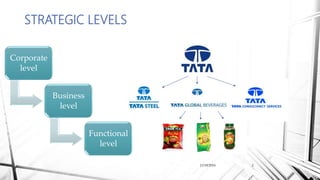
STRATEGIC LEVELS
11/18/2016 2
Corporate
level
Business
level
Functional
level
11/18/2016 3
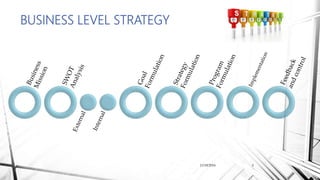
BUSINESS LEVEL STRATEGY
11/18/2016 4
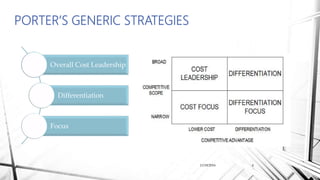
PORTER’S GENERIC STRATEGIES
Overall Cost Leadership
Differentiation
Focus
11/18/2016 5
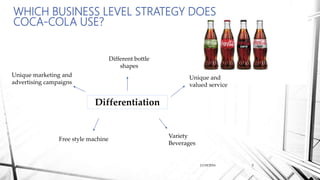
WHICH BUSINESS LEVEL STRATEGY DOES
COCA-COLA USE?
Differentiation
Unique and
valued service
Unique marketing and
advertising campaigns
Different bottle
shapes
Free style machine
Variety
Beverages
11/18/2016 6
THANK YOU

Buisness level strategy

Editor's Notes

  • #4 Differentiation – product,service ,delivery
  • #5 Connection between Business strategy and marketing strategy Business strategy is a broad process that can address the entire business, or a portion of the business such as marketing. Marketing strategies derive from strategic plans. To understand the relationship between the two, it's important to understand the purpose of strategic planning; the planning process; the difference between goals, objectives, strategies and tactics; and the important role of measurement in strategic planning. Business strategy has less to do with product or service development and sales and more to do with profitability initiatives. The executive management of a business must stay in close contact with their marketing department to determine if any corporate strategies they wish to pursue align with the company’s marketing strategies. For example, a corporate cost-containment strategy that includes using cheaper materials to make the company’s product might damage an upscale brand the business relies on to support its pricing, distribution and brand strategies. If an upscale women’s shoe company buys a bargain-brand women’s footwear company, the marketing department will most likely suggest that management not merge the two companies, but instead operate separate brands using centralized administrative services. If the company were to merge the two and sell both products under the same name, it would confuse consumers and damage both brands.
  • #6 Coca-Cola uses the differentiation strategy to make themselves unique and separated from other companies. By using the differentiation strategy, Coke creates a product and service that is unique and valued. They also have non-price attributes that customers will pay a premium for.     Coke differentiates themselves by using unique marketing and advertising campaigns to entice their customers to stay loyal to their brand by continuing to purchase coca-cola products versus one of the many competitors. They also have different bottle shapes. Research has been conducted that shows people feel better about themselves and skinnier if the bottle is shaped like a curvy, but slim body shape. Another great differentiation strategy Coke has done, is the above Coca-Cola Freestyle machine. This machine allows customers to mix and match their classic Coca-Cola beverages with many different flavors.    Coke will need to continue to work hard at using the differentiation strategy to keep themselves separated from its competitors. To do this, Coca-Cola will need to keep introducing new beverages that will maintain customers' brand loyalty. Another way to differentiate themselves would be to use alcohol drinking culture to their advantage. For example, many drinks are ordered as a "rum and Coke", "Captain and Coke" or "whiskey and Coke". Coca-Cola could collaborate with Captain Morgan or a whiskey company and sell attached 3 ounce bottles of liquor with a Coke bottle. Finally, Coca-Cola has a great tasting drink that people have loved for decades and will continue to purchase their product if Coca-Cola works hard to maintain their great Coke taste and innovative ways to present it to their customers.