Building	
  Social	
  Analy/cs	
  Tool	
  with	
  MongoDB	
  -­‐	
  
A	
  Developer's	
  Perspec/ve
1.  Product	
  Overview	
  
2.  Why	
  MongoDB	
  for	
  us?	
  
3.  Aggrega?on	
  Queries	
  to	
  the	
  rescue	
  
4.  How	
  Javascript	
  helped	
  us?	
  
5.  Experiences	
  with	
  Indexes	
  
6.  In-­‐progress	
  use-­‐cases	
  
7.  Tips	
  &	
  Tricks	
  
8.  Demo	
  
Agenda
Abhishek	
  Tejpaul	


SoUware	
  Developer	
  @	
  IntelliGrape	
  SoUware	


Loves	
  Grails,	
  Git	
  and	
  Linux	


abhishek@intelligrape.com	
  
About me
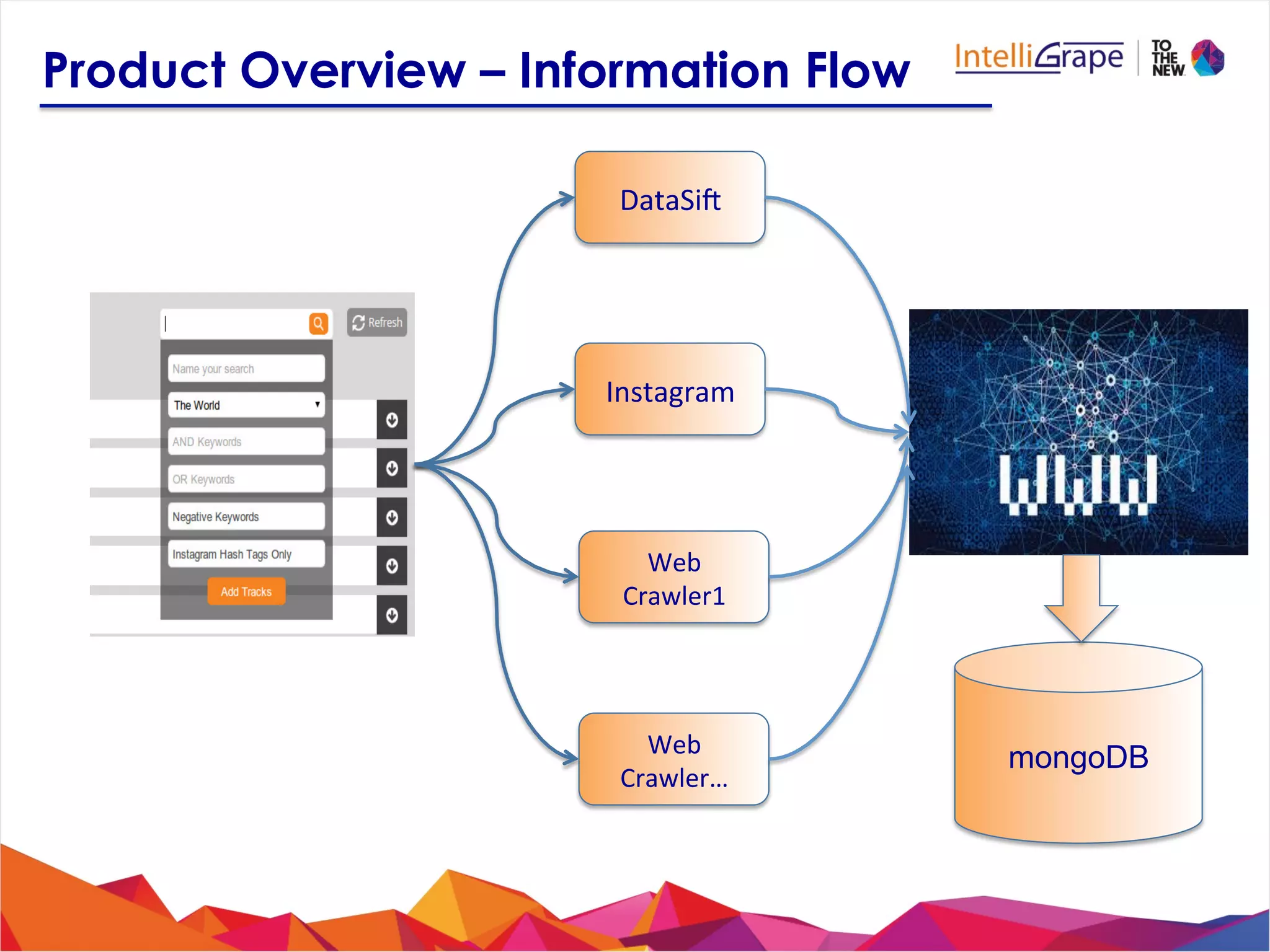
DataSiU	
  
Instagram	
  
Web	
  
Crawler1	
  
Web	
  
Crawler…	
  
mongoDB
Product Overview – Information Flow
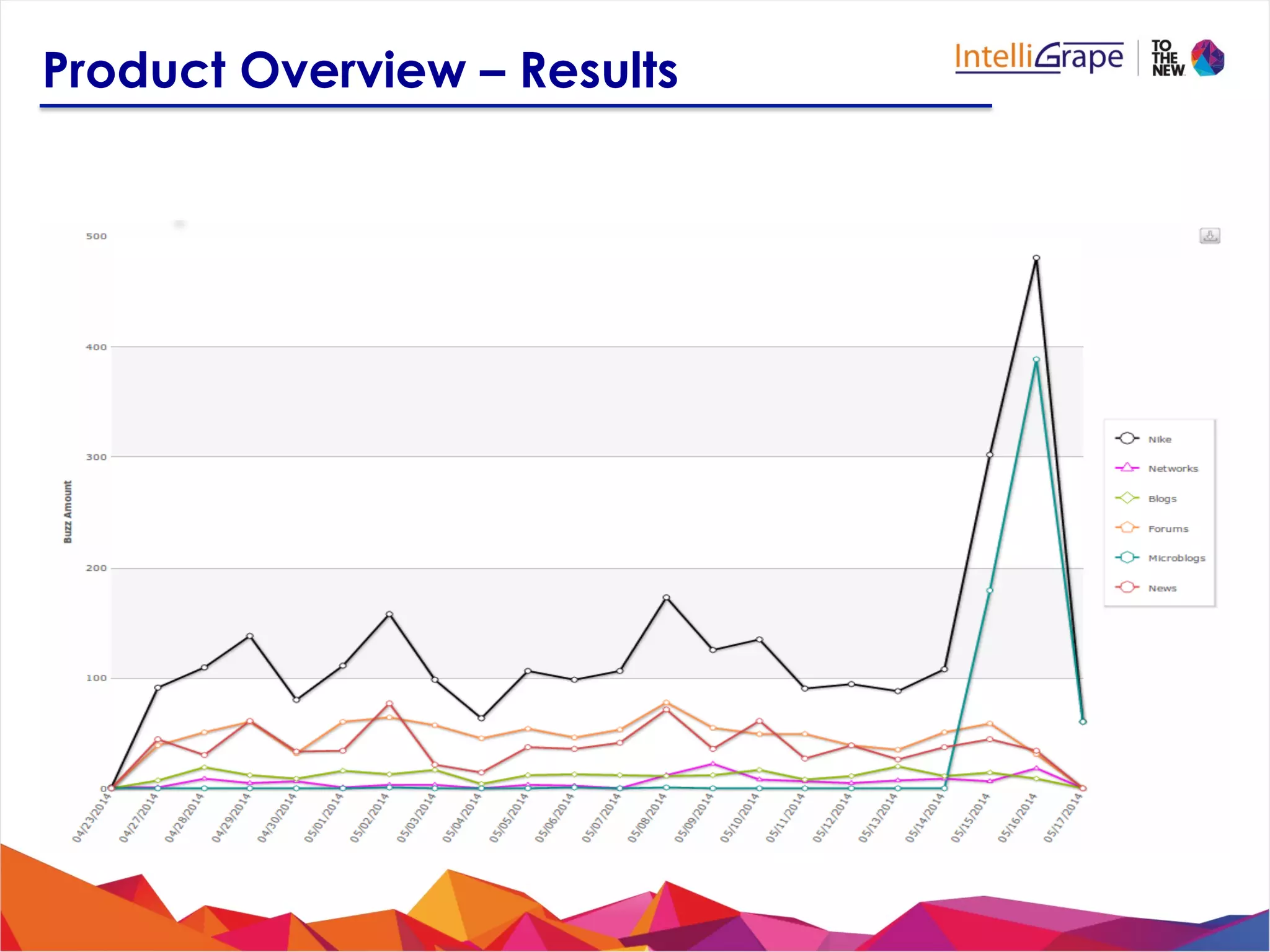
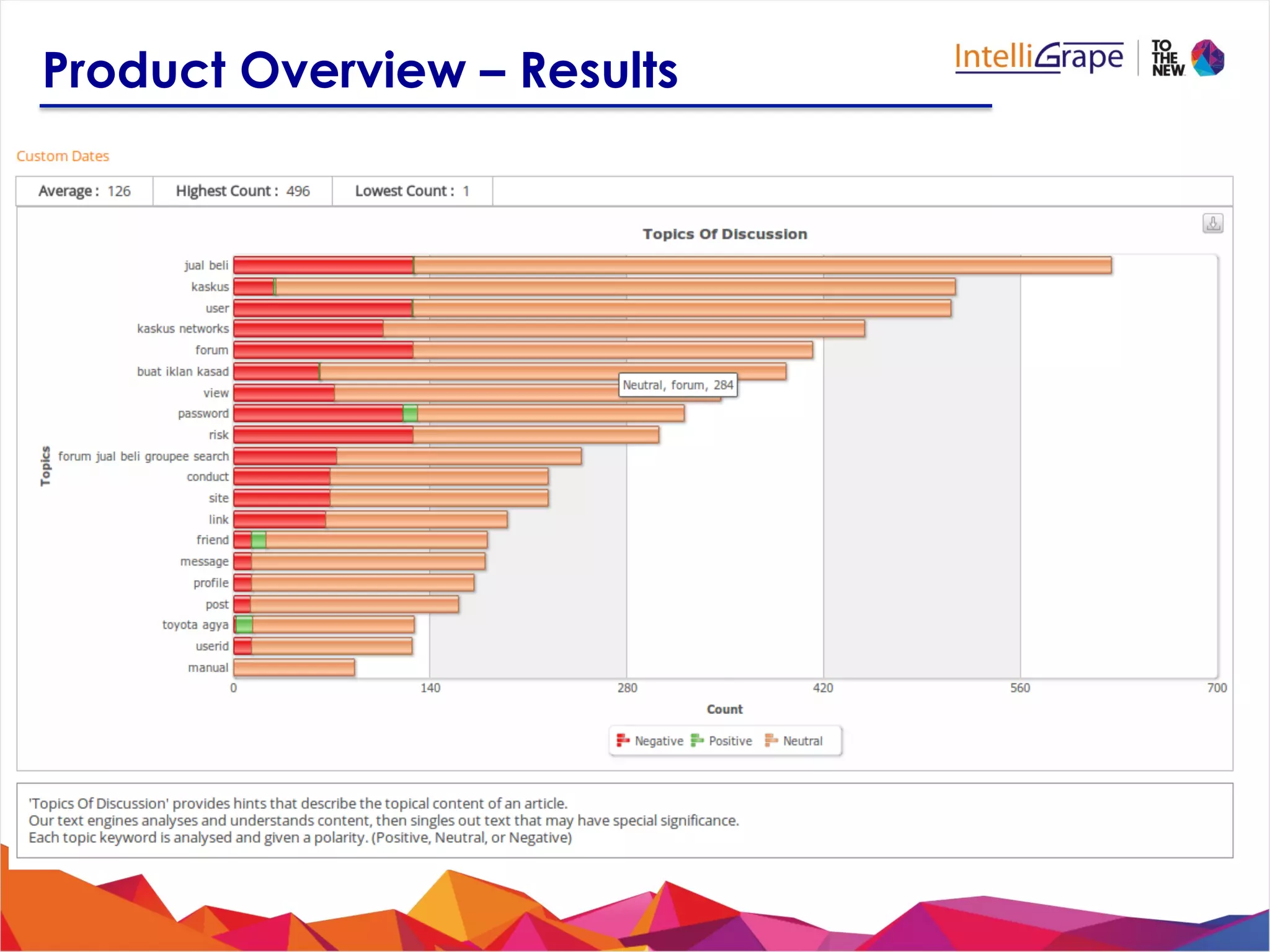
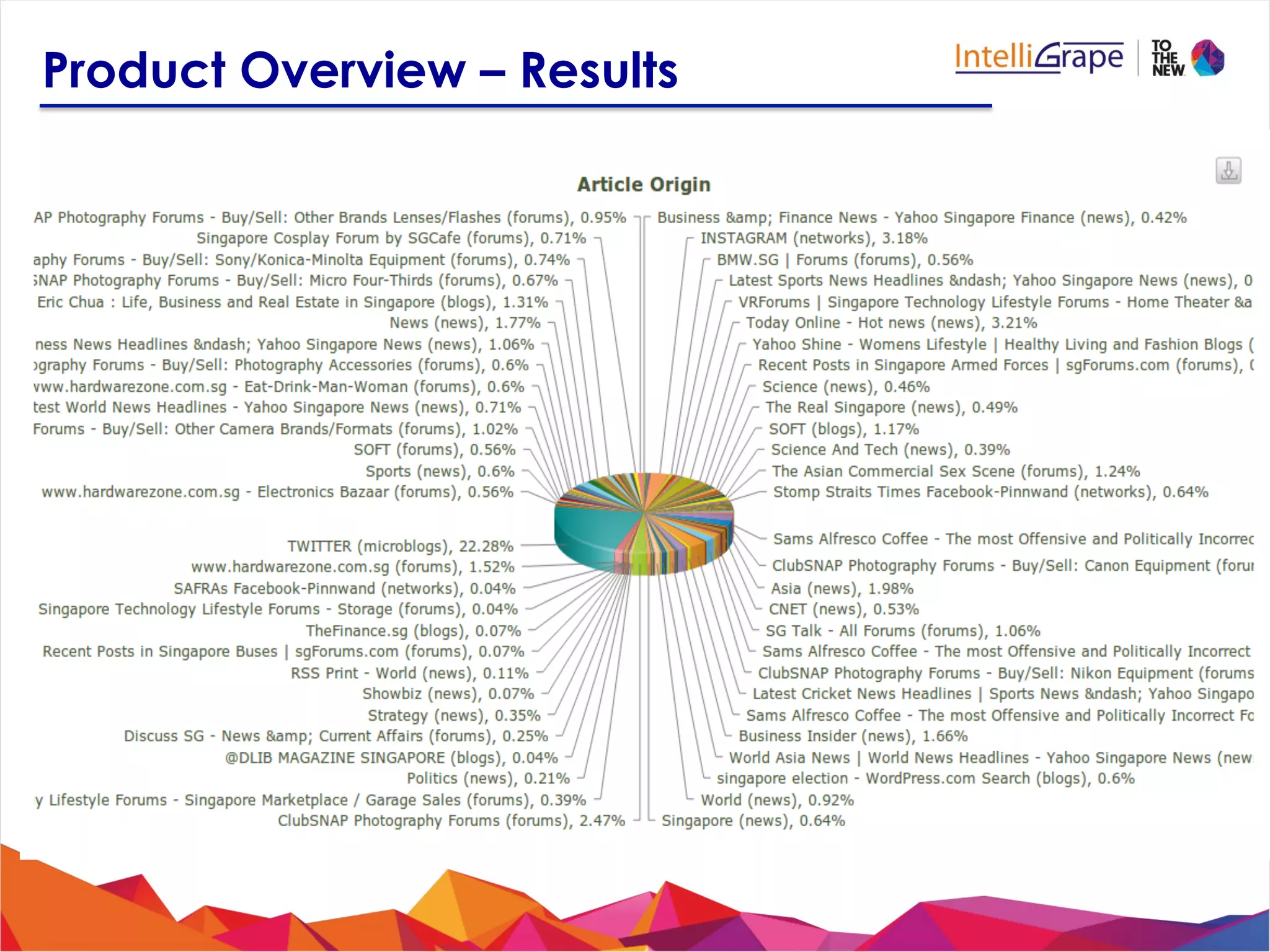
Product Overview – Results
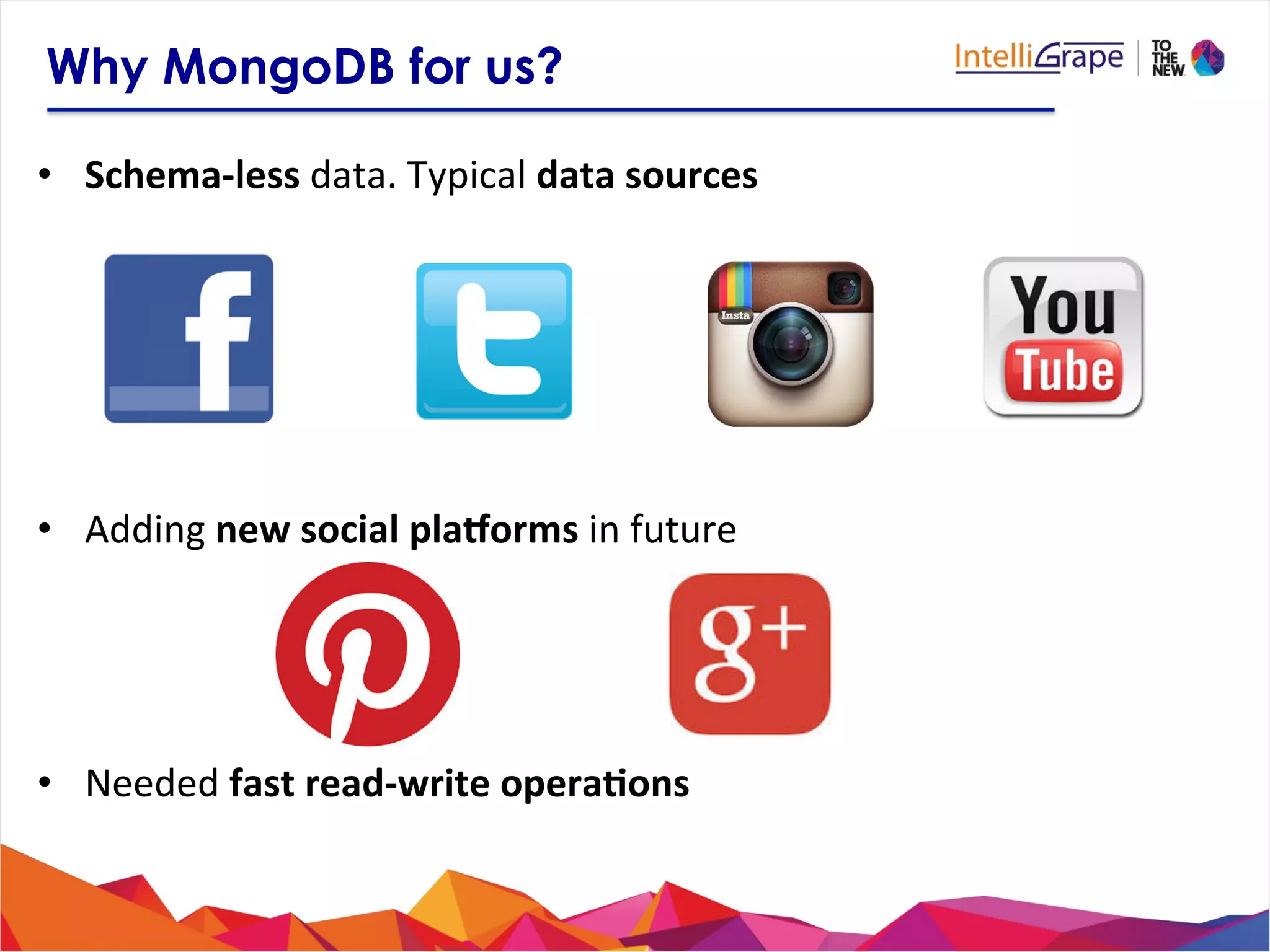
•  Schema-­‐less	
  data.	
  Typical	
  data	
  sources	


•  Adding	
  new	
  social	
  pla4orms	
  in	
  future	
  
•  Needed	
  fast	
  read-­‐write	
  opera6ons	
  
Why MongoDB for us?
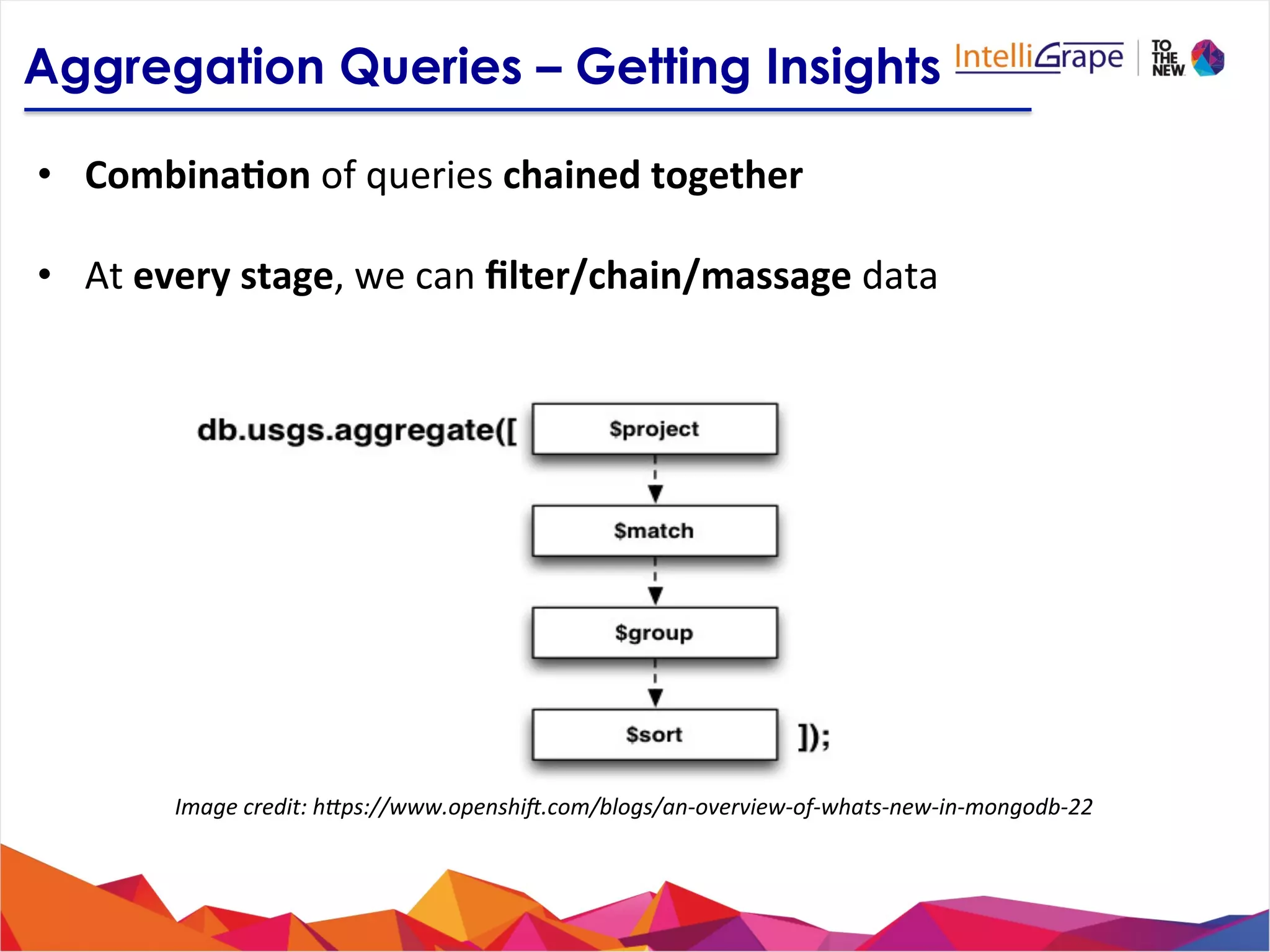
Aggregation Queries – Getting Insights
•  Combina6on	
  of	
  queries	
  chained	
  together	
  
•  At	
  every	
  stage,	
  we	
  can	
  filter/chain/massage	
  data	


Image	
  credit:	
  h@ps://www.openshiC.com/blogs/an-­‐overview-­‐of-­‐whats-­‐new-­‐in-­‐mongodb-­‐22	
  
Our use-case (esp. for graphs)
•  Sen6ment	
  Analysis	
  
•  Demographic	
  Analysis	
  
•  Ar6cle	
  Analysis	
  
•  Plan	
  
•  Crea?on	
  of	
  Intelligence	
  tables	
  in	
  advance	
  
•  Reality	
  
•  On-­‐the-­‐fly	
  analysis	
  using	
  Aggrega6on	
  queries	
  
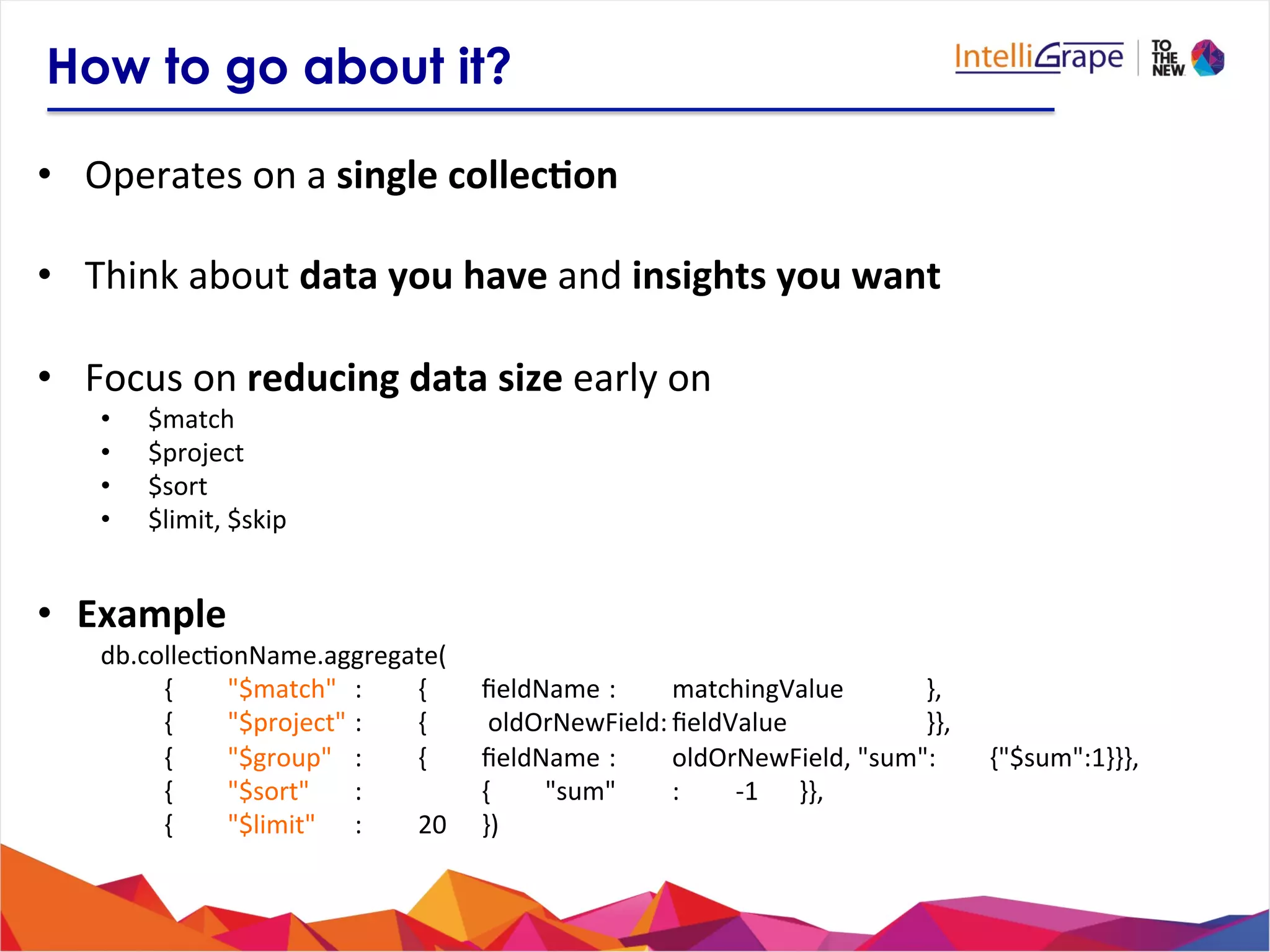
How to go about it?
•  Operates	
  on	
  a	
  single	
  collec6on	
  	
  
•  Think	
  about	
  data	
  you	
  have	
  and	
  insights	
  you	
  want	
  
•  Focus	
  on	
  reducing	
  data	
  size	
  early	
  on	
  
•  $match	
  
•  $project	
  
•  $sort	
  
•  $limit,	
  $skip	
  
•  Example
db.collec?onName.aggregate(	
  
	
  { 	
  "$match" 	
  : 	
  { 	
  fieldName	
  :	
   	
  matchingValue 	
   	
  },	
  
	
  { 	
  "$project"	
  : 	
  { 	
  	
  oldOrNewField:	
  fieldValue 	
   	
   	
  }},	
  
	
  { 	
  "$group" 	
  : 	
  { 	
  fieldName	
  : 	
  oldOrNewField,	
  "sum": 	
  {"$sum":1}}},	
  
	
  { 	
  "$sort" 	
  : 	
   	
  { 	
  "sum" 	
  : 	
  -­‐1 	
  }},	
  
	
  { 	
  "$limit" 	
  : 	
  20 	
  })	


Javascript Capabilities
•  All	
  the	
  programming	
  capabili6es	
  of	
  Javascript	
  language	
  at	
  your	
  
disposal	
  
•  Taking	
  business	
  logic	
  /	
  processing	
  to	
  your	
  data-­‐store	
  
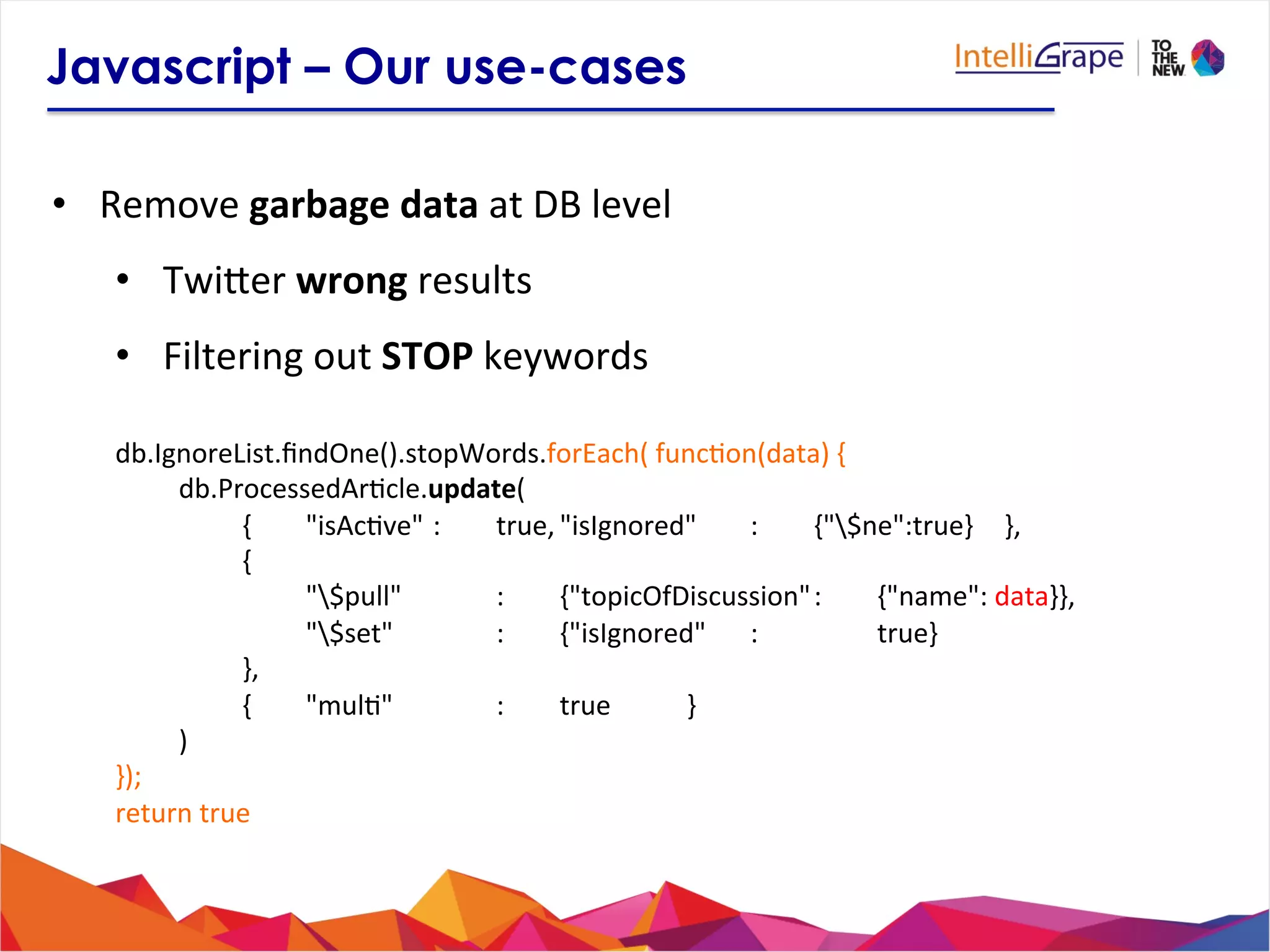
Javascript – Our use-cases
•  Remove	
  garbage	
  data	
  at	
  DB	
  level	
  
•  Twijer	
  wrong	
  results	
  
•  Filtering	
  out	
  STOP	
  keywords	


  db.IgnoreList.findOne().stopWords.forEach(	
  func?on(data)	
  {	


  db.ProcessedAr?cle.update(	


  { 	
  "isAc?ve"	
  : 	
  true,	
  "isIgnored" 	
  : 	
  {"$ne":true} 	
  },	


  { 	


  "$pull" 	
   	
  : 	
  {"topicOfDiscussion"	
  : 	
  {"name":	
  data}},	


  "$set" 	
   	
  : 	
  {"isIgnored" 	
  : 	
   	
  true}	


  },	


  { 	
  "mul?" 	
   	
  : 	
  true 	
   	
  }	


  )	
  
	
  });	
  
	
  return	
  true	


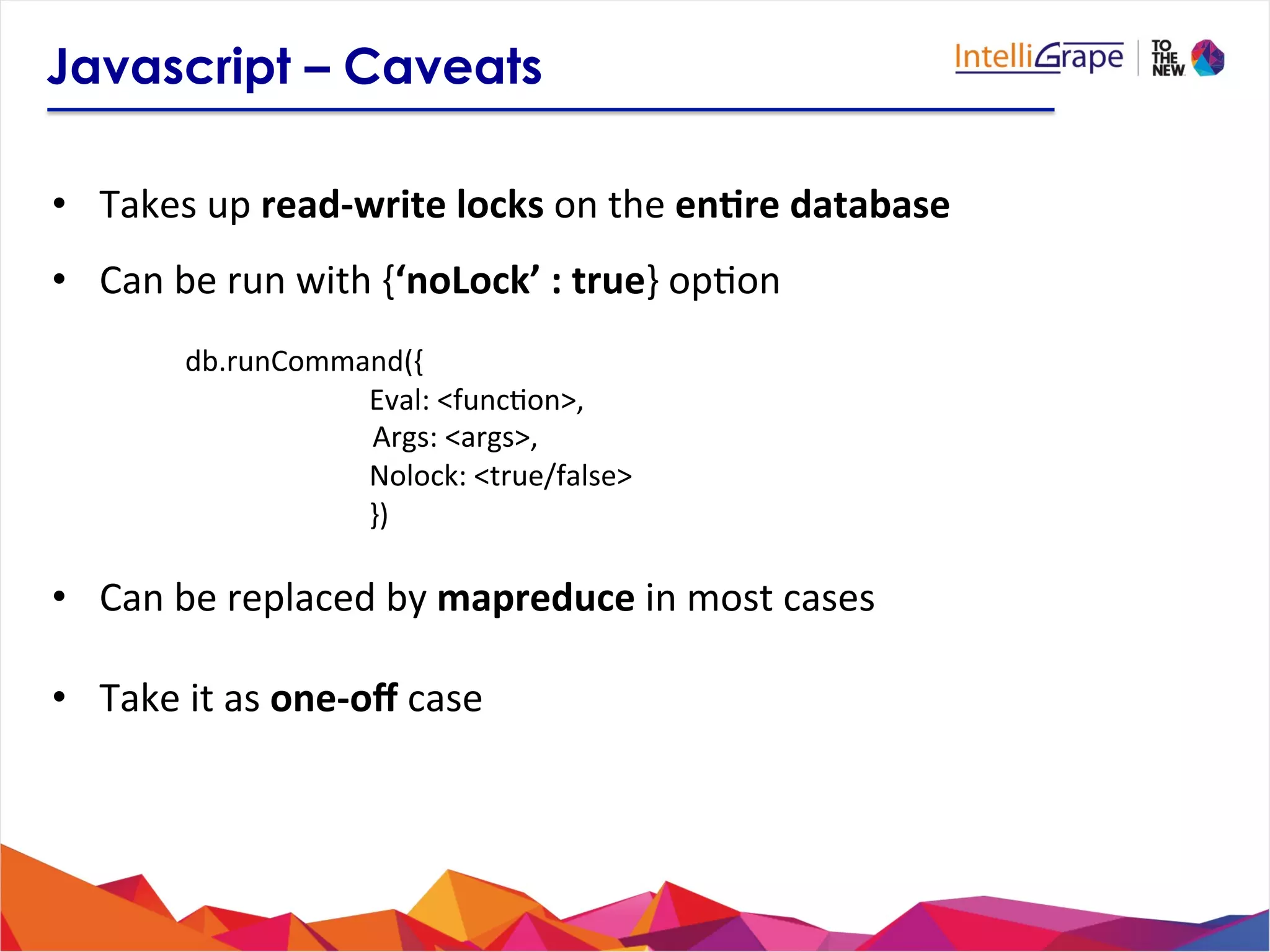
Javascript – Caveats
•  Takes	
  up	
  read-­‐write	
  locks	
  on	
  the	
  en6re	
  database	
  
•  Can	
  be	
  run	
  with	
  {‘noLock’	
  :	
  true}	
  op?on	


  db.runCommand({	


  Eval:	
  <func?on>,	


  Args:	
  <args>,	


  Nolock:	
  <true/false>	


  })	


•  Can	
  be	
  replaced	
  by	
  mapreduce	
  in	
  most	
  cases	


•  Take	
  it	
  as	
  one-­‐off	
  case	
  
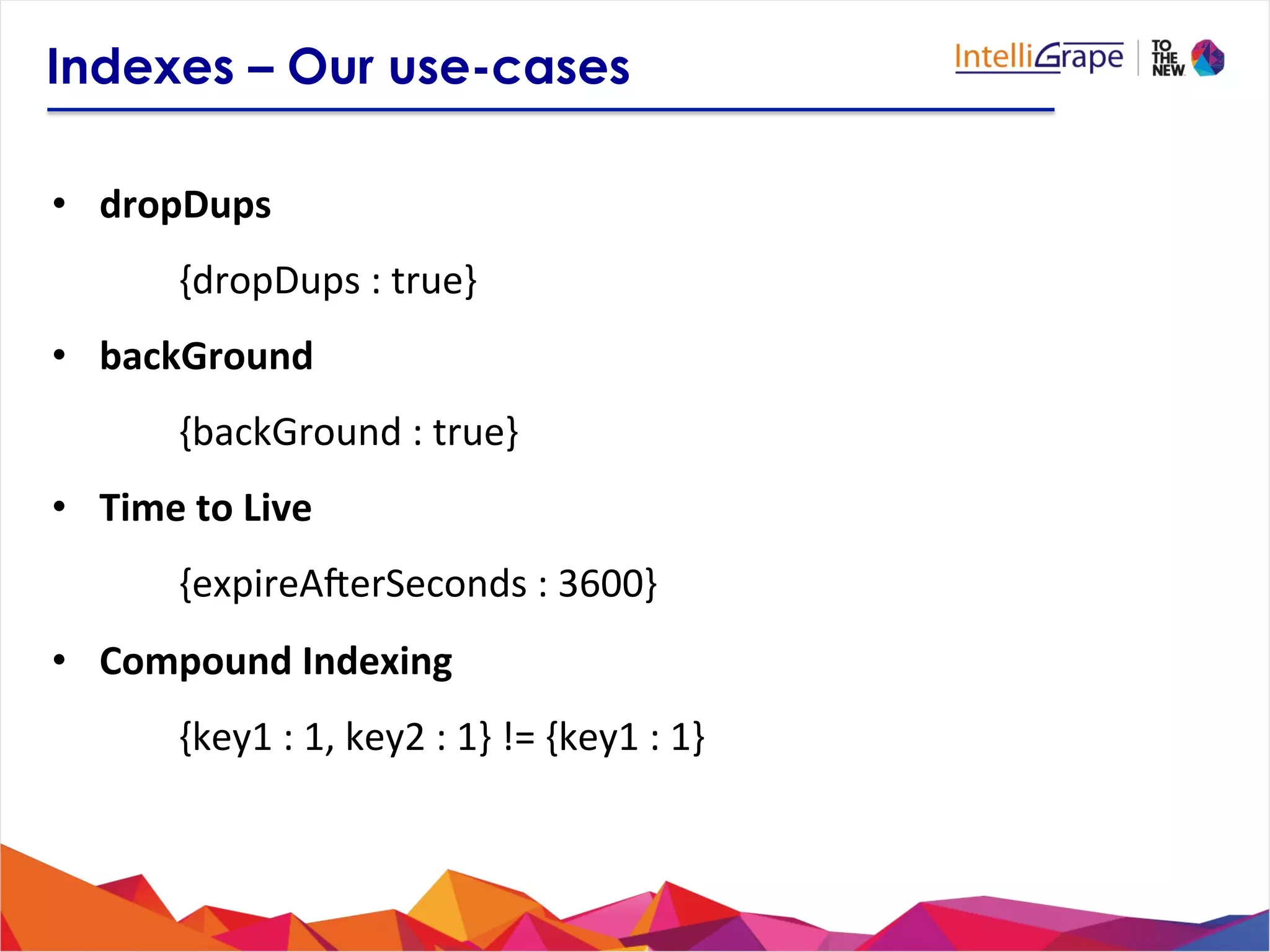
Indexes – Our use-cases
•  dropDups	
  
{dropDups	
  :	
  true}	
  
•  backGround	
  
{backGround	
  :	
  true}	
  
•  Time	
  to	
  Live	
  
{expireAUerSeconds	
  :	
  3600}	
  
•  Compound	
  Indexing	
  
{key1	
  :	
  1,	
  key2	
  :	
  1}	
  !=	
  {key1	
  :	
  1}	
  	
  
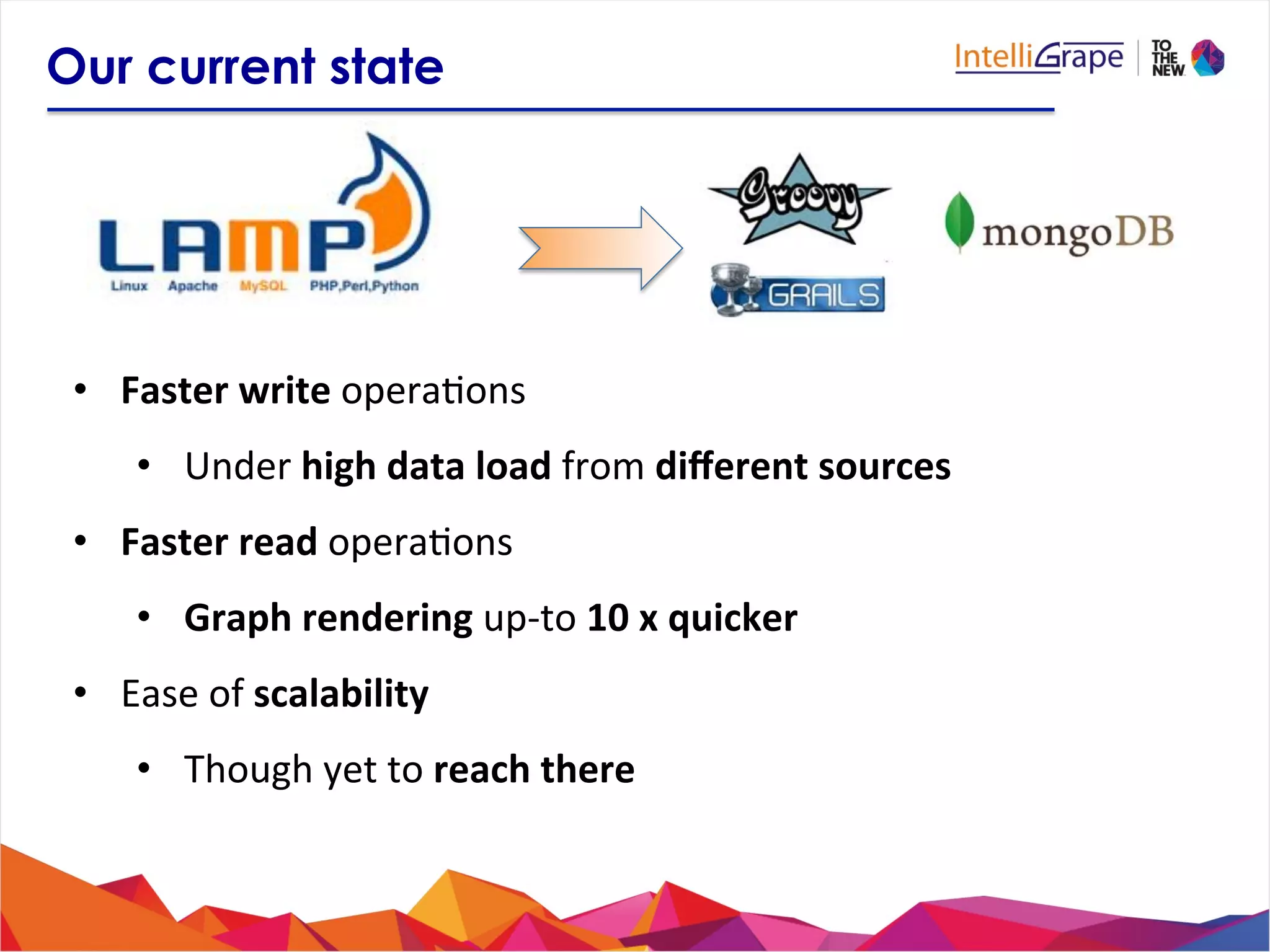
Our current state
•  Faster	
  write	
  opera?ons	
  
•  Under	
  high	
  data	
  load	
  from	
  different	
  sources	
  
•  Faster	
  read	
  opera?ons	
  
•  Graph	
  rendering	
  up-­‐to	
  10	
  x	
  quicker	
  
•  Ease	
  of	
  scalability	
  
•  Though	
  yet	
  to	
  reach	
  there	
  
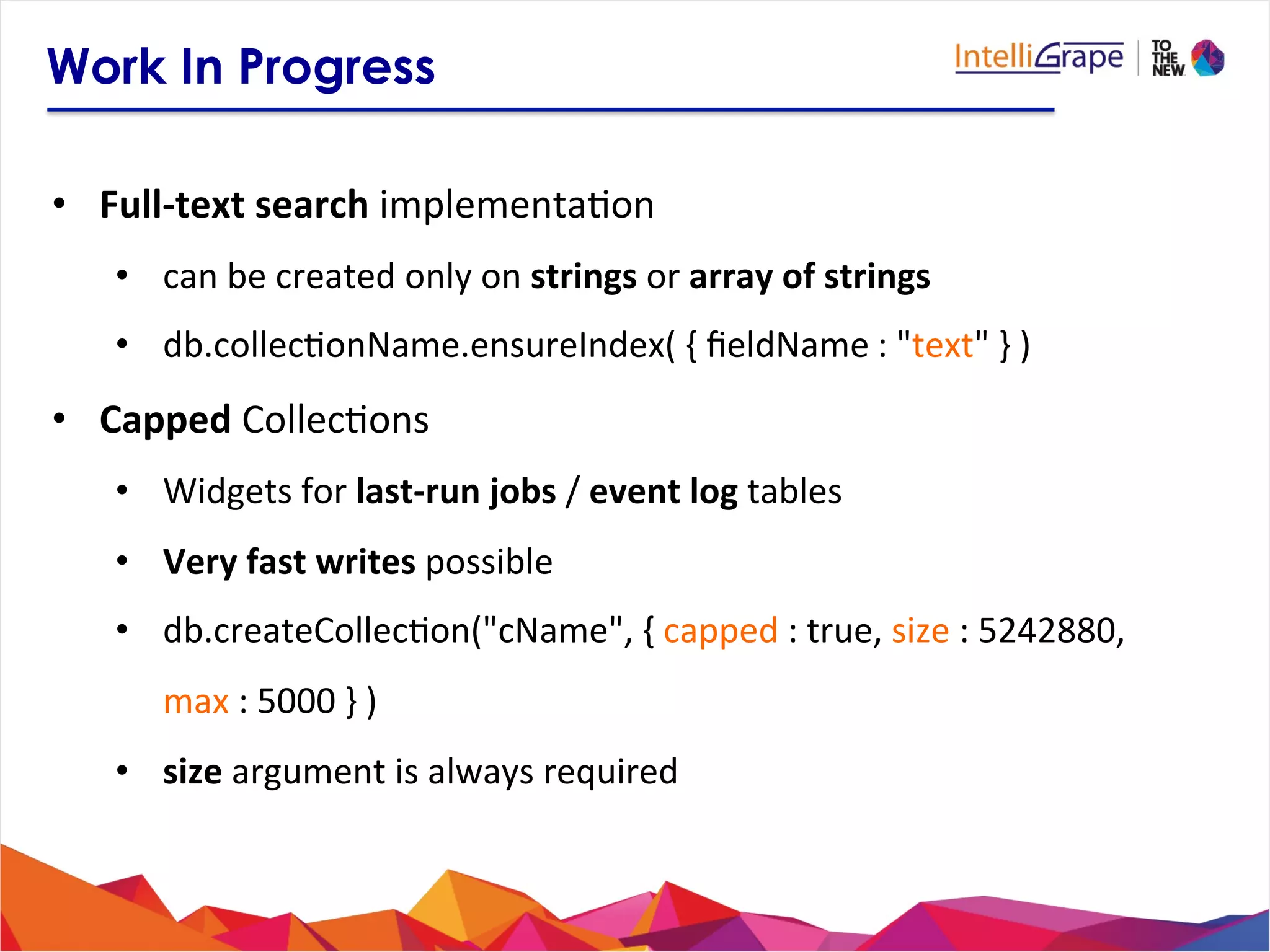
Work In Progress
•  Full-­‐text	
  search	
  implementa?on	
  
•  can	
  be	
  created	
  only	
  on	
  strings	
  or	
  array	
  of	
  strings	
  
•  db.collec?onName.ensureIndex(	
  {	
  fieldName	
  :	
  "text"	
  }	
  )	
  
•  Capped	
  Collec?ons	
  
•  Widgets	
  for	
  last-­‐run	
  jobs	
  /	
  event	
  log	
  tables	
  
•  Very	
  fast	
  writes	
  possible	
  
•  db.createCollec?on("cName",	
  {	
  capped	
  :	
  true,	
  size	
  :	
  5242880,	
  
max	
  :	
  5000	
  }	
  )	
  
•  size	
  argument	
  is	
  always	
  required	
  
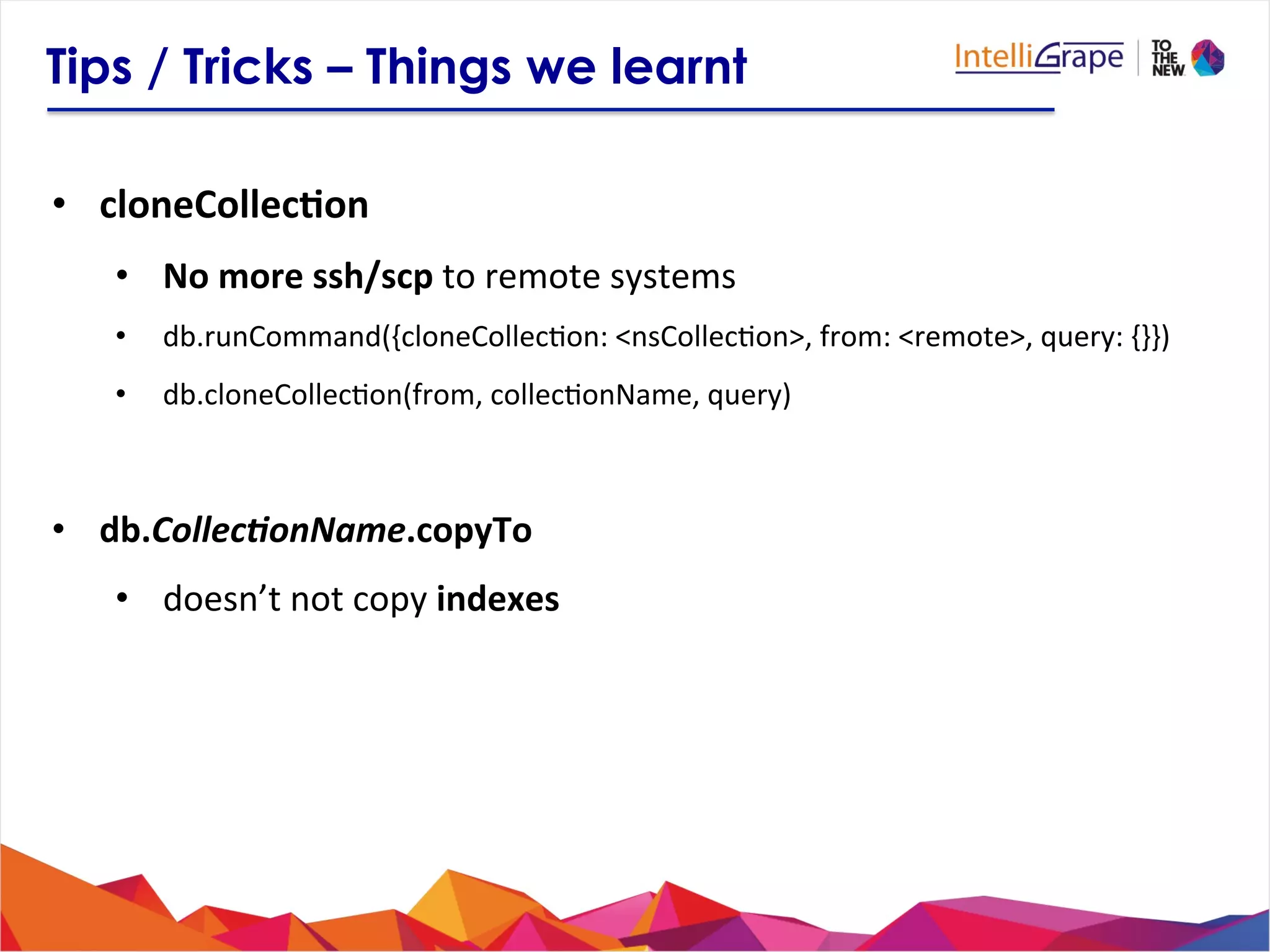
Tips / Tricks – Things we learnt
•  cloneCollec6on	
  
•  No	
  more	
  ssh/scp	
  to	
  remote	
  systems	
  
•  db.runCommand({cloneCollec?on:	
  <nsCollec?on>,	
  from:	
  <remote>,	
  query:	
  {}})	
  
•  db.cloneCollec?on(from,	
  collec?onName,	
  query)	
  
•  db.Collec-onName.copyTo	
  
•  doesn’t	
  not	
  copy	
  indexes	
  
Tips / Tricks – Things we learnt
•  remove()	
  vs	
  drop()	
  
•  Can’t	
  use	
  remove	
  for	
  capped	
  collec6ons	
  	
  
•  remove	
  keeps	
  indexes	
  while	
  drop()	
  clears	
  them	
  
•  To	
  remove	
  all	
  the	
  documents	
  in	
  a	
  collec?on,	
  use	
  drop()	
  
•  To	
  remove	
  beZer	
  part	
  of	
  large	
  collec?on,	
  use	
  javascript	
  
•  preZy()	
  find	
  by	
  default	
  
•  DBQuery.prototype._prejyShell	
  =	
  true	
  (	
  inside	
  your	
  ~/.mongorc.js)	
  
DEMO	
  
I	
  am	
  not	
  a	
  MongoDB	
  expert	
  though	
  J	
  
Thank	
  You!!	
  

Buildingsocialanalyticstoolwithmongodb

  • 1.
                 Building  Social  Analy/cs  Tool  with  MongoDB  -­‐   A  Developer's  Perspec/ve
  • 2.
    1.  Product  Overview   2.  Why  MongoDB  for  us?   3.  Aggrega?on  Queries  to  the  rescue   4.  How  Javascript  helped  us?   5.  Experiences  with  Indexes   6.  In-­‐progress  use-­‐cases   7.  Tips  &  Tricks   8.  Demo   Agenda
  • 3.
    Abhishek  Tejpaul     SoUware  Developer  @  IntelliGrape  SoUware     Loves  Grails,  Git  and  Linux     abhishek@intelligrape.com   About me
  • 4.
    DataSiU   Instagram   Web   Crawler1   Web   Crawler…   mongoDB Product Overview – Information Flow
  • 5.
  • 6.
  • 7.
  • 8.
    •  Schema-­‐less  data.  Typical  data  sources     •  Adding  new  social  pla4orms  in  future   •  Needed  fast  read-­‐write  opera6ons   Why MongoDB for us?
  • 9.
    Aggregation Queries –Getting Insights •  Combina6on  of  queries  chained  together   •  At  every  stage,  we  can  filter/chain/massage  data     Image  credit:  h@ps://www.openshiC.com/blogs/an-­‐overview-­‐of-­‐whats-­‐new-­‐in-­‐mongodb-­‐22  
  • 10.
    Our use-case (esp.for graphs) •  Sen6ment  Analysis   •  Demographic  Analysis   •  Ar6cle  Analysis   •  Plan   •  Crea?on  of  Intelligence  tables  in  advance   •  Reality   •  On-­‐the-­‐fly  analysis  using  Aggrega6on  queries  
  • 11.
    How to goabout it? •  Operates  on  a  single  collec6on     •  Think  about  data  you  have  and  insights  you  want   •  Focus  on  reducing  data  size  early  on   •  $match   •  $project   •  $sort   •  $limit,  $skip   •  Example db.collec?onName.aggregate(    {  "$match"  :  {  fieldName  :    matchingValue    },    {  "$project"  :  {    oldOrNewField:  fieldValue      }},    {  "$group"  :  {  fieldName  :  oldOrNewField,  "sum":  {"$sum":1}}},    {  "$sort"  :    {  "sum"  :  -­‐1  }},    {  "$limit"  :  20  })    
  • 12.
    Javascript Capabilities •  All  the  programming  capabili6es  of  Javascript  language  at  your   disposal   •  Taking  business  logic  /  processing  to  your  data-­‐store  
  • 13.
    Javascript – Ouruse-cases •  Remove  garbage  data  at  DB  level   •  Twijer  wrong  results   •  Filtering  out  STOP  keywords      db.IgnoreList.findOne().stopWords.forEach(  func?on(data)  {      db.ProcessedAr?cle.update(        {  "isAc?ve"  :  true,  "isIgnored"  :  {"$ne":true}  },          {            "$pull"    :  {"topicOfDiscussion"  :  {"name":  data}},          "$set"    :  {"isIgnored"  :    true}        },        {  "mul?"    :  true    }      )    });    return  true    
  • 14.
    Javascript – Caveats • Takes  up  read-­‐write  locks  on  the  en6re  database   •  Can  be  run  with  {‘noLock’  :  true}  op?on      db.runCommand({        Eval:  <func?on>,                                                        Args:  <args>,        Nolock:  <true/false>        })     •  Can  be  replaced  by  mapreduce  in  most  cases     •  Take  it  as  one-­‐off  case  
  • 15.
    Indexes – Ouruse-cases •  dropDups   {dropDups  :  true}   •  backGround   {backGround  :  true}   •  Time  to  Live   {expireAUerSeconds  :  3600}   •  Compound  Indexing   {key1  :  1,  key2  :  1}  !=  {key1  :  1}    
  • 16.
    Our current state • Faster  write  opera?ons   •  Under  high  data  load  from  different  sources   •  Faster  read  opera?ons   •  Graph  rendering  up-­‐to  10  x  quicker   •  Ease  of  scalability   •  Though  yet  to  reach  there  
  • 17.
    Work In Progress • Full-­‐text  search  implementa?on   •  can  be  created  only  on  strings  or  array  of  strings   •  db.collec?onName.ensureIndex(  {  fieldName  :  "text"  }  )   •  Capped  Collec?ons   •  Widgets  for  last-­‐run  jobs  /  event  log  tables   •  Very  fast  writes  possible   •  db.createCollec?on("cName",  {  capped  :  true,  size  :  5242880,   max  :  5000  }  )   •  size  argument  is  always  required  
  • 18.
    Tips / Tricks– Things we learnt •  cloneCollec6on   •  No  more  ssh/scp  to  remote  systems   •  db.runCommand({cloneCollec?on:  <nsCollec?on>,  from:  <remote>,  query:  {}})   •  db.cloneCollec?on(from,  collec?onName,  query)   •  db.Collec-onName.copyTo   •  doesn’t  not  copy  indexes  
  • 19.
    Tips / Tricks– Things we learnt •  remove()  vs  drop()   •  Can’t  use  remove  for  capped  collec6ons     •  remove  keeps  indexes  while  drop()  clears  them   •  To  remove  all  the  documents  in  a  collec?on,  use  drop()   •  To  remove  beZer  part  of  large  collec?on,  use  javascript   •  preZy()  find  by  default   •  DBQuery.prototype._prejyShell  =  true  (  inside  your  ~/.mongorc.js)  
  • 20.
  • 21.
    I  am  not  a  MongoDB  expert  though  J  
  • 22.