Building Your First
AI Program in
Python
ashokveda.com
•
•
•
•
•
•
Introduction to AI Programming
Setting Up Python Environment
Understanding Python Libraries for AI
Basic Concepts of Machine Learning
Building a Simple AI Model
Data Collection and Preprocessing
•
•
•
•
•
Creating the AI Model
Training and Testing the
Model Evaluating Model
Performance Improving
Model Accuracy Deploying
Your AI Model
Agenda
ashokveda.com
Introduction to
AI Programming
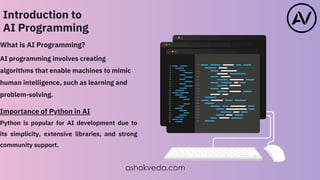
AI programming involves creating
algorithms that enable machines to mimic
human intelligence, such as learning and
problem-solving.
Python is popular for AI development due to
its simplicity, extensive libraries, and strong
community support.
What is AI Programming?
Importance of Python in AI
ashokveda.com
Setting Up Python Environment
Visit python.org, download the
latest Python version, and run the
installer. Ensure 'Add Python to
PATH' is checked.
Install PyCharm or Jupyter
Notebook. Follow the installation
wizard and verify by running a simple
Python script.
Install an IDE
Download Python
ashokveda.com
Understanding Python Libraries for AI
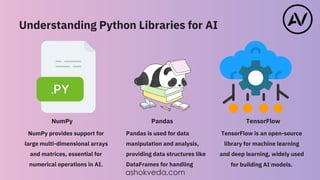
NumPy provides support for
large multi-dimensional arrays
and matrices, essential for
numerical operations in AI.
Pandas is used for data
manipulation and analysis,
providing data structures like
DataFrames for handling
TensorFlow is an open-source
library for machine learning
and deep learning, widely used
for building AI models.
NumPy Pandas TensorFlow
ashokveda.com
Basic Concepts of Machine
Learning
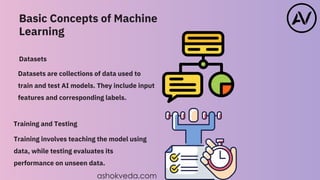
Training involves teaching the model using
data, while testing evaluates its
performance on unseen data.
Datasets are collections of data used to
train and test AI models. They include input
features and corresponding labels.
Datasets
Training and Testing
ashokveda.com
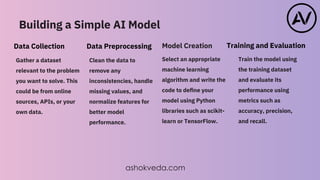
Building a Simple AI Model
Gather a dataset
relevant to the problem
you want to solve. This
could be from online
sources, APIs, or your
own data.
Model Creation
Train the model using
the training dataset
and evaluate its
performance using
metrics such as
accuracy, precision,
and recall.
Clean the data to
remove any
inconsistencies, handle
missing values, and
normalize features for
better model
performance.
Select an appropriate
machine learning
algorithm and write the
code to define your
model using Python
libraries such as scikit-
learn or TensorFlow.
Data Collection Data Preprocessing Training and Evaluation
ashokveda.com
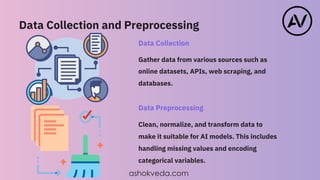
Data Collection and Preprocessing
Data Collection
Gather data from various sources such as
online datasets, APIs, web scraping, and
databases.
Clean, normalize, and transform data to
make it suitable for AI models. This includes
handling missing values and encoding
categorical variables.
Data Preprocessing
ashokveda.com
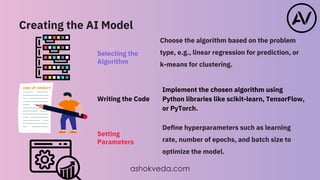
Creating the AI Model
Setting
Parameters
Selecting the
Algorithm
Writing the Code
Choose the algorithm based on the problem
type, e.g., linear regression for prediction, or
k-means for clustering.
Define hyperparameters such as learning
rate, number of epochs, and batch size to
optimize the model.
Implement the chosen algorithm using
Python libraries like scikit-learn, TensorFlow,
or PyTorch.
ashokveda.com
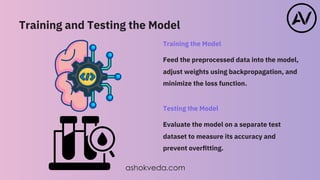
Training and Testing the Model
Testing the Model
Evaluate the model on a separate test
dataset to measure its accuracy and
prevent overfitting.
Training the Model
Feed the preprocessed data into the model,
adjust weights using backpropagation, and
minimize the loss function.
ashokveda.com
Evaluating Model Performance
Accuracy
Measures the ratio of
correctly predicted
instances to the total
instances
.
Precision & Recall
Precision: Ratio of true
positives to predicted
positives. Recall: Ratio
true positives to actual
F1 Score
Harmonic mean of
precision and
recall,
providing a balance
between both
metrics.
ashokveda.com
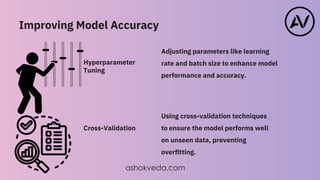
Improving Model Accuracy
Cross-Validation
Hyperparameter
Tuning
Using cross-validation techniques
to ensure the model performs well
on unseen data, preventing
overfitting.
Adjusting parameters like learning
rate and batch size to enhance model
performance and accuracy.
ashokveda.com
Deploying Your AI Model
Integration with Applications
Use APIs to integrate AI models with web or
mobile applications, enabling real-time
predictions and analysis.
Cloud Services
Utilize platforms like AWS, Google Cloud, or
Azure to deploy and scale your AI model
efficiently.
ashokveda.com

Building Your First AI Program in Python ashokveda.com.pdf

  • 1.
    Building Your First AIProgram in Python ashokveda.com
  • 2.
    • • • • • • Introduction to AIProgramming Setting Up Python Environment Understanding Python Libraries for AI Basic Concepts of Machine Learning Building a Simple AI Model Data Collection and Preprocessing • • • • • Creating the AI Model Training and Testing the Model Evaluating Model Performance Improving Model Accuracy Deploying Your AI Model Agenda ashokveda.com
  • 3.
    Introduction to AI Programming AIprogramming involves creating algorithms that enable machines to mimic human intelligence, such as learning and problem-solving. Python is popular for AI development due to its simplicity, extensive libraries, and strong community support. What is AI Programming? Importance of Python in AI ashokveda.com
  • 4.
    Setting Up PythonEnvironment Visit python.org, download the latest Python version, and run the installer. Ensure 'Add Python to PATH' is checked. Install PyCharm or Jupyter Notebook. Follow the installation wizard and verify by running a simple Python script. Install an IDE Download Python ashokveda.com
  • 5.
    Understanding Python Librariesfor AI NumPy provides support for large multi-dimensional arrays and matrices, essential for numerical operations in AI. Pandas is used for data manipulation and analysis, providing data structures like DataFrames for handling TensorFlow is an open-source library for machine learning and deep learning, widely used for building AI models. NumPy Pandas TensorFlow ashokveda.com
  • 6.
    Basic Concepts ofMachine Learning Training involves teaching the model using data, while testing evaluates its performance on unseen data. Datasets are collections of data used to train and test AI models. They include input features and corresponding labels. Datasets Training and Testing ashokveda.com
  • 7.
    Building a SimpleAI Model Gather a dataset relevant to the problem you want to solve. This could be from online sources, APIs, or your own data. Model Creation Train the model using the training dataset and evaluate its performance using metrics such as accuracy, precision, and recall. Clean the data to remove any inconsistencies, handle missing values, and normalize features for better model performance. Select an appropriate machine learning algorithm and write the code to define your model using Python libraries such as scikit- learn or TensorFlow. Data Collection Data Preprocessing Training and Evaluation ashokveda.com
  • 8.
    Data Collection andPreprocessing Data Collection Gather data from various sources such as online datasets, APIs, web scraping, and databases. Clean, normalize, and transform data to make it suitable for AI models. This includes handling missing values and encoding categorical variables. Data Preprocessing ashokveda.com
  • 9.
    Creating the AIModel Setting Parameters Selecting the Algorithm Writing the Code Choose the algorithm based on the problem type, e.g., linear regression for prediction, or k-means for clustering. Define hyperparameters such as learning rate, number of epochs, and batch size to optimize the model. Implement the chosen algorithm using Python libraries like scikit-learn, TensorFlow, or PyTorch. ashokveda.com
  • 10.
    Training and Testingthe Model Testing the Model Evaluate the model on a separate test dataset to measure its accuracy and prevent overfitting. Training the Model Feed the preprocessed data into the model, adjust weights using backpropagation, and minimize the loss function. ashokveda.com
  • 11.
    Evaluating Model Performance Accuracy Measuresthe ratio of correctly predicted instances to the total instances . Precision & Recall Precision: Ratio of true positives to predicted positives. Recall: Ratio true positives to actual F1 Score Harmonic mean of precision and recall, providing a balance between both metrics. ashokveda.com
  • 12.
    Improving Model Accuracy Cross-Validation Hyperparameter Tuning Usingcross-validation techniques to ensure the model performs well on unseen data, preventing overfitting. Adjusting parameters like learning rate and batch size to enhance model performance and accuracy. ashokveda.com
  • 13.
    Deploying Your AIModel Integration with Applications Use APIs to integrate AI models with web or mobile applications, enabling real-time predictions and analysis. Cloud Services Utilize platforms like AWS, Google Cloud, or Azure to deploy and scale your AI model efficiently. ashokveda.com