Building Your Dream Machine Learning
Team with Python Expertise
Oren Etzioni, the CEO of the Allen Institute for Artificial Intelligence, once said,
“In the past, Apple has not been at the vanguard of machine learning and
cutting-edge artificial intelligence work, but that is rapidly changing, they
are after the best and the brightest, just like everybody else.”
And it’s not just Apple - startups worldwide want in on the action too. They all
see the massive potential for machine learning to upgrade everything from
medical research to self-driving cars.
As a result, these companies are focused on assembling high-performing ML
teams to turn visions into reality.
However, not all ML teams are created equal. Building an ML team with strong
Python fluency provides unique advantages that set your project up for success.
Python is a leading programming language for machine learning thanks to its
incredible libraries, readability, and vibrant community.
Note: Python has risen to the top of various programming language popularity
indices, including the TIOBE Index and the PYPL Index, and it remains the
most popular programming language.
In this blog post, we will provide strategies to help you build your dream ML
team with Python development expertise. But first, it's important to understand
why build your ML team with Python expertise.
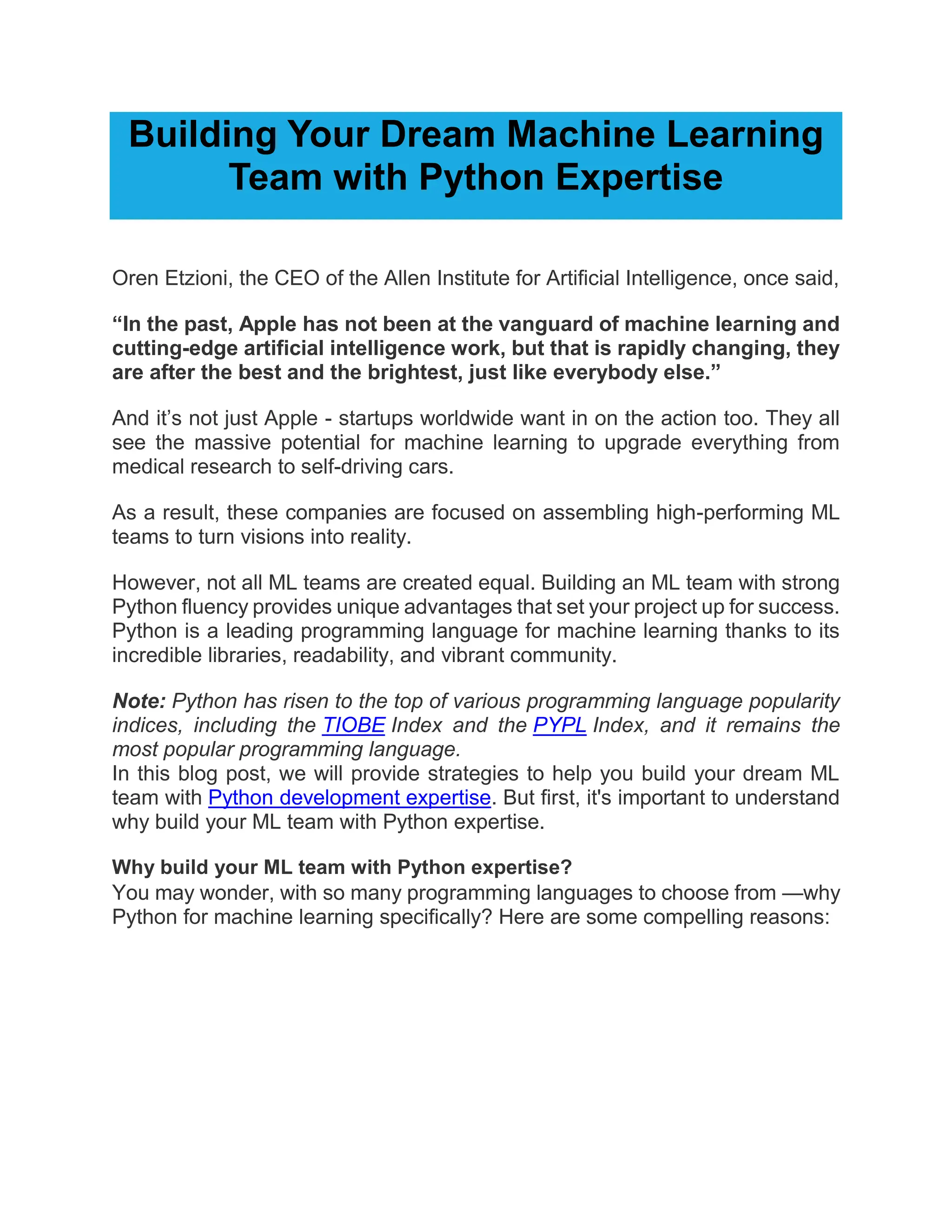
Why build your ML team with Python expertise?
You may wonder, with so many programming languages to choose from —why
Python for machine learning specifically? Here are some compelling reasons:
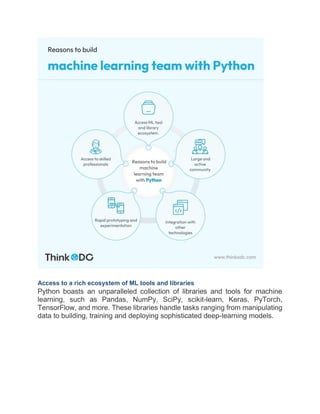
Access to a rich ecosystem of ML tools and libraries
Python boasts an unparalleled collection of libraries and tools for machine
learning, such as Pandas, NumPy, SciPy, scikit-learn, Keras, PyTorch,
TensorFlow, and more. These libraries handle tasks ranging from manipulating
data to building, training and deploying sophisticated deep-learning models.
Having these building blocks available enables the rapid development of ML
solutions without getting bogged down in low-level details. Data scientists using
Python spend less time programming complex algorithms that have already
been packaged into easy-to-use Python functions and classes.
Large and active community
Behind Python's rise is its vibrant global community of developers and data
science practitioners who actively share knowledge and best practices.
Want to know how to fine-tune a cutting-edge NLP model? Odds are someone
has written a detailed tutorial or asked a question on StackOverflow already.
This wealth of collective knowledge accelerates learning.
Note: Python has a large community of programmers, with 15.7 million
developers.
The community also develops and maintains all the leading ML libraries. So you
benefit from the latest innovations and fixes for free.
Integration with other tools and technologies
Python integrates smoothly with all the main tools, technologies and platforms
required for data science projects.
For example, perform data extraction using SQL, store and process data using
Spark or Hadoop, build models using TensorFlow running on GPUs, and serve
predictions using Flask or Django web frameworks.
The flexibility to use the right combinations of technologies for each task
accelerates the building of end-to-end data solutions.
Rapid prototyping and experimentation
Machine learning model building involves extensive prototyping and iteration
before arriving at effective solutions.
Python's interpreted nature, dynamic typing, and the Jupyter notebook
environment massively reduce cycles for experimentation. Data scientists use
these advantages to test many ideas quickly, discarding poor approaches early.
Over time, these saved iterations compound into large gains in productivity and
velocity.
Access to a large pool of skilled professionals
As Python's popularity in ML/Data Science explodes, so does the availability of
developers and data scientists proficient in it. Having a larger talent pool makes
recruiting and growing teams far easier.
Plus, extensive Python experience translates well into picking up other ancillary
technologies like Spark, cloud platforms, etc. This talent leverage effect
kickstarts your team's capabilities rapidly.
In totality, having a unified Python data science stack allows you to assemble
ML teams with exceptional depth across the full model lifecycle.
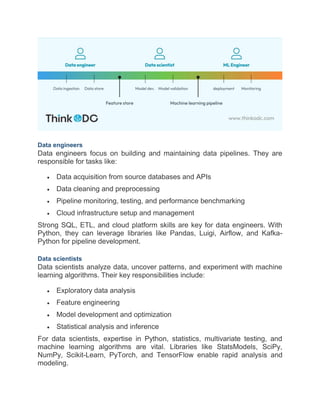
Key roles in a Machine Learning team
Now that we've discussed why Python expertise is key, let's examine the roles
that comprise well-rounded machine learning teams:
Data engineers
Data engineers focus on building and maintaining data pipelines. They are
responsible for tasks like:
 Data acquisition from source databases and APIs
 Data cleaning and preprocessing
 Pipeline monitoring, testing, and performance benchmarking
 Cloud infrastructure setup and management
Strong SQL, ETL, and cloud platform skills are key for data engineers. With
Python, they can leverage libraries like Pandas, Luigi, Airflow, and Kafka-
Python for pipeline development.
Data scientists
Data scientists analyze data, uncover patterns, and experiment with machine
learning algorithms. Their key responsibilities include:
 Exploratory data analysis
 Feature engineering
 Model development and optimization
 Statistical analysis and inference
For data scientists, expertise in Python, statistics, multivariate testing, and
machine learning algorithms are vital. Libraries like StatsModels, SciPy,
NumPy, Scikit-Learn, PyTorch, and TensorFlow enable rapid analysis and
modeling.
A data scientist is someone who can obtain, scrub, explore, model, and interpret
data, blending hacking, statistics, and machine learning. Data scientists not only
are adept at working with data but appreciate data itself as a first-class product.
~ Hillary mason, founder at fast forward labs
Machine learning engineers
Machine learning engineers operationalize models developed by data scientists
for real-world usage. Their focus areas are:
 Building model APIs/microservices
 Deployment on cloud platforms
 Monitoring, testing, and updates in production
 Optimization for scale and performance
Machine learning engineers should have strong software engineering skills in
Python. Flask, Django, and FastAPI can help expose models as production
APIs.
As we can see, while roles differ, Python versatility allows it to underpin a
multidisciplinary machine learning team.
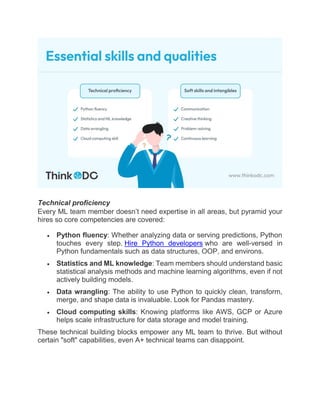
Essential skills and qualities
In addition to core competencies of Python in machine learning, here is a
checklist of other vital skills for an ML team:
Technical proficiency
Every ML team member doesn’t need expertise in all areas, but pyramid your
hires so core competencies are covered:
 Python fluency: Whether analyzing data or serving predictions, Python
touches every step. Hire Python developers who are well-versed in
Python fundamentals such as data structures, OOP, and environs.
 Statistics and ML knowledge: Team members should understand basic
statistical analysis methods and machine learning algorithms, even if not
actively building models.
 Data wrangling: The ability to use Python to quickly clean, transform,
merge, and shape data is invaluable. Look for Pandas mastery.
 Cloud computing skills: Knowing platforms like AWS, GCP or Azure
helps scale infrastructure for data storage and model training.
These technical building blocks empower any ML team to thrive. But without
certain "soft" capabilities, even A+ technical teams can disappoint.
Soft skills and intangibles
Studies show software teams with strong soft skills outperform those without by
50% or higher on metrics like productivity, quality and customer satisfaction.
Prioritize candidates with qualities like:
 Communication: Can team members discuss complex topics, explain
technical concepts clearly and give constructive feedback diplomatically?
 Creative thinking: Are they curious? Can they think outside the box to
envision innovative applications of ML versus rote usage?
 Problem-solving: Faced with vague issues or uncertainty, do they invest
time to understand root causes and explore solutions?
 Continuous learning: Is lifelong growth through courses, reading,
conferences/groups evident? Stagnation = death in the rapidly changing
ML field!
A team stacked with these soft skills and technical chops will unleash magical
results! But attracting and retaining top talent remains an immense challenge.
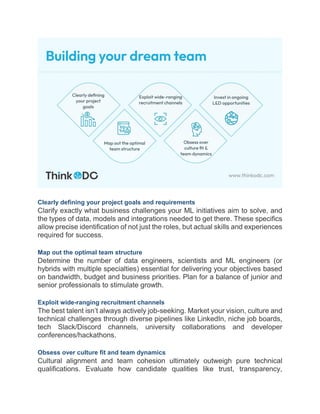
Building your dream team
Demand for AI and Machine Learning Specialists is expected to increase by
40%, or 1 million jobs, as AI and machine learning drive continued industry
transformation.
With the exponential demand, the construction of your dream team won’t be
easy, but is achievable by:
Clearly defining your project goals and requirements
Clarify exactly what business challenges your ML initiatives aim to solve, and
the types of data, models and integrations needed to get there. These specifics
allow precise identification of not just the roles, but actual skills and experiences
required for success.
Map out the optimal team structure
Determine the number of data engineers, scientists and ML engineers (or
hybrids with multiple specialties) essential for delivering your objectives based
on bandwidth, budget and business priorities. Plan for a balance of junior and
senior professionals to stimulate growth.
Exploit wide-ranging recruitment channels
The best talent isn’t always actively job-seeking. Market your vision, culture and
technical challenges through diverse pipelines like LinkedIn, niche job boards,
tech Slack/Discord channels, university collaborations and developer
conferences/hackathons.
Obsess over culture fit and team dynamics
Cultural alignment and team cohesion ultimately outweigh pure technical
qualifications. Evaluate how candidate qualities like trust, transparency,
humility, diversity of thought and grit mesh with your environment. Disruptive
narcissists or divas can poison teams.
Invest in ongoing L&D opportunities
The half-life of skills shortens yearly in machine learning. Allow your team time
for continual learning through internal mentoring, external
courses/certifications, attending events and contributing to the global
community. This pays exponential dividends in motivation, innovation and
retention.
With deliberate planning guided by the above areas, any organization - from a
startup to a blue chip giant - can amass an incredible pool of Python-adept ML
talent perfect for disrupting industries.
Conclusion
With careful planning and by taking advantage of Python's machine-learning
capabilities, you can put together a talented team to make your project ideas
come true.
Bringing together people with technical abilities, knowledge of the field, and
interpersonal skills is key for successfully leveraging machine learning in a way
that can revolutionize your industry.
If you are looking for Python developers for hire, turn to ThinkODC to assemble
your dream machine-learning squad.
Our talented team brings together data engineers, data scientists, and ML
engineers with proven expertise across the Python data science stack.
Whether you need capabilities for data wrangling, predictive modelling, or
production-grade deployment, our agile developers deliver using libraries like
Pandas, PyTorch, and Flask. With in-depth knowledge and hands-on
experience implementing end-to-end ML systems, ThinkODC is your go-to
partner for creating high-impact ML solutions.

Building Your Dream Machine Learning Team with Python Expertise

  • 1.
    Building Your DreamMachine Learning Team with Python Expertise Oren Etzioni, the CEO of the Allen Institute for Artificial Intelligence, once said, “In the past, Apple has not been at the vanguard of machine learning and cutting-edge artificial intelligence work, but that is rapidly changing, they are after the best and the brightest, just like everybody else.” And it’s not just Apple - startups worldwide want in on the action too. They all see the massive potential for machine learning to upgrade everything from medical research to self-driving cars. As a result, these companies are focused on assembling high-performing ML teams to turn visions into reality. However, not all ML teams are created equal. Building an ML team with strong Python fluency provides unique advantages that set your project up for success. Python is a leading programming language for machine learning thanks to its incredible libraries, readability, and vibrant community. Note: Python has risen to the top of various programming language popularity indices, including the TIOBE Index and the PYPL Index, and it remains the most popular programming language. In this blog post, we will provide strategies to help you build your dream ML team with Python development expertise. But first, it's important to understand why build your ML team with Python expertise. Why build your ML team with Python expertise? You may wonder, with so many programming languages to choose from —why Python for machine learning specifically? Here are some compelling reasons:
  • 2.
    Access to arich ecosystem of ML tools and libraries Python boasts an unparalleled collection of libraries and tools for machine learning, such as Pandas, NumPy, SciPy, scikit-learn, Keras, PyTorch, TensorFlow, and more. These libraries handle tasks ranging from manipulating data to building, training and deploying sophisticated deep-learning models.
  • 3.
    Having these buildingblocks available enables the rapid development of ML solutions without getting bogged down in low-level details. Data scientists using Python spend less time programming complex algorithms that have already been packaged into easy-to-use Python functions and classes. Large and active community Behind Python's rise is its vibrant global community of developers and data science practitioners who actively share knowledge and best practices. Want to know how to fine-tune a cutting-edge NLP model? Odds are someone has written a detailed tutorial or asked a question on StackOverflow already. This wealth of collective knowledge accelerates learning. Note: Python has a large community of programmers, with 15.7 million developers. The community also develops and maintains all the leading ML libraries. So you benefit from the latest innovations and fixes for free.
  • 4.
    Integration with othertools and technologies Python integrates smoothly with all the main tools, technologies and platforms required for data science projects. For example, perform data extraction using SQL, store and process data using Spark or Hadoop, build models using TensorFlow running on GPUs, and serve predictions using Flask or Django web frameworks. The flexibility to use the right combinations of technologies for each task accelerates the building of end-to-end data solutions. Rapid prototyping and experimentation Machine learning model building involves extensive prototyping and iteration before arriving at effective solutions. Python's interpreted nature, dynamic typing, and the Jupyter notebook environment massively reduce cycles for experimentation. Data scientists use these advantages to test many ideas quickly, discarding poor approaches early. Over time, these saved iterations compound into large gains in productivity and velocity. Access to a large pool of skilled professionals As Python's popularity in ML/Data Science explodes, so does the availability of developers and data scientists proficient in it. Having a larger talent pool makes recruiting and growing teams far easier. Plus, extensive Python experience translates well into picking up other ancillary technologies like Spark, cloud platforms, etc. This talent leverage effect kickstarts your team's capabilities rapidly. In totality, having a unified Python data science stack allows you to assemble ML teams with exceptional depth across the full model lifecycle. Key roles in a Machine Learning team Now that we've discussed why Python expertise is key, let's examine the roles that comprise well-rounded machine learning teams:
  • 5.
    Data engineers Data engineersfocus on building and maintaining data pipelines. They are responsible for tasks like:  Data acquisition from source databases and APIs  Data cleaning and preprocessing  Pipeline monitoring, testing, and performance benchmarking  Cloud infrastructure setup and management Strong SQL, ETL, and cloud platform skills are key for data engineers. With Python, they can leverage libraries like Pandas, Luigi, Airflow, and Kafka- Python for pipeline development. Data scientists Data scientists analyze data, uncover patterns, and experiment with machine learning algorithms. Their key responsibilities include:  Exploratory data analysis  Feature engineering  Model development and optimization  Statistical analysis and inference For data scientists, expertise in Python, statistics, multivariate testing, and machine learning algorithms are vital. Libraries like StatsModels, SciPy, NumPy, Scikit-Learn, PyTorch, and TensorFlow enable rapid analysis and modeling.
  • 6.
    A data scientistis someone who can obtain, scrub, explore, model, and interpret data, blending hacking, statistics, and machine learning. Data scientists not only are adept at working with data but appreciate data itself as a first-class product. ~ Hillary mason, founder at fast forward labs Machine learning engineers Machine learning engineers operationalize models developed by data scientists for real-world usage. Their focus areas are:  Building model APIs/microservices  Deployment on cloud platforms  Monitoring, testing, and updates in production  Optimization for scale and performance Machine learning engineers should have strong software engineering skills in Python. Flask, Django, and FastAPI can help expose models as production APIs. As we can see, while roles differ, Python versatility allows it to underpin a multidisciplinary machine learning team. Essential skills and qualities In addition to core competencies of Python in machine learning, here is a checklist of other vital skills for an ML team:
  • 7.
    Technical proficiency Every MLteam member doesn’t need expertise in all areas, but pyramid your hires so core competencies are covered:  Python fluency: Whether analyzing data or serving predictions, Python touches every step. Hire Python developers who are well-versed in Python fundamentals such as data structures, OOP, and environs.  Statistics and ML knowledge: Team members should understand basic statistical analysis methods and machine learning algorithms, even if not actively building models.  Data wrangling: The ability to use Python to quickly clean, transform, merge, and shape data is invaluable. Look for Pandas mastery.  Cloud computing skills: Knowing platforms like AWS, GCP or Azure helps scale infrastructure for data storage and model training. These technical building blocks empower any ML team to thrive. But without certain "soft" capabilities, even A+ technical teams can disappoint.
  • 8.
    Soft skills andintangibles Studies show software teams with strong soft skills outperform those without by 50% or higher on metrics like productivity, quality and customer satisfaction. Prioritize candidates with qualities like:  Communication: Can team members discuss complex topics, explain technical concepts clearly and give constructive feedback diplomatically?  Creative thinking: Are they curious? Can they think outside the box to envision innovative applications of ML versus rote usage?  Problem-solving: Faced with vague issues or uncertainty, do they invest time to understand root causes and explore solutions?  Continuous learning: Is lifelong growth through courses, reading, conferences/groups evident? Stagnation = death in the rapidly changing ML field! A team stacked with these soft skills and technical chops will unleash magical results! But attracting and retaining top talent remains an immense challenge. Building your dream team Demand for AI and Machine Learning Specialists is expected to increase by 40%, or 1 million jobs, as AI and machine learning drive continued industry transformation. With the exponential demand, the construction of your dream team won’t be easy, but is achievable by:
  • 9.
    Clearly defining yourproject goals and requirements Clarify exactly what business challenges your ML initiatives aim to solve, and the types of data, models and integrations needed to get there. These specifics allow precise identification of not just the roles, but actual skills and experiences required for success. Map out the optimal team structure Determine the number of data engineers, scientists and ML engineers (or hybrids with multiple specialties) essential for delivering your objectives based on bandwidth, budget and business priorities. Plan for a balance of junior and senior professionals to stimulate growth. Exploit wide-ranging recruitment channels The best talent isn’t always actively job-seeking. Market your vision, culture and technical challenges through diverse pipelines like LinkedIn, niche job boards, tech Slack/Discord channels, university collaborations and developer conferences/hackathons. Obsess over culture fit and team dynamics Cultural alignment and team cohesion ultimately outweigh pure technical qualifications. Evaluate how candidate qualities like trust, transparency,
  • 10.
    humility, diversity ofthought and grit mesh with your environment. Disruptive narcissists or divas can poison teams. Invest in ongoing L&D opportunities The half-life of skills shortens yearly in machine learning. Allow your team time for continual learning through internal mentoring, external courses/certifications, attending events and contributing to the global community. This pays exponential dividends in motivation, innovation and retention. With deliberate planning guided by the above areas, any organization - from a startup to a blue chip giant - can amass an incredible pool of Python-adept ML talent perfect for disrupting industries. Conclusion With careful planning and by taking advantage of Python's machine-learning capabilities, you can put together a talented team to make your project ideas come true. Bringing together people with technical abilities, knowledge of the field, and interpersonal skills is key for successfully leveraging machine learning in a way that can revolutionize your industry. If you are looking for Python developers for hire, turn to ThinkODC to assemble your dream machine-learning squad. Our talented team brings together data engineers, data scientists, and ML engineers with proven expertise across the Python data science stack. Whether you need capabilities for data wrangling, predictive modelling, or production-grade deployment, our agile developers deliver using libraries like Pandas, PyTorch, and Flask. With in-depth knowledge and hands-on experience implementing end-to-end ML systems, ThinkODC is your go-to partner for creating high-impact ML solutions.