The Role of DevOps Consulting in Modern
Software Development
In software development, DevOps creates a link between operations and
growth development. It makes a more responsive software development
lifecycle, lessens bottlenecks, and promotes a smoother workflow.
The primary role of DevOps consulting services is to automate software
development processes, from code integration to deployment, in order to
produce software more rapidly and consistently.
Let's go to learn everything about the role of DevOps consulting services, from
learning its definition and principles to the integrated continuous processes,
to help you make an informed decision about your next software development
projects!
What is DevOps and How is it useful in Software development?
Combining the words "Development" and "Operations," "DevOps" refers to a
set of procedures designed to dismantle conventional organizational silos and
promote cooperation and continuous improvement. Software development
and IT operations are combined to deliver a constantly evolving process called
the DevOps.
The role of DevOps consulting services is to enhance the software
development process by encouraging cooperations between the operations
and development teams. DevOps seeks to reduce the duration of the
development lifecycle while regularly delivering features, fixes, and upgrades
that are closely aligned with business objectives. This method produces more
effective and efficient results by assisting in the early identification and
resolution of problems in the development process.
A DevOps team creates software that flawlessly satisfies user needs, delivers
quickly, and functions well the first time around. Organizations employ
technology in addition to culture to accomplish this purpose. Stakeholders
and developers interact on the project while developers work on minor
modifications on their own.
IT teams utilize CI/CD pipelines and other forms of automation to transfer
code between the development and deployment stages. Teams are able to
assess changes instantly and apply regulations to guarantee that releases
adhere to standards.
What is DevOps Development Consulting?
A DevOps-focused business can improve and optimize an organization's
software development and operational procedures by giving DevOps
development consulting. These services play a critical role in creating a more
effective and seamless workflow by bridging the gap between IT operations
(Ops) and Development (Dev).
The role of DevOps Consulting services starts by evaluating how your
processes are currently set up, pinpointing areas that need work, and creating
a customized DevOps plan. One of the central tenets of DevOps development
consulting is the integration and automation of tools. These services allow for
continuous integration and continuous deployment (CI/CD), which speeds up
the release cycle considerably by automating parts of the software
development lifecycle like coding, testing, and deployment.
Infrastructure as Code (IaC), which facilitates effective infrastructure
management and provisioning, is a critical component of DevOps
development consultancy. Furthermore, these services frequently cover
migration and cloud services, assisting companies in utilizing cloud computing
for maximum scalability and performance. DevOps development consulting
involves more than just technical advancements; it also entails a change in
organizational culture.
Businesses looking to streamline their development processes might benefit
significantly from the DevOps Consulting companies. They assist in
streamlining your current DevOps procedures, updating your software
development lifecycle (SDLC), and optimizing your current IT setup.
Having stated that, a DevOps consultant can benefit your company in the
following ways:
 Make the best use of the software development teams and tools
available for a project.
 Boost the effectiveness of software evaluation.
 Oversee workflow automation and bring the SDLC up to date.
 Encourage the use of cutting-edge software and tools.
 Assure a quicker market delivery.
DevOps Consulting: Core Principles and Philosophy
Better communication and collaboration between these teams and others
within an organization are the core principles of DevOps. It also refers to
cultural shifts, such as fostering unity and trust between systems
administrators and developers and coordinating technology initiatives with
business needs. The software delivery chain, services, job roles, IT tools, and
best practices can all be altered by DevOps.
DevOps settings use common approaches, even though they aren't really a
technology. Among them are the following:
 Continuous deployment or continuous integration and delivery (CI/CD),
with a focus on task automation.
 Software development, real-time monitoring, incident management,
resource provisioning, configuration management, and communication
platforms are among the systems and tools that facilitate the
implementation of DevOps.
 Microservices and cloud computing are deployed alongside DevOps
techniques.
One of the various methods IT personnel employ to carry out IT initiatives that
satisfy business goals is the DevOps strategy. It can be combined with
different working methodologies Agile, waterfall and hybrid software
development, IT service management framework like ITIL, project
management commands like Lean and Sigma.
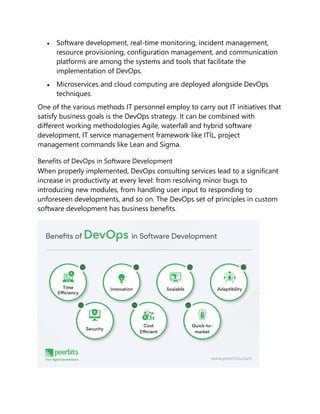
Benefits of DevOps in Software Development
When properly implemented, DevOps consulting services lead to a significant
increase in productivity at every level: from resolving minor bugs to
introducing new modules, from handling user input to responding to
unforeseen developments, and so on. The DevOps set of principles in custom
software development has business benefits.
Efficiency of time and innovation
Being proactive is the cornerstone and primary advantage of DevOps. As a
result, it facilitates smoother team coordination and communication within
businesses. Furthermore, your IT personnel may concentrate on higher-value
initiatives with round-the-clock automated IT infrastructure monitoring and
management.
Scalable according to demand
DevOps principles enable systems to scale down during periods of low
demand and expand during periods of high demand. You won't waste time
maintaining an extended system when you automate most tasks, like testing.
Adaptability
Software solutions built using the DevOps methodology are modular, self-
contained, and readily replaceable modules. According to the DevOps
methodology, infrastructure is flexible and may be configured at any time.
Since agility allows you to respond swiftly to customer feedback and
unforeseen developments in the market, it provides early business benefits.
Cost-efficient
By decreasing the amount of manual work engineers must perform and by
speeding up time to market, the DevOps lifecycle lowers costs. It makes
software development, testing, and deployment faster and less error-prone.
Enhanced Safety and Dependability
In an ideal scenario, the procedure is configured so that, in the event of an
emergency, all user profiles and associated data are constantly backed up.
Additionally, systems might completely automate the release/deployment
processes and promptly notify of any issues. In the event of a disaster, you can
quickly restore backups and get the system back up and running.
Quick-to-market
Whether you're changing environments, adding new features, addressing
issues, or something else entirely, you may complete your tasks more quickly
by applying the DevOps methodology. The necessity to develop infrastructure
increases with its complexity and evolution.
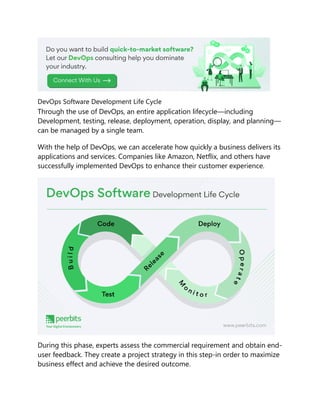
DevOps Software Development Life Cycle
Through the use of DevOps, an entire application lifecycle—including
Development, testing, release, deployment, operation, display, and planning—
can be managed by a single team.
With the help of DevOps, we can accelerate how quickly a business delivers its
applications and services. Companies like Amazon, Netflix, and others have
successfully implemented DevOps to enhance their customer experience.
During this phase, experts assess the commercial requirement and obtain end-
user feedback. They create a project strategy in this step-in order to maximize
business effect and achieve the desired outcome.
 Code: At this stage, the code is being written. The development team
uses lifecycle DevOps tools and extensions like Git to streamline the
design process and help them avoid lousy coding standards and safety
issues.
 Build: After finishing their work, programmers submit their code to the
common code source using technologies like Maven and Gradle.
 Test: The product is initially sent to the test platform to carry out several
kinds of screening, like user acceptability testing, safety testing,
integration checking, speed testing, and so on, using tools like JUnit,
Selenium, etc., in order to ensure software integrity.
 Release: At this stage, the build is ready to be implemented in the real
world. When the build passes all organizational requirements-based
checks and is ready for production, the DevOps team prepares updates
or deploys multiple versions.
 Deploy: Using a variety of DevOps lifecycle tools, Infrastructure-as-Code
now helps to create the operational infrastructure and publishes the
build.
 Operate: Users can now use this version conveniently. At this point,
server configuration and deployment are handled by the management
department using technologies like Chef.
 Monitor: At this stage, the DevOps workflow is examined based on
information obtained from many sources, including consumer behavior
and application efficiency. Teams can find bottlenecks impacting the
performance of the production and operations teams by having the
capacity to examine the entire environment.
To obtain the process, each stage of the DevOps lifecycle is connected to
specific tools and applied sciences. A number of the commonly used tools are
developed mainly to meet the needs of commercial enterprises and are
available as open source. The DevOps lifecycle facilitates satisfying delivery
and is simple to work with.
How does DevOps Speed up the Process of Software Development?
Here are the processes that help DevOps to speed up the developing and
deploying applications.
Continuous Development
Continuous Development is crucial to DevOps because it increases
productivity each time a piece of code is developed, tested, built, and put into
production. Code is written in small, continuous chunks rather than all at once.
Continuous Development improves the code's quality and speeds up the
process of fixing errors, vulnerabilities, and faults. It makes it easier for
developers to focus on writing excellent code.
Continuous Integration
In DevOps, four primary stages describe continuous integration. They are
listed in the following order:
 Consistent SourceCode using SCM
 Constructing the code
 Code quality assessment
 Building artifacts' storage
The Continuous Integration flow consists of the stages listed above. We can
use any tool that meets our needs at each stage, and one of the most widely
used tools is GitHub for source code management (SCM). As a developer
writes code on his local computer, he pushes it to GitHub, a remote repository
from which anyone with access can pull, clone, and edit the code as needed.
Continuous Testing
Continuous testing can be implemented by any organization using the agile
and DevOps approaches. Testsigma, Selenium, LambdaTest, and other
automation testing tools can be used for continuous testing, depending on
our needs. These technologies allow us to test our code more rapidly and
intelligently, as well as prevent issues and code smells. An additional
advantage is that the entire process may be automated with the help of a
continuous integration platform like Jenkins.
Continuous Deployment
The technique of automatically delivering an application into the production
environment when it has finished the build and testing phases is known as
continuous deployment. Everything from getting the source code of the
application to deploying it will be automated in this case. Continuous
deployment refers to the process of manually deploying an application into
production servers when it has finished the construction and testing phases.
Continuous Monitoring
In the absence of continuous monitoring, the DevOps lifecycle is not
complete. Prometheus and Grafana enable continuous monitoring so that we
can keep an eye on things and be alerted before something goes wrong.
Prometheus allows us to collect a wide range of performance metrics, such as
error rates, network traffic, CPU and memory utilization, application response
times, and more. Grafana enables the visual representation and monitoring of
time series data, including CPU and memory usage.
Continuous Feedback
After the program is made available to the public, end users will utilize it and,
after providing us with feedback, will let us know how well it performs and if
any bugs negatively impact the user experience. In order to reduce errors or
bugs in the code we are currently developing and to produce much more
effective results for end users, the DevOps team will analyze the feedback
provided by end users and then reach out to the development team to try and
rectify any mistakes they may have made.
Continuous Operations
By introducing continuous operation, we will maintain better application
uptime while reducing maintenance downtime that could negatively affect
end users' experiences. Continuous operations lead to improved quality
control, reduced production costs, and increased productivity.
Conclusion
The software development and deployment process has undergone a
complete transformation thanks to DevOps consulting services. It has aided
companies in bringing together Development and operations teams to work
together productively towards a common goal, enhancing understanding of
the requirements and deployment plan for the application.
Businesses benefit from it in many ways, including reduced time to market,
improved quality, and increased customer satisfaction. By taking DevOps
Consulting services from Peerbits can help you to automate and integrate
agile development approaches that can distribute software more rapidly,
correctly, and efficiently.

The Role of DevOps Consulting in Modern Software Development

  • 1.
    The Role ofDevOps Consulting in Modern Software Development In software development, DevOps creates a link between operations and growth development. It makes a more responsive software development lifecycle, lessens bottlenecks, and promotes a smoother workflow. The primary role of DevOps consulting services is to automate software development processes, from code integration to deployment, in order to produce software more rapidly and consistently. Let's go to learn everything about the role of DevOps consulting services, from learning its definition and principles to the integrated continuous processes, to help you make an informed decision about your next software development projects! What is DevOps and How is it useful in Software development? Combining the words "Development" and "Operations," "DevOps" refers to a set of procedures designed to dismantle conventional organizational silos and
  • 2.
    promote cooperation andcontinuous improvement. Software development and IT operations are combined to deliver a constantly evolving process called the DevOps. The role of DevOps consulting services is to enhance the software development process by encouraging cooperations between the operations and development teams. DevOps seeks to reduce the duration of the development lifecycle while regularly delivering features, fixes, and upgrades that are closely aligned with business objectives. This method produces more effective and efficient results by assisting in the early identification and resolution of problems in the development process. A DevOps team creates software that flawlessly satisfies user needs, delivers quickly, and functions well the first time around. Organizations employ technology in addition to culture to accomplish this purpose. Stakeholders and developers interact on the project while developers work on minor modifications on their own. IT teams utilize CI/CD pipelines and other forms of automation to transfer code between the development and deployment stages. Teams are able to assess changes instantly and apply regulations to guarantee that releases adhere to standards. What is DevOps Development Consulting? A DevOps-focused business can improve and optimize an organization's software development and operational procedures by giving DevOps development consulting. These services play a critical role in creating a more effective and seamless workflow by bridging the gap between IT operations (Ops) and Development (Dev). The role of DevOps Consulting services starts by evaluating how your processes are currently set up, pinpointing areas that need work, and creating a customized DevOps plan. One of the central tenets of DevOps development consulting is the integration and automation of tools. These services allow for continuous integration and continuous deployment (CI/CD), which speeds up the release cycle considerably by automating parts of the software development lifecycle like coding, testing, and deployment.
  • 3.
    Infrastructure as Code(IaC), which facilitates effective infrastructure management and provisioning, is a critical component of DevOps development consultancy. Furthermore, these services frequently cover migration and cloud services, assisting companies in utilizing cloud computing for maximum scalability and performance. DevOps development consulting involves more than just technical advancements; it also entails a change in organizational culture. Businesses looking to streamline their development processes might benefit significantly from the DevOps Consulting companies. They assist in streamlining your current DevOps procedures, updating your software development lifecycle (SDLC), and optimizing your current IT setup. Having stated that, a DevOps consultant can benefit your company in the following ways:  Make the best use of the software development teams and tools available for a project.  Boost the effectiveness of software evaluation.  Oversee workflow automation and bring the SDLC up to date.  Encourage the use of cutting-edge software and tools.  Assure a quicker market delivery. DevOps Consulting: Core Principles and Philosophy Better communication and collaboration between these teams and others within an organization are the core principles of DevOps. It also refers to cultural shifts, such as fostering unity and trust between systems administrators and developers and coordinating technology initiatives with business needs. The software delivery chain, services, job roles, IT tools, and best practices can all be altered by DevOps. DevOps settings use common approaches, even though they aren't really a technology. Among them are the following:  Continuous deployment or continuous integration and delivery (CI/CD), with a focus on task automation.
  • 4.
     Software development,real-time monitoring, incident management, resource provisioning, configuration management, and communication platforms are among the systems and tools that facilitate the implementation of DevOps.  Microservices and cloud computing are deployed alongside DevOps techniques. One of the various methods IT personnel employ to carry out IT initiatives that satisfy business goals is the DevOps strategy. It can be combined with different working methodologies Agile, waterfall and hybrid software development, IT service management framework like ITIL, project management commands like Lean and Sigma. Benefits of DevOps in Software Development When properly implemented, DevOps consulting services lead to a significant increase in productivity at every level: from resolving minor bugs to introducing new modules, from handling user input to responding to unforeseen developments, and so on. The DevOps set of principles in custom software development has business benefits.
  • 5.
    Efficiency of timeand innovation Being proactive is the cornerstone and primary advantage of DevOps. As a result, it facilitates smoother team coordination and communication within businesses. Furthermore, your IT personnel may concentrate on higher-value initiatives with round-the-clock automated IT infrastructure monitoring and management. Scalable according to demand DevOps principles enable systems to scale down during periods of low demand and expand during periods of high demand. You won't waste time maintaining an extended system when you automate most tasks, like testing. Adaptability Software solutions built using the DevOps methodology are modular, self- contained, and readily replaceable modules. According to the DevOps methodology, infrastructure is flexible and may be configured at any time. Since agility allows you to respond swiftly to customer feedback and unforeseen developments in the market, it provides early business benefits. Cost-efficient By decreasing the amount of manual work engineers must perform and by speeding up time to market, the DevOps lifecycle lowers costs. It makes software development, testing, and deployment faster and less error-prone. Enhanced Safety and Dependability In an ideal scenario, the procedure is configured so that, in the event of an emergency, all user profiles and associated data are constantly backed up. Additionally, systems might completely automate the release/deployment processes and promptly notify of any issues. In the event of a disaster, you can quickly restore backups and get the system back up and running. Quick-to-market Whether you're changing environments, adding new features, addressing issues, or something else entirely, you may complete your tasks more quickly by applying the DevOps methodology. The necessity to develop infrastructure increases with its complexity and evolution.
  • 6.
    DevOps Software DevelopmentLife Cycle Through the use of DevOps, an entire application lifecycle—including Development, testing, release, deployment, operation, display, and planning— can be managed by a single team. With the help of DevOps, we can accelerate how quickly a business delivers its applications and services. Companies like Amazon, Netflix, and others have successfully implemented DevOps to enhance their customer experience. During this phase, experts assess the commercial requirement and obtain end- user feedback. They create a project strategy in this step-in order to maximize business effect and achieve the desired outcome.
  • 7.
     Code: Atthis stage, the code is being written. The development team uses lifecycle DevOps tools and extensions like Git to streamline the design process and help them avoid lousy coding standards and safety issues.  Build: After finishing their work, programmers submit their code to the common code source using technologies like Maven and Gradle.  Test: The product is initially sent to the test platform to carry out several kinds of screening, like user acceptability testing, safety testing, integration checking, speed testing, and so on, using tools like JUnit, Selenium, etc., in order to ensure software integrity.  Release: At this stage, the build is ready to be implemented in the real world. When the build passes all organizational requirements-based checks and is ready for production, the DevOps team prepares updates or deploys multiple versions.  Deploy: Using a variety of DevOps lifecycle tools, Infrastructure-as-Code now helps to create the operational infrastructure and publishes the build.  Operate: Users can now use this version conveniently. At this point, server configuration and deployment are handled by the management department using technologies like Chef.  Monitor: At this stage, the DevOps workflow is examined based on information obtained from many sources, including consumer behavior and application efficiency. Teams can find bottlenecks impacting the performance of the production and operations teams by having the capacity to examine the entire environment. To obtain the process, each stage of the DevOps lifecycle is connected to specific tools and applied sciences. A number of the commonly used tools are developed mainly to meet the needs of commercial enterprises and are available as open source. The DevOps lifecycle facilitates satisfying delivery and is simple to work with. How does DevOps Speed up the Process of Software Development? Here are the processes that help DevOps to speed up the developing and deploying applications.
  • 8.
    Continuous Development Continuous Developmentis crucial to DevOps because it increases productivity each time a piece of code is developed, tested, built, and put into production. Code is written in small, continuous chunks rather than all at once. Continuous Development improves the code's quality and speeds up the process of fixing errors, vulnerabilities, and faults. It makes it easier for developers to focus on writing excellent code. Continuous Integration In DevOps, four primary stages describe continuous integration. They are listed in the following order:  Consistent SourceCode using SCM  Constructing the code  Code quality assessment  Building artifacts' storage The Continuous Integration flow consists of the stages listed above. We can use any tool that meets our needs at each stage, and one of the most widely used tools is GitHub for source code management (SCM). As a developer writes code on his local computer, he pushes it to GitHub, a remote repository from which anyone with access can pull, clone, and edit the code as needed. Continuous Testing Continuous testing can be implemented by any organization using the agile and DevOps approaches. Testsigma, Selenium, LambdaTest, and other automation testing tools can be used for continuous testing, depending on our needs. These technologies allow us to test our code more rapidly and intelligently, as well as prevent issues and code smells. An additional advantage is that the entire process may be automated with the help of a continuous integration platform like Jenkins. Continuous Deployment The technique of automatically delivering an application into the production environment when it has finished the build and testing phases is known as continuous deployment. Everything from getting the source code of the
  • 9.
    application to deployingit will be automated in this case. Continuous deployment refers to the process of manually deploying an application into production servers when it has finished the construction and testing phases. Continuous Monitoring In the absence of continuous monitoring, the DevOps lifecycle is not complete. Prometheus and Grafana enable continuous monitoring so that we can keep an eye on things and be alerted before something goes wrong. Prometheus allows us to collect a wide range of performance metrics, such as error rates, network traffic, CPU and memory utilization, application response times, and more. Grafana enables the visual representation and monitoring of time series data, including CPU and memory usage. Continuous Feedback After the program is made available to the public, end users will utilize it and, after providing us with feedback, will let us know how well it performs and if any bugs negatively impact the user experience. In order to reduce errors or bugs in the code we are currently developing and to produce much more effective results for end users, the DevOps team will analyze the feedback provided by end users and then reach out to the development team to try and rectify any mistakes they may have made. Continuous Operations By introducing continuous operation, we will maintain better application uptime while reducing maintenance downtime that could negatively affect end users' experiences. Continuous operations lead to improved quality control, reduced production costs, and increased productivity. Conclusion The software development and deployment process has undergone a complete transformation thanks to DevOps consulting services. It has aided companies in bringing together Development and operations teams to work together productively towards a common goal, enhancing understanding of the requirements and deployment plan for the application. Businesses benefit from it in many ways, including reduced time to market, improved quality, and increased customer satisfaction. By taking DevOps
  • 10.
    Consulting services fromPeerbits can help you to automate and integrate agile development approaches that can distribute software more rapidly, correctly, and efficiently.