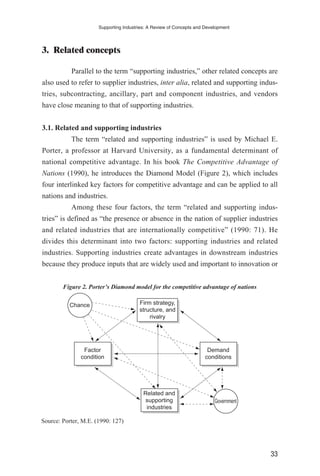
©Vietnam Development Forum, 2007
Contact:
Vietnam Development Forum
Suite 401, Hanoi Central Office Building
44B Ly Thuong Kiet St., Hanoi, Vietnam
Phone: 84-4-936 2633 / Fax: 84-4-936 2634
Email: hellovdf@vdf.org.vn
Website: http://www.vdf.org.vn
Vietnam Development Forum Tokyo
National Graduate Institute for Policy Studies (GRIPS)
7-22-1 Roppongi, Minato-ku, Tokyo 106-8677, Japan
Phone: 81-3-6439 6000 / Fax: 81-3-6439 6010
Email: vngripsnet@grips.ac.jp
Website: http://www.grips.ac.jp/vietnam/VDFTokyo/index.html
The authors would like to thank Professor Donna Amoroso and Ms. Patricia
Decker of the Academic Writing Center of GRIPS for their excellent and timely
work on English editing for the book, and all assistants of the GRIPS Develop-
ment Forum (GDF) for their tireless supports and encouragements in the prepa-
ration of the manuscript, as well as in several related administrative work.
CONTENTS
Introduction and Summary ⋯⋯⋯⋯⋯⋯⋯⋯⋯⋯⋯⋯⋯⋯⋯⋯⋯⋯i
Vietnam Development Forum
Chapter 1 Supporting Industries in Vietnam from the
Perspective of Japanese Manufacturing Firms ⋯⋯⋯⋯⋯1
Vietnam Development Forum
Chapter 2 Supporting Industries: A Review of Concepts
and Development ⋯⋯⋯⋯⋯⋯⋯⋯⋯⋯⋯⋯⋯⋯⋯⋯27
Nguyen Thi Xuan Thuy
Chapter 3 Quantitative Analysis of the Procurement Structure
of Supporting Industries in ASEAN 4, Republic of Korea,
and Japan ⋯⋯⋯⋯⋯⋯⋯⋯⋯⋯⋯⋯⋯⋯⋯⋯⋯⋯⋯51
Toshiyuki Baba
Chapter 4 Designing and Managing Supporting Industry
Databases ⋯⋯⋯⋯⋯⋯⋯⋯⋯⋯⋯⋯⋯⋯⋯⋯⋯⋯⋯65
Junichi Mori
Introduction and Summary
Vietnam is one of the best performing developing countries in the
world. Economic growth has been recorded at about 8 percent during the past
decade, during which the industrial sector has played an increasing role in both
value and employment creation. Swift changes in economic structure have
attracted an increasing flow of foreign investments, particularly in the manufac-
turing sector, which in turn has helped Vietnam to promote higher economic
growth. Moreover, under globalization with fiercer competition, both foreign
and local enterprises in Vietnam need to improve their international competi-
tiveness through good business connections. Given this need, supporting indus-
tries are becoming extremely important to the business strategies of the foreign
manufacturing enterprises, especially assemblers, in Vietnam. The demand of
the foreign enterprises in Vietnam for good local suppliers has necessitated
more comprehensive industrial policies in developing these industries.
However, supporting industries in Vietnam have not been fully devel-
oped; they are just at the early stages of development. This limits business
opportunities for the foreign-invested enterprises, specifically assemblers,
because it is costly and time-consuming for them to find good local suppliers.
In this context, conducting studies and proposing policy actions for the develop-
ment of the supporting industries in Vietnam is an urgent task. This book is
published for these purposes. It contains four papers, each addressing a differ-
ent topic on the current situation of Vietnam’s supporting industries and inter-
national experiences in developing these industries. These papers were present-
ed and commented on in a number of workshops and conferences held inside
and outside Vietnam. It is the hope of the editor that the contents of this book
will extend beyond those directly involved in the related field of research, and
that the book will provide crucial information about the current situation and
policy directions for the development of Vietnam’s supporting industries. The
following are summaries of the papers in this book.
The first paper, written by the Vietnam Development Forum (VDF)
research team, provides an overview on the supporting industries in Vietnam
from the perspective of Japanese manufacturing firms, and then proposes a set
i
of policy directions to develop these industries. The analyses are based mainly
on a series of hearings between the Ministry of Industry, Vietnam (MOI) and
Japanese manufacturing firms operating in Vietnam, which were held by VDF
from late February to early April 2006. There are 38 firms in the sample,
including 15 electrical and electronic firms, 14 motorbike firms, and 9 automo-
bile firms. The existing situation of local procurement shows that the supporting
industries in Vietnam are relatively underdeveloped in comparison with other
countries in the region, such as Malaysia and Thailand. Although progress in
the local procurement ratio has been recorded, it differs significantly across the
studied sectors.
Before making detailed analyses on enhancing the growth of support-
ing industries in Vietnam, the paper argues that competitiveness and demand
size are two determinants for the development of these industries. Regarding
competitiveness, the paper indicates that under the standards of Japanese manu-
facturing, quality, cost, and delivery (QCD) are extremely important. The parts
cost in the studied sectors usually occupies 70–90 percent compared with labor
cost of less than 10 percent, so the Japanese manufacturing firms need to reduce
the cost related to parts procurement, which in turn helps them to attain cost
competitiveness. To achieve this, most parts must be made in Vietnam because
importing parts from other countries will incur additional costs in transporta-
tion, storage, and handling. In addition, Japanese assemblers in Vietnam want
parts suppliers to be located close by to enable high-frequency, on-time delivery
of parts in order to minimize inventory and production lead time. To this end,
Vietnamese parts suppliers first need to improve quality and delivery of parts.
About the demand size, the paper argues that large demand size is crucial for
supporting industries because they require relatively large minimum orders to
enter the market, and they are generally more capital-intensive than the final
assembly. More importantly, some supporting industries, such as molding and
metal pressing, require expensive machines, which are indivisible, and therefore
they can reduce the unit capital cost by increasing the volume of production.
Such increase needs to be guaranteed by a large demand.
Once the two factors mentioned above are attained, four additional
areas must be promoted to accelerate the growth of supporting industries in
Vietnam: high-quality industrial human resources, attractive tax and tariff poli-
ii
cies, stable policy environment, and overcoming the information and perception
gaps between foreign direct investment (FDI) assemblers and Vietnamese sup-
pliers. For instance, the majority view among Japanese firms is that high-quali-
ty industrial human resources are much more important than high-tech
machines because second-hand machines operated by high-skilled workers may
be superior to brand-new machines operated by low-skilled workers. To
improve the human resources for industrial development, the paper proposes a
number of policy directions to enhance the existing training programs and pro-
mote new programs with both public and private efforts.
Along with these issues, the paper discusses other two issues, which
are also crucial for the development of supporting industries in Vietnam: indus-
trial and safety standards, and unavailability of raw materials. Dealing with
these issues is important for meeting international standards and ensuring effi-
cient operation.
In order to make a concrete development strategy for the supporting
industries in Vietnam, Nguyen Thi Xuan Thuy, in the second paper in the book,
argues that the term “supporting industries” needs to be defined properly to suit
the socio-economic conditions of the country and the targets of industrial strate-
gy. Therefore, her paper mainly focuses on reviewing different concepts of
“supporting industries” and their development, and then proposes a definition
for Vietnam.
According to the author, although the term “supporting industries” is
widely used in many countries, it is still ambiguous and without consensus in
definition. This term is used differently in different countries, depending on the
economic conditions and policy purposes. For instance, Thailand defines sup-
porting industries as the enterprises that produce parts and components that are
used in the final assembly processes of the automobile, machinery and electron-
ic manufacturing industries, while the US Department of Energy defines sup-
porting industries as those that supply materials and processes necessary to
form and fabricate products before they are marketed to end-use industries.
Moreover, the term has also been changed to adapt to changes in economic con-
ditions and policy directions of the country. For example, in the White Paper on
Economic Cooperation 1985 by Japan’s Ministry of International Trade and
Industry (MITI, now called the Ministry of Economy, Trade, and Industry—
iii
METI), the term “supporting industries” was used to refer to small and medium
enterprises (SMEs) that contribute to strengthening industrial structure in Asian
countries for medium and long terms, or the SMEs that produce parts and com-
ponents. However, in the New Asian Industrial Development Plan to promote
industrial cooperation between Japan and four countries in the Association of
Southeast Asian Nations (ASEAN 4: Indonesia, Malaysia, the Philippines, and
Thailand), MITI defined “supporting industries” as industries that supply the
necessary things such as raw materials, parts and capital goods for assembly-
type industries.
In addition to these concepts, the paper also provides a number of
related concepts in order to see the different development stages of supporting
industries. Subcontracting, ancillary industries, parts and components indus-
tries, and vendors are some of these concepts.
Going further with the case of Vietnam, where the term “supporting
industries” has been used only since 2003, the paper suggests that without a
clear definition of supporting industries, it is more difficult for Vietnam to have
concrete industrial policies and strategies, and to mobilize all necessary
resources for the development of supporting industries. Based on the current
development context, the author then proposes a definition of these industries in
Vietnam. Furthermore, reviewing international experiences in developing sup-
porting industries with such important policies as local content regulations, pro-
motion of FDI into supporting industries, linkage promotion, and participation
in the global production networks, the paper indicates some lessons that Viet-
nam can learn to foster these industries.
Using a broad definition of “supporting industries,” which refers to a
group of industries that supply the diverse parts and materials used in the pro-
duction of industrial products, the third paper of the book, by Toshiyuki Baba,
aims at describing quantitatively the procurement structure of supporting indus-
tries for key manufacturing categories in Asia. The paper uses the Asian Inter-
national Input-Output Tables to reveal the industrial structures that are com-
posed of the industries in each country in the region. Three tables correspon-
ding to 1975, 1990, and 1995 are used to analyze the industrial relations
between ASEAN 4, the Republic of Korea, and Japan with particular focus on
automotive/motorcycle and electrical/electronic industries.
iv
Providing formulas for estimating domestic direct procurement rate
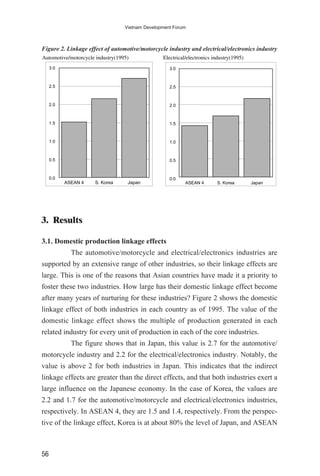
(DDPR) and domestic indirect procurement rate (DIPR), the author shows that
indirect linkage effects are greater than direct linkage effects in these studied
sectors in Japan, while ASEAN 4 and the Republic of Korea have lower domes-
tic linkage effects in comparison with Japan. According to the author, this find-
ing can be elucidated by a possibility that lower domestic linkage effects are
due to low levels of domestic procurement.
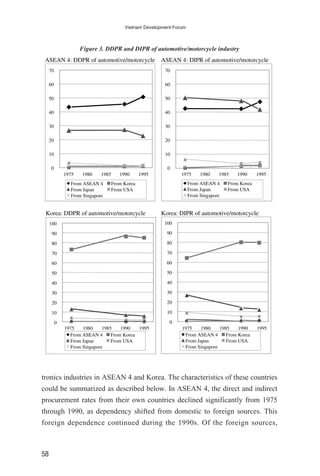
Regarding automotive/motorcycle industries, the paper shows that in
ASEAN 4 both direct and indirect procurement rates from their own countries
were stagnantly low during 1975–1990, while they developed during
1990–1995, and dependency on Japan was greater than that on domestic
sources. This can be explained by the fact that these countries experienced
major economic expansion in the latter period. The situation for the Republic of
Korea was contrasted with that of ASEAN 4, in which both direct and indirect
procurement rates from domestic sources increased over time, while those from
a major external source (Japan) declined steadily. For Japan, there was almost
no change during this 20-year period because both direct and indirect procure-
ments were approximately 100 percent from domestic sources.
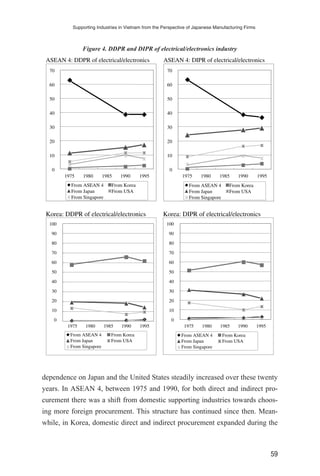
The same analysis is also used for the electrical and electronic indus-
tries. The findings imply that the foreign dependency was significant in
ASEAN 4 in the studied period. Meanwhile, domestic direct and indirect pro-
curements in the Republic of Korea expanded in the 1975–1990 period and
declined during the 1990s. This situation went along with an increase in foreign
procurements. For Japan, domestic sources were still significantly important,
and foreign sources, particularly the US, increased steadily.
To provide a more thorough analysis on these changes of domestic-
based and foreign-based procurements in the studied countries, the paper shows
some possible causes, including differences in the characteristics of parts, in the
quality required by the market, and in policies of each government. These dif-
ferences are useful information for the policy makers in proposing their indus-
trial development policies.
It is emphasized in the first three papers of this book that local pro-
curement of parts and components benefits both FDI assemblers and local parts
suppliers because FDI assemblers are able to reduce additional costs, such as
v
transportation and inventory, associated with imports, while local suppliers can
increase business volume and absorb updated technology through business rela-
tions with FDI assemblers. Therefore, it is commonly agreed that promoting
local procurement is a key to FDI-led industrial growth in developing countries.
Yet, most FDI assemblers in Vietnam do not have sufficient information on
where good Vietnamese parts suppliers are located in order to attain cost com-
petitiveness through fruitful business connections with these local suppliers. To
investigate this research question, Junichi Mori presents an analysis of design-
ing and managing databases for supporting industries in the last paper of the
book.
The author explains the importance of such databases in Vietnam.
According to various sources of information such as Japan External Trade
Organization (JETRO) (2004) and VDF (2006), FDI assemblers in Vietnam
face serious difficulties in promoting parts localization because local parts pro-
curement in all manufacturing sectors in Vietnam was much lower than in other
ASEAN countries. More seriously, it is also costly and time-consuming for FDI
assemblers in Vietnam to find appropriate and good parts suppliers in Vietnam.
Creating databases of supporting industries is therefore urgently necessary.
To go further with designing databases for supporting industries in
Vietnam, the paper describes desirable characteristics of such databases. It is
shown that the current yellow-page-type business directories in Vietnam cannot
provide sufficient information for FDI assemblers to find their appropriate local
partners. It is also emphasized that the main difference between databases for
supporting industries and business directories is the depth of firm-level data. To
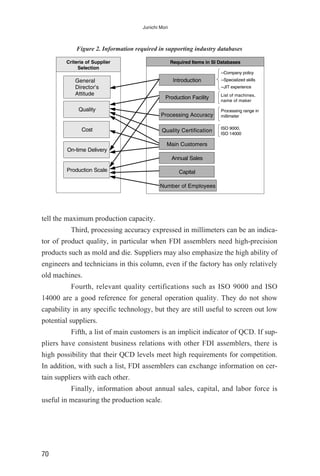
obtain the required information, the paper then illustrates the mutual relation
between criteria of supplier selection and the required items in databases for
supporting industries.
For creating appropriate databases that can meet the demand of FDI
assemblers, the author provides useful information about databases of support-
ing industries in Japan. Among many others, Okaya City database and
Monozukuri-net are excellent examples. To create such databases, various relat-
ed issues need to be considered thoroughly. For instance, motivating SMEs to
participate in the databases requires such important activities as good public-
private partnerships, intensive company visits, and business matching services.
vi
We hope that this book will help the readers understand more thor-
oughly the current status of the supporting industries in Vietnam. If VDF can
contribute its mite to promote development of Vietnam’s supporting industries,
we will be more than happy.
Tokyo, March 2007
Vietnam Development Forum
vii
Chapter 1
Supporting Industries in Vietnam from the Per-
spective of Japanese Manufacturing Firms
Vietnam Development Forum
In early 2006, the Vietnam Development Forum (VDF) organized a
series of hearings between the Ministry of Industry (MOI) and Japanese manu-
facturing firms operating in Vietnam1
. Through these hearings, the MOI team,
which was drafting the supporting industry master plan, directly exchanged
information and views with the concerned Japanese firms.
The targeted sectors were Japanese assemblers and parts suppliers
belonging to electrical goods and electronics, motorbikes, and automobiles2
.
These were important sectors for the development of supporting industries, as
well as the sectors specifically mentioned in the Japan-Vietnam Joint Initiative.
We sent letters to all Japanese FDI firms operating in Vietnam in these sectors,
which numbered 55. Among them, we were able to hear from 32 firms, which
included 15 electrical and electronics firms, 14 motorbike firms, and 9 automo-
bile firms3
. By region, 19 firms were located in the North and 13 firms were
located in the South. In addition, we visited one Vietnamese assembler, two
Vietnamese parts suppliers, and one Taiwanese parts supplier, all of which had
business relations with Japanese assemblers. We also heard opinions of Japan-
ese industrial experts.
Hearings were conducted from late February to early April 2006.
Intensive hearings were organized in the week of March 6 in the North, and in
1
1
Participants from VDF were Kenichi Ohno (project co-leader), Mai The Cuong, Ngo Duc Anh,
Junichi Mori, Pham Truong Hoang, and Kohei Mishima. Participants from MOI were Nguyen
Anh Nam (team leader), Mai Tuan Anh, Pham Gia Thuc, Pham Tung Lam, and Duong Hong
Quan.
2
Hearings with Vietnamese firms and firms of other nationalities, including China, Taiwan, Korea
and EU, were conducted separately by MOI without our help.
3
These add up to 38 firms due to overlapping. Six firms supplied parts to both automobile assem-
blers and motorbike assemblers.
the week of March 13 in the South. Different hearing styles were used, from
formal meetings to factory visits, informal exchange and email correspondence,
to adapt to the preferences and time constraints of the companies. In semi-struc-
tured interviews, we generally inquired about the current situation of parts
localization and desired policy measures for supporting industry promotion. We
also received comments on the draft supporting industry master plan, if any. All
information was treated as confidential and no company name was to be
released.
This report was compiled by VDF using the inputs from the inter-
viewed firms. VDF takes full responsibility for its content. No statement or
analysis in this report should be construed as a consensus view among Japanese
FDI firms. In fact, opinions often differed among the three sectors, and even
among firms belonging to the same sector. Arguments presented below are
majority views, or common denominators, among Japanese FDI firms operating
in Vietnam, as selected by VDF.
1. Current situation of local procurement
Vietnam’s supporting industries are relatively undeveloped. For
Japanese FDI firms in manufacturing, Vietnam’s local procurement ratio was
22.6% in 2003, while the ratios of Malaysia and Thailand were 45% or higher4
.
However, the progress of local procurement differs significantly across the
three sectors studied.
The motorbike sector is most advanced in localization, with the aver-
age local procurement ratio of 75%5
. This figure includes internal parts produc-
tion by assemblers, sourcing from local suppliers, and sourcing from FDI sup-
pliers in Vietnam. Although motorbike assemblers continue to stress the impor-
tance of developing supporting industries further, the degree of their localiza-
tion is much higher than the other two sectors.
In the electrical and electronics sector, local procurement is rising at
2
Vietnam Development Forum
4
According to JETRO, local procurement of the manufacturing sector in 2004 was 47.9% in Thai-
land, 45.0% in Malaysia, 38.3% in Indonesia, and 28.3% in the Philippines. See JETRO (2005).
5
This figure was provided by a motorbike assembler during the intensive hearing week.
some FDI firms. In 2002, most consumer electronics assemblers were unable to
domestically source even relatively simple plastic and metal parts. Now, how-
ever, one TV assembler reports that it is able to buy virtually all plastic parts
from (mainly FDI) suppliers in Vietnam. At present, local procurement for TVs
seems to range from 20% to 40%, depending on the producer (Mori, 2005: 28).
Similarly, a computer device producer said that it had increased its number of
domestic suppliers from 7 in 2002 to 45 in 2006. As a result, local procurement
of this firm rose from 5% in 2004 to 30–40% in 2006. However, there are other
producers who continue to have low local procurement. One TV assembler still
maintains complete knock-down (CKD) production because imported parts are
cheaper than domestic parts. Overall, the current localization level is still far
below what Japanese firms desire for attaining competitiveness. Even for manu-
facturers who have raised local procurement of plastic parts significantly in
recent years, finding electronics parts, molds, and metal processes such as
pressing, forging, and plating, remains very difficult. An assembler of home
appliances said that it could not find any high-valued components in the domes-
tic market. Although this firm has achieved a local procurement ratio of 70% in
terms of number of parts, its localization is only 30% in value. This implies that
localization has been concentrated in low-value parts.
As for the automobile sector, progress is slowest among the three sec-
tors, with local procurement ratios of 5–10% (Japan Finance Corporation for
Small and Medium Enterprises [JASME], 2004). While some bulky or labor-
intensive parts, such as seats and wire harnesses, have been localized, most
other parts continue to be imported. Furthermore, automobile manufacturers in
Vietnam are currently beset with serious short-term problems such as second-
hand car imports, a special consumption tax, and related uncertainty in the
domestic market6
. These problems prevent auto-makers from making long-term
strategic plans. Compared with motorbikes, automobiles in Vietnam are at a
much lower level of demand size and development, which severely limits
Supporting Industries in Vietnam from the Perspective of Japanese Manufacturing Firms
3
6
The special consumption tax on passenger vehicles rose from 40% to 50% in January 2006, and
the import ban on second-hand passenger cars will be lifted on May 1, 2006. Domestic new car
sales in the first quarter of 2006 fell 32% compared with the same period last year due to the wait-
and-see attitude of consumers.
strategic options to overcome these problems. Within the automobile sector,
trucks and buses have higher local procurement ratios than passenger cars
because the upper-structure of buses (passenger areas) and trucks (cargo stor-
age) can be built locally by Vietnamese companies.
2. Key factors and relations for competitiveness
By the standards of Japanese manufacturing, competitiveness depends
on quality, cost and delivery (QCD). For Japanese parts producers in Vietnam,
the crucial aspects that need to be improved are cost and delivery, while quality
guarantee is taken for granted. To reduce cost and quicken delivery, a healthy
development of supporting industries is essential.
In mechanical assembly-type manufacturing, which is considered in
this report, parts cost looms large in the total production cost of final assem-
blers. For instance, one consumer electronics assembler said that parts account-
ed for 80% of the production cost while labor accounted for only 2%. More
generally, the parts cost usually occupies 70–90% compared with the labor cost
of less than 10%. Thus, cost competitiveness cannot be attained unless the cost
related to parts procurement is reduced. By importing Malaysian or Thai parts,
producers in Vietnam incur additional costs in transportation, storage and han-
dling. Unless most parts are made in Vietnam, they cannot compete effectively
against Malaysian or Thai assemblers, who can use these parts without addi-
tional costs.
Furthermore, Japanese assemblers require high-frequency, on-time
delivery of parts in order to minimize inventory and production lead time. Nor-
mally, daily or even hourly deliveries are required. Unlike some Vietnamese
firms which hold large inventories as a safety buffer, Japanese firms always
consider inventory as a cost to be avoided as much as possible. To achieve zero
inventory, Toyota developed the Just-In-Time system (also known as the kan-
ban system) in the 1950s, which has spread widely to other Japanese firms.
Quick and frequent delivery is impossible if parts are imported every few
months, or if it takes days to bring parts to the factory. For this reason, final
assemblers want suppliers to be located near them. One Japanese consumer
electronics company recently visited Vietnam to consider the possibility of
4
Vietnam Development Forum
building a factory there, but gave up the idea after observing the weaknesses of
supporting industries in Vietnam.
For Vietnamese parts suppliers, on the other hand, the most crucial
aspects that must be improved are quality and delivery. Even if their parts are
cheap, Japanese assemblers will never buy them unless these two factors are
guaranteed. At present, there is a significant gap between Japanese assemblers
and Vietnamese suppliers regarding the acceptable standards in quality and
delivery, which will be discussed later.
Supporting industries consist of both FDI firms and Vietnamese
firms. Realistically, parts localization must begin with first attracting a large
number of FDI suppliers to Vietnam, followed by a gradual strengthening of
Vietnamese suppliers. FDI firms must inevitably be a large part of supporting
industries in the early stage of Vietnam’s industrialization.
Demand size is the pre-condition for attracting FDI suppliers to Viet-
nam. Large demand is crucial for cost reduction and FDI attraction, which are
mutually related. Without sufficient demand, parts makers cannot lower pro-
duction cost (the reason will be explained below) and become competitive.
Therefore they will not invest in Vietnam. Overcoming the demand size prob-
lem must be the top priority in the development of supporting industries.
Once this problem is solved, our survey has shown that there are four
additional areas that must be enhanced in order to accelerate the growth of sup-
porting industries: (i) high-quality industrial human resources, (ii) attractive tax
and tariff policies, (iii) stable policy environment, and (iv) overcoming the
information and perception gaps between FDI assemblers and Vietnamese sup-
pliers.
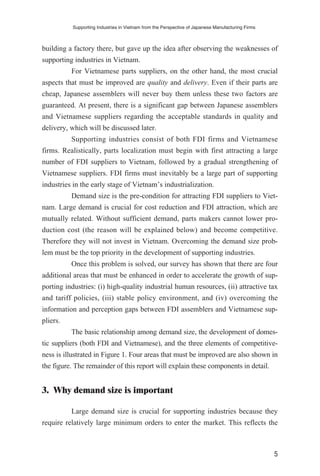
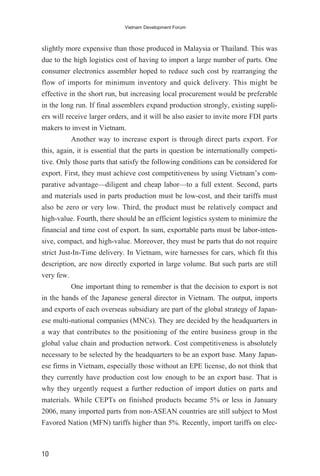
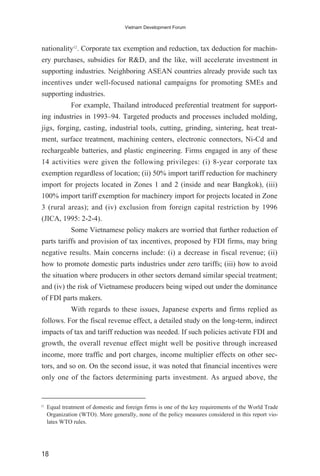
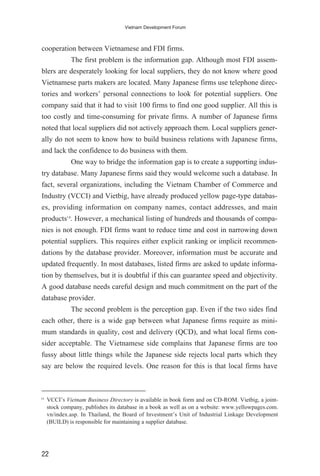
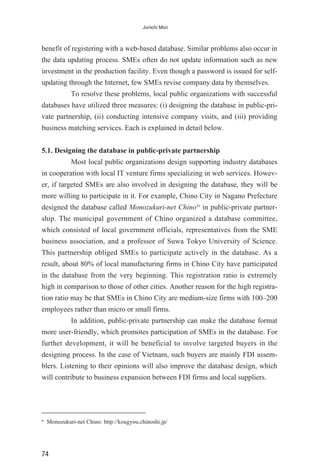
The basic relationship among demand size, the development of domes-
tic suppliers (both FDI and Vietnamese), and the three elements of competitive-
ness is illustrated in Figure 1. Four areas that must be improved are also shown in
the figure. The remainder of this report will explain these components in detail.
3. Why demand size is important
Large demand size is crucial for supporting industries because they
require relatively large minimum orders to enter the market. This reflects the
Supporting Industries in Vietnam from the Perspective of Japanese Manufacturing Firms
5
fact that, generally speaking, supporting industries are more capital-intensive
than final assembly, which tends to be highly labor-intensive. One auto parts
supplier stated that supporting industries would develop naturally even without
any promotion policy, if there was a sufficient demand.
Supporting industries such as molding, metal processing and plastic
injection require expensive machines and relatively few workers compared with
assembly. Moreover, these machines are indivisible (one cannot purchase one-
tenth of a machine). Once machines are installed, the capital cost for the factory
is the same whether they are operated 24 hours a day and 365 days a year, or
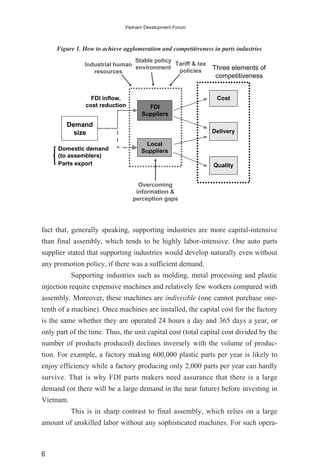
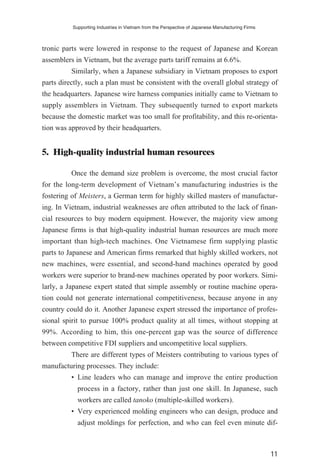
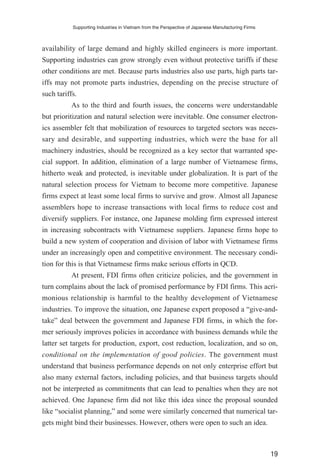
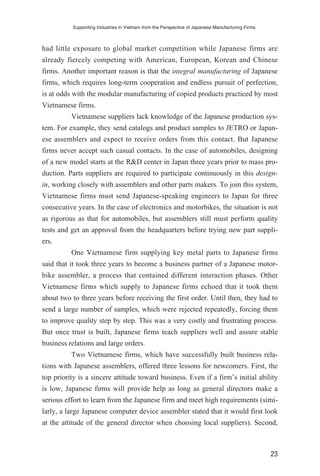
only part of the time. Thus, the unit capital cost (total capital cost divided by the
number of products produced) declines inversely with the volume of produc-
tion. For example, a factory making 600,000 plastic parts per year is likely to
enjoy efficiency while a factory producing only 2,000 parts per year can hardly
survive. That is why FDI parts makers need assurance that there is a large
demand (or there will be a large demand in the near future) before investing in
Vietnam.
This is in sharp contrast to final assembly, which relies on a large
amount of unskilled labor without any sophisticated machines. For such opera-
6
Vietnam Development Forum
Industrial human
resources
Stable policy
environment
Overcoming
information &
perception gaps
Tariff & tax
policies
Delivery
Cost
Quality
FDI
Suppliers
Local
Suppliers
Demand
size
Three elements of
competitiveness
FDI inflow,
cost reduction
Domestic demand
(to assemblers)
Parts export
Figure 1. How to achieve agglomeration and competitiveness in parts industries
tion, the unit cost is almost constant since there is no sunk capital cost. To dou-
ble the production volume, all that is needed is to use twice as many workers,
tables, tools, and expand the factory space accordingly.
In the motorbike sector, domestic demand in Vietnam reached 2.02
million units in 2004, ranking third within Association of Southeast Asian
Nations (ASEAN) after Indonesia and Thailand7
. It is normally said that many
motorbike parts suppliers begin to enter the market if the minimum order
exceeds 200,000 to 300,000 units (Mishima, 2005: 218). A domestic demand of
2 million units per year is sufficient to entice a number of FDI parts makers to
come to Vietnam and compete with each other. Indeed, motorbike assemblers
are now able to source many metal and plastic parts from both FDI and local
suppliers. However, they still import engine parts or produce them in-house.
The domestic market of consumer electrical and electronics is grow-
ing rapidly, but its absolute size remains small compared with those of other
ASEAN countries. For example, the annual sale of TVs is around 1.4 to 1.5
million sets in Vietnam, while Thai consumers buy 2.2 to 2.4 million sets per
Supporting Industries in Vietnam from the Perspective of Japanese Manufacturing Firms
7
Capital-intensive
Unit
cost
Labor-intensive
Production
volume
Figure 2. Declining unit cost in supporting industries
7
The Vietnamese figure comes from the Ministry of Police and the Ministry of Industry (unpub-
lished data). Within ASEAN, the largest motorbike market is Indonesia (3.08 million in 2003) fol-
lowed by Thailand (2.11 million in 2005). See Mishima (2005), p. 215.
year8
. If exports are also included in calculating the market size, Vietnam looks
even smaller. Vietnam produced 2.2 million TV sets in 2003 (General Statistics
Office [GSO], 2005: 339)9
, whereas Malaysia produced 9.9 million sets and
Thailand produced 6.5 million sets in 2004 (News Net Aisa [NNA], 2005: 79).
Because of the small market in Vietnam, Japanese parts makers prefer to export
parts from their existing factories in Malaysia or Thailand to Vietnam, rather
than taking the risk to invest in Vietnam. While some plastic suppliers have
already entered the Vietnamese market, there are few electronic parts suppliers
because the latter require larger minimum orders. One TV assembler said that
its sister factory in Malaysia could purchase almost 100% of the parts domesti-
cally, including electronic components, but that remained impossible in Viet-
nam.
Small demand size is far more serious an issue for the automobile
industry. In 2005, domestic demand for new passenger cars was about 35,000
units while Thailand produced over 1 million cars. According to one car manu-
facturer, a minimum order of 400,000 units is necessary to enjoy scale merit,
which is roughly the market size of Indonesia or Malaysia. Despite the small
market, Japanese car makers have maintained their production facilities in Viet-
nam because they expected growing demand in the future in a country with a
population of over 80 million. However, many Japanese car assemblers are dis-
appointed that demand for new cars has been shrinking in recent years due to
policy reasons, such as the rising special consumption tax and the liberalization
of second-hand car imports. In addition, they are concerned that worsening traf-
fic congestion and accidents may impede the healthy growth of the car market.
Moreover, without proper policy, increased traffic would cause environmental
damage, especially air pollution, as severe as in Bangkok or Jakarta.
8
Vietnam Development Forum
8
Figures provided by a consumer electronics assembler during the intensive hearing weeks. Since
the number of TV manufacturers is almost the same in Vietnam (7 companies) and Thailand (6
companies), the average market size for each assembler is smaller in Vietnam than in Thailand.
9
However, production of 2.2 million looks too large in comparison with the domestic market of
1.4–1.5 million sets (note that Vietnam exports very few TV sets).
4. Possibility of export
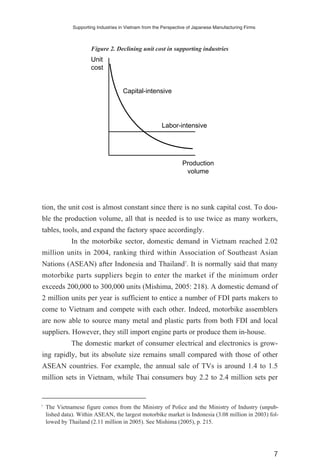
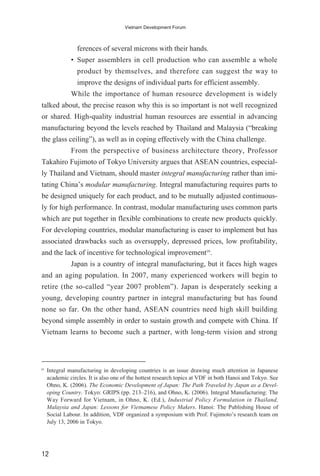
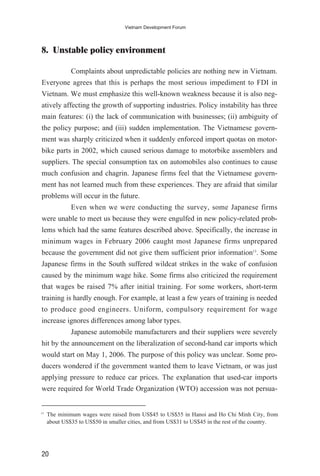
One way to overcome the problem of small domestic demand is to
find export markets. For parts suppliers, this can be done indirectly by supply-
ing to domestic assemblers who may export finished products in large quantity,
or directly through parts export.
In electrical and electronics, bulky finished products such as washing
machines and refrigerators may not be suitable for export, unless domestic
products are sufficiently low-cost to offset high logistics cost associated with
export. On the other hand, compact products such as computer peripherals and
hi-fi stereos are normally produced in one location and distributed to the global
market. For instance, one computer device assembler in Vietnam exports 1.2
million printers per month under the privileges of being an export processing
enterprise (EPE). Another consumer electronics manufacturer, which currently
focuses on the domestic market, has a plan to convert its factory into an export
base, provided that the policy environment improves to make cost reduction
possible.
The most desired policy for cost competitiveness in electrical and
electronics is the reduction of parts tariffs to zero, or at least to a level lower
than the Common Effective Preferential Tariffs (CEPTs) on finished products
(5% or less). Several consumer electronics manufacturers stated that further
tariff reduction on parts and materials was necessary for survival and preparing
brighter future plans. However, a number of the manufacturers added that, even
with zero parts tariffs, domestically assembled finished products would still be
Supporting Industries in Vietnam from the Perspective of Japanese Manufacturing Firms
9
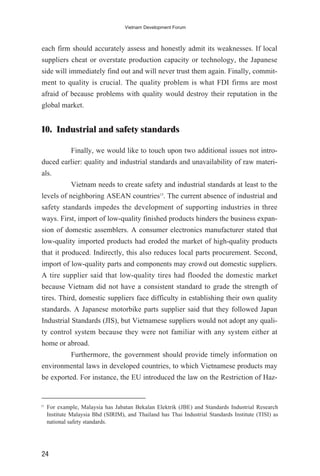
Figure 3. Possibility of export
slightly more expensive than those produced in Malaysia or Thailand. This was
due to the high logistics cost of having to import a large number of parts. One
consumer electronics assembler hoped to reduce such cost by rearranging the
flow of imports for minimum inventory and quick delivery. This might be
effective in the short run, but increasing local procurement would be preferable
in the long run. If final assemblers expand production strongly, existing suppli-
ers will receive larger orders, and it will be also easier to invite more FDI parts
makers to invest in Vietnam.
Another way to increase export is through direct parts export. For
this, again, it is essential that the parts in question be internationally competi-
tive. Only those parts that satisfy the following conditions can be considered for
export. First, they must achieve cost competitiveness by using Vietnam’s com-
parative advantage—diligent and cheap labor—to a full extent. Second, parts
and materials used in parts production must be low-cost, and their tariffs must
also be zero or very low. Third, the product must be relatively compact and
high-value. Fourth, there should be an efficient logistics system to minimize the
financial and time cost of export. In sum, exportable parts must be labor-inten-
sive, compact, and high-value. Moreover, they must be parts that do not require
strict Just-In-Time delivery. In Vietnam, wire harnesses for cars, which fit this
description, are now directly exported in large volume. But such parts are still
very few.
One important thing to remember is that the decision to export is not
in the hands of the Japanese general director in Vietnam. The output, imports
and exports of each overseas subsidiary are part of the global strategy of Japan-
ese multi-national companies (MNCs). They are decided by the headquarters in
a way that contributes to the positioning of the entire business group in the
global value chain and production network. Cost competitiveness is absolutely
necessary to be selected by the headquarters to be an export base. Many Japan-
ese firms in Vietnam, especially those without an EPE license, do not think that
they currently have production cost low enough to be an export base. That is
why they urgently request a further reduction of import duties on parts and
materials. While CEPTs on finished products became 5% or less in January
2006, many imported parts from non-ASEAN countries are still subject to Most
Favored Nation (MFN) tariffs higher than 5%. Recently, import tariffs on elec-
10
Vietnam Development Forum
tronic parts were lowered in response to the request of Japanese and Korean
assemblers in Vietnam, but the average parts tariff remains at 6.6%.
Similarly, when a Japanese subsidiary in Vietnam proposes to export
parts directly, such a plan must be consistent with the overall global strategy of
the headquarters. Japanese wire harness companies initially came to Vietnam to
supply assemblers in Vietnam. They subsequently turned to export markets
because the domestic market was too small for profitability, and this re-orienta-
tion was approved by their headquarters.
5. High-quality industrial human resources
Once the demand size problem is overcome, the most crucial factor
for the long-term development of Vietnam’s manufacturing industries is the
fostering of Meisters, a German term for highly skilled masters of manufactur-
ing. In Vietnam, industrial weaknesses are often attributed to the lack of finan-
cial resources to buy modern equipment. However, the majority view among
Japanese firms is that high-quality industrial human resources are much more
important than high-tech machines. One Vietnamese firm supplying plastic
parts to Japanese and American firms remarked that highly skilled workers, not
new machines, were essential, and second-hand machines operated by good
workers were superior to brand-new machines operated by poor workers. Simi-
larly, a Japanese expert stated that simple assembly or routine machine opera-
tion could not generate international competitiveness, because anyone in any
country could do it. Another Japanese expert stressed the importance of profes-
sional spirit to pursue 100% product quality at all times, without stopping at
99%. According to him, this one-percent gap was the source of difference
between competitive FDI suppliers and uncompetitive local suppliers.
There are different types of Meisters contributing to various types of
manufacturing processes. They include:
• Line leaders who can manage and improve the entire production
process in a factory, rather than just one skill. In Japanese, such
workers are called tanoko (multiple-skilled workers).
• Very experienced molding engineers who can design, produce and
adjust moldings for perfection, and who can feel even minute dif-
Supporting Industries in Vietnam from the Perspective of Japanese Manufacturing Firms
11
ferences of several microns with their hands.
• Super assemblers in cell production who can assemble a whole
product by themselves, and therefore can suggest the way to
improve the designs of individual parts for efficient assembly.
While the importance of human resource development is widely
talked about, the precise reason why this is so important is not well recognized
or shared. High-quality industrial human resources are essential in advancing
manufacturing beyond the levels reached by Thailand and Malaysia (“breaking
the glass ceiling”), as well as in coping effectively with the China challenge.
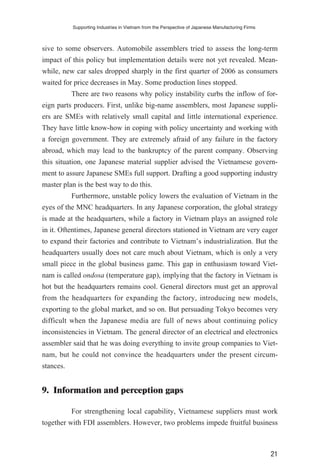
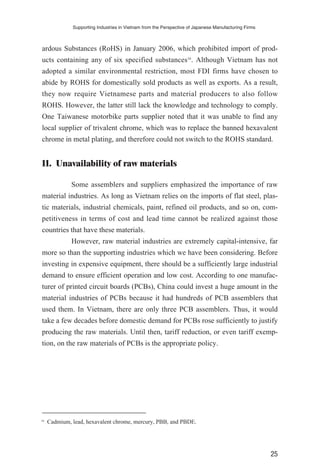
From the perspective of business architecture theory, Professor
Takahiro Fujimoto of Tokyo University argues that ASEAN countries, especial-
ly Thailand and Vietnam, should master integral manufacturing rather than imi-
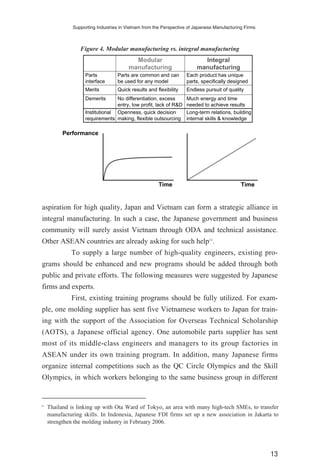
tating China’s modular manufacturing. Integral manufacturing requires parts to
be designed uniquely for each product, and to be mutually adjusted continuous-
ly for high performance. In contrast, modular manufacturing uses common parts
which are put together in flexible combinations to create new products quickly.
For developing countries, modular manufacturing is easer to implement but has
associated drawbacks such as oversupply, depressed prices, low profitability,
and the lack of incentive for technological improvement10
.
Japan is a country of integral manufacturing, but it faces high wages
and an aging population. In 2007, many experienced workers will begin to
retire (the so-called “year 2007 problem”). Japan is desperately seeking a
young, developing country partner in integral manufacturing but has found
none so far. On the other hand, ASEAN countries need high skill building
beyond simple assembly in order to sustain growth and compete with China. If
Vietnam learns to become such a partner, with long-term vision and strong
12
Vietnam Development Forum
10
Integral manufacturing in developing countries is an issue drawing much attention in Japanese
academic circles. It is also one of the hottest research topics at VDF in both Hanoi and Tokyo. See
Ohno, K. (2006). The Economic Development of Japan: The Path Traveled by Japan as a Devel-
oping Country. Tokyo: GRIPS (pp. 213–216), and Ohno, K. (2006). Integral Manufacturing: The
Way Forward for Vietnam, in Ohno, K. (Ed.), Industrial Policy Formulation in Thailand,
Malaysia and Japan: Lessons for Vietnamese Policy Makers. Hanoi: The Publishing House of
Social Labour. In addition, VDF organized a symposium with Prof. Fujimoto’s research team on
July 13, 2006 in Tokyo.
aspiration for high quality, Japan and Vietnam can form a strategic alliance in
integral manufacturing. In such a case, the Japanese government and business
community will surely assist Vietnam through ODA and technical assistance.
Other ASEAN countries are already asking for such help11
.
To supply a large number of high-quality engineers, existing pro-
grams should be enhanced and new programs should be added through both
public and private efforts. The following measures were suggested by Japanese
firms and experts.
First, existing training programs should be fully utilized. For exam-
ple, one molding supplier has sent five Vietnamese workers to Japan for train-
ing with the support of the Association for Overseas Technical Scholarship
(AOTS), a Japanese official agency. One automobile parts supplier has sent
most of its middle-class engineers and managers to its group factories in
ASEAN under its own training program. In addition, many Japanese firms
organize internal competitions such as the QC Circle Olympics and the Skill
Olympics, in which workers belonging to the same business group in different
Supporting Industries in Vietnam from the Perspective of Japanese Manufacturing Firms
13
Endless pursuit of qualityQuick results and flexibilityMerits
Long-term relations, building
internal skills & knowledge
Openness, quick decision
making, flexible outsourcing
Institutional
requirements
Much energy and time
needed to achieve results
No differentiation, excess
entry, low profit, lack of R&D
Demerits
Each product has unique
parts, specifically designed
Parts are common and can
be used for any model
Parts
interface
Modular
manufacturing
Integral
manufacturing
Performance
Time Time
Figure 4. Modular manufacturing vs. integral manufacturing
11
Thailand is linking up with Ota Ward of Tokyo, an area with many high-tech SMEs, to transfer
manufacturing skills. In Indonesia, Japanese FDI firms set up a new association in Jakarta to
strengthen the molding industry in February 2006.
countries meet in one place to compete for high performance.
Second, the Vietnamese government should support training pro-
grams offered by firms. The draft of the Master Plan for the Development of
Supporting Industries in Vietnam in the Period of 2006-2015 with a Vision to
2020 proposes to subsidize 50% of the cost incurred by the training activities of
individual firms. Many Japanese firms welcomed this proposal. One company
asked for the precise definition of “training and education.” It wanted to know
whether all types of training, both external and internal, would be supported.
Third, a system to promote and certify industrial Meisters should be
established. Japan has Meister systems at national, prefectural (provincial), and
firm levels, which together encourage good engineers to do better and be social-
ly recognized. For example, one of the top companies in Japan (an electronic
device manufacturer) has an internal Meister system for lens polishing, paint-
ing, and electrical wiring. Meister candidates are nominated by each department
and are classified into three ranks A, B, and C. The company then sends A-
ranked engineers to the Meister license offices of the central or local govern-
ment. If they successfully receive Meister certificates from the government, the
firm will additionally award them with internal Meister titles and a bonus of
500,000 yen (about US$4,200). Meisters in this company are required to train
two successors for two years.
Fourth, collaborative training programs between FDI firms and local
suppliers should be encouraged. Such programs promote technical transfer to
local firms, and provide opportunities for both sides to know each other and
work together. One of the most successful programs in collaborative training is
the Penang Skills Development Centre (PSDC) in Malaysia (Mori, 2005:
44–67). During our survey in Vietnam, many Japanese firms expressed interest
in participating in such programs. They hoped that practical vocational training,
if properly conducted, would increase the supply of skilled workers and slow
down wage inflation. A number of Japanese firms said that they would send
their experienced engineers as instructors or make their equipment available for
such training, if the government made a serious effort to initiate such programs.
Fifth, practical engineering education must be strengthened in high
schools, industrial colleges, and universities. A motorbike parts supplier com-
plained that the results of sending their workers to Japan for training were less
14
Vietnam Development Forum
than expected, because Vietnamese workers lacked basic skill and knowledge
for absorbing advanced technology. One computer device assembler proposed
that the government should pay more attention to basic but highly demanded
skills such as production engineering and efficient factory management, rather
than pursuing flashy words like IT, high-tech, and biotech. An electronics com-
ponent producer also suggested bolstering practical skills and knowledge in
molding and pressing with precision.
6. Job hopping as an impediment to skill development
One important issue related to human resource development is job
hopping. For integral manufacturing, engineers with high skills and deep
knowledge of the production process must stay in one firm. However, Viet-
namese workers who are trained by a company or have acquired some skills
often move to another company in search of higher salaries or better working
conditions. This prevents accumulation of highly specific skills and reduces
incentives for companies to train their workers. Even in labor-intensive garment
production and food processing, job hopping causes problems for personnel
management. But for supporting industries which rely on experienced engineers
and expensive machines, job hopping is fatal. This phenomenon is not unique to
Vietnam; many developing countries report high job turnovers.
In Vietnam, several Japanese molding companies aim to establish an
integrated manufacturing system within a factory from design to marketing.
They train their workers to become full-fledged engineers who know how to
make molds from A to Z. However, their plans are often frustrated by middle-
class engineers quitting without mastering high-level techniques. One Japanese
expert criticized this trend because workers were losing the opportunity to
become excellent engineers in favor of short-term gains.
In Vietnam at present, there seem to be two macro reasons for
increased job hopping. First, an increased inflow of FDI is creating labor short-
ages, especially in localities where FDI is concentrated. An automobile parts
supplier in the North said that, as the industrial zone in which the company was
located was getting fully occupied, rising labor demand began to cause a high
job turnover and wage increase. The second reason is a shift in economic struc-
Supporting Industries in Vietnam from the Perspective of Japanese Manufacturing Firms
15
ture. In and around Ho Chi Minh City, service industries are expanding rapidly
and absorbing a large amount of the workforce. An electronic parts maker in Ho
Chi Minh City said that the average turnover of first-year employees had
increased dramatically in recent years, from less than 1% to 40–50 % at present.
However, not all firms report high job hopping. Among the firms we
visited, some said they had kept their workers successfully with very low
turnovers, even less than 1% per year. One reason seems to be location. An
automobile parts supplier in the suburbs of Hanoi explained that it was located
in an area where labor demand had not risen very much and where most of the
workers were local, not migrant, with no intention of moving far. Another rea-
son seems to be company policy toward employees. A plastic parts supplier
described its worker incentive programs, such as generous benefits, transporta-
tion allowance, and delicious lunches. Workers tend to be loyal to companies
which treat them well. The salary level is often not the decisive factor. It is nec-
essary to study the conditions under which workers stay longer with one com-
pany, to minimize unnecessary job hopping.
7. Tariff reduction and tax incentives
The general director of a consumer electronics manufacturer stated
that tariff reduction and tax incentives were standard policy instruments for pro-
moting supporting industries. Many firms we interviewed agreed. These meas-
ures are also widely practiced in other East Asian countries for encouraging
SMEs and supporting industries.
Many electrical and electronics firms requested that import duties on
parts and components be quickly lowered preferably to zero, or at least to less
than 5%, which was the CEPT rate for finished ASEAN products. This reduc-
tion was needed to avoid the situation of a reverse tariff structure in which tar-
iffs on components were higher than tariffs on finished products. Otherwise,
assemblers in Vietnam would lose cost competitiveness against ASEAN
imports. ASEAN imports that threaten production in Vietnam are often the
products of local subsidiaries belonging to the same Japanese business group.
From the viewpoint of the Tokyo headquarters, there is no reason to assemble
TVs and audio-visual equipment in Vietnam if such assembly incurs high parts
16
Vietnam Development Forum
tariffs in addition to high logistics cost. It would be more efficient to export
them from the existing factories in Malaysia or Thailand, where local parts are
available and production scale is large, to serve the Vietnamese market.
Tariff reduction would have two favorable effects. First, it would
enhance cost competitiveness of assemblers and could turn Vietnam into an
export base of certain finished products. Second, liberalization of parts import
would increase intra-industry parts trade and encourage Vietnam to specialize
in the production of certain parts to be exported globally. Advanced ASEAN
countries have already actively participated in East Asia’s production network
and found certain core components to specialize in. For example, Malaysia spe-
cializes in cathode-ray tubes (CRT) and Thailand specializes in compressors
used in air-conditioners and refrigerators.
In addition, a number of firms wanted import duties on raw materials
to be reduced. More than one parts supplier urged import tariff reduction on
high-quality industrial materials which were not produced in Vietnam. Several
metal parts suppliers complained about the recent tariff increase on cold rolled
steel from 0% to 7%, to protect the new Phu My cold rolling mill in the South.
This is forcing domestic metal users to raise their prices. The problem is that
the quality of Phu My’s cold rolled steel is still below standard and Japanese
firms must continue to use imported cold rolled steel at a higher tariff. If the
Phu My mill improves quality and delivery speed to a level acceptable to Japan-
ese firms, the problem may be ameliorated.
Capacity building of customs officers is also called for. Several firms
complained that common products available in Vietnam (steel pipe for con-
struction, for example) and high-tech materials unavailable in Vietnam (rare
metal precision tube for molding, for example) are charged at the same tariff
rate to protect the former. Japanese firms wanted popular products and high-
quality industrial materials be distinguished in the tariff schedule. In some
cases, different tariffs were levied on the same product depending on the whims
of the customs official in charge. In general, customs officers do not have suffi-
cient knowledge to distinguish and classify fundamentally different products.
Another important promotion measure is tax incentives. Preferential
tax treatment should be provided to encourage supporting industries. This
should be applied to both FDI and local suppliers without regard to
Supporting Industries in Vietnam from the Perspective of Japanese Manufacturing Firms
17
nationality12
. Corporate tax exemption and reduction, tax deduction for machin-
ery purchases, subsidies for R&D, and the like, will accelerate investment in
supporting industries. Neighboring ASEAN countries already provide such tax
incentives under well-focused national campaigns for promoting SMEs and
supporting industries.
For example, Thailand introduced preferential treatment for support-
ing industries in 1993–94. Targeted products and processes included molding,
jigs, forging, casting, industrial tools, cutting, grinding, sintering, heat treat-
ment, surface treatment, machining centers, electronic connectors, Ni-Cd and
rechargeable batteries, and plastic engineering. Firms engaged in any of these
14 activities were given the following privileges: (i) 8-year corporate tax
exemption regardless of location; (ii) 50% import tariff reduction for machinery
import for projects located in Zones 1 and 2 (inside and near Bangkok), (iii)
100% import tariff exemption for machinery import for projects located in Zone
3 (rural areas); and (iv) exclusion from foreign capital restriction by 1996
(JICA, 1995: 2-2-4).
Some Vietnamese policy makers are worried that further reduction of
parts tariffs and provision of tax incentives, proposed by FDI firms, may bring
negative results. Main concerns include: (i) a decrease in fiscal revenue; (ii)
how to promote domestic parts industries under zero tariffs; (iii) how to avoid
the situation where producers in other sectors demand similar special treatment;
and (iv) the risk of Vietnamese producers being wiped out under the dominance
of FDI parts makers.
With regards to these issues, Japanese experts and firms replied as
follows. For the fiscal revenue effect, a detailed study on the long-term, indirect
impacts of tax and tariff reduction was needed. If such policies activate FDI and
growth, the overall revenue effect might well be positive through increased
income, more traffic and port charges, income multiplier effects on other sec-
tors, and so on. On the second issue, it was noted that financial incentives were
only one of the factors determining parts investment. As argued above, the
18
Vietnam Development Forum
12
Equal treatment of domestic and foreign firms is one of the key requirements of the World Trade
Organization (WTO). More generally, none of the policy measures considered in this report vio-
lates WTO rules.
availability of large demand and highly skilled engineers is more important.
Supporting industries can grow strongly even without protective tariffs if these
other conditions are met. Because parts industries also use parts, high parts tar-
iffs may not promote parts industries, depending on the precise structure of
such tariffs.
As to the third and fourth issues, the concerns were understandable
but prioritization and natural selection were inevitable. One consumer electron-
ics assembler felt that mobilization of resources to targeted sectors was neces-
sary and desirable, and supporting industries, which were the base for all
machinery industries, should be recognized as a key sector that warranted spe-
cial support. In addition, elimination of a large number of Vietnamese firms,
hitherto weak and protected, is inevitable under globalization. It is part of the
natural selection process for Vietnam to become more competitive. Japanese
firms expect at least some local firms to survive and grow. Almost all Japanese
assemblers hope to increase transactions with local firms to reduce cost and
diversify suppliers. For instance, one Japanese molding firm expressed interest
in increasing subcontracts with Vietnamese suppliers. Japanese firms hope to
build a new system of cooperation and division of labor with Vietnamese firms
under an increasingly open and competitive environment. The necessary condi-
tion for this is that Vietnamese firms make serious efforts in QCD.
At present, FDI firms often criticize policies, and the government in
turn complains about the lack of promised performance by FDI firms. This acri-
monious relationship is harmful to the healthy development of Vietnamese
industries. To improve the situation, one Japanese expert proposed a “give-and-
take” deal between the government and Japanese FDI firms, in which the for-
mer seriously improves policies in accordance with business demands while the
latter set targets for production, export, cost reduction, localization, and so on,
conditional on the implementation of good policies. The government must
understand that business performance depends on not only enterprise effort but
also many external factors, including policies, and that business targets should
not be interpreted as commitments that can lead to penalties when they are not
achieved. One Japanese firm did not like this idea since the proposal sounded
like “socialist planning,” and some were similarly concerned that numerical tar-
gets might bind their businesses. However, others were open to such an idea.
Supporting Industries in Vietnam from the Perspective of Japanese Manufacturing Firms
19
8. Unstable policy environment
Complaints about unpredictable policies are nothing new in Vietnam.
Everyone agrees that this is perhaps the most serious impediment to FDI in
Vietnam. We must emphasize this well-known weakness because it is also neg-
atively affecting the growth of supporting industries. Policy instability has three
main features: (i) the lack of communication with businesses; (ii) ambiguity of
the policy purpose; and (iii) sudden implementation. The Vietnamese govern-
ment was sharply criticized when it suddenly enforced import quotas on motor-
bike parts in 2002, which caused serious damage to motorbike assemblers and
suppliers. The special consumption tax on automobiles also continues to cause
much confusion and chagrin. Japanese firms feel that the Vietnamese govern-
ment has not learned much from these experiences. They are afraid that similar
problems will occur in the future.
Even when we were conducting the survey, some Japanese firms
were unable to meet us because they were engulfed in new policy-related prob-
lems which had the same features described above. Specifically, the increase in
minimum wages in February 2006 caught most Japanese firms unprepared
because the government did not give them sufficient prior information13
. Some
Japanese firms in the South suffered wildcat strikes in the wake of confusion
caused by the minimum wage hike. Some firms also criticized the requirement
that wages be raised 7% after initial training. For some workers, short-term
training is hardly enough. For example, at least a few years of training is needed
to produce good engineers. Uniform, compulsory requirement for wage
increase ignores differences among labor types.
Japanese automobile manufacturers and their suppliers were severely
hit by the announcement on the liberalization of second-hand car imports which
would start on May 1, 2006. The purpose of this policy was unclear. Some pro-
ducers wondered if the government wanted them to leave Vietnam, or was just
applying pressure to reduce car prices. The explanation that used-car imports
were required for World Trade Organization (WTO) accession was not persua-
20
Vietnam Development Forum
13
The minimum wages were raised from US$45 to US$55 in Hanoi and Ho Chi Minh City, from
about US$35 to US$50 in smaller cities, and from US$31 to US$45 in the rest of the country.
sive to some observers. Automobile assemblers tried to assess the long-term
impact of this policy but implementation details were not yet revealed. Mean-
while, new car sales dropped sharply in the first quarter of 2006 as consumers
waited for price decreases in May. Some production lines stopped.
There are two reasons why policy instability curbs the inflow of for-
eign parts producers. First, unlike big-name assemblers, most Japanese suppli-
ers are SMEs with relatively small capital and little international experience.
They have little know-how in coping with policy uncertainty and working with
a foreign government. They are extremely afraid of any failure in the factory
abroad, which may lead to the bankruptcy of the parent company. Observing
this situation, one Japanese material supplier advised the Vietnamese govern-
ment to assure Japanese SMEs full support. Drafting a good supporting industry
master plan is the best way to do this.
Furthermore, unstable policy lowers the evaluation of Vietnam in the
eyes of the MNC headquarters. In any Japanese corporation, the global strategy
is made at the headquarters, while a factory in Vietnam plays an assigned role
in it. Oftentimes, Japanese general directors stationed in Vietnam are very eager
to expand their factories and contribute to Vietnam’s industrialization. But the
headquarters usually does not care much about Vietnam, which is only a very
small piece in the global business game. This gap in enthusiasm toward Viet-
nam is called ondosa (temperature gap), implying that the factory in Vietnam is
hot but the headquarters remains cool. General directors must get an approval
from the headquarters for expanding the factory, introducing new models,
exporting to the global market, and so on. But persuading Tokyo becomes very
difficult when the Japanese media are full of news about continuing policy
inconsistencies in Vietnam. The general director of an electrical and electronics
assembler said that he was doing everything to invite group companies to Viet-
nam, but he could not convince the headquarters under the present circum-
stances.
9. Information and perception gaps
For strengthening local capability, Vietnamese suppliers must work
together with FDI assemblers. However, two problems impede fruitful business
Supporting Industries in Vietnam from the Perspective of Japanese Manufacturing Firms
21
cooperation between Vietnamese and FDI firms.
The first problem is the information gap. Although most FDI assem-
blers are desperately looking for local suppliers, they do not know where good
Vietnamese parts makers are located. Many Japanese firms use telephone direc-
tories and workers’ personal connections to look for potential suppliers. One
company said that it had to visit 100 firms to find one good supplier. All this is
too costly and time-consuming for private firms. A number of Japanese firms
noted that local suppliers did not actively approach them. Local suppliers gener-
ally do not seem to know how to build business relations with Japanese firms,
and lack the confidence to do business with them.
One way to bridge the information gap is to create a supporting indus-
try database. Many Japanese firms said they would welcome such a database. In
fact, several organizations, including the Vietnam Chamber of Commerce and
Industry (VCCI) and Vietbig, have already produced yellow page-type databas-
es, providing information on company names, contact addresses, and main
products14
. However, a mechanical listing of hundreds and thousands of compa-
nies is not enough. FDI firms want to reduce time and cost in narrowing down
potential suppliers. This requires either explicit ranking or implicit recommen-
dations by the database provider. Moreover, information must be accurate and
updated frequently. In most databases, listed firms are asked to update informa-
tion by themselves, but it is doubtful if this can guarantee speed and objectivity.
A good database needs careful design and much commitment on the part of the
database provider.
The second problem is the perception gap. Even if the two sides find
each other, there is a wide gap between what Japanese firms require as mini-
mum standards in quality, cost and delivery (QCD), and what local firms con-
sider acceptable. The Vietnamese side complains that Japanese firms are too
fussy about little things while the Japanese side rejects local parts which they
say are below the required levels. One reason for this is that local firms have
22
Vietnam Development Forum
14
VCCI’s Vietnam Business Directory is available in book form and on CD-ROM. Vietbig, a joint-
stock company, publishes its database in a book as well as on a website: www.yellowpages.com.
vn/index.asp. In Thailand, the Board of Investment’s Unit of Industrial Linkage Development
(BUILD) is responsible for maintaining a supplier database.
had little exposure to global market competition while Japanese firms are
already fiercely competing with American, European, Korean and Chinese
firms. Another important reason is that the integral manufacturing of Japanese
firms, which requires long-term cooperation and endless pursuit of perfection,
is at odds with the modular manufacturing of copied products practiced by most
Vietnamese firms.
Vietnamese suppliers lack knowledge of the Japanese production sys-
tem. For example, they send catalogs and product samples to JETRO or Japan-
ese assemblers and expect to receive orders from this contact. But Japanese
firms never accept such casual contacts. In the case of automobiles, designing
of a new model starts at the R&D center in Japan three years prior to mass pro-
duction. Parts suppliers are required to participate continuously in this design-
in, working closely with assemblers and other parts makers. To join this system,
Vietnamese firms must send Japanese-speaking engineers to Japan for three
consecutive years. In the case of electronics and motorbikes, the situation is not
as rigorous as that for automobiles, but assemblers still must perform quality
tests and get an approval from the headquarters before trying new part suppli-
ers.
One Vietnamese firm supplying key metal parts to Japanese firms
said that it took three years to become a business partner of a Japanese motor-
bike assembler, a process that contained different interaction phases. Other
Vietnamese firms which supply to Japanese firms echoed that it took them
about two to three years before receiving the first order. Until then, they had to
send a large number of samples, which were rejected repeatedly, forcing them
to improve quality step by step. This was a very costly and frustrating process.
But once trust is built, Japanese firms teach suppliers well and assure stable
business relations and large orders.
Two Vietnamese firms, which have successfully built business rela-
tions with Japanese assemblers, offered three lessons for newcomers. First, the
top priority is a sincere attitude toward business. Even if a firm’s initial ability
is low, Japanese firms will provide help as long as general directors make a
serious effort to learn from the Japanese firm and meet high requirements (simi-
larly, a large Japanese computer device assembler stated that it would first look
at the attitude of the general director when choosing local suppliers). Second,
Supporting Industries in Vietnam from the Perspective of Japanese Manufacturing Firms
23
each firm should accurately assess and honestly admit its weaknesses. If local
suppliers cheat or overstate production capacity or technology, the Japanese
side will immediately find out and will never trust them again. Finally, commit-
ment to quality is crucial. The quality problem is what FDI firms are most
afraid of because problems with quality would destroy their reputation in the
global market.
10. Industrial and safety standards
Finally, we would like to touch upon two additional issues not intro-
duced earlier: quality and industrial standards and unavailability of raw materi-
als.
Vietnam needs to create safety and industrial standards at least to the
levels of neighboring ASEAN countries15
. The current absence of industrial and
safety standards impedes the development of supporting industries in three
ways. First, import of low-quality finished products hinders the business expan-
sion of domestic assemblers. A consumer electronics manufacturer stated that
low-quality imported products had eroded the market of high-quality products
that it produced. Indirectly, this also reduces local parts procurement. Second,
import of low-quality parts and components may crowd out domestic suppliers.
A tire supplier said that low-quality tires had flooded the domestic market
because Vietnam did not have a consistent standard to grade the strength of
tires. Third, domestic suppliers face difficulty in establishing their own quality
standards. A Japanese motorbike parts supplier said that they followed Japan
Industrial Standards (JIS), but Vietnamese suppliers would not adopt any quali-
ty control system because they were not familiar with any system either at
home or abroad.
Furthermore, the government should provide timely information on
environmental laws in developed countries, to which Vietnamese products may
be exported. For instance, the EU introduced the law on the Restriction of Haz-
24
Vietnam Development Forum
15
For example, Malaysia has Jabatan Bekalan Elektrik (JBE) and Standards Industrial Research
Institute Malaysia Bhd (SIRIM), and Thailand has Thai Industrial Standards Institute (TISI) as
national safety standards.
ardous Substances (RoHS) in January 2006, which prohibited import of prod-
ucts containing any of six specified substances16
. Although Vietnam has not
adopted a similar environmental restriction, most FDI firms have chosen to
abide by ROHS for domestically sold products as well as exports. As a result,
they now require Vietnamese parts and material producers to also follow
ROHS. However, the latter still lack the knowledge and technology to comply.
One Taiwanese motorbike parts supplier noted that it was unable to find any
local supplier of trivalent chrome, which was to replace the banned hexavalent
chrome in metal plating, and therefore could not switch to the ROHS standard.
11. Unavailability of raw materials
Some assemblers and suppliers emphasized the importance of raw
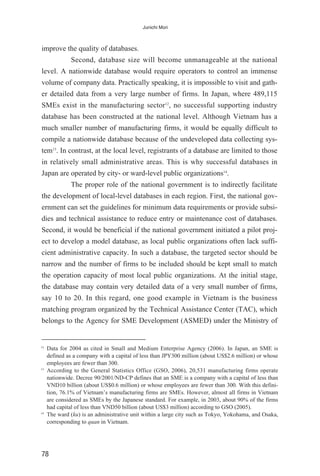
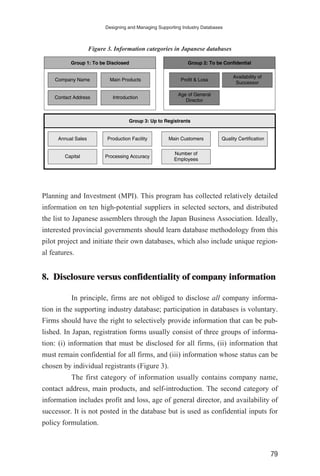
material industries. As long as Vietnam relies on the imports of flat steel, plas-
tic materials, industrial chemicals, paint, refined oil products, and so on, com-
petitiveness in terms of cost and lead time cannot be realized against those
countries that have these materials.
However, raw material industries are extremely capital-intensive, far
more so than the supporting industries which we have been considering. Before
investing in expensive equipment, there should be a sufficiently large industrial
demand to ensure efficient operation and low cost. According to one manufac-
turer of printed circuit boards (PCBs), China could invest a huge amount in the
material industries of PCBs because it had hundreds of PCB assemblers that
used them. In Vietnam, there are only three PCB assemblers. Thus, it would
take a few decades before domestic demand for PCBs rose sufficiently to justify
producing the raw materials. Until then, tariff reduction, or even tariff exemp-
tion, on the raw materials of PCBs is the appropriate policy.
Supporting Industries in Vietnam from the Perspective of Japanese Manufacturing Firms
25
16
Cadmium, lead, hexavalent chrome, mercury, PBB, and PBDE.
References
General Statistics Office (GSO). (2005). Statistical yearbook 2004. Hanoi: Statistical
Publishing House.
Japan External Trade Organization (JETRO). (2005). Japanese-affiliated manufacturers
in Asia (ASEAN and India): Survey 2004. Tokyo: JETRO.
Japan Finance Corporation for Small and Medium Enterprises (JASME). (2004, Novem-
ber). Kakkoku no jidoushagyoukai no doukou ni tsuite (The trends of automotive
industry in some countries). Keiei jouhou (Management Information), 323.
Retrieved February 22, 2006 from http://www.jasme.go.jp/jpn/publish/info/
no323.html#02
Japan International Cooperation Agency (JICA). (1995). Investigation report for indus-
trial development: Supporting industry sector. Tokyo: JICA.
Mishima, K. (2005). The supplier system of motorcycle industry in Vietnam, Thailand,
and Indonesia: Localization, procurement and cost reduction processes. In K. Ohno
& V. T. Nguyen (Ed.), Improving industrial policy formulation, (pp. 211–234).
Hanoi: The Publishing House of Political Theory.
Mori, J. (2005). Development of supporting industries for Vietnam’s industrialization:
Increasing positive vertical externalities through collaborative training. (Master the-
sis, Fletcher School, Tufts University). Retrieved February 20, 2006 from
http://fletcher.tufts.edu/research/2006/Mori_MALD Thesis_010406.pdf
News Net Asia (NNA). (2005). Chuugoku ni katsu: Asean seizougyoukai (Beating
China: The manufacturing industry in ASEAN). Tokyo: NNA.
26
Vietnam Development Forum
Chapter 2
Supporting Industries:
A Review of Concepts and Development
Nguyen Thi Xuan Thuy*
1. Introduction
Many researchers and policy makers use the term “supporting indus-
tries,” but its origin and initial meaning are sometimes not well known to them.
They define this term according to their own understanding and purpose. In
reality, “supporting industries” is Japanese-made English employed first by
Japanese enterprises long before becoming an official term. It gained popularity
in Japan in the mid-1980s when the Japanese government used it in its docu-
ments, as explained below, and has been widely used in Asia ever since. The
idea of supporting industries is now routinely discussed in regional meetings on
the development of small and medium enterprises (SMEs).
The term began to be officially used in Vietnam relatively late, that is,
in 2003. The Vietnamese government did not give much attention to it until the
drafting of a master plan for developing supporting industries was requested by
the Vietnam-Japan Joint Initiative Phase 1 (2003–2005) as one of the urgent
measures to promote foreign direct investment (FDI).
Because of autarky, economic planning, and heavy industry-oriented
policy of the past, Vietnam fostered industries that internalized manufacturing
of all inputs in a vertically consolidated structure, be it agricultural machines,
bicycles, or automobiles. These industries no longer exist, have been stream-
lined, or have shifted to other activities since the implementation of Doi moi in
1986. Due to the lack of information as well as the fact that local suppliers
27
∗
The Vietnam Development Forum (VDF) and Vietnam’s Ministry of Industry (MOI). This
research was conducted in 2006 when the author was a researcher at VDF-Tokyo.
could not meet stringent quality requirements, foreign firms that came to Viet-
nam in the mid-1990s were of the view that supporting industries were nonex-
istent or extremely primitive in Vietnam. However, the survey conducted by the
Japan External Trade Organization (JETRO) in 2004 found that this view was
not entirely correct, and that Vietnam’s supporting industries were burgeoning
(Ichikawa, 2005).
Sustainable growth of supporting industries requires a proper policy
of the government, and the Master Plan for the Development of Supporting
Industries must be designed to meet this requirement. The current version under
MOI’s internal review still leaves much room for improvement. This paper
reviews various concepts and related issues of supporting industries in the hope
that this will offer some practical inputs for the master plan.
In particular, the following questions are posed: (i) what does the
term “supporting industries” mean, (ii) why does Vietnam need to develop sup-
porting industries, (iii) how did other countries develop their supporting indus-
tries, and (iv) what can Vietnam learn from their experiences and what should it
do to promote supporting industries. Different definitions of supporting indus-
tries give different industrial scopes as well as different policies to address
them. We also propose our own definition, which can be used in the Viet-
namese policy context. In studying international experiences, promotion poli-
cies for localization, foreign direct investment into supporting industries, indus-
trial linkages, and production networks are particularly important.
2. Concepts of supporting industries
Although the term “supporting industries” is widely used in many
countries, it is still ambiguous and without consensus in definition. Whether
“supporting industries” is understood broadly to include all industries that pro-
vide production inputs or narrowly as industries that provide only parts, compo-
nents and tools for certain industries depends much on the user.
On a practical level, the leather footwear industry needs industries
which produce parts of footwear, processed leather, leather working machinery,
and design services. Supporting industries of the motorbike industry supply
motorbike assemblers with material inputs and their processing as well as serv-
28
Nguyen Thi Xuan Thuy
ices. On the other hand, supporting industries also refer to industries which are
much broader and without a clear borderline. This means that, for policy formu-
lation, the scope of supporting industries must be specified concretely and
strategically by policy makers in a way that ensures consistency between defini-
tion and policy purpose.
For instance, Thailand defines supporting industries to be enterprises
that produce parts and components that are used in the final assembly processes
of the automobile, machinery and electronic manufacturing industries (Ratana,
1999: 2). Meanwhile, the US Department of Energy defines supporting indus-
tries as those that supply materials and processes necessary to form and fabri-
cate products before they are marketed to end-use industries (2005: 1). In Viet-
nam’s current context, it is not practical to import any ready-made concept of
supporting industries from abroad because of differences in economic condi-
tions, development level and the degree of challenges that each country faces in
the global economy. It is necessary for Vietnam to select a definition of sup-
porting industries which is most appropriate for its own socio-economic condi-
tions.
The term currently used in East Asia originated from Japan in the
mid-1980s. The first official document to use this term, as far as we can identi-
fy, was the White Paper on Economic Cooperation 1985 by the Ministry of
International Trade and Industry (MITI)1
of Japan, where the term “supporting
industries” was used to refer to “small and medium enterprises (SMEs) that
contribute to strengthening industrial infrastructure in Asian countries for medi-
um and long terms” (1985: 120) or “the SMEs that produce parts and compo-
nents” (1985: 121). The purpose of MITI at that time was to promote the
process of industrialization and the development of SMEs in ASEAN countries,
especially in ASEAN 4 (Indonesia, Malaysia, Philippines, and Thailand).
Two years later, MITI re-introduced the term to other Asian countries
through the New Asian Industrial Development Plan (known as the New AID
Plan). The Plan was a comprehensive economic cooperation package based on
the trinity of aid, investment, and trade. In the framework of the Plan, the Asian
Supporting Industries Development Program was promulgated in 1993 to
Supporting Industries: A Review of Concepts and Development
29
1
MITI has been changed to METI (Ministry of Economy, Trade and Industry) since January 2001.
resolve trade imbalances, bottlenecks of infrastructure, and shortage of profes-
sional workforce in ASEAN 4 and to promote industrial cooperation between
Japan and those countries (Japanese Bank for International Cooperation [JBIC],
2005: 125). In this Program, supporting industries were officially defined as
“industries that supply the necessary things such as raw materials, parts and
capital goods for assembly type industries” (as quoted by Japan Overseas Enter-
prises Association, 1994: 19). The scope of supporting industries was widened
from SMEs to the industries that produce intermediate and capital goods for
assembly-type industries without regards to firm size (Figure 1).
A question might be raised as to why the term appeared in Japan but
not in other countries, and in the middle of the 1980s but not earlier or later.
The higher yen value and the efforts of MITI to develop an industrial base in
order to support Japanese firms operating in Asia could be considered as the
response to this question. The sudden appreciation of the yen after the Plaza
Accord in September 1985, from 240 yen per US dollar in September 1985 to
160 yen per US dollar in April 1986, had a great impact on export-related enter-
prises (MITI, 1987). The higher yen made Japanese firms reduce exports of fin-
ished products and shift production to countries with lower labor costs. Howev-
er, Japanese factories abroad had to import parts and components from subcon-
30
Nguyen Thi Xuan Thuy
Figure 1. Scope of supporting industries according to MITI
Source: Japan Overseas Enterprises Association (1994: 19)
tractors in Japan because the providers of essential parts and components were
not available in developing countries, including ASEAN 4. Thus, the term “sup-
porting industries” was used to indicate the lack of such industries in those
countries. Consistent with this context, MITI subsequently introduced the New
AID Plan in 1987 and the Asian Supporting Industries Development Program in
1993, as explained above, which promulgated the term to other Asian countries
as well. Therefore, it can be said that the appreciation of the yen and the efforts
of MITI were necessary and sufficient conditions for the birth of the term “sup-
porting industries” in Japan and Asia in the 1980s.
Vietnam adopted the term “supporting industries” relatively late, as
mentioned above. In the past, concentration on the development of heavy indus-
tries in the centrally-planned economy required a wide range of production
inputs. Vietnam did not attach importance to the concept of supporting indus-
tries because parts and components for finished products of such industries as
agricultural machines, bicycles, and automobiles were produced in-house and in
a vertically integrated fashion. Even when the term “supporting industries” was
introduced in most Asian countries at the meetings of the Asian Productivities
Organization (APO) and the Asia-Pacific Economic Cooperation (APEC), Viet-
nam, which was in the early years of the Doi moi process, continued to pay lit-
tle attention because it was dealing with other urgent issues such as agricultural
revitalization, hyperinflation, economic reform, and poverty alleviation.
When foreign investors started to come to Vietnam in the mid-1990s,
it was difficult for them to find qualified local suppliers for production inputs.
They pointed to this problem and asked the Vietnamese government to take
appropriate measures to resolve it. However, at that time the Vietnamese gov-
ernment was not familiar with the concept of supporting industries. The prob-
lem included the absence of a legal definition for supporting industries, which
prevented any effective execution of promotion measures. The Vietnamese gov-
ernment remained unclear as to how this situation could be corrected (Ichikawa,
2005). The Japanese government was proactive in supporting Vietnam to
improve the business and investment environment through the Ishikawa Project
(1995), the New Miyazawa Initiative (1999), and the Vietnam-Japan Joint Ini-
tiative (2003). These programs were beneficial to both countries: Vietnam was
able to absorb much more FDI and foreign firms doing business in Vietnam
Supporting Industries: A Review of Concepts and Development
31
enjoyed an improved business environment.
The main themes of the Ishikawa Project were to help Vietnam
smooth the transition from a planned to a market-oriented economy, to integrate
Vietnam into the international community, to modernize the financial system, to
strengthen industrial competitiveness, and to develop rural areas. In relation to
these themes, the request from the Japanese business community for a better
legal system was also encompassed under this Project2
. The New Miyazawa Ini-
tiative was an Official Development Assistance (ODA) loan to Vietnam, which
was used to promote Vietnam’s economic reform policy, including formulation
of a private sector promotion program, auditing of state-owned enterprises, and
tariffication of non-tariff barriers3
.
The Vietnam-Japan Joint Initiative, launched in 2003, aimed to
strengthen Vietnam’s economic competitiveness through promotion of FDI
flows into Vietnam. In the Action Plan of the Initiative, the first item in the list
of required actions was the “development, introduction, and utilization of sup-
porting industries in Vietnam,”4
which indicated that Vietnamese officials start-
ed to realize the importance of supporting industries in the process of industrial-
ization and FDI attraction. However, during Phase 1 of the Initiative, which
lasted two years, this action did not fully materialize. Therefore, the need for
action was reiterated in its Phase 2, which included establishment of a master
plan for supporting industries development, setting up of a database of support-
ing industries, and creating industrial zones for supporting industries.
To fulfill this requirement effectively, Vietnamese policy makers
must clearly grasp the nature of supporting industries and related concepts, and
choose a definition of supporting industries which can serve as a foundation for
designing a comprehensive industrial policy for these industries.
32
Nguyen Thi Xuan Thuy
2
Ministry of Foreign Affairs (MOFA) Press Briefing on: Summary of meetings held by Prime
Minister Keizo Obuchi at the Association of Southeast Asian Nations Summit, December 1998.
3
MOFA Press Release: ODA Loan to Vietnam – to support economic reform of Vietnam,
September 29, 1999.
4
MOFA’ s Report on Vietnam-Japan Joint Initiative to Improve Business Environment with a View
to Strengthen Vietnam’s Competitiveness, December 4, 2003.
3. Related concepts
Parallel to the term “supporting industries,” other related concepts are
also used to refer to supplier industries, inter alia, related and supporting indus-
tries, subcontracting, ancillary, part and component industries, and vendors
have close meaning to that of supporting industries.
3.1. Related and supporting industries
The term “related and supporting industries” is used by Michael E.
Porter, a professor at Harvard University, as a fundamental determinant of
national competitive advantage. In his book The Competitive Advantage of
Nations (1990), he introduces the Diamond Model (Figure 2), which includes
four interlinked key factors for competitive advantage and can be applied to all
nations and industries.
Among these four factors, the term “related and supporting indus-
tries” is defined as “the presence or absence in the nation of supplier industries
and related industries that are internationally competitive” (1990: 71). He
divides this determinant into two factors: supporting industries and related
industries. Supporting industries create advantages in downstream industries
because they produce inputs that are widely used and important to innovation or
Supporting Industries: A Review of Concepts and Development
33
Firm strategy,
structure, and
rivalry
Factor
condition
Demand
conditions
Related and
supporting
industries
Chance
Government
Figure 2. Porter’s Diamond model for the competitive advantage of nations
Source: Porter, M.E. (1990: 127)
to internationalization, whilst related industries are those in which firms can
coordinate or share activities in the value chain when competing, or those
which involve products that are complementary (1990: 100–105). Three other
determinants include (i) the strategy, structure and rivalry of firms, which show
the conditions in which companies are created, organized and managed, and the
nature of domestic rivalry; (ii) demand conditions, which are the nature of
home demand for the industry’s product or service; and (iii) factor conditions,
which imply the key factors (i.e., skilled labor, capital, and infrastructure) that
are necessary to compete in a given industry. In addition to these four factors,
Porter also emphasizes the role of government because policies implemented
without consideration of how they influence the entire system of determinants
are likely to undermine national advantage.
The term used by Porter is broader and academic, while MITI’s term
is more specific and empirical. However, both emphasize the importance of
supporting industries to strengthen the industrial competitiveness of nations.
3.2. Subcontracting
The term “subcontracting” was used some decades ago but has not
always been specified in an explicit manner. The recent definition by the United
Nations Industrial Development Organization (UNIDO) indicates that subcon-
tracting is “an agreement between two parties—the main contractor and the
subcontractor. The main contractor entrusts one or several enterprises with the
production of parts, components or sub-assemblies and/or provision of industri-
al services necessary for the manufacture of its final product. The subcontractor
executes the work as per the specifications provided by the main contractor”5
.
Unlike supporting industries, subcontracting emphasizes only long-term com-
mitments and relationships between large firms and subcontractors, and it does
not cover other types of transactions, e.g., in-house or outsourcing.
In the Japanese economy, the public view on subcontracting has dras-
tically changed over time. In the 1940s and 1950s, subcontracting was thought
of as the exploitation of small firms by large ones, that the latter utilized their
34
Nguyen Thi Xuan Thuy
5
UNIDO’s official website definition at http://www.unido.org/doc/4558?language%5fcode=en#Where
dominant position in a transaction to unfairly impose on the former unprofitable
conditions, for instance, delays in payments to subcontractors. In the 1970s and
1980s, as Japanese gained confidence in their economic system, the view
swung toward the opposite end. Subcontracting has been regarded as one of the
important components of the Japanese economic system, with presumed bene-
fits in saving costs to search for and select new suppliers, having successful
quality enhancement and cost reduction in cooperation with subcontractors, and
having efficient risk-sharing mechanisms (Kimura, 2001). Nevertheless, recent
studies indicate that subcontracting no longer upholds its advantages such as
long-term stability and quick reaction to changes in the large firms, but that it
instead brought pressure, gave limited scope for bargaining, and lowered profits
for subcontractors in comparison with independent suppliers (Kimura, 2001;
Subrahamanya, 2006). As such, there has been a recent trend for subcontractors
to become independent suppliers that are similar to enterprises operating in sup-
porting industries.
3.3. Ancillary industries
The term “ancillary industries” has been widely used in India since
the 1950s. It was defined in the Industries (Development and Regulation) Act
of 1951 as “an industrial undertaking, which is engaged or is proposed to be
engaged in the manufacture or production of parts, components, sub-assem-
blies, tools or intermediates, or the rending of service...” The term is known
only in India, as the Indian economy had not yet linked closely to the global
economy. A few Indian policy makers did try to introduce this term to the out-
side world, for instance, in an article “Development of Ancillary Industry in
India” published in the Small Industry Bulletin for Asia and Far East, Vol. 5,
Nanjappa (1967, as quoted by Fuminori, 2004) wrote that in order to foster
small scale enterprises, the Indian government had set up a committee to pro-
mote ancillary industries to act as suppliers of necessary parts, components, and
semi-finished products to large enterprises. The term, however, did not gain
widespread appeal outside India. A reason for the lack of appeal might be
because this term indicated a subgroup of small-scale industries, and thus rarely
found a specific concern, policy, or strategy for the promotion of such indus-
tries, even in India.
Supporting Industries: A Review of Concepts and Development
35
3.4. Part and component industries
There is no specific definition of the term “part and component indus-
tries,” but it is usually understood to mean industries that produce parts and
components. The term is widely used in assembly-type industries such as
motorbikes, automobiles, electrics, and electronics. This is the narrowest related
concept, as it does not cover any other input which can be included in the con-
cept of supporting industries such as services, tools, machines, and materials.
Part and component industries are seen as the core of supporting industries, and
as an important element for assessment of local procurement.
3.5. Vendors
Like “part and component industries,” there is no specified definition
for “vendors.” The term is widely understood to mean the sellers of commodi-
ties and services for an industry. It is widely used in Malaysia and South Asian
countries, and refers to SMEs that work as subcontractors for large firms.
Unlike “supporting industries,” “vendors” implies individual firms rather than
an industry as a whole. Vendors are basically a unit of supporting industries
whose operations play a decisive role in the development of these industries.
4. Definition of supporting industries
The above review shows that “supporting industries” and other relat-
ed concepts have a common view, which emphasizes the importance of the
industries that manufacture inputs for finished products. However, each concept
determines a different scope of these industries. Broad concepts, e.g., support-
ing and related industries and subcontracting, delineate a broad scope, which
covers all supplier industries. In contrast, part and component industry or ven-
dors draw a relatively narrow scope. “Supporting industries” is a vague term;
without a clear definition, it is impossible to identify which industries they are
and to what they provide support. Therefore the scope of supporting industries
mentioned in industrial policies and strategies varies depending on concepts and
purposes used by policy makers. The more detailed definition of the term is, the
easier policies can be formulated, and the more feasible they are.
Figure 3 illustrates three common concepts of supporting industries
36
Nguyen Thi Xuan Thuy
and their respective scopes. The core concept, which leads to the smallest
scope, defines supporting industries as industries which supply parts, compo-
nents and tools to produce parts and components. There are two broader
scopes, in which one corresponds to the concept that defines supporting indus-
tries as the industries which supply parts, components, tools to produce parts
and components, and production services such as logistics, storing, distribution
and insurance, while the other refers to the concept that defines supporting
industries as those which supply all physical inputs including parts, compo-
nents, tools, machines and materials. Noticeably, the scopes of supporting
industries do not specify firm size, ownership, or manufacturing architecture.
They can include foreign and local firms, larger firms and SMEs, integral and
modular manufacturing firms.
In the current context of Vietnam, with budget constraint, underdevel-
oped industrial bases, and pressures of international integration and competi-
Supporting Industries: A Review of Concepts and Development
37
Capital Goods
Tools
Machines
Final Goods
Assembly
Sub-assembly
Intermediate Goods
Parts
Components
Production Services
Logistics
Storage
Distribution
Insurance
Materials
Steel
Chemicals
SI(broadscope2)
SI(corescope)
SI(broadscope1)
Figure 3. Scopes of supporting industries
tion, the core concept is more suitable to mobilize all resources for the develop-
ment of supporting industries. An operational definition of supporting indus-
tries, appropriate to the purposes of research and policymaking in Vietnam, is
thus proposed as follows: Supporting industries can be defined as a group of
industrial activities which supply intermediate inputs (i.e., parts, components
and tools to produce these parts and components) for assembly-type or process-
ing industries.
While firm size and nationality are not considered in the definition of
supporting industries, SMEs and local firms are often targeted in industrial poli-
cy. Besides, supporting industries have other characteristics that are not men-
tioned in the definition, but should be considered carefully in the policymaking
process. These characteristics of supporting industries include: (i) they are rela-
tively more capital-intensive and require more skilled workers than assembly-
type industries, (ii) their products are supplied for both domestic use and export,
(iii) they produce both standardized parts and components, which are usually
modular manufactured and export-oriented, and bulky and specific ones, which
are integral-type manufactured and used domestically, and (iv) they are
required in both assembly-type industries (such as automobiles, motorbikes,
electronics) and processing industries (textile and garment, footwear industry),
but vary in their features and require different treatment; the former requires
more skilled labor force, produces many metal, rubber and plastic parts, and
strongly influences the product’s quality, while the latter can use low-skilled
workers, consists of a few part industries, and the product’s quality does not
heavily depend on them. That is why supporting industries of these two sectors
should be addressed and grouped separately in strategic planning.
5. Necessity for Vietnam to develop supporting industries
Vietnam is currently challenged by competition from regional coun-
tries in absorption of FDI, flood of Chinese products, and pressures of interna-
tional integration. Development of supporting industries is an essential measure
for Vietnam to overcome these challenges.
Supporting industries play an important role in promoting FDI. In the
1980s, the massive investment inflows from multi-national corporations
38
Nguyen Thi Xuan Thuy
(MNCs) to developing countries were attracted by the low labor cost. Nowa-
days, when MNCs choose a location for FDI, they consider not only the advan-
tage in labor cost but also the comparative advantages in other production
inputs such as parts and components and production services, which can help
them to improve their competitiveness in price and quality.
Vietnam is now trying its best to achieve its goal of becoming an
industrialized country by 2020. Like other developing countries, Vietnam has
utilized FDI as a force to drive its economy. Although Vietnam is attempting to
absorb FDI and develop its industrial sector, it does not seem to realize the
importance of supporting industries in industrialization and FDI attraction. It is
not really proactive in promoting these industries like other ASEAN countries
such as Thailand, Malaysia, and Indonesia have done. Thus, it is necessary for
Vietnam to learn from the successes and failures of other countries to design a
proper strategy and policy on the development of supporting industries.
Supporting industries are essential for Vietnam to compete with
China. The growth of the Chinese economy is a threat to all the economies in
the world. However it would be unwise for Vietnam to compete directly with
China. Manufacturing industries in China, which have advantages of cheap and
abundant labor and a large market, are characterized by mass production of
modular products with copied design and technology and high competitiveness
in prices. Only through promoting high-quality supporting industries and
becoming a crucial integral partner of MNCs can Vietnamese products enter the
global market without clashing with Chinese products.
Strong supporting industries will also expedite Vietnam’s integration
into the international economy and participation in the global value chain. Pres-
sures of globalization do not allow any country to protect its industries by non-
tariff measures or protective policy. In recent years we have seen the formation
of global-scale economic systems which are tightly integrated and often man-
aged on a day-to-day basis. Many firms have had international operations and
trading relationships, and all activities are divided among multiple firms and
spread across the world. Today, the process of economic development cannot
be isolated from these global systems. Supporting industries will help Vietnam
to diversify its tradable products and to deeply involve itself in the global value
chain through partnerships and linkages with FDI firms and MNCs.
Supporting Industries: A Review of Concepts and Development
39
Nevertheless, supporting industries do not develop naturally and Viet-
nam cannot take full advantage of these industries if the involvements of Viet-
namese firms in such industries do not exist. For this reason, deepening the
linkages between Vietnamese firms and MNCs, which will be addressed below,
must be considered carefully in the policymaking process.
6. International experiences in developing supporting
industries
General observations show that latecomer countries implemented var-
ious measures to strengthen industrial infrastructure. In the first half of the 20th
century, non-tariff measures and protective policy, such as local content regula-
tions, were utilized to protect infant economies. When these were removed
because of the pressure from international integration, FDI was used as a driv-
ing force for economic growth. In addition, linkages between SMEs and larger
firms, local firms and MNCs, as well as participation in the global production
networks were considered crucial factors for the development of industries in
the latecomer countries.
6.1. Local content regulations
Taiwan and Korea developed their industries, absorbed technologies
from foreign companies, and achieved international competitiveness in automo-
biles and electronics through local content regulations. Taiwan introduced the
Local Content Regulations (LCR) in the 1960s covering most automobile, elec-
tric and electronic products. The LCR were phased out from 1975 to 1986 when
commitments of trade liberalization were fully implemented. LCR were useful
in forcing foreign makers, who monopolized the local market, to transfer parts
manufacturing technologies to their local joint venture partners or to other local
parts suppliers (APO, 2002: 67, 68). Korea launched two five-year programs on
localization in 1987–1991 and 1992–1996. According to those programs, a total
number of 7,032 parts and components were designated for localization. The
programs were successful in the automobile parts industry (about 78% of desig-
nated parts were localized), but not in the electrical and electronic parts industry
(success rate was only 38%) (APO, 2002: 64, 65). Nowadays, latecomer coun-
40
Nguyen Thi Xuan Thuy
tries can no longer apply local content regulations due to the rules of the World
Trade Organization. These countries, however, are still able to encourage local
procurements through incentives in taxes, loans, or technical assistance.
6.2. Promotion of FDI into supporting industries
Supporting industries were also developed through FDI. Advanced
ASEAN countries implemented selective FDI promotion policies to drive FDI
into targeted industries. They implemented various tax incentives, established
free trade zones under an export-oriented strategy, and took full advantage of
the massive transfer of manufacturing bases from Japan during the 1980s and
1990s due to the sharp appreciation in the value of the yen. Thailand did not
introduce privileges to favor investment in specific supporting industries.
Instead, it sought to increase the number of investment applications from for-
eign (particularly Japanese) smaller manufacturers, or from local concerns by
lowering the minimum required investment amount. The preferential treatment
given to such investors was basically orthodox tax benefits. Malaysia promoted
FDI into supporting industries by tax incentives such as investment tax
allowances, which were a five-year tax respite, and corporate tax levied at
15–30 percent of income. These two countries have now become the major sup-
pliers for parts and components for automobiles and electronics in the world
market.
6.3. Linkage promotion
The backward linkage promotion served as a useful measure for the
latecomer countries to promote their supporting industries. Japan, Korea, and
Taiwan promoted the linkage between subcontractors, which were mainly
SMEs, and large firms. Thailand and Malaysia worked to deepen the linkage
between local suppliers and foreign affiliates (mainly Japanese firms). More-
over, UNIDO and United Nations Conference on Trade and Development
(UNCTAD) also assisted developing countries to promote industrial linkage.
Japan: Japan designed its industrial policy to respond to the changes
in the business environment, and it tried to facilitate and balance the benefits
between SMEs and large firms. For instance, in the 1940s, the rapid expansion
in the demand for the products of the machinery industry made large firms con-
Supporting Industries: A Review of Concepts and Development
41
tract out production to smaller firms rather than expand their own production
facilities. To cope with the issue, the Japanese government introduced the Law
on Cooperatives of SMEs and other Parties, which was enacted in 1949, to
enhance the bargaining power of SMEs and enable them to approach new tech-
nologies and sources for loans. In the 1950s, the subcontractors were exploited
by their parent companies through buffers and delayed payments. The govern-
ment intervened by enacting the Law on the Prevention of Delay in the Pay-
ment of Subcontracting Charges and Related Matters in 1956 to prevent delays
in payments to subcontractors. During the 1960s and 1970s, the rapid expansion
of the manufacturing sector, resulting from mass production, led to the increase
in competition between large firms. Large firms thus needed subcontractors
who could improve productivity and lower costs to enhance the competitiveness
of their products. The government supported this through the Law on the Pro-
motion of Subcontracting Small and Medium Enterprises in 1970, to ensure
smooth subcontracting (Subrahmanya, 2006).
Korea: In order to promote the linkage between SMEs and large
firms, Korea implemented the top-down policy, which designated some large
firms as the key players and required them to purchase parts from the targeted
SMEs. For example, the SMEs Sub-Contracting Promotion Act, which was
introduced in 1975 and revised in 1978, designated some branches of industries
as well as their products as sub-contracting products. The large firms were
required to procure those designated products through outsourcing rather than
through their own in-house production. The number of designated items rose
sharply from 41 in 1979 to 1,553 in 1984, and then decreased gradually to
1,053 in 1999 (APO, 2002: 62). In 2005, Korea launched the Strategy for the
Development of Materials and Parts, which targeted the main parts and materi-
als used in electronics and automobiles. The strategy designated large firms
such as Samsung and Lucky Gold Star (LG) as core firms and designated some
producers as participant firms, which would conduct research and develop new
parts and materials as substitutes for imported products. The core firms are
required to procure these parts and materials from the participant firms (Suzuki,
2006).
Taiwan: In contrast with Korea, the Taiwanese government was not
deeply involved in the decision of larger firms and subcontractors, but played
42
Nguyen Thi Xuan Thuy
the role of facilitator by providing financial subsidies. The Core-Satellite Sys-
tem was launched in 1984. It consisted of three linkages: (i) parts and compo-
nents suppliers and an assembler, (ii) downstream users and a major material
producer, and (iii) subcontractors and a trading firm/merchandiser (APO, 2002:
69). The government supported these linkages through technical assistance,
managerial consultation, and financial aid. The core firms are responsible for
coordinating, monitoring, and upgrading the operations of its satellite factories.
The core firms are attracted by financial subsidies, while the satellite firms’
main interest was to improve productivity. The system served as the facilitator
for information sharing and provided a mechanism for the government to
implement policies.
Malaysia: To support matchmaking and linkages between local sup-
pliers and large firms, Malaysia launched the Vendor Development Program
(VDP), which appointed large enterprises as “anchors.” The anchors had to nur-
ture “vendors” (i.e., first tier supplier and Bumiputra firms), provide them mar-
kets, and assist in technical development and management skills. The govern-
ment provided support through interest-free loans, which were provided only to
vendors. The program was not successful due to the lack of enthusiasm and
high dependence of the local firms. In addition, anchor firms faced difficulties
in finding new vendors to develop, especially Bumiputra ones, because they
already had many subcontractors. They participated in VDP only because of the
government’s request and their commitment to cooperate with the govern-
ment’s SME development policy (Karikomi, 1998).
To correct the situation, Malaysia designed a new program called the
Industrial Linkage Program (ILP), where second tier suppliers and non-
Bumiputra companies could also qualify as linkage suppliers. The lead princi-
pal companies would be granted special treatment such as subsidies for their
R&D activities and tax concessions.
Thailand: With a long history of FDI absorption and industrializa-
tion, Thailand has created a relatively thick layer of supporting industries, espe-
cially for supplying auto parts. However, local capability and technology are
still at low levels. Dependency on foreign technology and management remains
high even after 40 years of industrial development. The government did not
succeed in upgrading the quality of Thai supporting industries (Ohno, 2006a).
Supporting Industries: A Review of Concepts and Development
43
This was clearly seen through failures of the Board of Investment (BOI) Unit
for Industrial Linkage Development (BUILD) and the National Supplier Devel-
opment Program (NSDP), which were implemented during the 1990s to provide
channels of communication for the manufacturing sector in Thailand.
BUILD was initiated in 1992 and existed until 1997 through four
phases, i.e., (i) 1992–1993: development of databases to support matchmaking,
focusing on electronics, automobile and machinery industries, and upgrading of
suppliers through training; (ii) 1993–1994: technical support, seminar activities
and matchmaking activities; (iii) 1994–1995: database development, training
and participating in international trade fairs; and (iv) 1995–1997: trade fairs and
seminar activities. Simultaneously NSDP, which was initiated in 1994, was a
coordinator for all related programs, and provided services and information to
suppliers. While BUILD was not very successful, NSDP could not really mate-
rialize. The main reasons were: (i) while the demand for the activities of
BUILD existed, there was a lack of awareness of BUILD. In a survey of 239
companies producing auto parts and electric/electronic parts, only 43 percent of
those companies knew about BUILD; (ii) promotion of matchmaking and sub-
contracting was not a top priority for firms; the need to upgrade man power and
modernize machinery was a higher priority. Only 1.7 percent of the interviewed
firms had demands for matchmaking. A final reason is (iii) the lack of coordina-
tion between relevant organizations, and the Ministry of Industry (MOI) did not
wholly cooperate with BUILD and NSDP6
(Lauridsen, 2000).
Learning from those experiences, Thailand sought the cooperation of
the Japan International Cooperation Agency (JICA) to design the Master Plan
on the Development of Supporting Industries. The plan focused on two sectors:
automobiles and electrics/electronics.
United Nations (UN): The UN also supports member nations, espe-
cially developing countries, in the promotion of industrial linkages. UNIDO
established the Subcontracting and Partnership Exchange (SPX) on a world-
wide basis in 1985 to support and promote SMEs in developing countries. The
44
Nguyen Thi Xuan Thuy
6
At that time, BUILD and NSDP were carried out by BOI, which was under the Office of
Government and chaired by the prime minister. With the recent administrative reform, it was
placed under MOI.
ultimate objective of the SPX was to enhance matchmaking via direct contacts,
industry visits, fairs, etc. The primary industrial sectors covered by the SPX
operation were metal-mechanic (81 percent), plastic-rubber (64 percent), elec-
tric-electronic (47 percent), and industrial services (33 percent) (Rendon, 2000).
UNCTAD introduced a toolkit to promote linkages in its World Investment
Report 2001, in which specific measures to create and deepen linkages, as well
as policies to strengthen linkages were introduced. The report included guid-
ance to design a linkage promotion program based on the experiences of some
of the member nations.
6.4. Participation in global production networks
Going by the recent trends in the global supply chain, every country
has tried to attain some level of specialization and join regional or global pro-
duction networks. For example, Taiwan has specialized in semiconductors,
Thailand has concentrated on automobile parts, and Malaysia has focused on
electronics. In order to join these networks, countries must have sufficiently
strong industrial bases and human resources. The industrial bases consist of
core technologies—those that are required by most industries—such as casting,
molding, forging, plating, heat treatment, planting, pressing, and plastic. Human
resources refer to skilled workers and managers. There are many examples of
success in the development of human resources in Asian countries. In Hong
Kong, the Teaching Company Scheme aims to foster university-industry part-
nership, and it supports local companies to hire graduate students from universi-
ties in Hong Kong to assist in proper R&D work. Through the arrangement,
companies benefit from the research results. Each company and the Scheme
bear half of the cost for hiring students (APO, 2002: 36). In Malaysia, the
Penang Skill Development Center aims to increase the supply of skilled labor
for manufacturing firms in Penang, especially for MNCs (UNCTAD, 2001). In
Japan, meister systems have been formed from the national to local levels, and
even at individual companies. These systems encourage engineers and man-
agers to improve their skills continuously, and to transfer their knowledge to
their successors.
Supporting Industries: A Review of Concepts and Development
45
7. Lessons for Vietnam from international experiences
From the above experiences, some lessons that Vietnam can learn to
foster the supporting industries are as follows.
Firstly, local content requirement can no longer be applied, but local
procurement still can be increased through incentive schemes such as reducing
tariffs on machines and raw materials which cannot be produced in Vietnam,
and setting up communication channels between foreign assemblers and local
suppliers to reduce information and perception gaps. These incentives must be
applied to all firms regardless of nationality.
Secondly, the investment environment should be made more attractive
to promote FDI into supporting industries. Nowadays, in the free trade context,
Vietnam cannot apply the industrial policy that the pioneer countries employed.
Simple external openings such as free trade and investment are not enough. To
attract massive flows of FDI, Vietnam should work in cooperation with foreign
investors, listen to their needs carefully, set agreed goals for technical transfer
and domestic procurement, design consistent supporting policies, and so on.
Moreover, Vietnam should also actively solve any problems that may arise in
pursuing these goals. Vietnam has to use the targeted policies to create superior
location advantages and lower the costs of doing business, which in turn
require, among other things, an improvement of domestic skills (e.g., produc-
tion management, marketing, engineering—not just primary education), infra-
structure, supporting institutions, efficient government services, and good man-
agement of industrial and export processing zones (Ohno, 2006b: 2).
Thirdly, most part and component suppliers are SMEs, so the Viet-
namese government, especially the MOI, should pay more attention to the
development of SMEs. The MOI should cooperate closely with local govern-
ments in order to design appropriate industrial policies that facilitate business
activities of industrial enterprises in the country as a whole and not only the
enterprises under the MOI.
Fourthly, global value chains are the current trend for MNCs. The
government should promote the industrial linkages between local firms and
MNCs by learning from international experiences and in cooperation with inter-
national organizations. Experiences from other countries show that successes in
46
Nguyen Thi Xuan Thuy
promotion of linkages are rooted in the quick responses of the government to
the change in the business environment (Japan); sufficiently strong leading
firms (Korea); sufficiently strong core firms and enthusiasm of firms (Taiwan);
and technical and financial supports from governments. The reasons for failure
or partial success in promotion of linkages are the lack of inter-ministerial coor-
dination (Thailand); the lack of awareness of government’s policies (Thailand);
mismatch between government policy and the demand of the firms (Thailand);
discrimination against types of enterprises (Malaysia), and the lack of enthusi-
asm of firms (Malaysia). The government should take full advantage of infor-
mation technology to narrow down the information and perception gaps
between local and foreign firms. A comprehensive industrial database will
serve as a catalyst or matchmaker that helps firms to save time and find their
suppliers or buyers.
Fifthly, for long-term industrial development, the MOI should draw
up an annual White Paper on Industry. The reason why the Japanese govern-
ment could respond quickly to the demand of firms was that it had comprehen-
sive White Papers, which would analyze the conditions for the development of
trade, industries, SMEs, and other issues. White Papers, as well as an industrial
database and industrial statistic system, are also necessary for industrial
research, analysis and policymaking purposes. In addition, in order to meet the
current requirements and to catch up with the advanced countries, industrial
policies should form industrial societies in parallel with knowledge-base soci-
eties. This means that the policy should not only target reducing costs and
improving the quality of industrial infrastructure, but should also maintain a
conducive environment for innovation on the basis of a network of companies,
universities and research organizations.
Finally, for improving the master plan on the development of sup-
porting industries, the MOI should decide an appropriate definition of support-
ing industries, which is not too broad, to serve as a foundation for designing
proper policies and to ensure feasibility of these policies within the country’s
capability. Coordination with other government organizations and businesses
are essential for the MOI in the process of policymaking. The MOI should also
use other measures to foster the development of supporting industries, such as
promoting industrial human resources by coordinating with the Ministry of
Supporting Industries: A Review of Concepts and Development
47
Education and Training (MOET), business community, vocational schools, and
foreign organizations; strengthening the development of SMEs; and promoting
linkages between local firms and FDI firms/MNCs.
8. Concluding remarks
The term “supporting industries” had been developed over a period of
at least two decades, but its nature is not very different from other related terms
used long ago, such as subcontracting, ancillary industries, and part and compo-
nent industries. The logic behind the concept of supporting industries and other
related concepts is to emphasis the importance of the industries that manufac-
ture inputs for finished products. This is a policy-oriented term, and thus policy
makers of each country should tailor the definition to suit the socio-economic
conditions of the country and the targets of industrial strategy.
Although Vietnam began to use this term relatively late, this does not
mean that Vietnam will always be behind other countries in the process of
industrialization. In order to catch up with the pioneer countries, Vietnam needs
to exert more effort than other countries in the development of supporting
industries. To do this, Vietnam should utilize comprehensive measures to pro-
mote localization, attract massive inflows of FDI into industries (especially sup-
porting industries), deepen the industrial linkages, and participate in the region-
al and global production networks. Among other things, Vietnam needs to
improve industrial human resources, absorb technological transfer, and reduce
the information and perception gaps that exist to promote the supporting indus-
tries.
References
Asian Productivity Organization (APO). (2002). Strengthening of supporting industries:
Asian experiences. Tokyo: APO.
Fuminori, I. (2004). Sapoutingu indasutori kenkyuu no tenkai: Kenkyuu shiteki shiten o
motoni (The development of study on supporting industries: On the basis of
research historical point of view). (Essay, College of International Relation, Rit-
48
Nguyen Thi Xuan Thuy
sumeikan University, 2003FY). Essay Collection, 4, 1.
Ichikawa, K. (2005). Building and strengthening supporting industries in Vietnam: A
survey report. Hanoi: JETRO.
Indian Parliament. (1951). Industries (development and regulation) act. Retrieved July
15, 2006 from http://www.vakilno1.com/bareacts/industriesdevact/industriesde
vact.htm.
Japan Overseas Enterprises Association (JOEA). (1994). Sapotingu indasutori no kenkyu
(A study on supporting industries). Tokyo: JOEA.
Japanese Bank for International Cooperation (JBIC). (2005). Chiikikeizai apurouchi wo
fumaeta seisaku no ikkansei bunseki: Higashiajia no keiken to tadonaa no seisaku
(Coherence analysis of policy based on regional economy approach: Experiences
from East Asian and policies of other donors). Tokyo: JBIC.
Karikomi, S. (1998). The development strategy for SMEs in Malaysia. IDE APEC Study
Center, Working Paper Series 97/98 – No.4. Tokyo: IDE APEC Study Center.
Kimura, F. (2001). Subcontracting and the performance of small and medium firms in
Japan (1st
ed.). Washington, D.C.: World Bank Institute.
Lauridsen, L.S. (2000). Policies and Institutions of Industrial Deepening and Upgrading
in Thailand II – The Supporting Industry Policy with Particular Emphasis on the
Downstream Plastic Parts and Mould Industries. Working Paper No. 9, Department
of Geography and International Development Studies, Roskilde University.
Retrieved June 30, 2006 from roskilde-university.com/inst3/IDS/Public/workpa-
pers/no09.pdf/.
Ministry of Foreign Affairs (MOFA). (1998). Press briefing on summary of meetings
held by Prime Minister Keizo Obuchi at the ASEAN Summit. Tokyo: MOFA.
________. (September 29, 1999). Press release on ODA loan to Vietnam: To support
economic reform of Vietnam. Tokyo: MOFA.
________. (2003). Vietnam-Japan joint initiative to improve business environment with
a view to strengthen the Vietnam’s competitiveness. Tokyo: MOFA.
Ministry of International Trade and Industry (MITI). (1985). Keizai kyouryoku hakusho
(White Paper on Economic Cooperation). Tokyo: MITI.
________. (1987). Tsuushou hakusho (White paper on international economy and trade).
Tokyo: MITI.
Ohno, K. (Eds.). (2006a). Industrial policy formulation in Thailand, Malaysia and
Japan: Lessons for Vietnamese policy makers. Hanoi: VDF.
Supporting Industries: A Review of Concepts and Development
49
_______ (2006b). FDI strategy under global and regional integration. In Lecture note of
International Economics. Retrieved August 1, 2006 from http://www.grips.ac.jp/
teacher/oono/hp/lecture_F/lec06.htm.
Porter, M.E. (1990). The competitive advantage of nations. New York: Free Press.
Ratana, E. (1999). The role of small and medium supporting industries in Japan and
Thailand. IDE APEC Study Center, Working Paper Series 98/99. Tokyo: IDE
APEC Study Center.
Rendon, R. (2000). A global review of the industrial subcontracting and partnership
exchanges (SPXs) established by UNIDO. Vienna: UNIDO.
Subrahmanya, M.H. Bala. (2006). Manufacturing SMEs in Japan: Subcontracting, struc-
ture and performance. Mimeo. Tokyo: National Graduate Institute for Policy Stud-
ies.
Suzuki, S. (2006, February 6). Kankoku, buhin-sozai sangyou o ikusei (Korea, promot-
ing part and material industry). Nihon Keizai Shinbun, p. 6.
United Nation Conference on Trade and Development (UNCTAD). (2001). World
investment report 2001: Promoting linkages. New York and Geneva: UN.
US Department of Energy (DOE). (2005). Supporting industries: Industries of the
future, fiscal year 2004 annual report. Washington, D.C.: DOE.
50
Nguyen Thi Xuan Thuy
Chapter 3
Quantitative Analysis of the Procurement
Structure of Supporting Industries
in ASEAN 4, Republic of Korea, and Japan
Toshiyuki Baba*
1. Introduction
The aim of this paper is to describe quantitatively the procurement
structure of supporting industries for key manufacturing categories in Asia. The
term “supporting industry” refers to a group of industries that supply the diverse
parts and materials used in the production of industrial products, such as auto-
mobiles and electronic and electrical products. In this paper, “supporting indus-
tries” is defined as a general term for all industries that supply parts and materi-
als for the production of final products, such as automobiles and consumer elec-
tronics products. In the automotive industry, for example, a few ten thousands
of parts and materials that are ultimately assembled by car manufacturers are
manufactured by a variety of companies, including first-tier, second-tier, and
third-tier suppliers. Various materials (metals, plastics, rubber, glass, fibers,
etc.) and processing technologies are therefore needed to produce a complete
automobile. Thus, to produce an automobile, it is necessary to have cooperation
not only within the automotive parts industry, but with a large number of other
industries as well.
Regarding industrial development in Asia, there has been much dis-
cussion about the need to strengthen the supporting industries in order to boost
industrial competitiveness. Indeed, countries in Asia have already spent a few
decades developing their supporting industries, not only for automobiles but in
other areas as well. To what extent have Asia’s supporting industries developed
51
*
An associate professor of Hosei University, Japan.
as a result of these efforts? In this paper we conduct a quantitative analysis of
the procurement structures for the manufacturing industries for cars, trucks and
motorcycles (hereafter automotive/motorcycle industry in this paper) as well as
electrical and electronics products (ranging from air conditioners and washing
machines to televisions, CD and DVD players, and computers, etc.; hereafter
electrical/electronics industry in this paper) in the Association of Southeast
Asian Nations 4 (ASEAN 4: Thailand, Malaysia, Indonesia, and Philippines),
Republic of Korea (hereafter Korea in this paper), and Japan, and make infer-
ences about the procurement structures from their supporting industries.
The procurement activities associated with supporting industries are
complex and have certain special features. For example, (1) materials are pro-
cured from a large number of industries; (2) supplier relationships are intricate,
with suppliers often supplying each other, and supplier-customer roles some-
times being reversed; and (3) in many cases, first- and second-tier suppliers and
others import from other countries the materials they need for their own produc-
tion, even though these materials may be available within their own country.
Trade and industrial statistics alone are insufficient to analyze these complex
industrial linkages and trade structures; it is necessary to use industrial input-
output tables. The Asian International Input-Output Tables used in this paper
reveal the industrial structures that are composed of the industries in each coun-
try (Figure 1). By using these tables, it is possible to accurately analyze the
inputs from supporting industries into the industries targeted by our analysis. In
addition, by using back-linkage analysis, it is also possible to conduct analysis
converging on infinity of the linkages in each industry that provides inputs into
the industries targeted by this analysis. In this paper, by using the Asian Inter-
national Input-Output Tables, we attempt a quantitative analysis of the structure
of industries that support the automotive/motorcycle and electrical/electronics
industries, which Asian countries have selectively encouraged from among a
wide range of supporting industries. Many studies have already conducted
input-output analyses for Asia, but many of these have focused on the analysis
of industrial structures at the national level. Analysis that pays attention to their
supporting industries is difficult to find.
52
Vietnam Development Forum
2. Methodology
2.1. Industrial input-output tables and target of analysis
The input-output tables used in this paper include the tables for the
year 1975 (8 countries, 56 industrial sectors), 1990 (10 countries, 78 industrial
sectors), and 1995 (10 countries, 78 industrial sectors) of the Asian Internation-
al Input-Output Tables from the Institute of Developing Economies (IDE, 1982,
1998 and 2001). The analysis in this paper compares ASEAN 4, Korea, and
Japan. The selection of the industries for this analysis is based on the general
thinking model of Asian economic development that placed Japan as the leader;
in this paper, under a similar development model, Japan and Korea are seen as
advanced countries compared to ASEAN 4 in terms of the automotive, electri-
cal and electronic industries. The subjects of analysis in this paper are the auto-
motive/motorcycle and electrical/electronics industries. The reasons for their
selection are that they are typical examples of industries that require extensive
supporting industries, and governments have strategically fostered both of them
in ASEAN 4 and Korea.
Supporting Industries in Vietnam from the Perspective of Japanese Manufacturing Firms
53
Note: F&I is the acronym of International Freight and Insurance.
ROW is short for Rest of the World.
ASEAN 4
Korea
Japan
USA A F L Q X
Singapore
China
Taiwan
F&I BA BF
Imp. Hong Kong HA HF
ROW WA WF
Wages and salary VV001
Operating surplus VV002
Depreciation of fixed capital VV003
Indirect taxes less subsidies VV004
Total X
Intermediate
transaction
Final
demand Export
Taiwan
China
Singapore
USA
Japan
Korea
ASEAN4
Taiwan
...
ASEAN4
ROW
W.Germany
E.Germany
France
UK
HongKong
Statistical
discrepancy
Total
Figure 1. Concept structure of Asian International Input-Output Table
2.2. Terminology and Analytical Methodology
In this paper we conduct the analysis with an emphasis on input struc-
tures, paying attention to the procurement of materials required for production.
First, the domestic linkage effects in each country are measured for the automo-
tive/motorcycle and electrical/electronics industries. In addition, to facilitate a
detailed analysis, the terms “direct procurement” and “indirect procurement”
are introduced, as well as their related indicators.
“Direct procurement” is defined here as first procurement activities
from various industries by industry j when industry j carries out production.
Column j in the intermediate transaction segment of the international input-out-
put tables shows the “amount procured” from which “country,” of the raw
materials needed for the production of a product in industry j. The raw materials
needed for that production are indicated under the “intermediate inputs” catego-
ry. Using these features of the tables, it is possible to analyze to what extent
industry j is procuring materials from which industries in which country.
“Domestic direct procurement rate” (DDPR) is defined here as the proportion
of direct procurement done domestically as a portion of all direct procurement,
as shown in Equation 1.
(1)
in which DDPR: Domestic direct procurement rate,
a
cij
: Intermediate input coefficient of industry j in country a,
m: Total number of industries in each country, and
g: Total number of countries.
Procurement activities in supporting industries cannot be expressed,
however, only in terms of direct procurement. The production linkage effect
associated with production in the supporting industries themselves brings a
variety of indirect linkage effects both inside and outside the country, and gen-
erates new procurement activities. For example, let us consider the case of
industry i, and industry j, which provides inputs to it. An expansion of produc-
tion in industry i will naturally stimulate an expansion of production in industry
DDPR= ×100,
·i=1
m
·a=1
g
·i=1
m a
cij
a
cij
54
Vietnam Development Forum
j as well. At this point, if industry j is highly dependent on foreign sources, the
more industry j expands production to meet demand in industry i, the more
imports from other countries will increase. In other words, newly-generated
procurement activity is dependent on other countries, but the concept of direct
procurement does not include the impacts of this indirect type of foreign
dependency. In order to explain the production dependence structure caused by
this kind of indirect production linkage effects, it is necessary to introduce a
separate concept from direct procurement. We define “indirect procurement” as
the procurement conducted in the processes of continuous chain production
caused by indirect linkage effects. The “domestic indirect procurement rate”
(DIPR) is defined as the proportion of indirect procurement done domestically,
as shown in Equation 2.
(2)
in which DIPR: Domestic indirect procurement rate,
a
bij
: Each elements of Leontief inverse matrix of industry
j in country a,
a
Bj
: The sum of row elements of Leontief inverse matrix
of industry j in country a, and
m: Total number of industries in each country.
Direct procurement is based on roughly the same concept as the
domestic production ratio used in the automotive industry policies of ASEAN
and other countries. It must be noted that even if, at first glance, the domestic
production ratio seems high, in many cases in reality the supply of parts or sub-
parts and materials may depend on imports from other countries. By examining
indirect procurement, we wish to quantify the structure of foreign dependency
for the materials needed to manufacture those parts.
DIPR= ×100,
∑
i=1
m
a
bij−1
a
Bj−1
Supporting Industries in Vietnam from the Perspective of Japanese Manufacturing Firms
55
3. Results
3.1. Domestic production linkage effects
The automotive/motorcycle and electrical/electronics industries are
supported by an extensive range of other industries, so their linkage effects are
large. This is one of the reasons that Asian countries have made it a priority to
foster these two industries. How large has their domestic linkage effect become
after many years of nurturing for these industries? Figure 2 shows the domestic
linkage effect of both industries in each country as of 1995. The value of the
domestic linkage effect shows the multiple of production generated in each
related industry for every unit of production in each of the core industries.
The figure shows that in Japan, this value is 2.7 for the automotive/
motorcycle industry and 2.2 for the electrical/electronics industry. Notably, the
value is above 2 for both industries in Japan. This indicates that the indirect
linkage effects are greater than the direct effects, and that both industries exert a
large influence on the Japanese economy. In the case of Korea, the values are
2.2 and 1.7 for the automotive/motorcycle and electrical/electronics industries,
respectively. In ASEAN 4, they are 1.5 and 1.4, respectively. From the perspec-
tive of the linkage effect, Korea is at about 80% the level of Japan, and ASEAN
56
Vietnam Development Forum
Automotive/motorcycle industry(1995) Electrical/electronics industry(1995)
3.0
2.5
2.0
1.5
1.0
0.5
0.0
3.0
2.5
2.0
1.5
1.0
0.5
0.0
ASEAN 4 S. Korea Japan ASEAN 4 S. Korea Japan
Figure 2. Linkage effect of automotive/motorcycle industry and electrical/electronics industry
is only at about 60%. This result suggests that ASEAN 4 in particular has a
lower domestic linkage effect compared to Japan. This may suggest that the
domestic linkage effect is lower due to the low level of domestic procurement,
which may be due to inadequate development in their supporting industries.
3.2. Direct and indirect procurement in automotive/motorcycle industries
Figure 3 shows the trends for DDPR and DIPR for the automotive/
motorcycle industries in ASEAN 4 and Korea. Characteristics of each country
could be summarized as described below. In ASEAN 4, the direct and indirect
procurement rates from their own countries were stagnant in the 40% range
from 1975 until 1990. Overseas dependency on Japan was strong, but particu-
larly for indirect procurement, the dependency on Japan was stronger than that
on domestic sources. Later, from 1990 until 1995, procurement from the
domestic supporting industries expanded. In ASEAN 4, it appears that support-
ing industries were stagnant from 1975 until 1990, but that they developed from
1990 through 1995. This period of their expansion coincided with a period of
major economic expansion in ASEAN 4. Meanwhile, in Korea, domestic direct
and indirect procurement expanded from 1975 through 1990, to the point that
more than 80% of procurement was done domestically. From 1990 through
1995 this composition continued at roughly the same level. During this twenty-
year period, Korea’s dependency on its most important procurement source,
Japan, steadily declined. One could conclude that supporting industries in
Korea expanded from 1975 through 1990, and thereafter maintained the same
structure. There is a clear tendency in both ASEAN 4 and Korea for the propor-
tion of domestic direct procurement to be lower than the proportion of indirect
procurement, and one could say that their supporting industries depend on pro-
curement of materials from overseas, particularly from Japan. Even for indirect
procurement, however, by 1990 Korea shifted to a structure with about 80%
domestic procurement. As for Japan, over the twenty years from 1975 through
1995, there was almost no change, with almost 100% domestic sources being
used for both direct and indirect procurement.
3.3. Direct and indirect procurement in electrical/electronics industries
Figure 4 shows the trends of DDPR and DIPR for the electrical/elec-
Supporting Industries in Vietnam from the Perspective of Japanese Manufacturing Firms
57
tronics industries in ASEAN 4 and Korea. The characteristics of these countries
could be summarized as described below. In ASEAN 4, the direct and indirect
procurement rates from their own countries declined significantly from 1975
through 1990, as dependency shifted from domestic to foreign sources. This
foreign dependence continued during the 1990s. Of the foreign sources,
58
Vietnam Development Forum
ASEAN 4: DDPR of automotive/motorcycle ASEAN 4: DIPR of automotive/motorcycle
70
60
50
40
30
20
10
0
70
60
50
40
30
20
10
0
1975 1980 1985 1990 1995 1975 1980 1985 1990 1995
From ASEAN 4 From Korea
From Japan From USA
From Singapore
From ASEAN 4 From Korea
From Japan From USA
From Singapore
Figure 3. DDPR and DIPR of automotive/motorcycle industry
Korea: DDPR of automotive/motorcycle Korea: DIPR of automotive/motorcycle
100
90
80
70
60
50
40
30
20
10
0
100
90
80
70
60
50
40
30
20
10
0
1975 1980 1985 1990 1995 1975 1980 1985 1990 1995
From ASEAN 4 From Korea
From Japan From USA
From Singapore
From ASEAN 4 From Korea
From Japan From USA
From Singapore
dependence on Japan and the United States steadily increased over these twenty
years. In ASEAN 4, between 1975 and 1990, for both direct and indirect pro-
curement there was a shift from domestic supporting industries towards choos-
ing more foreign procurement. This structure has continued since then. Mean-
while, in Korea, domestic direct and indirect procurement expanded during the
Supporting Industries in Vietnam from the Perspective of Japanese Manufacturing Firms
59
ASEAN 4: DDPR of electrical/electronics ASEAN 4: DIPR of electrical/electronics
70
60
50
40
30
20
10
0
70
60
50
40
30
20
10
0
1975 1980 1985 1990 1995 1975 1980 1985 1990 1995
From ASEAN 4 From Korea
From Japan From USA
From Singapore
From ASEAN 4 From Korea
From Japan From USA
From Singapore
Figure 4. DDPR and DIPR of electrical/electronics industry
Korea: DDPR of electrical/electronics Korea: DIPR of electrical/electronics
100
90
80
70
60
50
40
30
20
10
0
100
90
80
70
60
50
40
30
20
10
0
1975 1980 1985 1990 1995 1975 1980 1985 1990 1995
From Korea
From USA
From ASEAN 4
From Japan
From Singapore
From Korea
From USA
From ASEAN 4
From Japan
From Singapore
period from 1975 through 1990, to the point that about 60% of procurement
was sourced domestically. From 1990 until 1995, the foreign proportion of pro-
curement increased. In Korea, direct and indirect procurement from domestic
supporting industries expanded from 1975 through 1990, but after 1990 this
trend was reversed, and it appears that in many cases procurement from over-
seas increased. In those cases, the main sources were Japan and the United
States. As for Japan, over the period from 1975 through 1995, the composition
of domestic procurement stayed above 90%, for both direct and indirect pro-
curement. During this twenty-year period, however, the procurement ratio from
foreign sources has steadily increased, with the largest foreign supplier being
the United States.
4. Review
The above discussion has been on a country basis, but because this
analysis revealed that there were differences between the automotive/motorcy-
cle and electrical/electronics industries with regard to changes in direct and
indirect procurement, the author would like to proceed now by focusing the
analysis on industries. First the author summarizes the results of analysis to this
point. For the automotive/motorcycle industry (with the exception of Japan,
which procured almost 100% domestically), between 1975 and 1995, Korea
shifted to an industrial structure with over 80% domestic procurement, followed
by ASEAN 4, which also increased its domestic procurement rate. The changes
in procurement for both ASEAN 4 and Korea were similar in that they general-
ly experienced a steady expansion of domestic procurement. Meanwhile, in the
electrical/electronics industry, from 1975 through 1995, in Korea the domestic
procurement expanded temporarily, but then foreign procurement increased
again.
ASEAN 4 shifted towards an industrial structure with foreign depend-
ence, with foreign exceeding domestic procurement, and this structure persist-
ed. As shown above, the automotive/motorcycle industry emphasizes domestic
procurement, while the electrical/electronics industry is structurally foreign
dependent.
60
Vietnam Development Forum
4.1. Differences in characteristics of parts
How did this difference arise between the automotive/motorcycle and
electrical/electronics industries? To begin with, one could consider the differ-
ences in characteristics of the parts being handled. The characteristics of auto-
motive and electronic parts differ greatly. The first aspect is the nature of those
parts. Many automotive parts are large and heavy, while many electronic parts
are small and light; thus, one could say that automotive parts are not as easily
transported as electronic parts. In interviews with car manufacturers, procure-
ment managers state that one of the reasons they have encouraged local produc-
tion and procurement is the nature of automotive parts, and their transport-relat-
ed characteristics.
Conversely, electronic parts are light. Thanks to this, they are easy to
transport by air. Interviews with Japanese electronic parts makers indicated that
many of these exports are carried by air transport. In addition, due to their small
size and light weight, electronic parts are likely to be high in value per gram. In
studies on procurement of electronic parts in developing countries, Kodama and
Kiba (1994), Letchumanan and Kodama (2000) and others have shown quanti-
tatively that the higher a part’s value per gram, the more likely is the dependen-
cy on foreign production. Based on such differences in the nature of parts, com-
pared to automotive parts, electronic parts could be characterized as being easi-
er to import.
The second aspect relates to design and standardization. It is common
for automotive parts to be custom-designed for each car model. Electronic parts
are more commonly composed of standardized components. Kokuryo (1999)
presented the concept of “open architecture.” Fujimoto (2001) and Shibata
(2001) assert that automobiles are composed of non-standardized parts in a
closed architecture, while products such as consumer electronics products and
personal computers are composed of standardized parts in an open architecture.
In addition, Shibata gave the label of “black box” parts to automotive parts
designed through cooperation between car makers and parts makers, and point-
ed out that many automotive parts consist of these parts. Substitution of such
specialized “black box” parts is not easy, making it difficult to purchase them
from just any source in the world. In contrast, electronic parts are standardized
and can be easily substituted thanks to their modular design, making it possible
Supporting Industries in Vietnam from the Perspective of Japanese Manufacturing Firms
61
to procure them from anywhere in the world, depending on cost and perform-
ance. These differences in the physical features and standardization of parts are
thought to be among the factors affecting differences between the procurement
situations for automotive and electronic parts.
4.2. Differences in quality required by the market
Next, one could also consider differences in the quality required by
the market. If the we calculate each country’s domestic demand ratio in the
automotive/motorcycle and electrical/electronics industries from each year’s
figures from the Asian International Input-Output Tables, we see for 1975
through 1995 that in ASEAN 4, the automotive/motorcycle industry was almost
completely oriented toward satisfying domestic demand. The
automotive/motorcycle industry in Korea was also mainly focused on domestic
demand. Meanwhile, in the electrical/electronics industry, from 1975 through
1990, in ASEAN 4 the industrial structure was focused on exports, and this ten-
dency became stronger after 1990. In Korea as well, the export ratio of the elec-
trical/electronics industry was high, compared to that of the automotive/motor-
cycle industry, and production for overseas exports rose steadily. Aoki (1993)
states that one issue regarding Malaysia’s electronics and electrical equipment
is that its industrial structure requires the import of more than 50% of the inter-
mediate materials needed to produce manufactured goods for export. He indi-
cates that the reason for this is that procurement cannot be done from the
domestic supporting industries, so the raw materials and parts must be import-
ed. A number of inferences can be made from these points. Specifically, the
automotive/motorcycle industry was oriented toward satisfying domestic
demand, and products were acceptable at a level that was competitive domesti-
cally. For this purpose, it was not necessary for procured parts to be of high
quality. In contrast, because the electrical/electronics industry was export-ori-
ented, it was necessary to manufacture products that were internationally com-
petitive. One could infer that in cases where domestically procured parts could
not achieve the required quality, it was necessary to procure high-quality parts
from overseas.
62
Vietnam Development Forum
4.3. Differences in policies
One final aspect is differences in policies. ASEAN countries either
banned imports or placed high import duties on automotive parts in line with
policies to promote the domestic production of these parts. Meanwhile, ASEAN
countries poured their efforts into encouraging exports and gave preferential
treatment to exporting industries, using, for example, import duties and import
surcharges on the parts and raw materials necessary for production of export
products. Because the electrical/electronics industry was export-oriented, as
shown above, it was possible to import electronic parts duty-free or with very
favorable import duties. The differences between the automotive/motorcycle
industry compared to the electrical/electronics industry (in both direct and indi-
rect procurement) are probably also due to such factors.
5. Conclusion
We have conducted an analysis of the procurement structure of the
automotive/motorcycle and electrical/electronics industries in the Association
of Southeast Asian Nations 4 (ASEAN 4), the Republic of Korea, and Japan,
and made some inferences about the state of development of their supporting
industries. It was not possible to draw conclusions on a country basis regarding
their supporting industries, so it was necessary to examine things by industry. In
the automotive/motorcycle industry, each country increased its domestic direct
and indirect procurement year by year, and supporting industries expanded. In
the electrical/electronics industry, however, the opposite results were found. We
could conclude that the automotive/motorcycle industry emphasizes domestic
procurement, while the electrical/electronics industry is structurally foreign-
dependent. Reasons for these differences include such factors as differences in
the nature of parts, differences in the quality required by the demand markets,
and differences in government policies.
References
Aoki, K. (1993). The export-oriented strategy: The light and shadow seen in Malaysia.
Supporting Industries in Vietnam from the Perspective of Japanese Manufacturing Firms
63
Tokyo: Japan External Trade Organization (JETRO).
Fujimoto, T. (2001). Aakitekucha no sangyouron (Industrial theory of architecture). In
T. Fujimoto, A. Takeishi, & Y. Aoshima (Ed.), Bijinesu aakitekucha (Business
architecture) (pp. 3–26). Tokyo: Yuhikaku.
Institute of Developing Economies (IDE). (1982). International Input-Output Table for
ASEAN Countries 1975 (Statistical Data Series No.39). Tokyo: IDE-JETRO.
_______. (1998). International Input-Output Table for ASEAN Countries 1990 (Statisti-
cal Data Series No.81). Tokyo: IDE-JETRO.
_______. (2001). International Input-Output Table for ASEAN Countries 1995 (Statisti-
cal Data Series No.82). Tokyo: IDE-JETRO.
Kodama, F. & Kiba, T. (1994). Emerging Trajectory of International Technology Trans-
fer. Occasional paper, Asia/Pacific Research Center, Stanford University.
Kokuryo, J. (1999). Open architecture strategy. Tokyo: Diamond Press.
Letchumanan, R. & Kodama, F. (2000). Reconciling the conflict between the “pollution-
haven” hypothesis and emerging trajectory of international technology transfer.
Research Policy, 29, 59–79.
Shibata, T. (2001). The research on learning process of R&D of product. Diss., Universi-
ty of Tokyo.
64
Vietnam Development Forum
Chapter 4
Designing and Managing
Supporting Industry Databases†
Junichi Mori*
1. Introduction
It is generally agreed that local procurement of parts and components
benefits both FDI assemblers and local parts suppliers. With more locally
sourced parts, FDI assemblers are able to reduce transportation cost associated
with imports, while local suppliers can increase business volume and absorb up-
to-date technology through business relations with FDI assemblers. Thus, pro-
moting local procurement is a key to FDI-led industrial growth in developing
countries.
However, in Vietnam, most FDI assemblers do not have sufficient
information on where good Vietnamese parts suppliers are located, despite the
fact that they desperately seek locally procured parts for cost competitiveness.
Many Japanese firms use very primitive methods such as telephone directories
and workers’ personal connections to look for potential suppliers. This informa-
tion gap impedes fruitful business cooperation between Vietnamese suppliers
and FDI assemblers. To bridge this gap, establishment of a supporting industry
database has long been requested by Japanese FDI assemblers. However, no
significant progress has been made, in part because the Vietnamese side does
not know the precise requirements of an effective supporting industry database.
This paper explores the desirable features of the supporting industry
database and considers various issues in its operation. For this, existing databas-
65
†
Research and surveys for this paper were conducted from July to August 2006, when the author
was affiliated with the Vietnam Development Forum (VDF) and the National Graduate Institute
for Policy Studies (GRIPS). He would like to thank the officials, experts and enterprise managers
who provided valuable information.
∗
United Nations Industrial Development Organization (UNIDO), Vietnam.
es in Japan, Malaysia, Thailand, and Vietnam have been examined. In particu-
lar, local officials and chambers of commerce of six Japanese cities which have
successfully established supporting industry databases were visited and inter-
viewed1
. Their experiences offer important lessons for Vietnam, not only for
designing databases but also for operating and maintaining them. With proper
design, operation, and maintenance, supporting industry databases can con-
tribute to expanding business between FDI assemblers and local suppliers.
2. Why supporting industry databases are necessary
Rising demand for supporting industry databases is closely linked
with the development of supply chain management (SCM). The idea of SCM
has been practiced for a long time by advanced firms such as Toyota, but the
concept became particularly popular in the 1990s. From the viewpoint of build-
ing SCM, as more parts are locally sourced, greater reductions can be made in
logistics costs and production lead time. For this reason, FDI assemblers in East
Asia began to make great efforts in increasing locally sourced parts. The aver-
age local procurement ratio of Japanese manufacturers in ASEAN4 (Malaysia,
Thailand, Indonesia, Philippines) rose from 41.9% in 1998 to 51.8% in 2003.
The same ratio in China also rose from 46.8% in 1998 to 55.9% in 2003 (Minit-
ry of Economy, Trade and Industry [METI], 2006).
This trend is also observable in Vietnam. Although most FDI assem-
blers initially came to Vietnam for the low-wage and high-quality labor force,
they are now trying to strengthen cost competitiveness by increasing local parts
procurement. According to a JETRO survey in 2004, 72.9% of Japanese manu-
facturers in Vietnam said that they planned to increase local procurement of
parts (Figure 1).
In Vietnam, however, FDI assemblers face serious difficulty in pro-
moting parts localization. According to the same survey, the average ratio of
local parts procurement in all manufacturing sectors remained at 22.6% at the
66
Junichi Mori
1
These six cities are Sumida-ku (Tokyo Metropolitan Area), Kawasaki City and Sagamihara City
(Kanagawa Prefecture), Hamamatsu City (Shizuoka Prefecture), and Okaya City and Chino City
(Nagano Prefecture). See Appendix A for the locations of these cities.
value base, which was much lower than in other ASEAN countries2
. The survey
also pointed out the problem of insufficient product quality of local suppliers.
However, a more fundamental problem in Vietnam seems to be the information
gap described above, which impedes business interaction between FDI assem-
blers and local suppliers in the first place. One Japanese firm noted that it had to
visit approximately 100 firms to find one good supplier (Vietnam Development
Forum [VDF], 2006). Because this is too costly and time-consuming for private
firms, FDI assemblers do not have sufficient incentives to replace parts import
with local procurement. Thus, it is essential to establish an effective supporting
industry database, which will reduce the cost of finding potential suppliers.
Development of the supporting industry database will shorten the
process FDI assemblers must go through to select suppliers; the process con-
sists of preliminary search, factory inspection, and sample evaluation. An effec-
tive supporting industry database can drastically reduce the time needed for pre-
liminary search, in which company profiles, production facilities, quality level,
and so forth, are reviewed. In addition, it can also reduce the time needed for
factory inspection and sample evaluation, by allowing FDI assemblers to screen
low potential suppliers and focus on only high potential suppliers.
Designing and Managing Supporting Industry Databases
67
Others
China
ASEAN
Inside VietnamFrom
%
72.9
10.6
28.2
62.4
0 10 20 30 40 50 60 70 80
Figure 1. Procurement strategy of Japanese manufacturers in Vietnam
Source: Japan External Trade Organization (2005).
2
Local procurement of all Japanese manufacturing sector in 2004 was 47.9% in Thailand, 45.0% in
Malaysia, 38.3% in Indonesia, and 28.3% in the Philippines.
3. Desirable characteristics of the database
The Vietnamese government and the Japanese government officially
agreed on the importance of a supporting industry database in the Vietnam-
Japan Joint Initiative Phase 1 (2003–2005), but such a database has not been
constructed3
. It is likely that the Vietnamese side does not have sufficient infor-
mation on the difference between supporting industry databases and business
directories.
In Vietnam, a number of yellow-page-type business directories
already exist, operated by joint-stock companies, public organizations, and
business associations. For example, Vietnam Yellow Pages4
is one of the most
popular directories, which contains data of 60,000 companies. This directory
offers free access through the Internet. Printed and CD-ROM versions are also
available. The Vietnam Chamber of Commerce and Industry (VCCI) also man-
ages the web-based Vietnam Business Directory5
, which includes data of
20,000 firms. This is also available in printed and CD-ROM versions. More-
over, several business associations such as the Vietnam Saigon Plastic Associa-
tion publish sectoral business directories.
These business directories may help FDI assemblers to find contact
addresses of local suppliers by specific company names and main products.
However, that is not enough for FDI assemblers to shorten the preliminary
search period. For effective search, more details of local suppliers are needed.
The main difference between supporting industry databases and business direc-
tories is the depth of firm-level data. Business directories tend to cover a large
number of firms in many business sectors, but data of individual firms are basic
and limited. In contrast, supporting industry databases cover a relatively small
number of firms in a specified business sector, but they contain detailed data of
each company. This will enable FDI assemblers to narrow down targeted sup-
pliers based on suitable technology and production facility. In this way, FDI
assemblers will not waste time by avoiding suppliers with no potential, and can
68
Junichi Mori
3
See MOFA (2003, p. xii).
4
Vietnam Yellow Pages: http://www.yellowpages.com.vn/
5
Vietnam Business Directory (VCCI): http://www.vidc.com.vn/Default1.htm
minimize the search cost of replacing imported parts by locally sourced parts,
especially in the preliminary search.
The content of the supporting industry database should closely match
the supplier selection criteria of FDI assemblers. In addition to main products,
which are covered by most business directories, Japanese manufacturers usually
choose suppliers by the following criteria: (i) general director’s attitude, (ii)
quality, (iii) cost, (iv) capability of on-time delivery, and (v) production scale6
.
As a prerequisite to starting a business partnership, FDI assemblers want to see
the seriousness of the general director in improving his or her business. Several
local suppliers that have successful relationship with Japanese firms say that
Japanese firms helped them even if their initial ability was low, as long as the
general director made a serious effort to meet the high requirements set by the
Japanese side (VDF, 2006). After the seriousness of the general director is con-
firmed, the core criteria of supplier selection are quality, cost, and delivery
(QCD). Furthermore, information on production scale is necessary to infer the
maximum production capacity of suppliers.
To satisfy these criteria, supporting industry databases should provide
information on the above five items, either explicitly or implicitly, in addition
to basic information such as company name, contact address and main products
(Figure 2).
First, a well-written self-introduction can express the general direc-
tor’s sincere attitude. This is not a perfect indicator, however, because how well
it is written depends on the drafter’s ability. Nevertheless, it can still be useful
in eliminating low potential suppliers who do not have ability to express their
strength plainly. In addition, suppliers may indicate the experience of Just-In-
Time delivery in this column, because there is no other way to quantitatively
measure delivery accuracy.
Second, detailed information on production facilities (machine and
equipment) will help FDI assemblers to infer the quality and scale of produc-
tion. With a list of machines including manufacturers’ names, FDI assemblers
are able to guess the level of product quality. The number of machines can also
Designing and Managing Supporting Industry Databases
69
6
These criteria are identified through a large number of interviews the author conducted from 2004
to 2006. See VDF (2006).
tell the maximum production capacity.
Third, processing accuracy expressed in millimeters can be an indica-
tor of product quality, in particular when FDI assemblers need high-precision
products such as mold and die. Suppliers may also emphasize the high ability of
engineers and technicians in this column, even if the factory has only relatively
old machines.
Fourth, relevant quality certifications such as ISO 9000 and ISO
14000 are a good reference for general operation quality. They do not show
capability in any specific technology, but they are still useful to screen out low
potential suppliers.
Fifth, a list of main customers is an implicit indicator of QCD. If sup-
pliers have consistent business relations with other FDI assemblers, there is
high possibility that their QCD levels meet high requirements for competition.
In addition, with such a list, FDI assemblers can exchange information on cer-
tain suppliers with each other.
Finally, information about annual sales, capital, and labor force is
useful in measuring the production scale.
70
Junichi Mori
General
Director’s
Attitude
Quality
Cost
On-time Delivery
Production Scale
Criteria of Supplier
Selection
Required Items in SI Databases
Introduction
Production Facility
Processing Accuracy
Quality Certification
Main Customers
Number of Employees
Annual Sales
Capital
List of machines,
name of maker
Processing range in
millimeter
ISO 9000,
ISO 14000
--Company policy
--Specialized skills
--JIT experience
Figure 2. Information required in supporting industry databases
4. Supporting industry databases in Japan
Gathering detailed firm-level data is not easy. Even more advanced
ASEAN countries, such as Malaysia and Thailand, have not succeeded in estab-
lishing a good supporting industry database. However, some Japanese localities
operate high-quality supporting industry databases (see Appendix B for a list).
Japan has an agglomeration of highly competitive supporting indus-
tries, which consist mostly of small and medium enterprises (SMEs). Our
research has confirmed that some Japanese local governments and local cham-
bers of commerce (henceforth “local public organizations”) have well-designed
supporting industry databases, which carry almost all of the information pro-
posed in Section 2. These databases were established as a business matching
tool between assemblers and suppliers. Since SMEs with excellent manufactur-
ing skills are not necessarily good at public relations and marketing, local pub-
lic organizations need to help them link with potential buyers.
Furthermore, in the 1980s and 1990s, many large Japanese assem-
blers transferred their manufacturing bases overseas, under the pressure of the
sharp appreciation of Japanese yen after the Plaza Accord in 1985. Consequent-
ly, many SME suppliers which were located near large assemblers lost long-
standing domestic customers. In order to revitalize these SMEs, local public
organizations began to assist them to explore new business opportunities in
other areas of Japan through supporting industry databases.
4.1. Okaya City database
For example, the municipal government of Okaya, which is a part of
the Suwa Lake Region in Nagano Prefecture, created a high-quality supporting
industry database7
. Okaya has a concentration of various types of parts suppliers
which receive a large volume of orders from Seiko Epson, Olympus, and
Kyocera. There are approximately 700 to 800 SMEs in Okaya, of which 80%
are small enterprises with four or fewer employees. Most have produced metal
precision parts for cameras and watches, but some companies are gradually
Designing and Managing Supporting Industry Databases
71
7
Okaya City’s Enterprise Database: http://www.tech-okaya.jp/top.html
shifting to the production of automobile parts8
.
Okaya City’s database contains very detailed information on each
registered company (Appendix C). In the self-introduction column, firms can
showcase their company policy and specialized skills. Potential buyers can
assess product quality and production scale of registered companies from
detailed lists of machines with makers, model names, and stock. The section for
production processing technology states the range of processing accuracy in the
unit of millimeters to show production quality. Another indicator of quality is
the acquirement of quality certifications such as ISO, which is found in the col-
umn of international standards. Furthermore, potential buyers can evaluate the
level of QCD from the list of main customers. Finally, production capacity can
be inferred from capital and the number of employees.
Moreover, another feature of Okaya City’s database is ease of search.
Potential buyers can quickly narrow down the targeted group of suppliers by
multiple choices, which include business category, business sector, and special-
ized skills.
4.2. Monozukuri-net
Another good database is Monozukuri-net, an inter-city project by
four chambers of commerce in Hamamatsu City9
in Shizuoka Prefecture,
Sagamihara City and Fujisawa City in Kanagawa Prefecture, and Ogaki City in
Gifu Prefecture. Monozukuri-net was initiated by the Chamber of Commerce of
Hamamatsu City, where Yamaha Motor Co., Ltd. and Suzuki Motor Co., Ltd.
are located. In 2003, at the invitation of Hamamatsu, the Sagamihara Chamber
of Commerce joined Momozukuri-net, and the Fujisawa Chamber of Com-
merce and the Ogaki Chamber of Commerce also joined in 2004. Member cities
are expected to increase further in the future.
In addition to its sophisticated database design, this inter-city project
has the mechanism of cost reduction and information sharing in managing the
72
Junichi Mori
8
One of the companies, Okaya Seiken Co., Ltd., which produces both automotive and electronics
parts, has established a subsidiary in Ho Chi Minh City, with the name Okaya Vietnam Co., Ltd.
See http://www.okaya-seiken.co.jp/
9
Monozukuri-net of Hamamatsu: http://www.monodukuri.net/hamamatsu/
databases. The Hamamatsu Chamber of Commerce is recovering initial invest-
ment cost by collecting monthly user fees from the other three cities. On the
other hand, the other three chambers of commerce can save initial investment
cost by participating in the existing database and paying relatively small month-
ly user fees. Moreover, by sharing inter-regional information, it is expected that
inter-city business deals will increase, taking advantage of each city’s compara-
tive advantage.
5. Motivating SMEs to participate in the database
Many Japanese local public organizations have established sophisti-
cated supporting industry databases with considerable effort. However, effec-
tive operation of databases is often more difficult than designing them. Japanese
local public organizations have operated the databases by trial and error. The
major common problem is that SMEs do not participate actively in the databas-
es. A supporting industry database will not function well without proper opera-
tion and regular maintenance, no matter how elaborately it is designed.
In Japan, data registration is normally conducted as follows. First, the
local public organization distributes registration forms to local SMEs by post.
Local officials usually interact with SMEs through paper-based communication,
because most SMEs are unfamiliar with information technology (IT). Second,
SMEs fill in the form and send it back to the local public organization. Third,
the local public organization checks the information filled in by local SMEs and
key all the data into the database. Finally, for updating, some local public
organizations issue passwords and ask registered firms to update the data by
themselves through the Internet. Others periodically send registration forms to
SMEs by post and ask them to report updated information.
In order to have an active database, it is essential to attract a sufficient
number of registrants. However, not many SMEs send back registration forms,
despite earnest requests from local public organizations. For example, one pub-
lic organization in Japan reported that they sent out registration forms to about
1,000 firms, but only eight responded. Small enterprises with ten employees or
less often do not reply because they lack time and human resources to fill in the
form. In addition, most SMEs are unfamiliar with IT and do not recognize the
Designing and Managing Supporting Industry Databases
73
benefit of registering with a web-based database. Similar problems also occur in
the data updating process. SMEs often do not update information such as new
investment in the production facility. Even though a password is issued for self-
updating through the Internet, few SMEs revise company data by themselves.
To resolve these problems, local public organizations with successful
databases have utilized three measures: (i) designing the database in public-pri-
vate partnership, (ii) conducting intensive company visits, and (iii) providing
business matching services. Each is explained in detail below.
5.1. Designing the database in public-private partnership
Most local public organizations design supporting industry databases
in cooperation with local IT venture firms specializing in web services. Howev-
er, if targeted SMEs are also involved in designing the database, they will be
more willing to participate in it. For example, Chino City in Nagano Prefecture
designed the database called Monozukuri-net Chino10
in public-private partner-
ship. The municipal government of Chino organized a database committee,
which consisted of local government officials, representatives from the SME
business association, and a professor of Suwa Tokyo University of Science.
This partnership obliged SMEs to participate actively in the database. As a
result, about 80% of local manufacturing firms in Chino City have participated
in the database from the very beginning. This registration ratio is extremely
high in comparison to those of other cities. Another reason for the high registra-
tion ratio may be that SMEs in Chino City are medium-size firms with 100–200
employees rather than micro or small firms.
In addition, public-private partnership can make the database format
more user-friendly, which promotes participation of SMEs in the database. For
further development, it will be beneficial to involve targeted buyers in the
designing process. In the case of Vietnam, such buyers are mainly FDI assem-
blers. Listening to their opinions will also improve the database design, which
will contribute to business expansion between FDI firms and local suppliers.
74
Junichi Mori
10
Monozukuri-net Chino: http://kougyou.chinoshi.jp/
5.2. Intensive company visits
The supporting industry database is a sophisticated IT product, but its
operation requires labor-intensive, face-to-face service. Local public organiza-
tions which achieve high registration ratios of local SMEs often employ senior
experts with experiences working in manufacturing firms as managers or engi-
neers. These senior experts visit SMEs one by one to help them fill in registra-
tion forms, and at the same time they provide technical or managerial advice for
these SMEs. Similarly, one local public organization combines database cre-
ation with IT training service. When IT instructors visit SMEs for employee
training, they also teach how to fill in the registration form and explain the ben-
efits of participating in the database.
Intensive company visits may take several years before they succeed.
In the meantime, great patience is required from database builders. For exam-
ple, the municipal government of Okaya started to gather detailed firm data in
2003. It mailed out registration forms to about 800 firms, but only 116 firms
replied. To increase registration, two senior experts were hired by the municipal
government to visit local firms one by one and gather the required data. After
three years of continued effort, they had collected data from 600 firms, or 75%
of all firms in Okaya City.
Intensive company visits also strengthen mutual trust between SMEs
and local public organizations through face-to-face interaction. Trust is an
important factor to increase SMEs’ participation in the database. One local pub-
lic organization stated that SMEs often hesitated to disclose company data
because they did not know how local public organizations would use it. Anoth-
er organization reported that some SMEs did not want to submit data to a pri-
vate survey company which had a contract with the local authority. Therefore,
intensive company visits with face-to-face conversation can reduce SMEs’ psy-
chological barriers to participate in the database. Another point is that local
public organizations can ensure the credibility of database information because
experts can check consistency between submitted data and actual conditions of
the factory and machines in company visits.
5.3. Providing business matching services
Business matching services, which provide more business activities
Designing and Managing Supporting Industry Databases
75
for SMEs, can attract more companies to participate in the supporting industry
database. In order to execute these services, it is necessary to establish a service
window at the local public organization, which receive inquires from buyers
and recommends suitable local suppliers.
Buyers may directly contact suppliers if they are large firms with a
competent procurement team or if they have already found very specific infor-
mation in the database. On the other hand, if buyers are small and need more
information or recommendation from local public organizations, or if they can-
not get sufficient information from the database, a service window will play an
important role in linking buyers with potential suppliers. For example, the Sum-
ida SME Center in Tokyo has a supplier discovery service which is operated by
senior experts in management and engineering11
. At buyers’ requests, they
search databases, select several suppliers as candidates, telephone them to see if
they are interested in new business, and send the short list of potential firms to
the buyers. Other databases such as Okaya City’s database and Monozukuri-net
also have similar business matching services.
6. Issues surrounding performance indicators
The rest of this paper examines three issues related to the manage-
ment of supporting industry databases: (i) performance indicators, (ii) choice
between national and local databases, and (iii) disclosure versus confidentiality
of company data.
In addition to the three supplementary activities explained in the pre-
vious section, statistical evidence of expanded business opportunities provides
an important incentive for SMEs to participate in the databases. However, few
Japanese local public organizations accurately grasp the increase of business
volume due to the existence of a database. For one thing, most of the databases
were established after 2000 and have not yet reached the evaluation stage. More
importantly, however, there is no established methodology to measure the
impact of databases. Local public organizations often count indirect inquires, in
76
Junichi Mori
11
Sumida Enterprise Guide: http://www.techno-city.sumida.tokyo.jp/sumida/index.htm
which buyers ask for the recommendation of suitable suppliers through service
windows. However, they do not have information on the increase of direct
inquires, in which buyers contact local SMEs directly after looking at the data-
base. For example, the Sumida SME Center received 130 indirect inquires in
2006, of which 40 led to actual business, but they do not have a systematic way
to count the number and results of direct inquires. Ironically, direct inquires are
likely to increase as the database becomes more sophisticated and user-friendly.
If buyers can find sufficient information in the database, they do not need addi-
tional support from local public organizations.
Performance indicators are also necessary for local public organiza-
tions to prove the usefulness of the database and secure the budget for its opera-
tion. In fact, some local public organizations are facing difficulty in obtaining
additional budget to hire experts for intensive company visits because they can-
not produce clear evidence of effectiveness. As a result, registration of targeted
companies may remain low despite the fact that the database is constructed in a
sophisticated way.
Ideally, this problem will be solved if there is a mechanism in which
SMEs periodically report the number of all incoming business inquiries and the
amount of actual business increase thanks to the database. Also, several local
public organizations plan to conduct surveys on the performance of the data-
base. But gathering of precise data on a continuous basis may be costly and
time-consuming to both SMEs and local public organizations.
7. National versus local databases
Some argue that the national government should establish a nation-
wide supporting industry database because standardizing the format improves
operation efficiency. However, in general and in light of the Japanese experi-
ence, local public organizations are in a better position than the national gov-
ernment to operate databases efficiently.
First, it is unnecessary and even undesirable to completely standard-
ize the database across all areas in the country. Instead, database format should
be customized to reflect regional features and priorities. In addition, inter-
regional competition for providing good database service is healthy and can
Designing and Managing Supporting Industry Databases
77
improve the quality of databases.
Second, database size will become unmanageable at the national
level. A nationwide database would require operators to control an immense
volume of company data. Practically speaking, it is impossible to visit and gath-
er detailed data from a very large number of firms. In Japan, where 489,115
SMEs exist in the manufacturing sector12
, no successful supporting industry
database has been constructed at the national level. Although Vietnam has a
much smaller number of manufacturing firms, it would be equally difficult to
compile a nationwide database because of the undeveloped data collecting sys-
tem13
. In contrast, at the local level, registrants of a database are limited to those
in relatively small administrative areas. This is why successful databases in
Japan are operated by city- or ward-level public organizations14
.
The proper role of the national government is to indirectly facilitate
the development of local-level databases in each region. First, the national gov-
ernment can set the guidelines for minimum data requirements or provide subsi-
dies and technical assistance to reduce entry or maintenance cost of databases.
Second, it would be beneficial if the national government initiated a pilot proj-
ect to develop a model database, as local public organizations often lack suffi-
cient administrative capacity. In such a database, the targeted sector should be
narrow and the number of firms to be included should be kept small to match
the operation capacity of most local public organizations. At the initial stage,
the database may contain very detailed data of a very small number of firms,
say 10 to 20. In this regard, one good example in Vietnam is the business
matching program organized by the Technical Assistance Center (TAC), which
belongs to the Agency for SME Development (ASMED) under the Ministry of
78
Junichi Mori
12
Data for 2004 as cited in Small and Medium Enterprise Agency (2006). In Japan, an SME is
defined as a company with a capital of less than JPY300 million (about US$2.6 million) or whose
employees are fewer than 300.
13
According to the General Statistics Office (GSO, 2006), 20,531 manufacturing firms operate
nationwide. Decree 90/2001/ND-CP defines that an SME is a company with a capital of less than
VND10 billion (about US$0.6 million) or whose employees are fewer than 300. With this defini-
tion, 76.1% of Vietnam’s manufacturing firms are SMEs. However, almost all firms in Vietnam
are considered as SMEs by the Japanese standard. For example, in 2003, about 90% of the firms
had capital of less than VND50 billion (about US$3 million) according to GSO (2005).
14
The ward (ku) is an administrative unit within a large city such as Tokyo, Yokohama, and Osaka,
corresponding to quan in Vietnam.
Planning and Investment (MPI). This program has collected relatively detailed
information on ten high-potential suppliers in selected sectors, and distributed
the list to Japanese assemblers through the Japan Business Association. Ideally,
interested provincial governments should learn database methodology from this
pilot project and initiate their own databases, which also include unique region-
al features.
8. Disclosure versus confidentiality of company information
In principle, firms are not obliged to disclose all company informa-
tion in the supporting industry database; participation in databases is voluntary.
Firms should have the right to selectively provide information that can be pub-
lished. In Japan, registration forms usually consist of three groups of informa-
tion: (i) information that must be disclosed for all firms, (ii) information that
must remain confidential for all firms, and (iii) information whose status can be
chosen by individual registrants (Figure 3).
The first category of information usually contains company name,
contact address, main products, and self-introduction. The second category of
information includes profit and loss, age of general director, and availability of
successor. It is not posted in the database but is used as confidential inputs for
policy formulation.
Designing and Managing Supporting Industry Databases
79
Introduction
Production Facility
Processing Accuracy
Quality CertificationMain Customers
Number of
Employees
Company Name
Contact Address
Main Products Profit & Loss
Age of General
Director
Availability of
Successor
Annual Sales
Capital
Group 1: To be Disclosed Group 2: To be Confidential
Group 3: Up to Registrants
Figure 3. Information categories in Japanese databases
The third category of information constitutes the core of the support-
ing industry database. It includes many items directly related to the supplier
selection criteria explained above (Figure 2), such as annual sales, capital size,
production facility, processing accuracy, main customers, number of employ-
ees, and quality certifications. Although these data are less sensitive than those
in the second group, it is appropriate to allow registered companies to decide
which information is to be disclosed and which information is to be confiden-
tial. If database operators require firms to disclose all data in the third group,
some of them may opt out of the database altogether. For example, one Japan-
ese local public organization asked firms to choose whether to disclose or hide
all data in this category without permitting them to select item-by-item. As a
result, more than half of the registered firms decided to keep all the data secret.
Although allowing companies choices about disclosure is important,
the database will not function well if firms withhold too many items in the third
group. Without disclosing them, a supporting industry database becomes a busi-
ness directory. To avoid this situation, database operators should patiently per-
suade firms to disclose these data. In Okaya City, only 520 firms agreed to fully
disclose their data in the database among the 600 firms that submitted data. The
remaining 80 firms filled in all required information in the registration form,
but did not want to show it in the web. Some of them are afraid that the web-
based database may allow anyone, even unwelcome people or companies, to
access company information freely. For example, several firms in Okaya City
expressed their concern that releasing company information would increase
junk mail and random sales calls rather than serious business inquiries. The
municipal government of Okaya is now trying to convince them that the bene-
fits of disclosing information should outweigh the demerits. Another solution
may be to limit database access to selected potential buyers screened in advance
by database operators, until the time when registered firms fully recognize the
benefits of data disclosure. In Vietnam, this may be an option in particular for
pilot projects, but such screening will inevitably increase the administrative
load of database operators.
80
Junichi Mori
9. Concluding remarks
Several years ago, few FDI assemblers were interested in increasing
local procurement in Vietnam because most of them were busy stabilizing their
daily operations. In the initial stage of operation, FDI assemblers have to
depend on imported parts. However, an increasing number of FDI assemblers
are now eager to move local procurement to the next stage, in which they must
improve cost competitiveness for survival. Vietnam’s integration into the global
and regional free-trade systems such as World Trade Organization (WTO) and
ASEAN Free Trade Area (AFTA) also accelerates this movement, because FDI
assemblers, even when they mainly target the domestic market, must compete
with imports after tariff protection is removed.
In order to catch this wave of local procurement, effective supporting
industry databases are urgently required. Databases will assist FDI assemblers
to increase local procurement and allow local suppliers to establish business
relations with FDI assemblers. Some are concerned that, because FDI assem-
blers will trade only with FDI suppliers, local suppliers will not be able to
expand business even if supporting industry databases are constructed. Howev-
er, this view is myopic and unwarranted. Although FDI assemblers buy parts
mainly from FDI suppliers at first, they will gradually be forced to seek local
suppliers if they hope to reduce procurement cost. Moreover, parts industries
are multi-layered, and FDI suppliers also need to buy parts from local suppliers.
Supporting industry databases can increase business not only between FDI
assemblers and local suppliers but also between FDI suppliers and local suppli-
ers. For these reasons, supporting industry databases are a necessary lubricant
in promoting the strategy of FDI-led industrial development as well as provid-
ing benefits to local firms.
References
General Statistics Office (GSO). (2005). The real situation of enterprises: Through the
results of surveys conducted in 2002, 2003, 2004. Hanoi: Statistical Publishing
House.
Designing and Managing Supporting Industry Databases
81
_________. (2006). Statistical yearbook of Vietnam. Hanoi: Statistical Publishing
House.
Japan External Trade Organization (JETRO). (2005). Japanese-affiliated manufacturers
in Asia (ASEAN and India): Survey 2004. Tokyo: JETRO.
Vietnam Development Forum (VDF). (June 2006). Supporting industries in Vietnam:
From the perspective of Japanese manufacturing firms, VDF Policy Note No. 2.
Tokyo: VDF.
Ministry of Foreign Affairs (MOFA). (2003). The report of Vietnam-Japan joint initia-
tive to improve business environment with a view to strengthen Vietnam’s competi-
tiveness. Tokyo: MOFA.
Ministry of Economy, Trade and Industry (METI). (2006). Dai 34 kai kaigai jigyou kat-
sudou kihon chousa kekka gaiyou: 2003 nendo jisseki (The 34th
survey on overseas
business activities: Actual results in 2003). Tokyo: METI.
Small and Medium Enterprise Agency. (2006). Chuushoukigyou hakusho 2006 nenban
(White paper on small and medium enterprises in Japan). Tokyo: Gyosei.
82
Junichi Mori
Designing and Managing Supporting Industry Databases
83
AppendixA
SixCitiesVisitedbytheAuthor,MapofOkayaCityandVicinity
84
Junichi Mori
○○○○○○○○○○
○○○○○○○○○○
○○○○○○○○○○
○○○○○○○○○○
○○○−○○○○○○
○○○−○○○−○−
○○−−○○○○△−
○−○−○○○−−−
○○○−○○○−○−
○○○−○○○−○−
○−−−−−○−−−
○−−−−−○−−−
○−○○○−○−−−
○○−−−−○−−−
1
2
3
4
5
6
7
8
9
10
1
2
1
3
98
54
194
31
600
1,300
2,500
?
about400
?
60,000
20,000
?
?
SagamiharaChamberof
Commerce
FujisawaChamberof
Commerce
HamamatsuChamberof
Commerce
OgakiChamberof
Commerce
TechnoPlazaOkaya
Kawasaki-cityIndustrial
DevelopmentFoundation
Okaya-cityEnterprise
Database
KawasakiDatabase
EnterpriseDatabase
OTA-TECH.NET
Suwa-cityIndustry
Guide
VietnamBusiness
Directory
ASEANSupporting
IndustryDatabase
SumidaSMECenter
Ota-kuIndustrial
DevelopmentAssociation
Suwa-city
VCCI
BOI,Thailand
Chino-cityMonozukuri-netChino
Monozukuri-net
Japan Vietnam Others
YellowPagesJSC
SMIDEC,Malaysia
VietnamYellowPages
Enterprise50
Contact
Address
Yearof
Foundation
Capital
Annual
Sales
No.of
Employees
Introduction
Main
Product
Main
Customers
Production
Facility
ISO
RegisteredInformation
Registerd
Firm
NameAdministratorNo.
Cou
ntry
AppendixB
ComparisonofSupportingIndustryDatabasesinJapan,Malaysia,Thailand,andVietnam
Appendix C
Sample Company Data of Okaya City’s Enterprise Database
Designing and Managing Supporting Industry Databases
85
Company Name xxxxxxxxxx
Company Policy
Address xxxxxx
Name of Representative xxxxxx
Tel xxxxxx
FAX
e-mail xxxxxx
Company URL xxxxxx
No of employeess 50 employees
Year of Foundation 1961/3/1
Capital ´25,000,000
Domestic Branch
Overseas Branch
Business Category Metal Processing Industry
Business Sector Camera, Automobile, medical devices
Main Product
Main Customers Koshina, Sanko Manufacturing, Kyosera, HOYA-SCHOTT
Receiving CAD Format DXF MI IGES
Using CAD/CAM Software JAPT 2MR 2MX
International Standard
(ISO,etc.)
Mold & die for metal precision parts of camera and electronics goods, jigs, cutting
tools
1. To improve working environment by combining wisdoms of all the employees.
2. To improve the ability and to bring out the full potential all the time.
Mode of Receiving Orders
Finished Products, Parts
Processing
Handling Material
Production and Processing Technology
Wire Cut
Others
Wire Cut
Others
Wire Cut
Others
Others
Maximum Minimum Accuracy
Material which is
very difficult to cut W520 D370 H320 1/1000
Super-fine
Processing
Short Lead-time
Material which is
very difficult to cut
Super-fine
Processing
Short Lead-time
Low Cost
Processing Technology Specialized Skills
Range of Processing
Casting Iron Iron Stainless Copper, Alloyed
Metal
Aluminum Alloy Magnesium alloy Lead Alloy Tungsten,
Molybdenum Alloy
Nickel Alloy Others
86
Junichi Mori
Note: Confidential information is blocked out with xxx.
Source: Okaya City’s Enterprise Database, available at http://www.tech-okaya.jp/top.html, as trans-
lated by the author.
Hardness Gauge MVK-HI Akashi 1
Projector PV-5000 Mitsutoyo 7 Twenty fold
Microscope TM ″ 5
Pinch age EP-2A ″ 5 0.50~6.00
CAD/CAM 2MR/X Y.J.S 6
″ EAPT Fanac 1
Electric Discharging Machine M35C5, etc Mitsubishi Electric 3
Machining Center V-M II Roku-roku 3 General Usage
Milling Machines VHR-AF, etc Shizuoka Tekko, etc. 0
Lathe Machine Takizawa, etc. 3 General usage
Flat-surface grinding machine GS-BM II Kuroda Seiko 6
Jig grinding machine 3SB Mitsui Seiki 1
Super-hard Tool Grinder T-CTG4 Tsugami 1
Power Press HISG-35, etc. Endo Press 30
Tupper BTO-263 Brother Industry 10
Precise and Small Drill Unit AFI-III ″ 4
High Spin BRI-103 ″ 13
Leveler RP5-151 ″ 2
Wire Cut Machine U53K, etc. Makino, Sodec, etc 33
SGAC, etc. Amada 1
Shirring AAA, etc. Aizawa Tekkojo, etc. 5
Barrel finishing machine 5
Facility, Machine Name Model Number Maker Unit Remarks
Name of Machinery or Facility Model Number Maker Unit Remarks
Main Measuring Device
Main CAD/CAM Facility
Main Production and Processing Facility
Short lead time
processing,
irrespective of
material
Combination,
Rolling, Vibration
Sheet Metal Processing
Facility
Building supporting industries in Vietnam

Building supporting industries in Vietnam

  • 3.
    ©Vietnam Development Forum,2007 Contact: Vietnam Development Forum Suite 401, Hanoi Central Office Building 44B Ly Thuong Kiet St., Hanoi, Vietnam Phone: 84-4-936 2633 / Fax: 84-4-936 2634 Email: hellovdf@vdf.org.vn Website: http://www.vdf.org.vn Vietnam Development Forum Tokyo National Graduate Institute for Policy Studies (GRIPS) 7-22-1 Roppongi, Minato-ku, Tokyo 106-8677, Japan Phone: 81-3-6439 6000 / Fax: 81-3-6439 6010 Email: vngripsnet@grips.ac.jp Website: http://www.grips.ac.jp/vietnam/VDFTokyo/index.html
  • 4.
    The authors wouldlike to thank Professor Donna Amoroso and Ms. Patricia Decker of the Academic Writing Center of GRIPS for their excellent and timely work on English editing for the book, and all assistants of the GRIPS Develop- ment Forum (GDF) for their tireless supports and encouragements in the prepa- ration of the manuscript, as well as in several related administrative work.
  • 5.
    CONTENTS Introduction and Summary⋯⋯⋯⋯⋯⋯⋯⋯⋯⋯⋯⋯⋯⋯⋯⋯⋯⋯i Vietnam Development Forum Chapter 1 Supporting Industries in Vietnam from the Perspective of Japanese Manufacturing Firms ⋯⋯⋯⋯⋯1 Vietnam Development Forum Chapter 2 Supporting Industries: A Review of Concepts and Development ⋯⋯⋯⋯⋯⋯⋯⋯⋯⋯⋯⋯⋯⋯⋯⋯27 Nguyen Thi Xuan Thuy Chapter 3 Quantitative Analysis of the Procurement Structure of Supporting Industries in ASEAN 4, Republic of Korea, and Japan ⋯⋯⋯⋯⋯⋯⋯⋯⋯⋯⋯⋯⋯⋯⋯⋯⋯⋯⋯51 Toshiyuki Baba Chapter 4 Designing and Managing Supporting Industry Databases ⋯⋯⋯⋯⋯⋯⋯⋯⋯⋯⋯⋯⋯⋯⋯⋯⋯⋯⋯65 Junichi Mori
  • 6.
    Introduction and Summary Vietnamis one of the best performing developing countries in the world. Economic growth has been recorded at about 8 percent during the past decade, during which the industrial sector has played an increasing role in both value and employment creation. Swift changes in economic structure have attracted an increasing flow of foreign investments, particularly in the manufac- turing sector, which in turn has helped Vietnam to promote higher economic growth. Moreover, under globalization with fiercer competition, both foreign and local enterprises in Vietnam need to improve their international competi- tiveness through good business connections. Given this need, supporting indus- tries are becoming extremely important to the business strategies of the foreign manufacturing enterprises, especially assemblers, in Vietnam. The demand of the foreign enterprises in Vietnam for good local suppliers has necessitated more comprehensive industrial policies in developing these industries. However, supporting industries in Vietnam have not been fully devel- oped; they are just at the early stages of development. This limits business opportunities for the foreign-invested enterprises, specifically assemblers, because it is costly and time-consuming for them to find good local suppliers. In this context, conducting studies and proposing policy actions for the develop- ment of the supporting industries in Vietnam is an urgent task. This book is published for these purposes. It contains four papers, each addressing a differ- ent topic on the current situation of Vietnam’s supporting industries and inter- national experiences in developing these industries. These papers were present- ed and commented on in a number of workshops and conferences held inside and outside Vietnam. It is the hope of the editor that the contents of this book will extend beyond those directly involved in the related field of research, and that the book will provide crucial information about the current situation and policy directions for the development of Vietnam’s supporting industries. The following are summaries of the papers in this book. The first paper, written by the Vietnam Development Forum (VDF) research team, provides an overview on the supporting industries in Vietnam from the perspective of Japanese manufacturing firms, and then proposes a set i
  • 7.
    of policy directionsto develop these industries. The analyses are based mainly on a series of hearings between the Ministry of Industry, Vietnam (MOI) and Japanese manufacturing firms operating in Vietnam, which were held by VDF from late February to early April 2006. There are 38 firms in the sample, including 15 electrical and electronic firms, 14 motorbike firms, and 9 automo- bile firms. The existing situation of local procurement shows that the supporting industries in Vietnam are relatively underdeveloped in comparison with other countries in the region, such as Malaysia and Thailand. Although progress in the local procurement ratio has been recorded, it differs significantly across the studied sectors. Before making detailed analyses on enhancing the growth of support- ing industries in Vietnam, the paper argues that competitiveness and demand size are two determinants for the development of these industries. Regarding competitiveness, the paper indicates that under the standards of Japanese manu- facturing, quality, cost, and delivery (QCD) are extremely important. The parts cost in the studied sectors usually occupies 70–90 percent compared with labor cost of less than 10 percent, so the Japanese manufacturing firms need to reduce the cost related to parts procurement, which in turn helps them to attain cost competitiveness. To achieve this, most parts must be made in Vietnam because importing parts from other countries will incur additional costs in transporta- tion, storage, and handling. In addition, Japanese assemblers in Vietnam want parts suppliers to be located close by to enable high-frequency, on-time delivery of parts in order to minimize inventory and production lead time. To this end, Vietnamese parts suppliers first need to improve quality and delivery of parts. About the demand size, the paper argues that large demand size is crucial for supporting industries because they require relatively large minimum orders to enter the market, and they are generally more capital-intensive than the final assembly. More importantly, some supporting industries, such as molding and metal pressing, require expensive machines, which are indivisible, and therefore they can reduce the unit capital cost by increasing the volume of production. Such increase needs to be guaranteed by a large demand. Once the two factors mentioned above are attained, four additional areas must be promoted to accelerate the growth of supporting industries in Vietnam: high-quality industrial human resources, attractive tax and tariff poli- ii
  • 8.
    cies, stable policyenvironment, and overcoming the information and perception gaps between foreign direct investment (FDI) assemblers and Vietnamese sup- pliers. For instance, the majority view among Japanese firms is that high-quali- ty industrial human resources are much more important than high-tech machines because second-hand machines operated by high-skilled workers may be superior to brand-new machines operated by low-skilled workers. To improve the human resources for industrial development, the paper proposes a number of policy directions to enhance the existing training programs and pro- mote new programs with both public and private efforts. Along with these issues, the paper discusses other two issues, which are also crucial for the development of supporting industries in Vietnam: indus- trial and safety standards, and unavailability of raw materials. Dealing with these issues is important for meeting international standards and ensuring effi- cient operation. In order to make a concrete development strategy for the supporting industries in Vietnam, Nguyen Thi Xuan Thuy, in the second paper in the book, argues that the term “supporting industries” needs to be defined properly to suit the socio-economic conditions of the country and the targets of industrial strate- gy. Therefore, her paper mainly focuses on reviewing different concepts of “supporting industries” and their development, and then proposes a definition for Vietnam. According to the author, although the term “supporting industries” is widely used in many countries, it is still ambiguous and without consensus in definition. This term is used differently in different countries, depending on the economic conditions and policy purposes. For instance, Thailand defines sup- porting industries as the enterprises that produce parts and components that are used in the final assembly processes of the automobile, machinery and electron- ic manufacturing industries, while the US Department of Energy defines sup- porting industries as those that supply materials and processes necessary to form and fabricate products before they are marketed to end-use industries. Moreover, the term has also been changed to adapt to changes in economic con- ditions and policy directions of the country. For example, in the White Paper on Economic Cooperation 1985 by Japan’s Ministry of International Trade and Industry (MITI, now called the Ministry of Economy, Trade, and Industry— iii
  • 9.
    METI), the term“supporting industries” was used to refer to small and medium enterprises (SMEs) that contribute to strengthening industrial structure in Asian countries for medium and long terms, or the SMEs that produce parts and com- ponents. However, in the New Asian Industrial Development Plan to promote industrial cooperation between Japan and four countries in the Association of Southeast Asian Nations (ASEAN 4: Indonesia, Malaysia, the Philippines, and Thailand), MITI defined “supporting industries” as industries that supply the necessary things such as raw materials, parts and capital goods for assembly- type industries. In addition to these concepts, the paper also provides a number of related concepts in order to see the different development stages of supporting industries. Subcontracting, ancillary industries, parts and components indus- tries, and vendors are some of these concepts. Going further with the case of Vietnam, where the term “supporting industries” has been used only since 2003, the paper suggests that without a clear definition of supporting industries, it is more difficult for Vietnam to have concrete industrial policies and strategies, and to mobilize all necessary resources for the development of supporting industries. Based on the current development context, the author then proposes a definition of these industries in Vietnam. Furthermore, reviewing international experiences in developing sup- porting industries with such important policies as local content regulations, pro- motion of FDI into supporting industries, linkage promotion, and participation in the global production networks, the paper indicates some lessons that Viet- nam can learn to foster these industries. Using a broad definition of “supporting industries,” which refers to a group of industries that supply the diverse parts and materials used in the pro- duction of industrial products, the third paper of the book, by Toshiyuki Baba, aims at describing quantitatively the procurement structure of supporting indus- tries for key manufacturing categories in Asia. The paper uses the Asian Inter- national Input-Output Tables to reveal the industrial structures that are com- posed of the industries in each country in the region. Three tables correspon- ding to 1975, 1990, and 1995 are used to analyze the industrial relations between ASEAN 4, the Republic of Korea, and Japan with particular focus on automotive/motorcycle and electrical/electronic industries. iv
  • 10.
    Providing formulas forestimating domestic direct procurement rate (DDPR) and domestic indirect procurement rate (DIPR), the author shows that indirect linkage effects are greater than direct linkage effects in these studied sectors in Japan, while ASEAN 4 and the Republic of Korea have lower domes- tic linkage effects in comparison with Japan. According to the author, this find- ing can be elucidated by a possibility that lower domestic linkage effects are due to low levels of domestic procurement. Regarding automotive/motorcycle industries, the paper shows that in ASEAN 4 both direct and indirect procurement rates from their own countries were stagnantly low during 1975–1990, while they developed during 1990–1995, and dependency on Japan was greater than that on domestic sources. This can be explained by the fact that these countries experienced major economic expansion in the latter period. The situation for the Republic of Korea was contrasted with that of ASEAN 4, in which both direct and indirect procurement rates from domestic sources increased over time, while those from a major external source (Japan) declined steadily. For Japan, there was almost no change during this 20-year period because both direct and indirect procure- ments were approximately 100 percent from domestic sources. The same analysis is also used for the electrical and electronic indus- tries. The findings imply that the foreign dependency was significant in ASEAN 4 in the studied period. Meanwhile, domestic direct and indirect pro- curements in the Republic of Korea expanded in the 1975–1990 period and declined during the 1990s. This situation went along with an increase in foreign procurements. For Japan, domestic sources were still significantly important, and foreign sources, particularly the US, increased steadily. To provide a more thorough analysis on these changes of domestic- based and foreign-based procurements in the studied countries, the paper shows some possible causes, including differences in the characteristics of parts, in the quality required by the market, and in policies of each government. These dif- ferences are useful information for the policy makers in proposing their indus- trial development policies. It is emphasized in the first three papers of this book that local pro- curement of parts and components benefits both FDI assemblers and local parts suppliers because FDI assemblers are able to reduce additional costs, such as v
  • 11.
    transportation and inventory,associated with imports, while local suppliers can increase business volume and absorb updated technology through business rela- tions with FDI assemblers. Therefore, it is commonly agreed that promoting local procurement is a key to FDI-led industrial growth in developing countries. Yet, most FDI assemblers in Vietnam do not have sufficient information on where good Vietnamese parts suppliers are located in order to attain cost com- petitiveness through fruitful business connections with these local suppliers. To investigate this research question, Junichi Mori presents an analysis of design- ing and managing databases for supporting industries in the last paper of the book. The author explains the importance of such databases in Vietnam. According to various sources of information such as Japan External Trade Organization (JETRO) (2004) and VDF (2006), FDI assemblers in Vietnam face serious difficulties in promoting parts localization because local parts pro- curement in all manufacturing sectors in Vietnam was much lower than in other ASEAN countries. More seriously, it is also costly and time-consuming for FDI assemblers in Vietnam to find appropriate and good parts suppliers in Vietnam. Creating databases of supporting industries is therefore urgently necessary. To go further with designing databases for supporting industries in Vietnam, the paper describes desirable characteristics of such databases. It is shown that the current yellow-page-type business directories in Vietnam cannot provide sufficient information for FDI assemblers to find their appropriate local partners. It is also emphasized that the main difference between databases for supporting industries and business directories is the depth of firm-level data. To obtain the required information, the paper then illustrates the mutual relation between criteria of supplier selection and the required items in databases for supporting industries. For creating appropriate databases that can meet the demand of FDI assemblers, the author provides useful information about databases of support- ing industries in Japan. Among many others, Okaya City database and Monozukuri-net are excellent examples. To create such databases, various relat- ed issues need to be considered thoroughly. For instance, motivating SMEs to participate in the databases requires such important activities as good public- private partnerships, intensive company visits, and business matching services. vi
  • 12.
    We hope thatthis book will help the readers understand more thor- oughly the current status of the supporting industries in Vietnam. If VDF can contribute its mite to promote development of Vietnam’s supporting industries, we will be more than happy. Tokyo, March 2007 Vietnam Development Forum vii
  • 13.
    Chapter 1 Supporting Industriesin Vietnam from the Per- spective of Japanese Manufacturing Firms Vietnam Development Forum In early 2006, the Vietnam Development Forum (VDF) organized a series of hearings between the Ministry of Industry (MOI) and Japanese manu- facturing firms operating in Vietnam1 . Through these hearings, the MOI team, which was drafting the supporting industry master plan, directly exchanged information and views with the concerned Japanese firms. The targeted sectors were Japanese assemblers and parts suppliers belonging to electrical goods and electronics, motorbikes, and automobiles2 . These were important sectors for the development of supporting industries, as well as the sectors specifically mentioned in the Japan-Vietnam Joint Initiative. We sent letters to all Japanese FDI firms operating in Vietnam in these sectors, which numbered 55. Among them, we were able to hear from 32 firms, which included 15 electrical and electronics firms, 14 motorbike firms, and 9 automo- bile firms3 . By region, 19 firms were located in the North and 13 firms were located in the South. In addition, we visited one Vietnamese assembler, two Vietnamese parts suppliers, and one Taiwanese parts supplier, all of which had business relations with Japanese assemblers. We also heard opinions of Japan- ese industrial experts. Hearings were conducted from late February to early April 2006. Intensive hearings were organized in the week of March 6 in the North, and in 1 1 Participants from VDF were Kenichi Ohno (project co-leader), Mai The Cuong, Ngo Duc Anh, Junichi Mori, Pham Truong Hoang, and Kohei Mishima. Participants from MOI were Nguyen Anh Nam (team leader), Mai Tuan Anh, Pham Gia Thuc, Pham Tung Lam, and Duong Hong Quan. 2 Hearings with Vietnamese firms and firms of other nationalities, including China, Taiwan, Korea and EU, were conducted separately by MOI without our help. 3 These add up to 38 firms due to overlapping. Six firms supplied parts to both automobile assem- blers and motorbike assemblers.
  • 14.
    the week ofMarch 13 in the South. Different hearing styles were used, from formal meetings to factory visits, informal exchange and email correspondence, to adapt to the preferences and time constraints of the companies. In semi-struc- tured interviews, we generally inquired about the current situation of parts localization and desired policy measures for supporting industry promotion. We also received comments on the draft supporting industry master plan, if any. All information was treated as confidential and no company name was to be released. This report was compiled by VDF using the inputs from the inter- viewed firms. VDF takes full responsibility for its content. No statement or analysis in this report should be construed as a consensus view among Japanese FDI firms. In fact, opinions often differed among the three sectors, and even among firms belonging to the same sector. Arguments presented below are majority views, or common denominators, among Japanese FDI firms operating in Vietnam, as selected by VDF. 1. Current situation of local procurement Vietnam’s supporting industries are relatively undeveloped. For Japanese FDI firms in manufacturing, Vietnam’s local procurement ratio was 22.6% in 2003, while the ratios of Malaysia and Thailand were 45% or higher4 . However, the progress of local procurement differs significantly across the three sectors studied. The motorbike sector is most advanced in localization, with the aver- age local procurement ratio of 75%5 . This figure includes internal parts produc- tion by assemblers, sourcing from local suppliers, and sourcing from FDI sup- pliers in Vietnam. Although motorbike assemblers continue to stress the impor- tance of developing supporting industries further, the degree of their localiza- tion is much higher than the other two sectors. In the electrical and electronics sector, local procurement is rising at 2 Vietnam Development Forum 4 According to JETRO, local procurement of the manufacturing sector in 2004 was 47.9% in Thai- land, 45.0% in Malaysia, 38.3% in Indonesia, and 28.3% in the Philippines. See JETRO (2005). 5 This figure was provided by a motorbike assembler during the intensive hearing week.
  • 15.
    some FDI firms.In 2002, most consumer electronics assemblers were unable to domestically source even relatively simple plastic and metal parts. Now, how- ever, one TV assembler reports that it is able to buy virtually all plastic parts from (mainly FDI) suppliers in Vietnam. At present, local procurement for TVs seems to range from 20% to 40%, depending on the producer (Mori, 2005: 28). Similarly, a computer device producer said that it had increased its number of domestic suppliers from 7 in 2002 to 45 in 2006. As a result, local procurement of this firm rose from 5% in 2004 to 30–40% in 2006. However, there are other producers who continue to have low local procurement. One TV assembler still maintains complete knock-down (CKD) production because imported parts are cheaper than domestic parts. Overall, the current localization level is still far below what Japanese firms desire for attaining competitiveness. Even for manu- facturers who have raised local procurement of plastic parts significantly in recent years, finding electronics parts, molds, and metal processes such as pressing, forging, and plating, remains very difficult. An assembler of home appliances said that it could not find any high-valued components in the domes- tic market. Although this firm has achieved a local procurement ratio of 70% in terms of number of parts, its localization is only 30% in value. This implies that localization has been concentrated in low-value parts. As for the automobile sector, progress is slowest among the three sec- tors, with local procurement ratios of 5–10% (Japan Finance Corporation for Small and Medium Enterprises [JASME], 2004). While some bulky or labor- intensive parts, such as seats and wire harnesses, have been localized, most other parts continue to be imported. Furthermore, automobile manufacturers in Vietnam are currently beset with serious short-term problems such as second- hand car imports, a special consumption tax, and related uncertainty in the domestic market6 . These problems prevent auto-makers from making long-term strategic plans. Compared with motorbikes, automobiles in Vietnam are at a much lower level of demand size and development, which severely limits Supporting Industries in Vietnam from the Perspective of Japanese Manufacturing Firms 3 6 The special consumption tax on passenger vehicles rose from 40% to 50% in January 2006, and the import ban on second-hand passenger cars will be lifted on May 1, 2006. Domestic new car sales in the first quarter of 2006 fell 32% compared with the same period last year due to the wait- and-see attitude of consumers.
  • 16.
    strategic options toovercome these problems. Within the automobile sector, trucks and buses have higher local procurement ratios than passenger cars because the upper-structure of buses (passenger areas) and trucks (cargo stor- age) can be built locally by Vietnamese companies. 2. Key factors and relations for competitiveness By the standards of Japanese manufacturing, competitiveness depends on quality, cost and delivery (QCD). For Japanese parts producers in Vietnam, the crucial aspects that need to be improved are cost and delivery, while quality guarantee is taken for granted. To reduce cost and quicken delivery, a healthy development of supporting industries is essential. In mechanical assembly-type manufacturing, which is considered in this report, parts cost looms large in the total production cost of final assem- blers. For instance, one consumer electronics assembler said that parts account- ed for 80% of the production cost while labor accounted for only 2%. More generally, the parts cost usually occupies 70–90% compared with the labor cost of less than 10%. Thus, cost competitiveness cannot be attained unless the cost related to parts procurement is reduced. By importing Malaysian or Thai parts, producers in Vietnam incur additional costs in transportation, storage and han- dling. Unless most parts are made in Vietnam, they cannot compete effectively against Malaysian or Thai assemblers, who can use these parts without addi- tional costs. Furthermore, Japanese assemblers require high-frequency, on-time delivery of parts in order to minimize inventory and production lead time. Nor- mally, daily or even hourly deliveries are required. Unlike some Vietnamese firms which hold large inventories as a safety buffer, Japanese firms always consider inventory as a cost to be avoided as much as possible. To achieve zero inventory, Toyota developed the Just-In-Time system (also known as the kan- ban system) in the 1950s, which has spread widely to other Japanese firms. Quick and frequent delivery is impossible if parts are imported every few months, or if it takes days to bring parts to the factory. For this reason, final assemblers want suppliers to be located near them. One Japanese consumer electronics company recently visited Vietnam to consider the possibility of 4 Vietnam Development Forum
  • 17.
    building a factorythere, but gave up the idea after observing the weaknesses of supporting industries in Vietnam. For Vietnamese parts suppliers, on the other hand, the most crucial aspects that must be improved are quality and delivery. Even if their parts are cheap, Japanese assemblers will never buy them unless these two factors are guaranteed. At present, there is a significant gap between Japanese assemblers and Vietnamese suppliers regarding the acceptable standards in quality and delivery, which will be discussed later. Supporting industries consist of both FDI firms and Vietnamese firms. Realistically, parts localization must begin with first attracting a large number of FDI suppliers to Vietnam, followed by a gradual strengthening of Vietnamese suppliers. FDI firms must inevitably be a large part of supporting industries in the early stage of Vietnam’s industrialization. Demand size is the pre-condition for attracting FDI suppliers to Viet- nam. Large demand is crucial for cost reduction and FDI attraction, which are mutually related. Without sufficient demand, parts makers cannot lower pro- duction cost (the reason will be explained below) and become competitive. Therefore they will not invest in Vietnam. Overcoming the demand size prob- lem must be the top priority in the development of supporting industries. Once this problem is solved, our survey has shown that there are four additional areas that must be enhanced in order to accelerate the growth of sup- porting industries: (i) high-quality industrial human resources, (ii) attractive tax and tariff policies, (iii) stable policy environment, and (iv) overcoming the information and perception gaps between FDI assemblers and Vietnamese sup- pliers. The basic relationship among demand size, the development of domes- tic suppliers (both FDI and Vietnamese), and the three elements of competitive- ness is illustrated in Figure 1. Four areas that must be improved are also shown in the figure. The remainder of this report will explain these components in detail. 3. Why demand size is important Large demand size is crucial for supporting industries because they require relatively large minimum orders to enter the market. This reflects the Supporting Industries in Vietnam from the Perspective of Japanese Manufacturing Firms 5
  • 18.
    fact that, generallyspeaking, supporting industries are more capital-intensive than final assembly, which tends to be highly labor-intensive. One auto parts supplier stated that supporting industries would develop naturally even without any promotion policy, if there was a sufficient demand. Supporting industries such as molding, metal processing and plastic injection require expensive machines and relatively few workers compared with assembly. Moreover, these machines are indivisible (one cannot purchase one- tenth of a machine). Once machines are installed, the capital cost for the factory is the same whether they are operated 24 hours a day and 365 days a year, or only part of the time. Thus, the unit capital cost (total capital cost divided by the number of products produced) declines inversely with the volume of produc- tion. For example, a factory making 600,000 plastic parts per year is likely to enjoy efficiency while a factory producing only 2,000 parts per year can hardly survive. That is why FDI parts makers need assurance that there is a large demand (or there will be a large demand in the near future) before investing in Vietnam. This is in sharp contrast to final assembly, which relies on a large amount of unskilled labor without any sophisticated machines. For such opera- 6 Vietnam Development Forum Industrial human resources Stable policy environment Overcoming information & perception gaps Tariff & tax policies Delivery Cost Quality FDI Suppliers Local Suppliers Demand size Three elements of competitiveness FDI inflow, cost reduction Domestic demand (to assemblers) Parts export Figure 1. How to achieve agglomeration and competitiveness in parts industries
  • 19.
    tion, the unitcost is almost constant since there is no sunk capital cost. To dou- ble the production volume, all that is needed is to use twice as many workers, tables, tools, and expand the factory space accordingly. In the motorbike sector, domestic demand in Vietnam reached 2.02 million units in 2004, ranking third within Association of Southeast Asian Nations (ASEAN) after Indonesia and Thailand7 . It is normally said that many motorbike parts suppliers begin to enter the market if the minimum order exceeds 200,000 to 300,000 units (Mishima, 2005: 218). A domestic demand of 2 million units per year is sufficient to entice a number of FDI parts makers to come to Vietnam and compete with each other. Indeed, motorbike assemblers are now able to source many metal and plastic parts from both FDI and local suppliers. However, they still import engine parts or produce them in-house. The domestic market of consumer electrical and electronics is grow- ing rapidly, but its absolute size remains small compared with those of other ASEAN countries. For example, the annual sale of TVs is around 1.4 to 1.5 million sets in Vietnam, while Thai consumers buy 2.2 to 2.4 million sets per Supporting Industries in Vietnam from the Perspective of Japanese Manufacturing Firms 7 Capital-intensive Unit cost Labor-intensive Production volume Figure 2. Declining unit cost in supporting industries 7 The Vietnamese figure comes from the Ministry of Police and the Ministry of Industry (unpub- lished data). Within ASEAN, the largest motorbike market is Indonesia (3.08 million in 2003) fol- lowed by Thailand (2.11 million in 2005). See Mishima (2005), p. 215.
  • 20.
    year8 . If exportsare also included in calculating the market size, Vietnam looks even smaller. Vietnam produced 2.2 million TV sets in 2003 (General Statistics Office [GSO], 2005: 339)9 , whereas Malaysia produced 9.9 million sets and Thailand produced 6.5 million sets in 2004 (News Net Aisa [NNA], 2005: 79). Because of the small market in Vietnam, Japanese parts makers prefer to export parts from their existing factories in Malaysia or Thailand to Vietnam, rather than taking the risk to invest in Vietnam. While some plastic suppliers have already entered the Vietnamese market, there are few electronic parts suppliers because the latter require larger minimum orders. One TV assembler said that its sister factory in Malaysia could purchase almost 100% of the parts domesti- cally, including electronic components, but that remained impossible in Viet- nam. Small demand size is far more serious an issue for the automobile industry. In 2005, domestic demand for new passenger cars was about 35,000 units while Thailand produced over 1 million cars. According to one car manu- facturer, a minimum order of 400,000 units is necessary to enjoy scale merit, which is roughly the market size of Indonesia or Malaysia. Despite the small market, Japanese car makers have maintained their production facilities in Viet- nam because they expected growing demand in the future in a country with a population of over 80 million. However, many Japanese car assemblers are dis- appointed that demand for new cars has been shrinking in recent years due to policy reasons, such as the rising special consumption tax and the liberalization of second-hand car imports. In addition, they are concerned that worsening traf- fic congestion and accidents may impede the healthy growth of the car market. Moreover, without proper policy, increased traffic would cause environmental damage, especially air pollution, as severe as in Bangkok or Jakarta. 8 Vietnam Development Forum 8 Figures provided by a consumer electronics assembler during the intensive hearing weeks. Since the number of TV manufacturers is almost the same in Vietnam (7 companies) and Thailand (6 companies), the average market size for each assembler is smaller in Vietnam than in Thailand. 9 However, production of 2.2 million looks too large in comparison with the domestic market of 1.4–1.5 million sets (note that Vietnam exports very few TV sets).
  • 21.
    4. Possibility ofexport One way to overcome the problem of small domestic demand is to find export markets. For parts suppliers, this can be done indirectly by supply- ing to domestic assemblers who may export finished products in large quantity, or directly through parts export. In electrical and electronics, bulky finished products such as washing machines and refrigerators may not be suitable for export, unless domestic products are sufficiently low-cost to offset high logistics cost associated with export. On the other hand, compact products such as computer peripherals and hi-fi stereos are normally produced in one location and distributed to the global market. For instance, one computer device assembler in Vietnam exports 1.2 million printers per month under the privileges of being an export processing enterprise (EPE). Another consumer electronics manufacturer, which currently focuses on the domestic market, has a plan to convert its factory into an export base, provided that the policy environment improves to make cost reduction possible. The most desired policy for cost competitiveness in electrical and electronics is the reduction of parts tariffs to zero, or at least to a level lower than the Common Effective Preferential Tariffs (CEPTs) on finished products (5% or less). Several consumer electronics manufacturers stated that further tariff reduction on parts and materials was necessary for survival and preparing brighter future plans. However, a number of the manufacturers added that, even with zero parts tariffs, domestically assembled finished products would still be Supporting Industries in Vietnam from the Perspective of Japanese Manufacturing Firms 9 Figure 3. Possibility of export
  • 22.
    slightly more expensivethan those produced in Malaysia or Thailand. This was due to the high logistics cost of having to import a large number of parts. One consumer electronics assembler hoped to reduce such cost by rearranging the flow of imports for minimum inventory and quick delivery. This might be effective in the short run, but increasing local procurement would be preferable in the long run. If final assemblers expand production strongly, existing suppli- ers will receive larger orders, and it will be also easier to invite more FDI parts makers to invest in Vietnam. Another way to increase export is through direct parts export. For this, again, it is essential that the parts in question be internationally competi- tive. Only those parts that satisfy the following conditions can be considered for export. First, they must achieve cost competitiveness by using Vietnam’s com- parative advantage—diligent and cheap labor—to a full extent. Second, parts and materials used in parts production must be low-cost, and their tariffs must also be zero or very low. Third, the product must be relatively compact and high-value. Fourth, there should be an efficient logistics system to minimize the financial and time cost of export. In sum, exportable parts must be labor-inten- sive, compact, and high-value. Moreover, they must be parts that do not require strict Just-In-Time delivery. In Vietnam, wire harnesses for cars, which fit this description, are now directly exported in large volume. But such parts are still very few. One important thing to remember is that the decision to export is not in the hands of the Japanese general director in Vietnam. The output, imports and exports of each overseas subsidiary are part of the global strategy of Japan- ese multi-national companies (MNCs). They are decided by the headquarters in a way that contributes to the positioning of the entire business group in the global value chain and production network. Cost competitiveness is absolutely necessary to be selected by the headquarters to be an export base. Many Japan- ese firms in Vietnam, especially those without an EPE license, do not think that they currently have production cost low enough to be an export base. That is why they urgently request a further reduction of import duties on parts and materials. While CEPTs on finished products became 5% or less in January 2006, many imported parts from non-ASEAN countries are still subject to Most Favored Nation (MFN) tariffs higher than 5%. Recently, import tariffs on elec- 10 Vietnam Development Forum
  • 23.
    tronic parts werelowered in response to the request of Japanese and Korean assemblers in Vietnam, but the average parts tariff remains at 6.6%. Similarly, when a Japanese subsidiary in Vietnam proposes to export parts directly, such a plan must be consistent with the overall global strategy of the headquarters. Japanese wire harness companies initially came to Vietnam to supply assemblers in Vietnam. They subsequently turned to export markets because the domestic market was too small for profitability, and this re-orienta- tion was approved by their headquarters. 5. High-quality industrial human resources Once the demand size problem is overcome, the most crucial factor for the long-term development of Vietnam’s manufacturing industries is the fostering of Meisters, a German term for highly skilled masters of manufactur- ing. In Vietnam, industrial weaknesses are often attributed to the lack of finan- cial resources to buy modern equipment. However, the majority view among Japanese firms is that high-quality industrial human resources are much more important than high-tech machines. One Vietnamese firm supplying plastic parts to Japanese and American firms remarked that highly skilled workers, not new machines, were essential, and second-hand machines operated by good workers were superior to brand-new machines operated by poor workers. Simi- larly, a Japanese expert stated that simple assembly or routine machine opera- tion could not generate international competitiveness, because anyone in any country could do it. Another Japanese expert stressed the importance of profes- sional spirit to pursue 100% product quality at all times, without stopping at 99%. According to him, this one-percent gap was the source of difference between competitive FDI suppliers and uncompetitive local suppliers. There are different types of Meisters contributing to various types of manufacturing processes. They include: • Line leaders who can manage and improve the entire production process in a factory, rather than just one skill. In Japanese, such workers are called tanoko (multiple-skilled workers). • Very experienced molding engineers who can design, produce and adjust moldings for perfection, and who can feel even minute dif- Supporting Industries in Vietnam from the Perspective of Japanese Manufacturing Firms 11
  • 24.
    ferences of severalmicrons with their hands. • Super assemblers in cell production who can assemble a whole product by themselves, and therefore can suggest the way to improve the designs of individual parts for efficient assembly. While the importance of human resource development is widely talked about, the precise reason why this is so important is not well recognized or shared. High-quality industrial human resources are essential in advancing manufacturing beyond the levels reached by Thailand and Malaysia (“breaking the glass ceiling”), as well as in coping effectively with the China challenge. From the perspective of business architecture theory, Professor Takahiro Fujimoto of Tokyo University argues that ASEAN countries, especial- ly Thailand and Vietnam, should master integral manufacturing rather than imi- tating China’s modular manufacturing. Integral manufacturing requires parts to be designed uniquely for each product, and to be mutually adjusted continuous- ly for high performance. In contrast, modular manufacturing uses common parts which are put together in flexible combinations to create new products quickly. For developing countries, modular manufacturing is easer to implement but has associated drawbacks such as oversupply, depressed prices, low profitability, and the lack of incentive for technological improvement10 . Japan is a country of integral manufacturing, but it faces high wages and an aging population. In 2007, many experienced workers will begin to retire (the so-called “year 2007 problem”). Japan is desperately seeking a young, developing country partner in integral manufacturing but has found none so far. On the other hand, ASEAN countries need high skill building beyond simple assembly in order to sustain growth and compete with China. If Vietnam learns to become such a partner, with long-term vision and strong 12 Vietnam Development Forum 10 Integral manufacturing in developing countries is an issue drawing much attention in Japanese academic circles. It is also one of the hottest research topics at VDF in both Hanoi and Tokyo. See Ohno, K. (2006). The Economic Development of Japan: The Path Traveled by Japan as a Devel- oping Country. Tokyo: GRIPS (pp. 213–216), and Ohno, K. (2006). Integral Manufacturing: The Way Forward for Vietnam, in Ohno, K. (Ed.), Industrial Policy Formulation in Thailand, Malaysia and Japan: Lessons for Vietnamese Policy Makers. Hanoi: The Publishing House of Social Labour. In addition, VDF organized a symposium with Prof. Fujimoto’s research team on July 13, 2006 in Tokyo.
  • 25.
    aspiration for highquality, Japan and Vietnam can form a strategic alliance in integral manufacturing. In such a case, the Japanese government and business community will surely assist Vietnam through ODA and technical assistance. Other ASEAN countries are already asking for such help11 . To supply a large number of high-quality engineers, existing pro- grams should be enhanced and new programs should be added through both public and private efforts. The following measures were suggested by Japanese firms and experts. First, existing training programs should be fully utilized. For exam- ple, one molding supplier has sent five Vietnamese workers to Japan for train- ing with the support of the Association for Overseas Technical Scholarship (AOTS), a Japanese official agency. One automobile parts supplier has sent most of its middle-class engineers and managers to its group factories in ASEAN under its own training program. In addition, many Japanese firms organize internal competitions such as the QC Circle Olympics and the Skill Olympics, in which workers belonging to the same business group in different Supporting Industries in Vietnam from the Perspective of Japanese Manufacturing Firms 13 Endless pursuit of qualityQuick results and flexibilityMerits Long-term relations, building internal skills & knowledge Openness, quick decision making, flexible outsourcing Institutional requirements Much energy and time needed to achieve results No differentiation, excess entry, low profit, lack of R&D Demerits Each product has unique parts, specifically designed Parts are common and can be used for any model Parts interface Modular manufacturing Integral manufacturing Performance Time Time Figure 4. Modular manufacturing vs. integral manufacturing 11 Thailand is linking up with Ota Ward of Tokyo, an area with many high-tech SMEs, to transfer manufacturing skills. In Indonesia, Japanese FDI firms set up a new association in Jakarta to strengthen the molding industry in February 2006.
  • 26.
    countries meet inone place to compete for high performance. Second, the Vietnamese government should support training pro- grams offered by firms. The draft of the Master Plan for the Development of Supporting Industries in Vietnam in the Period of 2006-2015 with a Vision to 2020 proposes to subsidize 50% of the cost incurred by the training activities of individual firms. Many Japanese firms welcomed this proposal. One company asked for the precise definition of “training and education.” It wanted to know whether all types of training, both external and internal, would be supported. Third, a system to promote and certify industrial Meisters should be established. Japan has Meister systems at national, prefectural (provincial), and firm levels, which together encourage good engineers to do better and be social- ly recognized. For example, one of the top companies in Japan (an electronic device manufacturer) has an internal Meister system for lens polishing, paint- ing, and electrical wiring. Meister candidates are nominated by each department and are classified into three ranks A, B, and C. The company then sends A- ranked engineers to the Meister license offices of the central or local govern- ment. If they successfully receive Meister certificates from the government, the firm will additionally award them with internal Meister titles and a bonus of 500,000 yen (about US$4,200). Meisters in this company are required to train two successors for two years. Fourth, collaborative training programs between FDI firms and local suppliers should be encouraged. Such programs promote technical transfer to local firms, and provide opportunities for both sides to know each other and work together. One of the most successful programs in collaborative training is the Penang Skills Development Centre (PSDC) in Malaysia (Mori, 2005: 44–67). During our survey in Vietnam, many Japanese firms expressed interest in participating in such programs. They hoped that practical vocational training, if properly conducted, would increase the supply of skilled workers and slow down wage inflation. A number of Japanese firms said that they would send their experienced engineers as instructors or make their equipment available for such training, if the government made a serious effort to initiate such programs. Fifth, practical engineering education must be strengthened in high schools, industrial colleges, and universities. A motorbike parts supplier com- plained that the results of sending their workers to Japan for training were less 14 Vietnam Development Forum
  • 27.
    than expected, becauseVietnamese workers lacked basic skill and knowledge for absorbing advanced technology. One computer device assembler proposed that the government should pay more attention to basic but highly demanded skills such as production engineering and efficient factory management, rather than pursuing flashy words like IT, high-tech, and biotech. An electronics com- ponent producer also suggested bolstering practical skills and knowledge in molding and pressing with precision. 6. Job hopping as an impediment to skill development One important issue related to human resource development is job hopping. For integral manufacturing, engineers with high skills and deep knowledge of the production process must stay in one firm. However, Viet- namese workers who are trained by a company or have acquired some skills often move to another company in search of higher salaries or better working conditions. This prevents accumulation of highly specific skills and reduces incentives for companies to train their workers. Even in labor-intensive garment production and food processing, job hopping causes problems for personnel management. But for supporting industries which rely on experienced engineers and expensive machines, job hopping is fatal. This phenomenon is not unique to Vietnam; many developing countries report high job turnovers. In Vietnam, several Japanese molding companies aim to establish an integrated manufacturing system within a factory from design to marketing. They train their workers to become full-fledged engineers who know how to make molds from A to Z. However, their plans are often frustrated by middle- class engineers quitting without mastering high-level techniques. One Japanese expert criticized this trend because workers were losing the opportunity to become excellent engineers in favor of short-term gains. In Vietnam at present, there seem to be two macro reasons for increased job hopping. First, an increased inflow of FDI is creating labor short- ages, especially in localities where FDI is concentrated. An automobile parts supplier in the North said that, as the industrial zone in which the company was located was getting fully occupied, rising labor demand began to cause a high job turnover and wage increase. The second reason is a shift in economic struc- Supporting Industries in Vietnam from the Perspective of Japanese Manufacturing Firms 15
  • 28.
    ture. In andaround Ho Chi Minh City, service industries are expanding rapidly and absorbing a large amount of the workforce. An electronic parts maker in Ho Chi Minh City said that the average turnover of first-year employees had increased dramatically in recent years, from less than 1% to 40–50 % at present. However, not all firms report high job hopping. Among the firms we visited, some said they had kept their workers successfully with very low turnovers, even less than 1% per year. One reason seems to be location. An automobile parts supplier in the suburbs of Hanoi explained that it was located in an area where labor demand had not risen very much and where most of the workers were local, not migrant, with no intention of moving far. Another rea- son seems to be company policy toward employees. A plastic parts supplier described its worker incentive programs, such as generous benefits, transporta- tion allowance, and delicious lunches. Workers tend to be loyal to companies which treat them well. The salary level is often not the decisive factor. It is nec- essary to study the conditions under which workers stay longer with one com- pany, to minimize unnecessary job hopping. 7. Tariff reduction and tax incentives The general director of a consumer electronics manufacturer stated that tariff reduction and tax incentives were standard policy instruments for pro- moting supporting industries. Many firms we interviewed agreed. These meas- ures are also widely practiced in other East Asian countries for encouraging SMEs and supporting industries. Many electrical and electronics firms requested that import duties on parts and components be quickly lowered preferably to zero, or at least to less than 5%, which was the CEPT rate for finished ASEAN products. This reduc- tion was needed to avoid the situation of a reverse tariff structure in which tar- iffs on components were higher than tariffs on finished products. Otherwise, assemblers in Vietnam would lose cost competitiveness against ASEAN imports. ASEAN imports that threaten production in Vietnam are often the products of local subsidiaries belonging to the same Japanese business group. From the viewpoint of the Tokyo headquarters, there is no reason to assemble TVs and audio-visual equipment in Vietnam if such assembly incurs high parts 16 Vietnam Development Forum
  • 29.
    tariffs in additionto high logistics cost. It would be more efficient to export them from the existing factories in Malaysia or Thailand, where local parts are available and production scale is large, to serve the Vietnamese market. Tariff reduction would have two favorable effects. First, it would enhance cost competitiveness of assemblers and could turn Vietnam into an export base of certain finished products. Second, liberalization of parts import would increase intra-industry parts trade and encourage Vietnam to specialize in the production of certain parts to be exported globally. Advanced ASEAN countries have already actively participated in East Asia’s production network and found certain core components to specialize in. For example, Malaysia spe- cializes in cathode-ray tubes (CRT) and Thailand specializes in compressors used in air-conditioners and refrigerators. In addition, a number of firms wanted import duties on raw materials to be reduced. More than one parts supplier urged import tariff reduction on high-quality industrial materials which were not produced in Vietnam. Several metal parts suppliers complained about the recent tariff increase on cold rolled steel from 0% to 7%, to protect the new Phu My cold rolling mill in the South. This is forcing domestic metal users to raise their prices. The problem is that the quality of Phu My’s cold rolled steel is still below standard and Japanese firms must continue to use imported cold rolled steel at a higher tariff. If the Phu My mill improves quality and delivery speed to a level acceptable to Japan- ese firms, the problem may be ameliorated. Capacity building of customs officers is also called for. Several firms complained that common products available in Vietnam (steel pipe for con- struction, for example) and high-tech materials unavailable in Vietnam (rare metal precision tube for molding, for example) are charged at the same tariff rate to protect the former. Japanese firms wanted popular products and high- quality industrial materials be distinguished in the tariff schedule. In some cases, different tariffs were levied on the same product depending on the whims of the customs official in charge. In general, customs officers do not have suffi- cient knowledge to distinguish and classify fundamentally different products. Another important promotion measure is tax incentives. Preferential tax treatment should be provided to encourage supporting industries. This should be applied to both FDI and local suppliers without regard to Supporting Industries in Vietnam from the Perspective of Japanese Manufacturing Firms 17
  • 30.
    nationality12 . Corporate taxexemption and reduction, tax deduction for machin- ery purchases, subsidies for R&D, and the like, will accelerate investment in supporting industries. Neighboring ASEAN countries already provide such tax incentives under well-focused national campaigns for promoting SMEs and supporting industries. For example, Thailand introduced preferential treatment for support- ing industries in 1993–94. Targeted products and processes included molding, jigs, forging, casting, industrial tools, cutting, grinding, sintering, heat treat- ment, surface treatment, machining centers, electronic connectors, Ni-Cd and rechargeable batteries, and plastic engineering. Firms engaged in any of these 14 activities were given the following privileges: (i) 8-year corporate tax exemption regardless of location; (ii) 50% import tariff reduction for machinery import for projects located in Zones 1 and 2 (inside and near Bangkok), (iii) 100% import tariff exemption for machinery import for projects located in Zone 3 (rural areas); and (iv) exclusion from foreign capital restriction by 1996 (JICA, 1995: 2-2-4). Some Vietnamese policy makers are worried that further reduction of parts tariffs and provision of tax incentives, proposed by FDI firms, may bring negative results. Main concerns include: (i) a decrease in fiscal revenue; (ii) how to promote domestic parts industries under zero tariffs; (iii) how to avoid the situation where producers in other sectors demand similar special treatment; and (iv) the risk of Vietnamese producers being wiped out under the dominance of FDI parts makers. With regards to these issues, Japanese experts and firms replied as follows. For the fiscal revenue effect, a detailed study on the long-term, indirect impacts of tax and tariff reduction was needed. If such policies activate FDI and growth, the overall revenue effect might well be positive through increased income, more traffic and port charges, income multiplier effects on other sec- tors, and so on. On the second issue, it was noted that financial incentives were only one of the factors determining parts investment. As argued above, the 18 Vietnam Development Forum 12 Equal treatment of domestic and foreign firms is one of the key requirements of the World Trade Organization (WTO). More generally, none of the policy measures considered in this report vio- lates WTO rules.
  • 31.
    availability of largedemand and highly skilled engineers is more important. Supporting industries can grow strongly even without protective tariffs if these other conditions are met. Because parts industries also use parts, high parts tar- iffs may not promote parts industries, depending on the precise structure of such tariffs. As to the third and fourth issues, the concerns were understandable but prioritization and natural selection were inevitable. One consumer electron- ics assembler felt that mobilization of resources to targeted sectors was neces- sary and desirable, and supporting industries, which were the base for all machinery industries, should be recognized as a key sector that warranted spe- cial support. In addition, elimination of a large number of Vietnamese firms, hitherto weak and protected, is inevitable under globalization. It is part of the natural selection process for Vietnam to become more competitive. Japanese firms expect at least some local firms to survive and grow. Almost all Japanese assemblers hope to increase transactions with local firms to reduce cost and diversify suppliers. For instance, one Japanese molding firm expressed interest in increasing subcontracts with Vietnamese suppliers. Japanese firms hope to build a new system of cooperation and division of labor with Vietnamese firms under an increasingly open and competitive environment. The necessary condi- tion for this is that Vietnamese firms make serious efforts in QCD. At present, FDI firms often criticize policies, and the government in turn complains about the lack of promised performance by FDI firms. This acri- monious relationship is harmful to the healthy development of Vietnamese industries. To improve the situation, one Japanese expert proposed a “give-and- take” deal between the government and Japanese FDI firms, in which the for- mer seriously improves policies in accordance with business demands while the latter set targets for production, export, cost reduction, localization, and so on, conditional on the implementation of good policies. The government must understand that business performance depends on not only enterprise effort but also many external factors, including policies, and that business targets should not be interpreted as commitments that can lead to penalties when they are not achieved. One Japanese firm did not like this idea since the proposal sounded like “socialist planning,” and some were similarly concerned that numerical tar- gets might bind their businesses. However, others were open to such an idea. Supporting Industries in Vietnam from the Perspective of Japanese Manufacturing Firms 19
  • 32.
    8. Unstable policyenvironment Complaints about unpredictable policies are nothing new in Vietnam. Everyone agrees that this is perhaps the most serious impediment to FDI in Vietnam. We must emphasize this well-known weakness because it is also neg- atively affecting the growth of supporting industries. Policy instability has three main features: (i) the lack of communication with businesses; (ii) ambiguity of the policy purpose; and (iii) sudden implementation. The Vietnamese govern- ment was sharply criticized when it suddenly enforced import quotas on motor- bike parts in 2002, which caused serious damage to motorbike assemblers and suppliers. The special consumption tax on automobiles also continues to cause much confusion and chagrin. Japanese firms feel that the Vietnamese govern- ment has not learned much from these experiences. They are afraid that similar problems will occur in the future. Even when we were conducting the survey, some Japanese firms were unable to meet us because they were engulfed in new policy-related prob- lems which had the same features described above. Specifically, the increase in minimum wages in February 2006 caught most Japanese firms unprepared because the government did not give them sufficient prior information13 . Some Japanese firms in the South suffered wildcat strikes in the wake of confusion caused by the minimum wage hike. Some firms also criticized the requirement that wages be raised 7% after initial training. For some workers, short-term training is hardly enough. For example, at least a few years of training is needed to produce good engineers. Uniform, compulsory requirement for wage increase ignores differences among labor types. Japanese automobile manufacturers and their suppliers were severely hit by the announcement on the liberalization of second-hand car imports which would start on May 1, 2006. The purpose of this policy was unclear. Some pro- ducers wondered if the government wanted them to leave Vietnam, or was just applying pressure to reduce car prices. The explanation that used-car imports were required for World Trade Organization (WTO) accession was not persua- 20 Vietnam Development Forum 13 The minimum wages were raised from US$45 to US$55 in Hanoi and Ho Chi Minh City, from about US$35 to US$50 in smaller cities, and from US$31 to US$45 in the rest of the country.
  • 33.
    sive to someobservers. Automobile assemblers tried to assess the long-term impact of this policy but implementation details were not yet revealed. Mean- while, new car sales dropped sharply in the first quarter of 2006 as consumers waited for price decreases in May. Some production lines stopped. There are two reasons why policy instability curbs the inflow of for- eign parts producers. First, unlike big-name assemblers, most Japanese suppli- ers are SMEs with relatively small capital and little international experience. They have little know-how in coping with policy uncertainty and working with a foreign government. They are extremely afraid of any failure in the factory abroad, which may lead to the bankruptcy of the parent company. Observing this situation, one Japanese material supplier advised the Vietnamese govern- ment to assure Japanese SMEs full support. Drafting a good supporting industry master plan is the best way to do this. Furthermore, unstable policy lowers the evaluation of Vietnam in the eyes of the MNC headquarters. In any Japanese corporation, the global strategy is made at the headquarters, while a factory in Vietnam plays an assigned role in it. Oftentimes, Japanese general directors stationed in Vietnam are very eager to expand their factories and contribute to Vietnam’s industrialization. But the headquarters usually does not care much about Vietnam, which is only a very small piece in the global business game. This gap in enthusiasm toward Viet- nam is called ondosa (temperature gap), implying that the factory in Vietnam is hot but the headquarters remains cool. General directors must get an approval from the headquarters for expanding the factory, introducing new models, exporting to the global market, and so on. But persuading Tokyo becomes very difficult when the Japanese media are full of news about continuing policy inconsistencies in Vietnam. The general director of an electrical and electronics assembler said that he was doing everything to invite group companies to Viet- nam, but he could not convince the headquarters under the present circum- stances. 9. Information and perception gaps For strengthening local capability, Vietnamese suppliers must work together with FDI assemblers. However, two problems impede fruitful business Supporting Industries in Vietnam from the Perspective of Japanese Manufacturing Firms 21
  • 34.
    cooperation between Vietnameseand FDI firms. The first problem is the information gap. Although most FDI assem- blers are desperately looking for local suppliers, they do not know where good Vietnamese parts makers are located. Many Japanese firms use telephone direc- tories and workers’ personal connections to look for potential suppliers. One company said that it had to visit 100 firms to find one good supplier. All this is too costly and time-consuming for private firms. A number of Japanese firms noted that local suppliers did not actively approach them. Local suppliers gener- ally do not seem to know how to build business relations with Japanese firms, and lack the confidence to do business with them. One way to bridge the information gap is to create a supporting indus- try database. Many Japanese firms said they would welcome such a database. In fact, several organizations, including the Vietnam Chamber of Commerce and Industry (VCCI) and Vietbig, have already produced yellow page-type databas- es, providing information on company names, contact addresses, and main products14 . However, a mechanical listing of hundreds and thousands of compa- nies is not enough. FDI firms want to reduce time and cost in narrowing down potential suppliers. This requires either explicit ranking or implicit recommen- dations by the database provider. Moreover, information must be accurate and updated frequently. In most databases, listed firms are asked to update informa- tion by themselves, but it is doubtful if this can guarantee speed and objectivity. A good database needs careful design and much commitment on the part of the database provider. The second problem is the perception gap. Even if the two sides find each other, there is a wide gap between what Japanese firms require as mini- mum standards in quality, cost and delivery (QCD), and what local firms con- sider acceptable. The Vietnamese side complains that Japanese firms are too fussy about little things while the Japanese side rejects local parts which they say are below the required levels. One reason for this is that local firms have 22 Vietnam Development Forum 14 VCCI’s Vietnam Business Directory is available in book form and on CD-ROM. Vietbig, a joint- stock company, publishes its database in a book as well as on a website: www.yellowpages.com. vn/index.asp. In Thailand, the Board of Investment’s Unit of Industrial Linkage Development (BUILD) is responsible for maintaining a supplier database.
  • 35.
    had little exposureto global market competition while Japanese firms are already fiercely competing with American, European, Korean and Chinese firms. Another important reason is that the integral manufacturing of Japanese firms, which requires long-term cooperation and endless pursuit of perfection, is at odds with the modular manufacturing of copied products practiced by most Vietnamese firms. Vietnamese suppliers lack knowledge of the Japanese production sys- tem. For example, they send catalogs and product samples to JETRO or Japan- ese assemblers and expect to receive orders from this contact. But Japanese firms never accept such casual contacts. In the case of automobiles, designing of a new model starts at the R&D center in Japan three years prior to mass pro- duction. Parts suppliers are required to participate continuously in this design- in, working closely with assemblers and other parts makers. To join this system, Vietnamese firms must send Japanese-speaking engineers to Japan for three consecutive years. In the case of electronics and motorbikes, the situation is not as rigorous as that for automobiles, but assemblers still must perform quality tests and get an approval from the headquarters before trying new part suppli- ers. One Vietnamese firm supplying key metal parts to Japanese firms said that it took three years to become a business partner of a Japanese motor- bike assembler, a process that contained different interaction phases. Other Vietnamese firms which supply to Japanese firms echoed that it took them about two to three years before receiving the first order. Until then, they had to send a large number of samples, which were rejected repeatedly, forcing them to improve quality step by step. This was a very costly and frustrating process. But once trust is built, Japanese firms teach suppliers well and assure stable business relations and large orders. Two Vietnamese firms, which have successfully built business rela- tions with Japanese assemblers, offered three lessons for newcomers. First, the top priority is a sincere attitude toward business. Even if a firm’s initial ability is low, Japanese firms will provide help as long as general directors make a serious effort to learn from the Japanese firm and meet high requirements (simi- larly, a large Japanese computer device assembler stated that it would first look at the attitude of the general director when choosing local suppliers). Second, Supporting Industries in Vietnam from the Perspective of Japanese Manufacturing Firms 23
  • 36.
    each firm shouldaccurately assess and honestly admit its weaknesses. If local suppliers cheat or overstate production capacity or technology, the Japanese side will immediately find out and will never trust them again. Finally, commit- ment to quality is crucial. The quality problem is what FDI firms are most afraid of because problems with quality would destroy their reputation in the global market. 10. Industrial and safety standards Finally, we would like to touch upon two additional issues not intro- duced earlier: quality and industrial standards and unavailability of raw materi- als. Vietnam needs to create safety and industrial standards at least to the levels of neighboring ASEAN countries15 . The current absence of industrial and safety standards impedes the development of supporting industries in three ways. First, import of low-quality finished products hinders the business expan- sion of domestic assemblers. A consumer electronics manufacturer stated that low-quality imported products had eroded the market of high-quality products that it produced. Indirectly, this also reduces local parts procurement. Second, import of low-quality parts and components may crowd out domestic suppliers. A tire supplier said that low-quality tires had flooded the domestic market because Vietnam did not have a consistent standard to grade the strength of tires. Third, domestic suppliers face difficulty in establishing their own quality standards. A Japanese motorbike parts supplier said that they followed Japan Industrial Standards (JIS), but Vietnamese suppliers would not adopt any quali- ty control system because they were not familiar with any system either at home or abroad. Furthermore, the government should provide timely information on environmental laws in developed countries, to which Vietnamese products may be exported. For instance, the EU introduced the law on the Restriction of Haz- 24 Vietnam Development Forum 15 For example, Malaysia has Jabatan Bekalan Elektrik (JBE) and Standards Industrial Research Institute Malaysia Bhd (SIRIM), and Thailand has Thai Industrial Standards Institute (TISI) as national safety standards.
  • 37.
    ardous Substances (RoHS)in January 2006, which prohibited import of prod- ucts containing any of six specified substances16 . Although Vietnam has not adopted a similar environmental restriction, most FDI firms have chosen to abide by ROHS for domestically sold products as well as exports. As a result, they now require Vietnamese parts and material producers to also follow ROHS. However, the latter still lack the knowledge and technology to comply. One Taiwanese motorbike parts supplier noted that it was unable to find any local supplier of trivalent chrome, which was to replace the banned hexavalent chrome in metal plating, and therefore could not switch to the ROHS standard. 11. Unavailability of raw materials Some assemblers and suppliers emphasized the importance of raw material industries. As long as Vietnam relies on the imports of flat steel, plas- tic materials, industrial chemicals, paint, refined oil products, and so on, com- petitiveness in terms of cost and lead time cannot be realized against those countries that have these materials. However, raw material industries are extremely capital-intensive, far more so than the supporting industries which we have been considering. Before investing in expensive equipment, there should be a sufficiently large industrial demand to ensure efficient operation and low cost. According to one manufac- turer of printed circuit boards (PCBs), China could invest a huge amount in the material industries of PCBs because it had hundreds of PCB assemblers that used them. In Vietnam, there are only three PCB assemblers. Thus, it would take a few decades before domestic demand for PCBs rose sufficiently to justify producing the raw materials. Until then, tariff reduction, or even tariff exemp- tion, on the raw materials of PCBs is the appropriate policy. Supporting Industries in Vietnam from the Perspective of Japanese Manufacturing Firms 25 16 Cadmium, lead, hexavalent chrome, mercury, PBB, and PBDE.
  • 38.
    References General Statistics Office(GSO). (2005). Statistical yearbook 2004. Hanoi: Statistical Publishing House. Japan External Trade Organization (JETRO). (2005). Japanese-affiliated manufacturers in Asia (ASEAN and India): Survey 2004. Tokyo: JETRO. Japan Finance Corporation for Small and Medium Enterprises (JASME). (2004, Novem- ber). Kakkoku no jidoushagyoukai no doukou ni tsuite (The trends of automotive industry in some countries). Keiei jouhou (Management Information), 323. Retrieved February 22, 2006 from http://www.jasme.go.jp/jpn/publish/info/ no323.html#02 Japan International Cooperation Agency (JICA). (1995). Investigation report for indus- trial development: Supporting industry sector. Tokyo: JICA. Mishima, K. (2005). The supplier system of motorcycle industry in Vietnam, Thailand, and Indonesia: Localization, procurement and cost reduction processes. In K. Ohno & V. T. Nguyen (Ed.), Improving industrial policy formulation, (pp. 211–234). Hanoi: The Publishing House of Political Theory. Mori, J. (2005). Development of supporting industries for Vietnam’s industrialization: Increasing positive vertical externalities through collaborative training. (Master the- sis, Fletcher School, Tufts University). Retrieved February 20, 2006 from http://fletcher.tufts.edu/research/2006/Mori_MALD Thesis_010406.pdf News Net Asia (NNA). (2005). Chuugoku ni katsu: Asean seizougyoukai (Beating China: The manufacturing industry in ASEAN). Tokyo: NNA. 26 Vietnam Development Forum
  • 39.
    Chapter 2 Supporting Industries: AReview of Concepts and Development Nguyen Thi Xuan Thuy* 1. Introduction Many researchers and policy makers use the term “supporting indus- tries,” but its origin and initial meaning are sometimes not well known to them. They define this term according to their own understanding and purpose. In reality, “supporting industries” is Japanese-made English employed first by Japanese enterprises long before becoming an official term. It gained popularity in Japan in the mid-1980s when the Japanese government used it in its docu- ments, as explained below, and has been widely used in Asia ever since. The idea of supporting industries is now routinely discussed in regional meetings on the development of small and medium enterprises (SMEs). The term began to be officially used in Vietnam relatively late, that is, in 2003. The Vietnamese government did not give much attention to it until the drafting of a master plan for developing supporting industries was requested by the Vietnam-Japan Joint Initiative Phase 1 (2003–2005) as one of the urgent measures to promote foreign direct investment (FDI). Because of autarky, economic planning, and heavy industry-oriented policy of the past, Vietnam fostered industries that internalized manufacturing of all inputs in a vertically consolidated structure, be it agricultural machines, bicycles, or automobiles. These industries no longer exist, have been stream- lined, or have shifted to other activities since the implementation of Doi moi in 1986. Due to the lack of information as well as the fact that local suppliers 27 ∗ The Vietnam Development Forum (VDF) and Vietnam’s Ministry of Industry (MOI). This research was conducted in 2006 when the author was a researcher at VDF-Tokyo.
  • 40.
    could not meetstringent quality requirements, foreign firms that came to Viet- nam in the mid-1990s were of the view that supporting industries were nonex- istent or extremely primitive in Vietnam. However, the survey conducted by the Japan External Trade Organization (JETRO) in 2004 found that this view was not entirely correct, and that Vietnam’s supporting industries were burgeoning (Ichikawa, 2005). Sustainable growth of supporting industries requires a proper policy of the government, and the Master Plan for the Development of Supporting Industries must be designed to meet this requirement. The current version under MOI’s internal review still leaves much room for improvement. This paper reviews various concepts and related issues of supporting industries in the hope that this will offer some practical inputs for the master plan. In particular, the following questions are posed: (i) what does the term “supporting industries” mean, (ii) why does Vietnam need to develop sup- porting industries, (iii) how did other countries develop their supporting indus- tries, and (iv) what can Vietnam learn from their experiences and what should it do to promote supporting industries. Different definitions of supporting indus- tries give different industrial scopes as well as different policies to address them. We also propose our own definition, which can be used in the Viet- namese policy context. In studying international experiences, promotion poli- cies for localization, foreign direct investment into supporting industries, indus- trial linkages, and production networks are particularly important. 2. Concepts of supporting industries Although the term “supporting industries” is widely used in many countries, it is still ambiguous and without consensus in definition. Whether “supporting industries” is understood broadly to include all industries that pro- vide production inputs or narrowly as industries that provide only parts, compo- nents and tools for certain industries depends much on the user. On a practical level, the leather footwear industry needs industries which produce parts of footwear, processed leather, leather working machinery, and design services. Supporting industries of the motorbike industry supply motorbike assemblers with material inputs and their processing as well as serv- 28 Nguyen Thi Xuan Thuy
  • 41.
    ices. On theother hand, supporting industries also refer to industries which are much broader and without a clear borderline. This means that, for policy formu- lation, the scope of supporting industries must be specified concretely and strategically by policy makers in a way that ensures consistency between defini- tion and policy purpose. For instance, Thailand defines supporting industries to be enterprises that produce parts and components that are used in the final assembly processes of the automobile, machinery and electronic manufacturing industries (Ratana, 1999: 2). Meanwhile, the US Department of Energy defines supporting indus- tries as those that supply materials and processes necessary to form and fabri- cate products before they are marketed to end-use industries (2005: 1). In Viet- nam’s current context, it is not practical to import any ready-made concept of supporting industries from abroad because of differences in economic condi- tions, development level and the degree of challenges that each country faces in the global economy. It is necessary for Vietnam to select a definition of sup- porting industries which is most appropriate for its own socio-economic condi- tions. The term currently used in East Asia originated from Japan in the mid-1980s. The first official document to use this term, as far as we can identi- fy, was the White Paper on Economic Cooperation 1985 by the Ministry of International Trade and Industry (MITI)1 of Japan, where the term “supporting industries” was used to refer to “small and medium enterprises (SMEs) that contribute to strengthening industrial infrastructure in Asian countries for medi- um and long terms” (1985: 120) or “the SMEs that produce parts and compo- nents” (1985: 121). The purpose of MITI at that time was to promote the process of industrialization and the development of SMEs in ASEAN countries, especially in ASEAN 4 (Indonesia, Malaysia, Philippines, and Thailand). Two years later, MITI re-introduced the term to other Asian countries through the New Asian Industrial Development Plan (known as the New AID Plan). The Plan was a comprehensive economic cooperation package based on the trinity of aid, investment, and trade. In the framework of the Plan, the Asian Supporting Industries Development Program was promulgated in 1993 to Supporting Industries: A Review of Concepts and Development 29 1 MITI has been changed to METI (Ministry of Economy, Trade and Industry) since January 2001.
  • 42.
    resolve trade imbalances,bottlenecks of infrastructure, and shortage of profes- sional workforce in ASEAN 4 and to promote industrial cooperation between Japan and those countries (Japanese Bank for International Cooperation [JBIC], 2005: 125). In this Program, supporting industries were officially defined as “industries that supply the necessary things such as raw materials, parts and capital goods for assembly type industries” (as quoted by Japan Overseas Enter- prises Association, 1994: 19). The scope of supporting industries was widened from SMEs to the industries that produce intermediate and capital goods for assembly-type industries without regards to firm size (Figure 1). A question might be raised as to why the term appeared in Japan but not in other countries, and in the middle of the 1980s but not earlier or later. The higher yen value and the efforts of MITI to develop an industrial base in order to support Japanese firms operating in Asia could be considered as the response to this question. The sudden appreciation of the yen after the Plaza Accord in September 1985, from 240 yen per US dollar in September 1985 to 160 yen per US dollar in April 1986, had a great impact on export-related enter- prises (MITI, 1987). The higher yen made Japanese firms reduce exports of fin- ished products and shift production to countries with lower labor costs. Howev- er, Japanese factories abroad had to import parts and components from subcon- 30 Nguyen Thi Xuan Thuy Figure 1. Scope of supporting industries according to MITI Source: Japan Overseas Enterprises Association (1994: 19)
  • 43.
    tractors in Japanbecause the providers of essential parts and components were not available in developing countries, including ASEAN 4. Thus, the term “sup- porting industries” was used to indicate the lack of such industries in those countries. Consistent with this context, MITI subsequently introduced the New AID Plan in 1987 and the Asian Supporting Industries Development Program in 1993, as explained above, which promulgated the term to other Asian countries as well. Therefore, it can be said that the appreciation of the yen and the efforts of MITI were necessary and sufficient conditions for the birth of the term “sup- porting industries” in Japan and Asia in the 1980s. Vietnam adopted the term “supporting industries” relatively late, as mentioned above. In the past, concentration on the development of heavy indus- tries in the centrally-planned economy required a wide range of production inputs. Vietnam did not attach importance to the concept of supporting indus- tries because parts and components for finished products of such industries as agricultural machines, bicycles, and automobiles were produced in-house and in a vertically integrated fashion. Even when the term “supporting industries” was introduced in most Asian countries at the meetings of the Asian Productivities Organization (APO) and the Asia-Pacific Economic Cooperation (APEC), Viet- nam, which was in the early years of the Doi moi process, continued to pay lit- tle attention because it was dealing with other urgent issues such as agricultural revitalization, hyperinflation, economic reform, and poverty alleviation. When foreign investors started to come to Vietnam in the mid-1990s, it was difficult for them to find qualified local suppliers for production inputs. They pointed to this problem and asked the Vietnamese government to take appropriate measures to resolve it. However, at that time the Vietnamese gov- ernment was not familiar with the concept of supporting industries. The prob- lem included the absence of a legal definition for supporting industries, which prevented any effective execution of promotion measures. The Vietnamese gov- ernment remained unclear as to how this situation could be corrected (Ichikawa, 2005). The Japanese government was proactive in supporting Vietnam to improve the business and investment environment through the Ishikawa Project (1995), the New Miyazawa Initiative (1999), and the Vietnam-Japan Joint Ini- tiative (2003). These programs were beneficial to both countries: Vietnam was able to absorb much more FDI and foreign firms doing business in Vietnam Supporting Industries: A Review of Concepts and Development 31
  • 44.
    enjoyed an improvedbusiness environment. The main themes of the Ishikawa Project were to help Vietnam smooth the transition from a planned to a market-oriented economy, to integrate Vietnam into the international community, to modernize the financial system, to strengthen industrial competitiveness, and to develop rural areas. In relation to these themes, the request from the Japanese business community for a better legal system was also encompassed under this Project2 . The New Miyazawa Ini- tiative was an Official Development Assistance (ODA) loan to Vietnam, which was used to promote Vietnam’s economic reform policy, including formulation of a private sector promotion program, auditing of state-owned enterprises, and tariffication of non-tariff barriers3 . The Vietnam-Japan Joint Initiative, launched in 2003, aimed to strengthen Vietnam’s economic competitiveness through promotion of FDI flows into Vietnam. In the Action Plan of the Initiative, the first item in the list of required actions was the “development, introduction, and utilization of sup- porting industries in Vietnam,”4 which indicated that Vietnamese officials start- ed to realize the importance of supporting industries in the process of industrial- ization and FDI attraction. However, during Phase 1 of the Initiative, which lasted two years, this action did not fully materialize. Therefore, the need for action was reiterated in its Phase 2, which included establishment of a master plan for supporting industries development, setting up of a database of support- ing industries, and creating industrial zones for supporting industries. To fulfill this requirement effectively, Vietnamese policy makers must clearly grasp the nature of supporting industries and related concepts, and choose a definition of supporting industries which can serve as a foundation for designing a comprehensive industrial policy for these industries. 32 Nguyen Thi Xuan Thuy 2 Ministry of Foreign Affairs (MOFA) Press Briefing on: Summary of meetings held by Prime Minister Keizo Obuchi at the Association of Southeast Asian Nations Summit, December 1998. 3 MOFA Press Release: ODA Loan to Vietnam – to support economic reform of Vietnam, September 29, 1999. 4 MOFA’ s Report on Vietnam-Japan Joint Initiative to Improve Business Environment with a View to Strengthen Vietnam’s Competitiveness, December 4, 2003.
  • 45.
    3. Related concepts Parallelto the term “supporting industries,” other related concepts are also used to refer to supplier industries, inter alia, related and supporting indus- tries, subcontracting, ancillary, part and component industries, and vendors have close meaning to that of supporting industries. 3.1. Related and supporting industries The term “related and supporting industries” is used by Michael E. Porter, a professor at Harvard University, as a fundamental determinant of national competitive advantage. In his book The Competitive Advantage of Nations (1990), he introduces the Diamond Model (Figure 2), which includes four interlinked key factors for competitive advantage and can be applied to all nations and industries. Among these four factors, the term “related and supporting indus- tries” is defined as “the presence or absence in the nation of supplier industries and related industries that are internationally competitive” (1990: 71). He divides this determinant into two factors: supporting industries and related industries. Supporting industries create advantages in downstream industries because they produce inputs that are widely used and important to innovation or Supporting Industries: A Review of Concepts and Development 33 Firm strategy, structure, and rivalry Factor condition Demand conditions Related and supporting industries Chance Government Figure 2. Porter’s Diamond model for the competitive advantage of nations Source: Porter, M.E. (1990: 127)
  • 46.
    to internationalization, whilstrelated industries are those in which firms can coordinate or share activities in the value chain when competing, or those which involve products that are complementary (1990: 100–105). Three other determinants include (i) the strategy, structure and rivalry of firms, which show the conditions in which companies are created, organized and managed, and the nature of domestic rivalry; (ii) demand conditions, which are the nature of home demand for the industry’s product or service; and (iii) factor conditions, which imply the key factors (i.e., skilled labor, capital, and infrastructure) that are necessary to compete in a given industry. In addition to these four factors, Porter also emphasizes the role of government because policies implemented without consideration of how they influence the entire system of determinants are likely to undermine national advantage. The term used by Porter is broader and academic, while MITI’s term is more specific and empirical. However, both emphasize the importance of supporting industries to strengthen the industrial competitiveness of nations. 3.2. Subcontracting The term “subcontracting” was used some decades ago but has not always been specified in an explicit manner. The recent definition by the United Nations Industrial Development Organization (UNIDO) indicates that subcon- tracting is “an agreement between two parties—the main contractor and the subcontractor. The main contractor entrusts one or several enterprises with the production of parts, components or sub-assemblies and/or provision of industri- al services necessary for the manufacture of its final product. The subcontractor executes the work as per the specifications provided by the main contractor”5 . Unlike supporting industries, subcontracting emphasizes only long-term com- mitments and relationships between large firms and subcontractors, and it does not cover other types of transactions, e.g., in-house or outsourcing. In the Japanese economy, the public view on subcontracting has dras- tically changed over time. In the 1940s and 1950s, subcontracting was thought of as the exploitation of small firms by large ones, that the latter utilized their 34 Nguyen Thi Xuan Thuy 5 UNIDO’s official website definition at http://www.unido.org/doc/4558?language%5fcode=en#Where
  • 47.
    dominant position ina transaction to unfairly impose on the former unprofitable conditions, for instance, delays in payments to subcontractors. In the 1970s and 1980s, as Japanese gained confidence in their economic system, the view swung toward the opposite end. Subcontracting has been regarded as one of the important components of the Japanese economic system, with presumed bene- fits in saving costs to search for and select new suppliers, having successful quality enhancement and cost reduction in cooperation with subcontractors, and having efficient risk-sharing mechanisms (Kimura, 2001). Nevertheless, recent studies indicate that subcontracting no longer upholds its advantages such as long-term stability and quick reaction to changes in the large firms, but that it instead brought pressure, gave limited scope for bargaining, and lowered profits for subcontractors in comparison with independent suppliers (Kimura, 2001; Subrahamanya, 2006). As such, there has been a recent trend for subcontractors to become independent suppliers that are similar to enterprises operating in sup- porting industries. 3.3. Ancillary industries The term “ancillary industries” has been widely used in India since the 1950s. It was defined in the Industries (Development and Regulation) Act of 1951 as “an industrial undertaking, which is engaged or is proposed to be engaged in the manufacture or production of parts, components, sub-assem- blies, tools or intermediates, or the rending of service...” The term is known only in India, as the Indian economy had not yet linked closely to the global economy. A few Indian policy makers did try to introduce this term to the out- side world, for instance, in an article “Development of Ancillary Industry in India” published in the Small Industry Bulletin for Asia and Far East, Vol. 5, Nanjappa (1967, as quoted by Fuminori, 2004) wrote that in order to foster small scale enterprises, the Indian government had set up a committee to pro- mote ancillary industries to act as suppliers of necessary parts, components, and semi-finished products to large enterprises. The term, however, did not gain widespread appeal outside India. A reason for the lack of appeal might be because this term indicated a subgroup of small-scale industries, and thus rarely found a specific concern, policy, or strategy for the promotion of such indus- tries, even in India. Supporting Industries: A Review of Concepts and Development 35
  • 48.
    3.4. Part andcomponent industries There is no specific definition of the term “part and component indus- tries,” but it is usually understood to mean industries that produce parts and components. The term is widely used in assembly-type industries such as motorbikes, automobiles, electrics, and electronics. This is the narrowest related concept, as it does not cover any other input which can be included in the con- cept of supporting industries such as services, tools, machines, and materials. Part and component industries are seen as the core of supporting industries, and as an important element for assessment of local procurement. 3.5. Vendors Like “part and component industries,” there is no specified definition for “vendors.” The term is widely understood to mean the sellers of commodi- ties and services for an industry. It is widely used in Malaysia and South Asian countries, and refers to SMEs that work as subcontractors for large firms. Unlike “supporting industries,” “vendors” implies individual firms rather than an industry as a whole. Vendors are basically a unit of supporting industries whose operations play a decisive role in the development of these industries. 4. Definition of supporting industries The above review shows that “supporting industries” and other relat- ed concepts have a common view, which emphasizes the importance of the industries that manufacture inputs for finished products. However, each concept determines a different scope of these industries. Broad concepts, e.g., support- ing and related industries and subcontracting, delineate a broad scope, which covers all supplier industries. In contrast, part and component industry or ven- dors draw a relatively narrow scope. “Supporting industries” is a vague term; without a clear definition, it is impossible to identify which industries they are and to what they provide support. Therefore the scope of supporting industries mentioned in industrial policies and strategies varies depending on concepts and purposes used by policy makers. The more detailed definition of the term is, the easier policies can be formulated, and the more feasible they are. Figure 3 illustrates three common concepts of supporting industries 36 Nguyen Thi Xuan Thuy
  • 49.
    and their respectivescopes. The core concept, which leads to the smallest scope, defines supporting industries as industries which supply parts, compo- nents and tools to produce parts and components. There are two broader scopes, in which one corresponds to the concept that defines supporting indus- tries as the industries which supply parts, components, tools to produce parts and components, and production services such as logistics, storing, distribution and insurance, while the other refers to the concept that defines supporting industries as those which supply all physical inputs including parts, compo- nents, tools, machines and materials. Noticeably, the scopes of supporting industries do not specify firm size, ownership, or manufacturing architecture. They can include foreign and local firms, larger firms and SMEs, integral and modular manufacturing firms. In the current context of Vietnam, with budget constraint, underdevel- oped industrial bases, and pressures of international integration and competi- Supporting Industries: A Review of Concepts and Development 37 Capital Goods Tools Machines Final Goods Assembly Sub-assembly Intermediate Goods Parts Components Production Services Logistics Storage Distribution Insurance Materials Steel Chemicals SI(broadscope2) SI(corescope) SI(broadscope1) Figure 3. Scopes of supporting industries
  • 50.
    tion, the coreconcept is more suitable to mobilize all resources for the develop- ment of supporting industries. An operational definition of supporting indus- tries, appropriate to the purposes of research and policymaking in Vietnam, is thus proposed as follows: Supporting industries can be defined as a group of industrial activities which supply intermediate inputs (i.e., parts, components and tools to produce these parts and components) for assembly-type or process- ing industries. While firm size and nationality are not considered in the definition of supporting industries, SMEs and local firms are often targeted in industrial poli- cy. Besides, supporting industries have other characteristics that are not men- tioned in the definition, but should be considered carefully in the policymaking process. These characteristics of supporting industries include: (i) they are rela- tively more capital-intensive and require more skilled workers than assembly- type industries, (ii) their products are supplied for both domestic use and export, (iii) they produce both standardized parts and components, which are usually modular manufactured and export-oriented, and bulky and specific ones, which are integral-type manufactured and used domestically, and (iv) they are required in both assembly-type industries (such as automobiles, motorbikes, electronics) and processing industries (textile and garment, footwear industry), but vary in their features and require different treatment; the former requires more skilled labor force, produces many metal, rubber and plastic parts, and strongly influences the product’s quality, while the latter can use low-skilled workers, consists of a few part industries, and the product’s quality does not heavily depend on them. That is why supporting industries of these two sectors should be addressed and grouped separately in strategic planning. 5. Necessity for Vietnam to develop supporting industries Vietnam is currently challenged by competition from regional coun- tries in absorption of FDI, flood of Chinese products, and pressures of interna- tional integration. Development of supporting industries is an essential measure for Vietnam to overcome these challenges. Supporting industries play an important role in promoting FDI. In the 1980s, the massive investment inflows from multi-national corporations 38 Nguyen Thi Xuan Thuy
  • 51.
    (MNCs) to developingcountries were attracted by the low labor cost. Nowa- days, when MNCs choose a location for FDI, they consider not only the advan- tage in labor cost but also the comparative advantages in other production inputs such as parts and components and production services, which can help them to improve their competitiveness in price and quality. Vietnam is now trying its best to achieve its goal of becoming an industrialized country by 2020. Like other developing countries, Vietnam has utilized FDI as a force to drive its economy. Although Vietnam is attempting to absorb FDI and develop its industrial sector, it does not seem to realize the importance of supporting industries in industrialization and FDI attraction. It is not really proactive in promoting these industries like other ASEAN countries such as Thailand, Malaysia, and Indonesia have done. Thus, it is necessary for Vietnam to learn from the successes and failures of other countries to design a proper strategy and policy on the development of supporting industries. Supporting industries are essential for Vietnam to compete with China. The growth of the Chinese economy is a threat to all the economies in the world. However it would be unwise for Vietnam to compete directly with China. Manufacturing industries in China, which have advantages of cheap and abundant labor and a large market, are characterized by mass production of modular products with copied design and technology and high competitiveness in prices. Only through promoting high-quality supporting industries and becoming a crucial integral partner of MNCs can Vietnamese products enter the global market without clashing with Chinese products. Strong supporting industries will also expedite Vietnam’s integration into the international economy and participation in the global value chain. Pres- sures of globalization do not allow any country to protect its industries by non- tariff measures or protective policy. In recent years we have seen the formation of global-scale economic systems which are tightly integrated and often man- aged on a day-to-day basis. Many firms have had international operations and trading relationships, and all activities are divided among multiple firms and spread across the world. Today, the process of economic development cannot be isolated from these global systems. Supporting industries will help Vietnam to diversify its tradable products and to deeply involve itself in the global value chain through partnerships and linkages with FDI firms and MNCs. Supporting Industries: A Review of Concepts and Development 39
  • 52.
    Nevertheless, supporting industriesdo not develop naturally and Viet- nam cannot take full advantage of these industries if the involvements of Viet- namese firms in such industries do not exist. For this reason, deepening the linkages between Vietnamese firms and MNCs, which will be addressed below, must be considered carefully in the policymaking process. 6. International experiences in developing supporting industries General observations show that latecomer countries implemented var- ious measures to strengthen industrial infrastructure. In the first half of the 20th century, non-tariff measures and protective policy, such as local content regula- tions, were utilized to protect infant economies. When these were removed because of the pressure from international integration, FDI was used as a driv- ing force for economic growth. In addition, linkages between SMEs and larger firms, local firms and MNCs, as well as participation in the global production networks were considered crucial factors for the development of industries in the latecomer countries. 6.1. Local content regulations Taiwan and Korea developed their industries, absorbed technologies from foreign companies, and achieved international competitiveness in automo- biles and electronics through local content regulations. Taiwan introduced the Local Content Regulations (LCR) in the 1960s covering most automobile, elec- tric and electronic products. The LCR were phased out from 1975 to 1986 when commitments of trade liberalization were fully implemented. LCR were useful in forcing foreign makers, who monopolized the local market, to transfer parts manufacturing technologies to their local joint venture partners or to other local parts suppliers (APO, 2002: 67, 68). Korea launched two five-year programs on localization in 1987–1991 and 1992–1996. According to those programs, a total number of 7,032 parts and components were designated for localization. The programs were successful in the automobile parts industry (about 78% of desig- nated parts were localized), but not in the electrical and electronic parts industry (success rate was only 38%) (APO, 2002: 64, 65). Nowadays, latecomer coun- 40 Nguyen Thi Xuan Thuy
  • 53.
    tries can nolonger apply local content regulations due to the rules of the World Trade Organization. These countries, however, are still able to encourage local procurements through incentives in taxes, loans, or technical assistance. 6.2. Promotion of FDI into supporting industries Supporting industries were also developed through FDI. Advanced ASEAN countries implemented selective FDI promotion policies to drive FDI into targeted industries. They implemented various tax incentives, established free trade zones under an export-oriented strategy, and took full advantage of the massive transfer of manufacturing bases from Japan during the 1980s and 1990s due to the sharp appreciation in the value of the yen. Thailand did not introduce privileges to favor investment in specific supporting industries. Instead, it sought to increase the number of investment applications from for- eign (particularly Japanese) smaller manufacturers, or from local concerns by lowering the minimum required investment amount. The preferential treatment given to such investors was basically orthodox tax benefits. Malaysia promoted FDI into supporting industries by tax incentives such as investment tax allowances, which were a five-year tax respite, and corporate tax levied at 15–30 percent of income. These two countries have now become the major sup- pliers for parts and components for automobiles and electronics in the world market. 6.3. Linkage promotion The backward linkage promotion served as a useful measure for the latecomer countries to promote their supporting industries. Japan, Korea, and Taiwan promoted the linkage between subcontractors, which were mainly SMEs, and large firms. Thailand and Malaysia worked to deepen the linkage between local suppliers and foreign affiliates (mainly Japanese firms). More- over, UNIDO and United Nations Conference on Trade and Development (UNCTAD) also assisted developing countries to promote industrial linkage. Japan: Japan designed its industrial policy to respond to the changes in the business environment, and it tried to facilitate and balance the benefits between SMEs and large firms. For instance, in the 1940s, the rapid expansion in the demand for the products of the machinery industry made large firms con- Supporting Industries: A Review of Concepts and Development 41
  • 54.
    tract out productionto smaller firms rather than expand their own production facilities. To cope with the issue, the Japanese government introduced the Law on Cooperatives of SMEs and other Parties, which was enacted in 1949, to enhance the bargaining power of SMEs and enable them to approach new tech- nologies and sources for loans. In the 1950s, the subcontractors were exploited by their parent companies through buffers and delayed payments. The govern- ment intervened by enacting the Law on the Prevention of Delay in the Pay- ment of Subcontracting Charges and Related Matters in 1956 to prevent delays in payments to subcontractors. During the 1960s and 1970s, the rapid expansion of the manufacturing sector, resulting from mass production, led to the increase in competition between large firms. Large firms thus needed subcontractors who could improve productivity and lower costs to enhance the competitiveness of their products. The government supported this through the Law on the Pro- motion of Subcontracting Small and Medium Enterprises in 1970, to ensure smooth subcontracting (Subrahmanya, 2006). Korea: In order to promote the linkage between SMEs and large firms, Korea implemented the top-down policy, which designated some large firms as the key players and required them to purchase parts from the targeted SMEs. For example, the SMEs Sub-Contracting Promotion Act, which was introduced in 1975 and revised in 1978, designated some branches of industries as well as their products as sub-contracting products. The large firms were required to procure those designated products through outsourcing rather than through their own in-house production. The number of designated items rose sharply from 41 in 1979 to 1,553 in 1984, and then decreased gradually to 1,053 in 1999 (APO, 2002: 62). In 2005, Korea launched the Strategy for the Development of Materials and Parts, which targeted the main parts and materi- als used in electronics and automobiles. The strategy designated large firms such as Samsung and Lucky Gold Star (LG) as core firms and designated some producers as participant firms, which would conduct research and develop new parts and materials as substitutes for imported products. The core firms are required to procure these parts and materials from the participant firms (Suzuki, 2006). Taiwan: In contrast with Korea, the Taiwanese government was not deeply involved in the decision of larger firms and subcontractors, but played 42 Nguyen Thi Xuan Thuy
  • 55.
    the role offacilitator by providing financial subsidies. The Core-Satellite Sys- tem was launched in 1984. It consisted of three linkages: (i) parts and compo- nents suppliers and an assembler, (ii) downstream users and a major material producer, and (iii) subcontractors and a trading firm/merchandiser (APO, 2002: 69). The government supported these linkages through technical assistance, managerial consultation, and financial aid. The core firms are responsible for coordinating, monitoring, and upgrading the operations of its satellite factories. The core firms are attracted by financial subsidies, while the satellite firms’ main interest was to improve productivity. The system served as the facilitator for information sharing and provided a mechanism for the government to implement policies. Malaysia: To support matchmaking and linkages between local sup- pliers and large firms, Malaysia launched the Vendor Development Program (VDP), which appointed large enterprises as “anchors.” The anchors had to nur- ture “vendors” (i.e., first tier supplier and Bumiputra firms), provide them mar- kets, and assist in technical development and management skills. The govern- ment provided support through interest-free loans, which were provided only to vendors. The program was not successful due to the lack of enthusiasm and high dependence of the local firms. In addition, anchor firms faced difficulties in finding new vendors to develop, especially Bumiputra ones, because they already had many subcontractors. They participated in VDP only because of the government’s request and their commitment to cooperate with the govern- ment’s SME development policy (Karikomi, 1998). To correct the situation, Malaysia designed a new program called the Industrial Linkage Program (ILP), where second tier suppliers and non- Bumiputra companies could also qualify as linkage suppliers. The lead princi- pal companies would be granted special treatment such as subsidies for their R&D activities and tax concessions. Thailand: With a long history of FDI absorption and industrializa- tion, Thailand has created a relatively thick layer of supporting industries, espe- cially for supplying auto parts. However, local capability and technology are still at low levels. Dependency on foreign technology and management remains high even after 40 years of industrial development. The government did not succeed in upgrading the quality of Thai supporting industries (Ohno, 2006a). Supporting Industries: A Review of Concepts and Development 43
  • 56.
    This was clearlyseen through failures of the Board of Investment (BOI) Unit for Industrial Linkage Development (BUILD) and the National Supplier Devel- opment Program (NSDP), which were implemented during the 1990s to provide channels of communication for the manufacturing sector in Thailand. BUILD was initiated in 1992 and existed until 1997 through four phases, i.e., (i) 1992–1993: development of databases to support matchmaking, focusing on electronics, automobile and machinery industries, and upgrading of suppliers through training; (ii) 1993–1994: technical support, seminar activities and matchmaking activities; (iii) 1994–1995: database development, training and participating in international trade fairs; and (iv) 1995–1997: trade fairs and seminar activities. Simultaneously NSDP, which was initiated in 1994, was a coordinator for all related programs, and provided services and information to suppliers. While BUILD was not very successful, NSDP could not really mate- rialize. The main reasons were: (i) while the demand for the activities of BUILD existed, there was a lack of awareness of BUILD. In a survey of 239 companies producing auto parts and electric/electronic parts, only 43 percent of those companies knew about BUILD; (ii) promotion of matchmaking and sub- contracting was not a top priority for firms; the need to upgrade man power and modernize machinery was a higher priority. Only 1.7 percent of the interviewed firms had demands for matchmaking. A final reason is (iii) the lack of coordina- tion between relevant organizations, and the Ministry of Industry (MOI) did not wholly cooperate with BUILD and NSDP6 (Lauridsen, 2000). Learning from those experiences, Thailand sought the cooperation of the Japan International Cooperation Agency (JICA) to design the Master Plan on the Development of Supporting Industries. The plan focused on two sectors: automobiles and electrics/electronics. United Nations (UN): The UN also supports member nations, espe- cially developing countries, in the promotion of industrial linkages. UNIDO established the Subcontracting and Partnership Exchange (SPX) on a world- wide basis in 1985 to support and promote SMEs in developing countries. The 44 Nguyen Thi Xuan Thuy 6 At that time, BUILD and NSDP were carried out by BOI, which was under the Office of Government and chaired by the prime minister. With the recent administrative reform, it was placed under MOI.
  • 57.
    ultimate objective ofthe SPX was to enhance matchmaking via direct contacts, industry visits, fairs, etc. The primary industrial sectors covered by the SPX operation were metal-mechanic (81 percent), plastic-rubber (64 percent), elec- tric-electronic (47 percent), and industrial services (33 percent) (Rendon, 2000). UNCTAD introduced a toolkit to promote linkages in its World Investment Report 2001, in which specific measures to create and deepen linkages, as well as policies to strengthen linkages were introduced. The report included guid- ance to design a linkage promotion program based on the experiences of some of the member nations. 6.4. Participation in global production networks Going by the recent trends in the global supply chain, every country has tried to attain some level of specialization and join regional or global pro- duction networks. For example, Taiwan has specialized in semiconductors, Thailand has concentrated on automobile parts, and Malaysia has focused on electronics. In order to join these networks, countries must have sufficiently strong industrial bases and human resources. The industrial bases consist of core technologies—those that are required by most industries—such as casting, molding, forging, plating, heat treatment, planting, pressing, and plastic. Human resources refer to skilled workers and managers. There are many examples of success in the development of human resources in Asian countries. In Hong Kong, the Teaching Company Scheme aims to foster university-industry part- nership, and it supports local companies to hire graduate students from universi- ties in Hong Kong to assist in proper R&D work. Through the arrangement, companies benefit from the research results. Each company and the Scheme bear half of the cost for hiring students (APO, 2002: 36). In Malaysia, the Penang Skill Development Center aims to increase the supply of skilled labor for manufacturing firms in Penang, especially for MNCs (UNCTAD, 2001). In Japan, meister systems have been formed from the national to local levels, and even at individual companies. These systems encourage engineers and man- agers to improve their skills continuously, and to transfer their knowledge to their successors. Supporting Industries: A Review of Concepts and Development 45
  • 58.
    7. Lessons forVietnam from international experiences From the above experiences, some lessons that Vietnam can learn to foster the supporting industries are as follows. Firstly, local content requirement can no longer be applied, but local procurement still can be increased through incentive schemes such as reducing tariffs on machines and raw materials which cannot be produced in Vietnam, and setting up communication channels between foreign assemblers and local suppliers to reduce information and perception gaps. These incentives must be applied to all firms regardless of nationality. Secondly, the investment environment should be made more attractive to promote FDI into supporting industries. Nowadays, in the free trade context, Vietnam cannot apply the industrial policy that the pioneer countries employed. Simple external openings such as free trade and investment are not enough. To attract massive flows of FDI, Vietnam should work in cooperation with foreign investors, listen to their needs carefully, set agreed goals for technical transfer and domestic procurement, design consistent supporting policies, and so on. Moreover, Vietnam should also actively solve any problems that may arise in pursuing these goals. Vietnam has to use the targeted policies to create superior location advantages and lower the costs of doing business, which in turn require, among other things, an improvement of domestic skills (e.g., produc- tion management, marketing, engineering—not just primary education), infra- structure, supporting institutions, efficient government services, and good man- agement of industrial and export processing zones (Ohno, 2006b: 2). Thirdly, most part and component suppliers are SMEs, so the Viet- namese government, especially the MOI, should pay more attention to the development of SMEs. The MOI should cooperate closely with local govern- ments in order to design appropriate industrial policies that facilitate business activities of industrial enterprises in the country as a whole and not only the enterprises under the MOI. Fourthly, global value chains are the current trend for MNCs. The government should promote the industrial linkages between local firms and MNCs by learning from international experiences and in cooperation with inter- national organizations. Experiences from other countries show that successes in 46 Nguyen Thi Xuan Thuy
  • 59.
    promotion of linkagesare rooted in the quick responses of the government to the change in the business environment (Japan); sufficiently strong leading firms (Korea); sufficiently strong core firms and enthusiasm of firms (Taiwan); and technical and financial supports from governments. The reasons for failure or partial success in promotion of linkages are the lack of inter-ministerial coor- dination (Thailand); the lack of awareness of government’s policies (Thailand); mismatch between government policy and the demand of the firms (Thailand); discrimination against types of enterprises (Malaysia), and the lack of enthusi- asm of firms (Malaysia). The government should take full advantage of infor- mation technology to narrow down the information and perception gaps between local and foreign firms. A comprehensive industrial database will serve as a catalyst or matchmaker that helps firms to save time and find their suppliers or buyers. Fifthly, for long-term industrial development, the MOI should draw up an annual White Paper on Industry. The reason why the Japanese govern- ment could respond quickly to the demand of firms was that it had comprehen- sive White Papers, which would analyze the conditions for the development of trade, industries, SMEs, and other issues. White Papers, as well as an industrial database and industrial statistic system, are also necessary for industrial research, analysis and policymaking purposes. In addition, in order to meet the current requirements and to catch up with the advanced countries, industrial policies should form industrial societies in parallel with knowledge-base soci- eties. This means that the policy should not only target reducing costs and improving the quality of industrial infrastructure, but should also maintain a conducive environment for innovation on the basis of a network of companies, universities and research organizations. Finally, for improving the master plan on the development of sup- porting industries, the MOI should decide an appropriate definition of support- ing industries, which is not too broad, to serve as a foundation for designing proper policies and to ensure feasibility of these policies within the country’s capability. Coordination with other government organizations and businesses are essential for the MOI in the process of policymaking. The MOI should also use other measures to foster the development of supporting industries, such as promoting industrial human resources by coordinating with the Ministry of Supporting Industries: A Review of Concepts and Development 47
  • 60.
    Education and Training(MOET), business community, vocational schools, and foreign organizations; strengthening the development of SMEs; and promoting linkages between local firms and FDI firms/MNCs. 8. Concluding remarks The term “supporting industries” had been developed over a period of at least two decades, but its nature is not very different from other related terms used long ago, such as subcontracting, ancillary industries, and part and compo- nent industries. The logic behind the concept of supporting industries and other related concepts is to emphasis the importance of the industries that manufac- ture inputs for finished products. This is a policy-oriented term, and thus policy makers of each country should tailor the definition to suit the socio-economic conditions of the country and the targets of industrial strategy. Although Vietnam began to use this term relatively late, this does not mean that Vietnam will always be behind other countries in the process of industrialization. In order to catch up with the pioneer countries, Vietnam needs to exert more effort than other countries in the development of supporting industries. To do this, Vietnam should utilize comprehensive measures to pro- mote localization, attract massive inflows of FDI into industries (especially sup- porting industries), deepen the industrial linkages, and participate in the region- al and global production networks. Among other things, Vietnam needs to improve industrial human resources, absorb technological transfer, and reduce the information and perception gaps that exist to promote the supporting indus- tries. References Asian Productivity Organization (APO). (2002). Strengthening of supporting industries: Asian experiences. Tokyo: APO. Fuminori, I. (2004). Sapoutingu indasutori kenkyuu no tenkai: Kenkyuu shiteki shiten o motoni (The development of study on supporting industries: On the basis of research historical point of view). (Essay, College of International Relation, Rit- 48 Nguyen Thi Xuan Thuy
  • 61.
    sumeikan University, 2003FY).Essay Collection, 4, 1. Ichikawa, K. (2005). Building and strengthening supporting industries in Vietnam: A survey report. Hanoi: JETRO. Indian Parliament. (1951). Industries (development and regulation) act. Retrieved July 15, 2006 from http://www.vakilno1.com/bareacts/industriesdevact/industriesde vact.htm. Japan Overseas Enterprises Association (JOEA). (1994). Sapotingu indasutori no kenkyu (A study on supporting industries). Tokyo: JOEA. Japanese Bank for International Cooperation (JBIC). (2005). Chiikikeizai apurouchi wo fumaeta seisaku no ikkansei bunseki: Higashiajia no keiken to tadonaa no seisaku (Coherence analysis of policy based on regional economy approach: Experiences from East Asian and policies of other donors). Tokyo: JBIC. Karikomi, S. (1998). The development strategy for SMEs in Malaysia. IDE APEC Study Center, Working Paper Series 97/98 – No.4. Tokyo: IDE APEC Study Center. Kimura, F. (2001). Subcontracting and the performance of small and medium firms in Japan (1st ed.). Washington, D.C.: World Bank Institute. Lauridsen, L.S. (2000). Policies and Institutions of Industrial Deepening and Upgrading in Thailand II – The Supporting Industry Policy with Particular Emphasis on the Downstream Plastic Parts and Mould Industries. Working Paper No. 9, Department of Geography and International Development Studies, Roskilde University. Retrieved June 30, 2006 from roskilde-university.com/inst3/IDS/Public/workpa- pers/no09.pdf/. Ministry of Foreign Affairs (MOFA). (1998). Press briefing on summary of meetings held by Prime Minister Keizo Obuchi at the ASEAN Summit. Tokyo: MOFA. ________. (September 29, 1999). Press release on ODA loan to Vietnam: To support economic reform of Vietnam. Tokyo: MOFA. ________. (2003). Vietnam-Japan joint initiative to improve business environment with a view to strengthen the Vietnam’s competitiveness. Tokyo: MOFA. Ministry of International Trade and Industry (MITI). (1985). Keizai kyouryoku hakusho (White Paper on Economic Cooperation). Tokyo: MITI. ________. (1987). Tsuushou hakusho (White paper on international economy and trade). Tokyo: MITI. Ohno, K. (Eds.). (2006a). Industrial policy formulation in Thailand, Malaysia and Japan: Lessons for Vietnamese policy makers. Hanoi: VDF. Supporting Industries: A Review of Concepts and Development 49
  • 62.
    _______ (2006b). FDIstrategy under global and regional integration. In Lecture note of International Economics. Retrieved August 1, 2006 from http://www.grips.ac.jp/ teacher/oono/hp/lecture_F/lec06.htm. Porter, M.E. (1990). The competitive advantage of nations. New York: Free Press. Ratana, E. (1999). The role of small and medium supporting industries in Japan and Thailand. IDE APEC Study Center, Working Paper Series 98/99. Tokyo: IDE APEC Study Center. Rendon, R. (2000). A global review of the industrial subcontracting and partnership exchanges (SPXs) established by UNIDO. Vienna: UNIDO. Subrahmanya, M.H. Bala. (2006). Manufacturing SMEs in Japan: Subcontracting, struc- ture and performance. Mimeo. Tokyo: National Graduate Institute for Policy Stud- ies. Suzuki, S. (2006, February 6). Kankoku, buhin-sozai sangyou o ikusei (Korea, promot- ing part and material industry). Nihon Keizai Shinbun, p. 6. United Nation Conference on Trade and Development (UNCTAD). (2001). World investment report 2001: Promoting linkages. New York and Geneva: UN. US Department of Energy (DOE). (2005). Supporting industries: Industries of the future, fiscal year 2004 annual report. Washington, D.C.: DOE. 50 Nguyen Thi Xuan Thuy
  • 63.
    Chapter 3 Quantitative Analysisof the Procurement Structure of Supporting Industries in ASEAN 4, Republic of Korea, and Japan Toshiyuki Baba* 1. Introduction The aim of this paper is to describe quantitatively the procurement structure of supporting industries for key manufacturing categories in Asia. The term “supporting industry” refers to a group of industries that supply the diverse parts and materials used in the production of industrial products, such as auto- mobiles and electronic and electrical products. In this paper, “supporting indus- tries” is defined as a general term for all industries that supply parts and materi- als for the production of final products, such as automobiles and consumer elec- tronics products. In the automotive industry, for example, a few ten thousands of parts and materials that are ultimately assembled by car manufacturers are manufactured by a variety of companies, including first-tier, second-tier, and third-tier suppliers. Various materials (metals, plastics, rubber, glass, fibers, etc.) and processing technologies are therefore needed to produce a complete automobile. Thus, to produce an automobile, it is necessary to have cooperation not only within the automotive parts industry, but with a large number of other industries as well. Regarding industrial development in Asia, there has been much dis- cussion about the need to strengthen the supporting industries in order to boost industrial competitiveness. Indeed, countries in Asia have already spent a few decades developing their supporting industries, not only for automobiles but in other areas as well. To what extent have Asia’s supporting industries developed 51 * An associate professor of Hosei University, Japan.
  • 64.
    as a resultof these efforts? In this paper we conduct a quantitative analysis of the procurement structures for the manufacturing industries for cars, trucks and motorcycles (hereafter automotive/motorcycle industry in this paper) as well as electrical and electronics products (ranging from air conditioners and washing machines to televisions, CD and DVD players, and computers, etc.; hereafter electrical/electronics industry in this paper) in the Association of Southeast Asian Nations 4 (ASEAN 4: Thailand, Malaysia, Indonesia, and Philippines), Republic of Korea (hereafter Korea in this paper), and Japan, and make infer- ences about the procurement structures from their supporting industries. The procurement activities associated with supporting industries are complex and have certain special features. For example, (1) materials are pro- cured from a large number of industries; (2) supplier relationships are intricate, with suppliers often supplying each other, and supplier-customer roles some- times being reversed; and (3) in many cases, first- and second-tier suppliers and others import from other countries the materials they need for their own produc- tion, even though these materials may be available within their own country. Trade and industrial statistics alone are insufficient to analyze these complex industrial linkages and trade structures; it is necessary to use industrial input- output tables. The Asian International Input-Output Tables used in this paper reveal the industrial structures that are composed of the industries in each coun- try (Figure 1). By using these tables, it is possible to accurately analyze the inputs from supporting industries into the industries targeted by our analysis. In addition, by using back-linkage analysis, it is also possible to conduct analysis converging on infinity of the linkages in each industry that provides inputs into the industries targeted by this analysis. In this paper, by using the Asian Inter- national Input-Output Tables, we attempt a quantitative analysis of the structure of industries that support the automotive/motorcycle and electrical/electronics industries, which Asian countries have selectively encouraged from among a wide range of supporting industries. Many studies have already conducted input-output analyses for Asia, but many of these have focused on the analysis of industrial structures at the national level. Analysis that pays attention to their supporting industries is difficult to find. 52 Vietnam Development Forum
  • 65.
    2. Methodology 2.1. Industrialinput-output tables and target of analysis The input-output tables used in this paper include the tables for the year 1975 (8 countries, 56 industrial sectors), 1990 (10 countries, 78 industrial sectors), and 1995 (10 countries, 78 industrial sectors) of the Asian Internation- al Input-Output Tables from the Institute of Developing Economies (IDE, 1982, 1998 and 2001). The analysis in this paper compares ASEAN 4, Korea, and Japan. The selection of the industries for this analysis is based on the general thinking model of Asian economic development that placed Japan as the leader; in this paper, under a similar development model, Japan and Korea are seen as advanced countries compared to ASEAN 4 in terms of the automotive, electri- cal and electronic industries. The subjects of analysis in this paper are the auto- motive/motorcycle and electrical/electronics industries. The reasons for their selection are that they are typical examples of industries that require extensive supporting industries, and governments have strategically fostered both of them in ASEAN 4 and Korea. Supporting Industries in Vietnam from the Perspective of Japanese Manufacturing Firms 53 Note: F&I is the acronym of International Freight and Insurance. ROW is short for Rest of the World. ASEAN 4 Korea Japan USA A F L Q X Singapore China Taiwan F&I BA BF Imp. Hong Kong HA HF ROW WA WF Wages and salary VV001 Operating surplus VV002 Depreciation of fixed capital VV003 Indirect taxes less subsidies VV004 Total X Intermediate transaction Final demand Export Taiwan China Singapore USA Japan Korea ASEAN4 Taiwan ... ASEAN4 ROW W.Germany E.Germany France UK HongKong Statistical discrepancy Total Figure 1. Concept structure of Asian International Input-Output Table
  • 66.
    2.2. Terminology andAnalytical Methodology In this paper we conduct the analysis with an emphasis on input struc- tures, paying attention to the procurement of materials required for production. First, the domestic linkage effects in each country are measured for the automo- tive/motorcycle and electrical/electronics industries. In addition, to facilitate a detailed analysis, the terms “direct procurement” and “indirect procurement” are introduced, as well as their related indicators. “Direct procurement” is defined here as first procurement activities from various industries by industry j when industry j carries out production. Column j in the intermediate transaction segment of the international input-out- put tables shows the “amount procured” from which “country,” of the raw materials needed for the production of a product in industry j. The raw materials needed for that production are indicated under the “intermediate inputs” catego- ry. Using these features of the tables, it is possible to analyze to what extent industry j is procuring materials from which industries in which country. “Domestic direct procurement rate” (DDPR) is defined here as the proportion of direct procurement done domestically as a portion of all direct procurement, as shown in Equation 1. (1) in which DDPR: Domestic direct procurement rate, a cij : Intermediate input coefficient of industry j in country a, m: Total number of industries in each country, and g: Total number of countries. Procurement activities in supporting industries cannot be expressed, however, only in terms of direct procurement. The production linkage effect associated with production in the supporting industries themselves brings a variety of indirect linkage effects both inside and outside the country, and gen- erates new procurement activities. For example, let us consider the case of industry i, and industry j, which provides inputs to it. An expansion of produc- tion in industry i will naturally stimulate an expansion of production in industry DDPR= ×100, ·i=1 m ·a=1 g ·i=1 m a cij a cij 54 Vietnam Development Forum
  • 67.
    j as well.At this point, if industry j is highly dependent on foreign sources, the more industry j expands production to meet demand in industry i, the more imports from other countries will increase. In other words, newly-generated procurement activity is dependent on other countries, but the concept of direct procurement does not include the impacts of this indirect type of foreign dependency. In order to explain the production dependence structure caused by this kind of indirect production linkage effects, it is necessary to introduce a separate concept from direct procurement. We define “indirect procurement” as the procurement conducted in the processes of continuous chain production caused by indirect linkage effects. The “domestic indirect procurement rate” (DIPR) is defined as the proportion of indirect procurement done domestically, as shown in Equation 2. (2) in which DIPR: Domestic indirect procurement rate, a bij : Each elements of Leontief inverse matrix of industry j in country a, a Bj : The sum of row elements of Leontief inverse matrix of industry j in country a, and m: Total number of industries in each country. Direct procurement is based on roughly the same concept as the domestic production ratio used in the automotive industry policies of ASEAN and other countries. It must be noted that even if, at first glance, the domestic production ratio seems high, in many cases in reality the supply of parts or sub- parts and materials may depend on imports from other countries. By examining indirect procurement, we wish to quantify the structure of foreign dependency for the materials needed to manufacture those parts. DIPR= ×100, ∑ i=1 m a bij−1 a Bj−1 Supporting Industries in Vietnam from the Perspective of Japanese Manufacturing Firms 55
  • 68.
    3. Results 3.1. Domesticproduction linkage effects The automotive/motorcycle and electrical/electronics industries are supported by an extensive range of other industries, so their linkage effects are large. This is one of the reasons that Asian countries have made it a priority to foster these two industries. How large has their domestic linkage effect become after many years of nurturing for these industries? Figure 2 shows the domestic linkage effect of both industries in each country as of 1995. The value of the domestic linkage effect shows the multiple of production generated in each related industry for every unit of production in each of the core industries. The figure shows that in Japan, this value is 2.7 for the automotive/ motorcycle industry and 2.2 for the electrical/electronics industry. Notably, the value is above 2 for both industries in Japan. This indicates that the indirect linkage effects are greater than the direct effects, and that both industries exert a large influence on the Japanese economy. In the case of Korea, the values are 2.2 and 1.7 for the automotive/motorcycle and electrical/electronics industries, respectively. In ASEAN 4, they are 1.5 and 1.4, respectively. From the perspec- tive of the linkage effect, Korea is at about 80% the level of Japan, and ASEAN 56 Vietnam Development Forum Automotive/motorcycle industry(1995) Electrical/electronics industry(1995) 3.0 2.5 2.0 1.5 1.0 0.5 0.0 3.0 2.5 2.0 1.5 1.0 0.5 0.0 ASEAN 4 S. Korea Japan ASEAN 4 S. Korea Japan Figure 2. Linkage effect of automotive/motorcycle industry and electrical/electronics industry
  • 69.
    is only atabout 60%. This result suggests that ASEAN 4 in particular has a lower domestic linkage effect compared to Japan. This may suggest that the domestic linkage effect is lower due to the low level of domestic procurement, which may be due to inadequate development in their supporting industries. 3.2. Direct and indirect procurement in automotive/motorcycle industries Figure 3 shows the trends for DDPR and DIPR for the automotive/ motorcycle industries in ASEAN 4 and Korea. Characteristics of each country could be summarized as described below. In ASEAN 4, the direct and indirect procurement rates from their own countries were stagnant in the 40% range from 1975 until 1990. Overseas dependency on Japan was strong, but particu- larly for indirect procurement, the dependency on Japan was stronger than that on domestic sources. Later, from 1990 until 1995, procurement from the domestic supporting industries expanded. In ASEAN 4, it appears that support- ing industries were stagnant from 1975 until 1990, but that they developed from 1990 through 1995. This period of their expansion coincided with a period of major economic expansion in ASEAN 4. Meanwhile, in Korea, domestic direct and indirect procurement expanded from 1975 through 1990, to the point that more than 80% of procurement was done domestically. From 1990 through 1995 this composition continued at roughly the same level. During this twenty- year period, Korea’s dependency on its most important procurement source, Japan, steadily declined. One could conclude that supporting industries in Korea expanded from 1975 through 1990, and thereafter maintained the same structure. There is a clear tendency in both ASEAN 4 and Korea for the propor- tion of domestic direct procurement to be lower than the proportion of indirect procurement, and one could say that their supporting industries depend on pro- curement of materials from overseas, particularly from Japan. Even for indirect procurement, however, by 1990 Korea shifted to a structure with about 80% domestic procurement. As for Japan, over the twenty years from 1975 through 1995, there was almost no change, with almost 100% domestic sources being used for both direct and indirect procurement. 3.3. Direct and indirect procurement in electrical/electronics industries Figure 4 shows the trends of DDPR and DIPR for the electrical/elec- Supporting Industries in Vietnam from the Perspective of Japanese Manufacturing Firms 57
  • 70.
    tronics industries inASEAN 4 and Korea. The characteristics of these countries could be summarized as described below. In ASEAN 4, the direct and indirect procurement rates from their own countries declined significantly from 1975 through 1990, as dependency shifted from domestic to foreign sources. This foreign dependence continued during the 1990s. Of the foreign sources, 58 Vietnam Development Forum ASEAN 4: DDPR of automotive/motorcycle ASEAN 4: DIPR of automotive/motorcycle 70 60 50 40 30 20 10 0 70 60 50 40 30 20 10 0 1975 1980 1985 1990 1995 1975 1980 1985 1990 1995 From ASEAN 4 From Korea From Japan From USA From Singapore From ASEAN 4 From Korea From Japan From USA From Singapore Figure 3. DDPR and DIPR of automotive/motorcycle industry Korea: DDPR of automotive/motorcycle Korea: DIPR of automotive/motorcycle 100 90 80 70 60 50 40 30 20 10 0 100 90 80 70 60 50 40 30 20 10 0 1975 1980 1985 1990 1995 1975 1980 1985 1990 1995 From ASEAN 4 From Korea From Japan From USA From Singapore From ASEAN 4 From Korea From Japan From USA From Singapore
  • 71.
    dependence on Japanand the United States steadily increased over these twenty years. In ASEAN 4, between 1975 and 1990, for both direct and indirect pro- curement there was a shift from domestic supporting industries towards choos- ing more foreign procurement. This structure has continued since then. Mean- while, in Korea, domestic direct and indirect procurement expanded during the Supporting Industries in Vietnam from the Perspective of Japanese Manufacturing Firms 59 ASEAN 4: DDPR of electrical/electronics ASEAN 4: DIPR of electrical/electronics 70 60 50 40 30 20 10 0 70 60 50 40 30 20 10 0 1975 1980 1985 1990 1995 1975 1980 1985 1990 1995 From ASEAN 4 From Korea From Japan From USA From Singapore From ASEAN 4 From Korea From Japan From USA From Singapore Figure 4. DDPR and DIPR of electrical/electronics industry Korea: DDPR of electrical/electronics Korea: DIPR of electrical/electronics 100 90 80 70 60 50 40 30 20 10 0 100 90 80 70 60 50 40 30 20 10 0 1975 1980 1985 1990 1995 1975 1980 1985 1990 1995 From Korea From USA From ASEAN 4 From Japan From Singapore From Korea From USA From ASEAN 4 From Japan From Singapore
  • 72.
    period from 1975through 1990, to the point that about 60% of procurement was sourced domestically. From 1990 until 1995, the foreign proportion of pro- curement increased. In Korea, direct and indirect procurement from domestic supporting industries expanded from 1975 through 1990, but after 1990 this trend was reversed, and it appears that in many cases procurement from over- seas increased. In those cases, the main sources were Japan and the United States. As for Japan, over the period from 1975 through 1995, the composition of domestic procurement stayed above 90%, for both direct and indirect pro- curement. During this twenty-year period, however, the procurement ratio from foreign sources has steadily increased, with the largest foreign supplier being the United States. 4. Review The above discussion has been on a country basis, but because this analysis revealed that there were differences between the automotive/motorcy- cle and electrical/electronics industries with regard to changes in direct and indirect procurement, the author would like to proceed now by focusing the analysis on industries. First the author summarizes the results of analysis to this point. For the automotive/motorcycle industry (with the exception of Japan, which procured almost 100% domestically), between 1975 and 1995, Korea shifted to an industrial structure with over 80% domestic procurement, followed by ASEAN 4, which also increased its domestic procurement rate. The changes in procurement for both ASEAN 4 and Korea were similar in that they general- ly experienced a steady expansion of domestic procurement. Meanwhile, in the electrical/electronics industry, from 1975 through 1995, in Korea the domestic procurement expanded temporarily, but then foreign procurement increased again. ASEAN 4 shifted towards an industrial structure with foreign depend- ence, with foreign exceeding domestic procurement, and this structure persist- ed. As shown above, the automotive/motorcycle industry emphasizes domestic procurement, while the electrical/electronics industry is structurally foreign dependent. 60 Vietnam Development Forum
  • 73.
    4.1. Differences incharacteristics of parts How did this difference arise between the automotive/motorcycle and electrical/electronics industries? To begin with, one could consider the differ- ences in characteristics of the parts being handled. The characteristics of auto- motive and electronic parts differ greatly. The first aspect is the nature of those parts. Many automotive parts are large and heavy, while many electronic parts are small and light; thus, one could say that automotive parts are not as easily transported as electronic parts. In interviews with car manufacturers, procure- ment managers state that one of the reasons they have encouraged local produc- tion and procurement is the nature of automotive parts, and their transport-relat- ed characteristics. Conversely, electronic parts are light. Thanks to this, they are easy to transport by air. Interviews with Japanese electronic parts makers indicated that many of these exports are carried by air transport. In addition, due to their small size and light weight, electronic parts are likely to be high in value per gram. In studies on procurement of electronic parts in developing countries, Kodama and Kiba (1994), Letchumanan and Kodama (2000) and others have shown quanti- tatively that the higher a part’s value per gram, the more likely is the dependen- cy on foreign production. Based on such differences in the nature of parts, com- pared to automotive parts, electronic parts could be characterized as being easi- er to import. The second aspect relates to design and standardization. It is common for automotive parts to be custom-designed for each car model. Electronic parts are more commonly composed of standardized components. Kokuryo (1999) presented the concept of “open architecture.” Fujimoto (2001) and Shibata (2001) assert that automobiles are composed of non-standardized parts in a closed architecture, while products such as consumer electronics products and personal computers are composed of standardized parts in an open architecture. In addition, Shibata gave the label of “black box” parts to automotive parts designed through cooperation between car makers and parts makers, and point- ed out that many automotive parts consist of these parts. Substitution of such specialized “black box” parts is not easy, making it difficult to purchase them from just any source in the world. In contrast, electronic parts are standardized and can be easily substituted thanks to their modular design, making it possible Supporting Industries in Vietnam from the Perspective of Japanese Manufacturing Firms 61
  • 74.
    to procure themfrom anywhere in the world, depending on cost and perform- ance. These differences in the physical features and standardization of parts are thought to be among the factors affecting differences between the procurement situations for automotive and electronic parts. 4.2. Differences in quality required by the market Next, one could also consider differences in the quality required by the market. If the we calculate each country’s domestic demand ratio in the automotive/motorcycle and electrical/electronics industries from each year’s figures from the Asian International Input-Output Tables, we see for 1975 through 1995 that in ASEAN 4, the automotive/motorcycle industry was almost completely oriented toward satisfying domestic demand. The automotive/motorcycle industry in Korea was also mainly focused on domestic demand. Meanwhile, in the electrical/electronics industry, from 1975 through 1990, in ASEAN 4 the industrial structure was focused on exports, and this ten- dency became stronger after 1990. In Korea as well, the export ratio of the elec- trical/electronics industry was high, compared to that of the automotive/motor- cycle industry, and production for overseas exports rose steadily. Aoki (1993) states that one issue regarding Malaysia’s electronics and electrical equipment is that its industrial structure requires the import of more than 50% of the inter- mediate materials needed to produce manufactured goods for export. He indi- cates that the reason for this is that procurement cannot be done from the domestic supporting industries, so the raw materials and parts must be import- ed. A number of inferences can be made from these points. Specifically, the automotive/motorcycle industry was oriented toward satisfying domestic demand, and products were acceptable at a level that was competitive domesti- cally. For this purpose, it was not necessary for procured parts to be of high quality. In contrast, because the electrical/electronics industry was export-ori- ented, it was necessary to manufacture products that were internationally com- petitive. One could infer that in cases where domestically procured parts could not achieve the required quality, it was necessary to procure high-quality parts from overseas. 62 Vietnam Development Forum
  • 75.
    4.3. Differences inpolicies One final aspect is differences in policies. ASEAN countries either banned imports or placed high import duties on automotive parts in line with policies to promote the domestic production of these parts. Meanwhile, ASEAN countries poured their efforts into encouraging exports and gave preferential treatment to exporting industries, using, for example, import duties and import surcharges on the parts and raw materials necessary for production of export products. Because the electrical/electronics industry was export-oriented, as shown above, it was possible to import electronic parts duty-free or with very favorable import duties. The differences between the automotive/motorcycle industry compared to the electrical/electronics industry (in both direct and indi- rect procurement) are probably also due to such factors. 5. Conclusion We have conducted an analysis of the procurement structure of the automotive/motorcycle and electrical/electronics industries in the Association of Southeast Asian Nations 4 (ASEAN 4), the Republic of Korea, and Japan, and made some inferences about the state of development of their supporting industries. It was not possible to draw conclusions on a country basis regarding their supporting industries, so it was necessary to examine things by industry. In the automotive/motorcycle industry, each country increased its domestic direct and indirect procurement year by year, and supporting industries expanded. In the electrical/electronics industry, however, the opposite results were found. We could conclude that the automotive/motorcycle industry emphasizes domestic procurement, while the electrical/electronics industry is structurally foreign- dependent. Reasons for these differences include such factors as differences in the nature of parts, differences in the quality required by the demand markets, and differences in government policies. References Aoki, K. (1993). The export-oriented strategy: The light and shadow seen in Malaysia. Supporting Industries in Vietnam from the Perspective of Japanese Manufacturing Firms 63
  • 76.
    Tokyo: Japan ExternalTrade Organization (JETRO). Fujimoto, T. (2001). Aakitekucha no sangyouron (Industrial theory of architecture). In T. Fujimoto, A. Takeishi, & Y. Aoshima (Ed.), Bijinesu aakitekucha (Business architecture) (pp. 3–26). Tokyo: Yuhikaku. Institute of Developing Economies (IDE). (1982). International Input-Output Table for ASEAN Countries 1975 (Statistical Data Series No.39). Tokyo: IDE-JETRO. _______. (1998). International Input-Output Table for ASEAN Countries 1990 (Statisti- cal Data Series No.81). Tokyo: IDE-JETRO. _______. (2001). International Input-Output Table for ASEAN Countries 1995 (Statisti- cal Data Series No.82). Tokyo: IDE-JETRO. Kodama, F. & Kiba, T. (1994). Emerging Trajectory of International Technology Trans- fer. Occasional paper, Asia/Pacific Research Center, Stanford University. Kokuryo, J. (1999). Open architecture strategy. Tokyo: Diamond Press. Letchumanan, R. & Kodama, F. (2000). Reconciling the conflict between the “pollution- haven” hypothesis and emerging trajectory of international technology transfer. Research Policy, 29, 59–79. Shibata, T. (2001). The research on learning process of R&D of product. Diss., Universi- ty of Tokyo. 64 Vietnam Development Forum
  • 77.
    Chapter 4 Designing andManaging Supporting Industry Databases† Junichi Mori* 1. Introduction It is generally agreed that local procurement of parts and components benefits both FDI assemblers and local parts suppliers. With more locally sourced parts, FDI assemblers are able to reduce transportation cost associated with imports, while local suppliers can increase business volume and absorb up- to-date technology through business relations with FDI assemblers. Thus, pro- moting local procurement is a key to FDI-led industrial growth in developing countries. However, in Vietnam, most FDI assemblers do not have sufficient information on where good Vietnamese parts suppliers are located, despite the fact that they desperately seek locally procured parts for cost competitiveness. Many Japanese firms use very primitive methods such as telephone directories and workers’ personal connections to look for potential suppliers. This informa- tion gap impedes fruitful business cooperation between Vietnamese suppliers and FDI assemblers. To bridge this gap, establishment of a supporting industry database has long been requested by Japanese FDI assemblers. However, no significant progress has been made, in part because the Vietnamese side does not know the precise requirements of an effective supporting industry database. This paper explores the desirable features of the supporting industry database and considers various issues in its operation. For this, existing databas- 65 † Research and surveys for this paper were conducted from July to August 2006, when the author was affiliated with the Vietnam Development Forum (VDF) and the National Graduate Institute for Policy Studies (GRIPS). He would like to thank the officials, experts and enterprise managers who provided valuable information. ∗ United Nations Industrial Development Organization (UNIDO), Vietnam.
  • 78.
    es in Japan,Malaysia, Thailand, and Vietnam have been examined. In particu- lar, local officials and chambers of commerce of six Japanese cities which have successfully established supporting industry databases were visited and inter- viewed1 . Their experiences offer important lessons for Vietnam, not only for designing databases but also for operating and maintaining them. With proper design, operation, and maintenance, supporting industry databases can con- tribute to expanding business between FDI assemblers and local suppliers. 2. Why supporting industry databases are necessary Rising demand for supporting industry databases is closely linked with the development of supply chain management (SCM). The idea of SCM has been practiced for a long time by advanced firms such as Toyota, but the concept became particularly popular in the 1990s. From the viewpoint of build- ing SCM, as more parts are locally sourced, greater reductions can be made in logistics costs and production lead time. For this reason, FDI assemblers in East Asia began to make great efforts in increasing locally sourced parts. The aver- age local procurement ratio of Japanese manufacturers in ASEAN4 (Malaysia, Thailand, Indonesia, Philippines) rose from 41.9% in 1998 to 51.8% in 2003. The same ratio in China also rose from 46.8% in 1998 to 55.9% in 2003 (Minit- ry of Economy, Trade and Industry [METI], 2006). This trend is also observable in Vietnam. Although most FDI assem- blers initially came to Vietnam for the low-wage and high-quality labor force, they are now trying to strengthen cost competitiveness by increasing local parts procurement. According to a JETRO survey in 2004, 72.9% of Japanese manu- facturers in Vietnam said that they planned to increase local procurement of parts (Figure 1). In Vietnam, however, FDI assemblers face serious difficulty in pro- moting parts localization. According to the same survey, the average ratio of local parts procurement in all manufacturing sectors remained at 22.6% at the 66 Junichi Mori 1 These six cities are Sumida-ku (Tokyo Metropolitan Area), Kawasaki City and Sagamihara City (Kanagawa Prefecture), Hamamatsu City (Shizuoka Prefecture), and Okaya City and Chino City (Nagano Prefecture). See Appendix A for the locations of these cities.
  • 79.
    value base, whichwas much lower than in other ASEAN countries2 . The survey also pointed out the problem of insufficient product quality of local suppliers. However, a more fundamental problem in Vietnam seems to be the information gap described above, which impedes business interaction between FDI assem- blers and local suppliers in the first place. One Japanese firm noted that it had to visit approximately 100 firms to find one good supplier (Vietnam Development Forum [VDF], 2006). Because this is too costly and time-consuming for private firms, FDI assemblers do not have sufficient incentives to replace parts import with local procurement. Thus, it is essential to establish an effective supporting industry database, which will reduce the cost of finding potential suppliers. Development of the supporting industry database will shorten the process FDI assemblers must go through to select suppliers; the process con- sists of preliminary search, factory inspection, and sample evaluation. An effec- tive supporting industry database can drastically reduce the time needed for pre- liminary search, in which company profiles, production facilities, quality level, and so forth, are reviewed. In addition, it can also reduce the time needed for factory inspection and sample evaluation, by allowing FDI assemblers to screen low potential suppliers and focus on only high potential suppliers. Designing and Managing Supporting Industry Databases 67 Others China ASEAN Inside VietnamFrom % 72.9 10.6 28.2 62.4 0 10 20 30 40 50 60 70 80 Figure 1. Procurement strategy of Japanese manufacturers in Vietnam Source: Japan External Trade Organization (2005). 2 Local procurement of all Japanese manufacturing sector in 2004 was 47.9% in Thailand, 45.0% in Malaysia, 38.3% in Indonesia, and 28.3% in the Philippines.
  • 80.
    3. Desirable characteristicsof the database The Vietnamese government and the Japanese government officially agreed on the importance of a supporting industry database in the Vietnam- Japan Joint Initiative Phase 1 (2003–2005), but such a database has not been constructed3 . It is likely that the Vietnamese side does not have sufficient infor- mation on the difference between supporting industry databases and business directories. In Vietnam, a number of yellow-page-type business directories already exist, operated by joint-stock companies, public organizations, and business associations. For example, Vietnam Yellow Pages4 is one of the most popular directories, which contains data of 60,000 companies. This directory offers free access through the Internet. Printed and CD-ROM versions are also available. The Vietnam Chamber of Commerce and Industry (VCCI) also man- ages the web-based Vietnam Business Directory5 , which includes data of 20,000 firms. This is also available in printed and CD-ROM versions. More- over, several business associations such as the Vietnam Saigon Plastic Associa- tion publish sectoral business directories. These business directories may help FDI assemblers to find contact addresses of local suppliers by specific company names and main products. However, that is not enough for FDI assemblers to shorten the preliminary search period. For effective search, more details of local suppliers are needed. The main difference between supporting industry databases and business direc- tories is the depth of firm-level data. Business directories tend to cover a large number of firms in many business sectors, but data of individual firms are basic and limited. In contrast, supporting industry databases cover a relatively small number of firms in a specified business sector, but they contain detailed data of each company. This will enable FDI assemblers to narrow down targeted sup- pliers based on suitable technology and production facility. In this way, FDI assemblers will not waste time by avoiding suppliers with no potential, and can 68 Junichi Mori 3 See MOFA (2003, p. xii). 4 Vietnam Yellow Pages: http://www.yellowpages.com.vn/ 5 Vietnam Business Directory (VCCI): http://www.vidc.com.vn/Default1.htm
  • 81.
    minimize the searchcost of replacing imported parts by locally sourced parts, especially in the preliminary search. The content of the supporting industry database should closely match the supplier selection criteria of FDI assemblers. In addition to main products, which are covered by most business directories, Japanese manufacturers usually choose suppliers by the following criteria: (i) general director’s attitude, (ii) quality, (iii) cost, (iv) capability of on-time delivery, and (v) production scale6 . As a prerequisite to starting a business partnership, FDI assemblers want to see the seriousness of the general director in improving his or her business. Several local suppliers that have successful relationship with Japanese firms say that Japanese firms helped them even if their initial ability was low, as long as the general director made a serious effort to meet the high requirements set by the Japanese side (VDF, 2006). After the seriousness of the general director is con- firmed, the core criteria of supplier selection are quality, cost, and delivery (QCD). Furthermore, information on production scale is necessary to infer the maximum production capacity of suppliers. To satisfy these criteria, supporting industry databases should provide information on the above five items, either explicitly or implicitly, in addition to basic information such as company name, contact address and main products (Figure 2). First, a well-written self-introduction can express the general direc- tor’s sincere attitude. This is not a perfect indicator, however, because how well it is written depends on the drafter’s ability. Nevertheless, it can still be useful in eliminating low potential suppliers who do not have ability to express their strength plainly. In addition, suppliers may indicate the experience of Just-In- Time delivery in this column, because there is no other way to quantitatively measure delivery accuracy. Second, detailed information on production facilities (machine and equipment) will help FDI assemblers to infer the quality and scale of produc- tion. With a list of machines including manufacturers’ names, FDI assemblers are able to guess the level of product quality. The number of machines can also Designing and Managing Supporting Industry Databases 69 6 These criteria are identified through a large number of interviews the author conducted from 2004 to 2006. See VDF (2006).
  • 82.
    tell the maximumproduction capacity. Third, processing accuracy expressed in millimeters can be an indica- tor of product quality, in particular when FDI assemblers need high-precision products such as mold and die. Suppliers may also emphasize the high ability of engineers and technicians in this column, even if the factory has only relatively old machines. Fourth, relevant quality certifications such as ISO 9000 and ISO 14000 are a good reference for general operation quality. They do not show capability in any specific technology, but they are still useful to screen out low potential suppliers. Fifth, a list of main customers is an implicit indicator of QCD. If sup- pliers have consistent business relations with other FDI assemblers, there is high possibility that their QCD levels meet high requirements for competition. In addition, with such a list, FDI assemblers can exchange information on cer- tain suppliers with each other. Finally, information about annual sales, capital, and labor force is useful in measuring the production scale. 70 Junichi Mori General Director’s Attitude Quality Cost On-time Delivery Production Scale Criteria of Supplier Selection Required Items in SI Databases Introduction Production Facility Processing Accuracy Quality Certification Main Customers Number of Employees Annual Sales Capital List of machines, name of maker Processing range in millimeter ISO 9000, ISO 14000 --Company policy --Specialized skills --JIT experience Figure 2. Information required in supporting industry databases
  • 83.
    4. Supporting industrydatabases in Japan Gathering detailed firm-level data is not easy. Even more advanced ASEAN countries, such as Malaysia and Thailand, have not succeeded in estab- lishing a good supporting industry database. However, some Japanese localities operate high-quality supporting industry databases (see Appendix B for a list). Japan has an agglomeration of highly competitive supporting indus- tries, which consist mostly of small and medium enterprises (SMEs). Our research has confirmed that some Japanese local governments and local cham- bers of commerce (henceforth “local public organizations”) have well-designed supporting industry databases, which carry almost all of the information pro- posed in Section 2. These databases were established as a business matching tool between assemblers and suppliers. Since SMEs with excellent manufactur- ing skills are not necessarily good at public relations and marketing, local pub- lic organizations need to help them link with potential buyers. Furthermore, in the 1980s and 1990s, many large Japanese assem- blers transferred their manufacturing bases overseas, under the pressure of the sharp appreciation of Japanese yen after the Plaza Accord in 1985. Consequent- ly, many SME suppliers which were located near large assemblers lost long- standing domestic customers. In order to revitalize these SMEs, local public organizations began to assist them to explore new business opportunities in other areas of Japan through supporting industry databases. 4.1. Okaya City database For example, the municipal government of Okaya, which is a part of the Suwa Lake Region in Nagano Prefecture, created a high-quality supporting industry database7 . Okaya has a concentration of various types of parts suppliers which receive a large volume of orders from Seiko Epson, Olympus, and Kyocera. There are approximately 700 to 800 SMEs in Okaya, of which 80% are small enterprises with four or fewer employees. Most have produced metal precision parts for cameras and watches, but some companies are gradually Designing and Managing Supporting Industry Databases 71 7 Okaya City’s Enterprise Database: http://www.tech-okaya.jp/top.html
  • 84.
    shifting to theproduction of automobile parts8 . Okaya City’s database contains very detailed information on each registered company (Appendix C). In the self-introduction column, firms can showcase their company policy and specialized skills. Potential buyers can assess product quality and production scale of registered companies from detailed lists of machines with makers, model names, and stock. The section for production processing technology states the range of processing accuracy in the unit of millimeters to show production quality. Another indicator of quality is the acquirement of quality certifications such as ISO, which is found in the col- umn of international standards. Furthermore, potential buyers can evaluate the level of QCD from the list of main customers. Finally, production capacity can be inferred from capital and the number of employees. Moreover, another feature of Okaya City’s database is ease of search. Potential buyers can quickly narrow down the targeted group of suppliers by multiple choices, which include business category, business sector, and special- ized skills. 4.2. Monozukuri-net Another good database is Monozukuri-net, an inter-city project by four chambers of commerce in Hamamatsu City9 in Shizuoka Prefecture, Sagamihara City and Fujisawa City in Kanagawa Prefecture, and Ogaki City in Gifu Prefecture. Monozukuri-net was initiated by the Chamber of Commerce of Hamamatsu City, where Yamaha Motor Co., Ltd. and Suzuki Motor Co., Ltd. are located. In 2003, at the invitation of Hamamatsu, the Sagamihara Chamber of Commerce joined Momozukuri-net, and the Fujisawa Chamber of Com- merce and the Ogaki Chamber of Commerce also joined in 2004. Member cities are expected to increase further in the future. In addition to its sophisticated database design, this inter-city project has the mechanism of cost reduction and information sharing in managing the 72 Junichi Mori 8 One of the companies, Okaya Seiken Co., Ltd., which produces both automotive and electronics parts, has established a subsidiary in Ho Chi Minh City, with the name Okaya Vietnam Co., Ltd. See http://www.okaya-seiken.co.jp/ 9 Monozukuri-net of Hamamatsu: http://www.monodukuri.net/hamamatsu/
  • 85.
    databases. The HamamatsuChamber of Commerce is recovering initial invest- ment cost by collecting monthly user fees from the other three cities. On the other hand, the other three chambers of commerce can save initial investment cost by participating in the existing database and paying relatively small month- ly user fees. Moreover, by sharing inter-regional information, it is expected that inter-city business deals will increase, taking advantage of each city’s compara- tive advantage. 5. Motivating SMEs to participate in the database Many Japanese local public organizations have established sophisti- cated supporting industry databases with considerable effort. However, effec- tive operation of databases is often more difficult than designing them. Japanese local public organizations have operated the databases by trial and error. The major common problem is that SMEs do not participate actively in the databas- es. A supporting industry database will not function well without proper opera- tion and regular maintenance, no matter how elaborately it is designed. In Japan, data registration is normally conducted as follows. First, the local public organization distributes registration forms to local SMEs by post. Local officials usually interact with SMEs through paper-based communication, because most SMEs are unfamiliar with information technology (IT). Second, SMEs fill in the form and send it back to the local public organization. Third, the local public organization checks the information filled in by local SMEs and key all the data into the database. Finally, for updating, some local public organizations issue passwords and ask registered firms to update the data by themselves through the Internet. Others periodically send registration forms to SMEs by post and ask them to report updated information. In order to have an active database, it is essential to attract a sufficient number of registrants. However, not many SMEs send back registration forms, despite earnest requests from local public organizations. For example, one pub- lic organization in Japan reported that they sent out registration forms to about 1,000 firms, but only eight responded. Small enterprises with ten employees or less often do not reply because they lack time and human resources to fill in the form. In addition, most SMEs are unfamiliar with IT and do not recognize the Designing and Managing Supporting Industry Databases 73
  • 86.
    benefit of registeringwith a web-based database. Similar problems also occur in the data updating process. SMEs often do not update information such as new investment in the production facility. Even though a password is issued for self- updating through the Internet, few SMEs revise company data by themselves. To resolve these problems, local public organizations with successful databases have utilized three measures: (i) designing the database in public-pri- vate partnership, (ii) conducting intensive company visits, and (iii) providing business matching services. Each is explained in detail below. 5.1. Designing the database in public-private partnership Most local public organizations design supporting industry databases in cooperation with local IT venture firms specializing in web services. Howev- er, if targeted SMEs are also involved in designing the database, they will be more willing to participate in it. For example, Chino City in Nagano Prefecture designed the database called Monozukuri-net Chino10 in public-private partner- ship. The municipal government of Chino organized a database committee, which consisted of local government officials, representatives from the SME business association, and a professor of Suwa Tokyo University of Science. This partnership obliged SMEs to participate actively in the database. As a result, about 80% of local manufacturing firms in Chino City have participated in the database from the very beginning. This registration ratio is extremely high in comparison to those of other cities. Another reason for the high registra- tion ratio may be that SMEs in Chino City are medium-size firms with 100–200 employees rather than micro or small firms. In addition, public-private partnership can make the database format more user-friendly, which promotes participation of SMEs in the database. For further development, it will be beneficial to involve targeted buyers in the designing process. In the case of Vietnam, such buyers are mainly FDI assem- blers. Listening to their opinions will also improve the database design, which will contribute to business expansion between FDI firms and local suppliers. 74 Junichi Mori 10 Monozukuri-net Chino: http://kougyou.chinoshi.jp/
  • 87.
    5.2. Intensive companyvisits The supporting industry database is a sophisticated IT product, but its operation requires labor-intensive, face-to-face service. Local public organiza- tions which achieve high registration ratios of local SMEs often employ senior experts with experiences working in manufacturing firms as managers or engi- neers. These senior experts visit SMEs one by one to help them fill in registra- tion forms, and at the same time they provide technical or managerial advice for these SMEs. Similarly, one local public organization combines database cre- ation with IT training service. When IT instructors visit SMEs for employee training, they also teach how to fill in the registration form and explain the ben- efits of participating in the database. Intensive company visits may take several years before they succeed. In the meantime, great patience is required from database builders. For exam- ple, the municipal government of Okaya started to gather detailed firm data in 2003. It mailed out registration forms to about 800 firms, but only 116 firms replied. To increase registration, two senior experts were hired by the municipal government to visit local firms one by one and gather the required data. After three years of continued effort, they had collected data from 600 firms, or 75% of all firms in Okaya City. Intensive company visits also strengthen mutual trust between SMEs and local public organizations through face-to-face interaction. Trust is an important factor to increase SMEs’ participation in the database. One local pub- lic organization stated that SMEs often hesitated to disclose company data because they did not know how local public organizations would use it. Anoth- er organization reported that some SMEs did not want to submit data to a pri- vate survey company which had a contract with the local authority. Therefore, intensive company visits with face-to-face conversation can reduce SMEs’ psy- chological barriers to participate in the database. Another point is that local public organizations can ensure the credibility of database information because experts can check consistency between submitted data and actual conditions of the factory and machines in company visits. 5.3. Providing business matching services Business matching services, which provide more business activities Designing and Managing Supporting Industry Databases 75
  • 88.
    for SMEs, canattract more companies to participate in the supporting industry database. In order to execute these services, it is necessary to establish a service window at the local public organization, which receive inquires from buyers and recommends suitable local suppliers. Buyers may directly contact suppliers if they are large firms with a competent procurement team or if they have already found very specific infor- mation in the database. On the other hand, if buyers are small and need more information or recommendation from local public organizations, or if they can- not get sufficient information from the database, a service window will play an important role in linking buyers with potential suppliers. For example, the Sum- ida SME Center in Tokyo has a supplier discovery service which is operated by senior experts in management and engineering11 . At buyers’ requests, they search databases, select several suppliers as candidates, telephone them to see if they are interested in new business, and send the short list of potential firms to the buyers. Other databases such as Okaya City’s database and Monozukuri-net also have similar business matching services. 6. Issues surrounding performance indicators The rest of this paper examines three issues related to the manage- ment of supporting industry databases: (i) performance indicators, (ii) choice between national and local databases, and (iii) disclosure versus confidentiality of company data. In addition to the three supplementary activities explained in the pre- vious section, statistical evidence of expanded business opportunities provides an important incentive for SMEs to participate in the databases. However, few Japanese local public organizations accurately grasp the increase of business volume due to the existence of a database. For one thing, most of the databases were established after 2000 and have not yet reached the evaluation stage. More importantly, however, there is no established methodology to measure the impact of databases. Local public organizations often count indirect inquires, in 76 Junichi Mori 11 Sumida Enterprise Guide: http://www.techno-city.sumida.tokyo.jp/sumida/index.htm
  • 89.
    which buyers askfor the recommendation of suitable suppliers through service windows. However, they do not have information on the increase of direct inquires, in which buyers contact local SMEs directly after looking at the data- base. For example, the Sumida SME Center received 130 indirect inquires in 2006, of which 40 led to actual business, but they do not have a systematic way to count the number and results of direct inquires. Ironically, direct inquires are likely to increase as the database becomes more sophisticated and user-friendly. If buyers can find sufficient information in the database, they do not need addi- tional support from local public organizations. Performance indicators are also necessary for local public organiza- tions to prove the usefulness of the database and secure the budget for its opera- tion. In fact, some local public organizations are facing difficulty in obtaining additional budget to hire experts for intensive company visits because they can- not produce clear evidence of effectiveness. As a result, registration of targeted companies may remain low despite the fact that the database is constructed in a sophisticated way. Ideally, this problem will be solved if there is a mechanism in which SMEs periodically report the number of all incoming business inquiries and the amount of actual business increase thanks to the database. Also, several local public organizations plan to conduct surveys on the performance of the data- base. But gathering of precise data on a continuous basis may be costly and time-consuming to both SMEs and local public organizations. 7. National versus local databases Some argue that the national government should establish a nation- wide supporting industry database because standardizing the format improves operation efficiency. However, in general and in light of the Japanese experi- ence, local public organizations are in a better position than the national gov- ernment to operate databases efficiently. First, it is unnecessary and even undesirable to completely standard- ize the database across all areas in the country. Instead, database format should be customized to reflect regional features and priorities. In addition, inter- regional competition for providing good database service is healthy and can Designing and Managing Supporting Industry Databases 77
  • 90.
    improve the qualityof databases. Second, database size will become unmanageable at the national level. A nationwide database would require operators to control an immense volume of company data. Practically speaking, it is impossible to visit and gath- er detailed data from a very large number of firms. In Japan, where 489,115 SMEs exist in the manufacturing sector12 , no successful supporting industry database has been constructed at the national level. Although Vietnam has a much smaller number of manufacturing firms, it would be equally difficult to compile a nationwide database because of the undeveloped data collecting sys- tem13 . In contrast, at the local level, registrants of a database are limited to those in relatively small administrative areas. This is why successful databases in Japan are operated by city- or ward-level public organizations14 . The proper role of the national government is to indirectly facilitate the development of local-level databases in each region. First, the national gov- ernment can set the guidelines for minimum data requirements or provide subsi- dies and technical assistance to reduce entry or maintenance cost of databases. Second, it would be beneficial if the national government initiated a pilot proj- ect to develop a model database, as local public organizations often lack suffi- cient administrative capacity. In such a database, the targeted sector should be narrow and the number of firms to be included should be kept small to match the operation capacity of most local public organizations. At the initial stage, the database may contain very detailed data of a very small number of firms, say 10 to 20. In this regard, one good example in Vietnam is the business matching program organized by the Technical Assistance Center (TAC), which belongs to the Agency for SME Development (ASMED) under the Ministry of 78 Junichi Mori 12 Data for 2004 as cited in Small and Medium Enterprise Agency (2006). In Japan, an SME is defined as a company with a capital of less than JPY300 million (about US$2.6 million) or whose employees are fewer than 300. 13 According to the General Statistics Office (GSO, 2006), 20,531 manufacturing firms operate nationwide. Decree 90/2001/ND-CP defines that an SME is a company with a capital of less than VND10 billion (about US$0.6 million) or whose employees are fewer than 300. With this defini- tion, 76.1% of Vietnam’s manufacturing firms are SMEs. However, almost all firms in Vietnam are considered as SMEs by the Japanese standard. For example, in 2003, about 90% of the firms had capital of less than VND50 billion (about US$3 million) according to GSO (2005). 14 The ward (ku) is an administrative unit within a large city such as Tokyo, Yokohama, and Osaka, corresponding to quan in Vietnam.
  • 91.
    Planning and Investment(MPI). This program has collected relatively detailed information on ten high-potential suppliers in selected sectors, and distributed the list to Japanese assemblers through the Japan Business Association. Ideally, interested provincial governments should learn database methodology from this pilot project and initiate their own databases, which also include unique region- al features. 8. Disclosure versus confidentiality of company information In principle, firms are not obliged to disclose all company informa- tion in the supporting industry database; participation in databases is voluntary. Firms should have the right to selectively provide information that can be pub- lished. In Japan, registration forms usually consist of three groups of informa- tion: (i) information that must be disclosed for all firms, (ii) information that must remain confidential for all firms, and (iii) information whose status can be chosen by individual registrants (Figure 3). The first category of information usually contains company name, contact address, main products, and self-introduction. The second category of information includes profit and loss, age of general director, and availability of successor. It is not posted in the database but is used as confidential inputs for policy formulation. Designing and Managing Supporting Industry Databases 79 Introduction Production Facility Processing Accuracy Quality CertificationMain Customers Number of Employees Company Name Contact Address Main Products Profit & Loss Age of General Director Availability of Successor Annual Sales Capital Group 1: To be Disclosed Group 2: To be Confidential Group 3: Up to Registrants Figure 3. Information categories in Japanese databases
  • 92.
    The third categoryof information constitutes the core of the support- ing industry database. It includes many items directly related to the supplier selection criteria explained above (Figure 2), such as annual sales, capital size, production facility, processing accuracy, main customers, number of employ- ees, and quality certifications. Although these data are less sensitive than those in the second group, it is appropriate to allow registered companies to decide which information is to be disclosed and which information is to be confiden- tial. If database operators require firms to disclose all data in the third group, some of them may opt out of the database altogether. For example, one Japan- ese local public organization asked firms to choose whether to disclose or hide all data in this category without permitting them to select item-by-item. As a result, more than half of the registered firms decided to keep all the data secret. Although allowing companies choices about disclosure is important, the database will not function well if firms withhold too many items in the third group. Without disclosing them, a supporting industry database becomes a busi- ness directory. To avoid this situation, database operators should patiently per- suade firms to disclose these data. In Okaya City, only 520 firms agreed to fully disclose their data in the database among the 600 firms that submitted data. The remaining 80 firms filled in all required information in the registration form, but did not want to show it in the web. Some of them are afraid that the web- based database may allow anyone, even unwelcome people or companies, to access company information freely. For example, several firms in Okaya City expressed their concern that releasing company information would increase junk mail and random sales calls rather than serious business inquiries. The municipal government of Okaya is now trying to convince them that the bene- fits of disclosing information should outweigh the demerits. Another solution may be to limit database access to selected potential buyers screened in advance by database operators, until the time when registered firms fully recognize the benefits of data disclosure. In Vietnam, this may be an option in particular for pilot projects, but such screening will inevitably increase the administrative load of database operators. 80 Junichi Mori
  • 93.
    9. Concluding remarks Severalyears ago, few FDI assemblers were interested in increasing local procurement in Vietnam because most of them were busy stabilizing their daily operations. In the initial stage of operation, FDI assemblers have to depend on imported parts. However, an increasing number of FDI assemblers are now eager to move local procurement to the next stage, in which they must improve cost competitiveness for survival. Vietnam’s integration into the global and regional free-trade systems such as World Trade Organization (WTO) and ASEAN Free Trade Area (AFTA) also accelerates this movement, because FDI assemblers, even when they mainly target the domestic market, must compete with imports after tariff protection is removed. In order to catch this wave of local procurement, effective supporting industry databases are urgently required. Databases will assist FDI assemblers to increase local procurement and allow local suppliers to establish business relations with FDI assemblers. Some are concerned that, because FDI assem- blers will trade only with FDI suppliers, local suppliers will not be able to expand business even if supporting industry databases are constructed. Howev- er, this view is myopic and unwarranted. Although FDI assemblers buy parts mainly from FDI suppliers at first, they will gradually be forced to seek local suppliers if they hope to reduce procurement cost. Moreover, parts industries are multi-layered, and FDI suppliers also need to buy parts from local suppliers. Supporting industry databases can increase business not only between FDI assemblers and local suppliers but also between FDI suppliers and local suppli- ers. For these reasons, supporting industry databases are a necessary lubricant in promoting the strategy of FDI-led industrial development as well as provid- ing benefits to local firms. References General Statistics Office (GSO). (2005). The real situation of enterprises: Through the results of surveys conducted in 2002, 2003, 2004. Hanoi: Statistical Publishing House. Designing and Managing Supporting Industry Databases 81
  • 94.
    _________. (2006). Statisticalyearbook of Vietnam. Hanoi: Statistical Publishing House. Japan External Trade Organization (JETRO). (2005). Japanese-affiliated manufacturers in Asia (ASEAN and India): Survey 2004. Tokyo: JETRO. Vietnam Development Forum (VDF). (June 2006). Supporting industries in Vietnam: From the perspective of Japanese manufacturing firms, VDF Policy Note No. 2. Tokyo: VDF. Ministry of Foreign Affairs (MOFA). (2003). The report of Vietnam-Japan joint initia- tive to improve business environment with a view to strengthen Vietnam’s competi- tiveness. Tokyo: MOFA. Ministry of Economy, Trade and Industry (METI). (2006). Dai 34 kai kaigai jigyou kat- sudou kihon chousa kekka gaiyou: 2003 nendo jisseki (The 34th survey on overseas business activities: Actual results in 2003). Tokyo: METI. Small and Medium Enterprise Agency. (2006). Chuushoukigyou hakusho 2006 nenban (White paper on small and medium enterprises in Japan). Tokyo: Gyosei. 82 Junichi Mori
  • 95.
    Designing and ManagingSupporting Industry Databases 83 AppendixA SixCitiesVisitedbytheAuthor,MapofOkayaCityandVicinity
  • 96.
    84 Junichi Mori ○○○○○○○○○○ ○○○○○○○○○○ ○○○○○○○○○○ ○○○○○○○○○○ ○○○−○○○○○○ ○○○−○○○−○− ○○−−○○○○△− ○−○−○○○−−− ○○○−○○○−○− ○○○−○○○−○− ○−−−−−○−−− ○−−−−−○−−− ○−○○○−○−−− ○○−−−−○−−− 1 2 3 4 5 6 7 8 9 10 1 2 1 3 98 54 194 31 600 1,300 2,500 ? about400 ? 60,000 20,000 ? ? SagamiharaChamberof Commerce FujisawaChamberof Commerce HamamatsuChamberof Commerce OgakiChamberof Commerce TechnoPlazaOkaya Kawasaki-cityIndustrial DevelopmentFoundation Okaya-cityEnterprise Database KawasakiDatabase EnterpriseDatabase OTA-TECH.NET Suwa-cityIndustry Guide VietnamBusiness Directory ASEANSupporting IndustryDatabase SumidaSMECenter Ota-kuIndustrial DevelopmentAssociation Suwa-city VCCI BOI,Thailand Chino-cityMonozukuri-netChino Monozukuri-net Japan VietnamOthers YellowPagesJSC SMIDEC,Malaysia VietnamYellowPages Enterprise50 Contact Address Yearof Foundation Capital Annual Sales No.of Employees Introduction Main Product Main Customers Production Facility ISO RegisteredInformation Registerd Firm NameAdministratorNo. Cou ntry AppendixB ComparisonofSupportingIndustryDatabasesinJapan,Malaysia,Thailand,andVietnam
  • 97.
    Appendix C Sample CompanyData of Okaya City’s Enterprise Database Designing and Managing Supporting Industry Databases 85 Company Name xxxxxxxxxx Company Policy Address xxxxxx Name of Representative xxxxxx Tel xxxxxx FAX e-mail xxxxxx Company URL xxxxxx No of employeess 50 employees Year of Foundation 1961/3/1 Capital ´25,000,000 Domestic Branch Overseas Branch Business Category Metal Processing Industry Business Sector Camera, Automobile, medical devices Main Product Main Customers Koshina, Sanko Manufacturing, Kyosera, HOYA-SCHOTT Receiving CAD Format DXF MI IGES Using CAD/CAM Software JAPT 2MR 2MX International Standard (ISO,etc.) Mold & die for metal precision parts of camera and electronics goods, jigs, cutting tools 1. To improve working environment by combining wisdoms of all the employees. 2. To improve the ability and to bring out the full potential all the time. Mode of Receiving Orders Finished Products, Parts Processing Handling Material Production and Processing Technology Wire Cut Others Wire Cut Others Wire Cut Others Others Maximum Minimum Accuracy Material which is very difficult to cut W520 D370 H320 1/1000 Super-fine Processing Short Lead-time Material which is very difficult to cut Super-fine Processing Short Lead-time Low Cost Processing Technology Specialized Skills Range of Processing Casting Iron Iron Stainless Copper, Alloyed Metal Aluminum Alloy Magnesium alloy Lead Alloy Tungsten, Molybdenum Alloy Nickel Alloy Others
  • 98.
    86 Junichi Mori Note: Confidentialinformation is blocked out with xxx. Source: Okaya City’s Enterprise Database, available at http://www.tech-okaya.jp/top.html, as trans- lated by the author. Hardness Gauge MVK-HI Akashi 1 Projector PV-5000 Mitsutoyo 7 Twenty fold Microscope TM ″ 5 Pinch age EP-2A ″ 5 0.50~6.00 CAD/CAM 2MR/X Y.J.S 6 ″ EAPT Fanac 1 Electric Discharging Machine M35C5, etc Mitsubishi Electric 3 Machining Center V-M II Roku-roku 3 General Usage Milling Machines VHR-AF, etc Shizuoka Tekko, etc. 0 Lathe Machine Takizawa, etc. 3 General usage Flat-surface grinding machine GS-BM II Kuroda Seiko 6 Jig grinding machine 3SB Mitsui Seiki 1 Super-hard Tool Grinder T-CTG4 Tsugami 1 Power Press HISG-35, etc. Endo Press 30 Tupper BTO-263 Brother Industry 10 Precise and Small Drill Unit AFI-III ″ 4 High Spin BRI-103 ″ 13 Leveler RP5-151 ″ 2 Wire Cut Machine U53K, etc. Makino, Sodec, etc 33 SGAC, etc. Amada 1 Shirring AAA, etc. Aizawa Tekkojo, etc. 5 Barrel finishing machine 5 Facility, Machine Name Model Number Maker Unit Remarks Facility, Machine Name Model Number Maker Unit Remarks Name of Machinery or Facility Model Number Maker Unit Remarks Main Measuring Device Main CAD/CAM Facility Main Production and Processing Facility Short lead time processing, irrespective of material Combination, Rolling, Vibration Sheet Metal Processing Facility