Building Reactive Microservices In Java 1st Edition Clement Escoffier
Building Reactive Microservices In Java 1st Edition Clement Escoffier
Building Reactive Microservices In Java 1st Edition Clement Escoffier
Building Reactive Microservices In Java 1st Edition Clement Escoffier
Building Reactive Microservices In Java 1st Edition Clement Escoffier
1.
Building Reactive MicroservicesIn Java 1st
Edition Clement Escoffier download
https://ebookbell.com/product/building-reactive-microservices-in-
java-1st-edition-clement-escoffier-51005348
Explore and download more ebooks at ebookbell.com
2.
Here are somerecommended products that we believe you will be
interested in. You can click the link to download.
Building Reactive Microservices In Java Clement Escoffier
https://ebookbell.com/product/building-reactive-microservices-in-java-
clement-escoffier-10450858
Building Microservices With Micronaut A Quickstart Guide To Building
Highperformance Reactive Microservices For Java Developers Nirmal
Singh
https://ebookbell.com/product/building-microservices-with-micronaut-a-
quickstart-guide-to-building-highperformance-reactive-microservices-
for-java-developers-nirmal-singh-34877338
Building Microservices With Micronaut A Quickstart Guide To Building
Highperformance Reactive Microservices 1st Edition Nirmal Singh Zack
Dawood The Micronaut Foundation
https://ebookbell.com/product/building-microservices-with-micronaut-a-
quickstart-guide-to-building-highperformance-reactive-
microservices-1st-edition-nirmal-singh-zack-dawood-the-micronaut-
foundation-36301292
Building Modern Business Applications Reactive Cloud Architecture For
Java Spring And Postgresql Peter Royal
https://ebookbell.com/product/building-modern-business-applications-
reactive-cloud-architecture-for-java-spring-and-postgresql-peter-
royal-47394338
3.
Rust Programming ByExample Enter The World Of Rust By Building
Engaging Concurrent Reactive And Robust Applications Antoni Boucher
Guillaume Gomez
https://ebookbell.com/product/rust-programming-by-example-enter-the-
world-of-rust-by-building-engaging-concurrent-reactive-and-robust-
applications-antoni-boucher-guillaume-gomez-62311094
Neural Network Mastering The Art Of Algorithmic Trading Building
Algorithmic Trading Strategies With Deep Learning In Python Bisette
https://ebookbell.com/product/neural-network-mastering-the-art-of-
algorithmic-trading-building-algorithmic-trading-strategies-with-deep-
learning-in-python-bisette-55892742
The Side Hustle Playbook A Strategic Guide To Building Multiple Income
Streams Launch Your Business In 90 Days Van Der Post
https://ebookbell.com/product/the-side-hustle-playbook-a-strategic-
guide-to-building-multiple-income-streams-launch-your-business-
in-90-days-van-der-post-230977004
Building The Realtime User Experience Creating Immersive And
Interactive Websites Ted Roden
https://ebookbell.com/product/building-the-realtime-user-experience-
creating-immersive-and-interactive-websites-ted-roden-4577874
Scaling Analysis In Modeling Transport And Reaction Processes A
Systematic Approach To Model Building And The Art Of Approximation 1st
Edition William B Krantz
https://ebookbell.com/product/scaling-analysis-in-modeling-transport-
and-reaction-processes-a-systematic-approach-to-model-building-and-
the-art-of-approximation-1st-edition-william-b-krantz-2153072
While the publisherand the author have used good faith efforts to ensure that the information
and instructions contained in this work are accurate, the publisher and the author disclaim all
responsibility for errors or omissions, including without limitation responsibility for damages
resulting from the use of or reliance on this work. Use of the information and instructions
contained in this work is at your own risk. If any code samples or other technology this work
contains or describes is subject to open source licenses or the intellectual property rights of
others, it is your responsibility to ensure that your use thereof complies with such licenses
and/or rights.
9781491986288
[LSI]
8.
Chapter 1. Introduction
Thisreport is for developers and architects interested in developing microservices and
distributed applications. It does not explain the basics of distributed systems, but instead focuses
on the reactive benefits to build efficient microservice systems. Microservices can be seen as an
extension of the basic idea of modularity: programs connected by messagepassing instead of
direct API calls so that they can be distributed among multiple services. Why are microservices
so popular? It’s basically due to the combination of two factors: cloud computing and the need
to scale up and down quickly. Cloud computing makes it convenient to deploy thousands of
small services; scaling makes it necessary to do so.
In this report, we will see how Eclipse Vert.x (http://vertx.io) can be used to build reactive
microservice systems. Vert.x is a toolkit to build reactive and distributed systems. Vert.x is
incredibly flexible. Because it’s a toolkit, you can build simple network utilities, modern web
applications, a system ingesting a huge amount of messages, REST services, and, obviously,
microservices. This malleability gives Vert.x great popularity, a large community, and a vibrant
ecosystem. Vert.x was already promoting microservices before it became so popular. Since the
beginning, Vert.x has been tailored to build applications composed by a set of distributed and
autonomous services. Systems using Vert.x are built upon the reactive system principles
(http://reactivemanifesto.org). They are responsive, elastic, resilient, and use asynchronous
message passing to interact.
This report goes beyond Vert.x and microservices. It looks at the whole environment in which a
microservice system runs and introduces the many tools needed to get the desired results. On
this journey, we will learn:
What Vert.x is and how you can use it
What reactive means and what reactive microservices are
How to implement microservices using HTTP or messages
The patterns used to build reactive microservice systems
Playlists
History
Topics
Tutorials
Offers & Deals
Highlights
Settings
Support
Sign Out
9.
How to deploymicroservices in a virtual or cloud environment
The code presented in this report is available from https://github.com/redhatdeveloper/reactive
microservicesinjava.
Preparing Your Environment
Eclipse Vert.x requires Java 8, which we use for the different examples provided in this report.
We are going to use Apache Maven to build them. Make sure you have the following
prerequisites installed:
JDK 1.8
Maven 3.3+
A commandline terminal (Bash, PowerShell, etc.)
Even if not mandatory, we recommend using an IDE such as the Red Hat Development Suite
(https://developers.redhat.com/products/devsuite/overview). In the last chapter, we use
OpenShift, a container platform built on top of Kubernetes (https://kubernetes.io) to run
containerized microservices. To install OpenShift locally, we recommend Minishift
(https://github.com/minishift/minishift) or the Red Hat Container Development Kit (CDK) v3.
You can download the CDK from https://developers.redhat.com/products/cdk/download.
Let’s get started.
pricing options.
10.
Chapter 2. UnderstandingReactive
Microservices and Vert.x
Microservices are not really a new thing. They arose from research conducted in the 1970s and
have come into the spotlight recently because microservices are a way to move faster, to deliver
value more easily, and to improve agility. However, microservices have roots in actorbased
systems, service design, dynamic and autonomic systems, domaindriven design, and distributed
systems. The finegrained modular design of microservices inevitably leads developers to create
distributed systems. As I’m sure you’ve noticed, distributed systems are hard. They fail, they are
slow, they are bound by the CAP and FLP theorems. In other words, they are very complicated
to build and maintain. That’s where reactive comes in.
30+ YEARS OF EVOLUTION
The actor model was introduced by C. Hewitt, P. Bishop, and R. Steiger in 1973. Autonomic
computing, a term coined in 2001, refers to the selfmanaging characteristics (selfhealing,
selfoptimization, etc.) of distributed computing resources.
But what is reactive? Reactive is an overloaded term these days. The Oxford dictionary defines
reactive as “showing a response to a stimulus.” So, reactive software reacts and adapts its
behavior based on the stimuli it receives. However, the responsiveness and adaptability
promoted by this definition are programming challenges because the flow of computation isn’t
controlled by the programmer but by the stimuli. In this chapter, we are going to see how Vert.x
helps you be reactive by combining:
Reactive programming—A development model focusing on the observation of data streams,
reacting on changes, and propagating them
Reactive system—An architecture style used to build responsive and robust distributed systems
based on asynchronous messagepassing
A reactive microservice is the building block of reactive microservice systems. However, due to
History
Topics
Tutorials
Offers & Deals
Highlights
Settings
Support
Sign Out
11.
their asynchronous aspect,the implementation of these microservices is challenging. Reactive
programming reduces this complexity. How? Let’s answer this question right now.
Reactive Programming
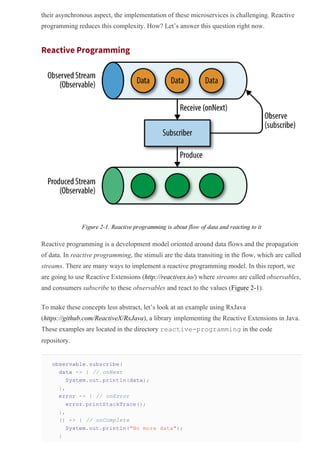
Figure 21. Reactive programming is about flow of data and reacting to it
Reactive programming is a development model oriented around data flows and the propagation
of data. In reactive programming, the stimuli are the data transiting in the flow, which are called
streams. There are many ways to implement a reactive programming model. In this report, we
are going to use Reactive Extensions (http://reactivex.io/) where streams are called observables,
and consumers subscribe to these observables and react to the values (Figure 21).
To make these concepts less abstract, let’s look at an example using RxJava
(https://github.com/ReactiveX/RxJava), a library implementing the Reactive Extensions in Java.
These examples are located in the directory reactiveprogramming in the code
repository.
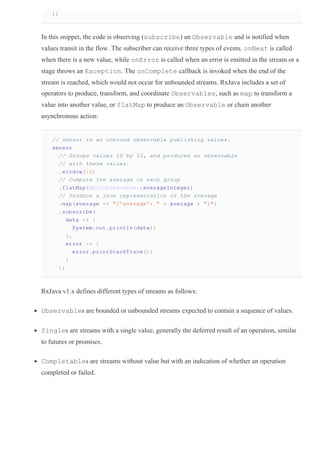
observable.subscribe(
data > { // onNext
System.out.println(data);
},
error > { // onError
error.printStackTrace();
},
() > { // onComplete
System.out.println("No more data");
}
12.
);
In this snippet,the code is observing (subscribe) an Observable and is notified when
values transit in the flow. The subscriber can receive three types of events. onNext is called
when there is a new value, while onError is called when an error is emitted in the stream or a
stage throws an Exception. The onComplete callback is invoked when the end of the
stream is reached, which would not occur for unbounded streams. RxJava includes a set of
operators to produce, transform, and coordinate Observables, such as map to transform a
value into another value, or flatMap to produce an Observable or chain another
asynchronous action:
// sensor is an unbound observable publishing values.
sensor
// Groups values 10 by 10, and produces an observable
// with these values.
.window(10)
// Compute the average on each group
.flatMap(MathObservable::averageInteger)
// Produce a json representation of the average
.map(average > "{'average': " + average + "}")
.subscribe(
data > {
System.out.println(data);
},
error > {
error.printStackTrace();
}
);
RxJava v1.x defines different types of streams as follows:
Observables are bounded or unbounded streams expected to contain a sequence of values.
Singles are streams with a single value, generally the deferred result of an operation, similar
to futures or promises.
Completables are streams without value but with an indication of whether an operation
completed or failed.
This ebook isfor the use of anyone anywhere in the United States
and most other parts of the world at no cost and with almost no
restrictions whatsoever. You may copy it, give it away or re-use it
under the terms of the Project Gutenberg License included with this
ebook or online at www.gutenberg.org. If you are not located in the
United States, you will have to check the laws of the country where
you are located before using this eBook.
Title: The Three Brothers; Complete
Author: Mrs. Oliphant
Release date: November 22, 2018 [eBook #58323]
Most recently updated: January 24, 2021
Language: English
Credits: Produced by Chuck Greif and the Online Distributed
Proofreading Team at http://www.pgdp.net (This file was
produced from images available at The Internet Archive)
*** START OF THE PROJECT GUTENBERG EBOOK THE THREE
BROTHERS; COMPLETE ***
19.
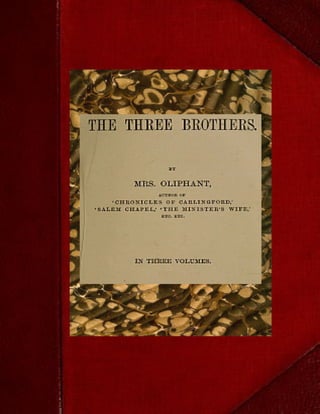
THE THREE BROTHERS.
COMPLETE.
CONTENTSOF VOLUME I.
CONTENTS OF VOLUME II.
CONTENTS OF VOLUME III.
THE THREE BROTHERS.
VOLUME I.
THE THREE BROTHERS.
BY
MRS. OLIPHANT,
AUTHOR OF
‘CHRONICLES OF CARLINGFORD,’
‘SALEM CHAPEL,’ ‘THE MINISTER’S WIFE,’
ETC. ETC.
IN THREE VOLUMES.
VOL. I.
LONDON:
20.
HURST AND BLACKETT,PUBLISHERS,
13 GREAT MARLBOROUGH STREET.
1870.
The Right of Translation is Reserved.
LONDON:
Strangeways and Walden, Printers,
28 Castle St. Leicester Sq.
21.
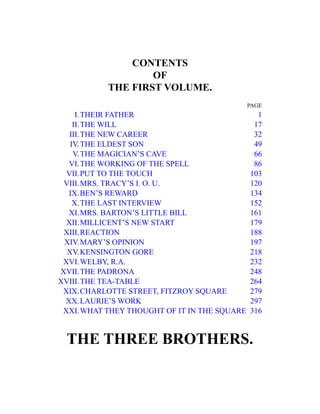
CONTENTS
OF
THE FIRST VOLUME.
PAGE
I.THEIRFATHER 1
II.THE WILL 17
III.THE NEW CAREER 32
IV.THE ELDEST SON 49
V.THE MAGICIAN’S CAVE 66
VI.THE WORKING OF THE SPELL 86
VII.PUT TO THE TOUCH 103
VIII.MRS. TRACY’S I. O. U. 120
IX.BEN’S REWARD 134
X.THE LAST INTERVIEW 152
XI.MRS. BARTON’S LITTLE BILL 161
XII.MILLICENT’S NEW START 179
XIII.REACTION 188
XIV.MARY’S OPINION 197
XV.KENSINGTON GORE 218
XVI.WELBY, R.A. 232
XVII.THE PADRONA 248
XVIII.THE TEA-TABLE 264
XIX.CHARLOTTE STREET, FITZROY SQUARE 279
XX.LAURIE’S WORK 297
XXI.WHAT THEY THOUGHT OF IT IN THE SQUARE 316
THE THREE BROTHERS.
22.
CHAPTER I.
THEIR FATHER.
Thereason why Mr. Renton’s sons were sent out into the world in the
humble manner, and with the results we are about to record, must be first
told, in order that their history may be comprehensible to the reader. Had
they been a poor man’s sons no explanation would have been necessary; but
their father was anything but a poor man. The family was one of those
exceptional families which add active exertion to hereditary endowments.
Though the Rentons had been well-known people in Berks for two or three
centuries, it had almost been a family tradition that each successive heir,
instead of resting content with the good things Providence had given him,
should add by his own efforts to the family store. There had been pirates
among them in Elizabeth’s time. They had made money when everybody
else lost money in the time of the ‘South Sea.’ Mr. Renton’s father had gone
to India young, and had returned, what was then called, a ‘Nabob.’ Mr.
Renton himself was sent off in his turn to Calcutta, as remorselessly as
though he had not been the heir to heaven knows how many thousands a-
year; and he too had increased the thousands. There was not a prettier estate
nor a more commodious house in the whole county than Renton Manor. The
town-house was in Berkeley Square. The family had everything handsome
about them, and veiled their bonnet to none. Mr. Renton was a man who
esteemed wealth as a great power; but he esteemed energy still more, and
placed it high above all other qualities. As he is just about to die, and cannot
have time to speak for himself in these pages, we may be permitted to
describe a personage so important to this history. He was a spare, middle-
sized man, with a singular watchfulness and animation in his looks; his foot
springy and light; his sight, and hearing, and all his senses, unusually keen;
—a man always on the alert, body and mind, yet not incapable of repose.
Restless was not an epithet you could apply to him. A kind of vigilant, quiet
readiness and promptitude breathed out from him. He would have sooner
died than have taken an unfair advantage over any one; but he was ready to
seize upon any and every advantage which was fair and lawful, spying it
23.
out with theeyes of an eagle, and coming down upon it with the spring of a
giant. Twice, or rather let us say four times in his life he had departed from
the traditions of the Rentons. Instead of the notable, capable woman whom
they had been wont to choose, and who had helped to make the family what
it was, he had married a pretty, useless wife, for no better reason than that
he loved her. And partly under her influence, partly by reason of a certain
languor and inclination towards personal ease which had crept over him, he
had been—as he sometimes felt—basely neglectful of the best interests of
his sons. The eldest, Ben, had not been sent to India at sixteen, as his father
was; nor had Laurie, the second, gone off to the Colonies, as would have
been natural; and as for Frank, his father’s weakness had gone so far as to
permit of the purchase of a commission for him when the boy had fallen in
love with a red coat. Frank was a Guardsman, and he a Renton! Such a
thing had never been heard of in the family before.
The eldest surviving aunt, Mrs. Westbury, who was full of Renton
traditions, almost went mad of this event, so afflicted was she by such a
departure from use and wont. She had two boys of her own, whom she had
steadfastly kept in the family groove, and, accordingly, had the very best
grounds for her indignation. ‘But what was to be expected,’ she said, ‘from
such a wife?’ Mrs. Renton was as harmless a soul as ever lay on a sofa, and
had little more than a passive influence in the affairs of her family; but her
husband’s sister, endowed with that contempt for the masculine
understanding which most women entertain, put all the blame upon her soft
shoulders. Two men-about-town, and a boy in the Guards! ‘Is Laurence
mad?’ said Mrs. Westbury. It was her own son who had gone to the house in
Calcutta, which might have mollified her; but it did not. ‘My boy has to
banish himself, and wear out the best of his life in that wilderness,’ she said,
vehemently, ‘while Ben Renton makes a fool of himself at home.’ When
they brought their fine friends to the Manor for shooting or fishing, she had
always something to say of her boy who was banished from all these
pleasures; though, indeed, there had been a great rejoicing in the Westbury
household when Richard got the appointment. It was but a very short time
before her brother’s death that Aunt Lydia’s feelings became too many for
her, and she felt that for once she must speak and deliver her soul.
‘Ben is to succeed you, I suppose?’ she said, perhaps in rather an
unsympathetic way, as she took Mr. Renton to the river-side for a walk,
under pretence of speaking to him ‘about the boys.’ He thought, poor man,
24.
that it washer own boys she meant, and was very good-natured about it.
And then it was his favourite walk. The river ran through the Renton
woods, at the foot of a steep bank, and was visible from some of the
windows of the Manor. The road to it was a charming woodland walk,
embowered in great beeches, the special growth of Berks. Through their
vast branches, and round about their giant trunks, playing with the
spectator’s charmed vision like a child, came glimpses of the broad, soft
water, over which willows hung fondly, and the swans and water-lilies
shone. Mr. Renton was not sentimental, but he had known the river all his
life, and was fond of it;—perhaps all the more so as he found out what
mistakes he had made, and that life had not been expended to so much
purpose as it ought to have been; so that he walked down very willingly
with his sister, and inclined his ear with much patience and good-nature to
hear what she had to say about her boys.
‘Ben will succeed you, I suppose?’ she said, looking at him in a
disapproving way, as they came to the very margin of the stream where
Laurie’s boat, with its brightly painted sides and red cushions reflected in
the water, lay moored by the bank. It was a fantastic little toy, meant for
speed, and not for safety; and Mrs. Westbury would have walked ten miles
round by Oakley Bridge rather than have trusted herself to that arrowy bark.
She sighed as her eyes fell upon it. ‘Poor Laurie! poor boy!’ she said,
shaking her head. The sight seemed to fill her with a compassion beyond
words.
‘Why poor Laurie?’ said Mr. Renton; but he knew what she meant, and it
made him angry. ‘Of course Ben will succeed me. I succeeded my father. It
is his right.’
‘Ah, Laurence, but how did you succeed your father?’ said Mrs.
Westbury. ‘You had the satisfaction of being the greatest comfort to dear
papa. He felt the property would be safe in your hands, and be improved, as
it has always been. People say we are such a lucky family, but you and I
know better. We know it is work that has always done it,—alas! until now!’
she said, suddenly lifting up her eyes to heaven. Truth compels us to add
that Mr. Renton was very much disconcerted. He could not bear to hear his
own family attacked; but he felt the justice of all she said.
‘Well, Lydia, manners change,’ he said. ‘It seemed natural enough in our
time; but, when you come to consider it, I don’t see what reason I have for
25.
sending the boysaway. I can leave them very well off. We were never so
well off as we are now. You know I managed to buy that last farm my father
had set his mind upon. I don’t see why I should have broken their mother’s
heart.’
‘Ah, I knew it would come out,’ said Mrs. Westbury, with a little
bitterness. ‘Why should Mary’s heart be more tender than other people’s? I
have to send my boys away, though I love them as well as she does hers;
and people congratulate me on having such a good appointment for
Richard. It never occurs to anybody that I shall break my heart.’
‘You are a Renton,’ said her brother, with some dexterity. ‘I often think
you are the best Renton of us all. But if poor Westbury had lived, you know,
he might have contrived to spare you the parting, as I have spared Mary;
and—— The short and the long of it is the boys are doing very well. I have
no fault to find with them, and I mean to take my own way with my own
family, Lydia; no offence to you.’
‘Oh, no; no offence,’ said Mrs. Westbury, with a little toss of her head.
‘It is all for my advantage, I am sure. When my Richard comes home at a
proper time with the fortune your Ben ought to have made, I shall have no
reason to complain for one.’
‘Ben will be very well off,’ said Mr. Renton, but with an uncomfortable
smile.
‘Oh, very well off, no doubt,’ said his sister, with a touch of contempt; ‘a
vapid squire, like the rest of them. People used to say the Rentons were like
a fresh breeze blowing in the county. Always motion and stir where they
were! And, poor Laurie!’ she added once more, with offensive compassion,
as they turned and came again face to face with Laurie’s boat.
‘I should like to know why Laurie so particularly excites your pity,’ said
Mr. Renton, much irritated. Laurie was his own namesake and favourite,
and this was the animadversion which he could least bear.
‘Poor boy! I don’t know who would not pity him,’ said Aunt Lydia; ‘it
would melt a heart of stone to see a boy with such abilities all going to
wrack and ruin. It is all very well as long as he is at home; but when he
comes to have his own money what will he do with it? Spend it on pictures
and nonsense, and encourage a set of idle people about him to eat him up.
Laurence, you mark my words—that is just the kind of boy to be eaten up
26.
by everybody, andto come to poverty in the end. Whereas, if he had been
taught from the first that work was the natural destiny of man——’
‘There, Lydia,—there,—I wish you would make an end of this
croaking,’ cried Mr. Renton. ‘I am not quite well to-day, and can’t bear it.
That’s enough for one time.’
‘As for Frank, I give him up,’ said Mrs. Westbury,—‘a soldier, that can
never make a penny,—and, of all soldiers, a Guardsman! I am very sorry
for you, Laurence, I am sure. How a man of your sense could give in so to
Mary’s whims I can’t understand.’
‘Mary had nothing to do with it,’ said Mr. Renton angrily; and he led the
way up the bank, and changed the subject abruptly. Mrs. Westbury, though
she was not susceptible, felt that she must say no more; and they returned in
comparative silence to the house. This walk had been taken late in a
summer evening after dinner, and in the solemnity of evening dress, over
which, Aunt Lydia, who was stout and felt the heat, had thrown a little
shawl. As they reached the lawn in front of the Manor they came upon a
pretty scene. Mrs. Renton, who was feebly pretty still, lay on a sofa, which
had been brought out and placed in the shadow of the trees. Mary Westbury,
her godchild, who bore a curious softened resemblance to her mother, sat
upright on a footstool by her aunt’s side, working and talking to her. The
third figure was Laurie, lying at full length on the soft grass. Probably since
dinner he had been having a cigar; for instead of the regular evening coat he
wore a fantastic velvet vestment, which half veiled the splendour of his
white linen and white tie. He was lying stretched out on his back,—
handsome, lazy, and contented,—a practical commentary on his aunt’s
speech. There were books lying about, which his energetic cousin had been
coaxing and boring him to read aloud; but Laurie had only shaken his head
at her, ruffling his chestnut locks against the grass: and a little sketch-book
lay by his side, where it had fallen from his indolent hand. Mrs. Westbury
looked at him and then at her brother. What words could say as much?
There lay lazy Laurence, with an unspeakable sentiment of far niente, in
every line of him; and he a Renton, whose very ease had always been
energetic! Mr. Renton saw it, too, and, for once in his life, was heartily
ashamed of his favourite son.
‘There you lie,’ said Aunt Lydia, ‘resting after your hard day’s work.
What a laborious young man you must be, Laurie! I never saw any one who
27.
wanted so muchrest.’
‘Thanks,’ said Laurence, with a little nod of his chin from the grass. ‘My
constitution requires a great deal of rest, as you say. If you don’t mind
moving a little, Aunt Lydia, you are sitting on my note-book. Thanks. There
are some swans there I should not like to lose.’
‘And of what use are swans?’ said Mrs. Westbury. ‘I wish you would tell
me, Laurie; I am such an ignorant creature, and I should like to know.’
‘Use?’ said Laurie, opening his eyes. ‘They don’t get made into patties,
as far as I know;—but they are of about as much use as the most of us, I
suppose.’
‘The most of us have a great deal to do in the world,’ said Aunt Lydia,
growing very red, for she was fond of pâtés; ‘if you knew how many things
have to pass through my hands from morning to night——’
‘Yes, I know,’ said lazy Laurence, raising his hand in soft deprecation.
‘Mary has been telling us;—but what is the use of that, Aunt Lydia? Why
should you worry yourself? Things would go on just as well if you let them
alone,—that’s what I always tell Ben. What’s the good of fidgeting? If
you’ll believe,’ continued Laurie, raising himself a little on one elbow, ‘all
the people who have ever made any mark in the world have been people
who knew how to keep quiet and let things work themselves out. There’s
your Queen Elizabeth,’ he said, warming to his subject, and giving a slight
kick with his polished boot to a big volume on the grass; ‘the only quality
she had was a masterly inaction. She kept quiet, and things settled
themselves.’
‘Oh, Laurie! not when she killed that poor, dear, Queen Mary!’ cried his
mother from the sofa. ‘I hate that woman’s very name.’
‘No,’ said Laurie, gracefully sinking down again among the grass, ‘that’s
an instance of energy, mother,—a brutal quality, that always comes to
harm.’
‘Laurence, you are a fool!’ said Mr. Renton sharply, to his son’s surprise;
and he turned his back upon them all abruptly, and went in across the soft
grass, through the magical, evening atmosphere that tempted all the world
to rest. His sister had taken all restfulness out of him. Though he was a
sensible man, he was a Renton; and the family traditions when thus recalled
to his mind had a great power over him. He went into the library, which
looked out upon a dark corner of the grounds full of mournful evergreens;
28.
the blank wallof the kitchen-garden showed a little behind them, and the
room at this time of day was a very doleful room. It was a kind of penance
to put upon himself to come in from that air, all full of lingering hues of
sunset and soft suggestions of falling dew, to the grim-luxurious room, in
which he already wanted artificial light. Here he sat and pondered over his
own life, and that of his boys. Up to this moment they had been a great deal
happier than he had been. Like a gust of air from the old plains of his youth,
a remembrance came over him of loneliness and wistfulness, and a certain
impossible longing for a little pleasure now and then, and some love to
brighten the boyish days. He had not been aware of wanting those vanities
then; but he saw now that he had done so, and that his youth had been very
bare and unlovely. He had scattered roses before his sons, while only thorns
had been in his own path; but what if he had kept from them the harder
training which should make them men? He sat till the darkness grew almost
into night thinking over these things. They were men now,—the lads. Ben
was five-and-twenty; Laurie but a year younger; and Frank, the happy boy,
was only twenty, glorious in his red coat. Mr. Renton pondered long, and
when the lamp came he made a great many notes and calculations, which he
locked up carefully in his desk. He had a headache, which was very
unusual. It was his wife’s rôle in the family to have the headaches; and it
did not occur to Mr. Renton that there could be anything the matter with
him. It was the heat, no doubt, or a little worry. The ladies had come into
the drawing-room when his ponderings were over. It was a large room, full
of windows, with one large bow projecting out upon the cliff, from which
you could see the river through the cloud of intervening beeches. On the
other side the room was open to the soft darkness of the lawn. There were
two lamps in it, but both were shadowed; for Mrs. Renton’s eyes, like her
head, were weak; and the cool air of night breathed in, odorous and soft,
making a scarcely perceptible draught from window to window. Mrs.
Renton lay quite out of this current of air, which naturally she was afraid of,
on another sofa. Mary made tea in a corner, with the light of one of the
lamps falling concentrated upon her pretty hands in twinkling motion about
the brilliant little spots of china and silver. She had a ring or two upon her
pink transparent fingers, and a bracelet, which sparkled in the light. Mrs.
Westbury sat apart in a great chair, and fanned herself. Now and then, with
a dash against the delicate abat-jour of the lamp, came a mad moth, bent on
self-destruction. Mr. Renton dropped into the first chair he could find, not
29.
knowing why hewas so uncomfortable, and Mary brought him some tea.
The weather had been very warm, and everybody was languid with the heat.
They all sat a great way apart from each other, and were not energetic
enough for conversation. ‘Where is Laurie?’ Mr. Renton asked; and they
told him that Laurie, with his usual wilfulness, had gone down to the river.
‘There will be a moon to-night,’ Mrs. Renton said, with some fretfulness;
for she liked to have one of her boys by her, if only lying on the grass, or on
the deep mossy carpet, which was almost as soft as the grass.
‘He has gone off to his moonlight, and his swans, and his water-lilies,’
said Mrs. Westbury, with disdain; but even she felt the heat too much to
proceed.
‘The water-lilies are closed at night,’ said Mary apologetically; venturing
to this extent to take her cousin’s part; lazy Laurence was a favourite with
most people, though he had no energy. Then, all at once, a larger swoop
than usual went circling through the dim upper atmosphere of the room, and
Mrs. Renton gave a scream.
‘It is a bat!’ she cried. ‘Ring, Mary, ring,—I am so superstitious about
bats; and Laurie out all by himself on that river. Mr. Renton, I wish you
would put a stop to it. I never can think it is safe. Oh, tell them to drive out
that creature, Mary! I always know something must happen when a bat
comes into one’s room.’
‘No, godmamma, never mind,’ said Mary. ‘It is only the light. How
should a bat know anything that was going to happen? They come into the
Cottage every evening, and we never mind.’
‘Then you will be found some morning dead in your beds,’ said Mrs.
Renton; ‘I know you will. Oh, it makes me so unhappy, Mary! and Laurie
all by himself in that horrid little boat!’
‘Laurie is all right,’ said Mr. Renton; ‘he knows how to manage a boat, if
he knows nothing else.’ This was muttered half to himself and half aloud;
and then he went to the bow-window and looked out upon the river. The
moon had just risen, and was shining straight down upon one gleam of
water which blazed intensely white amid all the darkling shadows. As Mr.
Renton stood looking out, a boat shot into this gleaming spot, with long
oars glistening, balancing, touching the water like wings of a bird. ‘Laurie
is all right,’ he said to himself, in a mechanical way. He did not himself care
for a thousand bats. But his wife’s alarm struck into his own uneasiness like
30.
a key-note,—the key-noteto something he could not tell what. It was all so
lovely and peaceful as he looked, soft glooms, soft light, rustling rhythm of
foliage, wistful breathing of the night air over that pleasant landscape he
knew so well. After all, was it not better to have the boy there in his boat,
than scorching out in India or toiling like a slave in some Canadian or
Australian forest? What is the good of the father’s work but to better the
condition of the sons? But, on the other hand, if life when it came should
find the sons incapable? Mr. Renton had been a prosperous man; but he
knew that life was no holiday. When it came like an armed man with
temptations, and cares, and responsibilities upon that silken boy, how would
he meet it? These were the father’s thoughts as the bat was hunted out with
much commotion, and his wife lay sighing on her sofa. If he had been well,
probably, Mrs. Westbury’s talk would have had no such effect upon him;
but he was not well; and it had made him very ill at ease.
Next day his lawyer came, and was closeted for a long time with him,
and there were witnesses called in,—the Rector who happened to be calling,
and the lawyer’s clerk—to witness Mr. Renton’s signature. And within a
week, though he was still in what is called the prime of life, the father of the
house was dead; and his will alone remained behind him to govern the fate
of his three sons.
31.
CHAPTER II.
THE WILL.
Therewas great consternation in the family when this sudden misfortune
came upon it. All the bustling household from the Cottage overflowed into
the Manor in the excitement of the unlooked-for event; and the eldest and
the youngest son came as fast as the telegraph could summon them to their
father’s bedside. During the two or three days of his illness the three young
men wandered about the place, as young men do when there is fatal illness
in a house—useless,—not liking to go about their usual employments, and
not knowing what else to do. They took silent walks up and down to the
river, and cast wistful looks at the boats, and dropped now and then into
ordinary conversation, only to break off and pull themselves up with
contrition when they remembered. They were very good sons, and felt their
father’s danger, and would have done anything for him; but there are no
special arts or occupations made for men in such circumstances. The only
alternative the poor boys had was to resort to their ordinary pleasures, or to
do nothing; and they did nothing, as that was the most respectful thing to
do,—and were as dispirited and miserable as heart could desire.
On the last day of all they were called up together to their father’s death-
bed. He had known from the first that he was going to die; and Mrs.
Westbury, who was his principal nurse, and a very kind and patient one, had
felt that her brother had something on his mind. More than once she had
exhorted him to speak out and relieve himself; but he had always turned his
face to the wall when she made this proposition. It was a close, warm, silent
afternoon when the boys were called up-stairs; a brooding calm, like that
which comes before a thunder-storm; a yellow light was all over the sky,
and the birds were fluttering about with a frightened, stealthy look. Even
the leaves about the open windows shook with a terrified rustling,—
clinging, as it were, to the human walls to give them support in this crisis of
nature. The light was yellow in the sick-room, for the patient would not
have the day excluded, as it is proper to do. He looked like an old man on
his bed, though he was not old. The reflection of lurid colour tinged the
32.
ashen face withyellow. He called them to him, and looked at them all with
keen anxiety in his eyes.
‘Well,’ he said, ‘I’m going, boys;—it’s unexpected, but one has to give
in. I hope you’ll all do well. If you don’t do well, I’ll get no rest in my
grave.’
‘Don’t you trust us, father?’ cried Ben, who was the eldest, with a
thickness in his voice. ‘We’ll do as you have done. That will be our guide.
But don’t think of us,—think of yourself now.’
‘You can’t do as I have done,’ said the father; ‘I started different. Perhaps
it is too late now. Laurie, you will not blame me? And, Frank, my boy, it
won’t make so much difference to you. Frank’s but a boy, and Laurie’s very
soft-hearted—’ he said, as if to himself.
‘Then it is me you are afraid of, father?’ said Ben, whose face darkened
in spite of himself. ‘If I have done anything to make you distrust me, God
knows I did not mean it. Believe me now.’
‘The boy does not know,’ said Mr. Renton to himself, in a confused way;
and then he added more loudly, ‘I don’t distrust you. You’ve always been a
good lad; but it’s hard on you,—ay, it’s hard on Ben,—very hard;—I
wonder if I should have done it!’ said the dying man. They could get very
little more out of him as they stood round his bed, grave, sorrowful, and
bewildered, looking for other words, for another kind of leave-taking. He
bade them no farewell, but mused and murmured on about something he
had done; and that it would be hard on Ben. It was not the kind of scene,—
of conscious farewell and tender adieu,—the last words of the dying father,
which we are so often told of; but perhaps it was a more usual state of mind
at such a moment. His intelligence was lost in mists, from the coming end.
Energy enough to be coherent had forsaken him. He could do nothing but
go over in his enfeebled mind the last great idea that had taken possession
of him. ‘Your mother had nothing to do with it,’ he said; ‘she knows no
more than you do. And don’t think badly of me. It has all been so sudden.
How was I to know that a week after,—is it a week?—without any time to
think, I should have to die? It’s very strange,—very strange,’ he added, in a
tone of musing, as if he were himself a spectator; ‘to go right away, you
know, from one’s business, that one understands,—to——’
Then he paused, and they all paused with him, gazing, wondering,
penetrated to the heart by that suggestion. Frank, who was the youngest,
33.
wept aloud. MaryWestbury, behind the curtain at one side of the bed,
busied herself, noiselessly, in smoothing the bed-clothes, and arranging the
drapery, so as to shade the patient’s eyes, with trembling hands, and
trembling lips, and tears that dropped silently down her white cheeks. These
two being the youngest were the most overcome. But there was no
harshness or coldness about the bedside of the prosperous man. They had
all perfect faith in him, and no fear that he was going out of the world
leaving any thorns in their path. His words seemed to them as dreams. Why
should they think badly of him? What could they ever have to forgive him?
There had never been any mystery in the house, and it was easier to think
their father’s mind was affected by the approach of death than to believe in
any mystery now.
Mr. Renton died that night; and it was on a very sad and silent house that
the moon rose—the same moon which he had watched shining on Laurie’s
boat. Mrs. Renton, poor soul, shut herself up in her room, taking refuge in
illness, as had been her habit all her life, with Mary nursing and weeping
over her. Aunt Lydia, worn out with watching, went to bed as soon as ‘all
was over.’ The lads were left alone. They huddled together in the library
where all the shutters had been closed, and one lamp alone burned dimly on
the table. Only last night there had still been floods of light and great
windows open to the sky. They gathered about the table together, not
knowing what to do. Nothing could be done that night. It was too soon to
talk of plans, and of their altered life. They could not read anything that
would have amused their minds; that would have been a sin against the
proprieties of grief; so the poor fellows gathered round the dim lamp, and
tried to talk, with now and then something that choked them climbing into
their throats.
‘Have you any idea what he could mean by that,—about me,—about it
being hard?’ said Ben, resting his head on both his hands, and gazing
steadfastly with two dilated eyes into the light of the lamp.
‘I don’t think he could mean anything,’ said Laurie, ‘unless it was the
responsibility. What else could it be?’
‘There must always have been the responsibility,’ said Ben. ‘He spoke as
if it were something more.’
‘His mind was wandering,’ said Laurie; and then there was a long pause.
It was broken by Frank with a sudden outburst.
34.
‘Ben, you’ll beawfully good to poor mamma,’ cried the boy; ‘she can’t
bear things as we can.’ The two elder ones held their breath tightly when
Frank’s sob disturbed the quiet;—they were too much men to sob with him,
—and yet there came that convulsive contraction of the throat. The only
thing to be done was to grasp each other’s hands silently, not daring to look
into each other’s faces, and to go to bed,—to take refuge in darkness and
solitude, and that soft oblivion of sleep, universal asylum of humanity, to
which one gains access so easily when one is young! Stealthily, on tiptoe,
each one of Mr. Renton’s sons paid a secret visit to the dimly-lighted room,
all shrouded and covered, with faint puffs of night air stealing in like spirits
through the shuttered windows, where their father lay all quiet and at rest.
True tears,—genuine sorrow was in all their hearts; and yet——
As each went away with a heart strained and exhausted by the outburst
of grief, something of the new life beyond, something that breathed vaguely
across them in the dark, like the air from the window, filled the impatient
human souls within them. The one idea could not retain undisturbed
possession even so long as that. The world itself could no more stand still,
poising itself in its vast orbit, than the spirits of its inhabitants. It was not
that Ben thought of his new wealth, nor Laurie of his future freedom; but
only that a thrill of the future passed through them, as they stood for this
melancholy moment by the death-bed of their past.
Five days passed thus, each of them as long as a year. Duty and propriety
kept the young men in-doors, in the languid stillness; or if they went out at
all, it was only for a disconsolate stroll through the grounds, on which,
sometimes singly, sometimes in pairs, they would set out, saying little. The
funeral relieved them from the painful artificiality of this seclusion. When
they met together after it, it was with faces in which there was neither fear
nor hope, that the sons of the dead man appeared. Their father had always
been just to them and kind, and they had no reason to expect that he could
have been otherwise in the last act of his life. The persons present were
Mrs. Renton, Mrs. Westbury, her children Mary and Laurence, and the three
Renton boys; with the lawyer, Mr. Pounceby, and his clerk, and a few old
friends of the family, who had just accompanied them from the grave. They
all took their places without excitement. He might have left a few legacies,
more or less, but nobody could doubt what would be the disposal of his
principal property. The ladies sat together, a heap of mournful crape, at one
end of the room. The whole company was quiet, and languid, and trustful.
35.
There was noanxiety in any one’s mind,—unless, indeed, it was in that of
Mr. Pounceby, who did not look to be at his ease. For the first quarter of an
hour he did nothing but clear his throat; then he had a blind pulled up, that
he might have a light to read by; then he pulled it down, because of a gleam
of the sun that stole in and worried him. His task was such that he did not
like to begin it, or to go through it when begun. But with the obtuseness of
people who have not their attention directed to a subject, nobody noticed his
confusion; he had a cold, no doubt, which made him clear his throat;—he
was always fidgety;—they were not suspicious, and found nothing out.
‘I ought to explain first,’ said Mr. Pounceby, ‘I promised my excellent
friend and client,—my late excellent client,—to make a little explanation
before I read what must be a painful document, in some points of view. Mr.
Ben Renton, I believe your father was particularly anxious that it should be
explained to you. He sent for me suddenly last week. It was, alas! only on
Friday morning that I came here by his desire. He wanted certain
arrangements made. Boys,’ said Mr. Pounceby, who was an old friend,
turning round upon them, ‘I give you my solemn word, had I known how
little time he would have lived to think it over, or change again, if
necessary, I should never have had any hand in it,—nor would he,—nor
would he. Had he thought his time was running so short, he would have
made no change.’
Then there ensued a little movement among the boys, which showed
how correct their father’s opinion of all the three had been. Frank bent
forward with a little wonder in his face, poising in his fingers a paper-knife
he had picked up, and looked calmly on as a spectator; Laurie only woke up
as it were from another train of thought, and turned his eyes with a certain
mild regret towards the lawyer; Ben alone, moved out of his composure,
rose up and faced the man, who held, as it seemed, their fate in his hands.
‘Whatever my father planned will no doubt be satisfactory to us,’ he said
firmly. ‘You forget that we are ignorant what change was made.’
He began to read now, but to an audience much more interested than at
first. There was, of course, a long technical preamble, to which Ben listened
breathlessly, his lips slightly moving with impatience, and a hot colour on
his cheeks, and then the real matter in question came.
Mr. Pounceby shook his grizzled head, ‘It was a great change that was
made,’ he said; ‘but I will not waste your time with further explanation. As
36.
Welcome to ourwebsite – the perfect destination for book lovers and
knowledge seekers. We believe that every book holds a new world,
offering opportunities for learning, discovery, and personal growth.
That’s why we are dedicated to bringing you a diverse collection of
books, ranging from classic literature and specialized publications to
self-development guides and children's books.
More than just a book-buying platform, we strive to be a bridge
connecting you with timeless cultural and intellectual values. With an
elegant, user-friendly interface and a smart search system, you can
quickly find the books that best suit your interests. Additionally,
our special promotions and home delivery services help you save time
and fully enjoy the joy of reading.
Join us on a journey of knowledge exploration, passion nurturing, and
personal growth every day!
ebookbell.com




![While the publisher and the author have used good faith efforts to ensure that the information
and instructions contained in this work are accurate, the publisher and the author disclaim all
responsibility for errors or omissions, including without limitation responsibility for damages
resulting from the use of or reliance on this work. Use of the information and instructions
contained in this work is at your own risk. If any code samples or other technology this work
contains or describes is subject to open source licenses or the intellectual property rights of
others, it is your responsibility to ensure that your use thereof complies with such licenses
and/or rights.
9781491986288
[LSI]](https://image.slidesharecdn.com/25502674-250511110515-ee92d04f/85/Building-Reactive-Microservices-In-Java-1st-Edition-Clement-Escoffier-7-320.jpg)



![This ebook is for the use of anyone anywhere in the United States
and most other parts of the world at no cost and with almost no
restrictions whatsoever. You may copy it, give it away or re-use it
under the terms of the Project Gutenberg License included with this
ebook or online at www.gutenberg.org. If you are not located in the
United States, you will have to check the laws of the country where
you are located before using this eBook.
Title: The Three Brothers; Complete
Author: Mrs. Oliphant
Release date: November 22, 2018 [eBook #58323]
Most recently updated: January 24, 2021
Language: English
Credits: Produced by Chuck Greif and the Online Distributed
Proofreading Team at http://www.pgdp.net (This file was
produced from images available at The Internet Archive)
*** START OF THE PROJECT GUTENBERG EBOOK THE THREE
BROTHERS; COMPLETE ***](https://image.slidesharecdn.com/25502674-250511110515-ee92d04f/85/Building-Reactive-Microservices-In-Java-1st-Edition-Clement-Escoffier-18-320.jpg)