1
Building Modern Web Apps with MEANStack
By Suresh Patidar
E
2
Who am I?
{
"name":"Suresh Patidar",
"before":"Worked with ClearTrail Technologies and L&T",
"today":"UI Architect @ Calsoft",
"Geek":[
"Writes code for Frontend and Backend",
"Works on UI/UX aspect",
"Create Application Architecture and Design"
],
"languages-and-frameworks":[
"JavaScript, NodeJS, AngularJS, Backbone, JQuery…",
"HTML, CSS, SASS, LESS, Bootstrap etc.",
"Java, .NET (C#), Spring MVC",
"Oracle, MySql, MongoDB"
],
"specialized-in":[
"Application Architecture & Design",
"MEAN Stack/Full Stack Application Development",
"Web development/Architecture",
"Mobile Development"
]
}
3
Agenda
 Structure of web application
 The requirements for a Modern Web App
 What is MEAN stack?
 Who uses MEAN stack?
 How it is different from LAMP stack?
 The MEAN Stack Architecture and
Components
 So why Go MEAN?
 Value of the MEAN stack
 MEAN Security
 What’s bad about MEAN approach?
 Future of MEAN stack
 Any Questions?
4
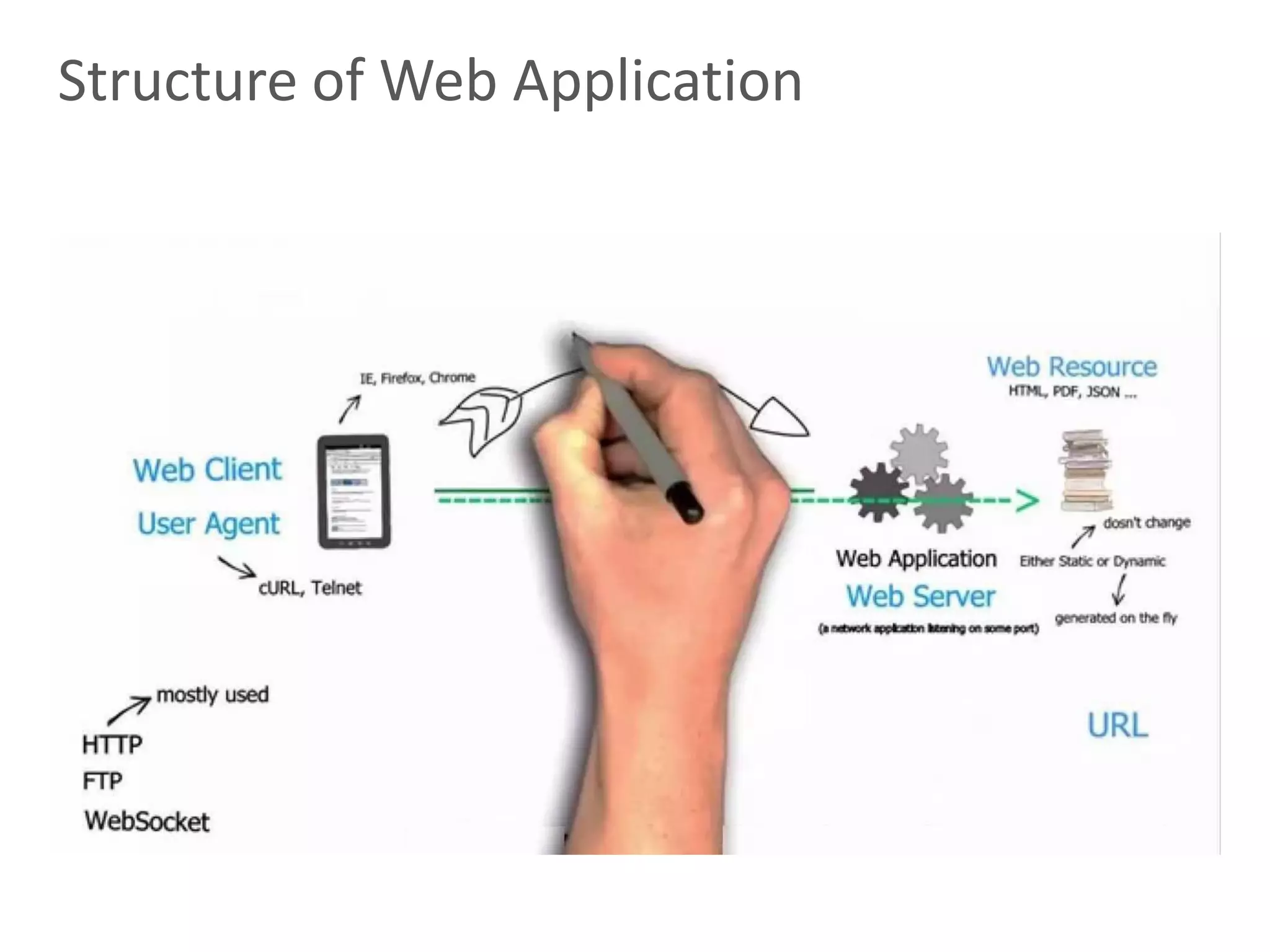
Structure of Web Application
5
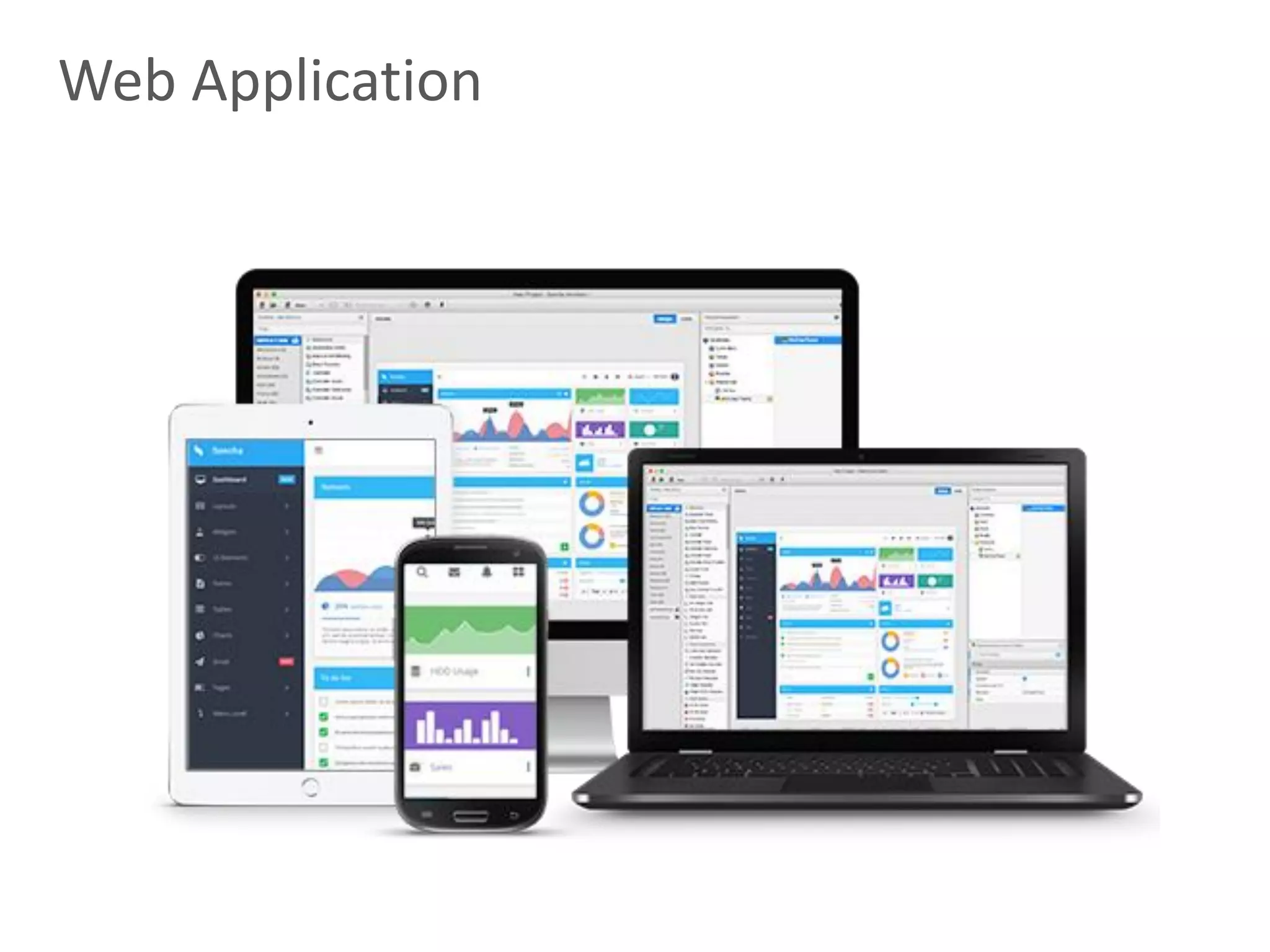
Web Application
6
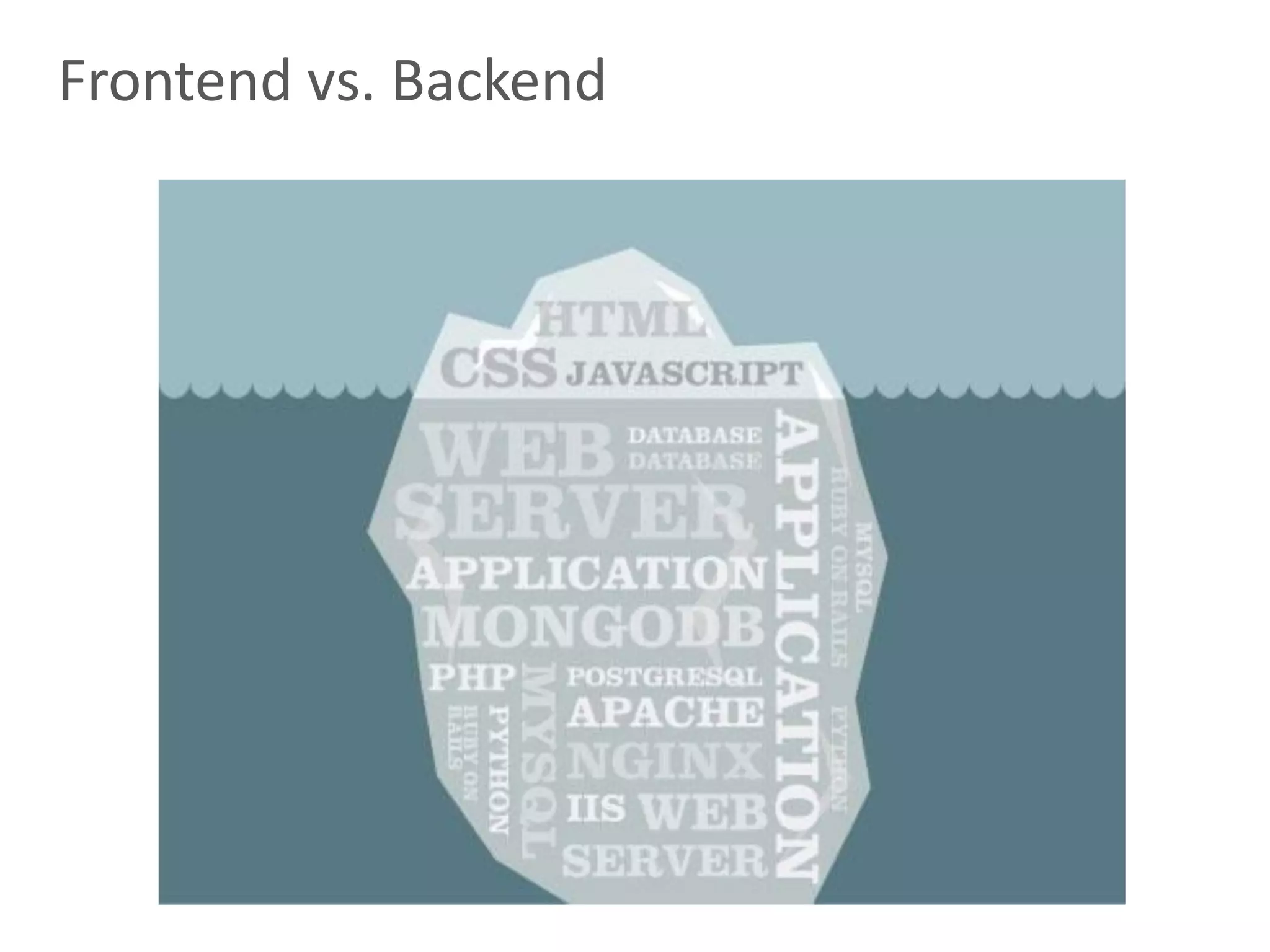
Frontend vs. Backend
7
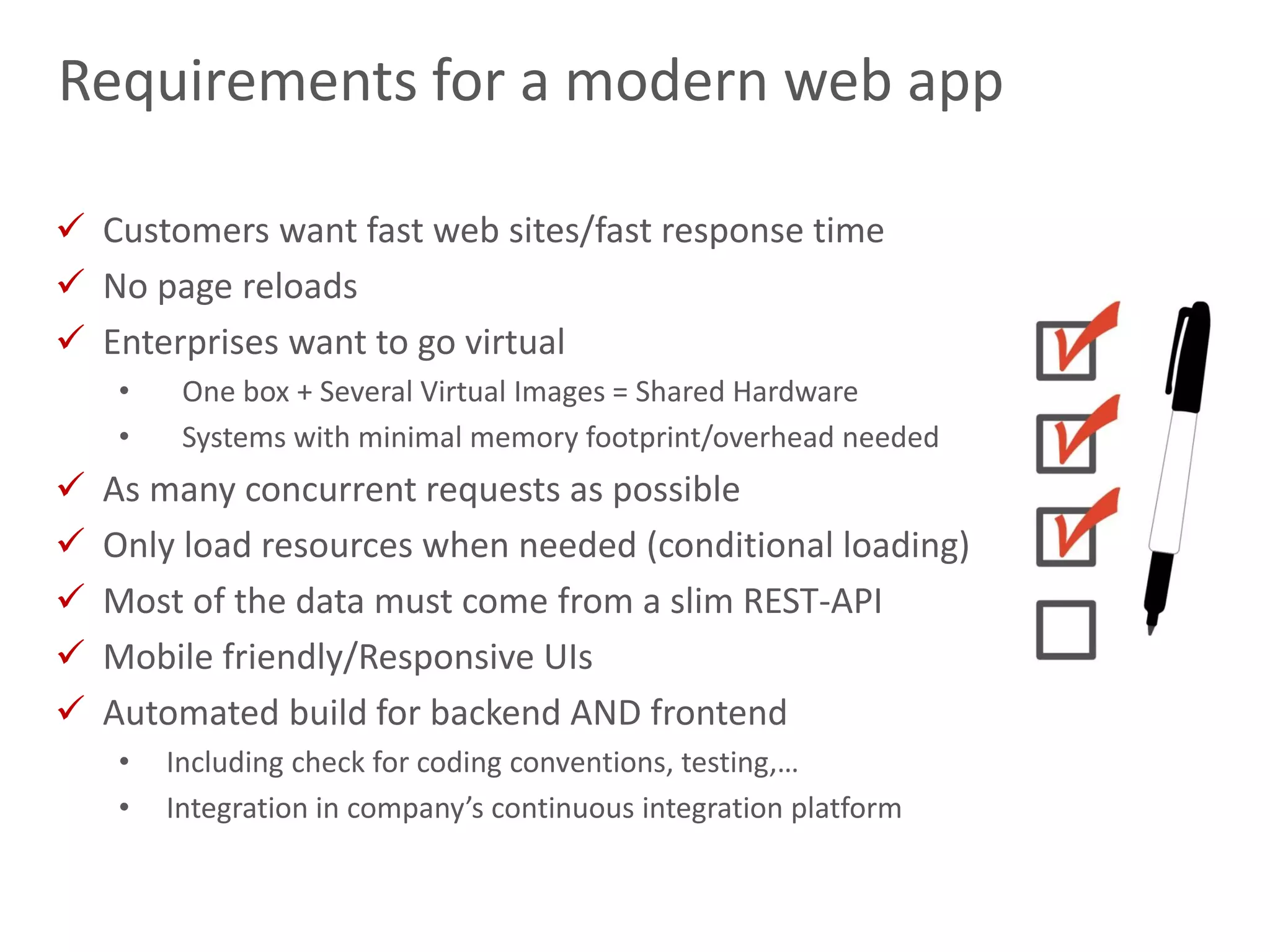
Requirements for a modern web app
 Customers want fast web sites/fast response time
 No page reloads
 Enterprises want to go virtual
• One box + Several Virtual Images = Shared Hardware
• Systems with minimal memory footprint/overhead needed
 As many concurrent requests as possible
 Only load resources when needed (conditional loading)
 Most of the data must come from a slim REST-API
 Mobile friendly/Responsive UIs
 Automated build for backend AND frontend
• Including check for coding conventions, testing,…
• Integration in company’s continuous integration platform
8
Front end vs. Back end
Introduction to the
MEAN Stack
9
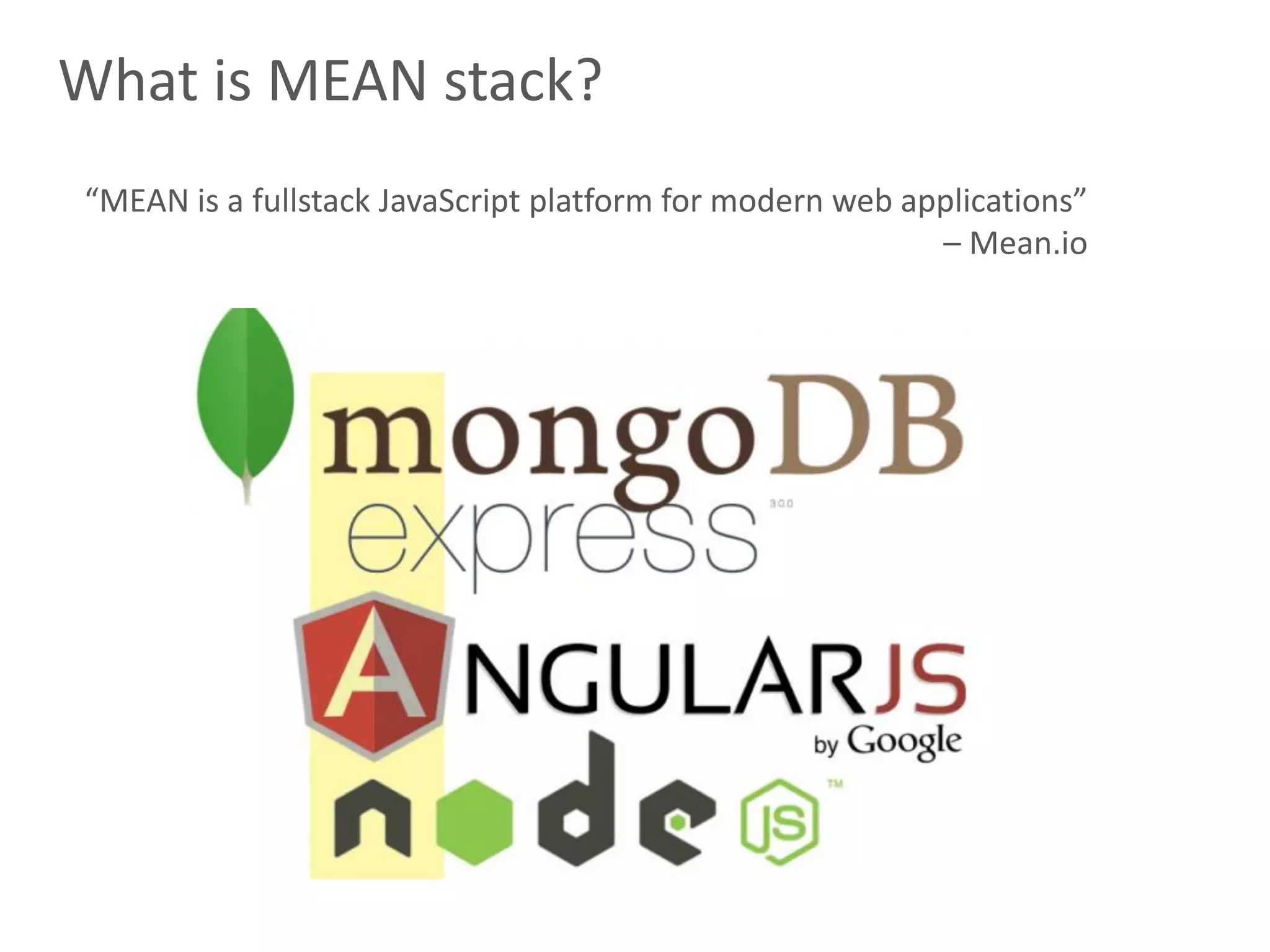
What is MEAN stack?
“MEAN is a fullstack JavaScript platform for modern web applications”
– Mean.io
10
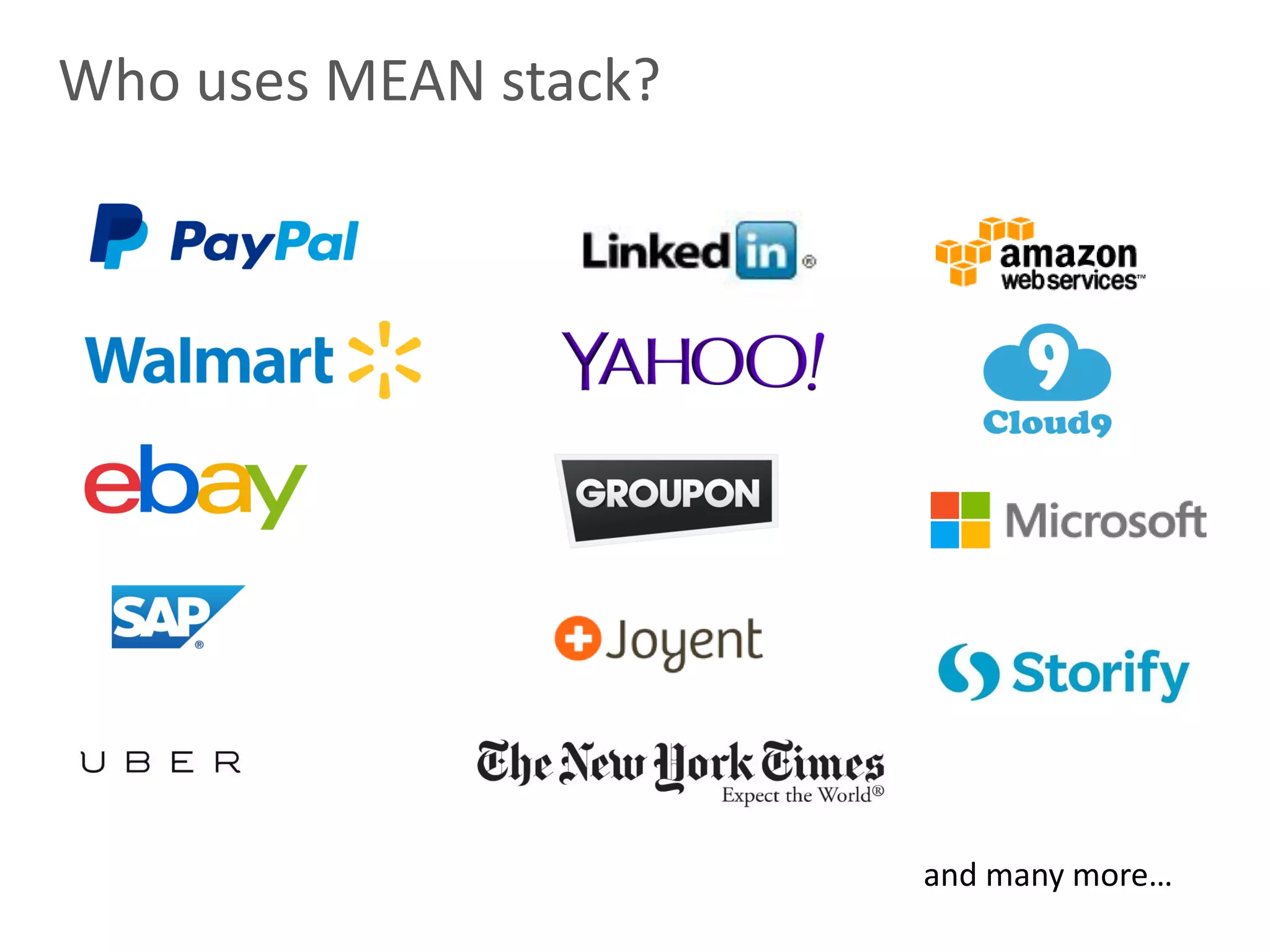
Who uses MEAN stack?
and many more…
11
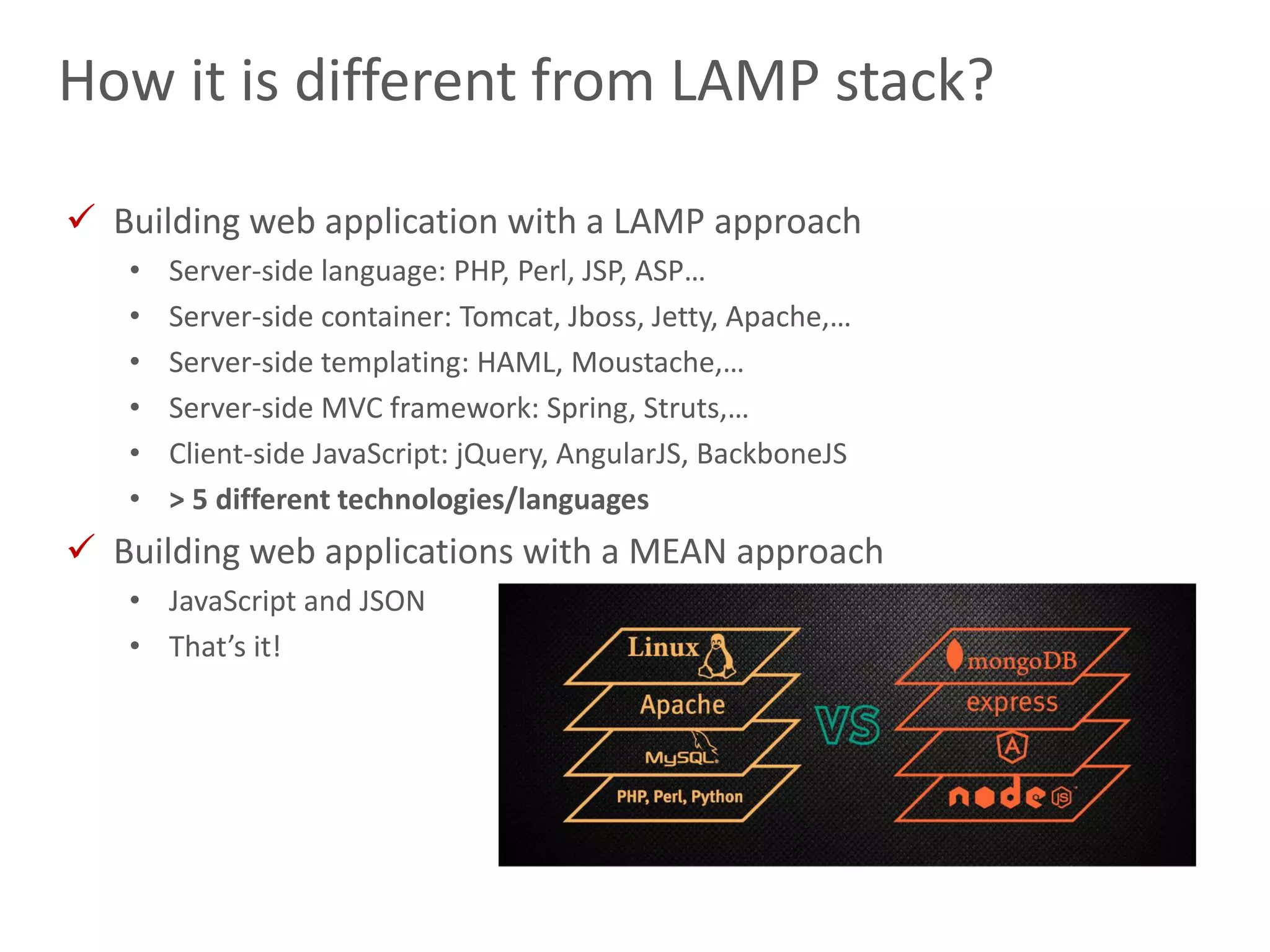
How it is different from LAMP stack?
 Building web application with a LAMP approach
• Server-side language: PHP, Perl, JSP, ASP…
• Server-side container: Tomcat, Jboss, Jetty, Apache,…
• Server-side templating: HAML, Moustache,…
• Server-side MVC framework: Spring, Struts,…
• Client-side JavaScript: jQuery, AngularJS, BackboneJS
• > 5 different technologies/languages
 Building web applications with a MEAN approach
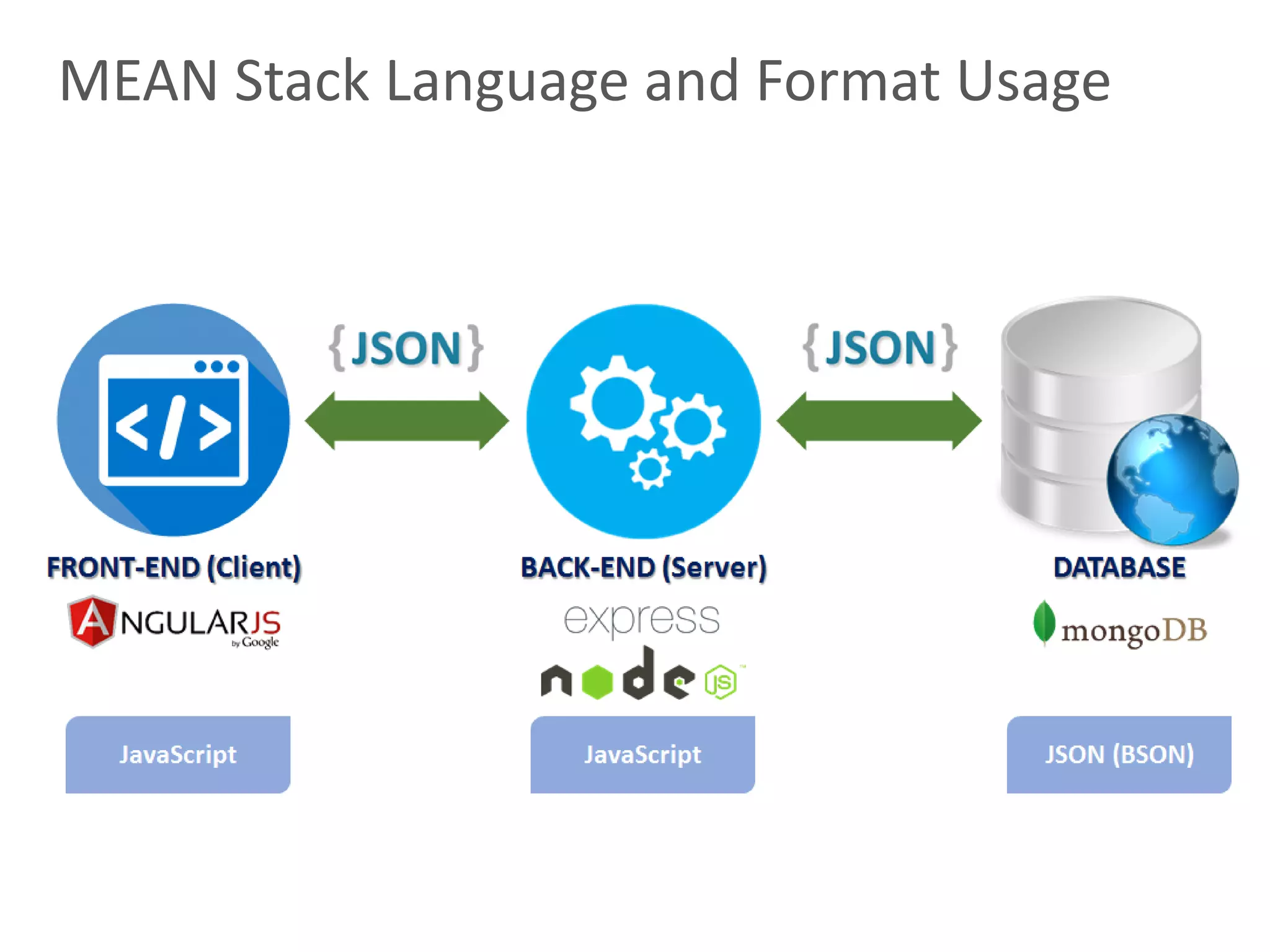
• JavaScript and JSON
• That’s it!
12
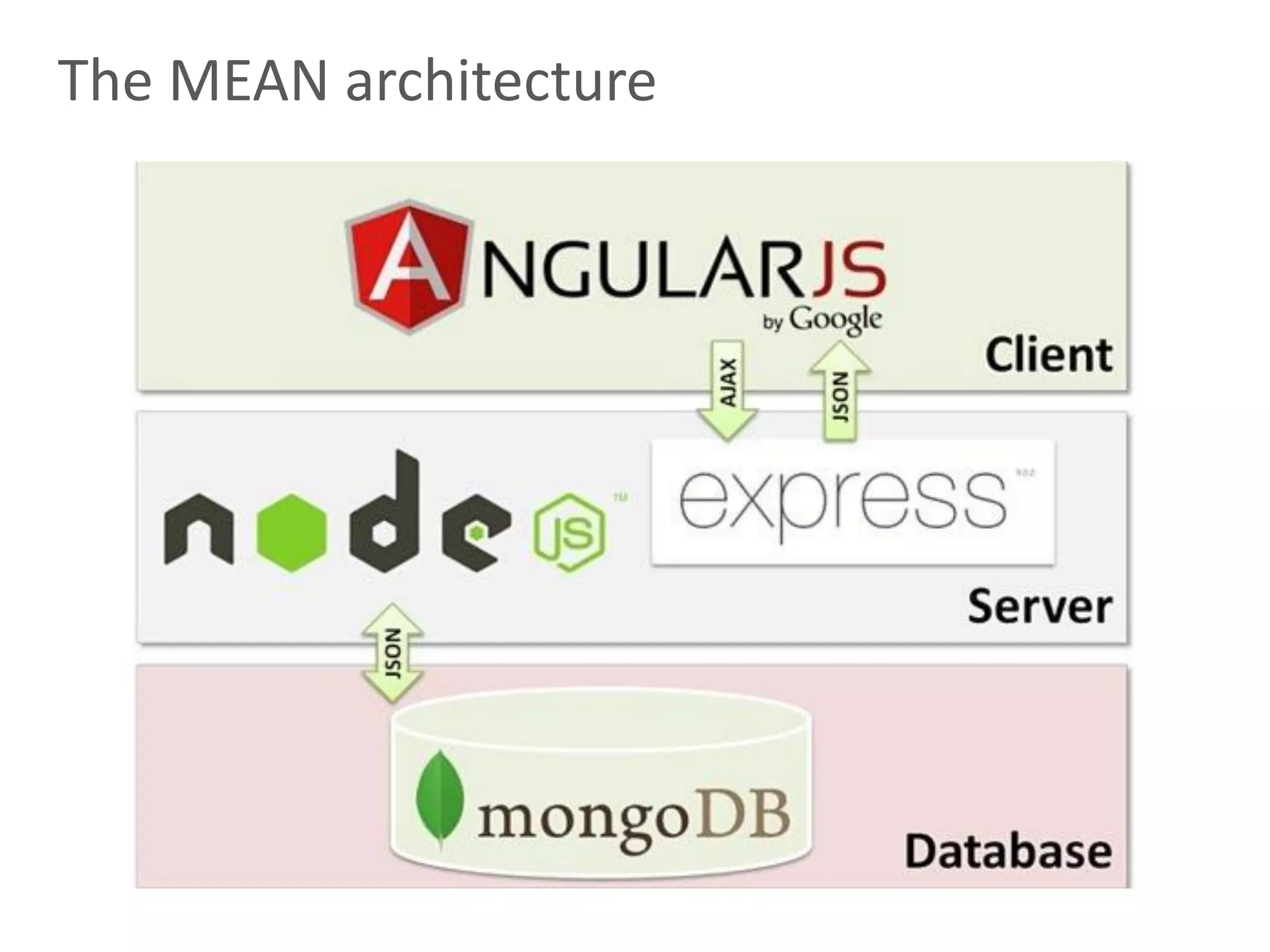
The MEAN architecture
13
AngularJS
Our app’s entire frontend
 Open source, maintained by Google
 Client Side MVC (MVVM) framework
 Excellent data bindings
 Very modular and extensible
 Great browser support (> IE8)
 Well documented
 Easy to test
14
Node.js
Lightweight web server framework
 Released in 2009 by Ryan Dahi
 Written in C/C++
 Built on Google Chrome’s V8 JavaScript engine
 Extremely lightweight and efficient
 What JavaScript has done for the web browser,
Node.js is doing for backend server
 Does module loading and Asynchronous IO
 Single threaded, One node process per CPU
 Easily scalable (just create a cluster)
 Great community and well maintained
15
Express
Create our routes and our API
 A simple, minimal, robust and flexible web
application framework for Node.js
 Gives everything we would expect to build a
modern web server
 Abstracts away a lot of low level logic (e.g. for
HTTP requests, SSL etc.)
 Helps organize your Node app into an MVC
structure
 Easy to implement REST API and session
management
 Middleware, routing, templating, static-files,
cookies, mime-types and much much more
16
MongoDB
Our data store
 A simple and scalable document based top
NoSQL Database
 Open Source, maintained by MongoDB
 JSON like syntax and model persistence
 Key-value stores
 Replication and High-Availability
 Flexible Schemas, Full Index support, Query
Selectors, Sharding and much much more
17
MEAN Stack Language and Format Usage
18
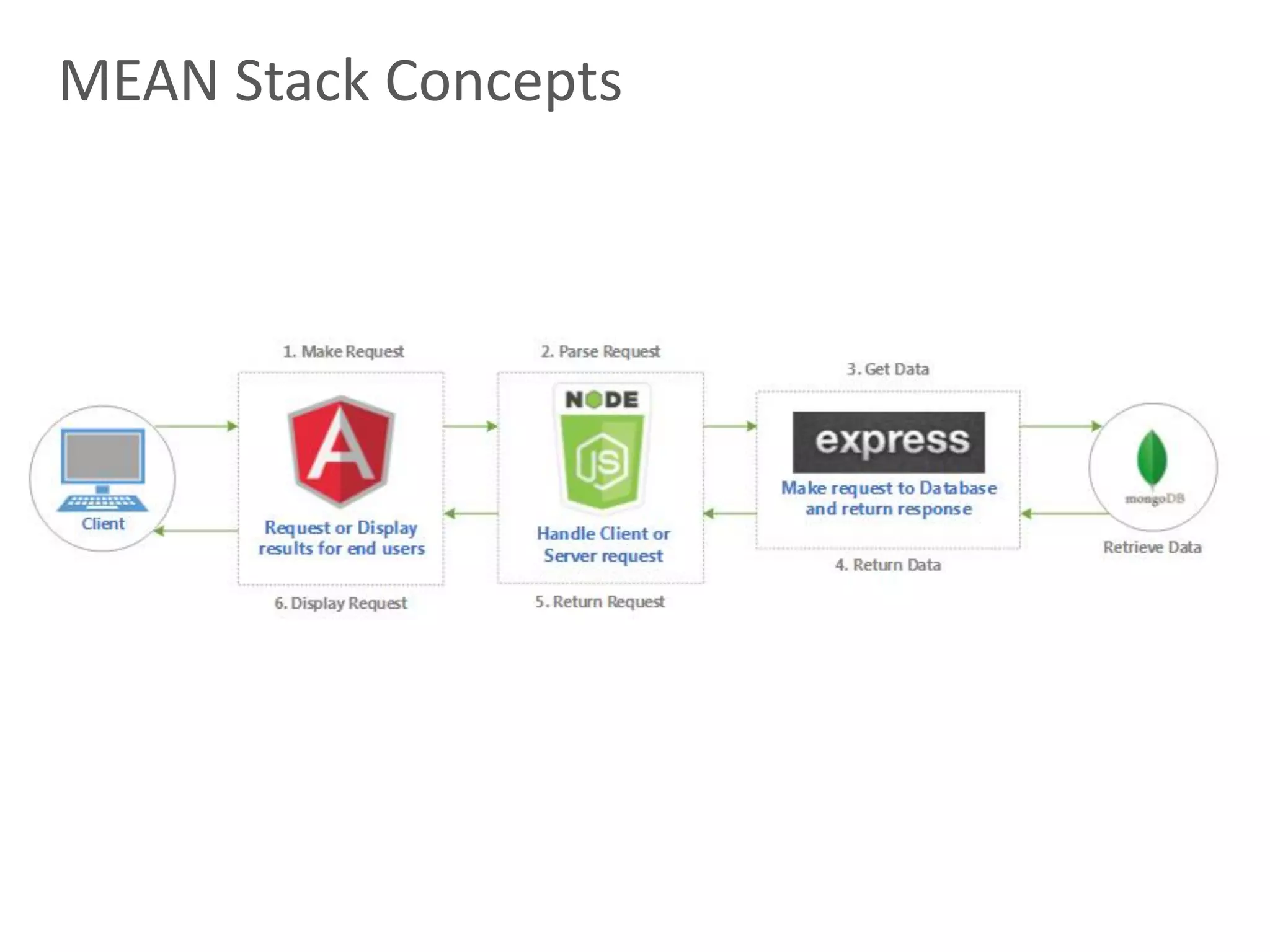
MEAN Stack Concepts
19
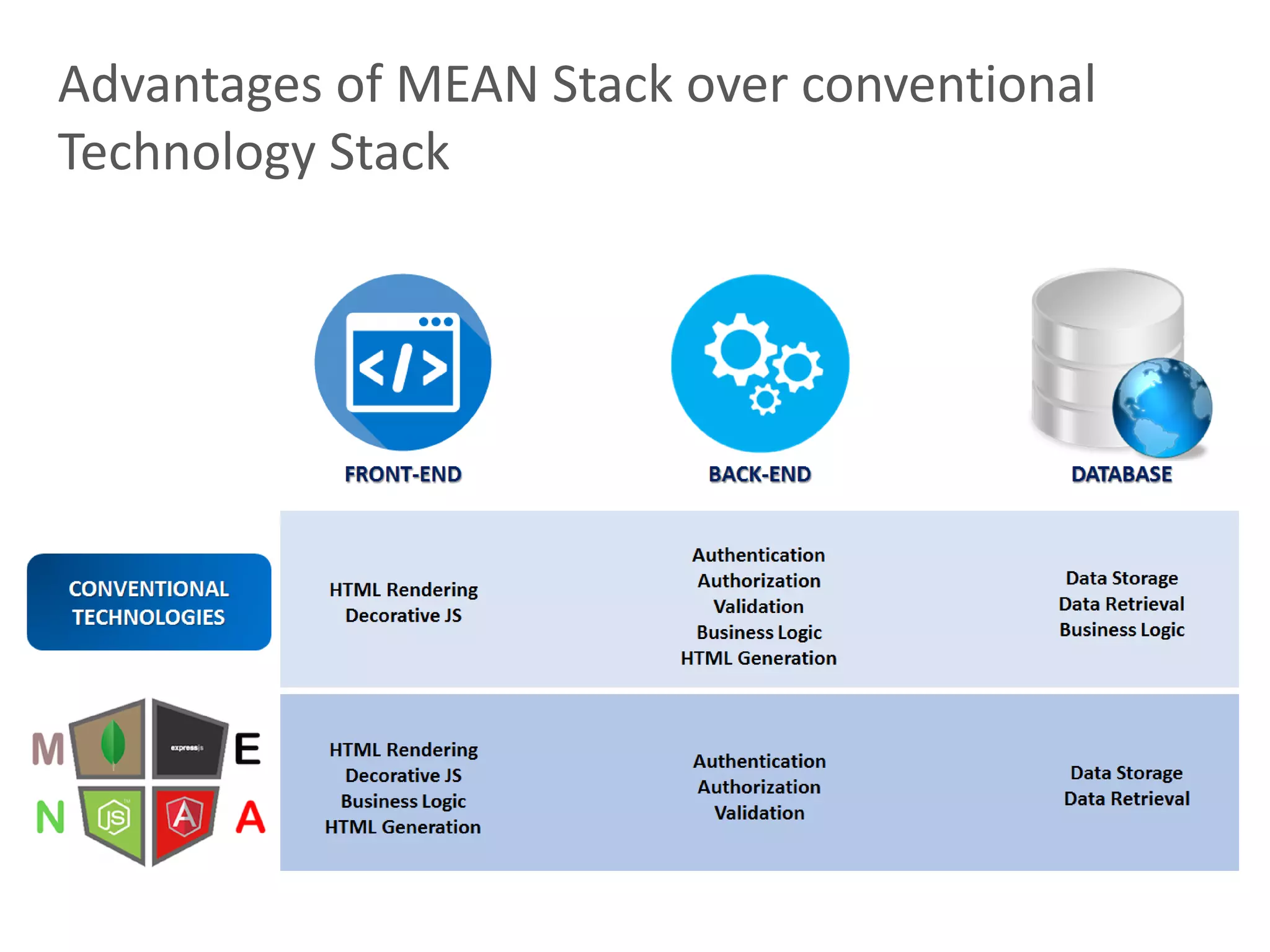
Advantages of MEAN Stack over conventional
Technology Stack
20
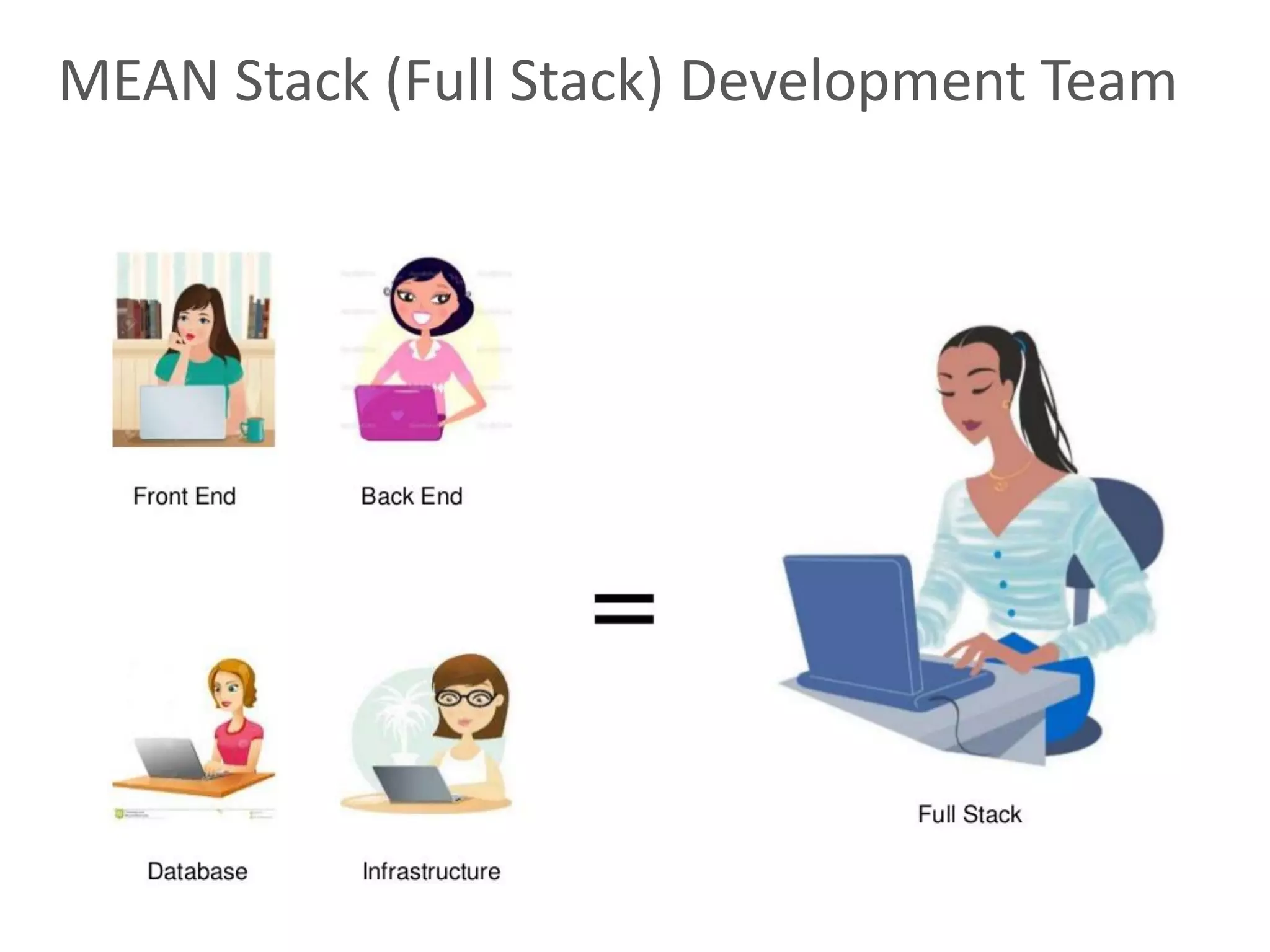
MEAN Stack (Full Stack) Development Team
21
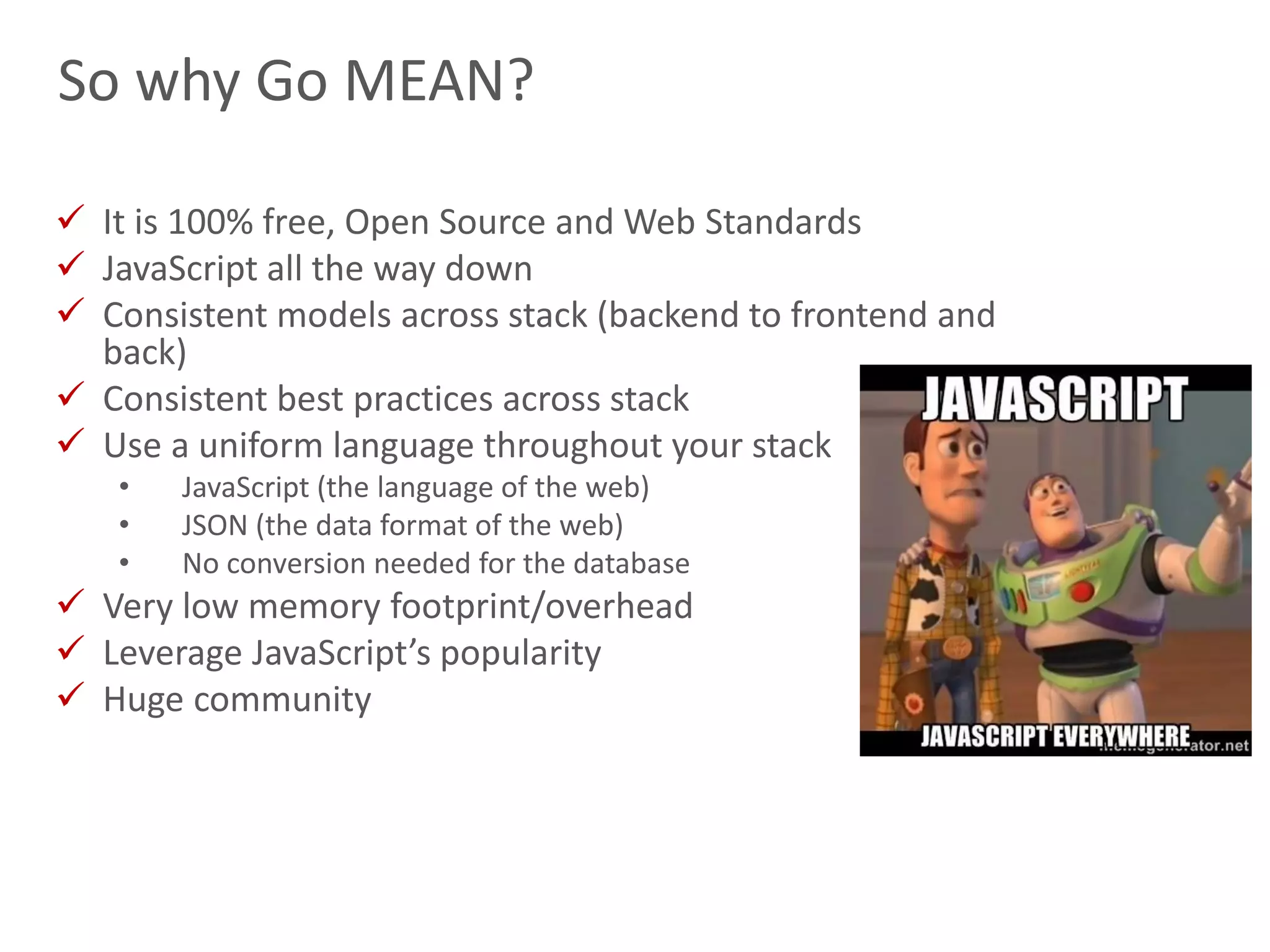
So why Go MEAN?
 It is 100% free, Open Source and Web Standards
 JavaScript all the way down
 Consistent models across stack (backend to frontend and
back)
 Consistent best practices across stack
 Use a uniform language throughout your stack
• JavaScript (the language of the web)
• JSON (the data format of the web)
• No conversion needed for the database
 Very low memory footprint/overhead
 Leverage JavaScript’s popularity
 Huge community
22
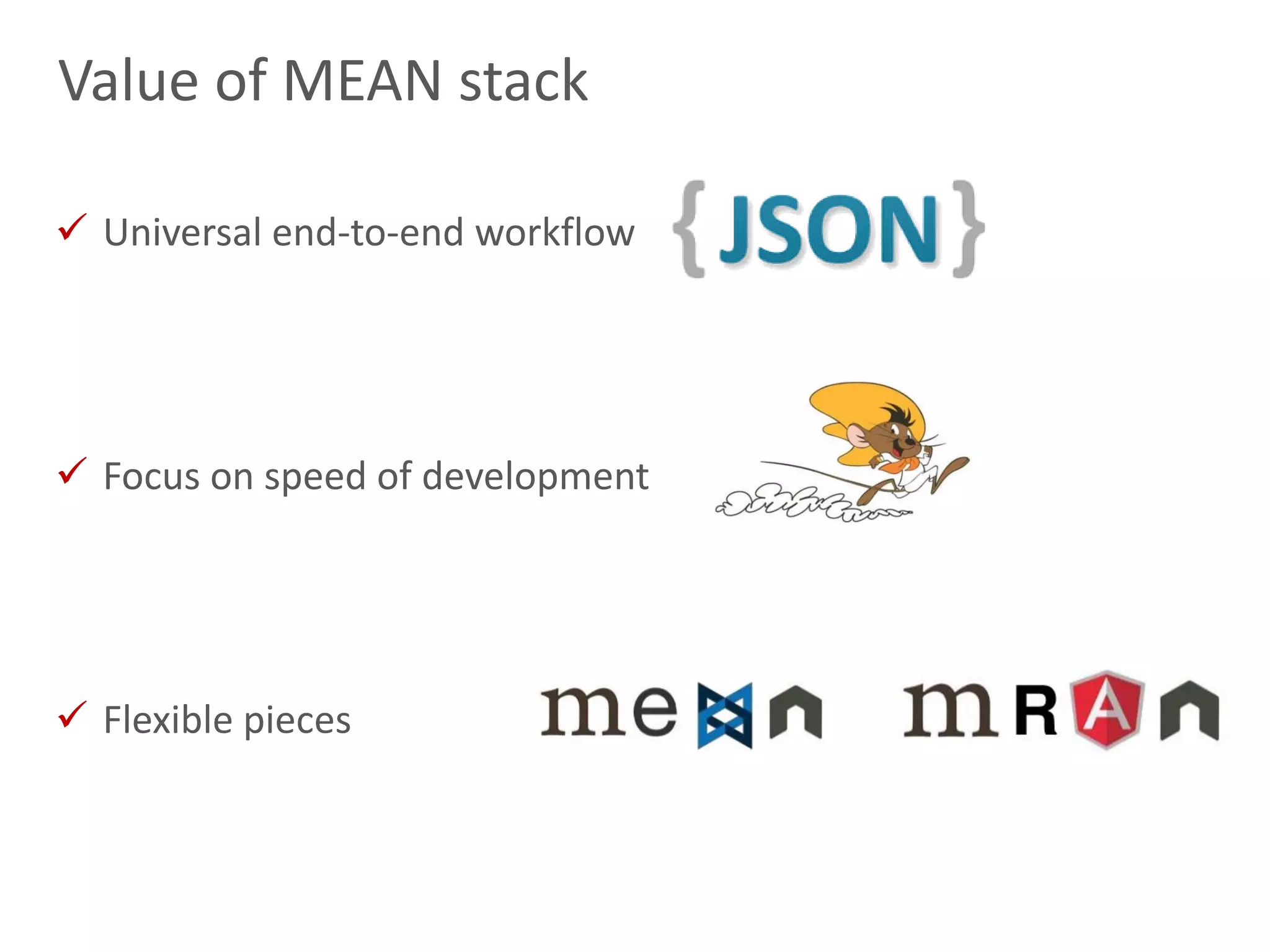
Value of MEAN stack
 Universal end-to-end workflow
 Focus on speed of development
 Flexible pieces
23
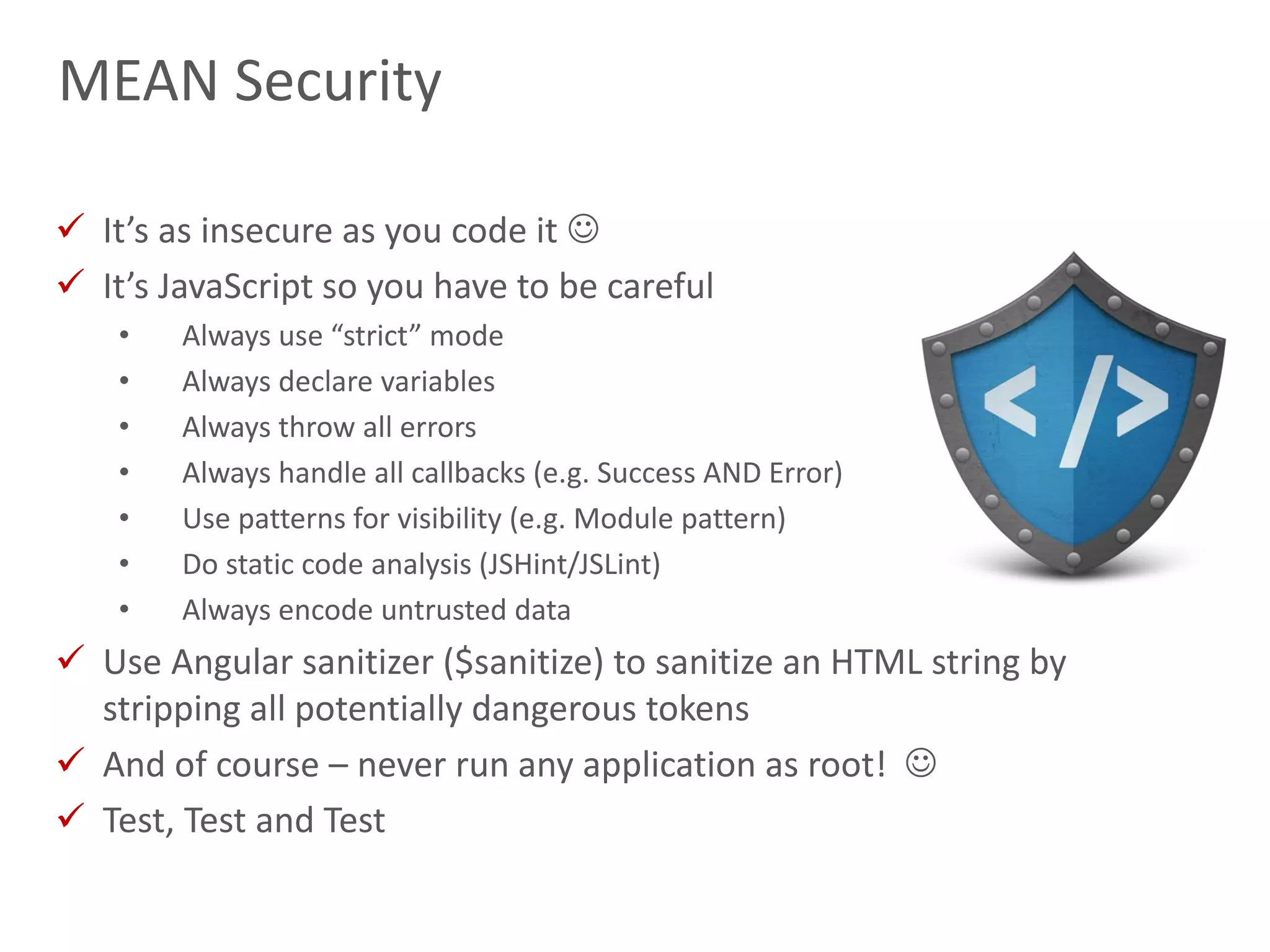
MEAN Security
 It’s as insecure as you code it 
 It’s JavaScript so you have to be careful
• Always use “strict” mode
• Always declare variables
• Always throw all errors
• Always handle all callbacks (e.g. Success AND Error)
• Use patterns for visibility (e.g. Module pattern)
• Do static code analysis (JSHint/JSLint)
• Always encode untrusted data
 Use Angular sanitizer ($sanitize) to sanitize an HTML string by
stripping all potentially dangerous tokens
 And of course – never run any application as root! 
 Test, Test and Test
24
What’s bad about this “MEAN” approach
 For those who don’t like JavaScript – Its going to be killing you 
 There is still no general JS coding guidelines
 SPA need a new way of thinking
• The browser is your platform
 MongoDB is not as robust as an SQL Server is
• This security is what they sacrifice to gain speed
 We need to take care of rollbacks our self (2-Phase-Commit)
• ACID -> Possible but part of the driver/client application
 It’s hard to find specialists that are no hipsters
• Have the big picture/architecture for enterprise in mind
 It make sense to also have a look at Grunt, Yeoman and Bower in
order to create good developer experience
 Once you have created the first application with this technology,
it’s hard to go back to the old approach
25
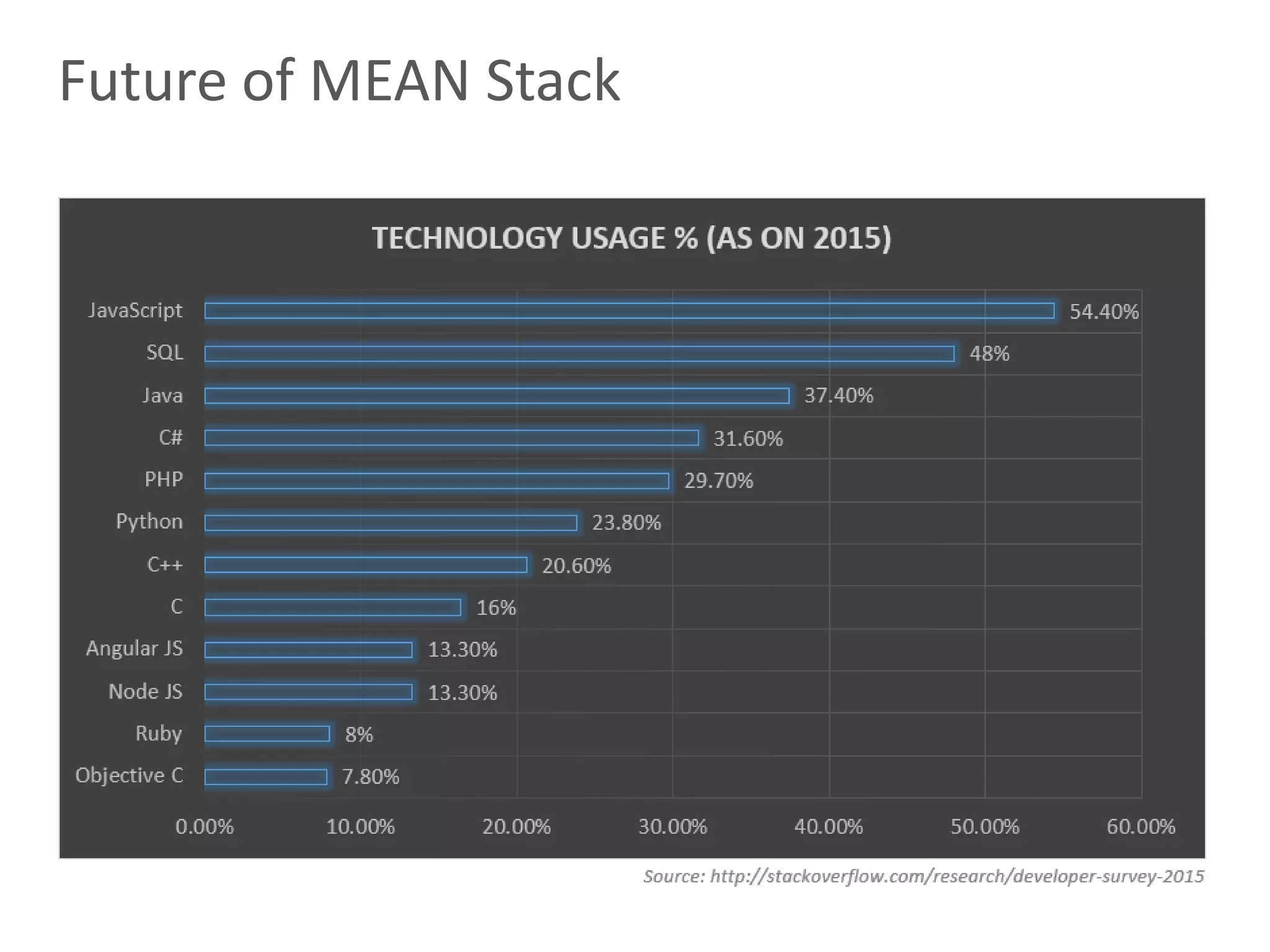
Future of MEAN Stack
26
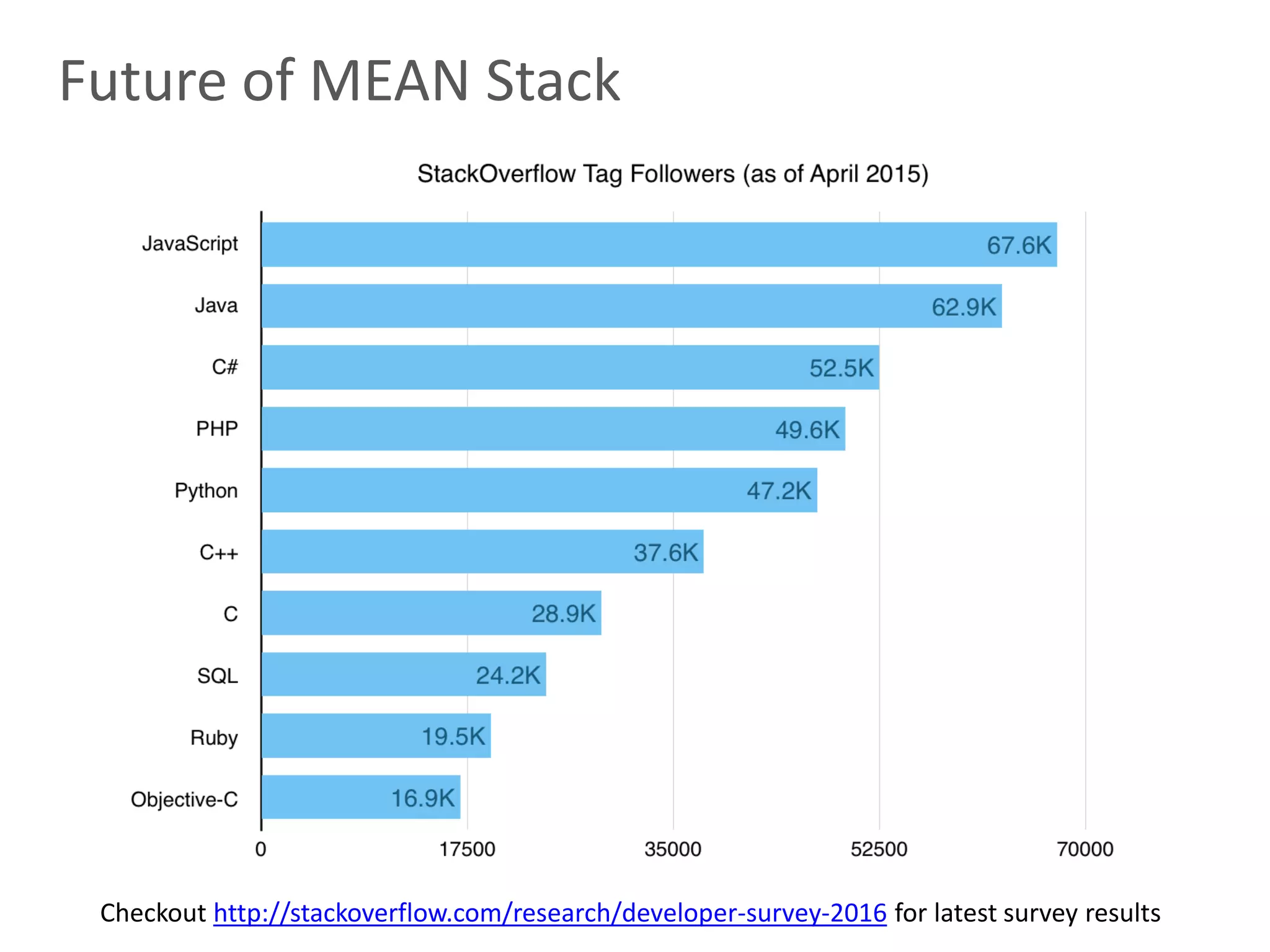
Future of MEAN Stack
Checkout http://stackoverflow.com/research/developer-survey-2016 for latest survey results
27

Building Modern Web Apps with MEAN Stack

  • 1.
    1 Building Modern WebApps with MEANStack By Suresh Patidar E
  • 2.
    2 Who am I? { "name":"SureshPatidar", "before":"Worked with ClearTrail Technologies and L&T", "today":"UI Architect @ Calsoft", "Geek":[ "Writes code for Frontend and Backend", "Works on UI/UX aspect", "Create Application Architecture and Design" ], "languages-and-frameworks":[ "JavaScript, NodeJS, AngularJS, Backbone, JQuery…", "HTML, CSS, SASS, LESS, Bootstrap etc.", "Java, .NET (C#), Spring MVC", "Oracle, MySql, MongoDB" ], "specialized-in":[ "Application Architecture & Design", "MEAN Stack/Full Stack Application Development", "Web development/Architecture", "Mobile Development" ] }
  • 3.
    3 Agenda  Structure ofweb application  The requirements for a Modern Web App  What is MEAN stack?  Who uses MEAN stack?  How it is different from LAMP stack?  The MEAN Stack Architecture and Components  So why Go MEAN?  Value of the MEAN stack  MEAN Security  What’s bad about MEAN approach?  Future of MEAN stack  Any Questions?
  • 4.
    4 Structure of WebApplication
  • 5.
  • 6.
  • 7.
    7 Requirements for amodern web app  Customers want fast web sites/fast response time  No page reloads  Enterprises want to go virtual • One box + Several Virtual Images = Shared Hardware • Systems with minimal memory footprint/overhead needed  As many concurrent requests as possible  Only load resources when needed (conditional loading)  Most of the data must come from a slim REST-API  Mobile friendly/Responsive UIs  Automated build for backend AND frontend • Including check for coding conventions, testing,… • Integration in company’s continuous integration platform
  • 8.
    8 Front end vs.Back end Introduction to the MEAN Stack
  • 9.
    9 What is MEANstack? “MEAN is a fullstack JavaScript platform for modern web applications” – Mean.io
  • 10.
    10 Who uses MEANstack? and many more…
  • 11.
    11 How it isdifferent from LAMP stack?  Building web application with a LAMP approach • Server-side language: PHP, Perl, JSP, ASP… • Server-side container: Tomcat, Jboss, Jetty, Apache,… • Server-side templating: HAML, Moustache,… • Server-side MVC framework: Spring, Struts,… • Client-side JavaScript: jQuery, AngularJS, BackboneJS • > 5 different technologies/languages  Building web applications with a MEAN approach • JavaScript and JSON • That’s it!
  • 12.
  • 13.
    13 AngularJS Our app’s entirefrontend  Open source, maintained by Google  Client Side MVC (MVVM) framework  Excellent data bindings  Very modular and extensible  Great browser support (> IE8)  Well documented  Easy to test
  • 14.
    14 Node.js Lightweight web serverframework  Released in 2009 by Ryan Dahi  Written in C/C++  Built on Google Chrome’s V8 JavaScript engine  Extremely lightweight and efficient  What JavaScript has done for the web browser, Node.js is doing for backend server  Does module loading and Asynchronous IO  Single threaded, One node process per CPU  Easily scalable (just create a cluster)  Great community and well maintained
  • 15.
    15 Express Create our routesand our API  A simple, minimal, robust and flexible web application framework for Node.js  Gives everything we would expect to build a modern web server  Abstracts away a lot of low level logic (e.g. for HTTP requests, SSL etc.)  Helps organize your Node app into an MVC structure  Easy to implement REST API and session management  Middleware, routing, templating, static-files, cookies, mime-types and much much more
  • 16.
    16 MongoDB Our data store A simple and scalable document based top NoSQL Database  Open Source, maintained by MongoDB  JSON like syntax and model persistence  Key-value stores  Replication and High-Availability  Flexible Schemas, Full Index support, Query Selectors, Sharding and much much more
  • 17.
    17 MEAN Stack Languageand Format Usage
  • 18.
  • 19.
    19 Advantages of MEANStack over conventional Technology Stack
  • 20.
    20 MEAN Stack (FullStack) Development Team
  • 21.
    21 So why GoMEAN?  It is 100% free, Open Source and Web Standards  JavaScript all the way down  Consistent models across stack (backend to frontend and back)  Consistent best practices across stack  Use a uniform language throughout your stack • JavaScript (the language of the web) • JSON (the data format of the web) • No conversion needed for the database  Very low memory footprint/overhead  Leverage JavaScript’s popularity  Huge community
  • 22.
    22 Value of MEANstack  Universal end-to-end workflow  Focus on speed of development  Flexible pieces
  • 23.
    23 MEAN Security  It’sas insecure as you code it   It’s JavaScript so you have to be careful • Always use “strict” mode • Always declare variables • Always throw all errors • Always handle all callbacks (e.g. Success AND Error) • Use patterns for visibility (e.g. Module pattern) • Do static code analysis (JSHint/JSLint) • Always encode untrusted data  Use Angular sanitizer ($sanitize) to sanitize an HTML string by stripping all potentially dangerous tokens  And of course – never run any application as root!   Test, Test and Test
  • 24.
    24 What’s bad aboutthis “MEAN” approach  For those who don’t like JavaScript – Its going to be killing you   There is still no general JS coding guidelines  SPA need a new way of thinking • The browser is your platform  MongoDB is not as robust as an SQL Server is • This security is what they sacrifice to gain speed  We need to take care of rollbacks our self (2-Phase-Commit) • ACID -> Possible but part of the driver/client application  It’s hard to find specialists that are no hipsters • Have the big picture/architecture for enterprise in mind  It make sense to also have a look at Grunt, Yeoman and Bower in order to create good developer experience  Once you have created the first application with this technology, it’s hard to go back to the old approach
  • 25.
  • 26.
    26 Future of MEANStack Checkout http://stackoverflow.com/research/developer-survey-2016 for latest survey results
  • 27.