




BUILDING LARGE SCALE
WEB APPS AND PLATFORMS
1
ANURAG SINHA
PAYPAL CHECKOUT
@ANURAGS28
WWW.LINKEDIN.COM/IN/SINHAANURAG2
STUFF I AM GONNA RAMBLE ABOUT...
▸ A little background
▸ Platform centric approach
▸ Architectural Patterns
3
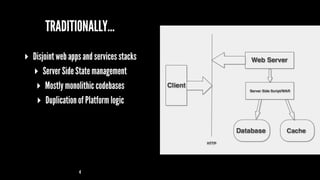
TRADITIONALLY...
▸ Disjoint web apps and services stacks
▸ Server Side State management
▸ Mostly monolithic codebases
▸ Duplication of Platform logic
4
PLATFORM CENTRIC APPROACH...
▸ Single Page Applications
▸ Blurring the line between Web Apps & APIs
▸ Reuse at scale
▸ Truly centralised server architecture
▸ Thinking in terms of platform capabilities
5
Platform Architecture Patterns
6
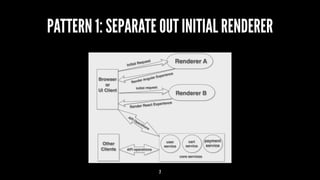
PATTERN 1: SEPARATE OUT INITIAL RENDERER
7
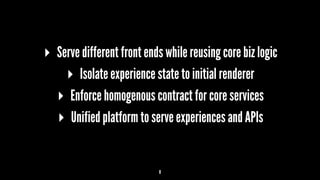
▸ Serve different front ends while reusing core biz logic
▸ Isolate experience state to initial renderer
▸ Enforce homogenous contract for core services
▸ Unified platform to serve experiences and APIs
8
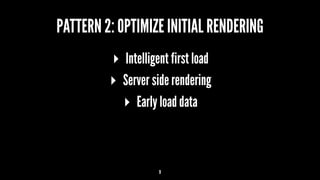
PATTERN 2: OPTIMIZE INITIAL RENDERING
▸ Intelligent first load
▸ Server side rendering
▸ Early load data
9
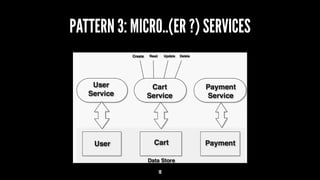
PATTERN 3: MICRO..(ER ?) SERVICES
10
▸ Design core operations as Micro-Services
▸ Spectrum of Concerns: From Resource To Operations
▸ Stateless Services
▸ Good Ole' SRP (Single Responsibility Principle)
11
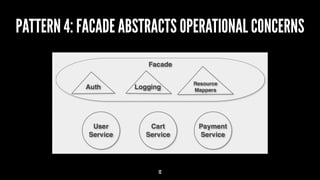
PATTERN 4: FACADE ABSTRACTS OPERATIONAL CONCERNS
12
▸ Generic concerns such as Authorization, Validation, Logging can be
abstracted by a facade
▸ Maps resources for internal vs external clients & APIs
▸ Can Orchestrate calls to multiple core services
▸ Can act as a robust layer to keep the core platform generic.
13
PATTERN 5: ASYNC WHERE YOU CAN...
▸ Non blocking communication
▸ Increases decoupling in the stack
▸ Lessen impact of errors in dependencies
▸ Preserves autonomy
14
PATTERN 6: CACHE STRATEGICALLY...
▸ Front end clients
▸ Facade layer
▸ Core Services design
15
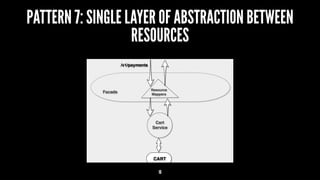
PATTERN 7: SINGLE LAYER OF ABSTRACTION BETWEEN
RESOURCES
16
▸ Optimal separation between internal and external resources.
▸ Multiple external resources can map to a single internal resource.
▸ Designing internal resource as a super Resource has its pitfalls.
▸ Facade layer can abstract away the right concerns in order to not
pollute the internal resources.
17
PATTERN 8: STATE IS A NECESSARY EH..(?)VIL ! " #
▸ Manage state at the client or the facade layer
▸ Context sharing between core services can happen via shared
request interfaces
▸ Statelessness enables generic use and decreases points of failures
▸ React.JS and Angular.JS allow pushing the state to clients
18
PATTERN 9: ADHERE ! TO A SPEC
▸ Enforces strict contract
▸ Makes each service independently testable and deployable
▸ Makes the whole stack framework/language agnostic
▸ Spec frameworks provide a lot of tools out of the box
19
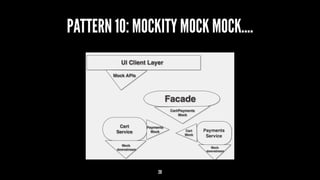
PATTERN 10: MOCKITY MOCK MOCK....
20
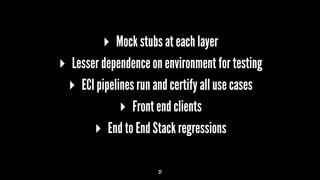
▸ Mock stubs at each layer
▸ Lesser dependence on environment for testing
▸ ECI pipelines run and certify all use cases
▸ Front end clients
▸ End to End Stack regressions
21
KEY TAKEAWAYS
▸ Build Generic APIs
▸ Kill State
▸ Separation of Concerns (& Resources)
▸ Context Sharing
▸ Scalable and Faster development cycles
22
Questions ?
23
Thank You!
24
25

Building Large Scale Web Apps And Platforms

  • 1.
    BUILDING LARGE SCALE WEBAPPS AND PLATFORMS 1
  • 2.
  • 3.
    STUFF I AMGONNA RAMBLE ABOUT... ▸ A little background ▸ Platform centric approach ▸ Architectural Patterns 3
  • 4.
    TRADITIONALLY... ▸ Disjoint webapps and services stacks ▸ Server Side State management ▸ Mostly monolithic codebases ▸ Duplication of Platform logic 4
  • 5.
    PLATFORM CENTRIC APPROACH... ▸Single Page Applications ▸ Blurring the line between Web Apps & APIs ▸ Reuse at scale ▸ Truly centralised server architecture ▸ Thinking in terms of platform capabilities 5
  • 6.
  • 7.
    PATTERN 1: SEPARATEOUT INITIAL RENDERER 7
  • 8.
    ▸ Serve differentfront ends while reusing core biz logic ▸ Isolate experience state to initial renderer ▸ Enforce homogenous contract for core services ▸ Unified platform to serve experiences and APIs 8
  • 9.
    PATTERN 2: OPTIMIZEINITIAL RENDERING ▸ Intelligent first load ▸ Server side rendering ▸ Early load data 9
  • 10.
    PATTERN 3: MICRO..(ER?) SERVICES 10
  • 11.
    ▸ Design coreoperations as Micro-Services ▸ Spectrum of Concerns: From Resource To Operations ▸ Stateless Services ▸ Good Ole' SRP (Single Responsibility Principle) 11
  • 12.
    PATTERN 4: FACADEABSTRACTS OPERATIONAL CONCERNS 12
  • 13.
    ▸ Generic concernssuch as Authorization, Validation, Logging can be abstracted by a facade ▸ Maps resources for internal vs external clients & APIs ▸ Can Orchestrate calls to multiple core services ▸ Can act as a robust layer to keep the core platform generic. 13
  • 14.
    PATTERN 5: ASYNCWHERE YOU CAN... ▸ Non blocking communication ▸ Increases decoupling in the stack ▸ Lessen impact of errors in dependencies ▸ Preserves autonomy 14
  • 15.
    PATTERN 6: CACHESTRATEGICALLY... ▸ Front end clients ▸ Facade layer ▸ Core Services design 15
  • 16.
    PATTERN 7: SINGLELAYER OF ABSTRACTION BETWEEN RESOURCES 16
  • 17.
    ▸ Optimal separationbetween internal and external resources. ▸ Multiple external resources can map to a single internal resource. ▸ Designing internal resource as a super Resource has its pitfalls. ▸ Facade layer can abstract away the right concerns in order to not pollute the internal resources. 17
  • 18.
    PATTERN 8: STATEIS A NECESSARY EH..(?)VIL ! " # ▸ Manage state at the client or the facade layer ▸ Context sharing between core services can happen via shared request interfaces ▸ Statelessness enables generic use and decreases points of failures ▸ React.JS and Angular.JS allow pushing the state to clients 18
  • 19.
    PATTERN 9: ADHERE! TO A SPEC ▸ Enforces strict contract ▸ Makes each service independently testable and deployable ▸ Makes the whole stack framework/language agnostic ▸ Spec frameworks provide a lot of tools out of the box 19
  • 20.
    PATTERN 10: MOCKITYMOCK MOCK.... 20
  • 21.
    ▸ Mock stubsat each layer ▸ Lesser dependence on environment for testing ▸ ECI pipelines run and certify all use cases ▸ Front end clients ▸ End to End Stack regressions 21
  • 22.
    KEY TAKEAWAYS ▸ BuildGeneric APIs ▸ Kill State ▸ Separation of Concerns (& Resources) ▸ Context Sharing ▸ Scalable and Faster development cycles 22
  • 23.
  • 24.
  • 25.