THEORIES OF HUMAN NATURE
ANCIENT ASIAN PHILOSOPHERS
THE BUDDHA
By:
Huma Iqbal (18302)
Sadaf Sohail (17780)
Shazia Rani (17952)
Qurrat ul Ain(17783)
Eastern Perspectives
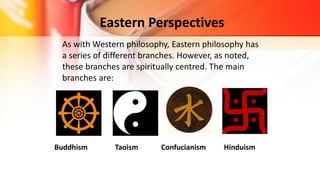
As with Western philosophy, Eastern philosophy has
a series of different branches. However, as noted,
these branches are spiritually centred. The main
branches are:
Buddhism Taoism Confucianism Hinduism
Buddhism
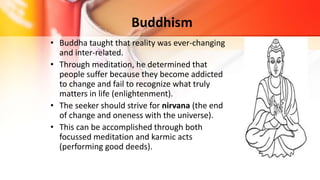
• Buddha taught that reality was ever-changing
and inter-related.
• Through meditation, he determined that
people suffer because they become addicted
to change and fail to recognize what truly
matters in life (enlightenment).
• The seeker should strive for nirvana (the end
of change and oneness with the universe).
• This can be accomplished through both
focussed meditation and karmic acts
(performing good deeds).
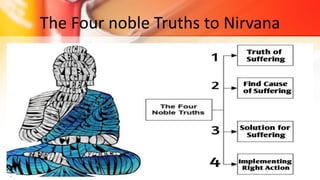
• Dukkha: Suffering is everywhere and a part of life.
• Samudaya: There is a cause of suffering, which is
attachment or misplaced desire (tanha) rooted in
ignorance.
• Nirodha: There is an end of suffering, which is
nirvana (the possibility of liberation exists for
everyone). One must cease all desires.
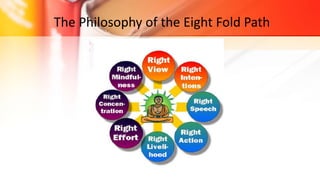
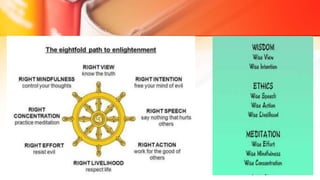
• Marga: There is a path that leads out of suffering,
known as the Noble Eightfold Path (right view, right
thought, right speech, right conduct, right vocation,
right effort, right attention and right meditation).
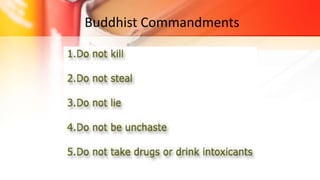
Buddhist Commandments
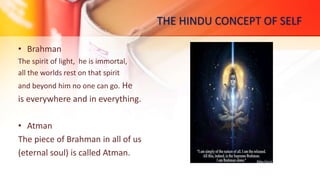
THE HINDU CONCEPT OF SELF
• Brahman
The spirit of light, he is immortal,
all the worlds rest on that spirit
and beyond him no one can go. He
is everywhere and in everything.
• Atman
The piece of Brahman in all of us
(eternal soul) is called Atman.
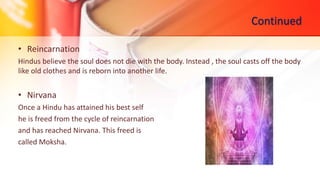
Continued
• Reincarnation
Hindus believe the soul does not die with the body. Instead , the soul casts off the body
like old clothes and is reborn into another life.
• Nirvana
Once a Hindu has attained his best self
he is freed from the cycle of reincarnation
and has reached Nirvana. This freed is
called Moksha.
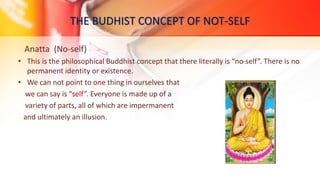
THE BUDHIST CONCEPT OF NOT-SELF
Anatta (No-self)
• This is the philosophical Buddhist concept that there literally is “no-self”. There is no
permanent identity or existence.
• We can not point to one thing in ourselves that
we can say is “self”. Everyone is made up of a
variety of parts, all of which are impermanent
and ultimately an illusion.
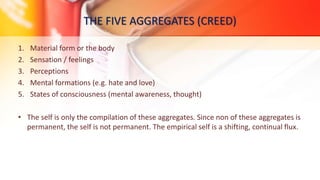
THE FIVE AGGREGATES (CREED)
1. Material form or the body
2. Sensation / feelings
3. Perceptions
4. Mental formations (e.g. hate and love)
5. States of consciousness (mental awareness, thought)
• The self is only the compilation of these aggregates. Since non of these aggregates is
permanent, the self is not permanent. The empirical self is a shifting, continual flux.
The Four noble Truths to Nirvana
The Philosophy of the Eight Fold Path
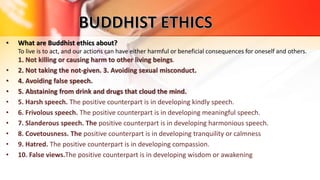
• What are Buddhist ethics about?
To live is to act, and our actions can have either harmful or beneficial consequences for oneself and others.
1. Not killing or causing harm to other living beings.
• 2. Not taking the not-given. 3. Avoiding sexual misconduct.
• 4. Avoiding false speech.
• 5. Abstaining from drink and drugs that cloud the mind.
• 5. Harsh speech. The positive counterpart is in developing kindly speech.
• 6. Frivolous speech. The positive counterpart is in developing meaningful speech.
• 7. Slanderous speech. The positive counterpart is in developing harmonious speech.
• 8. Covetousness. The positive counterpart is in developing tranquility or calmness
• 9. Hatred. The positive counterpart is in developing compassion.
• 10. False views.The positive counterpart is in developing wisdom or awakening
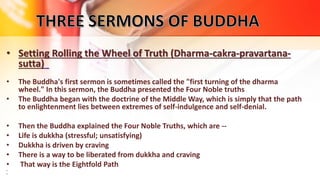
• Setting Rolling the Wheel of Truth (Dharma-cakra-pravartana-
sutta)
• The Buddha's first sermon is sometimes called the "first turning of the dharma
wheel." In this sermon, the Buddha presented the Four Noble truths
• The Buddha began with the doctrine of the Middle Way, which is simply that the path
to enlightenment lies between extremes of self-indulgence and self-denial.
• Then the Buddha explained the Four Noble Truths, which are --
• Life is dukkha (stressful; unsatisfying)
• Dukkha is driven by craving
• There is a way to be liberated from dukkha and craving
• That way is the Eightfold Path
•
•
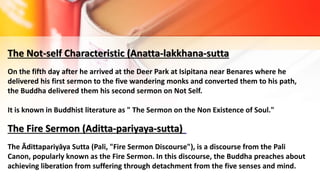
The Not-self Characteristic (Anatta-lakkhana-sutta
On the fifth day after he arrived at the Deer Park at Isipitana near Benares where he
delivered his first sermon to the five wandering monks and converted them to his path,
the Buddha delivered them his second sermon on Not Self.
It is known in Buddhist literature as " The Sermon on the Non Existence of Soul."
The Fire Sermon (Aditta-pariyaya-sutta)
The Ādittapariyāya Sutta (Pali, "Fire Sermon Discourse"), is a discourse from the Pali
Canon, popularly known as the Fire Sermon. In this discourse, the Buddha preaches about
achieving liberation from suffering through detachment from the five senses and mind.
CONCLUSION
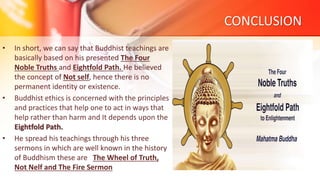
• In short, we can say that Buddhist teachings are
basically based on his presented The Four
Noble Truths and Eightfold Path. He believed
the concept of Not self, hence there is no
permanent identity or existence.
• Buddhist ethics is concerned with the principles
and practices that help one to act in ways that
help rather than harm and It depends upon the
Eightfold Path.
• He spread his teachings through his three
sermons in which are well known in the history
of Buddhism these are The Wheel of Truth,
Not Nelf and The Fire Sermon
Budhism (Educational phillosophy) Education.pptx

Budhism (Educational phillosophy) Education.pptx

  • 1.
    THEORIES OF HUMANNATURE ANCIENT ASIAN PHILOSOPHERS THE BUDDHA By: Huma Iqbal (18302) Sadaf Sohail (17780) Shazia Rani (17952) Qurrat ul Ain(17783)
  • 3.
    Eastern Perspectives As withWestern philosophy, Eastern philosophy has a series of different branches. However, as noted, these branches are spiritually centred. The main branches are: Buddhism Taoism Confucianism Hinduism
  • 4.
    Buddhism • Buddha taughtthat reality was ever-changing and inter-related. • Through meditation, he determined that people suffer because they become addicted to change and fail to recognize what truly matters in life (enlightenment). • The seeker should strive for nirvana (the end of change and oneness with the universe). • This can be accomplished through both focussed meditation and karmic acts (performing good deeds).
  • 5.
    • Dukkha: Sufferingis everywhere and a part of life. • Samudaya: There is a cause of suffering, which is attachment or misplaced desire (tanha) rooted in ignorance. • Nirodha: There is an end of suffering, which is nirvana (the possibility of liberation exists for everyone). One must cease all desires. • Marga: There is a path that leads out of suffering, known as the Noble Eightfold Path (right view, right thought, right speech, right conduct, right vocation, right effort, right attention and right meditation).
  • 6.
  • 7.
    THE HINDU CONCEPTOF SELF • Brahman The spirit of light, he is immortal, all the worlds rest on that spirit and beyond him no one can go. He is everywhere and in everything. • Atman The piece of Brahman in all of us (eternal soul) is called Atman.
  • 8.
    Continued • Reincarnation Hindus believethe soul does not die with the body. Instead , the soul casts off the body like old clothes and is reborn into another life. • Nirvana Once a Hindu has attained his best self he is freed from the cycle of reincarnation and has reached Nirvana. This freed is called Moksha.
  • 9.
    THE BUDHIST CONCEPTOF NOT-SELF Anatta (No-self) • This is the philosophical Buddhist concept that there literally is “no-self”. There is no permanent identity or existence. • We can not point to one thing in ourselves that we can say is “self”. Everyone is made up of a variety of parts, all of which are impermanent and ultimately an illusion.
  • 10.
    THE FIVE AGGREGATES(CREED) 1. Material form or the body 2. Sensation / feelings 3. Perceptions 4. Mental formations (e.g. hate and love) 5. States of consciousness (mental awareness, thought) • The self is only the compilation of these aggregates. Since non of these aggregates is permanent, the self is not permanent. The empirical self is a shifting, continual flux.
  • 11.
    The Four nobleTruths to Nirvana
  • 12.
    The Philosophy ofthe Eight Fold Path
  • 14.
    • What areBuddhist ethics about? To live is to act, and our actions can have either harmful or beneficial consequences for oneself and others. 1. Not killing or causing harm to other living beings. • 2. Not taking the not-given. 3. Avoiding sexual misconduct. • 4. Avoiding false speech. • 5. Abstaining from drink and drugs that cloud the mind. • 5. Harsh speech. The positive counterpart is in developing kindly speech. • 6. Frivolous speech. The positive counterpart is in developing meaningful speech. • 7. Slanderous speech. The positive counterpart is in developing harmonious speech. • 8. Covetousness. The positive counterpart is in developing tranquility or calmness • 9. Hatred. The positive counterpart is in developing compassion. • 10. False views.The positive counterpart is in developing wisdom or awakening
  • 15.
    • Setting Rollingthe Wheel of Truth (Dharma-cakra-pravartana- sutta) • The Buddha's first sermon is sometimes called the "first turning of the dharma wheel." In this sermon, the Buddha presented the Four Noble truths • The Buddha began with the doctrine of the Middle Way, which is simply that the path to enlightenment lies between extremes of self-indulgence and self-denial. • Then the Buddha explained the Four Noble Truths, which are -- • Life is dukkha (stressful; unsatisfying) • Dukkha is driven by craving • There is a way to be liberated from dukkha and craving • That way is the Eightfold Path • •
  • 16.
    The Not-self Characteristic(Anatta-lakkhana-sutta On the fifth day after he arrived at the Deer Park at Isipitana near Benares where he delivered his first sermon to the five wandering monks and converted them to his path, the Buddha delivered them his second sermon on Not Self. It is known in Buddhist literature as " The Sermon on the Non Existence of Soul." The Fire Sermon (Aditta-pariyaya-sutta) The Ādittapariyāya Sutta (Pali, "Fire Sermon Discourse"), is a discourse from the Pali Canon, popularly known as the Fire Sermon. In this discourse, the Buddha preaches about achieving liberation from suffering through detachment from the five senses and mind.
  • 17.
    CONCLUSION • In short,we can say that Buddhist teachings are basically based on his presented The Four Noble Truths and Eightfold Path. He believed the concept of Not self, hence there is no permanent identity or existence. • Buddhist ethics is concerned with the principles and practices that help one to act in ways that help rather than harm and It depends upon the Eightfold Path. • He spread his teachings through his three sermons in which are well known in the history of Buddhism these are The Wheel of Truth, Not Nelf and The Fire Sermon