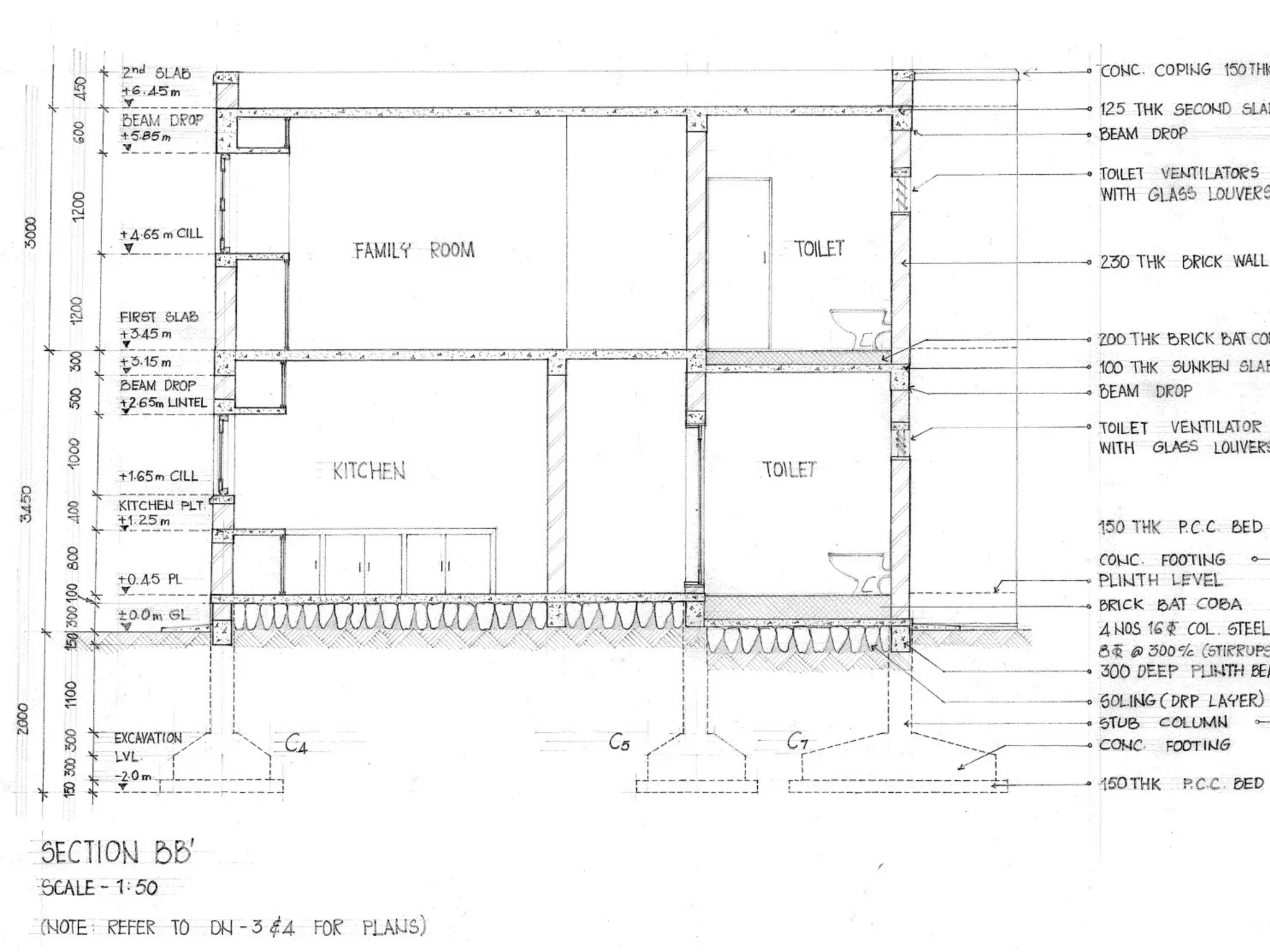
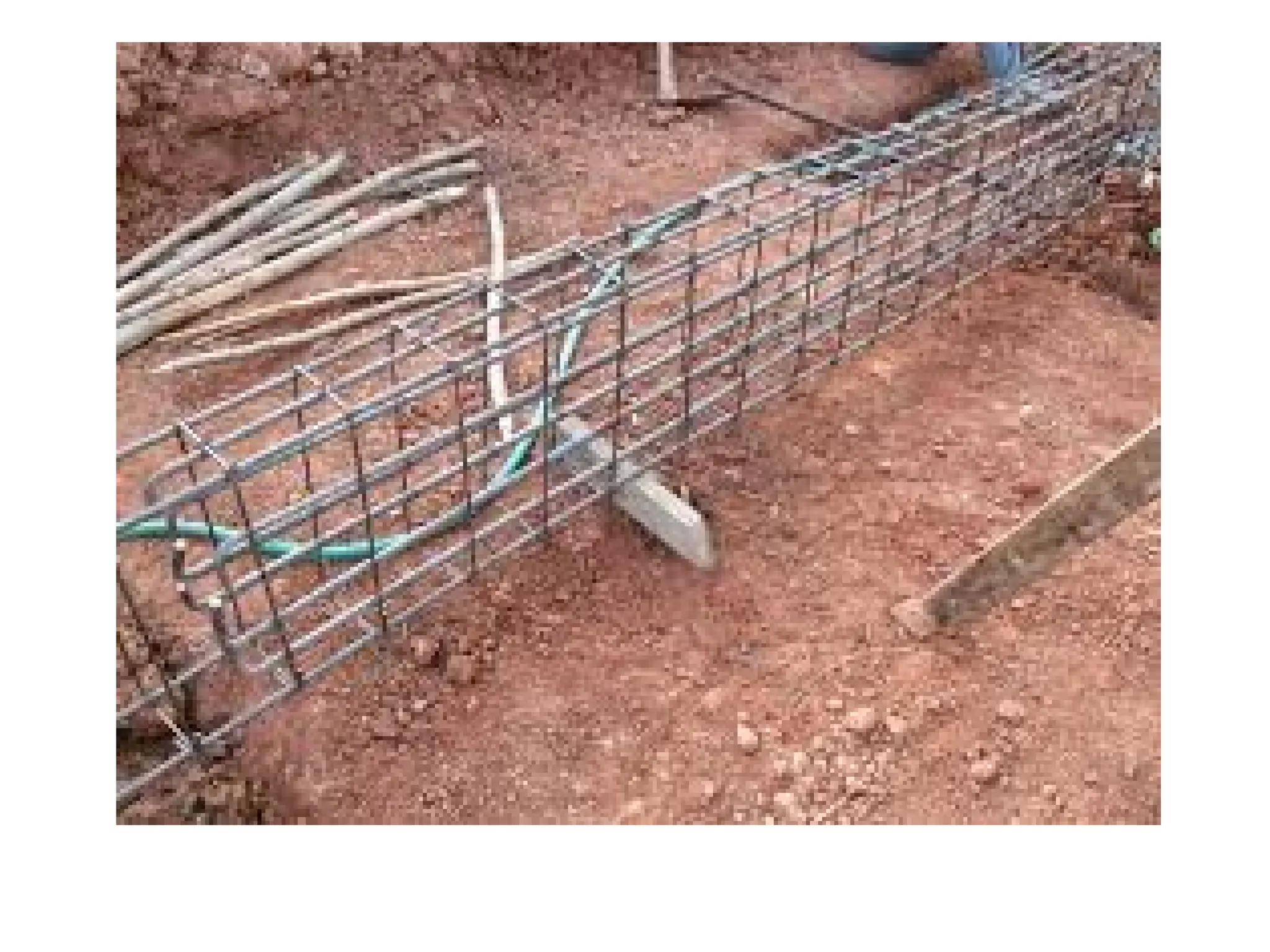
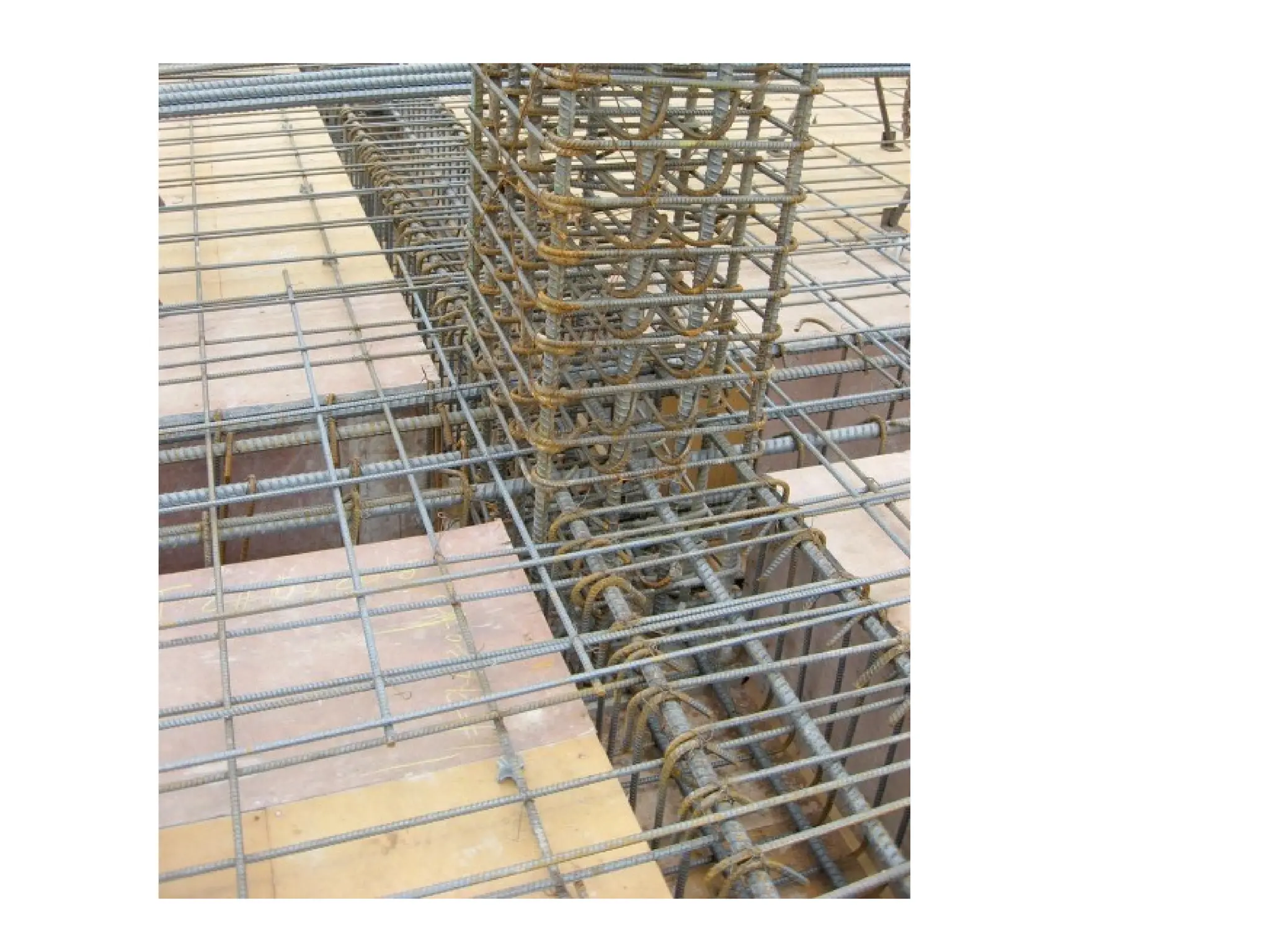
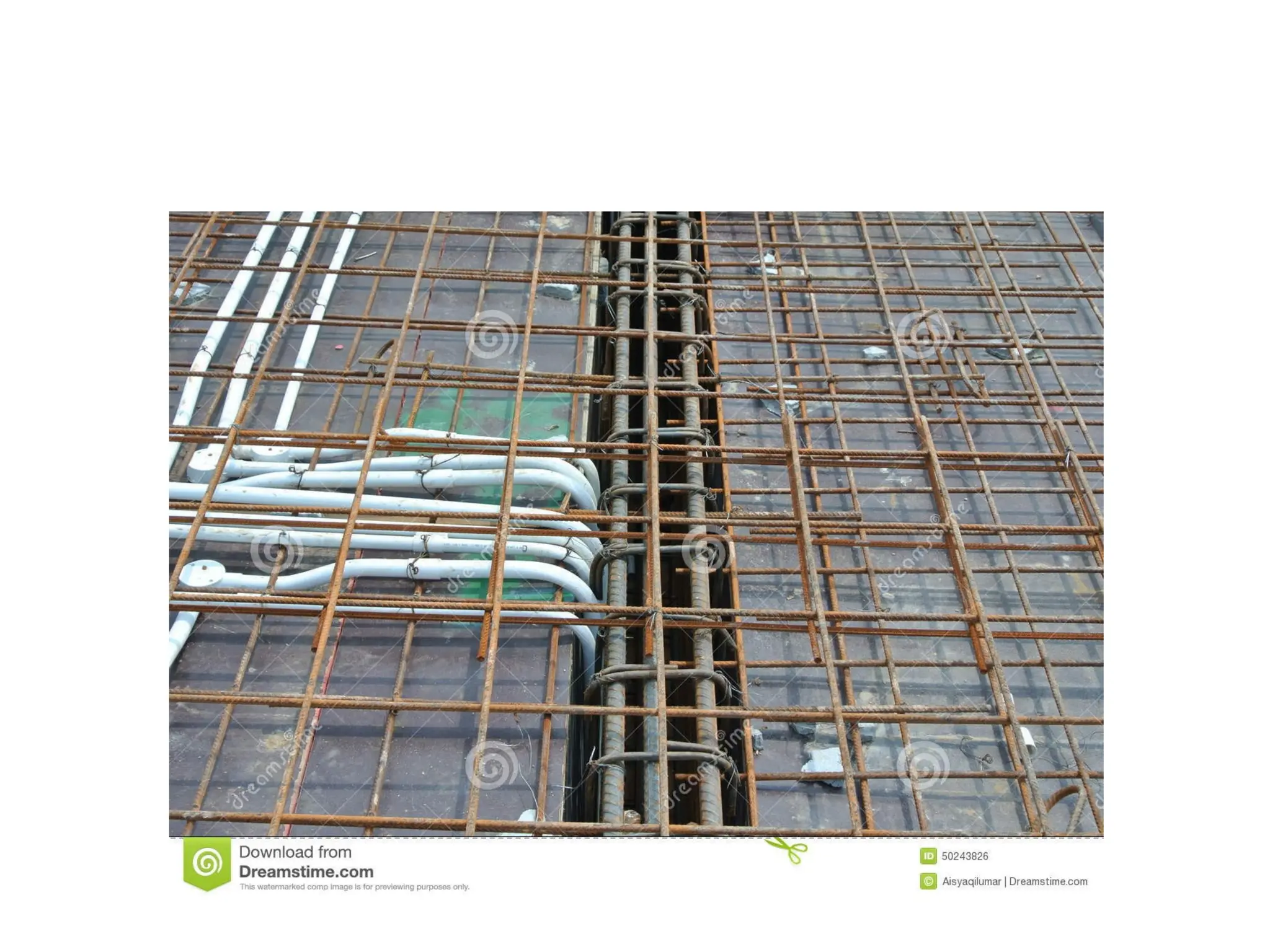
1) slabs to cover
2) beams to support slabs and walls
3)columns to support beams
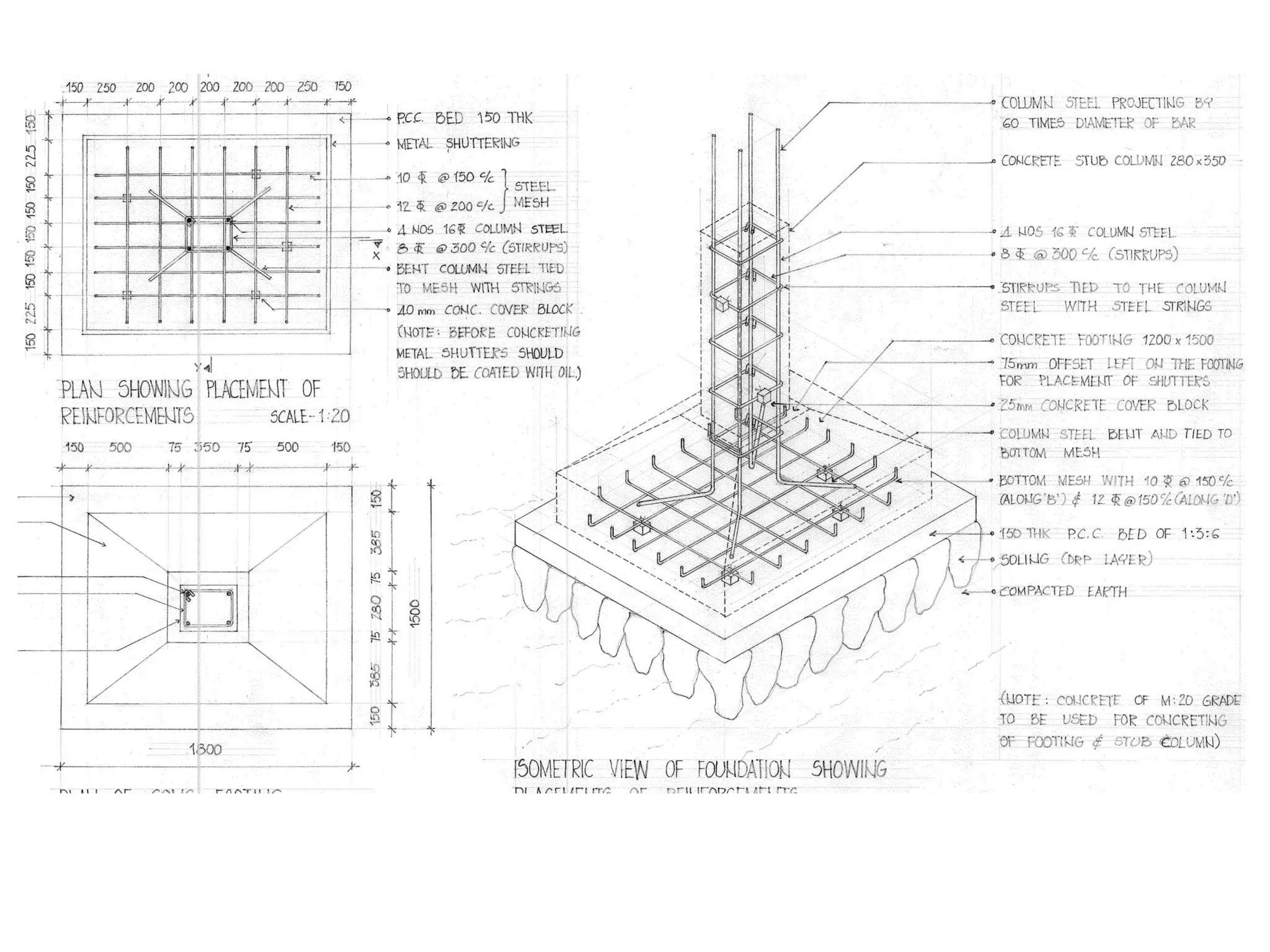
4) footings
In a framed structure the load is transferred
from slab to beam, from beam to column and
then to the foundation and soil below it
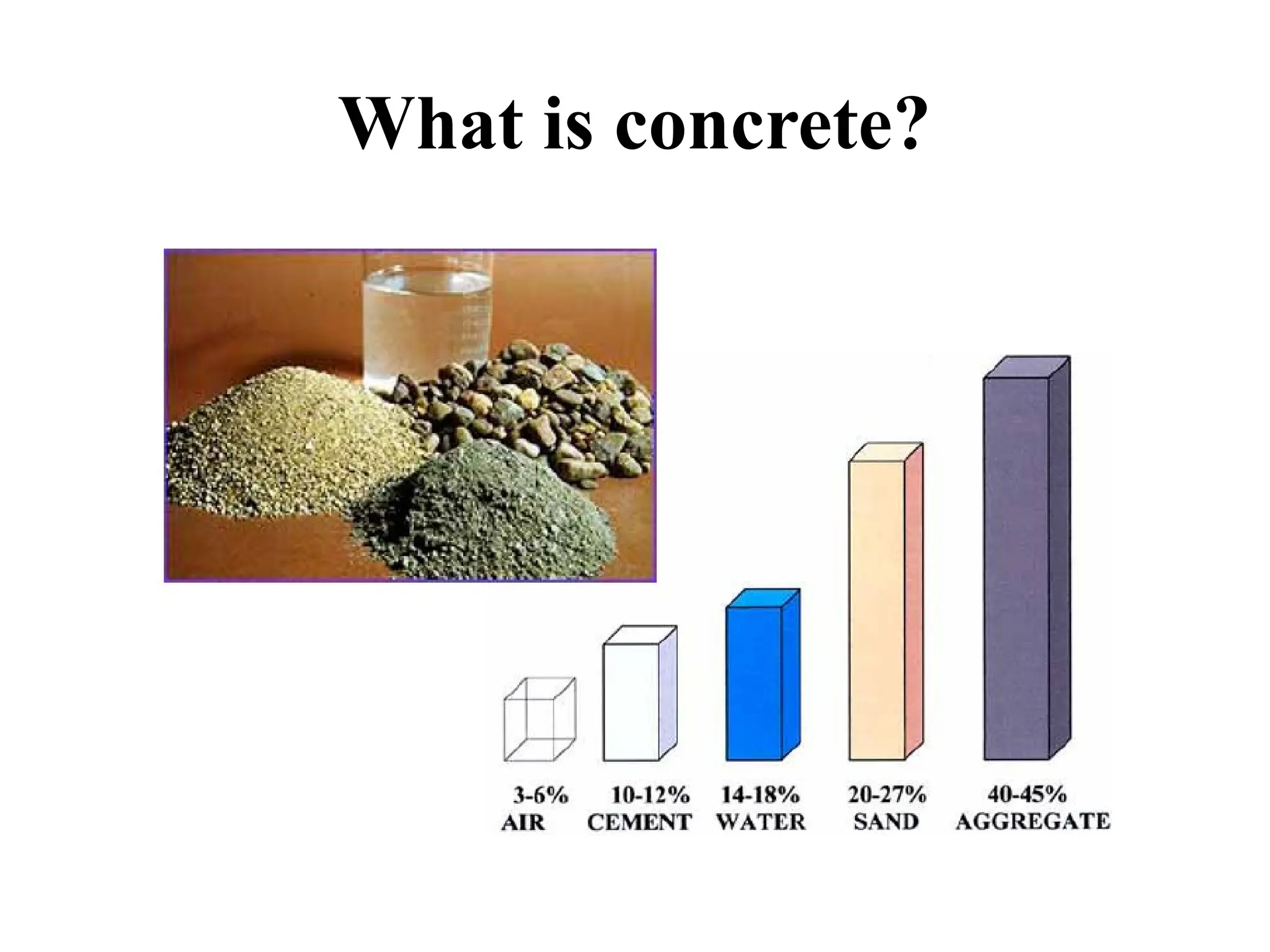
What is concrete?
• Here are some of the advantages of RCC construction:
• Materials used in RCC construction are easily available.
• It is durable and long lasting.
• It is fire resisting and not attacked by termites.
• It is economical in ultimate cost.
• The reinforced concrete member can be cast to any shape because of the
fluidity of concrete.
• Its monolithic character gives much rigidity to the structure.
• Cost of maintenance is nil.
• Here are some of its disadvantages:
• Scrap value of reinforced members is almost nil.
• Constant checking is required.
• Skilled labour is engaged in the work.
• The advantages of RCC outweigh its disadvantages.
• This is one construction technique that made construction
very easy and brought a boom to the field of construction
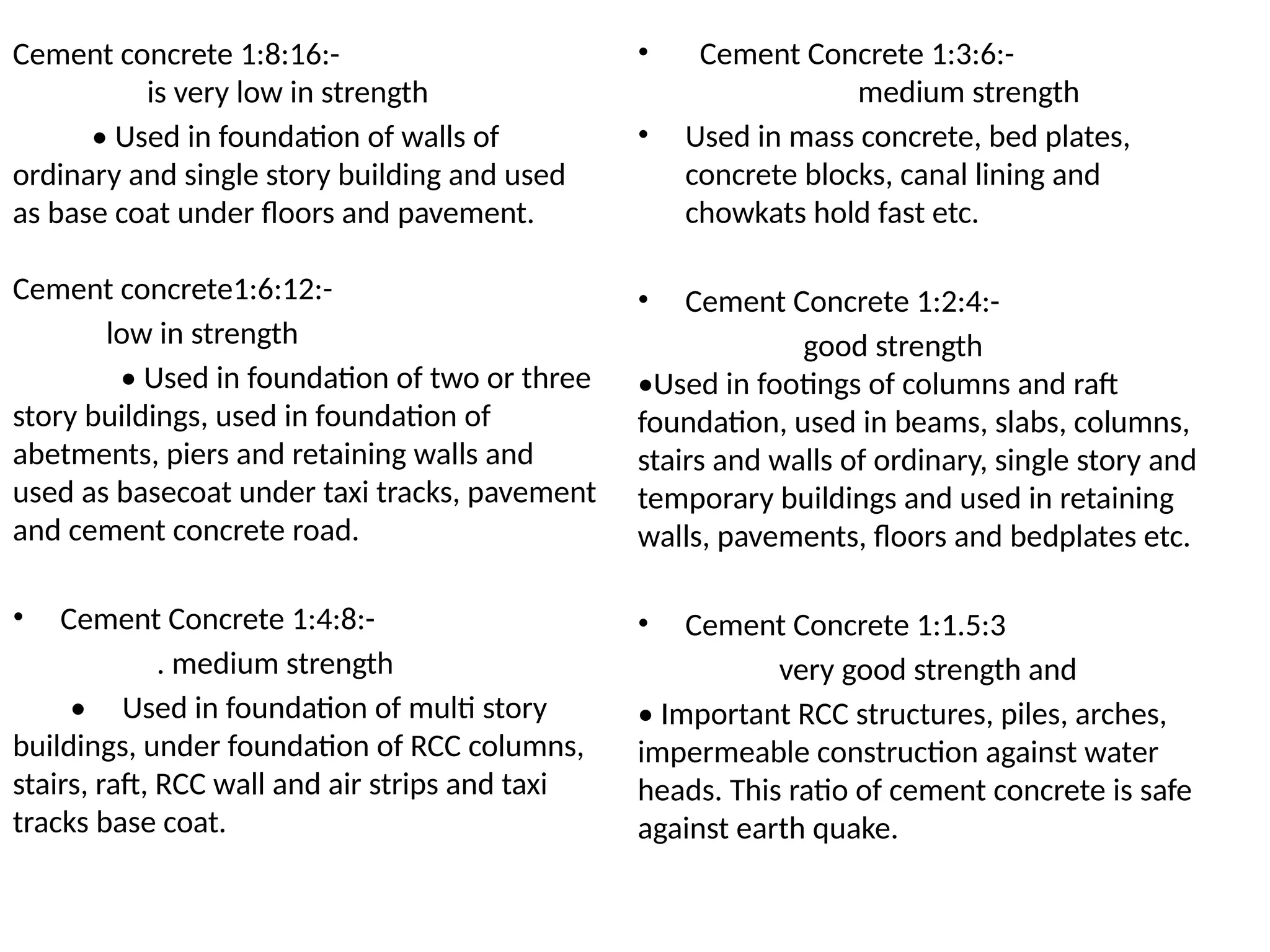
Cement concrete 1:8:16:-
is very low in strength
• Used in foundation of walls of
ordinary and single story building and used
as base coat under floors and pavement.
Cement concrete1:6:12:-
low in strength
• Used in foundation of two or three
story buildings, used in foundation of
abetments, piers and retaining walls and
used as basecoat under taxi tracks, pavement
and cement concrete road.
• Cement Concrete 1:4:8:-
. medium strength
• Used in foundation of multi story
buildings, under foundation of RCC columns,
stairs, raft, RCC wall and air strips and taxi
tracks base coat.
• Cement Concrete 1:3:6:-
medium strength
• Used in mass concrete, bed plates,
concrete blocks, canal lining and
chowkats hold fast etc.
• Cement Concrete 1:2:4:-
good strength
•Used in footings of columns and raft
foundation, used in beams, slabs, columns,
stairs and walls of ordinary, single story and
temporary buildings and used in retaining
walls, pavements, floors and bedplates etc.
• Cement Concrete 1:1.5:3
very good strength and
• Important RCC structures, piles, arches,
impermeable construction against water
heads. This ratio of cement concrete is safe
against earth quake.
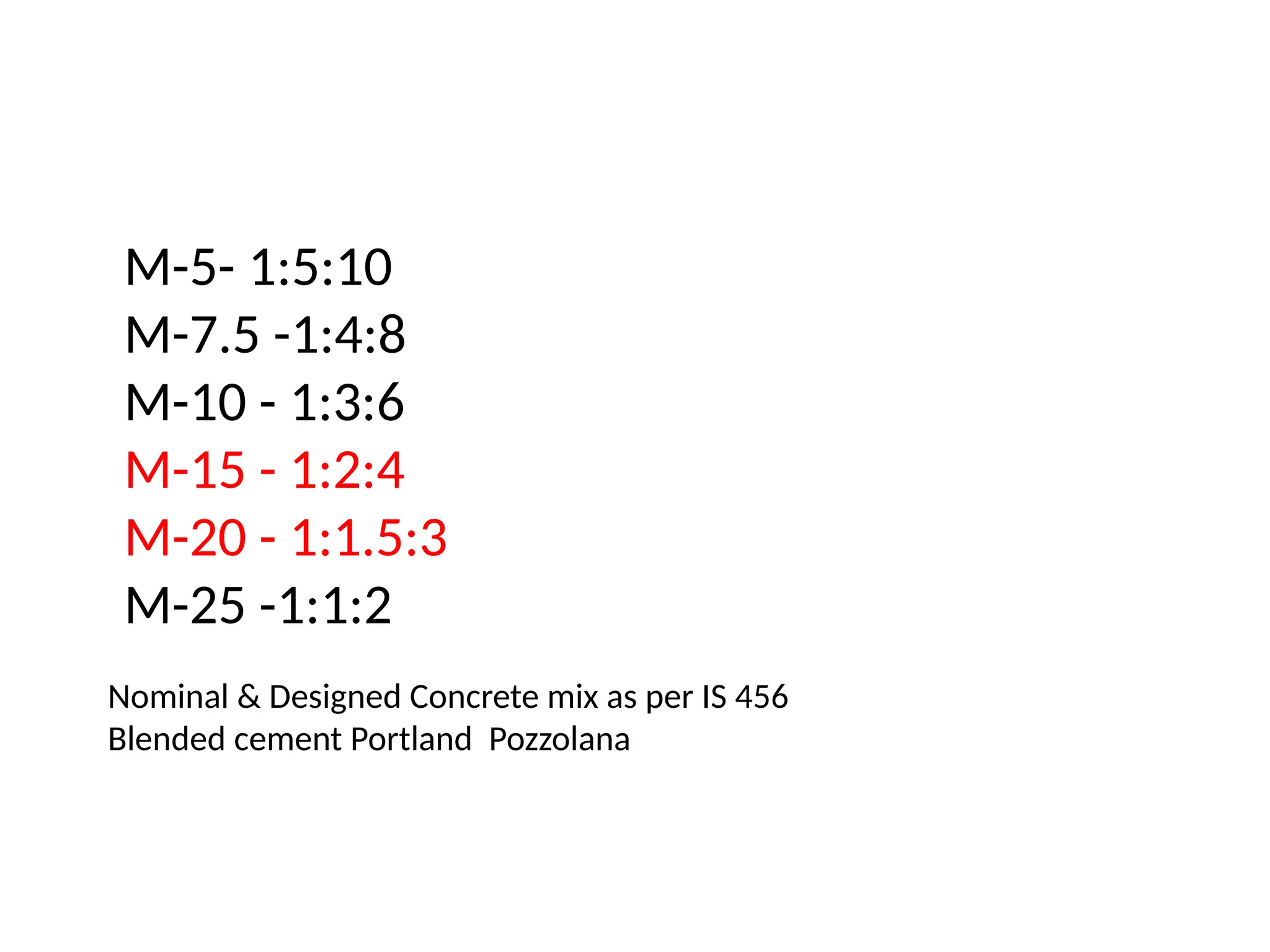
M-5- 1:5:10
M-7.5 -1:4:8
M-10 - 1:3:6
M-15 - 1:2:4
M-20 - 1:1.5:3
M-25 -1:1:2
Nominal & Designed Concrete mix as per IS 456
Blended cement Portland Pozzolana
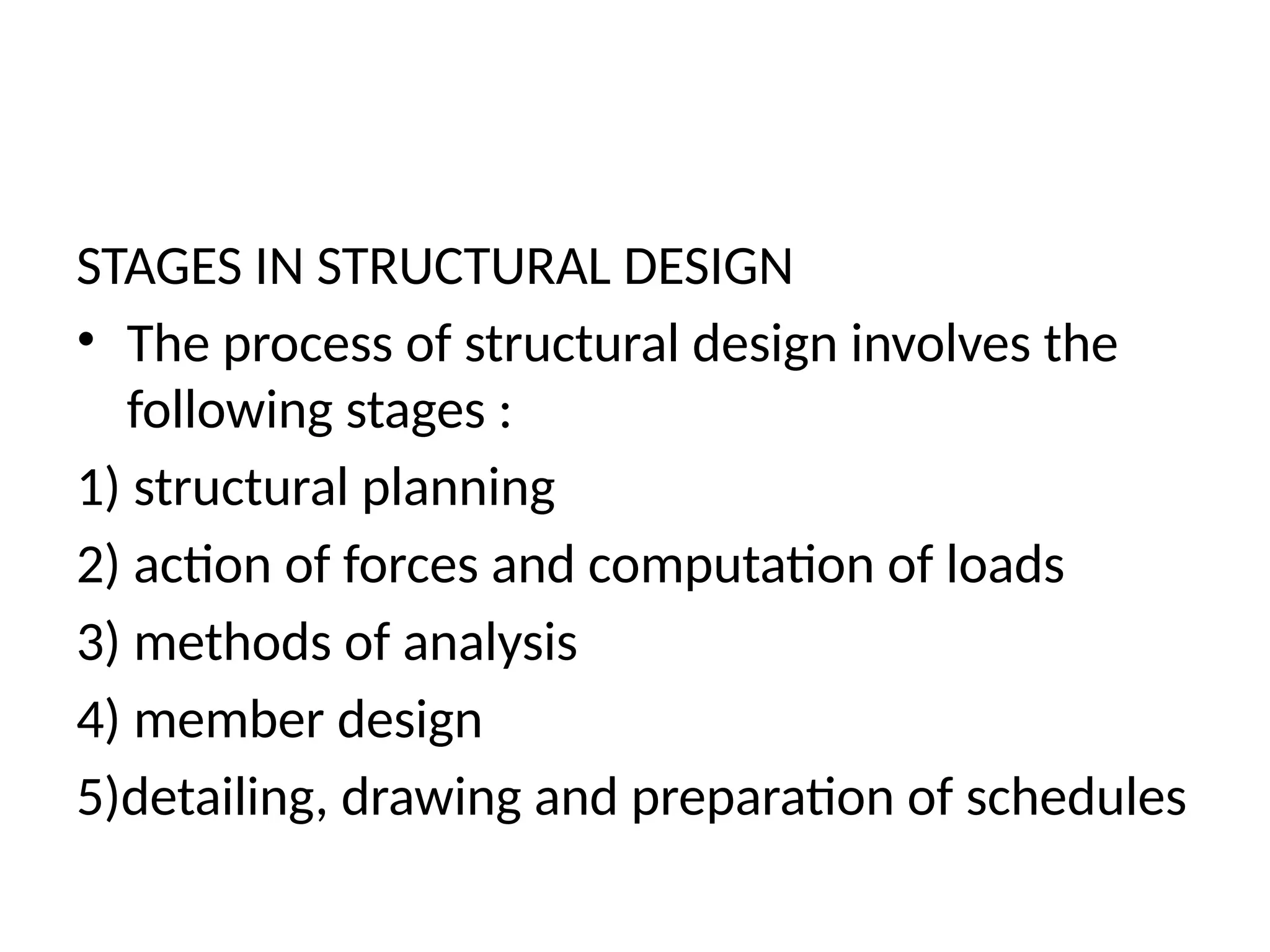
STAGES IN STRUCTURAL DESIGN
• The process of structural design involves the
following stages :
1) structural planning
2) action of forces and computation of loads
3) methods of analysis
4) member design
5)detailing, drawing and preparation of schedules
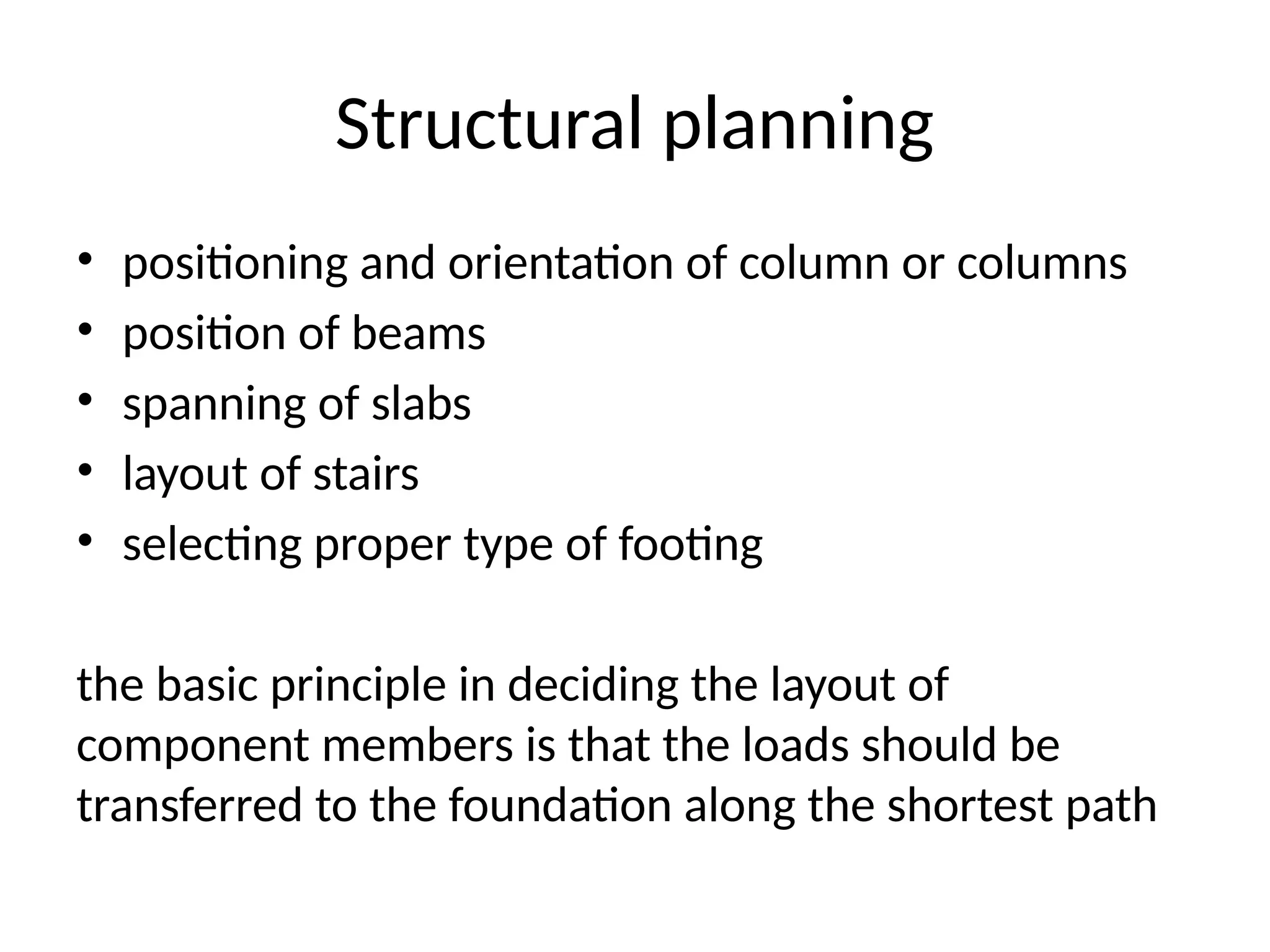
Structural planning
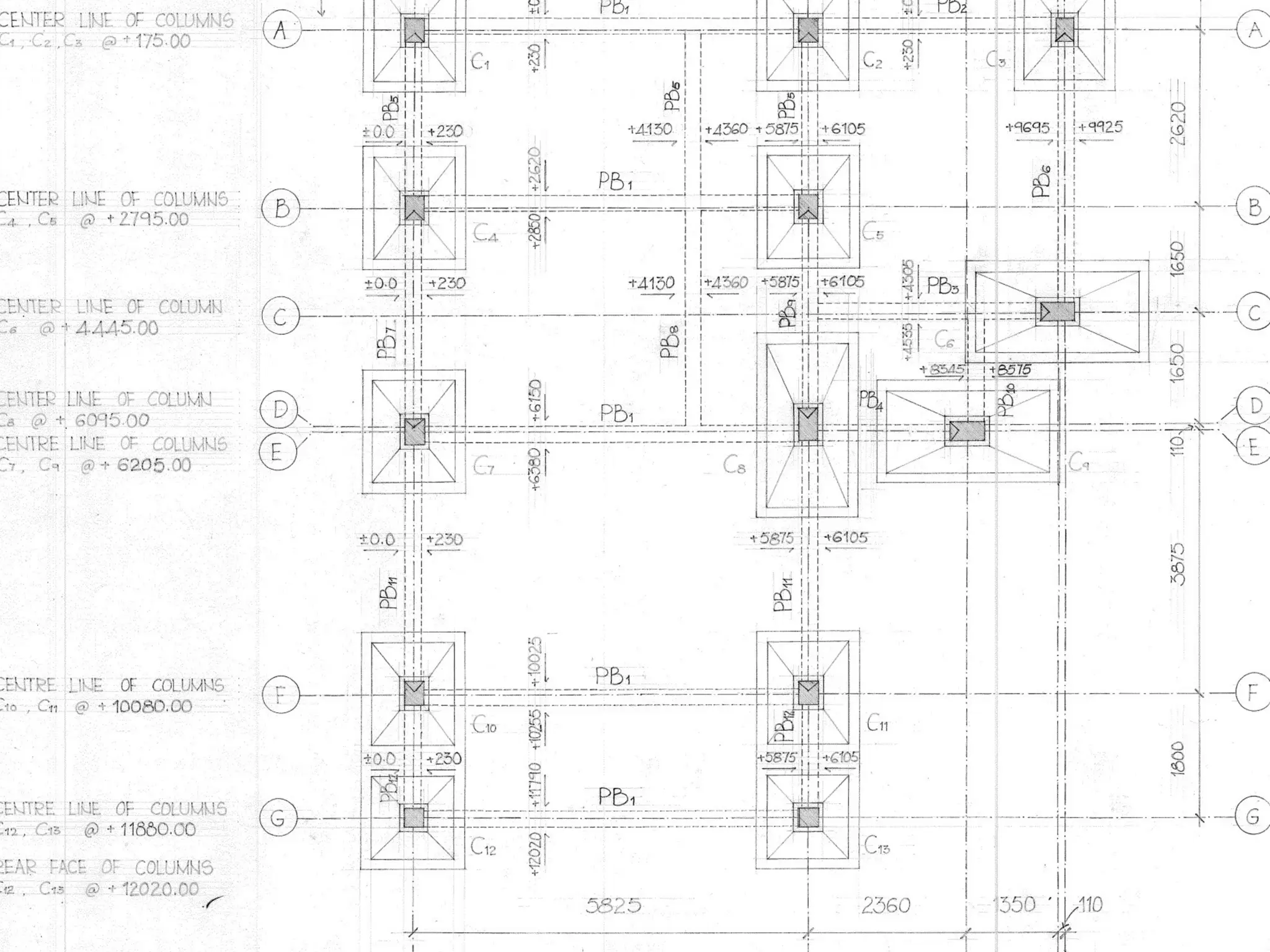
• positioning and orientation of column or columns
• position of beams
• spanning of slabs
• layout of stairs
• selecting proper type of footing
the basic principle in deciding the layout of
component members is that the loads should be
transferred to the foundation along the shortest path
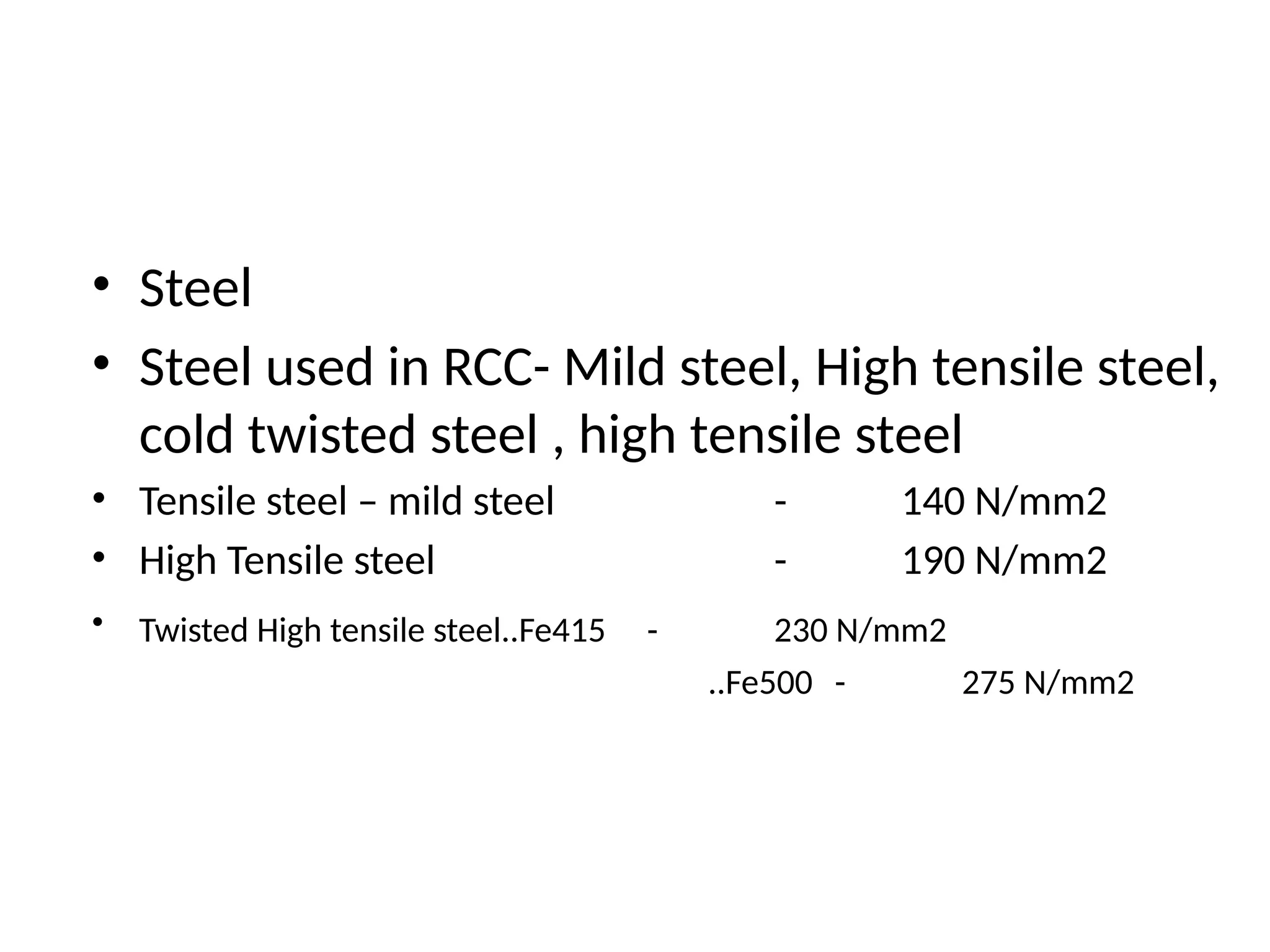
• Steel
• Steel used in RCC- Mild steel, High tensile steel,
cold twisted steel , high tensile steel
• Tensile steel – mild steel - 140 N/mm2
• High Tensile steel - 190 N/mm2
• Twisted High tensile steel..Fe415 - 230 N/mm2
..Fe500 - 275 N/mm2
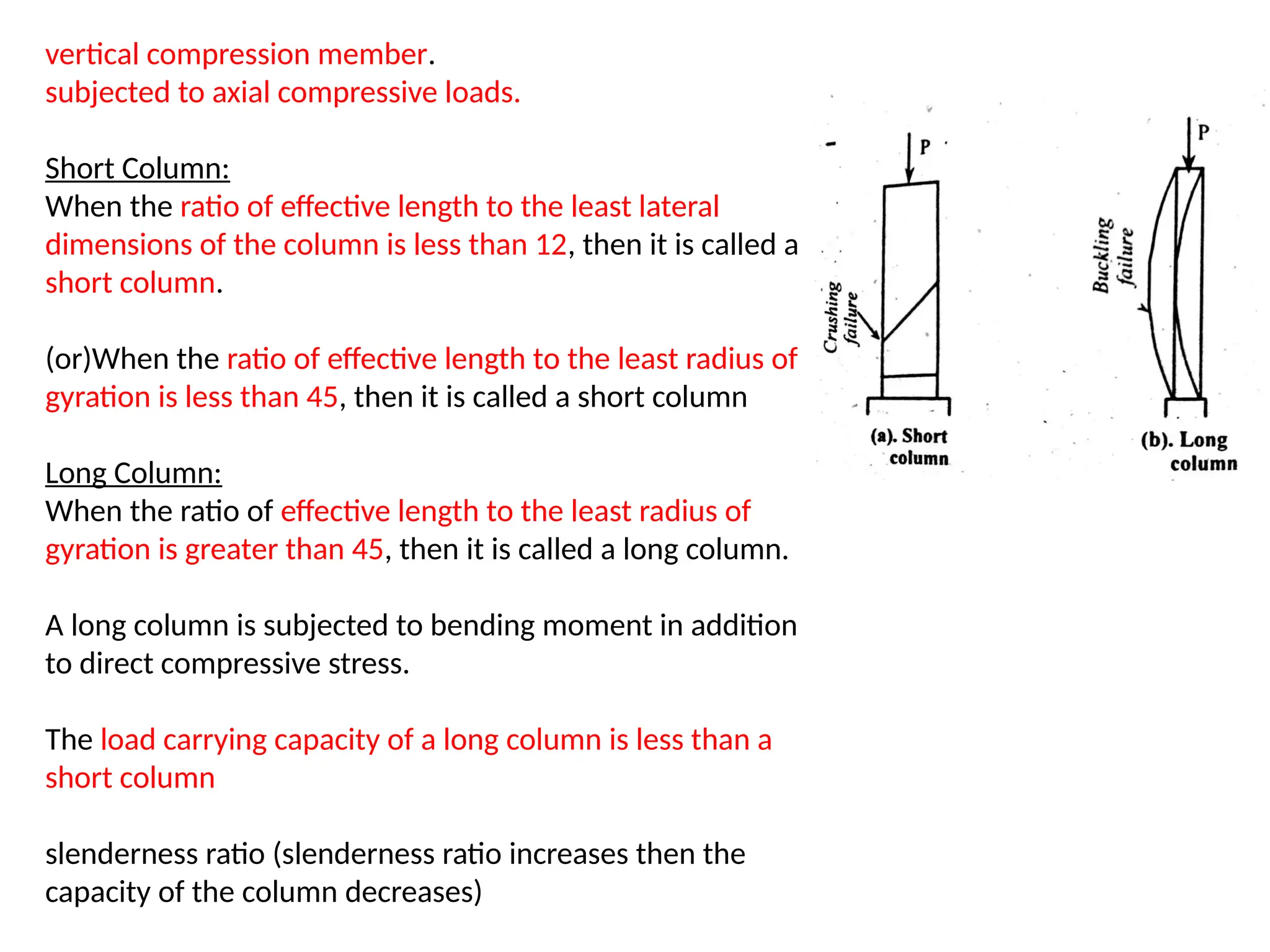
vertical compression member.
subjected to axial compressive loads.
Short Column:
When the ratio of effective length to the least lateral
dimensions of the column is less than 12, then it is called a
short column.
(or)When the ratio of effective length to the least radius of
gyration is less than 45, then it is called a short column
Long Column:
When the ratio of effective length to the least radius of
gyration is greater than 45, then it is called a long column.
A long column is subjected to bending moment in addition
to direct compressive stress.
The load carrying capacity of a long column is less than a
short column
slenderness ratio (slenderness ratio increases then the
capacity of the column decreases)
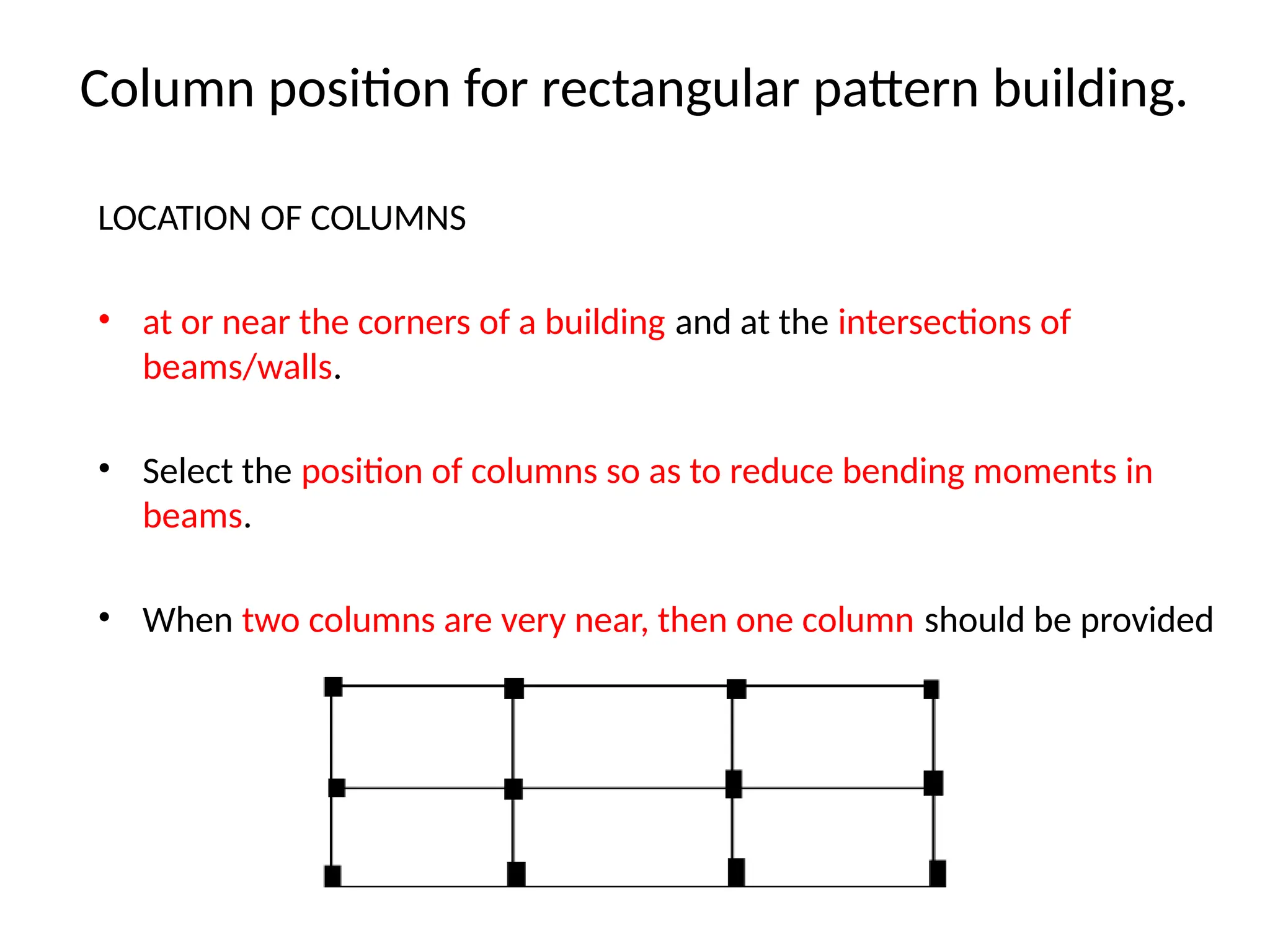
Column position for rectangular pattern building.
LOCATION OF COLUMNS
• at or near the corners of a building and at the intersections of
beams/walls.
• Select the position of columns so as to reduce bending moments in
beams.
• When two columns are very near, then one column should be provided
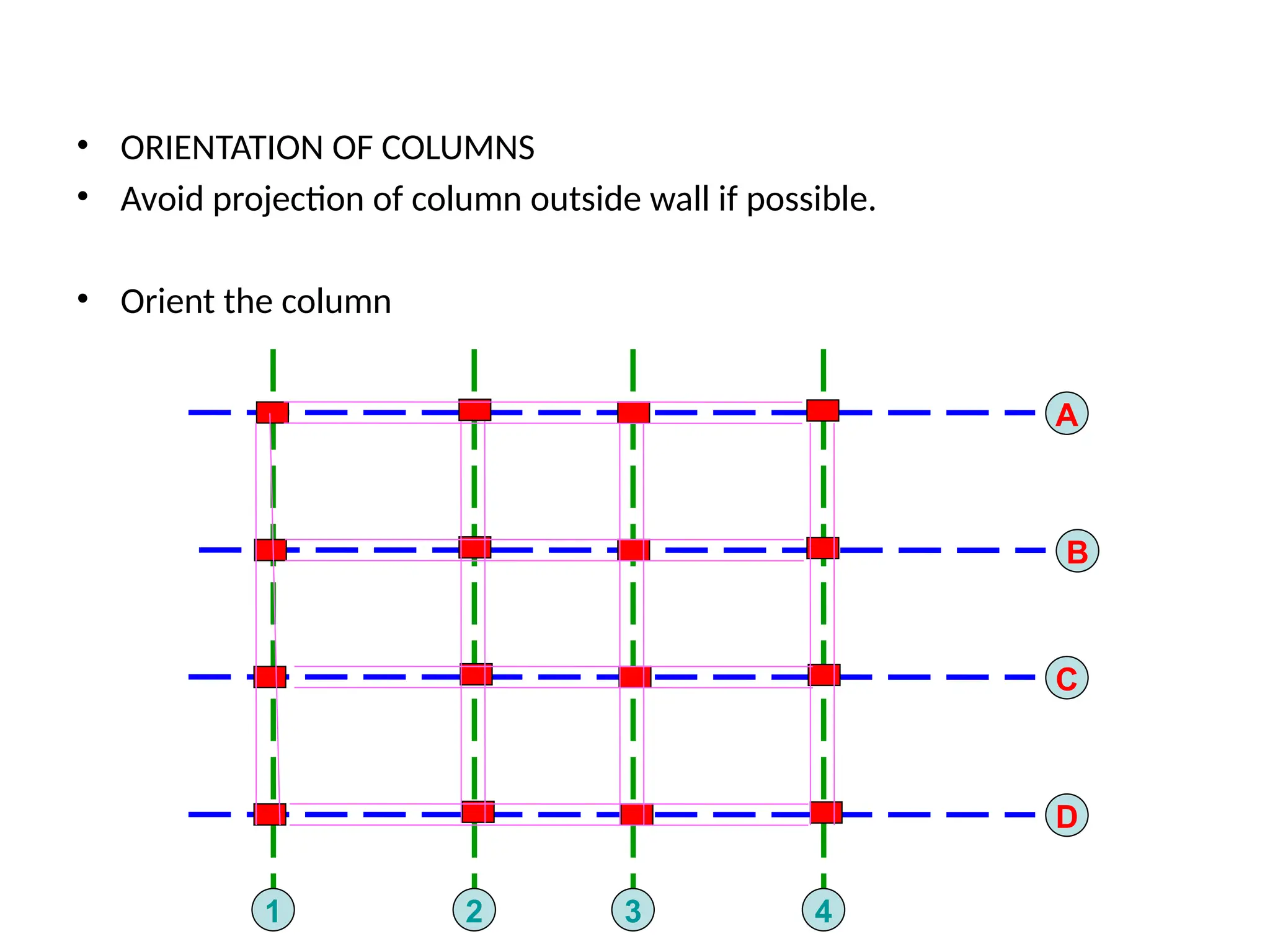
• ORIENTATION OF COLUMNS
• Avoid projection of column outside wall if possible.
• Orient the column so that the depth of the column is contained in the
major plane of bending or is perpendicular to the major axis of bending.
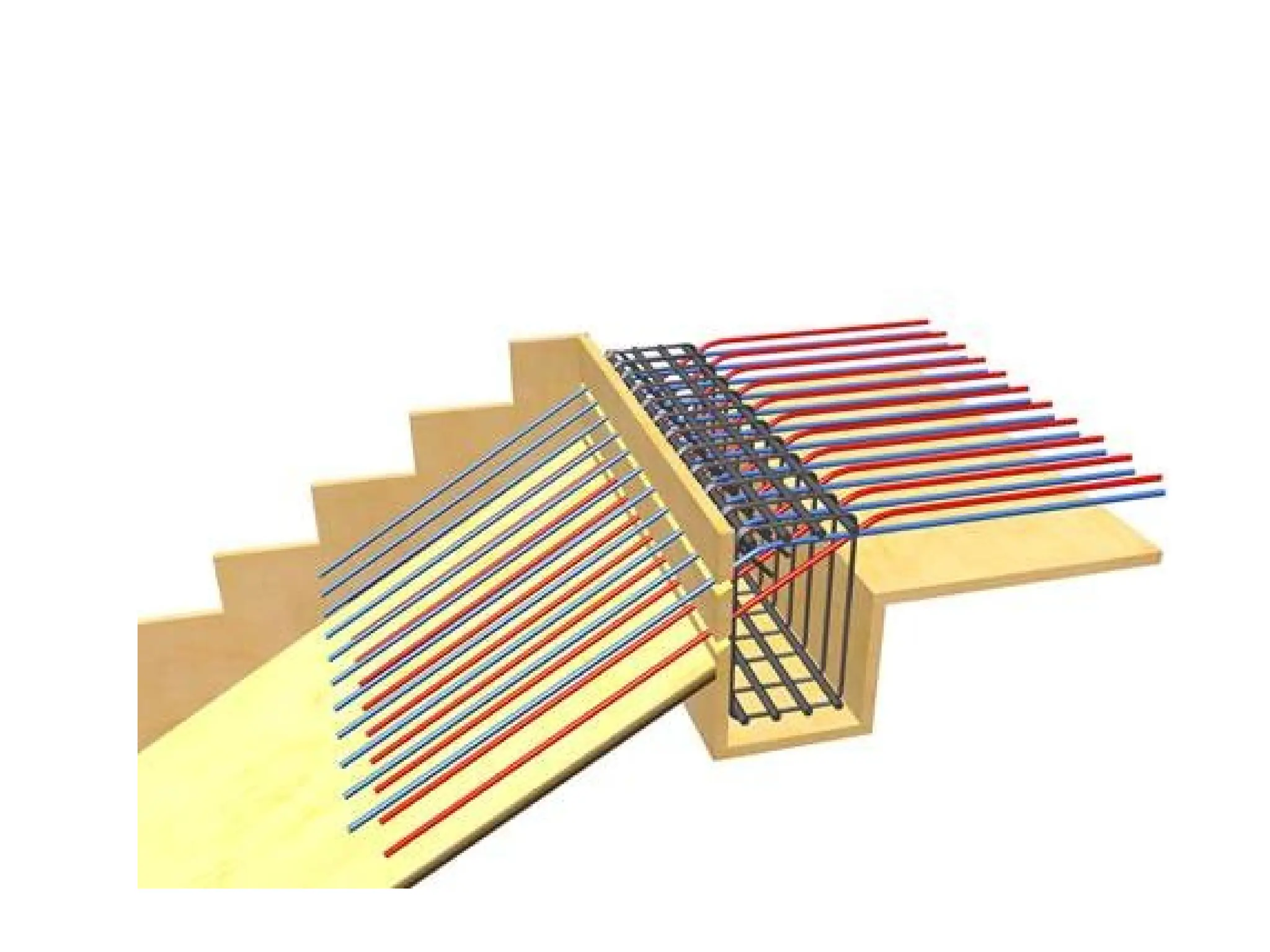
A
B
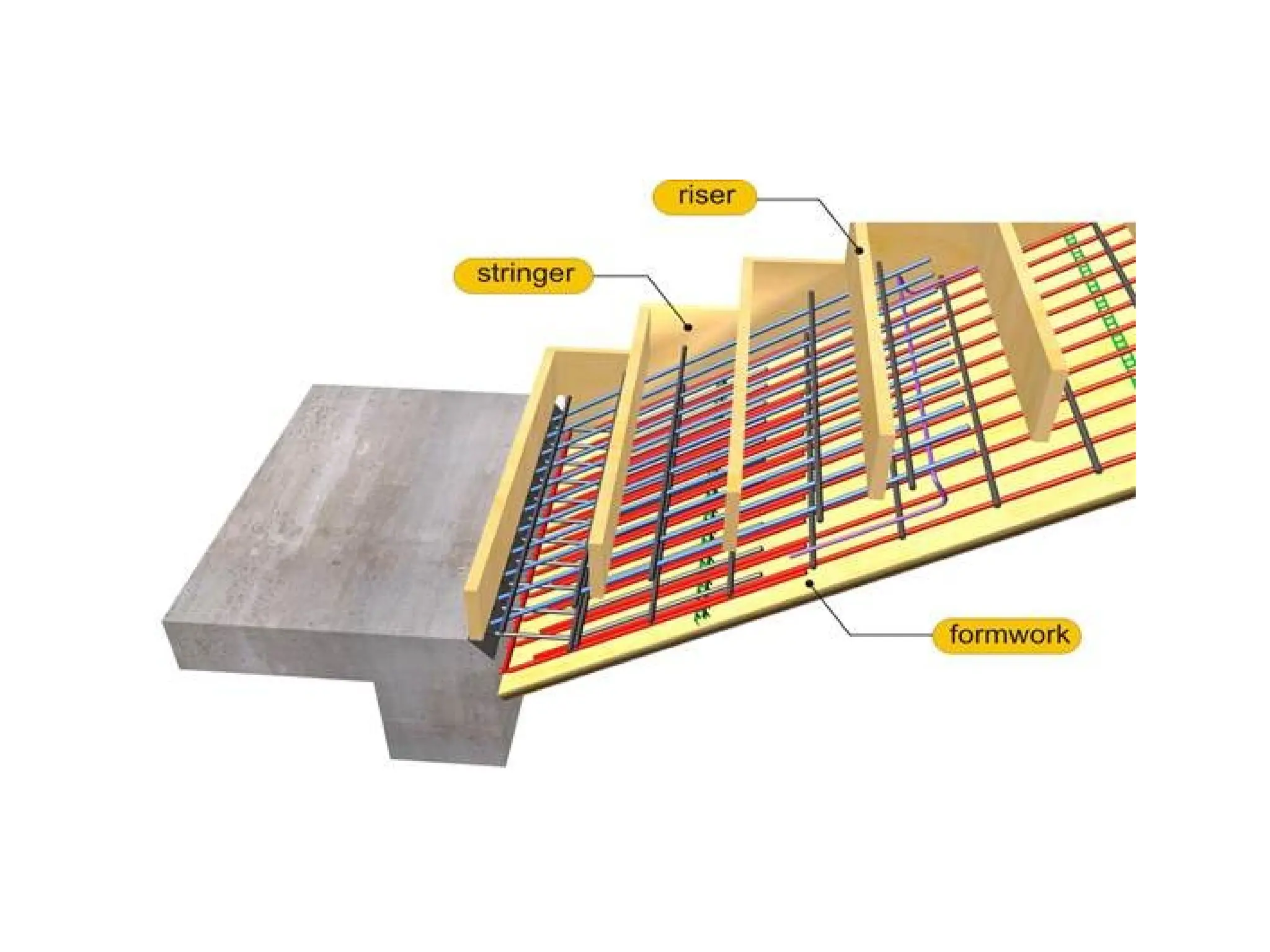
C
D
1 2 3 4
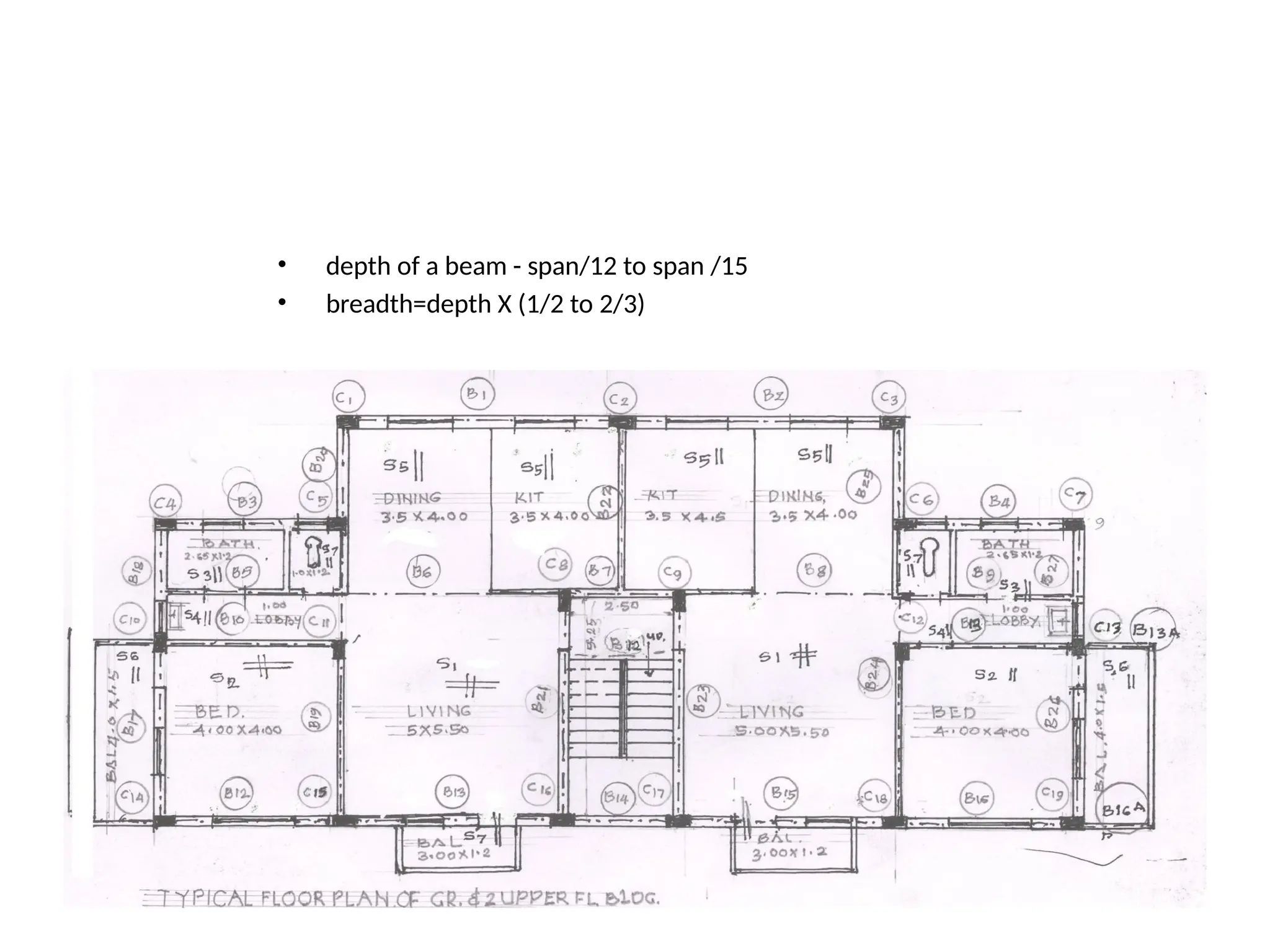
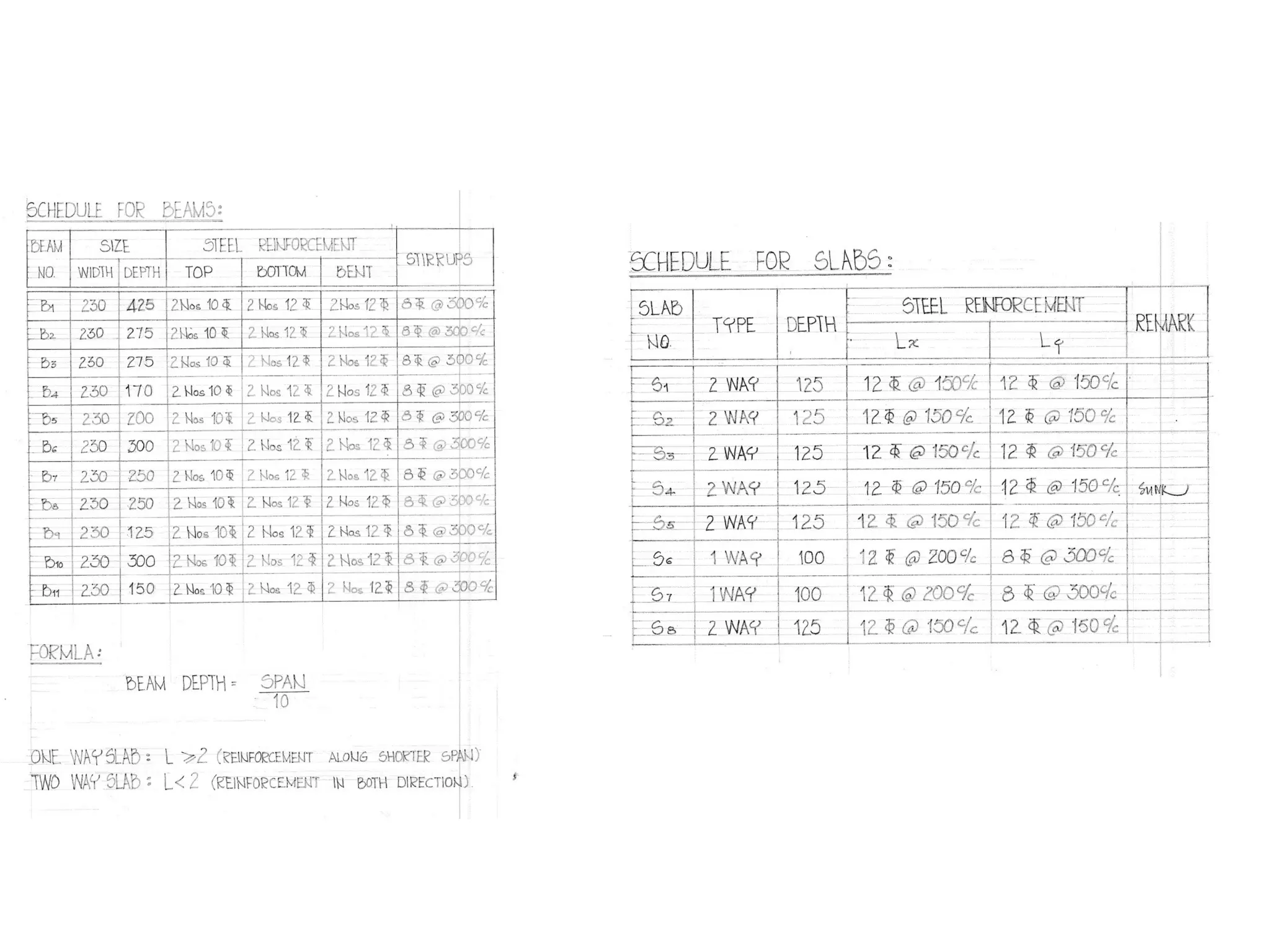
• depth of a beam - span/12 to span /15
• breadth=depth X (1/2 to 2/3)
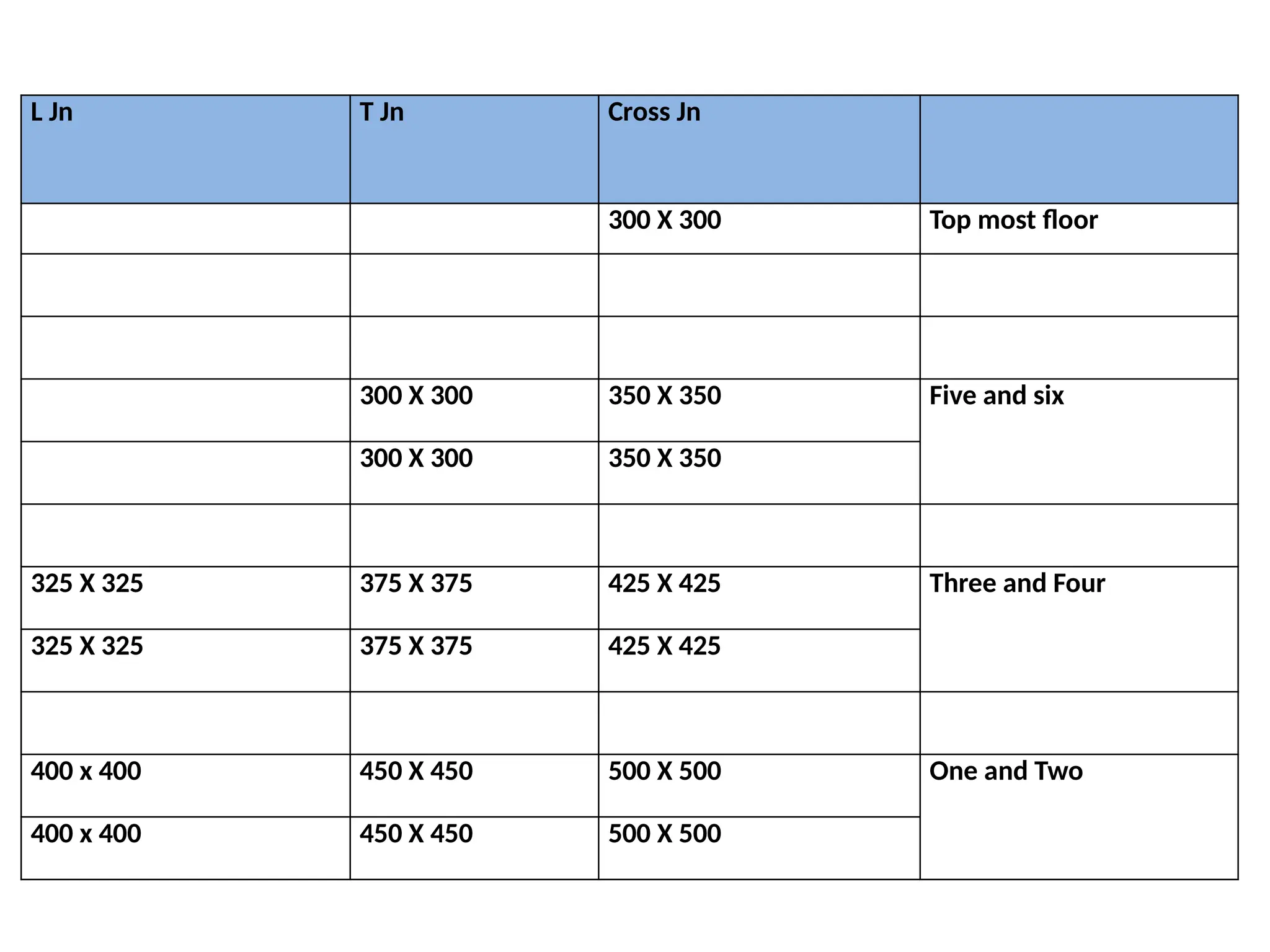
L Jn T Jn Cross Jn
300 X 300 Top most floor
300 X 300 350 X 350 Five and six
300 X 300 350 X 350
325 X 325 375 X 375 425 X 425 Three and Four
325 X 325 375 X 375 425 X 425
400 x 400 450 X 450 500 X 500 One and Two
400 x 400 450 X 450 500 X 500
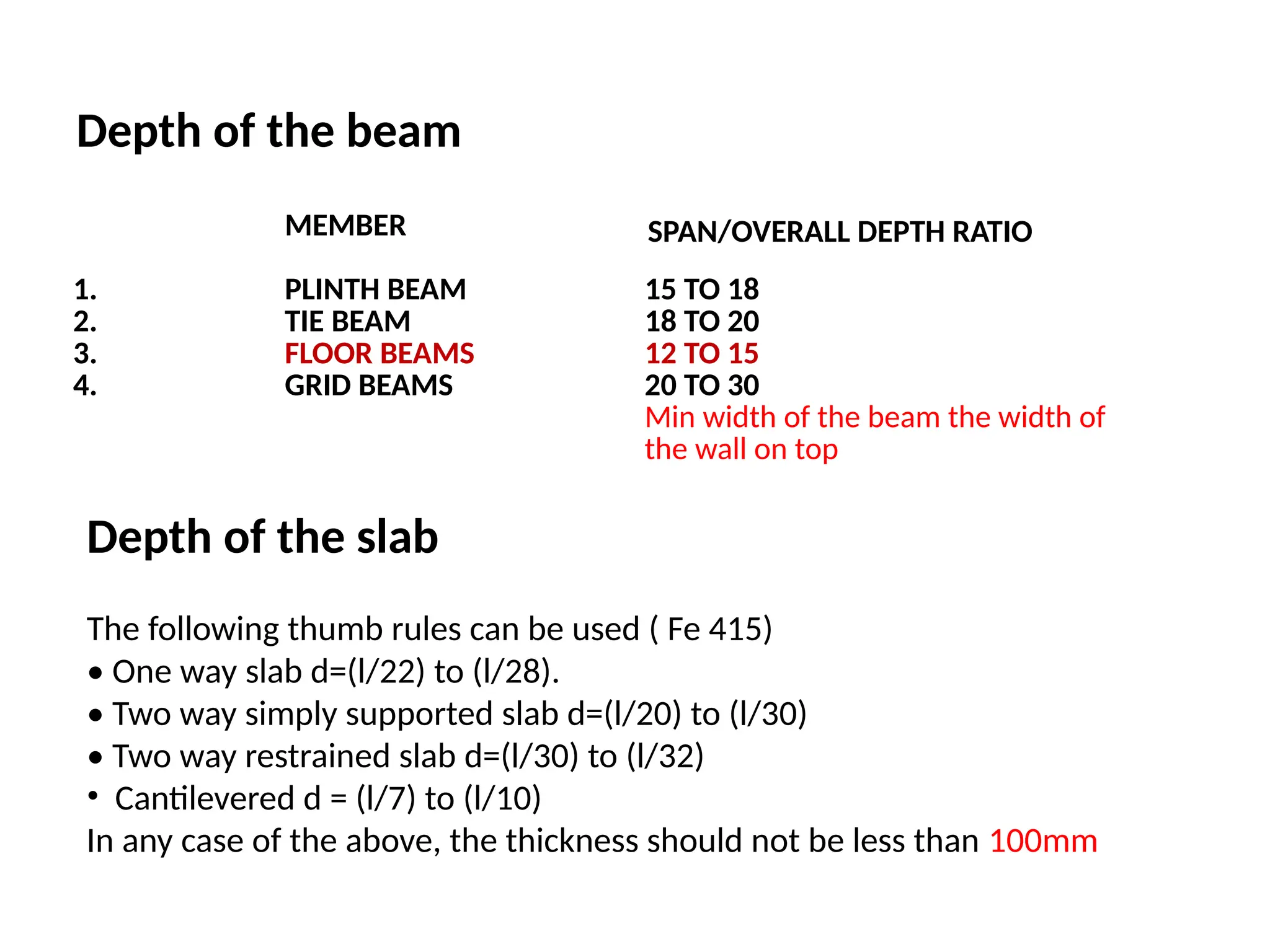
Depth of the beam
MEMBER SPAN/OVERALL DEPTH RATIO
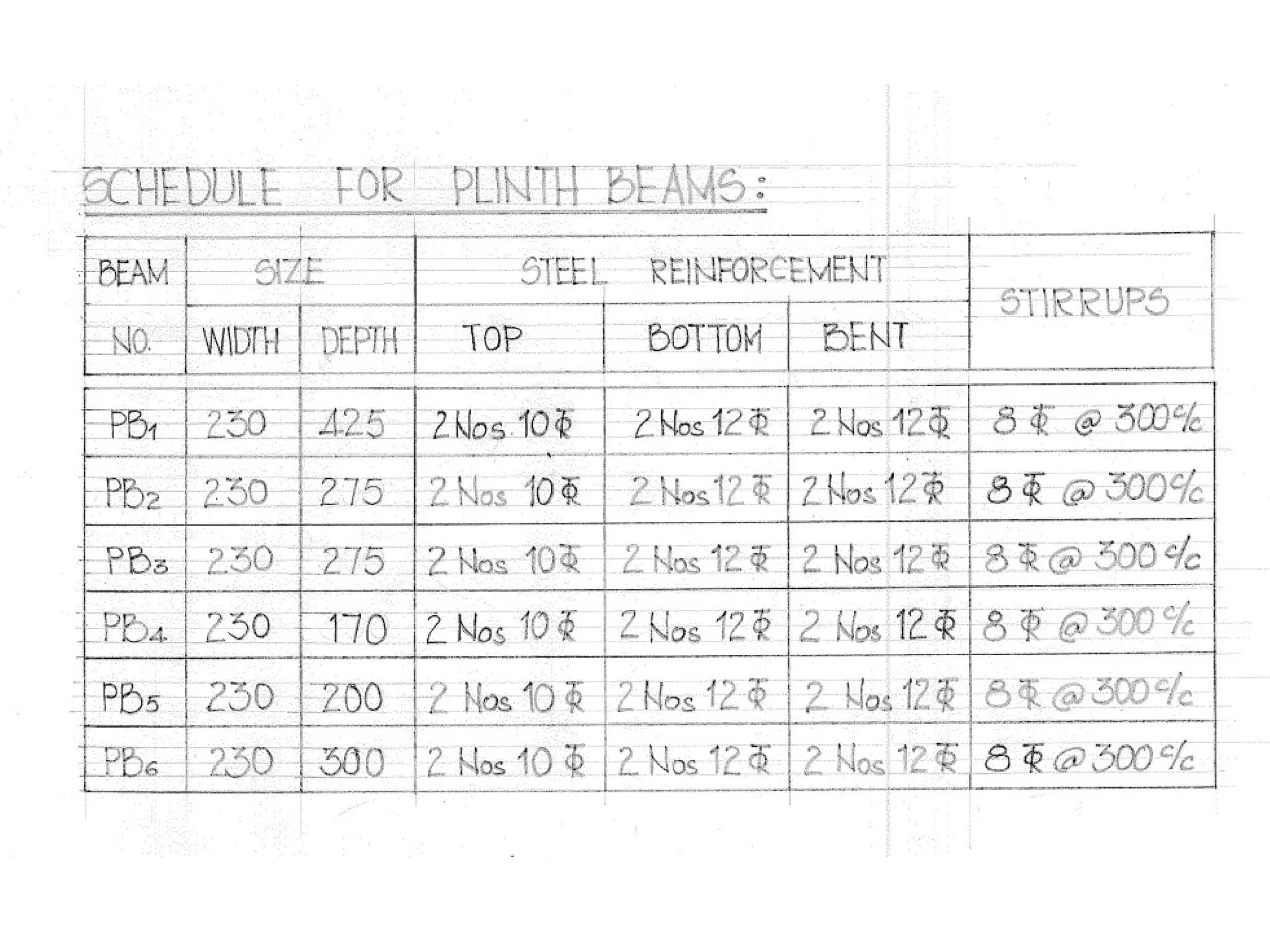
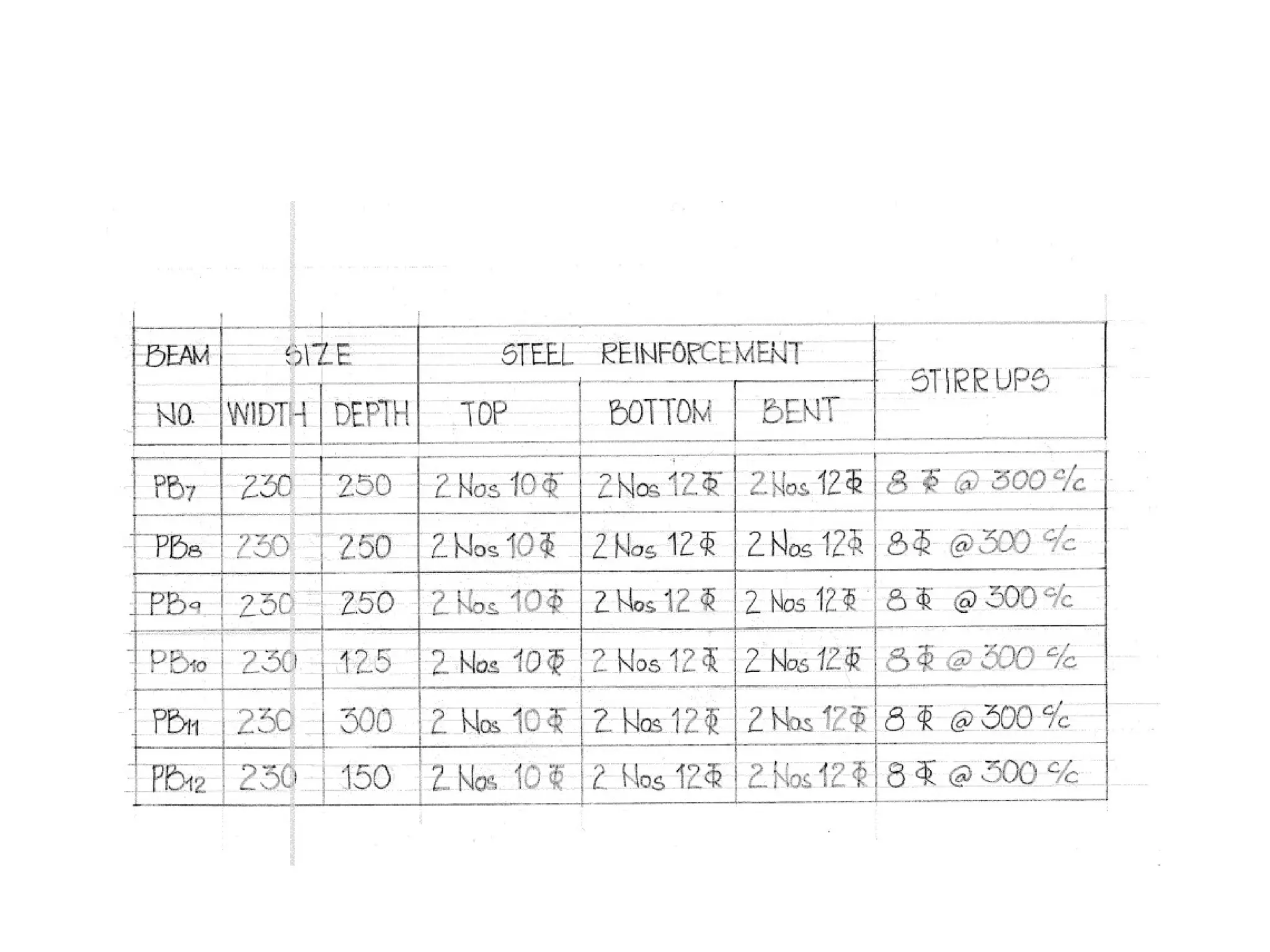
1. PLINTH BEAM 15 TO 18
2. TIE BEAM 18 TO 20
3. FLOOR BEAMS 12 TO 15
4. GRID BEAMS 20 TO 30
Min width of the beam the width of
the wall on top
Depth of the slab
The following thumb rules can be used ( Fe 415)
• One way slab d=(l/22) to (l/28).
• Two way simply supported slab d=(l/20) to (l/30)
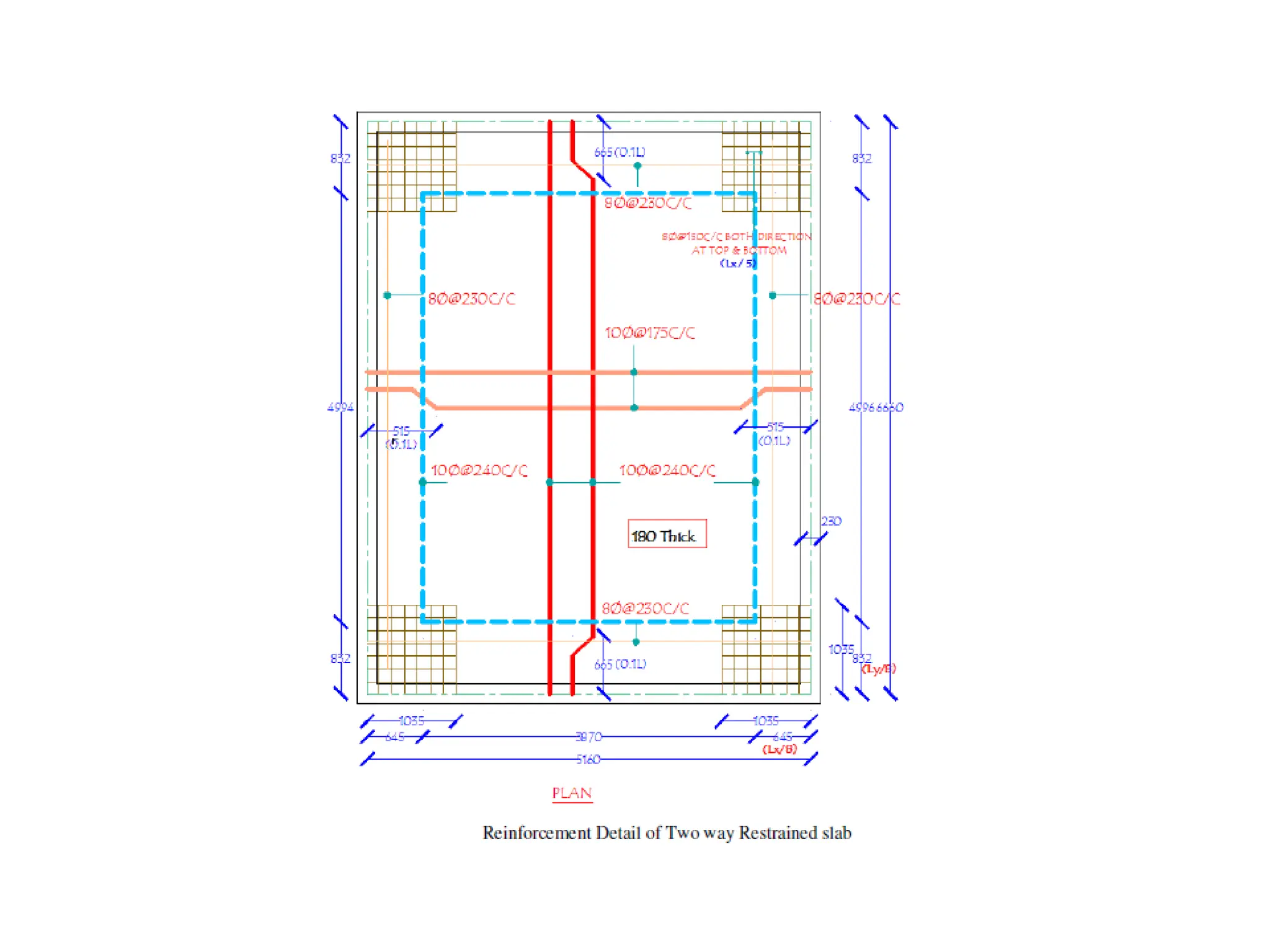
• Two way restrained slab d=(l/30) to (l/32)
• Cantilevered d = (l/7) to (l/10)
In any case of the above, the thickness should not be less than 100mm
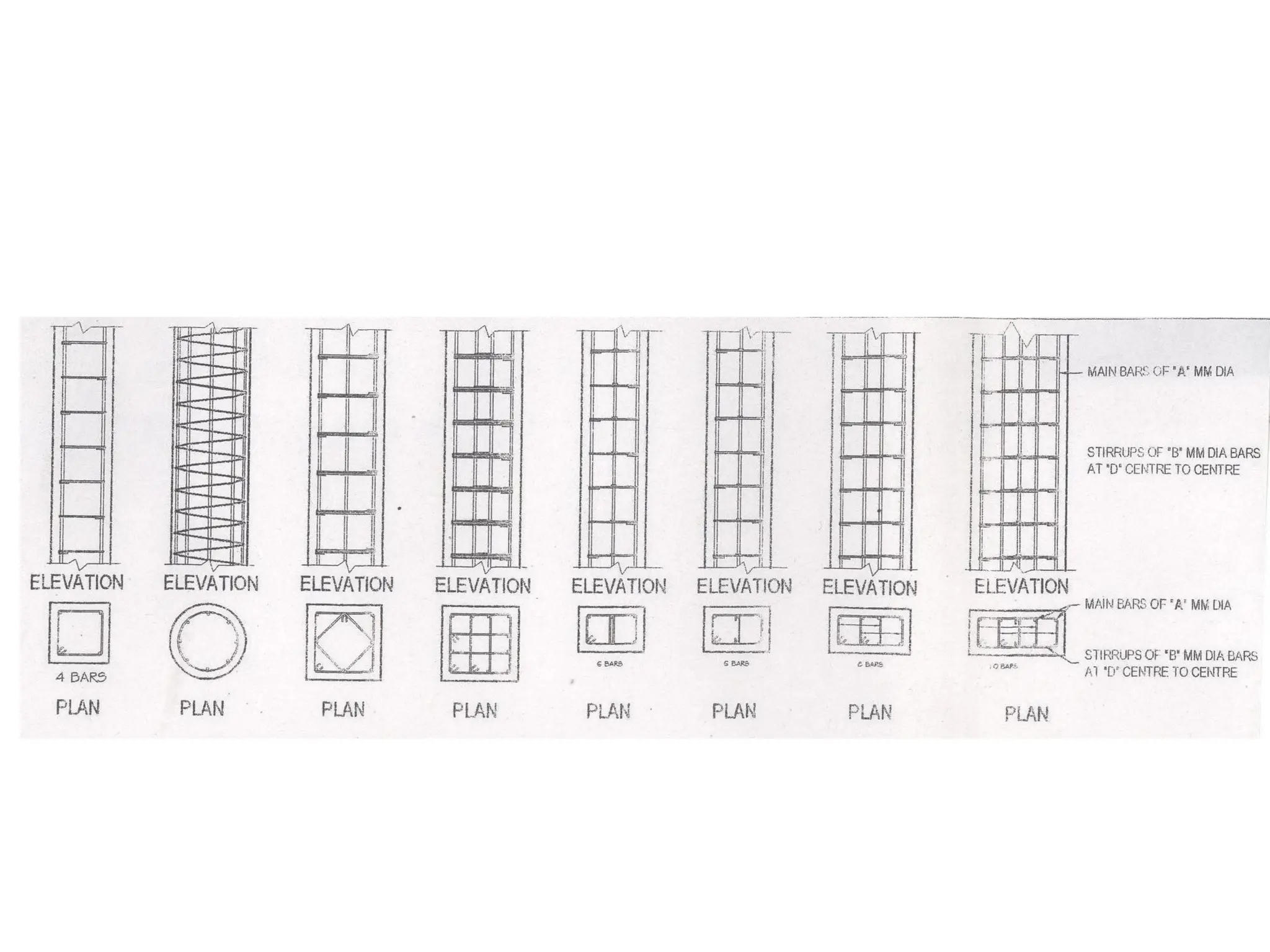
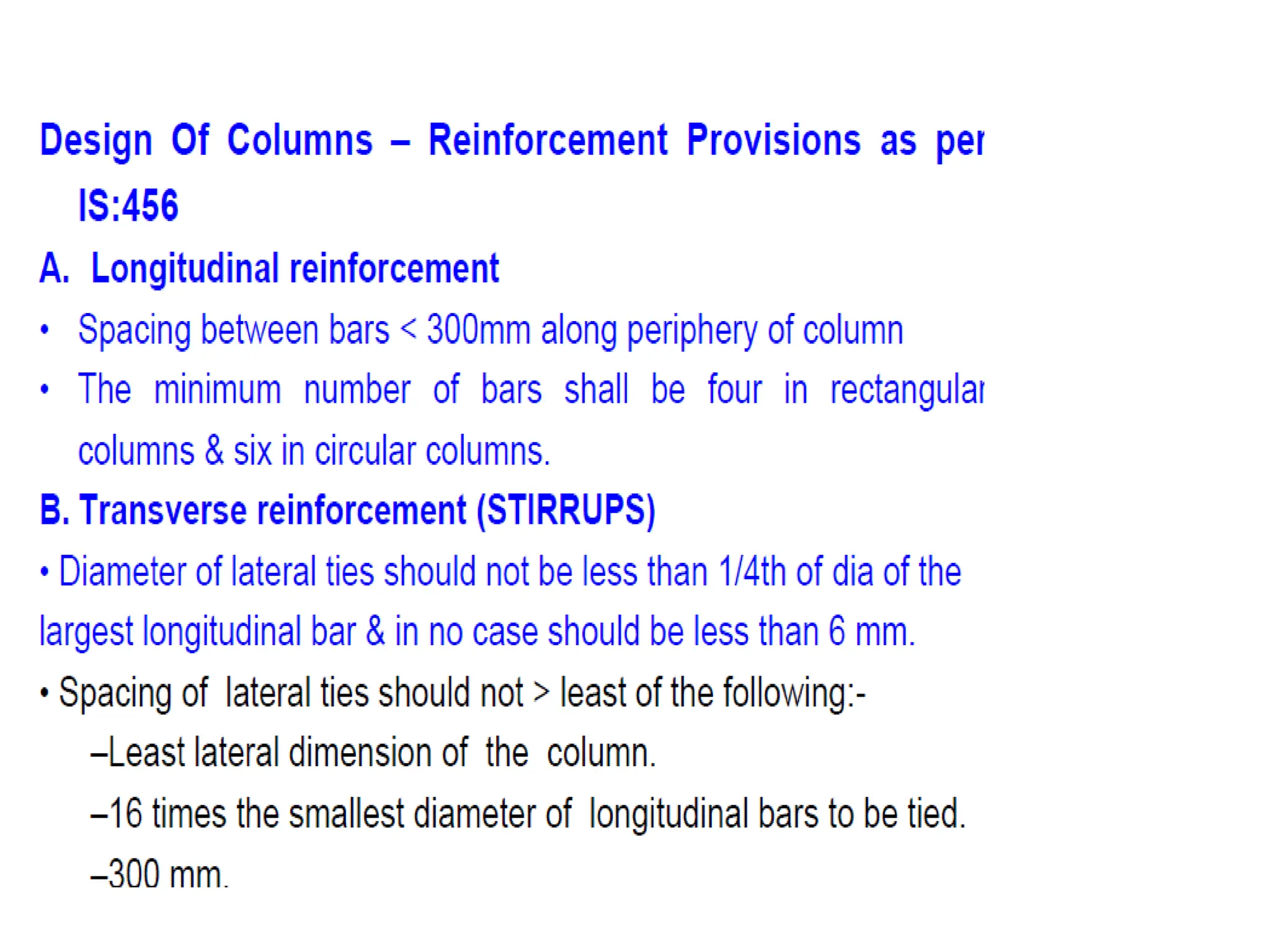
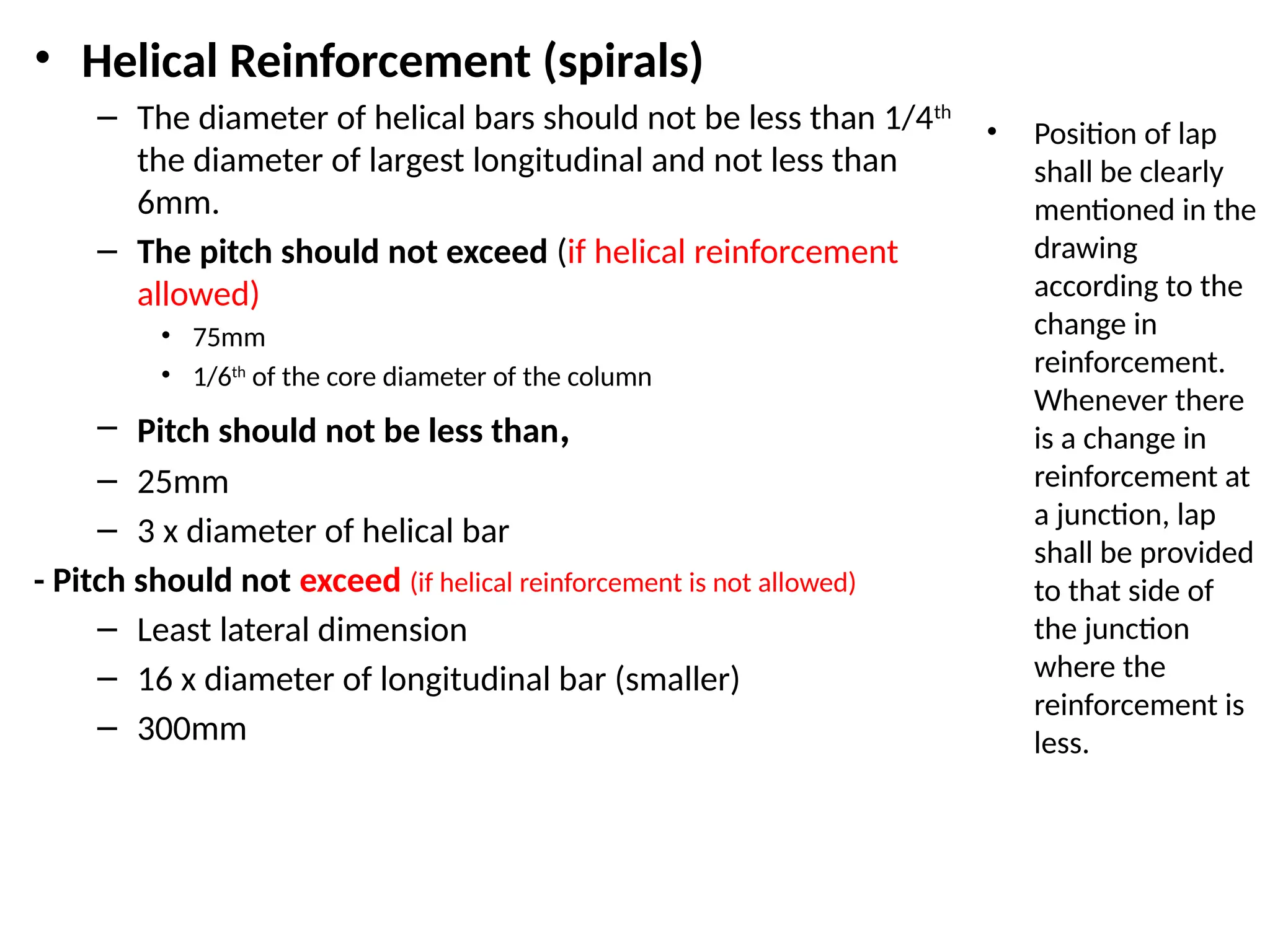
• Helical Reinforcement (spirals)
– The diameter of helical bars should not be less than 1/4th
the diameter of largest longitudinal and not less than
6mm.
– The pitch should not exceed (if helical reinforcement
allowed)
• 75mm
• 1/6th
of the core diameter of the column
– Pitch should not be less than,
– 25mm
– 3 x diameter of helical bar
- Pitch should not exceed (if helical reinforcement is not allowed)
– Least lateral dimension
– 16 x diameter of longitudinal bar (smaller)
– 300mm
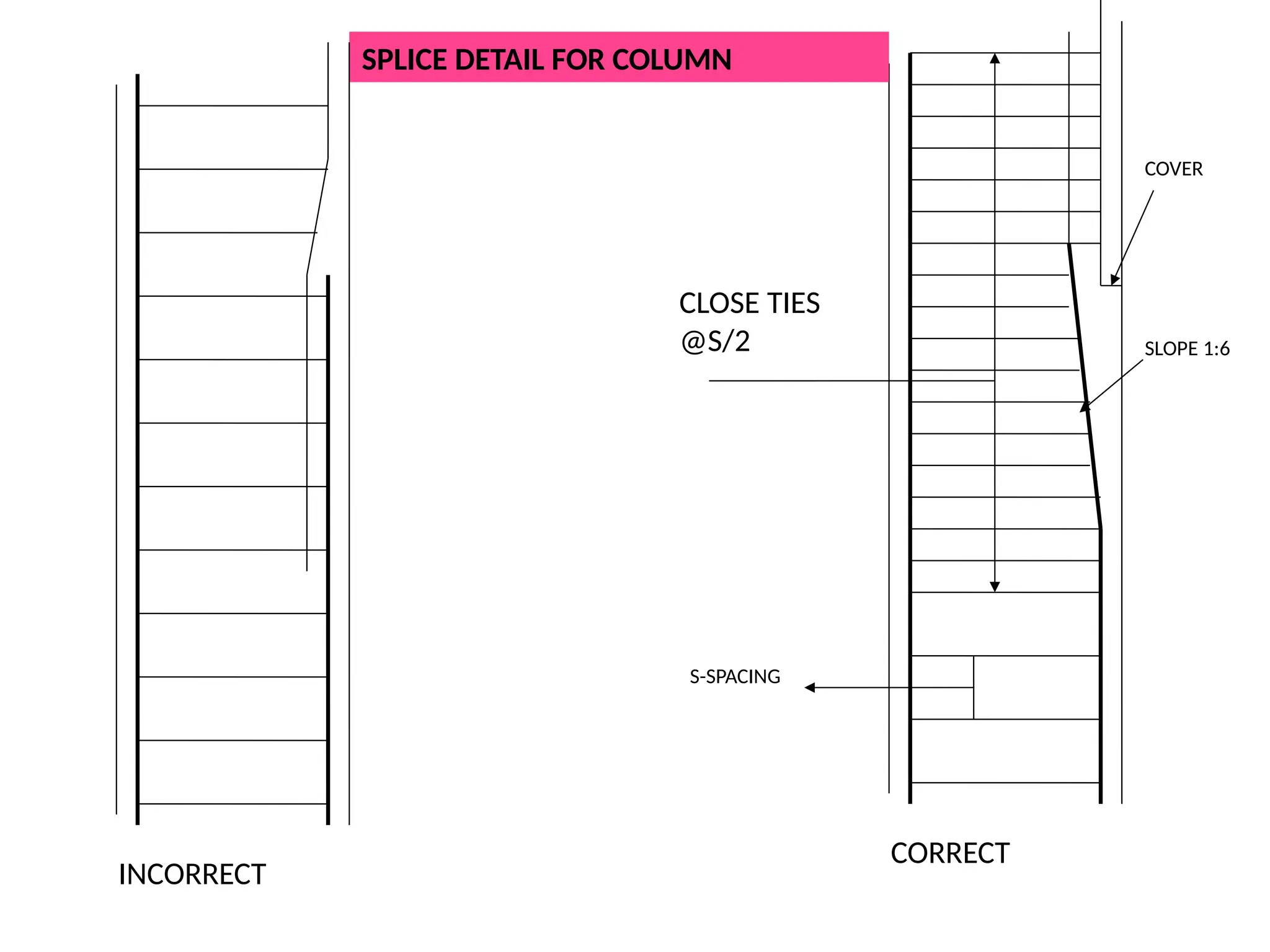
• Position of lap
shall be clearly
mentioned in the
drawing
according to the
change in
reinforcement.
Whenever there
is a change in
reinforcement at
a junction, lap
shall be provided
to that side of
the junction
where the
reinforcement is
less.
CORRECT
SPLICE DETAIL FOR COLUMN
INCORRECT
COVER
CLOSE TIES
@S/2
S-SPACING
SLOPE 1:6
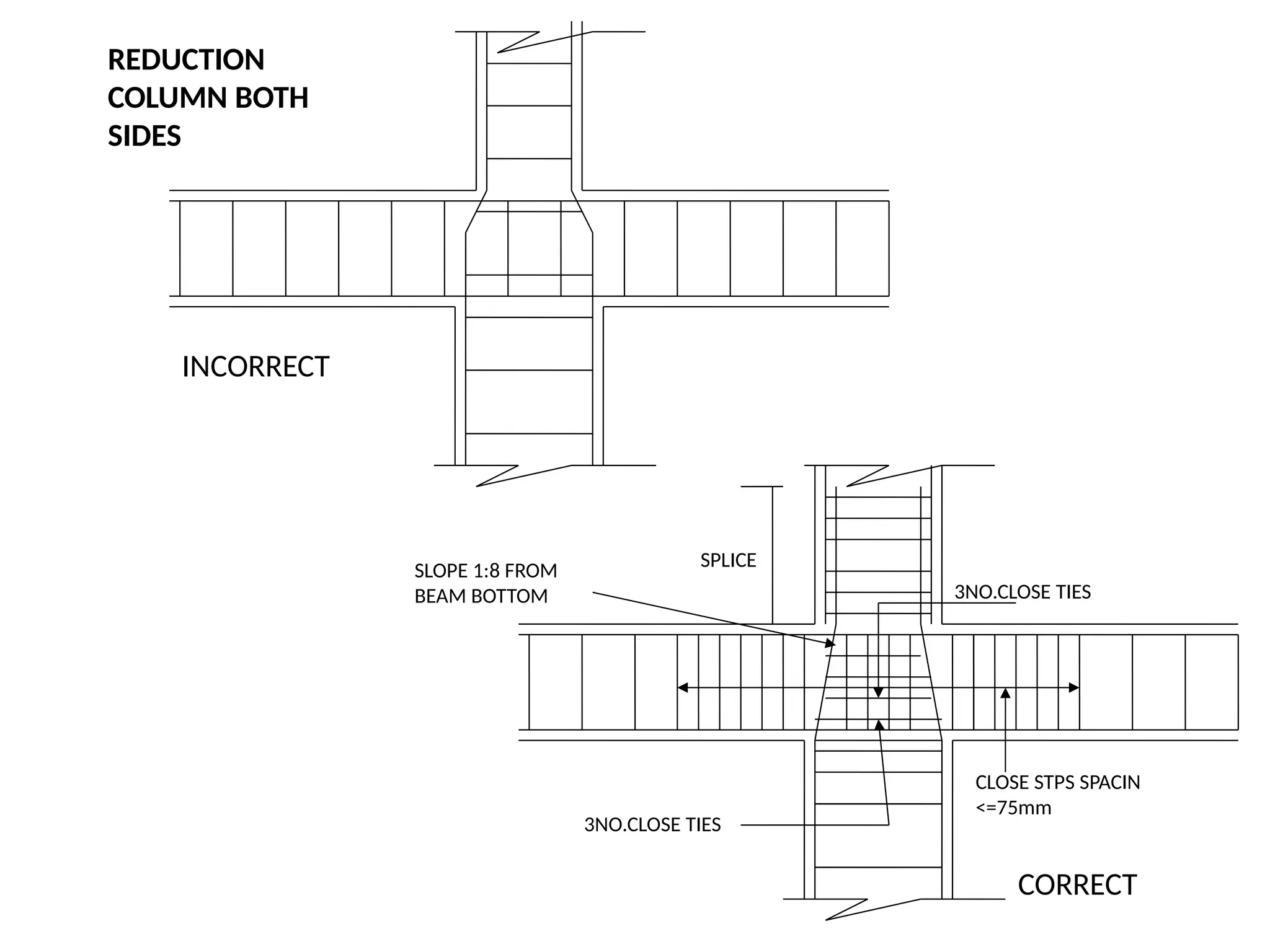
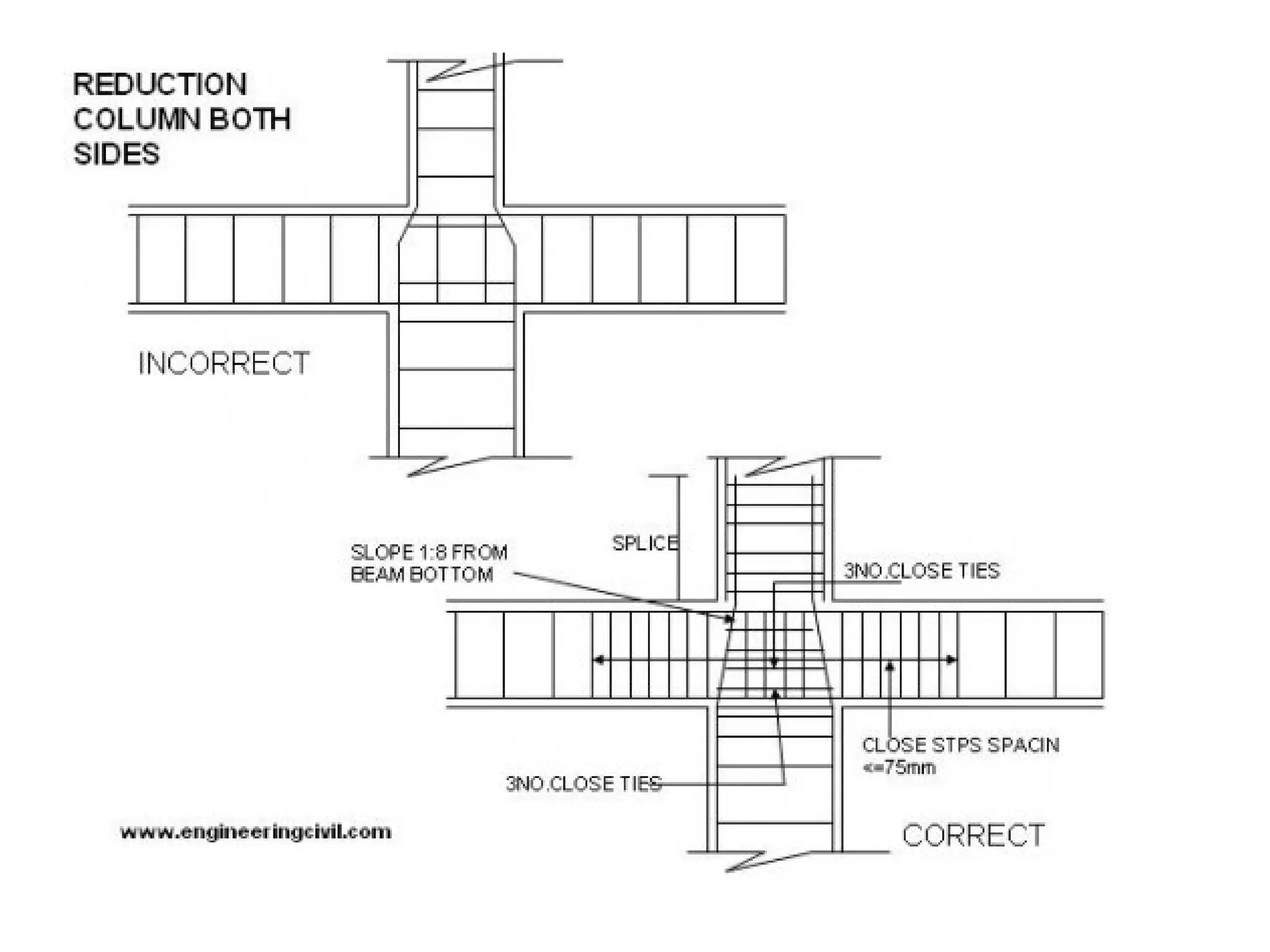
REDUCTION
COLUMN BOTH
SIDES
INCORRECT
CORRECT
3NO.CLOSE TIES
SPLICE
CLOSE STPS SPACIN
<=75mm
SLOPE 1:8 FROM
BEAM BOTTOM
3NO.CLOSE TIES
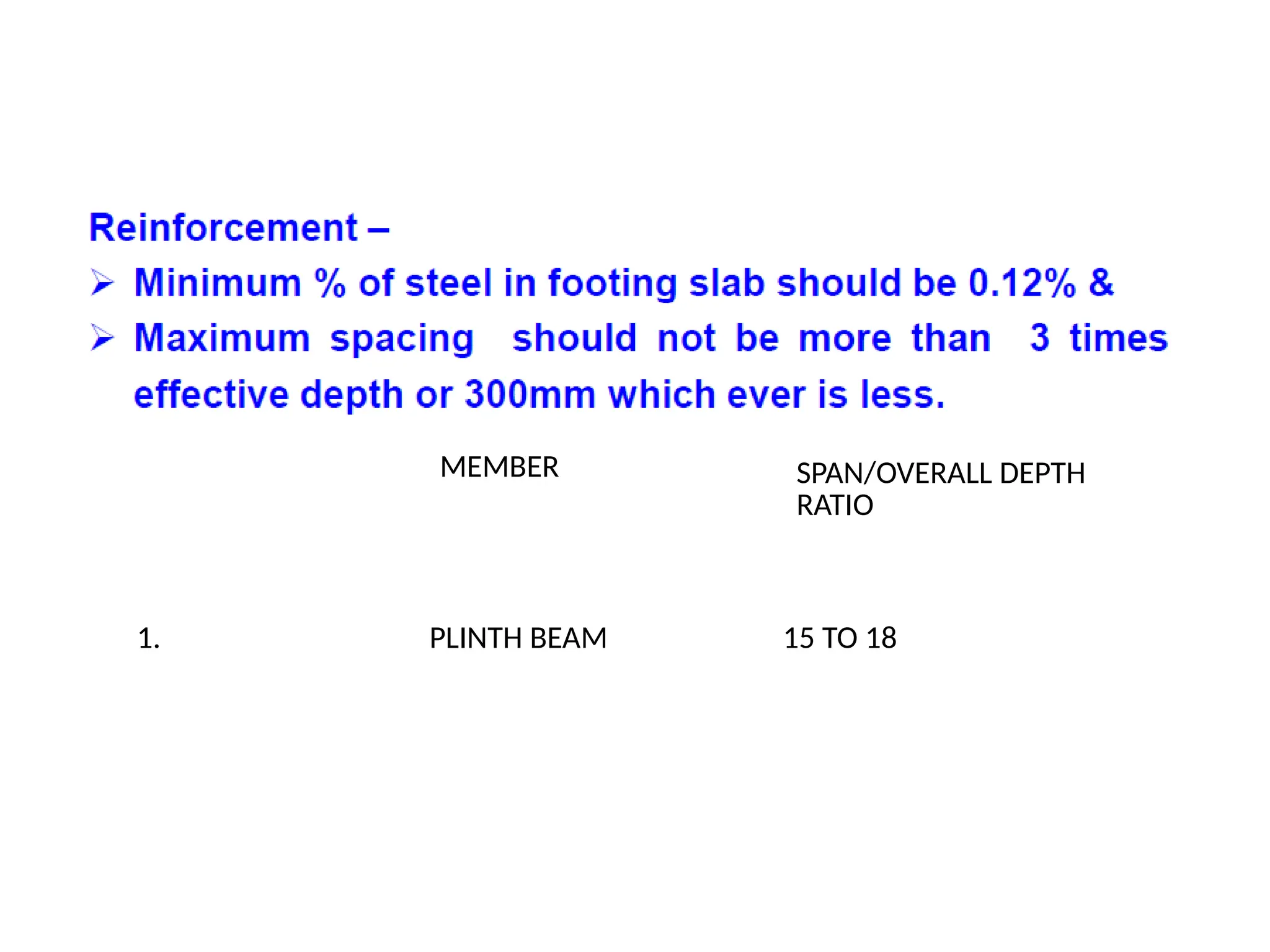
1. PLINTH BEAM 15 TO 18
MEMBER SPAN/OVERALL DEPTH
RATIO
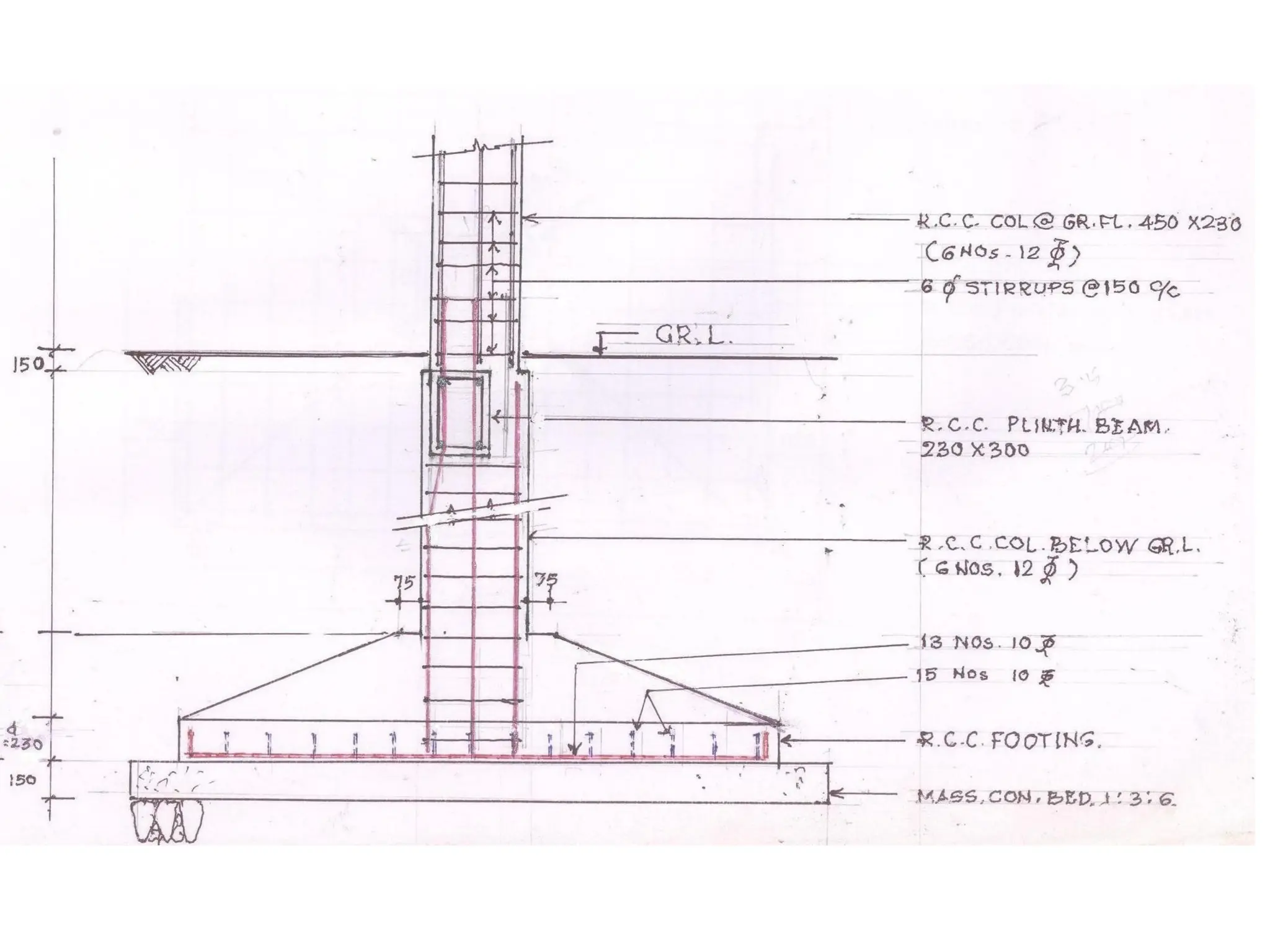
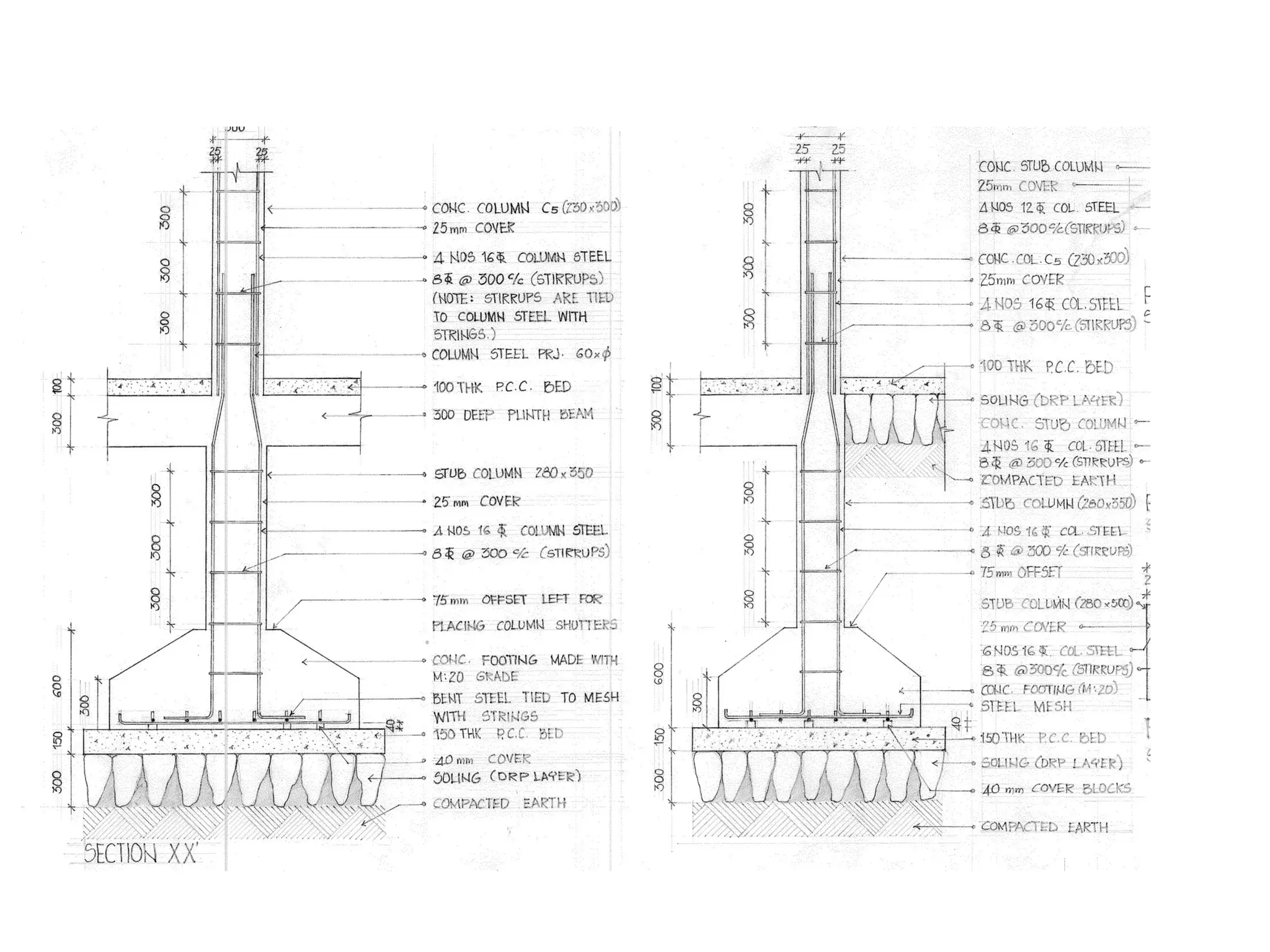
FOOTINGS
BEAMS
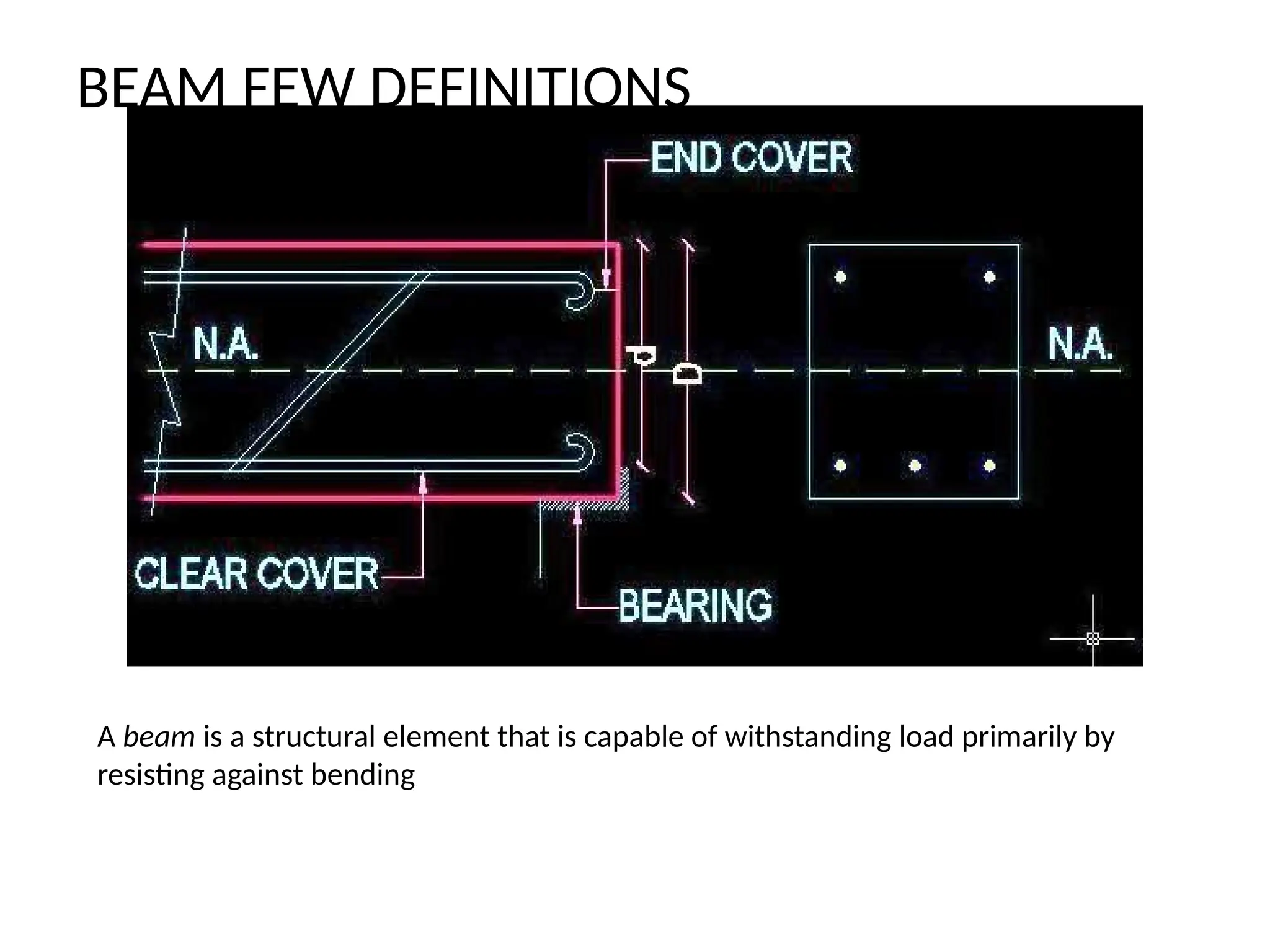
BEAM FEW DEFINITIONS
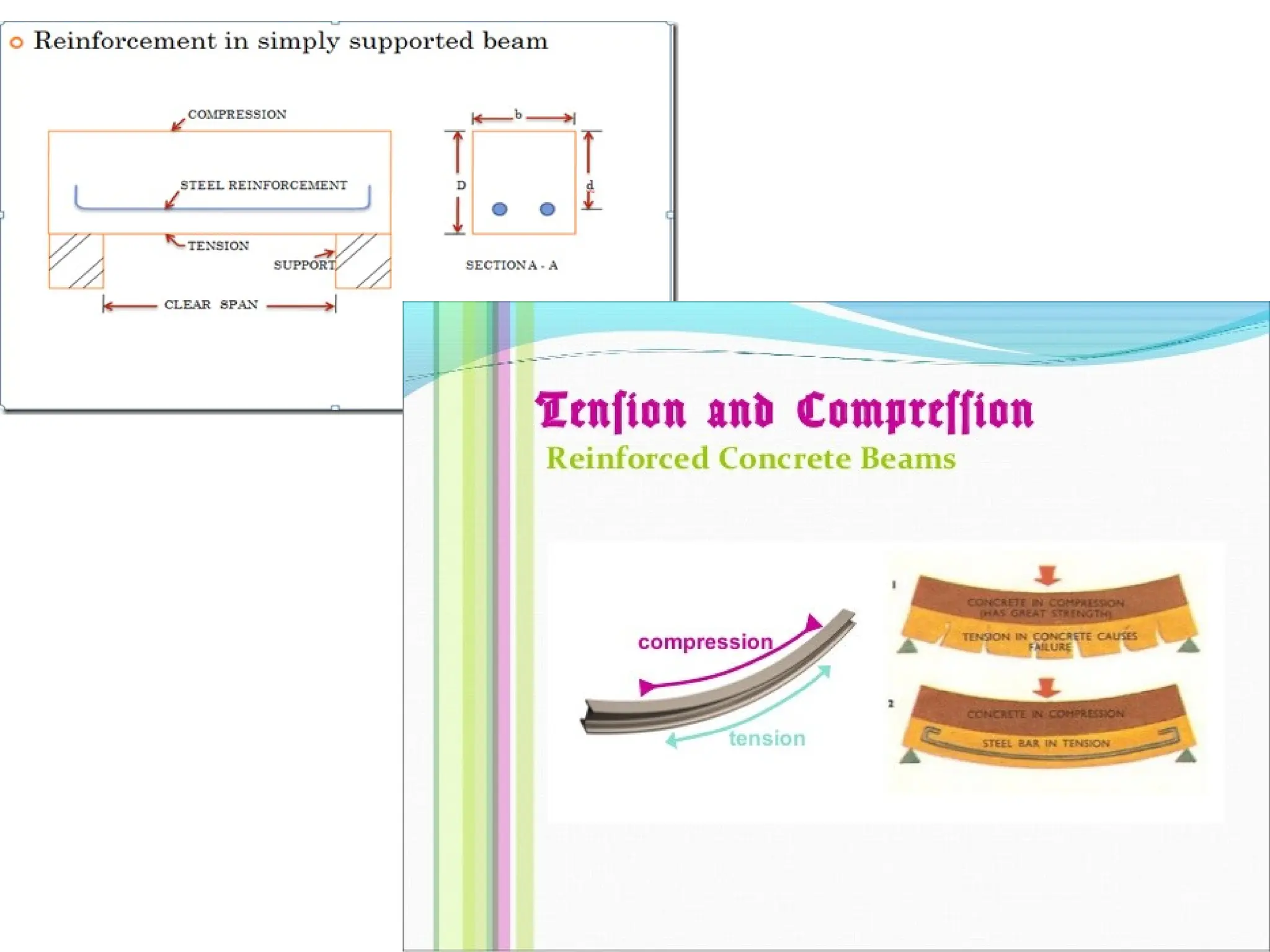
A beam is a structural element that is capable of withstanding load primarily by
resisting against bending
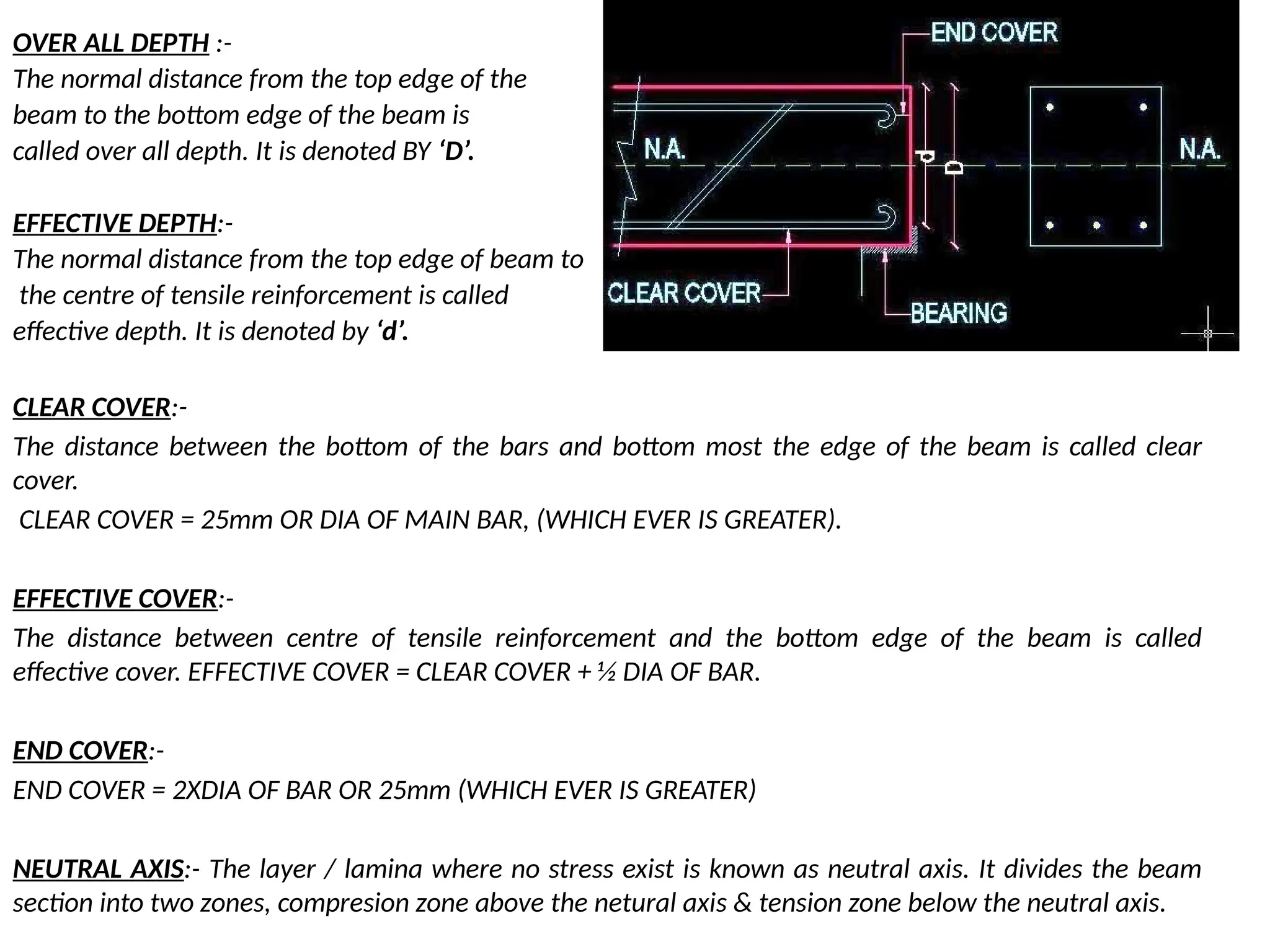
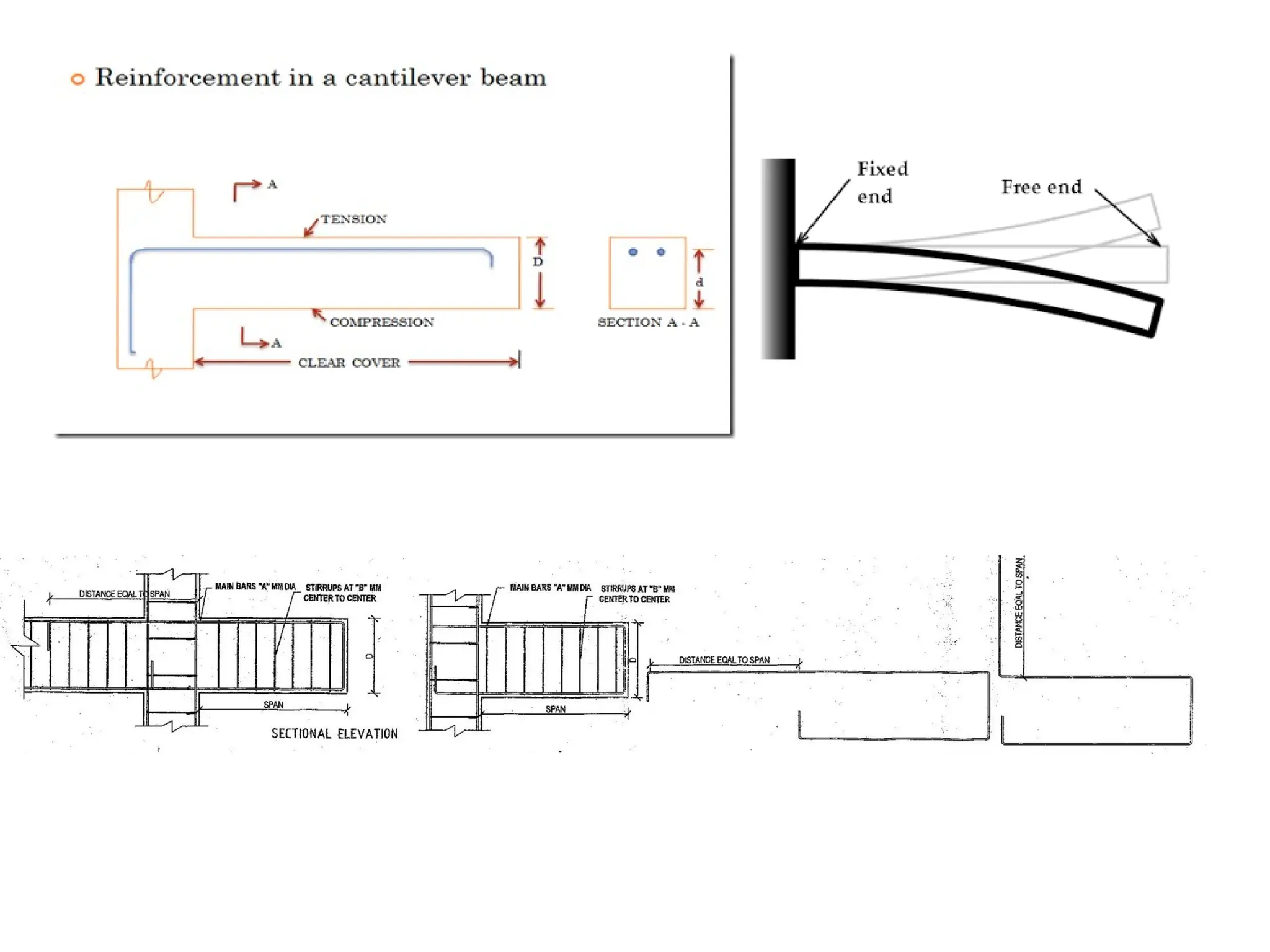
OVER ALL DEPTH :-
The normal distance from the top edge of the
beam to the bottom edge of the beam is
called over all depth. It is denoted BY ‘D’.
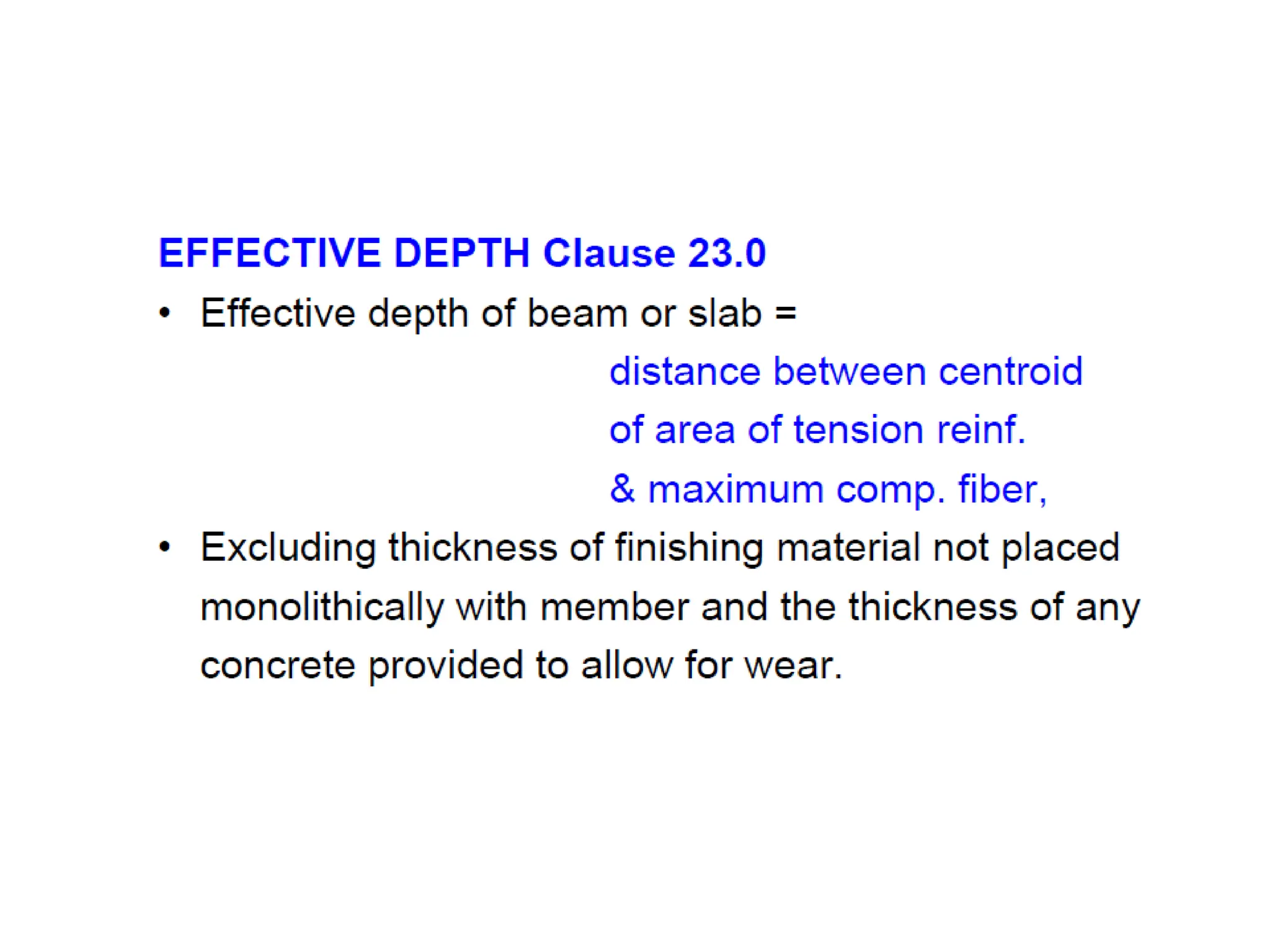
EFFECTIVE DEPTH:-
The normal distance from the top edge of beam to
the centre of tensile reinforcement is called
effective depth. It is denoted by ‘d’.
CLEAR COVER:-
The distance between the bottom of the bars and bottom most the edge of the beam is called clear
cover.
CLEAR COVER = 25mm OR DIA OF MAIN BAR, (WHICH EVER IS GREATER).
EFFECTIVE COVER:-
The distance between centre of tensile reinforcement and the bottom edge of the beam is called
effective cover. EFFECTIVE COVER = CLEAR COVER + ½ DIA OF BAR.
END COVER:-
END COVER = 2XDIA OF BAR OR 25mm (WHICH EVER IS GREATER)
NEUTRAL AXIS:- The layer / lamina where no stress exist is known as neutral axis. It divides the beam
section into two zones, compresion zone above the netural axis & tension zone below the neutral axis.
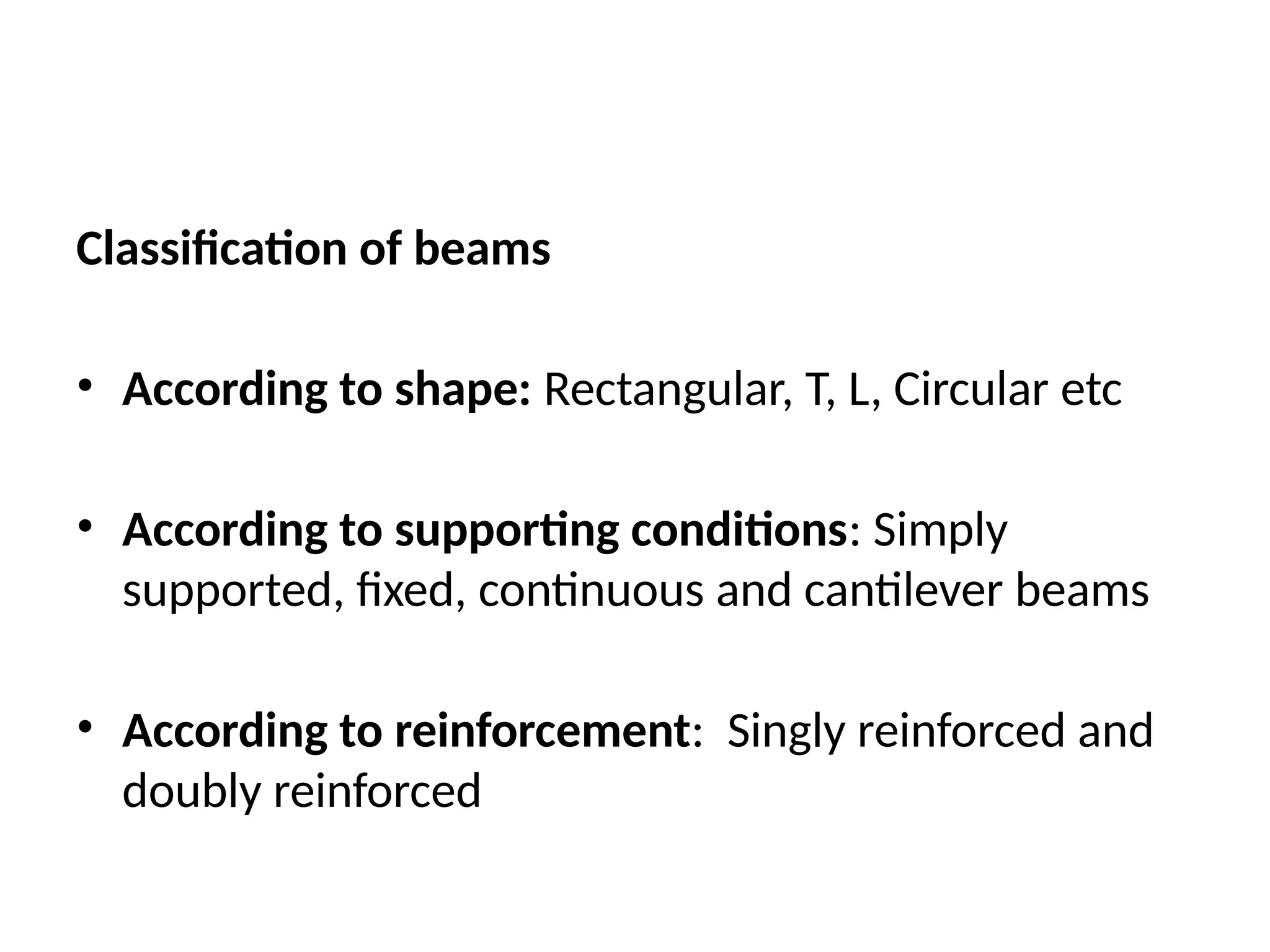
Classification of beams
• According to shape: Rectangular, T, L, Circular etc
• According to supporting conditions: Simply
supported, fixed, continuous and cantilever beams
• According to reinforcement: Singly reinforced and
doubly reinforced
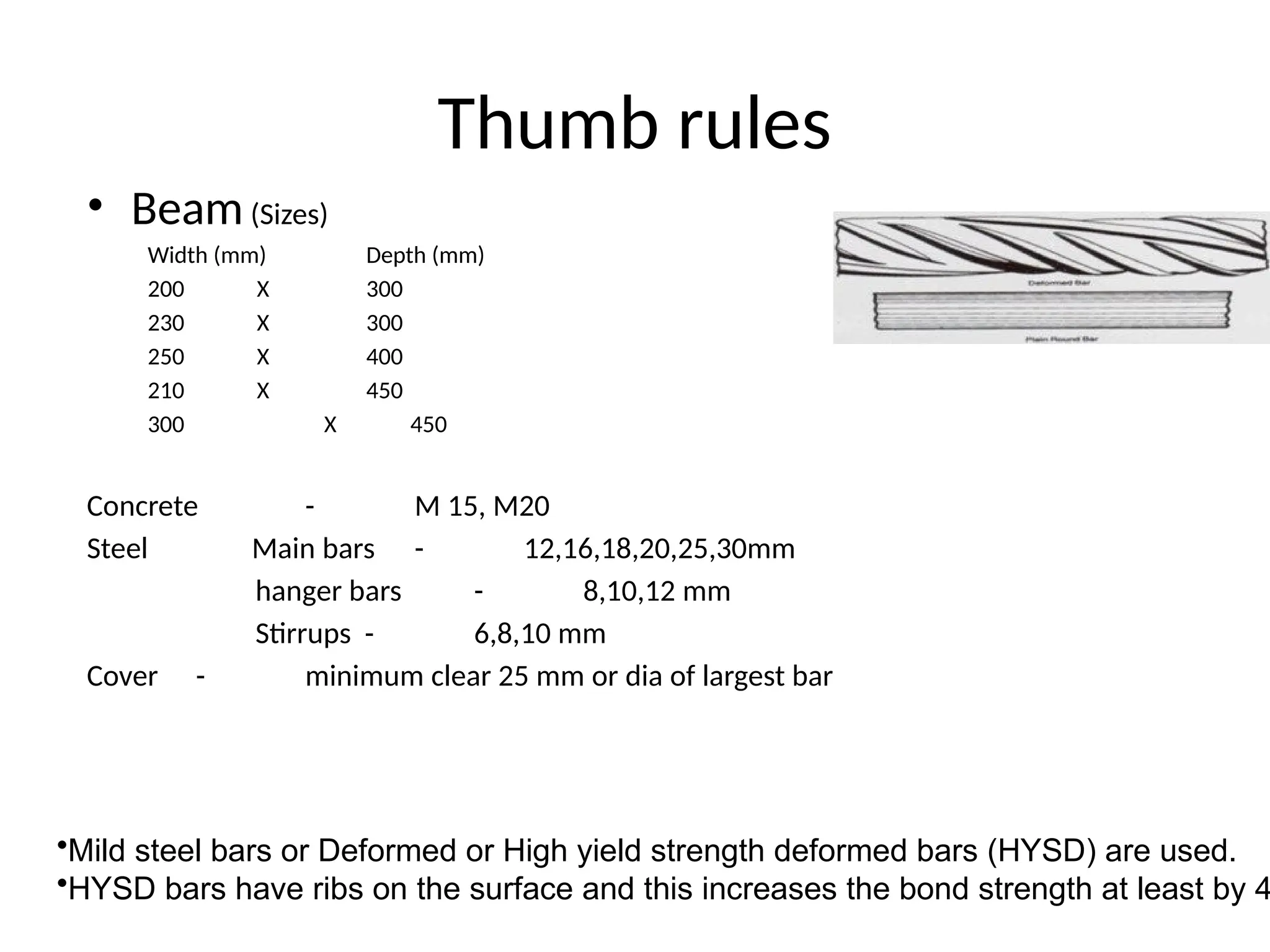
Thumb rules
• Beam(Sizes)
Width (mm) Depth (mm)
200 X 300
230 X 300
250 X 400
210 X 450
300 X 450
Concrete - M 15, M20
Steel Main bars - 12,16,18,20,25,30mm
hanger bars - 8,10,12 mm
Stirrups - 6,8,10 mm
Cover - minimum clear 25 mm or dia of largest bar
•Mild steel bars or Deformed or High yield strength deformed bars (HYSD) are used.
•HYSD bars have ribs on the surface and this increases the bond strength at least by 4
Beam
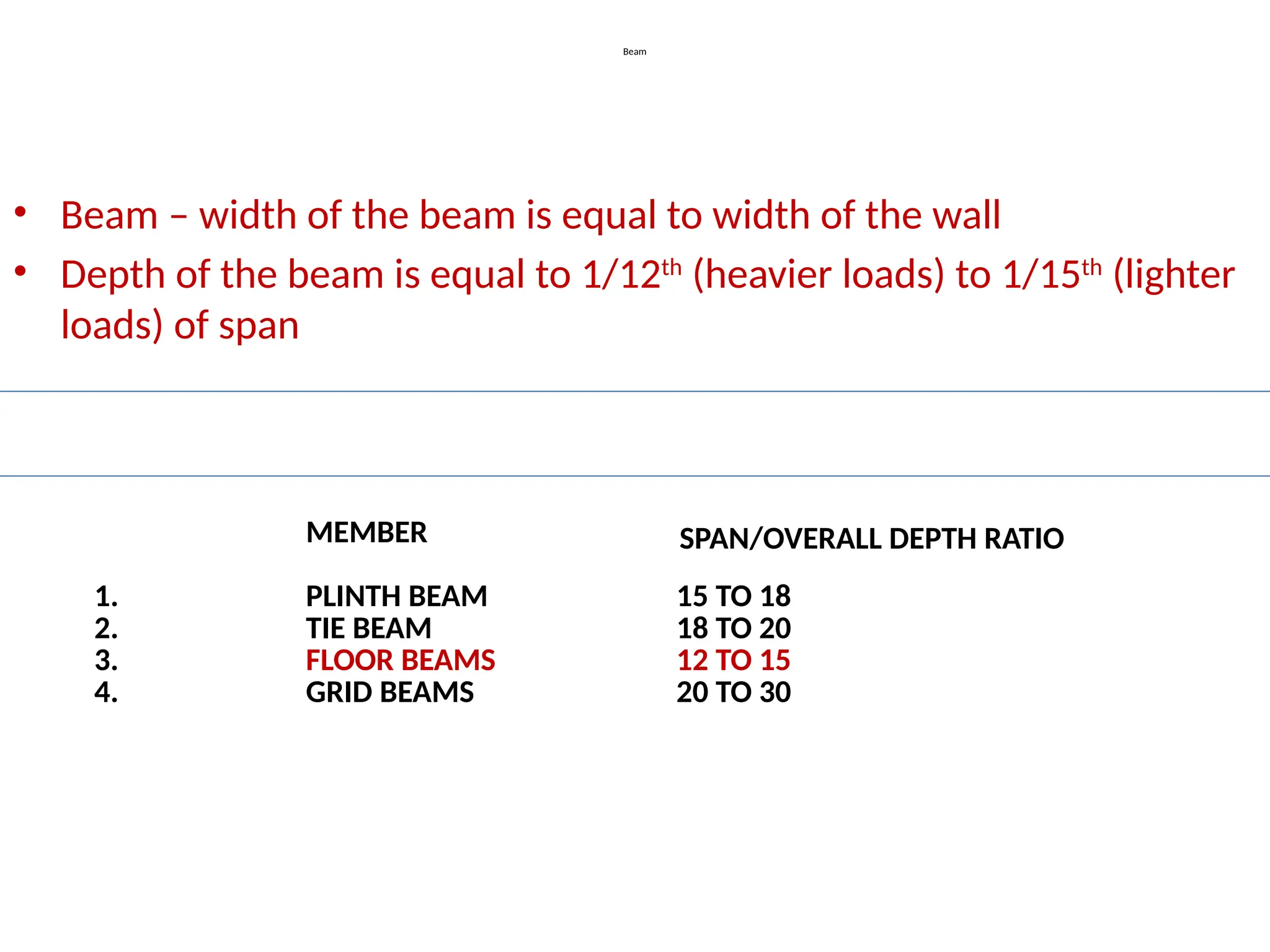
• Beam – width of the beam is equal to width of the wall
• Depth of the beam is equal to 1/12th
(heavier loads) to 1/15th
(lighter
loads) of span
MEMBER SPAN/OVERALL DEPTH RATIO
1. PLINTH BEAM 15 TO 18
2. TIE BEAM 18 TO 20
3. FLOOR BEAMS 12 TO 15
4. GRID BEAMS 20 TO 30
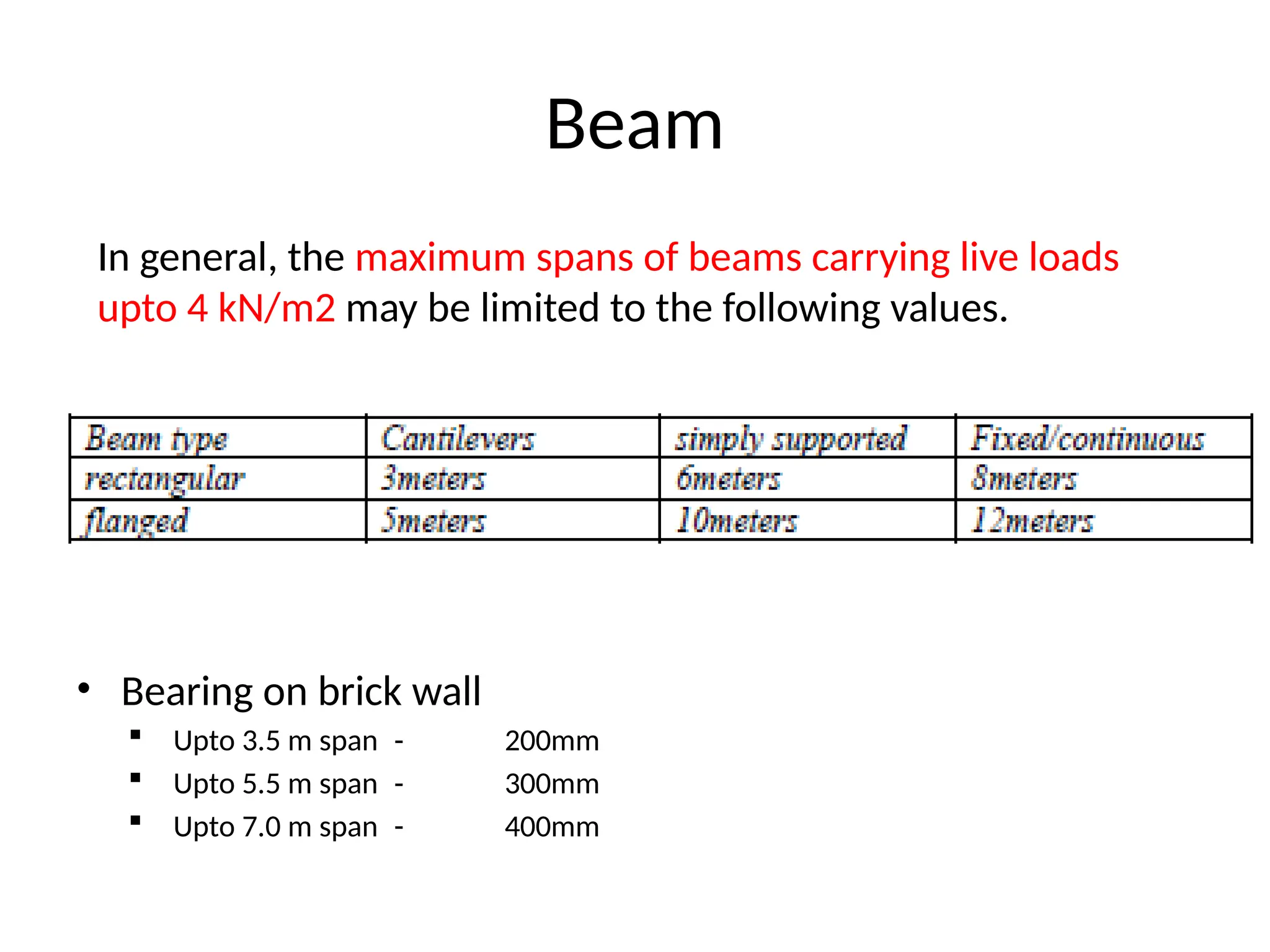
Beam
• Bearing on brick wall
 Upto 3.5 m span - 200mm
 Upto 5.5 m span - 300mm
 Upto 7.0 m span - 400mm
In general, the maximum spans of beams carrying live loads
upto 4 kN/m2 may be limited to the following values.
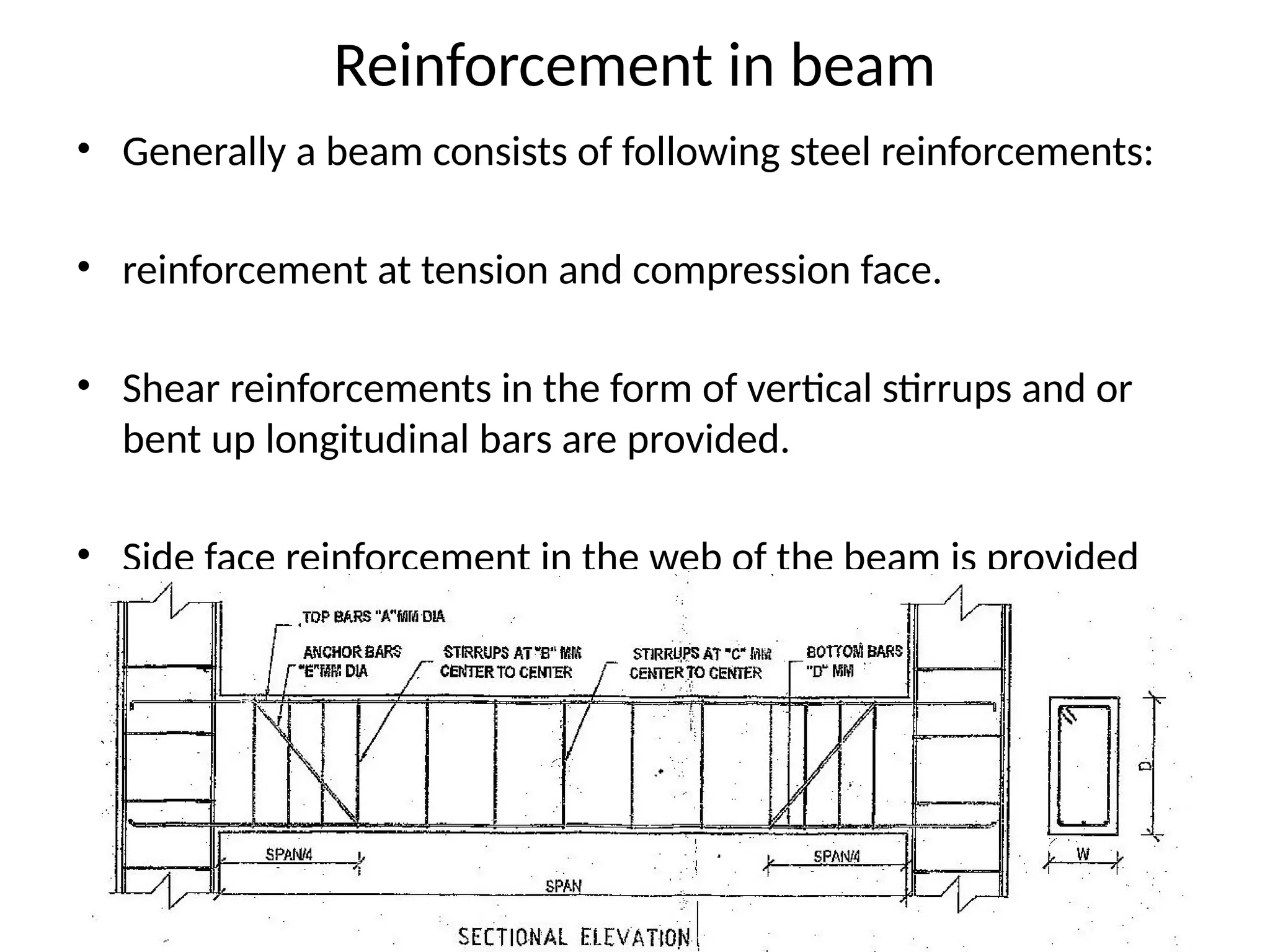
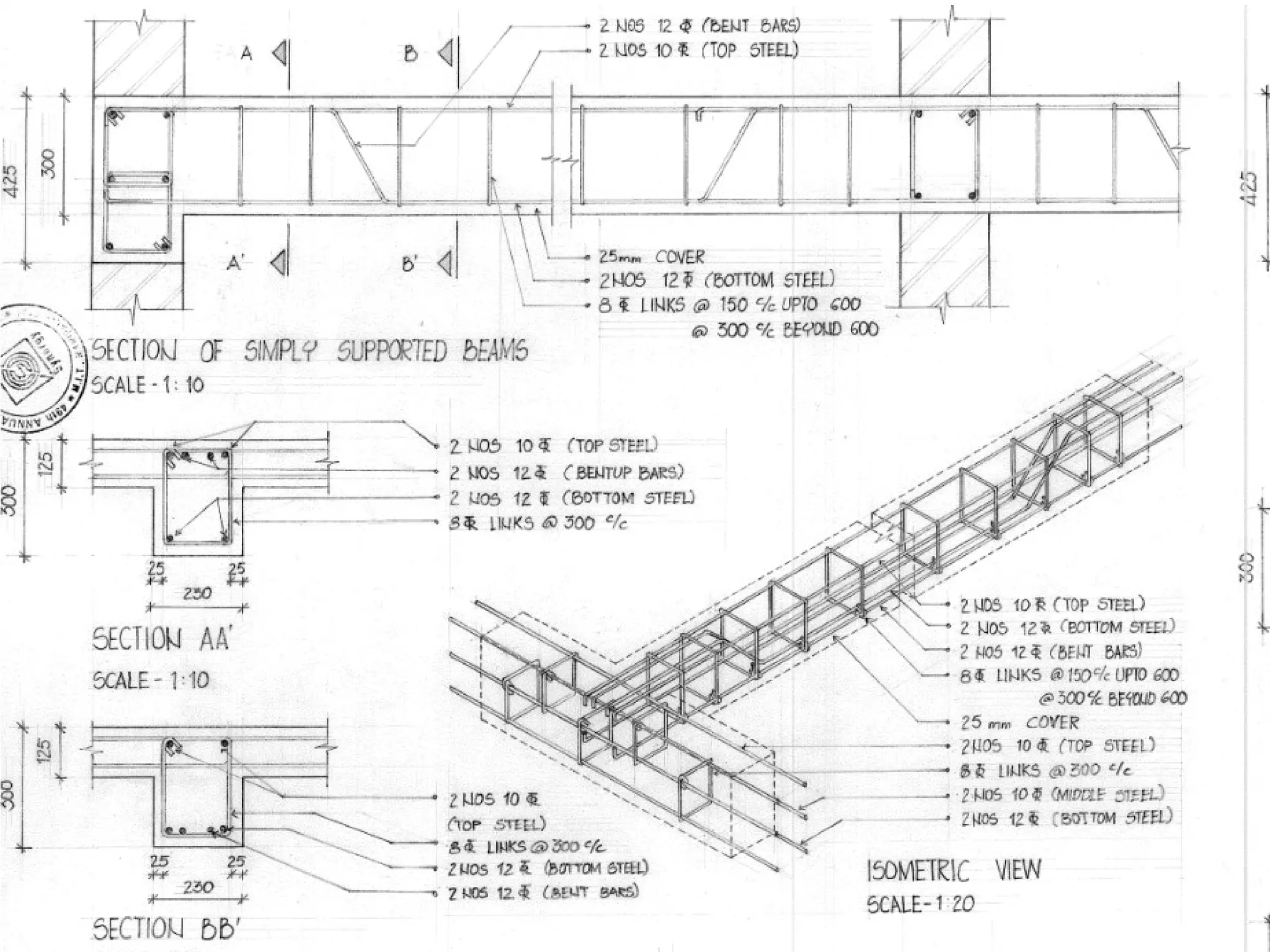
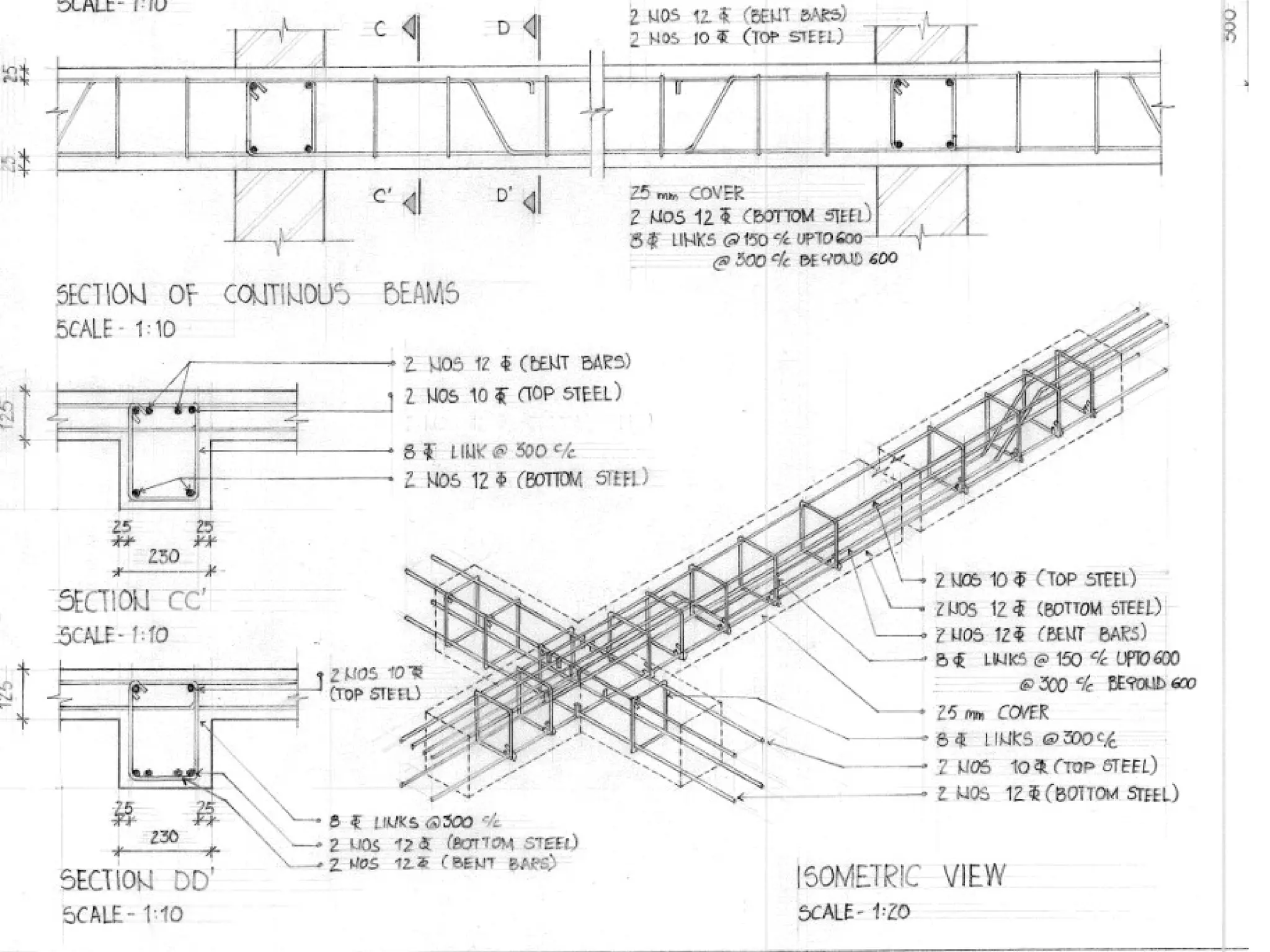
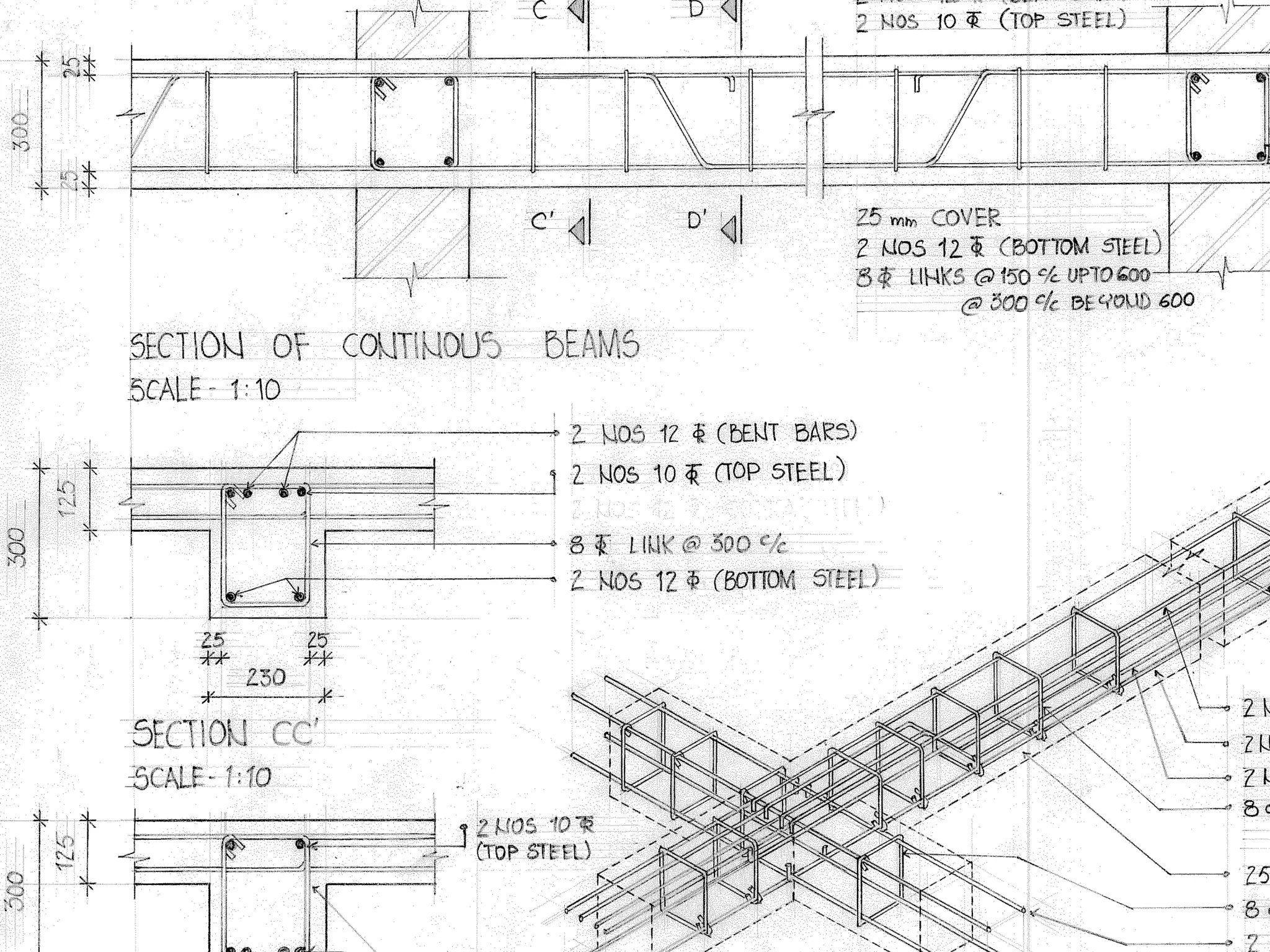
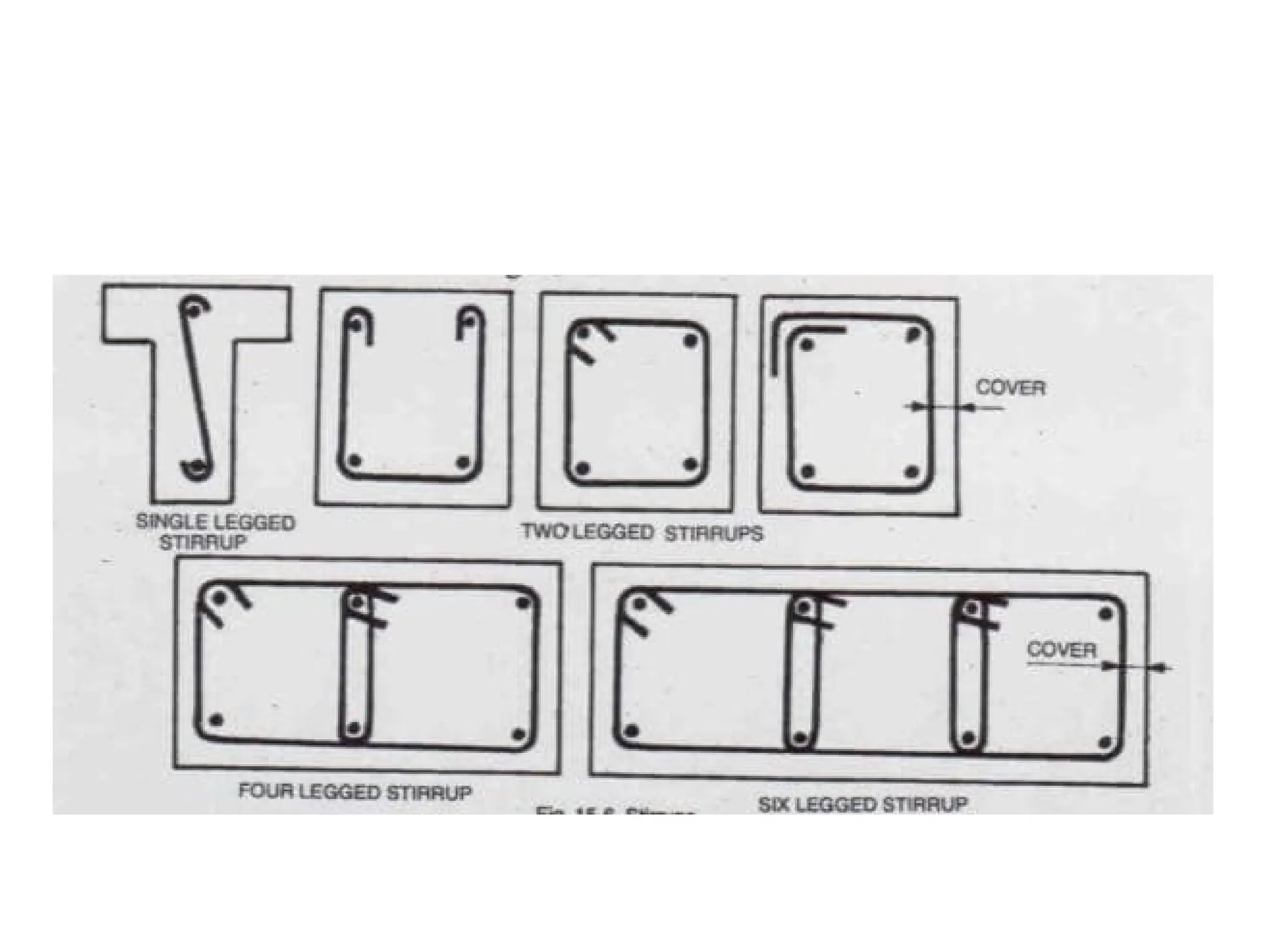
• Generally a beam consists of following steel reinforcements:
• reinforcement at tension and compression face.
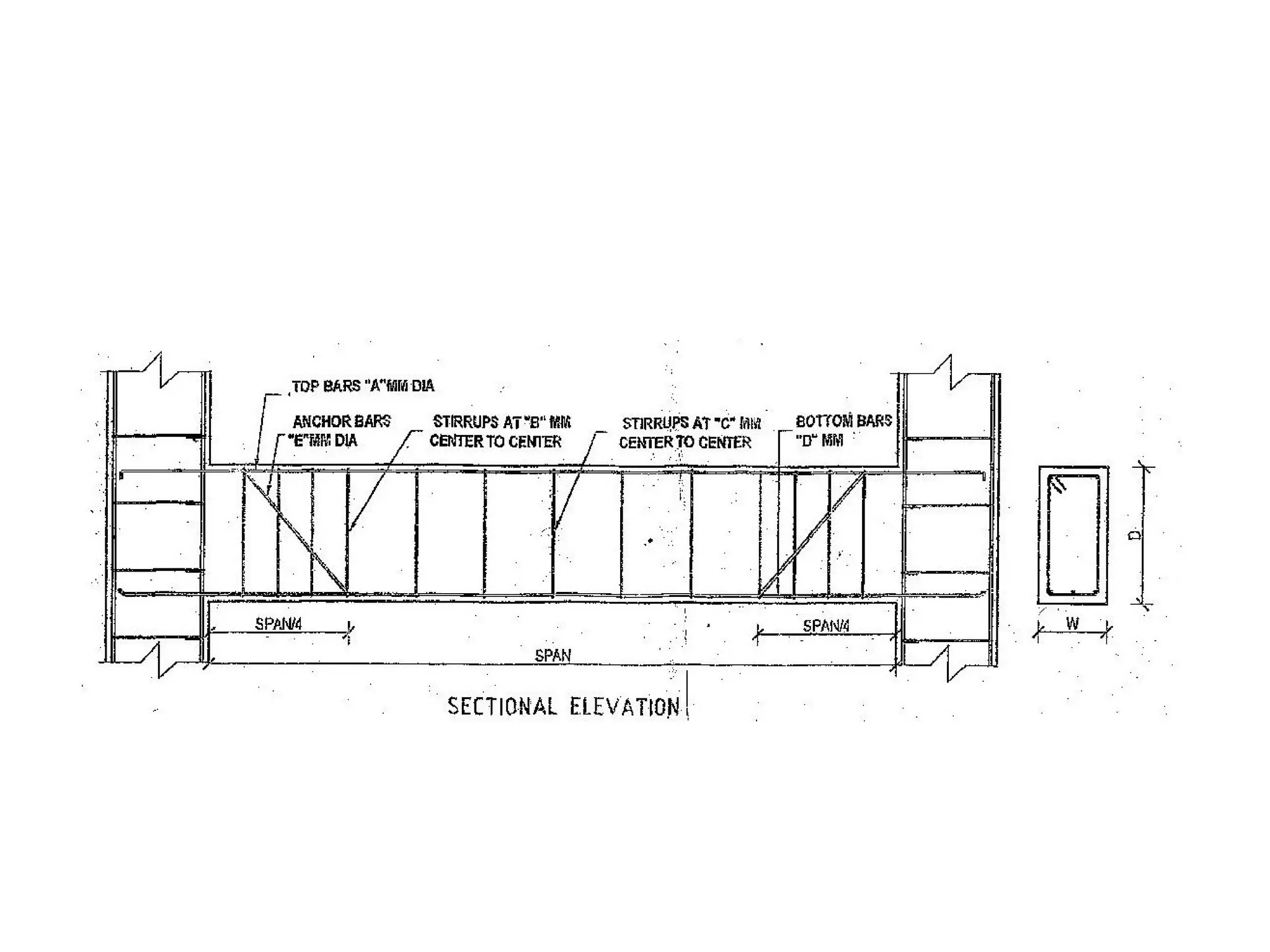
• Shear reinforcements in the form of vertical stirrups and or
bent up longitudinal bars are provided.
• Side face reinforcement in the web of the beam is provided
when the depth of the web in a beam exceeds 750 mm.
Reinforcement in beam
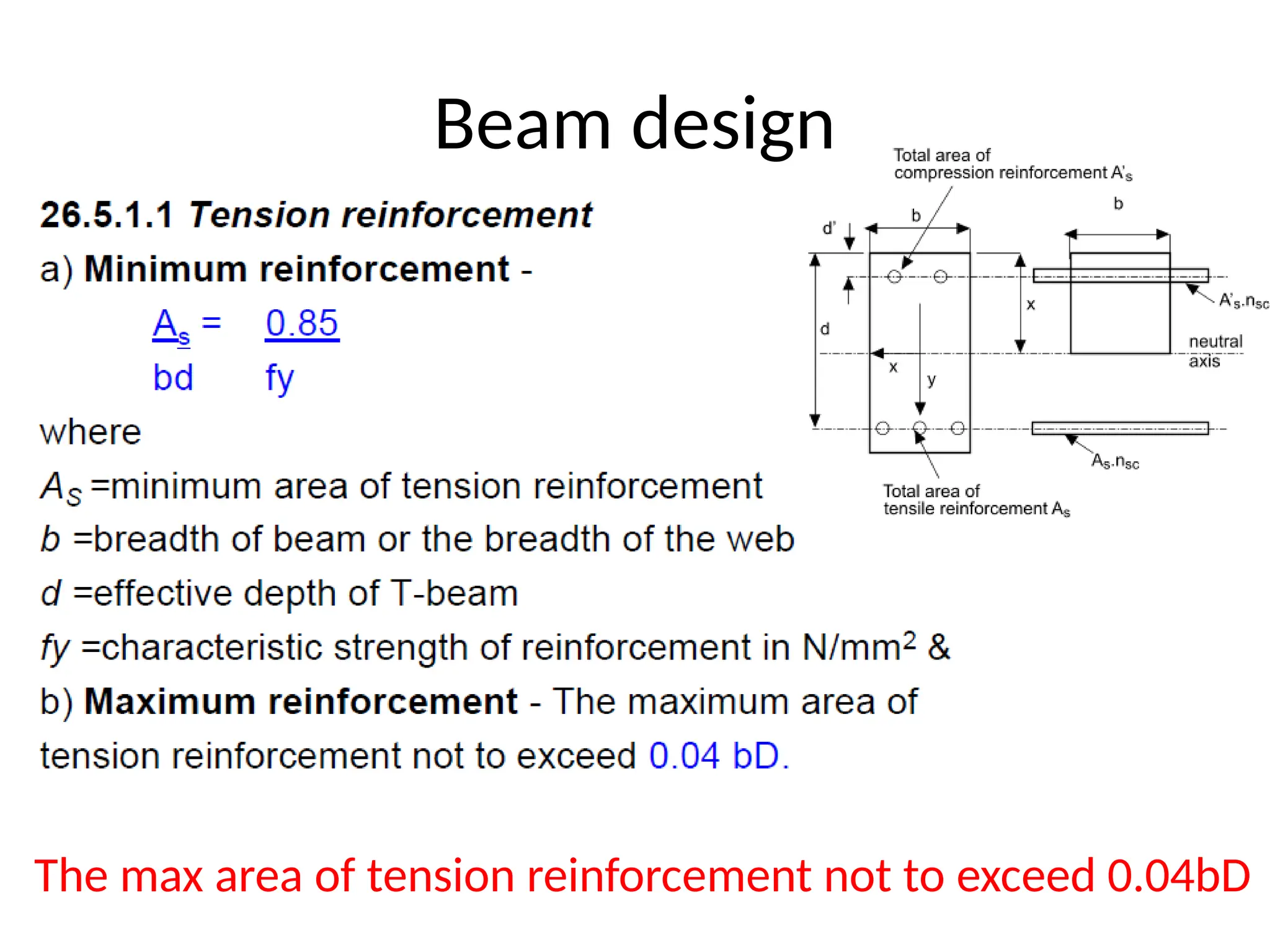
Beam design
The max area of tension reinforcement not to exceed 0.04bD
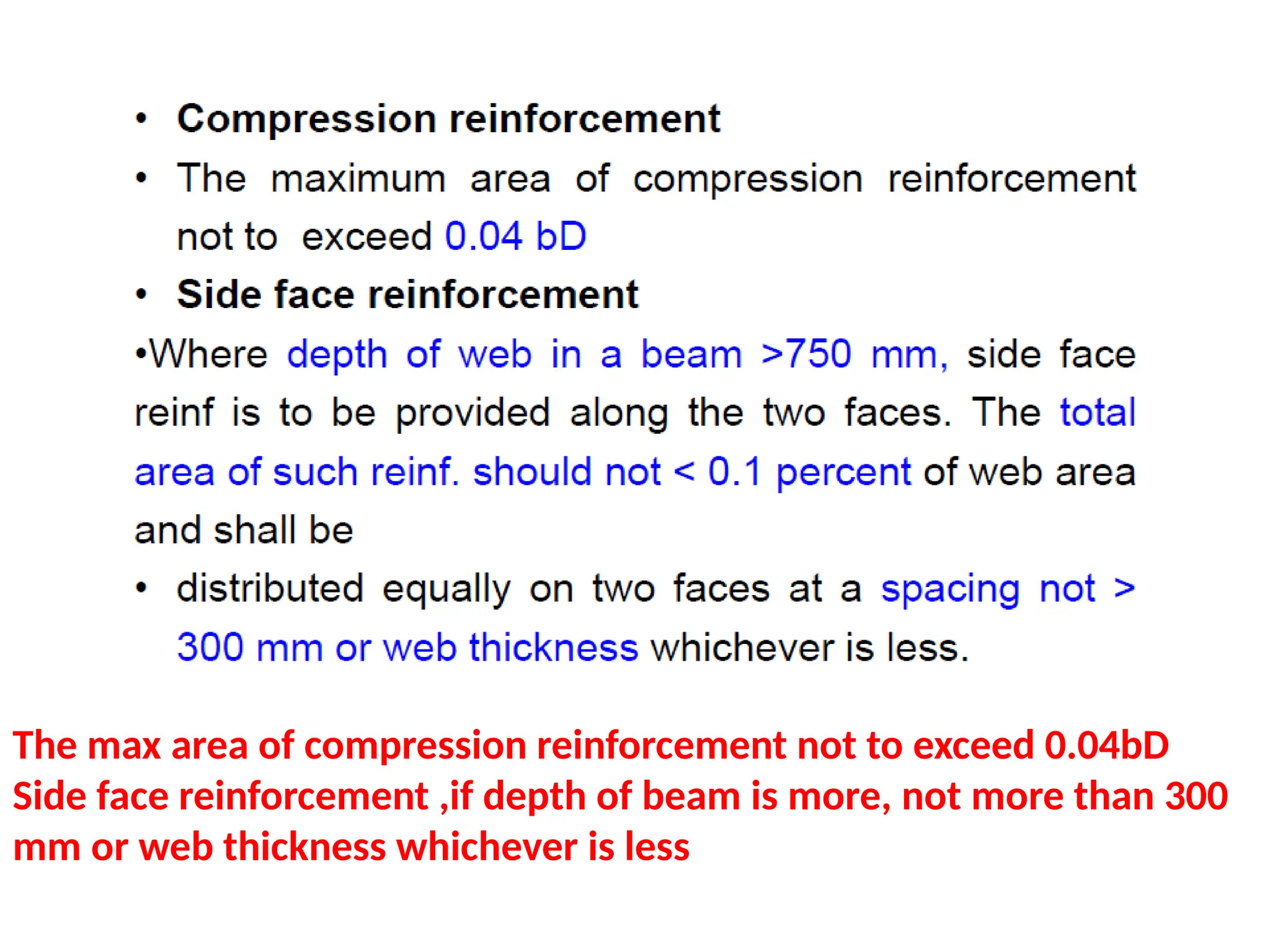
The max area of compression reinforcement not to exceed 0.04bD
Side face reinforcement ,if depth of beam is more, not more than 300
mm or web thickness whichever is less
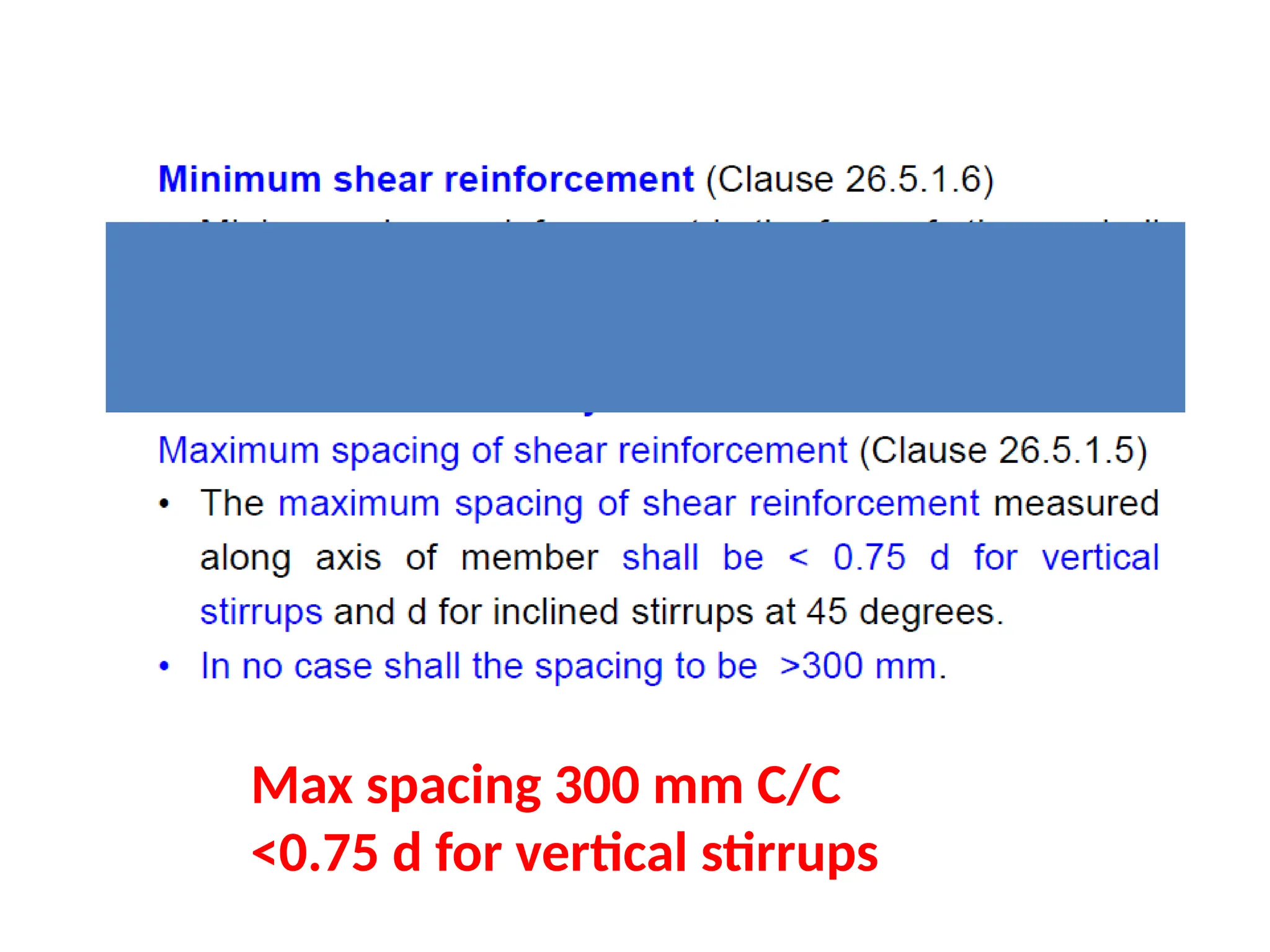
Max spacing 300 mm C/C
<0.75 d for vertical stirrups
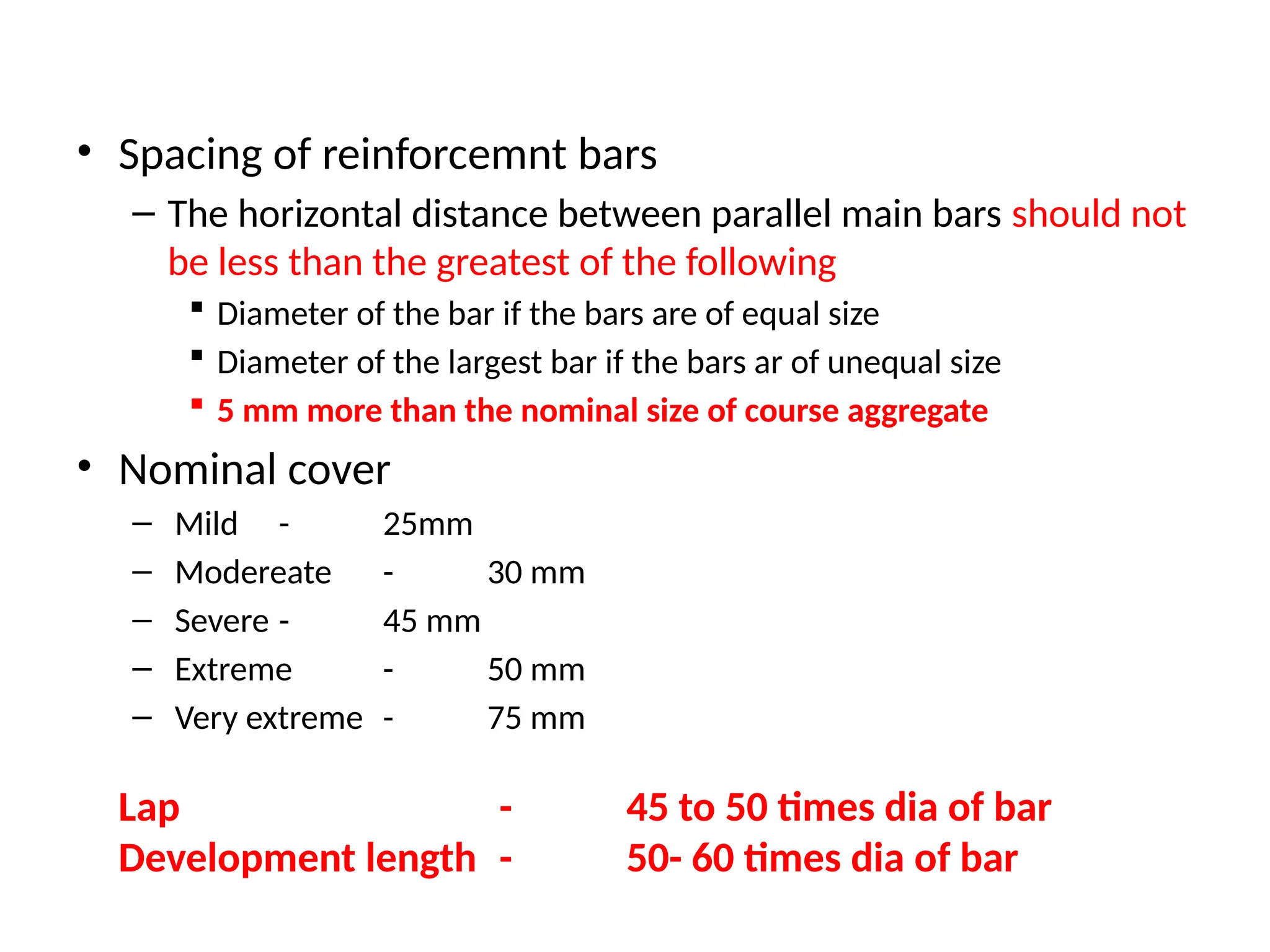
• Spacing of reinforcemnt bars
– The horizontal distance between parallel main bars should not
be less than the greatest of the following
 Diameter of the bar if the bars are of equal size
 Diameter of the largest bar if the bars ar of unequal size
 5 mm more than the nominal size of course aggregate
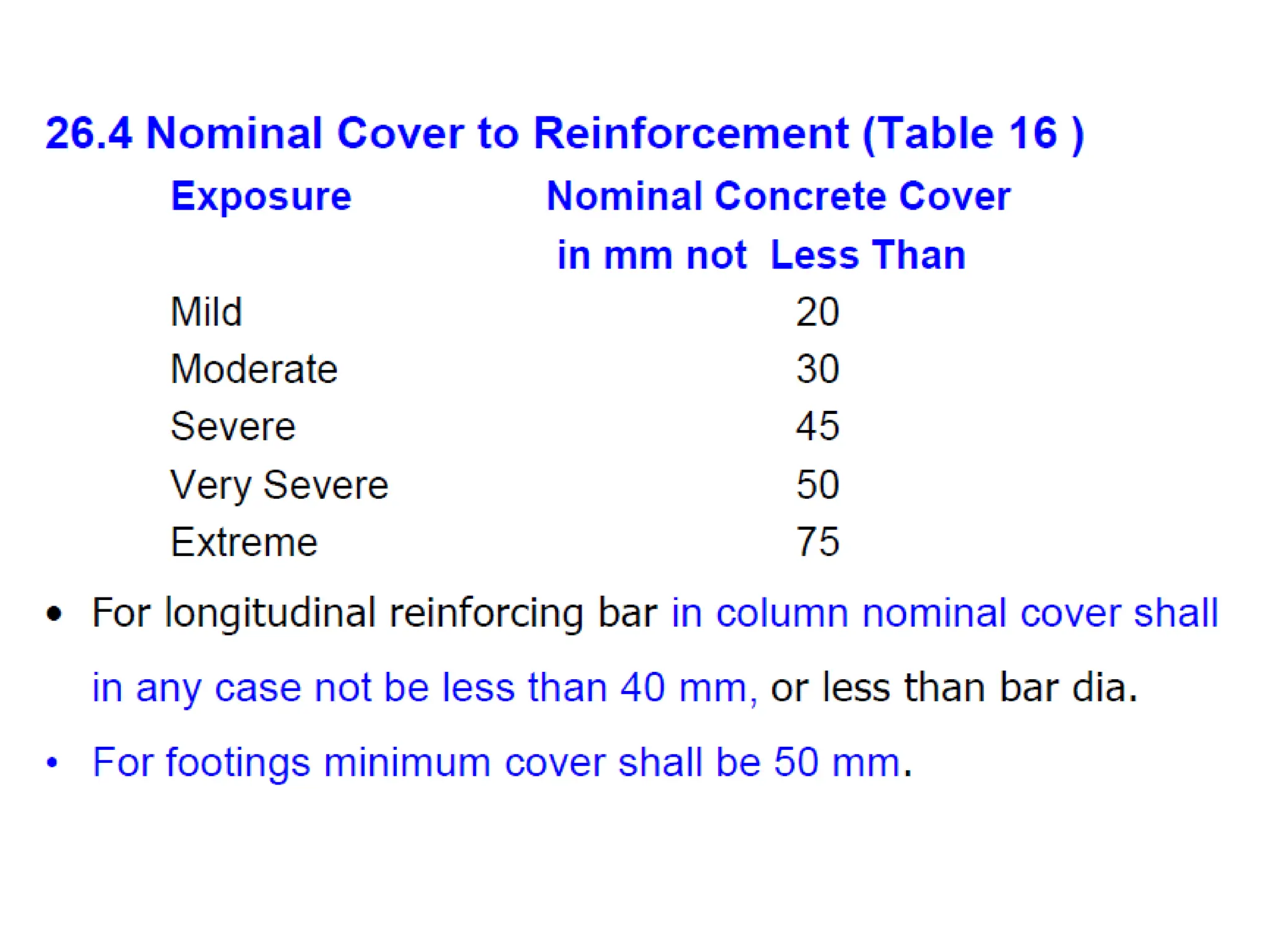
• Nominal cover
– Mild - 25mm
– Modereate - 30 mm
– Severe - 45 mm
– Extreme - 50 mm
– Very extreme - 75 mm
Lap - 45 to 50 times dia of bar
Development length - 50- 60 times dia of bar
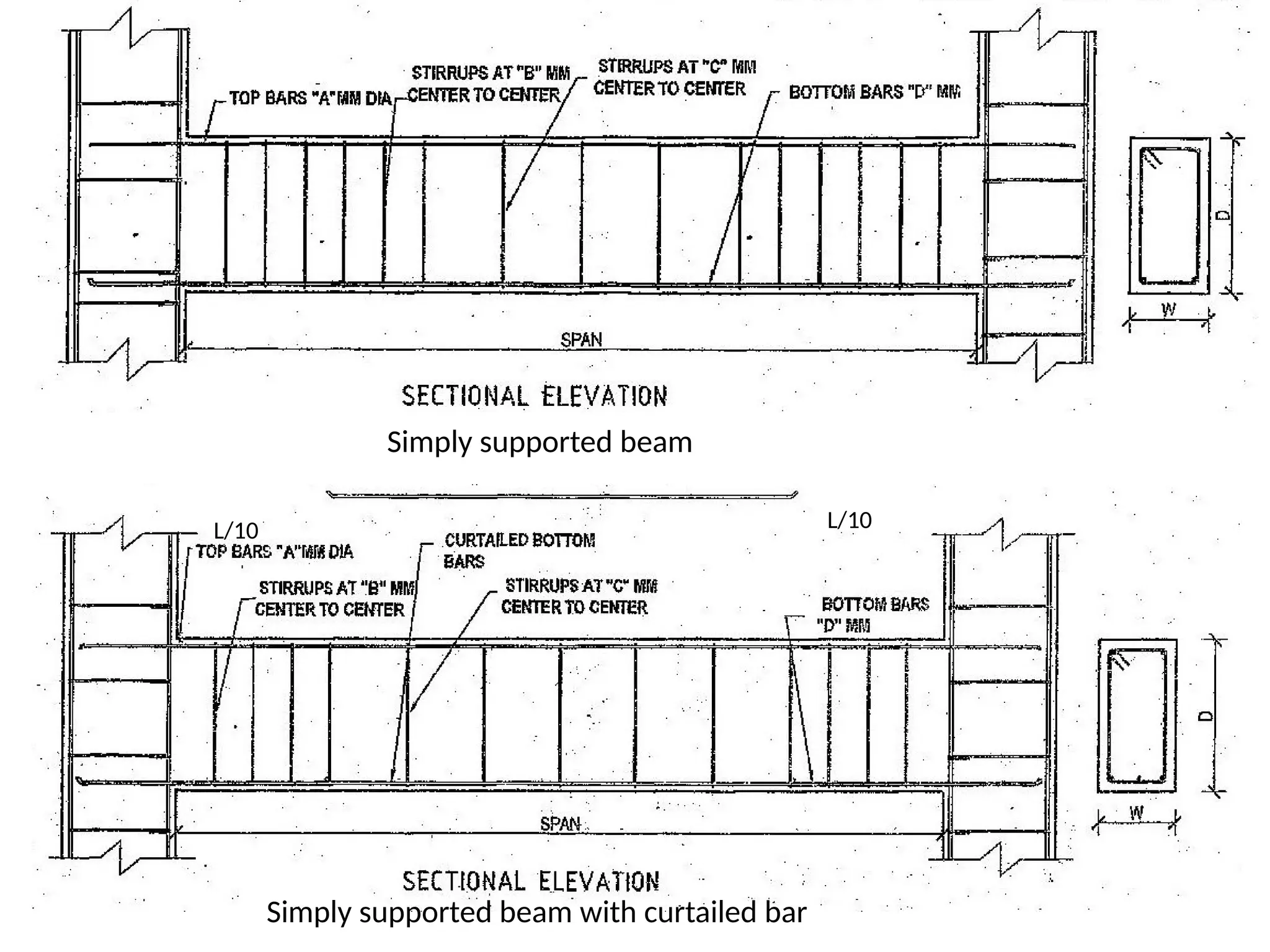
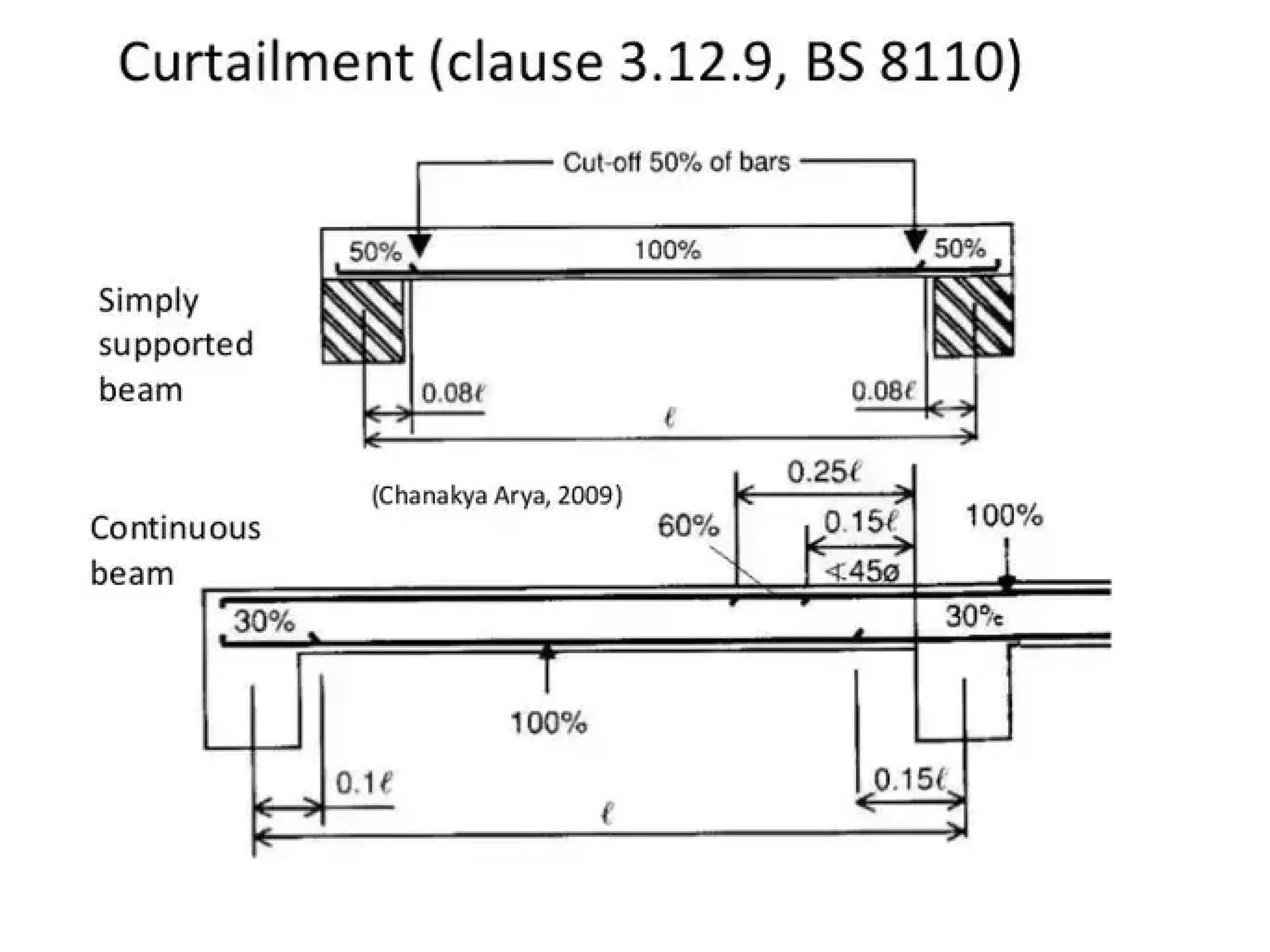
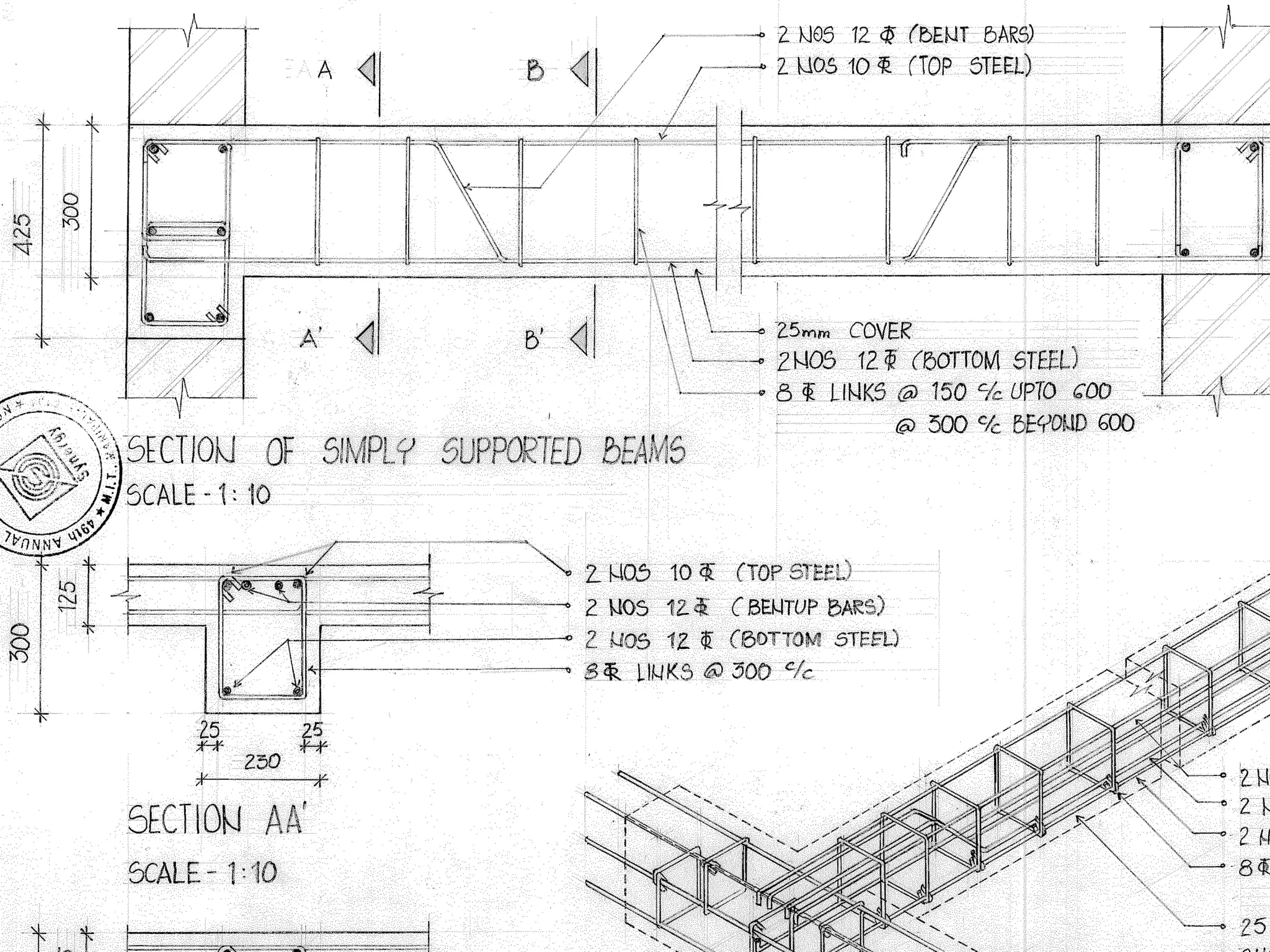
Simply supported beam
Simply supported beam with curtailed bar
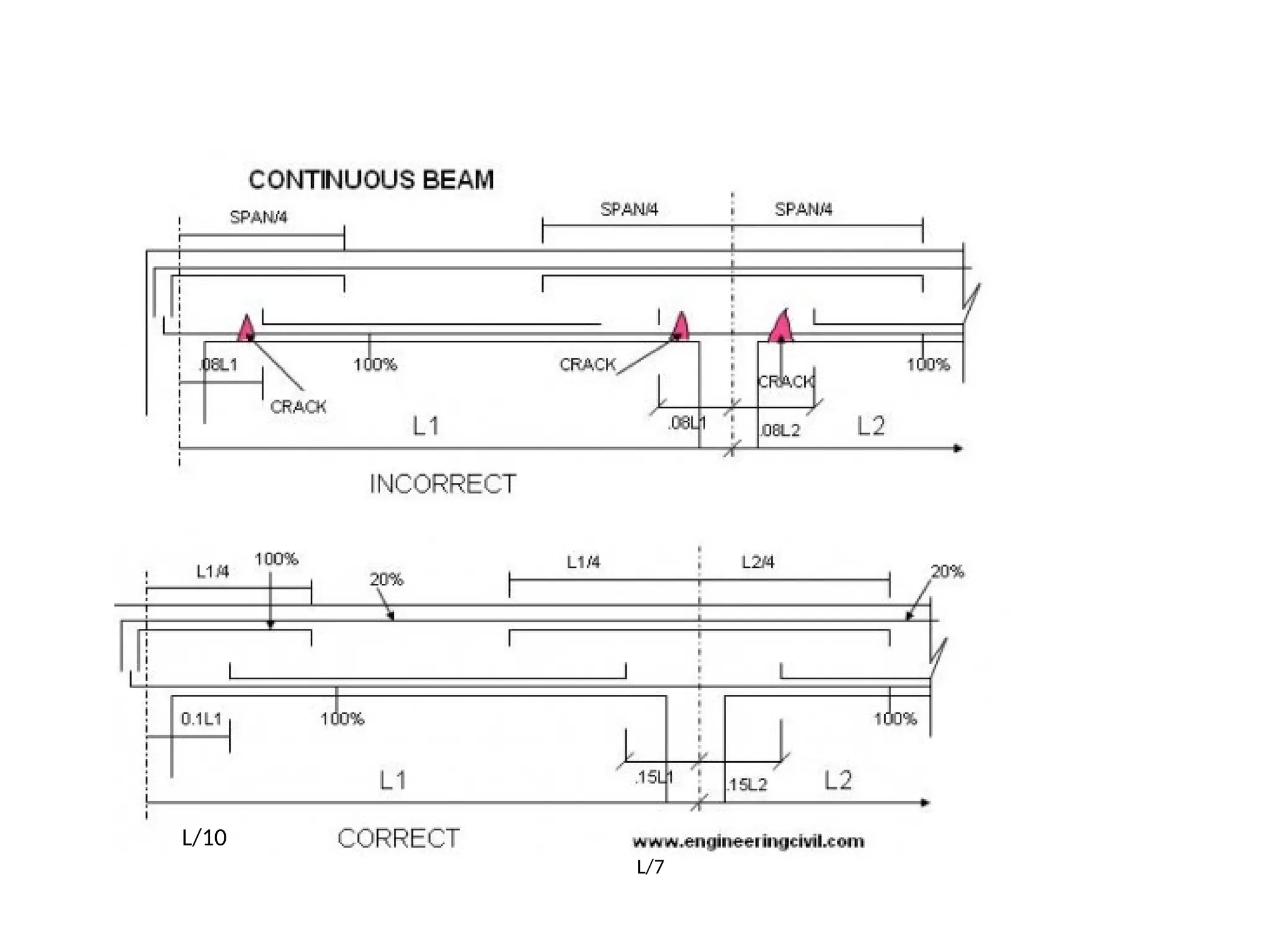
L/10 L/10
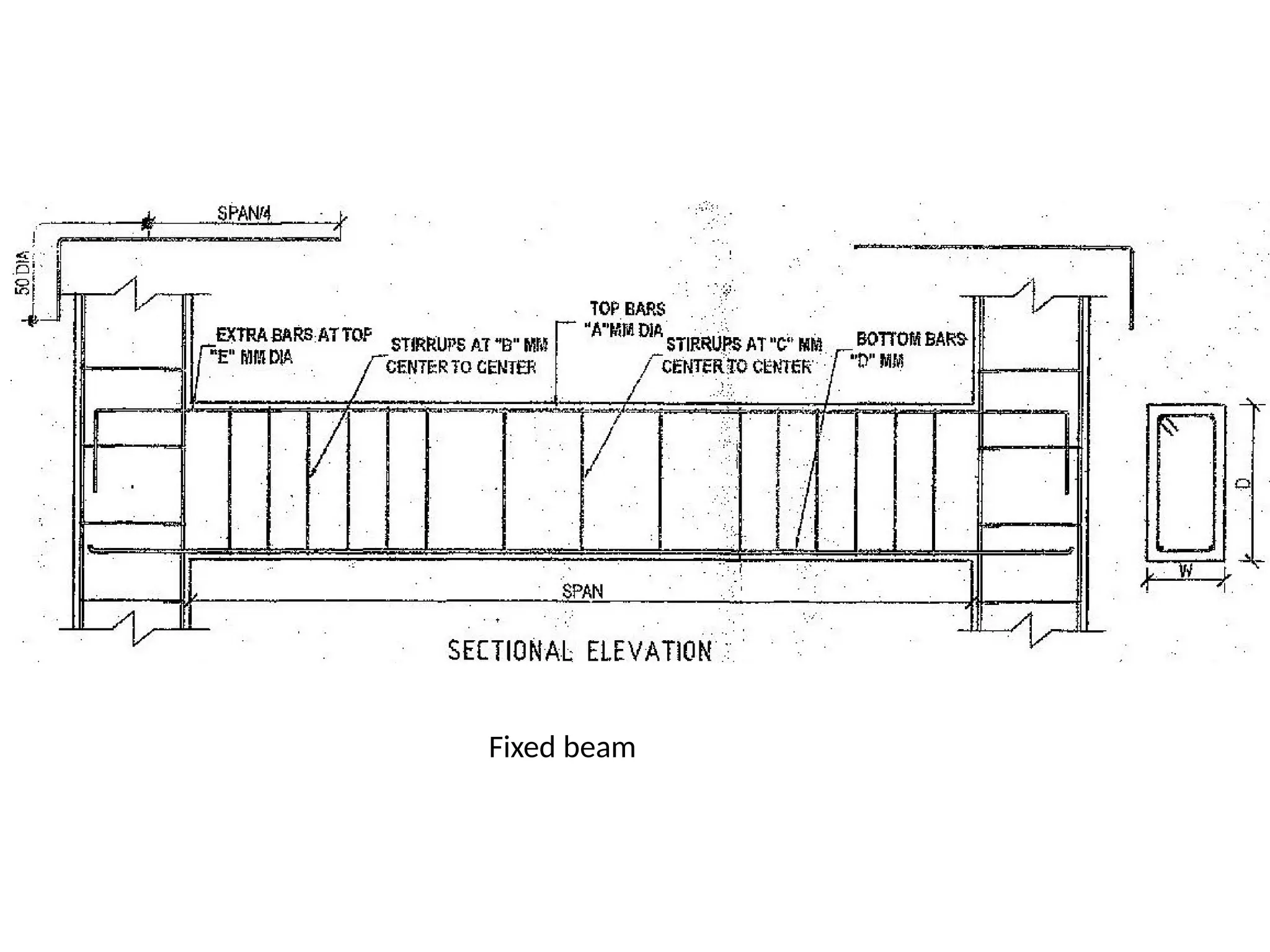
Fixed beam
L/7
L/10
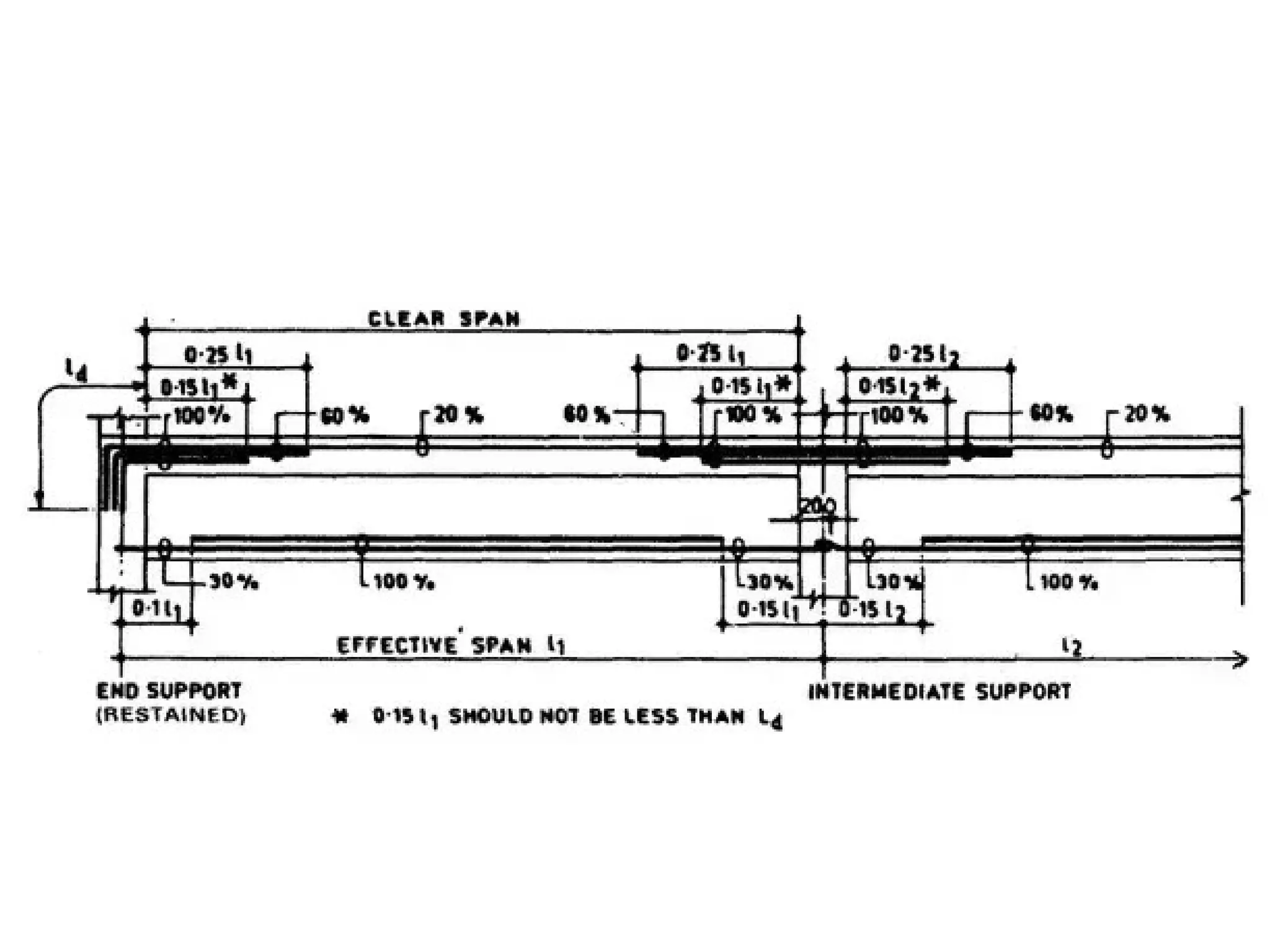
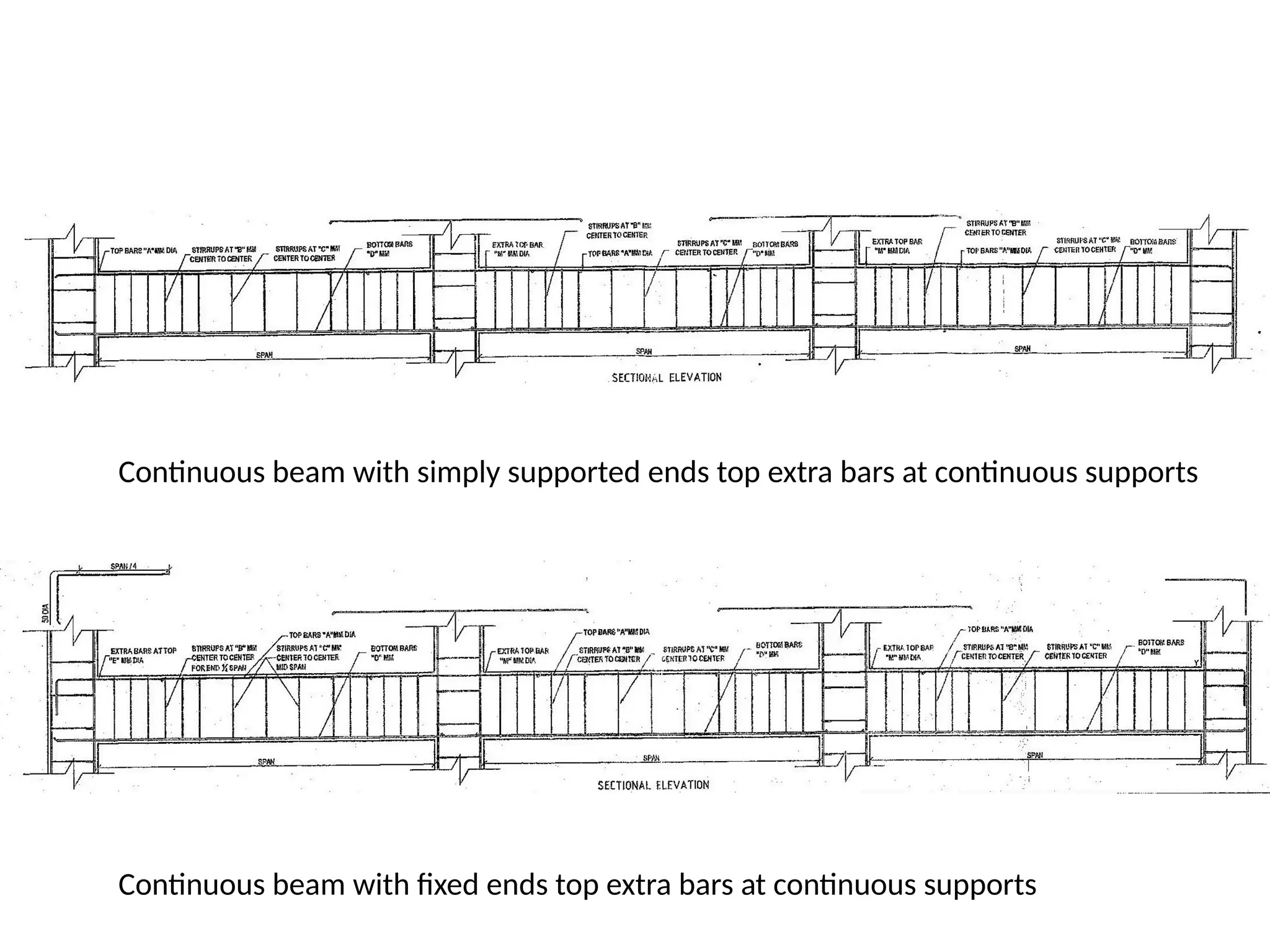
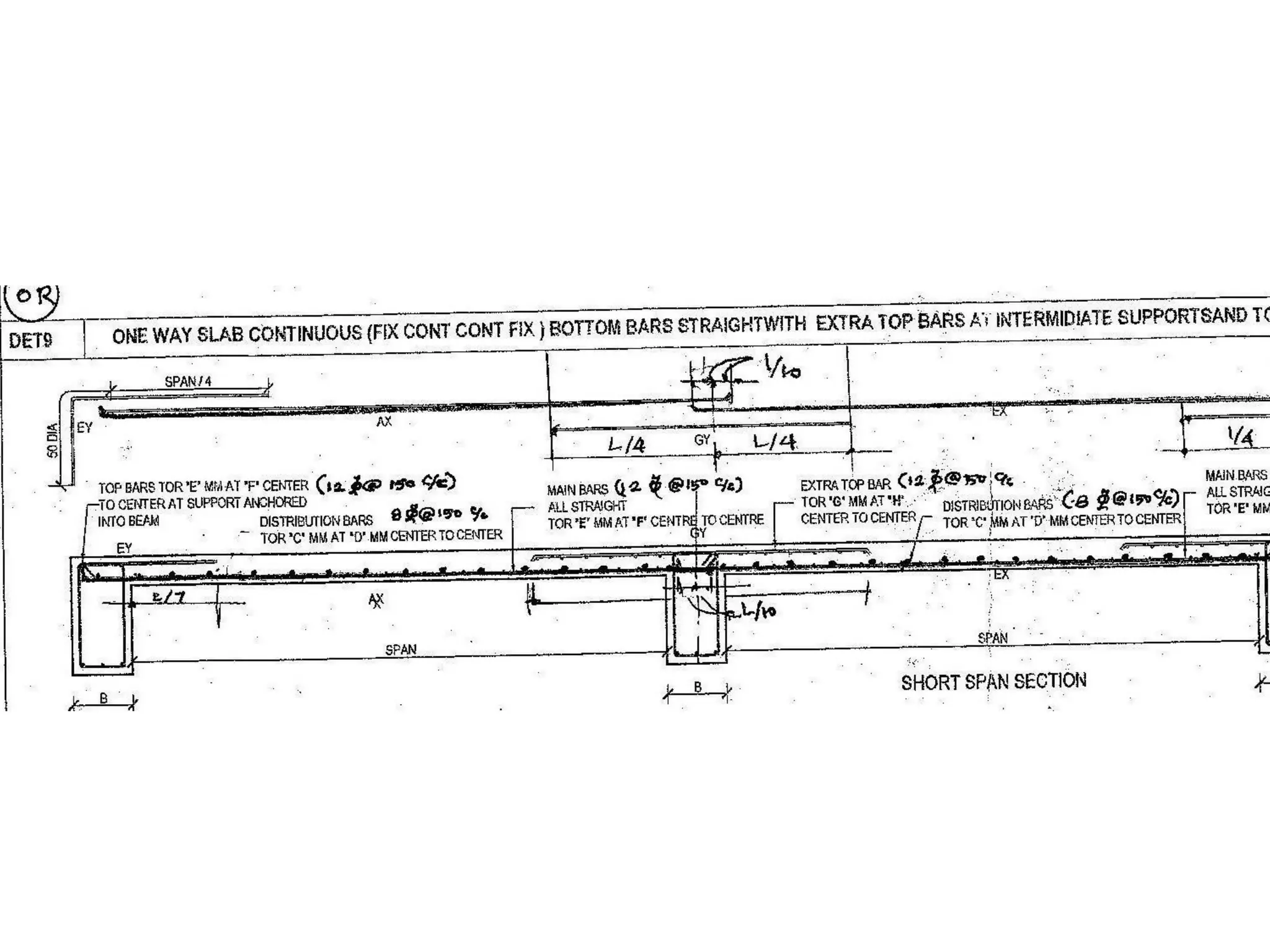
Continuous beam with simply supported ends top extra bars at continuous supports
Continuous beam with fixed ends top extra bars at continuous supports
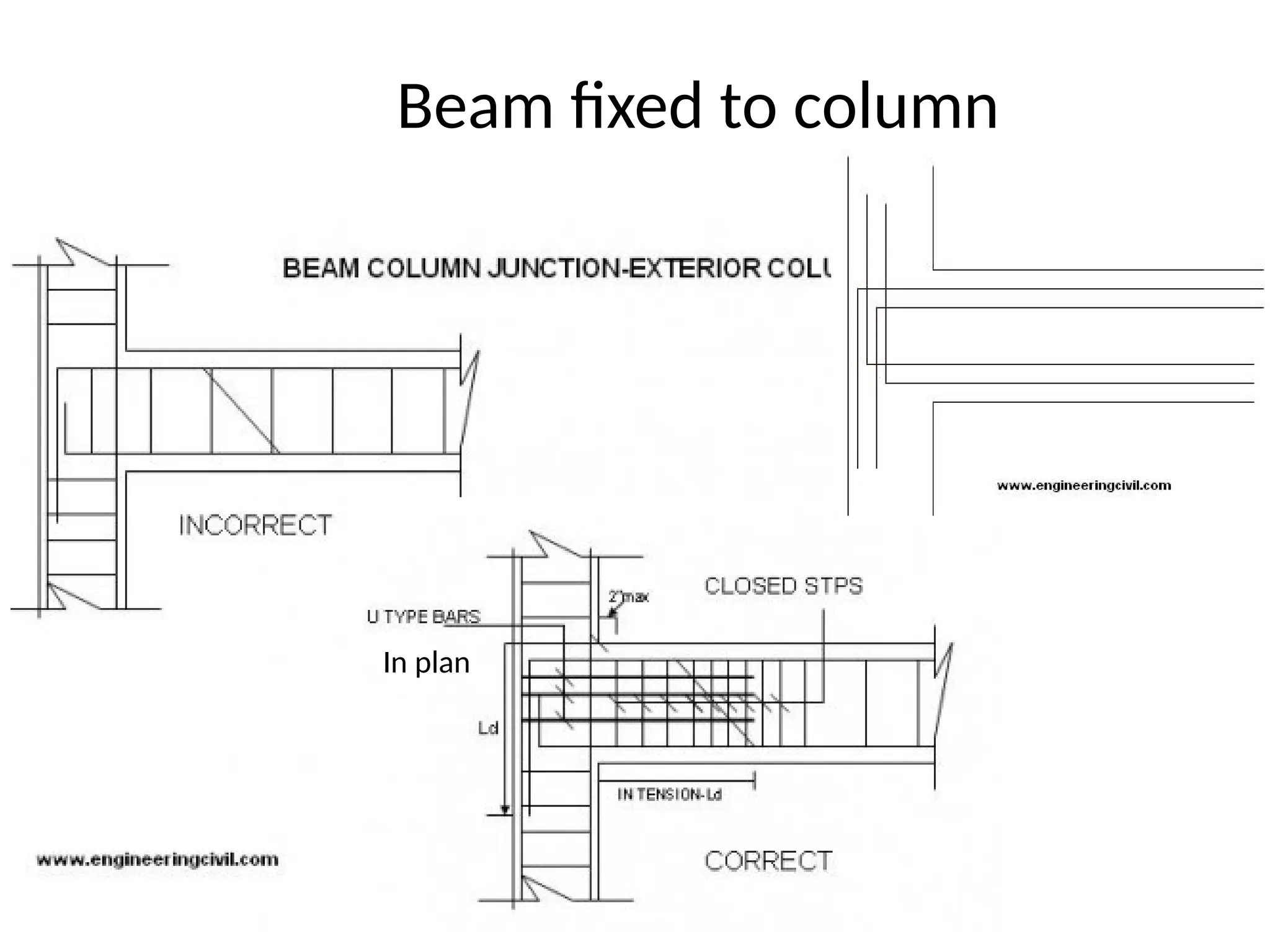
Beam fixed to column
In plan
SLABS
Terminology
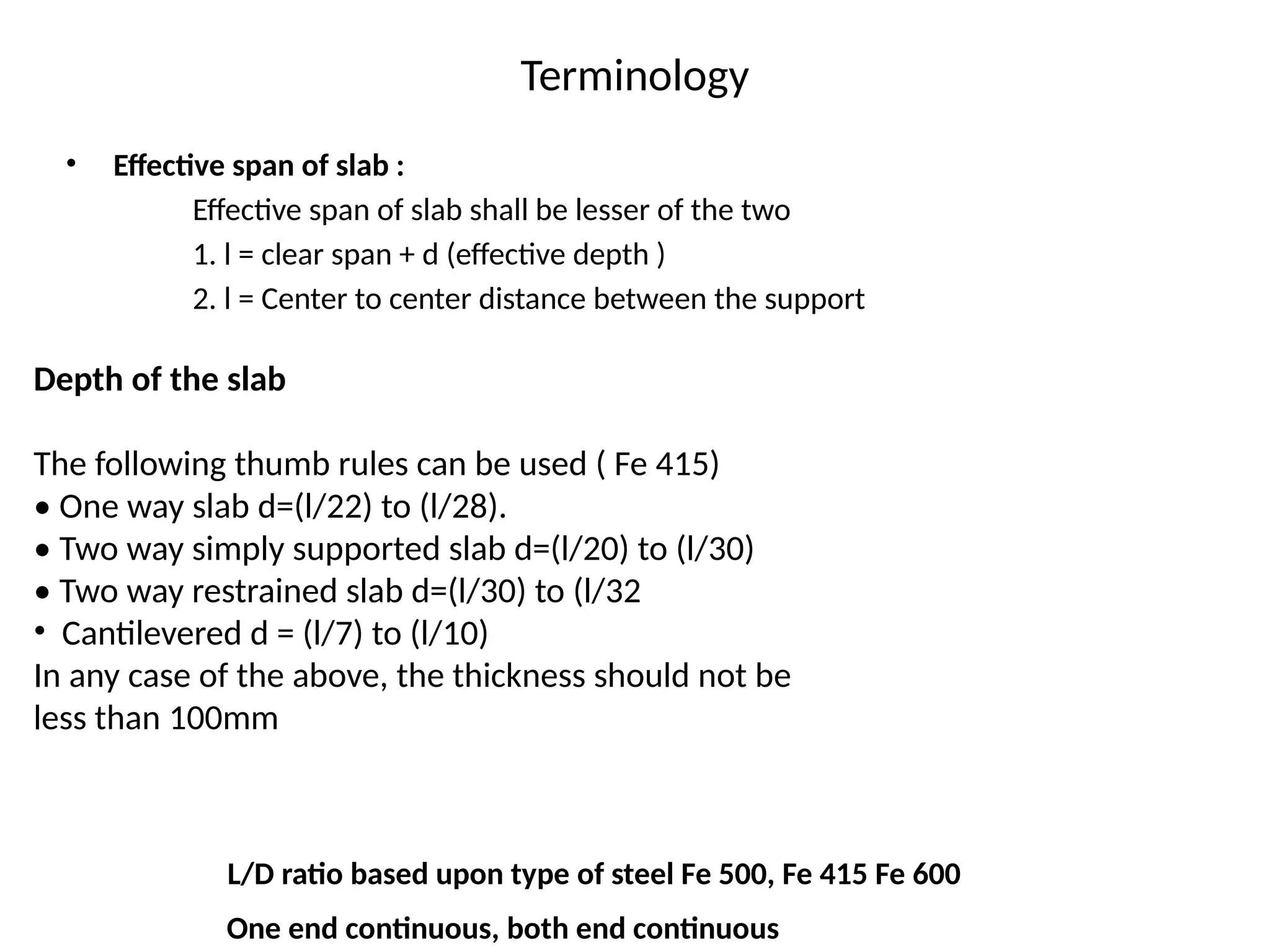
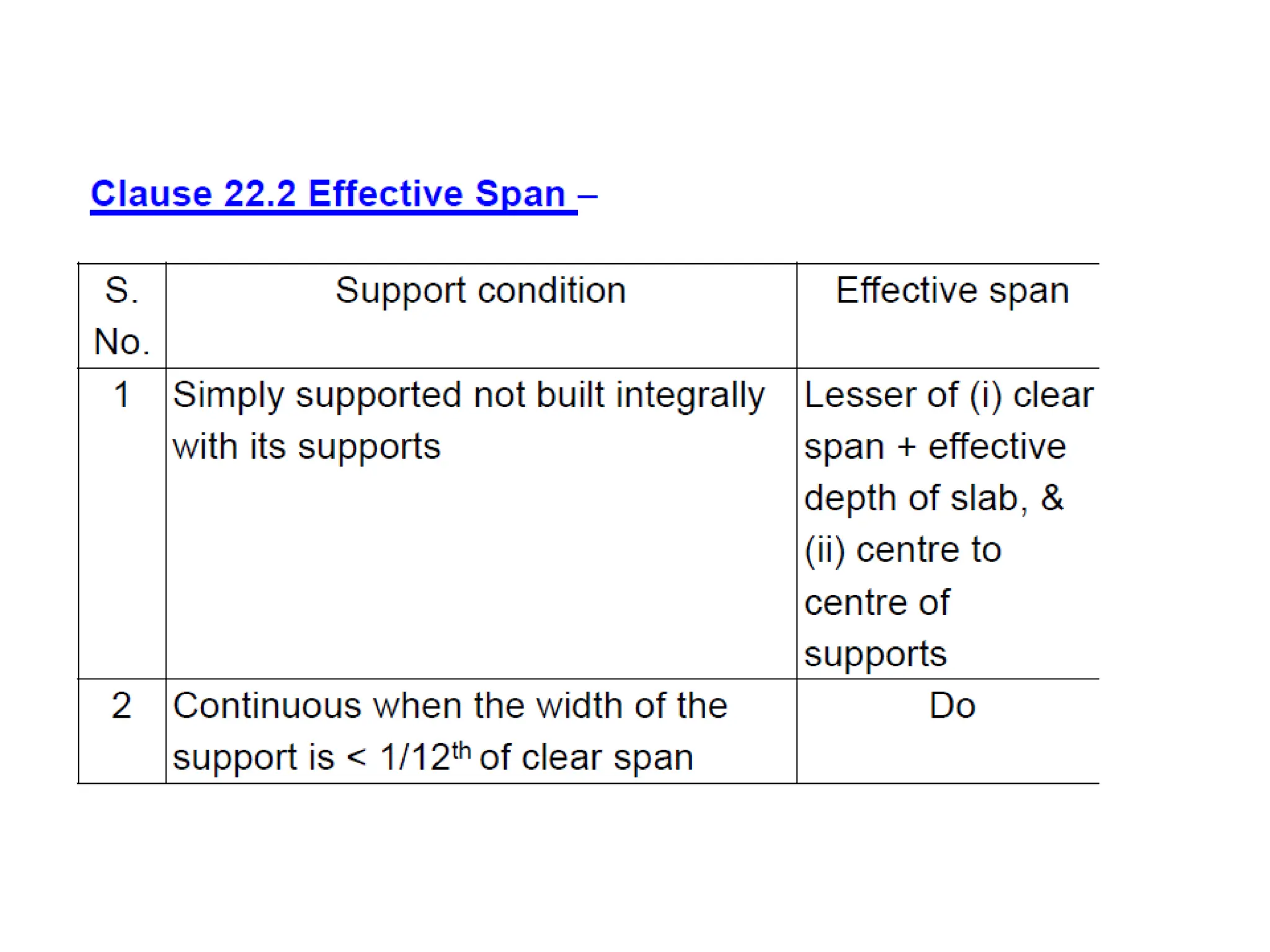
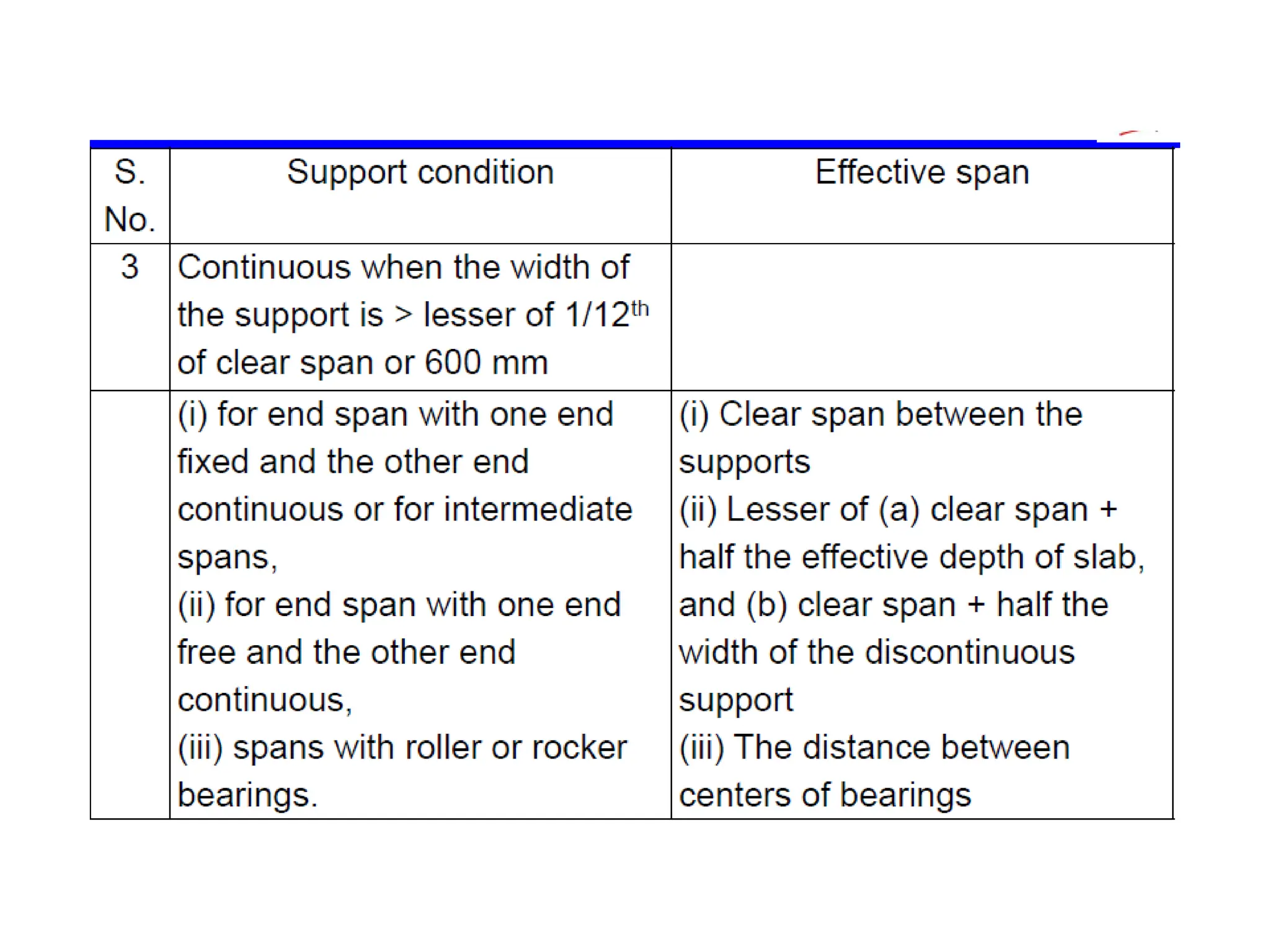
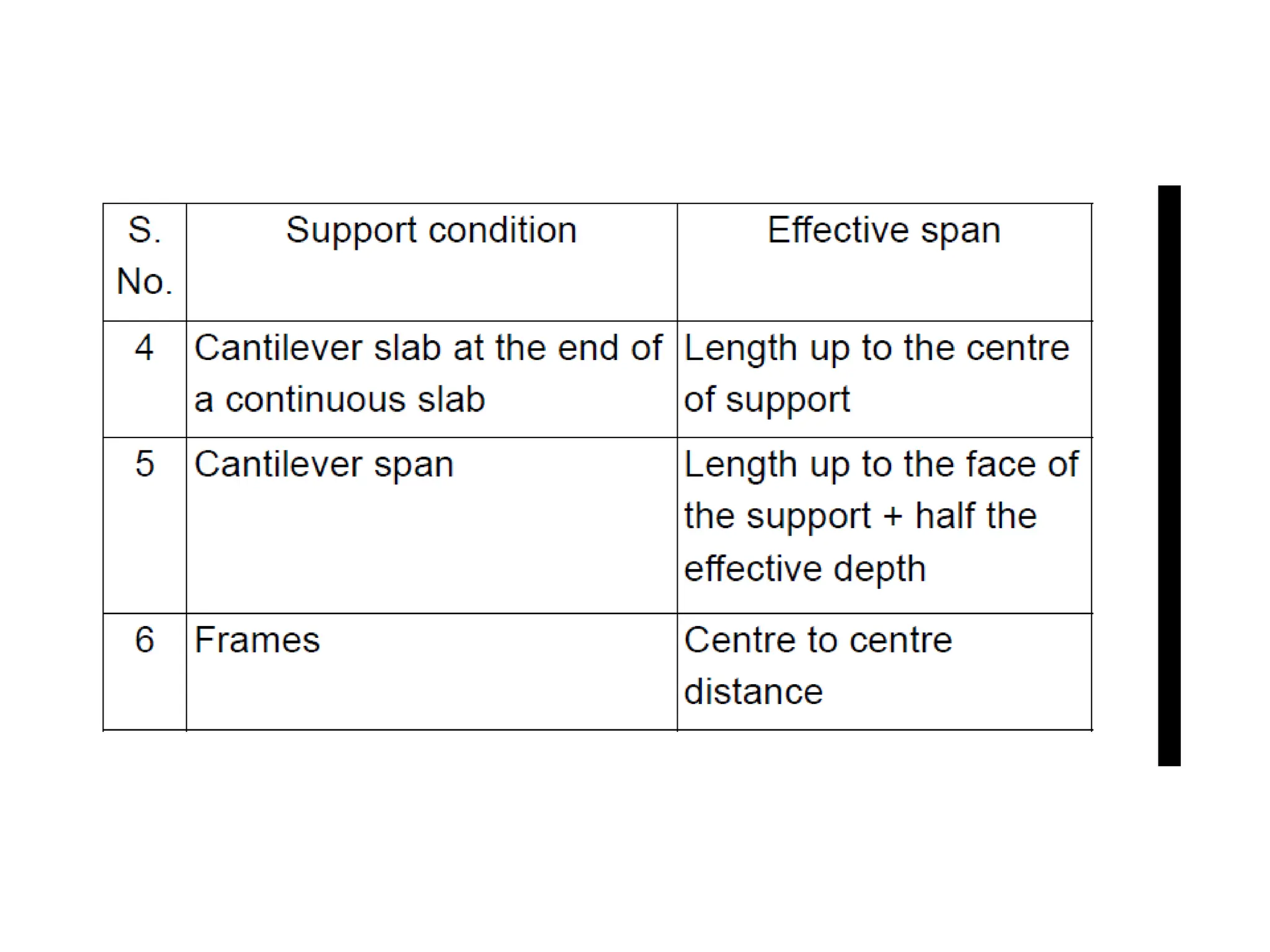
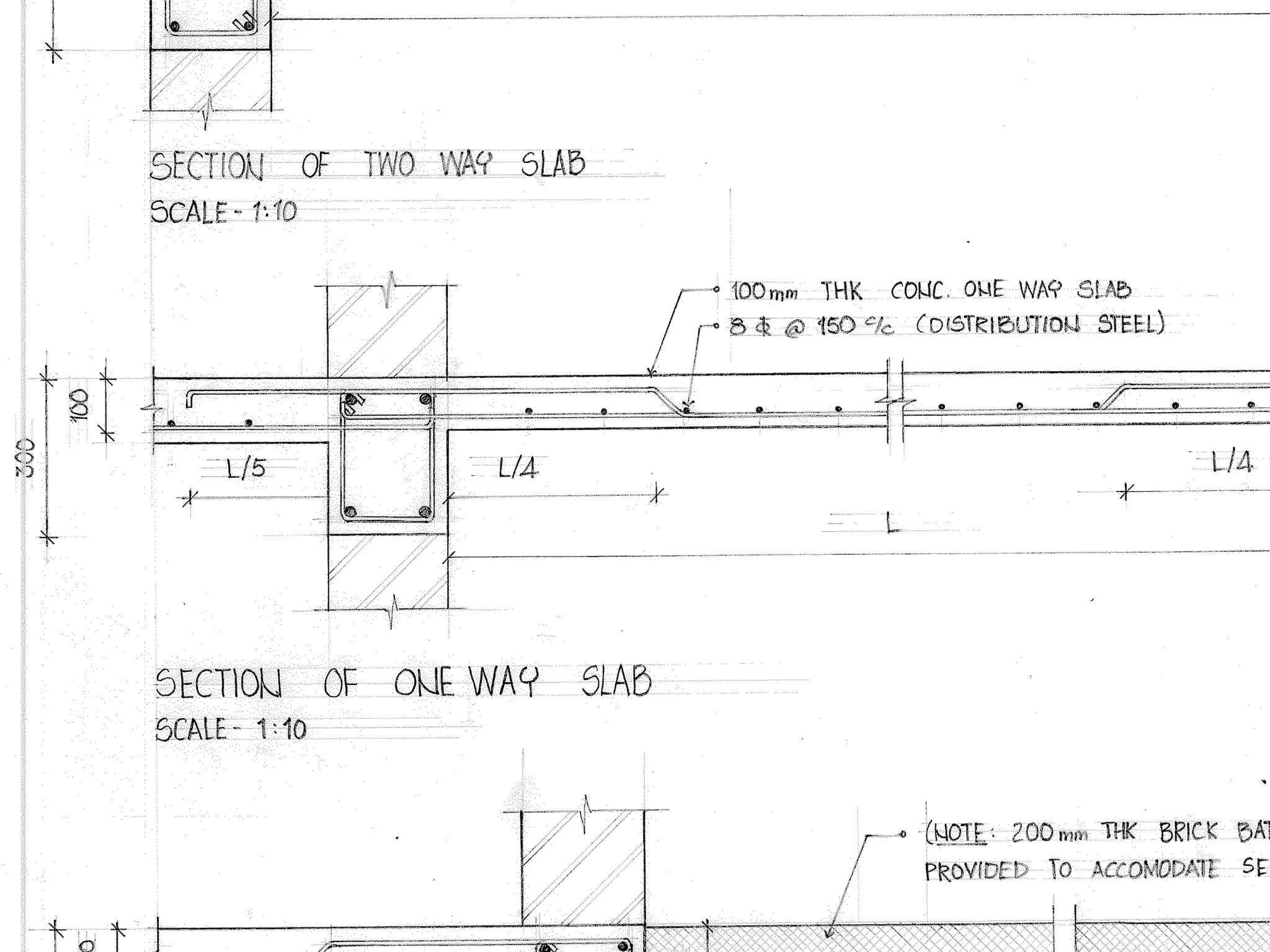
• Effective span of slab :
Effective span of slab shall be lesser of the two
1. l = clear span + d (effective depth )
2. l = Center to center distance between the support
Depth of the slab
The following thumb rules can be used ( Fe 415)
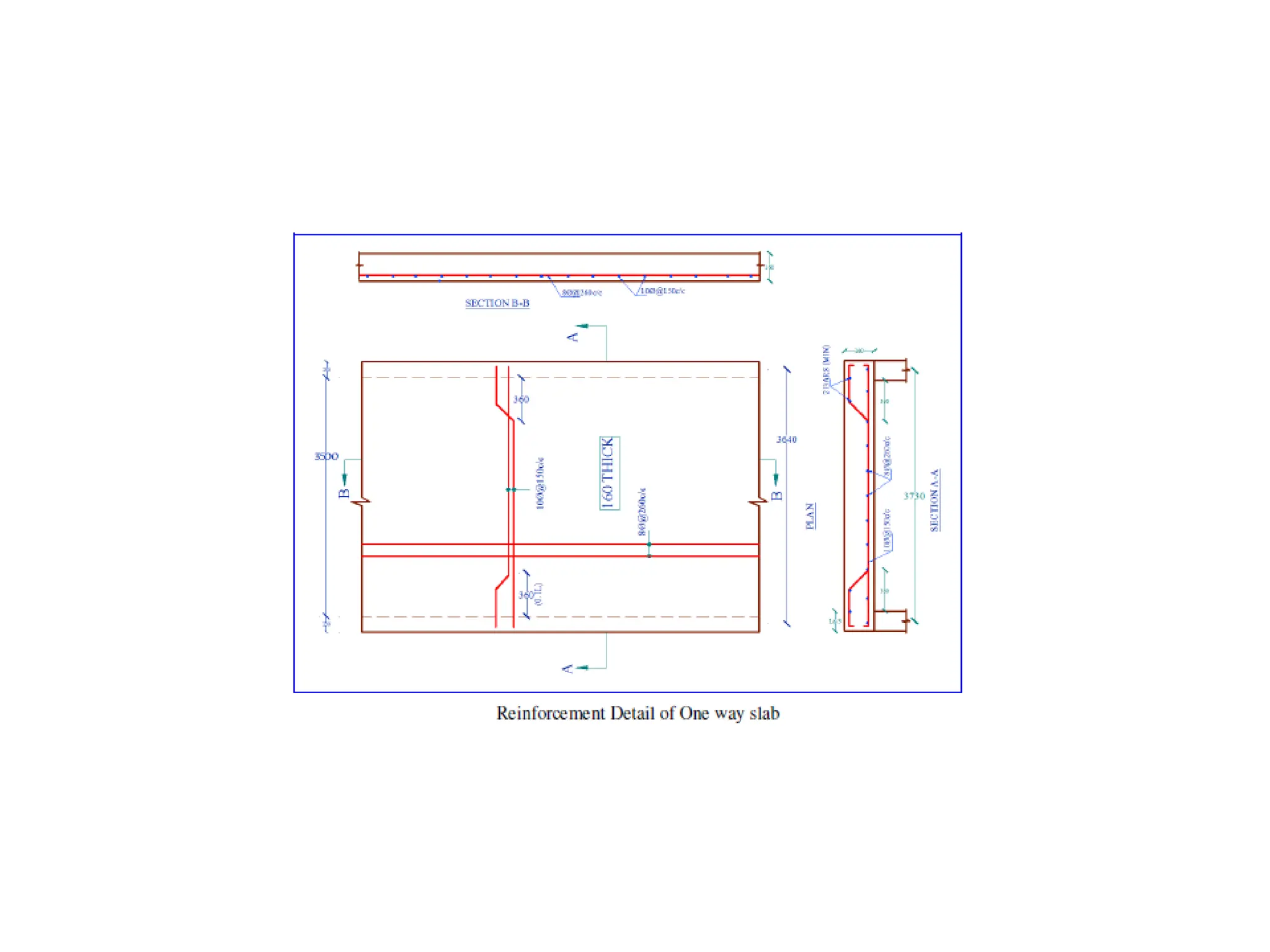
• One way slab d=(l/22) to (l/28).
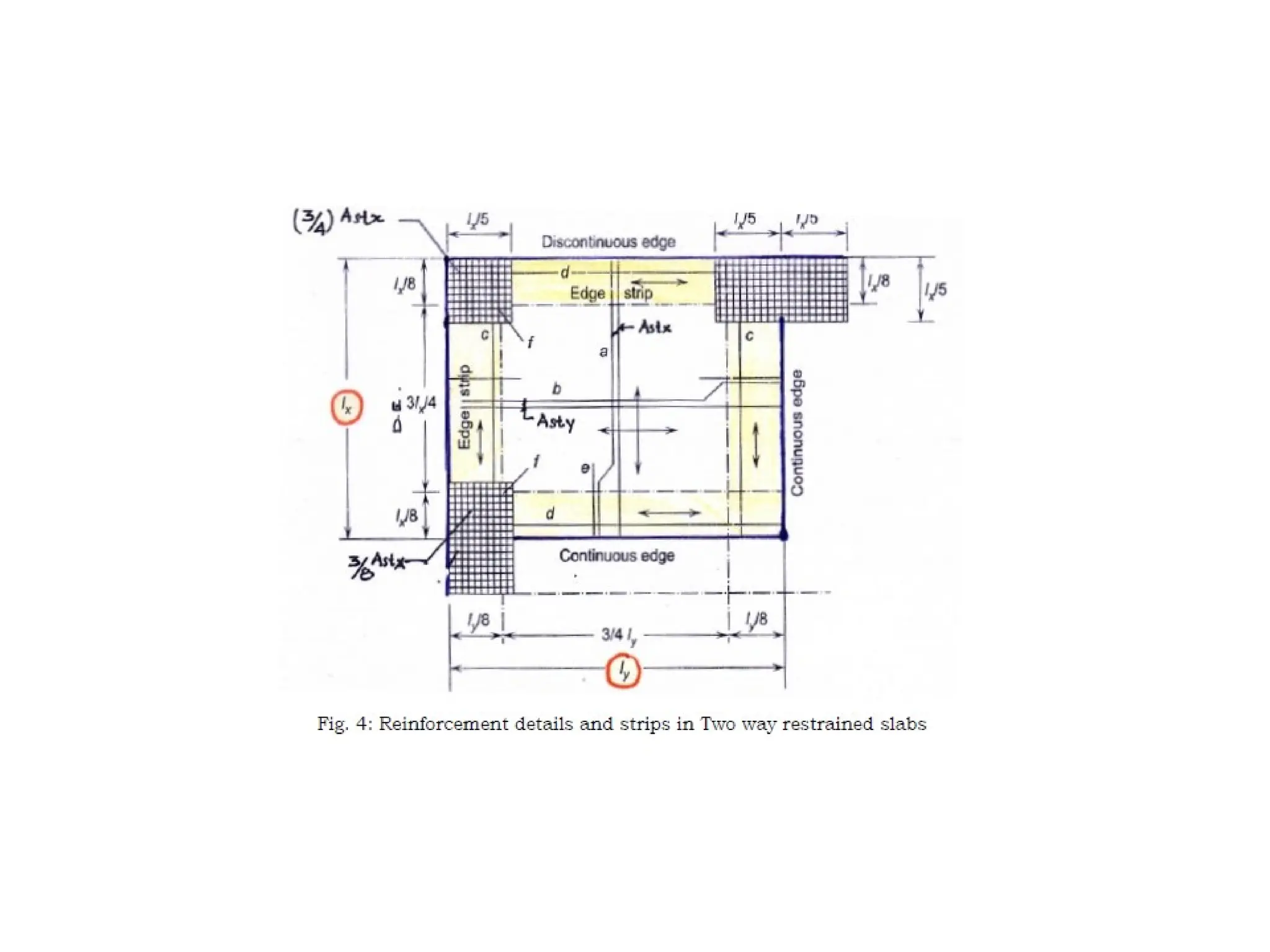
• Two way simply supported slab d=(l/20) to (l/30)
• Two way restrained slab d=(l/30) to (l/32
• Cantilevered d = (l/7) to (l/10)
In any case of the above, the thickness should not be
less than 100mm
L/D ratio based upon type of steel Fe 500, Fe 415 Fe 600
One end continuous, both end continuous
Load on slab
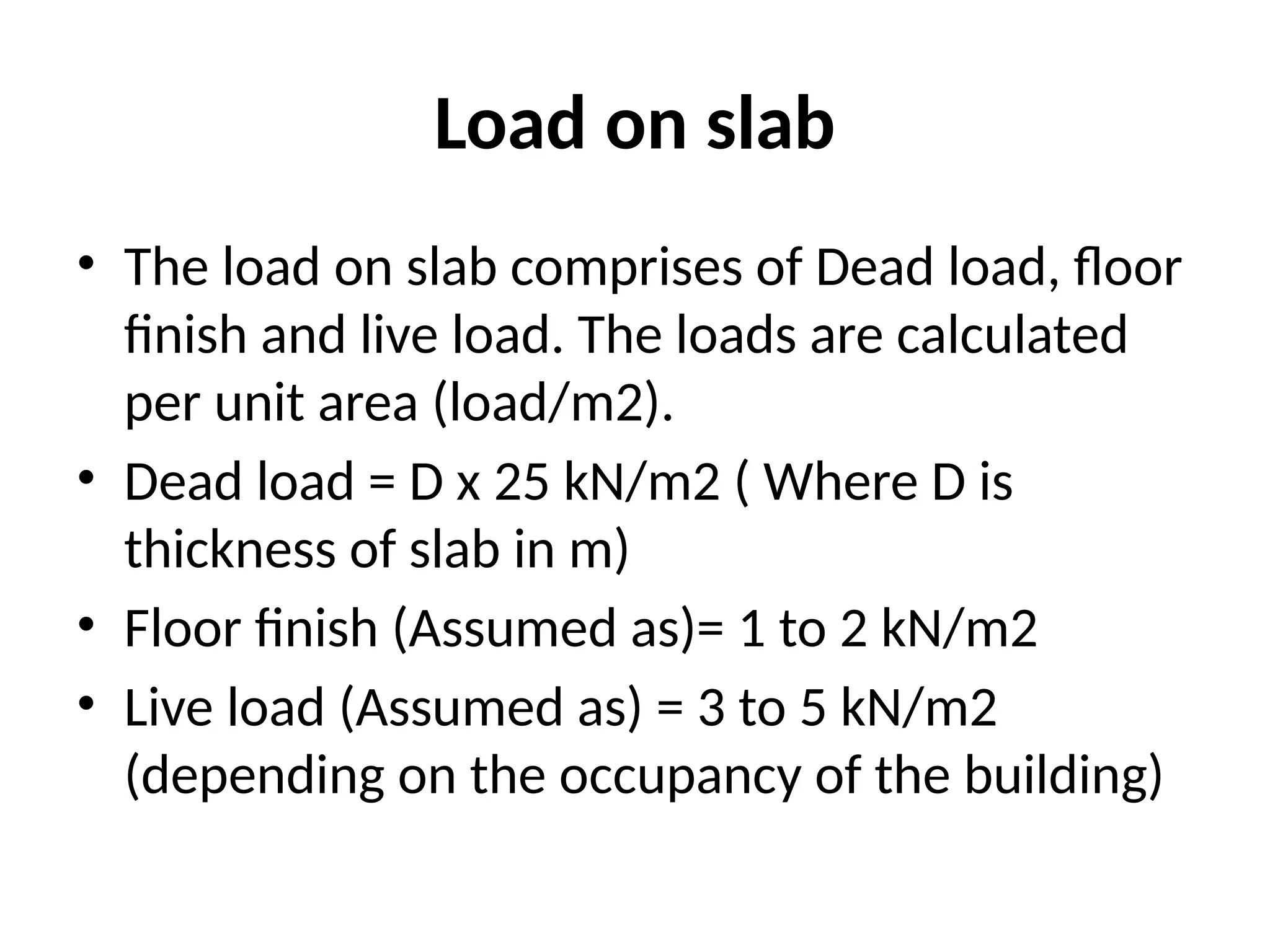
• The load on slab comprises of Dead load, floor
finish and live load. The loads are calculated
per unit area (load/m2).
• Dead load = D x 25 kN/m2 ( Where D is
thickness of slab in m)
• Floor finish (Assumed as)= 1 to 2 kN/m2
• Live load (Assumed as) = 3 to 5 kN/m2
(depending on the occupancy of the building)
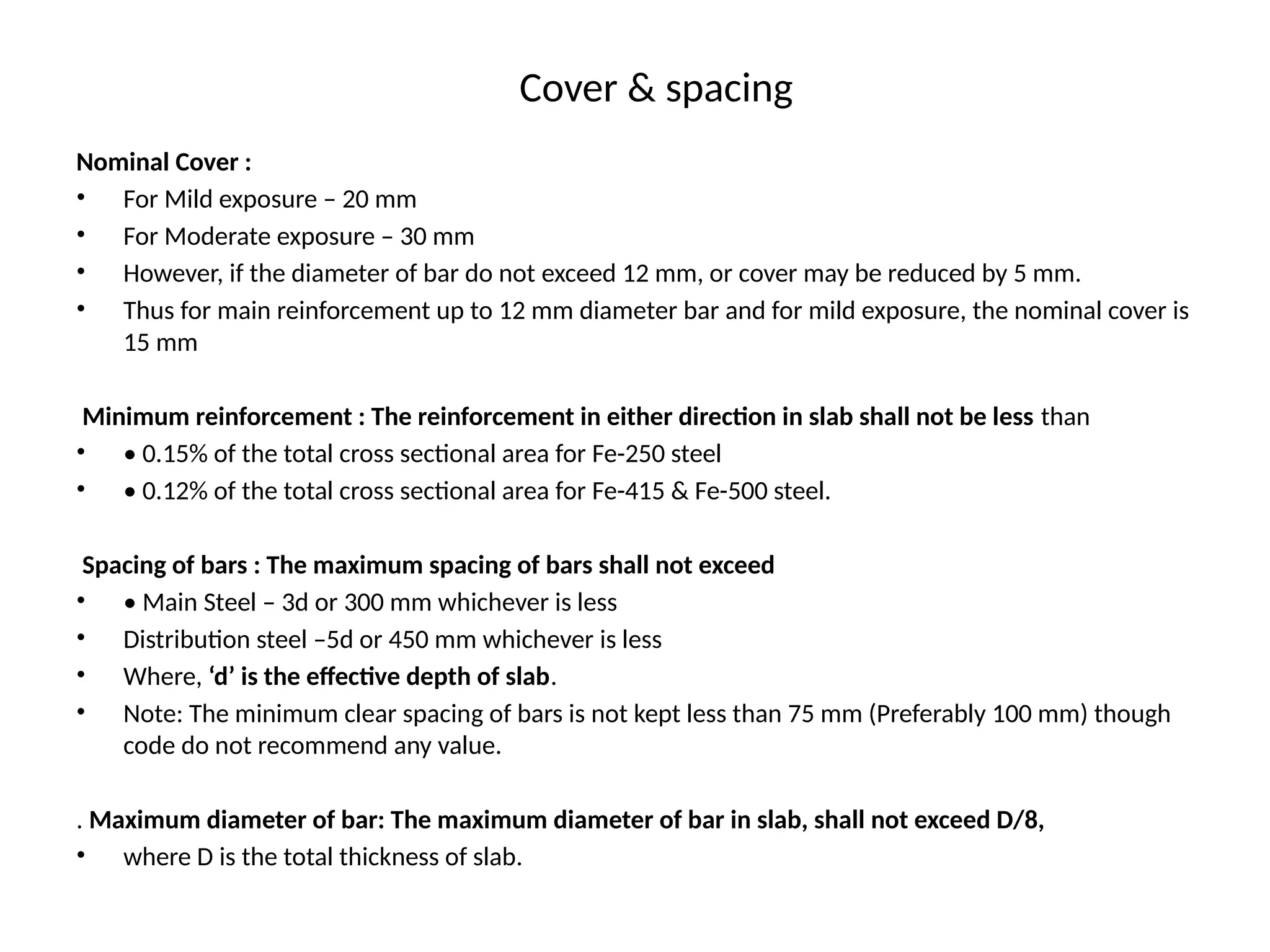
Cover & spacing
Nominal Cover :
• For Mild exposure – 20 mm
• For Moderate exposure – 30 mm
• However, if the diameter of bar do not exceed 12 mm, or cover may be reduced by 5 mm.
• Thus for main reinforcement up to 12 mm diameter bar and for mild exposure, the nominal cover is
15 mm
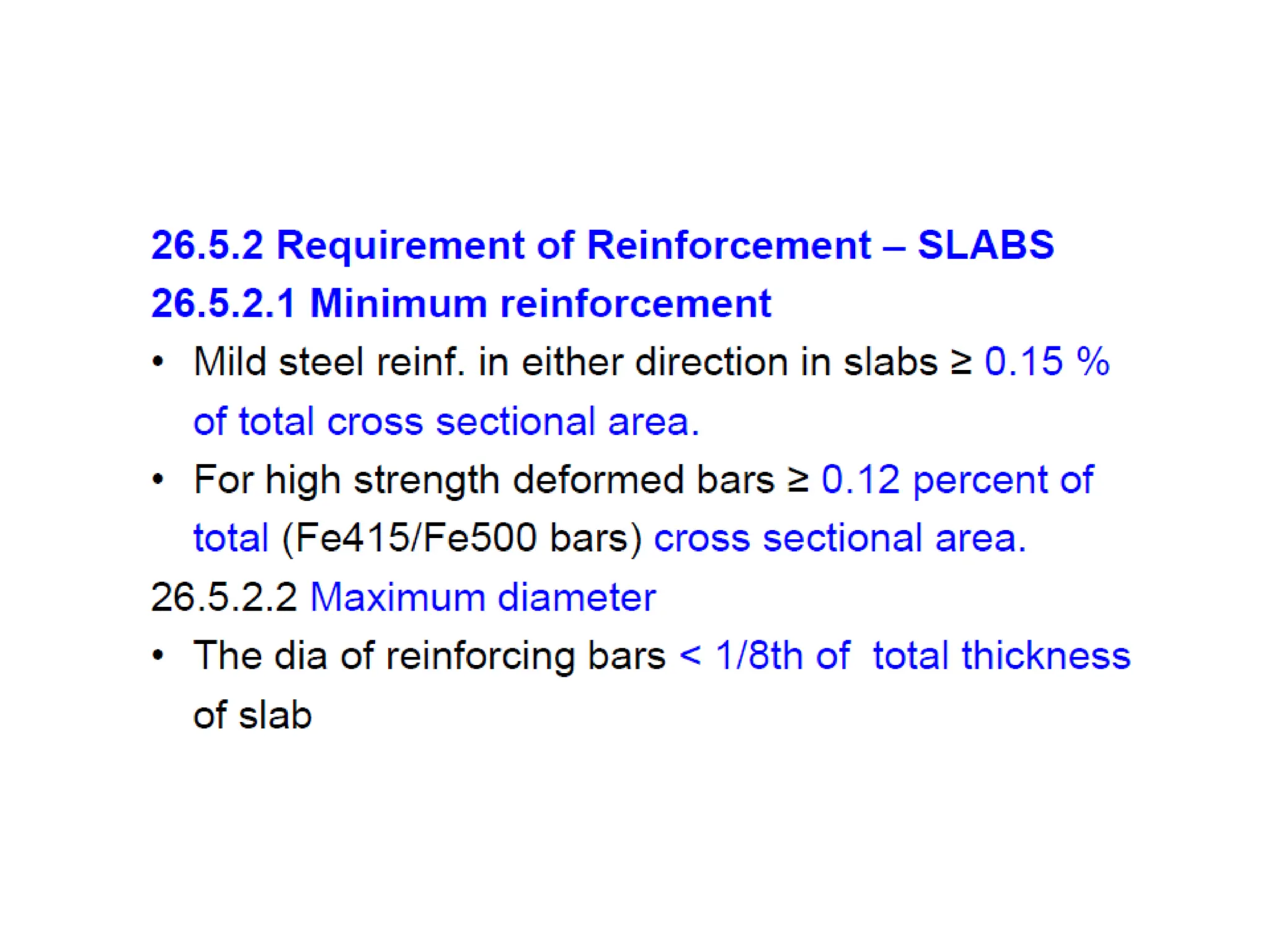
Minimum reinforcement : The reinforcement in either direction in slab shall not be less than
• • 0.15% of the total cross sectional area for Fe-250 steel
• • 0.12% of the total cross sectional area for Fe-415 & Fe-500 steel.
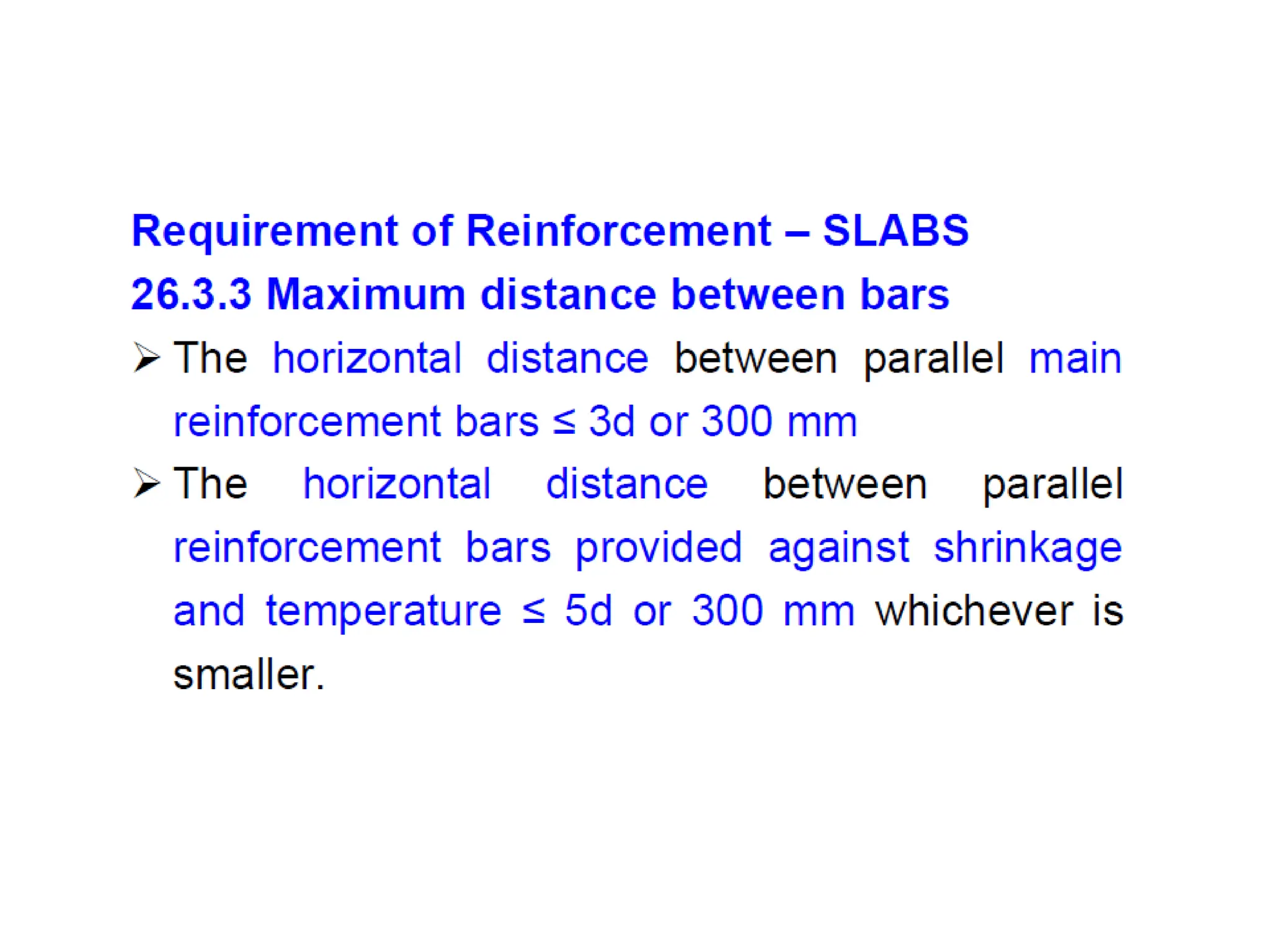
Spacing of bars : The maximum spacing of bars shall not exceed
• • Main Steel – 3d or 300 mm whichever is less
• Distribution steel –5d or 450 mm whichever is less
• Where, ‘d’ is the effective depth of slab.
• Note: The minimum clear spacing of bars is not kept less than 75 mm (Preferably 100 mm) though
code do not recommend any value.
. Maximum diameter of bar: The maximum diameter of bar in slab, shall not exceed D/8,
• where D is the total thickness of slab.
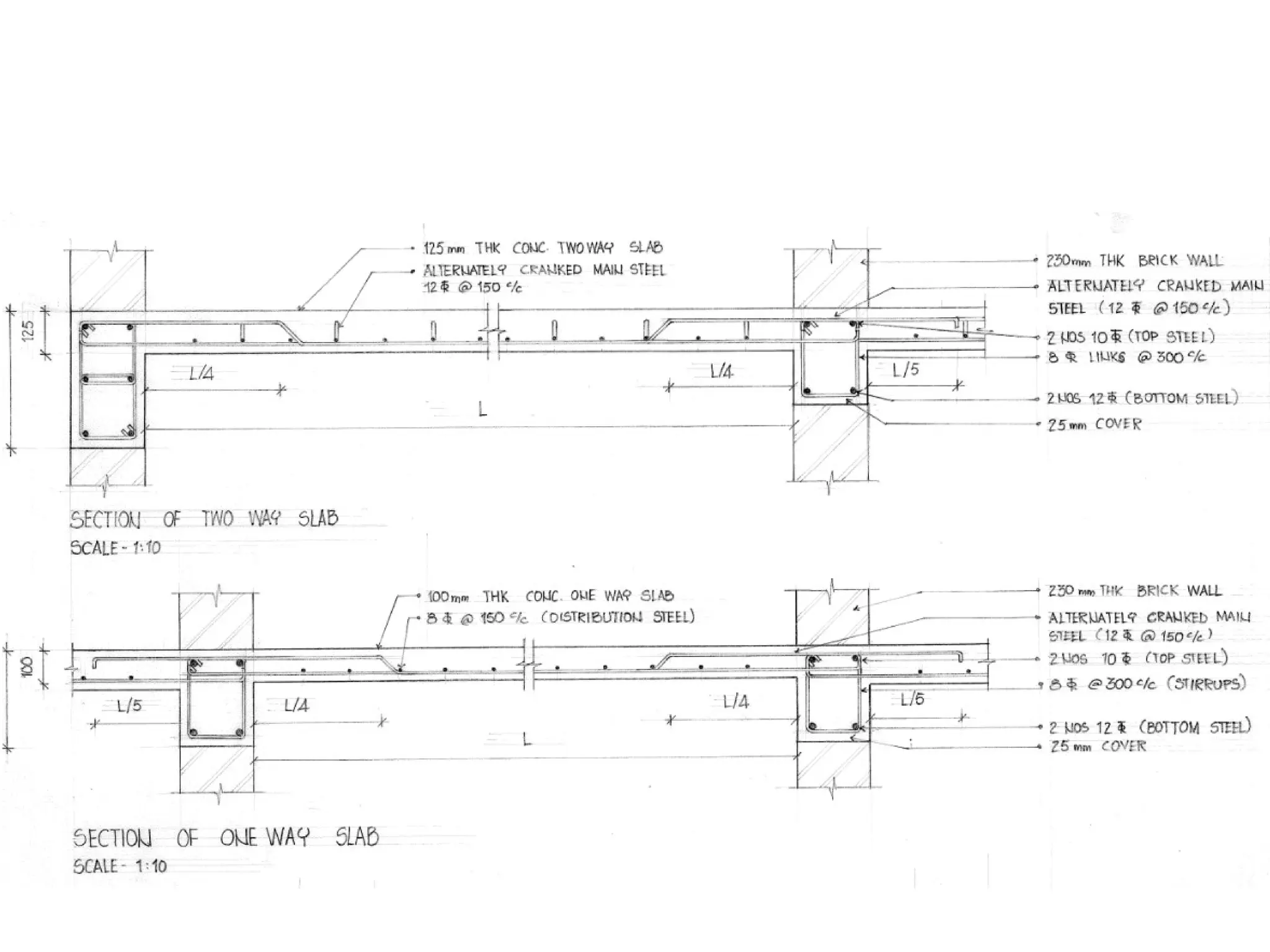
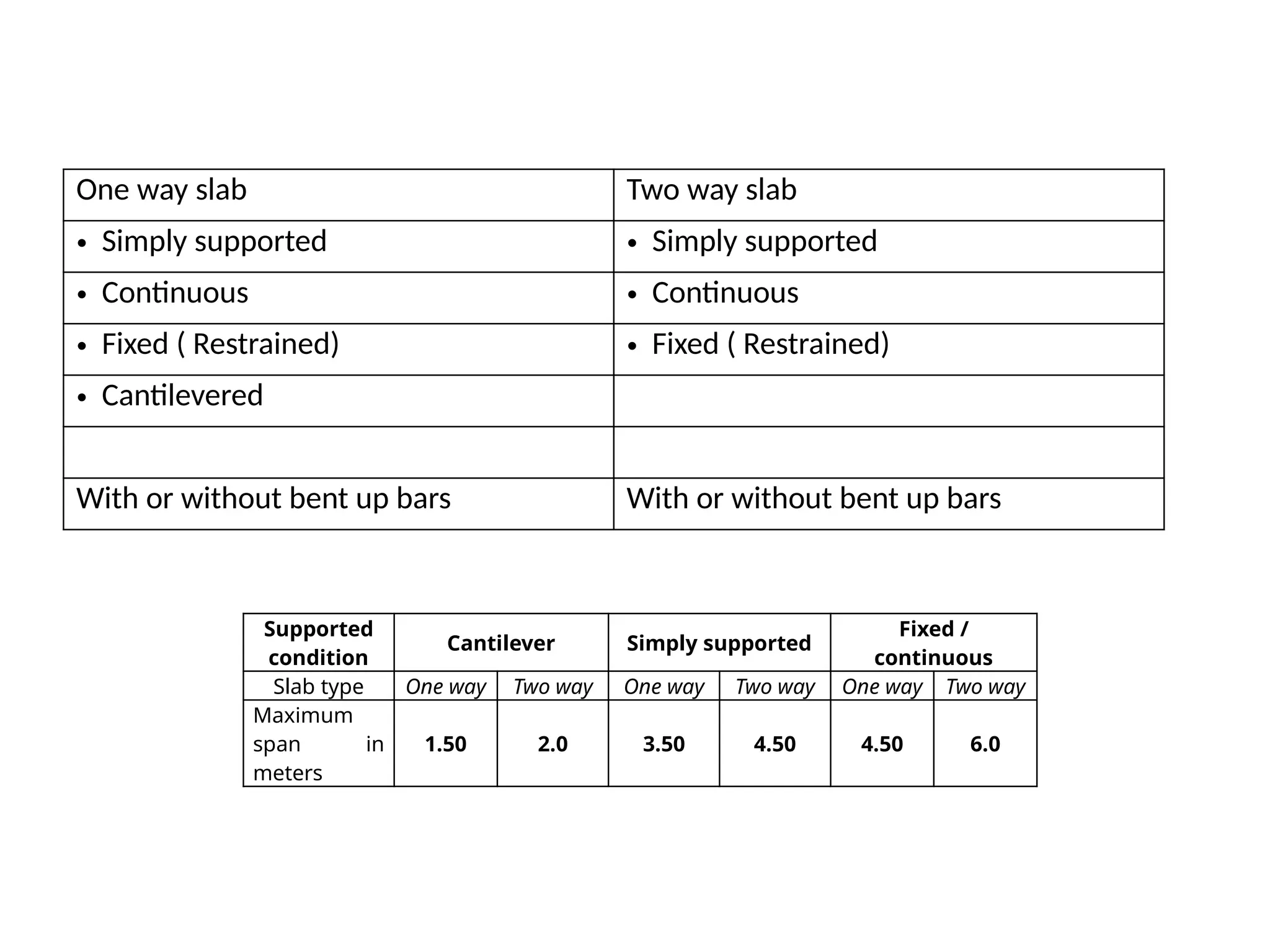
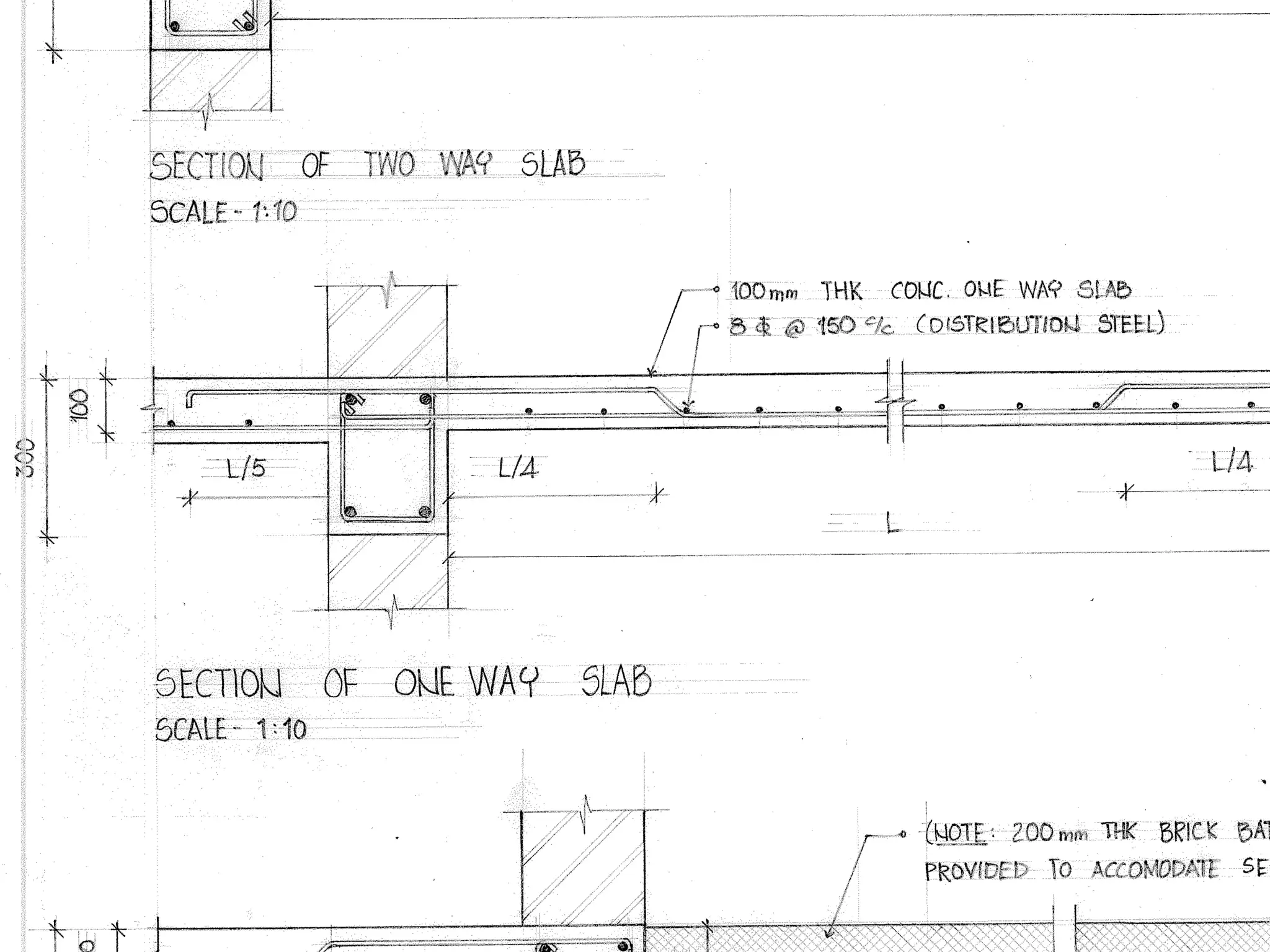
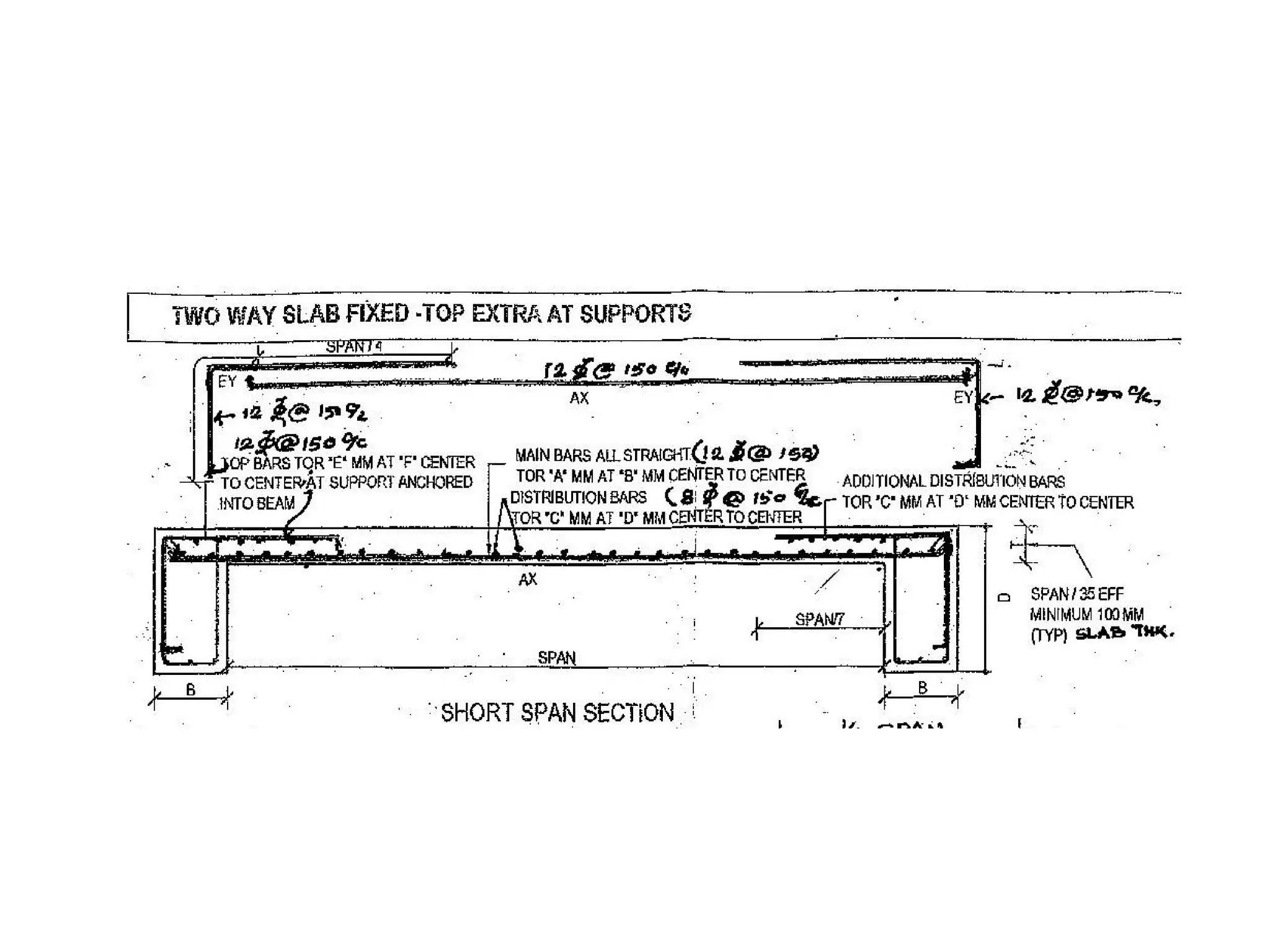
One way slab Two way slab
• Simply supported • Simply supported
• Continuous • Continuous
• Fixed ( Restrained) • Fixed ( Restrained)
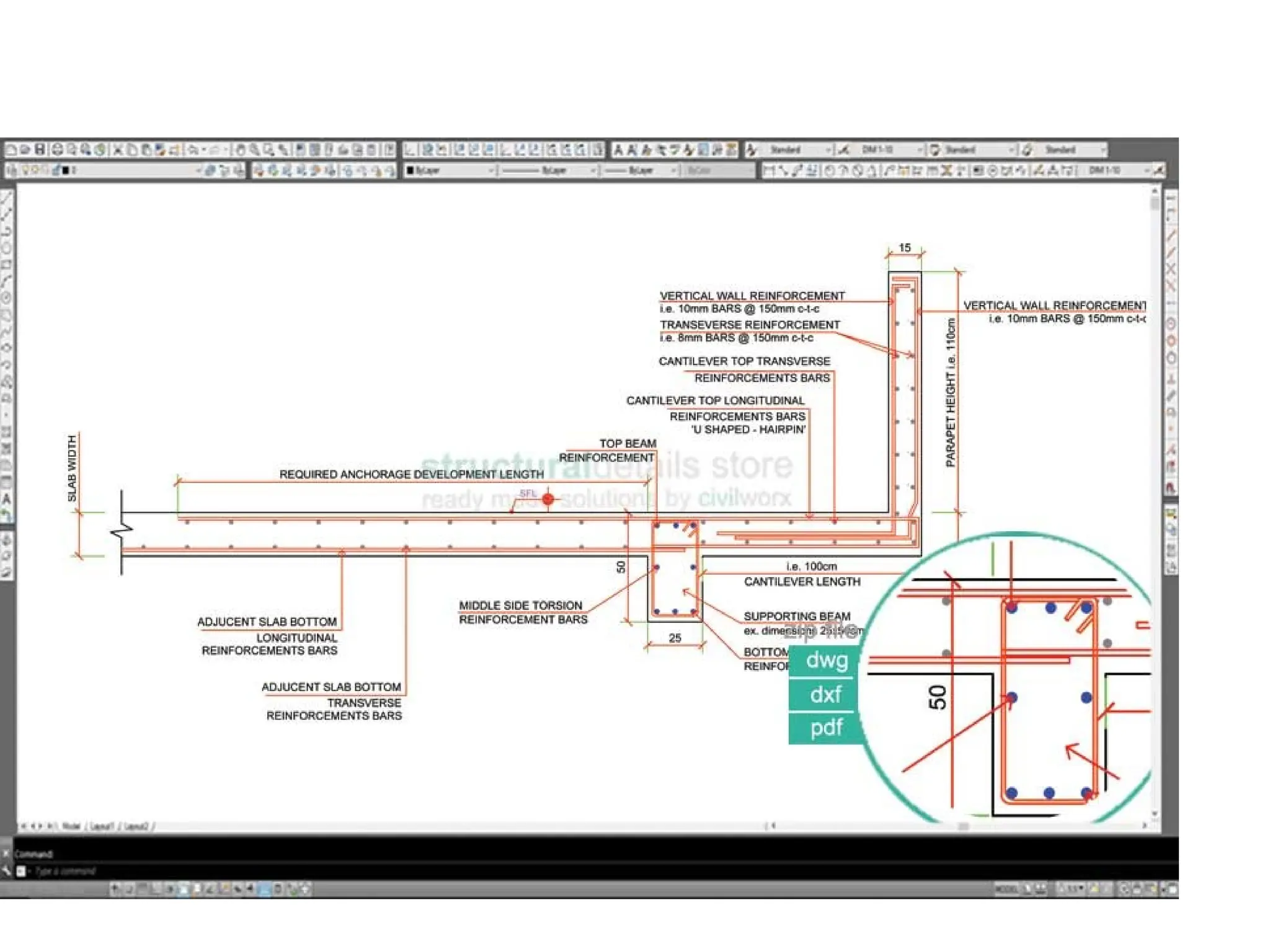
• Cantilevered
With or without bent up bars With or without bent up bars
Supported
condition
Cantilever Simply supported
Fixed /
continuous
Slab type One way Two way One way Two way One way Two way
Maximum
span in
meters
1.50 2.0 3.50 4.50 4.50 6.0
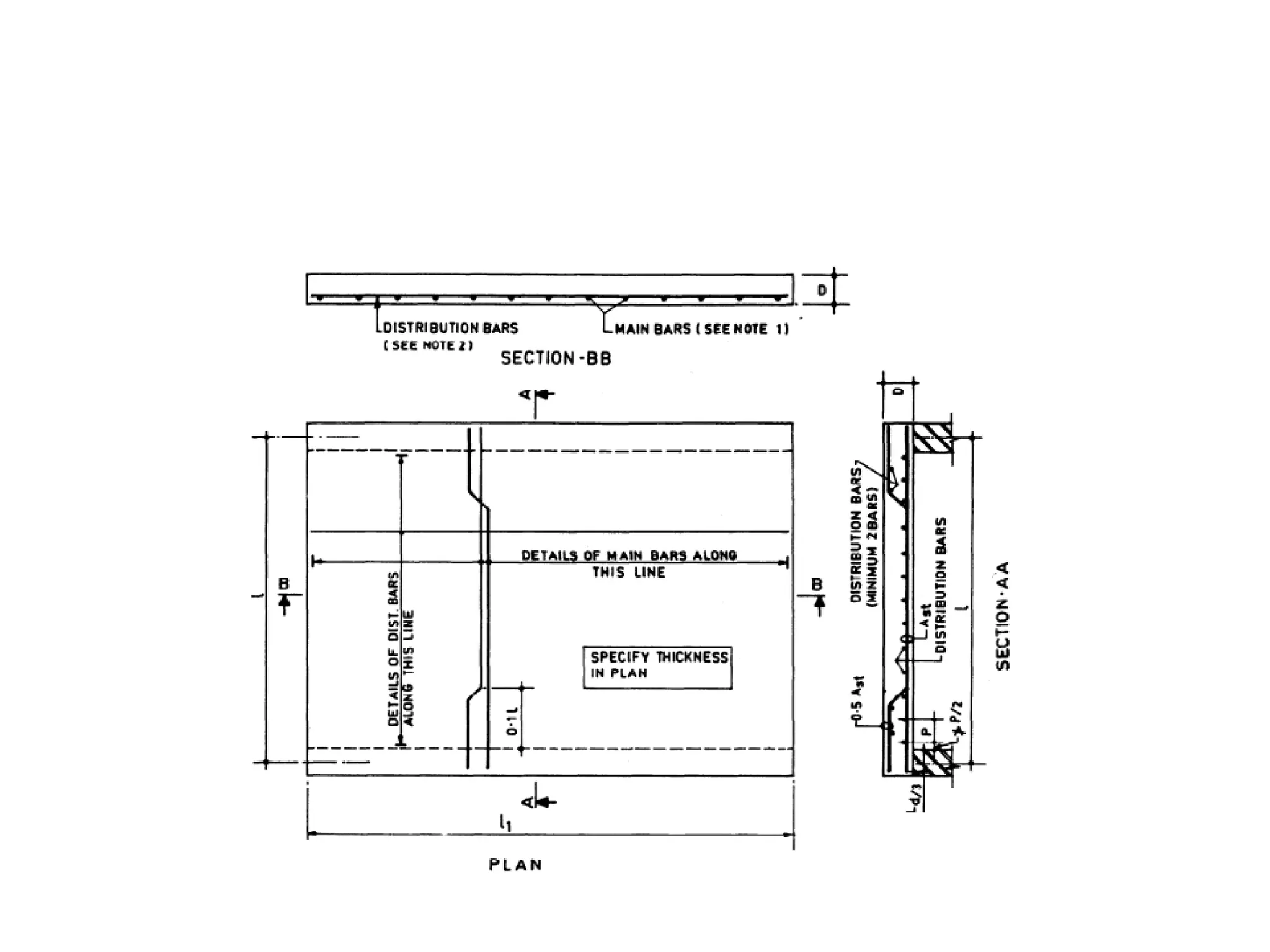
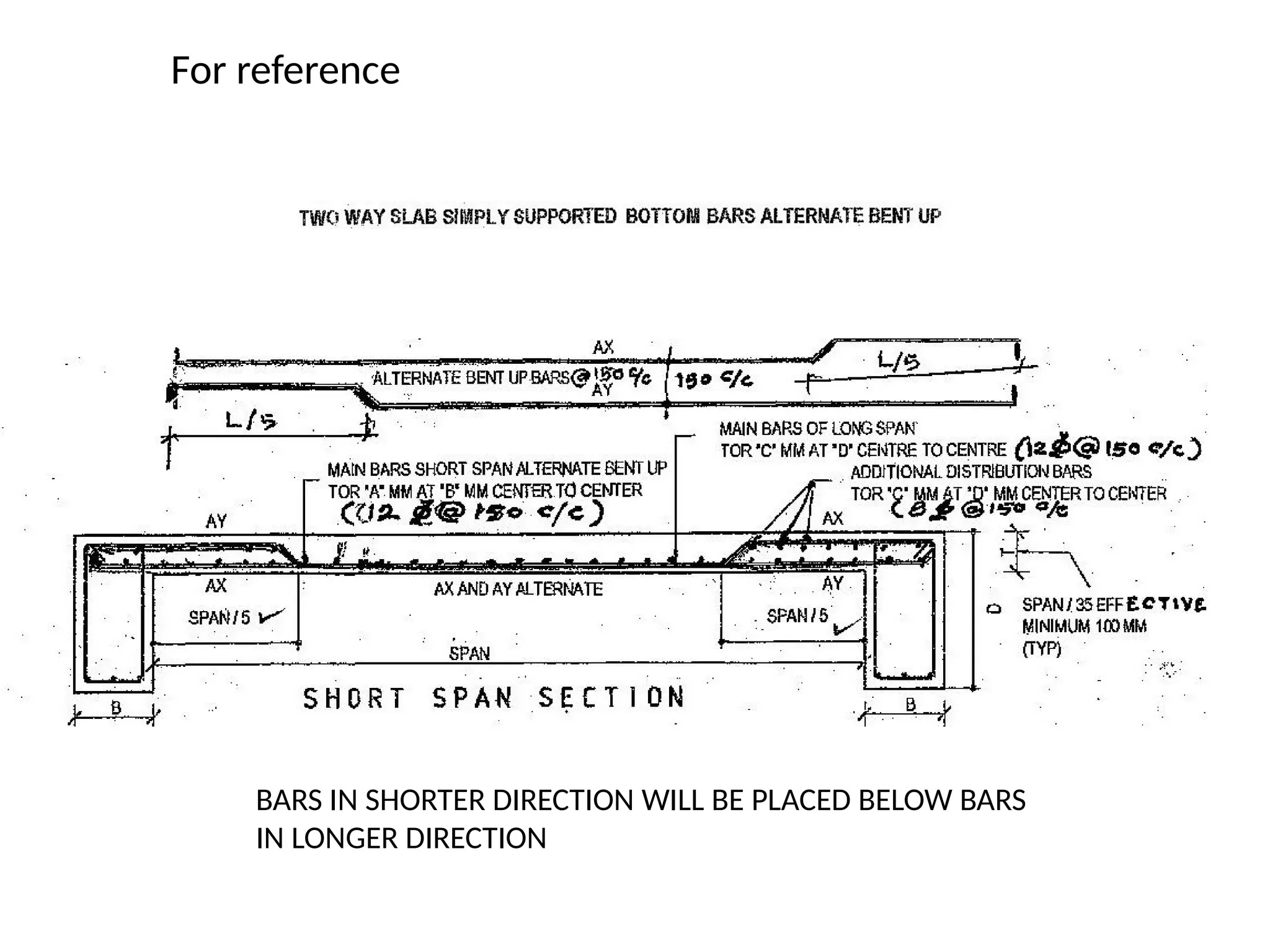
For reference
BARS IN SHORTER DIRECTION WILL BE PLACED BELOW BARS
IN LONGER DIRECTION
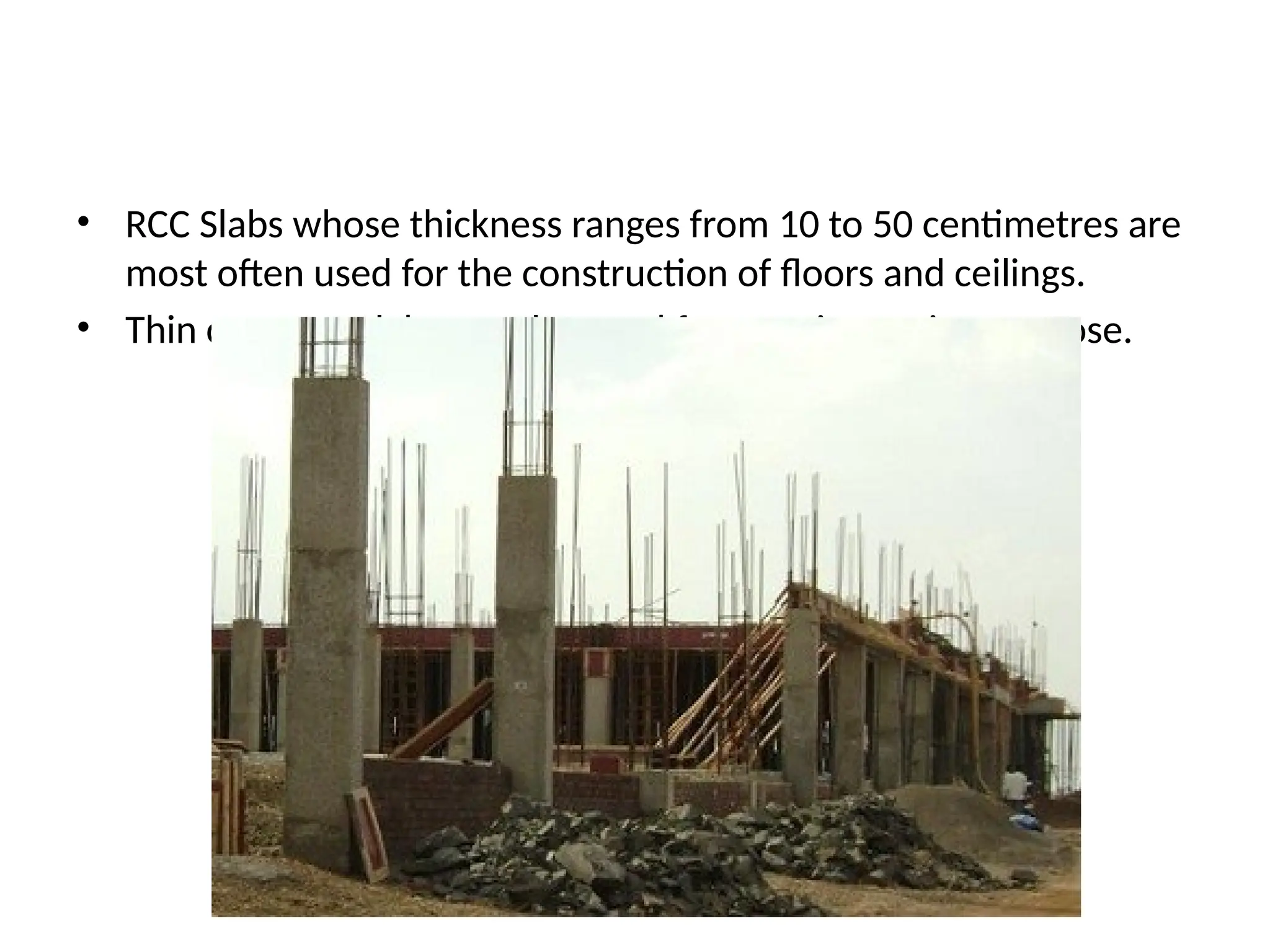
• RCC Slabs whose thickness ranges from 10 to 50 centimetres are
most often used for the construction of floors and ceilings.
• Thin concrete slabs are also used for exterior paving purpose.
• Design of various types of slabs and their reinforcement
• For a suspended slab, there are a number of designs to improve the strength-to-weight ratio. In all cases the top surface remains flat, and
the underside is modulated:
• Corrugated, usually where the concrete is poured into a corrugated steel tray. This improves strength and prevents the slab bending
under its own weight. The corrugations run across the short dimension, from side to side.
• A ribbed slab, giving considerable extra strength on one direction.
• A waffle slab, giving added strength in both directions
• Prefabricated concrete slabs are cast in a factory and then transported to the site ready
to be lowered into place between steel or concrete beams.
• They may be pre-stressed (in the factory), post-stressed (on site), or unstressed. Care
should be taken to see that the supporting structure is built to the correct dimensions to
avoid trouble with the fitting of slabs over the supporting structure.
• In situ concrete slabs are built on the building site using formwork. Formwork is a box-
like setup in which concrete is poured for the construction of slabs.
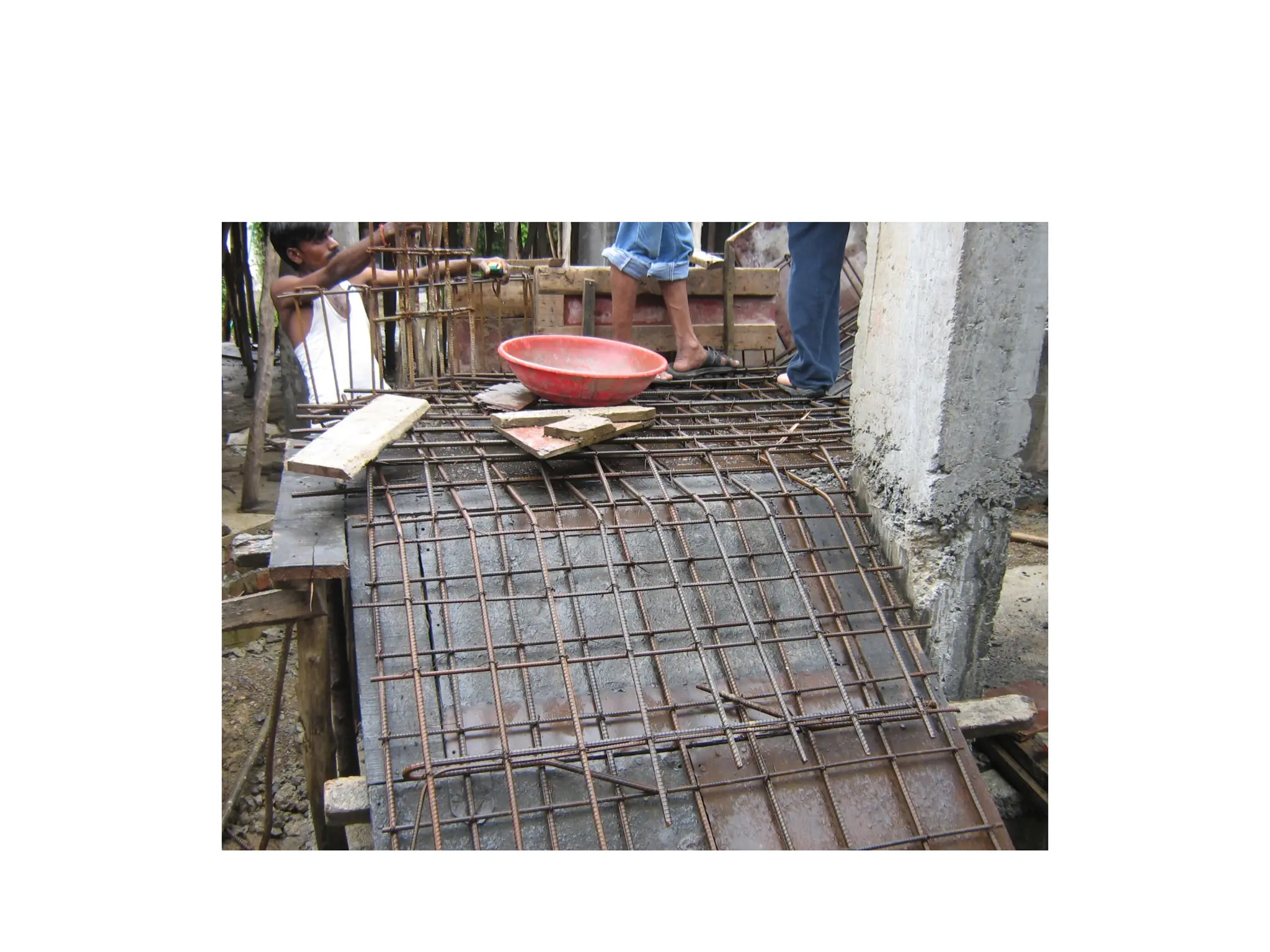
• For reinforced concrete slabs, reinforcing steel bars are placed within the formwork and
then the concrete is poured.
• Plastic tipped metal, or plastic bar chairs are used to hold the reinforcing steel bars away
from the bottom and sides of the form-work, so that when the concrete sets it
completely envelops the reinforcement.
• Formwork differs with the kind of slab. For a ground slab, the form-work may consist
only of sidewalls pushed into the ground whereas for a suspended slab, the form-work
is shaped like a tray, often supported by a temporary scaffold until the concrete sets
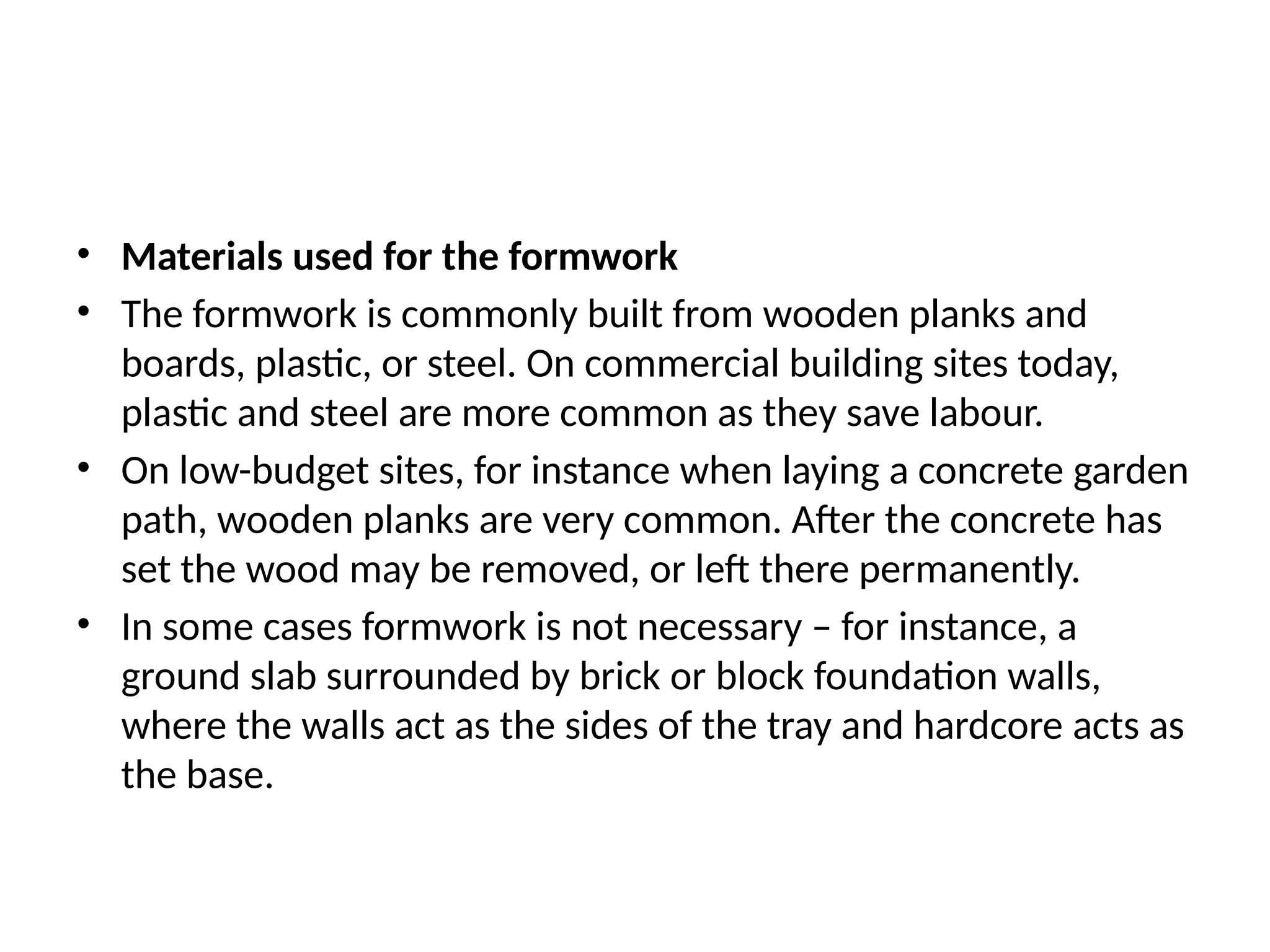
• Materials used for the formwork
• The formwork is commonly built from wooden planks and
boards, plastic, or steel. On commercial building sites today,
plastic and steel are more common as they save labour.
• On low-budget sites, for instance when laying a concrete garden
path, wooden planks are very common. After the concrete has
set the wood may be removed, or left there permanently.
• In some cases formwork is not necessary – for instance, a
ground slab surrounded by brick or block foundation walls,
where the walls act as the sides of the tray and hardcore acts as
the base.
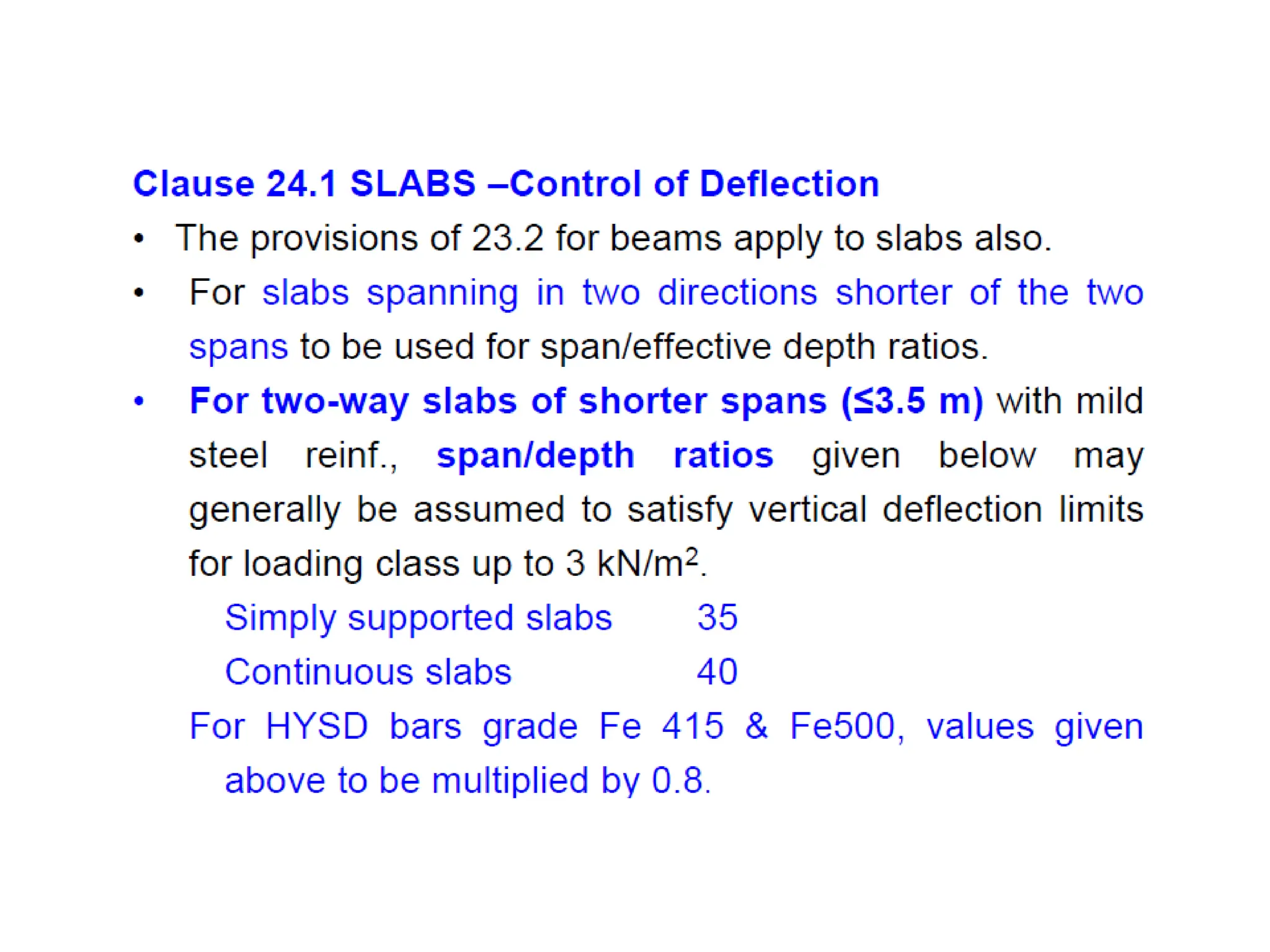
• Span – Effective Depth ratios
• Excessive deflections of slabs will cause damage to the ceiling, floor
finishes and other architectural details. To avoid this, limits are set on
the span-depth ratios.
• These limits are exactly the same as those for beams. As a slab is
usually a slender member the restriction on the span-depth ratio
becomes more important and this can often control the depth of slab
required in terms of the span – effective depth ratio is given by,
• Minimum effective depth = span/(basic ratio x modification factor)
• The modification factor is based on the area of tension steel in the
shorter span when a slab is singly reinforced at midspan, the
modification factors for the areas of tensions and compression steel
are as given in the figure 2 and 4 of the code.
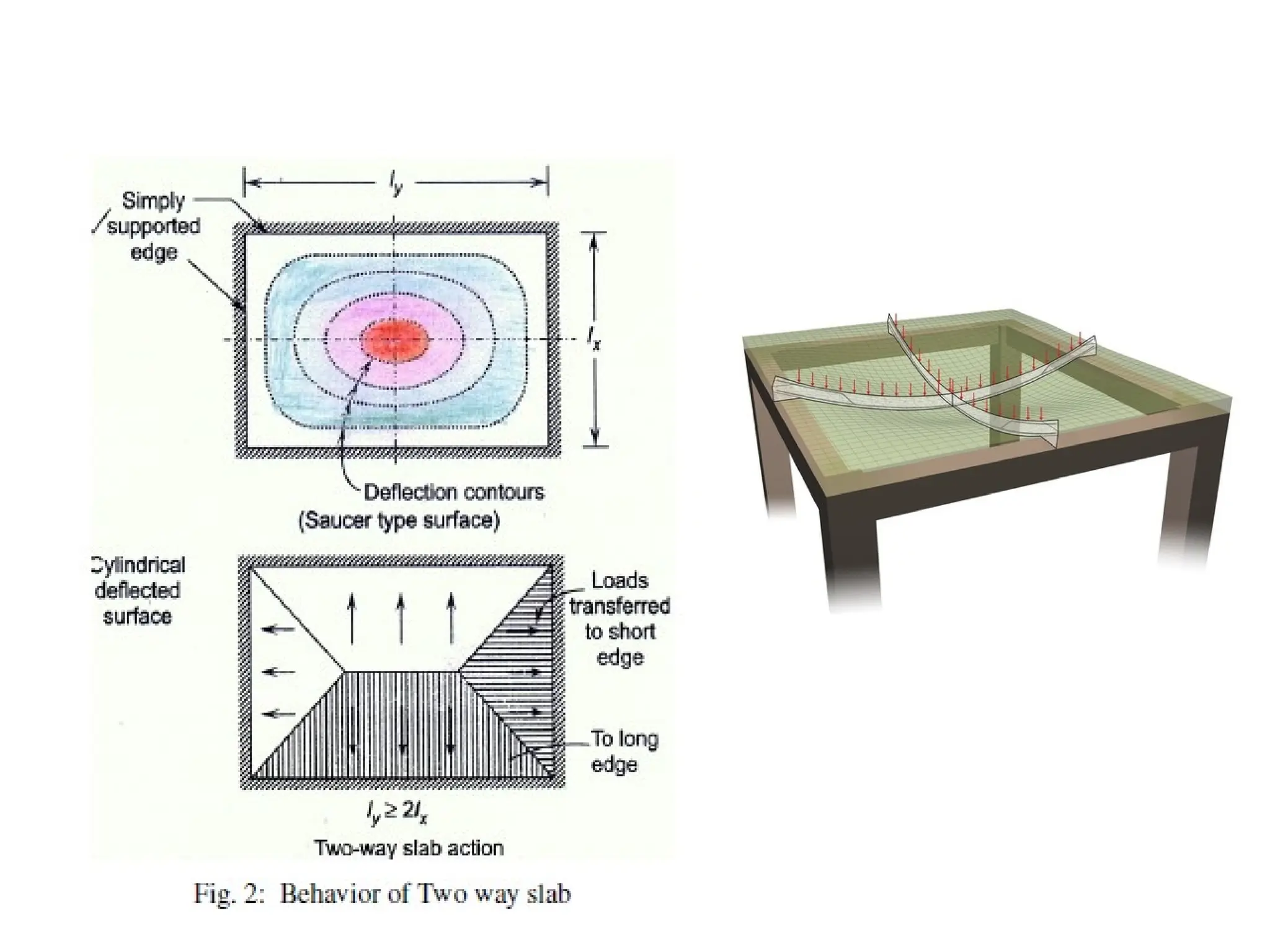
• Solid Slab spanning in two directions
• When a slab is supported on all four of its sides, it effectively spans in both directions, and it is
sometimes more economical to design the slab on this basis. The moment of bending in each
direction will depend on the ratio of the two spans and the conditions of restraint at each
support.
• If the slab is square and the restraint is similar along the four sides, then the load will span
equally in both directions. If the slab is rectangular, then more than one-half of the load will be
carried in the shorter direction and lesser load will be imposed on the longer direction.
• If one span is much longer than the other, a large portion of the load will be carried in the
shorter direction and the slab may as well be designed as spanning in only one direction.
• Moments in each direction of span are generally calculated using co-efficients which are
tabulated in the code.
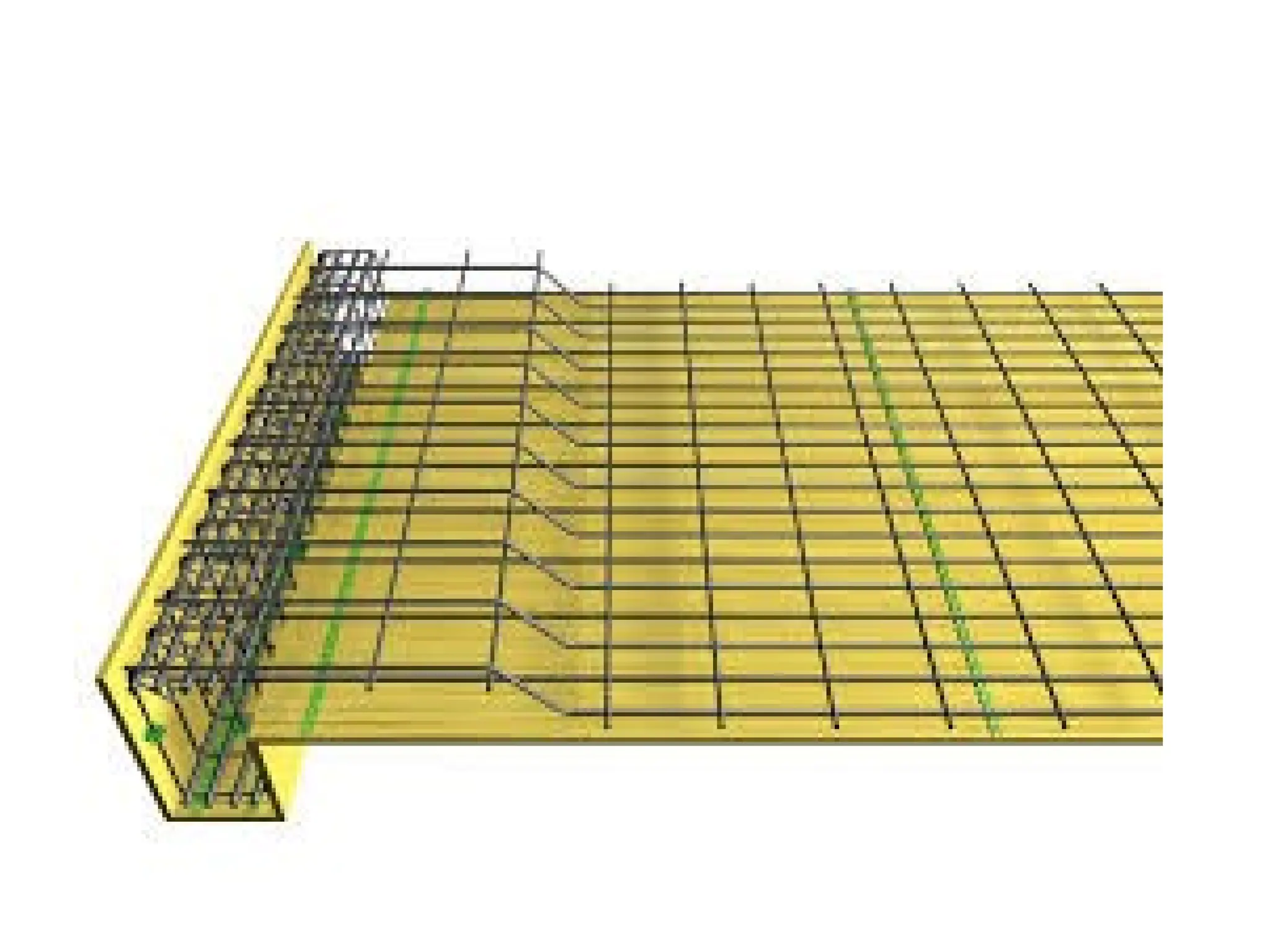
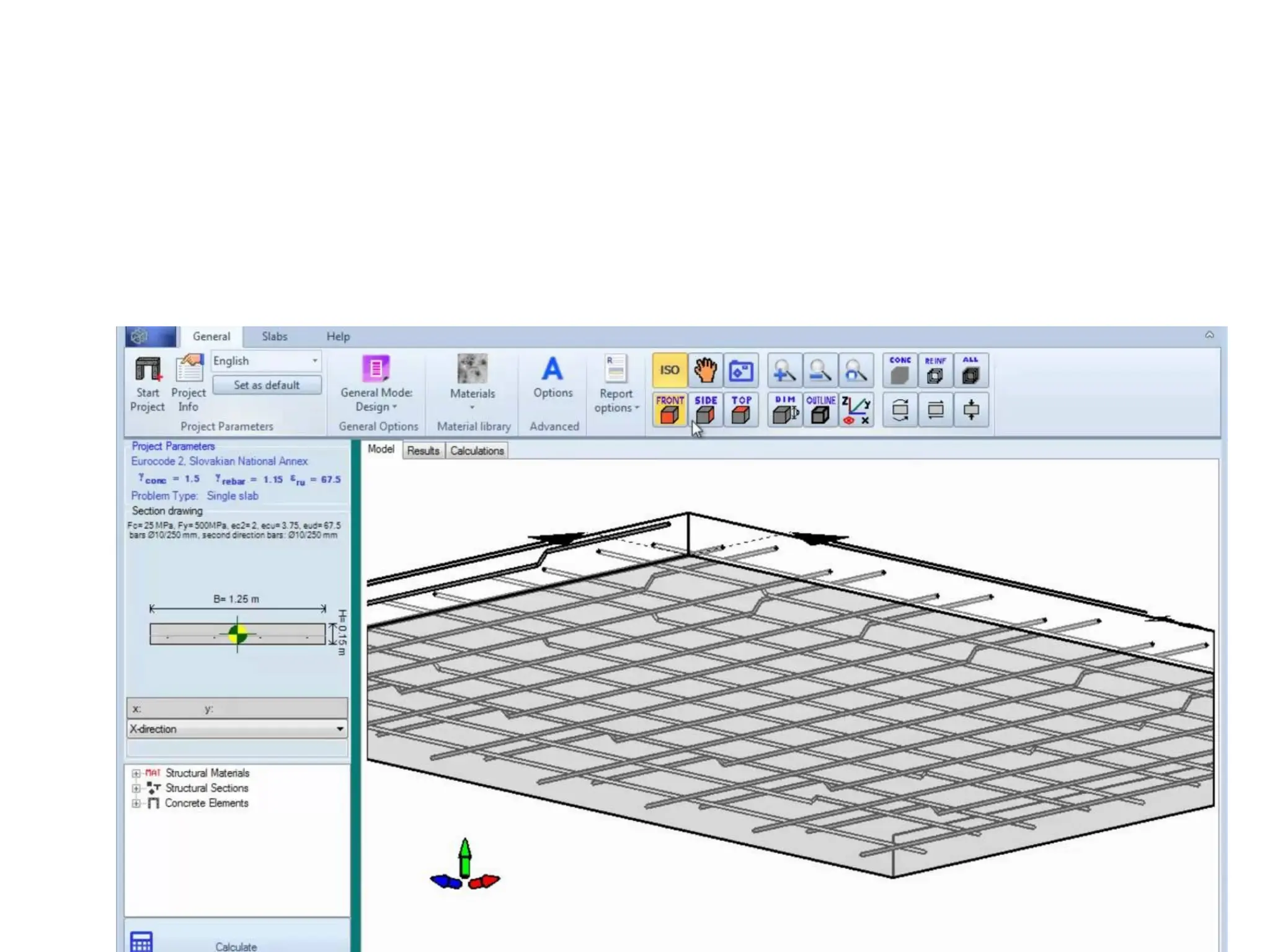
• The slab is reinforced with the bars in both directions parallel to the spans with the steel for
the shorter span placed farthest from the natural acis to five the greater effective depth.
• The span-efective depths are based on the shorter span and the percentage of the
reinforcement in that direction.
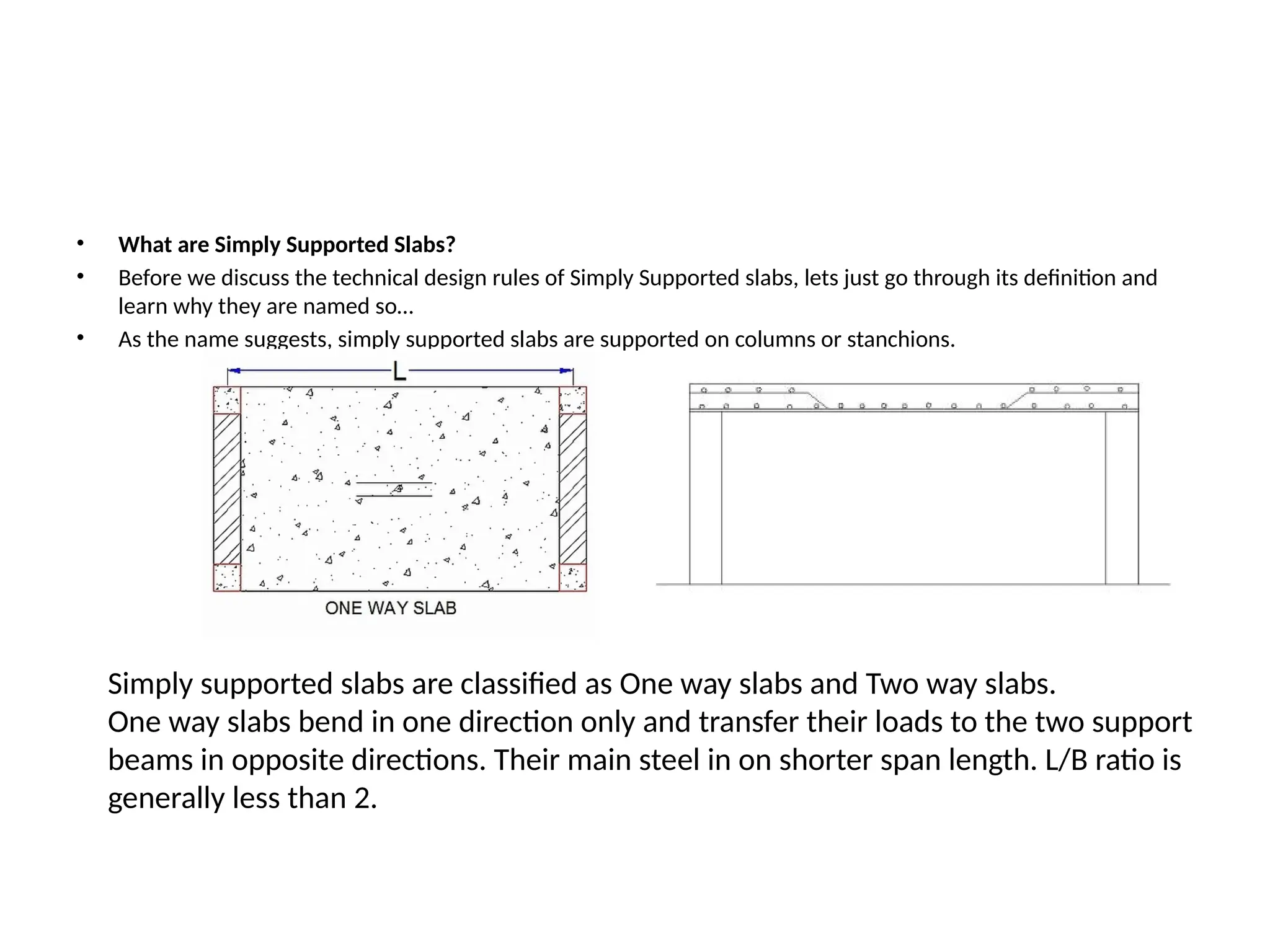
• What are Simply Supported Slabs?
• Before we discuss the technical design rules of Simply Supported slabs, lets just go through its definition and
learn why they are named so…
• As the name suggests, simply supported slabs are supported on columns or stanchions.
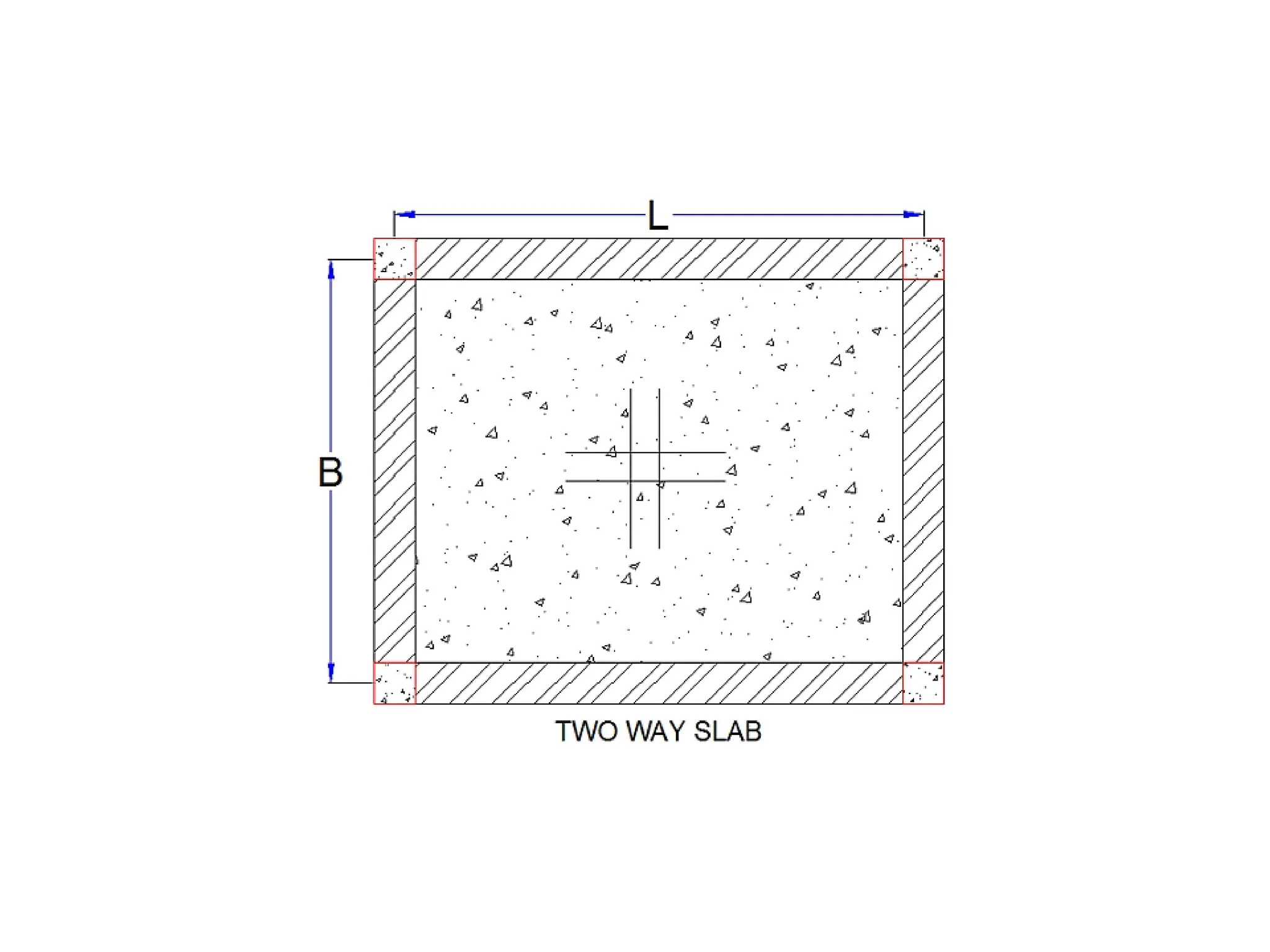
Simply supported slabs are classified as One way slabs and Two way slabs.
One way slabs bend in one direction only and transfer their loads to the two support
beams in opposite directions. Their main steel in on shorter span length. L/B ratio is
generally less than 2.
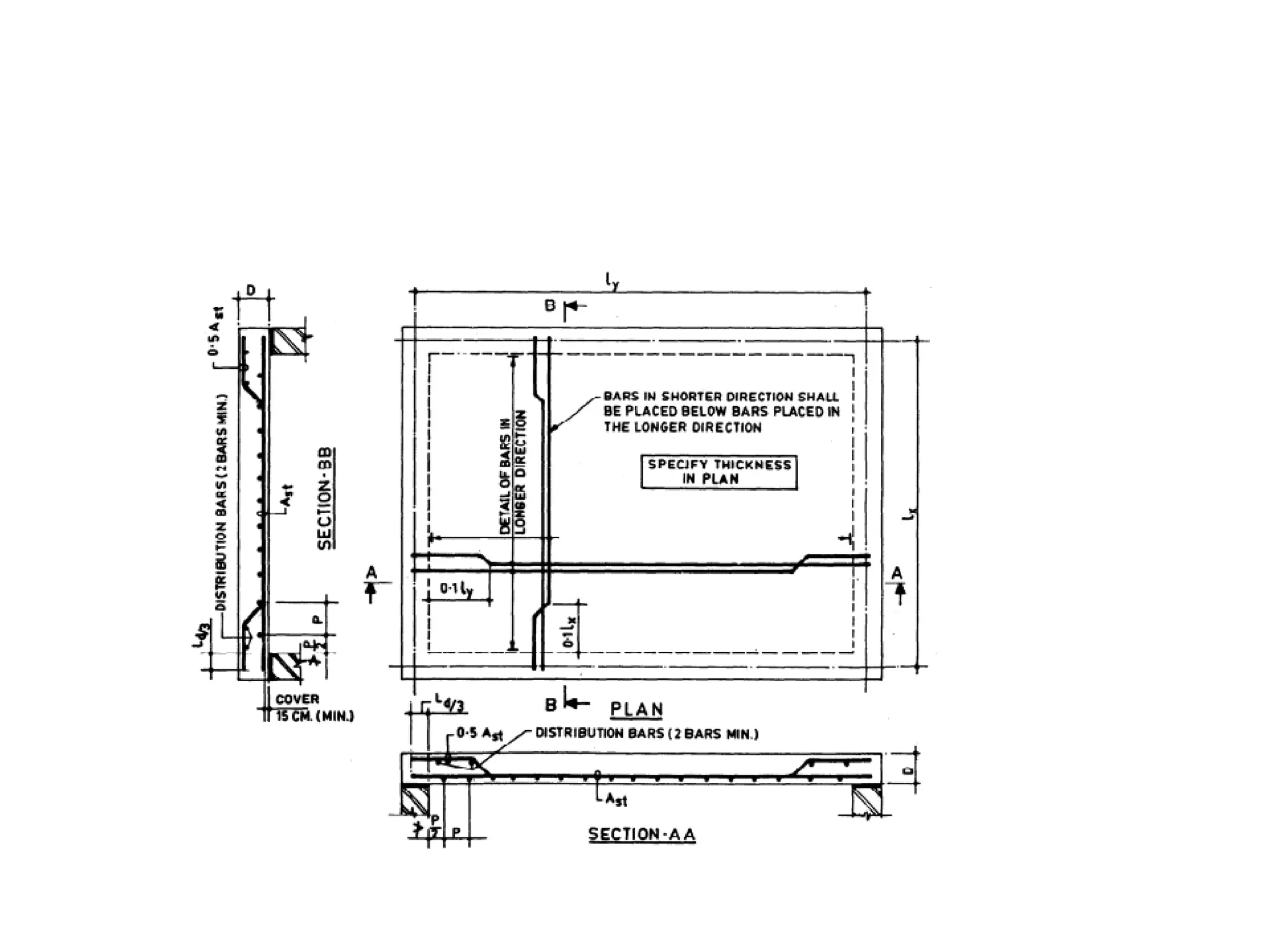
Simply supported slabs don’t give adequate provision to resist torsion at corner to
prevent corner from lifting.
The maximum bending moment will be given if the slabs are restrained.
But atleast 50% of the tension reinforcement provided at the mid span should extend to
the support.
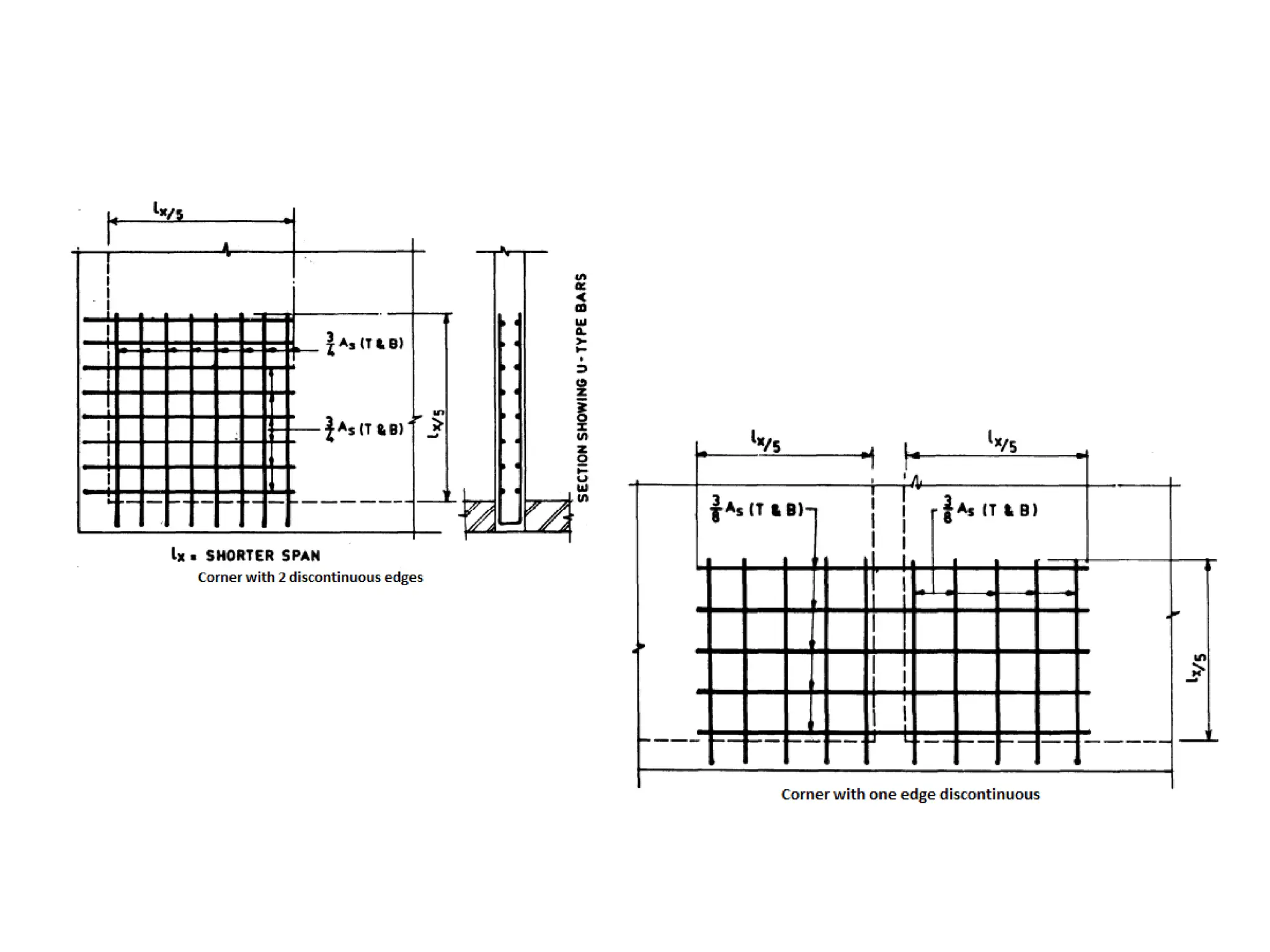
The remaining 50% should extend to within 0.1Lx or Ly at the support as appropriate.
RCC Slab Design depends on the on the dimensions of the slab after which the slab is
termed as a one-way slab or a two-way slab…
n the design of RCC structures, Column Design and Beam Design are to be done before
we start with RCC Slab Design…
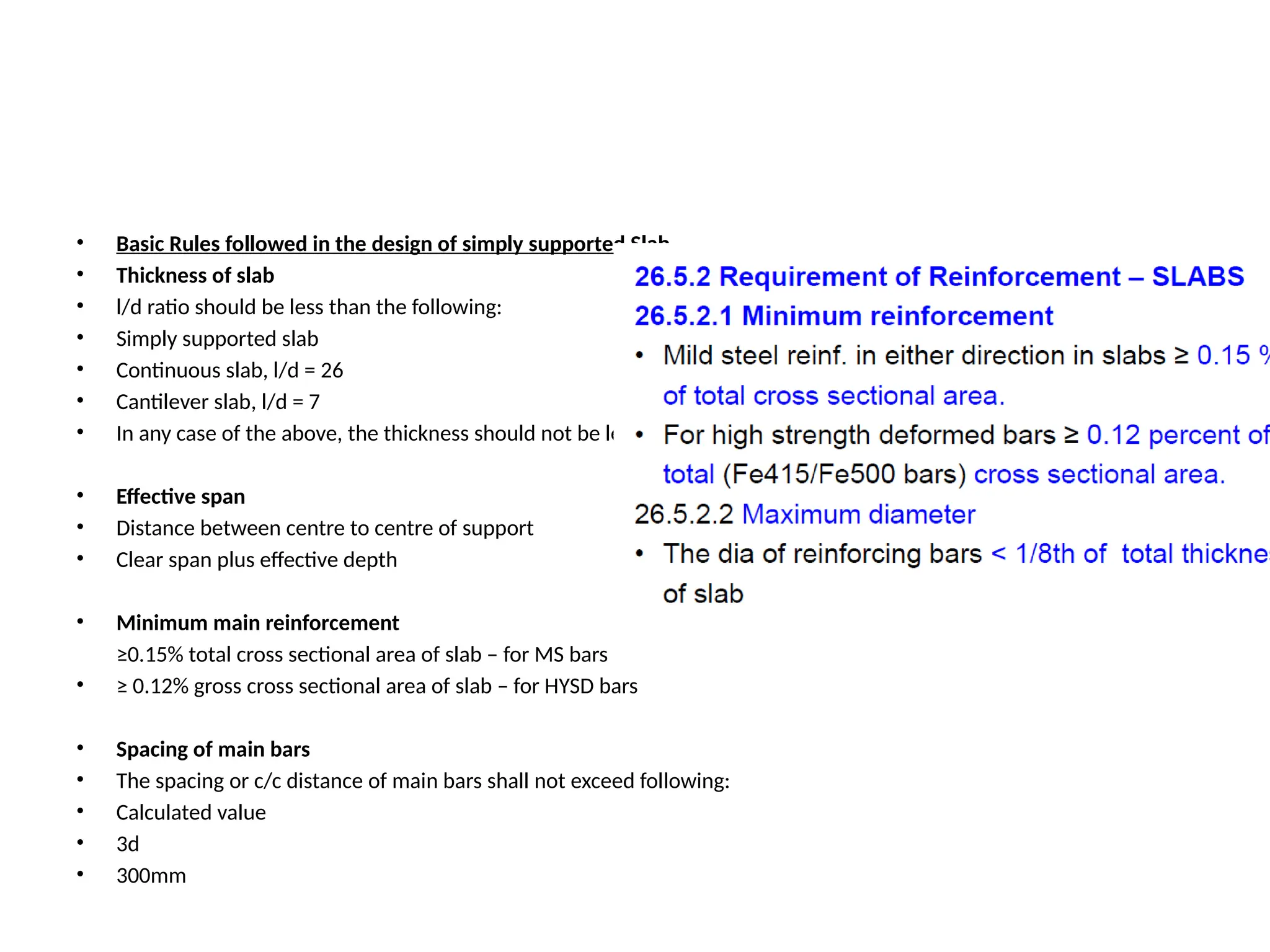
• Basic Rules followed in the design of simply supported Slab
• Thickness of slab
• l/d ratio should be less than the following:
• Simply supported slab
• Continuous slab, l/d = 26
• Cantilever slab, l/d = 7
• In any case of the above, the thickness should not be less than 100mm
• Effective span
• Distance between centre to centre of support
• Clear span plus effective depth
• Minimum main reinforcement
≥0.15% total cross sectional area of slab – for MS bars
• ≥ 0.12% gross cross sectional area of slab – for HYSD bars
• Spacing of main bars
• The spacing or c/c distance of main bars shall not exceed following:
• Calculated value
• 3d
• 300mm
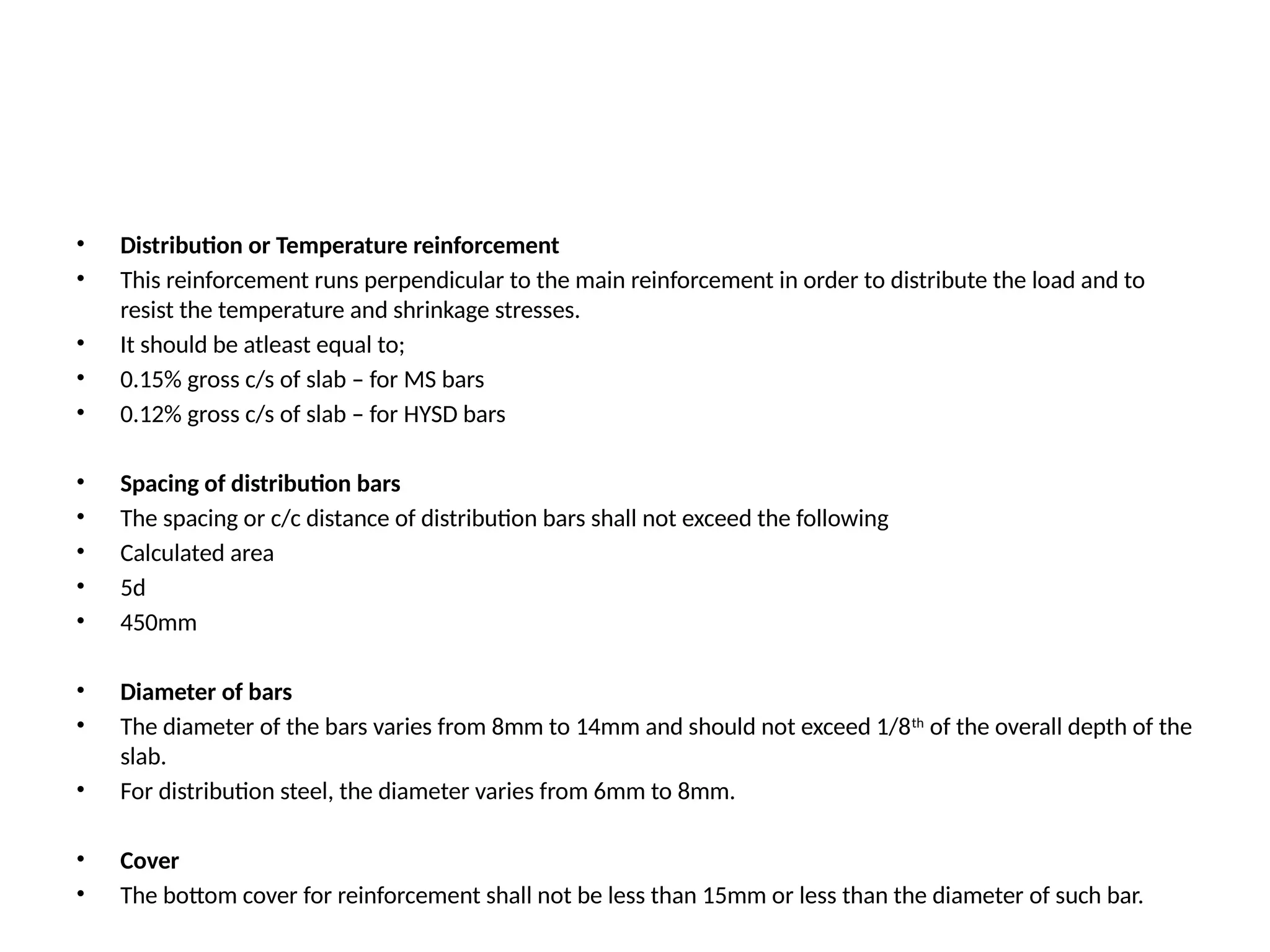
• Distribution or Temperature reinforcement
• This reinforcement runs perpendicular to the main reinforcement in order to distribute the load and to
resist the temperature and shrinkage stresses.
• It should be atleast equal to;
• 0.15% gross c/s of slab – for MS bars
• 0.12% gross c/s of slab – for HYSD bars
• Spacing of distribution bars
• The spacing or c/c distance of distribution bars shall not exceed the following
• Calculated area
• 5d
• 450mm
• Diameter of bars
• The diameter of the bars varies from 8mm to 14mm and should not exceed 1/8th
of the overall depth of the
slab.
• For distribution steel, the diameter varies from 6mm to 8mm.
• Cover
• The bottom cover for reinforcement shall not be less than 15mm or less than the diameter of such bar.
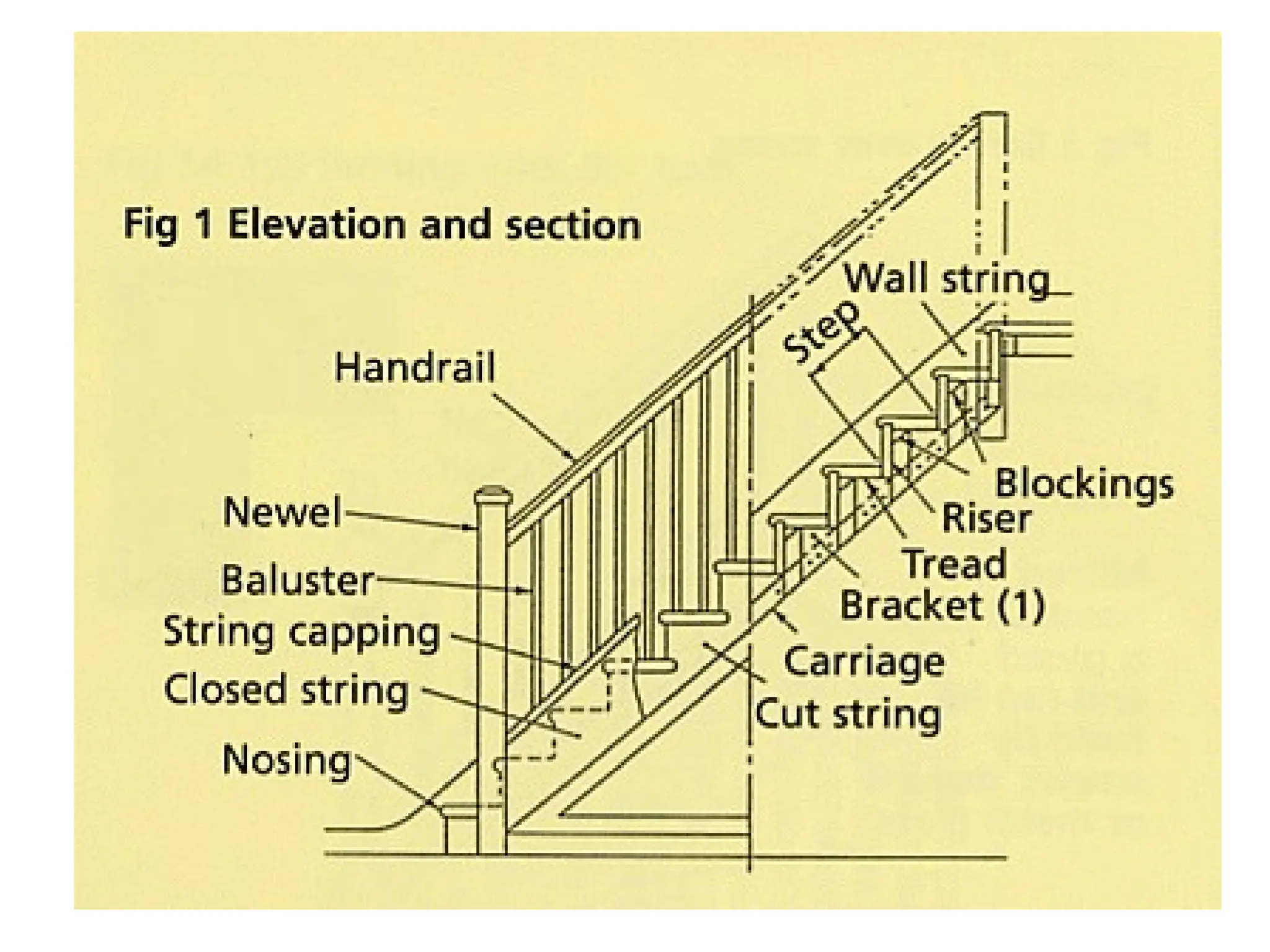
STAIRCASE
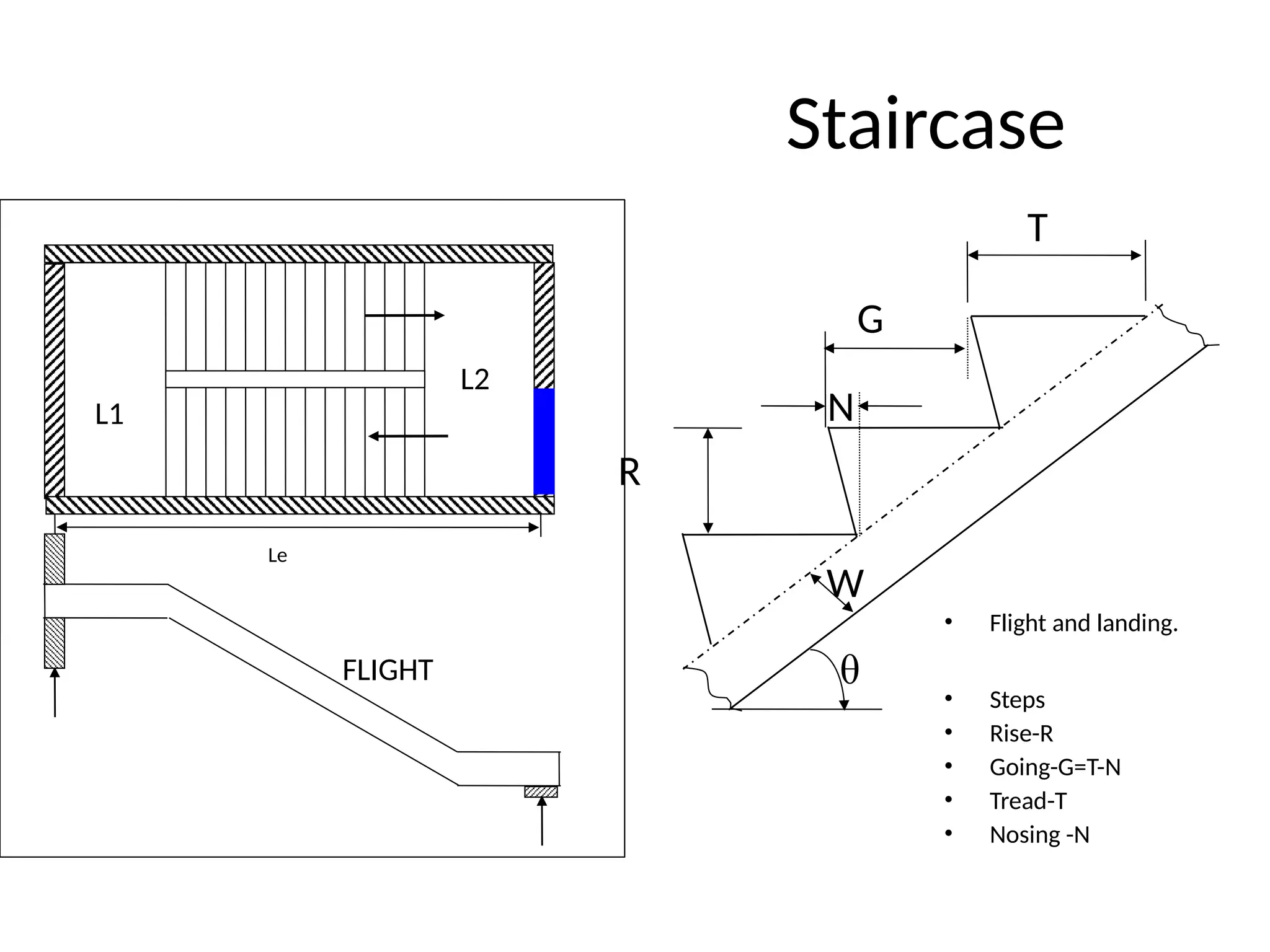
Staircase
G
T
N
R
W
θ
• Flight and landing.
• Steps
• Rise-R
• Going-G=T-N
• Tread-T
• Nosing -N
Le
L1
L2
FLIGHT
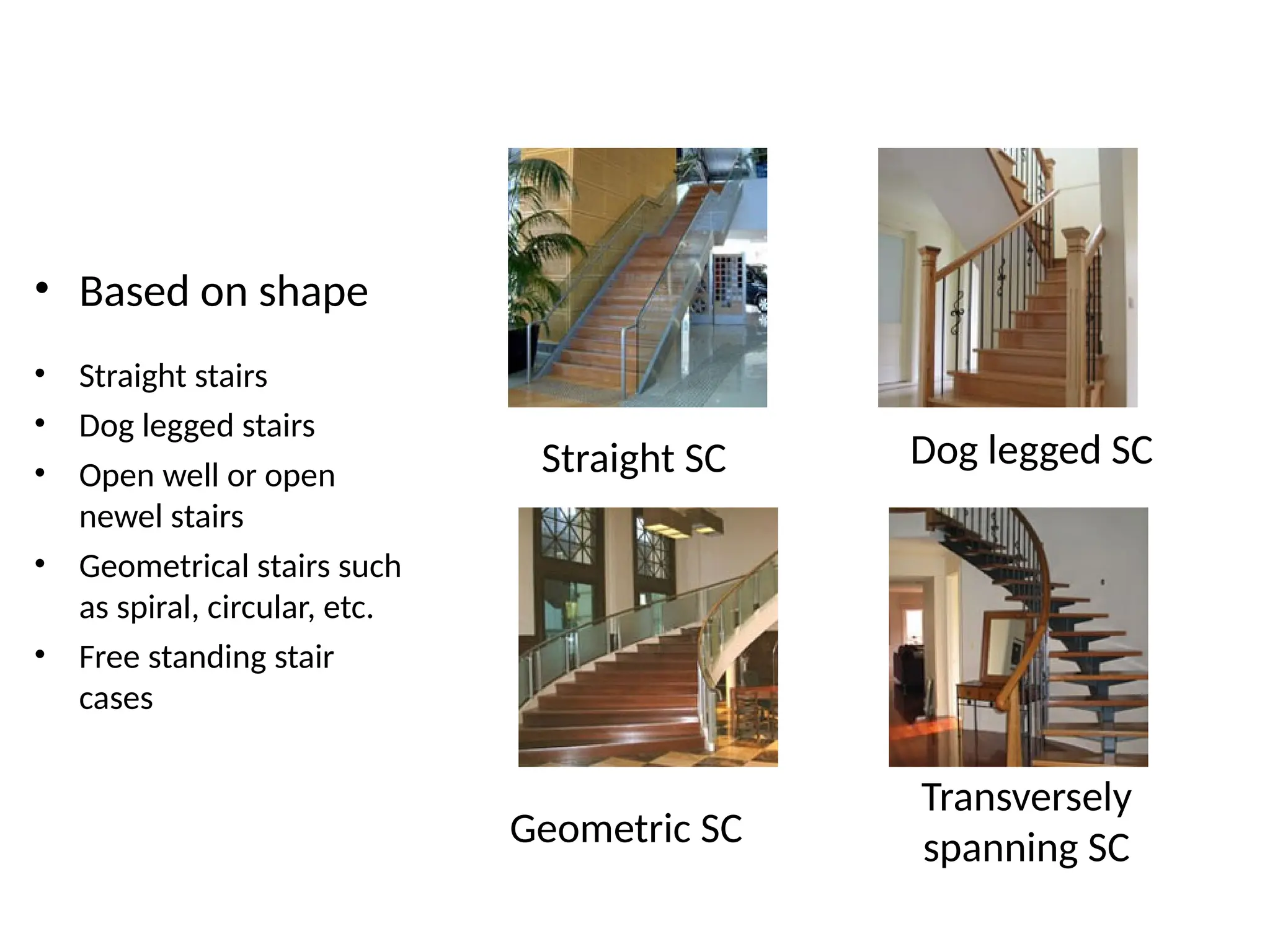
• Based on shape
• Straight stairs
• Dog legged stairs
• Open well or open
newel stairs
• Geometrical stairs such
as spiral, circular, etc.
• Free standing stair
cases
Straight SC
Geometric SC
Dog legged SC
Transversely
spanning SC
• Rise (R) : 150mm to 180mm
• Tread (T) : 220 mm to300 mm- for residential buildings.
• Rise (R) : 120 to 150 mm
• Tread (T) : 250 mm to 300 mm – for public buildings
[T + 2R] : Between 500 mm to 650 mm
The width of the stair
• 0.8 m to 1 m for residential building and
• 1.8 m to 2 m for public building.
• The width of the landing is equal to the width of stairs.
• The number of steps in each flight should not be greater than
12
• The pitch of the stair should not be more than 38 degrees.
• The head room measured vertically above any step or below
the mid landing shall not be less than 2.1 m.
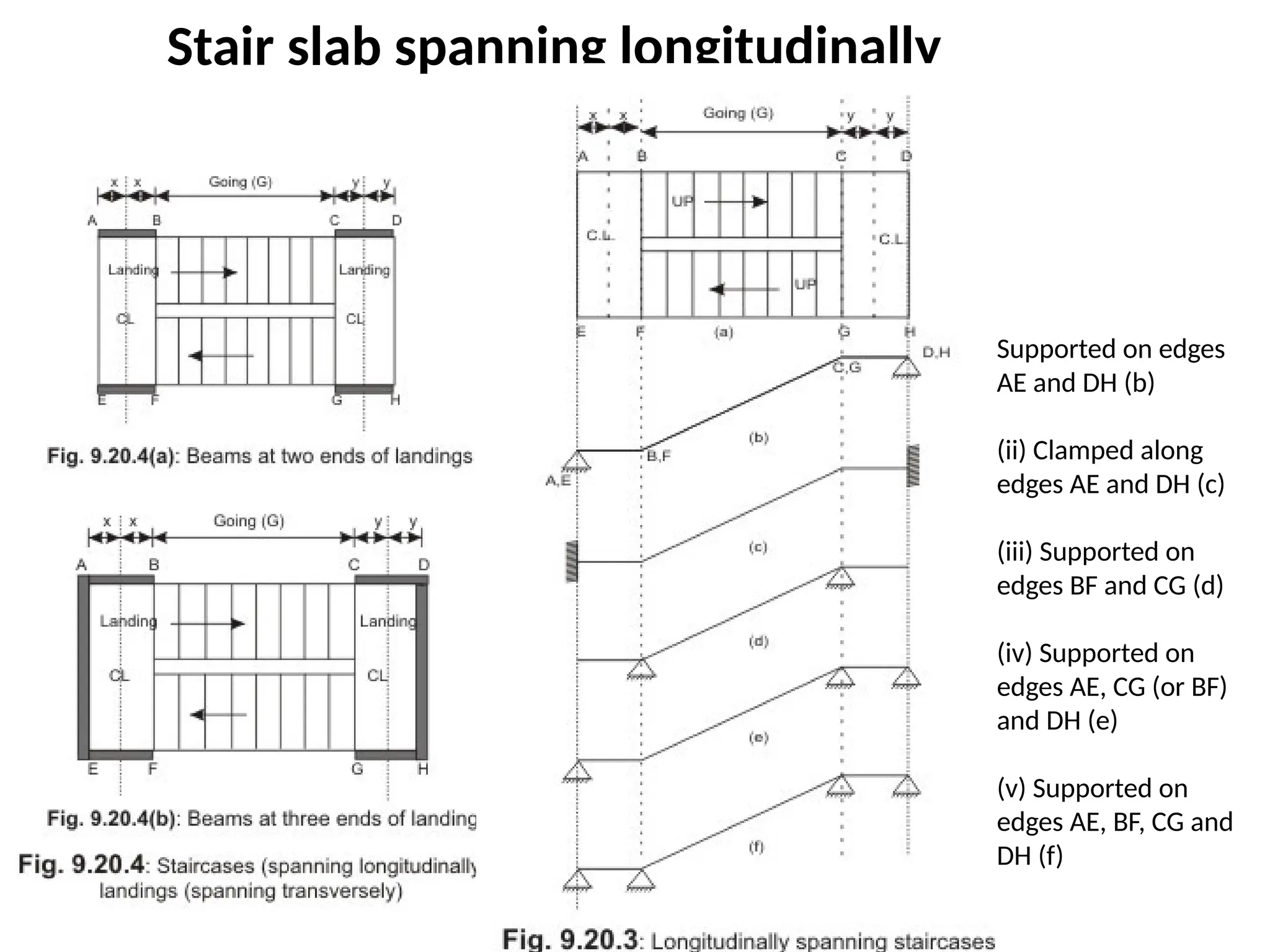
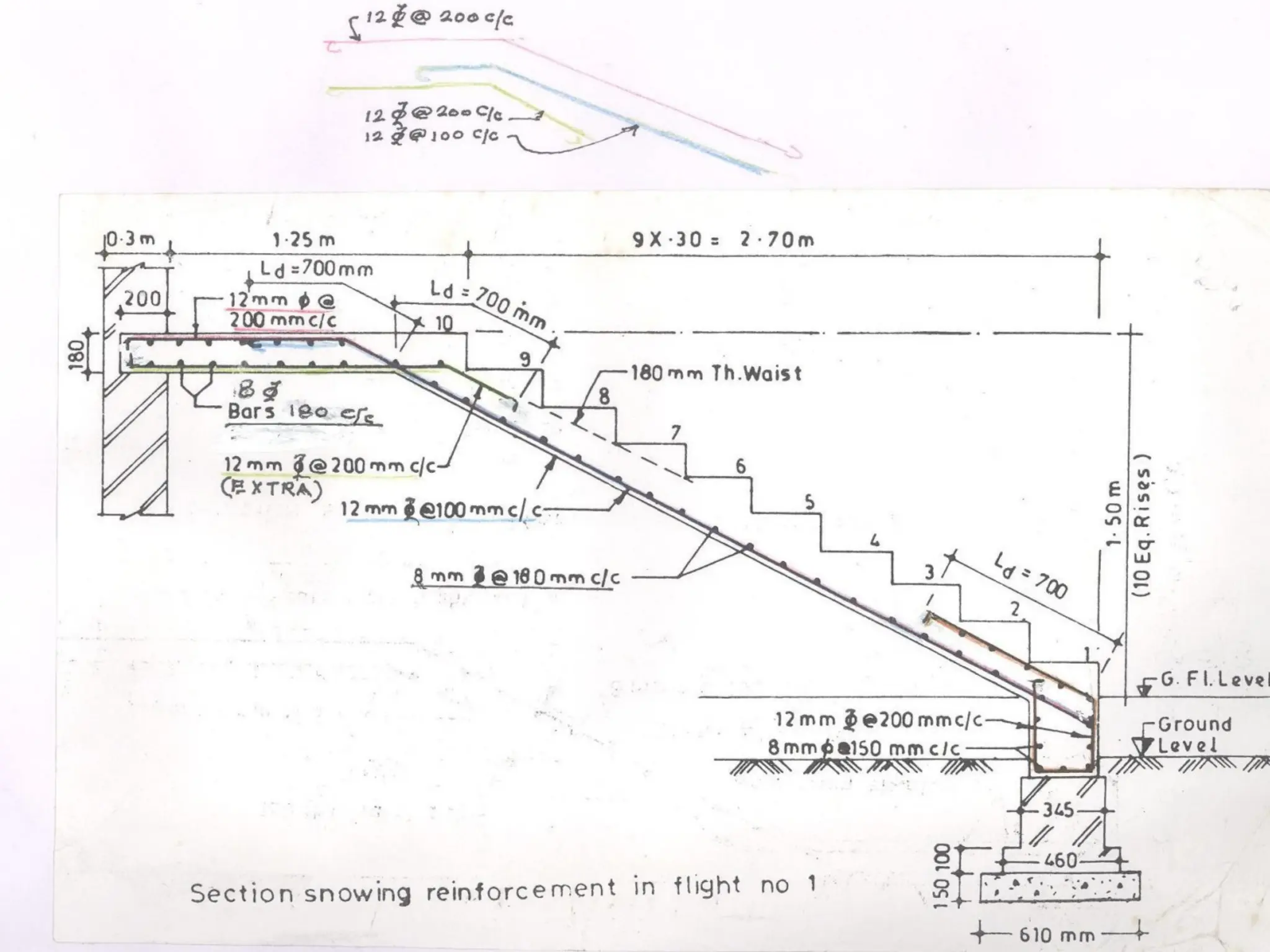
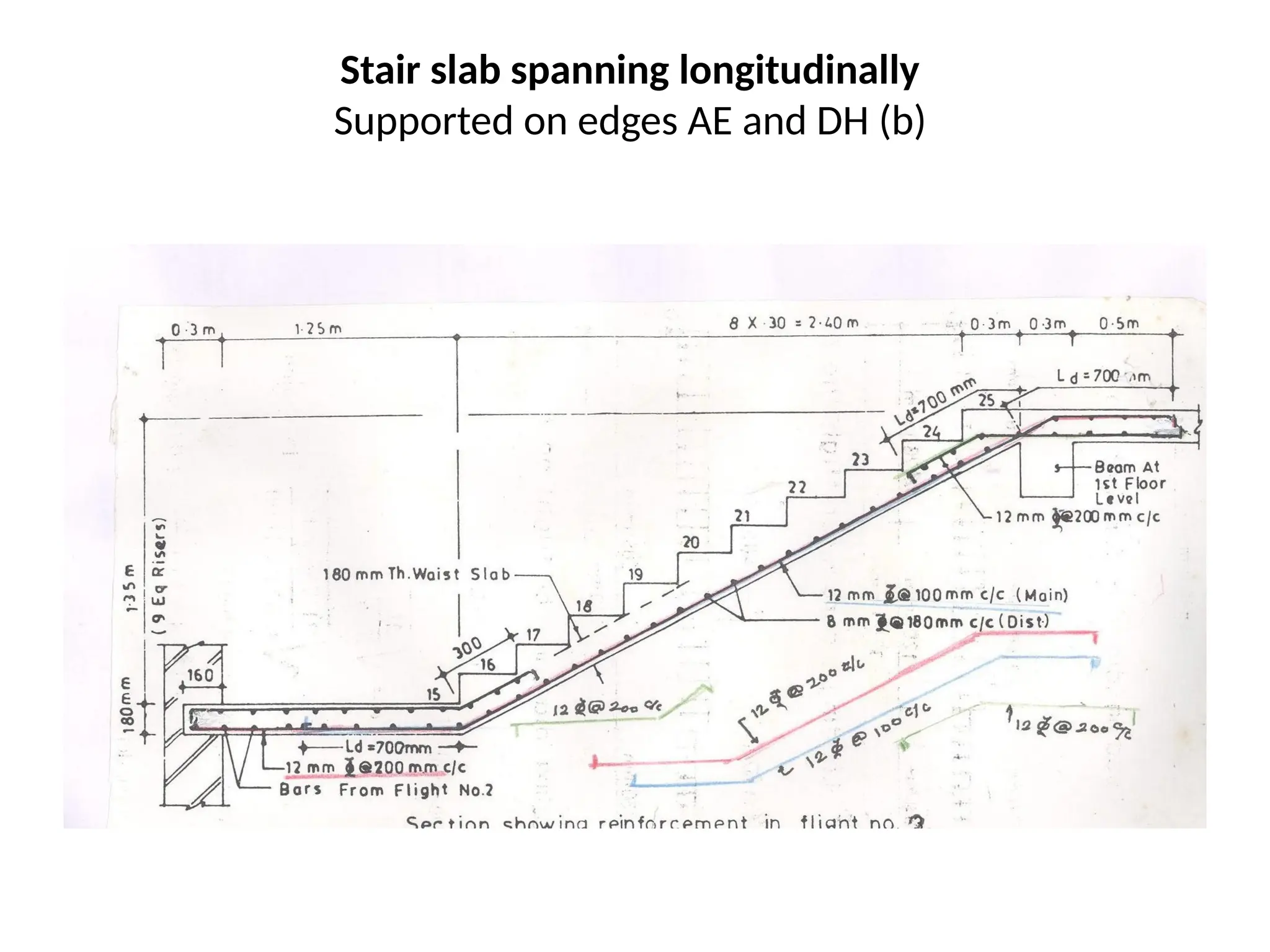
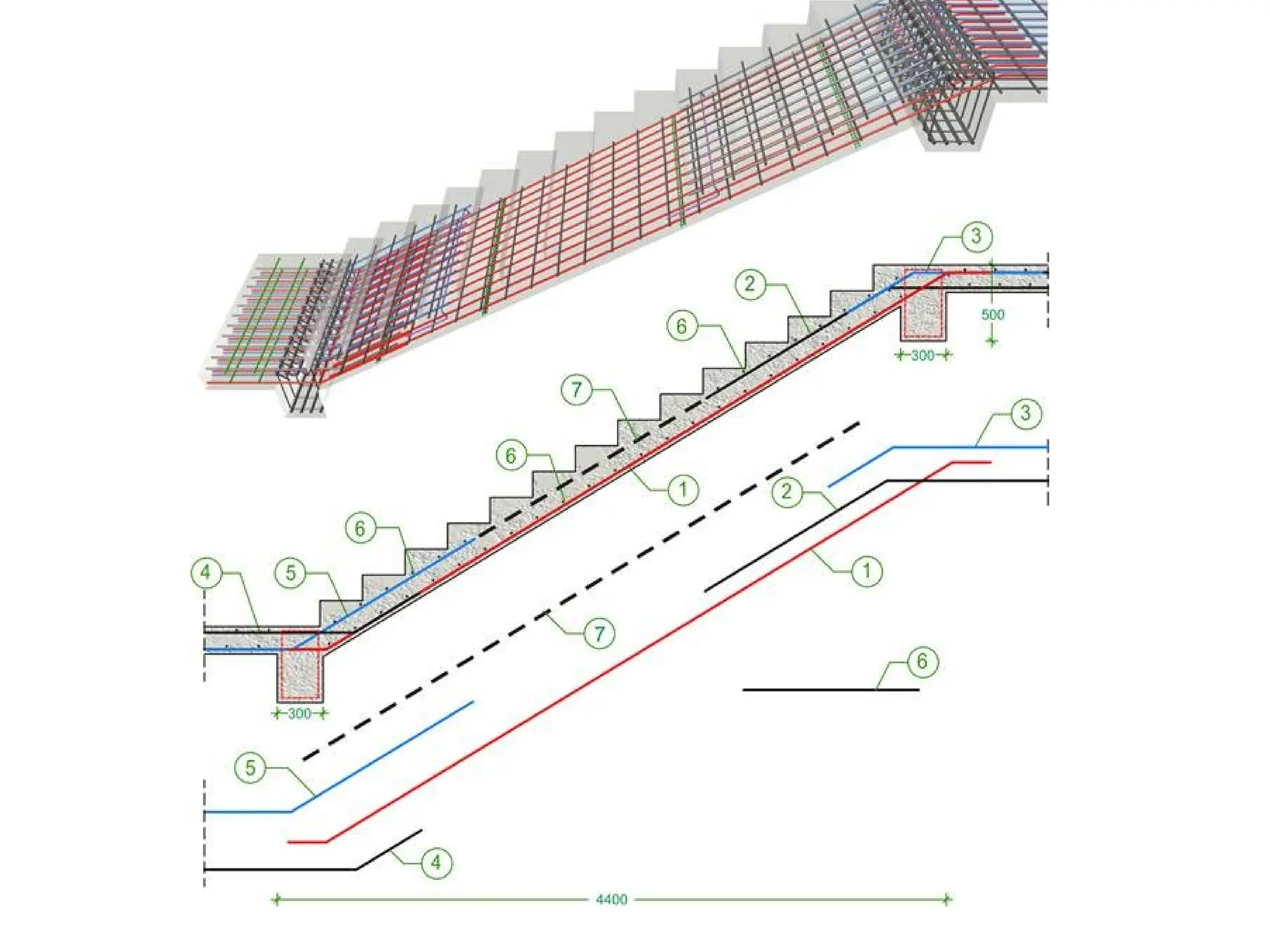
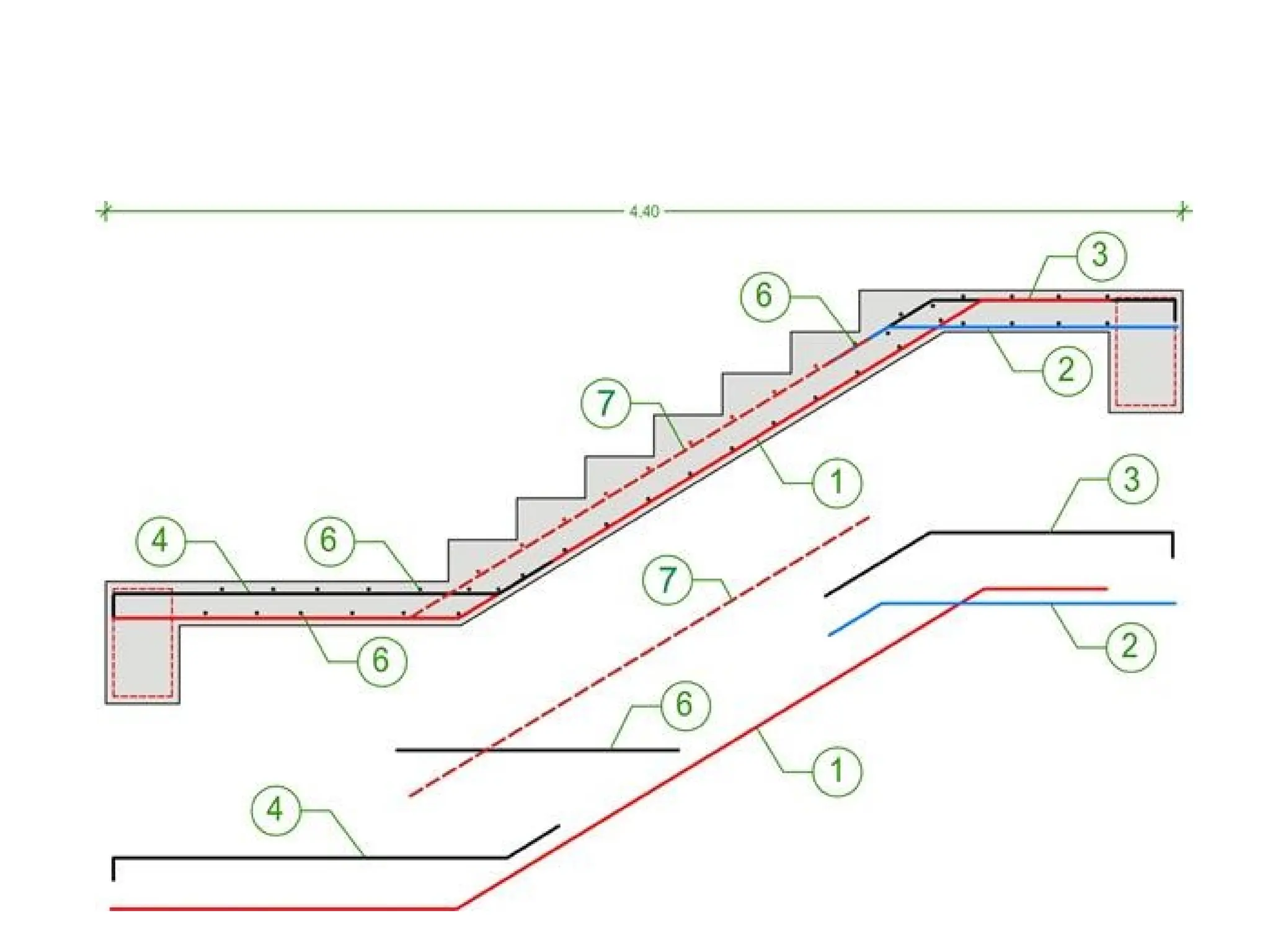
Stair slab spanning longitudinally
Supported on edges
AE and DH (b)
(ii) Clamped along
edges AE and DH (c)
(iii) Supported on
edges BF and CG (d)
(iv) Supported on
edges AE, CG (or BF)
and DH (e)
(v) Supported on
edges AE, BF, CG and
DH (f)
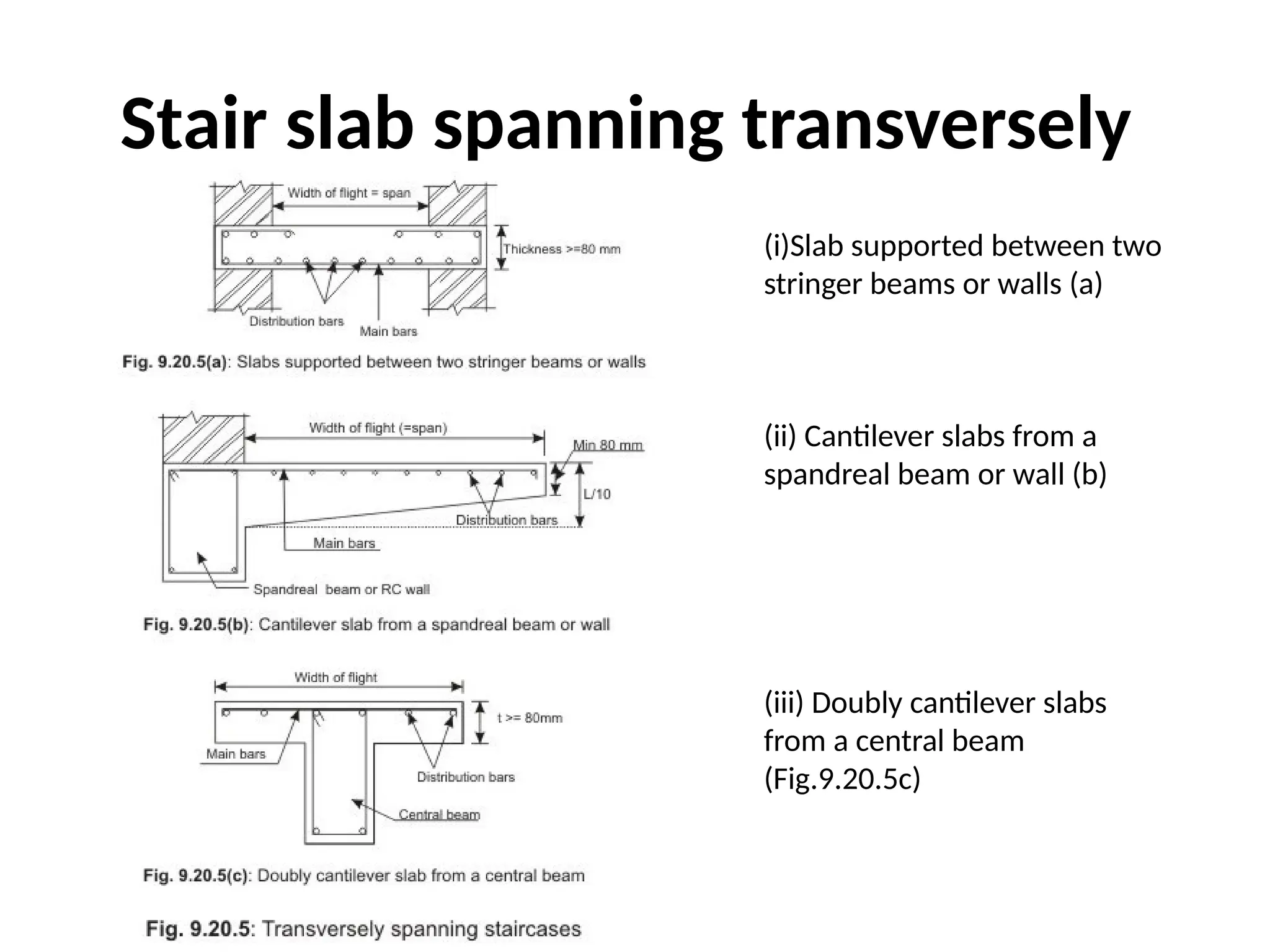
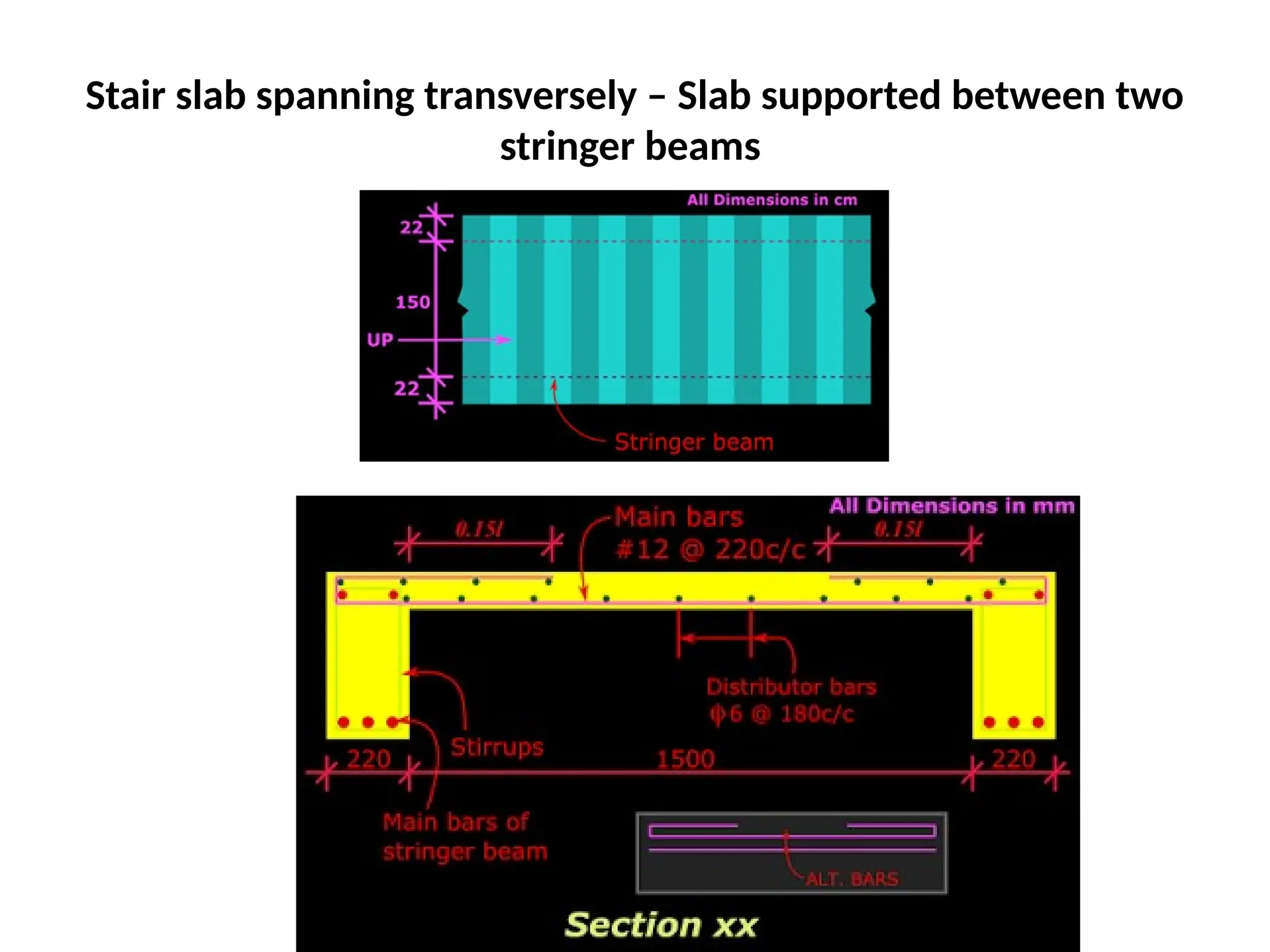
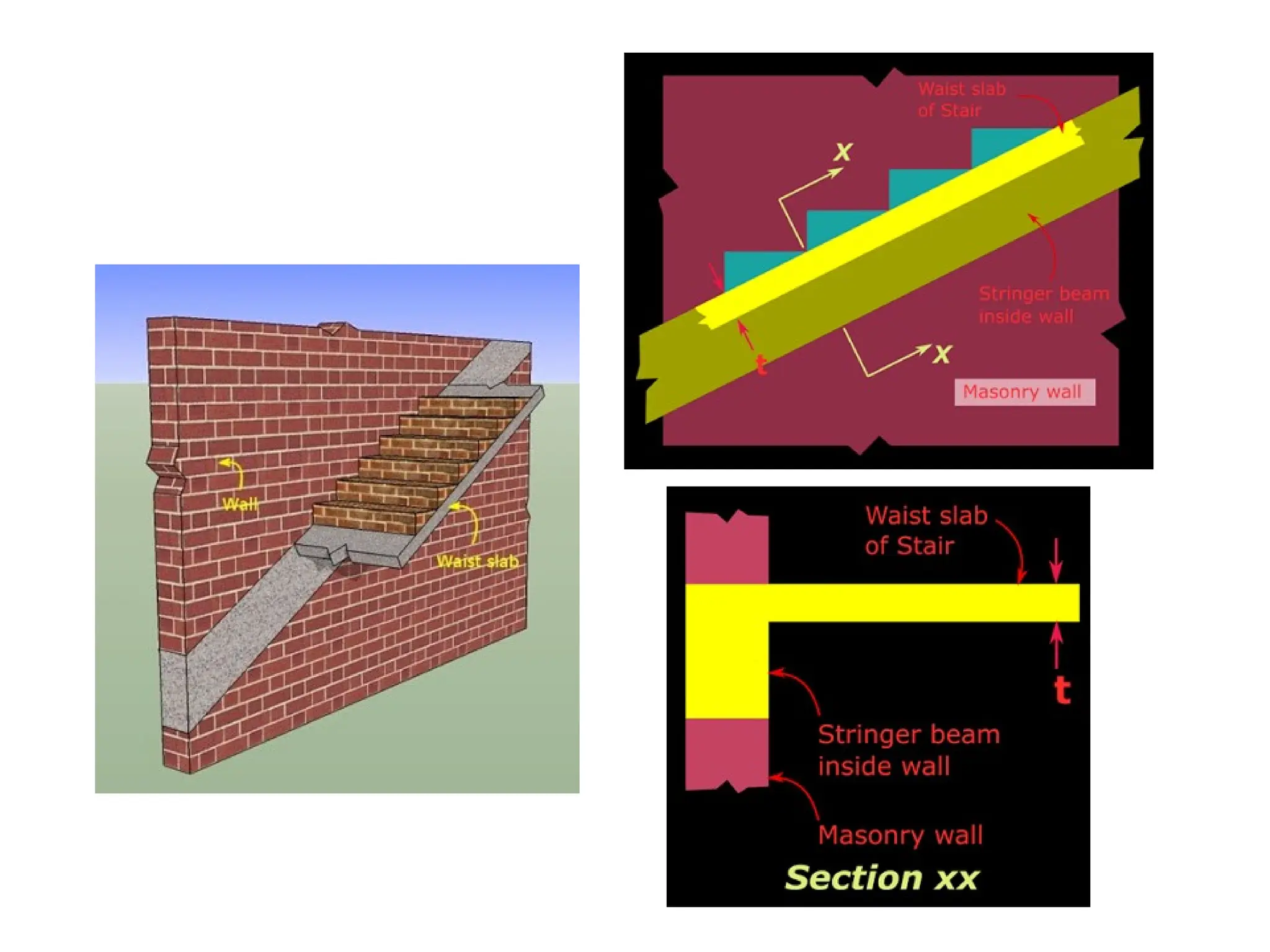
Stair slab spanning transversely
(i)Slab supported between two
stringer beams or walls (a)
(ii) Cantilever slabs from a
spandreal beam or wall (b)
(iii) Doubly cantilever slabs
from a central beam
(Fig.9.20.5c)
Stair slab spanning transversely – Slab supported between two
stringer beams
Stair slab spanning longitudinally
Supported on edges AE and DH (b)
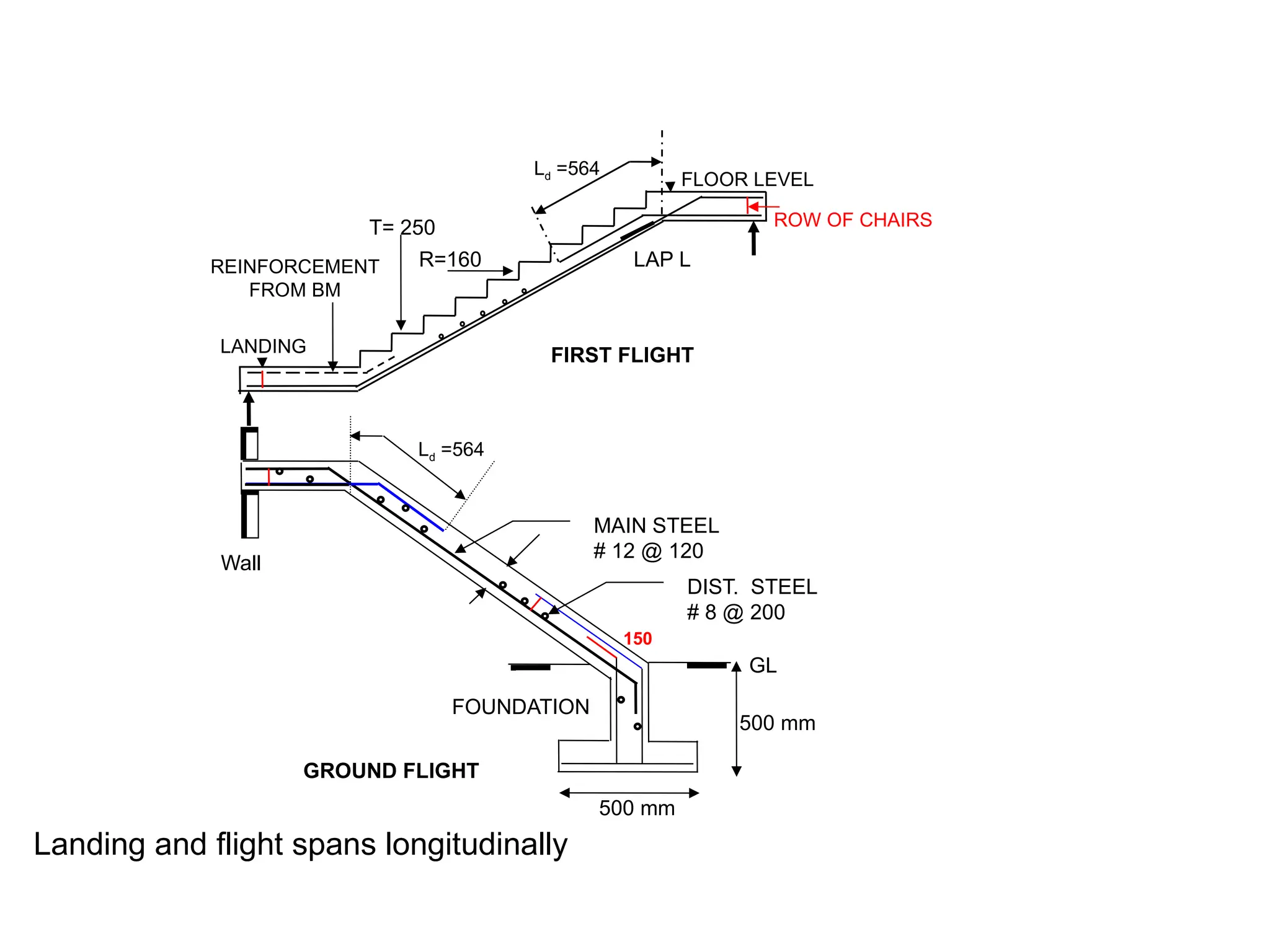
ROW OF CHAIRS
500 mm
500 mm
GL
Wall
FOUNDATION
GROUND FLIGHT
MAIN STEEL
# 12 @ 120
DIST. STEEL
# 8 @ 200
150
Ld =564
REINFORCEMENT
FROM BM
Ld =564
FLOOR LEVEL
LANDING FIRST FLIGHT
R=160
T= 250
LAP L
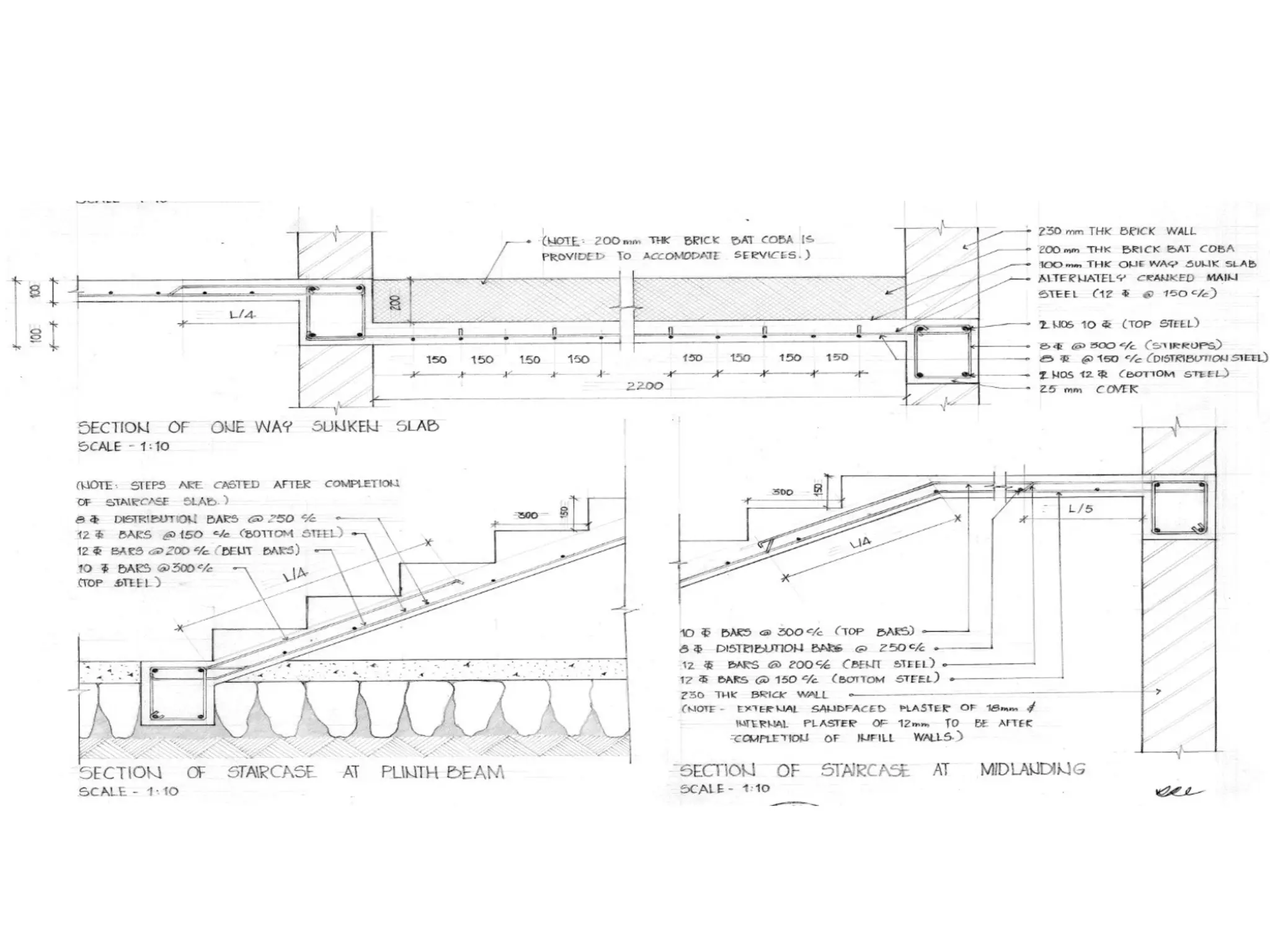
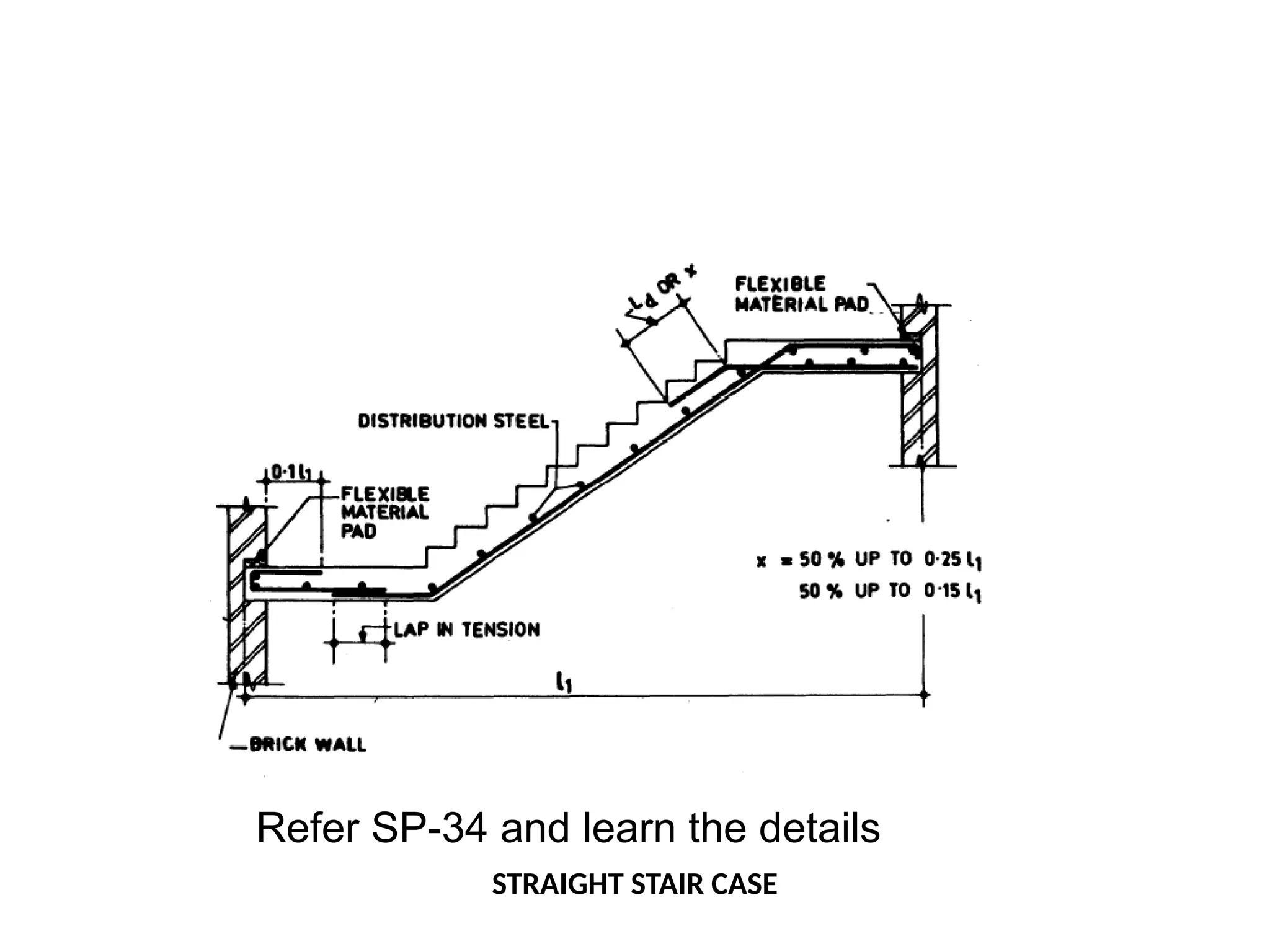
Landing and flight spans longitudinally
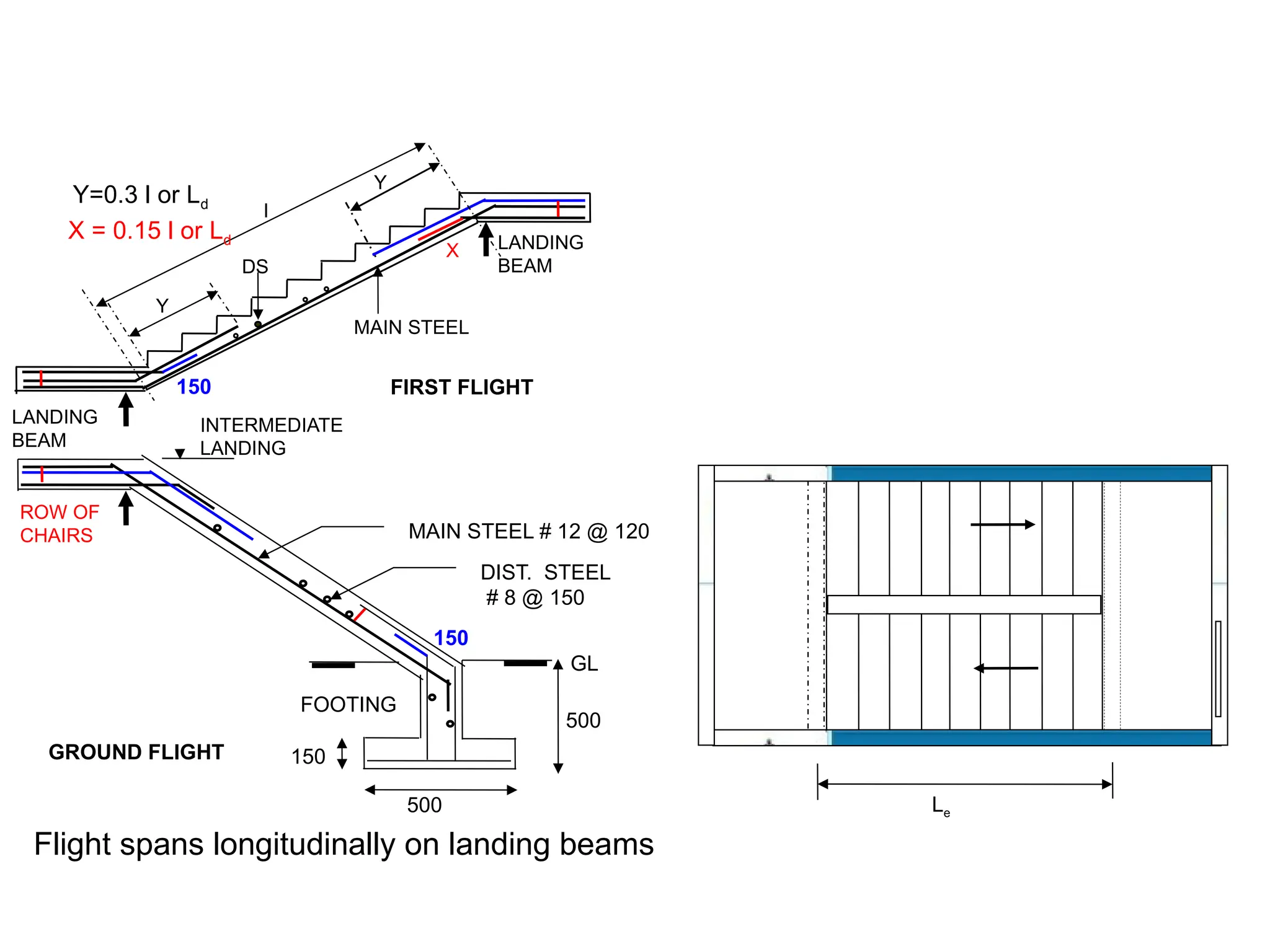
Y=0.3 l or Ld
LANDING
BEAM
500
500
GL
FOOTING
GROUND FLIGHT
FIRST FLIGHT
MAIN STEEL # 12 @ 120
DIST. STEEL
# 8 @ 150
LANDING
BEAM
150
X
l
Y
Y
150
INTERMEDIATE
LANDING
ROW OF
CHAIRS
X = 0.15 l or Ld
MAIN STEEL
DS
150
Le
Flight spans longitudinally on landing beams
Refer SP-34 and learn the details
STRAIGHT STAIR CASE
WALL SYSTEMS
• Concrete frame structures are strong and economical.
• Hence almost any walling materials can be used with them.
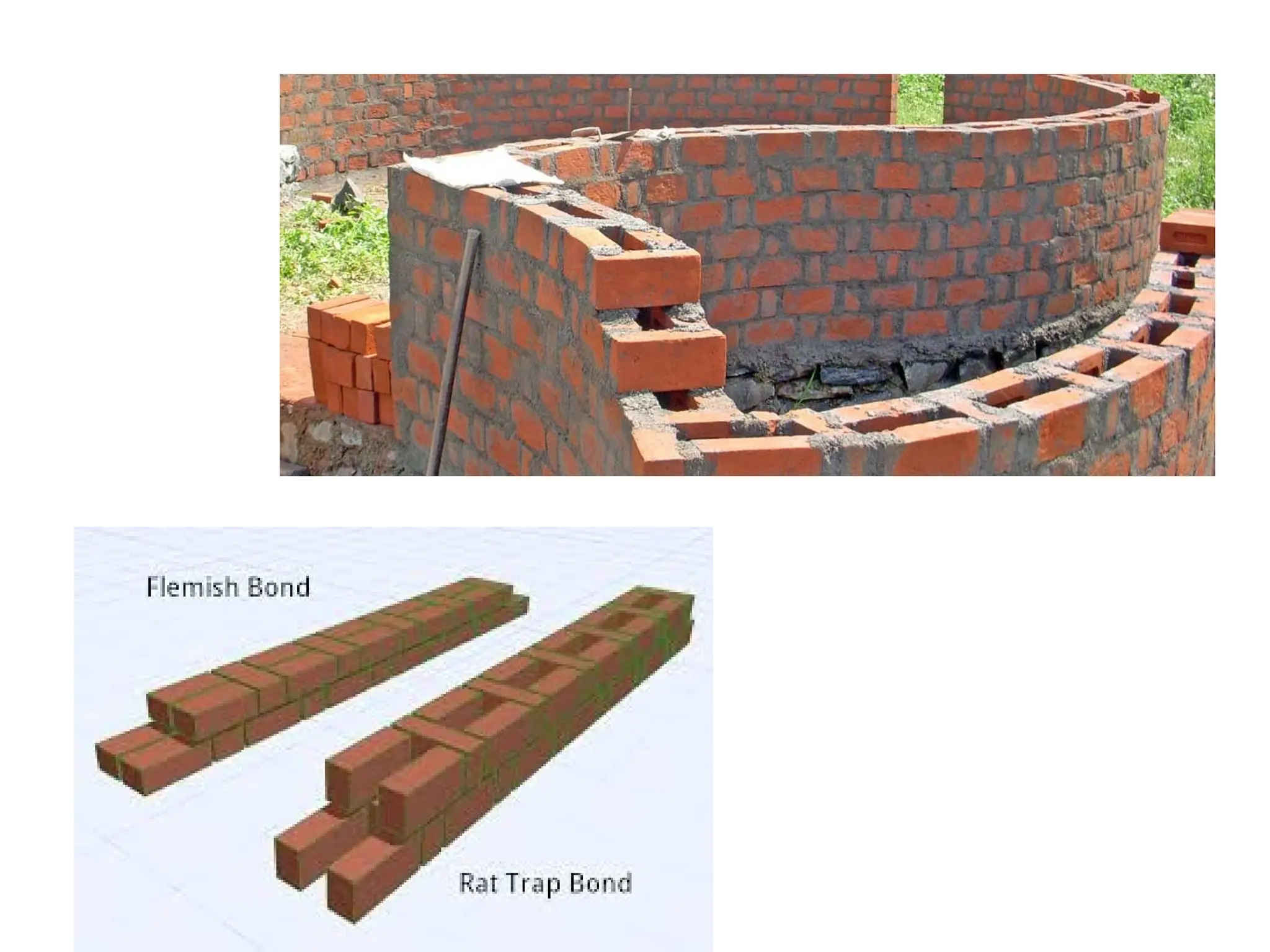
• Heavier options - masonry walls of brick, concrete block, or stone.
• when strong, secure, and sound-proof enclosures are required
• Lighter options - drywall partitions made of light steel or wood studs
covered with sheeting material.
• when quick, flexible lightweight partitions are needed.
• When brick or concrete blocks are used, it is common to plaster the entire
surface - brick and concrete - with a cement plaster to form a hard, long-
lasting finish.
Masonry Walls
• concrete block walls, common thicknesses are 200mm(8"),
150mm(6") and100mm(4"). (excluding plaster)
– Solid Concrete Blocks
– Hollow Concrete Blocks
– Lightweight Aerated Concrete Blocks
– Flyash Concrete Block
• brick walls, common thickness is 230mm(9"), excluding plaster)
• run electrical, or any other wires or pipes in a brick wall,
you have to first chase the wall.
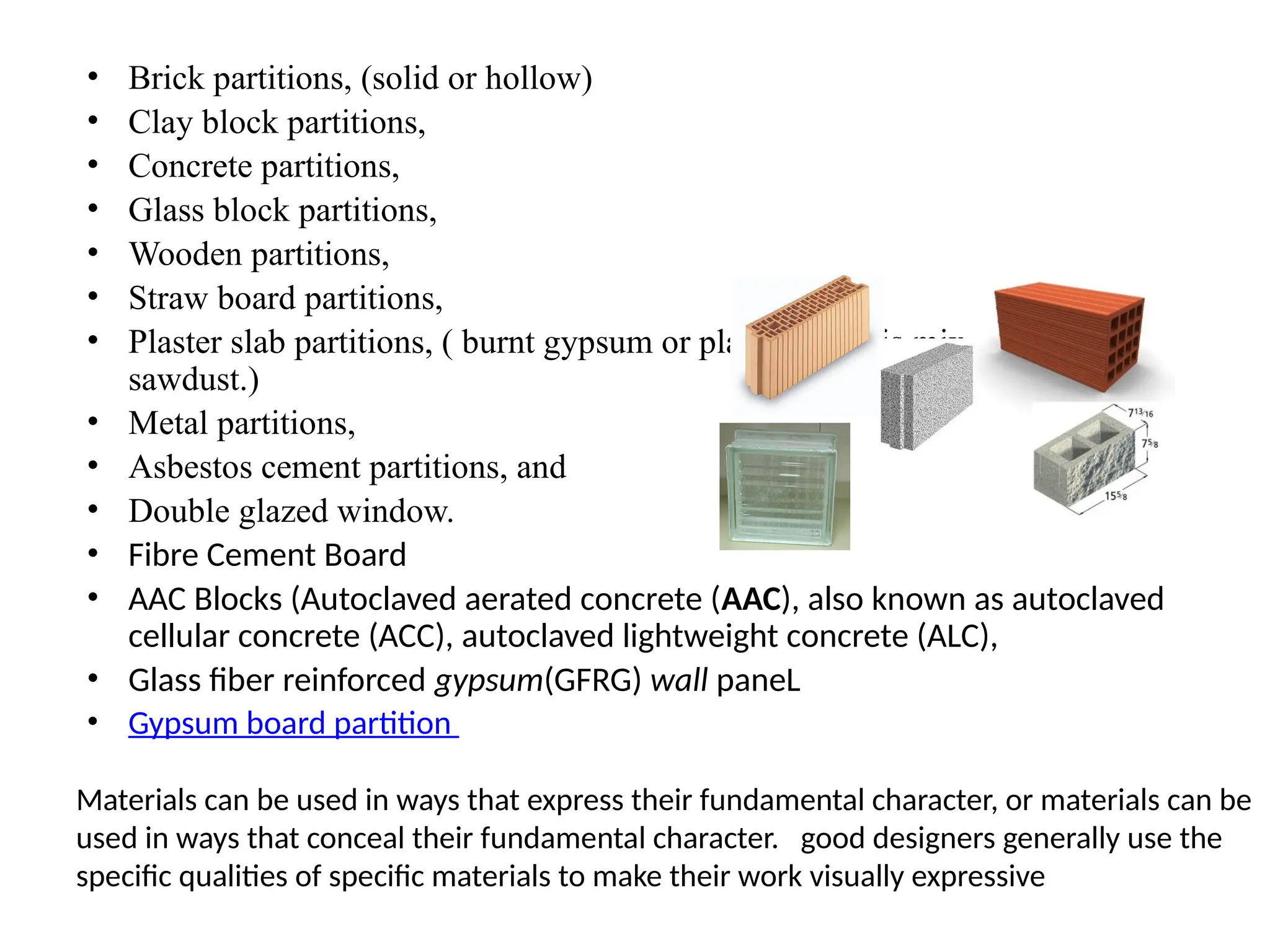
• Brick partitions, (solid or hollow)
• Clay block partitions,
• Concrete partitions,
• Glass block partitions,
• Wooden partitions,
• Straw board partitions,
• Plaster slab partitions, ( burnt gypsum or plaster of paris mixed with
sawdust.)
• Metal partitions,
• Asbestos cement partitions, and
• Double glazed window.
• Fibre Cement Board
• AAC Blocks (Autoclaved aerated concrete (AAC), also known as autoclaved
cellular concrete (ACC), autoclaved lightweight concrete (ALC),
• Glass fiber reinforced gypsum(GFRG) wall paneL
• Gypsum board partition
Materials can be used in ways that express their fundamental character, or materials can be
used in ways that conceal their fundamental character. good designers generally use the
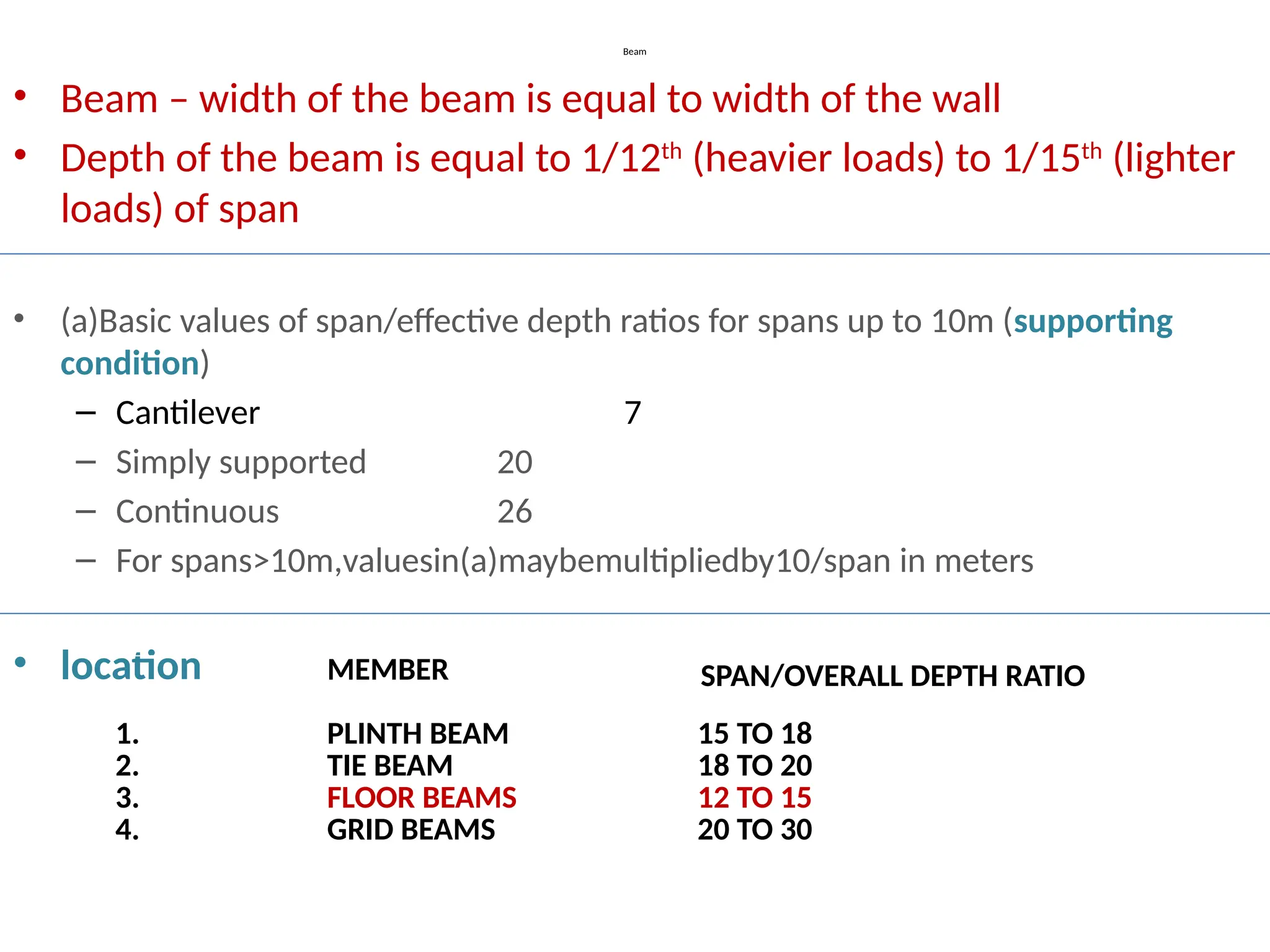
specific qualities of specific materials to make their work visually expressive
Beam
• Beam – width of the beam is equal to width of the wall
• Depth of the beam is equal to 1/12th
(heavier loads) to 1/15th
(lighter
loads) of span
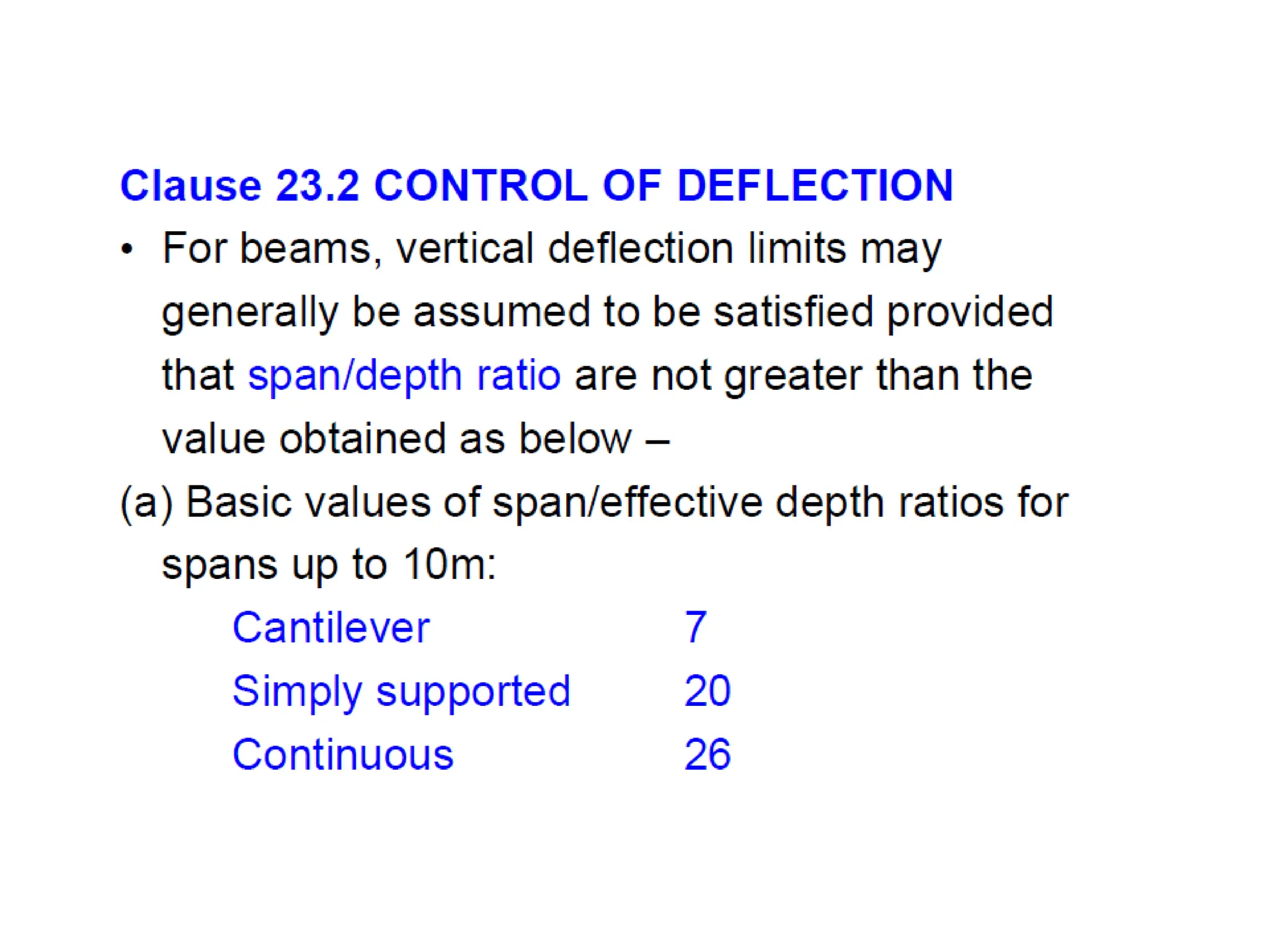
• (a)Basic values of span/effective depth ratios for spans up to 10m (supporting
condition)
– Cantilever 7
– Simply supported 20
– Continuous 26
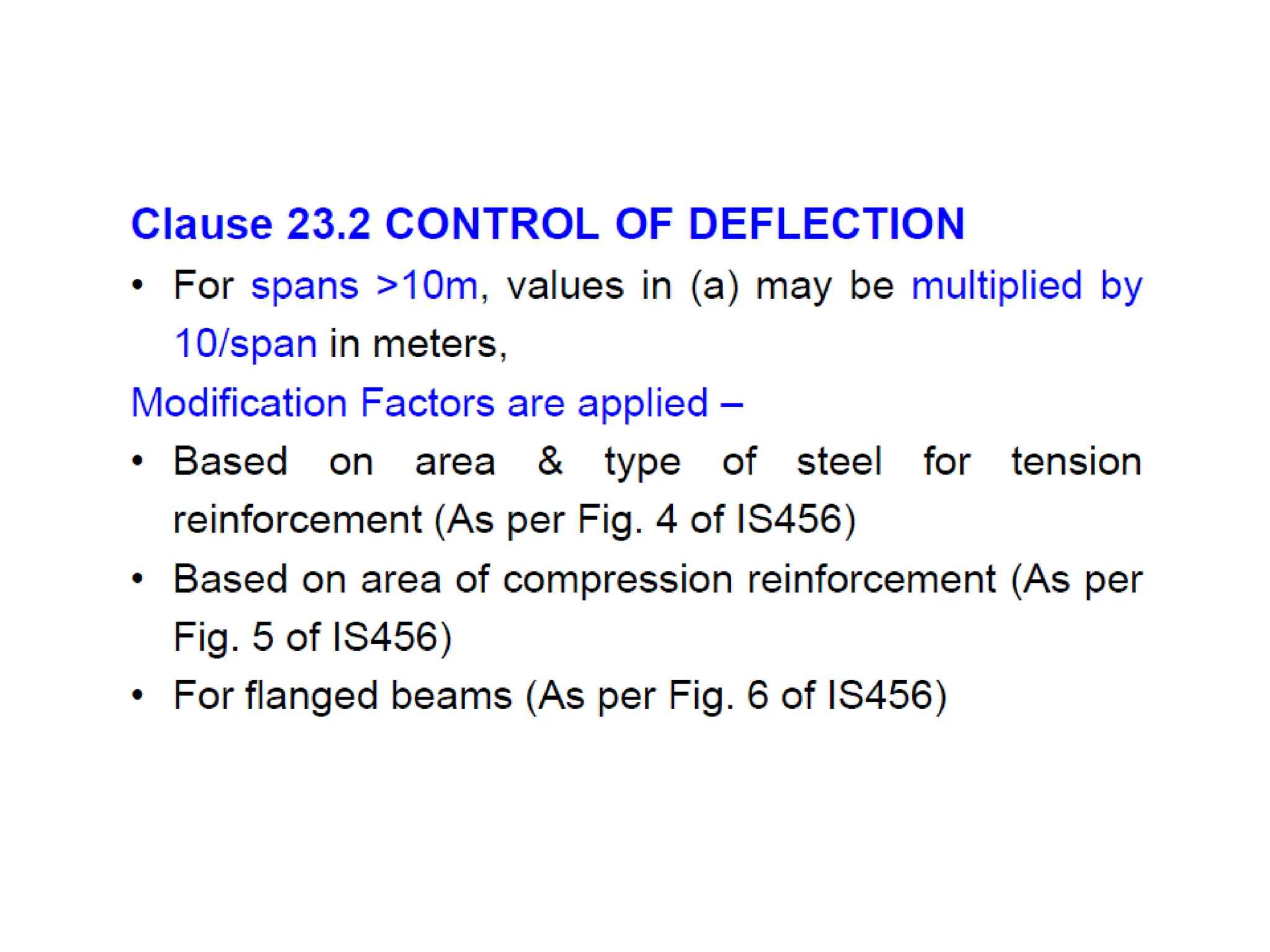
– For spans>10m,valuesin(a)maybemultipliedby10/span in meters
• location MEMBER SPAN/OVERALL DEPTH RATIO
1. PLINTH BEAM 15 TO 18
2. TIE BEAM 18 TO 20
3. FLOOR BEAMS 12 TO 15
4. GRID BEAMS 20 TO 30
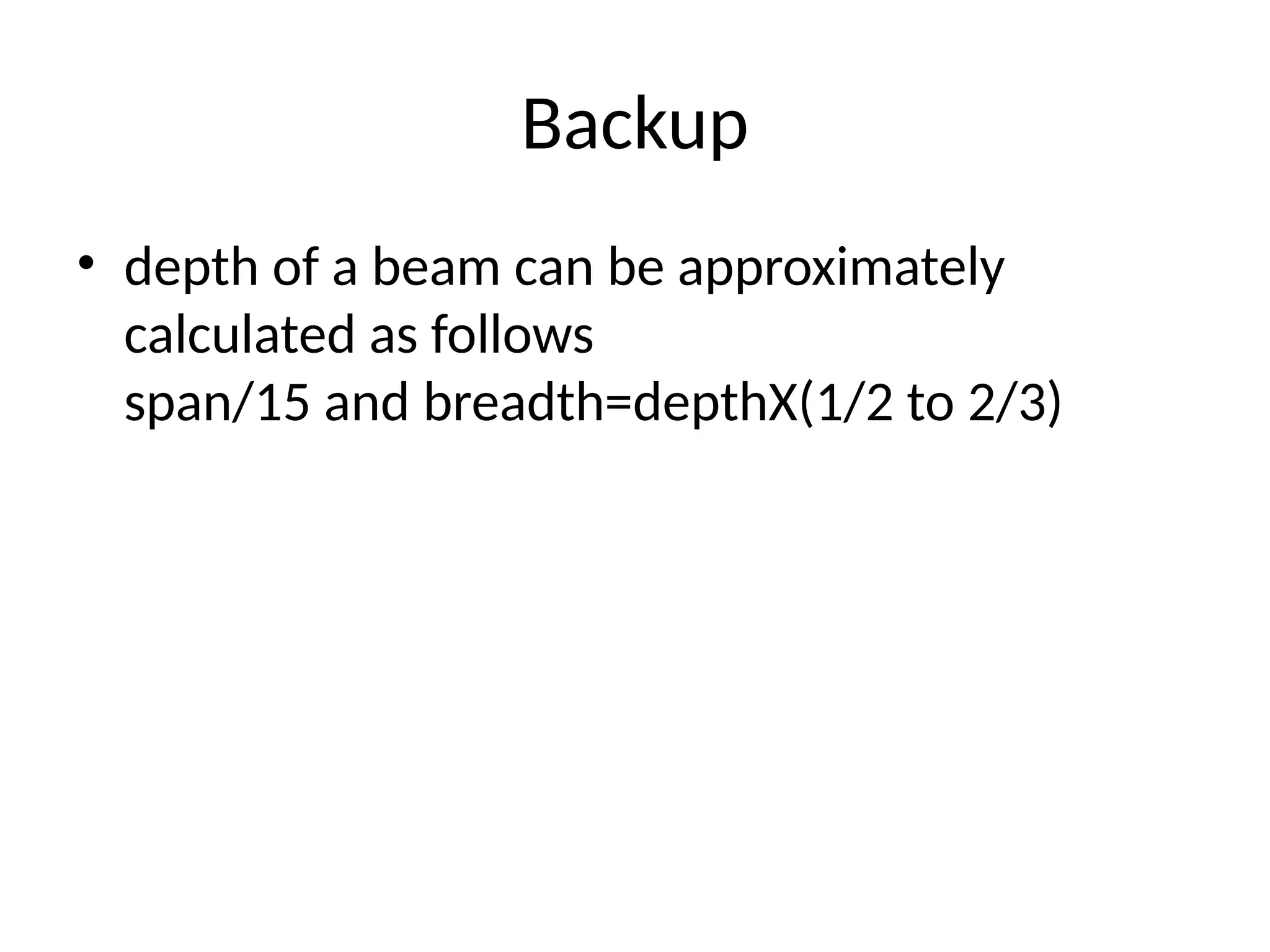
Backup
• depth of a beam can be approximately
calculated as follows
span/15 and breadth=depthX(1/2 to 2/3)
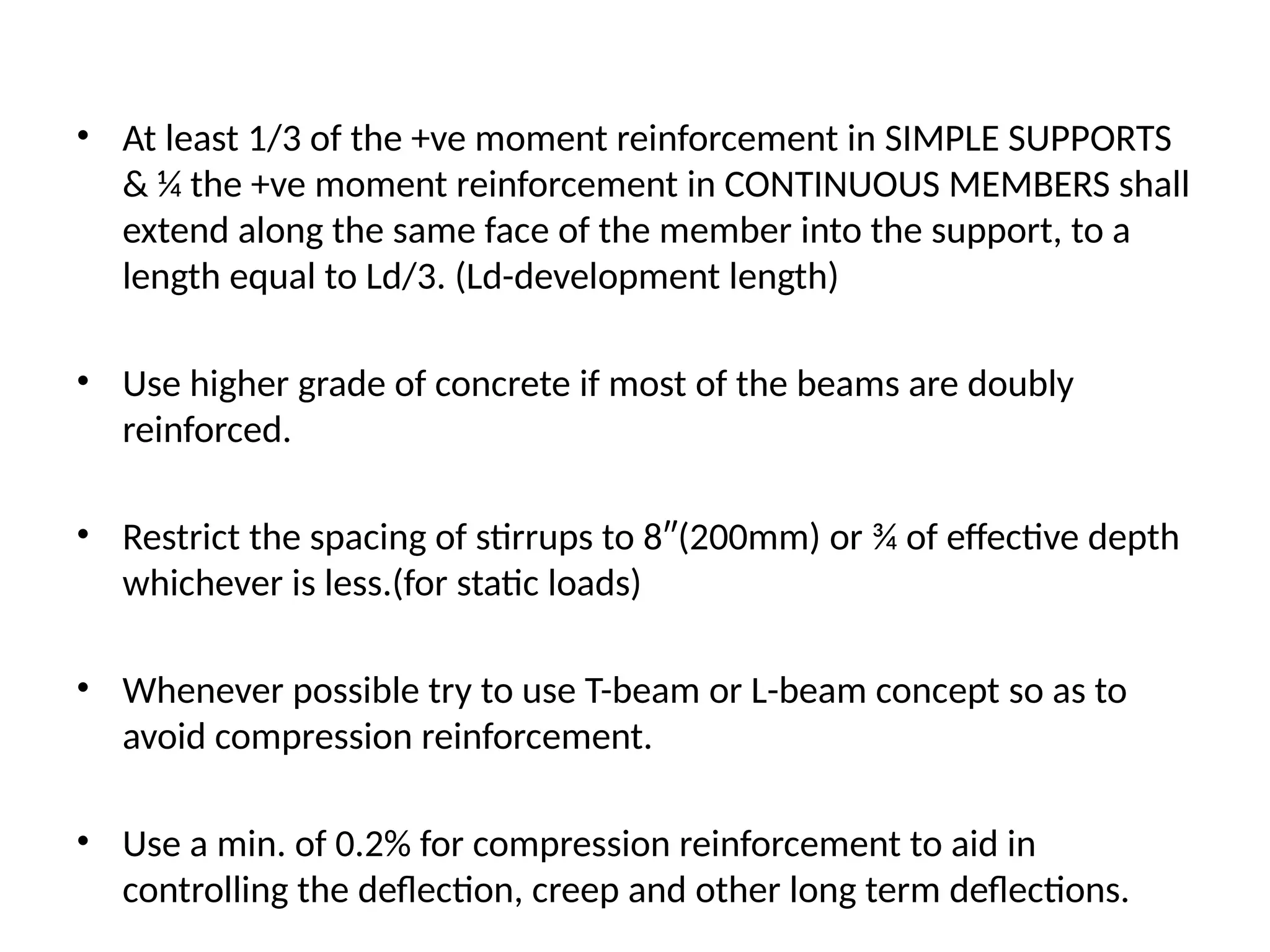
• At least 1/3 of the +ve moment reinforcement in SIMPLE SUPPORTS
& ¼ the +ve moment reinforcement in CONTINUOUS MEMBERS shall
extend along the same face of the member into the support, to a
length equal to Ld/3. (Ld-development length)
• Use higher grade of concrete if most of the beams are doubly
reinforced.
• Restrict the spacing of stirrups to 8″(200mm) or ¾ of effective depth
whichever is less.(for static loads)
• Whenever possible try to use T-beam or L-beam concept so as to
avoid compression reinforcement.
• Use a min. of 0.2% for compression reinforcement to aid in
controlling the deflection, creep and other long term deflections.
Slabs
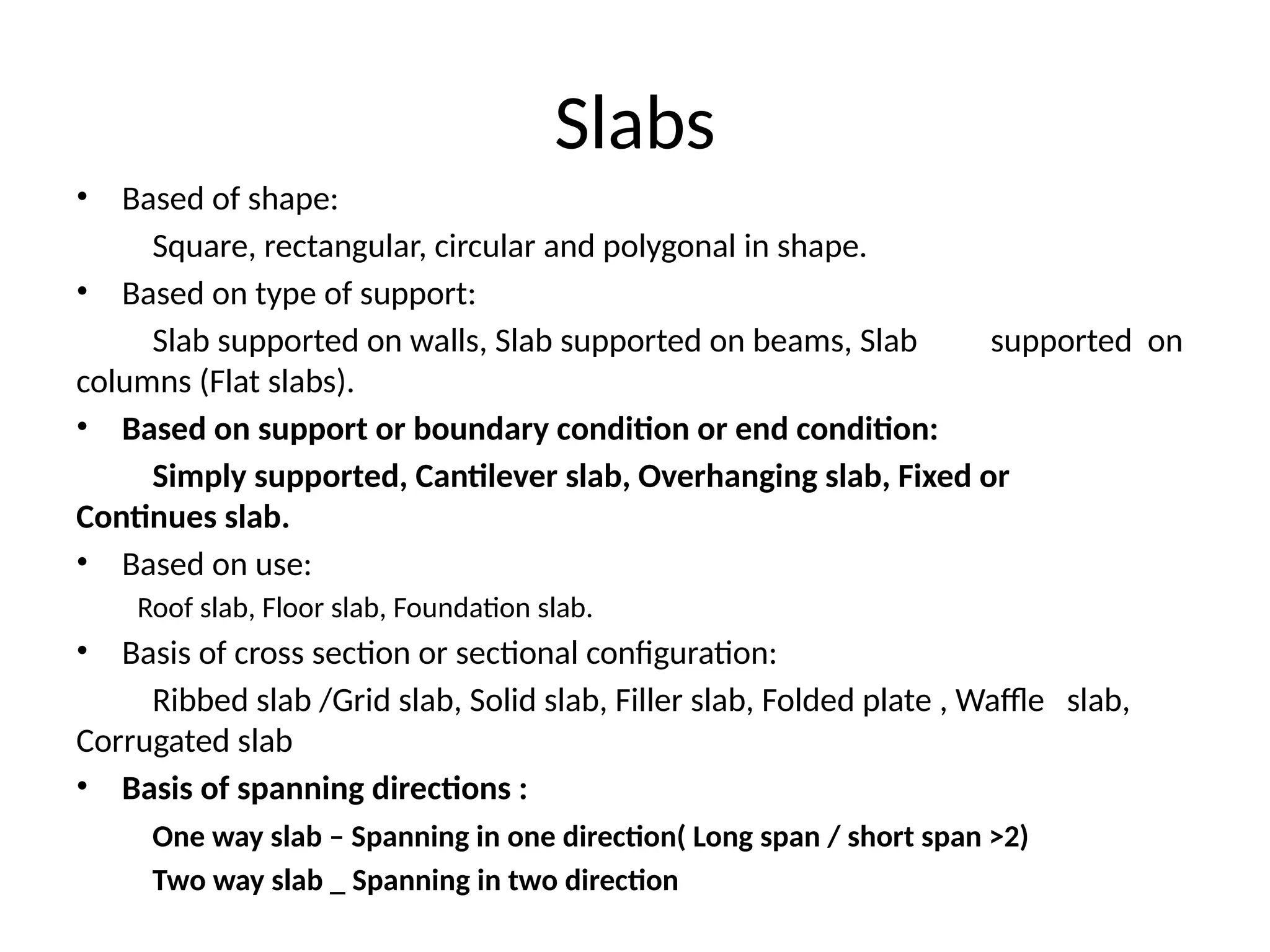
• Based of shape:
Square, rectangular, circular and polygonal in shape.
• Based on type of support:
Slab supported on walls, Slab supported on beams, Slab supported on
columns (Flat slabs).
• Based on support or boundary condition or end condition:
Simply supported, Cantilever slab, Overhanging slab, Fixed or
Continues slab.
• Based on use:
Roof slab, Floor slab, Foundation slab.
• Basis of cross section or sectional configuration:
Ribbed slab /Grid slab, Solid slab, Filler slab, Folded plate , Waffle slab,
Corrugated slab
• Basis of spanning directions :
One way slab – Spanning in one direction( Long span / short span >2)
Two way slab _ Spanning in two direction

BTech Sem 3 notes.pptxARARQQDWQEE2E2DSR4E WR3RD3 V

  • 1.
    1) slabs tocover 2) beams to support slabs and walls 3)columns to support beams 4) footings In a framed structure the load is transferred from slab to beam, from beam to column and then to the foundation and soil below it
  • 2.
  • 3.
    • Here aresome of the advantages of RCC construction: • Materials used in RCC construction are easily available. • It is durable and long lasting. • It is fire resisting and not attacked by termites. • It is economical in ultimate cost. • The reinforced concrete member can be cast to any shape because of the fluidity of concrete. • Its monolithic character gives much rigidity to the structure. • Cost of maintenance is nil.
  • 4.
    • Here aresome of its disadvantages: • Scrap value of reinforced members is almost nil. • Constant checking is required. • Skilled labour is engaged in the work. • The advantages of RCC outweigh its disadvantages. • This is one construction technique that made construction very easy and brought a boom to the field of construction
  • 5.
    Cement concrete 1:8:16:- isvery low in strength • Used in foundation of walls of ordinary and single story building and used as base coat under floors and pavement. Cement concrete1:6:12:- low in strength • Used in foundation of two or three story buildings, used in foundation of abetments, piers and retaining walls and used as basecoat under taxi tracks, pavement and cement concrete road. • Cement Concrete 1:4:8:- . medium strength • Used in foundation of multi story buildings, under foundation of RCC columns, stairs, raft, RCC wall and air strips and taxi tracks base coat. • Cement Concrete 1:3:6:- medium strength • Used in mass concrete, bed plates, concrete blocks, canal lining and chowkats hold fast etc. • Cement Concrete 1:2:4:- good strength •Used in footings of columns and raft foundation, used in beams, slabs, columns, stairs and walls of ordinary, single story and temporary buildings and used in retaining walls, pavements, floors and bedplates etc. • Cement Concrete 1:1.5:3 very good strength and • Important RCC structures, piles, arches, impermeable construction against water heads. This ratio of cement concrete is safe against earth quake.
  • 6.
    M-5- 1:5:10 M-7.5 -1:4:8 M-10- 1:3:6 M-15 - 1:2:4 M-20 - 1:1.5:3 M-25 -1:1:2 Nominal & Designed Concrete mix as per IS 456 Blended cement Portland Pozzolana
  • 7.
    STAGES IN STRUCTURALDESIGN • The process of structural design involves the following stages : 1) structural planning 2) action of forces and computation of loads 3) methods of analysis 4) member design 5)detailing, drawing and preparation of schedules
  • 8.
    Structural planning • positioningand orientation of column or columns • position of beams • spanning of slabs • layout of stairs • selecting proper type of footing the basic principle in deciding the layout of component members is that the loads should be transferred to the foundation along the shortest path
  • 9.
    • Steel • Steelused in RCC- Mild steel, High tensile steel, cold twisted steel , high tensile steel • Tensile steel – mild steel - 140 N/mm2 • High Tensile steel - 190 N/mm2 • Twisted High tensile steel..Fe415 - 230 N/mm2 ..Fe500 - 275 N/mm2
  • 10.
    vertical compression member. subjectedto axial compressive loads. Short Column: When the ratio of effective length to the least lateral dimensions of the column is less than 12, then it is called a short column. (or)When the ratio of effective length to the least radius of gyration is less than 45, then it is called a short column Long Column: When the ratio of effective length to the least radius of gyration is greater than 45, then it is called a long column. A long column is subjected to bending moment in addition to direct compressive stress. The load carrying capacity of a long column is less than a short column slenderness ratio (slenderness ratio increases then the capacity of the column decreases)
  • 11.
    Column position forrectangular pattern building. LOCATION OF COLUMNS • at or near the corners of a building and at the intersections of beams/walls. • Select the position of columns so as to reduce bending moments in beams. • When two columns are very near, then one column should be provided
  • 12.
    • ORIENTATION OFCOLUMNS • Avoid projection of column outside wall if possible. • Orient the column so that the depth of the column is contained in the major plane of bending or is perpendicular to the major axis of bending. A B C D 1 2 3 4
  • 13.
    • depth ofa beam - span/12 to span /15 • breadth=depth X (1/2 to 2/3)
  • 15.
    L Jn TJn Cross Jn 300 X 300 Top most floor 300 X 300 350 X 350 Five and six 300 X 300 350 X 350 325 X 325 375 X 375 425 X 425 Three and Four 325 X 325 375 X 375 425 X 425 400 x 400 450 X 450 500 X 500 One and Two 400 x 400 450 X 450 500 X 500
  • 18.
    Depth of thebeam MEMBER SPAN/OVERALL DEPTH RATIO 1. PLINTH BEAM 15 TO 18 2. TIE BEAM 18 TO 20 3. FLOOR BEAMS 12 TO 15 4. GRID BEAMS 20 TO 30 Min width of the beam the width of the wall on top Depth of the slab The following thumb rules can be used ( Fe 415) • One way slab d=(l/22) to (l/28). • Two way simply supported slab d=(l/20) to (l/30) • Two way restrained slab d=(l/30) to (l/32) • Cantilevered d = (l/7) to (l/10) In any case of the above, the thickness should not be less than 100mm
  • 29.
    • Helical Reinforcement(spirals) – The diameter of helical bars should not be less than 1/4th the diameter of largest longitudinal and not less than 6mm. – The pitch should not exceed (if helical reinforcement allowed) • 75mm • 1/6th of the core diameter of the column – Pitch should not be less than, – 25mm – 3 x diameter of helical bar - Pitch should not exceed (if helical reinforcement is not allowed) – Least lateral dimension – 16 x diameter of longitudinal bar (smaller) – 300mm • Position of lap shall be clearly mentioned in the drawing according to the change in reinforcement. Whenever there is a change in reinforcement at a junction, lap shall be provided to that side of the junction where the reinforcement is less.
  • 34.
    CORRECT SPLICE DETAIL FORCOLUMN INCORRECT COVER CLOSE TIES @S/2 S-SPACING SLOPE 1:6
  • 35.
    REDUCTION COLUMN BOTH SIDES INCORRECT CORRECT 3NO.CLOSE TIES SPLICE CLOSESTPS SPACIN <=75mm SLOPE 1:8 FROM BEAM BOTTOM 3NO.CLOSE TIES
  • 36.
    1. PLINTH BEAM15 TO 18 MEMBER SPAN/OVERALL DEPTH RATIO
  • 39.
  • 40.
  • 41.
    BEAM FEW DEFINITIONS Abeam is a structural element that is capable of withstanding load primarily by resisting against bending
  • 42.
    OVER ALL DEPTH:- The normal distance from the top edge of the beam to the bottom edge of the beam is called over all depth. It is denoted BY ‘D’. EFFECTIVE DEPTH:- The normal distance from the top edge of beam to the centre of tensile reinforcement is called effective depth. It is denoted by ‘d’. CLEAR COVER:- The distance between the bottom of the bars and bottom most the edge of the beam is called clear cover. CLEAR COVER = 25mm OR DIA OF MAIN BAR, (WHICH EVER IS GREATER). EFFECTIVE COVER:- The distance between centre of tensile reinforcement and the bottom edge of the beam is called effective cover. EFFECTIVE COVER = CLEAR COVER + ½ DIA OF BAR. END COVER:- END COVER = 2XDIA OF BAR OR 25mm (WHICH EVER IS GREATER) NEUTRAL AXIS:- The layer / lamina where no stress exist is known as neutral axis. It divides the beam section into two zones, compresion zone above the netural axis & tension zone below the neutral axis.
  • 43.
    Classification of beams •According to shape: Rectangular, T, L, Circular etc • According to supporting conditions: Simply supported, fixed, continuous and cantilever beams • According to reinforcement: Singly reinforced and doubly reinforced
  • 44.
    Thumb rules • Beam(Sizes) Width(mm) Depth (mm) 200 X 300 230 X 300 250 X 400 210 X 450 300 X 450 Concrete - M 15, M20 Steel Main bars - 12,16,18,20,25,30mm hanger bars - 8,10,12 mm Stirrups - 6,8,10 mm Cover - minimum clear 25 mm or dia of largest bar •Mild steel bars or Deformed or High yield strength deformed bars (HYSD) are used. •HYSD bars have ribs on the surface and this increases the bond strength at least by 4
  • 45.
    Beam • Beam –width of the beam is equal to width of the wall • Depth of the beam is equal to 1/12th (heavier loads) to 1/15th (lighter loads) of span MEMBER SPAN/OVERALL DEPTH RATIO 1. PLINTH BEAM 15 TO 18 2. TIE BEAM 18 TO 20 3. FLOOR BEAMS 12 TO 15 4. GRID BEAMS 20 TO 30
  • 46.
    Beam • Bearing onbrick wall  Upto 3.5 m span - 200mm  Upto 5.5 m span - 300mm  Upto 7.0 m span - 400mm In general, the maximum spans of beams carrying live loads upto 4 kN/m2 may be limited to the following values.
  • 47.
    • Generally abeam consists of following steel reinforcements: • reinforcement at tension and compression face. • Shear reinforcements in the form of vertical stirrups and or bent up longitudinal bars are provided. • Side face reinforcement in the web of the beam is provided when the depth of the web in a beam exceeds 750 mm. Reinforcement in beam
  • 48.
    Beam design The maxarea of tension reinforcement not to exceed 0.04bD
  • 49.
    The max areaof compression reinforcement not to exceed 0.04bD Side face reinforcement ,if depth of beam is more, not more than 300 mm or web thickness whichever is less
  • 50.
    Max spacing 300mm C/C <0.75 d for vertical stirrups
  • 51.
    • Spacing ofreinforcemnt bars – The horizontal distance between parallel main bars should not be less than the greatest of the following  Diameter of the bar if the bars are of equal size  Diameter of the largest bar if the bars ar of unequal size  5 mm more than the nominal size of course aggregate • Nominal cover – Mild - 25mm – Modereate - 30 mm – Severe - 45 mm – Extreme - 50 mm – Very extreme - 75 mm Lap - 45 to 50 times dia of bar Development length - 50- 60 times dia of bar
  • 53.
    Simply supported beam Simplysupported beam with curtailed bar L/10 L/10
  • 58.
  • 61.
  • 62.
    Continuous beam withsimply supported ends top extra bars at continuous supports Continuous beam with fixed ends top extra bars at continuous supports
  • 69.
    Beam fixed tocolumn In plan
  • 75.
  • 77.
    Terminology • Effective spanof slab : Effective span of slab shall be lesser of the two 1. l = clear span + d (effective depth ) 2. l = Center to center distance between the support Depth of the slab The following thumb rules can be used ( Fe 415) • One way slab d=(l/22) to (l/28). • Two way simply supported slab d=(l/20) to (l/30) • Two way restrained slab d=(l/30) to (l/32 • Cantilevered d = (l/7) to (l/10) In any case of the above, the thickness should not be less than 100mm L/D ratio based upon type of steel Fe 500, Fe 415 Fe 600 One end continuous, both end continuous
  • 78.
    Load on slab •The load on slab comprises of Dead load, floor finish and live load. The loads are calculated per unit area (load/m2). • Dead load = D x 25 kN/m2 ( Where D is thickness of slab in m) • Floor finish (Assumed as)= 1 to 2 kN/m2 • Live load (Assumed as) = 3 to 5 kN/m2 (depending on the occupancy of the building)
  • 79.
    Cover & spacing NominalCover : • For Mild exposure – 20 mm • For Moderate exposure – 30 mm • However, if the diameter of bar do not exceed 12 mm, or cover may be reduced by 5 mm. • Thus for main reinforcement up to 12 mm diameter bar and for mild exposure, the nominal cover is 15 mm Minimum reinforcement : The reinforcement in either direction in slab shall not be less than • • 0.15% of the total cross sectional area for Fe-250 steel • • 0.12% of the total cross sectional area for Fe-415 & Fe-500 steel. Spacing of bars : The maximum spacing of bars shall not exceed • • Main Steel – 3d or 300 mm whichever is less • Distribution steel –5d or 450 mm whichever is less • Where, ‘d’ is the effective depth of slab. • Note: The minimum clear spacing of bars is not kept less than 75 mm (Preferably 100 mm) though code do not recommend any value. . Maximum diameter of bar: The maximum diameter of bar in slab, shall not exceed D/8, • where D is the total thickness of slab.
  • 80.
    One way slabTwo way slab • Simply supported • Simply supported • Continuous • Continuous • Fixed ( Restrained) • Fixed ( Restrained) • Cantilevered With or without bent up bars With or without bent up bars Supported condition Cantilever Simply supported Fixed / continuous Slab type One way Two way One way Two way One way Two way Maximum span in meters 1.50 2.0 3.50 4.50 4.50 6.0
  • 86.
    For reference BARS INSHORTER DIRECTION WILL BE PLACED BELOW BARS IN LONGER DIRECTION
  • 91.
    • RCC Slabswhose thickness ranges from 10 to 50 centimetres are most often used for the construction of floors and ceilings. • Thin concrete slabs are also used for exterior paving purpose.
  • 92.
    • Design ofvarious types of slabs and their reinforcement • For a suspended slab, there are a number of designs to improve the strength-to-weight ratio. In all cases the top surface remains flat, and the underside is modulated: • Corrugated, usually where the concrete is poured into a corrugated steel tray. This improves strength and prevents the slab bending under its own weight. The corrugations run across the short dimension, from side to side. • A ribbed slab, giving considerable extra strength on one direction. • A waffle slab, giving added strength in both directions
  • 97.
    • Prefabricated concreteslabs are cast in a factory and then transported to the site ready to be lowered into place between steel or concrete beams. • They may be pre-stressed (in the factory), post-stressed (on site), or unstressed. Care should be taken to see that the supporting structure is built to the correct dimensions to avoid trouble with the fitting of slabs over the supporting structure. • In situ concrete slabs are built on the building site using formwork. Formwork is a box- like setup in which concrete is poured for the construction of slabs. • For reinforced concrete slabs, reinforcing steel bars are placed within the formwork and then the concrete is poured. • Plastic tipped metal, or plastic bar chairs are used to hold the reinforcing steel bars away from the bottom and sides of the form-work, so that when the concrete sets it completely envelops the reinforcement. • Formwork differs with the kind of slab. For a ground slab, the form-work may consist only of sidewalls pushed into the ground whereas for a suspended slab, the form-work is shaped like a tray, often supported by a temporary scaffold until the concrete sets
  • 98.
    • Materials usedfor the formwork • The formwork is commonly built from wooden planks and boards, plastic, or steel. On commercial building sites today, plastic and steel are more common as they save labour. • On low-budget sites, for instance when laying a concrete garden path, wooden planks are very common. After the concrete has set the wood may be removed, or left there permanently. • In some cases formwork is not necessary – for instance, a ground slab surrounded by brick or block foundation walls, where the walls act as the sides of the tray and hardcore acts as the base.
  • 99.
    • Span –Effective Depth ratios • Excessive deflections of slabs will cause damage to the ceiling, floor finishes and other architectural details. To avoid this, limits are set on the span-depth ratios. • These limits are exactly the same as those for beams. As a slab is usually a slender member the restriction on the span-depth ratio becomes more important and this can often control the depth of slab required in terms of the span – effective depth ratio is given by, • Minimum effective depth = span/(basic ratio x modification factor) • The modification factor is based on the area of tension steel in the shorter span when a slab is singly reinforced at midspan, the modification factors for the areas of tensions and compression steel are as given in the figure 2 and 4 of the code.
  • 100.
    • Solid Slabspanning in two directions • When a slab is supported on all four of its sides, it effectively spans in both directions, and it is sometimes more economical to design the slab on this basis. The moment of bending in each direction will depend on the ratio of the two spans and the conditions of restraint at each support. • If the slab is square and the restraint is similar along the four sides, then the load will span equally in both directions. If the slab is rectangular, then more than one-half of the load will be carried in the shorter direction and lesser load will be imposed on the longer direction. • If one span is much longer than the other, a large portion of the load will be carried in the shorter direction and the slab may as well be designed as spanning in only one direction. • Moments in each direction of span are generally calculated using co-efficients which are tabulated in the code. • The slab is reinforced with the bars in both directions parallel to the spans with the steel for the shorter span placed farthest from the natural acis to five the greater effective depth. • The span-efective depths are based on the shorter span and the percentage of the reinforcement in that direction.
  • 101.
    • What areSimply Supported Slabs? • Before we discuss the technical design rules of Simply Supported slabs, lets just go through its definition and learn why they are named so… • As the name suggests, simply supported slabs are supported on columns or stanchions. Simply supported slabs are classified as One way slabs and Two way slabs. One way slabs bend in one direction only and transfer their loads to the two support beams in opposite directions. Their main steel in on shorter span length. L/B ratio is generally less than 2.
  • 103.
    Simply supported slabsdon’t give adequate provision to resist torsion at corner to prevent corner from lifting. The maximum bending moment will be given if the slabs are restrained. But atleast 50% of the tension reinforcement provided at the mid span should extend to the support. The remaining 50% should extend to within 0.1Lx or Ly at the support as appropriate. RCC Slab Design depends on the on the dimensions of the slab after which the slab is termed as a one-way slab or a two-way slab… n the design of RCC structures, Column Design and Beam Design are to be done before we start with RCC Slab Design…
  • 104.
    • Basic Rulesfollowed in the design of simply supported Slab • Thickness of slab • l/d ratio should be less than the following: • Simply supported slab • Continuous slab, l/d = 26 • Cantilever slab, l/d = 7 • In any case of the above, the thickness should not be less than 100mm • Effective span • Distance between centre to centre of support • Clear span plus effective depth • Minimum main reinforcement ≥0.15% total cross sectional area of slab – for MS bars • ≥ 0.12% gross cross sectional area of slab – for HYSD bars • Spacing of main bars • The spacing or c/c distance of main bars shall not exceed following: • Calculated value • 3d • 300mm
  • 105.
    • Distribution orTemperature reinforcement • This reinforcement runs perpendicular to the main reinforcement in order to distribute the load and to resist the temperature and shrinkage stresses. • It should be atleast equal to; • 0.15% gross c/s of slab – for MS bars • 0.12% gross c/s of slab – for HYSD bars • Spacing of distribution bars • The spacing or c/c distance of distribution bars shall not exceed the following • Calculated area • 5d • 450mm • Diameter of bars • The diameter of the bars varies from 8mm to 14mm and should not exceed 1/8th of the overall depth of the slab. • For distribution steel, the diameter varies from 6mm to 8mm. • Cover • The bottom cover for reinforcement shall not be less than 15mm or less than the diameter of such bar.
  • 114.
  • 116.
    Staircase G T N R W θ • Flight andlanding. • Steps • Rise-R • Going-G=T-N • Tread-T • Nosing -N Le L1 L2 FLIGHT
  • 117.
    • Based onshape • Straight stairs • Dog legged stairs • Open well or open newel stairs • Geometrical stairs such as spiral, circular, etc. • Free standing stair cases Straight SC Geometric SC Dog legged SC Transversely spanning SC
  • 118.
    • Rise (R): 150mm to 180mm • Tread (T) : 220 mm to300 mm- for residential buildings. • Rise (R) : 120 to 150 mm • Tread (T) : 250 mm to 300 mm – for public buildings [T + 2R] : Between 500 mm to 650 mm The width of the stair • 0.8 m to 1 m for residential building and • 1.8 m to 2 m for public building.
  • 119.
    • The widthof the landing is equal to the width of stairs. • The number of steps in each flight should not be greater than 12 • The pitch of the stair should not be more than 38 degrees. • The head room measured vertically above any step or below the mid landing shall not be less than 2.1 m.
  • 120.
    Stair slab spanninglongitudinally Supported on edges AE and DH (b) (ii) Clamped along edges AE and DH (c) (iii) Supported on edges BF and CG (d) (iv) Supported on edges AE, CG (or BF) and DH (e) (v) Supported on edges AE, BF, CG and DH (f)
  • 121.
    Stair slab spanningtransversely (i)Slab supported between two stringer beams or walls (a) (ii) Cantilever slabs from a spandreal beam or wall (b) (iii) Doubly cantilever slabs from a central beam (Fig.9.20.5c)
  • 122.
    Stair slab spanningtransversely – Slab supported between two stringer beams
  • 126.
    Stair slab spanninglongitudinally Supported on edges AE and DH (b)
  • 132.
    ROW OF CHAIRS 500mm 500 mm GL Wall FOUNDATION GROUND FLIGHT MAIN STEEL # 12 @ 120 DIST. STEEL # 8 @ 200 150 Ld =564 REINFORCEMENT FROM BM Ld =564 FLOOR LEVEL LANDING FIRST FLIGHT R=160 T= 250 LAP L Landing and flight spans longitudinally
  • 133.
    Y=0.3 l orLd LANDING BEAM 500 500 GL FOOTING GROUND FLIGHT FIRST FLIGHT MAIN STEEL # 12 @ 120 DIST. STEEL # 8 @ 150 LANDING BEAM 150 X l Y Y 150 INTERMEDIATE LANDING ROW OF CHAIRS X = 0.15 l or Ld MAIN STEEL DS 150 Le Flight spans longitudinally on landing beams
  • 134.
    Refer SP-34 andlearn the details STRAIGHT STAIR CASE
  • 135.
  • 136.
    • Concrete framestructures are strong and economical. • Hence almost any walling materials can be used with them. • Heavier options - masonry walls of brick, concrete block, or stone. • when strong, secure, and sound-proof enclosures are required • Lighter options - drywall partitions made of light steel or wood studs covered with sheeting material. • when quick, flexible lightweight partitions are needed. • When brick or concrete blocks are used, it is common to plaster the entire surface - brick and concrete - with a cement plaster to form a hard, long- lasting finish.
  • 137.
    Masonry Walls • concreteblock walls, common thicknesses are 200mm(8"), 150mm(6") and100mm(4"). (excluding plaster) – Solid Concrete Blocks – Hollow Concrete Blocks – Lightweight Aerated Concrete Blocks – Flyash Concrete Block • brick walls, common thickness is 230mm(9"), excluding plaster) • run electrical, or any other wires or pipes in a brick wall, you have to first chase the wall.
  • 138.
    • Brick partitions,(solid or hollow) • Clay block partitions, • Concrete partitions, • Glass block partitions, • Wooden partitions, • Straw board partitions, • Plaster slab partitions, ( burnt gypsum or plaster of paris mixed with sawdust.) • Metal partitions, • Asbestos cement partitions, and • Double glazed window. • Fibre Cement Board • AAC Blocks (Autoclaved aerated concrete (AAC), also known as autoclaved cellular concrete (ACC), autoclaved lightweight concrete (ALC), • Glass fiber reinforced gypsum(GFRG) wall paneL • Gypsum board partition Materials can be used in ways that express their fundamental character, or materials can be used in ways that conceal their fundamental character. good designers generally use the specific qualities of specific materials to make their work visually expressive
  • 141.
    Beam • Beam –width of the beam is equal to width of the wall • Depth of the beam is equal to 1/12th (heavier loads) to 1/15th (lighter loads) of span • (a)Basic values of span/effective depth ratios for spans up to 10m (supporting condition) – Cantilever 7 – Simply supported 20 – Continuous 26 – For spans>10m,valuesin(a)maybemultipliedby10/span in meters • location MEMBER SPAN/OVERALL DEPTH RATIO 1. PLINTH BEAM 15 TO 18 2. TIE BEAM 18 TO 20 3. FLOOR BEAMS 12 TO 15 4. GRID BEAMS 20 TO 30
  • 142.
    Backup • depth ofa beam can be approximately calculated as follows span/15 and breadth=depthX(1/2 to 2/3)
  • 143.
    • At least1/3 of the +ve moment reinforcement in SIMPLE SUPPORTS & ¼ the +ve moment reinforcement in CONTINUOUS MEMBERS shall extend along the same face of the member into the support, to a length equal to Ld/3. (Ld-development length) • Use higher grade of concrete if most of the beams are doubly reinforced. • Restrict the spacing of stirrups to 8″(200mm) or ¾ of effective depth whichever is less.(for static loads) • Whenever possible try to use T-beam or L-beam concept so as to avoid compression reinforcement. • Use a min. of 0.2% for compression reinforcement to aid in controlling the deflection, creep and other long term deflections.
  • 147.
    Slabs • Based ofshape: Square, rectangular, circular and polygonal in shape. • Based on type of support: Slab supported on walls, Slab supported on beams, Slab supported on columns (Flat slabs). • Based on support or boundary condition or end condition: Simply supported, Cantilever slab, Overhanging slab, Fixed or Continues slab. • Based on use: Roof slab, Floor slab, Foundation slab. • Basis of cross section or sectional configuration: Ribbed slab /Grid slab, Solid slab, Filler slab, Folded plate , Waffle slab, Corrugated slab • Basis of spanning directions : One way slab – Spanning in one direction( Long span / short span >2) Two way slab _ Spanning in two direction