BRAND PERSONALITIES AND CORPORATE BRANDS
How human is a company?
ANALOGY IS FINE.
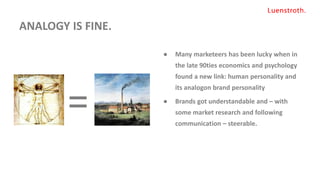
● Many marketeers has been lucky when in
the late 90ties economics and psychology
found a new link: human personality and
its analogon brand personality
● Brands got understandable and – with
some market research and following
communication – steerable.
=
AN ANALOGY IS AN ANALOGY.
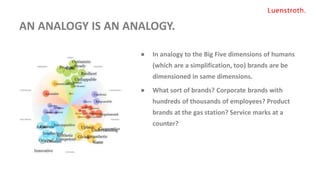
● In analogy to the Big Five dimensions of humans
(which are a simplification, too) brands are be
dimensioned in same dimensions.
● What sort of brands? Corporate brands with
hundreds of thousands of employees? Product
brands at the gas station? Service marks at a
counter?
„BRAND“ IS JUST A NOUN FOR SEVERAL SORTS OF MARKS.
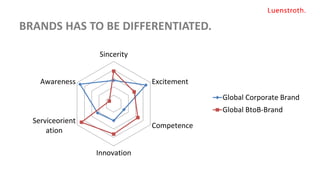
● Personality of a trade mark is totally different from personality of a corporate brand.
● A retail brand faces totally different target groups than a small btob brand.
● An automotive brand needs different assets than a pharmacy brand.
● We all know and understand these differences.
● Brand managers and marketeers know that but they keep loving the analogy of one brand
personality.
BRANDS HAS TO BE DIFFERENTIATED.
Sincerity
Excitement
Competence
Innovation
Serviceorient
ation
Awareness
Global Corporate Brand
Global BtoB-Brand
ANALYSIS FIRST
● Most companies use to measure their brand personality once a year. That´s fine and well
done.
● To keep the right methodology (comparability) the research contents and methods must
be the same as at initial measurement.
● The problem: Target group behavior and markets change.
● These changes could make the difference if competitors react.
SOLUTION
● There isn‘t any solution which is correct in a scientific sense if there is no change in
amount of research.
● If contents or methods are changed results are not comparable.
● If they same contents are kept over the years new aspects and market changes can‘t get in
mind.
● Luenstroth go for the future oriented way: Keep the existing contents and methods for a
period of time and add new elements.
● Find the inner relations between results of existing market research and the modified
ones. Build the new model. Year by year.
THANK YOU FOR VISITING.

Brand personality

  • 1.
    BRAND PERSONALITIES ANDCORPORATE BRANDS How human is a company?
  • 2.
    ANALOGY IS FINE. ●Many marketeers has been lucky when in the late 90ties economics and psychology found a new link: human personality and its analogon brand personality ● Brands got understandable and – with some market research and following communication – steerable. =
  • 3.
    AN ANALOGY ISAN ANALOGY. ● In analogy to the Big Five dimensions of humans (which are a simplification, too) brands are be dimensioned in same dimensions. ● What sort of brands? Corporate brands with hundreds of thousands of employees? Product brands at the gas station? Service marks at a counter?
  • 4.
    „BRAND“ IS JUSTA NOUN FOR SEVERAL SORTS OF MARKS. ● Personality of a trade mark is totally different from personality of a corporate brand. ● A retail brand faces totally different target groups than a small btob brand. ● An automotive brand needs different assets than a pharmacy brand. ● We all know and understand these differences. ● Brand managers and marketeers know that but they keep loving the analogy of one brand personality.
  • 5.
    BRANDS HAS TOBE DIFFERENTIATED. Sincerity Excitement Competence Innovation Serviceorient ation Awareness Global Corporate Brand Global BtoB-Brand
  • 6.
    ANALYSIS FIRST ● Mostcompanies use to measure their brand personality once a year. That´s fine and well done. ● To keep the right methodology (comparability) the research contents and methods must be the same as at initial measurement. ● The problem: Target group behavior and markets change. ● These changes could make the difference if competitors react.
  • 7.
    SOLUTION ● There isn‘tany solution which is correct in a scientific sense if there is no change in amount of research. ● If contents or methods are changed results are not comparable. ● If they same contents are kept over the years new aspects and market changes can‘t get in mind. ● Luenstroth go for the future oriented way: Keep the existing contents and methods for a period of time and add new elements. ● Find the inner relations between results of existing market research and the modified ones. Build the new model. Year by year.
  • 8.
    THANK YOU FORVISITING.