Contents
Preface: Why
Brainfluence?
Acknowledgments
About the Author
Chapter 1: Sell to 95 Per-
cent of Your Customer’s
Brain
Brainfluence Takeaway: Stop
Selling to 5 Percent of Your
Customer’s Brain
Section One: Price and
Product Brainfluence
Chapter 2: The “Ouch!” of
Paying
Bundling Minimizes Pain
Fairness Counts
Credit as Painkiller
Brainfluence Takeaway: Min-
imum Pain, Maximum Sales
Chapter 3: Don’t Sell Like
a Sushi Chef
Paying for Pain Avoidance
Brainfluence Takeaway:
Avoid Multiple Pain Points
3/743
Chapter 4: Picturing
Money
No Money in Sight
Restaurant Lessons
Brainfluence Takeaway: Use
Money Cues Wisely
Chapter 5: Anchors
Aweigh!
Gasoline: Drifting Anchor
Real Estate Prices
Less Familiar Products
Irrational Anchors
Presetting an Anchor
4/743
Brainfluence Takeaway: Be
Careful Where You Drop Your
Anchor!
Chapter 6: Wine, Prices,
and Expectations
Brainfluence Takeaway: Be
Careful With Discounts
Chapter 7: Be Precise With
Prices
Brainfluence Takeaway: Use
Precise Pricing
Chapter 8: Decoy Products
and Pricing
How Decoys Work
5/743
Decoys in Real Estate
Brain Scan Evidence
Brainfluence Takeaway: Try a
“Not-So-Good” Decoy to Push
Your Top Product
Chapter 9: How About a
Compromise?
Brainfluence Takeaway: Add
a High-End Product
Chapter 10: Cut Choices;
Boost Sales
Choice Fatigue
Brainfluence Takeaway: Find
Your Choice Sweet Spot
6/743
Section Two: Sensory
Brainfluence
Chapter 11: Use All the
Senses
Brand Fragments
Brainfluence Takeaway: Ap-
peal to All Five Senses
Chapter 12: Does Your
Marketing Smell?
More Scent Effects
Bad Smells
Brainfluence Takeaway: Own
Your Smell
Summary: Think Smell
7/743
Chapter 13: Learn From
Coffee
Nespresso’s Dilemma
Brainfluence Takeaway: Give
Your Product a Sensory
Tweak
Chapter 14: Sounds Like
Changed Behavior
Brainfluence Takeaway: Find
Background Music That
Works!
Chapter 15: The Sound of
Your Brand
8/743
The Musical Logo
Beyond Music
Brainfluence Takeaway: Find
and Keep Your Key Audio
Branding Elements
Chapter 16: Exploit the
Brut Effect
Brainfluence Takeaway: Use
Scent to Be Memorable
Chapter 17: Smelly but
Memorable
Tagline Recall Enhanced
Purchase Triggers
9/743
Brainfluence Takeaway:
Unique Scents Boost
Memorability
Chapter 18: Learn From
Yogurt
Brainfluence Takeaway: Im-
portant Product Characterist-
ics May Not Be Obvious
Section Three: Brain-
fluence Branding
Chapter 19: Neurons That
Fire Together . . .
The Monkey’s Paw
10/743
Anything for a Smoke
I Like It, but Why?
Pavlovian Branding
Brainfluence Takeaway: Keep
Your Brand Associations
Consistent
Chapter 20: Who Needs
Attention?
Low Attention, No Attention
“Ignored” TV Commercials
Fast-Forward Branding
Branding Without Seeing
Familiarity Breeds Likeability
(in Milliseconds!)
11/743
Brainfluence Takeaway: “No
Attention” Doesn’t Mean “No
Results”
Chapter 21: Passion for
Hire
Tech Passion
Brainfluence Takeaway: Feel
the Passion
Chapter 22: Create an
Enemy
The Tajfel Experiment
Us Versus Them
Compare People, Not Products
Our Customers Are Different/
Better
12/743
The Etsy Approach
Godin and Tribes
Brainfluence Takeaway:
Make Your Customers Feel
Like Members of a Group
Section Four: Brainflu-
ence in Print
Chapter 23: Use Paper for
Emotion
A Cautionary Note
Optimizing Paper-Based
Marketing
Digital Lesson
13/743
Brainfluence Takeaway:
Paper Means Emotion
Chapter 24: Vivid Print
Images Change Memory
Brainfluence Takeaway: Use
Vivid Images in Print
Chapter 25: Paper Out-
weighs Digital
Weighty Words
Brainfluence Takeaway: Bulk
Up for Impact
Chapter 26: Use Simple
Fonts
14/743
Brainfluence Takeaway:
Simple Fonts Spur Action
Chapter 27: When to Get
Complicated
Brainfluence Takeaway: Use
Complex Fonts and Big Words
to Enhance Your Product
Chapter 28: Memorable
Complexity
Brainfluence Takeaway:
Boost Recall With Complex
Fonts
15/743
Section Five: Picture
Brainfluence
Chapter 29: Just Add
Babies!
Brainfluence Takeaway: Baby
Pictures Draw the Eye
Chapter 30: Focus, Baby!
Brainfluence Takeaway: Use
the Baby’s Gaze to Direct
Attention
Chapter 31: Pretty Woman
Brainfluence Takeaway: Test
People Photos
16/743
Chapter 32: Itsy, Bitsy,
Teeny, Weeny . . .
More Arousal, Worse
Decisions
Bigger Is Better, and It’s Not
What You Are Thinking!
Brainfluence Takeaway: Sexy
Women Affect Male Decisions
Chapter 33: Photos In-
crease Empathy
Brainfluence Takeaway: In-
clude a Photo If Empathy Will
Help Your Cause
17/743
Section Six: Loyalty
and Trust Brainfluence
Chapter 34: Build Loyalty
Like George Bailey
Instant Loyalty, Just Add
Imagination
Brainfluence Takeaway: Use
Counterfactual Scenarios to
Boost Loyalty
Chapter 35: Reward
Loyalty
Loyalty Point Power
Brainfluence Takeaway: Offer
Loyalty Rewards
18/743
Chapter 36: Loyalty, Rats,
and Your Customers
Brainfluence Takeaway: Give
a Head Start
Chapter 37: Time Builds
Trust and Loyalty
Brainfluence Takeaway: Qu-
ality Contact Time Counts
Chapter 38: Ten Words
That Build Trust
Brainfluence Takeaway: Tell
’em to Trust You
19/743
Chapter 39: Trust Your
Customer
Brainfluence Takeaway:
Show Trust to Get Trust
Section Seven: Brain-
fluence in Person
Chapter 40: It Pays to
Schmooze
Brainfluence Takeaway: Sch-
mooze First; Bargain Later
Chapter 41: Shake Hands
Like a Pro
20/743
How About a Nice Massage?
Brainfluence Takeaway:
Touch Is Important
Chapter 42: Right Ear
Selling
Brainfluence Takeaway: Fa-
vor Your Prospect’s Right Ear
Chapter 43: Smile!
The Price of a Smile
Brainfluence Takeaway:
Smiles, Even Smiling Images,
Help Sales
Chapter 44: Confidence
Sells
21/743
Confidence Man: Jim Cramer
Natural Mind Readers
Brainfluence Takeaway: De-
monstrate Confidence
Chapter 45: Small Favors,
Big Results
Got the Time, Buddy?
Signs of Success
Foot in the Door
Brainfluence Takeaway: Ask
for a Small Favor First
Chapter 46: Hire Articu-
late Salespeople
22/743
Brainfluence Takeaway: Hire
Articulate People
Chapter 47: You’re the
Best!
Brainfluence Takeaway: Use
Ethical Flattery
Chapter 48: Coffee,
Anyone?
Brainfluence Takeaway:
Serve Hot Beverages
Chapter 49: Candy Is
Dandy
Brainfluence Takeaway: Try
the Truffle Strategy
23/743
Chapter 50: Selling Secrets
of Magicians
1. People Focus on Only One
Thing
2. Motion Attracts Our
Attention
3. Big Motions Beat Little
Motions
4. The Unexpected Attracts Us
5. Mirror Neurons Engage Us
6. Cut the Chatter
Brainfluence Takeaway:
Learn From Magicians
Chapter 51: Soften Up
Your Prospects
24/743
Brainfluence Takeaway:
Soften Up Your Prospects
Section Eight: Brain-
fluence for a Cause
Chapter 52: Mirror, Mir-
ror on the Wall
Brainfluence Takeaway: Let
Donors See Themselves
Chapter 53: Get Closer to
Heaven
Lifting Generosity
Elevating Cooperation
Practical Implications
25/743
Business Applications
Brainfluence Takeaway: Con-
trol Altitude, Change Attitude
Chapter 54: Child Labor
Brainfluence Takeaway: Use
Babies to Boost Altruism
Chapter 55: Give Big, Get
Bigger
Nonprofit Reciprocity
Strategy
Business Reciprocity
Brainfluence Takeaway: Gift
Your Prospects
26/743
Chapter 56: Make It
Personal
Brainfluence Takeaway:
Make It Personal
Chapter 57: Lose the
Briefcase!
Brainfluence Takeaway:
Avoid Business and Financial
Cues
Chapter 58: Ask Big!
Brainfluence Takeaway: Start
With a Big Number
27/743
Section Nine: Brainflu-
ence Copywriting
Chapter 59: Surprise the
Brain
Brainfluence Takeaway: Sur-
prise the Audience
Chapter 60: Use a Simple
Slogan
Brainfluence Takeaway: Use a
Simple Savings Slogan
Chapter 61: Write Like
Shakespeare
28/743
Brainfluence Takeaway:
“Misuse” a Word
Chapter 62: A Muffin by
Any Other Name . . .
Beyond Food
Brainfluence Takeaway: Re-
name Your Category
Chapter 63: Why Per-
centages Don’t Add Up
Brainfluence Takeaway: Use
Real Numbers for Impact
Chapter 64: Magic Word
#1: FREE!
29/743
Free Kisses Beat Bargain
Truffles
Amazon’s Experience With
FREE!
Brainfluence Takeaway: Tap
Into the Power of FREE!
Chapter 65: Magic Word
#2: NEW!
Brainfluence Takeaway:
Make It NEW!
Chapter 66: Adjectives
That Work
Brainfluence Takeaway:
Season Your Copy With Vivid
Adjectives
30/743
Chapter 67: Your Brain on
Stories
Why Stories Engage Our
Brain
The Mind-Meld Effect
Advertising Stories
Brainfluence Takeaway: Tell
a Vivid Story
Chapter 68: Use Story
Testimonials
Brainfluence Takeaway: Go
Beyond Short Testimonials
31/743
Chapter 69: When Words
Are Worth a Thousand
Pictures
Brainfluence Takeaway: Text
Beats Richer Media When It
Tells a Story
Chapter 70: The Million-
Dollar Pickle
Brainfluence Takeaway: Don’t
Create Negative Stories
Section Ten: Con-
sumer Brainfluence
32/743
Chapter 71: Simple Mar-
keting for Complex
Products
Brainfluence Takeaway: Give
Buyers a Simple Reason to
Buy Your Complex Product
Chapter 72: Sell to the In-
ner Infovore
Brainfluence Takeaway:
Show ’Em Something New
Chapter 73: Want Versus
Should: Time Your Pitch
Timing Is Critical
33/743
Brainfluence Takeaway: Time
Your Pitch to Wants and
Shoulds
Chapter 74: Sell to
Tightwads
Brainfluence Takeaway: Min-
imize the Pain for Tightwads
(and Everyone Else)
Chapter 75: Sell to
Spendthrifts
Brainfluence Takeaway: Push
the Free-Spending Hot
Buttons
34/743
Chapter 76: Take a Chance
on a Contest
Golf Lessons
Pepsi’s Billion Dollars
Brainfluence Takeaway: Keep
Your Eye on the Prize
Chapter 77: Unconvention-
al Personalization
Brainfluence Takeaway: Try
Going Beyond Simple
Personalization
Chapter 78: Expect More,
and Get It!
Expectation Becomes Reality
35/743
A New Role for Marketing
From Wine to Software
Brainfluence Takeaway: Set
High but Achievable
Expectations
Chapter 79: Surprise Your
Customers!
Brainfluence Takeaway:
Create Positive Feelings With
a Small Surprise
Section Eleven:
Gender Brainfluence
36/743
Chapter 80: Mating on the
Mind
Brainfluence Takeaway: Use
Romantic Priming if Your
Product (or Service Project) Is
Conspicuous
Chapter 81: Guys Like It
Simple
J. Peterman Is From Mars, the
Catalog Copy Isn’t
Brainfluence Takeaway: Use
Simple Copy for Guys
Chapter 82: Are Women
Better at Sales?
37/743
Another Theory—The Peacock
Display
Brainfluence Takeaway: Ex-
ploit the Peacock Effect With
Male Buyers
Chapter 83: Do Women
Make Men Crazy?
Brainfluence Takeaway: At-
tractive Female Photos
Shorten Male Time Horizons
Section Twelve: Shop-
per Brainfluence
38/743
Chapter 84: Cooties in
Every Bag
Fat Transfer
Brainfluence Takeaway:
Watch Your Pairings
Chapter 85: Customer
Replies Change Minds
Brainfluence Takeaway: En-
gage Problem Customers
Quickly
Chapter 86: It’s Wise to
Apologize
The Price of Rude Behavior
The Apology Effect
39/743
Brainfluence Takeaway: Don’t
Be Afraid to Apologize
Chapter 87: The Power of
Touch
Psychological Ownership
Brainfluence Takeaway: Let
Customers Touch Your
Product
Chapter 88: When Diffi-
culty Sells
Brainfluence Takeaway: Easy
Isn’t Always Best
40/743
Section Thirteen:
Video, TV, and Film
Brainfluence
Chapter 89: Don’t Put the
CEO on TV
Our Bodies Talk
Brainfluence Takeaway:
Physical Actions Outweigh
Words
Chapter 90: Get the Order
Right!
Brainfluence Takeaway: Cred-
ibility Before Claims
41/743
Chapter 91: Emotion Beats
Logic
Brainfluence Takeaway: Get
Emotional
Section Fourteen:
Brainfluence on the
Web
Chapter 92: First Impres-
sions Count—Really!
Confirmation Bias Makes the
First Impression Stick
Happy Users Keep Trying
Brainfluence Takeaway: Test
Your Site’s First Impression
42/743
Chapter 93: Make Your
Website Golden
Brainfluence Takeaway: Use
the Golden Mean
Chapter 94: Rich Media
Boost Engagement
Brainfluence Takeaway: Add
and Optimize Other Media
Chapter 95: Reward
Versus Reciprocity
Reciprocity Beats Reward
Not Just for Form Completion
43/743
Brainfluence Takeaway: Test
the Reciprocity Approach
Chapter 96: Exploit Scar-
city on the Fly
Scarce Seats
Overstock.com—The Scarcity
Trifecta
Daily Scarcity
Brainfluence Takeaway: Use
Scarcity and Be Specific
Chapter 97: Target
Boomers With Simplicity
Brainfluence Takeaway: Keep
It Simple
44/743
Chapter 98: Use Your Cus-
tomer’s Imagination
Brainfluence Takeaway: Help
Customers Imagine
Ownership
Chapter 99: Avoid the
Corner of Death
Brainfluence Takeaway: Put
Your Brand Front and Center
Chapter 100: Computers
as People
Get on the Same Team
“I’m on Your Side!”
Specialized = Smart
45/743
Brainfluence Takeaway: It’s
Not a Computer; It’s a Person!
Afterword: What’s Next?
Index
46/743
Copyright © 2012 by Roger Dooley. All
rights reserved.
Published by John Wiley & Sons, Inc.,
Hoboken, New Jersey.
Published simultaneously in Canada.
No part of this publication may be repro-
duced, stored in a retrieval system, or trans-
mitted in any form or by any means, elec-
tronic, mechanical, photocopying, recording,
scanning, or otherwise, except as permitted
under Section 107 or 108 of the 1976 United
States Copyright Act, without either the prior
written permission of the Publisher, or au-
thorization through payment of the
appropriate per-copy fee to the Copyright
Clearance Center, Inc., 222 Rosewood Drive,
Danvers, MA 01923, (978) 750-8400, fax
(978) 646-8600, or on the web at www.copy-
right.com. Requests to the Publisher for per-
mission should be addressed to the
Permissions Department, John Wiley &
Sons, Inc., 111 River Street, Hoboken, NJ
07030, (201) 748-6011, fax (201) 748-6008,
or online at http://www.wiley.com/go/
permissions.
Limit of Liability/Disclaimer of War-
ranty: While the publisher and author have
used their best efforts in preparing this book,
they make no representations or warranties
with respect to the accuracy or completeness
of the contents of this book and specifically
disclaim any implied warranties of mer-
chantability or fitness for a particular pur-
pose. No warranty may be created or exten-
ded by sales representatives or written sales
materials. The advice and strategies con-
tained herein may not be suitable for your
situation. You should consult with a profes-
sional where appropriate. Neither the pub-
lisher nor author shall be liable for any loss
of profit or any other commercial damages,
49/743
including but not limited to special, incident-
al, consequential, or other damages.
For general information on our other
products and services or for technical sup-
port, please contact our Customer Care De-
partment within the United States at (800)
762-2974, outside the United States at (317)
572-3993 or fax (317) 572-4002.
Wiley publishes in a variety of print and
electronic formats and by print-on-demand.
Some material included with standard print
versions of this book may not be included in
e-books or in print-on-demand. If this book
refers to media such as a CD or DVD that is
not included in the version you purchased,
you may download this material at ht-
tp://booksupport.wiley.com. For more in-
formation about Wiley products, visit
www.wiley.com.
50/743
Library of Congress Cataloging-in-
Publication Data:
Dooley, Roger, 1952-
Brainfluence : 100 ways to persuade and
convince consumers with neuromarketing /
Roger Dooley.
p. cm
ISBN 978-1-118-11336-3 (hardback);
ISBN 978-1-118-17594-1 (ebk); ISBN
978-1-118-17595-8 (ebk); ISBN
978-1-118-17596-5 (ebk)
1. Neuromarketing. 2. Marketing—Psy-
chological aspects. 3. Advertising—Psycholo-
gical aspects. 4. Consumers—Psychology. I.
Title.
HF5415.12615.D66 2012
658.8001’9—dc23
51/743
2011029938
52/743
To Carol, for putting up with me, and to my
mother, who sparked my interest in words
Preface
Why Brainfluence?
Today’s #1 Challenge:
Better Results With
Less Money
In these trying economic times, marketers
are being called upon to accomplish more,
but with fewer resources. Conventional wis-
dom pairs sales success with the amount of
resources you expend. If one out of four sales
calls results in a sale, make twice as many
calls to double sales. If 10 clicks on a search
ad yield one inquiry, on average, then all it
takes to up the lead flow is to keep buying
more clicks. Need more brand awareness?
Buy more ads, sponsor more events, or
plaster your logo in more places.
The problem with the “more resources ap-
plied = more success” model is that it gets
expensive—very expensive. Worst of all, if
the cost of getting a sale isn’t justified by the
profit from that sale, the model breaks down
completely. Applying more resources just
results in bigger losses.
The Answer: Appealing
to Your Customer’s
Brain
This book is all about smarter marketing. Al-
though there are certainly many ways to
boost the effectiveness of your marketing
and sales efforts, in Brainfluence we’ll follow
one theme: understanding how your cus-
tomers’ brains work to get better results
with less money.
55/743
From Ad Psychology to
Neuromarketing
The idea of using our understanding of how
people think in marketing and sales is hardly
a new idea. No doubt, salespeople in ancient
bazaars had some of the same insights into
human nature that we have today. And for
decades we’ve seen terms like advertising
psychology and sales psychology thrown
around in articles and books.
So what has changed since the era depic-
ted in TV’s Mad Men? One huge shift is the
development of modern neuroscience. For
all its accomplishments, traditional psycho-
logy treated the brain as a black box. Give a
person a stimulus, and you get a response.
Even more complex models of how we think
(Freud’s, for example) were based on obser-
vation, experiments, and deduction, but not
on a detailed understanding of brain science.
56/743
Modern neuroscience has brought us tools
that help us see inside our brains and open
up psychology’s black box. Now, with the
magic of functional magnetic resonance ima-
ging (fMRI) brain scans, we can see, for ex-
ample, that our brain’s response to a price
that’s too high is very much like getting
pinched: it’s painful. Electroencephalogram
(EEG) technology is bringing the cost of
measuring some kinds of brain activity down
and allowing larger sample sizes for statistic-
ally reliable optimization of ads and
products.
How Rational Are We?
We all like to think there are good reasons
for what we do and that our decisions result
from a conscious, deliberative process. Al-
though certainly there are rational compon-
ents to many of our decisions and actions,
57/743
researchers are constantly exposing new
ways in which our subconscious drives our
choices, often with minimal conscious
involvement.
Since the early days of their science, psy-
chologists have suggested that our conscious
minds are not in charge of what we do.
Freud, for example, developed elaborate the-
ories involving repression and dreams. Many
modern scientists attribute behaviors to our
evolutionary past. Even as we tweet from our
iPhones, evolutionary psychologists say, our
brains are operating with software from our
hunter-gatherer days.
Not all the new insights come from com-
plex neuroscientific studies. Around the
world, behavioral researchers are conducting
simple experiments with human subjects
that reveal how our brains work and, in some
cases, work much differently than we might
predict. Duke University professor Dan Ari-
ely is one of these researchers, and if you
58/743
doubt the existence of unconscious influ-
ences on our decisions, read his engaging
book, Predictably Irrational.
What Is
Neuromarketing?
I’ve written the blog titled Neuromarketing
since 2005, and I have explored many ways
that marketers can use different aspects of
brain science to improve results. There’s no
universal agreement as to exactly what does
(and what doesn’t) constitute neuromarket-
ing. Some would use the term to refer only to
brain scan–based marketing analysis. Others
might add related technologies, such as bio-
metrics (e.g., tracking heart rate and respira-
tion) and eye tracking.
I prefer a broadly inclusive definition of
neuromarketing that includes behavioral re-
search and behavior-based strategies. To me,
59/743
it’s all a continuum; the reason the fMRI ma-
chine shows that your brain lights up at a
particular point in a commercial is likely due
to some underlying preference or “program.”
The brain scan can show you where the hot
button is, but it can’t change it or push it.
Neuromarketing is all about understand-
ing how our brains work, regardless of the
science used, and employing that under-
standing to improve both our marketing and
our products.
Good or Evil?
Some people find the concept of neuromar-
keting frightening. They view it as manipu-
lative and unethical. I disagree.
If neuromarketing techniques are used
properly, we’ll have better ads, better
products, and happier customers. Who
wouldn’t want a product they liked more or a
60/743
less boring commercial? Would consumers
really be better off if companies annoyed
them with ineffective but costly ad
campaigns?
Any marketing tool can be “evil” if the
company behind it misuses it. Advertising
can be fun and informative; it can also con-
tain false information or misrepresent the
product. Warranties are a great consumer
benefit, but not if the company fails to honor
them. Neuromarketing is simply another
technique that marketers can use to under-
stand their customers and serve them better.
Most companies seek to build their brand
for the long haul and won’t abuse their cus-
tomers with any kind of deception or manip-
ulation, neuromarketing or otherwise.
What This Book Is Not
61/743
This isn’t a science book or a neuroscience
primer. It’s not an attempt to explain the sci-
entific basis for branding or advertising.
(One book that does that in great detail is the
excellent The Branded Mind by Erik du
Plessis.) You won’t find any brain diagrams,
because I’ve kept the references to specific
brain structures to a minimum. (And if you
find an occasional reference to the amygdala
or prefrontal cortex, don’t worry; these won’t
be on the test, and you won’t need to be able
to pinpoint them on a brain chart!)
This isn’t a big idea book. I love books like
Chris Anderson’s Free and Malcolm Glad-
well’s Blink that explore one trend or topic in
great depth. For better or worse, Brainflu-
ence isn’t one of those. Instead, it’s a compil-
ation of a hundred smaller, bite-sized ideas,
each one based on neuroscience or behavior
research.
This is a book of practical advice for mar-
keters, managers, and business owners, not
62/743
scientists or neuroscience geeks. (If you are a
scientist or neuroscience geek, I’ve included
a reference for just about every study I men-
tion; feel free to explore more deeply.)
Who Can Benefit From
This Book
I’ve selected the hundred topics in Brainflu-
ence to be applicable to a wide range of
budgets and situations. Although some of the
ideas in this book come from costly research
using fMRI machines or other technology
unavailable to most firms, each topic
provides a marketing approach that is usable
by any organization, often at low cost. Mar-
keters in both large and small businesses will
find problems like their own and solutions
they can implement on a scale that fits their
needs.
63/743
Each topic in Brainfluence is designed to
describe research findings that show how our
brains work and offer one or more ways to
directly apply that knowledge to real-world
marketing situations. Although I make a few
leaps here and there in relating that research
to actual business needs, you won’t find me
saying, “Do this because I’m telling you to.”
Most of the book uses the language of
business, talking about customers and sales,
but many of the concepts are applicable to
the nonprofit sector as well. Every nonprofit
today has to accomplish more with fewer re-
sources, and many of the topics here will en-
able them to do just that.
It isn’t necessary to read this book from
cover to cover, or even from front to back.
Although the ideas are grouped in major cat-
egories, each topic stands on its own. Feel
free to browse as you like.
64/743
And remember: “marketing smarter”
doesn’t just mean using your brain; it means
using your customer’s brain too!
65/743
Acknowledgments
It’s customary to acknowledge the contribu-
tions of those who collaborated in writing the
book. In creating both Brainfluence and my
blog, Neuromarketing, my partners are the
dedicated researchers who devote their lives
to teasing out the details of how our brains
work. Some of them I have met; others I
know only via correspondence or their work.
It’s people like Dan Ariely, George Loewen-
stein, Robert Cialdini, Paul Zak, Read
Montague, and so many others, who do the
heavy lifting in this field. To them, thank
you!
About the Author
Roger Dooley is founder of Dooley Direct
LLC, a marketing consultancy, and author of
the popular blog Neuromarketing. He
cofounded College Confidential, the highest-
traffic website for college-bound students,
which was acquired by Hobsons, a unit of
London-based DMGT, in 2008. He served as
Vice President of Digital Marketing at Hob-
sons and remains in a consulting role to the
firm. Dooley is a long-time entrepreneur and
direct marketer.
Dooley holds an engineering degree from
Carnegie Mellon University (1971) and an
MBA from the University of Tennessee
(1977). He resides in Austin, Texas.
Chapter 1
Sell to 95 Percent of
Your Customer’s Brain
Ninety-five percent of our thoughts, emo-
tions, and learning occur without our con-
scious awareness, according to Harvard mar-
keting professor and author Gerald Zalt-
man.1 And he’s not the only expert who
thinks this way; the 95 percent rule is used
by many neuroscientists to estimate subcon-
scious brain activity. (NeuroFocus founder
and chief executive officer [CEO], A. K.
Pradeep, estimates it at 99.999 percent in his
book, The Buying Brain.2) It’s doubtful we’ll
ever be able to arrive at a precise number,
but all neuroscientists agree there’s a lot go-
ing on under the surface in our brains.
(There’s debate, too, over the terminology;
many scientists prefer nonconscious or pre-
conscious for greater precision. I’ll mostly
use subconscious, simply because it’s the
most familiar term.)
One indication of the power of our subcon-
scious comes from a study that showed that
subjects given a puzzle to solve actually
solved it as much as eight seconds before
they were consciously aware of having
solved it. (The researchers determined this
by monitoring brain activity with an electro-
encephalograph (EEG) and identifying the
pattern that correlated with reaching a solu-
tion.3) Other research shows a lag in decision
making—our brains seem to reach a decision
before we are consciously aware of it.
The realization that the vast majority of
our behaviors are determined subcon-
sciously is a basic premise of most of the
69/743
strategies in this book, and indeed, of the en-
tire field of neuromarketing. Customers gen-
erally can’t understand or accurately explain
why they make choices in the marketplace,
and efforts to tease out that information by
asking them questions are mostly doomed to
failure. Furthermore, marketing efforts
based mostly on customer statements and
self-reports of their experiences, preferences,
and intentions are equally doomed.
Brainfluence
Takeaway: Stop Selling
to 5 Percent of Your
Customer’s Brain
The rest of the takeaways in this book are a
lot more specific and actionable, but this one
is the most important. Despite knowing that
70/743
rational, conscious cognitive processes are a
small influence in human decision making,
we often focus most of our message on that
narrow slice of our customer’s thinking. We
provide statistics, feature lists, cost/benefit
analyses, and so on, while ignoring the vast
emotional and nonverbal subconscious share
of brain activity.
Although there are conscious and rational
parts in most decisions, marketers need to
focus first on appealing to the buyer’s emo-
tions and unconscious needs. It’s not always
bad to include factual details, as they will
help the customer’s logical brain justify the
decision—just don’t expect them to make the
sale!
Notes
1. Gerald Zaltman, How Customers
Think (Boston: Harvard Business School
Press, 2003).
71/743
2. A. K. Pradeep, The Buying Brain:
Secrets for Selling to the Subconscious
Mind (Hoboken, NJ: John Wiley &
Sons, 2010), 4.
3. “Incognito: Evidence Mounts That
Brains Decide Before Their Owners
Know About It,” Economist 390, no.
8627 (April 18, 2009): 86–87, ht-
tp://www.economist.com/node/
13489722?story_id=13489722.
72/743
SECTION ONE
Price and Product
Brainfluence
Every marketer wrestles with decisions
about how to structure a product line and
how to set prices. A small difference in pri-
cing can make a big difference in profits, but
the wrong price can kill sales, too. For-
tunately, neuromarketing has plenty to tell
us about these closely related areas!
Chapter 2
The “Ouch!” of Paying
One of the key insights neuroeconomics and
neuromarketing research have provided us is
that buying something can cause the pain
center in our brain to light up. Researchers
at Carnegie Mellon and Stanford universities
presented subjects with cash, put them in a
functional magnetic resonance imaging
(fMRI) machine to record their brain activ-
ity, and then offered them items, each with a
price. Some of the products were overpriced,
and others were a good value. The subjects
were able to choose to buy items with their
money or keep the cash. The researchers
compared self-reporting of purchase
intentions by the subjects, brain scan data,
and actual purchases.1
I spoke with Carnegie Mellon University
professor George Loewenstein after that
work was published, and he noted that one
significant aspect of the findings is that the
brain scans predicted buying behavior al-
most as well as the self-reported intentions
of the subjects. In other words, absent any
knowledge of what the subject intended to
do, viewing the brain scan was just about as
accurate as asking the subject what he or she
would do.
Loewenstein pointed out that, in this ex-
periment, the questions about the intentions
of the subject were quite straightforward and
one would expect the answers to be good
predictors of actual behavior.
The “negative” activation produced by cost
is relative, according to Loewenstein. That is,
it isn’t just the dollar amount; it’s the context
of the transaction. Thus, people can spend
75/743
hundreds of dollars on accessories when
buying a car with little pain, but a vending
machine that takes 75 cents and produces
nothing is very aggravating.
Bundling Minimizes
Pain
Auto luxury bundles minimize negative ac-
tivation because their price tag covers mul-
tiple items. The consumer can’t relate a spe-
cific price to each component in the bundle
(leather seats, sunroof, etc.) and hence can’t
easily evaluate the fairness of the deal or
whether the utility of the accessory is worth
the price.
Fairness Counts
76/743
Cost isn’t the only variable that causes
“pain.” It’s really the perceived fairness or
unfairness of the deal that creates the reac-
tion. Other parts of an offer that caused it to
appear unfair would presumably cause a
similar reaction as a price that was too high.
There’s not always a single “fair” price for
an item. For most people, a fair price for a
cup of coffee at Starbucks would likely be
higher than a cup from a street corner coffee
cart. A famous study by economist Richard
Thaler showed that thirsty beachgoers would
pay nearly twice as much for a beer from a
resort hotel than for the same brew from a
small, rundown grocery store.2
Credit as Painkiller
Overall, Loewenstein wasn’t enthused about
using his work for neuromarketing purposes.
He pointed out that, for many years, credit
77/743
card companies have prospered while en-
couraging consumers to spend too much by
exploiting the principles he’s now uncovering
in his research.
The problem is that, for many consumers,
the credit card takes the pain (quite literally,
from the standpoint of the customer’s brain)
out of purchasing. Pulling cash out of one’s
wallet causes one to evaluate the purchase
more carefully.
We think this makes a lot of sense and is
entirely consistent with real-world behavior.
A credit card reduces the pain level by trans-
ferring the cost to a future period where it
can be paid in small increments. Hence, not
only does a credit card enable a consumer to
buy something without actually having the
cash, but it also tips the scale as one’s brain
weighs the pain versus the benefit of the pur-
chase. This can be a bad combination for in-
dividuals lacking financial discipline.
78/743
Brainfluence
Takeaway: Minimum
Pain, Maximum Sales
Pricing and the product itself need to be op-
timized to minimize the pain of paying. First,
the price must be seen as fair. If your
product is more expensive than others, take
the time to explain why it is a premium
product.
If you find yourself in a situation where,
for cost or other reasons, the price of a
product is likely to produce an “ouch!” reac-
tion from your customers, see if some kind of
a bundle with complementary items will dull
the pain.
Payment terms and credit options can also
reduce the pain of paying. Don’t push your
customers into buying products they can’t af-
ford, but even affluent customers will feel
79/743
less pain if they don’t have to make immedi-
ate payment in cash.
Notes
1. Brian Knutson et al., “Neural Predict-
ors of Purchases,” Neuron 53, no.1
(January 4, 2007): 147–156, ht-
tp://www.neuron.org/content/article/
abstract?uid=PIIS0896627306009044.
2. Richard Thaler, “Transaction Utility
Theory,” Advances in Consumer Re-
search 10 (1983): 229–232.
80/743
Chapter 3
Don’t Sell Like a Sushi
Chef
I love sushi. But I hate the way most sushi
restaurants sell it, with a separate price for
each tiny piece. Every bite I take seems to
have a price tag on it. “Mmm . . . not bad. But
was that mouthful worth five bucks? Do I
really want another one?”
It turns out my brain is normal, at least in
relation to my aversion to the typical sushi
pricing scheme. In the last chapter, we met
Carnegie Mellon University economics and
psychology professor George Loewenstein.
Another insight from his work is that selling
products in a way that the consumer sees the
price increase with every bit of consumption
causes the most pain. This isn’t physical
pain, of course, but rather activation of the
same brain areas associated with physical
pain. In an interview with SmartMoney,
Loewenstein noted3:
[Consumers are] not weighing the cur-
rent gratification vs. future gratifica-
tions. They experience an immediate
pang of pain [when they think of how
much they have to pay for something] .
. .
It also explains why AOL switched from
pay-per-hour Internet service to pay-
per-month. When they did that, they
got a flood of subscribers . . . Why do
people love to prepay for things or pay
a flat rate for things? Again, it mutes
the pang of pain. The worst-case al-
ternative is when you pay for sushi and
82/743
you’re paying per piece. Or watching
the taxi meter; you know how much
every inch of the way is costing you.
Marketers have realized this for years, and
they have responded with offers designed to
minimize the pain associated with buying
their products. All-inclusive meal options are
popular at many eateries. Netflix crushed its
video rental competitors in part by its “all-
you-can-watch” price strategy. Cruises have
surged in popularity in part because they de-
liver a vacation experience for a fixed price.
In each case, the marketer offers a single, re-
latively attractive price that removes addi-
tional pain from the buying experience.
Paying for Pain
Avoidance
83/743
In many situations, the single price is actu-
ally higher than the amount the consumer
would have spent on individual food items,
movie rentals, and so on. Nevertheless, the
all-inclusive number is likely to appeal to
many consumers, particularly those that
Loewenstein would identify as being most
sensitive to the pain of buying.
Brainfluence
Takeaway: Avoid Mul-
tiple Pain Points
To minimize customer pain, marketers
should always try to avoid multiple individu-
al pain points in the purchasing process. Ob-
viously, some situations make individual
purchases unavoidable; for example, a gro-
cery store can’t offer fee-based shopping in-
stead of item-by-item pricing.
84/743
Many business situations, though, will
permit some experimentation with a single-
price approach for items usually purchased
separately, such as a monthly or annual fee
instead of individual transactions. That sim-
pler pricing approach may boost not only
sales, but because some people will pay a
premium for pain avoidance, profit margins
as well.
Notes
3. Lisa Scherzer, “Professor: Pain, Not
Logic, Dictates Spending,”
SmartMoney, March 22, 2007, ht-
tp://www.smartmoney.com/invest/
markets/professor-pain-not-logic-
dictates-spending-20987/.
85/743
Chapter 4
Picturing Money
The concept of priming is simple, although
it’s also a bit unsettling: if you present an in-
dividual with subtle cues, you can affect that
person’s subsequent behavior, even though
he or she is entirely unaware of either the
priming or behavioral changes. Money-re-
lated images are some of the more potent
forms of priming.
Psychologist Kathleen Vohs has studied
priming extensively and found that supply-
ing subjects with cues related to money in-
creases selfish behavior. For example, she
and her colleagues had student subjects
either read an essay that mentioned money
or sit facing a poster that pictured different
types of currency.
The subjects who were primed with money
cues took 70 percent longer to ask for help in
solving a difficult problem and spent only
half as much time helping another person
(who, unknown to the subject, was actually
part of the experiment) needing assistance.
The money-primed subjects also preferred
to work alone and chose solitary leisure
activities compared with unprimed subjects.
They even sat farther apart when setting up
chairs to chat with another subject.
Vohs concludes that even subtle money
cues change the frame of mind people are in:
they don’t want to depend on others, nor do
they want others to depend on them.
This work has interesting implications for
advertisers who frequently use money
themes in their ads. Big savings, higher in-
vestment returns, visions of prosperous re-
tirement, money containers ranging from
87/743
piggy banks to gleaming bank vaults . . . ads
are full of these images. Most of these ads
appeal to the selfish interest of the viewer, so
any priming that takes place matches the in-
tent of the advertisement. A mutual fund
company touting superior returns and
prosperous-looking retirees clearly wants to
appeal to the self-interest of the customer;
the company hopes the viewer will be suffi-
ciently enticed by these images to transfer
funds to it.
Money-related advertising images are per-
vasive in other types of ads, though, and not
all appeal to selfish interests. Many print,
television, and even in-store ads seem to em-
phasize savings. Are “save money on gifts for
Mom” advertisers shooting themselves in the
foot by subtly priming the would-be gift
givers with selfish feelings?
The advertisers who should be particularly
cautious about money cues are those who
want to appeal to the viewer’s feelings about
88/743
others. Filling viewers with feelings of
warmth and a desire to please someone else,
and then reminding them about money,
could be self-defeating.
Really, of course, it’s a trade-off. Good
salespeople often make the sale using feel-
ings and emotion, and then close the deal
with a financial incentive that has an expira-
tion looming. If you’ve ever sat through a
time-share sales pitch, you’ll recognize that
technique. Much of the pitch is intended to
evoke warm feelings about recreation, qual-
ity time with family and friends, and so on,
but there’s always a financial incentive as the
close approaches. Special financing is avail-
able only today, there’s a price reduction for
48 hours, and so on. This approach is clearly
effective. An advertiser must make a judg-
ment call on whether and how to bring
money into the picture if the appeal is
primarily an emotional one.
89/743
No Money in Sight
Think about the long-running A Diamond Is
Forever campaign. This is a good example of
advertising that scrupulously avoids introdu-
cing money cues. Their ads target the luxury
gift market. Spending large sums of money
to give someone else a polished piece of car-
bon whose value is determined by cartel-en-
forced scarcity is hardly a concept that ap-
peals to one’s self-interest.
This effective ad campaign is a purely
emotional pitch that would be spoiled by a
tagline that offered, for example, “special
savings in December!” The ads even avoid
talking about the investment value of
diamonds.
Restaurant Lessons
90/743
Even a simple currency symbol in front of a
price can make a difference. One Cornell
study looked at several common restaurant
price display techniques:
Numerical with dollar sign: $12.00
Numerical without dollar sign or
decimals: 12
Spelled out: twelve dollars
The researchers expected that the written/
scripted prices would perform best, but they
found that the guests with the simple numer-
al prices (those without dollar signs or
decimals) spent significantly more than the
other two groups did. When you visit a res-
taurant and find the menu has small prices
presented this way, you’ll know they are up
on their neuromarketing best practices!4
91/743
Brainfluence
Takeaway: Use Money
Cues Wisely
Use currency symbols in ads for products
consistent with selfish feelings—products
that offer financial independence, for ex-
ample, or even a self-indulgent purchase like
a sports car.
For campaigns focused on giving and
thinking about others, such as gifts, non-
profit appeals, and so forth, advertisers may
want to be a bit cautious and should likely
avoid introducing financial imagery.
Notes
4. Sybil S. Yang, Sheryl E. Kimes, and
Mauro M. Sessarego, “$ or Dollars: Ef-
fects of Menu-price Formats on
92/743
Restaurant Checks,” Cornell Hospitality
Reports 9, no. 8, The Center for Hospit-
ality Research, Cornell University
School of Hotel Administration, ht-
tp://www.hotelschool.cornell.edu/re-
search/chr/pubs/reports/ab-
stract-15048.html.
93/743
Chapter 5
Anchors Aweigh!
Here’s a scenario: You decide to venture into
a cell phone store (despite your reluctance to
deal with a bewildering number of phones,
options, plans, and confusing pricing). As
usual, you find you’ll have to wait a bit for a
salesperson. The greeter hands you a card
with a big “97” printed on it and says, “It
should only be a few minutes. We’ll call your
number, 97, when a salesperson can help
you.” You notice that a large digital display
on the wall is showing “94.” You see it click
to 95, then 96, and finally 97. The reception-
ist says, “Number 97, please,” and a salesper-
son arrives to assist you. You thought
nothing of the numeric ordering of custom-
ers, but it’s possible that the store had an ul-
terior motive: they could have been attempt-
ing to manipulate the price you would pay.
Sound bizarre? Read on . . .
When a consumer views an offer, a key
element in the decision to accept or reject it
is whether it appears to be a fair deal or not.
We know that buying pain—the activation of
our brain’s pain center when paying for a
purchase—increases when the price seems
too high. But how does that value equation
work? The answer is anchoring; typically, we
store an anchor price for different products
(say, $2 for a cup of coffee for the local coffee
shop) that we then use to judge relative
value. That sounds simple enough, but it’s
actually not. Some anchor prices are stickier
than others, and at times, totally unrelated
factors can affect these anchor points. The
better marketers can understand how an-
choring works, the more creative and
95/743
effective pricing strategies they will be able
to develop.
Gasoline: Drifting
Anchor
First, let’s look at a nonsticky anchor price
scenario that most of us cope with daily:
fluctuating gasoline prices. In the United
States, we’ve seen prices surge past the $4
level, not high by world standards but a new
threshold for Americans. The first time I saw
that “4” digit at the front of the price, I’m
sure my brain registered pain. I had barely
become used to paying $3 per gallon of gas.
But, after a short time, my anchor was reset.
The $4 prices were no longer exceptional,
and if I had been seeing mostly $4.29 prices,
a $4.09 price would register as a good deal.
If I saw a station offering gas for $3.99—a
price that only a few months earlier would
96/743
have seemed outrageously high—I’d be hard
pressed not to pull into the station to take
advantage of the “bargain.” Of course, gasol-
ine is a unique product; we expect its price to
vary, and we have constant feedback on cur-
rent pricing as we pass gas station signs. For
this product, we are constantly reanchoring.
Real Estate Prices
Other items have stickier anchor points. In
Predictably Irrational, Dan Ariely describes
research by Uri Simonsohn at Penn and Ge-
orge Loewenstein at Carnegie Mellon
University, showing it takes about a year
after relocation for home buyers to adapt to
the pricing in a new market with higher or
lower real estate prices. People who moved
and bought a new home immediately tended
to spend the same amount on housing as
they had before, even if it meant buying a
97/743
home that was much larger or smaller than
the one they left.5
Less Familiar Products
But what about items for which we have fuz-
zier anchors? We get daily feedback on gas
prices, and if we own a home, we probably
keep an eye on sales of comparable proper-
ties to gauge our own level of equity. Items
that are unfamiliar or rarely purchased may
form an anchor point when we start thinking
about the purchase. If we decide to buy a big-
screen television, we may spot one we like in
a Best Buy circular for $1,000. We may not
buy that item, but according to Ariely that
now becomes an anchor price against which
other deals are measured.
Irrational Anchors
98/743
Here’s where anchor prices get weird—and
weird isn’t a word I use lightly when I’m
talking about the foibles of human brains.
Up to this point, there was a perfectly logical
framework underpinning the brain’s anchor-
ing process. But research conducted by Ari-
ely showed that getting subjects to think of a
random number—in this case, the last two
digits of their Social Security number—im-
pacted the price they were willing to pay for
various items. A higher random number led
to higher prices.
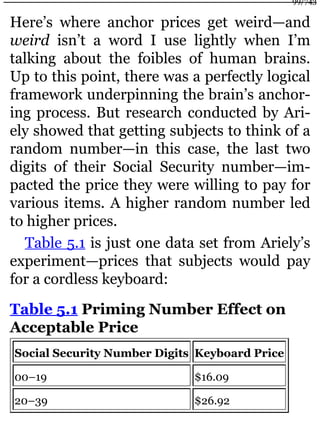
Table 5.1 is just one data set from Ariely’s
experiment—prices that subjects would pay
for a cordless keyboard:
Table 5.1 Priming Number Effect on
Acceptable Price
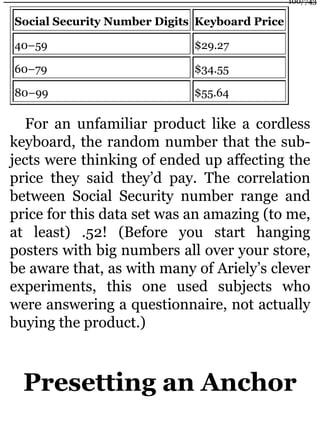
Social Security Number Digits Keyboard Price
00–19 $16.09
20–39 $26.92
99/743
Social Security Number Digits Keyboard Price
40–59 $29.27
60–79 $34.55
80–99 $55.64
For an unfamiliar product like a cordless
keyboard, the random number that the sub-
jects were thinking of ended up affecting the
price they said they’d pay. The correlation
between Social Security number range and
price for this data set was an amazing (to me,
at least) .52! (Before you start hanging
posters with big numbers all over your store,
be aware that, as with many of Ariely’s clever
experiments, this one used subjects who
were answering a questionnaire, not actually
buying the product.)
Presetting an Anchor
100/743
Other experiments by Ariely showed that an-
chors could be preset for unfamiliar items; in
that case, a payment for listening to an an-
noying sound. A questionnaire that included,
“Would you be willing to listen to this sound
again for $.10?” elicited lower bids than
those given by subjects asked the same ques-
tion with a price of $.90.
Brainfluence
Takeaway: Be Careful
Where You Drop Your
Anchor!
It’s no big news to marketers that customers
may have specific price expectations for a
product or product category. If one can bring
a product into that category with a price
lower than expected, it should be an
101/743
attractive offer. If one’s product is premium
priced, then it will be important to separate
it as much as possible from lower-priced
products.
The more interesting challenge is how to
deal with new products for which consumers
have no clearly established anchor price. Ari-
ely’s research shows that anchor pricing for
such products is quite fungible, and mar-
keters would do well to avoid inadvertently
establishing a low anchor price. If a higher
anchor price can be established, then offers
involving lower prices will be attractive to
consumers.
Apple’s iPhone introduction is a good ex-
ample of using anchor pricing to keep de-
mand strong. When they first released the
iPhone, it ranged in price from $499 to
$599, establishing the initial anchor for what
the unique product should cost. To the chag-
rin of early adopters, Apple dropped the
price by $200 after only a few months,
102/743
creating an apparent bargain and stimulat-
ing more sales. When they introduced the
iPhone 3G, pricing was as low as $199, and
they sold one million phones in three days.
There are many reasons why marketers
start with a high price initially. One big one
is to work the demand curve, that is, to de-
mand a high price from the portion of the
market willing to pay that much before drop-
ping the price to reach a larger number of
customers. A key benefit of this strategy for
new products, though, is that a high anchor
price is established in the minds of custom-
ers, making each subsequent reduction a big-
ger bargain.
Nonsense Anchors
Can marketers take advantage of irrational
anchor pricing? Would asking customers to
think of a number between 90 and 99 while
standing in line at a fast-food restaurant
103/743
make them willing to pay more for a burger?
Should stores hang posters of big numbers
by the checkouts? Although Ariely’s work
suggests that this kind of irrational anchor-
ing effect could exist, I wouldn’t recommend
building a marketing strategy around such
techniques. But by all means feel free to test
it!
Infomercials and Anchor
Pricing
One group of marketers that seems to impli-
citly understand anchor pricing are the cre-
ators of successful infomercials. Just about
every one of these seeks to establish a high
anchor price for their usually unique or unfa-
miliar product. They start by saying things
like, “Department stores charge $200 for
this kind of product . . .”; then they make an
offer at a lower price. They typically proceed
to add bonus products into the offer as well,
104/743
making the new anchor price of their actual
offer (“Only $59.99 plus shipping!”) look
better and better. By the end of the pitch, the
offer price is not only far lower than the ini-
tial anchor but the offer itself has expanded
to include far more products. (One such
commercial, as it concluded, dropped the
price by $5 “for callers in the next 20
minutes”—yet another exploitation of a fa-
vorable comparison to a previously estab-
lished anchor.)
Marketers of all types could do worse than
studying the techniques of successful direct
marketers. The latter live or die by the suc-
cess of their commercials, catalogs, or web-
sites, and if you see an offer repeated time
after time you can be certain that it is
working.
Notes
105/743
5. Dan Ariely, Predictably Irrational:
The Hidden Forces That Shape Our De-
cisions, rev. ed. (New York: Harper Per-
ennial, 2010).
106/743
Chapter 6
Wine, Prices, and
Expectations
In an area as subjective as wine tasting, it’s
easy to believe that what wine drinkers say
about a wine is influenced by what they
know about the wine. (Or, by what they think
they know!) It might be surprising to find
out, though, that wine thought to be more
expensive really does taste better at the most
fundamental level of perception. Researchers
at Stanford University and Caltech demon-
strated that people’s brains experience more
pleasure when they think they are drinking a
$45 wine instead of a $5 bottle, even when in
reality it’s the same cheap stuff!6
The important aspect of these findings is
that people aren’t fibbing on a survey; that is,
they aren’t reporting that a wine tastes better
because they know it’s more expensive and
they don’t want to look dumb. Rather, they
are actually experiencing a tastier wine.
The price (or what the subjects thought
was the price) actually changed their experi-
ence with the product. Baba Shiv and his fel-
low researchers monitored brain activity us-
ing fMRI while the subjects tasted the wine
to observe how the subjects’ brains reacted
with each sip.
Wine isn’t the only product affected by its
price. Shiv, in another experiment, showed
that people who paid more for an energy
drink actually solved puzzles more quickly
than those who bought it at a discount. The
higher price made the drink more
stimulating.
108/743
Yet another study showed that 85 percent
of subjects given a placebo pill for pain relief
reported a reduction in pain when they were
told the pill cost $2.50 per dose; when told
the pill cost 10 cents, only 61 percent of sub-
jects reported a pain reduction. The pills, of
course, had no actual active ingredients.7
Here’s the conundrum for marketers: On
one hand, we know that the pain of paying
kicks in when people perceive that a product
is overpriced and makes people less likely to
make a purchase. But now we have multiple
studies showing that people enjoy a product
more when they pay more for it. How should
a marketer determine the price point?
I don’t think these neural reactions to pri-
cing are necessarily in conflict. If the wine
drinkers in the Stanford University–Caltech
study had been sent to the supermarket and
asked to pick up a bottle of wine on the way
to the lab, they would no doubt have felt the
pain of paying too much for a bottle of wine.
109/743
Unless they were wine aficionados, they
likely would have chosen a less costly bottle.
(Other factors could influence the selection
process, too. Would the researchers see the
bottle chosen? If it was too cheap, would
they think the subject was a wine ignora-
mus? Would blindly choosing a costly bottle
make the subject look like a snob or a spend-
thrift?) The pleasurable boost from a higher
price occurs after purchase and consump-
tion, so marketers still face the same prob-
lem they always have: setting a price that
consumers will accept and that will yield a
suitable combination of profit margin and
total revenue.
Brainfluence
Takeaway: Be Careful
With Discounts
110/743
What this does suggest is that marketers
need to understand that price is an import-
ant part of the experience for a premium
product or luxury brand. This isn’t huge
news; we’ve seen once-proud brands des-
troyed by overdistribution and pervasive dis-
counting. And it isn’t even the price that the
consumer pays; the subjects in the study
didn’t pay anything for the wine they tasted,
but they still stated that the expensive wine
tasted better.
The consumer has to believe that a
product is priced at a certain level for the
brain effect to kick in. If someone gives me a
$100 bottle of wine, I’ll no doubt taste it as
such. If I find the same bottle mispriced at
the wine shop and buy it for $10, it will likely
still be a $100 wine to me (and I’ll have
greatly reduced my buying pain as well).
But, if I find a bin full of the wine priced at
$10 and marked “Huge sale; save $90 per
bottle!” some skepticism will kick in. Did this
111/743
vintage turn out poorly? Did the shop store a
few cases next to the furnace and find they
had gone bad? Did Robert Parker or another
wine expert give it a terrible review? I’m cer-
tain that these doubts would lower my
brain’s perceived value of the wine. If the
wine was advertised with a “new low price”
of $10, my brain would be even more certain
it didn’t taste like a $100 bottle of wine.
There’s not an easy way to cut through the
complex balancing act of pricing the product
high enough to appeal but low enough to sell
in volume. My advice is to price the product
appropriately for the target market and to be
aware that discounting may actually reduce
the quality of the customer experience. That
doesn’t mean that discounts or low prices are
bad; they have a powerful effect on con-
sumers, too.
Most consumers will have no problem in
deciding whether the better taste (real or
perceived) of a more costly bottle of wine
112/743
justifies the difference in price. That’s why
two-buck chuck has sold hundreds of mil-
lions of bottles to date, whereas $100 bottles
mostly gather dust on wine store shelves.
Notes
6. Lisa Trei, “Price Changes Way People
Experience Wine,” Stanford News Ser-
vice, January 16, 2008, ht-
tp://news.stanford.edu/news/2008/
january16/wine-011608.html.
7. Benedict Carey, “More Expensive
Placebos Bring More Relief,” New York
Times, March 5, 2008, ht-
tp://www.nytimes.com/2008/03/05/
health/research/05placebo.html.
113/743
Chapter 7
Be Precise With Prices
In my time as a catalog marketer, I usually
priced products just below the next dollar in-
crement. So, for example, a cheap item might
be $9.97 rather than $10, and a more ex-
pensive item may have been $499, or even
$499.99, instead of $500.
This approach was based on a couple of as-
sumptions. First, I thought that there was
probably something desirable about offering,
say, a “nine-dollar-and-change” price versus
a “ten-dollar” price. Even though the differ-
ence was only a few pennies, I thought, some
customers would perceive the $9.97 price to
offer more substantial savings.
Second, I observed that big marketers like
Sears, who could afford to test any number
of pricing options and no doubt did so fre-
quently, tended to stick with the “just below
the next increment” approach. As it turns
out, I was right, but for the wrong reason.
New research points us toward the reasons
why consumers respond better to a $499
price versus a $500 price, and it has more to
do with the apparent precision of the odd
number than the lower price.
University of Florida marketing professors
Chris Janiszewski and Dan Uy tested how
people react to pricing in an auction environ-
ment by giving groups of buyers three differ-
ent starting prices:
• $4,988
• $5,000
• $5,012
115/743
While for practical purposes these prices
may be essentially identical, when the re-
searchers asked the buyers to estimate the
wholesale price of the item, the buyer group
with the $5,000 price estimated a much
lower number. Not only did the $5,000
group move farther away from the anchor
price, but they also tended to estimate the
wholesale price as a round number, too.
Janiszewski and Uy attribute this phe-
nomenon to our creation of a mental meas-
uring stick based on the initial price. If we
think a toaster priced at $20 is overpriced,
we estimate it might be worth $19 or $18.
For the same item priced at $19.95, our
measuring stick has more precision, so
prices like $19.75 or $19.50 come to mind.8
Another study looked at the price of
houses and found that sellers who listed
their house at an odd price, such as
$494,500, sold at a price closer to their ask-
ing price than houses priced at even
116/743
numbers, like $500,000. Oddly, the even-
priced houses lost more value as they aged
on the market, too.9
Brainfluence
Takeaway: Use Precise
Pricing
According to these findings, it seems, I might
have done just as well selling a $499 product
at $502.50; the key thing is to avoid the
dreaded round number of $500, which im-
plies a lack of precision and makes custom-
ers wonder if $400 is a more appropriate
price.
I still think there might be a small bias to-
ward the slightly lower number than the
slightly higher number when it comes to
buyer decision making, but the researchers
didn’t explore that directly. Another area
117/743
that could use more study is comparing pre-
cise pricing to minimalist pricing, such as the
tiny “19” (with no currency symbol or decim-
al) as one might find on a restaurant menu.
This work should give marketers the am-
munition they need to fend off requests for
simplified pricing. In the past, I recall fre-
quent admonitions that “Nobody is fooled by
a price that’s a penny cheaper—let’s keep it
simple and just charge an even number.”
People may not be fooled by the more precise
price, but they may attribute a higher value
to the product itself.
Notes
8. Wray Herbert, “Why Things Cost
$19.95,” Scientific American Mind 19,
no. 2 (April 2008), http://www.scienti-
ficamerican.com/article.cfm?id=why-
thin,gs-cost-1995&ec=su_1995.
118/743
9. Ibid.
119/743
Chapter 8
Decoy Products and
Pricing
Need to sell more of a product or service?
Here’s a counterintuitive idea: offer your
customers a similar, but inferior, product or
service at about the same price. While it’s
unlikely that they will actually buy the less
attractive item, you may see a jump in sales
of what you are trying to sell.
Here’s a real-world example. The last time
I needed a can of shaving gel, I found myself
staring at a shelfful of options. Gels and
foamy creams, with variations that included
“Sensitive Skin,” “Aloe,” “Cleansing,” and
many more, lined the shelves. As I stood
there befuddled by the choices, I noticed a
taller can of the “Advanced” gel amid the
forest of shave products. This can was
identical to several other cans of “Advanced,”
but it was one or two inches taller and held a
couple of ounces more of the product. Best of
all, it seemed to be the same price as the
shorter cans.
I studied the cans for another few seconds
to be sure I wasn’t missing something. Nope,
I wasn’t—same stuff, same package design,
same price, but 20 percent more product. My
confusion evaporated. I had no idea how
shaving gel could be “Advanced,” or how that
might compare with “Aloe,” but I grabbed
the bigger can, rooted around and found one
more in back, and headed for the checkout
with both cans. How did buyer befuddlement
turn into a larger-than-expected purchase so
quickly? The answer: decoy marketing. In
this case, the decoy was unintentional, but
121/743
there are lots of ways that marketers can use
the technique to steer customers toward a
decision.
In the shaving gel display, the inclusion of
the extra large shaving cream can was an ac-
cident—the store just had a few left from a
previous promotion. But the principle
worked just fine. In this case, the regular-
sized cans were the decoys. As soon as I spot-
ted a nearly identical product that was
clearly a better value, that new find stood
out as the right choice.
Relativity is the key element in decoy mar-
keting. Our brains aren’t good at judging ab-
solute values, but they are always ready to
compare values and benefits. When used
proactively by marketers, a decoy product or
offer can make another product look like a
better value.
In Predictably Irrational, author Dan Ari-
ely describes an experiment using magazine
subscription offers. Like most of Ariely’s
122/743
experiments, this one is deceptively simple.
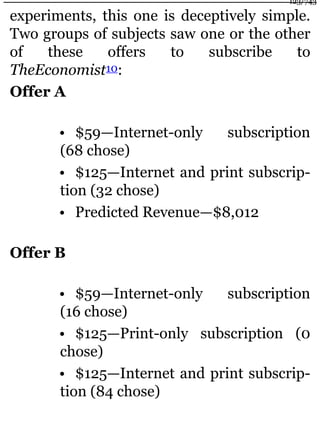
Two groups of subjects saw one or the other
of these offers to subscribe to
TheEconomist10:
Offer A
• $59—Internet-only subscription
(68 chose)
• $125—Internet and print subscrip-
tion (32 chose)
• Predicted Revenue—$8,012
Offer B
• $59—Internet-only subscription
(16 chose)
• $125—Print-only subscription (0
chose)
• $125—Internet and print subscrip-
tion (84 chose)
123/743
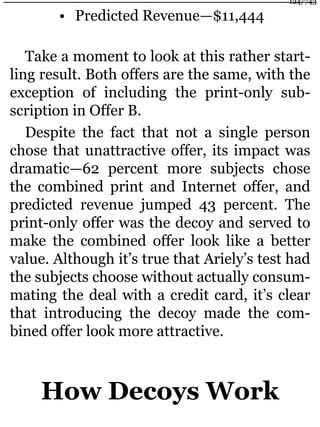
• Predicted Revenue—$11,444
Take a moment to look at this rather start-
ling result. Both offers are the same, with the
exception of including the print-only sub-
scription in Offer B.
Despite the fact that not a single person
chose that unattractive offer, its impact was
dramatic—62 percent more subjects chose
the combined print and Internet offer, and
predicted revenue jumped 43 percent. The
print-only offer was the decoy and served to
make the combined offer look like a better
value. Although it’s true that Ariely’s test had
the subjects choose without actually consum-
mating the deal with a credit card, it’s clear
that introducing the decoy made the com-
bined offer look more attractive.
How Decoys Work
124/743
According to Ariely, decoys change behavior
when a subject is choosing between alternat-
ives that are more or less equally attractive.
He gives an example of choosing between a
trip to Rome and a trip to Paris, both of
which include free breakfasts. One might ex-
pect a slow decision-making process with a
more or less even split between the two al-
ternatives. Ariely suggests that introducing a
decoy, a trip to Rome with no breakfast,
would make the original trip to Rome more
attractive, and that, given those options, the
trip to Rome with breakfast would handily
beat the similar Paris trip.
So, jumping back to the shaving gel topic,
if a drugstore received a shipment of promo-
tional cans with an extra 20 percent of
product inside, their first reaction might be
to remove the regular cans from the shelf un-
til the promotional stock was gone. What
customer would be dumb enough to buy the
125/743
small can when the bigger cans were the
same price?
According to decoy marketing logic,
however, the store would be well advised to
leave a few of the small cans on the shelf
with the bigger ones. As counterintuitive as it
seems, the presence of some small cans
would likely boost sales of the larger promo-
tional cans, perhaps even taking market
share away from competing products that
came in the larger size to begin with.
Decoys in Real Estate
I’ve bought a number of homes, and I’ve
found that real estate agents often set up a
tour of several houses in the same price
range, leaving the most desirable for last.
This seems to me to be another form of de-
coy marketing, particularly when the next-
to-last house compares poorly with the one
126/743
the agent hopes to sell you (e.g., the same
price but in need of more repairs).
Ariely suggests that this will be most ef-
fective when the comparison is between su-
perficially similar homes, for example,
between two-story colonial-style homes with
the same number of bedrooms. Buying a
house is a complex, risky, and expensive pro-
cess, and getting a buyer to make a de-
cision—even when he or she knows it’s ne-
cessary—can be difficult. Clever real estate
agents learn that comparisons are a key part
of the buyer’s process and that selecting the
right homes to visit is a key part of moving
toward a decision.
Brain Scan Evidence
One study used fMRI scanning to see what
happens in our brains when we are trying to
choose between options. The researchers
127/743
found that choosing between two equally at-
tractive options caused the subjects to dis-
play irritation due to the difficulty of choos-
ing. But, when another less attractive option
was offered, the choice process became easi-
er and more pleasurable.11
Brainfluence
Takeaway: Try a “Not-
So-Good” Decoy to
Push Your Top
Product
I don’t advocate any techniques that push
customers into buying something they don’t
need or want. Sometimes, though, customers
have difficulty deciding between alternatives.
To get the product they need, they require a
nudge in one direction or the other. For
128/743
example, I was certainly going to buy shaving
gel in that store, but the unintentional decoy
got me to the decision point and on my way
more quickly than if I had spent another few
minutes considering the weighty issues of gel
versus foam, aloe versus sensitive skin,
cheaper small size versus expensive big size,
and so on. The regular-sized decoys nudged
me toward the jumbo can at the same price,
and the deal was closed.
When creating their product offerings,
most companies try to develop the best and
most attractive offers they can—a practice I
wholly endorse. But sometimes adding a less
attractive offer to the mix will close more
deals on the better offers without disad-
vantaging the customer in any way. So, the
next time you are creating your “good, bet-
ter, and best” packages, consider tossing in a
“not-so-good” package that’s similar to (but
not as good as) the one you’d like to drive the
129/743
most traffic to. If that boosts sales of that
item, you’ll know your decoy is working.
Notes
10. Ariely, Predictably Irrational.
11. University of Minnesota, “Inside the
Consumer Mind: U of M Brain Scans
Reveal Choice Mechanism,” news re-
lease, December 11, 2008, ht-
tp://www.eurekalert.org/pub_releases/
2008-12/uom-itc121108.php.
130/743
Chapter 9
How About a
Compromise?
When marketers plan a company’s product
offerings, they usually try to do so in the
most logical way possible. Several levels of
product may be offered: a stripped-down,
basic version; a more capable better version;
and perhaps a “best” version. These are nor-
mally priced at quite different levels, prob-
ably based in part on the relative manufac-
turing costs of the products.
In the last chapter, we saw how a seem-
ingly crazy pricing strategy—that is, pricing
an inferior product either the same as or
almost the same as a better one—could boost
sales of the better product. (In that case, the
inferior product is the decoy.)
Now, let’s look at a different kind of decoy:
a new high-end product that, even if it sells
poorly, can boost sales of the next product in
the lineup.
Retailer Williams-Sonoma at one point
offered a $275 bread maker. Later, they ad-
ded a large capacity version at a 50 percent
premium. They didn’t sell many of the more
expensive model, but sales of the cheaper
one doubled.12
What happened? Simply put, introducing
the higher-priced machine framed the previ-
ously most costly unit as a compromise, or
middle-of-the-road choice. Buyers were no
longer spending too much on the “Cadillac”
of the line, but rather making a wise and
practical choice. Before the retailer added
the higher-priced bread maker, customers
may have compromised on a still lower-
132/743
priced machine, or perhaps bought none at
all.
A Stanford University experiment had a
group of consumers choose between two
cameras, one more full-featured than the
other. A second group chose from a selection
of three cameras, which had the other two
cameras plus one even higher-end model.
The first group split their purchase about
50/50 between the two models. But, in the
second group, fewer of the cheapest unit sold
while more of the second camera sold. Ad-
ding the very expensive model made the
second camera look like a reasonable com-
promise.13
Brainfluence
Takeaway: Add a High-
End Product
133/743
From a practical standpoint, this means that
if you have a solid product at the top of your
line, you can actually increase its sales by
adding an even higher-priced product above
it in the lineup.
You might find, of course, that the market
will support the new premium item on its
own merits. If that happens, perhaps intro-
ducing an even more costly super-premium
product might further boost revenue. But,
even if the new high-end product doesn’t
generate spectacular sales, you may find that
it boosts sales of the next-best or mid-range
products.
Of course, there are a few cautions. First,
the customer may not be comparing your
products only against each other; keep an
eye on competitive offerings, too. Second,
you should avoid having too many product
variations. Research shows that having too
many choices reduces sales, due to a sort of
paralysis of analysis.
134/743
Restaurant Decoys
One area where decoy products are used
with great regularity (and success) is in res-
taurants. The costly filet mignon and lobster
combination at the top of the menu is likely
more effective at making the other entrees
seem reasonable than in generating orders
itself. Similarly, the $100 Cabernet Sauvign-
on on the wine list makes a $35 bottle an ac-
ceptable upgrade compared with the $20
plonk at the bottom of the price range.
Notes
12. Barbara Buell, “The Limits of One-
to-One Marketing,” Stanford Business
68, no. 4 (August 2000), ht-
tp://www.gsb.stanford.edu/com-
munity/bmag/sbsm0008/faculty_re-
search_mktg.html.
135/743
13. Itamar Simonson, “The Effect of
Product Assortment on Buyer Prefer-
ences,” Journal of Retailing 75, no. 3
(Autumn 1999): 347–370, ht-
tp://www.sciencedirect.com/science/
article/pii/S0022435999000123.
136/743
Chapter 10
Cut Choices; Boost
Sales
Consumers must like lots of choices—why
else would there be hundreds of shampoo
brands and variants on a typical supermar-
ket shelf? Actually, it’s been known for years
that too many choices can reduce consumer
purchases.
A study at Columbia University compared
consumer behavior when confronted with a
selection of either 6 or 24 gourmet jams in
an upscale grocery store. The bigger selec-
tion did indeed cause more customers to
stop and check it out—60 percent looked
versus 40 percent for the limited selection.
The interesting part, though, was the pur-
chasing behavior. Whereas 30 percent of the
customers presented with the limited selec-
tion made a purchase, a mere 3 percent of
those who saw the extensive selection bought
something.14
That result is quite startling—the small se-
lection sold 10 times as much as the larger
one.
Choice Fatigue
Additional research shows that making
choices tires the chooser’s brain and can ac-
tually make subsequent decision making
more difficult.15
One study, by Ned Augenblick and Scott
Nicholson of Stanford University, analyzed
voting patterns in a California county. They
found that the lower on the ballot an item
138/743
appeared, the more likely the voter was to
not make any choice or to use a shortcut,
such as picking the first choice. The process
of working through the ballot making choices
caused voters to look for an easy way out as
they progressed.16
We’ve likely all experienced that ourselves
when completing online surveys. We start
out paying close attention to the questions
and choices, but if the process starts to
stretch across multiple screens, our diligence
wanes.
Cutting choices works in the real world.
Walmart dropped two brands of peanut but-
ter and found sales in the category went up.
Similarly, Procter & Gamble cut the range of
skin care products at a retailer, and sales of
the remaining products increased. Cus-
tomers reported that the product selection
seemed larger after the cut, perhaps because
the merchandise could be better organized
and displayed.17
139/743
Brainfluence
Takeaway: Find Your
Choice Sweet Spot
The trick, it seems, is finding the optimal
number of choices for your product: offering
enough choices to ensure that a customer
can find a satisfying product, but not so
many that the customer will be bewildered or
demotivated. As with most elements of mar-
keting, testing beats guesswork for this kind
of decision. If any general conclusion can be
drawn, it’s that adding more choices because
you want to have what looks like a large se-
lection is a bad strategy; if poorly selling
choices are axed, sales may actually increase.
Helping Customers Choose
140/743
Customer guidance may help, too. In the
Columbia study, almost nobody purchased
jam products when the selection was huge.
What if a salesperson had been on hand to
ask customers a question or two about their
preferences and then make a strong recom-
mendation? “If you like strawberries, then
you’ll absolutely love our strawberry ginger
jam. It’s full of fruit flavor but has really in-
teresting spicy notes, too. A group of chefs
rated it their favorite choice from our full
range of jams.” Likely, a bit of effort to help
the customer decide (and validate that de-
cision with additional data) would go a long
way toward slicing through the confusion
and frustration caused by too many choices.
Self-Service Help
Even in a self-service setting, guidance in the
form of labels, shelf talkers, and so on, may
help by directing consumer attention toward
141/743
products that may be suited to their needs
and wants. The wine shelves at the super-
market are a good example of a paralyzing
array of choices. Wine shops deal with this
profusion of options by offering (apparently)
expert advice to customers. In contrast,
many supermarket wine sections offer as
large a selection as a wineshop but have no
trained staff to assist confused customers.
I’ve seen smart retailers guide choices by la-
beling a few wines with prominent descrip-
tions and expert ratings.
Choosing on the Web
Online retailers can offer a greater selection
of products than brick-and-mortar stores,
and they can use all kinds of techniques to
make choosing easier: recommendation en-
gines, sorting and ranking features, ratings
and reviews, suggestions of similar products,
and so forth. Amazon.com has a product list
142/743
that numbers in the millions, but it still man-
ages to guide its customers to appropriate
choices. Some online retailers fail the test,
though. I’ve left sites that presented me with
a large assortment of products that met my
initial criteria but offered me no way to sort
through them and narrow my options.
Avoid Similar Choices
The wide selection phase of the jam experi-
ment is a good example of offering many
choices with no shortcuts to help consumers.
Choices are less daunting when the items are
quite different and offer the consumer mean-
ingful variation. Sales-killing choices are
those that appear very similar and offer the
consumer no shortcuts in making a decision.
The basic message is the same for all ven-
ues: more choice isn’t always good and can
actually reduce sales.
143/743
Notes
14. Sheena S. Iyengar and Mark R. Lep-
per, “When Choice Is Demotivating: Can
One Desire Too Much of a Good Thing?”
Journal of Personality and Social Psy-
chology 79, no. 6 (December 2000):
995–1006, http://psycnet.apa.org/
?&fa=main.doiLanding&doi=10.1037/
0022-3514.79.6.995.
15. Randy Dotinga, “Choices Sap Your
Stamina, Self Control,” Washington
Post, April 18, 2008, http://www.wash-
ingtonpost.com/wp-dyn/content/art-
icle/2008/04/18/
AR2008041802473.html.
16. Ned Augenblick and Scott Nicholson,
“Choice Fatigue: The Effect of Making
Previous Choices on Decision Making in
a Voting Context,” Haas School of Busi-
ness, University of California, Berkeley
(February 2011): 1–29,
144/743
http://faculty.haas.berkeley.edu/ned/
Choice_Fatigue.pdf.
17. Marina Strauss, “In Store Aisles, Less
Is More but Customers Can Still Be Par-
ticular,” Globe and Mail, May 18, 2010,
http://www.theglobeandmail.com/
report-on-business/in-store-aisles-less-
is-more-but-customers-can-still-be-par-
ticular/article1573518/.
145/743
SECTION TWO
Sensory
Brainfluence
The connection between our senses and our
brain is direct. Marketers who build sensory
features into their products, services, and
marketing can appeal directly to the emo-
tions and stored memories of their custom-
ers. Marketing to all five senses can change
weak brands and products into powerhouses.
Chapter 11
Use All the Senses
One of the strongest advocates for creating
marketing that appeals to all five of our
senses is Martin Lindstrom, author of both
Buyology and Brand Sense: Build Powerful
Brands Through Touch, Taste, Smell, Sight,
and Sound. The latter book was based in part
on a global research project by Millward
Brown, which studied the relationship
between branding and sensory awareness.
Lindstrom’s basic point in Brand Sense is
simple: brands that appeal to multiple senses
will be more successful than brands that fo-
cus on only one or two. These appeals can be
part of the brand’s advertising, like using a
distinctive color and logo in a consistent
manner, or be part of the product itself, such
as a phone ringtone or the fragrance of a
soap product.
Singapore Airlines, according to Lind-
strom, is the pinnacle of sensory branding.
They not only use the consistent visual
themes one might expect from an airline but
incorporate the same scent, Stefan Floridian
Waters, in the perfume worn by flight at-
tendants, in their hot towels, and in other
elements of their service. Flight attendants
must meet stringent appearance criteria, and
they wear fine silk uniforms that match ele-
ments of the cabin decor.
Singapore Airlines strives to make every
sensory element of their customer interac-
tion appealing and, equally important, con-
sistent from encounter to encounter. Lind-
strom credits the firm’s perennial position
atop travelers’ preference rankings to these
efforts.
148/743
Brand Fragments
One key element of Lindstrom’s marketing
prescription is what he calls, “Smash Your
Brand.” In essence, he thinks a brand should
be identifiable even when some parts of the
marketing program aren’t there. If your logo
is removed from your product or your ad-
vertisement, would it still be instantly recog-
nizable as your brand? Is just a color enough
to signify your brand? Of course, few brands
have the power to claim a single color as
their exclusive look, but the point is that
marketers need to think beyond their logo as
the sole consistent element in their branding
efforts.
149/743
Brainfluence
Takeaway: Appeal to
All Five Senses
To be truly successful, your marketing
should encompass every human sense. This
isn’t an exhaustive list of possible sensory
topics, but check them off and see which you
are addressing now and which are successful
enough that your customers would recognize
them on their own:
Sight—logo, product design, col-
or(s), typeface
Sound—music, product sounds
Taste—product taste, edible favors/
gifts
Smell—environmental aroma,
product aroma
150/743
Touch—product surface and shape,
marketing materials, environment
surfaces
Consistency is the key in building the sens-
ory aspects of your brand. These elements
should be the same across time, in any loca-
tion, and in any use. We’ll look at some spe-
cific sensory approaches in the ensuing
chapters.
151/743
Chapter 12
Does Your Marketing
Smell?
Martin Lindstrom, whom we met in the pre-
vious chapter, thinks smell is particularly po-
tent in bypassing conscious thought and cre-
ating associations with memories and emo-
tions. He estimates that 75 percent of our
emotions are generated by what we smell,
and he is an enthusiastic advocate of incor-
porating the sense of smell into as many as-
pects of a firm’s marketing as possible.
French author Marcel Proust really did get
it right with his concept of “involuntary
memory.” Proust famously described an
avalanche of memories being triggered by
the smell of a madeleine, a French cake. He
felt that these induced memories were more
realistic and powerful than “voluntary”
memories which we intentionally try to re-
call. All the way back in 1935, a study by
Donald Laird showed that 80 percent of men
and 90 percent of women reported having
vivid, emotion-triggering memories evoked
by odor.1
Scents can affect perception in other ways,
too. In one experiment, two pairs of identical
Nike shoes were evaluated by consumers:
one in a room with a floral scent and one
with no scent. Fully 84 percent of the sub-
jects evaluated the sneakers in the scented
room as superior.
Marc Gobe, author of Emotional Brand-
ing, says every brand should have a distinct-
ive smell and thinks that scent is a key suc-
cess factor in building a deeper emotional
bond with the consumer. Gobe cites Thomas
153/743
Pink, a London-based shirt seller, which
scents its stores with line-dried linen fra-
grance. He thinks that even specific spaces,
such as sections of a department store or in-
dividual displays, may deserve their own
unique scent boost.
Gerald Zaltman, an expert in consumer
psychology and author of How Customers
Think, describes how olfactory and other
sensory cues are hardwired into the brain’s
limbic system. That’s the seat of emotion,
and by virtue of that connection, smells can
stimulate vivid recollections.
Once a scent is embedded in an individu-
al’s brain, even visual cues can cause it to be
resurrected and even “experienced,” accord-
ing to Zaltman. For example, a television
commercial showing a pizza being pulled
from an oven can trigger olfactory responses
in the brain.
Zaltman sees scents as serving in several
ways. They can be memory markers that help
154/743
a person recall familiar brands more than
unfamiliar ones. They can also change the
way we process information; a lemon aroma,
for example, can make us more alert. Zalt-
man speculates that scents of that type could
be helpful when introducing a new product.
More Scent Effects
Scents can affect behavior and consumer
perceptions. One experiment showed that
nightclub patrons danced longer when the
venue was scented with orange, peppermint,
and seawater. When surveyed, the patrons of
the scented clubs reported they had a better
time and liked the music more.2
A test in a casino found that people
gambled 45 percent more money in a slot
machine when a pleasant scent was intro-
duced into the area. Another test found that
changing a shampoo’s fragrance but no other
155/743
performance characteristics caused testers to
find that it foamed better, rinsed out more
easily, and left their hair glossier.3
The fact that a change in fragrance af-
fected customer perceptions of how the
shampoo performed in totally unrelated
areas is a telling point for marketers and
product developers.
Sometimes, we process scents without
conscious awareness. In one unique experi-
ment, researchers asked female subjects to
smell shirts worn by men who watched
either an erotic movie or a neutral one. Vir-
tually all of the women said they didn’t smell
anything, but the functional magnetic reson-
ance imaging (fMRI) scans of the brains of
the women who smelled the shirts worn by
the aroused guys lit up in a different way.4
(This is just one example of why surveys,
questionnaires, and similar market research
tools can yield unreliable results.)
156/743
Bad Smells
All sensory experiences aren’t positive. Lind-
strom recounts the results of a sensory sur-
vey of U.S. McDonald’s customers that found
that one third of the patrons thought that the
restaurants smelled like stale oil. Of McDon-
ald’s customers in Britain, 42 percent
thought the same, and both groups indicated
that this smell diminished their enjoyment of
the food. The survey found that other cus-
tomers liked the smell and that it made their
mouths water. It’s interesting that although
usually bad smells are situational and fleet-
ing—scorched coffee, burned food, and so
on—in the case of McDonald’s, the consist-
ency of the stale oil smell had reached the
point of becoming a brand association.
157/743
Brainfluence
Takeaway: Own Your
Smell
Although one thinks of olfactory marketing
as the province of big companies that can af-
ford custom fragrance development, just
about every business has smells associated
with it. They might be intended or uninten-
ded, enticing or unpleasant, but they are
there. Getting these under control is key for
businesses of every size.
Olfactory Branding
The first, and perhaps most significant, use
of scent is for branding. The keys to olfactory
branding are consistency and uniqueness.
One reason for Singapore Airline’s sensory
branding success is that they developed a
memorable scent and then used it
158/743
everywhere for years. Regular flyers learned
what the airline smelled like; more import-
antly, they unconsciously associated this
scent with the rest of the Singapore Airlines
experience: lovely attendants, impeccable
service, and so on. A brand’s scent need not
come out of a spray can or an aroma generat-
or; Barnes & Noble stores have a fairly con-
sistent scent that includes crisp new books
and Starbucks coffee. (Then again, perhaps
there’s a machine in a back room pumping
out that smell!)
Hollister and other apparel retailers use
environmental scents. Reportedly, Hollister
uses its own SoCal fragrance, both spraying
it on clothing items and even pumping it out-
side to attract passersby.
Products
Olfactory product marketing is a bit more
straightforward but is still important. In
159/743
today’s supermarkets, is there any doubt that
more rotisserie chickens are sold because of
the enticing aroma of roasting chicken that
wafts around that area of the store? In that
same environment, though, there may be
many other aroma marketing techniques in
use, either intentionally or not. The coffee
section likely has a grinder that circulates a
coffee aroma as it crushes the beans. Some
food stores aren’t relying on natural aroma
propagation—one Brooklyn grocery recently
deployed scent generators to stimulate buy-
ing. They introduce scents that are enticing
but might be hard to create and maintain by
normal means, like chocolate in the candy
section and grapefruit in the produce area.5
Nonfood items can benefit from aromas,
too—think linen scents in a bedding store,
leather scents in clothing and furniture en-
vironments, and so on.
The product itself may use materials like
rubber, plastic, wood, leather, oils, and so
160/743
forth, that carry a scent. These can be en-
hanced if desired, for impact and consist-
ency. Today, the evocative “new car smell” is
at least in part the product of forethought,
testing, and even simulated scents.
Retail Environments
In any retail setting, controlling the olfactory
environment is important. People will asso-
ciate smells with the store and products. Do
you want to be known for stale oil or
something else unpleasant? Don’t forget the
Nike shoe study in which a pleasant smell
entirely unrelated to the product (floral
scents and running shoes seem quite discon-
nected) dramatically increased consumer
preference.
Olfactory Dangers
161/743
In scents, a little goes a long way. We’ve
probably all had the experience of sitting
near an olfactorily challenged septuagenari-
an who applied a few more shots of perfume
than were necessary—and it’s not a pleasant
experience.
Similarly, a fresh-smelling hotel room is a
plus; one that seems to have been doused
with gallons of air freshener not only is un-
pleasant but begs the question, “What are
they covering up?” Some individuals are
quite sensitive to fragrances and may find
strong scents very disturbing. One abortive
effort to sell milk by placing cookie-scented
ads in bus shelters lasted only a day before
city authorities forced their removal. The of-
ficial reason was the objection of the “envir-
onmental illness community.”
Scents should be subtle and appropriate to
their environment. The smell of fresh-baked
chocolate chip cookies would be wonderful
in a bakery or coffee shop; in an outdoor bus
162/743
shelter, the same aroma is rather suspect.
Consumers’ brains will process that same in-
formation differently. In the bakery, that
smell is processed as real, but in the bus
shelter, it’s pegged as artificial. Another
location-dependent example is musty books;
the smell of old paper, dust, and foxed pages
would be quite awful for Barnes & Noble, but
might be just the thing to get book collectors
and academics salivating at an antiquarian
bookstore.
Summary: Think Smell
Smell may be the most potent and direct
sensory path to the brain. Check out your
products and selling environments, both by
direct observation and customer queries.
Chances are you have at least one default
smell, even if you are doing nothing inten-
tionally aromatic. Determine whether that
163/743
scent is something to build on or something
to eliminate. Consider a branding strategy
that includes aroma—that may not be appro-
priate for every situation, but think outside
the box. Follow through into both the
product and customer contact environment.
What do they smell like now, and can you
improve their appeal and/or consistency?
Finally, never overdo any kind of scent-based
marketing. The customer backlash will out-
weigh any benefits.
Notes
1. Laird, D. (1935). What can you do
with your nose? Scientific Monthly. 41:
126-30
2. “Clubbers Can Smell a Good Night-
spot,” ScienceDaily, May 17, 2011, ht-
tp://www.sciencedaily.com/releases/
2011/05/110517105141.htm.
164/743
3. Kate Fox, “The Smell Report,” Social
Issues Research Centre, ht-
tp://www.sirc.org/publik/smell.pdf.
4. Nicholas Bakalar, “Varying Sweat
Scents Are Noted by Women,” New
York Times, February 16, 2009, ht-
tp://www.nytimes.com/2009/02/17/
health/17swea.html.
5. “N.Y. grocery turns to scent market-
ing.” CBSNews.com. 13 Aug. 2011. CBS
News. 18 July 2011; www.cbsnews.com/
stories/2011/07/18/earlyshow/
main20080320.shtml.
165/743
Chapter 13
Learn From Coffee
Coffee may sharpen your thinking, and
studying coffee sellers may sharpen your
sensory marketing, too. Few firms have de-
voted as much thought to sensory appeal as
purveyors of coffee.
One of the keys to the long-term success of
Starbucks has been that its stores offer a
consistent and appealing sensory experience.
The music, colors, and lighting are all im-
portant, but the wonderful coffee aroma is
what dominates one’s senses on entering a
Starbucks outlet. (Starbucks briefly damaged
its own sensory appeal by introducing break-
fast sandwiches that smelled like eggs and
overpowered the traditional coffee smell.
The sandwiches were eliminated until Star-
bucks found preparation methods that
avoided the undesirable aroma.)
Nespresso’s Dilemma
I enjoy brewing Starbucks coffee at home,
but it never seems quite the same as when I
consume it in the actual shop. It turns out
that I’m not alone, and that my coffeemaker
isn’t the entire problem. Yes, coffee in the
coffee shop does taste better, but not for the
reasons you might expect. Research from an-
other coffee provider, Nespresso, shows that
60 percent of the sensory experience of
drinking espresso comes from the retail en-
vironment!6
Nespresso, a subsidiary of food giant
Nestlé, was faced with a dilemma created by
this sensory experience quirk. It had created
167/743
a home espresso-making system that pro-
duced espresso that tasted just like the brew
you could find in a coffee shop. Unfortu-
nately, consumers didn’t recognize that.
It’s not a big shock that home-brewed es-
presso might not seem as tasty as what you
get in a coffee shop. This source bias, along
with the improved sensory experience in the
shop environment, stacks the deck against
home-prepared espresso no matter how
good it actually tastes.
To beat these ingrained consumer percep-
tions, Nestlé first launched upscale coffee
shops in major cities for the primary purpose
of creating the high-intensity sensory experi-
ence people expect, but also with the inten-
tion of showing customers they could get the
same high-quality espresso at home.
The second thing they did was modify the
home espresso-making system to release
more aroma. This is a brilliant and, I can
testify, often overlooked strategy.
168/743
I once owned a Melitta coffeemaker that
made superb coffee. In addition to brewing it
properly, it stored the product in an insu-
lated stainless steel pot (to avoid flavor de-
gradation from sitting on a heating element).
Although the system was not hermetically
sealed, the brewed coffee was injected dir-
ectly into the pot with virtually no exposure
to room air. This may be good for preserving
the flavor, but you can guess the problem:
very little aroma escaped into the
environment.
My previous Braun coffeemaker was far
less sophisticated, but it could be counted on
to fill the house with the enticing aroma of
freshly brewing coffee.
Brainfluence
Takeaway: Give Your
169/743
Product a Sensory
Tweak
I doubt if many consumer firms have taken
as many steps to improve the sensory appeal
of their products as Nespresso has. Not only
did they modify the product itself to improve
the sensory experience, they launched an en-
tirely new channel (their branded coffee
shops) just to address the perceived sensory
gap in the home environment. Most compan-
ies won’t want to open up a chain of retail
shops, but just about every company could
benefit from a sensory review of their key
products.
If, like Nespresso, you find that you are
missing a sensory opportunity (even though
it doesn’t relate to the quality or perform-
ance of the product), don’t be afraid to make
changes.
170/743
Notes
6. Neuromarketing; “Sensory Market-
ing to Jolt Espresso Sales,” in Neur-
omarketing, a blog by Roger Dooley,
November 1, 2007, http://www.neuros-
ciencemarketing.com/blog/articles/
espresso-sensory-selling.htm.
171/743
Chapter 14
Sounds Like Changed
Behavior
Some years ago, researchers in the United
Kingdom decided to evaluate the effects of
background music on customer purchasing
decisions. They chose a wineshop for this ex-
periment, since wines have identifiable ori-
gins, and proceeded to play French and Ger-
man background music on alternating days.
The results were startling: the French and
German wines each outsold the other by sev-
eral multiples on the days the matching mu-
sic was playing.7
These intrepid music explorers also found
that enjoyable and appropriate background
music could induce customers to accept long
waiting times, both on the telephone and in
person.
Firms like Muzak built large businesses
based on playing subtle music that is barely
noticed but that changes the audio environ-
ment and, in some cases, changes behavior.
Other research has demonstrated the ef-
fects of background music on a variety of be-
haviors. One study found that children with
emotional or behavioral problems learned
math more quickly in the presence of calm-
ing background music.8 Another study meas-
ured how customer perception of a bank
changed when background music was added
to the environment. A classical sound track
caused a 233 percent jump in bank goer’s
perception of the bank as “inspiring,” com-
pared with their perception when no music
was playing.9
173/743
Brainfluence
Takeaway: Find Back-
ground Music That
Works!
There’s no single type of background music
that works best in every retail environment.
A teen apparel store may find booming hip-
hop boosts traffic and sales, whereas a mer-
chant selling organic spa products might
choose New Age tracks. As shown by the
wine experiment, the products you hope to
sell should guide your choice of music.
If you settle for silence, though, or random
radio broadcasting, you are likely losing cus-
tomers and sales.
Notes
174/743
7. Adrian C. North, David J. Hargreaves,
and Jennifer Mckendrick, “Music and
On-hold Waiting Time,” British Journal
of Psychology 90, no. 1 (February 1999):
161–164, ht-
tp://onlinelibrary.wiley.com/doi/
10.1348/000712699161215/abstract;
Adrian C. North and David J. Har-
greaves, “The Effects of Musical Com-
plexity and Silence on Waiting Time,”
Environment and Behavior 31, no. 1
(January 1999): 136–149, ht-
tp://eab.sagepub.com/content/31/1/
136.
8. Susan Hallam and John Price, “Can
the Use of Background Music Improve
the Behavior and Academic Perform-
ance of Children with Emotional and
Behavioural Difficulties?” British Journ-
al of Special Education 25, no. 2 (June
1998): 88–91,
175/743
http://onlinelibrary.wiley.com/doi/
10.1111/1467-8527.t01-1-00063/
abstract.
9. Adrian C. North and David J. Har-
greaves, “The Effects of Music on Atmo-
sphere in a Bank and a Bar,” Journal of
Applied Social Psychology 30, no. 7
(June 2000): 1504–1522, http://on-
linelibrary.wiley.com/doi/10.1111/
j.1559-1816.2000.tb02533.x/abstract.
176/743
Chapter 15
The Sound of Your
Brand
Marketing campaigns often focus primarily
on the sense of vision, whether they are
purely visual, such as print ads and bill-
boards, or have associated sound, such as
television commercials or retail environ-
ments. How can marketers go beyond using
audio to communicate benefits (or, even
worse, speed-read through the legalese of a
disclaimer) and incorporate a powerful
branding or other marketing message?
Most marketers don’t ignore the possibilit-
ies of sound when it’s an available option.
They’ll use it productively for mood-setting
music or a persuasive voice-over. It’s pos-
sible, though, to go beyond the obvious.
Muzak has been exploiting the need for
background music for decades, although for
much of that time, they seemed to be primar-
ily suppliers of bland “elevator music” (relat-
ively neutral instrumentals with extreme fre-
quencies filtered out). This was music de-
signed primarily not to offend. Now, Muzak
considers itself an audio branding firm, cap-
able of crafting a musical background partic-
ularly suited to a firm’s overall branding and
positioning strategy.
For example, Muzak crafted a mix of
soothing and serene instrumentals to create
a spa-like acoustic environment for Joie de
Vivre’s Hotel Vitale. This was designed to
complement the hotel’s visual, tactile, and
olfactory emphases on natural luxury.
Does audio branding actually work? One
has to believe there’s a fair amount of
178/743
guesswork when you are an audio architect
trying to create just the right branding music
for a firm or environment. Still, it seems
likely that a diligent attempt, even if imper-
fect and difficult to prove effective, is better
than ignoring the concept.
The Musical Logo
United Airlines has taken a familiar compos-
ition, George Gershwin’s Rhapsody in Blue,
and made it their own (to the dismay of some
music lovers). The airline has cleverly used
the theme in most of its ads but has modified
it in many ways to vary the sound and keep it
relevant to the ad content. For example, for a
television commercial promoting Asian des-
tinations, the familiar Rhapsody theme was
arranged in an appropriately Asian style.
Rhapsody appears in airport environ-
ments controlled by United Airlines, too.
179/743
Although nobody wants to sit for hours
listening to bastardized Gershwin, it’s an in-
teresting addition to passenger transit areas,
which are high traffic but where nobody
stays very long.
Beyond Music
Music may be a powerful mood setter, but
other auditory inputs can have a profound
impact as well. We’ve heard about the
Mercedes door-slam team—a group project
to get the most appealing sound from a clos-
ing car door.
One of the more impressive auditory
branding efforts I’ve seen is from Nextel, the
cell phone company that is now part of
Sprint. They have always offered a unique
walkie-talkie feature that lets fellow Nextel
users initiate a conversation instantly by
pushing one button. Although most cell
180/743
features let the user choose from a range of
sounds or ringtones, Nextel did something
different—something smart: every Nextel
phone emits a distinctive chirp when in
walkie-talkie mode. This chirp is unique and
instantly recognizable by any other Nextel
user. They have incorporated the chirp into
their TV commercials, and one hears it often
in public. This powerful auditory branding
message cost Nextel nothing other than the
courage to keep the sound consistent across
phone styles and generations, and to not let
users easily change it. (Unfortunately for the
Nextel brand, a variety of business issues
have more than offset these branding bene-
fits. In the years since the merger between
Nextel and Sprint, use of the Nextel brand
has almost vanished in favor of Sprint
branding.)
181/743
Brainfluence
Takeaway: Find and
Keep Your Key Audio
Branding Elements
Consistent use is the key to effective audio
branding. Constant repetition breeds famili-
arity, whether it is a cell phone chirp or a
variation on Rhapsody in Blue. Although
Rhapsody is indeed a distinctive and magical
piece of music when performed as Gershwin
wrote it, that’s not why it has worked for Un-
ited Airlines. They could have taken any one
of many musical themes and, after years of
repetition, made that theme instantly identi-
fiable and synonymous with their brand.
Few companies can resist the temptation
to swap their theme music and brandable
sounds every few years, or with every major
new product. I’m not sure why. In contrast,
182/743
most firms won’t change their corporate
identity willingly, and often logos last for
decades with just minor tweaks. If compan-
ies were equally reluctant to change their au-
dio branding elements, far more would have
sonic branding that consumers actually
recognize.
183/743
Chapter 16
Exploit the Brut Effect
John Medina, a developmental molecular
biologist and author of Brain Rules, de-
scribes an amusing, albeit informal, experi-
ment he conducted to evaluate the potency
of scent to enhance the formation of memor-
ies.10 Medina ran the test while teaching a
complex molecular biology topic to two
classes. In one class, before each lesson he
sprayed Brut cologne on the wall; the other
class received no such treatment. (Medina
doesn’t relate what comments, if any, stu-
dents entering the cologne-scented
classroom made.) When it was time for the
final exam, he sprayed Brut for all students.
The students who had received the Brut-
scented lectures performed significantly bet-
ter on the test.
Although this experiment wasn’t scientific-
ally rigorous, it is consistent with the theory
that memories can be stimulated by sensory
inputs similar to those present when the
memory was formed. (Think Proust!)
Some marketers are trying this approach
in the real world. One South Korean politi-
cian sprayed a scent called Great Korea at his
campaign events and planned to repeat the
process near polling places on election day.11
Brainfluence
Takeaway: Use Scent
to Be Memorable
Although Medina’s test was designed to test
simple recall, marketers can use this
185/743
knowledge to help customers make a pur-
chase decision. Stores such as Starbucks and
bakeries practice this kind of marketing
every day—merely passing by a store lets
customers inhale the aroma of coffee or
oven-fresh baked goods, no doubt causing a
combination of an unconscious Pavlovian re-
sponse and a recollection of past good exper-
iences in that environment.
What studies like Medina’s show, though,
is that the scent and memory don’t have to
be related to be effective; in this case, the
Brut smell had nothing to do with molecular
biology, but it still enhanced recall of the
topic. The consistency of the scent was the
key factor in stimulating the memory of the
subjects.
(I don’t think that repeated exposures to
Brut actually makes you smarter, although
the design of Medina’s experiment doesn’t
rule out this possibility.)
186/743
Notes
10. John Medina, Brain Rules: 12 Prin-
ciples for Surviving and Thriving at
Work, Home, and School (Seattle: Pear
Press, 2008).
11. Reuters, “Candidate Secretly Sniffs
Out Voters,” December 13, 2007, ht-
tp://uk.reuters.com/article/2007/12/
13/oukoe-uk-korea-election-perfume-
idUKSEO1534820071213?feedType=RSS&
187/743
Chapter 17
Smelly but Memorable
Would you prefer a scented pencil? How
about a tennis ball? Tires? You might not
care. You might even prefer to avoid the ol-
factory assault altogether, but research
shows you’ll remember the product better if
it has a scent.
Researchers found that scent enhances a
product’s distinctiveness. They had subjects
evaluate pencils that were unscented, had a
common scent (pine), or had an uncommon
scent (tea tree). They found that the subjects
remembered the scented pencils to a much
higher degree than the unscented pencils,
and this differential increased over time.12 In
particular, the uncommon tea tree scent pro-
duced the most durable memories.
Tagline Recall
Enhanced
Of interest to marketers, it wasn’t just the
pencils themselves the subjects remembered.
The product attributes presented to the sub-
jects included claims such as, “Is endorsed
with the Green Seal environment standard,”
“Contains superior graphite lead,” and “Are
made from premium oak trees that hail from
California.” The subjects remembered these
and other characteristics better for the scen-
ted pencils.
Other research helps explain why the un-
usual scent worked better. Our brains
process first-time smells in a different way
than familiar ones. The special processing,
which can associate the smell with a pleasant
189/743
or unpleasant experience, is unique to our
sense of smell. New sounds, for example,
don’t form the same kinds of memory.13
In reading the pencil study, I wondered
about the novelty effect. I might remember a
pencil that carried a tea tree aroma simply
because such a scent would be unexpected
and unfamiliar in the context of a writing in-
strument. On the plus side, though, the im-
proved recall was achieved without the aid of
scent cues. Adding a scent during the testing
process would almost certainly have boosted
recall even more.
Purchase Triggers
One small but interesting study measured
sales of a liquor product in a bar. Patrons
who had the aroma of that beverage pumped
into the surrounding air while a visual ad
could be seen purchased nearly twice as
190/743
much of the product as those who saw the ad
alone.14
Brainfluence
Takeaway: Unique
Scents Boost
Memorability
People will remember more about a product,
even its ad copy, if it is scented. Since we
don’t know how effective scent would be if
many or all products in a category were scen-
ted, it seems likely that there is a first-mover
advantage for those who are early adopters
of scent marketing. If your product is unex-
pectedly scented and competitive products
are not, people will remember not just the
scent but what you tell them about the
product.
191/743
Another first-mover plus is that, at least in
the United States, scents can be trade-
marked. So, if you attach a particular scent
to your product, you can stop competitors
from using the same scent.
Although any scent may help, one that is
unique will further enhance the memorabil-
ity of the product and its characteristics. This
is borne out both by the pencil study and by
research showing first-time scents being
stored differently in the brain than familiar
ones. If possible, choose unusual scents in
preference to common ones.
Notes
12. Journal of Consumer Research,
“Does Scent Enhance Product Memor-
ies?” news release, December 14, 2009,
https://www.jcr-admin.org/files/
192/743
pressreleases/121409105836Krishnare-
lease.pdf.
13. “Early Scents Really Do Get ‘Etched’
in the Brain,” ScienceDaily, November
6, 2009, http://www.sciencedaily.com/
releases/2009/11/091105132448.htm.
14. Ideair, “Sell Better with Scents,” ht-
tp://www.ideair.fi/sales.html.
193/743
Chapter 18
Learn From Yogurt
I’m not a big yogurt fan. “Live cultures”
would be unacceptable, or even scary, in
most foods, but for some reason, they are
highly prized in yogurt. Nevertheless, we can
all learn something from a neuromarketing
study focused on the gooey dairy product.
First, a question: If you were to imagine
the process of eating yogurt, starting with
seeing the container, picking it up, opening
it, inserting the spoon and stirring up the
fruit, smelling it, eating the first spoonful,
then eating another, which step do you think
would be most engaging to your brain?
Dr. A. K. Pradeep, author of The Buying
Brain, says that most people asked that
question choose inserting the spoon and stir-
ring. Certainly, the first creamy spoonful
would be a good second guess. When
Pradeep’s company, NeuroFocus, tested the
yogurt consumption process in its labs,
however, they reached a surprising conclu-
sion: the key part of the process (as far as the
consumer brains they tested are concerned)
is grasping and removing the foil covering
over the top of the container.15
NeuroFocus calls such characteristics
neurological iconic signatures (NISs). Anoth-
er NIS could be the crunch of a potato chip.
Pradeep doesn’t mention it, but long before
neuromarketing, one advertiser found and
promoted its NIS: Rice Krispies made the
sound its cereal made when combined with
milk famous with its “Snap, Crackle, Pop”
slogan.
195/743
Brainfluence
Takeaway: Important
Product Characterist-
ics May Not Be
Obvious
The finding that pulling off the foil lid was
the most significant sensory element in eat-
ing yogurt was important to the yogurt-mak-
ing client that sponsored the work, but it’s an
important lesson for all product marketers.
Don’t assume that the obvious product char-
acteristics are the only important ones. With
yogurt, one would logically expect taste, tex-
ture, and aroma to outweigh mere packaging
considerations; in this case, they didn’t.
This finding doesn’t mean that flavor and
other characteristics are not still very im-
portant to the success of the product; if the
196/743
yogurt didn’t taste good, or had a funny
smell, surely it wouldn’t sell.
And although neuromarketing studies can
reveal surprises like this, costly research isn’t
always necessary. The Rice Krispies mar-
keters who decided to let other cereal brands
talk about flavor and focus their ads on the
sound of their cereal conducted no brain
studies, but they turned their brand into a
decades-long success story.
Notes
15. Pradeep, The Buying Brain.
197/743
SECTION THREE
Brainfluence
Branding
Brains Love Brands
They Know
Marketers have always understood the
power of a brand, but it’s only recently that
we have positive proof of just how potent
brands can be. A study in Germany showed
subjects a variety of brand images while their
brain activity was being scanned using func-
tional magnetic resonance imaging (fMRI).
The images included familiar, well-known
brands as well as other lesser-known brands.
The results were startling: the strong brands
lit up areas of the brain associated with
positive emotions, rewards, and self-identi-
fication. The weak brands, meanwhile, lit up
areas associated with memory (perhaps try-
ing to figure out if they had ever seen it?) and
negative emotions.1
Brands Trump Senses
The power of strong brands even overpowers
our senses. Remember the classic Pepsi
Challenge? Pepsi did blind taste tests of their
cola versus Coke and consistently came out
on top. Pepsi hammered Coke with those
results in their ads for so long that they fi-
nally goaded the larger firm into developing
New Coke. The reformulated Coke was cap-
able of beating Pepsi in blind tests, but it was
such a marketing disaster that it almost des-
troyed the brand.
Read Montague, Director of the Human
Neuroimaging Lab at Baylor College of
199/743
Medicine, repeated the Pepsi Challenge in a
new way: he had the subjects taste the
products while being scanned by an fMRI
machine that let him see how their brains re-
acted to the colas. In a blind tasting,
Montague confirmed the original Pepsi Chal-
lenge results. Not only did the subjects say
they liked it better, but their brains
agreed—one of their brains’ reward centers
showed five times more activity with Pepsi
than with Coke.2
When the subjects saw which brand they
were drinking, though, nearly all of the sub-
jects said they preferred the Coke. Signific-
antly, the subjects’ brain activity changed as
well. In the “branded” test, for Coke an area
of the brain associated with self-identifica-
tion lit up to a much higher degree. Even
swapping the cola identifications didn’t
change the results: the Coke brand reigned
supreme, regardless of whether the subject
was actually tasting Coke or Pepsi.
200/743
Given that brands exert exceptionally
powerful influences on our brain, let’s look at
some ways marketers can strengthen their
brand and use their brand to good
advantage.
Notes
1. Radiological Society of North Amer-
ica, “MRI Shows Brains Respond Better
to Name Brands,” news release, Novem-
ber 28, 2006, ht-
tp://www.eurekalert.org/pub_releases/
2006-11/rson-msb112106.php.
2. Edwin Colyer, “The Science of Brand-
ing,” BrandChannel, March 15, 2004,
http://www.brandchannel.com/fea-
tures_effect.asp?pf_id=20.1.
201/743
Chapter 19
Neurons That Fire
Together . . .
Sigmund Freud was the first to propose the
theory, then Canadian psychologist Donald
Hebb refined it, but it took neuroscientist
Carla Shatz to compact it into six words3:
Neurons that fire together wire
together.
Modern neuroscience has confirmed
Freud’s original speculation by proving that
our brains actually change with our experi-
ences, a phenomenon called neuroplasticity.
The Monkey’s Paw
Researchers have found that training alters
brain maps (the locations of the brain that
correspond to individual body parts). One
experiment attached two fingers of a monkey
together for a period of months so that they
acted, in essence, as a single finger; tests
showed that the previously separate brain
mappings for the two fingers had indeed be-
come one. Although this is an extreme ex-
ample, many other experiments show that
training rewires the brain.
Anything for a Smoke
Martin Lindstrom gives evidence of how as-
sociations can become hardwired over time
in his popular neuromarketing book Buy-
ology. Lindstrom notes that tobacco warning
labels were found to stimulate craving for
203/743
tobacco when smokers were observed using
fMRI brain scans. The very labels intended
to frighten smokers became, after repeated
exposure, a cue to smoke. By their presence
on every pack of cigarettes, the warning la-
bels became associated with the pleasurable
aspect of satisfying a tobacco craving.
I Like It, but Why?
Researchers Melanie Dempsey (Ryerson
University) and Andrew A. Mitchell
(University of Toronto) set out to test the
power of branding messages by conditioning
consumers to like or dislike fictitious brand
names. They exposed consumers to hun-
dreds of images. Twenty of these images
paired a fictitious brand with positive words
or images, and another 20 images paired an-
other brand with negative sentiments.
204/743
At the end of the process, the subjects
were unable to recall which brands had been
associated with positive or negative mes-
sages, but they did express a preference for
the positively matched brand. The research-
ers called this an “I like it, but I don’t know
why” effect.
To further test the potency of these uncon-
scious brand preferences, Dempsey and
Mitchell carried out a second experiment in
which they presented subjects with factual
product information that contradicted their
conditioning. The subjects still preferred the
products that they knew to be inferior but for
which they had received the positive brand-
ing messages.
A subsequent experiment found that even
highly motivated subjects were unable to
overcome their conditioning. The authors
concluded, “Choice decisions of consumers
are not only determined by evaluations of ra-
tional information (product attributes) but
205/743
are also driven by forces that are generally
outside of rational control.”
This series of experiments demonstrates
that branding messages can be remarkably
powerful, even when the exposure has been
brief and the messages (or even brand name)
can’t be consciously recalled.
Pavlovian Branding
Remember Pavlov, who trained dogs to saliv-
ate when they heard the food bell even when
no food was present? Brands train your brain
the same way. A study at Caltech found that
a symbol could become associated with a
taste experience to the point where merely
showing subjects that symbol caused their
brain to light up. The more subjects liked the
taste reward, the stronger the learned re-
sponse was in their brains. Golden arches,
anyone?4
206/743
Brainfluence
Takeaway: Keep Your
Brand Associations
Consistent
The neuromarketing message here is that a
consistent experience with your brand or
product will become inseparably connected
to it. Lindstrom found that embedded brand
messages like the Coca-Cola and Marlboro
red colors, and even red race cars similar to
the ones Marlboro sponsored for years could
stimulate a desire for the product with no
overt brand or product references. Although
few companies have the scale to market like
Marlboro or Coca-Cola, that doesn’t mean
that the idea of a consistent branding mes-
sage should be abandoned.
207/743
Beyond brand characteristics, customer
experience will cause these same kinds of as-
sociations. If a customer is consistently
pleased by a product or service, that pleasur-
able experience will become attached to the
brand. Conversely, bad experiences will also
stick. Once these associations are estab-
lished, they will be difficult to change.
Your customers’ brains are constantly
forming new associations. To ensure that
your brand is wiring itself the way you want
it to, keep your brand experience consistent
and excellent!
Notes
3. Norman Doidge, The Brain That
Changes Itself: Stories of Personal Tri-
umph from the Frontiers of Brain
Science (New York: Penguin Group,
2007).
208/743
4. Shaoni Bhattacharya, “How Brands
Get Wired Into the Brain,” NewScient-
ist, January 4, 2006, http://www.news-
cientist.com/article/dn8535.
209/743
Chapter 20
Who Needs Attention?
A couple of the key questions we often ask
about advertising are, “Did the ad get the
customers’ attention?” and then, “Did the ad
hold their attention?” Although these are ex-
cellent and important questions, a lack of at-
tention does not mean an ad has no impact.
Attention is a good thing. It makes sense
that if we have a viewer’s attention and
present a compelling ad, we stand a chance
of improving the perception of our brand.
But what about those times when we don’t
have the viewer’s attention, and the person
doesn’t even recall seeing the ad?
Low Attention, No
Attention
The idea that consumers can be swayed
without their conscious knowledge isn’t
new—subliminal messages were a key
premise of Vance Packard’s The Hidden Per-
suaders decades ago. There are many con-
temporary examples of how external stimuli
can bypass our conscious mind. The idea of
low-involvement processing or low-attention
processing gained ground about 10 years ago
when Dr. Robert Heath wrote a key article
for Admap.
Heath summed up the prevailing belief
about ad effectiveness5:
Traditional theories of how advertising
works were based on the hypothesis
that it must be processed cognitively by
consumers to be effective—in other
words, it must capture your attention
211/743
and interest, and make you “think”
about and remember the ad and the
message within it. Advertising that
does not “cut through” in this way is
deemed to be largely wasted.
Heath then proposed that we do, in fact,
process ads without conscious awareness,
that sensory associations are particularly
strong, and that when we make a purchase
decision, these stored brand associations can
indeed influence us.
“Ignored” TV
Commercials
Research using television commercials sup-
ports Heath’s theory. In Brand Immortality,
authors Hamish Pringle and Peter Field de-
scribe a series of experiments conducted by
Ipsos that exposed subjects to commercials
212/743
while they were supposedly reviewing a new
TV drama. Afterward, the subjects were
tested for recall of the ads and for any
change in brand perception. This is a truly
massive set of data; the experiments in-
volved 97,000 subjects, 512 commercials,
and 47 different companies.
The results showed an average brand shift
of 7.3 percent for those subjects who paid at-
tention to the ad and could describe it (high-
attention processors). More interestingly,
though, even those subjects who paid little or
no attention to the ads saw a positive brand
shift. Low-attention processors who could
recall the ad only when it was described by
the researchers saw a 2.7 percent shift, and
even ultra-low-attention processors who
couldn’t recall the ad at all saw a 1.2 percent
lift. Not stunning, perhaps, but statistically
significant and really not bad for a single un-
conscious exposure. These numbers look
even better when compared with the brand
213/743
shift in the highly attentive group, a mere 7.3
percent.
Fast-Forward
Branding
So if commercials that we don’t even recall
seeing have an impact, what about commer-
cials we skip over by fast-forwarding past
them? Surprisingly, research shows that
even these bypassed commercials have an
impact. One study by neuromarketing firm
Innerscope Research compared subjects who
viewed ads normally to viewers who fast-for-
warded through the same commercials. As
expected, the group who viewed the ads live
had the best recall. But, despite the loss of
sound and most visual content, the fast-for-
ward group still recalled ads and recognized
brands at twice the level expected had they
not been exposed to the ad at all.6
214/743
In The Branded Mind, Erik du Plessis de-
votes an entire chapter to attention and
makes a strong case for the effectiveness of
fast-forwarded commercials. He backs this
up with massive data collected in South
Africa over many years of monitoring ad ex-
posures and effectiveness.
One interesting finding reported by du
Plessis is that the impact of fast-forwarded
commercials is highest when the viewer has
seen the whole ad at regular speed at least
once. After one regular viewing, apparently
there’s enough information in the fast-for-
warded visuals to stimulate recall; this
makes subsequent “skipped” ads nearly as
effective as those seen at regular speed.
Branding Without
Seeing
215/743
It’s not commonly known that in addition to
our main visual processing system, we have a
secondary, more primitive system that feeds
directly into our subconscious. The most
amazing demonstration of this is the phe-
nomenon of blindsight. Studies of individu-
als blinded by brain damage show how
blindsight works. Controlled lab experiments
show that some individuals who are truly
blind from damage to their visual cortex can
navigate around obstacles in a hallway
without consciously knowing how they are
doing it.
But is blindsight just rudimentary light/
dark or outline perception? Surprisingly, the
answer is no; “emotional blindsight” exists as
well. Some subjects are able to react to im-
ages of fearful faces, even though they are
not consciously aware of seeing them. From
that, we know that this primitive visual sys-
tem is apparently capable of registering not
just objects, but social signals as well.7
216/743
Since most of your customers don’t suffer
from rare brain afflictions, is this knowledge
of any use? It’s impossible to say how this
primitive system might process brand im-
agery, if at all. But, we do know that con-
sumers process brand information without
being consciously aware of it. There’s more
than one pathway into the brain for visual
information.
Familiarity Breeds
Likeability (in
Milliseconds!)
Decades ago, psychologist Robert Zajonc
demonstrated what is known as the mere ex-
posure effect by showing two groups of non-
Chinese-speaking subjects a series of five
Chinese ideographs; one group received five
exposures to the symbols, and the other
217/743
group just got one. In all cases, the exposures
lasted only five milliseconds or less, too fast
for conscious processing. Then, Zajonc
showed the subjects a larger group of images
that included the original set as well as new
ideographs and other symbols. The subjects
viewed the images for a full second, more
than enough time to be conscious of seeing
them. Zajonc then asked how much they
liked each one.
The subjects who received five subliminal
exposures to an ideograph liked it much bet-
ter than the subjects who had seen it only
once.8
The conclusion was that the presence of
familiar things, even when we are unaware of
the exposure, makes us feel better. Later
work has suggested that this effect is related
to fluency, the ease with which our brains
process things that are more familiar. And
although the experiment used ideographs,
it’s not a big leap to suggest that unconscious
218/743
exposure to brand symbols might work the
same way.
Brainfluence
Takeaway: “No Atten-
tion” Doesn’t Mean
“No Results”
In short, reams of data show that even when
your ads aren’t consciously noticed, your
branding message is still having an impact.
The key point for marketers is to keep your
brand visible even when people don’t seem
to be paying attention.
Positive associations to go with that visib-
ility are better. Do you want your brand re-
membered in the context of a frustrating
wait or a rude associate? Wouldn’t a welcom-
ing smile or a pleasing scent be better?
219/743
Having said that, the subliminal image re-
search suggests that any exposure is better
than none and can cause a positive associ-
ation later. Labeling your products in a way
that keeps the brand constantly visible is one
approach. Every time the product is used, or
carried in public, the brand is exposed.
Sponsorships are another. How many people
consciously notice who has branded their
luggage cart at the airport? Probably very
few, but those labels add up to billions of im-
pressions per year.
Samsung is a master of subtle branding via
sponsorships. Lately, the firm has been
branding airport electrical charging stations.
Can you imagine a better way to link an elec-
tronics brand with a positive association?
Imagine the relief felt by the owner of a
smartphone with a dying battery, who, stuck
in the airport without a charger, finds this
electrical oasis!
220/743
You may not have Samsung’s marketing
budget, but if you control an environment,
keep your brand visible. If you sponsor a loc-
al event, use brand symbols consistent with
the rest of your marketing. Look for creative
ways to make many inexpensive brand
impressions.
Clothing and promotional items can be in-
expensive and provide ongoing brand expos-
ure at no incremental cost. (If you are going
to put your label on a promo item, be sure
it’s something that customers will use or at
least keep visible!)
Notes
5. Heath, R. (1999) “The Low-Involve-
ment Processing Theory,” Admap 34
(March): 14–17]
6. Jeremy Hsu, “TV Ads Grab Attention
in Fast-Forward,” Live Science, October
221/743
2, 2008, http://www.livescience.com/
2931-tv-ads-grab-attention-fast.html.
7. Benedict Carey, “Blind, Yet Seeing:
The Brain’s Subconscious Visual Sense,”
New York Times, December 22, 2008,
http://www.nytimes.com/2008/12/23/
health/23blin.html?_r=2.
8. Robert B. Zajonc, “Attitudinal Effects
of Mere Exposure,” Journal of Person-
ality and Social Psychology 9, no. 2, pt.
2 (June 1968): 1–27, ht-
tp://psycnet.apa.org/
?&fa=main.doiLanding&doi=10.1037/
h0025848.
222/743
Chapter 21
Passion for Hire
Brands don’t build themselves. It takes
people.
Kate Newlin, author of Passion Brands:
Why Some Brands Are Just Gotta Have,
Drive All Night For, and Tell All Your
Friends About, thinks the most desirable
brand is what she calls a passion brand. Pas-
sion brands are those with which consumers
form an emotional attachment and recom-
mend enthusiastically to their friends.
Indeed, passionate brands inspire evangel-
ism, and their loyalists are disappointed if
friends fail to follow their advice.
Newlin thinks that to create a passion
brand, you must hire “passionistas.” These
employees bring their own passion for the
category and the brand. The people they in-
teract with will see their genuine enthusi-
asm, and some will become infected them-
selves. Newlin writes, “Passion brands breed
passionate followings, very often through
impassioned employees. I remember the
early stories of Red Bull, when dogged sales
guys would bring empty cans to bars and
leave them crunched up and strewn around
to make it look like the brand was popular,
well before it actually was.”9
In the hiring process, we often focus on
the objective facts: education, experience, ac-
complishments, and so on. If we really want
to maintain passion within the group and ex-
tend that to customers, we need to be sure
we add passion to the subjective
requirements.
224/743
Tech Passion
For a period of years, I ran an information
technology (IT) business and had to hire net-
work engineers and other technical staffers.
One of the most telling questions I asked job
applicants was, “What kind of computer
setup do you have at home?” I tended to hire
the ones whose faces lit up as they described
complex networks they had built with
salvaged hardware and beta-version soft-
ware. I knew these applicants didn’t get into
the IT field because they saw a tech school ad
promising high salaries; these guys (they
were mostly guys) reinstalled operating sys-
tems for fun! Invariably, these passionate
techies were the most up to date on breaking
technology news, were the quickest problem
solvers, and were respected the most by their
customers.
225/743
Brainfluence
Takeaway: Feel the
Passion
Your customers can sense the passion of
your people, even if they don’t process it con-
sciously. The body language, the speech pat-
terns, and other cues will give your custom-
ers the confidence that the person they are
dealing with truly believes in your product.
If you want your customers to love your
brand, when you are looking at resumes, go
beyond the facts and look for passion!
Notes
9. Kate Newlin, Passion Brands: Why
Some Brands Are Just Gotta Have,
Drive All Night For, and Tell All Your
226/743
Friends About (Amherst, NY: Prometh-
eus Books, 2009).
227/743
Chapter 22
Create an Enemy
Sometimes the best thing for a brand is an
enemy: a rival brand that can be the focus of
advertising and customer loathing.
Take Apple, for instance; they are a brand
envied by all. The firm that began by build-
ing some of the first home computers turned
their customers into legions of fanatical
evangelists. Indeed, brain scans show that
when you put Apple “true believers” in an
fMRI machine, their brains light up in the
same areas normally triggered by religion.10
But, without a Steve Jobs at the helm, or
with fewer resources than Apple, is building
that kind of loyalty possible? I’ve got good
news: although having a visionary and cha-
rismatic chief executive officer (CEO) is a big
plus, an iconic leader isn’t necessary to build
a fan base, or even a fanatic base. One secret
of Apple’s success lies in an experiment con-
ducted 40 years ago.
The Tajfel Experiment
Psychologist Henri Tajfel wanted to know
how seemingly normal people could commit
genocide, and he explored how easy or diffi-
cult it was to get subjects to identify with one
group and discriminate against others. What
he found was startling: with the most trivial
of distinctions, he could create artificial loy-
alties to one group, who would then discrim-
inate against those not in that group.11
Tajfel tested subjects by having them per-
form a more or less meaningless task, like
229/743
choosing between one of two painters or
guessing a number of dots shown on a
screen. Then, he assigned each subject to a
group, ostensibly based on their answer.
When the groups were asked to distribute
real rewards, they became loyal to their own
group and were stingy with the other group.
Many variations on this experiment have
been performed subsequently, and they have
shown that people can develop group loyalty
very quickly, even in the absence of real dif-
ferences. Subjects even became emotionally
invested in their meaningless groups, cheer-
ing for their own group’s rewards and mock-
ing the other group.
Tajfel’s experiment led to the theory of so-
cial identity, which states that people have
an inherent tendency to categorize them-
selves into groups. They then base their
identity, at least in part, on their group affili-
ations, and build boundaries to keep other
groups separate.
230/743
Us Versus Them
In neuromarketing terms, our brains are
hardwired to want to be in one or more
groups. Brands that can be positioned to put
their customers into a group will find that
their efforts will be enhanced by their cus-
tomers’ own need to belong. In addition, the
brand’s customers will likely cultivate a dis-
like for other brand groups.
Jumping back to Apple, look how they
have leveraged an “us versus them” approach
for decades. Their “1984” commercial cer-
tainly drew a sharp distinction between the
lone, attractive, athletic young woman and
the lines of brainwashed drones.
A year later, Apple’s creepy and somewhat
depressing “Lemmings” commercial contin-
ued to push people into one of two camps;
they again portrayed Windows (PC) users as
231/743
mindless, in this case as blindfolded busi-
nesspeople functioning like suicidal rodents
following each other off a cliff. (Lemmings,
by the way, aren’t actually suicidal; they do
engage in mass migration, though, and occa-
sionally enter a body of water that proves too
challenging to swim across.)
Fast-forwarding to recent times, we have
the wildly popular “I’m a Mac versus I’m a
PC” ads. These ads draw a sharp distinction:
Do you want to be one of the cool kids, or a
dork?
Compare People, Not
Products
Note the common characteristic of these and
many other Apple commercials: they focus
on the people who use each product. These
ads convey little or no actual product
232/743
information, and instead mock PC users
while portraying Apple users in a favorable
way.
Certainly, other brands have successfully
exploited this concept, both directly and in-
directly. Could the surprising results that
showed Coke-branded cola lit up people’s
brains more than Pepsi (whether or not the
beverage tasted was Coke or Pepsi) be a res-
ult of more people thinking of themselves as
“a Coke person” versus “a Pepsi person”?
The famous “Pepsi Generation” campaign
was all about establishing Pepsi drinkers as a
desirable group (young, attractive, fun), al-
though in the long run, Coke has held its
leading position.
Car and truck makers haven’t worked the
“us versus them” angle very much in their
ads, but their owner base has certainly
picked up on the theme. Truck owners in
particular seem to consider themselves part
of groups, as shown by the ongoing
233/743
animosity between Chevy drivers and Ford
drivers.
Our Customers Are
Different/Better
Although the “us versus them” strategy
works better when products are visible to
others (cars, apparel, cigarettes, etc.), there
is no reason why it can’t be used by any
brand that people feel at least a little at-
tached to. It’s critical to make your custom-
ers feel different and to interact with them in
a way that makes that more credible than a
passing ad slogan.
The Etsy Approach
Although Etsy, the phenomenal web success
story in the arts and crafts market, wouldn’t
234/743
seem to have much in common with a mega-
brand like Apple, founder Rob Kalin has
emulated Steve Jobs in at least one way.
Etsy’s key “customers” are actually the thou-
sands of artists who choose to sell their
wares on Etsy, and Kalin has appealed to this
group by positioning himself on their side
against big business.
Even as Etsy itself turns into a huge enter-
prise, Kalin calls himself not CEO but crafter
in chief and talks about “the big companies
that all us small businesses are teaming up
against.” This rhetoric seems laughable for a
company that has raised tens of millions of
dollars in venture capital, but so far it seems
to be working. It’s us (Etsy and the artists)
against them (the suits and big business).
Godin and Tribes
235/743
Author Seth Godin echoes this thought, but
states it in his own terms12:
Brand management is so 1999.
Brand management was top-down, in-
ternally focused, political and money-
based. It involved an MBA managing
the brand, the ads, the shelf space, etc . .
. Tribe management is a whole different
way of looking at the world . . .
What people really want is the ability to
connect to each other, not to companies.
So the permission is used to build a
tribe, to build people who want to hear
from the company because it helps
them connect, it helps them find each
other, it gives them a story to tell and
something to talk about . . .
People form tribes with or without us.
The challenge is to work for the tribe
and make it something even better.
236/743
Brainfluence
Takeaway: Make Your
Customers Feel Like
Members of a Group
Have you been able to make your customers
feel different from those of your competi-
tion? Does your brand have a tribe? Have
you been able to define an enemy group that
strengthens the cohesiveness of your own? If
you can accomplish this and fan the flames
of rivalry, you’ll create not only more loyal
customers but also brand advocates and
evangelists.
Subtle Cues Help
237/743
If there is some kind of demographic divide
between you and your competition (e.g., your
target customer is younger), incorporating
even subtle cues can highlight the group
distinctions.
A test involving the believability of politic-
al falsehoods found that asking undecided
voters to write their age on a card nearly
doubled the percentage who thought John
McCain was senile. Similarly, voters who in-
dicated their race on a card were more than
twice as likely to believe that Barack Obama
was a socialist.13
Undecided subjects gave the “Obama is a
socialist” a mere 25 percent probability of
being true, a number that jumped to 62 per-
cent when they were asked to record their
race.
Let me make it clear that I’m not advocat-
ing any brand to make false statements
about either their competitors or their own
products. This research is, I believe, equally
238/743
relevant to true statements. If you can prime
your target audience with cues that separate
them from other customer groups that favor
your competition, they will be more likely to
believe your message.
If you can segment your target customers
in a way that separates them from other
groups, remind them of that difference, even
in a very subtle way. Doing so will amplify
the credibility of your message and further
their status as a member of your group.
Notes
10. Alex Riley and Adam Boome, “Su-
perbrands’ Success Fuelled by Sex, Reli-
gion and Gossip,” BBC News, May 16,
2011, http://www.bbc.co.uk/news/
business-13416598.
11. Henri Tajfel et al., “Social Categoriza-
tion and Intergroup Behaviour,”
239/743
European Journal of Social Psychology
1, no. 2 (April–June 1971): 149–178, ht-
tp://sozpsy.sowi.uni-mannheim.de/in-
tranet/php/lecture/files/Ta-
jfel_Bil-
lig_Bundy_Flament_1971_EJSP.pdf.
12. Seth Godin’s Blog; “Tribe Manage-
ment,” in Seth Godin’s Blog, January 30,
2008, http://sethgodin.typepad.com/
seths_blog/2008/01/tribal-man-
ageme.html.
13. “Why Some Americans Believe
Obama Is a Muslim,” ScienceDaily,
August 31, 2010, http://www.scien-
cedaily.com/releases/2010/08/
100831102828.htm.
240/743
SECTION FOUR
Brainfluence in
Print
Who Needs Print?
Many forms of traditional print media are
under heavy pressure from digital competi-
tion. I’ve worked with a few firms whose
main business had been the printing of paper
directories. The advantages of digital media
for ease of search and instant updating
largely killed the print vehicles, and the firms
were forced to develop online directories and
other digital media products. Newspapers,
magazines, and books are all feeling the heat
from digital.
Despite all this, it seems likely that we’ll
have print media around for many years. In
this section, we’ll look at how print differs
from other media and some specific ways to
maximize the effectiveness of print pieces.
Digital Applications
Even though these topics are directed
primarily at print use, at least some are rel-
evant to electronic media. Font effects, for
example, apply equally well to print and
digital.
242/743
Chapter 23
Use Paper for Emotion
Direct mail is so last millennium, right? Ul-
traefficient (and comparatively low-cost) di-
gital marketing seems all but certain to sup-
plant physical paper and ink marketing de-
livered by actual humans. Hold on, though.
It may be a little too soon to shut down the
paper mills, according to a study by branding
agency Millward Brown. Their research pro-
ject used functional magnetic resonance ima-
ging (fMRI) brain scans to show that our
brains process paper-based and digital mar-
keting in different ways and, in particular,
that paper ads caused more emotional
processing.
According to the study, physical media left
a “deeper footprint” on the brain, even after
for controlling for the increase in sensory
processing for tangible items.1 From the
brain areas activated by the paper ads, the
researchers concluded that physical materi-
al (like paper) is more “real” to the brain.
Since it has a physical place, it engages with
the brain’s spatial memory networks.
The study also found that the tangible ma-
terials involved more emotional processing
in the subjects. The memories of the paper-
based ads were likely to be more vivid and
associated with emotions.
A Cautionary Note
Before we get carried away and crank up the
printing presses, a few limitations of the
findings should be noted. The biggest is that
a head-to-head comparison of similar digital
244/743
and print ads may not represent most real-
world marketing situations. Digital ads can
do things that print ads can’t match, like in-
corporate video, audio, and interactivity.
Furthermore, digital ads can be targeted far
more effectively based on user interests (e.g.,
search terms, adjacent content), past behavi-
or, and other characteristics that print can’t
match.
Optimizing Paper-
Based Marketing
As a longtime direct marketing guy, I’m
happy to see that high-tech brain scans show
that old-fashioned paper still has some ad-
vantages that intangible bits can’t match.
The Millward Brown study didn’t look at how
to optimize a print piece, but here are a few
quick ideas:
245/743
• Think about the tactile nature of the
piece. Heavier stock and a textured
finish could emphasize the tangibility
of the mailed item, as could die cuts,
torn edges, embossing, and so on.
• Take advantage of the brain’s emo-
tional engagement with tangible me-
dia and create a message that has an
emotional impact.
• Build in your brand imagery; brand
recall may be enhanced by the paper
medium.
Digital Lesson
Digital marketers, on the other hand, need to
look beyond static banners that are little
more than converted print ads. (The ubiquity
of the term banner blindness is one clue
about how ineffective many digital ads are!) I
246/743
have little doubt that a comparison between
a paper ad and a well-targeted, engaging,
rich-media ad would at least even things up,
if not tilt in the favor of digital.
Digital ads have the potential to stimulate
multiple senses, both surprise and interact
with the viewer, and overall engage the user’s
brain. I’m confident that these strengths can
offset the tangible advantages of paper in
many applications.
Brainfluence
Takeaway: Paper
Means Emotion
Particularly in the context of a mailing piece
that you control all aspects of, or in a glossy
magazine surrounded by other upscale ads
and content, paper can pack a bigger punch
than a similar digital ad. Don’t give up on
247/743
paper, and be sure to take full advantage of
paper’s benefits.
Digital marketers also need to take full ad-
vantage of their medium—simple ads aren’t
that engaging. Animation, sound, interac-
tion, and precise targeting can boost digital
out of the less-engaging-than-paper range.
Notes
1. “Using Neuroscience to Understand
the Role of Direct Mail,” Millward
Brown Case Study, 2009, ht-
tp://www.millwardbrown.com/
Insights/CaseStudies/NeuroscienceDir-
ectMail.aspx.
248/743
Chapter 24
Vivid Print Images
Change Memory
Remember that fresh, buttery popcorn you
had a few weeks ago? Maybe you didn’t
really have it at all, and the memory was cre-
ated by a magazine ad. You might think that
impossible, but research shows that some
print ads can be impactful enough to create a
false memory of having tried a product that
doesn’t even exist!
Researchers Priyali Rajagopal (Southern
Methodist University) and Nicole Mont-
gomery (College of William and Mary)
showed subjects either high-imagery or low-
imagery versions of print ads for a fictitious
popcorn product, Orville Redenbacher Gour-
met Fresh, but gave them no product to
taste. A third group of subjects was allowed
to consume samples of the invented product,
which were actually a different Redenbacher
popcorn.2
A week later, all of the participants were
surveyed to determine their attitudes toward
the product and how confident they were
about their opinions. Amazingly, members of
the group that viewed the more vivid ad were
as likely to report that they had tried the
product as the group that actually consumed
the samples. The group that saw the low-im-
agery ads were less likely to report they had
tried the product and had weaker, less favor-
able opinions about it.
Changing the brand to an unknown name,
the fictitious Pop Joy’s Gourmet Fresh, re-
duced the false memory effect. I presume
that the more ubiquitous the product and
250/743
brand, the more likely these false recollec-
tions are to occur. Ads for Maseratis and
25-year old Macallan Scotch are unlikely to
confuse consumers enough that they believe
they drove or drank them.
Brainfluence
Takeaway: Use Vivid
Images in Print
The real story here isn’t that advertisers can
create false memories, which seems unlikely
in most circumstances. Rather, this study
shows the power of print ads that incorpor-
ate vivid imagery to leave a lasting impres-
sion. Clearly, paper has once again shown it-
self to be an effective medium. These ads,
even though static and two-dimensional, can
create the impression of experiencing the
251/743
product in consumer brains and can increase
positive feelings about the product.
The research suggests that it’s worth tak-
ing the time to create superb im-
ages—mouthwatering, well-styled close-ups
for food products, for example. For other
products, images that emphasize the
products’ sensual aspects, such as textures
and scents, would likely work best, even
though the sensory experience will be in the
mind of the viewer. Since we experience the
world in color, I predict that color ads will
beat black-and-white ones for creating the
sense of having experienced the product.
These findings are good news for magazine
publishers, who can offer excellent quality
and realistic reproduction of vivid ads.
Notes
252/743
2. Journal of Consumer Research, “Fak-
ing It: Can Ads Create False Memories
About Products?” news release, May 9,
2011, http://www.jcr-admin.org/files/
pressreleases/050811130432_Rajago-
palrelease.pdf.
253/743
Chapter 25
Paper Outweighs
Digital
Earlier we saw that viewing information on
paper causes more emotional processing in
the brain than viewing the same information
on a screen. There’s yet another way that pa-
per might be better: its weight.
Researchers asked people to study a job
candidate by looking at a resume placed on a
clipboard. Each subject received either a
light clipboard or a heavy one. The people
given the heavy clipboards judged the applic-
ants to have a more serious interest in the
position than did the group that received the
light clipboard.3
Weighty Words
As bizarre as this effect sounds, our language
echoes it. Heavy is a near-synonym for seri-
ous in some contexts (say, literature or mu-
sic). The concept of gravitas neatly com-
bines both elements. And our print practices
reflect it as well. Documents that are de-
signed to impress the recipient are almost al-
ways printed on heavier stock and may in-
clude features such as a heavy varnish coat-
ing that further adds to the perception of
weight.
The weight effect could play a role in the
paper versus digital question, too. It seems
likely that viewing a heavy print document
versus reading the same “weightless” text on
a screen would show the same effect. If that’s
255/743
true, then the print document would convey
more serious impact than the digital version.
Brainfluence
Takeaway: Bulk Up for
Impact
Until someone actually tests the paper versus
digital weight comparison, there are still
some neuromarketing takeaways from the
clipboard tests:
• A heavier document will create a
more serious impression than a light-
er one.
• Since tactile sensations so clearly in-
fluence our subconscious percep-
tions, other characteristics of a prin-
ted piece, such as rigidity, texture,
256/743
embossing, die cuts, and so on, can
all have an effect.
• If you can’t afford a heavy printed
piece, have the reader hold a brick
while viewing your information. I’m
joking, but only because handing a
sales prospect a brick might seem a
bit strange. The experiments show
that even an unrelated tactile sensa-
tion can influence behavior, so the
brick trick could actually work.
Notes
3. Joshua M. Ackerman, Christopher C.
Nocera, and John A. Bargh, “Incidental
Haptic Sensations Influence Social
Judgments and Decisions,” Science 328,
no. 5986 (June 25, 2010): 1712–1715,
257/743
http://www.sciencemag.org/content/
328/5986/1712.
258/743
Chapter 26
Use Simple Fonts
Do you need to convince a customer to com-
plete an application form? Or, for a non-
profit, do you need volunteers for a charity
event? In both cases, you will be more suc-
cessful if you describe the task in a simple,
easy-to-read typeface.
Research by Hyunjin Song and Norbert
Schwarz shows that the way we perceive in-
formation can be affected dramatically by
how simple or complex the font is. In partic-
ular, their work found that readers of a
simple font were more likely to make a com-
mitment.4
The researchers expected that getting
people to commit to an exercise regimen
would depend on how long they thought the
workout would take. A longer estimated time
would be a bigger commitment, and people
would be less likely to sign up. That’s all
simple logic, but Song and Schwarz decided
to test two groups of subjects. The first group
saw the exercises described in a simple font
, and the second group saw the exact
same text presented in a harder-to-read font,
.
The results were astounding. As shown in
Table 26.1, the subjects who read the same
instructions in the harder-to-read font es-
timated that the regimen would take nearly
twice as long, 15.1 minutes versus 8.2
minutes.
Table 26.1 Estimated Time to Com-
plete Exercises Printed in Two Type
Fonts
260/743
It’s no surprise at all that the group who
thought the exercise would take only 8
minutes was significantly more likely to com-
mit to the regimen.
Song and Schwarz attribute the difference
to cognitive fluency—in essence, how easy it
is for us to process and digest information.
They performed a similar experiment in-
volving a sushi recipe. Subjects who saw the
instructions in estimated that prepara-
tion would take 5.6 minutes, while those who
read the directions in , a more
261/743
complicated font, expected it to take 9.3
minutes.
Brainfluence
Takeaway: Simple
Fonts Spur Action
For years, we’ve been hearing about KISS:
Keep it simple, stupid! It turns out the KISS
proponents were right. If you need to con-
vince a customer, client, or donor to perform
some kind of task, you should describe that
task in a simple, easy-to-read font.
Since the perception of lower effort is re-
lated to the concept of cognitive fluency, you
should also make the type size easy to read
and use simpler words and sentence struc-
ture. These steps will minimize the perceived
effort needed to accomplish the task, and
your success rate will increase.
262/743
There’s no reason why the same approach
won’t work online, too. Need someone to
complete a form? In addition to the obvious
step of making the form itself less daunting,
be sure your instructions are short and dis-
played in a simple font.
Notes
4. Hyunjin Song and Norbert Schwarz,
“If It’s Hard to Read, It’s Hard to Do:
Processing Fluency Affects Effort Pre-
diction and Motivation,” Psychological
Science 19, no. 10 (October 2008):
986–988, http://sitemaker.umich.edu/
norbert.schwarz/files/
08_ps_song___schwarz_effort.pdf.
263/743
Chapter 27
When to Get
Complicated
The last chapter suggested that using a
simple font is almost always the best ap-
proach, but there is at least one situation
where fancy, harder-to-read fonts can actu-
ally work better than simple ones.
If you are selling a costly product, describ-
ing it using a hard-to-read font will suggest
to the viewer that more effort went into cre-
ating that product. As part of their ongoing
cognitive fluency research, Hyunjin Song
and Norbert Schwarz of the University of
Michigan found that restaurant menus are
one such case.5
The researchers presented test subjects
with a description of a menu item printed in
either a simple font or a harder-to-read font.
The subjects who saw the difficult font rated
the skills needed by the chef significantly
higher than the subjects who saw the simple
font.
Hence, a restaurant wanting to justify
higher prices should print the menu descrip-
tions in a more complex font. Other steps
that affect the cognitive fluency characterist-
ics of the description could amplify the effect
of the fancy font. Long descriptions with big
words will also slow down the reader and im-
ply that more effort and skill go into prepar-
ing the dish.
Of course, it is logical that the actual copy
should also describe, or at least suggest, the
skill and time needed to prepare the dish. As
265/743
with most marketing efforts, best results oc-
cur when all the elements are coordinated.
Brainfluence
Takeaway: Use Com-
plex Fonts and Big
Words to Enhance
Your Product
There’s a lesson here for all kinds of busi-
nesses: complicated fonts and difficult text
make things seem harder. If you want to con-
vince customers that your product involves
tedious steps to make or that great skill is re-
quired to deliver the service you provide,
slow the reader down with a harder-to-read
font and big words.
266/743
Complexify With Caution
One danger in trying to exploit cognitive flu-
ency using fancy fonts and complicated text
is that the reader may attach the complexity
to the wrong product attribute. So, you
might have spent thousands of programming
and testing hours making your software
exceptionally user-friendly, but if you go into
a long, fancy-font description of that effort,
the customer takeaway may be “hard to use.”
The other danger is that your potential
customers won’t be motivated enough to
struggle through hard-to-read text. Restaur-
ant customers are likely to read the descrip-
tions because they have no choice if they
want to order food and know what they will
get. On the other hand, customers looking at
a product brochure or a print ad might
simply skip the text altogether. Could a
lingering sense of complexity still remain,
even from a brief glance? Perhaps, but I’d
267/743
recommend using this approach sparingly;
overdo it and you might lose the customer’s
attention completely.
Notes
5. Ibid.
268/743
Chapter 28
Memorable
Complexity
If you want someone to remember your in-
formation, should you use a simple, easy-to-
read font or one that is more complicated
and difficult to read? Most people would
guess that simplicity is best. Surprisingly,
though, those who opted for simplicity would
be wrong.
A Princeton study compared student re-
tention of course material presented in both
simple fonts and more complex fonts and
found that retention was significantly better
for the complex font.6
Why is this? It appears that the additional
effort required to read the complex fonts
(also called disfluent fonts) leads to deeper
processing, and ultimately better recall. The
simple font tested was ; the complicated
ones were , , and
.
This study was conducted with the idea of
enhancing recall in education environments,
but the same concept has marketing applica-
tions. If you want a reader to remember
something—a phone number, for example,
or the key advantage of your product versus
its competition—making the reader’s brain
work a little harder to read it can produce a
more persistent memory.
I don’t think I’d start setting long para-
graphs of ad copy in Monotype Corsiva just
yet, though. We know that people associate
much greater effort with disfluent fonts, and
seeing a dense block of text in a hard-to-read
font might dissuade the viewer from even
270/743
attempting to read it. Or the reader might
start the text but give up sooner than if it had
been in a simpler font.
Brainfluence
Takeaway: Boost
Recall With Complex
Fonts
Use a difficult font to boost recall of import-
ant marketing information. But, don’t overdo
it; use it for a tagline or a phone number, but
not for lengthy ad copy. Too much complex-
ity, and your brilliant copy won’t get read at
all!
Notes
271/743
6. Connor Diemand-Yauman, Daniel M.
Oppenheimer, and Erikka B. Vaughan,
“Fortune Favors the Bold (and the
Italicized): Effects of Disfluency on Edu-
cational Outcomes, Cognition 188, no. 1
(January 2011): 111–115, ht-
tp://web.princeton.edu/sites/opplab/
papers/Diemand-Yauman_Oppen-
heimer_2010.pdf.
272/743
SECTION FIVE
Picture
Brainfluence
Humans are readily able to interpret pictures
as representations of reality, and that makes
photos and illustrations powerful accom-
paniments to other advertising content.
Chapter 29
Just Add Babies!
Since the early days of advertising, it’s been
axiomatic that pictures of babies grab the at-
tention of readers more effectively than any
other kind of image. This has led advertisers
to stick baby pictures in ads for every kind of
product or service, whether or not infants are
remotely relevant. As it turns out, all those
advertisers were right on the money: our
brains are wired to respond to baby faces,
and even baby-like characteristics in adults.1
How we react to baby pictures was the top-
ic of study using a neuroimaging technique
called magnetoencephalography (MEG),
which allows extremely fast measurements
of brain activity. Amazingly, in as little as 150
milliseconds after being shown a photo of a
baby’s face, a high level of activity was ob-
served in the viewers’ medial orbitofrontal
cortex. This area of the brain is associated
with emotion. Adult photos had little or no
effect on the same area.
There’s probably a good evolutionary reas-
on for this. Human babies are vulnerable
creatures, and their chances for survival are
greater if they tug at the emotions of not just
their parents but also of other adults.
The appeal of baby photos is a prime ex-
ample of how neuroscience research will of-
ten serve to confirm what marketers have
known either intuitively or through tradi-
tional research techniques. An intriguing as-
pect of the research is that the baby pro-
gramming in our brains also affects how we
perceive adult faces. Studies show that men
prefer female faces with baby-like features.
Women’s preferences are more complex, and
275/743
depending on their stage of ovulation, may
prefer faces that are either more masculine
or more baby-like.
Brainfluence
Takeaway: Baby Pic-
tures Draw the Eye
If you want to get viewers’ attention, show
them a baby picture. Of course, you then
have to channel that attention into your
product or your brand message, which might
be difficult if babies are totally irrelevant.
Still, we knew babies were attention getters
before brain scans, and now we have a better
understanding of how and why they have
that effect.
Notes
276/743
1. Morten L. Kringelbach et al., “A Spe-
cific and Rapid Neural Signature for
Parental Instinct,” Plos One, February
27, 2008, http://www.plosone.org/art-
icle/
info:doi%2F10.1371%2Fjourn-
al.pone.0001664.
277/743
Chapter 30
Focus, Baby!
In the previous chapter, we saw that baby
pictures are a powerful way to attract readers
and engage their brains. Now, let’s look at a
technique proved to increase the attention
paid to not just the cute baby, but also your
message!
Employing eye-tracking technology to
measure the direction and duration of his
subjects’ eye movements, Australian usabil-
ity specialist James Breeze studied how
people view ads with babies.2 When the sub-
jects viewed an ad with the baby looking
straight out of the page, the heat map shows
that viewers fixated on the baby’s face and
gave quite a bit less attention to the headline
and ad copy. That the baby’s face would
dominate the user’s attention is no surprise.
But then Breeze tested an alternative ad
version with a side-facing baby image in
which the baby is looking toward the ad’s
headline. In this version, the baby’s face was
still a major hot spot, but the ad headline
and copy get far more attention!
Breeze concludes, “In advertising we will
look at what the person we see in an ad is
looking at. If they are looking out at us we
will simply look back at them and not really
anywhere else.”
Brainfluence
Takeaway: Use the
279/743
Baby’s Gaze to Direct
Attention
A face in your ad will attract attention, but be
sure the face is looking at what you want the
viewer to see—your headline, a product im-
age, or whatever is key. Viewers will examine
the face, and then subconsciously be drawn
to what the eyes appear to be looking at. Try
it with pictures of adults, too. Instead of a
smiling model staring out of the page, posi-
tion him so that he is looking at your most
important content!
Notes
2. UsableWorld; “You Look Where They
Look,” in UsableWorld, a blog by James
Breeze, March 16, 2009, http://usable-
world.com.au/2009/03/16/you-look-
where-they-look/.
280/743
Chapter 31
Pretty Woman
First, a quick question for our male readers:
How many additional points of interest on a
loan would you pay if the loan offer included
a small picture of an attractive woman? I’m
sure all of you guys are saying, “For a little
picture? Not a penny more!” As with many
attempts to predict our own behavior, you’d
be wrong.
Marketers are constantly facing the chal-
lenge of how to make an offer more attract-
ive to their customers. Will free shipping
garner more orders than a $10 coupon?
What about a 10 percent discount or a free
tote bag? Smart marketers know there is
only one way to definitively answer this kind
of question: test the options in the
marketplace.
One South African bank trying to boost its
loan business did just that. They mailed
50,000 customers a loan offer and used sev-
eral variations in the direct mail package.
First, the offers included a range of randomly
selected interest rates. Logically, the interest
rate (along with repayment terms) is by far
the most important factor in whether a loan
offer is appealing. In essence, the interest
rate is the price of the loan.3
With some of the offers, the bank also in-
cluded several psychological features—de-
tails of the mailed offer that had nothing to
do with the loan itself but were intended to
frame the offer in some way or otherwise al-
ter customer behavior. The researchers were
surprised that these irrelevant offer changes
didn’t just boost the response of some offers,
282/743
but actually offset the impact of significantly
higher interest rates on loan sign-ups.
The experiment featured a rather dramatic
range in interest rates—3.25 percent to 11.75
percent. They also incorporated different
features in the offer, including different de-
scriptions of the loan, a comparison to com-
petitive products, varied photos of males and
females, and subtle suggestions.
Although the interest rate was indeed im-
portant, some of the psychological features
also significantly affected conversion. Oddly,
the psychological features offered the biggest
benefit to the less attractive offers.
The education levels and income of the
customers did not affect the performance of
the psychological features. The researchers
concluded, “Even in a market setting with
large stakes and experienced customers,
subtle psychological features appear to be
powerful drivers of behavior.”
283/743
For me, at least, the most startling finding
was that for male customers, including a
photo of a female instead of a male on the
mailing piece increased response rate by the
same amount as a 4.5 percent drop in the
loan interest rate. Female customers, mean-
while, were mostly unaffected by the gender
of the photo.
I find it amazing that the effect of a mere
photo of a woman on a loan offer was equi-
valent to nearly a 5 percent difference in the
loan interest rate—an enormous differential
in the lending world.
Brainfluence
Takeaway: Test People
Photos
Will slapping a photo of a pretty woman on
your direct mail piece boost response rates?
284/743
If you are marketing to men, maybe. Women
seem to be much less affected by irrelevant
photos, according to this test. That might be
good news—women shouldn’t be negatively
affected if a female photo is used in an at-
tempt to boost male response.
The second takeaway from this research is
that marketers should never assume they
know what is going to work; testing different
offers, different presentations, and even a
crazy idea or two is the only way to know
what will really make an offer take off.
Notes
3. Marianne Bertrand et al., “What’s
Psychology Worth? A Field Experiment
in the Consumer Credit Market,” re-
search at Princeton, October 31, 2005,
http://www.princeton.edu/rpds/pa-
pers/pdfs/
Shafir_2006Whats%20Psych%20Worth_%
285/743
Chapter 32
Itsy, Bitsy, Teeny,
Weeny . . .
If a picture of an attractive woman is worth
four or five points of interest on a loan, what
if she was clad in a bikini?
Scantily clad women have been used to sell
products to men for decades, and likely for
millennia in one form or another. There’s
little doubt that the typical male brain is
wired to respond to attractive females in re-
vealing attire. But is this a cheap attention-
getting trick that has no real impact on sales,
or does it actually work? Researchers shed
new light on this topic by exposing subjects
to either videos of women in bikinis or more
neutral videos, and then evaluating their
decision-making ability.
The researchers found that guys studying
bikini-clad girls make worse decisions when
presented with a monetary offer. Specifically,
the male subjects were offered the choice of a
sum of money immediately (about $25) or
the ability to negotiate for a bigger amount a
week or a month later. In each test, the men
who viewed the sexier images chose delayed
reward amounts lower than the other men.
For example, the bikini watchers might de-
mand just $7 for waiting a month, while the
control group held out for twice that.
Although there were individual variations,
and not every man was affected similarly, the
averages consistently showed that men
primed by the sexy video were willing to
strike a quicker, less beneficial deal. The re-
searchers thought that viewing the sexier
287/743
images made the men more impulsive and
interested in immediate gratification.4
More Arousal, Worse
Decisions
An earlier study by neuroeconomics expert
George Loewenstein of Carnegie Mellon
University and Dan Ariely of MIT surveyed
young men who were not sexually aroused
and then repeated the same questions when
they were. The aroused males gave very dif-
ferent answers about topics like having un-
protected sex or getting their partner drunk
to make her more pliable. As in the bikini
study, being sexually aroused caused the
male subjects to be more focused on short-
term gratification than on long-term logic. In
the words of writer Brian Alexander5:
288/743
In general, though, all our brains,
Loewenstein believes, can be thought of
as being of “two minds,” there is the af-
fective system, (“Dude! Who cares what
it costs! She’s hot!”) which answers to
our basic drives, and the deliberative
system (“That’s your IRA contribu-
tion!”). To think of this another way,
picture an angel on one shoulder and
the devil on the other. Even in the heat
of the moment, there is still that little
voice that says “You know you are mak-
ing a mistake”—the trouble is it gets
drowned out by the volume of the af-
fective system.
We are constantly negotiating between
these two systems, which is why eco-
nomists are so interested; it’s how we
make purchasing decisions.
289/743
Bigger Is Better, and
It’s Not What You Are
Thinking!
When using a photo of a woman to attract
the attention of a male audience, what
should you make bigger? You may think you
know the answer to this . . . and if you
guessed her pupils, you would be right! Re-
searchers asked men to rate 8″ × 10″ photos
of women for attractiveness and used photos
in which half the women had dilated pupils,
an indicator of arousal, and half didn’t. Al-
though the men weren’t consciously aware of
this difference, they rated the women with
dilated pupils as more attractive.6
Brainfluence
Takeaway: Sexy
290/743
Women Affect Male
Decisions
What does this mean for marketers? Were
the toolmakers who sent out pinup calendars
on the right track all along? Do women in
bikinis really sell? The answer is, “Probably,
and under the right conditions.”
To begin with, this effect seems to be a
short-term one that would be most effective
at the point of purchase. The ideal selling
situation, no doubt, would be to have the
bikini-clad babe selling to the guys in person.
That would ensure both maximum impact
and the ability to direct the purchasing beha-
vior to the desired product.
Most products aren’t conducive to such a
sales approach, though, and a somewhat ef-
fective alternative might be posters, point-of-
purchase displays, and even product pack-
aging. Marketers, of course, should be aware
291/743
that female buyers might find the same
images off-putting. In addition, marketers
should ensure that the images are consistent
with the brand image. It would make no
sense to cheapen a brand’s perception for a
fleeting sex appeal boost.
Something that marketers need to watch
out for, though, is the reverse neuromarket-
ing effect of sexy advertising. Other research
shows that sexual images and situations can
actually reduce brand recall. (That research
compared recall of ads running on sexy tele-
vision shows with those on tamer fare.)
In short, for products where bikini-clad
babes represent an appropriate marketing
strategy (I’ll let you be the judge of what
those product categories are!), the place to
put them is at the point of sale. I’d use them
in ads more distant from the point of pur-
chase, like television commercials or print
ads, only if they are an integral and long-
running element of the brand strategy.
292/743
As a more subtle strategy for ads that you
hope will appeal to men, be sure the model’s
eyes are visible and her pupils are dilated.
Notes
4. Brian Alexander, “Science Proves
That Bikinis Turn Men into Boobs,”
MSNBC, June 20, 2008, ht-
tp://www.msnbc.msn.com/id/
25197962/.
5. Ibid.
6. David Eagleman, Incognito: The
Secret Lives of the Brain (New York:
Pantheon, 2011).
293/743
Chapter 33
Photos Increase
Empathy
We know pictures get our attention, but an
interesting experiment showed that radiolo-
gists are more meticulous when a photo-
graph accompanied a patient’s file. The doc-
tors also said they felt more connected to the
patients; radiologists rarely see patients face-
to-face.7
So, the mere inclusion of a patient photo
altered the behavior of these medical profes-
sionals, without them realizing that they
were treating the patients differently. This
might have implications for how medical
records are kept and transmitted, but how
can marketers use this knowledge?
Brainfluence
Takeaway: Include a
Photo If Empathy Will
Help Your Cause
Nonprofit Marketers
Most organizations looking for donations
already understand the power of personal
photos. Savvy nonprofit marketers include
photos, names, and often detailed biograph-
ies of the recipients of their charity. Rather
than exhorting donors to “wipe out hunger”
in general terms, a mailer may show a photo
of a child made even more specific by
295/743
including her name and specific circum-
stances. Colleges soliciting donations take a
similar approach by including the photos
and stories of individual students who bene-
fit from the funds.
Photo Business Cards?
Except in real estate and a few other fields,
photo business cards and letterheads aren’t
common—and might even seem a bit unpro-
fessional. You certainly wouldn’t expect to
find the business card of a Fortune 500 CEO
emblazoned with a grinning photo.
Nevertheless, marketers might well want
to look for ways to build photos into their ef-
forts. Not random stock photos, of course,
but photos of the individuals in actual con-
tact with the customer. For example, if a
company routinely sent out prospecting let-
ters to schedule sales appointments, they
could include a photo of the salesperson on
296/743
the letter. When she calls to schedule an ap-
pointment, that small effort will result in a
little extra attention.
The evidence that photos of people do al-
ter behavior is mounting. The challenge for
marketers is to determine what works in
their particular situation.
Notes
7. Radiological Society of North Amer-
ica, “Patient Photos Spur Radiologist
Empathy and Eye for Detail,” news re-
lease, December 2, 2008, ht-
tp://www.rsna.org/media/press-
releases/pr_target.cfm?ID=389.
297/743
SECTION SIX
Loyalty and Trust
Brainfluence
Loyalty and trust are usually associated with
human-to-human relationships, but they are
equally applicable to brands. Loyalty is an
amazingly potent tool when it can be estab-
lished in that it reduces marketing ex-
pense—retaining a loyal customer is far
cheaper than trying to convert new buyers.
Even more important, a truly loyal customer
can turn into a strong brand advocate and
further extend your marketing reach.
Chapter 34
Build Loyalty Like Ge-
orge Bailey
Remember George Bailey? In the movie It’s a
Wonderful Life, he’s the fictional business-
man who shifts from despair to intense mo-
tivation when an angel intervenes to show
him how much worse off his town would
have been without him. Most of us don’t
have a guardian angel named Clarence to
show us alternative histories, but imagining
what-if scenarios is a powerful tool in real
life.
Instant Loyalty, Just
Add Imagination
Loyalty is an important commodity. Busi-
nesses want loyal employees. Marketers
want loyal customers. Generally, loyalty is
earned over time, but it turns out that feel-
ings of loyalty can be increased in a rather
simple way. Researchers at Northwestern
University and the University of California,
Berkeley, led by Hal Ersner-Hershfield found
that having subjects visualize historical al-
ternatives made them more patriotic. Simil-
arly, reflecting on the shaky origins of a com-
pany made its employees more positive
about the firm.1,2
The researchers ran a series of tests. They
asked subjects to reflect on how the United
States came into being. Half of the subjects
were asked to reflect on what their world
would be like if the country hadn’t come into
being. (This is called counterfactual
300/743
reflection.) The other half were told to think
about what their world is like because the
country did come into existence (factual re-
flection). The subjects told to imagine the
“what if the country hadn’t come into exist-
ence” scenario demonstrated higher levels of
patriotism in subsequent testing than those
who reflected on their actual situation.
And it’s not just patriotism that can be
stirred by imagining alternative scenarios—it
works for businesses, too. A similar test that
had subjects reflect on the origins of a com-
pany showed a significant boost in positive
feelings among those who thought about the
counterfactual condition, that is, the differ-
ences in the world or their own lives had the
company not been created.
Brainfluence
Takeaway: Use
301/743
Counterfactual Scen-
arios to Boost Loyalty
What if the company hadn’t survived?
Most companies have had some touch-and-
go moments in their history. The authors of
the study cite FedEx as a famous example.
The company was almost out of cash when
founder Fred Smith flew to a Las Vegas
casino in a last-ditch attempt to generate
enough funds to make payroll. (Yes, he won
enough hands of blackjack to pay his em-
ployees. Today, the firm employs 275,000
people worldwide, and it’s doubtful that any
casino has limits high enough to make that
payroll!) Just about every company has some
sort of story like that (although perhaps not
quite as dramatic), and letting employees
think about how their situation would have
been affected had things not turned out as
they did could boost feelings of loyalty.
302/743
What if you hadn’t joined our com-
pany? The researchers didn’t test this ap-
proach, but I think it likely that, particularly
for employees who have had positive experi-
ences since being employed, such as promo-
tions, pay increases, home or car purchases,
and so on, reflecting on the company’s role
in this and, more important, the alternative
scenarios, could amplify positive emotion to-
ward the company.
What if you didn’t buy our product/
service? Has a customer had a positive ex-
perience or received real benefits from the
relationship? Has the customer reduced his
or her cost or improved his or her efficiency?
Have there been fewer delivery problems
than with past vendors? Helping customers
visualize alternative scenarios would be one
way to enhance their positive feelings about
the relationship.
Use with caution. There are a lot of
ways a poorly planned approach to this
303/743
technique could backfire. If you call an em-
ployee into your office and tell him, “Think
about what your life would be like if you wer-
en’t employed by us,” the emotions gener-
ated likely won’t be positive. Similarly,
telling a customer, “Imagine how screwed up
your manufacturing schedule would be if you
were still dealing with your old, unreliable
supplier,” won’t come across as positive and
professional.
But, if you avoid the ham-fisted approach
and are subtle in introducing alternative
scenarios, you will produce the desired posit-
ive boost in loyalty and emotion without ali-
enating the other person. Of course, if you
can hire an angel named Clarence, do it!
Notes
1. Hal Ersner-Hershfield et al., “Com-
pany, Country, Connections: Counter-
factual Origins Increase Organizational
304/743
Commitment, Patriotism, and Social In-
vestment,” Psychological Science 21, no.
10 (October 2010): 1479–1486, ht-
tp://www.kellogg.northwestern.edu/
?sc_itemid={CFCFA812-F244-4E6E-
BE1C-387FF7E5A04C}.
2. Minkyung Koo et al., “It’s a Wonder-
ful Life: Mentally Subtracting Positive
Events Improves People’s Affective
States, Contrary to Their Affective Fore-
casts,” Journal of Personality and So-
cial Psychology 95, no. 5 (November
2008): 1217–1224, ht-
tp://www.ncbi.nlm.nih.gov/pmc/art-
icles/PMC2746912/.
305/743
Chapter 35
Reward Loyalty
It seems like everyone has a loyalty program
these days. Buy a cup of coffee, and you get a
punch card that promises a free cup after you
purchase a specified number of additional
cups. Shop at the grocery store, and you get
points to reduce the price of gas. Our wallets
bulge with partially punched cards, and our
key rings are stuffed with plastic bar code
tags, all in the name of loyalty. Do these ac-
tually work?
The short answer is “yes.” Researchers in
Singapore found that consumers were in-
deed motivated by loyalty programs. They
used credit cards, which they considered an
ideal test because credit cards tend to be
similar in characteristics and are easy to
switch if a customer carries several at once.
Credit cards with attractive reward programs
were indeed more effective in gaining a lar-
ger “share of wallet.” That is, people used
those cards whose rewards programs they
preferred more often than they used other
cards.3
Obviously, for a loyalty program to work,
several factors must be considered:
• The underlying product or service
must be at least comparable to the
competition in the eyes of the
consumer.
• The rewards offered must be at-
tractive to the consumer.
• Brand preferences and other
factors may trump loyalty programs.
• “Switching costs” (sacrifices that
consumers must make in order to
307/743
change brands) may increase loyalty
to the current brand and reduce the
impact of competing loyalty
programs.
• Purchase frequency must be high
enough to keep customers engaged in
the program. Coffee and gasoline, for
example, are perfect; appliances and
autos are not.
Loyalty Point Power
Providing more evidence of the potential of
loyalty programs, one study showed that ir-
relevant information (in this case, largely
valueless loyalty points) changed consumer
buying decisions.4
What the researchers identified in their
experiments went beyond the logical and ex-
pected effect of a loyalty program: the mere
308/743
presence of point values influenced custom-
er buying decisions. Even when the value of
loyalty points was less than the value of a
real-money price difference, the consumers
were swayed by the loyalty points.
Starbucks Versus Panera
Electronic programs are ideal, because they
allow customer buying behavior to be
tracked and make it easy to apply special of-
fers or bonuses. Two current examples are
both from the coffee shop genre. Starbucks
combines their loyalty program with their re-
loadable gift cards. Paying with the gift card
updates the loyalty program, and the cus-
tomer needs have only one card. Starbucks
further builds on this by issuing customers a
special gold card after a set number of pur-
chases. The gold card has some tangible be-
nefits, like free coffee refills, but also confers
a higher status on its holder.
309/743
Another coffee purveyor, Panera Bread,
doesn’t combine its money cards and loyalty,
but it stores bonuses within the loyalty pro-
gram. A customer may be awarded a free
pastry, for example, and is notified by the
barista when the card is used. (Oddly, Star-
bucks sends its reward notifications, like a
free cup of coffee, by old-fashioned snail
mail. Perhaps they determined that an actual
postcard has greater impact than an invisible
electronic update?)
Neither Starbucks nor Panera uses any
kind of point system readily visible to the
customer, nor does either create the illusion
of progress. The old-fashioned punch card
beats both programs in that respect. Both
programs do provide extra rewards early on
to engage their new plan members.
310/743
Brainfluence
Takeaway: Offer Loy-
alty Rewards
Assuming your product or service is pur-
chased frequently enough, offer your cus-
tomers a loyalty program. They do work. In
addition, keep your customers engaged by
letting them monitor their progress and, if
possible, reminding them about the program
if they haven’t bought in a while.
Beyond the loyalty effect, merely exposing
customers to point values at the time of pur-
chase can amplify the effectiveness of the
loyalty program. Want to encourage
sampling of a new product or drive up-
grades? Want a customer to visit you instead
of your competitor? Try something along the
lines of, “100 extra Rewards Points with
every purchase!” Note that bigger numbers
311/743
may seem more important to consumers, so
a little point inflation could be a good thing.
Mobile
There’s little doubt that mobile marketing
technology and personal targeting will create
even more effective loyalty programs. (And,
perhaps, that annoying pile of plastic loyalty
cards will be a thing of the past!) If you have
a loyalty program, or are planning one, be
sure to evaluate how it will function with
mobile targeting.
Notes
3. Jochen Wirtz, Anna S. Mattila, and
May Oo Lwin, “How Effective Are Loy-
alty Reward Programs in Driving Share
of Wallet?” Journal of Service Research
9, no. 4 (May 2007): 327–334,
312/743
http://www.sagepub.com/clow/study/
articles/PDFs/14_WIrtz.pdf.
4. Stijn M. J. Van Osselaer, Joseph W.
Alba, and Puneet Manchanda, “Irrelev-
ant Information and Mediated Inter-
temporal Choice,” Journal of Consumer
Psychology 14, no. 3 (June 2004):
257–270, http://www-person-
al.umich.edu/~pmanchan/Pub-
lished_files/Van-osselaer_Alba_Man-
chanda_JCP_2004.pdf.
313/743
Chapter 36
Loyalty, Rats, and
Your Customers
So what do rats have to do with loyalty pro-
grams? Well, back in the 1930s, researchers
made an interesting discovery: rats running
a maze to reach food ran faster as they got
closer to the food. This finding led to the goal
gradient hypothesis, which states that the
tendency to approach a goal increases with
proximity to the goal. Simply put, the closer
the goal, the more effort you expend to get
there.
A few years ago, Columbia University re-
searchers examined the goal gradient
hypothesis using unwitting human subjects
instead of lab rats, and they found that
people pursue rewards much as rodents do.
Give people a coffee punch card that rewards
them with a free coffee when it’s full, and like
the rats in the home stretch of the maze,
they’ll drink coffee more frequently as they
approach a fully stamped card.
Similarly, users rating songs online in re-
turn for reward certificates visit the rating
site more often, rate more songs, and stay
longer as they get closer to earning a reward.
One of the most interesting findings was
that the mere illusion of progress caused
people to buy coffee more frequently. The ex-
perimenters issued two different cards:
empty cards with 10 spots to stamp and
cards with 12 blanks of which two were
prestamped. In both cases, 10 stamps were
required to earn the free coffee. Despite the
identical number of stamps needed, the
group that started with apparent progress on
315/743
their card bought coffee more frequently
than the empty-card group.5
Brainfluence
Takeaway: Give a Head
Start
We know loyalty programs work. But, rather
than just giving people a card (or online ac-
count), give them a head start on their first
goal. Since we perceive progress as a per-
centage of completion, providing someone
with the goal partially achieved can be an ef-
fective boost to a loyalty program. A plane
ticket that requires using 25,000 frequent
flyer miles would not seem as “close” as one
that requires 35,000 miles but in which the
customer starts with 10,000 miles. Coffee
shops should add a cup or two to the require-
ment for a free coffee, but then have their
316/743
staff give an equivalent number of bonus
punches upon first use. Not only will the
card seem closer to completion, but the es-
tablishment and personnel will score points
for being generous.
Although loyalty programs may not be
right for every product, when they are appro-
priate, it’s clear that quickly moving people
toward a reward goal will keep them motiv-
ated and loyal.
Notes
5. Ran Kivetz, Oleg Urminsky, and
Yuhuang Zheng, “The Goal-Gradient
Hypothesis Resurrected: Purchase Ac-
celeration, Illusionary Goal Progress,
and Customer Retention,” Journal of
Marketing Research 43 (February
2006): 39–58, ht-
tp://www.columbia.edu/~rk566/
research/Goal-
317/743
Gradi-
ent_Illusionary_Goal_Progress.pdf.
318/743
Chapter 37
Time Builds Trust and
Loyalty
Today more than ever, it seems, there is a
huge emphasis on productivity in sales and
customer service. Increasingly, businesses
give customers tools to place their own or-
ders, check on their status, and so on. In-
person sales calls cost hundreds of dollars
(some estimates run over a thousand dollars,
and trips to distant places cost even more),
so an emphasis on efficiency is understand-
able. And, as a customer myself, I appreciate
being able to initiate orders, check on them,
and so forth, at any time of the day or night.
Customer relationship management
(CRM) software further strives to improve
the productivity of sales contacts by helping
separate customers into priority groups, with
the most important getting the most contact.
A key benefit of CRM systems is that time
“wasted” on less valuable accounts can be
minimized.
In this drive for efficiency, though, com-
panies need to be aware of the importance of
contact time to the customer relationship.
Let’s look at three wildly different groups of
“customers” and see how contact time played
an important role in their satisfaction.
Convicted Felons
How do you think that felons—convicted
felons, that is—would rate the fairness of
their legal process? One might expect a
rather high level of dissatisfaction (their de-
fense was unsuccessful, after all), with the
320/743
main variables being objective measures
such as length of sentence. In fact, according
to authors Ori and Rom Brafman, when re-
searchers surveyed hundreds of such felons,
length of sentence was a major predictor of
their fairness rating. Short sentences made
the legal process fairer; longer sentences,
less so.
The surprising finding was that nearly as
important as the outcome was the time their
lawyer spent with them. The felons who had
more face time with their lawyers considered
the process fairer than other felons with the
same outcome. The Brafmans note that “al-
though the outcome might be exactly the
same, when we don’t get to voice our con-
cerns, we perceive the overall fairness of the
experience quite differently.”6
Venture Capitalists
321/743
Despite the rapacious behavior ascribed to
them by entrepreneurs, one would have to
admit that Silicon Valley venture capitalists
are quite a bit different from the drug dealers
and armed robbers in the felon study. But it
turns out that the venture capitalists and
felons have more in common than a desire
for high returns on invested time and money.
When surveyed about their investments
and relationships with the management
teams at those firms, the researchers expec-
ted a hard-headed focus on the monetary re-
turn of each investment. After all, the object-
ive of the activity is to earn a high return on
capital, and venture capitalist firms sink or
swim based on their numbers.
Surprisingly, according to the Brafman
brothers, the researchers found that the
amount and timeliness of feedback from the
entrepreneurs was a key factor in the level of
trust extended by the venture capitalists and
their level of support for management
322/743
strategies. The Brafmans note that the will-
ingness of an entrepreneur to keep investors
updated has little to do with the bottom line
and could sway the venture capitalists into
less-than-optimal decisions. (It’s possible
there is a correlation between how good or
bad the situation is at the firm and the will-
ingness of the entrepreneur to talk to the
venture capitalists, making this bias not en-
tirely irrational. The researchers attempted
to control for this in their analysis.)
Injured Patients
In Blink, Malcolm Gladwell notes that most
people who suffer an injury due to doctor
negligence don’t sue. Based on extensive in-
terviews of injured patients, it turns out that
patients who sue have often felt like they
were rushed, ignored, or otherwise treated
poorly by their physician.7
323/743
Think about that. Most people who have
suffered a potentially devastating injury be-
cause of a medical error do not sue their doc-
tor if they feel that they were treated fairly
and that the doctor was doing his or her best.
This belief, in turn, is based on the quantity
of time spent and the quality of that
interaction.
Brainfluence
Takeaway: Quality
Contact Time Counts
These diverse data points show that all cus-
tomer relationships need to include time
spent listening to the customer. This may
mean face time for big customers, perhaps
phone time or web chat for smaller ones.
And these contacts can’t be one-way sales
324/743
pitches—the customer needs to believe his or
her concerns are being heard.
Is this difficult? Often, yes. Is it expensive?
Perhaps not. Just about every customer rela-
tionship is tested at some point—missed de-
livery dates, unexpected price increases, or
an aggressive competitor. If you want your
company to be like the doctors whose pa-
tients defends them, even after an injurious
mistake, you must invest the time in cultivat-
ing the relationship before that relationship
is put to the test. Time really is precious.
Notes
6. Ori Brafman and Rom Brafman,
Sway: The Irresistible Pull of Irrational
Behavior (New York: Doubleday, 2008).
7. Malcolm Gladwell, Blink: The Power
of Thinking Without Thinking (New
York: Little, Brown, 2005).
325/743
Chapter 38
Ten Words That Build
Trust
Do you think one short sentence at the end
of your ad could cause a major increase in
the level of trust customers place in you? Be-
lieve it or not, it’s true. Researchers found
that placing the following statement at the
end of an ad for an auto service firm caused
their trust scores to jump as much as 33 per-
cent!8
“You can trust us to do the job for you.”
Does this seem like something that
shouldn’t even need to be said? Clearly, the
implication in any ad or relationship is that if
you give the firm a job to do, it will do it. In
this short sentence, there’s no claim that the
job will be done right, done better, done
quickly, or even done with a smile.
Nevertheless, that phrase caused people to
rate the firm higher in every category:
• Fair price—up 7 percent
• Caring—up 11 percent
• Fair treatment—up 20 percent
• Quality—up 30 percent
• Competency—up 33 percent
It’s quite surprising that as nebulous as
the “trust us” statement was, it produced
major increases in very specific areas of
performance.
327/743
Brainfluence
Takeaway: Tell ’em to
Trust You
If you want your customers to trust you, re-
mind them that they can trust you. Try it. It
will work. You can trust me.
Notes
8. Fuan Li and Paul W. Miniard, “On the
Potential for Advertising to Facilitate
Trust in the Advertised Brand,” Journal
of Advertising 35, no. 4 (Winter 2006):
101–112, ht-
tp://mesharpe.metapress.com/app/
home/contribu-
tion.asp?referrer=par-
ent&backto=is-
sue,8,12;journal,18,33;linkingpublicationr
328/743
Chapter 39
Trust Your Customer
Want your customers to trust you? Show that
you trust them! This may seem counterintu-
itive, but there’s sound neuromarketing reas-
oning behind it. The concept revolves around
that seemingly magical neurochemical oxyto-
cin, which is a key factor in forming trust re-
lationships. Paul Zak, director of the Center
for Neuroeconomics Studies at Claremont
Graduate University and unofficial oxytocin
evangelist, relates a story about how in his
younger days he was the victim of a small-
scale swindle. He now concludes that a key
factor in getting him to fall for the con was
that the swindler demonstrated that he trus-
ted Zak.9
In particular, Zak notes, our brains make
us feel good when we help others. This is the
reason we attach ourselves to family and
friends, and even cooperate with strangers.
(That’s usually a good thing, unless that
stranger is a con artist!)
Zak explains that this behavior is all part
of what he calls THOMAS—the human
oxytocin-mediated attachment system.
THOMAS allows us to empathize with others
and plays an important role in building so-
cial relationships.
How can this understanding help us sell
more effectively? Building trust is an essen-
tial part of the sales process, and anything
that we can do to foster that will pay
dividends.
330/743
Brainfluence
Takeaway: Show Trust
to Get Trust
Building on what Zak suggests, one key way
to build your customers’ trust is by demon-
strating that you trust them. (Obviously, be-
having in a transparent and trustworthy
manner yourself is important as well.)
How can you demonstrate trust in your
customers? Here are a few ideas:
• Make a loaner/trial product avail-
able with few restrictions.
• Establish credit without lengthy
forms and an onerous screening
process.
• Share confidential information
without making the customer sign a
nondisclosure agreement.
331/743
Note that showing trust doesn’t mean that
you should take unnecessary business
risks—just ensure your practices demon-
strate that you trust the customer, and do as
much of the self-protective work, like check-
ing credit, in the background.
Depending on the relationship with the
customer, you can probably think of any
number of other ways to show trust. And, a
customer who thinks you trust him or her
will be far more likely to reciprocate.
Notes
9. The Moral Molecule; “How to Run a
Con,” in The Moral Molecule, a blog by
Paul J. Zak, November 13, 2008, ht-
tp://www.psychologytoday.com/blog/
the-moral-molecule/200811/how-run-
con.
332/743
SECTION SEVEN
Brainfluence in
Person
Although more and more business is conduc-
ted remotely with ever less human-to-human
interaction, there are times when we get to
interact with customers in person.
In advertising, we talk about rich media
and immersive ads. When you think about it,
though, there’s nothing richer or more im-
mersive than person-to-person contact. Mul-
tiple senses are engaged, eye contact occurs,
body language is used to send mes-
sages—these are things the human brain was
designed to process. In this section, we’ll see
how to maximize our success when we have
the increasingly rare opportunity to meet
face-to-face.
Chapter 40
It Pays to Schmooze
One of my all-time favorite TV commercials
is the classic 1990 United Airlines spot that
shows a manager distributing plane tickets
to the sales staff so that they can visit their
customers in person. This was filmed in the
days before e-mail and the Internet, but even
then phones and faxes were low-cost com-
petition for face-to-face meetings.
That United Airlines ad worked because its
story resonated with its audience. It also
worked because of its acting and production
values; it’s a full-blown business drama
packed into a 60-second commercial.
In fact, there’s research that backs up Un-
ited Airlines’s implied claim that there’s no
substitute for face-to-face customer contact.
Good old-fashioned face time can have a sig-
nificant impact on trust and behavior.
Scientists love to create artificial situations
to mimic the real world, and one of the clas-
sics is a setup known as the ultimatum game.
In it, one participant decides how to share a
sum of money (e.g., $10) with another sub-
ject. The second subject can accept or reject
the split. If the split is rejected, nobody re-
ceives any money. Although classic economic
theory suggests that any nonzero offer
should be accepted (since even a dollar is
better than nothing), real people tend to re-
ject what they perceive as unfair offers that
are too skewed toward the first subject.
In the standard ultimatum game, about
half of all splits are fair—within 10 points of
a 50/50 split. Although some players will be-
have like rational economists and accept
335/743
whatever nonzero amount is offered, one
third of the splits are rejected.
Researcher Al Roth tried an interesting
twist on the ultimatum game: he had the
subjects talk face-to-face before playing.
Amazingly, even when the subjects did not
discuss the game and chatted about random
topics, they were far more likely to conclude
the game with a successful split. With the
conversation, the percentage of fair offers
rose to 83 percent and a mere 5 percent of
the games resulted in failure.1
That’s a stunning difference, and it shows
that establishing rapport with another per-
son really does alter behavior.
A lab experiment at INSEAD showed sim-
ilar results when wholesale/retail relation-
ships were simulated with one player for
each role. Although each player could at-
tempt to maximize his or her own price and
profit, the highest total revenue and profits
could be achieved when the two parties
336/743
cooperated to allow a lower market price.
When the two parties established a social re-
lationship before participating, they behaved
in a more cooperative and fairer manner and
achieved higher profits than pairs without a
relationship.2
Brainfluence
Takeaway: Schmooze
First; Bargain Later
Don’t be in too much of a rush to get down to
business. Time spent chatting about kids,
golf, or the upcoming weekend may seem
like a waste of time, but it’s laying the
groundwork for mutual respect and trust.
The likelihood of reaching a deal that satis-
fies both parties will increase.
An interesting probability is that connect-
ing electronically via social media could have
337/743
a similar effect; certainly, a full video con-
nection like Skype or web conferencing
would allow some level of face-to-face social-
izing. If you can’t be there in person, try
some electronic schmoozing to break the ice.
Notes
1. Kay-Yut Chen and Marina Krakovsky,
Secrets of the Moneylab: How Behavi-
oral Economics Can Improve Your
Business (New York: Portfolio Penguin,
2010).
2. C. H. Loch and Y. Wu, “Social Prefer-
ences and Supply Chain Performance:
An Experimental Study,” Management
Science 54, no. 11 (2008), 1835–1849.
338/743
Chapter 41
Shake Hands Like a
Pro
Sales and business experts have always
talked about the power of a handshake to
make a good first impression and to start
building a relationship. Research backs this
up: a study at the University of Iowa showed
that student job applicants with good hand-
shakes were scored higher on employability.3
“Handshake experts” judged the quality of
the applicants’ handshakes, while recruiters
rated their employability and other aspects
of the applicants. Those students whose
handshakes scored the best also ranked
higher for employability, extroversion, and
overall social skills. Applicants with limp
handshakes were rated as less employable
and less outgoing.
What is it about handshaking that seems
to engage the emotions of the two parti-
cipants? Neuroscientist and oxytocin guru
Paul Zak says that touch primes the brain to
release oxytocin.
How About a Nice
Massage?
In one study Zak conducted, two groups of
subjects participated in a game in which they
exchanged money. One group received a
15-minute massage while members of the
other group rested alone. The brains of the
massage group released much more oxyto-
cin. More significantly, members of the mas-
sage group returned two and a half times as
340/743
much money to a trusting stranger than the
control group members.4
Zak hypothesizes that our brains use oxy-
tocin to unconsciously assess whether a per-
son is trustworthy. Our brain combines our
memory of past encounters and multiple
sensory inputs from the current encounter. If
the stranger seems to match up with people
we have found to be trustworthy in the past,
the brain releases oxytocin, flagging the new
contact as “safe to trust.”
Dopamine is released in the brain’s reward
center at the same time, associating a person
we trust with pleasure. This speeds up pro-
cessing the next time. Overall, this is how
oxytocin causes most of us to be prosocial.
Compassion, generosity, love, and related
emotions are in part based on this cycle.
Zak’s research suggests that if a firm hand-
shake is good, a massage might be even bet-
ter. That’s likely true. Unfortunately, a
341/743
typical job interview or sales call doesn’t usu-
ally permit that kind of activity.
Brainfluence
Takeaway: Touch Is
Important
Oxytocin studies and other research make it
clear that touch is an important tool in build-
ing trust. Typically, this means a good hand-
shake—the Iowa researchers report that the
best handshakes include “a complete, firm
grip, eye contact and a vigorous up-and-
down movement.” Don’t use a grip so firm
that it causes pain.
Most business encounters allow two hand-
shakes: one at the beginning of the meeting
and one at the end. Make the most of both
handshake opportunities.
342/743
More Touching?
Although additional touching—say, guiding
an interviewee through a doorway—might
help build the bond that Zak talks about, I’d
recommend caution. Touching a stranger is a
potentially risky strategy and highly depend-
ent on cultural and personal factors. What
might seem like a natural touch to some
might seem odd or offensive to others. But, if
appropriate, a casual touch may help build
trust.
For Women Only
Another study showed that a light touch on a
person’s shoulder made that person more
willing to choose a riskier option when de-
ciding between accepting a sum of money or
taking a chance on getting either a larger
sum or nothing.5
343/743
Oddly, however, the shoulder touch effect
worked only for female touchers. A male
touch had no effect, whereas the female
touch worked for both male and female
subjects.
Because a purchase decision often involves
some risk, such as trying a new product or
changing suppliers, women might try the
shoulder touch approach if the situation al-
lows it.
A Final Caution
Not everyone likes handshakes. The most
famous handshake-phobic person is real es-
tate magnate Donald Trump. Trump said in
his blog, “I think that the only thing better
than a good handshake is no handshake at
all. I’ve long said that handshakes are a bad
idea because of all the germs people spread
when they shake hands.”
344/743
Trump would prefer that we adopt the
Japanese practice of bowing. No germs, but
no oxytocin, either.
Notes
3. Richard Alleyne, “Handshake Key to
Landing a Job, Scientists Claim,” The
Telegraph, September 26, 2008, ht-
tp://www.telegraph.co.uk/news/
3085731/Handshake-key-to-landing-a-
job-scientists-claim.html.
4. Paul J. Zak, “The Power of a Hand-
shake: How Touch Sustains Personal
and Business Relationships,” HuffPost
Business, September 29, 2008, ht-
tp://www.huffingtonpost.com/paul-j-
zak/the-power-of-a-hand-
shake_b_129441.html.
5. Columbia Business School, “A Touch
of Risk,” Ideas@work, March 26, 2010,
http://www4.gsb.columbia.edu/
345/743
ideasatwork/feature/7211685/
A+Touch+of+Risk.
346/743
Chapter 42
Right Ear Selling
If you want to get someone to do something,
speak into the person’s right ear. Research
by Dr. Luca Tommasi and Daniele Marzoli
from the University Gabriele d’Annunzio in
Chieti, Italy, shows not only that we have a
preference for processing spoken informa-
tion via our right ear but that requests made
to that ear are more likely to be successful.
In what has to be a brilliant choice of re-
search venues, Tommasi and Marzoli de-
cided to study ear preference in noisy
nightclubs. In one study, they simply ob-
served club patrons talking and found that
almost three quarters of the interactions
took place on the right side of the listener.6
Then, they became participants by asking
other clubbers for a cigarette by speaking in-
to the target’s right or left ear. Surprisingly,
they had significantly more success in
cadging a smoke when they spoke into the
clubber’s right ear.
Brainfluence
Takeaway: Favor Your
Prospect’s Right Ear
Naturally, most sales don’t happen by yelling
into one ear. Nevertheless, there are some
practical applications for this research. Here
are just a few:
• Dinner seating: If more than two are
dining, the key sales communicator
348/743
should sit to the right of the decision
maker.
• Sales office layout: Although most
communications in a typical sales of-
fice will be more or less face-to-face
and binaural, it would be wise to
avoid any seating layouts in which
the salesperson is talking to the left
side of the prospect.
• Networking events: We’ve all been to
networking receptions, trade shows,
and other events where one has to
talk into someone’s ear to be heard
over loud music or other background
noise. Although listeners will gener-
ally adjust their position to one that
is comfortable, keep in mind the
right-side preference when initiating
a conversation. This situation is very
similar to the one tested by the re-
searchers, and they were significantly
349/743
more successful when initiating con-
tact via the right ear.
One thing that I like about this research is
that it wasn’t conducted in a structured, arti-
ficial lab setting but rather in a real-world
venue with unsuspecting subjects. The real-
istic nature of the research should increase
the probability of success when putting these
findings into practice.
Notes
6. “Need Something? Talk To My Right
Ear,” ScienceDaily, June 23, 2009, ht-
tp://www.sciencedaily.com/releases/
2009/06/090623090705.htm.
350/743
Chapter 43
Smile!
What’s the first thing a manager teaches a
new retail or food service employee? Maybe
“Don’t steal the cash!” is first, but right after
that is, “Smile at the customer!” It turns out
that this is probably even better advice than
one might think. A truly fascinating study
shows that exposure to brief images of smil-
ing or frowning faces—too quickly for the
subject to consciously process—actually af-
fected the amount people were willing to pay
for a drink!7
It’s not difficult to imagine a positive,
smiling staff member selling more, on aver-
age, than a scowling one. But a study done a
few years ago by Piotr Winkielman of the
University of California, San Diego, and Kent
C. Berridge of the University of Michigan
showed that even subliminal smile images
could have a significant effect. The research-
ers showed subjects a picture of a neutral
face that was neither smiling or unsmiling
for a little less than half a second. That’s long
enough to recognize the face and identify its
gender, which is what the subjects were sup-
posed to do. The researchers also inserted a
very brief image of a smiling or scowling
face. This image was shown for only 16
milliseconds.
The subjects were unaware of the smile/
scowl image they had been exposed to and
were neither more nor less positive. Despite
this, subjects who were thirsty served them-
selves more of a beverage and drank more if
they saw a happy face.
352/743
The Price of a Smile
A second phase of the study showed that
thirsty subjects would pay about twice as
much for the same beverage if they saw a
happy face instead of an angry one.
The researchers deduced that the role
played by thirst showed that the emotional
reactions were biopsychological in nature
and were unaffected by conscious processing
of the stimuli. The authors call this phe-
nomenon unconscious emotion, referring to
the fact that an apparent emotional change
has occurred with the subject being aware of
neither the stimulus that caused it nor the
shift in his emotional state.
Brainfluence
Takeaway: Smiles,
353/743
Even Smiling Images,
Help Sales
Flashing smiling subliminal images at cus-
tomers waiting to be served at a burger res-
taurant doesn’t seem very practical, or very
ethical for that matter. What the study does
show is that even a tiny elevation of mood, so
small that it is imperceptible to the subjects,
can affect customer consumption and will-
ingness to spend.
In short, the manager who trains employ-
ees to smile is on the right track. In addition,
imagery in the purchase area should be pos-
itive, and any pictured people should be
smiling.
A secondary takeaway is that market re-
searchers should be very cautious when ask-
ing people to describe their emotional state.
The research showed significant behavioral
effects even when the subjects did not notice
354/743
any change in their emotions. Simply asking
people questions inevitably fails to disclose
what’s really happening in their brains.
Notes
7. Piotr Winkielman and Kent C. Ber-
ridge, “Unconscious Emotion,” Current
Directions in Psychological Science 13,
no. 3 (June 2004): 120–123, ht-
tp://psy2.ucsd.edu/~pwinkiel/
winkielman-ber-
ridge_Uncon-
scious_Emotion_CDIPS-2004.pdf.
355/743
Chapter 44
Confidence Sells
Is it better to know your stuff or to act like
you do? If you are in the business of convin-
cing other people, whether as a consultant,
salesperson, team member, or any other pos-
ition that requires others to believe you, it
pays to be confident.
A study by Don Moore from Carnegie Mel-
lon University’s Center for Behavioral De-
cision Research showed that confidence even
trumps past accuracy in earning the trust of
others.8
Moore asked volunteers to guess the
weight of people from photos. The
volunteers were given cash for correct
guesses and were able to buy advice from
one of four other volunteers. The people
guessing couldn’t see what weights the other
volunteers had estimated, but they could see
a confidence rating for each one.
Unsurprisingly, from the very beginning,
those volunteers in the advisory role sold
more advice if they were confident in their
estimate. As the game progressed and those
guessing gained experience with the accur-
acy of the other volunteers, they did tend to
avoid those with the most incorrect past an-
swers. This bias, though, was more than off-
set by their confidence estimates. In short,
confidence trumped demonstrated accuracy.
This finding may not be a huge surprise,
since people naturally associate confidence
with expertise. A strategy of trusting confid-
ence breaks down, though, when someone
sounds very confident without actually being
right. It also means that simplistic, but
357/743
confident, explanations of complex topics
such as climate change and future economic
behavior may find more believers than the
nuanced opinion of a true expert. The latter,
in the interest of accuracy and completeness,
might describe multiple scenarios and the
uncertainty associated with each. This makes
the expert less credible than the confident
person with a simple explanation.
Confidence Man: Jim
Cramer
For an example of over-the-top confidence,
look at Mad Money’s Jim Cramer (CNBC).
Like any financial advisor, he has a mixed re-
cord of accuracy in his forecasts for markets
and individual stocks. Nevertheless, he has
his own television show and a huge
following.
358/743
A big key to Cramer’s success in building
an audience is his confidence and appear-
ance of expertise. When a phone call comes
in with a question about a relatively obscure
company, Cramer reels off the ticker symbol,
gives a quick synopsis of what the company
does and why he likes or doesn’t like it, and
gives a firm buy or sell recommendation
(complete with sound effects and flashing
lights). No waffling, no alternative scenarios,
no neutral “hold” recommendations—just a
quick demonstration of deep knowledge and
a firm, unambiguous opinion. That’s confid-
ence, and it works for Cramer.
Natural Mind Readers
It’s possible that mirror neurons play a role
in our affinity for confident people. Studies
have shown that when we interact with an-
other person, our mirror neurons will fire
359/743
sympathetically not just in response to the
physical motions or gestures of the other
person but also in response to his or her
emotional state.9
This observation has led scientists to sug-
gest that we are all natural mind readers.
From an early age, we observe others and
build a sort of database of emotions that lets
us interpret the feelings of others. This is
subconscious and automatic, and it influ-
ences our behavior. So, confidence begets
confidence.
Brainfluence
Takeaway: Demon-
strate Confidence
Should we all become obnoxiously confident
in our own opinions and never admit that
other views might have merit? Of course not.
360/743
But if we want to close sales, get projects ap-
proved, and achieve other objectives requir-
ing persuasion, we need to communicate our
confidence to others.
I’m not suggesting that we adopt false
bravado to manipulate others. Rather, we
should use time-honored strategies to devel-
op our confidence. Salespeople should truly
believe in their product. Every persuader
should achieve mastery of the facts. Confid-
ence will flow naturally from these.
Sometimes real uncertainty exists; for ex-
ample, the product may not work in the par-
ticular situation, surgery might make the
condition worse, or the research project may
not produce a breakthrough. It would be
foolish and unethical to ignore possible neg-
ative outcomes in the name of staying con-
fident. When such uncertainty is present, de-
scribe the alternative outcomes and, if pos-
sible, assign a probability. But, if you are re-
commending what you believe is the best
361/743
course of action, don’t waffle or spend too
much time discussing alternative possibilit-
ies; this will leave the audience confused and
doubtful. Be honest, transparent, and confid-
ent in your recommendation.
Notes
8. Peter Aldhous, “Humans Prefer Cock-
iness to Expertise,” New Scientist 202,
no. 2711 (June 3, 2009): 15, ht-
tp://www.newscientist.com/article/
mg20227115.500-humans-prefer-
cockiness-to-expertise.html.
9. Ker Than, “Scientists Say Everyone
Can Read Minds,” Live Science, April
27, 2005, http://www.livescience.com/
220-scientists-read-minds.html.
362/743
Chapter 45
Small Favors, Big
Results
From time to time, all of us need to persuade
people we don’t know personally to do
things. A salesperson wants to close a deal.
An office worker needs to persuade the new
computer technician to fix her computer
first. A fund-raiser hopes to get a potential
donor to make a pledge. Our natural instinct
in such situations is to avoid asking the indi-
vidual we want to persuade for any favors
other than the one that’s important to us.
After all, the only thing worse than being
asked for a favor is being asked for multiple
favors, right?
The expected and seemingly logical an-
swer, that asking for more than one favor is
unwise, is wrong. Behavioral research shows
us that sometimes asking for one favor first
can greatly increase the probability of suc-
cess with the second favor!
Got the Time, Buddy?
My first encounter with the counterintuitive
concept that asking for one favor improves
the success rate when asking for a second fa-
vor was when I read about a study conducted
on a city street. A researcher asked passersby
for complicated directions. Not all subjects
bothered to help. Some subjects were asked
first for an extremely small favor: the re-
searcher inquired as to the time of day.
364/743
Virtually all of the passersby checked their
watch and provided the time.
Here’s the interesting part: subjects that
complied with the initial small request were
much more likely to respond to the more
time-consuming one. The psychology
seemed to be a sort of subconscious feeling
that having granted one request, it would be
consistent to grant a somewhat bigger one.
Signs of Success
A more recent experiment asked homeown-
ers to display a 3′ × 6′ “Drive Carefully” sign
in their front yard. Only 17 percent of
homeowners in an upscale neighborhood
agreed to do so, despite being offered the
slightly scary assurance that the sign in-
stallers would take care of all digging needed
for the holes for the support posts.10
365/743
Amazingly, the positive response rate in-
creased to 76 percent among a similar group
of homeowners who, two weeks earlier, had
been asked to put a tiny “Safe Driver” sign in
their house window. The latter request was a
minor inconvenience, and virtually all
homeowners agreed to it.
I find the idea that three quarters of the
second group would agree to having people
come out, tear up their lawn, and install a big
sign quite surprising; in fact, even the 17 per-
cent number for the first group was a bit of a
surprise. That the simple step of making an
insignificant earlier request more than quad-
rupled the response rate is truly amazing.
Foot in the Door
In another study, intrepid investigators
asked people if they would be willing to allow
five or six researchers to come inside their
366/743
house for two hours to root through their
closets and cupboards and classify the goods
found for a study. An astonishing 22 percent
of the households contacted agreed to this
invasion of personal space—clearly, one fifth
of the population is either unable to say “no”
or so bored that they’ll agree to anything for
a break in their routine.11
The researchers contacted a second group
of households with a request to answer a few
survey questions by phone on the same top-
ic, a simple favor to which almost all agreed.
Three days later, they asked the phone sur-
vey group to participate in the invasive, time-
consuming study, and the positive response
rate more than doubled to 56 percent!
Clearly, the initial foot-in-the-door approach
of the simple survey caused many more
households to throw their doors completely
open for the nosy researchers.
367/743
Brainfluence
Takeaway: Ask for a
Small Favor First
The message in all this is clear. Making a
small initial request of your targets won’t
turn them off. Rather, if it is small enough to
be granted by almost everyone, it will make
them much more likely to respond positively
to your ultimate request.
Here are just a few ways to get that small
initial favor:
• Ask for a cup of coffee or glass of
water.
• Ask for a tiny trial order, no matter
how small.
• If you are raising funds, get the
donor to make a trivially small dona-
tion before you make your real pitch.
368/743
• Ask a prospect to complete a short
survey.
The variety of small setup favors is end-
less. Regardless of which approach you ad-
opt, that initial foot in the door will greatly
increase the odds of success later.
Notes
10. Robert Cialdini, Noah Goldsten, and
Steve Martin, Yes! 50 Scientifically
Proven Ways to Be Persuasive (New
York: Free Press, 2008).
11. Ibid.
369/743
Chapter 46
Hire Articulate
Salespeople
Few would argue that one of the most im-
portant skills a salesperson can have is to un-
derstand what the customer is thinking, but
that’s a skill that’s difficult to measure. In-
stead, hiring managers usually rely on evid-
ence of past sales success (a good predictor
of future performance) and the interview (a
reasonable simulation of an in-person sales
call).
Perhaps those managers hiring
salespeople should consider checking the
candidate’s SAT Verbal score, too. A study at
Wellesley College shows that advanced lan-
guage skills correlate with the ability to pre-
dict what another person is thinking.12
The investigators conducted the experi-
ment using deaf adults with differing degrees
of signing skills. They showed the subjects a
series of pictures that told part of a story,
and then they asked the subjects to choose
the next picture in the sequence from two
choices. Correct predictions would be based
on what the character in the story was think-
ing. The subjects who had more advanced
signing ability were better able to choose the
correct picture.
One might guess that the advanced signers
were smarter and hence better able to inter-
pret the story, but, in fact, individuals who
learned better signing skills over a period of
time also improved their ability to predict
the story character’s thought process.
371/743
Brainfluence
Takeaway: Hire Articu-
late People
The researchers determined that advanced
language skills are required to fully utilize
our innate ability to understand what other
people are thinking. So, hiring an articulate
salesperson (or manager, customer service
person, and so on) may have a dual benefit:
not only will that individual make a better
impression on customers and others, but he
or she may be better able to read the custom-
er’s state of mind.
Notes
12. Nicole Branan, “Ability to Guess
Others’ Thoughts Tied to Language Pro-
ficiency,” Scientific American Mind 20,
372/743
no. 6 (November 2009): 8, ht-
tp://www.scientificamerican.com/art-
icle.cfm?id=language-skills-and-
reading-minds.
373/743
Chapter 47
You’re the Best!
Your mother probably told you, “Flattery will
get you nowhere.”
Mom was wrong. Research shows that
even when people perceive that flattery is in-
sincere, that flattery can still leave a lasting
and positive impression of the flatterer.
Elaine Chan and Jaideep Sengupta of the
Hong Kong University of Science and Tech-
nology found that even insincere flattery can
have a persuasive influence on consumers,
despite their efforts to correct for the flatter-
er’s motive. According to Chan and Sen-
gupta, even when we realize we are being
flattered, and “correct” for that when we
think about the flatterer, there is still an un-
derlying positive impression that can be
strong and long lasting. This subconscious
positive impression—the researchers call it
implicit—was found to influence behavior
even when the subjects consciously realized
that the flattery was insincere.
It’s scary that we can be manipulated this
easily and that our own defenses against
such manipulation are ineffective even when
we realize what is happening. But is there a
way that ethical marketers can apply this
knowledge? The answer is, “Yes!”
Brainfluence
Takeaway: Use Ethical
Flattery
375/743
The key to using flattery in a nonmanipulat-
ive way is to be honest. Particularly in a dir-
ect sales environment, the salesperson can
praise some action or characteristic of the
customer and do so in a way that is not dis-
honest at all. Indeed, flattery based on truth
is likely to be more credible to and better re-
ceived by the customer than a compliment
that is blatantly false or overstated.
Mass Flattery
In marketing situations other than one-on-
one interactions, you can still stay honest by
using targeted pitches. For example, “As an
owner of a Platinum Class suit, you showed
you are an individual who can recognize
sophisticated styling and superb quality . . .”
These customized approaches are more
honest and likely far more effective than, say,
a mass mailing that makes a generic flatter-
ing statement about the recipient. Even
376/743
though the research suggests that generic
flattery might work even if the recipient dis-
counted it as insincere, statements grounded
in truth will cause less cognitive dissonance
and create a more favorable impression of
the company and brand.
377/743
Chapter 48
Coffee, Anyone?
If you’re meeting with a sales prospect in
person for the first time, think twice before
you offer the person a nice, ice-cold bever-
age. Instead, try a steaming mug of hot cof-
fee to make the best impression. One of my
favorite researchers, John Bargh of Yale
University, found that the temperature of a
beverage makes a difference in how one per-
son judges another person.13
An experiment gave subjects cups of either
iced or hot coffee and then told them to rate
someone else’s personality solely from a file
of information about that person. Which
group do you think scored the person higher
for “warmth”? The hot coffee group, of
course!
The researchers attribute this effect to the
fact that brain imaging studies show hot and
cold stimuli light up an area of the brain re-
lated to trust and cooperation.
Interestingly enough, the warm beverages
affect not just our perceptions of other
people but our own behavior as well. Accord-
ing to Bargh, “Physical warmth can make us
see others as warmer people, but also cause
us to be warmer—more generous and trust-
ing—as well.”
Brainfluence
Takeaway: Serve Hot
Beverages
Given the choice, you might be better off
meeting a sales prospect or potential
379/743
business partner for coffee than a cold drink.
Not only will your companion judge you to
be a warmer person, he or she will be more
generous and trusting as well.
(Unfortunately, the researchers did not
conduct variations on the experiment using
alcoholic beverages, which, I have heard
from reliable sources, have their own behavi-
or modification potential! Hot toddies,
anyone?)
To really carry the strategy to an extreme,
a hot beverage in a noninsulated mug that
needs to be held in one’s hand would seem to
be the best approach. Perhaps the reason
Chinese restaurants serve a pot of tea with
little handle-free cups is to spread warm feel-
ings around the table!
Memory Bonus
As a plus for serving a caffeinated beverage,
caffeine has been shown to boost short-term
380/743
memory.14 So, not only will your pitch be
better received, it may be more memorable,
too.
Notes
13. John Tierney, “Heart-Warming
News on Hot Coffee,” New York Times,
October 23, 2008, ht-
tp://tierneylab.blogs.nytimes.com/
2008/10/23/heart-warming-news-on-
coffee/.
14. “Caffeine Boosts Brain’s Short-Term
Memory Function,” Daily News Central,
December 1, 2005, ht-
tp://health.dailynewscentral.com/con-
tent/view/0001975/62/.
381/743
Chapter 49
Candy Is Dandy
Could eating a chocolate treat make you
want to buy a TV or book a cruise? The sur-
prising answer is, “YES!”
At a mall I used to frequent, there was a
candy kiosk that always offered a sample
chocolate to each passerby. I wondered
about the economics of that practice—it
seemed that almost everyone grabbed the
treat and kept on walking—but I assumed
that it must be profitable or they wouldn’t
keep doing it.
In fact, tempting an individual and getting
him or her to indulge will actually increase
the person’s desire to keep indulging. Even
more surprising, the desire to indulge goes
far beyond having another piece of candy
and extends to high-priced consumer items
such as fancy computers and designer shirts!
Researchers Julio Laran of Miami
University and Chris Janiszewski of the
University of Florida offered subjects a
chocolate truffle and encouraged them to eat
it. They found that the subjects who indulged
were eager to keep indulging, not only con-
suming more truffles but also fatty foods
such as ice cream, pizza, and chips.15
That might not seem odd—there’s cer-
tainly a grain of truth in the old Lay’s Potato
Chip slogan, “Betcha can’t eat just one!” But
the truly startling finding was that the desire
to indulge expanded to much more than
tasty treats.
An additional experiment found that sub-
jects who ate the first truffle also assigned
more value to consumer goods such as Apple
383/743
computers, designer shirts, high-end TVs,
and cruises compared with those subjects
who successfully resisted the truffle
temptation.
There were a few other relevant findings as
well. First, if the subjects continued to con-
sume truffles until satisfied, the desire to in-
dulge turned off. Second, those individuals
who resisted the truffle also seemed to be-
come more virtuous in their attempts to
avoid self-indulgence.
Brainfluence
Takeaway: Try the
Truffle Strategy
Should you tempt your customers with some
kind of indulgent treat? If you sell a product
that might be considered an indulgence,
such as a premium or luxury item or a
384/743
product that people want but don’t need, the
truffle strategy might work. But don’t keep
feeding them treats, or their desire to in-
dulge themselves will fade. Also, be aware
that those customers who resist the tempta-
tion may actually become harder to sell to.
Thinking back to the chocolate kiosk in the
mall, I wonder now if the mall operator or
surrounding merchants should have subsid-
ized the free chocolates. The delivery mech-
anism was just about perfect: The clerk
offered each passerby one sample, so there
was no opportunity for a sweet-toothed cus-
tomer to grab a handful. The samples were
small enough that just about everyone who
accepted one wanted more. (No doubt that
was the chocolatier’s strategy.) But, accord-
ing to these findings, each customer who ac-
cepted and ate one of the tasty morsels was
primed to spend more money—and not just
for a box of chocolates!
385/743
Notes
15. University of Miami School of Busi-
ness Administration, “School of Busi-
ness Research Shows One Tiny Chocol-
ate May Cause Overindulgent Eating &
Shopping,” news release, February 10,
2009, http://www.bus.miami.edu/
news-and-media/recent-news/truffles-
research.html.
386/743
Chapter 50
Selling Secrets of
Magicians
If you think that magicians and neuroscient-
ists have little to talk about, you’d be wrong:
both deal with issues like attention and con-
sciousness, albeit in different ways. Mar-
keters can learn from both professions and,
in particular, from understanding how magi-
cians can fool us even when we are trying to
pay attention.16
Here are a few ways that magicians exploit
our mental processes that can be used by
marketers—not to trick customers, but to
better engage them and hold their attention:
1. People Focus on
Only One Thing
I consider myself a multitasker, and no
doubt most businesspeople would say the
same about themselves. But the success of
stage magicians shows that we can only
really pay attention to one thing at a time.
Many illusions are based on the magician
showing you something with one hand while
doing something you don’t notice with the
other hand.
Neuroscientists compare our attention fo-
cus to shining a spotlight on something: we
see what is lit, and we lose focus on
everything else. The term tunnel vision is
particularly apt to describe how people zero
in on one small area at a time.
388/743
Marketers need to be sure they have fo-
cused their target’s attention where they
want it. If the customer is distracted by
something external, or worse, by something
else the salesperson is doing (or that is hap-
pening in an advertisement), the key point of
the pitch will be missed.
Magic Strategy #1: Don’t let (or make)
your customers multitask when you need
their attention on your message!
2. Motion Attracts Our
Attention
Ever wonder why doves are such popular
props with magicians? I’m sure their docile
nature and willingness to tolerate being
stuffed in a pocket are important, but the ex-
plosive burst of white, flapping wings as they
fly off is guaranteed to draw every eyeball in
the audience. The ability of the birds to
389/743
hijack the viewers’ attention gives the per-
former a window of opportunity to set up the
next stage of the illusion.
Our brains are wired to respond to mo-
tion—after all, in prehistoric times, move-
ment might be a threat, or perhaps food. Ma-
gicians exploit that response in many ways,
and you can too.
Magic Strategy #2: Whether you are
presenting to a group, selling one-on-one, or
designing a TV commercial, use motion to
grab the attention of your audience and focus
it where you want it. If there’s one thing
that’s moving, that’s where the audience will
look.
3. Big Motions Beat
Little Motions
390/743
If you were watching a magician standing on
the stage and he or she made a small, quick
move to his or her pocket, you would likely
notice it. Magicians know that and prevent
you from seeing their small moves by dis-
tracting you with a big move, such as pulling
a colorful scarf out of a pocket in a sweeping
gesture with their other hand. They know the
audience will tune out the small move in fa-
vor of paying attention to the big one.
Magic Strategy #3: If you are dealing
with an audience who is distracted or who
may be losing focus, use big motions to snap
them to attention.
4. The Unexpected At-
tracts Us
When I watch a magician, I always try to pay
close attention to spot any shady moves. So
does the rest of the audience. It’s rare to spot
391/743
a skilled magician’s tricks, though—not just
because of the distraction techniques de-
scribed previously. Magicians hide some of
their moves by making them look like expec-
ted actions.
For example, when magicians scratch their
ears, shoot their cuffs, or make other moves
we are familiar with, our brains tune it out as
expected and uninteresting. That move may
well mask a transfer of a prop or some other
preparation step. On the other hand, if magi-
cians were to place their palms on top of
their heads or raise their left arm for no ap-
parent reason, we’d all be watching carefully.
Novelty attracts us; the routine bores us.
Magic Strategy #4: To get your custom-
ers’ attention, surprise them with an unex-
pected move, a novel sound, or an unfamiliar
image. That will cause them to look at and
analyze what they are seeing. That’s true
even with text—“New!” is one of the most
attention-getting words in advertising.
392/743
5. Mirror Neurons En-
gage Us
One reason we don’t notice when magicians
scratch their noses while slyly palming a coin
that was hidden in their mouth is that we
know what it feels like to scratch our noses.
When magicians engage in that activity, if we
notice at all, our mirror neurons are lighting
up as if we were performing that action
ourselves.
Magicians exploit this phenomenon with
decoy actions—appearing to take a drink, for
example, but really passing an item from
mouth to hand in the process. Our brains aid
the deception by playing along with the de-
coy activity and interpreting the action as
one we are already wired to understand.
393/743
Magic Strategy #5: Even though mar-
keters aren’t normally trying to disguise
sneaky actions, there is a lesson here. When
people see someone performing a familiar
action, either in person or on video, their
brains will engage as their mirror neurons
kick in. Selling soft drinks? Let people exper-
ience opening the bottle, raising it to their
lips, and taking a drink. Magicians know how
familiar physical actions engage our brain,
and you should too.
6. Cut the Chatter
If you’ve ever been to a magic show, either
on a stage or close-up, you know that the
magician often keeps talking. Good magi-
cians will talk about what they are doing,
why it is difficult, and so on, while their
hands are busy with the trick. Their purpose,
of course, is not to give you real information
394/743
about their technique but rather to distract
you. In essence, the magician’s patter is an-
other stream of information for your brain to
process, and the overload makes it less likely
that you will spot what is really happening.
Magic Strategy #6: While a stream of
chatter serves the magician’s purposes, talk-
ing too much can distract your customers
from your selling points. Have you ever en-
countered a salesperson who wouldn’t shut
up while you were examining a product? It’s
hard to look at, say, a car’s control panel,
while a salesperson is spouting a stream of
inane babble.
Salespeople should be trained not just
what to say, but when to say it—and when
not to say anything at all. In other media,
such as commercials, be aware that the
spoken audio content shouldn’t conflict with
important information on the screen.
Even PowerPoint jockeys can learn from
magicians’ patter—lengthy text bullets in a
395/743
presentation are a perfect example of dis-
traction. Trying to read the text while the
speaker is making the same point verbally
causes low comprehension and recall be-
cause the brain is too distracted to do a good
job with either task.
Brainfluence
Takeaway: Learn From
Magicians
Magic has likely been around in some form
at least as long as marketing, and marketers
would do well to learn from its practitioners!
Skilled magicians are experts in holding the
attention of their audiences and can direct
that attention at will. In addition, magicians
are masters of distraction and provide an im-
portant lesson in what not to do if you want
your audience focused.
396/743
Notes
16. Stephen L. Macknik, Susana
Martinez-Conde, and Sandra Blakeslee,
Sleights of Mind: What the Neuros-
cience of Magic Reveals About Our
Everyday Deceptions (New York: Henry
Holt, 2010).
397/743
Chapter 51
Soften Up Your
Prospects
If the last time you bought a car the salesper-
son offered you a soft, comfortable chair,
there are two possible explanations:
1. The salesperson was genuinely
concerned about your comfort dur-
ing a stressful negotiation.
2. The salesperson knew you would
pay more than if you sat in a hard
chair.
The second choice sounds crazy, right? I’m
sure all of us would swear that the firmness
of our chair would have absolutely no effect
on how much we’d pay for a car. If anything,
a hard seat might make us eager to strike a
deal more quickly, perhaps leaving money on
the table.
The opposite is true.
A study by Joshua M. Ackerman (MIT),
Christopher C. Nocera (Harvard), and John
Bargh (Yale), showed that “hard objects in-
creased rigidity in negotiations.” One of a
series of experiments involved a simulated
car price negotiation in which the subject
had to make a price offer for a car, which was
rejected. Then, the “buyer” had to make a
second offer. The subjects were also asked to
evaluate their negotiating partner.17
The researchers found that there was a sig-
nificant difference between subjects sitting
in hard and soft chairs. Those seated in hard
chairs judged their negotiating partner to be
less emotional. Most significantly, the “buy-
ers” in soft chairs increased their offer by
nearly 40 percent more than those in hard
399/743
chairs. In short, not only did a hard chair
change the buyers’ perception of their nego-
tiating partners, it made them harder
bargainers.
Another experiment had subjects feel a
hard block of wood or a soft blanket before
rating a boss-employee interaction. The sub-
jects who felt the hard block rated the em-
ployee as being more rigid than those who
felt the blanket. Will these laboratory find-
ings translate into real-world results? Study
author Joshua Ackerman says, “I suspect
that the stresses of real-world decision-mak-
ing environments will act as mental distrac-
ters, making people even more susceptible to
the effects of tactile cues.”
400/743
Brainfluence
Takeaway: Soften Up
Your Prospects
If you want to be perceived as more flexible
in dealing with prospects while at the same
time increasing their flexibility in reaching a
deal, take these steps:
• Seat them in a soft chair.
• If you hand them anything, avoid
hard objects.
• Offer them a warm beverage (see
Chapter 48).
The combined effect will let you relate bet-
ter emotionally to your prospect and will in-
crease the chance of reaching a deal. In fact,
unless you want to encourage rigidity in the
401/743
people you meet with, you might make all
your office seating soft.
Notes
17. Joshua M. Ackerman, Christopher C.
Nocera, and John A. Bargh, “Incidental
Haptic Sensations Influence Social
Judgments and Decisions,” Science 328,
no. 5986 (June 25, 2010): 1712–1715, ht-
tp://www.sciencemag.org/content/328/
5986/1712.
402/743
SECTION EIGHT
Brainfluence for a
Cause
We think of marketing as being exclusively a
business activity, but it extends to every type
of organization—nonprofits and charities,
government agencies, and education.
The concepts in this section all have par-
ticular applicability to nonprofit activity, but
it’s still worth a read for you for-profit mar-
keters. Every business has times when it
needs to cultivate emotions such as generos-
ity, altruism, and socially appropriate
behavior.
Chapter 52
Mirror, Mirror on the
Wall
Here’s a prediction: in the coming years,
we’ll see mirrors popping up in the entry-
ways of churches and other places of wor-
ship—and the reason won’t be to let those
entering fix their hair.
The mirror has a rather magical effect on
us.
Motivation experts have often told their
audiences to look in the mirror as they for-
mulated their goals or imagined the future
they wanted. As it turns out, this advice
wasn’t all motivational hokum. When we
look in a mirror, our behavior is actually
altered—at least for a short period of time.1
The most venerable piece of mirror-beha-
vior research dates all the way back to the
1970s. Like many experiments in social psy-
chology, the setup was simple: children mak-
ing their Halloween rounds were told they
could take one piece of candy from a large
bowl of candy and were then left alone.
About 34 percent helped themselves to more
than one piece. When a mirror was placed
behind the bowl so that the children could
see themselves as they took the candy, only 9
percent disobeyed their instructions. The
simple addition of the mirror cut the rate of
bad behavior by almost three-fourths!
And it’s not just kids who respond to see-
ing themselves. Another experiment showed
subjects either a live video of themselves
(rather like looking in a mirror except for the
image reversal part) or neutral geometric
shapes. They were then given a small task
405/743
that required them to exit the room with a
used paper towel. Almost half of the subjects
who saw the neutral images littered by drop-
ping the used towel in an empty stairwell,
whereas only one quarter of those who saw
themselves did so.
It seems that seeing one’s image causes
one to think about one’s behavior and ulti-
mately behave in a more socially desirable
way. According to influence and persuasion
expert Robert Cialdini, other actions, such as
asking people their names, can have a simil-
ar effect. Another experiment showed that a
picture of eyes dramatically reduced “theft”
in a break area where employees were sup-
posed to drop money in a jar when they had
a cup of coffee or tea.
Cialdini notes that mirrors could be an in-
expensive way to cut shoplifting and employ-
ee theft in areas that can’t readily be mon-
itored. (No doubt they would be particularly
406/743
effective if they were accompanied by a sign
that said “Two-way mirrors in use.”)
Brainfluence
Takeaway: Let Donors
See Themselves
I think there could be some interesting non-
profit marketing applications for this self-
awareness strategy. Generally, charities are
seeking commitments of money or time for a
cause that most people would consider so-
cially beneficial. What better way to boost
their success rate than letting potential
donors see themselves?
If a solicitation is taking place in an envir-
onment controlled by the nonprofit, one or
more strategically placed mirrors (such as in
the waiting room or behind the solicitor’s
desk) could work to increase the close rate
407/743
and perhaps boost the average commitment.
Of course, relatively few nonprofits have the
luxury of bringing donors into their
environment.
I think there are applications for this re-
search in the most common way of soliciting
contributions: direct mail. One would be to
include an inexpensive reflective area on part
of the solicitation, perhaps accompanied by
wording that urged the reader to “imagine
the good you could do . . .” Although the im-
age quality might not be as good as a real
mirror, the thought would be there. Person-
alizing the pitch by printing the donor’s
name below the reflective area would likely
help as well. Building on the video results,
it’s possible a photo of the donor could influ-
ence generosity. More costly solicitations
aimed at individual large donors could even
incorporate a real mirror in some way.
The benefits of using mirrors or other self-
images will most likely be greatest for
408/743
marketers who are clearly on the side of what
is socially desirable: charities, universities,
green marketers, and so on.
Notes
1. Robert Cialdini, Noah Goldsten, and
Steve Martin, Yes! 50 Scientifically
Proven Ways to Be Persuasive (New
York: Free Press, 2008).
409/743
Chapter 53
Get Closer to Heaven
In our language, we tend to associate height
with good. Heaven is above us, Hell is some-
where beneath us. God appears on a moun-
tain, not in a valley or a well. You look up to
someone you admire and look down on
someone undesirable.
Not only is this association of height with
good rooted in our subconscious mind, but
our physical location actually affects our
behavior.
Lifting Generosity
A study led by Lawrence Sanna of the
University of North Carolina at Chapel Hill
looked at how the physical position of sub-
jects changed the probability that they would
engage in prosocial acts, that is, do good
things. One experiment involved asking mall
shoppers for a charitable contribution imme-
diately after they had gone up an escalator or
gone down an escalator. They found that 16
percent of the people going up contributed,
more than twice the 7 percent contributed by
subjects going down. A control group of
shoppers walking on level ground not near
any escalators contributed at an 11 percent
rate.2
Elevating Cooperation
Another experiment used a more controlled
setting with randomly assigned subjects.
Those who had gone up a set of steps spent
411/743
68 percent longer helping the experiment
leader with a task than those who had gone
down a set of steps.
Physical location isn’t an essential com-
ponent of the high/low effect. In yet another
experiment, subjects saw videos shot from
an airplane or a car and asked to imagine
themselves in the video. They then engaged
in an activity in which they thought they
were helping another individual in a com-
puter game. Subjects who saw the airplane
video (the “high” position) were 60 percent
more cooperative than subjects who saw the
car video (the “low” position).
Practical Implications
Since nonprofits depend on altruistic behavi-
or to get donations and volunteers, many ap-
plications spring to mind. Locating donation
tables at the top of steps or escalators would
412/743
be an obvious step as it directly mimics the
experiment. These findings might influence
office location, too. Volunteers who walked
up a flight of steps might well work harder
and longer. Although not demonstrated by
the experiment, I think it likely that there is
a “high office” effect. Get donors into an
upper-floor office with big windows or to a
fund-raiser in a venue with an expansive
view, and their generosity might be
increased.
Business Applications
Most businesses don’t run on altruism, but
cooperation is important. Using the altitude
effect might be a great addition to a team-
building exercise or a way to encourage
everyone to pitch in for an important rush
project.
413/743
The researchers didn’t study how long
lasting the effect was, but I would suspect
that repeated exposure to an elevated envir-
onment would reduce its impact. If you
climb a flight of steps (or ride an elevator to
the 20th floor) every day, it seems likely that
the behavior effects would decline as the
change in elevation became routine.
Brainfluence
Takeaway: Control
Altitude, Change
Attitude
Where’s your office? Where are you holding
your next fund-raiser? Where are you meet-
ing your customer for lunch? Keep altitude
in mind. And if you are stuck in the base-
ment, note that in one experiment merely
414/743
showing the subjects a video taken from on
high was enough to kick in the height effect;
consider installing a mural of clouds or a big
aerial photo.
Notes
2. Lawrence J. Sanna et al., “Rising Up
to Higher Virtues: Experiencing Elev-
ated Physical Height Uplifts Prosocial
Actions,” Journal of Experimental So-
cial Psychology 47 (2011): 472–476,
http://www-personal.umich.edu/
~ljsanna/ljs11jesp.pdf.
415/743
Chapter 54
Child Labor
We all like to look at images of babies (see
page 86), but in addition to their fascination
for most adults, they have an extra power:
baby pictures can boost altruistic behavior.
An experiment in Edinburgh began by
planting hundreds of wallets on city streets.
Almost half were mailed back to the “owner.”
Most wallets contained one of four possible
photos: a smiling baby, a cute puppy, a
happy family, or an elderly couple. Other
wallets had no photo at all, and some had
charity papers inside.3
The results were quite startling. Fully 88
percent of the wallets with the baby photo
were returned. The next best rate was the
puppy photo, at 53 percent. A family photo
netted a 48 percent return rate, while an eld-
erly couple picture scored only 28 percent.
Just one out of seven of the no-photo wallets
was returned.
According to the principal researcher, Dr.
Richard Wiseman, the high rate of return for
the wallets that included a baby photo re-
flects an evolution-driven instinct to help
vulnerable infants. Humans, in order to pro-
tect future generations, are wired to help ba-
bies, even the progeny of others.
Brainfluence
Takeaway: Use Babies
to Boost Altruism
417/743
For a nonprofit organization that depends on
altruistic behavior, employing baby images
could get donors in a more generous mood.
Some groups will be better able to use the
technique than others; a symphony, for ex-
ample, might find it difficult to build a baby
image into a fund-raising letter without it
looking odd. Charities serving families,
though, might consider a prominent baby
picture instead of an image showing an en-
tire family group or pictures of older
children.
For-Profit Advertisers
Is there a takeaway for for-profit advertisers?
At the simplest level, advertisers have long
incorporated baby images simply because
they grabbed the viewer’s attention. Perhaps
in some cases they got an altruistic boost,
too.
418/743
The general categories of safety and pro-
tection might benefit from the baby effect.
Michelin, the tire maker, pictured a baby
next to a tire in an ad that emphasized the
safety characteristics of the product. You
might be willing to risk your own neck driv-
ing on cheap tires, but would you take a
chance with that cute baby?
Life insurance is another example of a
product that might be ignored until framed
in the context of providing for one’s family,
and in particular, for a helpless infant.
Notes
3. Hannah Devlin, “Want to keep your
wallet? Carry a baby picture,” The
Times, July 11, 2009, ht-
tp://www.timesonline.co.uk/tol/news/
science/article6681923.ece.
419/743
Chapter 55
Give Big, Get Bigger
Reciprocity is a recurring theme in discus-
sions of influencing behavior. The concept of
reciprocity suggests that giving someone
something, or doing a favor for someone, es-
tablishes a subtle return obligation. An inter-
esting study by German researcher Armin
Falk showed that a bigger gift amplifies the
reciprocity effect. Falk’s study involved mail-
ing 10,000 requests for charitable donations,
divided into three groups. One group re-
ceived only the letter requesting the dona-
tion, one group received the letter plus a free
postcard and envelope (the small gift), and
the last group received a package containing
four postcards and envelopes (the large
gift).4
The idea that sending a gift along with a
charitable donation request boosts response
is well established, and the experiment bore
this out: the small gift boosted donation
totals by 17 percent. The recipients of the
large gift, though, were even more generous:
they donated 75 percent more than the no-
gift group.
This experiment is significant in a couple
of ways. First, it tested reciprocity in the real
world, not in an academic setting with un-
dergrads used as inexpensive lab rats. Se-
cond, it demonstrated that the reciprocity ef-
fect is proportional to the perceived size of
the gift or favor, even when the variations
are relatively minor.
421/743
Nonprofit Reciprocity
Strategy
Nonprofits are well aware of the reciprocity
effect, and they use it to great advantage.
Some use an approach nearly identical to the
test, mailing unsolicited small gifts such as
address labels or holiday cards to boost
donation rates. This research shows that
testing different gift values and types is ex-
tremely important.
Clearly, four cards had passed some kind
of tipping point that spiked donations com-
pared with those generated when a single
card was used. But would two cards have
done nearly as well? Would six cards have
caused enough of an increase to justify the
even higher cost? And what if the cards were
of exceptional quality (and apparently higher
value) or if the gift was something other than
cards?
422/743
The great thing about direct mail is that it
lends itself to testing. It’s easy to segment
donor lists for different mailings and to track
the response rate for each package. With a
little investment in testing and gift options, a
nonprofit can determine whether a bigger
gift will boost the donation rate by more than
enough to cover the added cost.
Business Reciprocity
Although businesses don’t send gifts to po-
tential customers asking for donations, a re-
ciprocity strategy can still work. (Conference
swag is one example; give away a T-shirt or a
gimmicky pen, and many booth visitors will
feel an obligation to listen to your pitch.)
One business use of direct mail that is
somewhat similar to Falk’s experiment is the
“appointment request” letter often used in
sales prospecting. The typical letter
423/743
introduces the salesperson, mentions the
business purpose (e.g., showing the custom-
er how to save money on insurance), perhaps
mentions a shared personal connection, and
suggests meeting in person. A business that
uses this approach should try increasing
their appointment-setting success with the
inclusion of a small gift for the recipient. Not
only will reciprocity kick in, but the mailing
piece will stand out from the flood of other
mail on the recipient’s desk.
Brainfluence
Takeaway: Gift Your
Prospects
Reciprocity is a potent force, and it makes
sense to try varying gifts to accompany your
appeal. Even a minor change in the gift may
have a significant impact on the response
424/743
rate, and the only way to determine the most
cost-effective strategy is to test.
The old maxim says, “It’s better to give
than to receive.” The reciprocity effect might
change this to, “It’s best to give, and then
receive!”
Notes
4. Armin Falk, “Charitable Giving as a
Gift Exchange: Evidence from a Field
Experiment,” Institute of the Study of
Labor, Discussion Paper 1148, May
2004, http://ftp.iza.org/dp1148.pdf.
425/743
Chapter 56
Make It Personal
Logic tells us that a bigger problem should
get more attention. One person suffering
from a disease is certainly bad, but a thou-
sand afflicted individuals should motivate us
far more. As is often the case in our odd
world of neuromarketing, research shows
that our brains operate in an illogical and
perhaps unexpected manner.
Paul Slovic, a researcher at Decision Re-
search, demonstrated this by measuring the
contribution levels from people shown pic-
tures of starving children. Some subjects
were shown a photo of a single starving child
from Mali; others were shown a photo of two
children. All were identified by name. The
subjects shown two children donated 15 per-
cent less than those shown the single child.
In a related experiment, subjects shown a
group of eight starving children contributed
50 percent less money than those shown just
one.5
This tendency may be hardwired. We are
drawn to stories about one person in crisis (a
great example was the national fascination
with Baby Jessica, who was trapped in a
well), but mass starvation or rampant dis-
ease barely engages us.
Clearly, nonprofit marketers need to make
their marketing efforts as personal as pos-
sible—and not just on the donor side, but on
the recipient side as well. This is real one-to-
one marketing.
No charity understands the concept better
than ChildFund International (formerly
Christian Children’s Fund), who lets its
donors sponsor a single child identified by
427/743
name, photo, and other personal details.
Potential donors see a photo and biography
of a child they can sponsor; the cost is made
to appear minimal by expressing it in “cents
a day.”
A typical description begins like this:
“Sindy is a pretty little girl who lives in a
poor rural community located in the western
part of Honduras, Central America. She stays
healthy most of the time and has no physical
impediments. Sindy attends preschool. She
likes drawing and playing with dolls . . .”
There is also a photo that shows a needy but
not pathetic child.
Furthermore, if you aren’t moved to save
that particular child from abject poverty, you
can click a link for “Search for a different
child” that lets you see several new child
photos and also lets you search by gender,
age, and other factors in case you have a
preference. The potential donor can project
his or her own needs onto a seemingly
428/743
limitless database of needy children, brows-
ing them until the perfect match comes up.
I’m in no way criticizing the great work
ChildFund does—I was a donor for many
years myself. But this is absolutely brilliant
marketing! Their approach, which we now
find has a sound basis in behavioral re-
search, helps explain why ChildFund has
been around for 70 years and, according to
their data, has helped more than 15 million
children.
Another powerful element of ChildFund’s
personalized recipient approach is that most
donors no doubt feel obligated to keep giv-
ing; even if you cut back donations to other
charities, do you really want to imagine
“your child” being tossed back into a life of
grinding poverty because you wanted to
make a few more Starbucks runs each
month? I’d guess ChildFund’s donor con-
tinuity numbers are off the charts compared
with that of other charities.
429/743
Brainfluence
Takeaway: Make It
Personal
Most nonprofits can benefit from a more
personal approach to describing the recipi-
ents of their largesse. Don’t contribute to the
symphony’s general fund; sponsor a cellist
named Marie. Don’t just write a check to the
university you graduated from, provide an
incoming freshman from Iowa with the aid
she needs to enable her to attend. Many non-
profits have discovered the power of person-
alizing their appeal already, but others still
inundate potential owners with mind-numb-
ing statistics.
Nonprofit marketers would do well to re-
member that the vast majority of their
donors aren’t adept at converting statistics
430/743
into a donation strategy and that our brains
are wired to respond more strongly to an in-
dividual plight than the same condition af-
flicting a group. Appeals personalized for in-
dividual donors have always been important
in raising money, but personalizing the re-
cipients can be just as important.
Notes
5. Clive Thompson, “Clive Thompson
Explains Why We Can Count on Geeks
to Rescue the Earth,” Wired Magazine,
August 21, 2007, ht-
tp://www.wired.com/techbiz/people/
magazine/15-09/st_thompson.
431/743
Chapter 57
Lose the Briefcase!
Most nonprofit organizations try to present
as businesslike an appearance as possible.
After all, donors want to know their contri-
butions will be handled properly. Looking
organized is fine, but specific cues could ac-
tually cause donors to be more stingy.
Researchers at Stanford and Yale uni-
versities showed subjects either pictures of
objects from the world of business
(briefcases, boardroom tables, fountain pens,
dress shoes, business suits, etc.) or neutral
pictures (kites, electrical sockets, turkeys,
whales, sheet music, etc.).
When the subjects then participated in the
ultimatum game, those primed with business
images behaved in a more self-serving and
competitive manner. In fact, whereas 91 per-
cent of the participants who had been shown
neutral images proposed an even split of the
money, just 33 percent of the business-
primed group did so.6
To see if real objects would cause different
behavior than pictures, a second test exposed
one group of subjects to a briefcase, a leather
portfolio, and an executive-style pen. The ex-
perimenter withdrew a form from the
briefcase and told each subject to place the
completed form in the portfolio. A control
group received similar instructions but the
business objects were replaced with a back-
pack, a cardboard box, and a common
wooden pencil.
Once again, the business-primed subjects
demonstrated a selfish streak. Whereas 100
percent of the backpack group proposed an
433/743
even split of money in the ultimatum game, a
mere 50 percent of the briefcase subjects
were so generous.
Brainfluence
Takeaway: Avoid Busi-
ness and Financial
Cues
When you are getting ready to ask for a
donation, avoid obvious business cues and
any images or objects that suggest money.
For an in-person donation request, use a
neutral, perhaps homelike, setting instead of
an office with computers, file cabinets, and
all the other trappings of business. Of course,
as we saw earlier, you should also avoid all
specific money or currency imagery (see
page 9).
434/743
In addition, a more casual dress code
makes sense. Instead of a business suit,
snappy attaché case, and Montblanc pen, ad-
opt a more relaxed look.
Negotiations, Too
Even for-profit firms can employ this
strategy. A typical deal meeting might be a
bunch of suits in a boardroom—this is the
opposite of what you need to incite coopera-
tion. So, just like a nonprofit hoping to spur
a generous donation, get rid of as many obvi-
ous trappings of business as you can. In fact,
by encouraging casual dress for all parties
and holding the session in a venue less form-
al than a corporate boardroom, both sides
will be primed for cooperation instead of
competition.
Notes
435/743
6. Aaron C. Kay, S. Christian Wheeler,
John A. Bargh, and Lee Ross, “Material
Priming: The Influence of Mundane
Physical Objects on Situational Constru-
al and Competitive Behavioral Choice,”
Organizational Behavior and Human
Decision Processes 95, issue 1
(2004):83–96.
436/743
Chapter 58
Ask Big!
Years ago, when The Tonight Show ruled
late-night TV and when all the guests weren’t
celebrities promoting their latest book,
movie, or TV show, host Johnny Carson in-
terviewed the Girl Scout who sold the most
cookies that year. This young lady, Markita
Andrews, set a cookie sales record that was
never broken. What was her technique? In
addition to hard work, she used a framing
strategy to make her customers view the pur-
chase as a trivial expense.
Markita’s strategy was simple. When she
knocked on a door, she would first ask for a
$30,000 donation to the Girl Scouts.
Naturally, she had no takers on that request.
But then she’d ask if they would at least buy
a box of Girl Scout cookies, and just about
everyone would.7
This isn’t unlike sticker price framing,
where the list price of a product greatly ex-
ceeds the actual sale price, making the latter
look like a bargain. In Markita’s case,
though, the strategy was a little different. By
throwing out the $30,000 number, she made
the few bucks for some cookies seem trivial.
(I’m sure the fact that the message was de-
livered by a charming little girl helped as
well!)
Brainfluence
Takeaway: Start With a
Big Number
438/743
Even if you aren’t a precocious eight-year
old, there’s a real-world strategy here. If you
can introduce a large number into the fund-
raising or sales process, a much smaller ask
amount will be cast in a better light. Try it
out. You won’t get on TV talk shows, but you
might score a donation or close a sale.
Notes
7. David Rivers, “How to Win More
Sales: 5 Lessons I Learned From the
Best Selling Girl Scout in America,” Suc-
cess, December 23, 2008, ht-
tp://www.successmagazine.com/art-
icle/print?articleId=509.
439/743
SECTION NINE
Brainfluence
Copywriting
The adage says a picture is worth a thousand
words, but don’t tell that to a skilled copy-
writer. Direct marketers, in particular, know
that the right copy can increase the response
rate of an offer by many multiples.
Even with today’s emphasis on media that
bombard the senses with motion and sound,
words still pack a punch. Sophisticated lan-
guage skills set humans apart from other
species, and brainy marketers know that the
right words can tap into customer emotions
and hold their attention while conveying a
message.
Our knowledge of how our brains work is
now helping us understand why some copy
techniques outperform others and can help
you craft copy like a pro!
441/743
Chapter 59
Surprise the Brain
Neuroscientists are getting closer to under-
standing how we are surprised by unexpec-
ted events. Researchers in the United King-
dom found that the hippocampus, a small
structure in our brain, “predicts” what will
happen next by automatically recalling an
entire sequence of events in response to a
single cue.
The subjects saw a series of four images in
fixed order. When the order of the final two
was changed, observed activity in the hippo-
campus surged. The researchers concluded
that the subjects’ brains were predicting
what would come next and, when an
unexpected image appeared, the reaction oc-
curred.1
There’s research that sheds light on how
your brain predicts what’s coming next. In
some cases, your brain acts like a smart word
processor that suggests words you might
want as you begin to type them.2
This text is from an audio podcast by
Scientific American’s Steve Mirsky3:
While I’m talking, you’re not just pass-
ively listening. Your brain is also busy
at work, guessing the next word that I
will sa . . . vor before I actually speak it.
You thought I was gonna say “say,”
didn’t you? Our brains actually con-
sider many possible words—and their
meanings—before we’ve heard the final
sound of the word in quest . . . of being
understood.
443/743
I know my brain anticipated “say” and
“question” in the two spots where Mirsky
surprised listeners with an unexpected word!
Advertising copywriters have for years
used a similar technique to jar the reader out
of complacency. Once in a while, they substi-
tute an unexpected word in a familiar
phrase. For example, instead of “a stitch in
time saves nine,” the writer might use the
unexpected phrase, “a stitch in time saves
money.” The unexpected word at the end of a
familiar phrase snaps the reader to attention.
If you want to wake up your readers or
listeners, substitute an unexpected word for
the one their brains have already filled in.
Brainfluence
Takeaway: Surprise
the Audience
444/743
This research underscores how an advertiser
can get a reaction by doing something unex-
pected. If you present a viewer with a famili-
ar image or situation, that person’s brain will
automatically predict what will happen next.
If the advertiser inserts an unexpected im-
age, word, or event, it will grab the audi-
ence’s attention to a much greater degree
than had the predictable occurred.
In a spoken or audio presentation, a word
with a similar beginning might be particu-
larly effective, as the brain’s word-winnow-
ing method reinforces the expectation.
The brain is constantly predicting and
comparing, and providing it with something
other than it predicted will cause a reaction.
Make a commitment to testing this tech-
nique, because we all know that actions
speak louder than . . . doing nothing!
Notes
445/743
1. “Tales of the Unexpected: How the
Brain Detects Novelty,” Medical News
Today, November 30, 2006, ht-
tp://www.medicalnewstoday.com/re-
leases/57648.php.
2. “Scientists Watch as Listener’s Brain
Predicts Speaker’s Words,” Science-
Daily, September 15, 2008, ht-
tp://www.sciencedaily.com/releases/
2008/09/080911140815.htm.
3. Steve Mirsky, “Listener Anticipates
Speaker’s Word Choice,” Scientific
American, podcast audio, September 12,
2008, ht-
tp://www.scientificamerican.com/pod-
cast/epis-
ode.cfm?id=56B932C3-0722-2562-5F1275
446/743
Chapter 60
Use a Simple Slogan
We think of brands as amazingly powerful.
People prefer whatever cola they are drink-
ing, as long as it’s labeled Coke. People pay
lots more for a Ralph Lauren polo shirt than
a store-brand shirt of identical quality. Al-
though the brand name rarely changes,
brand slogans are treated as ephemeral and
tend to be updated much more frequently.
But, to resurrect an old Coke motto, what if a
brand’s slogan was the real thing?
Think of a brand that is all about saving
money . . . How about Walmart? Surprising
research shows that consumers exposed to
the Walmart name might actually spend less
than those exposed to the store’s current slo-
gan, “Save money. Live better.” This curious
finding was replicated with other stores and
slogans by a team of researchers from
Miami, Hong Kong, and Berkeley.4
The experiment divided subjects into two
groups. Half were exposed to brand names
associated with saving money, like Walmart,
Dollar General, Sears, and Ross. The other
half were exposed to the slogans for those re-
tailers, such as Sears’s current motto, “The
Good Life at a Great Price. Guaranteed.”
When asked to visualize a shopping trip and
describe how much money would be spent,
the brand-exposed group spent an average of
$94 versus the slogan group, who spent just
about twice as much: $184.
A second study found that exposing con-
sumers to a “savings” message caused them
to spend more than when they saw a “luxury”
message. The researchers found the fact that
a savings message caused higher spending
448/743
counterintuitive and perhaps worrisome. Of
course, most retailers won’t be overly
troubled by this incongruity. They push
savings-oriented slogans not to rein in excess
consumer spending, but rather to increase
their own sales and gain market share.
I’d weight this research more if it had been
conducted with real customers spending real
money in real stores. But the findings do
suggest that a savings-oriented slogan might
be a way to boost sales for value brands.
Most of us are willing to spend more if we
think we are getting a deal (like that gallon of
mayo in your fridge from a Sam’s Club trip
two years ago).
Brainfluence
Takeaway: Use a
Simple Savings Slogan
449/743
Perhaps we haven’t been giving slogans
enough credit for conveying a savings mes-
sage. (Walmart, no slouch at building sales,
apparently believes in the power of slogans;
unlike many retailers, they build their slogan
into their logo!)
The main lesson is that slogans that prom-
ise savings offer the potential to increase
consumer purchases. If your brand is a value
brand, develop a simple slogan and make it a
centerpiece of your marketing efforts.
Notes
4. http://moya.bus.miami.edu/~jular-
an/Papers/
PE_LaranDaltonAndrade_JCR.pdf?
450/743
Chapter 61
Write Like
Shakespeare
Few would argue that Shakespeare is one of
the greatest writers in the English language,
but we don’t see Madison Avenue putting
much of their copy in sonnet form. And al-
though I don’t expect to see a surge in the
use of iambic pentameter in print ads, it
turns out that Shakespeare may have
something to teach twenty-first-century ad-
vertising copywriters. Neuroscience re-
searchers at the University of Liverpool
found that reading Shakespeare causes posit-
ive activation of the brain.
Using three different types of brain scans,
researchers monitored brain activity in sub-
jects as they read Shakespeare. They found
that when Shakespeare used a linguistic
technique called functional shift (using one
part of speech for another in one such shift,
for example, turning a noun into a verb), it
spiked the brain activity of the reader. In es-
sence, the reader was jolted into having to
work out what Shakespeare was trying to
say.5 A phrase like “he godded me” is an ex-
ample of this creative misuse of common
words that causes the burst of brain activity.
Neil Roberts, one of the researchers, com-
pares the effect of this technique to a magic
trick. The momentary confusion created is
positive, he says, and the spike occurs when
the brain encounters the unexpected word.
He attributes the long-lasting appeal of
Shakespeare to the way his words engage the
brain of the reader (or listener).
452/743
Brainfluence
Takeaway: “Misuse” a
Word
Take a lesson from the bard and shake up
the way you use your words. Take a word
that people know, and use it in an unexpec-
ted way. Neuro your copy!
Even if your advertising prose doesn’t end
up being taught in literature classes centur-
ies from now, it may do a better job of selling
today!
Notes
5. Armen Hareyan, “Reading
Shakespeare May Have Dramatic Effect
on Human Brain,” EmaxHealth, Janu-
ary 30, 2007,
453/743
http://www.emaxhealth.com/7/
9254.html.
454/743
Chapter 62
A Muffin by Any Other
Name . . .
Most of us don’t give much thought to what
we call our product, at least in terms of its
category. Toothpaste is toothpaste. Cars are
cars. Perhaps it’s time that other businesses
learn what many restauranteurs already
know: what you call a product affects its per-
ceived characteristics and its sales.
Savvy eatery operators know unhealthy
dishes that consumers might avoid can be
made more appealing with a little creative
renaming. Potato chips can be relabeled as
“veggie chips,” while a pasta/vegetable
combination will appear more healthful if it
is called a “salad.” My personal favorite is the
rebranding of cake as a “muffin.” None of us
would order carrot cake for breakfast, but
who wouldn’t want a nice carrot muffin? It
sounds like health food, even with the layer
of cream cheese frosting!
A study in the Journal of Consumer Re-
search shows that individuals who are diet-
ing or trying to eat healthy foods have
learned to avoid some foods by name. Hence,
they will skip a milk shake, but will still or-
der a healthier-sounding smoothie.6
In fact, the researchers found that the
same dish containing vegetables, pasta,
meat, and cheese was rated as healthier
when it was called “salad” instead of “pasta.”
Another test showed that subjects ate more
“fruit chews” than “candy chews,” even
though the product was the same.
456/743
Beyond Food
I’m sure that every industry has some ex-
amples of transformative naming. Liquid
soap was around for years before “shower
gel” transformed how we bathe. In some
cases, like the food examples, the name is a
means to shed a negative image for a product
that people enjoy. Potato chips taste great
but are loaded with carbs and fat. Veggie
chips taste great, have plenty of carbs and
fat, but sound so much more virtuous! (In
each case, product and package adjustments
accompanied the renaming.)
Brainfluence
Takeaway: Rename
Your Category
457/743
If your sales are stalled, it may be time to
think outside the box—that is, your product’s
current box! If your product has any negative
connotations, or even if some aspect of it,
like an ingredient, is problematic, renaming
(and changing it a little) could be part of the
solution to increasing sales.
This may be difficult. If you are in the
candy business, your first thought isn’t to la-
bel a product as something other than candy
or to reformulate and repackage to make the
product less candy-like. Nevertheless, some
creative reflection may give you a “new”
product that is closer to what your customers
are looking for. (Creativity is great, but don’t
get so imaginative that you misrepresent the
underlying product!)
Describing your product in a new way may
not be all that difficult; after decades of
selling “prunes” to aging, constipated people,
fruit companies in the United States also of-
fer “dried plums” to a new generation of
458/743
young, vigorous, health-oriented consumers.
Renaming the category on some of their
products allowed them to shed the old prune
stereotypes at far lower cost than trying to
get consumers to reimagine the stodgy
prune. Not only did they avoid an expensive
image makeover for prunes, they could keep
selling the wrinkled fruit to their traditional
base with no loss of revenue.
Notes
6. Caglar Irmak, Beth Vallen, and Ste-
fanie Rosen Robinson, “The Impact of
Product Name on Dieters’ and Nondi-
eters’ Food Evaluations and Consump-
tion,” Journal of Consumer Research,
April 12, 2011, http://www.jstor.org/
stable/10.1086/660044.
459/743
Chapter 63
Why Percentages
Don’t Add Up
Which would you find more frightening: un-
dergoing a potentially fatal surgical proced-
ure that has a 95 percent survival rate or one
that causes death in 1 out of 20 patients? If
you are like most people, you would find the
latter statistic far more worrisome, even
though mathematically the two statements
are the same. A variety of research shows
that marketers should choose carefully when
throwing numbers at their customers.
Although Jason Zweig’s excellent neuroe-
conomics book, Your Money and Your
Brain, is geared to showing how poorly our
brains are wired for evaluating investments,
it has plenty of content useful to marketers.
Zweig spends time discussing framing—how
the way information is presented can affect
the way it is interpreted. One of the more
surprising examples of framing is the differ-
ence between percentages and absolute
numbers.7
Zweig notes that people react differently
even to the subtle variation between “10 per-
cent” and “1 out of every 10.” For example,
he cites an experiment that showed 79 per-
cent of psychiatrists would release a patient
who had a 20 percent chance of committing
a violent act within six months, but only 59
percent would release a patient when they
were told that “20 out of 100” similar pa-
tients would commit such an act.
Another experiment showed that people
believed cancer to be 32 percent riskier when
461/743
told that it kills 1,286 out of every 10,000
people, versus 12.86 percent of people.
The difference is that numbers imply real
people. A 2 percent chance of misfortune
sounds low, but if you hear that 2 people out
of 100 will be harmed, your brain imagines
two actual people suffering an injury.
Brainfluence
Takeaway: Use Real
Numbers for Impact
If you want to convey a positive message, use
real numbers, not percentages. If you are de-
scribing a benefit of your product or service,
expressing it in terms of absolute numbers
will maximize its impact.
Good: 90 percent of our customers
rate our service as “excellent”
462/743
Better: 9 out of 10 customers rate
our service as “excellent”
Present Negative Data as
Percentages
If you must present negative information
(and are not bound legally to present it in a
particular way), expressing it as a percentage
may mute its impact somewhat. In general,
of course, it’s better to focus on the positive;
few marketers would include negative in-
formation in their ads voluntarily. (“Most
people like our product a lot, but 5 percent
think it sucks!” is an unlikely tagline.)
Sometimes, when marketers do have to in-
clude negative information, such as the side
effects of a pharmaceutical product, they
may have specific legal requirements as to
what they can and can’t say. But there are
times when marketing and public relations
people do have to address negative topics, as
463/743
when dealing with press coverage of a com-
pany problem. In these cases, I’d recom-
mend percentages. “Only 1 percent of our
laptops have actually caught on fire” is, from
a framing standpoint, better than, “Only 1
out of 100 . . .” Bad news is bad news, but
people will be less likely to visualize their
legs getting scorched if they don’t imagine
themselves as “the one.”
Percentages Still Have
Their Uses
A product that is 99.94 percent pure does in-
deed sound free of contaminants, and there
may not be a better way of making the point.
In that case, though, the writer isn’t expect-
ing the reader to really analyze or under-
stand the number beyond the fact that it is
really close to a perfect 100 percent.
In short, to communicate with clarity and
impact, use real numbers whenever possible.
464/743
Your targets will understand you better and
identify more closely with the statistics when
they relate to numbers of people.
Notes
7. Jason Zweig, Your Money and Your
Brain: How the New Science of Neuroe-
conomics Can Help Make You Rich
(New York: Simon and Schuster, 2007).
465/743
Chapter 64
Magic Word #1: FREE!
It’s not big news that “FREE!” is a potent
word in copy. For decades, that word has
been on every list of attention-getting words
for copywriters. More recently, Chris Ander-
son wrote an entire book about the concept
of “free” and how it is becoming a consumer
expectation.
FREE! is indeed special. Research conduc-
ted by author and Duke professor Dan Ariely
shows us that “free” is far more effective than
“almost free.” Indeed, a preference for “free”
seems to be another feature hardwired into
our brains.
Free Kisses Beat Bar-
gain Truffles
In his book Predictably Irrational, Ariely de-
scribes a series of simple experiments that
offered subjects something desir-
able—chocolate—at a variety of prices. Two
types of chocolate were used: a Hershey’s
Kiss and a Lindt chocolate truffle. Whereas
the Kiss is an inexpensive and rather pedes-
trian treat, a Lindt truffle is a far tastier con-
fection that costs an order of magnitude
more than the Kiss.
The first experiment offered subjects a
truffle for 15 cents (about half its actual cost)
or a Kiss for 1 cent. Nearly three out of four
subjects chose the truffle, which seems logic-
al enough based on the relative value of the
offers.
The next experiment reduced the price of
each product by one cent—the truffle was
467/743
offered at 14 cents, and the Kiss was free. Al-
though the price differential remained the
same, the behavior of the subjects changed
dramatically: more than two thirds of the
subjects chose the free chocolate Kiss over
the bargain-priced truffle.
To see if the appeal of the free chocolate
was based on convenience (not having any
change, having to hunt around in a purse for
coins, etc.), the experiment was repeated in a
cafeteria food line where the cost of the
chocolate could be easily added to the total
purchase. Even with the elimination of pay-
ing inconvenience, the free Kiss was still the
overwhelming choice.
Ariely attributes the preference for free
even when the rational choice would be the
bargain item to our brain’s aversion to loss.
In essence, a free item carries no risk. Ariely
may be right, although I think another ex-
planation is that, to our hunter-gatherer
brain, a free item represents the proverbial
468/743
low-hanging fruit. That is, a resource that
can be obtained with near-zero effort. If, mil-
lennia before money and commerce came in-
to being, I had just gorged on fruit and had
an adequate supply of food stored in my
cave, I would be unlikely to go looking for
more food. But, if I was walking back to my
cave and found a perfect apple hanging over
the path in easy reach, I’d no doubt be temp-
ted to pluck it and figure out what to do with
it later. That apple would be, in essence,
free—other food sources might involve
climbing, stalking, traveling, or other kinds
of effort.
Amazon’s Experience
With FREE!
The most interesting example of the power of
free in Predictably Irrational comes from
Amazon.com. When Amazon launched a free
469/743
shipping promotion with the purchase of a
second book, every country except France
showed a big jump in sales from the offer.
The Amazon marketers investigated, think-
ing perhaps the French were rational enough
not to be swayed into buying a second book.
In fact, they found that in France the pro-
gram had been slightly altered. Instead of
zero shipping, the offer in France charged a
mere one franc—about 20 cents. From a pure
economic standpoint, the two offers are al-
most indistinguishable. In actual perform-
ance, though, the one franc offer caused no
sales increase. (When the French offer was
changed to free, sales did indeed jump.)
Brainfluence
Takeaway: Tap Into
the Power of FREE!
470/743
FREE! is more powerful than any rational
economic analysis would suggest. If you
want to sell more of something, use that
power. I often see department store offers
such as, “Buy one pair of slacks at regular
price, get a second pair for only one penny!”
That may sound clever—“Wow, pants for just
a penny!”—but I think free will outperform
the penny offer. Want to spark sales of a
product? Try offering something free with it.
Want to get the widest possible sampling of a
new product? Use a free sample.
When Not to Use FREE!
There are some cases when using FREE! isn’t
the best idea. If you are trying to encourage
sampling of a product that appeals to a spe-
cific audience, for example, a very modest
charge will throttle demand but will elimin-
ate most samplers who have no use for the
product. For example, I don’t own a cat. I
471/743
don’t even care much for cats. But if the su-
permarket had a big display of “Free Cat
Food Samples,” there’s a good chance that
I’d pick one up, thinking that I’d give it to a
friend. Or maybe I’d hang onto it for when
one of the inevitable stray cats shows up.
Hey, it’s FREE!—I’ll grab it now and figure
out what to do with it later.
Ariely’s research suggests that pricing the
cat food sample at, say, a mere 10 cents,
would almost certainly slash inappropriate
sampling by people like me. A few legitimate
cat owners might avoid the sample, too, but
the overall cost/benefit of the program
would likely improve.
472/743
Chapter 65
Magic Word #2: NEW!
Another word that is a perennial entry in
every list of attention-getting words for ad-
vertising is “NEW!” Neuroscientists have
now determined that the appeal of NEW! is
hardwired into our brains.
Novelty activates our brain’s reward cen-
ter, which may have been an evolutionary
advantage to our ancestors as they en-
countered new food sources or other ele-
ments of survival. Today, we are no longer
hunters and gatherers, but the novelty-seek-
ing circuitry is still active and makes us find
new products (and even repackaged old
products) attractive.
Researcher Bianca Wittmann and her
teams had subjects choose cards associated
with small rewards while scanning their
brains using fMRI. Over time, the subjects
were shown cards with which they had be-
come familiar as well as new ones. The re-
searchers found that making novel choices lit
up the brain’s ventral striatum, an evolution-
arily primitive part of the brain and an area
associated with rewarding behavior.
Wittmann speculates that dopamine, a neur-
otransmitter that is part of the brain’s re-
ward process, is released when a novel
choice is made.8
Brainfluence
Takeaway: Make It
NEW!
474/743
Make a product “new” in some way, and it
will get a boost when compared with com-
peting products. At the same time, marketers
should be mindful of long-term brand at-
tachments. (Will Coca-Cola ever forget the
New Coke disaster?) For example, changing
a brand’s logo might provide a short-term
novelty boost, but it might also weaken
brand familiarity and attachment.
Since we know that brain scans show that
familiar brands cause higher levels of brain
activation than unfamiliar ones (see page
53), marketers need to steer a careful course.
You should emphasize the novelty of your of-
fering while still using the power of long-
term brand affinity.
Notes
8. Roger Highfield, “‘Sense of Adven-
ture’ Makes Us Marketing Targets,” The
Telegraph, June 25, 2008,
475/743
http://www.telegraph.co.uk/science/
science-news/3345444/Sense-of-
adventure-makes-us-marketing-tar-
gets.html.
476/743
Chapter 66
Adjectives That Work
Compelling, emotion-rich adjectives can give
bland copy a major boost in effectiveness.
(Just like the start of that sentence!) I was
reminded of this while viewing a Panera
menu. Which do you think sounds more
appealing:
Ham, egg, & cheese on wheat bread
sandwich.
or
Our Breakfast Power Sandwich starts
with lean, hardwood-smoked ham and
a freshly-cracked egg. Then we add
Vermont white cheddar for its tangy
sharpness. Finally, we grill everything
on our freshly baked whole grain bread
to bring out the grains’ nutty, smooth
flavors.
Take a look at the adjectives that turn an
average sandwich into a mouthwatering, tan-
talizing sales magnet:
Our Breakfast Power Sandwich
starts with lean, hardwood-smoked
ham and a freshly-cracked egg. Then
we add Vermont white cheddar
[cheese] for its tangy sharpness. Fin-
ally, we grill everything on our
freshly-baked whole grain bread to
bring out the grains’ nutty, smooth
flavors.
If people aren’t lining up to buy this sand-
wich, it’s not the copywriter’s fault. (Sadly
for Panera, though, most patrons see only
the minimalist description on the in-restaur-
ant menu board.)
478/743
Adjectives aren’t without controversy.
Some copy experts think adjectives slow
down the reader and reduce comprehension.
But research shows that properly used ad-
jectives actually increase revenue.
For example, Dr. Brian Wansink studied
the effect of descriptive menu labels and
found they increased sales by as much as 27
percent. He divided his adjectives into cat-
egories, including geographic (e.g.,
“Southwestern Tex-Mex salad”) and sensory
(e.g., “buttery plump pasta”). Branding ad-
jectives can help too, like “Jack Daniels” bar-
becue sauce.
According to Wansink, not only do vivid
descriptors nudge patrons toward a pur-
chase, they also increase satisfaction at the
end of the meal compared with the same
food without the labeling.9
Although we can likely all agree that
“applewood-smoked bacon” is more enticing
than plain old “bacon,” most of us don’t run
479/743
restaurants. Still, we can learn from what
those food establishments have found to be
effective. When it makes sense, enhance the
impact of your descriptive copy with care-
fully chosen adjectives. I’ll offer my own vari-
ation on Wansink’s categories of modifiers:
Vivid—“Freshly-cracked” is much
more compelling than “fresh.”
Sensory—Terms such as “hickory-
smoked,” “brick oven–fired,” and
“oven-crisped,” engage the reader’s
senses.
Emotional/nostalgic—“Aged
Vermont cheddar” evokes images of
crusty New England dairymen
rather than Kraft megaplants.
Specific—“Wild Alaskan” attached
to a salmon description immedi-
ately enhances it with visions of vig-
orous, healthy fish swimming in
pristine, unpolluted streams.
480/743
Branded—Attaching desirable
brand names to a description can
boost sales. I’m sure it hasn’t been
cheap for restaurants to offer “Jack
Daniels” barbecue items, but their
continued menu presence suggests
branding with the famous whiskey
name more than pays for itself.
These adjectives are processed uncon-
sciously most of the time. Do you really pon-
der whether the tomato on your burger is
“farm-fresh” as the menu claims? What does
“farm-fresh” mean, anyway? Do some res-
taurants use tomatoes that don’t come from
farms or that are spoiled? (More likely, the
tomatoes are so fresh that they started green,
had to be ethylene-ripened and are still as
hard as croquet balls!)
While your conscious mind is thinking
about the price, how much cash is in your
wallet, and whether the item will blow your
481/743
diet, those sensory and emotional terms are
being processed in the background.
Brainfluence
Takeaway: Season
Your Copy With Vivid
Adjectives
Your own challenge is to find the adjectives
that work for your product or service. What
emotions do you want to evoke in your cus-
tomers? A feeling of, say, tradition and
craftsmanship? cutting-edge technology?
personal service? Find relevant, compelling
adjectives, and your copy will be more
effective.
Striking a Balance
482/743
In your quest to liven up your copy, don’t go
overboard. As enticing as the Panera sand-
wich description is, most of us would hate to
read more than a few lines written in that
style.
Your message is told mainly by nouns and
verbs, and too many adjectives slow down
the reader and muddle your message. That’s
particularly true if they are boring words that
add little in the way of sensory or emotional
engagement.
Just like adding too much Hawaiian Red
and Black Sea Salt (yes, it exists) to your re-
cipe, it’s certainly possible to overdo things
even with vivid and enticing modifiers. Use
adjectives in short product descriptions and
similar places, but leave them out of your call
to action, your ordering instructions, and
anywhere else where quick, easy comprehen-
sion is critical.
483/743
Notes
9. Sarah Kershaw, “Using Menu Psycho-
logy to Entice Diners,” New York Times,
December 22, 2009, ht-
tp://www.nytimes.com/2009/12/23/
dining/23menus.html.
484/743
Chapter 67
Your Brain on Stories
“They laughed when I sat down at the
piano . . .”
“On a beautiful late spring afternoon,
twenty-five years ago, two young men
graduated from the same college. They
were very much alike, these two young
men. Both had been better than average
students . . .”
Advertising buffs instantly recognize these
two opening lines. The first is from an ad
penned by the legendary John Caples pro-
moting music lessons by mail. The second is
the beginning of a Martin Conroy–written
Wall Street Journal ad, which Brian Clark,
principal author of the popular Copyblogger
website, describes as “the greatest sales letter
of all time.”
What do these two ads have in common,
besides being amazingly successful and
nearly ageless? (Both campaigns ran for dec-
ades essentially unchanged, unheard of in
the fast-changing world of advertising.) The
answer is simple: these unusually effective
ads each tell a story.
Why Stories Engage
Our Brain
Evolutionary psychologists think our brains’
affinity for stories is hardwired and that it
provided early humans a significant advant-
age over other species. While most animals
learn by experience—“the red bumpy fruit
makes you sick,” for example—humans can
486/743
describe their experiences and other humans
can imagine them as if they were experien-
cing the same thing.
There’s modern-day proof that stories al-
low vivid sharing of experiences. Scientists
put subjects in an fMRI machine while they
read an exciting passage from a Hardy Boys
novel. The scans showed that the subjects’
brains lit up in different places for different
passages. For example, when the story char-
acters were grabbing objects, motor neurons
were activated; vision-related neurons fired
up when the characters were observing their
environment.10
Psychology writer Herbert Wray thinks we
aren’t passive when we read but, rather, our
brains turn on “scripts” based on real-world
experiences. Because of this, Wray says that
“reading is much like remembering or ima-
gining a vivid event.”
487/743
The Mind-Meld Effect
Princeton researchers monitored brain activ-
ity in pairs of subjects while one told the oth-
er a story. They found that when the subjects
communicated, neural activity in their brains
became almost synchronous. A second after
specific brain activity was observed in the
speaker’s brain, this same pattern was re-
peated in the listener’s brain.11
The brain scans show that such neural
coupling doesn’t always occur—it happened
only when the listener was paying attention
and understood the story.
Advertising Stories
Clearly, the narratives in the successful ads
resonated in some special and universal way
with their readers. We’ve all experienced mo-
ments of social discomfort, much like the
488/743
would-be pianist who sits down at the piano
only to have his friends laugh. And we’ve all
had moments of pride when others acknow-
ledge our skill or accomplishments.
The narrative nature of the wording in
“They laughed when I sat down . . .” brings
these deep-seated memories to the surface to
produce a more profound effect than had the
ad copy simply suggested that we could im-
press our friends if we could play the piano.
Brainfluence
Takeaway: Tell a Vivid
Story
To engage potential customers, write a vivid
story involving your product or brand. In-
clude action, motion, dialogue, and other as-
pects that will activate different parts of your
customers’ brains. This approach has worked
489/743
for the best copywriters and most successful
ads in history, and it can work for you.
Notes
10. We’re Only Human; “The Narrative
in the Neurons,” in We’re Only Human,
a blog by Wray Herbert, July 14, 2009,
http://www.psychologicalscience.org/
onlyhuman/2009/07/narrative-in-
neurons.cfm.
11. Greg J. Stephens, Lauren J. Silbert,
and Uri Hasson, “Speaker–Listener
Neural Coupling Underlies Successful
Communication,” Proceedings of the
National Academy of Sciences of the
United States of America 107, no. 32
(August 10, 2010): 14425–14430, ht-
tp://www.pnas.org/content/107/32/
14425.full.pd-
f+html?sid=af1e1664-a040-42d0-9f79-b-
f44eedbc1af.
490/743
Chapter 68
Use Story
Testimonials
We know that anecdotes can be a convincing
way to sell a product, particularly if someone
we trust tells the story. This harks back to a
time when our brains were evolving and hu-
mans had two ways to learn about dangers
and rewards in their environment: personal
experience and communication from other
trusted humans.
Trusted stories are still important, even
when our personal networks are far-flung
and so much communication is electronic.
For most of us, an average rating of 3.7 stars
for a nearby restaurant is far less powerful
than a description of a friend’s nightmarish
experience on her last visit to the
establishment.
As Christopher Chabris and Daniel Simons
point out in The Invisible Gorilla:12
We naturally generalize from one ex-
ample to the population as a whole, and
our memories for such inferences are
inherently sticky. Individual examples
lodge in our minds, but statistics and
averages do not . . . Our ancestors
lacked access to huge data sets, statist-
ics, and experimental methods. By ne-
cessity, we learned from specific ex-
amples, not by compiling data from
many people across a wide range of
situations.
Statistics are simply less interesting and
relevant to our brains than detailed anec-
dotes. This is why successful infomercials
492/743
always include personal success stories told
by the individuals themselves. (Another
reason might be that they lack the statistic-
ally valid research to back up their claims!)
Even if you can show that two thirds of the
people who used your diet aid lost weight,
having one credible individual tell her per-
sonal story can be much more potent.
These infomercial stories usually provide
plenty of detail—the individual’s situation
before using the product, how that person
felt, what the first experience with the
product was like, and so on. This detail all
plays to our brain’s ability to silently simu-
late what it is hearing.
Sadly, even bogus stories exercise consid-
erable influence. In the United States, child-
hood diseases that had been nearly nonexist-
ent are making a comeback due to scientific-
ally unfounded fears that vaccines cause aut-
ism. A raft of statistics demonstrating the
safety of the vaccines, and even
493/743
pronouncements by groups of eminent sci-
entists, proved to be less powerful than the
stories of mothers of autistic children who
attributed the condition to a vaccine injec-
tion. Scientists can dismiss such claims as
anecdotal and produce statistics that show
no cause and effect, but the unfortunate
truth is that our brains respond to anecdotes.
Brainfluence
Takeaway: Go Beyond
Short Testimonials
Short testimonials are not a bad thing at all.
Letting potential customers know that other
real people used your product with success is
always a good thing and constitutes social
proof. But don’t stop there. Turning a testi-
monial into a personal anecdote will greatly
increase its impact. Adding a name, a face,
494/743
and a story will play to the way our brains
evolved and be more convincing and more
memorable.
Our brain’s preference for trusted stories
explains why word of mouth is such a power-
ful tool: if the story is told by someone we ac-
tually know, not by a celebrity or paid en-
dorser, it will be even more credible and
potent.
Notes
12. Christopher Chabris and Daniel Si-
mons, The Invisible Gorilla: And Other
Ways Our Intuitions Deceive Us (New
York: Crown, 2010).
495/743
Chapter 69
When Words Are
Worth a Thousand
Pictures
What makes an engaging television commer-
cial? If you think visual and auditory ap-
peal—action, sound, music, people, color,
and so on—you would usually be correct.
Ditto for high production values. An exotic
location might help too. All of these capabil-
ities explain why advertisers love the video
medium, particularly for creating an emo-
tional reaction in the viewer.
For years, copywriters have had to suffer
under the maxim that “a picture is worth a
thousand words.” (Just imagine how many
words a video would be worth!) But, a recent
Super Bowl provided an example that should
warm the hearts of copywriters everywhere:
Google’s entry into the big league of Super
Bowl advertising with their “Parisian Love”
ad.13
This ad is quite different from the typical
Super Bowl commercial, and, indeed, from
almost any television spot that you have
seen. There are no dogs, horses, or monkeys.
No scenery. No fast cars. No gorgeous wo-
men. In fact there are no humans at all. Oth-
er than a few small, fleetingly seen maps, the
only graphic element is the prominent
Google logo.
What the ad does have is text. . . lots of
text. Not only does the ad have text to read,
but there’s plenty of spurious text that the
viewer has to ignore while trying to keep up
497/743
with the rapidly changing screens. Just as in
real Google searches, multiple suggestions
are shown, as are multiple results for each
completed search. Despite the quick screen
changes and irrelevant content, though,
viewers can easily follow the story spelled
out by the searches.
So, to recap so far . . . Google decided to
spend nearly $3 million to air an ad that cost
next to nothing to produce, has no actors or
computer-generated images (CGI) or anima-
tion, no cute animals—nothing but a series of
words typed into search boxes and the gener-
ated search results. At first glance, this might
sound like E-Trade’s famous, “We just
wasted $2 million bucks” ad, but it’s not.
In fact, this unlikely ad was highly
effective.
How do we know? One indicator might be
critical acclaim. Every year, marketing pro-
fessors at Michigan State University rank the
Super Bowl ads, and in 2010, their top choice
498/743
of the 60 commercials was Google’s ad. Their
reasoning was that it had a “fantastic story,
low production costs and the surprise factor.
It sells what they do in a simple way.”14
A more telling indicator, though, might be
how people responded physically and emo-
tionally to the ad. Neuromarketing company
Sands Research conducted a study of all 60
or so ads that aired during the 2010 Super
Bowl, and Google’s Parisian Love ad came in
fourth in terms of what Sands calls “neuro-
engagement.”15
That an ad consisting entirely of text could
outscore nearly all of the high-budget, high-
production value Super Bowl ads was a sur-
prise, according to the firm’s founder Steph-
en Sands. He commented that in addition to
the high neuro-engagement score, the
Google ad was one of the most-remembered
ads when the subjects were surveyed after
the experiment.
499/743
Brainfluence
Takeaway: Text Beats
Richer Media When It
Tells a Story
Even in a highly visual medium like televi-
sion, properly used text can beat commer-
cials with amazing imagery, sound, and pro-
duction values. From a branding and mem-
orability standpoint, having a giant Google
logo on the screen much of the time is likely
a good thing, but the key to the ad’s engage-
ment was its compelling plot. This Google
commercial is further proof that text can be
amazingly powerful when it tells a story.
Notes
13. “Parisian Love,” YouTube video,
00:52, uploaded by SearchStories,
500/743
November 19, 2009, http://www.you-
tube.com/watch?v=nnsSUqgkDwU.
14. Michigan State University, “MSU
Profs Rate Google Ad Top Super Bowl
Commercial,” news release, February 7,
2010, http://news.msu.edu/story/7416.
15. Neuromarketing; “Super Bowl 2010
Ad Winners,” in Neuromarketing, a
blog by Roger Dooley, February 24,
2010, http://www.neurosciencemarket-
ing.com/blog/articles/super-
bowl-2010-ad-winners.htm.
501/743
Chapter 70
The Million-Dollar
Pickle
Years ago, I listened to a keynote speech fo-
cused on customer service. The speaker’s
centerpiece was “the pickle story.” Briefly,
this guy discovered he was out of pickles just
before a big Sunday cookout at his house and
made an emergency run to the closest super-
market. He arrived home with the pickles
and opened the jar, only to find that the top
pickle appeared to have a large bite out of it.
His wife confirmed the diagnosis, so he
rushed back to the store again. That’s when
things headed south.
He was met by surliness and indifference
by the store’s staff. The clerk eyed him with
suspicion, and two managers were called
over. They conferred, examining the pickle in
question and glancing repeatedly at their
customer. Clearly, they had decided that if
anyone took a bite out of that pickle, it was
the joker who now wanted a different jar. Al-
though the store eventually replaced the
bottle, the combination of terrible attitude
and lengthy delay made our speaker vow
never to shop at the store again.
He also vowed to spread the word far and
wide. He told his guests at the cookout. He
told his neighbors. He told the audiences he
spoke to. I won’t attempt to duplicate the
math, but he calculated that the hassle over a
$1.50 jar of pickles cost the store thousands
of dollars in purchases that he and his family
would have made in the following years. He
estimated the store’s losses at an amount in
the millions of dollars if even a portion of the
503/743
people who heard his pickle story decided to
try shopping someplace else.
Did that speaker cost the store millions in
lost sales? Who knows? But there’s little
doubt the story lodged in the brains of those
who listened to it. I didn’t even know the
guy, and I still remember the story many
years later. I’m sure he had lots of great in-
formation about how good companies take
care of their customers and had impressive
statistics that demonstrate the effects of
good service. But what’s the only thing I re-
member? The pickle story!
Most likely, I would have remembered the
name of the supermarket chain, too, but it
wasn’t one that served my area; I’m sure
many of those who heard the story firsthand
did remember the name and stored it as an
essential part of that story.
504/743
Brainfluence
Takeaway: Don’t
Create Negative
Stories
We know that stories can sell in part because
they make our brains light up in sympathy
with what we are hearing and that anecdotes
are more powerful than statistics. The pickle
story is a great example of a story that will
hurt sales, and will persist in the minds of
those who hear it. Stories like that can affect
the perception of the unfortunate merchant
for years to come.
The persistence of the story in my own
memory, despite not recalling the speaker’s
name, the venue, the name of the event, or
any other details, illustrates how sticky stor-
ies can be.
505/743
You can’t make people forget a memorable
tale of poor service or problematic products,
so your best defense is to speedily resolve
every problem before it turns into your own
“million-dollar pickle” story.
506/743
SECTION TEN
Consumer
Brainfluence
Neuroscience and behavior research have
provided many, many insights into how con-
sumers make decisions. Here are some of the
best and most actionable!
This has ended up being a catchall cat-
egory for neuromarketing techniques that
may not fit neatly into a single medium but
that can be applied in multiple ways.
Chapter 71
Simple Marketing for
Complex Products
The more complex a decision is, the more
thought and deliberation it requires, right?
As intuitive and seemingly obvious as that
statement seems, research shows that it’s not
true, at least in some kinds of situations. A
study at the University of Amsterdam on
how we make decisions led to a surprising
conclusion: simple decisions seem to work
out best when made with more thought,
whereas complex decisions seem better when
made intuitively.1
One experiment had subjects assess the
quality of four hypothetical automobiles us-
ing either 4 or 12 attributes. Those who were
given four attributes chose the better-quality
cars more accurately when they were allowed
to think about it, whereas subjects who were
distracted (and who couldn’t deliberate)
made worse choices. Surprisingly, though,
the results were reversed for the subjects
who had more information (12 attributes):
the distracted subjects actually made better
choices than the subjects who were allowed
to concentrate on the decision.
Of greater marketing interest, perhaps, is
another experiment by the same group that
measured the satisfaction of subjects with
purchase decisions they made. The research-
ers surveyed shoppers leaving two stores, De
Bijenkorf, which sells clothes, a simple
product, and IKEA, a seller of complex
products like furniture. (I suspect the
509/743
researchers who found clothing to be a
simple product were mostly male!)
The researchers found that the purchasers
of simple products were happiest with their
decision when they had thought long and
hard about the purchase, whereas the re-
verse was true for those who bought more
complex products. The happiest buyers for
the complex products were those who de-
cided with little conscious deliberation.2
The study concluded that decision makers
leave more complex decisions to the subcon-
scious. I’m not sure I completely buy into
this strategy. Sometimes, complex products
actually require detailed analysis to make a
good decision. Periodically, I evaluate smart-
phones, for example—a complex product if
there ever was one. Each phone has dozens
of important variables: screen size, keyboard
type and layout, overall weight, battery life
under different conditions, data connection
speed, service availability in different
510/743
geographic areas, operating system, available
data plans, and many others.
The models are usually quite different in
many respects, and a unit that excels in one
area may be deficient in another. This is
truly a complex problem, but careful analysis
is important; buying an expensive phone
that proves to be incompatible with my
scheduling software, has a difficult-to-use
keyboard, or has limited broadband service
in a geographic area I frequent is a prescrip-
tion for disaster.
On the other hand, we’ve all had times
when we’ve devoted way too much thought
to buying an item. I’ve noticed that doing
lots of research may promote buyer’s re-
morse; even when you make the best choice,
you are still aware of the flaws of the thing
you bought and of those areas where a com-
peting item excels.
511/743
Brainfluence
Takeaway: Give Buyers
a Simple Reason to
Buy Your Complex
Product
If we accept the idea that some complex de-
cisions are best made without lots of deliber-
ation, how should that affect our marketing?
It’s a matter of degree. If you are selling a
complex product like an automobile, give the
customer a simple reason to buy your
product. Make the specifications and fea-
tures available to the consumer, because
people like me will want to analyze the de-
tails; however, don’t lead with six new fea-
tures or 10 reasons to buy the product.
A simple message, like “#1 in customer
satisfaction” or “more safety features than
any car in its class” will go farther in steering
512/743
the consumer down the intuitive decision
path. After all, if the car I’m buying is #1 in
customer satisfaction, do I really need to
sweat the details? Maybe not. An even sim-
pler approach is a nonverbal emotional ap-
peal, such as showing the car in a setting that
exudes wealth, glamour, and luxury.
Simple marketing messages have always
been appealing for their clarity and memor-
ability. The flip side of the research, though,
is that very simple products, such as tooth-
paste and socks, may do better with more in-
formation. Indeed, scanning the toothpaste
aisle today reveals products with an almost
bewildering array of features. Toothpaste is
no longer a simple commodity for dental
cleaning; now, products offer various com-
binations of whitening, tartar control, cavity
prevention, breath freshening, gum care, and
other features. Consumers can zero in on
their oral hygiene priorities and find a
product that’s a perfect match.
513/743
One caution: even though the research
shows that consumers should make de-
cisions in this manner for best results (in
terms of both decision quality and their own
satisfaction), it doesn’t mean that people will
decide this way. The researchers found no
shortage of shoppers who bought simple
products impulsively and complex products
with a lot of thought. Even if these strategies
weren’t optimal, that’s how those consumers
made their choices.
At best, a marketing campaign can guide
the customer toward one strategy or the oth-
er, but it can’t force a customer to decide in a
way that he or she doesn’t want to. So allow
for different types of decision makers,
whether the product is simple or
complicated.
Notes
514/743
1. S. Alexander Haslam, “I Think, There-
fore I Err,” Scientific American Mind 18,
no. 2 (April 2007): 16–17, ht-
tp://www.scientificamerican.com/art-
icle.cfm?id=i-think-therefore-i-err.
2. “Sleep on It, Decision-Makers Told,”
BBC News, February 17, 2006, ht-
tp://news.bbc.co.uk/2/hi/health/
4723216.stm.
515/743
Chapter 72
Sell to the Inner
Infovore
Although the term infovore has been kicking
around for a while as a cute name for a con-
sumer of information, the University of
Southern California’s Irving Biederman uses
the term to describe humans exhibiting a
more specific kind of behavior: an innate de-
sire for information and learning. Bieder-
man’s work shows there is a feedback mech-
anism in the brain that rewards the acquisi-
tion of knowledge and that most humans
have a “knowledge addiction.”3
Biederman thinks we are programmed to
be information junkies. From an evolution-
ary standpoint, perceived intelligence is a
key factor in mate selection, he notes. Bie-
derman even attributes our appreciation for
art to the same quest for new information.
In coming up with this theory, Biederman
linked pleasure receptors in the brain to the
way we process new visual stimuli. Seeing
something new increases activity in that area
of the brain, and the reward system kicks in.
According to Biederman, we uncon-
sciously seek things that are rich in informa-
tion and novel. Although his work focused on
the processing of visual information, he
speculates that similar findings would apply
to other senses.
517/743
Brainfluence
Takeaway: Show ’Em
Something New
What can marketers derive from Bieder-
man’s research? Perhaps the most important
finding is that people experience a neuro-
chemical reward when they acquire new in-
formation. That information doesn’t have to
be reading War and Peace or learning the
proof for a mathematical theorem; it could
be as simple as seeing a new, unfamiliar
picture.
So, although conventional advertising wis-
dom suggests that repetition is an essential
part of changing customer behavior, Bieder-
man’s work shows that the brain tends to
tune out familiar images in favor of novel
ones. Hence, advertisers must strike a bal-
ance between repeating their message but
518/743
also providing novel information to trigger
the reward circuits in the brain.
Market Like Absolut
One successful ad campaign that is an excel-
lent example of infovore marketing is Abso-
lut Vodka’s long-running print campaign of
bottle-shaped images. Long before neur-
omarketing was conceived, Absolut’s ad
people devised a campaign that provided in-
triguing, novel images incorporating the dis-
tinctive shape of the Absolut bottle. These
highly creative images not only were original
but often contained a bit of humor or play-
fully incorporated some concept that would
take a bit of thought for the viewer to fully
connect.
From an infovore perspective, one would
have to say these images were just about per-
fect. Not only were they novel and
519/743
unexpected, they produced a little “aha, I get
it!” reward to the viewer who decoded the
image.
Notes
3. Irving Biederman and Edward Vessel,
“Perceptual Pleasure and the Brain,”
American Scientist 94, no. 3 (May–June
2006): 247, http://condition.org/as-
65-6.htm.
520/743
Chapter 73
Want Versus Should:
Time Your Pitch
Everyone is familiar with the want versus
should conflict. Do you order the loaded
cheese fries as your side dish or the steamed
broccoli? You want the greasy fries, but you
know you should order the broccoli. Do you
mow the grass (should) or watch football
(want)?
Harvard researchers Todd Rogers and
Katherine Milkman think two personalities
reside in all of us: the want-self and the
should-self. Table 73.1 shows some typical
behavioral conflict.
Table 73.1 Want Versus Should
Want-self Should-self
Short-term gratification Long-term benefit
Junk food Healthy food
Spend now Save for later
Watch television Exercise
Timing Is Critical
The study showed that timing was critical in
the want versus should battle. A decision on
food for immediate consumption favored
want items. Purchases for consumption days
in the future were more likely to be healthy
and nutritious (should items).4,5
Movie Battles
522/743
Food isn’t the only battleground between our
want-self and should-self where time of con-
sumption differences exist. The same re-
searchers studied DVD rental patterns and
found that people ordered documentary
(should watch) DVDs before action and other
entertainment films (want to watch). They
tended to return the documentaries after the
other DVDs, however, indicating that at the
moment of consumption (putting the DVD in
the player), the want-self won out over the
should-self.
Brainfluence
Takeaway: Time Your
Pitch to Wants and
Shoulds
523/743
The implications of this work are significant
for many kinds of marketers. Just about
every marketer sells either want or should
items, and many sell both.
Sell Want Items for Imme-
diate Use
Based on these studies, sales of want items
can be maximized when they will be used
right away; should items do best if marketed
for future use. The authors point out that
fruits and vegetables are among the first
things the consumers sees as they begin to
push their carts around the grocery store;
this makes sense, as the beginning of the
shopping trip is farthest away from time of
product use.
I assume the same logic dictates why the
supermarkets place candy bars right at the
checkout. These items may not even make it
to the car before they are consumed!
524/743
Selling Online
The authors comment that online sellers and
catalog merchants should be sure to take de-
livery time into account when promoting
their merchandise. Consumers are likely to
order more want items if they are available
for immediate delivery. On the other hand,
they caution that customers will spend less
overall the further in advance of delivery the
order is placed.
Everything Else
These lessons could apply to just about any-
thing. Selling sports cars? Assure the cus-
tomer that he can drive away in his new con-
vertible as soon as he signs the papers.
Selling vitamins? Offer a promotion favoring
purchases of a six-month supply, maybe
525/743
even with a delayed payment and periodic
shipments.
First, determine whether you are selling a
want or a should; then, choose an appropri-
ate timing strategy. As with many things in
life and business, in the battle between the
customer’s want-self and should-self, timing
is everything.
Notes
4. Sarah Jane Gilbert, “Understanding
the ‘Want’ vs. ‘Should’ Decision,” Har-
vard Business School, July 16, 2007, ht-
tp://hbswk.hbs.edu/item/5693.html.
5. Todd Rogers, Katherine L. Milkman,
and Max H. Bazerman, “I’ll Have the Ice
Cream Soon and the Vegetables Later:
Decreasing Impatience Over Time in
Online Grocery Orders,” Harvard Busi-
ness School, May 15, 2007,
526/743
http://www.hbs.edu/research/pdf/
07-078.pdf.
527/743
Chapter 74
Sell to Tightwads
A quarter of your potential customers may
be particularly challenging to sell to. They
are classified as tightwads, individuals who
are particularly reluctant to part with their
money.
Research at Carnegie Mellon University
showed that some individuals feel so much
buying pain that they tend to avoid spending
money—even in situations where most indi-
viduals would find the expense to be justified
and of good value; these are tightwads.
Spendthrifts, meanwhile, seem to feel little
buying pain and spend money even in
situations where most individuals would
avoid doing so.6
According to the researchers, the differ-
ences in behavior between the two groups
are strongest in scenarios where the pain of
paying is maximized (e.g., immediate pay-
ment in full) and smallest in situations with
the least buying pain (e.g., payment deferred
into the future). They also find a distinction
between tightwads and people who are
frugal. Frugal people don’t feel more buying
pain than the rest of us; they simply enjoy
saving. That distinction may be incon-
sequential in some situations, but it’s im-
portant to note that the underlying motiva-
tion of frugality is different.
A survey of more than 13,000 individuals
showed the following breakdown:
Tightwads—24 percent
Unconflicted—60 percent
Spendthrifts—15 percent
529/743
Some marketers may be disappointed that
free spenders comprise only 15 percent of
their potential customer base, but the key
takeaway is that there are major portions of
the population who are wired to respond to
marketing offers in quite different ways.
Ignoring these differences may result in an
underperforming ad campaign or sales
effort.
One of the defining questions in the survey
was how much credit card debt the subject
had. Spendthrifts were three times as likely
as tightwads to have credit card debt. Per-
haps unsurprisingly, tightwads reported
higher levels of personal savings than
spendthrifts.
Brainfluence
Takeaway: Minimize
530/743
the Pain for Tightwads
(and Everyone Else)
Although an in-person sales effort can adjust
to customer characteristics on the fly, print
and other media campaigns may have to
come up with an approach that is geared to
the most likely buyer groups or develop
somewhat different campaigns if it makes
sense to try to target all groups of customers.
The overall approach that seems likely to
work across the board is to minimize buying
pain in a given offer.
1. Make the price a bargain. Tightwads
don’t like high prices, or prices that ap-
pear to be high for what they are buying.
Sale prices are more potent tools with
this group. In a direct selling situation
where the offer can be tailored to the in-
dividual, a price discount can help seal
the deal. In most selling situations,
531/743
though, discounting may not be a desir-
able option, or even a possibility. In
these cases, try restating the price in dif-
ferent terms. An annual membership
costing $120 might be described as
“only $10 per month” or “only 33 cents
per day.” In every case, you are trying to
show the tightwad buyer how fair the
price is for the value received.
2. Avoid repeated pain points. Per-item
pricing (as in a sushi restaurant) creates
a more painful buying situation than a
one-time, all-inclusive price (as in a sea-
food buffet). Since tightwads are more
sensitive to paying pain, avoid “drip-
drip-drip” pricing structures that punish
the buyer every time she does
something. Obviously, not all selling
situations allow this. Walmart can’t
adopt “per-cart” or “all-you-can-buy”
pricing. But many products and ser-
vices, including Internet service, cell
532/743
phone service plans, health club mem-
berships, and physical products with op-
tions, are possibilities for converting à la
carte items in a package price.
3. Create product bundles. This is
closely related to the previous point.
One effect of package pricing is to dis-
guise individual pain points, as has been
noted by neuroeconomics expert George
Loewenstein. One example he cites is
the bundling of car accessories, such as
leather seats, power features, and so on,
into a single “luxury package.” This
avoids the multiple pain points of select-
ing separately priced items and also dis-
guises the individual prices. If the pack-
aged items were sold individually, the
consumer would have to make a specific
decision on whether leather seats were
worth an extra $1,000, a power moon-
roof, $900 more, and so on. Even
though the package may cost as much
533/743
as, or even more than, the individual
components priced separately, there’s
less buying pain involved.
One good thing: if you can reduce the buy-
ing pain associated with your offer, you’ll al-
most certainly do better with the vast major-
ity of your potential customers. All but the
most extreme spendthrifts do feel some buy-
ing pain, and a less painful offer will help
with more than tightwad customers.
4. Appeal to important needs. Tight-
wads are less likely to be seduced by the
sex appeal of a product than other types
of buyers. One of the experiments con-
ducted by the CMU researchers was to
present an offer of a $100 massage
couched either in utilitarian terms (re-
lief of back pain) or hedonic terms (a
pleasurable experience). Although tight-
wads were 26 percent less likely to buy
the hedonic massage than the spend-
thrifts, they lagged by only 9 percent for
534/743
the utilitarian massage. Most products
combine a variety of characteristics, and
the utilitarian ones may be most import-
ant to emphasize when selling to
tightwads.
5. Watch your language! One rather
startling finding in the CMU research
was that changing the description of an
overnight shipping charge on a free
DVD offer from a “$5 fee” to a “small $5
fee” increased the response rate among
tightwads by 20 percent! This is hardly
inventive copywriting, but the mere re-
minder that $5 was a small amount of
money had an important effect on
tightwads.
In short, don’t write off a big chunk of your
potential customers as too cheap to bother
marketing to. Instead, refine your approach
to your tightwad customers, and you’ll steal
market share from your less aware competit-
ors and boost sales across the board.
535/743
Notes
6. Scott I. Rick, Cynthia E. Cryder, and
George Loewenstein, “Tightwads and
Spendthrifts,” Knowledge@Wharton,
September 1, 2007, ht-
tp://knowledge.wharton.upenn.edu/pa-
pers/1342.pdf.
536/743
Chapter 75
Sell to Spendthrifts
Neuroeconomics research shows that
roughly 15 percent of your consumers are
spendthrifts—people who have unusually low
sensitivity to the pain of paying, that is, the
neural discomfort associated with parting
with money.
Selling to people who feel little or no buy-
ing pain should be easy, right? With reduced
buying inhibition, a spendthrift is more
likely to take advantage of any given offer
compared with a tightwad or even a normal,
nonconflicted person. Nevertheless, making
the sale isn’t a given. For one, you have com-
petition; your offer is competing with other
offers for similar products or services, as well
as offers for dozens of other, unrelated items.
Unless your spendthrift has the net worth
of Warren Buffett (who would no doubt qual-
ify as a tightwad), choices will have to be
made—as much as the spendthrift might like
to, buying everything isn’t an option.
Why Worry about
Spendthrifts?
If less than one out of six customers falls into
the spendthrift category, and they are relat-
ively easy to sell to, why worry about them as
a group? I think it’s worth thinking about
spendthrifts because it is likely that certain
types of goods—luxury items, expensive va-
cations, and the like—are purchased dispro-
portionately by this group.
Is a tightwad likely to buy an expensive
Coach purse or Hermes tie? Probably not,
538/743
unless that tightwad has so much actual
wealth that there’s little pain associated with
buying those items. Marketers of luxury
items, not to mention products that are non-
essential or even frivolous, should pay par-
ticular attention to spendthrift psychology.
Brainfluence
Takeaway: Push the
Free-Spending Hot
Buttons
1. Appeal to both hedonistic and utilit-
arian tendencies. Unlike tightwads,
spendthrifts are concerned both about
utilitarian issues as well as how the
product or service will make them feel.
In the previous chapter, we mentioned
study of a $100 massage offer that was
539/743
presented to subjects in two different ways:
for some, as a relief from back pain, and for
others, as a pleasurable experience. Spend-
thrifts were much more likely to buy than
tightwads when the offer was couched in
terms of the massage being a pleasurable ex-
perience. Almost half of the spendthrifts
bought a pleasurable massage, compared
with only about 22 percent of the tightwads.
That’s more than 100 percent higher.
Interestingly, though, spendthrifts were
more likely to buy the therapeutic massage,
too—almost 80 percent of the spendthrifts
bought the massage, versus a little less than
70 percent of the tightwads. This shows that
the most effective offer by far for the spend-
thrifts was the utilitarian service, but they
were also much more responsive to the idea
of a pleasurable experience.
What’s a marketer to do? If possible, hit
both hot buttons—you need this product, but
it’s fun too. A good example of this kind of
540/743
marketing is the luxury pickup truck market.
A buyer may need the pickup truck for con-
tracting work but also want it to look good
and be fun to drive too. (A tightwad corpor-
ate buyer, who won’t be driving the vehicle
personally anyway, might choose an
anonymous-looking utility van for the same
application.)
2. Provide and emphasize credit op-
tions. The tightwad study shows that
spendthrifts are the most likely group to
have credit card debt. Because this
group has an above-average willingness
to use credit cards, providing both credit
card options as well as other easy finan-
cing will help close the deal. Although
financing options can help in selling to
tightwads too, the reason is different.
For tightwads, financing defers and
spreads out the buying pain; for spend-
thrifts, financing options are more
541/743
important in their role of simply en-
abling the purchase.
3. Don’t sweat the language. Although
framing a $5 shipping fee as a “small $5
fee” was highly effective in selling to
tightwads, it had little effect on spend-
thrifts. This doesn’t mean that word-
smithing should go out the window en-
tirely, but rather that spending a lot of
effort to put the pricing in the most fa-
vorable light won’t help much. Focus on
making the product or service appealing
to this group.
4. Offer instant gratification. Although
this was not a conclusion of the Carnegie
Mellon University study, I think the be-
havioral characteristics of spendthrifts
suggest that they will be more suscept-
ible to offers that afford either instant or
quick gratification.
542/743
What’s better than a sexy sports car? One
you can drive off the lot right now and in
minutes be showing off in your driveway or
taking for a spin in the country.
5. Improve margins with options.
Spendthrifts have less sensitivity to buy-
ing pain, so some selling situations
might use an attractive initial offer to
get the buyer to commit and then im-
prove margins with desirable options.
The net effect on the package price
might be no different than an all-inclus-
ive or bundled offer, but the closure rate
might improve.
Are spendthrifts more likely to buy an ex-
tended warranty? We have no data on that,
but it is likely that in making the trade-off
between peace of mind (knowing that
whatever goes wrong with your purchase,
you’ll be covered) and a hefty fee (often 10
percent or more of the purchase price), a
spendthrift is more likely to take the offered
543/743
warranty. Indeed, the reason electronics
store clerks are trained to ask every customer
about adding the warranty (not unlike the
automatic fast-food queries, “fries with
that?” and “supersize it?”) is that 15 percent
of the customer base is wired to be more re-
ceptive to that pitch.
544/743
Chapter 76
Take a Chance on a
Contest
Our brains are programmed for reward anti-
cipation, but they aren’t very good at calcu-
lating odds. A Stanford University study
shows that big potential rewards produce big
responses, even if they are unlikely out-
comes. In other words, our brain is very re-
sponsive to the size of the reward and far less
sensitive to the probability of actually receiv-
ing that reward.7
People who stand in line to buy a
Powerball ticket when a record jackpot is in
play aren’t calculating the odds. Even if a
statistician was at the ticket dispenser to tell
people their odds are much worse than if
they wait a week or two, they will ignore that
information. If anything, the mobs buying
tickets are a form of social proof, not an in-
dication of rapidly declining odds. It’s the
amount that engages people, not the hard-
to-visualize probability of winning.
The analytical part of your brain never has
a chance to compete with the reward center
lighting up from the prospect of winning a
sum bigger than the gross national product
of some nations. This human inclination has
implications for marketers who use contests,
sweepstakes, or other prize offerings. The
clear message is that it’s the magnitude of
the grand prize that is the most important
factor in a giveaway. The rest of the details
are just that, details.
Golf Lessons
546/743
Conventional wisdom at the blackjack table
is to decline the insurance offered by the
dealer, but for marketers insurance makes
sense when it allows a bigger prize. A perfect
example is the common “million-dollar hole-
in-one” fund-raiser. Golfers make a donation
to enter the contest for a chance at winning a
million dollars by shooting a hole in one.
There are various rules to reduce the prob-
ability of the million dollars actually being
paid. The most significant is that the winning
shot usually can’t take place in the qualifying
round when hundreds of golfers may be
whacking multiple balls at the cup; the
money shot takes place in a final session,
when just one or a few golfers (who placed
closest to the hole in the first round to quali-
fy) get a chance.
The other technique that eliminates any
risk to the charity (a good thing, since one
lucky shot might turn a fund-raiser into a
financial disaster) is that they can buy
547/743
insurance. By paying a tiny fixed sum to a
firm that offers such coverage (and who en-
sures the rules of the game minimize the
probability of a payout), the charity can offer
the million-dollar prize with no fear of cata-
strophic loss.
The reason those fund-raisers attract
entrants is the magnitude of the potential
payout. (A desire to support the charity and
the justification for playing hooky from the
office are no doubt also factors.) The cost of
hole-in-one insurance for a million dollars
might be as little as a few hundred dollars,
but the prize looks enormous.
From the standpoint of a totally rational
individual competitor, awarding a few
$1,000 prizes to those closest to the hole
would have a higher expected payout than
the opportunity to qualify for a million-dol-
lar shot. But would logical improvement in
the payout generate any excitement? Likely
none at all. In short, awarding five $1,000
548/743
prizes would cost the charity a lot more than
hole-in-one insurance for a million-dollar
prize and would almost certainly result in
fewer entrants (unless the fund-raiser is tar-
geting mathematicians and statisticians) and
a lot less excitement.
Pepsi’s Billion Dollars
One company that saw how attractive a big
prize could be is soft drink giant Pepsi-Cola.
They ran a sweepstakes with a top prize of $1
billion, certainly one of the biggest prizes
ever. Like the organizers of your local charity
hole-in-one contest, Pepsi took a variety of
precautions to avoid financial disaster. They
structured the contest as a play-off event, in
which first-round winners qualified to con-
tinue in a second round and only one con-
testant ultimately had a chance to match a
six-digit number (chosen by a chimpanzee
549/743
rolling dice!) to win the billion dollars. They
also insured the prize via Berkshire Hath-
away, the financial powerhouse founded by
Warren Buffett. In the unlikely event that the
billion-dollar prize had to be awarded, Pepsi
wouldn’t take a huge hit to the bottom line.8
The hoopla surrounding the contest
included reality-TV show coverage of the fi-
nal stages. Of course, the final contestant
didn’t win the billion dollars. He did walk
away with a million, though, and Pepsi
garnered a publicity windfall.
Brainfluence
Takeaway: Keep Your
Eye on the Prize
Business contests have different motivation
than charity fund-raisers, but the same prin-
ciples apply—a spectacular prize is better,
550/743
even if the odds are low. (One exception may
be very-high-frequency prizes, such as those
in some fast-food restaurant promotions; in
these, there is a high concentration of win-
ning game pieces with small food awards,
like free french fries. That’s nearly Pavlovian
in design!)
When choosing a topline prize, think
big—even if the odds are lower, people will
respond better if there are more zeros at the
end of the number. Here are a few ways to
maximize the prize value:
• Concentrate the prize budget on
one prize.
• Use a play-off system or other ap-
proach to permit a huge prize with
tightly controlled probability of
awarding it.
• Participate in a joint promotion
with other companies to increase the
prize budget.
551/743
(In the United States and other jurisdic-
tions, there are laws that govern contests, so
be sure to comply with any relevant legal
requirements.)
Notes
7. Jason Zweig, “Your money and your
brain,” CNNMoney, August 23, 2007,
http://money.cnn.com/2007/08/14/pf/
zweig.moneymag/
?postversion=2007082313.
8. Gordon T. Anderson, “Pepsi’s Billion-
Dollar Monkey,” CNNMoney, May 2,
2003, http://money.cnn.com/2003/04/
09/news/companies/pep-
si_billion_game/index.htm.
552/743
Chapter 77
Unconventional
Personalization
Dale Carnegie once said, “Remember that a
man’s name is to him the sweetest and most
important sound in the English language.”
It’s a good bet that even Carnegie would be
surprised at how true that statement is, even
at the unconscious level.
Let’s start with a quick experiment. Take
the first letter of your first name. Now, do
you like that letter? Although you might say
it’s just a letter and you don’t like or dislike
it, research across many cultures has shown
that people like their “initial” letters better
than other letters. This preference can be
overt, but it also has some strange and unex-
pected effects on our behavior.
One study showed that students whose
names began with A and B got better grades
(and were more likely to attend an elite law
school) than those whose names began with
C and D.9 The weirdness doesn’t stop there.
Other research shows that people are more
likely to live in cities that resemble their
names and choose careers that do the
same.10
The concept is called implicit egotism.
People are generally positive about them-
selves and tend to be favorable toward things
connected to them. Hence, the researchers
found that people named Louis are statistic-
ally more common in St. Louis, and that
people named Dennis and Denise are more
frequently dentists than one might predict.
Even “birthday numbers” correlated with
554/743
locations, for example, people born on the
third living in Three Rivers.
Other research has shown related effects,
including the ownership effect, a preference
for an item that one owns over one that be-
longs to someone else. One study showed
that people had a more favorable impression
of Rasputin, the “mad monk,” when they
thought he shared their birthday.11
This research is weirdly fascinating. I’m
sure lawyers named Lawrence would argue
that their name had absolutely nothing to do
with their career choice. But what can Marv
and Mark, who chose the field of marketing,
do with this information?
Brainfluence
Takeaway: Try Going
555/743
Beyond Simple
Personalization
Direct marketers know that personalized
mailers or e-mails almost always outperform
generic versions. But how do they use impli-
cit egotism to further enhance their offer-
ings? Here are a few thoughts.
List Segmentation
Direct marketers still mail catalogs and other
marketing pitches, despite the ever-increas-
ing cost of doing so. Mailing lists can be ren-
ted and enhanced. For example, a mailer
might take a large list of magazine sub-
scribers and try to improve the response rate
by mailing only to those in specific zip codes
that in the past had been shown to respond
well. Thus, a list that might have been un-
profitable to mail to can now produce a
556/743
positive return. (List enhancement gets a lot
more sophisticated than that.)
But, I wonder if Harry and David ever
tested how their gift catalog performed when
mailed to people named Harry, Harriet,
David, Davey, and other variations? The re-
search would predict a better response for
those names than names like Sam, Zeke, or
Susan. Similarly, Frontgate might see a small
improvement when mailing to people named
Frank Smith or Susan Fremont.
Enhanced Personalization
We know that personalization works, but
what if a marketing pitch personalized some
other elements. For example, a database of
customer testimonials could be developed,
and a testimonial that matched the initial or
name of the prospect could be selected.
Would I respond better to a marketing piece
that featured a satisfied customer named
557/743
Roger Jones versus one that used Miranda
Smith? I’d like to think not, but the research
shows I probably would.
Similarly, a featured product might be
chosen based on the name of the prospect. A
gift catalog might put a Cuisinart product on
pitches to prospects whose names started
with C and a KitchenAid item to those whose
names began with K.
Birthday Fun
If people are attracted by their own birthday
numbers, what if one incorporated a seem-
ingly random but prominent number on a
mailing? Perhaps a house address on an il-
lustration? If you knew the prospect’s birth-
day was December 14, the number could be
1214. Building this in subtly but visibly
would be a challenge, but it could be done.
These are, of course, weak effects. In many
cases, employing an implicit egotism strategy
558/743
would likely not be effective enough to justify
its cost. Still, marketers could test the
concept, or even research it using past sales
data. Direct marketers, in particular, are
great at data analysis, and it wouldn’t be dif-
ficult for a sophisticated marketer to see if
people named Harry outperformed those
with other names in their last big mailing.
Notes
9. Sharon Begley, “A, My Name is Alice:
Moniker Madness,” Newsweek, Novem-
ber 7, 2007, ht-
tp://www.newsweek.com/blogs/lab-
notes/2007/11/07/a-my-name-is-alice-
moniker-madness.html.
10. Brett W. Pelham, Matthew C. Miren-
berg, and John T. Jones, “Why Susie
Sells Seashells by the Seashore: Implicit
Egotism and Major Life Decisions,”
Journal of Personality and Social
559/743
Psychology 82, no. 4 (2002): 469–487,
http://www.stat.columbia.edu/~gel-
man/stuff_for_blog/susie.pdf.
11. John F. Finch and Robert B. Cialdini,
“Another Indirect Tactic of (Self-) Image
Management,” Personality and Social
Psychology Bulletin 15, no. 2 (June
1989): 222–232, ht-
tp://psp.sagepub.com/content/15/2/
222.abstract.
560/743
Chapter 78
Expect More, and Get
It!
Brain studies are providing new insights into
consumer behavior, but one of the most im-
portant findings is the potential impact of
marketing on the actual customer experi-
ence. Few advertising and marketing execut-
ives discount the value of marketing, but
how often have you heard these kinds of
statements?
Our product will sell itself!
Once people try the product, they’ll
love it!
We count on advertising mainly to
build awareness.
Many business executives assume that
marketing is a front-end activity designed to
entice people to buy the product at least
once. At that point, the product itself takes
over; the customer will like it, or not, and fu-
ture purchases will depend on which it is.
That’s true, as far as it goes, but it neglects
an important fact: the customer’s real exper-
ience with the product will be shaped by his
or her expectations and beliefs about the
product.
Note that I’m not saying that the custom-
er’s reported experience is affected by pre-
conceived notions; for example, it’s common
for consumers to rationalize an expensive
purchase and report higher levels of satisfac-
tion than are really accurate. I’m saying that
the customer’s actual experience—before any
rationalization or even conscious thought
562/743
occurs—is affected by what that person
knows about the product!
The basis for this bold assertion is re-
search on wine, of all things. Wine is actually
a good product to study, because most
people aren’t wine experts and hence are
more suggestible. Following are a few data
points that illustrate what I’m talking about.
Price Influences Taste
In Chapter 6, we discussed research that
showed people’s brains lit up more in the
part of the brain that registers a pleasant ex-
perience when they thought they were drink-
ing a $45 wine instead of a $5 wine, even
though the two wines were actually the
same! The subjects anticipated a better ex-
perience from the $45 wine, and they got it.
Expensive wine really does taste better, even
when it isn’t!12
563/743
Wine Label Makes Food
Better
Another study found that diners offered a
free glass of wine from “Noah’s Winery in
California” ate more food at a fixed-price
French restaurant and were even more likely
to book a new reservation than diners who
were given a glass from “Noah’s Winery in
North Dakota.” As in the previously de-
scribed experiment, the wine was actually
the same for all diners.13
Expectation Becomes
Reality
What this research shows is that what cus-
tomers believe about a product can turn into
reality—if they believe a product is better, it
will be better. If you want to look at it anoth-
er way, if customers have doubts about a
564/743
product, as in the case of North Dakotan
wine, the experience can be diminished.
(This would certainly be a frustrating situ-
ation for a real North Dakota winery, whose
customers would find that their wine never
tasted quite as good as that from California
or France—even if objectively the wines were
equivalent!)
A New Role for
Marketing
Critics often assume that marketing, advert-
ising, and branding efforts are intended to
manipulate consumers into buying things
they don’t need. A more common (and be-
nign) view is that these activities are geared
to informing consumers about products that
they may enjoy or that may improve their
lives in some way. Individual marketers
could add to this list with specifics such as
565/743
encouraging repeat purchases, building
brand awareness, and so on.
Here’s the role that won’t be on any of
those lists: establishing high customer ex-
pectations that will improve their actual ex-
perience with the product or service. But it
should be. The wine research shows that
what consumers believe—“Expensive wines
are likely to taste better than cheap ones” or
“California wines are famous worldwide, and
I didn’t even know that wines from North
Dakota existed”—affects their satisfaction
with the product beyond the actual charac-
teristics of the product itself.
It’s not a big leap to assert that what a cus-
tomer knows about a brand will similarly af-
fect the product experience. Lexus tradition-
ally ranks near the top of customer satisfac-
tion surveys. Certainly, the actual quality of
the vehicles plays a role in this. But there are
a host of other factors—the reputation of the
brand, the premium price, the unusually
566/743
well-appointed dealerships—that create the
expectation of a superior-quality product. As
long as the product itself doesn’t disappoint
in some major way, the Lexus buyer is likely
to really be more satisfied than had he or she
purchased a comparable Toyota.
Product Still Counts
It would be nice to think that good market-
ing could create a fantastic customer experi-
ence on its own, but that’s obviously not the
case. If a customer buys a $100 wine and it
tastes like vinegar, the expectation of an out-
standing wine experience will be crushed by
the reality of the awful flavor.
A small amount of dissonance between ex-
pectation and reality can be overcome, but if
the gap is too wide, all bets are off. The cus-
tomer will realize that the expectation was
wrong, and indeed, may find the product
worse than it really is. Buying a $5 bottle of
567/743
wine that has an unpleasant flavor is an ex-
perience likely to be forgotten in a day, but
buying a $50 bottle from a famous winery
that tastes like spoiled cork is likely to create
both an immediate high level of dissatisfac-
tion and a long-term suspicion of that brand.
In my opinion, the product must fall in the
general range of expectations for marketing
to improve customers’ real experience. In ad-
dition, the expertise of customers will de-
termine how much they will be affected by
preconceived notions. The more knowledge
and experience customers have, the more
they will use objective factors in judging a
product. A professional wine taster is un-
likely to be fooled by putting a French label
and a $100 price tag on last Tuesday’s bot-
tling of Two Buck Chuck.
But even pros can be influenced, of
course—think of the audiophiles who repor-
ted better sound from bizarre accessories
like “balancing stones,” little rocks reputed
568/743
to improve sound quality if strategically
placed on audio components. It’s all a matter
of degree; the professional wine taster might
easily reject $3 plonk but might be convinced
that a good wine was a bit better than it
really is with the right priming.
From Wine to
Software
Microsoft’s much reviled operating system,
Vista, suffered from bad press from the time
it was introduced. Early users encountered
bugs, corporate information technology (IT)
executives noisily demanded that they be al-
lowed to keep using Vista’s predecessor,
Windows XP, and Apple heaped scorn on
Vista with its I’m a PC; I’m a Mac ads.
Even after initial bugs were cured, opin-
ions about Vista were still negative compared
with past introductions of new Windows
569/743
versions. This was no doubt annoying to Mi-
crosoft executives, just as if a North Dakota
winery was shipping superb wine but people
still found it less tasty than inferior wine
from California. So, in a move out of the
neuromarketing playbook, Microsoft con-
ducted a study that asked people to test-
drive and rate a new operating system, “Mo-
jave.” The new operating system was, of
course, actually Vista.
Lo and behold, software users turned out
to be as impressionable as wine drinkers and
the rest of humanity. An impressive 94 per-
cent of the users rated Mojave higher than
they had rated Vista, and Mojave (post-
demo) scored 8.5 on a scale of 10 versus
Vista, which was scored at 4.4 (pre-demo).14
Brainfluence
Takeaway: Set High
570/743
but Achievable
Expectations
Be sure your marketing is geared not only to
getting customers to buy your product but to
improving their experience once they try it.
That means setting high but realistic expect-
ations for the product’s quality, taste, per-
formance, or whatever measures apply to it.
Brand positioning should emphasize those
variables that will lead to a positive customer
experience; place less emphasis on low
prices or value and more on superior flavor,
fine craftsmanship, and so on. If you suc-
ceed, you’ll have happier customers and, of
course, higher sales.
Notes
12. Lisa Trei, “Price Changes Way
People Experience Wine,” Stanford
571/743
News Service, January 16, 2008, ht-
tp://news.stanford.edu/news/2008/
january16/wine-011608.html.
13. Cornell University, “Fine as North
Dakota Wine,” news release, August 6,
2007, http://www.eurekalert.org/
pub_releases/2007-08/cfb-
fan080607.php.
14. Paul McDougall, “Microsoft Dupes
Windows Vista Haters with ‘Mojave Ex-
periment’,” Information Week, July 29,
2008, ht-
tp://www.informationweek.com/news/
windows/operatingsystems/
209800457.
572/743
Chapter 79
Surprise Your
Customers!
What does it take to make you happy? Not
much. A classic study by psychologist
Norbert Schwarz found that 10 cents would
do the trick. He and his cohorts repeatedly
placed a dime near a copy machine where
they knew it would be found. When the sub-
jects who found the dime were surveyed
shortly after their discovery, their overall sat-
isfaction with life was substantially higher
than other subjects who did not find a coin.
Although the original study was conducted
back in 1987, when a dime bought more than
it does today, the basic idea remains the
same: even a tiny positive surprise can im-
prove one’s outlook, albeit temporarily. In an
interview with the Baltimore Sun, Schwarz
noted, “It’s not the value of what you find.
It’s that something positive happened to
you.”15
Another study showed that food surprises
worked too. In a grocery store, shoppers
were asked about their satisfaction with their
home TV. Those who had received a free
food sample minutes earlier were happier
with their TV than those who didn’t get the
sample.
Brainfluence
Takeaway: Create Pos-
itive Feelings With a
Small Surprise
574/743
This study shows that one has the opportun-
ity to create an association of improved
mood with a brand if a small positive sur-
prise can be delivered at the same time as a
brand impression. And it doesn’t have to be a
total surprise—receiving a food sample at a
grocery store isn’t exactly a shocking
occurrence.
Here are a few that come to mind.
Sampling, but With Clear
Brand Identity
Sampling is pervasive these days in super-
markets and warehouse stores, but often the
brand identity is lost in the shuffle. Sampling
in a venue not already flooded with sampling
stations, ensuring that the display shows the
brand, and training the attendant to mention
the brand by name will further help ensure
the brand gets the boost.
575/743
Surprise in the Box
Product makers could include a small, inex-
pensive free accessory or promotional item
in the product package. Obviously, putting
“Free gift inside!” on the outside of the box
will kill any surprise. But, calling the item a
“free gift” inside the box would emphasize
that it is of some value or utility and likely
enhance the surprise.
Shipping Upgrades
Zappos.com became a billion-dollar com-
pany in part by surprising its customers with
free shipping upgrades. When most of its
shoe-selling competitors were taking three or
more days to deliver product, Zappos de-
livered many of its orders using two-day or
overnight shipping. Rather than touting a
free upgrade policy, they surprised their
576/743
customers by notifying them of an upgrade
after the order had been placed.
Notes
15. Susan Ager, “A dime can make a dif-
ference,” Baltimore Sun, August 22,
1999, http://articles.baltimoresun.com/
1999-08-22/news/
9908240363_1_schwarz-dime-life.
577/743
SECTION ELEVEN
Gender
Brainfluence
Research continues to show that not only do
men and women behave differently, but they
even use their brains differently. For ex-
ample, brain scan studies show that men and
women viewing an emotional movie show
different patterns of brain activation at the
same points in the film.1
Needless to say, these differences can have
major implications for marketers. This sec-
tion will look at some specific ways to appeal
to each gender.
Notes
1. Ronald Kotulak, “Hormones Wire
Men’s, Women’s Brains Differently,”
Baltimore Sun, May 19, 2006, ht-
tp://articles.baltimoresun.com/
2006-05-19/news/
0605190009_1_hormones-female-or-
male-puberty.
579/743
Chapter 80
Mating on the Mind
A professor at the University of New Mexico
has an interesting suggestion: the evolution
of the human brain was largely driven by
finding better ways to appeal to the opposite
sex.
Geoffrey Miller, an evolutionary psycholo-
gist, thinks that the human brain is a lot like
the peacock’s tail—it’s a biological artifact
that evolved to attract a mate. The brain, of
course, has a lot more functionality than a
decorative plume of feathers. Sill, Miller
thinks the advanced features of the human
brain, like language and complex reasoning,
are all about sex.
Miller studied conspicuous consumption
and altruism. These concepts seem like op-
posites; the first behavior is selfish, and the
second seems generous. Miller thinks they
are related, though, and that visible altruism
is a form of conspicuous consumption.
To test this idea, Miller and fellow re-
searchers primed two groups of subjects in
different ways. The first group was romantic-
ally primed by having to write about their
ideal date. The second group’s assigned topic
was the weather.
Each subject was then given an imaginary
budget of both money ($5,000) and time (60
hours) to spend. The romantically primed
men turned into wild spenders, while the
women in that group volunteered like crazy.
The men did little volunteering, and the wo-
men spent little money.
The neutrally primed group showed no
major tendency toward spending or volun-
teering. The researchers concluded that men
581/743
and women do “show off” when romantically
primed but use different strategies. Guys buy
stuff, and women help others.2
A follow-up study looked at the degree to
which this showing off was visible and found
that romantically primed men focused on
buying things they could wear or drive and
tended to ignore items that would stay in
their home. The women in that state chose
volunteer activities that were in public set-
tings and avoided solitary tasks.
Those subjects who weren’t romantically
primed were mostly indifferent to the public
or private nature of their spending and
volunteering.
Brainfluence
Takeaway: Use Ro-
mantic Priming if Your
582/743
Product (or Service
Project) Is
Conspicuous
Succeed With Men
Long before neuromarketing and evolution-
ary psychology, marketers knew that men
spend money to enhance their reputation
(and their appeal to the opposite sex)—ex-
pensive sports cars, costly restaurants, and
so on, all demonstrate that the guy is finan-
cially well fixed and, because of that,
attractive.
Marketers who give a man a chance to buy
something expensive in a visible way can ex-
pect an above-average rate of success. Non-
profits looking for donations must, to appeal
to males, also ensure visibility; public recog-
nition is particularly important among those
583/743
who (usually unconsciously) are seeking to
boost their attractiveness.
Succeed With Women
The female side of the equation is a bit dif-
ferent. Women, apparently, tend not to
spend money conspicuously as an implicit
mating strategy. (They may still spend
money on clothing and accessories intended
to enhance their attractiveness, but romantic
priming doesn’t have much effect.)
Interestingly, they may be induced to
spend their time conspicuously for that pur-
pose. Nonprofits looking for volunteers know
that recognition is important, and this re-
search underscores that some recognition
should be public and visible to be most
effective.
How does one accomplish romantic prim-
ing outside a psychology lab? Probably the
most logical way is with gender-appropriate
584/743
images that put the viewer in a mating frame
of mind. We’ll see in subsequent chapters
some specific ways this effect has been
demonstrated.
Notes
2. “Blatant Benevolence and Conspicu-
ous Consumption,” Economist 384, no.
8540 (August 4, 2007): 67–68, ht-
tp://www.economist.com/node/
9581656?story_id=9581656.
585/743
Chapter 81
Guys Like It Simple
Popular books like Men Are from Mars, Wo-
men Are from Venus, not to mention genera-
tions of comedians, have played up the dif-
ferences between males and females. What’s
not a joke is that researchers at Northwest-
ern University and the University of Haifa
found that there are provable biological dif-
ferences in the way that boys and girls pro-
cess language in their brains.3,4
The researchers found that language pro-
cessing by girls is more abstract, whereas
boys are more sensory when dealing with
that task. Boys and girls use different parts
of the brains for the same activities.
The researchers focused on the education-
al implications of their research. The differ-
ences in language processing were dramatic
enough that they suggested that single-
gender classes might be more effective. They
also suggested that boys might perform bet-
ter on written exams about material they had
read and on oral exams for material they had
absorbed by hearing it.
The findings suggest that boys may have
some kind of sensory processing bottleneck
that prevents auditory or visual information
from reaching the language areas of the
brain.
The researchers extend this as a possible
explanation for use of more complex and ab-
stract communications by women. They use
giving directions as one example; women,
they say, tend to provide more detail, like de-
scribing what kind of landmarks are near a
turn, while men use less detail.
587/743
J. Peterman Is From
Mars, the Catalog Copy
Isn’t
This theory would suggest that advertising
copy aimed at males should be simple and
direct and that female-oriented copy can
provide more context. The first brand that
popped into my head while pondering simple
copy versus highly contextual and abstract
copy was J. Peterman, whose catalog fea-
tures highly engaging but hardly simple and
direct copy. I tracked down the percentage of
female versus male customers for the J.
Peterman catalog (which includes items for
both men and women and whose flagship
product is a men’s duster coat), and I wasn’t
surprised that females outnumbered males
by more than a two-to-one margin.
Obviously, the product selection has
something to do with this skewed gender
588/743
split in J. Peterman’s customer base, but an-
other explanation is that the lengthy product
narratives work better with the firm’s
primary gender demographic: females.
Indeed, catalog marketing is highly scientif-
ic: the detailed statistics for both products
and customer demographics ensure a Dar-
winian evolution over the years.
A big caution, though: the gender differ-
ences in language processing among 9- to
15-year-olds are well demonstrated by this
research; adult differences and their real-
world implications are a lot more speculative
at this point. And overall statistical differ-
ences don’t say much about individuals—I
enjoy reading the J. Peterman descriptions
as much as the next guy . . . or gal!
589/743
Brainfluence
Takeaway: Use Simple
Copy for Guys
Wordy copy is rarely a good idea, but espe-
cially if you are aiming at a male audience, in
which case, keep the prose simple. Typically,
guys process language in a less abstract,
more sensory way, and excess verbiage will
get in the way of your message.
Notes
3. Wendy Leopold, “Gender Differences
in Languages Appear Biological,” North-
western University, March 11, 2008, ht-
tp://www.northwestern.edu/newscen-
ter/stories/2008/03/burman-
gender.html.
590/743
4. Douglas D. Burman, Tali Bitan, and
James R. Booth, “Sex Differences in
Neural Processing of Language Among
Children,” Neuropsychologia 46, no. 5
(2008): 1349–1362, http://www.scien-
cedirect.com/science/article/pii/
S0028393207004460.
591/743
Chapter 82
Are Women Better at
Sales?
Have you noticed that female salespeople
seem to dominate some areas and that these
women seem to skew toward the attractive
end of the spectrum? One example is the
pharmaceutical sales rep, who prototypically
is an attractive woman who spends much of
her time calling on a predominantly male
physician customer base. That’s an overgen-
eralization, of course; there are many female
doctors and plenty of male drug reps. Still,
the stereotype is sufficiently valid that a
physician acquaintance of mine expressed
mock shock at seeing a middle-aged male
drug rep, quipping, “I don’t think I’ve seen
one of those before.”
Here are a few theories I’ve heard ad-
vanced as to why female salespeople might
be more successful:
• Getting in the door? Some might
think that the reason for the domin-
ance of female reps in some areas is
their “get in the door” factor. Here’s
how that theory might work: if a busy
male executive has a new salesperson
waiting in the lobby, is he more likely
to make the time to see a paunchy
middle-aged guy or an attractive 20--
something woman? That might seem
like a no-brainer to some, but we
don’t have any actual data on that.
• People skills? Another reason for
the success of female salespeople
might be better people skills. In fact,
593/743
there’s an entire book devoted to that
theory: Women Make the Best Sales-
men: Isn’t It Time You Started Using
Their Secrets? The book’s description
notes, “Women, with their natural
social skills and acute emotional an-
tennae, have natural advantages both
sexes can learn from.”5
Another Theory—The
Peacock Display
Could the mere presence of a halfway at-
tractive female serve to romantically prime
the male customer? Based on the research
we previously wrote about, if subconsciously
primed with romantic thoughts, the male
customer will be more inclined to demon-
strate his mating potential by his spending
594/743
behavior, for example, by placing a large
order.
We know that stimuli as trivial as a photo
of an attractive woman have a romantic
priming effect on men (see page 90). It’s no
leap at all to suggest that a real woman
would work at least as well. And, if you buy
into Geoffrey Miller’s theory, you would ex-
pect that other behavior, such as placing an
order, would serve the same peacock display
purpose.
In the medical sphere, even though a phys-
ician usually isn’t actually ordering product
or spending money (patients and insurance
companies spend the real money), he can
still demonstrate his power and mastery by
agreeing to distribute samples, recommend
the product in appropriate situations, and so
on. Exercising authority in this manner
seems as much of a visible display as writing
a check.
595/743
I’m not suggesting anything improper is
occurring. Although it’s possible that either
party could engage in overtly flirtatious be-
havior, I don’t think that occurs in most situ-
ations or is even necessary for the romantic
priming effect to work. Indeed, such behavi-
or could be counterproductive.
Of course, many factors influence the
typical decision-making process, most of
them substantive. The product has to be ap-
propriate and more or less as good as the
competition. The price has to be in line with
expectations and the competition. Sales
skills—the ability to present the product ef-
fectively and establish a bond with the cus-
tomer—are important as well. Sending in an
attractive salesperson with an inadequate
product or poor training is likely to fail most
of the time.
I view the romantic priming effect as a
tiebreaker; given two firms with similar
products and pricing, the salesperson who
596/743
can create the romantic priming effect may
have a small advantage when asking for the
order. Think of it as a temporary and subtle
reality distortion field. Any influence on
judgment will most likely occur in the pres-
ence of the salesperson when the priming ef-
fect is maximized. When the salesperson
moves to close the deal, if the customer was
favorably disposed to begin with, the subtle
and unconscious priming influence might,
for example, be enough to produce an imme-
diate signature instead of a promise to think
about it.
A Male Approach
Female salespeople aren’t the only ones who
try to appeal to male customers for a “power
display.” I’ve periodically received calls from
boiler-room security salesmen (universally
male, in my experience) trying to pitch a
stock or at least get an agreement that I’ll
597/743
listen to future pitches. I’m usually courteous
when I disengage a telemarketer, but the
only way to get these guys off the line is to
hang up. Any attempt to end the call will
produce more rapid-fire questions.
One approach I’ve had them use is a line
such as, “Are you telling me you can’t make a
$5,000 investment?” Said dismissively, it’s
clearly intended to question the authority,
the financial wherewithal, and ultimately the
masculinity of the client. The desired re-
sponse is another peacock display, perhaps
something like, “Of course I can! I make
much larger investments all the time!” With
that response, the sales guy is back on track
with his pitch. Not romantic priming, per-
haps, but another way to produce a similar
result. In avian terms, he’s asking, “Do you
actually have any tail feathers at all?”
The Good News
598/743
With entire books devoted to explaining why
women make better salespeople, one might
fear discrimination in the hiring, retention,
and promotion process. In the sales profes-
sion, though, it’s results that count. Few
companies retain ineffective salespeople, and
many base a significant portion of the indi-
vidual’s compensation on actual sales met-
rics. Theoretically, at least, that should make
gender discrimination much less likely than
in more subjectively evaluated positions. Ul-
timately, too, customers want salespeople
who can fix their problems and make their
lives easier—appearance and gender factors
will pale in comparison to real solutions.
Brainfluence
Takeaway: Exploit the
599/743
Peacock Effect With
Male Buyers
Romantic priming can affect the sales pro-
cess, although it may be a second-order ef-
fect in most situations. A salesperson seeking
to exploit that small advantage should make
a subtle appeal to the (male) customer’s fin-
ancial or authority status. In most cases, it
shouldn’t be as aggressive as, “Are you telling
me you can’t afford the payments on this
car?”
Rather, a lower-key approach such as,
“Would the payments on this car be comfort-
able for you?” will give the customer a
chance to show off his beautiful tail feathers.
A simple question like, “Can you sign off on
this yourself?” can provide the same kind of
opportunity (if he can sign off on it himself).
Linking the display of financial ability or
decision-making power to a concrete action,
such as signing an agreement, is the final
600/743
element in turning any possible priming ef-
fect into sales success.
Notes
5. Marion Luna Brem, Women Make the
Best Salesmen: Isn’t It Time You Star-
ted Using their Secrets? (New York:
Doubleday, 2004).
601/743
Chapter 83
Do Women Make Men
Crazy?
Do women make men crazy? It turns out pic-
tures of women do have an effect on male de-
cision making. The guys don’t actually be-
come crazy, but they become more impatient
and focused on the short term.
Evolutionary psychologists Margo Wilson
and Martin Daly (both of McMaster
University) studied this phenomenon and
concluded that pictures of attractive women
were causing men to value short-term bene-
fits more by putting them in a mating frame
of mind. A clever experimental plan
demonstrated the priming effect of photos of
attractive women.6
The researchers evaluated the degree to
which subjects discounted the future. We all
discount the value of future benefits versus
immediate or short-term benefits—it’s logic-
al. Most of us would choose to have $100
given to us immediately versus, say, $105 in
two years. Every individual has his or her
own discount rate for making these kinds of
decisions. Men, as a group, have a higher
discount rate than women; that is, their pref-
erences skew toward shorter-term rewards.
Wilson and Daly think evolutionary psy-
chology accounts for this difference, as a ba-
sic tenet of that field is that women operate
with a longer time frame due to the realities
of childbearing and subsequent care.
Wilson and Daly tested this hypothesis by
showing men and women head shots of at-
tractive and unattractive members of the op-
posite sex. Men who viewed photos of
603/743
women judged to be attractive showed a sig-
nificant increase in their discount rate; that
is, they became more attracted by short-term
rewards. The other groups did not show stat-
istically significant changes. (See related
findings about bikini photos on page 90.)
Other recent research even showed a link
between mating priming and warlike in-
stincts in young men. Photos of attractive
women served to prime men to respond
more quickly to images or words related to
war. As seems common in these experi-
ments, women were unaffected by such im-
ages.7
Brainfluence
Takeaway: Attractive
Female Photos
604/743
Shorten Male Time
Horizons
Male viewers are influenced by photos of at-
tractive women, and their decisions skew to-
ward the short-term and impulsive. Incor-
porating such images in marketing or point-
of-sale materials has the potential to lift sales
if the product itself has an appropriate
reward.
I would expect that sales of apparel or
grooming products would do better than,
say, broccoli. The work done by Wilson and
Daly specifically looked at monetary re-
wards, which would have most significance
for products such as loans, insurance, invest-
ments, casinos, and so forth.
When Not to Use Pretty
Women
605/743
I’d also expect that photos of attractive wo-
men would be ineffective or even a negative
when selling certain kinds of products to
men. For example, products like life insur-
ance and annuities both involve spending
current money for a future (and, in the case
of insurance, uncertain) payout. Priming
male sales prospects with mating cues could
be counterproductive by making the cash in
their pocket seem more valuable than future
rewards.
Notes
6. Margo Wilson and Martin Daly, “Do
Pretty Women Inspire Men to Discount
the Future?” Proceedings of the Royal
Society 271, Suppl. 4 (May 2004):
S177–S179, http://rspb.royalsocietypub-
lishing.org/content/271/Suppl_4/
S177.full.pdf.
606/743
7. Lei Chang, Hui Jing Lu, Hongli Li,
and Tong Li, Pers Soc Psychol Bull, July
2011; vol. 37, 7: pp. 976–984, first pub-
lished on March 23, 2011.
607/743
SECTION TWELVE
Shopper
Brainfluence
Chapter 84
Cooties in Every Bag
Some of us are old enough to remember
when supermarkets sold food and a few
household products, drugstores sold health
and beauty products, hardware stores sold
hardware, and so on. Today, any number of
chains have huge stores that stock just about
every category imaginable.
I recall the first megastore I shopped at: it
was fascinating to watch what other shop-
pers had in their carts as they checked out—a
gallon of milk, a floor mop, khaki slacks, and
a chain saw . . . great fodder for a creative
writing contest! It turns out that there’s a
downside to some of those weird product
juxtapositions. Research shows that products
that trigger subconscious feelings of disgust
can contaminate consumer perceptions of
other products.
Products such as lard, feminine hygiene
items, cigarettes, and cat litter trigger a dis-
gust reaction, as do some less obvious items,
such as mayonnaise and shortening. The re-
search, conducted by Gavan Fitzsimons, a
professor of marketing and psychology at
Duke University, and Andrea Morales, an as-
sistant professor of marketing at Arizona
State, examined how products like these af-
fected consumer perceptions of other items
in their shopping carts.1
The experiment was simple. The research-
ers placed food products next to a product
that would trigger a disgust reaction and let
subjects see the products. They then tested
the subjects’ attitudes and found that food
items that had been in proximity to a
disgust-inducing item were less appealing.
610/743
(Apparently, cooties can’t jump very far. If
the products were one inch or more apart,
the effect was negligible.)
This wasn’t a fleeting effect, either. Even
an hour later, fewer people wanted to try a
cookie if they had seen it in contact with a
package of feminine hygiene products. The
researchers attribute this behavior to a hu-
man instinct to avoid consuming items that
might be contaminated.
Fat Transfer
One of the stranger findings was that rice
cakes in a transparent package were judged
to have a higher fat content after subjects
saw them touching a container of lard. The
fat gain experienced by the rice cakes was
lower when they were in an opaque package.
It appears that products in clear packaging
611/743
are the most vulnerable to subconscious
contamination.
Brainfluence
Takeaway: Watch Your
Pairings
Clearly, marketers can’t control what shop-
pers combine in their shopping carts, and
once the item is in the cart, the consumer is
almost certain to buy it anyway. It’s also
doubtful that this negative association is a
long-lasting effect that would tarnish the
brand or the consumer’s long-term feelings
about the product.
I’d worry more about preshopping cart
product contagion on the store shelves and
in displays. Fortunately, most stores segreg-
ate their products by category, and one won’t
find cat litter in the cookie aisle. But,
612/743
particularly in smaller environments, weird
juxtapositions can occur. In a hotel “conveni-
ence store,” I spied cups of “Instant Lunch”
noodles directly touching packages of femin-
ine hygiene products. Just a guess, but I’d
expect those noodles to be slow sellers.
Clear (and Present)
Danger
Marketers should be mindful of this previ-
ously unknown downside to clear packaging.
Although complete transparency ensures
consumers that the product they are buying
is exactly what they expect, it seems that
clear packaging causes greater vulnerability
to imaginary contamination.
In retail environments that aren’t well lit
and spotlessly clean, it seems likely that clear
packages might allow the products to be “in-
fected” (subconsciously, of course) by their
surroundings. So, for products likely to be
613/743
sold in widely varied environments with un-
certain maintenance (convenience stores,
gas stations, etc.), opt for opaque packages to
keep the product free from imagined
contamination.
Notes
1. Laura Brinn, “When Cookies Catch
the Cooties,” Duke Today, April 30,
2007, http://today.duke.edu/2007/04/
cooties.html.
614/743
Chapter 85
Customer Replies
Change Minds
It’s axiomatic that you find out how good a
business really is when it has already
screwed up once; the speed and nature of the
fix show the firm’s true nature. After ship-
ping you the wrong item, do they just offer to
refund your return shipping? Do they
overnight the correct item to you, no ques-
tions asked? How quickly do they resolve the
problem?
It turns out that the way companies re-
spond to bad online reviews makes a differ-
ence too. A Harris survey showed that 18
percent of those who posted a negative re-
view of the merchant and received a reply ul-
timately became loyal customers and bought
more.2
In addition, nearly 70 percent of those
consumers receiving replies reversed the
negative content either by deleting the bad
review or posting a second positive one. Con-
sidering the power of word of mouth—in par-
ticular, negative word of mouth—that’s a
stunning accomplishment.
Although salvaging one out of five un-
happy customers is a laudable goal (and, I
suspect, a lot cheaper than prospecting for
new customers), I have no doubt the benefits
extend far beyond that number. Countless
other buyers reading reviews will see a pro-
active response to a problem instead of an
unanswered (and apparently ignored) com-
plaint. (Indeed, when I’m evaluating an on-
line purchase I usually visit the firm’s forum
to see how quickly and effectively they
616/743
respond to problem reports. Unanswered
complaints are a huge red flag.)
Brainfluence
Takeaway: Engage
Problem Customers
Quickly
Monitor where your customers
post—Twitter, Facebook, blogs, review sites,
your own support forum, and so on—and en-
gage them quickly and constructively. Don’t
try to win an argument about who’s right; if
the customer is upset, that will just create ag-
gravation and ill will. Offer a simple but sin-
cere apology, and state how the problem can
be resolved with minimal customer pain. Not
only do you have a chance to retain that cus-
tomer, but you’ll have influenced many
617/743
others as well. Even better, with a great re-
sponse you may influence the customer to
remove or correct the initial complaint.
Notes
2. “The Retail Consumer Report: Bring
Back Unhappy Customers via Social Me-
dia,” Right Now (2011): 1–6, ht-
tp://www.rightnow.com/files/Retail-
Consumer-Report.pdf.
618/743
Chapter 86
It’s Wise to Apologize
Occasionally, product or service failures go
viral. The “United Breaks Guitars” video
(www.youtube.com/watch?v=5YGc4zOqozo)
is one example. After baggage attendants at
United Airlines broke a musician’s guitar
and the customer service staff provided no
satisfaction, he recorded a video that has
garnered more than 10 million views to date.
A little older example is the “Yours Is a
Very Bad Hotel” slide show
(www.slideshare.net/whatidiscover/yours-
is-a-very-bad-hotel-97480) directed at the
Doubletree Club Houston, which recounts
the hotel’s indifference encountered by a pair
of business travelers when their confirmed
reservations weren’t honored.
Much like the million-dollar pickle story
(see page 179), these incidents share a com-
mon thread: an initial customer service fail-
ure was exacerbated by poor treatment after
it happened. The guitar video portrays Un-
ited Airlines customer service as indifferent
and uncaring. The Doubletree slide show
mocks “night clerk Mike” in hilarious fash-
ion; Mike had not only given away their
rooms, but he took no responsibility for the
problem and found them rooms at another
hotel only under duress from the weary trav-
elers. In each case, a prompt and friendly
resolution of the problem would have ended
the incident before it turned into a public re-
lations problem.
620/743
The Price of Rude
Behavior
In The Upside of Irrationality, Dan Ariely
describes an experiment that shows how cus-
tomer attitudes can be changed by a simple
apology.
Like many of Ariely’s experiments, this
one was deceptively simple. Subjects were
recruited with a promise of a $5 payment for
completing a brief task. To measure their at-
titude toward the researcher (or research or-
ganization), the researcher “accidentally”
overpaid each subject by a few dollars at the
end of the task in a way that the subject
could easily pocket the difference. For half
the subjects, the researcher explained the
task and paid the subjects after it was com-
plete. With the other subjects, he interrupted
the explanation to take an unrelated and un-
important cell phone call and offered no ex-
planation or apology when he resumed the
621/743
instructions. In both cases he paid the sub-
jects, suggested they count the money, and
then moved away.
Although the faux call took a mere 12
seconds, the rude treatment dramatically af-
fected the subjects’ willingness to return the
overpayment for the task. Whereas 45 per-
cent of the regular group pointed out the er-
ror and returned the extra money, just 14
percent of the phone call group did so. A few
seconds of rudeness, and the portion of hon-
est customers dropped by two thirds.
Ariely considers rude treatment to be a re-
venge motivator. “He was rude to me, so I’m
justified in paying him back.” In this case,
payback meant not paying back the extra
money. An attitude change can manifest it-
self in many ways in the real world. Cus-
tomers might complain, they might be rude
in return, they might post derogatory re-
views or negative social media comments, or
they might attempt to take advantage of the
622/743
company in some other way as compensation
for their poor treatment. If the company is
particularly unlucky, these disgruntled cus-
tomers will have the talent and motivation to
create something that reaches far beyond
their own circle of friends.
The Apology Effect
So what’s a company to do? Ariely conducted
a second experiment that added a third con-
dition: the researcher took the cell phone
call, but immediately apologized for the be-
havior. The data showed a startling change:
the group that received the apology returned
the overpayment at the same rate as those in
the “no interruption” group. The apology
negated the effect of the rude behavior im-
mediately preceding it.
623/743
Brainfluence
Takeaway: Don’t Be
Afraid to Apologize
Ariely’s simple experiment confirms what
customer service experts know already: a
sincere apology goes a long way toward de-
fusing customer anger. Sometimes compan-
ies and their staffers are reluctant to apolo-
gize, as doing so is an admission of fault.
That’s a mistake. Customers are more likely
to continue to fight, whether that means fil-
ing a lawsuit or creating a viral complaint
video, if they meet with unapologetic
indifference.
624/743
Chapter 87
The Power of Touch
Have you ever been in a store and had a
salesperson encourage you to hold an item
and perhaps even imagine what it would be
like to own it? In 2003, the Illinois Attorney
General actually warned consumers to be
wary of this practice. Although that might
sound like the ultimate in nanny-state gov-
ernment, subsequent research showed that
touching an item did indeed cause people to
feel a greater sense of ownership and to place
a higher value on it. Imagining that they
owned it increased the effect.
Marketing professors Joann Peck and Suz-
anne Shu evaluated how subjects felt about
items with and without touching them and
also with and without visualizing they owned
them. In a series of experiments involving
products such as a Slinky and a mug, they
found touching did change attitudes.3
Psychological
Ownership
Ownership can take different forms. You
may feel a sense of ownership in the com-
pany you work for, your alma mater, or fa-
vorite sports team, even though you have no
legal ownership in any of them. Physical ob-
jects can be the same; you know they aren’t
yours, but you can have varying levels of feel-
ing ownership for them. Separate from a
sense of owning an item, you can also feel
positive or negative emotion toward it.
Peck and Shu found that touching an ob-
ject immediately improved both the level of
626/743
perceived ownership and positive emotion.
The only exception was an object that had an
unpleasant surface. People still felt more
ownership, but they didn’t like the item any
more.
Brainfluence
Takeaway: Let Cus-
tomers Touch Your
Product
You have a greater chance of making a sale if
you let your customers touch or hold your
product (unless it is unpleasant to touch, a
condition that you might want to address
anyway). You can amplify the effect by help-
ing customers imagine that they own the
product.
627/743
Small toys and mugs were the experiment-
al props, but the findings could extend to lar-
ger and more expensive items. Getting cus-
tomers behind the wheel will certainly
provide tactile stimuli. Asking a few ques-
tions such as, “Can you imagine pulling into
your driveway and garage in this car?” would
provide the ownership imagery to amplify
the effect.
Brand flagship stores, ranging from Apple
to Gucci, all serve the important purpose of
getting potential customers to handle the
products in a controlled and positive setting.
Get your product into your customers’
hands, and it’s more likely they’ll leave with
it.
Notes
3. Joann Peck and Suzanne B. Shu, “The
Effect of Mere Touch on Perceived
628/743
Ownership,” Journal of Consumer Re-
search, October 2009.
629/743
Chapter 88
When Difficulty Sells
Marketers expend a great deal of effort mak-
ing it easy to buy their products. They ex-
pand distribution channels, offer financing
alternatives, and when possible, ensure the
customer can leave with the product at time
of purchase. After all, if you think of the sales
process as a funnel (or perhaps a leaky fun-
nel), every little barrier to purchasing is one
more way to knock that potential buyer out
of the funnel. The exceptions to this rule are
some true luxury products.
Want to buy a Ferrari? Write a check and
get on the waiting list. Any number of high-
end luxury products are sold only through a
small number of brand-controlled retail
stores, which means that the potential buyer
must travel to that city and a specific loca-
tion to make a purchase. Other luxury items
have different ways of making buying their
product an ordeal.
Instead of going out of business, though,
most of the difficult-to-buy brands are highly
prized by their owners. One reason for this is
cognitive dissonance. In this context, it
means that our brains have to make sense of
this conflict:
1. Obtaining this product was
inconvenient.
2. I’m smart, and wouldn’t expend a
lot of effort to buy just any product.
The resolution that our brain usually
comes up with is:
This is an amazing product, and it’s
more than worth the effort it took to
buy it.
631/743
Some of the early research in cognitive dis-
sonance resolution took place more than 50
years ago. Stanford University researchers
conducted an experiment in which subjects
who wanted to join a discussion group went
through an initiation process in which they
had to read to the group. Some subjects were
in a “severe” group that read sexually explicit
(hence embarrassing) text, while a “mild”
group read neutral text. All of the subjects
then heard a recording of other group mem-
bers in which the conversation was inten-
tionally as dull as possible. The researchers
found that the subjects who underwent the
severe initiation rated the discussion as sig-
nificantly more interesting than those in the
mild group.4
The cognitive dissonance factor doesn’t
just affect ultra-luxury products. It’s one
reason why, for example, Apple fanatics
stood in line for hours to buy the latest itera-
tion of the iPhone, even though it required
632/743
the often-reviled AT&T phone service. Obvi-
ously, the product itself is great, but the fan-
aticism of true Apple diehards and their un-
willingness to tolerate any criticism of the
product is clearly a result of their cognitive
dissonance resolution. And there’s likely a
feedback loop effect: the true believers who
line up the night before a product launch are
already disposed to like the product, and the
extreme effort they put into purchasing the
product reinforces that affinity.
Not all luxury brands pursue this strategy.
Lexus, for example, strives to make the buy-
ing experience as painless as possible. (Of
course, some would consider Lexus to be a
premium brand, not a luxury brand.)
633/743
Brainfluence
Takeaway: Easy Isn’t
Always Best
For most brands and situations, eliminating
obstacles to buying is a good thing. But the
counterintuitive strategy from cognitive dis-
sonance research suggests that easy isn’t al-
ways best. If you are lucky enough to have a
highly sought-after product, you may actu-
ally increase buyer commitment to your
product by making the buying process a little
more difficult.
Conversely, if you find yourself in a situ-
ation in which your customers find that buy-
ing is difficult, for example, if there’s an un-
expected shortage of a popular product, try
to turn the problem into a plus: use it as an
indicator of the popularity of the product.
The combination of cognitive dissonance and
634/743
social proof will make for highly committed
customers.
Notes
4. Elliot Aronson and Judson Mills, “The
Effect of Severity of Initiation on Liking
for a Group,” http://faculty.uncfsu.edu/
tvancantfort/Syllabi/Gresearch/Read-
ings/A_Aronson.pdf.
635/743
SECTION
THIRTEEN
Video, TV, and
Film Brainfluence
Chapter 89
Don’t Put the CEO on
TV
Why do spokespeople in ads who aren’t pro-
fessional actors do so badly most of the time?
No doubt we’ve all seen the painfully bad ads
featuring the sales manager of the local car
dealer or the guy who owns the furniture
outlet.
Of course, there are a few success stories:
long-running campaigns that turned chief
executive officers (CEOs) into celebrities and
changed the fortunes of the company—Lee
Iacocca’s series of Chrysler ads comes to
mind, along with Dave Thomas’s Wendy’s
commercials. Part of the reason is the level of
production involved; filming national spots
for an auto company will have a high-quality
director who will use as many takes as re-
quired to get it right. Local retail ads have
lower production values and will probably
use the first take in which the “actor” doesn’t
muff the lines.
Neuroscience suggests another reason for
this divide.
In filming a commercial featuring a
spokesperson, the primary focus is usually
on the text the actor will deliver—why the
new product is great, how prices have been
slashed for the huge weekend sale, and so
on. Research shows, however, that gestures
and body language may be as important as
the words and that a mismatch between the
verbal and physical means of communication
causes a shift in brain waves similar to the
reaction to misused or unexpected words.
638/743
Neuroscientist Spencer D. Kelly of Colgate
University studies the effects of gestures by
measuring event-related potentials—brain
waves that form peaks and valleys. Measured
with an EEG, the patterns show how differ-
ent areas of the brain process information.
One particular valley, or negative peak, has
been dubbed N400; it occurs when we
stumble over an inappropriate word. (For ex-
ample, “He spread his toast with socks.”)1
Interestingly, the same N400 negative
peak is found when a speaker’s gestures
don’t match the words being spoken. For ex-
ample, if the speaker was saying “tall” but
using gestures that indicated something
short, a strong negative peak would be ob-
served. The researchers interpreted this as
meaning that speech and gestures are pro-
cessed simultaneously and that observers
factor the meaning of the gesture into their
interpretation of the word.
639/743
Our Bodies Talk
Years ago, the term body language was pop-
ularized when various authors offered inter-
pretations for different body positions and
gestures. Crossed arms meant resistance to
an idea, steepled fingers were a symbol of
authority, and so on. Readers were encour-
aged to pay attention to the body language of
others and behave in accord with their better
understanding of the mental frame of the
other person. For example, faced with a sales
prospect leaning back from the table with
crossed arms, a salesperson would be foolish
to plow ahead touting features and benefits;
the first step would be to get the subject in a
more receptive frame of mind.
The fact is that people are constantly pro-
cessing the body language and gestures of
others, but this is done mostly at the uncon-
scious level. When we say, “That salesperson
seemed a bit sketchy,” it may well be due to a
640/743
mismatch between the words being spoken
and the body language.
Some business owners may be comfortable
enough as actors to do a credible job. In
many cases, they have one advantage over a
professional actor: they know their product
and believe in it. If this essential truth can be
communicated to viewers, they don’t need
exceptional thespian skills. A business owner
who can’t deliver the lines with complete
conviction, though, had better be an out-
standing actor. How many times have we
heard car dealers claim they are having the
“sale of the century,” with prices that are “the
lowest in our history,” and that will “never be
seen again.” A few weeks later, of course, we
hear a different variation on the same theme.
Delivering these lines with heartfelt convic-
tion might be best left to a professional.
641/743
Brainfluence
Takeaway: Physical Ac-
tions Outweigh Words
In every element of your marketing cam-
paign—print ads, commercials, and sales
presentations—pay as much attention to the
physical actions of the people as to what they
are saying. If these gestures and postures re-
inforce the verbal message, that message will
be more powerful. If instead the nonverbal
cues create dissonance with the intended
message, the effectiveness of that effort will
drop.
Notes
1. Ipke Wachsmuth, “Gestures Offer
Insight,” Scientific American Mind 17,
no. 5 (October 2006): 20–25,
642/743
http://www.scientificamerican.com/art-
icle.cfm?id=gestures-offer-insight.
643/743
Chapter 90
Get the Order Right!
One of the more intriguing concepts in neur-
omarketing is priming: influencing an indi-
vidual’s behavior by the introduction of vari-
ous subtle cues. This often occurs in a sub-
liminal manner; that is, the individual is en-
tirely unaware that he or she has received
cues of any nature or that his or her behavior
has been affected in any way.
In master wordsmith Frank Luntz’s Words
That Work, I ran across a phenomenon that
I call priming by order. In a nutshell, re-
search conducted by Luntz and his firm
showed that the order in which three films
about a political candidate were played
dramatically affected perception of that can-
didate by focus group participants.2
Frank Luntz has built a career and a busi-
ness around advising politicians and corpor-
ations how to choose the right words. Al-
though Luntz may come across as a sort of
verbal Svengali, most of his recommenda-
tions are based on specific research. He
doesn’t just come up with magic words, like
renaming the inheritance tax the death tax or
calling drilling for oil energy exploration; he
uses polls and focus groups to discover what
really works. I’ve always been a fan of quant-
itative marketing, so when someone backs
up the claims with hard numbers, I tend to
listen.
The kind of priming I talk about elsewhere
in this book is extremely subtle: individuals
are exposed, say, to words or pictures with
no particular attention drawn to them.
Often, the loaded words or images seem to
be part of the general background or are
645/743
mixed in with neutral content. Subsequently,
the behavior of these subjects is observed to
be different—a money image on a computer
screen saver, for example, causes the indi-
viduals who saw it to behave in a more
selfish fashion after exposure to it. Luntz de-
scribes a somewhat different phenomenon
that I think resembles other priming
examples.
Luntz’s test began as an accident. In 1992,
he was showing focus groups three short
films of presidential candidate Ross Perot: a
biography, testimonials praising Ross Perot,
and a recorded speech by Perot himself. In
one session, he inadvertently showed the
speech first and was stunned to find that the
individuals in that group were far more neg-
ative about Perot than all of his previous
groups.
Further testing showed that leading with
the speech was far less effective at creating a
positive impression of the candidate. He
646/743
attributed this to the fact that Perot had an
impressive business background and was
well respected, but he didn’t necessarily
communicate this through his personal pres-
ence and words. His ideas were a bit differ-
ent from those of typical politicians too. As
Luntz aptly puts it, “Unless and until you
knew something about the man and his
background, you would get the impression
that his mental tray was not quite in the full,
upright, and locked position.” Luntz lists get-
ting the order right as a key technique for
preventing message mistakes.
In one sense, we shouldn’t be sur-
prised—sales and marketing are a process,
and we wouldn’t expect a salesperson to at-
tempt to close the deal before assessing the
customer’s needs, describing the product be-
nefits, and answering objections. In another
sense, though, Luntz’s experience is a bit
startling. In this case, the subjects were pass-
ively viewing information of three different
647/743
types; they all saw all of the content, and
there was no interaction to close the deal.
Nevertheless, the order of viewing made a
huge difference in their opinions even after
they had viewed all of the content.
This is clearly an effect that marketers
should be aware of; in the Perot case, his
credibility was irreparably damaged when
viewers were exposed to his somewhat out-
landish ideas and grating voice before his
credibility had been established by third-
party narration and testimonials. Once the
viewers were turned off, exposure to the rest
of the Perot information didn’t turn them
back on to him.
Brainfluence
Takeaway: Credibility
Before Claims
648/743
It’s common in marketing to lead with a
powerful claim to grab the viewer’s atten-
tion—“The most effective investment man-
agement system ever devised!”—and then
follow with supporting information. If you
buy into the idea of priming by order, it
might be more effective to lead with,
“Developed by a company that has been
managing its clients’ money for more than
150 years . . .” or “Described by former
Federal Reserve Chairman Alan Greenspan
as ‘an amazing breakthrough that even I can
be exuberant about . . .’ ” and then segue into
the actual claims.
Certainly, every situation is different. Per-
haps if Perot hadn’t been a big-eared short
guy without much hair and didn’t have a
manner of speaking that was part cracker
and part nails-on-chalkboard, Luntz’s testing
of order wouldn’t have yielded such dramatic
results. Nevertheless, marketers will ignore
these data at their peril; introducing an idea,
649/743
particularly an idea that might not be in-
stantly believable, and then backing it up
may be less effective than preparing the
audience to accept it first.
Notes
2. Frank Luntz, Words That Work: It’s
Not What You Say, It’s What People
Hear (New York: Hyperion, 2007).
650/743
Chapter 91
Emotion Beats Logic
The idea that ads that engage us emotionally
work better than those that don’t should not
be a big shock to anyone who’s spent time in
advertising. Surprisingly, though, I still en-
counter business executives who don’t be-
lieve they are swayed by emotional factors
when buying things and often doubt that
others are. So, for those uberrational de-
cision makers, here’s the hard data.
The UK-based Institute of Practitioners in
Advertising (IPA) maintains a data bank of
1,400 case studies of successful advertising
campaigns submitted for the IPA Effective-
ness Award competition over the past three
decades. An analysis of the IPA data com-
pared the profitability boost of campaigns
that relied primarily on emotional appeal
versus those that used rational persuasion
and information. Campaigns with purely
emotional content performed about twice as
well (31 percent versus 16 percent) with only
rational content, and those that were purely
emotional did a little better (31 percent
versus 26 percent) than those that mixed
emotional and rational content.
In their book, Brand Immortality: How
Brands Can Live Long and Prosper, Hamish
Pringle and Peter Field attribute this split to
our brain’s ability to process emotional input
without cognitive processing, as well as our
brain’s more powerful recording of emotion-
al stimuli.3
Pringle and Field note that although an
emotional marketing campaign may be more
effective, creating ads that engage consumer
emotions isn’t easy. By comparison, basing a
652/743
campaign on a “killer fact” (if a brand has
such an advantage) is comparatively simple.
Indeed, brands have damaged themselves
when an emotional campaign failed to align
with reality. Pringle and Field suggest that
committing to an emotional branding ap-
proach be “hardwired into the fabric of the
brand,” which requires a major commitment
as well as good understanding of consumer
motivation. They cite Nike’s pervasive theme
of “success in sport” as an example of a
brand that focuses on a key emotional driver
and builds advertising, sponsorships, and so
on, around it.
Smaller brands may not be able to follow
the same emotional branding approach as
the market leaders, Pringle and Field note,
but they may be able to segment the market
to find a group of consumers that will re-
spond to a different appeal. Ben & Jerry’s
and Jones Soda, for example, weren’t the
biggest players in their markets, but both
653/743
achieved success by appealing to smaller seg-
ments of consumers.
Smaller entities face additional challenges.
Their name recognition is likely much lower,
and an emotion-based campaign may be-
fuddle consumers who don’t even link the
brand and its product category. Budweiser
can run amusing and engaging commercials
about Clydesdales and Dalmatians because
everyone in the audience knows their
products, and most know their brand im-
agery. A small business might have to take
the combined rational and emotional ap-
proach even if it is slightly less effective, or at
least ensure that its emotion-based ads
clearly identify the product.
654/743
Brainfluence
Takeaway: Get
Emotional
Emotion-based ads may be more difficult to
create, but the statistics say it’s worth the ef-
fort. Although pure emotional appeals have
been shown to work best, using a dual ap-
proach that includes some facts may be best
for brands that aren’t well known to
consumers.
Notes
3. Hamish Pringle and Peter Field,
Brand Immortality: How Brands Can
Live Long and Prosper (London: Konan
Page, 2008).
655/743
SECTION
FOURTEEN
Brainfluence on
the Web
Chapter 92
First Impressions
Count—Really!
The maxim that says “First impressions can
be deceiving” may apply to websites, but
your visitors may not give you a chance to
undo a negative first impression.
How long do you think it takes someone to
decide whether your website is appealing? A
few seconds? Up to a minute? Researchers at
Carleton University were stunned to find
that showing users an image of a website for
a mere 50 milliseconds—that’s just a twenti-
eth of a second—was sufficient for them to
decide how appealing a website was.1
Lest you dismiss this as interesting but not
really meaningful for real-world website us-
age, there were additional findings that
hammered home the relevance of that in-
stantaneous impression:
1. The 50-millisecond rating for
visual appeal correlated highly with
ratings given after much longer
exposures.
2. The visual appeal rating was
found to correlate highly with other
ratings—whether a site was boring
or interesting, clear or confusing,
and so on.
Confirmation Bias
Makes the First Im-
pression Stick
658/743
The researchers suggest that there’s a con-
firmation bias at work that amplifies the po-
tency of the first impression. Once our hu-
man minds form an opinion, we readily ac-
cept new information that agrees with that
opinion; we discount or reject contradictory
information.
Long-held beliefs related to topics like reli-
gion or politics are some of the most power-
ful examples of confirmation bias. Try carry-
ing on a rational discussion of politics with
someone committed to one political party,
and that person will likely find a way to dis-
count or dismiss any facts that disagree with
his or her beliefs.
In essence, it seems that the opinion of a
website’s appearance formed in milliseconds
biases users as they continue to view the site.
If their initial impression was good, flaws
they find will be discounted. Conversely, if
they disliked the site at first glance, it will be
659/743
difficult to change that impression by more
time on the site.
Happy Users Keep
Trying
Human factors expert Don Norman comes to
a similar conclusion, albeit from a different
perspective. In his book Emotional Design,
Norman reports on research that shows
users who are happy with a design are more
apt to find it easier to use. Looking at the un-
derlying neuroscience and psychology, Nor-
man posits that a user in a positive frame of
mind (rendered positive by a pleasing and
emotionally satisfying design) is more likely
to find a way to accomplish the task. A user
who is negative or frustrated is more liable to
repeat the same action that didn’t work the
first time. This is a strategy that works only
occasionally with physical products and is
660/743
almost never as successful on websites. Nat-
urally, additional failures cause more frus-
tration and ultimate lack of success.
Brainfluence
Takeaway: Test Your
Site’s First Impression
It would be nice to think that a magic for-
mula exists for making a great first impres-
sion. Unfortunately, the study, which used
100 different home pages in their testing,
failed to uncover any consistent design char-
acteristics that accounted for high rat-
ings—even though the ratings were fairly
consistent across the population of raters.
Naturally, using good designers and em-
powering them to do their best to create ap-
pealing and user-friendly pages is a great
start. Testing the design, or alternative
661/743
designs, on potential site visitors is the only
way to really determine visual appeal in the
target population.
Beyond the Home Page
Remember, many, if not most, of your site
visitors won’t arrive on your site’s home
page. They may come through a landing page
because they clicked on a paid ad or a con-
tent page that turned up in a search. In addi-
tion to testing the home page, spot-check
typical entry pages too.
Notes
1. Gitte Lindgaard et al., “Attention Web
Designers: You Have 50 Milliseconds to
Make a Good First Impression!” Behavi-
or and Information Technology 25 no. 2
(March–April 2006): 115–126,
662/743
http://www.ext.colostate.edu/
conferences/ace-netc/lindgaard.pdf.
663/743
Chapter 93
Make Your Website
Golden
What do mathematicians, architects,
sculptors, biologists, and graphic designers
have in common? They all use what is per-
haps the most interesting number in math-
ematics: the golden mean, also called the
golden ratio and the golden section. Approx-
imated as 1.618 and illustrated as a rectangle
in the following graphic, the golden mean
plays a prominent role in math, science, and
art.
Mathematicians know this number as phi,
the ratio between number pairs in the
Fibonacci sequence. Biologists find it in the
proportions of Nautilus shells and leaves. Ar-
chitects, painters, and sculptors have incor-
porated the ratio into their works because it
seems to impart a pleasing balance. The
facade of the Parthenon, considered one of
the most perfectly proportioned buildings in
history, matches the golden ratio. The fre-
quency with which this number seems to pop
up in such disparate areas may strike some
as surprising, or even a bit spooky.
665/743
Neuroscientists are starting to unravel at
least a piece of the mystery using functional
magnetic resonance imaging (fMRI) brain
scans. Italian researchers showed subjects
undergoing fMRI brain scans images of
sculptures. The original sculptures followed
the classical proportions defined by the
golden mean. The subjects, who were selec-
ted for their lack of detailed art knowledge,
also saw images of the same sculptures mod-
ified to depart from that ratio. When the sub-
jects viewed the sculptures that followed the
golden mean, their brains lit up in a different
pattern; one part of the brain where more
activity was observed was the insula, an area
responsible for mediating emotions. This re-
action was judged to be a measure of object-
ive beauty, that is, beauty not influenced by
the individual’s own taste.2
666/743
Brainfluence
Takeaway: Use the
Golden Mean
It’s significant that a positive response to
specifically proportioned shapes is built into
our brains. That doesn’t mean that every ele-
ment on every web page or print ad should
have a width-to-height ratio of 1.618. In
some cases, deliberate deviations may have
greater impact. After all, ads aren’t usually
intended to be timeless works of art. Subject
matter and available space may impose other
dimensional constraints. Nevertheless,
graphic designers and commercial artists
should be aware of our brains’ preference for
this proportion and use it when appropriate.
Particularly when we know that visitors
make a judgment on a website’s visual ap-
peal in a tiny fraction of a second (see page
244), appealing to their brain’s innate sense
667/743
of beauty will help steer that ultrafast de-
cision process.
Notes
2. “Is the Beauty of a Sculpture in the
Brain of the Beholder?” ScienceDaily,
November 24, 2007, http://www.scien-
cedaily.com/releases/2007/11/
071120201928.htm.
668/743
Chapter 94
Rich Media Boost
Engagement
For years, search engine result pages
(SERPs) consisted of 10 blue links, some ad-
ditional text following each link, and ads that
were also usually text links. In the past few
years, though, we’ve seen the introduction of
universal search results that include image
and video results. There’s neuromarketing
research behind this move by the search en-
gines, and it has implications not just for
Google and Bing but for every website.
One to One Interactive’s OTOinsights unit
brought the disparate fields of search engine
optimization (SEO) and neuromarketing to-
gether by studying how users engaged with
SERPs. This research examined the effects of
universal search results (which include im-
age and video results) compared with the
traditional text-only SERPs.3
OTOinsights used eye tracking, biometric
monitoring, and questionnaires to gauge
user reactions. The findings showed that the
universal SERPs did attract the attention of
the users and were, in fact, more emotionally
engaging.
The media results were located near the
top of the search results, and they tended to
keep the user’s gaze focused on the upper
part of the page. Search results and paid ads
that were lower on the page garnered less at-
tention when universal results were present.
In addition, overall engagement with the
search page was higher when the universal
results were present.
670/743
Brainfluence
Takeaway: Add and
Optimize Other Media
This research has two main implications for
web developers and site owners. First, it’s
apparent that searchers are attracted to
these alternative media and that creating
branded and optimized media is a key way of
reaching those searchers. It’s no longer
enough to rely on a top 10 key word ranking
in the text results. These media may be on
your site, or on specialty media sites like
YouTube, but they need to reinforce your
message and lead viewers toward your de-
sired goal. Ideally, your content can appear
in the image and video results as well as the
text listings.
The second implication is more general. If
people are more emotionally engaged by
search results that have videos and images, it
671/743
stands to reason that they will engage more
with your website if appropriate media are
present. And, beyond better user engage-
ment, there’s a potential rankings benefit,
too. Most SEO experts think that sites and
pages that incorporate nontext media get a
ranking boost in Google’s algorithm.
If we combine the idea that on-page media
is a positive ranking factor with the findings
from the OTOinsights research that univer-
sal results are more engaging and more likely
to draw clicks, it’s clearly time for both SEO
experts and marketers to start thinking out-
side the box—the text box, that is.
Notes
3. One to One; “Implications of User En-
gagement with Search Result Pages,” in
One to One, a blog by Jeremi Karnell,
July 3, 2009, http://www.onetooneg-
lobal.com/otocorporate-white-papers/
672/743
2009/07/03/implications-of-user-
engagement-with-search-result-
pages-2/.
673/743
Chapter 95
Reward Versus
Reciprocity
Many of us work with websites that depend
on collecting user information—lead genera-
tion sites, charity sites, and so on. Typically,
the operators of these sites have content use-
ful to those visitors and want to use that con-
tent to encourage visitors to submit their
contact data. This valuable content can be
provided in a number of forms, such as a
white paper, a podcast, a recorded webinar,
or a password-protected section of the site.
The most commonly used strategy can be
summed up as, “Force visitors to give up
their info before we show them the good
stuff.” But, there’s a catch to this approach. If
there’s an SEO person helping with the site,
the immediate objection will be, “You can’t
put your best content behind a registration
form—it won’t get indexed by Google or even
linked to, and your traffic will tank!”
The good news is that there’s a strategy
that will keep both the SEO experts and the
numbers people happy.
Reciprocity Beats
Reward
Requiring a user to give up contact data be-
fore viewing good content is a reward
strategy—give us your info, and we’ll reward
you by letting you see our wonderful stuff.
This is an appealing strategy at first glance;
100 percent of the people who use the con-
tent will have completed the form, and the
675/743
valuable information should be a powerful
motivator for visitors to comply.
In fact, most users confronted with a form
won’t complete it. If they arrived at the site
looking for some specific information, they
will likely hit the back button and see if they
can get similar data elsewhere without the
aggravation of form completion and without
the risk of getting unwanted e-mails or
phone calls. (Of course, if all the good con-
tent is locked away behind a log-in, the num-
ber of free visitors arriving by clicking on or-
ganic search results will be a lot lower
anyway.)
It turns out that a reciprocity strategy can
work better; give visitors the info they want
and then ask for their information. Italian
researchers found that twice as many visitors
gave up their contact data if they were able to
access the information first. It’s counterintu-
itive, perhaps, but even though these visitors
were under no obligation to complete the
676/743
form, they converted at double the rate of
visitors seeing the mandatory form.4
Not Just for Form
Completion
Of course, this approach isn’t just for form
completion. The psychological principle of
reciprocity suggests that visitors who are re-
warded in advance would be more likely to
buy products, make donations, and so forth.
In her book, Neuro Web Design, Susan
Weinschenk suggests putting a call to action
immediately after the good content.
Brainfluence
Takeaway: Test the Re-
ciprocity Approach
677/743
If you invoke reciprocity, you’ll be working
with the way our brains are wired and will be
more likely to get your visitors to do what
you want them to. (And, as an added bonus,
your SEO guy will be happy that Google will
be able to see your content too!)
As with most aspects of web design, you
should test both approaches. It’s possible
that depending on the perceived value of the
content, the simplicity of the sign-up form,
and other factors, the reward approach
might garner more conversions. But don’t
assume that the obvious “forced information
capture” will automatically capture more
leads than relying on visitor goodwill; you
might be surprised!
Notes
4. Luciano Gamberini et al., “Embedded
Persuasive Strategies to Obtain Visitors’
678/743
Data: Comparing Reward and Recipro-
city in an Amateur, Knowledge-Based
Website,” Lecture Notes in Computer
Science 4744 (2007): 187–198, ht-
tp://www.springerlink.com/content/
t3698286348v713n/.
679/743
Chapter 96
Exploit Scarcity on the
Fly
E-commerce websites have a great opportun-
ity to exploit the scarcity effect, primarily be-
cause they can provide instantaneous feed-
back on inventory levels and, in a credible
way, let customers know when products are
scarce.
Merchants use scarcity as part of their call
to action in different ways. Amazon knows a
few things about e-commerce, and it warns
consumers when stock is running low. A typ-
ical exhortation that appears as a prominent
part of the description is “Only 4 left in
stock—order soon.” Combine the scarcity ef-
fect with, say, one-click ordering and free
shipping, and you’ve got a powerful tool for
getting visitors to click the Add to Cart
button.
Scarce Seats
Travel is another area that seems to foster
indecision. There are often a plethora of
flight choices, including dates, times, air-
ports, connections, and intermediate cities. I
often have multiple windows open from dif-
ferent travel sites, in each case trying to find
the perfect combination of price and
convenience.
What’s one way to get people to stop
dithering? Tell them they might miss their
chance to book a flight because the seats are
almost gone. Expedia does this with a prom-
inent warning, “1 ticket left at this price,” and
681/743
more than once that was enough to get me to
go ahead and book the flight then and there.
Overstock.com—The
Scarcity Trifecta
Perhaps the most impressive use of scarcity
I’ve seen is Overstock.com. It has a layered
approach that gives consumers several levels
of scarcity motivation.
First, Overstock offers a fairly generic
warning of low stock on an item. No quantit-
ies, but a “sellout” alert, “Sell Out Risk
High!” That may be fairly prosaic, but Over-
stock goes a step further by providing an
alert on their search results page that reads,
“Almost Sold Out.”
On a page featuring many products, I
think there’s little doubt that the viewer’s eye
would be drawn to that flagged item. But to
682/743
complete the scarcity trifecta, Overstock has
one more card to play: it keeps sold-out
items in their results and flags them as “Sold
Out.”
Some might find that a risky move—show-
ing customers an unavailable but interesting
product might cause them to try to find it
elsewhere. Or customers might decide to buy
nothing at all if an attractive product was
sold out. Nevertheless, these “Sold Out” in-
dicators add credibility to the other scarcity
warnings and add a sense of urgency to the
shopping process.
Daily Scarcity
The explosive growth of daily deal sites like
Groupon are in part scarcity-based. They
combine short-duration offers (typically 24
hours) with limits on how many offers will be
683/743
sold to encourage consumers to act
immediately.
Recently, I’ve been receiving e-mail sale
notifications from e-commerce fashion mer-
chant RueLaLa.com. It, too, exploits scarcity.
Rue La La sales last only 24 hours, and, like
Overstock, sold-out merchandise is left on
the site, although it is pushed to the end of
the listings and flagged as no longer avail-
able. This combination builds urgency into
the ordering process.
Brainfluence
Takeaway: Use Scar-
city and Be Specific
The best way to imply scarcity in a credible
way is to be specific. Tell visitors to the site
how many you have left, if your technology
lets you do that. “Only 2 left at this price” is
684/743
much better than “Limited supply.” If the
volume of your offering is such that your in-
ventory changes often, a dynamic display of
scarcity would be even better. I think a really
effective message would be something like,
“Just sold another! Only 1 left!”
That may not work for every e-commerce
site, but just about all sites can boost sales
using at least one variation of the scarcity
effect.
685/743
Chapter 97
Target Boomers With
Simplicity
If you are marketing to baby boomers or
seniors with your advertising, here’s one key:
keep it simple. Although that’s usually good
advice for any kind of advertising, brain
scans show a dramatic difference in the abil-
ity of older brains to suppress distracting in-
formation. Studies by Dr. Adam Gazzaley
showed that the suppression difference in
older versus younger brains was the key
factor in memory formation decline in older
people.
Using fMRI scans to examine younger and
older adult brains during memory tasks,
Gazzaley found that both young and old
brains were able to activate their brains ef-
fectively for building memories but the older
brains were far worse at suppressing irrelev-
ant information. (A similar study using EEG,
still under review, suggests that the differ-
ence in suppression is due to a decline in
neural processing speed.5)
The latest research by Gazzaley shows that
the lower performance of older brains when
multitasking is a switching glitch—in es-
sence, when distracted, the older brains
switched from the memory task to pro-
cessing the interruption, and the memory
was less likely to be stored.6
687/743
Brainfluence
Takeaway: Keep It
Simple
In The Buying Brain, A. K. Pradeep cites
Gazzaley’s research and suggests these tac-
tics for marketers hoping to appeal to baby
boomers and seniors:
• Keep the message obvious.
• Use an uncluttered layout for copy
and images.
• Include some white space around the
message.
• Avoid distractions like running
screens, sounds, and animations.
Simplicity is an ongoing theme of mine; a
simple approach seems to work best in many
situations, whether it’s choosing a simple
688/743
font or using a simple guarantee. As a gener-
al rule, I recommend striving for simplicity.
Even younger brains will do a better job of
processing your message!
5. Adam Gazzaley, “The Aging Brain: At
the Crossroads of Attention and
Memory,” UserExperience 8, no. 1 (1st
Quarter 2009): 6–8, ht-
tp://gazzaleylab.ucsf.edu/files/
brain_ux81.pdf.
6. University of California San Fran-
cisco, “UCSF Study on Multitasking
Reveals Switching Glitch in Aging
Brain,” news release, April 11, 2011, ht-
tp://www.ucsf.edu/news/2011/04/
9676/ucsf-study-multitasking-reveals-
switching-glitch-aging-brain.
689/743
Chapter 98
Use Your Customer’s
Imagination
In a previous chapter, I described a study by
marketing professors Joann Peck and Suz-
anne Shu that focused on how touching an
object increased feelings of ownership (see
page 231). An additional finding in that
study has implications for selling online.
Even when customers can’t touch a product,
it is still possible to increase their perceived
ownership using what Peck and Shu term
ownership imagery.
They asked the subjects in the study ques-
tions such as, “Imagine taking the product
home with you. Where would you keep it?
What would you do with it?” The duration of
the imagery session was a mere 60 seconds.
Although it was true that the imagery had an
impact on the feeling of ownership, there
was a bigger surprise in the data: even when
no touching was involved, the subjects ex-
posed to ownership imagery were still
influenced.
Peck and Shu conclude, “Online retailers
who can encourage ownership imagery
among potential buyers may be able to in-
crease both perceived ownership and valu-
ation. In the no-touch environment, owner-
ship imagery was powerful in increasing
both the feeling of ownership and the
amount a consumer was willing to pay.”
Brainfluence
Takeaway: Help
691/743
Customers Imagine
Ownership
If you can help your customers imagine that
they own the product, your chances of mak-
ing a sale increase. The question, naturally,
is how to do that within the confines of a
website or mobile application.
One simple, low-cost way to do this would
be to ask leading questions in the product’s
copy, much as experimenters did in person.
Of course, unlike the in-person research con-
dition, you have little control over your cus-
tomers or the time they spend on any given
activity. In addition, on a site with many
products, visualization instructions on each
one might seem a bit bizarre.
Still, in some e-commerce situations, the
copy might be effective. Some Internet mar-
keters use a squeeze page for a single
product—one long page filled with product
692/743
data, testimonials from satisfied customers,
answers to common objections, and so on.
Typically, the customer who makes it well in-
to the page is quite engaged and might be
open to ownership imagery.
One of the best ownership imagery ex-
amples I’ve seen online is at TireRack.com, a
national seller of auto tires and wheels. Cus-
tomers begin the selection process by spe-
cifying the make, model, and year of their
car. The site then brings up a selection of ap-
propriate wheels and tires. Once the custom-
er sees, say, a set of wheels that are of in-
terest, he or she clicks “View on Vehicle.” A
picture of the customer’s exact vehicle ap-
pears, with a drop-down box listing the man-
ufacturer’s colors for that model. The user
selects the correct color, and presto—the cus-
tomer sees his or her very own vehicle
rendered beautifully with the wheels and
tires just picked out.
693/743
For some sites, it might be relevant to in-
clude a video that, along with a discussion of
product features, included ownership im-
agery prompts. Every site is different, but
finding a way to build a sense of perceived
ownership will increase the conversion rate
and total revenue.
694/743
Chapter 99
Avoid the Corner of
Death
What’s the worst place to put your logo, and
where do advertisers most often put their
logo in print ads, TV spots, and direct-mail
pieces? The answer is the same: the lower
right corner, an area dubbed the corner of
death by facial coding expert Dan Hill.7 Hill’s
comments stem from an interesting eye-
tracking study by Steve Outing and Laura
Rule.8
In a recent article, Hill says that the lower
right corner is the second to last place people
look. Many may not get that far if they are
processing the page quickly or aren’t en-
gaged by the content they view first.
Despite these findings, the lower right
corner is by far the most common single loc-
ation for the primary logo/brand identity use
in all types of advertising, according to Hill.
Brainfluence
Takeaway: Put Your
Brand Front and
Center
Based on eye-tracking research, where
should the logo or brand identity be placed
so that consumers actually see it? Hill says
that the best place is the lower middle part of
the page or layout, At that point, the viewer
will have engaged emotionally with the lead-
ing part of the ad and will then have the
696/743
opportunity to associate the brand with solv-
ing a problem or satisfying consumers’
wants.
Notes
7. Dan Hill, About Face: The Secrets of
Emotionally Effective Advertising (Lon-
don: Kogan Page, 2010).
8. Steve Outing and Laura Rule, “The
Best of Eyetrack III: What We Saw
When We Looked Through Their Eyes,”
Eyetrack III, January 30, 2006, ht-
tp://www.uvsc.edu/disted/decourses/
dgm/2740/IN/steinja/lessons/05/docs/
eyetrack_iii.pdf.
697/743
Chapter 100
Computers as People
Forget the turing test! (That test, proposed in
1950, was a measure of machine intelligence
that required a machine to interact with a
person so effectively that the person could
not distinguish it from a human.) But you
don’t have to try to fool people; research
shows well-designed automation can make
people feel like they are interacting with a
real person even when they know they aren’t.
So, what can businesses do to make com-
puter interactions more “human”? It turns
out that people do tend to treat computers
like people and that changing the interaction
can enhance that tendency. Here are a few
ways to humanize your automation.
Get on the Same Team
It’s well established that people will form
team allegiances very quickly and with very
little prompting. Studies show that people
can bond with computers in much the same
way. Stanford University professor Clifford
Nass arbitrarily divided subjects into two
groups. Half were told they were on the blue
team and wore a blue wristband while work-
ing on a blue-bordered monitor. The other
half used a green-bordered monitor and
were told that they were a blue person work-
ing with the green computer.
Even though there was no difference in the
details of the human-computer interaction
between the two groups, the participants
who were told they were on a team rated
699/743
their computer as smarter and more helpful.
They also worked harder, apparently because
of the “bond” formed with their computer.9
Can you find some common ground with
your users? Do you have some individual
user data that would let you, say, tailor an in-
terface to each user? (One trivial example: if
you know a user’s favorite sports team, you
could embellish the interface with that
team’s colors.)
Nass posits that one can use just about
every social science finding about people-to-
people interactions and apply it to people
and computers.
“I’m on Your Side!”
One of the most reviled computer characters
in PC history was Microsoft’s Clippy, a car-
toon paper clip that seemed to delight in ask-
ing users inane and repetitive questions
700/743
about what they were doing in a (usually)
vain attempt to help. Clippy was so annoying
that hate sites, fan groups, and videos target-
ing him sprang up around the web. Nass
found that all this emotion could be negated
easily.
He and his team re-created a Clippy that
made it sound like Clippy was on the user’s
side by saying things like, “That gets me
really angry! Let’s tell Microsoft how bad
their help system is.” If a user created a
complaint e-mail, Clippy would provide ad-
ded encouragement: “C’mon! You can be
tougher than that. Let ’em have it!”
These changes turned Clippy-haters into
Clippy-lovers. Every user in the test liked
Clippy, with one exclaiming, “He’s so
supportive!”
Got a feedback function? Like Clippy 2.0,
position the interface as being on the user’s
side, not yours. (Good human salespeople
know this works. When things go wrong with
701/743
an order, they position themselves as cus-
tomer advocates rather than company
apologists.)
Specialized = Smart
People accord more wisdom to devices that
specialize. Nass found that people rated TV
news programs more highly on multiple cri-
teria when they thought the TV they were
watching showed only news content.
Making your computer interface “an ex-
pert” will increase its credibility. People will
trust a “Business Laptop Configuration Wiz-
ard” more than an “Order Form.”
Brainfluence
Takeaway: It’s Not a
702/743
Computer; It’s a
Person!
If you are going to structure a human-com-
puter interaction, assume that people will
think of the computer as a person! That
means incorporating the right social
strategy: imagine that you were trying to
train a new (and slightly dense) employee
how to interact emotionally with the custom-
er and build that logic into the automated
system.
The three approaches outlined, either indi-
vidually or in combination, will dramatically
improve the way your customers feel about
your automated processes.
Notes
9. Clifford Nass, “Sweet Talking Your
Computer,” Wall Street Journal, August
703/743
28, 2010, http://online.wsj.com/article/
SB100014240527487039597045754534111
704/743
Afterword
What’s Next?
I’m excited about the future of marketing,
advertising, and branding. Without losing
the art of these disciplines, we are on the
threshold of adding the missing science.
Everyone involved in marketing has seen
bad decisions that led to failed products and
ineffective campaigns. Some of these were
predictable, like a train chugging toward a
collapsed bridge. Others appeared to be
promising to all involved, but then were re-
jected by seemingly fickle customers. Re-
sources were squandered, careers were de-
railed, and in some cases, the companies
themselves foundered.
Neuromarketing techniques are no pan-
acea for marketing failure, but in some cases,
they can identify problem products and
ineffective ads before they are launched at
great expense. More importantly, perhaps,
they can provide objective support to those
marketers who really do understand their
customers but who aren’t the ultimate de-
cision makers.
Although I expect neuromarketing studies
using brain analytics and biometrics to be-
come increasingly affordable, not every pro-
ject will be able to justify that type of ap-
proach. Even in those cases, though, behavi-
oral studies and more general neuroscience
and neuroeconomics work can inform mar-
keting decisions.
That’s the point of this book—know how
our brains work, and you’ll have better
products and better marketing. And the best
is yet to come!
706/743
Index
Absolut
Ackerman, Joshua M.
Adjectives
Advertising. See also Branding; Commer-
cials; Copywriting
assumptions about
effectiveness of
emotion in
and in-person interactions
logos in
money-related images in
spokespeople for
Advertising psychology
Amazon
Anchor prices
Anderson, Chris
Andrews, Markita
Apologizing
Apple
Appointment request letters
Ariely, Dan
anchor prices research
on customer attitudes
on decoy marketing
free product research
and short-term gratification
AT&T
Audio branding
Augenblick, Ned
Autism
Babies, pictures of
Baby boomers
Background music
708/743
Banner blindness
Bargh, John
Barnes & Noble
Beauty
Ben & Jerry’s
Berkshire Hathaway
Berridge, Kent C.
Beverages
Biederman, Irving
Bijenkorf
Birthday numbers
Blindsight
Blink (Gladwell)
Body language
Books. See also Print media
Brafman, Ori
Brafman, Rom
Brainfluence, See specific headings
709/743
Brain scans. See also Functional magnetic
resonance imaging (fMRI) research
The Branded Mind (du Plessis)
Brand imagery
Brand Immortality (Pringle & Field)
Branding. See also Advertising; Copywriting
adjectives used in
assumptions about
audio. See also Sound
by employees
enemies in
fragments of brand
getting attention with
and neuroplasticity
olfactory. See also Smell(s)
and sensory awareness
with sponsorships
on website
Brand Sense (Lindstrom)
710/743
Breeze, James
Brown, Millward
Brut effect
Buffett, Warren
Bundling
Business cards
The Buying Brain (Pradeep)
Buying pain:
and anchor prices
avoiding
overview
of tightwad customers
Caffeine
Caples, John
Carnegie, Dale
Chabris, Christopher
Chan, Elaine
ChildFund
711/743
Choices
Cialdini, Robert
Cigarette packaging
Clark, Brian
Coca Cola
Coffee
Cognitive dissonance
Comfort
Commercials. See also Infomercials
Computers
Confidence
Confirmation bias
Conscious mind
Consumers
decision making by
expectations of
feedback from
imagination of
infovore
712/743
participation in contests
and personalization
spendthrifts
surprising
tightwad
want vs. should conflicts of
Contact information, obtaining
Cooperation
Copywriting
effectiveness of
functional shifts in
and importance of words
for men
product naming in
promoting free products in
promoting new products in
simple slogans in
stories used in
713/743
surprising the brain with
testimonials used in
useful adjectives for
use of percentages in
Counterfactual scenarios
Cramer, Jim
Credibility
Credit cards:
purchasing with
reward programs with
spendthrifts’ use of
CRM (customer relationship management)
software
Cruises
Cues:
avoiding business
money-related
and neuroplasticity
Customer brain. See also Consumers
714/743
Customer interactions, see In-person
interactions
Customer relationship management (CRM)
software
Daily deal sites
Daly, Martin
Decision making:
fMRI research on
lags in
and simple marketing
Decoy products
Demand curve
Dempsey, Melanie
Differentiation
Digital media. See also Internet
advantages of
capabilities of
font effects for
Dinner seating
715/743
Direct mail
Direct marketers
Discounts:
price and product brainfluence
for tightwads
Dollar General
Dopamine
Doubletree
Dress code
du Plessis, Erik
Ear preferences
Economist
Efficiency
Electroencephalogram (EEG) technology:
function of
measuring event-related potentials
Electronic loyalty programs
Emotion
716/743
Emotional Design (Norman)
Empathy
Employees
Enemies
Energy drinks
Entrepreneurs
Ersner-Hershfield, Hal
E-Trade
Etsy
Event-related potentials
Evolutionary psychologists
Expectations, customer
Expedia
Exposure
Eye-tracking technology
Fairness
Falk, Armin
Familiarity, product
Fast-forward branding
717/743
Favors, asking for small
FedEx
Felons
Fibonacci sequence
Field, Peter
First impressions
Flagship stores
Flattery
fMRI research, see Functional magnetic res-
onance imaging research
Font effects
Foot in the door approach
Framing strategy
Freud, Sigmund
Functional magnetic resonance imaging
(fMRI) research:
on branding
on buying pain
on decision making
718/743
on emotional processing
function of
on human response to beauty
on memory
on rewards
on stories’ effects on brain
on wine tasting
Functional shifts
Gasoline
Gazzaley, Adam
Gender
and mating
and sales
and simplicity
women’s effect on men
Generosity
Gershwin, George
Gifts
719/743
Gladwell, Malcolm
Goal gradient hypothesis
Gobe, Marc
Godin, Seth
Golden mean
Golfing
Google
Group membership
Groupon
Heath, Robert
Hebb, Donald
The Hidden Persuaders (Packard)
High-end products. See also Luxury
products
Hill, Dan
Hippocampus
Hole-in-one golf fundraisers
Hollister
Hot beverages
720/743
Iacocca, Lee
IKEA
Imagination
Implicit egotism
Infomercials
Information technology (IT)
Infovores
Injured people
Innerscope Research
In-person interactions
asking for small favors
benefits of
beverages for
candy in
comfort in
confidence in
flattery in
handshakes for
721/743
and paying attention
role of articulate salespeople in
smiling during
speaking into person’s right ear during
talking too much in
Instant gratification
Institute of Practitioners in Advertising
(IPA)
Insurance
Interactions, in-person, see In-person
interactions
Internet
first impressions on
gathering contact information on
and golden mean
and humanizing computer interactions
logos on
ownership imagery on
scarcity effect on
722/743
search engine result pages on
targeting baby boomers on
Involuntary memory
IPA (Institute of Practitioners in
Advertising)
iPhones
IT (information technology)
It’s a Wonderful Life
J. Peterman
Janiszewski, Chris
Jobs, Steve
Jones Soda
Kalin, Rob
Kelly, Spencer D.
“Knowledge addiction”
Laird, Donald
Language processing
Language skills
Laran, Julio
723/743
Lexus
Life insurance
Lindstrom, Martin
Loewenstein, George:
and buying pain
and disguising pain points
and real estate prices
and short-term gratification
Logic
Logos
Loyalty. See also Trust
building
and goal gradient hypothesis
as important tool
rewarding
Luntz, Frank
“Luxury” messages
Luxury products
724/743
McCain, John
McDonald’s
Magazines. See also Print media
Magicians, strategies of
Magnetoencephalography (MEG) research
Mailing lists
Marketing:
assumptions about
for complex products
decoy
establishing credibility in
impact of
mobile
nonprofit, see Nonprofit marketing
Marlboro
Marzoli, Daniele
Massages
Medina, John
MEG (magnetoencephalography) research
725/743
Memory:
caffeine for boosting
fMRI research on
and print media
of smells
Men:
effect of women on
preference for simplicity
romantic priming for
Mere exposure effect
Michelin
Microsoft
Milkman, Katherine
Miller, Geoffrey
Mind meld
Mirrors
Mirror neurons
Mirsky, Steve
726/743
Mitchell, Andrew A.
Mobile marketing
Money
Montague, Read
Montgomery, Nicole
Moore, Don
Motion
Multitasking
Music
Muzak
Nass, Clifford
Nespresso
Nestlé
Netflix
Networking events
“Neuro-engagement”
NeuroFocus
Neurological iconic signatures (NISs)
Neuromarketing. See also specific headings
727/743
advancements in
defining
and search engine optimization
Neuromarketing blog
Neuroplasticity
Neuroscience
Neuro Web Design (Weinschenk)
Newlin, Kate
New products
Newspapers. See also Print media
Nextel
N400 negative peak
Nicholson, Scott
Nike
NISs (neurological iconic signatures)
Nocera, Christopher C.
Nonconscious mind, see Subconscious mind
Nonprofit marketing
728/743
asking for big donations in
avoiding business cues in
and cooperation
and generosity
gifts in
mirrors in
personalization in
pictures in
visibility of
Norman, Don
Obama, Barack
Olfactory branding. See also Smell(s)
One to One Interactive (OTOI)
Online retailers. See also Internet
Outing, Steve
Overstock.com
Ownership
Oxytocin
Packard, Vance
729/743
Pain, buying, see Buying pain
Pain avoidance
Panera Bread
Parthenon
Passion brands
Pavlov, Ivan
Peck, Joann
Pepsi
Percentages
Per-item pricing
Perot, Ross
Personalization
Photo business cards
Pictures
of attractive people
of babies
focusing eyes on
increasing empathy with
730/743
sexy
Pradeep, A. K.
Preconscious mind, see Subconscious mind
Predictably Irrational (Ariely)
Premium pricing
Price and product brainfluence
anchor prices in
and buying pain
cutting choices for
with decoy products
and discounts
with high-end products
precision in
pricing models
role of priming in
Pricing:
models for
per-item
precision in
731/743
Priming:
by order
overview
romantic
subliminal
Pringle, Hamish
Print media
expressing emotion with
font effects for
and memory
need for
weight of
Procter & Gamble
Product(s). See also Price and product
brainfluence
decoy
familiarity with
free
high-end
732/743
luxury
naming of
new
packaging of
pairing of
selection of
smell of
touching
Proust, Marcel
Rajagopal, Priyali
Ralph Lauren
Rasputin
Rats
Rationality
Real estate prices
Reciprocity
Relativity (decoy marketing)
Retail environments:
733/743
products in
smells in
Rewards
Rhapsody in Blue
Rice Krispies
Roberts, Neil
Rogers, Todd
Romantic priming
Ross
Roth, Al
RueLaLa.com
Rule, Laura
Sales office layout
Salespeople
Sales psychology
Sampling
Samsung
Sands, Stephen
Sands Research
734/743
Sanna, Lawrence
“Savings” messages
Scarcity
Scent, see Smell
Schwarz, Norbert
Search engine optimization (SEO)
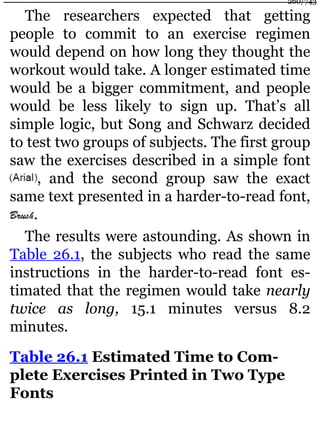
Search engine result pages (SERPs)
Sears
Seating
Segmentation
Self-service help
Sengupta, Jaideep
Sensory brainfluence
of brands
of coffee sellers
smell
sound
using all senses
735/743
yogurt products
SEO (search engine optimization)
SERPs (search engine result pages)
Sexy pictures
Shakespeare, William
Shatz, Carla
Shipping upgrades
Shiv, Baba
Shopping
and apologizing for failures
and customer feedback
for luxury products
and pairing products
power of touch in
Shu, Suzanne
Sight
Simons, Daniel
Simonsohn, Uri
Simplicity
736/743
Singapore Airlines
Slovic, Paul
Smell(s)
bad
Brut effect
distinctive
memorable
overview
Smiling
Smith, Fred
Social identity
Software
Song, Hyunjin
Sound
Spendthrifts
Sponsorships
Sprint
Starbucks
737/743
Statistics
Sticker price framing
Stories (copywriting):
effective
negative
Subconscious mind:
decision making in
and flattery
percent of brain activity in
Sushi
Switching costs
Taglines
Taijfel, Henri
Taste
Telemarketing
Television
Testimonials
Thaler, Richard
738/743
THOMAS (the human oxytocin-mediated at-
tachment system)
Thomas, Dave
Thomas Pink
Tightwads
Timing
TireRack.com
Tommasi, Luca
The Tonight Show
Touch, sense of
Trademarking
Travel
Trump, Donald
Trust. See also Loyalty
contact time for building
in customers
as important tool
language for creating
Tunnel vision
739/743
Ultimatum game
Uncertainty
United Airlines
The Upside of Irrationality (Ariely)
Uy, Dan
Vaccines
Venture capitalists
Vohs, Kathleen
Walmart
Wansink, Brian
“Want vs. should” conflicts
Web design
Websites. See also Internet
branding on
first impression of
and golden mean
Weinschenk, Susan
Williams Sonoma
740/743
Wilson, Margo
Wine
Winkielman, Piotr
Wiseman, Richard
Wittmann, Bianca
Women:
effect on men
and in-person interactions
language processing by
romantic priming for
as salespeople
Women Make the Best Salesmen (Brem)
Words That Work (Luntz)
Wray, Herbert
Yogurt
Your Money and Your Brain (Zweig)
YouTube
Zajonc, Robert
Zak, Paul
741/743
Zaltman, Gerald
Zappos
Zweig, Jason
742/743
@Created by PDF to ePub

Brainfluence.pdf

  • 2.
    Contents Preface: Why Brainfluence? Acknowledgments About theAuthor Chapter 1: Sell to 95 Per- cent of Your Customer’s Brain Brainfluence Takeaway: Stop Selling to 5 Percent of Your Customer’s Brain
  • 3.
    Section One: Priceand Product Brainfluence Chapter 2: The “Ouch!” of Paying Bundling Minimizes Pain Fairness Counts Credit as Painkiller Brainfluence Takeaway: Min- imum Pain, Maximum Sales Chapter 3: Don’t Sell Like a Sushi Chef Paying for Pain Avoidance Brainfluence Takeaway: Avoid Multiple Pain Points 3/743
  • 4.
    Chapter 4: Picturing Money NoMoney in Sight Restaurant Lessons Brainfluence Takeaway: Use Money Cues Wisely Chapter 5: Anchors Aweigh! Gasoline: Drifting Anchor Real Estate Prices Less Familiar Products Irrational Anchors Presetting an Anchor 4/743
  • 5.
    Brainfluence Takeaway: Be CarefulWhere You Drop Your Anchor! Chapter 6: Wine, Prices, and Expectations Brainfluence Takeaway: Be Careful With Discounts Chapter 7: Be Precise With Prices Brainfluence Takeaway: Use Precise Pricing Chapter 8: Decoy Products and Pricing How Decoys Work 5/743
  • 6.
    Decoys in RealEstate Brain Scan Evidence Brainfluence Takeaway: Try a “Not-So-Good” Decoy to Push Your Top Product Chapter 9: How About a Compromise? Brainfluence Takeaway: Add a High-End Product Chapter 10: Cut Choices; Boost Sales Choice Fatigue Brainfluence Takeaway: Find Your Choice Sweet Spot 6/743
  • 7.
    Section Two: Sensory Brainfluence Chapter11: Use All the Senses Brand Fragments Brainfluence Takeaway: Ap- peal to All Five Senses Chapter 12: Does Your Marketing Smell? More Scent Effects Bad Smells Brainfluence Takeaway: Own Your Smell Summary: Think Smell 7/743
  • 8.
    Chapter 13: LearnFrom Coffee Nespresso’s Dilemma Brainfluence Takeaway: Give Your Product a Sensory Tweak Chapter 14: Sounds Like Changed Behavior Brainfluence Takeaway: Find Background Music That Works! Chapter 15: The Sound of Your Brand 8/743
  • 9.
    The Musical Logo BeyondMusic Brainfluence Takeaway: Find and Keep Your Key Audio Branding Elements Chapter 16: Exploit the Brut Effect Brainfluence Takeaway: Use Scent to Be Memorable Chapter 17: Smelly but Memorable Tagline Recall Enhanced Purchase Triggers 9/743
  • 10.
    Brainfluence Takeaway: Unique ScentsBoost Memorability Chapter 18: Learn From Yogurt Brainfluence Takeaway: Im- portant Product Characterist- ics May Not Be Obvious Section Three: Brain- fluence Branding Chapter 19: Neurons That Fire Together . . . The Monkey’s Paw 10/743
  • 11.
    Anything for aSmoke I Like It, but Why? Pavlovian Branding Brainfluence Takeaway: Keep Your Brand Associations Consistent Chapter 20: Who Needs Attention? Low Attention, No Attention “Ignored” TV Commercials Fast-Forward Branding Branding Without Seeing Familiarity Breeds Likeability (in Milliseconds!) 11/743
  • 12.
    Brainfluence Takeaway: “No Attention”Doesn’t Mean “No Results” Chapter 21: Passion for Hire Tech Passion Brainfluence Takeaway: Feel the Passion Chapter 22: Create an Enemy The Tajfel Experiment Us Versus Them Compare People, Not Products Our Customers Are Different/ Better 12/743
  • 13.
    The Etsy Approach Godinand Tribes Brainfluence Takeaway: Make Your Customers Feel Like Members of a Group Section Four: Brainflu- ence in Print Chapter 23: Use Paper for Emotion A Cautionary Note Optimizing Paper-Based Marketing Digital Lesson 13/743
  • 14.
    Brainfluence Takeaway: Paper MeansEmotion Chapter 24: Vivid Print Images Change Memory Brainfluence Takeaway: Use Vivid Images in Print Chapter 25: Paper Out- weighs Digital Weighty Words Brainfluence Takeaway: Bulk Up for Impact Chapter 26: Use Simple Fonts 14/743
  • 15.
    Brainfluence Takeaway: Simple FontsSpur Action Chapter 27: When to Get Complicated Brainfluence Takeaway: Use Complex Fonts and Big Words to Enhance Your Product Chapter 28: Memorable Complexity Brainfluence Takeaway: Boost Recall With Complex Fonts 15/743
  • 16.
    Section Five: Picture Brainfluence Chapter29: Just Add Babies! Brainfluence Takeaway: Baby Pictures Draw the Eye Chapter 30: Focus, Baby! Brainfluence Takeaway: Use the Baby’s Gaze to Direct Attention Chapter 31: Pretty Woman Brainfluence Takeaway: Test People Photos 16/743
  • 17.
    Chapter 32: Itsy,Bitsy, Teeny, Weeny . . . More Arousal, Worse Decisions Bigger Is Better, and It’s Not What You Are Thinking! Brainfluence Takeaway: Sexy Women Affect Male Decisions Chapter 33: Photos In- crease Empathy Brainfluence Takeaway: In- clude a Photo If Empathy Will Help Your Cause 17/743
  • 18.
    Section Six: Loyalty andTrust Brainfluence Chapter 34: Build Loyalty Like George Bailey Instant Loyalty, Just Add Imagination Brainfluence Takeaway: Use Counterfactual Scenarios to Boost Loyalty Chapter 35: Reward Loyalty Loyalty Point Power Brainfluence Takeaway: Offer Loyalty Rewards 18/743
  • 19.
    Chapter 36: Loyalty,Rats, and Your Customers Brainfluence Takeaway: Give a Head Start Chapter 37: Time Builds Trust and Loyalty Brainfluence Takeaway: Qu- ality Contact Time Counts Chapter 38: Ten Words That Build Trust Brainfluence Takeaway: Tell ’em to Trust You 19/743
  • 20.
    Chapter 39: TrustYour Customer Brainfluence Takeaway: Show Trust to Get Trust Section Seven: Brain- fluence in Person Chapter 40: It Pays to Schmooze Brainfluence Takeaway: Sch- mooze First; Bargain Later Chapter 41: Shake Hands Like a Pro 20/743
  • 21.
    How About aNice Massage? Brainfluence Takeaway: Touch Is Important Chapter 42: Right Ear Selling Brainfluence Takeaway: Fa- vor Your Prospect’s Right Ear Chapter 43: Smile! The Price of a Smile Brainfluence Takeaway: Smiles, Even Smiling Images, Help Sales Chapter 44: Confidence Sells 21/743
  • 22.
    Confidence Man: JimCramer Natural Mind Readers Brainfluence Takeaway: De- monstrate Confidence Chapter 45: Small Favors, Big Results Got the Time, Buddy? Signs of Success Foot in the Door Brainfluence Takeaway: Ask for a Small Favor First Chapter 46: Hire Articu- late Salespeople 22/743
  • 23.
    Brainfluence Takeaway: Hire ArticulatePeople Chapter 47: You’re the Best! Brainfluence Takeaway: Use Ethical Flattery Chapter 48: Coffee, Anyone? Brainfluence Takeaway: Serve Hot Beverages Chapter 49: Candy Is Dandy Brainfluence Takeaway: Try the Truffle Strategy 23/743
  • 24.
    Chapter 50: SellingSecrets of Magicians 1. People Focus on Only One Thing 2. Motion Attracts Our Attention 3. Big Motions Beat Little Motions 4. The Unexpected Attracts Us 5. Mirror Neurons Engage Us 6. Cut the Chatter Brainfluence Takeaway: Learn From Magicians Chapter 51: Soften Up Your Prospects 24/743
  • 25.
    Brainfluence Takeaway: Soften UpYour Prospects Section Eight: Brain- fluence for a Cause Chapter 52: Mirror, Mir- ror on the Wall Brainfluence Takeaway: Let Donors See Themselves Chapter 53: Get Closer to Heaven Lifting Generosity Elevating Cooperation Practical Implications 25/743
  • 26.
    Business Applications Brainfluence Takeaway:Con- trol Altitude, Change Attitude Chapter 54: Child Labor Brainfluence Takeaway: Use Babies to Boost Altruism Chapter 55: Give Big, Get Bigger Nonprofit Reciprocity Strategy Business Reciprocity Brainfluence Takeaway: Gift Your Prospects 26/743
  • 27.
    Chapter 56: MakeIt Personal Brainfluence Takeaway: Make It Personal Chapter 57: Lose the Briefcase! Brainfluence Takeaway: Avoid Business and Financial Cues Chapter 58: Ask Big! Brainfluence Takeaway: Start With a Big Number 27/743
  • 28.
    Section Nine: Brainflu- enceCopywriting Chapter 59: Surprise the Brain Brainfluence Takeaway: Sur- prise the Audience Chapter 60: Use a Simple Slogan Brainfluence Takeaway: Use a Simple Savings Slogan Chapter 61: Write Like Shakespeare 28/743
  • 29.
    Brainfluence Takeaway: “Misuse” aWord Chapter 62: A Muffin by Any Other Name . . . Beyond Food Brainfluence Takeaway: Re- name Your Category Chapter 63: Why Per- centages Don’t Add Up Brainfluence Takeaway: Use Real Numbers for Impact Chapter 64: Magic Word #1: FREE! 29/743
  • 30.
    Free Kisses BeatBargain Truffles Amazon’s Experience With FREE! Brainfluence Takeaway: Tap Into the Power of FREE! Chapter 65: Magic Word #2: NEW! Brainfluence Takeaway: Make It NEW! Chapter 66: Adjectives That Work Brainfluence Takeaway: Season Your Copy With Vivid Adjectives 30/743
  • 31.
    Chapter 67: YourBrain on Stories Why Stories Engage Our Brain The Mind-Meld Effect Advertising Stories Brainfluence Takeaway: Tell a Vivid Story Chapter 68: Use Story Testimonials Brainfluence Takeaway: Go Beyond Short Testimonials 31/743
  • 32.
    Chapter 69: WhenWords Are Worth a Thousand Pictures Brainfluence Takeaway: Text Beats Richer Media When It Tells a Story Chapter 70: The Million- Dollar Pickle Brainfluence Takeaway: Don’t Create Negative Stories Section Ten: Con- sumer Brainfluence 32/743
  • 33.
    Chapter 71: SimpleMar- keting for Complex Products Brainfluence Takeaway: Give Buyers a Simple Reason to Buy Your Complex Product Chapter 72: Sell to the In- ner Infovore Brainfluence Takeaway: Show ’Em Something New Chapter 73: Want Versus Should: Time Your Pitch Timing Is Critical 33/743
  • 34.
    Brainfluence Takeaway: Time YourPitch to Wants and Shoulds Chapter 74: Sell to Tightwads Brainfluence Takeaway: Min- imize the Pain for Tightwads (and Everyone Else) Chapter 75: Sell to Spendthrifts Brainfluence Takeaway: Push the Free-Spending Hot Buttons 34/743
  • 35.
    Chapter 76: Takea Chance on a Contest Golf Lessons Pepsi’s Billion Dollars Brainfluence Takeaway: Keep Your Eye on the Prize Chapter 77: Unconvention- al Personalization Brainfluence Takeaway: Try Going Beyond Simple Personalization Chapter 78: Expect More, and Get It! Expectation Becomes Reality 35/743
  • 36.
    A New Rolefor Marketing From Wine to Software Brainfluence Takeaway: Set High but Achievable Expectations Chapter 79: Surprise Your Customers! Brainfluence Takeaway: Create Positive Feelings With a Small Surprise Section Eleven: Gender Brainfluence 36/743
  • 37.
    Chapter 80: Matingon the Mind Brainfluence Takeaway: Use Romantic Priming if Your Product (or Service Project) Is Conspicuous Chapter 81: Guys Like It Simple J. Peterman Is From Mars, the Catalog Copy Isn’t Brainfluence Takeaway: Use Simple Copy for Guys Chapter 82: Are Women Better at Sales? 37/743
  • 38.
    Another Theory—The Peacock Display BrainfluenceTakeaway: Ex- ploit the Peacock Effect With Male Buyers Chapter 83: Do Women Make Men Crazy? Brainfluence Takeaway: At- tractive Female Photos Shorten Male Time Horizons Section Twelve: Shop- per Brainfluence 38/743
  • 39.
    Chapter 84: Cootiesin Every Bag Fat Transfer Brainfluence Takeaway: Watch Your Pairings Chapter 85: Customer Replies Change Minds Brainfluence Takeaway: En- gage Problem Customers Quickly Chapter 86: It’s Wise to Apologize The Price of Rude Behavior The Apology Effect 39/743
  • 40.
    Brainfluence Takeaway: Don’t BeAfraid to Apologize Chapter 87: The Power of Touch Psychological Ownership Brainfluence Takeaway: Let Customers Touch Your Product Chapter 88: When Diffi- culty Sells Brainfluence Takeaway: Easy Isn’t Always Best 40/743
  • 41.
    Section Thirteen: Video, TV,and Film Brainfluence Chapter 89: Don’t Put the CEO on TV Our Bodies Talk Brainfluence Takeaway: Physical Actions Outweigh Words Chapter 90: Get the Order Right! Brainfluence Takeaway: Cred- ibility Before Claims 41/743
  • 42.
    Chapter 91: EmotionBeats Logic Brainfluence Takeaway: Get Emotional Section Fourteen: Brainfluence on the Web Chapter 92: First Impres- sions Count—Really! Confirmation Bias Makes the First Impression Stick Happy Users Keep Trying Brainfluence Takeaway: Test Your Site’s First Impression 42/743
  • 43.
    Chapter 93: MakeYour Website Golden Brainfluence Takeaway: Use the Golden Mean Chapter 94: Rich Media Boost Engagement Brainfluence Takeaway: Add and Optimize Other Media Chapter 95: Reward Versus Reciprocity Reciprocity Beats Reward Not Just for Form Completion 43/743
  • 44.
    Brainfluence Takeaway: Test theReciprocity Approach Chapter 96: Exploit Scar- city on the Fly Scarce Seats Overstock.com—The Scarcity Trifecta Daily Scarcity Brainfluence Takeaway: Use Scarcity and Be Specific Chapter 97: Target Boomers With Simplicity Brainfluence Takeaway: Keep It Simple 44/743
  • 45.
    Chapter 98: UseYour Cus- tomer’s Imagination Brainfluence Takeaway: Help Customers Imagine Ownership Chapter 99: Avoid the Corner of Death Brainfluence Takeaway: Put Your Brand Front and Center Chapter 100: Computers as People Get on the Same Team “I’m on Your Side!” Specialized = Smart 45/743
  • 46.
    Brainfluence Takeaway: It’s Nota Computer; It’s a Person! Afterword: What’s Next? Index 46/743
  • 48.
    Copyright © 2012by Roger Dooley. All rights reserved. Published by John Wiley & Sons, Inc., Hoboken, New Jersey. Published simultaneously in Canada. No part of this publication may be repro- duced, stored in a retrieval system, or trans- mitted in any form or by any means, elec- tronic, mechanical, photocopying, recording, scanning, or otherwise, except as permitted under Section 107 or 108 of the 1976 United States Copyright Act, without either the prior written permission of the Publisher, or au- thorization through payment of the appropriate per-copy fee to the Copyright Clearance Center, Inc., 222 Rosewood Drive, Danvers, MA 01923, (978) 750-8400, fax (978) 646-8600, or on the web at www.copy- right.com. Requests to the Publisher for per- mission should be addressed to the
  • 49.
    Permissions Department, JohnWiley & Sons, Inc., 111 River Street, Hoboken, NJ 07030, (201) 748-6011, fax (201) 748-6008, or online at http://www.wiley.com/go/ permissions. Limit of Liability/Disclaimer of War- ranty: While the publisher and author have used their best efforts in preparing this book, they make no representations or warranties with respect to the accuracy or completeness of the contents of this book and specifically disclaim any implied warranties of mer- chantability or fitness for a particular pur- pose. No warranty may be created or exten- ded by sales representatives or written sales materials. The advice and strategies con- tained herein may not be suitable for your situation. You should consult with a profes- sional where appropriate. Neither the pub- lisher nor author shall be liable for any loss of profit or any other commercial damages, 49/743
  • 50.
    including but notlimited to special, incident- al, consequential, or other damages. For general information on our other products and services or for technical sup- port, please contact our Customer Care De- partment within the United States at (800) 762-2974, outside the United States at (317) 572-3993 or fax (317) 572-4002. Wiley publishes in a variety of print and electronic formats and by print-on-demand. Some material included with standard print versions of this book may not be included in e-books or in print-on-demand. If this book refers to media such as a CD or DVD that is not included in the version you purchased, you may download this material at ht- tp://booksupport.wiley.com. For more in- formation about Wiley products, visit www.wiley.com. 50/743
  • 51.
    Library of CongressCataloging-in- Publication Data: Dooley, Roger, 1952- Brainfluence : 100 ways to persuade and convince consumers with neuromarketing / Roger Dooley. p. cm ISBN 978-1-118-11336-3 (hardback); ISBN 978-1-118-17594-1 (ebk); ISBN 978-1-118-17595-8 (ebk); ISBN 978-1-118-17596-5 (ebk) 1. Neuromarketing. 2. Marketing—Psy- chological aspects. 3. Advertising—Psycholo- gical aspects. 4. Consumers—Psychology. I. Title. HF5415.12615.D66 2012 658.8001’9—dc23 51/743
  • 52.
  • 53.
    To Carol, forputting up with me, and to my mother, who sparked my interest in words
  • 54.
    Preface Why Brainfluence? Today’s #1Challenge: Better Results With Less Money In these trying economic times, marketers are being called upon to accomplish more, but with fewer resources. Conventional wis- dom pairs sales success with the amount of resources you expend. If one out of four sales calls results in a sale, make twice as many calls to double sales. If 10 clicks on a search ad yield one inquiry, on average, then all it takes to up the lead flow is to keep buying more clicks. Need more brand awareness? Buy more ads, sponsor more events, or plaster your logo in more places.
  • 55.
    The problem withthe “more resources ap- plied = more success” model is that it gets expensive—very expensive. Worst of all, if the cost of getting a sale isn’t justified by the profit from that sale, the model breaks down completely. Applying more resources just results in bigger losses. The Answer: Appealing to Your Customer’s Brain This book is all about smarter marketing. Al- though there are certainly many ways to boost the effectiveness of your marketing and sales efforts, in Brainfluence we’ll follow one theme: understanding how your cus- tomers’ brains work to get better results with less money. 55/743
  • 56.
    From Ad Psychologyto Neuromarketing The idea of using our understanding of how people think in marketing and sales is hardly a new idea. No doubt, salespeople in ancient bazaars had some of the same insights into human nature that we have today. And for decades we’ve seen terms like advertising psychology and sales psychology thrown around in articles and books. So what has changed since the era depic- ted in TV’s Mad Men? One huge shift is the development of modern neuroscience. For all its accomplishments, traditional psycho- logy treated the brain as a black box. Give a person a stimulus, and you get a response. Even more complex models of how we think (Freud’s, for example) were based on obser- vation, experiments, and deduction, but not on a detailed understanding of brain science. 56/743
  • 57.
    Modern neuroscience hasbrought us tools that help us see inside our brains and open up psychology’s black box. Now, with the magic of functional magnetic resonance ima- ging (fMRI) brain scans, we can see, for ex- ample, that our brain’s response to a price that’s too high is very much like getting pinched: it’s painful. Electroencephalogram (EEG) technology is bringing the cost of measuring some kinds of brain activity down and allowing larger sample sizes for statistic- ally reliable optimization of ads and products. How Rational Are We? We all like to think there are good reasons for what we do and that our decisions result from a conscious, deliberative process. Al- though certainly there are rational compon- ents to many of our decisions and actions, 57/743
  • 58.
    researchers are constantlyexposing new ways in which our subconscious drives our choices, often with minimal conscious involvement. Since the early days of their science, psy- chologists have suggested that our conscious minds are not in charge of what we do. Freud, for example, developed elaborate the- ories involving repression and dreams. Many modern scientists attribute behaviors to our evolutionary past. Even as we tweet from our iPhones, evolutionary psychologists say, our brains are operating with software from our hunter-gatherer days. Not all the new insights come from com- plex neuroscientific studies. Around the world, behavioral researchers are conducting simple experiments with human subjects that reveal how our brains work and, in some cases, work much differently than we might predict. Duke University professor Dan Ari- ely is one of these researchers, and if you 58/743
  • 59.
    doubt the existenceof unconscious influ- ences on our decisions, read his engaging book, Predictably Irrational. What Is Neuromarketing? I’ve written the blog titled Neuromarketing since 2005, and I have explored many ways that marketers can use different aspects of brain science to improve results. There’s no universal agreement as to exactly what does (and what doesn’t) constitute neuromarket- ing. Some would use the term to refer only to brain scan–based marketing analysis. Others might add related technologies, such as bio- metrics (e.g., tracking heart rate and respira- tion) and eye tracking. I prefer a broadly inclusive definition of neuromarketing that includes behavioral re- search and behavior-based strategies. To me, 59/743
  • 60.
    it’s all acontinuum; the reason the fMRI ma- chine shows that your brain lights up at a particular point in a commercial is likely due to some underlying preference or “program.” The brain scan can show you where the hot button is, but it can’t change it or push it. Neuromarketing is all about understand- ing how our brains work, regardless of the science used, and employing that under- standing to improve both our marketing and our products. Good or Evil? Some people find the concept of neuromar- keting frightening. They view it as manipu- lative and unethical. I disagree. If neuromarketing techniques are used properly, we’ll have better ads, better products, and happier customers. Who wouldn’t want a product they liked more or a 60/743
  • 61.
    less boring commercial?Would consumers really be better off if companies annoyed them with ineffective but costly ad campaigns? Any marketing tool can be “evil” if the company behind it misuses it. Advertising can be fun and informative; it can also con- tain false information or misrepresent the product. Warranties are a great consumer benefit, but not if the company fails to honor them. Neuromarketing is simply another technique that marketers can use to under- stand their customers and serve them better. Most companies seek to build their brand for the long haul and won’t abuse their cus- tomers with any kind of deception or manip- ulation, neuromarketing or otherwise. What This Book Is Not 61/743
  • 62.
    This isn’t ascience book or a neuroscience primer. It’s not an attempt to explain the sci- entific basis for branding or advertising. (One book that does that in great detail is the excellent The Branded Mind by Erik du Plessis.) You won’t find any brain diagrams, because I’ve kept the references to specific brain structures to a minimum. (And if you find an occasional reference to the amygdala or prefrontal cortex, don’t worry; these won’t be on the test, and you won’t need to be able to pinpoint them on a brain chart!) This isn’t a big idea book. I love books like Chris Anderson’s Free and Malcolm Glad- well’s Blink that explore one trend or topic in great depth. For better or worse, Brainflu- ence isn’t one of those. Instead, it’s a compil- ation of a hundred smaller, bite-sized ideas, each one based on neuroscience or behavior research. This is a book of practical advice for mar- keters, managers, and business owners, not 62/743
  • 63.
    scientists or neurosciencegeeks. (If you are a scientist or neuroscience geek, I’ve included a reference for just about every study I men- tion; feel free to explore more deeply.) Who Can Benefit From This Book I’ve selected the hundred topics in Brainflu- ence to be applicable to a wide range of budgets and situations. Although some of the ideas in this book come from costly research using fMRI machines or other technology unavailable to most firms, each topic provides a marketing approach that is usable by any organization, often at low cost. Mar- keters in both large and small businesses will find problems like their own and solutions they can implement on a scale that fits their needs. 63/743
  • 64.
    Each topic inBrainfluence is designed to describe research findings that show how our brains work and offer one or more ways to directly apply that knowledge to real-world marketing situations. Although I make a few leaps here and there in relating that research to actual business needs, you won’t find me saying, “Do this because I’m telling you to.” Most of the book uses the language of business, talking about customers and sales, but many of the concepts are applicable to the nonprofit sector as well. Every nonprofit today has to accomplish more with fewer re- sources, and many of the topics here will en- able them to do just that. It isn’t necessary to read this book from cover to cover, or even from front to back. Although the ideas are grouped in major cat- egories, each topic stands on its own. Feel free to browse as you like. 64/743
  • 65.
    And remember: “marketingsmarter” doesn’t just mean using your brain; it means using your customer’s brain too! 65/743
  • 66.
    Acknowledgments It’s customary toacknowledge the contribu- tions of those who collaborated in writing the book. In creating both Brainfluence and my blog, Neuromarketing, my partners are the dedicated researchers who devote their lives to teasing out the details of how our brains work. Some of them I have met; others I know only via correspondence or their work. It’s people like Dan Ariely, George Loewen- stein, Robert Cialdini, Paul Zak, Read Montague, and so many others, who do the heavy lifting in this field. To them, thank you!
  • 67.
    About the Author RogerDooley is founder of Dooley Direct LLC, a marketing consultancy, and author of the popular blog Neuromarketing. He cofounded College Confidential, the highest- traffic website for college-bound students, which was acquired by Hobsons, a unit of London-based DMGT, in 2008. He served as Vice President of Digital Marketing at Hob- sons and remains in a consulting role to the firm. Dooley is a long-time entrepreneur and direct marketer. Dooley holds an engineering degree from Carnegie Mellon University (1971) and an MBA from the University of Tennessee (1977). He resides in Austin, Texas.
  • 68.
    Chapter 1 Sell to95 Percent of Your Customer’s Brain Ninety-five percent of our thoughts, emo- tions, and learning occur without our con- scious awareness, according to Harvard mar- keting professor and author Gerald Zalt- man.1 And he’s not the only expert who thinks this way; the 95 percent rule is used by many neuroscientists to estimate subcon- scious brain activity. (NeuroFocus founder and chief executive officer [CEO], A. K. Pradeep, estimates it at 99.999 percent in his book, The Buying Brain.2) It’s doubtful we’ll ever be able to arrive at a precise number,
  • 69.
    but all neuroscientistsagree there’s a lot go- ing on under the surface in our brains. (There’s debate, too, over the terminology; many scientists prefer nonconscious or pre- conscious for greater precision. I’ll mostly use subconscious, simply because it’s the most familiar term.) One indication of the power of our subcon- scious comes from a study that showed that subjects given a puzzle to solve actually solved it as much as eight seconds before they were consciously aware of having solved it. (The researchers determined this by monitoring brain activity with an electro- encephalograph (EEG) and identifying the pattern that correlated with reaching a solu- tion.3) Other research shows a lag in decision making—our brains seem to reach a decision before we are consciously aware of it. The realization that the vast majority of our behaviors are determined subcon- sciously is a basic premise of most of the 69/743
  • 70.
    strategies in thisbook, and indeed, of the en- tire field of neuromarketing. Customers gen- erally can’t understand or accurately explain why they make choices in the marketplace, and efforts to tease out that information by asking them questions are mostly doomed to failure. Furthermore, marketing efforts based mostly on customer statements and self-reports of their experiences, preferences, and intentions are equally doomed. Brainfluence Takeaway: Stop Selling to 5 Percent of Your Customer’s Brain The rest of the takeaways in this book are a lot more specific and actionable, but this one is the most important. Despite knowing that 70/743
  • 71.
    rational, conscious cognitiveprocesses are a small influence in human decision making, we often focus most of our message on that narrow slice of our customer’s thinking. We provide statistics, feature lists, cost/benefit analyses, and so on, while ignoring the vast emotional and nonverbal subconscious share of brain activity. Although there are conscious and rational parts in most decisions, marketers need to focus first on appealing to the buyer’s emo- tions and unconscious needs. It’s not always bad to include factual details, as they will help the customer’s logical brain justify the decision—just don’t expect them to make the sale! Notes 1. Gerald Zaltman, How Customers Think (Boston: Harvard Business School Press, 2003). 71/743
  • 72.
    2. A. K.Pradeep, The Buying Brain: Secrets for Selling to the Subconscious Mind (Hoboken, NJ: John Wiley & Sons, 2010), 4. 3. “Incognito: Evidence Mounts That Brains Decide Before Their Owners Know About It,” Economist 390, no. 8627 (April 18, 2009): 86–87, ht- tp://www.economist.com/node/ 13489722?story_id=13489722. 72/743
  • 73.
    SECTION ONE Price andProduct Brainfluence Every marketer wrestles with decisions about how to structure a product line and how to set prices. A small difference in pri- cing can make a big difference in profits, but the wrong price can kill sales, too. For- tunately, neuromarketing has plenty to tell us about these closely related areas!
  • 74.
    Chapter 2 The “Ouch!”of Paying One of the key insights neuroeconomics and neuromarketing research have provided us is that buying something can cause the pain center in our brain to light up. Researchers at Carnegie Mellon and Stanford universities presented subjects with cash, put them in a functional magnetic resonance imaging (fMRI) machine to record their brain activ- ity, and then offered them items, each with a price. Some of the products were overpriced, and others were a good value. The subjects were able to choose to buy items with their money or keep the cash. The researchers compared self-reporting of purchase
  • 75.
    intentions by thesubjects, brain scan data, and actual purchases.1 I spoke with Carnegie Mellon University professor George Loewenstein after that work was published, and he noted that one significant aspect of the findings is that the brain scans predicted buying behavior al- most as well as the self-reported intentions of the subjects. In other words, absent any knowledge of what the subject intended to do, viewing the brain scan was just about as accurate as asking the subject what he or she would do. Loewenstein pointed out that, in this ex- periment, the questions about the intentions of the subject were quite straightforward and one would expect the answers to be good predictors of actual behavior. The “negative” activation produced by cost is relative, according to Loewenstein. That is, it isn’t just the dollar amount; it’s the context of the transaction. Thus, people can spend 75/743
  • 76.
    hundreds of dollarson accessories when buying a car with little pain, but a vending machine that takes 75 cents and produces nothing is very aggravating. Bundling Minimizes Pain Auto luxury bundles minimize negative ac- tivation because their price tag covers mul- tiple items. The consumer can’t relate a spe- cific price to each component in the bundle (leather seats, sunroof, etc.) and hence can’t easily evaluate the fairness of the deal or whether the utility of the accessory is worth the price. Fairness Counts 76/743
  • 77.
    Cost isn’t theonly variable that causes “pain.” It’s really the perceived fairness or unfairness of the deal that creates the reac- tion. Other parts of an offer that caused it to appear unfair would presumably cause a similar reaction as a price that was too high. There’s not always a single “fair” price for an item. For most people, a fair price for a cup of coffee at Starbucks would likely be higher than a cup from a street corner coffee cart. A famous study by economist Richard Thaler showed that thirsty beachgoers would pay nearly twice as much for a beer from a resort hotel than for the same brew from a small, rundown grocery store.2 Credit as Painkiller Overall, Loewenstein wasn’t enthused about using his work for neuromarketing purposes. He pointed out that, for many years, credit 77/743
  • 78.
    card companies haveprospered while en- couraging consumers to spend too much by exploiting the principles he’s now uncovering in his research. The problem is that, for many consumers, the credit card takes the pain (quite literally, from the standpoint of the customer’s brain) out of purchasing. Pulling cash out of one’s wallet causes one to evaluate the purchase more carefully. We think this makes a lot of sense and is entirely consistent with real-world behavior. A credit card reduces the pain level by trans- ferring the cost to a future period where it can be paid in small increments. Hence, not only does a credit card enable a consumer to buy something without actually having the cash, but it also tips the scale as one’s brain weighs the pain versus the benefit of the pur- chase. This can be a bad combination for in- dividuals lacking financial discipline. 78/743
  • 79.
    Brainfluence Takeaway: Minimum Pain, MaximumSales Pricing and the product itself need to be op- timized to minimize the pain of paying. First, the price must be seen as fair. If your product is more expensive than others, take the time to explain why it is a premium product. If you find yourself in a situation where, for cost or other reasons, the price of a product is likely to produce an “ouch!” reac- tion from your customers, see if some kind of a bundle with complementary items will dull the pain. Payment terms and credit options can also reduce the pain of paying. Don’t push your customers into buying products they can’t af- ford, but even affluent customers will feel 79/743
  • 80.
    less pain ifthey don’t have to make immedi- ate payment in cash. Notes 1. Brian Knutson et al., “Neural Predict- ors of Purchases,” Neuron 53, no.1 (January 4, 2007): 147–156, ht- tp://www.neuron.org/content/article/ abstract?uid=PIIS0896627306009044. 2. Richard Thaler, “Transaction Utility Theory,” Advances in Consumer Re- search 10 (1983): 229–232. 80/743
  • 81.
    Chapter 3 Don’t SellLike a Sushi Chef I love sushi. But I hate the way most sushi restaurants sell it, with a separate price for each tiny piece. Every bite I take seems to have a price tag on it. “Mmm . . . not bad. But was that mouthful worth five bucks? Do I really want another one?” It turns out my brain is normal, at least in relation to my aversion to the typical sushi pricing scheme. In the last chapter, we met Carnegie Mellon University economics and psychology professor George Loewenstein. Another insight from his work is that selling
  • 82.
    products in away that the consumer sees the price increase with every bit of consumption causes the most pain. This isn’t physical pain, of course, but rather activation of the same brain areas associated with physical pain. In an interview with SmartMoney, Loewenstein noted3: [Consumers are] not weighing the cur- rent gratification vs. future gratifica- tions. They experience an immediate pang of pain [when they think of how much they have to pay for something] . . . It also explains why AOL switched from pay-per-hour Internet service to pay- per-month. When they did that, they got a flood of subscribers . . . Why do people love to prepay for things or pay a flat rate for things? Again, it mutes the pang of pain. The worst-case al- ternative is when you pay for sushi and 82/743
  • 83.
    you’re paying perpiece. Or watching the taxi meter; you know how much every inch of the way is costing you. Marketers have realized this for years, and they have responded with offers designed to minimize the pain associated with buying their products. All-inclusive meal options are popular at many eateries. Netflix crushed its video rental competitors in part by its “all- you-can-watch” price strategy. Cruises have surged in popularity in part because they de- liver a vacation experience for a fixed price. In each case, the marketer offers a single, re- latively attractive price that removes addi- tional pain from the buying experience. Paying for Pain Avoidance 83/743
  • 84.
    In many situations,the single price is actu- ally higher than the amount the consumer would have spent on individual food items, movie rentals, and so on. Nevertheless, the all-inclusive number is likely to appeal to many consumers, particularly those that Loewenstein would identify as being most sensitive to the pain of buying. Brainfluence Takeaway: Avoid Mul- tiple Pain Points To minimize customer pain, marketers should always try to avoid multiple individu- al pain points in the purchasing process. Ob- viously, some situations make individual purchases unavoidable; for example, a gro- cery store can’t offer fee-based shopping in- stead of item-by-item pricing. 84/743
  • 85.
    Many business situations,though, will permit some experimentation with a single- price approach for items usually purchased separately, such as a monthly or annual fee instead of individual transactions. That sim- pler pricing approach may boost not only sales, but because some people will pay a premium for pain avoidance, profit margins as well. Notes 3. Lisa Scherzer, “Professor: Pain, Not Logic, Dictates Spending,” SmartMoney, March 22, 2007, ht- tp://www.smartmoney.com/invest/ markets/professor-pain-not-logic- dictates-spending-20987/. 85/743
  • 86.
    Chapter 4 Picturing Money Theconcept of priming is simple, although it’s also a bit unsettling: if you present an in- dividual with subtle cues, you can affect that person’s subsequent behavior, even though he or she is entirely unaware of either the priming or behavioral changes. Money-re- lated images are some of the more potent forms of priming. Psychologist Kathleen Vohs has studied priming extensively and found that supply- ing subjects with cues related to money in- creases selfish behavior. For example, she and her colleagues had student subjects either read an essay that mentioned money
  • 87.
    or sit facinga poster that pictured different types of currency. The subjects who were primed with money cues took 70 percent longer to ask for help in solving a difficult problem and spent only half as much time helping another person (who, unknown to the subject, was actually part of the experiment) needing assistance. The money-primed subjects also preferred to work alone and chose solitary leisure activities compared with unprimed subjects. They even sat farther apart when setting up chairs to chat with another subject. Vohs concludes that even subtle money cues change the frame of mind people are in: they don’t want to depend on others, nor do they want others to depend on them. This work has interesting implications for advertisers who frequently use money themes in their ads. Big savings, higher in- vestment returns, visions of prosperous re- tirement, money containers ranging from 87/743
  • 88.
    piggy banks togleaming bank vaults . . . ads are full of these images. Most of these ads appeal to the selfish interest of the viewer, so any priming that takes place matches the in- tent of the advertisement. A mutual fund company touting superior returns and prosperous-looking retirees clearly wants to appeal to the self-interest of the customer; the company hopes the viewer will be suffi- ciently enticed by these images to transfer funds to it. Money-related advertising images are per- vasive in other types of ads, though, and not all appeal to selfish interests. Many print, television, and even in-store ads seem to em- phasize savings. Are “save money on gifts for Mom” advertisers shooting themselves in the foot by subtly priming the would-be gift givers with selfish feelings? The advertisers who should be particularly cautious about money cues are those who want to appeal to the viewer’s feelings about 88/743
  • 89.
    others. Filling viewerswith feelings of warmth and a desire to please someone else, and then reminding them about money, could be self-defeating. Really, of course, it’s a trade-off. Good salespeople often make the sale using feel- ings and emotion, and then close the deal with a financial incentive that has an expira- tion looming. If you’ve ever sat through a time-share sales pitch, you’ll recognize that technique. Much of the pitch is intended to evoke warm feelings about recreation, qual- ity time with family and friends, and so on, but there’s always a financial incentive as the close approaches. Special financing is avail- able only today, there’s a price reduction for 48 hours, and so on. This approach is clearly effective. An advertiser must make a judg- ment call on whether and how to bring money into the picture if the appeal is primarily an emotional one. 89/743
  • 90.
    No Money inSight Think about the long-running A Diamond Is Forever campaign. This is a good example of advertising that scrupulously avoids introdu- cing money cues. Their ads target the luxury gift market. Spending large sums of money to give someone else a polished piece of car- bon whose value is determined by cartel-en- forced scarcity is hardly a concept that ap- peals to one’s self-interest. This effective ad campaign is a purely emotional pitch that would be spoiled by a tagline that offered, for example, “special savings in December!” The ads even avoid talking about the investment value of diamonds. Restaurant Lessons 90/743
  • 91.
    Even a simplecurrency symbol in front of a price can make a difference. One Cornell study looked at several common restaurant price display techniques: Numerical with dollar sign: $12.00 Numerical without dollar sign or decimals: 12 Spelled out: twelve dollars The researchers expected that the written/ scripted prices would perform best, but they found that the guests with the simple numer- al prices (those without dollar signs or decimals) spent significantly more than the other two groups did. When you visit a res- taurant and find the menu has small prices presented this way, you’ll know they are up on their neuromarketing best practices!4 91/743
  • 92.
    Brainfluence Takeaway: Use Money CuesWisely Use currency symbols in ads for products consistent with selfish feelings—products that offer financial independence, for ex- ample, or even a self-indulgent purchase like a sports car. For campaigns focused on giving and thinking about others, such as gifts, non- profit appeals, and so forth, advertisers may want to be a bit cautious and should likely avoid introducing financial imagery. Notes 4. Sybil S. Yang, Sheryl E. Kimes, and Mauro M. Sessarego, “$ or Dollars: Ef- fects of Menu-price Formats on 92/743
  • 93.
    Restaurant Checks,” CornellHospitality Reports 9, no. 8, The Center for Hospit- ality Research, Cornell University School of Hotel Administration, ht- tp://www.hotelschool.cornell.edu/re- search/chr/pubs/reports/ab- stract-15048.html. 93/743
  • 94.
    Chapter 5 Anchors Aweigh! Here’sa scenario: You decide to venture into a cell phone store (despite your reluctance to deal with a bewildering number of phones, options, plans, and confusing pricing). As usual, you find you’ll have to wait a bit for a salesperson. The greeter hands you a card with a big “97” printed on it and says, “It should only be a few minutes. We’ll call your number, 97, when a salesperson can help you.” You notice that a large digital display on the wall is showing “94.” You see it click to 95, then 96, and finally 97. The reception- ist says, “Number 97, please,” and a salesper- son arrives to assist you. You thought
  • 95.
    nothing of thenumeric ordering of custom- ers, but it’s possible that the store had an ul- terior motive: they could have been attempt- ing to manipulate the price you would pay. Sound bizarre? Read on . . . When a consumer views an offer, a key element in the decision to accept or reject it is whether it appears to be a fair deal or not. We know that buying pain—the activation of our brain’s pain center when paying for a purchase—increases when the price seems too high. But how does that value equation work? The answer is anchoring; typically, we store an anchor price for different products (say, $2 for a cup of coffee for the local coffee shop) that we then use to judge relative value. That sounds simple enough, but it’s actually not. Some anchor prices are stickier than others, and at times, totally unrelated factors can affect these anchor points. The better marketers can understand how an- choring works, the more creative and 95/743
  • 96.
    effective pricing strategiesthey will be able to develop. Gasoline: Drifting Anchor First, let’s look at a nonsticky anchor price scenario that most of us cope with daily: fluctuating gasoline prices. In the United States, we’ve seen prices surge past the $4 level, not high by world standards but a new threshold for Americans. The first time I saw that “4” digit at the front of the price, I’m sure my brain registered pain. I had barely become used to paying $3 per gallon of gas. But, after a short time, my anchor was reset. The $4 prices were no longer exceptional, and if I had been seeing mostly $4.29 prices, a $4.09 price would register as a good deal. If I saw a station offering gas for $3.99—a price that only a few months earlier would 96/743
  • 97.
    have seemed outrageouslyhigh—I’d be hard pressed not to pull into the station to take advantage of the “bargain.” Of course, gasol- ine is a unique product; we expect its price to vary, and we have constant feedback on cur- rent pricing as we pass gas station signs. For this product, we are constantly reanchoring. Real Estate Prices Other items have stickier anchor points. In Predictably Irrational, Dan Ariely describes research by Uri Simonsohn at Penn and Ge- orge Loewenstein at Carnegie Mellon University, showing it takes about a year after relocation for home buyers to adapt to the pricing in a new market with higher or lower real estate prices. People who moved and bought a new home immediately tended to spend the same amount on housing as they had before, even if it meant buying a 97/743
  • 98.
    home that wasmuch larger or smaller than the one they left.5 Less Familiar Products But what about items for which we have fuz- zier anchors? We get daily feedback on gas prices, and if we own a home, we probably keep an eye on sales of comparable proper- ties to gauge our own level of equity. Items that are unfamiliar or rarely purchased may form an anchor point when we start thinking about the purchase. If we decide to buy a big- screen television, we may spot one we like in a Best Buy circular for $1,000. We may not buy that item, but according to Ariely that now becomes an anchor price against which other deals are measured. Irrational Anchors 98/743
  • 99.
    Here’s where anchorprices get weird—and weird isn’t a word I use lightly when I’m talking about the foibles of human brains. Up to this point, there was a perfectly logical framework underpinning the brain’s anchor- ing process. But research conducted by Ari- ely showed that getting subjects to think of a random number—in this case, the last two digits of their Social Security number—im- pacted the price they were willing to pay for various items. A higher random number led to higher prices. Table 5.1 is just one data set from Ariely’s experiment—prices that subjects would pay for a cordless keyboard: Table 5.1 Priming Number Effect on Acceptable Price Social Security Number Digits Keyboard Price 00–19 $16.09 20–39 $26.92 99/743
  • 100.
    Social Security NumberDigits Keyboard Price 40–59 $29.27 60–79 $34.55 80–99 $55.64 For an unfamiliar product like a cordless keyboard, the random number that the sub- jects were thinking of ended up affecting the price they said they’d pay. The correlation between Social Security number range and price for this data set was an amazing (to me, at least) .52! (Before you start hanging posters with big numbers all over your store, be aware that, as with many of Ariely’s clever experiments, this one used subjects who were answering a questionnaire, not actually buying the product.) Presetting an Anchor 100/743
  • 101.
    Other experiments byAriely showed that an- chors could be preset for unfamiliar items; in that case, a payment for listening to an an- noying sound. A questionnaire that included, “Would you be willing to listen to this sound again for $.10?” elicited lower bids than those given by subjects asked the same ques- tion with a price of $.90. Brainfluence Takeaway: Be Careful Where You Drop Your Anchor! It’s no big news to marketers that customers may have specific price expectations for a product or product category. If one can bring a product into that category with a price lower than expected, it should be an 101/743
  • 102.
    attractive offer. Ifone’s product is premium priced, then it will be important to separate it as much as possible from lower-priced products. The more interesting challenge is how to deal with new products for which consumers have no clearly established anchor price. Ari- ely’s research shows that anchor pricing for such products is quite fungible, and mar- keters would do well to avoid inadvertently establishing a low anchor price. If a higher anchor price can be established, then offers involving lower prices will be attractive to consumers. Apple’s iPhone introduction is a good ex- ample of using anchor pricing to keep de- mand strong. When they first released the iPhone, it ranged in price from $499 to $599, establishing the initial anchor for what the unique product should cost. To the chag- rin of early adopters, Apple dropped the price by $200 after only a few months, 102/743
  • 103.
    creating an apparentbargain and stimulat- ing more sales. When they introduced the iPhone 3G, pricing was as low as $199, and they sold one million phones in three days. There are many reasons why marketers start with a high price initially. One big one is to work the demand curve, that is, to de- mand a high price from the portion of the market willing to pay that much before drop- ping the price to reach a larger number of customers. A key benefit of this strategy for new products, though, is that a high anchor price is established in the minds of custom- ers, making each subsequent reduction a big- ger bargain. Nonsense Anchors Can marketers take advantage of irrational anchor pricing? Would asking customers to think of a number between 90 and 99 while standing in line at a fast-food restaurant 103/743
  • 104.
    make them willingto pay more for a burger? Should stores hang posters of big numbers by the checkouts? Although Ariely’s work suggests that this kind of irrational anchor- ing effect could exist, I wouldn’t recommend building a marketing strategy around such techniques. But by all means feel free to test it! Infomercials and Anchor Pricing One group of marketers that seems to impli- citly understand anchor pricing are the cre- ators of successful infomercials. Just about every one of these seeks to establish a high anchor price for their usually unique or unfa- miliar product. They start by saying things like, “Department stores charge $200 for this kind of product . . .”; then they make an offer at a lower price. They typically proceed to add bonus products into the offer as well, 104/743
  • 105.
    making the newanchor price of their actual offer (“Only $59.99 plus shipping!”) look better and better. By the end of the pitch, the offer price is not only far lower than the ini- tial anchor but the offer itself has expanded to include far more products. (One such commercial, as it concluded, dropped the price by $5 “for callers in the next 20 minutes”—yet another exploitation of a fa- vorable comparison to a previously estab- lished anchor.) Marketers of all types could do worse than studying the techniques of successful direct marketers. The latter live or die by the suc- cess of their commercials, catalogs, or web- sites, and if you see an offer repeated time after time you can be certain that it is working. Notes 105/743
  • 106.
    5. Dan Ariely,Predictably Irrational: The Hidden Forces That Shape Our De- cisions, rev. ed. (New York: Harper Per- ennial, 2010). 106/743
  • 107.
    Chapter 6 Wine, Prices,and Expectations In an area as subjective as wine tasting, it’s easy to believe that what wine drinkers say about a wine is influenced by what they know about the wine. (Or, by what they think they know!) It might be surprising to find out, though, that wine thought to be more expensive really does taste better at the most fundamental level of perception. Researchers at Stanford University and Caltech demon- strated that people’s brains experience more pleasure when they think they are drinking a
  • 108.
    $45 wine insteadof a $5 bottle, even when in reality it’s the same cheap stuff!6 The important aspect of these findings is that people aren’t fibbing on a survey; that is, they aren’t reporting that a wine tastes better because they know it’s more expensive and they don’t want to look dumb. Rather, they are actually experiencing a tastier wine. The price (or what the subjects thought was the price) actually changed their experi- ence with the product. Baba Shiv and his fel- low researchers monitored brain activity us- ing fMRI while the subjects tasted the wine to observe how the subjects’ brains reacted with each sip. Wine isn’t the only product affected by its price. Shiv, in another experiment, showed that people who paid more for an energy drink actually solved puzzles more quickly than those who bought it at a discount. The higher price made the drink more stimulating. 108/743
  • 109.
    Yet another studyshowed that 85 percent of subjects given a placebo pill for pain relief reported a reduction in pain when they were told the pill cost $2.50 per dose; when told the pill cost 10 cents, only 61 percent of sub- jects reported a pain reduction. The pills, of course, had no actual active ingredients.7 Here’s the conundrum for marketers: On one hand, we know that the pain of paying kicks in when people perceive that a product is overpriced and makes people less likely to make a purchase. But now we have multiple studies showing that people enjoy a product more when they pay more for it. How should a marketer determine the price point? I don’t think these neural reactions to pri- cing are necessarily in conflict. If the wine drinkers in the Stanford University–Caltech study had been sent to the supermarket and asked to pick up a bottle of wine on the way to the lab, they would no doubt have felt the pain of paying too much for a bottle of wine. 109/743
  • 110.
    Unless they werewine aficionados, they likely would have chosen a less costly bottle. (Other factors could influence the selection process, too. Would the researchers see the bottle chosen? If it was too cheap, would they think the subject was a wine ignora- mus? Would blindly choosing a costly bottle make the subject look like a snob or a spend- thrift?) The pleasurable boost from a higher price occurs after purchase and consump- tion, so marketers still face the same prob- lem they always have: setting a price that consumers will accept and that will yield a suitable combination of profit margin and total revenue. Brainfluence Takeaway: Be Careful With Discounts 110/743
  • 111.
    What this doessuggest is that marketers need to understand that price is an import- ant part of the experience for a premium product or luxury brand. This isn’t huge news; we’ve seen once-proud brands des- troyed by overdistribution and pervasive dis- counting. And it isn’t even the price that the consumer pays; the subjects in the study didn’t pay anything for the wine they tasted, but they still stated that the expensive wine tasted better. The consumer has to believe that a product is priced at a certain level for the brain effect to kick in. If someone gives me a $100 bottle of wine, I’ll no doubt taste it as such. If I find the same bottle mispriced at the wine shop and buy it for $10, it will likely still be a $100 wine to me (and I’ll have greatly reduced my buying pain as well). But, if I find a bin full of the wine priced at $10 and marked “Huge sale; save $90 per bottle!” some skepticism will kick in. Did this 111/743
  • 112.
    vintage turn outpoorly? Did the shop store a few cases next to the furnace and find they had gone bad? Did Robert Parker or another wine expert give it a terrible review? I’m cer- tain that these doubts would lower my brain’s perceived value of the wine. If the wine was advertised with a “new low price” of $10, my brain would be even more certain it didn’t taste like a $100 bottle of wine. There’s not an easy way to cut through the complex balancing act of pricing the product high enough to appeal but low enough to sell in volume. My advice is to price the product appropriately for the target market and to be aware that discounting may actually reduce the quality of the customer experience. That doesn’t mean that discounts or low prices are bad; they have a powerful effect on con- sumers, too. Most consumers will have no problem in deciding whether the better taste (real or perceived) of a more costly bottle of wine 112/743
  • 113.
    justifies the differencein price. That’s why two-buck chuck has sold hundreds of mil- lions of bottles to date, whereas $100 bottles mostly gather dust on wine store shelves. Notes 6. Lisa Trei, “Price Changes Way People Experience Wine,” Stanford News Ser- vice, January 16, 2008, ht- tp://news.stanford.edu/news/2008/ january16/wine-011608.html. 7. Benedict Carey, “More Expensive Placebos Bring More Relief,” New York Times, March 5, 2008, ht- tp://www.nytimes.com/2008/03/05/ health/research/05placebo.html. 113/743
  • 114.
    Chapter 7 Be PreciseWith Prices In my time as a catalog marketer, I usually priced products just below the next dollar in- crement. So, for example, a cheap item might be $9.97 rather than $10, and a more ex- pensive item may have been $499, or even $499.99, instead of $500. This approach was based on a couple of as- sumptions. First, I thought that there was probably something desirable about offering, say, a “nine-dollar-and-change” price versus a “ten-dollar” price. Even though the differ- ence was only a few pennies, I thought, some customers would perceive the $9.97 price to offer more substantial savings.
  • 115.
    Second, I observedthat big marketers like Sears, who could afford to test any number of pricing options and no doubt did so fre- quently, tended to stick with the “just below the next increment” approach. As it turns out, I was right, but for the wrong reason. New research points us toward the reasons why consumers respond better to a $499 price versus a $500 price, and it has more to do with the apparent precision of the odd number than the lower price. University of Florida marketing professors Chris Janiszewski and Dan Uy tested how people react to pricing in an auction environ- ment by giving groups of buyers three differ- ent starting prices: • $4,988 • $5,000 • $5,012 115/743
  • 116.
    While for practicalpurposes these prices may be essentially identical, when the re- searchers asked the buyers to estimate the wholesale price of the item, the buyer group with the $5,000 price estimated a much lower number. Not only did the $5,000 group move farther away from the anchor price, but they also tended to estimate the wholesale price as a round number, too. Janiszewski and Uy attribute this phe- nomenon to our creation of a mental meas- uring stick based on the initial price. If we think a toaster priced at $20 is overpriced, we estimate it might be worth $19 or $18. For the same item priced at $19.95, our measuring stick has more precision, so prices like $19.75 or $19.50 come to mind.8 Another study looked at the price of houses and found that sellers who listed their house at an odd price, such as $494,500, sold at a price closer to their ask- ing price than houses priced at even 116/743
  • 117.
    numbers, like $500,000.Oddly, the even- priced houses lost more value as they aged on the market, too.9 Brainfluence Takeaway: Use Precise Pricing According to these findings, it seems, I might have done just as well selling a $499 product at $502.50; the key thing is to avoid the dreaded round number of $500, which im- plies a lack of precision and makes custom- ers wonder if $400 is a more appropriate price. I still think there might be a small bias to- ward the slightly lower number than the slightly higher number when it comes to buyer decision making, but the researchers didn’t explore that directly. Another area 117/743
  • 118.
    that could usemore study is comparing pre- cise pricing to minimalist pricing, such as the tiny “19” (with no currency symbol or decim- al) as one might find on a restaurant menu. This work should give marketers the am- munition they need to fend off requests for simplified pricing. In the past, I recall fre- quent admonitions that “Nobody is fooled by a price that’s a penny cheaper—let’s keep it simple and just charge an even number.” People may not be fooled by the more precise price, but they may attribute a higher value to the product itself. Notes 8. Wray Herbert, “Why Things Cost $19.95,” Scientific American Mind 19, no. 2 (April 2008), http://www.scienti- ficamerican.com/article.cfm?id=why- thin,gs-cost-1995&ec=su_1995. 118/743
  • 119.
  • 120.
    Chapter 8 Decoy Productsand Pricing Need to sell more of a product or service? Here’s a counterintuitive idea: offer your customers a similar, but inferior, product or service at about the same price. While it’s unlikely that they will actually buy the less attractive item, you may see a jump in sales of what you are trying to sell. Here’s a real-world example. The last time I needed a can of shaving gel, I found myself staring at a shelfful of options. Gels and foamy creams, with variations that included “Sensitive Skin,” “Aloe,” “Cleansing,” and
  • 121.
    many more, linedthe shelves. As I stood there befuddled by the choices, I noticed a taller can of the “Advanced” gel amid the forest of shave products. This can was identical to several other cans of “Advanced,” but it was one or two inches taller and held a couple of ounces more of the product. Best of all, it seemed to be the same price as the shorter cans. I studied the cans for another few seconds to be sure I wasn’t missing something. Nope, I wasn’t—same stuff, same package design, same price, but 20 percent more product. My confusion evaporated. I had no idea how shaving gel could be “Advanced,” or how that might compare with “Aloe,” but I grabbed the bigger can, rooted around and found one more in back, and headed for the checkout with both cans. How did buyer befuddlement turn into a larger-than-expected purchase so quickly? The answer: decoy marketing. In this case, the decoy was unintentional, but 121/743
  • 122.
    there are lotsof ways that marketers can use the technique to steer customers toward a decision. In the shaving gel display, the inclusion of the extra large shaving cream can was an ac- cident—the store just had a few left from a previous promotion. But the principle worked just fine. In this case, the regular- sized cans were the decoys. As soon as I spot- ted a nearly identical product that was clearly a better value, that new find stood out as the right choice. Relativity is the key element in decoy mar- keting. Our brains aren’t good at judging ab- solute values, but they are always ready to compare values and benefits. When used proactively by marketers, a decoy product or offer can make another product look like a better value. In Predictably Irrational, author Dan Ari- ely describes an experiment using magazine subscription offers. Like most of Ariely’s 122/743
  • 123.
    experiments, this oneis deceptively simple. Two groups of subjects saw one or the other of these offers to subscribe to TheEconomist10: Offer A • $59—Internet-only subscription (68 chose) • $125—Internet and print subscrip- tion (32 chose) • Predicted Revenue—$8,012 Offer B • $59—Internet-only subscription (16 chose) • $125—Print-only subscription (0 chose) • $125—Internet and print subscrip- tion (84 chose) 123/743
  • 124.
    • Predicted Revenue—$11,444 Takea moment to look at this rather start- ling result. Both offers are the same, with the exception of including the print-only sub- scription in Offer B. Despite the fact that not a single person chose that unattractive offer, its impact was dramatic—62 percent more subjects chose the combined print and Internet offer, and predicted revenue jumped 43 percent. The print-only offer was the decoy and served to make the combined offer look like a better value. Although it’s true that Ariely’s test had the subjects choose without actually consum- mating the deal with a credit card, it’s clear that introducing the decoy made the com- bined offer look more attractive. How Decoys Work 124/743
  • 125.
    According to Ariely,decoys change behavior when a subject is choosing between alternat- ives that are more or less equally attractive. He gives an example of choosing between a trip to Rome and a trip to Paris, both of which include free breakfasts. One might ex- pect a slow decision-making process with a more or less even split between the two al- ternatives. Ariely suggests that introducing a decoy, a trip to Rome with no breakfast, would make the original trip to Rome more attractive, and that, given those options, the trip to Rome with breakfast would handily beat the similar Paris trip. So, jumping back to the shaving gel topic, if a drugstore received a shipment of promo- tional cans with an extra 20 percent of product inside, their first reaction might be to remove the regular cans from the shelf un- til the promotional stock was gone. What customer would be dumb enough to buy the 125/743
  • 126.
    small can whenthe bigger cans were the same price? According to decoy marketing logic, however, the store would be well advised to leave a few of the small cans on the shelf with the bigger ones. As counterintuitive as it seems, the presence of some small cans would likely boost sales of the larger promo- tional cans, perhaps even taking market share away from competing products that came in the larger size to begin with. Decoys in Real Estate I’ve bought a number of homes, and I’ve found that real estate agents often set up a tour of several houses in the same price range, leaving the most desirable for last. This seems to me to be another form of de- coy marketing, particularly when the next- to-last house compares poorly with the one 126/743
  • 127.
    the agent hopesto sell you (e.g., the same price but in need of more repairs). Ariely suggests that this will be most ef- fective when the comparison is between su- perficially similar homes, for example, between two-story colonial-style homes with the same number of bedrooms. Buying a house is a complex, risky, and expensive pro- cess, and getting a buyer to make a de- cision—even when he or she knows it’s ne- cessary—can be difficult. Clever real estate agents learn that comparisons are a key part of the buyer’s process and that selecting the right homes to visit is a key part of moving toward a decision. Brain Scan Evidence One study used fMRI scanning to see what happens in our brains when we are trying to choose between options. The researchers 127/743
  • 128.
    found that choosingbetween two equally at- tractive options caused the subjects to dis- play irritation due to the difficulty of choos- ing. But, when another less attractive option was offered, the choice process became easi- er and more pleasurable.11 Brainfluence Takeaway: Try a “Not- So-Good” Decoy to Push Your Top Product I don’t advocate any techniques that push customers into buying something they don’t need or want. Sometimes, though, customers have difficulty deciding between alternatives. To get the product they need, they require a nudge in one direction or the other. For 128/743
  • 129.
    example, I wascertainly going to buy shaving gel in that store, but the unintentional decoy got me to the decision point and on my way more quickly than if I had spent another few minutes considering the weighty issues of gel versus foam, aloe versus sensitive skin, cheaper small size versus expensive big size, and so on. The regular-sized decoys nudged me toward the jumbo can at the same price, and the deal was closed. When creating their product offerings, most companies try to develop the best and most attractive offers they can—a practice I wholly endorse. But sometimes adding a less attractive offer to the mix will close more deals on the better offers without disad- vantaging the customer in any way. So, the next time you are creating your “good, bet- ter, and best” packages, consider tossing in a “not-so-good” package that’s similar to (but not as good as) the one you’d like to drive the 129/743
  • 130.
    most traffic to.If that boosts sales of that item, you’ll know your decoy is working. Notes 10. Ariely, Predictably Irrational. 11. University of Minnesota, “Inside the Consumer Mind: U of M Brain Scans Reveal Choice Mechanism,” news re- lease, December 11, 2008, ht- tp://www.eurekalert.org/pub_releases/ 2008-12/uom-itc121108.php. 130/743
  • 131.
    Chapter 9 How Abouta Compromise? When marketers plan a company’s product offerings, they usually try to do so in the most logical way possible. Several levels of product may be offered: a stripped-down, basic version; a more capable better version; and perhaps a “best” version. These are nor- mally priced at quite different levels, prob- ably based in part on the relative manufac- turing costs of the products. In the last chapter, we saw how a seem- ingly crazy pricing strategy—that is, pricing an inferior product either the same as or
  • 132.
    almost the sameas a better one—could boost sales of the better product. (In that case, the inferior product is the decoy.) Now, let’s look at a different kind of decoy: a new high-end product that, even if it sells poorly, can boost sales of the next product in the lineup. Retailer Williams-Sonoma at one point offered a $275 bread maker. Later, they ad- ded a large capacity version at a 50 percent premium. They didn’t sell many of the more expensive model, but sales of the cheaper one doubled.12 What happened? Simply put, introducing the higher-priced machine framed the previ- ously most costly unit as a compromise, or middle-of-the-road choice. Buyers were no longer spending too much on the “Cadillac” of the line, but rather making a wise and practical choice. Before the retailer added the higher-priced bread maker, customers may have compromised on a still lower- 132/743
  • 133.
    priced machine, orperhaps bought none at all. A Stanford University experiment had a group of consumers choose between two cameras, one more full-featured than the other. A second group chose from a selection of three cameras, which had the other two cameras plus one even higher-end model. The first group split their purchase about 50/50 between the two models. But, in the second group, fewer of the cheapest unit sold while more of the second camera sold. Ad- ding the very expensive model made the second camera look like a reasonable com- promise.13 Brainfluence Takeaway: Add a High- End Product 133/743
  • 134.
    From a practicalstandpoint, this means that if you have a solid product at the top of your line, you can actually increase its sales by adding an even higher-priced product above it in the lineup. You might find, of course, that the market will support the new premium item on its own merits. If that happens, perhaps intro- ducing an even more costly super-premium product might further boost revenue. But, even if the new high-end product doesn’t generate spectacular sales, you may find that it boosts sales of the next-best or mid-range products. Of course, there are a few cautions. First, the customer may not be comparing your products only against each other; keep an eye on competitive offerings, too. Second, you should avoid having too many product variations. Research shows that having too many choices reduces sales, due to a sort of paralysis of analysis. 134/743
  • 135.
    Restaurant Decoys One areawhere decoy products are used with great regularity (and success) is in res- taurants. The costly filet mignon and lobster combination at the top of the menu is likely more effective at making the other entrees seem reasonable than in generating orders itself. Similarly, the $100 Cabernet Sauvign- on on the wine list makes a $35 bottle an ac- ceptable upgrade compared with the $20 plonk at the bottom of the price range. Notes 12. Barbara Buell, “The Limits of One- to-One Marketing,” Stanford Business 68, no. 4 (August 2000), ht- tp://www.gsb.stanford.edu/com- munity/bmag/sbsm0008/faculty_re- search_mktg.html. 135/743
  • 136.
    13. Itamar Simonson,“The Effect of Product Assortment on Buyer Prefer- ences,” Journal of Retailing 75, no. 3 (Autumn 1999): 347–370, ht- tp://www.sciencedirect.com/science/ article/pii/S0022435999000123. 136/743
  • 137.
    Chapter 10 Cut Choices;Boost Sales Consumers must like lots of choices—why else would there be hundreds of shampoo brands and variants on a typical supermar- ket shelf? Actually, it’s been known for years that too many choices can reduce consumer purchases. A study at Columbia University compared consumer behavior when confronted with a selection of either 6 or 24 gourmet jams in an upscale grocery store. The bigger selec- tion did indeed cause more customers to stop and check it out—60 percent looked
  • 138.
    versus 40 percentfor the limited selection. The interesting part, though, was the pur- chasing behavior. Whereas 30 percent of the customers presented with the limited selec- tion made a purchase, a mere 3 percent of those who saw the extensive selection bought something.14 That result is quite startling—the small se- lection sold 10 times as much as the larger one. Choice Fatigue Additional research shows that making choices tires the chooser’s brain and can ac- tually make subsequent decision making more difficult.15 One study, by Ned Augenblick and Scott Nicholson of Stanford University, analyzed voting patterns in a California county. They found that the lower on the ballot an item 138/743
  • 139.
    appeared, the morelikely the voter was to not make any choice or to use a shortcut, such as picking the first choice. The process of working through the ballot making choices caused voters to look for an easy way out as they progressed.16 We’ve likely all experienced that ourselves when completing online surveys. We start out paying close attention to the questions and choices, but if the process starts to stretch across multiple screens, our diligence wanes. Cutting choices works in the real world. Walmart dropped two brands of peanut but- ter and found sales in the category went up. Similarly, Procter & Gamble cut the range of skin care products at a retailer, and sales of the remaining products increased. Cus- tomers reported that the product selection seemed larger after the cut, perhaps because the merchandise could be better organized and displayed.17 139/743
  • 140.
    Brainfluence Takeaway: Find Your ChoiceSweet Spot The trick, it seems, is finding the optimal number of choices for your product: offering enough choices to ensure that a customer can find a satisfying product, but not so many that the customer will be bewildered or demotivated. As with most elements of mar- keting, testing beats guesswork for this kind of decision. If any general conclusion can be drawn, it’s that adding more choices because you want to have what looks like a large se- lection is a bad strategy; if poorly selling choices are axed, sales may actually increase. Helping Customers Choose 140/743
  • 141.
    Customer guidance mayhelp, too. In the Columbia study, almost nobody purchased jam products when the selection was huge. What if a salesperson had been on hand to ask customers a question or two about their preferences and then make a strong recom- mendation? “If you like strawberries, then you’ll absolutely love our strawberry ginger jam. It’s full of fruit flavor but has really in- teresting spicy notes, too. A group of chefs rated it their favorite choice from our full range of jams.” Likely, a bit of effort to help the customer decide (and validate that de- cision with additional data) would go a long way toward slicing through the confusion and frustration caused by too many choices. Self-Service Help Even in a self-service setting, guidance in the form of labels, shelf talkers, and so on, may help by directing consumer attention toward 141/743
  • 142.
    products that maybe suited to their needs and wants. The wine shelves at the super- market are a good example of a paralyzing array of choices. Wine shops deal with this profusion of options by offering (apparently) expert advice to customers. In contrast, many supermarket wine sections offer as large a selection as a wineshop but have no trained staff to assist confused customers. I’ve seen smart retailers guide choices by la- beling a few wines with prominent descrip- tions and expert ratings. Choosing on the Web Online retailers can offer a greater selection of products than brick-and-mortar stores, and they can use all kinds of techniques to make choosing easier: recommendation en- gines, sorting and ranking features, ratings and reviews, suggestions of similar products, and so forth. Amazon.com has a product list 142/743
  • 143.
    that numbers inthe millions, but it still man- ages to guide its customers to appropriate choices. Some online retailers fail the test, though. I’ve left sites that presented me with a large assortment of products that met my initial criteria but offered me no way to sort through them and narrow my options. Avoid Similar Choices The wide selection phase of the jam experi- ment is a good example of offering many choices with no shortcuts to help consumers. Choices are less daunting when the items are quite different and offer the consumer mean- ingful variation. Sales-killing choices are those that appear very similar and offer the consumer no shortcuts in making a decision. The basic message is the same for all ven- ues: more choice isn’t always good and can actually reduce sales. 143/743
  • 144.
    Notes 14. Sheena S.Iyengar and Mark R. Lep- per, “When Choice Is Demotivating: Can One Desire Too Much of a Good Thing?” Journal of Personality and Social Psy- chology 79, no. 6 (December 2000): 995–1006, http://psycnet.apa.org/ ?&fa=main.doiLanding&doi=10.1037/ 0022-3514.79.6.995. 15. Randy Dotinga, “Choices Sap Your Stamina, Self Control,” Washington Post, April 18, 2008, http://www.wash- ingtonpost.com/wp-dyn/content/art- icle/2008/04/18/ AR2008041802473.html. 16. Ned Augenblick and Scott Nicholson, “Choice Fatigue: The Effect of Making Previous Choices on Decision Making in a Voting Context,” Haas School of Busi- ness, University of California, Berkeley (February 2011): 1–29, 144/743
  • 145.
    http://faculty.haas.berkeley.edu/ned/ Choice_Fatigue.pdf. 17. Marina Strauss,“In Store Aisles, Less Is More but Customers Can Still Be Par- ticular,” Globe and Mail, May 18, 2010, http://www.theglobeandmail.com/ report-on-business/in-store-aisles-less- is-more-but-customers-can-still-be-par- ticular/article1573518/. 145/743
  • 146.
    SECTION TWO Sensory Brainfluence The connectionbetween our senses and our brain is direct. Marketers who build sensory features into their products, services, and marketing can appeal directly to the emo- tions and stored memories of their custom- ers. Marketing to all five senses can change weak brands and products into powerhouses.
  • 147.
    Chapter 11 Use Allthe Senses One of the strongest advocates for creating marketing that appeals to all five of our senses is Martin Lindstrom, author of both Buyology and Brand Sense: Build Powerful Brands Through Touch, Taste, Smell, Sight, and Sound. The latter book was based in part on a global research project by Millward Brown, which studied the relationship between branding and sensory awareness. Lindstrom’s basic point in Brand Sense is simple: brands that appeal to multiple senses will be more successful than brands that fo- cus on only one or two. These appeals can be part of the brand’s advertising, like using a
  • 148.
    distinctive color andlogo in a consistent manner, or be part of the product itself, such as a phone ringtone or the fragrance of a soap product. Singapore Airlines, according to Lind- strom, is the pinnacle of sensory branding. They not only use the consistent visual themes one might expect from an airline but incorporate the same scent, Stefan Floridian Waters, in the perfume worn by flight at- tendants, in their hot towels, and in other elements of their service. Flight attendants must meet stringent appearance criteria, and they wear fine silk uniforms that match ele- ments of the cabin decor. Singapore Airlines strives to make every sensory element of their customer interac- tion appealing and, equally important, con- sistent from encounter to encounter. Lind- strom credits the firm’s perennial position atop travelers’ preference rankings to these efforts. 148/743
  • 149.
    Brand Fragments One keyelement of Lindstrom’s marketing prescription is what he calls, “Smash Your Brand.” In essence, he thinks a brand should be identifiable even when some parts of the marketing program aren’t there. If your logo is removed from your product or your ad- vertisement, would it still be instantly recog- nizable as your brand? Is just a color enough to signify your brand? Of course, few brands have the power to claim a single color as their exclusive look, but the point is that marketers need to think beyond their logo as the sole consistent element in their branding efforts. 149/743
  • 150.
    Brainfluence Takeaway: Appeal to AllFive Senses To be truly successful, your marketing should encompass every human sense. This isn’t an exhaustive list of possible sensory topics, but check them off and see which you are addressing now and which are successful enough that your customers would recognize them on their own: Sight—logo, product design, col- or(s), typeface Sound—music, product sounds Taste—product taste, edible favors/ gifts Smell—environmental aroma, product aroma 150/743
  • 151.
    Touch—product surface andshape, marketing materials, environment surfaces Consistency is the key in building the sens- ory aspects of your brand. These elements should be the same across time, in any loca- tion, and in any use. We’ll look at some spe- cific sensory approaches in the ensuing chapters. 151/743
  • 152.
    Chapter 12 Does YourMarketing Smell? Martin Lindstrom, whom we met in the pre- vious chapter, thinks smell is particularly po- tent in bypassing conscious thought and cre- ating associations with memories and emo- tions. He estimates that 75 percent of our emotions are generated by what we smell, and he is an enthusiastic advocate of incor- porating the sense of smell into as many as- pects of a firm’s marketing as possible. French author Marcel Proust really did get it right with his concept of “involuntary memory.” Proust famously described an
  • 153.
    avalanche of memoriesbeing triggered by the smell of a madeleine, a French cake. He felt that these induced memories were more realistic and powerful than “voluntary” memories which we intentionally try to re- call. All the way back in 1935, a study by Donald Laird showed that 80 percent of men and 90 percent of women reported having vivid, emotion-triggering memories evoked by odor.1 Scents can affect perception in other ways, too. In one experiment, two pairs of identical Nike shoes were evaluated by consumers: one in a room with a floral scent and one with no scent. Fully 84 percent of the sub- jects evaluated the sneakers in the scented room as superior. Marc Gobe, author of Emotional Brand- ing, says every brand should have a distinct- ive smell and thinks that scent is a key suc- cess factor in building a deeper emotional bond with the consumer. Gobe cites Thomas 153/743
  • 154.
    Pink, a London-basedshirt seller, which scents its stores with line-dried linen fra- grance. He thinks that even specific spaces, such as sections of a department store or in- dividual displays, may deserve their own unique scent boost. Gerald Zaltman, an expert in consumer psychology and author of How Customers Think, describes how olfactory and other sensory cues are hardwired into the brain’s limbic system. That’s the seat of emotion, and by virtue of that connection, smells can stimulate vivid recollections. Once a scent is embedded in an individu- al’s brain, even visual cues can cause it to be resurrected and even “experienced,” accord- ing to Zaltman. For example, a television commercial showing a pizza being pulled from an oven can trigger olfactory responses in the brain. Zaltman sees scents as serving in several ways. They can be memory markers that help 154/743
  • 155.
    a person recallfamiliar brands more than unfamiliar ones. They can also change the way we process information; a lemon aroma, for example, can make us more alert. Zalt- man speculates that scents of that type could be helpful when introducing a new product. More Scent Effects Scents can affect behavior and consumer perceptions. One experiment showed that nightclub patrons danced longer when the venue was scented with orange, peppermint, and seawater. When surveyed, the patrons of the scented clubs reported they had a better time and liked the music more.2 A test in a casino found that people gambled 45 percent more money in a slot machine when a pleasant scent was intro- duced into the area. Another test found that changing a shampoo’s fragrance but no other 155/743
  • 156.
    performance characteristics causedtesters to find that it foamed better, rinsed out more easily, and left their hair glossier.3 The fact that a change in fragrance af- fected customer perceptions of how the shampoo performed in totally unrelated areas is a telling point for marketers and product developers. Sometimes, we process scents without conscious awareness. In one unique experi- ment, researchers asked female subjects to smell shirts worn by men who watched either an erotic movie or a neutral one. Vir- tually all of the women said they didn’t smell anything, but the functional magnetic reson- ance imaging (fMRI) scans of the brains of the women who smelled the shirts worn by the aroused guys lit up in a different way.4 (This is just one example of why surveys, questionnaires, and similar market research tools can yield unreliable results.) 156/743
  • 157.
    Bad Smells All sensoryexperiences aren’t positive. Lind- strom recounts the results of a sensory sur- vey of U.S. McDonald’s customers that found that one third of the patrons thought that the restaurants smelled like stale oil. Of McDon- ald’s customers in Britain, 42 percent thought the same, and both groups indicated that this smell diminished their enjoyment of the food. The survey found that other cus- tomers liked the smell and that it made their mouths water. It’s interesting that although usually bad smells are situational and fleet- ing—scorched coffee, burned food, and so on—in the case of McDonald’s, the consist- ency of the stale oil smell had reached the point of becoming a brand association. 157/743
  • 158.
    Brainfluence Takeaway: Own Your Smell Althoughone thinks of olfactory marketing as the province of big companies that can af- ford custom fragrance development, just about every business has smells associated with it. They might be intended or uninten- ded, enticing or unpleasant, but they are there. Getting these under control is key for businesses of every size. Olfactory Branding The first, and perhaps most significant, use of scent is for branding. The keys to olfactory branding are consistency and uniqueness. One reason for Singapore Airline’s sensory branding success is that they developed a memorable scent and then used it 158/743
  • 159.
    everywhere for years.Regular flyers learned what the airline smelled like; more import- antly, they unconsciously associated this scent with the rest of the Singapore Airlines experience: lovely attendants, impeccable service, and so on. A brand’s scent need not come out of a spray can or an aroma generat- or; Barnes & Noble stores have a fairly con- sistent scent that includes crisp new books and Starbucks coffee. (Then again, perhaps there’s a machine in a back room pumping out that smell!) Hollister and other apparel retailers use environmental scents. Reportedly, Hollister uses its own SoCal fragrance, both spraying it on clothing items and even pumping it out- side to attract passersby. Products Olfactory product marketing is a bit more straightforward but is still important. In 159/743
  • 160.
    today’s supermarkets, isthere any doubt that more rotisserie chickens are sold because of the enticing aroma of roasting chicken that wafts around that area of the store? In that same environment, though, there may be many other aroma marketing techniques in use, either intentionally or not. The coffee section likely has a grinder that circulates a coffee aroma as it crushes the beans. Some food stores aren’t relying on natural aroma propagation—one Brooklyn grocery recently deployed scent generators to stimulate buy- ing. They introduce scents that are enticing but might be hard to create and maintain by normal means, like chocolate in the candy section and grapefruit in the produce area.5 Nonfood items can benefit from aromas, too—think linen scents in a bedding store, leather scents in clothing and furniture en- vironments, and so on. The product itself may use materials like rubber, plastic, wood, leather, oils, and so 160/743
  • 161.
    forth, that carrya scent. These can be en- hanced if desired, for impact and consist- ency. Today, the evocative “new car smell” is at least in part the product of forethought, testing, and even simulated scents. Retail Environments In any retail setting, controlling the olfactory environment is important. People will asso- ciate smells with the store and products. Do you want to be known for stale oil or something else unpleasant? Don’t forget the Nike shoe study in which a pleasant smell entirely unrelated to the product (floral scents and running shoes seem quite discon- nected) dramatically increased consumer preference. Olfactory Dangers 161/743
  • 162.
    In scents, alittle goes a long way. We’ve probably all had the experience of sitting near an olfactorily challenged septuagenari- an who applied a few more shots of perfume than were necessary—and it’s not a pleasant experience. Similarly, a fresh-smelling hotel room is a plus; one that seems to have been doused with gallons of air freshener not only is un- pleasant but begs the question, “What are they covering up?” Some individuals are quite sensitive to fragrances and may find strong scents very disturbing. One abortive effort to sell milk by placing cookie-scented ads in bus shelters lasted only a day before city authorities forced their removal. The of- ficial reason was the objection of the “envir- onmental illness community.” Scents should be subtle and appropriate to their environment. The smell of fresh-baked chocolate chip cookies would be wonderful in a bakery or coffee shop; in an outdoor bus 162/743
  • 163.
    shelter, the samearoma is rather suspect. Consumers’ brains will process that same in- formation differently. In the bakery, that smell is processed as real, but in the bus shelter, it’s pegged as artificial. Another location-dependent example is musty books; the smell of old paper, dust, and foxed pages would be quite awful for Barnes & Noble, but might be just the thing to get book collectors and academics salivating at an antiquarian bookstore. Summary: Think Smell Smell may be the most potent and direct sensory path to the brain. Check out your products and selling environments, both by direct observation and customer queries. Chances are you have at least one default smell, even if you are doing nothing inten- tionally aromatic. Determine whether that 163/743
  • 164.
    scent is somethingto build on or something to eliminate. Consider a branding strategy that includes aroma—that may not be appro- priate for every situation, but think outside the box. Follow through into both the product and customer contact environment. What do they smell like now, and can you improve their appeal and/or consistency? Finally, never overdo any kind of scent-based marketing. The customer backlash will out- weigh any benefits. Notes 1. Laird, D. (1935). What can you do with your nose? Scientific Monthly. 41: 126-30 2. “Clubbers Can Smell a Good Night- spot,” ScienceDaily, May 17, 2011, ht- tp://www.sciencedaily.com/releases/ 2011/05/110517105141.htm. 164/743
  • 165.
    3. Kate Fox,“The Smell Report,” Social Issues Research Centre, ht- tp://www.sirc.org/publik/smell.pdf. 4. Nicholas Bakalar, “Varying Sweat Scents Are Noted by Women,” New York Times, February 16, 2009, ht- tp://www.nytimes.com/2009/02/17/ health/17swea.html. 5. “N.Y. grocery turns to scent market- ing.” CBSNews.com. 13 Aug. 2011. CBS News. 18 July 2011; www.cbsnews.com/ stories/2011/07/18/earlyshow/ main20080320.shtml. 165/743
  • 166.
    Chapter 13 Learn FromCoffee Coffee may sharpen your thinking, and studying coffee sellers may sharpen your sensory marketing, too. Few firms have de- voted as much thought to sensory appeal as purveyors of coffee. One of the keys to the long-term success of Starbucks has been that its stores offer a consistent and appealing sensory experience. The music, colors, and lighting are all im- portant, but the wonderful coffee aroma is what dominates one’s senses on entering a Starbucks outlet. (Starbucks briefly damaged its own sensory appeal by introducing break- fast sandwiches that smelled like eggs and
  • 167.
    overpowered the traditionalcoffee smell. The sandwiches were eliminated until Star- bucks found preparation methods that avoided the undesirable aroma.) Nespresso’s Dilemma I enjoy brewing Starbucks coffee at home, but it never seems quite the same as when I consume it in the actual shop. It turns out that I’m not alone, and that my coffeemaker isn’t the entire problem. Yes, coffee in the coffee shop does taste better, but not for the reasons you might expect. Research from an- other coffee provider, Nespresso, shows that 60 percent of the sensory experience of drinking espresso comes from the retail en- vironment!6 Nespresso, a subsidiary of food giant Nestlé, was faced with a dilemma created by this sensory experience quirk. It had created 167/743
  • 168.
    a home espresso-makingsystem that pro- duced espresso that tasted just like the brew you could find in a coffee shop. Unfortu- nately, consumers didn’t recognize that. It’s not a big shock that home-brewed es- presso might not seem as tasty as what you get in a coffee shop. This source bias, along with the improved sensory experience in the shop environment, stacks the deck against home-prepared espresso no matter how good it actually tastes. To beat these ingrained consumer percep- tions, Nestlé first launched upscale coffee shops in major cities for the primary purpose of creating the high-intensity sensory experi- ence people expect, but also with the inten- tion of showing customers they could get the same high-quality espresso at home. The second thing they did was modify the home espresso-making system to release more aroma. This is a brilliant and, I can testify, often overlooked strategy. 168/743
  • 169.
    I once owneda Melitta coffeemaker that made superb coffee. In addition to brewing it properly, it stored the product in an insu- lated stainless steel pot (to avoid flavor de- gradation from sitting on a heating element). Although the system was not hermetically sealed, the brewed coffee was injected dir- ectly into the pot with virtually no exposure to room air. This may be good for preserving the flavor, but you can guess the problem: very little aroma escaped into the environment. My previous Braun coffeemaker was far less sophisticated, but it could be counted on to fill the house with the enticing aroma of freshly brewing coffee. Brainfluence Takeaway: Give Your 169/743
  • 170.
    Product a Sensory Tweak Idoubt if many consumer firms have taken as many steps to improve the sensory appeal of their products as Nespresso has. Not only did they modify the product itself to improve the sensory experience, they launched an en- tirely new channel (their branded coffee shops) just to address the perceived sensory gap in the home environment. Most compan- ies won’t want to open up a chain of retail shops, but just about every company could benefit from a sensory review of their key products. If, like Nespresso, you find that you are missing a sensory opportunity (even though it doesn’t relate to the quality or perform- ance of the product), don’t be afraid to make changes. 170/743
  • 171.
    Notes 6. Neuromarketing; “SensoryMarket- ing to Jolt Espresso Sales,” in Neur- omarketing, a blog by Roger Dooley, November 1, 2007, http://www.neuros- ciencemarketing.com/blog/articles/ espresso-sensory-selling.htm. 171/743
  • 172.
    Chapter 14 Sounds LikeChanged Behavior Some years ago, researchers in the United Kingdom decided to evaluate the effects of background music on customer purchasing decisions. They chose a wineshop for this ex- periment, since wines have identifiable ori- gins, and proceeded to play French and Ger- man background music on alternating days. The results were startling: the French and German wines each outsold the other by sev- eral multiples on the days the matching mu- sic was playing.7
  • 173.
    These intrepid musicexplorers also found that enjoyable and appropriate background music could induce customers to accept long waiting times, both on the telephone and in person. Firms like Muzak built large businesses based on playing subtle music that is barely noticed but that changes the audio environ- ment and, in some cases, changes behavior. Other research has demonstrated the ef- fects of background music on a variety of be- haviors. One study found that children with emotional or behavioral problems learned math more quickly in the presence of calm- ing background music.8 Another study meas- ured how customer perception of a bank changed when background music was added to the environment. A classical sound track caused a 233 percent jump in bank goer’s perception of the bank as “inspiring,” com- pared with their perception when no music was playing.9 173/743
  • 174.
    Brainfluence Takeaway: Find Back- groundMusic That Works! There’s no single type of background music that works best in every retail environment. A teen apparel store may find booming hip- hop boosts traffic and sales, whereas a mer- chant selling organic spa products might choose New Age tracks. As shown by the wine experiment, the products you hope to sell should guide your choice of music. If you settle for silence, though, or random radio broadcasting, you are likely losing cus- tomers and sales. Notes 174/743
  • 175.
    7. Adrian C.North, David J. Hargreaves, and Jennifer Mckendrick, “Music and On-hold Waiting Time,” British Journal of Psychology 90, no. 1 (February 1999): 161–164, ht- tp://onlinelibrary.wiley.com/doi/ 10.1348/000712699161215/abstract; Adrian C. North and David J. Har- greaves, “The Effects of Musical Com- plexity and Silence on Waiting Time,” Environment and Behavior 31, no. 1 (January 1999): 136–149, ht- tp://eab.sagepub.com/content/31/1/ 136. 8. Susan Hallam and John Price, “Can the Use of Background Music Improve the Behavior and Academic Perform- ance of Children with Emotional and Behavioural Difficulties?” British Journ- al of Special Education 25, no. 2 (June 1998): 88–91, 175/743
  • 176.
    http://onlinelibrary.wiley.com/doi/ 10.1111/1467-8527.t01-1-00063/ abstract. 9. Adrian C.North and David J. Har- greaves, “The Effects of Music on Atmo- sphere in a Bank and a Bar,” Journal of Applied Social Psychology 30, no. 7 (June 2000): 1504–1522, http://on- linelibrary.wiley.com/doi/10.1111/ j.1559-1816.2000.tb02533.x/abstract. 176/743
  • 177.
    Chapter 15 The Soundof Your Brand Marketing campaigns often focus primarily on the sense of vision, whether they are purely visual, such as print ads and bill- boards, or have associated sound, such as television commercials or retail environ- ments. How can marketers go beyond using audio to communicate benefits (or, even worse, speed-read through the legalese of a disclaimer) and incorporate a powerful branding or other marketing message? Most marketers don’t ignore the possibilit- ies of sound when it’s an available option.
  • 178.
    They’ll use itproductively for mood-setting music or a persuasive voice-over. It’s pos- sible, though, to go beyond the obvious. Muzak has been exploiting the need for background music for decades, although for much of that time, they seemed to be primar- ily suppliers of bland “elevator music” (relat- ively neutral instrumentals with extreme fre- quencies filtered out). This was music de- signed primarily not to offend. Now, Muzak considers itself an audio branding firm, cap- able of crafting a musical background partic- ularly suited to a firm’s overall branding and positioning strategy. For example, Muzak crafted a mix of soothing and serene instrumentals to create a spa-like acoustic environment for Joie de Vivre’s Hotel Vitale. This was designed to complement the hotel’s visual, tactile, and olfactory emphases on natural luxury. Does audio branding actually work? One has to believe there’s a fair amount of 178/743
  • 179.
    guesswork when youare an audio architect trying to create just the right branding music for a firm or environment. Still, it seems likely that a diligent attempt, even if imper- fect and difficult to prove effective, is better than ignoring the concept. The Musical Logo United Airlines has taken a familiar compos- ition, George Gershwin’s Rhapsody in Blue, and made it their own (to the dismay of some music lovers). The airline has cleverly used the theme in most of its ads but has modified it in many ways to vary the sound and keep it relevant to the ad content. For example, for a television commercial promoting Asian des- tinations, the familiar Rhapsody theme was arranged in an appropriately Asian style. Rhapsody appears in airport environ- ments controlled by United Airlines, too. 179/743
  • 180.
    Although nobody wantsto sit for hours listening to bastardized Gershwin, it’s an in- teresting addition to passenger transit areas, which are high traffic but where nobody stays very long. Beyond Music Music may be a powerful mood setter, but other auditory inputs can have a profound impact as well. We’ve heard about the Mercedes door-slam team—a group project to get the most appealing sound from a clos- ing car door. One of the more impressive auditory branding efforts I’ve seen is from Nextel, the cell phone company that is now part of Sprint. They have always offered a unique walkie-talkie feature that lets fellow Nextel users initiate a conversation instantly by pushing one button. Although most cell 180/743
  • 181.
    features let theuser choose from a range of sounds or ringtones, Nextel did something different—something smart: every Nextel phone emits a distinctive chirp when in walkie-talkie mode. This chirp is unique and instantly recognizable by any other Nextel user. They have incorporated the chirp into their TV commercials, and one hears it often in public. This powerful auditory branding message cost Nextel nothing other than the courage to keep the sound consistent across phone styles and generations, and to not let users easily change it. (Unfortunately for the Nextel brand, a variety of business issues have more than offset these branding bene- fits. In the years since the merger between Nextel and Sprint, use of the Nextel brand has almost vanished in favor of Sprint branding.) 181/743
  • 182.
    Brainfluence Takeaway: Find and KeepYour Key Audio Branding Elements Consistent use is the key to effective audio branding. Constant repetition breeds famili- arity, whether it is a cell phone chirp or a variation on Rhapsody in Blue. Although Rhapsody is indeed a distinctive and magical piece of music when performed as Gershwin wrote it, that’s not why it has worked for Un- ited Airlines. They could have taken any one of many musical themes and, after years of repetition, made that theme instantly identi- fiable and synonymous with their brand. Few companies can resist the temptation to swap their theme music and brandable sounds every few years, or with every major new product. I’m not sure why. In contrast, 182/743
  • 183.
    most firms won’tchange their corporate identity willingly, and often logos last for decades with just minor tweaks. If compan- ies were equally reluctant to change their au- dio branding elements, far more would have sonic branding that consumers actually recognize. 183/743
  • 184.
    Chapter 16 Exploit theBrut Effect John Medina, a developmental molecular biologist and author of Brain Rules, de- scribes an amusing, albeit informal, experi- ment he conducted to evaluate the potency of scent to enhance the formation of memor- ies.10 Medina ran the test while teaching a complex molecular biology topic to two classes. In one class, before each lesson he sprayed Brut cologne on the wall; the other class received no such treatment. (Medina doesn’t relate what comments, if any, stu- dents entering the cologne-scented classroom made.) When it was time for the final exam, he sprayed Brut for all students.
  • 185.
    The students whohad received the Brut- scented lectures performed significantly bet- ter on the test. Although this experiment wasn’t scientific- ally rigorous, it is consistent with the theory that memories can be stimulated by sensory inputs similar to those present when the memory was formed. (Think Proust!) Some marketers are trying this approach in the real world. One South Korean politi- cian sprayed a scent called Great Korea at his campaign events and planned to repeat the process near polling places on election day.11 Brainfluence Takeaway: Use Scent to Be Memorable Although Medina’s test was designed to test simple recall, marketers can use this 185/743
  • 186.
    knowledge to helpcustomers make a pur- chase decision. Stores such as Starbucks and bakeries practice this kind of marketing every day—merely passing by a store lets customers inhale the aroma of coffee or oven-fresh baked goods, no doubt causing a combination of an unconscious Pavlovian re- sponse and a recollection of past good exper- iences in that environment. What studies like Medina’s show, though, is that the scent and memory don’t have to be related to be effective; in this case, the Brut smell had nothing to do with molecular biology, but it still enhanced recall of the topic. The consistency of the scent was the key factor in stimulating the memory of the subjects. (I don’t think that repeated exposures to Brut actually makes you smarter, although the design of Medina’s experiment doesn’t rule out this possibility.) 186/743
  • 187.
    Notes 10. John Medina,Brain Rules: 12 Prin- ciples for Surviving and Thriving at Work, Home, and School (Seattle: Pear Press, 2008). 11. Reuters, “Candidate Secretly Sniffs Out Voters,” December 13, 2007, ht- tp://uk.reuters.com/article/2007/12/ 13/oukoe-uk-korea-election-perfume- idUKSEO1534820071213?feedType=RSS& 187/743
  • 188.
    Chapter 17 Smelly butMemorable Would you prefer a scented pencil? How about a tennis ball? Tires? You might not care. You might even prefer to avoid the ol- factory assault altogether, but research shows you’ll remember the product better if it has a scent. Researchers found that scent enhances a product’s distinctiveness. They had subjects evaluate pencils that were unscented, had a common scent (pine), or had an uncommon scent (tea tree). They found that the subjects remembered the scented pencils to a much higher degree than the unscented pencils, and this differential increased over time.12 In
  • 189.
    particular, the uncommontea tree scent pro- duced the most durable memories. Tagline Recall Enhanced Of interest to marketers, it wasn’t just the pencils themselves the subjects remembered. The product attributes presented to the sub- jects included claims such as, “Is endorsed with the Green Seal environment standard,” “Contains superior graphite lead,” and “Are made from premium oak trees that hail from California.” The subjects remembered these and other characteristics better for the scen- ted pencils. Other research helps explain why the un- usual scent worked better. Our brains process first-time smells in a different way than familiar ones. The special processing, which can associate the smell with a pleasant 189/743
  • 190.
    or unpleasant experience,is unique to our sense of smell. New sounds, for example, don’t form the same kinds of memory.13 In reading the pencil study, I wondered about the novelty effect. I might remember a pencil that carried a tea tree aroma simply because such a scent would be unexpected and unfamiliar in the context of a writing in- strument. On the plus side, though, the im- proved recall was achieved without the aid of scent cues. Adding a scent during the testing process would almost certainly have boosted recall even more. Purchase Triggers One small but interesting study measured sales of a liquor product in a bar. Patrons who had the aroma of that beverage pumped into the surrounding air while a visual ad could be seen purchased nearly twice as 190/743
  • 191.
    much of theproduct as those who saw the ad alone.14 Brainfluence Takeaway: Unique Scents Boost Memorability People will remember more about a product, even its ad copy, if it is scented. Since we don’t know how effective scent would be if many or all products in a category were scen- ted, it seems likely that there is a first-mover advantage for those who are early adopters of scent marketing. If your product is unex- pectedly scented and competitive products are not, people will remember not just the scent but what you tell them about the product. 191/743
  • 192.
    Another first-mover plusis that, at least in the United States, scents can be trade- marked. So, if you attach a particular scent to your product, you can stop competitors from using the same scent. Although any scent may help, one that is unique will further enhance the memorabil- ity of the product and its characteristics. This is borne out both by the pencil study and by research showing first-time scents being stored differently in the brain than familiar ones. If possible, choose unusual scents in preference to common ones. Notes 12. Journal of Consumer Research, “Does Scent Enhance Product Memor- ies?” news release, December 14, 2009, https://www.jcr-admin.org/files/ 192/743
  • 193.
    pressreleases/121409105836Krishnare- lease.pdf. 13. “Early ScentsReally Do Get ‘Etched’ in the Brain,” ScienceDaily, November 6, 2009, http://www.sciencedaily.com/ releases/2009/11/091105132448.htm. 14. Ideair, “Sell Better with Scents,” ht- tp://www.ideair.fi/sales.html. 193/743
  • 194.
    Chapter 18 Learn FromYogurt I’m not a big yogurt fan. “Live cultures” would be unacceptable, or even scary, in most foods, but for some reason, they are highly prized in yogurt. Nevertheless, we can all learn something from a neuromarketing study focused on the gooey dairy product. First, a question: If you were to imagine the process of eating yogurt, starting with seeing the container, picking it up, opening it, inserting the spoon and stirring up the fruit, smelling it, eating the first spoonful, then eating another, which step do you think would be most engaging to your brain?
  • 195.
    Dr. A. K.Pradeep, author of The Buying Brain, says that most people asked that question choose inserting the spoon and stir- ring. Certainly, the first creamy spoonful would be a good second guess. When Pradeep’s company, NeuroFocus, tested the yogurt consumption process in its labs, however, they reached a surprising conclu- sion: the key part of the process (as far as the consumer brains they tested are concerned) is grasping and removing the foil covering over the top of the container.15 NeuroFocus calls such characteristics neurological iconic signatures (NISs). Anoth- er NIS could be the crunch of a potato chip. Pradeep doesn’t mention it, but long before neuromarketing, one advertiser found and promoted its NIS: Rice Krispies made the sound its cereal made when combined with milk famous with its “Snap, Crackle, Pop” slogan. 195/743
  • 196.
    Brainfluence Takeaway: Important Product Characterist- icsMay Not Be Obvious The finding that pulling off the foil lid was the most significant sensory element in eat- ing yogurt was important to the yogurt-mak- ing client that sponsored the work, but it’s an important lesson for all product marketers. Don’t assume that the obvious product char- acteristics are the only important ones. With yogurt, one would logically expect taste, tex- ture, and aroma to outweigh mere packaging considerations; in this case, they didn’t. This finding doesn’t mean that flavor and other characteristics are not still very im- portant to the success of the product; if the 196/743
  • 197.
    yogurt didn’t tastegood, or had a funny smell, surely it wouldn’t sell. And although neuromarketing studies can reveal surprises like this, costly research isn’t always necessary. The Rice Krispies mar- keters who decided to let other cereal brands talk about flavor and focus their ads on the sound of their cereal conducted no brain studies, but they turned their brand into a decades-long success story. Notes 15. Pradeep, The Buying Brain. 197/743
  • 198.
    SECTION THREE Brainfluence Branding Brains LoveBrands They Know Marketers have always understood the power of a brand, but it’s only recently that we have positive proof of just how potent brands can be. A study in Germany showed subjects a variety of brand images while their brain activity was being scanned using func- tional magnetic resonance imaging (fMRI). The images included familiar, well-known brands as well as other lesser-known brands. The results were startling: the strong brands lit up areas of the brain associated with
  • 199.
    positive emotions, rewards,and self-identi- fication. The weak brands, meanwhile, lit up areas associated with memory (perhaps try- ing to figure out if they had ever seen it?) and negative emotions.1 Brands Trump Senses The power of strong brands even overpowers our senses. Remember the classic Pepsi Challenge? Pepsi did blind taste tests of their cola versus Coke and consistently came out on top. Pepsi hammered Coke with those results in their ads for so long that they fi- nally goaded the larger firm into developing New Coke. The reformulated Coke was cap- able of beating Pepsi in blind tests, but it was such a marketing disaster that it almost des- troyed the brand. Read Montague, Director of the Human Neuroimaging Lab at Baylor College of 199/743
  • 200.
    Medicine, repeated thePepsi Challenge in a new way: he had the subjects taste the products while being scanned by an fMRI machine that let him see how their brains re- acted to the colas. In a blind tasting, Montague confirmed the original Pepsi Chal- lenge results. Not only did the subjects say they liked it better, but their brains agreed—one of their brains’ reward centers showed five times more activity with Pepsi than with Coke.2 When the subjects saw which brand they were drinking, though, nearly all of the sub- jects said they preferred the Coke. Signific- antly, the subjects’ brain activity changed as well. In the “branded” test, for Coke an area of the brain associated with self-identifica- tion lit up to a much higher degree. Even swapping the cola identifications didn’t change the results: the Coke brand reigned supreme, regardless of whether the subject was actually tasting Coke or Pepsi. 200/743
  • 201.
    Given that brandsexert exceptionally powerful influences on our brain, let’s look at some ways marketers can strengthen their brand and use their brand to good advantage. Notes 1. Radiological Society of North Amer- ica, “MRI Shows Brains Respond Better to Name Brands,” news release, Novem- ber 28, 2006, ht- tp://www.eurekalert.org/pub_releases/ 2006-11/rson-msb112106.php. 2. Edwin Colyer, “The Science of Brand- ing,” BrandChannel, March 15, 2004, http://www.brandchannel.com/fea- tures_effect.asp?pf_id=20.1. 201/743
  • 202.
    Chapter 19 Neurons ThatFire Together . . . Sigmund Freud was the first to propose the theory, then Canadian psychologist Donald Hebb refined it, but it took neuroscientist Carla Shatz to compact it into six words3: Neurons that fire together wire together. Modern neuroscience has confirmed Freud’s original speculation by proving that our brains actually change with our experi- ences, a phenomenon called neuroplasticity.
  • 203.
    The Monkey’s Paw Researchershave found that training alters brain maps (the locations of the brain that correspond to individual body parts). One experiment attached two fingers of a monkey together for a period of months so that they acted, in essence, as a single finger; tests showed that the previously separate brain mappings for the two fingers had indeed be- come one. Although this is an extreme ex- ample, many other experiments show that training rewires the brain. Anything for a Smoke Martin Lindstrom gives evidence of how as- sociations can become hardwired over time in his popular neuromarketing book Buy- ology. Lindstrom notes that tobacco warning labels were found to stimulate craving for 203/743
  • 204.
    tobacco when smokerswere observed using fMRI brain scans. The very labels intended to frighten smokers became, after repeated exposure, a cue to smoke. By their presence on every pack of cigarettes, the warning la- bels became associated with the pleasurable aspect of satisfying a tobacco craving. I Like It, but Why? Researchers Melanie Dempsey (Ryerson University) and Andrew A. Mitchell (University of Toronto) set out to test the power of branding messages by conditioning consumers to like or dislike fictitious brand names. They exposed consumers to hun- dreds of images. Twenty of these images paired a fictitious brand with positive words or images, and another 20 images paired an- other brand with negative sentiments. 204/743
  • 205.
    At the endof the process, the subjects were unable to recall which brands had been associated with positive or negative mes- sages, but they did express a preference for the positively matched brand. The research- ers called this an “I like it, but I don’t know why” effect. To further test the potency of these uncon- scious brand preferences, Dempsey and Mitchell carried out a second experiment in which they presented subjects with factual product information that contradicted their conditioning. The subjects still preferred the products that they knew to be inferior but for which they had received the positive brand- ing messages. A subsequent experiment found that even highly motivated subjects were unable to overcome their conditioning. The authors concluded, “Choice decisions of consumers are not only determined by evaluations of ra- tional information (product attributes) but 205/743
  • 206.
    are also drivenby forces that are generally outside of rational control.” This series of experiments demonstrates that branding messages can be remarkably powerful, even when the exposure has been brief and the messages (or even brand name) can’t be consciously recalled. Pavlovian Branding Remember Pavlov, who trained dogs to saliv- ate when they heard the food bell even when no food was present? Brands train your brain the same way. A study at Caltech found that a symbol could become associated with a taste experience to the point where merely showing subjects that symbol caused their brain to light up. The more subjects liked the taste reward, the stronger the learned re- sponse was in their brains. Golden arches, anyone?4 206/743
  • 207.
    Brainfluence Takeaway: Keep Your BrandAssociations Consistent The neuromarketing message here is that a consistent experience with your brand or product will become inseparably connected to it. Lindstrom found that embedded brand messages like the Coca-Cola and Marlboro red colors, and even red race cars similar to the ones Marlboro sponsored for years could stimulate a desire for the product with no overt brand or product references. Although few companies have the scale to market like Marlboro or Coca-Cola, that doesn’t mean that the idea of a consistent branding mes- sage should be abandoned. 207/743
  • 208.
    Beyond brand characteristics,customer experience will cause these same kinds of as- sociations. If a customer is consistently pleased by a product or service, that pleasur- able experience will become attached to the brand. Conversely, bad experiences will also stick. Once these associations are estab- lished, they will be difficult to change. Your customers’ brains are constantly forming new associations. To ensure that your brand is wiring itself the way you want it to, keep your brand experience consistent and excellent! Notes 3. Norman Doidge, The Brain That Changes Itself: Stories of Personal Tri- umph from the Frontiers of Brain Science (New York: Penguin Group, 2007). 208/743
  • 209.
    4. Shaoni Bhattacharya,“How Brands Get Wired Into the Brain,” NewScient- ist, January 4, 2006, http://www.news- cientist.com/article/dn8535. 209/743
  • 210.
    Chapter 20 Who NeedsAttention? A couple of the key questions we often ask about advertising are, “Did the ad get the customers’ attention?” and then, “Did the ad hold their attention?” Although these are ex- cellent and important questions, a lack of at- tention does not mean an ad has no impact. Attention is a good thing. It makes sense that if we have a viewer’s attention and present a compelling ad, we stand a chance of improving the perception of our brand. But what about those times when we don’t have the viewer’s attention, and the person doesn’t even recall seeing the ad?
  • 211.
    Low Attention, No Attention Theidea that consumers can be swayed without their conscious knowledge isn’t new—subliminal messages were a key premise of Vance Packard’s The Hidden Per- suaders decades ago. There are many con- temporary examples of how external stimuli can bypass our conscious mind. The idea of low-involvement processing or low-attention processing gained ground about 10 years ago when Dr. Robert Heath wrote a key article for Admap. Heath summed up the prevailing belief about ad effectiveness5: Traditional theories of how advertising works were based on the hypothesis that it must be processed cognitively by consumers to be effective—in other words, it must capture your attention 211/743
  • 212.
    and interest, andmake you “think” about and remember the ad and the message within it. Advertising that does not “cut through” in this way is deemed to be largely wasted. Heath then proposed that we do, in fact, process ads without conscious awareness, that sensory associations are particularly strong, and that when we make a purchase decision, these stored brand associations can indeed influence us. “Ignored” TV Commercials Research using television commercials sup- ports Heath’s theory. In Brand Immortality, authors Hamish Pringle and Peter Field de- scribe a series of experiments conducted by Ipsos that exposed subjects to commercials 212/743
  • 213.
    while they weresupposedly reviewing a new TV drama. Afterward, the subjects were tested for recall of the ads and for any change in brand perception. This is a truly massive set of data; the experiments in- volved 97,000 subjects, 512 commercials, and 47 different companies. The results showed an average brand shift of 7.3 percent for those subjects who paid at- tention to the ad and could describe it (high- attention processors). More interestingly, though, even those subjects who paid little or no attention to the ads saw a positive brand shift. Low-attention processors who could recall the ad only when it was described by the researchers saw a 2.7 percent shift, and even ultra-low-attention processors who couldn’t recall the ad at all saw a 1.2 percent lift. Not stunning, perhaps, but statistically significant and really not bad for a single un- conscious exposure. These numbers look even better when compared with the brand 213/743
  • 214.
    shift in thehighly attentive group, a mere 7.3 percent. Fast-Forward Branding So if commercials that we don’t even recall seeing have an impact, what about commer- cials we skip over by fast-forwarding past them? Surprisingly, research shows that even these bypassed commercials have an impact. One study by neuromarketing firm Innerscope Research compared subjects who viewed ads normally to viewers who fast-for- warded through the same commercials. As expected, the group who viewed the ads live had the best recall. But, despite the loss of sound and most visual content, the fast-for- ward group still recalled ads and recognized brands at twice the level expected had they not been exposed to the ad at all.6 214/743
  • 215.
    In The BrandedMind, Erik du Plessis de- votes an entire chapter to attention and makes a strong case for the effectiveness of fast-forwarded commercials. He backs this up with massive data collected in South Africa over many years of monitoring ad ex- posures and effectiveness. One interesting finding reported by du Plessis is that the impact of fast-forwarded commercials is highest when the viewer has seen the whole ad at regular speed at least once. After one regular viewing, apparently there’s enough information in the fast-for- warded visuals to stimulate recall; this makes subsequent “skipped” ads nearly as effective as those seen at regular speed. Branding Without Seeing 215/743
  • 216.
    It’s not commonlyknown that in addition to our main visual processing system, we have a secondary, more primitive system that feeds directly into our subconscious. The most amazing demonstration of this is the phe- nomenon of blindsight. Studies of individu- als blinded by brain damage show how blindsight works. Controlled lab experiments show that some individuals who are truly blind from damage to their visual cortex can navigate around obstacles in a hallway without consciously knowing how they are doing it. But is blindsight just rudimentary light/ dark or outline perception? Surprisingly, the answer is no; “emotional blindsight” exists as well. Some subjects are able to react to im- ages of fearful faces, even though they are not consciously aware of seeing them. From that, we know that this primitive visual sys- tem is apparently capable of registering not just objects, but social signals as well.7 216/743
  • 217.
    Since most ofyour customers don’t suffer from rare brain afflictions, is this knowledge of any use? It’s impossible to say how this primitive system might process brand im- agery, if at all. But, we do know that con- sumers process brand information without being consciously aware of it. There’s more than one pathway into the brain for visual information. Familiarity Breeds Likeability (in Milliseconds!) Decades ago, psychologist Robert Zajonc demonstrated what is known as the mere ex- posure effect by showing two groups of non- Chinese-speaking subjects a series of five Chinese ideographs; one group received five exposures to the symbols, and the other 217/743
  • 218.
    group just gotone. In all cases, the exposures lasted only five milliseconds or less, too fast for conscious processing. Then, Zajonc showed the subjects a larger group of images that included the original set as well as new ideographs and other symbols. The subjects viewed the images for a full second, more than enough time to be conscious of seeing them. Zajonc then asked how much they liked each one. The subjects who received five subliminal exposures to an ideograph liked it much bet- ter than the subjects who had seen it only once.8 The conclusion was that the presence of familiar things, even when we are unaware of the exposure, makes us feel better. Later work has suggested that this effect is related to fluency, the ease with which our brains process things that are more familiar. And although the experiment used ideographs, it’s not a big leap to suggest that unconscious 218/743
  • 219.
    exposure to brandsymbols might work the same way. Brainfluence Takeaway: “No Atten- tion” Doesn’t Mean “No Results” In short, reams of data show that even when your ads aren’t consciously noticed, your branding message is still having an impact. The key point for marketers is to keep your brand visible even when people don’t seem to be paying attention. Positive associations to go with that visib- ility are better. Do you want your brand re- membered in the context of a frustrating wait or a rude associate? Wouldn’t a welcom- ing smile or a pleasing scent be better? 219/743
  • 220.
    Having said that,the subliminal image re- search suggests that any exposure is better than none and can cause a positive associ- ation later. Labeling your products in a way that keeps the brand constantly visible is one approach. Every time the product is used, or carried in public, the brand is exposed. Sponsorships are another. How many people consciously notice who has branded their luggage cart at the airport? Probably very few, but those labels add up to billions of im- pressions per year. Samsung is a master of subtle branding via sponsorships. Lately, the firm has been branding airport electrical charging stations. Can you imagine a better way to link an elec- tronics brand with a positive association? Imagine the relief felt by the owner of a smartphone with a dying battery, who, stuck in the airport without a charger, finds this electrical oasis! 220/743
  • 221.
    You may nothave Samsung’s marketing budget, but if you control an environment, keep your brand visible. If you sponsor a loc- al event, use brand symbols consistent with the rest of your marketing. Look for creative ways to make many inexpensive brand impressions. Clothing and promotional items can be in- expensive and provide ongoing brand expos- ure at no incremental cost. (If you are going to put your label on a promo item, be sure it’s something that customers will use or at least keep visible!) Notes 5. Heath, R. (1999) “The Low-Involve- ment Processing Theory,” Admap 34 (March): 14–17] 6. Jeremy Hsu, “TV Ads Grab Attention in Fast-Forward,” Live Science, October 221/743
  • 222.
    2, 2008, http://www.livescience.com/ 2931-tv-ads-grab-attention-fast.html. 7.Benedict Carey, “Blind, Yet Seeing: The Brain’s Subconscious Visual Sense,” New York Times, December 22, 2008, http://www.nytimes.com/2008/12/23/ health/23blin.html?_r=2. 8. Robert B. Zajonc, “Attitudinal Effects of Mere Exposure,” Journal of Person- ality and Social Psychology 9, no. 2, pt. 2 (June 1968): 1–27, ht- tp://psycnet.apa.org/ ?&fa=main.doiLanding&doi=10.1037/ h0025848. 222/743
  • 223.
    Chapter 21 Passion forHire Brands don’t build themselves. It takes people. Kate Newlin, author of Passion Brands: Why Some Brands Are Just Gotta Have, Drive All Night For, and Tell All Your Friends About, thinks the most desirable brand is what she calls a passion brand. Pas- sion brands are those with which consumers form an emotional attachment and recom- mend enthusiastically to their friends. Indeed, passionate brands inspire evangel- ism, and their loyalists are disappointed if friends fail to follow their advice.
  • 224.
    Newlin thinks thatto create a passion brand, you must hire “passionistas.” These employees bring their own passion for the category and the brand. The people they in- teract with will see their genuine enthusi- asm, and some will become infected them- selves. Newlin writes, “Passion brands breed passionate followings, very often through impassioned employees. I remember the early stories of Red Bull, when dogged sales guys would bring empty cans to bars and leave them crunched up and strewn around to make it look like the brand was popular, well before it actually was.”9 In the hiring process, we often focus on the objective facts: education, experience, ac- complishments, and so on. If we really want to maintain passion within the group and ex- tend that to customers, we need to be sure we add passion to the subjective requirements. 224/743
  • 225.
    Tech Passion For aperiod of years, I ran an information technology (IT) business and had to hire net- work engineers and other technical staffers. One of the most telling questions I asked job applicants was, “What kind of computer setup do you have at home?” I tended to hire the ones whose faces lit up as they described complex networks they had built with salvaged hardware and beta-version soft- ware. I knew these applicants didn’t get into the IT field because they saw a tech school ad promising high salaries; these guys (they were mostly guys) reinstalled operating sys- tems for fun! Invariably, these passionate techies were the most up to date on breaking technology news, were the quickest problem solvers, and were respected the most by their customers. 225/743
  • 226.
    Brainfluence Takeaway: Feel the Passion Yourcustomers can sense the passion of your people, even if they don’t process it con- sciously. The body language, the speech pat- terns, and other cues will give your custom- ers the confidence that the person they are dealing with truly believes in your product. If you want your customers to love your brand, when you are looking at resumes, go beyond the facts and look for passion! Notes 9. Kate Newlin, Passion Brands: Why Some Brands Are Just Gotta Have, Drive All Night For, and Tell All Your 226/743
  • 227.
    Friends About (Amherst,NY: Prometh- eus Books, 2009). 227/743
  • 228.
    Chapter 22 Create anEnemy Sometimes the best thing for a brand is an enemy: a rival brand that can be the focus of advertising and customer loathing. Take Apple, for instance; they are a brand envied by all. The firm that began by build- ing some of the first home computers turned their customers into legions of fanatical evangelists. Indeed, brain scans show that when you put Apple “true believers” in an fMRI machine, their brains light up in the same areas normally triggered by religion.10 But, without a Steve Jobs at the helm, or with fewer resources than Apple, is building
  • 229.
    that kind ofloyalty possible? I’ve got good news: although having a visionary and cha- rismatic chief executive officer (CEO) is a big plus, an iconic leader isn’t necessary to build a fan base, or even a fanatic base. One secret of Apple’s success lies in an experiment con- ducted 40 years ago. The Tajfel Experiment Psychologist Henri Tajfel wanted to know how seemingly normal people could commit genocide, and he explored how easy or diffi- cult it was to get subjects to identify with one group and discriminate against others. What he found was startling: with the most trivial of distinctions, he could create artificial loy- alties to one group, who would then discrim- inate against those not in that group.11 Tajfel tested subjects by having them per- form a more or less meaningless task, like 229/743
  • 230.
    choosing between oneof two painters or guessing a number of dots shown on a screen. Then, he assigned each subject to a group, ostensibly based on their answer. When the groups were asked to distribute real rewards, they became loyal to their own group and were stingy with the other group. Many variations on this experiment have been performed subsequently, and they have shown that people can develop group loyalty very quickly, even in the absence of real dif- ferences. Subjects even became emotionally invested in their meaningless groups, cheer- ing for their own group’s rewards and mock- ing the other group. Tajfel’s experiment led to the theory of so- cial identity, which states that people have an inherent tendency to categorize them- selves into groups. They then base their identity, at least in part, on their group affili- ations, and build boundaries to keep other groups separate. 230/743
  • 231.
    Us Versus Them Inneuromarketing terms, our brains are hardwired to want to be in one or more groups. Brands that can be positioned to put their customers into a group will find that their efforts will be enhanced by their cus- tomers’ own need to belong. In addition, the brand’s customers will likely cultivate a dis- like for other brand groups. Jumping back to Apple, look how they have leveraged an “us versus them” approach for decades. Their “1984” commercial cer- tainly drew a sharp distinction between the lone, attractive, athletic young woman and the lines of brainwashed drones. A year later, Apple’s creepy and somewhat depressing “Lemmings” commercial contin- ued to push people into one of two camps; they again portrayed Windows (PC) users as 231/743
  • 232.
    mindless, in thiscase as blindfolded busi- nesspeople functioning like suicidal rodents following each other off a cliff. (Lemmings, by the way, aren’t actually suicidal; they do engage in mass migration, though, and occa- sionally enter a body of water that proves too challenging to swim across.) Fast-forwarding to recent times, we have the wildly popular “I’m a Mac versus I’m a PC” ads. These ads draw a sharp distinction: Do you want to be one of the cool kids, or a dork? Compare People, Not Products Note the common characteristic of these and many other Apple commercials: they focus on the people who use each product. These ads convey little or no actual product 232/743
  • 233.
    information, and insteadmock PC users while portraying Apple users in a favorable way. Certainly, other brands have successfully exploited this concept, both directly and in- directly. Could the surprising results that showed Coke-branded cola lit up people’s brains more than Pepsi (whether or not the beverage tasted was Coke or Pepsi) be a res- ult of more people thinking of themselves as “a Coke person” versus “a Pepsi person”? The famous “Pepsi Generation” campaign was all about establishing Pepsi drinkers as a desirable group (young, attractive, fun), al- though in the long run, Coke has held its leading position. Car and truck makers haven’t worked the “us versus them” angle very much in their ads, but their owner base has certainly picked up on the theme. Truck owners in particular seem to consider themselves part of groups, as shown by the ongoing 233/743
  • 234.
    animosity between Chevydrivers and Ford drivers. Our Customers Are Different/Better Although the “us versus them” strategy works better when products are visible to others (cars, apparel, cigarettes, etc.), there is no reason why it can’t be used by any brand that people feel at least a little at- tached to. It’s critical to make your custom- ers feel different and to interact with them in a way that makes that more credible than a passing ad slogan. The Etsy Approach Although Etsy, the phenomenal web success story in the arts and crafts market, wouldn’t 234/743
  • 235.
    seem to havemuch in common with a mega- brand like Apple, founder Rob Kalin has emulated Steve Jobs in at least one way. Etsy’s key “customers” are actually the thou- sands of artists who choose to sell their wares on Etsy, and Kalin has appealed to this group by positioning himself on their side against big business. Even as Etsy itself turns into a huge enter- prise, Kalin calls himself not CEO but crafter in chief and talks about “the big companies that all us small businesses are teaming up against.” This rhetoric seems laughable for a company that has raised tens of millions of dollars in venture capital, but so far it seems to be working. It’s us (Etsy and the artists) against them (the suits and big business). Godin and Tribes 235/743
  • 236.
    Author Seth Godinechoes this thought, but states it in his own terms12: Brand management is so 1999. Brand management was top-down, in- ternally focused, political and money- based. It involved an MBA managing the brand, the ads, the shelf space, etc . . . Tribe management is a whole different way of looking at the world . . . What people really want is the ability to connect to each other, not to companies. So the permission is used to build a tribe, to build people who want to hear from the company because it helps them connect, it helps them find each other, it gives them a story to tell and something to talk about . . . People form tribes with or without us. The challenge is to work for the tribe and make it something even better. 236/743
  • 237.
    Brainfluence Takeaway: Make Your CustomersFeel Like Members of a Group Have you been able to make your customers feel different from those of your competi- tion? Does your brand have a tribe? Have you been able to define an enemy group that strengthens the cohesiveness of your own? If you can accomplish this and fan the flames of rivalry, you’ll create not only more loyal customers but also brand advocates and evangelists. Subtle Cues Help 237/743
  • 238.
    If there issome kind of demographic divide between you and your competition (e.g., your target customer is younger), incorporating even subtle cues can highlight the group distinctions. A test involving the believability of politic- al falsehoods found that asking undecided voters to write their age on a card nearly doubled the percentage who thought John McCain was senile. Similarly, voters who in- dicated their race on a card were more than twice as likely to believe that Barack Obama was a socialist.13 Undecided subjects gave the “Obama is a socialist” a mere 25 percent probability of being true, a number that jumped to 62 per- cent when they were asked to record their race. Let me make it clear that I’m not advocat- ing any brand to make false statements about either their competitors or their own products. This research is, I believe, equally 238/743
  • 239.
    relevant to truestatements. If you can prime your target audience with cues that separate them from other customer groups that favor your competition, they will be more likely to believe your message. If you can segment your target customers in a way that separates them from other groups, remind them of that difference, even in a very subtle way. Doing so will amplify the credibility of your message and further their status as a member of your group. Notes 10. Alex Riley and Adam Boome, “Su- perbrands’ Success Fuelled by Sex, Reli- gion and Gossip,” BBC News, May 16, 2011, http://www.bbc.co.uk/news/ business-13416598. 11. Henri Tajfel et al., “Social Categoriza- tion and Intergroup Behaviour,” 239/743
  • 240.
    European Journal ofSocial Psychology 1, no. 2 (April–June 1971): 149–178, ht- tp://sozpsy.sowi.uni-mannheim.de/in- tranet/php/lecture/files/Ta- jfel_Bil- lig_Bundy_Flament_1971_EJSP.pdf. 12. Seth Godin’s Blog; “Tribe Manage- ment,” in Seth Godin’s Blog, January 30, 2008, http://sethgodin.typepad.com/ seths_blog/2008/01/tribal-man- ageme.html. 13. “Why Some Americans Believe Obama Is a Muslim,” ScienceDaily, August 31, 2010, http://www.scien- cedaily.com/releases/2010/08/ 100831102828.htm. 240/743
  • 241.
    SECTION FOUR Brainfluence in Print WhoNeeds Print? Many forms of traditional print media are under heavy pressure from digital competi- tion. I’ve worked with a few firms whose main business had been the printing of paper directories. The advantages of digital media for ease of search and instant updating largely killed the print vehicles, and the firms were forced to develop online directories and other digital media products. Newspapers, magazines, and books are all feeling the heat from digital.
  • 242.
    Despite all this,it seems likely that we’ll have print media around for many years. In this section, we’ll look at how print differs from other media and some specific ways to maximize the effectiveness of print pieces. Digital Applications Even though these topics are directed primarily at print use, at least some are rel- evant to electronic media. Font effects, for example, apply equally well to print and digital. 242/743
  • 243.
    Chapter 23 Use Paperfor Emotion Direct mail is so last millennium, right? Ul- traefficient (and comparatively low-cost) di- gital marketing seems all but certain to sup- plant physical paper and ink marketing de- livered by actual humans. Hold on, though. It may be a little too soon to shut down the paper mills, according to a study by branding agency Millward Brown. Their research pro- ject used functional magnetic resonance ima- ging (fMRI) brain scans to show that our brains process paper-based and digital mar- keting in different ways and, in particular, that paper ads caused more emotional processing.
  • 244.
    According to thestudy, physical media left a “deeper footprint” on the brain, even after for controlling for the increase in sensory processing for tangible items.1 From the brain areas activated by the paper ads, the researchers concluded that physical materi- al (like paper) is more “real” to the brain. Since it has a physical place, it engages with the brain’s spatial memory networks. The study also found that the tangible ma- terials involved more emotional processing in the subjects. The memories of the paper- based ads were likely to be more vivid and associated with emotions. A Cautionary Note Before we get carried away and crank up the printing presses, a few limitations of the findings should be noted. The biggest is that a head-to-head comparison of similar digital 244/743
  • 245.
    and print adsmay not represent most real- world marketing situations. Digital ads can do things that print ads can’t match, like in- corporate video, audio, and interactivity. Furthermore, digital ads can be targeted far more effectively based on user interests (e.g., search terms, adjacent content), past behavi- or, and other characteristics that print can’t match. Optimizing Paper- Based Marketing As a longtime direct marketing guy, I’m happy to see that high-tech brain scans show that old-fashioned paper still has some ad- vantages that intangible bits can’t match. The Millward Brown study didn’t look at how to optimize a print piece, but here are a few quick ideas: 245/743
  • 246.
    • Think aboutthe tactile nature of the piece. Heavier stock and a textured finish could emphasize the tangibility of the mailed item, as could die cuts, torn edges, embossing, and so on. • Take advantage of the brain’s emo- tional engagement with tangible me- dia and create a message that has an emotional impact. • Build in your brand imagery; brand recall may be enhanced by the paper medium. Digital Lesson Digital marketers, on the other hand, need to look beyond static banners that are little more than converted print ads. (The ubiquity of the term banner blindness is one clue about how ineffective many digital ads are!) I 246/743
  • 247.
    have little doubtthat a comparison between a paper ad and a well-targeted, engaging, rich-media ad would at least even things up, if not tilt in the favor of digital. Digital ads have the potential to stimulate multiple senses, both surprise and interact with the viewer, and overall engage the user’s brain. I’m confident that these strengths can offset the tangible advantages of paper in many applications. Brainfluence Takeaway: Paper Means Emotion Particularly in the context of a mailing piece that you control all aspects of, or in a glossy magazine surrounded by other upscale ads and content, paper can pack a bigger punch than a similar digital ad. Don’t give up on 247/743
  • 248.
    paper, and besure to take full advantage of paper’s benefits. Digital marketers also need to take full ad- vantage of their medium—simple ads aren’t that engaging. Animation, sound, interac- tion, and precise targeting can boost digital out of the less-engaging-than-paper range. Notes 1. “Using Neuroscience to Understand the Role of Direct Mail,” Millward Brown Case Study, 2009, ht- tp://www.millwardbrown.com/ Insights/CaseStudies/NeuroscienceDir- ectMail.aspx. 248/743
  • 249.
    Chapter 24 Vivid PrintImages Change Memory Remember that fresh, buttery popcorn you had a few weeks ago? Maybe you didn’t really have it at all, and the memory was cre- ated by a magazine ad. You might think that impossible, but research shows that some print ads can be impactful enough to create a false memory of having tried a product that doesn’t even exist! Researchers Priyali Rajagopal (Southern Methodist University) and Nicole Mont- gomery (College of William and Mary) showed subjects either high-imagery or low-
  • 250.
    imagery versions ofprint ads for a fictitious popcorn product, Orville Redenbacher Gour- met Fresh, but gave them no product to taste. A third group of subjects was allowed to consume samples of the invented product, which were actually a different Redenbacher popcorn.2 A week later, all of the participants were surveyed to determine their attitudes toward the product and how confident they were about their opinions. Amazingly, members of the group that viewed the more vivid ad were as likely to report that they had tried the product as the group that actually consumed the samples. The group that saw the low-im- agery ads were less likely to report they had tried the product and had weaker, less favor- able opinions about it. Changing the brand to an unknown name, the fictitious Pop Joy’s Gourmet Fresh, re- duced the false memory effect. I presume that the more ubiquitous the product and 250/743
  • 251.
    brand, the morelikely these false recollec- tions are to occur. Ads for Maseratis and 25-year old Macallan Scotch are unlikely to confuse consumers enough that they believe they drove or drank them. Brainfluence Takeaway: Use Vivid Images in Print The real story here isn’t that advertisers can create false memories, which seems unlikely in most circumstances. Rather, this study shows the power of print ads that incorpor- ate vivid imagery to leave a lasting impres- sion. Clearly, paper has once again shown it- self to be an effective medium. These ads, even though static and two-dimensional, can create the impression of experiencing the 251/743
  • 252.
    product in consumerbrains and can increase positive feelings about the product. The research suggests that it’s worth tak- ing the time to create superb im- ages—mouthwatering, well-styled close-ups for food products, for example. For other products, images that emphasize the products’ sensual aspects, such as textures and scents, would likely work best, even though the sensory experience will be in the mind of the viewer. Since we experience the world in color, I predict that color ads will beat black-and-white ones for creating the sense of having experienced the product. These findings are good news for magazine publishers, who can offer excellent quality and realistic reproduction of vivid ads. Notes 252/743
  • 253.
    2. Journal ofConsumer Research, “Fak- ing It: Can Ads Create False Memories About Products?” news release, May 9, 2011, http://www.jcr-admin.org/files/ pressreleases/050811130432_Rajago- palrelease.pdf. 253/743
  • 254.
    Chapter 25 Paper Outweighs Digital Earlierwe saw that viewing information on paper causes more emotional processing in the brain than viewing the same information on a screen. There’s yet another way that pa- per might be better: its weight. Researchers asked people to study a job candidate by looking at a resume placed on a clipboard. Each subject received either a light clipboard or a heavy one. The people given the heavy clipboards judged the applic- ants to have a more serious interest in the
  • 255.
    position than didthe group that received the light clipboard.3 Weighty Words As bizarre as this effect sounds, our language echoes it. Heavy is a near-synonym for seri- ous in some contexts (say, literature or mu- sic). The concept of gravitas neatly com- bines both elements. And our print practices reflect it as well. Documents that are de- signed to impress the recipient are almost al- ways printed on heavier stock and may in- clude features such as a heavy varnish coat- ing that further adds to the perception of weight. The weight effect could play a role in the paper versus digital question, too. It seems likely that viewing a heavy print document versus reading the same “weightless” text on a screen would show the same effect. If that’s 255/743
  • 256.
    true, then theprint document would convey more serious impact than the digital version. Brainfluence Takeaway: Bulk Up for Impact Until someone actually tests the paper versus digital weight comparison, there are still some neuromarketing takeaways from the clipboard tests: • A heavier document will create a more serious impression than a light- er one. • Since tactile sensations so clearly in- fluence our subconscious percep- tions, other characteristics of a prin- ted piece, such as rigidity, texture, 256/743
  • 257.
    embossing, die cuts,and so on, can all have an effect. • If you can’t afford a heavy printed piece, have the reader hold a brick while viewing your information. I’m joking, but only because handing a sales prospect a brick might seem a bit strange. The experiments show that even an unrelated tactile sensa- tion can influence behavior, so the brick trick could actually work. Notes 3. Joshua M. Ackerman, Christopher C. Nocera, and John A. Bargh, “Incidental Haptic Sensations Influence Social Judgments and Decisions,” Science 328, no. 5986 (June 25, 2010): 1712–1715, 257/743
  • 258.
  • 259.
    Chapter 26 Use SimpleFonts Do you need to convince a customer to com- plete an application form? Or, for a non- profit, do you need volunteers for a charity event? In both cases, you will be more suc- cessful if you describe the task in a simple, easy-to-read typeface. Research by Hyunjin Song and Norbert Schwarz shows that the way we perceive in- formation can be affected dramatically by how simple or complex the font is. In partic- ular, their work found that readers of a simple font were more likely to make a com- mitment.4
  • 260.
    The researchers expectedthat getting people to commit to an exercise regimen would depend on how long they thought the workout would take. A longer estimated time would be a bigger commitment, and people would be less likely to sign up. That’s all simple logic, but Song and Schwarz decided to test two groups of subjects. The first group saw the exercises described in a simple font , and the second group saw the exact same text presented in a harder-to-read font, . The results were astounding. As shown in Table 26.1, the subjects who read the same instructions in the harder-to-read font es- timated that the regimen would take nearly twice as long, 15.1 minutes versus 8.2 minutes. Table 26.1 Estimated Time to Com- plete Exercises Printed in Two Type Fonts 260/743
  • 261.
    It’s no surpriseat all that the group who thought the exercise would take only 8 minutes was significantly more likely to com- mit to the regimen. Song and Schwarz attribute the difference to cognitive fluency—in essence, how easy it is for us to process and digest information. They performed a similar experiment in- volving a sushi recipe. Subjects who saw the instructions in estimated that prepara- tion would take 5.6 minutes, while those who read the directions in , a more 261/743
  • 262.
    complicated font, expectedit to take 9.3 minutes. Brainfluence Takeaway: Simple Fonts Spur Action For years, we’ve been hearing about KISS: Keep it simple, stupid! It turns out the KISS proponents were right. If you need to con- vince a customer, client, or donor to perform some kind of task, you should describe that task in a simple, easy-to-read font. Since the perception of lower effort is re- lated to the concept of cognitive fluency, you should also make the type size easy to read and use simpler words and sentence struc- ture. These steps will minimize the perceived effort needed to accomplish the task, and your success rate will increase. 262/743
  • 263.
    There’s no reasonwhy the same approach won’t work online, too. Need someone to complete a form? In addition to the obvious step of making the form itself less daunting, be sure your instructions are short and dis- played in a simple font. Notes 4. Hyunjin Song and Norbert Schwarz, “If It’s Hard to Read, It’s Hard to Do: Processing Fluency Affects Effort Pre- diction and Motivation,” Psychological Science 19, no. 10 (October 2008): 986–988, http://sitemaker.umich.edu/ norbert.schwarz/files/ 08_ps_song___schwarz_effort.pdf. 263/743
  • 264.
    Chapter 27 When toGet Complicated The last chapter suggested that using a simple font is almost always the best ap- proach, but there is at least one situation where fancy, harder-to-read fonts can actu- ally work better than simple ones. If you are selling a costly product, describ- ing it using a hard-to-read font will suggest to the viewer that more effort went into cre- ating that product. As part of their ongoing cognitive fluency research, Hyunjin Song and Norbert Schwarz of the University of
  • 265.
    Michigan found thatrestaurant menus are one such case.5 The researchers presented test subjects with a description of a menu item printed in either a simple font or a harder-to-read font. The subjects who saw the difficult font rated the skills needed by the chef significantly higher than the subjects who saw the simple font. Hence, a restaurant wanting to justify higher prices should print the menu descrip- tions in a more complex font. Other steps that affect the cognitive fluency characterist- ics of the description could amplify the effect of the fancy font. Long descriptions with big words will also slow down the reader and im- ply that more effort and skill go into prepar- ing the dish. Of course, it is logical that the actual copy should also describe, or at least suggest, the skill and time needed to prepare the dish. As 265/743
  • 266.
    with most marketingefforts, best results oc- cur when all the elements are coordinated. Brainfluence Takeaway: Use Com- plex Fonts and Big Words to Enhance Your Product There’s a lesson here for all kinds of busi- nesses: complicated fonts and difficult text make things seem harder. If you want to con- vince customers that your product involves tedious steps to make or that great skill is re- quired to deliver the service you provide, slow the reader down with a harder-to-read font and big words. 266/743
  • 267.
    Complexify With Caution Onedanger in trying to exploit cognitive flu- ency using fancy fonts and complicated text is that the reader may attach the complexity to the wrong product attribute. So, you might have spent thousands of programming and testing hours making your software exceptionally user-friendly, but if you go into a long, fancy-font description of that effort, the customer takeaway may be “hard to use.” The other danger is that your potential customers won’t be motivated enough to struggle through hard-to-read text. Restaur- ant customers are likely to read the descrip- tions because they have no choice if they want to order food and know what they will get. On the other hand, customers looking at a product brochure or a print ad might simply skip the text altogether. Could a lingering sense of complexity still remain, even from a brief glance? Perhaps, but I’d 267/743
  • 268.
    recommend using thisapproach sparingly; overdo it and you might lose the customer’s attention completely. Notes 5. Ibid. 268/743
  • 269.
    Chapter 28 Memorable Complexity If youwant someone to remember your in- formation, should you use a simple, easy-to- read font or one that is more complicated and difficult to read? Most people would guess that simplicity is best. Surprisingly, though, those who opted for simplicity would be wrong. A Princeton study compared student re- tention of course material presented in both simple fonts and more complex fonts and found that retention was significantly better for the complex font.6
  • 270.
    Why is this?It appears that the additional effort required to read the complex fonts (also called disfluent fonts) leads to deeper processing, and ultimately better recall. The simple font tested was ; the complicated ones were , , and . This study was conducted with the idea of enhancing recall in education environments, but the same concept has marketing applica- tions. If you want a reader to remember something—a phone number, for example, or the key advantage of your product versus its competition—making the reader’s brain work a little harder to read it can produce a more persistent memory. I don’t think I’d start setting long para- graphs of ad copy in Monotype Corsiva just yet, though. We know that people associate much greater effort with disfluent fonts, and seeing a dense block of text in a hard-to-read font might dissuade the viewer from even 270/743
  • 271.
    attempting to readit. Or the reader might start the text but give up sooner than if it had been in a simpler font. Brainfluence Takeaway: Boost Recall With Complex Fonts Use a difficult font to boost recall of import- ant marketing information. But, don’t overdo it; use it for a tagline or a phone number, but not for lengthy ad copy. Too much complex- ity, and your brilliant copy won’t get read at all! Notes 271/743
  • 272.
    6. Connor Diemand-Yauman,Daniel M. Oppenheimer, and Erikka B. Vaughan, “Fortune Favors the Bold (and the Italicized): Effects of Disfluency on Edu- cational Outcomes, Cognition 188, no. 1 (January 2011): 111–115, ht- tp://web.princeton.edu/sites/opplab/ papers/Diemand-Yauman_Oppen- heimer_2010.pdf. 272/743
  • 273.
    SECTION FIVE Picture Brainfluence Humans arereadily able to interpret pictures as representations of reality, and that makes photos and illustrations powerful accom- paniments to other advertising content.
  • 274.
    Chapter 29 Just AddBabies! Since the early days of advertising, it’s been axiomatic that pictures of babies grab the at- tention of readers more effectively than any other kind of image. This has led advertisers to stick baby pictures in ads for every kind of product or service, whether or not infants are remotely relevant. As it turns out, all those advertisers were right on the money: our brains are wired to respond to baby faces, and even baby-like characteristics in adults.1 How we react to baby pictures was the top- ic of study using a neuroimaging technique called magnetoencephalography (MEG), which allows extremely fast measurements
  • 275.
    of brain activity.Amazingly, in as little as 150 milliseconds after being shown a photo of a baby’s face, a high level of activity was ob- served in the viewers’ medial orbitofrontal cortex. This area of the brain is associated with emotion. Adult photos had little or no effect on the same area. There’s probably a good evolutionary reas- on for this. Human babies are vulnerable creatures, and their chances for survival are greater if they tug at the emotions of not just their parents but also of other adults. The appeal of baby photos is a prime ex- ample of how neuroscience research will of- ten serve to confirm what marketers have known either intuitively or through tradi- tional research techniques. An intriguing as- pect of the research is that the baby pro- gramming in our brains also affects how we perceive adult faces. Studies show that men prefer female faces with baby-like features. Women’s preferences are more complex, and 275/743
  • 276.
    depending on theirstage of ovulation, may prefer faces that are either more masculine or more baby-like. Brainfluence Takeaway: Baby Pic- tures Draw the Eye If you want to get viewers’ attention, show them a baby picture. Of course, you then have to channel that attention into your product or your brand message, which might be difficult if babies are totally irrelevant. Still, we knew babies were attention getters before brain scans, and now we have a better understanding of how and why they have that effect. Notes 276/743
  • 277.
    1. Morten L.Kringelbach et al., “A Spe- cific and Rapid Neural Signature for Parental Instinct,” Plos One, February 27, 2008, http://www.plosone.org/art- icle/ info:doi%2F10.1371%2Fjourn- al.pone.0001664. 277/743
  • 278.
    Chapter 30 Focus, Baby! Inthe previous chapter, we saw that baby pictures are a powerful way to attract readers and engage their brains. Now, let’s look at a technique proved to increase the attention paid to not just the cute baby, but also your message! Employing eye-tracking technology to measure the direction and duration of his subjects’ eye movements, Australian usabil- ity specialist James Breeze studied how people view ads with babies.2 When the sub- jects viewed an ad with the baby looking straight out of the page, the heat map shows that viewers fixated on the baby’s face and
  • 279.
    gave quite abit less attention to the headline and ad copy. That the baby’s face would dominate the user’s attention is no surprise. But then Breeze tested an alternative ad version with a side-facing baby image in which the baby is looking toward the ad’s headline. In this version, the baby’s face was still a major hot spot, but the ad headline and copy get far more attention! Breeze concludes, “In advertising we will look at what the person we see in an ad is looking at. If they are looking out at us we will simply look back at them and not really anywhere else.” Brainfluence Takeaway: Use the 279/743
  • 280.
    Baby’s Gaze toDirect Attention A face in your ad will attract attention, but be sure the face is looking at what you want the viewer to see—your headline, a product im- age, or whatever is key. Viewers will examine the face, and then subconsciously be drawn to what the eyes appear to be looking at. Try it with pictures of adults, too. Instead of a smiling model staring out of the page, posi- tion him so that he is looking at your most important content! Notes 2. UsableWorld; “You Look Where They Look,” in UsableWorld, a blog by James Breeze, March 16, 2009, http://usable- world.com.au/2009/03/16/you-look- where-they-look/. 280/743
  • 281.
    Chapter 31 Pretty Woman First,a quick question for our male readers: How many additional points of interest on a loan would you pay if the loan offer included a small picture of an attractive woman? I’m sure all of you guys are saying, “For a little picture? Not a penny more!” As with many attempts to predict our own behavior, you’d be wrong. Marketers are constantly facing the chal- lenge of how to make an offer more attract- ive to their customers. Will free shipping garner more orders than a $10 coupon? What about a 10 percent discount or a free tote bag? Smart marketers know there is
  • 282.
    only one wayto definitively answer this kind of question: test the options in the marketplace. One South African bank trying to boost its loan business did just that. They mailed 50,000 customers a loan offer and used sev- eral variations in the direct mail package. First, the offers included a range of randomly selected interest rates. Logically, the interest rate (along with repayment terms) is by far the most important factor in whether a loan offer is appealing. In essence, the interest rate is the price of the loan.3 With some of the offers, the bank also in- cluded several psychological features—de- tails of the mailed offer that had nothing to do with the loan itself but were intended to frame the offer in some way or otherwise al- ter customer behavior. The researchers were surprised that these irrelevant offer changes didn’t just boost the response of some offers, 282/743
  • 283.
    but actually offsetthe impact of significantly higher interest rates on loan sign-ups. The experiment featured a rather dramatic range in interest rates—3.25 percent to 11.75 percent. They also incorporated different features in the offer, including different de- scriptions of the loan, a comparison to com- petitive products, varied photos of males and females, and subtle suggestions. Although the interest rate was indeed im- portant, some of the psychological features also significantly affected conversion. Oddly, the psychological features offered the biggest benefit to the less attractive offers. The education levels and income of the customers did not affect the performance of the psychological features. The researchers concluded, “Even in a market setting with large stakes and experienced customers, subtle psychological features appear to be powerful drivers of behavior.” 283/743
  • 284.
    For me, atleast, the most startling finding was that for male customers, including a photo of a female instead of a male on the mailing piece increased response rate by the same amount as a 4.5 percent drop in the loan interest rate. Female customers, mean- while, were mostly unaffected by the gender of the photo. I find it amazing that the effect of a mere photo of a woman on a loan offer was equi- valent to nearly a 5 percent difference in the loan interest rate—an enormous differential in the lending world. Brainfluence Takeaway: Test People Photos Will slapping a photo of a pretty woman on your direct mail piece boost response rates? 284/743
  • 285.
    If you aremarketing to men, maybe. Women seem to be much less affected by irrelevant photos, according to this test. That might be good news—women shouldn’t be negatively affected if a female photo is used in an at- tempt to boost male response. The second takeaway from this research is that marketers should never assume they know what is going to work; testing different offers, different presentations, and even a crazy idea or two is the only way to know what will really make an offer take off. Notes 3. Marianne Bertrand et al., “What’s Psychology Worth? A Field Experiment in the Consumer Credit Market,” re- search at Princeton, October 31, 2005, http://www.princeton.edu/rpds/pa- pers/pdfs/ Shafir_2006Whats%20Psych%20Worth_% 285/743
  • 286.
    Chapter 32 Itsy, Bitsy,Teeny, Weeny . . . If a picture of an attractive woman is worth four or five points of interest on a loan, what if she was clad in a bikini? Scantily clad women have been used to sell products to men for decades, and likely for millennia in one form or another. There’s little doubt that the typical male brain is wired to respond to attractive females in re- vealing attire. But is this a cheap attention- getting trick that has no real impact on sales, or does it actually work? Researchers shed new light on this topic by exposing subjects
  • 287.
    to either videosof women in bikinis or more neutral videos, and then evaluating their decision-making ability. The researchers found that guys studying bikini-clad girls make worse decisions when presented with a monetary offer. Specifically, the male subjects were offered the choice of a sum of money immediately (about $25) or the ability to negotiate for a bigger amount a week or a month later. In each test, the men who viewed the sexier images chose delayed reward amounts lower than the other men. For example, the bikini watchers might de- mand just $7 for waiting a month, while the control group held out for twice that. Although there were individual variations, and not every man was affected similarly, the averages consistently showed that men primed by the sexy video were willing to strike a quicker, less beneficial deal. The re- searchers thought that viewing the sexier 287/743
  • 288.
    images made themen more impulsive and interested in immediate gratification.4 More Arousal, Worse Decisions An earlier study by neuroeconomics expert George Loewenstein of Carnegie Mellon University and Dan Ariely of MIT surveyed young men who were not sexually aroused and then repeated the same questions when they were. The aroused males gave very dif- ferent answers about topics like having un- protected sex or getting their partner drunk to make her more pliable. As in the bikini study, being sexually aroused caused the male subjects to be more focused on short- term gratification than on long-term logic. In the words of writer Brian Alexander5: 288/743
  • 289.
    In general, though,all our brains, Loewenstein believes, can be thought of as being of “two minds,” there is the af- fective system, (“Dude! Who cares what it costs! She’s hot!”) which answers to our basic drives, and the deliberative system (“That’s your IRA contribu- tion!”). To think of this another way, picture an angel on one shoulder and the devil on the other. Even in the heat of the moment, there is still that little voice that says “You know you are mak- ing a mistake”—the trouble is it gets drowned out by the volume of the af- fective system. We are constantly negotiating between these two systems, which is why eco- nomists are so interested; it’s how we make purchasing decisions. 289/743
  • 290.
    Bigger Is Better,and It’s Not What You Are Thinking! When using a photo of a woman to attract the attention of a male audience, what should you make bigger? You may think you know the answer to this . . . and if you guessed her pupils, you would be right! Re- searchers asked men to rate 8″ × 10″ photos of women for attractiveness and used photos in which half the women had dilated pupils, an indicator of arousal, and half didn’t. Al- though the men weren’t consciously aware of this difference, they rated the women with dilated pupils as more attractive.6 Brainfluence Takeaway: Sexy 290/743
  • 291.
    Women Affect Male Decisions Whatdoes this mean for marketers? Were the toolmakers who sent out pinup calendars on the right track all along? Do women in bikinis really sell? The answer is, “Probably, and under the right conditions.” To begin with, this effect seems to be a short-term one that would be most effective at the point of purchase. The ideal selling situation, no doubt, would be to have the bikini-clad babe selling to the guys in person. That would ensure both maximum impact and the ability to direct the purchasing beha- vior to the desired product. Most products aren’t conducive to such a sales approach, though, and a somewhat ef- fective alternative might be posters, point-of- purchase displays, and even product pack- aging. Marketers, of course, should be aware 291/743
  • 292.
    that female buyersmight find the same images off-putting. In addition, marketers should ensure that the images are consistent with the brand image. It would make no sense to cheapen a brand’s perception for a fleeting sex appeal boost. Something that marketers need to watch out for, though, is the reverse neuromarket- ing effect of sexy advertising. Other research shows that sexual images and situations can actually reduce brand recall. (That research compared recall of ads running on sexy tele- vision shows with those on tamer fare.) In short, for products where bikini-clad babes represent an appropriate marketing strategy (I’ll let you be the judge of what those product categories are!), the place to put them is at the point of sale. I’d use them in ads more distant from the point of pur- chase, like television commercials or print ads, only if they are an integral and long- running element of the brand strategy. 292/743
  • 293.
    As a moresubtle strategy for ads that you hope will appeal to men, be sure the model’s eyes are visible and her pupils are dilated. Notes 4. Brian Alexander, “Science Proves That Bikinis Turn Men into Boobs,” MSNBC, June 20, 2008, ht- tp://www.msnbc.msn.com/id/ 25197962/. 5. Ibid. 6. David Eagleman, Incognito: The Secret Lives of the Brain (New York: Pantheon, 2011). 293/743
  • 294.
    Chapter 33 Photos Increase Empathy Weknow pictures get our attention, but an interesting experiment showed that radiolo- gists are more meticulous when a photo- graph accompanied a patient’s file. The doc- tors also said they felt more connected to the patients; radiologists rarely see patients face- to-face.7 So, the mere inclusion of a patient photo altered the behavior of these medical profes- sionals, without them realizing that they were treating the patients differently. This might have implications for how medical
  • 295.
    records are keptand transmitted, but how can marketers use this knowledge? Brainfluence Takeaway: Include a Photo If Empathy Will Help Your Cause Nonprofit Marketers Most organizations looking for donations already understand the power of personal photos. Savvy nonprofit marketers include photos, names, and often detailed biograph- ies of the recipients of their charity. Rather than exhorting donors to “wipe out hunger” in general terms, a mailer may show a photo of a child made even more specific by 295/743
  • 296.
    including her nameand specific circum- stances. Colleges soliciting donations take a similar approach by including the photos and stories of individual students who bene- fit from the funds. Photo Business Cards? Except in real estate and a few other fields, photo business cards and letterheads aren’t common—and might even seem a bit unpro- fessional. You certainly wouldn’t expect to find the business card of a Fortune 500 CEO emblazoned with a grinning photo. Nevertheless, marketers might well want to look for ways to build photos into their ef- forts. Not random stock photos, of course, but photos of the individuals in actual con- tact with the customer. For example, if a company routinely sent out prospecting let- ters to schedule sales appointments, they could include a photo of the salesperson on 296/743
  • 297.
    the letter. Whenshe calls to schedule an ap- pointment, that small effort will result in a little extra attention. The evidence that photos of people do al- ter behavior is mounting. The challenge for marketers is to determine what works in their particular situation. Notes 7. Radiological Society of North Amer- ica, “Patient Photos Spur Radiologist Empathy and Eye for Detail,” news re- lease, December 2, 2008, ht- tp://www.rsna.org/media/press- releases/pr_target.cfm?ID=389. 297/743
  • 298.
    SECTION SIX Loyalty andTrust Brainfluence Loyalty and trust are usually associated with human-to-human relationships, but they are equally applicable to brands. Loyalty is an amazingly potent tool when it can be estab- lished in that it reduces marketing ex- pense—retaining a loyal customer is far cheaper than trying to convert new buyers. Even more important, a truly loyal customer can turn into a strong brand advocate and further extend your marketing reach.
  • 299.
    Chapter 34 Build LoyaltyLike Ge- orge Bailey Remember George Bailey? In the movie It’s a Wonderful Life, he’s the fictional business- man who shifts from despair to intense mo- tivation when an angel intervenes to show him how much worse off his town would have been without him. Most of us don’t have a guardian angel named Clarence to show us alternative histories, but imagining what-if scenarios is a powerful tool in real life.
  • 300.
    Instant Loyalty, Just AddImagination Loyalty is an important commodity. Busi- nesses want loyal employees. Marketers want loyal customers. Generally, loyalty is earned over time, but it turns out that feel- ings of loyalty can be increased in a rather simple way. Researchers at Northwestern University and the University of California, Berkeley, led by Hal Ersner-Hershfield found that having subjects visualize historical al- ternatives made them more patriotic. Simil- arly, reflecting on the shaky origins of a com- pany made its employees more positive about the firm.1,2 The researchers ran a series of tests. They asked subjects to reflect on how the United States came into being. Half of the subjects were asked to reflect on what their world would be like if the country hadn’t come into being. (This is called counterfactual 300/743
  • 301.
    reflection.) The otherhalf were told to think about what their world is like because the country did come into existence (factual re- flection). The subjects told to imagine the “what if the country hadn’t come into exist- ence” scenario demonstrated higher levels of patriotism in subsequent testing than those who reflected on their actual situation. And it’s not just patriotism that can be stirred by imagining alternative scenarios—it works for businesses, too. A similar test that had subjects reflect on the origins of a com- pany showed a significant boost in positive feelings among those who thought about the counterfactual condition, that is, the differ- ences in the world or their own lives had the company not been created. Brainfluence Takeaway: Use 301/743
  • 302.
    Counterfactual Scen- arios toBoost Loyalty What if the company hadn’t survived? Most companies have had some touch-and- go moments in their history. The authors of the study cite FedEx as a famous example. The company was almost out of cash when founder Fred Smith flew to a Las Vegas casino in a last-ditch attempt to generate enough funds to make payroll. (Yes, he won enough hands of blackjack to pay his em- ployees. Today, the firm employs 275,000 people worldwide, and it’s doubtful that any casino has limits high enough to make that payroll!) Just about every company has some sort of story like that (although perhaps not quite as dramatic), and letting employees think about how their situation would have been affected had things not turned out as they did could boost feelings of loyalty. 302/743
  • 303.
    What if youhadn’t joined our com- pany? The researchers didn’t test this ap- proach, but I think it likely that, particularly for employees who have had positive experi- ences since being employed, such as promo- tions, pay increases, home or car purchases, and so on, reflecting on the company’s role in this and, more important, the alternative scenarios, could amplify positive emotion to- ward the company. What if you didn’t buy our product/ service? Has a customer had a positive ex- perience or received real benefits from the relationship? Has the customer reduced his or her cost or improved his or her efficiency? Have there been fewer delivery problems than with past vendors? Helping customers visualize alternative scenarios would be one way to enhance their positive feelings about the relationship. Use with caution. There are a lot of ways a poorly planned approach to this 303/743
  • 304.
    technique could backfire.If you call an em- ployee into your office and tell him, “Think about what your life would be like if you wer- en’t employed by us,” the emotions gener- ated likely won’t be positive. Similarly, telling a customer, “Imagine how screwed up your manufacturing schedule would be if you were still dealing with your old, unreliable supplier,” won’t come across as positive and professional. But, if you avoid the ham-fisted approach and are subtle in introducing alternative scenarios, you will produce the desired posit- ive boost in loyalty and emotion without ali- enating the other person. Of course, if you can hire an angel named Clarence, do it! Notes 1. Hal Ersner-Hershfield et al., “Com- pany, Country, Connections: Counter- factual Origins Increase Organizational 304/743
  • 305.
    Commitment, Patriotism, andSocial In- vestment,” Psychological Science 21, no. 10 (October 2010): 1479–1486, ht- tp://www.kellogg.northwestern.edu/ ?sc_itemid={CFCFA812-F244-4E6E- BE1C-387FF7E5A04C}. 2. Minkyung Koo et al., “It’s a Wonder- ful Life: Mentally Subtracting Positive Events Improves People’s Affective States, Contrary to Their Affective Fore- casts,” Journal of Personality and So- cial Psychology 95, no. 5 (November 2008): 1217–1224, ht- tp://www.ncbi.nlm.nih.gov/pmc/art- icles/PMC2746912/. 305/743
  • 306.
    Chapter 35 Reward Loyalty Itseems like everyone has a loyalty program these days. Buy a cup of coffee, and you get a punch card that promises a free cup after you purchase a specified number of additional cups. Shop at the grocery store, and you get points to reduce the price of gas. Our wallets bulge with partially punched cards, and our key rings are stuffed with plastic bar code tags, all in the name of loyalty. Do these ac- tually work? The short answer is “yes.” Researchers in Singapore found that consumers were in- deed motivated by loyalty programs. They used credit cards, which they considered an
  • 307.
    ideal test becausecredit cards tend to be similar in characteristics and are easy to switch if a customer carries several at once. Credit cards with attractive reward programs were indeed more effective in gaining a lar- ger “share of wallet.” That is, people used those cards whose rewards programs they preferred more often than they used other cards.3 Obviously, for a loyalty program to work, several factors must be considered: • The underlying product or service must be at least comparable to the competition in the eyes of the consumer. • The rewards offered must be at- tractive to the consumer. • Brand preferences and other factors may trump loyalty programs. • “Switching costs” (sacrifices that consumers must make in order to 307/743
  • 308.
    change brands) mayincrease loyalty to the current brand and reduce the impact of competing loyalty programs. • Purchase frequency must be high enough to keep customers engaged in the program. Coffee and gasoline, for example, are perfect; appliances and autos are not. Loyalty Point Power Providing more evidence of the potential of loyalty programs, one study showed that ir- relevant information (in this case, largely valueless loyalty points) changed consumer buying decisions.4 What the researchers identified in their experiments went beyond the logical and ex- pected effect of a loyalty program: the mere 308/743
  • 309.
    presence of pointvalues influenced custom- er buying decisions. Even when the value of loyalty points was less than the value of a real-money price difference, the consumers were swayed by the loyalty points. Starbucks Versus Panera Electronic programs are ideal, because they allow customer buying behavior to be tracked and make it easy to apply special of- fers or bonuses. Two current examples are both from the coffee shop genre. Starbucks combines their loyalty program with their re- loadable gift cards. Paying with the gift card updates the loyalty program, and the cus- tomer needs have only one card. Starbucks further builds on this by issuing customers a special gold card after a set number of pur- chases. The gold card has some tangible be- nefits, like free coffee refills, but also confers a higher status on its holder. 309/743
  • 310.
    Another coffee purveyor,Panera Bread, doesn’t combine its money cards and loyalty, but it stores bonuses within the loyalty pro- gram. A customer may be awarded a free pastry, for example, and is notified by the barista when the card is used. (Oddly, Star- bucks sends its reward notifications, like a free cup of coffee, by old-fashioned snail mail. Perhaps they determined that an actual postcard has greater impact than an invisible electronic update?) Neither Starbucks nor Panera uses any kind of point system readily visible to the customer, nor does either create the illusion of progress. The old-fashioned punch card beats both programs in that respect. Both programs do provide extra rewards early on to engage their new plan members. 310/743
  • 311.
    Brainfluence Takeaway: Offer Loy- altyRewards Assuming your product or service is pur- chased frequently enough, offer your cus- tomers a loyalty program. They do work. In addition, keep your customers engaged by letting them monitor their progress and, if possible, reminding them about the program if they haven’t bought in a while. Beyond the loyalty effect, merely exposing customers to point values at the time of pur- chase can amplify the effectiveness of the loyalty program. Want to encourage sampling of a new product or drive up- grades? Want a customer to visit you instead of your competitor? Try something along the lines of, “100 extra Rewards Points with every purchase!” Note that bigger numbers 311/743
  • 312.
    may seem moreimportant to consumers, so a little point inflation could be a good thing. Mobile There’s little doubt that mobile marketing technology and personal targeting will create even more effective loyalty programs. (And, perhaps, that annoying pile of plastic loyalty cards will be a thing of the past!) If you have a loyalty program, or are planning one, be sure to evaluate how it will function with mobile targeting. Notes 3. Jochen Wirtz, Anna S. Mattila, and May Oo Lwin, “How Effective Are Loy- alty Reward Programs in Driving Share of Wallet?” Journal of Service Research 9, no. 4 (May 2007): 327–334, 312/743
  • 313.
    http://www.sagepub.com/clow/study/ articles/PDFs/14_WIrtz.pdf. 4. Stijn M.J. Van Osselaer, Joseph W. Alba, and Puneet Manchanda, “Irrelev- ant Information and Mediated Inter- temporal Choice,” Journal of Consumer Psychology 14, no. 3 (June 2004): 257–270, http://www-person- al.umich.edu/~pmanchan/Pub- lished_files/Van-osselaer_Alba_Man- chanda_JCP_2004.pdf. 313/743
  • 314.
    Chapter 36 Loyalty, Rats,and Your Customers So what do rats have to do with loyalty pro- grams? Well, back in the 1930s, researchers made an interesting discovery: rats running a maze to reach food ran faster as they got closer to the food. This finding led to the goal gradient hypothesis, which states that the tendency to approach a goal increases with proximity to the goal. Simply put, the closer the goal, the more effort you expend to get there. A few years ago, Columbia University re- searchers examined the goal gradient
  • 315.
    hypothesis using unwittinghuman subjects instead of lab rats, and they found that people pursue rewards much as rodents do. Give people a coffee punch card that rewards them with a free coffee when it’s full, and like the rats in the home stretch of the maze, they’ll drink coffee more frequently as they approach a fully stamped card. Similarly, users rating songs online in re- turn for reward certificates visit the rating site more often, rate more songs, and stay longer as they get closer to earning a reward. One of the most interesting findings was that the mere illusion of progress caused people to buy coffee more frequently. The ex- perimenters issued two different cards: empty cards with 10 spots to stamp and cards with 12 blanks of which two were prestamped. In both cases, 10 stamps were required to earn the free coffee. Despite the identical number of stamps needed, the group that started with apparent progress on 315/743
  • 316.
    their card boughtcoffee more frequently than the empty-card group.5 Brainfluence Takeaway: Give a Head Start We know loyalty programs work. But, rather than just giving people a card (or online ac- count), give them a head start on their first goal. Since we perceive progress as a per- centage of completion, providing someone with the goal partially achieved can be an ef- fective boost to a loyalty program. A plane ticket that requires using 25,000 frequent flyer miles would not seem as “close” as one that requires 35,000 miles but in which the customer starts with 10,000 miles. Coffee shops should add a cup or two to the require- ment for a free coffee, but then have their 316/743
  • 317.
    staff give anequivalent number of bonus punches upon first use. Not only will the card seem closer to completion, but the es- tablishment and personnel will score points for being generous. Although loyalty programs may not be right for every product, when they are appro- priate, it’s clear that quickly moving people toward a reward goal will keep them motiv- ated and loyal. Notes 5. Ran Kivetz, Oleg Urminsky, and Yuhuang Zheng, “The Goal-Gradient Hypothesis Resurrected: Purchase Ac- celeration, Illusionary Goal Progress, and Customer Retention,” Journal of Marketing Research 43 (February 2006): 39–58, ht- tp://www.columbia.edu/~rk566/ research/Goal- 317/743
  • 318.
  • 319.
    Chapter 37 Time BuildsTrust and Loyalty Today more than ever, it seems, there is a huge emphasis on productivity in sales and customer service. Increasingly, businesses give customers tools to place their own or- ders, check on their status, and so on. In- person sales calls cost hundreds of dollars (some estimates run over a thousand dollars, and trips to distant places cost even more), so an emphasis on efficiency is understand- able. And, as a customer myself, I appreciate being able to initiate orders, check on them, and so forth, at any time of the day or night.
  • 320.
    Customer relationship management (CRM)software further strives to improve the productivity of sales contacts by helping separate customers into priority groups, with the most important getting the most contact. A key benefit of CRM systems is that time “wasted” on less valuable accounts can be minimized. In this drive for efficiency, though, com- panies need to be aware of the importance of contact time to the customer relationship. Let’s look at three wildly different groups of “customers” and see how contact time played an important role in their satisfaction. Convicted Felons How do you think that felons—convicted felons, that is—would rate the fairness of their legal process? One might expect a rather high level of dissatisfaction (their de- fense was unsuccessful, after all), with the 320/743
  • 321.
    main variables beingobjective measures such as length of sentence. In fact, according to authors Ori and Rom Brafman, when re- searchers surveyed hundreds of such felons, length of sentence was a major predictor of their fairness rating. Short sentences made the legal process fairer; longer sentences, less so. The surprising finding was that nearly as important as the outcome was the time their lawyer spent with them. The felons who had more face time with their lawyers considered the process fairer than other felons with the same outcome. The Brafmans note that “al- though the outcome might be exactly the same, when we don’t get to voice our con- cerns, we perceive the overall fairness of the experience quite differently.”6 Venture Capitalists 321/743
  • 322.
    Despite the rapaciousbehavior ascribed to them by entrepreneurs, one would have to admit that Silicon Valley venture capitalists are quite a bit different from the drug dealers and armed robbers in the felon study. But it turns out that the venture capitalists and felons have more in common than a desire for high returns on invested time and money. When surveyed about their investments and relationships with the management teams at those firms, the researchers expec- ted a hard-headed focus on the monetary re- turn of each investment. After all, the object- ive of the activity is to earn a high return on capital, and venture capitalist firms sink or swim based on their numbers. Surprisingly, according to the Brafman brothers, the researchers found that the amount and timeliness of feedback from the entrepreneurs was a key factor in the level of trust extended by the venture capitalists and their level of support for management 322/743
  • 323.
    strategies. The Brafmansnote that the will- ingness of an entrepreneur to keep investors updated has little to do with the bottom line and could sway the venture capitalists into less-than-optimal decisions. (It’s possible there is a correlation between how good or bad the situation is at the firm and the will- ingness of the entrepreneur to talk to the venture capitalists, making this bias not en- tirely irrational. The researchers attempted to control for this in their analysis.) Injured Patients In Blink, Malcolm Gladwell notes that most people who suffer an injury due to doctor negligence don’t sue. Based on extensive in- terviews of injured patients, it turns out that patients who sue have often felt like they were rushed, ignored, or otherwise treated poorly by their physician.7 323/743
  • 324.
    Think about that.Most people who have suffered a potentially devastating injury be- cause of a medical error do not sue their doc- tor if they feel that they were treated fairly and that the doctor was doing his or her best. This belief, in turn, is based on the quantity of time spent and the quality of that interaction. Brainfluence Takeaway: Quality Contact Time Counts These diverse data points show that all cus- tomer relationships need to include time spent listening to the customer. This may mean face time for big customers, perhaps phone time or web chat for smaller ones. And these contacts can’t be one-way sales 324/743
  • 325.
    pitches—the customer needsto believe his or her concerns are being heard. Is this difficult? Often, yes. Is it expensive? Perhaps not. Just about every customer rela- tionship is tested at some point—missed de- livery dates, unexpected price increases, or an aggressive competitor. If you want your company to be like the doctors whose pa- tients defends them, even after an injurious mistake, you must invest the time in cultivat- ing the relationship before that relationship is put to the test. Time really is precious. Notes 6. Ori Brafman and Rom Brafman, Sway: The Irresistible Pull of Irrational Behavior (New York: Doubleday, 2008). 7. Malcolm Gladwell, Blink: The Power of Thinking Without Thinking (New York: Little, Brown, 2005). 325/743
  • 326.
    Chapter 38 Ten WordsThat Build Trust Do you think one short sentence at the end of your ad could cause a major increase in the level of trust customers place in you? Be- lieve it or not, it’s true. Researchers found that placing the following statement at the end of an ad for an auto service firm caused their trust scores to jump as much as 33 per- cent!8 “You can trust us to do the job for you.” Does this seem like something that shouldn’t even need to be said? Clearly, the
  • 327.
    implication in anyad or relationship is that if you give the firm a job to do, it will do it. In this short sentence, there’s no claim that the job will be done right, done better, done quickly, or even done with a smile. Nevertheless, that phrase caused people to rate the firm higher in every category: • Fair price—up 7 percent • Caring—up 11 percent • Fair treatment—up 20 percent • Quality—up 30 percent • Competency—up 33 percent It’s quite surprising that as nebulous as the “trust us” statement was, it produced major increases in very specific areas of performance. 327/743
  • 328.
    Brainfluence Takeaway: Tell ’emto Trust You If you want your customers to trust you, re- mind them that they can trust you. Try it. It will work. You can trust me. Notes 8. Fuan Li and Paul W. Miniard, “On the Potential for Advertising to Facilitate Trust in the Advertised Brand,” Journal of Advertising 35, no. 4 (Winter 2006): 101–112, ht- tp://mesharpe.metapress.com/app/ home/contribu- tion.asp?referrer=par- ent&backto=is- sue,8,12;journal,18,33;linkingpublicationr 328/743
  • 329.
    Chapter 39 Trust YourCustomer Want your customers to trust you? Show that you trust them! This may seem counterintu- itive, but there’s sound neuromarketing reas- oning behind it. The concept revolves around that seemingly magical neurochemical oxyto- cin, which is a key factor in forming trust re- lationships. Paul Zak, director of the Center for Neuroeconomics Studies at Claremont Graduate University and unofficial oxytocin evangelist, relates a story about how in his younger days he was the victim of a small- scale swindle. He now concludes that a key factor in getting him to fall for the con was
  • 330.
    that the swindlerdemonstrated that he trus- ted Zak.9 In particular, Zak notes, our brains make us feel good when we help others. This is the reason we attach ourselves to family and friends, and even cooperate with strangers. (That’s usually a good thing, unless that stranger is a con artist!) Zak explains that this behavior is all part of what he calls THOMAS—the human oxytocin-mediated attachment system. THOMAS allows us to empathize with others and plays an important role in building so- cial relationships. How can this understanding help us sell more effectively? Building trust is an essen- tial part of the sales process, and anything that we can do to foster that will pay dividends. 330/743
  • 331.
    Brainfluence Takeaway: Show Trust toGet Trust Building on what Zak suggests, one key way to build your customers’ trust is by demon- strating that you trust them. (Obviously, be- having in a transparent and trustworthy manner yourself is important as well.) How can you demonstrate trust in your customers? Here are a few ideas: • Make a loaner/trial product avail- able with few restrictions. • Establish credit without lengthy forms and an onerous screening process. • Share confidential information without making the customer sign a nondisclosure agreement. 331/743
  • 332.
    Note that showingtrust doesn’t mean that you should take unnecessary business risks—just ensure your practices demon- strate that you trust the customer, and do as much of the self-protective work, like check- ing credit, in the background. Depending on the relationship with the customer, you can probably think of any number of other ways to show trust. And, a customer who thinks you trust him or her will be far more likely to reciprocate. Notes 9. The Moral Molecule; “How to Run a Con,” in The Moral Molecule, a blog by Paul J. Zak, November 13, 2008, ht- tp://www.psychologytoday.com/blog/ the-moral-molecule/200811/how-run- con. 332/743
  • 333.
    SECTION SEVEN Brainfluence in Person Althoughmore and more business is conduc- ted remotely with ever less human-to-human interaction, there are times when we get to interact with customers in person. In advertising, we talk about rich media and immersive ads. When you think about it, though, there’s nothing richer or more im- mersive than person-to-person contact. Mul- tiple senses are engaged, eye contact occurs, body language is used to send mes- sages—these are things the human brain was designed to process. In this section, we’ll see how to maximize our success when we have the increasingly rare opportunity to meet face-to-face.
  • 334.
    Chapter 40 It Paysto Schmooze One of my all-time favorite TV commercials is the classic 1990 United Airlines spot that shows a manager distributing plane tickets to the sales staff so that they can visit their customers in person. This was filmed in the days before e-mail and the Internet, but even then phones and faxes were low-cost com- petition for face-to-face meetings. That United Airlines ad worked because its story resonated with its audience. It also worked because of its acting and production values; it’s a full-blown business drama packed into a 60-second commercial.
  • 335.
    In fact, there’sresearch that backs up Un- ited Airlines’s implied claim that there’s no substitute for face-to-face customer contact. Good old-fashioned face time can have a sig- nificant impact on trust and behavior. Scientists love to create artificial situations to mimic the real world, and one of the clas- sics is a setup known as the ultimatum game. In it, one participant decides how to share a sum of money (e.g., $10) with another sub- ject. The second subject can accept or reject the split. If the split is rejected, nobody re- ceives any money. Although classic economic theory suggests that any nonzero offer should be accepted (since even a dollar is better than nothing), real people tend to re- ject what they perceive as unfair offers that are too skewed toward the first subject. In the standard ultimatum game, about half of all splits are fair—within 10 points of a 50/50 split. Although some players will be- have like rational economists and accept 335/743
  • 336.
    whatever nonzero amountis offered, one third of the splits are rejected. Researcher Al Roth tried an interesting twist on the ultimatum game: he had the subjects talk face-to-face before playing. Amazingly, even when the subjects did not discuss the game and chatted about random topics, they were far more likely to conclude the game with a successful split. With the conversation, the percentage of fair offers rose to 83 percent and a mere 5 percent of the games resulted in failure.1 That’s a stunning difference, and it shows that establishing rapport with another per- son really does alter behavior. A lab experiment at INSEAD showed sim- ilar results when wholesale/retail relation- ships were simulated with one player for each role. Although each player could at- tempt to maximize his or her own price and profit, the highest total revenue and profits could be achieved when the two parties 336/743
  • 337.
    cooperated to allowa lower market price. When the two parties established a social re- lationship before participating, they behaved in a more cooperative and fairer manner and achieved higher profits than pairs without a relationship.2 Brainfluence Takeaway: Schmooze First; Bargain Later Don’t be in too much of a rush to get down to business. Time spent chatting about kids, golf, or the upcoming weekend may seem like a waste of time, but it’s laying the groundwork for mutual respect and trust. The likelihood of reaching a deal that satis- fies both parties will increase. An interesting probability is that connect- ing electronically via social media could have 337/743
  • 338.
    a similar effect;certainly, a full video con- nection like Skype or web conferencing would allow some level of face-to-face social- izing. If you can’t be there in person, try some electronic schmoozing to break the ice. Notes 1. Kay-Yut Chen and Marina Krakovsky, Secrets of the Moneylab: How Behavi- oral Economics Can Improve Your Business (New York: Portfolio Penguin, 2010). 2. C. H. Loch and Y. Wu, “Social Prefer- ences and Supply Chain Performance: An Experimental Study,” Management Science 54, no. 11 (2008), 1835–1849. 338/743
  • 339.
    Chapter 41 Shake HandsLike a Pro Sales and business experts have always talked about the power of a handshake to make a good first impression and to start building a relationship. Research backs this up: a study at the University of Iowa showed that student job applicants with good hand- shakes were scored higher on employability.3 “Handshake experts” judged the quality of the applicants’ handshakes, while recruiters rated their employability and other aspects of the applicants. Those students whose handshakes scored the best also ranked
  • 340.
    higher for employability,extroversion, and overall social skills. Applicants with limp handshakes were rated as less employable and less outgoing. What is it about handshaking that seems to engage the emotions of the two parti- cipants? Neuroscientist and oxytocin guru Paul Zak says that touch primes the brain to release oxytocin. How About a Nice Massage? In one study Zak conducted, two groups of subjects participated in a game in which they exchanged money. One group received a 15-minute massage while members of the other group rested alone. The brains of the massage group released much more oxyto- cin. More significantly, members of the mas- sage group returned two and a half times as 340/743
  • 341.
    much money toa trusting stranger than the control group members.4 Zak hypothesizes that our brains use oxy- tocin to unconsciously assess whether a per- son is trustworthy. Our brain combines our memory of past encounters and multiple sensory inputs from the current encounter. If the stranger seems to match up with people we have found to be trustworthy in the past, the brain releases oxytocin, flagging the new contact as “safe to trust.” Dopamine is released in the brain’s reward center at the same time, associating a person we trust with pleasure. This speeds up pro- cessing the next time. Overall, this is how oxytocin causes most of us to be prosocial. Compassion, generosity, love, and related emotions are in part based on this cycle. Zak’s research suggests that if a firm hand- shake is good, a massage might be even bet- ter. That’s likely true. Unfortunately, a 341/743
  • 342.
    typical job interviewor sales call doesn’t usu- ally permit that kind of activity. Brainfluence Takeaway: Touch Is Important Oxytocin studies and other research make it clear that touch is an important tool in build- ing trust. Typically, this means a good hand- shake—the Iowa researchers report that the best handshakes include “a complete, firm grip, eye contact and a vigorous up-and- down movement.” Don’t use a grip so firm that it causes pain. Most business encounters allow two hand- shakes: one at the beginning of the meeting and one at the end. Make the most of both handshake opportunities. 342/743
  • 343.
    More Touching? Although additionaltouching—say, guiding an interviewee through a doorway—might help build the bond that Zak talks about, I’d recommend caution. Touching a stranger is a potentially risky strategy and highly depend- ent on cultural and personal factors. What might seem like a natural touch to some might seem odd or offensive to others. But, if appropriate, a casual touch may help build trust. For Women Only Another study showed that a light touch on a person’s shoulder made that person more willing to choose a riskier option when de- ciding between accepting a sum of money or taking a chance on getting either a larger sum or nothing.5 343/743
  • 344.
    Oddly, however, theshoulder touch effect worked only for female touchers. A male touch had no effect, whereas the female touch worked for both male and female subjects. Because a purchase decision often involves some risk, such as trying a new product or changing suppliers, women might try the shoulder touch approach if the situation al- lows it. A Final Caution Not everyone likes handshakes. The most famous handshake-phobic person is real es- tate magnate Donald Trump. Trump said in his blog, “I think that the only thing better than a good handshake is no handshake at all. I’ve long said that handshakes are a bad idea because of all the germs people spread when they shake hands.” 344/743
  • 345.
    Trump would preferthat we adopt the Japanese practice of bowing. No germs, but no oxytocin, either. Notes 3. Richard Alleyne, “Handshake Key to Landing a Job, Scientists Claim,” The Telegraph, September 26, 2008, ht- tp://www.telegraph.co.uk/news/ 3085731/Handshake-key-to-landing-a- job-scientists-claim.html. 4. Paul J. Zak, “The Power of a Hand- shake: How Touch Sustains Personal and Business Relationships,” HuffPost Business, September 29, 2008, ht- tp://www.huffingtonpost.com/paul-j- zak/the-power-of-a-hand- shake_b_129441.html. 5. Columbia Business School, “A Touch of Risk,” Ideas@work, March 26, 2010, http://www4.gsb.columbia.edu/ 345/743
  • 346.
  • 347.
    Chapter 42 Right EarSelling If you want to get someone to do something, speak into the person’s right ear. Research by Dr. Luca Tommasi and Daniele Marzoli from the University Gabriele d’Annunzio in Chieti, Italy, shows not only that we have a preference for processing spoken informa- tion via our right ear but that requests made to that ear are more likely to be successful. In what has to be a brilliant choice of re- search venues, Tommasi and Marzoli de- cided to study ear preference in noisy nightclubs. In one study, they simply ob- served club patrons talking and found that
  • 348.
    almost three quartersof the interactions took place on the right side of the listener.6 Then, they became participants by asking other clubbers for a cigarette by speaking in- to the target’s right or left ear. Surprisingly, they had significantly more success in cadging a smoke when they spoke into the clubber’s right ear. Brainfluence Takeaway: Favor Your Prospect’s Right Ear Naturally, most sales don’t happen by yelling into one ear. Nevertheless, there are some practical applications for this research. Here are just a few: • Dinner seating: If more than two are dining, the key sales communicator 348/743
  • 349.
    should sit tothe right of the decision maker. • Sales office layout: Although most communications in a typical sales of- fice will be more or less face-to-face and binaural, it would be wise to avoid any seating layouts in which the salesperson is talking to the left side of the prospect. • Networking events: We’ve all been to networking receptions, trade shows, and other events where one has to talk into someone’s ear to be heard over loud music or other background noise. Although listeners will gener- ally adjust their position to one that is comfortable, keep in mind the right-side preference when initiating a conversation. This situation is very similar to the one tested by the re- searchers, and they were significantly 349/743
  • 350.
    more successful wheninitiating con- tact via the right ear. One thing that I like about this research is that it wasn’t conducted in a structured, arti- ficial lab setting but rather in a real-world venue with unsuspecting subjects. The real- istic nature of the research should increase the probability of success when putting these findings into practice. Notes 6. “Need Something? Talk To My Right Ear,” ScienceDaily, June 23, 2009, ht- tp://www.sciencedaily.com/releases/ 2009/06/090623090705.htm. 350/743
  • 351.
    Chapter 43 Smile! What’s thefirst thing a manager teaches a new retail or food service employee? Maybe “Don’t steal the cash!” is first, but right after that is, “Smile at the customer!” It turns out that this is probably even better advice than one might think. A truly fascinating study shows that exposure to brief images of smil- ing or frowning faces—too quickly for the subject to consciously process—actually af- fected the amount people were willing to pay for a drink!7 It’s not difficult to imagine a positive, smiling staff member selling more, on aver- age, than a scowling one. But a study done a
  • 352.
    few years agoby Piotr Winkielman of the University of California, San Diego, and Kent C. Berridge of the University of Michigan showed that even subliminal smile images could have a significant effect. The research- ers showed subjects a picture of a neutral face that was neither smiling or unsmiling for a little less than half a second. That’s long enough to recognize the face and identify its gender, which is what the subjects were sup- posed to do. The researchers also inserted a very brief image of a smiling or scowling face. This image was shown for only 16 milliseconds. The subjects were unaware of the smile/ scowl image they had been exposed to and were neither more nor less positive. Despite this, subjects who were thirsty served them- selves more of a beverage and drank more if they saw a happy face. 352/743
  • 353.
    The Price ofa Smile A second phase of the study showed that thirsty subjects would pay about twice as much for the same beverage if they saw a happy face instead of an angry one. The researchers deduced that the role played by thirst showed that the emotional reactions were biopsychological in nature and were unaffected by conscious processing of the stimuli. The authors call this phe- nomenon unconscious emotion, referring to the fact that an apparent emotional change has occurred with the subject being aware of neither the stimulus that caused it nor the shift in his emotional state. Brainfluence Takeaway: Smiles, 353/743
  • 354.
    Even Smiling Images, HelpSales Flashing smiling subliminal images at cus- tomers waiting to be served at a burger res- taurant doesn’t seem very practical, or very ethical for that matter. What the study does show is that even a tiny elevation of mood, so small that it is imperceptible to the subjects, can affect customer consumption and will- ingness to spend. In short, the manager who trains employ- ees to smile is on the right track. In addition, imagery in the purchase area should be pos- itive, and any pictured people should be smiling. A secondary takeaway is that market re- searchers should be very cautious when ask- ing people to describe their emotional state. The research showed significant behavioral effects even when the subjects did not notice 354/743
  • 355.
    any change intheir emotions. Simply asking people questions inevitably fails to disclose what’s really happening in their brains. Notes 7. Piotr Winkielman and Kent C. Ber- ridge, “Unconscious Emotion,” Current Directions in Psychological Science 13, no. 3 (June 2004): 120–123, ht- tp://psy2.ucsd.edu/~pwinkiel/ winkielman-ber- ridge_Uncon- scious_Emotion_CDIPS-2004.pdf. 355/743
  • 356.
    Chapter 44 Confidence Sells Isit better to know your stuff or to act like you do? If you are in the business of convin- cing other people, whether as a consultant, salesperson, team member, or any other pos- ition that requires others to believe you, it pays to be confident. A study by Don Moore from Carnegie Mel- lon University’s Center for Behavioral De- cision Research showed that confidence even trumps past accuracy in earning the trust of others.8 Moore asked volunteers to guess the weight of people from photos. The
  • 357.
    volunteers were givencash for correct guesses and were able to buy advice from one of four other volunteers. The people guessing couldn’t see what weights the other volunteers had estimated, but they could see a confidence rating for each one. Unsurprisingly, from the very beginning, those volunteers in the advisory role sold more advice if they were confident in their estimate. As the game progressed and those guessing gained experience with the accur- acy of the other volunteers, they did tend to avoid those with the most incorrect past an- swers. This bias, though, was more than off- set by their confidence estimates. In short, confidence trumped demonstrated accuracy. This finding may not be a huge surprise, since people naturally associate confidence with expertise. A strategy of trusting confid- ence breaks down, though, when someone sounds very confident without actually being right. It also means that simplistic, but 357/743
  • 358.
    confident, explanations ofcomplex topics such as climate change and future economic behavior may find more believers than the nuanced opinion of a true expert. The latter, in the interest of accuracy and completeness, might describe multiple scenarios and the uncertainty associated with each. This makes the expert less credible than the confident person with a simple explanation. Confidence Man: Jim Cramer For an example of over-the-top confidence, look at Mad Money’s Jim Cramer (CNBC). Like any financial advisor, he has a mixed re- cord of accuracy in his forecasts for markets and individual stocks. Nevertheless, he has his own television show and a huge following. 358/743
  • 359.
    A big keyto Cramer’s success in building an audience is his confidence and appear- ance of expertise. When a phone call comes in with a question about a relatively obscure company, Cramer reels off the ticker symbol, gives a quick synopsis of what the company does and why he likes or doesn’t like it, and gives a firm buy or sell recommendation (complete with sound effects and flashing lights). No waffling, no alternative scenarios, no neutral “hold” recommendations—just a quick demonstration of deep knowledge and a firm, unambiguous opinion. That’s confid- ence, and it works for Cramer. Natural Mind Readers It’s possible that mirror neurons play a role in our affinity for confident people. Studies have shown that when we interact with an- other person, our mirror neurons will fire 359/743
  • 360.
    sympathetically not justin response to the physical motions or gestures of the other person but also in response to his or her emotional state.9 This observation has led scientists to sug- gest that we are all natural mind readers. From an early age, we observe others and build a sort of database of emotions that lets us interpret the feelings of others. This is subconscious and automatic, and it influ- ences our behavior. So, confidence begets confidence. Brainfluence Takeaway: Demon- strate Confidence Should we all become obnoxiously confident in our own opinions and never admit that other views might have merit? Of course not. 360/743
  • 361.
    But if wewant to close sales, get projects ap- proved, and achieve other objectives requir- ing persuasion, we need to communicate our confidence to others. I’m not suggesting that we adopt false bravado to manipulate others. Rather, we should use time-honored strategies to devel- op our confidence. Salespeople should truly believe in their product. Every persuader should achieve mastery of the facts. Confid- ence will flow naturally from these. Sometimes real uncertainty exists; for ex- ample, the product may not work in the par- ticular situation, surgery might make the condition worse, or the research project may not produce a breakthrough. It would be foolish and unethical to ignore possible neg- ative outcomes in the name of staying con- fident. When such uncertainty is present, de- scribe the alternative outcomes and, if pos- sible, assign a probability. But, if you are re- commending what you believe is the best 361/743
  • 362.
    course of action,don’t waffle or spend too much time discussing alternative possibilit- ies; this will leave the audience confused and doubtful. Be honest, transparent, and confid- ent in your recommendation. Notes 8. Peter Aldhous, “Humans Prefer Cock- iness to Expertise,” New Scientist 202, no. 2711 (June 3, 2009): 15, ht- tp://www.newscientist.com/article/ mg20227115.500-humans-prefer- cockiness-to-expertise.html. 9. Ker Than, “Scientists Say Everyone Can Read Minds,” Live Science, April 27, 2005, http://www.livescience.com/ 220-scientists-read-minds.html. 362/743
  • 363.
    Chapter 45 Small Favors,Big Results From time to time, all of us need to persuade people we don’t know personally to do things. A salesperson wants to close a deal. An office worker needs to persuade the new computer technician to fix her computer first. A fund-raiser hopes to get a potential donor to make a pledge. Our natural instinct in such situations is to avoid asking the indi- vidual we want to persuade for any favors other than the one that’s important to us. After all, the only thing worse than being
  • 364.
    asked for afavor is being asked for multiple favors, right? The expected and seemingly logical an- swer, that asking for more than one favor is unwise, is wrong. Behavioral research shows us that sometimes asking for one favor first can greatly increase the probability of suc- cess with the second favor! Got the Time, Buddy? My first encounter with the counterintuitive concept that asking for one favor improves the success rate when asking for a second fa- vor was when I read about a study conducted on a city street. A researcher asked passersby for complicated directions. Not all subjects bothered to help. Some subjects were asked first for an extremely small favor: the re- searcher inquired as to the time of day. 364/743
  • 365.
    Virtually all ofthe passersby checked their watch and provided the time. Here’s the interesting part: subjects that complied with the initial small request were much more likely to respond to the more time-consuming one. The psychology seemed to be a sort of subconscious feeling that having granted one request, it would be consistent to grant a somewhat bigger one. Signs of Success A more recent experiment asked homeown- ers to display a 3′ × 6′ “Drive Carefully” sign in their front yard. Only 17 percent of homeowners in an upscale neighborhood agreed to do so, despite being offered the slightly scary assurance that the sign in- stallers would take care of all digging needed for the holes for the support posts.10 365/743
  • 366.
    Amazingly, the positiveresponse rate in- creased to 76 percent among a similar group of homeowners who, two weeks earlier, had been asked to put a tiny “Safe Driver” sign in their house window. The latter request was a minor inconvenience, and virtually all homeowners agreed to it. I find the idea that three quarters of the second group would agree to having people come out, tear up their lawn, and install a big sign quite surprising; in fact, even the 17 per- cent number for the first group was a bit of a surprise. That the simple step of making an insignificant earlier request more than quad- rupled the response rate is truly amazing. Foot in the Door In another study, intrepid investigators asked people if they would be willing to allow five or six researchers to come inside their 366/743
  • 367.
    house for twohours to root through their closets and cupboards and classify the goods found for a study. An astonishing 22 percent of the households contacted agreed to this invasion of personal space—clearly, one fifth of the population is either unable to say “no” or so bored that they’ll agree to anything for a break in their routine.11 The researchers contacted a second group of households with a request to answer a few survey questions by phone on the same top- ic, a simple favor to which almost all agreed. Three days later, they asked the phone sur- vey group to participate in the invasive, time- consuming study, and the positive response rate more than doubled to 56 percent! Clearly, the initial foot-in-the-door approach of the simple survey caused many more households to throw their doors completely open for the nosy researchers. 367/743
  • 368.
    Brainfluence Takeaway: Ask fora Small Favor First The message in all this is clear. Making a small initial request of your targets won’t turn them off. Rather, if it is small enough to be granted by almost everyone, it will make them much more likely to respond positively to your ultimate request. Here are just a few ways to get that small initial favor: • Ask for a cup of coffee or glass of water. • Ask for a tiny trial order, no matter how small. • If you are raising funds, get the donor to make a trivially small dona- tion before you make your real pitch. 368/743
  • 369.
    • Ask aprospect to complete a short survey. The variety of small setup favors is end- less. Regardless of which approach you ad- opt, that initial foot in the door will greatly increase the odds of success later. Notes 10. Robert Cialdini, Noah Goldsten, and Steve Martin, Yes! 50 Scientifically Proven Ways to Be Persuasive (New York: Free Press, 2008). 11. Ibid. 369/743
  • 370.
    Chapter 46 Hire Articulate Salespeople Fewwould argue that one of the most im- portant skills a salesperson can have is to un- derstand what the customer is thinking, but that’s a skill that’s difficult to measure. In- stead, hiring managers usually rely on evid- ence of past sales success (a good predictor of future performance) and the interview (a reasonable simulation of an in-person sales call). Perhaps those managers hiring salespeople should consider checking the candidate’s SAT Verbal score, too. A study at
  • 371.
    Wellesley College showsthat advanced lan- guage skills correlate with the ability to pre- dict what another person is thinking.12 The investigators conducted the experi- ment using deaf adults with differing degrees of signing skills. They showed the subjects a series of pictures that told part of a story, and then they asked the subjects to choose the next picture in the sequence from two choices. Correct predictions would be based on what the character in the story was think- ing. The subjects who had more advanced signing ability were better able to choose the correct picture. One might guess that the advanced signers were smarter and hence better able to inter- pret the story, but, in fact, individuals who learned better signing skills over a period of time also improved their ability to predict the story character’s thought process. 371/743
  • 372.
    Brainfluence Takeaway: Hire Articu- latePeople The researchers determined that advanced language skills are required to fully utilize our innate ability to understand what other people are thinking. So, hiring an articulate salesperson (or manager, customer service person, and so on) may have a dual benefit: not only will that individual make a better impression on customers and others, but he or she may be better able to read the custom- er’s state of mind. Notes 12. Nicole Branan, “Ability to Guess Others’ Thoughts Tied to Language Pro- ficiency,” Scientific American Mind 20, 372/743
  • 373.
    no. 6 (November2009): 8, ht- tp://www.scientificamerican.com/art- icle.cfm?id=language-skills-and- reading-minds. 373/743
  • 374.
    Chapter 47 You’re theBest! Your mother probably told you, “Flattery will get you nowhere.” Mom was wrong. Research shows that even when people perceive that flattery is in- sincere, that flattery can still leave a lasting and positive impression of the flatterer. Elaine Chan and Jaideep Sengupta of the Hong Kong University of Science and Tech- nology found that even insincere flattery can have a persuasive influence on consumers, despite their efforts to correct for the flatter- er’s motive. According to Chan and Sen- gupta, even when we realize we are being
  • 375.
    flattered, and “correct”for that when we think about the flatterer, there is still an un- derlying positive impression that can be strong and long lasting. This subconscious positive impression—the researchers call it implicit—was found to influence behavior even when the subjects consciously realized that the flattery was insincere. It’s scary that we can be manipulated this easily and that our own defenses against such manipulation are ineffective even when we realize what is happening. But is there a way that ethical marketers can apply this knowledge? The answer is, “Yes!” Brainfluence Takeaway: Use Ethical Flattery 375/743
  • 376.
    The key tousing flattery in a nonmanipulat- ive way is to be honest. Particularly in a dir- ect sales environment, the salesperson can praise some action or characteristic of the customer and do so in a way that is not dis- honest at all. Indeed, flattery based on truth is likely to be more credible to and better re- ceived by the customer than a compliment that is blatantly false or overstated. Mass Flattery In marketing situations other than one-on- one interactions, you can still stay honest by using targeted pitches. For example, “As an owner of a Platinum Class suit, you showed you are an individual who can recognize sophisticated styling and superb quality . . .” These customized approaches are more honest and likely far more effective than, say, a mass mailing that makes a generic flatter- ing statement about the recipient. Even 376/743
  • 377.
    though the researchsuggests that generic flattery might work even if the recipient dis- counted it as insincere, statements grounded in truth will cause less cognitive dissonance and create a more favorable impression of the company and brand. 377/743
  • 378.
    Chapter 48 Coffee, Anyone? Ifyou’re meeting with a sales prospect in person for the first time, think twice before you offer the person a nice, ice-cold bever- age. Instead, try a steaming mug of hot cof- fee to make the best impression. One of my favorite researchers, John Bargh of Yale University, found that the temperature of a beverage makes a difference in how one per- son judges another person.13 An experiment gave subjects cups of either iced or hot coffee and then told them to rate someone else’s personality solely from a file of information about that person. Which group do you think scored the person higher
  • 379.
    for “warmth”? Thehot coffee group, of course! The researchers attribute this effect to the fact that brain imaging studies show hot and cold stimuli light up an area of the brain re- lated to trust and cooperation. Interestingly enough, the warm beverages affect not just our perceptions of other people but our own behavior as well. Accord- ing to Bargh, “Physical warmth can make us see others as warmer people, but also cause us to be warmer—more generous and trust- ing—as well.” Brainfluence Takeaway: Serve Hot Beverages Given the choice, you might be better off meeting a sales prospect or potential 379/743
  • 380.
    business partner forcoffee than a cold drink. Not only will your companion judge you to be a warmer person, he or she will be more generous and trusting as well. (Unfortunately, the researchers did not conduct variations on the experiment using alcoholic beverages, which, I have heard from reliable sources, have their own behavi- or modification potential! Hot toddies, anyone?) To really carry the strategy to an extreme, a hot beverage in a noninsulated mug that needs to be held in one’s hand would seem to be the best approach. Perhaps the reason Chinese restaurants serve a pot of tea with little handle-free cups is to spread warm feel- ings around the table! Memory Bonus As a plus for serving a caffeinated beverage, caffeine has been shown to boost short-term 380/743
  • 381.
    memory.14 So, notonly will your pitch be better received, it may be more memorable, too. Notes 13. John Tierney, “Heart-Warming News on Hot Coffee,” New York Times, October 23, 2008, ht- tp://tierneylab.blogs.nytimes.com/ 2008/10/23/heart-warming-news-on- coffee/. 14. “Caffeine Boosts Brain’s Short-Term Memory Function,” Daily News Central, December 1, 2005, ht- tp://health.dailynewscentral.com/con- tent/view/0001975/62/. 381/743
  • 382.
    Chapter 49 Candy IsDandy Could eating a chocolate treat make you want to buy a TV or book a cruise? The sur- prising answer is, “YES!” At a mall I used to frequent, there was a candy kiosk that always offered a sample chocolate to each passerby. I wondered about the economics of that practice—it seemed that almost everyone grabbed the treat and kept on walking—but I assumed that it must be profitable or they wouldn’t keep doing it. In fact, tempting an individual and getting him or her to indulge will actually increase
  • 383.
    the person’s desireto keep indulging. Even more surprising, the desire to indulge goes far beyond having another piece of candy and extends to high-priced consumer items such as fancy computers and designer shirts! Researchers Julio Laran of Miami University and Chris Janiszewski of the University of Florida offered subjects a chocolate truffle and encouraged them to eat it. They found that the subjects who indulged were eager to keep indulging, not only con- suming more truffles but also fatty foods such as ice cream, pizza, and chips.15 That might not seem odd—there’s cer- tainly a grain of truth in the old Lay’s Potato Chip slogan, “Betcha can’t eat just one!” But the truly startling finding was that the desire to indulge expanded to much more than tasty treats. An additional experiment found that sub- jects who ate the first truffle also assigned more value to consumer goods such as Apple 383/743
  • 384.
    computers, designer shirts,high-end TVs, and cruises compared with those subjects who successfully resisted the truffle temptation. There were a few other relevant findings as well. First, if the subjects continued to con- sume truffles until satisfied, the desire to in- dulge turned off. Second, those individuals who resisted the truffle also seemed to be- come more virtuous in their attempts to avoid self-indulgence. Brainfluence Takeaway: Try the Truffle Strategy Should you tempt your customers with some kind of indulgent treat? If you sell a product that might be considered an indulgence, such as a premium or luxury item or a 384/743
  • 385.
    product that peoplewant but don’t need, the truffle strategy might work. But don’t keep feeding them treats, or their desire to in- dulge themselves will fade. Also, be aware that those customers who resist the tempta- tion may actually become harder to sell to. Thinking back to the chocolate kiosk in the mall, I wonder now if the mall operator or surrounding merchants should have subsid- ized the free chocolates. The delivery mech- anism was just about perfect: The clerk offered each passerby one sample, so there was no opportunity for a sweet-toothed cus- tomer to grab a handful. The samples were small enough that just about everyone who accepted one wanted more. (No doubt that was the chocolatier’s strategy.) But, accord- ing to these findings, each customer who ac- cepted and ate one of the tasty morsels was primed to spend more money—and not just for a box of chocolates! 385/743
  • 386.
    Notes 15. University ofMiami School of Busi- ness Administration, “School of Busi- ness Research Shows One Tiny Chocol- ate May Cause Overindulgent Eating & Shopping,” news release, February 10, 2009, http://www.bus.miami.edu/ news-and-media/recent-news/truffles- research.html. 386/743
  • 387.
    Chapter 50 Selling Secretsof Magicians If you think that magicians and neuroscient- ists have little to talk about, you’d be wrong: both deal with issues like attention and con- sciousness, albeit in different ways. Mar- keters can learn from both professions and, in particular, from understanding how magi- cians can fool us even when we are trying to pay attention.16 Here are a few ways that magicians exploit our mental processes that can be used by marketers—not to trick customers, but to better engage them and hold their attention:
  • 388.
    1. People Focuson Only One Thing I consider myself a multitasker, and no doubt most businesspeople would say the same about themselves. But the success of stage magicians shows that we can only really pay attention to one thing at a time. Many illusions are based on the magician showing you something with one hand while doing something you don’t notice with the other hand. Neuroscientists compare our attention fo- cus to shining a spotlight on something: we see what is lit, and we lose focus on everything else. The term tunnel vision is particularly apt to describe how people zero in on one small area at a time. 388/743
  • 389.
    Marketers need tobe sure they have fo- cused their target’s attention where they want it. If the customer is distracted by something external, or worse, by something else the salesperson is doing (or that is hap- pening in an advertisement), the key point of the pitch will be missed. Magic Strategy #1: Don’t let (or make) your customers multitask when you need their attention on your message! 2. Motion Attracts Our Attention Ever wonder why doves are such popular props with magicians? I’m sure their docile nature and willingness to tolerate being stuffed in a pocket are important, but the ex- plosive burst of white, flapping wings as they fly off is guaranteed to draw every eyeball in the audience. The ability of the birds to 389/743
  • 390.
    hijack the viewers’attention gives the per- former a window of opportunity to set up the next stage of the illusion. Our brains are wired to respond to mo- tion—after all, in prehistoric times, move- ment might be a threat, or perhaps food. Ma- gicians exploit that response in many ways, and you can too. Magic Strategy #2: Whether you are presenting to a group, selling one-on-one, or designing a TV commercial, use motion to grab the attention of your audience and focus it where you want it. If there’s one thing that’s moving, that’s where the audience will look. 3. Big Motions Beat Little Motions 390/743
  • 391.
    If you werewatching a magician standing on the stage and he or she made a small, quick move to his or her pocket, you would likely notice it. Magicians know that and prevent you from seeing their small moves by dis- tracting you with a big move, such as pulling a colorful scarf out of a pocket in a sweeping gesture with their other hand. They know the audience will tune out the small move in fa- vor of paying attention to the big one. Magic Strategy #3: If you are dealing with an audience who is distracted or who may be losing focus, use big motions to snap them to attention. 4. The Unexpected At- tracts Us When I watch a magician, I always try to pay close attention to spot any shady moves. So does the rest of the audience. It’s rare to spot 391/743
  • 392.
    a skilled magician’stricks, though—not just because of the distraction techniques de- scribed previously. Magicians hide some of their moves by making them look like expec- ted actions. For example, when magicians scratch their ears, shoot their cuffs, or make other moves we are familiar with, our brains tune it out as expected and uninteresting. That move may well mask a transfer of a prop or some other preparation step. On the other hand, if magi- cians were to place their palms on top of their heads or raise their left arm for no ap- parent reason, we’d all be watching carefully. Novelty attracts us; the routine bores us. Magic Strategy #4: To get your custom- ers’ attention, surprise them with an unex- pected move, a novel sound, or an unfamiliar image. That will cause them to look at and analyze what they are seeing. That’s true even with text—“New!” is one of the most attention-getting words in advertising. 392/743
  • 393.
    5. Mirror NeuronsEn- gage Us One reason we don’t notice when magicians scratch their noses while slyly palming a coin that was hidden in their mouth is that we know what it feels like to scratch our noses. When magicians engage in that activity, if we notice at all, our mirror neurons are lighting up as if we were performing that action ourselves. Magicians exploit this phenomenon with decoy actions—appearing to take a drink, for example, but really passing an item from mouth to hand in the process. Our brains aid the deception by playing along with the de- coy activity and interpreting the action as one we are already wired to understand. 393/743
  • 394.
    Magic Strategy #5:Even though mar- keters aren’t normally trying to disguise sneaky actions, there is a lesson here. When people see someone performing a familiar action, either in person or on video, their brains will engage as their mirror neurons kick in. Selling soft drinks? Let people exper- ience opening the bottle, raising it to their lips, and taking a drink. Magicians know how familiar physical actions engage our brain, and you should too. 6. Cut the Chatter If you’ve ever been to a magic show, either on a stage or close-up, you know that the magician often keeps talking. Good magi- cians will talk about what they are doing, why it is difficult, and so on, while their hands are busy with the trick. Their purpose, of course, is not to give you real information 394/743
  • 395.
    about their techniquebut rather to distract you. In essence, the magician’s patter is an- other stream of information for your brain to process, and the overload makes it less likely that you will spot what is really happening. Magic Strategy #6: While a stream of chatter serves the magician’s purposes, talk- ing too much can distract your customers from your selling points. Have you ever en- countered a salesperson who wouldn’t shut up while you were examining a product? It’s hard to look at, say, a car’s control panel, while a salesperson is spouting a stream of inane babble. Salespeople should be trained not just what to say, but when to say it—and when not to say anything at all. In other media, such as commercials, be aware that the spoken audio content shouldn’t conflict with important information on the screen. Even PowerPoint jockeys can learn from magicians’ patter—lengthy text bullets in a 395/743
  • 396.
    presentation are aperfect example of dis- traction. Trying to read the text while the speaker is making the same point verbally causes low comprehension and recall be- cause the brain is too distracted to do a good job with either task. Brainfluence Takeaway: Learn From Magicians Magic has likely been around in some form at least as long as marketing, and marketers would do well to learn from its practitioners! Skilled magicians are experts in holding the attention of their audiences and can direct that attention at will. In addition, magicians are masters of distraction and provide an im- portant lesson in what not to do if you want your audience focused. 396/743
  • 397.
    Notes 16. Stephen L.Macknik, Susana Martinez-Conde, and Sandra Blakeslee, Sleights of Mind: What the Neuros- cience of Magic Reveals About Our Everyday Deceptions (New York: Henry Holt, 2010). 397/743
  • 398.
    Chapter 51 Soften UpYour Prospects If the last time you bought a car the salesper- son offered you a soft, comfortable chair, there are two possible explanations: 1. The salesperson was genuinely concerned about your comfort dur- ing a stressful negotiation. 2. The salesperson knew you would pay more than if you sat in a hard chair. The second choice sounds crazy, right? I’m sure all of us would swear that the firmness of our chair would have absolutely no effect
  • 399.
    on how muchwe’d pay for a car. If anything, a hard seat might make us eager to strike a deal more quickly, perhaps leaving money on the table. The opposite is true. A study by Joshua M. Ackerman (MIT), Christopher C. Nocera (Harvard), and John Bargh (Yale), showed that “hard objects in- creased rigidity in negotiations.” One of a series of experiments involved a simulated car price negotiation in which the subject had to make a price offer for a car, which was rejected. Then, the “buyer” had to make a second offer. The subjects were also asked to evaluate their negotiating partner.17 The researchers found that there was a sig- nificant difference between subjects sitting in hard and soft chairs. Those seated in hard chairs judged their negotiating partner to be less emotional. Most significantly, the “buy- ers” in soft chairs increased their offer by nearly 40 percent more than those in hard 399/743
  • 400.
    chairs. In short,not only did a hard chair change the buyers’ perception of their nego- tiating partners, it made them harder bargainers. Another experiment had subjects feel a hard block of wood or a soft blanket before rating a boss-employee interaction. The sub- jects who felt the hard block rated the em- ployee as being more rigid than those who felt the blanket. Will these laboratory find- ings translate into real-world results? Study author Joshua Ackerman says, “I suspect that the stresses of real-world decision-mak- ing environments will act as mental distrac- ters, making people even more susceptible to the effects of tactile cues.” 400/743
  • 401.
    Brainfluence Takeaway: Soften Up YourProspects If you want to be perceived as more flexible in dealing with prospects while at the same time increasing their flexibility in reaching a deal, take these steps: • Seat them in a soft chair. • If you hand them anything, avoid hard objects. • Offer them a warm beverage (see Chapter 48). The combined effect will let you relate bet- ter emotionally to your prospect and will in- crease the chance of reaching a deal. In fact, unless you want to encourage rigidity in the 401/743
  • 402.
    people you meetwith, you might make all your office seating soft. Notes 17. Joshua M. Ackerman, Christopher C. Nocera, and John A. Bargh, “Incidental Haptic Sensations Influence Social Judgments and Decisions,” Science 328, no. 5986 (June 25, 2010): 1712–1715, ht- tp://www.sciencemag.org/content/328/ 5986/1712. 402/743
  • 403.
    SECTION EIGHT Brainfluence fora Cause We think of marketing as being exclusively a business activity, but it extends to every type of organization—nonprofits and charities, government agencies, and education. The concepts in this section all have par- ticular applicability to nonprofit activity, but it’s still worth a read for you for-profit mar- keters. Every business has times when it needs to cultivate emotions such as generos- ity, altruism, and socially appropriate behavior.
  • 404.
    Chapter 52 Mirror, Mirroron the Wall Here’s a prediction: in the coming years, we’ll see mirrors popping up in the entry- ways of churches and other places of wor- ship—and the reason won’t be to let those entering fix their hair. The mirror has a rather magical effect on us. Motivation experts have often told their audiences to look in the mirror as they for- mulated their goals or imagined the future they wanted. As it turns out, this advice wasn’t all motivational hokum. When we
  • 405.
    look in amirror, our behavior is actually altered—at least for a short period of time.1 The most venerable piece of mirror-beha- vior research dates all the way back to the 1970s. Like many experiments in social psy- chology, the setup was simple: children mak- ing their Halloween rounds were told they could take one piece of candy from a large bowl of candy and were then left alone. About 34 percent helped themselves to more than one piece. When a mirror was placed behind the bowl so that the children could see themselves as they took the candy, only 9 percent disobeyed their instructions. The simple addition of the mirror cut the rate of bad behavior by almost three-fourths! And it’s not just kids who respond to see- ing themselves. Another experiment showed subjects either a live video of themselves (rather like looking in a mirror except for the image reversal part) or neutral geometric shapes. They were then given a small task 405/743
  • 406.
    that required themto exit the room with a used paper towel. Almost half of the subjects who saw the neutral images littered by drop- ping the used towel in an empty stairwell, whereas only one quarter of those who saw themselves did so. It seems that seeing one’s image causes one to think about one’s behavior and ulti- mately behave in a more socially desirable way. According to influence and persuasion expert Robert Cialdini, other actions, such as asking people their names, can have a simil- ar effect. Another experiment showed that a picture of eyes dramatically reduced “theft” in a break area where employees were sup- posed to drop money in a jar when they had a cup of coffee or tea. Cialdini notes that mirrors could be an in- expensive way to cut shoplifting and employ- ee theft in areas that can’t readily be mon- itored. (No doubt they would be particularly 406/743
  • 407.
    effective if theywere accompanied by a sign that said “Two-way mirrors in use.”) Brainfluence Takeaway: Let Donors See Themselves I think there could be some interesting non- profit marketing applications for this self- awareness strategy. Generally, charities are seeking commitments of money or time for a cause that most people would consider so- cially beneficial. What better way to boost their success rate than letting potential donors see themselves? If a solicitation is taking place in an envir- onment controlled by the nonprofit, one or more strategically placed mirrors (such as in the waiting room or behind the solicitor’s desk) could work to increase the close rate 407/743
  • 408.
    and perhaps boostthe average commitment. Of course, relatively few nonprofits have the luxury of bringing donors into their environment. I think there are applications for this re- search in the most common way of soliciting contributions: direct mail. One would be to include an inexpensive reflective area on part of the solicitation, perhaps accompanied by wording that urged the reader to “imagine the good you could do . . .” Although the im- age quality might not be as good as a real mirror, the thought would be there. Person- alizing the pitch by printing the donor’s name below the reflective area would likely help as well. Building on the video results, it’s possible a photo of the donor could influ- ence generosity. More costly solicitations aimed at individual large donors could even incorporate a real mirror in some way. The benefits of using mirrors or other self- images will most likely be greatest for 408/743
  • 409.
    marketers who areclearly on the side of what is socially desirable: charities, universities, green marketers, and so on. Notes 1. Robert Cialdini, Noah Goldsten, and Steve Martin, Yes! 50 Scientifically Proven Ways to Be Persuasive (New York: Free Press, 2008). 409/743
  • 410.
    Chapter 53 Get Closerto Heaven In our language, we tend to associate height with good. Heaven is above us, Hell is some- where beneath us. God appears on a moun- tain, not in a valley or a well. You look up to someone you admire and look down on someone undesirable. Not only is this association of height with good rooted in our subconscious mind, but our physical location actually affects our behavior. Lifting Generosity
  • 411.
    A study ledby Lawrence Sanna of the University of North Carolina at Chapel Hill looked at how the physical position of sub- jects changed the probability that they would engage in prosocial acts, that is, do good things. One experiment involved asking mall shoppers for a charitable contribution imme- diately after they had gone up an escalator or gone down an escalator. They found that 16 percent of the people going up contributed, more than twice the 7 percent contributed by subjects going down. A control group of shoppers walking on level ground not near any escalators contributed at an 11 percent rate.2 Elevating Cooperation Another experiment used a more controlled setting with randomly assigned subjects. Those who had gone up a set of steps spent 411/743
  • 412.
    68 percent longerhelping the experiment leader with a task than those who had gone down a set of steps. Physical location isn’t an essential com- ponent of the high/low effect. In yet another experiment, subjects saw videos shot from an airplane or a car and asked to imagine themselves in the video. They then engaged in an activity in which they thought they were helping another individual in a com- puter game. Subjects who saw the airplane video (the “high” position) were 60 percent more cooperative than subjects who saw the car video (the “low” position). Practical Implications Since nonprofits depend on altruistic behavi- or to get donations and volunteers, many ap- plications spring to mind. Locating donation tables at the top of steps or escalators would 412/743
  • 413.
    be an obviousstep as it directly mimics the experiment. These findings might influence office location, too. Volunteers who walked up a flight of steps might well work harder and longer. Although not demonstrated by the experiment, I think it likely that there is a “high office” effect. Get donors into an upper-floor office with big windows or to a fund-raiser in a venue with an expansive view, and their generosity might be increased. Business Applications Most businesses don’t run on altruism, but cooperation is important. Using the altitude effect might be a great addition to a team- building exercise or a way to encourage everyone to pitch in for an important rush project. 413/743
  • 414.
    The researchers didn’tstudy how long lasting the effect was, but I would suspect that repeated exposure to an elevated envir- onment would reduce its impact. If you climb a flight of steps (or ride an elevator to the 20th floor) every day, it seems likely that the behavior effects would decline as the change in elevation became routine. Brainfluence Takeaway: Control Altitude, Change Attitude Where’s your office? Where are you holding your next fund-raiser? Where are you meet- ing your customer for lunch? Keep altitude in mind. And if you are stuck in the base- ment, note that in one experiment merely 414/743
  • 415.
    showing the subjectsa video taken from on high was enough to kick in the height effect; consider installing a mural of clouds or a big aerial photo. Notes 2. Lawrence J. Sanna et al., “Rising Up to Higher Virtues: Experiencing Elev- ated Physical Height Uplifts Prosocial Actions,” Journal of Experimental So- cial Psychology 47 (2011): 472–476, http://www-personal.umich.edu/ ~ljsanna/ljs11jesp.pdf. 415/743
  • 416.
    Chapter 54 Child Labor Weall like to look at images of babies (see page 86), but in addition to their fascination for most adults, they have an extra power: baby pictures can boost altruistic behavior. An experiment in Edinburgh began by planting hundreds of wallets on city streets. Almost half were mailed back to the “owner.” Most wallets contained one of four possible photos: a smiling baby, a cute puppy, a happy family, or an elderly couple. Other wallets had no photo at all, and some had charity papers inside.3
  • 417.
    The results werequite startling. Fully 88 percent of the wallets with the baby photo were returned. The next best rate was the puppy photo, at 53 percent. A family photo netted a 48 percent return rate, while an eld- erly couple picture scored only 28 percent. Just one out of seven of the no-photo wallets was returned. According to the principal researcher, Dr. Richard Wiseman, the high rate of return for the wallets that included a baby photo re- flects an evolution-driven instinct to help vulnerable infants. Humans, in order to pro- tect future generations, are wired to help ba- bies, even the progeny of others. Brainfluence Takeaway: Use Babies to Boost Altruism 417/743
  • 418.
    For a nonprofitorganization that depends on altruistic behavior, employing baby images could get donors in a more generous mood. Some groups will be better able to use the technique than others; a symphony, for ex- ample, might find it difficult to build a baby image into a fund-raising letter without it looking odd. Charities serving families, though, might consider a prominent baby picture instead of an image showing an en- tire family group or pictures of older children. For-Profit Advertisers Is there a takeaway for for-profit advertisers? At the simplest level, advertisers have long incorporated baby images simply because they grabbed the viewer’s attention. Perhaps in some cases they got an altruistic boost, too. 418/743
  • 419.
    The general categoriesof safety and pro- tection might benefit from the baby effect. Michelin, the tire maker, pictured a baby next to a tire in an ad that emphasized the safety characteristics of the product. You might be willing to risk your own neck driv- ing on cheap tires, but would you take a chance with that cute baby? Life insurance is another example of a product that might be ignored until framed in the context of providing for one’s family, and in particular, for a helpless infant. Notes 3. Hannah Devlin, “Want to keep your wallet? Carry a baby picture,” The Times, July 11, 2009, ht- tp://www.timesonline.co.uk/tol/news/ science/article6681923.ece. 419/743
  • 420.
    Chapter 55 Give Big,Get Bigger Reciprocity is a recurring theme in discus- sions of influencing behavior. The concept of reciprocity suggests that giving someone something, or doing a favor for someone, es- tablishes a subtle return obligation. An inter- esting study by German researcher Armin Falk showed that a bigger gift amplifies the reciprocity effect. Falk’s study involved mail- ing 10,000 requests for charitable donations, divided into three groups. One group re- ceived only the letter requesting the dona- tion, one group received the letter plus a free postcard and envelope (the small gift), and the last group received a package containing
  • 421.
    four postcards andenvelopes (the large gift).4 The idea that sending a gift along with a charitable donation request boosts response is well established, and the experiment bore this out: the small gift boosted donation totals by 17 percent. The recipients of the large gift, though, were even more generous: they donated 75 percent more than the no- gift group. This experiment is significant in a couple of ways. First, it tested reciprocity in the real world, not in an academic setting with un- dergrads used as inexpensive lab rats. Se- cond, it demonstrated that the reciprocity ef- fect is proportional to the perceived size of the gift or favor, even when the variations are relatively minor. 421/743
  • 422.
    Nonprofit Reciprocity Strategy Nonprofits arewell aware of the reciprocity effect, and they use it to great advantage. Some use an approach nearly identical to the test, mailing unsolicited small gifts such as address labels or holiday cards to boost donation rates. This research shows that testing different gift values and types is ex- tremely important. Clearly, four cards had passed some kind of tipping point that spiked donations com- pared with those generated when a single card was used. But would two cards have done nearly as well? Would six cards have caused enough of an increase to justify the even higher cost? And what if the cards were of exceptional quality (and apparently higher value) or if the gift was something other than cards? 422/743
  • 423.
    The great thingabout direct mail is that it lends itself to testing. It’s easy to segment donor lists for different mailings and to track the response rate for each package. With a little investment in testing and gift options, a nonprofit can determine whether a bigger gift will boost the donation rate by more than enough to cover the added cost. Business Reciprocity Although businesses don’t send gifts to po- tential customers asking for donations, a re- ciprocity strategy can still work. (Conference swag is one example; give away a T-shirt or a gimmicky pen, and many booth visitors will feel an obligation to listen to your pitch.) One business use of direct mail that is somewhat similar to Falk’s experiment is the “appointment request” letter often used in sales prospecting. The typical letter 423/743
  • 424.
    introduces the salesperson,mentions the business purpose (e.g., showing the custom- er how to save money on insurance), perhaps mentions a shared personal connection, and suggests meeting in person. A business that uses this approach should try increasing their appointment-setting success with the inclusion of a small gift for the recipient. Not only will reciprocity kick in, but the mailing piece will stand out from the flood of other mail on the recipient’s desk. Brainfluence Takeaway: Gift Your Prospects Reciprocity is a potent force, and it makes sense to try varying gifts to accompany your appeal. Even a minor change in the gift may have a significant impact on the response 424/743
  • 425.
    rate, and theonly way to determine the most cost-effective strategy is to test. The old maxim says, “It’s better to give than to receive.” The reciprocity effect might change this to, “It’s best to give, and then receive!” Notes 4. Armin Falk, “Charitable Giving as a Gift Exchange: Evidence from a Field Experiment,” Institute of the Study of Labor, Discussion Paper 1148, May 2004, http://ftp.iza.org/dp1148.pdf. 425/743
  • 426.
    Chapter 56 Make ItPersonal Logic tells us that a bigger problem should get more attention. One person suffering from a disease is certainly bad, but a thou- sand afflicted individuals should motivate us far more. As is often the case in our odd world of neuromarketing, research shows that our brains operate in an illogical and perhaps unexpected manner. Paul Slovic, a researcher at Decision Re- search, demonstrated this by measuring the contribution levels from people shown pic- tures of starving children. Some subjects were shown a photo of a single starving child from Mali; others were shown a photo of two
  • 427.
    children. All wereidentified by name. The subjects shown two children donated 15 per- cent less than those shown the single child. In a related experiment, subjects shown a group of eight starving children contributed 50 percent less money than those shown just one.5 This tendency may be hardwired. We are drawn to stories about one person in crisis (a great example was the national fascination with Baby Jessica, who was trapped in a well), but mass starvation or rampant dis- ease barely engages us. Clearly, nonprofit marketers need to make their marketing efforts as personal as pos- sible—and not just on the donor side, but on the recipient side as well. This is real one-to- one marketing. No charity understands the concept better than ChildFund International (formerly Christian Children’s Fund), who lets its donors sponsor a single child identified by 427/743
  • 428.
    name, photo, andother personal details. Potential donors see a photo and biography of a child they can sponsor; the cost is made to appear minimal by expressing it in “cents a day.” A typical description begins like this: “Sindy is a pretty little girl who lives in a poor rural community located in the western part of Honduras, Central America. She stays healthy most of the time and has no physical impediments. Sindy attends preschool. She likes drawing and playing with dolls . . .” There is also a photo that shows a needy but not pathetic child. Furthermore, if you aren’t moved to save that particular child from abject poverty, you can click a link for “Search for a different child” that lets you see several new child photos and also lets you search by gender, age, and other factors in case you have a preference. The potential donor can project his or her own needs onto a seemingly 428/743
  • 429.
    limitless database ofneedy children, brows- ing them until the perfect match comes up. I’m in no way criticizing the great work ChildFund does—I was a donor for many years myself. But this is absolutely brilliant marketing! Their approach, which we now find has a sound basis in behavioral re- search, helps explain why ChildFund has been around for 70 years and, according to their data, has helped more than 15 million children. Another powerful element of ChildFund’s personalized recipient approach is that most donors no doubt feel obligated to keep giv- ing; even if you cut back donations to other charities, do you really want to imagine “your child” being tossed back into a life of grinding poverty because you wanted to make a few more Starbucks runs each month? I’d guess ChildFund’s donor con- tinuity numbers are off the charts compared with that of other charities. 429/743
  • 430.
    Brainfluence Takeaway: Make It Personal Mostnonprofits can benefit from a more personal approach to describing the recipi- ents of their largesse. Don’t contribute to the symphony’s general fund; sponsor a cellist named Marie. Don’t just write a check to the university you graduated from, provide an incoming freshman from Iowa with the aid she needs to enable her to attend. Many non- profits have discovered the power of person- alizing their appeal already, but others still inundate potential owners with mind-numb- ing statistics. Nonprofit marketers would do well to re- member that the vast majority of their donors aren’t adept at converting statistics 430/743
  • 431.
    into a donationstrategy and that our brains are wired to respond more strongly to an in- dividual plight than the same condition af- flicting a group. Appeals personalized for in- dividual donors have always been important in raising money, but personalizing the re- cipients can be just as important. Notes 5. Clive Thompson, “Clive Thompson Explains Why We Can Count on Geeks to Rescue the Earth,” Wired Magazine, August 21, 2007, ht- tp://www.wired.com/techbiz/people/ magazine/15-09/st_thompson. 431/743
  • 432.
    Chapter 57 Lose theBriefcase! Most nonprofit organizations try to present as businesslike an appearance as possible. After all, donors want to know their contri- butions will be handled properly. Looking organized is fine, but specific cues could ac- tually cause donors to be more stingy. Researchers at Stanford and Yale uni- versities showed subjects either pictures of objects from the world of business (briefcases, boardroom tables, fountain pens, dress shoes, business suits, etc.) or neutral pictures (kites, electrical sockets, turkeys, whales, sheet music, etc.).
  • 433.
    When the subjectsthen participated in the ultimatum game, those primed with business images behaved in a more self-serving and competitive manner. In fact, whereas 91 per- cent of the participants who had been shown neutral images proposed an even split of the money, just 33 percent of the business- primed group did so.6 To see if real objects would cause different behavior than pictures, a second test exposed one group of subjects to a briefcase, a leather portfolio, and an executive-style pen. The ex- perimenter withdrew a form from the briefcase and told each subject to place the completed form in the portfolio. A control group received similar instructions but the business objects were replaced with a back- pack, a cardboard box, and a common wooden pencil. Once again, the business-primed subjects demonstrated a selfish streak. Whereas 100 percent of the backpack group proposed an 433/743
  • 434.
    even split ofmoney in the ultimatum game, a mere 50 percent of the briefcase subjects were so generous. Brainfluence Takeaway: Avoid Busi- ness and Financial Cues When you are getting ready to ask for a donation, avoid obvious business cues and any images or objects that suggest money. For an in-person donation request, use a neutral, perhaps homelike, setting instead of an office with computers, file cabinets, and all the other trappings of business. Of course, as we saw earlier, you should also avoid all specific money or currency imagery (see page 9). 434/743
  • 435.
    In addition, amore casual dress code makes sense. Instead of a business suit, snappy attaché case, and Montblanc pen, ad- opt a more relaxed look. Negotiations, Too Even for-profit firms can employ this strategy. A typical deal meeting might be a bunch of suits in a boardroom—this is the opposite of what you need to incite coopera- tion. So, just like a nonprofit hoping to spur a generous donation, get rid of as many obvi- ous trappings of business as you can. In fact, by encouraging casual dress for all parties and holding the session in a venue less form- al than a corporate boardroom, both sides will be primed for cooperation instead of competition. Notes 435/743
  • 436.
    6. Aaron C.Kay, S. Christian Wheeler, John A. Bargh, and Lee Ross, “Material Priming: The Influence of Mundane Physical Objects on Situational Constru- al and Competitive Behavioral Choice,” Organizational Behavior and Human Decision Processes 95, issue 1 (2004):83–96. 436/743
  • 437.
    Chapter 58 Ask Big! Yearsago, when The Tonight Show ruled late-night TV and when all the guests weren’t celebrities promoting their latest book, movie, or TV show, host Johnny Carson in- terviewed the Girl Scout who sold the most cookies that year. This young lady, Markita Andrews, set a cookie sales record that was never broken. What was her technique? In addition to hard work, she used a framing strategy to make her customers view the pur- chase as a trivial expense. Markita’s strategy was simple. When she knocked on a door, she would first ask for a $30,000 donation to the Girl Scouts.
  • 438.
    Naturally, she hadno takers on that request. But then she’d ask if they would at least buy a box of Girl Scout cookies, and just about everyone would.7 This isn’t unlike sticker price framing, where the list price of a product greatly ex- ceeds the actual sale price, making the latter look like a bargain. In Markita’s case, though, the strategy was a little different. By throwing out the $30,000 number, she made the few bucks for some cookies seem trivial. (I’m sure the fact that the message was de- livered by a charming little girl helped as well!) Brainfluence Takeaway: Start With a Big Number 438/743
  • 439.
    Even if youaren’t a precocious eight-year old, there’s a real-world strategy here. If you can introduce a large number into the fund- raising or sales process, a much smaller ask amount will be cast in a better light. Try it out. You won’t get on TV talk shows, but you might score a donation or close a sale. Notes 7. David Rivers, “How to Win More Sales: 5 Lessons I Learned From the Best Selling Girl Scout in America,” Suc- cess, December 23, 2008, ht- tp://www.successmagazine.com/art- icle/print?articleId=509. 439/743
  • 440.
    SECTION NINE Brainfluence Copywriting The adagesays a picture is worth a thousand words, but don’t tell that to a skilled copy- writer. Direct marketers, in particular, know that the right copy can increase the response rate of an offer by many multiples. Even with today’s emphasis on media that bombard the senses with motion and sound, words still pack a punch. Sophisticated lan- guage skills set humans apart from other species, and brainy marketers know that the right words can tap into customer emotions and hold their attention while conveying a message. Our knowledge of how our brains work is now helping us understand why some copy
  • 441.
    techniques outperform othersand can help you craft copy like a pro! 441/743
  • 442.
    Chapter 59 Surprise theBrain Neuroscientists are getting closer to under- standing how we are surprised by unexpec- ted events. Researchers in the United King- dom found that the hippocampus, a small structure in our brain, “predicts” what will happen next by automatically recalling an entire sequence of events in response to a single cue. The subjects saw a series of four images in fixed order. When the order of the final two was changed, observed activity in the hippo- campus surged. The researchers concluded that the subjects’ brains were predicting what would come next and, when an
  • 443.
    unexpected image appeared,the reaction oc- curred.1 There’s research that sheds light on how your brain predicts what’s coming next. In some cases, your brain acts like a smart word processor that suggests words you might want as you begin to type them.2 This text is from an audio podcast by Scientific American’s Steve Mirsky3: While I’m talking, you’re not just pass- ively listening. Your brain is also busy at work, guessing the next word that I will sa . . . vor before I actually speak it. You thought I was gonna say “say,” didn’t you? Our brains actually con- sider many possible words—and their meanings—before we’ve heard the final sound of the word in quest . . . of being understood. 443/743
  • 444.
    I know mybrain anticipated “say” and “question” in the two spots where Mirsky surprised listeners with an unexpected word! Advertising copywriters have for years used a similar technique to jar the reader out of complacency. Once in a while, they substi- tute an unexpected word in a familiar phrase. For example, instead of “a stitch in time saves nine,” the writer might use the unexpected phrase, “a stitch in time saves money.” The unexpected word at the end of a familiar phrase snaps the reader to attention. If you want to wake up your readers or listeners, substitute an unexpected word for the one their brains have already filled in. Brainfluence Takeaway: Surprise the Audience 444/743
  • 445.
    This research underscoreshow an advertiser can get a reaction by doing something unex- pected. If you present a viewer with a famili- ar image or situation, that person’s brain will automatically predict what will happen next. If the advertiser inserts an unexpected im- age, word, or event, it will grab the audi- ence’s attention to a much greater degree than had the predictable occurred. In a spoken or audio presentation, a word with a similar beginning might be particu- larly effective, as the brain’s word-winnow- ing method reinforces the expectation. The brain is constantly predicting and comparing, and providing it with something other than it predicted will cause a reaction. Make a commitment to testing this tech- nique, because we all know that actions speak louder than . . . doing nothing! Notes 445/743
  • 446.
    1. “Tales ofthe Unexpected: How the Brain Detects Novelty,” Medical News Today, November 30, 2006, ht- tp://www.medicalnewstoday.com/re- leases/57648.php. 2. “Scientists Watch as Listener’s Brain Predicts Speaker’s Words,” Science- Daily, September 15, 2008, ht- tp://www.sciencedaily.com/releases/ 2008/09/080911140815.htm. 3. Steve Mirsky, “Listener Anticipates Speaker’s Word Choice,” Scientific American, podcast audio, September 12, 2008, ht- tp://www.scientificamerican.com/pod- cast/epis- ode.cfm?id=56B932C3-0722-2562-5F1275 446/743
  • 447.
    Chapter 60 Use aSimple Slogan We think of brands as amazingly powerful. People prefer whatever cola they are drink- ing, as long as it’s labeled Coke. People pay lots more for a Ralph Lauren polo shirt than a store-brand shirt of identical quality. Al- though the brand name rarely changes, brand slogans are treated as ephemeral and tend to be updated much more frequently. But, to resurrect an old Coke motto, what if a brand’s slogan was the real thing? Think of a brand that is all about saving money . . . How about Walmart? Surprising research shows that consumers exposed to the Walmart name might actually spend less
  • 448.
    than those exposedto the store’s current slo- gan, “Save money. Live better.” This curious finding was replicated with other stores and slogans by a team of researchers from Miami, Hong Kong, and Berkeley.4 The experiment divided subjects into two groups. Half were exposed to brand names associated with saving money, like Walmart, Dollar General, Sears, and Ross. The other half were exposed to the slogans for those re- tailers, such as Sears’s current motto, “The Good Life at a Great Price. Guaranteed.” When asked to visualize a shopping trip and describe how much money would be spent, the brand-exposed group spent an average of $94 versus the slogan group, who spent just about twice as much: $184. A second study found that exposing con- sumers to a “savings” message caused them to spend more than when they saw a “luxury” message. The researchers found the fact that a savings message caused higher spending 448/743
  • 449.
    counterintuitive and perhapsworrisome. Of course, most retailers won’t be overly troubled by this incongruity. They push savings-oriented slogans not to rein in excess consumer spending, but rather to increase their own sales and gain market share. I’d weight this research more if it had been conducted with real customers spending real money in real stores. But the findings do suggest that a savings-oriented slogan might be a way to boost sales for value brands. Most of us are willing to spend more if we think we are getting a deal (like that gallon of mayo in your fridge from a Sam’s Club trip two years ago). Brainfluence Takeaway: Use a Simple Savings Slogan 449/743
  • 450.
    Perhaps we haven’tbeen giving slogans enough credit for conveying a savings mes- sage. (Walmart, no slouch at building sales, apparently believes in the power of slogans; unlike many retailers, they build their slogan into their logo!) The main lesson is that slogans that prom- ise savings offer the potential to increase consumer purchases. If your brand is a value brand, develop a simple slogan and make it a centerpiece of your marketing efforts. Notes 4. http://moya.bus.miami.edu/~jular- an/Papers/ PE_LaranDaltonAndrade_JCR.pdf? 450/743
  • 451.
    Chapter 61 Write Like Shakespeare Fewwould argue that Shakespeare is one of the greatest writers in the English language, but we don’t see Madison Avenue putting much of their copy in sonnet form. And al- though I don’t expect to see a surge in the use of iambic pentameter in print ads, it turns out that Shakespeare may have something to teach twenty-first-century ad- vertising copywriters. Neuroscience re- searchers at the University of Liverpool found that reading Shakespeare causes posit- ive activation of the brain.
  • 452.
    Using three differenttypes of brain scans, researchers monitored brain activity in sub- jects as they read Shakespeare. They found that when Shakespeare used a linguistic technique called functional shift (using one part of speech for another in one such shift, for example, turning a noun into a verb), it spiked the brain activity of the reader. In es- sence, the reader was jolted into having to work out what Shakespeare was trying to say.5 A phrase like “he godded me” is an ex- ample of this creative misuse of common words that causes the burst of brain activity. Neil Roberts, one of the researchers, com- pares the effect of this technique to a magic trick. The momentary confusion created is positive, he says, and the spike occurs when the brain encounters the unexpected word. He attributes the long-lasting appeal of Shakespeare to the way his words engage the brain of the reader (or listener). 452/743
  • 453.
    Brainfluence Takeaway: “Misuse” a Word Takea lesson from the bard and shake up the way you use your words. Take a word that people know, and use it in an unexpec- ted way. Neuro your copy! Even if your advertising prose doesn’t end up being taught in literature classes centur- ies from now, it may do a better job of selling today! Notes 5. Armen Hareyan, “Reading Shakespeare May Have Dramatic Effect on Human Brain,” EmaxHealth, Janu- ary 30, 2007, 453/743
  • 454.
  • 455.
    Chapter 62 A Muffinby Any Other Name . . . Most of us don’t give much thought to what we call our product, at least in terms of its category. Toothpaste is toothpaste. Cars are cars. Perhaps it’s time that other businesses learn what many restauranteurs already know: what you call a product affects its per- ceived characteristics and its sales. Savvy eatery operators know unhealthy dishes that consumers might avoid can be made more appealing with a little creative renaming. Potato chips can be relabeled as “veggie chips,” while a pasta/vegetable
  • 456.
    combination will appearmore healthful if it is called a “salad.” My personal favorite is the rebranding of cake as a “muffin.” None of us would order carrot cake for breakfast, but who wouldn’t want a nice carrot muffin? It sounds like health food, even with the layer of cream cheese frosting! A study in the Journal of Consumer Re- search shows that individuals who are diet- ing or trying to eat healthy foods have learned to avoid some foods by name. Hence, they will skip a milk shake, but will still or- der a healthier-sounding smoothie.6 In fact, the researchers found that the same dish containing vegetables, pasta, meat, and cheese was rated as healthier when it was called “salad” instead of “pasta.” Another test showed that subjects ate more “fruit chews” than “candy chews,” even though the product was the same. 456/743
  • 457.
    Beyond Food I’m surethat every industry has some ex- amples of transformative naming. Liquid soap was around for years before “shower gel” transformed how we bathe. In some cases, like the food examples, the name is a means to shed a negative image for a product that people enjoy. Potato chips taste great but are loaded with carbs and fat. Veggie chips taste great, have plenty of carbs and fat, but sound so much more virtuous! (In each case, product and package adjustments accompanied the renaming.) Brainfluence Takeaway: Rename Your Category 457/743
  • 458.
    If your salesare stalled, it may be time to think outside the box—that is, your product’s current box! If your product has any negative connotations, or even if some aspect of it, like an ingredient, is problematic, renaming (and changing it a little) could be part of the solution to increasing sales. This may be difficult. If you are in the candy business, your first thought isn’t to la- bel a product as something other than candy or to reformulate and repackage to make the product less candy-like. Nevertheless, some creative reflection may give you a “new” product that is closer to what your customers are looking for. (Creativity is great, but don’t get so imaginative that you misrepresent the underlying product!) Describing your product in a new way may not be all that difficult; after decades of selling “prunes” to aging, constipated people, fruit companies in the United States also of- fer “dried plums” to a new generation of 458/743
  • 459.
    young, vigorous, health-orientedconsumers. Renaming the category on some of their products allowed them to shed the old prune stereotypes at far lower cost than trying to get consumers to reimagine the stodgy prune. Not only did they avoid an expensive image makeover for prunes, they could keep selling the wrinkled fruit to their traditional base with no loss of revenue. Notes 6. Caglar Irmak, Beth Vallen, and Ste- fanie Rosen Robinson, “The Impact of Product Name on Dieters’ and Nondi- eters’ Food Evaluations and Consump- tion,” Journal of Consumer Research, April 12, 2011, http://www.jstor.org/ stable/10.1086/660044. 459/743
  • 460.
    Chapter 63 Why Percentages Don’tAdd Up Which would you find more frightening: un- dergoing a potentially fatal surgical proced- ure that has a 95 percent survival rate or one that causes death in 1 out of 20 patients? If you are like most people, you would find the latter statistic far more worrisome, even though mathematically the two statements are the same. A variety of research shows that marketers should choose carefully when throwing numbers at their customers. Although Jason Zweig’s excellent neuroe- conomics book, Your Money and Your
  • 461.
    Brain, is gearedto showing how poorly our brains are wired for evaluating investments, it has plenty of content useful to marketers. Zweig spends time discussing framing—how the way information is presented can affect the way it is interpreted. One of the more surprising examples of framing is the differ- ence between percentages and absolute numbers.7 Zweig notes that people react differently even to the subtle variation between “10 per- cent” and “1 out of every 10.” For example, he cites an experiment that showed 79 per- cent of psychiatrists would release a patient who had a 20 percent chance of committing a violent act within six months, but only 59 percent would release a patient when they were told that “20 out of 100” similar pa- tients would commit such an act. Another experiment showed that people believed cancer to be 32 percent riskier when 461/743
  • 462.
    told that itkills 1,286 out of every 10,000 people, versus 12.86 percent of people. The difference is that numbers imply real people. A 2 percent chance of misfortune sounds low, but if you hear that 2 people out of 100 will be harmed, your brain imagines two actual people suffering an injury. Brainfluence Takeaway: Use Real Numbers for Impact If you want to convey a positive message, use real numbers, not percentages. If you are de- scribing a benefit of your product or service, expressing it in terms of absolute numbers will maximize its impact. Good: 90 percent of our customers rate our service as “excellent” 462/743
  • 463.
    Better: 9 outof 10 customers rate our service as “excellent” Present Negative Data as Percentages If you must present negative information (and are not bound legally to present it in a particular way), expressing it as a percentage may mute its impact somewhat. In general, of course, it’s better to focus on the positive; few marketers would include negative in- formation in their ads voluntarily. (“Most people like our product a lot, but 5 percent think it sucks!” is an unlikely tagline.) Sometimes, when marketers do have to in- clude negative information, such as the side effects of a pharmaceutical product, they may have specific legal requirements as to what they can and can’t say. But there are times when marketing and public relations people do have to address negative topics, as 463/743
  • 464.
    when dealing withpress coverage of a com- pany problem. In these cases, I’d recom- mend percentages. “Only 1 percent of our laptops have actually caught on fire” is, from a framing standpoint, better than, “Only 1 out of 100 . . .” Bad news is bad news, but people will be less likely to visualize their legs getting scorched if they don’t imagine themselves as “the one.” Percentages Still Have Their Uses A product that is 99.94 percent pure does in- deed sound free of contaminants, and there may not be a better way of making the point. In that case, though, the writer isn’t expect- ing the reader to really analyze or under- stand the number beyond the fact that it is really close to a perfect 100 percent. In short, to communicate with clarity and impact, use real numbers whenever possible. 464/743
  • 465.
    Your targets willunderstand you better and identify more closely with the statistics when they relate to numbers of people. Notes 7. Jason Zweig, Your Money and Your Brain: How the New Science of Neuroe- conomics Can Help Make You Rich (New York: Simon and Schuster, 2007). 465/743
  • 466.
    Chapter 64 Magic Word#1: FREE! It’s not big news that “FREE!” is a potent word in copy. For decades, that word has been on every list of attention-getting words for copywriters. More recently, Chris Ander- son wrote an entire book about the concept of “free” and how it is becoming a consumer expectation. FREE! is indeed special. Research conduc- ted by author and Duke professor Dan Ariely shows us that “free” is far more effective than “almost free.” Indeed, a preference for “free” seems to be another feature hardwired into our brains.
  • 467.
    Free Kisses BeatBar- gain Truffles In his book Predictably Irrational, Ariely de- scribes a series of simple experiments that offered subjects something desir- able—chocolate—at a variety of prices. Two types of chocolate were used: a Hershey’s Kiss and a Lindt chocolate truffle. Whereas the Kiss is an inexpensive and rather pedes- trian treat, a Lindt truffle is a far tastier con- fection that costs an order of magnitude more than the Kiss. The first experiment offered subjects a truffle for 15 cents (about half its actual cost) or a Kiss for 1 cent. Nearly three out of four subjects chose the truffle, which seems logic- al enough based on the relative value of the offers. The next experiment reduced the price of each product by one cent—the truffle was 467/743
  • 468.
    offered at 14cents, and the Kiss was free. Al- though the price differential remained the same, the behavior of the subjects changed dramatically: more than two thirds of the subjects chose the free chocolate Kiss over the bargain-priced truffle. To see if the appeal of the free chocolate was based on convenience (not having any change, having to hunt around in a purse for coins, etc.), the experiment was repeated in a cafeteria food line where the cost of the chocolate could be easily added to the total purchase. Even with the elimination of pay- ing inconvenience, the free Kiss was still the overwhelming choice. Ariely attributes the preference for free even when the rational choice would be the bargain item to our brain’s aversion to loss. In essence, a free item carries no risk. Ariely may be right, although I think another ex- planation is that, to our hunter-gatherer brain, a free item represents the proverbial 468/743
  • 469.
    low-hanging fruit. Thatis, a resource that can be obtained with near-zero effort. If, mil- lennia before money and commerce came in- to being, I had just gorged on fruit and had an adequate supply of food stored in my cave, I would be unlikely to go looking for more food. But, if I was walking back to my cave and found a perfect apple hanging over the path in easy reach, I’d no doubt be temp- ted to pluck it and figure out what to do with it later. That apple would be, in essence, free—other food sources might involve climbing, stalking, traveling, or other kinds of effort. Amazon’s Experience With FREE! The most interesting example of the power of free in Predictably Irrational comes from Amazon.com. When Amazon launched a free 469/743
  • 470.
    shipping promotion withthe purchase of a second book, every country except France showed a big jump in sales from the offer. The Amazon marketers investigated, think- ing perhaps the French were rational enough not to be swayed into buying a second book. In fact, they found that in France the pro- gram had been slightly altered. Instead of zero shipping, the offer in France charged a mere one franc—about 20 cents. From a pure economic standpoint, the two offers are al- most indistinguishable. In actual perform- ance, though, the one franc offer caused no sales increase. (When the French offer was changed to free, sales did indeed jump.) Brainfluence Takeaway: Tap Into the Power of FREE! 470/743
  • 471.
    FREE! is morepowerful than any rational economic analysis would suggest. If you want to sell more of something, use that power. I often see department store offers such as, “Buy one pair of slacks at regular price, get a second pair for only one penny!” That may sound clever—“Wow, pants for just a penny!”—but I think free will outperform the penny offer. Want to spark sales of a product? Try offering something free with it. Want to get the widest possible sampling of a new product? Use a free sample. When Not to Use FREE! There are some cases when using FREE! isn’t the best idea. If you are trying to encourage sampling of a product that appeals to a spe- cific audience, for example, a very modest charge will throttle demand but will elimin- ate most samplers who have no use for the product. For example, I don’t own a cat. I 471/743
  • 472.
    don’t even caremuch for cats. But if the su- permarket had a big display of “Free Cat Food Samples,” there’s a good chance that I’d pick one up, thinking that I’d give it to a friend. Or maybe I’d hang onto it for when one of the inevitable stray cats shows up. Hey, it’s FREE!—I’ll grab it now and figure out what to do with it later. Ariely’s research suggests that pricing the cat food sample at, say, a mere 10 cents, would almost certainly slash inappropriate sampling by people like me. A few legitimate cat owners might avoid the sample, too, but the overall cost/benefit of the program would likely improve. 472/743
  • 473.
    Chapter 65 Magic Word#2: NEW! Another word that is a perennial entry in every list of attention-getting words for ad- vertising is “NEW!” Neuroscientists have now determined that the appeal of NEW! is hardwired into our brains. Novelty activates our brain’s reward cen- ter, which may have been an evolutionary advantage to our ancestors as they en- countered new food sources or other ele- ments of survival. Today, we are no longer hunters and gatherers, but the novelty-seek- ing circuitry is still active and makes us find new products (and even repackaged old products) attractive.
  • 474.
    Researcher Bianca Wittmannand her teams had subjects choose cards associated with small rewards while scanning their brains using fMRI. Over time, the subjects were shown cards with which they had be- come familiar as well as new ones. The re- searchers found that making novel choices lit up the brain’s ventral striatum, an evolution- arily primitive part of the brain and an area associated with rewarding behavior. Wittmann speculates that dopamine, a neur- otransmitter that is part of the brain’s re- ward process, is released when a novel choice is made.8 Brainfluence Takeaway: Make It NEW! 474/743
  • 475.
    Make a product“new” in some way, and it will get a boost when compared with com- peting products. At the same time, marketers should be mindful of long-term brand at- tachments. (Will Coca-Cola ever forget the New Coke disaster?) For example, changing a brand’s logo might provide a short-term novelty boost, but it might also weaken brand familiarity and attachment. Since we know that brain scans show that familiar brands cause higher levels of brain activation than unfamiliar ones (see page 53), marketers need to steer a careful course. You should emphasize the novelty of your of- fering while still using the power of long- term brand affinity. Notes 8. Roger Highfield, “‘Sense of Adven- ture’ Makes Us Marketing Targets,” The Telegraph, June 25, 2008, 475/743
  • 476.
  • 477.
    Chapter 66 Adjectives ThatWork Compelling, emotion-rich adjectives can give bland copy a major boost in effectiveness. (Just like the start of that sentence!) I was reminded of this while viewing a Panera menu. Which do you think sounds more appealing: Ham, egg, & cheese on wheat bread sandwich. or Our Breakfast Power Sandwich starts with lean, hardwood-smoked ham and a freshly-cracked egg. Then we add Vermont white cheddar for its tangy
  • 478.
    sharpness. Finally, wegrill everything on our freshly baked whole grain bread to bring out the grains’ nutty, smooth flavors. Take a look at the adjectives that turn an average sandwich into a mouthwatering, tan- talizing sales magnet: Our Breakfast Power Sandwich starts with lean, hardwood-smoked ham and a freshly-cracked egg. Then we add Vermont white cheddar [cheese] for its tangy sharpness. Fin- ally, we grill everything on our freshly-baked whole grain bread to bring out the grains’ nutty, smooth flavors. If people aren’t lining up to buy this sand- wich, it’s not the copywriter’s fault. (Sadly for Panera, though, most patrons see only the minimalist description on the in-restaur- ant menu board.) 478/743
  • 479.
    Adjectives aren’t withoutcontroversy. Some copy experts think adjectives slow down the reader and reduce comprehension. But research shows that properly used ad- jectives actually increase revenue. For example, Dr. Brian Wansink studied the effect of descriptive menu labels and found they increased sales by as much as 27 percent. He divided his adjectives into cat- egories, including geographic (e.g., “Southwestern Tex-Mex salad”) and sensory (e.g., “buttery plump pasta”). Branding ad- jectives can help too, like “Jack Daniels” bar- becue sauce. According to Wansink, not only do vivid descriptors nudge patrons toward a pur- chase, they also increase satisfaction at the end of the meal compared with the same food without the labeling.9 Although we can likely all agree that “applewood-smoked bacon” is more enticing than plain old “bacon,” most of us don’t run 479/743
  • 480.
    restaurants. Still, wecan learn from what those food establishments have found to be effective. When it makes sense, enhance the impact of your descriptive copy with care- fully chosen adjectives. I’ll offer my own vari- ation on Wansink’s categories of modifiers: Vivid—“Freshly-cracked” is much more compelling than “fresh.” Sensory—Terms such as “hickory- smoked,” “brick oven–fired,” and “oven-crisped,” engage the reader’s senses. Emotional/nostalgic—“Aged Vermont cheddar” evokes images of crusty New England dairymen rather than Kraft megaplants. Specific—“Wild Alaskan” attached to a salmon description immedi- ately enhances it with visions of vig- orous, healthy fish swimming in pristine, unpolluted streams. 480/743
  • 481.
    Branded—Attaching desirable brand namesto a description can boost sales. I’m sure it hasn’t been cheap for restaurants to offer “Jack Daniels” barbecue items, but their continued menu presence suggests branding with the famous whiskey name more than pays for itself. These adjectives are processed uncon- sciously most of the time. Do you really pon- der whether the tomato on your burger is “farm-fresh” as the menu claims? What does “farm-fresh” mean, anyway? Do some res- taurants use tomatoes that don’t come from farms or that are spoiled? (More likely, the tomatoes are so fresh that they started green, had to be ethylene-ripened and are still as hard as croquet balls!) While your conscious mind is thinking about the price, how much cash is in your wallet, and whether the item will blow your 481/743
  • 482.
    diet, those sensoryand emotional terms are being processed in the background. Brainfluence Takeaway: Season Your Copy With Vivid Adjectives Your own challenge is to find the adjectives that work for your product or service. What emotions do you want to evoke in your cus- tomers? A feeling of, say, tradition and craftsmanship? cutting-edge technology? personal service? Find relevant, compelling adjectives, and your copy will be more effective. Striking a Balance 482/743
  • 483.
    In your questto liven up your copy, don’t go overboard. As enticing as the Panera sand- wich description is, most of us would hate to read more than a few lines written in that style. Your message is told mainly by nouns and verbs, and too many adjectives slow down the reader and muddle your message. That’s particularly true if they are boring words that add little in the way of sensory or emotional engagement. Just like adding too much Hawaiian Red and Black Sea Salt (yes, it exists) to your re- cipe, it’s certainly possible to overdo things even with vivid and enticing modifiers. Use adjectives in short product descriptions and similar places, but leave them out of your call to action, your ordering instructions, and anywhere else where quick, easy comprehen- sion is critical. 483/743
  • 484.
    Notes 9. Sarah Kershaw,“Using Menu Psycho- logy to Entice Diners,” New York Times, December 22, 2009, ht- tp://www.nytimes.com/2009/12/23/ dining/23menus.html. 484/743
  • 485.
    Chapter 67 Your Brainon Stories “They laughed when I sat down at the piano . . .” “On a beautiful late spring afternoon, twenty-five years ago, two young men graduated from the same college. They were very much alike, these two young men. Both had been better than average students . . .” Advertising buffs instantly recognize these two opening lines. The first is from an ad penned by the legendary John Caples pro- moting music lessons by mail. The second is the beginning of a Martin Conroy–written
  • 486.
    Wall Street Journalad, which Brian Clark, principal author of the popular Copyblogger website, describes as “the greatest sales letter of all time.” What do these two ads have in common, besides being amazingly successful and nearly ageless? (Both campaigns ran for dec- ades essentially unchanged, unheard of in the fast-changing world of advertising.) The answer is simple: these unusually effective ads each tell a story. Why Stories Engage Our Brain Evolutionary psychologists think our brains’ affinity for stories is hardwired and that it provided early humans a significant advant- age over other species. While most animals learn by experience—“the red bumpy fruit makes you sick,” for example—humans can 486/743
  • 487.
    describe their experiencesand other humans can imagine them as if they were experien- cing the same thing. There’s modern-day proof that stories al- low vivid sharing of experiences. Scientists put subjects in an fMRI machine while they read an exciting passage from a Hardy Boys novel. The scans showed that the subjects’ brains lit up in different places for different passages. For example, when the story char- acters were grabbing objects, motor neurons were activated; vision-related neurons fired up when the characters were observing their environment.10 Psychology writer Herbert Wray thinks we aren’t passive when we read but, rather, our brains turn on “scripts” based on real-world experiences. Because of this, Wray says that “reading is much like remembering or ima- gining a vivid event.” 487/743
  • 488.
    The Mind-Meld Effect Princetonresearchers monitored brain activ- ity in pairs of subjects while one told the oth- er a story. They found that when the subjects communicated, neural activity in their brains became almost synchronous. A second after specific brain activity was observed in the speaker’s brain, this same pattern was re- peated in the listener’s brain.11 The brain scans show that such neural coupling doesn’t always occur—it happened only when the listener was paying attention and understood the story. Advertising Stories Clearly, the narratives in the successful ads resonated in some special and universal way with their readers. We’ve all experienced mo- ments of social discomfort, much like the 488/743
  • 489.
    would-be pianist whosits down at the piano only to have his friends laugh. And we’ve all had moments of pride when others acknow- ledge our skill or accomplishments. The narrative nature of the wording in “They laughed when I sat down . . .” brings these deep-seated memories to the surface to produce a more profound effect than had the ad copy simply suggested that we could im- press our friends if we could play the piano. Brainfluence Takeaway: Tell a Vivid Story To engage potential customers, write a vivid story involving your product or brand. In- clude action, motion, dialogue, and other as- pects that will activate different parts of your customers’ brains. This approach has worked 489/743
  • 490.
    for the bestcopywriters and most successful ads in history, and it can work for you. Notes 10. We’re Only Human; “The Narrative in the Neurons,” in We’re Only Human, a blog by Wray Herbert, July 14, 2009, http://www.psychologicalscience.org/ onlyhuman/2009/07/narrative-in- neurons.cfm. 11. Greg J. Stephens, Lauren J. Silbert, and Uri Hasson, “Speaker–Listener Neural Coupling Underlies Successful Communication,” Proceedings of the National Academy of Sciences of the United States of America 107, no. 32 (August 10, 2010): 14425–14430, ht- tp://www.pnas.org/content/107/32/ 14425.full.pd- f+html?sid=af1e1664-a040-42d0-9f79-b- f44eedbc1af. 490/743
  • 491.
    Chapter 68 Use Story Testimonials Weknow that anecdotes can be a convincing way to sell a product, particularly if someone we trust tells the story. This harks back to a time when our brains were evolving and hu- mans had two ways to learn about dangers and rewards in their environment: personal experience and communication from other trusted humans. Trusted stories are still important, even when our personal networks are far-flung and so much communication is electronic. For most of us, an average rating of 3.7 stars
  • 492.
    for a nearbyrestaurant is far less powerful than a description of a friend’s nightmarish experience on her last visit to the establishment. As Christopher Chabris and Daniel Simons point out in The Invisible Gorilla:12 We naturally generalize from one ex- ample to the population as a whole, and our memories for such inferences are inherently sticky. Individual examples lodge in our minds, but statistics and averages do not . . . Our ancestors lacked access to huge data sets, statist- ics, and experimental methods. By ne- cessity, we learned from specific ex- amples, not by compiling data from many people across a wide range of situations. Statistics are simply less interesting and relevant to our brains than detailed anec- dotes. This is why successful infomercials 492/743
  • 493.
    always include personalsuccess stories told by the individuals themselves. (Another reason might be that they lack the statistic- ally valid research to back up their claims!) Even if you can show that two thirds of the people who used your diet aid lost weight, having one credible individual tell her per- sonal story can be much more potent. These infomercial stories usually provide plenty of detail—the individual’s situation before using the product, how that person felt, what the first experience with the product was like, and so on. This detail all plays to our brain’s ability to silently simu- late what it is hearing. Sadly, even bogus stories exercise consid- erable influence. In the United States, child- hood diseases that had been nearly nonexist- ent are making a comeback due to scientific- ally unfounded fears that vaccines cause aut- ism. A raft of statistics demonstrating the safety of the vaccines, and even 493/743
  • 494.
    pronouncements by groupsof eminent sci- entists, proved to be less powerful than the stories of mothers of autistic children who attributed the condition to a vaccine injec- tion. Scientists can dismiss such claims as anecdotal and produce statistics that show no cause and effect, but the unfortunate truth is that our brains respond to anecdotes. Brainfluence Takeaway: Go Beyond Short Testimonials Short testimonials are not a bad thing at all. Letting potential customers know that other real people used your product with success is always a good thing and constitutes social proof. But don’t stop there. Turning a testi- monial into a personal anecdote will greatly increase its impact. Adding a name, a face, 494/743
  • 495.
    and a storywill play to the way our brains evolved and be more convincing and more memorable. Our brain’s preference for trusted stories explains why word of mouth is such a power- ful tool: if the story is told by someone we ac- tually know, not by a celebrity or paid en- dorser, it will be even more credible and potent. Notes 12. Christopher Chabris and Daniel Si- mons, The Invisible Gorilla: And Other Ways Our Intuitions Deceive Us (New York: Crown, 2010). 495/743
  • 496.
    Chapter 69 When WordsAre Worth a Thousand Pictures What makes an engaging television commer- cial? If you think visual and auditory ap- peal—action, sound, music, people, color, and so on—you would usually be correct. Ditto for high production values. An exotic location might help too. All of these capabil- ities explain why advertisers love the video medium, particularly for creating an emo- tional reaction in the viewer.
  • 497.
    For years, copywritershave had to suffer under the maxim that “a picture is worth a thousand words.” (Just imagine how many words a video would be worth!) But, a recent Super Bowl provided an example that should warm the hearts of copywriters everywhere: Google’s entry into the big league of Super Bowl advertising with their “Parisian Love” ad.13 This ad is quite different from the typical Super Bowl commercial, and, indeed, from almost any television spot that you have seen. There are no dogs, horses, or monkeys. No scenery. No fast cars. No gorgeous wo- men. In fact there are no humans at all. Oth- er than a few small, fleetingly seen maps, the only graphic element is the prominent Google logo. What the ad does have is text. . . lots of text. Not only does the ad have text to read, but there’s plenty of spurious text that the viewer has to ignore while trying to keep up 497/743
  • 498.
    with the rapidlychanging screens. Just as in real Google searches, multiple suggestions are shown, as are multiple results for each completed search. Despite the quick screen changes and irrelevant content, though, viewers can easily follow the story spelled out by the searches. So, to recap so far . . . Google decided to spend nearly $3 million to air an ad that cost next to nothing to produce, has no actors or computer-generated images (CGI) or anima- tion, no cute animals—nothing but a series of words typed into search boxes and the gener- ated search results. At first glance, this might sound like E-Trade’s famous, “We just wasted $2 million bucks” ad, but it’s not. In fact, this unlikely ad was highly effective. How do we know? One indicator might be critical acclaim. Every year, marketing pro- fessors at Michigan State University rank the Super Bowl ads, and in 2010, their top choice 498/743
  • 499.
    of the 60commercials was Google’s ad. Their reasoning was that it had a “fantastic story, low production costs and the surprise factor. It sells what they do in a simple way.”14 A more telling indicator, though, might be how people responded physically and emo- tionally to the ad. Neuromarketing company Sands Research conducted a study of all 60 or so ads that aired during the 2010 Super Bowl, and Google’s Parisian Love ad came in fourth in terms of what Sands calls “neuro- engagement.”15 That an ad consisting entirely of text could outscore nearly all of the high-budget, high- production value Super Bowl ads was a sur- prise, according to the firm’s founder Steph- en Sands. He commented that in addition to the high neuro-engagement score, the Google ad was one of the most-remembered ads when the subjects were surveyed after the experiment. 499/743
  • 500.
    Brainfluence Takeaway: Text Beats RicherMedia When It Tells a Story Even in a highly visual medium like televi- sion, properly used text can beat commer- cials with amazing imagery, sound, and pro- duction values. From a branding and mem- orability standpoint, having a giant Google logo on the screen much of the time is likely a good thing, but the key to the ad’s engage- ment was its compelling plot. This Google commercial is further proof that text can be amazingly powerful when it tells a story. Notes 13. “Parisian Love,” YouTube video, 00:52, uploaded by SearchStories, 500/743
  • 501.
    November 19, 2009,http://www.you- tube.com/watch?v=nnsSUqgkDwU. 14. Michigan State University, “MSU Profs Rate Google Ad Top Super Bowl Commercial,” news release, February 7, 2010, http://news.msu.edu/story/7416. 15. Neuromarketing; “Super Bowl 2010 Ad Winners,” in Neuromarketing, a blog by Roger Dooley, February 24, 2010, http://www.neurosciencemarket- ing.com/blog/articles/super- bowl-2010-ad-winners.htm. 501/743
  • 502.
    Chapter 70 The Million-Dollar Pickle Yearsago, I listened to a keynote speech fo- cused on customer service. The speaker’s centerpiece was “the pickle story.” Briefly, this guy discovered he was out of pickles just before a big Sunday cookout at his house and made an emergency run to the closest super- market. He arrived home with the pickles and opened the jar, only to find that the top pickle appeared to have a large bite out of it. His wife confirmed the diagnosis, so he rushed back to the store again. That’s when things headed south.
  • 503.
    He was metby surliness and indifference by the store’s staff. The clerk eyed him with suspicion, and two managers were called over. They conferred, examining the pickle in question and glancing repeatedly at their customer. Clearly, they had decided that if anyone took a bite out of that pickle, it was the joker who now wanted a different jar. Al- though the store eventually replaced the bottle, the combination of terrible attitude and lengthy delay made our speaker vow never to shop at the store again. He also vowed to spread the word far and wide. He told his guests at the cookout. He told his neighbors. He told the audiences he spoke to. I won’t attempt to duplicate the math, but he calculated that the hassle over a $1.50 jar of pickles cost the store thousands of dollars in purchases that he and his family would have made in the following years. He estimated the store’s losses at an amount in the millions of dollars if even a portion of the 503/743
  • 504.
    people who heardhis pickle story decided to try shopping someplace else. Did that speaker cost the store millions in lost sales? Who knows? But there’s little doubt the story lodged in the brains of those who listened to it. I didn’t even know the guy, and I still remember the story many years later. I’m sure he had lots of great in- formation about how good companies take care of their customers and had impressive statistics that demonstrate the effects of good service. But what’s the only thing I re- member? The pickle story! Most likely, I would have remembered the name of the supermarket chain, too, but it wasn’t one that served my area; I’m sure many of those who heard the story firsthand did remember the name and stored it as an essential part of that story. 504/743
  • 505.
    Brainfluence Takeaway: Don’t Create Negative Stories Weknow that stories can sell in part because they make our brains light up in sympathy with what we are hearing and that anecdotes are more powerful than statistics. The pickle story is a great example of a story that will hurt sales, and will persist in the minds of those who hear it. Stories like that can affect the perception of the unfortunate merchant for years to come. The persistence of the story in my own memory, despite not recalling the speaker’s name, the venue, the name of the event, or any other details, illustrates how sticky stor- ies can be. 505/743
  • 506.
    You can’t makepeople forget a memorable tale of poor service or problematic products, so your best defense is to speedily resolve every problem before it turns into your own “million-dollar pickle” story. 506/743
  • 507.
    SECTION TEN Consumer Brainfluence Neuroscience andbehavior research have provided many, many insights into how con- sumers make decisions. Here are some of the best and most actionable! This has ended up being a catchall cat- egory for neuromarketing techniques that may not fit neatly into a single medium but that can be applied in multiple ways.
  • 508.
    Chapter 71 Simple Marketingfor Complex Products The more complex a decision is, the more thought and deliberation it requires, right? As intuitive and seemingly obvious as that statement seems, research shows that it’s not true, at least in some kinds of situations. A study at the University of Amsterdam on how we make decisions led to a surprising conclusion: simple decisions seem to work out best when made with more thought, whereas complex decisions seem better when made intuitively.1
  • 509.
    One experiment hadsubjects assess the quality of four hypothetical automobiles us- ing either 4 or 12 attributes. Those who were given four attributes chose the better-quality cars more accurately when they were allowed to think about it, whereas subjects who were distracted (and who couldn’t deliberate) made worse choices. Surprisingly, though, the results were reversed for the subjects who had more information (12 attributes): the distracted subjects actually made better choices than the subjects who were allowed to concentrate on the decision. Of greater marketing interest, perhaps, is another experiment by the same group that measured the satisfaction of subjects with purchase decisions they made. The research- ers surveyed shoppers leaving two stores, De Bijenkorf, which sells clothes, a simple product, and IKEA, a seller of complex products like furniture. (I suspect the 509/743
  • 510.
    researchers who foundclothing to be a simple product were mostly male!) The researchers found that the purchasers of simple products were happiest with their decision when they had thought long and hard about the purchase, whereas the re- verse was true for those who bought more complex products. The happiest buyers for the complex products were those who de- cided with little conscious deliberation.2 The study concluded that decision makers leave more complex decisions to the subcon- scious. I’m not sure I completely buy into this strategy. Sometimes, complex products actually require detailed analysis to make a good decision. Periodically, I evaluate smart- phones, for example—a complex product if there ever was one. Each phone has dozens of important variables: screen size, keyboard type and layout, overall weight, battery life under different conditions, data connection speed, service availability in different 510/743
  • 511.
    geographic areas, operatingsystem, available data plans, and many others. The models are usually quite different in many respects, and a unit that excels in one area may be deficient in another. This is truly a complex problem, but careful analysis is important; buying an expensive phone that proves to be incompatible with my scheduling software, has a difficult-to-use keyboard, or has limited broadband service in a geographic area I frequent is a prescrip- tion for disaster. On the other hand, we’ve all had times when we’ve devoted way too much thought to buying an item. I’ve noticed that doing lots of research may promote buyer’s re- morse; even when you make the best choice, you are still aware of the flaws of the thing you bought and of those areas where a com- peting item excels. 511/743
  • 512.
    Brainfluence Takeaway: Give Buyers aSimple Reason to Buy Your Complex Product If we accept the idea that some complex de- cisions are best made without lots of deliber- ation, how should that affect our marketing? It’s a matter of degree. If you are selling a complex product like an automobile, give the customer a simple reason to buy your product. Make the specifications and fea- tures available to the consumer, because people like me will want to analyze the de- tails; however, don’t lead with six new fea- tures or 10 reasons to buy the product. A simple message, like “#1 in customer satisfaction” or “more safety features than any car in its class” will go farther in steering 512/743
  • 513.
    the consumer downthe intuitive decision path. After all, if the car I’m buying is #1 in customer satisfaction, do I really need to sweat the details? Maybe not. An even sim- pler approach is a nonverbal emotional ap- peal, such as showing the car in a setting that exudes wealth, glamour, and luxury. Simple marketing messages have always been appealing for their clarity and memor- ability. The flip side of the research, though, is that very simple products, such as tooth- paste and socks, may do better with more in- formation. Indeed, scanning the toothpaste aisle today reveals products with an almost bewildering array of features. Toothpaste is no longer a simple commodity for dental cleaning; now, products offer various com- binations of whitening, tartar control, cavity prevention, breath freshening, gum care, and other features. Consumers can zero in on their oral hygiene priorities and find a product that’s a perfect match. 513/743
  • 514.
    One caution: eventhough the research shows that consumers should make de- cisions in this manner for best results (in terms of both decision quality and their own satisfaction), it doesn’t mean that people will decide this way. The researchers found no shortage of shoppers who bought simple products impulsively and complex products with a lot of thought. Even if these strategies weren’t optimal, that’s how those consumers made their choices. At best, a marketing campaign can guide the customer toward one strategy or the oth- er, but it can’t force a customer to decide in a way that he or she doesn’t want to. So allow for different types of decision makers, whether the product is simple or complicated. Notes 514/743
  • 515.
    1. S. AlexanderHaslam, “I Think, There- fore I Err,” Scientific American Mind 18, no. 2 (April 2007): 16–17, ht- tp://www.scientificamerican.com/art- icle.cfm?id=i-think-therefore-i-err. 2. “Sleep on It, Decision-Makers Told,” BBC News, February 17, 2006, ht- tp://news.bbc.co.uk/2/hi/health/ 4723216.stm. 515/743
  • 516.
    Chapter 72 Sell tothe Inner Infovore Although the term infovore has been kicking around for a while as a cute name for a con- sumer of information, the University of Southern California’s Irving Biederman uses the term to describe humans exhibiting a more specific kind of behavior: an innate de- sire for information and learning. Bieder- man’s work shows there is a feedback mech- anism in the brain that rewards the acquisi- tion of knowledge and that most humans have a “knowledge addiction.”3
  • 517.
    Biederman thinks weare programmed to be information junkies. From an evolution- ary standpoint, perceived intelligence is a key factor in mate selection, he notes. Bie- derman even attributes our appreciation for art to the same quest for new information. In coming up with this theory, Biederman linked pleasure receptors in the brain to the way we process new visual stimuli. Seeing something new increases activity in that area of the brain, and the reward system kicks in. According to Biederman, we uncon- sciously seek things that are rich in informa- tion and novel. Although his work focused on the processing of visual information, he speculates that similar findings would apply to other senses. 517/743
  • 518.
    Brainfluence Takeaway: Show ’Em SomethingNew What can marketers derive from Bieder- man’s research? Perhaps the most important finding is that people experience a neuro- chemical reward when they acquire new in- formation. That information doesn’t have to be reading War and Peace or learning the proof for a mathematical theorem; it could be as simple as seeing a new, unfamiliar picture. So, although conventional advertising wis- dom suggests that repetition is an essential part of changing customer behavior, Bieder- man’s work shows that the brain tends to tune out familiar images in favor of novel ones. Hence, advertisers must strike a bal- ance between repeating their message but 518/743
  • 519.
    also providing novelinformation to trigger the reward circuits in the brain. Market Like Absolut One successful ad campaign that is an excel- lent example of infovore marketing is Abso- lut Vodka’s long-running print campaign of bottle-shaped images. Long before neur- omarketing was conceived, Absolut’s ad people devised a campaign that provided in- triguing, novel images incorporating the dis- tinctive shape of the Absolut bottle. These highly creative images not only were original but often contained a bit of humor or play- fully incorporated some concept that would take a bit of thought for the viewer to fully connect. From an infovore perspective, one would have to say these images were just about per- fect. Not only were they novel and 519/743
  • 520.
    unexpected, they produceda little “aha, I get it!” reward to the viewer who decoded the image. Notes 3. Irving Biederman and Edward Vessel, “Perceptual Pleasure and the Brain,” American Scientist 94, no. 3 (May–June 2006): 247, http://condition.org/as- 65-6.htm. 520/743
  • 521.
    Chapter 73 Want VersusShould: Time Your Pitch Everyone is familiar with the want versus should conflict. Do you order the loaded cheese fries as your side dish or the steamed broccoli? You want the greasy fries, but you know you should order the broccoli. Do you mow the grass (should) or watch football (want)? Harvard researchers Todd Rogers and Katherine Milkman think two personalities reside in all of us: the want-self and the should-self. Table 73.1 shows some typical behavioral conflict.
  • 522.
    Table 73.1 WantVersus Should Want-self Should-self Short-term gratification Long-term benefit Junk food Healthy food Spend now Save for later Watch television Exercise Timing Is Critical The study showed that timing was critical in the want versus should battle. A decision on food for immediate consumption favored want items. Purchases for consumption days in the future were more likely to be healthy and nutritious (should items).4,5 Movie Battles 522/743
  • 523.
    Food isn’t theonly battleground between our want-self and should-self where time of con- sumption differences exist. The same re- searchers studied DVD rental patterns and found that people ordered documentary (should watch) DVDs before action and other entertainment films (want to watch). They tended to return the documentaries after the other DVDs, however, indicating that at the moment of consumption (putting the DVD in the player), the want-self won out over the should-self. Brainfluence Takeaway: Time Your Pitch to Wants and Shoulds 523/743
  • 524.
    The implications ofthis work are significant for many kinds of marketers. Just about every marketer sells either want or should items, and many sell both. Sell Want Items for Imme- diate Use Based on these studies, sales of want items can be maximized when they will be used right away; should items do best if marketed for future use. The authors point out that fruits and vegetables are among the first things the consumers sees as they begin to push their carts around the grocery store; this makes sense, as the beginning of the shopping trip is farthest away from time of product use. I assume the same logic dictates why the supermarkets place candy bars right at the checkout. These items may not even make it to the car before they are consumed! 524/743
  • 525.
    Selling Online The authorscomment that online sellers and catalog merchants should be sure to take de- livery time into account when promoting their merchandise. Consumers are likely to order more want items if they are available for immediate delivery. On the other hand, they caution that customers will spend less overall the further in advance of delivery the order is placed. Everything Else These lessons could apply to just about any- thing. Selling sports cars? Assure the cus- tomer that he can drive away in his new con- vertible as soon as he signs the papers. Selling vitamins? Offer a promotion favoring purchases of a six-month supply, maybe 525/743
  • 526.
    even with adelayed payment and periodic shipments. First, determine whether you are selling a want or a should; then, choose an appropri- ate timing strategy. As with many things in life and business, in the battle between the customer’s want-self and should-self, timing is everything. Notes 4. Sarah Jane Gilbert, “Understanding the ‘Want’ vs. ‘Should’ Decision,” Har- vard Business School, July 16, 2007, ht- tp://hbswk.hbs.edu/item/5693.html. 5. Todd Rogers, Katherine L. Milkman, and Max H. Bazerman, “I’ll Have the Ice Cream Soon and the Vegetables Later: Decreasing Impatience Over Time in Online Grocery Orders,” Harvard Busi- ness School, May 15, 2007, 526/743
  • 527.
  • 528.
    Chapter 74 Sell toTightwads A quarter of your potential customers may be particularly challenging to sell to. They are classified as tightwads, individuals who are particularly reluctant to part with their money. Research at Carnegie Mellon University showed that some individuals feel so much buying pain that they tend to avoid spending money—even in situations where most indi- viduals would find the expense to be justified and of good value; these are tightwads. Spendthrifts, meanwhile, seem to feel little buying pain and spend money even in
  • 529.
    situations where mostindividuals would avoid doing so.6 According to the researchers, the differ- ences in behavior between the two groups are strongest in scenarios where the pain of paying is maximized (e.g., immediate pay- ment in full) and smallest in situations with the least buying pain (e.g., payment deferred into the future). They also find a distinction between tightwads and people who are frugal. Frugal people don’t feel more buying pain than the rest of us; they simply enjoy saving. That distinction may be incon- sequential in some situations, but it’s im- portant to note that the underlying motiva- tion of frugality is different. A survey of more than 13,000 individuals showed the following breakdown: Tightwads—24 percent Unconflicted—60 percent Spendthrifts—15 percent 529/743
  • 530.
    Some marketers maybe disappointed that free spenders comprise only 15 percent of their potential customer base, but the key takeaway is that there are major portions of the population who are wired to respond to marketing offers in quite different ways. Ignoring these differences may result in an underperforming ad campaign or sales effort. One of the defining questions in the survey was how much credit card debt the subject had. Spendthrifts were three times as likely as tightwads to have credit card debt. Per- haps unsurprisingly, tightwads reported higher levels of personal savings than spendthrifts. Brainfluence Takeaway: Minimize 530/743
  • 531.
    the Pain forTightwads (and Everyone Else) Although an in-person sales effort can adjust to customer characteristics on the fly, print and other media campaigns may have to come up with an approach that is geared to the most likely buyer groups or develop somewhat different campaigns if it makes sense to try to target all groups of customers. The overall approach that seems likely to work across the board is to minimize buying pain in a given offer. 1. Make the price a bargain. Tightwads don’t like high prices, or prices that ap- pear to be high for what they are buying. Sale prices are more potent tools with this group. In a direct selling situation where the offer can be tailored to the in- dividual, a price discount can help seal the deal. In most selling situations, 531/743
  • 532.
    though, discounting maynot be a desir- able option, or even a possibility. In these cases, try restating the price in dif- ferent terms. An annual membership costing $120 might be described as “only $10 per month” or “only 33 cents per day.” In every case, you are trying to show the tightwad buyer how fair the price is for the value received. 2. Avoid repeated pain points. Per-item pricing (as in a sushi restaurant) creates a more painful buying situation than a one-time, all-inclusive price (as in a sea- food buffet). Since tightwads are more sensitive to paying pain, avoid “drip- drip-drip” pricing structures that punish the buyer every time she does something. Obviously, not all selling situations allow this. Walmart can’t adopt “per-cart” or “all-you-can-buy” pricing. But many products and ser- vices, including Internet service, cell 532/743
  • 533.
    phone service plans,health club mem- berships, and physical products with op- tions, are possibilities for converting à la carte items in a package price. 3. Create product bundles. This is closely related to the previous point. One effect of package pricing is to dis- guise individual pain points, as has been noted by neuroeconomics expert George Loewenstein. One example he cites is the bundling of car accessories, such as leather seats, power features, and so on, into a single “luxury package.” This avoids the multiple pain points of select- ing separately priced items and also dis- guises the individual prices. If the pack- aged items were sold individually, the consumer would have to make a specific decision on whether leather seats were worth an extra $1,000, a power moon- roof, $900 more, and so on. Even though the package may cost as much 533/743
  • 534.
    as, or evenmore than, the individual components priced separately, there’s less buying pain involved. One good thing: if you can reduce the buy- ing pain associated with your offer, you’ll al- most certainly do better with the vast major- ity of your potential customers. All but the most extreme spendthrifts do feel some buy- ing pain, and a less painful offer will help with more than tightwad customers. 4. Appeal to important needs. Tight- wads are less likely to be seduced by the sex appeal of a product than other types of buyers. One of the experiments con- ducted by the CMU researchers was to present an offer of a $100 massage couched either in utilitarian terms (re- lief of back pain) or hedonic terms (a pleasurable experience). Although tight- wads were 26 percent less likely to buy the hedonic massage than the spend- thrifts, they lagged by only 9 percent for 534/743
  • 535.
    the utilitarian massage.Most products combine a variety of characteristics, and the utilitarian ones may be most import- ant to emphasize when selling to tightwads. 5. Watch your language! One rather startling finding in the CMU research was that changing the description of an overnight shipping charge on a free DVD offer from a “$5 fee” to a “small $5 fee” increased the response rate among tightwads by 20 percent! This is hardly inventive copywriting, but the mere re- minder that $5 was a small amount of money had an important effect on tightwads. In short, don’t write off a big chunk of your potential customers as too cheap to bother marketing to. Instead, refine your approach to your tightwad customers, and you’ll steal market share from your less aware competit- ors and boost sales across the board. 535/743
  • 536.
    Notes 6. Scott I.Rick, Cynthia E. Cryder, and George Loewenstein, “Tightwads and Spendthrifts,” Knowledge@Wharton, September 1, 2007, ht- tp://knowledge.wharton.upenn.edu/pa- pers/1342.pdf. 536/743
  • 537.
    Chapter 75 Sell toSpendthrifts Neuroeconomics research shows that roughly 15 percent of your consumers are spendthrifts—people who have unusually low sensitivity to the pain of paying, that is, the neural discomfort associated with parting with money. Selling to people who feel little or no buy- ing pain should be easy, right? With reduced buying inhibition, a spendthrift is more likely to take advantage of any given offer compared with a tightwad or even a normal, nonconflicted person. Nevertheless, making the sale isn’t a given. For one, you have com- petition; your offer is competing with other
  • 538.
    offers for similarproducts or services, as well as offers for dozens of other, unrelated items. Unless your spendthrift has the net worth of Warren Buffett (who would no doubt qual- ify as a tightwad), choices will have to be made—as much as the spendthrift might like to, buying everything isn’t an option. Why Worry about Spendthrifts? If less than one out of six customers falls into the spendthrift category, and they are relat- ively easy to sell to, why worry about them as a group? I think it’s worth thinking about spendthrifts because it is likely that certain types of goods—luxury items, expensive va- cations, and the like—are purchased dispro- portionately by this group. Is a tightwad likely to buy an expensive Coach purse or Hermes tie? Probably not, 538/743
  • 539.
    unless that tightwadhas so much actual wealth that there’s little pain associated with buying those items. Marketers of luxury items, not to mention products that are non- essential or even frivolous, should pay par- ticular attention to spendthrift psychology. Brainfluence Takeaway: Push the Free-Spending Hot Buttons 1. Appeal to both hedonistic and utilit- arian tendencies. Unlike tightwads, spendthrifts are concerned both about utilitarian issues as well as how the product or service will make them feel. In the previous chapter, we mentioned study of a $100 massage offer that was 539/743
  • 540.
    presented to subjectsin two different ways: for some, as a relief from back pain, and for others, as a pleasurable experience. Spend- thrifts were much more likely to buy than tightwads when the offer was couched in terms of the massage being a pleasurable ex- perience. Almost half of the spendthrifts bought a pleasurable massage, compared with only about 22 percent of the tightwads. That’s more than 100 percent higher. Interestingly, though, spendthrifts were more likely to buy the therapeutic massage, too—almost 80 percent of the spendthrifts bought the massage, versus a little less than 70 percent of the tightwads. This shows that the most effective offer by far for the spend- thrifts was the utilitarian service, but they were also much more responsive to the idea of a pleasurable experience. What’s a marketer to do? If possible, hit both hot buttons—you need this product, but it’s fun too. A good example of this kind of 540/743
  • 541.
    marketing is theluxury pickup truck market. A buyer may need the pickup truck for con- tracting work but also want it to look good and be fun to drive too. (A tightwad corpor- ate buyer, who won’t be driving the vehicle personally anyway, might choose an anonymous-looking utility van for the same application.) 2. Provide and emphasize credit op- tions. The tightwad study shows that spendthrifts are the most likely group to have credit card debt. Because this group has an above-average willingness to use credit cards, providing both credit card options as well as other easy finan- cing will help close the deal. Although financing options can help in selling to tightwads too, the reason is different. For tightwads, financing defers and spreads out the buying pain; for spend- thrifts, financing options are more 541/743
  • 542.
    important in theirrole of simply en- abling the purchase. 3. Don’t sweat the language. Although framing a $5 shipping fee as a “small $5 fee” was highly effective in selling to tightwads, it had little effect on spend- thrifts. This doesn’t mean that word- smithing should go out the window en- tirely, but rather that spending a lot of effort to put the pricing in the most fa- vorable light won’t help much. Focus on making the product or service appealing to this group. 4. Offer instant gratification. Although this was not a conclusion of the Carnegie Mellon University study, I think the be- havioral characteristics of spendthrifts suggest that they will be more suscept- ible to offers that afford either instant or quick gratification. 542/743
  • 543.
    What’s better thana sexy sports car? One you can drive off the lot right now and in minutes be showing off in your driveway or taking for a spin in the country. 5. Improve margins with options. Spendthrifts have less sensitivity to buy- ing pain, so some selling situations might use an attractive initial offer to get the buyer to commit and then im- prove margins with desirable options. The net effect on the package price might be no different than an all-inclus- ive or bundled offer, but the closure rate might improve. Are spendthrifts more likely to buy an ex- tended warranty? We have no data on that, but it is likely that in making the trade-off between peace of mind (knowing that whatever goes wrong with your purchase, you’ll be covered) and a hefty fee (often 10 percent or more of the purchase price), a spendthrift is more likely to take the offered 543/743
  • 544.
    warranty. Indeed, thereason electronics store clerks are trained to ask every customer about adding the warranty (not unlike the automatic fast-food queries, “fries with that?” and “supersize it?”) is that 15 percent of the customer base is wired to be more re- ceptive to that pitch. 544/743
  • 545.
    Chapter 76 Take aChance on a Contest Our brains are programmed for reward anti- cipation, but they aren’t very good at calcu- lating odds. A Stanford University study shows that big potential rewards produce big responses, even if they are unlikely out- comes. In other words, our brain is very re- sponsive to the size of the reward and far less sensitive to the probability of actually receiv- ing that reward.7 People who stand in line to buy a Powerball ticket when a record jackpot is in play aren’t calculating the odds. Even if a
  • 546.
    statistician was atthe ticket dispenser to tell people their odds are much worse than if they wait a week or two, they will ignore that information. If anything, the mobs buying tickets are a form of social proof, not an in- dication of rapidly declining odds. It’s the amount that engages people, not the hard- to-visualize probability of winning. The analytical part of your brain never has a chance to compete with the reward center lighting up from the prospect of winning a sum bigger than the gross national product of some nations. This human inclination has implications for marketers who use contests, sweepstakes, or other prize offerings. The clear message is that it’s the magnitude of the grand prize that is the most important factor in a giveaway. The rest of the details are just that, details. Golf Lessons 546/743
  • 547.
    Conventional wisdom atthe blackjack table is to decline the insurance offered by the dealer, but for marketers insurance makes sense when it allows a bigger prize. A perfect example is the common “million-dollar hole- in-one” fund-raiser. Golfers make a donation to enter the contest for a chance at winning a million dollars by shooting a hole in one. There are various rules to reduce the prob- ability of the million dollars actually being paid. The most significant is that the winning shot usually can’t take place in the qualifying round when hundreds of golfers may be whacking multiple balls at the cup; the money shot takes place in a final session, when just one or a few golfers (who placed closest to the hole in the first round to quali- fy) get a chance. The other technique that eliminates any risk to the charity (a good thing, since one lucky shot might turn a fund-raiser into a financial disaster) is that they can buy 547/743
  • 548.
    insurance. By payinga tiny fixed sum to a firm that offers such coverage (and who en- sures the rules of the game minimize the probability of a payout), the charity can offer the million-dollar prize with no fear of cata- strophic loss. The reason those fund-raisers attract entrants is the magnitude of the potential payout. (A desire to support the charity and the justification for playing hooky from the office are no doubt also factors.) The cost of hole-in-one insurance for a million dollars might be as little as a few hundred dollars, but the prize looks enormous. From the standpoint of a totally rational individual competitor, awarding a few $1,000 prizes to those closest to the hole would have a higher expected payout than the opportunity to qualify for a million-dol- lar shot. But would logical improvement in the payout generate any excitement? Likely none at all. In short, awarding five $1,000 548/743
  • 549.
    prizes would costthe charity a lot more than hole-in-one insurance for a million-dollar prize and would almost certainly result in fewer entrants (unless the fund-raiser is tar- geting mathematicians and statisticians) and a lot less excitement. Pepsi’s Billion Dollars One company that saw how attractive a big prize could be is soft drink giant Pepsi-Cola. They ran a sweepstakes with a top prize of $1 billion, certainly one of the biggest prizes ever. Like the organizers of your local charity hole-in-one contest, Pepsi took a variety of precautions to avoid financial disaster. They structured the contest as a play-off event, in which first-round winners qualified to con- tinue in a second round and only one con- testant ultimately had a chance to match a six-digit number (chosen by a chimpanzee 549/743
  • 550.
    rolling dice!) towin the billion dollars. They also insured the prize via Berkshire Hath- away, the financial powerhouse founded by Warren Buffett. In the unlikely event that the billion-dollar prize had to be awarded, Pepsi wouldn’t take a huge hit to the bottom line.8 The hoopla surrounding the contest included reality-TV show coverage of the fi- nal stages. Of course, the final contestant didn’t win the billion dollars. He did walk away with a million, though, and Pepsi garnered a publicity windfall. Brainfluence Takeaway: Keep Your Eye on the Prize Business contests have different motivation than charity fund-raisers, but the same prin- ciples apply—a spectacular prize is better, 550/743
  • 551.
    even if theodds are low. (One exception may be very-high-frequency prizes, such as those in some fast-food restaurant promotions; in these, there is a high concentration of win- ning game pieces with small food awards, like free french fries. That’s nearly Pavlovian in design!) When choosing a topline prize, think big—even if the odds are lower, people will respond better if there are more zeros at the end of the number. Here are a few ways to maximize the prize value: • Concentrate the prize budget on one prize. • Use a play-off system or other ap- proach to permit a huge prize with tightly controlled probability of awarding it. • Participate in a joint promotion with other companies to increase the prize budget. 551/743
  • 552.
    (In the UnitedStates and other jurisdic- tions, there are laws that govern contests, so be sure to comply with any relevant legal requirements.) Notes 7. Jason Zweig, “Your money and your brain,” CNNMoney, August 23, 2007, http://money.cnn.com/2007/08/14/pf/ zweig.moneymag/ ?postversion=2007082313. 8. Gordon T. Anderson, “Pepsi’s Billion- Dollar Monkey,” CNNMoney, May 2, 2003, http://money.cnn.com/2003/04/ 09/news/companies/pep- si_billion_game/index.htm. 552/743
  • 553.
    Chapter 77 Unconventional Personalization Dale Carnegieonce said, “Remember that a man’s name is to him the sweetest and most important sound in the English language.” It’s a good bet that even Carnegie would be surprised at how true that statement is, even at the unconscious level. Let’s start with a quick experiment. Take the first letter of your first name. Now, do you like that letter? Although you might say it’s just a letter and you don’t like or dislike it, research across many cultures has shown that people like their “initial” letters better
  • 554.
    than other letters.This preference can be overt, but it also has some strange and unex- pected effects on our behavior. One study showed that students whose names began with A and B got better grades (and were more likely to attend an elite law school) than those whose names began with C and D.9 The weirdness doesn’t stop there. Other research shows that people are more likely to live in cities that resemble their names and choose careers that do the same.10 The concept is called implicit egotism. People are generally positive about them- selves and tend to be favorable toward things connected to them. Hence, the researchers found that people named Louis are statistic- ally more common in St. Louis, and that people named Dennis and Denise are more frequently dentists than one might predict. Even “birthday numbers” correlated with 554/743
  • 555.
    locations, for example,people born on the third living in Three Rivers. Other research has shown related effects, including the ownership effect, a preference for an item that one owns over one that be- longs to someone else. One study showed that people had a more favorable impression of Rasputin, the “mad monk,” when they thought he shared their birthday.11 This research is weirdly fascinating. I’m sure lawyers named Lawrence would argue that their name had absolutely nothing to do with their career choice. But what can Marv and Mark, who chose the field of marketing, do with this information? Brainfluence Takeaway: Try Going 555/743
  • 556.
    Beyond Simple Personalization Direct marketersknow that personalized mailers or e-mails almost always outperform generic versions. But how do they use impli- cit egotism to further enhance their offer- ings? Here are a few thoughts. List Segmentation Direct marketers still mail catalogs and other marketing pitches, despite the ever-increas- ing cost of doing so. Mailing lists can be ren- ted and enhanced. For example, a mailer might take a large list of magazine sub- scribers and try to improve the response rate by mailing only to those in specific zip codes that in the past had been shown to respond well. Thus, a list that might have been un- profitable to mail to can now produce a 556/743
  • 557.
    positive return. (Listenhancement gets a lot more sophisticated than that.) But, I wonder if Harry and David ever tested how their gift catalog performed when mailed to people named Harry, Harriet, David, Davey, and other variations? The re- search would predict a better response for those names than names like Sam, Zeke, or Susan. Similarly, Frontgate might see a small improvement when mailing to people named Frank Smith or Susan Fremont. Enhanced Personalization We know that personalization works, but what if a marketing pitch personalized some other elements. For example, a database of customer testimonials could be developed, and a testimonial that matched the initial or name of the prospect could be selected. Would I respond better to a marketing piece that featured a satisfied customer named 557/743
  • 558.
    Roger Jones versusone that used Miranda Smith? I’d like to think not, but the research shows I probably would. Similarly, a featured product might be chosen based on the name of the prospect. A gift catalog might put a Cuisinart product on pitches to prospects whose names started with C and a KitchenAid item to those whose names began with K. Birthday Fun If people are attracted by their own birthday numbers, what if one incorporated a seem- ingly random but prominent number on a mailing? Perhaps a house address on an il- lustration? If you knew the prospect’s birth- day was December 14, the number could be 1214. Building this in subtly but visibly would be a challenge, but it could be done. These are, of course, weak effects. In many cases, employing an implicit egotism strategy 558/743
  • 559.
    would likely notbe effective enough to justify its cost. Still, marketers could test the concept, or even research it using past sales data. Direct marketers, in particular, are great at data analysis, and it wouldn’t be dif- ficult for a sophisticated marketer to see if people named Harry outperformed those with other names in their last big mailing. Notes 9. Sharon Begley, “A, My Name is Alice: Moniker Madness,” Newsweek, Novem- ber 7, 2007, ht- tp://www.newsweek.com/blogs/lab- notes/2007/11/07/a-my-name-is-alice- moniker-madness.html. 10. Brett W. Pelham, Matthew C. Miren- berg, and John T. Jones, “Why Susie Sells Seashells by the Seashore: Implicit Egotism and Major Life Decisions,” Journal of Personality and Social 559/743
  • 560.
    Psychology 82, no.4 (2002): 469–487, http://www.stat.columbia.edu/~gel- man/stuff_for_blog/susie.pdf. 11. John F. Finch and Robert B. Cialdini, “Another Indirect Tactic of (Self-) Image Management,” Personality and Social Psychology Bulletin 15, no. 2 (June 1989): 222–232, ht- tp://psp.sagepub.com/content/15/2/ 222.abstract. 560/743
  • 561.
    Chapter 78 Expect More,and Get It! Brain studies are providing new insights into consumer behavior, but one of the most im- portant findings is the potential impact of marketing on the actual customer experi- ence. Few advertising and marketing execut- ives discount the value of marketing, but how often have you heard these kinds of statements? Our product will sell itself! Once people try the product, they’ll love it!
  • 562.
    We count onadvertising mainly to build awareness. Many business executives assume that marketing is a front-end activity designed to entice people to buy the product at least once. At that point, the product itself takes over; the customer will like it, or not, and fu- ture purchases will depend on which it is. That’s true, as far as it goes, but it neglects an important fact: the customer’s real exper- ience with the product will be shaped by his or her expectations and beliefs about the product. Note that I’m not saying that the custom- er’s reported experience is affected by pre- conceived notions; for example, it’s common for consumers to rationalize an expensive purchase and report higher levels of satisfac- tion than are really accurate. I’m saying that the customer’s actual experience—before any rationalization or even conscious thought 562/743
  • 563.
    occurs—is affected bywhat that person knows about the product! The basis for this bold assertion is re- search on wine, of all things. Wine is actually a good product to study, because most people aren’t wine experts and hence are more suggestible. Following are a few data points that illustrate what I’m talking about. Price Influences Taste In Chapter 6, we discussed research that showed people’s brains lit up more in the part of the brain that registers a pleasant ex- perience when they thought they were drink- ing a $45 wine instead of a $5 wine, even though the two wines were actually the same! The subjects anticipated a better ex- perience from the $45 wine, and they got it. Expensive wine really does taste better, even when it isn’t!12 563/743
  • 564.
    Wine Label MakesFood Better Another study found that diners offered a free glass of wine from “Noah’s Winery in California” ate more food at a fixed-price French restaurant and were even more likely to book a new reservation than diners who were given a glass from “Noah’s Winery in North Dakota.” As in the previously de- scribed experiment, the wine was actually the same for all diners.13 Expectation Becomes Reality What this research shows is that what cus- tomers believe about a product can turn into reality—if they believe a product is better, it will be better. If you want to look at it anoth- er way, if customers have doubts about a 564/743
  • 565.
    product, as inthe case of North Dakotan wine, the experience can be diminished. (This would certainly be a frustrating situ- ation for a real North Dakota winery, whose customers would find that their wine never tasted quite as good as that from California or France—even if objectively the wines were equivalent!) A New Role for Marketing Critics often assume that marketing, advert- ising, and branding efforts are intended to manipulate consumers into buying things they don’t need. A more common (and be- nign) view is that these activities are geared to informing consumers about products that they may enjoy or that may improve their lives in some way. Individual marketers could add to this list with specifics such as 565/743
  • 566.
    encouraging repeat purchases,building brand awareness, and so on. Here’s the role that won’t be on any of those lists: establishing high customer ex- pectations that will improve their actual ex- perience with the product or service. But it should be. The wine research shows that what consumers believe—“Expensive wines are likely to taste better than cheap ones” or “California wines are famous worldwide, and I didn’t even know that wines from North Dakota existed”—affects their satisfaction with the product beyond the actual charac- teristics of the product itself. It’s not a big leap to assert that what a cus- tomer knows about a brand will similarly af- fect the product experience. Lexus tradition- ally ranks near the top of customer satisfac- tion surveys. Certainly, the actual quality of the vehicles plays a role in this. But there are a host of other factors—the reputation of the brand, the premium price, the unusually 566/743
  • 567.
    well-appointed dealerships—that createthe expectation of a superior-quality product. As long as the product itself doesn’t disappoint in some major way, the Lexus buyer is likely to really be more satisfied than had he or she purchased a comparable Toyota. Product Still Counts It would be nice to think that good market- ing could create a fantastic customer experi- ence on its own, but that’s obviously not the case. If a customer buys a $100 wine and it tastes like vinegar, the expectation of an out- standing wine experience will be crushed by the reality of the awful flavor. A small amount of dissonance between ex- pectation and reality can be overcome, but if the gap is too wide, all bets are off. The cus- tomer will realize that the expectation was wrong, and indeed, may find the product worse than it really is. Buying a $5 bottle of 567/743
  • 568.
    wine that hasan unpleasant flavor is an ex- perience likely to be forgotten in a day, but buying a $50 bottle from a famous winery that tastes like spoiled cork is likely to create both an immediate high level of dissatisfac- tion and a long-term suspicion of that brand. In my opinion, the product must fall in the general range of expectations for marketing to improve customers’ real experience. In ad- dition, the expertise of customers will de- termine how much they will be affected by preconceived notions. The more knowledge and experience customers have, the more they will use objective factors in judging a product. A professional wine taster is un- likely to be fooled by putting a French label and a $100 price tag on last Tuesday’s bot- tling of Two Buck Chuck. But even pros can be influenced, of course—think of the audiophiles who repor- ted better sound from bizarre accessories like “balancing stones,” little rocks reputed 568/743
  • 569.
    to improve soundquality if strategically placed on audio components. It’s all a matter of degree; the professional wine taster might easily reject $3 plonk but might be convinced that a good wine was a bit better than it really is with the right priming. From Wine to Software Microsoft’s much reviled operating system, Vista, suffered from bad press from the time it was introduced. Early users encountered bugs, corporate information technology (IT) executives noisily demanded that they be al- lowed to keep using Vista’s predecessor, Windows XP, and Apple heaped scorn on Vista with its I’m a PC; I’m a Mac ads. Even after initial bugs were cured, opin- ions about Vista were still negative compared with past introductions of new Windows 569/743
  • 570.
    versions. This wasno doubt annoying to Mi- crosoft executives, just as if a North Dakota winery was shipping superb wine but people still found it less tasty than inferior wine from California. So, in a move out of the neuromarketing playbook, Microsoft con- ducted a study that asked people to test- drive and rate a new operating system, “Mo- jave.” The new operating system was, of course, actually Vista. Lo and behold, software users turned out to be as impressionable as wine drinkers and the rest of humanity. An impressive 94 per- cent of the users rated Mojave higher than they had rated Vista, and Mojave (post- demo) scored 8.5 on a scale of 10 versus Vista, which was scored at 4.4 (pre-demo).14 Brainfluence Takeaway: Set High 570/743
  • 571.
    but Achievable Expectations Be sureyour marketing is geared not only to getting customers to buy your product but to improving their experience once they try it. That means setting high but realistic expect- ations for the product’s quality, taste, per- formance, or whatever measures apply to it. Brand positioning should emphasize those variables that will lead to a positive customer experience; place less emphasis on low prices or value and more on superior flavor, fine craftsmanship, and so on. If you suc- ceed, you’ll have happier customers and, of course, higher sales. Notes 12. Lisa Trei, “Price Changes Way People Experience Wine,” Stanford 571/743
  • 572.
    News Service, January16, 2008, ht- tp://news.stanford.edu/news/2008/ january16/wine-011608.html. 13. Cornell University, “Fine as North Dakota Wine,” news release, August 6, 2007, http://www.eurekalert.org/ pub_releases/2007-08/cfb- fan080607.php. 14. Paul McDougall, “Microsoft Dupes Windows Vista Haters with ‘Mojave Ex- periment’,” Information Week, July 29, 2008, ht- tp://www.informationweek.com/news/ windows/operatingsystems/ 209800457. 572/743
  • 573.
    Chapter 79 Surprise Your Customers! Whatdoes it take to make you happy? Not much. A classic study by psychologist Norbert Schwarz found that 10 cents would do the trick. He and his cohorts repeatedly placed a dime near a copy machine where they knew it would be found. When the sub- jects who found the dime were surveyed shortly after their discovery, their overall sat- isfaction with life was substantially higher than other subjects who did not find a coin. Although the original study was conducted back in 1987, when a dime bought more than
  • 574.
    it does today,the basic idea remains the same: even a tiny positive surprise can im- prove one’s outlook, albeit temporarily. In an interview with the Baltimore Sun, Schwarz noted, “It’s not the value of what you find. It’s that something positive happened to you.”15 Another study showed that food surprises worked too. In a grocery store, shoppers were asked about their satisfaction with their home TV. Those who had received a free food sample minutes earlier were happier with their TV than those who didn’t get the sample. Brainfluence Takeaway: Create Pos- itive Feelings With a Small Surprise 574/743
  • 575.
    This study showsthat one has the opportun- ity to create an association of improved mood with a brand if a small positive sur- prise can be delivered at the same time as a brand impression. And it doesn’t have to be a total surprise—receiving a food sample at a grocery store isn’t exactly a shocking occurrence. Here are a few that come to mind. Sampling, but With Clear Brand Identity Sampling is pervasive these days in super- markets and warehouse stores, but often the brand identity is lost in the shuffle. Sampling in a venue not already flooded with sampling stations, ensuring that the display shows the brand, and training the attendant to mention the brand by name will further help ensure the brand gets the boost. 575/743
  • 576.
    Surprise in theBox Product makers could include a small, inex- pensive free accessory or promotional item in the product package. Obviously, putting “Free gift inside!” on the outside of the box will kill any surprise. But, calling the item a “free gift” inside the box would emphasize that it is of some value or utility and likely enhance the surprise. Shipping Upgrades Zappos.com became a billion-dollar com- pany in part by surprising its customers with free shipping upgrades. When most of its shoe-selling competitors were taking three or more days to deliver product, Zappos de- livered many of its orders using two-day or overnight shipping. Rather than touting a free upgrade policy, they surprised their 576/743
  • 577.
    customers by notifyingthem of an upgrade after the order had been placed. Notes 15. Susan Ager, “A dime can make a dif- ference,” Baltimore Sun, August 22, 1999, http://articles.baltimoresun.com/ 1999-08-22/news/ 9908240363_1_schwarz-dime-life. 577/743
  • 578.
    SECTION ELEVEN Gender Brainfluence Research continuesto show that not only do men and women behave differently, but they even use their brains differently. For ex- ample, brain scan studies show that men and women viewing an emotional movie show different patterns of brain activation at the same points in the film.1 Needless to say, these differences can have major implications for marketers. This sec- tion will look at some specific ways to appeal to each gender. Notes
  • 579.
    1. Ronald Kotulak,“Hormones Wire Men’s, Women’s Brains Differently,” Baltimore Sun, May 19, 2006, ht- tp://articles.baltimoresun.com/ 2006-05-19/news/ 0605190009_1_hormones-female-or- male-puberty. 579/743
  • 580.
    Chapter 80 Mating onthe Mind A professor at the University of New Mexico has an interesting suggestion: the evolution of the human brain was largely driven by finding better ways to appeal to the opposite sex. Geoffrey Miller, an evolutionary psycholo- gist, thinks that the human brain is a lot like the peacock’s tail—it’s a biological artifact that evolved to attract a mate. The brain, of course, has a lot more functionality than a decorative plume of feathers. Sill, Miller thinks the advanced features of the human brain, like language and complex reasoning, are all about sex.
  • 581.
    Miller studied conspicuousconsumption and altruism. These concepts seem like op- posites; the first behavior is selfish, and the second seems generous. Miller thinks they are related, though, and that visible altruism is a form of conspicuous consumption. To test this idea, Miller and fellow re- searchers primed two groups of subjects in different ways. The first group was romantic- ally primed by having to write about their ideal date. The second group’s assigned topic was the weather. Each subject was then given an imaginary budget of both money ($5,000) and time (60 hours) to spend. The romantically primed men turned into wild spenders, while the women in that group volunteered like crazy. The men did little volunteering, and the wo- men spent little money. The neutrally primed group showed no major tendency toward spending or volun- teering. The researchers concluded that men 581/743
  • 582.
    and women do“show off” when romantically primed but use different strategies. Guys buy stuff, and women help others.2 A follow-up study looked at the degree to which this showing off was visible and found that romantically primed men focused on buying things they could wear or drive and tended to ignore items that would stay in their home. The women in that state chose volunteer activities that were in public set- tings and avoided solitary tasks. Those subjects who weren’t romantically primed were mostly indifferent to the public or private nature of their spending and volunteering. Brainfluence Takeaway: Use Ro- mantic Priming if Your 582/743
  • 583.
    Product (or Service Project)Is Conspicuous Succeed With Men Long before neuromarketing and evolution- ary psychology, marketers knew that men spend money to enhance their reputation (and their appeal to the opposite sex)—ex- pensive sports cars, costly restaurants, and so on, all demonstrate that the guy is finan- cially well fixed and, because of that, attractive. Marketers who give a man a chance to buy something expensive in a visible way can ex- pect an above-average rate of success. Non- profits looking for donations must, to appeal to males, also ensure visibility; public recog- nition is particularly important among those 583/743
  • 584.
    who (usually unconsciously)are seeking to boost their attractiveness. Succeed With Women The female side of the equation is a bit dif- ferent. Women, apparently, tend not to spend money conspicuously as an implicit mating strategy. (They may still spend money on clothing and accessories intended to enhance their attractiveness, but romantic priming doesn’t have much effect.) Interestingly, they may be induced to spend their time conspicuously for that pur- pose. Nonprofits looking for volunteers know that recognition is important, and this re- search underscores that some recognition should be public and visible to be most effective. How does one accomplish romantic prim- ing outside a psychology lab? Probably the most logical way is with gender-appropriate 584/743
  • 585.
    images that putthe viewer in a mating frame of mind. We’ll see in subsequent chapters some specific ways this effect has been demonstrated. Notes 2. “Blatant Benevolence and Conspicu- ous Consumption,” Economist 384, no. 8540 (August 4, 2007): 67–68, ht- tp://www.economist.com/node/ 9581656?story_id=9581656. 585/743
  • 586.
    Chapter 81 Guys LikeIt Simple Popular books like Men Are from Mars, Wo- men Are from Venus, not to mention genera- tions of comedians, have played up the dif- ferences between males and females. What’s not a joke is that researchers at Northwest- ern University and the University of Haifa found that there are provable biological dif- ferences in the way that boys and girls pro- cess language in their brains.3,4 The researchers found that language pro- cessing by girls is more abstract, whereas boys are more sensory when dealing with that task. Boys and girls use different parts of the brains for the same activities.
  • 587.
    The researchers focusedon the education- al implications of their research. The differ- ences in language processing were dramatic enough that they suggested that single- gender classes might be more effective. They also suggested that boys might perform bet- ter on written exams about material they had read and on oral exams for material they had absorbed by hearing it. The findings suggest that boys may have some kind of sensory processing bottleneck that prevents auditory or visual information from reaching the language areas of the brain. The researchers extend this as a possible explanation for use of more complex and ab- stract communications by women. They use giving directions as one example; women, they say, tend to provide more detail, like de- scribing what kind of landmarks are near a turn, while men use less detail. 587/743
  • 588.
    J. Peterman IsFrom Mars, the Catalog Copy Isn’t This theory would suggest that advertising copy aimed at males should be simple and direct and that female-oriented copy can provide more context. The first brand that popped into my head while pondering simple copy versus highly contextual and abstract copy was J. Peterman, whose catalog fea- tures highly engaging but hardly simple and direct copy. I tracked down the percentage of female versus male customers for the J. Peterman catalog (which includes items for both men and women and whose flagship product is a men’s duster coat), and I wasn’t surprised that females outnumbered males by more than a two-to-one margin. Obviously, the product selection has something to do with this skewed gender 588/743
  • 589.
    split in J.Peterman’s customer base, but an- other explanation is that the lengthy product narratives work better with the firm’s primary gender demographic: females. Indeed, catalog marketing is highly scientif- ic: the detailed statistics for both products and customer demographics ensure a Dar- winian evolution over the years. A big caution, though: the gender differ- ences in language processing among 9- to 15-year-olds are well demonstrated by this research; adult differences and their real- world implications are a lot more speculative at this point. And overall statistical differ- ences don’t say much about individuals—I enjoy reading the J. Peterman descriptions as much as the next guy . . . or gal! 589/743
  • 590.
    Brainfluence Takeaway: Use Simple Copyfor Guys Wordy copy is rarely a good idea, but espe- cially if you are aiming at a male audience, in which case, keep the prose simple. Typically, guys process language in a less abstract, more sensory way, and excess verbiage will get in the way of your message. Notes 3. Wendy Leopold, “Gender Differences in Languages Appear Biological,” North- western University, March 11, 2008, ht- tp://www.northwestern.edu/newscen- ter/stories/2008/03/burman- gender.html. 590/743
  • 591.
    4. Douglas D.Burman, Tali Bitan, and James R. Booth, “Sex Differences in Neural Processing of Language Among Children,” Neuropsychologia 46, no. 5 (2008): 1349–1362, http://www.scien- cedirect.com/science/article/pii/ S0028393207004460. 591/743
  • 592.
    Chapter 82 Are WomenBetter at Sales? Have you noticed that female salespeople seem to dominate some areas and that these women seem to skew toward the attractive end of the spectrum? One example is the pharmaceutical sales rep, who prototypically is an attractive woman who spends much of her time calling on a predominantly male physician customer base. That’s an overgen- eralization, of course; there are many female doctors and plenty of male drug reps. Still, the stereotype is sufficiently valid that a physician acquaintance of mine expressed
  • 593.
    mock shock atseeing a middle-aged male drug rep, quipping, “I don’t think I’ve seen one of those before.” Here are a few theories I’ve heard ad- vanced as to why female salespeople might be more successful: • Getting in the door? Some might think that the reason for the domin- ance of female reps in some areas is their “get in the door” factor. Here’s how that theory might work: if a busy male executive has a new salesperson waiting in the lobby, is he more likely to make the time to see a paunchy middle-aged guy or an attractive 20-- something woman? That might seem like a no-brainer to some, but we don’t have any actual data on that. • People skills? Another reason for the success of female salespeople might be better people skills. In fact, 593/743
  • 594.
    there’s an entirebook devoted to that theory: Women Make the Best Sales- men: Isn’t It Time You Started Using Their Secrets? The book’s description notes, “Women, with their natural social skills and acute emotional an- tennae, have natural advantages both sexes can learn from.”5 Another Theory—The Peacock Display Could the mere presence of a halfway at- tractive female serve to romantically prime the male customer? Based on the research we previously wrote about, if subconsciously primed with romantic thoughts, the male customer will be more inclined to demon- strate his mating potential by his spending 594/743
  • 595.
    behavior, for example,by placing a large order. We know that stimuli as trivial as a photo of an attractive woman have a romantic priming effect on men (see page 90). It’s no leap at all to suggest that a real woman would work at least as well. And, if you buy into Geoffrey Miller’s theory, you would ex- pect that other behavior, such as placing an order, would serve the same peacock display purpose. In the medical sphere, even though a phys- ician usually isn’t actually ordering product or spending money (patients and insurance companies spend the real money), he can still demonstrate his power and mastery by agreeing to distribute samples, recommend the product in appropriate situations, and so on. Exercising authority in this manner seems as much of a visible display as writing a check. 595/743
  • 596.
    I’m not suggestinganything improper is occurring. Although it’s possible that either party could engage in overtly flirtatious be- havior, I don’t think that occurs in most situ- ations or is even necessary for the romantic priming effect to work. Indeed, such behavi- or could be counterproductive. Of course, many factors influence the typical decision-making process, most of them substantive. The product has to be ap- propriate and more or less as good as the competition. The price has to be in line with expectations and the competition. Sales skills—the ability to present the product ef- fectively and establish a bond with the cus- tomer—are important as well. Sending in an attractive salesperson with an inadequate product or poor training is likely to fail most of the time. I view the romantic priming effect as a tiebreaker; given two firms with similar products and pricing, the salesperson who 596/743
  • 597.
    can create theromantic priming effect may have a small advantage when asking for the order. Think of it as a temporary and subtle reality distortion field. Any influence on judgment will most likely occur in the pres- ence of the salesperson when the priming ef- fect is maximized. When the salesperson moves to close the deal, if the customer was favorably disposed to begin with, the subtle and unconscious priming influence might, for example, be enough to produce an imme- diate signature instead of a promise to think about it. A Male Approach Female salespeople aren’t the only ones who try to appeal to male customers for a “power display.” I’ve periodically received calls from boiler-room security salesmen (universally male, in my experience) trying to pitch a stock or at least get an agreement that I’ll 597/743
  • 598.
    listen to futurepitches. I’m usually courteous when I disengage a telemarketer, but the only way to get these guys off the line is to hang up. Any attempt to end the call will produce more rapid-fire questions. One approach I’ve had them use is a line such as, “Are you telling me you can’t make a $5,000 investment?” Said dismissively, it’s clearly intended to question the authority, the financial wherewithal, and ultimately the masculinity of the client. The desired re- sponse is another peacock display, perhaps something like, “Of course I can! I make much larger investments all the time!” With that response, the sales guy is back on track with his pitch. Not romantic priming, per- haps, but another way to produce a similar result. In avian terms, he’s asking, “Do you actually have any tail feathers at all?” The Good News 598/743
  • 599.
    With entire booksdevoted to explaining why women make better salespeople, one might fear discrimination in the hiring, retention, and promotion process. In the sales profes- sion, though, it’s results that count. Few companies retain ineffective salespeople, and many base a significant portion of the indi- vidual’s compensation on actual sales met- rics. Theoretically, at least, that should make gender discrimination much less likely than in more subjectively evaluated positions. Ul- timately, too, customers want salespeople who can fix their problems and make their lives easier—appearance and gender factors will pale in comparison to real solutions. Brainfluence Takeaway: Exploit the 599/743
  • 600.
    Peacock Effect With MaleBuyers Romantic priming can affect the sales pro- cess, although it may be a second-order ef- fect in most situations. A salesperson seeking to exploit that small advantage should make a subtle appeal to the (male) customer’s fin- ancial or authority status. In most cases, it shouldn’t be as aggressive as, “Are you telling me you can’t afford the payments on this car?” Rather, a lower-key approach such as, “Would the payments on this car be comfort- able for you?” will give the customer a chance to show off his beautiful tail feathers. A simple question like, “Can you sign off on this yourself?” can provide the same kind of opportunity (if he can sign off on it himself). Linking the display of financial ability or decision-making power to a concrete action, such as signing an agreement, is the final 600/743
  • 601.
    element in turningany possible priming ef- fect into sales success. Notes 5. Marion Luna Brem, Women Make the Best Salesmen: Isn’t It Time You Star- ted Using their Secrets? (New York: Doubleday, 2004). 601/743
  • 602.
    Chapter 83 Do WomenMake Men Crazy? Do women make men crazy? It turns out pic- tures of women do have an effect on male de- cision making. The guys don’t actually be- come crazy, but they become more impatient and focused on the short term. Evolutionary psychologists Margo Wilson and Martin Daly (both of McMaster University) studied this phenomenon and concluded that pictures of attractive women were causing men to value short-term bene- fits more by putting them in a mating frame of mind. A clever experimental plan
  • 603.
    demonstrated the primingeffect of photos of attractive women.6 The researchers evaluated the degree to which subjects discounted the future. We all discount the value of future benefits versus immediate or short-term benefits—it’s logic- al. Most of us would choose to have $100 given to us immediately versus, say, $105 in two years. Every individual has his or her own discount rate for making these kinds of decisions. Men, as a group, have a higher discount rate than women; that is, their pref- erences skew toward shorter-term rewards. Wilson and Daly think evolutionary psy- chology accounts for this difference, as a ba- sic tenet of that field is that women operate with a longer time frame due to the realities of childbearing and subsequent care. Wilson and Daly tested this hypothesis by showing men and women head shots of at- tractive and unattractive members of the op- posite sex. Men who viewed photos of 603/743
  • 604.
    women judged tobe attractive showed a sig- nificant increase in their discount rate; that is, they became more attracted by short-term rewards. The other groups did not show stat- istically significant changes. (See related findings about bikini photos on page 90.) Other recent research even showed a link between mating priming and warlike in- stincts in young men. Photos of attractive women served to prime men to respond more quickly to images or words related to war. As seems common in these experi- ments, women were unaffected by such im- ages.7 Brainfluence Takeaway: Attractive Female Photos 604/743
  • 605.
    Shorten Male Time Horizons Maleviewers are influenced by photos of at- tractive women, and their decisions skew to- ward the short-term and impulsive. Incor- porating such images in marketing or point- of-sale materials has the potential to lift sales if the product itself has an appropriate reward. I would expect that sales of apparel or grooming products would do better than, say, broccoli. The work done by Wilson and Daly specifically looked at monetary re- wards, which would have most significance for products such as loans, insurance, invest- ments, casinos, and so forth. When Not to Use Pretty Women 605/743
  • 606.
    I’d also expectthat photos of attractive wo- men would be ineffective or even a negative when selling certain kinds of products to men. For example, products like life insur- ance and annuities both involve spending current money for a future (and, in the case of insurance, uncertain) payout. Priming male sales prospects with mating cues could be counterproductive by making the cash in their pocket seem more valuable than future rewards. Notes 6. Margo Wilson and Martin Daly, “Do Pretty Women Inspire Men to Discount the Future?” Proceedings of the Royal Society 271, Suppl. 4 (May 2004): S177–S179, http://rspb.royalsocietypub- lishing.org/content/271/Suppl_4/ S177.full.pdf. 606/743
  • 607.
    7. Lei Chang,Hui Jing Lu, Hongli Li, and Tong Li, Pers Soc Psychol Bull, July 2011; vol. 37, 7: pp. 976–984, first pub- lished on March 23, 2011. 607/743
  • 608.
  • 609.
    Chapter 84 Cooties inEvery Bag Some of us are old enough to remember when supermarkets sold food and a few household products, drugstores sold health and beauty products, hardware stores sold hardware, and so on. Today, any number of chains have huge stores that stock just about every category imaginable. I recall the first megastore I shopped at: it was fascinating to watch what other shop- pers had in their carts as they checked out—a gallon of milk, a floor mop, khaki slacks, and a chain saw . . . great fodder for a creative writing contest! It turns out that there’s a downside to some of those weird product
  • 610.
    juxtapositions. Research showsthat products that trigger subconscious feelings of disgust can contaminate consumer perceptions of other products. Products such as lard, feminine hygiene items, cigarettes, and cat litter trigger a dis- gust reaction, as do some less obvious items, such as mayonnaise and shortening. The re- search, conducted by Gavan Fitzsimons, a professor of marketing and psychology at Duke University, and Andrea Morales, an as- sistant professor of marketing at Arizona State, examined how products like these af- fected consumer perceptions of other items in their shopping carts.1 The experiment was simple. The research- ers placed food products next to a product that would trigger a disgust reaction and let subjects see the products. They then tested the subjects’ attitudes and found that food items that had been in proximity to a disgust-inducing item were less appealing. 610/743
  • 611.
    (Apparently, cooties can’tjump very far. If the products were one inch or more apart, the effect was negligible.) This wasn’t a fleeting effect, either. Even an hour later, fewer people wanted to try a cookie if they had seen it in contact with a package of feminine hygiene products. The researchers attribute this behavior to a hu- man instinct to avoid consuming items that might be contaminated. Fat Transfer One of the stranger findings was that rice cakes in a transparent package were judged to have a higher fat content after subjects saw them touching a container of lard. The fat gain experienced by the rice cakes was lower when they were in an opaque package. It appears that products in clear packaging 611/743
  • 612.
    are the mostvulnerable to subconscious contamination. Brainfluence Takeaway: Watch Your Pairings Clearly, marketers can’t control what shop- pers combine in their shopping carts, and once the item is in the cart, the consumer is almost certain to buy it anyway. It’s also doubtful that this negative association is a long-lasting effect that would tarnish the brand or the consumer’s long-term feelings about the product. I’d worry more about preshopping cart product contagion on the store shelves and in displays. Fortunately, most stores segreg- ate their products by category, and one won’t find cat litter in the cookie aisle. But, 612/743
  • 613.
    particularly in smallerenvironments, weird juxtapositions can occur. In a hotel “conveni- ence store,” I spied cups of “Instant Lunch” noodles directly touching packages of femin- ine hygiene products. Just a guess, but I’d expect those noodles to be slow sellers. Clear (and Present) Danger Marketers should be mindful of this previ- ously unknown downside to clear packaging. Although complete transparency ensures consumers that the product they are buying is exactly what they expect, it seems that clear packaging causes greater vulnerability to imaginary contamination. In retail environments that aren’t well lit and spotlessly clean, it seems likely that clear packages might allow the products to be “in- fected” (subconsciously, of course) by their surroundings. So, for products likely to be 613/743
  • 614.
    sold in widelyvaried environments with un- certain maintenance (convenience stores, gas stations, etc.), opt for opaque packages to keep the product free from imagined contamination. Notes 1. Laura Brinn, “When Cookies Catch the Cooties,” Duke Today, April 30, 2007, http://today.duke.edu/2007/04/ cooties.html. 614/743
  • 615.
    Chapter 85 Customer Replies ChangeMinds It’s axiomatic that you find out how good a business really is when it has already screwed up once; the speed and nature of the fix show the firm’s true nature. After ship- ping you the wrong item, do they just offer to refund your return shipping? Do they overnight the correct item to you, no ques- tions asked? How quickly do they resolve the problem? It turns out that the way companies re- spond to bad online reviews makes a differ- ence too. A Harris survey showed that 18
  • 616.
    percent of thosewho posted a negative re- view of the merchant and received a reply ul- timately became loyal customers and bought more.2 In addition, nearly 70 percent of those consumers receiving replies reversed the negative content either by deleting the bad review or posting a second positive one. Con- sidering the power of word of mouth—in par- ticular, negative word of mouth—that’s a stunning accomplishment. Although salvaging one out of five un- happy customers is a laudable goal (and, I suspect, a lot cheaper than prospecting for new customers), I have no doubt the benefits extend far beyond that number. Countless other buyers reading reviews will see a pro- active response to a problem instead of an unanswered (and apparently ignored) com- plaint. (Indeed, when I’m evaluating an on- line purchase I usually visit the firm’s forum to see how quickly and effectively they 616/743
  • 617.
    respond to problemreports. Unanswered complaints are a huge red flag.) Brainfluence Takeaway: Engage Problem Customers Quickly Monitor where your customers post—Twitter, Facebook, blogs, review sites, your own support forum, and so on—and en- gage them quickly and constructively. Don’t try to win an argument about who’s right; if the customer is upset, that will just create ag- gravation and ill will. Offer a simple but sin- cere apology, and state how the problem can be resolved with minimal customer pain. Not only do you have a chance to retain that cus- tomer, but you’ll have influenced many 617/743
  • 618.
    others as well.Even better, with a great re- sponse you may influence the customer to remove or correct the initial complaint. Notes 2. “The Retail Consumer Report: Bring Back Unhappy Customers via Social Me- dia,” Right Now (2011): 1–6, ht- tp://www.rightnow.com/files/Retail- Consumer-Report.pdf. 618/743
  • 619.
    Chapter 86 It’s Wiseto Apologize Occasionally, product or service failures go viral. The “United Breaks Guitars” video (www.youtube.com/watch?v=5YGc4zOqozo) is one example. After baggage attendants at United Airlines broke a musician’s guitar and the customer service staff provided no satisfaction, he recorded a video that has garnered more than 10 million views to date. A little older example is the “Yours Is a Very Bad Hotel” slide show (www.slideshare.net/whatidiscover/yours- is-a-very-bad-hotel-97480) directed at the Doubletree Club Houston, which recounts the hotel’s indifference encountered by a pair
  • 620.
    of business travelerswhen their confirmed reservations weren’t honored. Much like the million-dollar pickle story (see page 179), these incidents share a com- mon thread: an initial customer service fail- ure was exacerbated by poor treatment after it happened. The guitar video portrays Un- ited Airlines customer service as indifferent and uncaring. The Doubletree slide show mocks “night clerk Mike” in hilarious fash- ion; Mike had not only given away their rooms, but he took no responsibility for the problem and found them rooms at another hotel only under duress from the weary trav- elers. In each case, a prompt and friendly resolution of the problem would have ended the incident before it turned into a public re- lations problem. 620/743
  • 621.
    The Price ofRude Behavior In The Upside of Irrationality, Dan Ariely describes an experiment that shows how cus- tomer attitudes can be changed by a simple apology. Like many of Ariely’s experiments, this one was deceptively simple. Subjects were recruited with a promise of a $5 payment for completing a brief task. To measure their at- titude toward the researcher (or research or- ganization), the researcher “accidentally” overpaid each subject by a few dollars at the end of the task in a way that the subject could easily pocket the difference. For half the subjects, the researcher explained the task and paid the subjects after it was com- plete. With the other subjects, he interrupted the explanation to take an unrelated and un- important cell phone call and offered no ex- planation or apology when he resumed the 621/743
  • 622.
    instructions. In bothcases he paid the sub- jects, suggested they count the money, and then moved away. Although the faux call took a mere 12 seconds, the rude treatment dramatically af- fected the subjects’ willingness to return the overpayment for the task. Whereas 45 per- cent of the regular group pointed out the er- ror and returned the extra money, just 14 percent of the phone call group did so. A few seconds of rudeness, and the portion of hon- est customers dropped by two thirds. Ariely considers rude treatment to be a re- venge motivator. “He was rude to me, so I’m justified in paying him back.” In this case, payback meant not paying back the extra money. An attitude change can manifest it- self in many ways in the real world. Cus- tomers might complain, they might be rude in return, they might post derogatory re- views or negative social media comments, or they might attempt to take advantage of the 622/743
  • 623.
    company in someother way as compensation for their poor treatment. If the company is particularly unlucky, these disgruntled cus- tomers will have the talent and motivation to create something that reaches far beyond their own circle of friends. The Apology Effect So what’s a company to do? Ariely conducted a second experiment that added a third con- dition: the researcher took the cell phone call, but immediately apologized for the be- havior. The data showed a startling change: the group that received the apology returned the overpayment at the same rate as those in the “no interruption” group. The apology negated the effect of the rude behavior im- mediately preceding it. 623/743
  • 624.
    Brainfluence Takeaway: Don’t Be Afraidto Apologize Ariely’s simple experiment confirms what customer service experts know already: a sincere apology goes a long way toward de- fusing customer anger. Sometimes compan- ies and their staffers are reluctant to apolo- gize, as doing so is an admission of fault. That’s a mistake. Customers are more likely to continue to fight, whether that means fil- ing a lawsuit or creating a viral complaint video, if they meet with unapologetic indifference. 624/743
  • 625.
    Chapter 87 The Powerof Touch Have you ever been in a store and had a salesperson encourage you to hold an item and perhaps even imagine what it would be like to own it? In 2003, the Illinois Attorney General actually warned consumers to be wary of this practice. Although that might sound like the ultimate in nanny-state gov- ernment, subsequent research showed that touching an item did indeed cause people to feel a greater sense of ownership and to place a higher value on it. Imagining that they owned it increased the effect. Marketing professors Joann Peck and Suz- anne Shu evaluated how subjects felt about
  • 626.
    items with andwithout touching them and also with and without visualizing they owned them. In a series of experiments involving products such as a Slinky and a mug, they found touching did change attitudes.3 Psychological Ownership Ownership can take different forms. You may feel a sense of ownership in the com- pany you work for, your alma mater, or fa- vorite sports team, even though you have no legal ownership in any of them. Physical ob- jects can be the same; you know they aren’t yours, but you can have varying levels of feel- ing ownership for them. Separate from a sense of owning an item, you can also feel positive or negative emotion toward it. Peck and Shu found that touching an ob- ject immediately improved both the level of 626/743
  • 627.
    perceived ownership andpositive emotion. The only exception was an object that had an unpleasant surface. People still felt more ownership, but they didn’t like the item any more. Brainfluence Takeaway: Let Cus- tomers Touch Your Product You have a greater chance of making a sale if you let your customers touch or hold your product (unless it is unpleasant to touch, a condition that you might want to address anyway). You can amplify the effect by help- ing customers imagine that they own the product. 627/743
  • 628.
    Small toys andmugs were the experiment- al props, but the findings could extend to lar- ger and more expensive items. Getting cus- tomers behind the wheel will certainly provide tactile stimuli. Asking a few ques- tions such as, “Can you imagine pulling into your driveway and garage in this car?” would provide the ownership imagery to amplify the effect. Brand flagship stores, ranging from Apple to Gucci, all serve the important purpose of getting potential customers to handle the products in a controlled and positive setting. Get your product into your customers’ hands, and it’s more likely they’ll leave with it. Notes 3. Joann Peck and Suzanne B. Shu, “The Effect of Mere Touch on Perceived 628/743
  • 629.
    Ownership,” Journal ofConsumer Re- search, October 2009. 629/743
  • 630.
    Chapter 88 When DifficultySells Marketers expend a great deal of effort mak- ing it easy to buy their products. They ex- pand distribution channels, offer financing alternatives, and when possible, ensure the customer can leave with the product at time of purchase. After all, if you think of the sales process as a funnel (or perhaps a leaky fun- nel), every little barrier to purchasing is one more way to knock that potential buyer out of the funnel. The exceptions to this rule are some true luxury products. Want to buy a Ferrari? Write a check and get on the waiting list. Any number of high- end luxury products are sold only through a
  • 631.
    small number ofbrand-controlled retail stores, which means that the potential buyer must travel to that city and a specific loca- tion to make a purchase. Other luxury items have different ways of making buying their product an ordeal. Instead of going out of business, though, most of the difficult-to-buy brands are highly prized by their owners. One reason for this is cognitive dissonance. In this context, it means that our brains have to make sense of this conflict: 1. Obtaining this product was inconvenient. 2. I’m smart, and wouldn’t expend a lot of effort to buy just any product. The resolution that our brain usually comes up with is: This is an amazing product, and it’s more than worth the effort it took to buy it. 631/743
  • 632.
    Some of theearly research in cognitive dis- sonance resolution took place more than 50 years ago. Stanford University researchers conducted an experiment in which subjects who wanted to join a discussion group went through an initiation process in which they had to read to the group. Some subjects were in a “severe” group that read sexually explicit (hence embarrassing) text, while a “mild” group read neutral text. All of the subjects then heard a recording of other group mem- bers in which the conversation was inten- tionally as dull as possible. The researchers found that the subjects who underwent the severe initiation rated the discussion as sig- nificantly more interesting than those in the mild group.4 The cognitive dissonance factor doesn’t just affect ultra-luxury products. It’s one reason why, for example, Apple fanatics stood in line for hours to buy the latest itera- tion of the iPhone, even though it required 632/743
  • 633.
    the often-reviled AT&Tphone service. Obvi- ously, the product itself is great, but the fan- aticism of true Apple diehards and their un- willingness to tolerate any criticism of the product is clearly a result of their cognitive dissonance resolution. And there’s likely a feedback loop effect: the true believers who line up the night before a product launch are already disposed to like the product, and the extreme effort they put into purchasing the product reinforces that affinity. Not all luxury brands pursue this strategy. Lexus, for example, strives to make the buy- ing experience as painless as possible. (Of course, some would consider Lexus to be a premium brand, not a luxury brand.) 633/743
  • 634.
    Brainfluence Takeaway: Easy Isn’t AlwaysBest For most brands and situations, eliminating obstacles to buying is a good thing. But the counterintuitive strategy from cognitive dis- sonance research suggests that easy isn’t al- ways best. If you are lucky enough to have a highly sought-after product, you may actu- ally increase buyer commitment to your product by making the buying process a little more difficult. Conversely, if you find yourself in a situ- ation in which your customers find that buy- ing is difficult, for example, if there’s an un- expected shortage of a popular product, try to turn the problem into a plus: use it as an indicator of the popularity of the product. The combination of cognitive dissonance and 634/743
  • 635.
    social proof willmake for highly committed customers. Notes 4. Elliot Aronson and Judson Mills, “The Effect of Severity of Initiation on Liking for a Group,” http://faculty.uncfsu.edu/ tvancantfort/Syllabi/Gresearch/Read- ings/A_Aronson.pdf. 635/743
  • 636.
  • 637.
    Chapter 89 Don’t Putthe CEO on TV Why do spokespeople in ads who aren’t pro- fessional actors do so badly most of the time? No doubt we’ve all seen the painfully bad ads featuring the sales manager of the local car dealer or the guy who owns the furniture outlet. Of course, there are a few success stories: long-running campaigns that turned chief executive officers (CEOs) into celebrities and changed the fortunes of the company—Lee Iacocca’s series of Chrysler ads comes to mind, along with Dave Thomas’s Wendy’s
  • 638.
    commercials. Part ofthe reason is the level of production involved; filming national spots for an auto company will have a high-quality director who will use as many takes as re- quired to get it right. Local retail ads have lower production values and will probably use the first take in which the “actor” doesn’t muff the lines. Neuroscience suggests another reason for this divide. In filming a commercial featuring a spokesperson, the primary focus is usually on the text the actor will deliver—why the new product is great, how prices have been slashed for the huge weekend sale, and so on. Research shows, however, that gestures and body language may be as important as the words and that a mismatch between the verbal and physical means of communication causes a shift in brain waves similar to the reaction to misused or unexpected words. 638/743
  • 639.
    Neuroscientist Spencer D.Kelly of Colgate University studies the effects of gestures by measuring event-related potentials—brain waves that form peaks and valleys. Measured with an EEG, the patterns show how differ- ent areas of the brain process information. One particular valley, or negative peak, has been dubbed N400; it occurs when we stumble over an inappropriate word. (For ex- ample, “He spread his toast with socks.”)1 Interestingly, the same N400 negative peak is found when a speaker’s gestures don’t match the words being spoken. For ex- ample, if the speaker was saying “tall” but using gestures that indicated something short, a strong negative peak would be ob- served. The researchers interpreted this as meaning that speech and gestures are pro- cessed simultaneously and that observers factor the meaning of the gesture into their interpretation of the word. 639/743
  • 640.
    Our Bodies Talk Yearsago, the term body language was pop- ularized when various authors offered inter- pretations for different body positions and gestures. Crossed arms meant resistance to an idea, steepled fingers were a symbol of authority, and so on. Readers were encour- aged to pay attention to the body language of others and behave in accord with their better understanding of the mental frame of the other person. For example, faced with a sales prospect leaning back from the table with crossed arms, a salesperson would be foolish to plow ahead touting features and benefits; the first step would be to get the subject in a more receptive frame of mind. The fact is that people are constantly pro- cessing the body language and gestures of others, but this is done mostly at the uncon- scious level. When we say, “That salesperson seemed a bit sketchy,” it may well be due to a 640/743
  • 641.
    mismatch between thewords being spoken and the body language. Some business owners may be comfortable enough as actors to do a credible job. In many cases, they have one advantage over a professional actor: they know their product and believe in it. If this essential truth can be communicated to viewers, they don’t need exceptional thespian skills. A business owner who can’t deliver the lines with complete conviction, though, had better be an out- standing actor. How many times have we heard car dealers claim they are having the “sale of the century,” with prices that are “the lowest in our history,” and that will “never be seen again.” A few weeks later, of course, we hear a different variation on the same theme. Delivering these lines with heartfelt convic- tion might be best left to a professional. 641/743
  • 642.
    Brainfluence Takeaway: Physical Ac- tionsOutweigh Words In every element of your marketing cam- paign—print ads, commercials, and sales presentations—pay as much attention to the physical actions of the people as to what they are saying. If these gestures and postures re- inforce the verbal message, that message will be more powerful. If instead the nonverbal cues create dissonance with the intended message, the effectiveness of that effort will drop. Notes 1. Ipke Wachsmuth, “Gestures Offer Insight,” Scientific American Mind 17, no. 5 (October 2006): 20–25, 642/743
  • 643.
  • 644.
    Chapter 90 Get theOrder Right! One of the more intriguing concepts in neur- omarketing is priming: influencing an indi- vidual’s behavior by the introduction of vari- ous subtle cues. This often occurs in a sub- liminal manner; that is, the individual is en- tirely unaware that he or she has received cues of any nature or that his or her behavior has been affected in any way. In master wordsmith Frank Luntz’s Words That Work, I ran across a phenomenon that I call priming by order. In a nutshell, re- search conducted by Luntz and his firm showed that the order in which three films about a political candidate were played
  • 645.
    dramatically affected perceptionof that can- didate by focus group participants.2 Frank Luntz has built a career and a busi- ness around advising politicians and corpor- ations how to choose the right words. Al- though Luntz may come across as a sort of verbal Svengali, most of his recommenda- tions are based on specific research. He doesn’t just come up with magic words, like renaming the inheritance tax the death tax or calling drilling for oil energy exploration; he uses polls and focus groups to discover what really works. I’ve always been a fan of quant- itative marketing, so when someone backs up the claims with hard numbers, I tend to listen. The kind of priming I talk about elsewhere in this book is extremely subtle: individuals are exposed, say, to words or pictures with no particular attention drawn to them. Often, the loaded words or images seem to be part of the general background or are 645/743
  • 646.
    mixed in withneutral content. Subsequently, the behavior of these subjects is observed to be different—a money image on a computer screen saver, for example, causes the indi- viduals who saw it to behave in a more selfish fashion after exposure to it. Luntz de- scribes a somewhat different phenomenon that I think resembles other priming examples. Luntz’s test began as an accident. In 1992, he was showing focus groups three short films of presidential candidate Ross Perot: a biography, testimonials praising Ross Perot, and a recorded speech by Perot himself. In one session, he inadvertently showed the speech first and was stunned to find that the individuals in that group were far more neg- ative about Perot than all of his previous groups. Further testing showed that leading with the speech was far less effective at creating a positive impression of the candidate. He 646/743
  • 647.
    attributed this tothe fact that Perot had an impressive business background and was well respected, but he didn’t necessarily communicate this through his personal pres- ence and words. His ideas were a bit differ- ent from those of typical politicians too. As Luntz aptly puts it, “Unless and until you knew something about the man and his background, you would get the impression that his mental tray was not quite in the full, upright, and locked position.” Luntz lists get- ting the order right as a key technique for preventing message mistakes. In one sense, we shouldn’t be sur- prised—sales and marketing are a process, and we wouldn’t expect a salesperson to at- tempt to close the deal before assessing the customer’s needs, describing the product be- nefits, and answering objections. In another sense, though, Luntz’s experience is a bit startling. In this case, the subjects were pass- ively viewing information of three different 647/743
  • 648.
    types; they allsaw all of the content, and there was no interaction to close the deal. Nevertheless, the order of viewing made a huge difference in their opinions even after they had viewed all of the content. This is clearly an effect that marketers should be aware of; in the Perot case, his credibility was irreparably damaged when viewers were exposed to his somewhat out- landish ideas and grating voice before his credibility had been established by third- party narration and testimonials. Once the viewers were turned off, exposure to the rest of the Perot information didn’t turn them back on to him. Brainfluence Takeaway: Credibility Before Claims 648/743
  • 649.
    It’s common inmarketing to lead with a powerful claim to grab the viewer’s atten- tion—“The most effective investment man- agement system ever devised!”—and then follow with supporting information. If you buy into the idea of priming by order, it might be more effective to lead with, “Developed by a company that has been managing its clients’ money for more than 150 years . . .” or “Described by former Federal Reserve Chairman Alan Greenspan as ‘an amazing breakthrough that even I can be exuberant about . . .’ ” and then segue into the actual claims. Certainly, every situation is different. Per- haps if Perot hadn’t been a big-eared short guy without much hair and didn’t have a manner of speaking that was part cracker and part nails-on-chalkboard, Luntz’s testing of order wouldn’t have yielded such dramatic results. Nevertheless, marketers will ignore these data at their peril; introducing an idea, 649/743
  • 650.
    particularly an ideathat might not be in- stantly believable, and then backing it up may be less effective than preparing the audience to accept it first. Notes 2. Frank Luntz, Words That Work: It’s Not What You Say, It’s What People Hear (New York: Hyperion, 2007). 650/743
  • 651.
    Chapter 91 Emotion BeatsLogic The idea that ads that engage us emotionally work better than those that don’t should not be a big shock to anyone who’s spent time in advertising. Surprisingly, though, I still en- counter business executives who don’t be- lieve they are swayed by emotional factors when buying things and often doubt that others are. So, for those uberrational de- cision makers, here’s the hard data. The UK-based Institute of Practitioners in Advertising (IPA) maintains a data bank of 1,400 case studies of successful advertising campaigns submitted for the IPA Effective- ness Award competition over the past three
  • 652.
    decades. An analysisof the IPA data com- pared the profitability boost of campaigns that relied primarily on emotional appeal versus those that used rational persuasion and information. Campaigns with purely emotional content performed about twice as well (31 percent versus 16 percent) with only rational content, and those that were purely emotional did a little better (31 percent versus 26 percent) than those that mixed emotional and rational content. In their book, Brand Immortality: How Brands Can Live Long and Prosper, Hamish Pringle and Peter Field attribute this split to our brain’s ability to process emotional input without cognitive processing, as well as our brain’s more powerful recording of emotion- al stimuli.3 Pringle and Field note that although an emotional marketing campaign may be more effective, creating ads that engage consumer emotions isn’t easy. By comparison, basing a 652/743
  • 653.
    campaign on a“killer fact” (if a brand has such an advantage) is comparatively simple. Indeed, brands have damaged themselves when an emotional campaign failed to align with reality. Pringle and Field suggest that committing to an emotional branding ap- proach be “hardwired into the fabric of the brand,” which requires a major commitment as well as good understanding of consumer motivation. They cite Nike’s pervasive theme of “success in sport” as an example of a brand that focuses on a key emotional driver and builds advertising, sponsorships, and so on, around it. Smaller brands may not be able to follow the same emotional branding approach as the market leaders, Pringle and Field note, but they may be able to segment the market to find a group of consumers that will re- spond to a different appeal. Ben & Jerry’s and Jones Soda, for example, weren’t the biggest players in their markets, but both 653/743
  • 654.
    achieved success byappealing to smaller seg- ments of consumers. Smaller entities face additional challenges. Their name recognition is likely much lower, and an emotion-based campaign may be- fuddle consumers who don’t even link the brand and its product category. Budweiser can run amusing and engaging commercials about Clydesdales and Dalmatians because everyone in the audience knows their products, and most know their brand im- agery. A small business might have to take the combined rational and emotional ap- proach even if it is slightly less effective, or at least ensure that its emotion-based ads clearly identify the product. 654/743
  • 655.
    Brainfluence Takeaway: Get Emotional Emotion-based adsmay be more difficult to create, but the statistics say it’s worth the ef- fort. Although pure emotional appeals have been shown to work best, using a dual ap- proach that includes some facts may be best for brands that aren’t well known to consumers. Notes 3. Hamish Pringle and Peter Field, Brand Immortality: How Brands Can Live Long and Prosper (London: Konan Page, 2008). 655/743
  • 656.
  • 657.
    Chapter 92 First Impressions Count—Really! Themaxim that says “First impressions can be deceiving” may apply to websites, but your visitors may not give you a chance to undo a negative first impression. How long do you think it takes someone to decide whether your website is appealing? A few seconds? Up to a minute? Researchers at Carleton University were stunned to find that showing users an image of a website for a mere 50 milliseconds—that’s just a twenti- eth of a second—was sufficient for them to decide how appealing a website was.1
  • 658.
    Lest you dismissthis as interesting but not really meaningful for real-world website us- age, there were additional findings that hammered home the relevance of that in- stantaneous impression: 1. The 50-millisecond rating for visual appeal correlated highly with ratings given after much longer exposures. 2. The visual appeal rating was found to correlate highly with other ratings—whether a site was boring or interesting, clear or confusing, and so on. Confirmation Bias Makes the First Im- pression Stick 658/743
  • 659.
    The researchers suggestthat there’s a con- firmation bias at work that amplifies the po- tency of the first impression. Once our hu- man minds form an opinion, we readily ac- cept new information that agrees with that opinion; we discount or reject contradictory information. Long-held beliefs related to topics like reli- gion or politics are some of the most power- ful examples of confirmation bias. Try carry- ing on a rational discussion of politics with someone committed to one political party, and that person will likely find a way to dis- count or dismiss any facts that disagree with his or her beliefs. In essence, it seems that the opinion of a website’s appearance formed in milliseconds biases users as they continue to view the site. If their initial impression was good, flaws they find will be discounted. Conversely, if they disliked the site at first glance, it will be 659/743
  • 660.
    difficult to changethat impression by more time on the site. Happy Users Keep Trying Human factors expert Don Norman comes to a similar conclusion, albeit from a different perspective. In his book Emotional Design, Norman reports on research that shows users who are happy with a design are more apt to find it easier to use. Looking at the un- derlying neuroscience and psychology, Nor- man posits that a user in a positive frame of mind (rendered positive by a pleasing and emotionally satisfying design) is more likely to find a way to accomplish the task. A user who is negative or frustrated is more liable to repeat the same action that didn’t work the first time. This is a strategy that works only occasionally with physical products and is 660/743
  • 661.
    almost never assuccessful on websites. Nat- urally, additional failures cause more frus- tration and ultimate lack of success. Brainfluence Takeaway: Test Your Site’s First Impression It would be nice to think that a magic for- mula exists for making a great first impres- sion. Unfortunately, the study, which used 100 different home pages in their testing, failed to uncover any consistent design char- acteristics that accounted for high rat- ings—even though the ratings were fairly consistent across the population of raters. Naturally, using good designers and em- powering them to do their best to create ap- pealing and user-friendly pages is a great start. Testing the design, or alternative 661/743
  • 662.
    designs, on potentialsite visitors is the only way to really determine visual appeal in the target population. Beyond the Home Page Remember, many, if not most, of your site visitors won’t arrive on your site’s home page. They may come through a landing page because they clicked on a paid ad or a con- tent page that turned up in a search. In addi- tion to testing the home page, spot-check typical entry pages too. Notes 1. Gitte Lindgaard et al., “Attention Web Designers: You Have 50 Milliseconds to Make a Good First Impression!” Behavi- or and Information Technology 25 no. 2 (March–April 2006): 115–126, 662/743
  • 663.
  • 664.
    Chapter 93 Make YourWebsite Golden What do mathematicians, architects, sculptors, biologists, and graphic designers have in common? They all use what is per- haps the most interesting number in math- ematics: the golden mean, also called the golden ratio and the golden section. Approx- imated as 1.618 and illustrated as a rectangle in the following graphic, the golden mean plays a prominent role in math, science, and art. Mathematicians know this number as phi, the ratio between number pairs in the
  • 665.
    Fibonacci sequence. Biologistsfind it in the proportions of Nautilus shells and leaves. Ar- chitects, painters, and sculptors have incor- porated the ratio into their works because it seems to impart a pleasing balance. The facade of the Parthenon, considered one of the most perfectly proportioned buildings in history, matches the golden ratio. The fre- quency with which this number seems to pop up in such disparate areas may strike some as surprising, or even a bit spooky. 665/743
  • 666.
    Neuroscientists are startingto unravel at least a piece of the mystery using functional magnetic resonance imaging (fMRI) brain scans. Italian researchers showed subjects undergoing fMRI brain scans images of sculptures. The original sculptures followed the classical proportions defined by the golden mean. The subjects, who were selec- ted for their lack of detailed art knowledge, also saw images of the same sculptures mod- ified to depart from that ratio. When the sub- jects viewed the sculptures that followed the golden mean, their brains lit up in a different pattern; one part of the brain where more activity was observed was the insula, an area responsible for mediating emotions. This re- action was judged to be a measure of object- ive beauty, that is, beauty not influenced by the individual’s own taste.2 666/743
  • 667.
    Brainfluence Takeaway: Use the GoldenMean It’s significant that a positive response to specifically proportioned shapes is built into our brains. That doesn’t mean that every ele- ment on every web page or print ad should have a width-to-height ratio of 1.618. In some cases, deliberate deviations may have greater impact. After all, ads aren’t usually intended to be timeless works of art. Subject matter and available space may impose other dimensional constraints. Nevertheless, graphic designers and commercial artists should be aware of our brains’ preference for this proportion and use it when appropriate. Particularly when we know that visitors make a judgment on a website’s visual ap- peal in a tiny fraction of a second (see page 244), appealing to their brain’s innate sense 667/743
  • 668.
    of beauty willhelp steer that ultrafast de- cision process. Notes 2. “Is the Beauty of a Sculpture in the Brain of the Beholder?” ScienceDaily, November 24, 2007, http://www.scien- cedaily.com/releases/2007/11/ 071120201928.htm. 668/743
  • 669.
    Chapter 94 Rich MediaBoost Engagement For years, search engine result pages (SERPs) consisted of 10 blue links, some ad- ditional text following each link, and ads that were also usually text links. In the past few years, though, we’ve seen the introduction of universal search results that include image and video results. There’s neuromarketing research behind this move by the search en- gines, and it has implications not just for Google and Bing but for every website. One to One Interactive’s OTOinsights unit brought the disparate fields of search engine
  • 670.
    optimization (SEO) andneuromarketing to- gether by studying how users engaged with SERPs. This research examined the effects of universal search results (which include im- age and video results) compared with the traditional text-only SERPs.3 OTOinsights used eye tracking, biometric monitoring, and questionnaires to gauge user reactions. The findings showed that the universal SERPs did attract the attention of the users and were, in fact, more emotionally engaging. The media results were located near the top of the search results, and they tended to keep the user’s gaze focused on the upper part of the page. Search results and paid ads that were lower on the page garnered less at- tention when universal results were present. In addition, overall engagement with the search page was higher when the universal results were present. 670/743
  • 671.
    Brainfluence Takeaway: Add and OptimizeOther Media This research has two main implications for web developers and site owners. First, it’s apparent that searchers are attracted to these alternative media and that creating branded and optimized media is a key way of reaching those searchers. It’s no longer enough to rely on a top 10 key word ranking in the text results. These media may be on your site, or on specialty media sites like YouTube, but they need to reinforce your message and lead viewers toward your de- sired goal. Ideally, your content can appear in the image and video results as well as the text listings. The second implication is more general. If people are more emotionally engaged by search results that have videos and images, it 671/743
  • 672.
    stands to reasonthat they will engage more with your website if appropriate media are present. And, beyond better user engage- ment, there’s a potential rankings benefit, too. Most SEO experts think that sites and pages that incorporate nontext media get a ranking boost in Google’s algorithm. If we combine the idea that on-page media is a positive ranking factor with the findings from the OTOinsights research that univer- sal results are more engaging and more likely to draw clicks, it’s clearly time for both SEO experts and marketers to start thinking out- side the box—the text box, that is. Notes 3. One to One; “Implications of User En- gagement with Search Result Pages,” in One to One, a blog by Jeremi Karnell, July 3, 2009, http://www.onetooneg- lobal.com/otocorporate-white-papers/ 672/743
  • 673.
  • 674.
    Chapter 95 Reward Versus Reciprocity Manyof us work with websites that depend on collecting user information—lead genera- tion sites, charity sites, and so on. Typically, the operators of these sites have content use- ful to those visitors and want to use that con- tent to encourage visitors to submit their contact data. This valuable content can be provided in a number of forms, such as a white paper, a podcast, a recorded webinar, or a password-protected section of the site. The most commonly used strategy can be summed up as, “Force visitors to give up
  • 675.
    their info beforewe show them the good stuff.” But, there’s a catch to this approach. If there’s an SEO person helping with the site, the immediate objection will be, “You can’t put your best content behind a registration form—it won’t get indexed by Google or even linked to, and your traffic will tank!” The good news is that there’s a strategy that will keep both the SEO experts and the numbers people happy. Reciprocity Beats Reward Requiring a user to give up contact data be- fore viewing good content is a reward strategy—give us your info, and we’ll reward you by letting you see our wonderful stuff. This is an appealing strategy at first glance; 100 percent of the people who use the con- tent will have completed the form, and the 675/743
  • 676.
    valuable information shouldbe a powerful motivator for visitors to comply. In fact, most users confronted with a form won’t complete it. If they arrived at the site looking for some specific information, they will likely hit the back button and see if they can get similar data elsewhere without the aggravation of form completion and without the risk of getting unwanted e-mails or phone calls. (Of course, if all the good con- tent is locked away behind a log-in, the num- ber of free visitors arriving by clicking on or- ganic search results will be a lot lower anyway.) It turns out that a reciprocity strategy can work better; give visitors the info they want and then ask for their information. Italian researchers found that twice as many visitors gave up their contact data if they were able to access the information first. It’s counterintu- itive, perhaps, but even though these visitors were under no obligation to complete the 676/743
  • 677.
    form, they convertedat double the rate of visitors seeing the mandatory form.4 Not Just for Form Completion Of course, this approach isn’t just for form completion. The psychological principle of reciprocity suggests that visitors who are re- warded in advance would be more likely to buy products, make donations, and so forth. In her book, Neuro Web Design, Susan Weinschenk suggests putting a call to action immediately after the good content. Brainfluence Takeaway: Test the Re- ciprocity Approach 677/743
  • 678.
    If you invokereciprocity, you’ll be working with the way our brains are wired and will be more likely to get your visitors to do what you want them to. (And, as an added bonus, your SEO guy will be happy that Google will be able to see your content too!) As with most aspects of web design, you should test both approaches. It’s possible that depending on the perceived value of the content, the simplicity of the sign-up form, and other factors, the reward approach might garner more conversions. But don’t assume that the obvious “forced information capture” will automatically capture more leads than relying on visitor goodwill; you might be surprised! Notes 4. Luciano Gamberini et al., “Embedded Persuasive Strategies to Obtain Visitors’ 678/743
  • 679.
    Data: Comparing Rewardand Recipro- city in an Amateur, Knowledge-Based Website,” Lecture Notes in Computer Science 4744 (2007): 187–198, ht- tp://www.springerlink.com/content/ t3698286348v713n/. 679/743
  • 680.
    Chapter 96 Exploit Scarcityon the Fly E-commerce websites have a great opportun- ity to exploit the scarcity effect, primarily be- cause they can provide instantaneous feed- back on inventory levels and, in a credible way, let customers know when products are scarce. Merchants use scarcity as part of their call to action in different ways. Amazon knows a few things about e-commerce, and it warns consumers when stock is running low. A typ- ical exhortation that appears as a prominent part of the description is “Only 4 left in
  • 681.
    stock—order soon.” Combinethe scarcity ef- fect with, say, one-click ordering and free shipping, and you’ve got a powerful tool for getting visitors to click the Add to Cart button. Scarce Seats Travel is another area that seems to foster indecision. There are often a plethora of flight choices, including dates, times, air- ports, connections, and intermediate cities. I often have multiple windows open from dif- ferent travel sites, in each case trying to find the perfect combination of price and convenience. What’s one way to get people to stop dithering? Tell them they might miss their chance to book a flight because the seats are almost gone. Expedia does this with a prom- inent warning, “1 ticket left at this price,” and 681/743
  • 682.
    more than oncethat was enough to get me to go ahead and book the flight then and there. Overstock.com—The Scarcity Trifecta Perhaps the most impressive use of scarcity I’ve seen is Overstock.com. It has a layered approach that gives consumers several levels of scarcity motivation. First, Overstock offers a fairly generic warning of low stock on an item. No quantit- ies, but a “sellout” alert, “Sell Out Risk High!” That may be fairly prosaic, but Over- stock goes a step further by providing an alert on their search results page that reads, “Almost Sold Out.” On a page featuring many products, I think there’s little doubt that the viewer’s eye would be drawn to that flagged item. But to 682/743
  • 683.
    complete the scarcitytrifecta, Overstock has one more card to play: it keeps sold-out items in their results and flags them as “Sold Out.” Some might find that a risky move—show- ing customers an unavailable but interesting product might cause them to try to find it elsewhere. Or customers might decide to buy nothing at all if an attractive product was sold out. Nevertheless, these “Sold Out” in- dicators add credibility to the other scarcity warnings and add a sense of urgency to the shopping process. Daily Scarcity The explosive growth of daily deal sites like Groupon are in part scarcity-based. They combine short-duration offers (typically 24 hours) with limits on how many offers will be 683/743
  • 684.
    sold to encourageconsumers to act immediately. Recently, I’ve been receiving e-mail sale notifications from e-commerce fashion mer- chant RueLaLa.com. It, too, exploits scarcity. Rue La La sales last only 24 hours, and, like Overstock, sold-out merchandise is left on the site, although it is pushed to the end of the listings and flagged as no longer avail- able. This combination builds urgency into the ordering process. Brainfluence Takeaway: Use Scar- city and Be Specific The best way to imply scarcity in a credible way is to be specific. Tell visitors to the site how many you have left, if your technology lets you do that. “Only 2 left at this price” is 684/743
  • 685.
    much better than“Limited supply.” If the volume of your offering is such that your in- ventory changes often, a dynamic display of scarcity would be even better. I think a really effective message would be something like, “Just sold another! Only 1 left!” That may not work for every e-commerce site, but just about all sites can boost sales using at least one variation of the scarcity effect. 685/743
  • 686.
    Chapter 97 Target BoomersWith Simplicity If you are marketing to baby boomers or seniors with your advertising, here’s one key: keep it simple. Although that’s usually good advice for any kind of advertising, brain scans show a dramatic difference in the abil- ity of older brains to suppress distracting in- formation. Studies by Dr. Adam Gazzaley showed that the suppression difference in older versus younger brains was the key factor in memory formation decline in older people.
  • 687.
    Using fMRI scansto examine younger and older adult brains during memory tasks, Gazzaley found that both young and old brains were able to activate their brains ef- fectively for building memories but the older brains were far worse at suppressing irrelev- ant information. (A similar study using EEG, still under review, suggests that the differ- ence in suppression is due to a decline in neural processing speed.5) The latest research by Gazzaley shows that the lower performance of older brains when multitasking is a switching glitch—in es- sence, when distracted, the older brains switched from the memory task to pro- cessing the interruption, and the memory was less likely to be stored.6 687/743
  • 688.
    Brainfluence Takeaway: Keep It Simple InThe Buying Brain, A. K. Pradeep cites Gazzaley’s research and suggests these tac- tics for marketers hoping to appeal to baby boomers and seniors: • Keep the message obvious. • Use an uncluttered layout for copy and images. • Include some white space around the message. • Avoid distractions like running screens, sounds, and animations. Simplicity is an ongoing theme of mine; a simple approach seems to work best in many situations, whether it’s choosing a simple 688/743
  • 689.
    font or usinga simple guarantee. As a gener- al rule, I recommend striving for simplicity. Even younger brains will do a better job of processing your message! 5. Adam Gazzaley, “The Aging Brain: At the Crossroads of Attention and Memory,” UserExperience 8, no. 1 (1st Quarter 2009): 6–8, ht- tp://gazzaleylab.ucsf.edu/files/ brain_ux81.pdf. 6. University of California San Fran- cisco, “UCSF Study on Multitasking Reveals Switching Glitch in Aging Brain,” news release, April 11, 2011, ht- tp://www.ucsf.edu/news/2011/04/ 9676/ucsf-study-multitasking-reveals- switching-glitch-aging-brain. 689/743
  • 690.
    Chapter 98 Use YourCustomer’s Imagination In a previous chapter, I described a study by marketing professors Joann Peck and Suz- anne Shu that focused on how touching an object increased feelings of ownership (see page 231). An additional finding in that study has implications for selling online. Even when customers can’t touch a product, it is still possible to increase their perceived ownership using what Peck and Shu term ownership imagery. They asked the subjects in the study ques- tions such as, “Imagine taking the product
  • 691.
    home with you.Where would you keep it? What would you do with it?” The duration of the imagery session was a mere 60 seconds. Although it was true that the imagery had an impact on the feeling of ownership, there was a bigger surprise in the data: even when no touching was involved, the subjects ex- posed to ownership imagery were still influenced. Peck and Shu conclude, “Online retailers who can encourage ownership imagery among potential buyers may be able to in- crease both perceived ownership and valu- ation. In the no-touch environment, owner- ship imagery was powerful in increasing both the feeling of ownership and the amount a consumer was willing to pay.” Brainfluence Takeaway: Help 691/743
  • 692.
    Customers Imagine Ownership If youcan help your customers imagine that they own the product, your chances of mak- ing a sale increase. The question, naturally, is how to do that within the confines of a website or mobile application. One simple, low-cost way to do this would be to ask leading questions in the product’s copy, much as experimenters did in person. Of course, unlike the in-person research con- dition, you have little control over your cus- tomers or the time they spend on any given activity. In addition, on a site with many products, visualization instructions on each one might seem a bit bizarre. Still, in some e-commerce situations, the copy might be effective. Some Internet mar- keters use a squeeze page for a single product—one long page filled with product 692/743
  • 693.
    data, testimonials fromsatisfied customers, answers to common objections, and so on. Typically, the customer who makes it well in- to the page is quite engaged and might be open to ownership imagery. One of the best ownership imagery ex- amples I’ve seen online is at TireRack.com, a national seller of auto tires and wheels. Cus- tomers begin the selection process by spe- cifying the make, model, and year of their car. The site then brings up a selection of ap- propriate wheels and tires. Once the custom- er sees, say, a set of wheels that are of in- terest, he or she clicks “View on Vehicle.” A picture of the customer’s exact vehicle ap- pears, with a drop-down box listing the man- ufacturer’s colors for that model. The user selects the correct color, and presto—the cus- tomer sees his or her very own vehicle rendered beautifully with the wheels and tires just picked out. 693/743
  • 694.
    For some sites,it might be relevant to in- clude a video that, along with a discussion of product features, included ownership im- agery prompts. Every site is different, but finding a way to build a sense of perceived ownership will increase the conversion rate and total revenue. 694/743
  • 695.
    Chapter 99 Avoid theCorner of Death What’s the worst place to put your logo, and where do advertisers most often put their logo in print ads, TV spots, and direct-mail pieces? The answer is the same: the lower right corner, an area dubbed the corner of death by facial coding expert Dan Hill.7 Hill’s comments stem from an interesting eye- tracking study by Steve Outing and Laura Rule.8 In a recent article, Hill says that the lower right corner is the second to last place people look. Many may not get that far if they are
  • 696.
    processing the pagequickly or aren’t en- gaged by the content they view first. Despite these findings, the lower right corner is by far the most common single loc- ation for the primary logo/brand identity use in all types of advertising, according to Hill. Brainfluence Takeaway: Put Your Brand Front and Center Based on eye-tracking research, where should the logo or brand identity be placed so that consumers actually see it? Hill says that the best place is the lower middle part of the page or layout, At that point, the viewer will have engaged emotionally with the lead- ing part of the ad and will then have the 696/743
  • 697.
    opportunity to associatethe brand with solv- ing a problem or satisfying consumers’ wants. Notes 7. Dan Hill, About Face: The Secrets of Emotionally Effective Advertising (Lon- don: Kogan Page, 2010). 8. Steve Outing and Laura Rule, “The Best of Eyetrack III: What We Saw When We Looked Through Their Eyes,” Eyetrack III, January 30, 2006, ht- tp://www.uvsc.edu/disted/decourses/ dgm/2740/IN/steinja/lessons/05/docs/ eyetrack_iii.pdf. 697/743
  • 698.
    Chapter 100 Computers asPeople Forget the turing test! (That test, proposed in 1950, was a measure of machine intelligence that required a machine to interact with a person so effectively that the person could not distinguish it from a human.) But you don’t have to try to fool people; research shows well-designed automation can make people feel like they are interacting with a real person even when they know they aren’t. So, what can businesses do to make com- puter interactions more “human”? It turns out that people do tend to treat computers like people and that changing the interaction
  • 699.
    can enhance thattendency. Here are a few ways to humanize your automation. Get on the Same Team It’s well established that people will form team allegiances very quickly and with very little prompting. Studies show that people can bond with computers in much the same way. Stanford University professor Clifford Nass arbitrarily divided subjects into two groups. Half were told they were on the blue team and wore a blue wristband while work- ing on a blue-bordered monitor. The other half used a green-bordered monitor and were told that they were a blue person work- ing with the green computer. Even though there was no difference in the details of the human-computer interaction between the two groups, the participants who were told they were on a team rated 699/743
  • 700.
    their computer assmarter and more helpful. They also worked harder, apparently because of the “bond” formed with their computer.9 Can you find some common ground with your users? Do you have some individual user data that would let you, say, tailor an in- terface to each user? (One trivial example: if you know a user’s favorite sports team, you could embellish the interface with that team’s colors.) Nass posits that one can use just about every social science finding about people-to- people interactions and apply it to people and computers. “I’m on Your Side!” One of the most reviled computer characters in PC history was Microsoft’s Clippy, a car- toon paper clip that seemed to delight in ask- ing users inane and repetitive questions 700/743
  • 701.
    about what theywere doing in a (usually) vain attempt to help. Clippy was so annoying that hate sites, fan groups, and videos target- ing him sprang up around the web. Nass found that all this emotion could be negated easily. He and his team re-created a Clippy that made it sound like Clippy was on the user’s side by saying things like, “That gets me really angry! Let’s tell Microsoft how bad their help system is.” If a user created a complaint e-mail, Clippy would provide ad- ded encouragement: “C’mon! You can be tougher than that. Let ’em have it!” These changes turned Clippy-haters into Clippy-lovers. Every user in the test liked Clippy, with one exclaiming, “He’s so supportive!” Got a feedback function? Like Clippy 2.0, position the interface as being on the user’s side, not yours. (Good human salespeople know this works. When things go wrong with 701/743
  • 702.
    an order, theyposition themselves as cus- tomer advocates rather than company apologists.) Specialized = Smart People accord more wisdom to devices that specialize. Nass found that people rated TV news programs more highly on multiple cri- teria when they thought the TV they were watching showed only news content. Making your computer interface “an ex- pert” will increase its credibility. People will trust a “Business Laptop Configuration Wiz- ard” more than an “Order Form.” Brainfluence Takeaway: It’s Not a 702/743
  • 703.
    Computer; It’s a Person! Ifyou are going to structure a human-com- puter interaction, assume that people will think of the computer as a person! That means incorporating the right social strategy: imagine that you were trying to train a new (and slightly dense) employee how to interact emotionally with the custom- er and build that logic into the automated system. The three approaches outlined, either indi- vidually or in combination, will dramatically improve the way your customers feel about your automated processes. Notes 9. Clifford Nass, “Sweet Talking Your Computer,” Wall Street Journal, August 703/743
  • 704.
  • 705.
    Afterword What’s Next? I’m excitedabout the future of marketing, advertising, and branding. Without losing the art of these disciplines, we are on the threshold of adding the missing science. Everyone involved in marketing has seen bad decisions that led to failed products and ineffective campaigns. Some of these were predictable, like a train chugging toward a collapsed bridge. Others appeared to be promising to all involved, but then were re- jected by seemingly fickle customers. Re- sources were squandered, careers were de- railed, and in some cases, the companies themselves foundered. Neuromarketing techniques are no pan- acea for marketing failure, but in some cases, they can identify problem products and
  • 706.
    ineffective ads beforethey are launched at great expense. More importantly, perhaps, they can provide objective support to those marketers who really do understand their customers but who aren’t the ultimate de- cision makers. Although I expect neuromarketing studies using brain analytics and biometrics to be- come increasingly affordable, not every pro- ject will be able to justify that type of ap- proach. Even in those cases, though, behavi- oral studies and more general neuroscience and neuroeconomics work can inform mar- keting decisions. That’s the point of this book—know how our brains work, and you’ll have better products and better marketing. And the best is yet to come! 706/743
  • 707.
    Index Absolut Ackerman, Joshua M. Adjectives Advertising.See also Branding; Commer- cials; Copywriting assumptions about effectiveness of emotion in and in-person interactions logos in money-related images in spokespeople for Advertising psychology Amazon Anchor prices
  • 708.
    Anderson, Chris Andrews, Markita Apologizing Apple Appointmentrequest letters Ariely, Dan anchor prices research on customer attitudes on decoy marketing free product research and short-term gratification AT&T Audio branding Augenblick, Ned Autism Babies, pictures of Baby boomers Background music 708/743
  • 709.
    Banner blindness Bargh, John Barnes& Noble Beauty Ben & Jerry’s Berkshire Hathaway Berridge, Kent C. Beverages Biederman, Irving Bijenkorf Birthday numbers Blindsight Blink (Gladwell) Body language Books. See also Print media Brafman, Ori Brafman, Rom Brainfluence, See specific headings 709/743
  • 710.
    Brain scans. Seealso Functional magnetic resonance imaging (fMRI) research The Branded Mind (du Plessis) Brand imagery Brand Immortality (Pringle & Field) Branding. See also Advertising; Copywriting adjectives used in assumptions about audio. See also Sound by employees enemies in fragments of brand getting attention with and neuroplasticity olfactory. See also Smell(s) and sensory awareness with sponsorships on website Brand Sense (Lindstrom) 710/743
  • 711.
    Breeze, James Brown, Millward Bruteffect Buffett, Warren Bundling Business cards The Buying Brain (Pradeep) Buying pain: and anchor prices avoiding overview of tightwad customers Caffeine Caples, John Carnegie, Dale Chabris, Christopher Chan, Elaine ChildFund 711/743
  • 712.
    Choices Cialdini, Robert Cigarette packaging Clark,Brian Coca Cola Coffee Cognitive dissonance Comfort Commercials. See also Infomercials Computers Confidence Confirmation bias Conscious mind Consumers decision making by expectations of feedback from imagination of infovore 712/743
  • 713.
    participation in contests andpersonalization spendthrifts surprising tightwad want vs. should conflicts of Contact information, obtaining Cooperation Copywriting effectiveness of functional shifts in and importance of words for men product naming in promoting free products in promoting new products in simple slogans in stories used in 713/743
  • 714.
    surprising the brainwith testimonials used in useful adjectives for use of percentages in Counterfactual scenarios Cramer, Jim Credibility Credit cards: purchasing with reward programs with spendthrifts’ use of CRM (customer relationship management) software Cruises Cues: avoiding business money-related and neuroplasticity Customer brain. See also Consumers 714/743
  • 715.
    Customer interactions, seeIn-person interactions Customer relationship management (CRM) software Daily deal sites Daly, Martin Decision making: fMRI research on lags in and simple marketing Decoy products Demand curve Dempsey, Melanie Differentiation Digital media. See also Internet advantages of capabilities of font effects for Dinner seating 715/743
  • 716.
    Direct mail Direct marketers Discounts: priceand product brainfluence for tightwads Dollar General Dopamine Doubletree Dress code du Plessis, Erik Ear preferences Economist Efficiency Electroencephalogram (EEG) technology: function of measuring event-related potentials Electronic loyalty programs Emotion 716/743
  • 717.
    Emotional Design (Norman) Empathy Employees Enemies Energydrinks Entrepreneurs Ersner-Hershfield, Hal E-Trade Etsy Event-related potentials Evolutionary psychologists Expectations, customer Expedia Exposure Eye-tracking technology Fairness Falk, Armin Familiarity, product Fast-forward branding 717/743
  • 718.
    Favors, asking forsmall FedEx Felons Fibonacci sequence Field, Peter First impressions Flagship stores Flattery fMRI research, see Functional magnetic res- onance imaging research Font effects Foot in the door approach Framing strategy Freud, Sigmund Functional magnetic resonance imaging (fMRI) research: on branding on buying pain on decision making 718/743
  • 719.
    on emotional processing functionof on human response to beauty on memory on rewards on stories’ effects on brain on wine tasting Functional shifts Gasoline Gazzaley, Adam Gender and mating and sales and simplicity women’s effect on men Generosity Gershwin, George Gifts 719/743
  • 720.
    Gladwell, Malcolm Goal gradienthypothesis Gobe, Marc Godin, Seth Golden mean Golfing Google Group membership Groupon Heath, Robert Hebb, Donald The Hidden Persuaders (Packard) High-end products. See also Luxury products Hill, Dan Hippocampus Hole-in-one golf fundraisers Hollister Hot beverages 720/743
  • 721.
    Iacocca, Lee IKEA Imagination Implicit egotism Infomercials Informationtechnology (IT) Infovores Injured people Innerscope Research In-person interactions asking for small favors benefits of beverages for candy in comfort in confidence in flattery in handshakes for 721/743
  • 722.
    and paying attention roleof articulate salespeople in smiling during speaking into person’s right ear during talking too much in Instant gratification Institute of Practitioners in Advertising (IPA) Insurance Interactions, in-person, see In-person interactions Internet first impressions on gathering contact information on and golden mean and humanizing computer interactions logos on ownership imagery on scarcity effect on 722/743
  • 723.
    search engine resultpages on targeting baby boomers on Involuntary memory IPA (Institute of Practitioners in Advertising) iPhones IT (information technology) It’s a Wonderful Life J. Peterman Janiszewski, Chris Jobs, Steve Jones Soda Kalin, Rob Kelly, Spencer D. “Knowledge addiction” Laird, Donald Language processing Language skills Laran, Julio 723/743
  • 724.
    Lexus Life insurance Lindstrom, Martin Loewenstein,George: and buying pain and disguising pain points and real estate prices and short-term gratification Logic Logos Loyalty. See also Trust building and goal gradient hypothesis as important tool rewarding Luntz, Frank “Luxury” messages Luxury products 724/743
  • 725.
    McCain, John McDonald’s Magazines. Seealso Print media Magicians, strategies of Magnetoencephalography (MEG) research Mailing lists Marketing: assumptions about for complex products decoy establishing credibility in impact of mobile nonprofit, see Nonprofit marketing Marlboro Marzoli, Daniele Massages Medina, John MEG (magnetoencephalography) research 725/743
  • 726.
    Memory: caffeine for boosting fMRIresearch on and print media of smells Men: effect of women on preference for simplicity romantic priming for Mere exposure effect Michelin Microsoft Milkman, Katherine Miller, Geoffrey Mind meld Mirrors Mirror neurons Mirsky, Steve 726/743
  • 727.
    Mitchell, Andrew A. Mobilemarketing Money Montague, Read Montgomery, Nicole Moore, Don Motion Multitasking Music Muzak Nass, Clifford Nespresso Nestlé Netflix Networking events “Neuro-engagement” NeuroFocus Neurological iconic signatures (NISs) Neuromarketing. See also specific headings 727/743
  • 728.
    advancements in defining and searchengine optimization Neuromarketing blog Neuroplasticity Neuroscience Neuro Web Design (Weinschenk) Newlin, Kate New products Newspapers. See also Print media Nextel N400 negative peak Nicholson, Scott Nike NISs (neurological iconic signatures) Nocera, Christopher C. Nonconscious mind, see Subconscious mind Nonprofit marketing 728/743
  • 729.
    asking for bigdonations in avoiding business cues in and cooperation and generosity gifts in mirrors in personalization in pictures in visibility of Norman, Don Obama, Barack Olfactory branding. See also Smell(s) One to One Interactive (OTOI) Online retailers. See also Internet Outing, Steve Overstock.com Ownership Oxytocin Packard, Vance 729/743
  • 730.
    Pain, buying, seeBuying pain Pain avoidance Panera Bread Parthenon Passion brands Pavlov, Ivan Peck, Joann Pepsi Percentages Per-item pricing Perot, Ross Personalization Photo business cards Pictures of attractive people of babies focusing eyes on increasing empathy with 730/743
  • 731.
    sexy Pradeep, A. K. Preconsciousmind, see Subconscious mind Predictably Irrational (Ariely) Premium pricing Price and product brainfluence anchor prices in and buying pain cutting choices for with decoy products and discounts with high-end products precision in pricing models role of priming in Pricing: models for per-item precision in 731/743
  • 732.
    Priming: by order overview romantic subliminal Pringle, Hamish Printmedia expressing emotion with font effects for and memory need for weight of Procter & Gamble Product(s). See also Price and product brainfluence decoy familiarity with free high-end 732/743
  • 733.
    luxury naming of new packaging of pairingof selection of smell of touching Proust, Marcel Rajagopal, Priyali Ralph Lauren Rasputin Rats Rationality Real estate prices Reciprocity Relativity (decoy marketing) Retail environments: 733/743
  • 734.
    products in smells in Rewards Rhapsodyin Blue Rice Krispies Roberts, Neil Rogers, Todd Romantic priming Ross Roth, Al RueLaLa.com Rule, Laura Sales office layout Salespeople Sales psychology Sampling Samsung Sands, Stephen Sands Research 734/743
  • 735.
    Sanna, Lawrence “Savings” messages Scarcity Scent,see Smell Schwarz, Norbert Search engine optimization (SEO) Search engine result pages (SERPs) Sears Seating Segmentation Self-service help Sengupta, Jaideep Sensory brainfluence of brands of coffee sellers smell sound using all senses 735/743
  • 736.
    yogurt products SEO (searchengine optimization) SERPs (search engine result pages) Sexy pictures Shakespeare, William Shatz, Carla Shipping upgrades Shiv, Baba Shopping and apologizing for failures and customer feedback for luxury products and pairing products power of touch in Shu, Suzanne Sight Simons, Daniel Simonsohn, Uri Simplicity 736/743
  • 737.
    Singapore Airlines Slovic, Paul Smell(s) bad Bruteffect distinctive memorable overview Smiling Smith, Fred Social identity Software Song, Hyunjin Sound Spendthrifts Sponsorships Sprint Starbucks 737/743
  • 738.
    Statistics Sticker price framing Stories(copywriting): effective negative Subconscious mind: decision making in and flattery percent of brain activity in Sushi Switching costs Taglines Taijfel, Henri Taste Telemarketing Television Testimonials Thaler, Richard 738/743
  • 739.
    THOMAS (the humanoxytocin-mediated at- tachment system) Thomas, Dave Thomas Pink Tightwads Timing TireRack.com Tommasi, Luca The Tonight Show Touch, sense of Trademarking Travel Trump, Donald Trust. See also Loyalty contact time for building in customers as important tool language for creating Tunnel vision 739/743
  • 740.
    Ultimatum game Uncertainty United Airlines TheUpside of Irrationality (Ariely) Uy, Dan Vaccines Venture capitalists Vohs, Kathleen Walmart Wansink, Brian “Want vs. should” conflicts Web design Websites. See also Internet branding on first impression of and golden mean Weinschenk, Susan Williams Sonoma 740/743
  • 741.
    Wilson, Margo Wine Winkielman, Piotr Wiseman,Richard Wittmann, Bianca Women: effect on men and in-person interactions language processing by romantic priming for as salespeople Women Make the Best Salesmen (Brem) Words That Work (Luntz) Wray, Herbert Yogurt Your Money and Your Brain (Zweig) YouTube Zajonc, Robert Zak, Paul 741/743
  • 742.
  • 743.