BRAIN TICKLER
PALETTE CLEANSER
TYPES OF TICKLING
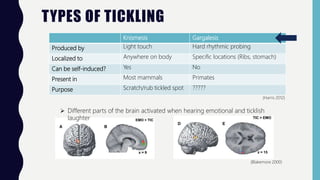
Knismesis Gargalesis
Produced by Light touch Hard rhythmic probing
Localized to Anywhere on body Specific locations (Ribs, stomach)
Can be self-induced? Yes No
Present in Most mammals Primates
Purpose Scratch/rub tickled spot ?????
 Different parts of the brain activated when hearing emotional and ticklish
laughter
(Harris 2012)
(Blakemore 2000)
PSYCHOLOGY OF TICKLING
Is tickling a conditioned response to play?
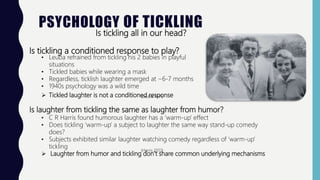
• Leuba refrained from tickling his 2 babies in playful
situations
• Tickled babies while wearing a mask
• Regardless, ticklish laughter emerged at ~6-7 months
• 1940s psychology was a wild time
 Tickled laughter is not a conditioned response
Is laughter from tickling the same as laughter from humor?
• C R Harris found humorous laughter has a ‘warm-up’ effect
• Does tickling ‘warm-up’ a subject to laughter the same way stand-up comedy
does?
• Subjects exhibited similar laughter watching comedy regardless of ‘warm-up’
tickling
 Laughter from humor and tickling don’t share common underlying mechanisms
Is tickling all in our head?
(Leuba 1941)
(Harris 2012)
TICKLING ROBOTSDoes tickling require another person?
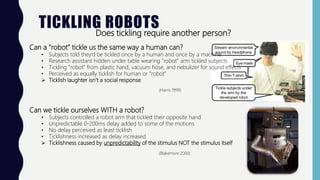
Can a “robot” tickle us the same way a human can?
• Subjects told they’d be tickled once by a human and once by a machine
• Research assistant hidden under table wearing “robot” arm tickled subjects
• Tickling “robot” from plastic hand, vacuum hose, and nebulizer for sound effects
• Perceived as equally ticklish for human or “robot”
 Ticklish laughter isn’t a social response
Can we tickle ourselves WITH a robot?
• Subjects controlled a robot arm that tickled their opposite hand
• Unpredictable 0-200ms delay added to some of the motions
• No delay perceived as least ticklish
• Ticklishness increased as delay increased
 Ticklishness caused by unpredictability of the stimulus NOT the stimulus itself
(Harris 1999)
(Blakemore 2000)
NEUROLOGY OF TICKLINGMore than a reflex
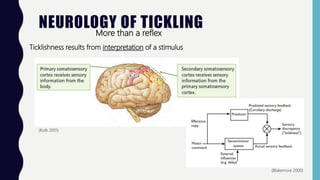
Ticklishness results from interpretation of a stimulus
(Blakemore 2000)
(Kolb 2001)
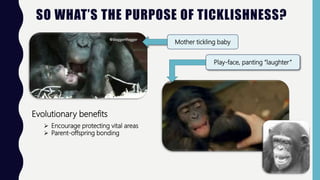
SO WHAT’S THE PURPOSE OF TICKLISHNESS?
Play-face, panting “laughter”
Mother tickling baby
 Encourage protecting vital areas
 Parent-offspring bonding
Evolutionary benefits
REFERENCES
Harris, C. R. "Tickling." (2012): 611-615.
Blakemore, S.J., Wolpert, D., et al., 2000. Why can’t you tickle yourself? NeuroReport 11 (11), R11 –R16
Leuba, Clarence. "Tickling and laughter: Two genetic studies." The Pedagogical Seminary and Journal of Genetic
Psychology 58.1 (1941): 201-209.
Harris, Christine R., and Nicholas Christenfeld. "Can a machine tickle?." Psychonomic bulletin & review 6.3 (1999):
504-510.
Kolb, Bryan, Ian Q. Whishaw, and G. Campbell Teskey. An introduction to brain and behavior. New York: Worth,
2001.

Brain Tickler

  • 1.
  • 2.
  • 3.
    TYPES OF TICKLING KnismesisGargalesis Produced by Light touch Hard rhythmic probing Localized to Anywhere on body Specific locations (Ribs, stomach) Can be self-induced? Yes No Present in Most mammals Primates Purpose Scratch/rub tickled spot ?????  Different parts of the brain activated when hearing emotional and ticklish laughter (Harris 2012) (Blakemore 2000)
  • 4.
    PSYCHOLOGY OF TICKLING Istickling a conditioned response to play? • Leuba refrained from tickling his 2 babies in playful situations • Tickled babies while wearing a mask • Regardless, ticklish laughter emerged at ~6-7 months • 1940s psychology was a wild time  Tickled laughter is not a conditioned response Is laughter from tickling the same as laughter from humor? • C R Harris found humorous laughter has a ‘warm-up’ effect • Does tickling ‘warm-up’ a subject to laughter the same way stand-up comedy does? • Subjects exhibited similar laughter watching comedy regardless of ‘warm-up’ tickling  Laughter from humor and tickling don’t share common underlying mechanisms Is tickling all in our head? (Leuba 1941) (Harris 2012)
  • 5.
    TICKLING ROBOTSDoes ticklingrequire another person? Can a “robot” tickle us the same way a human can? • Subjects told they’d be tickled once by a human and once by a machine • Research assistant hidden under table wearing “robot” arm tickled subjects • Tickling “robot” from plastic hand, vacuum hose, and nebulizer for sound effects • Perceived as equally ticklish for human or “robot”  Ticklish laughter isn’t a social response Can we tickle ourselves WITH a robot? • Subjects controlled a robot arm that tickled their opposite hand • Unpredictable 0-200ms delay added to some of the motions • No delay perceived as least ticklish • Ticklishness increased as delay increased  Ticklishness caused by unpredictability of the stimulus NOT the stimulus itself (Harris 1999) (Blakemore 2000)
  • 6.
    NEUROLOGY OF TICKLINGMorethan a reflex Ticklishness results from interpretation of a stimulus (Blakemore 2000) (Kolb 2001)
  • 7.
    SO WHAT’S THEPURPOSE OF TICKLISHNESS? Play-face, panting “laughter” Mother tickling baby  Encourage protecting vital areas  Parent-offspring bonding Evolutionary benefits
  • 8.
    REFERENCES Harris, C. R."Tickling." (2012): 611-615. Blakemore, S.J., Wolpert, D., et al., 2000. Why can’t you tickle yourself? NeuroReport 11 (11), R11 –R16 Leuba, Clarence. "Tickling and laughter: Two genetic studies." The Pedagogical Seminary and Journal of Genetic Psychology 58.1 (1941): 201-209. Harris, Christine R., and Nicholas Christenfeld. "Can a machine tickle?." Psychonomic bulletin & review 6.3 (1999): 504-510. Kolb, Bryan, Ian Q. Whishaw, and G. Campbell Teskey. An introduction to brain and behavior. New York: Worth, 2001.